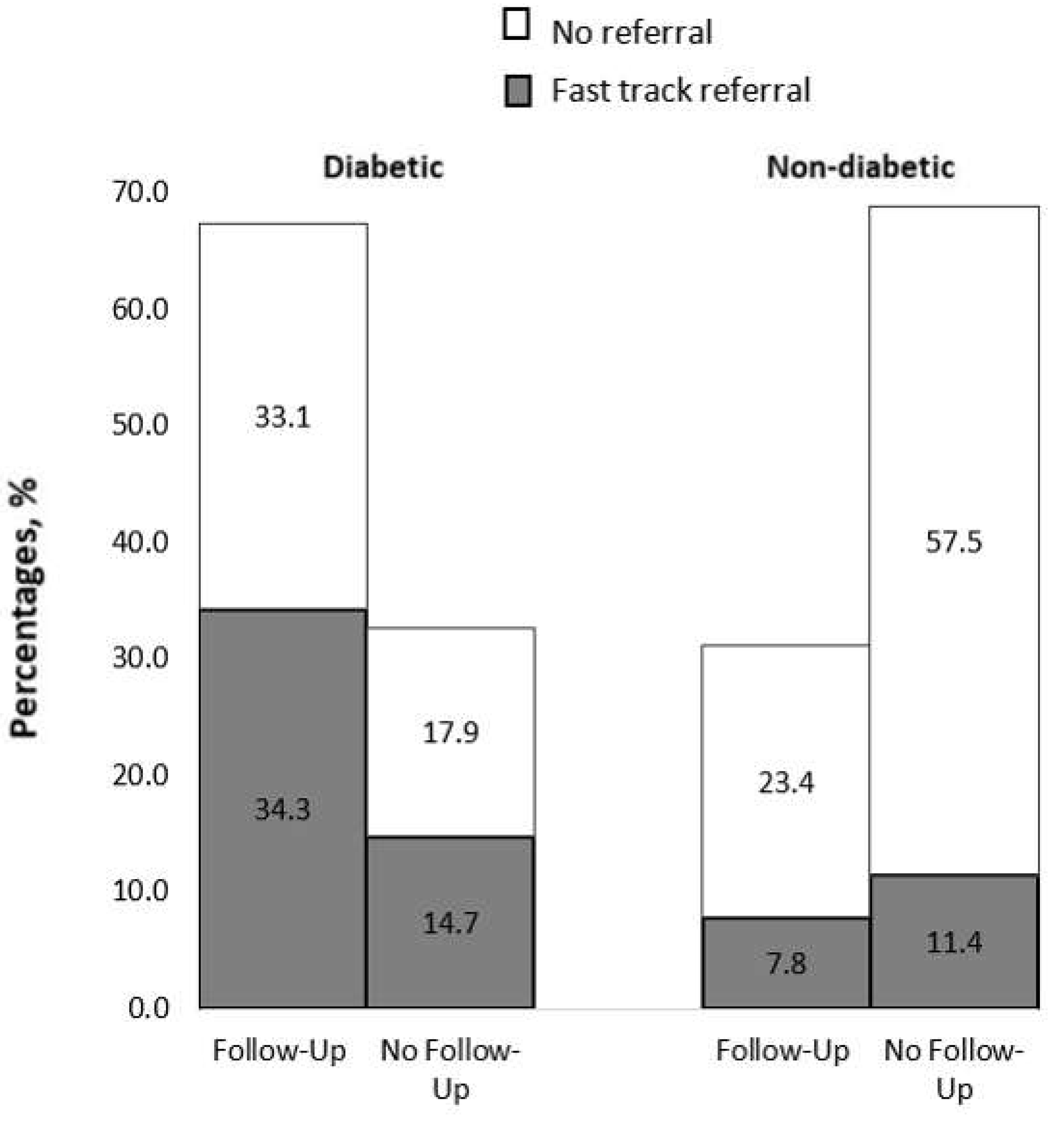
Correction: Liem et al. High Ocular Disease Burden and Increased Referral Needs in Patients with Chronic Kidney Disease: A Step Toward Personalized Care. J. Pers. Med. 2025, 15, 204

 and
and Reference
- Liem, Y.; Thyagarajan, P.; Chee, M.L.; Lim, C.C.; Teo, B.W.; Sabanayagam, C. High Ocular Disease Burden and Increased Referral Needs in Patients with Chronic Kidney Disease: A Step Toward Personalized Care. J. Pers. Med. 2025, 15, 204. [Google Scholar] [CrossRef] [PubMed]


| Referral | Number of Cases | Causes |
|---|---|---|
| Urgent (immediate) | 6 | CRAO, macular hole, PDR, retinal detachment, retinal emboli |
| Semi-urgent (1–2 weeks) | 30 | Central Serous Retinopathy, collaterals with impending occlusion/disc collaterals, CRVO, late AMD, PDR with maculopathy, pseudohole due to ERM |
| Fast-track (1–3 months) | 151 | Cataracts, glaucoma suspect, late AMD, maculopathy, mild NPDR with maculopathy, moderate NPDR, ungradable, treated stable DR |
| Routine (Annually) | 154 | Early AMD, mild NPDR, myopic degeneration, presence of asteroid hyalosis |
Disclaimer/Publisher’s Note: The statements, opinions and data contained in all publications are solely those of the individual author(s) and contributor(s) and not of MDPI and/or the editor(s). MDPI and/or the editor(s) disclaim responsibility for any injury to people or property resulting from any ideas, methods, instructions or products referred to in the content. |
© 2025 by the authors. Licensee MDPI, Basel, Switzerland. This article is an open access article distributed under the terms and conditions of the Creative Commons Attribution (CC BY) license (https://creativecommons.org/licenses/by/4.0/).
Share and Cite
Liem, Y.; Thyagarajan, P.; Chee, M.L.; Lim, C.C.; Teo, B.W.; Sabanayagam, C. Correction: Liem et al. High Ocular Disease Burden and Increased Referral Needs in Patients with Chronic Kidney Disease: A Step Toward Personalized Care. J. Pers. Med. 2025, 15, 204. J. Pers. Med. 2025, 15, 494. https://doi.org/10.3390/jpm15100494
Liem Y, Thyagarajan P, Chee ML, Lim CC, Teo BW, Sabanayagam C. Correction: Liem et al. High Ocular Disease Burden and Increased Referral Needs in Patients with Chronic Kidney Disease: A Step Toward Personalized Care. J. Pers. Med. 2025, 15, 204. Journal of Personalized Medicine. 2025; 15(10):494. https://doi.org/10.3390/jpm15100494
Chicago/Turabian StyleLiem, Yulia, Pavitra Thyagarajan, Miao Li Chee, Cynthia Ciwei Lim, Boon Wee Teo, and Charumathi Sabanayagam. 2025. "Correction: Liem et al. High Ocular Disease Burden and Increased Referral Needs in Patients with Chronic Kidney Disease: A Step Toward Personalized Care. J. Pers. Med. 2025, 15, 204" Journal of Personalized Medicine 15, no. 10: 494. https://doi.org/10.3390/jpm15100494
APA StyleLiem, Y., Thyagarajan, P., Chee, M. L., Lim, C. C., Teo, B. W., & Sabanayagam, C. (2025). Correction: Liem et al. High Ocular Disease Burden and Increased Referral Needs in Patients with Chronic Kidney Disease: A Step Toward Personalized Care. J. Pers. Med. 2025, 15, 204. Journal of Personalized Medicine, 15(10), 494. https://doi.org/10.3390/jpm15100494