The Accuracy and Sensitivity of Delta Neutrophil Index in Malignancy: Diagnostic Study of Different Types

 , , , and
Abstract
1. Introduction
2. Materials and Methods
2.1. Study Design, Setting, and Data Sources
2.2. Participants and Eligibility
2.3. Variables and Timing of Measurements
2.4. Statistical Analysis
3. Results
4. Discussion
5. Conclusions
Author Contributions
Funding
Institutional Review Board Statement
Informed Consent Statement
Data Availability Statement
Conflicts of Interest
References
- Kotrych, D.; Ciechanowicz, D.; Pawlik, J.; Brodecki, A.; Białomyzy, A.; Prowans, P.; Bohatyrewicz, A.; Szostakowski, B. Delay in Diagnosis and Treatment of Primary Bone Tumors. Ortop. Traumatol. Rehabil. 2023, 25, 9–22. [Google Scholar] [CrossRef]
- Kurilchik, A.A.; Ivanov, V.E.; Starodubtsev, A.L.; Zubarev, A.L. Common errors in the treatment of patients with malignant bone tumors. Grek. Bull. Surg. 2021, 180, 87–92. [Google Scholar] [CrossRef]
- Jacofsky, D.J. Tumors Around the Knee—What Orthopaedists Should Know. J. Knee Surg. 2022, 35, 583–584. [Google Scholar] [CrossRef]
- Goker, B.; Shea, M.; Zhang, R.; Wang, J.; Ferrena, A.; Chae, S.-S.; Borjihan, H.; Yang, R.; Hoang, B.H.; Geller, D.S.; et al. The evolution of the multidisciplinary tumor board in orthopedic oncology: From its historical roots to its future potential. Holist. Integr. Oncol. 2024, 3, 36. [Google Scholar] [CrossRef]
- Piña, D.; Kalistratova, V.; Boozé, Z.; Voort, W.V.; Conry, K.; Fine, J.; Holland, J.; Wick, J.; Ortega, B.; Javidan, Y.; et al. Sociodemographic Characteristics of Patients Undergoing Surgery for Metastatic Disease of the Spine. J. Am. Acad. Orthop. Surg. 2023, 31, e675–e684. [Google Scholar] [CrossRef]
- Zhou, Y.; Tao, L.; Qiu, J.; Xu, J.; Yang, X.; Zhang, Y.; Tian, X.; Guan, X.; Cen, X.; Zhao, Y. Tumor biomarkers for diagnosis, prognosis and targeted therapy. Signal Transduct. Target. Ther. 2024, 9, 132. [Google Scholar] [CrossRef]
- Hart, P.C.; Rajab, I.M.; Alebraheem, M.; Potempa, L.A. C-Reactive Protein and Cancer—Diagnostic and Therapeutic Insights. Front. Immunol. 2020, 11, 595835. [Google Scholar] [CrossRef]
- Abdollahi, O.; Vosoughi, T.; Talebi, A.; Karimpourian, H.; Rastegar, M.; Farhadi, E. Investigation of ESR Values in the Diagnosis of Malignancies: A Cross-Sectional Study. Health Sci. Rep. 2025, 8, e71208. [Google Scholar] [CrossRef]
- Grecian, R.; Whyte, M.K.B.; Walmsley, S.R. The role of neutrophils in cancer. Br. Med. Bull. 2018, 128, 5–14. [Google Scholar] [CrossRef] [PubMed] [PubMed Central]
- Nierhaus, A.; Klatte, S.; Linssen, J.; Eismann, N.M.; Wichmann, D.; Hedke, J.; A Braune, S.; Kluge, S. Revisiting the white blood cell count: Immature granulocytes count as a diagnostic marker to discriminate between SIRS and sepsis—A prospective, observational study. BMC Immunol. 2013, 14, 8. [Google Scholar] [CrossRef]
- Bozan, M.B.; Yazar, F.M.; Kale, I.T.; Topuz, S.; Bozan, A.A.; Boran, O.F. Immature Granulocyte Count and Delta Neutrophil Index as New Predictive Factors for Axillary Metastasis of Breast Cancer. J. Coll. Physicians Surg. Pak. JCPSP 2022, 32, 220–225. [Google Scholar] [CrossRef]
- Bozan, M.B.; Yazar, F.M.; Kale, I.T.; Yüzbaşıoğlu, M.F.; Boran, Ö.F.; Bozan, A.A. Delta Neutrophil Index and Neutrophil-to-Lymphocyte Ratio in the Differentiation of Thyroid Malignancy and Nodular Goiter. World J. Surg. 2021, 45, 507–514. [Google Scholar] [CrossRef]
- Park, B.H.; Kang, Y.A.; Park, M.S.; Jung, W.J.; Lee, S.H.; Lee, S.K.; Kim, S.Y.; Kim, S.K.; Chang, J.; Jung, J.Y.; et al. Delta neutrophil index as an early marker of disease severity in critically ill patients with sepsis. BMC Infect. Dis. 2011, 11, 299. [Google Scholar] [CrossRef] [PubMed]
- Wickham, H. ggplot2: Elegant Graphics for Data Analysis; Springer: New York, NY, USA, 2016. [Google Scholar] [CrossRef]
- Wickham, H.; Bryan, J. Readxl: Read Excel Files, R Package Version 1.3.1. 2019. Available online: https://CRAN.R-project.org/package=readxl (accessed on 20 September 2025).
- Kuhn, M. Building Predictive Models in R Using the caret Package. J. Stat. Softw. 2008, 28, 1–26. [Google Scholar] [CrossRef]
- Robin, X.; Turck, N.; Hainard, A.; Tiberti, N.; Lisacek, F.; Sanchez, J.-C.; Müller, M. pROC: An open-source package for R and S+ to analyze and compare ROC curves. BMC Bioinform. 2011, 12, 77. [Google Scholar] [CrossRef]
- Wickham, H.; François, R.; Henry, L.; Müller, K.; Vaughan, D. dplyr: A Grammar of Data Manipulation. Available online: https://dplyr.tidyverse.org (accessed on 20 September 2025).
- Meyer, D.; Dimitriadou, E.; Hornik, K.; Weingessel, A.; Leisch, F.; Chang, C.-C.; Lin, C.-C. Misc Functions of the Department of Statistics (e1071), R Package Version 1.7-0.1; TU Wien: Vienna, Austria, 2019. [Google Scholar]
- Barut, O.; Demirkol, M.K.; Kucukdurmaz, F.; Sahinkanat, T.; Resim, S. Pre-treatment Delta Neutrophil Index as a Predictive Factor in Renal Cell Carcinoma. J. Coll. Physicians Surg. Pak. JCPSP 2021, 31, 156–161. [Google Scholar] [CrossRef] [PubMed]
- Zheng, J.; Zheng, L.; Wang, X.; Mao, X.; Wang, Q.; Yang, Y.; Mo, D. The Clinical Value of the Combined Detection of Systemic Immune-Inflammation Index (SII), Systemic Inflammation Response Index (SIRI), and Prognostic Nutritional Index (PNI) in Early Diagnosis of Gastric Cancer. J. Inflamm. Res. 2025, 18, 813–826. [Google Scholar] [CrossRef]
- Ge, J.; Lei, Y.; Wen, Q.; Zhang, Y.; Kong, X.; Wang, W.; Qian, S.; Hou, H.; Wang, Z.; Wu, S.; et al. The prognostic nutritional index, an independent predictor of overall survival for newly diagnosed follicular lymphoma in China. Front. Nutr. 2022, 9, 981338. [Google Scholar] [CrossRef]
- Kose, C.; Körpe, B.; Korkmaz, V.; Ustun, Y. Predictive Role of Delta Neutrophil Index in Endometrial Cancer: A Promising Biomarker for Diagnosis. Duzce Med. J. 2023, 25, 185–188. [Google Scholar] [CrossRef]
- Alkurt, E.G.; Tutan, M.B. Diagnostic value of delta neutrophil index in determining axillary metastases in breast cancer. J. Med. Palliat. Care 2022, 3, 216–220. [Google Scholar] [CrossRef]
- Chan, J.Y.; Zhang, Z.; Chew, W.; Tan, G.F.; Lim, C.L.; Zhou, L.; Goh, W.L.; Poon, E.; Somasundaram, N.; Selvarajan, S.; et al. Biological significance and prognostic relevance of peripheral blood neutrophil-to-lymphocyte ratio in soft tissue sarcoma. Sci. Rep. 2018, 8, 11959. [Google Scholar] [CrossRef] [PubMed]
- Fiore, M.; Ljevar, S.; Pasquali, S.; Morelli, D.; Callegaro, D.; Sanfilippo, R.; Barisella, M.; Sangalli, C.; Miceli, R.; Gronchi, A. Preoperative Neutrophil-to-Lymphocyte Ratio and a New Inflammatory Biomarkers Prognostic Index for Primary Retroperitoneal Sarcomas: Retrospective Monocentric Study. Clin. Cancer Res. 2022, 29, 614–620. [Google Scholar] [CrossRef] [PubMed]
- Winarto, H.; Habiburrahman, M.; Anggraeni, T.D.; Nuryanto, K.H.; Julianti, R.A.; Purwoto, G.; Andrijono, A. The Utility of Pre-Treatment Inflammation Markers as Associative Factors to the Adverse Outcomes of Vulvar Cancer: A Study on Staging, Nodal Involvement, and Metastasis Models. J. Clin. Med. 2023, 12, 96. [Google Scholar] [CrossRef] [PubMed]



| Variables | Participants (n = 1313) |
|---|---|
| Gender | |
| Male | 762 (58%) |
| Female | 551 (42%) |
| Age | 63 (53–70) |
| CRP | 19.23 (5.05–58.40) |
| DNI | 0.4 (0.3–0.8) |
| GGT | 31 (18–66) |
| AST | 20 (15–28) |
| ALT | 15 (11–25) |
| LDH | 229 (184–329) |
| AFP | 2.23 (1.45–3.89) |
| ALP | 94 (73–139) |
| Direct bilirubin | 0.2 (0.14–0.29) |
| Indirect bilirubin | 0.26 (0.17–0.41) |
| PT | 9.40 (8.83–10.10) |
| APTT | 27.5 (25.4–29.9) |
| INR | 1.03 (0.97–1.11) |
| PCT | 0.11 (0.06–0.25) |
| CA19-9 | 23.90 (8–99.50) |
| CEA | 3.57 (1.71–15.50) |
| CA15-3 | 26.70 (16.70–49.55) |
| CA125 | 43.10 (14.60–152) |
| WBC | 8.05 (5.97–10.52) |
| Lymphocyte percentage | 22.80 (14.80–31.20) |
| Neutrophil percentage | 65.1 (54.4–74.2) |
| Tumor Classification | |
| Hematological | 361 (27.5%) |
| Carcinoma | 826 (62.9%) |
| Melanoma | 13 (1%) |
| Sarcoma | 113 (8.6%) |
| Variables | Hematological (n = 361) | Carcinoma (n = 826) | Melanoma (n = 13) | Sarcoma (n = 113) | p-Value | Effect Size () |
|---|---|---|---|---|---|---|
| Age | 60 (45–69) a | 64 (57–70) bc | 66 (59–78) c | 54 (38–65) d | <0.001 * | 0.045 |
| CRP | 18.61 a (4.53–53.97) | 22.51 ca (6.70–61.90) | 5.51 abc (1.98–31.77) | 6.83 b (2.69–34.18) | <0.001 * | 0.025 |
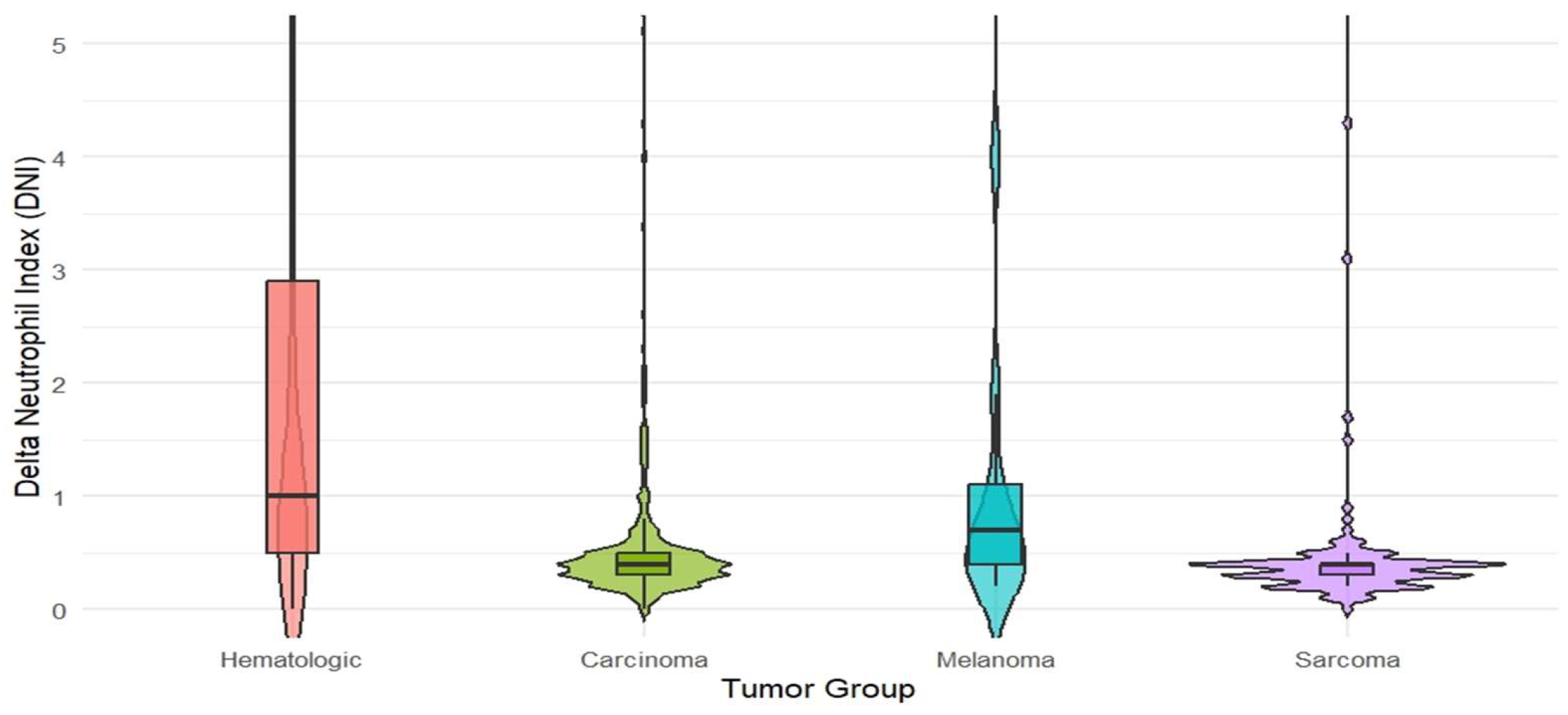
| DNI | 1 a (0.5–2.9) | 0.4 b (0.3–0.5) | 0.7 abc (0.4–1.1) | 0.4 cb (0.3–0.4) | <0.001 * | 0.151 |
| Procalcitonin | 0.09 a (0.06–0.20) | 0.13 b (0.06–0.30) | 0.09 abc (0.05–0.19) | 0.06 c (0.03–0.13) | <0.001 * | 0.043 |
| DNI (Categoric) | ||||||
| 0.6 | 113 (31.3%) | 674 (81.6%) | 6 (46.2%) | 104 (92%) | ||
| >0.6 | 248 (68.7%) | 152 (18.4%) | 7 (53.8%) | 9 (8%) | <0.001 ** | 0.500 |
| Pathology of Hematological Tumors (n = 361) | DNI | p-Value |
|---|---|---|
| ALL (n = 27) | 1.7 (0.8–4.5) | <0.001 |
| AML (n = 115) | 1.7 (0.9–5.8) | |
| Hodgkin Lymphoma (n = 28) | 0.7 (0.4–1.1) | |
| CLL (n = 18) | 0.4 (0.2–0.6) | |
| CML (n = 10) | 19.9 (5.4–30.8) | |
| Multiple Myeloma (n = 57) | 1 (0.7–3) | |
| Non-Hodgkin Lymphoma (n = 104) | 0.7 (0.4–1) | |
| Plazmositoma (n = 2) | 0.6 (0.4–0.7) | |
| Pathology of carcinoma tumors (n = 826) | DNI | p-value |
| Pulmonary (n = 242) | 0.4 (0.3–0.5) | <0.001 |
| Skin (n = 7) | 0.5 (0.3–0.5) | |
| Oral cavity (n = 8) | 0.2 (0.2–0.3) | |
| Endometrium (n = 37) | 0.4 (0.3–0.7) | |
| Pharyngeal (n = 15) | 0.3 (0.3–0.5) | |
| Hepatocellular (n = 13) | 0.5 (0.3–0.7) | |
| Colangiocellular (n = 16) | 0.3 (0.2–0.5) | |
| Colorectal (n = 144) | 0.4 (0.3–0.5) | |
| Laryngeal (n = 21) | 0.3 (0.2–0.4) | |
| Breast (n = 114) | 0.4 (0.3–0.5) | |
| Urothelial (n = 24) | 0.5 (0.4–0.7) | |
| Gastric (n = 88) | 0.4 (0.3–0.5) | |
| Over (n = 38) | 0.4 (0.3–0.6) | |
| Oesophageal (n = 8) | 0.4 (0.4–0.5) | |
| Pancreatic (n = 58) | 0.3 (0.3–0.5) | |
| Parotideal (n = 4) | 0.4 (0.2–0.4) | |
| Peritoneal (n = 4) | 0.4 (0.4–0.4) | |
| Prostate (n = 28) | 0.8 (0.5–2.1) | |
| Renal cell (n = 19) | 0.3 (0.3–0.5) | |
| Cervix (n = 7) | 0.4 (0.2–0.7) | |
| Thyroideal (n = 5) | 0.5 (0.2–1) |
| Tumor Classification | OR (95% CI) | p-Value |
|---|---|---|
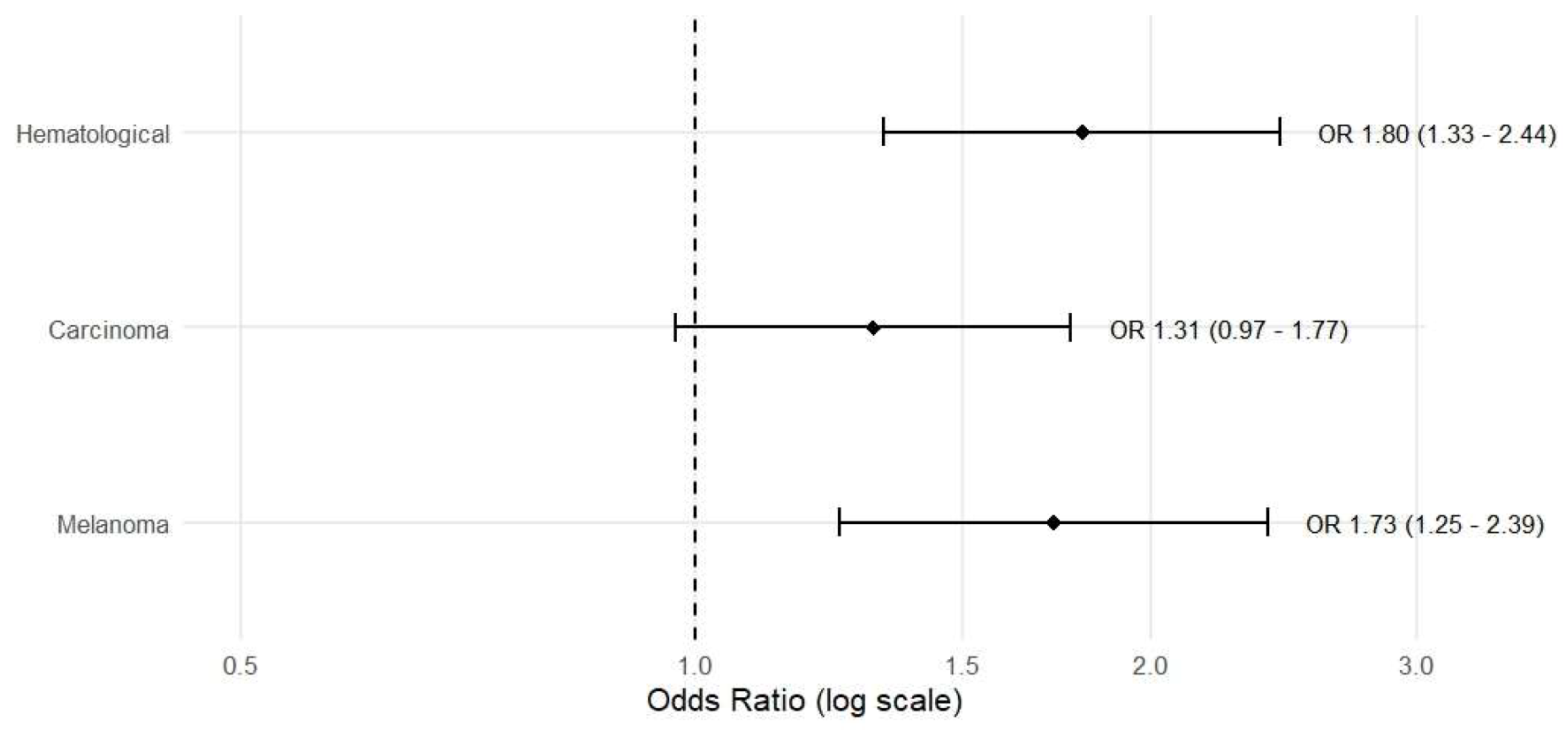
| Hematological | 1.801 (1.332–2.436) | <0.001 |
| Carcinoma | 1.310 (0.970–1.771) | 0.079 |
| Melanoma | 1.725 (1.245–2.390) | 0.001 |
| Comparison | AUC * | Cut-Off | Sensitivity | Specificity |
|---|---|---|---|---|
| Hematologic vs Carcinoma | 0.734 | 0.209 | 0.731 | 0.794 |
| Hematologic vs. Melanoma | 0.368 | 0.183 | 0.815 | 0.333 |
| Hematologic vs. Sarcoma | 0.780 | 0.196 | 0.778 | 0.879 |
| Carcinoma vs. Melanoma | 0.735 | 0.314 | 0.960 | 0.667 |
| Carcinoma vs. Sarcoma | 0.376 | 0.188 | 1.000 | 0.030 |
| Melanoma vs. Sarcoma | 0.753 | 0.017 | 0.667 | 0.939 |
| Comparison | AUC * |
|---|---|
| Hematologic | 0.735 |
| Carcinoma | 0.652 |
| Melanoma | 0.692 |
| Sarcoma | 0.672 |
Disclaimer/Publisher’s Note: The statements, opinions and data contained in all publications are solely those of the individual author(s) and contributor(s) and not of MDPI and/or the editor(s). MDPI and/or the editor(s) disclaim responsibility for any injury to people or property resulting from any ideas, methods, instructions or products referred to in the content. |
© 2025 by the authors. Licensee MDPI, Basel, Switzerland. This article is an open access article distributed under the terms and conditions of the Creative Commons Attribution (CC BY) license (https://creativecommons.org/licenses/by/4.0/).
Share and Cite
Tepedelenlioğlu, H.E.; Çevik, H.B.; Yildirim, Ö.A.; Güneş, A.K.; Akgün, E.; Avcı, H. The Accuracy and Sensitivity of Delta Neutrophil Index in Malignancy: Diagnostic Study of Different Types. Diagnostics 2025, 15, 3187. https://doi.org/10.3390/diagnostics15243187
Tepedelenlioğlu HE, Çevik HB, Yildirim ÖA, Güneş AK, Akgün E, Avcı H. The Accuracy and Sensitivity of Delta Neutrophil Index in Malignancy: Diagnostic Study of Different Types. Diagnostics. 2025; 15(24):3187. https://doi.org/10.3390/diagnostics15243187
Chicago/Turabian StyleTepedelenlioğlu, Hüseyin Emre, Hüseyin Bilgehan Çevik, Özgen Ahmet Yildirim, Ahmet Kürşat Güneş, Erkan Akgün, and Hanife Avcı. 2025. "The Accuracy and Sensitivity of Delta Neutrophil Index in Malignancy: Diagnostic Study of Different Types" Diagnostics 15, no. 24: 3187. https://doi.org/10.3390/diagnostics15243187
APA StyleTepedelenlioğlu, H. E., Çevik, H. B., Yildirim, Ö. A., Güneş, A. K., Akgün, E., & Avcı, H. (2025). The Accuracy and Sensitivity of Delta Neutrophil Index in Malignancy: Diagnostic Study of Different Types. Diagnostics, 15(24), 3187. https://doi.org/10.3390/diagnostics15243187