Abstract
Background: Oral cancer is a major global health burden with heterogeneous survival outcomes. This study aimed to identify clinicopathological factors, particularly lymph node-related parameters, associated with prognosis in patients with oral cancer and to construct a survival model for predicting overall survival (OS). Methods: A total of 174 patients with oral cancer who underwent surgery between January 2018 and November 2021 were retrospectively analyzed. Clinicopathological variables, including age, gender, body mass index (BMI), pathological T, N and overall stage, tumor subsite, perineural invasion (PNI), lymphovascular invasion (LVI), surgical margin status, lymph node yield (LNY), lymph node metastases (LNM), and lymph node ratio (LNR), were evaluated. Univariate and multivariate Cox regression analyses were performed to identify independent prognostic factors for OS and disease-specific survival (DSS). Results: Univariate analysis showed that older age, lower BMI, advanced pathological stage, presence of PNI or LVI, positive/close margins, LNY < 15, LNM ≥ 3, and LNR ≥ 0.0454 were significantly associated with poorer OS. Multivariate analysis identified age ≥ 63 years, pathological stage 3–4, LNY < 15, LNM ≥ 3, and LNR ≥ 0.0454 as independent predictors of OS. LNR ≥ 0.0454 was the only independent predictor of DSS. A survival model incorporating age, pathological stage, LNY, LNM, and LNR demonstrated good discriminatory ability for OS. Conclusions: Multiple independent prognostic factors for oral cancer survival were identified. The proposed survival model provides a practical tool for risk stratification and may assist personalized treatment planning, with particular emphasis on lymph node-related parameters.
1. Introduction
Oral cancer is a major global health issue, ranking as the sixth most common cancer worldwide with over 600,000 new cases diagnosed annually [1,2]. Despite advances in diagnostic methods, surgical techniques, and multimodal treatments over recent decades, the prognosis remains suboptimal, with 5-year survival rates generally between 60% and 70% in many regions [2,3]. This highlights the need for improved prognostic tools and personalized treatment strategies.
The tumor-node-metastasis (TNM) staging system, established by the American Joint Committee on Cancer (AJCC), has been the cornerstone for oral cancer prognosis [4]. However, patients with identical TNM stages often experience diverse clinical outcomes, indicating that factors beyond tumor size, nodal involvement, and metastasis influence prognosis [5,6]. This has driven research into additional clinicopathological factors as potential prognostic markers. Among these, pathological features such as perineural invasion (PNI), lymphovascular invasion (LVI) and surgical margins have emerged as important prognostic factors. PNI, defined as tumor invasion into nerve sheaths, correlates with higher rates of locoregional recurrence and reduced survival [7,8]. LVI, defined as the presence of tumor cells within lymphatic or blood vessels, has been linked to higher rates of nodal metastasis and poorer outcomes [7,8]. Surgical margin status reflects the completeness of tumor excision, with positive or close margins linked to elevated risks of local recurrence and decreased survival [9].
Recently, lymph node-related parameters have attracted growing attention as valuable prognostic indicators. The lymph node ratio (LNR), defined as the ratio of positive lymph nodes to the total number of lymph nodes examined, has demonstrated significant prognostic value across various head and neck cancers, including oral cavity malignancies [10,11,12]. Ebrahimi et al. reported that LNR independently predicted survival in oral squamous cell carcinoma patients, even after adjusting for traditional TNM staging [10]. Similarly, Patel et al., in a large international study, found that LNR outperformed the conventional nodal staging system in predicting outcomes [11]. The concept of lymph node yield (LNY), representing the total number of lymph nodes retrieved during neck dissection, has also emerged as a potential prognostic factor [13,14]. Ebrahimi et al. demonstrated that higher LNY was associated with improved survival in oral cancer patients, suggesting that more comprehensive lymphadenectomy may have therapeutic benefits [13]. This finding was corroborated by Divi et al., who reported that lymph node count independently predicted mortality in head and neck cancer patients [14]. Furthermore, the absolute number of lymph node metastases (LNM) has also been identified as a strong prognostic indicator, with studies by Roberts et al. suggesting that LNM may be superior to both LNR and conventional AJCC N staging in predicting outcomes [15].
Prognostic nomograms that integrate clinicopathological variables have emerged as valuable tools for personalized risk stratification in oral cancer [16,17,18]. Montero et al. developed a preoperative nomogram incorporating age, sex, clinical T/N stage, and tumor site, enabling individualized risk assessment before surgery [17]. Similarly, Wang et al. constructed postoperative nomograms integrating age, sex, pathological T/N stage, and tumor site to estimate both overall survival (OS) and disease-specific survival (DSS) [18]. These tools may facilitate more informed clinical decision-making regarding treatment intensity, adjuvant therapy, and surveillance strategies. However, both models primarily rely on conventional predictors, lacking integration of important pathological features such as surgical margin status, PNI, LVI, and detailed lymph node-related parameters. Comprehensive analyses incorporating a wider array of clinicopathological features, particularly lymph node-related parameters, remain limited in the literature.
This study aims to identify clinicopathological factors, particularly comprehensive lymph node parameters, associated with OS and DSS in oral cancer patients, and to develop an integrated prognostic survival model for improved risk stratification and personalized treatment planning.
2. Materials and Methods
2.1. Ethical Considerations
This retrospective study was conducted at a tertiary medical center and approved by the institutional ethical review board (No.113210-E), and the requirement for informed consent was waived due to the retrospective nature of the study. The study adhered to the Declaration of Helsinki.
2.2. Study Population and Data Collection
This retrospective study included 174 patients diagnosed with oral cancer who underwent surgery between January 2018 and November 2021. Patient information was extracted from the hospital’s cancer registry database. The collected clinicopathological variables included age, gender, body height (BH), body weight (BW), body mass index (BMI), smoking and alcohol history, tumor size, pathological TNM stage (T stage, N stage, overall stage), tumor subsite, adjuvant treatment, follow-up duration, recurrence status, perineural invasion (PNI), lymphovascular invasion (LVI), surgical margin status, lymph node yield (LNY), lymph node metastases (LNM), lymph node ratio (LNR), and survival status. Adjuvant therapy was classified as radiotherapy (RT), chemotherapy (CT), or concurrent chemoradiotherapy (CRT). The follow-up duration was calculated from the date of cancer diagnosis to either the date of death or the last documented clinical contact. The surveillance protocol consisted of monthly clinical evaluations during the first year, followed by assessments every two months in the second year and every three months until the fifth year. Imaging studies with CT or MRI were performed every six months during the first two years and thereafter annually or as clinically indicated. Patterns of failure were classified as locoregional recurrence or distant metastasis.
2.3. Definitions and Cut-Off Values
Pathological T stage, N stage, and overall stage (pStage) were classified according to the 8th edition of the American Joint Committee on Cancer (AJCC) TNM staging system. PNI and LVI were classified as absent or present. Surgical margin was classified as free or positive/close. Cut-off values for key variables were determined by ROC analysis using the Youden index: age (63 years), BMI (23.5 kg/m2), overall stage (pStage 1+2 vs. 3+4), LNY (15 nodes), LNM (3 nodes), and LNR (0.0454).
2.4. Statistical Analysis
All statistical analyses were performed using STATA version 14.0 (Stata Corporation, College Station, TX, USA). Continuous variables were reported as mean ± standard deviation (interquartile range), while categorical variables were presented as counts and percentages. Survival analysis employed the Kaplan–Meier method, with group differences assessed via the log-rank test. Univariate and multivariate Cox regression analyses were used to identify independent prognostic factors for overall survival (OS) and disease-specific survival (DSS). A prognostic survival model using nomogram was created based on the multivariate analysis, and patients were stratified into three risk groups using a two-threshold approach derived from ROC curve analysis. This dual-threshold method provides clearer differentiation of risk levels compared to traditional single-threshold classification, facilitating more clinically meaningful risk categorization and decision-making. Statistical significance was defined as p-value < 0.05.
3. Results
The cohort comprised 154 men (88.51%) and 20 women (11.49%), with a mean age of 55.6 ± 9.9 years (Table 1). The mean BMI was 25.5 ± 4.6 kg/m2 (range: 15.01–41.15 kg/m2). Smoking and alcohol consumption were reported in 135 (77.59%) and 110 (63.22%) patients, respectively. Tumor characteristics were as follows: 40 (22.99%) patients had pT1, 39 (22.41%) had pT2, 45 (25.86%) had pT3, and 50 (28.74%) had pT4 disease. The mean tumor size was 31.5 ± 18.2 mm (range: 1–100 mm). Primary subsites included the tongue (n = 64), buccal mucosa (n = 55), gingiva (n = 30), lip (n = 9), retromolar trigone (n = 8), floor of mouth (n = 5), and hard palate (n = 3). Nodal status showed 113 (65.94%) patients with pN0, 19 (10.92%) with pN1, 16 (9.19%) with pN2, and 26 (14.94%) with pN3 disease. Pathological stage distribution was: 34 (19.54%) pStage 1, 25 (14.37%) pStage 2, 38 (21.84%) pStage 3, and 77 (44.25%) pStage 4. Perineural invasion (PNI) and lymphovascular invasion (LVI) were present in 72 (41.38%) and 84 (48.28%) patients, respectively. Surgical margins were clear in 154 (88.51%) patients, and positive or close in 20 (11.49%). The mean surgical margin distance was 5.74 ± 5.60 mm. The mean lymph node yield (LNY) was 28.4 ± 17.6 nodes (range: 1–90), and mean lymph node metastases (LNM) was 1 ± 2.2 nodes (range: 0–15). The mean lymph node ratio (LNR) was 0.428 ± 0.102 (range: 0–0.75), with 41 (23.56%) patients having an LNR ≥ 0.0454.
Table 1.
Clinical and pathological characteristics of included patients.
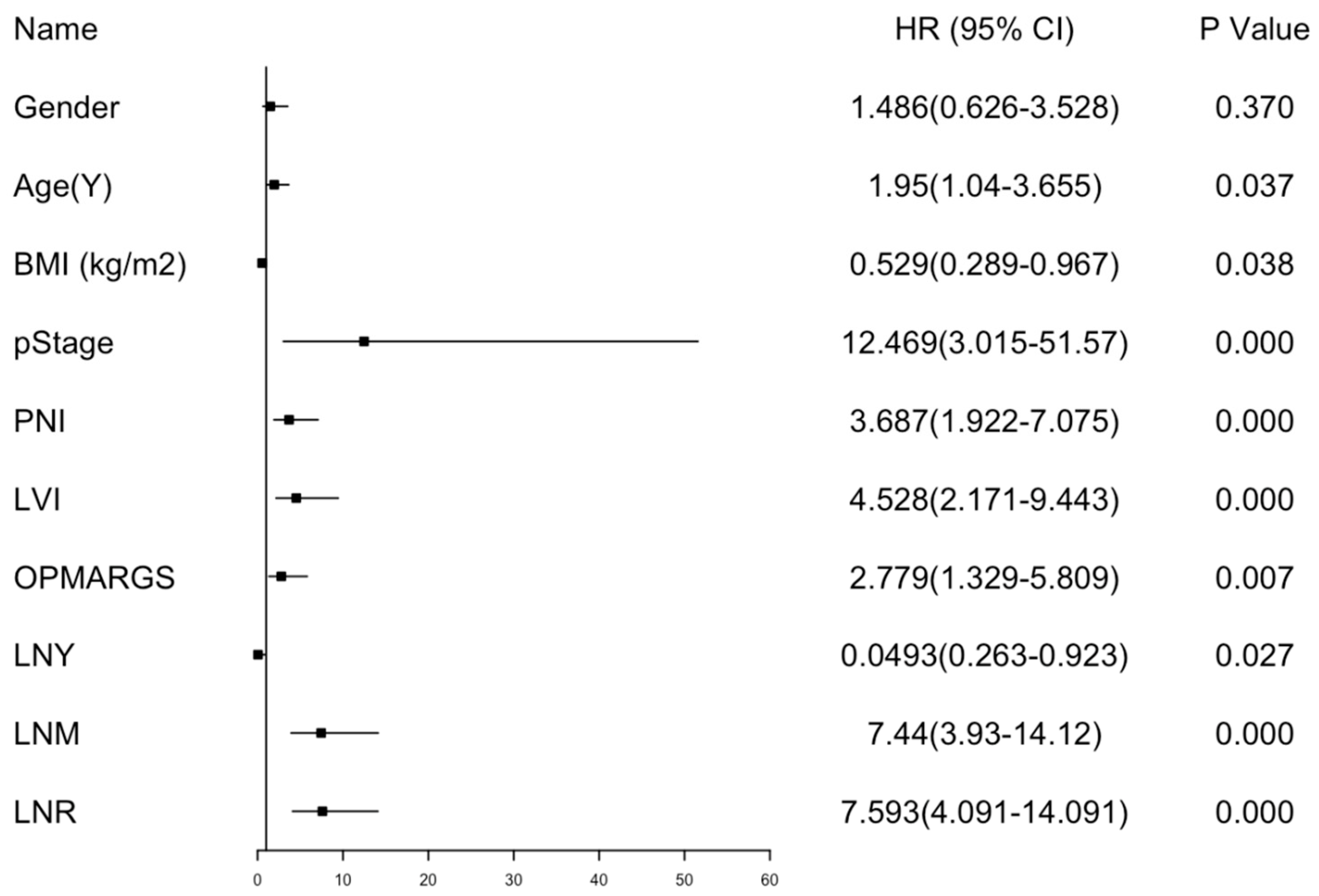
At analysis, 131 (75.29%) patients were alive, and 43 (24.71%) had died. The follow-up duration was 869 ± 4454 days. Locoregional recurrence occurred in 23 patients, while 17 patients developed distant metastases. Univariate Cox regression analysis (Table 2 and Figure 1) identified significant factors affecting OS: age ≥ 63 years (HR = 1.950, 95% CI: 1.040–3.655, p = 0.037), BMI < 23.5 kg/m2 (HR = 0.529, 95%CI: 0.289–0.967, p = 0.038), advanced pT stage (pT2: HR = 5.198, 95%CI: 1.139–23.724, p = 0.033; pT3: HR = 7.311, 95%CI: 1.672–31.976, p = 0.008; pT4: HR = 7.344, 95%CI: 1.688–31.953, p = 0.008), advanced pN stage (pN2: HR = 6.291, 95%CI: 2.718–14.564, p < 0.001; pN3: HR = 7.457, 95%CI: 3.620–15.362, p < 0.001), pStage 3+4 (HR = 12.469, 95%CI: 3.015–51.570, p < 0.001), presence of PNI (HR = 3.687, 95%CI: 1.922–7.075, p < 0.001), presence of LVI (HR = 4.528, 95%CI: 2.171–9.443, p < 0.001), positive surgical margins (HR = 2.779, 95%CI: 1.329–5.809, p = 0.007), LNY <15 (HR = 0.049, 95%CI: 0.263–0.923, p = 0.027), LNM ≥3 (HR = 7.440, 95%CI: 3.930–14.120, p < 0.001), and LNR ≥0.0454 (HR = 7.593, 95%CI: 4.091–14.091, p < 0.001). Kaplan–Meier survival analysis revealed significant OS differences by age, pathological stage, LNY, LNM, and LNR. Five-year survival rates were 61% vs. 73% for patients ≥ 63 vs. < 63 years (p = 0.037), 96% vs. 58% for pStage 1+2 vs. 3+4 (p < 0.001), 75% vs. 51% for LNY ≥ 15 vs. < 15 (p = 0.027), 15% vs. 77% for LNM ≥ 3 vs. < 3 (p < 0.001), and 23% vs. 85% for LNR ≥ 0.0454 vs. < 0.0454 (p < 0.001). Multivariate Cox regression analysis identified the following independent prognostic factors for OS: age ≥63 years (HR = 2.154, 95%CI: 1.115–4.163, p = 0.022), pStage 3+4 (HR = 7.424, 95%CI: 1.687–32.666, p = 0.008), LNY <15 (HR = 0.355, 95%CI: 0.180–0.698, p = 0.003), LNM ≥3 (HR = 3.833, 95%CI: 1.620–9.070, p = 0.002), and LNR ≥0.0454 (HR = 2.154, 95%CI: 1.115–4.163, p = 0.022).
Table 2.
Univariate and multivariate COX regression analyses of factors related to OS in oral cancer patients.
Figure 1.
Forest plot of OS with the variables included in the univariable analysis. Note. Abbreviation: OS, overall survival; HR, hazard ratio; 95% CI, 95% confidence interval; BMI, body mass index; pStage, pathological overall stage; PNI, perineural invasion; LVI, lymphovascular invasion; OPMARGS, Surgical margin; LNY, lymph node yield; LNM, lymph node metastases; LNR, lymph node ratio.
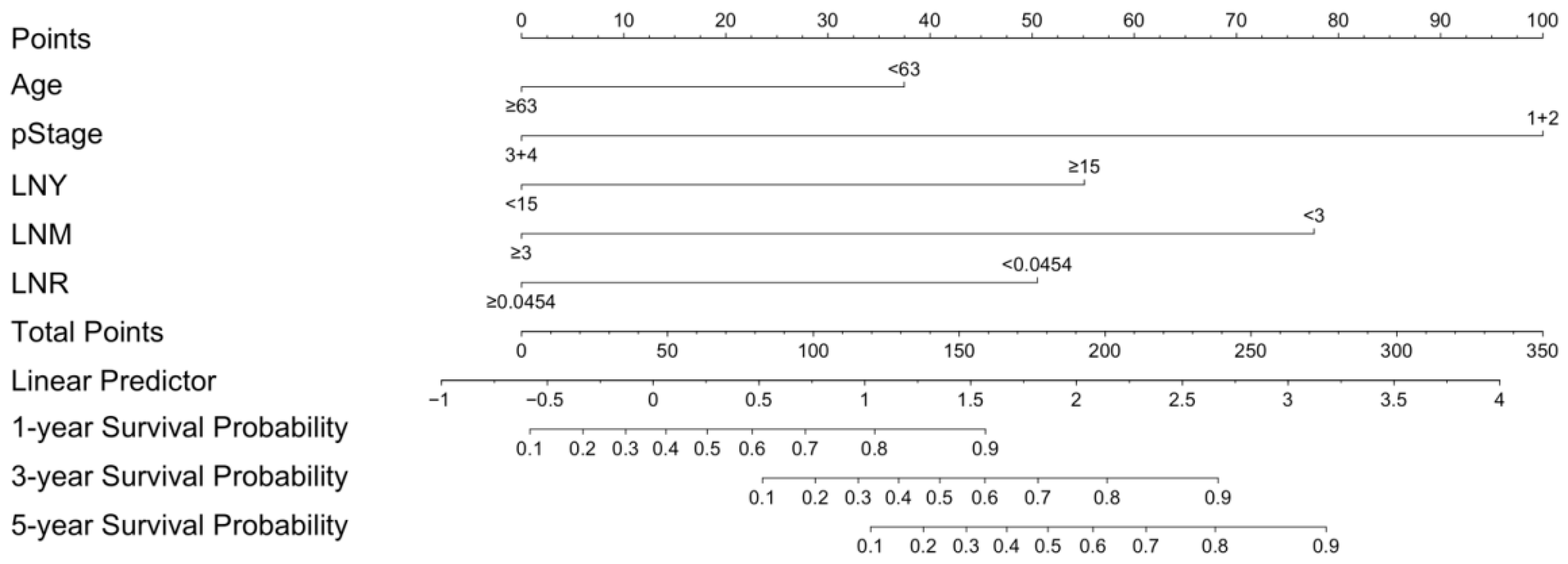
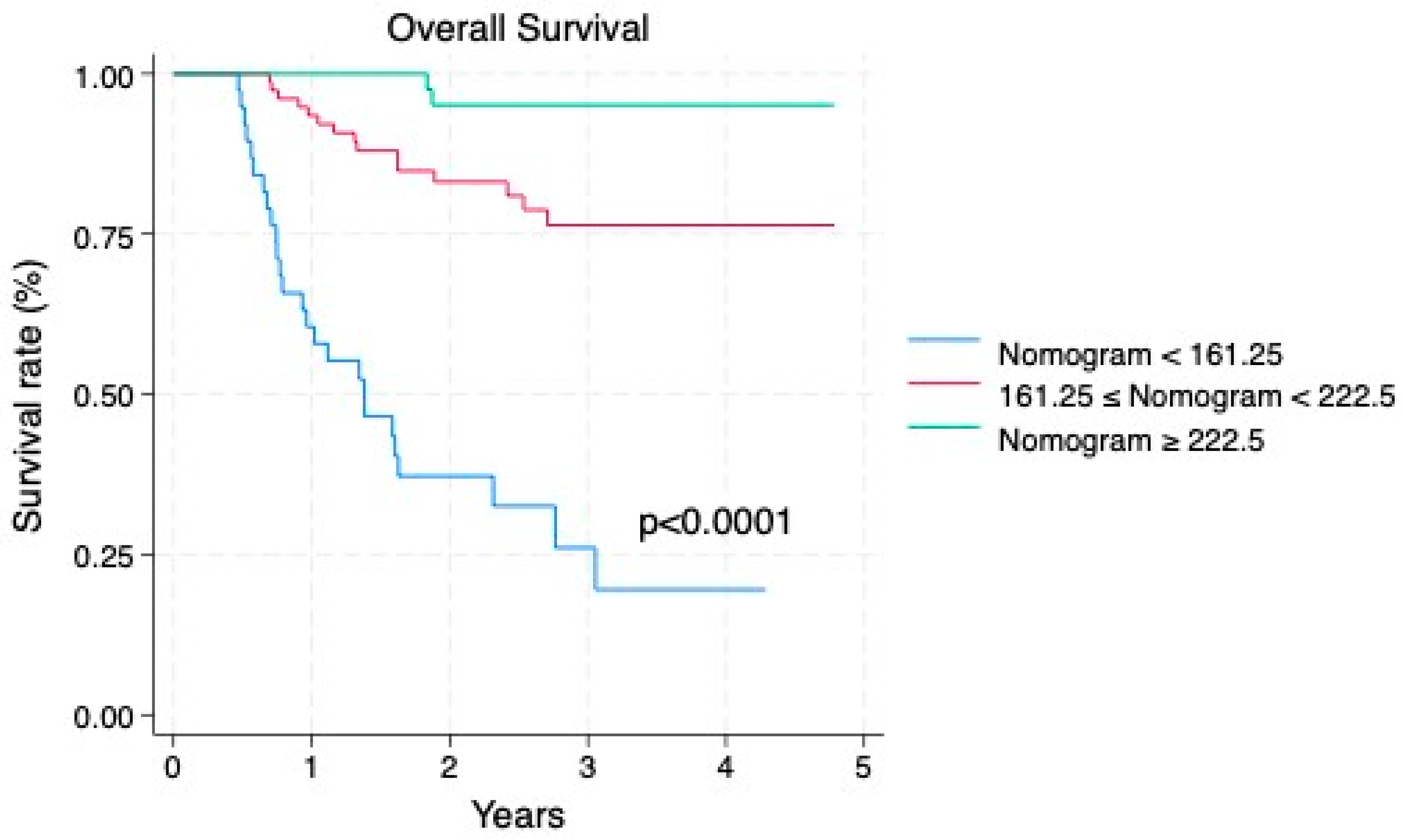
Based on multivariate results, a survival model was constructed to predict OS incorporating age, pathological stage, LNY, LNM, and LNR (Figure 2). ROC curve analysis defined two clinical thresholds of survival model: a low (rule-out) threshold at 161.25 (sensitivity ≥ 90%; observed 90.84%, specificity 60.47%), and a high (rule-in) threshold at 222.5 (specificity ≥ 90%; observed 95.35%, sensitivity 43.51%). Patients were stratified into three risk groups: high-risk (score < 161.25), medium-risk (score 161.25–222.5), and low-risk (score ≥ 222.5). Kaplan–Meier curves showed survival differences among groups (log-rank p < 0.001), with 1-, 3-, and 5-year survival rates of 100%, 95.9%, and 95.9% for the low-risk group; 93.4%, 76.6%, and 76.6% for the medium-risk group; and 60.5%, 26.6%, and 17.8% for the high-risk group (Figure 3).
Figure 2.
The nomogram for OS in oral cancer patients. Note. Abbreviation: OS, overall survival; pStage, pathological overall stage; LNY, lymph node yield; LNM, lymph node metastases; LNR, lymph node ratio.
Figure 3.
Kaplan–Meier survival curves stratified according to risk groups generated by the survival model. Note. The 1-, 3-, and 5-year overall survival rates were 100.0%, 95.9%, and 95.9% for the low-risk group (nomogram score ≥ 222.5); 93.4%, 76.6%, and 76.6% for the intermediate-risk group (222.5 > score ≥ 161.25); and 60.5%, 26.6%, and 17.8% for the high-risk group (score < 161.25), respectively.
In the univariate analysis for DSS, factors such as advanced nodal stage (pN2 and pN3), pathological stage (pStage 3+4), presence of PNI, presence of LVI, LNM ≥ 3, and LNR ≥ 0.0454 were significantly associated with worse DSS (Table 3). In the multivariate Cox regression analysis, LNR ≥ 0.0454 remained an independent prognostic factor for DSS (HR = 3.986, 95% CI: 1.222–13.002, p = 0.025). LVI showed a borderline association (p = 0.088), while other variables were not significant after adjustment.
Table 3.
Univariate and multivariate COX regression analyses of factors related to DSS in oral cancer patients.
4. Discussion
This study comprehensively analyzed various clinicopathological factors associated with survival in patients with oral cancer and developed a prognostic survival model to predict overall survival. Our findings highlight the importance of lymph node-related factors, particularly LNY, LNM, and LNR, as strong predictors of survival in oral cancer patients [10,11,13,14,15]. Based on the identified independent prognostic factors, we developed a survival model, which effectively stratified patients into three prognostic groups with significantly different survival outcomes. Such a tool could be valuable for individualized risk assessment, and may help identify high-risk patients who could benefit from intensified adjuvant therapy or enhanced surveillance. The recognition of lymph node-related factors as robust survival predictors carries important clinical implications. For surgeons, it underscores the necessity of adequate lymph node dissection during neck surgery. For pathologists, it highlights the importance of meticulous lymph node examination and precise reporting. For oncologists, it provides supplementary prognostic information to guide adjuvant treatment decisions.
The demographic and clinical characteristics of our cohort align with previously reported data, with a predominance of male patients and a significant association with smoking and alcohol consumption [2]. The high proportion of advanced-stage disease (66.09% with pStage 3–4) reflects the reality of oral cancer presentation in many regions, where delayed diagnosis remains a challenge [2].
Age emerged as an independent prognostic factor; patients aged ≥63 years exhibited significantly poorer outcomes, consistent with earlier studies linking older age to worse prognosis in oral cancer [19,20]. This may relate to age-associated comorbidities, diminished treatment tolerance, and possibly more aggressive tumor biology.
As anticipated, pathological stage, combining tumor and nodal status, strongly correlated with survival [19]. Patients with advanced stage (pStage 3–4) fared worse than those with early stage (pStage 1–2), underscoring the critical need for early detection and treatment [2,5].
Tumor subsite demonstrated prognostic relevance, with buccal mucosa showing slightly better survival than tongue, although this difference did not reach statistical significance in the univariate analysis. Subsite-stratified lymph node assessments (Supplementary Table S1) revealed comparable LNY, LNM, and LNR among tongue, buccal mucosa, and gingiva/other subsites, indicating consistent surgical quality across anatomical locations.
Tumor subsite showed distinct prognostic patterns, with tongue cancers tending toward poorer survival than buccal mucosa cancers, although this difference did not retain significance in multivariate analysis. Subsite-stratified lymph node assessment (Supplementary Table S1) demonstrated comparable lymph node yields across oral cavity subsites, suggesting consistent neck dissection quality and reducing the likelihood of surgical bias in nodal evaluation. Buccal mucosa cancers were characterized by a lower propensity for nodal dissemination, reflected by reduced rates of LNM and a lower lymph node ratio, whereas tongue and gingiva/other subsites exhibited a higher nodal burden, supporting biologically distinct metastatic behaviors with potential implications for prognosis and subsite-specific risk stratification.
Lymph node-related variables proved to be powerful independent survival predictors. LNY ≥ 15 was associated with improved survival outcomes, suggesting that adequate lymph node sampling during neck dissection may have prognostic implications [13,14]. This finding supports the concept that a more thorough lymphadenectomy may not only improve staging accuracy but may also have therapeutic benefits by removing potential micrometastases [21,22]. Stampe et al. recently affirmed the prognostic significance of LNY as a quality metric in oral cancer neck dissections and survival [23].
LNM was similarly prognostic, with ≥3 metastatic nodes linked to poorer survival, corroborating previous evidence of a threshold effect of nodal burden [15,24]. Recent work by Struckmeier et al. demonstrated that LNY, LNR, and LNM all provide valuable prognostic insights, with LNM showing particularly strong predictive value in oral squamous cell carcinoma [25].
The most compelling finding of our study is the strong prognostic value of LNR. Patients with LNR ≥0.0454 had significantly worse OS and DSS. The prognostic significance of LNR persisted in multivariate analysis, suggesting that it provides additional prognostic information beyond conventional TNM staging. LNR may be particularly valuable as it accounts for both the extent of nodal disease (number of positive nodes) and the adequacy of lymph node evaluation (total number of nodes examined). Our results support LNR as a powerful marker for risk stratification in oral cancer management, with potential to guide surgical strategies, adjuvant therapy decisions, and surveillance intensity. Recent studies by Haraguchi et al. and Mamic et al. further reinforce LNR’s prognostic power across diverse populations [26,27]. Additionally, Verde-Sanchez et al. have proposed a predictive model incorporating lymph node density, demonstrating its significant prognostic value in treatment planning for oral SCC patients [28]. Building upon these concepts, our study provides a more comprehensive assessment of lymph node-related parameters, including LNY, LNM, and LNR, to deliver prognostic insights beyond the TNM framework. This approach captures the combined effects of nodal burden and dissection adequacy.
PNI and LVI were significant prognostic factors in univariate analysis but did not emerge as independent predictors in multivariate analysis for overall survival. These findings suggest that while these histopathological features are important markers of tumor aggressiveness, their prognostic impact may be partially mediated through their association with other factors, particularly nodal status. Furthermore, despite the significance of PNI, LVI in univariate analysis, no one has assessed the state of the organs of immunobiological surveillance with the same other parameters in patients, so it is not possible to consider their value as independent predictors in multivariate analysis for OS. A recent systematic review and meta-analysis by Alqutub et al. confirmed that histopathological features, including PNI and LVI, are indeed important predictors of lymph node metastasis in oral cavity squamous cell carcinoma, though their independent prognostic value varies across studies [8].
Surgical margin status was significantly associated with survival in univariate analysis but not in multivariate analysis. This could be attributed to the relatively small number of patients with positive or close margins (11.5%) in our cohort, which may have limited statistical power. Nevertheless, the importance of achieving negative surgical margins in oral cancer management cannot be overstated, as it remains a fundamental principle of oncologic surgery.
The BMI finding in our univariate analysis (BMI < 23.5 kg/m2 associated with worse survival) aligns with emerging evidence suggesting that nutritional status and body composition may influence cancer outcomes. Low BMI may reflect cancer cachexia, malnutrition, or compromised physiological reserves, all of which can adversely affect survival. Conversely, elevated BMI has been associated with chronic inflammatory states and metabolic dysfunction that impair antitumor immune responses [29]. However, it is noteworthy that in our analysis, patients with BMI < 23.5 showed worse outcomes, suggesting that the adverse effects of malnutrition and depletion outweigh potential protective anti-inflammatory effects at lower BMI ranges in this cohort. The complex relationship between BMI, metabolic status, and antitumor immunity warrants further investigation. Regardless, BMI was not significant in multivariate analysis, indicating confounding by stronger prognostic factors.
Overall, our findings and accumulating evidence advocate for comprehensive lymph node assessment, including LNR, LNY, and LNM, as superior prognostic markers compared to conventional nodal staging alone [30]. This supports the need for standardized pathological reporting of lymph node parameters in oral cancer.
Despite these significant findings, our study has several limitations. First, its retrospective nature introduces potential selection bias and limits causal inference. Second, the relatively small sample size and single-institution setting may limit the generalizability of our findings. External validation of the prognostic survival model in an independent cohort is necessary to confirm its predictive accuracy and clinical utility. Future studies should focus on validating these findings in larger, multi-institutional cohorts and integrating molecular and genomic markers with clinicopathological factors to develop more comprehensive prognostic models.
5. Conclusions
This research identified several independent prognostic factors associated with survival outcomes. Specifically, age ≥ 63 years, advanced pathological stage (pStage 3+4), LNY < 15, LNM ≥ 3, and LNR ≥ 0.0454 were strong independent predictors of overall survival. These findings emphasize the vital role of comprehensive lymph node assessment in oral cancer management for precise staging and reliable prognostication.
Supplementary Materials
The following supporting information can be downloaded at: https://www.mdpi.com/article/10.3390/diagnostics15243133/s1, Table S1: Comparison of categorized lymphatic parameters across subsites.
Author Contributions
Data curation, P.-C.C., C.-M.C. and W.-C.L.; Formal analysis, P.-C.C., P.-W.C. and W.-C.L.; Funding acquisition, P.-C.C., L.-J.L., P.-W.C. and W.-C.L.; Methodology, P.-C.C., C.-M.C., L.-J.L. and W.-C.L.; Project administration, P.-C.C., C.-M.C., L.-J.L., P.-W.C. and W.-C.L.; Supervision, W.-C.L.; Validation, L.-J.L., P.-W.C. and W.-C.L.; Visualization, P.-C.C., C.-M.C. and W.-C.L.; Writing—original draft, P.-C.C., C.-M.C. and W.-C.L.; Writing—review and editing, P.-C.C., C.-M.C., L.-J.L., P.-W.C. and W.-C.L. All authors have read and agreed to the published version of the manuscript.
Funding
This work was supported by grants from the Far Eastern Memorial Hospital Research Program (FEMH-2025-C-24 and FEMH-2025-C-25).
Institutional Review Board Statement
This study was approved by the institutional ethical review board of Far Eastern Memorial Hospital (No.113210-E) on 3 September 2024.
Informed Consent Statement
Patient consent was waived due to the retrospective design of the study, and the study was approved by the Institutional Ethical Review Board.
Data Availability Statement
The original contributions presented in this study are included in the article/Supplementary Materials. Further inquiries can be directed to the corresponding author. Data available on request due to restrictions related to patient privacy and institutional ethical regulations.
Acknowledgments
We thank our colleagues in the Head and Neck Cancer Surveillance & Research Group, Far Eastern Memorial Hospital, for their help.
Conflicts of Interest
The authors declare that they have no conflicts of interest.
Abbreviations
The following abbreviations are used in this manuscript:
| LNY | Lymph Node Yield |
| LNM | Lymph Node Metastases |
| LNR | Lymph Node Ratio |
| OS | Overall Survival |
| DSS | Disease-Specific Survival |
| PNI | Perineural Invasion |
| LVI | Lymphovascular Invasion |
| BMI | Body Mass Index |
| BH | Body Height |
| BW | Body Weight |
| TNM | Tumor-Node-Metastasis |
| AJCC | American Joint Committee on Cancer |
| pStage | Pathological Stage |
| HR | Hazard Ratio |
| CI | Confidence Interval |
| ROC | Receiver Operating Characteristic |
| SD | Standard Deviation |
| IQR | Interquartile Range |
References
- Sung, H.; Ferlay, J.; Siegel, R.L.; Laversanne, M.; Soerjomataram, I.; Jemal, A.; Bray, F. Global Cancer Statistics 2020: GLOBOCAN Estimates of Incidence and Mortality Worldwide for 36 Cancers in 185 Countries. CA Cancer J. Clin. 2021, 71, 209–249. [Google Scholar] [CrossRef]
- Warnakulasuriya, S. Global epidemiology of oral and oropharyngeal cancer. Oral Oncol. 2009, 45, 309–316. [Google Scholar] [CrossRef]
- Amit, M.; Yen, T.C.; Liao, C.T.; Chaturvedi, P.; Agarwal, J.P.; Kowalski, L.P.; Ebrahimi, A.; Clark, J.R.; Kreppel, M.; Zöller, J.; et al. Improvement in survival of patients with oral cavity squamous cell carcinoma: An international collaborative study. Cancer 2013, 119, 4242–4248. [Google Scholar] [CrossRef] [PubMed]
- Amin, M.B.; Greene, F.L.; Edge, S.B.; Compton, C.C.; Gershenwald, J.E.; Brookland, R.K.; Meyer, L.; Gress, D.M.; Byrd, D.R.; Winchester, D.P. The Eighth Edition AJCC Cancer Staging Manual: Continuing to build a bridge from a population-based to a more “personalized” approach to cancer staging. CA Cancer J. Clin. 2017, 67, 93–99. [Google Scholar] [CrossRef] [PubMed]
- Woolgar, J.A.; Rogers, S.; West, C.R.; Errington, R.D.; Brown, J.S.; Vaughan, E.D. Survival and patterns of recurrence in 200 oral cancer patients treated by radical surgery and neck dissection. Oral Oncol. 1999, 35, 257–265. [Google Scholar] [CrossRef]
- Ebrahimi, A.; Gil, Z.; Amit, M.; Yen, T.C.; Liao, C.T.; Chaturvedi, P.; Agarwal, J.P.; Kowalski, L.P.; Kreppel, M.; Cernea, C.R.; et al. Primary tumor staging for oral cancer and a proposed modification incorporating depth of invasion: An international multicenter retrospective study. JAMA Otolaryngol. Head Neck Surg. 2014, 140, 1138–1148. [Google Scholar] [CrossRef] [PubMed]
- Jardim, J.F.; Francisco, A.L.; Gondak, R.; Damascena, A.; Kowalski, L.P. Prognostic impact of perineural invasion and lymphovascular invasion in advanced stage oral squamous cell carcinoma. Int. J. Oral Maxillofac. Surg. 2015, 44, 23–28. [Google Scholar] [CrossRef]
- Alqutub, S.; Alqutub, A.; Bakhshwin, A.; Mofti, Z.; Alqutub, S.; Alkhamesi, A.A.; Nujoom, M.A.; Rammal, A.; Merdad, M.; Marzouki, H.Z. Histopathological predictors of lymph node metastasis in oral cavity squamous cell carcinoma: A systematic review and meta-analysis. Front. Oncol. 2024, 14, 1401211. [Google Scholar] [CrossRef]
- Baddour, H.M., Jr.; Magliocca, K.R.; Chen, A.Y. The importance of margins in head and neck cancer. J. Surg. Oncol. 2016, 113, 248–255. [Google Scholar] [CrossRef]
- Ebrahimi, A.; Clark, J.R.; Zhang, W.J.; Elliott, M.S.; Gao, K.; Milross, C.G.; Shannon, K.F. Lymph node ratio as an independent prognostic factor in oral squamous cell carcinoma. Head Neck 2011, 33, 1245–1251. [Google Scholar] [CrossRef]
- Patel, S.G.; Amit, M.; Yen, T.C.; Liao, C.T.; Chaturvedi, P.; Agarwal, J.P.; Kowalski, L.P.; Ebrahimi, A.; Clark, J.R.; Cernea, C.R.; et al. Lymph node density in oral cavity cancer: Results of the International Consortium for Outcomes Research. Br. J. Cancer 2013, 109, 2087–2095. [Google Scholar] [CrossRef]
- Talmi, Y.P.; Takes, R.P.; Alon, E.E.; Nixon, I.J.; Lopez, F.; de Bree, R.; Rodrigo, J.P.; Shaha, A.R.; Halmos, G.B.; Rinaldo, A.; et al. Prognostic value of lymph node ratio in head and neck squamous cell carcinoma. Head Neck 2018, 40, 1082–1090. [Google Scholar] [CrossRef]
- Ebrahimi, A.; Zhang, W.J.; Gao, K.; Clark, J.R. Nodal yield and survival in oral squamous cancer: Defining the standard of care. Cancer 2011, 117, 2917–2925. [Google Scholar] [CrossRef]
- Divi, V.; Chen, M.M.; Nussenbaum, B.; Rhoads, K.F.; Sirjani, D.B.; Holsinger, F.C.; Shah, J.L.; Hara, W. Lymph Node Count from Neck Dissection Predicts Mortality in Head and Neck Cancer. J. Clin. Oncol. 2016, 34, 3892–3897. [Google Scholar] [CrossRef]
- Roberts, T.J.; Colevas, A.D.; Hara, W.; Holsinger, F.C.; Oakley-Girvan, I.; Divi, V. Number of positive nodes is superior to the lymph node ratio and American Joint Committee on Cancer N staging for the prognosis of surgically treated head and neck squamous cell carcinomas. Cancer 2016, 122, 1388–1397. [Google Scholar] [CrossRef] [PubMed]
- Shariat, S.F.; Karakiewicz, P.I.; Suardi, N.; Kattan, M.W. Comparison of nomograms with other methods for predicting outcomes in prostate cancer: A critical analysis of the literature. Clin. Cancer Res. 2008, 14, 4400–4407. [Google Scholar] [CrossRef] [PubMed]
- Montero, P.H.; Yu, C.; Palmer, F.L.; Patel, P.D.; Ganly, I.; Shah, J.P.; Shaha, A.R.; Boyle, J.O.; Kraus, D.H.; Singh, B.; et al. Nomograms for preoperative prediction of prognosis in patients with oral cavity squamous cell carcinoma. Cancer 2014, 120, 214–221. [Google Scholar] [CrossRef] [PubMed]
- Wang, F.; Zhang, H.; Wen, J.; Zhou, J.; Liu, Y.; Cheng, B.; Chen, X.; Wei, J. Nomograms forecasting long-term overall and cancer-specific survival of patients with oral squamous cell carcinoma. Cancer Med. 2018, 7, 943–952. [Google Scholar] [CrossRef] [PubMed]
- Amit, M.; Tam, S.; Takahashi, H.; Choi, K.Y.; Zafereo, M.; Bell, D.; Weber, R.S. Prognostic performance of the American Joint Committee on Cancer 8th edition of the TNM staging system in patients with early oral tongue cancer. Head Neck 2019, 41, 1270–1276. [Google Scholar] [CrossRef]
- Chen, S.; Lin, Z.; Chen, J.; Yang, A.; Zhang, Q.; Xie, C.; Zhang, X.; Yang, Z.; Chen, W.; Song, M. Older age is a risk factor associated with poor prognosis of patients with squamous cell carcinoma of the oral cavity. Eur. Arch. Otorhinolaryngol. 2020, 277, 2573–2580. [Google Scholar] [CrossRef]
- D’Cruz, A.K.; Vaish, R.; Kapre, N.; Dandekar, M.; Gupta, S.; Hawaldar, R.; Agarwal, J.P.; Pantvaidya, G.; Chaukar, D.; Deshmukh, A.; et al. Elective versus Therapeutic Neck Dissection in Node-Negative Oral Cancer. N. Engl. J. Med. 2015, 373, 521–529. [Google Scholar] [CrossRef]
- Iyer, N.G.; Tan, D.S.W.; Tan, V.K.; Wang, W.; Hwang, J.; Tan, N.-C.; Sivanandan, R.; Tan, H.-K.; Lim, W.T.; Ang, M.-K.; et al. Randomized trial comparing surgery and adjuvant radiotherapy versus concurrent chemoradiotherapy in patients with advanced, nonmetastatic squamous cell carcinoma of the head and neck: 10-year update and subset analysis. Cancer 2015, 121, 1599–1607. [Google Scholar] [CrossRef]
- Stampe, H.; Jakobsen, K.K.; Tvedskov, J.F.; Wessel, I.; Kiss, K.; Friborg, J.; Andersen, A.O.; Gronhoj, C.; von Buchwald, C.; Christensen, A. Prognostic Value of Lymph Node Yield, Lymph Node Density, and pN in Oral Cancer. Otolaryngol. Head Neck Surg. 2023, 169, 276–285. [Google Scholar] [CrossRef]
- Shingaki, S.; Takada, M.; Sasai, K.; Bibi, R.; Kobayashi, T.; Nomura, T.; Saito, C. Impact of lymph node metastasis on the pattern of failure and survival in oral carcinomas. Am. J. Surg. 2003, 185, 278–284. [Google Scholar] [CrossRef] [PubMed]
- Struckmeier, A.K.; Buchbender, M.; Lutz, R.; Agaimy, A.; Kesting, M. Comparison of the prognostic value of lymph node yield, lymph node ratio, and number of lymph node metastases in patients with oral squamous cell carcinoma. Head Neck 2024, 46, 1083–1093. [Google Scholar] [CrossRef] [PubMed]
- Haraguchi, K.; Habu, M.; Takahashi, O.; Tominaga, K.; Yoshioka, I.; Sasaguri, M. Association between lymph node ratio and survival outcomes in patients with oral squamous cell carcinoma. J. Stomatol. Oral Maxillofac. Surg. 2024, 125, 101816. [Google Scholar] [CrossRef]
- Mamic, M.; Lucijanic, M.; Lorencin, M.; Suton, P.; Luksic, I. Impact of lymph node ratio on survival and recurrence outcomes in oral squamous cell carcinoma. Int. J. Oral Maxillofac. Surg. 2022, 51, 1257–1263. [Google Scholar] [CrossRef]
- Verde-Sanchez, L.; Capote, A.L.; Sanz-Garcia, A.; Brabyn, P.; Rodriguez-Campo, F.J.; Naval Gias, L. Prognostic Involvement of Lymph Node Density in Oral Squamous Cell Carcinoma. A New Predictive Model. J. Oral Maxillofac. Surg. 2023, 81, 358–369. [Google Scholar] [CrossRef]
- Chen, T.; Zhai, W.; Song, J.; Liu, W.; Wu, Z.; Yang, F.; Wang, L. Obesity Paradox in Cancer: A Complex Interplay Between Risk and Therapeutic Outcomes. MedComm 2025, 6, e70494. [Google Scholar] [CrossRef]
- Voss, J.O.; Freund, L.; Neumann, F.; Mrosk, F.; Rubarth, K.; Kreutzer, K.; Doll, C.; Heiland, M.; Koerdt, S. Prognostic value of lymph node involvement in oral squamous cell carcinoma. Clin. Oral Investig. 2022, 26, 6711–6720. [Google Scholar] [CrossRef] [PubMed]
Disclaimer/Publisher’s Note: The statements, opinions and data contained in all publications are solely those of the individual author(s) and contributor(s) and not of MDPI and/or the editor(s). MDPI and/or the editor(s) disclaim responsibility for any injury to people or property resulting from any ideas, methods, instructions or products referred to in the content. |
© 2025 by the authors. Licensee MDPI, Basel, Switzerland. This article is an open access article distributed under the terms and conditions of the Creative Commons Attribution (CC BY) license (https://creativecommons.org/licenses/by/4.0/).