Global Comparative Genomics of Stenotrophomonas maltophilia Reveals Cryptic Species Diversity, Resistome Variation, and Population Structure

 , , , , , , , , and
Abstract
1. Introduction
2. Materials and Methods
2.1. Genome Retrieval and Dataset Construction
2.2. Genome Quality Assessment and Filtering
2.3. Genome Annotation
2.4. Average Nucleotide Identity (ANI) Analysis and Species Delineation
2.5. Pan-Genome Analysis
2.6. Core-Genome Alignment and Phylogenetic Reconstruction
2.7. Antimicrobial Resistance Gene Identification
2.8. Mobile Genetic Element Profiling
2.9. Metadata Integration and Statistical Analyses
3. Results and Discussion
3.1. Genome Collection and Quality Overview
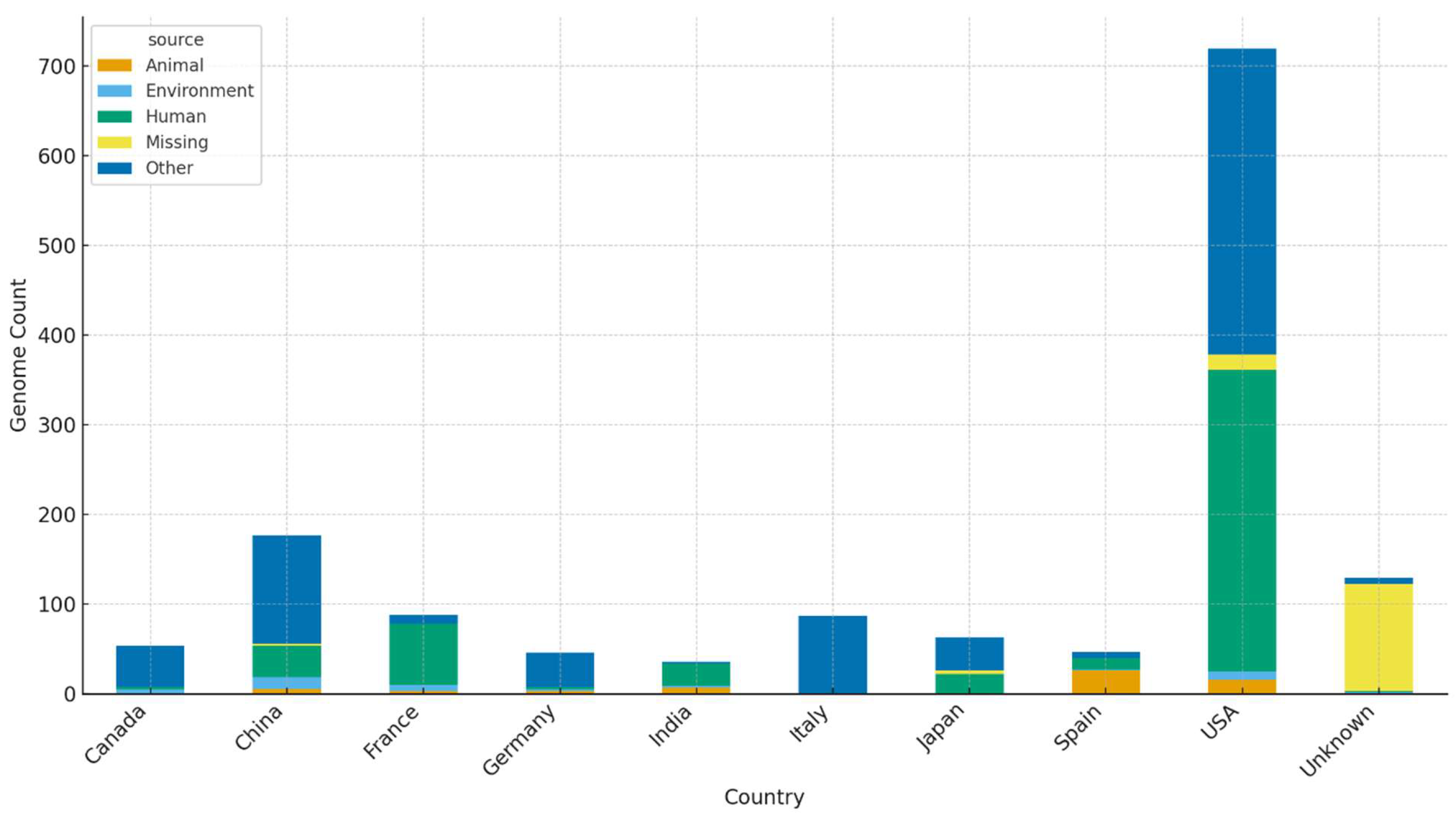
3.1.1. Global Sampling Patterns Reveal Geographic and Clinical Biases
3.1.2. Ecological Source Metadata Highlight Dominance of Clinical Isolates
3.1.3. Integration of Geographic and Ecological Patterns
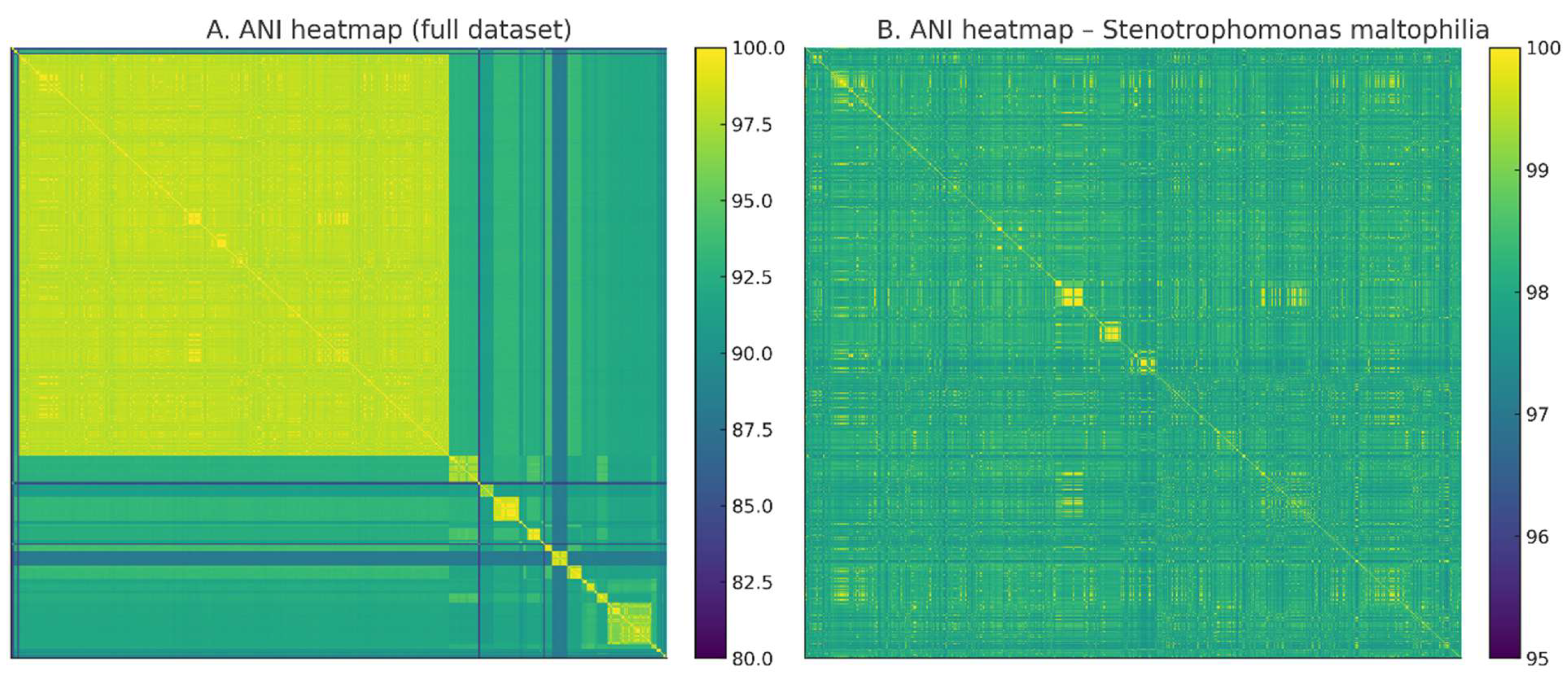
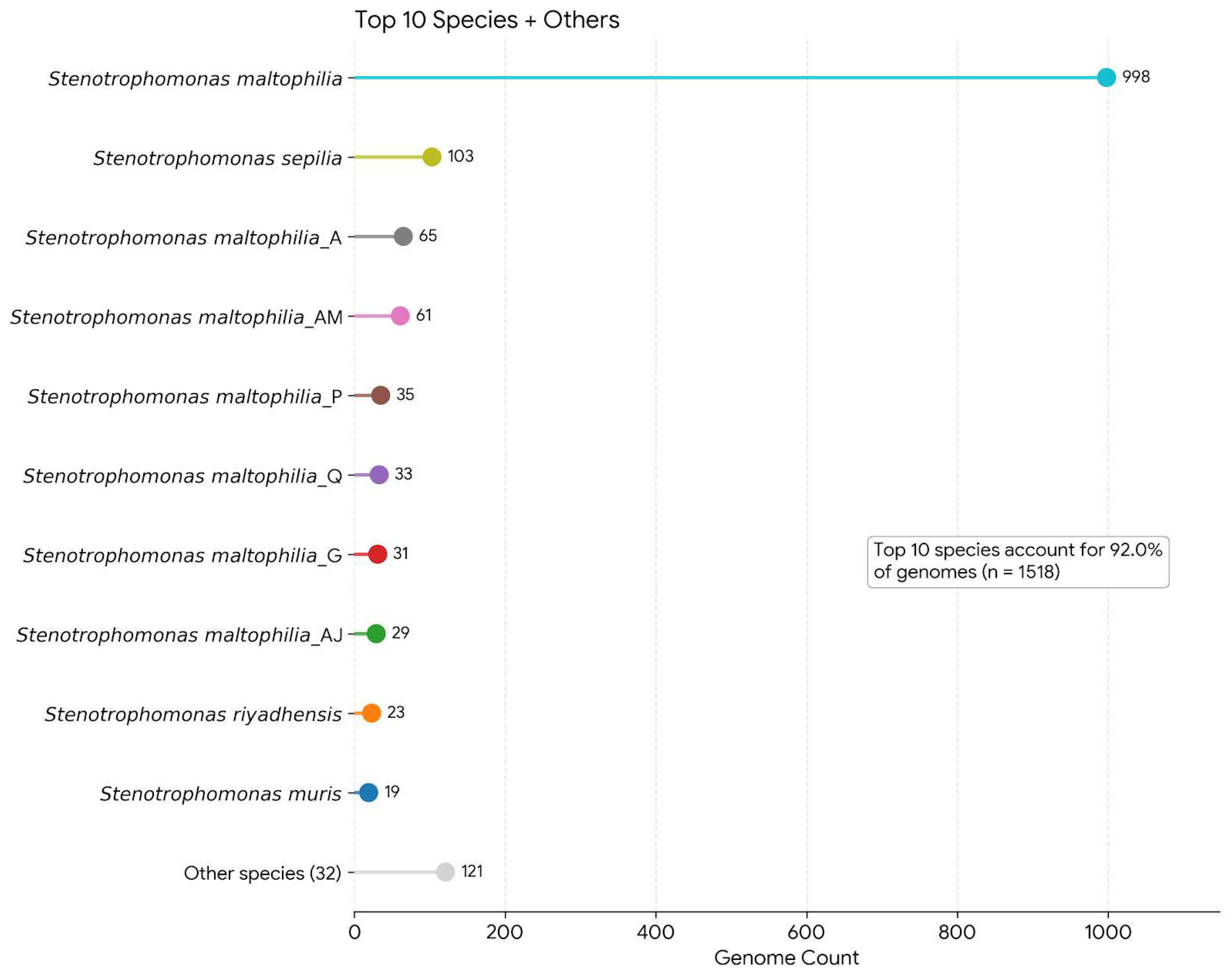
3.2. ANI-Based Species Clusters and Misidentification
3.2.1. Extensive Misclassification of Publicly Deposited Genomes
3.2.2. Implications for Genomics, Clinical Diagnostics, and Surveillance
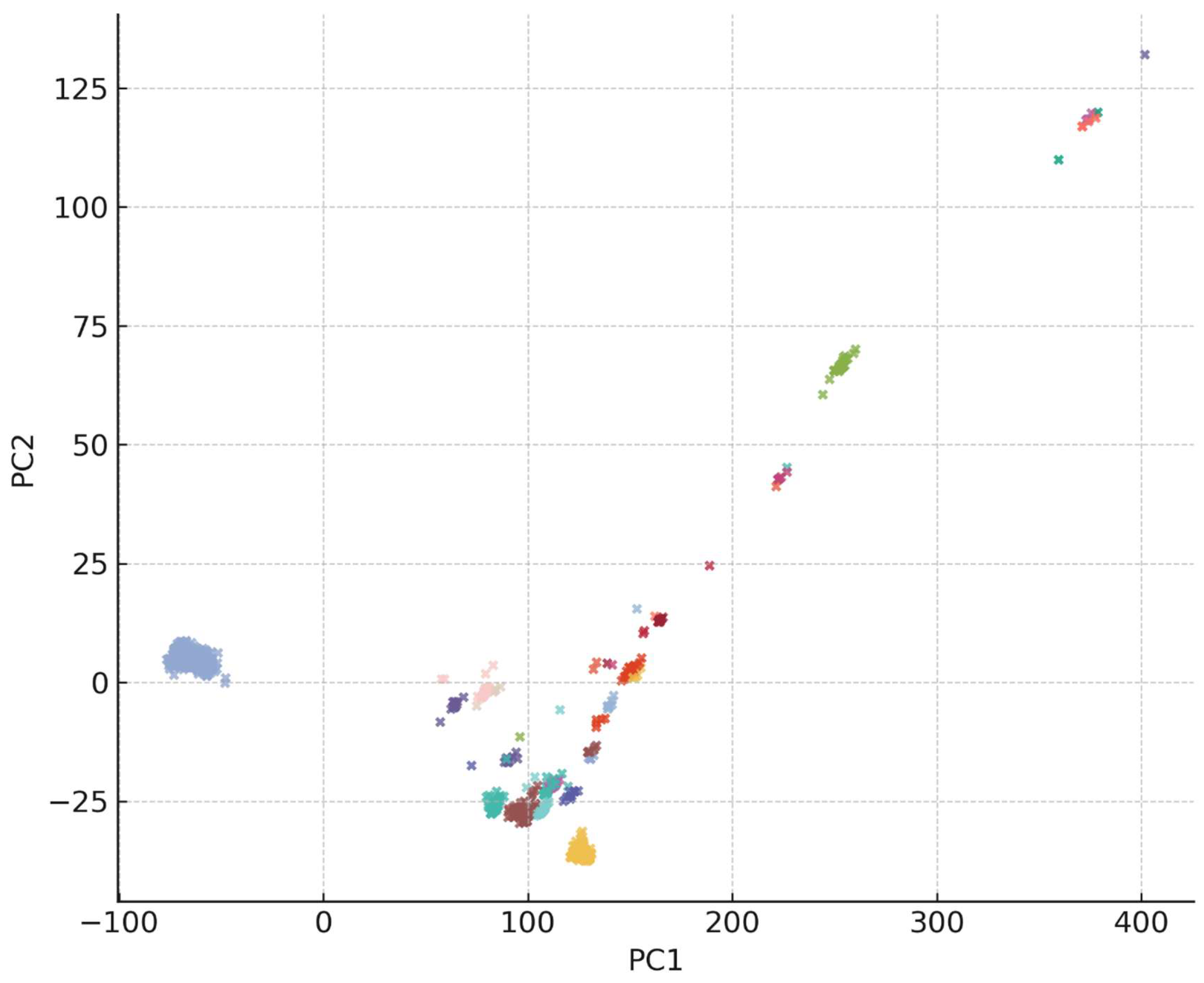
3.3. Core-Genome Phylogeny and Population Structure

3.4. Pan-Genome Structure
3.5. Resistome Landscape Across the Species Complex
3.6. Mobilome Diversity
Source- and Geography-Linked Genomic Patterns
4. Conclusions
Supplementary Materials
Author Contributions
Funding
Institutional Review Board Statement
Informed Consent Statement
Data Availability Statement
Conflicts of Interest
References
- Brooke Joanna, S. Stenotrophomonas maltophilia: An Emerging Global Opportunistic Pathogen. Clin. Microbiol. Rev. 2012, 25, 2–41. [Google Scholar] [CrossRef] [PubMed]
- Chang, Y.T.; Lin, C.Y.; Chen, Y.H.; Hsueh, P.-R. Update on infections caused by Stenotrophomonas maltophilia with particular attention to resistance mechanisms and therapeutic options. Front. Microbiol. 2015, 6, 893. [Google Scholar] [CrossRef] [PubMed]
- Ryan, R.P.; Monchy, S.; Cardinale, M.; Taghavi, S.; Crossman, L.; Avison, M.B.; Berg, G.; van der Lelie, D.; Dow, J.M. The versatility and adaptation of bacteria from the genus Stenotrophomonas. Nat. Rev. Microbiol. 2009, 7, 514–525. [Google Scholar] [CrossRef] [PubMed]
- Gil-Gil, T.; Martínez, J.L.; Blanco, P. Mechanisms of antimicrobial resistance in Stenotrophomonas maltophilia: A review of current knowledge. Expert Rev. Anti-Infect. Ther. 2020, 18, 335–347. [Google Scholar] [CrossRef]
- Kumar, S.; Bansal, K.; Patil, P.P.; Kaur, A.; Kaur, S.; Jaswal, V.; Gautam, V.; Patil, P.B. Genomic insights into evolution of extensive drug resistance in Stenotrophomonas maltophilia complex. Genomics 2020, 112, 4171–4178. [Google Scholar] [CrossRef]
- Li, K.; Yu, K.; Huang, Z.; Liu, X.; Mei, L.; Ren, X.; Bai, X.; Gao, H.; Sun, Z.; Liu, X.; et al. Stenotrophomonas maltophilia complex: Insights into evolutionary relationships, global distribution and pathogenicity. Front. Cell. Infect. Microbiol. 2023, 13, 1325379. [Google Scholar] [CrossRef]
- Ochoa-Sánchez, L.E.; Vinuesa, P. Evolutionary Genetic Analysis Uncovers Multiple Species with Distinct Habitat Preferences and Antibiotic Resistance Phenotypes in the Stenotrophomonas maltophilia Complex. Front. Microbiol. 2017, 8, 1548. [Google Scholar] [CrossRef]
- Patil, P.P.; Kumar, S.; Midha, S.; Gautam, V.; Patil, P.B. Taxonogenomics reveal multiple novel genomospecies associated with clinical isolates of Stenotrophomonas maltophilia. Microb. Genom. 2018, 4, e000207. [Google Scholar] [CrossRef]
- Mojica, M.F.; Humphries, R.; Lipuma, J.J.; Mathers, A.J.; Rao, G.G.; Shelburne, S.A.; Fouts, D.E.; Van Duin, D.; Bonomo, R.A. Clinical challenges treating Stenotrophomonas maltophilia infections: An update. JAC-Antimicrob. Resist. 2022, 4, dlac040. [Google Scholar] [CrossRef]
- Crossman, L.C.; Gould, V.C.; Dow, J.M.; Vernikos, G.S.; Okazaki, A.; Sebaihia, M.; Saunders, D.; Arrowsmith, C.; Carver, T.; Peters, N.; et al. The complete genome, comparative and functional analysis of Stenotrophomonas maltophilia reveals an organism heavily shielded by drug resistance determinants. Genome Biol. 2008, 9, R74. [Google Scholar] [CrossRef]
- McDaniel, M.S.; Sumpter, N.A.; Lindgren, N.R.; Billiot, C.E.; Swords, W.E. Comparative genomics of clinical Stenotrophomonas maltophilia isolates reveals regions of diversity which correlate with colonization and persistence in vivo. bioRxiv 2023. [Google Scholar] [CrossRef]
- Youenou, B.; Favre-Bonté, S.; Bodilis, J.; Brothier, E.; Dubost, A.; Muller, D.; Nazaret, S. Comparative Genomics of Environmental and Clinical Stenotrophomonas maltophilia Strains with Different Antibiotic Resistance Profiles. Genome Biol. Evol. 2015, 7, 2484–2505. [Google Scholar] [CrossRef]
- Pinski, A.; Zur, J.; Hasterok, R.; Hupert-Kocurek, K. Comparative Genomics of Stenotrophomonas maltophilia and Stenotrophomonas rhizophila Revealed Characteristic Features of Both Species. Int. J. Mol. Sci. 2020, 21, 4922. [Google Scholar] [CrossRef] [PubMed]
- Jain, C.; Rodriguez, R.L.; Phillippy, A.M.; Konstantinidis, K.T.; Aluru, S. High throughput ANI analysis of 90K prokaryotic genomes reveals clear species boundaries. Nat. Commun. 2018, 9, 5114. [Google Scholar] [CrossRef] [PubMed]
- Sayers, E.W.; Bolton, E.E.; Brister, J.R.; Canese, K.; Chan, J.; Comeau, D.C.; Farrell, C.M.; Feldgarden, M.; Fine, A.M.; Funk, K.; et al. Database resources of the National Center for Biotechnology Information in 2023. Nucleic Acids Res. 2023, 51, D29–D38. [Google Scholar] [CrossRef] [PubMed]
- Parks, D.H.; Imelfort, M.; Skennerton, C.T.; Hugenholtz, P.; Tyson, G.W. CheckM: Assessing the quality of microbial genomes recovered from isolates, single cells, and metagenomes. Genome Res. 2015, 25, 1043–1055. [Google Scholar] [CrossRef]
- Bowers, R.M.; Kyrpides, N.C.; Stepanauskas, R.; Harmon-Smith, M.; Doud, D.; Reddy, T.B.K.; Schulz, F.; Jarett, J.; Rivers, A.R.; Eloe-Fadrosh, E.A.; et al. Minimum information about a single amplified genome (MISAG) and a metagenome-assembled genome (MIMAG) of bacteria and archaea. Nat. Biotechnol. 2017, 35, 725–731. [Google Scholar] [CrossRef]
- Seemann, T. Prokka: Rapid prokaryotic genome annotation. Bioinformatics 2014, 30, 2068–2069. [Google Scholar] [CrossRef]
- Cantalapiedra, C.P.; Hernandez-Plaza, A.; Letunic, I.; Bork, P.; Huerta-Cepas, J. eggNOG-mapper v2: Functional Annotation, Orthology Assignments, and Domain Prediction at the Metagenomic Scale. Mol. Biol. Evol. 2021, 38, 5825–5829. [Google Scholar] [CrossRef]
- Hyatt, D.; Chen, G.L.; LoCascio, P.F.; Land, M.L.; Larimer, F.W.; Hauser, L.J. Prodigal: Prokaryotic gene recognition and translation initiation site identification. BMC Bioinform. 2010, 11, 119. [Google Scholar] [CrossRef]
- Konstantinidis Konstantinos, T.; Tiedje James, M. Towards a Genome-Based Taxonomy for Prokaryotes. J. Bacteriol. 2005, 187, 6258–6264. [Google Scholar] [CrossRef]
- Richter, M.; Rosselló-Móra, R. Shifting the genomic gold standard for the prokaryotic species definition. Proc. Natl. Acad. Sci. USA 2009, 106, 19126–19131. [Google Scholar] [CrossRef] [PubMed]
- Bastian, M.; Heymann, S.; Jacomy, M. Gephi: An Open Source Software for Exploring and Manipulating Networks. In Proceedings of the Third International Conference on Weblogs and Social Media, ICWSM 2009, San Jose, CA, USA, 17–20 May 2009. [Google Scholar] [CrossRef]
- Tonkin-Hill, G.; MacAlasdair, N.; Ruis, C.; Weimann, A.; Horesh, G.; Lees, J.A.; Gladstone, R.A.; Lo, S.; Beaudoin, C.; Floto, R.A.; et al. Producing polished prokaryotic pangenomes with the Panaroo pipeline. Genome Biol. 2020, 21, 180. [Google Scholar] [CrossRef] [PubMed]
- Edgar, R.C. MUSCLE: Multiple sequence alignment with high accuracy and high throughput. Nucleic Acids Res. 2004, 32, 1792–1797. [Google Scholar] [CrossRef] [PubMed]
- Capella-Gutiérrez, S.; Silla-Martínez, J.M.; Gabaldón, T. trimAl: A tool for automated alignment trimming in large-scale phylogenetic analyses. Bioinformatics 2009, 25, 1972–1973. [Google Scholar] [CrossRef]
- Nguyen, L.T.; Schmidt, H.A.; von Haeseler, A.; Minh, B.Q. IQ-TREE: A fast and effective stochastic algorithm for estimating maximum-likelihood phylogenies. Mol. Biol. Evol. 2015, 32, 268–274. [Google Scholar] [CrossRef]
- Letunic, I.; Bork, P. Interactive Tree of Life (iTOL) v6: Recent updates to the phylogenetic tree display and annotation tool. Nucleic Acids Res. 2024, 52, W78–W82. [Google Scholar] [CrossRef]
- Feldgarden, M.; Brover, V.; Gonzalez-Escalona, N.; Frye, J.G.; Haendiges, J.; Haft, D.H.; Hoffmann, M.; Pettengill, J.B.; Prasad, A.B.; Tillman, G.E.; et al. AMRFinderPlus and the Reference Gene Catalog facilitate examination of the genomic links among antimicrobial resistance, stress response, and virulence. Sci. Rep. 2021, 11, 12728. [Google Scholar] [CrossRef]
- Alcock, B.P.; Raphenya, A.R.; Lau, T.T.Y.; Tsang, K.K.; Bouchard, M.; Edalatmand, A.; Huynh, W.; Nguyen, A.V.; Cheng, A.A.; Liu, S.; et al. CARD 2020: Antibiotic resistome surveillance with the comprehensive antibiotic resistance database. Nucleic Acids Res. 2020, 48, D517–D525. [Google Scholar] [CrossRef]
- Akhter, S.; Aziz, R.K.; Edwards, R.A. PhiSpy: A novel algorithm for finding prophages in bacterial genomes that combines similarity- and composition-based strategies. Nucleic Acids Res. 2012, 40, e126. [Google Scholar] [CrossRef]
- Starikova, E.V.; Tikhonova, P.O.; Prianichnikov, N.A.; Rands, C.M.; Zdobnov, E.M.; Ilina, E.N.; Govorun, V.M. Phigaro: High-throughput prophage sequence annotation. Bioinformatics 2020, 36, 3882–3884. [Google Scholar] [CrossRef]
- Xie, Z.; Tang, H. ISEScan: Automated identification of insertion sequence elements in prokaryotic genomes. Bioinformatics 2017, 33, 3340–3347. [Google Scholar] [CrossRef]
- Robertson, J.; Nash, J.H.E. MOB-suite: Software tools for clustering, reconstruction and typing of plasmids from draft assemblies. Microb. Genom. 2018, 4, e000206. [Google Scholar] [CrossRef]
- Carattoli, A.; Hasman, H. PlasmidFinder and In Silico pMLST: Identification and Typing of Plasmid Replicons in Whole-Genome Sequencing (WGS). Methods Mol. Biol. 2020, 2075, 285–294. [Google Scholar] [CrossRef] [PubMed]
- Federhen, S. The NCBI Taxonomy database. Nucleic Acids Res. 2012, 40, D136–D143. [Google Scholar] [CrossRef] [PubMed]
- Looney, W.J.; Narita, M.; Mühlemann, K. Stenotrophomonas maltophilia: An emerging opportunist human pathogen. Lancet Infect. Dis. 2009, 9, 312–323. [Google Scholar] [CrossRef] [PubMed]
- Crisan, C.V.; Goldberg, J.B. Stenotrophomonas maltophilia complex: A broadly distributed emerging pathogen. PLoS Pathog. 2025, 21, e1013422. [Google Scholar] [CrossRef]
- Li, Y.; Liu, X.; Chen, L.; Shen, X.; Wang, H.; Guo, R.; Li, X.; Yu, Z.; Zhang, X.; Zhou, Y.; et al. Comparative genomics analysis of Stenotrophomonas maltophilia strains from a community. Front. Cell. Infect. Microbiol. 2023, 13, 1266295. [Google Scholar] [CrossRef]
- Didelot, X.; Fraser, C.; Gardy, J.; Colijn, C. Genomic Infectious Disease Epidemiology in Partially Sampled and Ongoing Outbreaks. Mol. Biol. Evol. 2017, 34, 997–1007. [Google Scholar] [CrossRef]
- Lira, F.; Berg, G.; Martínez, J.L. Double-Face Meets the Bacterial World: The Opportunistic Pathogen Stenotrophomonas maltophilia. Front. Microbiol. 2017, 8, 2190. [Google Scholar] [CrossRef]
- Chauviat, A.; Abrouk, D.; Brothier, E.; Muller, D.; Meyer, T.; Favre-Bonté, S. Genomic and phylogenetic re-assessment of the genus Stenotrophomonas: Description of Stenotrophomonas thermophila sp. nov., and the proposal of Parastenotrophomonas gen. Nov., Pseudostenotrophomonas gen. Nov., Pedostenotrophomonas gen. Nov., and Allostenotrophomonas gen. Nov. Syst. Appl. Microbiol. 2025, 48, 126630. [Google Scholar] [CrossRef]
- Yu, Z.-L.; Wang, R.-B. Revised taxonomic classification of the Stenotrophomonas genomes, providing new insights into the genus Stenotrophomonas. Front. Microbiol. 2024, 15, 1488674. [Google Scholar] [CrossRef] [PubMed]
- Adegoke, A.A.; Stenström, T.A.; Okoh, A.I. Stenotrophomonas maltophilia as an Emerging Ubiquitous Pathogen: Looking Beyond Contemporary Antibiotic Therapy. Front. Microbiol. 2017, 8, 2276. [Google Scholar] [CrossRef] [PubMed]
- Sum, D.K.; Chong, Y.Y.; Tan, J.L. Comparative Analyses Suggest Genome Stability and Plasticity in Stenotrophomonas maltophilia. Int. J. Mol. Sci. 2025, 26, 10477. [Google Scholar] [CrossRef]
- Ngan, W.Y.; Rao, S.; Fung, A.H.Y.; Habimana, O. Genomic Profiling Reveals Clinically Relevant Antimicrobial Resistance and Virulence Genes in Klebsiella pneumoniae from Hong Kong Wet Markets. Antibiotics 2025, 14, 922. [Google Scholar] [CrossRef]
- Sanz-García, F.; Gil-Gil, T.; Laborda, P.; Ochoa-Sánchez, L.E.; Martínez, J.L.; Hernando-Amado, S. Coming from the Wild: Multidrug Resistant Opportunistic Pathogens Presenting a Primary, Not Human-Linked, Environmental Habitat. Int. J. Mol. Sci. 2021, 22, 8080. [Google Scholar] [CrossRef]
- Ley, R.E.; Peterson, D.A.; Gordon, J.I. Ecological and evolutionary forces shaping microbial diversity in the human intestine. Cell 2006, 124, 837–848. [Google Scholar] [CrossRef] [PubMed]
- Baidya, A.; Kodan, P.; Fazal, F.; Tsering, S.; Menon, P.R.; Jorwal, P.; Chowdhury, U.K. Stenotrophomonas maltophilia: More than Just a Colonizer! Indian J. Crit. Care Med. 2019, 23, 434–436. [Google Scholar] [CrossRef]
- Kovarikova, S.; Husník, R.; Honzak, D.; Kohout, P.; Fictum, P. Stenotrophomonas maltophilia urinary tract infections in three dogs: A case report. Vet. Med. 2011, 57, 380–383. [Google Scholar] [CrossRef]
- Nicolas-Sayago, L.; Cruz-Cruz, C.; Durán-Manuel, E.M.; Castro-Escarpulli, G.; Ortíz-López, M.G.; Jiménez-Zamarripa, C.A.; Rojas-Bernabé, A.; Nieto-Velázquez, N.G.; Tolentino-Sánchez, E.; Bravata-Alcántara, J.C.; et al. Genetic Diversity of Stenotrophomonas maltophilia and Clonal Transmission (ST92) in Critical Care Units at Hospital Juárez de México: MLST and Virulence Profiling. Pathogens 2025, 14, 1125. [Google Scholar] [CrossRef]
- Maiden, M.C.; Jansen van Rensburg, M.J.; Bray, J.E.; Earle, S.G.; Ford, S.A.; Jolley, K.A.; McCarthy, N.D. MLST revisited: The gene-by-gene approach to bacterial genomics. Nat. Rev. Microbiol. 2013, 11, 728–736. [Google Scholar] [CrossRef]
- Tettelin, H.; Masignani, V.; Cieslewicz, M.J.; Donati, C.; Medini, D.; Ward, N.L.; Angiuoli, S.V.; Crabtree, J.; Jones, A.L.; Durkin, A.S.; et al. Genome analysis of multiple pathogenic isolates of Streptococcus agalactiae: Implications for the microbial “pan-genome”. Proc. Natl. Acad. Sci. USA 2005, 102, 13950–13955. [Google Scholar] [CrossRef] [PubMed]
- McInerney, J.O.; McNally, A.; O’Connell, M.J. Why prokaryotes have pangenomes. Nat. Microbiol. 2017, 2, 17040. [Google Scholar] [CrossRef] [PubMed]
- Zhang, L.; Li, X.Z.; Poole, K. SmeDEF multidrug efflux pump contributes to intrinsic multidrug resistance in Stenotrophomonas maltophilia. Antimicrob. Agents Chemother. 2001, 45, 3497–3503. [Google Scholar] [CrossRef]
- Zając, O.M.; Tyski, S.; Laudy, A.E. Phenotypic and Molecular Characteristics of the MDR Efflux Pump Gene-Carrying Stenotrophomonas maltophilia Strains Isolated in Warsaw, Poland. Biology 2022, 11, 105. [Google Scholar] [CrossRef]
- Avison, M.B.; Higgins, C.S.; Ford, P.J.; von Heldreich, C.J.; Walsh, T.R.; Bennett, P.M. Differential regulation of L1 and L2 beta-lactamase expression in Stenotrophomonas maltophilia. J. Antimicrob. Chemother. 2002, 49, 387–389. [Google Scholar] [CrossRef]
- Walsh, T.R.; Hall, L.; Assinder, S.J.; Nichols, W.W.; Cartwright, S.J.; MacGowan, A.P.; Bennett, P.M. Sequence analysis of the L1 metallo-beta-lactamase from Xanthomonas maltophilia. Biochim. Biophys. Acta 1994, 1218, 199–201. [Google Scholar] [CrossRef]
- Furlan, J.P.R.; Pitondo-Silva, A.; Stehling, E.G. Detection of blaNDM-1 in Stenotrophomonas maltophilia isolated from Brazilian soil. Mem. Inst. Oswaldo Cruz 2018, 113, e170558. [Google Scholar] [CrossRef]
- Sánchez, M.B. Antibiotic resistance in the opportunistic pathogen Stenotrophomonas maltophilia. Front. Microbiol. 2015, 6, 658. [Google Scholar] [CrossRef]
- Sameni, F.; Dadashi, A.; Hajikhani, B.; Eshkalak, M.P.; van Belkum, A.; Hashemi, A.; Alirezaei, A.; Dadashi, M. Insights into antibiotic resistance and prevalence of Stenotrophomonas maltophilia isolated from clinical samples in Iran: A systematic review. New Microbes New Infect. 2025, 68, 101664. [Google Scholar] [CrossRef]
- García, G.; Girón, J.A.; Yañez, J.A.; Cedillo, M.L. Stenotrophomonas maltophilia and Its Ability to Form Biofilms. Microbiol. Res. 2022, 14, 1–20. [Google Scholar] [CrossRef]
- Martiny, H.M.; Munk, P.; Brinch, C.; Aarestrup, F.M.; Calle, M.L.; Petersen, T.N. Utilizing co-abundances of antimicrobial resistance genes to identify potential co-selection in the resistome. Microbiol. Spectr. 2024, 12, e0410823. [Google Scholar] [CrossRef] [PubMed]
- Gu, Q.; Sun, M.; Lin, T.; Zhang, Y.; Wei, X.; Wu, S.; Zhang, S.; Pang, R.; Wang, J.; Ding, Y.; et al. Characteristics of Antibiotic Resistance Genes and Antibiotic-Resistant Bacteria in Full-Scale Drinking Water Treatment System Using Metagenomics and Culturing. Front. Microbiol. 2022, 12, 798442. [Google Scholar] [CrossRef]
- Wang, L.; Wang, Y.; Ye, K.; Qiu, X.; Zhao, Q.; Ye, L.; Yang, J. Molecular epidemiology, genetic diversity, antibiotic resistance and pathogenicity of Stenotrophomonas maltophilia complex from bacteremia patients in a tertiary hospital in China for nine years. Front. Microbiol. 2024, 15, 1424241. [Google Scholar] [CrossRef]
- Siguier, P.; Gourbeyre, E.; Chandler, M. Bacterial insertion sequences: Their genomic impact and diversity. FEMS Microbiol. Rev. 2014, 38, 865–891. [Google Scholar] [CrossRef]
- Smillie, C.; Garcillán-Barcia, M.P.; Francia, M.V.; Rocha, E.P.C.; de la Cruz, F. Mobility of Plasmids. Microbiol. Mol. Biol. Rev. 2010, 74, 434–452. [Google Scholar] [CrossRef]
- Vassallo, A.; Kett, S.; Purchase, D.; Marvasi, M. The Bacterial Urban Resistome: Recent Advances. Antibiotics 2022, 11, 512. [Google Scholar] [CrossRef]
- Partridge Sally, R.; Kwong Stephen, M.; Firth, N.; Jensen Slade, O. Mobile Genetic Elements Associated with Antimicrobial Resistance. Clin. Microbiol. Rev. 2018, 31, 4. [Google Scholar] [CrossRef]
- Johnson, C.M.; Grossman, A.D. Integrative and Conjugative Elements (ICEs): What They Do and How They Work. Annu. Rev. Genet. 2015, 49, 577–601. [Google Scholar] [CrossRef]



| GTDB Species | Genome Count | Interpretation |
|---|---|---|
| Stenotrophomonas maltophilia | 998 | True S. maltophilia sensu stricto lineage; high intra-species ANI (≥97%) |
| Stenotrophomonas sepilia | 103 | Distinct species cluster; misidentified as S. maltophilia in NCBI |
| S. maltophilia_A | 65 | Divergent species-level cluster below 95% ANI |
| S. maltophilia_AM | 61 | Divergent species; often incorrectly labeled S. maltophilia |
| S. maltophilia_P | 35 | Subspecies-level clade; <95% ANI to type strain |
| S. maltophilia_Q | 33 | Divergent clade; ANI supports species-level status |
| S. maltophilia_G | 31 | Distinct species-level lineage |
| S. maltophilia_AJ | 29 | Divergent lineage; misannotated genomes |
| Stenotrophomonas riyadhensis | 23 | Recognized species separate from S. maltophilia |
| Stenotrophomonas muris | 19 | Distinct species; not S. maltophilia |
| Additional species cluster (n = 28) | 121 combined | Smaller species groups represented by ≤15 genomes each |
| Total | 1518 | High-quality genomes retained after QC filtering |
Disclaimer/Publisher’s Note: The statements, opinions and data contained in all publications are solely those of the individual author(s) and contributor(s) and not of MDPI and/or the editor(s). MDPI and/or the editor(s) disclaim responsibility for any injury to people or property resulting from any ideas, methods, instructions or products referred to in the content. |
© 2026 by the authors. Licensee MDPI, Basel, Switzerland. This article is an open access article distributed under the terms and conditions of the Creative Commons Attribution (CC BY) license.
Share and Cite
Thant, E.P.; Klaysubun, C.; Suwannasin, S.; Dechathai, T.; Singkhamanan, K.; Yaikhan, T.; Chaichana, N.; Pomwised, R.; Wonglapsuwan, M.; Chusri, S.; et al. Global Comparative Genomics of Stenotrophomonas maltophilia Reveals Cryptic Species Diversity, Resistome Variation, and Population Structure. Life 2026, 16, 158. https://doi.org/10.3390/life16010158
Thant EP, Klaysubun C, Suwannasin S, Dechathai T, Singkhamanan K, Yaikhan T, Chaichana N, Pomwised R, Wonglapsuwan M, Chusri S, et al. Global Comparative Genomics of Stenotrophomonas maltophilia Reveals Cryptic Species Diversity, Resistome Variation, and Population Structure. Life. 2026; 16(1):158. https://doi.org/10.3390/life16010158
Chicago/Turabian StyleThant, Ei Phway, Chollachai Klaysubun, Sirikan Suwannasin, Thitaporn Dechathai, Kamonnut Singkhamanan, Thunchanok Yaikhan, Nattarika Chaichana, Rattanaruji Pomwised, Monwadee Wonglapsuwan, Sarunyou Chusri, and et al. 2026. "Global Comparative Genomics of Stenotrophomonas maltophilia Reveals Cryptic Species Diversity, Resistome Variation, and Population Structure" Life 16, no. 1: 158. https://doi.org/10.3390/life16010158
APA StyleThant, E. P., Klaysubun, C., Suwannasin, S., Dechathai, T., Singkhamanan, K., Yaikhan, T., Chaichana, N., Pomwised, R., Wonglapsuwan, M., Chusri, S., & Surachat, K. (2026). Global Comparative Genomics of Stenotrophomonas maltophilia Reveals Cryptic Species Diversity, Resistome Variation, and Population Structure. Life, 16(1), 158. https://doi.org/10.3390/life16010158