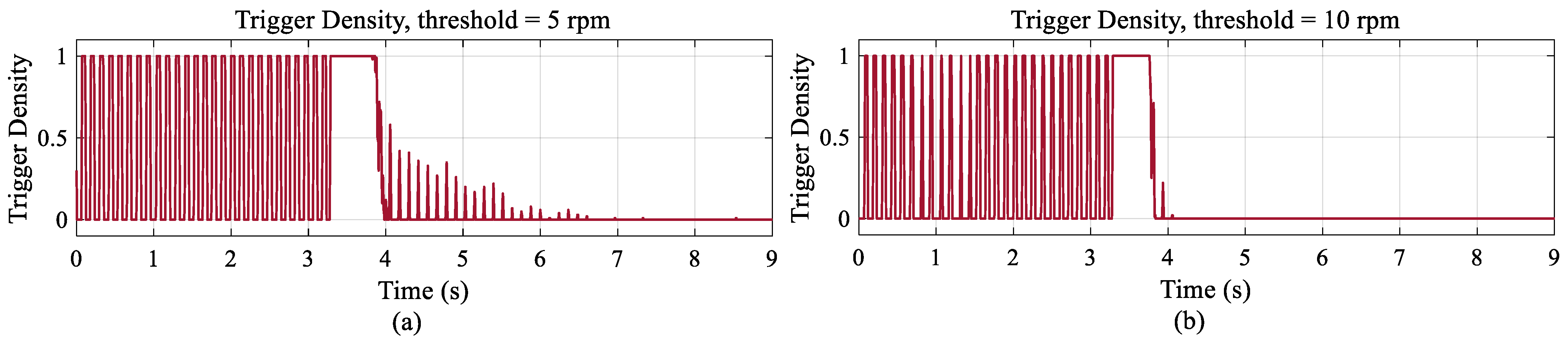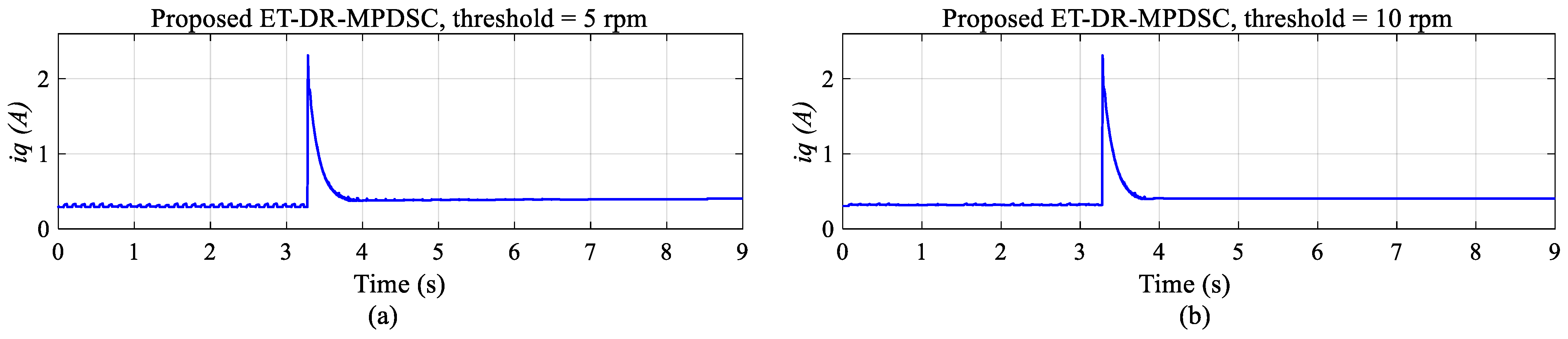

Event-Triggered Extension of Duty-Ratio-Based MPDSC with Field Weakening for PMSM Drives in EV Applications




Abstract
1. Introduction
1.1. State of the Art
1.2. Related Works on Event-Triggered Control for PMSM Drives
1.3. Research Gap and Main Contributions
- A direct speed-level event-triggered execution framework is formulated specifically for DR-MPDSC, enabling predictive optimization to be selectively activated only when speed performance degradation is detected. Unlike conventional time-triggered MPDSC and existing event-triggered MPC approaches, the proposed strategy directly targets the speed control layer, achieving substantial control update reduction without compromising dynamic response.
- A disturbance-aware predictive speed control structure is established by integrating EKF-based rotor speed and load torque estimation, allowing the proposed ET-DR-MPDSC to maintain robustness against load variations without relying on mechanical torque sensing.
- A unified field-weakening mechanism is embedded within the event-triggered predictive framework, ensuring seamless transition between base-speed and high-speed constant-power operation, which is essential for practical EV traction drives.
- An optimized duty-ratio formulation is incorporated within the predictive speed control loop to explicitly regulate voltage application duration, resulting in reduced electromagnetic torque ripple and improved current quality, while preserving low switching frequency and computational efficiency.
- Comprehensive simulation and experimental validation under realistic EV operating conditions is conducted, including quantitative analysis of speed tracking accuracy, torque ripple reduction, and control update execution rate, demonstrating the practical feasibility and embedded suitability of the proposed ET-DR-MPDSC strategy.
2. Mathematical Model of PMSM and Inverter
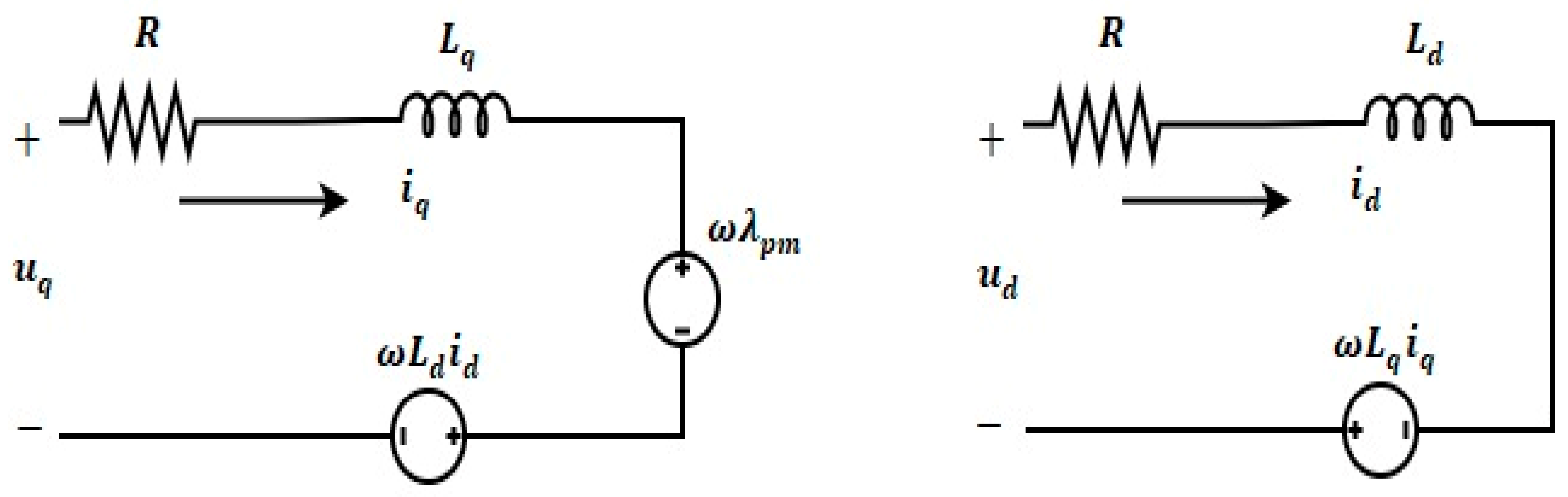
2.1. Continuous-Time Model of PMSM
2.2. Discrete-Time Model of PMSM
2.3. Inverter Model
2.4. Predicted Controlled Variables
3. Implementation of EKF
3.1. Mathematical Model
3.2. EKF Algorithm
3.3. Calculations of Kalman Gain
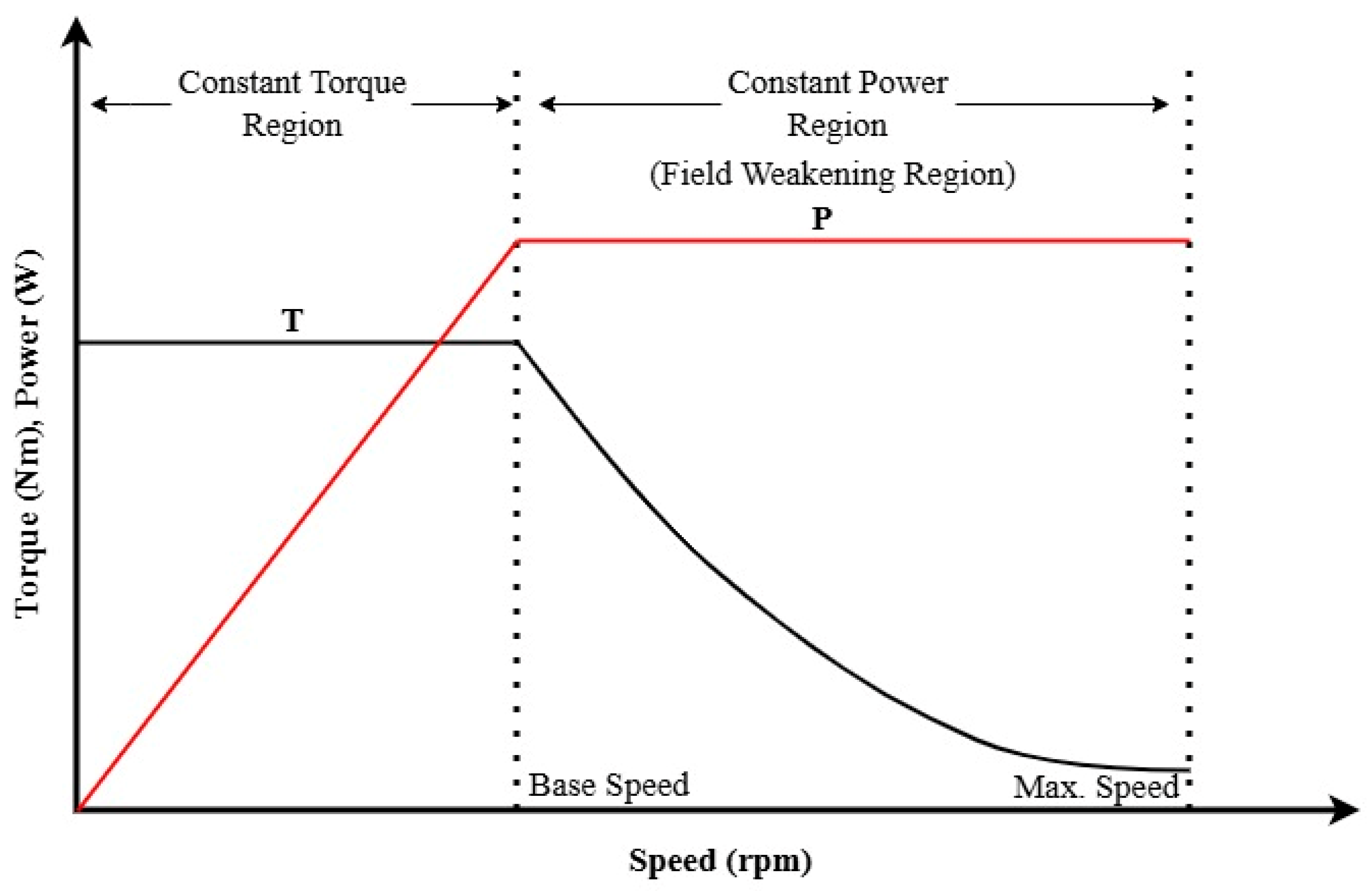
4. Implementation of FWC
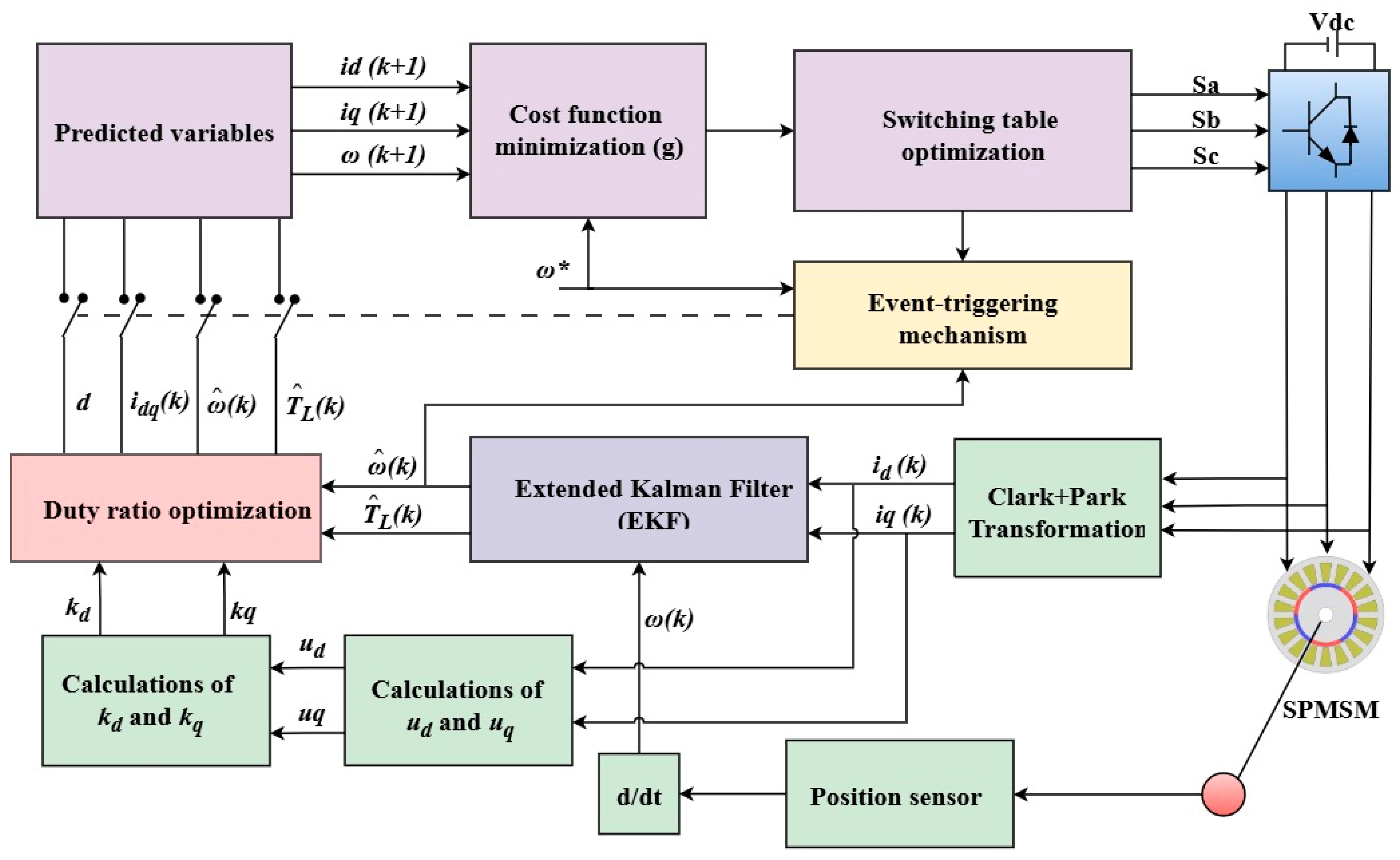
5. Proposed Event-Triggered DR-MPDSC Strategy
5.1. Control Objectives and Design Considerations
- Accurate tracking of the speed reference under rapid changes.
- Reduction of electromagnetic torque ripples through duty-ratio optimization.
- Limitation of inverter switching frequency.
- Maintenance of constant power operation in the FW region.
- Robust operation under load disturbances using EKF-based estimation.
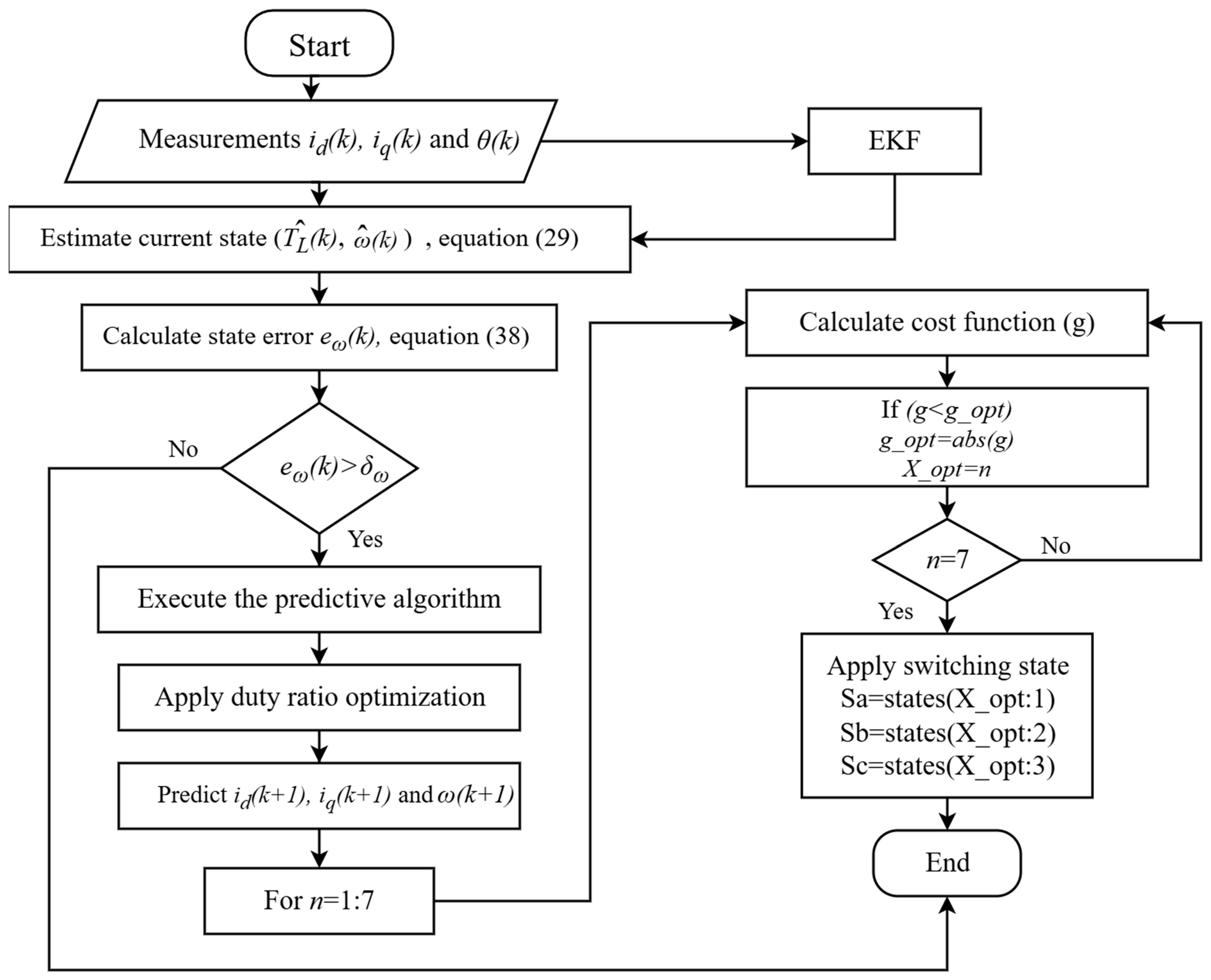
5.2. Event-Triggered Speed Control Mechanism
5.3. Duty-Ratio-Based MPDSC Formulation
5.4. Design of the Main Cost Function
6. Implementation of Benchmark Control Strategies
6.1. Implementation of FOC
6.1.1. Control Structure and Operating Stages
- Acquisition of measured signals;
- Reference frame transformations;
- Generation of reference currents;
- Voltage reference computation;
- Voltage synthesis through the inverter;
- Cost function design.
6.1.2. Measured Variables
6.1.3. Reference Frame Transformations
6.1.4. Reference Current Generation
6.1.5. Voltage Reference Calculation
6.1.6. Inverter Voltage Synthesis
6.1.7. Cost Function Design
6.2. Implementation of MPDTC
6.2.1. Prediction of Electromagnetic Torque
6.2.2. Prediction of Stator Flux Components
6.2.3. Cost Function Formulation
6.2.4. Voltage Vector Selection
7. Simulation Results and Discussion
7.1. Simulation Setup
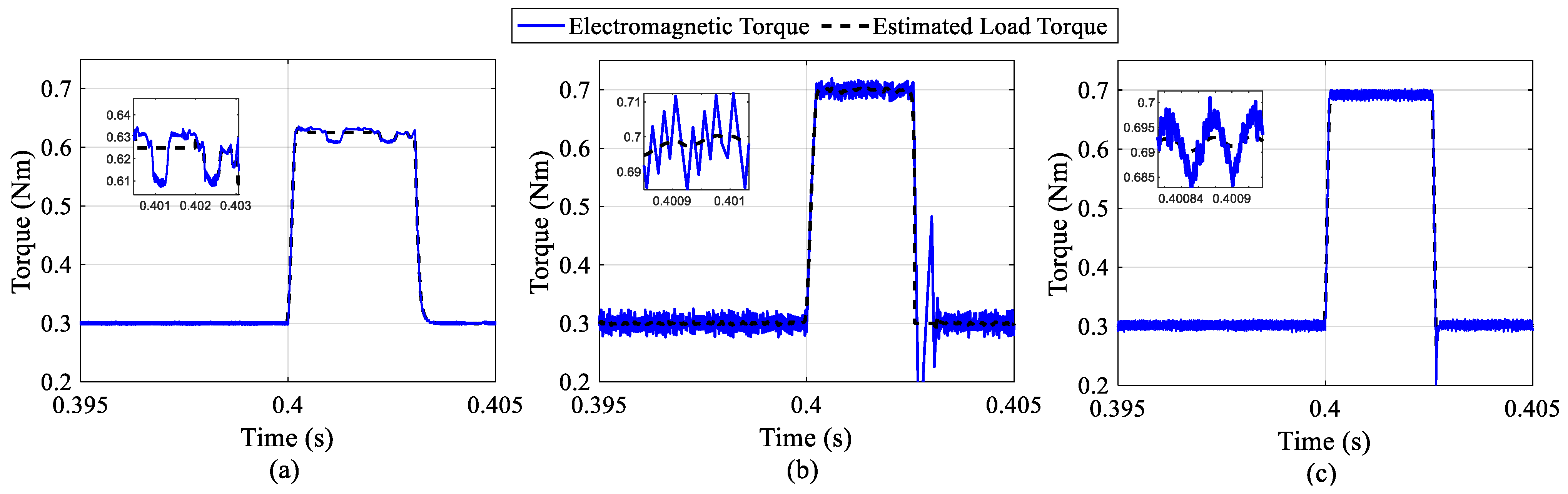
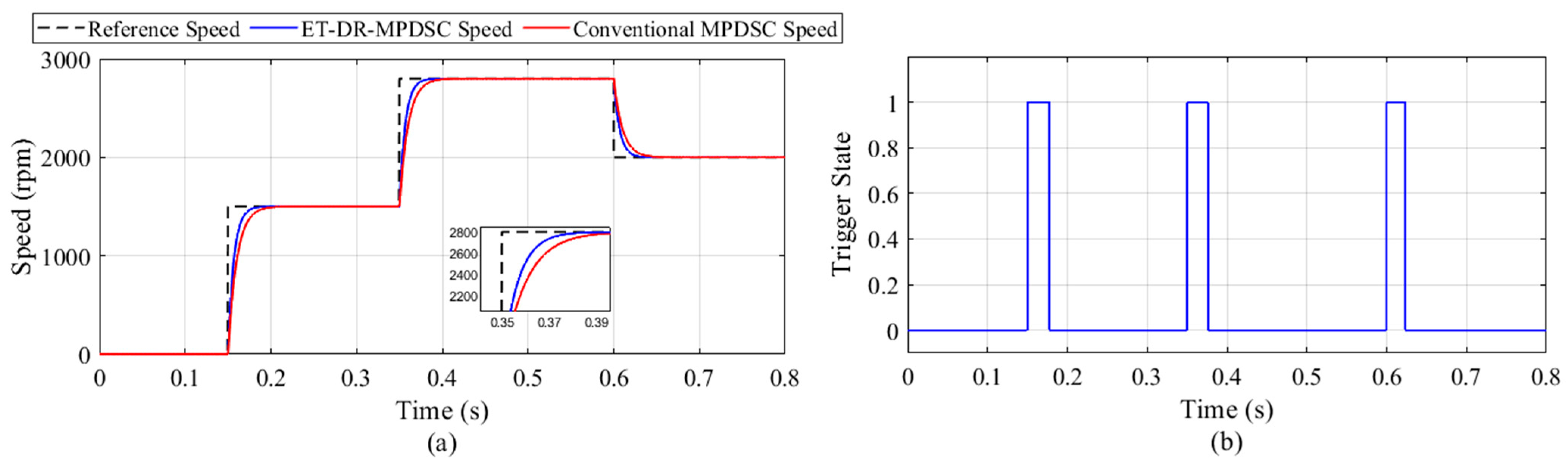
7.2. Event-Triggered Control Performance
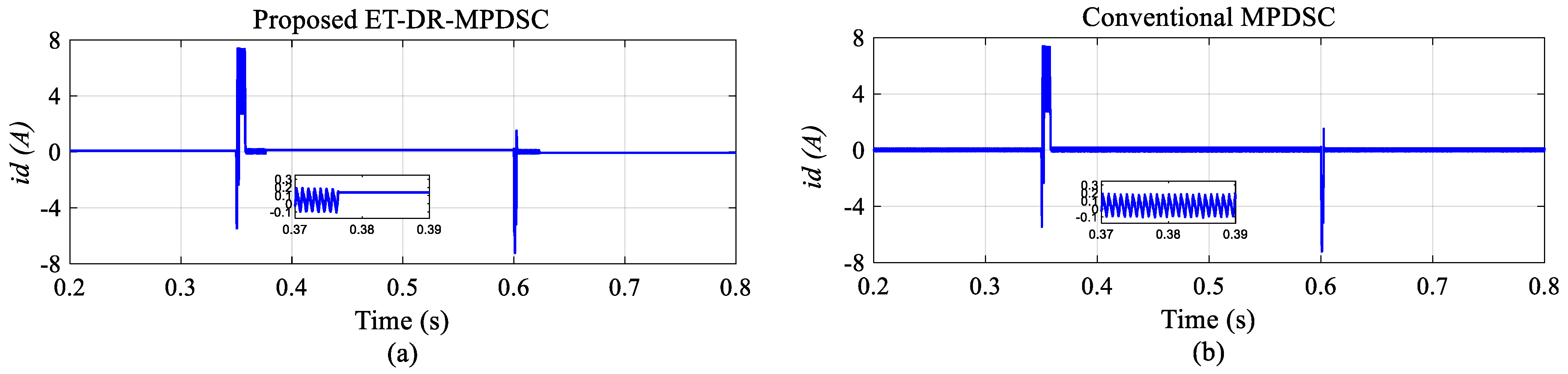
7.3. Dynamic Response Under Speed Reference Change
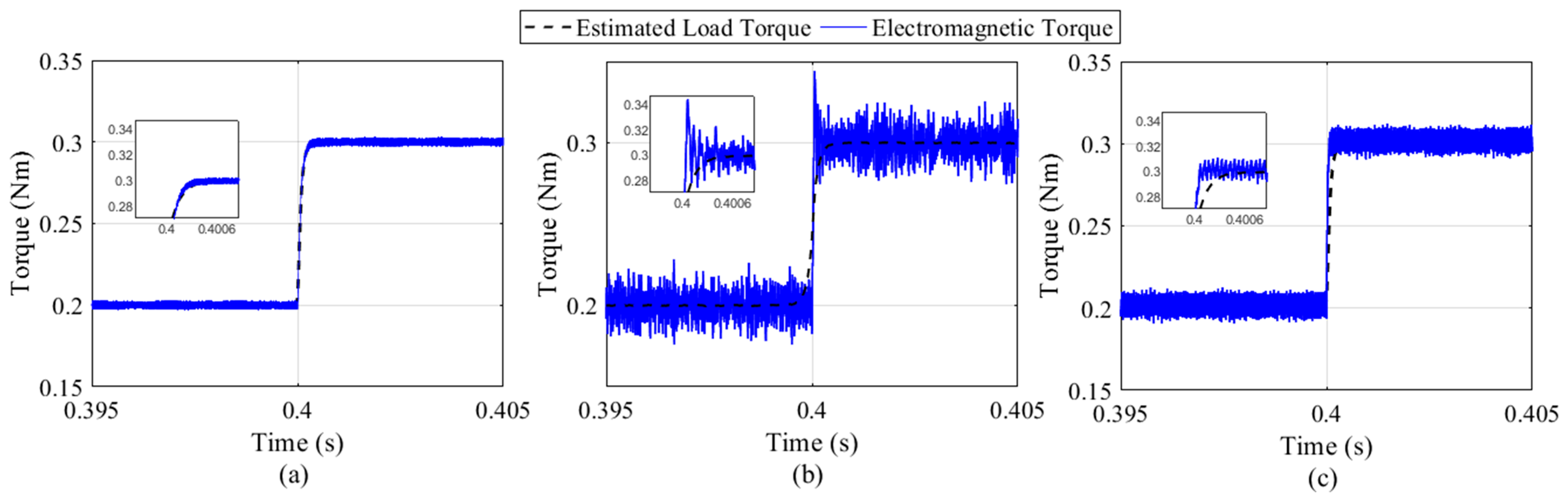
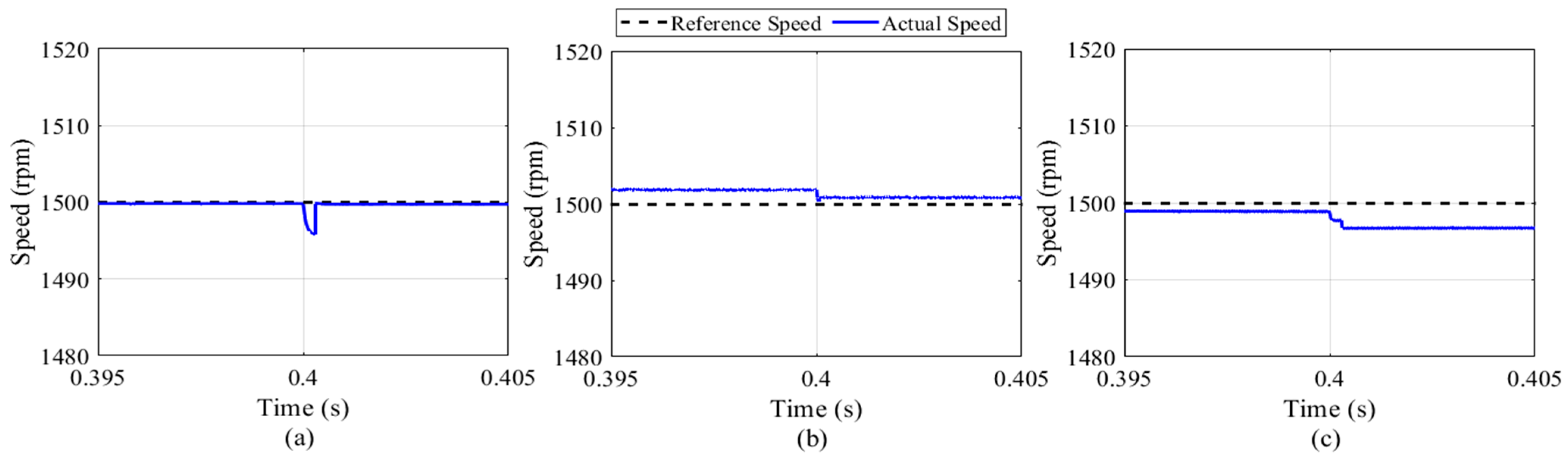
7.4. Response to Load Torque Disturbance
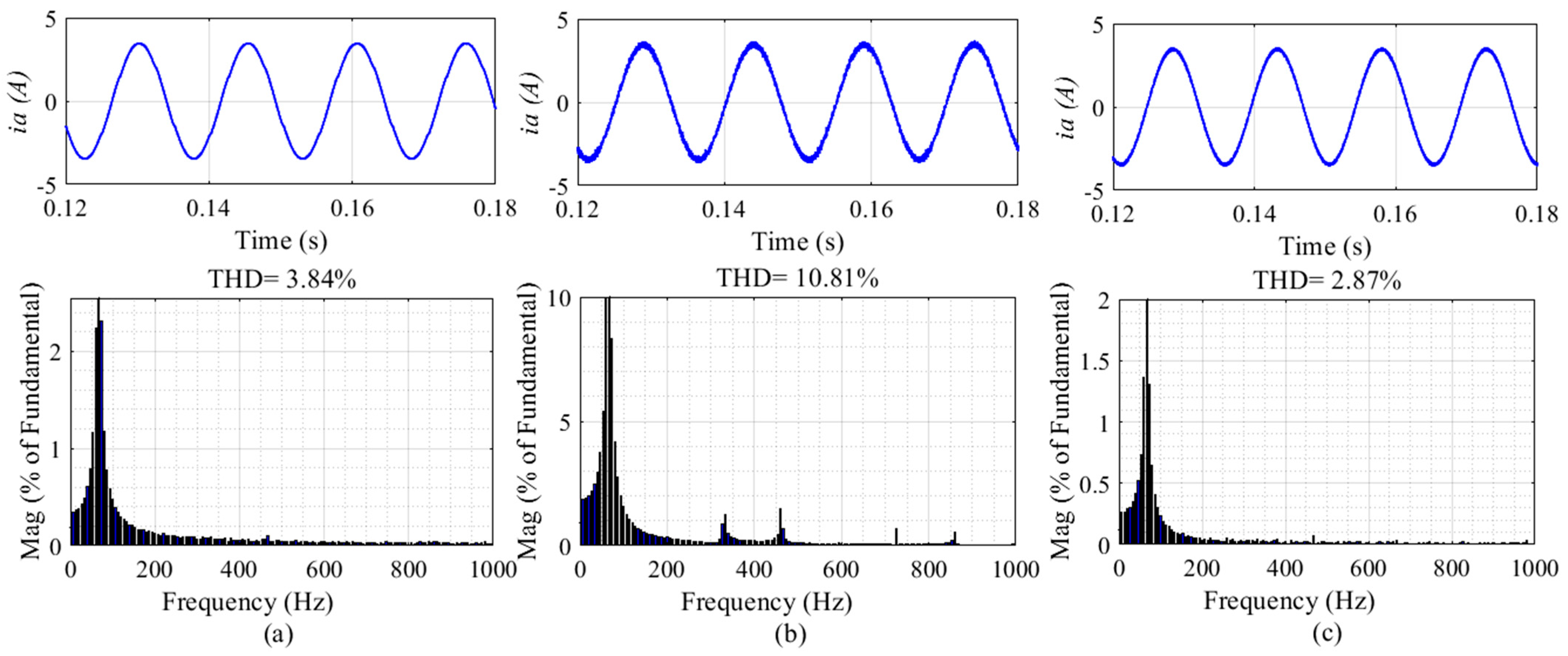
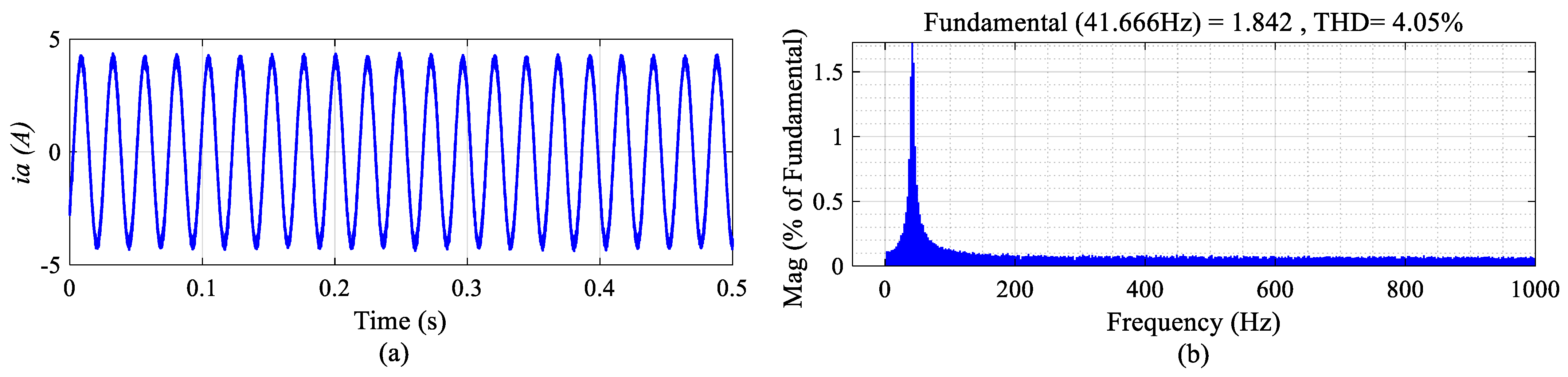
7.5. THD Analysis
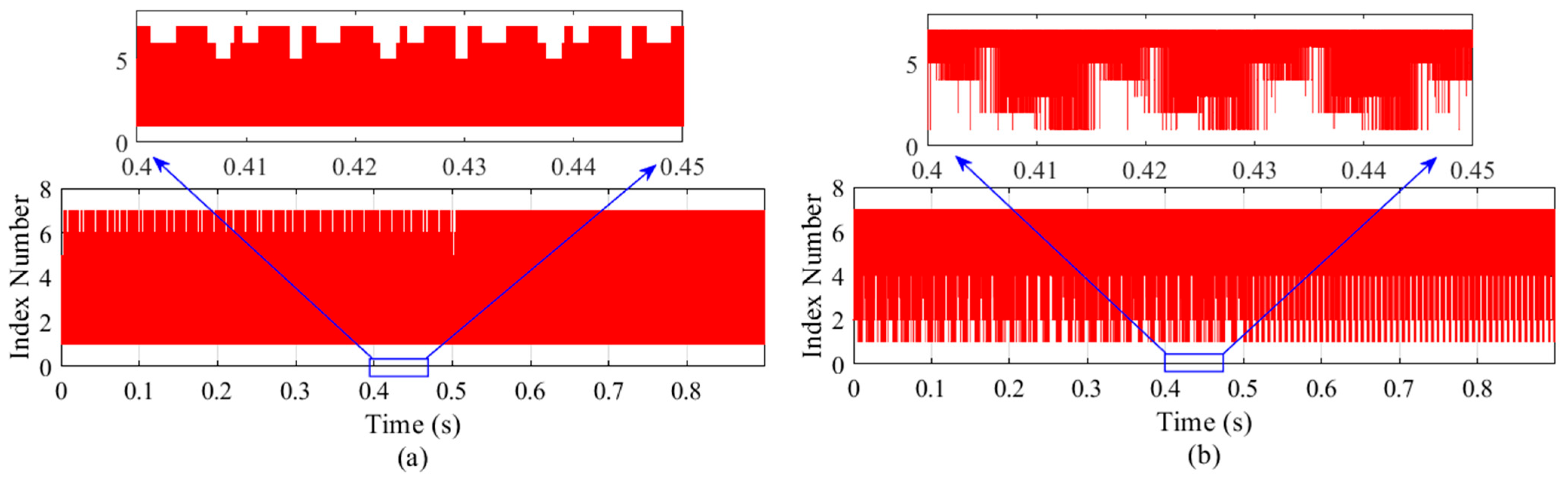
7.6. Voltage Vector Selection Patterns
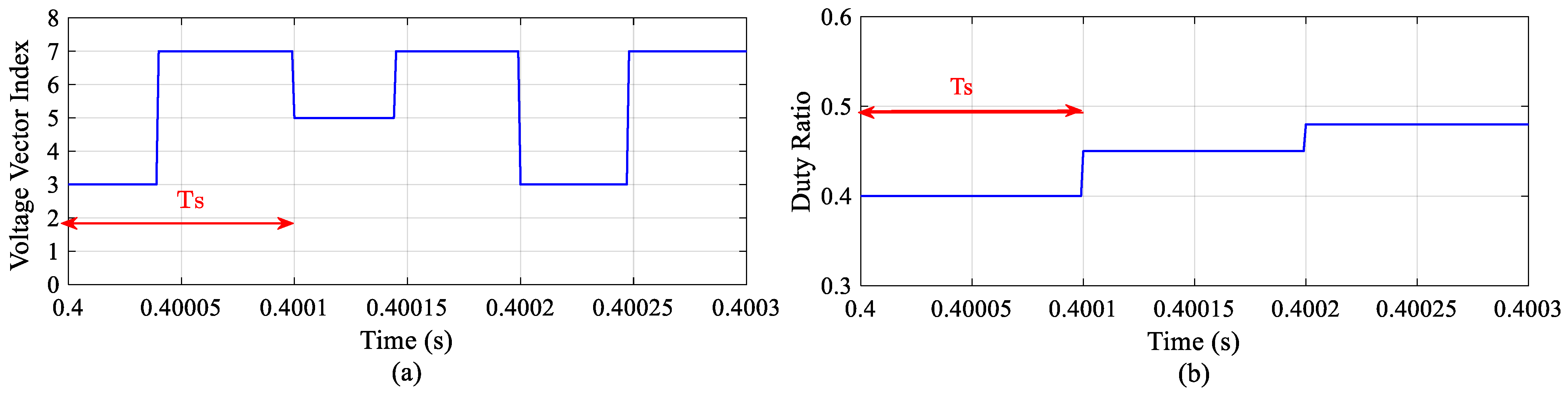
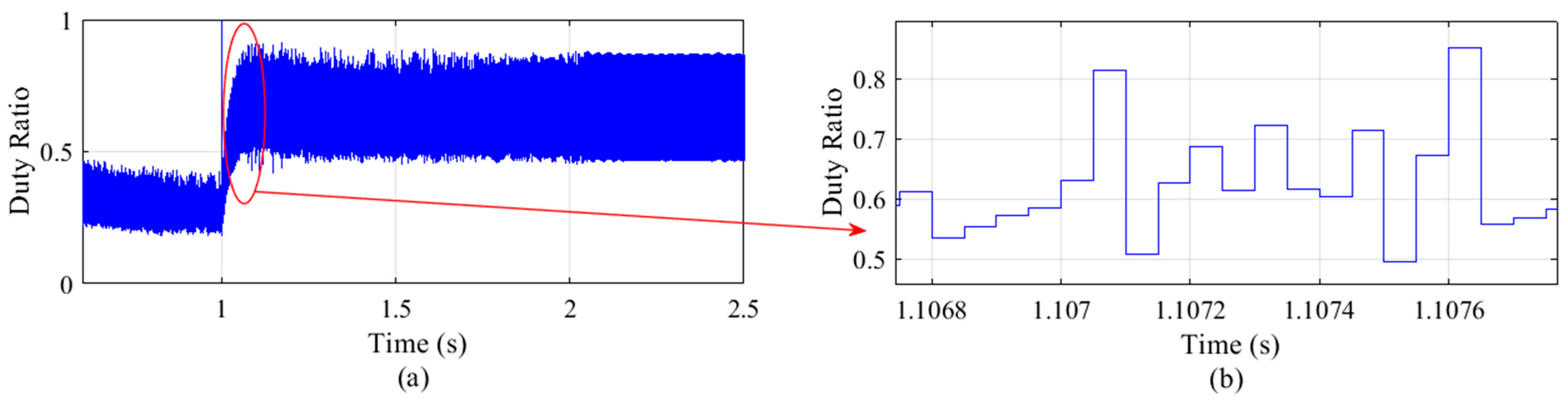
7.7. Duty Ratio Response During Speed Transition
7.8. Duty Ratio-Based Voltage Vector Modulation in the DR-MPDSC
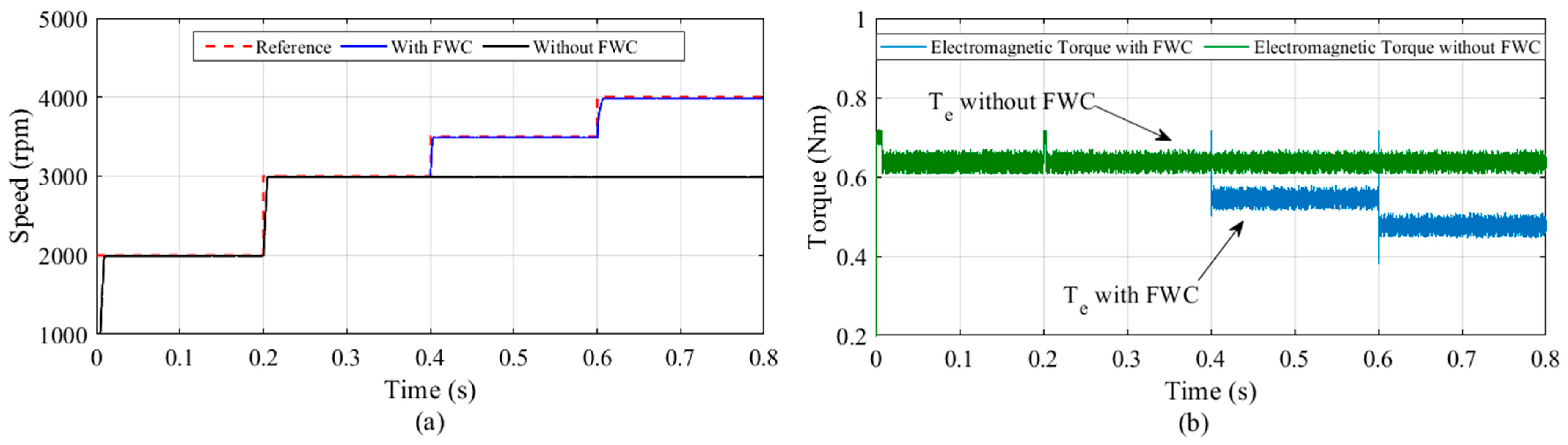
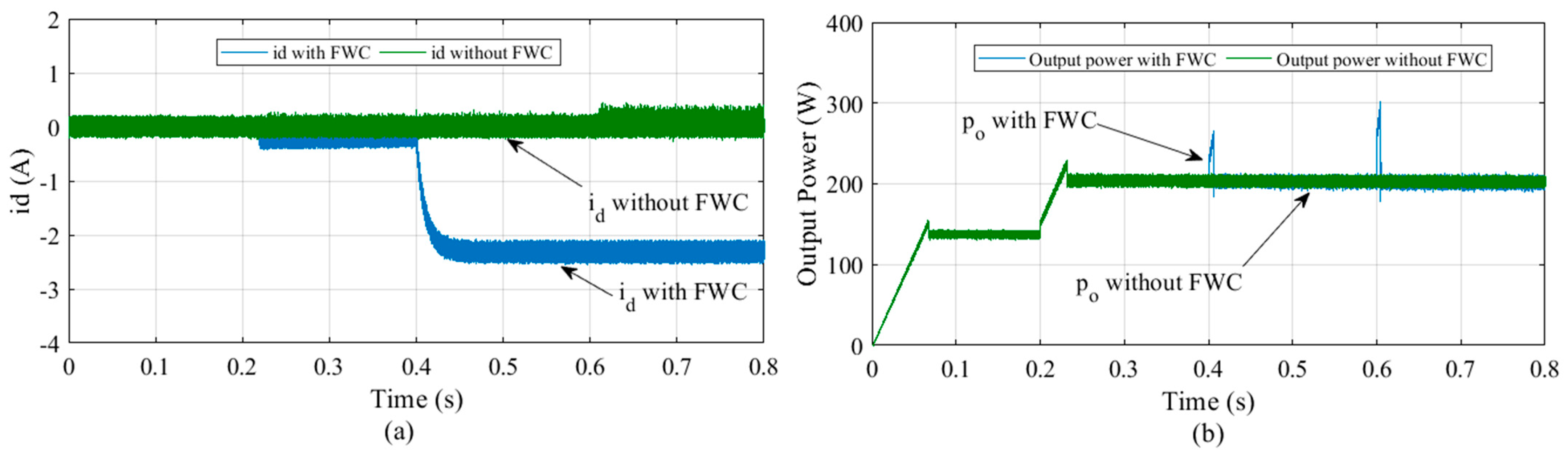
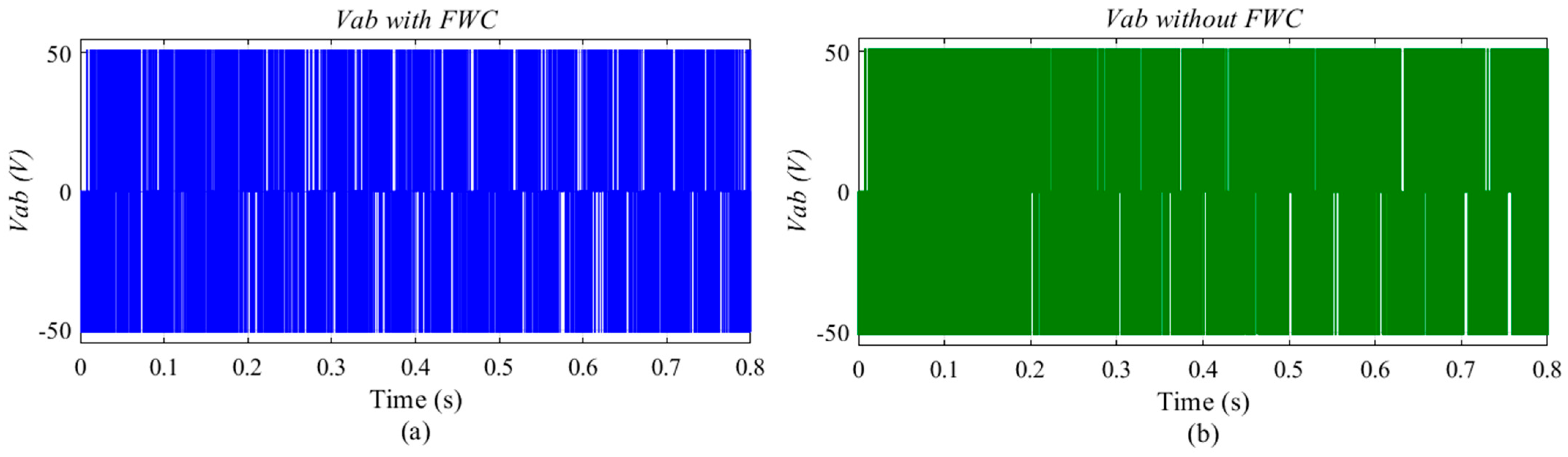
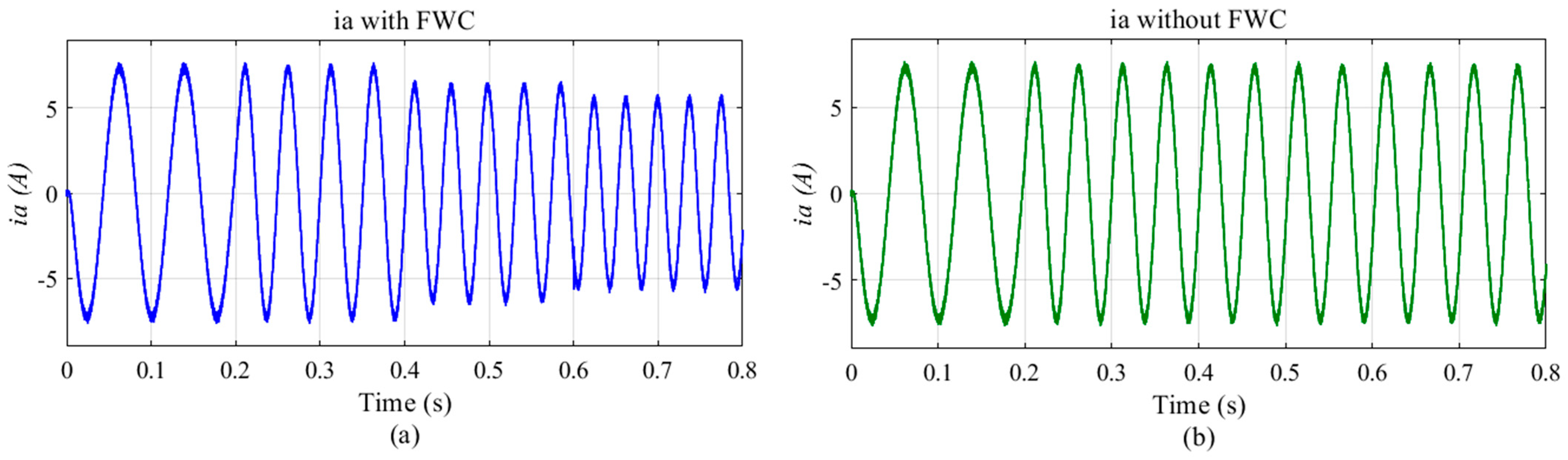
7.9. Comparative Analysis of FW and Non-FW Performance
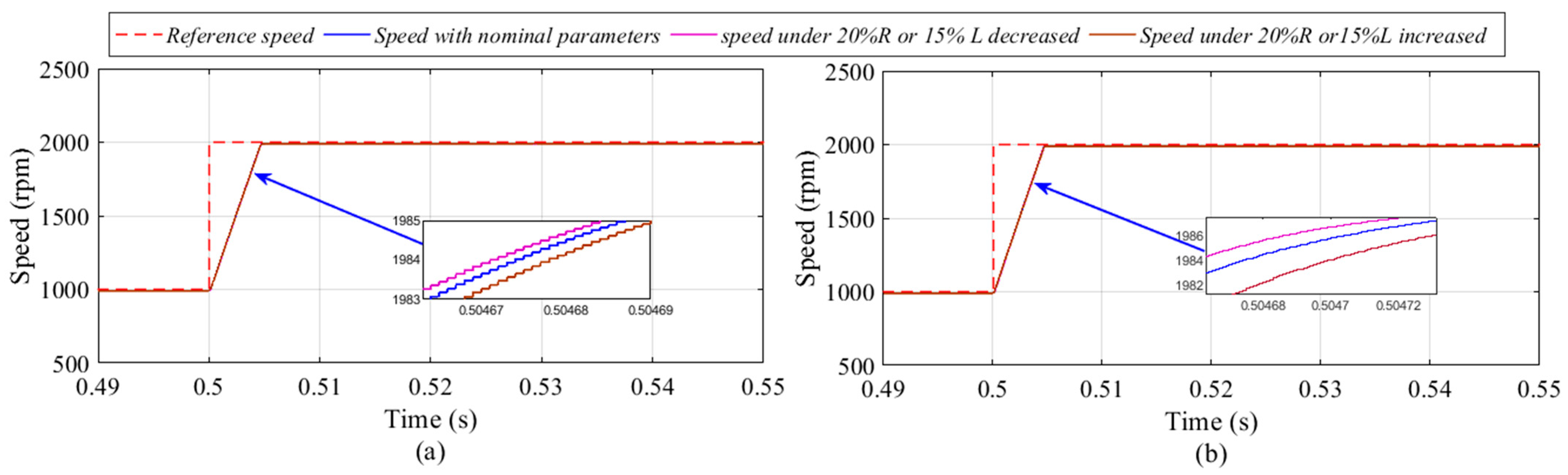
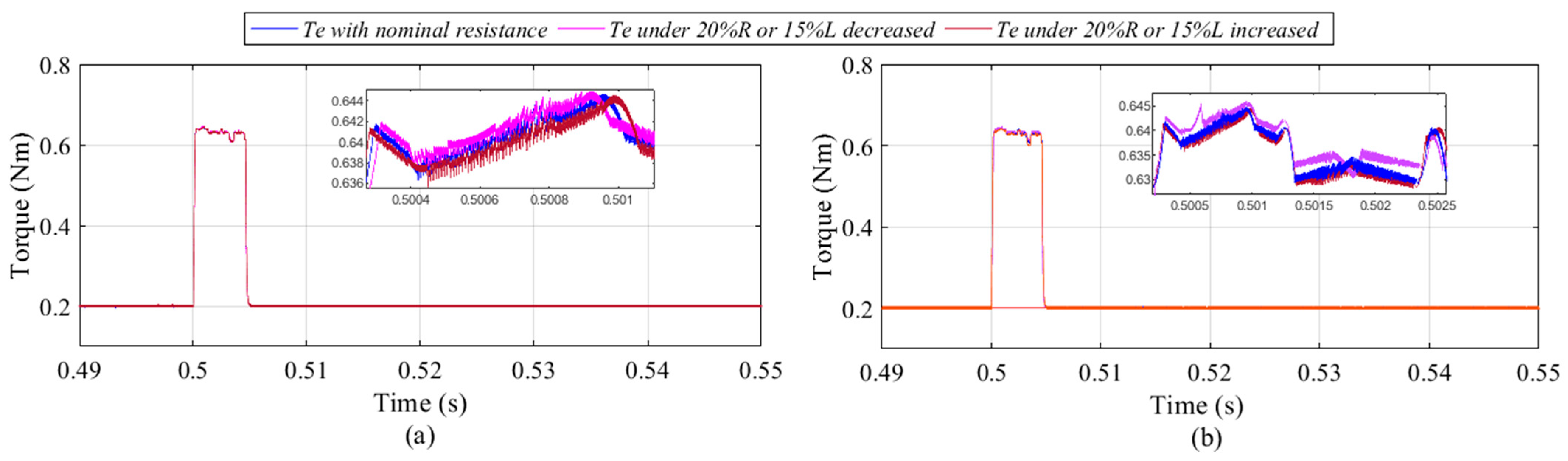
7.10. Effect of Parameter Variations on Proposed ET-DR-MPDSC
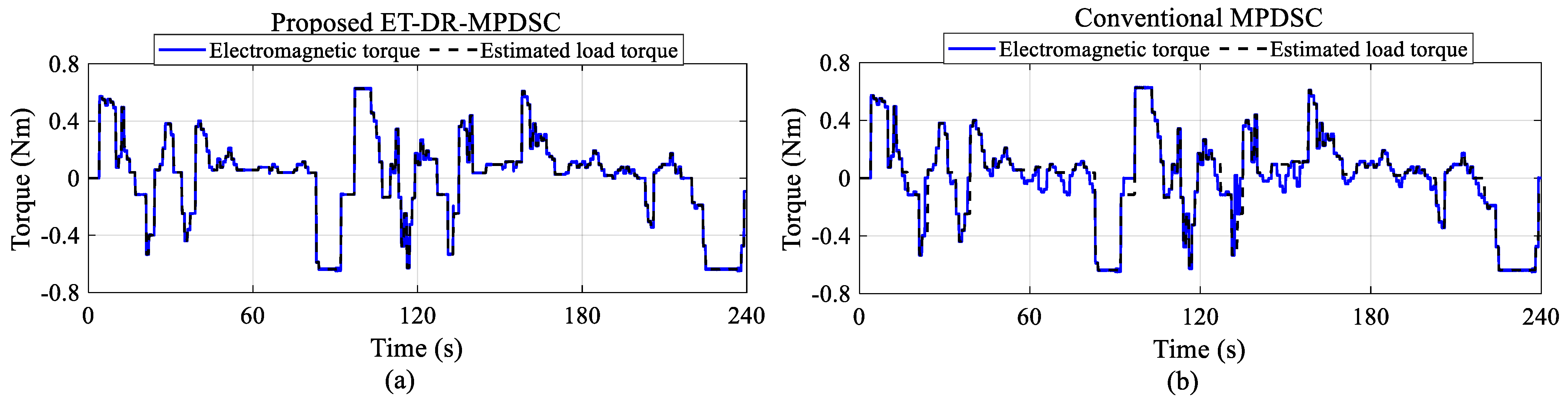
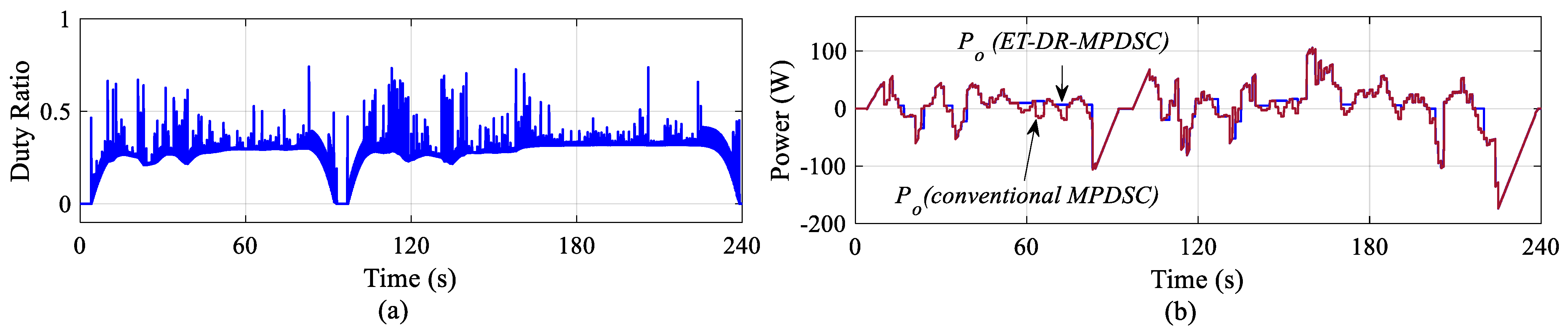
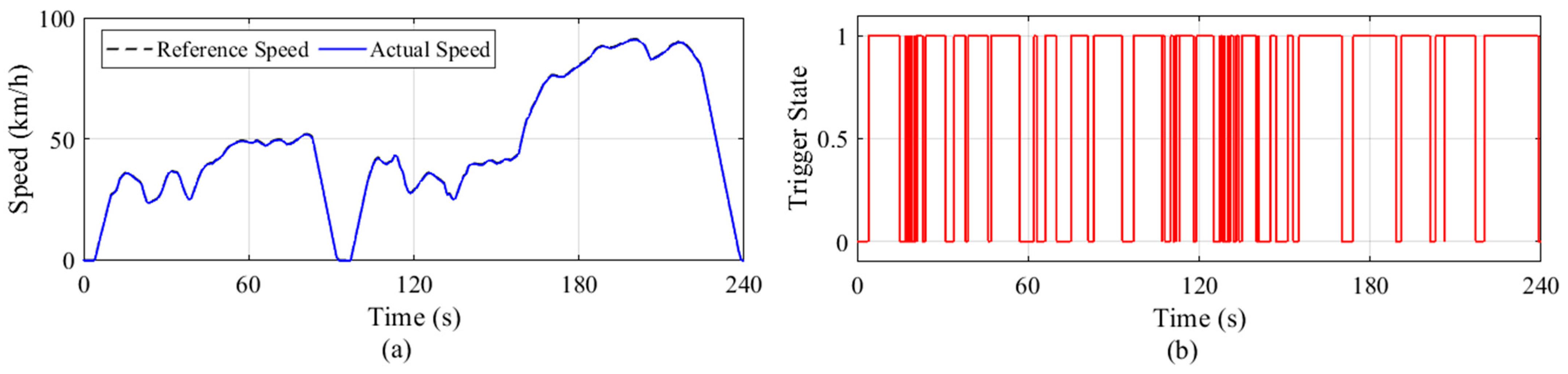
7.11. Dynamic Performance Evaluation of ET-DR-MPDSC Under IM240 Drive Cycle Conditions
7.11.1. IM240 Drive Cycle Description and Relevance to EV Applications
7.11.2. Speed Scaling and Dynamic Adaptation of the IM240 Drive Cycle to the Low-Power PMSM
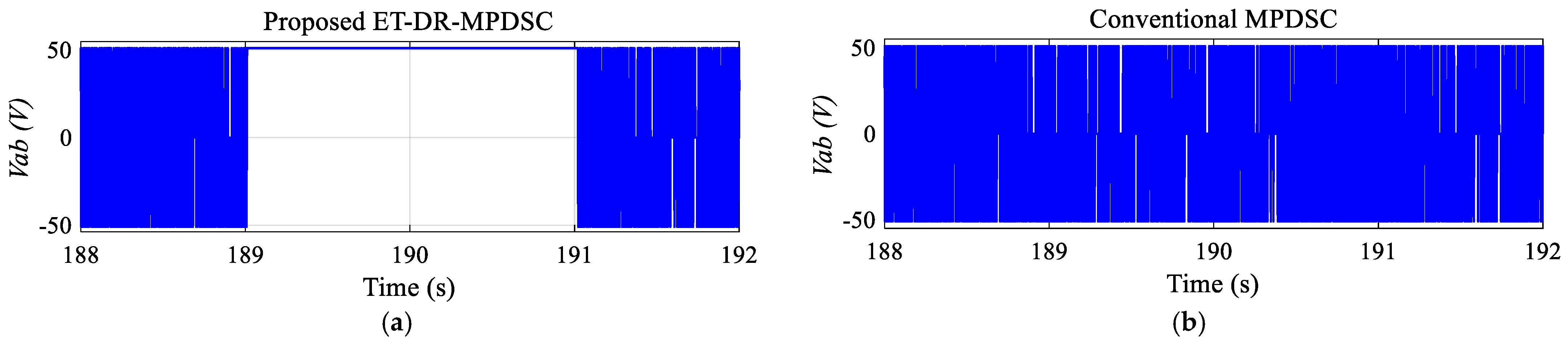
7.11.3. Event-Triggered Control Performance Under IM240 Excitation
7.11.4. Field-Weakening Operation During High-Speed IM240 Intervals
7.12. Quantitative Performance Comparison Between Conventional MPDSC and the Proposed ET-DR-MPDSC
8. Experimental Results and Discussion
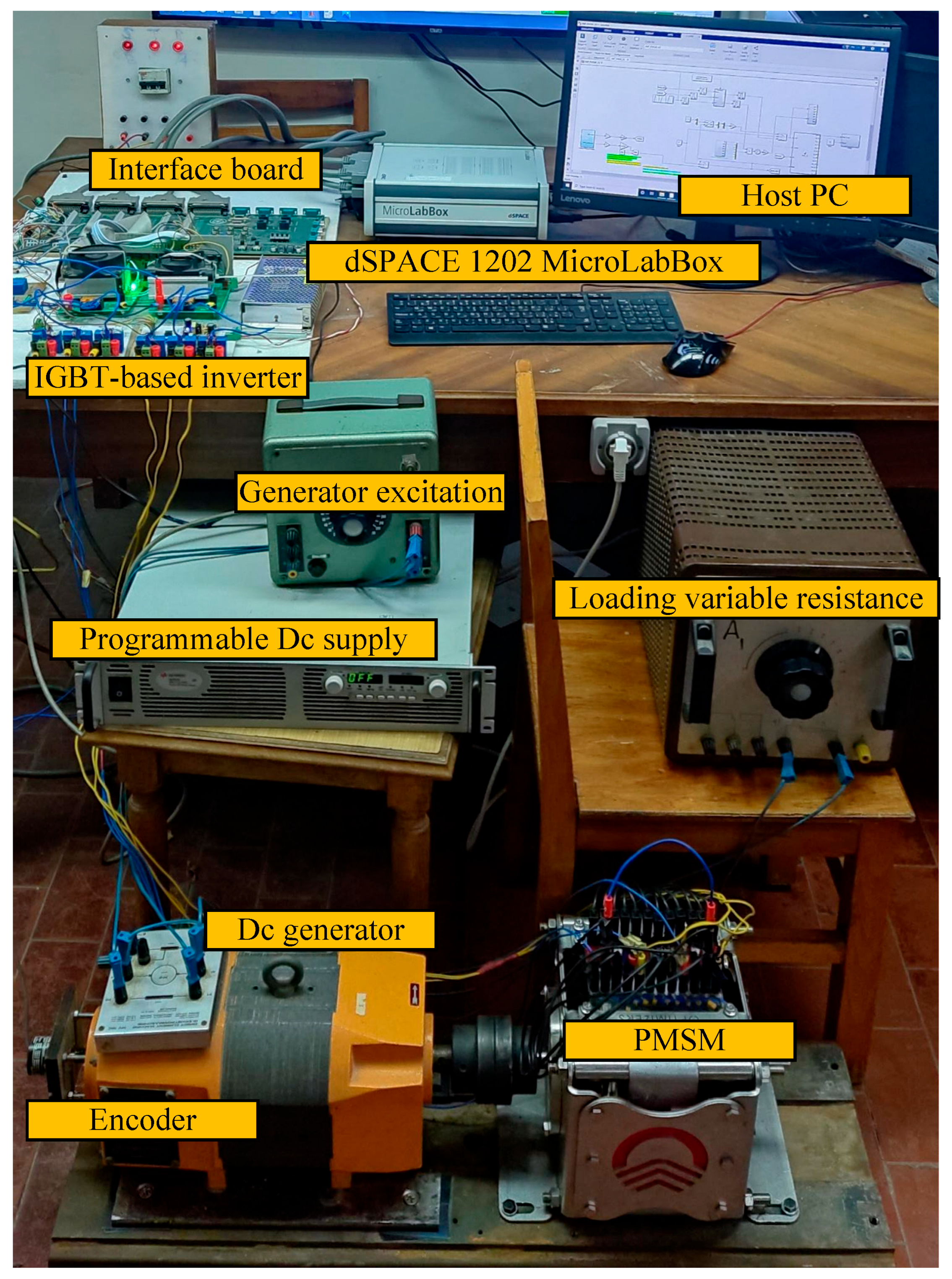
8.1. Experimental Setup
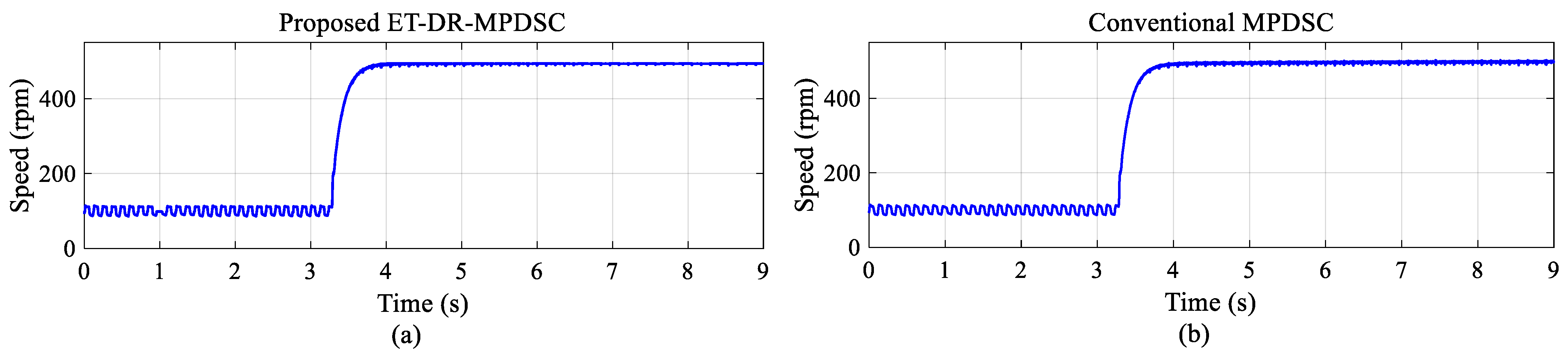
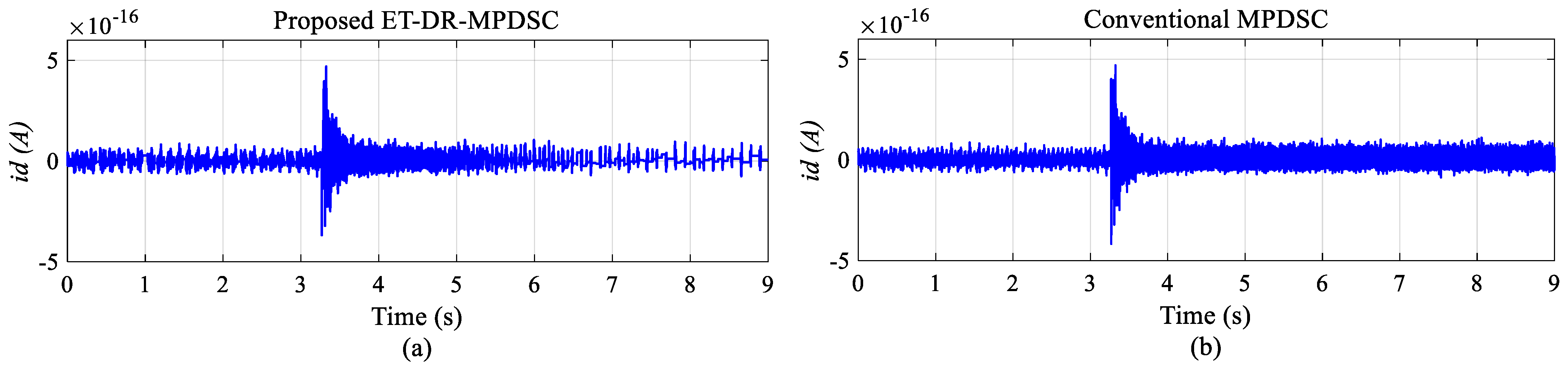
8.2. Comparison Between Proposed ET-DR-MPDSC () and Conventional MPDSC
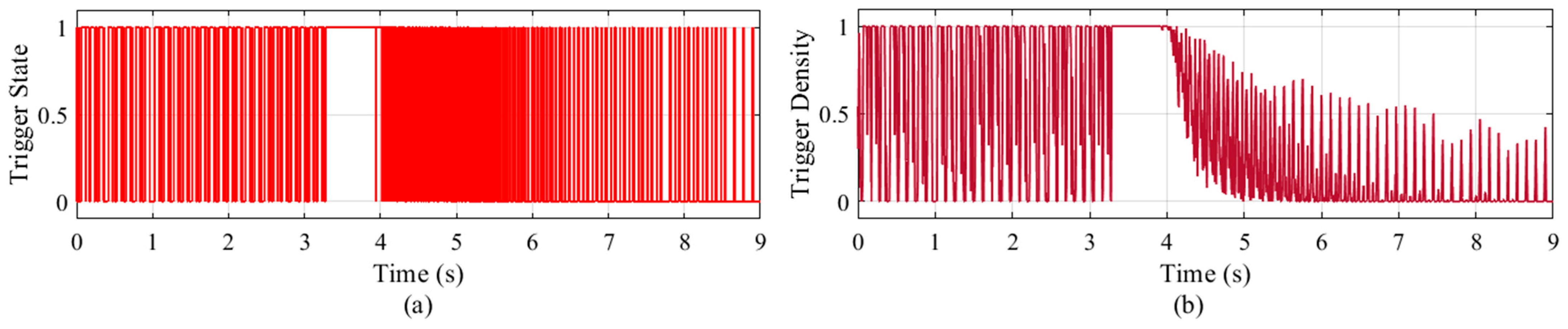
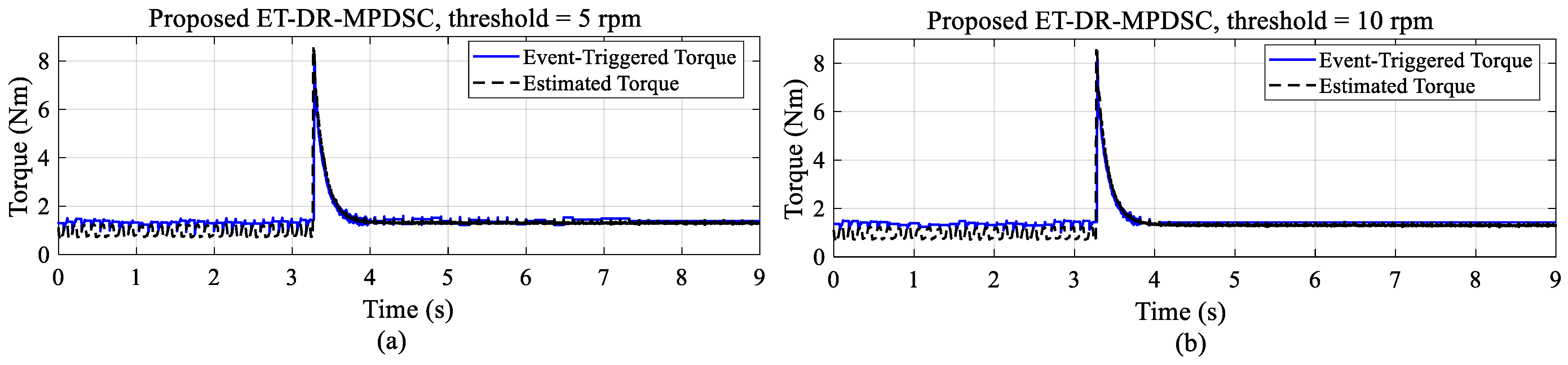
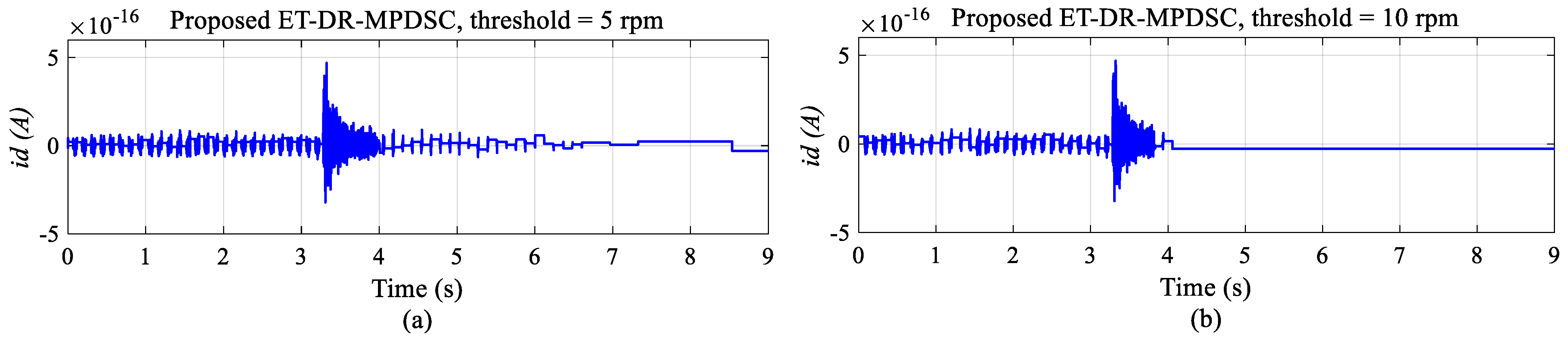
8.3. Effect of Event-Triggering Threshold on Control Performance
9. Conclusions
Author Contributions
Funding
Data Availability Statement
Conflicts of Interest
References
- Kulkarni, S.; Thosar, A. Performance Analysis of Permanent Magnet Synchronous Machine due to Winding Failures. Int. J. Electr. Electron. Res. 2021, 9, 76–83. [Google Scholar] [CrossRef]
- Trabelsi, M.; Semail, E. Virtual current vector-based method for inverter open-switch and open-phase fault diagnosis in multiphase permanent magnet synchronous motor drives. IET Electr. Power Appl. 2022, 16, 1476–1491. [Google Scholar] [CrossRef]
- Belkhadir, A.; Pusca, R.; Belkhayat, D.; Romary, R.; Zidani, Y. Analytical Modeling, Analysis and Diagnosis of External Rotor PMSM with Stator Winding Unbalance Fault. Energies 2023, 16, 3198. [Google Scholar] [CrossRef]
- Wei, H.; Wei, H.; Zhang, Y. Matlab Simulation Research on Permanent Magnet Synchronous Motor Vector Control. EPH—Int. J. Sci. Eng. 2021, 7. [Google Scholar] [CrossRef]
- Gade, C.R.; Wahab, R.S. Conceptual Framework for Modelling of an Electric Tractor and Its Performance Analysis Using a Permanent Magnet Synchronous Motor. Sustainability 2023, 15, 4391. [Google Scholar] [CrossRef]
- Kumar, A.N.; Dheepanchakkravarthy, A. Design and Analysis of Interior Buried Permanent Magnet Synchronous Motor for Electric Vehicle Applications. Adv. Electr. Comput. Eng. 2023, 23, 3–14. [Google Scholar] [CrossRef]
- Abdelsalam, A.A.; Cui, S. A fuzzy logic global power management strategy for hybrid electric vehicles based on a permanent magnet electric variable transmission. Energies 2012, 5, 1175–1198. [Google Scholar] [CrossRef]
- Abd El Maguid Ahmed, W.; Adel, M.M.; Taha, M.; Saleh, A.A. PSO technique applied to sensorless field-oriented control PMSM drive with discretized RL-fractional integral. Alex. Eng. J. 2021, 60, 4029–4040. [Google Scholar] [CrossRef]
- Ramesh, P.; Umavathi, M.; Bharatiraja, C.; Ramanathan, G.; Athikkal, S. Development of a PMSM motor field-oriented control algorithm for electrical vehicles. Mater. Today Proc. 2022, 65, 176–187. [Google Scholar] [CrossRef]
- Wu, Z.; Lin, F.; Liang, Q.; Zhang, S.; Liang, J. Low order speed harmonic suppression in FOC-PMSM based on the closed-loop transfer mechanism of injected voltage. JVC/J. Vib. Control. 2024, 30, 4525–4536. [Google Scholar] [CrossRef]
- Tripathi, H.; Marahatta, K.; Gupta, B.K.; Yadav, N.K.; Shrestha, S. Modelling and Simulation of Field-Oriented Control of Permanent Magnet Synchronous Motor. J. Eng. Sci. 2023, 2, 88–92. [Google Scholar] [CrossRef]
- Nustes, J.C.; Pau, D.P.; Gruosso, G. Modelling the Field Oriented Control applied to a 3-phase Permanent Magnet Synchronous Motor. Softw. Impacts 2023, 15, 100479. [Google Scholar] [CrossRef]
- Nustes, J.C.; Pau, D.P.; Gruosso, G. Field oriented control dataset of a 3-phase permanent magnet synchronous motor. Data Brief 2023, 47, 109002. [Google Scholar] [CrossRef] [PubMed]
- Khames, M.A.; Ahmed, A.A.; Omara, A.M.; Rashad, E.E.M. Dynamic behavior assessment of permanent magnet synchronous motors under finite set model predictive controllers and field-oriented control. In 2021 22nd International Middle East Power Systems Conference (MEPCON); IEEE: New York, NY, USA, 2021; pp. 455–462. [Google Scholar]
- Tejavathu, R.; Bukkana, T.; Tangirala, I.; Poondla, D.K. DTC-SPWM based Realization of SVM with Reduced carrier for Three-level NPC fed Five Phase Permanent Magnet Synchronous Motor Drive. In 2023 IEEE IAS Global Conference on Emerging Technologies, GlobConET 2023; IEEE: New York, NY, USA, 2023. [Google Scholar] [CrossRef]
- Ramesh, T.; Bukkana, T.; Mohan, M. Model Predictive Current Control based Three-Level Inverter fed Five Phase Permanent Magnet Synchronous Motor Drive. In 5th International Conference on Energy, Power, and Environment: Towards Flexible Green Energy Technologies, ICEPE 2023; IEEE: New York, NY, USA, 2023. [Google Scholar] [CrossRef]
- Zhang, W.; Liu, C.; Lian, C.; Liu, J.; Mai, Z. Optimization of SVPWM Algorithm used in PMSM DTC. In 2023 3rd International Conference on Electrical Engineering and Mechatronics Technology, ICEEMT 2023; IEEE: New York, NY, USA, 2023. [Google Scholar] [CrossRef]
- He, H.; Gui, H.; Shao, H.; Gao, J. Model Predictive Direct Torque Control Based on Active Disturbance Rejection Controller for PMSM. In 2022 International Conference on Mechanical and Electronics Engineering, ICMEE 2022; IEEE: New York, NY, USA, 2022. [Google Scholar] [CrossRef]
- Tian, Y.; Zhang, Y.; Xiao, X.; Yildirim, T. Weighting factors design in model predictive direct torque control based on cascaded neural network. Asian J. Control 2024, 26, 1323–1338. [Google Scholar] [CrossRef]
- Hou, L.; Guo, Y.; Ba, X.; Lei, G.; Zhu, J. Efficiency Improvement of Permanent Magnet Synchronous Motors Using Model Predictive Control Considering Core Loss. Energies 2024, 17, 773. [Google Scholar] [CrossRef]
- Ahmed, A.A.; Koh, B.K.; Lee, Y.I. A Comparison of Finite Control Set and Continuous Control Set Model Predictive Control Schemes for Speed Control of Induction Motors. IEEE Trans. Industr. Inform. 2018, 14, 1334–1346. [Google Scholar] [CrossRef]
- Ahmed, A.A. Experimental implementation of model predictive control for permanent magnet synchronous motor. Int. J. Electr. Comput. Energetic Electron. Commun. Eng. 2015, 9, 644–647. [Google Scholar]
- Gao, S.; Wei, Y.; Qi, H.; Zhang, D.; Wei, Y. Model Prediction Hybrid Parallel Direct Speed Control of Permanent Magnet Synchronous Machines for Electric Vehicles. Control. Eng. Appl. Inform. 2022, 24, 31–39. [Google Scholar]
- Wang, H.; Zhang, S.; Liu, W.; Geng, Q.; Zhou, Z. Finite control-set model predictive direct speed control of a PMSM drive based on the Taylor series model. IET Electr. Power Appl. 2021, 15, 1452–1465. [Google Scholar] [CrossRef]
- Pancurak, L.; Jure, T.; Kyslan, K. Finite Control Set Model Predictive Direct Speed Control of PMSM. In 2023 International Conference on Electrical Drives and Power Electronics, EDPE 2023—Proceedings; IEEE: New York, NY, USA, 2023. [Google Scholar] [CrossRef]
- Gao, M.; Liu, H. Direct speed predictive control of permanent magnet synchronous motor. In 2023 3rd International Conference on Intelligent Power and Systems, ICIPS 2023; IEEE: New York, NY, USA, 2023. [Google Scholar] [CrossRef]
- Yahia, T.; Ahmed, A.A.; Elzawawi, A.; Ahmed, M.M. Model Predictive Direct Speed Control of PMSM with Load Torque Compensation. In 2021 24th International Conference on Electrical Machines and Systems (ICEMS); IEEE: New York, NY, USA, 2021; pp. 1335–1341. [Google Scholar]
- Yahia, T.; Ahmed, A.A.; Ahmed, M.M.; El Zawawi, A.; Elbarbary, Z.M.S.; Arafath, M.S.; Ali, M.M. Enhanced Model Predictive Speed Control of PMSMs Based on Duty Ratio Optimization with Integrated Load Torque Disturbance Compensation. Machines 2025, 13, 891. [Google Scholar] [CrossRef]
- Sadhukhan, T.; Roy, P.; Ray, S. Direct Torque Control of PMSM following Advanced Duty Ratio Modulation with MTPA Scheme. In Proceedings of 2023 IEEE 3rd Applied Signal Processing Conference, ASPCON 2023; IEEE: New York, NY, USA, 2023. [Google Scholar] [CrossRef]
- Du, N.; Ge, L. A Novel Duty Ratio Interval Subdivision Based MPTC Method for PMSM. In 2023 26th International Conference on Electrical Machines and Systems, ICEMS 2023; IEEE: New York, NY, USA, 2023. [Google Scholar] [CrossRef]
- Zhang, X.; Zhang, C. A Simple Model Predictive Control for Open Winding PMSM Based on Duty Ratio Control. In 2023 IEEE 6th International Electrical and Energy Conference, CIEEC 2023; IEEE: New York, NY, USA, 2023. [Google Scholar] [CrossRef]
- Lu, K.; Zhu, Z.Q. Comparative Stability Analysis of PMSMs under Feedback FluxWeakening Control. IEEE Trans. Ind. Appl. 2025, 62, 1093–1102. [Google Scholar] [CrossRef]
- Yang, C.; Liu, W.; Song, B.; Xie, X.; Niu, S.; Chau, K.T. Signal-Injection-Based Efficient Direct-Determination of Controller Gains and Nonlinear Friction Compensation Values in SPMSM Drives. IEEE Trans. Power Electron. 2026, 41, 1627–1633. [Google Scholar] [CrossRef]
- Dai, C.; Guo, T.; Yang, J.; Li, S. A Disturbance Observer-Based Current-Constrained Controller for Speed Regulation of PMSM Systems Subject to Unmatched Disturbances. IEEE Trans. Ind. Electron. 2021, 68, 767–775. [Google Scholar] [CrossRef]
- Li, H.; Li, S.; Yan, Y. Disturbance observer based MPC for PMSM with multiple disturbances. In 2023 IEEE International Conference on Predictive Control of Electrical Drives and Power Electronics, PRECEDE 2023; IEEE: New York, NY, USA, 2023. [Google Scholar] [CrossRef]
- Schwarz, U.; Aubele, F.; Koch, S.; Staiger, J.; Steinhart, H. Sensorless Control Technique of PMSM based on MRAS Observer with Smooth Transition. In 12th International Conference on Power Electronics, Machines and Drives (PEMD 2023); IET: London, UK, 2023. [Google Scholar] [CrossRef]
- Kashif, M.; Singh, B. BEMF-MRAS Based Sensorless PMSM for Solar Irrigation Pump with Ancillary Load Services. In PESGRE 2022—IEEE International Conference on “Power Electronics, Smart Grid, and Renewable Energy; IEEE: New York, NY, USA, 2022. [Google Scholar] [CrossRef]
- Vesely, L.; Zamecnik, D. Extending mathematical model of permanent magnet synchronous motors in alpha-beta coordinate system for EKF. In 12th IEEE International Symposium on Computational Intelligence and Informatics, CINTI 2011—Proceedings; IEEE: New York, NY, USA, 2011. [Google Scholar] [CrossRef]
- Shan, D.; Wang, D.; He, D.; Zhang, P. Position Sensorless Vector Control System for Lawnmower Permanent Magnet Synchronous Motor Based on Extended Kalman Filter. Energies 2024, 17, 1230. [Google Scholar] [CrossRef]
- Yang, C.; Liu, W.; Niu, S.; Lyu, J.; Chau, K.T. Parameter-Tuning-Free Two-Step Identification of Mechanical Parameters for PMSM Drives. IEEE Trans. Ind. Electron. 2025, 72, 12378–12392. [Google Scholar] [CrossRef]
- Tang, S.; Cao, Y.; Shi, T.; Yan, Y.; Xia, C. Online Estimation of Load Torque and Moment of Inertia Incorporating Extended Disturbance Observer With Trigger. IEEE Trans. Power Electron. 2025, 40, 5731–5742. [Google Scholar] [CrossRef]
- Yang, C.; Song, B.; Xie, Y.; Zheng, S.; Tang, X. Adaptive Identification of Nonlinear Friction and Load Torque for PMSM Drives via a Parallel-Observer-Based Network With Model Compensation. IEEE Trans. Power Electron. 2023, 38, 5875–5897. [Google Scholar] [CrossRef]
- Shen, W.; Shao, L.; Liu, D.; Wang, J.; Ge, C. Event-Triggered FCS-MPC With Sliding Mode Observer for Permanent Magnet Synchronous Motor Servo Motion Systems. IEEE Trans. Autom. Sci. Eng. 2025, 22, 2257–2268. [Google Scholar] [CrossRef]
- Song, J.; Wang, Y.K.; Zheng, W.X.; Niu, Y. Adaptive Terminal Sliding Mode Speed Regulation for PMSM Under Neural-Network-Based Disturbance Estimation: A Dynamic-Event-Triggered Approach. IEEE Trans. Ind. Electron. 2023, 70, 8446–8456. [Google Scholar] [CrossRef]
- Tuo, Y.; Song, Y. Adaptive event-triggered finite-time prescribed performance control of PMSM stochastic system considering time-varying delays. JVC/J. Vib. Control. 2025, 31, 3046–3063. [Google Scholar] [CrossRef]
- Zhao, K.; Chen, X.; Liu, J.; Yu, J. Discrete-Time Adaptive Fuzzy Event-Triggered Control for PMSMs With Voltage Faults via Command Filter Approximator. IEEE Trans. Power Electron. 2024, 39, 7343–7350. [Google Scholar] [CrossRef]
- Song, J.; Wang, Y.K.; Niu, Y.; Lam, H.K.; He, S.; Liu, H. Periodic Event-Triggered Terminal Sliding Mode Speed Control for Networked PMSM System: A GA-Optimized Extended State Observer Approach. IEEE/ASME Trans. Mechatron. 2022, 27, 4153–4164. [Google Scholar] [CrossRef]
- Luo, J.; Luo, Y.; Yang, K.; Hossen, M.S.; Yu, J. Dynamic Threshold Adjustment-Based Event-Triggered Model Predictive Control for PMSM Motor. IEEE Trans. Power Electron. 2025, 40, 16206–16218. [Google Scholar] [CrossRef]
- Dai, B.; Sun, J.; Yang, J.; Li, S. Dynamic Event-Triggered Disturbance Rejection Control for Speed Regulation of Networked PMSM. IEEE Trans. Industr. Inform. 2024, 20, 6436–6445. [Google Scholar] [CrossRef]
- Zhou, B.; Tang, G.; Luo, Y. Dynamic Modeling and Analysis of Demagnetizing Rotor of Permanent Magnet Synchronous Motor. Shock Vib. 2021, 2021, 6622851. [Google Scholar] [CrossRef]
- Bifeng, Z.; Guoning, T.; Yiping, L. Dynamics modeling and analysis of the permanent-magnet synchronous motors bearing-rotor-magnetic field under rotor demagnetize. Adv. Mech. Eng. 2021, 13, 16878140211025413. [Google Scholar] [CrossRef]
- Chen, Z.; Liu, Y. Sensorless control of marine permanent magnet synchronous propulsion motor based on adaptive extended Kalman filter. Front. Energy Res. 2022, 10, 1037595. [Google Scholar] [CrossRef]
- Yang, G.; Jiang, X.; Lv, S. Model Predictive Direct Torque Control of Permanent Magnet Synchronous Motor (PMSM) with Online Parameter Estimation Based on Extended Kalman Filter. Int. J. Commun. Netw. Syst. Sci. 2022, 15, 79–93. [Google Scholar] [CrossRef]
- Dong, Q.; Wang, B.; Xia, L.; Yu, Y.; Tian, M.; Xu, D. Optimized Field-Weakening Operation of PMSM Modulated Model Predictive Control Using Predictive Current Error Margin. IEEE Trans. Energy Convers. 2024, 39, 613–624. [Google Scholar] [CrossRef]
- Mynar, Z.; Vesely, L.; Vaclavek, P. PMSM Model Predictive Control with Field-Weakening Implementation. IEEE Trans. Ind. Electron. 2016, 63, 5156–5166. [Google Scholar] [CrossRef]




















| Constants | Symbol | Value |
|---|---|---|
| DC bus voltage (V) | 51 | |
| Rated speed (rpm) | 3000 | |
| No. of poles | 8 | |
| Rated current (A) | 7.5 | |
| d-axis inductance (mH) | 0.9 | |
| q-axis inductance (mH) | 0.9 | |
| Stator winding resistance (Ω) | 0.336 | |
| Rated torque (Nm) | 0.637 | |
| Moment of inertia coefficient (kg·m2) | 1.89 × 10⁻⁵ | |
| PM flux (Wb) | 0.0145 | |
| Friction coefficient | 1 × 10⁻⁵ |
| Category | Specifications |
|---|---|
| IM240 Drive Cycle | Duration: 240 s; maximum speed: 90.9 km/h; average speed: ≈31 km/h; maximum acceleration: +1.5 m/s2; maximum deceleration: −1.5 m/s2; driving pattern: urban stop-and-go with frequent acceleration and braking; sampling time: 0.01 s. |
| Electric Vehicle | Micro-EV/test-bench equivalent; vehicle mass: 100 kg; wheel radius: 0.3 m; gear ratio: 2; rated motor power: 200 W; rated speed: 3000 rpm; rated electromagnetic torque: 0.637 Nm; rated phase current: 7.5 A. |
| Performance Metric | Conventional MPDSC | Proposed ET-DR-MPDSC | Improvement Status |
|---|---|---|---|
| Control Update Executions | 100% | 15.93% | 84.07% Reduction |
| Stator Current THD | 5.80% | 3.84% | Significant Enhancement |
| Steady-state Speed Error | 1.50% | <0.50% | High Tracking Accuracy |
| Torque Ripple (approx.) | 4.00% | ~2.50% | Optimized Stability |
| Field-Weakening Range | Limited | Extended/Verified | Full High-Speed Support |
| Device/Component | Specifications |
|---|---|
| PMSM | DC bus voltage: 310 V; rated speed: 1200 rpm; number of poles: 10; rated current: 3.2 A; d-axis inductance: 36 mH; q-axis inductance: 36 mH; stator winding resistance: 2.2 Ω; rated torque: 16 Nm; moment of inertia: 0.0261 kg·m2; permanent-magnet flux linkage: 0.448 Wb; friction coefficient: 0.0033 Nm·s/rad |
| Inverter type | Two-level IGBT-based voltage source inverter |
| Inverter switching frequency | 10 kHz (fixed) |
| Semiconductor switch ratings | Voltage: 650 V; current: 30–50 A |
| Gate-driver modules | Isolated gate-drivers; turn-on/turn-off fast; dead-time ≈ 1–2 µs |
| Current sensors | Hall-effect sensors, ±50 A nominal sensing range, bandwidth > 100 kHz |
| Voltage sensing/DC-link monitoring | Precision divider + buffering circuit, scaled for ADC input |
| ADC for electrical measurements | DS1202 ADC (for sensor data acquisition) |
| Speed encoder | Optical incremental encoder, 2500 pulses per revolution (ppr) |
| Load machine and mechanical coupling | Separately excited DC machine mechanically coupled to PMSM shaft, controlled via programmable DC drive |
| Sensor interface and data logging | All sensor data routed to DS1202 → real-time display (via software) + logged to MAT-files for offline analysis |
| Trigger Threshold (rpm) | Speed Ripple Reduction (%) | Torque Ripple Reduction (%) | Update Reduction (%) |
|---|---|---|---|
| 35–40% | 30–35% | 60.69% | |
| 45–50% | 40–45% | 77.79% | |
| 55–60% | 50–55% | 84.07% |
Disclaimer/Publisher’s Note: The statements, opinions and data contained in all publications are solely those of the individual author(s) and contributor(s) and not of MDPI and/or the editor(s). MDPI and/or the editor(s) disclaim responsibility for any injury to people or property resulting from any ideas, methods, instructions or products referred to in the content. |
© 2026 by the authors. Licensee MDPI, Basel, Switzerland. This article is an open access article distributed under the terms and conditions of the Creative Commons Attribution (CC BY) license.
Share and Cite
Yahia, T.; Elbarbary, Z.M.S.; Alqahtani, S.A.; Ahmed, A.A. Event-Triggered Extension of Duty-Ratio-Based MPDSC with Field Weakening for PMSM Drives in EV Applications. Machines 2026, 14, 137. https://doi.org/10.3390/machines14020137
Yahia T, Elbarbary ZMS, Alqahtani SA, Ahmed AA. Event-Triggered Extension of Duty-Ratio-Based MPDSC with Field Weakening for PMSM Drives in EV Applications. Machines. 2026; 14(2):137. https://doi.org/10.3390/machines14020137
Chicago/Turabian StyleYahia, Tarek, Z. M. S. Elbarbary, Saad A. Alqahtani, and Abdelsalam A. Ahmed. 2026. "Event-Triggered Extension of Duty-Ratio-Based MPDSC with Field Weakening for PMSM Drives in EV Applications" Machines 14, no. 2: 137. https://doi.org/10.3390/machines14020137
APA StyleYahia, T., Elbarbary, Z. M. S., Alqahtani, S. A., & Ahmed, A. A. (2026). Event-Triggered Extension of Duty-Ratio-Based MPDSC with Field Weakening for PMSM Drives in EV Applications. Machines, 14(2), 137. https://doi.org/10.3390/machines14020137