Abstract
Dynamic performance is an important performance of robots used for machine processing. This paper studies the dynamic modeling and evaluation method of a 5-DOF (Degree of Freedom) hybrid robot used in aerospace composite material processing. With the consideration of the dynamics of the serial part, the complete dynamic model of the hybrid robot is established based on the virtual work principle. In addition to the widely considered acceleration term, a dynamic performance evaluation index that comprehensively considers the acceleration term, velocity term and gravity term in the dynamic model is proposed. Using the dynamic performance index, the effect of the placement direction of the robot and the arrangement of the double symmetric limbs on robot dynamics are investigated. The results indicate that the vertical placement is beneficial to the dynamics of the hybrid robot, and the arrangement of double symmetric limbs has different effects on different limbs.
1. Introduction
Because of high stiffness and good bearing capacity, parallel mechanisms have wide application prospects in the machining field [1,2,3,4]. Despite these advantages, parallel mechanisms also have the obvious disadvantage of poor dexterity and small workspace [5,6,7,8]. Redundancy has been shown to improve the mechanical performance of parallel mechanisms, but control challenges also arise with the introduction of redundancy [9]. On the contrary, serial robots generally have the advantages of good dexterity and a big workspace. The hybrid robot with the merits of both parallel robot and serial robot has great potential in polishing operation [10], pose adjusting system [11], prosthesis and external exoskeleton [12], machining field [13,14,15], etc. One of the most representative hybrid robots is the 5-DOF hybrid robot that consists of a 3-DOF 2R1T (two rotational DOFs and one translational DOF) parallel mechanism and a 2-DOF serial rotating head, such as the Ecospeed [16], Exechon [17] and Tricept [18,19] robots.
Dynamic performance is of great importance for the robots, especially when the robots are applied in machining field, which requires high dynamic performance [20,21]. It is necessary to establish a dynamic model to study the dynamic performance. However, the hybrid robot not only combines the merits of serial and parallel mechanisms but also inherits their complexity of kinematics [22]. Due to the complex kinematics, the velocity and acceleration of the hybrid robot are generally difficult to be obtained such that it is difficult to establish a complete dynamic model of the hybrid robot. Numerical techniques can be used to obtain the dynamic model of a hybrid robot, but numerical methods generally have poor computational performance [23,24]. In general, only the dynamics of the parallel mechanism in the hybrid robot are considered [25,26,27,28]. Han et al. [29] proposed a gain scheduling method based on the dynamic characteristics of the hybrid robot and reduced the overshoot and tracking error. Considering that the driving force of the actuated joints in the serial wrist is weakly coupled with its motion, only the dynamics of the parallel mechanism are taken into consideration. However, the dynamics of the parallel mechanism cannot completely reflect the dynamics of the entire hybrid robot. In order to obtain accurate dynamic characteristics, it is necessary to derive a complete dynamic model of the hybrid robot.
To evaluate the dynamic performance, some dynamic evaluation indices have been presented and they can mainly be classified into two types: ellipsoidal description methods and non-ellipsoidal description methods [30]. The two most classical ellipsoidal description methods are the general inertia ellipsoid (GIE) [31] and the dynamics manipulability ellipsoid (DME) [32]. The GIE represents the easiness of inducing an end-effector velocity with a fixed force, and the DME indicates the easiness of producing an end-effector acceleration by a given set of driving forces. Rao et al. [28] utilized DME to define two performance indices to measure the rotational and translational dynamic characteristics of the 2UPR-PRU (where U, P, and R represent universal, prismatic, and rotating joints, respectively) parallel mechanism. Chen et al. [33] classified the DME into a pure translational DME and a pure rotary DME. A special index was further developed to describe the relationship between the dynamic performances and its pure-translational DOFs. The non-ellipsoidal description method is also a kind of method to describe dynamic performance. Kim and Desa [34] used the acceleration sets to analyze the dynamic performance of a mechanism. Bowing and Kim [35] used dynamic capability hypersurface to analyze the dynamic performance of a mechanism. Xie et al. [36] used the ratio of non-diagonal elements to diagonal elements of the inertia matrix to evaluate the coupling effect of limbs. Most of these evaluation indices generally ignore velocity and gravity in a dynamic model, which will affect the dynamic evaluation. Zhao et al. [37] considered the velocity terms and gravity of the dynamic model when evaluating the dynamic performance of a redundant parallel mechanism. However, there has been no report on the application of evaluation methods considering gravity and velocity in hybrid robots.
In this paper, a complete and analytical dynamic model of the hybrid robot is established, and a dynamic evaluation index that comprehensively considers the acceleration term, velocity term, and gravity term in the dynamic model is proposed. By using the dynamic performance index, the impact of the placement direction of the robot and the arrangement of the double symmetric limbs on the performance of the robot is studied. The rest of this paper is organized as follows: The inverse kinematic model of the hybrid robot is formulated in Section 2. Section 3 establishes the inverse dynamic model of the hybrid robot, and a comprehensive dynamic evaluation index is presented in Section 4. Section 5 studies the effect of the robot placement direction and the arrangement of the double symmetric limbs on dynamic performance. In Section 6, some conclusions are summarized.
2. Inverse Kinematic Analysis
2.1. Structure Description
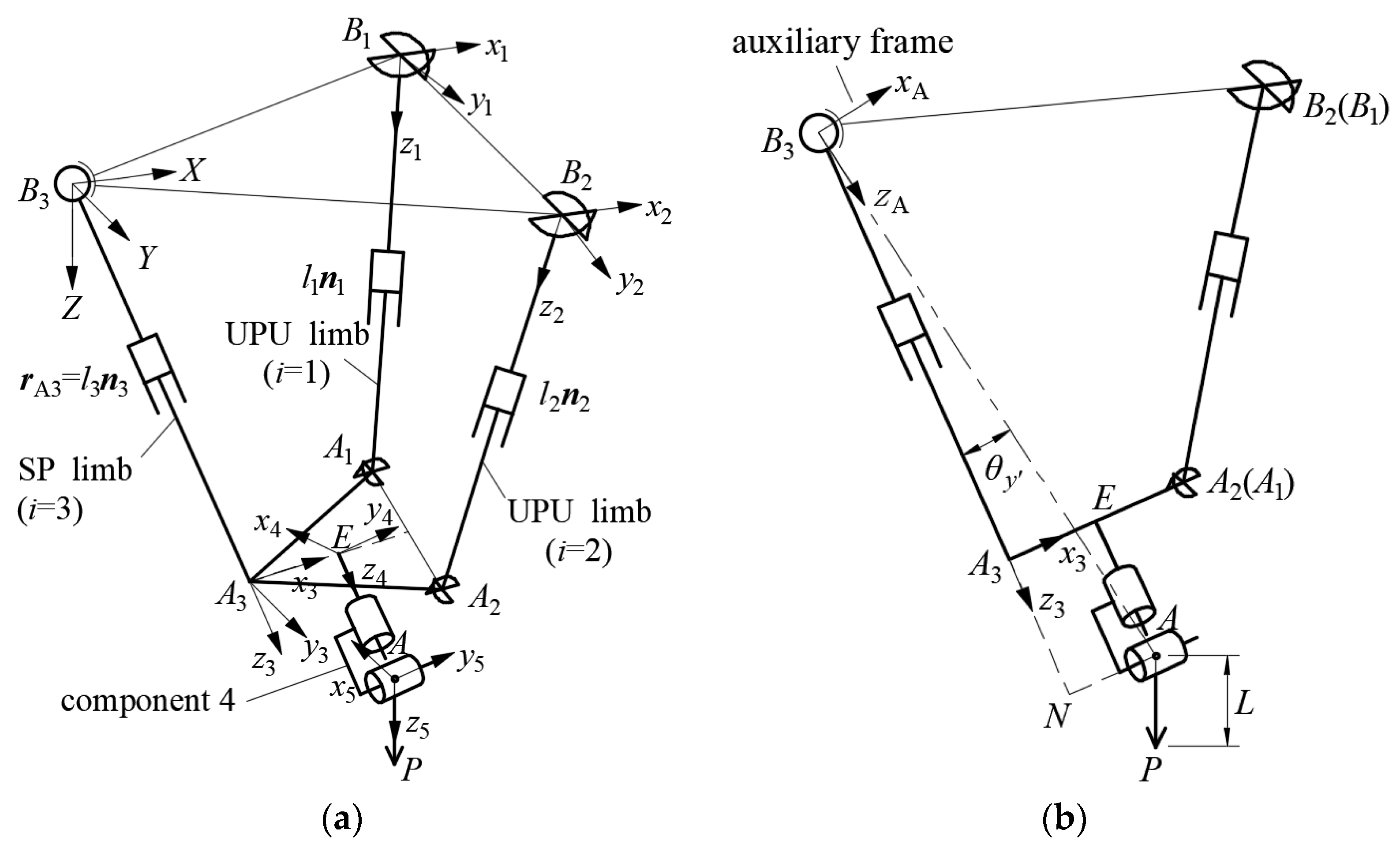
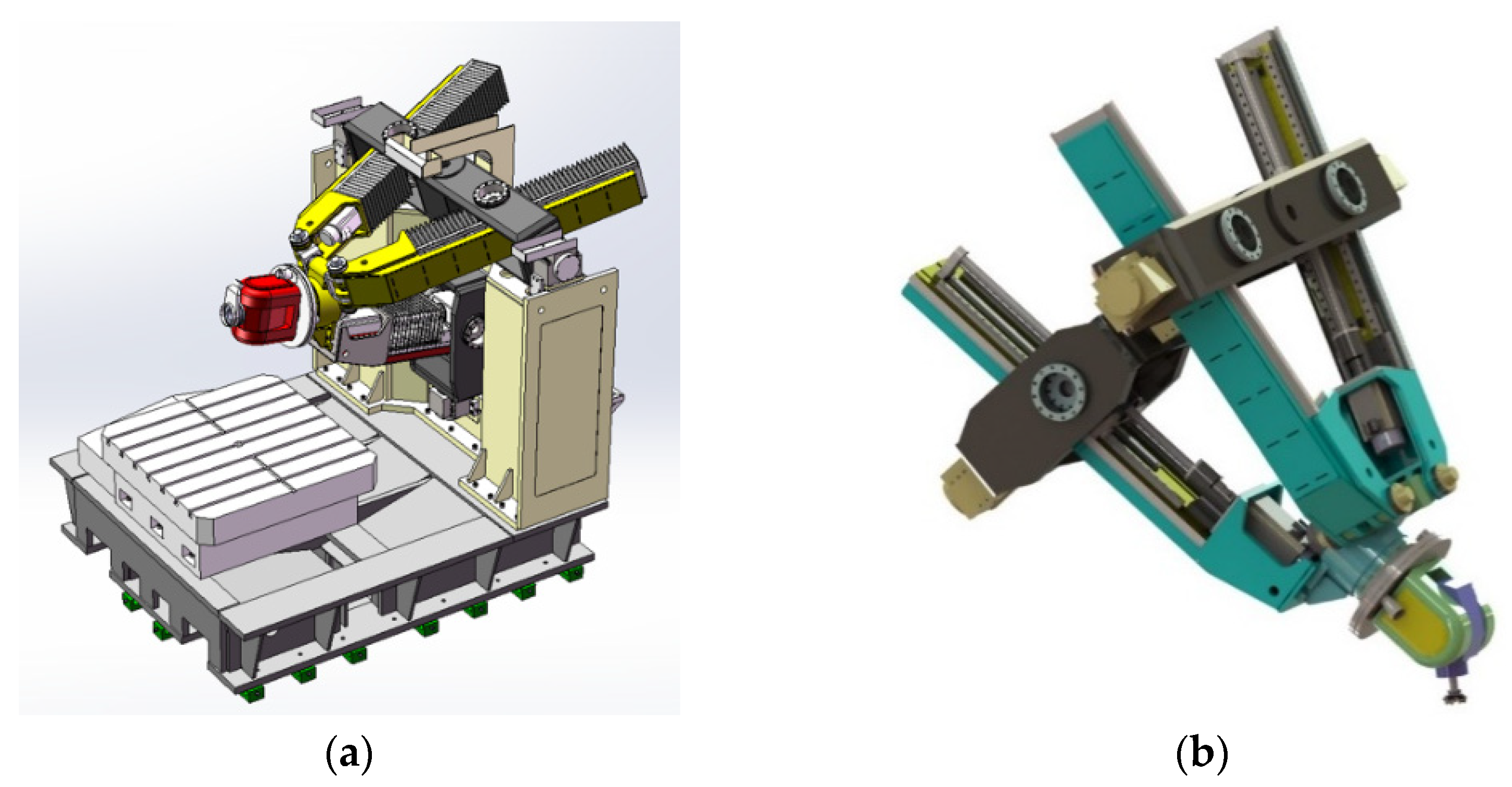
Figure 1 shows a 5-DOF hybrid robot that is used to machine aerospace structural components with composite material. It consists of a 2-DOF RR rotating head and a 3-DOF 2UPU/SP (where S represents spherical joints) parallel mechanism. The schematic diagram of the robot is shown in Figure 2. As shown in Figure 2a, the 2UPU/SP parallel mechanism consists of a fixed base, three limbs, and a moving platform (MP). Limb 1 and limb 2 are driven by prismatic (P) joints and connected with the MP and the base through universal (U) joints. Limb 3 is driven by a prismatic joint and connected with the base through a spherical (S) joint. The MP is rigidly attached to limb 3. The 2-DOF RR rotating head consists of two rotating joints. As Figure 2 shows, component 4 in RR rotating head is attached to the MP through a rotating joint whose axis is parallel to limb 3. Component 5 in RR rotating head is connected to component 4 through a rotating joint whose axis is perpendicular to the axis of the previous rotating joint.
Figure 1.
5-DOF hybrid robot [38]: (a) 3D model of the hybrid robot; (b) 2UPU/SP-RR mechanism.
Figure 2.
Schematic diagram of 2UPU/SP-RR hybrid robot: (a) schematic diagram of the hybrid robot; (b) auxiliary frame.
As Figure 2a shows, Bi (i = 1, 2) denotes the center of the U joints attached to the base, B3 denotes the center of the S joint, and Ai (i = 1, 2) denotes the center of the U joints connecting the MP. A3 denotes the intersection of the SP limb and the plane where Ai (i = 1, 2) are located and SP limb is perpendicular to the plane determined by Ai (i = 1, 2, 3). Triangles ∆A1A2A3 and ∆B1B2B3 are isosceles and similar. In the rotating head, E represents the intersection of the axis of the first rotating joint of the rotating head and the plane spanned by Ai (i = 1, 2, 3), A represents the intersection of the two rotating axes of the rotating head and P represents the end point of end-effector. Fixed frame B3-XYZ is established at point B3 with the Y axis parallel to the line and X axis pointing to the midpoint of the line . Besides, body fixed frame Bi-xiyizi (i = 1, 2), A3-x3y3z3, E-x4y4z4 and A-x5y5z5 are established. Frame Bi-xiyizi (i = 1, 2) is attached to point Bi with zi axis pointing from Bi to Ai and yi axis coincident with the first axis of the U joint. Frame A3-x3y3z3 is established at A3 with z3 axis coincident with the line and x3 axis pointing to the midpoint of the line A1A2. In E-x4y4z4, y4 axis is parallel to the axis of the second rotating joint of the rotating head, and z4 axis is coincident with the line EA. In A-x5y5z5, the z5 axis points from A to P, and the y5 axis coincides with the axis of the second joint of the rotating head. In addition, the axes not mentioned in the aforementioned frames satisfy the right-hand rule.
2.2. Inverse Position Analysis
2.2.1. Position Analysis of the Parallel Mechanism
For the inverse kinematics of the 5-DOF hybrid robot, the position and posture of the end-effector are given. The position vector of the end point can be represented by and the posture of the end-effector can be expressed by two rotation angles α and β. The position vector of A, which is denoted by , can be obtained as
where L represents the distance from points A to P, is the orientation vector of the end-effector and . According to the geometric relationship, the length of limb 3 can be written as
where d represents the distance from point A3 to E and k represents the distance from E to A.
As Figure 2b shows, an auxiliary frame B3-xAyAzA is established with zA axis pointing from B3 to A, yA axis parallel to the y3 axis of A3-x3y3z3, and xA axis satisfying the right-hand rule. The rotation matrix of auxiliary frame B3-xAyAzA can be expressed by XYZ Euler angles: firstly rotate about X-axis of the local frame; secondly rotate about the Y-axis of the new frame; finally rotate about the Z-axis of the new frame. Based on the B3-xAyAzA, the rotation matrix of A3-x3y3z3 can be obtained by rotating around the yA axis as [38]
where represents the rotation matrix of angle . According to Figure 2b, can be obtained as
where . The position vector of point A can be written as
Based on Equation (5), the angles and can be expressed as
The angle θAz must satisfy the structural constraint of plane A1A2B2B1 [39]. The plane constraint can be expressed as
where , , , , , and are the height of the base side of ∆B1B2B3 and ∆A1A2A3, and q1 and q2 are the half of the base side of ∆B1B2B3 and ∆A1A2A3. Based on Equations (3), (4), (6) and (7), the following equation can be obtained
where . can be determined by Equation (8)
where , , .
The position vector of point A3 can be expressed by
The closed-loop constraint equation of limbs 1 and 2 can be obtained as
where ni and li denote the unit vector and length of the limb i; bi is the position vector of Bi; and is the position vector of Ai in A3-x3y3z3. Based on Equations (10) and (11), li and ni can be written as
For limbs 1 and 2, the rotation matrix of Bi-xiyizi can be described by two rotations: first rotate θiy about Y-axis of the local frame; then rotate θix about the new X-axis. The rotation matrix of Bi-xiyizi (i = 1, 2) can be obtained as . Then ni can be also expressed as
where ej,i denotes a j-dimensional column vector in which the i-th element is 1 and the other elements are 0. The angle θiy and θix can be obtained by Equation (13) as
2.2.2. Position Analysis of the Rotating Head
For the serial rotating head, the angle of the first rotating joint is represented by φz, and the angle of the second rotating joint is denoted by φy. The orientation vector of the end-effector can be obtained as
The joint angles of the rotating head can be obtained by Equation (15) as
where , arg(z) represents the principal argument angle of the complex number z, and j is the imaginary unit. There are two solutions of φy of Equation (16), and the solution of φy is selected according to the motion trajectory.
2.3. Inverse Velocity Analysis
2.3.1. Velocity Analysis of the Parallel Mechanism
Based on the principle of angular velocity superposition and Equation (3), the angular velocity of limb 3 can be written as
where , . It can be seen from Equations (4) and (6) that the angles θAx, θAy and θy’ are functions of xA, yA and zA. Taking the time derivative of Equations (4) and (6) yields
where
and are given in the Appendix A. It can be seen from Equations (2), (4), (8) and (9) that the angle θAz can be expressed as a function of h1, h2 and h3; auxiliary variables h1, h2 and h3 are functions of lA, l3, lAyz, xA, yA and zA; lA, l3 and lAyz are functions of xA, yA and zA. Taking time derivative of Equation (9) yields
where ,
, and are given in the Appendix A. represents a 3 × 3 identity matrix.
According to Equations (1) and (18)–(20), the angle velocity of limb 3 can be rewritten as
where , , , , is a 3 × 2 null matrix, and .
Taking time derivative of Equation (10) yields
where , is the third row of and represents the skew-symmetric matrix of vector . For example, for a vector , its skew-symmetric matrix is defined as .
Taking the time derivative of Equation (11) leads to
Because ni is a unit vector, . Taking the dot product with ni on both sides of Equation (23) yields
Rewriting in matrix form leads to
where , .
According to Equations (14) and (23) and the principle of angular velocity superposition, the angular velocity of limb i (i = 1, 2) is given by
where , , is the i-th row of , , and
2.3.2. Velocity Analysis of the Rotating Head
Taking time derivative of Equations (16) and (17) yields
where and . The i-th (i = 1, 2, 3) row of can be written as . When , can be expressed as
When , the second row of becomes its opposite number.
According to the principle of angular velocity superposition, the angular velocity of component 4 can be obtained as
where . Similarly, the angular velocity of component 5 can be expressed as
where .
2.4. Inverse Acceleration Analysis
The angle acceleration of limb 3 can be obtained by taking time derivative of Equation (21) as
where . Equation (18) shows that the elements in are functions of θAx, θAy and θAz. Thus, the elements of the i-th row and j-th column in can be expressed as
The elements of the i-th row and j-th column in can be written as
can be obtained by Matlab software developed by MathWorks, Inc., the United States. and can be obtained through a similar method.
Taking the time derivative of Equation (25) leads to
where
Differentiating Equation (26) with respect to time leads to
where
and can be obtained by a similar method of solving .
Taking the time derivative of Equation (28) yields
where and . can be obtained by a similar method of solving . The i-th (i = 1, 2, 3) row of can be obtained as
Taking the time derivative of Equation (29) leads to
where .
3. Inverse Dynamic Analysis
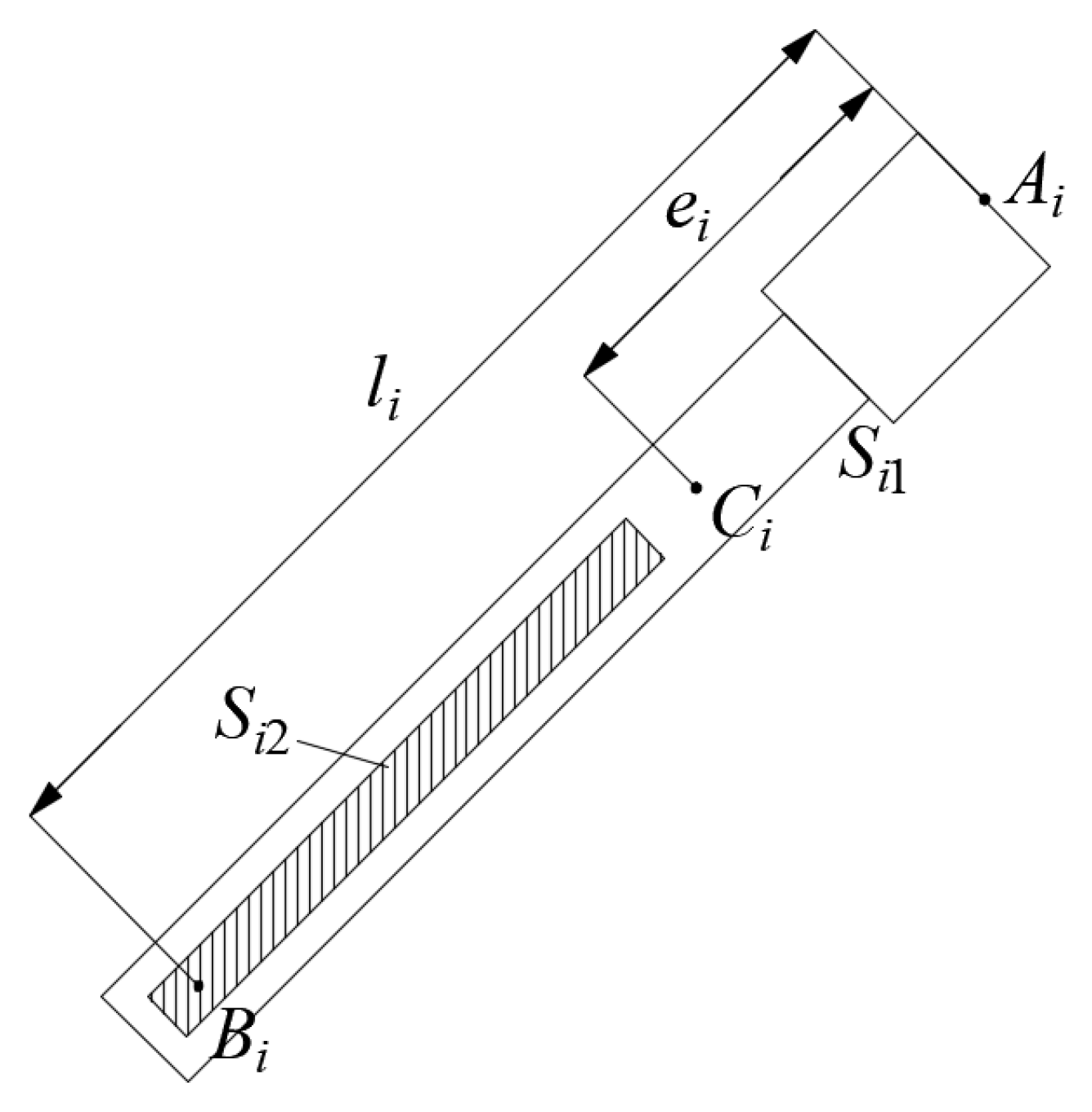
The inverse dynamics is to determine the driving force or driving torque with a given motion and external force of the end-effector. To simplify the analysis, the joint inertia is neglected. As Figure 3 shows, the limb of the parallel mechanism can be divided into two components according to the nature of motion. The motion of the first component Si1 including the limb body, linear guideway, and motor is a general motion. The motion of the second component Si2 including the lead-screw, coupler, and motor rotor is the afore-mentioned motion plus a rotation about the ni axis. The virtual power of limb i can be obtained as
where and is the inertia matrix of Si1 with respect to the centroid; and is the inertia matrix of Si2 with respect to the centroid; g represents the gravitational acceleration; mi represents the mass of Si1 and Si2 as a whole; and are the velocity and acceleration of the centroid of limb i which is denoted by Ci; and represent the angular velocity and acceleration of Si2. According to Figure 3, we can obtain
where , represents the i-th row of , ei is the distance from Ai to Ci, and is the i-th row of . The angular velocity of Si2 in B3-XYZ can be obtained as
where pi is the pitch of the lead-screw. The angular acceleration of Si2 can be obtained by Differentiating Equation (41) with respect to time as
where .
The virtual power of the components of the rotating head can be expressed as
where mi is the mass of component i; and is the inertia matrix of component i with respect to the centroid; and are the velocity and acceleration of the centroid of component i. According to Figure 2, we can obtain
where
denotes the position vector of C4 in A3-x3y3z3 and is the position vector of C5 in A-x5y5z5.
The virtual work principle yields
where f = [f1, f2, f3, τ4, τ5]T represents the actuating force vector, T and F represent the external torque and external force on end-effector with respect to point P, , , , and . By substituting Equations (37) and (43) into Equation (47), the inverse dynamic equation of the hybrid robot can be written as
where represents the acceleration term, represents the velocity term, represents the gravity and external force term,
Figure 3.
Schematic diagrams of limb structure. Reprinted with permission from ref. [40]. Copyright 2021 Elsevier.
4. Dynamic Performance Evaluation
4.1. Dynamic Performance Indices
For the limbs of the parallel mechanism, for given acceleration and velocity range of the end-effector, the driving force demand of each motor for a specific position and posture of end-effector can be written as
where and are the minimum and maximum of at the given position and posture. For the same motion of end-effector, a larger absolute value of driving force means higher requirements for the motor, and it will be more difficult to change the velocity and acceleration of end-effector. At the same time, the robot will bear greater internal force, which will have an adverse impact on the accuracy of the robot. Therefore, a larger absolute value of driving force can be considered as a worse working situation, and a local dynamic performance index can be defined as
Since the changes with the robot configuration, a global index to evaluate the average dynamic performance of the robot in the workspace can be defined as
where Wt represents the workspace.
4.2. Task Space and Motion Range of the Hybrid Robot
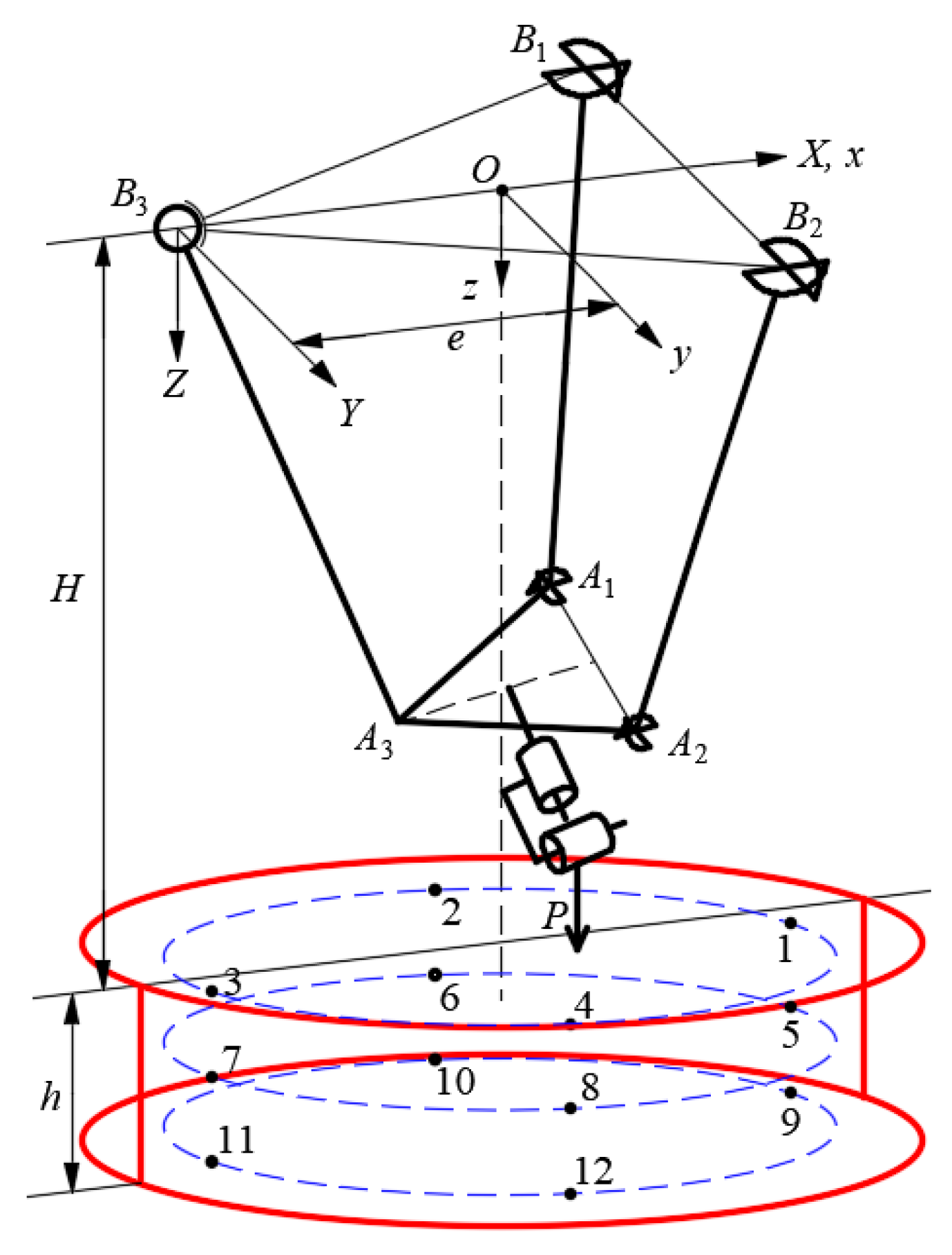
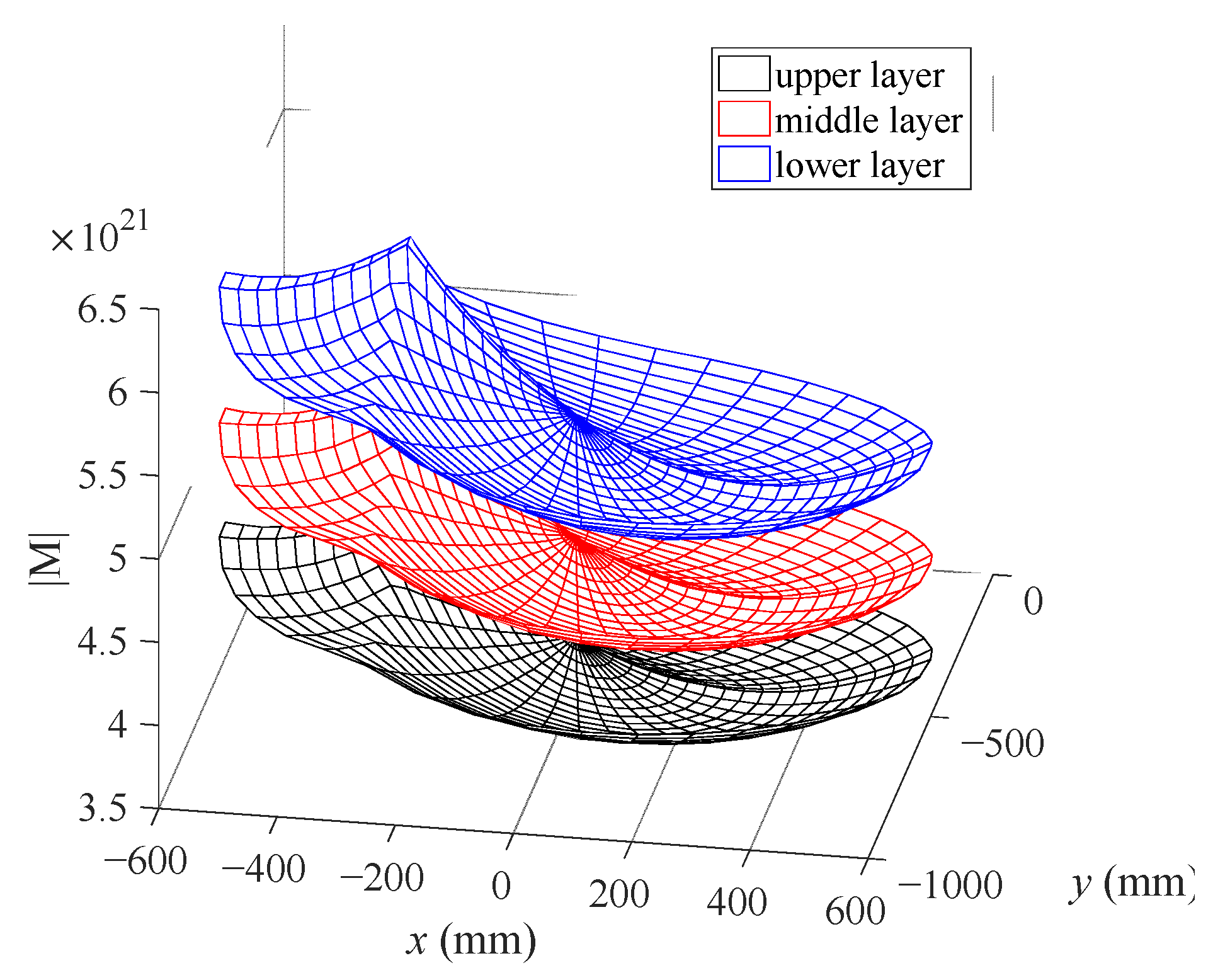
As shown by the red line in Figure 4, the task workspace of the hybrid robot is a cylinder whose radius is 600 mm. h = 300 mm is the height of the workspace, H = 1650 mm is the distance from O to the upper bound of the workspace and e = 422.5 mm is the distance between the Y to y axes of O-xyz. According to the practical application requirements, the required range of the posture of end-effector is specified as and . To ensure that the robot is not singular in the workspace, we investigate the singularity of matrix M in Equation (48). The distribution of the minimum of determinant of matrix M under the required posture range in the lower layer where z = 1900 mm, middle layer where z = 1800 mm and upper layer where z = 1700 mm of the workspace is shown in Figure 5. It can be seen that the determinant of matrix M is far away from zero in the workspace, so matrix M is nonsingular in the workspace, which ensures the rationality of subsequent analysis.
Figure 4.
Workspace of the hybrid robot and typical position in the workspace.
Figure 5.
Distribution of minimum of determinant of matrix M under the required posture range in the workspace.
The 2UPU/SP-RR hybrid robot has three translational DOFs and two rotational DOFs. In order to calculate the maximum absolute value of driving force at a given position in the workspace, the posture of the end-effector is taken as the limiting condition, whose range is specified as and .
According to Equation (48), the driving force of limb i at a given position can be written as
where , , , and Mi, Ci and Gi are the i-th row of M, C and G.
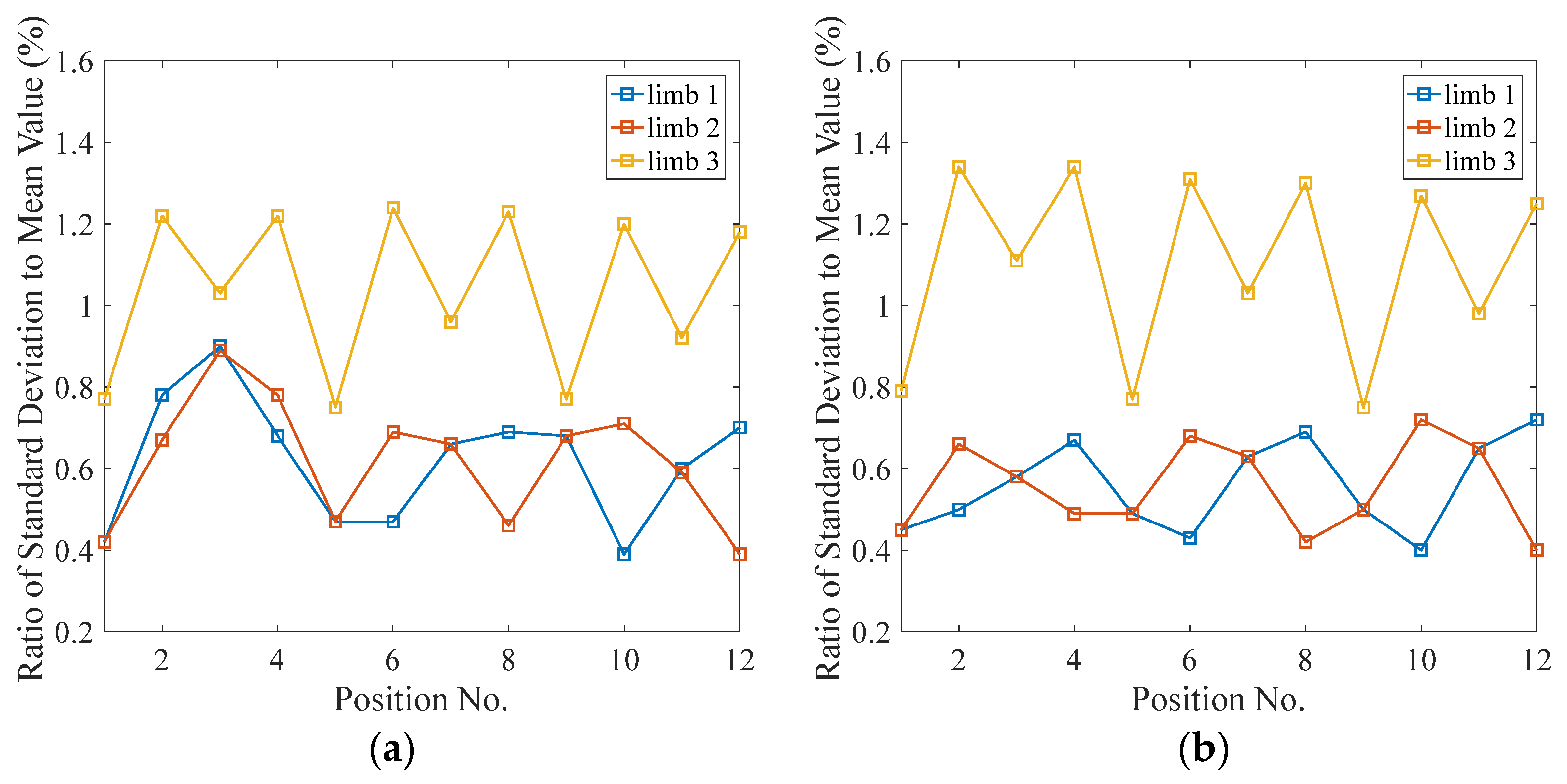
It can be seen from Equation (52) that the acceleration term is determined by the acceleration and posture of the end-effector, the velocity term is determined by the velocity and posture of the end-effector, and the gravity and external force term is determined by posture. To simplify the calculation of the maximum absolute value of fi, the influence of posture on the acceleration and velocity term is investigated. Twelve typical positions are selected on the circle with a radius of 500 mm in the lower layer, middle layer, and upper layer of the workspace, as shown in Figure 4. The distributions of maximum and minimum values of the acceleration and velocity term with posture at these typical positions are calculated by the MultiStart solver of Matlab 2016b. The ratio of the standard deviation to the mean value, which reflects the effect of the posture of the end-effector on the maximum and minimum acceleration and velocity term, is shown in Figure 6.
Figure 6.
The influence of posture of end-effector on acceleration and velocity term: (a) influence on the maximum of acceleration and velocity term; (b) influence on the minimum of acceleration and velocity term.
Figure 6 shows that the posture of the end-effector has little effect on the maximums and minimums of acceleration and velocity items. In order to simplify the calculation, the effect of the posture of the end-effector is ignored to calculate the acceleration and velocity item, namely
Then, we can obtain that
According to the practical application requirements, the velocity and acceleration requirements of the hybrid robot are given as , , , , , , , , , .
5. Dynamic Performance Comparison
5.1. Influence of Hybrid Robot Placement Direction on Dynamic Performance
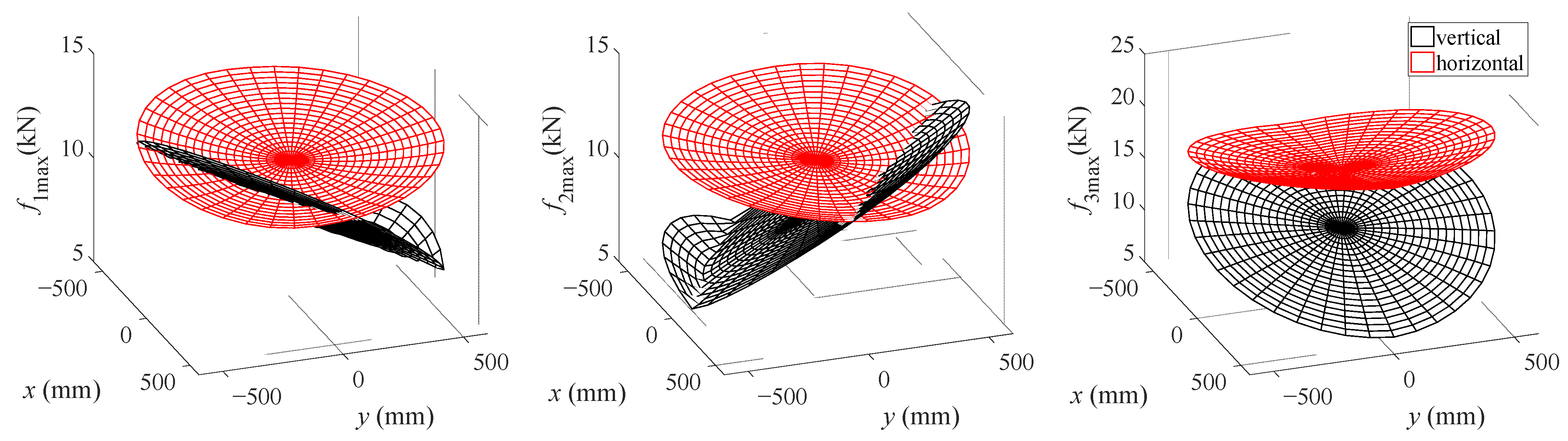
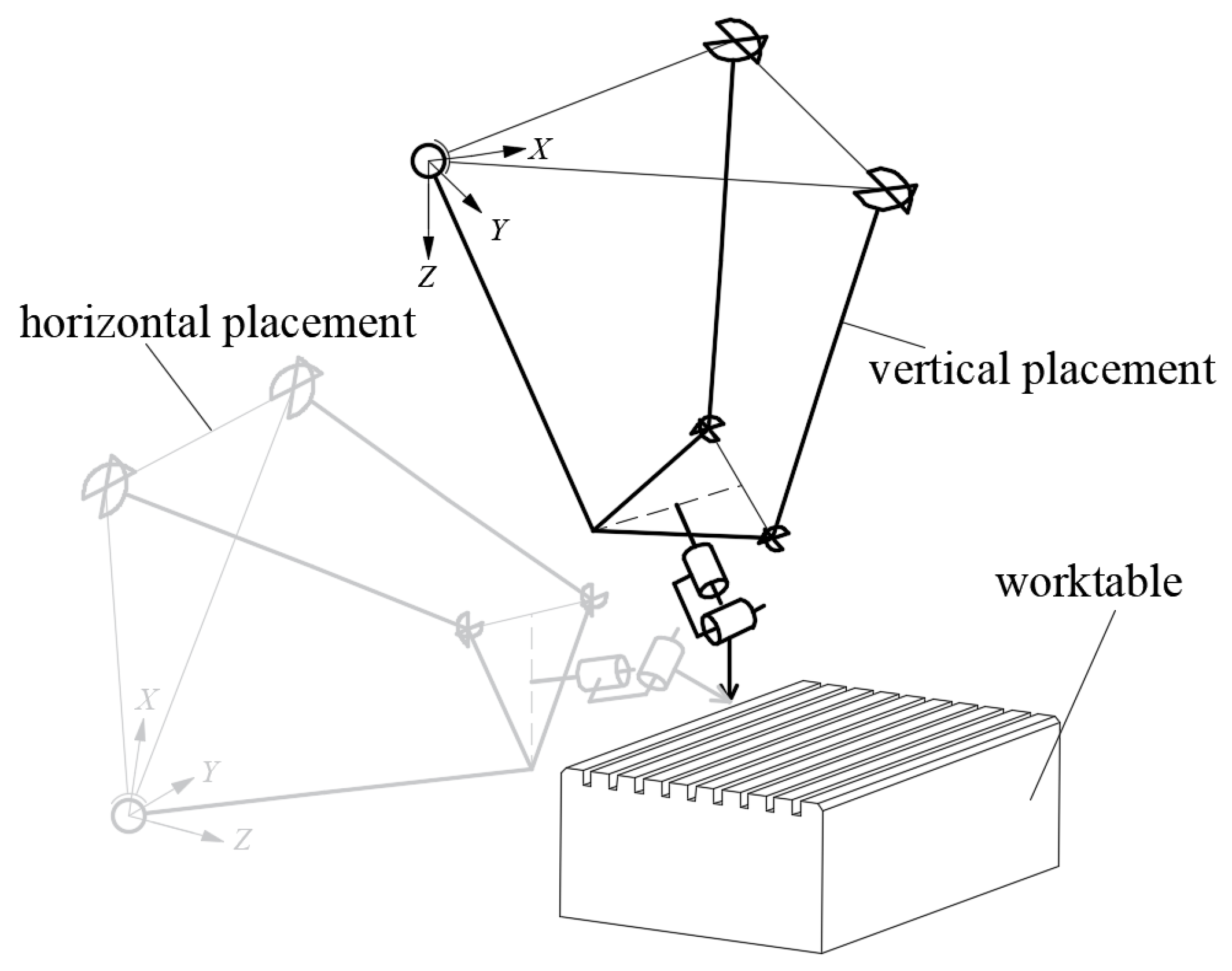
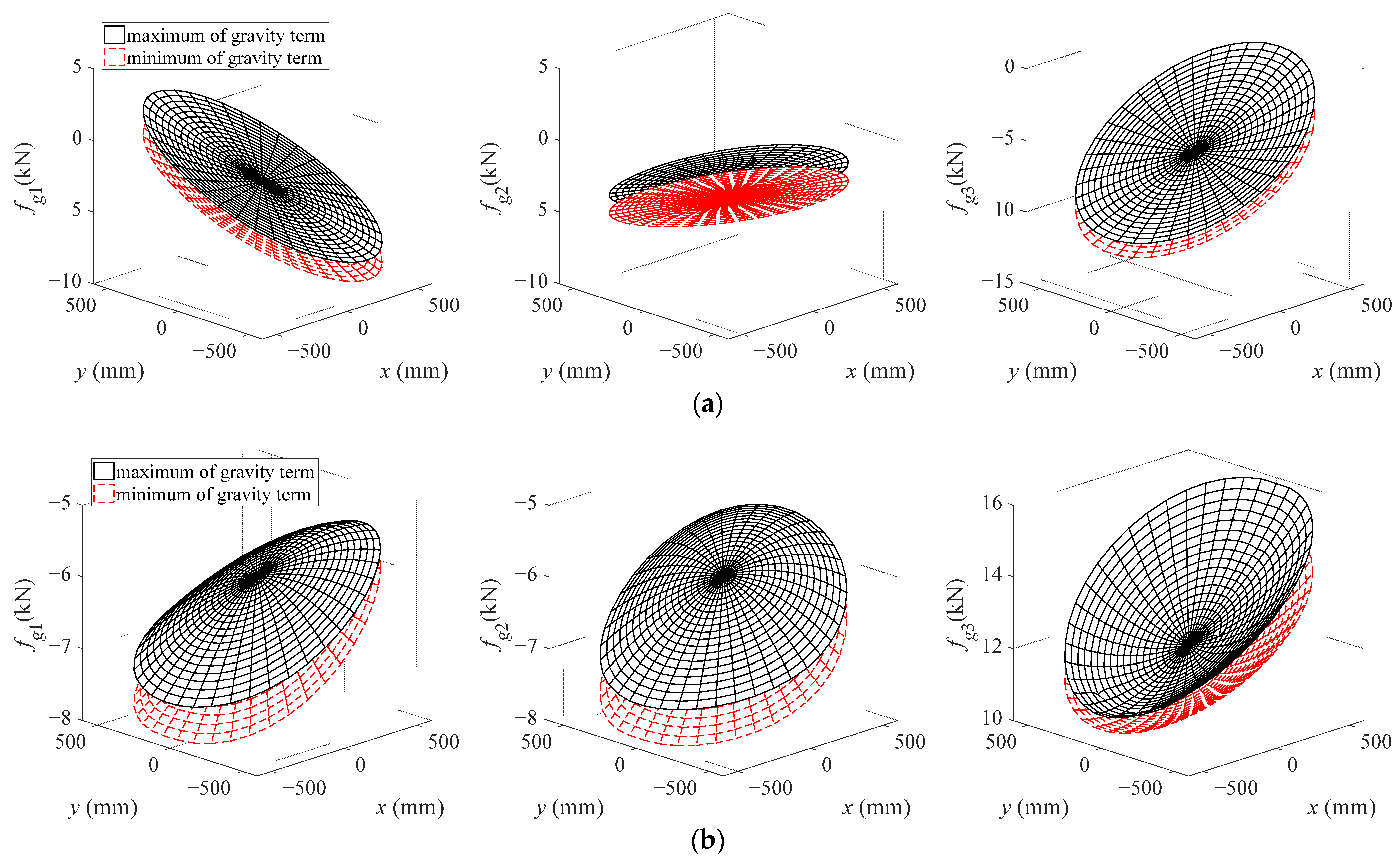
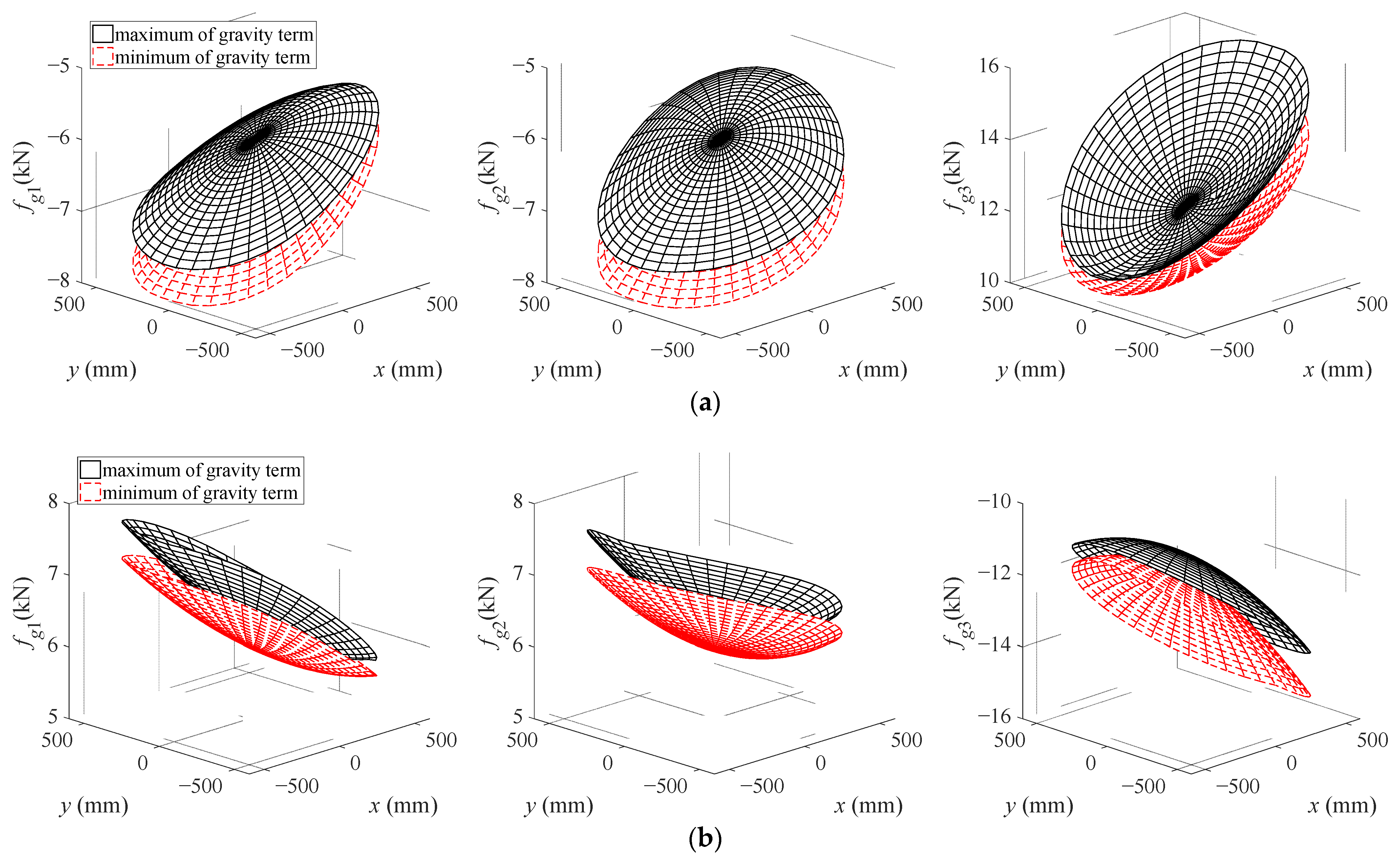
In practical application, the hybrid robot can be vertically or horizontally placed as shown in Figure 7. With different placement direction, gravity has a different effect on the dynamic performance. The inertial and geometric parameters of the robot are listed in the Appendix A. The indices fgi (i = 1, 2, 3) and fimax (i = 1, 2, 3) in the middle layer of the workspace are calculated by the MultiStart solver of Matlab 2016b, as shown in Figure 8 and Figure 9, and is listed in Table 1. Figure 8 shows that when the robot is placed vertically, the motor of a limb needs to provide tension for the gravity term in the workspace near the limb, but to provide thrust in the workspace away from the limb. When the robot is placed horizontally, limbs 1 and 2 always need to provide a greater tension for the gravity term, and limb 3 always needs to provide a greater thrust for the gravity term.
Figure 7.
Different placement directions of hybrid robot.
Figure 8.
Distributions of gravity term of driving force in the middle layer of the workspace: (a) vertical; (b) horizontal.
Figure 9.
Distributions of fimax in the middle layer of the workspace in vertical and horizontal placement.
Table 1.
Global performance indices in vertical and horizontal placement (unit: kN).
Figure 9 shows that in most workspaces, a smaller maximum absolute value of driving force is required in vertical placement than in horizontal placement. Only when the end-effector is close to a limb, the maximum absolute value of the driving force of the limb in vertical placement will be greater than that in horizontal placement. The results in Table 1 show that the average maximum absolute value of driving force in vertical placement is smaller, especially is 36.36% less than that in horizontal placement, which indicates that the vertical placement is beneficial to the dynamics of the hybrid robot.
5.2. Effect of the Position of Double Symmetric Limbs on the Dynamic Performance
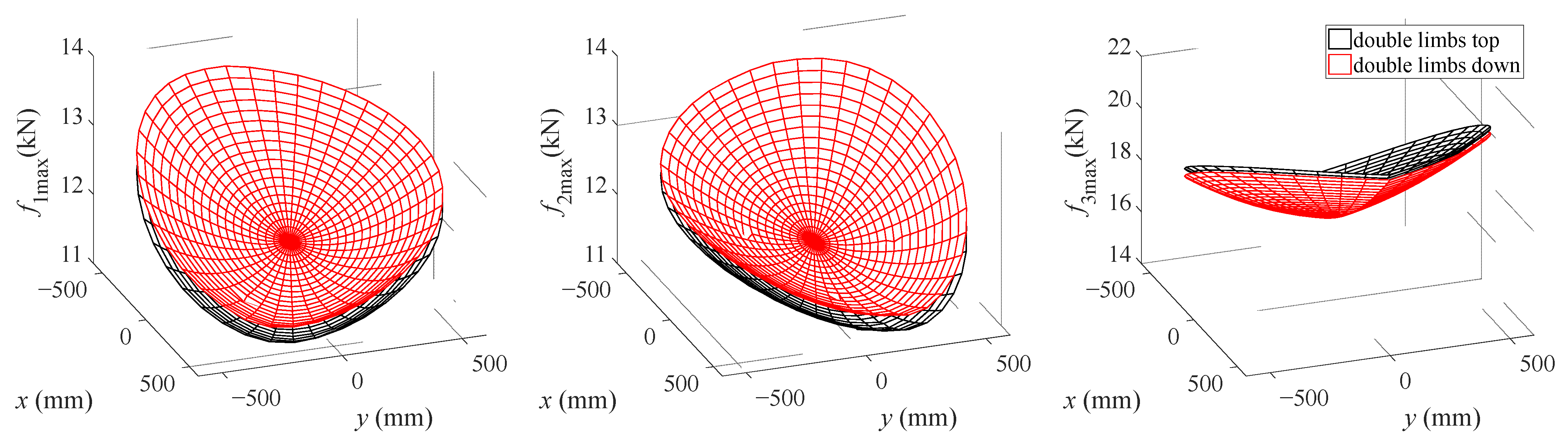
The arrangement of the limbs in horizontal placement will also affect the dynamic characteristics of the robot. The three limbs of the parallel mechanism in hybrid robot are usually arranged symmetrically due to the symmetrical structure of the mechanism, so there are two cases of double limbs on the top and double limbs on the bottom. The indices fgi (i = 1, 2, 3) and fimax (i = 1, 2, 3) in the middle layer of the workspace in the two cases are calculated by the MultiStart solver of Matlab 2016b, as shown in Figure 10 and Figure 11, and is listed in Table 2. Figure 10 shows that when the double limbs are on the top, the double limbs need to provide tension for the gravity term of driving force while limb 3 needs to provide thrust for the gravity term of driving force; when the double limbs are on the bottom, the double limbs need to provide thrust for the gravity term of driving force while limb 3 needs to provide tension for the gravity term of driving force.
Figure 10.
Distributions of gravity term of driving force in the middle layer of the workspace: (a) double limbs on the top; (b) double limbs on the bottom.
Figure 11.
Distributions of fimax in the middle layer of the workspace in different arrangements of the limbs.
Table 2.
Global performance indices in different arrangements of the limbs (unit: kN).
Figure 11 and Table 2 show that when the double limbs are on the top, limbs 1 and 2 require smaller average maximum absolute values of driving force while limb 3 requires larger average maximum absolute values of the driving force, which indicates that the arrangement of the limbs has different effects on the dynamic performance of different limbs. Considering that the double limbs and the worktable or workpiece are prone to interference when the double limbs are on the bottom, the double limbs are often on the top when the robot is placed horizontally in practical application.
6. Conclusions
In this paper, the complete dynamic equation of a 5-DOF hybrid robot is formulated. A dynamic evaluation index taking velocity and gravity terms in the dynamic model into consideration is proposed. Then, the effect of the placement direction of the robot and the arrangement mode of the double symmetric limbs on the dynamics is investigated. The conclusions are drawn as follows:
- (1)
- The maximum absolute value of the driving force of the robot at given motion limits of the end-effector can be regarded as the dynamic evaluation index of the hybrid robot.
- (2)
- The influence of placement direction on the dynamics of the hybrid is investigated, and the results indicate that vertical placement is beneficial to the dynamics of the hybrid robot.
- (3)
- The effect of the position of the double limbs on the dynamic performance is investigated. The results show that when double limbs are arranged on top, the average dynamic performance of the double limbs can be improved, while the dynamic performance of the third limb will be slightly deteriorated.
Author Contributions
Methodology, X.W. and J.W.; formal analysis, X.W. and Y.Z.; writing—original draft preparation, X.W. and J.W.; funding acquisition, J.W. All authors have read and agreed to the published version of the manuscript.
Funding
This research was funded by the National Natural Science Foundation of China (Grant No. 51975321) and EU H2020-MSCA-RISE-ECSASDPE (No. 734272).
Data Availability Statement
All data included in this study are available upon request by contact with the corresponding author.
Acknowledgments
This work was supported Tianjin Key Laboratory of High Speed Cutting and Precision Machining.
Conflicts of Interest
The authors declare no conflict of interest.
Appendix A
The expressions of and are
The expressions of , and are
where is the element in the i-th row and the j-th column of .
The geometric and inertial parameters of the hybrid robot are listed in Table A1.
Table A1.
Geometric and inertial parameters of the hybrid robot.
Table A1.
Geometric and inertial parameters of the hybrid robot.
| Parameter | Value | Unit | Parameter | Value | Unit |
|---|---|---|---|---|---|
| p1 | 845 | mm | q1 | 480 | mm |
| p2 | 360 | mm | q2 | 205 | mm |
| d | 160 | mm | k | 435 | mm |
| L | 180 | mm | pi (i = 1, 2, 3) | 16 | mm |
| mi (i = 1, 2) | 331 | kg | m3 | 465 | kg |
| m4 | 155 | kg | m5 | 43 | kg |
| ei (i = 1, 2) | 650 | mm | e3 | 653 | mm |
| mm | mm | ||||
| kg × m2 | kg × m2 | ||||
| kg × m2 | (i = 1, 2, 3) | kg × m2 | |||
| kg × m2 | kg × m2 |
References
- Orsino, R.M.M.; Coelho, T.A.H.; Pesce, C.P. Analytical mechanics approaches in the dynamic modelling of Delta mechanism. Robotica 2015, 33, 953–973. [Google Scholar] [CrossRef]
- Wu, J.; Wang, J.S.; You, Z. An overview of dynamic parameter identification of robots. Robot. Cim.-Int. Manuf. 2010, 26, 414–419. [Google Scholar] [CrossRef]
- Si, G.N.; Chen, F.H.; Zhang, X.P. Comparison of the dynamic performance of planar 3-DOF parallel manipulators. Machines 2022, 10, 233. [Google Scholar] [CrossRef]
- Chanal, H.; Guichard, A.; Blaysat, B.; Caro, S. Elasto-dynamic modeling of an over-constrained parallel kinematic machine using a beam model. Machines 2022, 10, 200. [Google Scholar] [CrossRef]
- Lee, G.; Park, S.; Lee, D.; Park, F.C.; Jeong, J.I.; Kim, J. Minimizing energy consumption of parallel mechanisms via redundant actuation. IEEE-ASME Trans. Mech. 2015, 20, 2805–2812. [Google Scholar] [CrossRef]
- Wu, J.; Gao, Y.; Zhang, B.B.; Wang, L. Workspace and dynamic performance evaluation of the parallel manipulators in a spray-painting equipment. Robot. Cim.-Int. Manuf. 2017, 44, 199–207. [Google Scholar] [CrossRef]
- Merlet, J.P. Determination of the orientation workspace of parallel manipulators. J. Intell. Robot. Syst. 1995, 13, 143–160. [Google Scholar] [CrossRef]
- Karger, A.; Husty, M. Classification of all self-motions of the original Stewart-Gough platform. Comput. Aided Des. 1998, 30, 205–215. [Google Scholar] [CrossRef]
- Luces, M.; Mills, J.K.; Benhabib, B. A review of redundant parallel kinematic mechanisms. J. Intell. Robot. Syst. 2017, 86, 175–198. [Google Scholar] [CrossRef]
- Xu, P.; Cheung, C.F.; Li, B.; Wang, C.; Zhao, C. Design, dynamic analysis, and experimental evaluation of a hybrid parallel-serial polishing machine with decoupled motions. J. Mech. Robot. 2021, 13, 061008. [Google Scholar] [CrossRef]
- Liu, S.; Sun, Y.; Peng, G.; Xue, Y.; Hnydiuk-Stefan, A.; Li, Z. Development of a novel 6-DOF hybrid serial-parallel mechanism for pose adjustment of large-volume components. Proc. Inst. Mech. Eng. Part C J. Mech. Eng. Sci. 2021, 236, 2099–2114. [Google Scholar] [CrossRef]
- Wang, Z.; Li, Y.; Sun, P.; Luo, Y.; Chen, B.; Zhu, W. A multi-objective approach for the trajectory planning of a 7-DOF serial-parallel hybrid humanoid arm. Mech. Mach. Theory 2021, 165, 104423. [Google Scholar] [CrossRef]
- Wu, J.; Yu, G.; Gao, Y.; Wang, L. Mechatronics modeling and vibration analysis of a 2-DOF parallel manipulator in a 5-DOF hybrid machine tool. Mech. Mach. Theory 2018, 121, 430–445. [Google Scholar] [CrossRef]
- Gao, Z.; Zhang, D. Performance analysis, mapping, and multiobjective optimization of a hybrid robotic machine tool. IEEE Trans. Ind. Electron. 2015, 62, 423–433. [Google Scholar] [CrossRef]
- Lai, Y.-L.; Liao, C.-C.; Chao, Z.-G. Inverse kinematics for a novel hybrid parallel–serial five-axis machine tool. Robot. Cim.-Int. Manuf. 2018, 50, 63–79. [Google Scholar] [CrossRef]
- Zhang, J.; Zhao, Y.; Dai, J. Compliance modeling and analysis of a 3-RPS parallel kinematic machine module. Chin. J. Mech. Eng. 2014, 27, 703–713. [Google Scholar] [CrossRef]
- Jin, Y.; Bi, Z.M.; Liu, H.T.; Higgins, C.; Price, M.; Chen, W.H.; Huang, T. Kinematic analysis and dimensional synthesis of Exechon parallel kinematic machine for large volume machining. J. Mech. Robot. 2015, 7, 041004. [Google Scholar] [CrossRef]
- Joshi, S.A.; Tsai, L.-W. The kinematics of a class of 3-DOF, 4-legged parallel manipulators. J. Mech. Design. 2003, 125, 52–60. [Google Scholar] [CrossRef]
- Joshi, S.; Tsai, L.-W. A comparison study of two 3-DOF parallel manipulators: One with three and the other with four supporting legs. IEEE Trans. Robot. Autom. 2003, 19, 200–209. [Google Scholar] [CrossRef]
- Liu, X.-J.; Han, G.; Xie, F.; Meng, Q. A novel acceleration capacity index based on motion/force transmissibility for high-speed parallel robots. Mech. Mach. Theory 2018, 126, 155–170. [Google Scholar] [CrossRef]
- Briot, S.; Caro, S.; Germain, C. Design procedure for a fast and accurate parallel manipulator. J. Mech. Robot. 2017, 9, 061012. [Google Scholar] [CrossRef]
- Merlet, J.P. Solving the forward kinematics of a Gough-type parallel manipulator with interval analysis. Int. J. Robot. Res. 2004, 23, 221–235. [Google Scholar] [CrossRef]
- Kumar, S.; Martensen, J.; Mueller, A.; Kirchner, F. Model simplification for dynamic control of series-parallel hybrid robots—A representative study on the effects of neglected dynamics. In Proceedings of the IEEE/RSJ International Conference on Intelligent Robots and Systems (IROS), Macau, China, 4–8 November 2019. [Google Scholar]
- Felis, M.L. RBDL: An efficient rigid-body dynamics library using recursive algorithms. Auton. Robot. 2017, 41, 495–511. [Google Scholar] [CrossRef]
- Li, M.; Huang, T.; Mei, J.; Zhao, X.; Chetwynd, D.G.; Hu, S.J. Dynamic formulation and performance comparison of the 3-DOF modules of two reconfigurable PKM—The Tricept and the TriVariant. J. Mech. Des. 2005, 127, 1129–1136. [Google Scholar] [CrossRef]
- Zhang, H.-Q.; Fang, H.-R.; Jiang, B.-S.; Wang, S.-G. Dynamic performance evaluation of a redundantly actuated and over-constrained parallel manipulator. Int. J. Autom. Comput. 2019, 16, 274–285. [Google Scholar] [CrossRef]
- Shao, H.; Zhang, H.; Yan, W. Dynamic modeling and performance optimization of a 2-PRU-PPRC 2T1R redundant parallel manipulator. In Proceedings of the 9th IEEE Annual International Conference on Cyber Technology in Automation, Control, and Intelligent Systems (IEEE-CYBER), Suzhou, China, 29 July–2 August 2019. [Google Scholar]
- Rao, C.; Xu, L.; Chen, Q.; Ye, W. Dynamic modeling and performance evaluation of a 2UPR-PRU parallel kinematic machine based on screw theory. J. Mech. Sci. Technol. 2021, 35, 2369–2381. [Google Scholar] [CrossRef]
- Han, J.; Shan, X.; Liu, H.; Xiao, J.; Huang, T. Fuzzy gain scheduling PID control of a hybrid robot based on dynamic characteristics. Mech. Mach. Theory 2023, 184, 105283. [Google Scholar] [CrossRef]
- Hao, Q. Optimization Design and Dynamic Control of a 2-DoF Planar Parallel Manipulator. Ph.D. Thesis, Tsinghua University, Beijing, China, 2011. [Google Scholar]
- Asada, H. A geometrical representation of manipulator dynamics and its application to arm design. J. Dyn. Syst.-T ASME 1983, 105, 131–142. [Google Scholar] [CrossRef]
- Yoshikawa, T. Dynamic manipulability of robot manipulators. J. Robot. Syst. 1985, 2, 113–124. [Google Scholar]
- Chen, M.; Zhang, Q.; Qin, X.; Sun, Y. Kinematic, dynamic, and performance analysis of a new 3-DOF over-constrained parallel mechanism without parasitic motion. Mech. Mach. Theory 2021, 162, 104365. [Google Scholar] [CrossRef]
- Kim, Y.; Desa, S. The definition, determination, and characterization of acceleration sets for spatial manipulators. Int. J. Robot. Res. 1993, 12, 572–587. [Google Scholar] [CrossRef]
- Bowling, A.; Kim, C.H. Dynamic performance analysis for non-redundant robotic manipulators in contact. In Proceedings of the 20th IEEE International Conference on Robotics and Automation (ICRA), Taipei, Taiwan, 14–19 September 2003. [Google Scholar]
- Xie, S.; Hu, K.; Liu, H.; Wan, Y. Dynamic modeling and performance analysis of a new redundant parallel rehabilitation robot. IEEE Access 2020, 8, 222211–222225. [Google Scholar] [CrossRef]
- Zhao, Y.J.; Gao, F. Dynamic formulation and performance evaluation of the redundant parallel manipulator. Robot. Cim.-Int. Manuf. 2009, 25, 770–781. [Google Scholar] [CrossRef]
- Ye, H.; Wang, D.; Wu, J.; Yue, Y.; Zhou, Y. Forward and inverse kinematics of a 5-DOF hybrid robot for composite material machining. Robot. Cim.-Int. Manuf. 2020, 65, 101961. [Google Scholar] [CrossRef]
- Zhang, D.; Xu, Y.; Yao, J.; Zhao, Y. Design of a novel 5-DOF hybrid serial-parallel manipulator and theoretical analysis of its parallel part. Robot. Cim.-Int. Manuf. 2018, 53, 228–239. [Google Scholar] [CrossRef]
- Wang, X.J.; Wu, J.; Wang, Y.T. Dynamics evaluation of 2UPU/SP parallel mechanism for a 5-DOF hybrid robot considering gravity. Robot. Auton. Syst. 2021, 135, 103675. [Google Scholar] [CrossRef]
Disclaimer/Publisher’s Note: The statements, opinions and data contained in all publications are solely those of the individual author(s) and contributor(s) and not of MDPI and/or the editor(s). MDPI and/or the editor(s) disclaim responsibility for any injury to people or property resulting from any ideas, methods, instructions or products referred to in the content. |
© 2023 by the authors. Licensee MDPI, Basel, Switzerland. This article is an open access article distributed under the terms and conditions of the Creative Commons Attribution (CC BY) license (https://creativecommons.org/licenses/by/4.0/).