1. Introduction
Robots are increasingly being used for a variety of tasks, including welding, forging, resource exploration and development, disaster relief and evacuation, complex surgery, bomb disposal, and machining. Because robots use electronic, electrical, mechanical, hydraulic, and pneumatic components, reliability issues are quite difficult to address due to the diversity of failure factors in robotic systems. However, the reliability of robots, as the main technical indicator for measuring the quality of industrial robots, is receiving unprecedented attention. The unreliable robot can bring a range of issues, including human damage. Thus, it is important to carefully consider the reliability of the robot. The robots must be both reliable and safe, so it is equipped with several safety devices. To analyze the reliability of a robot, we need to consider the relationship between the reliability and the safety device.
In reliability theory, there are many methods to analyze the reliability of engineering systems. In particular, the use of supplementary variables technique to establish models and analyze the reliability of robot systems has been widely studied. In 1955, Cox [
1] first proposed the “supplementary variable technique (SVT)” and established the M/G/1 queuing system. Gaver [
2] was the first to apply this technique for reliability models, and subsequently, other authors followed this line of research, such as Linton [
3], Gupta and Gupta [
4], Shi and Li [
5], Chung [
6], Oliveira et al. [
7], Zhang and Wu [
8], Shakuntla et al. [
9], Singh et al. [
10], Ke et al. [
11], Shekhar et al. [
12], Gao and Wang [
13].
There is a considerable amount of research literature on robot-safety systems, yet the research on system reliability remained limited. Most articles focus on repeatability and accuracy [
14,
15]. Dillon and Yang [
16] first studied a system with a robot and its safety device. The mathematical model was established by introducing SVT, and the steady-state solution (S-SS) was examined by the Laplace transforms. They then investigated a system with two robots and a safety device, one working and the other in storage [
17]. Many researchers subsequently used the SVT to establish various robot-safety systems and studied the steady-state reliability indices of these systems, see [
18,
19,
20,
21] and references therein. All of these researchers studied the reliability models of robot-safety systems under the assumption that the dynamic solution converges to its S-SS. The S-SS is well known to depends on the time-dependent solution (T-DS), and the T-DS can clearly reflect the operating trend of the system. As a result, it is necessary to investigate the existence and uniqueness of T-DS, as well as their asymptotic behavior and the instantaneous reliability index. In 2001, Gupur first introduced the dynamic analysis for the study of reliability models by the
–semigroups theory [
22,
23]. Guo and Xu [
24] studied a system composed of one robot and one safety device, and determined the existence and uniqueness of the system’s T-DS as well as its asymptotic behavior. Chen and Xu [
25] introduced the repair rate as a periodic function for the above system and analyzed the exponentially stability. Gupur [
26] considered a human–machine system and demonstrated the well posedness of the system and the asymptotic behavior of the T-DS, proved the quasi-compactness of the
–semigroup, determined that the
–semigroup exponentially converges to a projection operator [
27], and finally obtained an expression for the projection operator using the residual theorem [
28]. Zhang [
29] considered a system consisting two robots and one safety unit and investigated the exponential stability of the T-DS. Qiao and Ma [
30] discussed the system composed of a safety component and two redundant robots. Zhou and Wei [
31] have further investigated the system studied in [
24].
Based on the above literature, we found that the results of dynamic analysis of robot-safety systems are few and limited to special cases, i.e., simple systems consisting of one robot or two robots and one safety device. Recent advances have allowed robot-safety systems to become more and more complex to improve their performances. However, these complex systems have strong applicability in engineering. Thus, the reliability of complex robot-safety systems has become a serious and urgent problem. In this paper, we consider a system with one robot and n safety units and perform dynamic analysis on the system.
The robot safety system, according to Cheng and Dhillon [
32], is described by the following integro-differential equations:
where
and
denotes the probability that the system is in state
at time t;
denotes the probability that at time t, the system is in state
and the elapsed repair time is in
represents the robot/the safety unit’s failure rate;
represents the failure rate of the system failing safely/failing with an incident; the repair rate of the safety unit is denoted by
; and
represents the system’s repair rate when it is in state
k and satisfies
The organization of the remainder of this paper is outlined below.
Section 2 introduces the transformation of the given system into an abstract Cauchy problem.
Section 3 examines the system’s well posedness.
Section 4 investigates the exponential convergence of the T-DS to its S-SS.
Section 5 discusses the asymptotic behavior of instantaneous reliability indices.
Section 6 uses numerical examples to illustrate the sensitivity of reliability indices to system parameter variations.
Section 7 concludes with a summary of findings and suggestions for future research.
3. Well Posedness of (2)
We begin by demonstrating that generates a positive contraction semigroup on
Theorem 1. If for then generates a positive contraction semigroup .
Proof. We will estimate
as a first step. To do this, consider
for
that is,
Solving (3) and (4), we have
For (5)–(7) together with (8) and (9), we can get that
By using (9), the Fubini theorem and the following inequalities
we deduce (without loss of generality, assume
)
Combinging (13), (12), (11), (10) and (8), we deduce
The second step will be to demonstrate that
is dense in
. Let
then
. Take
then
by Adams [
33]. As a result, proving
suffices to show that
. Hence, if
then
gives
.
Take any
such that,
for all
that is
for all
here
Define
where
Then,
Moreover,
This implies , thus, is dense in
We can conclude that
generates a
semigroup based on the preceding two steps and the Hille–Yosida Theorem. Furthermore, we can deduce that
generates a
semigroup
using perturbation theory of
semigroup (see Gupur et al. [
34]).
In the final step, we show that
is a dispersive operator. Choosing, for
where
Let
and
, then we get
Using (15) for such
and boundary conditions, we deduce
The conclusion follows from (16).
Therefore, from above results together with Fillips theorem, we deduce that generates a positive contraction semigroup, and it is just by the uniqueness theorem of the semigroup. □
The following is the dual space of
.
obviously, it is a Banach space.
Then, by Theorem 1, it follows that
Choose
for
thus, we have
and
As a result,
is conservative with respect to the set
and we can now deduce the following result from the Fattorini theorem [
35] (p. 155).
Theorem 2. is isometric for , i.e.,
This section’s main result is derived from Theorems 1 and 2.
Theorem 3. Equation (2) has a unique positive T-DS satisfying Proof. Since
, Theorem 1 and Theorem 1.81 in [
34] show that the system (2) has a unique positive T-DS
i.e.,
4. Asymptotic Behavior of the T-DS of (2)
Analysis show that, similar to the proof of Theorem 1, operator generates a positive contraction semigroup . Therefore, we will demonstrate quasi-compactness of by showing that is a quasi-compact operator.
Lemma 1. If is a solution of the system Then,where are given by . Proof. Because
is a solution of
, it satisfies
Take
and
, then from (19), we get
If
, then using
and integrating (24) from
to
t separately, we deduce
Soving
and applying
gives
If
, using the relations
and integrating (19) from 0 to
t, as well as a similar argument to
, we obtain
Equations (25)–(27) complete the proof. □
From Theorem 1.35 in [
34], we can conclude the following Lemma.
Lemma 2. If and only if the following two conditions are satisfied, a bounded and closed subset is relatively compact. Theorem 4. is a compact operator on .
Proof. We only need to prove condition (1) in Lemma 2 by definition of
. Take
, for bounded
, then
is a solution of (17). Hence, from Lemma 1, we deduce, for
The procedure is to estimate each term of (28). Applying the boundary conditions, we get
We can estimate the first term of (28) using (29)–(31).
Now, we will estimate the second term in (28). Using Lemma 1 and boundary conditions, we calculate
From (33)–(35), we deduce
Combining (32) with (36), we obtain, for
The same conclusion can be drawn for This finishes the proof. □
Theorem 5. If for then satisfies Proof. For any
, we estimate
□
Hence, we can obtain the following result by Definition 1.85 in [
34].
Theorem 6. If for then is a quasi-compact operator on .
We get the following result by combining Theorem 6 and Proposition [
36] (p. 215), as well as the compactness of the
and
on
.
Corollary 1. If for then is a quasi-compact operator on .
Lemma 3. and geometric multiplicity of 0 is one.
Proof. Take
Hence,
Then, from (38)–(40) we can show that
Combining (42)–(44) and (45) with (46), we estimate
Equation (
47) show that
i.e., the point spectrum of
and from (46), it can be seen that the geometric multiplicity of 0 is one. □
Lemma 4. The adjoint operator of is given bywhereandand the constant α in is independent of j. Proof. For
, we have
□
Lemma 5. and geometric multiplicity of 0 is one.
Proof. Consider
i.e.,
Solving
, we deduce
Multiplying
to the both side of (53), we have
Substituting
into
, we get
Substituting
into
–
, we have
Equations (55)–(56) give
which imply
Furthermore, from (55) and (56), it is easy to verify that the geometric multiplicity of 0 is one. □
By using Lemmas 3 and 5 and Theorem 3, we can deduce that the algebraic multiplicity of 0 is one and the spectral bound
Finally, the conditions of Theorem 1.90 in [
34] are fulfilled. Therefore, we get the following result.
Theorem 7. If for then there exist a spectral projection with rank one such thatwhere and Γ
is a circle with a radius of sufficiently small and a center of . It is evident that by Theorem 3, Corollary 1 and Lemma 3. In other words, the resolvent set of includes all points on the imaginary axis except zero.
Remark 1. Based on the analysis above, we can conclude that the system’s T-DS strongly converges to its S-SS, i.e., where is the eigenvector corresponding to 0.
In the following, we investigate exponential convergence of system’s T-DS. For this goal, we first determine the explicit expression of by the growth bound of .
Lemma 6. For any , we getwhereand denotes the determinant of , and is the same matrix such that ith column is replaced with constants. Proof. Consider the equation
for
. Hence,
Solving (60) and using (61)–(63), we have
Substituting (64)–(66) into (57)–(59), we get
Equations (67)–(69) give
where
Using Cramer’s rule, we derive
Substituting into , , and separately, we get the rest of the Lemma’s results. □
In summary, we present the following main results.
Theorem 8. If for thenthat is, the system’s T-DS exponentially converges to its S-SS. Proof. Thus, the essential growth bound of
satisfies
,
,
,
,
by Proposition 2.10 in Engel and Nagel [
37] (p. 258).
Since
and
are compact operators, by Proposition 2.12 in [
37], we have
Thus, 0 is a pole of
of order 1 by Corollary 2.11 in [
37]. Moreover, from Theorem 8, Lemma 6 and residue theorem, we have
By calculating the above limit, we can now determine the projection operator. Let
Then, we can simplify
as
and
By Lemma 6, the Fubini theorem and
Combining (71)–(74) with Lemma 6 we obtain
Thus, we conclude by (75), Theorems 3 and 7 that
□
6. Numerical Results
This section provides numerical examples to investigate how changes in system parameters affect the reliability indices, using Matlab 2017a for calculations. To begin, we assume that
without losing generality and the system’s repair time is Gamma distributed with
The system parameters are fixed as
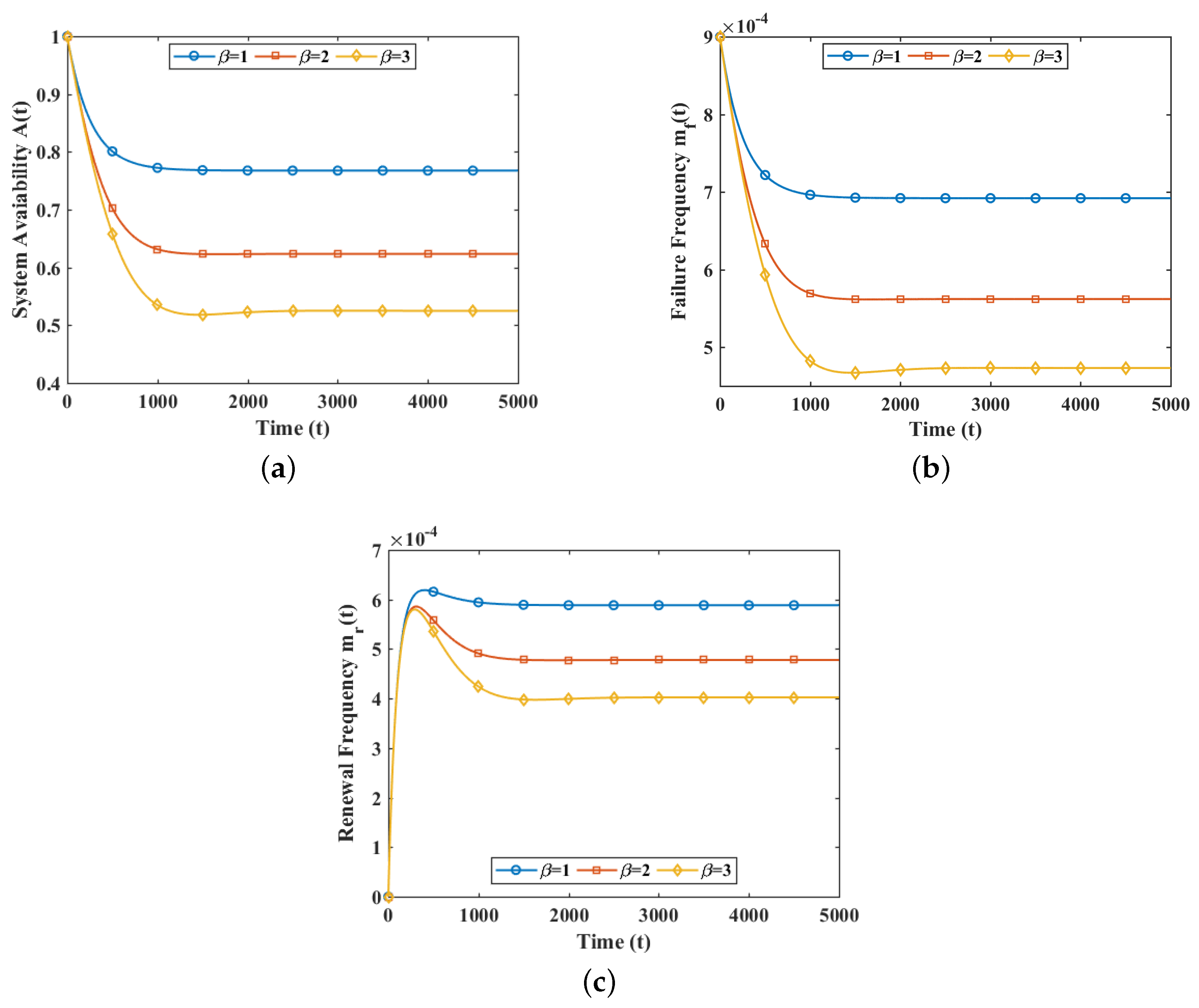
For different values of
, the variations in the system’s time-dependent availability (
Figure 1a), failure frequency (
Figure 1b), and renewal frequency (
Figure 1c) are plotted with respect to
t in
Figure 1. In each case, the
and
decrease rapidly as time increases, eventually becoming constant at some value. As time passes, the
increases rapidly in the early stages, then becomes constant at some value after a long run.
Furthermore, we observe that as increases, the system’s time-dependent availability, failure frequency, and renewal frequency decrease.
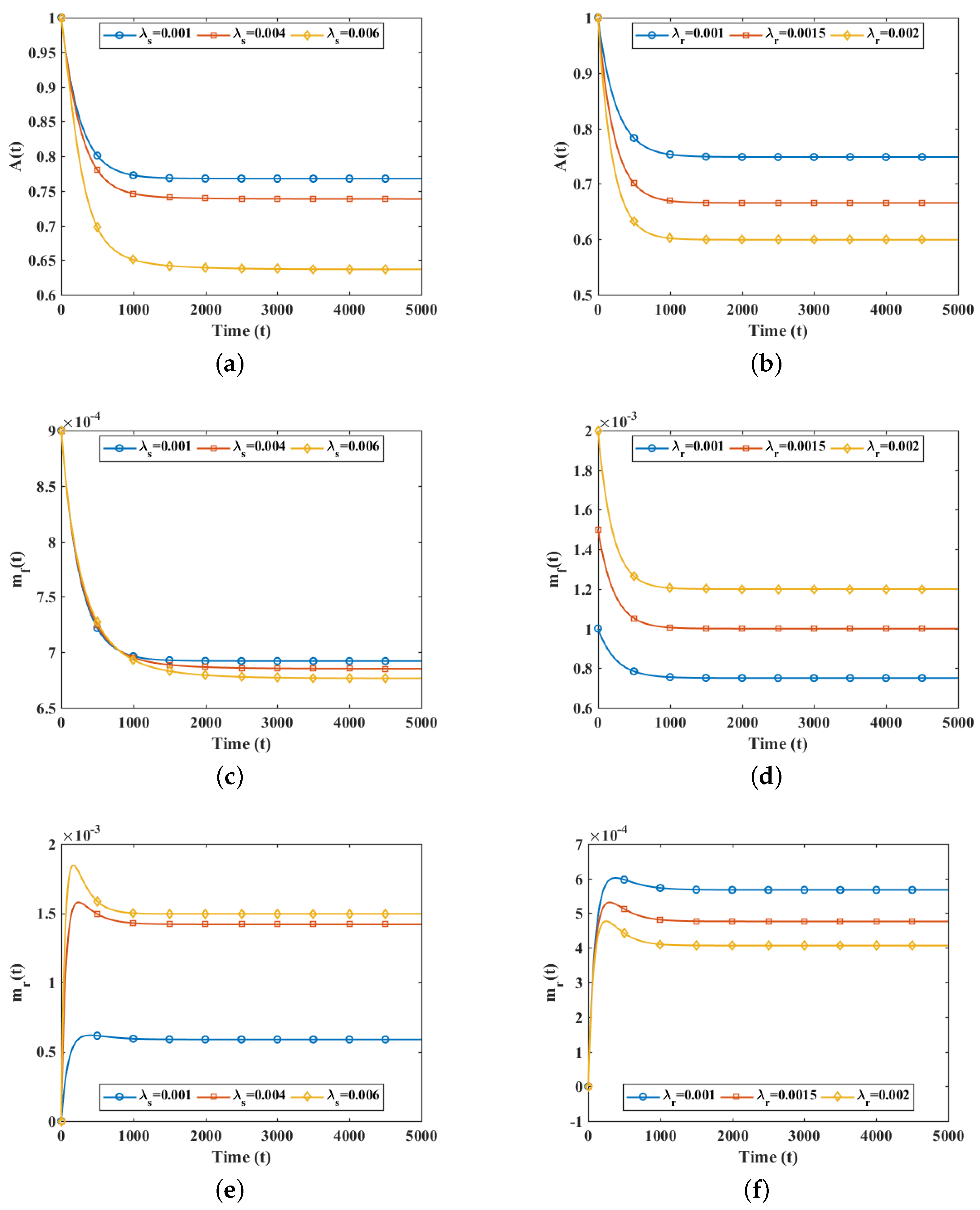
In the following, we further analyze the effect of different values of the failure and repair rates on the system’s reliability indices for
(i.e., the repair time is exponential distributed).
Figure 2 shows that as time increases, these reliability indices converge to some fixed value. As expected,
decreases with increasing
(
Figure 2a) and
(
Figure 2b).
decreases with increasing
, but its effect on the failure frequency is not evident (
Figure 2c), and
increases as
(
Figure 2d) increases.
increases with increasing
(
Figure 2e) and decreases with increasing
(
Figure 2f). Furthermore, changes in the system parameters
and
had almost no effect on the system reliability indices. In
Table 1, we only list the effect of
and
on the time-dependent availability
.
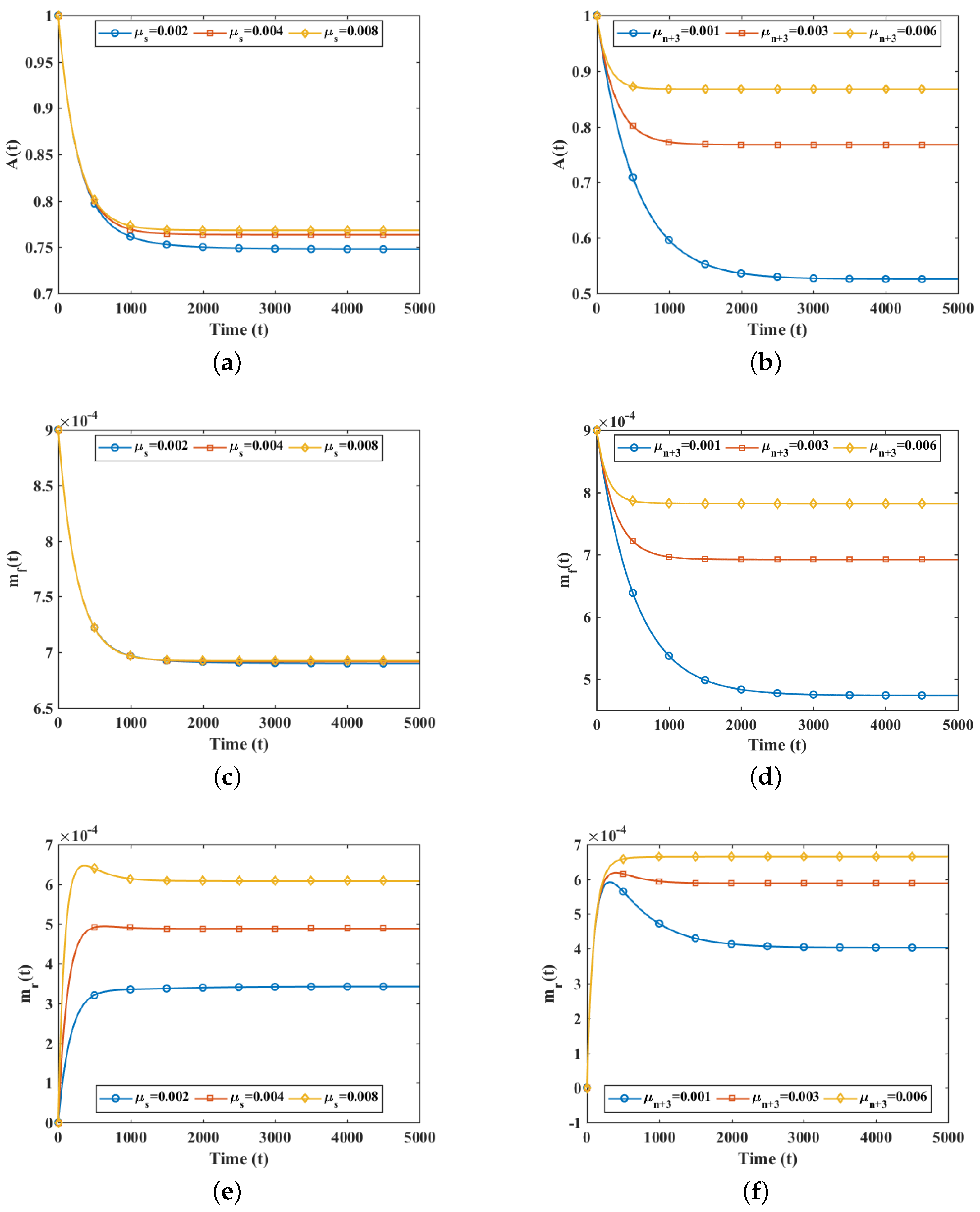
The behavior of the reliability indices for different repair rates is depicted in
Figure 3, showing that these indices increase as
and
increase. From this figure, we conclude that the changes in parameter
have little effect on
and
. Moreover,
Table 2 reveals that the effect of the changes of the parameters
and
on
are not significant. It is also observed that the changes in the parameter
and
on
and
are not significant. Furthermore, these indices approach a constant value that time goes to infinity.
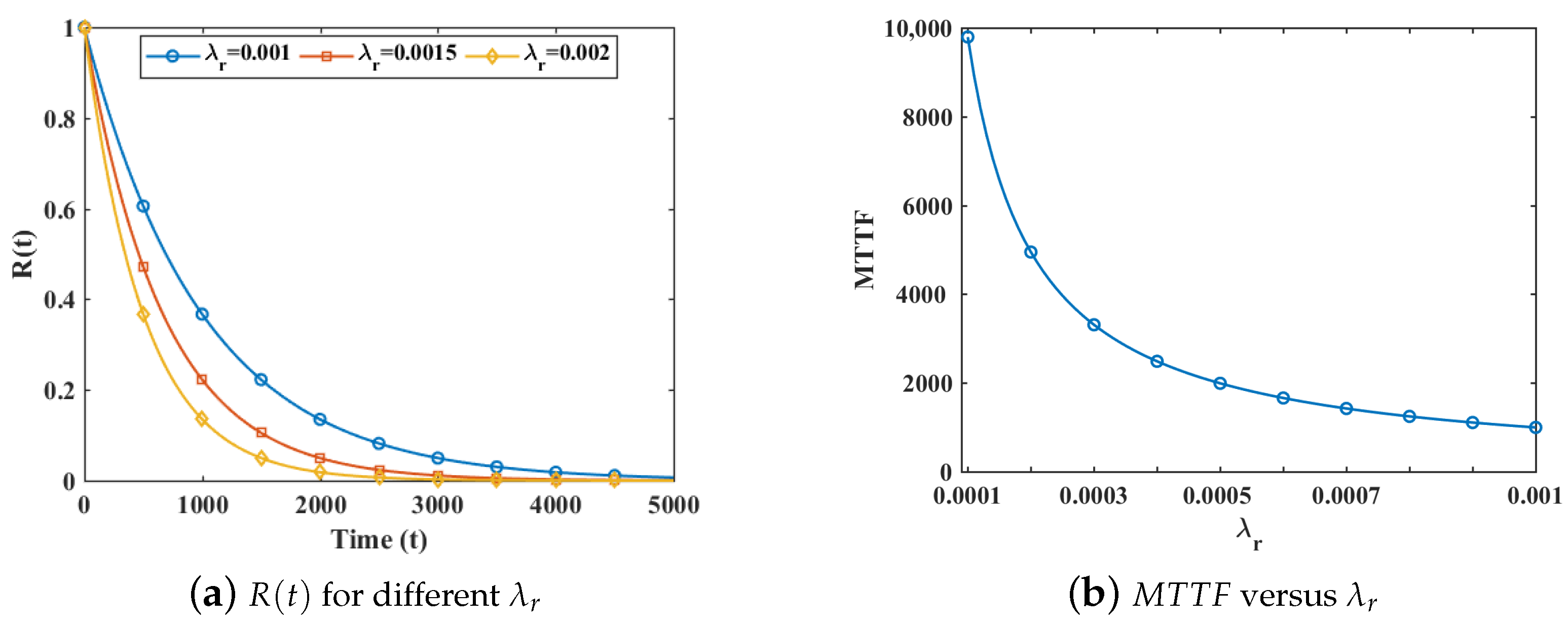
Figure 4 illustrates the effect of
on system’s time-dependent reliability and MTTF. We note that
decreases as
increases and vanishes as time goes to infinity (
Figure 4a). The MTTF decreases as
increases (
Figure 4b).
Finally, in
Table 3, we show the effect of the number of safety units in the system on the system transient availability. The availability increases as the number of safety units increases. However, having too many safety units does not contribute as much to the availability of this system.