


Abstract
In this article, a space-time spectral method is considered to approximate third-order differential equations with non-periodic boundary conditions. The Legendre-Petrov-Galerkin discretization is employed in both space and time. In the theoretical analysis, rigorous proof of error estimates in the weighted space-time norms is obtained for the fully discrete scheme. We also formulate the matrix form of the fully discrete scheme by taking appropriate test and trial functions in both space and time. Finally, extensive numerical experiments are conducted for linear and nonlinear problems, and spectral accuracy is derived for both space and time. Moreover, the numerical results are compared with those computed by other numerical methods to confirm the efficiency of the proposed method.
1. Introduction
Spectral methods [1,2,3,4,5] play an increasingly important role in numerical methods for solving partial differential equations (PDEs) of classical and fractional orders. In most applications of time-dependent problems [6,7], spectral methods are applied in space combined with time discretization using finite difference methods. However, such a combination leads to a mismatch in the accuracy in the space and time of the fully discrete scheme. In recent years, some researchers proposed space-time spectral methods [8,9,10,11] for time-dependent problems to attain high-order accuracy in space and time simultaneously. In [12], Shen and Wang presented a new space-time spectral method based on a Legendre-Galerkin method in space and a dual Petrov-Galerkin formulation in time. In [13], new space-time spectral and structured spectral element methods were described for approximating solutions of fourth order problems with homogeneous boundary conditions, and the spectral accuracy was proved in both space and time. In [14], a novel multi-implicit space-time spectral element method was proposed for advection-diffusion-reaction problems characterized by multiple time scales. Authors in [15] investigated a space-time spectral approximation to handle multi-dimensional space-time variable-order fractional Schrdinger equations. In [16], Legendre spectral methods were employed in both space and time discretization for solving multi-term time-fractional diffusion equations, and Fourier-like basis functions were constructed in space.
In this paper, a space-time Legendre-Petrov-Galerkin method is considered for the linear third-order differential equations, see [17]:
where the spatial domain is and time interval is . Without loss of generality, we assume that .
The study of the above model is of great significance for general third-order problems. The Korteweg-de Vries (KdV) equation [18,19,20,21,22,23] is a typical third-order nonlinear differential equation with an important physics application background. There are some efficient numerical methods to solve the problem (1). Considering the nonsymmetric property of the third-order differential operator, Ma and Sun proposed a Legendre-Petrov-Galerkin method in space and the Crank-Nicolson method in time for solving third-order differential equations in [17]. They also analyzed in detail the stability and -norm convergence of the fully discrete schemes and extended the application of the proposed method to the KdV equation by performing Chebyshev collocation treatment on the nonlinear terms. In [24], Shen developed a new dual Petrov-Galerkin method to solve third-order differential equations, where the main feature of the proposed method is to choose trail functions and test functions satisfying underlying and “dual” boundary conditions, respectively. The author not only presented the error estimates of the fully discrete numerical schemes in the theoretical analysis, but also verified the theoretical results and demonstrated the efficiency of the proposed method through extensive numerical experiments. In [25], a new pseudo-spectral method was investigated for third-order differential equations in which zeros of were used as collocation points. In [26], the author proposed spectral Chebyshev collocation algorithms for the approximation of the KdV equation with non-periodic boundary conditions, and discussed single- and multi-domain approaches combined with the backward Euler/Crank-Nicolson schemes in time. In [27], the error estimates of semi-discrete and fully discrete schemes were given for the KdV equations by applying the Legendre pseudo-spectral methods in space and finite difference methods in time. Qin and Ma developed a Legendre-tau-Galerkin method in time for solving nonlinear evolution equations in [28] and also considered the multi-interval forms. In numerical examples, the generalized KdV equations was considered, and its fully discrete scheme was given by combining the Legendre-Petrov-Galerkin methods in space with multi-interval forms of the Legendre-tau-Galerkin schemes in time. Furthermore, numerical results were compared with those computed by other methods in [17] under the same conditions. In this paper, in order to solve the linear third-order differential Equation (1) with high order accuracy in both space and time, we investigate a space-time spectral method. It is worth noting that considering the nonsymmetric property of third-order and first-order differential operators in space and time, respectively, we apply Petrov-Galerkin methods in both space and time.
The organization of this paper is as follows. In Section 2, on the basis of introducing some notations and definitions, we give the weak form and space-time Legendre-Petrov-Galerkin scheme for the problem (1). In Section 3, some corresponding lemmas are provided, and error estimates in the weighted space-time norms are obtained for the fully discrete scheme. In Section 4, a detailed implementation of the proposed method is presented by selecting the appropriate test and trial functions in both space and time. In Section 5, extensive numerical tests including nonlinear problems are conducted, and the numerical results are compared with those obtained by other methods to assess the efficiency and accuracy of our method. Finally, some conclusions are drawn in Section 6.
2. Space-Time Legendre-Petrov-Galerkin Scheme
We now introduce some notations. Let be a positive weight function in a bounded domain . The norm is denoted by in whose inner product is given by . Additionally, is dropped if . Let X be a Banach space with norm and define Throughout this paper, C denotes a generic positive constant. In the following, denote and to distinguish the weight functions on from , where are two parameters. Specific values are used in the article.
Definition 1
([29]). Let and , then the tensor product of A and B is defined as the matrix
Moreover, for arbitrary matrices and C, the following properties hold:
where .
Denote . Let
and
Then, applying the integration by parts, the weak form of Problem (1) is to find such that
Let denote the set of polynomials of degree ≤ on and denote , where M and N are a pair of given positive integers. In order to present the fully discrete space-time spectral scheme, we introduce the following finite-dimensional spaces:
and
Then we obtain the following space-time Legendre-Petrov-Galerkin scheme of (1): Find satisfying
Remark 1.
Since Equation (1) is first-order in time, it is natural to use a “dual Petrov-Galerkin method". The key idea of the method is to use trial functions satisfying the underlying boundary conditions of the differential equations and test functions satisfying the “dual" boundary conditions, namely, and are a pair of “dual" approximation spaces.
3. Error Estimate
Now, in order to analyze the error estimates for the scheme (7), we give a suitable comparison function introduced in [17,30]:
which satisfies and such that
where
and is the Legendre-Galerkin projection operator.
Lemma 1
([17,30]). If and ,
Orthogonal projection operator in time introduced in [12] is given by such that
Define , then considering the fact that one can observe ,
Lemma 2
([12]). If and with , we have
Let and denote the sets of measurable functions satisfying and , respectively, where for integers ,
Theorem 1.
Suppose and u are the solutions of (1) and (7), respectively. If for integers , then
Proof.
Denote . In order to derive the error estimates, we decompose the error into two parts: and denote . Then according to (4) and (7), we have ,
According to the definition of and , we can see for the right-hand terms of (17)
Then (17) can be simplified as follows:
By the Cauchy-Schwarz inequality and Young’s inequality, other terms of (20) can be estimated as follows:
Furthermore, according to Lemmas 1 and 2, for the right-hand terms of (30), we can obtain estimates
then
On the other hand, we obtain
According to the above estimates (33) and (34) and the triangle inequality, we derive the final error estimate
□
Remark 2.
Similar to the proof of error estimates, by taking in scheme (7), we can easily obtain the stability results. Assume , then is the solution of scheme (7) satisfying . Furthermore, there exists a zero solution if , namely, the existence and uniqueness of can be proved easily.
4. Implementation
In order to present the detailed implementation of the Equation (1) with initial condition , we take such that and reformulate the equation of unknown solution , then we obtain the discrete scheme: Find satisfying
We define the following basis functions in space and time:
where
Taking and v in scheme (36) as
then we can obtain the matrix form of the scheme (36)
where is a symmetric matrix with elements
and matrix with elements
For details about matrices C and D, see [12], and with , which can be computed by the Legendre-Gauss-type quadrature formulas.
Then according to the properties of matrix multiplication introduced in Section 2, Equation (36) can be formulated as
5. Numerical Experiments
In this section, we present some numerical examples, including nonlinear problems, to demonstrate the accuracy and efficiency of the proposed method for third-order partial differential equations. Some numerical results are compared with those computed in [17,27].
5.1. Example 1
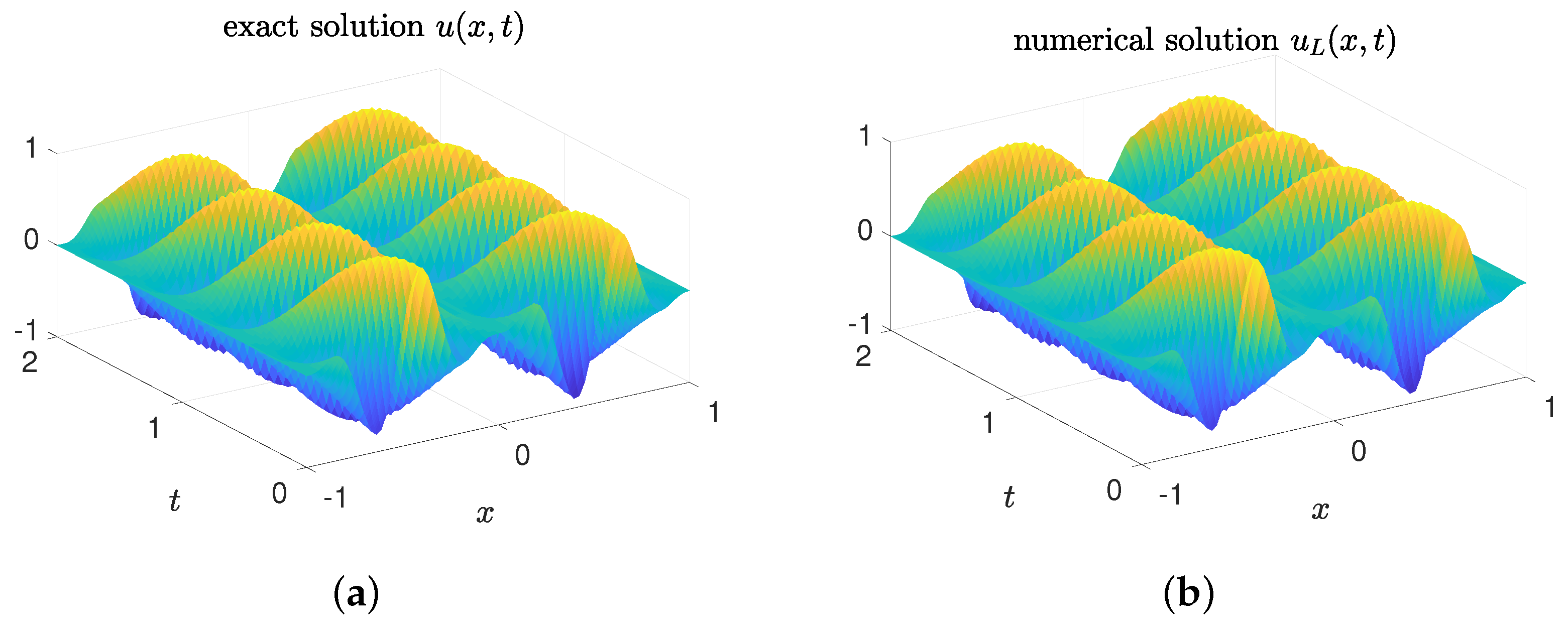
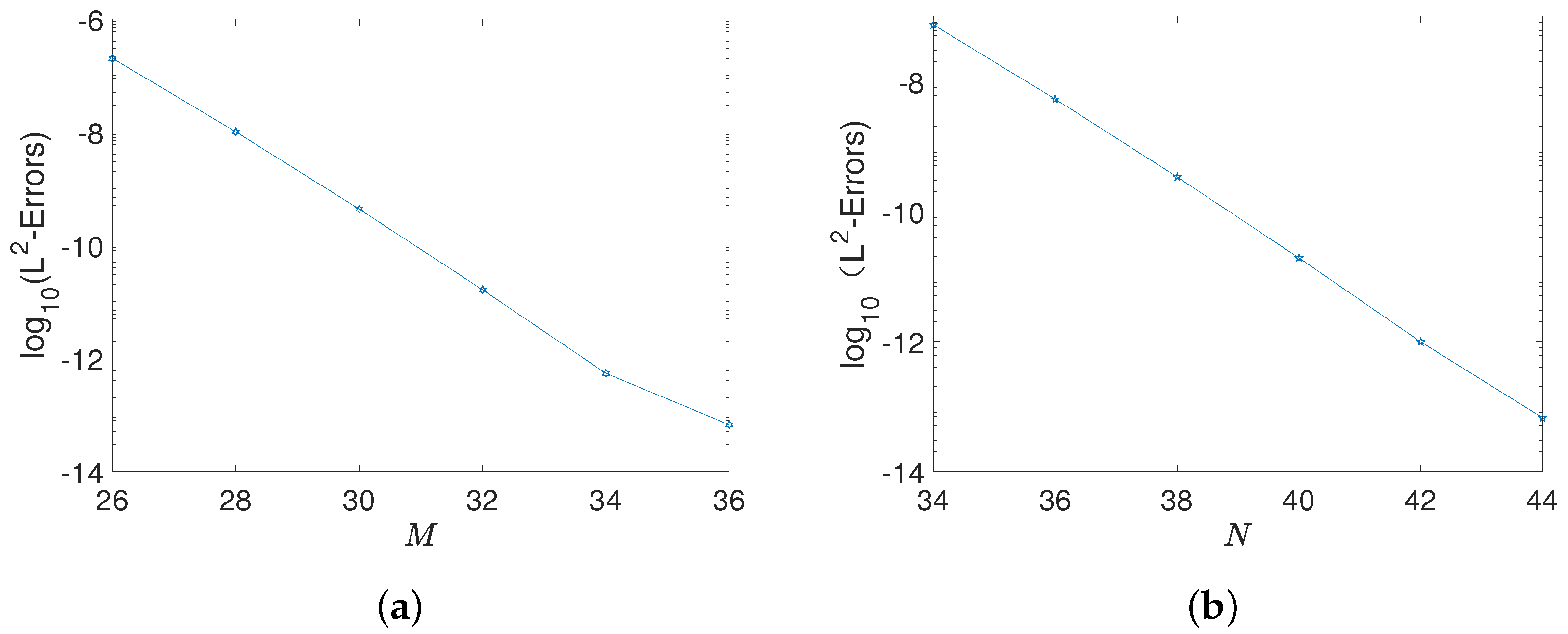
In Figure 1, we plot the time evolution of exact solutions and numerical solutions obtained by the proposed method and one can observe that numerical solutions well simulate the image of exact solutions. In [17], third-order partial differential Equations (1) were considered by combining the Legendre-Petrov-Galerkin methods in space with the Crank-Nicolson scheme for time advancing (see scheme (2.2) in [17]) and -errors in both space and time were given for the Equation (1) with exact solution (44) in numerical examples. So in order to show the efficiency of the proposed method in this paper, we present the spatial and temporal errors respectively in Table 1 and Table 2, where we compare the numerical results by our methods with those in [17] under the same conditions. By comparison, we can find that the numerical solutions obtained in this paper attain higher accuracy. Moreover, we report the -error in time and space by semi-log coordinates at for the equation in Figure 2, and we can see that the straight lines indicate that the errors decay like and ).
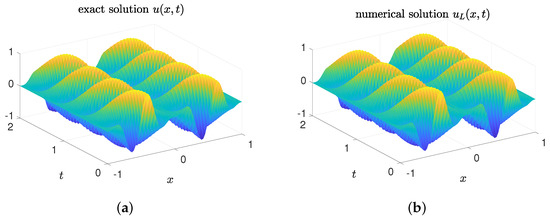
Figure 1.
Time evolution of exact solutions and numerical solutions for Example 1. (a) Exact solutions ; (b) numerical solutions by scheme (7).

Table 1.
Temporal errors at for Example 1.
Table 2.
Spatial errors at for Example 1.
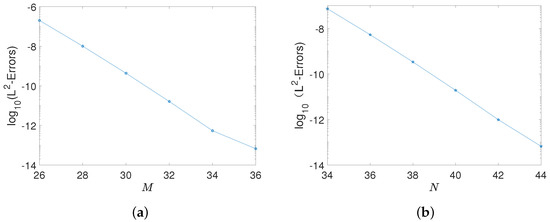
Figure 2.
Spectral errors in time and space, respectively, at for Example 1. (a) Temporal errors versus M with ; (b) spatial errors versus N with .
5.2. Example 2
Consider the following KdV equation [24,27]:
with exact solution
where and are given parameters.
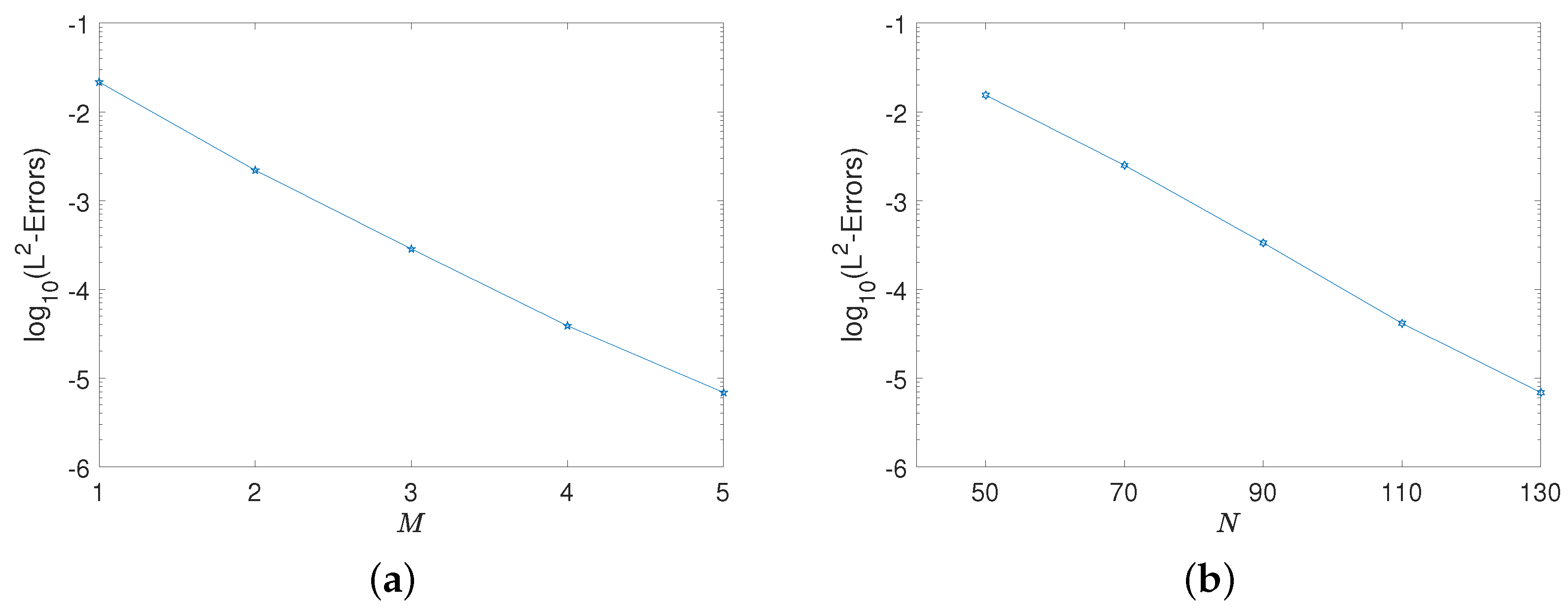
In Figure 3, we show temporal and spatial -error using semi-log coordinates at t = 6 for the KdV Equation (45) with . We can obviously observe that the errors are of the form , where for spatial errors, and for temporal errors, which indicate the exponential convergence in both time and space.
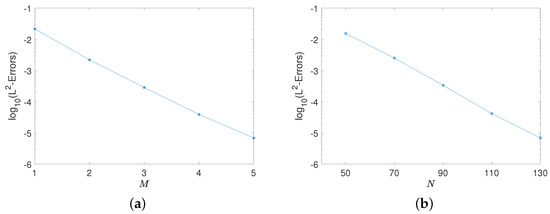
Figure 3.
Spectral errors in time and space, respectively, at for Example 2. Take . (a) Temporal errors versus M with ; (b) spatial errors versus N with .
In [27], a Legendre pseudo-spectral method was proposed for the KdV Equation (45) combined with finite difference methods in time (see scheme (2.3) in [27]), and temporal and spatial errors at were given for the equation with exact solution (46) by taking in the numerical examples. In Table 3 and Table 4, we compare the temporal and spatial errors, respectively, obtained by our method with those in [27] under the same conditions. We can observe from the results of comparison that the proposed method in this paper attains higher accuracy with smaller N.
Table 3.
Spatial errors at for Example 2. Take .
Table 4.
Temporal errors at for Example 2. Take .
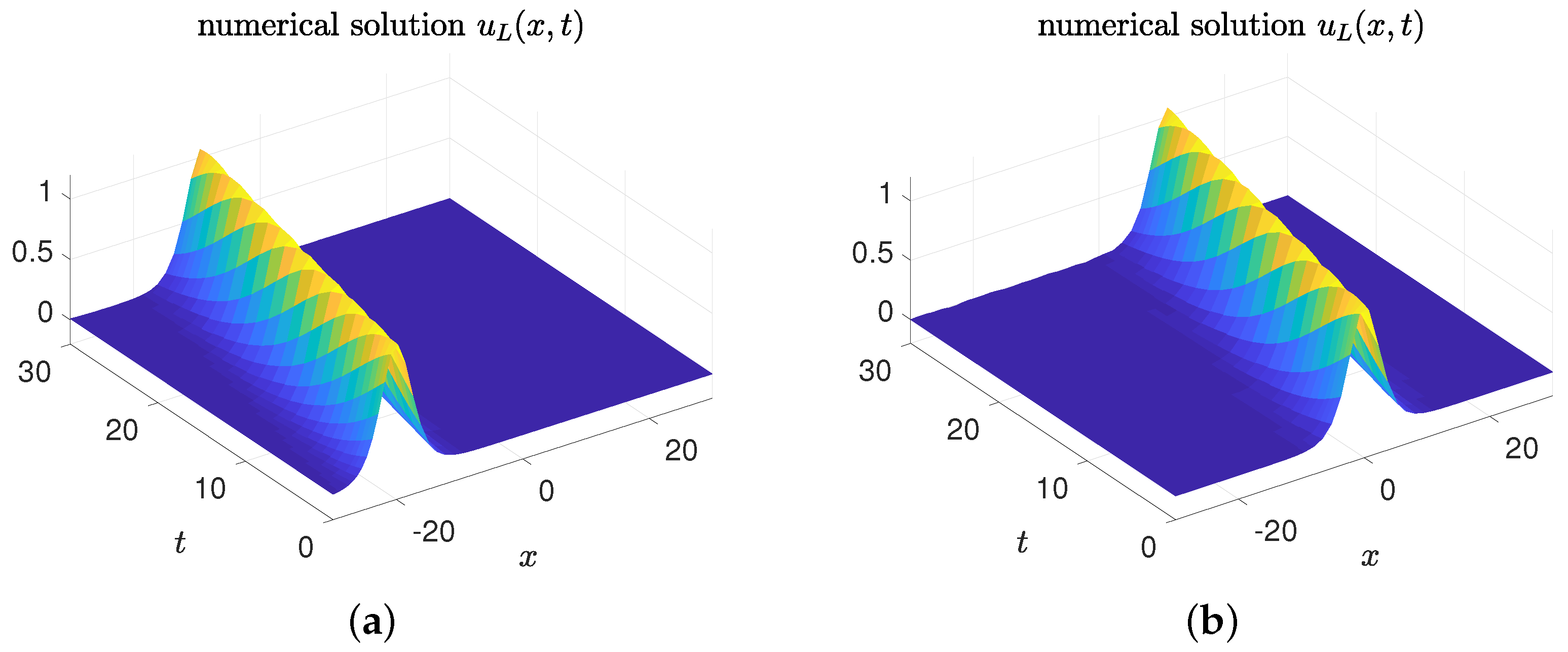
Moreover, in Figure 4, we plot the time evolution of numerical solutions for the KdV Equation (45) with exact solution (46) by taking and respectively.
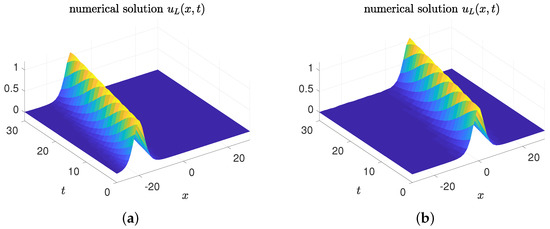
Figure 4.
Time evolution of the numerical solutions for Example 2 with different constant . Take . (a) ; (b) .
5.3. Example 3
Consider the following KdV equation [17,27]:
with exact solution
where and are given parameters.
In [27], the KdV Equation (47) was considered with exact solution (48) by taking in numerical examples, where relative -errors were presented in numerical results compared with those computed by backward Euler/forward Euler methods in [26]. However, no specific error estimates were reported neither in space nor time. In this example, we present the spatial -error estimates by taking and temporal -error estimates by taking conducted by our method in Table 5. One can easily observe that exponential convergence is obtained both in space and time.
Table 5.
Spectral errors at for Example 3. Take .
6. Conclusions
In this article, we investigate a space-time Legendre-Petrov-Galerkin method for solving the linear third-order differential equations with non-periodic boundary conditions. In the theoretical analysis, rigorous proof of error estimates in the weighted space-time norms is presented. In the numerical experiments, -error estimates are obtained by the proposed method and numerical results indicate the exponential convergence both in space and time. In addition, some numerical results are compared with those given by other numerical methods. By noticing the results, we can see that the proposed space-time spectral method in this paper can attain higher accuracy.
It is pointed out in some papers that multi-domain spectral methods in space and multi-interval spectral methods in time not only reduce the scale of the problems but also reach better accuracy. So, we try to investigate multi-domain forms in space or multi-interval forms in time of the space-time Legendre-Petrov-Galerkin methods in the forthcoming study.
Author Contributions
Conceptualization, S.T.; software, S.T.; validation, S.T. and H.L.; writing—original draft, S.T.; writing—review & editing, H.L.; funding acquisition, H.L. All authors have read and agreed to the published version of the manuscript.
Funding
This work is supported by the National Natural Science Foundation of China (12161063), Natural Science Foundation of Inner Mongolia Autonomous Regions (2021MS01018), Program for Innovative Research Team in Universities of Inner Mongolia Autonomous Region (NMGIRT2207).
Data Availability Statement
Data is contained within the article.
Acknowledgments
The authors would like to thank the reviewers and editors for their invaluable comments that greatly refine the content of this article.
Conflicts of Interest
The authors declare no conflict of interest.
References
- Boyd, J.P. Chebyshev and Fourier Spectral Methods; Courier Corporation: Mineola, NY, USA, 2001; ISBN 0-486-41183-4. [Google Scholar]
- Canuto, C.; Hussaini, M.Y.; Quarteroni, A.; Zang, T.A. Spectral Methods: Fundamentals in Single Domains; Springer Science & Business Media: Berlin/Heidelberg, Germany, 2007; ISBN 978-3-540-30725-9. [Google Scholar]
- Canuto, C.; Hussaini, M.Y.; Quarteroni, A.; Zang, T.A. Spectral Methods: Evolution to Complex Geometries and Applications to Fluid Dynamics; Springer Science & Business Media: Berlin/Heidelberg, Germany, 2007; ISBN 978-3-540-30727-3. [Google Scholar]
- Guo, B. Spectral Methods and Their Applications; World Scientific: Singapore, 1998; ISBN 9-810-23333-7. [Google Scholar]
- Shen, J.; Tang, T.; Wang, L.L. Spectral Methods: Algorithms, Analysis and Applications; Springer Science & Business Media: Berlin/Heidelberg, Germany, 2011; ISBN 978-3-540-71040-0. [Google Scholar]
- Bernardi, C.; Maday, Y. Spectral methods. Handb. Numer. Anal. 1997, 5, 209–485. [Google Scholar] [CrossRef]
- Canuto, C.; Hussaini, M.Y.; Quarteroni, A.; Zang, T.A. Spectral Methods in Fluid Dynamics; Springer Science & Business Media: Berlin/Heidelberg, Germany, 2012; ISBN 978-3-540-52205-8. [Google Scholar]
- Tal-Ezer, H. Spectral methods in time for hyperbolic equations. SIAM J. Numer. Anal. 1986, 23, 11–26. [Google Scholar] [CrossRef]
- Fakhar-Izadi, F.; Dehghan, M. Space-time spectral method for a weakly singular parabolic partial integro-differential equation on irregular domains. Comput. Math. Appl. 2014, 67, 1884–1904. [Google Scholar] [CrossRef]
- Shan, Y.; Liu, W.; Wu, B. Space-time Legendre-Gauss-Lobatto collocation method for two-dimensional generalized Sine-Gordon equation. Appl. Numer. Math. 2017, 12, 92–107. [Google Scholar] [CrossRef]
- Tang, S.; Li, H.; Yin, B. A space-time spectral method for multi-dimensional Sobolev equations. J. Math. Anal. Appl. 2021, 499, 124937. [Google Scholar] [CrossRef]
- Shen, J.; Wang, L. Fourierization of the Legendre-Galerkin method and a new space-time spectral method. Appl. Numer. Math. 2007, 57, 710–720. [Google Scholar] [CrossRef]
- Zhang, C.; Yao, H.; Li, H. New space-time spectral and structured spectral element methods for high order problems. J. Comput. Appl. Math. 2019, 351, 153–166. [Google Scholar] [CrossRef]
- Pei, C.; Mark, S.; Hussaini, M.Y. New multi-implicit space-time spectral element methods for advection-diffusion-reaction problems. J. Sci. Comput. 2019, 78, 653–686. [Google Scholar] [CrossRef]
- Bhrawy, A.H.; Zaky, M.A. An improved collocation method for multi-dimensional space-time variable-order fractional Schrödinger equations. Appl. Numer. Math. 2017, 111, 197–218. [Google Scholar] [CrossRef]
- Zheng, M.; Liu, F.; Anh, V.; Turner, I. A high-order spectral method for the multi-term time-fractional diffusion equations. Appl. Math. Model. 2016, 40, 4970–4985. [Google Scholar] [CrossRef]
- Ma, H.; Sun, W. A Legendre-Petrov-Galerkin and Chebyshev collocation method for third-order differential equations. SIAM J. Numer. Anal. 2000, 38, 1425–1438. [Google Scholar] [CrossRef]
- Ma, H.; Guo, B. The Fourier pseudo-spectral method with a restrain operator for the Korteweg-de Vries equation. J. Comput. Phys. 1986, 65, 120–137. [Google Scholar]
- Djidjeli, K.; Price, W.G.; Twizell, E.H.; Wang, Y. Numerical methods for the solution of the third and fifth-order dispersive Korteweg-de Vries equations. J. Comput. Appl. Math. 1995, 58, 307–336. [Google Scholar] [CrossRef]
- Carey, G.F.; Shen, Y. Approximations of the KdV equation by least squares finite elements. Comput. Methods Appl. Mech. Eng. 1991, 93, 1–11. [Google Scholar] [CrossRef]
- Chan, T.F.; Kerkhoven, T. Fourier methods with extended stability intervals for the Korteweg-de Vries equation. SIAM J. Numer. Anal. 1985, 22, 441–454. [Google Scholar] [CrossRef]
- Kovalyov, M. On the structure of the two-soliton interaction for the Korteweg-de Vries equation. J. Differ. Equ. 1999, 152, 431–438. [Google Scholar] [CrossRef]
- van Groesen, E. Andonowati, Variational derivation of KdV-type models for surface water waves. Phys. Lett. A 2007, 366, 195–201. [Google Scholar] [CrossRef]
- Shen, J. A new dual-Petrov-Galerkin method for third and higher odd-order differential equations: Application to the KDV equation. SIAM J. Numer. Anal. 2003, 41, 1595–1619. [Google Scholar] [CrossRef]
- Huang, W.; Sloan, D.M. The pseudo-spectral method for third-order differential equations. SIAM J. Numer. Anal. 1992, 29, 1626–1647. [Google Scholar] [CrossRef]
- Pavoni, D. Single and multidomain Chebyshev collocation methods for the Korteweg-de Vries equation. Calcolo 1988, 25, 311–346. [Google Scholar] [CrossRef]
- Li, J.; Ma, H.; Sun, W. Error analysis for solving the Korteweg-de Vries equation by a Legendre pseudo-spectral method. Numer. Methods Partial Differ. Equations Int. J. 2000, 16, 513–534. [Google Scholar] [CrossRef]
- Qin, Y.; Ma, H. Legendre-tau-Galerkin and spectral collocation method for nonlinear evolution equations. Appl. Numer. Math. 2020, 153, 52–65. [Google Scholar] [CrossRef]
- Laub, A.J. Matrix Analysis for Scientists and Engineers; SIAM: Davis, CA, USA, 2005; ISBN 978-0-898715-76-7. [Google Scholar]
- Ma, H.; Sun, W. Optimal error estimates of the Legendre-Petrov-Galerkin method for the Korteweg-de Vries equation. SIAM J. Numer. Anal. 2001, 39, 1380–1394. [Google Scholar] [CrossRef]
Disclaimer/Publisher’s Note: The statements, opinions and data contained in all publications are solely those of the individual author(s) and contributor(s) and not of MDPI and/or the editor(s). MDPI and/or the editor(s) disclaim responsibility for any injury to people or property resulting from any ideas, methods, instructions or products referred to in the content. |
© 2023 by the authors. Licensee MDPI, Basel, Switzerland. This article is an open access article distributed under the terms and conditions of the Creative Commons Attribution (CC BY) license (https://creativecommons.org/licenses/by/4.0/).