


Abstract
In this paper, we find a formula for the largest integer (p-Frobenius number) such that a linear equation of non-negative integer coefficients composed of a Jacobsthal triplet has at most p representations. For , the problem is reduced to the famous linear Diophantine problem of Frobenius, the largest integer of which is called the Frobenius number. We also give a closed formula for the number of non-negative integers (p-genus), such that linear equations have at most p representations. Extensions to the Jacobsthal polynomial and the Jacobsthal–Lucas polynomial give more general formulas that include the familiar Fibonacci and Lucas numbers. A basic problem with the Fibonacci triplet was dealt by Marin, Ramírez Alfonsín and M. P. Revuelta for and by Komatsu and Ying for the general non-negative integer p.
Keywords:
Jacobsthal numbers; linear Diophantine problem of Frobenius; Frobenius numbers; the number of representations; Apéry set; genus MSC:
11D07; 05A15; 20M14; 11B34; 11B39
1. Introduction
The Jacobsthal sequence is defined by
and the first terms are given by 0, 1, 1, 3, 5, 11, 21, 43, 85, 171, 341, 683, 1365, 2731, 5461, 10,923, 21,845, 43,691, …([1] and ([2], A001045)). Jacobsthal [3] may never have seen the actual values of this sequence. However, Horadam [4] uses the name “Jacobsthal sequence”; such an important sequence needs a name. Many properties and identities can be found in ([1], Ch.44).
In this paper, for fixed integers , we consider the linear Diophantine equation of the form
For example, when and , the equation has three different non-negative solutions (representations): , and . However, is not the largest integer that has three solutions, but is the largest. This implies that for all , the linear equation has at least four solutions. We are interested in an explicit form of such a largest integer N.
More generally, for positive integers with and N, we shall consider the linear equation
For a given non-negative integer p, the largest integer N, such that the linear Equation (2) has at most p different non-negative solutions (representations), is called the p-Frobenius number and denoted by [5,6,7]. When , 0-Frobenius number is called the Frobenius number, and such a problem is called the linear Diophantine problem of Frobenius. This problem, also known as the stamp exchange problem or the chicken McNuggets problem, has long fascinated many people in various ways. Much research has been done on this issue from various perspectives, but what we are interested in is the expression of closed formulas. Indeed, when , for two variables, Sylvester obtained the explicit form . For three (or more) variables, however, no explicit form of has been found, but the Frobenius number cannot be given by any set of closed formulas which can be reduced to a finite set of certain polynomials [8]. Only some special cases, explicit closed formulas have been found, including arithmetic, geometric-like, Fibonacci, Mersenne, and triangular (see [9,10,11,12,13,14,15] and references therein). When , the situation is even harder. For two variables, it is known that . However, for three or more variables, no concrete example had been found. Most recently, we have finally succeeded in giving the p-Frobenius number as a closed-form expression of the triangular number triplet [5]. Results on p-Frobenius numbers for repunits [6] and Fibonacci triples [16] will also be available.
In this paper, we find closed forms of p-Frobenius number of the linear Equation (1). In detail, we give complete expressions of p-Frobenius numbers about p-Frobenius numbers for , and for general p when .
The Sylvester number (or genus) is as important as the Frobenius number. That is, the number of positive integers N such that the linear Equation (2) has at most p non-negative integer solutions is called the p-Sylvester number (or p-genus), and is denoted by . When , 0-Sylvester number is the original Sylvester number. The concept of genus is very important in studying algebraic geometry, in particular, algebraic curves. Similarly to Frobenius numbers, Sylvester obtained the explicit form , but for three (or more) variables, no explicit form of has been found. If , the problem becomes even harder too.
In this paper, we also find closed forms of p-genus of the linear Equation (1). In order to compute both p-Frobenius numbers and p-genus, we analyze the geometrical structure of p-Apéry set. This framework is partly similar to that in Fibonacci triples [16], but complete descriptions require delicate case-by-case comparisons.
Throughout the paper, some known identities on Jacobsthal numbers are used. Two of the most important ones are (exercise 12 [1], [Chapter 44]) and (exercise 26 in [1], [Chapter 44]).
2. Initial Results
For integers , set the integers r and ℓ by
Theorem 1.
For , we have
Remark 1.
When , that is, , we have .
Theorem 2.
For , we have
When , that is, (), we have
Remark 2.
For example, when , we obtain
Theorem 3.
For , we have
When , that is, (:odd) or (:even), we have
Remark 3.
Concerning the relation with , the identities (8), (9), (10) and (11) can be written as
respectively.
Theorem 4.
For , we have
When , that is, (), we have
Remark 4.
3. Preliminaries
Without loss of generality, we assume that . For each , we introduce the positive integer congruent to i modulo , such that the number of representations of is bigger than or equal to and that of is less than or equal to p. Note that is defined to be 0. The set
is called the p-Apéry set of for a non-negative integer p (see, [17]), which is congruent, modulo , to the set
When , 0-Apéry set is the original Apéry set.
If one can know the structure of the elements of p-Apéry set, we can obtain the p-Frobenius numbers and p-gaps (p-Sylvester numbers) by the following formulas. A more general form can be seen in [7].
Lemma 1.
Let k and p be integers with and .
Assume that . We have
By using GAP package numericalsgps [18] (the authors thank Professor Pedro A. García-Sánchez for his kind instruction), p-Frobenius numbers of Jacobsthal triples can be obtained systematically.
- gap> jacob:= function(n)
- > if n=0 then
- > return 0;
- > elif n in [1, 2] then
- > return 1;
- > else
- > return jacob(n-1) + 2*jacob(n-2);
- > fi;
- > end;
- function( n ) … end
- gap> jacob(15);
- 10923
- gap> Set([3..10],i->FrobeniusNumber(DenumerantIdeal
- (NumericalSemigroup (jacob(i),jacob(i+2),jacob(2*i-1)),3)));
- [118, 145, 718, 2960, 12430, 50064, 202638, 811920 ]
For example,
(It is quite immediate to obtain the values until 50064. However, even by using GAP, it takes several hours to obtain 811920.)
We can have the 1-Apéry set and the representations of each element. For example, for , we can obtain the 1-Apéry set , and each element has exactly two representations. For instance, .
- gap> s:=NumericalSemigroup(11,43,171);
- gap> s1:=DenumerantIdeal(s,1);
- gap> AperyList(s1,11);
- [385, 386, 387, 344, 301, 258, 215, 513, 514, 471, 428 ]
- gap> FactorizationsElementListWRTNumericalSemigroup(AperyList(s1,11)
- ,s);
- [[[0, 1, 2 ], [35, 0, 0 ]], [[0, 5, 1 ], [4, 0, 2 ]], [[0, 9, 0 ], [4, 4, 1 ]],
- [[0, 8, 0 ], [4, 3, 1 ]], [[0, 7, 0 ], [4, 2, 1 ]], [[0, 6, 0 ], [4, 1, 1 ]],
- [[0, 5, 0 ], [4, 0, 1 ]], [[0, 0, 3 ], [31, 4, 0 ]], [[0, 4, 2 ], [35, 3, 0 ]],
- [[0, 3, 2 ], [35, 2, 0 ]], [[0, 2, 2 ], [35, 1, 0 ]]]
4. Proof of the Main Results
Put the linear representation
Given two Jacobsthal numbers and , integers r and ℓ are determined uniquely by
Proof of Theorem 1.
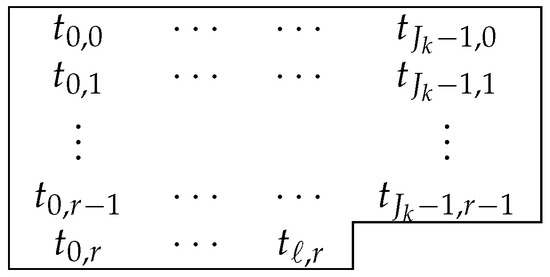
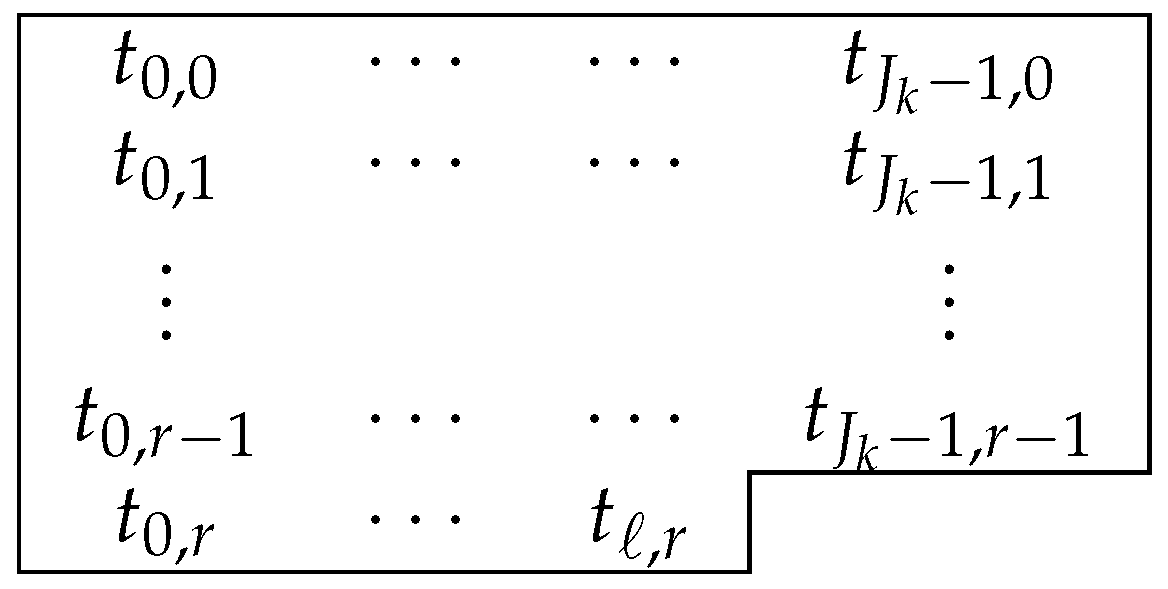
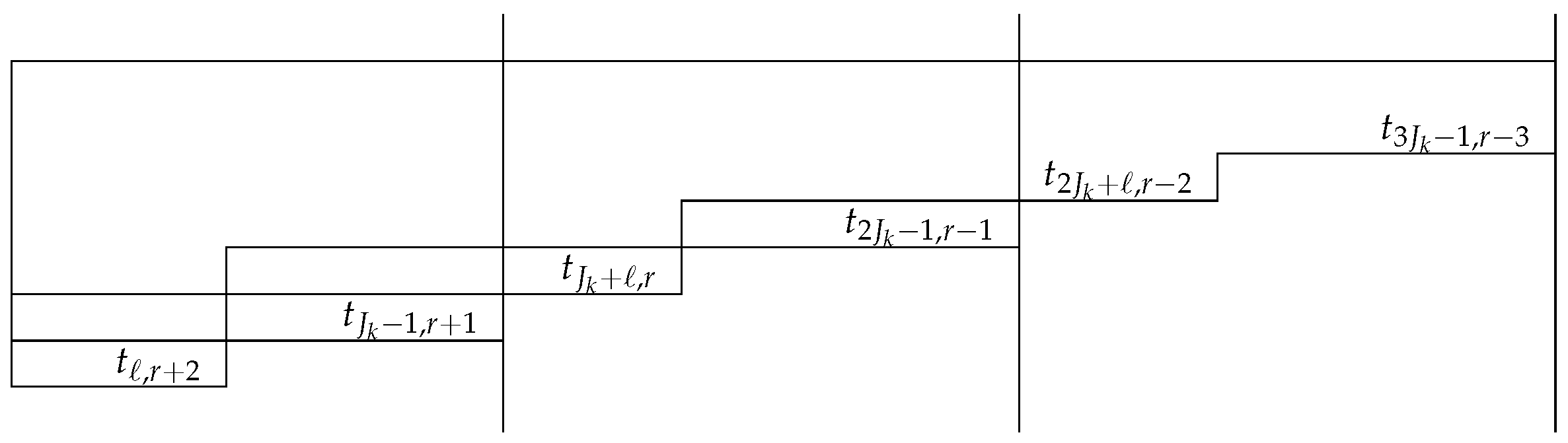
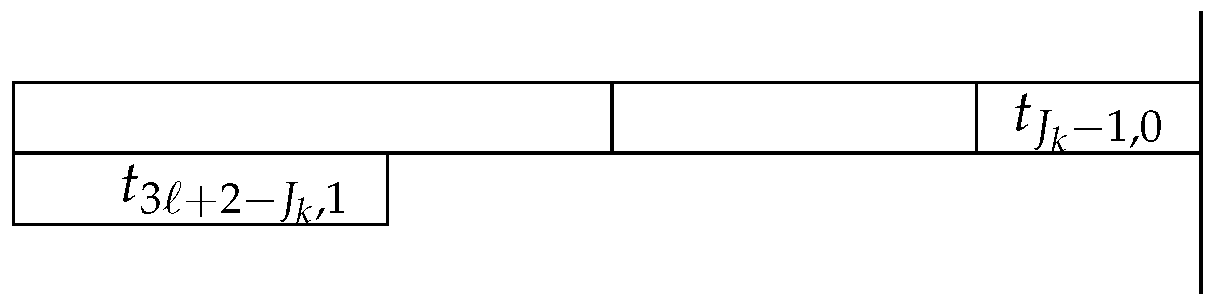
Since (), for and or and , we have each element of belongs to . See Chart 1. Namely, implies that and . When , the largest possible element is . When , the largest possible element is or , and is equivalent to . Hence, by (17), we obtain the desired result. □
Chart 1.
.
Proof of Theorem 2.
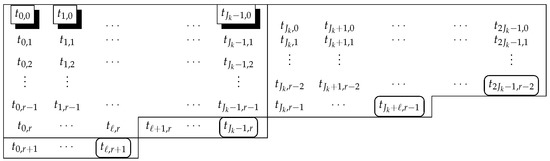
First, assume that . Since there are three congruence relations
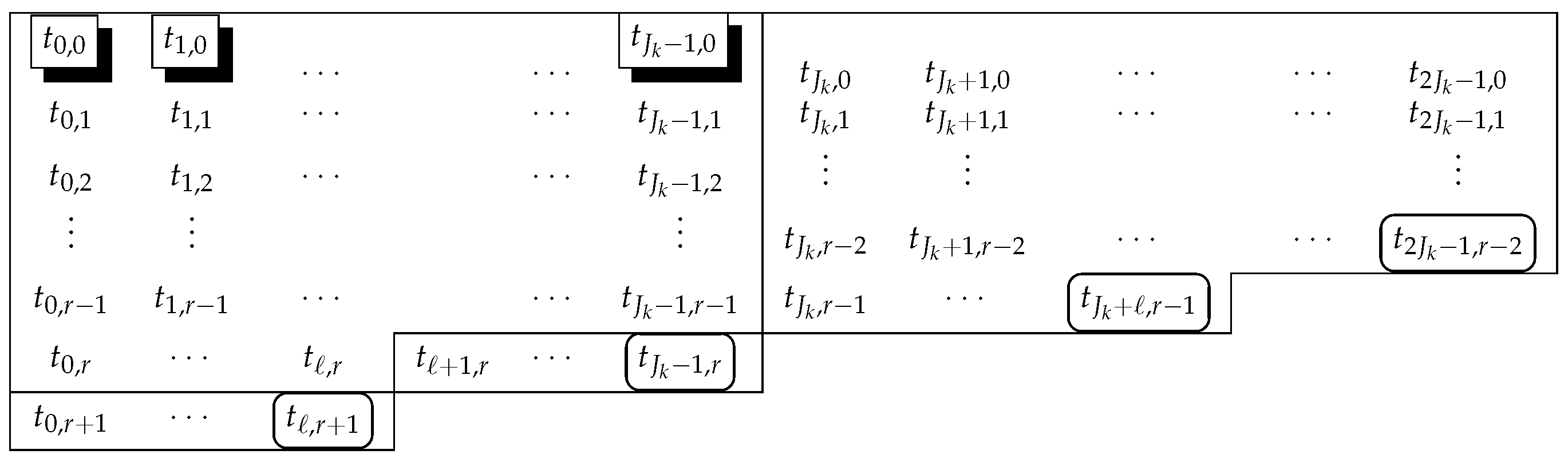
we can obtain the 1-Apéry set from the 0-Apéry set , where . By , we can see that each element of has exactly two different expressions in terms of :
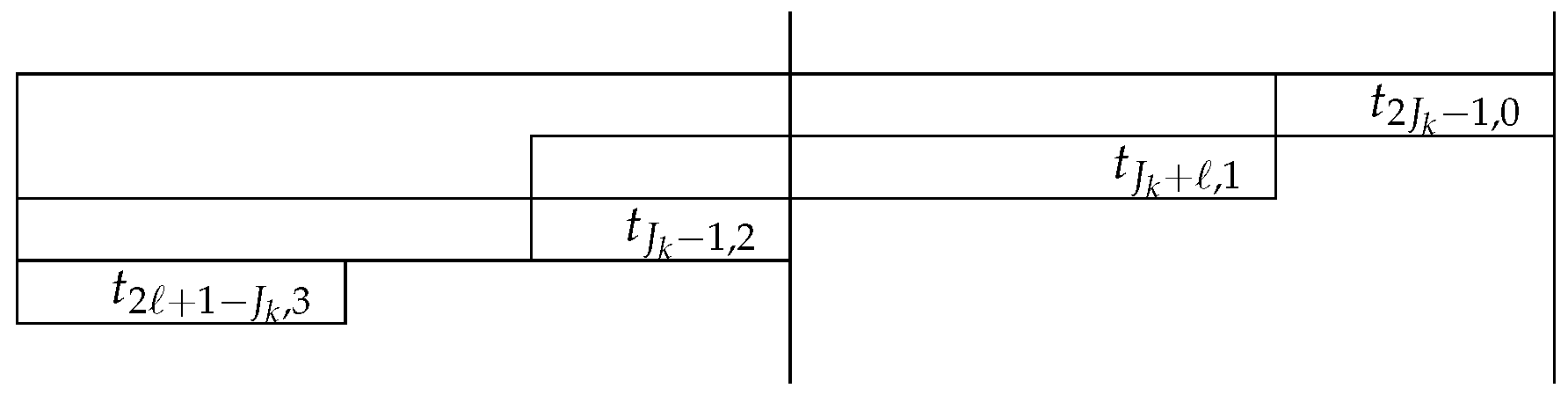
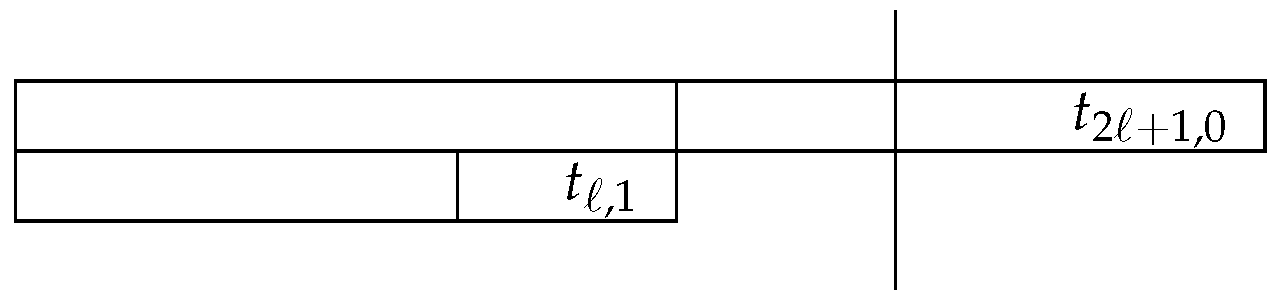
Concerning the largest value in the set , as seen in Chart 2, there are four candidates:
Since (), we can know that
Therefore, it is enough to compare and . Since is equivalent to , we have the identity (7).
Chart 2.
from .
The identities (4), (5) and (6) are yielded from the case . In this case, there are two different patterns for the arrangement of the elements of 1-Apéry set: or .
Case 1.

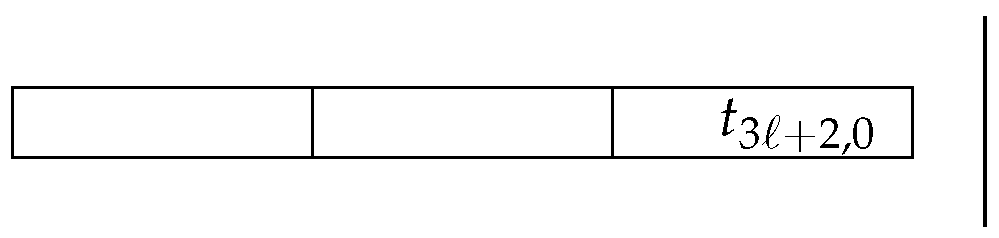
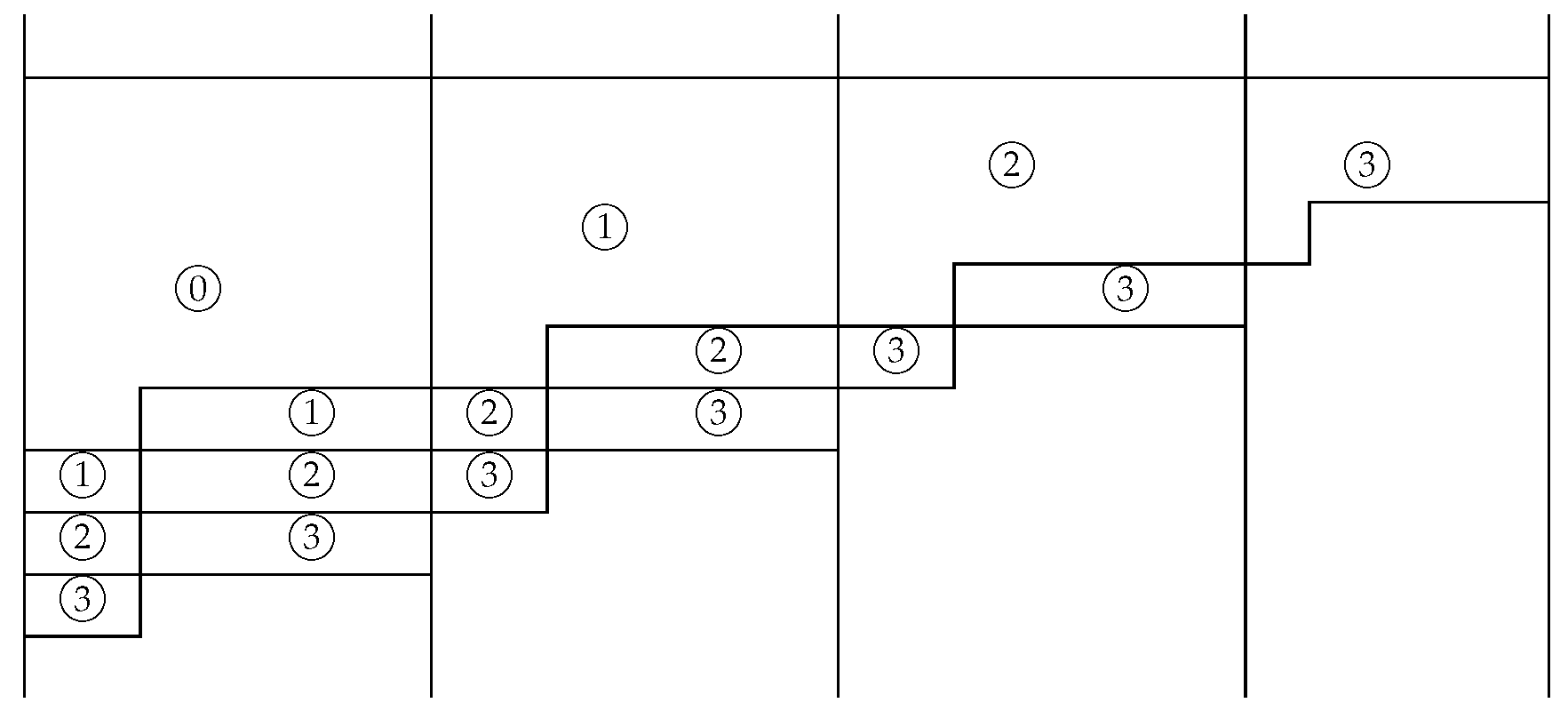
When , that is, , all the elements of 0-Apéry set and 1-Apéry set are in a unique line, as shown in Chart 3. There is the relation between each element in 0-Apéry set and 1-Apéry set as . Each element in 1-Apéry set has exactly two representations because for
Chart 3.
from when and .
Hence, the largest element of 1-Apéry set is
Notice that the condition is valid when or and i is even. By (17), we obtain the identity (4), and the identity (5) when i is even.
Case 2.

When , that is, , some elements of 1-Apéry set come to the second line, as shown in Chart 4. There are two corresponding relations between each element in 0-Apéry set and 1-Apéry set: () and (). Each element in 1-Apéry set has exactly two representations because for
and for
Chart 4.
from when and .
Hence, concerning the largest element of 1-Apéry set, there are two possibilities: and . Since implies that , the condition is valid only when or and i is odd. When , only possibility is , yielding the identity (6). When (and i is odd), by , we obtain the identity (5) when i is odd. □
Proof of Theorem 3.
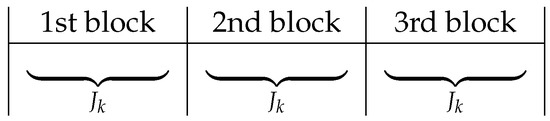
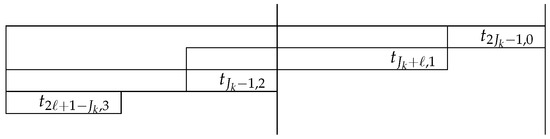
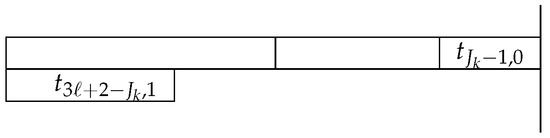
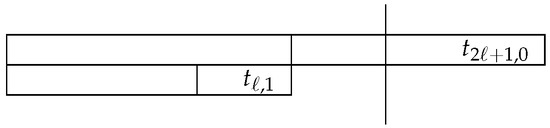
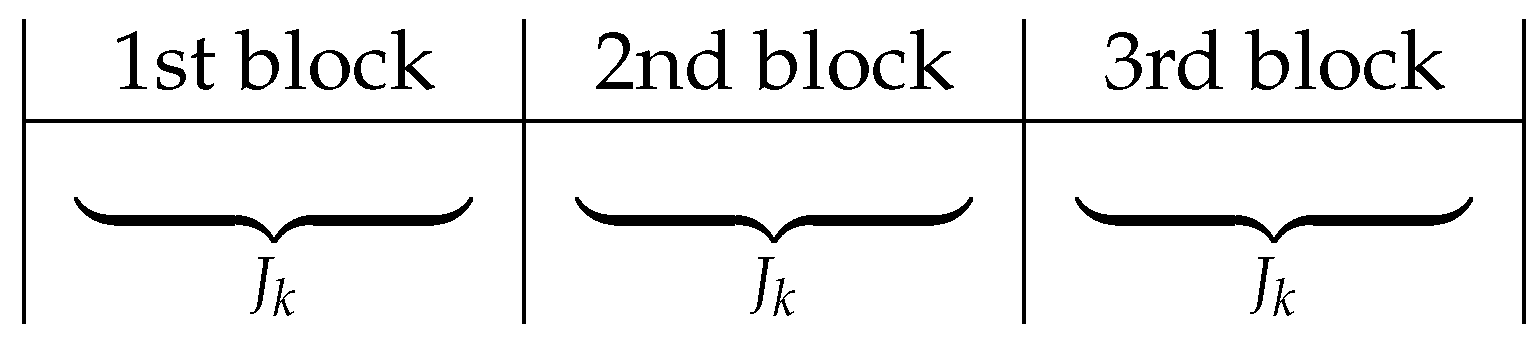
When , the elements of 2-Apéry set are determined from those of 1-Apéry set, by using the third block too (see Chart 5). Except for the elements in the top row, each element in the 1-Apéry set corresponds to the element in the 2-Apéry set with the same residue modulo so that it shifts up one step and moves to the right block. Only the elements in the 1-Apéry in the top row correspond to the elements of the 2-Apéry set with the same residue so that they are arranged in order so as to fill the gap at the bottom of the leftmost block (first block).
Chart 5.
Three blocks.
Case 1.
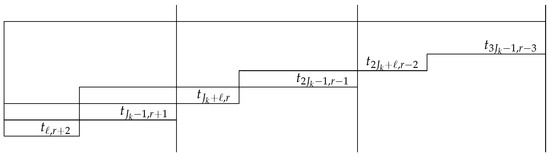
When , the elements of 2-Apéry set are placed below the first block, below the second block, and throughout the third block, as shown in Chart 6. Note that when , the third block consists of only one line with or less elements.
Chart 6.
() for .
Each element in the lower two lines of the first block (or just one line consisting of elements) can be represented in only three ways in terms of , and , respectively, and is congruent to an element in the top row of the second block modulo . Each element in the lower two lines of the second block (or just one line consisting of elements) can be represented in only three ways in terms of , and , respectively, and is congruent to an element in the second row from the bottom of the first block modulo . Every element of the third block has also only three ways of being represented in terms of , and , and there is a congruence relation with each element (except the first row) of the second block shifted up by one step.
Concerning the largest element of , there are six candidates:
Since (), . Hence, we obtain
Therefore, the largest value must be or . If , the largest value in is . If , the largest value in is . By (17), we obtain the identity (12).
Case 2.
When , there are two patterns depending on or .
If then , so .
However, by , . So, this case does not exist. If , by , the only possibility is and i is even. As shown in Chart 7, there are four candidates for the largest value of :
Chart 7.
() for and .
Since when i is even, by we have
By (17), we can obtain the identity (11).
Case 3.
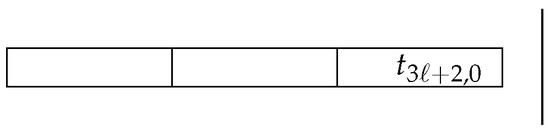
When , there are three patterns, depending on , or . If , we see that . As shown in Chart 8, the largest value of is . By (17), we obtain the identity (8).
Chart 8.
() for and .
If , that is, , together with , only the possibility is and i is even. As shown in Chart 9, the largest value of is or . Since for even i, we have . By (17), we obtain the identity (9) when i is even.
Chart 9.
() for and .
If , by , we see that or and i is odd. As shown in Chart 10, the largest value of is or . When (and i is odd), we have . When , we have . By (17), we obtain the identity (9) when i is odd, and the identity (10), respectively. □
Chart 10.
() for and .
Proof of Theorem 4.
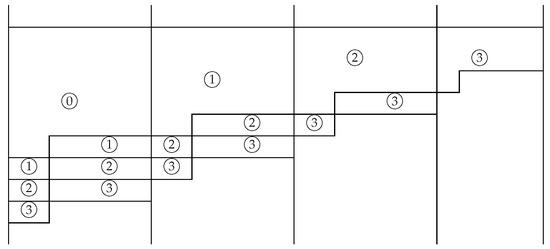
When , the structure will be systematically analyzed if . On the contrary, in the case where , the description is not simple at all because the delicate discussion of each case is required. Here, we outline the case of for generalization in a later section.
In Chart 11, ⓝ denotes the area of elements in . Here, each , satisfying (), can be expressed in at least ways but in at most n ways. Each element of existing in the second block to the fourth block corresponds to each element having the same residue of existing in the block immediately to the left thereof in a form of shifting up one step. The elements of existing over two rows (or one row) at the bottom of the first block correspond to the elements with the same residue of at the top of the third block. Therefore, since all the elements in form a complete remainder system, so is . We omit the details, but it can be seen that all the elements of have exactly four ways of expressing in terms of , , and . Within each region of , the rightmost (lower right) element is the largest, so by comparing those elements, the maximum element of can be found.
Chart 11.
() for .
Eventually, the largest element of is from the first block, that is, or . Hence, if , then . If , then . Notice that implies that with . □
5. General p Case
Let p be a given non-negative integer. When , by repeating the same process as those in previous theorems, we can obtain an explicit formula of p-Frobenius number.
Theorem 5.
Let and p be a non-negative integer. When with , we have
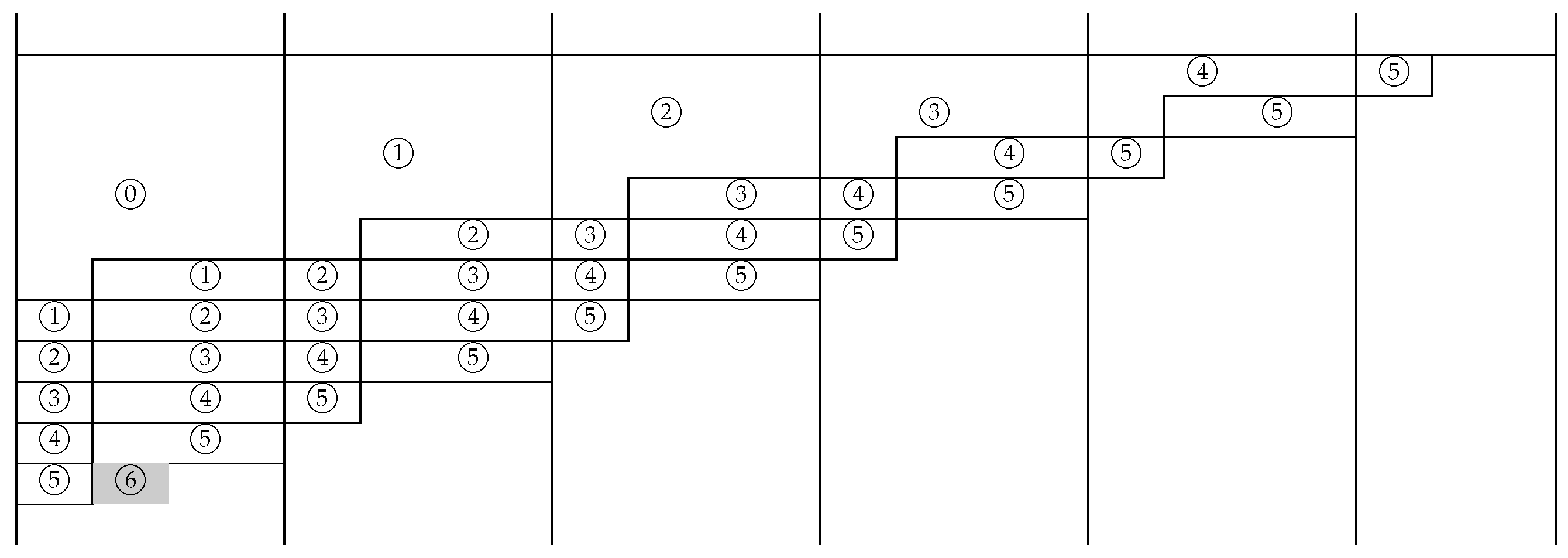
However, when , the situation is not simple at all. We do need the case-by-case discussion. To see this depends on how regularly the elements of the p-Apéry set continues to appear. The elements of the 0-Apéry set represented by Chart 2 are continually arranged regularly to those of the 1-Apéry set, the 2-Apéry set, and until the r-Apéry set. However, when it reaches the time of the (p)-Apéry set when , the elements arranged at the lower left are insufficient, and the regularity shifts. That is, the positional relationship of the elements giving the largest value suddenly changes. Hereinafter, this deviation increases as , , ⋯, and the regularity is greatly impaired.
Chart 12 shows the arrangement of the p-Apéry sets () when . One can see that there will be a deficiency in the arrangement of the lower left for 6-Apéry set.
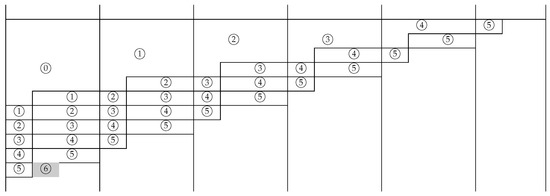
Chart 12.
().
6. p-Genus
In order to obtain an explicit form of p-genus (p-Sylvester number), we shall use the Formula (18). That is, in each case, it is necessary to find the sum of the elements within the areas of p-Apéry set. Calculating the sum is a bit cumbersome, but there is no need to compare candidates as we would when finding the largest value. Therefore, the calculation method is similar to that of Fibonacci [16].
6.1. The Case
By Chart 1, we have
By (18), we have
Theorem 6.
We have
Remark 5.
For Fibonacci triples [19], we have
6.2. The Case
Theorem 7.
For , we have
When , that is, (), we have
6.3. The Case
Theorem 8.
For , we have
When , that is, (:even), we have
7. General p Case
We can continue the process with . When , it is necessary to consider complicated case classification, but when , the closed formula for p-genus can be obtained according to the above-mentioned certain rule. We have
Hence, by (18), we have
Theorem 9.
Let and p be a non-negative integer. When , we have
Remark 6.
Concerning Fibonacci triples [16], for with , we have
8. Jacobsthal Polynomials
Jacobsthal numbers can be generalized as Jacobsthal polynomials , defined by the recurrence relation () with and ([1], [Ch.44]). When , are the Jacobsthal numbers.
Let p be a given non-negative integer. It would be possible to give a complete explicit formula for a given and p, but it requires a very complicated case classification for each case, and it is more difficult to make a general statement. Nevertheless, it is possible to give a generalized formula only when . The formula depends on the identity
Theorem 10.
Let and p be a non-negative integer, and b be a positive integer. When , we have
Remark 7.
Since are Fibonacci numbers, when , Theorem 10 can be reduced to the Fibonacci results in [16].
It would be attractive to consider the numbers or polynomials with the same recurrence relations but different initial values. In ([1], [Ch.44]), Jacobsthal–Lucas polynomials are introduced as () with and . are called Jacobsthal–Lucas numbers and are well-known Lucas numbers. However, explicit formula cannot be expressed only by the Jacobsthal–Lucas polynomials (or numbers), and the help of the Jacobsthal polynomials (or numbers) are also needed. The formula depends on the identity
Theorem 11.
Let and p be a non-negative integer, and b be a positive integer. When , we have
9. Open Questions
It would be interesting and possible to find an explicit form of p-Frobenius number about the so-called Pell-type numbers, satisfying the recurrence relation for an integer . One should not think the situation is similar. In this case, as the value of a increases, the value of increases even more rapidly, so it becomes more rapidly difficult to trace the actual situation. One of the difficulties is that there is no constant C that gives for each fixed a, unlike in Jacobsthal.
Author Contributions
Writing—original draft preparation, T.K.; review and editing, C.P.-R. All authors have read and agreed to the published version of the manuscript.
Funding
This research received no external funding.
Informed Consent Statement
Not applicable.
Data Availability Statement
Not applicable.
Acknowledgments
The authors thank the anonymous referees for careful reading of this manuscript. Their comments and suggestions improved the quality of the paper. Most parts of this work were completed when the first author stayed in Universidad Panamericana in July 2022. The first author thanks the fruitful discussion with the second author and the cordial hospitality of his institute.
Conflicts of Interest
The author declares no conflict of interest.
References
- Koshy, T. Fibonacci and Lucas Numbers with Applications; Pure and Applied Mathematics (Hoboken); John Wiley & Sons, Inc.: Hoboken, NJ, USA, 2019; Volume 2. [Google Scholar]
- Sloane, N.J.A. The On-Line Encyclopedia of Integer Sequences. 2022. Available online: oeis.org (accessed on 1 December 2022).
- Jacobsthal, E. Fibonaccische Polynome und Kreisteilungsgleichungen. Sitzungsberiohte Der Berl. Math. Ges. 1919, 17, 43–57. [Google Scholar]
- Horadam, A.F. Jacobsthal and Pell Curves. Fib. Quart. 1988, 26, 79–83. [Google Scholar]
- Komatsu, T. The Frobenius number for sequences of triangular numbers associated with number of solutions. Ann. Comb. 2022, 26, 757–779. [Google Scholar] [CrossRef]
- Komatsu, T. The Frobenius number associated with the number of representations for sequences of repunits. Comptes Rendus. Mathématique 2023, 361, 73–89. [Google Scholar] [CrossRef]
- Komatsu, T. On p-Frobenius and related numbers due to p-Apéry set. arXiv 2022, arXiv:2111.11021. [Google Scholar]
- Curtis, F. On formulas for the Frobenius number of a numerical semigroup. Math. Scand. 1990, 67, 190–192. [Google Scholar] [CrossRef]
- Ong, D.C.; Ponomarenko, V. The Frobenius number of geometric sequences. Integers 2008, 8, A33. [Google Scholar]
- Rosales, J.C.; Branco, M.B.; Torrão, D. The Frobenius problem for Thabit numerical semigroups. J. Number Theory 2015, 155, 85–99. [Google Scholar] [CrossRef]
- Rosales, J.C.; Branco, M.B.; Torrão, D. The Frobenius problem for repunit numerical semigroups. Ramanujan J. 2016, 40, 323–334. [Google Scholar] [CrossRef]
- Rosales, J.C.; Branco, M.B.; Torrão, D. The Frobenius problem for Mersenne numerical semigroups. Math. Z. 2017, 286, 741–749. [Google Scholar] [CrossRef]
- Robles-Pérez, A.M.; Rosales, J.C. The Frobenius number for sequences of triangular and tetrahedral numbers. J. Number Theory 2018, 186, 473–492. [Google Scholar] [CrossRef]
- Shallit, J. Frobenius numbers and automatic sequences. Integers 2021, 21, A124. [Google Scholar]
- Tripathi, A. On the Frobenius problem for geometric sequences. Integers 2008, 8, A43. [Google Scholar]
- Komatsu, T.; Ying, H. The Frobenius number associated with the number of representations for Fibonacci triplets. Math. Biosci. Eng. 2023, 20, 3455–3481. [Google Scholar] [CrossRef]
- Apéry, R. Sur les branches superlinéaires des courbes algébriques. C. R. Acad. Sci. Paris 1946, 222, 1198–1200. [Google Scholar]
- Delgado, M.; García-Sánchez, P.A.; Morais, J. “Numericalsgps”: A GAP Package on Numerical Semigroups. Available online: http://www.gap-system.org/Packages/numericalsgps.html (accessed on 1 December 2022).
- Marin, J.M.; Ramírez Alfonsín, J.L.; Revuelta, M.P. On the Frobenius number of Fibonacci numerical semigroups. Integers 2007, 7, A14. [Google Scholar]


Disclaimer/Publisher’s Note: The statements, opinions and data contained in all publications are solely those of the individual author(s) and contributor(s) and not of MDPI and/or the editor(s). MDPI and/or the editor(s) disclaim responsibility for any injury to people or property resulting from any ideas, methods, instructions or products referred to in the content. |
© 2023 by the authors. Licensee MDPI, Basel, Switzerland. This article is an open access article distributed under the terms and conditions of the Creative Commons Attribution (CC BY) license (https://creativecommons.org/licenses/by/4.0/).