Abstract
In the present paper, we consider a nonlinear fractional snap model with respect to a -Caputo derivative and subject to non-periodic boundary conditions. Some qualitative analysis of the solution, such as existence and uniqueness, are investigated in view of fixed-point theorems. Moreover, the stabilities of Ulam–Hyers and Ulam–Hyers–Rassias criterions are considered and investigated. Some numerical simulations were performed using MATLAB for understanding the theoretical results. All results in this work play an important role in understanding ocean engineering phenomena due to the huge applicability of jerk and snap in seakeeping, ride comfort, and shock response spectrum.
Keywords:
snap problem; \({\mathbb{G}}\)-Caputo fractional differential equation; boundary value problem; Ulam–Hyers–Rassias stability MSC:
34A08; 34B18
1. Introduction
The second derivative of the accelaration (fourth derivative of position) is a physical quantity called a snap or jounce, which can be modeled as:
It is obvious that the model (1) can be reduced to the following equation:
In fact, the terms jerk and snap are exceptionally rare for most individuals, counting physicists and engineers. Scientists jerk and snap are the third and fourth derivatives of our position with regard to time, respectively. Equation (1) contains a 4th-order derivative of the variable , and it describes a 4th-order dynamical vibration model. The corresponding fractional model is achieved by using the fractional derivative (of order less than or equal 1) instead of the standard derivative . Many types of fractional derivatives can be used here, such as the Riemann–Liouville, Caputo and Hadamard. We prefer to use the generalized fractional derivative with respect to differentiable increasing function . Gottlie in [1] applied the method of harmonic balance to non-linear jerk equations, which involves the third order time-derivative. In 2017, Elsonbaty et al., by applying the contraction principle, investigated the following jerk system:
in which derivatives are with respect to time, and and denote positive parameters with [2]. In 2018, Rahman et al. [3] with the help of the modified harmonic balance method, obtained a second approximate solution for a simple nonlinear 3rd-order jerk initial problem formulated as
Additionally, Prakash et al. in [4], introduced an extension of the jerk system to the fractional order jerk system without any equilibrium point, given as:
where , and are orders of fractional type. Many researchers have investigated the sufficient conditions for a wide domain of fractional nonlinear ordinary differential equations by employing methods which include standard fixed-point theorems, iterative approaches, etc. (see [5,6,7,8,9,10,11,12,13]). However, to the best of our knowledge, limited results can be found on the existence/stability of solutions for a fractional jerk system via the generalized -Caputo derivative. In 2020, Liu et al., developed two iterative algorithms to determine the periods and then the periodic solutions of nonlinear jerk equations for two possible cases initial values unknown and initial values given [14]. The authors in the recent article [15] considered the —fractional snap model with a constant initial conditions
where the -Caputo derivatives are illustrated by symbol , and such that ; the increasing function is such that and continuous function and , but we here in this article shall use non-periodic boundary conditions that generalize many boundary and initial conditions. The authors in [16] studied the following coupled system of fractional differential equations:
for equipped with the generalized fractional integral boundary conditions
where , and denote the generalized proportional fractional derivatives of Riemann–Liouville type of order ; denote the generalized proportional fractional integrals of order , ; and are continuous functions where .
We consider the following problem:
where the symbol , where is the -Caputo derivative such that , the function is increasing such that , and . Clearly, we can write the system as follows:
where , and .
This paper is organized as follows: In Section 2, we present some necessary definitions of fractional calculus and useful lemmas and some theorems about the fixed–point that are needed in the subsequent sections. In Section 3, with the help of Banach and Leary–Schauder fixed-point theorem, we give the proof of the fundamental theorems to prove the existence and uniqueness of solutions for problem (7). The stability results are extensively discussed in Section 4 in the context of the Ulam–Hyers and its generalized version, along with Ulam–Hyers–Rassias and its generalized version for solutions of the fractional -snap problem (7). Two significant examples, along with codes and numerical results, are presented in Section 5 in which our all outcomes are guaranteed. Those numerical examples were generated using MATLAB for understanding the theoretical results. Finally, we will give some suggestions to the reader in the conclusion Section 6.
2. Preliminaries
Some primitive notions, definitions and notations, which will be utilized throughout the manuscript, are recalled here. Let be increasing via . We start this part by defining —fractional integrals and derivatives. In all notations of this section, we set
The qth —integral for an integrable function with respect to is illustrated as follows ([17]):
where
By applying the Algorithm 1, we can obtain the qth —integral (8).
| Algorithm 1: MATLAB lines for getting the qth —integral of function . |
|
Let and be such that has the same properties mentioned above. The qth--fractional derivative of is defined by
in which [18]. The qth -Caputo derivative of is defined by
in which for , for [19]. In other words,
This derivative gives the Caputo–Hadamard derivative and the Caputo derivative when and , respectively. The qth -Caputo derivative of the function is specified as ([19], Theorem 3)
By using the MATLAB function in Algoritm 2, we can get the qth -Caputo derivative (9).
| Algorithm 2: MATLAB lines for getting qth -Caputo derivative of function . |
|
The composition rules for the above -operators are recalled in this lemma.
Lemma 1
([17,20]).Let and . Then the following holds:
for all . Moreover, if and , then the following holds:
Observe that if , we can get the following relation:
Lemma 2
([17]).Letand. Then, and by assuming, we have
- 1.
- ;
- 2.
- ;
- 3.
- ;
- 4.
- ;
- 5.
- , .
We recall the following two fixed-point theorems.
Theorem 1 (Banach fixed-point theorem).
Let be a Banach space, and let be a contraction mapping on a closed ball
that is, there exists a positive real number such that
for all . Then, Ψ admits a unique fixed point provided
Theorem 2 (Leray–Schauder).
Let be a Banach space, let be a closed convex bounded subset of and let O be an open set contained in with . Let be a continuous and compact mapping. Then, either (i) Ψ admits a fixed point belonging to , or (ii) there exist and such that .
3. Existence-Uniqueness Results
Here, we analyze the existence properties of solutions and their uniqueness for the proposed fractional non-periodic snap problem. We require the following lemma, which specifies the corresponding integral equation. Hereafter, we assume
(H1)
and
are continuously differentiable real-valued functions on
Lemma 3.
Let , and (H1) be held. If g is a real-valued continuous function on , then the solution of the linear fractional non-periodic snap problem
is given by
Proof.
Consider satisfying the snap problem (10). The continuity of g and
ensures that and
exist and are continuous. Hence, by applying the -th integral to both sides of Equation (10), by Lemma 2, we obtain
with . The differentiability of and
on implies (10) by operating to both sides of (12). Using the boundary condition,
we deduce that
Similarly, applying the -th integral operator , we get
The boundary condition
gives the following:
Next, we apply the -th integral operator to obtain
The boundary condition gives
Finally, we apply the integral operator to obtain
The last boundary condition can be applied to get
Therefore, we now see that fulfills (11), and the proof is ended. □
In the next result, our goal is to verify the unique solution of the fractional non-periodic snap problem (7) by using Banach fixed-point theorem.
Consider the space
Then, is a Banach space via the norm
The following notations are useful:
In virtue of Lemma 3, we can use the integral solution of the fractional non-periodic snap problem (7) to define a operator as the following.
where
for .
The following hypothesis is strongly needed for the contraction principle of the operator .
(H2)
The function and such that and , , , ,
where .
Theorem 3.
Let (H1) and (H2) be held. Then, the fractional non-periodic snap problem (7) admits a unique solution on if , where
Proof.
Define the compact subset of the Banach space as
for some constant satisfying , where
To apply the Banach Theorem, we verify that , i.e., maps into itself, where is defined by (16). For any we obtain
In addition, by (13) and (14), we have
Then
Additionally, we have
Then,
The last equality
implies that
From the above inequalities, we obtain
This implies that which means that In particular, we notice that
In the next step, the contractive property of the operator is investigated. Let ; then, we estimate
Additionally, we have
and
Finally,
From the above inequalities, we obtain
Since , is a contraction on , and Banach fixed-point theorem guarantees the existence of a unique fixed point for , and accordingly, the existence of a unique solution for the fractional non-periodic snap problem (7) and the proof are ended. □
The next existence property for possible solutions of the fractional non-periodic snap problem (7) is checked based on hypotheses of Leary-Shauder fixed-point theorem. We assume the following hypotheses:
(H3)
The function Moreover, there exist a monotonic increasing finite real-valued function and a finite real-valued function , such that
for any , and ;
(H4)
Let ,
and such that
Theorem 4.
Let (H1) , (H3) and (H4) be held. Then, there exists at least one solution for the fractional non-periodic snap problem (7) on .
Proof.
Let be defined as in (16) and be any bounded convex closed subset in . We show that the hypotheses of Leary–Schauder fixed-point theorem can be applied on the operator . Hence, the proof consists of several steps.
- Step 1:
- The continuity of the operator is obtained by applying the dominated convergence theorem and noting that the function is jointly continuous.
- Step 2:
- We show that is uniformly bounded, whereis an open ball with radius . For , we easily deduce thatThen, for any and , we can obtainandSimilarly, we haveandFrom the above inequalities, we obtainindependently of the element , which implies that is uniformly bounded.
- Step 3:
- Now, we show that is equicontinuous. Let such thatand , we deduceandSimilarly, we haveAdditionally, we haveFrom the above inequalities, we obtainas independently of , which implies that is equicontinuous. Using the Arzelà–Ascoli theorem, we deduce that is compact on . If there exist and such that , thenwhich draws a contradiction.
Therefore, by Leray–Schauder fixed-point theorem, admits at least one fixed point as a solution of the fractional non-periodic snap problem (7), and this finishes the proof. □
4. Stability Criterion
We introduce in this section many stability criteria, namely, the Ulam–Hyers and Ulam–Hyers–Rassias, with their generalizations for the solutions of the fractional non-periodic snap problem (7) on .
Definition 1
Definition 2.
Definition 3.
Definition 4.
Remark 1.
The relationships among these kinds of stability can be summarized by the following implications:
- (i)
- Definition 2 ⇒ Definition 1, if ;
- (ii)
- Definition 3 ⇒ Definition 4, if =;
- (iii)
- Definition 3 ⇒ Definition 1, if .
Remark 2.
Notice that satisfies the inequality (19) iff there exists such that
- (i)
- , ,
- (ii)
- .
Remark 3.
Notice that satisfies the inequality (20) iff there exists such that
- (i)
- ,
- (ii)
- .
The Ulam–Hyers stability of the fractional non-periodic snap problem (7) is investigated by the next result.
Theorem 5.
Let (H1) and (H2) be held; then, the fractional non-periodic snap problem (7) is Ulam–Hyers stable, and accordingly is Ulam–Hyers–Rassias stable provided that .
Proof.
For every and satisfying (19), we can find a function satisfying
with . It follows by Lemma 3 that
Using Theorem 3, there exists a unique solution satisfying the fractional non-periodic snap problem (7). Then,
Additionally, we have
Similarly, we have
Finally,
From the above inequalities, we obtain
Since , this shows the existence of a positive real
and hence according to Definition 1, the solution of (7) is Ulam–Hyers stable. Similarly, it shows the existence of a function with such that
Hence, the solution of (7) is GUH stable. □
The UHR stability for the fractional non-periodic snap problem (7) is checked in the following.
Theorem 6.
Let (H1) and (H2) be held. Then, the fractional non-periodic snap problem (7) is Ulam–Hyers–Rassias stable, and accordingly, is generalized Ulam–Hyers–Rassias stable.
Proof.
For every and satisfying (20), we can find a function satisfying
such that . Using Theorem 3, there exists a unique solution satisfying the fractional non-periodic snap problem (7). It follows by Lemma 3 that
Additionally, we have
and
Finally
From the above inequalities, we obtain
Since , this shows the existence of a positive real number
Hence, according to Definition 3, the solution of (7) is Ulam–Hyers–Rassias stable. Therefore, the solution of (7) is generalized Ulam–Hyers–Rassias stable. □
5. Numerical Applications
We give here some examples of the fractional non-periodic snap problem (7) based on numerical simulation to analyze their solutions. In these examples, we consider different cases of the function to cover the Caputo, Caputo–Hadamard and Katugampola versions with different orders.
Example 1.
We consider a nonlinear fractional non-periodic snap problem as
for and ,
Clearly , , , , , and
Thus, we can rewrite the above system as
At present, we have
Thus, . Furthermore,
By using equations in (15), we obtain
Now, from (17), we consider four cases for as , (Caputo derivative), (Caputo–Hadamard derivative), (Katugampola derivative).
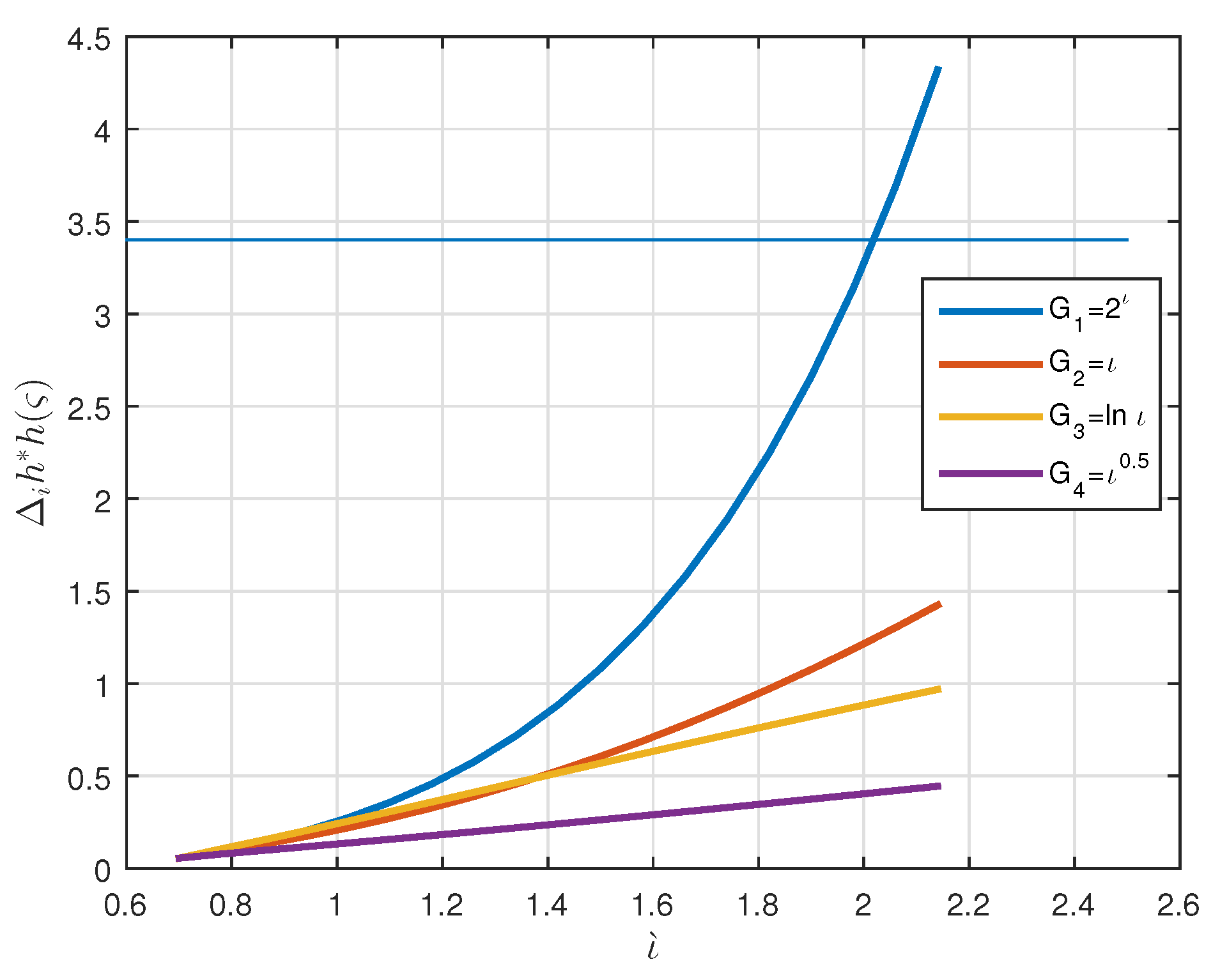
In Table 1 and Table 2, one can see the numerical results of
which we consider the maximum level for . These values show that for , they are not more than . We define the Algorithm S1 for obtaining the values of which is shown the MATLAB commands. Thus,
One can check numerical results of , and in Table 1 and Table 2 for and , as we can see in Figure 1. Thus,
Accordingly, all requirements of Theorem 3 hold, and so the fractional non-periodic snap problem (21) has one unique solution on the .
Table 1.
Numerical values of in Example 1 when and .
Table 2.
Numerical values of in Example 1 when and .
Figure 1.
Graphical representation of and for in Example 1.
We check our results of Theorem 4 in the following example which in we consider
and in particular, (Caputo type) for three different orders , and .
Example 2.
According to the system (6), we consider again a nonlinear fractional non-periodic snap problem (21). From the following inequality
for . This means that, we can choose and . Thus, for ,
and (H3) holds. In addition to,
By assuming , and (23), we obtain and
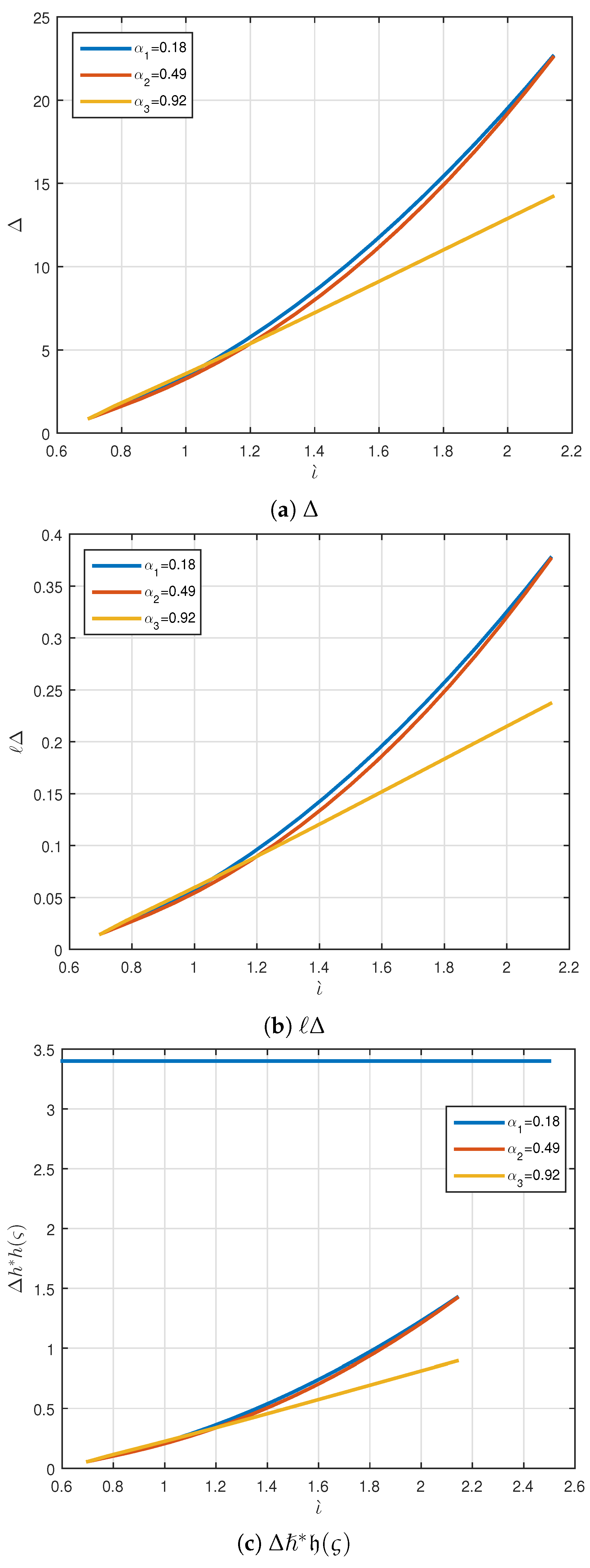
for whenever , whenever . Therefore, (H4) holds. Table 3 shows the results and one can see 2D plot of in Figure 2. In Table 3, one can see the numerical results of suitable , which we consider for .Now, we consider three cases for α as in (21) as follows:
By using relations in Equation (15), applying Equation (17) in the sequel, for , Caputo case, we have
and
Table 3.
Numerical values of in Example 2 when .
Figure 2.
2D graphs of vs. in Example 2.
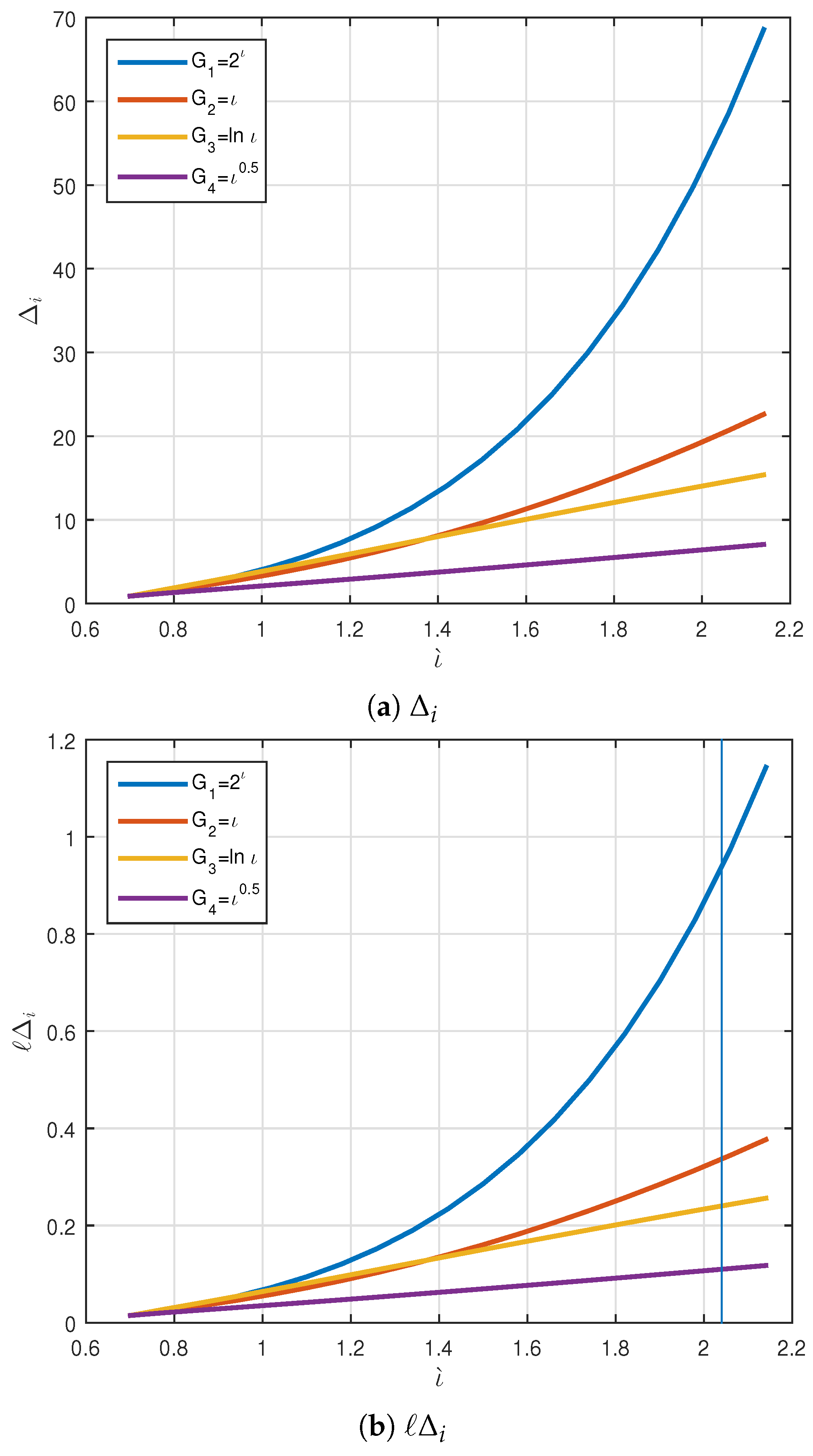
We define the Algorithm S2 for obtaining the values of and Δ, which is shown the MATLAB commands. Table 4, Table 5 and Table 6 show the results and one can see 2D plot of in Figure 3. In Table 4, Table 5 and Table 6, one can see the numerical results of , which we consider maximum level for . These values show that for , they are not more than .
Table 4.
Numerical values of , in Example 2 when and .
Table 5.
Numerical values of , in Example 2 when and .
Table 6.
Numerical values of , in Example 2 when and .
Figure 3.
Graphical representation of , and for in Example 2.
Hence (H3) holds for
One can see the 2D spectrum of and in Figure 3. In all three cases for the order , we see that all requirements of Theorem 4 are fulfilled. Therefore, this guarantees that for all of three different cases by terms of the order α, the fractional non-periodic snap problem (24) admits at least a solution on the interval .
6. Conclusions
In this paper, we defined a new fractional mathematical model consisting of a fractional snap equation with non-periodic boundary conditions in the framework of the generalized -operators. Thus, some investigations on the qualitative behaviors of its solutions, including existence, uniqueness and stability, were performed separately. To obtain the uniqueness of the solution, we used Banach contraction theorem, and for the general existence of at least one solution, we used the Shauder fixed-point theorem. Ulam–Hyers and Ulam–Hyers–Rassias with their generalizations were discussed and investigated. In the final step, we designed examples with different cases of the function , such as Caputo, Caputo–Hadamard and Katugampola; and with different orders of q, we obtained some numerical results concerning the fractional non-periodic snap problem.
Supplementary Materials
The following supporting information can be downloaded at: https://www.mdpi.com/article/10.3390/axioms11080390/s1, Algorithm S1: MATLAB lines for Example 1. Algorithm S2: MATLAB lines for Example 2.
Author Contributions
X.W.: Actualization, methodology, formal analysis, validation, investigation, and initial draft. A.B.: Actualization, methodology, formal analysis, validation, investigation, and initial draft. N.T.: Actualization, validation, methodology, formal analysis, investigation, and initial draft. M.M.M.: Actualization, validation, methodology, formal analysis, investigation, and initial draft. M.E.S.: Actualization, methodology, formal analysis, validation, investigation, software, simulation, initial draft and was a major contributor in writing the manuscript. M.K.A.K.: Actualization, methodology, formal analysis, validation, investigation, initial draft, and supervision of the original draft and editing. X.-G.Y.: Actualization, methodology, formal analysis, validation, investigation, and initial draft. All authors have read and agreed to the published version of the manuscript.
Funding
This research received no external funding.
Institutional Review Board Statement
Not applicable.
Informed Consent Statement
Not applicable.
Data Availability Statement
Data can be available upon request from the corresponding authors.
Conflicts of Interest
The authors declare that they have no competing interests.
References
- Gottlieb, H.P.W. Harmonic balance approach to periodic solutions of nonlinear jerk equations. J. Sound Vib. 2004, 271, 671–683. [Google Scholar] [CrossRef]
- Elsonbaty, A.R.; El-Sayed, A.M. Further nonlinear dynamical analysis of simple jerk system with multiple attractors. Nonlinear Dynam. 2017, 87, 1169–1186. [Google Scholar] [CrossRef]
- Rahman, M.S.; Hasan, A.S.M.Z. Modified harmonic balance method for the solution of nonlinear jerk equations. Results Phys. 2018, 8, 893–897. [Google Scholar] [CrossRef]
- Prakash, P.; Singh, J.P.; Roy, B.K. Fractional-order memristor-based chaotic jerk system with no equilibrium point and its fractional-order backstepping control. IFAC-Papers Online 2018, 51, 1–6. [Google Scholar] [CrossRef]
- Rezapour, S.; Thabet, S.T.M.; Matar, M.M.; Alzabut, J.; Etemad, S. Some Existence and Stability Criteria to a Generalized FBVP Having Fractional Composite p-Laplacian Operator. J. Funct. Spaces 2021, 2021, 9554076. [Google Scholar] [CrossRef]
- Matar, M.M.; Ahmad, M.; Zada, A.; Etemad, S.; Rezapour, S. On the existence and stability of two positive solutions of a hybrid differential system of arbitrary fractional order via Avery–Anderson–Henderson criterion on cones. Adv. Differ. Equ. 2021, 2021, 423. [Google Scholar] [CrossRef]
- Ragusa, M.A. Quasilinear equations with discontinuous coefficients. Commun. Appl. Anal. 2005, 9, 337–341. [Google Scholar]
- Sanaullah, K.; Ullah, S.; Arif, M.F.; Abodayeh, K.; Fayyaz, R. Self-adaptive predictorcorrector approach for general variational inequalities using a fixed-point formulation. J. Funct. Spaces 2022, 2022, 2478644. [Google Scholar] [CrossRef]
- Mohammadi, H.; Baleanu, D.; Etemad, S.; Rezapour, S. Criteria for existence of solutions for a Liouville–Caputo boundary value problem via generalized Gronwall’s inequality. J. Inequalities Appl. Vol. 2021, 2021, 36. [Google Scholar] [CrossRef]
- Yin, T.C. Algorithmic and analytical approach to the proximal split feasibility problem and fixed point problem. Filomat 2022, 36, 439–448. [Google Scholar] [CrossRef]
- Hajiseyedazizi, S.N.; Samei, M.E.; Alzabut, J.; Chu, Y. On multi-step methods for singular fractional q–integro-differential equations. Open Math. 2021, 19, 1378–1405. [Google Scholar] [CrossRef]
- Vanterler da, C. Sousa, J.; Capelas de Oliveira, E. On the Ulam-Hyers-Rassias stability for nonlinear fractional differential equations using the ψ-Hilfer operator. J. Fixed Point Theory Appl. 2018, 20, 96. [Google Scholar] [CrossRef]
- Matar, M.M.; Abbas, M.I.; Alzabut, J.; Kaabar, M.K.A.; Etemad, S.; Rezapour, S. Investigation of the p-Laplacian nonperiodic nonlinear boundary value problem via generalized Caputo fractional derivatives. Adv. Differ. Equ. 2021, 2021, 68. [Google Scholar] [CrossRef]
- Liu, C.; Chang, J.R. The periods and periodic solutions of nonlinear jerk equations solved by an iterative algorithm based on a shape function method. Appl. Math. Lett. 2020, 102, 106151. [Google Scholar] [CrossRef]
- Samei, M.E.; Matar, M.M.; Etemad, S.; Rezapour, S. On the generalized fractional snap boundary problems via G-Caputo operators: Existence and stability analysis. Adv. Differ. Equ. 2021, 2021, 498. [Google Scholar] [CrossRef]
- Abbas, M.I.; Ghaderi, M.; Rezapour, S.; Thabet, S.T.M. On a Coupled System of Fractional Differential Equations via the Generalized Proportional Fractional Derivatives. J. Funct. Spaces 2022, 2022, 4779213. [Google Scholar] [CrossRef]
- Kilbas, A.A.; Srivastava, H.M.; Trujillo, J.J. Theory and Applications of Fractional Differential Equations; Elsevier Science: North-Holland Mathematics Studies; Elsevier: Amsterdam, The Netherlands, 2006. [Google Scholar]
- Samko, S.G.; Kilbas, A.A.; Marichev, O.I. Fractional Integrals and Derivatives: Theory and Applications; Gordon and Breach Science Publishers: Basel, Switzerland; Philadelphia, PA, USA, 1993. [Google Scholar]
- Almeida, R. A Caputo fractional derivative of a function with respect to another function. Commun. Nonlinear Sci. Numer. Simul. 2017, 44, 460–481. [Google Scholar] [CrossRef]
- Almeida, R.; Malinowska, A.B.; Teresa, M.; Monteiro, T. Fractional differential equations with a Caputo derivative with respect to a kernel function and their applications. Math. Methods Appl. Sci. 2018, 41, 336–352. [Google Scholar] [CrossRef]
- Hyers, D. On the stability of the linear functional equation. Proc. Natl. Acad. Sci. USA 1941, 27, 222–224. [Google Scholar] [CrossRef] [PubMed]
Publisher’s Note: MDPI stays neutral with regard to jurisdictional claims in published maps and institutional affiliations. |
© 2022 by the authors. Licensee MDPI, Basel, Switzerland. This article is an open access article distributed under the terms and conditions of the Creative Commons Attribution (CC BY) license (https://creativecommons.org/licenses/by/4.0/).