


Abstract
An object-oriented concept lattice, as an important generalization of classic concept lattices, is a bridge between formal concept analysis and rough set theory. This paper presents an application of covering reduction in formal concept analysis. It studies attribute reduction, object reduction, and bireduction for object-oriented concept lattices. We show that attribute and object reductions for object-oriented concept lattices are equivalent to covering reductions. Using a Boolean matrix transformation, we derive the corresponding algorithms to identify all reducts. In contrast to existing discernibility matrix-based reduction algorithms for object-oriented concept lattices, our algorithms omit the calculation of concept lattices, discernibility matrices, and discernibility functions. The algorithms save substantial time and are a significant improvement over discernibility matrix-based techniques.
Keywords:
attribute reduction; bireduction; object-oriented concept lattice; object reduction; relation MSC:
06B99
1. Introduction
Formal concept analysis (FCA) [1,2] is a useful model for the mathematization of concept and conceptual hierarchy. It has become a useful method for knowledge discovery, and the method plays an important role in information retrieval, cognitive analytics, and many other applications. The set of formal concepts may be interpreted as a concept lattice. The lattice has been extensively studied [3,4,5,6,7,8,9], for instance, Aragon, Medina and Poussa [10] studied the impact of applying a local congruence on a concept lattice associated with a reduced context. Particularly, much research has been conducted on attribute reduction for such a lattice [11,12,13,14,15].
Rough set theory (RST) [16,17] serves as an efficient data analysis technique to deal with vagueness and uncertainty. The theory has been extensively used for classification, feature extraction, pattern recognition, and data science. FCA and RST are closely related, for example, object-oriented concept lattices connect FCA and RST. Wei and Qi [18] considered the relationship between FCA and RST. Many papers study concept lattices [19,20,21,22] in FCA by means of rough set approaches. Yao [23,24] gave a comparative study of two theories from a viewpoint of data science. Jose et al. [25] introduced a new attribute reduction method in FCA considering the reduction philosophy given in RST. The method allows to carry out a deeper study of the relation between FCA and RST.
A rough approximation can induce many different lattices, for thorough comprehension of data processing using concept lattices, Gediga and Duntsch [26] introduced attribute-oriented concept lattices (AOCL) based on RST. As a dual concept, Yao [23] defined object-oriented concept lattices (OOCL). Both AOCL and OOCL are important generalizations of the classic concept lattices, they establish the connection between FCA and RST. Generally, a concept lattice may contain superfluous attributes and objects. This leads to the study of attribute or object reduction. The aims of attribute or object reduction for concept lattices are to remove these superfluous attributes or objects. Attribute reduction for concept lattices was proposed by Ganter and Wille [2] and Zhang, Wei, and Qi [27]. According to Konecny [5], the clarification and reduction method can be derived from their book [2]. Zhang, Wei, and Qi [27] used discernibility matrix-based methods to identify all attribute reducts in classic concept lattices. Later, Qi [28] improved their own reduction methods by defining a new discernibility matrix. Using binary integer programming, Li and Zhang [29] proposed a reduction method that does not depend on the discernibility matrices for classic concept lattices.
Attribute reduction is helpful for construction of clear data-based classification and knowledge representation models. It is also a difficult problem in concept lattices. Liu et al. [30] considered the reduction problem of AOCL and OOCL by means of RST. They proposed a discernibility matrix-based reduction algorithm and checked the algorithm by numerical computational results. A discernibility matrix-based algorithm [31] has been standardized for identifying all reducts. The method comes from RST [17] and a similar approach [32] is used to bicluster continuous matrices on the basis of Boolean function analysis. Generally, both concept lattices and discernibility matrices must be calculated. Moreover, a discernibility function must be transformed into its minimal disjunctive normal form. Since it contains several short terms, the method can be used in general; however, it is inefficient and, for large formal contexts, prohibitively costly. For instance, an experimental evaluation by Konecny and Krajča [6] that compared four different reduction algorithms found that the method is inefficient. Shao, Liu, and Guo [33] proposed a Boolean vector-based reduction algorithm that is efficient; however, the algorithm can only identify one reduct rather than all reducts. So we need to set up an efficient reduction algorithm to identify all reducts.
Covering is widely studied in rough sets [34]. Covering reduction is a powerful problem-solving technique, and this paper presents a new covering reduction perspective for solving attribute reduction problems. Fortunately, we have already obtained a simple covering reduction algorithm in [20]. This paper studies the reduction problems in OOCLs and the aim of the paper is to design a simple reduction algorithm to identify all reducts. Specifically, we consider attribute reduction, object reduction and bireduction for OOCLs in formal contexts. We first transform the reduction problem for OOCLs into the reduction problem in coverings and then obtain the corresponding algorithms with the help of the covering reduction algorithm in [20]. All reducts can be directly identified by a Boolean matrix transformation. In particular, our algorithms are simpler than the algorithms given by Liu et al. [30]. This paper can be seen as an application of the covering reduction in reduction theory in formal contexts.
The paper is structured as follows. Section 2 briefly reviews some basic concepts and properties of rough sets, concept lattices and coverings. We show an isomorphic relationship between AOCLs and OOCLs. Section 3 studies the attribute reduction problem for OOCLs and gives an algorithm to identify all reducts with the help of the covering reduction. In Section 4, as a dual of attribute reduction, we consider the object reduction problem in OOCLs and give its reduction algorithm. In Section 5, we discuss the bireduction problem in OOCLs and derive a simple bireduction algorithm. Finally, Section 6 concludes the paper.
2. Preliminaries
We briefly recall basic definitions and properties of rough sets, formal contexts and two types of concept lattices. The detailed definitions can be found in [30]. An isomorphic relationship between AOCLs and OOCLs are established.
We assume that O is a finite object set and A is a finite attribute set. is the power set of O. I is called a relation from O to A if . We write for . A triplet [2] is called a formal context (for short, context) if I is a relation from O to A. Inverse relation of I is denoted by and . Let be the complementary relation of I. is also a relation from O to A that can be expressed simple in terms of I: . Recall that I is called regular [35] if I satisfies, for any , (1) there exist such that and , and (2) there exist such that and . Clearly, if I is regular, then and are also regular. Suppose , the restriction of I to , denoted by , is . Let , the right I-related set of p is
Similarly, for , the left I-related set of q is
Clearly, for , and for , . The lower and upper approximations is given by [36],
respectively. Because is a relation from A to O, for , using instead of I, we also have the lower and upper approximations and . Let , we denote [23]
respectively. Similarly, for , we denote [23]
Proposition 1
([23,30]). Let S be a context,
(1) for and for .
(2) and for . Similarly, and for .
Definition 1
([2,23,27]). Let S be a context.
(1) Assume that , define the meet and join operations on as follows.
respectively.
(2) Assume that , define the meet and join operations on as follows.
respectively.
is a lattice [2,23,27] and called the object-oriented concept lattice (OOCL) of S. Similarly, is also a lattice and called the attribute-oriented concept lattice (AOCL) of S. As Yao points out in [23], the OOCL and AOCL of S are anti-isomorphic. The following theorem reflects the isomorphic relationship between and .
Theorem 1
([30]). Let S be a context.
(1) .
(2) is isomorphic to .
By Theorem 1, the reduction problems in AOCLs can be transformed into the reduction problems in OOCLs. Thus, we only consider the reduction problems in OOCLs. We denote
is a lattice, its meet and join operations are given by
respectively. Clearly, for each and each set of is a union of some .
Similarly, is also a lattice, and its meet and join operations are
respectively.
Theorem 2.
Let S be a context, three lattices , and are isomorphic.
Definition 2.
Let S be a context. S is row clarified if implies for each ; S is column clarified if implies for each ; S is clarified [2] if S is row and column clarified.
Clearly, in a row clarified context, different objects have different intents, similarly, in a column clarified context, different attributes have different extents. The clarification process is as below. Let be a context, we define an equivalence relation on A as follows. for . The equivalence class containing q is denoted by and the corresponding quotient set is denoted by . This induces a relation from O to as follows. for some . It is easy to check that is a column clarified context. Similarly, if we define an equivalence relation on O as follows. for . Let denote the equivalence class containing and denote the corresponding quotient set, a relation from to A is given by for some . Then, is a row clarified context. Using similar techniques, we can construct a clarified context .
Example 1.

Let a context S be given in Table 1, where is the object set and is the attribute set. A star * in position of the table means that the object has the attribute . That is, . By direct computation, , and . Thus , , where and .
Table 1.
A formal context.
1. The column clarified context is given as in Table 2.
Table 2.
A column clarified context.
2. The row clarified context is given as in Table 3.
Table 3.
A row clarified context.
3. The clarified context is given as in Table 4.
Table 4.
A clarified context.
Definition 3
([34]). A covering Γ of O is a family of nonempty subsets of O such that . Assume , Z is called reducible if such that and ; otherwise, Z is irreducible. If , is a covering of O and consists of irreducible elements in Γ, then is called a reduct of Γ. Each covering has a unique reduct [34].
Coverings and column clarified contexts are closely related. Let , , if is a covering of O, we define and a relation I from O to A via for . Clearly, is a column clarified context. Conversely, is a column clarified context with for , then is a covering of . We [20] proposed a covering reduction algorithm to identify the reduct. We will use the covering reduction algorithm [20] to identify all reducts for OOCLs.
3. Attribute Reduction in Object-Oriented Concept Lattices
Liu et al. [30] considered attribute reduction for OOCLs in contexts. We continue to consider the same reduction problem and provide an attribute reduction algorithm for such a concept lattice in contexts. However, our algorithm is much simpler than that of Liu et al. [30]. In fact, this is an application of covering reduction to attribute reduction in OOCLs. The following are the definitions of attribute and object reductions for OOCLs.
Definition 4
([27]). Let S be a context and B be a nonempty subset of A. If B satisfies the following axioms:
(1) (lattice isomorphism), and
(2) , is not lattice isomorphic to .
Then, B is called an attribute reduct of S.
Note that in Definition 4, (1) guarantees that is invariant under lattice isomorphism and (2) requires B to be minimal.
Definition 5.
Let S be a context and V be a nonempty subset of O. If V satisfies the following axioms:
(1) (lattice isomorphism), and
(2) for , is not lattice isomorphic to .
Then V is called an object reduct of S.
Similarly, in Definition 5, (1) guarantees that is invariant under lattice isomorphism and (2) requires V to be minimal. For an AOCL, we can define the attribute and object reductions, respectively. Let , we use Span to denote the family spanned by E, that is, each element in Span can be written as a union of subsets in E. For example, if and , then Span. Recall that each covering [34] has a unique reduct. We obtained a covering reduction algorithm in [20].
Theorem 3.
Let S be a context and C be a nonempty subset of A.
(1) For , .
(2) For , .
(3) if and only if Span=Span.
(4) Let S be column clarified, C is an attribute reduct of S if and only if is a covering reduct of . In particular, S has a unique attribute reduct.
Proof.
(1) For , , .
(2) , by part (1),
.
(3) Suppose that , then . Thus, and are spanned by and , respectively. Hence,
This proves the theorem.
(4) is always a covering of . In this situation, C is an attribute reduct of S, then is a covering reduct of and vice versa. S has a unique attribute reduct because each covering has unique reducts. □
We always have for any context S. For a column clarified context, by Theorem 3, to identify an attribute reduct of S is equivalent to identifying the covering reduct of . If S is not column clarified, we use a column clarified context to replace . Let be the unique attribute reduct of , then each attribute reduct of has the form . Thus, there are different attribute reducts, where is the cardinality of X. Therefore, we only need to give a reduction algorithm for column clarified contexts.
Let be column clarified, where and , . is the relation matrix of I. Suppose that and for . By characteristic function of sets, we write as an n-Boolean column vector and Boolean matrix , where is transpose. A combination of Theorem 3 and the covering reduction algorithm [20] derives the following Algorithm 1.
| Algorithm 1: An attribute reduction algorithm for OOCL. |
Input: A column clarified context S. Output: A unique attribute reduct of S. 1. For to a. For to n 1. If , then times the ith column is added to the jth column. That is, is added to (denoted by . The family of all attributes, whose columns contain at least one 1, forms the reduct. |
Algorithm 1 follows from Theorem 3(4) and the reduction algorithm of coverings [20]. We now analyze the number of steps required by Algorithm 1. We require n steps to finish the calculation of the last step in Algorithm 1; thus, this algorithm requires at most steps. Hence, its computational complexity is .
If we compare with the existing reduction algorithm in [30], the advantages of our algorithm are as follows.
(1) Omit the computation of .
(2) Omit the calculation of discernibility matrix and discernibility function.
As we know, the computation of , discernibility matrix and discernibility function are difficult and time-consuming. Our reduction algorithms save substantial time and are a significant improvement over discernibility matrix-based techniques. Compared with the clarification and reduction method [6], our algorithms are also more intuitive and easy to understand. We present its reduction algorithm via the following example.
Example 2.
Let a context S be given in Example 1, S is not column clarified. Now we identify the unique reduct of covering of O by our algorithm.
Step 1. We obtain a column clarified context and construct a Boolean matrix W.
, where and .
Step 2. According to Algorithm 1, we do the column transformation for W.
, wheremeans thatmultiplying the ith column is added to the jth column.
Step 3. Obtain all reducts.
is the unique reduct of covering of O. Since , and , there are two different attribute reducts. Hence, and are all attribute reducts of S.
In fact, Figure 1 shows the Hasse diagram of .
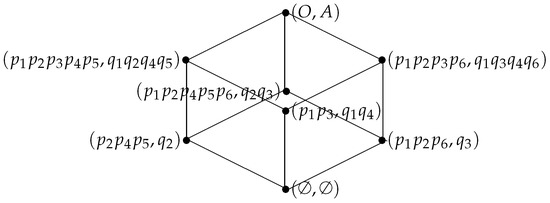
Figure 1.
The Hasse diagram of .
By Theorem 1, we can induce an object reduction algorithm for .
Corollary 1.
Let S be a context and V be a nonempty subset of O, then if and only if Span. In particular, V is an object reduct for if and only if is a covering reduct of . Moreover, if S is row clarified, then S has a unique object reduct.
Proof.
By duality principle, the proof is straightforward. □
Example 3.
Let S be given in Example 1, . C is a covering of A. is the unique reduct of C. Thus, and are all object reducts for .
4. Object Reduction in Object-Oriented Concept Lattices
The dual concept of attribute reduction is object reduction. We will set up an object reduction algorithm for OOCLs. Let A be a finite set and , we denote and for .
Theorem 4.
Let S be a context and V be a nonempty subset of O, then:
(1) For each , .
(2) if and only if Span.
(3) Let S be row clarified, then V is an object reduct of S if and only if is a covering reduct of . In particular, a row clarified context has a unique reduct.
Proof.
(1) By Proposition 1(2), . In particular, for , we have . Since , we obtain for each .
(2)
By part (1), is spanned by . Similarly, is spanned by . Thus, if and only if Span.
(3) and are coverings of A because I is regular. By part (2), if V is an object reduct of S, then is a covering reduct of and vice versa. □
If is not a row clarified, we use a row clarified context to replace S. Let be the unique object reduct of , then each object reduct has the form , where for . Thus, there are different object reducts of S.
Example 4.
Let S be a context defined in Example 1. By direct computation, , , , and . is a covering of A. is the unique reduct of covering . Thus and are all object reducts of S.
By Theorem 1, , C is an attribute reduct for if and only if C is an object reduct for . Thus, we derive an attribute reduction algorithm for , however, we omit it.
5. A Bireduction in Object-Oriented Concept Lattices
Bireduction for decision tables was first proposed by Slezak and Janusz [37] and its aim is to remove superfluous condition attributes and objects. Jose et al. [38] considered bireducts in a general framework in which attributes induce tolerance relations over the available objects. Jose et al. [39] applied the philosophy of RST to reduce formal context in the environment of FCA. Here, we consider the bireduction in an OOCL. Bireduction considers not only attribute reduction but also object reduction for a given context. Let S be a context, if V and C are non-empty subsets of O and A, respectively, we have a subcontext .
Definition 6.
Let be a context and be a subcontext of S. If
(1) (lattice isomorphism), and
(2) for or , is not lattice isomorphic to .
The pair is called a bireduct of S.
A bireduction needs to remove superfluous objects and attributes for a given context. Clearly, to identify a bireduct is to find a minimal subcontext such that and are isomorphic. Now let us set up a bireduction algorithm.
Lemma 1.
Let S be a context and V be a nonempty subset of O, if , then .
Proof.
means that and . We show that . By Proposition 1(2), . Now we show that .
Let , then . For , we have , thus, and . Hence, . Moreover, implies and . This proves that and . Therefore, . □
Lemma 2.
Let S be a context and C be a nonempty subset of A, if , then .
Proof.
Since , we have and . Clearly, . We show that . In fact, , because of and , this implies . Thus, , that is, and . Hence, and . We obtain and , thus, and . Therefore, and . We obtain and . □
Theorem 5.
Let S be a context and be a subcontext of S. If , then .
Proof.
By Lemma 2, . By Lemma 1, . Thus, . If , then , we define a mapping
Clearly, f is a bijection. Now we show that f is a lattice isomorphism. For , we denote and , thus, and . Moreover,
This shows that f is a lattice isomorphism. Hence, . Similarly, . □
Theorem 6.
Let S be a context and be a subcontext of S. If , then .
Proof.
If , by Theorem 4(2),
thus Span, that is, Span. By using Theorem 4(2) again, we have . Since , we have . □
Corollary 2.
Let S be a context and be a subcontext of S.
(1) .
(2) is a bireduct of S if and only if P is an object reduct and Q is an attribute reduct of S.
Proof.
By Theorems 5 and 6, The proof is straightforward. □
Corollary 3.
A clarified context has a unique bireduct.
Proof.
By Theorems 3 and 4, the proof is straightforward. □
The computation process of identifying bireducts can be divided into the following two steps:
(1) identify object reducts for , and
(2) identify attribute reducts for .
Let be a context, then is clarified. By Corollary 3, let be the unique bireduct of , then there are different bireducts of S.
Example 5.
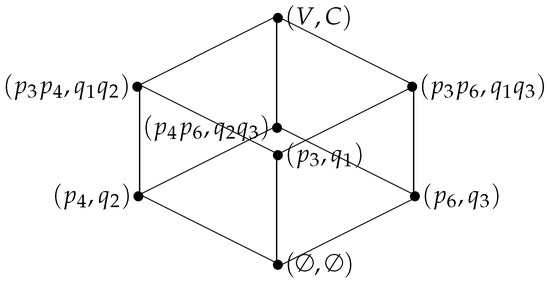 where . We obtain all object reducts and .
Let S be a context given in Example 1. By Example 4, and are all object reducts of S. By Example 2, and are all attribute reducts of S. Thus, all bireducts of S are as follows. , , and .
Let and , then is a subcontext. Moreover, = Figure 2 shows the Hasse diagram of . Clearly, .
Figure 2.
The Hasse diagram of .
The bireduction process is as follows.
We continue the reduction process with the following column operations.
We obtain all attribute reducts and . Hence, we can derive all bireducts of S. As we can see from this example, identifying all bireducts of a context is just matrix transformation processes.
For a given context S, Theorem 1 tells us that . Thus, attribute reduction, object reduction and bireduction for can be turned into object reduction, attribute reduction and bireduction for , respectively.
(1) Attribute reduction for coincides with object reduction for .
(2) Object reduction for coincides with attribute reduction for .
(3) is a bireduct of if and only if is a bireduct of .
Therefore, our proposed bireduction algorithm for OOCLs can be used to identify bireducts for AOCLs.
6. Conclusions
AOCL was proposed by Gediga and Duntsch, and OOCL was defined by Yao. The two types of concept lattices are an important bridge between FCA and RST. This paper has shown that the two types of lattices can be converted into each other. The reduction problem is an important topic in FCA, Liu et al. [30] considered the reduction problem in OOCLs and AOCLs and gave the corresponding reduction algorithms. However, their reduction algorithms are based on discernibility matrices and algorithm complexity is high. Virtually all contexts of practical importance are too large to be explored by hand. Thus, the algorithmic reduction implementation of the methods for exploring them is of great importance. In order to obtain simple reduction algorithms, we consider attribute reduction, object reduction and bireduction for OOCLs, respectively. The corresponding reduction algorithms are obtained and our proposed algorithms are much simpler than that of paper [30]. Moreover, our algorithms do not require calculating the concept lattice and corresponding discernibility matrix. In the future, we will extend our method to other types of reduction and consider the real-world applications of the proposed algorithm.
Funding
This work was supported by the National Natural Science Foundation of China (Grant No. 61972052) and the Discipline Team support Program of Beijing Language and Culture University (No. GF201905).
Institutional Review Board Statement
Not applicable.
Informed Consent Statement
Not applicable.
Data Availability Statement
Not applicable.
Conflicts of Interest
The author declares no conflict of interest.
References
- Wille, R. Restructuring lattice theory: An approach based on hierarchies of concepts. In Ordered Sets; Rival, I., Ed.; Reidel: Dordrecht, The Netherlands; Boston, MA, USA, 1982; pp. 445–470. [Google Scholar]
- Ganter, B.; Wille, R. Formal Concept Analysis: Mathematical Foundations; Springer: Berlin, Germany, 1999. [Google Scholar]
- Chen, J.; Mi, J.; Xie, B.; Lin, Y. A fast attribute reduction method for large formal decision contexts. Int. J. Approx. Reason. 2019, 106, 1–17. [Google Scholar] [CrossRef]
- Ganter, B.; Meschke, C. A formal concept analysis approach to rough data tables. In Transactions on Rough Sets; Peters, J.F., Skowron, A., Sakai, H., Chakraborty, M.K., Slezak, D., Hassanien, A.E., Zhu, W., Eds.; LNCS 6600; Springer: Berlin/Heidelberg, Germany, 2011; Volume XIV, pp. 37–61. [Google Scholar]
- Konecny, J. On attribute reduction in concept lattices: Methods based on discernibility matrix are outperformed by basic clarification and reduction. Inf. Sci. 2017, 415–416, 199–212. [Google Scholar] [CrossRef]
- Konecny, J.; Krajča, P. On attribute reduction in concept lattices: Experimental evaluation shows discernibility matrix based methods inefficient. Inf. Sci. 2018, 467, 431–445. [Google Scholar] [CrossRef]
- Li, J.; Mei, C.; Lv, Y. Knowledge reduction in decision formal contexts. Knowl.-Based Syst. 2011, 24, 709–715. [Google Scholar] [CrossRef]
- Li, J.; Mei, C.; Lv, Y. Incomplete decision contexts: Approximate concept construction, rule acquisition and knowledge reduction. Int. J. Approx. Reason. 2013, 54, 149–165. [Google Scholar] [CrossRef]
- Wang, L.; Liu, X. Concept analysis via rough set and AFS algebra. Inf. Sci. 2008, 178, 4125–4137. [Google Scholar] [CrossRef]
- Aragon, R.G.; Medina, J.; Poussa, E.R. Impact of local congruences in variable selection from datasets. J. Comput. Appl. Math. 2022, 404, 113416. [Google Scholar] [CrossRef]
- Chen, J.; Mi, J.; Xie, B.; Lin, Y. Attribute reduction in formal decision contexts and its application to fnite topological spaces. Int. J. Mach. Learn. Cybern. 2021, 12, 39–52. [Google Scholar] [CrossRef]
- Li, T. Attribute reduction of formal decision contexts. In Proceedings of the Eighth International Conference on Machine Learning and Cybernetics, Baoding, China, 12–15 July 2009; pp. 365–370. [Google Scholar]
- Li, J.; Mei, C.; Lv, Y. Knowledge reduction in formal decision contexts based on an order-preserving mapping. Int. J. Gen. Syst. 2012, 41, 143–161. [Google Scholar] [CrossRef]
- Medina, J. Relating attribute reduction in formal, object oriented and property-oriented concept lattices. Comput. Math. Appl. 2012, 64, 1992–2002. [Google Scholar] [CrossRef] [Green Version]
- Mi, J.; Leung, Y.; Wu, W. Approaches to attribute reduction in concept lattices induced by axialities. Knowl.-Based Syst. 2010, 23, 504–511. [Google Scholar] [CrossRef]
- Pawlak, Z. Rough sets. Int. J. Comput. Inf. Sci. 1982, 11, 341–356. [Google Scholar] [CrossRef]
- Pawlak, Z. Rough Sets: Theoretical Aspects of Reasoning about Data; Kluwer Academic Publishers: Boston, MA. USA, 1991. [Google Scholar]
- Wei, L.; Qi, J. Relation between concept lattice reduction and rough set reduction. Knowl.-Based Syst. 2010, 23, 934–938. [Google Scholar] [CrossRef]
- Kent, R. Rough Concept Analysis: A Synthesis of Rough Sets and Formal Concept Analysis. Fundam. Inform. 1996, 27, 169–181. [Google Scholar] [CrossRef]
- Liu, G. Rough set approaches in knowledge structures. Int. J. Approx. Reason. 2021, 138, 78–88. [Google Scholar] [CrossRef]
- Qi, J.; Qian, T.; Wei, L. The connections between three-way and classical concept lattices. Knowl.-Based Syst. 2016, 91, 143–151. [Google Scholar] [CrossRef]
- Tan, A.; Li, J.; Lin, G. Connections between covering-based rough sets and concept lattices. Int. J. Approx. Reason. 2015, 56, 43–58. [Google Scholar] [CrossRef]
- Yao, Y. A comparative study of formal concept analysis and rough set theory in data analysis. In Proceedings of the Fourth International Conference on Rough Sets and Current Trends in Computing (RSCTC 2004), Uppsala, Sweden, 1–5 June 2004; pp. 59–68. [Google Scholar]
- Yao, Y. Three-way granular computing, rough sets, and formal concept analysis. Int. J. Approx. Reason. 2020, 116, 106–125. [Google Scholar] [CrossRef]
- Jose, M.; Caballero, B.; Medina, J.; Poussa, E.R.; Slezak, D. A computational procedure for variable selection preserving different initial conditions. Int. J. Comput. Math. 2020, 97, 387–404. [Google Scholar]
- Gediga, G.; Duntsch, I. Modal-style operators in qualitative data analysis. In Proceedings of the 2002 IEEE International Conference on Data Mining, Maebashi City, Japan, 9–12 December 2002; pp. 155–162. [Google Scholar]
- Zhang, W.; Wei, L.; Qi, J. Attribute Reduction in Concept Lattice Based on Discernibility Matrix. Lect. Notes Comput. Sci. 2005, 3642, 157–165. [Google Scholar]
- Qi, J. Attribute reduction in formal contexts based on a new discernibility matrix. J. Appl. Math. Comput. 2009, 30, 305–314. [Google Scholar] [CrossRef]
- Li, L.; Zhang, D. 0–1 linear integer programming method for granule knowledge reduction and attribute reduction in concept lattices. Soft Comput. 2019, 23, 383–391. [Google Scholar] [CrossRef]
- Liu, M.; Shao, M.; Zhang, W.; Wu, C. Reduction method for concept lattices based on rough set theory and its application. Comput. Math. Appl. 2007, 53, 1390–1410. [Google Scholar] [CrossRef] [Green Version]
- Skowron, A.; Rauszer, C. The discernibility matrices and functions in information systems. In Intelligent Decision Support, Handbook of Applications and Advances of the Rough Sets Theory; Slowinski, R., Ed.; Kluwer Academic: Dordrecht, The Netherlands, 1992; pp. 331–362. [Google Scholar]
- Michalak, M.; Slezak, D. On Boolean representation of continuous data biclustering. Fundam. Inform. 2019, 167, 193–217. [Google Scholar] [CrossRef]
- Shao, M.; Liu, M.; Guo, L. Vector-based attribute reduction method for formal contexts. Fundam. Inform. 2013, 126, 397–414. [Google Scholar] [CrossRef]
- Zhu, W.; Wang, F. Reduction and axiomization of covering generalized rough sets. Inf. Sci. 2003, 152, 217–230. [Google Scholar] [CrossRef]
- Wu, W.; Leung, Y.; Mi, J. Granular computing and knowledge reduction in formal context. IEEE Trans. Knowl. Data Eng. 2009, 21, 1461–1474. [Google Scholar]
- Liu, G. Rough set theory based on two universal sets and its applications. Knowl.-Based Syst. 2010, 23, 110–115. [Google Scholar] [CrossRef]
- Slezak, D.; Janusz, A. Ensembles of bireducts: Towards robust classification and simple representation. In Future Generation Information Technology 2011 (FGIT 2011); Kimetal, T., Ed.; LNCS 7105; Springer: Berlin/Heidelberg, Germany, 2011; pp. 64–77. [Google Scholar]
- Jose, M.; Caballero, B.; Medina, J.; Poussa, E.R.; Slezak, D. Bireducts with tolerance relations. Inf. Sci. 2018, 435, 26–39. [Google Scholar]
- Jose, M.; Caballero, B.; Moreno, J.M.; Poussa, E.R. Bireducts in formal concept analysis. In Computational Intelligence and Mathematics for Tackling Complex Problems; Koczy, L., Medina, M.J., Ramirez, P.E., Sostak, A., Eds.; Studies in Computational Intelligence; Springer: Cham, Switzerland, 2020; Volume 819, pp. 191–198. [Google Scholar]
Publisher’s Note: MDPI stays neutral with regard to jurisdictional claims in published maps and institutional affiliations. |
© 2022 by the author. Licensee MDPI, Basel, Switzerland. This article is an open access article distributed under the terms and conditions of the Creative Commons Attribution (CC BY) license (https://creativecommons.org/licenses/by/4.0/).