


Abstract
In this paper, we consider certain quantities that arise in the images of the so-called graph-tree indexes of graph groupoids. In text, the graph groupoids are induced by connected finite-directed graphs with more than one vertex. If a graph groupoid G contains at least one loop-reduced finite path, then the order of is infinity; hence, the canonical groupoid index of the inclusion is either ∞ or 1 (under the definition and a natural axiomatization) for the graph groupoids of all “parts” K of G. A loop-reduced finite path generates a semicircular element in graph groupoid algebra. Thus, the existence of semicircular systems acting on the free-probabilistic structure of a given graph G is guaranteed by the existence of loop-reduced finite paths in . The non-semicircularity induced by graphs yields a new index-like notion called the graph-tree index of . We study the connections between our graph-tree index and non-semicircular cases. Hence, non-semicircularity also yields the classification of our graphs in terms of a certain type of trees. As an application, we construct towers of graph-groupoid-inclusions which preserve the graph-tree index. We further show that such classification applies to monoidal operads.
MSC:
05C62; 05C90; 17A[50]; 18B40; 47A99
1. Introduction
A directed graph is a combinatorial object consisting of the vertex set of all vertices and the edge set of all directed edges (or oriented edges up to the direction in G). In the text, we assume that all given graphs are connected, finite, and have more than one vertex. Such a directed graph is depicted in a diagrammatic form as a set of dots (for vertices) jointed by arrowed curves (for directed edges), where the arrows of the curves indicate the direction on the graph (e.g., [1,2,3,4]).
Graphs are the main objects not only in pure mathematical fields, but also in related applied areas (e.g., [5,6,7,8,9,10,11,12,13,14]).
Free probability is one of the main areas of operator algebra theory studying “noncommutative” measure-theoretic and corresponding statistical analysis on operator-theoretic structures (e.g., [15,16,17,18]). In free probability, semicircular elements whose free distributions obey the semicircular law play key roles, as the semicircular law is the noncommutative-analytic counterpart of the Gaussian distribution (or the normal distribution) of classical (commutative) functional analysis by the (free) central limit theorem(s) (e.g., [16,17,18,19]).
The main results of this paper include (i) characterizing the semicircularity on by the loop-ness on ; (ii) considering a certain measure on called the non-loop index of , providing the information of groupoidal elements in that are not loop-reduced finite paths; (iii) showing how our measuring tool of (ii) implies the non-semicircularity on with respect to (i); and (iv) constructing and studying a tower of -probability spaces that are free homomorphic from the base to the top, preserving our non-loop index.
1.1. Motivation
Amalgamated free-probabilistic operator-algebraic structures induced by directed graphs (which are necessarily neither connected nor finite) have been studied in [3,20,21,22,23,24,25,26,27,28,29,30,31]. In particular, algebraic structures called graph groupoids are constructed by directed graphs in [20]. These are algebraically pure groupoids equipped with multiple units, vertices generated by the generators, and edges (e.g., [32,33]). We introduced von Neumann algebra generated by graph groupoids preserving the graph-theoretic properties of given graphs, and such combinatorial properties were measured and analyzed in an amalgamated free probabilistic manner. The amalgamated freeness of the von Neumann algebra was characterized in [21], and, under a natural representation, graph groupoids were used to generate groupoid -dynamical systems in operator algebra in [24]. As an application, graph groupoids satisfying fractality were considered in [22,23]. Recently, certain free-probabilistic structures “over ” induced by connected finite-directed graphs were studied in [34], without considering amalgamation, differently from the above-mentioned earlier works. The main reason why we need a new type of free-probabilistic structure of [34] is for studying the semicircular law induced by graphs canonically.
Recently, semicircular elements were generated by orthogonal projections in [35,36,37,38]. These studies not only showed how to construct semicircular elements from mutually orthogonal projections (different from the usual free probabilistic methods), but also illustrated how the semicircular law is preserved or distorted by operator-algebraic actions (e.g., [19,37,38]).
In [34], motivated by the main results of [19,20,22,23,24,34,35,36,37,38], the relations between graphs and semicircular elements were studied. It is explained there that, instead of applying the amalgamated free structures of [21], it is better to consider a different type of (non-amalgamated) free-probabilistic structure induced by directed graphs, especially where they are connected, finite, and have more than one vertex. In this new model, the analysis and application of the semicircularity works well without ignoring the combinatorial properties of given graphs (equivalently, the algebraic properties of the corresponding graph groupoids). In particular, a certain algebraic object of a graph groupoid induced by the combinatorial property of a graph implies the semicircularity under the free-probabilistic language. In this paper, we show that the semicircularity in our setting implies the combinatorial property of such an object conversely; thus, we provide a characterization of the semicircularity in terms of this combinatorial property.
All other studies of this paper are based on the above characterization. Since the semicircularity of our free-probabilistic structures has been characterized, it is natural to consider how such semicircularity is preserved in bigger or smaller free-probabilistic structures than the original. Moreover, it is important to ask how we can characterize such semicircularity-preserving conditions, and how, if possible, we can quantize such conditions. In algebra, it seems natural to consider some kind of “index”, such as the group index. Because of the technical difficulties, instead of a semicircularity-preserving index, we introduce a “non-semicircularity”-preserving index in this paper. From the study of the index preserving non-semicircularity, we establish an abstract theory in terms of operad theory.
1.2. Overview
In the first part of this paper, Section 1, Section 2, Section 3 and Section 4, we construct a -probability space generated by the graph groupoid of a connected finite-directed graph G with more than one vertex and characterize the free distributions of free random variables induced by the generating operators of . In [34], we showed that if a loop-reduced finite path w exists in , it will induce infinitely many semicircular elements in . Motivated by this, here we fully characterize the semicircularity on in terms of the “loop-ness” on . It is important to note that lots of graphs do exist; these are the “trees” whose graph groupoids do not contain loop-reduced finite paths. Based on our semicircularity characterization in terms of the loop-ness, we introduce the so-called graph-tree index of graph groupoids and show that these index quantities give information of elements of , which are “not” semicircular in .
In the second part of this paper, Section 6, Section 7 and Section 8, we consider how such “non-semicircularity” in , determined by the “non-loop-ness” of which is characterized by the “tree-ness” of G, classifies the family of all our connected finite graphs (including the single-vertex graph “up to graph isomorphisms”) in terms of the tree-ness of graphs, equivalently; the non-loop-ness on graph groupoids; and, hence, the non-semicircularity of the corresponding -probability spaces. By studying these, we obtain similar but different properties to those of the Jones index theory. Jones index theory starts from a subfactor-inclusion of -factors, but ours starts from an inclusion of graphs (under some additional conditions).
In the final third part of the paper, Section 9, Section 10 and Section 11, we consider operad-theoretic properties from the main results of Section 6, Section 7 and Section 8 (see Section 9). As applications, certain discrete statistical models are studied in Section 10 and Section 11.
In summary, in Section 12 we consider the main results of the paper and explain their connections.
1.3. Why Connected Finite Graphs with More Than One Vertex?
We finish this section by explaining why we consider “connected” “finite” graphs with “more than one vertex” as the main objects of this paper (remark that, to consider our monoidal and operadic structures (e.g., [39,40,41,42,43]), we later consider a single-vertex graph consisting of only a single vertex with no edges. However, this single-vertex graph is added just for algebraic and categorial convenience. However, our main objects are connected finite graphs with more than one vertex, and their “classification” needs to include a single-vertex graph).
First of all, we restrict our interests to connected graphs because all (connected or disconnected) graphs have their connected components, which are connected graphs. Thus, combinatorially, studying graphs means considering their connected components; algebraically, studying corresponding graph groupoids means investigating the direct summands of subgroupoids, which are the graph groupoids of connected components; and operator-algebraically, studying corresponding graph groupoid algebra means considering the direct-product summands of subalgebra generated by the subgroupoids of connected components. Thus, without a great loss of generality, we focus on connected graphs (e.g., [22,23,34]).
Secondly, we restrict our interests to finite (connected) graphs. In analyses, sometimes “infinite” graphs play important roles in characterizing, visualizing, or explaining operator-algebraic structures and corresponding sub-structures (e.g., [6,8,24,37,41,44,45,46,47,48]). However, here, we do not focus on infinite graphs as our object. The main reason why we concentrate on finite graphs is to follow pure-combinatorial graph-theoretic properties. For instance, in the text, we characterize the semicircularity of free-probabilistic structures generated by graph groupoids in terms of the “loop-ness” of (shadowed) graphs. This characterization may not hold if a given graph is an infinite graph. Even though we have infinite graphs, the loop-ness implies their semicircularity, but we cannot conclude that the inverse is true. In other words, the combinatorial characterization of the semicircularity may not be obtained in an infinite-graph setting. Additionally, our graph groupoid index and graph-tree index, which will be considered in rgw text, are ∞, meaning the infinity in general. This means that the quantization techniques used for our classification of graphs do not work well in an infinite-graph setting. That is why we concentrate on finite graphs (e.g., [34]).
Finally, the reason why we focus on connected finite graphs with more than one vertex is simple; if a finite-connected graph G has a single vertex , then it is either a single-vertex graph with its edge set , an empty set, or a graph , for some , where are the loop edges connecting v to itself. In particular, if G is a single-vertex--many-loop-edge graph, then its graph groupoid is a group that is isomorphic to the free group with N-generators. Additionally, the corresponding graph groupoid -algebra is *-isomorphic to , which is studied in [22,23,24]. Furthermore, under our approach, the graph-tree of such a graph G becomes a single-vertex graph, which is not so interesting. Thus, to avoid the difficulties of handling and the triviality of our classification, we focus on graphs with more than one vertex.
2. Preliminaries
In this section, we introduce basic definitions and concepts from proceeding works. For more details, see [20,21,22,23,24,34].
2.1. Graph Groupoids
Throughout this paper, we automatically assume that all given graphs have more than one vertex,
where is the cardinality of a set X. Even though a graph has only one vertex, an interesting analytic and algebraic structure is constructed (e.g., [16,20,21,22,23]). However, for our main purposes we assume that all given graphs have more than a single vertex.
Let be a directed graph with the vertex set and the edge set If e ∈ is an edge connecting the initial vertex to the terminal vertex in the direction of G, then we write e = or e = or to indicate that an edge e has an initial vertex and terminal vertex . We can say that “ and e” and “e and ” are admissible, respectively. Note that the admissibility depends on the direction of G.
For a graph , one can define the oppositely directed graph of G with the vertex set
and the edge set
where means an edge and in if e = e in , with ∈. This oppositely directed edge ∈ is called the shadow of and the graph is called the shadow of This shadow-ness satisfies
with
We define the shadowed graph of G using a new graph with the vertex set,
and edge set,
where is the shadow of G. In other words, is the graph union of G and . Recall that if and are directed graphs, then the graph union is a new directed graph with
Note the difference between the graph union K and the “disjoint” graph union with
where ⊔ is the disjoint union (e.g., [21,22,23,34]).
Two edges, = and = , of the shadowed graph are said to be admissible if = equivalently, a finite path is well-defined on If is a finite path on with the initial vertex and rgw terminal vertex , then we write , , or ; finite paths and are admissible if a new finite path is well-defined on . By construction, every finite path can be expressed by a word in Denote the set of all finite paths by If with , then one can find the shadow of by:
by the shadows of for all .
Define the free semigroupoid of using an algebraic structure:
where:
The binary operation (·) is the admissibility of , where the additional element of is axiomatized to be the empty word in . This empty word represents the cases where two elements of are “not admissible” or “undefined on up to direction”
for . Canonically, the empty word satisfies:
Now, we define the reduction(RR) in the admissibility (·) of with the rule:
on , where , including the case where in . The admissibility of under (RR) is called the “reduced admissibility”.
Definition 1.
The algebraic pair of the quotient set and the reduced admissibility (•) is called the graph groupoid. We denote it by .
Graph groupoids are indeed algebraic groupoids with a single binary operation with multiple units (e.g., [3,20,21,22,23,49]).
Notation.
If there is no confusion, we denote the reduced admissibility (•) by (·):
With , we denote the set of all “reduced” finite paths of , giving:
which is set theoretically.
2.2. Graph Groupoid Algebra
Consider a representation of the graph groupoid of a graph G and a corresponding operator algebra. We define the graph Hilbert space of G by:
with the orthonormal basis
and the zero vector . By definition, there is a natural vector multiplication on :
for all . We define a canonical left action:
of by:
where is the operator algebra (which is a algebra under its operator norm) of all (Hilbert-space) operators on , while s are the (left-)multiplication operators with their symbols i.e.,
with their adjoints, = for all w ∈
If , then is a projection on , since:
in . Hence, if , then is a partial isometry on because:
is a projection in since by (RR). Trivially, the operator , the zero operator in , which is a projection. Thus, the operators are either projections or partial isometries in (also, see [20,21,22,23,24,34]).
On the graph Hilbert space , if , then:
Hence, the pair forms a well-defined Hilbert-space representation of .
Definition 2.
Let be the representation of the graph groupoid of a graph G. Define the algebra by:
in , where means the -subalgebra of generated by of a subset , where , is the polynomial algebra in a set , and is the closure of a subset Z of . This groupoid algebra is called the graph groupoid (-) algebra of G (or of ). Define a -subalgebra of by:
which is generated by the projections , where ⊕ is the direct product of algebra. We call the diagonal subalgebra of
Every element x of the graph groupoid algebra is expressed by:
The unity (or the multiplication-identity operator) of is determined to be:
since
for all , with , implying that:
Now, we define a conditional expectation,
by:
for all ∈ For example, if and , then:
in . This is indeed a well-defined conditional expectation in the sense of [17], since it is a bounded operator from onto , satisfying:
and
and
Thus, the pair forms an amalgamated -valued -probability space with amalgamation over (see [16,17,18,20,21]).
Recall that two directed graphs and are said to be graph-isomorphic. If there exist bijections,
such that:
in for all , with . The pair is said to be a graph isomorphism from to . Recall also that two groupoids and are said to be groupoid isomorphic. If there exists a bijection such that:
for all .
Proposition 1.
Let and be directed graphs. The shadowed graphs and are graph-isomorphic if and only if the graph groupoid algebra forms and are ∗-isomorphic—i.e.,
where “” means “being graph-isomorphic to” and “” means “being *-isomorphic to”.
Proof.
(⇒) If via a graph isomorphism , then the graph groupoids and are groupoid-isomoprhic via the groupoid isomorphism g, satisfying:
in for all with and , with the axiomatization: —i.e.,
where “” means “being groupoid-isomorphic to”. By Definition 2, and are ∗-isomorphic as -algebra.
(⇐) Assume now that . Then, . Hence, . □
2.3. From Undirected Graphs to Graph Groupoids
In this section, motivated by Proposition 1, we re-construct graph groupoids from “undirected” graphs . Without a loss of generality, one may understand that undirected graphs represent the shadowed graphs of directed graphs by regarding each undirected edge as two edges with opposite directions (an edge and its shadow):
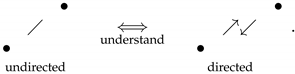
Let be an undirected graph (with more than one vertex) with the vertex set and its “undirected” or non-oriented edge set . If is a undirected edge connecting the vertices (which are not necessarily distinct), then one can assign two directions on e,
If we carry out such an orientation process for all edges of and fix the directions for edges, then such a undirected graph G becomes a directed graph for a fixed direction with the shadow . Such a directed choice gives the corresponding shadowed graph , inducing the graph groupoid .
Note here that the construction of the shadowed graph is free from the choice of directions on G, by Proposition 1. Hence, the construction of the graph groupoid is also free from the choice of directions in G. If and are the directed graphs induced by a given undirected graph G, then their shadowed graphs satisfy:
Hence, the corresponding graph groupoids generated by these are groupoid-isomorphic to .
In other words, if we regard each undirected edge with a possible directed edge or in , where is the shadowed graph in the sense of the above paragraphs, then for any choice of directions on all edges one can have the same (or, isomorphic) graph groupoid with the reduction (RR):
satisfying the set equality:
Note again that the construction of (and, hence, that of ) is free from the choice of directions of all edges of G. Thus, from below, if we fix any undirected graph G, one can identify it in the shadowed graph in the above sense.
Under our settings, two undirected graphs and are said to be graph-isomorphic if there exists a graph isomorphism such that and are bijections and:
Hence, automatically,
in whenever with , where (and ) is an arbitrarily fixed direction of e, satisfying:
Proposition 2.
If two undirected graphs and are graph-isomorphic (as undirected graphs), then the corresponding graph groupoids and are groupoid-isomorphic.
Proof.
By definition, if two undirected graphs and are isomorphic, then the shadowed graphs and are isomorphic as directed graphs. Hence, the graph groupoids and are groupoid-isomorphic. □
By Proposition 2, one can obtain the following result.
Corollary 1.
If two undirected graphs and are graph-isomorphic, then the graph groupoid algebra forms and are ∗-isomorphic.
Proof.
This is shown by Propositions 1 and 2. □
2.4. Semicircular Elements
Let be a mathematical pair of a topological (noncommutative) ∗-algebra A (for instance, a -algebra, a von Neumann algebra, or a Banach ∗-algebra) and a (bounded) linear functional on A. Then, this is said to be a (noncommutative) topological (free)∗-probability space (resp., a -probability space; resp., a -probability space; resp., a Banach ∗-probability space; etc.). An operator is said to be a free random variable if we regard it as an element of . For example, if is self-adjoint in A as an operator in the sense that , then a is called a self-adjoint free random variable. It can be found that even though A is a commutative algebra, the corresponding topological ∗-probability space is determined as a statistical-analytic structure. However, free probability generally applies for cases where A is noncommutative. Such a free-probabilisitic structure is understood as a noncommutative counterpart of a measure space of a measurable set X and a measure in commutative analysis. In particular, if is unital in the sense that: (i) A has the unity and (ii) , then it is a noncommutative version of a probability space with the total measure . Thus, in general, topological “∗-probability” spaces are the noncommutative analogue of “measure” spaces.
If are free random variables for , then the free distribution of is characterized by the joint free moments:
Equivalently, the joint free cumulants are:
for all and for all , where is the free cumulant on A in terms of . For more details, see e.g., [17,18].
Thus, the free distribution of a “self-adjoint” free random variable a is fully characterized by:
or:
Definition 3.
A self-adjoint free random variable x∈ is said to be semicircular if:
where:
for all and
are the k-th Catalan numbers for all .
By the Möbius inversion of [17], a self-adjoint free random variable x is semicircular in if and only if:
for all by (2), where is the Kronecker delta.
Therefore, according to the semicircular law, the free distributions of all semicircular elements are characterized by the free-moment sequence:
and, equivalently, by the free-cumulant sequence:
by (2) and (3), universally.
3. Radial Operators of Graph -Probability Spaces
In the rest of this paper, we assume all given directed graphs are “connected”, “finite”, and have more than one vertex. Recall that a graph G is disconnected if there exists two distinct vertices:
in the shadowed graph of G, such that there are no reduced finite paths in the graph groupoid , such that either:
Additionally, a graph G is finite if:
By regarding the shadowed graph as a undirected graph of Section 2.3, say , the connectedness and finiteness will be defined similarly without considering the direction in G (up to graph isomorphisms).
Definition 4.
Let be the graph groupoid algebra of a graph Define operators by:
Such operators of (6) are called the w-radial operators for .
By (6), every reduced-finite-path-radial operator is self-adjoint in . We define a linear functional on the diagonal subalgebra of using a morphism:
Then, this is not only a well-defined bounded linear functional on because , but also a trace satisfying:
We define a linear functional on using:
Since is a trace on and is a conditional expectation from to , the morphism of (7) is a well-defined bounded linear functional. Thus, a well-defined -probability space is constructed by a graph G.
For example, the unity of satisfies:
Since our graph G is assumed to be finite, , implying that is indeed bounded on .
Definition 5.
The -probability space is called the graph -probability space of G (or of ).
Two -probability spaces, and , are said to be free-isomorphic if there exists an ∗ isomorphism:
such that:
In such a case, we call the ∗ isomorphism a free isomorphism. If two -probability spaces are free-isomorphic, then they have the same free-probabilistic structure.
Theorem 1.
If two shadowed graphs and are graph-isomorphic, then the graph -probability spaces and will be free-isomorphic. Symbolically,
where “” means “being free-isomorphic to”.
Proof.
In the proofs of Propositions 1 and 2, we have:
Indeed, if is the groupoid-isomorphism induced by a graph isomorphism satisfying:
in , for all , where for , we have an ∗ isomorphism:
which satisfies:
for all , where are the Hilbert-space representations of for .
By (7), it is shown that:
Therefore, is a free isomorphism. Hence:
□
4. Semicircular Elements of
In this section, we study semicircular elements in the graph -probability space of a given graph G. Let:
be the w-radial operator of a reduced finite path in , which is a self-adjoint free random variable of .
If with in , then:
for all , because and are distinct in . Therefore:
by (8)
for all .
Theorem 2.
Let with . If is the w-radial operator of , then the free distribution of is characterized by the free moments:
Proof.
With (9), one has that:
Hence:
for all . Meanwhile:
This implies that:
for all . Thus, the free-distributional data (10) hold. □
By (10), if is a reduced finite path with distinct vertices and in , then the free distribution of the w-radial operator is characterized by the free moment sequence:
for all , where are in the sense of (10).
Lemma 1.
Let be a “loop” reduced finite path with the identical initial and terminal vertices in . Additionally, let be the w-radial operator. Then:
where are in the sense of (10) for all and are the k-th Catalan numbers for all .
Proof.
If w is a loop-reduced finite path adjacent to the vertex v in , then and are “non-empty” loop-reduced finite paths of whose adjacent vertices are v for all . For :
and each summand satisfies:
since in if and only if ; equivalently, in if and only if . Thus, one has:
It is well-known that:
where are the k-th Catalan numbers for all (e.g., [17,18,19,35,36,37,38]). Therefore, the free-distributional data (11) hold by (12). □
For convenience, we say “w is a loop” if w is a loop-reduced finite path.
Theorem 3.
A w-radial operator is semicircular in if and only if is a loop in .
Proof.
(⇐) Since a w-radial operator is self-adjoint in by definition, the free distribution of is characterized by its free-moment sequence in . If w is a loop, then:
by (11). Therefore, it is semicircular in by (2) or (4).
(⇒) Conversely, if w is not a loop in , then the free distribution of is characterized by (10), implying that it is not semicircular in by (2). □
The above theorem characterizes the semicircular law of “reduced-finite-path-radial” operators in . The semicircularity of induced by the generators of is fully characterized by the combinatorial property, the “loop-ness” on the graph groupoid . Theorem 3 generalizes the semicircularity necessary condition of [34]. More generally, we can obtain the following result.
Theorem 4.
Let be the graph -probability space of a graph , and let be an arbitrary non-zero “self-adjoint” free random variable of . Then, T is semicircular in if and only if there exists a loop , such that , where is the -radial operator of .
Proof.
(⇐) If for a loop , then it is semicircular in according to Theorems 2 and 3.
(⇒) Assume that for some loops of in . We already know that if with a non-loop-reduced finite path w of , then T is not semicircular in according to (10). Additionally, if for , then it is not semicircular either.
Suppose now a given self-adjoint free random variable T that is not a reduced-finite-path-radial operator of . Then, by the self-adjointness of T, this can be re-expressed by:
in , where for all and for all . These have conjugates in (e.g., [23]). For convenience, denote:
decomposing
as a self-adjoint free random variable of .
Clearly, if and , then T is not semicircular in because:
This implies that the first (and, hence, odd) free moment of T is non-zero. Therefore, if in T, then T is not semicircular in .
Now, let and , which is not a radial operator containing a summand,
First of all, if in , then the summand is not semicircular. Hence, T is not semicircular in ; secondly, if and w is not a loop, the summand is not semicircular. Hence, T is not semicircular in either (see [34]). Finally, if and w is a loop, then the summand is semicircular. However, since T contains other summands according to our assumption that T is not a radial operator, the free moments of T are not identical to those of (see [34]); hence, T cannot be semicircular in . In conclusion, if T is not a reduced-finite-path-radial operator, then it is not semicircular in .
Therefore, if an arbitrary self-adjoint free random variable T satisfies for some loops , then it is not semicircular in . Equivalently, if a self-adjoint free random variable T is semicircular in then there exists a loop , such that in . □
The above theorem fully characterizes the semicircularity in according to the “loop-ness” of !
Now, let K be a graph:
where are the edges connecting vertex to vertex for . Then, the corresponding graph groupoid does not contain a loop adjacent to each vertex, because:
This example demonstrates that there are (connected finite-directed) graphs (with more than one vertex) that do not induce semicircular elements in their graph -probability spaces by the semicircularity characterization, Theorem 4.
Recall that an “undirected” graph K (in the sense of Section 2.3) is a finite-connected tree if it is does not contain (undirected) loops. Equivalently, its graph groupoid does not contain loops.
Corollary 2.
Let be a (finite-connected) undirected tree as the shadowed graph of G. Then, the corresponding graph -probability space does not contain semicircular elements.
Proof.
Let be a tree understood as the shadowed graph of the finite-connected “directed graph” G. Then, the corresponding graph groupoid and the graph -probability space can be well-determined (see Section 2.3). By Theorem 4, does not contain semicircular elements because the graph groupoid does not contain loops. □
For our purpose, we finish this section with the following concept.
Definition 6.
Let be a graph groupoid of a graph G. A loop is called a loop-diagram if no loop exists, such that for all .
Note that, if is a loop, then there will always exist unique loop-diagrams and , such that in . In particular, if in , then w itself is a loop-diagram in according to Definition 6. Additionally, if is a loop-diagram, then one can take infinitely many loops in . For instance, if:
then one can take the loop-diagrams of :
and their shadows:
in the graph groupoid of G. Additionally, this verifies that:
are the infinitely many loops of . Note that, if the finiteness assumption exists, there are only finitely many loop-diagrams in a given graph (even though there are infinitely many loops).
As we discussed in [34], even though the graph groupoid does not contain loops, a graph whose undirected graph is a tree can induce certain semicircular elements (artificially but naturally) from its so-called the fractal cover , which is a fractal graph generating the graph fractaloid , a groupoid satisfying the fractality. Every fractal groupoid has loop-diagrams adjacent to all its vertices; hence, has infinitely many loops at all vertices. Thus, even though of a graph such as G does not contain semicircular elements according to Corollary 2, the graph -probability space contains infinitely many semicircular elements. For more details, see [34].
We note that the main results of Section 4 show that the existence of the semicircular elements in is determined by the existence of loops in , which is characterized by the fact that the undirected graph of a graph G is a tree, meaning that the semicircularity in is the loop-ness of , which is characterized by the tree-ness of the undirected graph of G.
From below, if we say “a graph G is a tree”, then this means that “the undirected graph of G is a tree”.
By the above assumption, one can summarize this section as that the semicircularity of is the loop-ness of , which is the “tree-ness” of G.
5. Graph Groupoid Index and Graph-Tree Index
In this section, we define the graph groupoid index and the graph-tree index on graph groupoids as a function from to , where is the family of all graphs and is the set of all positive real numbers greater than or equal to 1. These quantities measure how a certain graph groupoid is embedded in a graph groupoid . For our purposes, we restrict our interests to connected finite-directed graphs with more than one vertex, whose shadowed graphs are understood as undirected graphs up to graph isomorphisms in the sense of Section 2.3. Additionally, for algebraic convenience, we include the single-vertex graph in our scope, where , and , with being the empty set.
5.1. The Graph Groupoid Index
Let G be a (connected finite-directed) graph (with more than one vertex) with the graph groupoid , and let be the corresponding undirected graph regarded as the shadowed graph of G. Recall that J is a subgraph of G if it is a graph with:
and
Recall also that U is a full subgraph of G if it is a graph with:
and
Undirected versions of subgraphs and full subgraphs are canonically defined.
Recall that, according to our assumption, a undirected graph is connected. Even though is connected, it is possible that a subgraph or a full-subgraph is disconnected. More generally, we next define the following general concept.
Definition 7.
Let be the undirected graph of G. A combinatorial structure is said to be a undirected part of if is a (connected or disconnected) graph with:
This includes the case where either:
where ϕ is the empty set. We denote a relation “ as part of ” by “” In particular, if and , then the part is said to be a vertex part of (or a vertex graph independently). The “directed” version of a part is similarly defined according to the direction.
Note that if is the undirected graph of and is a part, then there exists a “directed” part K of G whose shadowed graph induces as in Section 2.3. Therefore, from below, we can simply say that “” and “” are parts without considering whether they are undirected or directed.
By definition, all subgraphs and full subgraphs of G are parts of G. Note that, according to Definition 7, if a part of G satisfies that , then automatically, because the part must be a graph combinatorially (which means “no vertices, no edges connecting vertices”). In such a case, we axiomatize such a part to be the empty part of G (or the empty graph independently). However, if is a part of G satisfying , then is not necessarily empty. It can simply be a subset of and, hence, could form either the empty graph or the vertex graph embedded in G.
Now, let G be a given directed graph and be a part. Suppose that K has n-many connected components , where each is a connected part of G (such as a connected graph) with:
for all , with:
where ⊔ is the disjoint union. Then, we “collapse” the connected parts to the vertices by identifying each in the collapsed vertex for all . For instance, if:
and
is a part of G with rgw connected components:
in G, then we collapse and to the vertices and ,
Then, by identifying all the connected components on the collapsed vertices , we construct a new graph using a graph with:
with the identification rule. If either or for with , for some , then we identify e with and , respectively, where is the collapsed vertex of for . For example, if are given as in the above paragraph, then:
Proposition 3.
If is a given graph and is a part of it, then the corresponding new graph of (13) is a connected finite-directed graph. Equivalently, if is the undirected graph of G and is a undirected part, then the undirected graph of is connected and finite.
Proof.
If K is a part of G with its connected components for , there always exists a reduced finite path or for all and due to the connectedness of G. This guarantees that, for all , there always exists a reduced finite path y of the graph groupoid of the new graph of (13), such that or for any collapsed vertices in . This implies that the graph of (13) is connected. Clearly, the finiteness is satisfied. □
As we can see in the above example, the graph is indeed connected and finite.
Definition 8.
The graph of (13) induced by the part inclusion of a given graph G is called the quotient graph of G by K. If K is the empty part of G, then the corresponding quotient graph is axiomatized to be G itself. Equivalently, the corresponding undirected graph of is called the (undirected) quotient graph .
Note that, if is the undirected quotient graph of the quotient graph , then it is not difficult to check that is isomorphic to , where are the undirected counterparts of .
According to Definitions 8 and 9, if a given graph G is finite and connected, then the quotient graphs are finite and connected too for all parts . As an independent graph, the quotient graphs have their graph groupoids for all parts . It is easy to verify that if K is a vertex part of G then by (13); if , then is the vertex graph with and , where x is the collapsed vertex of G in G.
Definition 9.
Let be the graph groupoid of the quotient graph of a graph G according to part . Then, the cardinality is called the index of the part inclusion . We denote this by . Suppose that is the undirected part-inclusion induced by the inclusion . Then, the (undirected) index is also defined as the index :
For example, if is given as above in the text, then:
where , , , and the next are the cardinality of the reduced-length-2 finite paths of .
It must be noted that the single-vertex graph , with and , has its graph groupoid, which is also denoted by , with:
since the empty word does not exist in (because the single vertex x is admissible to itself, meaning that for all ). This implies that:
for all graphs G according to Definition 9.
5.2. Graph-Tree Index
Let G be a graph with its graph groupoid and be the corresponding undirected graph understood as the shadowed graph of G. Suppose that is a loop-diagram with:
for some , inducing infinitely many loops in adjacent to the vertex . For this loop-diagram , define a part by a graph with:
where:
Hence, for all , where is the shadow of G. Then, this graph induced by the loop-diagram is a well-defined part of G according to (15), satisfying:
where are the shadows of for all .
According to (14) and (16), this part of G contains all loops induced by the fixed loop-diagram . Therefore, one can verify that the part of (15) is the maximal part of G containing all loops induced by .
Definition 10.
Let be a loop-diagram determined by (14), and let be a part (15) of a given graph G. Then, this connected finite-directed graph is called the loop-diagram part of (in short, the part) in the shadowed graph of G. Clearly, if is the corresponding undirected part of in the undirected graph of G, then it is also called the loop-diagram part of in , which is understood to be the shadowed graph of .
Suppose that is a loop of a graph :
Then, this loop is a loop-diagram of generating infinitely many loops in . From , one can construct the corresponding -part of , where:
according to (15), with its shadowed graph , being equivalent to , where is the undirected graph of .
Definition 11.
Let be “all” the loop-diagrams in a graph G for some . If are the undirected parts of for all , then we define a new part by the graph union of the loop-diagram parts ,…, , with:
This part, , of (17) is called “the” loop-part of . The part , in the sense of (15), whose shadowed graph is equivalent to the undirected graph of (17), is also called the loop-part of G.
Note that, according to (17), the loop-part of a given graph G is the “maximal” part of G whose graph groupoid contains all loops of the graph groupoid of G. For instance, if a given graph is as in the above paragraph, then the loop part of is a disconnected graph:
Definition 12.
Let be the loop-part of a given graph G and let be the corresponding quotient graph (13). We call the undirected graph of the quotient graph the tree of G (or the tree induced by ). The graph groupoid of (or that of ) is said to be the tree groupoid of G (or of ). If there is no confusion, we also call the quotient (directed) graph the tree of G as well.
Recall that a undirected tree is a undirected graph whose graph groupoid does not contain loops. Therefore, one can understand “directed trees” to be the directed graphs whose undirected graphs are (undirected) trees. The following result allows us to understand why Definition 12 is meaningful.
Theorem 5.
Let be the loop-part and be the corresponding quotient graph. Then, is a directed tree and, equivalently, the corresponding undirected graph of is a tree.
Proof.
Let be the loop-diagram parts of all loop-diagrams of the graph groupoid of a given graph G for , and let the graph union be the loop-part of G. Then, W has its connected components , for some , and these are identified with the collapsed vertices in the quotient graph , which is connected and finite according to Proposition 3. Since all connected components are collapsed to be the vertices for all , there are no loops in the graph groupoid of . Therefore, it becomes a directed tree; hence, the corresponding undirected graph is a tree. □
The above theorem shows that the quotient graphs of connected finite-directed graphs G by the loop-part W become connected finite-directed trees inducing the trees .
Note that, in the proof of Theorem 5, it is said that the loop-part W, the graph union of all loop-diagram parts of a given graph G, has its connected components , for some . For example, let us assume that a graph G contains the following “part K”:
in G. Then, one can find the following loop-diagrams:
and
“in K” and their shadows , inducing 16 loop-diagram parts (up to graph isomorphism) in G. For instance, the -part is a graph with:
etc. It is not hard to check that, according to Definition 11, , where are the -parts for all . Thus, up to the graph isomorphisms, we have a total of eight loop-diagram parts ,…, , as the undirected graphs of , for all . Thus, according to (17), one can obtain the part:
of the undirected graph of G. It is not difficult to check that this very part is connected. Indeed, this part is the corresponding undirected graph of the part . It is connected, and, hence, has only one connected component. Therefore, the graph union of eight loop-diagram parts becomes a single part. Thus, in general, one can verify that if are loop-diagram parts forming the loop-part , then W may have n-many connected components for some in in general.
Definition 13.
Let G be a given graph with the loop-part . Then, the quotient graph , or its corresponding undirected graph , is called the graph-tree of G (or, in short, the G-tree). Additionally, the graph grouopoid of is called the G-tree groupoid. The index,
of the part-inclusion is called the (graph-)tree-index of G (or of the corresponding undirected graph of G). We denote this tree-index of G by :
where W is the loop-part of G.
The range of tree-indices of given graphs is contained in:
Lemma 2.
For a given graph G, the tree-index is finite. Moreover:
Proof.
In line with our assumption that all given graphs are connected, “finite”, and have more than one vertex, the G-tree is connected and “finite”, where is the loop-part. Moreover, since does not contain any loops, the G-tree groupoid does not contain loops, implying the finiteness of —i.e., .
Assume now that a graph K is a circulant graph with:
and
with
for any , and
Then, this graph has its loop-part that is identified with itself. Thus, the corresponding K-tree is the quotient graph with:
This is graph-isomorphic to the single-vertex graph , satisfying:
This implies that, in general:
Therefore, the G-tree index satisfies:
□
Using (18), one can obtain the following range of tree-indices.
Theorem 6.
Let be the function from:
to , where every is unique up to graph isomorphisms, defined by:
Proof.
According to (18), the range is contained in . By definition, for all ,
where is the loop-part. Since the G-tree groupoid is a discrete finite set,
implying that:
Suppose that we have a single-edge tree,
in . Note that the -tree is identical to itself because this graph does not contain its loop-part. Equivalently, the loop-part of is the empty graph; hence, according to Definition 9. It is easy to check that:
This illustrates that:
Therefore, the relation (19) holds theoretically. □
Note that, by the definition of the family in Theorem 6, this contains a graph with:
Then, the loop-part W of is identical to itself. Thus, the quotient graph is the single-vertex graph . Hence:
All other graphs containing nonempty loop-parts satisfy:
Corollary 3.
Let be an element containing “nonempty” loop-part W. Then:
in .
Proof.
Let contain its loop-part W. If , then , as we discussed in the above paragraph. Now, suppose that in . Then, the minimal possible quotient graph for is (graph-isomorphic to) the single-edge tree:
This satisfies . Therefore, the relation (20) holds true. □
Now, we define the following concept:
Definition 14.
The function introduced in Theorem 6 is called the graph-tree index.
Based on (19) and (20), the range of the graph-tree index is properly contained in .
5.3. Graph-Tree Equivalence
In this section, motivated by the main results of Section 5.2, we consider an equivalence relation in the set:
These are determined up to graph isomorphisms, where is the single-vertex graph. We classify under the relation (up to graph isomorphisms).
Consider be a tree with:
where ,
up to graph isomorphisms, with its corresponding undirected graph (regarded as the shadowed graph ). Then, the corresponding -tree groupoid satisfies:
Observe that if are graphs:
and
Then, the corresponding loop parts and are:
and
respectively. Then, the corresponding -trees ,
are obtained for (up to graph isomorphisms), meaning that:
Even though and are not isomorphic in , the -tree and the -tree are isomorphic to the tree . This means that:
Lemma 3.
In the family , define a relation by:
Then, the relation is an equivalence relation on .
Proof.
Let . Then, clearly in . Therefore, . Suppose now that in . Then,
Hence, in .
If and in , then:
implying that ; hence, in .
Therefore, the relation is an equivalence relation on . □
The above lemma shows that the tree-index classifies the family by the equivalence relation of Lemma 3. One can define the quotient set,
are the -equivalence classes of for all . Additionally, one can define the function:
for all , where is the K-tree groupoid of the K-tree for the loop-part inclusion for some in .
Theorem 7.
Let be the quotient set (21), and , the function (22). Then,
for all .
Proof.
The proof of (23) is done by (19), (20) and Lemma 3. □
By (23), without the loss of much generality, the graph-tree index on is used to find the cardinalities of the graph groupoids of the trees representing the elements of . We define a family by:
where is unique up to graph isomorphisms. This family of (24) is called the (connected-finite-)tree family.
Theorem 8.
Let be the tree family (24) and let be the quotient set (22). Then, they are equipotent set-theoretically.
Suppose is the map defined by:
where are the graph groupoids of . Then, for any , there exists a unique , such that:
where is in the sense of (22). In particular,
in up to graph isomorphisms.
Proof.
If , then there exists a connected finite graph whose G-tree for the loop-part inclusion is a tree, satisfying:
For any , there exists a tree (up to graph isomorphisms) in . Thus, one can define a function:
for all . By (21), if in , then:
in . This implies that the function g of (27) is injective.
Let be the tree family (24). Then, for any arbitrary , there exists a connected finite graph whose G-tree for the loop-part inclusion is graph-isomorphic to a tree K. Equivalently, there exists , such that:
implying the surjectivity of the function g of (27). Thus, the function g is bijective. Hence, two families and are equipotent set-theoretically. Thus, the relation (25) holds.
By the equipotence (25), we have that:
Hence, there exists a unique tree , such that:
Therefore, the relation (26) holds as well. □
Using the above theorem, one can obtain the following result.
Corollary 4.
If , then there exists , such that:
where Γ is the graph-tree index on .
Proof.
The relation (28) holds by (23), (25) and (26). □
The above series of results show that our family is classified to be the quotient set by our graph-tree index , and this classification is fully characterized by the tree family . Free-probabilistically, recall that since each G-tree, say K, for , does not have loops, the corresponding graph -probability space does not contain semicircular elements. Since
the -algebra is a -subalgebra of the matricial algebra,
by Definition 2.
6. The Gluing on Graphs
Let and assume that and are parts. Suppose further that the fixed parts and are graph-isomorphic (as connected, or disconnected graphs). Then, by gluing or identifying and (under graph isomorphism) to the common part, say and , one can construct a new graph G as a graph with:
with the identification rule: if in , then identify e as an edge in .
For instance, if:
and
then, by gluing (or, identifying) the common (or graph-isomorphic) parts,
in and , one has a new graph G of (29):
Definition 15.
A new graph G of (29), induced by , by gluing the common (or, graph-isomorphic) parts , for , is called the glued graph of and by gluing and . We denote this by:
As a special case of (29), one can have the “vertex-gluing”. Let , and fix the vertices , for . Then, one can construct a new graph, denoted by:
by gluing (or, by identifying) the two vertices and to a new vertex—for instance:
Note that, since and are taken from , if they are different “in ” then they are not graph-isomorphic by the very definition of the family .
Definition 16.
Let (which are not necessarily distinct in ), and let be fixed for . Then, we identify two distinct vertices and with a new vertex , called the glued vertex of and . Then, we define a graph:
by a graph with:
with the identification rule. If either or in , then it is identified with , or , respectively, in . This new graph G of (30), obtained by gluing and , is called the glued graph of and with the glued vertex .
For instance, if:
and
then the glued graph of (30) is a new graph:
by gluing and to .
Theorem 9.
Let and , the glued graph of and by gluing the common parts and . Then, the graph -probability spaces of are free-probabilistic sub-structures of the graph -probability space , by regarding as , in the sense that:
for all , where “” means “being -subalgebra of”.
Proof.
If we identify with in the glued graph G, then are parts of G. Hence, the graph groupoids of are the subgroupoid of the graph groupoid of G, implying that the graph groupoid algebra of are -subalgebra of the graph groupoid algebra of . Furthermore, by (7) and (29), one has:
because in G. Therefore, the -probability spaces are the -probability subspaces of , for all . □
The above theorem shows that free-probabilistic properties of are preserved in whenever:
7. The Graph-Tree Index and Graph-Tree Towers
In this section, we consider certain towers of part-inclusions induced by a graph . In fact, we are interested in such towers preserving the graph-tree index in each step. Recall first that every graph has its G-tree , where is the loop-part and:
Certain Quotient Graphs Induced by
In this section, we fix an arbitrary graph with its loop-part , and, hence, the corresponding G-tree . Additionally, suppose throughout this section that the loop part W of G induced by the N-many loop-diagram parts induced by the loop-diagrams , for some . Then, there exist k-many connected components of W, for some in , such that:
For instance, if:
in , then it has the disconnected loop-part W in G
These induce the K-tree of K:
disp-formula>
by (31) and (33), where are the collapsed vertices of , for (see (17)).
Let , and suppose the loop-part has its connected components (induced from the diagram-loop parts ), for some in . Suppose is graph-isomorphic to G, whose loop-part is graph-isomorphic to the loop-part W of G, with its connected components , where each is graph-isomorphic to , for all .
Then, by gluing the common (or, graph-isomorphic) connected components and , we obtain the glued graph:
in the sense of (29), for any arbitrarily fixed . Without a loss of generality, the graph of (35) is identified with , since:
By (36), we identify and , for .
For example, if a graph is in the sense of (32) with its connected components of (33) induced by the loop-diagram parts (32), and if is a graph, isomorphic to K, whose loop-part has two connected components and , isomorphic to and , respectively, then we obtain a new graph:
by gluing and ,
by (29) and (35). According to (36), the new graph can be identified with .
As discussed above, from (36), one may understand given two graphs as an identical element of —i.e., two copies of . For a fixed and its connected part , one takes two “distinct” copies of G’s and identifies K in the two copies of G, before gluing them to construct a new graph in , as in (35).
Definition 17.
Let , and , a connected part. The graph,
induced by (35) of two copies of G (in the sense of (36)), is called the K-fixed 2-copy of G in . Similarly, one can have the K-fixed 3-copy of :
Inductively, we have the K-fixed -copies of G:
in , for all , with a notational identity: .
By Definition 17, we can obtain the following result.
Lemma 4.
Let and , a connected part, and let be the K-fixed n-copies of G for all with the identity: . Then, the quotient graph is isomorphic to the quotient graph for , in the sense of (13), in , for all :
Proof.
First, consider the case where . Suppose
is the K-fixed 2-copy of G in the sense of Definition 17, where in . Then, by identifying, or collapsing the part in , one has:
in . Similarly, if , then, by collapsing in , we have:
by Lemma 4. Therefore, inductively,
This implies that:
because every element of is uniquely determined up to the graph isomorphisms. Thus, the relation (37) holds. □
Using (37), one directly obtains the following corollary.
Corollary 5.
Let , and , a fixed vertex, and let
be the -fixed (or, v-fixed) n-copies of Definition 17, where is a vertex-part of G. Then:
Proof.
The relation (38) is immediately shown by (37). Indeed, one has:
in , by (37), where is a vertex-part of G. □
By (37), one also has the following result.
Theorem 10.
Let , and , a connected part, and let be the K-fixed n-copies of G, for . Then:
for all .
Proof.
By (37), we have:
where are the graph groupoids of the quotient graphs , which are graph-isomorphic to , and, hence, identified with in for all .
Thus, using (40), one has:
for all , where is the graph groupoid of . Therefore, Formula (39) holds. □
By (39), one obtains the following corollary.
Corollary 6.
Let and , a fixed vertex, and let be the -fixed n-copies of G, for all . Then:
for all , for all , inducing the vertex-parts of in .
Proof.
First of all, it must be noted that, if , inducing the vertex-part , then the corresponding quotient graphs are graph-isomorphic to G, and, hence, identified with G in . Thus, by (39), we have:
implying the Formula (41). □
Additionally, we have the following result.
Theorem 11.
Let , and , a connected part, and let be the K-fixed n-copies of G, for all . Suppose is the quotient graph for , and is the corresponding graph -probability space of . If
are the quotient graphs for , then:
for all .
Proof.
By Theorem 9, if two graphs and are graph-isomorphic, then the corresponding graph -probability spaces and are free-isomorphic. Therefore, by (37), the free-isomorphic relation (42) holds. □
By (42), the following corollary holds.
Corollary 7.
Let , and , a fixed vertex, and let be the -fixed n-copies of G, for all . If in , then:
Proof.
The free-isomorphic relation (43) holds by (38) and (42). □
Additionally, using Theorem 11 and Corollary 7, one obtains the following free-probabilistic information.
Corollary 8.
Let be a tree, and , a fixed vertex, and let be the -fixed n-copies of G, for all . If in , then:
Proof.
The relation (44) is obtained by (42) and (43). □
By Corollary 8, we obtain the following main result of this section.
Theorem 12.
Let and , the loop-part, inducing the G-tree . Assume that is a connected component of the loop-part W in G, generating the collapsed vertex x of . Let
with identity: , where are the -fixed n-copies of , for all . Then:
and
for all . In particular, these free-isomorphic -probability spaces of (46) do not contain semicircular elements.
Proof.
By (38), the graph-isomorphic relation of (45) hold for all . Thus, the index relations of (45) holds by (39) and (41) for all . Therefore, the free-isomorphic relation (46) holds by (42)–(44).
Since the graph is a tree in , it does not contain any loops in its graph groupoid . It guarantees that the graph -probability space does not contain any semicircular elements by Corollary 2. □
The above theorem shows that one can construct a tower of trees:
“in ,” whenever a loop-part inclusion is given “in ,” where is a collapsed vertex of an any connected component of the loop-part W of , and are the collection of -fixed n-copies of G. This tower (47) satisfies:
and
for all , by (45) and (46). Furthermore, under (318), all free-isomorphic -probability spaces do not have semicircular elements.
Definition 18.
Let and , the loop-part inclusion, inducing the G-tree . A tower (317) of trees, induced by and its -fixed n-copies for an arbitrary collapsed vertex x of a connected component of W, satisfying the relations of (48), is called the -tree tower.
By Theorem 12 and Definition 18, one immediately has the following corollary.
Corollary 9.
Let , and , the loop-part inducing the G-tree . Suppose
is a -tree tower (47), where for all , and is the collapsed vertex of a connected component of W. Then:
and
for all . The -probability spaces of (49) have no semicircular elements.
Proof.
The relations of (49) are shown by (48) under Definition 18. □
The above corollary shows that, for any , where is the graph-tree family (21) equipotent to the tree-family , one can construct -tree towers (47) for all collapsed vertices x of connected components of the loop-part . Note here that “all” -tree towers satisfy the relations of (49). The quotient structures for the steps of the tower are all equivalent from each other, combinatorially, algebraically, and free-probabilistically.
This shows that our graph-tree index on preserves the non-semicircularity on the (steps of the) towers (47) up to quotient relation (on the steps).
8. The Tree-Monoid
Define a new family using:
Note that, even though is a fixed tree, if in , then the elements and are “distinct” in by definition. For a fixed tree , there are -many elements in .
From the set of (50), define its partition by:
The partition of (51) satisfies:
where ⊔ is the disjoint union. We here consider the partition of as a family (or, a small category) of the sets , for all .
On this set of (50), define an operation ⊚ by:
where is the vertex-glued graph (30) of the trees and by gluing and to the identified, or glued vertex .
By (52), one may understand our -fixed 2-copy of as:
inductively,
in by (52), for all .
By (49) and (53), “if” the operation ⊚ is well-defined on , then the construction of the graph-tree towers of (47) is also carried out by the operation (52) by (53).
Lemma 5.
The operation ⊚ of (52) on the set of (50) is well-defined.
Proof.
By the definition (52), for any arbitrary , one can determine a pair of the glued graph , and the glued vertex of and . It is trivial to check that this new graph G forms a new finite connected tree contained in the tree-family . Thus,
by (50), implying that the operation ⊚ is closed on . □
This well-defined operation ⊚ on satisfies the following properties.
Lemma 6.
The operation ⊚ of (52) on the set of (50) satisfies the following properties:
The trivial element of the single-vertex graph with its unique vertex x forms the (⊚)-identity of ,
Proof.
Note that the tree-family is defined up to graph isomorphisms. Therefore, if , and if , then in , and the family is determined by by (50). Thus, the equalities
mean that in . Equivalently, and .
If , for , then:
where , and
where and
implying that:
in . Therefore, the associativity (54) of ⊚ holds.
The tree-family contains its trivial element , the single-vertex graph (unique up to graph isomorphisms), and hence, the family of (50) contains its trivial element,
satisfying that, for all ,
in , because
and
Similarly, one has:
Therefore, the trivial element acts as the (⊚)-identity. Thus, the relation (55) holds.
The commutativity (56) of ⊚ is clear, since:
in , and
Hence,
implying that:
in , for all . □
Recall that an algebraic structure of a set and an operation • is a monoid if a well-defined operation (•) is associative and has its identity. In particular, if the operation • is commutative, then the monoid is said to be a commutative monoid.
Theorem 13.
An algebraic pair is a commutative monoid.
Proof.
By Lemma 6, the operation ⊚ is closed on the set . And, by (54) and (12), an algebraic pair forms a monoid. Moreover, by (56), this monoid is commutative consisting of all mutually commuting elements under ⊚. □
From below, we understand the set of (50) then as a commutative monoid ,
Definition 19.
We call the monoid , the tree-monoid.
Now, let and , the loop-part inclusion inducing the G-tree in . For the collapsed vertex of an arbitrary connected component of the loop-part W, one can obtain:
As we considered in Section 7, one can have the G-tree tower (47):
in , satisfying (319). By regarding the steps of the tower as:
for all , we naturally obtain the corresponding tower:
in by (57) and by fixing the common vertex x. Note the difference between the G-tree tower (47) in , and the tower (58) induced by in .
Definition 20.
Under the same hypothesis with (57), the tower (58) is called the -tower in .
By the monoidal structure we discussed in Theorem 13, one has:
in the sense of (57) in , for all .
Proposition 4.
Let be the -tower (58) in . Then:
for all in .
Proof.
This relation is performed with (57) because the operation ⊚ is associative (equivalently, is a monoid). □
Now, let and be in the sense of (57), the steps of the -tower (58), and fix an arbitrary . Then, one can construct a sub-tower:
of the -tower. One can understand in (59) that:
in , for all .
Theorem 14.
Let (59) be the sub-tower of the -tower (58) in the tree-monoid . Then:
for all . All -probability spaces of (61) do not have semicircular elements.
Proof.
The combinatorial equivalence in (61) is shown by (57), (58) and (60), and it implies the free-isomorphic relation of (61). Since all free-isomorphic -probability spaces are induced by graph-isomorphic trees, they do not contain semicircular elements. □
9. The Operad Induced by
In Section 5, Section 6 and Section 7, we showed that, if and is the loop-part inclusion inducing the G-tree, the quotient graph , then the graph-tree index of G is determined by the graph groupoid index , and there exists a tower of trees:
of the -fixed n-copies , for all , where x is the collapsed vertex of of an arbitrary connected component of the loop-part W of G, in the tree-family , and each step
we have a combinatorial equivalence,
and an algebraic equivalence,
and a free-probabilistic equivalence,
In particular, the free-isomorphic relation (65) shows that the tower (62) constructs the same free-probabilistic structures in every step up to quotient, and they provide equivalent free-probabilistic structures without having semicircular elements.
Additionally, in Section 8, if one has a fixed , where and are as above, then:
are well-defined in by (57) to be
for all , with identity:
where is the tree-monoid of Definition 20 and the -tower,
of (58) is well-determined whose graph-entries of the steps satisfy (63)–(65).
Motivated by the above results, we here consider how our tree-monoid induces an operadic structure (e.g., also see [39,40,42,43]). Such an interesting consideration starts from the fact that:
satisfies the combinatorial relation,
since two vertices and are identified with the collapsed vertex v in .
Now, let us decompose the family of (50) by:
for all , where ⊔ means the disjoint union. By (24), we canonically obtain a family:
by (67). Moreover, by definitions, one has:
By abusing notation, one can understand that:
set-theoretically. Hence,
as sets. Indeed, the set-equality (69) holds, since
since ⊚ is well-defined on , and
since, for all ,
in . Additionally, if we understand
set-theoretically, then
as subsets of , for all .
The notational expression (69) says that the operation, also denoted by ⊚ on the family , is well-defined in the sense of (70).
Proposition 5.
If is the family (67) and (⊚) is the operation (69) on , then the set-equality (70) holds in , so that:
as elements of , for all .
Proof.
By the symbolic definition (69) of ⊚ on , one has:
Indeed, for , and (equivalently, , and ),
in , with:
Additionally, if , then, for the fixed vertex v, one can take a tree part of G with , containing v as its vertex. Then, from the fixed vertex v, by collecting all vertices which are not contained in (except for v), and by collecting all edges which are not contained in , we obtain another part with . One can decide:
such that:
in . This shows that:
Therefore, the set-equality (70) holds in the family . □
By Proposition 5, we obtain the following result.
Theorem 15.
The pair is a monoidal category, where is the family (67) and (⊚) is the operation (69).
Proof.
By the very construction of
this forms a small category. If we symbolically define an operation (⊚) on as in (69), then it is well-defined on , satisfying (70), by Proposition 5.
By (70), the operation (⊚) is associative in the sense that:
Indeed, both sides are identified with:
for all .
Furthermore, one can take in , satisfying:
for all by (70).
Therefore, the category forms a monoidal category under (⊚). □
Remark that this monoidal category is commutative in the sense that:
for all , since both sides are identical to:
Thus, is a commutative monoidal category.
9.1. Operads
Not only in mathematical analysis, but also in topology and quantum physics, operads are well-known and play important roles (e.g., [50]). In particular, their applications in connection with subfactor theory and knot theory are simply amazing (e.g., [41] and cited papers therein). Here, we introduce a modified definition of Day’s original definition of operads (e.g., see Sections 1.2, 1.3 and 1.7 of [50]).
Definition 21.
Let be a monoidal category with an operation ⊛ on . This structure is an operad, if (i) the well-defined operation ⊛ satisfies:
for all , for all ; (ii) ⊛ is associative in the sense that: if
for , and if
and
then
(iii) ⊛ satisfies the equivalence condition in the sense that: for all
one has
for all , where is the symmetric group over , and
and finally (iv) ⊛ has the unit property in the sense that: if
then
in , for all .
Interesting examples and applications of operads can be found in e.g., [41,50].
9.2. The Operad Induced by the Tree-Monoid
In this section, we prove that our monoidal category , induced by the tree-monoid , is a well-determined operad in the sense of Definition 21. Of course, as a commutative monoid, the tree-monoid itself is a good algebraic structure. More than that, if induces an operad, then it also provides “good” categorial, topological, and quantum-physical properties as in [50], and, hence, the similar applications such as the Jones’ operads (or, Temperly–Lieb operads) of planar algebra (e.g., [41]) may/can be possible. The tree-monoid provides a new example of operads in connections with graph theory, groupoid theory, representation theory, operator algebra and free probability (especially, “non-semicircularity”).
Let be the monoidal category of Theorem 15.
Theorem 16.
The monoidal category is an operad.
Proof.
Let be the small category (67) equipped with an operation (⊚) of (69). Then, using Theorem 15:
moreover, it is a commutative monoidal category. Recall that the operation ⊚ on satisfies:
by (70). Observe first that, if
then one has that:
since the category is monoidal by (71)
by (72)
by (71)
for all . Thus, the operation ⊚ of satisfies the condition (i) of Definition 21.
Now, assume that and are in the sense of the condition (ii) of Definition 21, and suppose:
and
in . Then, we have that:
where
in by (71) and (72). This implies that:
in , implying the associativity (ii) of Definition 21.
Consider now that if:
then
by (73). Note that, by (72)
and
implying that,
for all . Thus,
for all , where
by (75), for all . Thus, the equivalence condition (iii) of Definition 21 is satisfied for .
Now, let
as in (68), and
Recall that
in , by Theorem 15, for all . Therefore,
in , for all . This shows that the operation ⊚ of satisfies the unit property (iv) of Definition 21.
Therefore, by (73), (74), (76), and (77), our category is an operad. □
The above theorem not only shows our tree-monoid induces an operad naturally, but also provides a new example that is different from the free monoids of [50], and the Temperly–Lieb, or Temperly–Lieb-like operads of [41].
10. The Tree-Monoidal Algebra
Let be the tree-monoid of Definition [14]. In this section, we construct a certain pure-algebraic algebra generated by the monoid , and study not only the algebraic properties of , but also the natural statistical properties of .
Define a (pure-algebraic) vector space by:
where means the vector space spanned by a set Y over , and, hence, the vector space is generated by the set . By (78), every vector has its expression:
where ∑ is the finite sum, and are the spanning vectors of induced by .
(From below, in short, ) If there is no confusion, we denote the spanning vectors in (79) simply by . Under this assumption, one can re-write (79) using
below. In particular, we write:
in , for all . □
Now, on this vector space , we define a vector multiplication, also denoted as ⊚, by:
where the operation ⊚ on the right-hand side is the monoidal operation on the tree-monoid . Of course, in the summands in (80), the notations T, S and mean the spanning vectors and in , respectively, by .
By the very definition (80), the operation ⊚ is well-defined on the vector space . Moreover, it satisfies:
in , for all , since the operation ⊚ in the right-hand side of (80) is associative, inducing a monoid .
Therefore, this well-defined multiplication ⊚ of (80) is associative by (81) on . Thus, the vector space equipped with ⊚ forms a (pure-algebraic) algebra over . Moreover, this algebra is unital in the sense that it contains its unity (or, unit vector) ,
satisfying
implying
Additionally, since
and
in the tree-monoid , implying that
one can check that
by (80).
Theorem 17.
Let be the vector space (78) generated by the tree-monoid , equipped with the vector-multiplication ⊚ of (80). Then, it is a commutative unital algebra over .
Proof.
The vector space equipped with the operation ⊚ forms an algebra over by the well-definedness (80) and the associativity (81). Additionally, it is commutative by (83) and unital by the existence of the unity by (82). □
The above theorem shows that the tree-monoid generates the commutative unital algebra .
Definition 22.
The commutative unital algebra of (78), equipped with the vector-multiplication ⊚ of (80), is called the tree-monoidal algebra. From below, to distinguish with the vector-space notation , we denote this tree-monoidal algebra using . This notation means a vector space with the vector-multiplication ⊚, as an algebra.
11. Discrete Statistical Models of
Let be the tree-monoidal algebra of Definition 22 generated by the tree-monoid , equipped with its algebra multiplication ⊚ of (80).
11.1. A Tree-Index Statistical Model
On the tree-monoidal algebra , define a (pure-algebraic) linear functional by a linear morphism:
where on the right-hand side of (84) is the graph-tree index of Definition 25. Note that, by the very definition (84), the morphism is a well-defined linear functional, which is bounded in the sense that:
where is the modulus on . Moreover, by the commutativity of the tree-monoidal algebra . Note that if is the zero element (which is the zero vector of ), then it is understood to be:
and hence,
Definition 23.
We call the linear functional Γ of (84), the (graph-tree-)indexing trace on .
Recall that if with its loop-part , then
where is the graph groupoid of the quotient graph . Thus, one has:
if and only if
by our axiomatization , where is the empty part (see Definition 8).
Proposition 6.
The indexing trace Γ of (84) satisfies that:
and, as a special case,
for all , where are the graph groupoids of .
Proof.
By the definition (84) of the indexing trace and by the formula (85), one obtains the first formula of (86). Thus, one has:
by (85), for all . Thus, the second formula of (86) holds as a special case of the first. □
It is easy to check that
for all generating elements .
In (86), note that, since we are handling linear combinations (as finite sums), and since the graph groupoids of our trees contains finitely many elements, we always have:
Therefore, the resulted quantities of (86) are bounded in . Thus, one can obtain the following statistical structure (e.g., [18]).
Definition 24.
Let be the tree-monoidal algebra (78) generated by the tree-monoid , and let Γ be the indexing trace (84). Then, the pair is called the index-tree-monoidal (measure) space.
By the very definition, the statistical data determined by the moments of an element of the index-tree-monoidal measure space are determined by the tree index . In particular, by (86), one has:
for all . For instance, if in , then:
(e.g., see (18), or (20)).
Now, for an arbitrarily fixed in (implying that , for ), let:
Observe that the powers of satisfy that:
where are in the sense of (53), for all . Indeed,
in .
Theorem 18.
Let , for . Then
where are the graph groupoids of , for all , and where the limit in (88) is taken from the usual topology on .
Proof.
By (87), one has:
Hence, if are the graph groupoids of , then:
by (86) for all . Thus, the statistical data of the powers of (88) are obtained.
Note now that if in , then
inductively,
for all . Thus, if are the graph groupoids of , then the cardinalities of them are strictly increasing in ,
by (90). Hence:
Thus,
as , in . Therefore, the asymptotic data of (88) hold. □
The above statistical data (88) show that each generating element induces the algebra-element , whose moments approach 0.
Corollary 10.
Let , with for all , for . Then
Proof.
Under the assumption for the -coefficients that
one can obtain the above asymptotic statistical data according to (90). □
11.2. A Vertex-Cardinality Model
The index-tree-monoidal space is well-determined in Definition 13, and the corresponding discrete-measure-theoretic data on are considered in Section 11.1 as a discrete statistical model. However, in general, it is somewhat hard to “actually” compute the cardinality of graph groupoids of trees of the tree-family . In particular, if the size of finite trees of is bigger and bigger, or the combinatorial structure of the trees is more and more complicated, computing the cardinalities of the graph groupoids of such trees, which is equivalent to finding their tree-indices, is not easy, even though we know that they are finitely determined in . Thus, in this section, we introduce another statistical model on our tree-monoidal algebra , providing rough upper bounds.
Frankly speaking, in the model of this section, we will ignore some interesting combinatorial data of the trees of and corresponding algebraic information of the graph groupoids of the trees. However, this model is interesting as a discrete statistical model (induced from our graphs of ) independently, and it is much easier to handle computationally.
On the tree-monoidal algebra , we define a linear functional,
by
Then, it is indeed a well-defined bounded linear functional on the algebra .
By the very definition (91) of the linear functional on , one can realize that the combinatorial data from the trees of , determined by the admissibility of their graph groupoids, do not affect the quantitative data, while the classification of the generating family
determines the linear-functional values. For instance, if in , for all , then:
Hence, if , then, by (92), one has:
Proposition 7.
Let for all , for , and let
underNA 78. Then
Proof.
Under this hypothesis, the second formula of (94) is shown by (93). The first formula of (94) is proven by the straightforward computation by (87). Indeed, if is given as above, then:
since , for all , and hence,
□
Now, let in , inducing the algebra-element in under , for . As we considered in Section 11.1:
(under ), and
in , implying that
for all .
Theorem 19.
Let in inducing an algebra-element underNA 78, for . Then:
and hence,
where the limit is taken from the usual topology for .
Proof.
Recall that
in . Hence:
by (94), for all . By (95),
for all . Thus, the statistical data of (96) hold.
If , then . Hence, the asymptotic data of (96) hold as well. □
By (88) and (96), one can obtain the following result.
Corollary 11.
Let be in the sense of Theorem 19, with , for . Then
however,
for all , where is the unity.
Proof.
If , then:
under . Thus, if is a tree, which is not the vertex graph , then
because contains the empty word other than vertices. Hence:
Therefore, by (88) and (94), we have:
where are the graph groupoids of , for all . Therefore, the strict inequality of (97) holds.
Now, let is the identity of the tree-monoid , and , the unity under . Then, the powers of satisfy
Therefore, one has:
and
implying the equalities of (97) for all . □
The following result is a direct consequence of Corollary 11.
Corollary 12.
Let be in the sense of Theorem 19. Then:
for all .
Proof.
This is shown by (97). □
The above result illustrates that our vertex-cardinality statistical model on the tree-monoidal algebra provides rough upper bounds for the index-tree-monoidal space .
Definition 25.
The pair is called the vertex-tree-monoidal (measure) space.
Now, let W be an element of the vertex-tree-monoidal space:
for .
Observe that if is in the sense of (98), then:
for all , for all . If we denote the summands of by:
then
and
are the iterated glued graphs, and
are the corresponding iterated collapsed vertices, for all ∈, for , by (99).
Since if and in , then
in , each factor of the summand of , in the sense of (100), satisfies:
by (98) and (99).
Theorem 20.
Let be in the sense of (98). Then:
for all .
Proof.
If is an element (98), then:
by (99), where and are in the sense of (100), for all .
Thus, one has:
by (91). Hence, the formula (102) holds because:
by (101). □
The above moment computation (102) provides the following generalized estimation of (97).
Corollary 13.
Let be an element of the tree-monoidal algebra . If we understand as an element of the index-tree-monoidal space , then:
for all .
Proof.
If is as above, then, similar to (99),
where the summands are in terms of (100), for all .
By (97), one has:
for all . It implies that
Therefore, the inequality (103) holds by (102). □
12. Conclusions and Discussion
In this section, we explain the main ideas of this paper, summarize our main results, and discuss the connections among them.
Let G be a connected finite-directed graph with its graph groupoid . Then, the graph groupoid algebra is well-defined as a -algebra generated by , and the trace on is naturally defined. Thus, the graph -probability space is established. On , the semicircularity is characterized by the loop-ness on . If is the undirected graph of G, then the semicircularity on is characterized by the loop-ness on , which is characterized by the condition: is not a tree—i.e., is a loop if and only if the w-radial operator is semicircular in , if and only if is not a tree. Equivalently, the “non-semicircularity” on is characterized by the “non-loop-ness” of and, equivalently, the “tree-ness” of (or, the “directed-tree-ness” of G).
From a given connected finite-directed graph with more than one vertex (unique for the graph isomorphisms), one can take the loop-part and construct the quotient graph . Then, this quotient graph is a (directed) tree, called the G-tree. This shows that the G-tree implies the “non-semicircularity” inside , implying that does not contain any semicircular elements. Such a non-semicircularity on is quantized by the (graph-)tree index :
Based on the tree-indexing on , one can classify the family in terms of the tree-family (up to graph isomorphisms), implying the non-semicircularity induced by .
If , then the corresponding commutative monoid is well-defined under the vertex-gluing on (and, hence, on ), under the operation (⊚), which is the vertex-fixed gluing process. This monoidal structure induces an operad,
which is a monoidal category satisfying
for all . Independently, this monoid induces a pure-algebraic algebra over , and it has certain statistics depending on the tree-index , and that on the vertex-cardinality. In particular, the vertex-cardinality model provides rough upper bounds for the statistical data determined by .
From our main results, one may/can consider further operad-dependent structures, such as the operad algebra generated by our operad , and keep considering how the tree-ness (which classifies the non-semicircularity) affects not only the analysis but also the topology, as well as the physics. Additinoally, one may/can consider direct, canonical, and interesting connections between statistical data on and the non-semicircularity on graph -probability spaces.
Author Contributions
Both authors contributed to this paper equally. All authors have read and agreed to the published version of the manuscript.
Funding
This research received no external funding.
Conflicts of Interest
The authors declare no conflict of interest.
References
- Gibbons, A.; Novak, L. Hybrid Graph Theory and Network Analysis; Cambridge University Press: Cambridge, UK, 1999; ISBN 0-521-46117-0. [Google Scholar]
- Myasnikov, A.G.; Shapilrain, V. (Eds.) Group Theory, Statistics and Cryptography; AMS: Providence, RI, USA, 2003; Volume 360. [Google Scholar]
- Scapellato, R.; Lauri, J. Topics in Graph Automorphisms and Reconstruction, London Mathematics Society, Student Text 54; Cambridge University Press: Cambridge, UK, 2003. [Google Scholar]
- Shirai, T. The Spectrum of Infinite Regular Line Graphs. Trans. AMS 2000, 352, 115–132. [Google Scholar] [CrossRef]
- Bartholdi, L.; Grigorchuk, R.; Nekrashevych, V. From Fractal Groups to Fractal Sets. arXiv 2002, arXiv:math.GR/0202001v4. [Google Scholar]
- Exel, R. A new Look at the Crossed-Product of a C*-algebra by a Semigroup of Endomorphisms. Ergod. Theory Dyn. Syst. 2008, 28, 749–789. [Google Scholar] [CrossRef]
- Ghosh, A.; Boyd, S.; Saberi, A. Minimizing Effective Resistance of a Graph. SIAM Rev. 2008, 50, 37–66. [Google Scholar] [CrossRef]
- Gill, A. Introduction to the Theory of Finite-State Machines, MR0209083 (34\#8891); McGraw-Hill Book Co.: New York, NY, USA, 1962. [Google Scholar]
- Gliman, R.; Shpilrain, V.; Myasnikov, A.G. (Eds.) Computational and Statistical Group Theory; AMS: Providence, RI, USA, 2001; Volume 298. [Google Scholar]
- Kucherenko, I.V. On the Structurization of a Class of Reversible Cellular Automata. Diskret. Math. 2007, 19, 102–121. [Google Scholar]
- Lind, D.A. Entropies of Automorphisms of a Topological Markov Shift. Proc. AMS 1987, 99, 589–595. [Google Scholar] [CrossRef]
- Lind, D.A.; Marcus, B. An Introduction to Symbolic Dynamics and Coding; Cambridge University Press: Cambridge, UK, 1995. [Google Scholar]
- Schiff, J.L. Cellular Automata, Discrete View of the World, Wiley-Interscience Series in Discrete Mathematics & Optimazation; John Wiley & Sons Press: Hoboken, NJ, USA, 2008; ISBN 978-0-470-16879-0. [Google Scholar]
- Weintraub, S.H. Representation Theory of Finite Groups: Algebra and Arithmetic: Algebra and Arithmetic; AMS: Providence, RI, USA, 2003; Volume 59. [Google Scholar]
- Connes, A. Noncommutative Geometry; Lecture Notes in Mathematics, Mathematics Research Today and Tomorrow (Barcelona), 1525, MR:1247054; Springer: Berlin/Heidelberg, Germany, 1992; pp. 40–58. [Google Scholar]
- Radulescu, F. Random Matrices, Amalgamated Free Products and Subfactors of the C*-Algebra of a Free Group, of Noninteger Index. Invent. Math. 1994, 115, 347–389. [Google Scholar] [CrossRef]
- Speicher, R. Combinatorial Theory of the Free Product with Amalgamation and Operator-Valued Free Probability Theory; AMS: Providence, RI, USA, 1998; Volume 132. [Google Scholar]
- Voiculescu, D.; Dykema, K.; Nica, A. Free Random Variables; CRM Monograph Series; AMS: Providence, RI, USA, 1992; Volume 1. [Google Scholar]
- Cho, I. Banach-Space Operators Acting on Semicircular Elements Induced by Orthogonal Projections. Complex Anal. Oper. Theory 2019, 13, 4065–4115. [Google Scholar] [CrossRef]
- Cho, I. Graph von Neumann algebras. Acta Appl. Math. 2007, 95, 95–135. [Google Scholar] [CrossRef]
- Cho, I. Characterization of the Amalgamated Free Blocks of a Graph von Neumann Algebra. Complex Anal. Oper. Theory 2007, 1, 367–398. [Google Scholar] [CrossRef]
- Cho, I. Fractal Properties in B(H) Induced by Partial Isometries. Complex Anal. Oper. Theory 2011, 5, 1–40. [Google Scholar] [CrossRef]
- Cho, I. Frames, Fractals and Radial Operators in Hilbert Space. J. Math. Sci. Adv. Appl. 2010, 5, 333–393. [Google Scholar]
- Cho, I.; Jorgensen, P.E.T. C*-Subalgebras Generated by Partial Isometries. J. Math. Phys. 2009, 50, 023516. [Google Scholar] [CrossRef]
- Kribs, D.W. Quantum Causal Histories and the Directed Graph Operator Framework. arXiv 2005, arXiv:math.OA/0[50]1087v1. [Google Scholar]
- Mitchener, P.D. C*-Categories, Groupoid Actions, Equivalent KK-Theory, and the Baum-Connes Conjecture. arXiv 2005, arXiv:math.KT/0204291v1. [Google Scholar]
- Raeburn, I. Graph Algebras; CBMS; AMS: Providence, RI, USA, 2005. [Google Scholar]
- Solel, B. You can see the arrows in a Quiver Operator Algebras. J. Aust. Math. Soc. 2004, 77, 111–122. [Google Scholar] [CrossRef]
- Vega, V. Finite Directed Graphs and W*-Correspondences. Ph.D. Thesis, University of Iowa, Iowa City, IA, USA, 2007. [Google Scholar]
- Jorgensen, P.E.T.; Song, M. Entropy Encoding, Hilbert Spaces, and Kahunen-Loeve Transforms. J. Math. Phys. 2007, 48, 103503. [Google Scholar] [CrossRef]
- Potgieter, P. Nonstandard Analysis, Fractal Properties and Brownian Motion. arXiv 2007, arXiv:math.FA/0701649v1. [Google Scholar] [CrossRef]
- Afsar, Z.; Sims, A. KMS-States on the C*-Algebras of Fell Bundles over Groupoids. Math. Proc. Camb. Philos. Soc. 2021, 170, 221–246. [Google Scholar] [CrossRef]
- Brown, J.H.; Clark, L.O.; Huef, A. Dense Subalgebras of Purely Infinite Simple Groupoid C*-Algebras. Proc. Edinb. Math. Soc. 2020, 63, 609–629. [Google Scholar] [CrossRef]
- Cho, I.; Jorgensen, P.E.T. The Semicircular Law of Free Probability as Noncommutative Multivariable Operator Theory. Adv. Oper. Theory 2021, 6, 1–40. [Google Scholar] [CrossRef]
- Cho, I. Semicircular-Like, and Semicircular Laws on Banach *-Probability Spaces Induced by Dynamical Systems of the Finite Adele Ring. Adv. Oper. Theory 2019, 4, 24–70. [Google Scholar] [CrossRef]
- Cho, I. Free Semicircular Families in Free Product Banach *-Algebras Induced by p-Adic Number Fields Qp Over Primes p. Complex Anal. Oper. Theory 2017, 11, 507–565. [Google Scholar] [CrossRef]
- Cho, I.; Jorgensen, P.E.T. Certain *-Homomorphisms on C*-Algebras and Sequences of Semicircular Elements: A Banach Space View. Ill J. Math. 2020, 64, 519–567. [Google Scholar] [CrossRef]
- Cho, I.; Dong, J. Catalan Numbers and Free Distributions of Mutually Free Semicircular Elements. Adv. Appl. Stat. Sci. 2018; submitted. [Google Scholar]
- Guillou, B.J.; May, J.P.; Merling, M.; Osorno, A.M. Symmetric Monoidal G-Categories and Their Strictification. Q. J. Math. 2020, 71, 207–246. [Google Scholar] [CrossRef]
- Harpez, Y.; Nuiten, J.; Prasma, M. Tangent Categories of Algebras over Operads. Isr. J. Math. 2019, 234, 691–742. [Google Scholar] [CrossRef]
- Jones, V.F.R. Plannar Algebras I. arXiv 1999, arXiv:math/9909027. [Google Scholar]
- Moerdijk, I. Closed Dendroidal Sets and Unital Operads. Theory Appl. Categ. 2021, 36, 118–170. [Google Scholar]
- Spielberg, J. Groupoids and C*-Algebras for Left Cancellative Small Categories. Indiana Univ. Math. J. 2020, 69, 1579–1626. [Google Scholar] [CrossRef]
- Dutkay, D.E.; Jorgensen, P.E.T. Iterated Function Systems, Ruelle Operators and Invariant Projective Measures. arXiv 2005, arXiv:math.DS/0[50]1077/v3. [Google Scholar] [CrossRef]
- Guido, D.; Isola, T.; Lapidus, M.L. A Trace on Fractal Graphs and the Ihara Zeta Function. arXiv 2006, arXiv:math.OA/0608060v1. [Google Scholar] [CrossRef]
- Jorgensen, P.E.T. Use of Operator Algebras in the Analysis of Measures from Wavelets and Iterated Function Systems. Contemp. Math. 2006, 414, 13. [Google Scholar]
- Jorgensen, P.E.T.; Schmitt, L.M.; Werner, R.F. q-Canonical Commutation Relations and Stability of the Cuntz Algebra. Pac. J. Math. 1994, 165, 131–151. [Google Scholar] [CrossRef]
- Kigami, J.; Strichartz, R.S.; Walker, K.C. Constructing a Laplacian on the Diamond Fractal. Exp. Math. 2001, 10, 437–448. [Google Scholar] [CrossRef]
- Dicks, W.; Ventura, E. The Group Fixed by a Family of Injective Endomorphisms of a Free Group; AMS: Providence, RI, USA, 1996; Volume 195. [Google Scholar]
- Markl, M.; Shnider, S.; Stasheff, J. Operads in Algebra, Topology and Physics; AMS: Providence, RI, USA, 2002; Volume 96, ISBN 0-8218-2134-2. [Google Scholar]
Publisher’s Note: MDPI stays neutral with regard to jurisdictional claims in published maps and institutional affiliations. |
© 2022 by the authors. Licensee MDPI, Basel, Switzerland. This article is an open access article distributed under the terms and conditions of the Creative Commons Attribution (CC BY) license (https://creativecommons.org/licenses/by/4.0/).