


Abstract
Hardly any previous studies have focused on the granitic dykes which intrude into the Paleoproterozoic Liaohe Group in the Liaodong Peninsula, northeast of the North China Craton. In situ zircon U-Pb dating, Lu-Hf isotopic and geochemical analyses on three representative monzogranite dykes were taken in this study. These dykes have relatively high content of SiO2 (72.20%–74.78%) and K2O (2.83%–6.37%), and have characteristics of high-K calc-alkaline to shoshonite series. Two dyke samples have I-type granite features and have high Sr/Y ratios and positive Eu anomalies, showing an adakitic feature. Another dyke has a high ratio of Ga/Al, but has a low Zr saturation temperature, which differs from the typical A-type granite. Zircon grains from these three dykes have typical magmatic zoning in CL images and yield consistent U-Pb ages of ~1859–1852 Ma, which are interpreted as the crystallization ages of these dykes. Hf isotopic analyses yield mainly negative εHf(t) values and TDM2 ages of 2782–2430 Ma, similar to those of the 2.2–2.1 Ga granitoids and meta-sedimentary rocks (the Liaohe Group), indicating these monzogranitic dykes may have been sourced from melting of Paleoproterozoic granitoids and meta-sedimentary rocks. The monzogranitic dykes were generated under a post-collisional geological setting after the Jiao-Liao-Ji orogeny process.
1. Introduction
As one of the oldest cratons in the world, the North China Craton (NCC) is considered to be composed of the Eastern Block, the Western Block and Trans-North China Orogen [1,2]. Three major Paleoproterozoic orogenic belts have been recognized within the NCC [3], of which the Jiao-Liao-Ji Belt (JLJB) in the Eastern Block extends more than 1000 km ([4]; Figure 1). Great attention had been paid to the debate on the early Paleoproterozoic tectonic evolution model of the JLJB, and up to four tectonic models have been proposed as follows: an intra-continental rift opening and closing model [5,6], an arc–continent collision model [7,8,9,10,11], a rifting ocean followed by late subduction and collision model [6,12,13] and a back-arc basin (or retro-arc foreland basin) opening and closure model [14,15,16,17].
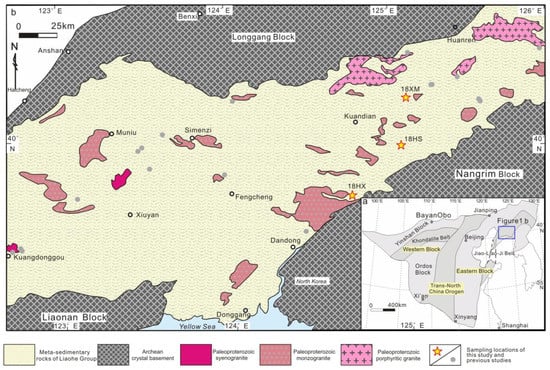
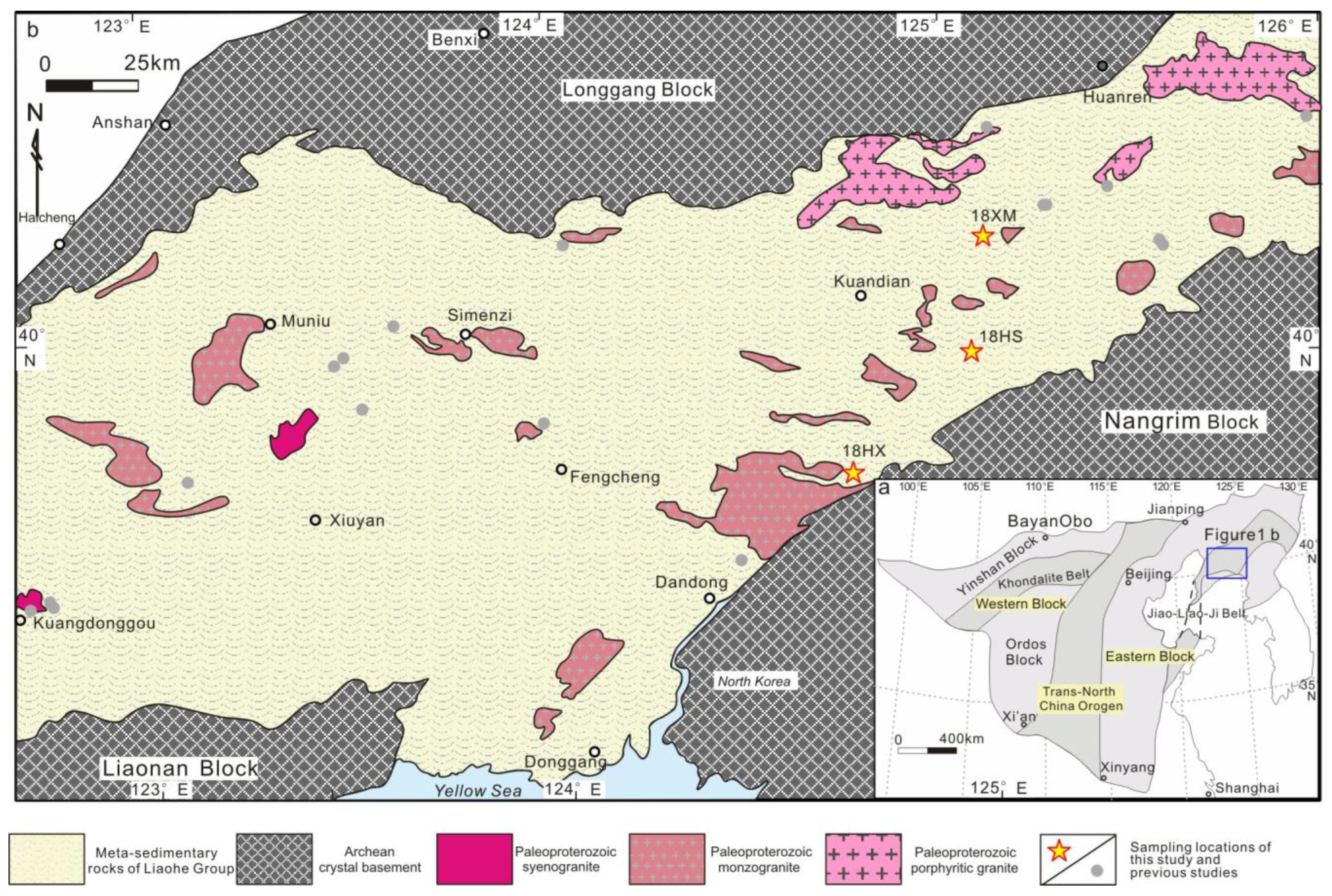
Figure 1.
Simplified geological map of the Liaodong Peninsula (b) and part of the Jiao-Liao-Ji Belt in the North China Craton (a). (Modified after [18,19]). Locations of the monzogranitic dykes of this study are indicated.
Compared to the controversy regarding the early stage of its tectonic evolution, studies on the late Paleoproterozoic JLJB orogenic processes are not as well developed. Previous research has focused on the porphyritic granites [20], syenite [21,22], granitic leucosomes in granulites [23], metamorphic rocks [24] and pegmatite veins [25] from ~1880 Ma to 1860 Ma. The granitoids may have been distributed under a geological setting related to the JLJB complex and long-term evolvement of the orogeny process. Although some granitoids are interpreted as originating under a post-collisional setting after the orogeny process, hardly any robust field evidence with corresponding geochronological evidence has been provided.
The Paleoproterozoic granitoid dykes, which were newly discovered during recent geological mapping fieldwork in the Liaodong Peninsula in Northeast China, enable us to better understand the post-collision process of the JLJB. Here, we report results of geochemical, zircon U-Pb ages, and Hf isotope studies of the three dykes in the Kuandian and Dandong areas (Figure 1), aiming to constrain the age and petrogenesis of post-collisional granites and to better understand the tectonic evolution process of the JLJB.
2. Geological Settings
The JLJB in the Eastern Block of the NCC is located between the Archean Longgang and the Liaonan-Nangrim blocks and extends into the Jiaodong Peninsula to the southwest (Figure 1a; [1,26,27]). Voluminous sedimentary rocks, granitoids, volcanic rocks and metamorphic rocks were involved in the intense orogenic process in ~1.9 Ga and experienced related deformation [28,29,30,31,32,33]. The Liaohe Group in the Liaoning Province is correlated with the Laoling and Ji’an groups in the Jilin Province and the Fenzishan and Jingshan groups in the Shandong Province. The Liaohe Group consists of meta-sedimentary rocks and some meta-volcanic rocks and is subdivided into the Langzishan, Lieryu, Gaojiayu, Dashiqiao, and Gaixian formations [4,5,34]. Previous researchers summarized the widely distributed igneous rocks data and distinguished five magmatic episodes [20,21] as follows: ca. 2190–2160 Ma A2-type granites with minor basaltic dykes and tuffs, ca. 2160–2110 Ma tholeiitic rocks, ca. 2110–2080 Ma mafic rocks and aluminous A2-type granites, ca. 2010–1885 Ma adakitic granites related to regional metamorphism and ca. 1875–1850 Ma post-collisional granites.
Post-collisional granites are represented by the biotite-bearing and garnet-bearing porphyritic granites in the Kuandian and Huanren areas [20], syenite in the Kuangdonggou area [22], and quartz diorite in the Qinghe area [24]. These undeformed granitoids intruded into the deformed Paleoproterozoic meta-sedimentary rocks and early gneissic granitoids. In addition, hardly any reliable post-collisional contemporary mafic intrusion or dykes are reported at this period within the JLJB.
3. Sample Materials and Analytical Methods
3.1. Sample Materials
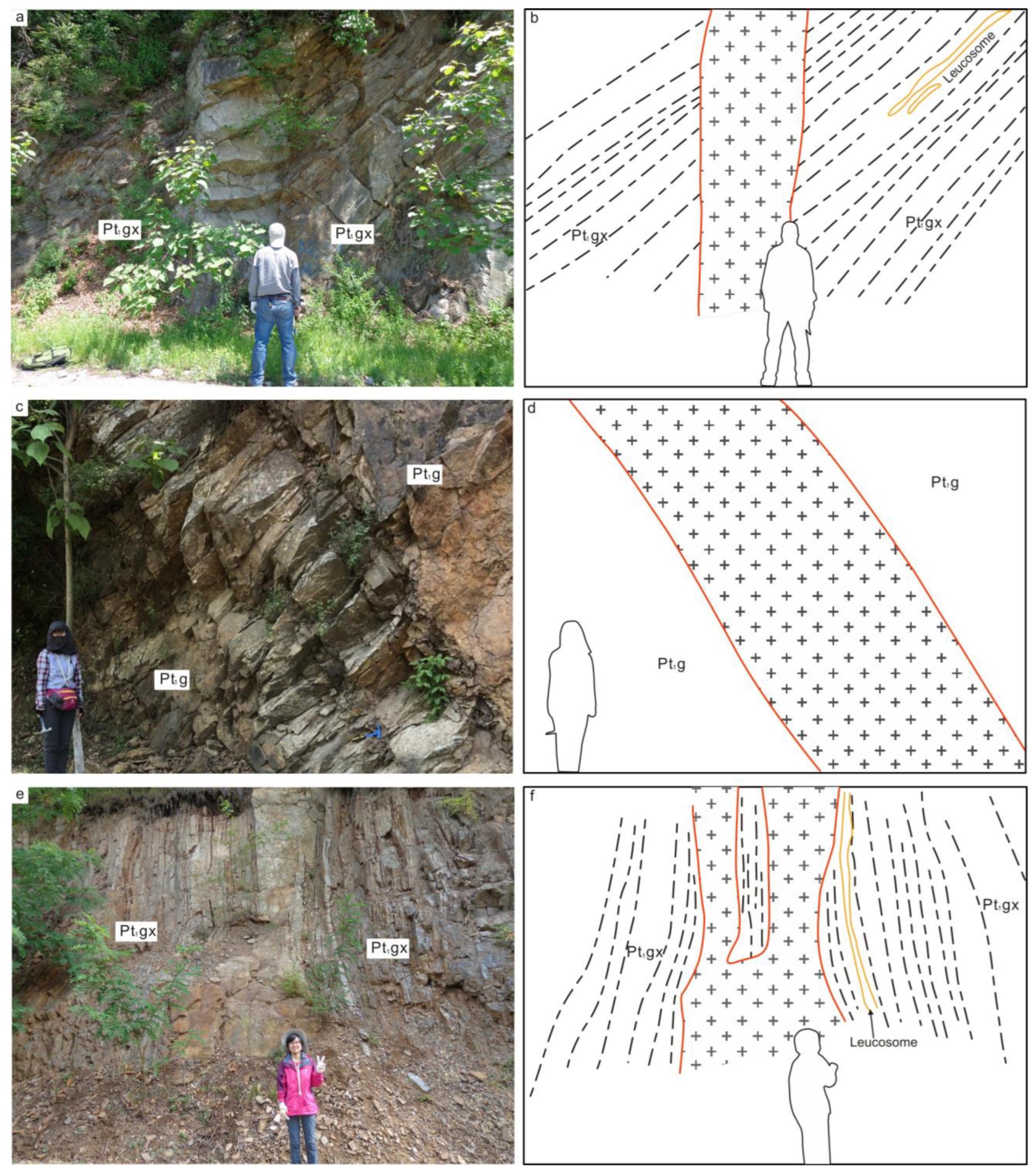
The granitic dykes from the Kuandian and Dandong areas, eastern Liaodong Peninsula, had a width of one to two meters and a length of tens of meters. Unlike the leucosomes in granulites and gneiss, which had a width of a few centimeters and paralleled the foliation of granulites as [23] reported, these granitic dykes are observed to intrude into the Paleoproterozoic Gaixian and Gaojiayu formations either cutting through or following the foliation of gneiss (Figure 2).
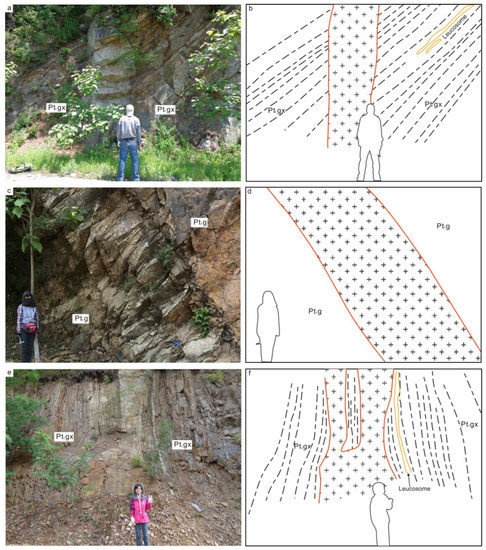
Figure 2.
Field photographs and sketches of the studied monzogranitic dykes in the Kuandian and Dandong areas within the Jiao-Liao-Ji Belt: (a,b) sample 18XM, (c,d) sample 18HX, (e,f) sample 18HS ((a): a monzogranitic dyke intrudes into the Paleoproterozoic Gaixian Formation gneiss and cuts the foliation of the gneiss near Kuandian County; (c): a monzogranitic dyke intrudes into the Paleoproterozoic Gaojiayu Formation granulite in the Hushan area; (e): a granitic dyke intrudes into the Gaixian Formation schist and gneiss near the Hongshi area) Pt1g: Paleoproterozoic Gaojiayu Formation granulite; Pt1gx: Paleoproterozoic Gaixian Formation schist and gneiss.
Sample 18XM (40°53′11″ N, 125°8′40″ E) was collected from a 1 m wide monzogranite dyke that intrudes into the Gaixian Formation schist and gneiss (Figure 2a). Sample 18HX (40°22′41″ N, 124°43′40″ E) was collected from a 2 m wide dyke that intrudes into the Gaojiayu Formation granulite near Hushan Town (Figure 2c). Sample 18HS is a coarse-grained granite (40°41′00″ N, 125°9′01″ E) collected from a 1.5 m wide dyke that intrudes into the Gaixian Formation schist and gneiss near Hongshi Town (Figure 2e).
3.2. Thin Section Petrography
The thin sections of the studied granitoids were prepared for optical petrography at the Shenyang Institute of Geology and Mineral Resources, Shenyang, China. Small pieces of rock were cut from the field samples with a diamond blade, and then mounted on a petrography carrier glass (~27 mm × 47 mm). The mounted sections were polished by using a range of ever-finer abrasive powders down to a thickness of 50 μm. Based on the polished thin sections, the microstructure, texture and mineral modal contents in vol% were estimated by point counting using an optical petrography microscope in both transmitted and polarized light.
3.3. Major and Trace Elements
After removal of altered surfaces, fresh whole-rock samples were crushed and ground to 200 mesh size in an agate mill. Chemical analyses were conducted at the Shenyang Institute of Geology and Mineral Resources, Shenyang, China. X-ray fluorescence (XRF, PANALYTICAL, Almelo, Holland) (AXIOS-Minerals) using fused glass disks and inductively coupled plasma mass spectrometry (ICP–MS, Agilent company, Santa Clara, CA, USA) (Agilent 7500a with a shield torch) were used to measure major and trace element compositions, respectively. The detailed sample-digesting procedure is as follows: Sample powder (200 mesh) was placed in an oven at 105 °C and dried for 12 h, then ~1.0 g dried sample was accurately weighted and placed in the ceramic crucible and then heated in a muffle furnace at 1000 °C for 2 h. After cooling to 400 °C, this sample was placed in the drying vessel and weighted again in order to calculate the loss on ignition (LOI). Sample powder (0.6 g) was mixed with 6.0 g cosolvent (Li2B4O7:LiBO2:LiF = 9:2:1) and 0.3 g oxidant (NH4NO3) in a Pt crucible, which was placed in the furnace at 1150 °C for 14 min. Then, this melting sample was quenched with air for 1 min to produce flat discs on the fire brick for the XRF analyses. Fe2O3 and FeO content were measured directly, while the FeOT was calculated (Supplementary Table S1). The detection limit of XRF differs from 0.001% to 1% following GB/T 14506.1-2010 standard. For trace element analysis, (1) 50 mg sample powder was accurately weighed and placed in a Teflon bomb; (2) 1 mL HNO3 and 1 mL HF were slowly added into the Teflon bomb; (3) Teflon bomb was placed in a stainless steel pressure jacket and heated to 190 °C in an oven for >24 h; (4) after cooling, the Teflon bomb was opened and placed on a hotplate at 140 °C and evaporated to incipient dryness, and then 1 mL HNO3 was added and evaporated to dryness again; (5) 1 mL of HNO3, 1 mL of MQ water and 1 mL internal standard solution of 1 ppm In were added, and the Teflon bomb was resealed and placed in the oven at 190 °C for >12 h; (6) the final solution was transferred to a polyethylene bottle and diluted to 100 g by the addition of 2% HNO3. Precision and accuracy were better than 5% for major elements and 10% for trace elements based on repeated analyses of the USGS standards BHVO-1, BCR-2, and AGV-1 [35]. The detection limit of ICP-MS differed from 0.003 to 1 × 10⁻⁶ following GB/T 14506.30-2010 standard.
3.4. Zircon LA-ICP-MS U-Pb Dating
Zircon grains from the granitoid samples were extracted using heavy-liquid and magnetic separation, and purified by hand-picking under a binocular microscope. Zircons were mounted and polished before cathodoluminescent (CL) images were taken to examine the internal structure and potential inclusions of individual grains. U-Pb dating and trace element analysis of zircon were simultaneously conducted by LA-ICP-MS (Agilent company, Santa Clara, CA, USA) (Agilent 7700e) at the Wuhan Sample Solution Analytical Technology Co., Ltd., Wuhan, China. Laser sampling was performed using a GeolasPro laser ablation system that consists of a COMPexPro 102 ArF excimer laser (wavelength of 193 nm and maximum energy of 200 mJ) and a MicroLas optical system. Helium was applied as a carrier gas. Argon was used as the make-up gas and was mixed with the carrier gas via a T-connector before entering the ICP system. The laser beam diameter was 35 μm and the repetition rate was 5 Hz. Each spot analysis consisted of a ~5 s background measurement and a 45 s sample measurement. The 207Pb/206Pb, 206Pb/238U, 207Pb/235U and 208Pb/232Th values were corrected for instrumental isotopic and elemental fractionation effects using zircon standard 91500. An Excel-based software, ICPMSDataCal (ICPMSdatacal Excel2016, Redmond, WA, USA), was used to perform off-line selection and integration of the background. It also analyzed signals, time–drift correction and quantitative calibration for trace element analysis and U-Pb dating [36]. Concordia diagrams and weighted mean calculations were made using Isoplot/Ex_ver3 (Ludwig, Berkeley, CA, USA) [37].
3.5. Zircon Lu-Hf Ratio Analyses
The in situ Lu–Hf isotope analyses (n = 42) were also conducted by MC-ICP-MS at the Wuhan Sample Solution Analytical Technology Co., Ltd. (Wuhan, China). A stationary spot used a beam diameter of ~55 μm. Helium was used to transport the ablated sample aerosol mixed with argon from the laser-ablation cell to the MC-ICP-MS torch by a mixing chamber. 176Lu/175Lu = 0.02658 and 176Yb/173Yb = 0.796218 ratios were determined to correct for the isobaric interferences of 176Lu and 176Yb on 176Hf [38]. The 176Hf/177Hf and 176Lu/177Hf ratios of the 91500 standard zircon were 0.282270 ± 0.000023 (2σ, n = 15) and 0.00028, similar to the commonly accepted 176Hf/177Hf ratio of 0.282284 ± 0.000003 (1σ) measured using the solution method [39]. Zircon international standard GJ-1 was used as the reference standard, with a weighted mean 176Hf/177Hf ratio of 0.282006 ± 32 (2SD, n = 24).
4. Results
4.1. Petrography
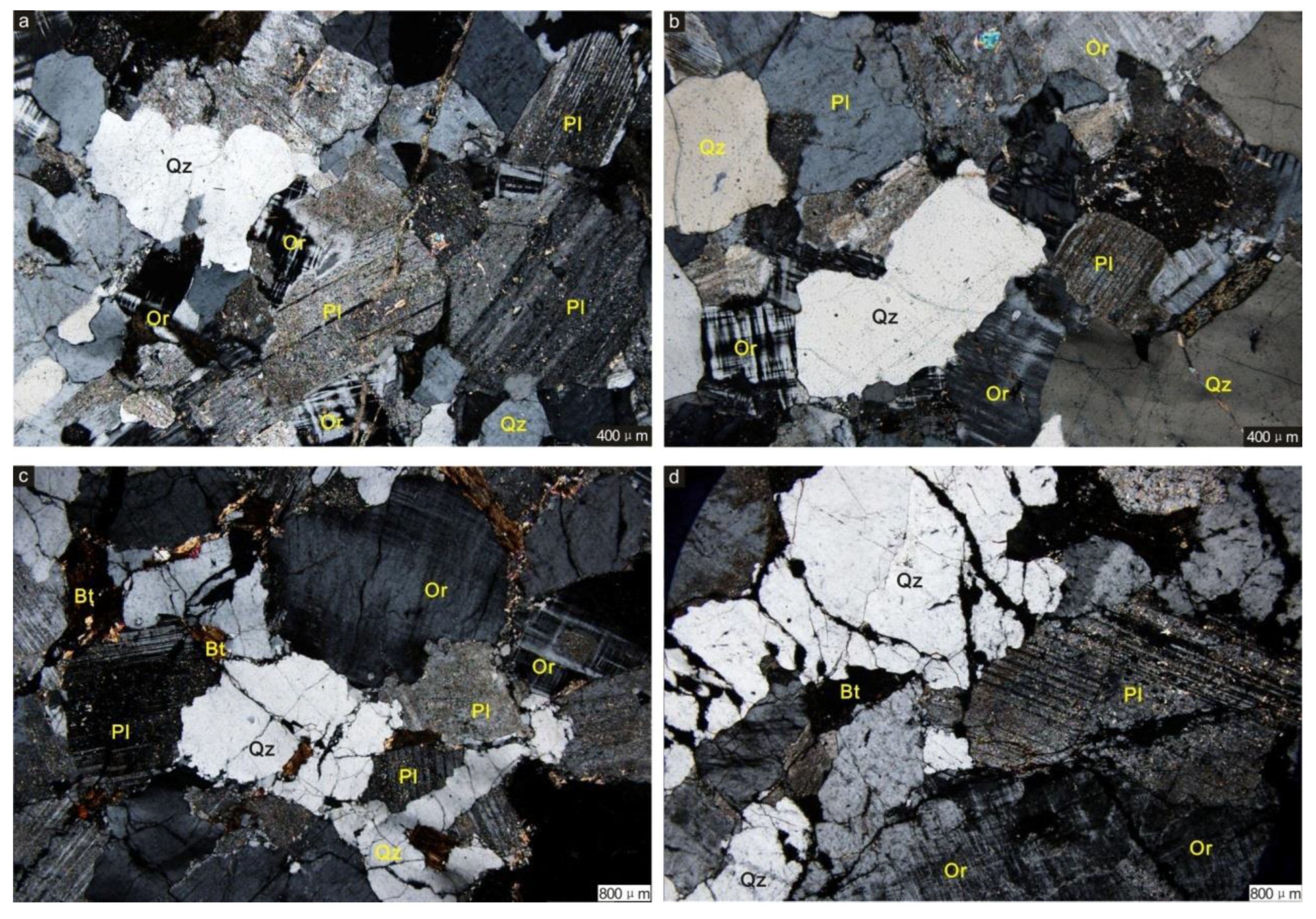
The 18XM sample has a fine- to medium-grained texture and a grey to light-brown color (Figure 3a,b). Minerals in the monzogranite include quartz (~30 vol%), plagioclase (~30 vol%), orthoclase (~35 vol%) and biotite (<5 vol%). The 18HX sample has a characteristic medium-grained texture and a grey color (Figure 3c). Quartz (~30 vol%), plagioclase (~33 vol%), orthoclase (~25 vol%), biotite (~10 vol%) and minor muscovite (~2 vol%) comprise the minerals in this monzogranite. The 18HS sample has a characteristic coarse-grained texture and a grey to brown color (Figure 3d). Plagioclase (~40 vol%), orthoclase (~35 vol%), quartz (~23 vol%) and minor biotite (~2 vol%) comprise this monzogranite.
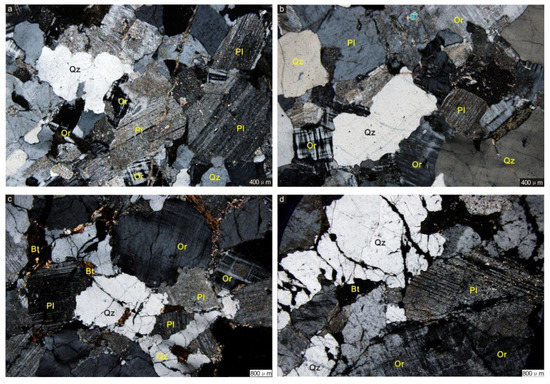
Figure 3.
Photomicrographs of the studied monzogranitic dykes in the Kuandian and Dandong areas (images are without analysator). (a,b) Sample 18XM, (c) sample 18HX, (d) sample 18HS (Bt: biotite; Or: orthoclase; Pl: plagioclase; Qz: quartz).
4.2. Major and Trace Elements
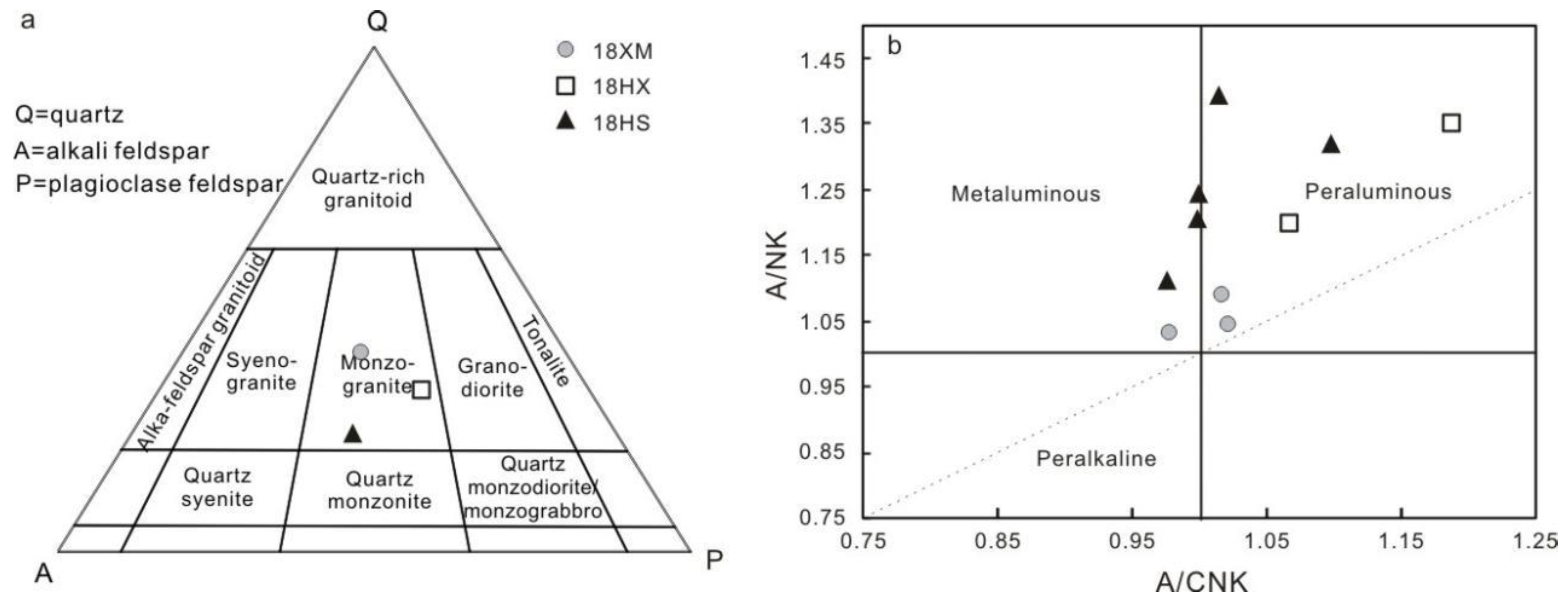
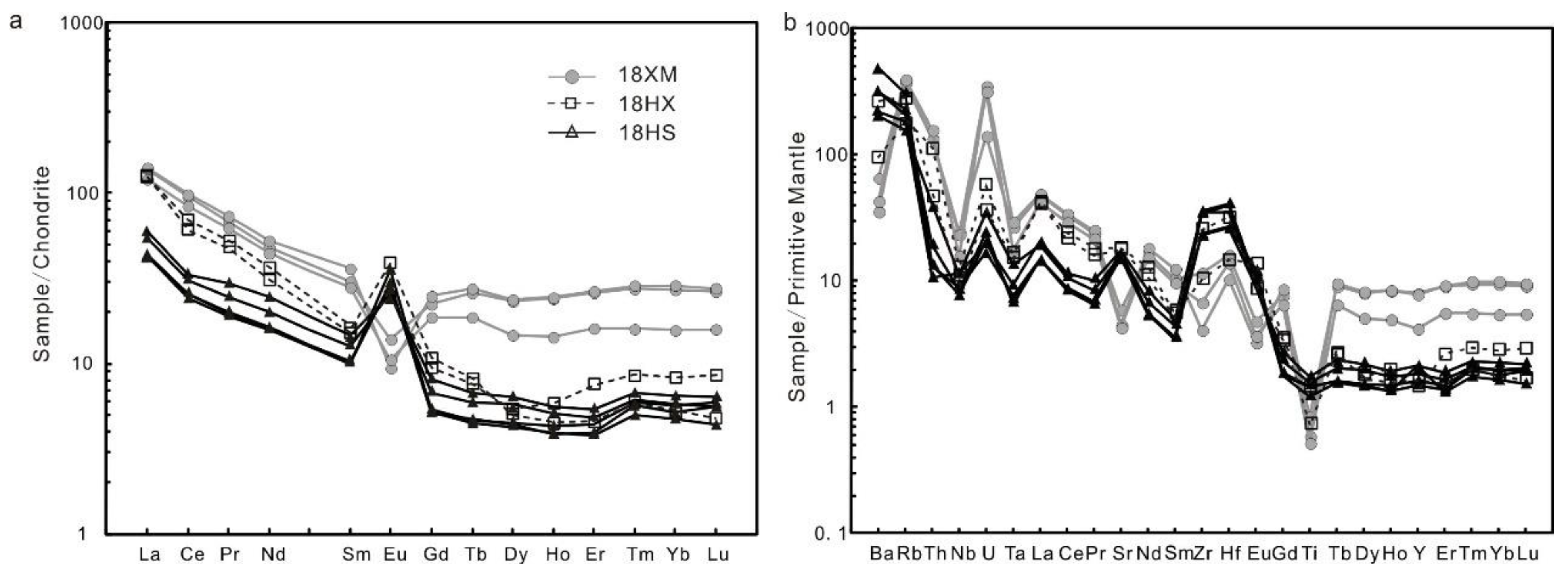
The 18XM samples have a relatively high content of SiO2 (72.81–74.78 wt%) and K2O (5.52–5.70 wt%), and plot into the metaluminous and peraluminous field (Figure 4b). The 18HS and 18HX granitic dyke samples also have a relatively high content of SiO2 (72.20–74.08 wt%) and K2O (2.83–6.37 wt%) and plot into the fields of high-K calc-alkaline to shoshonite series. These two samples have medium Al2O3 contents, and in the A/NK versus A/CNK diagram they are mainly metaluminous to weakly peraluminous (Figure 4b). Major and trace element content of the three analyzed granitoid dykes are given in Supplementary Table S1 and Figure 5. The 18HS and 18HX samples exhibit similar chondrite-normalized rare earth element (REE) patterns with marked positive Eu anomalies (Eu/Eu* = 2.16–4.70). The 18XM samples are also enriched in light REE but with strong negative Eu anomalies (Eu/Eu* = 0.31–0.53).
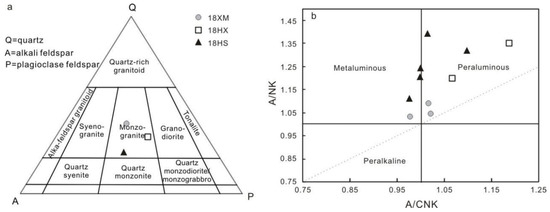
Figure 4.
Discrimination diagrams for the monzogranitic dykes in the Jiao-Liao-Ji Belt. (a) Quartz-alkali feldspar-plagioclase feldspar classification diagram (after [40]); (b) A/CNK versus A/NK after Maniar and Piccoli [41].
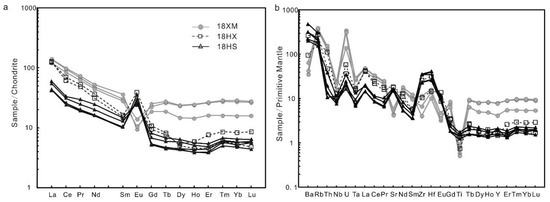
Figure 5.
CI chondrite-normalized REE (a) and primitive mantle-normalized trace elements distribution (b) patterns for the monzogranitic dykes in the Jiao-Liao-Ji Belt (CI chondrite and primitive mantle values are from [42]).
4.3. Zircon U-Pb Geochronology
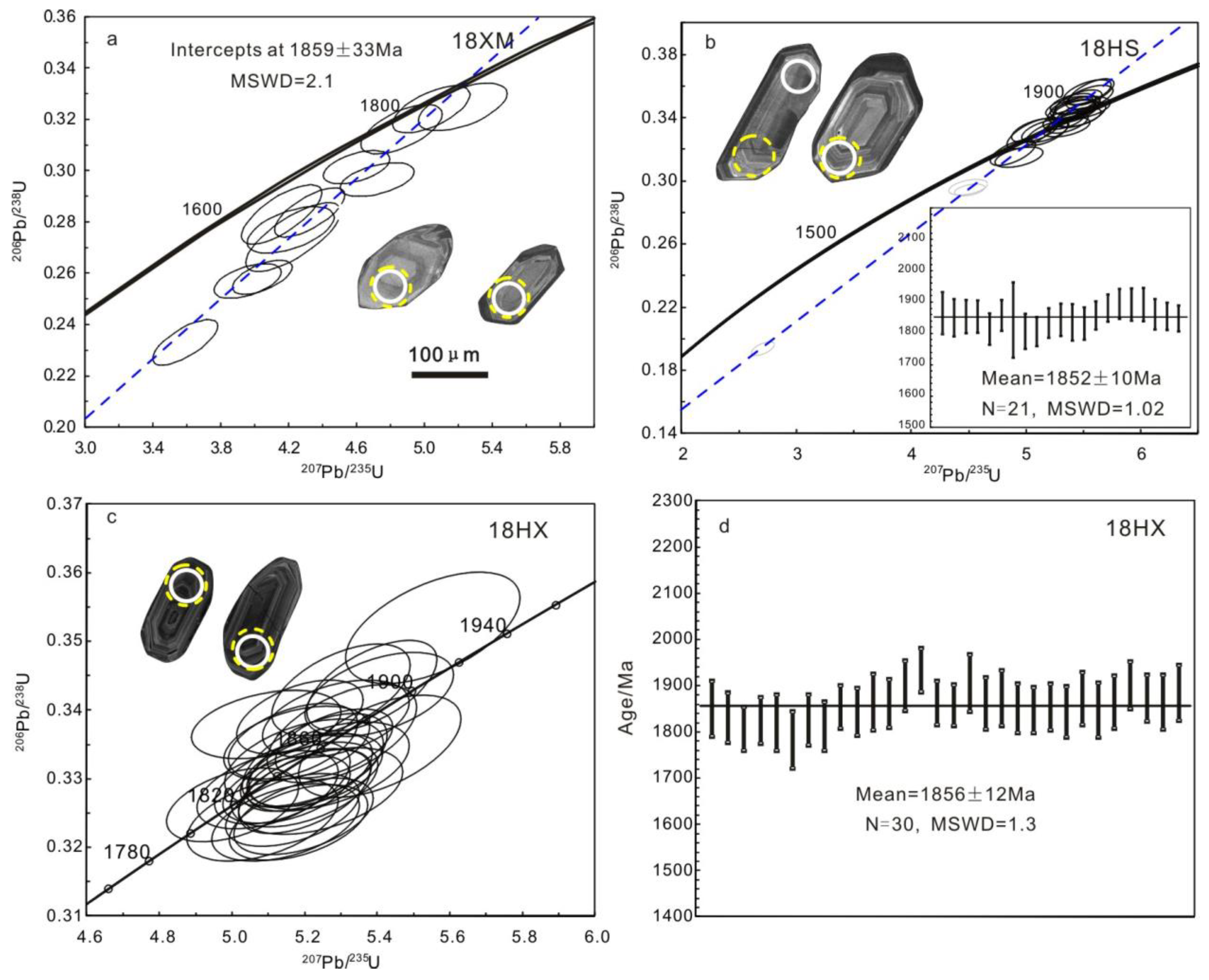
CL images of representative zircons from the three samples are listed in Supplementary Table S2 and Figure 6. Zircon grains have similar euhedral to subhedral shape and are about 70 to 200 μm long. Th/U ratios of the testing grains range from 0.11 to 0.86, indicating an igneous origin. Fifteen spots from sample 18XM and thirty spots from sample 18HS are analyzed, yielding intercept U-Pb age of 1859 ± 33 Ma (MSWD = 2.1) and 1852 ± 10 Ma (MSWD = 1.02), respectively. Twenty-five spots from sample 18HX yield weighted mean 207Pb/206Pb ages of 1856 ± 12 Ma (MSWD = 1.3) (Figure 6).
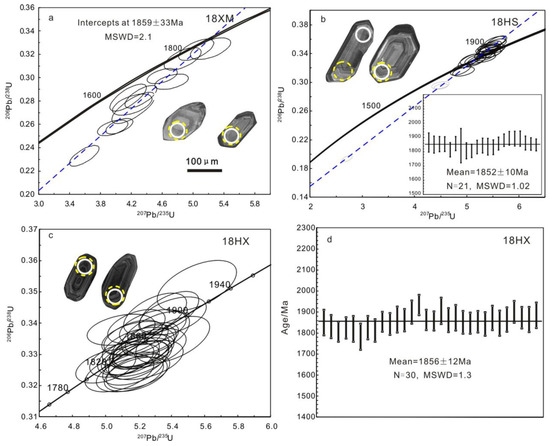
Figure 6.
Concordia diagrams for U-Pb analyses of zircons from monzogranitic dykes in the Jiao-Liao-Ji Belt, the 35-μm analytical spots of U-Pb (white ring) and 50 μm analytical spots of Hf (yellow ring) analysis of represented zircon grains are also shown. Respective error range (ellipse and bar) of 2SD is shown. (a) Sample 18XM; (b) sample 18HS; (c,d) sample 18HX.
4.4. Zircon Lu-Hf Isotopic Characteristics
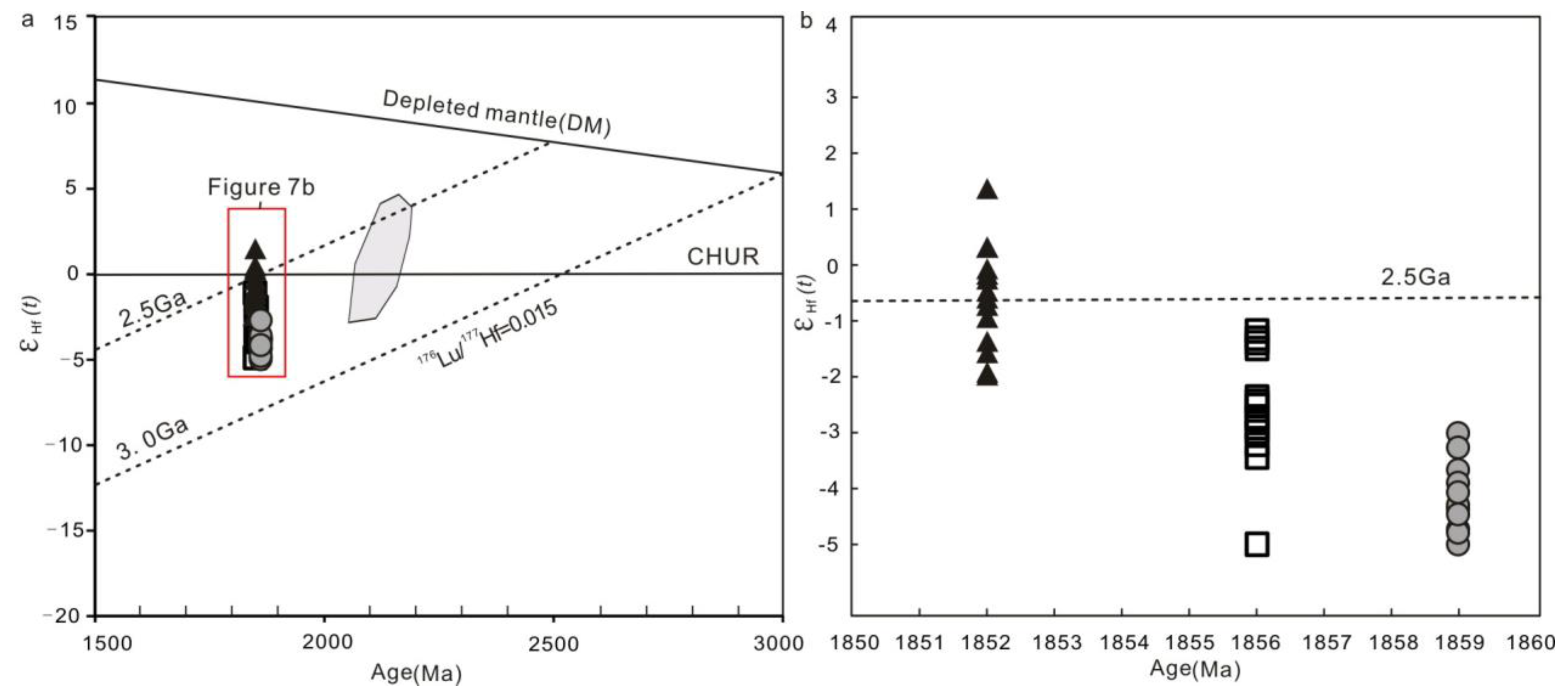
Zircon analytical spots with concordant U-Pb ages are analyzed for their Lu-Hf isotope contents. Results are listed in Supplementary Table S3 and Figure 7. Sample 18HX yielded negative εHf(t) values, ranging between −4.0 and −0.9. The initial 176Hf/177Hf ratios ranged from 0.281482 to 0.281607, with calculated TDM1 ages of 2447–2302 Ma and TDM2 ages of 2782–2566 Ma. Sample 18XM also yielded negative εHf(t) values, ranging between −2.8 and −6.8. The initial 176Hf/177Hf ratios ranged from 0.281484 to 0.281540, with calculated TDM1 ages of 2377–2452 Ma and TDM2 ages of 2696–2826 Ma. Similarly, initial 176Hf/177Hf ratios of zircons from 18HS were from 0.281573 to 0.281669, with calculated TDM1 ages of 2338–2206 Ma and TDM2 ages of 2640–2430 Ma. The εHf(t) values for 18HS ranged from −2.5 and +1.2.
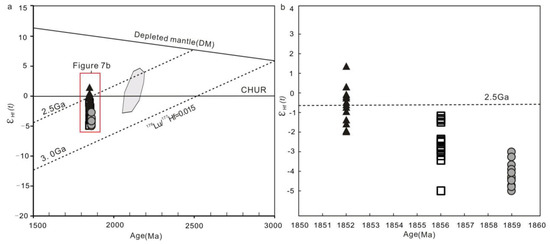
Figure 7.
Zircon207Pb/206Pb ages versus εHf(t) values of the monzogranitic dykes in the Jiao-Liao-Ji Belt (a,b). Lu-Hf evolution line for depleted mantle is constrained by a present-day 176Hf/177Hf ratio of 0.28325 [43] and 176Lu/177Hf ratio of 0.0384 [38]. The gray polygon is the Paleoproterozoic Hf isotopic data from [20]. Legend is similar with that in Figure 5.
5. Discussion
5.1. U-Pb Ages of the Monzogranitic Dykes and the Granitoids Geochronology within the JLJB
Three monzogranitic dykes were observed cutting through foliation of the deformed Liaohe Group meta-sedimentary rocks during the fieldwork (Figure 2). Zircon grains from these dykes exhibit typical oscillatory zoning in CL images, with most Th/U ratios greater than 0.2, indicating a magmatic origin [44]. These zircon grains yield consistent U-Pb ages of ~1859 to 1852 Ma (Supplementary Table S2, Figure 6), showing that these monzogranitic dykes crystallized ~1860–1850 Ma.
Previous researchers have summarized igneous rocks and their relations with the tectonic evolution process of the JLJB, and established different evolution stages [4,18,19]. Here, we also list Late Paleoproterozoic granitoids types and available ages in Liaoning and Jilin provinces in Table 1. Taking these studies into consideration, three stages of granitoids could be recognized as follows. An early magmatic event of ~2200 to 2140 Ma, indicated by A-type and I-type granites, which are also known as the Liaoji Granites [26,45,46,47]. A middle period consisting of ~1890 to 1860 Ma biotite-bearing and garnet-bearing porphyritic granites, pegmatite and adakitic granites. They were believed to be accompanied by peak metamorphism in the JLJB [16,25,33] or by Paleoproterozoic oceanic slab subduction [48]. A post-collisional magmatic event at ~1855 to 1840 Ma, is represented by the monzogranite dykes in this study, syenite in the Kuangdonggou area, and sporadically pegmatite dykes [21,25].

Table 1.
Geological characteristics and chronological results of Late Paleoproterozoic granites in the Liao-Ji region.
5.2. Genesis of the Monzogranitic Dykes
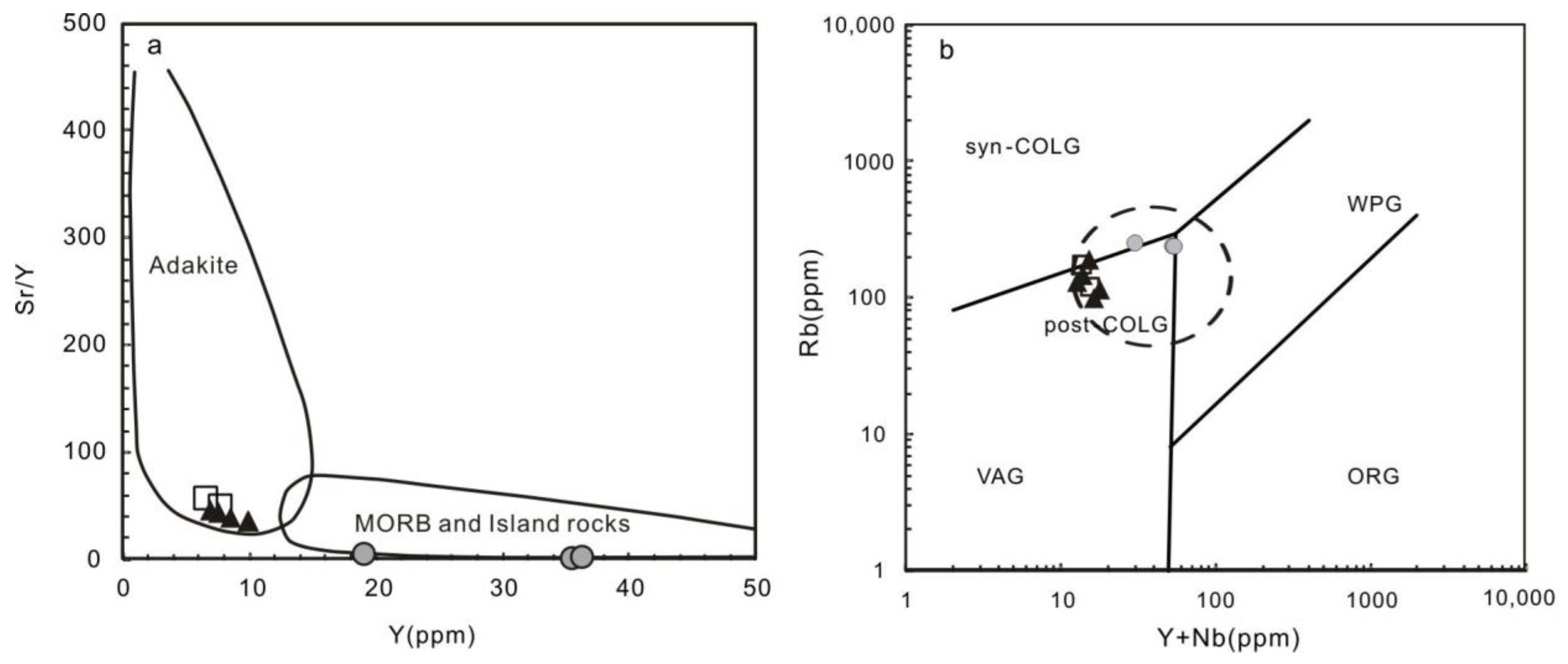
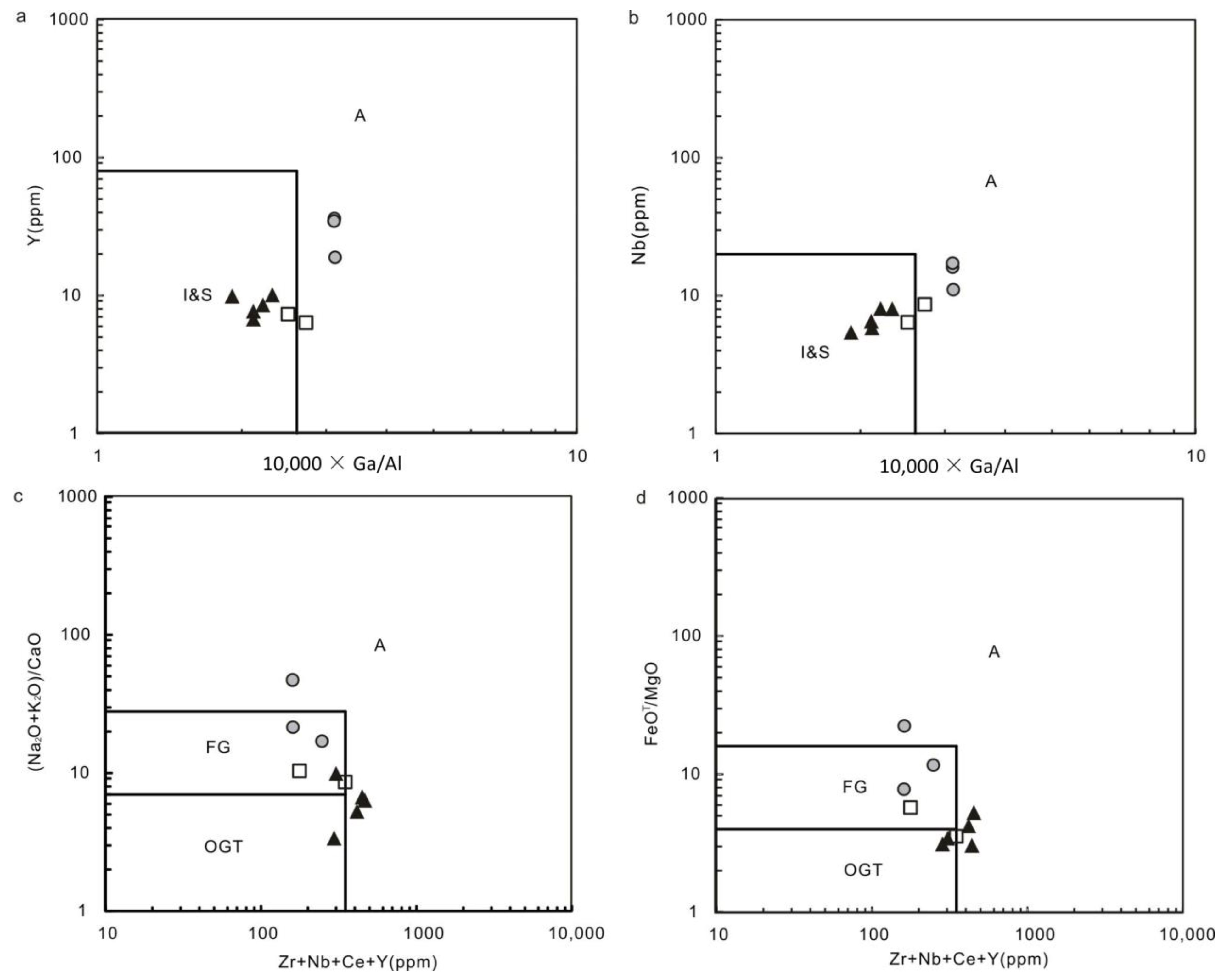
The monzogranite dykes in this study have a similar high SiO2 content and alkalis and have low content of MgO, FeOT and CaO (Supplementary Table S1). In the primitive mantle-normalized trace element diagram (Figure 5b), the 18HS and 18HX samples are enriched in large ion lithosphere elements (LILEs) with positive Eu (Figure 5a) and Ba, U anomalies and depleted in some high field-strength elements (HFSEs). The 18HS and 18HX samples also exhibit high Sr/Y ratio, indicating an adakitic granite feature (Figure 8a). The 18XM samples show relatively high content of U and HREE, but exhibit similar overall trace elements to those in 18HS and 18HX. The 18 XM samples have A-type granite features as their high ratios of Ga/Al, while the 18 HS and 18 HX samples show I-type granite characteristics (Figure 9). Further Zr saturation calculation results reveal that 18XM samples have the lowest temperature of 688 °C to 770 °C (Supplementary Table S1), rather than the high temperature of typical A-type granites [54,55,56,57]. Considering the distribution of the studied monzogranitic dykes within the JLJB, they should have been generated under a thickened crust tectonic setting.
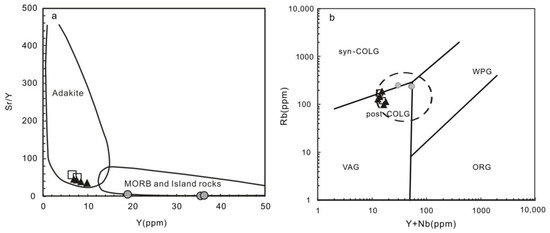
Figure 8.
Sr/Y vs. Y diagram for the monzogranitic dykes in the Jiao-Liao-Ji Belt (a, after [58] and Rb-(Y + Nb) diagrams (b, after [59,60]). The circle in Figure 8a represents a post-collisional geodynamic setting of Pearce et al. [60] (MORB: mid ocean ridge basalt; ORG: orogenic granite; syn-COLG: syn-collisional granite; COLG: collisional granitoids; OA: oceanic arc; VAG: volcanic arc granite; WPG: within-plate granite). Legend is similar to that in Figure 5.
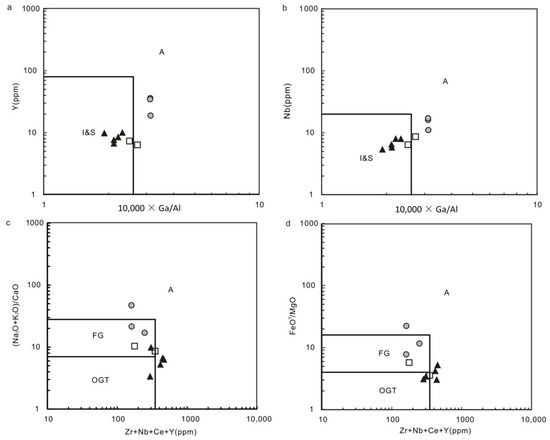
Figure 9.
Y (a), Nb (b) versus 10,000 × Ga/Al plots and (Na2O + K2O)/CaO (c), FeOT/MgO (d) versus Zr + Nb + Ce + Y plots (after [54]) A, I and S = A-, I- and S-type granites, respectively; FG = fractionated felsic granites; OGT = unfractionated M-, I- and S-type granites, legend is similar to that in Figure 5.
Hf isotope analysis also illustrated similar conclusions. Hf isotope data show TDM2 ages of 2640–2430 Ma, and reveal that most of the negative εHf(t) values plot near the 2.5 Ga crustal evolution line with a few positive values (Supplementary Table S3; Figure 7). These results are similar to those of the 2.2–2.1 Ga granitoids by previous studies [20,28,30,51]. These granitic dykes have low Mg# and variable LILE/HFSE ratios (Supplementary Table S1), suggesting that they may have been derived from low-degree partial melting of a thickened crust, rather than subduction of oceanic crust. This magmatic event should have been triggered by delamination-induced extension at the late stage of the orogenic process of the JLJB.
5.3. Implications to the Evolution Model of the JLJB
Although there are matters of debate on the early evolution model of the JLJB, there is a consensus understanding on the orogenic process in Late Paleoproterozoic (e.g., [14,61,62,63,64]). The Longgang block and the Liaonan-Nangrim block convergence began at ~2.0 or 1.95 Ga [16,26,65], and widespread metamorphism and deformation are also believed to have taken place at ~1.9 Ga [19,66,67,68,69] or ~1.88–1.85 Ga [70,71].
Termination time of the JLJB orogeny was only roughly defined by corresponding granitoids geochronological studies. Garnet-bearing and biotite-bearing porphyritic granites (~1870–1865 Ma), rapakivi granites and alkaline syenite (~1872–1850 Ma) were reported within the JLJB as products of anorogenic magmatism by previous studies and interpreted as representing the termination of the JLJB orogeny [20,22,72,73]. These geochronological results also met previous metamorphic study results in the JLJB, as ~1.95–1.85 Ga HP and MP granulites in the Jiaobei Block from the Jiaodong Peninsula, the South Liaohe Group in Liaoning Province, and the Ji’an Group in Jilin Province were reported [23,68,69,74,75].
Monzogranitic dykes in this study provide robust constraint on post-collisional granitoids in the JLJB orogeny process. Three granitic dykes observed in this study exhibit manifested post-collisional granite field features by cutting through foliation of the Liaohe Group meta-sedimentary rocks which deformed at ~1.9 Ga by previous studies [23,31,63] (Figure 2). These granitic dykes have transitional features of I- to A-type granites, probably distributing under a post-collisional tectonic setting as [76] illustrated. These monzogranite dykes show features of post-collisional granites in the model proposed by Pearce et al. [59,60] (Figure 8b). Considering these features of the granitoid dykes, the whole-rock geochemistry and Hf isotopic results, we believe these dykes represent exhumation and extension in the final collisional of the orogeny process. The termination collisional time of the JLJB orogen was constrained to be not later than 1860 Ma by these monzogranite dykes.
6. Conclusions
Based on a study of zircon U-Pb geochronology, Hf isotopes and whole-rock geochemistry of the monzogranitic dykes, the following conclusions can be drawn.
- (1)
- The monzogranite dykes cut through the foliation of the Liaohe Group meta-sedimentary rocks which deformed at ~1900 Ma. Zircons from the monzogranite dyke have euhedral to subhedral shape and high ratio of Th/U, and yield a consistent zircon U-Pb age of ~1859–1852 Ma.
- (2)
- Two dyke samples have I-type granite and adakitic granite features; the other dyke has a characteristic of A-type granite. Hf isotope data show TDM2 ages of 2640–2430 Ma and reveal that most of the εHf(t) values plot near the 2.5 Ga crustal evolution line. Such geochemistry and Hf isotope studies indicate they may have been generated under a delamination of thickened crust tectonic setting.
- (3)
- The termination collisional time of the JLJB orogen was constrained to be not later than 1860 Ma by these monzogranitic dykes.
Supplementary Materials
The following supporting information can be downloaded at: https://www.mdpi.com/article/10.3390/min13070928/s1, Table S1: Major(wt%) and trace (×10−6) element data for representative samples of the Paleoproterozoic monzogranitic dykes from the Kuandian and Dandong area within the Jiao-Liao-Ji Belt, (TZr(°C): Zircon saturations temperatures by [77]) and (δEu/Eu* = Eu N/(Sm N × Gd N)1/2, N denotes the chondrite normalization (Sun and McDonough, 1989) [42]). Table S2: LA-ICP-MS zircon U-Pb analyses for representative samples of Paleoproterozoic monzograntic dykes from the Kuandian and Dandong area within the Jiao-Liao-Ji Belt, Table S3: Lu-Hf isotopic compositions of the in situ zircons of Paleoproterozoic monzogranitic dykes in the Kuandian and Dandong area within the Jiao-Liao-Ji Belt.
Author Contributions
Conceptualization, Y.Z. and X.H.; methodology, P.Z. and J.L.; investigation, Y.Z. and C.C.; writing—original draft preparation, Y.Z.; writing—review and editing, Y.Z., X.H., S.L. and X.Y. All authors have read and agreed to the published version of the manuscript.
Funding
This research was funded by the National Science Foundation of China (Grant No. 42072104; 41502093), Geological Survey Project of China (Grant No. DD20230329; DD20230102), Scientific Research Foundation of Education Department of Liaoning Province (Grant No. LJKQZ20222473, LJKZ1075) and the China Scholarship Council.
Data Availability Statement
Not applicable.
Conflicts of Interest
The authors declare no conflict of interest.
References
- Zhao, G.C.; Sun, M.; Wilde, S.A.; Li, S.Z. Late Archean to Paleoproterozoic evolution of the North China Craton: Key issues revisited. Precambrian Res. 2005, 136, 177–202. [Google Scholar] [CrossRef]
- Wilde, S.A.; Zhao, G.C. Archean to Paleoproterozoic evolution of the North China Craton. J. Asian Earth Sci. 2005, 24, 519–522. [Google Scholar] [CrossRef]
- Zhai, M.G.; Santosh, M. Metallogeny of the North China Craton: Link with secular changes in the evolving Earth. Gondwana Res. 2013, 24, 275–297. [Google Scholar] [CrossRef]
- Liu, F.L.; Liu, P.H.; Wang, F.; Liu, C.H.; Cai, J. Progresses and overviews of voluminous meta-sedimentary series within the Paleoproterozoic Jiao-Liao-Ji orogenic/mobile belt, North China Craton. Acta Petrol. Sin. 2015, 31, 2816–2846, (In Chinese with English abstract). [Google Scholar]
- Li, S.Z.; Zhao, G.C.; Sun, M.; Han, Z.Z.; Hao, D.F.; Luo, Y.; Xia, X.P. Deformation history of the Paleoproterzoic Liaohe Group in the Eastern Block of the North China Craton. J. Asian Earth Sci. 2005, 24, 659–674. [Google Scholar] [CrossRef]
- Zhao, G.C.; Cawood, P.A.; Li, S.Z.; Wilde, S.A.; Sun, M.; Zhang, J.; He, Y.H.; Yin, C.Q. Amalgamation of the North China Craton: Key issues and discussion. Precambrian Res. 2012, 222–223, 55–76. [Google Scholar] [CrossRef]
- Zhang, Q.S.; Yang, Z.S.; Liu, L.D. Early Crust and Mineral Deposits of Liaodong Peninsula; Geological Publishing House: Beijing, China, 1988; pp. 218–450, (In Chinese with English abstract). [Google Scholar]
- Sun, M.; Armstrong, R.L.; Lambert, R.S.; Jiang, C.C.; Wu, J.H. Petrochemistry and Sr, Pb and Nd isotopic geochemistry of Paleoproterozoic Kuandian Complex, the eastern Liaoning province, China. Precambrian Res. 1993, 62, 171–190. [Google Scholar]
- Bai, J. The Pre-Cambrian Geology and Pb–Zn Mineralization in the Northern Margin of North China Platform; Geological Publishing House: Beijing, China, 1993; pp. 47–89. (In Chinese) [Google Scholar]
- Li, Z.; Chen, B.; Wei, C.J.; Wang, C.X.; Han, W. Provenance and tectonic setting of the Paleoproterozoic metasedimentary rocks from the Liaohe Group, Jiao–Liao–Ji Belt, North China Craton: Insights from detrital zircon U-Pb geochronology, whole–rock Sm–Nd isotopes, and geochemistry. J. Asian Earth Sci. 2015, 111, 711–732. [Google Scholar] [CrossRef]
- Li, Z.; Chen, B.; Yan, X.L. The Liaohe Group: An insight into the Paleoproterozoic tectonic evolution of the Jiao-Liao-Ji Belt, North China Craton. Precambrian Res. 2019, 326, 174–195. [Google Scholar] [CrossRef]
- Li, Z.; Wei, C.J.; Chen, B.; Fu, B.; Gong, M.Y. Late Neoarchean reworking of the Mesoarchean crustal remnant in northern Liaoning, North China Craton: A U-Pb-Hf-O-Nd perspective. Gondwana Res. 2020, 80, 350–369. [Google Scholar] [CrossRef]
- Zhu, K.; Liu, Z.H.; Xu, Z.Y.; Wang, X.A.; Cui, W.L.; Hao, Y.J. Petrogenesis and tectonic implications of two types of Liaoji granitoid in the Jiao-Liao-Ji Belt, North China Craton. Precambrian Res. 2019, 331, 1–19. [Google Scholar] [CrossRef]
- Li, S.Z.; Zhao, G.C.; Santosh, M.; Liu, X.; Dai, L.; Suo, Y.H.; Tam, P.K.; Song, M.; Wang, P.C. Paleoproterozoic structural evolution of the southern segment of the Jiao–Liao–Ji belt, North China Craton. Precambrian Res. 2012, 200–203, 59–73. [Google Scholar] [CrossRef]
- Zhao, G.C.; Zhai, M.G. Lithotectonic elements of Precambrian basement in the North China Craton: Review and tectonic implications. Gondwana Res. 2013, 23, 1207–1240. [Google Scholar] [CrossRef]
- Meng, E.; Liu, F.L.; Liu, P.H.; Liu, C.H.; Yang, H.; Wang, F.; Shi, J.R.; Cai, J. Petrogenesis and tectonic significance of Paleoproterozoic meta-mafic rocks from central Liaodong Peninsula, northeast China: Evidence from zircon U-Pb dating and in situ Lu-Hf isotopes, and whole-rock geochemistry. Precambrian Res. 2014, 247, 92–109. [Google Scholar] [CrossRef]
- Xu, W.; Liu, F.L.; Tian, Z.H.; Liu, L.S.; Ji, L.; Dong, Y.S. Source and petrogenesis of Paleoproterozoic meta-mafic rocks intruding into the North Liaohe Group: Implications for back-arc extension prior to the formation of the Jiao-Liao-Ji Belt, North China Craton. Precambrian Res. 2018, 207, 66–81. [Google Scholar] [CrossRef]
- Xu, W.; Liu, F.L. Geochronological and geochemical insights into the tectonic evolution of the Paleoproterozoic Jiao-Liao-Ji Belt, Sino-Korean Craton. Earth Sci. Rev. 2019, 193, 162–198. [Google Scholar] [CrossRef]
- Yang, C.W.; Liu, J.L.; Yang, H.X.; Zhang, C.; Feng, J.; Lu, T.J.; Sun, Y.Q.; Zhang, J. Tectonics of the Paleoproterozoic Jiao-Liao-Ji orogenic belt in the Liaodong peninsula, North China Craton: A review. J. Asian Earth Sci. 2019, 176, 141–156. [Google Scholar] [CrossRef]
- Liu, F.L.; Liu, C.H.; Itano, K.; Iizuka, T.; Cai, J.; Wang, F. Geochemistry, U-Pb dating, and Lu-Hf isotopes of zircon and monazite of porphyritic granites within the Jiao-Liao-Ji orogenic belt: Implications for petrogenesis and tectonic setting. Precambrian Res. 2017, 300, 78–106. [Google Scholar] [CrossRef]
- Lu, X.P.; Wu, F.Y.; Guo, J.H.; Yin, C.J. Late Paleoproterozoic granitic magmatism and crustal evolution in the Tonghua region, northeast China. Acta Petrol. Sin. 2005, 21, 721–736, (In Chinese with English abstract). [Google Scholar]
- Yang, J.H.; Wu, F.Y.; Xie, L.W.; Liu, X.M. Petrogenesis and tectonic implications of Kuangdonggou syenites in the Liaodong peninsula, east North China Craton: Constraints from in-situ zircon U-Pb ages and Hf isotopes. Acta Petrol. Sin. 2007, 23, 263–276, (In Chinese with English abstract). [Google Scholar]
- Liu, F.L.; Liu, L.S.; Cai, J.; Liu, P.H.; Wang, F.; Liu, C.H.; Liu, J.H. A widespread Paleoproterozoic partial melting event within the Jiao-Liao-Ji Belt, North China Craton: Zircon U-Pb dating of granitic leucosomes within politic granulites and its tectonic implications. Precambrian Res. 2019, 326, 155–173. [Google Scholar] [CrossRef]
- Lu, X.P.; Wu, F.Y.; Zhang, Y.B.; Zhao, C.B.; Guo, C.L. Emplacement age and tectonic setting of the Paleoproterozoic Liaoji Granites in Tonghua area, southern Jilin Province. Acta Petrol. Sin. 2004, 20, 381–392, (In Chinese with English abstract). [Google Scholar]
- Yang, H.; Wang, H.; Liu, J.H. Zircon U-Pb dating and its geological significance of granitic pegmatites from the Kuandian and Sanjiazi area in eastern Liaodong Province. Acta Petrol. Sin. 2017, 33, 2675–2688, (In Chinese with English abstract). [Google Scholar]
- Li, S.Z.; Zhao, G.C. SHRIMP U-Pb zircon geochronology of the Liaoji granitoids: Constraints on the evolution of the Paleoproterozoic Jiao-Liao-Ji belt in the Eastern Block of the North China Craton. Precambrian Res. 2007, 158, 1–16. [Google Scholar] [CrossRef]
- Wu, F.Y.; Li, Q.L.; Yang, J.H.; Kim, J.N.; Han, R.H. Crustal growth and evolution of the Rangnim Massif, northern Korean Peninsula. Acta Petrol. Sin. 2016, 32, 2933–3294, (In Chinese with English abstract). [Google Scholar]
- Li, Z.; Chen, B.; Wang, J.L. Geochronological framework and geodynamic implications of mafic magmatism in the Liaodong Peninsula and adjacent regions, North China Craton. Acta Geol. Sin. 2016, 90, 138–153, (In Chinese with English abstract). [Google Scholar] [CrossRef]
- Li, Z.; Chen, B.; Wei, C.J. Is the Paleoproterozoic Jiao-Liao-Ji Belt (North China Craton) a rift? Int. J. Earth Sci. 2017, 106, 355–375. [Google Scholar] [CrossRef]
- Li, Z.; Li, J.; Chen, B. Early Precambrian tectonic-thermal events: Coupled U-Pb-Hf of detrital zircons from Jiao-Liao-Ji Belt, North China Craton. Arab. J. Geosci. 2018, 11, 424–440. [Google Scholar] [CrossRef]
- Li, Z.; Meng, E.; Wang, C.Y.; Li, Y.G. Early Precambrian tectono-thermal events in Southern Jilin Province, China: Implications for the evolution of Neoarchean to Paleoproterozoic crust in the northeastern North China Craton. Miner. Petrol. 2019, 113, 185–205. [Google Scholar] [CrossRef]
- Xiao, C.H.; Liu, X.C.; Zhao, Y.; Zhang, Q.; Chen, Z.L.; Liu, J.M.; Wei, C.S.; Yao, X.F.; Wang, W.; Xie, L.Q. Structural controls and Re-Os dating of molybdenite of the Wulong gold deposit, NE China. Earth Sci. 2020, 45, 3982–3997, (In Chinese with English abstract). [Google Scholar]
- Zhao, Y.; Lin, S.F.; Zhang, P.; Yang, X.M.; Gu, Y.C.; Bi, Z.W.; Kou, L.L. Geochronology and Geochemical Characteristics of Paleoproterozoic Syn-orogenic Granitoids and Constraints on the Geological Evolution of the Jiao-Liao-Ji Orogenic Belt, North China Craton. Precambrian Res. 2021, 365, 106386. [Google Scholar] [CrossRef]
- Chen, J.S.; Xing, D.H.; Liu, M.; Li, B.; Yang, H.; Tian, D.X.; Yang, F.; Wang, Y. Zircon U-Pb chronology and geological significance of felsic volcanic rocks in the Liaohe Group from the Liaoyang area, Liaoning Province. Acta Petrol. Sin. 2017, 33, 2792–2810, (In Chinese with English abstract). [Google Scholar]
- Rudnick, R.L.; Gao, S. Composition of the continental crust. In The Crust, Treatise in Geochemistry; Rudnick, R.L., Ed.; Elsevier-Pergamon: Oxford, UK, 2003; Volume 3, pp. 1–64. [Google Scholar]
- Liu, Y.S.; Hu, Z.C.; Gao, S.; Guünther, D.; Xu, J.; Gao, C.G.; Chen, H.H. In situ analysis of major and trace elements of anhydrous minerals by LA-ICP-MS without applying an internal standard. Chem. Geol. 2008, 257, 34–43. [Google Scholar] [CrossRef]
- Ludwig, K.R. Isoplot/Ex, Version 3: A Geochronological Toolkit for Microsoft Excel; Berkeley Geochronology Centre: Berkeley, CA, USA, 2003. [Google Scholar]
- Griffin, W.L.; Pearson, N.J.; Belousova, E.; Jackson, S.E.; Van Achterbergh, E.; O’Reilly, S.Y.; Shee, S.R. The Hf–isotope composition of cratonic mantle: LAM-MC-ICPMS analysis of zircon megacrysts in kimberlites. Geochim. Cosmochim. Acta 2000, 64, 133–147. [Google Scholar] [CrossRef]
- Woodhead, J.D.; Hergt, J.M. A preliminary appraisal of seven natural zircon reference materials for in situ Hf-isotope analysis. Geost Geoanalytical Res. 2005, 29, 183–195. [Google Scholar] [CrossRef]
- Streckeisen, A.L. Classification of the common igneous rocks by means of their chemical composition: A provisional attempt. Neues Jahrb. Fur Mineral. 1976, 1, 1–15. [Google Scholar]
- Maniar, P.D.; Piccoli, P.M. Tectonic discrimination of granitoids. Geol. Soc. Am. Bull. 1989, 101, 635–643. [Google Scholar] [CrossRef]
- Sun, S.S.; McDonough, W.F. Chemical and isotopic systematics of oceanic basalts; implications for mantle composition and processes. Geol. Soc. Lond. Spec. Publ. 1989, 42, 313–345. [Google Scholar] [CrossRef]
- Nowell, G.M.; Kempton, P.D.; Noble, S.R.; Fitton, J.G.; Saunders, A.D.; Mahoney, J.J.; Taylor, R.N. High precision Hf isotope measurements of MORB and OIB by thermal ionisation mass spectrometry: Insights into the depleted mantle. Chem. Geol. 1998, 149, 211–233. [Google Scholar] [CrossRef]
- Hoskin, P.O.; Schaltegger, U. The composition of zircon and igneous and metamorphic petrogenesis. Rev. Miner. Geochem. 2003, 53, 27–62. [Google Scholar] [CrossRef]
- Song, Y.H.; Yang, F.C.; Yan, G.L.; Wei, M.H.; Shi, S.S. SHRIMP U-Pb ages and Hf isotopic compositions of Paleoproterozoic granites from the Eastern part of Liaoning Province and their tectonic significance. Acta Geol. Sin. 2016, 90, 2620–2636, (In Chinese with English abstract). [Google Scholar]
- Ren, Y.W.; Wang, H.C.; Kang, J.L.; Chu, H.; Tian, H. Paleoproterozoic magmatic events in the Hupiyu area in Yingkou, Liaoning Province and their geological significance. Acta Geol. Sin. 2017, 91, 2456–2472, (In Chinese with English abstract). [Google Scholar]
- Zhao, Y.; Zhang, P.; Li, Y.; Li, D.T.; Chen, J.; Bi, Z.W. Geochemistry of two types of Paleoproterozoic granites, and zircon U-Pb dating, and Lu-Hf isotopic characteristics in the Kuandian area within the Jiao-Liao-Ji belt: Implications for regional tectonic setting. Geol. J. 2020, 55, 7564–7580. [Google Scholar] [CrossRef]
- Zhang, P.; Zhao, Y.; Yang, H.Z.; Kou, L.L. Discrimination and its significance of the Sizhanggunzi granite in Kuangdonggou area, eastern Liaoning Province. J. Northeast. Univ. (Nat. Sci.) 2016, 37, 1349–1352, (In Chinese with English abstract). [Google Scholar]
- Yang, M.C.; Chen, B.; Yan, C. Petrological, geochronological, geochemical and Sr-Nd-Hf isotopic constraints on the petrogenesis of the Shuangcha Paleoproterozoic metaporphyritic granite in the southern Jilin Province: Tectonic implications. Acta Petrol. Sin. 2015, 31, 1573–1588, (In Chinese with English abstract). [Google Scholar]
- Wang, X.P.; Peng, P.; Wang, C.; Yang, S.Y. Petrogenesis of the 2115 Ma Haicheng mafic sills from the Eastern North China Craton: Implications for an intra-continental rifting. Gondwana Res. 2016, 39, 347–364. [Google Scholar] [CrossRef]
- Bi, J.H.; Ge, W.C.; Xing, D.H.; Yang, H.; Dong, Y.; Tian, D.X.; Chen, H.J. Paleoproterozoic meta-rhyolite and meta-dacite of the Liaohe Group, Jiao-Liao-Ji Belt, North China Craton: Petrogenesis and implications for tectonic setting. Precambrian Res. 2018, 314, 306–324. [Google Scholar] [CrossRef]
- Zhao, Y.; Kou, L.L.; Zhang, P.; Bi, Z.W.; Li, D.T.; Chen, C. Characteristics of Geochemistry and Hf isotope from meta-gabbro in the Longchang area, eastern of North China Craton: Implications on the evolution of the Jiao-Liao-Ji Paleoproterozoic orogeny belt. Earth Sci. 2019, 44, 3333–3345, (In Chinese with English abstract). [Google Scholar]
- Wang, X.P.; Peng, P.; Wang, C.; Yang, S.Y. Nature of three episodes of Paleoproterozoic magmatism (2180 Ma, 2115 Ma and 1890 Ma) in the Liaoji belt, North China with implications for tectonic evolution. Precambrian Res. 2017, 298, 252–267. [Google Scholar] [CrossRef]
- Drummond, M.S.; Defant, M.J. A model for trondhjemite-tonalitedacite genesis and crustal growth via slab melting: Archean to modern comparisons. J. Geophys. Res. Solid Earth 1990, 95, 21503–21521. [Google Scholar] [CrossRef]
- Whalen, J.B.; Currie, K.L.; Chappell, B.W. A-type granite: Geochemical characteristics, discrimination and petrogenesis. Contrib. Miner. Petrol. 1987, 95, 407–419. [Google Scholar] [CrossRef]
- Pearce, J.; Harris, N.B.W.; Tindle, A.G. Trace element discrimination diagrams for the tectonic interpretation of granitic rocks. J. Petrol. 1984, 25, 956–983. [Google Scholar] [CrossRef]
- Pearce, J. Sources and settings of granitic rocks. Epis. J. Int. Geosci. 1996, 19, 120–125. [Google Scholar] [CrossRef]
- Ma, Y.F.; Liu, Y.J.; Qin, T.; Sun, W.; Zang, Y.Q. Carboniferous granites in the Jalaid Banner area, middle Great Xing’an Range, NE China: Petrogenesis, tectonic background and orogeny accretionary implications. Acta Petrol. Sin. 2018, 34, 2931–2955. [Google Scholar]
- Ma, Y.F.; Liu, Y.J.; Qin, T.; Sun, W.; Zang, Y.Q.; Zhang, Y.J. Late Devonian to early Carboniferous magmatism in the western Songliao–Xilinhot block, NE China: Implications for eastward subduction of the Nenjiang oceanic lithosphere. Geol. J. 2020, 55, 2208–2231. [Google Scholar] [CrossRef]
- Ma, Y.F.; Liu, Y.J.; Wang, Y.; Qin, T.; Chen, H.J.; Sun, W.; Zang, Y.Q. Late Carboniferous mafic to felsic intrusive rocks in the central Great Xing’an Range, NE China: Petrogenesis and tectonic implications. Int. J. Earth Sci. 2020, 109, 761–783. [Google Scholar] [CrossRef]
- Zhai, M.G.; Santosh, M. The early Precambrian odyssey of North China Craton: A synoptic overview. Gondwana Res. 2011, 20, 6–25. [Google Scholar] [CrossRef]
- Liu, P.H.; Liu, F.L.; Yang, H.; Wang, F.; Liu, J.H. Protolith ages and timing of peak and retrograde metamorphism of the high pressure granulites in the Shandong Peninsula, eastern North China Craton. Geosci. Front. 2012, 3, 923–943. [Google Scholar] [CrossRef]
- Peng, P.; Wang, X.P.; Windley, B.F.; Guo, J.H.; Zhai, M.G.; Li, Y. Spatial distribution of 1950–1800 Ma metamorphic events in the North China Craton: Implications for tectonic subdivision of the craton. Lithos 2014, 202, 250–266. [Google Scholar] [CrossRef]
- Wu, M.L.; Lin, S.F.; Wan, Y.S.; Gao, J.F. Crustal evolution of the Eastern Block in the North China Craton: Constraints from zircon U–Pb geochronology and Lu–Hf isotopes of the Northern Liaoning Complex. Precambrian Res. 2016, 275, 35–47. [Google Scholar] [CrossRef]
- Zhou, X.W.; Zhao, G.C.; Wei, C.J.; Geng, Y.S.; Sun, M. Metamorphic evolution and Th-U-Pb zircon and monazite geochronology of high-pressure politic granulites in the Jiaobei massif of the North China Craton. Am. J. Sci. 2008, 308, 328–350. [Google Scholar] [CrossRef]
- Luo, Y.; Sun, M.; Zhao, G.C.; Li, S.Z.; Xu, P.; Ye, K.; Xia, X.P. LA-ICP-MS U-Pb zircon ages of the Liaohe Group in the Eastern Block of the North China Craton: Constraints on the evolution of the Jiao-Liao-Ji Belt. Precambrian Res. 2004, 134, 349–371. [Google Scholar] [CrossRef]
- Liou, J.G.; Tsujimori, T.; Chu, W.; Zhang, R.Y.; Wooden, J.L. Protolith and metamorphic ages of the Haiyangsuo Complex, eastern China: A non-UHP exotic tectonic slab in the Sulu ultrahigh-pressure terrane. Miner. Petrol. 2006, 88, 207–226. [Google Scholar] [CrossRef]
- Tam, P.Y.; Zhao, G.C.; Liu, F.L.; Zhou, X.W.; Sun, M.; Li, S.Z. Timing of metamorphism in the Paleoproterozoic Jiao-Liao-Ji Belt: New SHRIMP U–Pb zircon dating of granulites, gneisses and marbles of the Jiaobei massif in the North China Craton. Gondwana Res. 2011, 19, 150–162. [Google Scholar] [CrossRef]
- Liu, J.H.; Liu, F.L.; Ding, Z.J.; Liu, C.H.; Yang, H.; Liu, P.H.; Wang, F.; Meng, E. The growth, reworking and metamorphism of early Precambrian crust in the Jiaobei terrane, the North China Craton: Constraints from U-Th-Pb and Lu-Hf isotopic systematics, and REE concentrations of zircon from Archean granitoid gneisses. Precambrian Res. 2013, 224, 287–303. [Google Scholar] [CrossRef]
- Wan, Y.S.; Song, B.; Liu, D.Y.; Wilde, S.A.; Wu, J.S.; Shi, Y.R.; Yin, X.Y.; Zhou, H.Y. SHRIMP U-Pb zircon geochronology of Paleoproterozoic metasedimentary rocks in the North China Craton: Evidence for a major Late Paleoproterozoic tectonothermal event. Precambrian Res. 2006, 149, 249–271. [Google Scholar] [CrossRef]
- Meng, E.; Wang, C.Y.; Li, Y.G.; Li, Z.; Yang, H.; Cai, J.; Ji, L.; Ji, M.Q. Zircon U-Pb-Hf isotopic and whole–rock geochemical studies of Paleoproterozoic metasedimentary rocks in the northern segment of the Jiao-Liao-Ji Belt, China: Implications for provenance and regional tectonic evolution. Precambrian Res. 2017, 298, 472–489. [Google Scholar] [CrossRef]
- Lu, X.P.; Wu, F.Y.; Guo, J.H.; Wilde, S.A.; Yang, J.H.; Liu, X.M.; Zhang, X.O. Zircon U-Pb geochronological constraints on the Paleoproterozoic crustal evolution of the Eastern Block in the North China Craton. Precambrian Res. 2006, 146, 138–164. [Google Scholar] [CrossRef]
- Liu, J.; Zhang, J.; Liu, Z.H.; Yin, C.Q.; Zhao, C.; Li, Z.; Yang, Z.J.; Dou, S.Y. Geochemical and geochronological study on the Paleoproterozoic rock assemblage of the Xiuyan region: New constraints on an integrated rift-and collision tectonic process involving the evolution of the Jiao-Liao-Ji Belt, North China Craton. Precambrian Res. 2018, 310, 179–197. [Google Scholar] [CrossRef]
- Liu, J.; Zhang, J.; Liu, Z.H.; Yin, C.Q.; Xu, Z.Y.; Cheng, C.Q.; Zhao, C.; Wang, X. Late Paleoproterozoic crustal thickening of the Jiao-Liao-Ji belt, North China Craton: Insights from ca. 1.95–1.88 Ga syn-collisional adakitic granites. Precambrian Res. 2021, 355, 106120. [Google Scholar] [CrossRef]
- Yu, H.C.; Liu, J.; He, Z.H.; Liu, Z.H.; Cheng, C.Q.; Hao, Y.J.; Zhao, C.; Zhang, H.Q.; Dong, Y.C. Geochronology and Zircon Hf isotope of the Paleoproterozoic Gaixian Formation in the Southeastern Liaodong Peninsula: Implication for the tectonic evolution of the Jiao-Liao-Ji Belt. Minerals 2022, 2022, 792. [Google Scholar] [CrossRef]
- Wang, Q.; Mc Dermott, F.; Xu, J.F.; Bellon, H.; Zhu, Y.T. Cenozoic K-rich adakitic volcanic rocks in the Hohxil area, northern T ibet:Lower-crustal m elting in an intracontinental setting. Geology 2005, 33, 465–468. [Google Scholar] [CrossRef]
- Miller, F.H.; McDowell, S.M.; Mapes, R.W. Hot and cold granites? Implications of zircon saturation temperatures and preservation of inheritance. Geology 2003, 31, 529–532. [Google Scholar] [CrossRef]
Disclaimer/Publisher’s Note: The statements, opinions and data contained in all publications are solely those of the individual author(s) and contributor(s) and not of MDPI and/or the editor(s). MDPI and/or the editor(s) disclaim responsibility for any injury to people or property resulting from any ideas, methods, instructions or products referred to in the content. |
© 2023 by the authors. Licensee MDPI, Basel, Switzerland. This article is an open access article distributed under the terms and conditions of the Creative Commons Attribution (CC BY) license (https://creativecommons.org/licenses/by/4.0/).