


Text Correction
The original publication [1] contained an error due to data reduction being conducted with incorrect use of the internal standard. As specified in [1], it was intended to use silicon (29Si) as the internal standard, applying 31.35 wt %. However, SiO2 at 31.35 wt % was mistakenly used for the data reduction instead. As a result, all reported LA–ICP–MS data are significantly lower than they should be.
A correction has been made to Section 3. Results and Discussion, Section 3.7. Laser Ablation–Inductively Coupled Plasma–Mass Spectrometry (LA–ICP–MS), first and second paragraph:
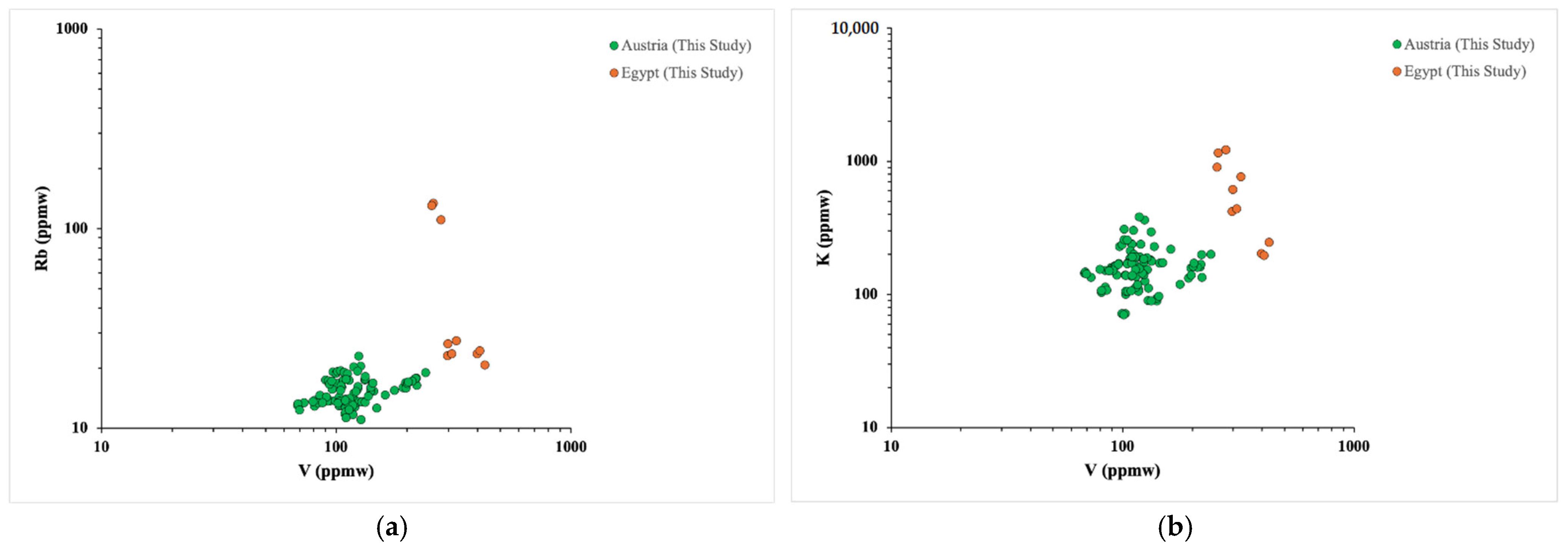
The ICP method was used for the accurate calculation of trace elements in 27 emerald samples. All samples studied with the LA–ICP–MS technique revealed similar results (Table 3), which show that Austrian emeralds contain Na2O below 2.43% and MgO between 1.88% and 3.80%, with Na2O/MgO below 1 for all analyses, while Cr/V ratios range from 5.38 to 36.36 (see also Table S1). The sum of the concentrations of all alkali metals (Li + Na + K + Rb + Cs) ranges from 1.28% to 1.87%. The amount of Cs was considered at around 370 ppmw [30,56], and the LA–ICP–MS results of this study revealed concentrations from around 115 to 390 ppmw. Relatively low contents of Li (below 195 ppmw), V (below 250 ppmw), K (below 385 ppmw), and Rb (below 25 ppmw) were also observed.
LA–ICP–MS analysis of Egyptian emeralds (Table 4) also presents low concentrations of Li (74.86–192.58 ppmw) but higher amounts of Rb (20.76–133.64 ppmw), V (255.44–429.82 ppmw), and K (196.47–1221.62 ppmw) compared to emeralds from Austria. Furthermore, the Egyptian emeralds show a relatively lower ratio of Cr/V (2.51–8.38), while the alkali content (Li + Na + K + Rb + Cs) has a narrower range from 1.47% to 1.83% (also see Table S2) compared to Austrian emeralds with a Na2O/MgO ratio ranging between 0.77 and 0.89.
Error in Figures and Tables
Following the adjustment of the LA–ICP–MS data, the revised Table 3 and Table 4 appear below and contain the data processed using the correct internal standard.

Table 3.
Results of trace element analysis for 27 emeralds from Habachtal (Austria) measured by LA-ICP-MS in ppmw.
Table 4.
Results of trace elements for 4 emerald crystals from Egypt measured by LA-ICP-MS in ppmw.
Following the corrections made in the text and to the tables, the updated Figure 12 appears below:
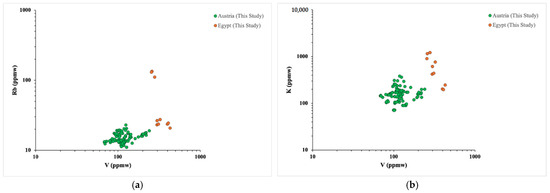
Figure 12.
Binary plots of trace elements in LA–ICP–MS results from emerald samples from Austria and Egypt. (a) V versus Rb binary plot, (b) V versus K binary plot.
The supplementary materials related to the LA–ICP–MS analysis have also been corrected accordingly.
The authors state that the scientific conclusions are unaffected. This correction was approved by the Academic Editor. The original publication has also been updated.
Reference
- Nikopoulou, M.; Karampelas, S.; Hennebois, U.; Gruss, P.; Gaillou, E.; Fritsch, E.; Herreweghe, A.; Papadopoulou, L.; Melfos, V.; Kantiranis, N.; et al. Microscopic, Spectroscopic and Chemical Analysis of Emeralds from Habachtal, Austria. Minerals 2025, 15, 22. [Google Scholar] [CrossRef]
Disclaimer/Publisher’s Note: The statements, opinions and data contained in all publications are solely those of the individual author(s) and contributor(s) and not of MDPI and/or the editor(s). MDPI and/or the editor(s) disclaim responsibility for any injury to people or property resulting from any ideas, methods, instructions or products referred to in the content. |
© 2025 by the authors. Licensee MDPI, Basel, Switzerland. This article is an open access article distributed under the terms and conditions of the Creative Commons Attribution (CC BY) license (https://creativecommons.org/licenses/by/4.0/).