Improving Marine Mineral Delineation with Planar Self-Potential Data and Bayesian Inversion
Abstract
1. Introduction
2. Theory
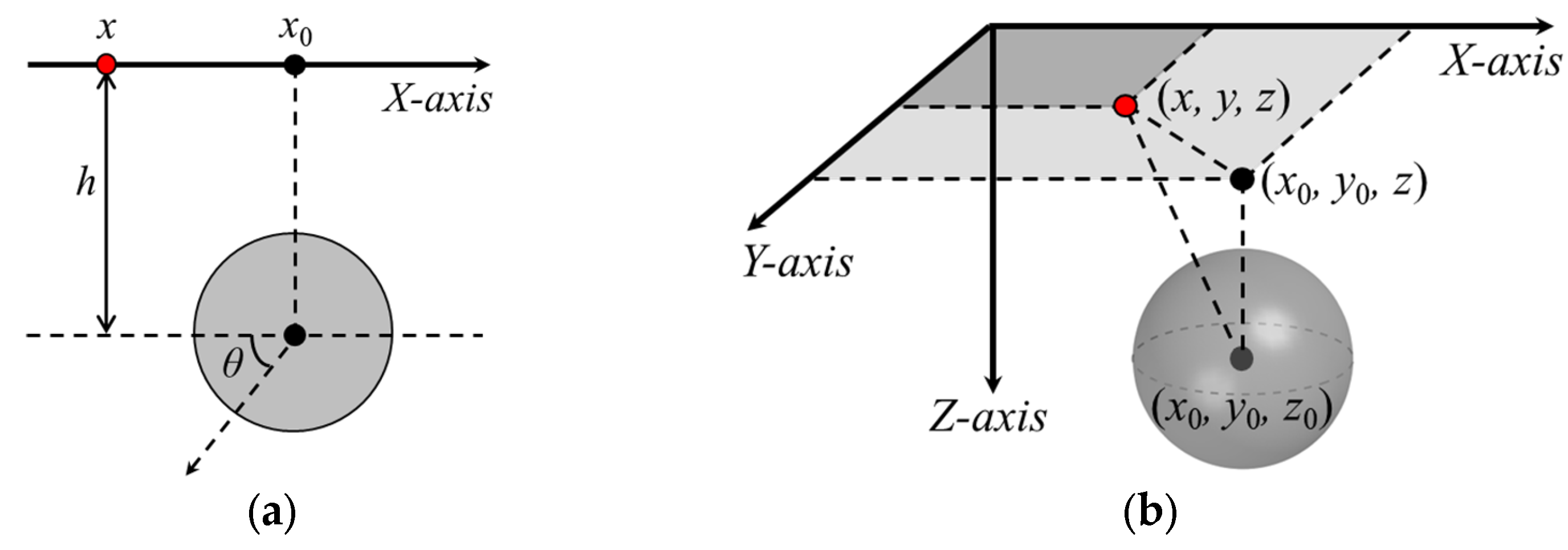
2.1. Analytical Solution for Planar Acquisition
2.2. Uncertainty Inversion by MCMC
- 1.
- Initialization:
- 2.
- Candidate sampling:
- 3.
- Acceptance criterion:
- 4.
- Iteration:
3. Synthetic Case Validation
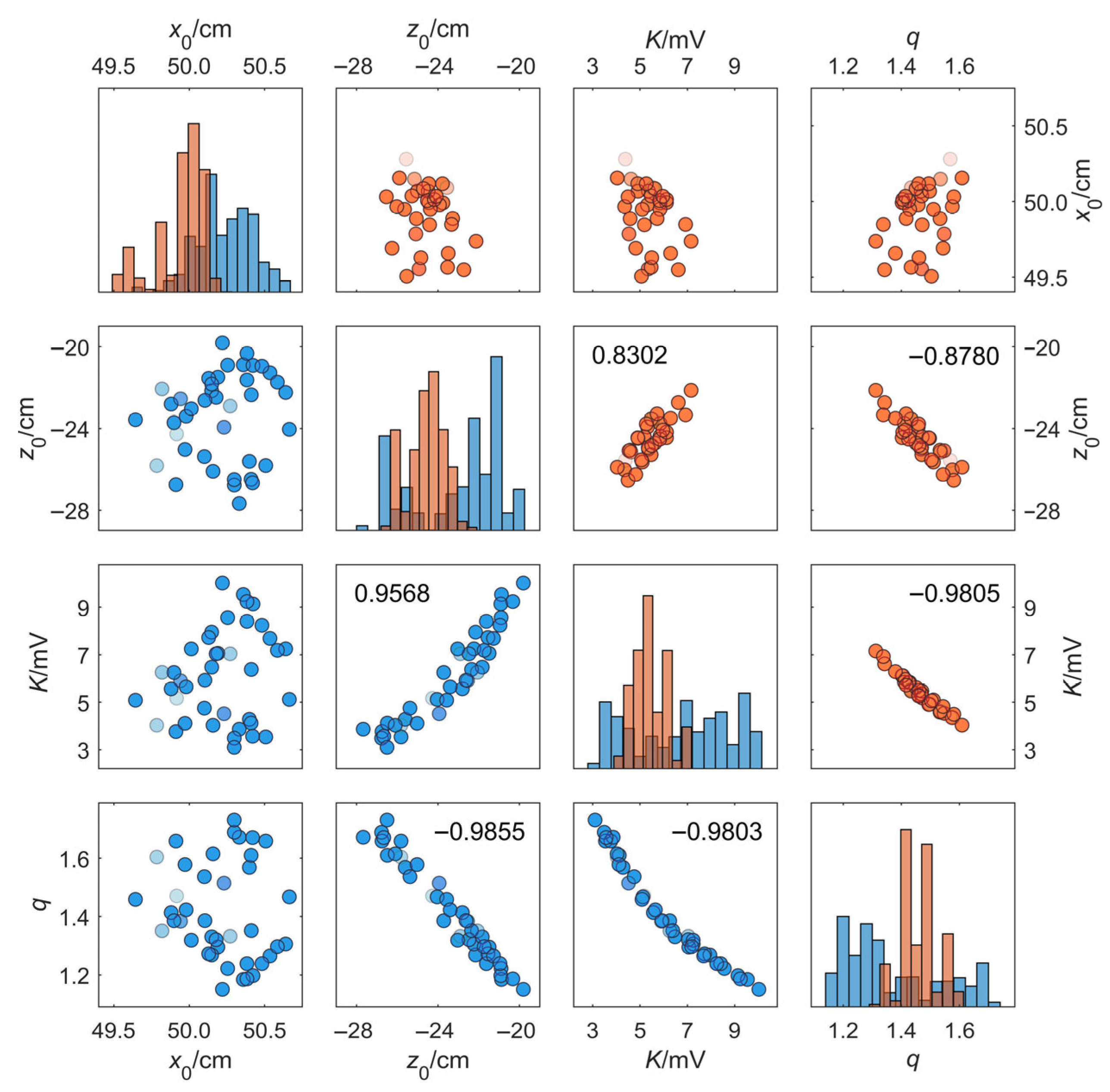
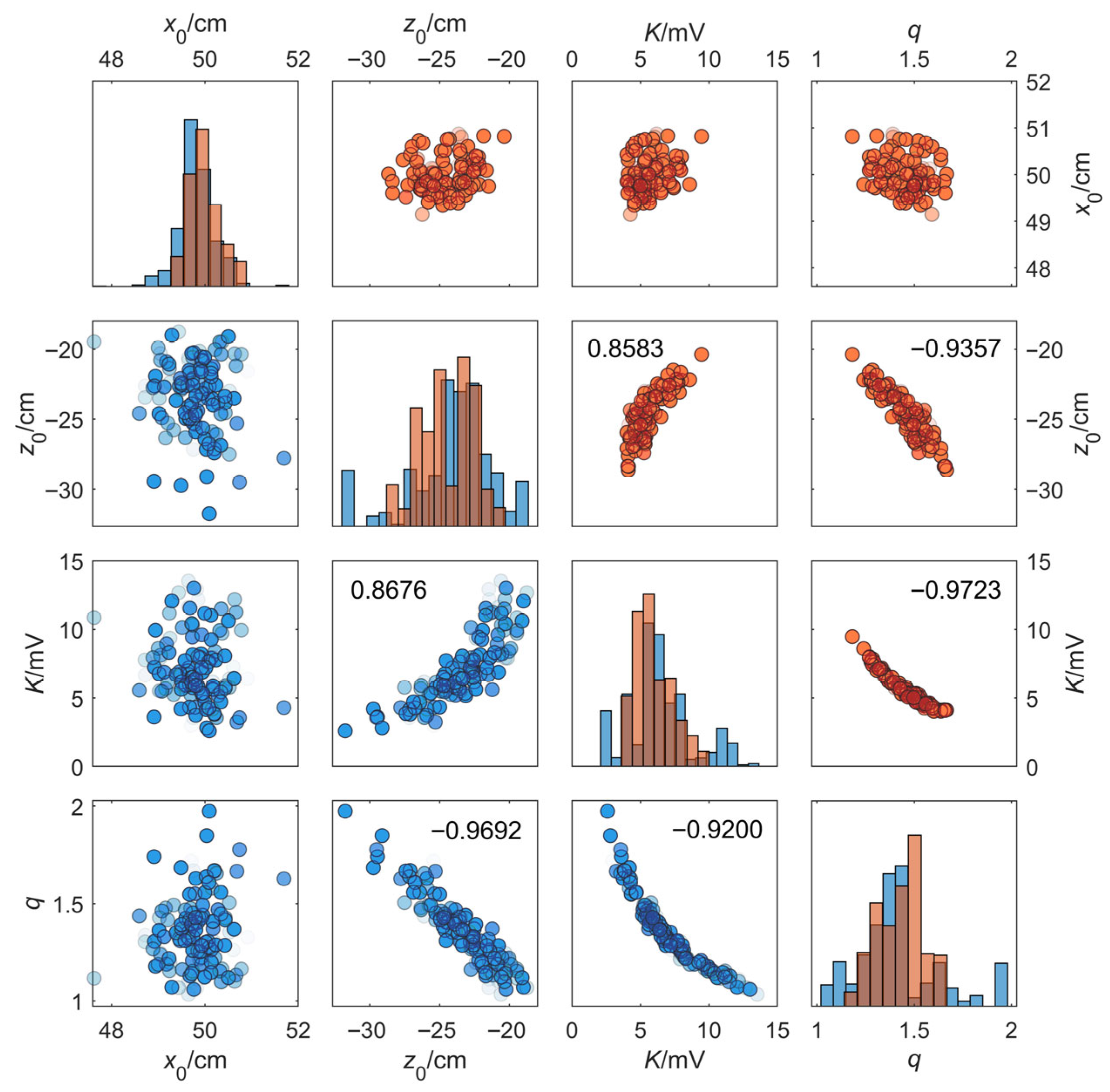
3.1. Laboratory-Scale Case
3.2. Field-Scale Case
4. Laboratory Experiment Validation
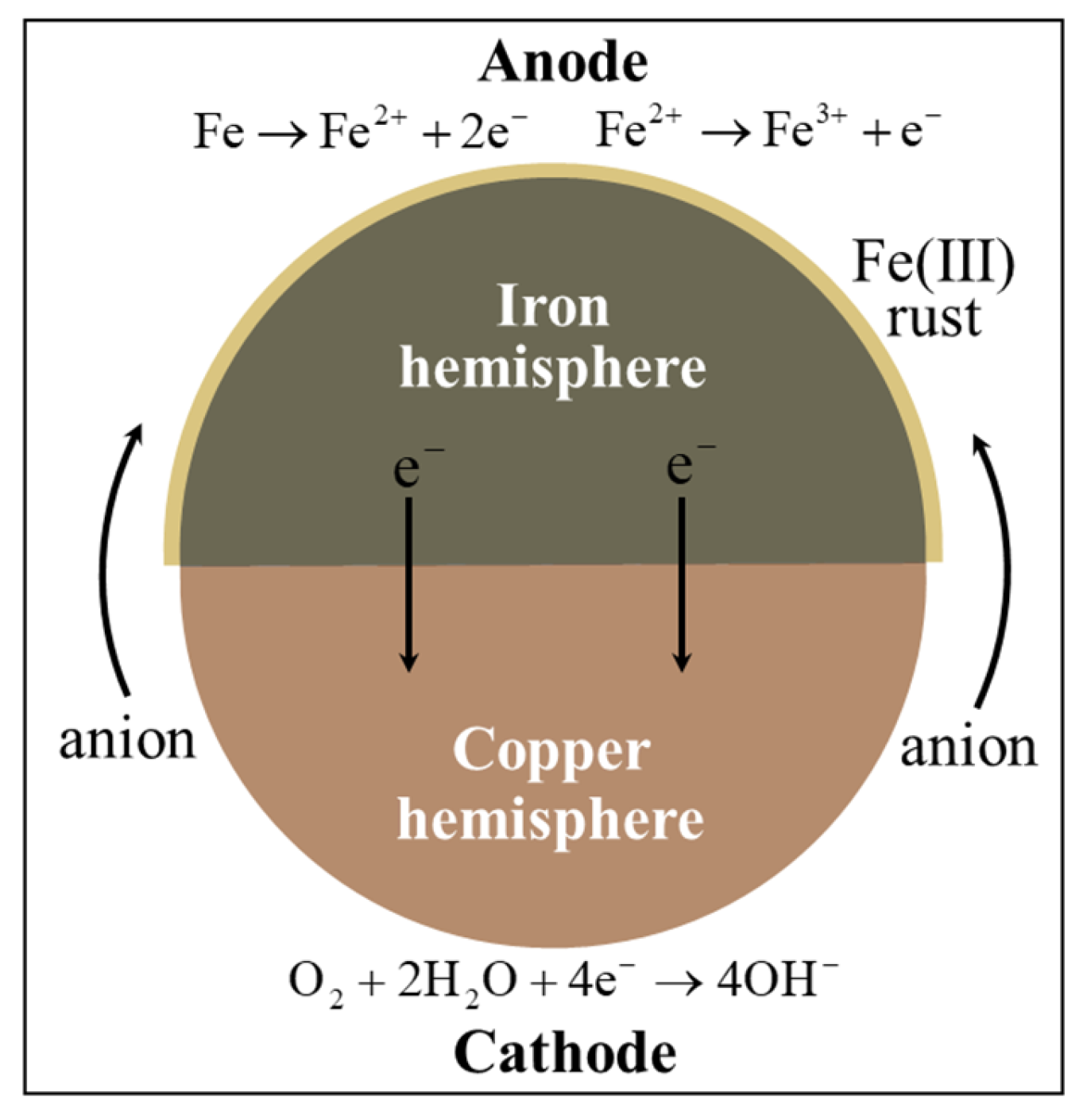
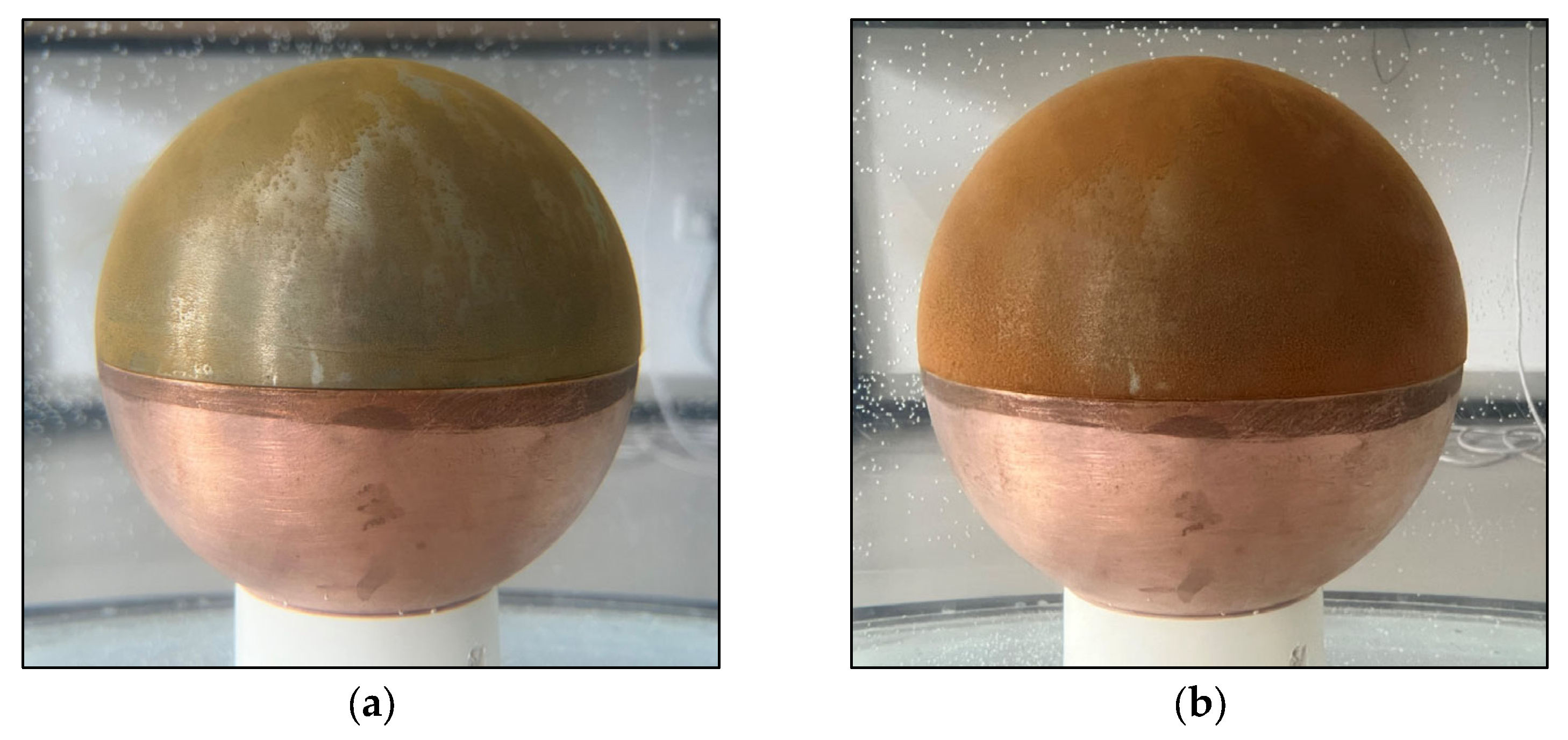
4.1. Laboratory Experiment
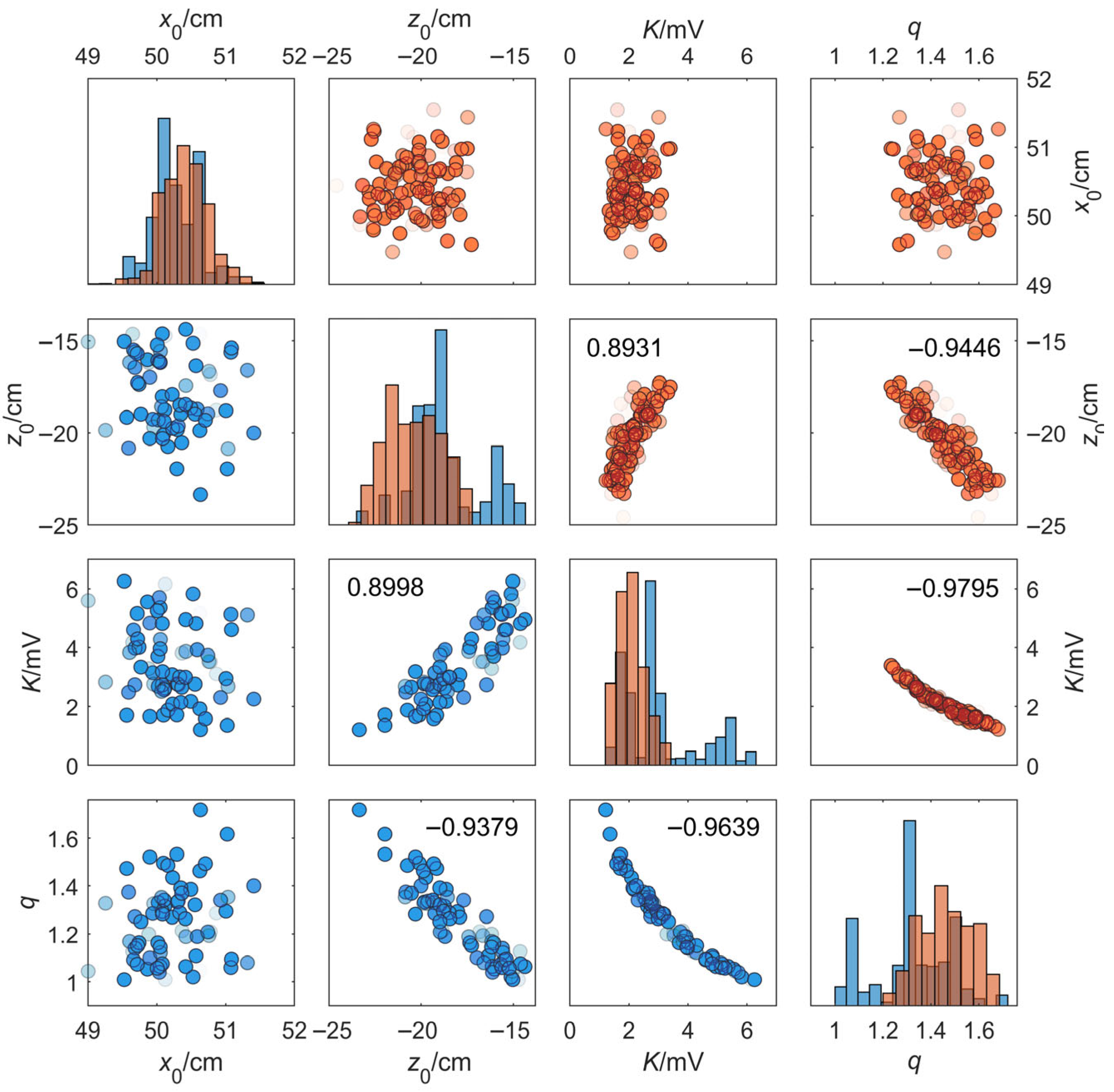
4.2. MCMC Inversion
5. Conclusions
Author Contributions
Funding
Data Availability Statement
Conflicts of Interest
References
- Toro, N.; Robles, P.; Jeldres, R.I. Seabed mineral resources, an alternative for the future of renewable energy: A critical review. Ore Geol. Rev. 2020, 126, 103699. [Google Scholar] [CrossRef]
- Vysetti, B. Deep-sea mineral deposits as a future source of critical metals, and environmental issues—A brief review. Miner. Miner. Mater. 2023, 2, 5. [Google Scholar] [CrossRef]
- Miller, K.A.; Thompson, K.F.; Johnston, P.; Santillo, D. An overview of seabed mining including the current state of development, environmental impacts, and knowledge gaps. Front. Mar. Sci. 2018, 4, 418. [Google Scholar] [CrossRef]
- Ma, W.; Zhang, K.; Du, Y.; Liu, X.; Shen, Y. Status of sustainability development of deep-sea mining activities. J. Mar. Sci. Eng. 2022, 10, 1508. [Google Scholar] [CrossRef]
- Yao, W.; Tian, C.; Teng, Y.; Diao, F.; Du, X.; Gu, P.; Zhou, W. Development of deep-sea mining and its environmental impacts: A review. Front. Mar. Sci. 2025, 12, 1598584. [Google Scholar] [CrossRef]
- Wu, C.; Zou, C.; Peng, C.; Liu, Y.; Wu, T.; Zhou, J.; Tao, C. Numerical simulation study on the relationships between mineralized structures and induced polarization properties of seafloor polymetallic sulfide rocks. Minerals 2022, 12, 1172. [Google Scholar] [CrossRef]
- Yang, Y.; Zhang, G.; Yao, C.; Deng, Z.; Ren, Z.; Li, C. Application of induced polarization method in mineral resource exploration. Sustainability 2023, 15, 3840. [Google Scholar] [CrossRef]
- Ishizu, K.; Goto, T.; Ohta, Y.; Kasaya, T.; Iwamoto, H.; Vachiratienchai, C.; Siripunvaraporn, W.; Tsuji, T.; Kumagai, H.; Koike, K. Internal structure of a seafloor massive sulfide deposit by electrical resistivity tomography, Okinawa Trough. Geophys. Res. Lett. 2019, 46, 11025–11034. [Google Scholar] [CrossRef]
- Kasaya, T.; Iwamoto, H.; Kawada, Y.; Hyakudome, T. Marine DC resistivity and self-potential survey in the hydrothermal deposit areas using multiple AUVs and ASV. Terr. Atmos. Ocean. Sci. 2020, 31, 579–588. [Google Scholar] [CrossRef]
- Gehrmann, R.A.S.; North, L.J.; Graber, S.; Szitkar, F.; Petersen, S.; Minshull, T.A.; Murton, B.J. Marine mineral exploration with controlled source electromagnetics at the TAG hydrothermal field, 26°N mid-Atlantic ridge. Geophys. Res. Lett. 2019, 46, 5808–5816. [Google Scholar] [CrossRef]
- Ishizu, K.; Kasaya, T.; Goto, T.-N.; Koike, K.; Siripunvaraporn, W.; Iwamoto, H.; Kawada, Y.; Ishibashi, J.-I. A marine controlled-source electromagnetic application using towed and seafloor-based receivers capable of mapping seafloor and embedded massive sulfides. Geophysics 2024, 89, 1MJ-V305. [Google Scholar] [CrossRef]
- Zhang, B.; Qu, K.; Yin, C.; Wang, Y.; Liu, Y.; Ren, X.; Su, Y. Review of 3D electromagnetic modeling and inversion for mineral exploration. Geophysics 2025, 90, E87–E99. [Google Scholar] [CrossRef]
- Araya, A.; Kanazawa, T.; Shinohara, M.; Yamada, T.; Fujimoto, H.; Iizasa, K.; Ishihara, T. Gravity gradiometer implemented in AUV for detection of seafloor massive sulfides. In Proceedings of the 2012 Oceans, Hampton Roads, VA, USA, 14–19 October 2012. [Google Scholar]
- Honsho, C.; Yamazaki, T.; Ura, T.; Okino, K.; Morozumi, H.; Ueda, S. Magnetic anomalies associated with abundant production of pyrrhotite in a sulfide deposit in the Okinawa Trough, Japan. Geochem. Geophys. Geosyst. 2016, 17, 4413–4424. [Google Scholar] [CrossRef]
- Kawada, Y.; Kasaya, T. Marine self-potential survey for exploring seafloor hydrothermal ore deposits. Sci. Rep. 2017, 7, 13552. [Google Scholar] [CrossRef] [PubMed]
- Zhu, Z.; Tao, C.; Shen, J.; Revil, A.; Deng, X.; Liao, S.; Zhou, J.; Wang, W.; Nie, Z.; Yu, J. Self-potential tomography of a deep-sea polymetallic sulfide deposit on southwest Indian ridge. J. Geophys. Res. Solid Earth 2020, 125, e2020JB019738. [Google Scholar] [CrossRef]
- Su, Z.; Tao, C.; Zhu, Z.; Revil, A.; Shen, J.; Nie, Z.; Li, Q.; Deng, X.; Zhou, J.; Liu, L. Joint interpretation of marine self-potential and transient electromagnetic survey for seafloor massive sulfide (SMS) deposits: Application at TAG hydrothermal mound, Mid-Atlantic Ridge. J. Geophys. Res. Solid Earth 2022, 127, e2022JB024496. [Google Scholar] [CrossRef]
- Xie, J.; Cui, Y.; Liu, J.; Guo, Y.; Zhang, L.; Luo, Y.; Zhang, P. A review on theory, modeling, inversion, and application of self-potential in marine mineral exploration. Trans. Nonferrous Met. Soc. China 2023, 33, 1214–1232. [Google Scholar] [CrossRef]
- Biswas, A. A review on modeling, inversion and interpretation of self-potential in mineral exploration and tracing paleo-shear zones. Ore Geol. Rev. 2017, 91, 21–56. [Google Scholar] [CrossRef]
- Mehanee, S.A. Simultaneous joint inversion of gravity and self-potential data measured along profile: Theory, numerical examples, and a case study from mineral exploration with cross validation from electromagnetic data. IEEE Trans. Geosci. Remote. Sens. 2022, 60, 4701620. [Google Scholar] [CrossRef]
- Mehanee, S.A. An efficient regularized inversion approach for self-potential data interpretation of ore exploration using a mix of logarithmic and non-logarithmic model parameters. Ore Geol. Rev. 2014, 57, 87–115. [Google Scholar] [CrossRef]
- Biswas, A.; Sharma, S.P. Interpretation of self-potential anomaly over idealized body and analysis of ambiguity using very fast simulated annealing global optimization. Near Surf. Geophys. 2015, 13, 179–195. [Google Scholar] [CrossRef]
- Fedi, M.; Abbas, M.A. A fast interpretation of self-potential data using the depth from extreme points method. Geophysics 2013, 78, E107–E116. [Google Scholar] [CrossRef]
- Kawada, Y.; Kasaya, T. Self-potential mapping using an autonomous underwater vehicle for the Sunrise deposit, Izu-Ogasawara arc, southern Japan. Earth, Planets Space 2018, 70, 142. [Google Scholar] [CrossRef]
- Constable, S.; Kowalczyk, P.; Bloomer, S. Measuring marine self-potential using an autonomous underwater vehicle. Geophys. J. Int. 2018, 215, 49–60. [Google Scholar] [CrossRef]
- Zhu, Z.; Shen, J.; Tao, C.; Deng, X.; Wu, T.; Nie, Z.; Wang, W.; Su, Z. Autonomous-underwater-vehicle-based marine multicomponent self-potential method: Observation scheme and navigational correction. Geosci. Instrum. Methods Data Syst. 2021, 10, 35–43. [Google Scholar] [CrossRef]
- Su, Z.; Tao, C.; Shen, J.; Revil, A.; Zhu, Z.; Deng, X.; Nie, Z.; Li, Q.; Liu, L.; Wu, T.; et al. 3D self-potential tomography of seafloor massive sulfide deposits using an autonomous underwater vehicle. Geophysics 2022, 87, B255–B267. [Google Scholar] [CrossRef]
- Ahmed, A.S.; Jardani, A.; Revil, A.; Dupont, J. SP2DINV: A 2D forward and inverse code for streaming potential problems. Comput. Geosci. 2013, 59, 9–16. [Google Scholar] [CrossRef]
- Mendonça, C.A. Forward and inverse self-potential modeling in mineral exploration. Geophysics 2008, 73, F33–F43. [Google Scholar] [CrossRef]
- Sheffer, M.R.; Oldenburg, D.W. Three-dimensional forward modelling of streaming potential. Geophys. J. Int. 2007, 169, 839–848. [Google Scholar] [CrossRef]
- Elhussein, M. A novel approach to self-potential data interpretation in support of mineral resource development. Nat. Resour. Res. 2021, 30, 97–127. [Google Scholar] [CrossRef]
- Rao, K.; Jain, S.; Biswas, A. Global optimization for delineation of self-potential anomaly of a 2D inclined plate. Nat. Resour. Res. 2021, 30, 175–189. [Google Scholar] [CrossRef]
- Abdelazeem, M.; Gobashy, M.; Khalil, M.H.; Abdrabou, M. A complete model parameter optimization from self-potential data using Whale algorithm. J. Appl. Geophys. 2019, 170, 103825. [Google Scholar] [CrossRef]
- Xie, J.; Cui, Y.; Niu, Q. Coupled inversion of hydraulic and self-potential data from transient outflow experiments to estimate soil petrophysical properties. Vadose Zone J. 2021, 20, e20157. [Google Scholar] [CrossRef]
- Younes, A.; Zaouali, J.; Lehmann, F.; Fahs, M. Sensitivity and identifiability of hydraulic and geophysical parameters from streaming potential signals in unsaturated porous media. Hydrol. Earth Syst. Sci. 2018, 22, 3561–3574. [Google Scholar] [CrossRef]
- Vrugt, J.A.; Gupta, H.V.; Bouten, W.; Sorooshian, S. A shuffled complex evolution Metropolis algorithm for optimization and uncertainty assessment of hydrologic model parameters. Water Resour. Res. 2003, 39, 1201. [Google Scholar] [CrossRef]
- Haario, H.; Saksman, E.; Tamminen, J. An adaptive Metropolis algorithm. Bernoulli 2001, 7, 223–242. [Google Scholar] [CrossRef]
- Revil, A.; Su, Z.; Zhu, Z.; Maineult, A. Self-Potential as a tool to monitor redox reactions at an ore body: A sandbox experiment. Minerals 2023, 13, 716. [Google Scholar] [CrossRef]
- Xie, J.; Cui, Y.; Guo, R.; Chen, H.; Guo, Y.; Liu, J. A deep learning algorithm for locating contaminant plumes from self-potential: A laboratory perspective. IEEE Trans. Geosci. Remote. Sens. 2025, 63, 5902913. [Google Scholar] [CrossRef]
- Ahmad, Z. Principles of Corrosion Engineering and Corrosion Control; Elsevier: Amsterdam, The Netherlands, 2006; pp. 352–381. [Google Scholar]



| Parameter | True Value | Prior Mean | Prior Bounds | Inversion Results of Single-Line Data | Inversion Results of Planar Data |
|---|---|---|---|---|---|
| x0 (cm) | 50 | 30 | 0~100 | 50.24 (0.5%) | 49.95 (1.0%) |
| [49.90, 50.54] 1.3% | [49.57, 50.12] 1.1% | ||||
| z0 (cm) | −25 | −15 | −50~0 | −22.87 (8.5%) | −24.53 (1.9%) |
| [−26.77, −19.81] 27.8% | [−26.03, −23.34] 10.8% | ||||
| K (mV) | 5 | 10 | 0~20 | 6.81 (36.2%) | 5.42 (8.4%) |
| [3.49, 10.02] 130.6% | [4.35, 6.93] 51.6% | ||||
| q (-) | 1.5 | 1.2 | 1~2 | 1.37 (8.7%) | 1.46 (2.7%) |
| [1.15, 1.69] 36.0% | [1.34, 1.58] 16.0% |
| Parameter | True Value | Prior Mean | Prior Bounds | Inversion Results of Single-Line Data | Inversion Results of Planar Data |
|---|---|---|---|---|---|
| x0 (cm) | 50 | 30 | 0~100 | 49.84 (0.3%) | 49.98 (0.4%) |
| [48.94, 50.50] 3.1% | [49.49, 50.68] 2.4% | ||||
| z0 (cm) | −25 | −15 | −50 0 | −24.11 (3.6%) | −24.47 (2.1%) |
| [−31.75, −19.01] 51.0% | [−28.37, −21.65] 26.9% | ||||
| K (mV) | 5 | 10 | 0~20 | 6.45 (29.0%) | 5.90 (18.0%) |
| [2.59, 12.07] 189.6% | [4.11, 8.59] 89.6% | ||||
| q (-) | 1.5 | 1.2 | 1~2 | 1.42 (5.3%) | 1.44 (4.0%) |
| [1.07, 1.97] 60.0% | [1.24, 1.65] 27.3% |
| Parameter | True Value | Prior Mean | Prior Bounds | Inversion Results of Single-Line Data | Inversion Results of Planar Data |
|---|---|---|---|---|---|
| x0_1 (m) | 60 | 80 | 0~200 | 60.26 (0.4%) | 60.09 (0.2%) |
| [59.12, 60.97] 3.1% | [59.45, 60.65] 2.0% | ||||
| x0_2 (m) | 140 | 120 | 0~200 | 140.19 (0.1%) | 140.61 (0.4%) |
| [139.22, 140.62] 1.0% | [139.77, 140.69] 0.7% | ||||
| z0_1 (m) | −15 | −10 | −50~0 | −14.26 (4.9%) | −14.63 (2.5%) |
| [−15.27, −13.74] 10.2% | [−15.19, −14.47] 4.8% | ||||
| z0_2 (m) | −15 | −10 | −50~0 | −14.54 (3.1%) | −14.78 (1.5%) |
| [−15.23, −13.88] 9.0% | [−15.32, −14.41] 6.1% | ||||
| K_1 (mV) | 1000 | 600 | 500~1500 | 642.53 (35.7%) | 934.63 (6.5%) |
| [514.82, 1060.76] 54.6% | [892.38, 1048.48] 15.6% | ||||
| K_2 (mV) | 1000 | 600 | 500~1500 | 754.58 (24.5%) | 909.78 (9.0%) |
| [534.02, 893.11] 35.9% | [866.97, 1109.30] 24.2% | ||||
| q_1 (-) | 1.5 | 1.2 | 1~2 | 1.43 (4.7%) | 1.49 (0.7%) |
| [1.21, 1.62] 27.3% | [1.37, 1.64] 18.0% | ||||
| q_2 (-) | 1.5 | 1.2 | 1~2 | 1.45 (3.3%) | 1.48 (1.3%) |
| [1.28, 1.59] 20.7% | [1.35, 1.57] 14.7% |
| Parameter | True Value | Prior Mean | Prior Bounds | Inversion Results of Single-Line Data | Inversion Results of Planar Data |
|---|---|---|---|---|---|
| x0 (cm) | 50 | 30 | 0~100 | 50.26 (0.5%) | 50.27 (0.5%) |
| [49.56, 51.02] 2.9% | [49.96, 50.98] 2.0% | ||||
| z0 (cm) | −20 | −10 | −50~0 | −18.68 (6.6%) | −20.63 (3.2%) |
| [−21.96, −14.62] 36.7% | [−22.71, −17.98] 23.7% | ||||
| K (mV) | \ | 10 | 0~20 | 2.99 | 2.04 |
| [1.36, 5.82] | [1.46, 2.97] | ||||
| q (-) | 1.5 | 1.2 | 1~2 | 1.32 (12.0%) | 1.48 (1.3%) |
| [1.02, 1.62] 40.0% | [1.30, 1.63] 22.0% |
Disclaimer/Publisher’s Note: The statements, opinions and data contained in all publications are solely those of the individual author(s) and contributor(s) and not of MDPI and/or the editor(s). MDPI and/or the editor(s) disclaim responsibility for any injury to people or property resulting from any ideas, methods, instructions or products referred to in the content. |
© 2025 by the authors. Licensee MDPI, Basel, Switzerland. This article is an open access article distributed under the terms and conditions of the Creative Commons Attribution (CC BY) license (https://creativecommons.org/licenses/by/4.0/).
Share and Cite
Zhang, L.; Feng, S.; Xu, S.; Huang, D.; Li, H.; Su, Y.; Xie, J. Improving Marine Mineral Delineation with Planar Self-Potential Data and Bayesian Inversion. Minerals 2025, 15, 1330. https://doi.org/10.3390/min15121330
Zhang L, Feng S, Xu S, Huang D, Li H, Su Y, Xie J. Improving Marine Mineral Delineation with Planar Self-Potential Data and Bayesian Inversion. Minerals. 2025; 15(12):1330. https://doi.org/10.3390/min15121330
Chicago/Turabian StyleZhang, Lijuan, Shengfeng Feng, Shengcai Xu, Dingyu Huang, Hewang Li, Ying Su, and Jing Xie. 2025. "Improving Marine Mineral Delineation with Planar Self-Potential Data and Bayesian Inversion" Minerals 15, no. 12: 1330. https://doi.org/10.3390/min15121330
APA StyleZhang, L., Feng, S., Xu, S., Huang, D., Li, H., Su, Y., & Xie, J. (2025). Improving Marine Mineral Delineation with Planar Self-Potential Data and Bayesian Inversion. Minerals, 15(12), 1330. https://doi.org/10.3390/min15121330