


Abstract
There was a hiatus in magmatism in Korea and Japan, located on the eastern continental margin of Asia, during a period of about 40 Ma from 160 Ma to 120 Ma. The cause of the resumption of magmatism since then is not yet well understood. In this study, we analyzed the Hf isotope composition of detrital zircons in the Cretaceous sediments of Korea (Hayang Group) and Japan (Goshoura and Himenoura groups) to investigate the tectonic evolution of eastern Asia in the Early Cretaceous period. εHf(t) in Cretaceous zircons from Japanese samples values from +8.2 to +0.1, suggesting that magmatism was sourced from the depleted juvenile materials, which is compatible with ridge subduction and subsequent melting of the young oceanic crust. εHf(t) values from Cretaceous zircons in the Hayang Group are negative, except for the Jindong Formation, which had a sediment supply from Japan, indicating that the old continental crust material of the Korean Peninsula was included in the magma generation. The detrital zircons of this study exhibit a depleted isotopic character at the beginning of subduction-related magmatism in Permian and Early Cretaceous, and then gradually change to a more enriched composition. This trend may be a typical example of the Pacific-type orogenic cycle.
1. Introduction and General Geology
The assembly of continental fragments in East Asia appears to have been completed during the Early Triassic period, when there was a continental collision between North China and South China blocks [1,2]. In the process of assembling continental fragments such as South China Block, North China Block, and Japanese Islands in this region, the Paleo-Pacific plates to the east have subducted below them and have triggered various tectonic activities and tectono-magmatic processes, including subduction-related magmatism [3,4,5], metamorphism [6,7,8], and terrestrial basin formation [9,10,11]. However, in the eastern margin of the Eurasia continent, especially in Japanese islands, igneous activities related to subduction of the Paleo-Pacific plate are observed even long before its complete assembly. The Japanese Islands have been affected by the subduction of Paleo-Pacific plates since about 500 Ma [12]. Since this time, there were several cyclic igneous activities called Pacific-type orogeny, and arc-related pull-apart sedimentary basins developed within the Japanese Islands [5,13]. As a result, the Japanese islands today consist mainly of tectonic units such as Paleozoic to Cenozoic accretionary complexes, high-pressure metamorphic belts, granite batholith suits, and sedimentary basins [5].
During the Phanerozoic subduction of Paleo-Pacific plates in the East Asian continental margin formed tectonic cycles repeated several times. It has been suggested that each cycle begins with an ocean ridge subduction (e.g., the Renge (Carboniferous), Farallon (Triassic), Izanagi (early Cretaceous), and Kula (late Cretaceous) [5]). The subduction of the Izanagi plate produced coeval Cretaceous orogenic components such as the Sanbagawa high-pressure metamorphic belt, the Sanbosan accretionary complex, the Ryoke-Sanyo batholith belt, and several sedimentary basins [13,14,15]. When each of these cycles begins and ends, and what characteristics do each of these cycles have over time is important in understanding these tectonic cycles. For example, the Mesozoic magmatism in Korea and Japan had a quiescent period from about 160 Ma to about 120 Ma [16,17,18].
The detrital zircons in sediments are suitable for studying the history of magmatism because they can comprehensively sample magmatism in the sediment source area and thus record the petrologic history of an arc. The detrital zircons of the Cretaceous basins of the Korean peninsula and Japanese islands, created by tectonic regime change during the Early Cretaceous period, are thought to be recording these changes in tectonic settings and magmatism [11,19,20]. The U-Pb age and Hf isotopic data of the detrital zircon can be used to trace the origin of the sediments, to limit the maximum deposition time, and to trace the tectonic environment and source materials of the magma-generated magma [21]. This study attempts to find out the temporal distribution of magmatism before the sedimentation by finding the distribution of U-Pb ages from the detrital zircons of the Cretaceous sediments in these regions, i.e., the Hayang Group in the southeastern Korean peninsula and Himenoura and Goshoura Group in SW Japan. From this, we verify the resumption period of early Cretaceous subduction-related magmatism, and also attempt to clarify the characteristics and tectonic settings of magmatism in that period through Hf isotope analysis of these zircons.
Sedimentary basins were produced in many places in Korea and Japan in the Cretaceous Period. The largest of these is the Gyeongsang Basin in the southeastern part of the Korean peninsula and consists of Sindong, Hayang, and Yucheon groups from the bottom. The Gyeongsang Basin was produced as a terrestrial back-arc basin [9]. No evidence of igneous activity in the early stages of basin formation was found, but detrital zircons with an age of about 128 Ma were found in the Nakdong Formation, the lowest layer, limiting the timing of basin formation [11]. Compared to the Sindong Group, where the detrital zircons of the Cretaceous age rarely appear, the overlying Hayang Group includes a high proportion of Cretaceous age zircons, especially those from about 120–110 Ma [19]. This indicates that there was enhanced igneous activity from this period and the tectonic environment gradually changed to intra-arc [19]. Cretaceous basins exist in several places in Southwest Japan. Among them, the Kanmon Group in Kyushu seems to have provenance of much of the sediment in the Korean Peninsula [22], suggesting that it was linked to Gyeongsang Basin at the time of deposition. The Cretaceous basins in Kyushu, unlike Korea, exhibit the characteristics of marine basins. However, there is evidence that sediments originated from the Korean Peninsula as detrital zircons include Paleoproterozoic ages, which are not present in Japan but characteristic of Precambrian basement rocks on the Korean Peninsula [22].
The Upper Cretaceous Himenoura Group and Geoshoura Group are distributed throughout the region including the Amakusa Islands, Kosikijima Islands, and the Uto Peninsulain in the western side of Kyushu (Figure 1) [23,24,25]. The basement rocks of Amakusa Island and the Uto Peninsula consist mainly of Cretaceous Higo plutonic-metamorphic rocks and Nagasaki metamorphic rocks [24]. The unconformably overlying rocks are composed of the Cretaceous Goshoura Group, Himenoura Group, Paleogene Miroku Group, Hondo Group, Sakasegawa Group, Neogene Kunhinotsu Group, and Paleogene to Neogene granitoids intruding into them. The Goshoura group is mainly distributed on the islands of Goshoura and Shishijima, which is the eastern part of the Amakusa Islands, and unconformably overlies the Higo Granitoids. The Goshoura Group is divided into Eboshi, Enokuchi, and Karakizaki formations in ascending order and consists of pebble bearing sandstone, sandstone and mudstone. Depositional environments of the Goshoura Group vary from terrestrial to marine deposits (e.g., floodplain, intertidal zone, and continental shelf) because of effects on sea-level fluctuation caused by repeated transgression and regression. Abundant mollusk fossils such as ammonite and bivalve have been reported from this group, suggesting that the sedimentation of the Goshoura Group ranges from Albian to Cenomanian [26,27].
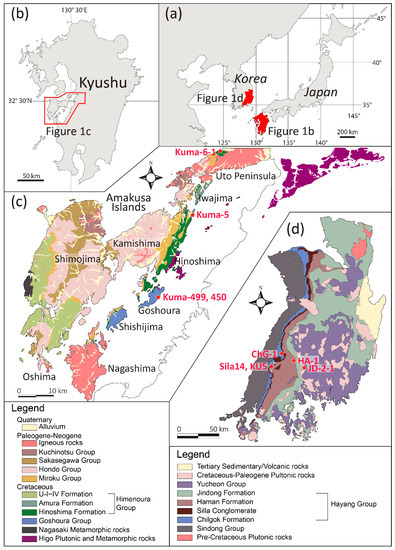
Figure 1.
Geological map of the Gyeongsang basin in southeastern Korea (after Lee et al. 2018) [19] and the Amakusa Islands (after Saito et al. 2010) [23] with sample locations. (a) East Asia map including Korea and Japan. The positions of Kyushu and the Gyeongsang Basin are marked in red. (b) The inset within Kyushu marks the location of the Amakusa Islands and Uto Peninsula, where the Cretaceous Himenoura and Goshoura groups are distributed. (c) The distribution of the Cretaceous Himenoura and Goshoura groups and sampling locations from them are shown. (d) It is a schematic geological map of the Cretaceous Gyeongsang basin and also shows the sampling locations in the Hayang Group.
The Himenoura Group extends from northeast to southwest and is exposed to the northeast of the Amakusa Islands. It is unconformable overlying the Higo plutonic and metamorphic rocks and the Goshoura Group and unconformably overlained by the Paleogene Miroku Group. The Himenora group is divided into lower subgroup and upper subgroup, the former consists of the lower Hinoshima Formation and the upper Amura Formation, and the latter consists of four formations from the U-I layer to the U-IV layer. Lower Hinoshima Formation is characterized by sedimentation of fining-upward sequences consisting of conglomerate, sandstone and mudstone, and upper Amura Formation is characterized by alternation of mudstone and sandstone. The Himenoura Group shows a variety of sedimentary environments from shallow marine to continental slopes and as well as pelagic deposits. In addition, the sedimentary environmental characteristics of the incised valleys have been reported from the lower part. Diverse fossils such as foraminiferas, radiolarians, ammonoids, and inoceramids have been found from the Himenoura Group, suggesting ages from Santonian to Campanian [28,29]. Recent zircon U-Pb age determination from felsic tuffs and suggested that the depositional ages of Hinoshima and Amura Formation were 85.4 ± 1.3 Ma (n = 15, MSWD = 0.83) and 81.5 ± 1.1 Ma (n = 20, MSWD = 1.3), respectively [25].
The Gyeongsang Basin is a Cretaceous non-marine sedimentary basin located southeast of the Korean peninsula (Figure 1). The west and north of the Gyeongsang Basin are surrounded by the Yeongnam Massif consisting of Paleoproterozoic metamorphic rocks and Mesozoic granitoids that intrude them. The east and south of the Gyeongsang basin face the sea. The Cretaceous Gyeongsang Supergroup deposited in the Gyeongsang basin consists of Sindong, Hayang, and Yucheon groups in ascending order [30]. The Hayang Group of the Miryang sub-basin is composed of Chilgok Formation, Silla Conglomerate, Haman Formation, and Jindong Formation in ascending order [31]. These formations were deposited in either alluvial, fluvial, or lacustrine environments [32]. In the lower layers of the Gyeongsang Basin, sediments were supplied by waters flowing from the west and northwest [33,34,35,36], but sediments constituting the upper layers were supplied from streams flowing from the east, the direction of the Japanese islands connected to the Korean Peninsula at the time [32,37,38,39]. The maximum depositional ages of the four formations constituting the Hayang Group defined from the youngest U-Pb age populations of detrital zircons are as follows; 109 Ma for the Chilgok Formation, 106 Ma for the Silla Conglomerate, 105 Ma for the Haman Formation, and 100 Ma for the Jindong Formation [19].
2. Samples and Analytic Methods
In this study, the hafnium isotopic compositions of detrital zircons were analyzed to study the characteristics of the subduction-related igneous activity resumed in the Cretaceous period. Therefore, samples were selected for sedimentary layers that are expected to have many detrital zircons of Cretaceous age. For the Gyeongsang Basin in Korea, we used the Hayang Group samples whose detrital zircon U-Pb ages have already been reported [19]; two in the Silla Conglomerate (Sila14, KU5) and one in each of the Chilgok (CG-1), Haman (HA-1), and Jindong (JD-2-1) Formations. For U-Pb age measurement and Hf isotope analysis, we used two sandstone samples from the upper Cretaceous Himenoura Group (Kuma-5, Kuma-6-1) and two samples from the mid Cretaceous Goshoura Group (Kuma-449 and Kuma-450), Kyushu, SW Japan, collected during the IGCP-507 field trip (Figure 1) [24]. Two samples of the Goshoura Group (Kuma-499, 450) were collected from a quarry on Goshoura Island. Sample Kuma-6 was collected from the lower Hinoshima Formation of the Himenoura group of the Uto Peninsula. The Kuma-5 sample was taken from the upper Amur Formation of the Himenoura Group on Kamishima Island.
U-Pb age determination of zircons separated from four samples of the Himenoura and Goshoura groups was conducted using Sensitive High-Resolution Ion Micro Probe (SHIRMP-IIe/Mc) operated by Korea Basic Science Institute (KBSI). For the SHRIMP U-Pb age determination, the O2− primary ion beam was used with diameter of about 25 μm and beam current of 2.0–4.0 nA. Zircon standards SL13 (U 238 ppm) and FC-1 (1099 Ma) [40] were used for uranium concentration and age calibration, respectively. All uncertainties for individual analysis points in the data table are quoted at one sigma level. Data reduction was performed using the SQUID 2.5 program [41]. Tera-Wasserburg diagrams, condordia ages, age histograms, and probability density plots were constructed using Isoplot 3.71 [42]. The 207Pb correction method was applied for 206Pb/238U ages below 1000 Ma, and the 204Pb correction method was applied for 207Pb/206Pb ages greater than 1000 Ma.
Hf isotope data for zircons were obtained from the same analysis spots as the U-Pb age measurements. Hf isotope composition was measured in KBSI using a Nu Plasma II multi collector inductively coupled plasma mass spectrometer equipped with a New Wave Research 193 nm ArF excimer ablation system (LA-MC-ICPMS). For Hf isotope analysis, 10 Faraday collectors were set up for simultaneous detection of Hf-Lu-Yb isotopes. Instrument parameters and operating conditions include spot size 50 μm, 10 Hz repetition rate, and energy density of 6–8 J/cm2. He (650 mL/min) and N2 (2 mL/min) were used as carrier gases for high Hf isotope intensity [43]. The spot depth in Hf isotope analysis is in the range of 15–30 μm. To monitor the measured isotope ratios, we used a time-resolved analytical (TRA) procedure. Signal intensities for each collector were collected every 0.2 s integration time. Background intensity, dwell time, and wash out time were measured for 35 s, 60 s, and 15 s, respectively. The isobaric interferences of 176Lu and 176Yb for the 176Hf signals were corrected using Chu et al. [44] and Vervoort, Patchett, Soderlund, and Baker [45]. The mass bias of the measured Hf isotope ratio was corrected to 179Hf/177Hf = 0.7325 using the exponential correction law [46]. All individual analyzes were calculated with 2-sigma uncertainty and data reduction was conducted with the Iolite 2.5 software program [47].
3. Results
3.1. U-Pb Age of the Detrital Zircons from the Himenoura and Goshoura Groups
Most of the detrital zircons separated from the sandstones of the Himenoura Group and the Goshoura Group of SW Japan except for one sample (Kuma-5) have crystal shapes of euhedral to subhedral with well-developed oscillatory growth zoning with no evidence of pre-Cretaceous zircon or old cores in CL images (Figure 2).
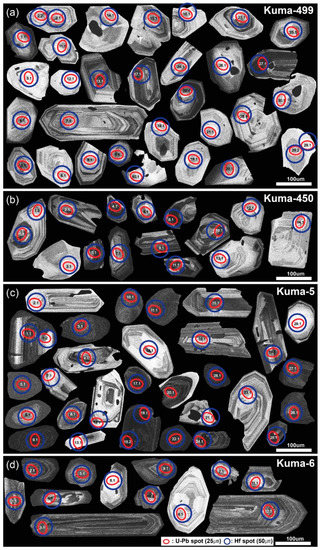
Figure 2.
Cathodoluminescence images of studied zircons from the Goshoura and Himenoura Groups. The red and blue ellipses represent U-Pb analysis and Hf analysis spots, respectively. Four samples are shown separately; (a) Kuma-449, (b) Kuma-450, (c) Kuma-5, and (d) Kuma-6. The size of spots for Hf isotope analysis (blue) is larger than spots in U-Pb analysis (red). Only the zircon grains of Kuma-5 contain ages older than Cretaceous and those with more developed roundness than other samples.
The U-Pb ages for 90 analytical spots for 85 zircon grains from the Himenoura Group and Goshoura Group of SW Japan are shown in Table A1 and Figure 3. Most zircon grains yield concordant or slightly discordant U-Pb ages. In the samples other than one (Kima-5), each single concordia age was obtained. The two samples of the Goshoura Group (Kuma-449, 450) yield concordia ages of 110.3 ± 0.7 Ma (n = 32, MSWD = 3.1) and 116.8 ± 0.8 Ma (n = 15, MSWD = 2.6), respectively. The lower Hinoshima Formation sample (Kuma-6) of the Himenoura group yields a concordant age of 114.9 ± 0.9 Ma (n = 12, MSWD = 1.4). Unlike these, the upper Amura Formation sample (Kuma-5) of the Himenoura group yields a wide range of ages from ca 2360 Ma to 86 Ma. The concordia ages of 88.4 ± 1.3 Ma (n = 6, MSWD = 0.1), 95.8 ± 1.6 Ma (n = 4, MSWD = 1.2), and 254.3 ± 1.8 Ma (n = 3, MSWD = 1.2) were obtained from the sample Kuma-5. Of the four samples analyzed from the Himenoura Group and Goshoura Group, only Kuma-5 has detrital zircons with ages other than Cretaceous, including Jurassic, Triassic, Permian, and Paleoproterozoic ones (Figure 4).
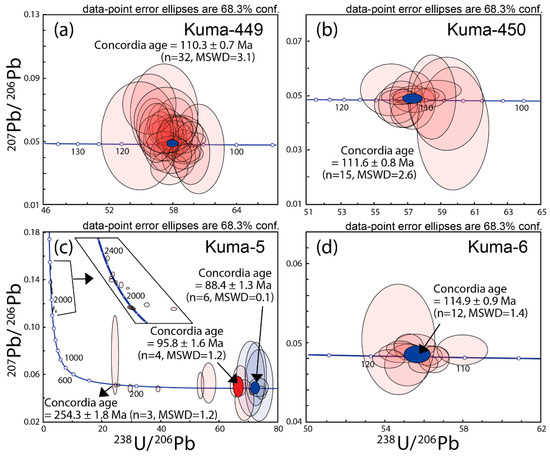
Figure 3.
Tera-Wasserburg diagrams of SHRIMP U-Pb detrital zircon ages from the (a,b) Goshoura Group and (c,d) Himenoura Group.
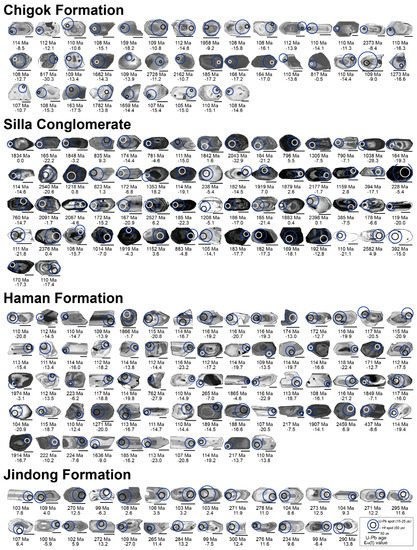
Figure 4.
Cathodoluminescence images of studied zircons from the Hayang Group. The small ellipses are the spots for the previous U-Pb age analysis, and the large ellipses are the spots for the Hf analysis.
3.2. Hf Isotopic Compositions of the Detrital Zircons from the Goshoura and Himenoura Groups, SW Japan
The analyzed Hf isotope compositions of the detrital zircons from the Goshoura Group and Himenoura Group in SW Japan are listed in Table A2. Of the four samples from the Goshoura Group and Himenoura Group, three with similar concordia ages of about 110–115 Ma exhibit positive εHf(t) values of +8.5 to +3.6 except for one analysis spot (Kuma-450-3.1) with a value of -7.8 (Figure 5). Their T2DM age ranges from 842 Ma to 560 Ma, and the exceptional spot (Kuma-450-3.1) has an older T2DM age of 1469 Ma. Sample Kuma-5, however, shows a wide range of εHf(t) values (+9.3 to −21.1) and T2DM ages (580 Ma to 2805 Ma). Among them, the εHf(t) values of the Cretaceous zircons are divided into two groups: +8.2 to +0.1 and −14.7 to −21.1. Jurassic zircon of Kuma-5 has an εHf(t) value of −19.6 and a T2DM age of 2163 Ma. From late Permian to Triassic, zircons have εHf(t) from +9.3 to +2.6, and Precambrian zircons range from +3.4 to −3.3.
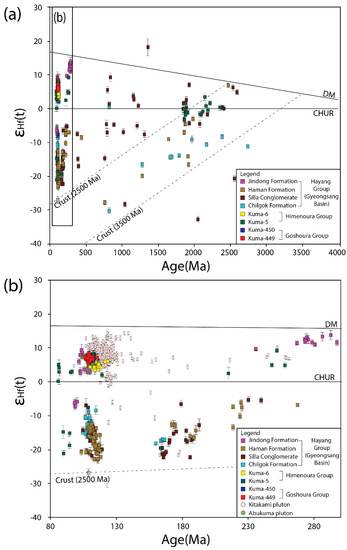
Figure 5.
Plot of zircon εHf(t) versus crystallization ages. The evolutionary path of the depleted mantle is based on 176Lu/177Hf and 176Hf/177Hf ratios from Griffin et al. [48]. The evolution lines for the continental crust with ages of 2500 Ma and 3500 Ma were drawn using the Lu/Hf ratio (=0.081) of Rudnick and Gao [49]. (a) Plot of zircon εHf(t) versus crystallization ages for the entire age range. (b) A plot expanded only in the range of about 80–300 Ma.
3.3. Hf Isotopic Compositions of the Detrital Zircons from the Hayang Group, Korea
In this study, Hf isotope composition was also analyzed from detrital zircons of Hayang Group in Gyeongsang basin, Korea (Table A3), which had already analyzed U-Pb ages [19]. The detrital zircons of the Hayang Group have a much wider range of U-Pb ages [19] than those of the Goshoura and Himenoura groups. The εHf(t) values of detrital zircons of the Hayang Group show significant changes with geological age. The Cretaceous detrital zircon grains mostly preserve the euhedral shape with sharp crystal edges, but the older zircon grains tend to develop roundness (Figure 4). In the case of Cretaceous zircons, which are almost half of all zircons, the εHf(t) value varies from −27.0 to +9.3 (Figure 5). Interestingly, negative εHf(t) values appear in all the lower three formations of the Hayang Group, and positive values appear only in the Jindong Formation at the top. The εHf(t) of the Jurassic and Triassic zircons ranges from −22.3 to −5.4. In the Jindong Formation, unlike other formations, a large number of Permian zircons appear and have fairly high positive εHf(t) values from +11.0 to +13.8. The Paleoproterozoic and Archean zircons of the Hayang Group show εHf(t) values of −32.9 to +7.0 (Figure 5). The Neoproterozoic and Mesoproterozoic zircons of the Hayang Group have a significant range of the εHf(t) values from −30.3 to +18.2.
4. Discussion
4.1. Provenance of Detrital Zircons of the Goshoura and Himenoura Groups
The detrital zircon grains of the three of the four samples from the Goshoura and Himenoura groups (Kuma-499, Kuma-450, and Kuma-6) show euhedral to subhedral shapes with well-preserved crystal edges instead of showing well developed roundness indicating the relatively short sediment transport distance (Figure 2). These samples yield single concordia ages with small errors of 110.3 ± 0.7 Ma, 116.8 ± 0.8 Ma, and 114.9 ± 0.9 Ma, respectively. The Th/U ratios of these zircons (0.25–0.96) are larger than 0.1, which is a general criterion that distinguishes igneous zircons from metamorphic zircons [50]. Therefore, it is presumed that these relatively homogeneous detrital zircons originate from igneous protoliths not far away. In contrast to these, the detrital zircon grains separated from the upper Amura Formation (Kuma-5) of the Himenoura group show a wide range of age distributions and the degree of development of roundness of grains. Among the zircon grains of the sample Kuma-5, Cretaceous ones have euhedral shapes like other samples. However, the older zircon grains show relatively rounded edges. In particular, the Paleoproterozoic zircon grains have more developed roundness (Figure 2c). Although the roundness of detrital zircon grains is not a definite quantitative measure of transport distance, it appears to reflect the degree of age variance and relative transport distance in the analyzed samples. All the analyzed zircons from Kima-5 have Th/U ratios greater than 0.1, implying igneous origin. The youngest concordia ages in the Goshoura Group and the Himenoura Group are 110.3 ± 0.7 Ma and 88.4 ± 1.3 Ma, respectively, somewhat older than previously reported fossil ages [26,27,28,29]. Recently, a slightly younger age of 81.5 ± 1.4 Ma was reported from the upper part of the Amura Formation and was suggested as the maximum depositional age [25]. Thus, these Cretaceous zircons were reworked from existing rocks or sediments and are not the product of syn-sedimentary volcanic activity. Among the detrital zircons of sample Kuma-5, the proportion of Paleoproterozoic is about 45%.
The U-Pb concordant ages calculated from detrital zircons of the Goshoura Group and Himenoura Group were 114.9 ± 0.9 Ma, 111.6 ± 0.8 Ma, 110.3 ± 0.7 Ma, 95.8 ± 1.6 Ma, and 88.4 ± 1.3 Ma. The U-Pb ages of the granitoids of the Higo metamorphic belt, the basement rock of Goshoura and Himenoura Groups, were reported from ca. 117 Ma to 108 Ma [51,52]. These Cretaceous ages of the Higo belt are consistent with the detrital zircon ages of the Goshoura and Himenoura groups with concordia ages of about 115 Ma to 110 Ma. Accordingly, the Higo belt is inferred as the main source of the Cretaceous detrital zircons of about 115–110 Ma deposited in Goshoura and Himenoura Groups. However, the U-Pb age of Amura Formation (Kuma-5), the upper layer of the Cretaceous Himenora group, shows ages between 2357 Ma and 86 Ma. More than 45% of these consist of Paleoproterozoic zircons, showing a different age distribution pattern than the other three samples. Although the Paleoproterozoic zircons should have been derived from the old continental crust, rocks of that age have not yet been reported on the Japanese Islands. However, on the Korean peninsula close to Japan, Paleoproterozoic rocks [53,54] corresponding to the zircon ages of Kuma-5 are exposed to the surface in a large area. Given the interconnection of the Korean Peninsula and the Japanese Islands before the opening of the East Sea (Sea of Japan) in Cenozoic [55], the presence of these Paleoproterozoic zircons indicates the supply of sediments from the inland area, presumably the current Korean Peninsula. We suggest that the basin-fills from the middle to the upper-middle part of the Cretaceous Basin in the Amakusa Islands were initially supplied primarily from source rocks in the nearby Higo belt where Cretaceous igneous rocks of similar age are distributed. However, the sediments of the Amura Formation were supplied from sources within the nearby Higo belt as well as from the distant inland areas.
The sample Kuma-5 of the Himenoura Group also yielded a Permian concordant age of 254.3 ± 1.8 Ma. In fact, Permian igneous rocks have been found in several areas of Japan, including the nearby Kyushu area. The Usukigawa granodiorite, located in east central Kyushu, has a zircon U-Pb age of ca. 290 Ma [52]. The Kinshozan Quartz Diorite from the Kanto Mountains, Japan, has a zircon U-Pb age of 281.5 ± 1.8 Ma [56]. Permian zircon U-Pb ages of 292 to 259 Ma have been reported from granitoids in the Maizuru area [57]. A new U–Pb zircon geochronological study for the paragneisses from the Tateyama area in the Hida Mountains of north central Japan showed that the detrital zircons had a core age of about 275 Ma and overgrowth ages due to metamorphism of around 235–250 Ma [58]. However, in the case of the Himenoura Group, considering that Th/U ratios of all zircons are greater than 0.1 implying igneous origin, it is suggested that Permian igneous rocks from other regions than the paragneiss of the Hida Mountains were the source of the studied detrital zircons.
Hf isotopic compositions of the detrital zircons are also helpful in tracking the provenance of sediments. The εHf(t) values of the Jurassic and Triassic zircons of the Hayang Group ranges from −18.2 to −5.4 and agree well with typical values for Jurassic and Triassic granitoids known in South Korea [59,60]. The Paleoproterozoic and Archean zircons of the Hayang Group have εHf(t) values of −14.8 to +6.9 and are similar to the Paleoproterozoic basement rocks of the Yeongnam massif surrounding the Gyeongsang basin [54,61]. The Neoproterozoic and Mesoproterozoic zircons of the Hayang Group appear to have been derived from the Okcheon metamorphic belt in the northwest [19]. During this period, the εHf(t) values of zircons show a significant range of changes from −30.3 to +18.2. The lower values appear to follow the evolution curve of the Archean continental crust, like the Paleoproterozoic and Archean zircons (Figure 5). However, some higher values seem to reflect the input of juvenile material from the depleted mantle at the time. This is consistent with the high εHf(t) values reported from constituent members of the Okcheon metamorphic belt, reflecting rifting events related to breakup in supercontinent Columbia during the Mesoproterozoic [62].
4.2. Resumption of Igneous Activities at about 120 Ma after a Break for 40 Ma
In the Korean peninsula and Japanese islands located at the eastern margin of the Eurasia continent, there was a long resting period without active magmatism from about 160 Ma to about 120 Ma [16,17,18]. Therefore, in the detrital zircons of the Cretaceous basins of these regions, ages during this long magmatic gap are hardly found. In the Nakdong Formation, the lowermost part of the Cretaceous Gyeongsang basin in the southeastern part of the Korean Peninsula, about 128 Ma of igneous zircons were found [11]. This age marks the beginning of the deposition of the Nakdong Formation, that is, the beginning of the development of the Cretaceous Gyeongsan basin. The igneous rock of this age has not yet been discovered in the Korean Peninsula, but granitoids of about 130–110 Ma are widely exposed in the Kitakami zone in Northeast Japan [63,64]. The emergence of granitoid plutons of this age in the Japanese islands indicates the resumption of igneous activity after a similar magmatic gap on the Korean Peninsula.
In the detrital zircons of the Himenoura Group and the Goshoura Group in southwestern Japan and the Hayang Group in the southeastern Korean peninsula, zircons of about 120–110 Ma, which are about 10–20 Ma younger than the Nakdong Formation, are common. Both the Korean peninsula and the Japanese islands, igneous rocks of this range of age are more common than those of about 120–130 Ma. Granitoids of 109–114 Ma are distributed in the southwestern part of North Korea [65]. In the western and central regions of the Gyeonggi massif in South Korea, igneous activities of about 110 Ma have been reported [66]. In Southwest Japan, several plutonic rocks in the central Kyushu region have zircon U-Pb ages of 108–117 Ma: Oshima quartz dioritic gneiss, Oshima granitic gneiss, Ryuhozan gabbro, Miyanohara tonalite, and Mansaka tonalite [51,52]. Zircon U–Pb ages of plutonic rocks in the southern Abukuma Mountains of Northeast Japan indicate that the intrusion ages of gabbroic rocks and surrounding granitic rocks ranges from 113 to 100 Ma [67]. Taken together, it seems that the long paused magmatism has resumed at about 130 Ma in the Kitamami zone in Northeast Japan. However, in a wide area extending to Southwest Japan and the Korean Peninsula, there seems to have been active magmatism at about 120–110 Ma a little later.
4.3. Input of Juvenile Mantle Material with Resumption of Magmatism
The detrital zircon of igneous origin retains the original hafnium isotopic value of the melt from which it was crystallized without post-crystallization radiogenic growth due to the low Lu/Hf ratio. Therefore, the Hf isotope values of detrital zircons are suitable for examining tectonic environment related to magmatism in their provenance [21,68]. The results of this study and the age distribution of Cretaceous granitoids in Korea and Japan show that there was a very active igneous activity from about 130–120 Ma after a magmatic gap of 30–40 Ma beginning at about 160 Ma. The Hf isotope composition in the detrital zircons of this period are characterized bimodal εHf(t) values of quite positive and significant negative values. Among the analysis results, most of the Cretaceous zircons of the Goshoura and Himenoura groups in Japan have positive εHf(t) values, but in the case of the Hayang Group on the Korean Peninsula, on the contrary, the Cretaceous zircons of the other formations except the Jindong Formation show negative values. Among these positive Cretaceous zircons are discussed first, and other results are discussed later.
The Mesozoic granitoids of the SW Japan mostly have εNd(t) values in the range of −15 to +5 and an average value of about −4, which is interpreted to have a source rock containing a large amount of recycled continental crust [69]. However, the Early Cretaceous detrital zircons of the Goshoura and Himenoura groups have a more depleted value of positive εHf(t), so it is necessary to investigate the cause. In general, high εHf(t) values indicate origin from depleted mantle or juvenile young oceanic crust, while low εHf(t) values represent origin from old continental crust sources [70]. Therefore, the positive εHf(t) of the Early Cretaceous zircons of the Goshoura and Himenoura groups represents the input of juvenile materials from the depleted mantle. Meanwhile, Early Cretaceous granitoids in the Kitakami zone in Northeast Japan have positive εHf(t) values [63] that are similar to or slightly higher than the Cretaceous detrital zircons in this study (Figure 5). Early Cretaceous Kitakami granitic plutons have been suggested to include rocks of adakitic affinity and mostly derived from juvenile oceanic crustal sources [64]. The generation model of adakitic magma includes the melting of young oceanic crusts or the melting of eclogite created by underplating these oceanic crusts underneath the crust [71,72,73,74]. The melts generated in this way may contain juvenile materials derived from depleted mantle in a high proportion, and thus the εHf(t) value may be quite high [75].
During the early Cretaceous period of 120–110 Ma, numerous igneous rocks were emplaced over large areas of Japan, including, for example, Ryoke-Sanyo batholith and a number of numerous granitoids distributed in the Abukuma belt, Sikoku area, and Higo belt [51,52,63,64,65,66,67]. Particular attention should be paid to the granitoids of Abukuma and Higo belts. These granitoids have zircon U-Pb ages ranging from 118 Ma to 101 Ma and exhibit the geochemical characteristics of adakite formed by slab melting of young oceanic crusts (e.g., Shiraishino adakitic pluton [76]). Recently, Maki et al. [51] conducted U-Pb age determination and Hf isotope analysis of diatexitic migmatite on Higo belts and obtained an age of 110.1 ± 0.6 Ma (n = 11, MSWD = 1.10) and high εHf(t) values up to +11.8. They also argued that the presence of diatexitic migmatite with high εHf(t) values reflects the influence of the highly depleted mantle and juvenile components, and may be related to the remelting of basalt produced from the depleted mantle. Coeval igneous rocks affected by depleted mantle-derived juvenile components have also been reported in Abukuma, in northeastern Japan. Tsuchiya et al. [64] claimed that the Cretaceous Abukuma granite had an age of 118–117 Ma and the geochemical characteristics of adakite. Therefore, the inclusion of juvenile mantle materials in magmatism that resumed after a long resting period was confirmed not only in detrital zircons in sedimentary formations in Southwest Japan, but also in 120–110 Ma granitoids in Northeast Japan.
4.4. Negative εHf(t) Values of Cretaceous Zircons
The εHf(t) values of the Cretaceous detrital zircons analyzed in this study show a bimodal distribution pattern that is divided into a fairly positive group and a significantly negative group. The positive group appears in Himenoura and Goshoura groups and Jindong Formation, and the negative group appears mainly in Chilgok, Silla, and Haman formations (Figure 5). That is, the positive group appears mainly on the Japanese side, and the negative group appears mostly on the Korean side, except for some zircons of Jindong Formation. One thing to note here is that when Jindong Formation was deposited, the flow direction of paleocurrent indicates the supply of sediment from the east, or the Japanese side [32,37,38,39]. Therefore, the detrital zircons of the positive group appearing in Jindong Formation may originate from sediment sources in Japan. Considering this, it suggests that the igneous activities at that time had the characteristics of mainly positive εHf(t) in the vicinity of the trench and significantly negative εHf(t) in the inland side. The fairly low εHf(t) values in the inland indicate that magma genesis and differentiation processes were affected by old crustal materials below the Korean Peninsula. A similar range of negative εHf(t) values can be seen in the Triassic to Jurassic igneous rocks of the Korean Peninsula [60]. This characteristic also appears in the εHf(t) values of the Triassic to Jurassic detrital zircons (−5 to −25) included in sedimentary layers of the Hayang Group (Figure 5) reflecting the influence of materials from the old continental curst of the Korean Peninsula.
4.5. Variability of εHf(t) Values Over Time
The high εHf(t) values of about 120–110 Ma detrital zircons are somewhat different from those previously reported from the Cretaceous to Paleogene granitoids from Southwest Japan. For example, the granitic rocks in the Iwakuni area in Southwest Japan have a zircon U-Pb age of 104–92 Ma and εHf(t) in the range of −5 to +0.7 [77]. The results of Sr-Nd isotope analysis for Phanerozoic granitoids from Southwest Japan generally show negative εNd(t) values and high initial 87Sr/86Sr ratios [69]. Therefore, it is clear that there was a temporal change from the high εHf(t) values of Early Cretaceous to the lower values of the later period. When ridge subduction occurs, the volume of the melting zone may be larger because of the enhanced temperature, and continental materials in the lower crust may be added to the melt. The magma formed in the later stages through this process may have a larger proportion of enriched materials compared to the earlier ones mainly derived from the young oceanic crust.
However, the temporal change of isotope values from depleted values to more enriched values does not appear only in the Cretaceous period. It is known that there was Permian igneous activity in both Korea and Japan, and it seems that there was no magmatism for a long time before that. The Permian zircons (270–300 Ma) of the Jindong Formation, which originated in Japan, show that the εHf(t) values of Permian granitoids appearing after the dormant period of magmatism are quite high, ranging from +11 to +14 (Figure 5). The Yeongdeok granite, located in the east-central part of the Korean peninsula at about 260 Ma, slightly younger than the Permian zircons of the Jindong Formation, also has adakitic characteristics and at the same time has an εHf(t) value of about +11.5, depleted isotopic composition [60]. In the Hayang Group, the εHf(t) values of Triassic to Jurassic detrital zircons also show a shift toward more enriched isotope composition than those of Permian (Figure 5). The tectonics of repetitive changes in the εHf(t) values in the Pacific type of orogenic cycle are outside the scope of this study, but it is worth noting.
4.6. Since Early Cretaceous, Japanese Islands Have Moved 1000 km Northeast from Next to South China?
Researchers of the Kitakami adakites argue that the magmatism of the time was caused by ridge subduction that migrated northward, and that these plutons were translated northeastward more than 1000 km from their original location next to South China [5]. However, considering the relationship with neighboring blocks, such a long-distance movement is not very persuasive and seems not necessary. First of all, there seems to be no significant difference in the history of tectonic evolution between Northeast Japan and Southwest Japan. One of the characteristics of Northeast Japan is the existence of Early Paleozoic plutons, which are about 500–450 Ma [12,56]. However, evidence of igneous activity in the Paleozoic era corresponding to this period was also found in Southwest Japan. The LA-ICP-MS zircon U–Pb geochronology revealed that the intrusion age of Saganoseki quartz diorite was 473.3 ± 3.6 Ma [78].
Early Cretaceous tectonic environments also appear to be similar in Northeast and Southwest Japan. The resumption of subduction-related igneous activity after a long resting period can be determined by the age of about 130–110 Ma granitoids that occur in various parts of Japan and by the age distribution patterns of detrital zircons in sediments. In the case of Northeast Japan, the age of plutons intruded in the Kitakami zone includes those of about 130–120 Ma. In the case of Southwest Japan, the maximum age of Early Cretaceous plutons or detrital zircons is about 120 Ma, suggesting that igneous activity may have begun in Northeast Japan slightly earlier than in Southwest Japan. However, both regions are similar in that the restarted magmatism has a high hafnium initial isotopic composition, indicating the melting of the material derived from the young oceanic crust. Since the resumption of magmatism was almost the same and the properties of the source material were similar, it is highly likely that the two regions shared the same tectonic setting. Several evidences have suggested that Southwest Japan and the Korean Peninsula were connected to each other in the Early Cretaceous period [55]. In particular, the research shows that during the Cretaceous period sediment was supplied from Japan to Korea and from Korea to Japan, depending on the location, supporting this [19,22,23,79]. This connection between Southwest Japan and the Korean Peninsula in Early Cretaceous contradicts the suggestion that Northeast Japan or the whole of Japan is located next to south China in Early Cretaceous and moved about 1000 km northeast to its present location.
5. Conclusions
Most of the detrital zircons of the Goshoura and Himenoura groups in west central Kyushu in Southwest Japan have U-Pb ages in the Cretaceous period, but some have older Permian or Paleoproterozoic ages. The detrital zircons with Paleoproterozoic ages indicate sediment supply from the inland area, possibly from the Korean Peninsula that was connected during their deposition. The Cretaceous age of about 120–110 Ma indicates that magmatism resumed after the previous dormant period, and the Japanese zircons have quite positive εHf(t) values. These detrital zircons, which appear to have originated from the igneous rocks of Southwest Japan, are likely to have been produced by ridge subduction that led to the melting of the young oceanic crust. We suggested that later Japanese granitoids generally show a more enriched isotope composition as a result of the melting of a wider volume as the ridge subduction proceeds and contain more crust components. All of the Cretaceous zircons of the Hayang Group have quite negative εHf(t) values, except for the Jindong Formation, which had a sediment supply from Japan. This is interpreted as the fact that the old continental crust material on the Korean Peninsula was included in the magma generation. The subduction-related magmatism started in Permian shows the characteristics of adakite generation and high εHf(t) value. Meanwhile, the composition of subsequent magmatisms changed to more enriched. This repetitive trend of change can be a typical example of the Pacific-type orogenic cycle.
Author Contributions
Conceptualization, T.-H.L. and K.-H.P.; methodology, K.-H.P.; validation, T.-H.L. and K.-H.P.; formal analysis, T.-H.L.; investigation, K.-H.P.; writing—original draft preparation, K.-H.P.; writing—review and editing, K.-H.P.; visualization, T.-H.L.; supervision, K.-H.P.; funding acquisition, K.-H.P. All authors have read and agreed to the published version of the manuscript.
Funding
This work was supported by the National Research Foundation of Korea (NRF) grant funded by the Korea government (MSIT) (No. NRF-2019R1A2C2002506). This research was also supported by a grant (GP2020-014) from the Research in Active Tectonics and Development of Fault Segmentation Model for Intraplate regions from Basic Research Project of the Korea Institute of Geoscience and Mineral Resources (KIGAM) funded by the Korean Ministry of Science and ICT.
Acknowledgments
We would like to thank Komatsu who organized and guided fourth international symposium and field trip of the IGCP507. We deeply appreciate the meticulous and constructive opinions of the anonymous reviewers.
Conflicts of Interest
The authors declare no conflict of interest. The funders had no role in the design of the study; in the collection, analyses, or interpretation of data; in the writing of the manuscript, or in the decision to publish the results.
Appendix A

Table A1.
SHRIMP U-Pb results for the detrital zircons from the Goshoura and Himenoura Groups, Southwest Japan.
Table A1.
SHRIMP U-Pb results for the detrital zircons from the Goshoura and Himenoura Groups, Southwest Japan.
| Spot No. | U (ppm) | Th (ppm) | Th/U | Common 206Pb (%) | 238U/206Pb | ± (%) | 207Pb/206Pb | ± (%) | Apparent Age (Ma) |
|---|---|---|---|---|---|---|---|---|---|
| Kuma-449 | |||||||||
| Kuma-449-1.1 | 224 | 103 | 0.48 | 0.00 | 57.0 | 1.6 | 0.0611 | 14.8 | 110.3 ± 1.3 |
| Kuma-449-2.1 | 247 | 118 | 0.50 | 0.06 | 58.6 | 1.8 | 0.0412 | 20.5 | 110.1 ± 1.6 |
| Kuma-449-2.2 | 234 | 111 | 0.49 | 0.37 | 58.2 | 1.8 | 0.0662 | 11.8 | 107.3 ± 1.7 |
| Kuma-449-3.1 | 105 | 69 | 0.68 | 0.00 | 60.4 | 2.7 | 0.0461 | 39.9 | 106.1 ± 1.5 |
| Kuma-449-4.1 | 321 | 212 | 0.68 | 0.20 | 58.0 | 2.2 | 0.0580 | 11.0 | 108.9 ± 2.2 |
| Kuma-449-5.1 | 596 | 262 | 0.45 | 0.00 | 59.2 | 1.8 | 0.0431 | 9.9 | 108.6 ± 1.9 |
| Kuma-449-6.1 | 208 | 98 | 0.49 | 0.00 | 58.7 | 2.4 | 0.0552 | 14.4 | 107.9 ± 2.4 |
| Kuma-449-7.1 | 508 | 211 | 0.43 | 0.09 | 60.0 | 1.3 | 0.0519 | 5.6 | 106.1 ± 1.3 |
| Kuma-449-8.1 | 289 | 128 | 0.46 | 0.00 | 57.7 | 2.0 | 0.0341 | 19.7 | 112.8 ± 2.1 |
| Kuma-449-9.1 | 429 | 248 | 0.60 | 0.00 | 57.2 | 1.1 | 0.0447 | 8.9 | 112.3 ± 1.1 |
| Kuma-449-10.1 | 206 | 85 | 0.43 | 0.56 | 59.0 | 1.9 | 0.0457 | 17.8 | 108.7 ± 1.8 |
| Kuma-449-11.1 | 219 | 145 | 0.68 | 0.00 | 58.0 | 1.5 | 0.0536 | 16.6 | 109.5 ± 1.2 |
| Kuma-449-12.1 | 122 | 53 | 0.45 | 0.03 | 56.2 | 1.9 | 0.0597 | 19.8 | 112.0 ± 1.4 |
| Kuma-449-13.1 | 1006 | 533 | 0.55 | 0.07 | 57.9 | 0.9 | 0.0480 | 5.3 | 110.5 ± 1.0 |
| Kuma-449-14.1 | 265 | 95 | 0.37 | 0.00 | 57.2 | 2.1 | 0.0537 | 12.7 | 110.9 ± 2.1 |
| Kuma-449-15.1 | 428 | 202 | 0.49 | 0.00 | 59.3 | 1.3 | 0.0435 | 8.6 | 108.3 ± 1.4 |
| Kuma-449-16.1 | 198 | 148 | 0.77 | 0.00 | 58.7 | 1.9 | 0.0524 | 17.9 | 108.4 ± 1.7 |
| Kuma-449-17.1 | 1059 | 751 | 0.73 | 0.00 | 57.6 | 1.2 | 0.0482 | 3.0 | 111.0 ± 1.3 |
| Kuma-449-18.1 | 203 | 94 | 0.48 | 5.23 | 56.8 | 1.8 | 0.0511 | 23.7 | 112.1 ± 1.2 |
| Kuma-449-19.1 | 242 | 123 | 0.53 | 0.28 | 57.4 | 1.9 | 0.0597 | 12.7 | 109.7 ± 1.8 |
| Kuma-449-20.1 | 327 | 216 | 0.68 | 0.00 | 58.3 | 1.8 | 0.0580 | 9.5 | 108.2 ± 1.8 |
| Kuma-449-21.1 | 100 | 58 | 0.60 | 0.00 | 57.2 | 3.7 | 0.0688 | 29.1 | 108.9 ± 3.0 |
| Kuma-449-22.1 | 378 | 203 | 0.56 | 0.37 | 57.2 | 1.9 | 0.0503 | 8.7 | 111.4 ± 2.0 |
| Kuma-449-23.1 | 227 | 113 | 0.51 | 0.07 | 56.3 | 1.8 | 0.0550 | 14.7 | 112.5 ± 1.7 |
| Kuma-449-24.1 | 226 | 151 | 0.69 | 0.02 | 58.2 | 1.9 | 0.0529 | 13.8 | 109.3 ± 1.9 |
| Kuma-449-25.1 | 178 | 97 | 0.56 | 0.00 | 59.7 | 2.0 | 0.0437 | 29.7 | 107.7 ± 1.3 |
| Kuma-449-26.1 | 133 | 71 | 0.55 | 0.00 | 55.8 | 3.0 | 0.0741 | 16.7 | 110.8 ± 2.8 |
| Kuma-449-27.1 | 1754 | 839 | 0.49 | 0.32 | 58.4 | 1.0 | 0.0503 | 2.8 | 109.1 ± 1.1 |
| Kuma-449-28.1 | 306 | 197 | 0.67 | 0.00 | 57.8 | 2.2 | 0.0426 | 18.0 | 111.3 ± 2.3 |
| Kuma-449-29.1 | 82 | 40 | 0.50 | 0.00 | 54.9 | 4.4 | 0.0543 | 41.0 | 115.5 ± 3.9 |
| Kuma-449-29.2 | 150 | 115 | 0.79 | 0.07 | 56.4 | 1.9 | 0.0562 | 21.7 | 112.1 ± 1.5 |
| Kuma-449-30.1 | 160 | 79 | 0.51 | 0.13 | 57.4 | 3.5 | 0.0641 | 21.2 | 109.2 ± 3.4 |
| Kuma-450 | |||||||||
| Kuma-450-1.1 | 539 | 308 | 0.59 | 0.07 | 56.8 | 1.0 | 0.0436 | 7.8 | 113.1 ± 1.1 |
| Kuma-450-1.2 | 210 | 103 | 0.51 | 0.00 | 56.0 | 2.2 | 0.0523 | 12.0 | 113.5 ± 2.3 |
| Kuma-450-2.1 | 563 | 364 | 0.67 | 0.00 | 57.4 | 1.4 | 0.0489 | 6.5 | 111.3 ± 1.6 |
| Kuma-450-3.1 | 134 | 101 | 0.78 | 0.00 | 59.7 | 2.4 | 0.0383 | 38.8 | 108.4 ± 1.7 |
| Kuma-450-4.1 | 1072 | 652 | 0.63 | 0.09 | 56.9 | 0.9 | 0.0494 | 3.1 | 112.1 ± 1.0 |
| Kuma-450-5.1 | 907 | 398 | 0.45 | 0.30 | 57.5 | 1.6 | 0.0503 | 3.4 | 110.9 ± 1.8 |
| Kuma-450-6.1 | 324 | 178 | 0.57 | 0.17 | 56.3 | 1.5 | 0.0467 | 9.4 | 113.8 ± 1.6 |
| Kuma-450-7.1 | 263 | 196 | 0.77 | 0.00 | 56.6 | 1.6 | 0.0471 | 11.9 | 113.0 ± 1.7 |
| Kuma-450-8.1 | 2321 | 1247 | 0.55 | 0.32 | 57.1 | 0.9 | 0.0488 | 1.8 | 111.9 ± 0.9 |
| Kuma-450-9.1 | 871 | 528 | 0.63 | 0.02 | 56.5 | 1.3 | 0.0497 | 3.7 | 112.9 ± 1.4 |
| Kuma-450-10.1 | 862 | 509 | 0.61 | 0.20 | 58.8 | 1.6 | 0.0522 | 4.6 | 108.1 ± 1.7 |
| Kuma-450-11.1 | 1027 | 817 | 0.82 | 0.00 | 58.3 | 1.1 | 0.0495 | 4.8 | 109.5 ± 1.2 |
| Kuma-450-12.1 | 237 | 130 | 0.57 | 0.17 | 57.3 | 1.6 | 0.0485 | 14.4 | 111.5 ± 1.5 |
| Kuma-450-13.1 | 145 | 89 | 0.63 | 0.00 | 59.3 | 2.4 | 0.0472 | 23.8 | 107.9 ± 2.4 |
| Kuma-450-14.1 | 155 | 110 | 0.73 | 0.12 | 58.5 | 1.6 | 0.0497 | 20.5 | 109.1 ± 1.2 |
| Kuma-5 | |||||||||
| Kuma-5-1.1 | 706 | 413 | 0.60 | 1.34 | 2.9 | 0.9 | 0.1290 | 0.4 | 2084.6 ± 6.6 |
| Kuma-5-1.2 | 94 | 68 | 0.75 | 0.76 | 2.7 | 1.3 | 0.1314 | 1.1 | 2116.6 ± 19.0 |
| Kuma-5-2.1 | 128 | 59 | 0.48 | 0.00 | 73.8 | 4.3 | 0.0520 | 38.1 | 86.3 ± 3.1 |
| Kuma-5-3.1 | 287 | 159 | 0.57 | 0.06 | 2.5 | 1.0 | 0.1334 | 0.6 | 2142.9 ± 10.2 |
| Kuma-5-4.1 | 759 | 333 | 0.45 | 0.04 | 66.7 | 1.0 | 0.0511 | 7.0 | 95.6 ± 0.9 |
| Kuma-5-5.1 | 325 | 33 | 0.10 | 0.00 | 2.9 | 1.6 | 0.1151 | 0.6 | 1882.2 ± 11.3 |
| Kuma-5-6.1 | 142 | 104 | 0.75 | 0.22 | 2.5 | 1.2 | 0.1391 | 0.9 | 2216.1 ± 14.8 |
| Kuma-5-7.1 | 416 | 149 | 0.37 | 0.00 | 66.0 | 2.1 | 0.0511 | 11.6 | 96.5 ± 1.9 |
| Kuma-5-8.1 | 324 | 87 | 0.28 | 0.09 | 3.0 | 1.5 | 0.1150 | 0.6 | 1879.6 ± 11.4 |
| Kuma-5-9.1 | 1626 | 1379 | 0.88 | 3.90 | 4.0 | 1.3 | 0.1139 | 0.6 | 1862.6 ± 11.7 |
| Kuma-5-10.1 | 453 | 198 | 0.45 | 0.00 | 2.4 | 1.1 | 0.1368 | 0.4 | 2186.9 ± 6.5 |
| Kuma-5-11.1 | 863 | 150 | 0.18 | 0.06 | 3.0 | 1.1 | 0.1138 | 0.3 | 1861.7 ± 5.8 |
| Kuma-5-12.1 | 775 | 603 | 0.80 | 5.07 | 67.4 | 2.5 | 0.0557 | 15.0 | 94.0 ± 2.1 |
| Kuma-5-13.1 | 120 | 87 | 0.74 | 2.66 | 70.9 | 4.4 | 0.0575 | 35.8 | 89.2 ± 3.2 |
| Kuma-5-14.1 | 136 | 104 | 0.79 | 0.00 | 72.8 | 3.3 | 0.0613 | 28.6 | 86.5 ± 2.2 |
| Kuma-5-15.1 | 579 | 438 | 0.78 | 0.00 | 74.7 | 1.5 | 0.0456 | 7.9 | 86.0 ± 1.2 |
| Kuma-5-16.1 | 188 | 194 | 1.06 | 0.00 | 68.8 | 3.0 | 0.0396 | 28.5 | 94.0 ± 2.6 |
| Kuma-5-17.1 | 657 | 88 | 0.14 | 1.74 | 3.3 | 1.3 | 0.1170 | 0.8 | 1910.3 ± 15.2 |
| Kuma-5-18.1 | 880 | 258 | 0.30 | 0.08 | 24.5 | 0.9 | 0.0520 | 2.2 | 257.6 ± 2.4 |
| Kuma-5-18.2 | 2013 | 618 | 0.32 | 0.32 | 25.5 | 1.1 | 0.0520 | 1.5 | 247.6 ± 2.8 |
| Kuma-5-19.1 | 420 | 234 | 0.58 | 0.26 | 73.7 | 3.0 | 0.0502 | 10.3 | 86.7 ± 2.6 |
| Kuma-5-20.1 | 750 | 291 | 0.40 | 0.11 | 39.1 | 1.2 | 0.0491 | 3.6 | 162.9 ± 1.9 |
| Kuma-5-21.1 | 160 | 104 | 0.67 | 0.00 | 56.5 | 2.9 | 0.0539 | 20.6 | 112.3 ± 2.9 |
| Kuma-5-22.1 | 221 | 92 | 0.43 | 0.00 | 3.0 | 1.1 | 0.1148 | 0.7 | 1876.4 ± 13.1 |
| Kuma-5-23.1 | 209 | 111 | 0.55 | 0.10 | 53.7 | 1.4 | 0.0518 | 14.1 | 118.4 ± 1.4 |
| Kuma-5-24.1 | 558 | 419 | 0.78 | 0.16 | 29.6 | 1.6 | 0.0493 | 4.7 | 214.8 ± 3.3 |
| Kuma-5-25.1 | 1260 | 1332 | 1.09 | 0.11 | 71.5 | 0.9 | 0.0472 | 4.4 | 89.6 ± 0.8 |
| Kuma-5-26.1 | 257 | 218 | 0.88 | 0.00 | 2.4 | 1.9 | 0.1348 | 0.6 | 2161.0 ± 9.9 |
| Kuma-5-27.1 | 116 | 58 | 0.51 | 0.62 | 2.3 | 1.2 | 0.1509 | 0.8 | 2356.5 ± 13.9 |
| Kuma-5-28.1 | 267 | 50 | 0.19 | 0.00 | 2.9 | 1.0 | 0.1152 | 0.7 | 1883.4 ± 12.3 |
| Kuma-5-29.1 | 35 | 23 | 0.67 | 0.17 | 24.3 | 3.3 | 0.0774 | 28.3 | 251.2 ± 4.7 |
| Kuma-6 | |||||||||
| Kuma-6-1.1 | 828 | 342 | 0.43 | 0.18 | 55.4 | 1.3 | 0.0511 | 2.5 | 114.9 ± 1.5 |
| Kuma-6-2.1 | 1106 | 264 | 0.25 | 0.02 | 56.2 | 0.9 | 0.0488 | 1.8 | 113.7 ± 1.0 |
| Kuma-6-3.1 | 1049 | 270 | 0.27 | 0.01 | 56.5 | 0.9 | 0.0483 | 1.9 | 113.1 ± 1.0 |
| Kuma-6-4.1 | 614 | 361 | 0.61 | 0.15 | 55.4 | 0.9 | 0.0471 | 3.5 | 115.6 ± 1.1 |
| Kuma-6-5.1 | 1320 | 333 | 0.26 | 0.06 | 54.9 | 1.4 | 0.0478 | 2.1 | 116.4 ± 1.7 |
| Kuma-6-6.1 | 297 | 144 | 0.50 | 0.00 | 55.3 | 1.4 | 0.0441 | 6.5 | 116.1 ± 1.6 |
| Kuma-6-7.1 | 718 | 176 | 0.25 | 0.00 | 56.7 | 0.9 | 0.0454 | 3.8 | 113.1 ± 1.1 |
| Kuma-6-8.1 | 234 | 94 | 0.42 | 0.27 | 55.5 | 2.4 | 0.0390 | 17.1 | 116.6 ± 2.7 |
| Kuma-6-9.1 | 1908 | 1158 | 0.63 | 0.13 | 54.8 | 0.9 | 0.0487 | 1.5 | 116.5 ± 1.0 |
| Kuma-6-10.1 | 1057 | 981 | 0.96 | 0.00 | 56.0 | 0.9 | 0.0475 | 1.7 | 114.3 ± 1.0 |
| Kuma-6-11.1 | 496 | 159 | 0.33 | 0.12 | 58.2 | 1.5 | 0.0460 | 4.5 | 110.1 ± 1.6 |
| Kuma-6-12.1 | 1030 | 240 | 0.24 | 0.00 | 54.3 | 1.0 | 0.0455 | 2.6 | 118.0 ± 1.2 |
Table A2.
LA-MC-ICPMS Lu-Yb-Hf isotopic compositions of the detrital zircons from the Goshoura and Himenoura Groups, Southwest Japan.
Table A2.
LA-MC-ICPMS Lu-Yb-Hf isotopic compositions of the detrital zircons from the Goshoura and Himenoura Groups, Southwest Japan.
| Spot No. | 176Hf/177Hf | ±2 S.E. | 176Lu/177Hf | ±2 S.E. | 176Yb/177Hf | ±2 S.E. | εHf(t) | T2DM (Ma) |
|---|---|---|---|---|---|---|---|---|
| Kuma-449 | ||||||||
| Kuma-449-1.1 | 0.282918 | 0.000022 | 0.001003 | 0.000033 | 0.02640 | 0.00110 | 7.5 | 618 |
| Kuma-449-2.1 | 0.282878 | 0.000021 | 0.001383 | 0.000036 | 0.03727 | 0.00074 | 6.1 | 699 |
| Kuma-449-2.2 | 0.282912 | 0.000019 | 0.000543 | 0.000005 | 0.01354 | 0.00023 | 7.3 | 629 |
| Kuma-449-3.1 | 0.282913 | 0.000022 | 0.000884 | 0.000015 | 0.02776 | 0.00047 | 7.3 | 629 |
| Kuma-449-4.1 | 0.282890 | 0.000020 | 0.000919 | 0.000015 | 0.02678 | 0.00058 | 6.5 | 674 |
| Kuma-449-5.1 | 0.282878 | 0.000023 | 0.000834 | 0.000008 | 0.02204 | 0.00023 | 6.1 | 697 |
| Kuma-449-6.1 | 0.282919 | 0.000023 | 0.000499 | 0.000007 | 0.01213 | 0.00029 | 7.5 | 615 |
| Kuma-449-7.1 | 0.282921 | 0.000029 | 0.001699 | 0.000074 | 0.05080 | 0.00230 | 7.5 | 616 |
| Kuma-449-8.1 | 0.282878 | 0.000024 | 0.001311 | 0.000040 | 0.03700 | 0.00094 | 6.1 | 698 |
| Kuma-449-9.1 | 0.282889 | 0.000019 | 0.000744 | 0.000008 | 0.01927 | 0.00011 | 6.5 | 674 |
| Kuma-449-10.1 | 0.282896 | 0.000019 | 0.000592 | 0.000005 | 0.01642 | 0.00017 | 6.7 | 661 |
| Kuma-449-11.1 | 0.282924 | 0.000021 | 0.000760 | 0.000005 | 0.02049 | 0.00031 | 7.7 | 605 |
| Kuma-449-12.1 | 0.282889 | 0.000021 | 0.000788 | 0.000023 | 0.02079 | 0.00046 | 6.5 | 674 |
| Kuma-449-13.1 | 0.282896 | 0.000028 | 0.001848 | 0.000047 | 0.05260 | 0.00150 | 6.7 | 665 |
| Kuma-449-14.1 | 0.282906 | 0.000025 | 0.001102 | 0.000019 | 0.02969 | 0.00089 | 7.1 | 642 |
| Kuma-449-15.1 | 0.282888 | 0.000021 | 0.000961 | 0.000010 | 0.02568 | 0.00023 | 6.4 | 678 |
| Kuma-449-16.1 | 0.282911 | 0.000026 | 0.000928 | 0.000020 | 0.02458 | 0.00041 | 7.2 | 632 |
| Kuma-449-17.1 | 0.282901 | 0.000027 | 0.002026 | 0.000022 | 0.05705 | 0.00062 | 6.8 | 656 |
| Kuma-449-18.1 | 0.282914 | 0.000019 | 0.000597 | 0.000015 | 0.01656 | 0.00047 | 7.4 | 624 |
| Kuma-449-19.1 | 0.282913 | 0.000020 | 0.000736 | 0.000014 | 0.01906 | 0.00053 | 7.3 | 627 |
| Kuma-449-20.1 | 0.282897 | 0.000025 | 0.000753 | 0.000007 | 0.02042 | 0.00030 | 6.7 | 660 |
| Kuma-449-21.1 | 0.282857 | 0.000021 | 0.000169 | 0.000005 | 0.00458 | 0.00017 | 5.4 | 736 |
| Kuma-449-22.1 | 0.282910 | 0.000020 | 0.000775 | 0.000006 | 0.02043 | 0.00028 | 7.3 | 633 |
| Kuma-449-23.1 | 0.282902 | 0.000024 | 0.001436 | 0.000021 | 0.03838 | 0.00042 | 7.0 | 651 |
| Kuma-449-24.1 | 0.282918 | 0.000026 | 0.000934 | 0.000033 | 0.02636 | 0.00083 | 7.5 | 618 |
| Kuma-449-25.1 | 0.282903 | 0.000021 | 0.000809 | 0.000011 | 0.02131 | 0.00020 | 6.9 | 648 |
| Kuma-449-26.1 | 0.282908 | 0.000020 | 0.000830 | 0.000011 | 0.02521 | 0.00023 | 7.2 | 637 |
| Kuma-449-27.1 | 0.282926 | 0.000024 | 0.001610 | 0.000021 | 0.04351 | 0.00015 | 7.7 | 605 |
| Kuma-449-28.1 | 0.282918 | 0.000020 | 0.000842 | 0.000004 | 0.02191 | 0.00031 | 7.5 | 617 |
| Kuma-449-29.1 | 0.282906 | 0.000027 | 0.000618 | 0.000004 | 0.01617 | 0.00030 | 7.2 | 638 |
| Kuma-449-29.2 | 0.282931 | 0.000022 | 0.000717 | 0.000016 | 0.02156 | 0.00065 | 8.0 | 590 |
| Kuma-449-30.1 | 0.282947 | 0.000021 | 0.000721 | 0.000006 | 0.01815 | 0.00030 | 8.5 | 560 |
| Kuma-450 | ||||||||
| Kuma-450-1.1 | 0.282928 | 0.000024 | 0.001519 | 0.000011 | 0.04262 | 0.00073 | 7.9 | 599 |
| Kuma-450-1.2 | 0.282913 | 0.000023 | 0.000787 | 0.000021 | 0.02178 | 0.00053 | 7.4 | 626 |
| Kuma-450-2.1 | 0.282903 | 0.000025 | 0.001422 | 0.000034 | 0.04100 | 0.00130 | 7.0 | 649 |
| Kuma-450-3.1 | 0.282487 | 0.000028 | 0.000904 | 0.000028 | 0.02606 | 0.00030 | −7.8 | 1469 |
| Kuma-450-4.1 | 0.282930 | 0.000033 | 0.002822 | 0.000020 | 0.08340 | 0.00160 | 7.8 | 601 |
| Kuma-450-5.1 | 0.282888 | 0.000027 | 0.001672 | 0.000042 | 0.04930 | 0.00031 | 6.4 | 680 |
| Kuma-450-6.1 | 0.282926 | 0.000024 | 0.001252 | 0.000027 | 0.03394 | 0.00069 | 7.8 | 602 |
| Kuma-450-7.1 | 0.282879 | 0.000022 | 0.001085 | 0.000012 | 0.03156 | 0.00036 | 6.2 | 695 |
| Kuma-450-8.1 | 0.282899 | 0.000028 | 0.001635 | 0.000027 | 0.04670 | 0.00140 | 6.8 | 658 |
| Kuma-450-9.1 | 0.282917 | 0.000028 | 0.001698 | 0.000061 | 0.04390 | 0.00140 | 7.5 | 622 |
| Kuma-450-10.1 | 0.282933 | 0.000027 | 0.001956 | 0.000014 | 0.05654 | 0.00044 | 7.9 | 593 |
| Kuma-450-11.1 | 0.282911 | 0.000030 | 0.002769 | 0.000020 | 0.08077 | 0.00089 | 7.1 | 640 |
| Kuma-450-12.1 | 0.282920 | 0.000026 | 0.001187 | 0.000019 | 0.03174 | 0.00025 | 7.6 | 615 |
| Kuma-450-13.1 | 0.282927 | 0.000022 | 0.000652 | 0.000010 | 0.01942 | 0.00050 | 7.8 | 600 |
| Kuma-450-14.1 | 0.282923 | 0.000022 | 0.000872 | 0.000001 | 0.02547 | 0.00028 | 7.7 | 608 |
| Kuma-5 | ||||||||
| Kuma-5-1.1 | 0.281436 | 0.000024 | 0.000698 | 0.000017 | 0.02189 | 0.00065 | −1.7 | 2697 |
| Kuma-5-1.2 | 0.281440 | 0.000022 | 0.000649 | 0.000012 | 0.02075 | 0.00043 | −0.8 | 2673 |
| Kuma-5-2.1 | 0.282724 | 0.000027 | 0.001143 | 0.000025 | 0.03455 | 0.00051 | 0.1 | 1012 |
| Kuma-5-3.1 | 0.281556 | 0.000026 | 0.000996 | 0.000033 | 0.02516 | 0.00058 | 3.4 | 2467 |
| Kuma-5-4.1 | 0.282795 | 0.000023 | 0.001217 | 0.000029 | 0.03730 | 0.00100 | 2.8 | 868 |
| Kuma-5-5.1 | 0.281583 | 0.000021 | 0.000697 | 0.000040 | 0.02270 | 0.00120 | −1.0 | 2498 |
| Kuma-5-6.1 | 0.281440 | 0.000019 | 0.000553 | 0.000008 | 0.01506 | 0.00024 | 1.6 | 2624 |
| Kuma-5-7.1 | 0.282797 | 0.000020 | 0.000611 | 0.000006 | 0.01812 | 0.00021 | 3.0 | 862 |
| Kuma-5-8.1 | 0.281578 | 0.000021 | 0.001137 | 0.000013 | 0.03643 | 0.00078 | −1.8 | 2539 |
| Kuma-5-9.1 | 0.281642 | 0.000028 | 0.001368 | 0.000054 | 0.04480 | 0.00260 | −0.2 | 2438 |
| Kuma-5-10.1 | 0.281410 | 0.000022 | 0.000740 | 0.000010 | 0.02330 | 0.00038 | −0.4 | 2708 |
| Kuma-5-11.1 | 0.281515 | 0.000019 | 0.000290 | 0.000025 | 0.00932 | 0.00079 | −3.3 | 2609 |
| Kuma-5-12.1 | 0.282288 | 0.000025 | 0.001109 | 0.000011 | 0.03300 | 0.00046 | −15.1 | 1865 |
| Kuma-5-13.1 | 0.282302 | 0.000052 | 0.001120 | 0.000012 | 0.03082 | 0.00040 | −14.7 | 1839 |
| Kuma-5-14.1 | 0.282839 | 0.000040 | 0.001560 | 0.000039 | 0.04900 | 0.00210 | 4.2 | 786 |
| Kuma-5-15.1 | 0.282867 | 0.000037 | 0.002031 | 0.000036 | 0.06170 | 0.00160 | 5.1 | 732 |
| Kuma-5-16.1 | 0.282188 | 0.000026 | 0.001402 | 0.000018 | 0.04495 | 0.00062 | −18.7 | 2060 |
| Kuma-5-17.1 | 0.281558 | 0.000019 | 0.000571 | 0.000031 | 0.01739 | 0.00087 | −1.1 | 2526 |
| Kuma-5-18.1 | 0.282753 | 0.000022 | 0.000810 | 0.000008 | 0.02376 | 0.00043 | 4.8 | 885 |
| Kuma-5-18.2 | 0.282762 | 0.000019 | 0.001116 | 0.000006 | 0.03152 | 0.00024 | 4.9 | 874 |
| Kuma-5-19.1 | 0.282806 | 0.000035 | 0.002902 | 0.000079 | 0.08720 | 0.00210 | 2.9 | 855 |
| Kuma-5-20.1 | 0.282119 | 0.000018 | 0.000406 | 0.000006 | 0.01236 | 0.00018 | −19.6 | 2163 |
| Kuma-5-21.1 | 0.282936 | 0.000027 | 0.000690 | 0.000009 | 0.01898 | 0.00030 | 8.2 | 580 |
| Kuma-5-22.1 | 0.281661 | 0.000021 | 0.000782 | 0.000004 | 0.02435 | 0.00032 | 1.5 | 2357 |
| Kuma-5-23.1 | 0.282758 | 0.000025 | 0.001157 | 0.000009 | 0.03000 | 0.00047 | 2.0 | 932 |
| Kuma-5-24.1 | 0.282717 | 0.000051 | 0.001373 | 0.000017 | 0.03814 | 0.00062 | 2.6 | 977 |
| Kuma-5-25.1 | 0.282123 | 0.000023 | 0.001819 | 0.000022 | 0.05750 | 0.00100 | −21.1 | 2189 |
| Kuma-5-26.1 | 0.281481 | 0.000025 | 0.001202 | 0.000023 | 0.03930 | 0.00130 | 0.9 | 2620 |
| Kuma-5-27.1 | 0.281312 | 0.000024 | 0.000494 | 0.000006 | 0.01527 | 0.00019 | 0.3 | 2805 |
| Kuma-5-28.1 | 0.281574 | 0.000018 | 0.000631 | 0.000038 | 0.02210 | 0.00150 | −1.2 | 2510 |
| Kuma-5-29.1 | 0.282880 | 0.000020 | 0.000379 | 0.000003 | 0.01141 | 0.00010 | 9.3 | 632 |
| Kuma-6 | ||||||||
| Kuma-6-1.1 | 0.282858 | 0.000028 | 0.002420 | 0.000110 | 0.07740 | 0.00410 | 5.4 | 741 |
| Kuma-6-2.1 | 0.282806 | 0.000027 | 0.001689 | 0.000013 | 0.04967 | 0.00057 | 3.6 | 842 |
| Kuma-6-3.1 | 0.282826 | 0.000026 | 0.001215 | 0.000020 | 0.03730 | 0.00120 | 4.3 | 800 |
| Kuma-6-4.1 | 0.282855 | 0.000029 | 0.001630 | 0.000053 | 0.04500 | 0.00200 | 5.3 | 744 |
| Kuma-6-5.1 | 0.282807 | 0.000022 | 0.001164 | 0.000018 | 0.03516 | 0.00063 | 3.7 | 836 |
| Kuma-6-6.1 | 0.282856 | 0.000030 | 0.001605 | 0.000009 | 0.04725 | 0.00068 | 5.4 | 741 |
| Kuma-6-7.1 | 0.282876 | 0.000110 | 0.001641 | 0.000076 | 0.06220 | 0.00160 | 6.0 | 703 |
| Kuma-6-8.1 | 0.282853 | 0.000034 | 0.001212 | 0.000010 | 0.03656 | 0.00079 | 5.3 | 746 |
| Kuma-6-9.1 | 0.282830 | 0.000027 | 0.001830 | 0.000021 | 0.05562 | 0.00040 | 4.5 | 794 |
| Kuma-6-10.1 | 0.282871 | 0.000028 | 0.001994 | 0.000068 | 0.05880 | 0.00210 | 5.9 | 714 |
| Kuma-6-11.1 | 0.282831 | 0.000030 | 0.002176 | 0.000053 | 0.06960 | 0.00170 | 4.3 | 795 |
| Kuma-6-12.1 | 0.282824 | 0.000023 | 0.001426 | 0.000012 | 0.04204 | 0.00064 | 4.3 | 803 |
Table A3.
LA-MC-ICPMS Lu-Yb-Hf isotopic compositions of the detrital zircons from the Hayang Group, Korea.
Table A3.
LA-MC-ICPMS Lu-Yb-Hf isotopic compositions of the detrital zircons from the Hayang Group, Korea.
| Spot No. | 176Hf/177Hf | ±2 s.d. | 176Lu/177Hf | ±2 s.d. | 176Yb/177Hf | ±2 s.d. | Apparent Age (Ma) | εHf(t) | T2DM (Ma) |
|---|---|---|---|---|---|---|---|---|---|
| Chilgok Formation | |||||||||
| ChG-1_1.1 | 0.282462 | 0.000034 | 0.000777 | 0.000032 | 0.023650 | 0.000440 | 114.2 | −8.5 | 1515 |
| ChG-1_2.1 | 0.282363 | 0.000021 | 0.000603 | 0.000010 | 0.021250 | 0.000500 | 111.5 | −12.1 | 1709 |
| ChG-1_3.1 | 0.282405 | 0.000023 | 0.000552 | 0.000015 | 0.016280 | 0.000230 | 110.0 | −10.6 | 1628 |
| ChG-1_4.1 | 0.282281 | 0.000024 | 0.001185 | 0.000013 | 0.040840 | 0.000470 | 107.9 | −15.1 | 1873 |
| ChG-1_5.1 | 0.282159 | 0.000013 | 0.000135 | 0.000006 | 0.005260 | 0.000220 | 158.9 | −18.2 | 2085 |
| ChG-1_6.1 | 0.282402 | 0.000036 | 0.001010 | 0.000035 | 0.032200 | 0.001100 | 108.9 | −10.8 | 1636 |
| ChG-1_7.1 | 0.282286 | 0.000033 | 0.000975 | 0.000032 | 0.031050 | 0.000780 | 111.7 | −14.8 | 1861 |
| ChG-1_8.1 | 0.281290 | 0.000027 | 0.000292 | 0.000004 | 0.010740 | 0.000190 | 1958.0 | −9.2 | 2998 |
| ChG-1_9.1 | 0.282260 | 0.000019 | 0.000755 | 0.000014 | 0.026560 | 0.000510 | 108.3 | −15.8 | 1912 |
| ChG-1_10.1 | 0.282251 | 0.000019 | 0.000599 | 0.000019 | 0.018250 | 0.000220 | 108.2 | −16.1 | 1929 |
| ChG-1_11.1 | 0.282310 | 0.000019 | 0.000503 | 0.000012 | 0.017490 | 0.000470 | 111.5 | −13.9 | 1813 |
| ChG-1_12.1 | 0.282306 | 0.000023 | 0.000953 | 0.000045 | 0.025880 | 0.000780 | 109.6 | −14.1 | 1823 |
| ChG-1_13.1 | 0.282387 | 0.000023 | 0.000724 | 0.000048 | 0.023700 | 0.001700 | 109.5 | −11.3 | 1664 |
| ChG-1_14.1 | 0.281048 | 0.000018 | 0.000329 | 0.000003 | 0.010020 | 0.000110 | 2373.0 | −8.4 | 3285 |
| ChG-1_15.1 | 0.282245 | 0.000022 | 0.000472 | 0.000008 | 0.016680 | 0.000300 | 110.1 | −16.3 | 1940 |
| ChG-1_16.1 | 0.282347 | 0.000020 | 0.000620 | 0.000010 | 0.019310 | 0.000420 | 107.8 | −12.7 | 1742 |
| ChG-1_17.1 | 0.281422 | 0.000025 | 0.000914 | 0.000012 | 0.031920 | 0.000310 | 817.4 | −30.3 | 3247 |
| ChG-1_18.1 | 0.282329 | 0.000026 | 0.001150 | 0.000110 | 0.036400 | 0.002500 | 109.1 | −13.4 | 1779 |
| ChG-1_19.1 | 0.281330 | 0.000021 | 0.000571 | 0.000026 | 0.016770 | 0.000270 | 1682.0 | −14.3 | 3056 |
| ChG-1_20.1 | 0.282313 | 0.000026 | 0.001028 | 0.000043 | 0.039500 | 0.001500 | 108.5 | −13.9 | 1810 |
| ChG-1_21.1 | 0.280750 | 0.000017 | 0.000472 | 0.000010 | 0.016070 | 0.000220 | 2728.0 | −11.2 | 3712 |
| ChG-1_22.1 | 0.281125 | 0.000018 | 0.000515 | 0.000010 | 0.016960 | 0.000390 | 2162.0 | −10.7 | 3243 |
| ChG-1_23.1 | 0.282172 | 0.000018 | 0.000419 | 0.000005 | 0.013480 | 0.000140 | 185.4 | −17.2 | 2051 |
| ChG-1_24.1 | 0.282186 | 0.000019 | 0.000629 | 0.000006 | 0.021200 | 0.000320 | 165.9 | −17.2 | 2033 |
| ChG-1_25.1 | 0.282190 | 0.000016 | 0.000597 | 0.000007 | 0.019110 | 0.000350 | 164.3 | −17.0 | 2025 |
| ChG-1_26.1 | 0.282319 | 0.000019 | 0.000436 | 0.000003 | 0.015990 | 0.000150 | 110.2 | −13.6 | 1795 |
| ChG-1_27.1 | 0.282280 | 0.000017 | 0.000236 | 0.000003 | 0.008010 | 0.000110 | 816.6 | 0.5 | 1571 |
| ChG-1_28.1 | 0.282298 | 0.000027 | 0.000838 | 0.000027 | 0.029060 | 0.000820 | 109.5 | −14.4 | 1838 |
| ChG-1_29.1 | 0.282452 | 0.000052 | 0.001504 | 0.000071 | 0.037700 | 0.001600 | 108.9 | −9.0 | 1539 |
| ChG-1_30.1 | 0.281521 | 0.000022 | 0.000633 | 0.000033 | 0.025200 | 0.001200 | 1273.0 | −16.6 | 2862 |
| ChG-1_31.1 | 0.282405 | 0.000018 | 0.000223 | 0.000004 | 0.008143 | 0.000095 | 106.7 | −10.7 | 1628 |
| ChG-1_32.1 | 0.282273 | 0.000019 | 0.000598 | 0.000014 | 0.018620 | 0.000240 | 108.4 | −15.3 | 1886 |
| ChG-1_33.1 | 0.282177 | 0.000016 | 0.000126 | 0.000004 | 0.004820 | 0.000120 | 163.1 | −17.5 | 2049 |
| ChG-1_34.1 | 0.281270 | 0.000017 | 0.000291 | 0.000004 | 0.010730 | 0.000120 | 1782.0 | −13.8 | 3111 |
| ChG-1_35.1 | 0.281345 | 0.000022 | 0.000687 | 0.000023 | 0.025600 | 0.001000 | 1659.0 | −14.4 | 3044 |
| ChG-1_36.1 | 0.282272 | 0.000020 | 0.000450 | 0.000004 | 0.016140 | 0.000170 | 106.9 | −15.4 | 1889 |
| ChG-1_37.1 | 0.282285 | 0.000020 | 0.000564 | 0.000004 | 0.019660 | 0.000210 | 104.5 | −15.0 | 1865 |
| ChG-1_38.1 | 0.282279 | 0.000026 | 0.000706 | 0.000005 | 0.025350 | 0.000120 | 109.9 | −15.1 | 1875 |
| ChG-1_39.1 | 0.282293 | 0.000020 | 0.000510 | 0.000007 | 0.017840 | 0.000270 | 107.6 | −14.6 | 1847 |
| Silla Conglomerate | |||||||||
| Sila14_1.1 | 0.281677 | 0.000030 | 0.001728 | 0.000041 | 0.047390 | 0.000620 | 1833.7 | 0.0 | 2406 |
| Sila14_2.1 | 0.282044 | 0.000022 | 0.000401 | 0.000005 | 0.010600 | 0.000200 | 165.0 | −22.2 | 2308 |
| Sila14_3.1 | 0.281529 | 0.000020 | 0.000313 | 0.000010 | 0.008740 | 0.000300 | 1848.1 | −3.2 | 2590 |
| Sila14_4.1 | 0.282535 | 0.000034 | 0.001451 | 0.000035 | 0.035180 | 0.000830 | 835.0 | 9.3 | 1101 |
| Sila14_5.1 | 0.282258 | 0.000022 | 0.000570 | 0.000006 | 0.014860 | 0.000150 | 174.4 | −14.4 | 1888 |
| Sila14_6.1 | 0.282177 | 0.000034 | 0.001513 | 0.000024 | 0.044700 | 0.001200 | 780.8 | −4.6 | 1823 |
| Sila14_7.1 | 0.282280 | 0.000023 | 0.000793 | 0.000006 | 0.019900 | 0.000300 | 111.3 | −15.0 | 1872 |
| Sila14_8.1 | 0.281670 | 0.000020 | 0.000355 | 0.000002 | 0.009775 | 0.000080 | 1841.7 | 1.6 | 2325 |
| Sila14_9.1 | 0.280592 | 0.000027 | 0.000884 | 0.000006 | 0.023810 | 0.000140 | 2042.7 | −32.9 | 4323 |
| Sila14_10.1 | 0.282073 | 0.000024 | 0.000398 | 0.000006 | 0.009810 | 0.000210 | 164.3 | −21.2 | 2252 |
| Sila14_11.1 | 0.282438 | 0.000029 | 0.000494 | 0.000005 | 0.010660 | 0.000200 | 798.4 | 5.5 | 1277 |
| Sila14_12.1 | 0.281748 | 0.000028 | 0.000260 | 0.000004 | 0.007000 | 0.000200 | 1304.9 | −7.5 | 2396 |
| Sila14_13.1 | 0.282100 | 0.000032 | 0.001377 | 0.000030 | 0.036300 | 0.001400 | 789.6 | −7.1 | 1965 |
| Sila14_14.1 | 0.281330 | 0.000021 | 0.000319 | 0.000005 | 0.009590 | 0.000170 | 1038.3 | −28.3 | 3312 |
| Sila14_15.1 | 0.282126 | 0.000025 | 0.000692 | 0.000032 | 0.016390 | 0.000630 | 163.6 | −19.3 | 2151 |
| Sila14_16.1 | 0.282292 | 0.000029 | 0.001516 | 0.000039 | 0.040920 | 0.000750 | 113.9 | −14.6 | 1850 |
| Sila14_17.1 | 0.280595 | 0.000027 | 0.000283 | 0.000000 | 0.008069 | 0.000078 | 2539.6 | −20.6 | 4064 |
| Sila14_18.1 | 0.282044 | 0.000022 | 0.000541 | 0.000001 | 0.015910 | 0.000140 | 1217.5 | 0.8 | 1873 |
| Sila14_19.1 | 0.282300 | 0.000022 | 0.000331 | 0.000003 | 0.008070 | 0.000110 | 823.4 | 1.3 | 1532 |
| Sila14_20.1 | 0.282515 | 0.000051 | 0.001089 | 0.000050 | 0.026480 | 0.000880 | 107.2 | −6.8 | 1415 |
| Sila14_21.1 | 0.282455 | 0.000071 | 0.000759 | 0.000006 | 0.021550 | 0.000150 | 1352.7 | 18.2 | 1027 |
| Sila14_22.1 | 0.282162 | 0.000025 | 0.000581 | 0.000011 | 0.014050 | 0.000250 | 114.4 | −19.1 | 2100 |
| Sila14_23.1 | 0.282474 | 0.000016 | 0.000267 | 0.000008 | 0.006710 | 0.000210 | 237.9 | −5.4 | 1437 |
| KU5_1.1 | 0.282251 | 0.000022 | 0.000490 | 0.000011 | 0.011600 | 0.000250 | 181.9 | −14.5 | 1898 |
| KU5_2.1 | 0.281786 | 0.000022 | 0.000728 | 0.000036 | 0.018800 | 0.001000 | 1919.0 | 7.0 | 2095 |
| KU5_3.1 | 0.281679 | 0.000029 | 0.000500 | 0.000002 | 0.012936 | 0.000084 | 1879.0 | 2.6 | 2302 |
| KU5_4.1 | 0.281381 | 0.000018 | 0.000755 | 0.000012 | 0.017550 | 0.000260 | 2177.0 | −1.7 | 2769 |
| KU5_5.1 | 0.282138 | 0.000021 | 0.000602 | 0.000008 | 0.013200 | 0.000280 | 1159.0 | 2.8 | 1717 |
| KU5_6.1 | 0.282049 | 0.000019 | 0.000683 | 0.000006 | 0.015666 | 0.000085 | 394.3 | −17.1 | 2206 |
| KU5_7.1 | 0.282484 | 0.000024 | 0.001482 | 0.000014 | 0.034230 | 0.000270 | 228.2 | −5.4 | 1431 |
| KU5_8.1 | 0.281904 | 0.000023 | 0.001496 | 0.000015 | 0.037270 | 0.000510 | 760.1 | −14.7 | 2359 |
| KU5_9.1 | 0.281419 | 0.000024 | 0.000360 | 0.000006 | 0.009060 | 0.000130 | 2091.0 | −1.7 | 2701 |
| KU5_10.1 | 0.281345 | 0.000029 | 0.000175 | 0.000017 | 0.004480 | 0.000380 | 2067.0 | −4.6 | 2839 |
| KU5_11.1 | 0.282237 | 0.000023 | 0.000473 | 0.000021 | 0.011210 | 0.000480 | 172.2 | −15.2 | 1930 |
| KU5_12.1 | 0.282079 | 0.000018 | 0.000433 | 0.000004 | 0.010050 | 0.000091 | 166.5 | −20.9 | 2239 |
| KU5_13.1 | 0.281379 | 0.000025 | 0.000748 | 0.000013 | 0.017010 | 0.000260 | 2527.0 | 6.2 | 2630 |
| KU5_14.1 | 0.282030 | 0.000021 | 0.000602 | 0.000007 | 0.014210 | 0.000180 | 184.9 | −22.3 | 2328 |
| KU5_15.1 | 0.281883 | 0.000026 | 0.000510 | 0.000007 | 0.013770 | 0.000270 | 1208.0 | −5.1 | 2188 |
| KU5_16.1 | 0.282177 | 0.000034 | 0.000421 | 0.000007 | 0.009020 | 0.000140 | 186.4 | −17.0 | 2040 |
| KU5_17.1 | 0.282066 | 0.000018 | 0.000311 | 0.000004 | 0.006837 | 0.000062 | 165.4 | −21.4 | 2264 |
| KU5_18.1 | 0.281611 | 0.000024 | 0.000419 | 0.000007 | 0.010690 | 0.000200 | 1883.0 | 0.4 | 2425 |
| KU5_19.1 | 0.281267 | 0.000024 | 0.000238 | 0.000002 | 0.006126 | 0.000045 | 2398.0 | 0.1 | 2851 |
| KU5_20.1 | 0.282323 | 0.000019 | 0.000227 | 0.000032 | 0.005800 | 0.000780 | 385.2 | −7.5 | 1670 |
| KU5_21.1 | 0.282477 | 0.000028 | 0.000700 | 0.000023 | 0.017570 | 0.000550 | 178.3 | −6.6 | 1459 |
| KU5_22.1 | 0.282137 | 0.000034 | 0.001606 | 0.000066 | 0.040300 | 0.001900 | 119.1 | −20.0 | 2151 |
| KU5_23.1 | 0.282089 | 0.000035 | 0.000760 | 0.000020 | 0.017310 | 0.000580 | 111.4 | −21.8 | 2244 |
| KU5_24.1 | 0.281295 | 0.000020 | 0.000381 | 0.000003 | 0.009294 | 0.000053 | 2376.0 | 0.4 | 2820 |
| KU5_25.1 | 0.282264 | 0.000020 | 0.000847 | 0.000015 | 0.020170 | 0.000370 | 108.4 | −15.7 | 1905 |
| KU5_26.1 | 0.281950 | 0.000025 | 0.000466 | 0.000005 | 0.012620 | 0.000200 | 1014.4 | −7.0 | 2137 |
| KU5_27.1 | 0.281451 | 0.000018 | 0.000273 | 0.000015 | 0.006910 | 0.000370 | 1919.0 | −4.3 | 2706 |
| KU5_28.1 | 0.282163 | 0.000027 | 0.000465 | 0.000004 | 0.012230 | 0.000130 | 1152.0 | 3.6 | 1666 |
| KU5_29.1 | 0.282088 | 0.000019 | 0.000079 | 0.000003 | 0.002275 | 0.000085 | 882.5 | −4.8 | 1912 |
| KU5_30.1 | 0.282308 | 0.000019 | 0.000502 | 0.000010 | 0.011900 | 0.000180 | 104.8 | −14.1 | 1819 |
| KU5_31.2 | 0.282160 | 0.000018 | 0.000433 | 0.000010 | 0.010020 | 0.000280 | 182.5 | −17.7 | 2075 |
| KU5_33.1 | 0.282173 | 0.000030 | 0.000738 | 0.000025 | 0.018990 | 0.000710 | 181.5 | −17.3 | 2052 |
| KU5_34.1 | 0.282157 | 0.000016 | 0.000379 | 0.000003 | 0.007990 | 0.000093 | 168.9 | −18.1 | 2086 |
| KU5_35.1 | 0.282296 | 0.000022 | 0.001085 | 0.000003 | 0.025930 | 0.000059 | 191.5 | −12.8 | 1811 |
| KU5_37.1 | 0.282108 | 0.000026 | 0.000510 | 0.000006 | 0.011940 | 0.000150 | 109.6 | −21.1 | 2207 |
| KU5_38.1 | 0.281288 | 0.000021 | 0.000322 | 0.000003 | 0.007504 | 0.000069 | 2582.0 | 4.9 | 2741 |
| KU5_39.1 | 0.282111 | 0.000021 | 0.000718 | 0.000008 | 0.017670 | 0.000160 | 392.0 | −15.0 | 2087 |
| KU5_40.1 | 0.282180 | 0.000024 | 0.000536 | 0.000009 | 0.012690 | 0.000170 | 169.6 | −17.3 | 2042 |
| KU5_41.1 | 0.282213 | 0.000021 | 0.000510 | 0.000009 | 0.011430 | 0.000160 | 109.7 | −17.4 | 2003 |
| Haman Formation. | |||||||||
| HA-1_1.1 | 0.282117 | 0.000033 | 0.000341 | 0.000017 | 0.008450 | 0.000420 | 110.3 | −20.8 | 2189 |
| HA-1_2.1 | 0.282295 | 0.000021 | 0.000519 | 0.000013 | 0.013260 | 0.000390 | 111.5 | −14.5 | 1842 |
| HA-1_3.1 | 0.282289 | 0.000018 | 0.000443 | 0.000002 | 0.011414 | 0.000072 | 110.2 | −14.7 | 1854 |
| HA-1_4.1 | 0.282313 | 0.000022 | 0.000934 | 0.000019 | 0.022740 | 0.000450 | 109.2 | −13.9 | 1809 |
| HA-1_5.1 | 0.281559 | 0.000019 | 0.000267 | 0.000013 | 0.007550 | 0.000330 | 1865.9 | −1.7 | 2522 |
| HA-1_6.1 | 0.282114 | 0.000030 | 0.000575 | 0.000016 | 0.013990 | 0.000270 | 114.7 | −20.8 | 2193 |
| HA-1_7.1 | 0.282232 | 0.000031 | 0.001161 | 0.000051 | 0.028600 | 0.001300 | 113.9 | −16.7 | 1966 |
| HA-1_8.1 | 0.282159 | 0.000027 | 0.000560 | 0.000014 | 0.012430 | 0.000230 | 116.2 | −19.2 | 2105 |
| HA-1_9.1 | 0.282118 | 0.000027 | 0.001170 | 0.000007 | 0.028080 | 0.000310 | 116.1 | −20.7 | 2187 |
| HA-1_10.1 | 0.282156 | 0.000028 | 0.000854 | 0.000009 | 0.021320 | 0.000500 | 116.4 | −19.3 | 2112 |
| HA-1_11.1 | 0.282299 | 0.000023 | 0.000685 | 0.000008 | 0.017510 | 0.000100 | 174.0 | −13.0 | 1809 |
| HA-1_12.1 | 0.282309 | 0.000035 | 0.000949 | 0.000011 | 0.025730 | 0.000150 | 172.4 | −12.7 | 1792 |
| HA-1_13.1 | 0.282139 | 0.000022 | 0.000640 | 0.000005 | 0.016340 | 0.000330 | 115.6 | −19.9 | 2145 |
| HA-1_14.1 | 0.282122 | 0.000024 | 0.000754 | 0.000028 | 0.017790 | 0.000540 | 117.4 | −20.5 | 2177 |
| HA-1_15.1 | 0.282111 | 0.000024 | 0.000893 | 0.000026 | 0.022620 | 0.000410 | 114.9 | −20.9 | 2200 |
| HA-1_16.1 | 0.282269 | 0.000028 | 0.000778 | 0.000015 | 0.020280 | 0.000420 | 113.0 | −15.4 | 1893 |
| HA-1_17.1 | 0.282325 | 0.000021 | 0.000547 | 0.000004 | 0.014827 | 0.000086 | 111.4 | −13.4 | 1783 |
| HA-1_18.1 | 0.282250 | 0.000019 | 0.000530 | 0.000006 | 0.012680 | 0.000220 | 114.3 | −16.0 | 1929 |
| HA-1_19.1 | 0.282189 | 0.000020 | 0.000710 | 0.000005 | 0.016850 | 0.000160 | 112.3 | −18.2 | 2049 |
| HA-1_20.1 | 0.282312 | 0.000018 | 0.000498 | 0.000011 | 0.013030 | 0.000370 | 114.3 | −13.8 | 1808 |
| HA-1_21.1 | 0.282297 | 0.000021 | 0.000766 | 0.000008 | 0.020380 | 0.000140 | 111.6 | −14.4 | 1839 |
| HA-1_22.1 | 0.282047 | 0.000024 | 0.000812 | 0.000005 | 0.020140 | 0.000210 | 115.7 | −23.2 | 2324 |
| HA-1_23.1 | 0.282217 | 0.000025 | 0.000721 | 0.000008 | 0.018540 | 0.000360 | 111.6 | −17.2 | 1995 |
| HA-1_24.1 | 0.282145 | 0.000021 | 0.000722 | 0.000010 | 0.017300 | 0.000240 | 113.8 | −19.7 | 2134 |
| HA-1_25.1 | 0.282325 | 0.000020 | 0.000528 | 0.000004 | 0.013239 | 0.000074 | 109.1 | −13.5 | 1784 |
| HA-1_26.1 | 0.282146 | 0.000019 | 0.000457 | 0.000004 | 0.012290 | 0.000110 | 113.5 | −19.7 | 2131 |
| HA-1_27.1 | 0.282233 | 0.000019 | 0.000440 | 0.000008 | 0.010670 | 0.000240 | 114.0 | −16.6 | 1962 |
| HA-1_28.1 | 0.282066 | 0.000017 | 0.000124 | 0.000009 | 0.003230 | 0.000250 | 118.0 | −22.4 | 2284 |
| HA-1_29.1 | 0.282309 | 0.000020 | 0.000703 | 0.000010 | 0.018820 | 0.000280 | 171.2 | −12.7 | 1791 |
| HA-1_30.1 | 0.282208 | 0.000019 | 0.000734 | 0.000011 | 0.017320 | 0.000240 | 112.4 | −17.5 | 2012 |
| HA-1_31.1 | 0.281463 | 0.000019 | 0.000588 | 0.000017 | 0.016280 | 0.000480 | 1973.8 | −3.1 | 2683 |
| HA-1_32.1 | 0.282324 | 0.000028 | 0.000766 | 0.000008 | 0.020370 | 0.000220 | 111.9 | −13.5 | 1786 |
| HA-1_33.1 | 0.282462 | 0.000022 | 0.000602 | 0.000007 | 0.016830 | 0.000310 | 223.0 | −6.2 | 1470 |
| HA-1_34.1 | 0.282171 | 0.000029 | 0.000905 | 0.000021 | 0.022510 | 0.000350 | 116.7 | −18.8 | 2083 |
| HA-1_35.1 | 0.282145 | 0.000032 | 0.001017 | 0.000021 | 0.023630 | 0.000460 | 113.6 | −19.8 | 2135 |
| HA-1_36.1 | 0.281523 | 0.000018 | 0.000912 | 0.000005 | 0.023930 | 0.000120 | 761.7 | −27.9 | 3076 |
| HA-1_37.1 | 0.282284 | 0.000019 | 0.000468 | 0.000005 | 0.012270 | 0.000200 | 109.7 | −14.9 | 1864 |
| HA-1_38.1 | 0.282411 | 0.000015 | 0.000256 | 0.000002 | 0.006100 | 0.000110 | 264.9 | −7.0 | 1549 |
| HA-1_39.1 | 0.281499 | 0.000018 | 0.000905 | 0.000006 | 0.025800 | 0.000150 | 1865.4 | −4.6 | 2680 |
| HA-1_40.1 | 0.282053 | 0.000037 | 0.000561 | 0.000009 | 0.015050 | 0.000280 | 116.1 | −22.9 | 2311 |
| HA-1_41.1 | 0.282175 | 0.000020 | 0.000693 | 0.000019 | 0.018010 | 0.000590 | 113.2 | −18.7 | 2076 |
| HA-1_42.1 | 0.282251 | 0.000023 | 0.000736 | 0.000058 | 0.020100 | 0.001500 | 108.3 | −16.1 | 1930 |
| HA-1_43.1 | 0.282101 | 0.000020 | 0.000670 | 0.000013 | 0.016680 | 0.000360 | 115.7 | −21.2 | 2219 |
| HA-1_44.1 | 0.281449 | 0.000017 | 0.001184 | 0.000012 | 0.034150 | 0.000380 | 1849.4 | −7.1 | 2801 |
| HA-1_45.1 | 0.282248 | 0.000024 | 0.000797 | 0.000009 | 0.019570 | 0.000190 | 116.9 | −16.0 | 1932 |
| HA-1_46.1 | 0.282118 | 0.000023 | 0.000499 | 0.000006 | 0.013220 | 0.000260 | 103.5 | −20.9 | 2190 |
| HA-1_47.1 | 0.282174 | 0.000036 | 0.000887 | 0.000041 | 0.021220 | 0.000830 | 114.6 | −18.7 | 2078 |
| HA-1_48.1 | 0.282353 | 0.000020 | 0.000674 | 0.000005 | 0.017000 | 0.000170 | 110.4 | −12.4 | 1730 |
| HA-1_49.1 | 0.281429 | 0.000018 | 0.000727 | 0.000053 | 0.019100 | 0.001400 | 1271.0 | −20.0 | 3043 |
| HA-1_50.1 | 0.282234 | 0.000023 | 0.001270 | 0.000031 | 0.033420 | 0.000610 | 112.7 | −16.7 | 1963 |
| HA-1_51.1 | 0.282289 | 0.000019 | 0.000560 | 0.000006 | 0.014680 | 0.000190 | 110.6 | −14.7 | 1854 |
| HA-1_52.1 | 0.282298 | 0.000019 | 0.000561 | 0.000005 | 0.014570 | 0.000170 | 110.2 | −14.4 | 1837 |
| HA-1_53.1 | 0.282246 | 0.000017 | 0.000410 | 0.000006 | 0.011370 | 0.000210 | 189.2 | −14.5 | 1905 |
| HA-1_54.1 | 0.282188 | 0.000018 | 0.000670 | 0.000014 | 0.015200 | 0.000250 | 187.5 | −16.6 | 2020 |
| HA-1_55.1 | 0.282128 | 0.000022 | 0.000977 | 0.000006 | 0.024660 | 0.000100 | 107.3 | −20.5 | 2171 |
| HA-1_56.1 | 0.282427 | 0.000019 | 0.000488 | 0.000008 | 0.013580 | 0.000330 | 217.0 | −7.5 | 1540 |
| HA-1_57.1 | 0.281195 | 0.000017 | 0.000639 | 0.000002 | 0.017185 | 0.000090 | 1906.8 | −14.1 | 3224 |
| HA-1_58.1 | 0.281417 | 0.000016 | 0.000201 | 0.000003 | 0.005326 | 0.000066 | 2459.0 | 6.9 | 2536 |
| HA-1_59.1 | 0.282263 | 0.000021 | 0.000744 | 0.000010 | 0.020390 | 0.000200 | 437.1 | −8.6 | 1773 |
| HA-1_60.1 | 0.282154 | 0.000027 | 0.000792 | 0.000009 | 0.018830 | 0.000200 | 114.2 | −19.4 | 2117 |
| HA-1_61.1 | 0.281115 | 0.000019 | 0.000536 | 0.000002 | 0.014430 | 0.000110 | 1914.0 | −16.7 | 3366 |
| HA-1_62.1 | 0.282348 | 0.000022 | 0.000540 | 0.000009 | 0.014990 | 0.000220 | 222.1 | −10.2 | 1693 |
| HA-1_63.1 | 0.282420 | 0.000019 | 0.000628 | 0.000007 | 0.017530 | 0.000140 | 223.6 | −7.6 | 1552 |
| HA-1_64.1 | 0.281494 | 0.000015 | 0.000159 | 0.000009 | 0.004680 | 0.000220 | 1635.9 | −9.0 | 2737 |
| HA-1_65.1 | 0.282203 | 0.000028 | 0.000723 | 0.000034 | 0.017720 | 0.000970 | 184.8 | −16.2 | 1992 |
| HA-1_66.1 | 0.282053 | 0.000017 | 0.000438 | 0.000007 | 0.011220 | 0.000220 | 113.3 | −23.0 | 2312 |
| HA-1_67.1 | 0.282120 | 0.000021 | 0.000737 | 0.000010 | 0.017570 | 0.000130 | 106.9 | −20.8 | 2186 |
| HA-1_68.1 | 0.282160 | 0.000021 | 0.000717 | 0.000013 | 0.017770 | 0.000410 | 114.2 | −19.2 | 2105 |
| HA-1_69.1 | 0.282254 | 0.000025 | 0.000651 | 0.000014 | 0.018860 | 0.000530 | 216.9 | −13.7 | 1879 |
| HA-1_70.1 | 0.282315 | 0.000019 | 0.000514 | 0.000004 | 0.013730 | 0.000220 | 110.2 | −13.8 | 1803 |
| Jindong Formation | |||||||||
| JD-2-1_1.1 | 0.282931 | 0.000030 | 0.001083 | 0.000043 | 0.024780 | 0.000780 | 103.0 | 7.8 | 595 |
| JD-2-1_2.1 | 0.282820 | 0.000028 | 0.000787 | 0.000015 | 0.020350 | 0.000260 | 108.8 | 4.0 | 812 |
| JD-2-1_3.1 | 0.282961 | 0.000017 | 0.000742 | 0.000006 | 0.017190 | 0.000080 | 270.3 | 12.5 | 467 |
| JD-2-1_4.1 | 0.282536 | 0.000033 | 0.001196 | 0.000008 | 0.031390 | 0.000470 | 99.1 | −6.3 | 1377 |
| JD-2-1_5.1 | 0.282782 | 0.000026 | 0.001149 | 0.000031 | 0.029500 | 0.000500 | 108.3 | 2.6 | 889 |
| JD-2-1_6.1 | 0.282807 | 0.000026 | 0.000714 | 0.000018 | 0.019030 | 0.000320 | 105.6 | 3.5 | 839 |
| JD-2-1_7.1 | 0.282801 | 0.000028 | 0.000921 | 0.000049 | 0.022070 | 0.000900 | 102.8 | 3.2 | 852 |
| JD-2-1_8.1 | 0.282780 | 0.000025 | 0.001321 | 0.000042 | 0.034000 | 0.001000 | 102.8 | 2.4 | 895 |
| JD-2-1_9.1 | 0.282943 | 0.000020 | 0.000762 | 0.000019 | 0.019480 | 0.000520 | 270.6 | 11.9 | 502 |
| JD-2-1_10.1 | 0.282913 | 0.000019 | 0.000565 | 0.000004 | 0.013550 | 0.000210 | 277.9 | 11.0 | 557 |
| JD-2-1_11.1 | 0.282951 | 0.000030 | 0.000878 | 0.000014 | 0.022230 | 0.000420 | 104.2 | 8.6 | 554 |
| JD-2-1_12.1 | 0.282963 | 0.000035 | 0.001656 | 0.000027 | 0.043590 | 0.000640 | 273.0 | 12.5 | 471 |
| JD-2-1_13.1 | 0.282972 | 0.000047 | 0.001413 | 0.000046 | 0.034300 | 0.001500 | 103.7 | 9.3 | 515 |
| JD-2-1_14.1 | 0.282952 | 0.000026 | 0.000678 | 0.000010 | 0.016980 | 0.000250 | 271.4 | 12.2 | 483 |
| JD-2-1_15.1 | 0.282920 | 0.000024 | 0.000409 | 0.000012 | 0.008660 | 0.000210 | 294.5 | 11.6 | 535 |
| JD-2-1_16.1 | 0.282888 | 0.000030 | 0.001409 | 0.000007 | 0.038820 | 0.000200 | 107.3 | 6.4 | 680 |
| JD-2-1_17.1 | 0.282545 | 0.000032 | 0.001014 | 0.000030 | 0.027530 | 0.000500 | 100.3 | −5.9 | 1358 |
| JD-2-1_18.1 | 0.282878 | 0.000023 | 0.000939 | 0.000017 | 0.022240 | 0.000240 | 102.0 | 5.9 | 700 |
| JD-2-1_19.1 | 0.282981 | 0.000028 | 0.001083 | 0.000034 | 0.029200 | 0.001200 | 271.6 | 13.2 | 430 |
| JD-2-1_20.1 | 0.281944 | 0.000030 | 0.001001 | 0.000016 | 0.026730 | 0.000280 | 109.2 | −27.0 | 2526 |
| JD-2-1_21.1 | 0.282932 | 0.000019 | 0.000465 | 0.000002 | 0.012033 | 0.000085 | 264.7 | 11.4 | 524 |
| JD-2-1_22.1 | 0.282976 | 0.000036 | 0.001170 | 0.000030 | 0.027500 | 0.001000 | 283.5 | 13.2 | 436 |
| JD-2-1_23.1 | 0.282500 | 0.000026 | 0.001049 | 0.000016 | 0.028220 | 0.000430 | 98.8 | −7.5 | 1448 |
| JD-2-1_24.1 | 0.282942 | 0.000023 | 0.001111 | 0.000012 | 0.027330 | 0.000150 | 300.0 | 12.4 | 496 |
| JD-2-1_25.1 | 0.282933 | 0.000024 | 0.001077 | 0.000015 | 0.027150 | 0.000350 | 275.8 | 11.6 | 523 |
| JD-2-1_26.1 | 0.282901 | 0.000015 | 0.000567 | 0.000029 | 0.012920 | 0.000500 | 234.2 | 9.6 | 599 |
| JD-2-1_27.1 | 0.282532 | 0.000028 | 0.001106 | 0.000034 | 0.027700 | 0.000660 | 98.5 | −6.4 | 1385 |
| JD-2-1_28.1 | 0.282991 | 0.000038 | 0.001822 | 0.000009 | 0.043230 | 0.000210 | 290.0 | 13.8 | 411 |
References
- Meng, Q.-R.; Zhang, G.-W. Timing of collision of the North and South China blocks: Controversy and reconciliation. Geology 1999, 27, 123–126. [Google Scholar] [CrossRef]
- Kusky, T.M.; Windley, B.F.; Zhai, M.-G. Tectonic evolution of the North China Block: From orogen to craton to orogeny. In Mesozoic Sub-Continental Lithospheric Thinning under Eastern Asia; Zhai, M.-G., Windley, B.F., Kusky, T.M., Meng, Q.R., Eds.; Geological Society, Special Publications: London, UK, 2007; Volume 280, pp. 1–34. [Google Scholar]
- Kinoshita, O. Migration of igneous activities related to ridge subduction in Southwest Japan and the East Asian continental margin from the Mesozoic to the Paleogene. Tectonophysics 1995, 245, 25–35. [Google Scholar] [CrossRef]
- Li, Z.-X.; Li, X.-H. Formation of the 1300-km-wide intracontinental orogen and postorogenic magmatic province in Mesozoic South China: A flat-slab subduction model. Geology 2007, 35, 179–182. [Google Scholar] [CrossRef]
- Isozaki, Y.; Aoki, K.; Nakama, T.; Yanai, S. New insight into a subduction-related orogen: A reappraisal of the geotectonic framework and evolution of the Japanese Islands. Gondwana Res. 2010, 18, 82–105. [Google Scholar] [CrossRef]
- Isozaki, Y.; Itaya, T. Chronology of Sanbagawa metamorphism. J. Metamorph. Geol. 1990, 8, 401–411. [Google Scholar] [CrossRef]
- Takasu, A.; Wallis, S.R.; Banno, S.; Dallmeyer, R.D. Evolution of the Sambagawa metamorphic belt, Japan. Lithos 1994, 33, 119–133. [Google Scholar] [CrossRef]
- Aoya, M. P–T–D Path of eclogite from the Sambagawa belt deduced from combination of petrological and microstructural analyses. J. Petrol. 2001, 42, 1225–1248. [Google Scholar] [CrossRef]
- Lee, D.-W. Strike–slip fault tectonics and basin formation during the Cretaceous in the Korean Peninsula. Isl. Arc 1999, 8, 218–231. [Google Scholar] [CrossRef]
- Takashima, R.; Kawabe, F.; Nishi, H.; Moriya, K.; Wani, R.; Ando, H. Geology and stratigraphy of forearc basin sediments in Hokkaido, Japan: Cretaceous environmental events on the north-west Pacific margin. Cretac. Res. 2004, 25, 365–390. [Google Scholar] [CrossRef]
- Lee, T.-H.; Park, K.-H.; Yi, K. SHRIMP U-Pb ages of detrital zircons from the early Cretaceous Nakdong Formation, SE Korea: Initiation of non-marine basin development and tectonic inversion. Isl. Arc 2018, 27, e12258. [Google Scholar] [CrossRef]
- Isozaki, Y.; Ehiro, M.; Nakahata, H.; Aoki, K.; Sakata, S.; Hirata, T. Cambrian plutonism in Northeast Japan and its significance for the earliest arc-trench system of proto-Japan: New U–Pb zircon ages of the oldest granitoids in the Kitakami and Ou Mountains. J. Asian Earth Sci. 2015, 108, 136–149. [Google Scholar] [CrossRef]
- Maruyama, S. Pacific-type orogeny revisited: Miyashiro-type orogeny proposed. Isl. Arc 1997, 6, 91–120. [Google Scholar] [CrossRef]
- Nakajima, T. The Ryoke plutonometamorphic belt: Crustal section of the Cretaceous Eurasian continental margin. Lithos 1994, 33, 51–66. [Google Scholar] [CrossRef]
- Aoki, K.; Isozaki, Y.; Yamamoto, S.; Maki, K.; Yokoyama, T.; Hirata, T. Tectonic erosion in a Pacific-type orogen: Detrital zircon response to Cretaceous tectonics in Japan. Geology 2012, 40, 1087–1090. [Google Scholar] [CrossRef]
- Sagong, H.; Kwon, S.-T. Mesozoic episodic magmatism in South Korea and its tectonic implication. Tectonics 2005, 24. [Google Scholar] [CrossRef]
- Park, K.-H. Cyclic igneous activities during the Late Paleozoic to Early Cenozoic period over the Korean peninsula. J. Petrol. Soc. Korea 2012, 21, 193–202. [Google Scholar] [CrossRef][Green Version]
- Kiminami, K.; Imaoka, T. Spatiotemporal variations of Jurassic–Cretaceous magmatism in eastern Asia (Tan-Lu Fault to SW Japan): Evidence for flat-slab subduction and slab rollback. Terra Nova 2013, 25, 414–422. [Google Scholar] [CrossRef]
- Lee, T.-H.; Park, K.-H.; Yi, K. Nature and evolution of the Cretaceous basins in the eastern margin of Eurasia: A case study of the Gyeongsang Basin, SE Korea. J. Asian Earth Sci. 2018, 166, 19–31. [Google Scholar] [CrossRef]
- Aoki, K.; Isozaki, Y.; Kofukuda, D.; Sato, T.; Yamamoto, A.; Maki, K.; Hirata, T. Provenance diversification within an arc-trench system induced by batholith development: The Cretaceous Japan case. Terra Nova 2014, 26, 139–149. [Google Scholar] [CrossRef]
- Iizuka, T.; Komiya, T.; Rino, S.; Maruyama, S.; Hirata, T. Detrital zircon evidence for Hf isotopic evolution of granitoid crust and continental growth. Geochim. Cosmochim. Acta 2010, 74, 2450–2472. [Google Scholar] [CrossRef]
- Asiedu, D.K.; Suzuki, S.; Shibata, T. Provenance of sandstones from the Wakino Subgroup of the Lower Cretaceous Kanmon Group, northern Kyushu, Japan. Isl. Arc 2000, 9, 128–144. [Google Scholar] [CrossRef]
- Saito, M.; Takarada, S.; Toshimitsu, S.; Mizuno, K.; Miyazaki, K.; Hoshizumi, H.; Hamasaki, S.; Sagaguchi, K.; Ohno, T.; Murata, Y. Yatsushiro and a part of Nomo Zaki. In Geological Map of Japan 1:200,000 NI-52-12, 18; Geological Survey of Japan: Tokyo, Japan, 2010. [Google Scholar]
- Komatsu, T.; Naruse, H.; Manabe, M.; Tsuihiji, T.; Ikegami, N.; Takashima, R. Cretaceous non-marine and shallow marine facies and fossils in western Kumamoto, Kyushu, Japan. Field Excursion Guidebook. In Proceedings of the 4th International Symposium, IGCP507, Paleoclimates of the Cretaceous in Asia and their Global Correlation, Kumamoto, Japan, 1–6 December 2009. [Google Scholar]
- Tsutsumi, Y.; Miyake, Y.; Komatsu, T. Depositional age of the Himenoura Group on the Amakusa-Kamishima area, Kyushu, southwest Japan: U sing zircon U–Pb dating of the acidic tuffs. Isl. Arc 2017, 26, e12194. [Google Scholar] [CrossRef]
- Kikuchi, N.; Tashiro, M. Trigonioides (Cretaceous non-marine bivalves) from the Goshoura Group in Kyushu. Mem. Fac. Sci. Kochi Univ. Ser. E Geol. 1999, 19, 23–31. [Google Scholar]
- Komatsu, T.; Jinhua, C.; Ugai, H.; Hirose, K. Notes on non-marine bivalve Trigonioides (Trigonioides?) from the mid-Cretaceous Goshoura Group, Kyushu, Japan. J. Asian Earth Sci. 2007, 29, 795–802. [Google Scholar] [CrossRef]
- Komatsu, T.; Ono, M.; Naruse, H.; Kumagae, T. Upper Cretaceous depositional environments and bivalve assemblages of far-east Asia: The Himenoura Group, Kyushu, Japan. Cretac. Res. 2008, 29, 489–508. [Google Scholar] [CrossRef]
- Kojo, Y.; Komatsu, T.; Iwamoto, T.; Takashima, R.; Takahashi, O.; Nishi, H. Stratigraphy and detailed age of the Upper Cretaceous Himenoua Group in the eastern part of Amakusa-Kamishima Island, Kumamoto, Japan. J. Geol. Soc. Japan 2011, 117, 398–416. [Google Scholar] [CrossRef]
- Chang, K.H. Cretaceous stratigraphy of southeast Korea. J. Geol. Soc. Korea 1975, 11, 1–23. [Google Scholar]
- Chang, K.H. Late Mesozoic stratigraphy, sedimentation and tectonics of southeastern Korea. J. Geol. Soc. Korea 1977, 13, 76–90, (in Korean with English abstract). [Google Scholar]
- Chough, S.K.; Sohn, Y.K. Tectonic and sedimentary evolution of a Cretaceous continental arc–backarc system in the Korean peninsula: New view. Earth Sci. Rev. 2010, 101, 225–249. [Google Scholar] [CrossRef]
- Chang, K.H.; Kim, H.M. Cretaceous paleocurrent and sedimentation in northwestern part of Gyeongsang Basin, southern Korea. J. Geol. Soc. Korea 1968, 4, 77–97. [Google Scholar]
- Chang, K.H. Cretaceous stratigraphy and paleocurrent analysis of Kyongsang Basin, Korea. J. Geol. Soc. Korea 1988, 24, 194–205. [Google Scholar]
- Kim, H.M. Paleocurrent analysis and depositional history of the Cretaceous Jinju Formation in Jinju-Sacheon area, Korea. J. Geol. Soc. Korea 1994, 30, 506–519, (in Korean with English abstract). [Google Scholar]
- Cheong, D.K.; Kim, Y.I. Sedimentological study of the Nakdong Formation to analyse the forming and evolving tectonics of the Cretaceous Gyeongsang Basin, I: Depositional setting, source, and paleocurrent analyses of the Nakdong Formation in the southwestern Gyeongsang Basin. Econ. Environ. Geol. 1996, 29, 639–660, (in Korean with English abstract). [Google Scholar]
- Chang, K.H.; Woo, B.G.; Lee, J.H.; Park, S.O.; Yao, A. Cretaceous and Early Cenozoic stratigraphy and history of eastern Kyongsang Basin, S. Korea. J. Geol. Soc. Korea 1990, 26, 471–487. [Google Scholar]
- Mitsugi, T.; Ishida, K.; Woo, B.-G.; Chang, K.-H.; Park, S.-O.; Hirano, H. Radiolarian-brearing conglomerate from the Hayang Group, the Kyongsang Supergroup, southeastern Korea. J. Asian Earth Sci. 2001, 19, 751–753. [Google Scholar] [CrossRef]
- Sohn, Y.K.; Son, M.; Jeong, J.O.; Jeon, Y.M. Eruption and emplacement of a laterally extensive, crystal-rich, and pumice-free ignimbrite (the Cretaceous Kudsandong Tuff, Korea). Sediment. Geol. 2009, 220, 190–203. [Google Scholar] [CrossRef]
- Paces, J.B.; Miller, J.D., Jr. Precise U-Pb ages of Duluth complex and related mafic intrusions, northeastern Minnesota: Geochronological insights to physical, petrogenetic, paleomagnetic, and tectonomagmatic processes associated with the 1.1 Ga midcontinent rift system. J. Geophys. Res. Solid Earth 1993, 98, 13997–14013. [Google Scholar] [CrossRef]
- Ludwig, K.R. SQUID 2: A User’s Manual; Berkeley Geochronology Center: Berkeley, CA, USA, 2009; Volume 5, p. 110. [Google Scholar]
- Ludwig, K.R. User’s Manual for Isoplot 3.7; Berkeley Geochronology Center: Berkeley, CA, USA, 2008; Volume 4, p. 70. [Google Scholar]
- Iizuka, T.; Hirata, T. Improvements of precision and accuracy in in situ Hf isotope microanalysis of zircon using the laser ablation-MC-ICPMS technique. Chem. Geol. 2005, 220, 121–137. [Google Scholar] [CrossRef]
- Chu, N.C.; Taylor, R.N.; Chavagnac, V.; Nesbitt, R.W.; Boella, R.M.; Milton, J.A.; Burton, K. Hf isotope ratio analysis using multi-collector inductively coupled plasma mass spectrometry: An evaluation of isobaric interference corrections. J. Anal. Spectrom. 2002, 17, 1567–1574. [Google Scholar] [CrossRef]
- Vervoort, J.D.; Patchett, P.J.; Söderlund, U.; Baker, M. Isotopic composition of Yb and the determination of Lu concentrations and Lu/Hf ratios by isotope dilution using MC-ICPMS. Geochem. Geophys. Geosyst. 2004, 5, Q11002. [Google Scholar] [CrossRef]
- Patchett, P.J.; Kouvo, O.; Hedge, C.E.; Tatsumoto, M. Evolution of continental crust and mantle heterogeneity: Evidence from Hf isotopes. Contrib. Mineral. Petrol. 1982, 78, 279–297. [Google Scholar] [CrossRef]
- Paton, C.; Hellstrom, J.; Paul, B.; Woodhead, J.; Hergt, J. Iolite: Freeware for the visualisation and processing of mass spectrometric data. J. Anal. Spectrom. 2011, 26, 2508–2518. [Google Scholar] [CrossRef]
- Griffin, W.L.; Wang, X.; Jackson, S.E.; Pearson, N.J.; O’Reilly, S.Y.; Xu, X.; Zhou, X. Zircon chemistry and magma mixing, SE China: In-situ analysis of Hf isotopes, Tonglu and Pingtan igneous complexes. Lithos 2002, 61, 237–269. [Google Scholar] [CrossRef]
- Rudnick, R.L.; Gao, S. Composition of the continental crust. In Treatise on Geochemistry, The Crust; Rudnick, R.L., Ed.; Elsevier: New York, NY, USA, 2003; Volume 3, pp. 1–64. [Google Scholar]
- Hoskin, P.W.O.; Schaltegger, U. The composition of zircon and igneous and metamorphic petrogenesis. Rev. Mineral. Geochem. 2003, 53, 27–62. [Google Scholar] [CrossRef]
- Maki, K.; Yui, T.F.; Miyazaki, K.; Fukuyama, M.; Wang, K.L.; Martens, U.; Liou, J.G. Petrogenesis of metatexite and diatexite migmatites determined using zircon U–Pb age, trace element and Hf isotope data, Higo metamorphic terrane, central Kyushu, Japan. J. Metamorph. Geol. 2014, 32, 301–323. [Google Scholar] [CrossRef]
- Sakashima, T.; Terada, K.; Takeshita, T.; Sano, Y. Large-scale displacement along the Median Tectonic Line, Japan: Evidence from SHRIMP zircon U–Pb dating of granites and gneisses from the South Kitakami and paleo-Ryoke belts. J. Asian Earth Sci. 2003, 21, 1019–1039. [Google Scholar] [CrossRef]
- Kim, N.; Cheong, C.-S.; Park, K.-H.; Kim, J.; Song, Y.-S. Crustal evolution of northeastern Yeongnam Massif, Korea, revealed by SHRIMP U–Pb zircon geochronology and geochemistry. Gondwana Res. 2012, 21, 865–875. [Google Scholar] [CrossRef]
- Cho, D.-L.; Lee, B.C.; Oh, C.W. Petrogenesis of paleoproterozoic (2.02–1.96 Ga) metagranitoids in the southwestern Yeongnam Massif, Korean Peninsula, and their significance for the tectonic history of northeast Asia: Insights from zircon U–Pb–Hf isotope and whole-rock geochemical compositions. Precambrian Res. 2020, 340, 105631. [Google Scholar]
- Hisada, K.-I.; Takashima, S.; Arai, S.; Lee, Y.I. Early cretaceous paleogeography of Korea and Southwest Japan inferred from occurrence of detrital chromian spinels. Isl. Arc 2008, 17, 471–484. [Google Scholar] [CrossRef]
- Ogasawara, M.; Fukuyama, M.; Horie, K. SHRIMP U–Pb zircon dating of the Kinshozan Quartz Diorite from the Kanto Mountains, Japan: Implications for late Paleozoic granitic activity in Japanese Islands. Isl. Arc 2016, 25, 28–42. [Google Scholar] [CrossRef]
- Tsutsumi, Y.; Yokoyama, K.; Kasatkin, S.A.; Golozubov, V.V. Zircon U–Pb age of granitoids in the Maizuru Belt, southwest Japan and the southernmost Khanka Massif, Far East Russia. J. Mineral. Petrol. Sci. 2014, 109, 97–102. [Google Scholar] [CrossRef]
- Takahashi, Y.; Cho, D.-L.; Mao, J.; Zhao, X.; Yi, K. SHRIMP U–Pb zircon ages of the Hida metamorphic and plutonic rocks, Japan: Implications for late Paleozoic to Mesozoic tectonics around the Korean Peninsula. Isl. Arc 2018, 27. [Google Scholar] [CrossRef]
- Park, K.-H.; Lee, T.-H. Characteristics of Nd Isotopic Compositions of the Phanerozoic Granitoids of Korea and Their Genetic Significance. J. Petrol. Soc. Korea 2014, 23, 279–292. [Google Scholar] [CrossRef]
- Cheong, C.-S.; Yi, K.; Kim, N.; Lee, T.-H.; Lee, S.R.; Geng, J.-Z.; Li, H.-k. Tracking source materials of Phanerozoic granitoids in South Korea by zircon Hf isotopes. Terra Nova 2013, 25, 228–235. [Google Scholar] [CrossRef]
- Kim, N.; Cheong, C.-S.; Yi, K.; Song, Y.-S.; Park, K.-H.; Geng, J.-Z.; Li, H.-k. Zircon U-Pb geochronological and Hf isotopic constraints on the Precambrian crustal evolution of the north-eastern Yeongnam Massif, Korea. Precambrian Res. 2014, 242, 1–21. [Google Scholar] [CrossRef]
- Kim, M.J.; Ha, Y.; Choi, J.E.; Park, K.-H.; Song, Y.-S.; Liu, S. U-Pb ages and Hf isotopic compositions of detrital zircons from the Seochangni Formation of the northeastern Okcheon Metamorphic Belt: Implications to the crustal evolution of the Sino-Korean craton since Paleoproterozoic. Lithos 2020. under review. [Google Scholar]
- Osozawa, S.; Usukic, T.; Usukid, M.; Wakabayashie, J.; Jahn, B.-m. Trace elemental and Sr-Nd-Hf isotopic compositions, and U-Pb ages for the Kitakami adakitic plutons: Insights into interactions with the early Cretaceous TRT triple junction offshore Japan. J. Asian Earth Sci. 2019, 184, 103968. [Google Scholar] [CrossRef]
- Tsuchiya, N.; Takeda, T.; Adachi, T.; Nakano, N.; Osanai, Y.; Adachi, Y. Early Cretaceous adakitic magmatism and tectonics in the Kitakami Mountains, Japan. Jpn. Mag. Mineral. Petrol. Sci. 2015, 44, 69–90. [Google Scholar]
- Wu, F.-Y.; Han, R.-H.; Yang, J.-H.; Wilde, S.A.; Zhai, M.G.; Park, S.C. Initial constraints on the timing of granitic magmatism in North Korea using U–Pb zircon geochronology. Chem. Geol. 2007, 238, 232–248. [Google Scholar] [CrossRef]
- Kim, S.W.; Ryu, I.-C.; Jeong, Y.-J.; Choi, S.-J.; Kee, W.-S.; Yi, K.; Lee, Y.S.; Kim, B.-C.; Park, D.W. Characteristics of the early cretaceous igneous activity in the korean peninsula and tectonic implications. J. Geol. 2012, 120, 625–646. [Google Scholar] [CrossRef]
- Takahashi, Y.; Mikoshiba, M.; Kubo, K.; Iwano, H.; Danhara, T.; Hirata, T. Zircon U–Pb ages of plutonic rocks in the southern Abukuma Mountains: Implications for Cretaceous geotectonic evolution of the Abukuma Belt. Isl. Arc 2016, 25, 154–188. [Google Scholar] [CrossRef]
- Li, X.-H.; Li, Z.-X.; Li, W.-X. Detrital zircon U–Pb age and Hf isotope constrains on the generation and reworking of Precambrian continental crust in the Cathaysia Block, South China: A synthesis. Gondwana Res. 2014, 25, 1202–1215. [Google Scholar] [CrossRef]
- Jahn, B.M. Accretionary orogen and evolution of the Japanese Islands: Implications from a Sr-Nd isotopic study of the Phanerozoic granitoids from SW Japan. Am. J. Sci. 2010, 310, 1210–1249. [Google Scholar] [CrossRef]
- Kinny, P.D.; Maas, R. Lu–Hf and Sm–Nd isotope systems in zircon. Rev. Mineral. Geochem. 2003, 53, 327–341. [Google Scholar] [CrossRef]
- Drummond, M.S.; Defant, M.J.; Kepezhinskas, P.K. Petrogenesis of slab-derived trondhjemite-tonalite-dacite/adakite magmas. Trans. R. Soc. Edinb. Earth Sci. 1996, 87, 205–215. [Google Scholar]
- Condie, K.C. TTGs and adakites: Are they both slab melts? Lithos 2005, 80, 33–44. [Google Scholar] [CrossRef]
- Tang, G.-J.; Wang, Q.; Wyman, D.A.; Chung, S.-L.; Chen, H.-Y.; Zhao, Z.-H. Genesis of pristine adakitic magmas by lower crustal melting: A perspective from amphibole composition. J. Geophys. Res. Solid Earth 2017, 122, 1934–1948. [Google Scholar] [CrossRef]
- Ribeiro, J.M.; Maury, R.C.; Grégoire, M. Are adakites slab melts or high-pressure fractionated mantle melts? J. Petrol. 2016, 57, 839–862. [Google Scholar] [CrossRef]
- Zhu, D.-C.; Zhao, Z.-D.; Pan, G.-T.; Lee, H.-Y.; Kang, Z.-Q.; Liao, Z.-L.; Wang, L.-Q.; Li, G.-M.; Dong, G.-C.; Liu, B. Early cretaceous subduction-related adakite-like rocks of the Gangdese Belt, southern Tibet: Products of slab melting and subsequent melt–peridotite. J. Asian Earth Sci. 2009, 34, 298–309. [Google Scholar] [CrossRef]
- Kamei, A. An adakitic pluton on Kyushu Island, southwest Japan arc. J. Asian Earth Sci. 2004, 24, 43–58. [Google Scholar] [CrossRef]
- Mateen, T.; Okamoto, K.; Chung, S.-L.; Wang, K.-L.; Lee, H.-Y.; Abe, S.; Mita, Y.; Rehman, H.U.; Terabayashi, M.; Yamamoto, H. LA-ICP-MS zircon U-Pb age and Hf isotope data from the granitic rocks in the Iwakuni area, southwest Japan: Reevaluation of emplacement order and the source magma. Geosci. J. 2019, 23, 917–931. [Google Scholar] [CrossRef]
- Kawaguchi, K.; Hayasaka, Y.; Shibata, T.; Komatsu, M.; Kimura, K.; Das, K. Discovery of Paleozoic rocks at northern margin of Sambagawa terrane, eastern Kyushu, Japan: Petrogenesis, U–Pb geochronology and its tectonic implication. Geosci. Front. 2020, 11, 1441–1459. [Google Scholar] [CrossRef]
- Kamata, Y.; Hisada, K.-I.; Lee, Y.I. Late Jurassic radiolarians from pebbles of Lower Cretaceous conglomerates of the Hayang Group, southeastern Korea. Geosci. J. 2000, 4, 165–174. [Google Scholar] [CrossRef]
Publisher’s Note: MDPI stays neutral with regard to jurisdictional claims in published maps and institutional affiliations. |
© 2020 by the authors. Licensee MDPI, Basel, Switzerland. This article is an open access article distributed under the terms and conditions of the Creative Commons Attribution (CC BY) license (http://creativecommons.org/licenses/by/4.0/).