Abstract
For a non-conservative nonlinear oscillator (NCNO) having a periodic solution, the existence of the first integral is a certain symmetry of the nonlinear dynamical system, which signifies the balance of kinetic energy and potential energy. A first-order nonlinear ordinary differential equation (ODE) is used to derive the first integral, which, equipped with a right-end boundary condition, can determine an implicit potential function for computing the period by an exact integral formula. However, the integrand is singular, which renders a less accurate value of the period. A generalized integral conservation law endowed with a weight function is constructed, which is proved to be equivalent to the exact integral formula. Minimizing the error to satisfy the periodicity conditions, the optimal initial value of the weight function is determined. Two non-iterative methods are developed by integrating three first-order ODEs or two first-order ODEs to compute the period. Very accurate value of the period can be observed upon testing five examples. For the NCNO without having the first integral, the integral-type period formula is derived. Four examples belong to the Liénard equation, involving the van der Pol equation, are evaluated by the proposed iterative method to determine the oscillatory amplitude and period. For the case with one or more limit cycles, the amplitude and period can be estimated very accurately. For the NCNO of a broad type with or without having the first integral, the present paper features a solid theoretical foundation and contributes integral-type formulations for the determination of the oscillatory period. The development of new numerical algorithms and extensive validation across a diverse set of examples is given.
1. Introduction
A considerable attention was devoted to the semi-analytical and analytical solutions for non-conservative nonlinear oscillators (NCNOs), because they are greatly important in our real world to tackle the nonlinear dynamical phenomena. Actually, the research on the periodic motion of the NCNO with/without a forcing term was a mature subject [1]. We can observe ubiquitous periodic motions in a lot of areas of mechanics and engineering applications, which are in practice the NCNO systems.
Seeking the periods and periodic solutions of NCNOs are a crucial periodic problem in nonlinear dynamical systems. When the period and oscillatory amplitude are unknown values, the periodic problem is a difficult task. Therefore, a lot of numerical methods were developed to solve the periodic problems of NCNO systems, like the differential transform method [2], the collocation method and high dimensional harmonic balance method [3], the time domain collocation method [4], and the shape function iteration method [5]. In addition, there are many analytic methods such as the parameter-expanding method [6], the linearized Lindstedt-Poincaré method [7], the harmonic balance method [8,9,10,11], the variational iteration method [12,13], and the homotopy perturbation method [14,15]. Viswanath [16] developed a method to compute high-precision periodic orbits of nonlinear dynamical systems based on the linearized Lindstedt-Poincaré method.
We must emphasize the importance of studying oscillations in general nonlinear dynamical systems. The development of oscillation theory is vital, as it represents a fundamental mathematical tool in analyzing the dynamic behavior of these systems. For example the study on the periodic motion of the second-order nonlinear ODE without delay effects has a lot of applications. The neutral differential equations are a class of differential equations that involve derivatives of an unknown function with delay effects, where the highest derivative of the function appears in both its current and delayed values within the same equation. These equations are important in scientific and engineering applications [17,18,19].
A second-order NCNO is modeled by
where the amplitude is a constant. The function is a continuous function of , and satisfies the Lipschitz condition for the uniqueness of the solution of Equation (1) [20].
Let . The Bendixson-Dulac Theorem [1] reveals that a necessary condition for the existence of a periodic motion in a simply connected region is that must change its sign inside .
In terms of first-order ODEs, Equation (1) can be written as
The divergence of the vector field is
If , i.e., , then the dynamical system in Equation (1) is conservative; otherwise, it is a non-conservative nonlinear oscillator (NCNO).
For Equation (1) the period T is the smallest positive real number that satisfies the periodicity conditions:
In general, the period of a periodic orbit, which is a simple closed curve in the phase plane, of the system is an unknown constant; however, the periodicity conditions in time can be used to determine T. Seeking T to allow a periodic solution is termed a periodic problem.
He and Garcia [21] derived a sufficient and necessary condition for Equation (1) existing a periodic solution. If and only if a function satisfies
Equation (1) possesses a periodic solution [21].
The explicit forms of and are different for different problems to be solved. For example a tapered beam has the following
where and are constants. Its first integral can be derived as follows [22]:
In general the explicit form of is not available, unless one can solve the ODE in Equation (6) explicitly. can be deemed as a potential function of the dynamical system and signifies the potential energy.
Equation (5) is indeed the first integral of Equation (1), from which we can derive an exact integral formula to compute the period:
The first integral is a certain symmetry of the nonlinear dynamical system. It signifies the conservation of kinetic energy and potential energy of the dynamical system, that is, .
There are three types of second-order nonlinear dynamical systems: conservative system, non-conservative system having the first integral and non-conservative system without having the first integral. For the first two types of systems the integral-type frequency formulas are well developed in [22]. However, for the last type of system, the integral-type period formula is not yet available. Mainly, we are concerned with the integral-type period formula for the dissipative nonlinear dynamical system.
The relationship between the period and vibration amplitude is a crucial property of NCNOs. By improving the precision of the relationship, there were many modifications of He’s frequency formula [23,24,25,26]. The modifications of He’s frequency-amplitude formulation were summarized in [27,28], and the discussions of the frequency-amplitude formulas were conducted in [29].
Speaking roughly, the methods for solving the periodic problems of NCNO can be classified into three types: exact methods, analytically approximate methods, and purely numerical methods. Hereon we propose the fourth type method as a combination of the exact method and the numerical method, shortened as exact-numerical method. We are going to derive the integral-type formula for NCNO, which is exact in the sense that when the exact solution is inserted into the integral formula the exact value of the period can be obtained [22]. For most NCNO the exact solution is not available; hence, we employ the numerical integration method to realize the integral-type formula. It would be clear that the proposed exact-numerical method is very effective and accurate in computing the unknown amplitude and period. This method outperforms the methods that appeared in the above literature from the aspect of accuracy and efficiency.
A limit cycle is a closed orbit in the phase plane of a nonlinear dynamical system, where at least one other trajectory spirals into or out of it. Essentially, it is a stable and repeating pattern of behavior in a nonlinear dynamical system, and nearby orbits eventually settling into this repeating cycle. A typical example of the limit cycle is the van der Pol equation, which is a self-sustaining oscillation [1]. Many applications of the limit cycle can be seen in the biological oscillation and aeroelastic oscillation [30,31].
For the non-conservative Liénard equation without having the first integral, the present paper will propose an integral-type period formula and derive an iteration method to determine both the unknown values of period and oscillation amplitude.
The innovation points of the present paper are coined as follows:
- 1.
- A first-order nonlinear ODE is used to derive the first integral, which, equipped with a right-end boundary condition, can determine, in general, an implicit function for computing the period by an exact integral formula.
- 2.
- A novel integral-type period formula involved a weight function and its initial value for the NCNO having the first integral is derived, which is equivalent to the exact integral formula. To meet the periodicity conditions to determine the initial value, a very accurate period can be obtained.
- 3.
- Based on the integral-type period formula, two non-iterative numerical methods are developed, which save the computational cost.
- 4.
- For the NCNO without having the first integral a supplementary variable is introduced, which helps derive an integral-type period formula for the non-conservative Liénard equation in the dimensionless time domain.
- 5.
- An iterative type numerical method is developed to compute the oscillatory amplitude and period of the Liénard equation.
2. A New Approach of the Period for NCNO
Under the existence condition of Bendixson-Dulac we discuss the period for a periodic solution of Equation (1), which must satisfy the periodicity conditions in Equation (4). After inserting , Equation (1) can be deemed as a nonlinear oscillator of conservative type:
As noticed in [21], from Equations (5) and (6) it follows that
Therefore, Equations (5) and (6) are sufficient conditions to derive Equation (10) from Equation (1), which is in fact a conservative nonlinear oscillator [32].
Equation (6) was further explored in [33] to provide an upper bound for the number of periodic orbits in planar systems, and in [34] to derive the homotopy-first integral method for NCNO.
According to , in the range , to compute T, we only need to consider the periodic orbit in the first quadrant in the phase plane with and ; hence via Equation (5). Based on these conditions, an exact integral-type period formula of Equation (1) is [35]:
The reason that Equation (12) may lose its accuracy for satisfying the periodicity conditions (4) is that the integrand is singular at owing to . Upon giving and A there exists no room in Equation (12) to improve the accuracy of T, and the limiting value of T is convergent slowly. Therefore, we propose a new approach that can modify Equation (12), such that the period can precisely satisfy the periodicity conditions (4).
By the integration of Equation (6), we have
where the right-end boundary condition was used. When is determined from Equation (13) implicitly, we can use Equation (9) to compute T. However, this integral formula is hard to realize because and is an implicit function of x.
At the same time, as the period for the nonlinear oscillator in Equations (10) and (11), Equation (9) is equivalent to Equation (12), which can be seen by inserting Equation (13) into Equation (12):
In order to derive an integral-type period formula we introduce a weight function , such that the strong form ODE in Equation (10) can be transformed into an integral-type equation, which satisfies Equation (10) in a weak sense. The theoretical background of the following results is the Galerkin method, where is also called the test function.
Let be a differentiable weight function. Multiplying Equation (10) by and integrating it from to generates
When the first integral term is integrated by parts and using the periodicity condition due to and specified in Equation (4), it becomes
moreover, using where , we have
Hence, Equation (14) is transformed to
which is a generalized integral conservation law for the nonlinear oscillator in Equation (10). While the left side signifies a generalized kinetic energy within one period, the right side is a generalized work performed by the oscillator within one period.
Remark 1.
As a special case of Equation (17) with , we have
While the left side is the kinetic energy of the oscillator within one period, the right side is a work engaged by the oscillator within one period. Therefore, we call Equation (17) a generalized integral conservation law for the nonlinear oscillator in Equation (10). It is a weak form of the conservation law for the nonlinear oscillator in Equation (10).
Shaping Equation (17) to be the integral with respect to x yields
In the range from to , we have , and by means of Equation (5), Equation (19) can be recast to
This is a generalized integral conservation law for the nonlinear oscillator in Equation (10) in the spatial domain .
We consider the following first-order ordinary differential equations (ODEs):
where is a parameter.
The left-hand side of Equation (20) with the aid of Equations (9) and (21) is changed to
which, by equating to the right side of Equation (20), reduces to
Because W is governed by the first-order ODE in Equation (21), an initial value must be specified for the unique solution of , if is available from Equation (6). The reason for introducing the first-order ODE in Equation (21) is that we can derive Equation (23), such that the period T can be obtained via the integral of . More reason for setting the above two first-order ODEs in Equations (21) and (22) would be clearly shown in Theorems 1 and 2 as follows.
By means of Equations (22) and (24), we can obtain
Through the integration of Equations (21) and (22) from to and with and , one can obtain the period by . This is a non-iterative method to compute the period T for the NCNO in Equation (1) by using .
Theorem 1.
Proof.
Theorem 2.
Proof.
Either we can integrate Equations (21) and (22) by subjecting them to the initial values and to compute the period by in Equation (25), or simply we use the new theoretical formula (30) to compute the period. No matter which formulation is undertaken, can be determined by minimizing the error to satisfy the periodicity conditions (4):
In the minimization problem in Equation (31) with a single parameter , we can adopt the so-called interval reduction method (IRM) to find the optimal value of . First we select a large interval and list the data of in the computer; we can observe where the minimal point locates; then we reduce the interval to a smaller one to involve that minimal point. Carrying out the same procedure a few times by the computer, we can find a quite accurate value of , which leads to the minimal value of . If each interval is divided into 100 points, and the times for interval reduction is 10, then in the IRM we need to apply the RK4 to integrate the ODEs 1000 times.
Examples will be given later to show that Equation (25) or Equation (30) is more accurate than Equation (12) to satisfy the periodicity conditions (4). The reason that Equation (12) loses its accuracy to satisfy the periodicity conditions (4) is that , which is a singular integral formula. in Equation (29) plays a main role in adjusting and correcting the period to satisfy the periodicity conditions (4). is a compensated term to remedy the shortcoming of the singularity that appeared in the integrand in Equation (12).
Remark 2.
For a conservative system
the following integral formula is well-known [1]:
Theorems 1 and 2 are crucial. We can also derive other exact integral formulas in Equations (26) and (29) for the NCNO having the first integral. These formulas are equivalent to that in Equations (9) and (12). Therefore, we can transform these integral formulas into a numerical integration problem without any iteration to quickly compute the exact value of the period as shown below. These findings are sound and have a great influence on remedying the singularity exhibited in the original integral formula in Equation (9).
3. Seeking the Period by Two Non-Iterative Methods
In view of Equations (6), (21) and (22), we have three first-order ODEs to compute T. First, we transform Equation (6) to an initial value problem by introducing
such that
where . Integrating the above ODE from to yields the initial value . Then, Equation (6) is transformed to an initial value problem:
We must emphasize that the transformation (34) is a crucial step to obtain the initial value by numerically integrating Equation (35). Such that we can transform the periodic problem to an initial value problem as shown below.
3.1. First Method
The algorithm begins by computing the initial value by numerically integrating Equation (35). Let , and . Equations (36), (21) and (22) generate three first-order ODEs:
The processes for determining T: (i) Compute , and give and with N given; (ii) Apply the fourth-order Runge-Kutta method (RK4) to integrate Equations (37)–(39) with N steps from to , and take
We can choose the best value of , such that Equation (31) is satisfied. This is a non-iterative method to determine T; we name it the first method.
3.2. Second Method
The algorithm begins by computing the initial value by numerically integrating Equation (35). Based on Theorem 2 a simpler non-iterative method can be derived as follows. Let , and
Equations (36) and (41) yield two first-order ODEs:
Instead of Equations (37)–(39), a simpler non-iterative method for determining T is given as follows. (i) Compute , and give (to distinguish it from used in the first method), and . (ii) Applying the RK4 to integrate Equations (42) and (43) up to , and by means of Equation (30), one has
We can choose the best value of , such that Equation (31) is satisfied. This non-iterative method is named the second method.
Both the first method and the second method are suitable for the second-order NCNO which has the first integral.
3.3. An Iterative Method
For comparing purpose we list an iteration method in [36] for a conservative system to find the period T. Let , and .
- (i)
- Give , , , , , and N
- (ii)
- For , with N steps from to , apply the RK4 to integratewhere and . TakeIf converges withthen stop; otherwise, go to step (ii).
The above iteration process to determine T is basically to solve the nonlinear equation , which is the periodicity condition in the phase plane. The disadvantage of this iterative method is that it converges slowly and an extra parameter is needed. Upon comparing it to the non-iterative methods, one can appreciate the advantage of the first method in Section 3.1 and the second method in Section 3.2.
4. Analysis of Examples
4.1. Example 1: Mickens’ Oscillator
We consider the Mickens’ oscillator [37]:
In [37] the following exact integral formula was derived:
For this example,
was derived in [21], which being inserted into Equation (9) can derive Equation (48).
In Equation (48) we divide the integral interval into sub-intervals, and in practice we compute the integral of Equation (48) by applying the three-point Gaussian quadrature to each sub-interval. In Table 1, the periods computed from Equation (48) with different are compared, and the errors of periodicity conditions measured by are listed. When is increased, the error is reduced and T tends to a limiting value. However, it is hard to compute the limiting value because when is increased to a large value the computation cost is also more expensive. Even up to = 500,000 the error of periodicity conditions is still in the order of , which is not very accurate. As mentioned, the loss of accuracy is due to the singularity of the integrand at . So for saving the computational time, we will fix in the computation of the period by using the exact integral formula.
Table 1.
Comparing the periods with different values of for Equation (47) with .
As shown in Equation (49) the exact value of is
Table 2 compares the numerical value obtained by by numerically integrating Equation (35) to that in Equation (50) for different N with . is sufficient for the high accuracy of .
Table 2.
Comparing numerical and exact values of with .
In Table 3, Err1 denotes the error of periodicity conditions for Equation (40) of the first method, Err2 denotes the error of periodicity conditions for Equation (44) of the second method, and Err3 denotes the error of periodicity conditions for Equation (48). Here we fix . It can be seen that the preservation of periodicity conditions is poor by using the exact period in Equation (48); however, the present methods in Section 3 with the optimal value of determined by Equation (31) for the first method, and for the second method can make significant improvements to the accuracy of periodicity conditions about seven to eight orders.
Table 3.
Comparing the periods with different values of A for Equation (47).
By using Equation (48) to compute the period with fourth-order accuracy, as shown in the last column of Table 1, we need , and in the Gaussian quadrature for each sub-interval we need three evaluations of functions. Therefore the total number of evaluations of functions is 1,500,000. By applying the interval reduction method (IRM) to find the optimal value of , we need to apply the RK4 to integrate the ODEs approximately 1000 times as that estimated below Equation (31). For three ODEs in the first method, we need 3000 evaluations of functions if we take . Therefore, the total number of evaluations of functions for the first method is . By applying the interval reduction method (IRM) to find the optimal value of , we need to apply the RK4 to integrate the ODEs approximately 1000 times. For ODEs in the second method we need 2000 evaluations of functions if we take . Therefore, the total number of evaluations of functions for the second method is . The computational cost for both methods is larger than that using Equation (48) to compute the period. However, it is deserved because the accuracy of the period can be raised from to for the first method and to for the second method as shown in Table 3.
4.2. Example 2: Tapered Beam’s Oscillator
The free vibration of a tapered beam is governed by [38]:
where and are constants.
By using He’s frequency-amplitude formula [38], one has
Table 4 compares the errors of periodicity conditions obtained from Equations (40), (44) and (52). Here, we fix . It can be seen that the preservation of periodicity conditions is poor by using the period in Equation (52); however, the present methods in Section 3 with the optimal values of and determined by Equation (31) can make significant improvements to the accuracy of periodicity conditions approximately nine to ten orders.
Table 4.
Comparing the periods with different values of A for Equation (51) with .
By means of Equation (8) the exact value of is
Table 5 compares the numerical value obtained by by numerically integrating Equation (35) to Equation (53) for different N with and . is sufficient for the high accuracy of .
Table 5.
Comparing numerical and exact values of with and .
To test the sensitivity to the initial value , we compare the period computed by Equation (44) of the second method for different values of in Table 6, where we fix , , and . It shows that these periods are not accurate upon comparing to the accurate one in Table 4. It is better to use the optimal value of determined by Equation (31) to compute the period. In general a trial and error method cannot obtain an accurate period.
Table 6.
Comparing numerical and exact values of with and .
4.3. Example 3
We consider a damped nonlinear oscillator [39]:
where k, c, and b are some constants. We fix .
The following formula was derived in [39]:
which is the same to that obtained by the homotopy perturbation method [40].
Table 7 compares the errors of periodicity conditions obtained from Equations (40), (44) and (55). Here, we fix . It can be seen that the preservation of periodicity conditions is poor by using the period in Equation (55); however, the present methods in Section 3 with the optimal values of and can make significant improvements to the accuracy of periodicity conditions approximately eight orders.
Table 7.
Comparing the periods with different values of A for Equation (54) with .
As shown in Section 3.1 and Section 3.2 the second method is simpler than the first method. Both methods need to compute by numerically integrating Equation (35), and determine and by Equation (31). The computational cost is quite saving because the iteration is not required for both methods. Most time is spent to find and by Equation (31), which is carried out by the interval reduction method (IRM). Through approximately a seven-to-ten-times reduction of the interval, very precise values of and can be obtained. In the RK4 we take such that the error of integration is in the order of , which is sufficient to obtain highly accurate period. Moreover, as shown in Table 3, Table 4 and Table 7 for examples 1–3, the second method is more accurate than the first method. For these two reasons we prefer the second method rather than the first method. For the next two examples we only apply the second method to compute the period.
4.4. Example 4: A Restrained Cantilever Beam’s Oscillator
The oscillation of a restrained cantilever beam is governed by [41]:
By using the harmonic balance method [42], one has
Table 8 compares the errors of periodicity conditions obtained from Equations (44) and (57). It can be seen that the preservation of periodicity conditions is poor by using the period in Equation (57) when A is large; however, the second method in Section 3.2 with the optimal value of determined by Equation (31) can make a significant improvement of the accuracy of periodicity conditions about ten orders.
Table 8.
Comparing the periods with different values of A for Equation (56).
4.5. Example 5
We consider [43]:
where is a constant.
Under the assumption , one has [43]
Table 9 compares the errors of periodicity conditions obtained from Equations (44) and (59). It can be seen that the preservation of periodicity conditions is poor by using the period in Equation (59) when A is large; however, the second method in Section 3.2 with the optimal value of determined by Equation (31) can make a significant improvement of the accuracy of periodicity conditions about ten orders.
Table 9.
Comparing the periods with different values of A for Equation (58) with .
5. The Oscillation Amplitude and Period for the Liénard Equation
We consider the Liénard equation [1]:
where and are both unknown constants. Equation (60) constitutes a special type boundary value problem with an unknown endpoint T of a time interval , and also an unknown initial value A.
Inserting into Equation (6) yields
It is a singular first-order ODE in the interval , because of . The existence of cannot be guaranteed, such that the method in Section 3 is not applicable for seeking the period of the Liénard equation. Moreover, because A and T are two unknown constants, this periodic problem is more difficult than that in Section 2.
We introduce a dimensionless time and a dimensionless displacement z by
where , , , and .
So far, Equation (60) changes to
Theorem 3.
For the Liénard Equation (60) the period of the periodic orbit can be computed by
Proof.
It is obvious that
taking the product of to the first one in Equation (65) and using Equation (67) yields
Integrating it with respect to from to , considering the second one in Equation (65), and noting that
renders Equation (66).
By the Levinson-Smith theorem [44] for the existence of a non-constant periodic solution of Equation (60), one of the necessary conditions is . By this way, the above T is always existent. As shown by Equation (66) the damping term gives no explicit influence on the value of T. However, z and are influenced by g. □
Equation (66) in Theorem 3 implies that T is an implicit function of A. Let , , and
Then, the period T derived in Equation (66) for Equation (60) can be written as
By means of , and from Equations (65), (69) and (70), we have four first-order ODEs:
which can be deemed as an initial value problem (IVP) for .
Consequently, the iteration method is (i) giving A, , , and ; (ii) for , RK4 integrating Equation (72) with up to , and taking
If the sequence of converges,
then stop; otherwise, go to step (ii).
The above process is carrying out for each A in a range and we update obtained in the previous step, and then we pick up the optimal value of A by
where x and are obtained by integrating Equation (60) with
The interval reduction method (IRM) is adopted to select a suitable range of in Equation (75).
Remark 3.
The integral formula in Equation (66) for the Liénard Equation (60) was derived at the first time, which is exact in the sense that when the exact solution is inserted into the integral formula the exact value of the period can be obtained. For the Liénard Equation (60) the exact solution is in general not available; hence, we employ the numerical integration method in Equations (72)–(75) to realize the integral-type formula. The iteration is convergent fast because they are based on the exact integral formula in Equation (66).
6. Examples Testing for the Liénard Equation
In this section we apply the above iteration method to determine the oscillation amplitude and period for some examples of Equation (60).
6.1. Example 6
We consider [45]:
where A is an unknown constant. According to [45], for .
In Equation (74), we take as the convergence criterion. With , we divide the interval into 100 sub-intervals. For each A in the sub-interval we carry out the iterations in Equations (72)–(74) to compute T. Then, we save the minimal one according to Equation (75). The convergence is very fast with ten iterations at the first sub-interval, and in the sequential sub-intervals it converges with one iteration. Because is updated, the subsequent iteration converges very fast with one iteration.
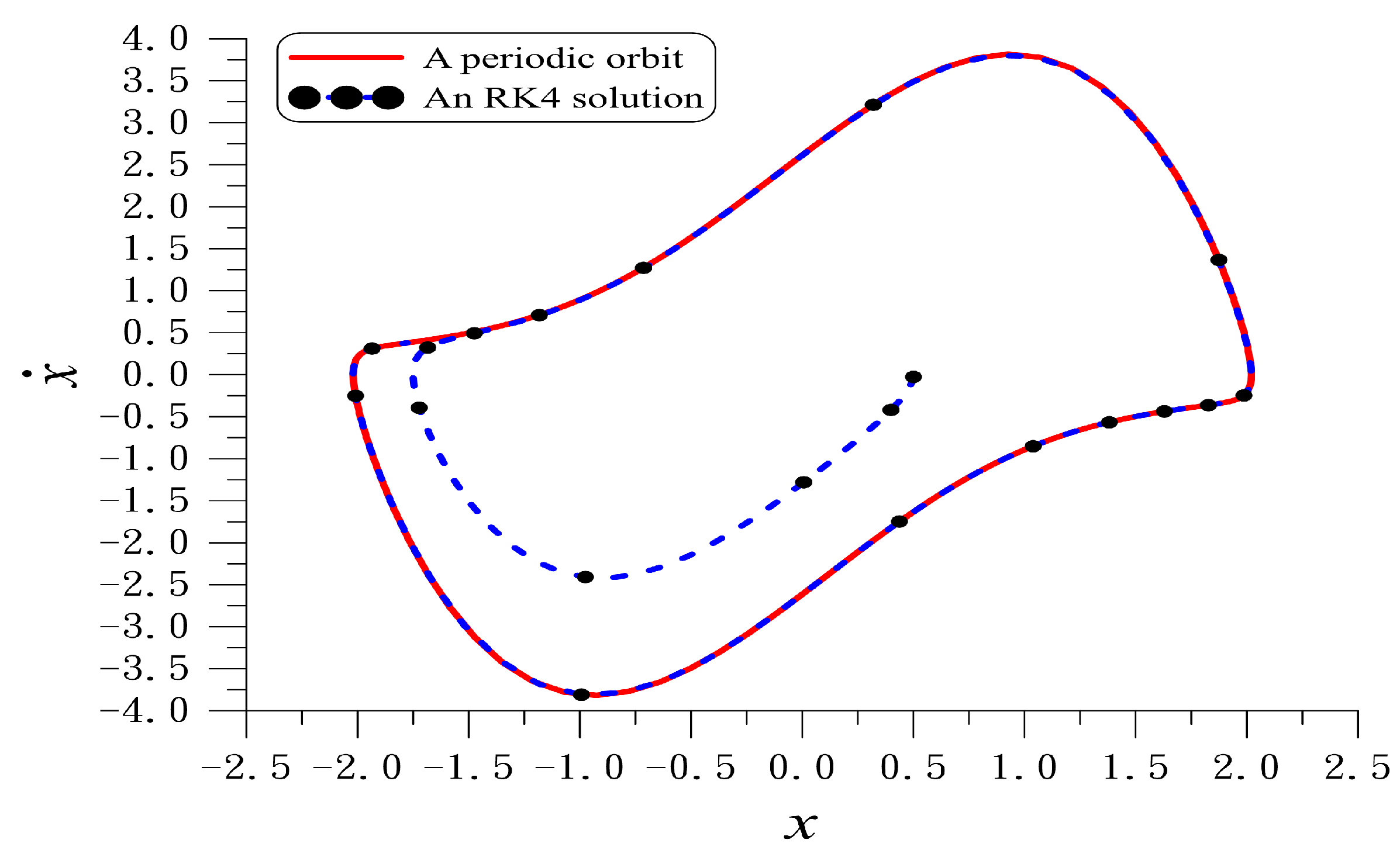
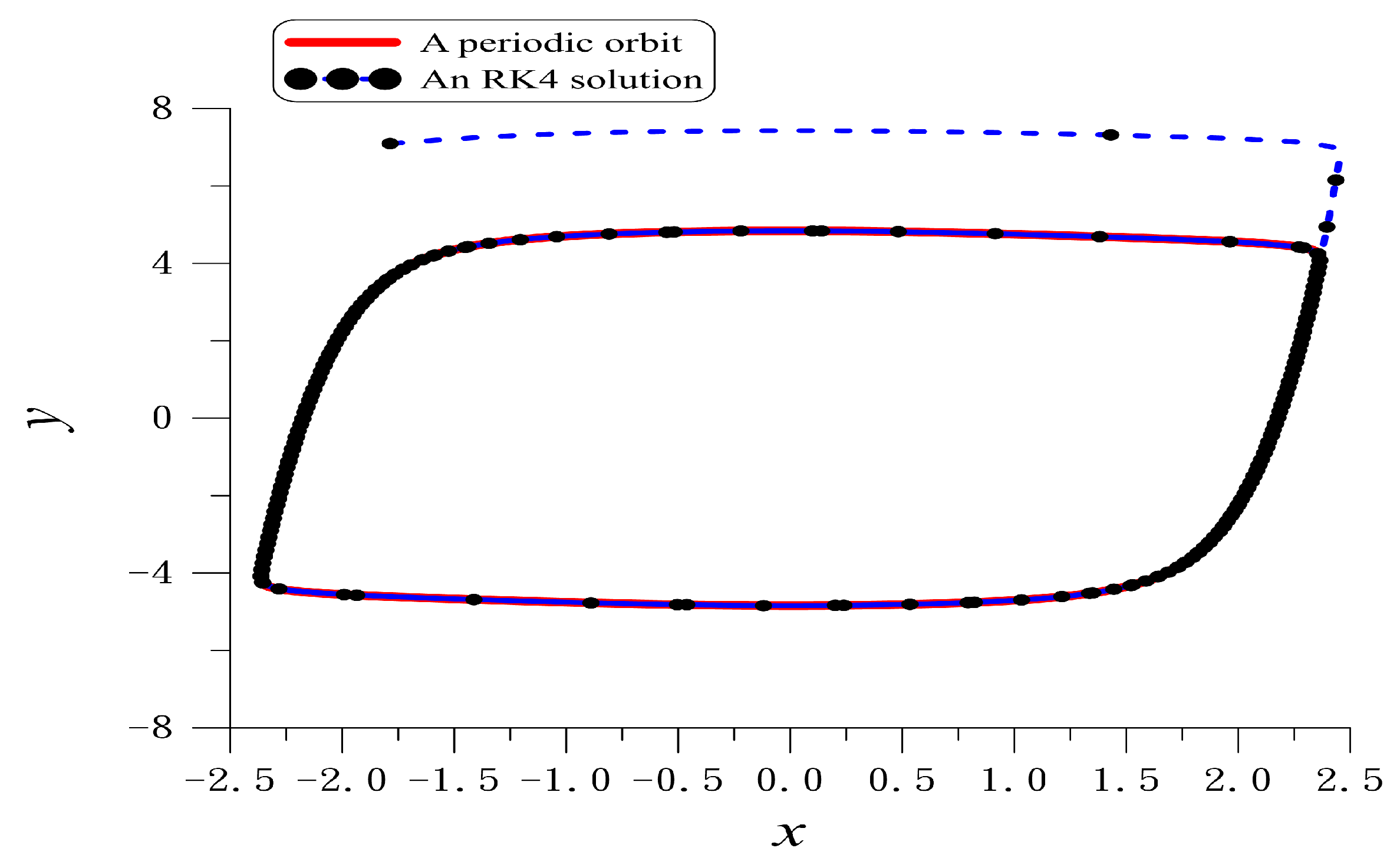
By using the iteration method we obtain and . Figure 1 plots the periodic orbit of the van der Pol equation with the absolute error of periodicity conditions.
Figure 1.
For example 6 of the van der Pol equation showing a periodic orbit and comparing the periodic solution with that computed by RK4 to the limit cycle.
Most researchers in the discussion of the Liénard equation adopt the following system [45,46]:
where
For the van der Pol equation , and we have
For this system we must check the following condition to determine A and T:
where x and y are obtained by integrating Equation (80).
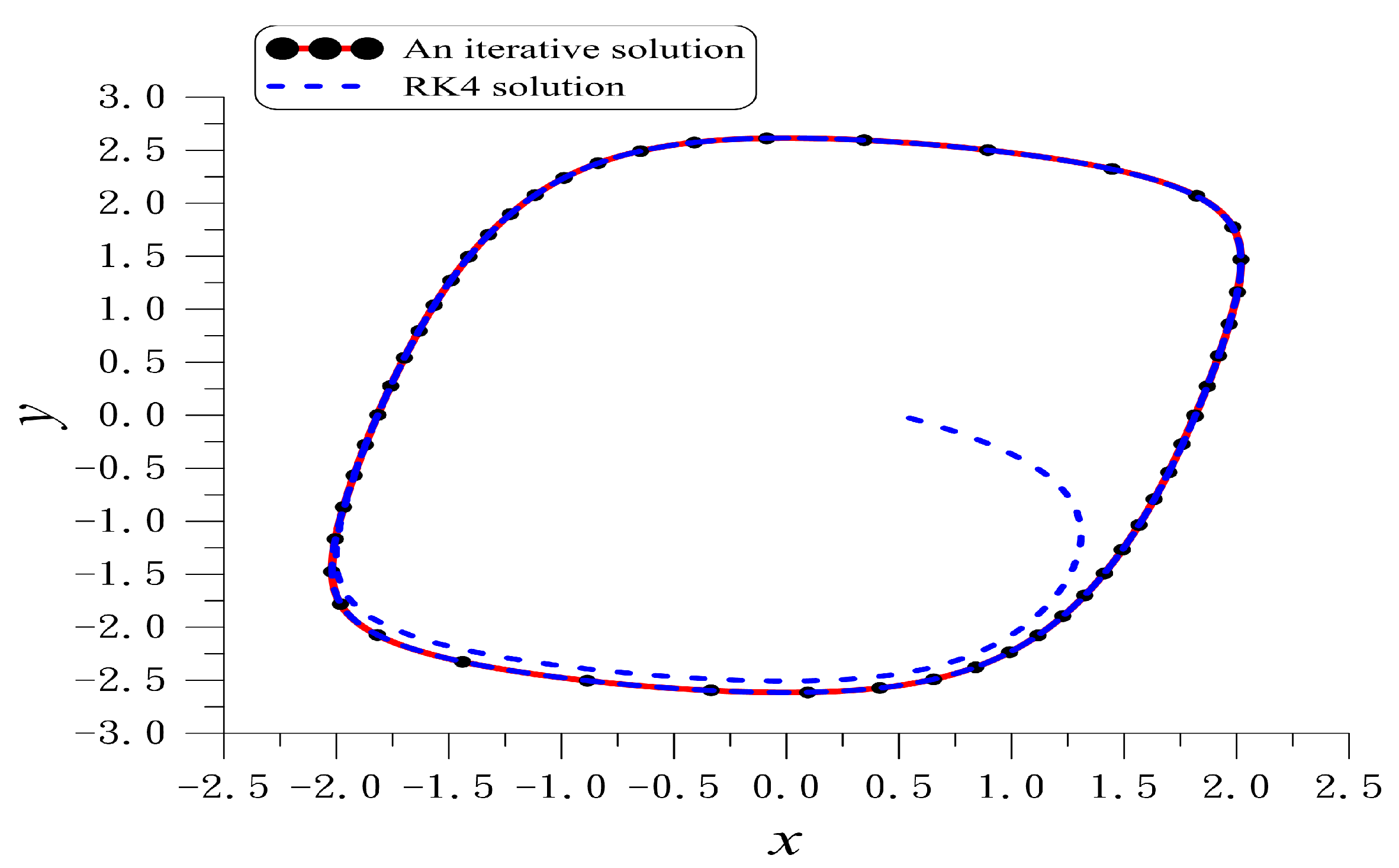
By using the iteration method we obtain and . Figure 2 plots the periodic orbit of the van der Pol equation with the absolute error of periodicity conditions. Two drawbacks of the second formulation are that A is not the maximum amplitude and the error of periodicity conditions is increased.
Figure 2.
For example 6 of the van der Pol equation showing a periodic orbit for the second system and comparing it with that computed by RK4 to the limit cycle.
6.2. Example 7
We consider [46]:
where A is an unknown constant.
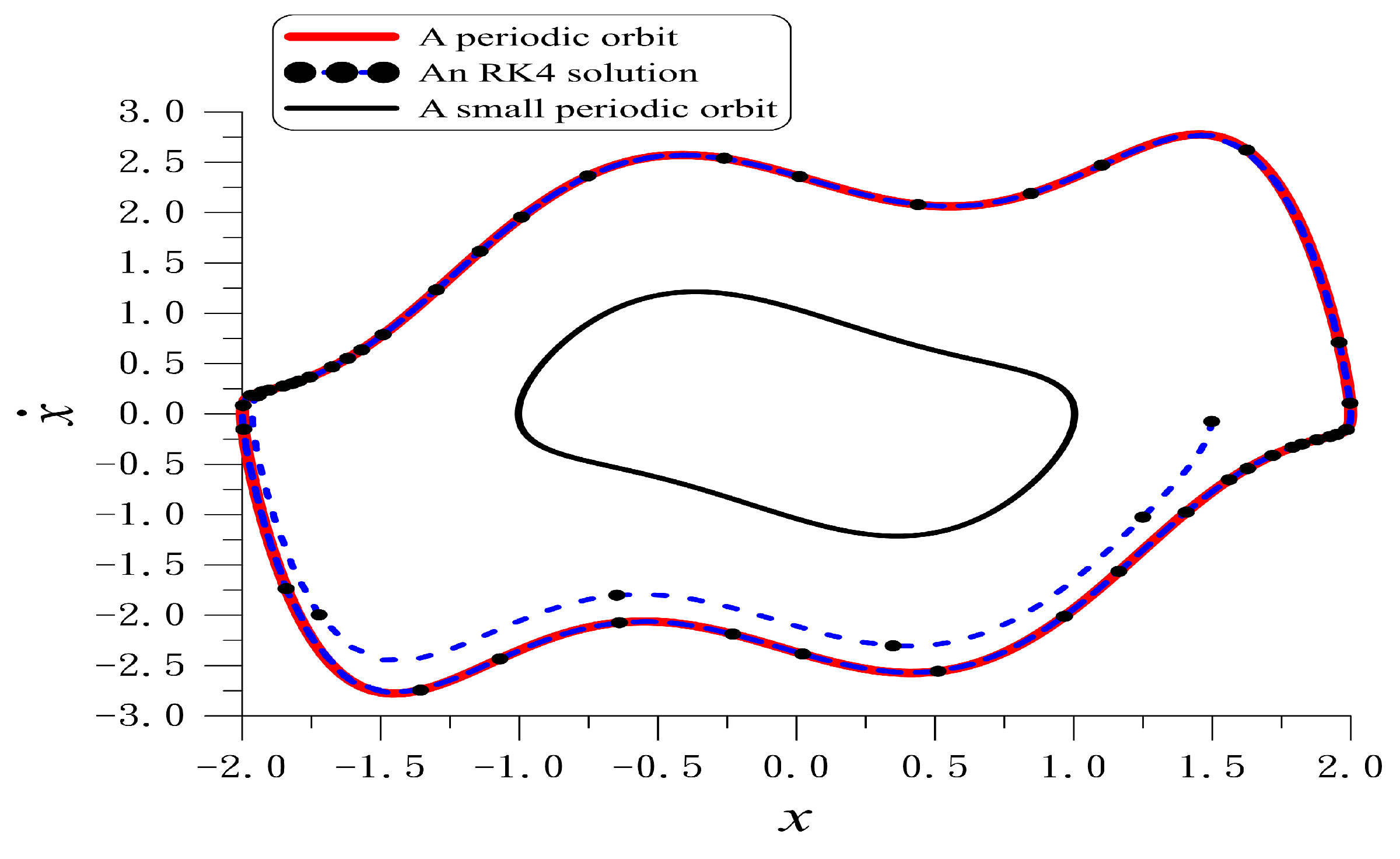
By using the iteration method we obtain and . Figure 3 plots the periodic orbit with the absolute error of periodicity conditions. A smaller periodic orbit is also plotted with , , and the absolute error of periodicity conditions is .
Figure 3.
For example 7 showing a periodic orbit and comparing the periodic solution with that computed by RK4 to the limit cycle, and a smaller periodic orbit.
6.3. Example 8
We consider [46]:
where A is an unknown constant. When , there exist two limit cycles [47]. We take .
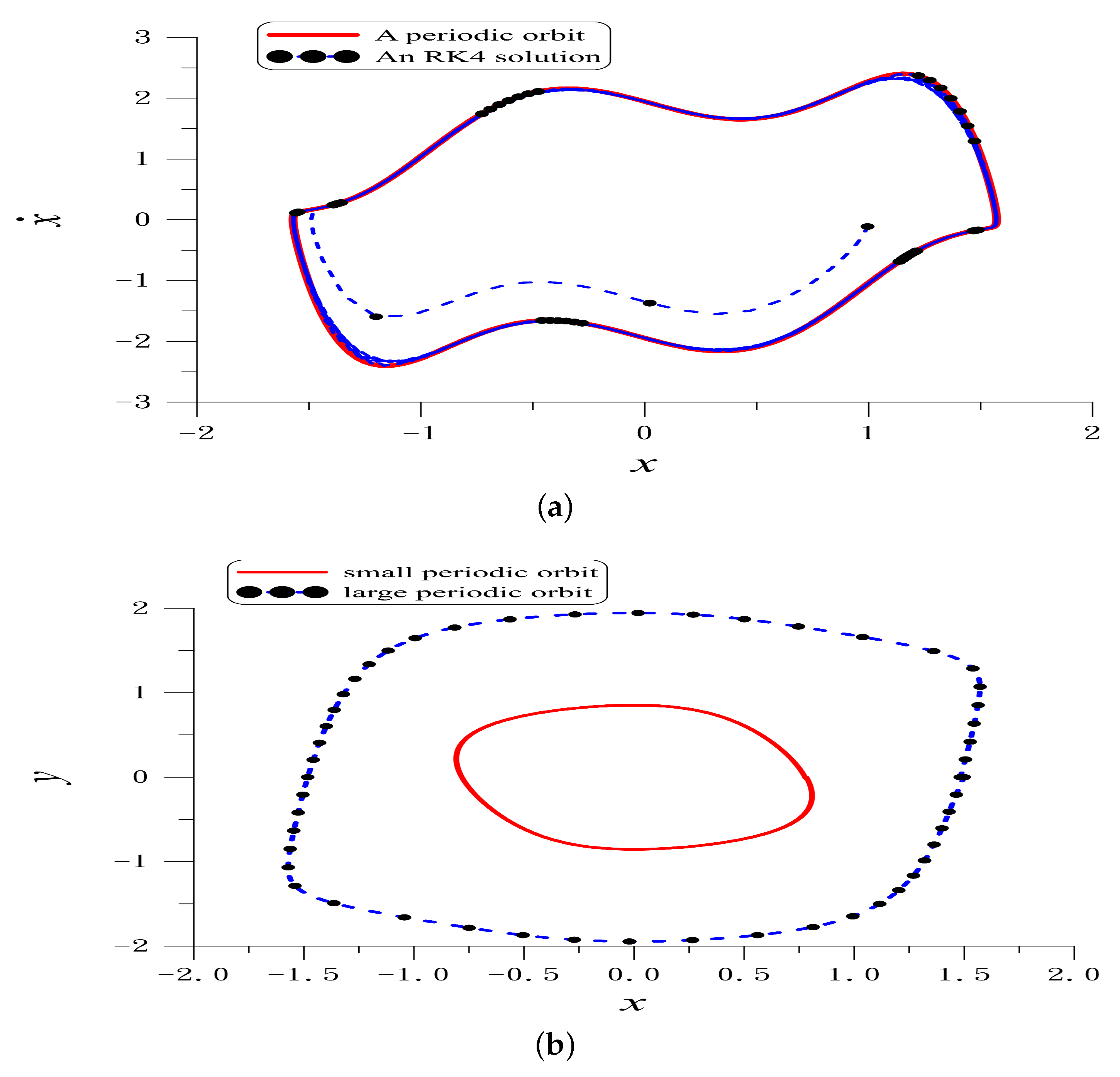
By using the iteration method we obtain and . Figure 4a plots the periodic orbit with the absolute error of periodicity conditions.
Figure 4.
For example 8 showing (a) a periodic orbit and comparing the periodic solution with that computed by RK4 to the limit cycle, and (b) two periodic orbits in the second system.
Equation (83) is recast to the second system by
Figure 4b plots two periodic orbits with and for larger one, and and for smaller one.
6.4. Example 9
We consider
By using the iteration method we obtain and . Figure 5 plots the periodic orbit with the absolute error of periodicity conditions. The RK4 solution is starting from and , and it fast tends to the limit cycle with the maximum value of x to be .
Figure 5.
For example 9 showing a periodic orbit and comparing the periodic solution with that computed by RK4 to the limit cycle.
7. Conclusions
A theoretical foundation of the integral-type formula was set up for the NCNO, which has the first integral. A weight function was introduced so that a generalized integral conservation law was derived for an integral-type formula of the period in Equation (24). Correspondingly, we derived two non-iterative numerical methods for quickly computing the period. Five examples exhibited high accuracy of the proposed methods.
We demonstrated the non-existence of the first integral for the Liénard equation. Then, we turned to the periodic problem of the Liénard equation, involving the van der Pol equation, and derived the integral formula of period for the limit cycle in terms of a dimensionless displacement in the dimensionless time domain in Equation (66). An iterative numerical method was developed with four examples for testing the accuracy of the proposed method to compute both the unknown values of oscillation amplitude and period.
In summary, the present paper is equipped with several novelties and significant contributions, which are highlighted below.
- 1.
- We have transformed the first-order nonlinear ODE used to derive the potential function to an initial value problem. The initial value can be determined very accurately.
- 2.
- A novel integral-type period formula involved a weight function and its initial value for the NCNO having the first integral was derived, which is equivalent to the exact integral formula. The initial value of weight function was determined to meet the periodicity conditions and a very accurate period can be obtained.
- 3.
- The derivation of two non-iterative methods through the integration of two or three first-order ODEs is mathematically sound and reduces computational complexity.
- 4.
- To improve the singularities and minimization of error via weight function adjustment is both innovative and well-justified.
- 5.
- For the NCNO without having the first integral, we derived an integral-type period formula for the non-conservative Liénard equation in the dimensionless time domain.
- 6.
- An iterative numerical method was developed to compute the amplitude and period of the Liénard equation. Even for the problem with multiple limit cycles the amplitude and period can be computed very fast.
- 7.
- Results showed strong agreement with known amplitudes and periods, even for systems with one or two limit cycles, confirming the method’s accuracy and applicability.
- 8.
- The periodic problem for the third-order NCNO and more complex dynamical systems may be pursued in the near future by developing the corresponding integral-type and iterative method to determine the period.
Our results obtained are not applicable to the systems of Equation (1) of a general form, when the existence of a periodic solution is not guaranteed. The numerical methods in Section 3.1 and Section 3.2 are restricted to the systems with periodic solutions, which satisfy Equation (1) and exist the first-integral. The numerical method in Section 5 is restricted to the Liénard equation. For other dynamical systems with periodic solutions and limit cycles, the integral-type and iterative method to depict the oscillatory behavior will be pursued in the future.

Author Contributions
Conceptualization, C.-S.L. and C.-W.C.; Methodology, C.-S.L. and C.-W.C.; Software, C.-S.L., C.-W.C. and C.-C.T.; Validation, C.-S.L. and C.-W.C.; Formal analysis, C.-S.L. and C.-W.C.; Investigation, C.-S.L., C.-W.C. and C.-C.T.; Resources, C.-S.L. and C.-W.C.; Data curation, C.-S.L., C.-W.C. and C.-C.T.; Writing—original draft, C.-S.L. and C.-W.C.; Writing—review & editing, C.-S.L. and C.-W.C.; Visualization, C.-S.L., C.-W.C. and C.-C.T.; Supervision, C.-S.L. and C.-W.C.; Project administration, C.-W.C.; Funding acquisition, C.-S.L. All authors have read and agreed to the published version of the manuscript.
Funding
This research was funded by the National Science and Technology Council grant number 113-2221-E-019-043-MY3.
Data Availability Statement
Data available on request from the authors.
Conflicts of Interest
The authors declare no conflicts of interest.
References
- Farkas, M. Periodic Motions; Springer: New York, NY, USA, 1994. [Google Scholar]
- Chu, H.P.; Lo, C.Y. Application of the differential transform method for solving periodic solutions of strongly non-linear oscillators. Comput. Model. Eng. Sci. 2011, 77, 161–172. [Google Scholar]
- Dai, H.H.; Schnoor, M.; Atluri, S.N. A simple collocation scheme for obtaining the periodic solutions of the Duffing equation, and its equivalence to the high dimensional harmonic balance method: Subharmonic oscillations. Comput. Model. Eng. Sci. 2012, 84, 459–497. [Google Scholar]
- Dai, H.H.; Yue, X.K.; Yuan, J.P. A time domain collocation method for obtaining the third superharmonic solutions to the Duffing oscillator. Nonlinear Dyn. 2013, 73, 593–609. [Google Scholar] [CrossRef]
- Liu, C.S.; Chang, J.R. The periods and periodic solutions of nonlinear jerk equations solved by an iterative algorithm based on a shape function method. Appl. Math. Lett. 2020, 102, 106151. [Google Scholar] [CrossRef]
- Koroglu, C.; Ozis, T. Applications of parameter-expanding method to nonlinear oscillators in which the restoring force is inversely proportional to the dependent variable or in form of rational function of dependent variable. Comput. Model. Eng. Sci. 2011, 75, 223–234. [Google Scholar]
- Liu, C.S.; Chen, Y.W. A simplified Lindstedt-Poincaré method for saving computational cost to determine higher order nonlinear free vibrations. Mathematics 2021, 9, 3070. [Google Scholar] [CrossRef]
- Donescu, P.; Virgin, L.N.; Wu, J.J. Periodic solutions of an unsymmetric oscillator including a comprehensive study of their stability characteristics. J. Sound Vib. 1996, 192, 959–976. [Google Scholar] [CrossRef]
- Wu, B.S.; Sun, W.P.; Lim, C.W. An analytical approximate technique for a class of strongly non-linear oscillators. Int. J. Non-Linear Mech. 2006, 41, 766–774. [Google Scholar] [CrossRef]
- Liu, L.; Thomas, J.P.; Dowell, E.H.; Attar, P.; Hall, K.C. A comparison of classical and high dimension harmonic balance approaches for a Duffing oscillator. J. Comput. Phys. 2006, 215, 298–320. [Google Scholar] [CrossRef]
- Dai, H.; Yue, X.; Yuan, J.; Atluri, S.N. A time domain collocation method for studying the aeroelasticity of a two dimensional airfoil with a structural nonlinearity. J. Comput. Phys. 2014, 270, 214–237. [Google Scholar] [CrossRef]
- He, J.H. Variational iteration method—A kind of non-linear analytic technique: Some examples. Int. J. Non-Linear Mech. 1999, 34, 699–708. [Google Scholar] [CrossRef]
- Ozis, T.; Yildirim, A. A study of nonlinear oscillators with u1/3 force by He’s variational iteration method. J. Sound Vib. 2007, 306, 372–376. [Google Scholar] [CrossRef]
- He, J.H. A coupling method of a homotopy technique and a perturbation technique for non-linear problems. Int. J. Non-Linear Mech. 2000, 35, 37–43. [Google Scholar] [CrossRef]
- Liu, C.S. Linearized homotopy perturbation method for two nonlinear problems of Duffing equations. J. Math. Res. 2021, 13, 10–19. [Google Scholar] [CrossRef]
- Viswanath, D. The Lindstedt-Poincaré technique as an algorithm for computing periodic orbits. SIAM Rev. 2001, 43, 478–495. [Google Scholar] [CrossRef]
- Batiha, B.; Alshammari, N.; Aldosari, F.; Masood, F.; Bazighifan, O. Asymptotic and oscillatory properties for even-order nonlinear neutral differential equations with damping term. Symmetry 2025, 17, 87. [Google Scholar] [CrossRef]
- Aljawi, S.; Masood, F.; Bazighifan, O. Oscillation analysis in nonlinear differential equations with mixed neutral terms. Appl. Math. Sci. Eng. 2025, 33, 2508175. [Google Scholar] [CrossRef]
- Masood, F.; Batiha, B.; Bazighifan, O. Asymptotic and oscillatory characteristics of solutions of neutral differential equations. J. Math. Comput. Sci. 2025, 39, 418–436. [Google Scholar] [CrossRef]
- Coddington, E.A.; Levinson, N. Theory of Ordinary Differential Equations; McGraw-Hill: New York, NY, USA, 1955. [Google Scholar]
- He, J.H.; Garcia, A. The simplest amplitude-period formula for non-conservative oscillators. Rep. Mech. Eng. 2021, 2, 143–148. [Google Scholar] [CrossRef]
- Liu, C.S.; Tsai, C.C.; Chang, C.W. Theoretical formulations of integral type frequency-amplitude relationships for second-order nonlinear oscillators. Vibration 2025, 8, 45. [Google Scholar] [CrossRef]
- Cai, X.C.; Liu, J.F. Application of the modified frequency formulation to a nonlinear oscillator. Comput. Math. Appl. 2011, 61, 2237–2240. [Google Scholar] [CrossRef]
- He, J.H. Amplitude-frequency relationship for conservative nonlinear oscillators with odd nonlinearities. Int. J. Appl. Comput. Math. 2017, 3, 1557–1560. [Google Scholar] [CrossRef]
- Ren, Z.F.; Hu, G.F. He’s frequency-amplitude formulation with average residuals for nonlinear oscillators. J. Low Freq. Noise Vib. Active Contr. 2018, 38, 1050–1059. [Google Scholar] [CrossRef]
- Wu, Y.; Liu, Y.P. Residual calculation in He’s frequency-amplitude formulation. J. Low Freq. Noise Vib. Active Contr. 2021, 40, 1040–1047. [Google Scholar]
- Tian, D.; Liu, Z. Period/frequency estimation of a nonlinear oscillator. J. Low Freq. Noise Vib. Active Contr. 2019, 38, 1629–1634. [Google Scholar] [CrossRef]
- He, C.H.; Wang, J.H.; Yao, S. A complement to period/frequency estimation of a nonlinear oscillator. J. Low Freq. Noise Vib. Active Contr. 2019, 38, 992–995. [Google Scholar] [CrossRef]
- El-Dib, Y.O. A review of the frequency-amplitude formula for nonlinear oscillators and its advancements. J. Low Freq. Noise Vib. Active Contr. 2024, 43, 1032–1064. [Google Scholar] [CrossRef]
- Glass, L.; Pasternack, J.S. Prediction of limit cycles in mathematical models of biological oscillations. Bull. Math. Biol. 1978, 40, 27–44. [Google Scholar] [CrossRef]
- Abdelkefi, A.; Vasconcellos, R.; Nayfeh, A.H.; Hajj, M.R. An analytical and experimental investigation into limit-cycle oscillations of an aeroelastic system. Nonlinear Dyn. 2013, 71, 159–173. [Google Scholar] [CrossRef]
- Mickens, R.E. Truly Nonlinear Oscillations: Harmonic Balance, Parameter Expansions, Iteration, and Averaging Methods; World Scientific: Singapore, 2010. [Google Scholar]
- Garcia, A. Bounding periodic orbits in second order systems. WSEAS Transac. Sys. Contr. 2022, 17, 498–503. [Google Scholar] [CrossRef]
- Garcia, A. On the homotopy-first integral method for non-conservative oscillators. Euations 2024, 4, 17–23. [Google Scholar] [CrossRef]
- Brauer, F.; Nohel, J.A. The Qualitative Theory of Ordinary Differential Equation: An Introduction; Dover Publications: New York, NY, USA, 1969. [Google Scholar]
- Liu, C.S.; Atluri, S.N.; Dai, H. Fictitious time integration method for seeking periodic orbits of nonlinear dynamical systems. Int. J. Non-Linear Mech. 2023, 152, 104388. [Google Scholar] [CrossRef]
- Mickens, R.E. Investigation of the properties of the period for the nonlinear oscillator x¨+(1+x˙2)x=0. J. Sound Vib. 2006, 292, 1031–1035. [Google Scholar] [CrossRef]
- Akbarzade, M.; Khan, Y. Dynamic model of large amplitude non-linear oscillations arising in the structural engineering: Analytical solutions. Math. Comput. Model. 2012, 55, 480–489. [Google Scholar] [CrossRef]
- Ren, Z.F.; Wu, J.B. He’s frequency-amplitude formulation for nonlinear oscillator with damping. J. Low Freq. Noise Vib. Active Contr. 2019, 38, 1045–1049. [Google Scholar] [CrossRef]
- Yao, S.W.; Cheng, Z.B. The homotopy perturbation method for a nonlinear oscillator with a damping. J. Low Freq. Noise Vib. Active Contr. 2019, 38, 1110–1112. [Google Scholar] [CrossRef]
- Ganji, S.S.; Ganji, D.D.; Babazadeh, H.; Sadoughi, N. Application of amplitude-frequency formulation to nonlinear oscillation system of the motion of a rigid rod rocking back. Math. Meth. Appl. Sci. 2010, 33, 157–166. [Google Scholar] [CrossRef]
- Qian, Y.H.; Pan, J.L.; Chen, S.P.; Yao, M.H. The spreading residue harmonic balance method for strongly nonlinear vibrations of a restrained cantilever beam. Adv. Math. Phys. 2017, 2017, 5214616. [Google Scholar] [CrossRef]
- Basit, M.A.; Tahir, M.; Shah, N.A.; Tag, S.M.; Imran, M. An application to formable transform: Novel numerical approach to study the nonlinear oscillator. J. Low Freq. Noise Vib. Active Contr. 2024, 43, 729–743. [Google Scholar] [CrossRef]
- Levinson, N.; Smith, O.K. A general equation for relaxation oscillations. Duke Math. J. 1942, 9, 384–403. [Google Scholar] [CrossRef]
- Odani, K. On the limit cycle of the Liénard equation. Arch. Math. 2000, 36, 25–31. [Google Scholar]
- Giacomini, H.; Neukirch, S. On the number of limit cycles of Liénard equation. Phys. Rev. E 1997, 56, 3809–3813. [Google Scholar] [CrossRef]
- Rychkov, G.S. The maximal number of limit cycles of the system y′=-x, x′=y-(a1x+a3x3+a5x5) is equal to two. Diff. Eqs. 1975, 11, 301. [Google Scholar]
Disclaimer/Publisher’s Note: The statements, opinions and data contained in all publications are solely those of the individual author(s) and contributor(s) and not of MDPI and/or the editor(s). MDPI and/or the editor(s) disclaim responsibility for any injury to people or property resulting from any ideas, methods, instructions or products referred to in the content. |
© 2025 by the authors. Licensee MDPI, Basel, Switzerland. This article is an open access article distributed under the terms and conditions of the Creative Commons Attribution (CC BY) license (https://creativecommons.org/licenses/by/4.0/).