


Abstract
This study develops a mathematical model for soil moisture diffusion, addressing the inverse problem of determining both the diffusion coefficient and the variation coefficient in a nonlinear moisture transfer equation. The model incorporates specific boundary and initial conditions and utilizes experimentally measured moisture values at a boundary point as input data. An iterative method, based on an explicit gradient scheme, is introduced to estimate the soil parameters. The initial boundary value problem is discretized, leading to a difference analog and the formulation of a conjugate difference problem. Iterative formulas for calculating the unknown parameters are derived, with a priori estimates ensuring the convergence of the iterative process. Additionally, the research establishes the convergence of the numerical model itself, providing a rigorous foundation for the proposed approach. The study also emphasizes symmetry in moisture calculations, ensuring consistency regardless of the calculation direction (from right to left or left to right) and confirming that moisture distribution remains symmetric within specified intervals. This preservation of symmetry enhances the model’s robustness and accuracy in parameter estimation. The numerical simulations were successfully conducted over a 7-day period, demonstrating the model’s reliability. The discrepancy between the numerical predictions and experimental observations remained within the margin of measurement error, confirming the model’s accuracy.
1. Introduction
Moisture measurement plays a critical role in various fields, including agriculture, environmental science, civil engineering, and material science. Accurate modeling and prediction of moisture transfer are essential for optimizing irrigation systems [1], preventing soil erosion [2], improving building insulation [3], and ensuring the durability of materials [4]. Despite significant progress in recent years, existing models often face limitations when dealing with non-linear dynamics and complex boundary conditions, especially in media with contact boundaries. In agriculture, understanding moisture dynamics is essential for efficient water management, improving crop yields, and reducing water waste [5]. Recent studies have shown that improved moisture transfer models can significantly enhance irrigation practices by predicting soil moisture behavior more accurately [6]. In civil engineering, moisture-related problems such as mold growth, material degradation, and foundation damage pose serious challenges [7]. Advanced moisture models can help predict these issues and mitigate their impacts through better design and maintenance practices. Moreover, in material science, the ability to predict moisture behavior in porous materials is crucial for improving product durability, especially in humid environments [8]. These applications highlight the wide-reaching impact of accurate moisture transfer models across different scientific disciplines.
Basic Approaches to Mathematical Modeling of Moisture Transfer
Mathematical models of most natural processes are based on the concept of continuum [9,10]. Analyzing known models, the authors of [11] consider it possible to accept the following assumptions: moisture transfer in the soil develops under the influence of capillary and gravitational forces.
Taking this into account, the equation of fluid motion when the soil is saturated can be described using Darcy’s law [12]. In this case, the speed of fluid movement is proportional to the pressure gradient:
where is the coefficient of moisture conductivity, which, according to [12], follows the dependence . This coefficient also depends on the coordinates x, y, z, and W—volumetric soil moisture, H—pressure, and t—time.
Soil moisture can vary depending on movement. If, at the initial period, the soil has an uneven moisture distribution in depth, over time, the moisture content will increase in drier layers according to the diffusion law. The direction of the soil moisture gradient will correspond to the layers where it is lower. If moisture moves from the larger to the smaller, then the process of moisture transfer is described by Equation (1). However, in some cases, moisture moves from less to more, a phenomenon known as the Allaire effect, described using the concept of fractured porous soil. A correction term is introduced into the moisture transfer equation to account for this effect, leading to the Allaire model [13]:
where A and D are proportionality factors.
A porous medium is primarily described as a continuous medium, the properties of which are not expressed through the constituent elements but are described based on indicators averaged over a certain volume [14,15]. Soil is characterized by its moisture-holding capacity, i.e., the ability to retain a certain amount of moisture that does not flow into the underlying layers. The water regime of the soil depends on its properties, as well as climatic and weather conditions. The soil—the upper fertile layer of the earth’s surface, as well as the underlying soils—is a three-phase structure consisting of a solid phase, a liquid phase, and gas (air), as shown in Figure 1.
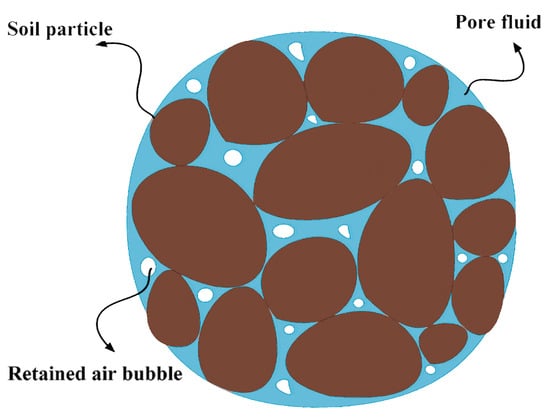
Figure 1.
Soil structure with gas-air pores.
Soil moisture capacity is a quantitative value that characterizes the soil’s water-holding capacity. One of the simple models of the theory of moisture movement in soil is based on solving the water balance equation of the soil profile using the Darcy equation and the continuity equation (Richards Equation) [16]. The second fundamental physical law necessary for modeling moisture movement in soil is the law of conservation of matter [9]. The physical meaning of the Richards equation lies in describing water movement in the soil. By setting small time intervals in the vertical coordinate for elementary layers, it is possible to determine the distribution of moisture in the soil profile, taking into account the initial conditions, precipitation, irrigation, water consumption of plants, and other factors [12,17]. Soil hydraulic conductivity is understood as its conductivity under the influence of soil moisture potential gradients [13]. The coefficient of hydraulic conductivity depends on soil moisture: it increases with increasing soil moisture and reaches a maximum in moisture-saturated soil. In this case, it is referred to as the filtration coefficient, but it is applicable to soils unsaturated with water.
A number of researchers note that for soils unsaturated with water, the value of the moisture conductivity coefficient is significantly determined by soil moisture [18]. A slight reduction in moisture content can lead to a significant decrease in hydraulic conductivity, which can be explained by a decrease in volumetric conductivity. The theory of moisture movement in soil is based on the assumption of the Newtonian nature of the liquid, which does not exhibit shear resistance and has constant viscosity at a certain temperature.
The patterns of dependence of hydraulic conductivity indicators on soil moisture differ for different types of soil [12]. Currently, methods of mathematical modeling of hydraulic conductivity are becoming widespread [17,19,20,21]. It is noted that experimental methods and approaches require further improvement [22]. The developed mathematical models of moisture transfer must satisfy several requirements [11], including simplicity, the inclusion of well-studied water-physical characteristics of the soil, and the use of universal numerical solution algorithms.
It should be noted that several issues of moisture transfer were studied in works [3,23]. In [24], various computerized models for managing the water regime during irrigation were developed, although these models did not explicitly account for the production processes of plant development.
In this context, some studies have focused on improving information support for tasks related to the automation and management of soil water regimes [17]. This can be achieved through optimization algorithms, the use of calculated values and reference databases, and modern methods in monitoring the initial soil regime using automated instruments and measuring technical means of remote sensing [20]. A computer experiment typically involves using a mathematical model as the test object, with external influences, model parameters, or subprocess algorithms acting as the variable experimental conditions [11,21,24,25,26,27,28,29,30].
Scientists have been studying combined irrigation technologies [31,32,33,34]. Comprehensive descriptions of irrigation systems can be found in [35,36]. The fractal and symmetrical properties of soil colloids have been investigated in [37]. Ecological and economic regulation, taking into account transboundary environmental pollution, was studied in [38], with mathematical modeling used to describe the processes of heat and moisture transfer. Among all the studies, works devoted to the theories of inverse and ill-posed problems hold a special place. Inverse problems of various processes were studied in [38,39,40,41,42]. The efficiency of irrigation can be significantly improved through the application of information technologies and technical-economic optimization, including in the management of reclamation activities, as described in publications [43]. The development of new promising technical means is presented in the patent [44].
This study proposes a novel numerical method for solving the inverse problem of moisture transfer in soil, validated against experimental data. By determining multiple transfer coefficients simultaneously, our model provides a robust solution that can be applied to diverse real-world challenges. The model incorporates uncertainty quantification, making it reliable for practical use in fields like agriculture, environmental science, and civil engineering. The approach is highly applicable for real-time moisture monitoring and prediction.
The following sections will delve into the intricacies of the problem at hand. Section 2 describes the experimental setup and governing equations necessary for understanding the moisture dynamics within the soil. It introduces the discrete numerical model employed to simulate these processes. In Section 3 the conjugate problem is defined, and the algorithm developed to solve it is detailed. The mathematical techniques and iterative methods used in the solution process are thoroughly explained. The most crucial is Section 4 of this article; it proves the convergence of the numerical model. Rigorous mathematical analysis is presented to establish the reliability and accuracy of the iterative processes used. Section 5 illustrates the results obtained from the numerical simulations. Detailed analysis and interpretation of the data are provided, offering insights into the practical implications of the findings.
2. Inverse Problem
2.1. Experimental Setup and Mathematical Modeling of the Problem
To use one-dimensional equations of moisture conductivity, we created the container shown in Figure 2. The side edges of which are moisture-proof. Thus, it leads to symmetry boundary conditions along z axis [45]. The end sides of the container are covered with fine rectangular mesh so that soil or soil cannot leave the container. The container is filled with soil and the end faces are closed with lids. The process of moisture transfer in the container is investigated.
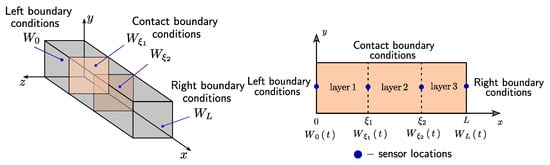
Figure 2.
Experimental set-up illustration with appropriate boundary conditions position (left), scheme of the sensor locations along the container (right).
If the conditions of moisture insulation along all side faces are met, then the process of moisture transfer in the container is described by the one-dimensional moisture transfer equation
where , x—container length shown in Figure 2.
At the initial moment of time (), we filled the container with soil and considered the distribution of moisture along the horizontal axis to be known. Typically this condition is written in the form
Neumann boundary conditions will be used. On the left boundary, we assume that there is no inflowing flow. This condition is equivalent to the fact that the left end of the container is closed with a heat-insulated lid. On the right boundary of the region, the inflowing flow is specified. That is, the right end is closed with a mesh cover, which allows the inflow to flow into the interior of the area. The above can be written as follows
2.2. Discrete Problem
The segment is divided into N equal parts with step , and the segment is divided into m equal parts with step . In the constructed mesh area
A discrete analog of the problem is studied (3)–(5) [46]:
where
Here, is an approximate value . For the sake of clarity, the methodology to solve discrete problem by Thomas’ method is given in Appendix A.
After applying Thomas’ method the question arises: is the denominator of the fraction (A21) different from zero? To answer this question, we check the conditions for the computational stability of the scalar sweep method.
In our case there is
Theorem 1.
If , , then all coefficients of the sweep formula do not exceed 1, i.e.,
Proof.
Direct inspection shows that
On the other hand, from (A1) the equality follows
therefore, . It follows that all the conditions of the theorem are met. It means that . □
3. Method for Solving the Inverse Problem
3.1. Conjugate Problem
The required quantities are sought iteratively. In this case, the solution of the system (9)–(12) will depend on the iteration number n, i.e.,
Additionally, the measured moisture value is set on the right border of the area ,
An auxiliary difference problem is constructed
After the multiplication of (23) by an arbitrary grid function and summing over i and j one needs to perform several mathematical steps to derive a conjugate problem (See Appendix B. Then, following the rule for choosing the boundary condition of the conjugate problem [46], we derive the conjugate problem:
3.2. Algorithm for Solving the Conjugate Problem
Let us rewrite the difference equation of the system (26) in the form
By introducing the notation
We obtain a three-point scheme of the form
We look for a solution to the system (33) in the form
Comparing the last equality (34) we conclude that
Assuming in the system (33) we find that
Formula (37) is the initial condition of Formula (36). This means that all coefficients of the Thomas method (34) are uniquely determined, and .
Knowing , you can calculate the entire value of using the Formula (34). To coduct this, we turn to the boundary condition of the system (26):
or, if
where
To determine the system is solved
Solving which we find
Algorithm for solving the conjugate problem
3.3. Solution of the Inverse Problem
To solve the inverse problem, i.e., develop a method for finding , four time domains are considered:
In the region we will look for the value A, in the region we will look for the function , and in the region we will look for the functions .
The required quantities are found from the minimum of the functional
Let us calculate the variation in the functional
Taking into account Formula (27) we rewrite the variation of the functional in the form
3.3.1. Calculation of the Allaire Parameter A
In the region Formula (47) takes the form
In this case, the direct difference problem (9)–(11), and the conjugate difference scheme (26) are used without changes.
The parameter is calculated using the formula
where is the damping coefficient. The calculation algorithm can be found in Algorithm 1.
| Algorithm 1 Computational algorithm for finding parameter A |
|
3.3.2. Calculation of Moisture Flow
We assume that . The n-th approximation is specified
Looking for coefficients of a cubic polynomial .
The n-th approximation is specified
Next, approximation searched in area .
In region :
Therefore, from (47) the equality follows
In order for the functional to be monotonic, the parameters are chosen as follows:
The calculation algorithm is presented in Algorithm 2.
| Algorithm 2 Computational Algorithm for Finding Parameter |
|
3.3.3. Calculation of Moisture Conductivity
Using the calculated values , we will determine . The function is defined by the formula (according to Gardner) . Therefore, it is sufficient to find the parameters B and E. In different schemes, the moisture diffusion coefficient is present in the form
Therefore,
Let us introduce the notation
Then
Using the Lagrange formula
where
Adding and subtracting value
Let us transform
To the second expression on the right side of the equal sign, we again apply the Lagrange formula, then
It means that
Taking into account the last equality, the relation (70) is presented in the form
Here, —a small value of the second order is determined by the formula.
In the region the Formula (47) has the form
We substitute Formula (78) and, isolating small quantities of the second order, we deduce that
where
Consider the expressions
Let us sum the last equality over i from 1 to N, then
We turn to the direct difference scheme
We sum it over i from 1 to and, taking into account the boundary conditions, conclude that
Summing up the last equality over j we conclude that
or
where const.
The last equality gives us the basis that
This means that the Formula (84) is represented in the form
Based on (48) from the last equality the calculation formula follows
Full algorithm of finding moisture conductivity coefficient is presented in Algorithm 3.
| Algorithm 3 Computational algorithm for finding coefficient |
|
3.3.4. Structural Algorithm for Solving the Inverse Problem
It was said above that the inverse problem is solved in the region , which is divided into four areas
In the region we will look for A, in the region we will find , in the region and we will find parameters and functions .
- 1-step.
- Initial approximations of are specified.
- 2-step.
- In the area , the algorithm is launched and is determined.
- 3-step.
- In the region the algorithm is launched and is determined.
- 4-step.
- In the regions and the algorithm is launched and is determined.
- 5-step.
- With new parametersthe direct difference problem is calculated and is determined.
- 6-step.
- The values of the functional are calculatedor
- 7-step.
- If there is inequality orthen the problem is solved with an accuracy of or and continue to step 8.And if or , then set and go to step 2.
- 8-step.
- Save and output values:
4. Convergence of Iterative Processes
4.1. A Priori Estimates
A priori estimates will be used to solve direct, auxiliary and conjugate problems.
First, consider the direct difference scheme.
Let us multiply the first equation of system (102) by and sum by i from 1 to , by j from 0 to the derivative j. After applying the summation formula by parts over variable i, it is deduced that
But
Therefore,
This implies the estimate
From identity
Inequality follows
this implies
Using the latter, (107) strengthens and, using the difference analog of the Gronwall Lemma, it is deduced that
where
Assuming that , that is, a limited non-zero value and multiplying the first equation of system (102) by and sum over i from 1 to , over j from 0 to the arbitrary J. Afterwards, applying the formula for summing by parts over variable i the following equality holds
from equality
it follows that there is a bounded . Without loss of generality, it is assumed that is bounded.
This implies the inequality
Choosing from the condition
display the second estimate
Lemma 1.
From estimate (111) it follows that
Proof.
Consider the identity
The last inequality implies the statement of Lemma 1.
Lemma 1 implies the inequality
Lemma 2.
Inequality is justified
Proved. □
Theorem 2.
If then the solution to system (102) satisfies the estimate
Theorem 3.
If the conditions of Theorem 2 and Lemmas 1 and 2 hold, then the solution to system (102) satisfies the estimate
Proof.
An a priori estimate for solving the conjugate problem
Let us multiply the first equation of system (125) by and sum by i from 1 to , by j from the arbitrary J to . After applying the summation formula over variable i the equality holds
Taking into account the condition and the inequality
the next inequality holds
We sum the last equality over s from arbitrary j to
From the last equality, it follows that there exists which is bounded. Without loss of generality, it is assumed that
Consider the identity
This implies the inequality
Using the last relation, we strengthen (129) and using the difference analog of Gronwall’s Lemma we derive the inequality
Proved. □
Theorem 5.
If Theorems 2 and 4 hold, then the solution to system (139) satisfies the estimate
Proof.
Auxiliary difference scheme in the region:
Here,
Multiply the first equation of the system (139) by and summarize by i from 1 to , by j of 0 to arbitrary j. The summation formula for parts by variable i, taking into account equality (140) is used, the following equality holds
Given the boundary conditions of the system (139), it is shown that
Using Cauchy’s inequality, the right-hand side of equality (141) is estimated as follows. This takes into account the assessment
It means that
Using Theorem 2 and the embedding estimate
the following inequality is derived
Let us use an obvious inequality . Then
The second sum on the right side of the equal sign (141) is estimated in a similar way:
4.2. Convergence of the Sequence
To prove the convergence of the iterative process, we turn to the formula
Let us transform
Let us apply Lagrange’s formula again. For convenience, the notation
is introduced. Then,
Taking into account the latter, equality (150) takes the form
The sums on the right side of the equal sign are denoted by
Based on Theorems 1–4 and the Cauchy formula, the following relations are derived
Let us introduce the notation
In order to estimate the value of , we summarize Equation (102) over i from 1 to an arbitrary . Taking into account homogeneous boundary conditions, we conclude that
From here we find
The found value into :
Grouping similar quantities, we have
Assume that
Let us prove that the right-hand side of (164) is bounded. Using Cauchy’s inequality we estimate
Using Theorems 2 and 3:
We turn again to (163) and set
Let us sum up the last equality for i from 1 to :
We sum the first equation of system (139) over i from 1 to , over j from 0 to an arbitrary j. Then,
Taking this into account, relation (168) takes the form
We sum over j again, then
The inequality is easy to prove
Due to the limited sum of and , it is always possible to select the functions and so that becomes a limited value.
Due to the above reasoning, inequality (158) takes on a new form
Let us introduce the notation
Then,
The value of depends only on the initial data of the direct difference problem and does not depend on the number of iterations n. Therefore, it is always possible to select and such that the inequality holds
After this, we obtain an inequality of the form
The decorated coefficient and is chosen as follows
Then, the inequality follows
or
where
Lemma 3.
Let the sequence be such that
—positive value. Then
Proof.
Both sides of inequality
divide by positive :
Adding and substracting the value:
Therefore,
or
The next inequality follows
Summing up the next inequality by n. Therefore,
By potentiating, we obtain the inequality
Lemma proved. □
Remark 1.
In the monographs [47], the method of choosing and stated above and the proven Lemma is called the R-method (rational method).
Remark 2.
If there is a lower limit of the sequence , i.e., so . Then, estimate (194) takes the form
Remark 3.
Inequality (194) proves that the R-method has an exponential degree of convergence.
4.3. Convergence on Sequence
In the region there is a diffusion coefficient parameter . The initial approximation is specified, and the next approximation is determined from the monotonicity of the functional , i.e.,
In area and . Therefore, the representation is valid
The auxiliary problem in the area is written as
is easily proved.
Theorem 6.
If Theorems 1 and 2 hold, then the estimate holds for the solution of system (198).
Proof.
Multiply (198) by and sum over I from 1 to , over J from 0 to an arbitrary J. Then, we apply the summation formula by parts and take into account each boundary condition system (198). Then,
In the area . Therefore,
here
We substitute Formula (201) into (200) and take into account that :
Using Cauchy’s inequality and the difference analog of Gronwall’s Lemma, we derive the estimate
From system (198) summing over i from 1 to the equality
is derived. By virtue of the last equality, there is a number such that
For brevity of multiplication assume that , then . Let .
or
Therefore, the inequality is justified
Remark 4.
If ,
equality is considered.
So, there is an inequality
Thus, there is the inequality
The theorem is proved.
We turn to formula (203). Rewriting the second and third sums on the right side of the equal sign as
Assuming that
Adding the last equality by I from 1 to . Taking into account , then
Again, summing by j
Reasoning in the same way as when calculating the coefficient , we obtain the exponential rate of convergence of the functional , i.e.,
In the region, we will look for the parameter . Assuming and , the equality is derived
where .
Let us propose equality
Multiply by and sum over all i
In this regard, from (219) the calculation formula follows:
On the other hand, due to proposition (219), the variation of the functional (218) is written in the form
Here,
From the difference problem (216), after some transformations, the estimate follows:
Based on the last estimate, using Theorems 1, 2, and 3, the inequalities are derived
This means that there is inequality
where
From (227) using the R-method, the next estimate is derived
□
5. Results
The measured moisture data were used to solve a numerical problem to find all proportionality factor coefficients (). All numerical computations are conducted with time step , which is equal to measurement period time. The uncertainty in the measurement position is along the x-axis. The total uncertainty in the observations is assessed by propagating the uncertainties. For moisture, the total uncertainty is calculated using the following formula:
where is the measurement sensor uncertainty, is the uncertainty due to the sensor location and is the uncertainty due to the response time of the sensor. The last terms are given by the following:
where represents the position uncertainty and is the response time of the sensor. The term in Equation (230) is derived at the sensor locations using the numerical solution. The second term, , is calculated based on the measurements, employing a second-order finite difference scheme. The uncertainty in the measurements, compared to the estimated moisture values, is illustrated by the gray-shaded regions in Figure 3.
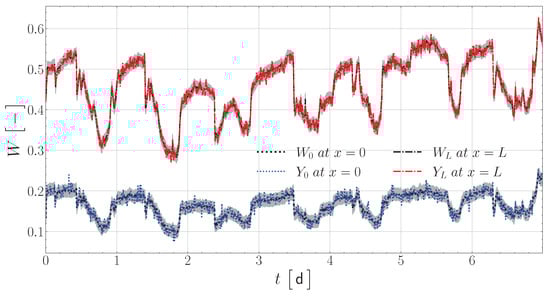
Figure 3.
Distribution of experimental data and during 7 days.
The moisture at is interpolated from measured moisture. Thus, first-order polynomials of are fitted for the length of the container.
These interpolation functions are used as initial conditions for numerical solutions.
The total duration of numerical experiments is equal to the total duration of experimental data, which is a 7-day period. As a result, moisture data were calculated in dynamic behavior. Figure 3 shows moisture distribution during a 7-day period at and . The residual error between the observations and the numerical results are given in Figure 4 for the moisture at different sensor locations, respectively. An error has a Gaussian symmetrical pattern around a zero value. This symmetry indicates that there is no consistent directional bias, and the model is equally likely to overestimate or underestimate the true values. In other words, this is generally a good sign for the validity of your model, as it suggests that any discrepancies between the model and reality are not systematic and could be reduced by refining the model or improving data collection methods.
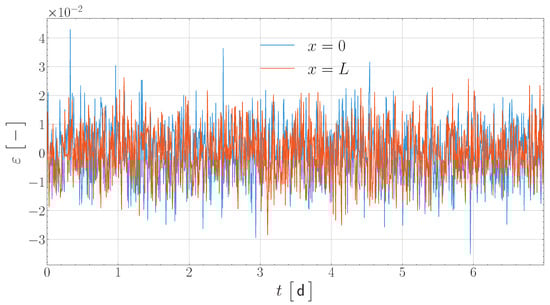
Figure 4.
Error variation between the estimated and experimentally observed moisture levels at and .
The numerical outcomes from the direct problem () are subsequently compared with the experimental data collected at , which serve as the basis for the inverse problem. The corresponding measurements, along with their uncertainty boundaries at the sensor location (), and the estimated values from the direct problem are depicted in Figure 3. The estimated values demonstrate a satisfactory alignment with all observation points. The deviation between numerical predictions and experimental data remains within the uncertainty range of the measurements. Finally, the model’s reliability is assessed by comparing the numerical predictions with an additional set of measurement data. Specifically, the numerical results from the direct problem () are compared with experimental data at , which were not used in the inverse problem resolution. Figure 3 presents the moisture comparison at , utilizing the estimated parameters alongside experimental data at . A highly satisfactory agreement is achieved between the numerical predictions and the experimental observations, thus confirming the reliability of the calibrated model.
The minimization of the functional continued until the relative error between the numerical solution and the experimental data reached , which, in turn, shows a fairly satisfactory accuracy. Checking the absolute errors, , numerical results also meet our expectations. Figure 5 illustrates the changes in parameter D during a 7-day period at points , and . Despite non-smooth experimental data, the numerical results show smooth behavior, which should be investigated in future works with different data. Figure 6 demonstrates the distribution of parameter D along container lengths at times , and .
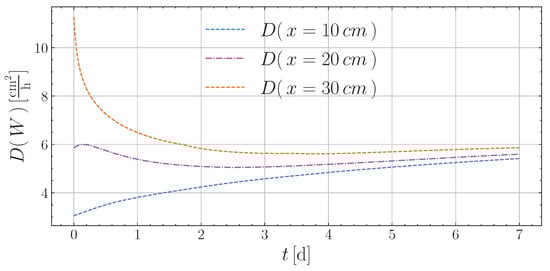
Figure 5.
Distribution of D parameter during a 7-day period at , and .
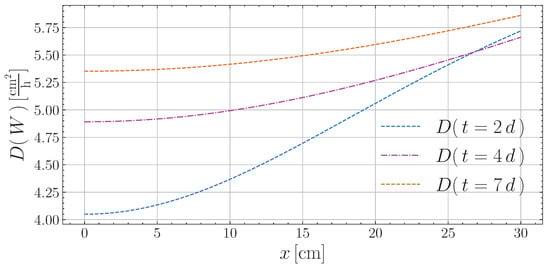
Figure 6.
Distribution of D parameter along the container the container at , and .
The process of convergence of each parameter coefficient is clearly visible in Figure 7. Different initial values are chosen to verify convergence at the values.
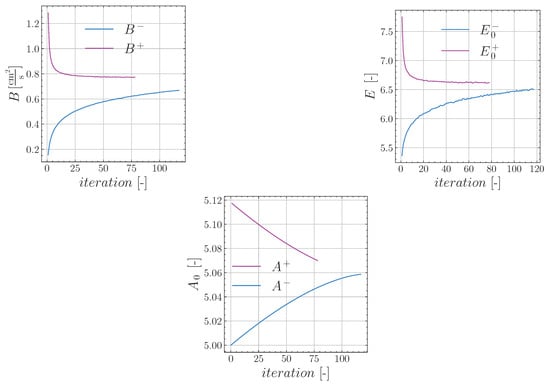
Figure 7.
Convergence distribution for B, E and A parameters.
6. Conclusions
This paper presents a robust numerical method for predicting and determining moisture transfer coefficients in media with contact boundaries. In contrast to previously proposed methods, our approach simultaneously determines multiple coefficients over different time segments, taking into account the limitations of estimating multiple coefficients within a single time frame. By dividing the measured data into time segments corresponding to the number of coefficients, the numerical solution efficiently calculates each coefficient for the respective segment.
A key feature of the proposed method is its ability to solve the nonlinear moisture transfer equation with the proportionality factor coefficient D, modeled as an exponential function, and the source function at the boundary, represented as a polynomial function. The inverse problem is tackled using the Conjugate Gradient method, ensuring high convergence of the solution. Initial moisture values are estimated through linear interpolation from experimental data, while the next approximation in the Conjugate Gradient method is computed using the Thomas (sweep) method, which guarantees unconditional stability.
The new results presented in this paper confirm the model’s reliability through comprehensive numerical simulations over a 7-day period. The calibration of the model using experimental data showed a discrepancy of only between experimental data and numerical estimations, which is within the uncertainty boundaries of the measurements. Additional validation using an extra measurement dataset further demonstrated that the model performs with satisfying accuracy, with the numerical results matching the experimental observations at a different location not used for the inverse problem solution.
The results also show smooth behavior in the moisture distribution across the length of the container, despite the non-smooth nature of the experimental data. This indicates the model’s robustness and suggests potential improvements through future work with different experimental datasets. The analysis of the proportionality factor D over time and across different locations within the container reveals convergent behavior, further validating the accuracy of the calibrated model.
In conclusion, the numerical method presented here proves to be a powerful tool for solving coefficient inverse problems in nonlinear moisture transfer equations. With its high accuracy, smooth numerical results, and successful validation against experimental data, the model holds promise for further applications in practical engineering tasks. Future research goals should take into account expanding the model to incorporate more complex environmental factors, such as freezing and porosity, through detailed experimental measurements.
Author Contributions
Methodology, S.A.; Investigation, N.R.; Data curation, B.R.; Writing—original draft, N.R.; Writing—review & editing, S.A.; Visualization, N.R.; Supervision, B.R.; Project administration, B.R.; Funding acquisition, B.R. All authors have read and agreed to the published version of the manuscript.
Funding
This research has been funded by the Science Committee of the Ministry of Science and Higher Education of the Republic of Kazakhstan (Grant No. AP19677594).
Data Availability Statement
Data are contained within the article.
Conflicts of Interest
The authors declare no conflicts of interest.
Appendix A. Thomas’ Method for Discrete Problem
The difference scheme of direct discrete problem transformed into a standard form using the following notation:
This implies the equality
Using the introduced notations, the system (9) is written in the form
From the system (A2), assuming and taking into account the first boundary condition of the system (12), we derive the equality
But, from (A2) for we find that
Therefore, the Formula (A3) is written in the form
From the last equality, it is determined :
We look for a solution to problem (A3) in the form
Comparing the last equality with (A7) we conclude that
From the Formula (A7), putting , we have the equality
Let us rewrite the second boundary condition of Formula (12) in the form
Let us transform the last equality:
or
From the last equality follows the formula
Let us introduce the notation
Now, using the last equality, the system is jointly solved
From here is determined by the formula
Appendix B. Conjugate Problem Derivation
Let us multiply (23) by an arbitrary grid function and sum over i from 1 to , over j from 0 to m. Then, after applying the summation by the parts formula:
The equality is derived:
For grid functions we require that
Here,
Using Formula (A23) in the opposite direction, we throw the difference derivative of the variable on the variable . Then,
For the grid functions we set the Neumann boundary condition
Then, the sum takes the following form
In a similar way, we transform the sum :
To the right side of the last equality we apply the summation by parts Formula (A22):
But , it follows that
Therefore, the last total relation is simplified and has the following compact form
We group similar quantities:
References
- Innocenti, A.; Pazzi, V.; Napoli, M.; Ciampalini, R.; Orlandini, S.; Fanti, R. Electrical resistivity tomography: A reliable tool to monitor the efficiency of different irrigation systems in horticulture field. J. Appl. Geophys. 2024, 230, 105527. [Google Scholar] [CrossRef]
- Marcinkowski, P.; Szporak-Wasilewska, S. Assessing monthly dynamics of agricultural soil erosion risk in Poland. Geoderma Reg. 2024, 39, e00864. [Google Scholar] [CrossRef]
- El Assaad, M.; Plantec, Y.; Colinart, T.; Lecompte, T. Influence of moisture transfer on thermal conductivity measurement by HFM: Measurement accuracy on insulation materials and consequences on building energy assessments. Energy Build. 2024, 320, 114635. [Google Scholar] [CrossRef]
- Rahmat, M.N.; Ismail, N. Effect of optimum compaction moisture content formulations on the strength and durability of sustainable stabilised materials. Appl. Clay Sci. 2018, 157, 257–266. [Google Scholar] [CrossRef]
- Wu, H.; Yue, Q.; Guo, P.; Xu, X. Exploiting the potential of carbon emission reduction in cropping-livestock systems: Managing water-energy-food nexus for sustainable development. Appl. Energy 2025, 377, 124443. [Google Scholar] [CrossRef]
- Wang, W.; Ma, C.; Wang, X.; Feng, J.; Dong, L.; Kang, J.; Jin, R.; Li, X. A soil moisture experiment for validating high-resolution satellite products and monitoring irrigation at agricultural field scale. Agric. Water Manag. 2024, 304, 109071. [Google Scholar] [CrossRef]
- Vecherin, S.; Joyner, M.; Smith, M.; Linkov, I. Risk assessment of mold growth across the US due to weather variations. Build. Environ. 2024, 256, 111498. [Google Scholar] [CrossRef]
- Hu, A.; Zhou, H.; Guo, F.; Wang, Q.; Zhang, J. Three-dimensional porous fibrous structural morphology changes of high-moisture extruded soy protein under the effect of moisture content. Food Hydrocoll. 2025, 159, 110600. [Google Scholar] [CrossRef]
- Gurtin, M.; Drugan, W. An Introduction to Continuum Mechanics. J. Appl. Mech. 1984, 51, 949. [Google Scholar] [CrossRef]
- Alpar, S.; Faizulin, R.; Tokmukhamedova, F.; Daineko, Y. Applications of Symmetry-Enhanced Physics-Informed Neural Networks in High-Pressure Gas Flow Simulations in Pipelines. Symmetry 2024, 16, 538. [Google Scholar] [CrossRef]
- Leong, K.; Liu, Y. Numerical study of a combined heat and mass recovery adsorption cooling cycle. Int. J. Heat Mass Transf. 2004, 47, 4761–4770. [Google Scholar] [CrossRef]
- Gardner, D. Computer age reaches California vineyards. Irrig. Age 1983, 17, 26T–26U, 26X, 33. [Google Scholar]
- Hallaire, M.; Baldy, C. Potentiel matriciel de l’eau dans les matériaux poreux et tension superficielle de l’eau. Journées L’hydraulique 1963, 7-2, 452–458. [Google Scholar]
- Nadeem, M.; Islam, A.; Karim, S.; Mureşan, S.; Iambor, L.F. Numerical Analysis of Time-Fractional Porous Media and Heat Transfer Equations Using a Semi-Analytical Approach. Symmetry 2023, 15, 1374. [Google Scholar] [CrossRef]
- Nurtas, M.; Baishemirov, Z.; Alpar, S.; Tokmukhamedova, F. Numerical simulation of wave propagation in mixed porous media using finite element method. J. Theor. Appl. Inf. Technol. 2021, 99, 4163–4172. [Google Scholar]
- Jäger, W.; Woukeng, J.L. Homogenization of Richards’ equations in multiscale porous media with soft inclusions. J. Differ. Equ. 2021, 281, 503–549. [Google Scholar] [CrossRef]
- Foth, H. Fundamentals of Soil Science; John Wiley and Sons: New York, NY, USA, 1991. [Google Scholar]
- Chakraborty, A.; Saharia, M.; Chakma, S.; Kumar Pandey, D.; Niranjan Kumar, K.; Thakur, P.K.; Kumar, S.; Getirana, A. Improved soil moisture estimation and detection of irrigation signal by incorporating SMAP soil moisture into the Indian Land Data Assimilation System (ILDAS). J. Hydrol. 2024, 638, 131581. [Google Scholar] [CrossRef]
- Lu, Z.; Wei, J.; Yang, X. Effects of hydraulic conductivity on simulating groundwater–land surface interactions over a typical endorheic river basin. J. Hydrol. 2024, 638, 131542. [Google Scholar] [CrossRef]
- Lal, R.; Shukla, M. Principles of Soil Physics. Vadose Zone J. 2005, 4, 448. [Google Scholar]
- Nikitina, L.M. Handbook of Tables of Thermodynamic Parameters and Mass Transfer Coefficients of Wet Materials; Begell House Inc. Publishers: New York, NY, USA, 2007. [Google Scholar]
- Jones, J. Using expert systems in agricultural models. Agric. Eng. 1985, 37, 21–22. [Google Scholar]
- Alpar, S.; Rysbaiuly, B. Determination of thermophysical characteristics in a nonlinear inverse heat transfer problem. Appl. Math. Comput. 2023, 440, 127656. [Google Scholar] [CrossRef]
- Fontana, E.; Donca, R.; Mancusi, E.; de Souza, A.A.U.; de Souza, S.M.G.U. Mathematical modeling and numerical simulation of heat and moisture transfer in a porous textile medium. J. Text. Inst. 2016, 107, 672–682. [Google Scholar] [CrossRef]
- Kang, M.Z.; Cournede, P.H.; Mathieu, A.; Letort, V.; Qi, R. A Functional-Structural Plant Model-Theory and Applications in Agronomy. In Proceedings of the International Symposium on Crop Modeling and Decision Support: ISCMDS 2008, Nanjing, China, 19–22 April 2008. [Google Scholar]
- Berger, J.; Dutykh, D.; Mendes, N.; Rysbaiuly, B. A new model for simulating heat, air and moisture transport in porous building materials. Int. J. Heat Mass Transf. 2019, 134, 1041–1060. [Google Scholar] [CrossRef]
- Egusa, M.; Matsukawa, S.; Miura, C.; Nakatani, S.; Yamada, J.; Endo, T.; Ifuku, S.; Kaminaka, H. Improving nitrogen uptake efficiency by chitin nanofiber promotes growth in tomato. Int. J. Biol. Macromol. 2020, 151, 1322–1331. [Google Scholar] [CrossRef]
- Arraes, F.; Miranda, J.; Duarte, S. Modeling soil water redistribution under surface drip irrigation. Eng. Agrícola 2019, 39, 55–64. [Google Scholar] [CrossRef]
- Soares, P.R.; Pato, R.L.; Dias, S.; Santos, D. Effects of Grazing Indigenous Laying Hens on Soil Properties: Benefits and Challenges to Achieving Soil Fertility. Sustainability 2022, 14, 3407. [Google Scholar] [CrossRef]
- Chen, Y.; Ma, J.; Wu, X.; Weng, L.; Li, Y. Sedimentation and Transport of Different Soil Colloids: Effects of Goethite and Humic Acid. Water 2020, 12, 980. [Google Scholar] [CrossRef]
- Teferi, E.T.; Assefa, T.T.; Tilahun, S.A.; Wassie, S.B.; Thi Minh, T.; Béné, C. Bridging the gap: Analysis of systemic barriers to irrigation technology supply businesses in Ethiopia. Agric. Water Manag. 2024, 303, 109004. [Google Scholar] [CrossRef]
- Gomes, A.H.S.; Chaves, L.H.G.; Guerra, H.O.C. Drip irrigated sunflower Inter-cropping. Am. J. Plant Sci. 2015, 6, 1816–1821. [Google Scholar] [CrossRef][Green Version]
- Allen, R.G.; Pereira, L.S. Estimating crop coefficients from fraction of ground over and height. Irrig. Sci. 2009, 28, 17–34. [Google Scholar] [CrossRef]
- Gregory, R.H. The Handbook of Technical Irrigation Information. 2015. Available online: https://www.hunterindustries.com/sites/default/files/tech_handbook_of_technical_irrigation_information.pdf (accessed on 15 April 2024).
- Altaji, M.; Eslamian, A. Handbook of Irrigation System Selection for Semi-Arid Region; CRC Press: Boca Raton, FL, USA, 2020. [Google Scholar] [CrossRef]
- Perrier, E.; Bird, N.; Rieu, M. Generalizing the fractal model of soil structure: The pore–solid fractal approach. Geoderma 1999, 88, 137–164. [Google Scholar] [CrossRef]
- Braat, L.C.; Van Lierop, W.F. Economic-ecological modeling: An introduction to methods and applications. Ecol. Model. 1986, 31, 33–44. [Google Scholar] [CrossRef]
- Hasanov, A.; Romanov, V. Introduction to Inverse Problems for Differential Equations; Springer: Cham, Switzerland, 2017. [Google Scholar] [CrossRef]
- Hussein, S.; Lesnic, D. Determination of forcing functions in the wave equation. Part I: The space-dependent case. J. Eng. Math. 2015, 96, 115–133. [Google Scholar] [CrossRef][Green Version]
- Klibanov, M.V. Inverse problems and Carleman estimates. Inverse Probl. 1992, 8, 575. [Google Scholar] [CrossRef]
- Zhenhai, L.; Szántó, I. Inverse coefficient problems for parabolic hemivariational inequalities. Acta Math. Sci. 2011, 31, 1318–1326. [Google Scholar] [CrossRef]
- Alpar, S.; Berger, J.; Rysbaiuly, B.; Belarbi, R. Estimation of soils thermophysical characteristics in a nonlinear inverse heat transfer problem. Int. J. Heat Mass Transf. 2024, 218, 124727. [Google Scholar] [CrossRef]
- Chen, Y.; Zhang, J.H.; Chen, M.X.; Zhu, F.Y.; Song, T. Optimizing water conservation and utilization with a regulated deficit irrigation strategy in woody crops: A review. Agric. Water Manag. 2023, 289, 108523. [Google Scholar] [CrossRef]
- Rysbaiuly, B.; Ryskeldi, M.; Kul’zhanov, A.; Kalimullin, A. Sistema Nerazrushayushchego Kontrolya Harakteristik Pochvy. Technical Report, Patent na Izobretenie No2022/0596.2.2022. 2022. Available online: https://gosreestr.kazpatent.kz/Utilitymodel/Details?docNumber=359967 (accessed on 25 January 2024).
- Sánchez-Pérez, J.F.; Marín-García, F.; Castro, E.; García-Ros, G.; Conesa, M.; Solano-Ramírez, J. Methodology for Solving Engineering Problems of Burgers–Huxley Coupled with Symmetric Boundary Conditions by Means of the Network Simulation Method. Symmetry 2023, 15, 1740. [Google Scholar] [CrossRef]
- Rysbajuly, B. Obratnye Zadachi Vnelineynoy Teploprovodnosti; Kazak Universiteti: Almaty, Kazakhstan, 2022; p. 369. [Google Scholar]
- Fedotov, G. Fraktal’nye Kolloidnye Struktury v Pochvah Razlichnoii Zonal’nosti. Doklady Academii Nauk RF 2005, 405, 351–354. [Google Scholar]
Disclaimer/Publisher’s Note: The statements, opinions and data contained in all publications are solely those of the individual author(s) and contributor(s) and not of MDPI and/or the editor(s). MDPI and/or the editor(s) disclaim responsibility for any injury to people or property resulting from any ideas, methods, instructions or products referred to in the content. |
© 2024 by the authors. Licensee MDPI, Basel, Switzerland. This article is an open access article distributed under the terms and conditions of the Creative Commons Attribution (CC BY) license (https://creativecommons.org/licenses/by/4.0/).