1. Introduction
L.A.Zadeh introduced the fuzzy set concept [
1]. Fuzzy set theory is a method of investigation that can be used to solve problems involving ambiguous, subjective, and inaccurate senses or judgments. Fuzzy set theory is a valuable tool for describing the data. Many researchers have discussed fuzzy versions of various algebraic structures. One of the algebraic structures is the gamma ring. Almost all the axioms of the ring and gamma ring are the same. In 1964, the concept of the gamma ring was introduced by N.Nobusawa [
2]. Nobusawa’s definition of the gamma rings was slightly weakened by W.E.Barnes [
3]. These two papers were widely read by mathematicians after being published and had interesting results on gamma rings. Y.B.Jun et al. used the idea of the fuzzy set in the theory of gamma rings [
4,
5]. Gamma rings have been used to extend several fundamental ring theory conclusions. The number of generalizations that are identical to the corresponding parts of S.Kyuno’s ring theory was investigated using the gamma ring structure [
6]. Many researchers developed theorems and examples of fuzzy sets on algebraic structures [
7,
8]. Pure mathematics uses algebraic structures to learn the symmetry of geometrical objects. The most important functions in ring theory are those that preserve ring operation, often called homomorphisms.
The extension of a fuzzy set is an intuitionistic fuzzy set (IFS). The IFS was introduced by Atanssov to tackle the problem of non-determinacy caused by a single membership function in the fuzzy set. The IFS is very useful in providing a flexible model to elaborate on the uncertainty and vagueness involved in decision making. Palaniappan et.al. developed and proved certain results on intuitionistic fuzzy ideals in both gamma near rings and the gamma ring structure [
9,
10,
11]. In 2011, the structures of Artinian and Noetherian nearrings were examined by Ezhilmaran and Palaniappan [
12]. Wen presented findings on the IF overlap function [
13]. Alolaiyan et.al. and Altassan stated their findings on fuzzy isomorphisms of fuzzy subrings [
14,
15]. In 2013, Uddin proved gamma endomorphism’s function [
16]. Pawlak proposed RS theory, a novel mathematical way of dealing with inexact and imprecise knowledge [
17]. RS is a new branch of uncertainty mathematics intimately related to fuzzy set theory. RS theory is intended to handle uncertainty in addition to fuzzy set theory, which uses concepts such as approximation, dependence, and reduction of attributes. Almost all the applications of a RSs and fuzzy sets are similar. However, fuzzy sets and RSs have distinctive characteristics which make RSs better than fuzzy sets. In fuzzy sets, a membership function is determined a priori, and data are fitted to the theory, but an RS does not need any assumptions about the membership function. According to an RS, each subset of a universe is made up of two subsets called the lower and upper approximations. An RS identifies partial or total reliance, purges superfluous data, and supplies an approach to null values, missing data, dynamic data, and others. The various structures of algebra are explained in terms of an RS by Biswas and Nandha [
18] and Z. Bonikowaski [
19]. Ali examined some properties of generalized RSs as well as some properties of generalized upper and lower approximations [
20]. B.Davvaz studied the new rough algebraic structural results [
21,
22,
23,
24,
25]. The following are some rough algebraic structures described by mathematicians. V.S.Subha et al. Stated the fuzzy rough prime and semi-prime ideals in semigroups and discussed their properties. Bagirmaz described the rough image and inverse image of the prime ideals [
26,
27,
28]. Zhan and Marynirmala proposed RFI and hearings [
29]. Bo et.al. investigated three kinds of neutrosophic rough sets and multigranulation neutrosophic rough sets [
30]. The concepts of rough sets have been extended to the fuzzy environment, in which the results are called the Rough Fuzzy Set (RFS) and fuzzy rough set. A pair of fuzzy sets called “RFS” is produced when a fuzzy set is approximated in a crisp approximation space. A RFS can be useful with improbability in classification, especially vagueness. Dubois and Prade showed the difference between an RFS and a fuzzy rough set [
31]. Wang et al. and Zhan primarily focused on rough fuzzy subsemigroups and rough fuzzy prime ideals [
32,
33]. The objective of the current work is to provide the RFI in the gamma ring structure. In this article, some basic concepts are given in
Section 2 and
Section 3 contain the definition of RFI with examples and some properties of RFI.
Section 4 and
Section 5 explain the characteristic functions of RFI in gamma rings and some operations on RFI in gamma rings. Then,
Section 6 deals with prime ideals in RFI. The two additional theorems of rough gamma endomorphism are demonstrated in
Section 7.
Section 8 concludes with a succinct summary.
3. Main Contribution
A definition of RFI and an example are given in this section, and we then discuss the basic concepts of RFI.
Definition 6. An RFS in N is called a rough fuzzy upper ideal (resp. rough fuzzy lower ideal) (RFUI (resp. RFLI)) of aRing N for alland given the following:
- (1)
;
- (2)
].
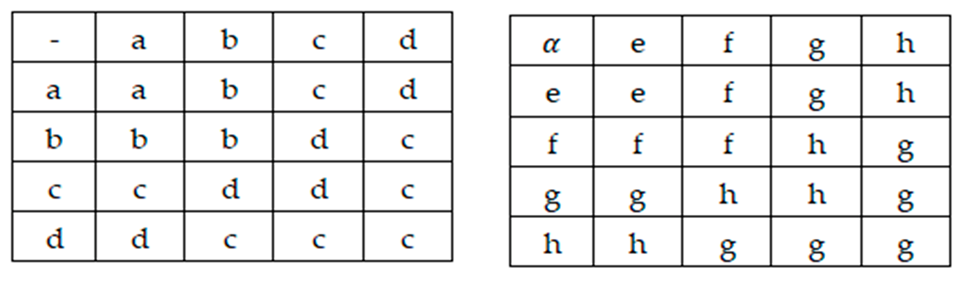
Example 1. Let N = {a, b, c, d} and {e, f, g, h} define N and as follows:
, =
By routine calculation, clearly, N is an RF ideal of N.
Theorem 1. Consider an ideal of a Γ Ring. Then, the RFS in N is a RFI of N.
Proof. Let . If the elements are in the ideal and , then and , since is an ideal of N. Hence, and . Additionally, 0 = 1 − and 0 = 1 − = If are not in the ideal , or , and we find and In addition, = {1 − = 1 and . Therefore, is a RFI of N. Similiarly, is also a RFI of N. □
Definition 7. A RFUI (resp. RFLI) of a Γ Ring N is normal if.
Example 2. Let R be the set of all integers. Then, R is a ring. Take N == R, and let a,b,. Suppose is the product of a, , and b. Then, N is a Ring. Define the RFS in N as follows:
where t, sand t + s . By routine calculation, clearly is a RFI. Here, . Therefore, is normal.
Theorem 2. Assume that is a RFUI (resp. RFLI) of a Γ Ring N, and let. Then is a normal RFUI (resp. RFLI) of N.
Proof. We observe that Therefore, is a normal RFS. To prove it is a RFUI (resp. RFLI), let and . Then, , and by our condition, we find =}} = . A similar condition also holds for lower ideals. This shows that is a RFUI (resp. RFLI) of N. □
4. Characteristic Function on RFI in Γ Rings
The following section includes the characteristics of RFI and discusses some related theorems.
Theorem 3. is an ideal of a Γ Ring N if and only if , where
(p) = and (p) =
Then,is a RFUI (resp. RFLI) of N.
Proof. Assume that is an ideal of N, and let and Therefore, () = 1.
Apply the condition of the RFI and () = 1( (as well as a similar p). Supposing the elements are not ideal, then we have ( and (p) = 0, and we find
In the same manner, lower ideals are also implemented. Hence, is a RFUI (resp. RFLI) of N. Conversely, let us assume that is a RFUI (resp. RFLI) of N. Let If () = 1, then ) = 0, and therfore , (which is also similiar for the element p). ) such that .
Therefore is a RFUI (resp. RFLI) of N. □
Theorem 4. Let I be the ideal of N. If the RFS in N is defined by
(p) = and (p) =
then for all p, where 00, a + c, and b + dthenis a RFUI (resp. RFLI) of N and U(= I = L(;c).
Proof. If , suppose atleast one of the p and q does not fit in I. Then, = {(p)(q)},. If , then , and so = a = {(p)}. Suppose that , and (also resp. the element p). In the case where then (( (also resp. the element p). In addition to the same steps, we also used a lower approximation, resulting in. If then , and if ( We can conclude that is a RFUI (resp. RFLI) of N. □
Theorem 5. An RFS in a RFUI (resp. RFLI) if andonly if = {p ( is an upper (resp. lower) ideal of N for , (
Proof. Let be a RFUI (resp. RFLI) of N, and let and (. If we take two elements p,q and ,(p)(q) We know the RFI conditions = {(p)(q)} and t (also resp. p).
Similarly, the same steps are also followed by lower ideals, and finally we have .
Therefore, is a RFUI (resp. RFLI) of N.
Conversely, assume that is a RFUI (resp. RFLI) of N. Then, and ( Let be such that , , and ,. Then, p and q such that and .
Without loss of generality, we may assume that it follows that such that . Since is an ideal of N, we have and for all , where = {(p)(q)}, and = {(p)(q)},.
We conclude that (resp. RFLI) of N. □
Theorem 6. If the RFS RFUI (resp. RFLI) of a then the sets N = {p/ and N (P) = {p/ are upper (resp.lower) ideals.
Proof. Consider N Then, () = (0) and () = (0), since is a RFUI (resp. RFLI). ( {()()}=(0), but (0)(. Therefore, and ((q) = (0) (also resp. the element ). Hence, N, and therefore is the upper (resp. lower) ideal of M. We followed the same steps followed by the lower ideals and finally arrived at N N. Therefore, is the upper (resp. lower) ideal of N. □
5. Operations on RFI in Rings
A few operators of RFI and their related theorems are presented in this section.
Definition 8. Let and be two rough fuzzy subsets of a Γ Ring N. Then, the rough sum of X and Y is defined to be the rough fuzzy setin N given by
Theorem 7. If and are two RFUI (resp. RFLI) ideals of N, then the rough sum is a RFUI (resp. RFLI) of N.
Proof. For any , we have , and by the definition of , we find
,}
By substituting into the above equation, we obtain
=
=
We also we = = . Similar conditions also hold for the lower ideals. Therefore, we conclude that is a RFUI (resp. RFLI) of N. □
Definition 9. Let be two rough fuzzy subsets of a Γ Ring N. Then, the composition of X and Y is in N, given by
Theorem 8. Let be two RFI in a Ring N. Then, is a RFUI (resp. RFLI) in N.
Proof. For any , we have , and by the definition of, we have
and
.
The same steps are also followed by lower ideals, and finally we obtain and . Therefore, is a RFUI (resp. RFLI) of N. □
Definition 10. Let be two RF subsets in a Ring N. Then, the product of A and B, constructed as Ais
Theorem 9. Let be two RFUIs (resp. RFLIs) of N. Then, A is a RFUI (resp. RFLI) of N. If X is a rough fuzzy right ideal, and Y is a rough fuzzy left ideal, then
Proof. Consider X and Y to be RFUIs (resp. RFLIs) of N, and let p, q Then,. By applying the condition of RFI and combining the terms p and q, we finally obtain {
Additionally, and Now,
The same steps are also followed by the lower ideals. Therefore, is an RFUI (resp. RFLI) of N. To prove the second part if there is nothing to show. By the definition of , =, = , since X is a rough fuzzy right ideal, and Y is a rough fuzzy left ideal, we have and
By definition we have
Hence, □
Corollary 1. If are two RFUIs (resp. RFLI) of N, then is a RFUI (resp. RFLI) of N.
Definition 11. A Ring N is regular if there exists and , and then x = x.
Result 1. A Ring N is said to be regular for each right ideal I and for each left ideal J of N.
Theorem 10. A Ring N is regular if for each rough fuzzy right ideal X and for each rough fuzzy left ideal Y of N,
Proof. Suppose N is regular by Theorem 9, where To prove , let and Then, by definition, such that x = x. Thus , . On the other hand, and Thus, , and hence □
Definition 12. If is an arbitrary family of RFS in X, wherefor each , then.
Theorem 11. If is a family of RFUI (resp. RELI) of N, then is a RFUI (resp. RFLI) of N.
Proof. Let and . Then, . By definition, we have =.
In addition, and The same is also true for lower ideals. Finally, we obtain and
Consequently, is a RFUI (resp. RFLI) of N. □
6. Rough Fuzzy Prime Ideals (RFPIs) in Rings
A few theorems are proven regarding the rough fuzzy prime ideals discussed in this section.
Definition 13. An ideal of the Ring N is said to be prime if, for any ideals X and Y of N, or
Definition 14. Let be a rough fuzzy ideal (RFI) of a Ring N. Then, is said to be prime if is not a constant mapping and, for any RFI X, Y of a Ring N, implies or
Theorem 12. Let be an ideal of a Ring N Then, is a prime ideal of N if is a RFPI of N.
Proof. Suppose that
is a prime ideal of
N, and let
Since
,
is not a constant mapping on
N. Let
X and
Y be two RFI of
N such that
and
or
. Then,
such that
and
. Thus,
but
and
such that
is a prime ideal of
N, it follows from Theorem 5 [
3] that there exists
r and
such that
. Let c =
. Then,
= 1. Thus,
, but
(by the definition of
c)
), and by following the same steps for the lower ideals, we find
.
Then, . This contradicts the result. Hence, for any two RFI X and Y, , which implies or . Hence, is a RFPI of N. Suppose that is not a constant mapping on N, where Let X and Y be two ideals of N such that , and let and be two fuzzy ideals of N. Consider Let if . Then, clearly .
Suppose . Then, and . There exists with p = q such that ,, and . Therefore, and .
This implies Thus, p = q. Therefore, = 1. It follows that . Since is a RFPI of N, either or Thus, either or Y Hence, is a prime ideal of N. □
7. Properties of Rough -Endomorphism of Rings
In this section, we propose some theorems about the morphism properties of RFI in the gamma ring based on rough gamma endomorphism.
Definition 15. Mapping of the Γ Ring N into itself is called a rough Γ-endomorphism of N. If for,then Let
denote the set of all rough
-endomorphisms of the
Ring
N.The multiplication and addition on the set are as
follows. If
, then
Theorem 13. If is the set of all rough -endomorphisms of a Ring N, then is a -endomorphism of a Ring with unity with respect to the usual operations.
Proof: Given that is the set of all rough -endomorphisms of a -ring M, toprove is a Ring with unity, welet. Then, the condition of the Ring is = .
By applying the distributive law and the condition of rough gamma endomorphism, we finally get = ,
Similiarly, Likewise, the three conditionsalso satisfythe lower case.
For all there exists a unity element such that , and hence Thus satisfies all the conditions of the Ring, andhence is a Ring with unity. □
Theorem 14. Let be the set of all rough endomorphisms of the Ring N. If , then a has a multiplicative inverse in if and only if x is a one-to-one function.
Proof. Assume to be the set of all rough -endomorphisms of a Ring M. If , then x has an inverse in To prove x is a one-to-one function, let x have an inverse y in we get A similar condition holds for the lower approximation, which x is clearly on. Furthermore, such that Therefore, x is a one-to-one mapping. Conversely, let us assume that the -endomorphism x is a one-to-one mapping of N onto N so that each element of N is of the form We define a mapping d of N into N as follows: If , then , and by this assumption, we get . Through asimple calculation, we finally get and .
A similar condition holds for the lower approximation. We see that b is a rough -endomorphism of M. Furthermore, for every p in N, and hence . Finally, Similiarly, . That is equivalent to the statement that and for every Hence, , and y is the inverse of x in. □