


Abstract
In this paper, we define a new form of Carlitz’s type degenerate twisted -Euler numbers and polynomials by generalizing the degenerate Euler numbers and polynomials, Carlitz’s type degenerate q-Euler numbers and polynomials. Some interesting identities, explicit formulas, symmetric properties, a connection with Carlitz’s type degenerate twisted -Euler numbers and polynomials are obtained. Finally, we investigate the zeros of the Carlitz’s type degenerate twisted -Euler polynomials by using computer.
1. Introduction
Many mathematicians have been working in the fields of the degenerate Euler numbers and polynomials, degenerate Bernoulli numbers and polynomials, degenerate tangent numbers and polynomials, degenerate Genocchi numbers and polynomials, degenerate Stirling numbers, and special polynomials (see [1,2,3,4,5,6,7,8]). In recent years, we have been studied some properties and symmetry identiities of the degenerate Carlitz-type -Euler numbers and polynomials, -Euler zeta function, higher-order generalized twisted -Euler polynomials, Dirichlet-type multiple twisted -l-function, twisted -Euler polynomials, and degenerate Carlitz-type q-Euler numbers and polynomial (see [9,10,11,12,13,14,15]).
In this paper we define a new form of Carlitz’s type degenerate twisted -Euler numbers and polynomials and study some theories of the Carlitz’s type degenerate twisted -Euler numbers and polynomials.
Throughout this paper, we always make use of the following classical notations: denotes the set of natural numbers, denotes the set of integers, denotes the set of nonnegative integers, denotes the set of real numbers, and denotes the set of complex numbers.
We recall that the degenerate Euler numbers and Euler polynomials , which are defined by generating functions like following (see [2,3,4])
and
respectively.
We remind that well-known Stirling numbers of the first kind and the second kind are defined by this (see [2,4,6])
respectively. Here . The numbers is like this
We also have
The generalized falling factorial with increment is defined by
for positive integer n, with ; as we know,
for . Clearly . The binomial theorem is this for a variable z,
For , the -number is defined by
The -number is a natural generalization of the q-number, that is
By using -number, we define a new form of Carlitz’s type degenerate twisted -Euler numbers and polynomials, which generalized the previously known numbers and polynomials, including the degenerate Euler numbers and polynomials, Carlitz’s type degenerate q-Euler numbers and polynomials (see [2,3,6,9]). We begin by recalling here the Carlitz’s type twisted -Euler numbers and polynomials (see [13]). Let be rth root of 1 and (see [13,14,16]).
Definition 1.
The Carlitz’s type twisted -Euler polynomials are defined by means of the generating function
and their values at are called the Carlitz’s type twisted -Euler numbers and denoted .
Here is a brief introduction to the history for the reader. The following diagram shows the variations of the different types of Euler polynomials, degenerate Euler polynomials, -Euler polynomials, degenerate -Euler polynomials, and twisted -Euler polynomials. Those polynomials in the first row and the second row of the diagram are studied by Carlitz [1,2], Cenkci, and Howard [3,4,5], Young [6], Hwang and Ryoo [9], Ryoo [10,11], Simsek [16], and Srivastava [17], respectively. The motivation of this paper is to investigate some interesting symmetric identities and explicit identities for Carlitz’s type degenerate twisted -Euler polynomials in the third row of the diagram.
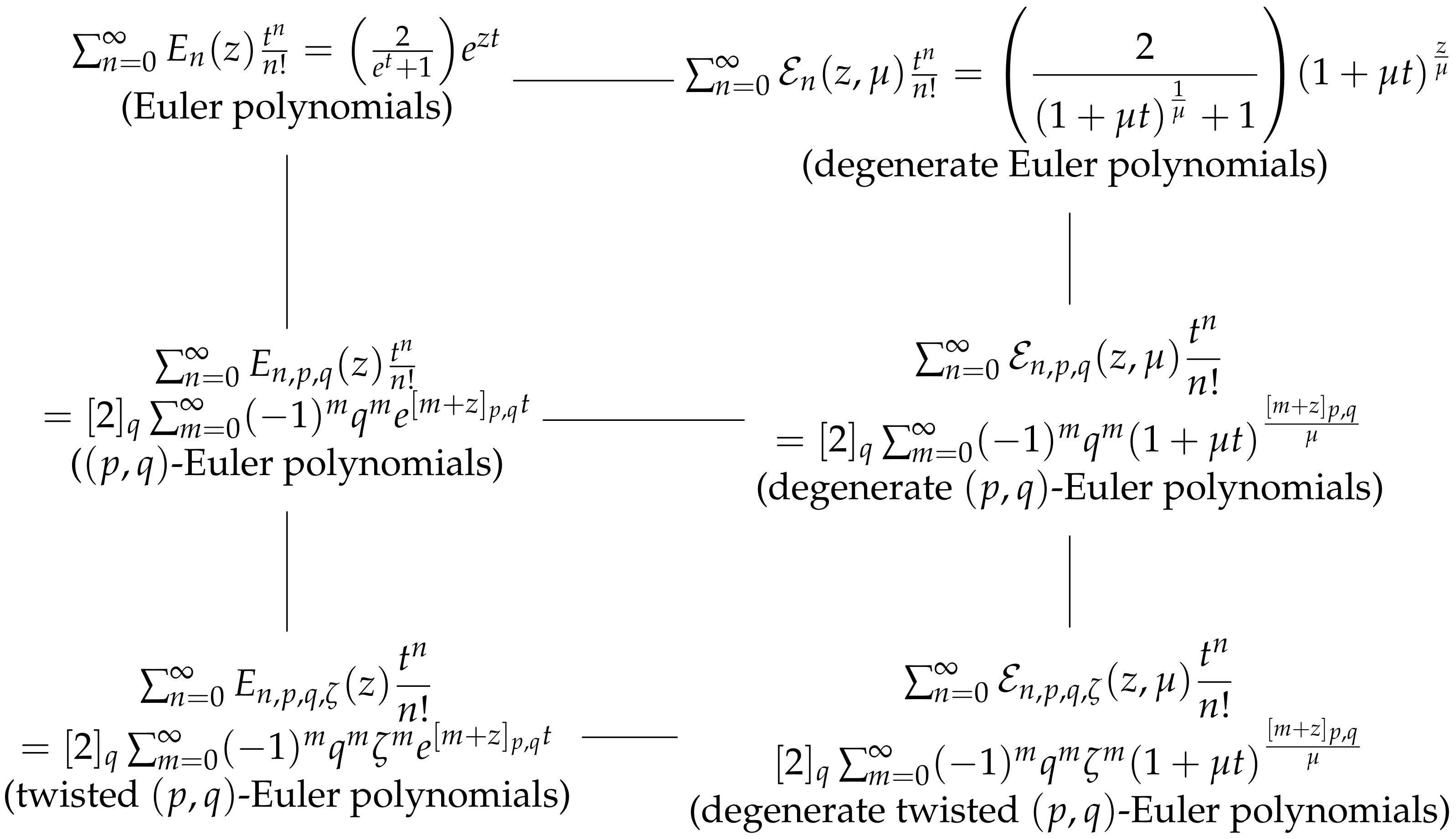
Many generalizations of these numbers and polynomials can be found in the literature (see [1,2,3,4,5,6,7,8,9,10,11,12,13,14,15,16,17]). Based on this idea, we generalize the Carlitz’s type twisted -Euler numbers and polynomials , degenertae -Euler numbers and polynomials , and degenerate q-Euler numbers and polynomials . It follows that we define the following the Carlitz’s type degenerate twisted -Euler numbers and polynomials .
In the following section, we define a new form of Carlitz’s type degenerate twisted -Euler numbers and polynomials . After that we will investigate some their properties. In Section 2, Carlitz’s type degenerate twisted -Euler numbers and polynomials are defined. We derive some of their relevant properties. In Section 3, first, we derive the symmetric properties for Carlitz’s type degenerate twisted -Euler numbers and polynomials . Finally, we investigate the zeros of the Carlitz’s type degenerate twisted -Euler numbers and polynomials by using computer.
2. Carlitz’s Type Degenerate Twisted (p,q)-Euler Numbers and Polynomials
In this section, we define a new form of Carlitz’s type degenerate twisted -Euler numbers and polynomials , and provide some of their relevant properties. Let be rth root of 1 and and (see [13,14,16]). Firstly, we construct the Carlitz’s type degenerate twisted -Euler numbers and polynomials as follows:
Definition 2.
For , the Carlitz’s type degenerate twisted -Euler numbers and polynomials are defined by means of the generating functions
and
respectively.
The Carlitz’s type degenerate twisted -Euler numbers can be determined explicitly. A few of them are
Setting in (1) and (2), we can obtain the corresponding definitions for the Carlitz’s type degenerate twisted q-Euler number and q-Euler polynomials , respectively (see [13]). Obviously, if we put , then we have
Putting and , we have
Theorem 1.
For , we have
Proof.
Since
we have
By comparing the coefficients in the above equation, the proof is completed. □
Theorem 2.
For , we have
Proof.
By replacing t by in (2), we have
Thus, by (5), the proof is completed. □
Theorem 3.
For , we have
Proof.
By replacing t by in Definition 1, we have
and
Thus, by (6) and (7), the proof is completed. □
We intriduce the -analogue of the generalized falling factorial with increment . The -generalized falling factorial with increment is defined by
for positive integer n, with the convention .
Theorem 4.
For , we have
Proof.
By (1) and (2), we get
Hence, by (8), we also have
By comparing the coefficients on both sides of (9), the proof is completed. □
Theorem 5.
For , we have
Proof.
We observe that
By (2),
So the proof is completed. □
3. Symmetric Properties about Carlitz’s Type Degenerate Twisted (p,q)-Euler Numbers and Polynomials
In this section, we are going to obtain the main results of Carlitz’s type degenerate twisted -Euler numbers and polynomials . We also establish some interesting symmetric identities for Carlitz’s type degenerate twisted -Euler numbers and polynomials .
Theorem 6.
Let a and b be odd positive integers. Then one has
Proof.
Observe that for any .
By substitute for z in Definition 2, replace p by , replace q by , and replace by , respectively, we derive
Since for any non-negative integer n and odd positive integer a, there exist unique non-negative integer r such that with . So this can be written as
It follows from the above equation that
From the similar method, we can obtain that
Thus, from (11) and (12), the proof is completed. □
It follows that we show some special cases of Theorem 6. Setting in Theorem 6, we have the multiplication theorem for the Carlitz’s type degenerate twisted -Euler polynomials .
Corollary 1.
Let a be odd positive integer. Then one has
Let in Theorem 6, we have the following corollary.
Corollary 2.
Let a and b be odd positive integers. Then it has
By Theorem 3 and Corollary 2, we have the below theorem.
Theorem 7.
Let a and b be odd positive integers. Then
We get another result by applying the addition theorem about the Carlitz-type twisted -Euler polynomials (see [14]).
Theorem 8.
Let a and b be odd positive integers. Then we have
where is called as the alternating twisted -sums.
Proof.
From (3), Theorem 3, and Theorem 6, we have
Therefore, we induce that
and
By (14) and (15), we make the desired symmetric identity. □
In particular, the case in Corollary 1 gives the triplication formula for Carlitz’s type degenerate twisted -Euler polynomials
Setting in (13) and (16) leads to the familiar multiplication theorem for the Carlitz’s type degenerate twisted q-Euler polynomials
and the triplication formula for Carlitz’s type degenerate twisted q-Euler polynomials
Letting in (17) and (18) leads to the familiar multiplication theorem for the degenerate twisted Euler polynomials
and the triplication formula for degenerate twisted Euler polynomials
Letting in (19) and (20) leads to the familiar multiplication theorem for the degenerate Euler polynomials
and the triplication formula for degenerate Euler polynomials
Letting in (21) and (22) leads to the familiar multiplication theorem for the Euler polynomials
and the triplication formula for Euler polynomials
4. Zeros of the Carlitz’s Type Degenerate Twisted (p,q)-Euler Numbers and Polynomials
In this section, we demonstrate the benefit of using numerical investigation to support theoretical prediction and to observe novel, interesting pattern of the solutions of the Carlitz’s type degenerate twisted -Euler polynomials . The Carlitz’s type degenerate twisted -Euler polynomials can be determined explicitly. A few of them are
Our numerical results for approximate solutions of complex zeros of are displayed (Table 1 and Table 2).

Table 1.
Numbers of real and complex zeros of , .
Table 2.
Approximate solutions of .
The ∗ mark in Table 1 means that there is no solution of . As a result of numerical experiments, it was found that ther is no solution of for We hope to verify that there is no solution of for We can see a regular pattern of the roots of the and also hope to verify the same kind of regular structure of the roots of the (Table 1).
We investigate the zeros of the by using a computer. We plot the zeros of the for (Figure 1).
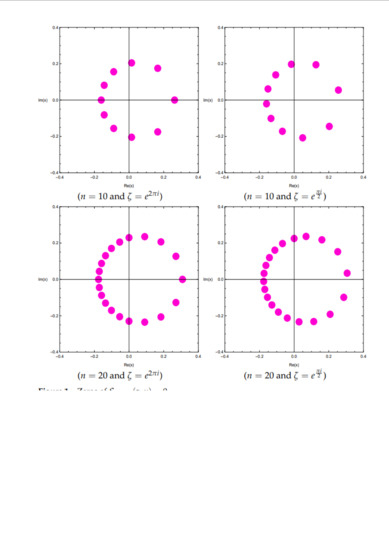
Figure 1.
Zeros of .
In Figure 1 (top-left), we choose and In Figure 1 (top-right), we choose and In Figure 1 (bottom-left), we choose and In Figure 1 (bottom-right), we choose and The ● mark in Figure 1 means the distribution of zeros of . We observed that zeros of the have no reflection symmetry for .
Next, we calculated an approximate solution satisfying for . The results are given in Table 2.
In Figure 1, the pink dots represent the distribution of zeros.
In Table 2, we choose and
5. Conclusions and Discussion
In our previous paper [13], we studied some identities of symmetry on the Carlitz-type twisted -Euler numbers and polynomials. The motivation of this paper is to construct the Carlitz’s type degenerate twisted -Euler numbers and polynomials. We also investigate some explicit identities for the Carlitz’s type degenerate twisted -Euler polynomials in the third row of the diagram at page 3. Therefore, we construct the Carlitz’s type degenerate twisted -Euler numbers and polynomials in the Definition 2 and obtained the formulas (Theorems 1 and 5), distribution relation (Corollary 1). In Theorems 6 and 7, we gave some symmetry identities for the Carlitz’s type degenerate twisted -Euler polynomials. We also obtained the explicit identities related with the Carlitz’s type degenerate twisted -Euler polynomials, Carlitz’s type wisted -Euler polynomials, the alternating twisted -sums, and Stirling numbers (see Theorems 7 and 8). Finally, we observed novel, interesting pattern of the solutions of the Carlitz’s type degenerate twisted -Euler polynomials .
If we can give a theoretical prediction via numerical experiments by finding a regular pattern for the roots of the Carlitz’s type degenerate twisted -Euler polynomials , we look forward to contributing to research related to the Carlitz’s type degenerate twisted -Euler polynomials in applied mathematics, mathematical physics, and engineering.
Funding
This work was supported by the National Research Foundation of Korea(NRF) grant funded by the Korea government(MEST) (No. 2017R1A2B4006092).
Institutional Review Board Statement
Not applicable.
Informed Consent Statement
Not applicable.
Data Availability Statement
The data presented in this study are available on request from the author.
Conflicts of Interest
The author declares no conflict of interest.
References
- Carlitz, L. A Note on the Multiplication Formulas for the Bernoulli and Euler Polynomials. Proc. Am. Math. Soc. 1953, 4, 184–188. [Google Scholar] [CrossRef]
- Carlitz, L. Degenerate Stiling, Bernoulli and Eulerian numbers. Util. Math. 1979, 15, 51–88. [Google Scholar]
- Cenkci, M.; Howard, F.T. Notes on degenerate numbers. Discret. Math. 2007, 307, 2359–2375. [Google Scholar] [CrossRef]
- Howard, F.T. Degenerate weighted Stirling numbers. Discret. Math. 1985, 57, 45–58. [Google Scholar] [CrossRef] [Green Version]
- Howard, F.T. Explicit formulas for degenerate Bernoulli numbers. Discret. Math. 1996, 162, 175–185. [Google Scholar] [CrossRef] [Green Version]
- Young, P.T. Degenerate Bernoulli polynomials, generalized factorial sums, and their applications. J. Number Theorey 2008, 128, 738–758. [Google Scholar] [CrossRef] [Green Version]
- Yang, X.-J. An Introduction to Hypergeometric, Supertrigonometric, and Superhyperbolic Functions; Academic Press: London, UK, 2021. [Google Scholar]
- Ghorbani, A. Beyond Adomian polynomials: He polynomials. Chaos Solitons Fractals 2009, 39, 1486–1492. [Google Scholar] [CrossRef]
- Hwang, K.-W.; Ryoo, C.S. Some symmetric identities for degenerate Carlitz-type (p,q)-Euler numbers and polynomials. Symmetry 2019, 11, 830. [Google Scholar] [CrossRef] [Green Version]
- Ryoo, C.S. Some symmetric identities for (p,q)-Euler zeta function. J. Comput. Anal. Appl. 2019, 27, 361–366. [Google Scholar]
- Ryoo, C.S. Symmetric identities for Dirichlet-type multiple twisted (h,q)-l-function and higher-order generalized twisted (h,q)-Euler polynomials. J. Comput. Anal. Appl. 2020, 28, 537–542. [Google Scholar]
- Ryoo, C.S. Symmetric identities for degenerate Carlitz-type q-Euler numbers and polynomial. J. Appl. Math. Inform. 2019, 37, 259–270. [Google Scholar]
- Ryoo, C.S. On the Carlitz’s type twisted (p,q)-Euler polynomials and twisted (p,q)-Euler zeta function. J. Comput. Anal. Appl. 2021, 29, 582–587. [Google Scholar]
- Lee, H.Y.; Ryoo, C.S. A note on the twisted (h,p,q)-Euler numbers and polynomials. J. Algebra Appl. Math. 2020, 18, 145–156. [Google Scholar]
- Ryoo, C.S. Some properties of the (h,p,q)-Euler numbers and polynomials and computation of their zeros. J. Appl. Pure Math. 2019, 1, 1–10. [Google Scholar]
- Simsek, Y. Twisted (h,q)-Bernoulli numbers and polynomials related to twisted (h,q)-zeta function and L-function. J. Math. Anal. Appl. 2006, 324, 790–804. [Google Scholar] [CrossRef] [Green Version]
- Srivastava, H.M. Some generalizations and basic (or q-) extensions of the Bernoulli, Euler and Genocchi Polynomials. Appl. Math. Inform. Sci. 2011, 5, 390–444. [Google Scholar]
Publisher’s Note: MDPI stays neutral with regard to jurisdictional claims in published maps and institutional affiliations. |
© 2021 by the author. Licensee MDPI, Basel, Switzerland. This article is an open access article distributed under the terms and conditions of the Creative Commons Attribution (CC BY) license (https://creativecommons.org/licenses/by/4.0/).