1. Introduction
The square root of minus one can be seen as an oscillation between plus and minus one. With this viewpoint, a simplest discrete system corresponds directly to the imaginary unit. This aspect of the square root of minus one as an
iterant is explained below. By starting with a discrete time series, one has non-commutativity of observations and this non-commutativity can be formalized in an iterant algebra as defined in
Section 3 of this paper. Iterant algebra generalizes matrix algebra and we shall see that it can be used to formulate the Lie algebra
for the Standard Model for particle physics and the Clifford algebra for Majorana Fermions. The present paper is a sequel to [
1,
2,
3,
4,
5,
6,
7,
8,
9,
10,
11,
12,
13,
14,
15] and it uses material from these papers. The present paper represents a synthesis of these papers and contains new material about the relationships of these algebras with the Majorana-Dirac equation.
Distinction and processes arising from distinction are at the base of the described world. Distinctions are elemental bits of awareness. The world is composed not of things but processes and observations. It is the purpose of this paper to explore, from this perspective, a source of algebraic structures that have been important for the development of both mathematics and physics. We will discuss how basic Clifford algebra comes from very elementary processes such as an alternation of and the fact that one can think of itself as a temporal iterant, a product of an and an where the is the and the is a time shift operator. Clifford algebra is at the base of this mathematical world, and the fermions are composed of these things.
View
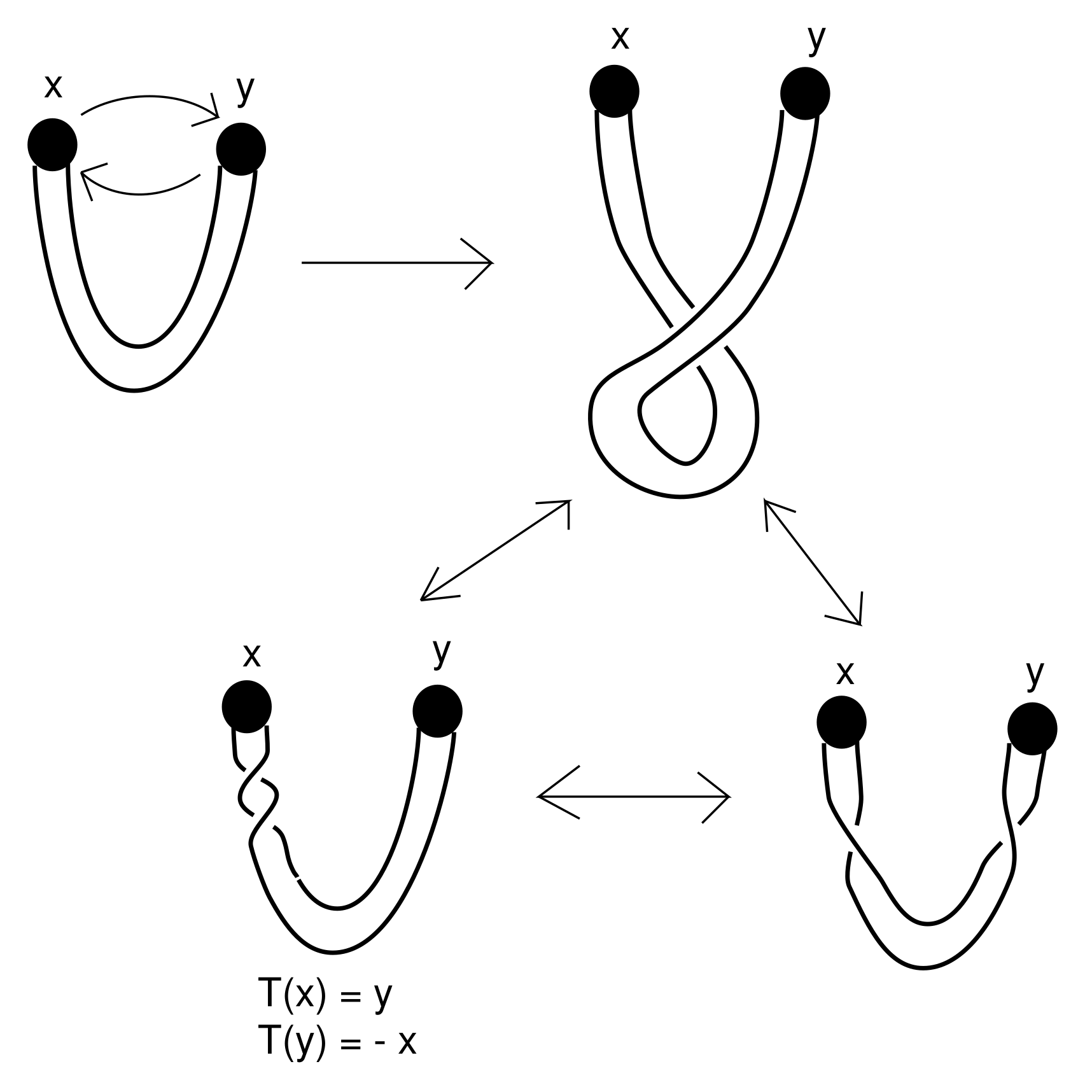
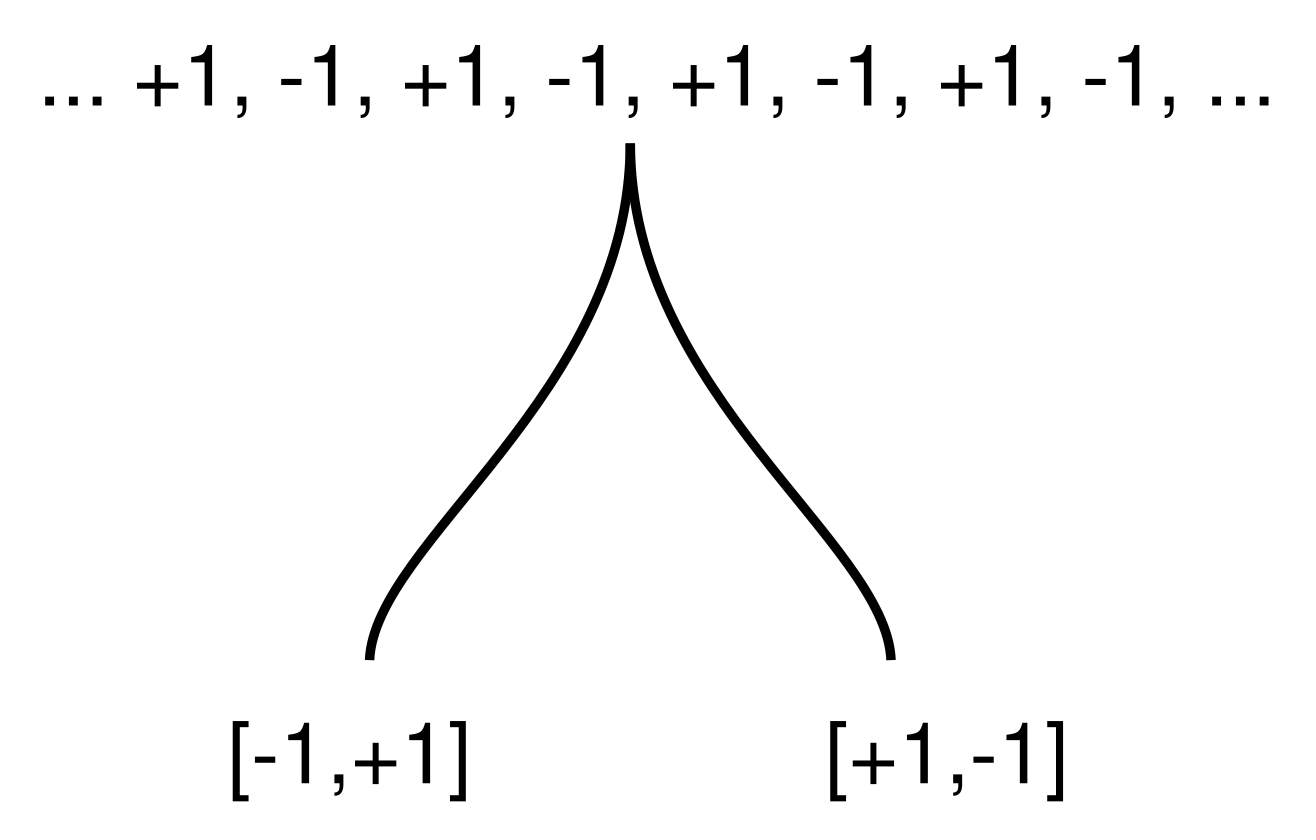
Figure 1. The discrete process
can be seen as an iteration of
or as an iteration of
Along with the structure of ordered pairs
and their component-wise addition and multiplication, we shall introduce a time-shifting operator
so that
Then, letting
we have
Iterants formalize the intuition that
i is a ± oscillation that interacts with itself through a delay of one time-step.
Section 2 is a discussion of the discrete Schrödinger equation and its relationship with iterants and with the complex numbers. We see how a discrete variant of the diffusion equation gives rise at once to both the complex numbers (as a summary of the iterant behaviour of this discretization of diffusion) and the Schrödinger equation as we know it. The section serves as an introduction to the key ideas in the rest of the paper.
Section 3 and
Section 4 are an introduction to the algebra of iterants and its relation with the square root of minus one.
Section 4 shows how iterants produce
matrix algebra and the split quaternions.
Section 5 studies iterants of arbitrary period. We generalize the iterant construction to arbitrary finite groups
We show that by rearranging the multiplication table of the group so that the identity element appears on the diagonal, we get a set of permutation matrices representing the group faithfully as
matrices.
Section 6 discusses the relationship of iterants with the Artin braid group. Each element of the braid group has an associated permutation. We generalize iterants so that the group acting on the vector part of the iterant is the Artin braid group. This leads to relationships with framed braids and we end the section with a description of a braided iterant formulation of the particle interaction model of Sundance Bilson-Thompson [
16].
Section 7 is about Majorana Fermion operators and their associated anyonic braiding. This section is key for this paper in relation to the later sections on the Majorana Dirac equation, as we show in the later sections that the Clifford algebras of Majorana operators are fundamental for the structure of solutions to the Majorana-Dirac equation. It is a main point of this paper to make this connection in the full context of iterants. The connection between solutions of the Majorana-Dirac equation and Majorana operators will be the subject of our further research.
Section 8 gives an iterant interpretation of the
Lie algebra for the Standard Model.
Section 9 discusses the Dirac equation and how the nilpotent and the Majorana operators work in this context. This section provides a link between our work, the work of Peter Rowlands [
17] and with our joint work [
1]. We end this section with an expression in split quaternions for the the Majorana Dirac equation in one dimension of time and three dimensions of space. The Majorana Dirac equation can be written as follows:
where
and
are the simplest generators of iterant algebra with
and
and
make a commuting copy of this algebra. Combining the simplest Clifford algebra with itself is the underlying structure of Majorana Fermions, forming indeed the underlying structure of all Fermions. The Majorana-Dirac equation is expressed entirely with real matrices so that it can have solutions over the real numbers. It was Majorana’s conjecture that such solutions would correspond to particles that were their own anti-particles.
Section 10 and
Section 11 go on to study the original Majorana-Dirac equation and variations of involving the algebraic approach in this paper. We show how the nilpotent method described in
Section 9 gives rise to solutions to this equation, hence to fundamental structures related to Majorana Fermions. This part of the paper reviews our work in [
1] and sets the stage for future work.
2. Iterants and the Schrödinger Equation
We begin with the Diffusion Equation
We reformulate this equation as a difference equation in space and time. In writing it as a difference equation, I shall use
for a finite increment in time and
for a finite increment in space.
This is equivalent to
or to
where
since for the continuum limit to exist we need to assume that
is constant as
and
go to zero. We shall use
for convenience.
Then the above equation becomes
Consider the possibility of putting a “plus or minus” ambiguity into this equation, like so:
The ± coefficient should be lawful not random, for then we can follow an algebraic formulation of the process behind the equation. We shall take ± to mean the alternating sequence
and time will be discrete. Then the new equation will become a difference equation in space and time
We must consider the continuum limit. But in that limit there is no direct meaning for the parity of the number of time steps
In the discrete model the wave function
divides into parts with even time index
and parts with odd time index
So we can write (thinking of these as the corresponding discrete equations or as the continuum limits).
We take the limit of
and
separately.
Then one can interpret the
as the complex number
Recall that the complex number
i has the property that
so that
when
A and
B are real numbers,
and so if
then
and if
then
So
i can be interpreted as oscillating between and and so we shall regard
i as a definition of
In fact, when we multiply
we get
because (using this temporal interpretation)
i takes a duration to oscillate and when the second term multiplies the first term, they are shifted by one step, and so we get either
or
We formalize this point of view later in the paper.
Now
behaves according to these rules, and we can write
so that
Thus
We have deduced the complex form of the Schrödinger equation as the limit of these discrete systems. In these systems there is a mutual dependency where the temporal variation of
is mediated by the spatial variation of
and the temporal variation of
is mediated by the spatial variation of
We arrive at the Schrödinger equation in the context of
as an
iterant.
Remark 1. The discrete recursion, just discussed, can be implemented to approximate solutions to the Schrödinger equation. A further study of this recursion is intended. This way of thinking about the Schrödinger equation shows that it is intimately connected with a generalization of the discrete diffusion process with a parity oscillation that becomes i in the limit. The temporal interpretation of i indicated here will be given an algebraic context in the body of this paper.
3. Iterants and Idempotents
In this section we give a general context and formalization for the idea that the square root of negative unity can be regarded as an oscillation between
and
that is phase shifted with respect to itself via a time-step in the course of interacting with itself. We have used this idea in the previous section to motivate a discrete model of the Schrödinger equation. Here we will take an ordered pair
to represent the oscillation and a permutation operator
to represent the time-step. The permutation operator will have order two and the property that
effecting the phase shift of the oscillation
to
Then we can define
so that
The details of this construction are given below. The general form of the construction involves vectors and permutations. We will use Greek letters for permuation operators. They are not to be confused with any Greek letters in the previous section.
An
iterant is a sum of elements of the form
where
is a vector of scalars (real or complex numbers in most cases) and
is an element of the permutation group on
n letters. The vectors are sums of elementary vectors of the form
where the 1 is in the
i-th place. The elements
are the basic idempotents that generate the iterants with the help of the permutations.
If , then we let denote the vector with its elements permuted by the action of
If
a and
b are vectors then
denotes the vector where
and
denotes the vector where
Note that we define the usual sum of vectors and also the
product of vectors as term-by-term combinations. Thus, for example,
and
Then, with vectors combined as above and the usual product (composition) of the permutations, we define products and sums of iterants as shown below.
for a scalar
k, and
Iterant algebra is generated by the elements
where
is a vector with a 1 in the
i-th place and zeros elsewhere, and
is an abritrary element of the symmetric group
We have, by definition, that
where
In this way, multiplication of iterants is defined in terms of the action of the symmetric group on the vectors. For example, if
is the cyclic permutation such that
then
since
Similarly,
for the cyclic permutation
in this paragraph.
By themselves, the elements
are idempotent (
for each
i)and we have
The iterant algebra is generated by these combinations of idempotents and permutations.
For example, if
is the order two permutation of two elements, then
Define the “shift" operator
on iterants by the equation
with
Think of
as a delay operator, since it shifts the waveform
by one internal time step. We can define
and then
Complex numbers emerge from iterants. Interpret
as an oscillation between
and
and
as a temporal shift operator. Then
is time sensitive and its self-interaction equals minus one. Iterants are a formalization of elementary discrete processes. Let
Then
We can write
and
where
denotes the transposition so that
and
Then we have
This is the mixed idempotent and permutation algebra for
Then we have
as we can see by
This is the beginning of the relationships between idempotents, iterants and Clifford algebras.
We construct an elementary Clifford algebra via
and
Then we have
and
Note also that the non-commuting of
and
is directly related to the interaction of the idempotents and the permutations.
4. Iterants, Discrete Processes and Matrix Algebra
In this section we relate iterants to matrix algebra. An elementary iterant is a periodic time series
The elements of the time series can be any mathematically well-defined objects. We regard ordered pairs
and
as abbreviations for the time series or as two points of view about the series (
a first or
b first). Call
an
iterant. One has the collection of transformations of the form
leaving the product
invariant. This tiny model contains the seeds of special relativity, and the iterants contain the seeds of matrix algebra. See [
4,
5,
18,
19,
20,
21,
22,
23,
24,
25].
Define products and sums of iterants as follows
and
These operations are natural with respect to the structural juxtaposition of iterants:
Structures combine at the points where they correspond. Time series combine at the times where they correspond
If • denotes any form of binary compositon for the elements (a,b,...) of iterants, then we extend • to the iterants themselves by the definition .
We now show how the iterant algebra is related to matrix algebra. In order to keep track of this patterning, lets write
where
and
Recall the definition of matrix multiplication.
Matrix multiplication is isomorphic with iterant multiplication.
Notation. We have the
shift operation which we shall denote by an overbar as shown below
Ordinary matrix multiplication can be written in a concise form using the following rules:
where Q is any two element iterant. Note the correspondence
This means that
corresponds to a diagonal matrix.
corresponds to the anti-diagonal permutation matrix.
and
corresponds to the product of a diagonal matrix and the permutation matrix.
This is the matrix interpretation of the equation
A two by two matrix is combinatorially the union of the identity pattern (the diagonal) and the interchange pattern (the antidiagonal). These correspond to the operators 1 and
for iterants.
In the case of complex numbers we represent
The square root of minus one takes the form of the matrix
If we identify the ordered pair
with
then this means taking the identification
In iterant terms we have
and this corresponds to the matrix equation
More generally, we see that
writing the
matrix algebra as a system of hypercomplex numbers. Note that
The formula on the right equals the determinant of the matrix. Thus we define the
conjugate of
by the formula
and we have the formula
for the determinant
where
where
and
Note that
so that
Note also that we assume that
are in a commutative base ring.
Note also that for
Z as above,
This is the classical adjoint of the matrix
We leave it to the reader to check that for matrix iterants
Z and
and that
and
Note also that
whence
We can prove that
as follows
That
is in the commutative base ring allows us to remove it from in between the appearance of
Z and
Iterants as
matrices form a direct non-commutative generalization of the complex numbers.
The
split quaternions are the system
The quaternions arise directly from the split quaternions once we construct an extra square root of minus one that commutes with them. Call this extra root of minus one
. Then the quaternions are generated by
with
In the next section we give a number of other ways to construct the quaternions, and we show how the iterant point of view is related to matrix representations of the quaternions such as matrices over the complex numbers in
5. Iterants of Arbirtarily High Period
As a next example, consider a waveform of period three.
Here we see three viewpoints (depending upon whether one starts at
a,
b or
c).
The appropriate shift operator is given by the formula
Thus, with
and
With this we obtain a closed algebra of iterants whose general element is of the form
in this formalism
are real or complex numbers. The algebra is denoted
with the scalars in a commutative ring with unit
For matrices,
is the
matrix algebra over
Lemma 1. Iterant algebra is isomorphic to the matrix algebra
Proof. Map 1 to the matrix
Map
S to the matrix
and map
to the matrix
Map
to the diagonal matrix
Then it follows that
maps to the matrix
preserving the algebra structure. It follows that
is isomorphic to the full
matrix algebra
□
The pattern behind the
matrices is held by the symbolic matrix
T occupies positions in the matrix corresponding to a permutation matrix. The letter
S occupies the positions corresponding to its permutation matrix. The 1’s occupy the diagonal for the an identity matrix. In this case the matrices form a permutation representation of the cyclic group of order 3,
It should be clear to the reader that this construction generalizes directly for iterants of any period and hence for a set of operators forming a cyclic group of any order. In fact we can generalize further to any finite group
See [
13] for more information about these generalizations.
In this example we consider the group
often called the “Klein 4-Group." We take
where
Thus
G has the multiplication table, which is also its
G-
Table for
Thus we have the permutation matrices that I shall call
whose entries are obtained from the matrix above by writing 1 for the places occupied by the corresponding letter and 0 for the other places. For example,
The reader will verify that
Recall that
is iterant notation for the diagonal matrix
The quaternions are iterants in relation to the Klein Four Group.
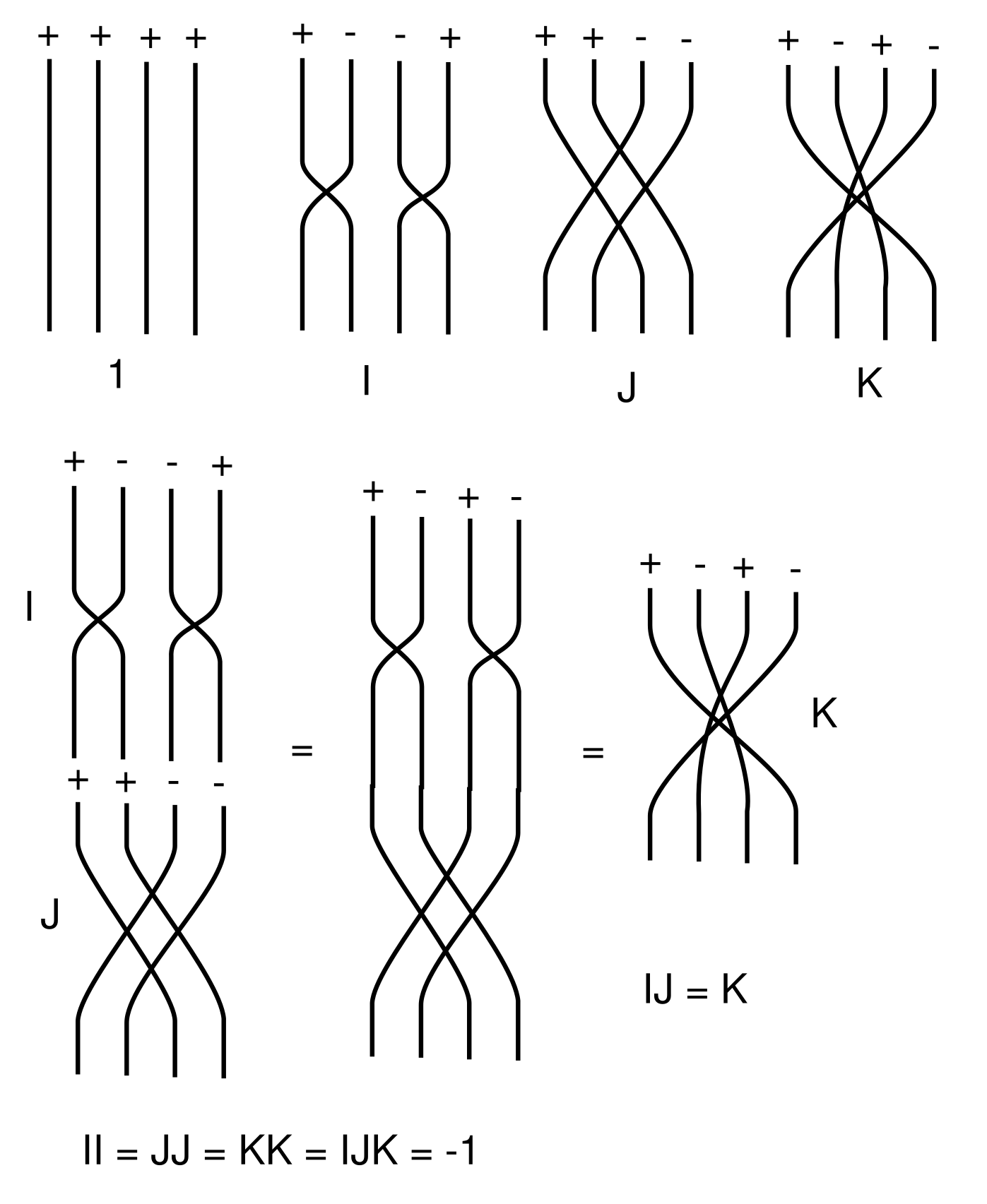
Figure 2 illustrates these quaternion generators with string diagrams for the permutations. The reader can check that the permutations correspond to the permutation matrices constructed for the Klein Four Group.
The set of matrices of the form
with
is isomorphic to the group
To see this, note that
is the set of matrices with complex entries
z and
w with determinant 1 so that
Letting
and w =
we have -4.6cm0cm
With a commutative
we obtain
as described in the previous section. This construction shows how the structure of the quaternions comes directly from the non-commutative structure of period two iterants. In other, words, quaternions can be represented by
matrices. This is the way it has been presented in standard language as in the group
Here
Let
represents a Hermitian
matrix and hence an observable for quantum processes mediated by
Hermitian matrices have real eigenvalues.
Take
then we obtain an iterant representation for a point in Minkowski spacetime.
Note that we have the formula
The eigenvalues of H are H can observe the time and the invariant spatial distance from the origin of the event Here quantum mechanics and special relativity are reconciled.
Iterants generate Hamilton’s Quaternions. We express them algebraically as shown below.
where
The permutations are products of transpositions
For example,
and
Remark 2. We take an eigenform to mean a fixed point for a transformation in any mathematical domain. Transformations of a given domain do not always have fixed points in that domain. For example in a boolean logical domain the avaliable values are 0 and If we take the transformation then and so that there is no fixed point for There is no boolean value J such that We can make extended logics that contain such values. Similarly, there is no fixed point for in the rational numbers, since such a fixed point would equal an irrational number. Finally, in the real numbers there is no fixed point for the transformaton since such a fixed point would have square equal to minus one. If we have a domain D where every element of the domain corresponds to a mapping of the domain to itself, then one can define special transformations of the form for every F in Then and every F in D has a fixed point. This is the method of the lambda calculus of Church and Curry [4]. Constructions for fixed points that extend given domains is a way of thinking about the nature of our constructions in this paper. This theme is the subject of other work of the author [26]. Here i is an eigenform for Indeed, each generating quaternion is an eigenform for the transformation The richness of the quaternions comes from the closed algebra that arises with its infinity of eigenforms that satisfy the equation where Clifford algebras
generated by elements
with
and
when
occur very often in both mathematics and physics. These algebras are often used as part of what is called geometric algebra [
27]. It is worth noting that these algebras fit naturally into the iterants framework via their self-action. That is, if we take
as a vector space over a field
K, then it has basis consisting of all the ordered products of the form
for
and
We can list the basis and obtain signed permutation matrices that represent the left action of the algebra on itself, just as we have done with the group representations in this section. For example, when n = 2 we have the basis list
and
while
Thus if
and
, then we can represent
and
as iterants. In the case
we have already given a simpler iterant representation of this algebra at the beginning of the paper, using
and
where
denotes the transposition in
It is interesting how this representation appears doubled in the one we deduced from the multiplication table of the algebra. It is of interest to carry out corresponding calculations for higher values of
6. Iterants Associated with the Framed Braid Group
The Symmetric Group
has presentation
The Artin Braid Group
has presentation
Thus there is a natural homomorphism from the Artin Braid Group to the Symmetric Group. In
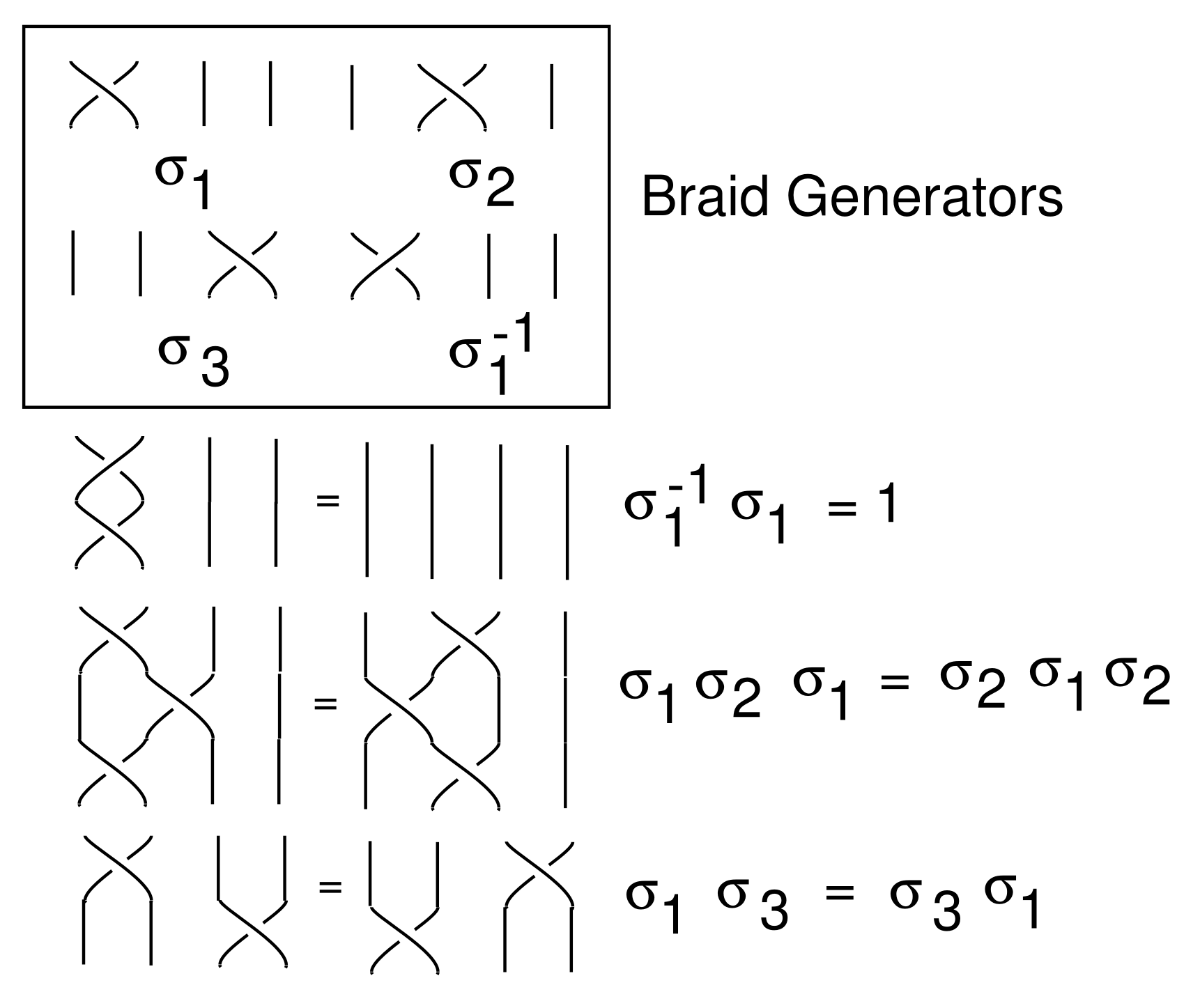
Figure 3 are shown the generators
of the 4-strand braid group with the topological relation
and the commuting relation
The elementary braid generators
correspond to the interchange of the
i-th strand iwith the
-th strand.
The homomorphism
defined on generators by
It is natural to generalize iterants to
braided iterants by first generalizing the braid group to the
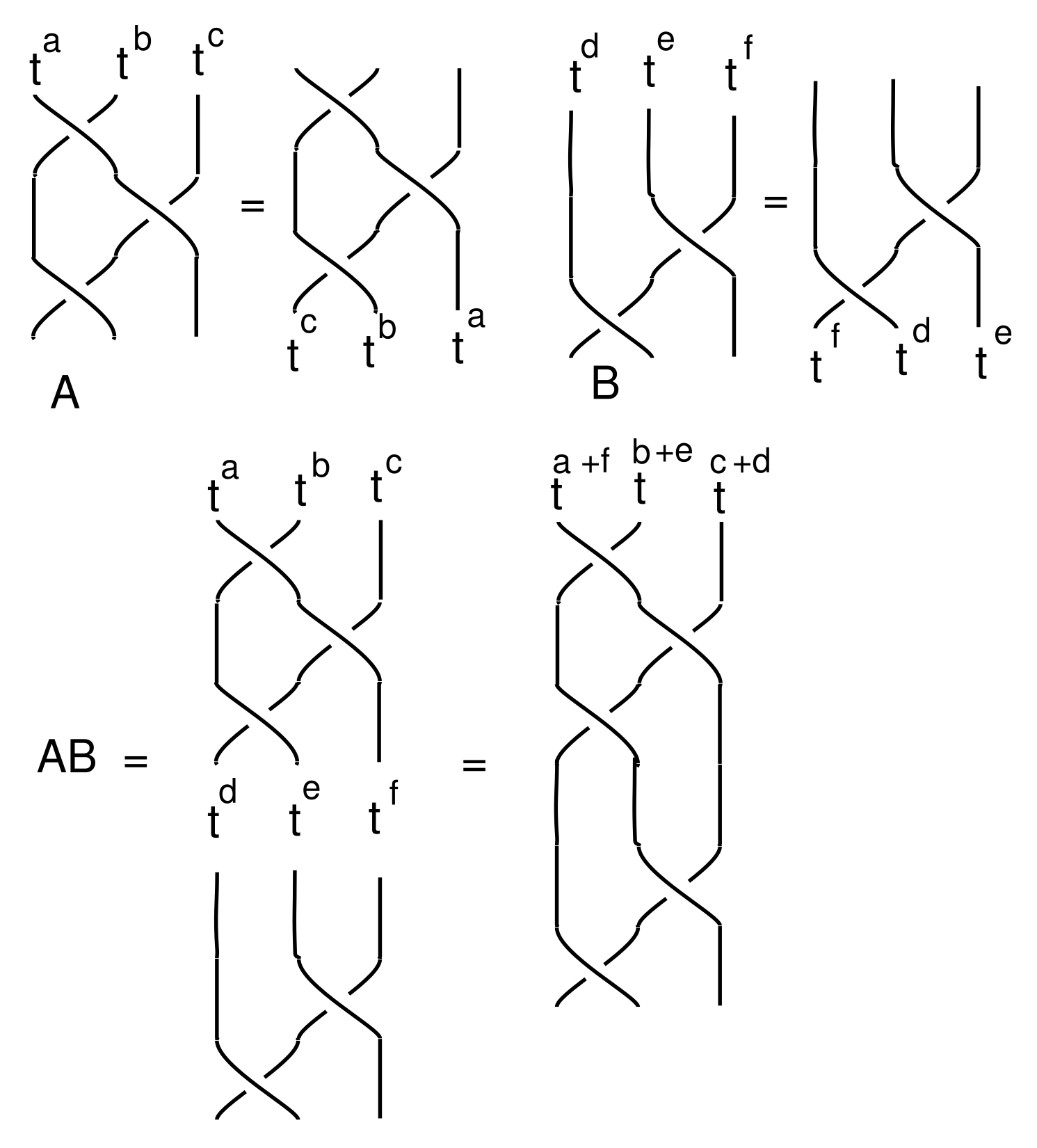
framed braid group. In this generalization, we associate integers
to the top of each braid strand. One can replace each braid strand by a ribbon and interpret
as a
twist in the ribbon. In
Figure 4 it is shown how to multiply two framed braids. The braids
A and
B are given by the formulas
The framed braid group on three strands is denoted
As the
Figure 4 illustrates, there is the formula
where
v is a vector of the form
(for
) and
is the result of permuting the vector by the permutation associated with the braid.
We can form an algebra by taking formal sums of framed braids of the form where is a scalar, is a framing vector and is an element of the Artin Braid group This algebra is a generalization of iterant algebra, based on the action of the Artin Braid Group. The representation induces a map of algebras where we recognize as exactly an iterant algebra based in the symmetric group
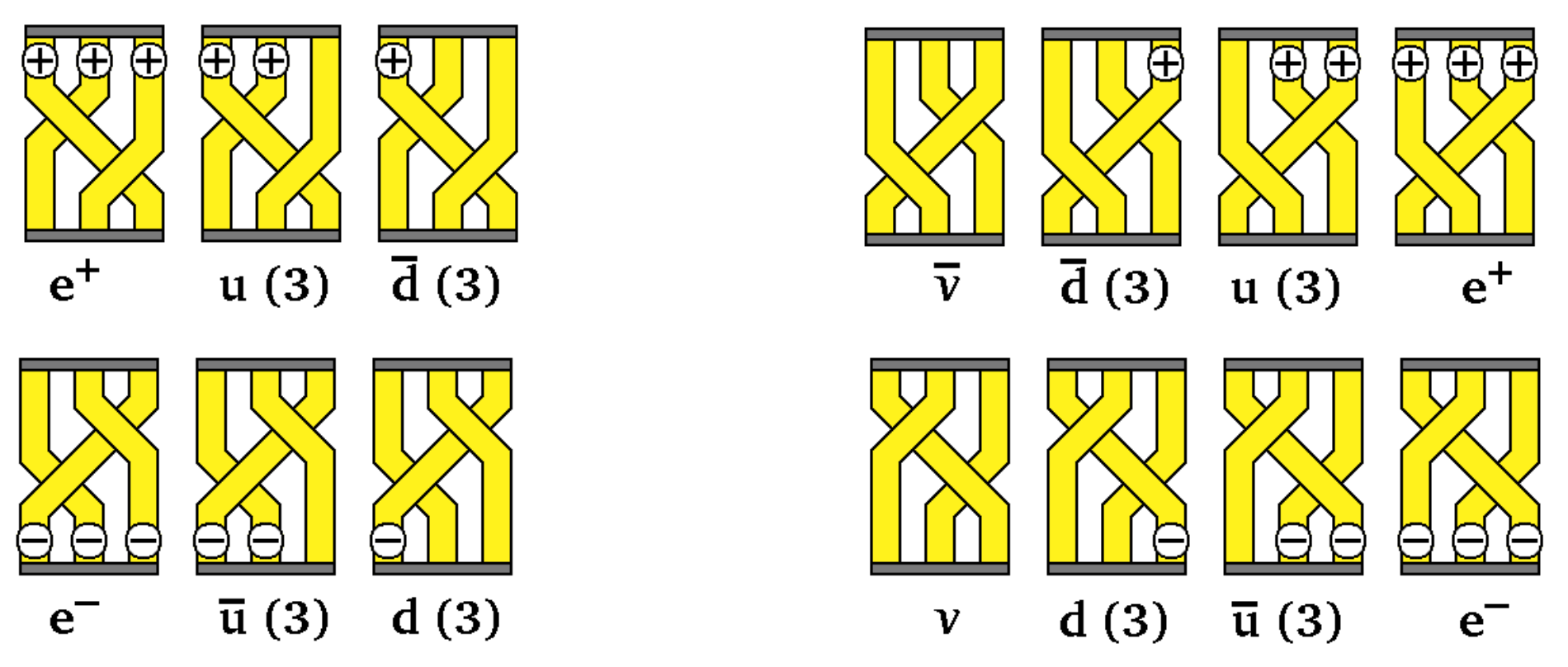
In [
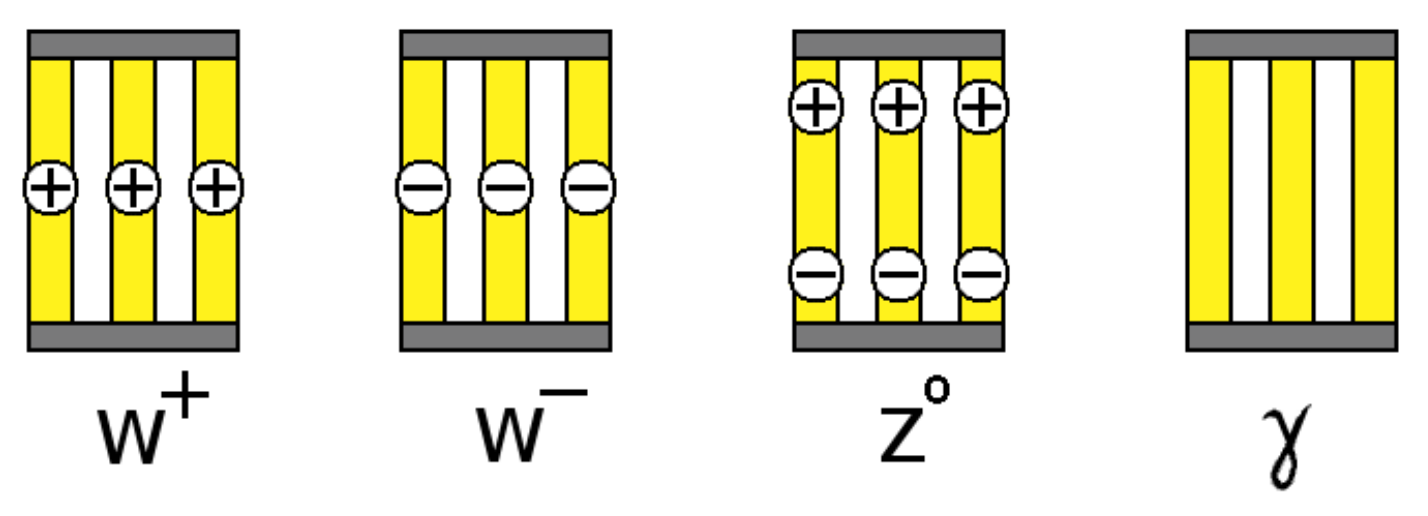
16] Fermions are represented as framed braids. See
Figure 5. The positron and the electron are given by the framed braids
and
Here we use
for the framing numbers
Products of framed braids catalog particle interactions. The electron and the positron are algebraic inverses. In
Figure 6 are bosons, including a photon
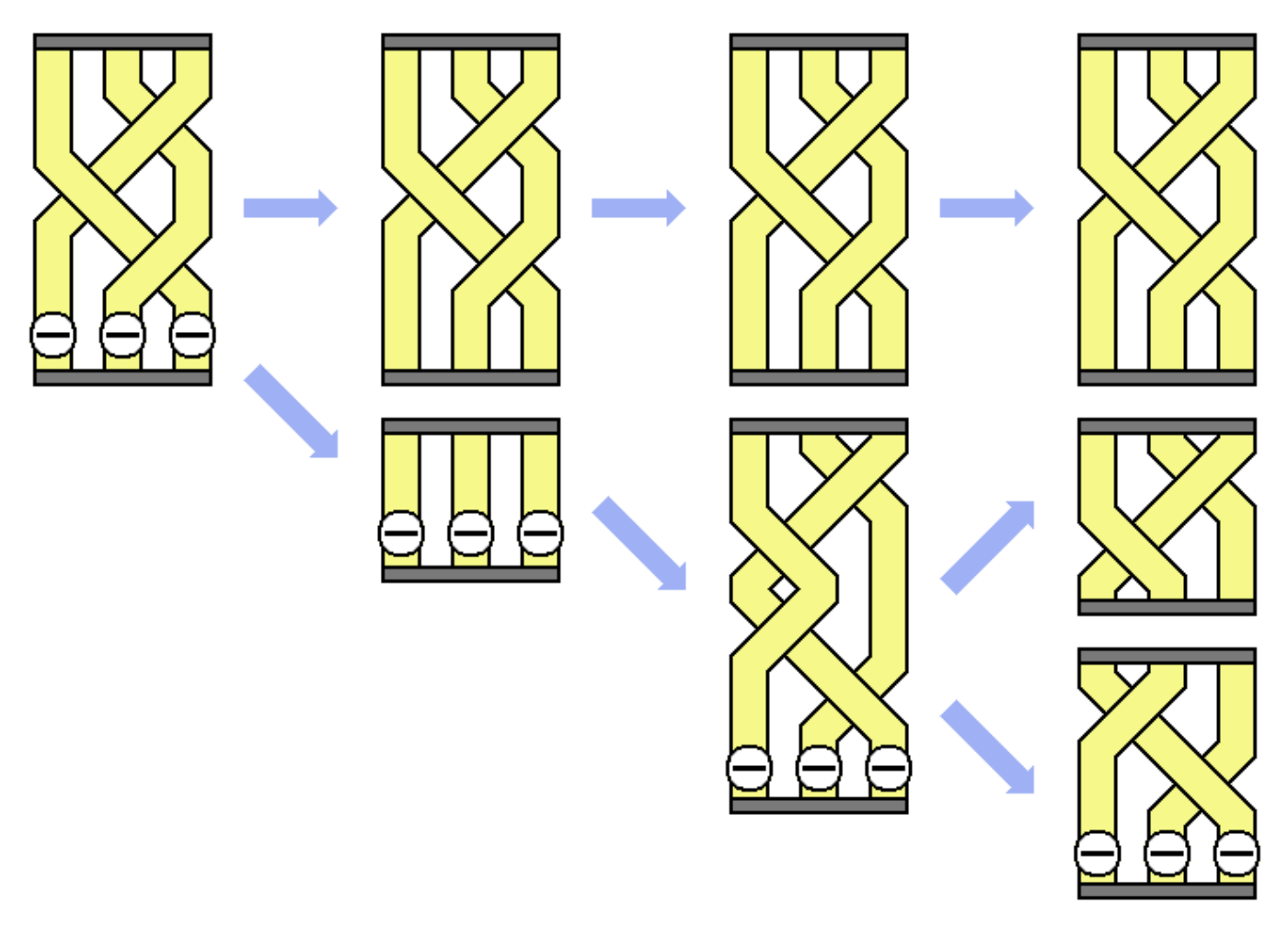
Figure 7 illustrates the muon decay
The muon decay is a multiplicative identity in the braid algebra:
7. Fermions, Majorana Fermions and Anyonic Braiding
In this section we consider the algebras of Femions and Majorana fermions. The generators of this Clifford algebra represent fermions that are their own anti-particles. For a long time it has been conjectured that neutrinos may be Majorana fermions. More recently, it has been suggested that Majorana fermions may occur in collective electronic phenomena and in subtle correlations in nano-wires and in two dimensional anyonic physics [
28,
29,
30,
31].
In order to explain this association, we first give a short exposition of the algebra of fermion operators. In a standard collection of fermion operators
one has that each
is a linear operator on a Hilbert space with an adjoint operator
(corresponding to the anti-particle for the particle created by
) and relations
when
There is another brand of Fermion algebra where we have generators
and
while
for all
These are the
Majorana fermions. There is a algebraic translation between the fermion algebra and Majorana fermion algebra. Given two Majorana fermions
a and
b with
and
define
and
It is then easy to see that
and
imply that
m and
form a fermion in the sense that
and
Thus pairs of Majorana fermions can be construed as ordinary fermions. Conversely, if
m is an ordinary fermion, then formal real and imaginary parts of
m yield a mathematical pair of Majorana fermions. A chain of electrons in a nano-wire, conceived in this way can give rise to a chain of Majorana fermions with a non-localized pair corresponding to the distant ends of the chain. The non-local nature of this pair is promising for creating topologically protected qubits, and there is at this writing an experimental search for evidence for the existence of such end-effect Majorana fermions.
Remark 3. It is common to refer to the Clifford algebra generated by a and b with and as a pair of Majorana Fermions. The reference is to Majorana [30] who rewrote the Dirac equation so that it could be seen as a coupled system of equations over the real numbers. This Majorana-Dirac equation can have solutions that are their own anti-particles. This is reflected in the algebra where and The Fermion operators that we construct from these Majorana operators and form a particle-antiparticle pair. It is of interest to see if the Majorana operators actually are related to Majorana’s original formalism. It is one of the main points of this paper that this is the case. See Sections 9 through 11 for more about this point. This paper and its predecessor [1] are a beginning for us in uncovering deeper relationships between Majorana operators as Clifford algebra and the properties of the Majorana-Dirac equation. Here is an example that shows how topology is related to the Majorana Fermion operators. Let
be three Majorana fermions. Let
We have already seen that
represent the quaternions. Now define
It is easy to see that
and
satisfy the braiding relation for any
For example, here is the verification for
Similarly,
Thus
and so a natural braid group representation arises from the Majorana fermions. This braid group representation is significant for possible applications in topological quantum computing. For the purpose of this discussion, the braid group representation shows that the Clifford algebraic representation for knot sets is related to topology at more than one level. The relation
for generators makes the individual sets, taken as products of generators, invariant under the Reidemeister moves (up to a global sign). But braiding invariance of certain linear combinations of sets is a relationship with knotting at a second level. This multiple relationship certainly deserves more thought. We will make one more remark here, and reserve further analysis for a subsequent paper.
The braiding operators act on the complex vector space spanned by the fermions
It follows that
and
In
Figure 8 where we show an interpretation for the braiding of two fermions. In the interpretation the two fermions are joined by a belt. On particle interchange, the belt is twisted by
A twist of
corresponds to a phase change of
See [
32]. It may not be evident which particle should receive the phase change. Topology alone tells only the relative change of phase. The Clifford algebra makes a specific choice and so fixes the representation of the braiding.
8. Iterants and the Standard Model
Here we give an iterant interpretation for the Lie algebra of the special unitary group
The Lie algebra
is generated by the following eight Gell Man Matrices [
33].
The group
consists in the matrices
where
are real numbers and
a ranges from 1 to
The Gell Man matrices satisfy the relations:
We sum over repeated indices.
is matrix trace,
equals 1 when
and equals 0 otherwise. Structure coefficients
have the non-zero values shown below.
An iterant representation for the Gell Man matrices that is based on the pattern
as we have previously described. We use the cyclic group of order three to represent all
matrices as iterants based on the permutation matrices
Recalling that
denotes a diagonal matrix
it is easy to verify the formulas for the Gell Mann Matrices in the iterant format:
Letting
the Lie algebra rewrites as iterants of the form
where
G is cyclic. Compare with [
34]. Let
Then we have the specific iterant formulas
Then and so that Thus the basic Lie algebra reduces to iterants.
9. The Dirac Equation and Majorana Fermions
We construct the Dirac equation. The speed of light is equal to 1 by convention. Energy
E, momentum
p and mass
m are related by the relativisitic equation
We obtain Dirac’s operator by first taking the case where
p is a scalar (one dimension of space and one dimension of time). Let
where
and
are elements of a a possibly non-commutative, associative algebra. Then
Hence we will satisfiy
if
and
This is our familiar Clifford algebra pattern and we can use the iterant algebra generated by
e and
if we wish. Then, because the quantum operator for momentum is
and the operator for energy is
we have the Dirac equation
Let
so that the Dirac equation takes the form
Now note that
We let
and let
then
This nilpotent element leads to a (plane wave) solution to the Dirac equation as follows: We have shown that
for
It then follows that
from which it follows that
is a (plane wave) solution to the Dirac equation.
In fact, this calculation suggests that we should multiply the operator
by
on the right, obtaining the operator
and the equivalent Dirac equation
In fact for the specific
above we will now have
This idea of reconfiguring the Dirac equation in relation to nilpotent algebra elements
U is due to Peter Rowlands [
17].
We see that with .
9.1. and
We recapitulate and start again.
and the operators
and
so that
and
The Dirac operator is
and the modified Dirac operator is
so that
If we let
(reversing time), then we have
giving a definition of
corresponding to the anti-particle for
We have
and
Note that here we have
and
We have that
and
The decomposition of
U and
into the corresponding Majorana Fermion operators corresponds to
Dividing by
we have
and
so that
and
then
and
Fermion creation and annihilation algebra arises naturally in the nilpotent formulation.
9.2. Writing in the Full Dirac Algebra
We have written the Dirac equation so far in one dimension of space and one dimension of time. Now the formalism is shifted to three dimensions of space. Take an independent Clifford algebra with generators with for and for Assume that and generate an independent Clifford algebra commuting with the Replace scalar momentum p by 3-vector momentum Let Replace with and with
We then have the following form of the Dirac equation.
Let
so that the Dirac equation takes the form
Let
Apply the Dirac operator to this
For nilpotency, the modified Dirac operator is
Then
where
So
and
is a solution to the modified Dirac Equation. We have the structure of the Fermion operators and Majorana Fermion operators.
9.3. Majorana Fermions
We now make a Dirac algebra distinct from the one generated by
and obtain an equation that can have real solutions. Majorana [
30] followed this strategy to construct his new equation. A real equation may have solutions invariant under complex conjugation. Such solutions correspond to particles that are their own anti-particles. We construct the Majorana algebra in terms of the split quaternions
and
We will use the matrix representation given below. It can be formulated in iterants as we have discussed.
Let
and
generate a second algebra of split quaternions, that commutes with the first algebra generated by
and
A real Majorana Dirac equation can be written:
To see that this is a correct Dirac equation, note that
(Here the “hats” denote the quantum differential operators corresponding to the energy and momentum.) will satisfy
if the algebra generated by
satisfies the conditions: Each generator has square one. Each distinct pair of generators anti-commute.
The general Dirac equation occurs by replacing
by
, and
with
(and same for
).
This is the same as
Thus, here we take
and observe that these elements satisfy the requirements for the Dirac algebra.
11. Spacetime Algebra
Another way to put the Dirac equation is to formulate it in terms of a
spacetime algebra. By a spacetime algebra we mean a Clifford algebra with generators
such that
,
and
for
Thus the generators of the algebra fit the Minkowski metric and we can represent a point in space time by
so that
corresponds to the spacetime metric with the speed of light
(The reader may wish to compare this approach with Hestenes [
27].)
Since the Dirac algebra demands
with all elements squaring to 1 and anti-commuting, we see that spacetime algebra is interchangeable with Dirac algebra via the translation:
where
is a square root of negative unity that commutes with all algebra elements.
The standard Dirac equation is
where
Thus we can rewrite
as
Then, multiply the whole Dirac equation by
and we find the equivalent operator
This point of view makes it clear how to search for Majorana algebra since we can search for a spacetime algebra of real matrices. Then the Dirac equation in the form
will be an equation over the real numbers. In fact the algebra that we have already written for Majorana is a spacetime algebra:
Furthermore, we can see that the following lemma gives us a guide to constructing nilpotent formulations of the Dirac equation.
Definition 1. Suppose that generates a spacetime algebra and that μ is an element of with and so that is also a spacetime algebra with , and for Under these circumstances, we call the spacetime algebra nilpotent.
Lemma 2. Let be a nilpotent spacetime algebra, with notation as in Definition 1 above. Then the operatorgenerates a nilpotent Dirac equation. Proof. We wish to show that if
and
then
Calculating, we find that
It follows that
his completes the proof. □
Example 1. Before proceeding to the Majorana structure, consider the standard Dirac algebra. Here we have with for each and each pair of distinct operators anticommutes. This can be taken to be the Pauli algebra and is represented by matrices over the complex numbers. We take α and β as before to generate a Clifford algebra that commutes with the Pauli algebra and is independent of it. Then the associated spacetime algebra has generatorsand the nilpotency corresponds to the fact that these generators, multiplied by yield another spacetime algebra. This is given byThe corresponding nilpotent Dirac operator isHenceApplying this operator to we obtain the nilpotentThis can be replaced by the nilpotentby factoring out the common square root of minus one. This is the same nipotent that we have previously derived. Note that in relation to this standard Dirac algebra we have the conjugate nilpotentand thatso that This is as we have derived earlier in the paper. The decomposition into Clifford operators follows these lines, giving Clifford elements that square to E. When we work with the real spacetime algebras (below) that correspond to the Majorana Dirac equation, the decomposition into Clifford algebras takes a different pattern, centering on the mass m rather than the energy
Example 2. In the case we have considered with We take and we find Indeed this gives a spacetime algebra and hence a nilpotent Majorana Dirac operator Example 3. Here is another example. We takeand and findThis gives a spacetime algebra and hence a nilpotent Dirac operator Example 4. We now give a number of examples of spacetime algebras. For this purpose it is useful to change notation. We will use Thus and and We will indicate a spacetime algebra as a 4-tuple where we require that the anti-commute and that the squares of the first three are 1 while The following are spacetime algebras.It is easy to see that A, B, C and D are nilpotent. Note that (up to signs) B is obtained from A by interchanging with and then interchanging i and C is obtained from A by interchanging i and j directly. To see that A is nilpotent, multiply by The algebra D is also nilpotent, via multiplying by The General Case. We are now in a position to prove the following Theorem.
Theorem 1. All real Majorana spacetime algebras are nilpotent and, up to permutations and substitutions, they are of the following types: Here the notation of types of algebras is as we have explained in the previous examples. The proof will proceed in the form of the discussion below. In subsequent work we shall return to this result and its possible physical consequences, since each spacetime algebra gives a Dirac equation that can be studied both for its physics and for its mathematics.
Suppose that we are given a nilpotent spacetime algebra specified by
and
with
so that
is also a spacetime algebra with
for
Then we have the nilpotent Dirac operator associated with this algebra:
Let
, a square root of negative unity that commutes with all algebra elements. Applying
to
we obtain the nilpotent
The nilpotent
A is directly decomposed into its two (Majorana) Clifford parts as the real and imaginary parts of
A, just as in our previous discussion of a special case. Other examples lead to real solutions to the Majorana Dirac equation just as we have done above. Note that the Clifford parts are
and
with
and
and
anticommute. It is of interest to note that the Clifford algebra is collapsed when the mass is equal to zero.
Consider that the fourth elememt of a spacetime algebra has square
Up to symmetries the possibilities are
and
Take each of these cases in turn. First suppose that
Then consider first all square one elements. These are
The subset of elements of
S that anti-commute with
is
and the (up to order and symmetry) the only triplet in
that mutually anti-commutes is
This gives the spacetime algebra
This algebra is nipotent via multiplication by
Now consider the subset of elements of
S that anti-commute with
This subset is
The triplets that anti-commute are
and
These give rise to spacetime algebras
and
The first is nilpotent via the multiplier and the second is nilpotent via the multiplier Up to symmetries these are all the cases and so we have proved the result
Theorem 2. All real Majorana spacetime algebras are nilpotent and, up to permutations and substitutions, they are of the following types: In a subsequent paper we shall follow up the consequences of this result.