You are currently viewing a new version of our website. To view the old version click .
Symmetry
  • Article
  • Open Access

23 January 2021

Approximation Results for Variational Inequalities Involving Pseudomonotone Bifunction in Real Hilbert Spaces


,
and
1
Faculty of Science and Technology, Rajamangala University of Technology Phra Nakhon (RMUTP), 1381 Pracharat 1 Road, Wongsawang, Bang Sue, Bangkok 10800, Thailand
2
Department of Mathematics, College of Science, Northern Border University, Arar 73222, Saudi Arabia
3
Department of Mathematical Sciences, Cameron University, Lawton, OK 73505, USA
*
Author to whom correspondence should be addressed.
This article belongs to the Section Mathematics

Abstract

In this paper, we introduce two novel extragradient-like methods to solve variational inequalities in a real Hilbert space. The variational inequality problem is a general mathematical problem in the sense that it unifies several mathematical models, such as optimization problems, Nash equilibrium models, fixed point problems, and saddle point problems. The designed methods are analogous to the two-step extragradient method that is used to solve variational inequality problems in real Hilbert spaces that have been previously established. The proposed iterative methods use a specific type of step size rule based on local operator information rather than its Lipschitz constant or any other line search procedure. Under mild conditions, such as the Lipschitz continuity and monotonicity of a bi-function (including pseudo-monotonicity), strong convergence results of the described methods are established. Finally, we provide many numerical experiments to demonstrate the performance and superiority of the designed methods.

1. Introduction

This paper concerns the problem of the classic variational inequality problem [1,2]. The variational inequalities problem (VIP) for an operator G : H H is defined in the following way:
Find u * C such that G ( u * ) , y u * 0 , y C
where C is a non-empty, convex and closed subset of a real Hilbert space H and . , . and . denote an inner product and the induced norm on H , respectively. Moreover, R , N are the sets of real numbers and natural numbers, respectively. It is important to note that the problem (VIP) is equivalent to solving the following problem:
Find u * C such that u * = P C [ u * χ G ( u * ) ] .
The idea of variational inequalities has been used by an antique mechanism to consider a wide range of topics, i.e., engineering, physics, optimization theory and economics. It is an important mathematical model that unifies a number of different mathematics problems such as the network equilibrium problem, the necessary optimality conditions, systems of non-linear equations and the complementarity problems (for further details [3,4,5,6,7,8,9]). This problem was introduced by Stampacchia [2] in 1964 and also demonstrated that the problem (VIP) had a key position in non-linear analysis. There are many researchers who have studied and considered many projection methods (see for more details [10,11,12,13,14,15,16,17,18,19,20]). Korpelevich [13] and Antipin [21] established the following extragradient method:
u 0 C , y n = P C [ u n χ G ( u n ) ] , u n + 1 = P C [ u n χ G ( y n ) ] .
Recently, the subgradient extragradient method was introduced by Censor et al. [10] for solving the problem (VIP) in a real Hilbert space. It has the following form:
u 0 C , y n = P C [ u n χ G ( u n ) ] , u n + 1 = P H n [ u n χ G ( y n ) ] ,
where
H n = { z H : u n χ G ( u n ) y n , z y n 0 } .
It is important to mention that the above well-established method carries two serious shortcomings, the first one is the fixed step size that involves the knowledge or approximation of the Lipschitz constants of the related mapping and it only converges weakly in Hilbert spaces. From the computational point of view, it might be questionable to use fixed step size, and hence the convergence rate and usefulness of the method could be affected.
The main objective of this paper is to introduce inertial-type methods that are used to strengthen the convergence rate of the iterative sequence in this context. Such methods have been previously established due to the oscillator equation with a damping and conservative force restoration. This second-order dynamical system is called a heavy friction ball, which was originally studied by Polyak in [22]. Mainly, the functionality of the inertial-type method is that it will use the two previous iterations for the next iteration. Numerical results support that inertial term usually improves the functioning of the methods in terms of the number of iterations and elapsed time in this sense, and that inertial-type method has been broadly studied in [23,24,25].
So a natural question arises:
“Is it possible to introduce a new inertial-type strongly convergent extragradient-like method with a monotone variable step size rule to solve problem (VIP)”?
In this study, we provide a positive answer of this question, i.e., the gradient method still generates a strong convergence sequence by using a fixed and variable step size rule for solving a problem (VIP) associated with pseudo-monotone mappings. Motivated by the works of Censor et al. [10] and Polyak [22], we introduce a new inertial extragradient-type method to solve the problem (VIP) in the setting of an infinite-dimensional real Hilbert space.
In brief, the key points of this paper are set out as follows:
(i)
We propose an inertial subgradient extragradient method by using a fixed step size to solve the variational inequality problem in real Hilbert space and confirm that a generated sequence is strongly convergent.
(ii)
We also create a second inertial subgradient extragradient method by using a variable monotone step size rule independent of the Lipschitz constant to solve pseudomonotone variational inequality problems.
(iii)
Numerical experiments are presented corresponding to proposed methods for the verification of theoretical findings, and we compare them with the results in [Algorithm 3.4 in [23]], [Algorithm 3.2 in [24] and Algorithm 3.1 in [25]]. Our numerical data has shown that the proposed methods are useful and performed better as compared to the existing ones.
The rest of the article is arranged as follows: The Section 2 includes the basic definitions and important lemmas that are used in the manuscript. Section 3 consists of inertial-type iterative schemes and convergence analysis theorems. Section 4 provided the numerical findings to explain the behaviour of the new methods and in comparison with other methods.

2. Preliminaries

In this section, we have written a number of important identities and relevant lemmas and definitions. A metric projection P C ( u 1 ) of u 1 H is defined by
P C ( u 1 ) = arg min { u 1 u 2 : u 2 C } .
Next, we list some of the important properties of the projection mapping.
Lemma 1.
[26] Suppose that P C : H C is a metric projection. Then, we have
(i) 
u 3 = P C ( u 1 ) if and only if
u 1 u 3 , u 2 u 3 0 , u 2 C .
(ii) 
u 1 P C ( u 2 ) 2 + P C ( u 2 ) u 2 2 u 1 u 2 2 , u 1 C , u 2 H .
(iii) 
u 1 P C ( u 1 ) u 1 u 2 , u 2 C , u 1 H .
Lemma 2.
[27] Let { a n } [ 0 , + ) be a sequence satisfying the following inequality
a n + 1 ( 1 b n ) a n + b n r n , n N .
Furthermore, { b n } ( 0 , 1 ) and { r n } R be two sequences such that
lim n + b n = 0 , n = 1 + b n = + and lim sup n + r n 0 .
Then, lim n + a n = 0 .
Lemma 3.
[28] Assume that { a n } R is a sequence and there exist a subsequence { n i } of { n } such that
a n i < a n i + 1 i N .
Then, there exists a non decreasing sequence m k N such that m k + as k + , and satisfying the following inequality for numbers k N :
a m k a m k + 1 and a k a m k + 1 .
Indeed, m k = max { j k : a j a j + 1 } .
Next, we list some of the important identities that were used to prove the convergence analysis.
Lemma 4.
[26] For any u 1 , u 2 H and b R . Then, the following inequalities hold.
(i) 
b u 1 + ( 1 b ) u 2 2 = b u 1 2 + ( 1 b ) u 2 2 b ( 1 b ) u 1 u 2 2 .
(ii) 
u 1 + u 2 2 u 1 2 + 2 u 2 , u 1 + u 2 .
Lemma 5.
[29] Assume that G : C H is a continuous and pseudo-monotone mapping. Then, u * solves the problem (VIP) iff u * is the solution of the following problem:
F i n d u C s u c h t h a t G ( y ) , y u 0 , y C .

3. Main Results

Now, we introduce both inertial-type subgradient extragradient methods which incorporate a monotone step size rule and the inertial term and provide both strong convergence theorems. The following two main results are outlined as Algorithms 1 and 2:
Algorithm 1 Inertial-type strongly convergent iterative scheme.
  • Step 0: Choose arbitrary starting points u 1 , u 0 C , θ > 0 and 0 < χ < 1 L . Moreover, choose { ϕ n } ( 0 , 1 ) comply with the following conditions:
    lim n + ϕ n = 0 and n = 1 + ϕ n = + .
  • Step 1: Evaluate
    w n = u n + θ n ( u n u n 1 ) ϕ n u n + θ n ( u n u n 1 ) ,
    where θ n such that
    0 θ n θ n ^ and θ n ^ = min θ 2 , ϵ n u n u n 1 if u n u n 1 , θ 2 else ,
    where ϵ n = ( ϕ n ) is a positive sequence, i.e., lim n + ϵ n ϕ n = 0 .
  • Step 2: Evaluate
    y n = P C ( w n χ G ( w n ) ) .
    If w n = y n , then STOP. Otherwise, go to Step 3.
  • Step 3: Evaluate
    u n + 1 = P H n ( w n χ G ( y n ) ) .
    where
    H n = { z H : w n χ G ( w n ) y n , z y n 0 } .
    Set n = n + 1 and go back to Step 1.
In order to study the convergence analysis, we consider that the following condition have been satisfied:
(B1)
The solution set of problem (VIP), denoted by Ω is non-empty;
(B2)
An operator G : H H is called to be pseudo-monotone, i.e.,
G ( y 1 ) , y 2 y 1 0 G ( y 2 ) , y 1 y 2 0 , y 1 , y 2 C ;
(B3)
An operator G : H H is called to be Lipschitz continuous through a constant L > 0 , i.e., there exists L > 0 such that
G ( y 1 ) G ( y 2 ) L y 1 y 2 , y 1 , y 2 C ;
(B4)
An operator G : H H is called to be weakly sequentially continuous, i.e., { G ( u n ) } converges weakly to G ( u ) for every sequence { u n } converges weakly to u.
Algorithm 2 Explicit Inertial-type strongly convergent iterative scheme.
  • Step 0: Choose arbitrary starting points u 1 , u 0 C , θ > 0 , μ ( 0 , 1 ) , χ 0 > 0 . Moreover, select { ϕ n } ( 0 , 1 ) comply with the following conditions:
    lim n + ϕ n = 0 and n = 1 + ϕ n = + .
  • Step 1: Evaluate
    w n = u n + θ n ( u n u n 1 ) ϕ n u n + θ n ( u n u n 1 )
    where θ n such that
    0 θ n θ n ^ and θ n ^ = min θ 2 , ϵ n u n u n 1 if u n u n 1 , θ 2 else ,
    where ϵ n = ( ϕ n ) is a positive sequence, i.e., lim n + ϵ n ϕ n = 0 .
  • Step 2: Evaluate
    y n = P C ( w n χ G ( w n ) ) .
    If w n = y n , then STOP and y n is a solution. Otherwise, go to Step 3.
  • Step 3: Evaluate
    u n + 1 = P H n ( w n χ G ( y n ) ) .
    where
    H n = { z H : w n χ G ( w n ) y n , z y n 0 } .
    (iii) Compute
    χ n + 1 = min χ n , μ w n y n G ( w n ) G ( y n ) if G ( w n ) G ( y n ) 0 , χ n e l s e .
    Set n = n + 1 and go back to Step 1.
Lemma 6.
Assume that G : H H satisfies the conditions (B1)(B4) in Algorithm 1. For each u * Ω , we have
u n + 1 u * 2 w n u * 2 ( 1 χ L ) w n y n 2 ( 1 χ L ) u n + 1 y n 2 .
Proof. 
First, consider the following
u n + 1 u * 2 = P H n [ w n χ G ( y n ) ] u * 2 = P H n [ w n χ G ( y n ) ] + [ w n χ G ( y n ) ] [ w n χ G ( y n ) ] u * 2 = [ w n χ G ( y n ) ] u * 2 + P H n [ w n χ G ( y n ) ] [ w n χ G ( y n ) ] 2 + 2 P H n [ w n χ G ( y n ) ] [ w n χ G ( y n ) ] , [ w n χ G ( y n ) ] u * .
It is given that u * Ω C H n , such that
P H n [ w n χ G ( y n ) ] [ w n χ G ( y n ) ] 2 + P H n [ w n χ G ( y n ) ] [ w n χ G ( y n ) ] , [ w n χ G ( y n ) ] u * = [ w n χ G ( y n ) ] P H n [ w n χ G ( y n ) ] , u * P H n [ w n χ G ( y n ) ] 0 ,
which implies that
P H n [ w n χ G ( y n ) ] [ w n χ G ( y n ) ] , [ w n χ G ( y n ) ] u * P H n [ w n χ G ( y n ) ] [ w n χ G ( y n ) ] 2 .
By the use of expressions (4) and (6), we obtain
u n + 1 u * 2 w n χ G ( y n ) u * 2 P H n [ w n χ G ( y n ) ] [ w n χ G ( y n ) ] 2 w n u * 2 w n u n + 1 2 + 2 χ G ( y n ) , u * u n + 1 .
It is given that u * Ω , we obtain
G ( u * ) , y u * 0 , for all y C .
By the use of pseudo-monotonicity of mapping G on C , we obtain
G ( y ) , y u * 0 , for all y C .
Let consider y = y n C , we obtain
G ( y n ) , y n u * 0 .
Thus, we have
G ( y n ) , u * u n + 1 = G ( y n ) , u * y n + G ( y n ) , y n u n + 1 G ( y n ) , y n u n + 1 .
By the use of expressions (7) and (8), we get
u n + 1 u * 2 w n u * 2 w n u n + 1 2 + 2 χ G ( y n ) , y n u n + 1 w n u * 2 w n y n + y n u n + 1 2 + 2 χ G ( y n ) , y n u n + 1 w n u * 2 w n y n 2 y n u n + 1 2 + 2 w n χ G ( y n ) y n , u n + 1 y n .
It is given that u n + 1 = P H n [ w n χ G ( y n ) ] , we have
2 w n χ G ( y n ) y n , u n + 1 y n = 2 w n χ G ( w n ) y n , u n + 1 y n + 2 χ G ( w n ) G ( y n ) , u n + 1 y n 2 χ L w n y n u n + 1 y n χ L w n y n 2 + χ L u n + 1 y n 2 .
Combining expressions (9) and (10), we obtain
u n + 1 u * 2 w n u * 2 ( 1 χ L ) w n y n 2 ( 1 χ L ) u n + 1 y n 2 .
   □
Theorem 1.
Let { u n } be a sequence generated by Algorithm 1 and satisfies the conditions (B1)–(B4). Then, { u n } strongly converges to u * Ω . Moreover, P Ω ( 0 ) = u * .
Proof. 
It is given in expression (3) that
lim n + θ n ϕ n u n u n 1 lim n + ϵ n ϕ n u n u n 1 = 0 .
By the use of definition of { w n } and inequality (12), we get
w n u * = u n + θ n ( u n u n 1 ) ϕ n u n θ n ϕ n ( u n u n 1 ) u * = ( 1 ϕ n ) ( u n u * ) + ( 1 ϕ n ) θ n ( u n u n 1 ) ϕ n u * ( 1 ϕ n ) u n u * + ( 1 ϕ n ) θ n u n u n 1 + ϕ n u *
( 1 ϕ n ) u n u * + ϕ n M 1 ,
where
( 1 ϕ n ) θ n ϕ n u n u n 1 + u * M 1 .
By the use of Lemma 6, we obtain
u n + 1 u * 2 w n u * 2 , n N .
Combining (14) with (15), we obtain
u n + 1 u * ( 1 ϕ n ) u n u * + ϕ n M 1 max u n u * , M 1 max u 0 u * , M 1 .
Thus, we conclude that the { u n } is bounded sequence. Indeed, by (14) we have
w n u * 2 ( 1 ϕ n ) 2 u n u * 2 + ϕ n 2 M 1 2 + 2 M 1 ϕ n ( 1 ϕ n ) u n u * u n u * 2 + ϕ n ϕ n M 1 2 + 2 M 1 ( 1 ϕ n ) u n u * u n u * 2 + ϕ n M 2 ,
for some M 2 > 0 . Combining the expressions (11) with (17), we have
u n + 1 u * 2 u n u * 2 + ϕ n M 2 ( 1 χ L ) w n y n 2 ( 1 χ L ) u n + 1 y n 2 .
Due to the Lipschitz-continuity and pseudo-monotonicity of G implies that Ω is a closed and convex set. It is given that u * = P Ω ( 0 ) and by using Lemma 1 (ii), we have
0 u * , y u * 0 , y Ω .
The rest of the proof is divided into the following parts:  
Case 1: Now consider that a number N 1 N such that
u n + 1 u * u n u * , n N 1 .
Thus, above implies that lim n + u n u * exists and let lim n + u n u * = l , for some l 0 . From the expression (18), we have
( 1 χ L ) w n y n 2 + ( 1 χ L ) u n + 1 y n 2 u n u * 2 + ϕ n M 2 u n + 1 u * 2 .
Due to existence of a limit of sequence u n u * and ϕ n 0 , we infer that
w n y n 0 and u n + 1 y n 0 as n + .
By the use of expression (22), we have
lim n + w n u n + 1 lim n + w n y n + lim n + y n u n + 1 = 0 .
Next, we will evaluate
w n u n = u n + θ n ( u n u n 1 ) ϕ n u n + θ n ( u n u n 1 ) u n θ n u n u n 1 + ϕ n u n + θ n ϕ n u n u n 1 = ϕ n θ n ϕ n u n u n 1 + ϕ n u n + ϕ n 2 θ n ϕ n u n u n 1 0 .
Thus above implies that
lim n + u n u n + 1 lim n + u n w n + lim n + w n u n + 1 = 0 .
The above explanation guarantees that the sequences { w n } and { y n } are also bounded. By the use of reflexivity of H and the boundedness of { u n } guarantees that there exits a subsequence { u n k } such that { u n k } u ^ H as k + . Next, we have to prove that u ^ Ω . It is given that y n k = P C [ w n k χ G ( w n k ) ] that is equivalent to
w n k χ G ( w n k ) y n k , y y n k 0 , y C .
The inequality described above implies that
w n k y n k , y y n k χ G ( w n k ) , y y n k , y C .
Thus, we obtain
1 χ w n k y n k , y y n k + G ( w n k ) , y n k w n k G ( w n k ) , y w n k , y C .
Due to boundedness of the sequence { w n k } implies that { G ( w n k ) } is also bounded. By the use of lim k w n k y n k = 0 and k in (28), we obtain
lim inf k G ( w n k ) , y w n k 0 , y C .
Moreover, we have
G ( y n k ) , y y n k = G ( y n k ) G ( w n k ) , y w n k + G ( w n k ) , y w n k + G ( y n k ) , w n k y n k .
Since lim k w n k y n k = 0 and G is L-Lipschitz continuity on H implies that
lim k G ( w n k ) G ( y n k ) = 0 ,
which together with (30) and (31), we obtain
lim inf k G ( y n k ) , y y n k 0 , y C .
Let us consider a sequence of positive numbers { ϵ k } that is decreasing and converges to zero. For each k, we denote m k by the smallest positive integer such that
G ( w n i ) , y w n i + ϵ k 0 , i m k .
Due to { ϵ k } is decreasing and { m k } is increasing.  
Case I: If there is a w n m k j subsequence of w n m k such that G ( w n m k j ) = 0 ( j ). Let j , we obtain
G ( u ^ ) , y u ^ = lim j G ( w n m k j ) , y u ^ = 0 .
Thus, u ^ C and imply that u ^ Ω .  
Case II: If there exits N 0 N such that for all n m k N 0 , G ( w n m k ) 0 . Consider that
Ξ n m k = G ( w n m k ) G ( w n m k ) 2 , n m k N 0 .
Due to the above definition, we obtain
G ( w n m k ) , Ξ n m k = 1 , n m k N 0 .
Moreover, expressions (33) and (36), for all n m k N 0 , we have
G ( w n m k ) , y + ϵ k Ξ n m k w n m k 0 .
Due to the pseudomonotonicity of G for n m k N 0 , we have
G ( y + ϵ k Ξ n m k ) , y + ϵ k Ξ n m k w n m k 0 .
For all n m k N 0 , we have
G ( y ) , y w n m k G ( y ) G ( y + ϵ k Ξ n m k ) , y + ϵ k Ξ n m k w n m k ϵ k G ( y ) , Ξ n m k .
Due to { w n k } weakly converges to u ^ C through G is sequentially weakly continuous on the set C , we get { G ( w n k ) } weakly converges to G ( u ^ ) . Suppose that G ( u ^ ) 0 , we have
G ( u ^ ) lim inf k G ( w n k ) .
Since { w n m k } { w n k } and lim k ϵ k = 0 , we have
0 lim k ϵ k Ξ n m k = lim k ϵ k G ( w n m k ) 0 G ( u ^ ) = 0 .
Next, consider k in (39), we obtain
G ( y ) , y u ^ 0 , y C .
By the use of Minty Lemma 5, we infer u ^ Ω . Next, we have
lim sup n + u * , u * u n = lim k + u * , u * u n k = u * , u * u ^ 0 .
By the use of lim n + u n + 1 u n = 0 . Thus, (43) implies that
lim sup n + u * , u * u n + 1 lim sup n + u * , u * u n + lim sup n + u * , u n u n + 1 0 .
Consider the expression (13), we have
w n u * 2 = u n + θ n ( u n u n 1 ) ϕ n u n θ n ϕ n ( u n u n 1 ) u * 2 = ( 1 ϕ n ) ( u n u * ) + ( 1 ϕ n ) θ n ( u n u n 1 ) ϕ n u * 2 ( 1 ϕ n ) ( u n u * ) + ( 1 ϕ n ) θ n ( u n u n 1 ) 2 + 2 ϕ n u * , w n u * = ( 1 ϕ n ) 2 u n u * 2 + ( 1 ϕ n ) 2 θ n 2 u n u n 1 2 + 2 θ n ( 1 ϕ n ) 2 u n u * u n u n 1 + 2 ϕ n u * , w n u n + 1 + 2 ϕ n u * , u n + 1 u * ( 1 ϕ n ) u n u * 2 + θ n 2 u n u n 1 2 + 2 θ n ( 1 ϕ n ) u n u * u n u n 1 + 2 ϕ n u * w n u n + 1 + 2 ϕ n u * , u n + 1 u * = ( 1 ϕ n ) u n u * 2 + ϕ n [ θ n u n u n 1 θ n ϕ n u n u n 1 + 2 ( 1 ϕ n ) u n u * θ n ϕ n u n u n 1 + 2 u * w n u n + 1 + 2 u * , u * u n + 1 ] .
From expressions (15) and (45) we obtain
u n + 1 u * 2 ( 1 ϕ n ) u n u * 2 + ϕ n [ θ n u n u n 1 θ n ϕ n u n u n 1 + 2 ( 1 ϕ n ) u n u * θ n ϕ n u n u n 1 + 2 u * w n u n + 1 + 2 u * , u * u n + 1 ] .
By the use of (23), (44), (46) and applying Lemma 2, conclude that lim n + u n u * = 0 .
  Case 2: Consider that there exists { n i } subsequence of { n } such that
u n i u * u n i + 1 u * , i N .
By using Lemma 3 there exists a sequence { m k } N as { m k } + such that
u m k u * u m k + 1 u * and u k u * u m k + 1 u * , for all k N .
As in Case 1, the relation (21) gives that
( 1 χ L ) w m k y m k 2 + ( 1 χ L ) u m k + 1 y m k 2 u m k u * 2 + ϕ m k M 2 u m k + 1 u * 2 .
Due to ϕ m k 0 , we deduce the following:
lim k + w m k y m k = lim k + u m k + 1 y m k = 0 .
It follows that
lim k + u m k + 1 w m k lim k + u m k + 1 y m k + lim k + y m k w m k = 0 .
Next, we evaluate
w m k u m k = u m k + θ m k ( u m k u m k 1 ) ϕ m k u m k + θ m k ( u m k u m k 1 ) u m k θ m k u m k u m k 1 + ϕ m k u m k + θ m k ϕ m k u m k u m k 1 = ϕ m k θ m k ϕ m k u m k u m k 1 + ϕ m k u m k + ϕ m k 2 θ m k ϕ m k u m k u m k 1 0 .
It follows that
lim k + u m k u m k + 1 lim k + u m k w m k + lim k + w m k u m k + 1 = 0 .
By using the same explanation as in the Case 1, such that
lim sup k + u * , u * u m k + 1 0 .
By using the expressions (46) and (47) we obtain
u m k + 1 u * 2 ( 1 ϕ m k ) u m k u * 2 + ϕ m k [ θ m k u m k u m k 1 θ m k ϕ m k u m k u m k 1 + 2 ( 1 ϕ m k ) u m k u * θ m k ϕ m k u m k u m k 1 + 2 u * w m k u m k + 1 + 2 u * , u * u m k + 1 ] ( 1 ϕ m k ) u m k + 1 u * 2 + ϕ m k [ θ m k u m k u m k 1 θ m k ϕ m k u m k u m k 1 + 2 ( 1 ϕ m k ) u m k u * θ m k ϕ m k u m k u m k 1 + 2 u * w m k u m k + 1 + 2 u * , u * u m k + 1 ] .
Thus, above implies that
u m k + 1 u * 2 [ θ m k u m k u m k 1 θ m k ϕ m k u m k u m k 1 + 2 ( 1 ϕ m k ) u m k u * θ m k ϕ m k u m k u m k 1 + 2 u * w m k u m k + 1 + 2 u * , u * u m k + 1 ] .
Since ϕ m k 0 , and boundedness of the sequence u m k u * is a bounded. Thus, expressions (53) and (55) implies that
u m k + 1 u * 2 0 , as k + .
It implies that
lim n + u k u * 2 lim n + u m k + 1 u * 2 0 .
As a consequence u n u * . This completes the proof of the theorem.    □
Lemma 7.
Assume that G : H H satisfies the conditions (B1)(B4) in Algorithm 2. For each u * Ω , we have
u n + 1 u * 2 w n u * 2 1 μ χ n χ n + 1 w n y n 2 1 μ χ n χ n + 1 u n + 1 y n 2 .
Proof. 
Consider that
u n + 1 u * 2 = P H n [ w n χ n G ( y n ) ] u * 2 = P H n [ w n χ n G ( y n ) ] + [ w n χ n G ( y n ) ] [ w n χ n G ( y n ) ] u * 2 = [ w n χ n G ( y n ) ] u * 2 + P H n [ w n χ n G ( y n ) ] [ w n χ n G ( y n ) ] 2 + 2 P H n [ w n χ n G ( y n ) ] [ w n χ n G ( y n ) ] , [ w n χ n G ( y n ) ] u * .
It is given that u * Ω C H n , we obtain
P H n [ w n χ n G ( y n ) ] [ w n χ n G ( y n ) ] 2 + P H n [ w n χ n G ( y n ) ] [ w n χ n G ( y n ) ] , [ w n χ n G ( y n ) ] u * = [ w n χ n G ( y n ) ] P H n [ w n χ n G ( y n ) ] , u * P H n [ w n χ n G ( y n ) ] 0 ,
which implies that
P H n [ w n χ n G ( y n ) ] [ w n χ n G ( y n ) ] , [ w n χ n G ( y n ) ] u * P H n [ w n χ n G ( y n ) ] [ w n χ n G ( y n ) ] 2 .
By using expressions (59) and (61), we obtain
u n + 1 u * 2 w n χ n G ( y n ) u * 2 P H n [ w n χ n G ( y n ) ] [ w n χ n G ( y n ) ] 2 w n u * 2 w n u n + 1 2 + 2 χ n G ( y n ) , u * u n + 1 .
Thus, we have
G ( u * ) , y u * 0 , for all y C .
By the use of condition (B2), we have
G ( y ) , y u * 0 , for all y C .
Take y = y n C , we obtain
G ( y n ) , y n u * 0 .
Thus, we have
G ( y n ) , u * u n + 1 = G ( y n ) , u * y n + G ( y n ) , y n u n + 1 G ( y n ) , y n u n + 1 .
Combining expressions (62) and (63), we obtain
u n + 1 u * 2 w n u * 2 w n u n + 1 2 + 2 χ n G ( y n ) , y n u n + 1 w n u * 2 w n y n + y n u n + 1 2 + 2 χ n G ( y n ) , y n u n + 1 w n u * 2 w n y n 2 y n u n + 1 2 + 2 w n χ n G ( y n ) y n , u n + 1 y n .
Note that u n + 1 = P H n [ w n χ n G ( y n ) ] and by the definition of χ n + 1 , we have
2 w n χ n G ( y n ) y n , u n + 1 y n = 2 w n χ n G ( w n ) y n , u n + 1 y n + 2 χ n G ( w n ) G ( y n ) , u n + 1 y n 2 χ n G ( w n ) G ( y n ) u n + 1 y n 2 μ χ n χ n + 1 w n y n u n + 1 y n μ χ n χ n + 1 w n y n 2 + μ χ n χ n + 1 u n + 1 y n 2 .
Combining expressions (64) and (65), we obtain
u n + 1 u * 2 w n u * 2 w n y n 2 y n u n + 1 2 + χ n χ n + 1 μ w n y n 2 + μ u n + 1 y n 2 w n u * 2 1 μ χ n χ n + 1 w n y n 2 1 μ χ n χ n + 1 u n + 1 y n 2 .
Theorem 2.
Let { u n } be a sequence generated by Algorithm 2 and satisfies the conditions (B1)–(B4). Then, { u n } strongly converges to u * Ω . Moreover, P Ω ( 0 ) = u * .
Proof. 
From Lemma 7, we have
u n + 1 u * 2 w n u * 2 1 μ χ n χ n + 1 w n y n 2 1 μ χ n χ n + 1 u n + 1 y n 2 .
It is given that χ n χ such that ϵ ( 0 , 1 μ ) , we have
lim n 1 μ χ n χ n + 1 = 1 μ > ϵ > 0 .
Therefore, there exists N 1 * N in order that
1 μ χ n χ n + 1 > ϵ > 0 , n N 1 * .
Thus, implies that
u n + 1 u * 2 w n u * 2 , n N 1 * .
Next, we follow the same steps as in the proof of Theorem 1. □

4. Numerical Illustrations

This section examines four numerical experiments to show the efficacy of the proposed algorithms. Any of these numerical experiments provide a detailed understanding of how better control parameters can be chosen. Some of them show the advantages of the proposed methods compared to existing ones in the literature.
Example 1.
Firstly, consider the HpHard problem that is taken from [30] and this example was studied by many authors for numerical experiments (see for details [31,32,33]). Let G : R m R m be a mapping is defined by
G ( u ) = M u + q
where q R m and
M = N N T + B + D
where B is an m × m skew-symmetric matrix, N is an m × m matrix and D is a diagonal m × m positive definite matrix. The set C is taken in the following way:
C = { u R m : 10 u i 10 } .
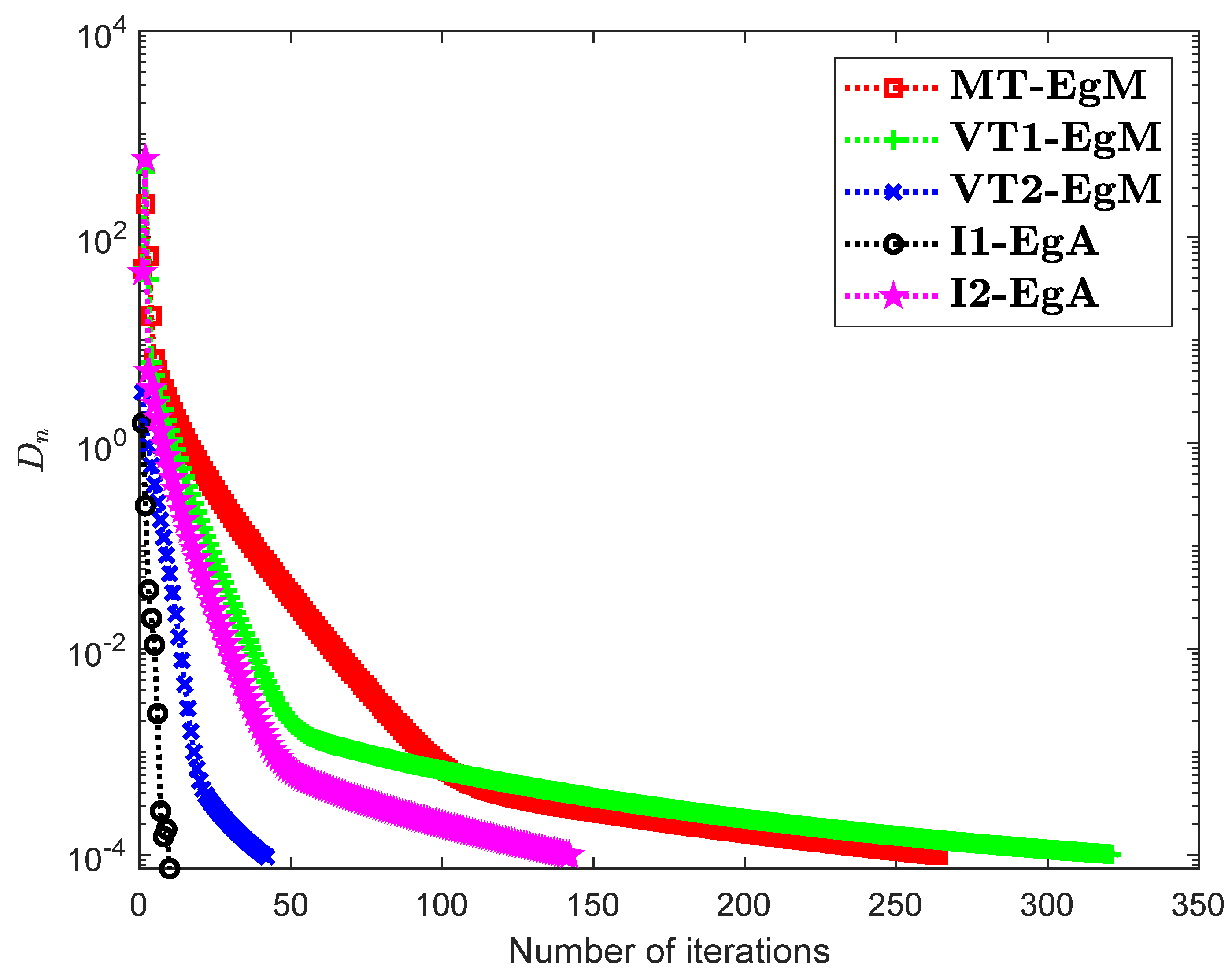
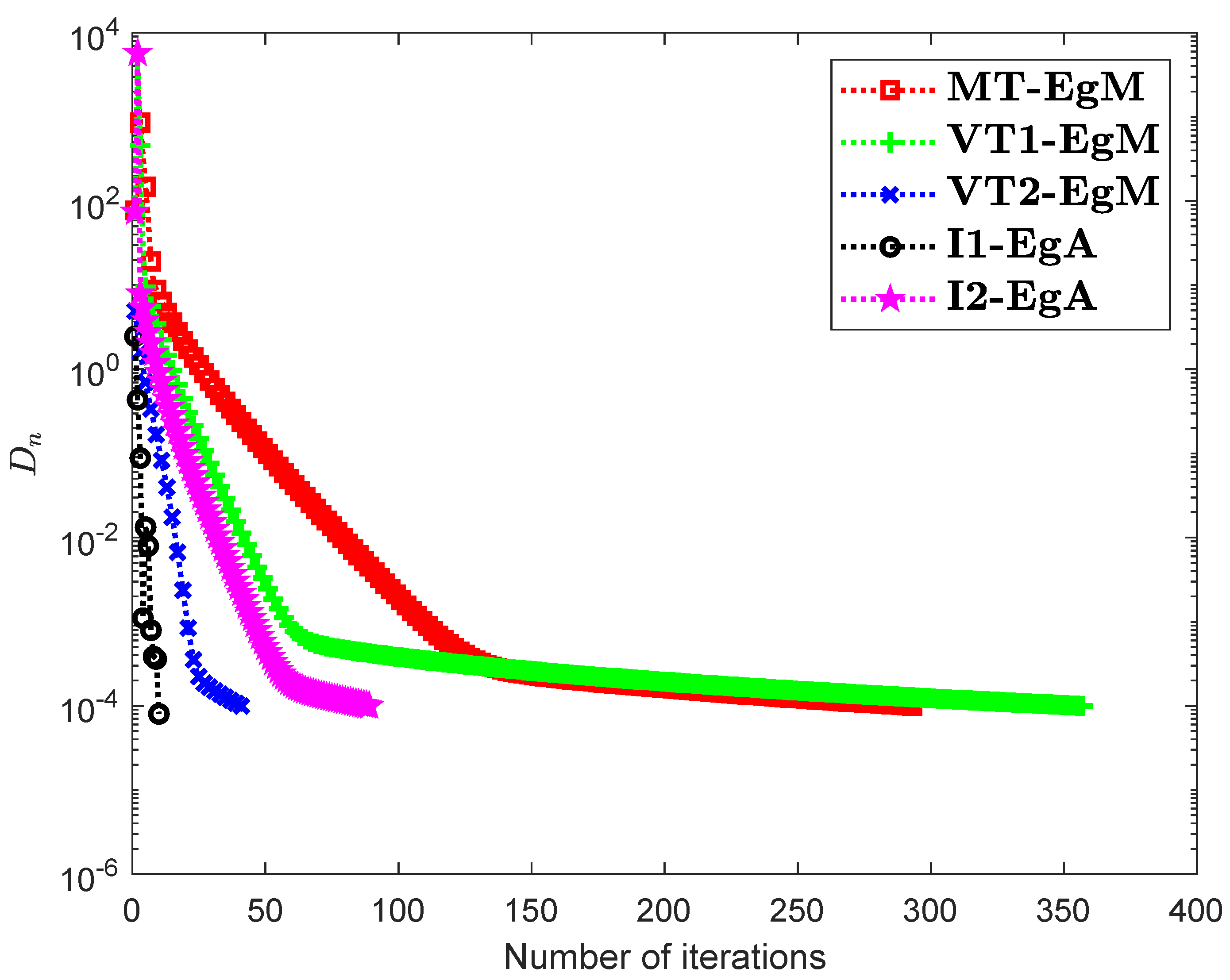
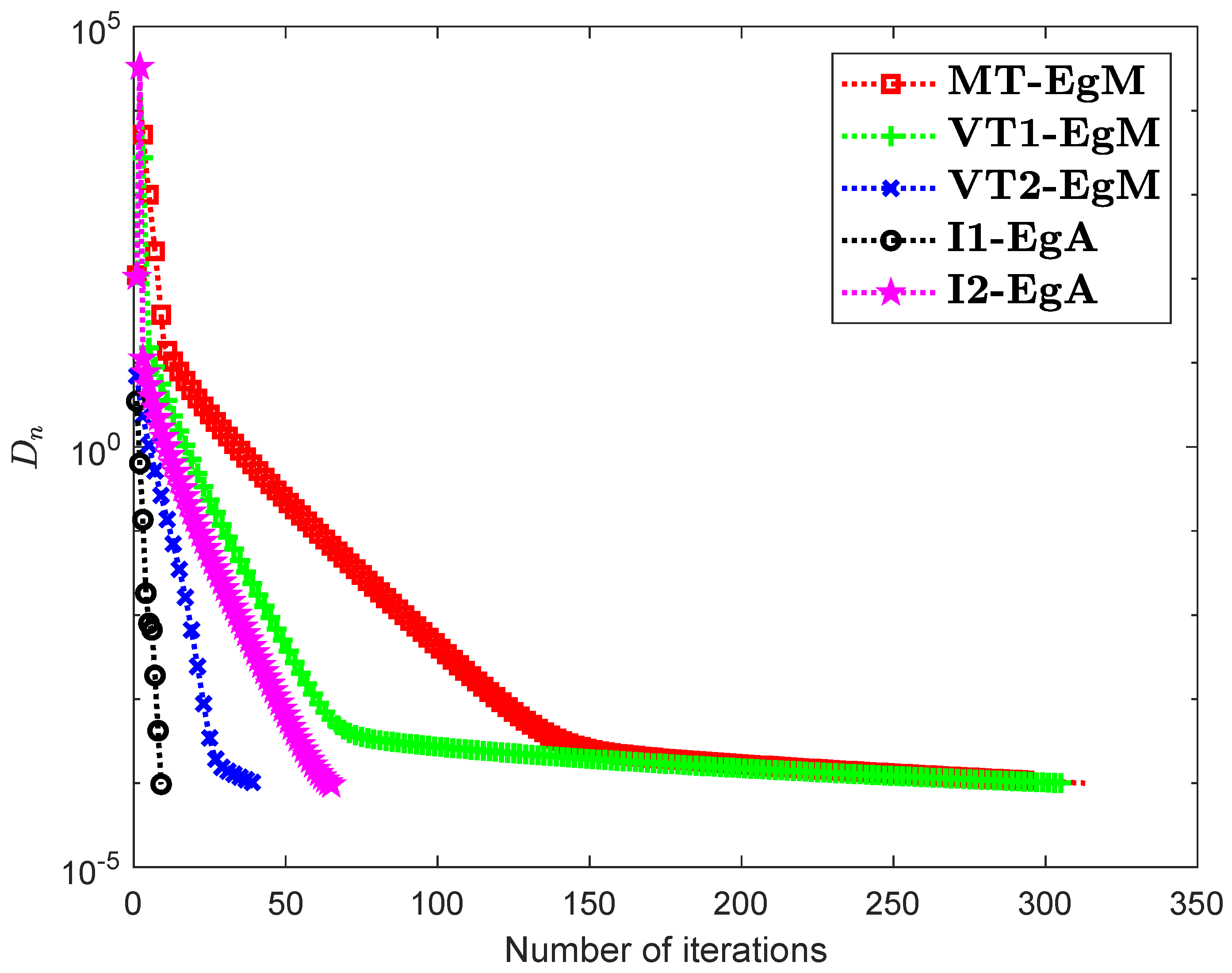
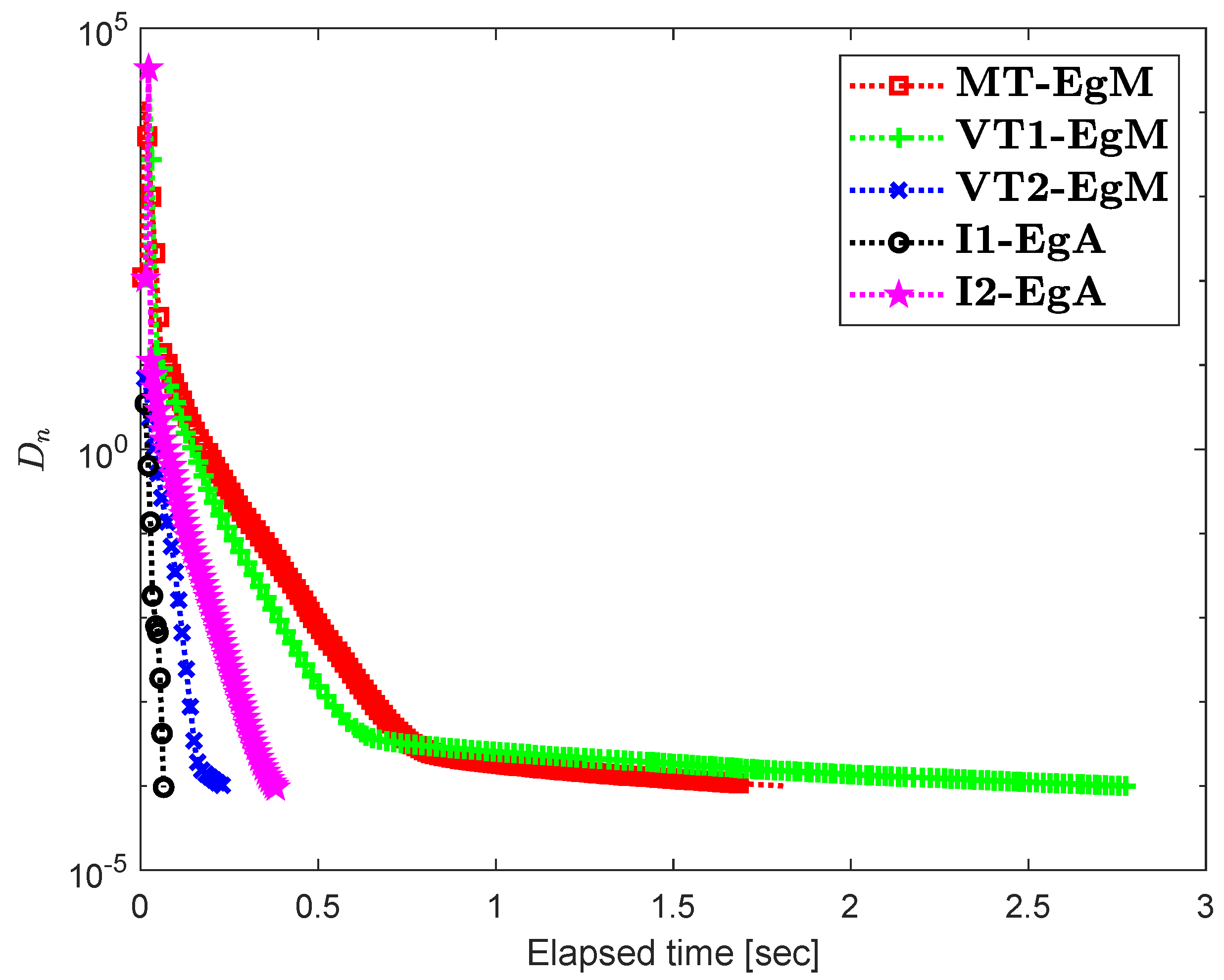
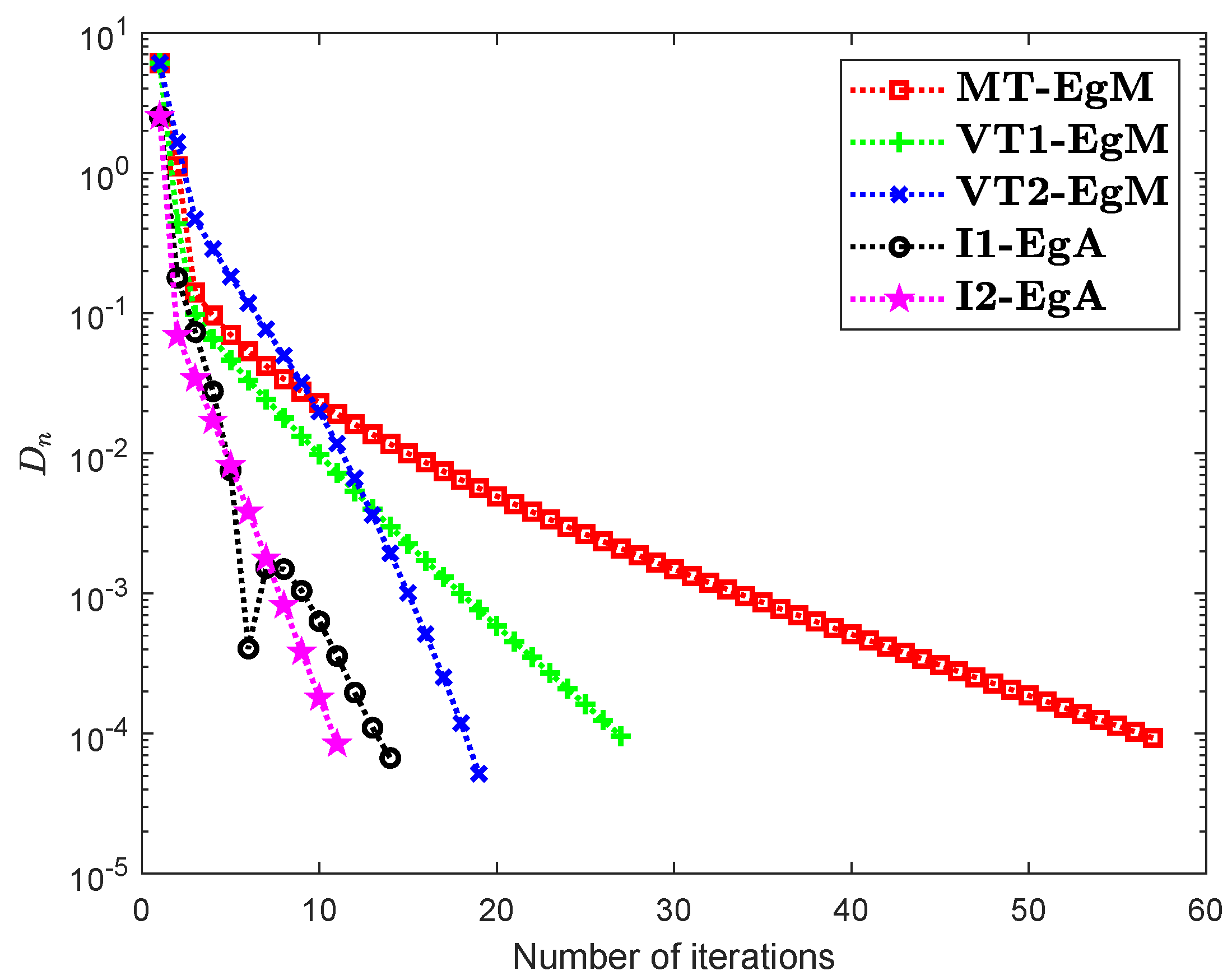
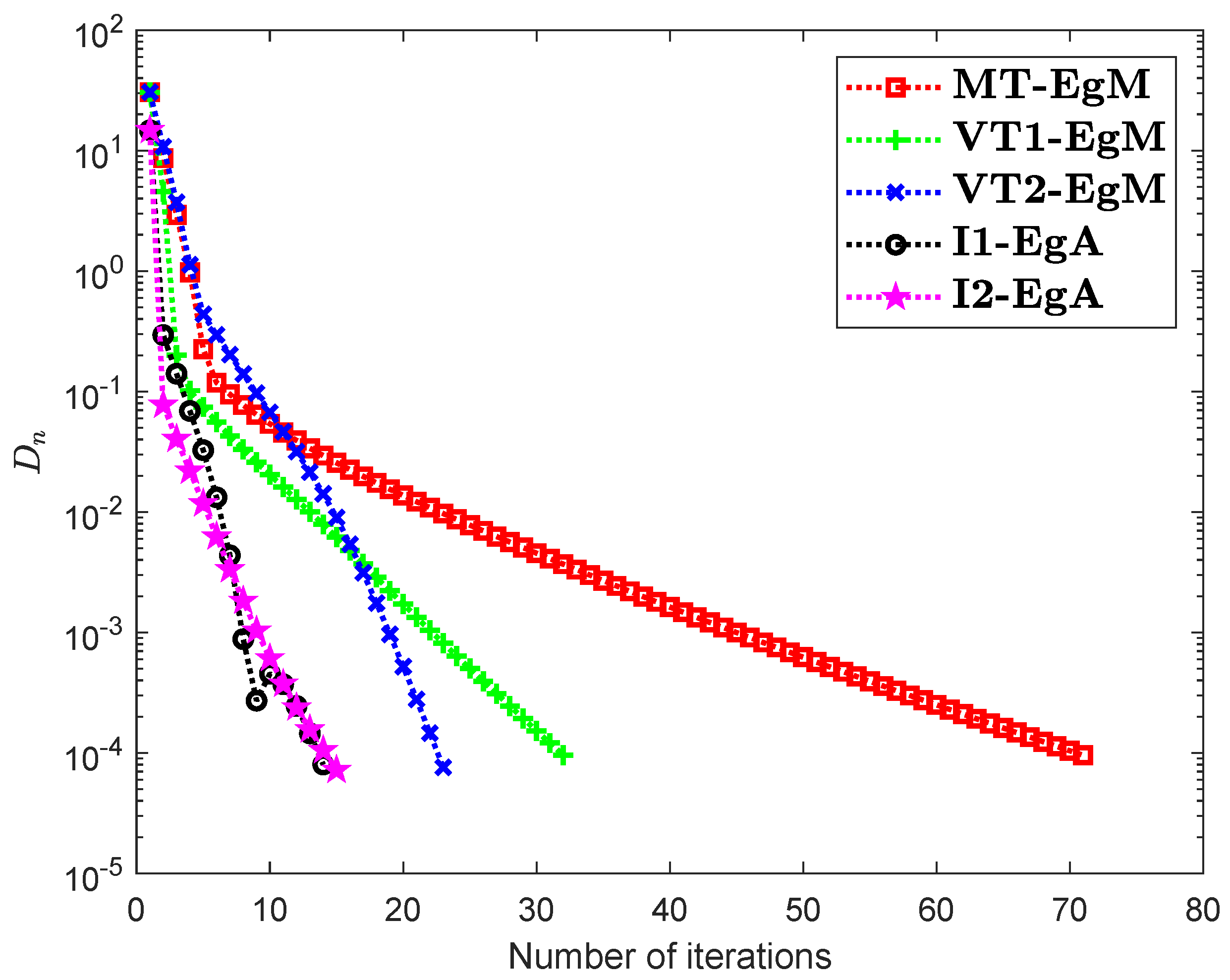
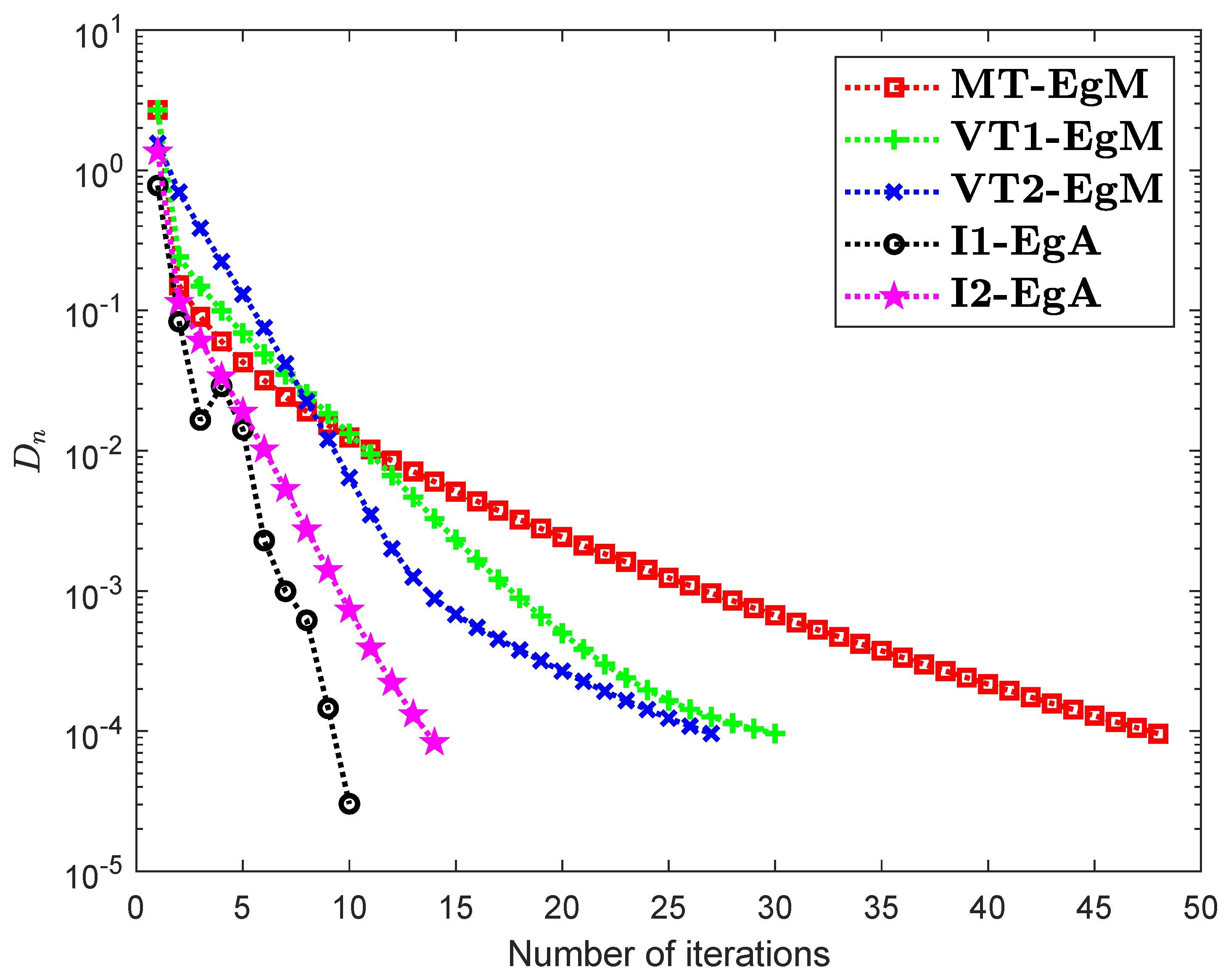
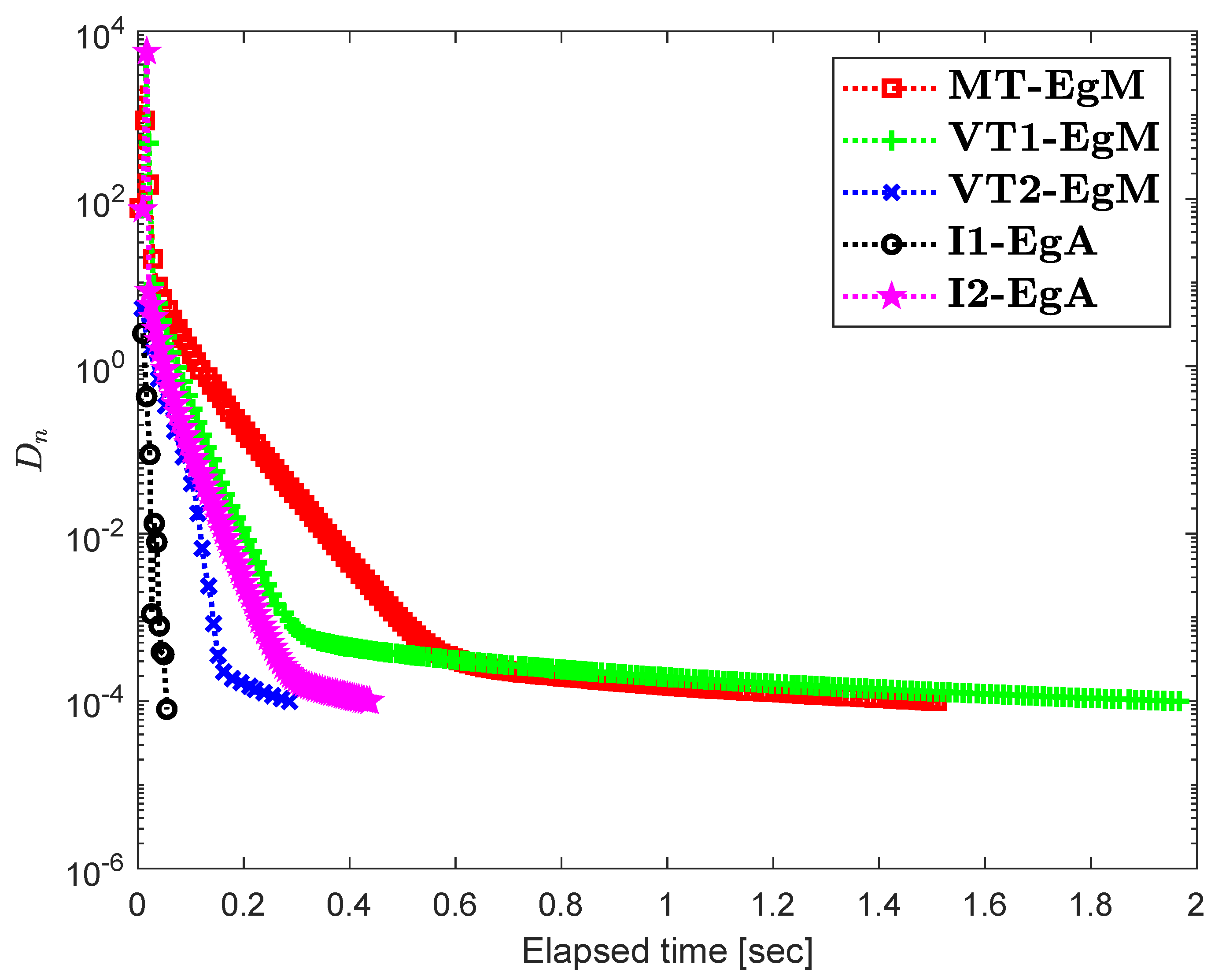
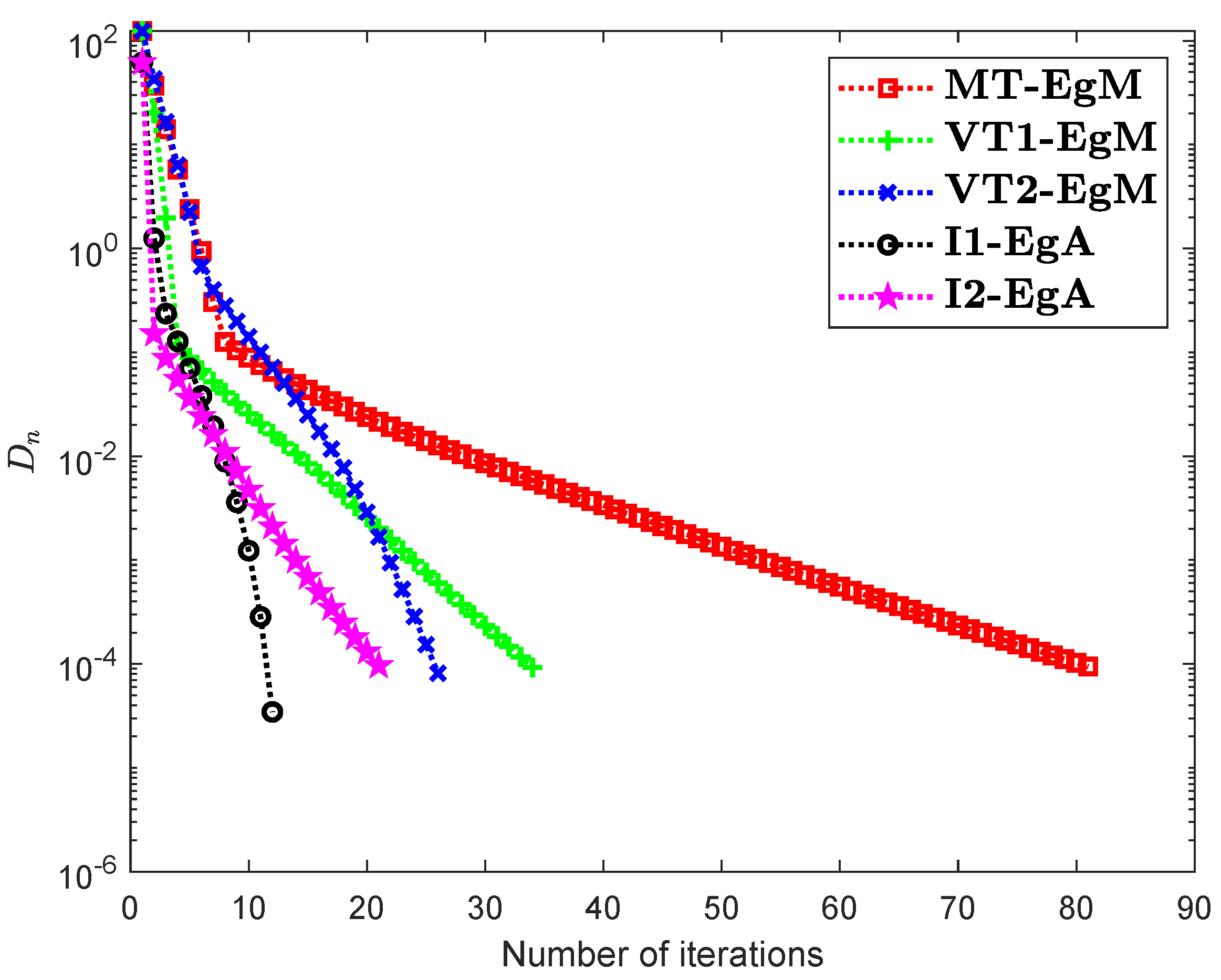
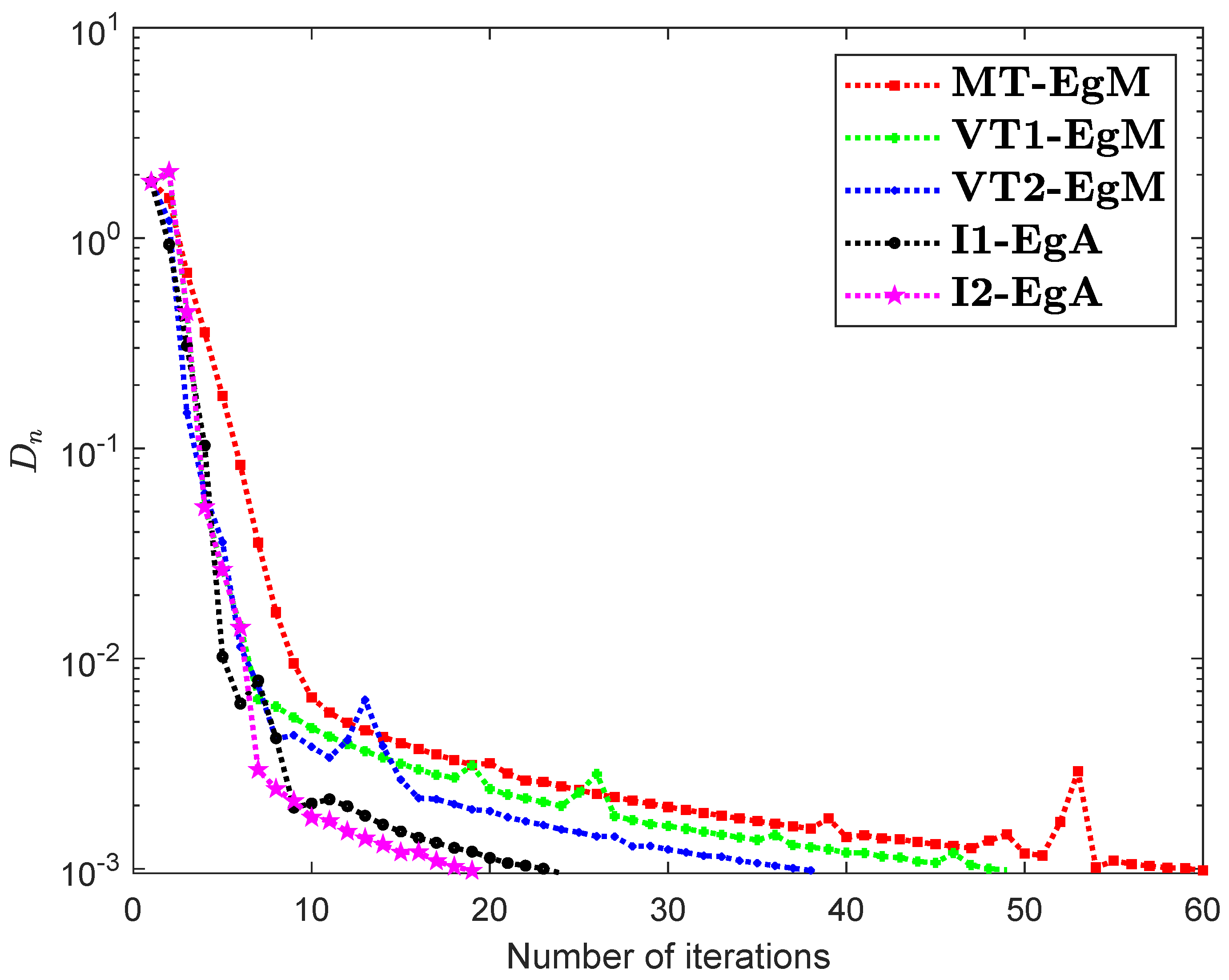
It is clear that G is monotone and Lipschitz continuous through L = M . For q = 0 , the solution set of the corresponding variational inequality problem is Ω = { 0 } . During this experiment, the initial point is u 0 = u 1 = ( 1 , 1 , , 1 ) and D n = w n y n 10 4 . The numerical findings of these methods are shown in Figure 1, Figure 2, Figure 3, Figure 4, Figure 5 and Figure 6 and Table 1. The control conditions are taken as follows:
Figure 1. Numerical illustration of Algorithms 1 and 2 with Algorithm 3.4 in [23] and Algorithm 3.2 in [24] and Algorithm 3.1 in [25] when m = 5 .
Figure 2. Numerical illustration of Algorithms 1 and 2 with Algorithm 3.4 in [23] and Algorithm 3.2 in [24] and Algorithm 3.1 in [25] when m = 20 .
Figure 3. Numerical illustration of Algorithms 1 and 2 with Algorithm 3.4 in [23] and Algorithm 3.2 in [24] and Algorithm 3.1 in [25] when m = 50 .
Figure 4. Numerical illustration of Algorithms 1 and 2 with Algorithm 3.4 in [23] and Algorithm 3.2 in [24] and Algorithm 3.1 in [25] when m = 50 .
Figure 5. Numerical illustration of Algorithms 1 and 2 with Algorithm 3.4 in [23] and Algorithm 3.2 in [24] and Algorithm 3.1 in [25] when m = 100 .
Figure 6. Numerical illustration of Algorithms 1 and 2 with Algorithm 3.4 in [23] and Algorithm 3.2 in [24] and Algorithm 3.1 in [25] when m = 100 .
Table 1. Numerical data for Figure 1, Figure 2, Figure 3, Figure 4, Figure 5 and Figure 6.
(i) 
Algorithm 3.4 in [23] (shortly, MT-EgM):
χ 0 = 0.20 , θ = 0.70 , μ = 0.30 , ϕ n = 1 ( n + 2 ) , τ n = 1 ( n + 1 ) 2 , θ n = 5 10 ( 1 ϕ n ) .
(ii) 
Algorithm 3.2 in [24] (shortly, VT1-EgM):
τ 0 = 0.20 , θ = 0.50 , μ = 0.50 , ϕ n = 1 ( n + 1 ) , ϵ n = 1 ( n + 1 ) 2 , f ( u ) = u 3 .
(iii) 
Algorithm 3.1 in [25] (shortly, VT2-EgM):
χ = 0.7 L , θ = 0.70 , ϕ n = 1 ( n + 2 ) , τ n = 1 ( n + 1 ) 2 , f ( u ) = u 3 .
(iv) 
Algorithm 1 (shortly, I1-EgA):
χ = 0.7 L , θ = 0.70 , ϕ n = 1 ( n + 2 ) , ϵ n = 1 ( n + 1 ) 2 .
(v) 
Algorithm 2 (shortly, I2-EgA):
χ 0 = 0.20 , μ = 0.30 , θ = 0.70 , ϕ n = 1 ( n + 2 ) , ϵ n = 1 ( n + 1 ) 2 .
Example 2.
Assume that H = L 2 ( [ 0 , 1 ] ) is a Hilbert space with an inner product
u , y = 0 1 u ( t ) y ( t ) d t , u , y H
and norm is defined by
u = 0 1 | u ( t ) | 2 d t .
Consider that the set C : = { u L 2 ( [ 0 , 1 ] ) : u 1 } is a unit ball. Let G : C H is defined by
G ( u ) ( t ) = 0 1 u ( t ) H ( t , s ) f ( u ( s ) ) d s + g ( t )
where
H ( t , s ) = 2 t s e ( t + s ) e e 2 1 , f ( u ) = cos u , g ( t ) = 2 t e t e e 2 1 .
It can be seen that G is Lipschitz-continuous with Lipschitz constant L = 2 and monotone. Figure 7, Figure 8 and Figure 9 and Table 2 show the numerical results by choosing different choices of u 0 . The control conditions are taken as follows:
Figure 7. Numerical illustration of Algorithms 1 and 2 with Algorithm 3.4 in [23] and Algorithm 3.2 in [24] and Algorithm 3.1 in [25] when u 0 = u 1 = t 2 + 1 .
Figure 8. Numerical illustration of Algorithms 1 and 2 with Algorithm 3.4 in [23] and Algorithm 3.2 in [24] and Algorithm 3.1 in [25] when u 0 = u 1 = 3 t 2 + 2 sin ( t ) .
Figure 9. Numerical illustration of Algorithms 1 and 2 with Algorithm 3.4 in [23] and Algorithm 3.2 in [24] and Algorithm 3.1 in [25] when u 0 = u 1 = 5 t 2 + e t .
Table 2. Numerical data for Figure 7, Figure 8 and Figure 9.
(i) 
Algorithm 3.4 in [23] (shortly, MT-EgM):
χ 0 = 0.25 , θ = 0.75 , μ = 0.35 , τ n = 1 ( n + 1 ) 2 , ϕ n = 1 2 ( n + 2 ) , θ n = 6 10 ( 1 ϕ n ) .
(ii) 
Algorithm 3.2 in [24] (shortly, VT1-EgM):
τ 0 = 0.25 , θ = 0.75 , μ = 0.35 , ϵ n = 1 ( n + 1 ) 2 , ϕ n = 1 2 ( n + 2 ) , f ( u ) = u 4 .
(iii) 
Algorithm 3.1 in [25] (shortly, VT2-EgM):
χ = 0.75 L , θ = 0.75 , τ n = 1 ( n + 1 ) 2 , ϕ n = 1 2 ( n + 2 ) , f ( u ) = u 4 .
(iv) 
Algorithm 1 (shortly, I1-EgA):
χ = 0.75 L , θ = 0.75 , ϵ n = 1 ( n + 1 ) 2 , ϕ n = 1 2 ( n + 2 ) .
(v) 
Algorithm 2 (shortly, I2-EgA):
χ 0 = 0.25 , μ = 0.35 , θ = 0.75 , ϵ n = 1 ( n + 1 ) 2 , ϕ n = 1 2 ( n + 2 ) .
Example 3.
Consider that the problem of Kojima–Shindo where the constraint set C is
C = { u R 4 : 1 u i 5 , i = 1 , 2 , 3 , 4 } ,
and the mapping G : R 4 R 4 is defined by
G ( u ) = u 1 + u 2 + u 3 + u 4 4 u 2 u 3 u 4 u 1 + u 2 + u 3 + u 4 4 u 1 u 3 u 4 u 1 + u 2 + u 3 + u 4 4 u 1 u 2 u 4 u 1 + u 2 + u 3 + u 4 4 u 1 u 2 u 3 .
It is easy to see that G is not monotone on the set C . By using the Monte-Carlo approach [34], it can be shown that G is pseudo-monotone on C . This problem has a unique solution u * = ( 5 , 5 , 5 , 5 ) T . Actually, in general, it is a very difficult task to check the pseudomonotonicity of any mapping G in practice. We here employ the Monte Carlo approach according to the definition of pseudo-monotonicity: Generate a large number of pairs of points u and y uniformly in C satisfying G ( u ) T ( y u ) 0 and then check if G ( y ) T ( y u ) 0 . Table 3, Table 4, Table 5, Table 6, Table 7 and Table 8 show the numerical results by taking different values of u 0 . The control conditions are taken as follows:
Table 3. Example 3: Numerical findings of Algorithm 3.4 in [23] and u 0 = u 1 = ( 1 , 2 , 3 , 4 ) T .
Table 4. Example 3: Numerical findings of Algorithm 3.2 in [24] and u 0 = u 1 = ( 1 , 2 , 3 , 4 ) T .
Table 5. Example 3: Numerical findings of Algorithm 2 and u 0 = u 1 = ( 1 , 2 , 3 , 4 ) T .
Table 6. Example 3: Numerical findings of Algorithm 3.4 in [23] and u 0 = u 1 = ( 1 , 0 , 1 , 2 ) T .
Table 7. Example 3: Numerical findings of Algorithm 3.2 in [24] and u 0 = u 1 = ( 1 , 0 , 1 , 2 ) T .
Table 8. Example 3: Numerical findings of Algorithm 2 and u 0 = u 1 = ( 1 , 0 , 1 , 2 ) T .
(i) 
Algorithm 3.4 in [23] (shortly, MT-EgM):
χ 0 = 0.05 , θ = 0.70 , μ = 0.33 , τ n = 1 ( n + 1 ) 2 , ϕ n = 1 50 ( n + 2 ) , θ n = 6 10 ( 1 ϕ n ) .
(ii) 
Algorithm 3.2 in [24] (shortly, VT1-EgM):
τ 0 = 0.05 , θ = 0.70 , μ = 0.33 , ϵ n = 1 ( n + 1 ) 2 , ϕ n = 1 50 ( n + 2 ) , f ( u ) = u 3 .
(iii) 
Algorithm 3.1 in [25] (shortly, VT2-EgM):
χ = 0.7 L , θ = 0.70 , τ n = 1 ( n + 1 ) 2 , ϕ n = 1 50 ( n + 2 ) , f ( u ) = u 3 .
(iv) 
Algorithm 1 (shortly, I1-EgA):
χ = 0.7 L , θ = 0.70 , ϵ n = 1 ( n + 1 ) 2 , ϕ n = 1 50 ( n + 2 ) .
(v) 
Algorithm 2 (shortly, I2-EgA):
χ 0 = 0.05 , μ = 0.33 , θ = 0.70 , ϵ n = 1 ( n + 1 ) 2 , ϕ n = 1 50 ( n + 2 ) .
Example 4.
The last Example has taken from [35] where G : R 2 R 2 is defined by
G ( u ) = 0.5 u 1 u 2 2 u 2 10 7 4 u 1 0.1 u 2 2 10 7
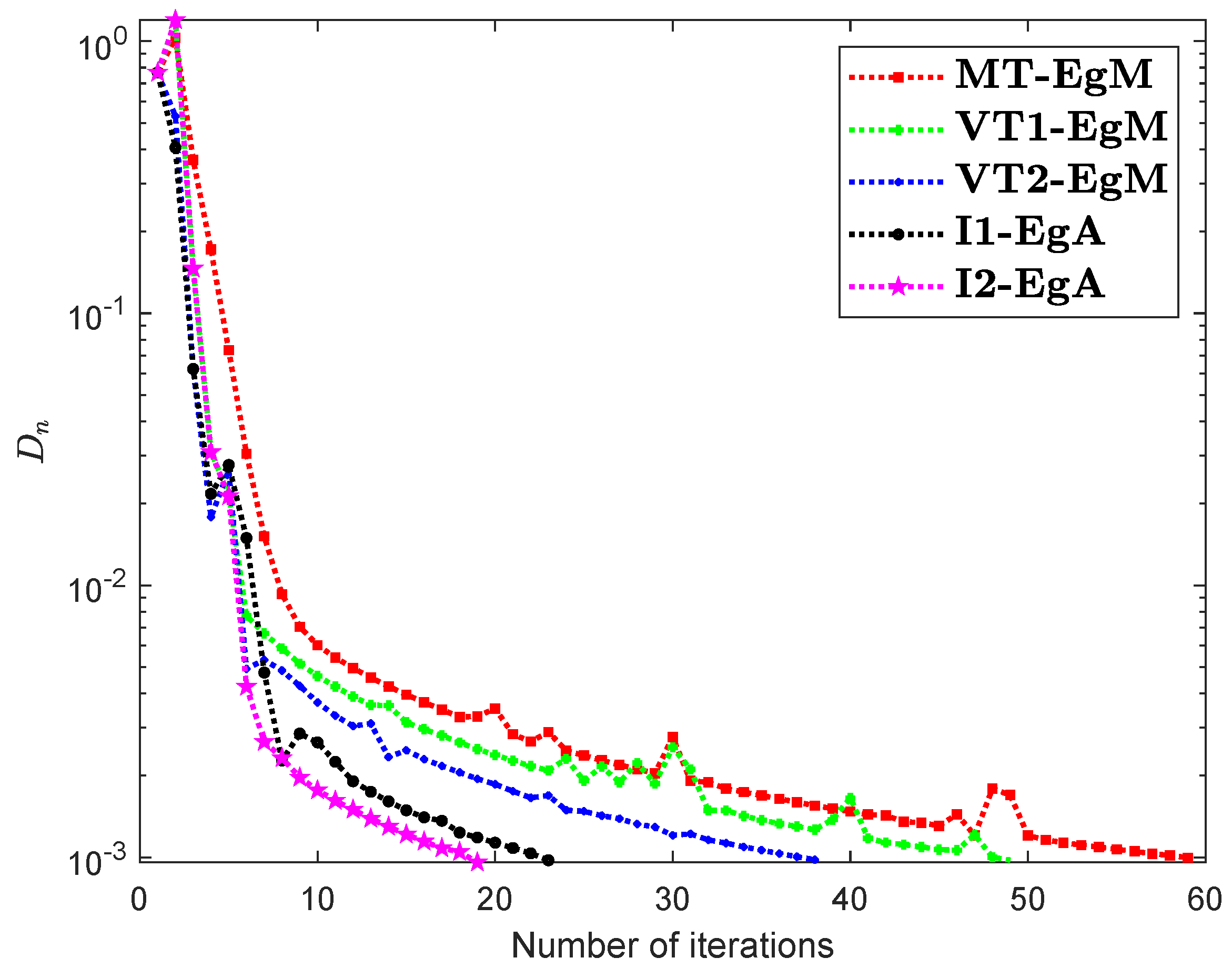
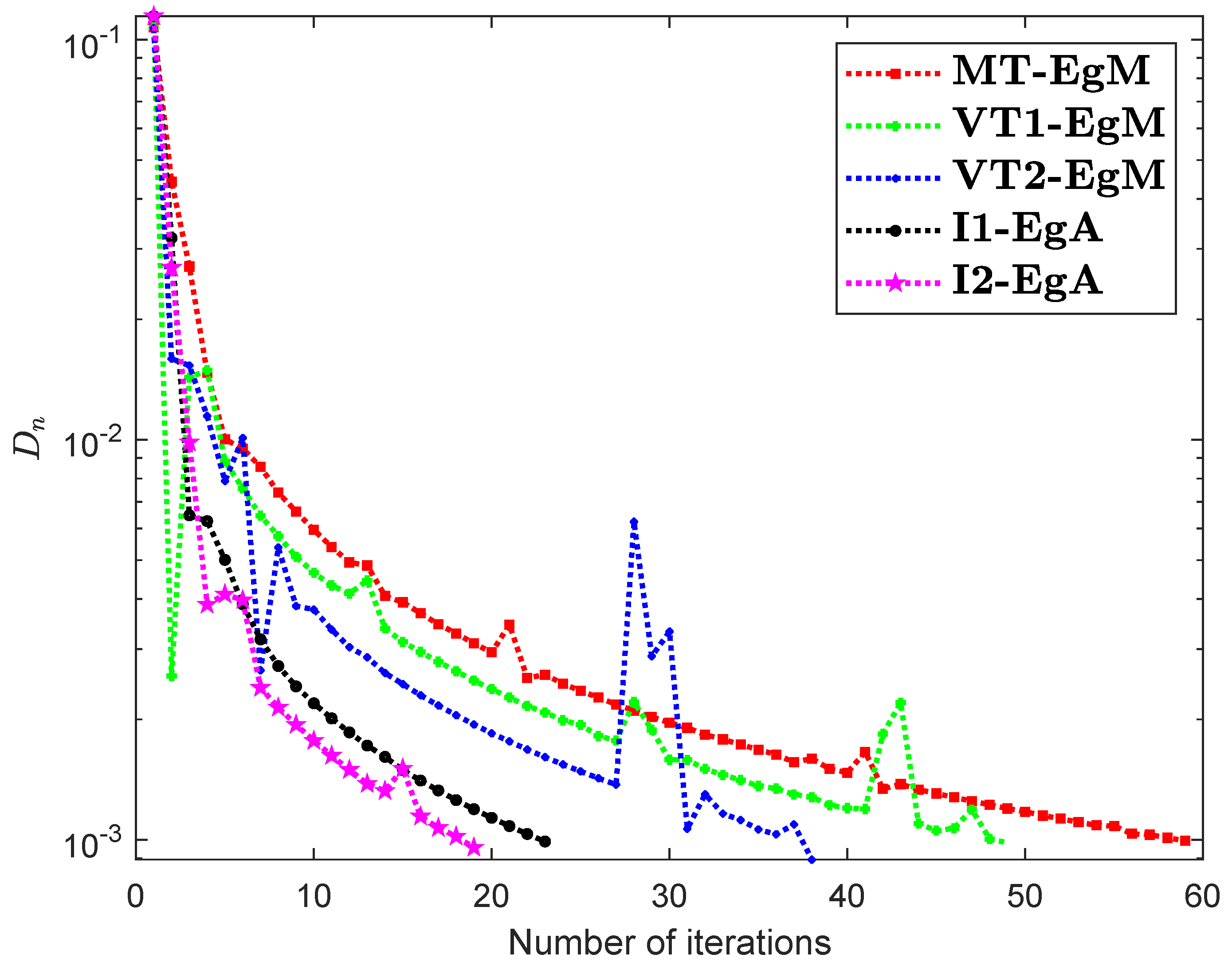
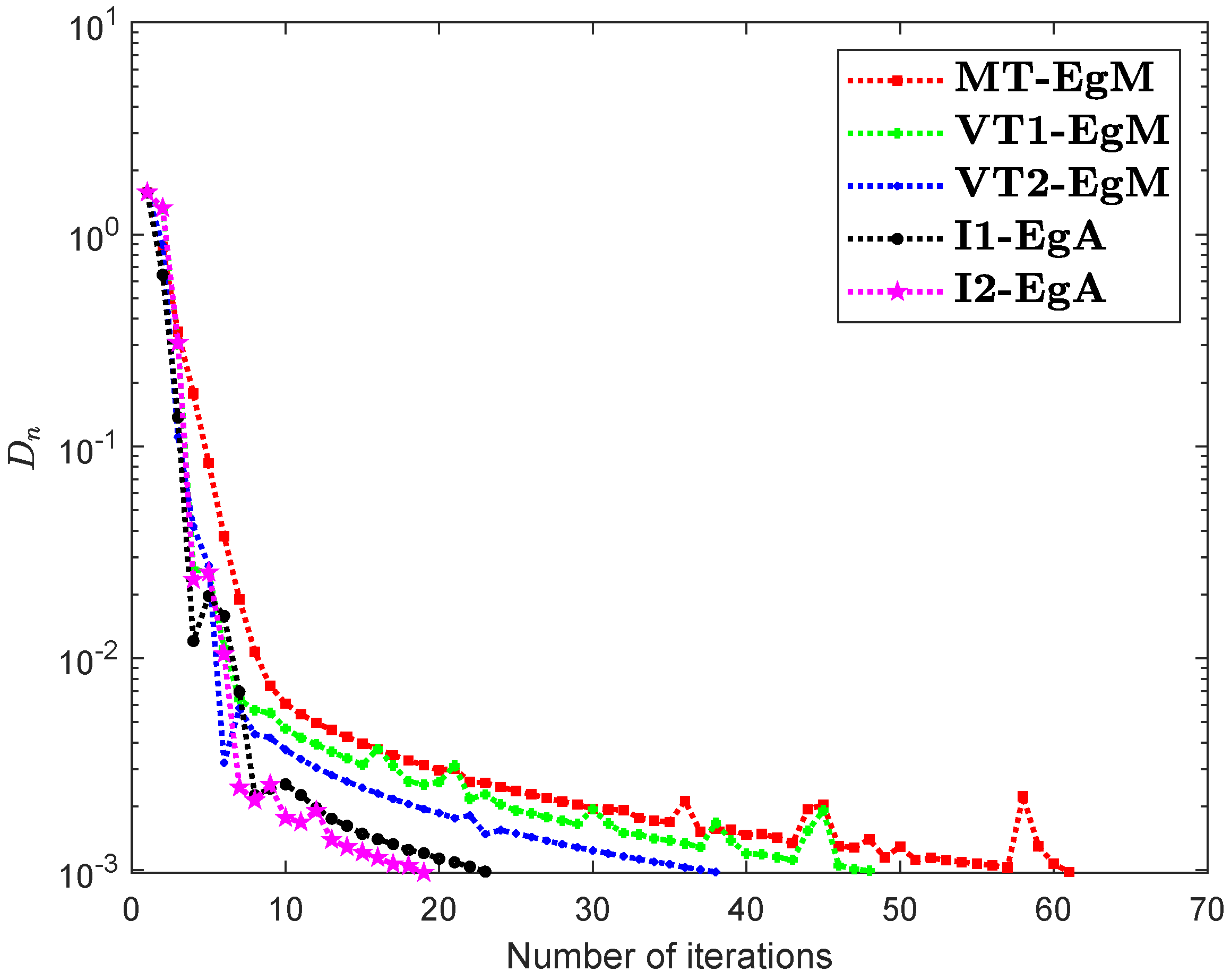
where C = { u R 2 : ( u 1 2 ) 2 + ( u 2 2 ) 2 1 } . It can easily see that G is Lipschitz continuous with L = 5 and G is not monotone on C but pseudomonotone. Here, the above problem has unique solution u * = ( 2.707 , 2.707 ) T . Figure 10, Figure 11, Figure 12 and Figure 13 and Table 9 show the numerical findings by letting different values of u 0 . The control conditions are taken as follows:
Figure 10. Numerical illustration of Algorithms 1 and 2 with Algorithm 3.4 in [23] and Algorithm 3.2 in [24] and Algorithm 3.1 in [25] when u 0 = u 1 = ( 1.5 , 1.7 ) T .
Figure 11. Numerical illustration of Algorithms 1 and 2 with Algorithm 3.4 in [23] and Algorithm 3.2 in [24] and Algorithm 3.1 in [25] when u 0 = u 1 = ( 2.0 , 3.0 ) T .
Figure 12. Numerical illustration of Algorithms 1 and 2 with Algorithm 3.4 in [23] and Algorithm 3.2 in [24] and Algorithm 3.1 in [25] when u 0 = u 1 = ( 1.0 , 2.0 ) T .
Figure 13. Numerical illustration of Algorithms 1 and 2 with Algorithm 3.4 in [23] and Algorithm 3.2 in [24] and Algorithm 3.1 in [25] when u 0 = u 1 = ( 2.7 , 2.6 ) T .
Table 9. Numerical data for Figure 7, Figure 8 and Figure 9.
(i) 
Algorithm 3.4 in [23] (shortly, MT-EgM):
χ 0 = 0.35 , θ = 0.80 , μ = 0.55 , τ n = 1 ( n + 1 ) 2 , ϕ n = 1 100 ( n + 2 ) , θ n = 6 10 ( 1 ϕ n ) .
(ii) 
Algorithm 3.2 in [24] (shortly, VT1-EgM):
τ 0 = 0.35 , θ = 0.80 , μ = 0.55 , ϵ n = 1 ( n + 1 ) 2 , ϕ n = 1 100 ( n + 1 ) , f ( u ) = u 5 .
(iii) 
Algorithm 3.1 in [25] (shortly, VT2-EgM):
χ = 0.8 L , θ = 0.80 , τ n = 1 ( n + 1 ) 2 , ϕ n = 1 100 ( n + 2 ) , f ( u ) = u 5 .
(iv) 
Algorithm 1 (shortly, I1-EgA):
χ = 0.8 L , θ = 0.80 , ϵ n = 1 ( n + 1 ) 2 , ϕ n = 1 100 ( n + 2 ) .
(v) 
Algorithm 2 (shortly, I2-EgA):
χ 0 = 0.35 , μ = 0.55 , θ = 0.80 , ϵ n = 1 ( n + 1 ) 2 , ϕ n = 1 100 ( n + 2 ) .

5. Conclusions

In this study, we have introduced two new methods for finding a solution of variational inequality problem in a Hilbert space. The results have been established on the base of two previous methods: the subgradient extragradient method and the inertial method. Some new approaches to the inertial framework and the step size rule have been set up. The strong convergence of our proposed methods is set up under the condition of pseudo-monotonicity and Lipschitz continuity of mapping. Some numerical results are presented to explain the convergence of the methods over others. The results in this paper have been used as methods for figuring out the variational inequality problem in Hilbert spaces. Finally, numerical experiments indicate that the inertial approach normally enhances the performance of the proposed methods.

Author Contributions

Conceptualization, K.M., N.A.A. and I.K.A.; methodology, K.M. and N.A.A.; software, K.M., N.A.A. and I.K.A.; validation, N.A.A. and I.K.A.; formal analysis, K.M. and N.A.A.; investigation, K.M., N.A.A. and I.K.A.; writing—original draft preparation, K.M., N.A.A. and I.K.A.; writing—review and editing, K.M., N.A.A. and I.K.A.; visualization, K.M., N.A.A. and I.K.A.; supervision and funding, K.M. and I.K.A. All authors have read and agree to the published version of the manuscript.

Funding

This research received no external funding.

Institutional Review Board Statement

Not applicable.

Data Availability Statement

Not applicable.

Acknowledgments

This first author was supported by Rajamangala University of Technology Phra Nakhon (RMUTP).

Conflicts of Interest

The authors declare no competing interest.

References

  1. Konnov, I.V. On systems of variational inequalities. Russ. Math. C/C Izv. Vyss. Uchebnye Zaved. Mat. 1997, 41, 77–86. [Google Scholar]
  2. Stampacchia, G. Formes bilinéaires coercitives sur les ensembles convexes. Comptes Rendus Hebd. Seances Acad. Sci. 1964, 258, 4413. [Google Scholar]
  3. Elliott, C.M. Variational and quasivariational inequalities applications to free—boundary ProbLems. (claudio baiocchi and antónio capelo). SIAM Rev. 1987, 29, 314–315. [Google Scholar] [CrossRef]
  4. Kassay, G.; Kolumbán, J.; Páles, Z. On nash stationary points. Publ. Math. 1999, 54, 267–279. [Google Scholar]
  5. Kassay, G.; Kolumbán, J.; Páles, Z. Factorization of minty and stampacchia variational inequality systems. Eur. J. Oper. Res. 2002, 143, 377–389. [Google Scholar] [CrossRef]
  6. Kinderlehrer, D.; Stampacchia, G. An Introduction to Variational Inequalities and Their Applications; Society for Industrial and Applied Mathematics: Philadelphia, PA, USA, 2000. [Google Scholar]
  7. Konnov, I. Equilibrium Models and Variational Inequalities; Elsevier: Amsterdam, The Netherlands, 2007; Volume 210. [Google Scholar]
  8. Nagurney, A.; Economics, E.N. A Variational Inequality Approach; Springer: Boston, MA, USA, 1999. [Google Scholar]
  9. Takahashi, W. Introduction to Nonlinear and Convex Analysis; Yokohama Publishers: Yokohama, Japan, 2009. [Google Scholar]
  10. Censor, Y.; Gibali, A.; Reich, S. The subgradient extragradient method for solving variational inequalities in Hilbert space. J. Optim. Theory Appl. 2010, 148, 318–335. [Google Scholar] [CrossRef] [PubMed]
  11. Censor, Y.; Gibali, A.; Reich, S. Extensions of korpelevich extragradient method for the variational inequality problem in euclidean space. Optimization 2012, 61, 1119–1132. [Google Scholar] [CrossRef]
  12. Iusem, A.N.; Svaiter, B.F. A variant of korpelevich’s method for variational inequalities with a new search strategy. Optimization 1997, 42, 309–321. [Google Scholar] [CrossRef]
  13. Korpelevich, G. The extragradient method for finding saddle points and other problems. Matecon 1976, 12, 747–756. [Google Scholar]
  14. Malitsky, Y.V.; Semenov, V.V. An extragradient algorithm for monotone variational inequalities. Cybern. Syst. Anal. 2014, 50, 271–277. [Google Scholar] [CrossRef]
  15. Moudafi, A. Viscosity approximation methods for fixed-points problems. J. Math. Anal. Appl. 2000, 241, 46–55. [Google Scholar] [CrossRef]
  16. Noor, M.A. Some iterative methods for nonconvex variational inequalities. Comput. Math. Model. 2010, 21, 97–108. [Google Scholar] [CrossRef]
  17. Thong, D.V.; Hieu, D.V. Modified subgradient extragradient method for variational inequality problems. Numer. Algorithms 2017, 79, 597–610. [Google Scholar] [CrossRef]
  18. Thong, D.V.; Hieu, D.V. Weak and strong convergence theorems for variational inequality problems. Numer. Algorithms 2017, 78, 1045–1060. [Google Scholar] [CrossRef]
  19. Tseng, P. A modified forward-backward splitting method for maximal monotone mappings. SIAM J. Control Optim. 2000, 38, 431–446. [Google Scholar] [CrossRef]
  20. Zhang, L.; Fang, C.; Chen, S. An inertial subgradient-type method for solving single-valued variational inequalities and fixed point problems. Numer. Algorithms 2018, 79, 941–956. [Google Scholar] [CrossRef]
  21. Antipin, A.S. On a method for convex programs using a symmetrical modification of the lagrange function. Ekon. Mat. Metod. 1976, 12, 1164–1173. [Google Scholar]
  22. Polyak, B. Some methods of speeding up the convergence of iteration methods. USSR Comput. Math. Math. Phys. 1964, 4, 1–17. [Google Scholar] [CrossRef]
  23. Anh, P.K.; Thong, D.V.; Vinh, N.T. Improved inertial extragradient methods for solving pseudo-monotone variational inequalities. Optimization 2020, 1–24. [Google Scholar] [CrossRef]
  24. Thong, D.V.; Hieu, D.V.; Rassias, T.M. Self adaptive inertial subgradient extragradient algorithms for solving pseudomonotone variational inequality problems. Optim. Lett. 2019, 14, 115–144. [Google Scholar] [CrossRef]
  25. Thong, D.V.; Vinh, N.T.; Cho, Y.J. A strong convergence theorem for tseng’s extragradient method for solving variational inequality problems. Optim. Lett. 2019, 14, 1157–1175. [Google Scholar] [CrossRef]
  26. Bauschke, H.H.; Combettes, P.L. Convex Analysis and Monotone Operator Theory in Hilbert Spaces; Springer: Berlin/Heidelberg, Germany, 2011; Volume 408. [Google Scholar]
  27. Xu, H.-K. Another control condition in an iterative method for nonexpansive mappings. Bull. Aust. Math. Soc. 2002, 65, 109–113. [Google Scholar] [CrossRef]
  28. Maingé, P.-E. Strong convergence of projected subgradient methods for nonsmooth and nonstrictly convex minimization. Set-Valued Anal. 2008, 16, 899–912. [Google Scholar] [CrossRef]
  29. Takahashi, W. Nonlinear Functional Analysis; Yokohama Publishers: Yokohama, Japan, 2000. [Google Scholar]
  30. Harker, P.T.; Pang, J.-S. For the linear complementarity problem. Comput. Solut. Nonlinear Syst. Equ. 1990, 26, 265. [Google Scholar]
  31. Dong, Q.L.; Cho, Y.J.; Zhong, L.L.; Rassias, T.M. Inertial projection and contraction algorithms for variational inequalities. J. Glob. Optim. 2017, 70, 687–704. [Google Scholar] [CrossRef]
  32. Hieu, D.V.; Anh, P.K.; Muu, L.D. Modified hybrid projection methods for finding common solutions to variational inequality problems. Comput. Optim. Appl. 2016, 66, 75–96. [Google Scholar] [CrossRef]
  33. Solodov, M.V.; Svaiter, B.F. A new projection method for variational inequality problems. SIAM J. Control Optim. 1999, 37, 765–776. [Google Scholar] [CrossRef]
  34. Hu, X.; Wang, J. Solving pseudomonotone variational inequalities and pseudoconvex optimization problems using the projection neural network. IEEE Trans. Neural Netw. 2006, 17, 1487–1499. [Google Scholar]
  35. Shehu, Y.; Dong, Q.-L.; Jiang, D. Single projection method for pseudo-monotone variational inequality in Hilbert spaces. Optimization 2018, 68, 385–409. [Google Scholar] [CrossRef]
Publisher’s Note: MDPI stays neutral with regard to jurisdictional claims in published maps and institutional affiliations.

Article Metrics

Citations

Article Access Statistics

Multiple requests from the same IP address are counted as one view.