1. Introduction
We consider finite and simple graphs
G with the vertex set
and the edge set
, and refer to Klešč [
1] for further notation and terminology. The
crossing number of a graph
G is the minimum possible number of edge crossings over all drawings of
G in the plane. It is well known that a drawing with a minimum number of crossings called an
optimal drawing is always a
good drawing, meaning that no edge crosses itself, no two edges cross more than once, and no two edges are incident with the same vertex cross. Let
D be a good drawing of the graph
G. We denote the number of crossings in
D by
. If
and
are edge-disjoint subgraphs of
G, we denote the number of crossings between edges of
and edges of
by
, and the number of crossings among edges of
in
D by
.
Many applications have the problem of reducing the number of edge crossings in the drawings of graphs; one of the most popular areas is the implementation of a VLSI layout, which caused a revolution in circuit design and has a strong influence on parallel computations. So, the mentioned problem is, therefore, investigated not only by the graph theory, but also by a lot of computer scientists in an effort to, for example, minimize the number of joints on the motherboards of computers. Since edge crossings in clustered level graphs are very similar to edge crossings in level graphs, a cross minimization has its application also in the graph-state quantum computation; see Bachmaier et al. [
2]. Garey and Johnson [
3] proved that calculation of the crossing number of a given simple graph in general is an NP-complete problem. A survey of the exact values of the crossing numbers for several families of graphs can be found by Clancy et al. [
4].
Throughout this paper, Kleitman’s result [
5] on the crossing numbers for some complete bipartite graphs
are used in several parts of proofs. He proved that
The join product of two graphs
and
, denoted as
, is obtained from vertex-disjoint copies of
and
by adding all edges between
and
. For
and
, the edge set of
is the union of the disjoint edge sets of the graphs
,
and
. Let
,
, and
be the
discrete graph, the
path, and the
cycle on
n vertices, respectively. The crossings numbers of the join products of all graphs of order at most four with paths and cycles have been well known for a long time by Klešč [
6,
7], and Klešč and Schrötter [
8]. We present a new technique of recalculating the number of crossings due to the combined fixation of different types of subgraphs in an effort to achieve the crossings numbers of
and
also for all graphs
G of orders five and six. Of course,
and
are already known for a lot of connected graphs
G of orders five and six [
1,
9,
10,
11,
12,
13,
14,
15,
16,
17], but only for some disconnected graphs [
18,
19,
20].
Let
be the graph of order six consisting of one 4-cycle and a path
, whose one end vertex is identical to one vertex of the 4-cycle. The crossing number of
equal to
is determined in Theorem 1 with the proof that is strongly based on different symmetries between the investigated subgraph configurations in
. Here, the idea of configurations is generalized onto the family of subgraphs whose edges cross the edges of
at most once, and the obtained lower bounds of necessary numbers of crossings are presented in the common symmetric
Table 1. Note that we are unable to establish
using the methods presented in [
21] because there is a possibility to obtain a subgraph
with
and
in some subdrawing
induced by a drawing
D of
in which
; see also
Table 1. The result of the main Theorem 1 can be extended to the same crossing number of
in Corollary 2, using two special drawings of
for
n even and odd. The crossing numbers of
for two other graphs
of order six are given in Corollaries 1 and 3 by adding new edges to the graph
.
Let
be the graph on six vertices consisting of one 4-cycle and two leaves adjacent to two different but not opposite vertices of the 4-cycle. In [
22], Staš proved the crossing number of
for
using the properties of cyclic permutations. The crossing number of
is given using its good drawing and presented in Corollary 5. Consequently, the obtained values of
and
help us to state
as the result of Theorem 5, thanks to multiple symmetries of the graph
.
also for two other graphs
of order six are presented in Theorems 3 and 4 by adding new edges to the graph
.
The paper concludes by giving the crossing numbers of the join products of the six graphs of order six mentioned above with the cycles . Additionally, in this paper, some proofs are supported by two well-known auxiliary statements: Lemmas 5 and 6.
2. Cyclic Permutations and Configurations
Let
be the connected graph on six vertices such that it contains as a subgraph one 4-cycle and a path
whose one end vertex is identical to one vertex of the 4-cycle (for brevity, we write
). Without lost of generality, let
, and let
and
be the vertex notation of the 4-cycle
and the path on three vertices in all our considered good drawings of
, respectively. Notice that each join product
consists of exactly one copy of the mentioned graph
and
n different vertices
, where each such vertex
is adjacent to any vertex of
. Throughout the paper, we denote by
the subgraph of
induced by the six edges incident with the vertex
. This enforces that the considered graph
is isomorphic to
, which yields
In any drawing
D of the join product
, by the
rotation of a vertex
, we understand the cyclic permutation that records the (cyclic) counter-clockwise order in which the edges leave
. See also Hernández-Vélez et al. [
23] and Woodall [
24]. We use the notation
if the counter-clockwise order of the edges incident with the vertex
is
,
,
,
,
, and
. Notice that a rotation is a cyclic permutation, and therefore, we try to represent each cyclic permutation by the permutation with 1 in the first position whenever possible. Let
denote the inverse permutation of
. In the paper, it is very helpful to separate
n different subgraphs
of
into three subsets depending on the number of crossings between
and
in
D. Let
and
. Each remaining subgraph
crosses the edges of
more than once. For any
, we also write
instead of
.
We also have to emphasize that there at least
crossings in each good drawing
D of
with the empty set
provided by
According to the expected result of Theorem 1, this leads to a consideration of the nonempty set in all good drawings of . As we can always redraw a crossing of two edges of to get a new drawing of (with vertices in a different order) with fewer edge crossings, the proof of Lemma 1 can be omitted. It is also well known that the same crossing number is obtained for two isomorphic subdrawings of one graph induced by any drawing of the join product with another graph.
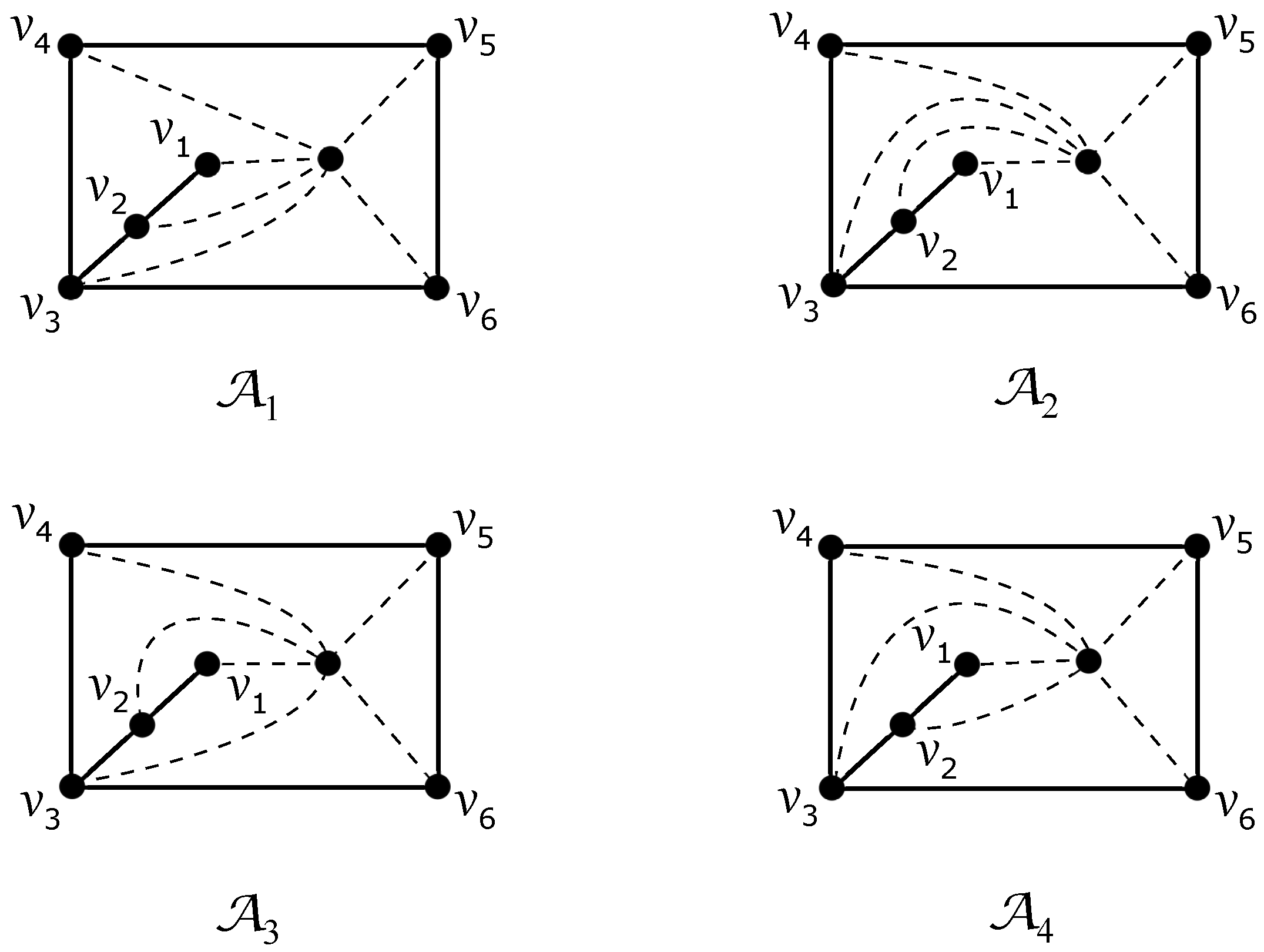
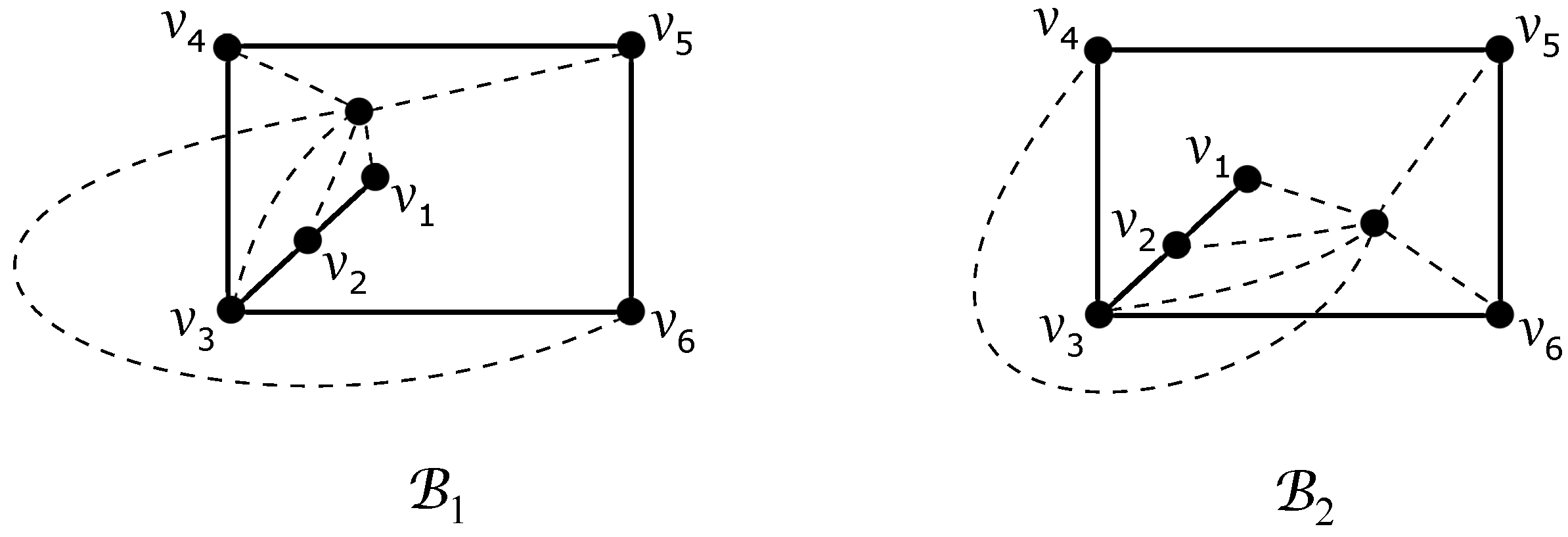
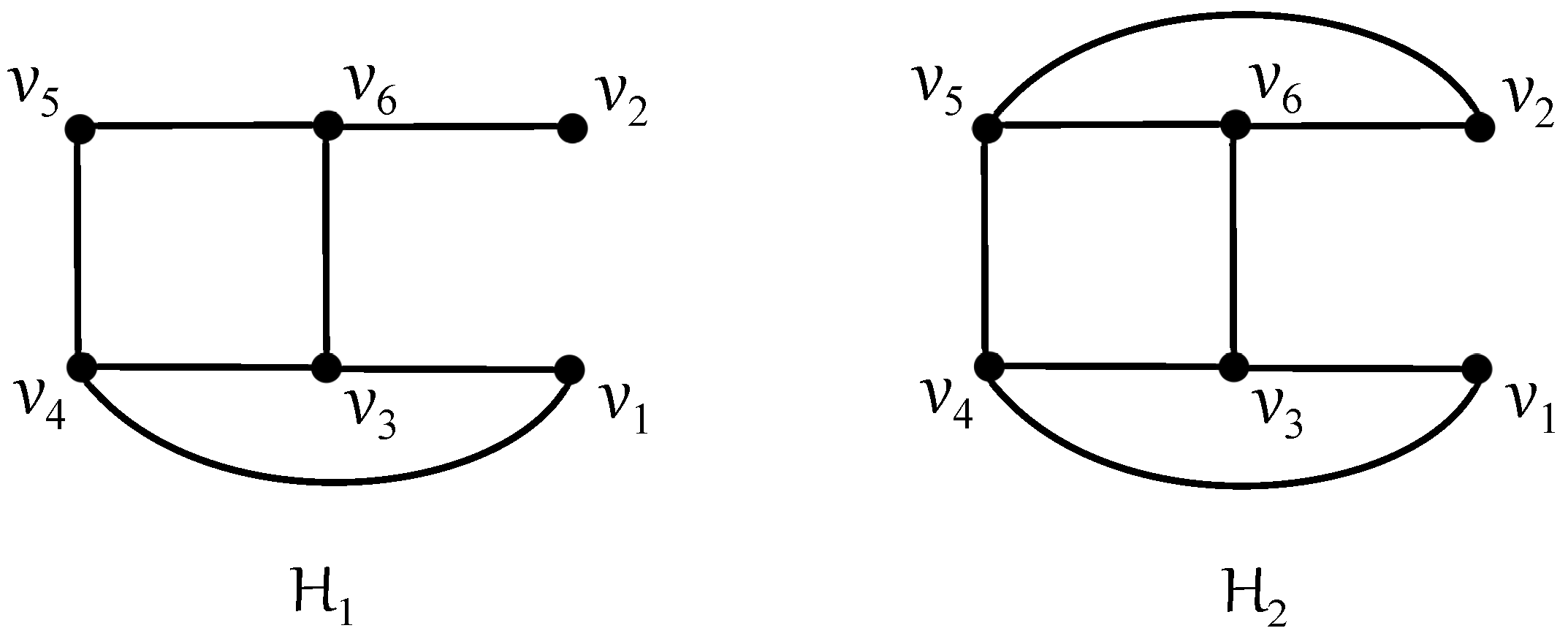
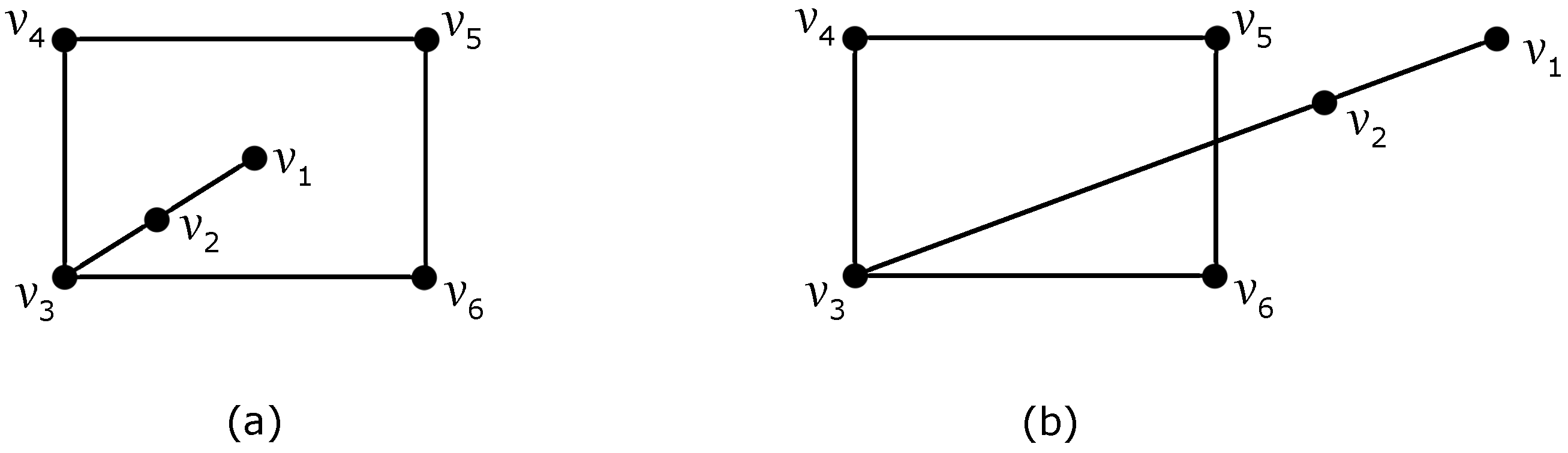
Lemma 1. In any optimal drawing D of the join product , the edges of do not cross each other. Moreover, the subdrawing of induced by D, in which there is a possibility to obtain a subgraph , is isomorphic to one of the two drawings depicted in Figure 1. Assume a good drawing
D of the join product
in which the edges of
do not cross each other. For this purpose, consider the planar drawing of the graph
as shown in
Figure 1a. For subgraphs
, we establish all possible rotations
which could appear in the considered drawing
D. Clearly, there is only one subdrawing of
and can be represented by the subrotation
. We have just four possibilities of getting a subdrawing of
, depending on which of the two regions the edges
and
can be placed in. Thus, there are four different cyclic permutations for
with
, namely, the cyclic permutations
,
,
, and
. Let us denote these cyclic permutations by
,
,
, and
. We say that a subdrawing of
has the configuration
, if
for some
. Suppose their drawings are as shown in
Figure 2 because it does not matter which of the regions in
is unbounded in our considerations.
In a contemplated good drawing of the graph
with the planar subdrawing of
, some configuration
may not appear. Hence, let
denote the set of all existing configurations
in the considered drawing
D such that they are included in the set
.
Figure 2 also points to the possibilities of obtaining a subgraph
with
and
for any subgraph
with the configuration
,
and
,
, respectively. For this purpose, there are two different cyclic permutations for
with
, namely, the cyclic permutations
and
. Let us denote these two cyclic permutations by
and
. We say that a subdrawing of
has the configuration
, if
and
for
. In view of our other considerations, suppose their drawings are as shown in
Figure 3. Obviously,
equal to either
or
may not force just one crossing on only some edge of
by the corresponding subgraph
if the vertex
is placed in the outer region of
with the four vertices
,
,
, and
of
on its boundary. As in the previous case of four possible configurations, let
denote the set of all existing configurations
in the considered drawing
D such that they are included in the set
.
Now, our aim is to establish a minimum number of edge crossings between two different subgraphs and using the idea of mentioned configurations. For two configurations and from (not necessarily different), let denote the number of edge crossings in for two different subgraphs such that , have configurations , , respectively. We denote by the minimum value of over all pairs and from among all good drawings D of the join product . In the following, our goal is to determine the lower bounds of for all possible pairs and we also partially extend this idea of lower bounds to a subfamily of subgraphs by which the edges are crossed exactly once, that is, for subgraphs with the configurations and .
At least five interchanges of adjacent elements of
are necessary to obtain cyclic permutation
because only one interchange of the adjacent elements of
produces the cyclic permutation
. (Let
and
be any two different subgraphs represented by their
and
of the same length
m, where
m is a positive integer of at least 3. If the minimum number of interchanges of adjacent elements of
required to produce
is at most
z, then
, see also Woodall [
24].) Using this knowledge, the edges of each subgraph
with the configuration
of
are crossed at least five times by the edges of each subgraph
with the configuration
of
, that is,
. The same idea also force
,
,
,
, and
. Moreover, by a simple discussion, we can verify that the lower bound of
can be increased up to 5. Let
be any subgraph with the configuration
, and let
be some different subgraph from
satisfying the restriction
. If we place the vertex
in the region of
with the three vertices
,
and
of
on its boundary, then the edges
,
and
produce exactly one, one and two crossings on the edges of
, respectively. Thus,
. Other placements of the vertex
imply at least five crossings on the edges of
. Clearly, also
for any
. The same method as above can be applied to establish the remaining lower bounds of two configurations from
. All resulting lower bounds are summarized in the common symmetric
Table 1 in which
and
are configurations of two different subgraphs
and
, where
and if
or
then
or
; otherwise,
or
, respectively.
3. The Crossing Number of
In a good drawing of , two different vertices and of the graph are said to be antipodal if the edges of the corresponding subgraph do not cross each other. A drawing is said to be antipode-free if it does not contain any two antipodal vertices.
Lemma 2. For , let D be a good and antipode-free drawing of with the subdrawing of induced by D given in Figure 1a. For some , if there is a subgraph with the configuration of and a subgraph such that , then - (a)
for any subgraph , ; and
- (b)
for any subgraph , ; and
- (c)
for any subgraph .
Proof. Let be the configuration of and remark that it is uniquely represented by its . The induced subdrawing of contains just six regions with the vertex on their boundaries. If we consider a subgraph satisfying the restriction , then the corresponding vertex can only be placed in the region with the four vertices , , , and of on its boundary. Using this knowledge, the edges , , and produce no crossings on edges of , and the edge either crosses the edge or does not cross any edge of . If crosses , then . If the edges of are not crossed by and also crosses of , then . Finally, if crosses , then crosses either , with or , with .
In the following, we suppose with , but a similar idea can be applied to the other three cases mentioned above.
- (a)
Let us assume
,
, with the configuration
of
for some
.
Table 2 summarizes the minimal values of necessary crossings among the edges in the subdrawing
. The values in the first column of
Table 2 are given by the lower bounds from the first column of
Table 1. Moreover, the mentioned results in the second column of
Table 2 are obvious for
and
, because
for
of
and
for
of
can be achieved for some
only with the configuration
of
again by
Table 1 (note that
). For the configuration
of
, it is easy to verify in all possible regions of
that the edges of
must be crossed by
more than four times. Finally for
,
provided by two interchanges of adjacent elements of
produce
. As
, the minimum value in the last column of
Table 2 forces the mentioned minimum number of edge crossings.
- (b)
As
with
, the subdrawing
is clearly interpreted, and so it is not difficult to check in all considered regions of the induced subdrawing
that the edges of
are crossed more than six times by any subgraph
,
. The second way is to use the software COGA created by Berežný and Buša [
25] to generate all permutations of six elements in which we need at most five exchanges of adjacent elements to achieve both rotations,
and
.
- (c)
Let
be any subgraph whose edges cross the edges of
more than once. As
and
by (
1), the edges of
must be crossed at least four times by
, which yields
.
Due to the symmetry of the configurations and , the proof can proceed in the same way also for the configuration of , and so the proof of Lemma 2 is done. □
Lemma 3 (See [
26] Lemma 3.1)
. For , let D be a good and antipode-free drawing of . Let , and let be two different subgraphs with . If both conditionshold, then there are at least crossings in D. Lemma 4. and .
Proof. The graph
is planar, and so
. Let
H be the graph of order five consisting of one 4-cycle
and one leaf
adjacent to the vertex
. This was proved by Klešč and Schrötter [
12] that
. As
contains a subgraph that is a subdivision of
, we obtain
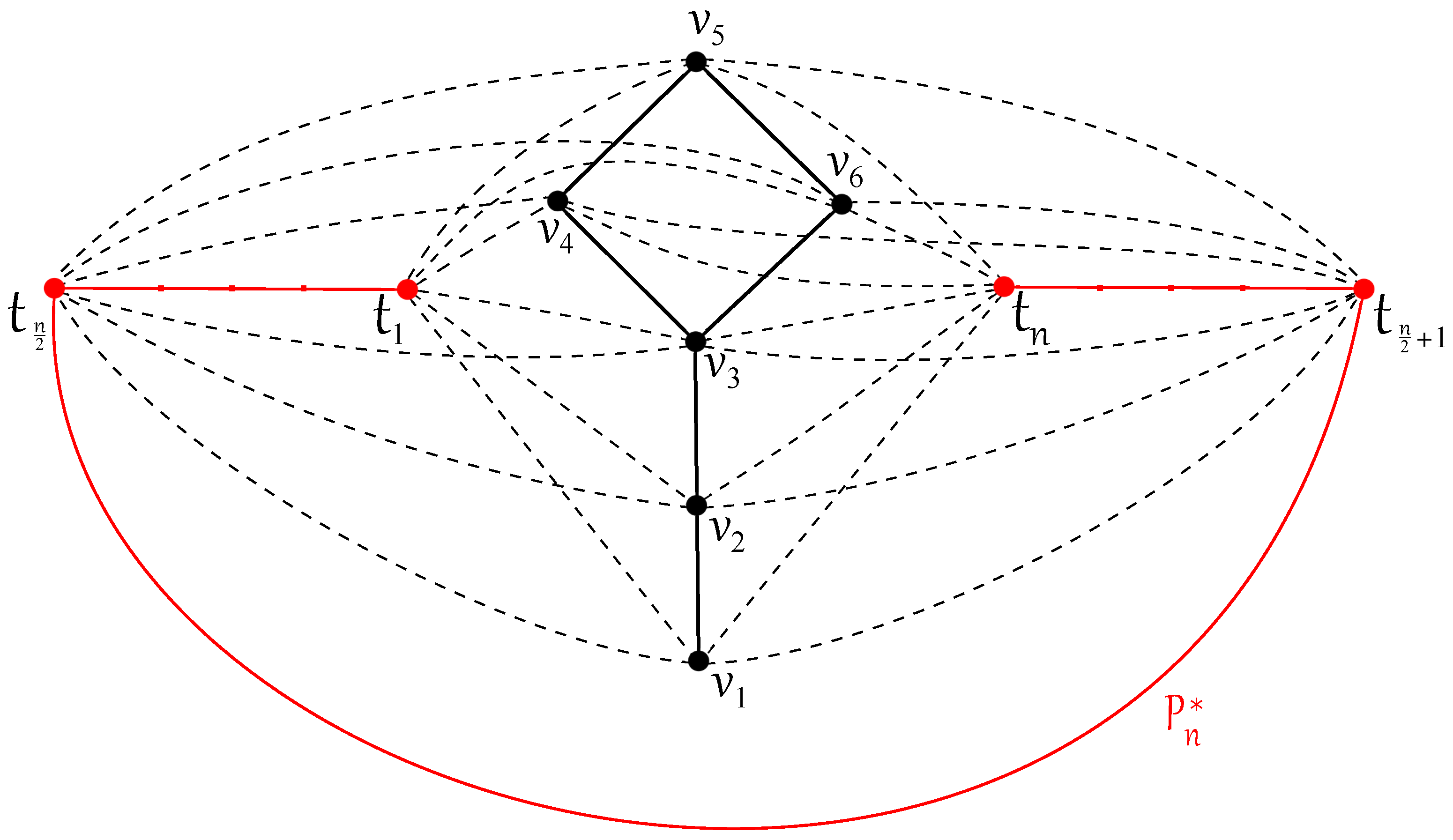
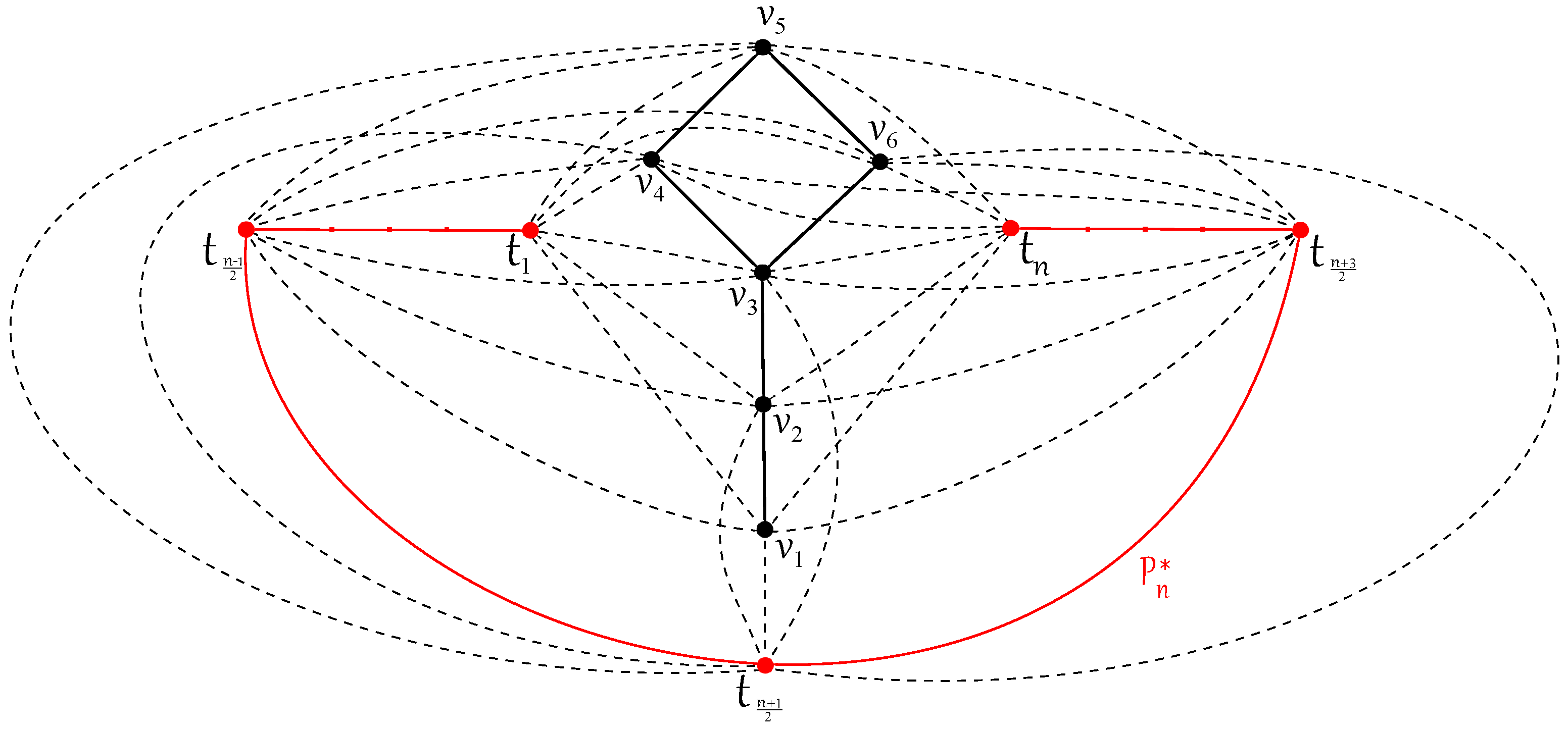
. The proof of Lemma 4 is done due to the subdrawing of the graph
having exactly two crossings in
Figure 4. □
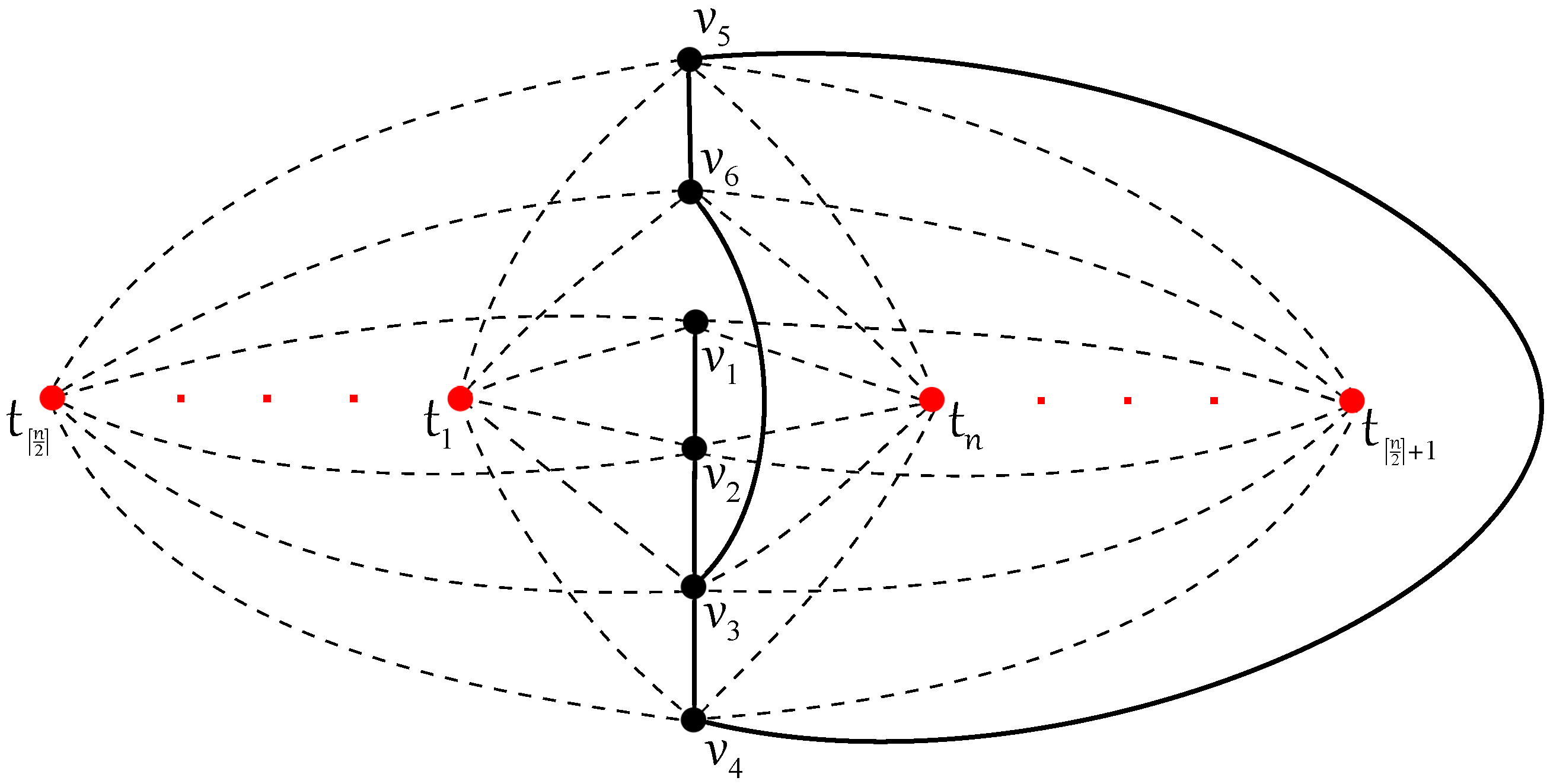
Theorem 1. for .
Proof. The good drawing of the join product
with exactly
crossings in
Figure 4 enforces the required upper border, that is,
. To prove the lower border by induction on
n, suppose that for some
using Lemma 4, there is a drawing
D such that
and let also
We first show that the considered drawing
D is with no antipodal vertices. For this purpose, let
hold for two different subgraphs
and
. If at least one of
and
, say
, does not cross the edges of
, then the edges of
must be crossed by
more than once, that is,
. If
, then
. The well-known fact
by (
1) produces at least six crossings on the edges of
by each other subgraph
,
. So, the number of crossings in
D satisfies
The obtained contradiction with the assumption (
5) does not allow the existence of two antipodal vertices, that is,
D is an antipode-free drawing. If we use the notation
and
, then
again by (
1) together with (
5) force the following relation with respect to the edge crossings of the subgraph
in
D:
i.e.,
The mentioned inequality (
7) subsequently enforces
, that is,
and
. As the set
is nonempty, we deal with the possibilities of obtaining a subgraph
, and a contradiction with the assumption (
5) is reached in all considered cases.
Case 1:. As
, we consider the subdrawing of
induced by
D given in
Figure 1a and we deal with the possible configurations
from the nonempty set
. For
, let us first consider that
and let also for some
with the configuration
of
there is a subgraph
by which the edges of
are crossed exactly twice. Then, by fixing the subgraph
and using the lower bounds in Lemma 2, we have
This contradicts the assumption (
5). Therefore, suppose that for any
,
holds for each subgraph
with the configuration
of
,
. In the following, we discuss two main subcases with respect to whether the set
is empty or not.
Subcase 1: Let be an empty set, that is, the edges of are crossed more than three times by any subgraph , where with some configuration of .
- i.
. In the rest of the paper, assume two different subgraphs
such that
and
have mentioned configurations
and
, respectively. By summing the values in the first two rows for four possible columns of
Table 1 we obtain
for any
with
. Using a relatively strong assumption of Subcase 1, any subgraph
crosses the edges of both
and
more than three times. This in turn means that
trivially holds for any
. Each of
subgraph
of
crosses
more than four times using
. As
, by fixing the subgraph
, we have
where the obtained number of crossings
contradicts the assumption (
5) only for
n odd. For
n even, it also applies if
or
. Suppose the case for
and
, which yields
. This knowledge enables us to add at least one more crossing into the mentioned number of crossings
, because over 14 possible regions of the symmetric subdrawing
, the edges of
are crossed at least eight times by each
. This also confirms a contradiction with the assumption in
D.
- ii.
. If
for only
, by fixing the subgraph
for some
, we have
Of course, the same idea for the cases of
and
forces the same result because
is also provided using the values in
Table 1 for any subgraph
,
if we fix the subgraph
with the configuration
and
of
, respectively. All these subcases contradict the assumption (
5) in
D, and therefore, the case of
offers only two possibilities of either
or
. If we fix any two subgraphs
such that
have the configurations
and
, respectively, then
Table 1 confirms that the condition (
3) holds. The condition (
4) follows from the special assumption
of Subcase 1. As
, the discussed drawing again contradicts the assumption of
D by Lemma 3. Finally, if
for only one
, the proof can proceed in the same way as in the case of
for only
.
Subcase 2: Let be a nonempty set, that is, there is a possibility to obtain a subgraph satisfying for some with either or of . Let us denote , , and consequently , . Notice that and are two disjoint subsets of , and , that is, . Using their symmetry, let be greater than provided that at least one of the sets and is nonempty. Now, we discuss the four possible subcases:
- i.
and assume some subgraph
, having the configuration
. Let
be a subgraph from the nonempty set
. By summing the values in two considered rows for four possible columns of
Table 1, we obtain
for any
with
. The subgraph
is represented by the cyclic permutation
, and so
holds for any other
,
. Moreover,
is fulfilling for any
with
because five interchanges of adjacent elements of
produce
. This forces
for any
and
for any
. As
, by fixing the subgraph
, we have
.
- ii.
and
. Let us assume the configuration
of some subgraph
, and let
. Taking into account the subgraph
, let us count the necessary crossings in
D. It is obvious that we have to deal with the possible existence of a subgraph
by which the edges of
can be crossed at most six times. For this reason, suppose that
is fulfilling for some
,
. This enforces that the edge
of
must cross the edge
of
, which yields
. Since the subgraph
is identifiable by its rotation
, the minimum number of edge crossings of
by some subgraph
,
, of at least 11 can be shown by using the properties of cyclic permutations. Over all possible regions of
the edges of
are crossed at least 10 times by each subgraph
with
and
is also true for any
. As
, by fixing the subgraph
, we have
To finish the proof of this subcase, suppose that
holds for any subgraph
,
. Again by summing corresponding values of
Table 1, we obtain
for any
with
. The subgraph
is represented by the cyclic permutation
, and so
for any
,
. Moreover,
also holds for any
with
because four interchanges of adjacent elements of
produce
. This forces
for any
and
for any
. As
, by fixing the subgraph
, we have
Both subcases again confirm a contradiction in D.
- iii.
and
. Assume the configuration
of some subgraph
for
. If the set
is empty, then the proof proceeds in the same way, like in Subcase 1 with
for only
. Now, let
and
be some subgraphs from the nonempty sets
and
, respectively. Over all possible regions of
, each of the
subgraphs
,
, crosses
at least 10 times. As
, by fixing the subgraph
, we have
- iv.
. If the set
is empty, then the proof also proceeds in the same way, like in Subcase 1 with
for only one
. Now, let
and
be some subgraphs from the nonempty sets
and
, respectively. For
, only using the lower bounds from
Table 1, the edges of
must be crossed by any
with
and
with
at least 11 and 9 times, respectively. Again, over all possible regions of
, exactly nine crossings on
can only be achieved by a subgraph, either
,
or
. As
, by fixing the subgraph
, we have
Both subcases also contradict the assumption (
5) in
D.
Case 2:, and we consider the subdrawing of
induced by
D given in
Figure 1b. The set
must be nonempty according to the inequality (
7). For subgraphs
, there is only one subdrawing of
identifiable by its subrotation
. The edge
can be added to two regions of
, but the proof proceeds in the same way, like in Subcase 1, with
for only
for both such possibilities of
by adding the edge
.
We have shown that there are at least crossings in each good drawing D of . □
4. Two Graphs and
In
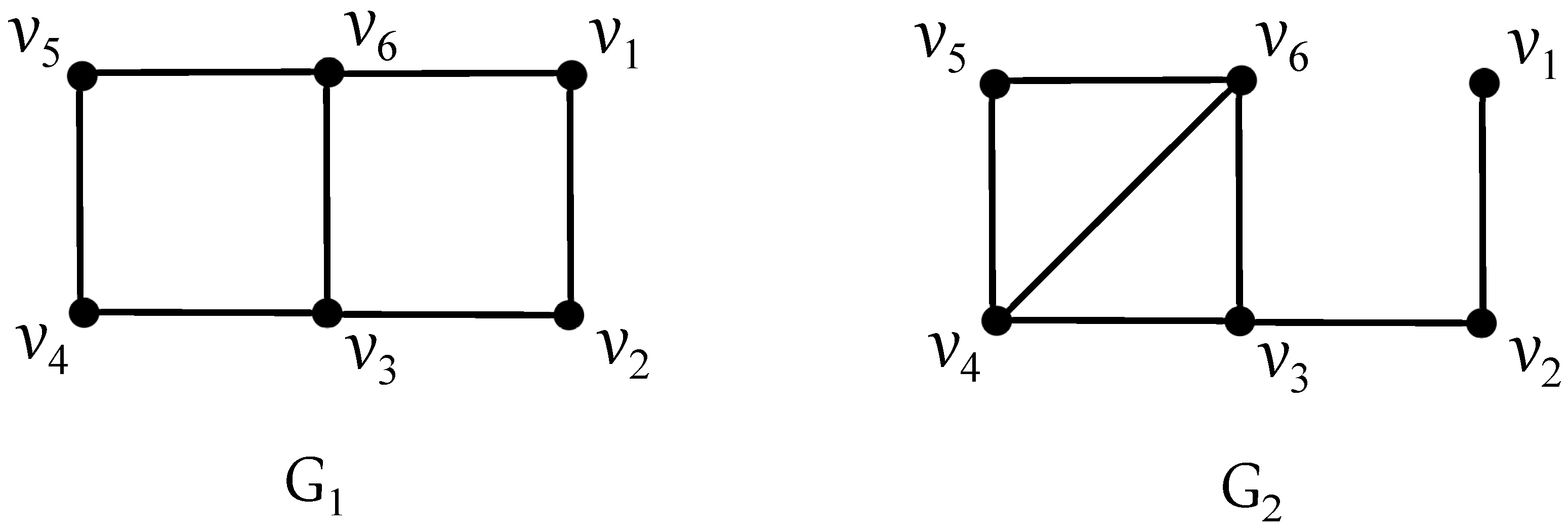
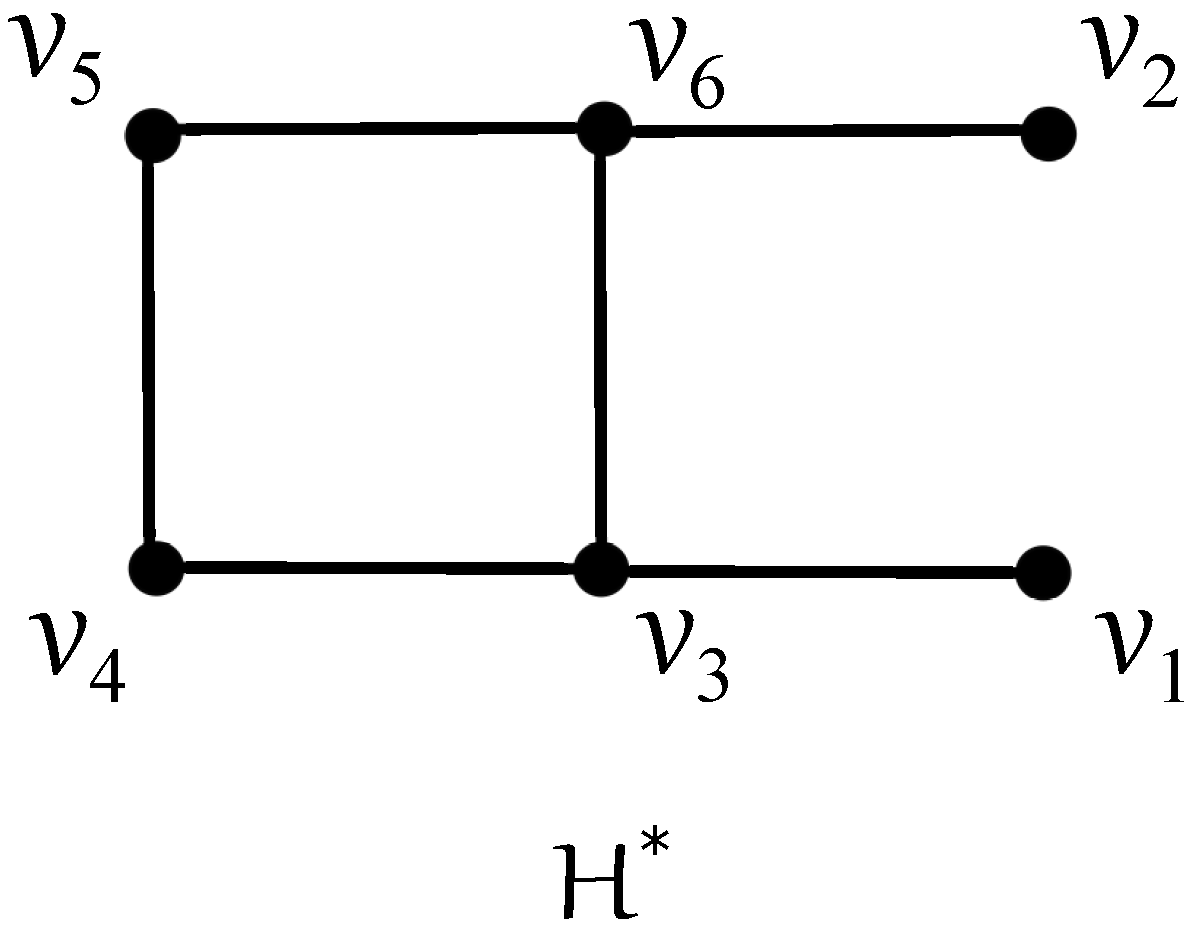
Figure 5, let
be the graph on six vertices obtained from
by adding the new edge
, i.e.,
. Similarly, let
. The good drawing of
with exactly
crossings can be obtained if we add the edge
to the graph
with no new crossing in
Figure 4. The graph
is a subgraph of
, and therefore,
. Thus, the following result is obvious.
Corollary 1. for .
Remark that the exact value of the crossing number of the graph
was already obtained by Klešč and Schrötter [
27].
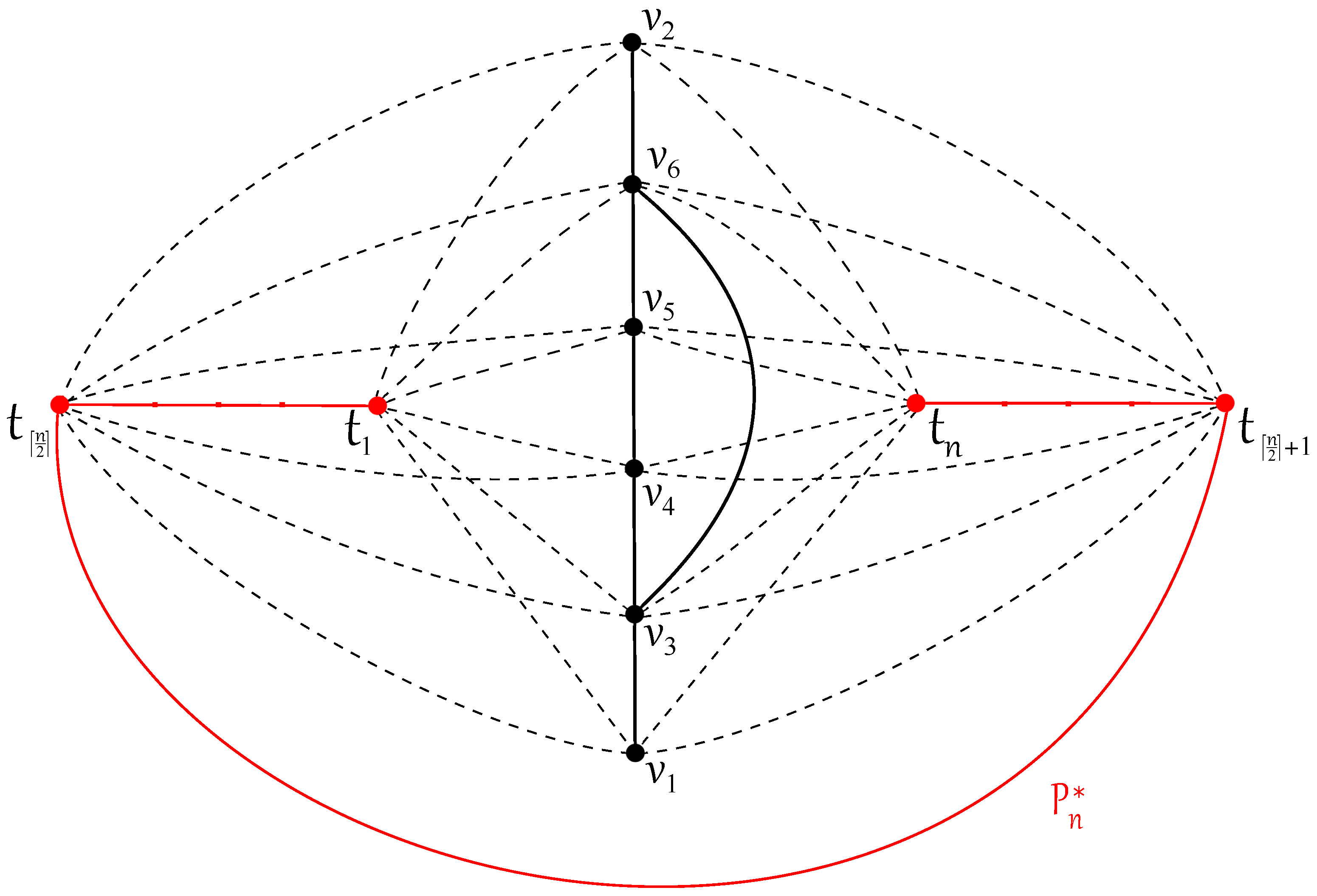
For
n even,
Figure 6 shows the good drawing of the join product
with exactly
crossings provided by the edges of
cross each other
times and any subgraph
crosses the edges of
just once.
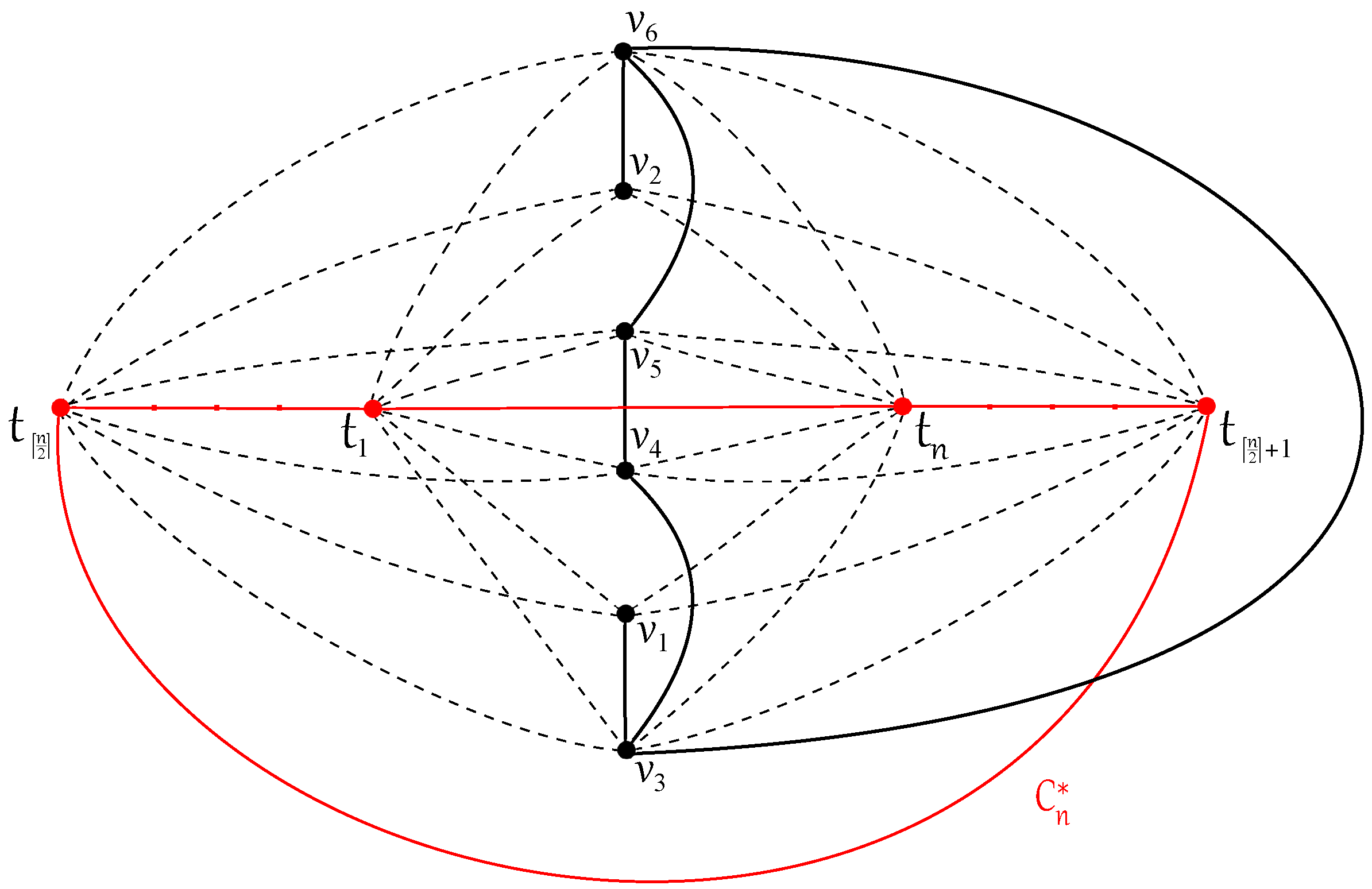
For
n odd, at least 3,
Figure 7 shows the good drawing of
also with
crossings by adding one subgraph
by which the edges of each of the
graphs
,
are crossed exactly three times, that is,
The lower bound is the same, based on Theorem 1, using that is a subgraph of .
Corollary 2. for .
The graph
is a subgraph of
, and so
. We can also obtain the drawings of
with exactly
crossings by adding the edge
to the graph
without additional crossings into both
Figure 6 and
Figure 7.
Corollary 3. for .
Corollary 4. for .
6. The Crossing Numbers of Join Products of Cycles with Six Graphs of Order Six
Let us suppose a graph
G on six vertices with the vertex set
, and let
be the vertex notation of the
n-cycle
for
. The join product
consists of one copy of the graph
G, one copy of the cycle
, and the edges joining each vertex of
G with each vertex of
. Let
denote the cycle as a subgraph of
induced on the vertices of
not belonging to the subgraph
G. The subdrawing
induced by any good drawing
D of
represents some drawing of
. For the vertices
of graph
G, we denote by
the subgraph induced by
n edges joining the vertex
with
n vertices of
. The edges joining six vertices of
G with
n vertices of
form the complete bipartite graph
, and so
In the proofs of the theorems, the following two statements regarding some restricted subdrawings of are useful.
Lemma 5 (See [
6] Lemma 2.2)
. Let D be a good drawing of , , in which no edge of is crossed, and does not separate the other vertices of the graph. Then, for all , two different subgraphs and cross each other in D at least times. Lemma 6 (See [
28] Lemma 1)
. Let G be a graph of order m, . In an optimal drawing of the join product , , the edges of do not cross each other. Theorem 6. for .
Proof. In both
Figure 6 and
Figure 7, it is possible to add the edge
that creates the cycle
on the vertices of
with just two additional crossings, i.e.,
is crossed by two edges
and
of the graph
. So,
. To prove the lower border, let
D be a good drawing of
with at most
crossings. By Theorem 1, at most, one edge of
can be crossed in
D, and we can also suppose that the edges of
do not cross each other using Lemma 6. The induced subdrawing
divides the plane into two regions with at least four vertices of the 4-cycle of
in one of them, and so three possible cases may occur:
Case 1: No edge of crosses any edge of , that is, all six vertices of must be placed in one region of the subdrawing . As at least five different subgraphs cannot cross the edges of , any two such different subgraphs and cross each other at least times by Lemma 5. This forces at least crossings in D.
Case 2: Some edge of crosses the edge of . Five vertices , , , , and of are placed in one region of and any subgraph , , cross no edge of . We obtain a contradiction in D using the same estimate as in the previous case.
Case 3: Some edge of
crosses the edge
of
. Again by Lemma 5, there exist at least
crossings in
D, where
and
. The empty set
contradicts the assumption of
D for all
and we also obtain at least
crossings in the obtained number (
9) for all integers
n more than 6. For
and
, we suppose only two subdrawings of
presented in
Figure 1. Let us first consider the planar subdrawing of
induced by
D given in
Figure 1a. For
, if either
,
or
, we obtain at least 10 and 12 crossings in
D using only some of the values in
Table 1, respectively. The similar idea can be applied for
if
. For
and
, if we would like to get the smallest possible number of crossings equal to 17 over the four subgraphs with configurations
,
,
, and
(in an effort to obtain their lower bounds in
Table 1), we obtain two additional crossings on the edge of
by which the edge
of
is crossed. For
and
, it is sufficient, due to (
9), to deal only with cases
, which again, only thanks to the values from
Table 1, give us the numbers of crossings contradicting the assumption in
D. Finally, assume the nonplanar subdrawing of
induced by
D given in
Figure 1b. The number of crossings obtained in (
9) confirms a contradiction in
D for all
n at least 5. For
and
, if either
or
,
,
, we can verify the contradicting numbers of crossings in
D by a very fast recalculation because the edges of
and
cross each other at least five and three times for any three different subgraphs
,
, respectively. The proof of Theorem 6 is done. □
In both
Figure 6 and
Figure 7 by adding the edge
, it is possible to add the edge
that creates
on the vertices of
with just two additional crossings. Thus, the result of Corollary 6 is obvious, because
is a subgraph of
, and so
.
Corollary 6. for .
Theorem 7. for .
Proof. The proof proceeds similarly like for the graph
in Theorem 6. In
Figure 9, adding the edge
to
offers the good drawing of
with
crossings. If we assume a drawing
D of
with at most
crossings, then the result of Theorem 2 forces at most one crossing on the edges of
in
D. At least five vertices of
(that are placed in the same region of the induced subdrawing
) with the corresponding five subgraphs
produce at least
crossings in
D. □
Due to Theorem 7, the good drawing of
in
Figure 11 is optimal. Clearly, we can add both edges
and
to the graph
with no new crossing, and therefore, the crossing numbers of
and
are at most
. The result of Corollary 7 is again obvious, because
is a subgraph of
, which is also a subgraph of
, and so
.
Corollary 7. for .
Remark that the crossing number of
was already obtained by Klešč [
1]. The proof of Theorem 8 can be omitted due to using arguments that are similar to those in the proof of Theorem 5, where the crossings numbers of two graphs
and
are already given by
.
Theorem 8. for .