1. Introduction
Cryptography is a traditional and effective way to protect information security for a long time. According to whether the same key is used in the encryption and decryption processes, encryption can be divided into symmetric encryption and asymmetric encryption. Running symmetric encryption and decryption is relatively faster than the asymmetric encryption and decryption which usually takes a longer time. With the approach of 5G era, the amount of image data in wired and wireless communication nets is in the tens of thousands. Therefore, an efficient symmetric image encryption scheme becomes extremely important for protecting image security during storage and transmission.
Through the years, scholars have proposed multifarious image encryption schemes, such as a series of popularly known confusion and diffusion-based methods [
1,
2]. The framework structure of confusion and diffusion for image encryption was put forwarded by Fridrich in 1998 [
3]. Confusion is usually achieved by permuting pixel control by keys without changing pixel values. Nevertheless, diffusion guarantees that altering one original pixel will cause several encrypted pixels to change.
Multifarious chaotic systems have been extensively applied to diverse fields [
4,
5,
6,
7,
8,
9,
10,
11] over the years because of their excellent properties [
12,
13,
14,
15]. Many scholars have designed robust and complex image encryption algorithms by using chaotic systems and the excellent characteristics of chaos [
16,
17,
18,
19,
20,
21,
22,
23,
24,
25]. When changing the initial parameters of the chaotic map, we can obtain totally different chaotic sequences. However, the premise for applying a chaotic map to image encryption is that it should have a large parameter space. Unfortunately, some classical maps, like Tent and Logistic maps, are chaotic only within a small scope of parameters. Therefore, it is essential to improve them to generate chaotic maps with more complex properties [
26]. Hua et al. [
27] proposed 2D-SLMM combined with CMT for image encryption. Zhu et al. [
28] designed LSMCL map and combined with the substitution and diffusion methods for image encryption. Although the dimensionalities of these proposed chaotic systems are higher than those of the classical maps, their chaotic trajectories still do not spread over the whole space and their parameter space is not very large. Therefore, a new 2D system with larger parameter space and excellent chaotic properties is put forward.
To strengthen the safety of the chaotic systems and the formation of confusion- and diffusion-based image encryption, we put forward a new Sine-coupling-Logistic-modulated-Sine system based on two one-dimensional maps, which expands the results from one-dimensional to two-dimensional. To verify the better performance of the newly designed 2D-SCLMS map compared to many existing chaotic maps, the dynamics of the newly designed 2D-SCLMS map is analyzed from multiple perspectives, including chaotic trajectory, bifurcation diagram, Lyapunov exponent, two complexity analysis methods [
29,
30], 0–1 test [
31,
32], sample entropy, and permutation entropy [
33]. Experimental tests show that 2D-SCLMS is a hyperchaotic system and has a wider chaotic range and better randomness.
Besides, a new symmetric encryption scheme using two new chaotic systems, which includes 2D-SCLMS map and 2D-LSCM [
34], is further introduced. The procedure of the encryption scheme is realized by pixel scrambling, Xnor, and diffusion. When scrambling, we propose to scramble the image by combining the indices of two chaotic sequences generated by the 2D-SCLMS system. Diffusion consists of two parts, row diffusion and column diffusion. We make use of two other chaotic sequences to perform the row and column diffusion respectively. In addition, the SHA-384 hash is used to produce the initial parameters of two systems, which greatly improves the resistance to known plaintext and chosen plaintext attacks [
33,
35].
The major contributions of this paper are as follows: (1) A new two-dimensional hyperchaotic map is designed based on Logistic and Sine maps. (2) Various methods, such as chaotic trajectory, Lyapunov exponent, 0–1 test, complexity analysis methods, and two different entropy analysis methods, are used to evaluate the chaotic properties of the new two-dimensional hyperchaotic map. (3) According to the two chaotic maps, a new symmetric encryption scheme for improving image security is proposed.
The rest of this article is arranged as follows.
Section 2 states related works.
Section 3 proposes the new 2D-SCLMS map and analyzes its chaotic behaviors.
Section 4 presents the design of the new pixel scrambling method.
Section 5 demonstrates the new symmetric image encryption algorithm.
Section 6 describes the corresponding image decryption process.
Section 7 presents simulation experiments and safety performance analysis.
Section 8 shows color image encryption.
Section 9 introduces the application areas of encryption algorithms.
Section 10 provides the conclusion.
2. Related Works
This section first introduces two proposed chaotic maps, which constitute the basis for creating the 2D-SCLMS map. Then, another chaotic system 2D-LSCM for image encryption algorithm is described.
2.1. Logistic Map
Pierre François Verhulst denominated this map as the Logistic map [
36]. It is known for its complex dynamic properties and has been widely used in different domains. In general, the expression of a 1D Logistic map [
37] is
where
μ ∈ (0, 1) is the parameter.
xi ∈ (0, 1),
i = 1, 2,⋯.
2.2. Sine Map
A variation of the sine function is Sine map whose input is converted from [0,
π] to [0, 1] and whose output range [0, 1] remains unchanged. The expression of the Sine map is described as [
38]:
where
λ ∈ (0, 1) is a parameter.
xi ∈ (0, 1),
i = 1, 2,⋯.
2.3. 2D-LSCM
In this paper, 2D-LSCM is used as one of the chaotic systems of the encryption algorithm. The expression of the 2D-LSCM [
34] is
where
α ∈ [0, 1] is a parameter.
3. 2D-SCLMS Map
We propose a novel Sine-coupling-Logistic-modulated-Sine map, in view of Logistic and Sine maps. To verify the better chaotic performance of the newly 2D-SCLMS map, efficient analysis and comparison are implemented in this section.
3.1. The Newly 2D-SCLMS Map
In fact, Logistic and Sine maps have good chaotic performances only in a suitable range of parameters and they also have some drawbacks, such as simple chaos and small chaotic range. Hence, it is relatively easy to forecast their trajectories using chaotic signal estimation techniques [
39,
40]. To overcome these drawbacks, a new 2D-SCLMS chaotic map with better chaotic properties is constructed in this paper. It is defined by Equation (4).
where
u > 0.1 is the parameter.
xi,
yi ∈ (−1,1),
i = 1, 2,⋯.
3.2. Performance Analysis
The 2D-SCLMS map is innovated by combining Logistic and Sine maps and it is expanded to two dimensions. Therefore, the 2D-SCLMS map has more complex chaotic properties and its dynamics will be specified from several aspects.
3.2.1. Chaotic Trajectory
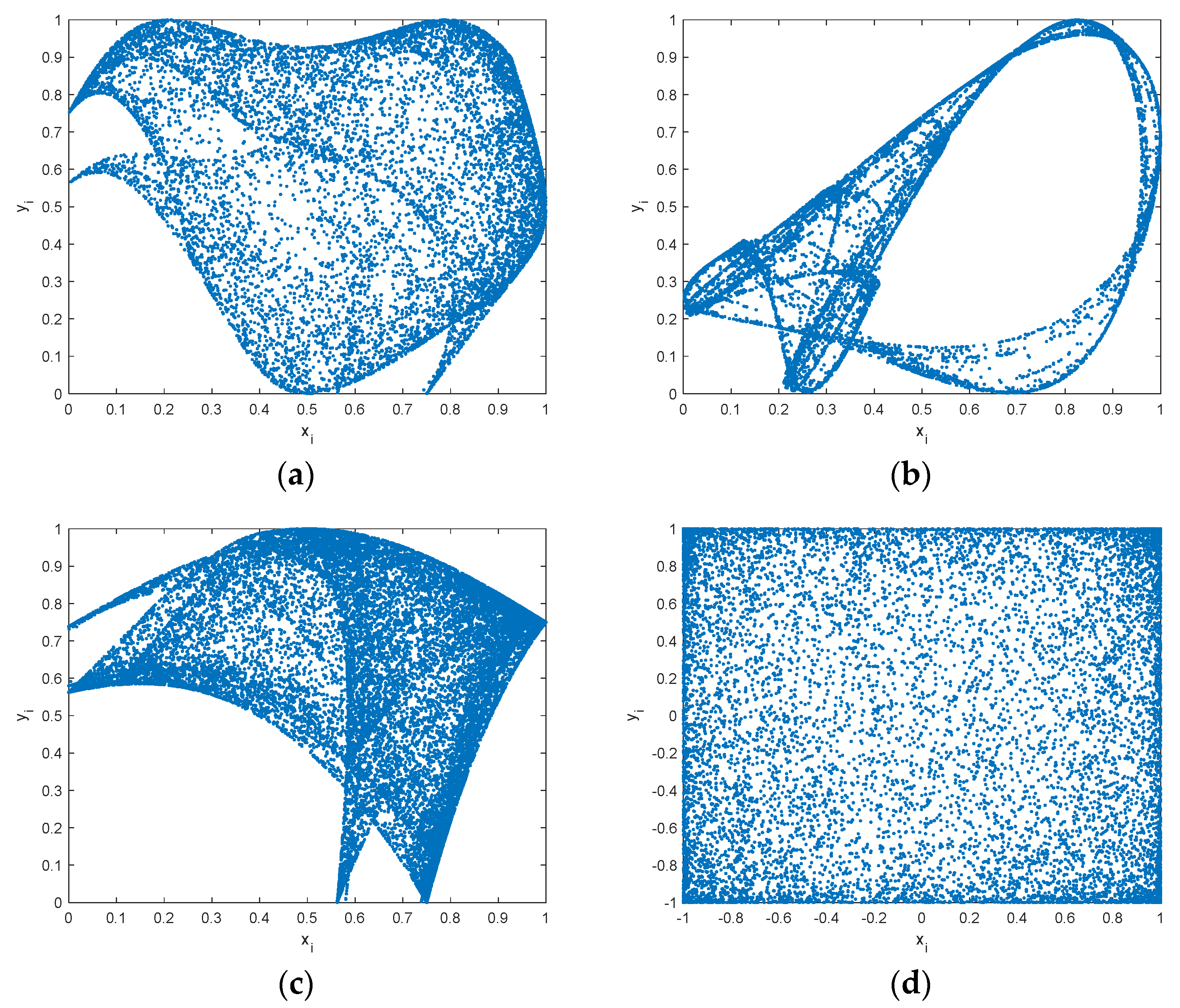
Chaotic trajectory is the motion track of the chaotic map over time for given parameters and initial values. Theoretically, the distribution of trajectories can prove to some extent the randomness of sequences. We set
x0 = 0.1,
y0 = 0.1, and the corresponding parameters.
Figure 1 gives the trajectory diagrams of the newly 2D-SCLMS map, LSMCL, 2D logistic map and 2D-SLMM [
28]. It can be obtained that chaotic trajectories of the new 2D-SCLMS map occupy a larger space, indicating that the map has better chaotic and track ergodicity.
3.2.2. Bifurcation Diagram
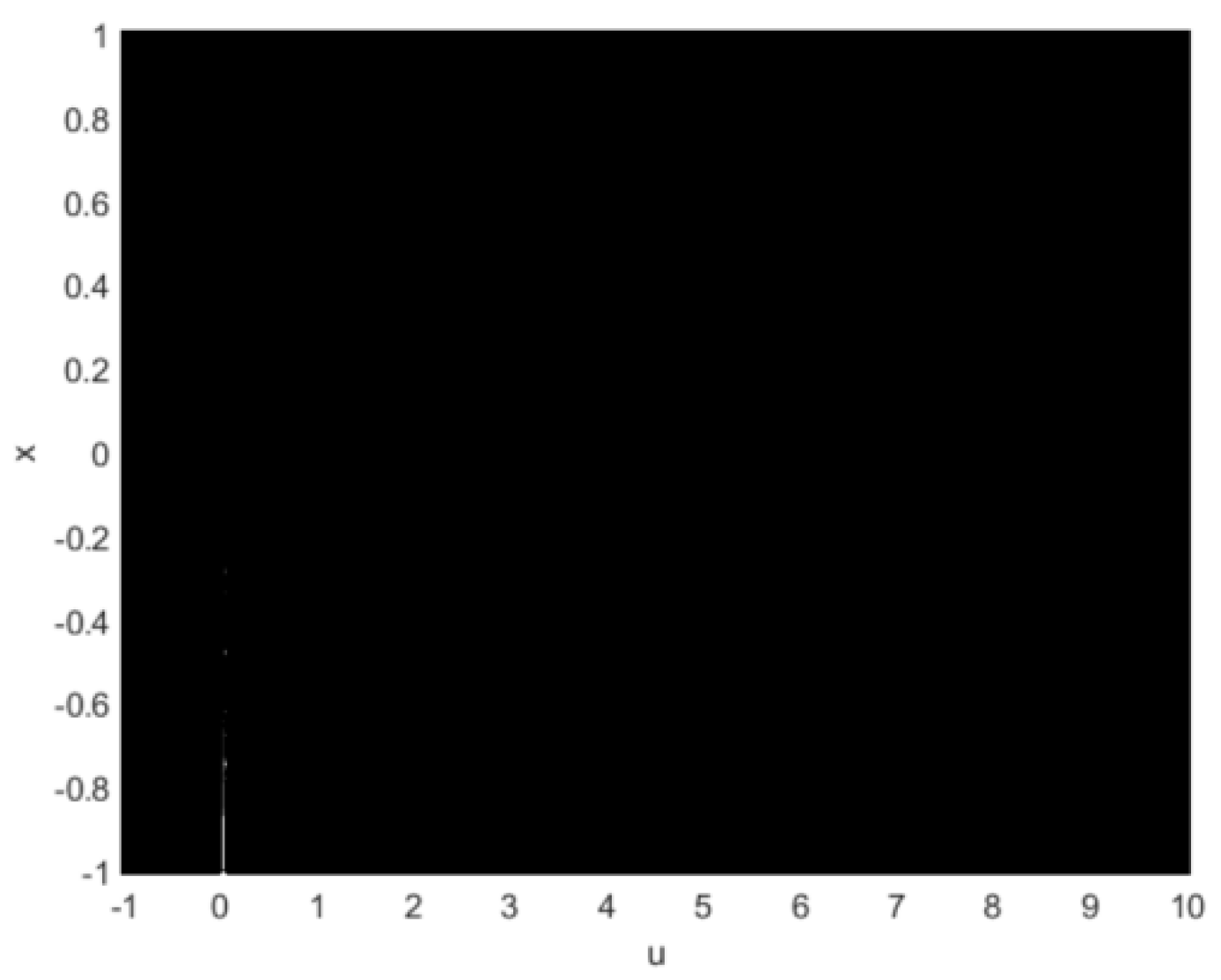
The 2D-SCLMS map is chaotic when
u is not in the vicinity of 0, which is drawn in
Figure 2. However, as we all know, Logistic and Sine maps are in a chaotic state when the parameters are
μ ∈ (0.89, 1) and
λ ∈ (0.87, 1) respectively. Thus, the 2D-SCLMS system exhibits chaos over a larger parameter interval.
3.2.3. Lyapunov Exponent
A significant index to evaluate the dynamical behavior of chaotic maps and a measurable way to represent the sensitivity of chaotic systems to initial values is the Lyapunov exponent. The LE of a 1D dynamic system is represented as
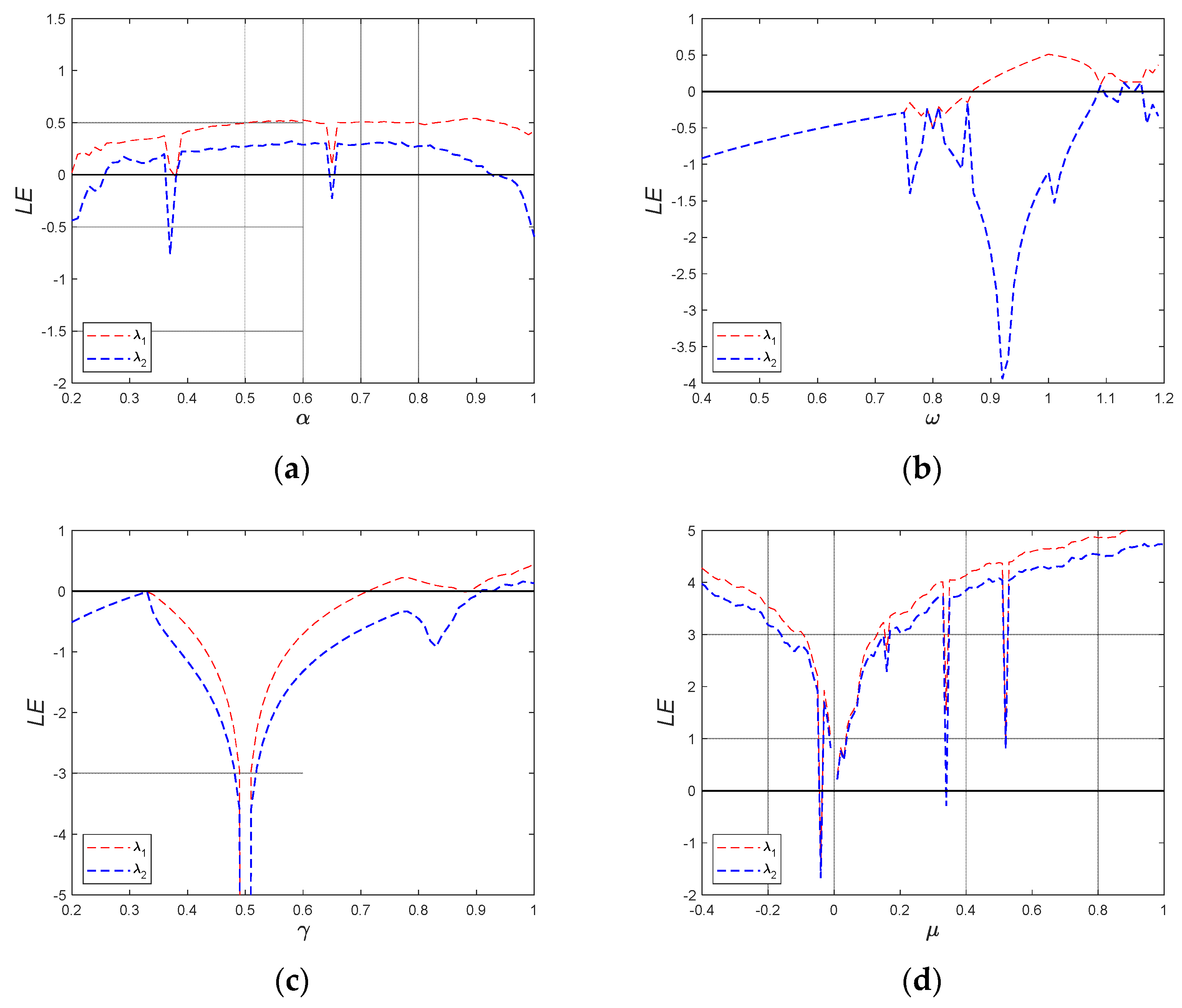
A positive LE implies that the map is chaotic. A larger LE implies that the system has a better chaotic property. Besides, the number of positive LE of a hyper-chaotic system is not less than two. The LEs of the newly 2D-SCLMS map, LSMCL, 2D logistic map and 2D-SLMM [
28] are demonstrated in
Figure 3. It reveals that the 2D-SCLMS map has two positive LEs over a broader range of parameters. Therefore, the 2D-SCLMS map has a wider chaos range and more complex chaotic behavior.
3.2.4. Complexity Analysis
A momentous index to appraise whether a chaotic sequence is close to a random sequence is the complexity. Under normal circumstances, a higher value of complexity implies that the chaotic sequence is closer to a random sequence. The spectral entropy (SE) complexity algorithm [
29] and the
C0 structure complexity algorithm [
30] are used to test complexity.
The SE value is obtained based on the Shannon entropy algorithm. The process of the algorithm is shown below.
In order to make the calculated spectrum more precise, delete the DC part of
by Equation (6)
wherein
n = 0, 1, 2, …,
N − 1.
Discrete Fourier transform of Equation (6) by Equation (7).
wherein
s = 0, 1, 2, …,
N − 1.
The sequence Ψ(s) processed by the discrete Fourier transform is calculated by taking the first half of the sequence Ψ(s) and using the Paserval algorithm to compute the power spectrum of one of the specific frequencies by Equation (8).
where
s = 0, 1, 2, …,
N/2 − 1.
Calculate the total power by Equation (9).
The probability of the relative power spectrum is given by Equation (10)
In Equation (10), .
Using the above Equations (8)–(10) and combining the concept of Shannon entropy, the spectral entropy
se of the signal can be found by Equation (11)
If
Ps = 0 in the Equation (11), it is defined that
Psln
Ps = 0. The magnitude of the SE tends to ln(
N/2). To facilitate comparative analysis, normalization is implemented
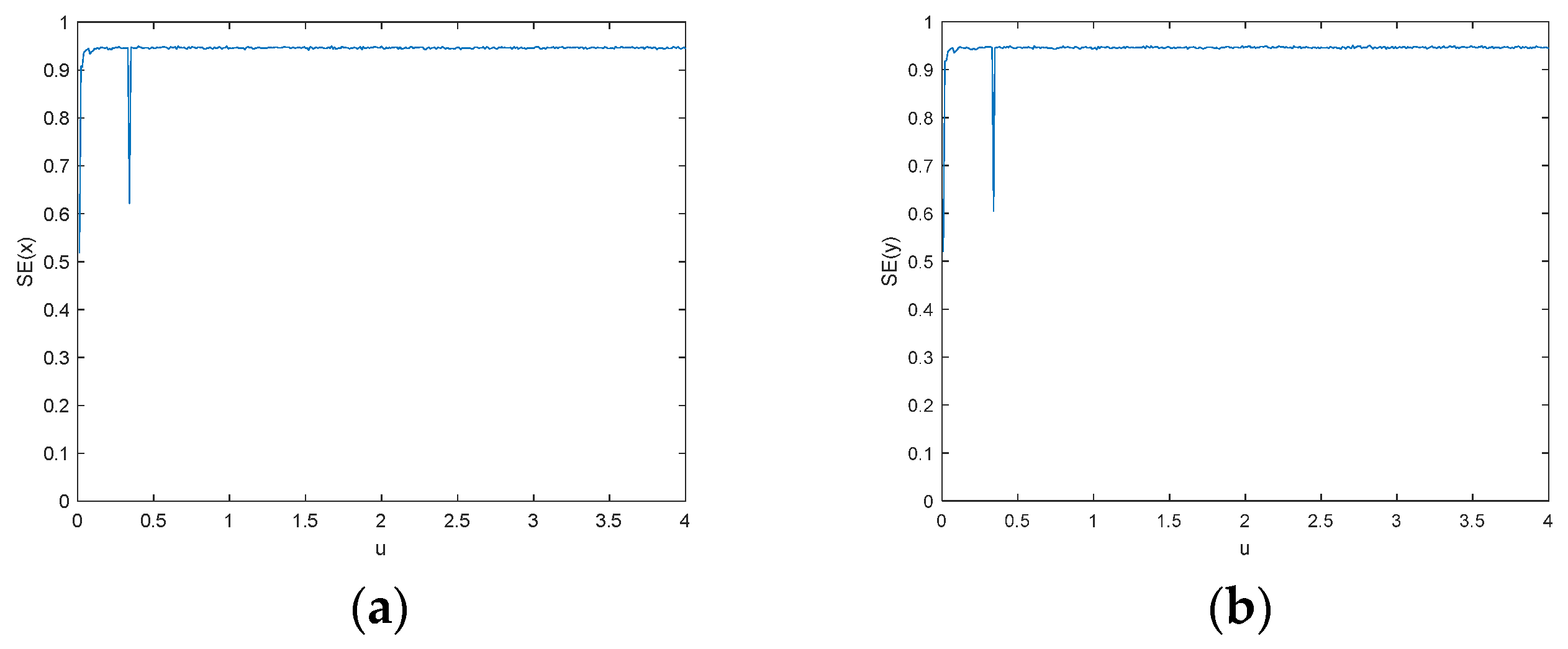
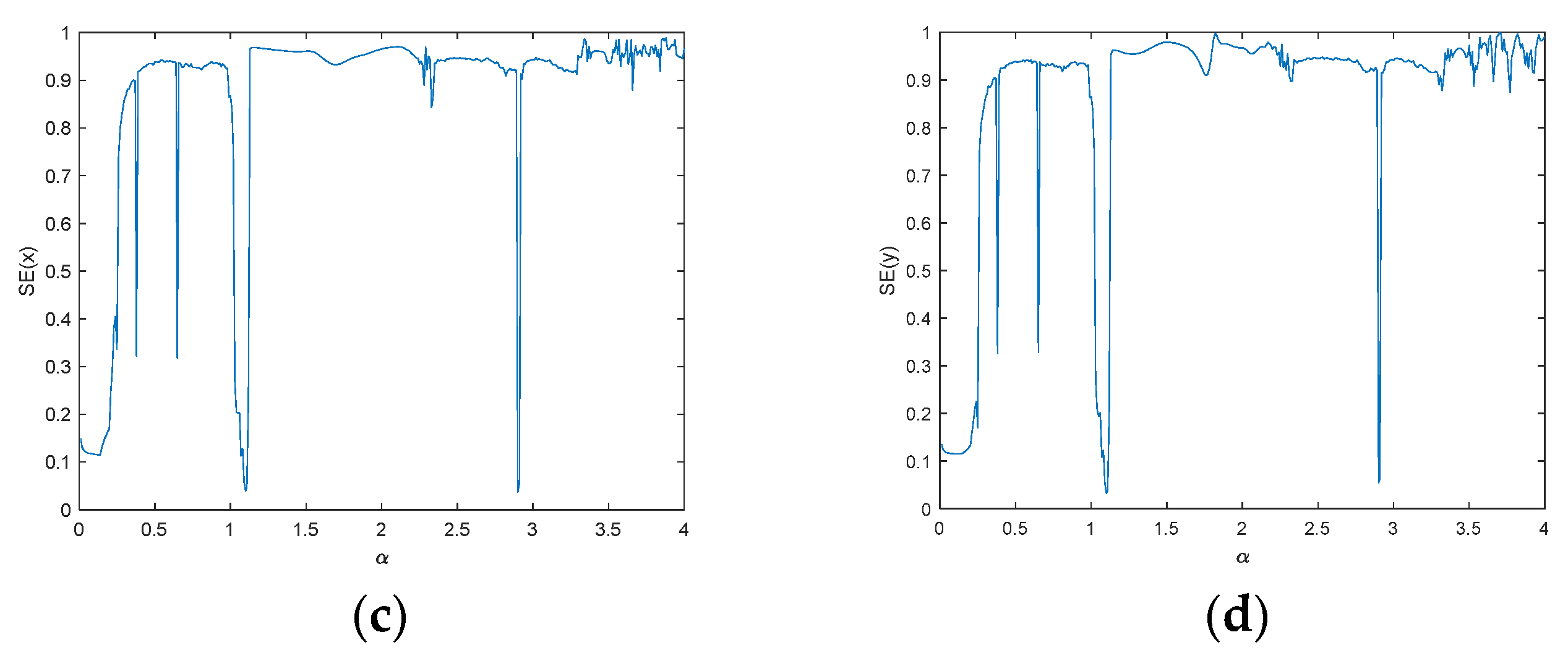
Figure 4 shows the SE of the 2D-SCLMS map and LSMCL.
Figure 4a,c are the
SE values of the
x sequence obtained by the 2D-SCLMS system and LSMCL respectively.
Figure 4b,d are the
SE values of the
y sequence generated by the 2D-SCLMS map and LSMCL respectively. When
u > 0.35, the value of SE is around 0.95, which is very close to 1. However, the SE of LSMCL are much smaller than the SE of the 2D-SCLMS map on several small intervals. This indicates that the 2D-SCLMS system has a higher complexity, i.e., the two sequences obtained by the new chaotic system are closer to the random sequence.
The main idea of the C0 complexity algorithm is to split the sequence into regular and irregular parts and what is wanted is the percentage of the irregular part of the whole chaotic sequence. The specific calculation steps of the C0 complexity algorithm are as follows.
Discrete FFT transform of the sequence
by Equation (13)
wherein
s = 0, 1, 2, …,
N − 1.
Removing the irregular part of Ψ(
s), assume that the mean square value of {Ψ(
s),
s = 0, 1, 2, …,
N − 1} is Equation (14)
Adding a parameter
η to the above equation and leaving more than
η multiple of that mean square value, assuming the value of the remaining part is zero, i.e.,
Fourier inversion of Equation (15) by Equation (16)
wherein
n = 0, 1, 2, …,
N − 1.
The expression of the
C0 complexity measure is Equation (17)
The C0 complexity algorithm developed based on the FFT transform removes the regular part and retains the irregular part. The more irregular parts in the whole sequence, the closer the corresponding time domain signal is to the random sequence.
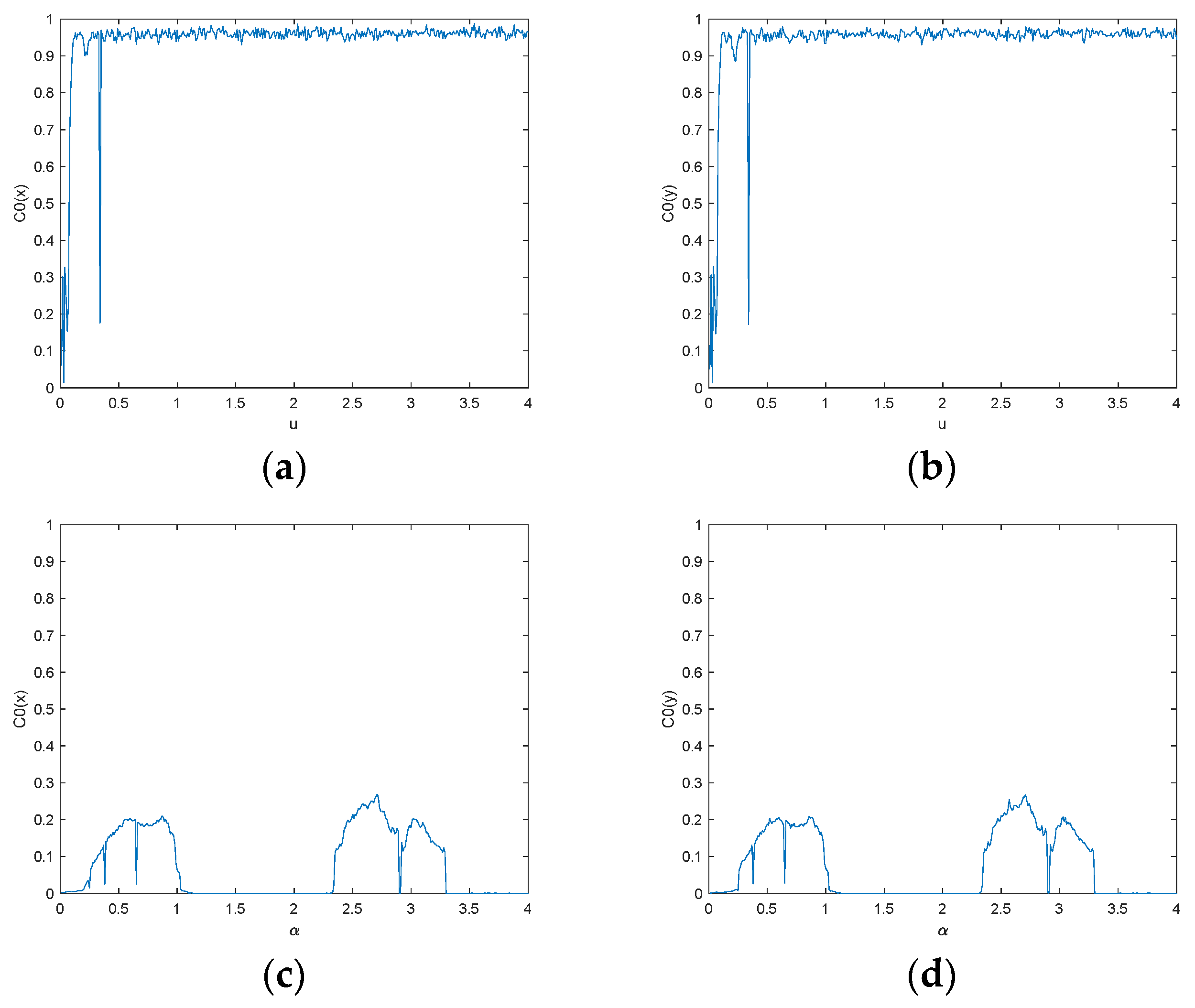
Figure 5 implies the
C0 complexity algorithm of the 2D-SCLMS map and LSMCL.
Figure 5a,c are the
C0 values of the
x sequence generated by the 2D-SCLMS map and LSMCL respectively.
Figure 5b,d are the
C0 values of the
y sequence generated by the 2D-SCLMS map and LSMCL respectively. When
u > 0.35, the
C0 value of 2D-SCLMS map is very close to 1. However, the
C0 values of LSMCL are small. This indicates that 2D-SCLMS system has a high complexity, that is, the two sequences generated by 2D-SCLMS map are close to random sequences.
3.2.5. 0–1 Test
The 0–1 test [
31] is an reliable and useful binary algorithm to determine whether a system is chaotic or not, proposed by Gottwald and Melbourne [
32]. The 0–1 test is a direct method to determine whether a system is chaotic or not by calculating whether the linear growth rate
Kc values of the discrete data transformation variables are close to 1 or 0, without the need of phase space reconstruction.
For a sequence
φ(
s) of length
M and any real constant
ζ, define two equations,
where
s = 1, 2, …,
M.
According to Equations (18) and (19), the expression of the displacement mean squared error is Equation (20)
where
s = 1, 2, …,
M.
It can be seen that it increases linearly with time or that it is bounded, especially, if
p(
s)(
q(
s)) is Brownian motion, which implies that
Q(
s) increases linearly with time. If
p(
s)(
q(
s)) is bounded, which implies that
Q(
s) is also bounded. Finally, the expression for
Kc is Equation (21)
A dynamical system is considered non-chaotic when Kc ≈ 0 and chaotic when Kc ≈ 1.
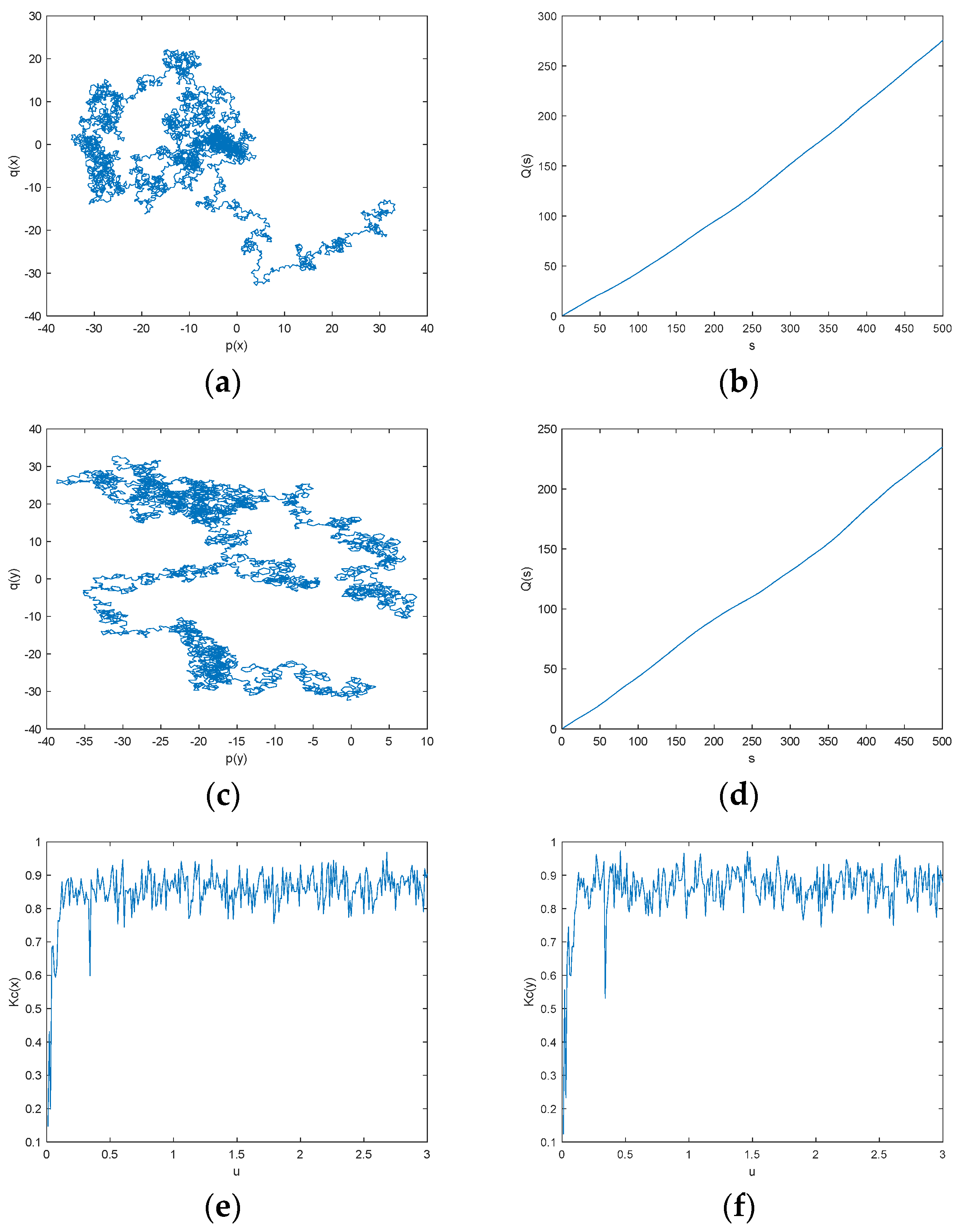
For the 2D-SCLMS map, when setting the parameter
u = 3 and the initial values
x0 = 0.1 and
y0 = 0.5, the 0–1 test is performed for each of the two sequences generated by the 2D-SCLMS system. We obtain the test results of the (
p,
q) plot, as shown in
Figure 6. The results show that both sequence trajectories are similar to Brownian motion. Moreover, when 0 ≤
u ≤ 3, the
Kc values of both sequences are close to 1. Therefore, the 2D-SCLMS map is a chaotic system.
3.2.6. Sample Entropy
A method to assess the complexity of a system is sample entropy. For a sequence U = {u(1), u(2), …, u(N)}, define parameters s, v.
Reconstructing
s dimensional vectors
V(1),
V(2), …,
V(
N-
s + 1), where
V(
i) = [
u(
i),
u(
i + 1), …,
u(
i + s − 1)]
where
H is the number of
V(
i)’s that satisfy the condition
d[
V(
i),
V(
j)] ≤
vFind the average of the above equation for all
iSet g = s + 1, repeating the above steps, we get Dg(v)
Then, the sample entropy is defined as
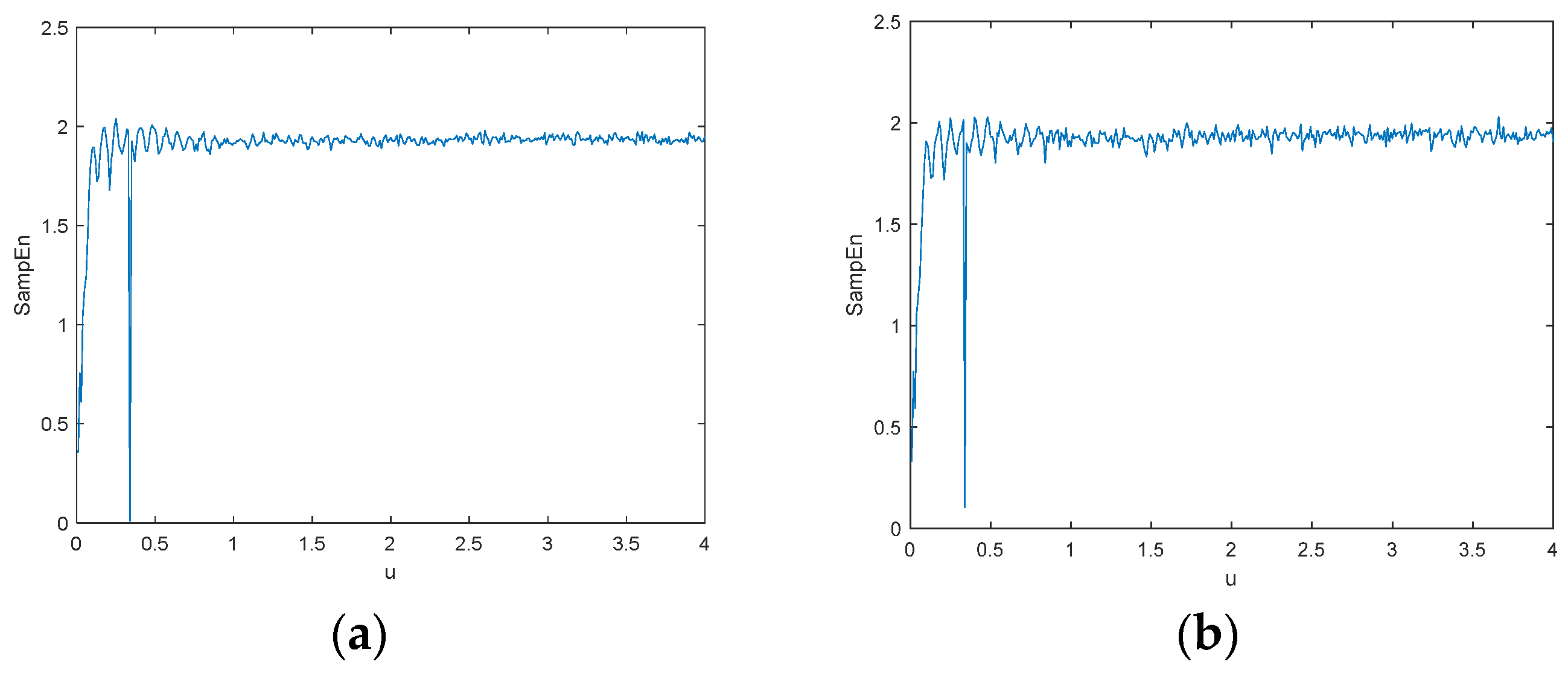
Figure 7 implies the sample entropy of two sequences generated by the 2D-SCLMS map separately. When
u > 0.35, the sample entropy is close to 2, which indicates that the two sequences are chaotic sequences and the 2D-SCLMS map is a complex chaotic system.
3.2.7. Permutation Entropy
A valid way to test the complexity of chaotic sequences is permutation entropy (PE) [
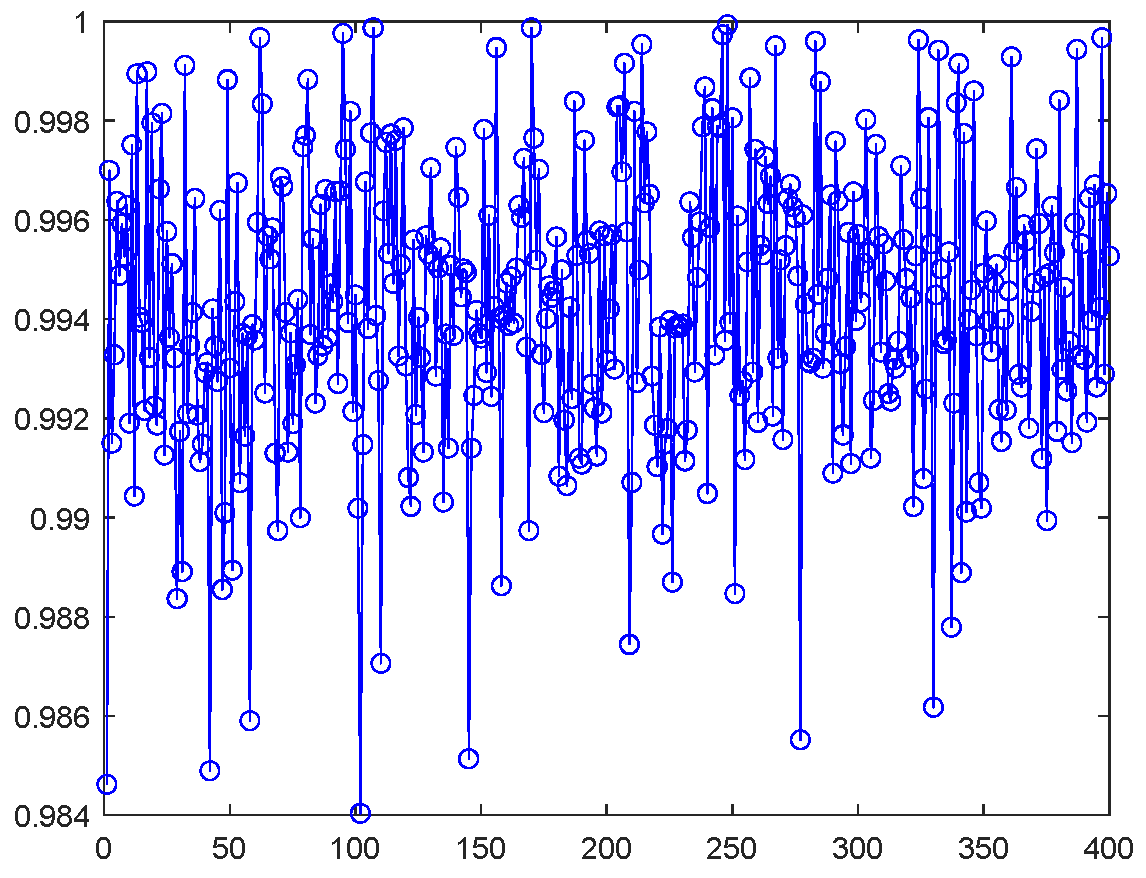
33]. The range of PE is from 0 to 1. A larger PE indicates that the generated chaotic sequence is more complex.
In
Figure 8, the PE value is very close to 1, which explains that the 2D-SCLMS system is a complex chaotic system.
In summary, this paper proposes a hyperchaotic system based on two existing chaotic maps, which has a larger parameter space and better chaotic properties than some existing chaotic maps. Based on this, the hyperchaotic system can be applied to encryption to provide convenience and security for image transmission. Therefore, a new symmetric image encryption algorithm based on this system is proposed in the paper.
4. Pixel Scrambling
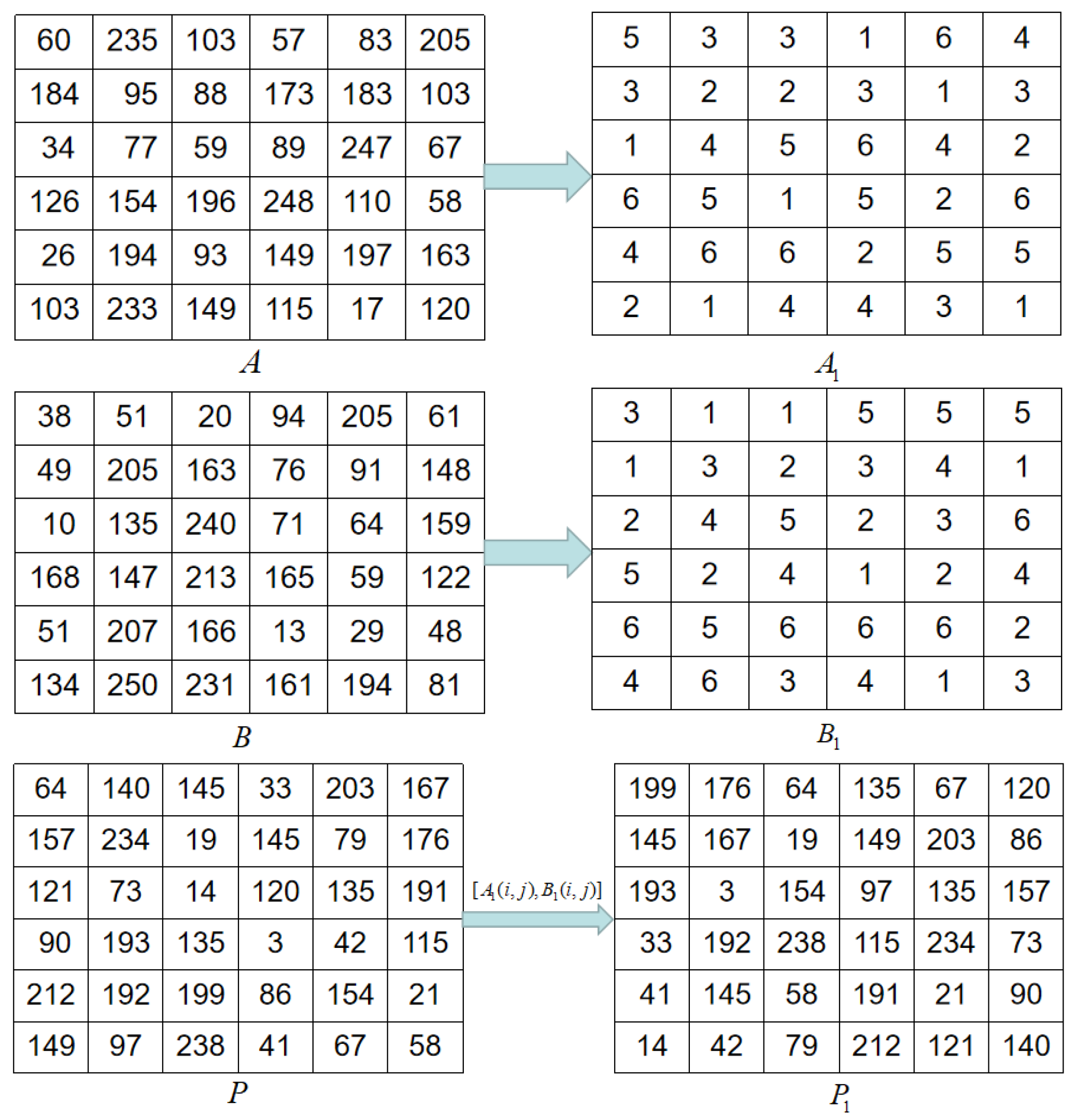
Two matrices
A,
B are arranged in ascending order by columns to produce two position index matrices
A1,
B1. Let
A1 be the row index and
B1 be the column index, combined together to permute the matrix
P. In this section, the 6 × 6 matrix is used as an example and the results are shown in
Figure 9.
5. Image Encryption Algorithm
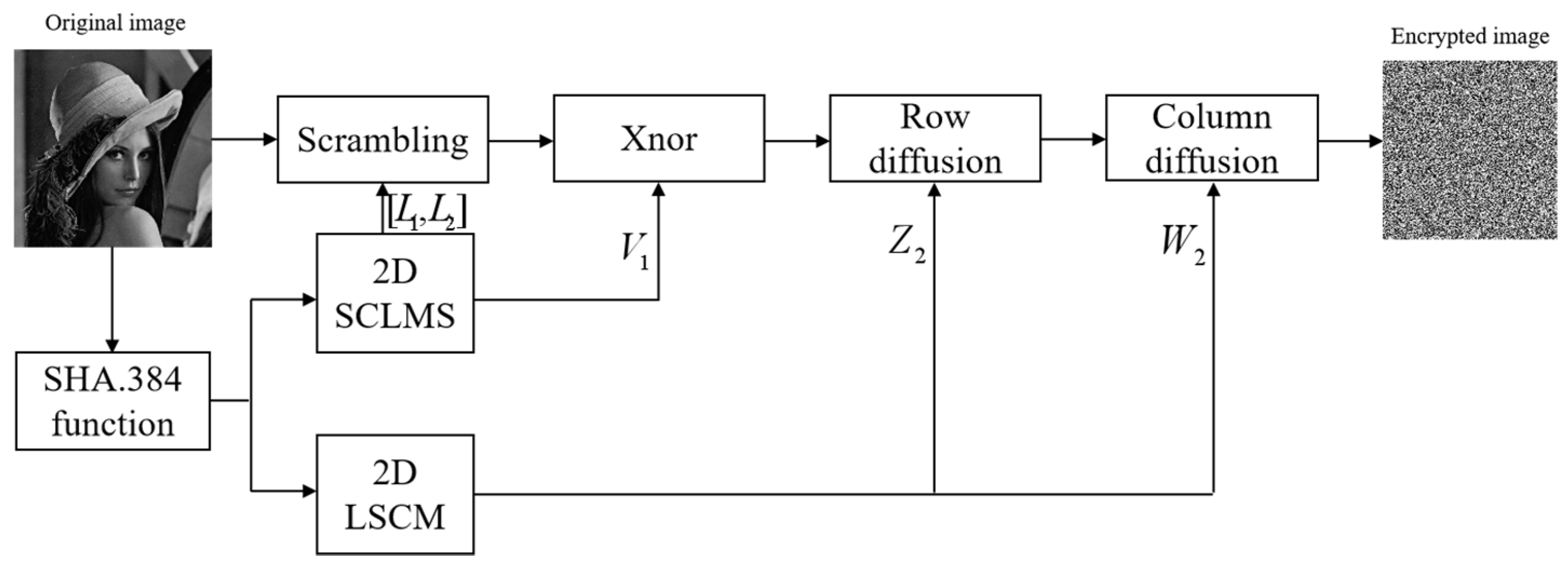
The paper expounds the symmetric encryption scenario based on 2D-LSCM and new 2D-SCLMS system and
Figure 10 is the flowchart. The encryption step mainly includes pixel scrambling, Xnor, and diffusion.
To heighten the safety of the scenario and the relevance of keys to original image. The hash is utilized to create initial parameters of the two systems. The hash 384 algorithm is used to acquire a 384-bit hash value that can be converted into a sequence of 48 binary values
k1,
k2, …,
k48. These values are computed by Equation (28)
where the parameters
x0′,
y0′,
u′,
z0′,
w0′,
α′ are symmetric keys.
- 2.
Pixel scrambling
The initial values (
x0,
y0,
u) are brought into the 2D-SCLMS map for
MN + 500 iterations to generate two chaotic sequences
xn,
yn. The first 500 iterations are discarded in order to eliminate transient effects. First, the two sequences are processed separately to obtain two new sequences
U,
V.
U,
V sequences are converted to matrices
U1,
V1 respectively. The sequence
U1,
V1 are sorted in ascending order by each column to generate two position indexes
L1,
L2. As introduced in
Section 4, let
L1 be the row index and
L2 be the column index, and combine them together to disrupt the original image matrix
P to generate
P1.
- 3.
Xnor
Perform the Xnor operation on matrix
P1 and matrix
V1 to generate matrix
P2.
- 4.
Diffusion of rows
The initial values (
z0,
w0,
α) are brought into the 2D-LSCM for
MN + 500 iterations to generate two chaotic sequences
zn,
wn. The first 500 iterations are discarded in order to eliminate transient effects.
A,
B sequences are converted to matrices
Z2,
W2 respectively.
For the first column of
P2,
P3(
i, 1) is calculated via Equation (32)
For the other column of
P2,
P3(
i,
j) is calculated using Equation (33)
- 5.
Diffusion of columns
For the first row of
P3,
P4(1,
j) is calculated by Equation (34)
For the other column of
P3,
P4(
i,
j) is calculated by Equation (35)
6. Image Decryption
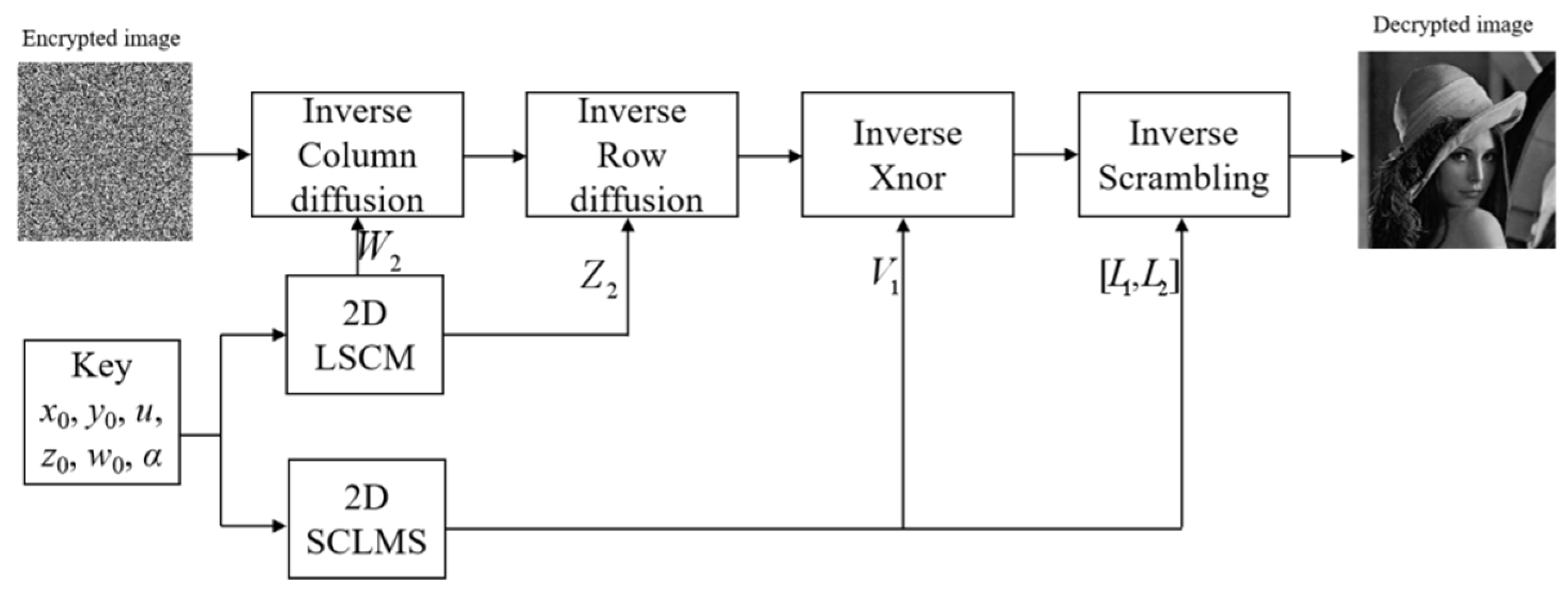
The specific step is described below and drawn in
Figure 11.
The image is obtained by performing the inverse operations of column diffusion, row diffusion, Xnor, and pixel scrambling on the ciphertext image in turn.
7. Experimental Results and Performance Analysis
To confirm the performance of the new symmetric encryption programme, all experiments are conducted on a PC with AMD Ryzen 2.00 GHz CPU, 8 G RAM, and 1 TB hard disk with Window 10 Ultimate system. This experiment is operated by MATLAB R2020a software. The selected images in this paper are all 512 × 512 in size.
7.1. Simulation Results
In this paper, we set the parameters
x0′,
y0′,
z0′,
w0′, and
α′ all to 0 and
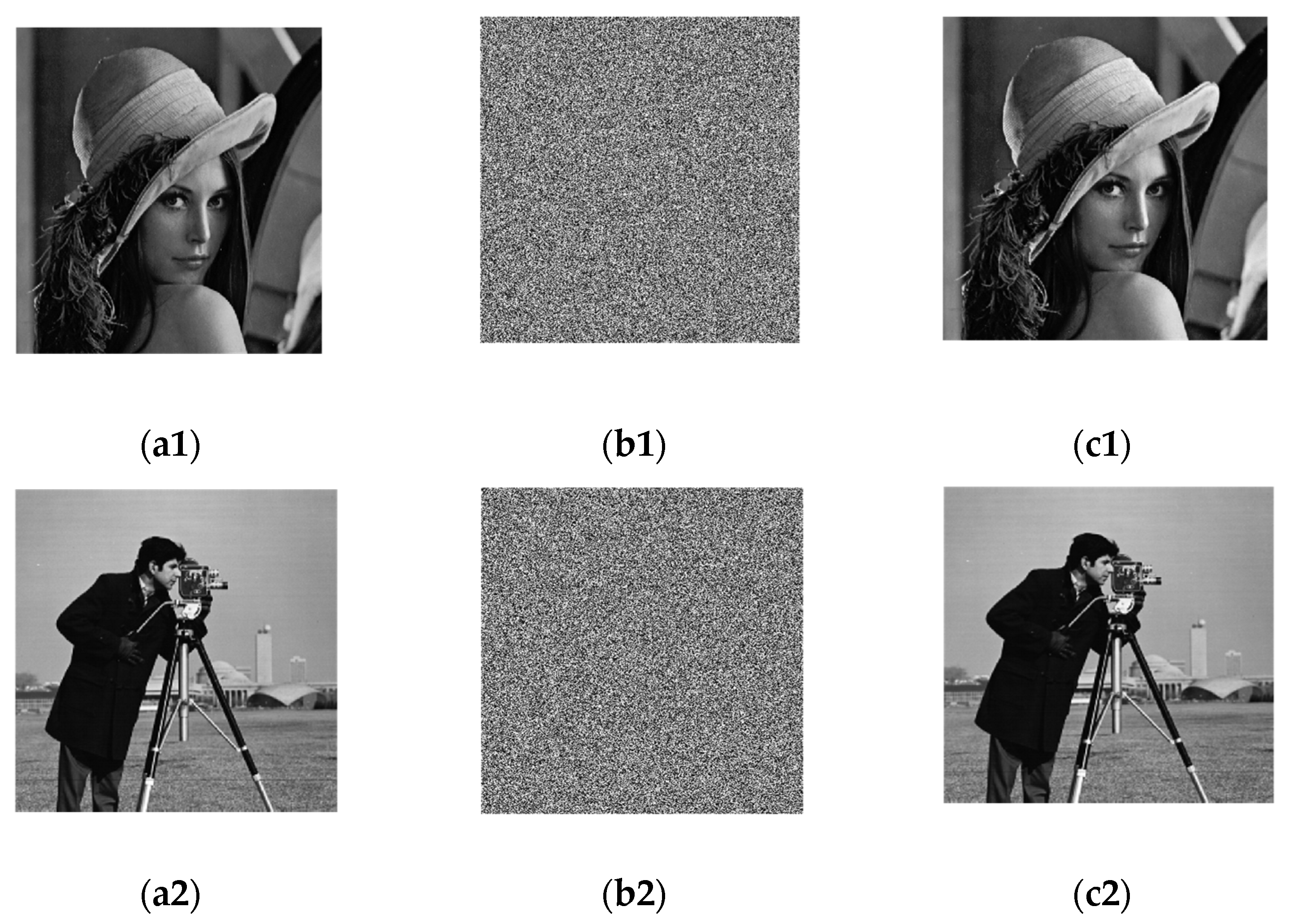
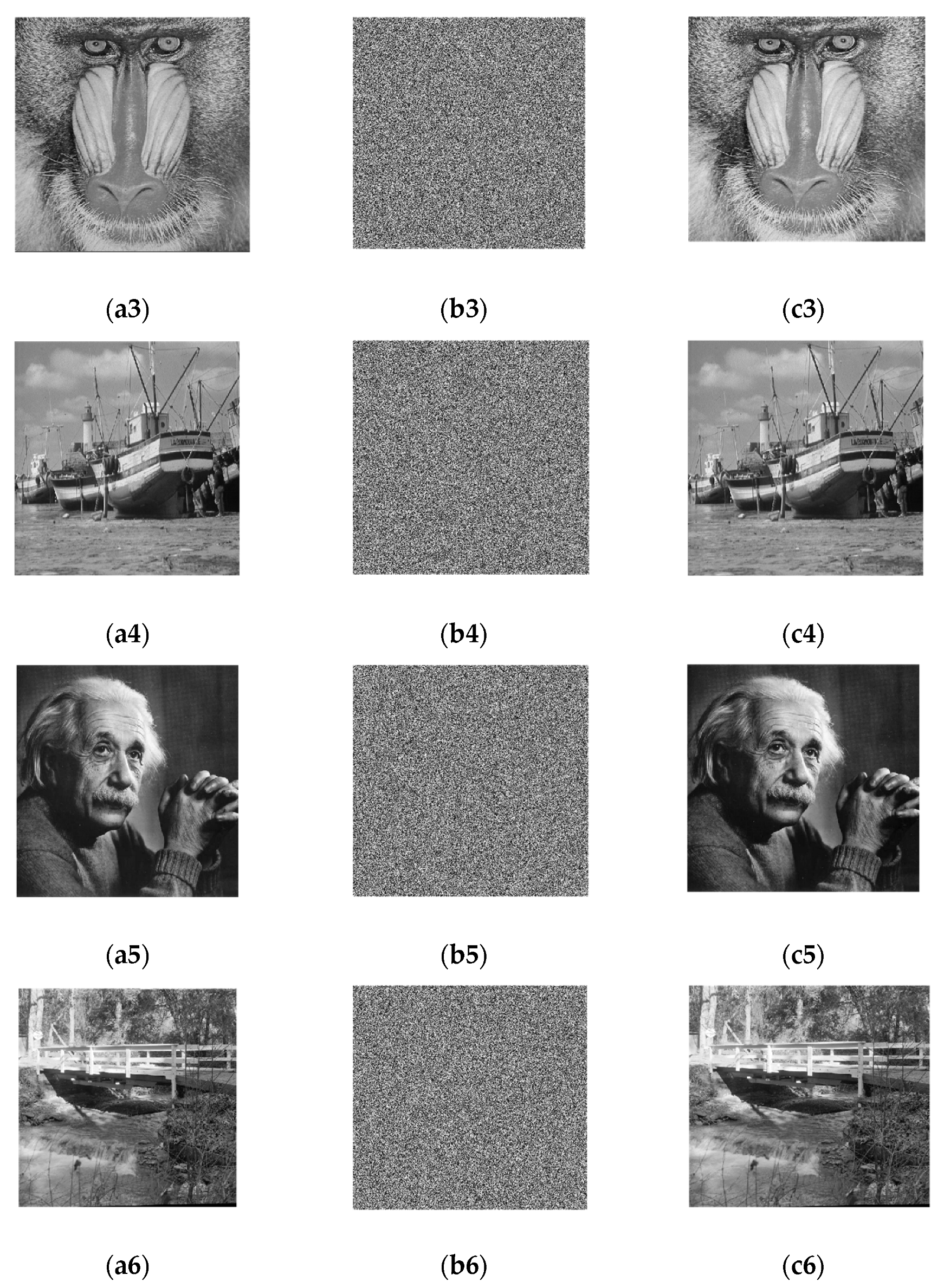
u’ = 1. Six images are selected for testing. In
Figure 12, each column is respectively the original, ciphertext and decrypted image. All the cipher images resemble noise and all of them can be decrypted successfully, which illustrates that the encryption algorithm is extremely secure.
7.2. Running Time (Complexity)
To verify that the new encryption scheme is practical and efficient, we calculated the time for the encryption algorithm and the decryption algorithm in
Table 1.
Table 1 demonstrates that the new encryption algorithm takes less time, which illustrates that the algorithm is practical and efficient.
Table 2 shows the running time comparison between the encryption algorithm proposed in this paper and other encryption algorithms. It can be seen from
Table 2 that the scheme proposed in this paper has an acceptable speed.
7.3. Information Entropy (IE)
Shannon proposed the entropy criterion in [
43]. It is an indispensable tool [
44] for testing the randomness of images before and after encryption. The expression of information entropy [
45] is
In Equation (36), p(si) is the probability of si. Theoretically, the ideal value of IE is 8.
We test the IE of the new encryption scenario and compare it with other encryption algorithms on “Boat” image. For the IE,
Table 3 demonstrates that the original image is around 7, while the encrypted image is almost nearly 8.
Table 4 demonstrates that our scheme has the largest entropy value, which explains that the ciphertext image has better randomness.
7.4. Key Space Analysis
An excellent encryption scenario with a key space greater than 2
100 is considered sufficient to oppose the most usual violent attack [
46]. Then, the key of this scenario consists of a 384-bit hash values and initial keys
x0′,
y0′,
u′,
z0′,
w0′,
α′. Suppose the calculation accuracy is 10
−14, the key space of this algorithm is 10
14×6 = 10
84. In addition to that, we have the 384-bit stream generated by SHA-384, so the entire key space is resistant to violent attack.
7.5. Key Sensitivity Analysis
A slight change of key causes the decrypted image to be completely different. We encrypt the “Boat” using the correct key. After that, any one of these keys is changed slightly.
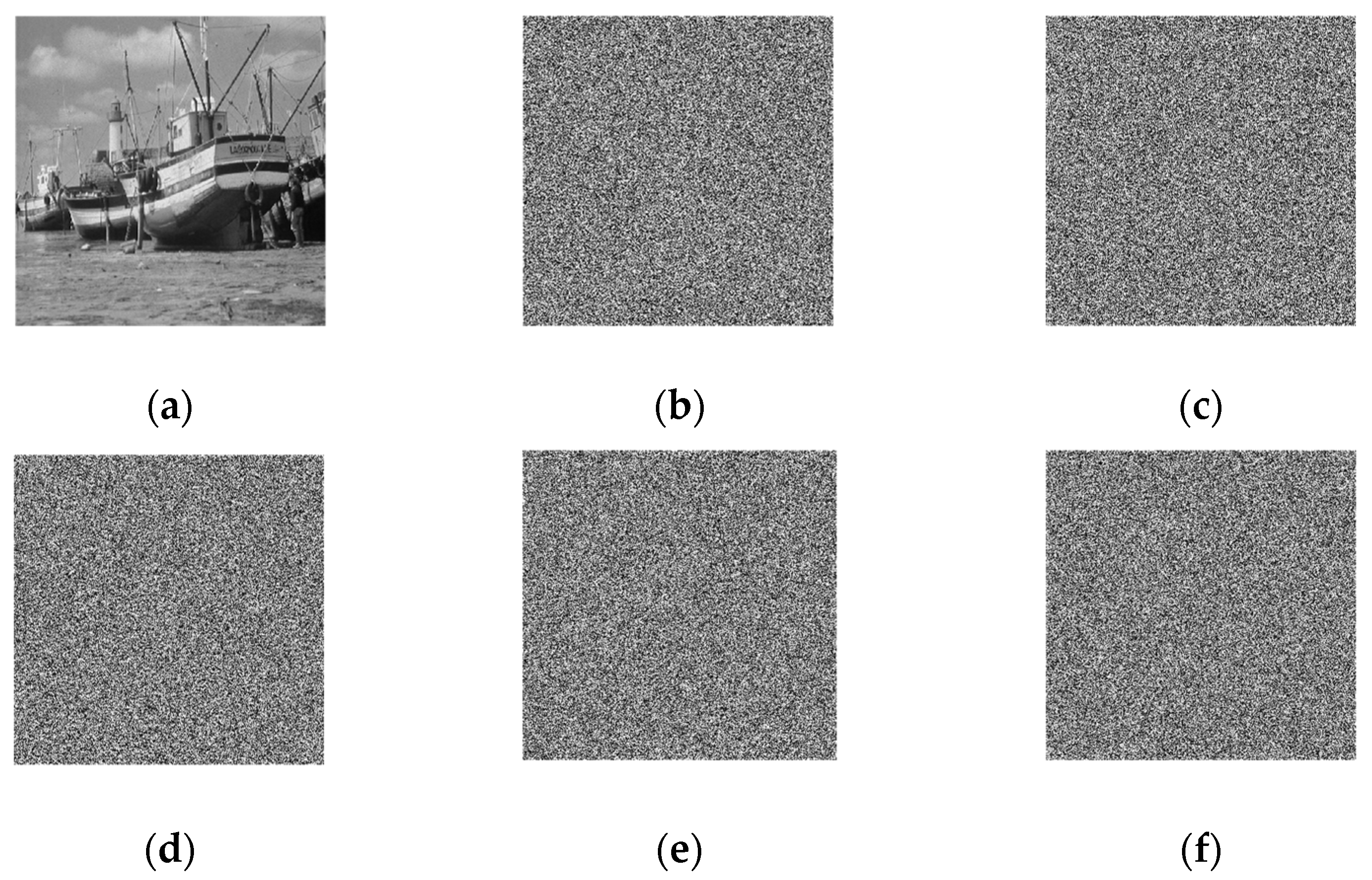
Figure 13 displays the images under different key decryption. When keys change very little, the decrypted images resemble noise, which indicates that this scenario is extremely sensitive to all keys.
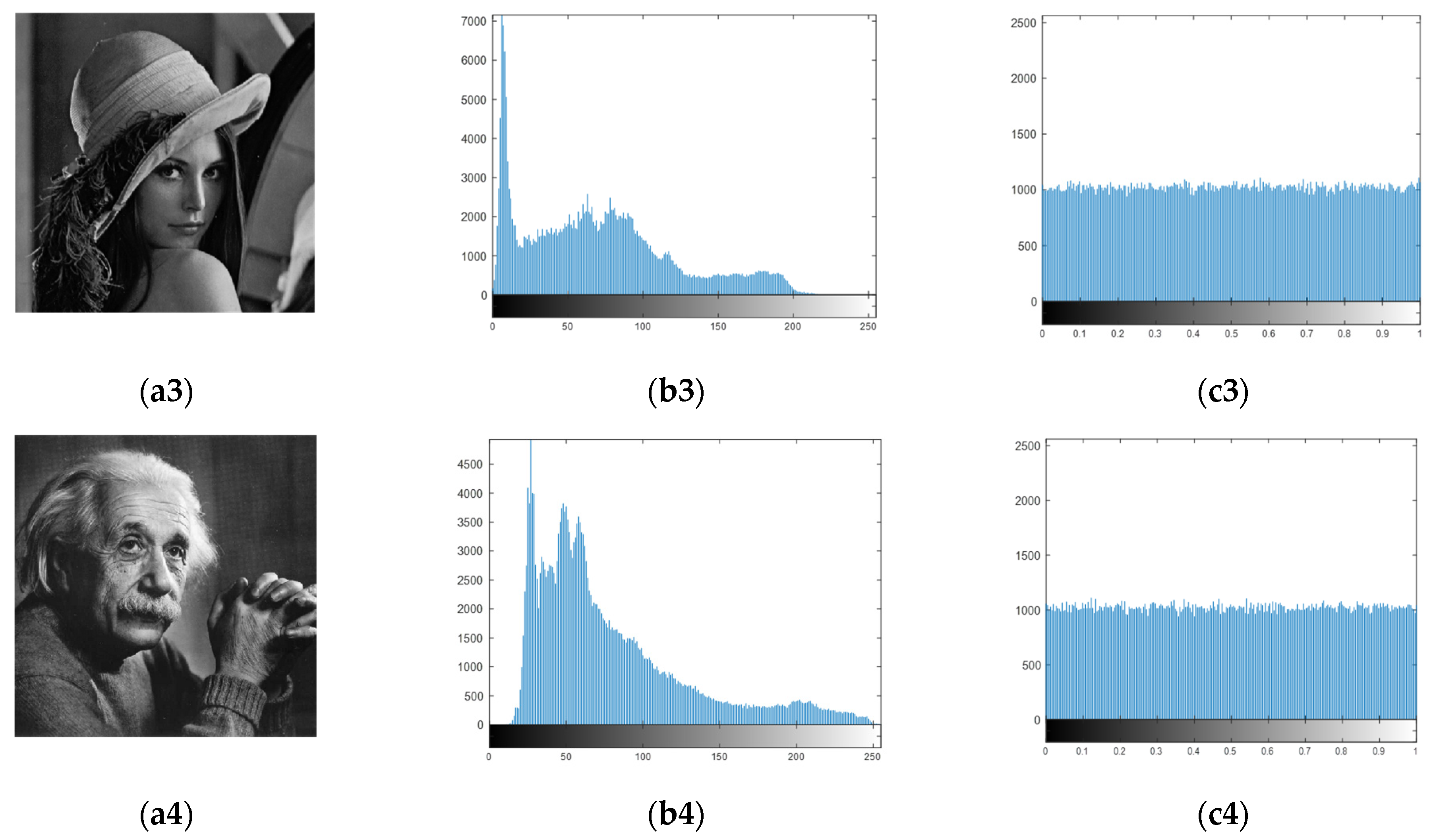
7.6. Histogram Analysis
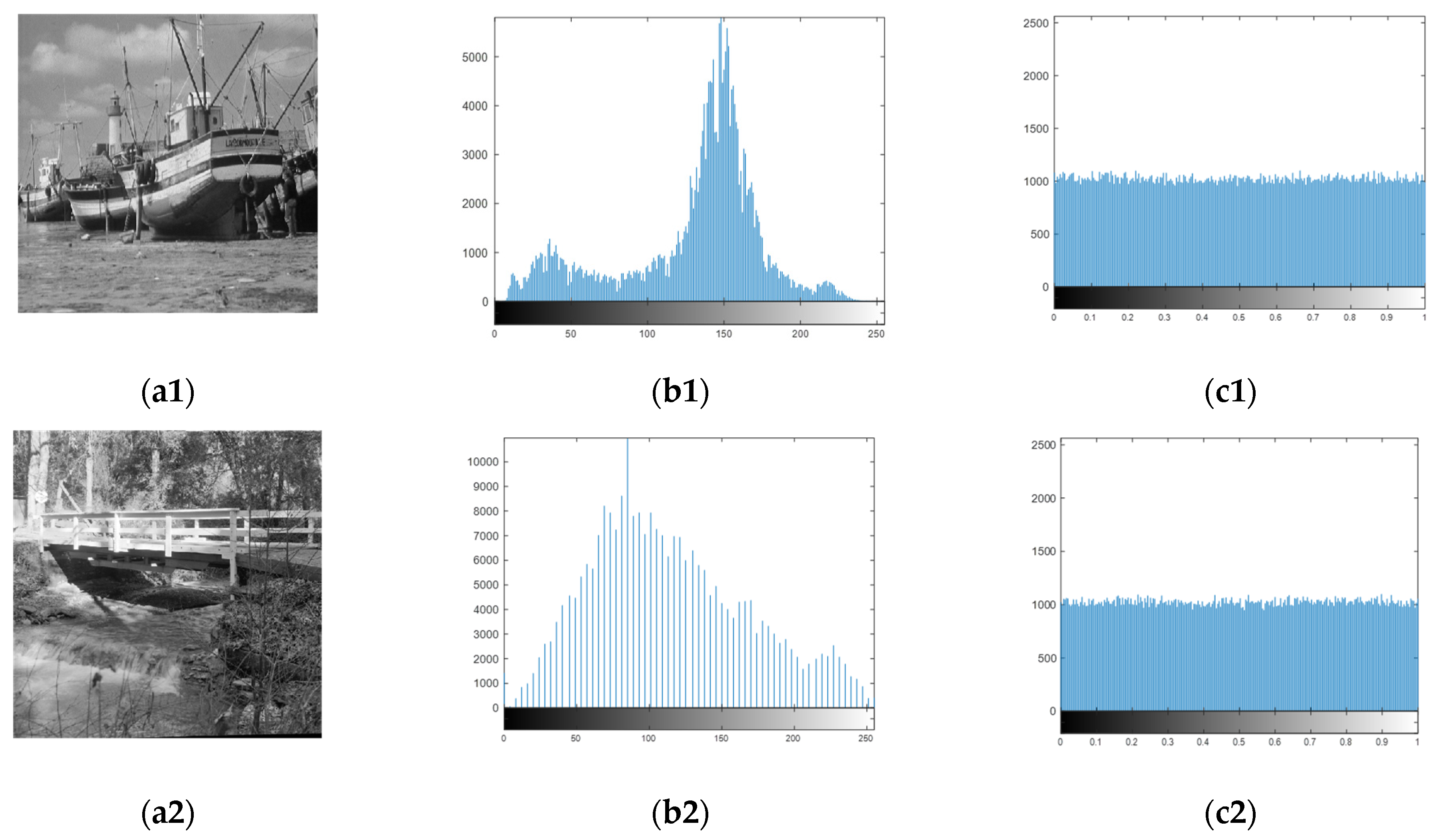
Normally, the histogram is nearly flat to resist statistical attacks. Obviously, the histogram of ciphertext images tends to be uniformly distributed in
Figure 14, which indicates that this scenario is resistant to statistical attacks.
7.7. Chi-Square Analysis
This paper utilizes a quantitative way to calculate the resistance of encryption scenario to statistical attacks, i.e., the chi-square test [
47], whose expression is Equation (37).
where
υi is frequency occupied by grayscale value
i.
υ0 =
MN/256.
Table 5 shows the chi-square calculation results, where the first and second rows show the chi-square results of the encrypted and plain images, respectively. The chi-square of all encrypted images is less than 293.25 [
34], which indicates that the encryption scheme is sufficient to defend against statistical attacks.
7.8. Correlation Analysis
The meaning of encryption is to decrease the correlation, which is expressed in Equations (38)–(41). This section arbitrarily selects 10,000 pairs of adjacent pixels
x,
y from the plain and encrypted images and calculates them in horizontal, vertical, and diagonal directions.
Table 6 lists the correlation coefficients of multiple images.
Table 7 compares the correlation coefficients of different encryption algorithms for the “Boat” image.
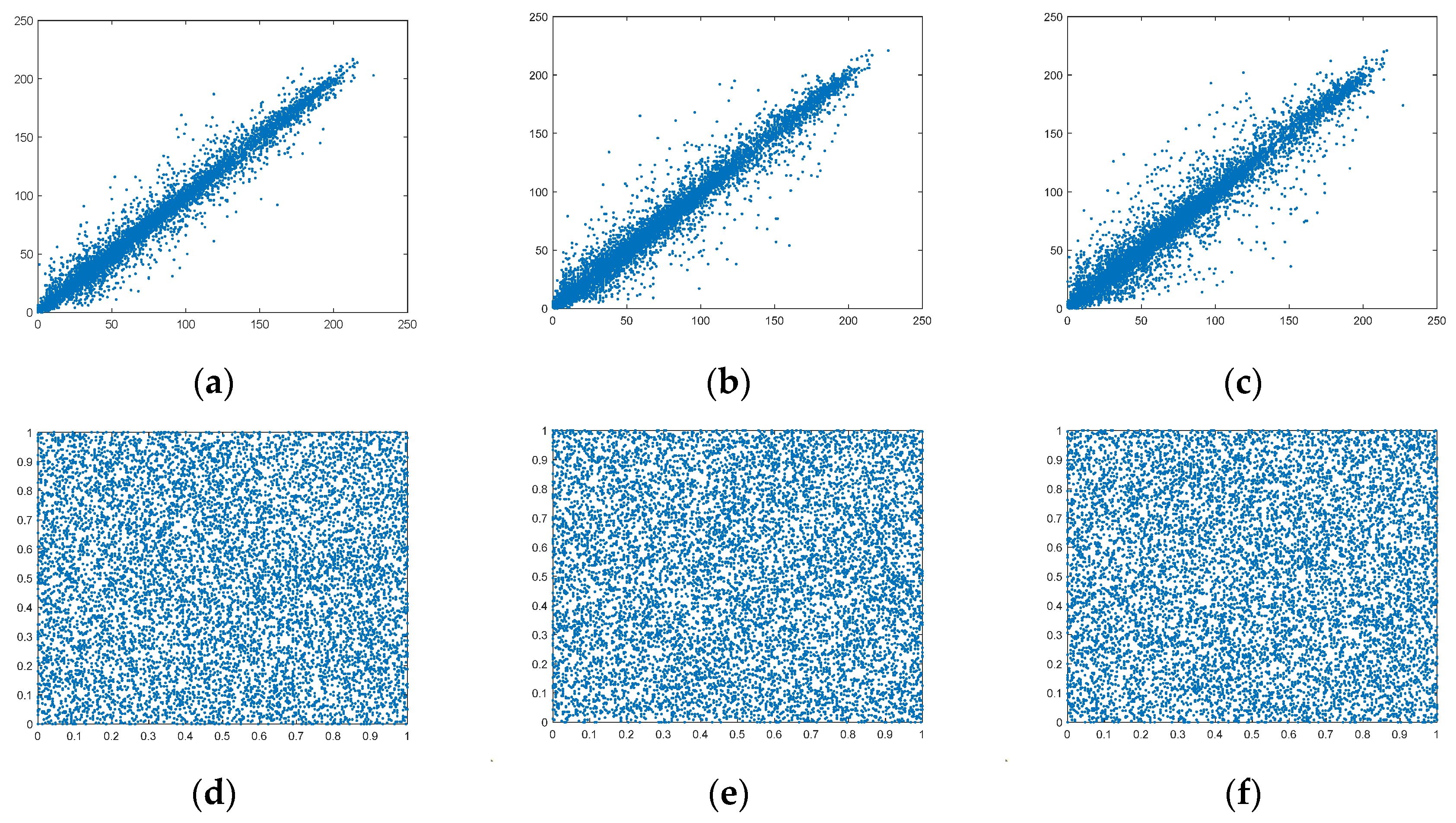
Figure 15 reveals the correlation of the plain and ciphertext images of “Lena”. The correlation of the plain image is diagonal in all directions, i.e., the correlation of the original image is very high. The correlation of the ciphertext image is scattered throughout the image, that is, the correlation of the ciphertext image is vastly abated, which demonstrates that the encryption scenario is very good.
7.9. Differential Attack Analysis
The value of pixel change rate (NPCR) [
48,
49] and the unified average change intensity (UACI) [
50] are utilized to determine the ability of the new scheme against differential attacks, which are given by
The ideal NPCR and UACI values are respectively 0.996094 and 0.334635 for 256 gray level images [
51,
52].
Table 8 lists the NPCR and UACI values of the new scenario for several images and they are both approach desired value. The UACI of the new scenario is closer to 33.4635% than other algorithms in
Table 9. Thus, this scenario is forceful against differential attacks.
7.10. Local Shannon Entropy
The local Shannon entropy can better express the randomness of the local image and can overcome some drawbacks of the global Shannon entropy. For each image
P, arbitrarily choose
k non-overlapping sub-images
Si,
i = 1, 2, …,
k.
TB pixels are arbitrarily chosen for every sub-image. The local Shannon information entropy is calculated as follows:
In Equation (44),
H(
Si) shows the IE of sub-image
Si. We set
k = 30,
TB = 7936 in this paper. When the confidence interval is 0.05, the local Shannon entropy is in the interval of [7.901901305, 7.903373329] [
34].
Table 10 lists the local Shannon entropy of multiple images whose results pass the experiment, i.e., the randomness of the local image is good.
7.11. Cropping Attack
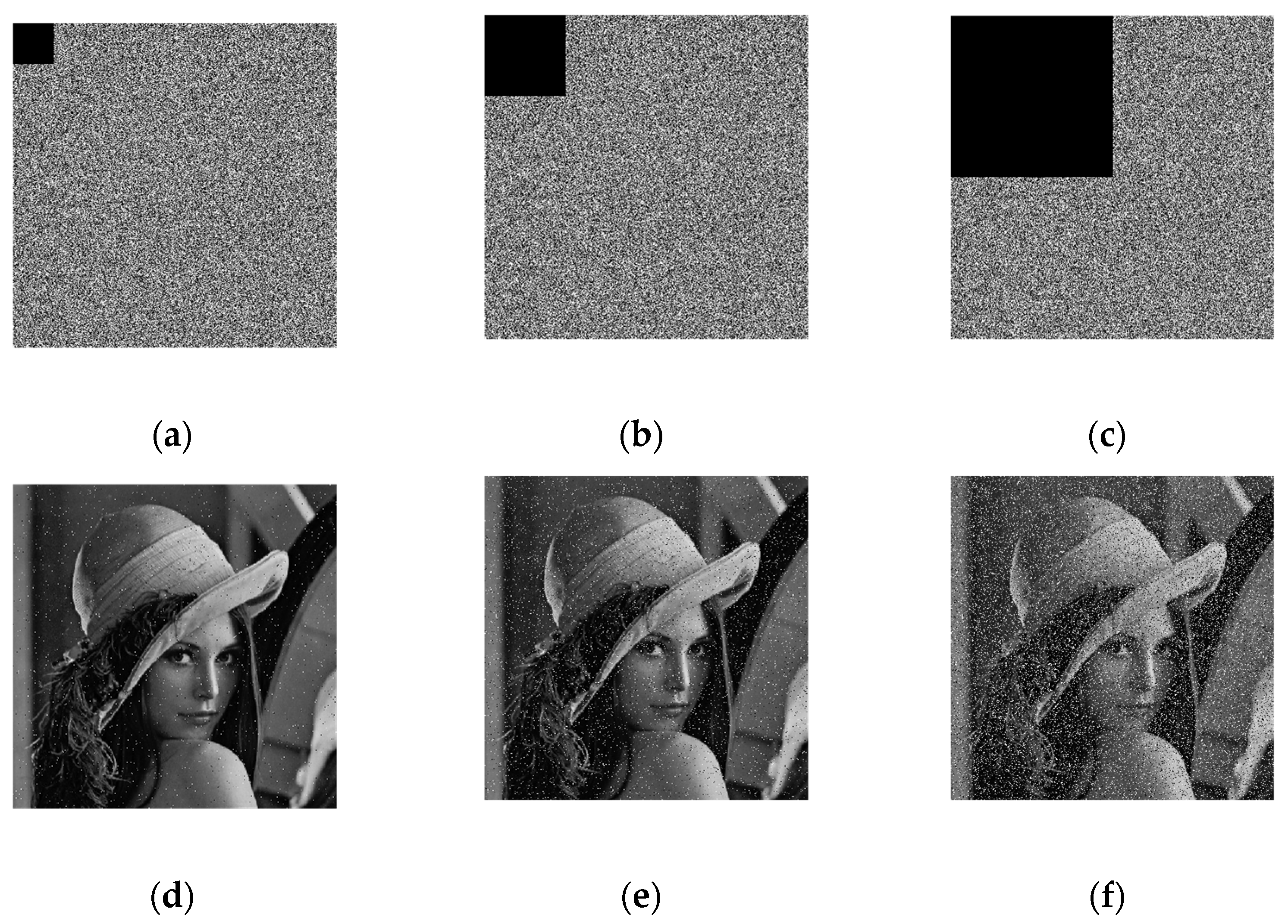
Remove some pixels from the encrypted image and see if it can be decrypted is the cropping attack. In this section, we test “Lena”.
Figure 16 presents the decrypted images after cutting 1/64, 1/16 and 1/4, respectively. Even if 1/4 of the data is cut off, the decrypted image still displays information from the original image, which illustrates that this scheme is highly resistant to clipping attack.
7.12. Noise Attack
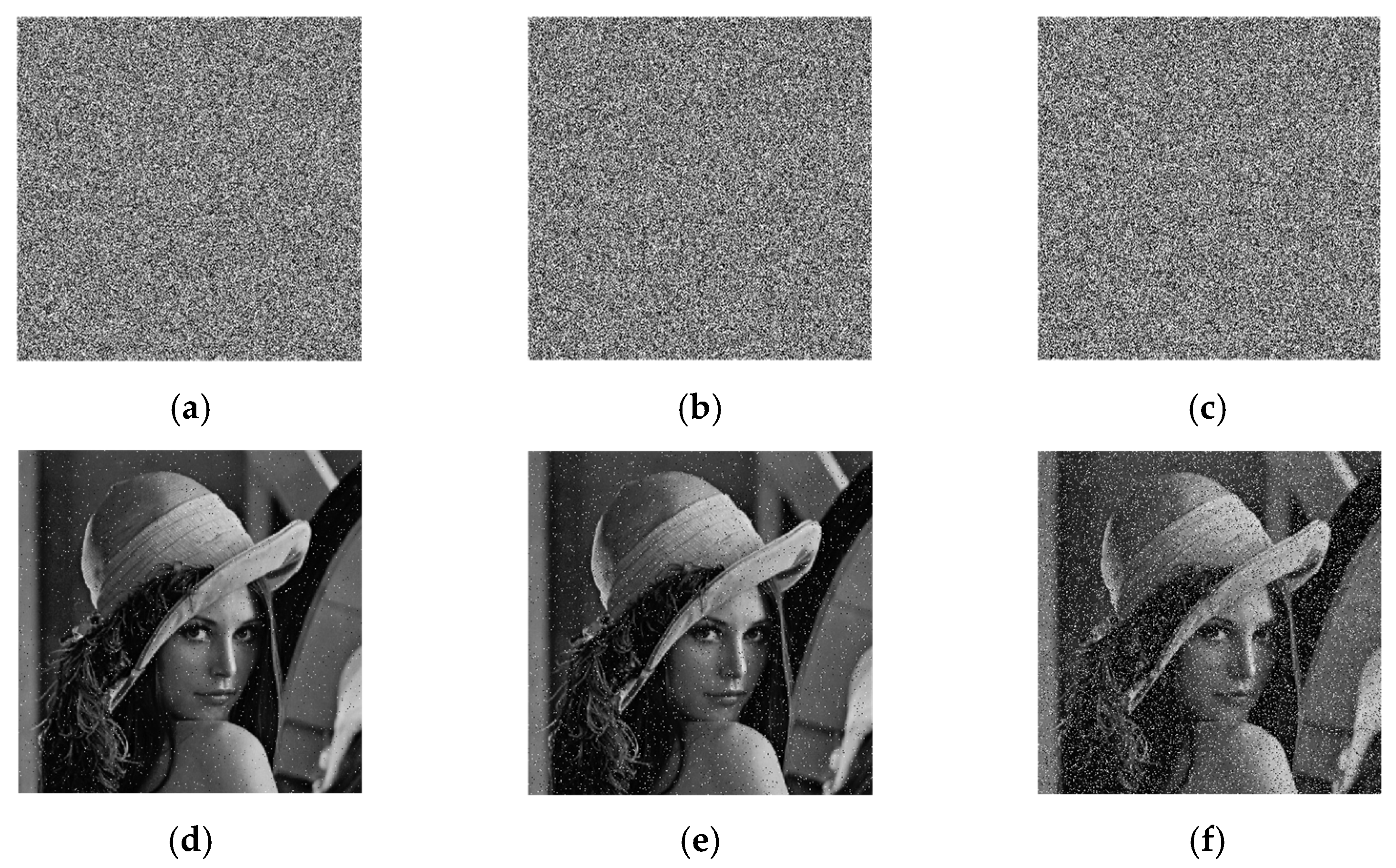
Inevitably, images are affected during transmission by noise that causes data loss. We take the noise of pepper and salt as an example to show the robustness of the proposed encryption algorithm, whose noise strengths are 0.005, 0.01, and 0.05, respectively. Even with the addition of 0.05 noise, the decrypted image still displays information from the original image in
Figure 17, which indicates that this scheme is highly resistant to noise attacks.
8. Color Image Encryption
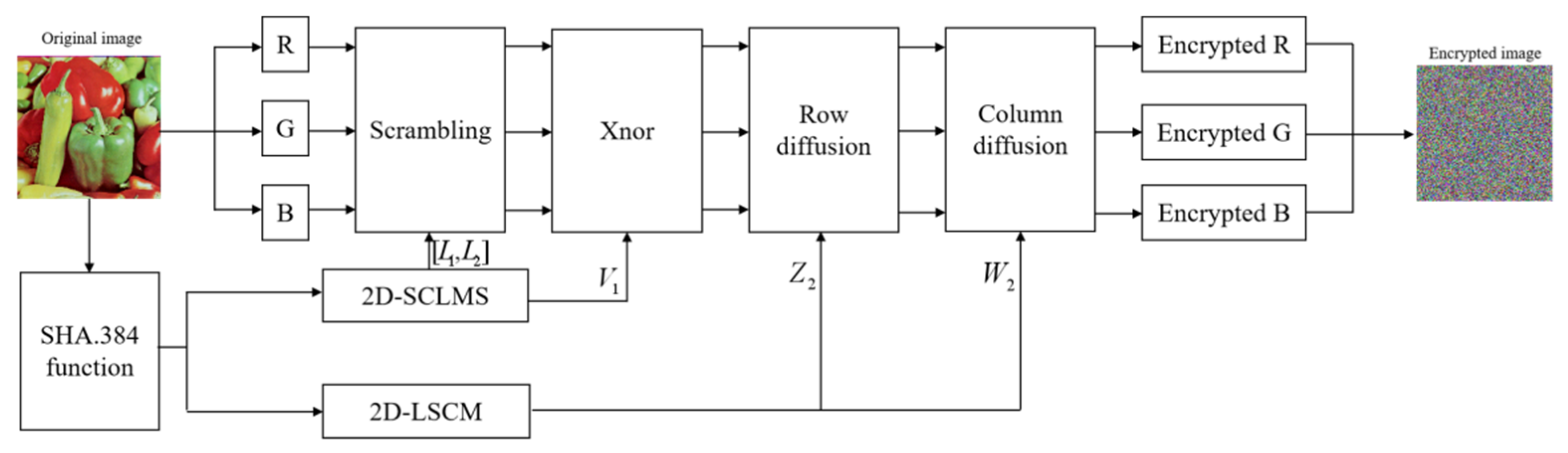
The encryption algorithm proposed in this paper can be used not only for grayscale images, but also for color images. The flowchart of color image encryption is given in
Figure 18. Unlike grayscale images, color images are divided into three channels, R, G, and B. Each channel is encrypted separately and finally combined to obtain the cipher image.
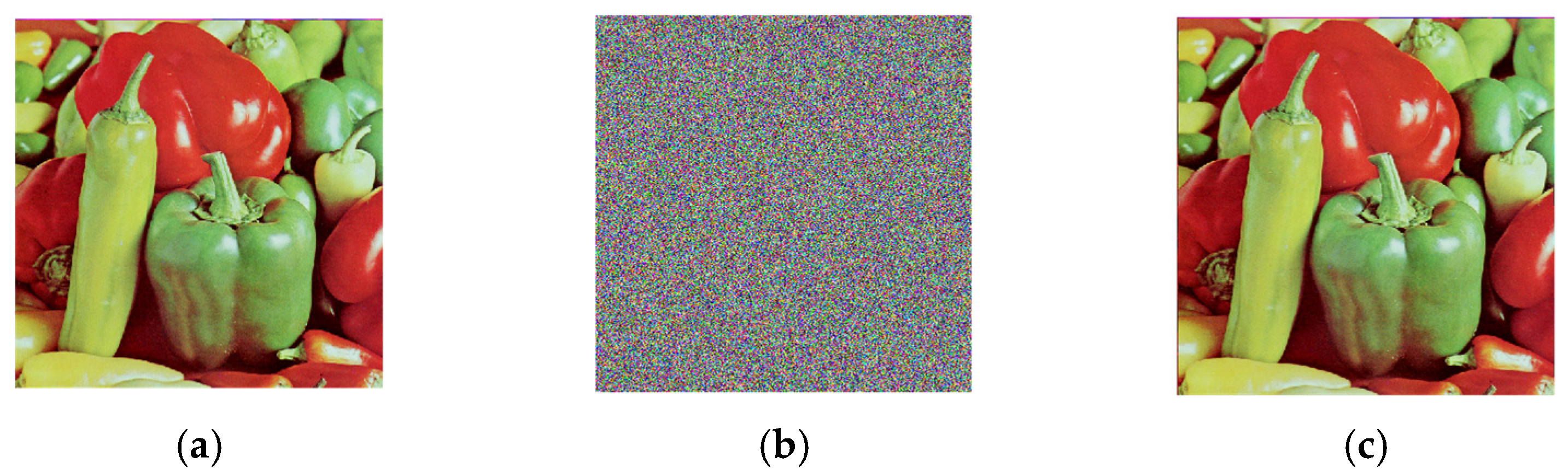
We take the “Peppers” image as an example. The original image, cipher image, and decrypted image are shown in
Figure 19. From the figure, we can see that the cipher image is similar to noise, and no information from the original image is obtained. This indicates that the encryption algorithm proposed in this paper works well and is applicable to color images.
When the color image is divided into three channels, R, G, and B, the encryption of each channel is the same as that of the gray image. Therefore, the security tests are not re-demonstrated in detail.
9. Application Areas of Encryption Algorithms
The high efficiency and securer performance of the proposed symmetric encryption algorithm make it possible to apply in many military, commercial, and even daily-use fields. Herein, we itemize several typical applications.
Image data in e-mails are usually transmitted over non-secure channels, such as the Internet. The widespread use of the Internet has also made encrypting e-mail with sensitive information a very important application in recent years.
- 2.
Electronic money
Electronic money, as a new means of financial transactions, must make the transactions authenticated but untraceable. Transactions must be authenticated so that both parties involved in the transaction are not deceived. Transactions must be untraceable so that each party’s privacy is protected. In practice, however, if there is no special protocol to support collaboratively, these requirements are difficult to achieve.
- 3.
Authentication server
The authentication server solves the security problem between two communities at different endpoints in the network. Two groups must be able to exchange keys, and at the same time must ensure that they are talking to the correct counterparty, not an imposter. The authentication server implements these functions through various protocols that rely on encryption mechanisms.
- 4.
Smart card
A smart card contains a microcomputer as well as a small amount of storage space. In general, smart cards are mostly used on various forms of credit. Other types of smart cards are used for access to computers or building access control, etc. Smart cards use encryption technology because it allows certain important operations to be performed, such as modifying bank accounts and accessing secure environments.
- 5.
Internet of Things
In the Internet of Things, the use of smart mobile devices to transfer images in large amounts of data has become increasingly common, such as photos of criminal suspects, medical photos of patients, military photos, etc. The image data captured by some end devices or IoT nodes is related to the private information of users. To protect these image data, image encryption schemes provide a convenient and secure method for the confidentiality of image conversion and storage in IoT systems.
10. Conclusions
The paper mainly introduces a new 2D-SCLMS map based on Logistic and Sine maps. A series of tests, such as Lyapunov exponent, 0–1 test, two complexity analysis methods, and two entropy analysis methods, are used to conclude that the 2D-SCLMS map is hyperchaotic with a broader chaotic range and better randomness. This paper further designs a symmetric image encryption algorithm using 2D-SCLMS map and 2D-LSCM. The encryption algorithm is used under the permutation-diffusion framework which combines pixel scrambling, Xnor, and diffusion. In addition, it uses the hash to create the initial parameters of two systems, which greatly improves the resistance to known plaintext and chosen plaintext attacks. Finally, the simulation experiments of time complexity, key space and sensitivity, information entropy and local Shannon entropy and correlation coefficient demonstrate the large key space, high security, and low time complexity of the new encryption scheme.
Among them, the information entropy of encrypted images using the proposed encryption algorithm can reach 7.9994 at best, which is very close to 8 and better than other related algorithms. The correlation coefficient of the cipher image can even reach −0.00003, which is far smaller than the correlation coefficients obtained using other encryption algorithms. Besides, various attacks, e.g., differential, cropping, and noise attacks, are also analyzed and the conclusions illustrate that this algorithm is also resistant to various attacks. Finally, the value of UACI can reach 33.4651%, which is very small from the standard value and can still recover the original image well when a quarter of the image is cropped off.
In the future, we intend to focus on the verification of the hyperchaotic systems from the perspective of theoretical analysis. Moreover, we remain interested in the practical combination of the proposed image encryption schemes with Internet of Things applications to effectively protect the security of images during the transmission of Internet of Things.