Abstract
Ecological security is fundamental to human survival and sustainable development. However, current assessment frameworks often lack regional adaptability. They also frequently overlook the security risks associated with landscape patterns. To address these gaps, this study establishes a “structure–process–function” framework that integrates potential ecological risks. Using Heilongjiang Province as a case study, we assessed the spatiotemporal evolution of its ecological security pattern. The results indicate that: (1) The average ecological security pattern index (ESPI) values for Heilongjiang in 2000, 2010, and 2020 were 0.6869, 0.6573, and 0.6752, respectively. This trend exhibits an initial decline followed by partial recovery, with unsafe areas distributed sporadically. (2) The spatial pattern remained relatively stable but showed significant regional heterogeneity. Yichun City achieved the highest security level, while insecure areas were primarily concentrated in Daqing City. (3) Regarding specific dimensions, habitat fragmentation (structural security) was prevalent in central agricultural and urban areas; soil erosion (process security) remained significant in the southeastern regions, despite overall stability; and ecosystem services (functional security) followed a “degradation–adjustment–recovery” trend from 2000 to 2020. This framework effectively achieves the coupled assessment of landscape patterns and ecological security, providing scientific support for regional ecological management.
1. Introduction
In recent years, the world has experienced rapid urbanization [1]. Accelerated socioeconomic development and mounting anthropogenic pressures have precipitated a series of ecological and environmental issues, such as soil erosion, environmental pollution, and biodiversity loss [2,3,4]. These challenges undermine the health and resilience of ecosystems, posing severe threats to socioeconomic development and human survival [5,6,7]. Against this backdrop, the concept of ecological security was first proposed by the International Institute for Applied Systems Analysis (IIASA) in 1989 [8]. Ecological security refers to the capacity of an ecosystem to maintain a stable structure and intact functions, thereby sustaining ecosystem services for human survival and socioeconomic development while safeguarding the human living environment from external threats [9,10]. With increasing global attention, ecological security has emerged as an important issue facing humanity in the 21st century [11,12], and has become a focal point of research in disciplines including geography, ecology, and environmental science [13]. In China, ecological security has been elevated to an integral component of national security [14,15]. Actively promoting the construction of ecological civilization and optimizing the ecological security barrier system have become critical national strategies [16,17]. Recently introduced policies, including the Ecological Conservation Redline and the National Territorial Spatial Planning (2016–2030), explicitly require the precise identification of ecological risks and the optimization of protection patterns. Consequently, ensuring ecological security has become a fundamental prerequisite for meeting these strategic requirements.
Ecological security assessment serves as the foundation of ecological security research [18]. Its objective is to employ scientific and systematic methods to quantitatively analyze the security status of ecosystems, thereby providing a basis for ecological management and policy formulation [19,20]. The key step of ecological security assessment is to construct scientific evaluation standards and an index system. The earliest applied model was the pressure-state-response (PSR) framework, developed by the OECD (Organization for Economic Co-operation and Development) in 1993 [21]. This model effectively reflects the relationship between humans and the ecological environment and has been widely applied [22]. Subsequently, numerous derivative models were developed, such as DPSIR (driver–pressure–state–impact–response), DSR (driver–state–response), and DPSER (driver–pressure–state–exposure–response) [20]. Another prevalent approach involves ecological models, primarily the ecological footprint method [23], which assesses the balance between human demand and ecological carrying capacity by measuring the utilization of natural resources and products [24,25].
To safeguard ecological security, China has implemented a series of initiatives, such as the National Periodic Remote Sensing Survey and Assessment of Ecological Status and the Measures for Regional Ecological Quality Evaluation (Trial), both of which prioritize the assessment of ecological patterns. As the physical carrier of ecological processes, landscape patterns not only determine the structural integrity of ecosystems but also maintain critical ecosystem services such as soil conservation and climate regulation [26,27]. Consequently, accurate pattern assessment is a prerequisite for optimizing spatial configuration and enhancing ecosystem functions. Prevalent assessment methodologies largely rely on landscape indices, which describe landscape patterns to elucidate the link between structure and process, thereby enhancing the understanding of landscape functions [28,29]. For instance, Hu et al. evaluated the ecological pattern of Henan Province using the PSR framework and landscape indices [30]. Other studies employ the remote sensing ecological index (RSEI) for rapid ecological monitoring [31]. This index integrates four indicators essential to human survival: greenness, wetness, dryness, and heat [32]. For example, Li et al. utilized RSEI to evaluate wetland ecological patterns [33]. Currently, morphological spatial pattern analysis (MSPA) is widely adopted. Based on mathematical morphology theory [34], MSPA categorizes landscape patterns into seven classes based on local context: core, islet, edge, perforation, bridge, loop, and branch [35,36]. This method quantifies the morphology, structure, and spatial configuration of geographic landscapes, facilitating a better understanding of ecosystem composition and function [37], and focusing on structural characterization [38].
Ecological security pattern (ESP) refer to potential spatial configurations within a landscape, comprising critical strategic points and specific spatial relationships, which play a pivotal role in safeguarding and controlling essential ecological processes [39,40]. They have become an important planning tool for maintaining ecological security and promoting sustainable development [41]. Currently, research on ESPs predominantly focuses on pattern construction and optimization, establishing a widely accepted paradigm of “source identification–resistance surface construction–corridor extraction” [42,43]. Source identification constitutes the core component of this paradigm and generally falls into two categories: direct designation and evaluation-based identification. Early approaches favored direct designation, selecting areas with superior natural environments—such as nature reserves, forest parks, and stable vegetation patches with high coverage [44]. Subsequently, methodologies evolved toward extracting high-quality patches via comprehensive evaluation index systems, incorporating multidimensional definitions of ecological security such as ecosystem services, health, and sensitivity. For instance, Zhong et al. [45] determined ecological sources based on a combined assessment of ecosystem services and ecological health, while Li et al. [13] developed an importance–sensitivity–connectivity framework for source identification.
Despite these methodological advancements, several critical deficiencies persist in current research. First, in the research of ecological security assessment, indicator selection often lacks consistency. Scholars frequently disagree on interpretation and selection logic. Furthermore, the scientific suitability of specific indicators is often overlooked, leading to mechanical application or misuse in practice [46]. Additionally, methods like the ecological footprint tend to oversimplify complex ecosystem characteristics [47]. These approaches often fail to integrate specific regional conditions, which limits their practical value for local management. Second, existing landscape pattern analyses prioritize morphological description [38]. They often overlook the intrinsic security implications, such as the capacity to resist disturbances and sustain key ecological processes. Consequently, static assessment outcomes frequently fail to reflect actual dynamic risks. Third, research on ecological security patterns (ESP) tends to “prioritize construction over evaluation”. There is often no systematic framework to validate the quality of the constructed patterns. This absence limits both the scientific rigor and the practical effectiveness of ESP construction.
To address these gaps, this study proposes a novel assessment framework. This framework explicitly integrates potential regional ecological risks into a “structure–process–function” dimension. We applied this framework to Heilongjiang Province. Based on local ecological characteristics, we selected three targeted risk indicators: habitat fragmentation (Structure), soil erosion (Process), and ecosystem service degradation (Function). This approach addresses common deficiencies in the literature, particularly the lack of regional adaptability and risk orientation. Specifically, this research focuses on two goals: (1) to develop a regionally specific ecological security pattern assessment framework that incorporates risk elements; and (2) to evaluate and validate the security of landscape patterns in Heilongjiang Province, subsequently analyzing their spatiotemporal trends. Ultimately, this study aim to deepen the understanding of the pattern–security coupling mechanism. It provides a novel theoretical perspective for ecological security evaluation systems. Furthermore, it offers a robust scientific basis for the ecological security and sustainable management in Heilongjiang Province.
2. Materials and Methods
2.1. Research Area and Data Sources
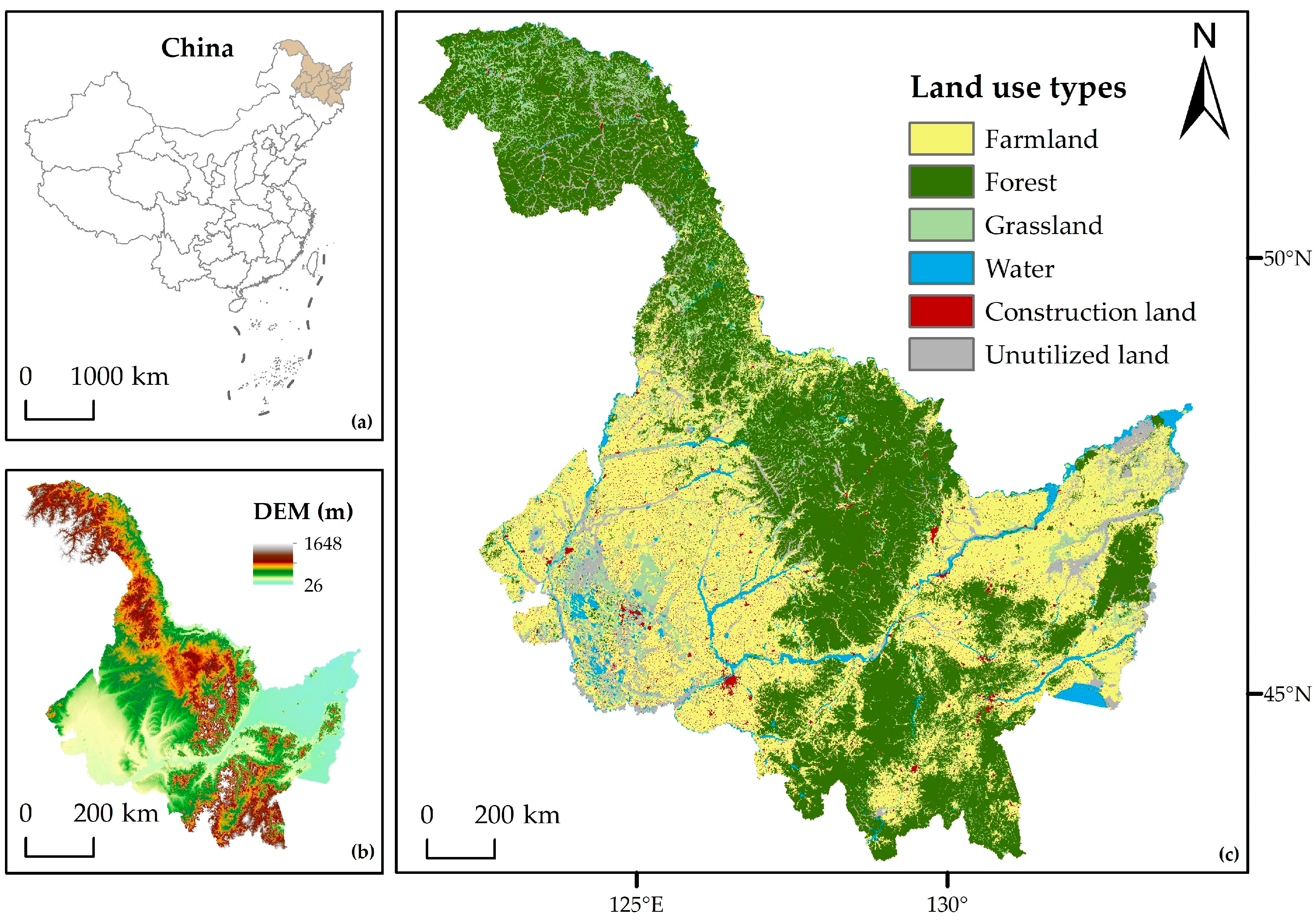
Heilongjiang Province is located in northeastern China (Figure 1a). Its landscape is characterized by a composition traditionally described as five parts mountains, one part water, one part grassland, and three parts farmland, with elevations ranging from 26 to 1648 m (Figure 1b). As a key ecological security barrier in northern China, Heilongjiang Province also serves as one of the most important commodity grain production bases in the nation. The province is endowed with abundant and diverse ecological resources. Forest coverage reaches 46.14%, with forest land constituting the dominant land use type (Figure 1c). Farmland is concentrated primarily in the Songnen Plain and the Sanjiang Plain. The province accounts for 56.1% of the country’s typical black soil cultivated land, and its wetland area ranks among the highest in the nation [48,49]. Grasslands are distributed mainly in the western Songnen Plain and the hilly transition zone. However, driven by rapid urbanization and agricultural intensification, the region is increasingly subject to multiple ecological risks, including black soil degradation, wetland shrinkage, and biodiversity loss [50]. Consequently, regional ecological security is under significant threat. Therefore, a systematic assessment and optimization of the ecological pattern are urgently needed.
Figure 1.
Overview of the study area: (a) geographical location, (b) digital elevation model (DEM), and (c) land use types.
This study utilized multi-source spatial data to support a comprehensive assessment and analysis of ecological security patterns in Heilongjiang Province. Detailed specifications regarding the acquisition year, spatial resolution, and source for each dataset are provided in Table 1. To ensure spatial consistency, all datasets were projected into a unified coordinate reference system (WGS_1984_UTM_Zone_51N) and resampled to a uniform spatial resolution using ArcGIS 10.8. Additionally, the calculation of landscape indices was performed using Fragstats 4.2.
Table 1.
Detailed description of data used in the study.
2.2. Establishment of the Evaluation System
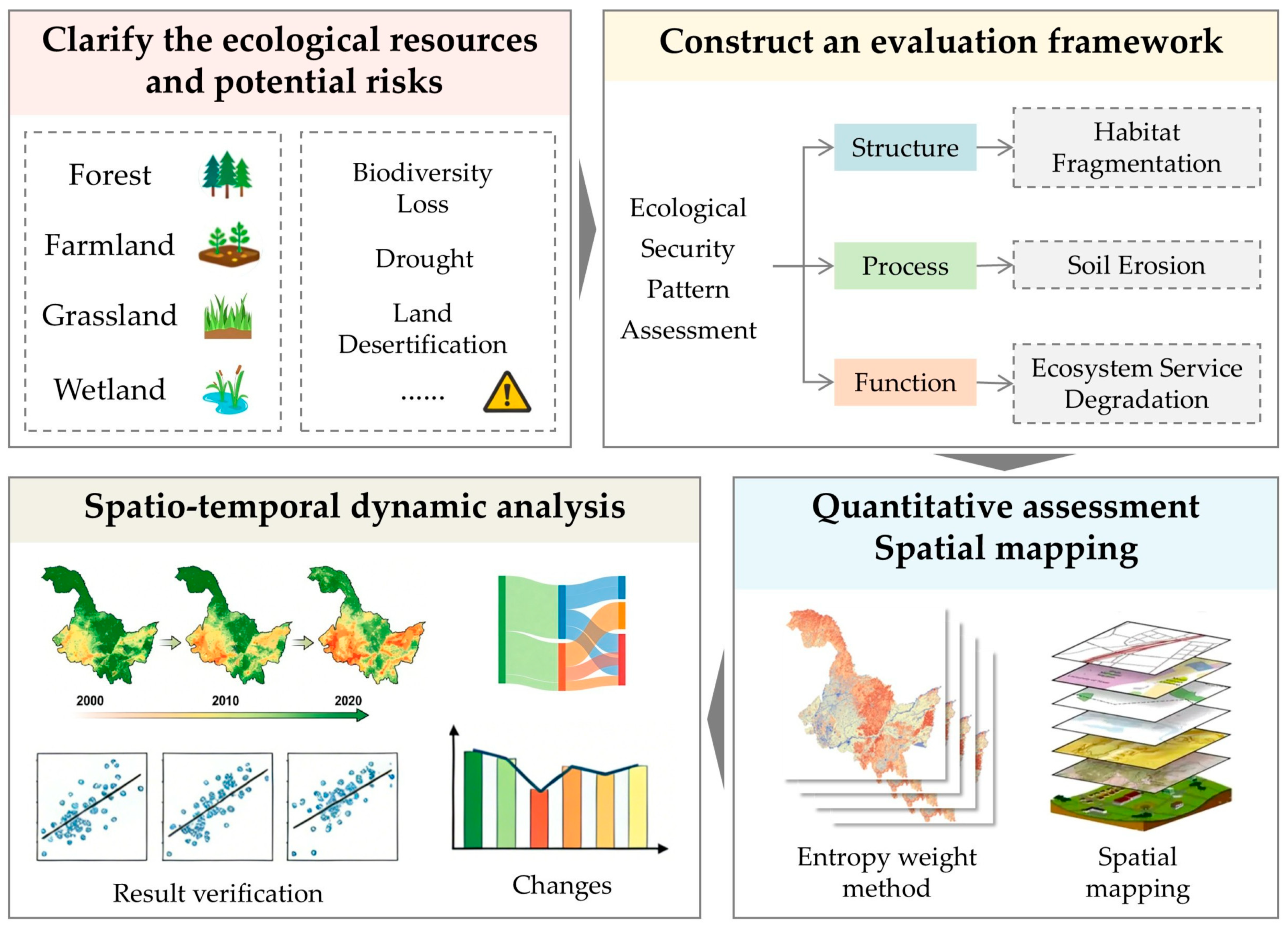
This study integrates regional characteristics within a structure–process–function framework to assess the ecological security pattern of Heilongjiang Province. Specifically, this research employs a cross-sectional analysis across three nodes (2000, 2010, and 2020) within a 21-year period. The research process is organized into four stages (Figure 2): (1) identification of ecological resources and potential ecological risks in Heilongjiang; (2) construction of a comprehensive index system for ecological security pattern assessment; (3) quantitative assessment and spatial mapping of the ecological security pattern; and (4) validation of the assessment results, coupled with analyses of spatiotemporal dynamics and comparisons across different periods.
Figure 2.
Research framework for this study.
This study adopts an ecological risk perspective and integrates risk assessment within the structure–process–function framework. Guided by the policy requirements and ecological resources of Heilongjiang Province, we selected habitat fragmentation (representing structural security), soil erosion (representing process security), and ecosystem service degradation (representing functional security) as the criteria layers. Subsequently, landscape pattern factors influencing these three risks were selected as specific metrics for the indicator layer.
Landscape metrics are critical for analyzing the interaction between landscape patterns and ecological processes, capturing dimensions such as edge, shape, aggregation, and diversity [51]. Based on relevant literature [52,53,54,55,56,57,58], we selected nine indices to assess the targeted ecological risks: Patch Density (PD), Contagion Index (CONTAG), Modified Shannon’s Evenness Index (MSIEI), Largest Patch Index (LPI), Number of Patches (NP), Area-weighted Mean Patch Size (MAI), Landscape Shape Index (LSI), Aggregation Index (AI), and Shannon Diversity Index (SHDI). The definitions and ecological significance of these metrics are detailed in Table 2.
Table 2.
Selection of landscape pattern index and ecological significance.
2.3. Calculation of the Comprehensive Index for Ecological Security Pattern Assessment
2.3.1. Index Standardization
To address the dimensional heterogeneity among indicators, we adopted the min-max normalization method to normalize the data. This method transforms original values into a [0, 1] range to eliminate unit and magnitude differences, ensuring comparability and enabling effective weighting of diverse indicators. The equations are as follows:
For positive indicators:
For negative indicators:
where Yij represents the standardized value of each index; Xij represents the original value of each index; Xmax represents the maximum value; Xmin represents the minimum value.
2.3.2. Calculation of Index Weights
The common methods of determining indicator weights include the analytic hierarchy process (AHP), the entropy weight method (EWM), and principal component analysis (PCA). Among these, the EWM offers a significant advantage by mitigating human interference, thus ensuring a more objective evaluation [59]. Therefore, we used EWM to calculate the weights of each landscape indicator (Table 3). The specific calculation steps are as follows:
Table 3.
Ecological security pattern evaluation indicator system.
Calculate the proportion of the i-th sample value to the j-th indicator (Pij):
Calculate the entropy value of the j-th indicator (eij):
where k = 1/ln(n), and n is the total number of samples.
Calculate the information entropy redundancy (di):
Calculate the weight of each indicator (wi):
2.3.3. Calculation of the Comprehensive Ecological Security Pattern Index
The Ecological Security Pattern Index (ESPI) was calculated through the weighted summation of the indicator layer. The calculation formula is as follows:
where Wi represents the weight value of each indicator; Xij represents the standardized value of each indicator; n is the number of indicators.
2.3.4. Classification of Assessment Results
Based on relevant literature [60,61,62,63], we adopted the equidistant method to categorize the ecological security assessment of Heilongjiang Province into five levels (Table 4). The ESPI values range from 0 to 1. Higher values denote a higher level of ecological security, while lower values indicate a poorer ecological security status.
Table 4.
Corresponding grading of ecological security and ecosystem service values. Regional ecological security pattern assessment standards and levels.
2.4. Validation of Assessment Results
To ensure the scientific rigor and reliability of the results, this study employed four core indicators for cross-validation: net primary productivity (NPP), soil conservation capacity, habitat quality for key protected wildlife, and the China ecological quality index (CHEQ). A Spearman correlation analysis was performed to test these associations, with statistical significance determined at p < 0.01.
3. Results
3.1. Spatial Distribution and Changes of Ecological Security Pattern Assessment Results
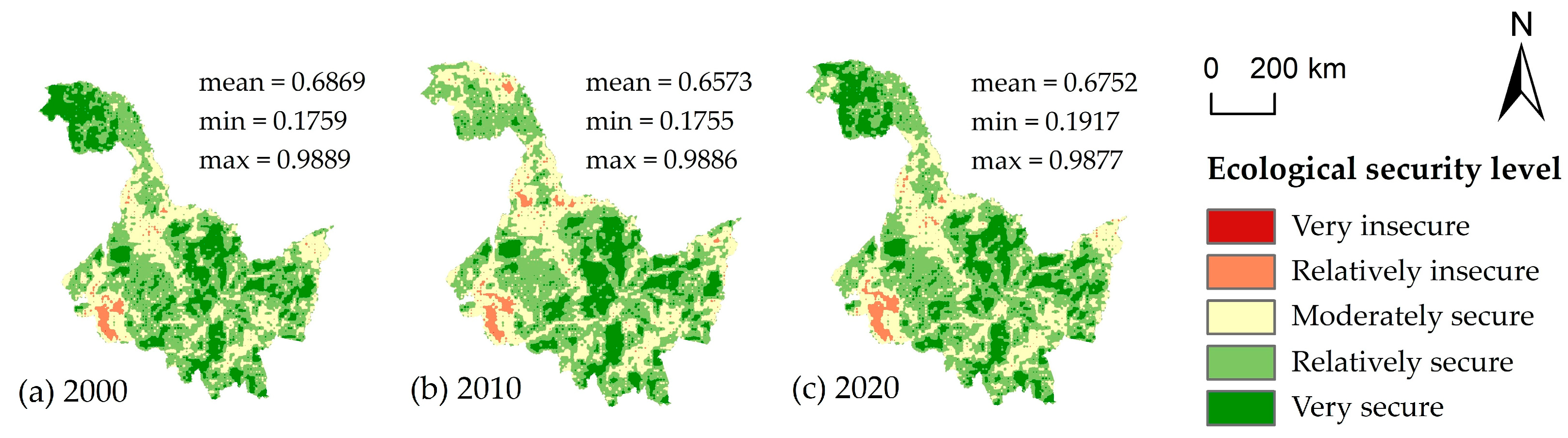
Utilizing the assessment model, we calculated ESPI values to analyze spatiotemporal variations (Figure 3). The results indicate that the mean ESPI decreased from 0.6869 in 2000 to 0.6573 in 2010, before recovering partially to 0.6752 in 2020. Despite the recovery observed in 2020, the index remained below initial levels. Spatially, insecure zones in the southwestern region expanded significantly in 2010, while the central and eastern regions also experienced ecological deterioration. By 2020, although the overall ecological security situation had improved, the southwestern region remained a high-risk area.
Figure 3.
Spatiotemporal evolution of the ESPI in Heilongjiang Province from 2000 to 2020.
Overall, from 2000 to 2020, the ESPI of Heilongjiang Province was characterized by a trajectory of initial decline followed by partial recovery. Geographically, very secure and relatively secure areas were predominantly located in the Greater Khingan Mountains, the Lesser Khingan Mountains, and the Changbai Mountains in the southeast. Moderately secure areas were concentrated in the plains, while insecure areas were distributed sporadically.
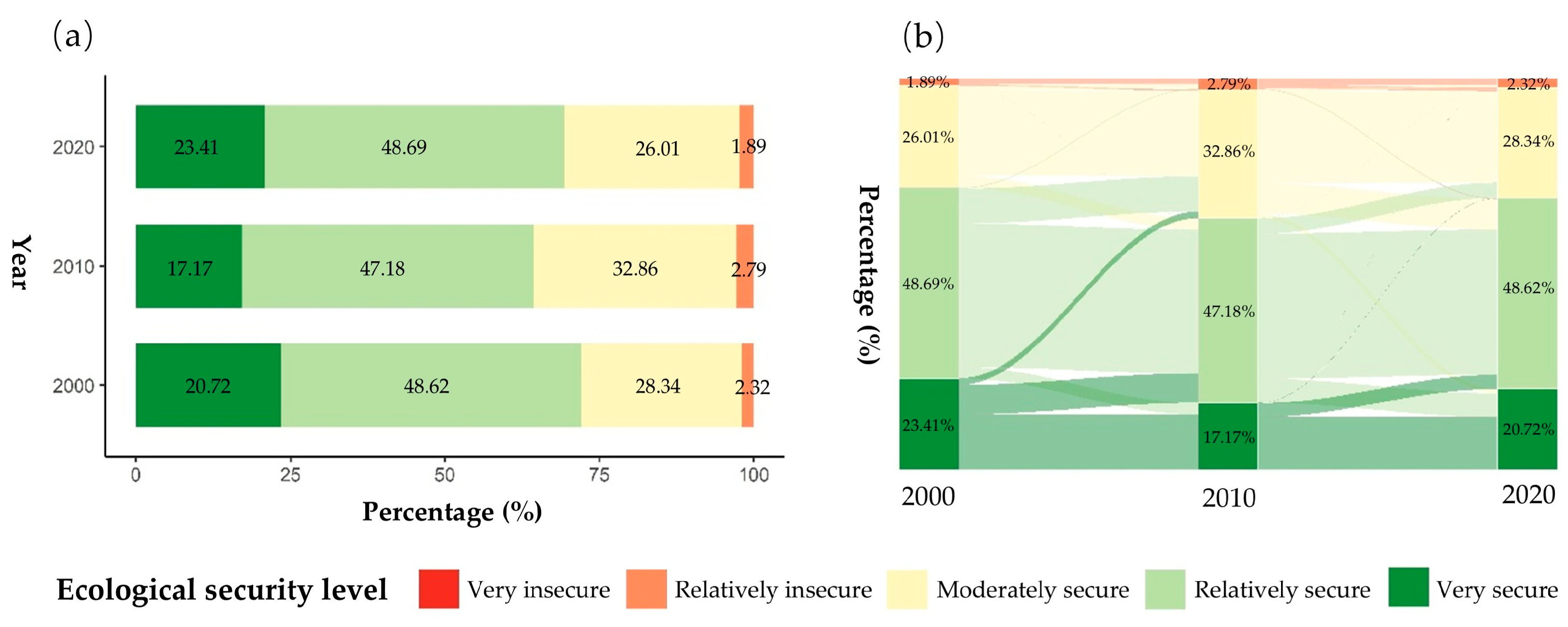
Significant changes were observed in the areal proportions of different ecological security levels in Heilongjiang Province from 2000 to 2020 (Figure 4). Overall, the relatively secure category consistently accounted for the largest proportion, maintaining a dominant and stable position throughout the study period.
Figure 4.
Variations in the area percentage of ecological security categories from 2000 to 2020. (a) Temporal variation in the proportion of different ecological security levels; (b) Sankey diagram illustrating the dynamic transfer directions and flow magnitudes between security levels from 2000 to 2020.
Regarding specific phases, the areal proportion of the very secure category exhibited a trend of decline followed by recovery, decreasing significantly from 23.41% in 2000 to 17.17% in 2010 before rebounding to 20.72% in 2020. Conversely, the moderately secure category showed an inverse trend, rising from 26.01% in 2000 to 32.86% in 2010, and subsequently decreasing to 28.34% in 2020. In contrast, the coverage of relatively insecure and very insecure areas remained consistently low, with their combined proportion never exceeding 5%.
The sankey diagram analysis reveals that transitions occurred predominantly between adjacent security levels. The period 2000–2010 was characterized by evident degradation, primarily involving transitions from very secure to relatively secure or moderately secure levels. Conversely, the 2010–2020 period exhibited a marked recovery trend, with substantial transfers from moderately secure to relatively secure and very secure levels. This shift underscores a comprehensive improvement in regional ecological security, highlighting the success of recent conservation interventions.
3.2. Assessment Results at the Municipal Scale
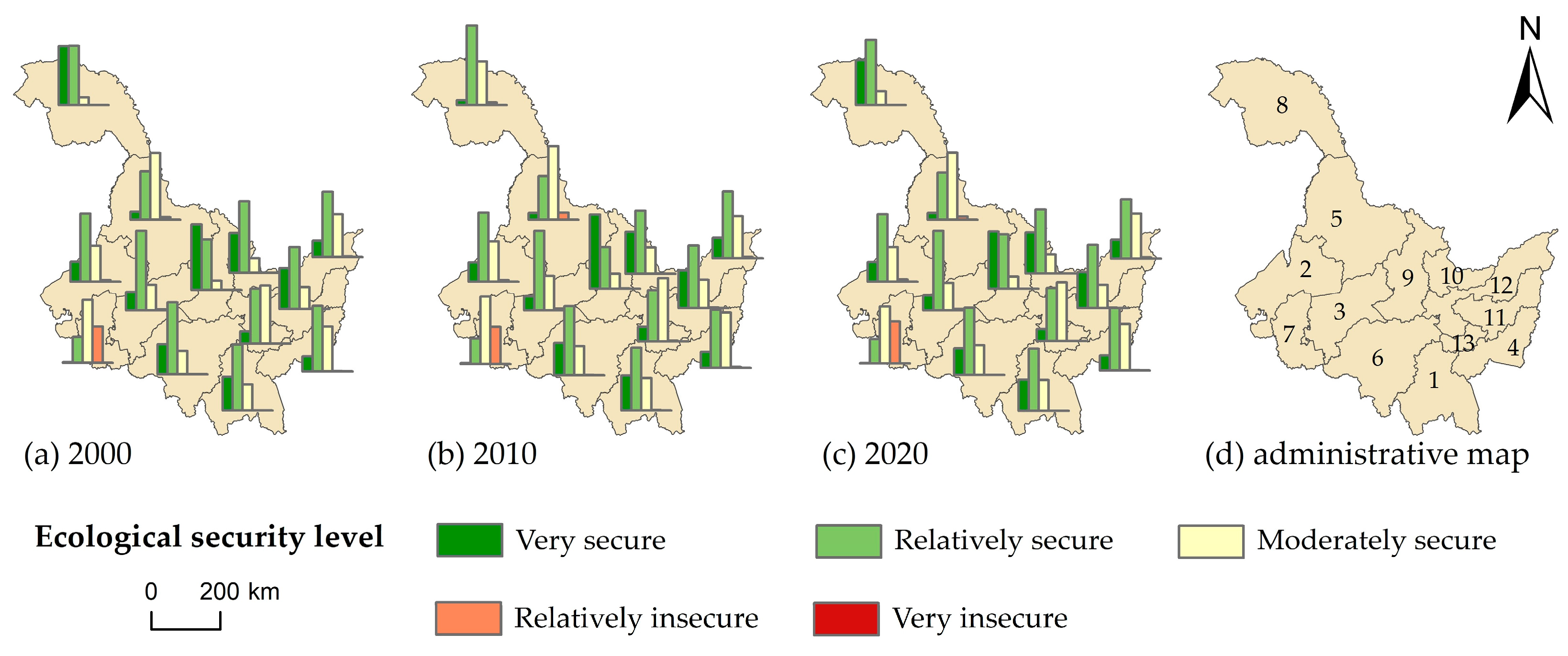
From 2000 to 2020, the ecological security levels of prefecture-level cities in Heilongjiang Province exhibited significant spatial heterogeneity and dynamic variations (Figure 5). While the overall spatial pattern remained relatively stable, pronounced disparities in ecological security status were observed across administrative regions. High-security zones were consistently concentrated in the forested mountainous areas of the north and southeast, whereas the central plains were dominated by low-security zones.
Figure 5.
Spatial distribution of ESPI levels among prefecture-level cities in Heilongjiang Province. (a) 2000, (b) 2010, (c) 2020, and (d) administrative map. (1: Mudanjiang; 2: Qiqihar; 3: Suihua; 4: Jixi; 5: Heihe; 6: Harbin; 7: Daqing; 8: Daxing’anling; 9: Yichun; 10: Hegang; 11: Shuangyashan; 12: Jiamusi; 13: Qitaihe).
Specifically, Yichun maintained the highest ecological security level, largely attributable to its extensive forest coverage and minimal anthropogenic disturbance. Heihe and Daqing were characterized predominantly by moderately insecure status. Notably, insecure areas were primarily clustered within Daqing City. This phenomenon likely stems from the adverse ecological impacts of long-term oil extraction, including habitat fragmentation, soil degradation, and vegetation destruction. The Greater Khingan region exhibited substantial fluctuations associated with forest landscape fragmentation induced by historical forestry activities. In other cities, the ecological security level remained consistently dominated by the relatively secure category, maintaining a stable spatial pattern.
3.3. Assessment Results and Changes of Different Dimensions
3.3.1. Structure Security and Habitat Fragmentation Risk
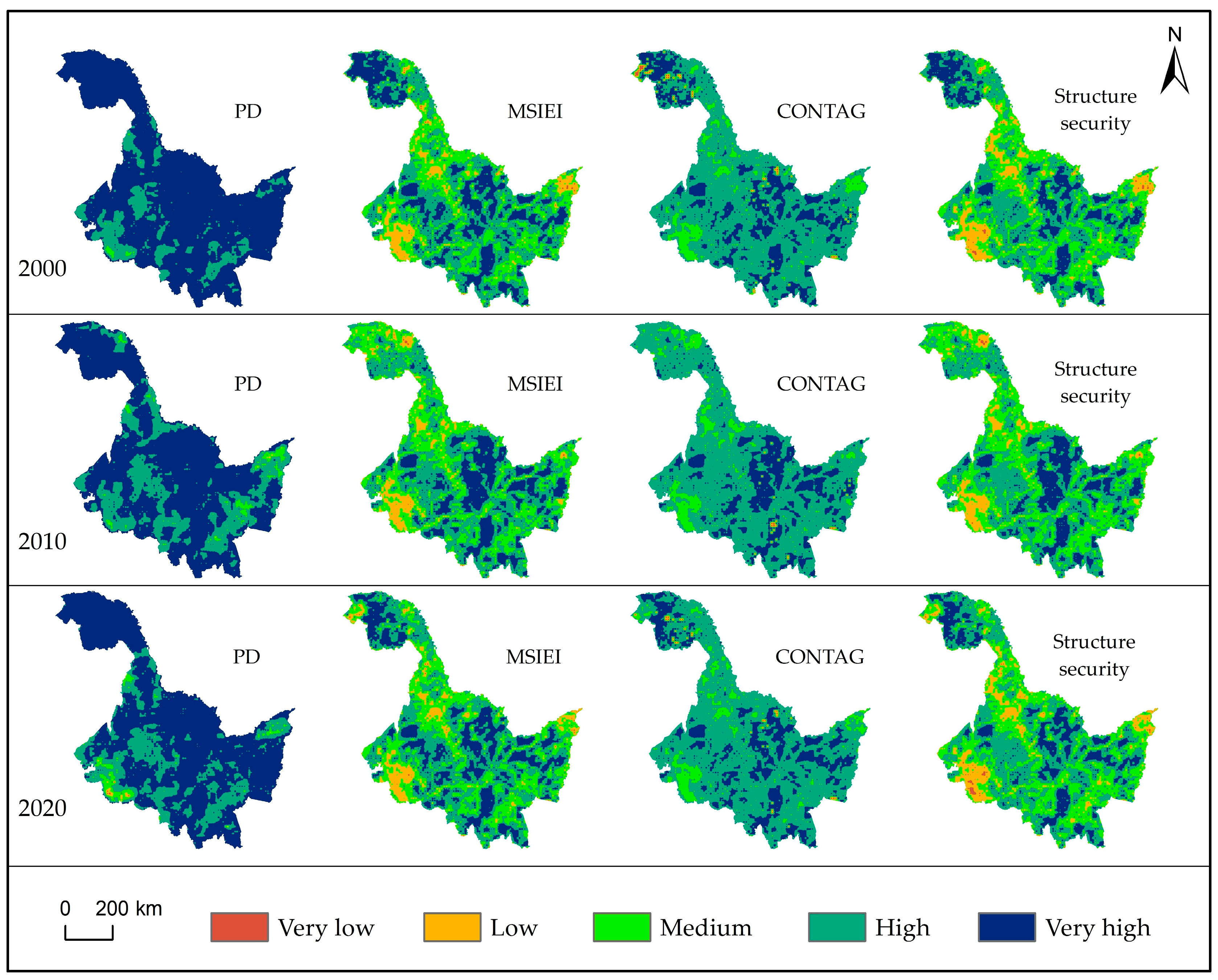
As shown in Figure 6, we analyzed the dynamics of structural ecological security (represented by habitat fragmentation risk) utilizing normalized PD, MSIEI, and CONTAG indices. Following normalization, higher values for all indicators indicate a higher level of structural ecological security and a correspondingly lower risk of habitat fragmentation.
Figure 6.
Spatial patterns of structural security characterized by habitat fragmentation risks.
The PD metric indicated a decreasing trend in fragmentation, with low-fragmentation areas expanding in the central and southern regions in 2010 and 2020. The MSIEI exhibited a decline followed by recovery, with moderate values expanding in the northern region in 2010. CONTAG generally increased, with moderate and high values becoming dominant by 2020, replacing low values in agro-forestry ecotones.
Consequently, the structural security map identifies central agricultural and urbanized areas as hotspots for habitat fragmentation risk (characterized by low to moderate security). Conversely, the northern and eastern forests represent high-security zones with minimal fragmentation. An overall improvement in structural security was observed in 2010, characterized by the expansion of moderately secure areas.
3.3.2. Process Security and Soil Erosion Risk
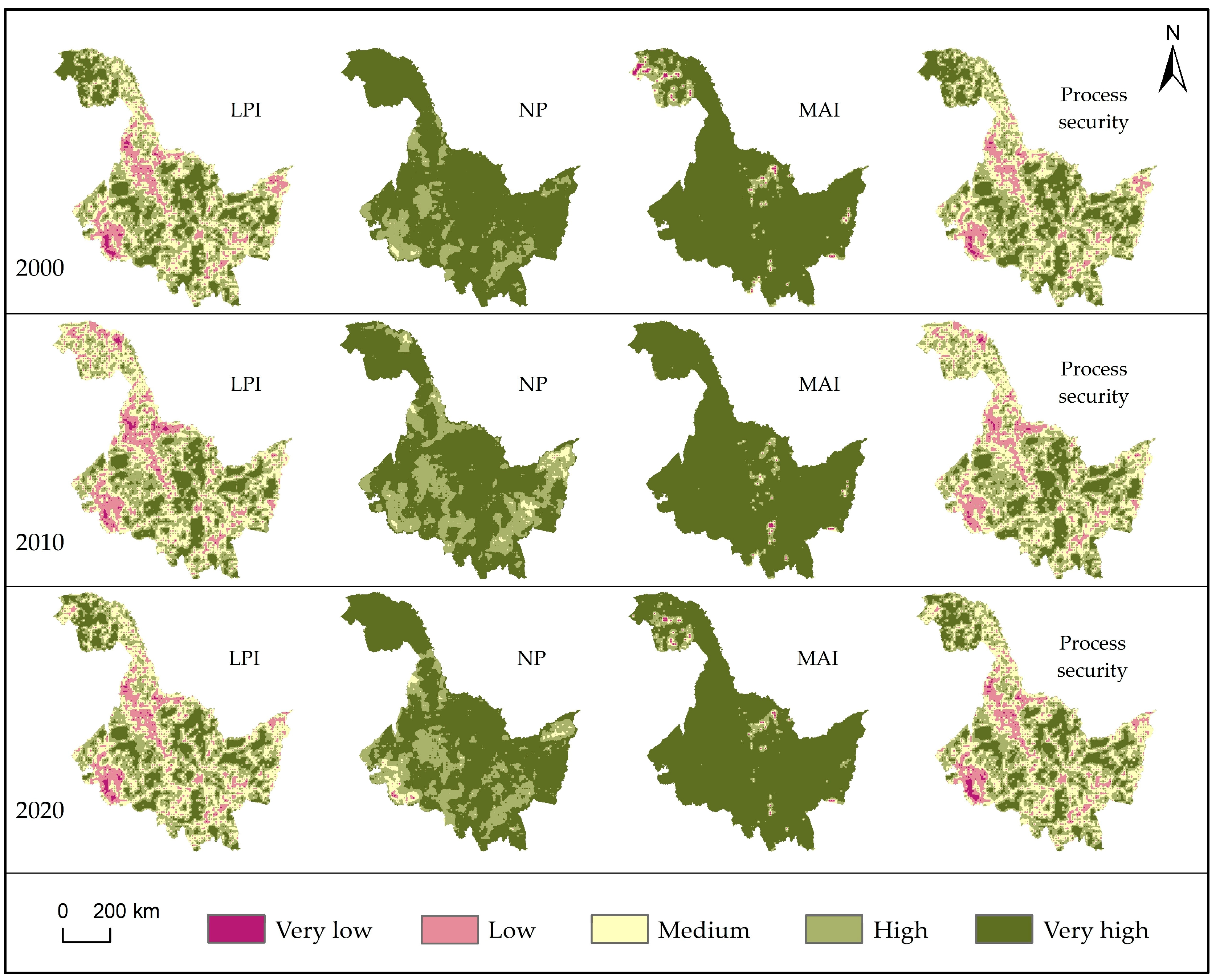
As shown in Figure 7, we analyzed the dynamics of process ecological security (characterized by soil erosion risk) using normalized LPI, NP, and MAI indices. Following normalization, higher values for all indicators indicate a higher level of process ecological security and a correspondingly lower risk of soil erosion.
Figure 7.
Spatial patterns of process security characterized by soil erosion risks.
Spatially, high LPI values were continuous, while low values were distributed across the central and southeastern areas. The NP metric revealed a progressive increase in fragmentation: dominated by high values in 2000, the coverage of high and very high NP zones expanded to encompass almost the entire province by 2020, leaving few areas with moderate levels. MAI values were predominantly high, with localized clusters of low-to-medium values.
Integrating these metrics, the process security assessment reveals that the year 2000 represented the peak of ecological security, characterized by the most intact spatial structure and the strongest capacity to mitigate soil erosion. Although process security declined in 2010 and rebounded in 2020, it remained below the 2000 baseline. This trend reflects a landscape that, despite evident disturbances, retained a degree of resilience in mitigating soil erosion risks.
3.3.3. Function Security and Ecosystem Services Degradation Risk
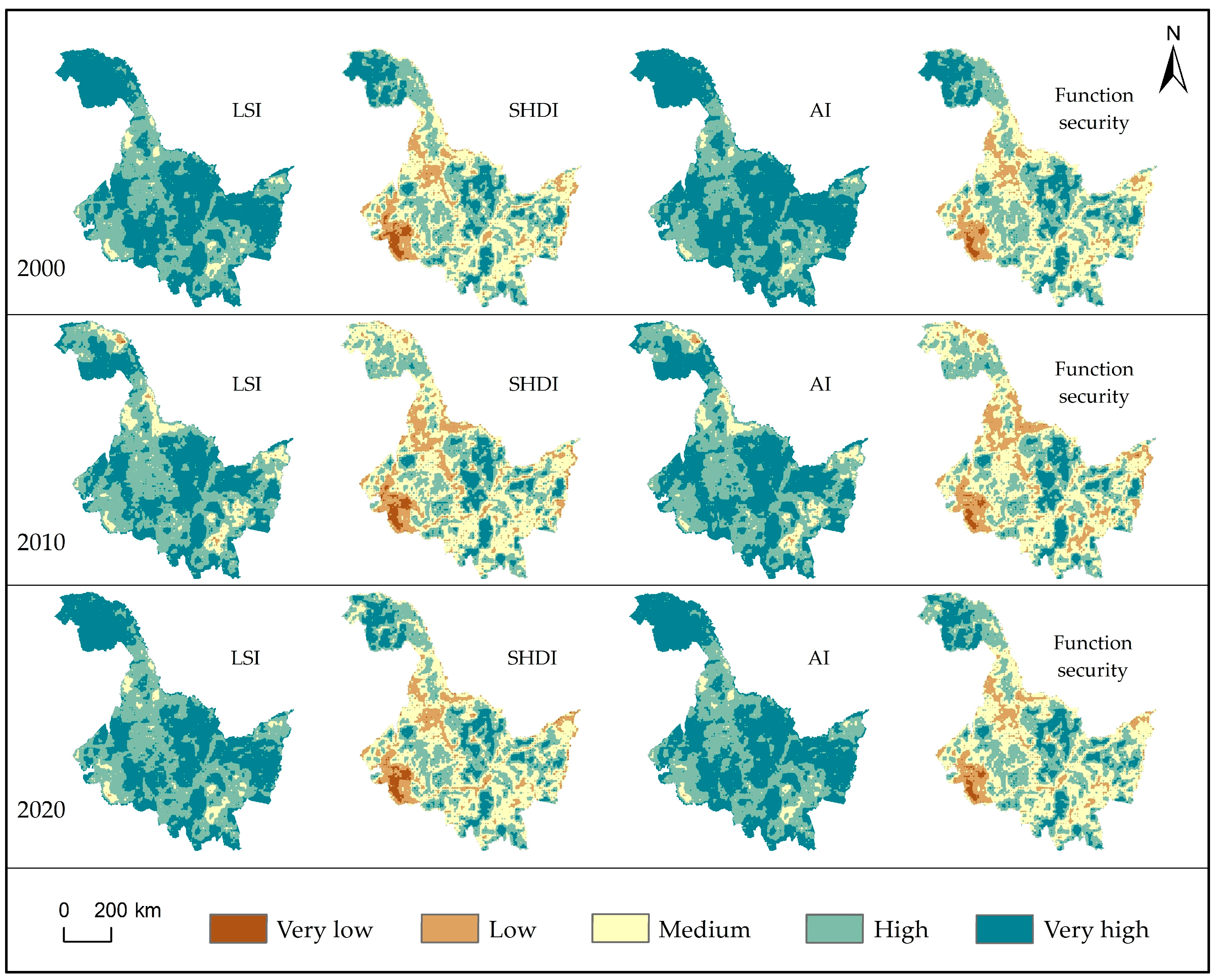
As shown in Figure 8, we analyzed the dynamics of functional ecological security (characterized by the risk of ecosystem service degradation) using normalized LSI, SHDI, and AI indices. Following normalization, higher values for all indicators indicate a higher level of functional ecological security and a correspondingly lower risk of ecosystem service degradation.
Figure 8.
Spatial patterns of functional security characterized by ecosystem service degradation risks.
Spatially, LSI values were predominantly high to very high, maintaining a stable spatial configuration that suggests consistent landscape shape complexity. The SHDI exhibited temporal fluctuations; initially dominated by medium-to-high values in 2000, it experienced a significant expansion of low-value zones in 2010 before recovering in 2020. The AI remained consistently high, reflecting a stable and highly aggregated landscape structure.
In terms of functional security, high-value zones formed a continuous expanse, contrasting with the scattered distribution of low-security areas. The temporal analysis shows that functional security was highest in 2000. Despite a significant decline in 2010 and a subsequent rebound in 2020, ecosystem services have not yet fully recovered to the 2000 baseline. This pattern illustrates a degradation-adjustment-recovery dynamic in the region’s ecological functions.
3.4. Reliability Analysis and Model Verification of Ecological Security Pattern Assessment Results
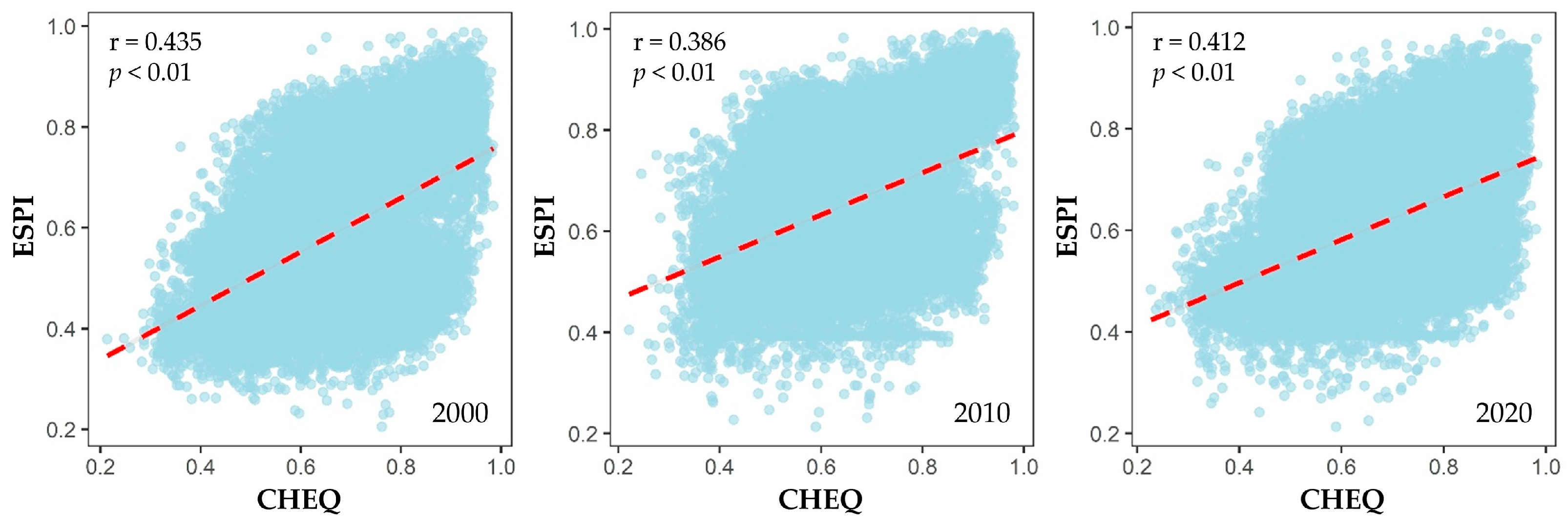
To validate the assessment results, Spearman correlation analysis was employed to examine the relationship between the ecological security pattern index (ESPI) and the comprehensive ecological quality (CHEQ) for the years 2000, 2010, and 2020 (Figure 9). Across all three time periods, a moderately positive and statistically significant correlation (p < 0.01) was observed between the ESPI and CHEQ, thereby confirming the reliability of the assessment findings.
Figure 9.
The results of correlation analysis between ESPI and CHEQ. (The red dashed line indicates the positive correlation trend).
Furthermore, this study extended the validation to encompass assessment results across the three dimensions: structure, process, and function (Table 5). All correlation analyses yielded highly significant results (p < 0.01), providing additional evidence for the robustness of the assessment framework.
Table 5.
Validation results of correlation analysis for ecological security pattern assessment.
4. Discussion
4.1. Ecological Security Pattern Assessment Result Verification and Comparison
Validating the accuracy and reliability of assessment results is a critical step in determining the rationality and scientific rigor of an evaluation system [2]. However, most existing studies on ecological security assessment have neglected this validation phase [64]. Therefore, this study incorporated multiple independent external datasets to verify the credibility of the assessment results through correlation analysis. All associations were statistically significant (p < 0.01), although the correlation coefficients remained below 0.5. In large-scale spatial analyses, correlation values are often constrained by spatial heterogeneity and complex interacting factors. A meta-analysis by Møller and Jennions [65] supports this context. They noted that the mean effect size in ecological research is typically around r ≈ 0.19 due to the inherent noise in natural systems. Consequently, the coefficients observed in this study (0.143–0.435) indicate a statistically meaningful positive correspondence between the ESPI and the independent validation data. This confirms the reliability of the proposed framework.
The analysis reveals that the spatial pattern of ecological security in Heilongjiang Province derived in this study maintains a high degree of consistency with findings from prior research. For instance, Zhang et al. [66] observed significant spatial differentiation in the net ecosystem productivity (NEP) of Heilongjiang from 2010 to 2020, characterized by lower values in the eastern and western regions and higher values in the central and northern areas; this distribution aligns closely with our assessment results. Similarly, Sui et al. [16] identified that low-risk zones were predominantly concentrated in the northeast forest belt and the inner mongolia grassland regions. The spatial distribution of high-security and low-security areas identified in this study corresponds strongly with these findings, with high-security zones consistently clustered in the forested mountainous regions of the north and southeast. This spatial pattern is primarily attributed to the unique topography of the Greater and Lesser Khingan Mountains. As designated national key ecological function zones, these regions have benefited from the implementation of rigorous protection and restoration measures, notably the Plan for Ecological Protection and Economic Transformation of the Greater and Lesser Khingan Mountains Forest Region (2021–2035). These initiatives have significantly enhanced regional ecological quality and functions, thereby maintaining high vegetation coverage and ecosystem integrity, which in turn consolidates a stable ecological security barrier. Furthermore, Wu et al. [67] highlighted that high-risk areas in Heilongjiang were primarily concentrated in the Daqing region. Consistent with this, our study also characterizes Daqing City as an area with a notably low level of ecological security. As a major petroleum-resource-based city, Daqing faces severe challenges driven by large-scale oil extraction. These activities have caused widespread soil pollution, posing significant threats to human existence and ecosystem health [68]. This creates a sharp conflict between the imperatives of economic growth and the maintenance of ecological stability. Collectively, these three independent studies provide compelling evidence that the assessment framework constructed in this research possesses high reliability and that the adopted methodology is scientifically sound. Consequently, the assessment outcomes accurately reflect the actual status and spatial heterogeneity of ecological security in Heilongjiang Province.
In the future, the ecological security of Heilongjiang Province is expected to stabilize and improve. This positive trend is driven by national strategies, such as the Ecological Civilization initiative. However, global warming introduces new uncertainties. Specifically, the increasing frequency of droughts poses a significant risk to crop yields [69]. Therefore, it is essential to strengthen disaster monitoring and early warning systems. These measures are critical to mitigate emerging threats.
4.2. Assessment Framework for Ecological Security Pattern: Structure–Process–Function Integrating Risksz
The spatial configuration of a landscape is the product of intricate interplay between physical, biological, and anthropogenic forces. Turner [70] established that since human land use heavily imprints on landscapes, meaningful quantification of structure is a prerequisite to understanding pattern–process relationships. Wu [71] further identified the landscape as the nexus of human–nature interaction, essential for linking local phenomena to global scales. Based on these theories, we argue that landscape patterns determine regional ecological security by regulating ecological processes and functions. This lays the theoretical foundation for our proposed “structure–process–function” framework.
Many existing studies primarily rely on PSR models or DPSIR frameworks to assess ecological security. However, these approaches often lack geographical adaptability. They frequently overlook the specific disturbances and risks faced by a region [46,72]. Accordingly, we developed a structure–process–function framework that integrates ecological risks. We tailored this framework to the unique ecological assets and strategic needs of the study area, ensuring that the evaluation indicators are highly targeted. Furthermore, the framework couples specific risks with the three dimensions. Specifically, habitat fragmentation serves as a direct proxy for structural risk. It indicates the physical breakdown of ecological connectivity. Simultaneously, we address process risk by linking land use configurations to soil erosion. Ultimately, ecosystem service degradation is evaluated as the functional risk, capturing the final consequence of these structural and process disruptions. By integrating landscape metrics including LPI, NP, LSI, SHDI, and AI, we successfully quantified the spatial heterogeneity of regional risks. It transforms abstract ecological risks into a tangible, diagnosable assessment system. Consequently, monitoring metric trajectories enables the identification of ecological security tipping points. This provides a robust scientific basis for effective spatial governance.
This study is subject to certain limitations. Although we cross-validated our results using independent multi-source datasets, the lack of extensive ground observation data remains a constraint given the macroscopic scale of the study region. Moreover, we propose two directions for future research. On one hand, future studies could employ multi-scale analyses. This would help determine the optimal operational scales for different risk types. On the other hand, researchers could integrate this framework with climate change scenarios. This approach would enable the prediction of the future evolution of ecological security patterns.
5. Conclusions
Targeting the specific ecological context of Heilongjiang Province, this study constructed an assessment model integrating local risks within the structure–process–function framework. Cross-validation with independent data (NPP, soil conservation, habitat quality, and CHEQ) confirmed the model’s reliability. Subsequently, we investigated the spatiotemporal evolution of the ecological security pattern index (ESPI) from 2000 to 2020. The key findings are as follows:
- (1)
- The study revealed a “V-shaped” evolutionary trajectory of ecological security in Heilongjiang Province from 2000 to 2020, characterized by initial degradation followed by recovery. This trend validates the effectiveness of recent ecological restoration policies, indicating that macro-policy intervention has successfully mitigated the deterioration of the ecological environment.
- (2)
- The assessment highlighted that the mountainous regions in the north and southeast (Greater and Lesser Khingan Mountains) function as robust ecological barriers. In contrast, the plains and resource-dependent cities face security challenges. The distribution pattern indicates that the topographical factors and the transition of resource exploitation are the main factors leading to the regional security pattern.
- (3)
- By transforming ecological risks into diagnosable dimensions, this study demonstrates that ecological security is a dynamic coupling of physical structure, stable processes, and service functions. This study provides a scientific basis for differentiating spatial governance strategies.
Author Contributions
Conceptualization, D.M. and Y.W.; methodology, D.M.; software, D.M.; validation, D.M. and M.Z.; formal analysis, D.M.; investigation, D.M.; resources, Y.P. and T.L.; data curation, D.M., H.Z. and H.L.; writing—original draft preparation, D.M.; writing—review and editing, Y.W.; visualization, D.M. and M.Z.; supervision, Y.W.; project administration, Y.W.; funding acquisition, Y.W. All authors have read and agreed to the published version of the manuscript.
Funding
This research was funded by National Natural Science Foundation of China (NSFC), grant number 52478047.
Data Availability Statement
The original contributions presented in the study are included in the article, further inquiries can be directed to the corresponding author.
Conflicts of Interest
The authors declare no conflicts of interest.
References
- Zhong, C.; Guo, H.; Swan, I.; Gao, P.; Yao, Q.; Li, H. Evaluating Trends, Profits, and Risks of Global Cities in Recent Urban Expansion for Advancing Sustainable Development. Habitat Int. 2023, 138, 102869. [Google Scholar] [CrossRef]
- Liu, C.; Li, W.; Xu, J.; Zhou, H.; Wang, W.; Wang, H. Temporal and Spatial Variations of Ecological Security on the Northeastern Tibetan Plateau Integrating Ecosystem Health-Risk-Services Framework. Ecol. Indic. 2024, 158, 111365. [Google Scholar] [CrossRef]
- Wu, X.; Zhang, H. Evaluation of Ecological Environmental Quality and Factor Explanatory Power Analysis in Western Chongqing, China. Ecol. Indic. 2021, 132, 108311. [Google Scholar] [CrossRef]
- Thebo, A.L.; Drechsel, P.; Lambin, E.F. Global Assessment of Urban and Peri-Urban Agriculture: Irrigated and Rainfed Croplands. Environ. Res. Lett. 2014, 9, 114002. [Google Scholar] [CrossRef]
- Ding, M.; Liu, W.; Xiao, L.; Zhong, F.; Lu, N.; Zhang, J.; Zhang, Z.; Xu, X.; Wang, K. Construction and Optimization Strategy of Ecological Security Pattern in a Rapidly Urbanizing Region: A Case Study in Central-South China. Ecol. Indic. 2022, 136, 108604. [Google Scholar] [CrossRef]
- Steffen, W.; Richardson, K.; Rockström, J.; Cornell, S.E.; Fetzer, I.; Bennett, E.M.; Biggs, R.; Carpenter, S.R.; de Vries, W.; de Wit, C.A.; et al. Planetary Boundaries: Guiding Human Development on a Changing Planet. Science 2015, 347, 1259855. [Google Scholar] [CrossRef]
- Estoque, R.C.; Murayama, Y. Quantifying Landscape Pattern and Ecosystem Service Value Changes in Four Rapidly Urbanizing Hill Stations of Southeast Asia. Landsc. Ecol 2016, 31, 1481–1507. [Google Scholar] [CrossRef]
- Li, Y.; Lian, Z.; Zhai, T.; Xie, X.; Wang, Y.; Li, M. Assessment of Land Ecological Security Based on the Boston Model: A Case Study from China. Land 2023, 12, 1348. [Google Scholar] [CrossRef]
- Peng, J.; Pan, Y.; Liu, Y.; Zhao, H.; Wang, Y. Linking Ecological Degradation Risk to Identify Ecological Security Patterns in a Rapidly Urbanizing Landscape. Habitat Int. 2018, 71, 110–124. [Google Scholar] [CrossRef]
- Li, S.; Zhao, Y.; Xiao, W.; Yue, W.; Wu, T. Optimizing Ecological Security Pattern in the Coal Resource-Based City: A Case Study in Shuozhou City, China. Ecol. Indic. 2021, 130, 108026. [Google Scholar] [CrossRef]
- Ye, W.; Kong, Q. Environmental Security: A Fundamental Problem Confronting Mankind in the 21st Century. China Popul. Resour. Environ. 2001, 11, 42–44. [Google Scholar] [CrossRef]
- Tian, J.; Gang, G. Research on Regional Ecological Security Assessment. Energy Procedia 2012, 16, 1180–1186. [Google Scholar] [CrossRef]
- Li, Y.; Zhao, J.; Yuan, J.; Ji, P.; Deng, X.; Yang, Y. Constructing the Ecological Security Pattern of Nujiang Prefecture Based on the Framework of “Importance–Sensitivity–Connectivity”. Int. J. Environ. Res. Public Health 2022, 19, 10869. [Google Scholar] [CrossRef]
- Yu, M.; Zou, F. Ecological Security under the Overall National Security Concept: Risk Perception, Morphological Evolution, and Systematic Governance. Gov. Stud. 2022, 38, 73–82. [Google Scholar] [CrossRef]
- Peng, W.; Li, B.; Liu, C. Xi Jinping’s Important Exposition on Ecological Security and the Construction of Ecological Security System. J. Eco-Civiliz. Stud. 2021, 1, 20–34. [Google Scholar]
- Sui, L.; Yan, Z.; Li, K.; Wang, C.; Shi, Y.; Du, Y. Prediction of Ecological Security Network in Northeast China Based on Landscape Ecological Risk. Ecol. Indic. 2024, 160, 111783. [Google Scholar] [CrossRef]
- Ran, Y.; Lei, D.; Li, J.; Gao, L.; Mo, J.; Liu, X. Identification of Crucial Areas of Territorial Ecological Restoration Based on Ecological Security Pattern: A Case Study of the Central Yunnan Urban Agglomeration, China. Ecol. Indic. 2022, 143, 109318. [Google Scholar] [CrossRef]
- Li, J.-X.; Chen, Y.-N.; Xu, C.-C.; Li, Z. Evaluation and Analysis of Ecological Security in Arid Areas of Central Asia Based on the Emergy Ecological Footprint (EEF) Model. J. Clean. Prod. 2019, 235, 664–677. [Google Scholar] [CrossRef]
- Liu, D.; Chang, Q. Ecological Security Research Progress in China. Acta Ecol. Sin. 2015, 35, 111–121. [Google Scholar] [CrossRef]
- Wang, L.; Pang, Y.S. A Review of Regional Ecological Security Evaluation. Appl. Mech. Mater. 2012, 178–181, 337–344. [Google Scholar] [CrossRef]
- OECD. OECD Core Set of Indicators for Environmental Performance Reviews: A Synthesis Report by the Group on the State of the Environment; Environment monographs; Organisation for Economic Co-Operation and Development: Paris, France, 1993. [Google Scholar]
- Wen, J.; Hou, K. Research on the Progress of Regional Ecological Security Evaluation and Optimization of Its Common Limitations. Ecol. Indic. 2021, 127, 107797. [Google Scholar] [CrossRef]
- Zhang, J.; Hao, X.; Li, X.; Fan, X.; Zhang, S. Evaluation and Regulation Strategy for Ecological Security in the Tarim River Basin Based on the Ecological Footprint. J. Clean. Prod. 2024, 435, 140488. [Google Scholar] [CrossRef]
- Chu, X.; Deng, X.; Jin, G.; Wang, Z.; Li, Z. Ecological Security Assessment Based on Ecological Footprint Approach in Beijing-Tianjin-Hebei Region, China. Phys. Chem. Earth Parts A/B/C 2017, 101, 43–51. [Google Scholar] [CrossRef]
- Liu, T.; Wang, H.-Z.; Wang, H.-Z.; Xu, H. The Spatiotemporal Evolution of Ecological Security in China Based on the Ecological Footprint Model with Localization of Parameters. Ecol. Indic. 2021, 126, 107636. [Google Scholar] [CrossRef]
- Chen, W.; Jiang, C.; Wang, Y.; Liu, X.; Dong, B.; Yang, J.; Huang, W. Landscape Patterns and Their Spatial Associations with Ecosystem Service Balance: Insights from a Rapidly Urbanizing Coastal Region of Southeastern China. Front. Environ. Sci. 2022, 10, 1002902. [Google Scholar] [CrossRef]
- Duarte, G.T.; Santos, P.M.; Cornelissen, T.G.; Ribeiro, M.C.; Paglia, A.P. The Effects of Landscape Patterns on Ecosystem Services: Meta-Analyses of Landscape Services. Landsc. Ecol. 2018, 33, 1247–1257. [Google Scholar] [CrossRef]
- Plexida, S.G.; Sfougaris, A.I.; Ispikoudis, I.P.; Papanastasis, V.P. Selecting Landscape Metrics as Indicators of Spatial Heterogeneity—A Comparison among Greek Landscapes. Int. J. Appl. Earth Obs. Geoinf. 2014, 26, 26–35. [Google Scholar] [CrossRef]
- Jia, Y.; Tang, L.; Xu, M.; Yang, X. Landscape Pattern Indices for Evaluating Urban Spatial Morphology—A Case Study of Chinese Cities. Ecol. Indic. 2019, 99, 27–37. [Google Scholar] [CrossRef]
- Hu, C.; Guo, L.; Li, S.; Liu, P. Research on the Ecological Pattern of Key Ecological Region in Henan Province. Environ. Sci. Manag. 2019, 44, 154–160. [Google Scholar]
- Xu, H. A remote sensing urban ecological index and its application. Acta Ecol. Sin. 2013, 33, 7853–7862. [Google Scholar]
- Liu, Y.; Xu, W.; Hong, Z.; Wang, L.; Ou, G.; Lu, N.; Dai, Q. Integrating Three-Dimensional Greenness into RSEI Improved the Scientificity of Ecological Environment Quality Assessment for Forest. Ecol. Indic. 2023, 156, 111092. [Google Scholar] [CrossRef]
- Li, F.; Zhang, Y.; Zhao, Z.; Cheng, M.; Cheng, M.; Wang, Z. Evaluation of ecological pattern change of Nanhui Dongtan wetland in Shanghai based on remote sensing ecological index. J. Shanghai Ocean Univ. 2020, 29, 746–756. [Google Scholar]
- Soille, P.; Vogt, P. Morphological Segmentation of Binary Patterns. Pattern Recognit. Lett. 2009, 30, 456–459. [Google Scholar] [CrossRef]
- Lin, J.; Huang, C.; Wen, Y.; Liu, X. An Assessment Framework for Improving Protected Areas Based on Morphological Spatial Pattern Analysis and Graph-Based Indicators. Ecol. Indic. 2021, 130, 108138. [Google Scholar] [CrossRef]
- Vogt, P.; Riitters, K. GuidosToolbox: Universal Digital Image Object Analysis. Eur. J. Remote Sens. 2017, 50, 352–361. [Google Scholar] [CrossRef]
- Chen, W.; Liu, H.; Wang, J. Construction and Optimization of Regional Ecological Security Patterns Based on MSPA-MCR-GA Model: A Case Study of Dongting Lake Basin in China. Ecol. Indic. 2024, 165, 112169. [Google Scholar] [CrossRef]
- Qiao, E.; Reheman, R.; Zhou, Z.; Tao, S. Evaluation of Landscape Ecological Security Pattern via the “Pattern-Function-Stability” Framework in the Guanzhong Plain Urban Agglomeration of China. Ecol. Indic. 2024, 166, 112325. [Google Scholar] [CrossRef]
- Yu, K. Landscape Ecological Security Pattern for Biological Conservation. Acta Ecol. Sin. 1999, 1, 10–17. [Google Scholar]
- Peng, J.; Xu, D.; Tang, H.; Jiang, H.; Dong, J.; Wu, J. A Landscape Ecological Approach to Spatial Conservation Planning—Ecological Security Pattern. Trends Ecol. Evol. 2025, 40, 1010–1022. [Google Scholar] [CrossRef]
- Xiang, K.; Chen, L.; Li, W.; He, Z. Construction and Optimization Strategy of Ecological Security Pattern in County-Level Cities under Spatial and Temporal Variation of Ecosystem Services: Case Study of Mianzhu, China. Land 2024, 13, 936. [Google Scholar] [CrossRef]
- Lv, L.; Zhang, S.; Zhu, J.; Wang, Z.; Wang, Z.; Li, G.; Yang, C. Ecological Restoration Strategies for Mountainous Cities Based on Ecological Security Patterns and Circuit Theory: A Case of Central Urban Areas in Chongqing, China. Int. J. Environ. Res. Public Health 2022, 19, 16505. [Google Scholar] [CrossRef]
- Fan, X.; Cheng, Y.; Tan, F.; Zhao, T. Construction and Optimization of the Ecological Security Pattern in Liyang, China. Land 2022, 11, 1641. [Google Scholar] [CrossRef]
- Dong, X.; Wang, F.; Fu, M. Research Progress and Prospects for Constructing Ecological Security Pattern Based on Ecological Network. Ecol. Indic. 2024, 168, 112800. [Google Scholar] [CrossRef]
- Zhong, B.; Wu, S.; Wu, N.; Sun, G.; He, C.; Liu, L.; Chen, H. Constructing Ecological Security Pattern Based on Spatio-Temporal Evaluation of Ecosystem Services and Ecological Health in Chengdu, Southwest China. Front. Environ. Sci. 2024, 12, 1415301. [Google Scholar] [CrossRef]
- Ma, X.; Zhang, J.; Guo, L.; Yang, L.; Wang, J. Traps and improvements of PSR model: An eco-environmental perspective. Acta Ecol. Sin. 2024, 44, 4923–4932. [Google Scholar] [CrossRef]
- Ying, L.; Kong, L.; Xiao, Y.; Ouyang, Z. The research progress and prospect of ecological security and its assessing approaches. Acta Ecol. Sin. 2022, 42, 1679–1692. [Google Scholar] [CrossRef]
- Du, X. Evaluation of Ecosystem Service Bundle and Research on the Optimization of Ecological Security Pattern in Heilongjiang Province. Master’s Thesis, Northeast Agricultural University, Harbin, China, 2025. [Google Scholar]
- Jiang, T.; Wang, Q.; Song, Y.; Jia, G.; Tang, Y.; Liang, C.; Han, L. Identification of Key Areas for Ecological Restoration of Provincial Territorial Space and Restoration Strategies—A Case Study of Heilongjiang Province. Nat. Resour. Econ. China 2025, 38, 52–62, 70. [Google Scholar] [CrossRef]
- Song, J. Research on Synergistic Driving Mechanism and Regulation Strategy of Ecosystem Service Trade-Off in Heilongiiang Province Based on Bayesian Network. Master’s Thesis, Northeast Agricultural University, Harbin, China, 2025. [Google Scholar]
- Uuemaa, E.; Antrop, M.; Roosaare, J.; Marja, R.; Mander, Ü. Landscape Metrics and Indices: An Overview of Their Use in Landscape Research. Living Rev. Landsc. Res. 2009, 3, 1. [Google Scholar] [CrossRef]
- Abolmaali, S.M.; Tarkesh, M.; Mousavi, S.A.; Karimzadeh, H.; Pourmanafi, S.; Fakheran, S. Impacts of Spatio-Temporal Change of Landscape Patterns on Habitat Quality across Zayanderud Dam Watershed in Central Iran. Sci. Rep. 2024, 14, 8780. [Google Scholar] [CrossRef]
- Yang, F.; Yang, L.; Fang, Q.; Yao, X. Impact of Landscape Pattern on Habitat Quality in the Yangtze River Economic Belt from 2000 to 2030. Ecol. Indic. 2024, 166, 112480. [Google Scholar] [CrossRef]
- Ouyang, W.; Skidmore, A.K.; Hao, F.; Wang, T. Soil Erosion Dynamics Response to Landscape Pattern. Sci. Total Environ. 2010, 408, 1358–1366. [Google Scholar] [CrossRef]
- Ahmadi Mirghaed, F.; Souri, B.; Mohammadzadeh, M.; Salmanmahiny, A.; Mirkarimi, S.H. Evaluation of the Relationship between Soil Erosion and Landscape Metrics across Gorgan Watershed in Northern Iran. Env. Monit Assess 2018, 190, 643. [Google Scholar] [CrossRef]
- Dai, E.; Lu, R.; Yin, J. Identifying the Effects of Landscape Pattern on Soil Conservation Services on the Qinghai-Tibet Plateau. Glob. Ecol. Conserv. 2024, 50, e02850. [Google Scholar] [CrossRef]
- Liu, H.M.; Ren, J.Y. The Influence of Landscape Pattern Evolution on the Value of Ecosystem Services. J. Environ. Inform. Lett. 2023, 9, 97–107. [Google Scholar] [CrossRef]
- Hou, L.; Wu, F.; Xie, X. The Spatial Characteristics and Relationships between Landscape Pattern and Ecosystem Service Value along an Urban-Rural Gradient in Xi’an City, China. Ecol. Indic. 2020, 108, 105720. [Google Scholar] [CrossRef]
- Zhu, Y.; Tian, D.; Yan, F. Effectiveness of Entropy Weight Method in Decision-Making. Math. Probl. Eng. 2020, 2020, 3564835. [Google Scholar] [CrossRef]
- Zhang, Z.; Nie, T.; Gao, Y.; Tan, S.; Gao, J. Regional Ecological Security Assessment Based on the Pressure–State–Response Framework. Geogr. Sci. 2022, 42, 1923–1931. [Google Scholar] [CrossRef]
- Ren, E.; Lin, W.; Li, B.; Jiang, Y.; Zhang, Y.; Yu, Y. Regional Ecological Security Assessment Based on the Pressure–State–Response Framework: The Demonstration Zone of Yangtze River Delta as an Example. Land 2024, 13, 96. [Google Scholar] [CrossRef]
- Liu, L.; Ma, C.; Zhang, J.; He, Z.; Huo, S.; Xi, B. Ecological Security Assessment of Typical Watershed in Northeast, China. Res. Environ. Sci. 2019, 32, 1108–1116. [Google Scholar] [CrossRef]
- Li, H.; Li, X.; Yu, J. Research on Ecological Security Assessment in Northeast China. Jilin Univ. J. Humanit. Soc. Sci. 2008, 5, 148–154. [Google Scholar] [CrossRef]
- Tang, C.; Wu, X.; Zheng, Q.; Lyu, N. Ecological Security Evaluations of the Tourism Industry in Ecological Conservation Development Areas: A Case Study of Beijing’s ECDA. J. Clean. Prod. 2018, 197, 999–1010. [Google Scholar] [CrossRef]
- Møller, A.; Jennions, M.D. How Much Variance Can Be Explained by Ecologists and Evolutionary Biologists? Oecologia 2002, 132, 492–500. [Google Scholar] [CrossRef] [PubMed]
- Zhang, H.; He, Z.; Zhang, L.; Cong, R.; Wei, W. Spatial–Temporal Changes and Driving Factor Analysis of Net Ecosystem Productivity in Heilongjiang Province from 2010 to 2020. Land 2024, 13, 1316. [Google Scholar] [CrossRef]
- Wu, B.; Zheng, F.; Fu, Y.; Peng, S.; Yang, X.; Wang, L.; Flanagan, D.C.; Zhang, J.; Li, Z. Decoupling Land Use Intensity and Ecological Risk: Insights from Heilongjiang Province of the Chinese Mollisol Region. Remote Sens. 2025, 17, 2243. [Google Scholar] [CrossRef]
- Li, R.; Yang, X.; Wang, Y.; Li, T.; Zhang, X.; Gao, O.; Zhou, Q. Ecological Transition from Micro-remediation to Ecological Regulation of Petroleum Pollution. Environ. Sci. 2024, 45, 4967–4979. [Google Scholar] [CrossRef]
- Yu, S.; Zhang, X.; Wang, Y.; Shen, Y. Review of research on the impacts of climate change on staple grain crops in the three provinces of Northeast China. Chin. J. Eco-Agric. 2024, 32, 970–985. [Google Scholar]
- Turner, M.G. Landscape Ecology: The Effect of Pattern on Process. Annu. Rev. Ecol. Evol. Syst. 1989, 20, 171–197. [Google Scholar] [CrossRef]
- Wu, J. Landscape Sustainability Science: Ecosystem Services and Human Well-Being in Changing Landscapes. Landsc. Ecol. 2013, 28, 999–1023. [Google Scholar] [CrossRef]
- Cui, X.; Fang, L.; Wang, X.; Kang, J. Urban eco-security assessment in the urban agglomerations based on DPSIR model:acase study of Yangtze River Delta, China. Acta Ecol. Sin. 2021, 41, 302–319. [Google Scholar]
Disclaimer/Publisher’s Note: The statements, opinions and data contained in all publications are solely those of the individual author(s) and contributor(s) and not of MDPI and/or the editor(s). MDPI and/or the editor(s) disclaim responsibility for any injury to people or property resulting from any ideas, methods, instructions or products referred to in the content. |
© 2026 by the authors. Licensee MDPI, Basel, Switzerland. This article is an open access article distributed under the terms and conditions of the Creative Commons Attribution (CC BY) license.