Abstract
Achieving coordinated development among social equity (SE), economic development (ED), and ecosystem health (EH) is central to resolving the sustainability trilemma. This study investigated the spatiotemporal evolution and driving forces of SE–ED–EH coordinated development in Hebei Province, China, from 2005 to 2020 using a 1 km grid dataset. A comprehensive analytical framework integrating the Coupling Coordination Degree (CCD) model, fuzzy C-means clustering, and interpretable machine learning (XGBoost–SHAP) was developed to quantify changes in coupling and coordination (CC) levels and reveal nonlinear threshold effects. Results show pronounced spatial heterogeneity: urban cores exhibit “high coupling degree (C)–high coordination degree (T)–high CC level,” southeastern plains show “high C–low T–medium CC level,” and northwestern mountainous areas present “low C–medium/high T–low CC level.” Six dominant temporal evolution types were identified. XGBoost–SHAP reveals that nighttime lights (NL), population density (POP), and elevation (DEM) are the dominant drivers, with clear threshold ranges (NL 500–1500 nits; POP threshold near 40 persons km−2 with diminishing returns beyond 100 persons km−2; DEM constraint at 1000–1250 m) and strong interaction effects. The results suggest that Hebei is entering a quality- and structure-oriented rebalancing stage, where threshold-based management is critical for avoiding marginal loss of coordinated development. This study demonstrates that interpretable machine learning provides a transferable paradigm for threshold calibration, spatial zoning, and policy optimization aligned with SDGs, particularly applicable for resource-constrained regions undergoing late industrial transition.
1. Introduction
The synergistic development of social equity (SE), economic development (ED), and environmental protection (represented by ecosystem health, EH) is widely regarded as a fundamental objective for addressing global sustainability challenges and securing long-term human well-being [1,2]. Ecosystem services serve as a key linkage between natural systems and socioeconomic processes, functioning as the tangible embodiment of ecological and environmental functions [3,4]. However, rapid population growth, intensified industrialization, and urban expansion have led to increasingly complex interactions among SE, ED, and EH components [5,6]. The continuous expansion of economic activities and rising societal demands impose escalating pressures on ecosystems, driving ecological degradation and subsequently constraining both economic progress and the improvement of social welfare [7,8]. As a result, achieving simultaneous enhancement of ecosystem services, high-quality economic development, and social equity has emerged as the central scientific challenge embedded in the “sustainability trilemma” [9].
Common approaches for assessing the coordination relationships among SE–ED–EH include the coupling coordination degree (CCD) model [10,11], structural equation modeling [12], and multilevel variable analysis [13]. Among these methods, CCD has been widely adopted for quantifying the synergistic effects of multiple systems due to its conceptual simplicity, operational flexibility, and strong capability for capturing spatiotemporal dynamics across different scales. It has been extensively applied in studies related to social progress, economic development, ecological conservation, energy management, and resource utilization [14,15,16,17]. Existing empirical evidence suggests that, at the national scale, the CCD level in developed countries generally falls within the category of “basic coordination,” whereas in developing countries, it is more commonly characterized by “weak imbalance,” underscoring the persistent disparity between economic growth and ecological protection in developing economies [18].
In addition, correlation analysis [19], gray relational analysis [20], and the obstacle degree model [21] are commonly applied to investigate linear relationships between CCD and its influencing factors. Geographically weighted regression (GWR) [22,23] has been widely used to characterize the spatial heterogeneity of factor effects, while the development of the geographic detector method [24,25] has enabled research to move beyond single-factor assessments toward exploring pairwise interaction effects. Although these methods have contributed substantially to understanding spatial associations and the relative intensity of driving factors, they remain limited in accurately quantifying factor contributions and capturing inherent nonlinear relationships.
In recent years, advances in machine learning have provided new methodological opportunities for investigating complex nonlinear relationships [23,26]. However, conventional machine learning models are often criticized as “black boxes,” limiting their ability to reveal the underlying mechanisms and interpret the roles of specific factors. The emergence of SHapley Additive exPlanations (SHAP) has addressed this limitation by enabling quantitative assessment of variable contributions while simultaneously identifying critical thresholds and interaction effects [27], thereby improving model interpretability and transparency. This offers a novel analytical pathway for quantifying the determinants of coupling coordination (CC) within the SE–ED–EH sustainability trilemma and for deepening the understanding of complex multi-factor interactions.
In China, pronounced regional disparities in coordinated development are evident. The eastern coastal region has achieved simultaneous progress in economic growth and ecological conservation, exhibiting a consistent upward trajectory in CC levels [28,29]. In contrast, resource overexploitation and developmental lag have constrained western [18] and northern China [25], resulting in persistently low CC levels and slow improvements, with ecological degradation persisting in certain areas. Meanwhile, southern China has attained relatively high CC levels supported by the implementation of green development policies and ecological governance initiatives [19,30]. These findings collectively highlight clear stage-dependent patterns and pronounced regional heterogeneity in China’s coordinated development process.
Hebei Province, located at the core of the Beijing–Tianjin–Hebei urban agglomeration, exhibits diverse geomorphological conditions and simultaneously faces intense pressures from economic development and ecological conservation. This makes it a representative region for investigating coupling coordination processes. Currently, Hebei is undergoing a critical period of industrial restructuring and high-quality development, and achieving an effective balance among social needs, economic growth, and ecological sustainability has become an urgent regional priority. Existing studies have shown that industrial structural imbalance [31] and severe water scarcity [32] are major constraints hindering coordinated development, whereas infrastructure investment [24], accelerated urbanization, and green technological innovation [33] contribute positively to improvements in CC levels. Furthermore, ecological protection and restoration initiatives have also played an active role in promoting synergy among systems [31]. Nevertheless, existing research remains insufficient in identifying threshold effects and uncovering the nonlinear driving mechanisms of influencing factors, thereby limiting a deeper understanding of the complex interactions underlying coordinated development.
Against this background, this study took Hebei Province as the research case and utilized a 1-km grid to construct an SE–ED–EH analytical framework, applying the CCD model to quantify CC levels and assess their spatiotemporal evolution from 2005 to 2020. Furthermore, an XGBoost–SHAP explainable machine learning approach was employed to identify the dominant influencing factors, reveal their nonlinear effects, and determine critical threshold responses. This study aims to provide a novel perspective for understanding the sustainability trilemma within regions undergoing rapid economic transition. The findings are expected to offer scientific evidence to support decision-making for regional green transformation and to inform high-quality development strategies in Hebei Province and other comparable regions.
2. Materials and Methods
2.1. Study Area
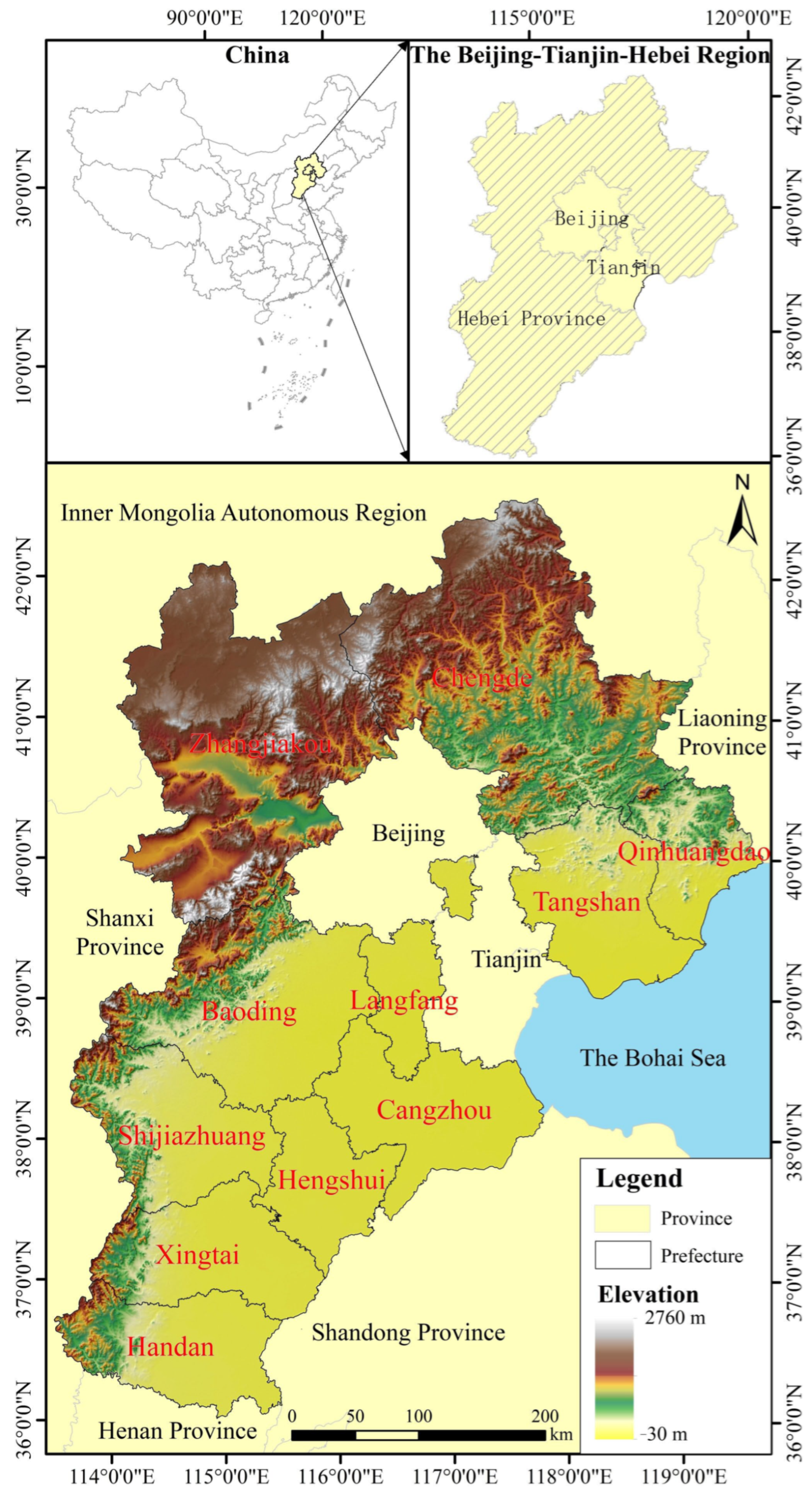
Hebei Province is situated in northern China, spanning 113°27′–119°50′ E and 36°05′–42°40′ N, and geographically encloses the municipalities of Beijing and Tianjin. The region exhibits pronounced topographic heterogeneity, with the Yanshan Mountains in the north, the Taihang Mountains in the west, the North China Plain in the central area, and coastal tidal flat zones along the Bohai Sea to the east (Figure 1). This geomorphological configuration forms a natural landscape characterized by the spatial coexistence of mountainous, plain, and coastal ecosystems. Such topographic diversity not only contributes to the formation of heterogeneous ecosystem types but also provides differentiated environmental conditions and multi-level spatial carriers that support socioeconomic development [34].
Figure 1.
Geographical configuration of the study area.
Rapid urbanization has improved infrastructure construction and public service capacity in Hebei Province [35], contributing to a gradual increase in the living standards of both urban and rural residents. Nevertheless, disparities in social development remain evident, and public service provision continues to lag in parts of remote and underdeveloped areas. Hebei has long served as a traditional industrial base in China, with sectors such as steel production and building materials holding significant national strategic importance [36]. With the promotion of green transformation, Hebei is currently accelerating its transition toward a low-carbon and innovation-oriented economic structure. The province also contains diverse ecological types and performs key ecological functions such as water regulation and soil conservation. However, intensive development and pollution pressures have resulted in ecological degradation in certain regions, although subsequent ecological restoration programs have gradually begun to mitigate environmental deterioration. Overall, the SE–ED–EH coordination process in Hebei is currently characterized by a stage of “rapid economic development–industrial restructuring–insufficient coordination,” a pattern commonly observed in rapidly urbanizing regions across China. Therefore, examining the spatiotemporal evolution of SE–ED–EH coordinated development in Hebei Province holds important theoretical significance and practical relevance for guiding regional sustainable transformation.
2.2. Data Sources and Preprocessing
This study integrates multiple data sources to evaluate SE, ED, and EH, and to quantify their influencing factors. The data categories and corresponding variables used are summarized in Table 1. The dataset system primarily includes the following components:
Socioeconomic data: Land use data and points of interest (POI) were used to construct grid-based socioeconomic indicators. Population density (POP), road network density, and nighttime light (NL) data were applied to characterize human activity intensity. Prefecture-level statistical yearbook data were utilized to describe regional socioeconomic conditions.
Natural environment data: Digital Elevation Model (DEM), slope (derived from DEM), precipitation (PRE), temperature (TEMP), Normalized Difference Vegetation Index (NDVI), evaporation, and root depth were used to characterize natural environmental attributes. Landscape pattern indices, including perimeter–area ratio (PARA), Shape Index (SHAPE), Contiguity Index (CONTIG), Fractal Dimension (FRACT), and Proximity Index (PROX), were calculated based on land use datasets.
Ecosystem service data: Ecosystem services were evaluated using the InVEST model, including carbon storage, water yield, soil conservation, and habitat quality indicators.
Driving factors: Considering the combined effects of natural environmental features, landscape structure, and human activities, we selected 13 factors as driving factors (POP, ROAD, NL, DEM, SLOPE, PRE, TEMP, NDVI, PARA, SHAPE, CONTIG, FRACT, and PROX).
Table 1.
Dataset and their corresponding basic information and sources.
Table 1.
Dataset and their corresponding basic information and sources.
| Data | Resolution | Time | Unit | Data Source |
|---|---|---|---|---|
| DEM | 30 m | 2020 | m | National Earth System Science Data Center (https://www.geodata.cn/main/, accessed on 1 July 2025) |
| China Soil Database | 1 km | 2008 | \ | Harmonized World Soil Database (HWSD) |
| PRE | 1 km | 2005–2020 | mm | National Qinghai–Tibet Plateau Science Data Center (https://data.tpdc.ac.cn/home/ (accessed on 8 July 2025)) |
| Evapotranspiration | 1 km | 2005–2020 | mm | |
| TEMP | 1 km | 2005–2020 | °C | |
| Land Use Data | 30 m/1 km | 2005–2020 | \ | Resource and Environment Science Data Center (RESDC) |
| NDVI | 1 km | 2005–2020 | \ | National Ecological Data Center Resource Sharing Service Platform (https://www.nesdc.org.cn/, (accessed on 8 July 2025) |
| Depth to Bedrock Map | 1 km | 2020 | m | https://doi.org/10.1038/s41597-019-0345-6 |
| POP | 1 km | 2005–2020 | persons km−2 | https://landscan.ornl.gov, accessed on 24 July 2025 |
| NL | 1 km | 2005–2020 | nits | Earth Resource Data Cloud (GRDC) |
| River and Road | \ | 2020 | \ | National Administration of Surveying, Mapping and Geoinformation (NASG) |
| POI | \ | 2005–2020 | \ | Gaode, Baidu |
| Socioeconomic Statistics | Prefecture | 2005–2020 | \ | Hebei Statistical Yearbook, China Urban Statistical Yearbook |
| Total Water Resources | Province | 2005–2020 | m3 | Hebei Water Resources Bulletin |
2.3. Methods
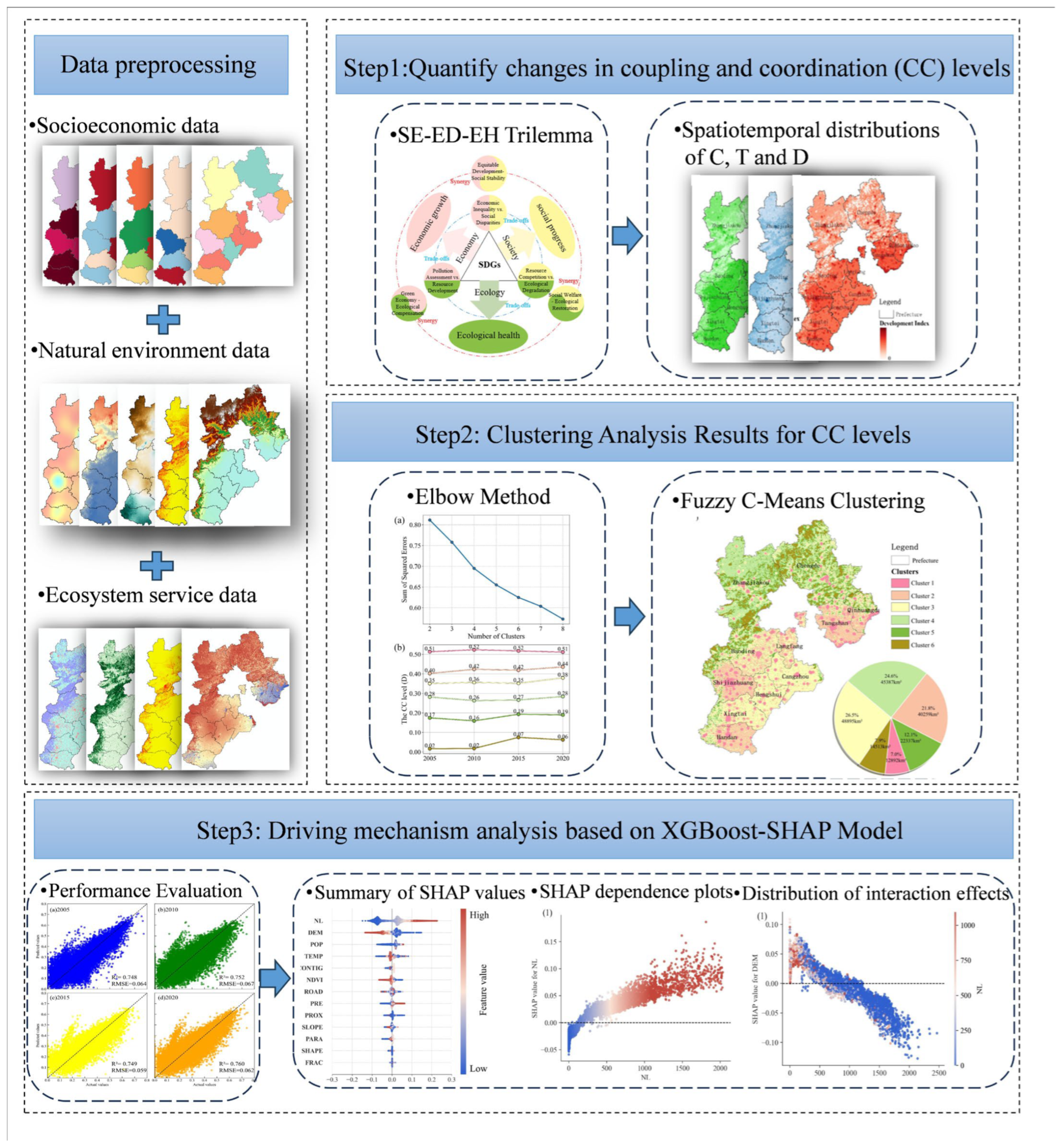
The research framework includes data preprocessing, quantification of coupling and coordination (CC) levels, clustering analysis, and driving mechanism analysis based on the XGBoost-SHAP model (Figure 2). First, multi-source heterogeneous data, including socioeconomic, natural environment, and ecosystem service data, were integrated and standardized to provide a solid foundation for subsequent analysis. Second, the quantification of CC levels was carried out using the SE-ED-EH trilemma framework, analyzing the coupling and coordination of social equity, economic development, and ecosystem health, and examining the spatiotemporal variations of the coupling degree (C), coordination degree (T), and CC level (D). The third step involved clustering analysis, where the elbow method and fuzzy C-means clustering were applied to identify regional differences in CC levels. Finally, the driving mechanism analysis, based on the XGBoost-SHAP model, evaluated the influence of various driving factors, analyzed the distribution of SHAP values, and explored the interactions between these factors using SHAP dependence plots and interaction effect distributions. These steps comprehensively reveal the factors influencing regional coordinated development and provide interpretable analytical results.
Figure 2.
The framework of the study.
To assess the CC levels in the SE-ED-EH systems, we constructed a comprehensive evaluation system (Table 2) based on the principles of indicator availability, comprehensiveness, and time continuity, in combination with previous studies: SE Dimension: The fair provision and accessibility of essential social services and infrastructure. Indicators such as agricultural productivity, education, healthcare, public services, and infrastructure reflect the level of social development [37], which are fundamental for promoting equal opportunities and improving the quality of life for all individuals in society. ED Dimension: This focuses on economic development, industrial structure, and resource utilization efficiency, while also addressing pollution control [38]; EH Dimension: Indicators such as carbon storage, soil retention, habitat quality, and water yield were selected to reflect the supporting functions of ecosystem services for socioeconomic development [39,40].
Table 2.
An evaluation index system for the SE-ED-EH trilemma system and the corresponding weights (“+” indicates that an increase in the indicator has a positive impact, while “−” indicates that an increase in the indicator has a negative impact).
2.3.1. Downscaling of Socioeconomic Data
To enable the gridded representation of socioeconomic statistical yearbook data, a hybrid downscaling approach was employed, integrating land use-based weighting and POI kernel density-based weighting. The land use types and POI types used for downscaling specific indicators are shown in Table 2.
where represents the kernel density, is the bandwidth, is the socioeconomic indicator value of the grid cell, is the ratio of land-use area/POI kernel density to the overall kernel density of land-use area/POI in the prefecture, is the socioeconomic statistical quantity of the prefecture, is the number of grid cells in Hebei Province, and is the number of prefectures in Hebei Province.
2.3.2. Data Standardization
To eliminate dimensional differences and ensure comparability among indicators, the data were standardized using the range normalization method:
where represents the value of the -th indicator for the -th spatial unit; and denote the maximum and minimum values of the indicator; and is the normalized value obtained according to the positive or negative attribute of the indicator.
2.3.3. Determination of Indicator Weights Using the Entropy Method
To minimize subjective bias, the entropy method [41] was employed to determine the weights of the indicators:
where denotes the weight of the -th indicator for the -th spatial unit; represents the processed data; refers to the information entropy of indicator j; denotes the entropy redundancy; and represents the final weight assigned to each indicator.
2.3.4. Comprehensive Evaluation Model Construction
, , and represent the comprehensive evaluation scores of the SE, ED, and EH dimensions, respectively. The calculation formulas are as follows:
where , , and denote the number of indicators corresponding to the SE, ED, and EH dimensions, which were 12, 12, and 4, respectively, in this study; , , and represent the weights assigned to each indicator; , , and refer to the standardized indicator values for each indicator.
2.3.5. Coupling and Coordination Assessment Model
To characterize the interactive relationships among the three dimensions, this study introduces the CC assessment model [42].
where C denotes the coupling degree (), with higher values indicating stronger interaction intensity among the three subsystems; T represents the coordination degree (), where values approaching 1 indicate higher levels of system coordination; and D denotes the overall coordinated development level (), where higher values reflect more advanced coordinated development. α, β, and γ are the weighting coefficients of the three subsystems, satisfying α + β + γ = 1. In this study, equal weighting was adopted, i.e., α = β = γ = 1/3.
2.3.6. Time Series Data Clustering Analysis
Elbow Method
The optimal number of clusters was determined by examining the sum of squared errors (SSE) under different cluster numbers, where the point at which the SSE curve exhibits an evident “elbow” was identified as the optimal clustering solution [43]:
where represents the i-th grid, denotes the centroid of the -th cluster, is the total number of samples, and refers to the maximum number of clusters considered (set to 8 in this study).
Fuzzy C-Means Clustering to Identify the Spatiotemporal Distribution Patterns
Fuzzy C-Means (FCM) clustering enables each sample to simultaneously belong to multiple clusters with different membership degrees [44], making it well-suited for addressing uncertainty and complexity in multidimensional data [45]. In this study, the FCM algorithm was applied to the CC assessment of Hebei Province from 2005 to 2020 to characterize and identify the spatiotemporal distribution patterns of coordinated development.
where denotes the total number of grids, is the optimal cluster number determined using the elbow method, and represents the membership degree of grid to cluster ().
2.3.7. XGBoost-SHAP Model
XGBoost is an efficient gradient boosting algorithm [46] that enhances predictive performance by integrating multiple decision trees. It provides notable advantages, including high computational efficiency, robustness to multicollinearity, automatic handling of missing values, and strong resistance to overfitting [47]. In this study, XGBoost was employed to construct a nonlinear model characterizing the relationships between 13 driving factors and the CC level (D). This modeling approach enables the identification of how multiple factors jointly influence changes within the SE–ED–EH sustainability trilemma and provides robust predictive support for subsequent analyses. Based on previous studies [48,49], data from each year were trained independently, with the training-to-testing ratio set at 80:20. The model parameters include the number of trees (300), learning rate (0.05), subsample ratio (0.9), column subsampling ratio (0.9), and maximum depth (6). To ensure that the class distribution of each subset matches that of the entire dataset, four-fold cross-validation was used to minimize the impact of randomness on the experimental results.
SHAP is derived from the Shapley value theory in cooperative game theory [27] and provides both global and local model interpretability [50]. In this study, SHAP was used to interpret the outputs of the XGBoost model, enabling the quantification of factor contributions and the identification of threshold responses and interaction effects, thereby improving model transparency and interpretability.
3. Results
3.1. Spatiotemporal Distributions of C, T, and D
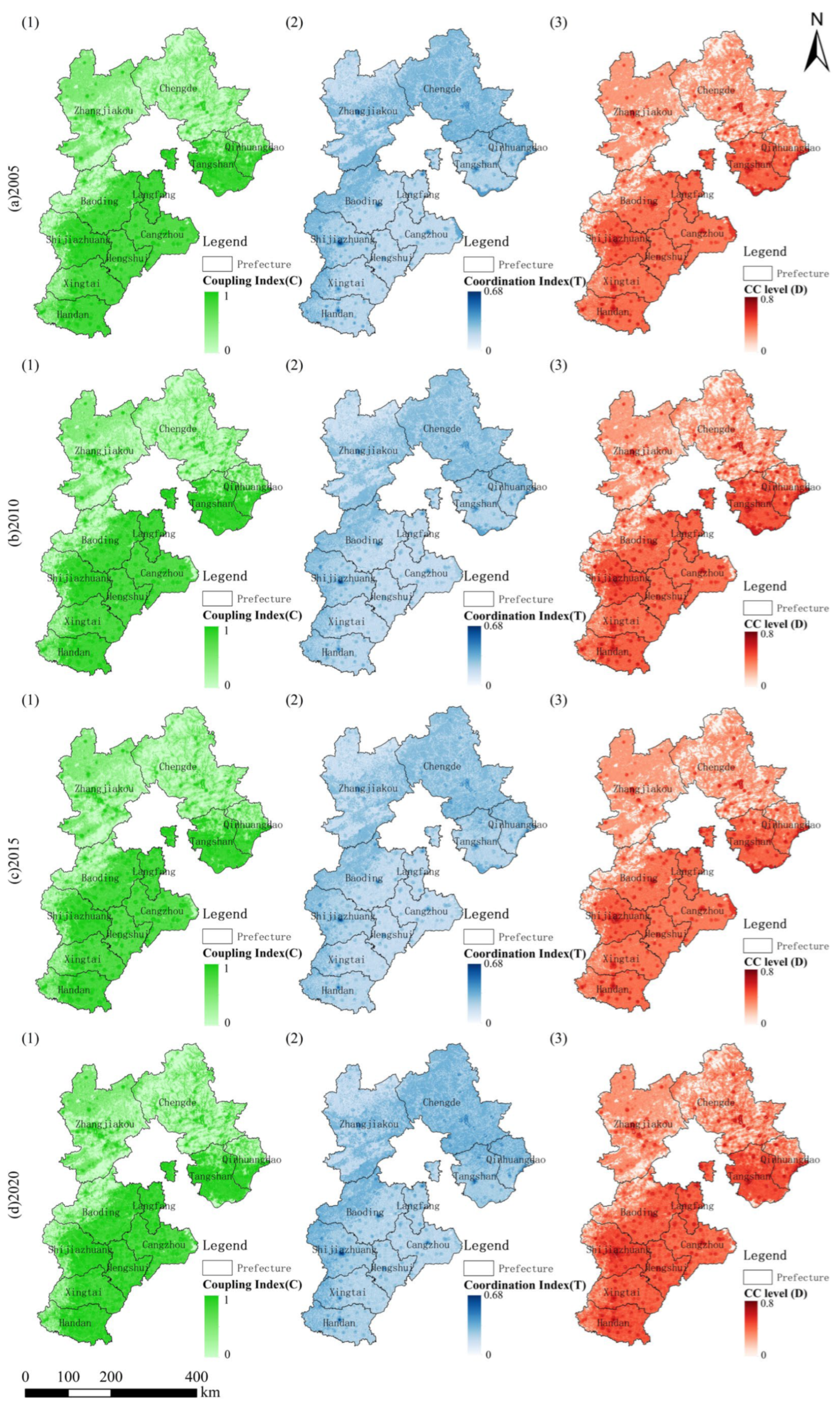
Based on the CCD method, the coupling degree (C), coordination degree (T), and CC level (D) of the SE–ED–EH sustainability trilemma were calculated for the years 2005, 2010, 2015, and 2020 (Figure 3). Overall, the temporal variation in C, T, and D values is relatively limited; however, pronounced spatial heterogeneity is evident across the study area.
Figure 3.
The coupling degree (C), coordination degree (T), and CC level (D) of the SE–ED–EH in Hebei Province, 2005–2020.
As shown in Figure 3(1), the C-value exhibits substantial spatial differentiation across Hebei Province. The highest C-values are observed in major urban centers, reflecting the strong coupling driven by intensive socioeconomic activities and enhanced ecological governance under rapid urbanization. Over time, from 2005 to 2020, a slight increase in C-values can be observed in these urban centers, suggesting an ongoing strengthening of coupling due to continuous urban expansion and socioeconomic development. In contrast, northwestern mountainous regions display relatively low C-values, which may be attributed to limited economic activity, weaker infrastructure conditions, and comparatively stable ecological systems.
With respect to the T-value distribution (Figure 3(2)), the coordination among the three subsystems is strongest in major urban centers, indicating a relatively well-balanced relationship among SE, ED, and EH. This coordination has improved slightly over the years, particularly in urban areas, which reflects more efficient integration of these subsystems under urbanization pressures. Although the northwestern region exhibits relatively low C-values, its T-values remain comparatively high, suggesting that, under conditions of low-intensity human disturbance and relatively stable ecological backgrounds, the three subsystems maintain a more balanced state despite weaker coupling intensity.
From the perspective of CC levels (D) (Figure 3(3)), the urban core areas exhibit the highest overall development and sustainable coordination capacity, benefiting from the combined advantages of both strong coupling and high coordination. Over time, these urban centers have demonstrated a gradual increase in their D-values, reflecting enhanced synergies between development and ecological governance. In contrast, the southeastern plains display lower D-values primarily due to relatively weak coordination (T), while the northwestern mountainous regions show low D-values as a result of insufficient coupling intensity (C), which limits the formation of effective synergies among the three subsystems.
3.2. Clustering Analysis Results for CC Levels
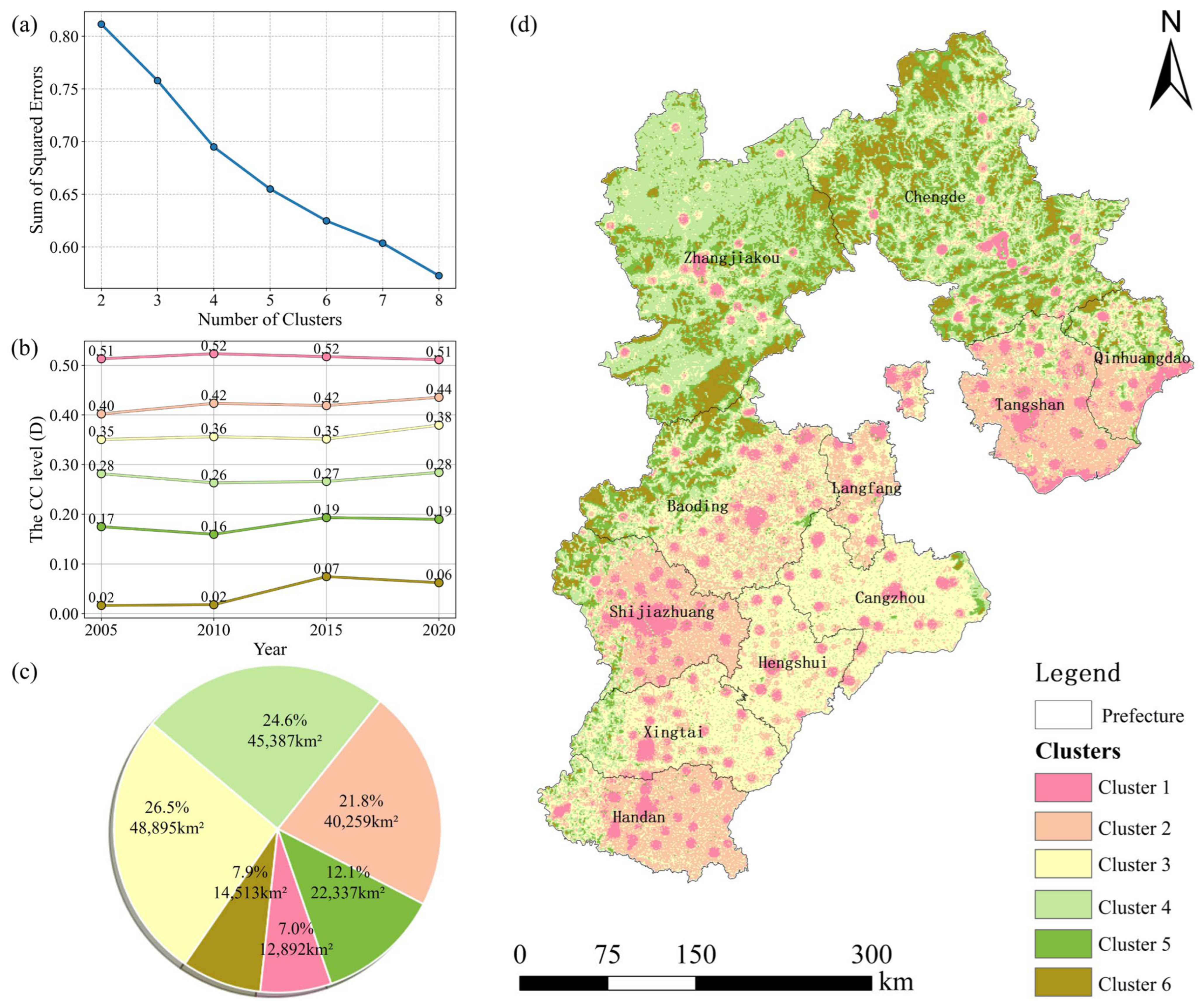
To more accurately capture the spatiotemporal distribution characteristics of coordinated development levels (D-values), FCM was applied to analyze temporal variations from 2005 to 2020. The sum of squared errors (SSE) was calculated under different cluster numbers using the elbow method. As the number of clusters increased, the rate of decline in SSE noticeably slowed at k = 6 (Figure 4a). Therefore, six clusters were selected as the optimal solution to balance model interpretability and analytical simplicity.
Figure 4.
FCM-based clustering analysis results: (a) elbow method result; (b) temporal changes in cluster distribution; (c) areal proportion for each cluster; (d) spatial distribution of clusters.
Based on FCM clustering of D-values for the four study periods, six temporal evolution types were identified (Figure 4b): Cluster 1: Average D = 0.515, exhibiting an inverted U-shaped pattern; primarily located in urban centers, accounting for 7.0%. It is characterized by outstanding economic and social service capacity, strong ecosystem service carrying capacity, and significant synergistic effects. Cluster 2: Average D = 0.420, exhibiting a steady increase; found in Shijiazhuang, Tangshan, Handan, southern Qinhuangdao, and the vicinity of Langfang, accounting for 21.8%. Development shows phased increases. Cluster 3: Average D = 0.360, showing an “increase–decrease–increase” pattern, presenting a positive “N” shape; concentrated in non-urban areas of Cangzhou, Hengshui, and Xingtai, accounting for 26.5%. In the later stages, the increase is driven by economic growth and enhanced ecological governance. Cluster 4: Average D = 0.273, showing a “U-shaped” pattern; located in the northwestern areas of Zhangjiakou, Chengde, and Baoding, as well as the southern part of Qinhuangdao, accounting for 24.6%. Cluster 5: Average D = 0.183, exhibiting an inverted N-shape; predominantly occupying the transitional zone between Cluster 4 and Cluster 6, accounting for 12.1%. Cluster 6: Average D = 0.043, “initially stable then rapidly rising”; primarily located in the high-altitude northwest region, accounting for 7.9%, with later growth driven by the implementation of energy projects and improved economic effects in the region. Overall (Figure 4b–d), various indicators in the northwest mountainous region have generally increased since 2010, reflecting the combined effects of wind and solar projects on economic enhancement, accelerated tree planting, soil conservation, and other ecological governance measures. Nonetheless, the magnitude and pace of improvement differ across indicator types.
3.3. Quantification of Influencing Factors on Changes in CC Levels
3.3.1. XGBoost Model Performance Evaluation
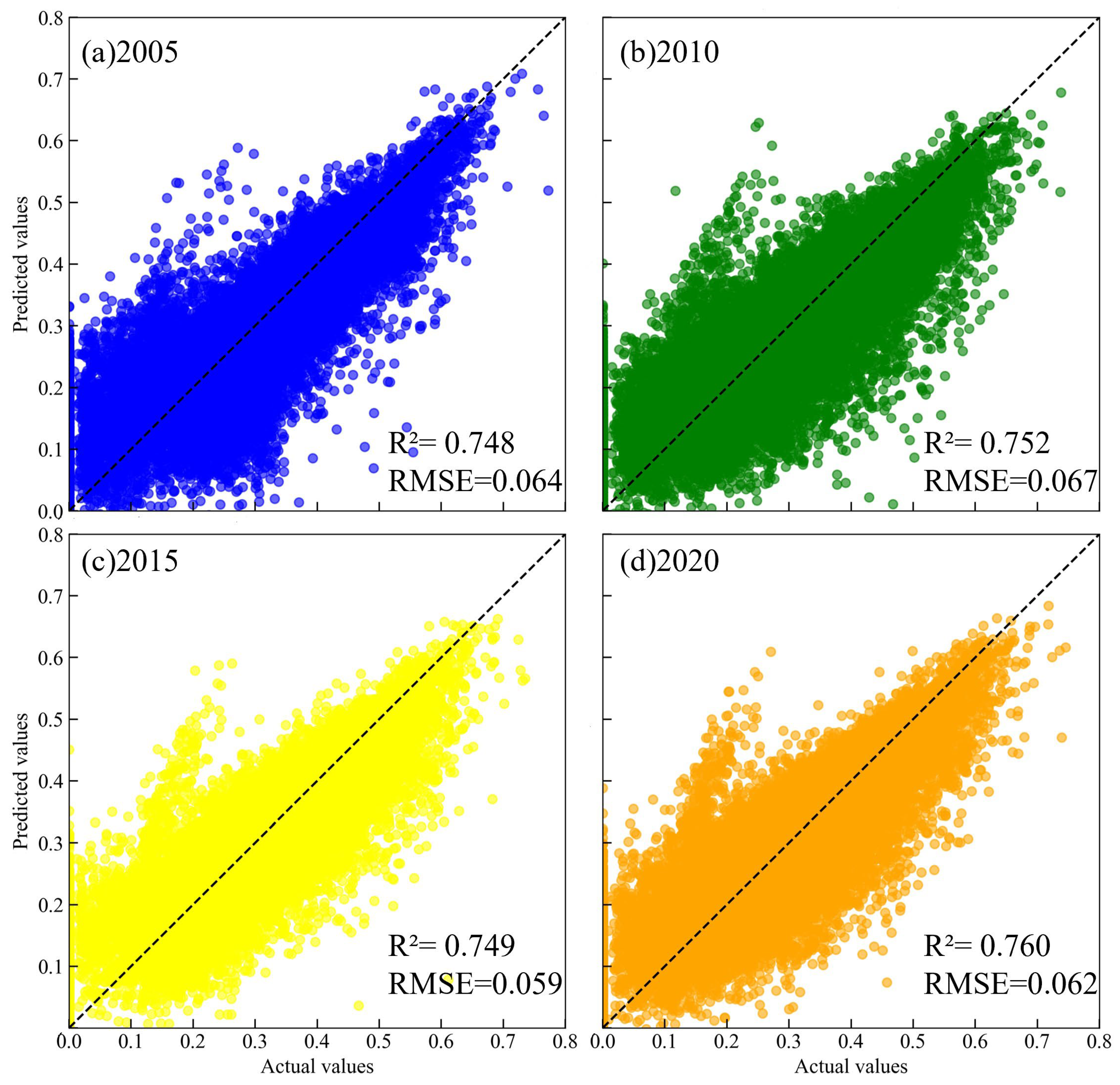
To investigate the multifactor driving mechanisms influencing CC levels within the SE–ED–EH sustainability trilemma in Hebei Province, an XGBoost regression model was constructed, and its predictive performance was evaluated using the test dataset (Figure 5). The R2 values for all four study periods (2005–2020) exceed 0.74, and the RMSE values are all below 0.067, indicating high model accuracy and robustness. These results confirm that the model effectively captures the relationships between CC levels (D) and multiple influencing factors, providing a reliable basis for subsequent SHAP-based interpretation.
Figure 5.
Scatter plots and performance evaluation of XGBoost model predictions for CC levels (D-values) on the test dataset.
3.3.2. Identification of Dominant Factors for Changes in CC Levels
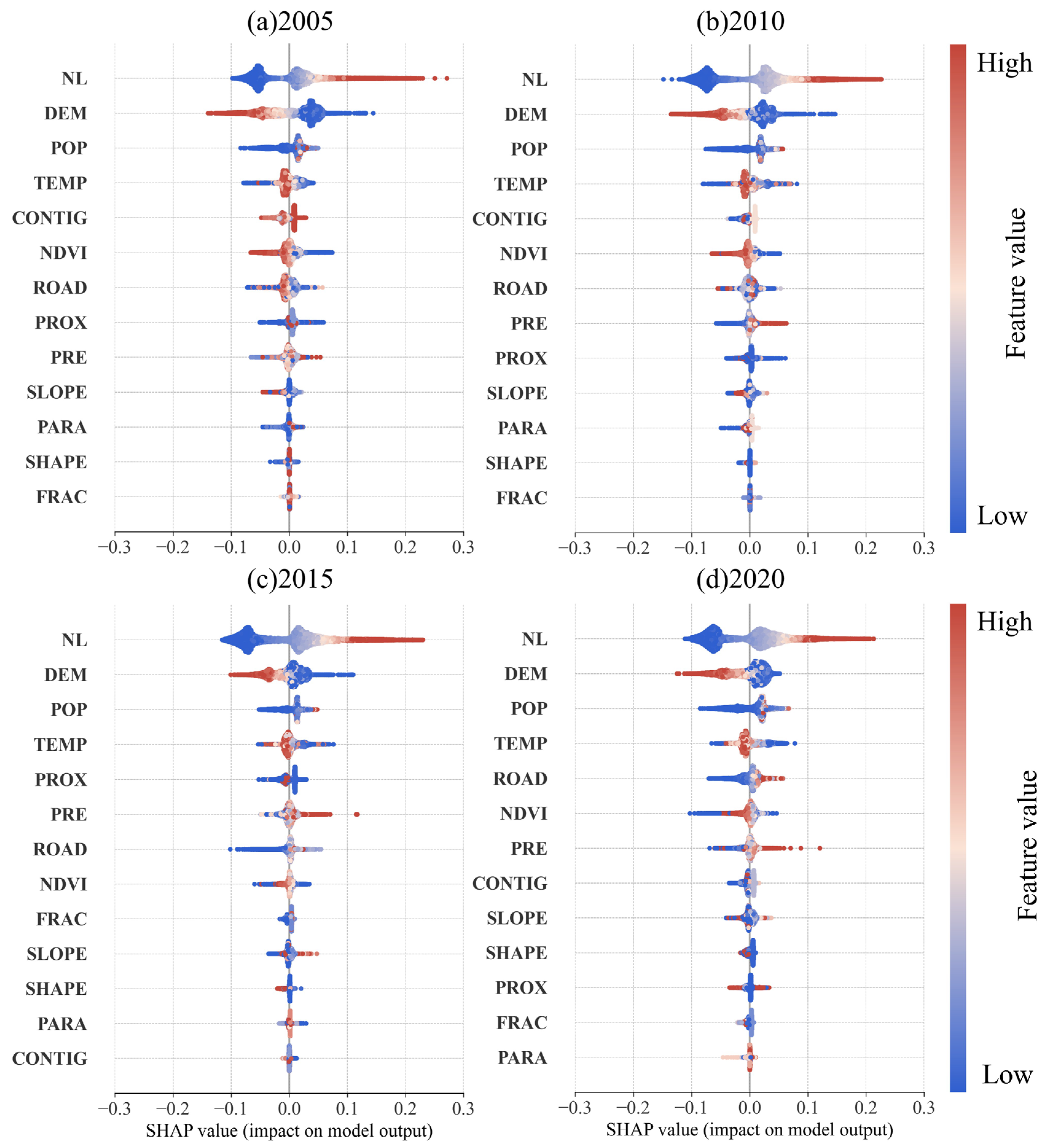
The SHAP method was applied to interpret the XGBoost regression results for the four study periods (2005–2020), enabling a quantitative assessment of the dynamic influence and contribution intensity of each factor on changes in CC levels (D) within the SE–ED–EH trilemma (Figure 6). According to the SHAP importance ranking, NL, DEM, POP, and TEMP consistently occupy the top positions across all periods, indicating that human activity intensity and natural environmental conditions are the primary determinants of CC variations. NL and POP exhibit positive correlations with D-values, reflecting the prominent role of anthropogenic factors in improving coordinated development, while DEM shows a negative correlation with D, suggesting a constraining effect associated with high-altitude terrain. The influence of TEMP demonstrates temporal and spatial variability with no consistent directional trend, indicating that temperature or climate change contributes very little to short-term CC variations. Over time, the inhibitory effect of DEM gradually weakens, whereas the influence of POP first declines and subsequently increases, becoming more pronounced after 2015. The contributions of other factors remain relatively limited and fluctuate substantially across periods.
Figure 6.
Summary of SHAP values for driving factors on changes in CC levels over the period 2005–2020.
3.3.3. Nonlinear Relationships of Dominant Factors and the Threshold Range of Their Influences
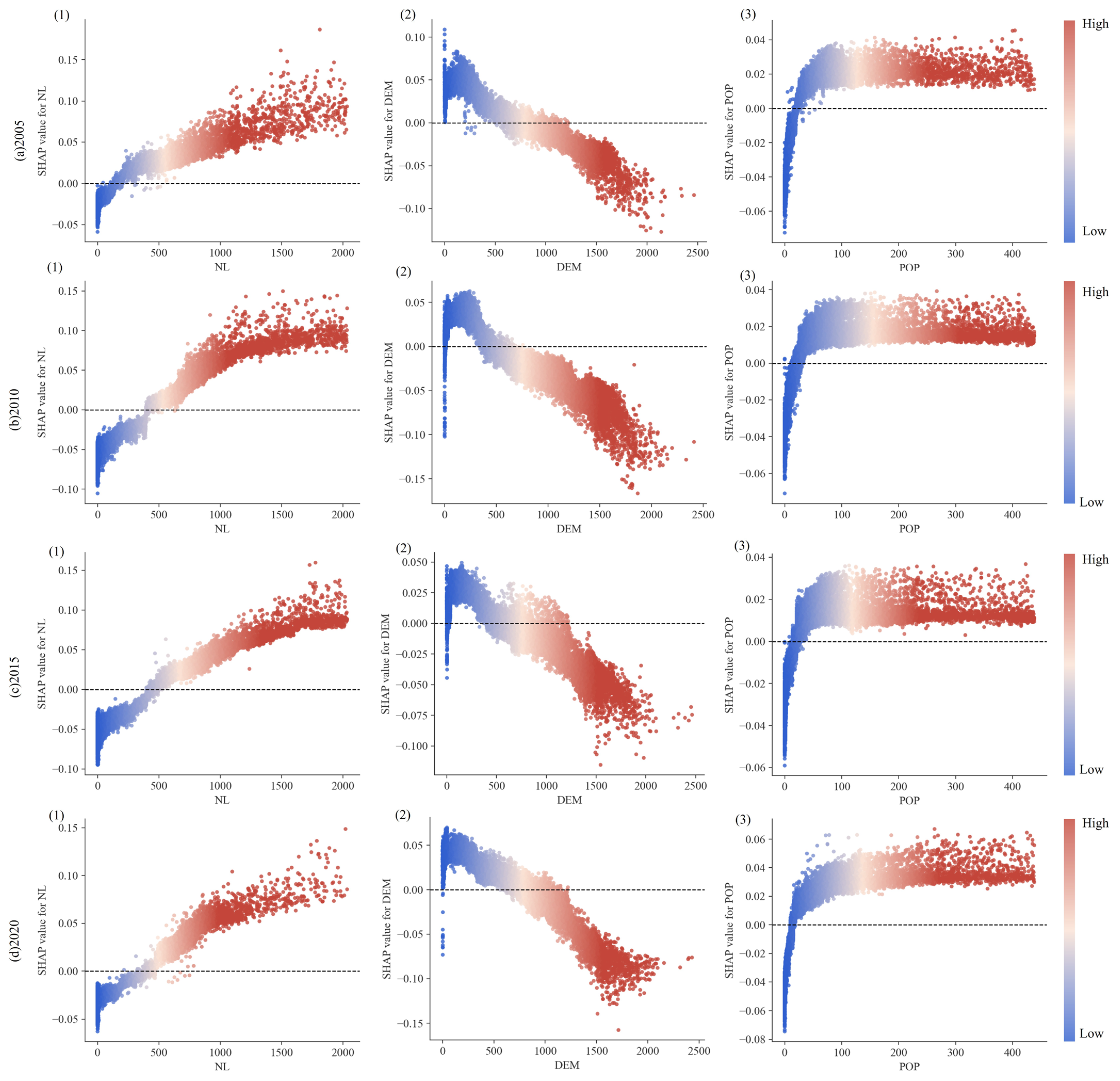
To further examine the nonlinear relationships and threshold responses between key drivers and changes in CC levels, this study selected the three most important factors based on SHAP importance rankings and constructed dependency plots for the four periods from 2005 to 2020 (Figure 7). The results reveal pronounced nonlinear effects and clear threshold characteristics for all three variables. For NL, the overall effect is positive. In 2005, the dominant threshold interval was approximately 250–1500 nits. Values below 250 nits exhibited a negative effect, reflecting the issues of insufficient economic activities and lack of social services in areas with low light intensity. Between 250 and 1500 nits, the positive effect was significant, indicating that moderate NL is beneficial for promoting sustainable urban development. Beyond 1500 nits, the marginal effect gradually weakened, suggesting that excessive light intensity, while contributing to socioeconomic development, brings some environmental burdens such as habitat disruption and light pollution. After 2010, the dominant threshold band shifted to 500–1500 nits. For DEM, the overall effect was negative, though threshold values varied across periods (approximately 1200 m, 1000 m, 1250 m, and 1250 m, respectively), reflecting the modulation of terrain constraints by human accessibility and resource utilization intensity, highlighting the important role of terrain in promoting or constraining regional development. Below the threshold level, DEM exhibited a positive association with D-values, whereas above the threshold, DEM exerted a strong inhibitory influence, reflecting the limiting role of terrain constraints under varying conditions of human accessibility and resource utilization intensity. For POP, the threshold remained relatively stable at approximately 40 persons/km2. Values below this threshold produced negative effects, suggesting that areas with low population density lack sufficient socioeconomic activities and resource development, which affects the sustainable development of the socioeconomic conditions. By contrast, values above 100 persons/km2 displayed diminishing marginal benefits, indicating a saturation effect with respect to population-driven development gains.
Figure 7.
SHAP dependence plots illustrating the impact of the top 3 influential factors in CC levels over the period 2005–2020.
3.3.4. Interpretation of the Interaction of Dominant Factors
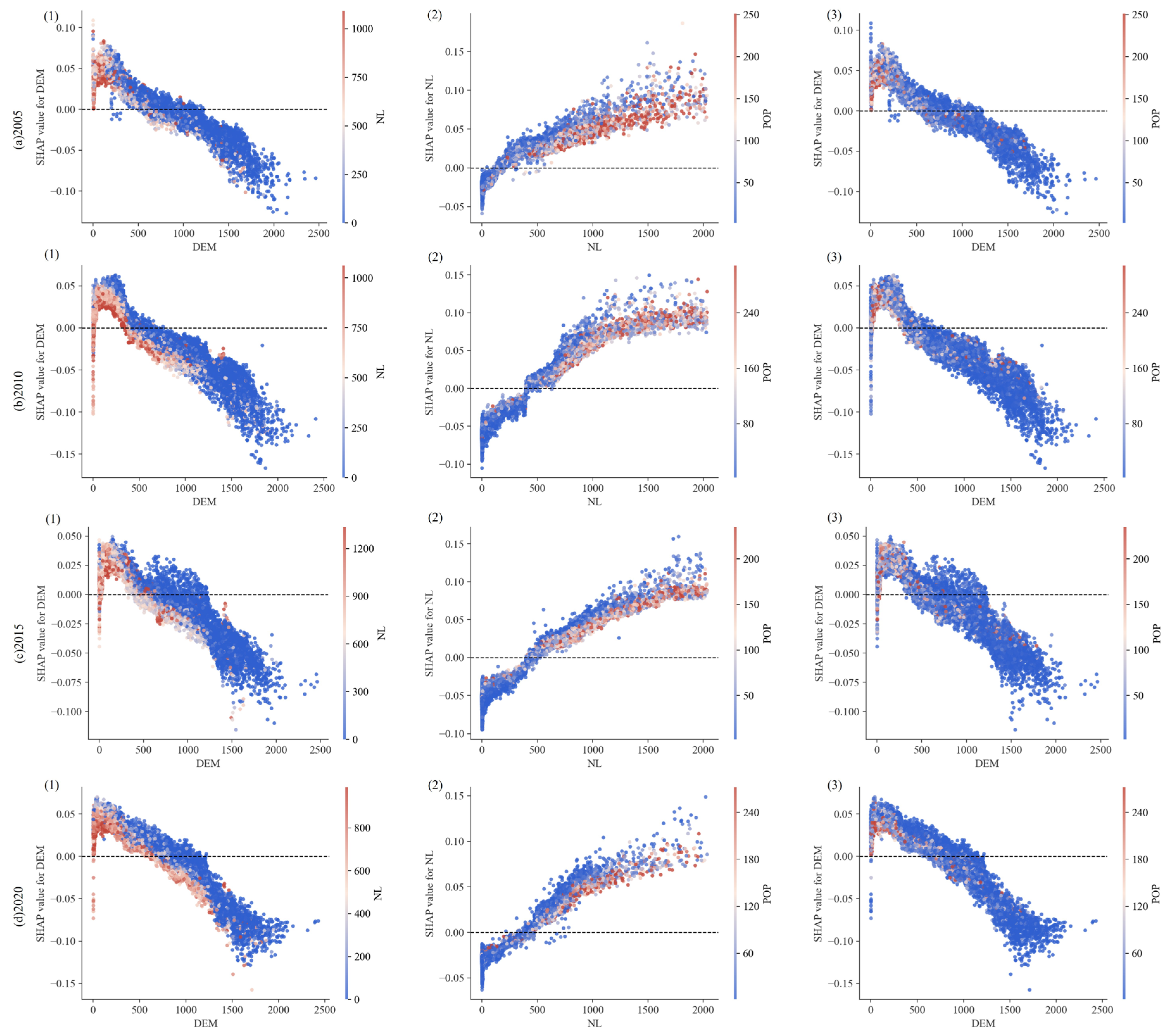
To further investigate the interaction effects and compound threshold responses among dominant influencing factors, the three most important variables identified by SHAP were selected to construct two-factor interaction dependency plots (Figure 8). The main findings are summarized as follows: For the interaction between NL and DEM, when DEM < 250 m, high NL values were associated with negative impacts on D. As DEM increased, the effect gradually shifted from negative to positive. Within the 250–1000 m elevation range, the joint influence of NL and DEM was generally positive, although the marginal effect weakened with increasing DEM. When DEM exceeded 1500 m, NL values were low and exerted a negative effect, reflecting the strong terrain constraints in high-altitude regions. For the NL and POP interaction, in the NL range of 0–500 nits, POP remained approximately 100 persons/km2 with negative impacts on D. When NL exceeded 500 nits, the effect gradually became positive; however, under high-population-density scenarios, SHAP values were lower than those in low-population settings, indicating that excessive population and lighting intensity may offset development benefits due to congestion and environmental pressure. For the DEM and POP interaction, their combined effect was predominantly negative. The low-elevation and high-population configuration (DEM < 1000 m) exhibited the strongest negative influence on D, suggesting that in areas with high accessibility and population concentration, ecological and resource constraints are more likely to become limiting bottlenecks for coordinated development.
Figure 8.
Distribution of interaction effects among dominant factors influencing the CC levels over the period 2005–2020.
4. Discussion
4.1. Implications for Hebei Province’s Green Transformation and High-Quality Development
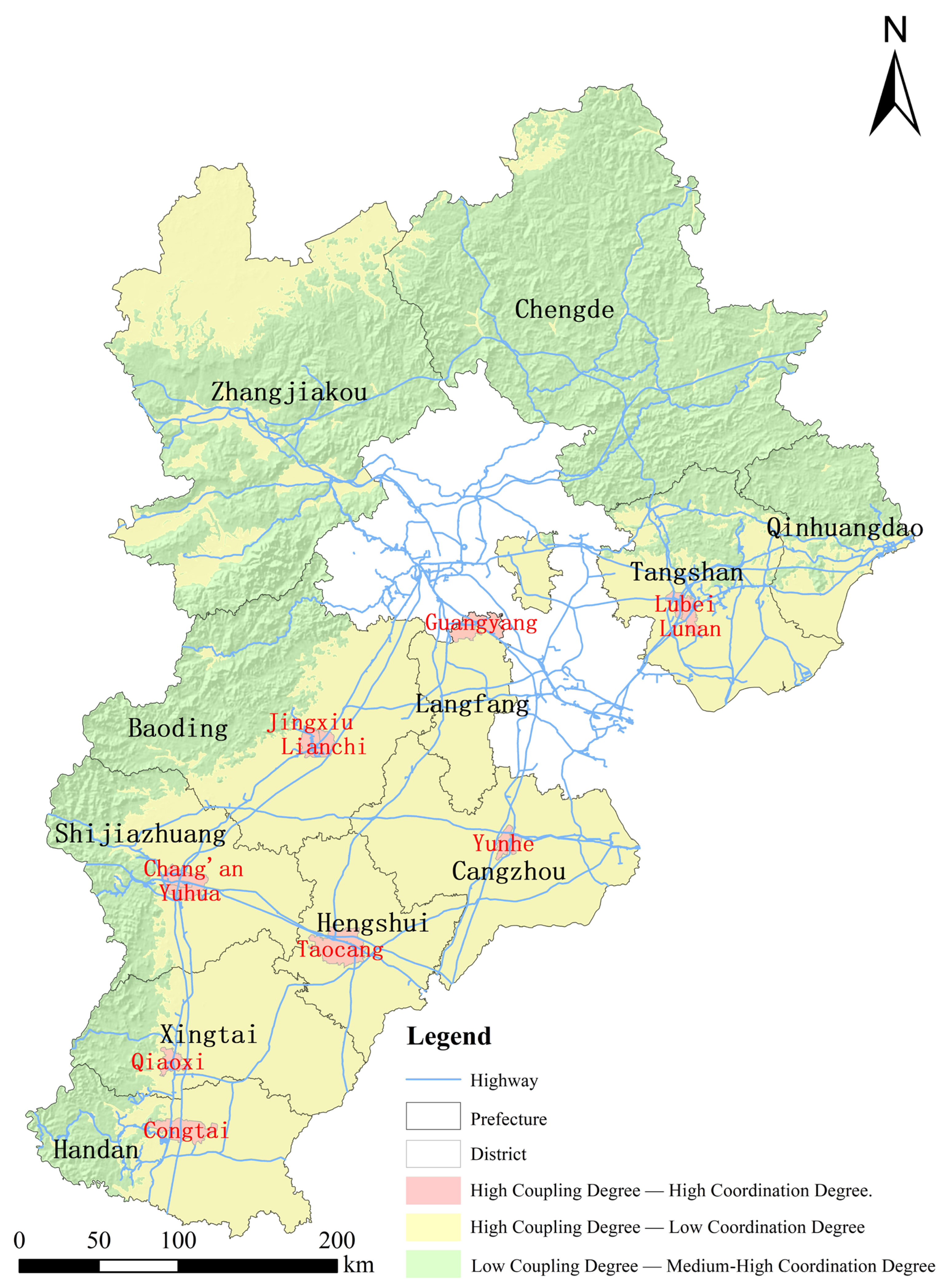
Based on the 1 km grid dataset, this study demonstrates pronounced spatial heterogeneity in the C, T, and CC levels within the SE–ED–EH trilemma across Hebei Province. Urban core areas are characterized by a pattern of “high C–high T–high CC level,” the southeastern plains exhibit “high C–low T–medium CC level,” while the northwestern mountainous regions present a “low C–medium to high T–low CC level” configuration (Figure 9). The XGBoost–SHAP results further indicate that NL, POP, and DEM are the dominant drivers shaping the spatiotemporal variation in CC levels, each with distinct threshold intervals and interaction effects. Specifically, NL displays an effective influence range of 500–1500 nits; POP shows an activation threshold of approximately 40 persons/km2 and diminishing returns beyond 100 persons/km2; and DEM exhibits a constraint threshold between approximately 1000–1250 m.
Figure 9.
Coupling coordination degree zones of Hebei Province (The red labels represent districts, while the black labels represent prefectures).
(1) Metropolitan areas: Building on their existing “high C–high T” characteristics, priority should be given to enhancing ecological benefits through the construction of green infrastructure and the restoration of ecological corridors [51,52,53]. Efforts should focus on reducing high energy consumption by upgrading industrial chains to improve energy efficiency, increasing the share of renewable energy utilization within the power system [54], and promoting green transportation development [55], in order to further consolidate and maintain high CC levels. A common feature of POP and NL is the presence of a “density threshold and diminishing returns” effect [56,57], where excessive agglomeration leads to population congestion, environmental capacity limitations, and public service bottlenecks. To mitigate the strain on resources and reduce the environmental burden, urban planners should regulate NL and POP at or below 100 people/km2, thereby promoting sustainable development.
(2) Southeastern Plain: For regions exhibiting the “high C–low T” pattern, priority should be placed on addressing resource misallocation and ecological pressure [58]. This requires the strict enforcement of ecological redlines, total control of water use and pollutant emissions [59], strengthened non-point source pollution management [60], and the strategic replacement of low-value-added industries with high-value-added and green manufacturing. These measures are expected to enhance coordination (T) and unlock the currently constrained potential for improving CC levels. Hebei retains a relatively high proportion of heavy chemical and resource-intensive industries. In the short term, there is a need to introduce advanced manufacturing and digital services [61,62] to promote green technology diffusion and supply chain coordination [63], which can drive the continuous improvement of T.
(3) Northwestern Mountainous Areas: In regions characterized by the “low C–medium to high T” pattern, terrain accessibility and infrastructure connectivity play a crucial role in enhancing coupling strength (C). Efforts should prioritize balancing the supply of transportation, digital infrastructure, and public services [64] while strengthening the value realization of ecological products [65]. Development strategies should emphasize eco-tourism, green agriculture and animal husbandry, and distributed renewable energy systems. These approaches can gradually enhance coupling intensity (C) while avoiding short-term, high-intensity development that could compromise ecological resilience.
For cross-regional optimization, emphasis should be placed on identifying the “moderate range” of urban population density [66] and the “acceleration window” for industrial greening [67,68]. After population density surpasses the activation threshold (approximately 40 persons/km2), green output efficiency per unit density should be enhanced through stock renewal, functional land use mixing, and balanced improvements in public service provision. In regions dominated by heavy industry, a combined strategy integrating technological upgrading, carbon asset management, and green finance [69] should be prioritized, especially in locations with high accessibility and relatively low ecological sensitivity. Such targeted strategies can achieve the objective of increasing coordination (T) without reducing coupling intensity (C), and improving overall development levels (D) without imposing additional ecological pressure [70].
4.2. Hebei’s Stage Under the United Nations SDGs and International Insights
Compared with the United Nations Sustainable Development Goals (SDGs), Hebei can be regarded as transitioning from a factor-driven stage toward a development phase increasingly oriented by efficiency and innovation. Regional progress is evident in SDG 9 (Industry, Innovation and Infrastructure) and SDG 11 (Sustainable Cities) [71,72]. In contrast, SDG 6 (Clean Water and Sanitation) and SDG 12 (Responsible Consumption and Production) remain constrained by severe water scarcity and a high energy-intensive industrial structure, indicating substantial room for improvement [73,74]. SDG 15 (Life on Land) shows potential advantages in the northwestern mountainous regions, yet is highly susceptible to ecological disturbance at development boundaries [75]. Based on the threshold evidence identified in this study, Hebei is entering a “rebalancing stage” centered on quality upgrading and structural optimization. Strengthening the precise threshold management of population, industry, and ecological pressures will be essential for improving coordination (T) while preventing “threshold distortion” that may hinder the enhancement of CC levels.
The analysis of the spatiotemporal evolution and driving forces underlying changes in CC levels in Hebei Province indicates the following:
(1) Interpretable machine learning as a “policy threshold calibration” tool: Compared to the methods previously used in the exploration of driving factors, which focus on understanding spatial associations and the relative intensity of driving factors, the XGBoost–SHAP framework excels in accurately quantifying factor contributions and capturing inherent nonlinear relationships. The XGBoost–SHAP framework uncovers the nonlinear thresholds and interaction effects [76] among dominant factors such as POP, NL, and DEM, thereby enabling the identification of “moderate agglomeration ranges,” “terrain constraint limits,” and “ecological carrying capacity boundaries.” This provides quantitative evidence to guide urban expansion control and industrial spatial configuration within a “maximum benefit–minimum cost” decision window.
(2) Fine-scale governance at the grid level: The 1 km grid-based evaluation framework translates macro-level sustainability objectives (e.g., SDG 11 and SDG 13) into operational spatial units, enabling a differentiated, zoned, and temporally adaptive policy mix. For grid units approaching critical threshold limits, priority should be placed on stock renewal and structural upgrading, whereas grid units far from threshold saturation are more suitable for guiding the expansion of green and low-carbon industries.
(3) Data availability and transferability: The proposed approach is based on multi-source remote sensing and publicly accessible statistical data, making it adaptable to data-scarce contexts and suitable for rapid assessments and iterative, rolling decision-making in developing economies. Moreover, core variables such as NL, POP, and DEM exhibit strong cross-regional comparability, enabling benchmarking, knowledge transfer, and collaborative governance among different regions and countries.
(4) A “coordination-first, acceleration-later” transformation pathway: For regions facing stronger resource and environmental constraints, priority should be placed on improving coordination (T)—including system-level alignment and ecological carrying capacity—before expanding coupling intensity (C) and increasing CC levels (D). This sequential strategy helps avoid the high-cost trajectory of “expansion first, correction later,” and supports a more sustainable and efficiency-oriented transformation path.
Therefore, this study applied interpretable machine learning to uncover the nonlinear mechanisms and threshold characteristics underlying SE–ED–EH coordination in Hebei Province, providing spatially explicit evidence and a grid-oriented policy framework aligned with the SDGs. This paradigm offers direct policy relevance and strong technical transferability, particularly for developing countries in the later stages of industrialization, where resource scarcity and environmental constraints are becoming increasingly binding.
However, due to various objective constraints, both the landscape pattern indices and the EH indicators are derived from land use data. As a result, there may be some internal structural influence during the exploration of driving factors, meaning these indicators could be interdependent during calculation, which may affect the independence and accuracy of the research findings. Future studies should consider a broader range of factors to complement and refine the existing research framework. Additionally, multi-region comparative studies could be conducted to further validate the adaptability of the XGBoost-SHAP model within complex evaluation systems, thereby minimizing the uncertainty of the research results.
5. Conclusions
This study examined the spatiotemporal evolution and driving forces of coordinated development within the SE–ED–EH sustainability trilemma in Hebei Province using a 1-km grid dataset, the CCD model, and an interpretable machine learning framework (XGBoost–SHAP). The results demonstrate significant spatial heterogeneity in coordinated development. Urban cores exhibit “high C–high T–high CC level,” the southeastern plains display the pattern of “high C–low T–medium CC level,” while the northwestern mountainous regions show “low C–medium/high T–low CC level.” Six temporal evolution types were identified using FCM clustering, reflecting differentiated development trajectories shaped by spatial location, resource conditions, and governance strategies.
XGBoost–SHAP reveals that NL, POP, and DEM are the dominant drivers of CC variation, exhibiting clear nonlinear thresholds and strong interaction effects. The effective NL range of 500–1500 nits, the activation threshold of POP near 40 persons/km2 with diminishing returns beyond 100 persons/km2, and the DEM constraint threshold of approximately 1000–1250 m jointly shape coordinated development trajectories. Interaction evidence further shows that compound pressure zones (e.g., low DEM and high POP) are more likely to trigger negative effects, whereas moderate population density and terrain elevation can generate net positive outcomes. These findings highlight the importance of threshold-based structural management for achieving sustainable coordination.
Interpretable machine learning provides quantitative “policy threshold calibration” and enables transformation of macro SDG targets into actionable grid-scale decision units. The method relies on multi-source remote sensing and publicly available statistics, offering high transferability for developing countries facing tightening ecological constraints in late industrialization stages. This paradigm provides a technically feasible and policy-operational pathway toward coordinated spatial governance, supporting sustainable, resilient, and high-quality development under the sustainability trilemma framework.
Author Contributions
Conceptualization, Q.C. and L.S.; methodology, Q.C.; software, Q.Z., K.Z., J.W. and J.B.; validation, Q.C., W.W. and Y.L.; formal analysis, Q.C.; investigation, G.Q., S.L. and Y.L.; resources, L.S.; data curation, Q.C., Q.Z. and J.W.; writing—original draft preparation, Q.C.; writing—review and editing, L.S. and G.Q.; visualization, Q.C. and Q.Z.; supervision, L.S.; project administration, L.S.; funding acquisition, L.S. All authors have read and agreed to the published version of the manuscript.
Funding
This research was supported by the Science and Technology Planning Project of Hebei Academy of Sciences (25103).
Data Availability Statement
No new data were created or analyzed in this study. Data sharing is not applicable to this article.
Acknowledgments
The authors would like to express their sincere gratitude to the editors and reviewers for their valuable comments and constructive suggestions, which have significantly improved the quality of this manuscript. The authors have reviewed and edited the output accordingly and take full responsibility for the content of this publication.
Conflicts of Interest
The authors declare no conflicts of interest.
References
- Elliott, J. An Introduction to Sustainable Development; Routledge: Milton Park, UK, 2012. [Google Scholar]
- Liu, H.; Xiong, J.; Hong, S.; Zhou, B. Social, economic, and environmental development in China through the lens of synergies and trade-offs. J. Clean. Prod. 2025, 509, 145634. [Google Scholar] [CrossRef]
- Peng, J.; Xia, P.; Liu, Y.; Xu, Z.; Zheng, H.; Lan, T.; Yu, S. Ecosystem services research: From golden era to next crossing. Trans. Earth Environ. Sustain. 2023, 1, 9–19. [Google Scholar] [CrossRef]
- Costanza, R. Valuing natural capital and ecosystem services toward the goals of efficiency, fairness, and sustainability. Ecosyst. Serv. 2020, 43, 101096. [Google Scholar] [CrossRef]
- Karaouzas, I.; Smeti, E.; Vourka, A.; Vardakas, L.; Mentzafou, A.; Tornés, E.; Sabater, S.; Muñoz, I.; Skoulikidis, N.T.; Kalogianni, E. Assessing the ecological effects of water stress and pollution in a temporary river-Implications for water management. Sci. Total Environ. 2018, 618, 1591–1604. [Google Scholar] [CrossRef]
- Han, L.; Zhou, W.; Li, W.; Li, L. Impact of urbanization level on urban air quality: A case of fine particles (PM2.5) in Chinese cities. Environ. Pollut. 2014, 194, 163–170. [Google Scholar] [CrossRef] [PubMed]
- Wang, W.; Wang, H.; Yang, G.; Zhou, X. Interactions between ecosystem services and social economies in the Yangtze River economic belt. Adv. Sustain. Syst. 2023, 7, 2200400. [Google Scholar] [CrossRef]
- Schaafsma, M.; Eigenbrod, F.; Gasparatos, A.; Gross-Camp, N.; Hutton, C.; Nunan, F.; Schreckenberg, K.; Turner, K. Trade-off decisions in ecosystem management for poverty alleviation. Ecol. Econ. 2021, 187, 107103. [Google Scholar] [CrossRef]
- Martine, G.; Alves, J.E.D. Economy, society and environment in the 21st century: Three pillars or trilemma of sustainability? Rev. Bras. De Estud. De Popul. 2015, 32, 433–460. Available online: https://www.scielo.br/j/rbepop/a/pXt5ZtxqShgBKDJVTDjfWRn/?lang=en (accessed on 28 December 2025). [CrossRef]
- Wang, S.; Kong, W.; Ren, L.; ZHI, D. Research on misuses and modification of coupling coordination degree model in China. J. Nat. Resour. 2021, 36, 793–810. [Google Scholar] [CrossRef]
- Zuo, Z.; Guo, H.; Cheng, J.; Li, Y. How to achieve new progress in ecological civilization construction?–Based on cloud model and coupling coordination degree model. J. Nat. Resour. 2021, 127, 107789. [Google Scholar] [CrossRef]
- Wu, J.; Guo, Y.; Zhou, J. Nexus between ecological conservation and socio-economic development and its dynamics: Insights from a case in China. Water 2020, 12, 663. [Google Scholar] [CrossRef]
- Ostrom, E. A general framework for analyzing sustainability of social-ecological systems. Science 2009, 325, 419–422. [Google Scholar] [CrossRef] [PubMed]
- Liu, Y.; Yang, L.; Jiang, W. Coupling coordination and spatiotemporal dynamic evolution between social economy and water environmental quality—A case study from Nansi Lake catchment, China. Ecol. Indic. 2020, 119, 106870. [Google Scholar] [CrossRef]
- Liu, Y.; Zeng, C.; Cui, H.; Song, Y. Sustainable land urbanization and ecological carrying capacity: A spatially explicit perspective. Sustainability 2018, 10, 3070. [Google Scholar] [CrossRef]
- Joore, J.P. New to Improve—The Mutual Influence Between New Products and Societal Change Processes; JP Joore: Delft, The Netherlands, 2010. [Google Scholar]
- Folke, C.; Hahn, T.; Olsson, P.; Norberg, J. Adaptive governance of social-ecological systems. Annu. Rev. Environ. Resour. 2005, 30, 441–473. [Google Scholar] [CrossRef]
- Huang, J.; Li, F. Coupling Coordination Degree Measurement and Spatial Distribution between Economic Development and Ecological Environment of Countries along the Belt and Road. Pol. J. Environ. Stud. 2021, 30, 3615–3626. [Google Scholar] [CrossRef] [PubMed]
- Ren, J.; Ma, R.; Huang, Y.; Wang, Q.; Guo, J.; Li, C.; Zhou, W. Identifying the trade-offs and synergies of land use functions and their influencing factors of Lanzhou-Xining urban agglomeration in the upper reaches of Yellow River Basin, China. Ecol. Indic. 2024, 158, 111279. [Google Scholar] [CrossRef]
- Ge, Y.; Hu, S.; Song, Y.; Zheng, H.; Liu, Y.; Ye, X.; Ma, T.; Liu, M.; Zhou, C. Sustainable poverty reduction models for the coordinated development of the social economy and environment in China. Sci. Bull. 2023, 68, 2236–2246. [Google Scholar] [CrossRef]
- Che, S.; Zhang, X.; Shu, W. Evaluation of internal coupling and coordination degree and diagnosis of obstacle factors for high-quality regional economic development: Evidence from Chongqing’s “One District, Two Groups”. PLoS ONE 2024, 19, e0312820. [Google Scholar] [CrossRef]
- Ye, S.; Wei, C.; Wang, Z. Coupling coordination between resource and environmental carrying capacity and social development quality and its influence mechanism. Ecol. Indic. 2025, 179, 114151. [Google Scholar] [CrossRef]
- Wang, J.; Hou, H.; Zhang, S.; Zhang, S.; Ji, H.; Chen, Z. Coupling Coordination Between Ecosystem Services and Sustainable Development Goals from a County-Level Perspective in Jiangsu Province, China. Land 2025, 14, 1627. [Google Scholar] [CrossRef]
- Xu, Y.; Yang, L.; Sun, K.; Zhu, J. Synergistic security relationships and risk measurement of water resources-social economy-ecological environment in Beijing-Tianjin-Hebei region. Ecol. Indic. 2025, 175, 113512. [Google Scholar] [CrossRef]
- Li, L.; Fan, Z.; Feng, W.; Yuxin, C.; Keyu, Q. Coupling coordination degree spatial analysis and driving factor between socio-economic and eco-environment in northern China. Ecol. Indic. 2022, 135, 108555. [Google Scholar] [CrossRef]
- Sun, X.; Ye, D.; Shan, R.; Peng, Q.; Zhao, Z.; Sun, J. Effect of physical geographic and socioeconomic processes on interactions among ecosystem services based on machine learning. J. Clean. Prod. 2022, 359, 131976. [Google Scholar] [CrossRef]
- Song, Y.; Zhang, D.; Wang, Q.; Liu, Y.; Chen, K.; Sun, J.; Shi, L.; Li, B.; Yang, X.; Mi, W. Prediction models for postoperative delirium in elderly patients with machine-learning algorithms and SHapley Additive exPlanations. Transl. Psychiatry 2024, 14, 57. [Google Scholar] [CrossRef] [PubMed]
- Dong, Q.; Zhong, K.; Liao, Y.; Xiong, R.; Wang, F.; Pang, M. Coupling coordination degree of environment, energy, and economic growth in resource-based provinces of China. Resour. Policy 2023, 81, 103308. [Google Scholar] [CrossRef]
- He, Y.; Liu, G. Coupling coordination analysis of low-carbon development, technology innoation, and new urbanization: Data from 30 provinces and cities in China. Front. Public Health 2022, 10, 1047691. [Google Scholar] [CrossRef]
- Tang, B.; Luo, H. Mismatch and coupling: A study on the synergistic development of tourism-economy-ecology Systems in the Pearl River Delta. Sustainability 2022, 14, 8518. [Google Scholar] [CrossRef]
- Liu, X.; Xin, Y. Exploring the characteristics and driving factors of coupling coordination of regional sustainable development: Evidence from China’s 31 provinces. Environ. Sci. Pollut. Res. 2022, 29, 71075–71099. [Google Scholar] [CrossRef]
- Zhang, J.; Dong, Z. Assessment of coupling coordination degree and water resources carrying capacity of Hebei Province (China) based on WRESP2D2P framework and GTWR approach. Sustain. Cities Soc. 2022, 82, 103862. [Google Scholar] [CrossRef]
- Yuan, Y.; Jingwen, Z.; Xiankai, H.; Jinlian, S. Evaluation of Coupling Coordination and Influencing Factors among Urban Agglomeration Economy, Water Resources, and Ecological Environment: A Case Study of the Beijing-Tianjin-Hebei Region. Arid Zone Resour. Environ. 2025, 39, 13–28. [Google Scholar] [CrossRef]
- Peng, J.; Chen, X.; Liu, Y.; Lü, H.; Hu, X. Spatial identification of multifunctional landscapes and associated influencing factors in the Beijing-Tianjin-Hebei region, China. Appl. Geogr. 2016, 74, 170–181. [Google Scholar] [CrossRef]
- Ren, F.; Yu, X. Coupling analysis of urbanization and ecological total factor energy efficiency—A case study from Hebei province in China. Sustain. Cities Soc. 2021, 74, 103183. [Google Scholar] [CrossRef]
- Kang, L.; Ma, L. Expansion of industrial parks in the Beijing–Tianjin–Hebei urban agglomeration: A spatial analysis. Land 2021, 10, 1118. [Google Scholar] [CrossRef]
- Yuan, C.; Zhang, B.; Xu, J.; Lyu, D.; Liu, J.; Hu, Z.; Han, Y. Impact of new-type urbanization pilot policy on public service provision: Evidence from China. Cities 2025, 161, 105853. [Google Scholar] [CrossRef]
- Arrow, K.J.; Dasgupta, P.; Goulder, L.H.; Mumford, K.J.; Oleson, K. Sustainability and the measurement of wealth. Environ. Dev. Econ. 2012, 17, 317–353. [Google Scholar] [CrossRef]
- Xu, L.; He, J.; He, Y.; Zhang, L.; Xu, H.; Tang, C. Multidimensional factors influencing ecosystem services and their relationships in alpine ecosystems: A case study of the Daxing’anling forest area, Inner Mongolia. For. Ecosyst. 2025, 14, 100383. [Google Scholar] [CrossRef]
- Dang, H.; Lü, Y.; Wang, X.; Hao, Y.; Fu, B. Integrating species diversity, ecosystem services, climate and ecological stability helps to improve spatial representation of protected areas for quadruple win. Geogr. Sustain. 2025, 6, 100205. [Google Scholar] [CrossRef]
- Zhu, Y.; Tian, D.; Yan, F. Effectiveness of entropy weight method in decision-making. Math. Probl. Eng. 2020, 2020, 3564835. [Google Scholar] [CrossRef]
- Dong, L.; Longwu, L.; Zhenbo, W.; Liangkan, C.; Faming, Z. Exploration of coupling effects in the Economy–Society–Environment system in urban areas: Case study of the Yangtze River Delta Urban Agglomeration. Ecol. Indic. 2021, 128, 107858. [Google Scholar] [CrossRef]
- Herdiana, I.; Kamal, M.A.; Estri, M.N. A More Precise Elbow Method for Optimum K-means Clustering. arXiv Prepr. 2025, arXiv:2502.00851. [Google Scholar] [CrossRef]
- Bezdek, J.C. Pattern Recognition with Fuzzy Objective Function Algorithms; Springer Science & Business Media: Berlin/Heidelberg, Germany, 2013. [Google Scholar]
- Bezdek, J.C. FCM: The fuzzy c-means clsutering algorithm. Comput. Geosci. 1984, 10, 191–203. [Google Scholar] [CrossRef]
- Ma, M.; Zhao, G.; He, B.; Li, Q.; Dong, H.; Wang, S.; Wang, Z. XGBoost-based method for flash flood risk assessment. J. Hydrol. 2021, 598, 126382. [Google Scholar] [CrossRef]
- Xu, B.; Li, J.; Liu, Y.; Zhang, T.; Luo, Z.; Pei, X. Disentangling the response of vegetation dynamics to natural and anthropogenic drivers over the Qinghai-Tibet Plateau using dimensionality reduction and structural equation model. For. Ecol. Manag. 2024, 554, 121677. [Google Scholar] [CrossRef]
- Ebrahimi-Khusfi, Z.; Dargahian, F.; Nafarzadegan, A.R. Predicting the dust events frequency around a degraded ecosystem and determining the contribution of their controlling factors using gradient boosting-based approaches and game theory. Environ. Sci. Pollut. Res. 2022, 29, 36655–36673. [Google Scholar] [CrossRef]
- Wang, Y.; Cheng, W.; Jin, Y.; Li, J.; Yang, Y.; Hu, S. An XGBoost-SHAP Model for Energy Demand Prediction with Boruta–Lasso Feature Selection. IEEE Access 2025, 13, 135806–135821. [Google Scholar] [CrossRef]
- Liu, J.; Jiang, W.; Yu, Y.; Gong, J.; Chen, G.; Yang, Y.; Wang, C.; Sun, D.; Lu, X. Applying machine learning to predict bowel preparation adequacy in elderly patients for colonoscopy: Development and validation of a web-based prediction tool. Ann. Med. 2025, 57, 2474172. [Google Scholar] [CrossRef] [PubMed]
- Ren, X.; Tan, X.; Luo, D. Coupling and Spatial Disparities of Regional Economy and Ecosystem in High-Quality Town Development. Res. Ecol. 2025, 7, 15–29. [Google Scholar] [CrossRef]
- Yun, K.; Zhang, M.; Zhang, Y. Investigating the coupled coordination of improved ecological environment and socio-economic development in alpine wetland areas: A case study of southwest China. Ecol. Indic. 2024, 160, 111740. [Google Scholar] [CrossRef]
- Liu, Y.; Yang, R.; Sun, M.; Zhang, L.; Li, X.; Meng, L.; Wang, Y.; Liu, Q. Regional sustainable development strategy based on the coordination between ecology and economy: A case study of Sichuan Province, China. Ecol. Indic. 2022, 134, 108445. [Google Scholar] [CrossRef]
- Tang, L.; Wang, H.; Zhu, X.; Liu, J.; Li, K. Optimization and Scheduling of Green Power System Consumption Based on Multi-Device Coordination and Multi-Objective Optimization. Energy Eng. J. Assoc. Energy Eng. 2025, 122, 2257. [Google Scholar] [CrossRef]
- Shah, K.J.; Pan, S.-Y.; Lee, I.; Kim, H.; You, Z.; Zheng, J.-M.; Chiang, P.-C. Green transportation for sustainability: Review of current barriers, strategies, and innovative technologies. J. Clean. Prod. 2021, 326, 129392. [Google Scholar] [CrossRef]
- Huang, Z.; Chen, Y.; Zheng, Z.; Wu, Z. Spatiotemporal coupling analysis between human footprint and ecosystem service value in the highly urbanized Pearl River Delta urban Agglomeration, China. Ecol. Indic. 2023, 148, 110033. [Google Scholar] [CrossRef]
- Yin, H.; Xiao, R.; Fei, X.; Zhang, Z.; Gao, Z.; Wan, Y.; Tan, W.; Jiang, X.; Cao, W.; Guo, Y. Analyzing “economy-society-environment” sustainability from the perspective of urban spatial structure: A case study of the Yangtze River delta urban agglomeration. Sustain. Cities Soc. 2023, 96, 104691. [Google Scholar] [CrossRef]
- Xiao, Y.; Li, Y.; Huang, H. Conflict or coordination? Assessment of coordinated development between socioeconomic and ecological environment in resource-based cities: Evidence from Sichuan province of China. Environ. Sci. Pollut. Res. 2021, 28, 66327–66339. [Google Scholar] [CrossRef]
- Wei, H.; Xue, D.; Huang, J.; Liu, M.; Li, L. Identification of coupling relationship between ecosystem services and urbanization for supporting ecological management: A case study on areas along the Yellow River of Henan Province. Remote Sens. 2022, 14, 2277. [Google Scholar] [CrossRef]
- Li, H.; Wang, Q.; Zang, X.; Gao, T.; Gu, H. Spatiotemporal differentiation and influencing factors of the degree of resilience coupling coordination in the Beijing–Tianjin–Hebei region. Sci. Rep. 2024, 14, 26394. [Google Scholar] [CrossRef]
- Hu, M.; Chen, P.; Chen, G.; Li, Z. Spatio-temporal influencing effects and mechanisms of the digital economy on eco-urbanization in the Yangtze River Delta region. Environ. Technol. Innov. 2025, 37, 103979. [Google Scholar] [CrossRef]
- Dong, S.; Yao, W. Spatiotemporal Evolution and Drivers of Digital Economy–Green Finance Coupling: Evidence from Guangdong. In Proceedings of the Proceedings of the 2025 International Conference on Digital Economy and Intelligent Computing, Shanghai, China, 23–25 May 2025; pp. 147–153. [Google Scholar]
- Li, C.; Chen, T.; Jia, K.; Plaza, A. Coupling Analysis Between Ecological Environment Change and Urbanization Process in the Middle Reaches of Yangtze River Urban Agglomeration, China. IEEE J. Sel. Top. Appl. Earth Obs. Remote Sens. 2024, 17, 880–892. [Google Scholar] [CrossRef]
- Daduna, J.R. Evolution of public transport in rural areas-new technologies and digitization. In Proceedings of the International Conference on Human-Computer Interaction, Copenhagen, Denmark, 19–24 July 2020; pp. 82–99. [Google Scholar]
- Ling, J.; Liang, X.; Zhang, J.; Xue, Y.; Liu, G. Ecological product value realization: Lessons learned from practice in China. Sustain. Futures 2025, 10, 100911. [Google Scholar] [CrossRef]
- Duranton, G.; Puga, D. The economics of urban density. J. Econ. Perspect. 2020, 34, 3–26. [Google Scholar] [CrossRef]
- Lin, S.; Sun, J.; Marinova, D.; Zhao, D. Evaluation of the green technology innovation efficiency of China’s manufacturing industries: DEA window analysis with ideal window width. Technol. Anal. Strateg. Manag. 2018, 30, 1166–1181. [Google Scholar] [CrossRef]
- Penna, C.C.; Geels, F.W. Multi-dimensional struggles in the greening of industry: A dialectic issue lifecycle model and case study. Technol. Forecast. Soc. Change 2012, 79, 999–1020. [Google Scholar] [CrossRef]
- Lin, Z.; Liao, X.; Jia, H. Could green finance facilitate low-carbon transformation of power generation? Some evidence from China. Int. J. Clim. Chang. Strateg. Manag. 2023, 15, 141–158. [Google Scholar] [CrossRef]
- Wang, H.; Ge, Q. Ecological resilience of three major urban agglomerations in China from the “environment–society” coupling perspective. Ecol. Indic. 2024, 169, 112944. [Google Scholar] [CrossRef]
- Li, W.; Song, H.; Dong, F.; Li, F. The high-quality development in Beijing-Tianjin-Hebei regions: Based on the perspective of comparison. Procedia Comput. Sci. 2022, 199, 1244–1251. [Google Scholar] [CrossRef]
- Yang, Z.; Yang, H.; Wang, H. Evaluating urban sustainability under different development pathways: A case study of the Beijing-Tianjin-Hebei region. Sustain. Cities Soc. 2020, 61, 102226. [Google Scholar] [CrossRef]
- Liu, Y.; Bian, J.; Li, X.; Liu, S.; Lageson, D.; Yin, Y. The optimization of regional industrial structure under the water-energy constraint: A case study on Hebei Province in China. Energy Policy 2020, 143, 111558. [Google Scholar] [CrossRef]
- Liu, X.; Du, H.; Zhang, X.; Feng, K.; Zhao, X.; Zhong, H.; Zhang, N.; Chen, Z. Assessing transboundary impacts of energy-driven water footprint on scarce water resources in China: Catchments under stress and mitigation options. Environ. Sci. Technol. 2023, 57, 9639–9652. [Google Scholar] [CrossRef]
- Du, H.; Zhao, L.; Zhang, P.; Li, J.; Yu, S. Ecological compensation in the Beijing-Tianjin-Hebei region based on ecosystem services flow. J. Environ. Manag. 2023, 331, 117230. [Google Scholar] [CrossRef]
- Tang, F.; Zeng, P.; Guo, Y.; Shen, Y.; Wang, L.; Liu, K.; Zhang, L. Decoding the spatiotemporal dynamics and driving mechanisms of ecological resilience in the Beijing-Tianjin-Hebei urban agglomeration: A deep learning approach. Urban Clim. 2025, 61, 102436. [Google Scholar] [CrossRef]
Disclaimer/Publisher’s Note: The statements, opinions and data contained in all publications are solely those of the individual author(s) and contributor(s) and not of MDPI and/or the editor(s). MDPI and/or the editor(s) disclaim responsibility for any injury to people or property resulting from any ideas, methods, instructions or products referred to in the content. |
© 2025 by the authors. Licensee MDPI, Basel, Switzerland. This article is an open access article distributed under the terms and conditions of the Creative Commons Attribution (CC BY) license.