


Abstract
Analyzing the spatiotemporal evolution and drivers of multifunctional territorial spatial utilization efficiency (TSE) is essential for guiding the sustainable use of territorial space. This study develops an evaluation system integrating urban, agricultural, and ecological spatial utilization, and investigates the Yangtze River Delta (YRD) from 2000 to 2023 using kernel density estimation and the XGBoost–SHAP model. The main findings are as follows: (1) TSE in the YRD exhibits a sustained upward trajectory and a distinct east–west gradient. At the sub-dimensional scale, urban spatial utilization efficiency is clustered in southeastern core cities, agricultural spatial utilization efficiency is concentrated in the central transition zone, and ecological spatial utilization efficiency is highest in the northern areas. (2) The overall regional disparity in multifunctional TSE shows a fluctuating yet declining trend, indicating a gradual reduction in spatial inequality. The inter-provincial imbalance in development is identified as the primary cause of spatial differentiation in the YRD. (3) Topography, economic density, and population density are the leading determinants of TSE, while their interactions with socioeconomic variables generate nonlinear effects on efficiency improvement. These conclusions provide empirical support for spatial planning and efficiency-oriented territorial governance in the YRD.
1. Introduction
As China advances toward an efficiency-oriented stage of economic transformation, optimizing territorial spatial patterns and improving spatial utilization efficiency have become essential to achieving regional sustainability [1]. Meanwhile, the rapid advancement of industrialization and urbanization has led to the unregulated expansion of urban built-up areas, which increasingly occupy agricultural and ecological land, resulting in fragmented spatial patterns and pronounced land-use and functional mismatches [2,3]. According to statistics, China’s built-up area reached 63,676.40 km2 in 2023, representing a 1.83-fold increase compared to the end of 2000, with an average annual growth of approximately 1792.92 km2. Despite China’s vast territory, the per capita arable land area is merely 0.093 ha, while the average annual growth rate of grain output in the past decade has remained as low as 0.985%. This indicates that China’s agricultural production is currently facing a dual challenge of limited land resources and increasing pressure for yield improvement. Furthermore, China’s ecological space has continued to shrink as substantial areas of ecological land have been transformed into urban built-up land and cropland, resulting in a range of ecological security problems, including soil degradation, urban inundation, and habitat disruption [4,5]. The National Territorial Spatial Planning Outline (2021–2035) highlights that urban, agricultural, and ecological spaces (three types of territorial spaces) constitute the core functional elements for shaping a well-coordinated and complementary structure of territorial spatial development and conservation. Accordingly, the optimization of China’s territorial spatial pattern has emerged as a key pathway to achieving urban sustainability. The Yangtze River Delta (YRD), as one of the nation’s leading economic growth engines, occupies merely 3.7% of China’s land area while supporting 16.9% of its population and generating about 25% of the national GDP in 2024. The region is characterized by high-intensity territorial spatial utilization and distinct economic agglomeration advantages. Therefore, a comprehensive analysis of the spatiotemporal dynamics and determinants of territorial spatial utilization efficiency (TSE) in the YRD holds important implications for improving spatial utilization efficiency and fostering sustainable regional development.
Existing studies have carried out extensive theoretical explorations and empirical analyses on TSE. (1) From a theoretical perspective: Early studies primarily focused on economic output and resource allocation efficiency, emphasizing the optimal relationship between land factor inputs and outputs [6]. With socioeconomic transformation, scholars have moved beyond a single economic perspective, viewing TSE as a comprehensive, multidimensional concept encompassing ecological impacts, economic development, and social equity and emphasizing overall functional coordination and sustainability [7]. (2) In terms of research content: Existing studies have primarily examined the utilization efficiency and optimal allocation of typical spatial types, including cultivated land [8], urban land [9], and industrial land [10], and have gradually developed multidimensional analytical frameworks centered on “production–living–ecological” [11] or “urban–agricultural–ecological” systems [12]. On this basis, scholars have increasingly focused on the coordination and intensification among different spatial functional zones and have sought to explore pathways for enhancing TSE from perspectives such as multi-objective optimization [13], coordinated functional zoning [14], and spatial restructuring [15]. (3) With respect to empirical research: Existing studies can be broadly categorized into several strands. First, regarding efficiency measurement, mainstream research predominantly employs parametric approaches represented by stochastic frontier analysis (SFA) [16] and non-parametric approaches typified by data envelopment analysis (DEA) [17]. In recent years, three-stage DEA models and dynamic measurement approaches based on the Malmquist index have been increasingly introduced to reveal the dynamic evolution of efficiency changes [18]. Second, in analyses of spatiotemporal evolution and regional disparities, scholars commonly employ kernel density estimation (KDE) to characterize temporal evolution trends [19], use the standard deviation ellipse method to identify shifts in spatial centers of gravity [3], and apply the Dagum Gini coefficient [20] or the Theil index [19] to decompose regional disparities and their sources. Some studies further adopt methods such as spatial autocorrelation analysis to reveal the clustering patterns and spatial spillover effects of TSE [21]. Third, with respect to research scale, scholars have conducted extensive studies at multiple spatial levels, including provinces, prefecture-level cities, and urban agglomerations [22,23]. Taking the Yangtze River Delta urban agglomeration as an example, existing studies have largely concentrated on efficiency measurement of urban construction land or a single spatial type [24], with a particular emphasis on the effects of individual factors such as technological innovation and industrial agglomeration on utilization efficiency [25,26]. Finally, in analyses of influencing factors. scholars typically select variables from three major dimensions—natural endowments, social structure, and economic development—and employ methods such as difference-in-differences [27], geographically weighted regression [28], and the geographic detector model [29] to systematically investigate the mechanisms through which policy shocks and socioeconomic development affect territorial spatial utilization efficiency.
Although existing studies have provided important theoretical and methodological foundations for this research, several limitations remain to be addressed. On the one hand, most previous studies have examined the evolution of territorial spatial patterns within the “production–living–ecological” framework, which tends to overlook the cross-linkages and coupling characteristics among different spatial functions. As a result, such approaches are insufficient to fully capture the integrated operational mechanisms of regional systems. To address this gap, this study adopts an analytical framework based on three spatial categories—urban, agricultural, and ecological spaces—and constructs a territorial spatial utilization efficiency evaluation system that better reflects functional interconnections within territorial space, thereby enabling a more objective and systematic assessment of territorial spatial utilization. On the other hand, traditional spatial econometric models primarily focus on linear relationships and average effects, limiting their ability to reveal nonlinear influences and global explanatory mechanisms of driving factors. To overcome this limitation, this study integrates the XGBoost–SHAP framework with the generalized additive model (GAM), allowing for the identification of nonlinear effects and marginal impacts of influencing factors on territorial spatial utilization efficiency in the Yangtze River Delta region. This methodological integration enhances model interpretability and robustness, thereby improving the scientific rigor and reliability of the empirical findings.
Building on the theoretical analysis, this study first conceptualizes the multifunctional utilization of territorial space in terms of dominant regional functions within an urban–agricultural–ecological framework; Second, it measures TSE for 41 cities in the YRD from 2000 to 2023 using a Super-SBM model and characterizes its temporal evolution via KDE. Subsequently, it quantifies regional disparities and their sources using the Dagum Gini coefficient. Finally, it identifies key drivers and their nonlinear and marginal effects through an XGBoost–SHAP framework combined with a GAM, thereby providing scientific evidence for differentiated and targeted strategies to enhance TSE under regional integration.
2. Conceptual Analysis of TSE
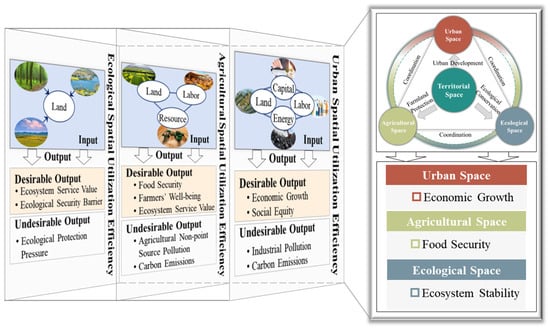
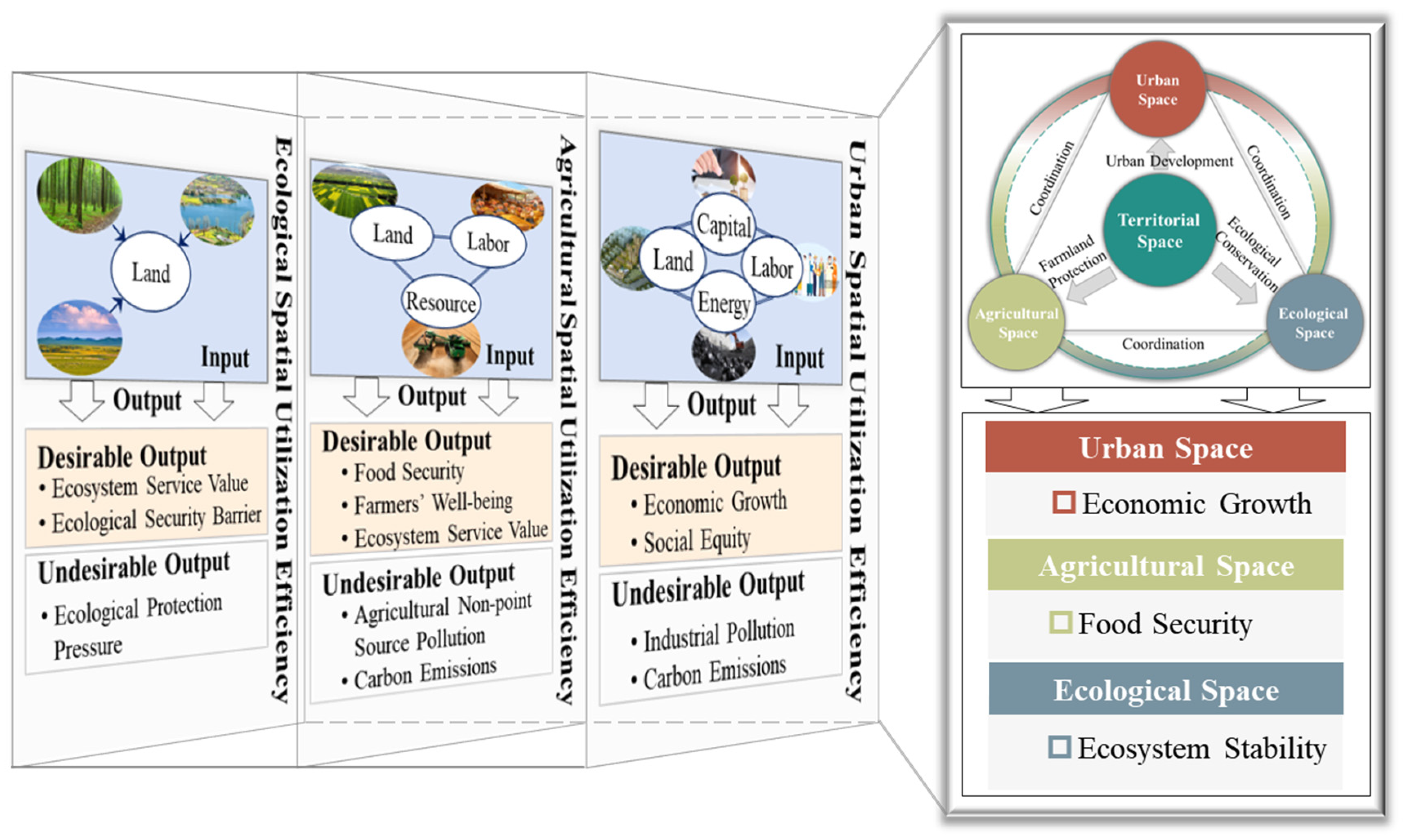
The territorial spatial system represents a multidimensional, dynamic, and interactive framework centered on the human–land nexus [30]. Guided by dominant land functions, territorial space is generally divided into three fundamental categories: urban space, characterized by production and living activities; agricultural space, oriented toward food security (agricultural supply stability); and ecological space, emphasizing environmental conservation and restoration. Driven by the flows of population, capital, and technology, the three types of territorial spaces are dynamically interconnected and collectively influence the sustainable development of the territorial spatial system [31] (Figure 1). However, their interactions are not purely synergistic. Conflicts and trade-offs can emerge due to land competition and cross-space externalities. Urban expansion and infrastructure development may crowd out farmland and ecological land and intensify environmental pressures, thereby weakening food-production capacity and ecological functions [32]. Agricultural intensification to stabilize food supply may increase fertilizer/pesticide use and irrigation demand, leading to non-point-source pollution and higher carbon emissions that undermine ecological quality and the living environment of cities [33]. Conversely, strict ecological conservation or permanent farmland protection can constrain developable land and limit certain production activities, potentially affecting urban growth and agricultural restructuring in the short term. These conflicts alter the balance between desirable outputs and undesirable outputs across the three spaces, and therefore can translate into changes in USE, ASE, and ESE and TSE.
Figure 1.
Conceptual illustrating the Connotation of TSE.
TSE refers to the comprehensive assessment of the relationship among resource factor inputs, desired outputs, and undesired outputs under given technological conditions and human activity participation. Within the framework of multifunctional territorial spatial utilization, TSE transcends a sole emphasis on the economic returns of resource input and instead integrates economic, social, and ecological outcomes. In essence, TSE seeks to enhance desirable outputs while curbing undesirable ones through the optimal allocation of factors and the coordinated realization of multiple spatial functions. Accordingly, TSE is conceptually classified into three dimensions: urban spatial utilization efficiency (USE), agricultural spatial utilization efficiency (ASE), and ecological spatial utilization efficiency (ESE). USE reflects the efficiency of resource use in urban areas through the optimal allocation of production inputs—including construction land, labor in the secondary and tertiary sectors, and capital—to enhance economic output while curbing undesirable by-products [34]. Specifically, ASE reflects the efficiency of agricultural land use achieved through the coordinated allocation of farmland, labor in the primary sector, and agricultural machinery. It emphasizes enhancing agricultural productivity while mitigating negative externalities [35]. Moreover, ESE emphasizes the optimization of ecological resource allocation within ecological spaces to maximize the provision of ecosystem services while reducing ecological risks [36].
3. Materials and Methods
3.1. Study Area and Data Sources
3.1.1. Study Area
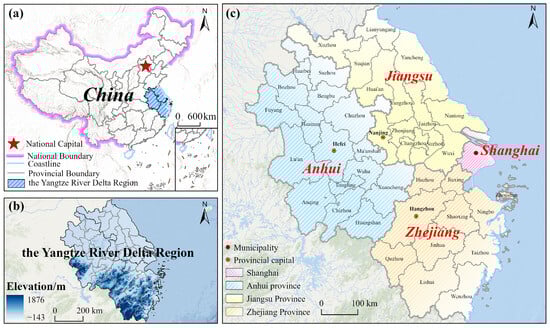
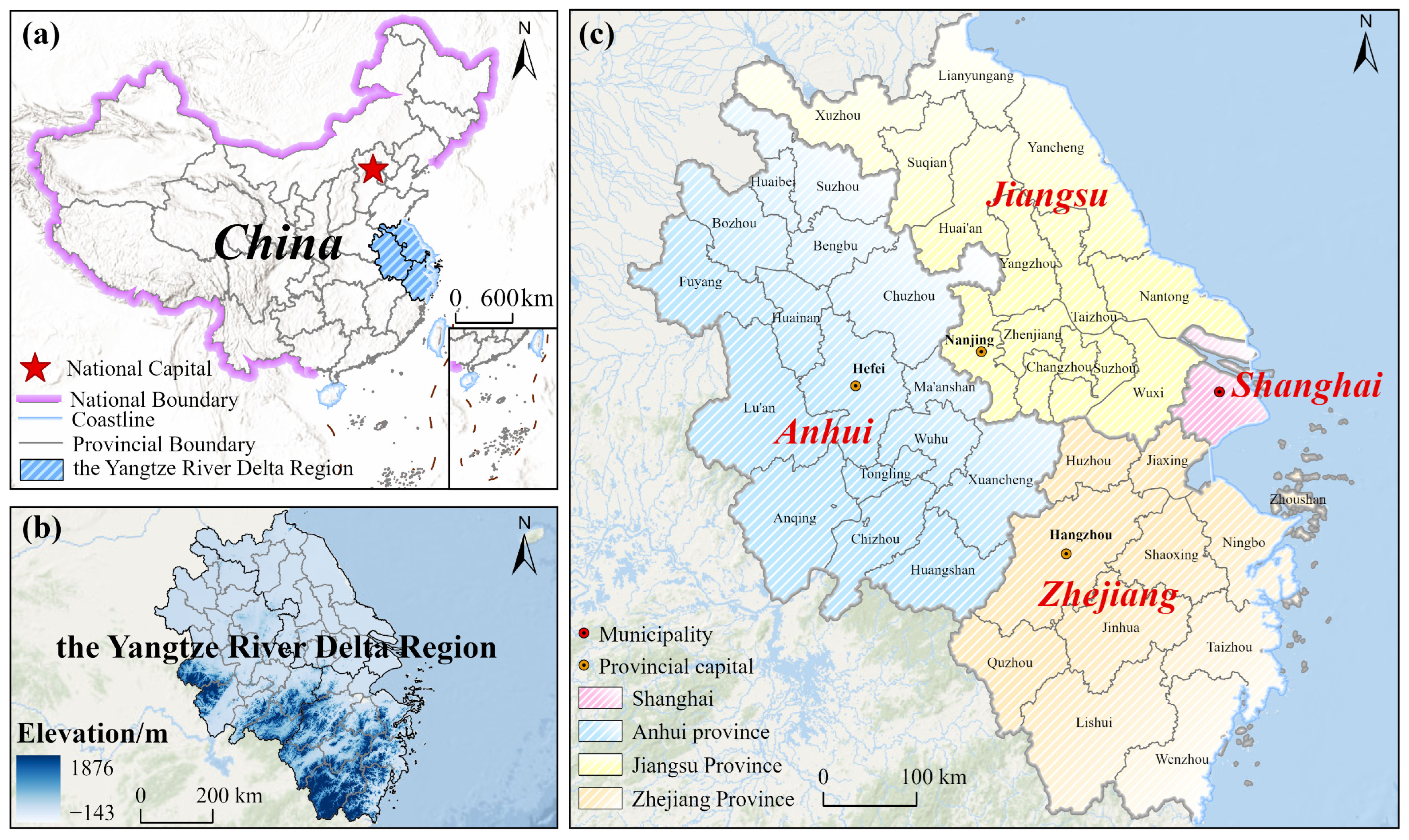
The YRD is located in the lower reaches of the Yangtze River (27°02′–35°08′ N, 114°54′–123°10′ E), adjacent to both the Yellow Sea and the East China Sea, where river and ocean systems intersect (Figure 2). According to the Outline of the Integrated Regional Development of the Yangtze River Delta, the YRD encompasses all administrative units of Shanghai, Jiangsu, Zhejiang, and Anhui, comprising 41 cities in total [33]. Despite occupying only 3.7% of China’s land area, the region supported nearly 16.7% of the national population and generated around 25% of the national GDP in 2024, making it a major driver of China’s economic growth.
Figure 2.
Study area. ((a) The location of the YRD in China; (b) Digital elevation model map of the YRD; (c) Administrative division of the YRD).
However, accelerated urbanization and industrialization have led to the continuous expansion of built-up land into agricultural areas, aggravating ecological degradation and weakening ecological functions. As a result, the YRD has become one of the most prominent regions where tensions between economic–social development and ecological–environmental protection are increasingly evident. Therefore, assessing the TSE of the YRD is essential for improving land-use efficiency and advancing regional sustainable development.
3.1.2. Data Sources
This study employs two primary categories of data types: land-use data and socioeconomic data. The land-use information is sourced from the China Land Use/Cover Dataset (CLCD), while elevation and slope variables are extracted from the Geospatial Data Cloud platform (https://www.gscloud.cn/). Socioeconomic indicators are collected from the statistical yearbooks of provinces and cities in the YRD covering the period 2001–2024. To ensure temporal continuity and address missing values, linear interpolation was applied for data completion.
3.2. Selection of Indicators and Data Sources for TSE
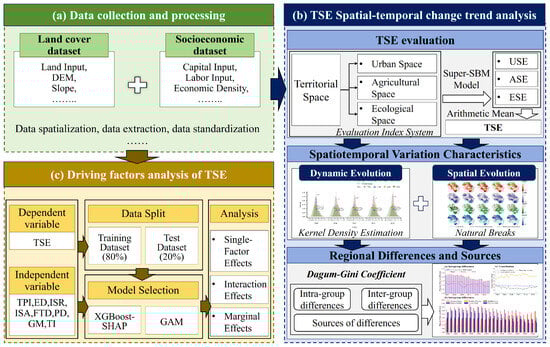
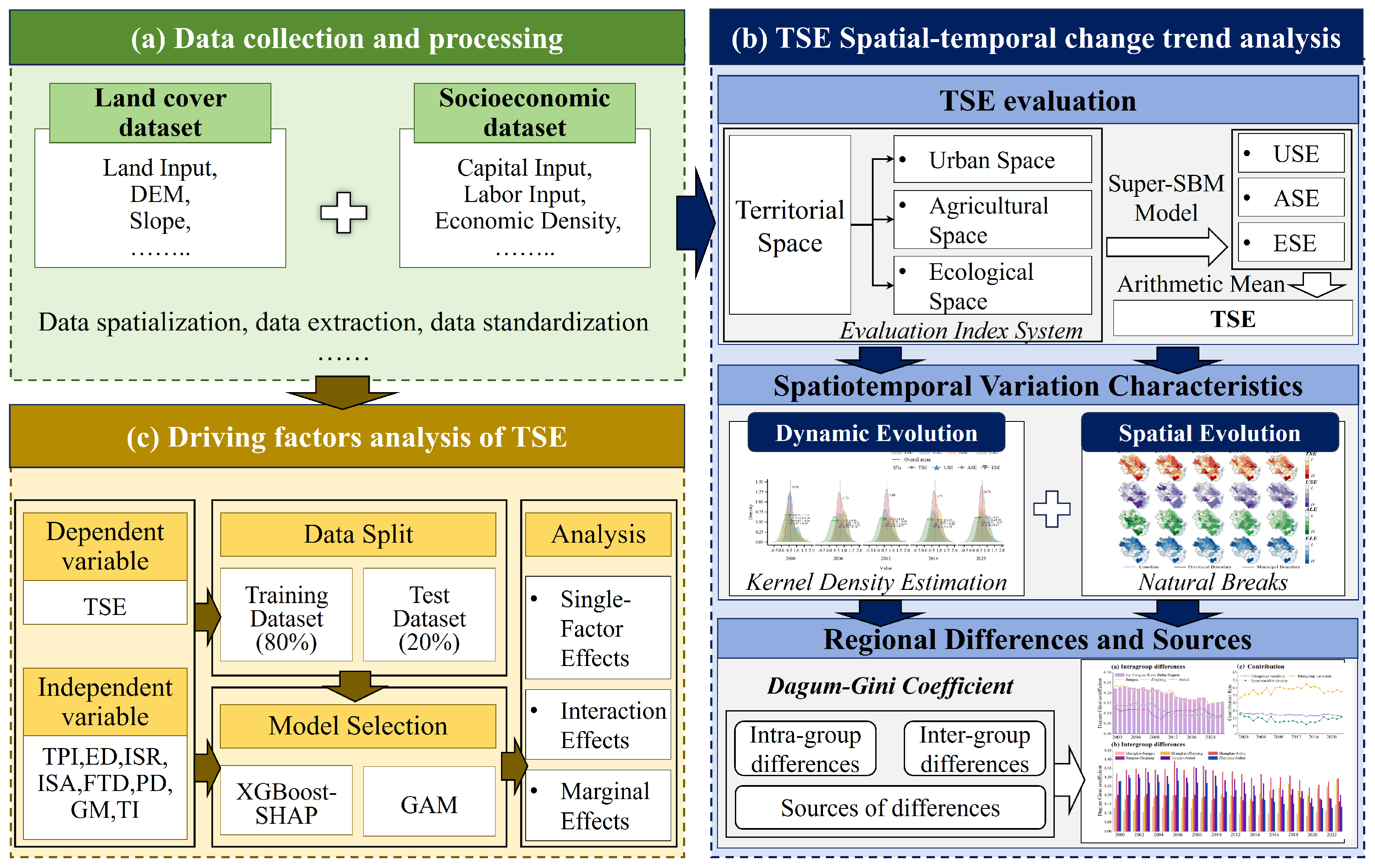
To clearly present the methodological framework adopted in this study, Figure 3 illustrates the analytical workflow used to evaluate TSE and explore its spatiotemporal evolution and driving mechanisms in the YRD. The framework consists of three main stages. First, multi-source land-cover and socioeconomic data are collected. Second, a comprehensive evaluation index system for urban, agricultural, and ecological spaces is constructed, and the Super-SBM model is applied to measure TSE and its sub-efficiencies. Kernel density estimation and the Dagum Gini coefficient are then used to reveal spatiotemporal evolution patterns and regional disparities. Third, the XGBoost–SHAP framework in combination with the GAM is employed to identify the nonlinear, marginal, and interaction effects of influencing factors on TSE. This integrated framework enables a systematic analysis spanning efficiency measurement, disparity decomposition, and driving mechanism identification.
Figure 3.
A methodological framework for evaluating TSE and analyzing its driving factors. This framework guides the efficiency measurement (Super-SBM) and driving analysis (XGBoost–SHAP + GAM).
3.2.1. Construction of the Evaluation Index System for TSE
As the spatial foundation that sustains socioeconomic activities, the territorial spatial system must integrate the functions of urban development, agricultural production, and ecological conservation to accommodate the diverse demands of society.
Building on the conceptual connotation of TSE and recognizing the diversity among the three types of territorial space in resource inputs, functional goals, and output performance, this study develops differentiated measurement indicators tailored to each spatial category. Specifically, the USE indicators emphasize the allocation of economic factors and their output performance, serving as an assessment of the intensification and efficiency of economic activities within urban spaces. The ASE indicators emphasize the utilization patterns of rural production and living spaces, capturing the input–output dynamics of key agricultural resources. Meanwhile, by emphasizing ecological conservation, the ESE indicators reveal its dual function: supporting sustainable regional development and preserving the stability and resilience of ecosystems under environmental pressure. The evaluation index system for TSE is presented in Table 1.
Table 1.
Evaluation index system for TSE.
3.2.2. Super-SBM Model
The Super-SBM model, proposed by Tone (2002) [37], is an extension of the SBM framework developed by Tone (2001) [38]. This improved model addresses the drawback of the traditional SBM method, which treats all fully efficient DMUs as identical once they reach the benchmark value of 1, thus failing to reveal performance differences among them. By permitting efficiency scores to exceed 1, the Super-SBM model strengthens the ability to differentiate between decision-making units and yields more reliable comparative efficiency assessments. Its mathematical formulation is given below:
Here, represents the calculated efficiency score, with higher values reflecting a better relative performance of each DMU; represent the numbers of DMUs, input variables, desirable outputs, and undesirable outputs, respectively. The matrices correspond to the inputs, desirable outputs, and undesirable outputs for each DMU; correspond to the slack vectors of these indicators; and denote the constant vector and the weight vector associated with the factors of each DMU, respectively.
3.3. Research Methodology
3.3.1. Kernel Density Estimation
KDE is a commonly used non-parametric technique that derives the probability density of a variable by placing kernel functions at each observation and smoothing them with a selected bandwidth. This method generates a continuous density curve or spatial distribution surface. In this study, a Gaussian kernel is applied to characterize the distribution pattern of TSE, and its mathematical formulation is given below [19]:
Here, denotes the number of observations; is the bandwidth that determines the smoothing level. denotes the kernel function, while represents the distance between the evaluation point and each sample point.
3.3.2. Dagum Gini Coefficient
The Dagum Gini coefficient (Dagum, 1997) [20,39] extends the traditional Gini index by decomposing regional inequality into three components: intra-group differences, inter-group differences, and sources of differences. Unlike conventional inequality measures, the Dagum approach enables a finer attribution of spatial differences by jointly considering internal heterogeneity, differences between regions, and cross-regional linkages. In this study, this coefficient is applied to reveal the spatial differentiation patterns and underlying drivers of TSE within the YRD. The corresponding mathematical formulation is given in Equation [20].
Here, denotes the overall Gini coefficient; is the total number of samples; refer to the TSE levels of regions , respectively; The symbol represents the average TSE value across all regions. To further trace the underlying sources of spatial inequality, the total Gini coefficient is decomposed according to the Dagum framework (1997) [39], as shown below:
Here, denotes the intra-group differences Gini coefficient; reflects the inter-group differences Gini coefficient; and measures the transvariation intensity, which characterizes the degree of overlap and interaction among regional efficiency distributions.
Equations (6)–(8) show the decomposition of the overall Dagum Gini coefficient (Equation (5)) into intra-group inequality, inter-group inequality, and transvariation components, which constitute Equation (4).
Here, is the number of subgroups; is the sample size of the k-th subgroup; is the mean TSE of the k-th subgroup; is the Gini coefficient of the k-th subgroup; is the Gini coefficient between the k-th and h-th subgroups; and is the transvariation index between the between the k-th and h-th subgroups.
3.3.3. XGBoost-SHAP Model
- (1)
- XGBoost Model
XGBoost, developed by Chen and Guestrin (2016) [40], extends the gradient boosting paradigm by building decision trees in a sequential manner and refining the model at each iteration to achieve superior predictive performance. Compared with traditional boosting methods, it offers advantages such as high computational efficiency, strong predictive accuracy, robustness to missing values, and built-in regularization to prevent overfitting. Owing to these strengths, XGBoost has been widely applied in classification, regression, and ranking tasks across various research fields. The corresponding mathematical formulation is given in the following equation:
Here, denotes the loss function quantifying the error between the observed value and predicted values . denotes the regularization term, which discourages complexity to prevent overfitting. Here, is the sample index, is the index of each tree, and represents the model parameters
- (2)
- SHAP Model
In this research, the SHAP technique is employed to make the XGBoost model more interpretable. Originating from Shapley’s cooperative game theory, SHAP quantifies the contribution of each feature to the model output, thereby revealing their relative importance. Its core principle lies in computing each feature’s marginal contribution across all possible feature combinations and obtaining the final contribution value through a weighted average. The method supports both global interpretation, which explains overall model behavior, and local interpretation, which explains individual predictions, making it a powerful tool for enhancing model interpretability [41].
Here, denotes the SHAP value of factor , which represents the contribution of this factor to the model prediction; refers to any subset of the features that excludes ; and denotes the set of all features. The term represents the model output when only the features in are included. This formulation computes the average marginal contribution of feature across all possible combinations of the remaining features.
- (3)
- Selection of Influencing Factors
Considering the potential influences of regional background conditions, socioeconomic development, and governance on TSE, this study categorizes the driving factors into three dimensions: natural, economic, and social (Table 2).
Table 2.
Influencing factors of TSE.
Natural conditions constitute the basic constraints of territorial space utilization by shaping resource endowment, construction suitability, agricultural productivity, and ecological carrying capacity [13,32]. Topographic conditions, in particular, affect land development intensity, infrastructure costs, and spatial accessibility, thereby influencing the coordinated utilization of urban, agricultural, and ecological spaces. Therefore, the topographic position index is selected to represent natural constraints and regional heterogeneity in physical conditions.
Economic development determines factor agglomeration, industrial organization, and production efficiency, which are key drivers of territorial spatial utilization [9,42]. Indicators such as economic density reflect the intensity of economic activities and agglomeration economies, while industrial structure rationalization and advancement capture the degree of coordination and upgrading of regional industrial systems. In addition, openness-related indicators reflect the role of external linkages and factor flows in reshaping spatial utilization patterns.
Social dimension indicates the degree of social progress and governance efficiency within the region [1,21]. Population density reflects labor concentration and demand pressure on land resources, while government administrative capacity affects spatial planning, land regulation, and the coordination of multiple functional objectives. Technological innovation capacity can enhance land-use efficiency by improving production processes, promoting intensive use, and facilitating green and low-carbon development.
4. Results
4.1. Spatiotemporal Variation Characteristics
This study selects five time points—2000, 2006, 2012, 2018, and 2023—to examine the spatiotemporal evolution of TSE in the YRD.
4.1.1. Temporal Evolution Characteristics
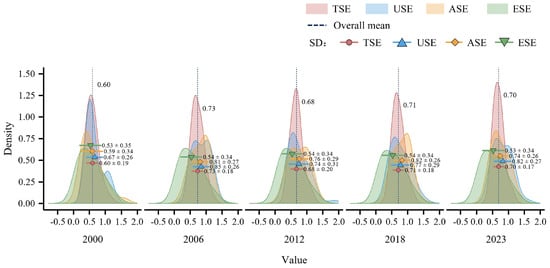
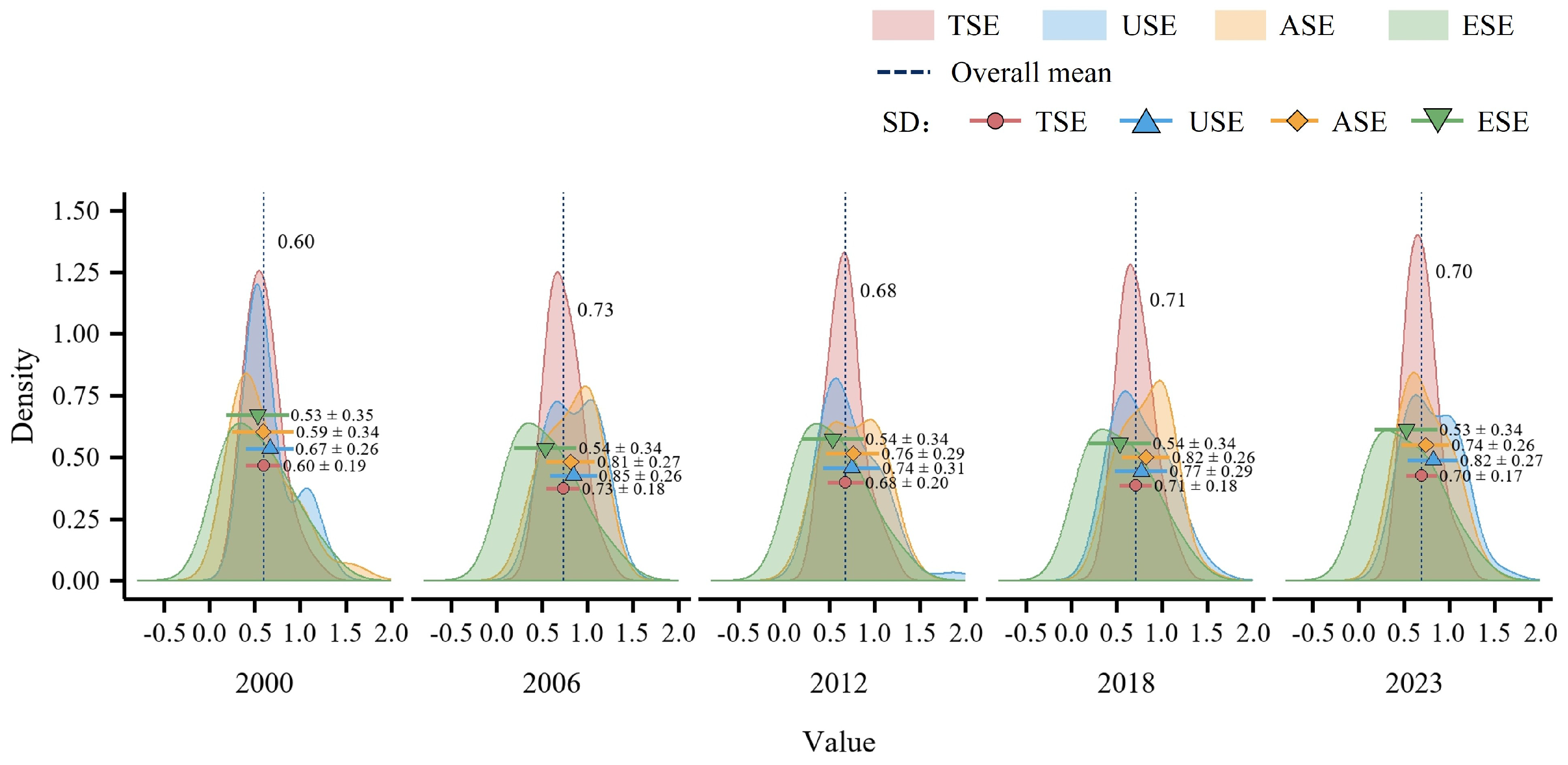
Figure 4 provides a depiction of the temporal variation in TSE, USE, ASE, and ESE within the YRD. Overall, the distribution curves of TSE and its three types of territorial spaces moved rightward, indicating an overall rise in efficiency levels throughout the region.
Figure 4.
Temporal evolution characteristics of TSE in the YRD.
In terms of distributional form, two key features can be identified. (1) Peak position: The primary peaks of the distribution curves for TSE, USE, ASE, and ESE are located at approximately 0.68, 0.77, 0.74, and 0.53, respectively. These positions suggest that all four efficiencies experienced a cyclical pattern of increase, decline, and renewed growth, with ESE remaining relatively stable around 0.53 throughout the study period. (2) Number of peaks: The distributions of TSE, ASE, and ESE are characterized by a single dominant peak, while that of USE alternates between unimodal and bimodal patterns over time. This indicates that spatial disparities in USE within the YRD are relatively pronounced, whereas variations in TSE, ASE, and ESE are comparatively minor.
Regarding distributional extensibility, the right tails of the TSE and ASE distributions exhibit a noticeable contraction, suggesting an overall convergence of efficiency levels. The right tail of USE fluctuates over time but shows an overall narrowing trend, whereas changes in the right tail of ESE remain limited, indicating a relatively stable distribution.
4.1.2. Spatial Evolution Characteristics
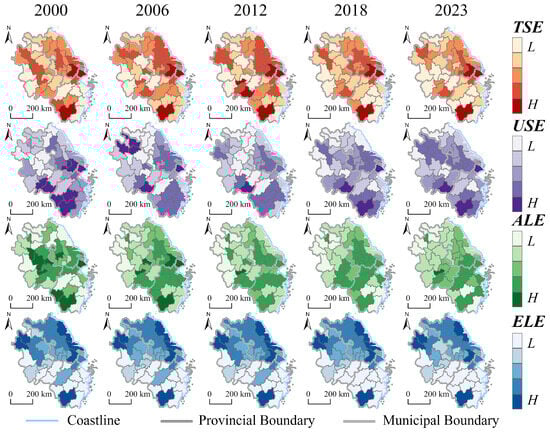
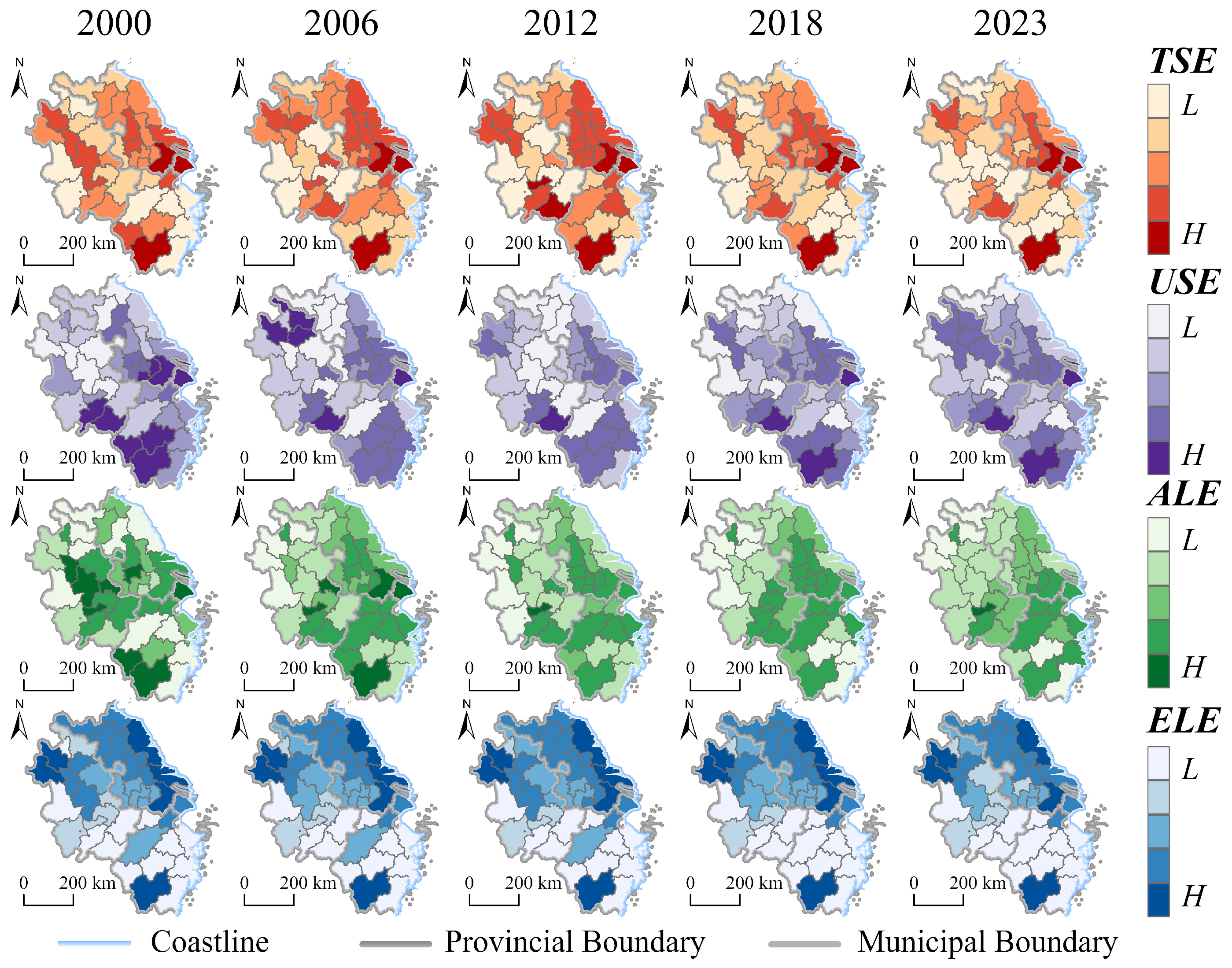
The spatial evolution of TSE, USE, ASE, and ESE in the YRD is shown in Figure 5. Based on the natural breaks method, the four efficiencies were divided into five levels ranging from low to high. The results reveal a stepped spatial pattern, with higher efficiency concentrated in the eastern areas and lower levels in the western part of the region.
Figure 5.
Spatial evolution characteristics of TSE in the YRD.
The spatial distribution of TSE presents a pronounced “core–periphery” pattern. High-efficiency areas are primarily concentrated in Shanghai, southern Jiangsu, and northern Zhejiang, while western and northern Anhui together with southern Zhejiang show persistently low performance. Furthermore, the overall pattern has transitioned from dispersion toward increasing spatial agglomeration.
The USE presents a spatial pattern characterized by higher efficiency in the eastern and southern parts of the YRD, while the western and northern areas exhibit relatively low levels. The dominant high-efficiency belt is located along the Shanghai–Nanjing–Hangzhou–Ningbo axis and has progressively expanded outward. In contrast, low-efficiency areas are mainly found in central and western Anhui, though their spatial scope has continued to contract over time.
The ASE displays a diffusion-oriented spatial layout, with southern Anhui, northern Zhejiang, and southern Jiangsu serving as the core areas, and the high-efficiency zones gradually spreading toward northern Anhui and northern Jiangsu. In contrast, agricultural efficiency in major metropolitan regions, including Shanghai and parts of northern Zhejiang, has shown a downward trend, largely driven by urban growth and the conversion of farmland into construction land.
The overall ESE pattern shows limited fluctuation and presents a spatial gradient of “higher in the east and north, lower in the west and south.” Areas with higher efficiency are chiefly distributed along Jiangsu’s coastal belt and the mountainous zones of southern Zhejiang and Anhui, whereas southeastern Zhejiang remains a low-efficiency cluster. As ecological governance has intensified, several medium-efficiency regions have shown noticeable improvement.
The formation of these spatial differentiation patterns is closely related to geographical location, resource endowment, regional development strategies, and factor mobility within urban agglomerations. Policy support and economic agglomeration have continuously promoted the outward expansion of high-efficiency zones, whereas low-efficiency areas lag behind due to weaker infrastructure, limited resource carrying capacity, and less favorable economic foundations.
4.2. Regional Differences and Sources
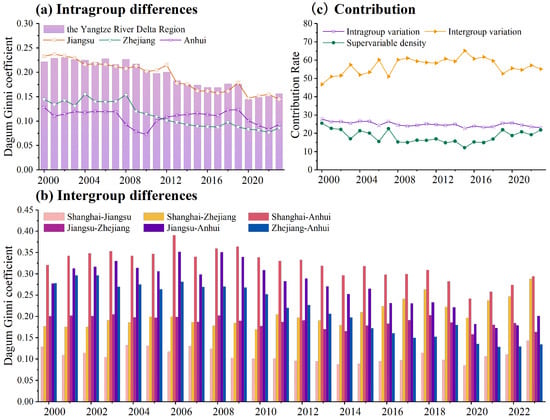
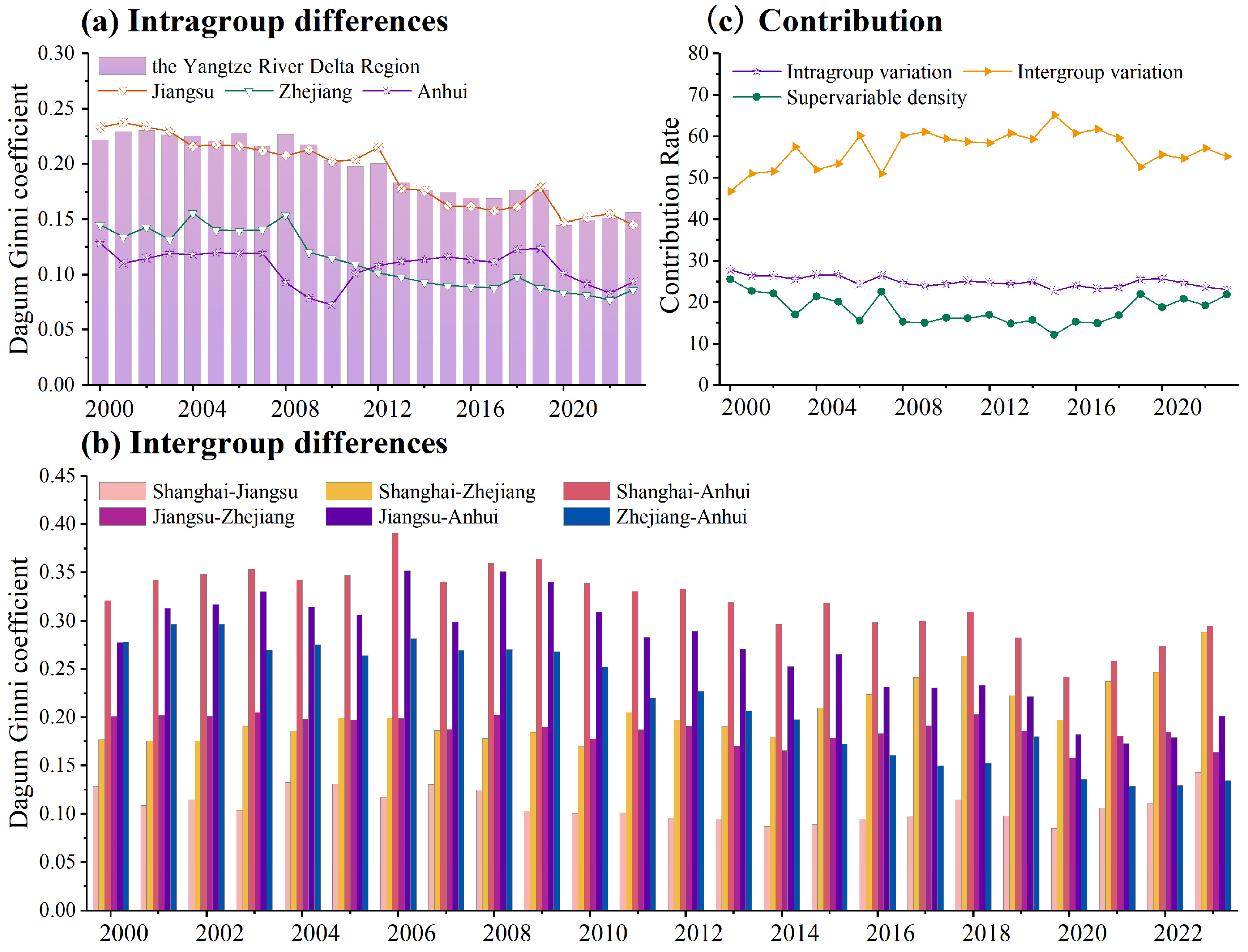
Figure 6 depicts the spatial gaps in TSE across the YRD and the factors contributing to them. The Dagum Gini index reveals a generally declining trajectory, falling from 0.2218 in 2000 to 0.1566 in 2023, equivalent to an average annual reduction of 0.27%. This downward movement reflects a steady contraction of inequality within the region.
Figure 6.
Regional differences and sources of TSE in the YRD.
The temporal evolution of the Gini coefficient demonstrates a cyclical pattern characterized by “increase–stability–decline–stability–rebound.” This process can be classified into three distinct phases: (1) expansion phase (2000–2002 and 2020–2023), during which the spatial disparities in TSE within the Yangtze River Delta (YRD) widened; (2) stagnation phase (2003–2008 and 2018–2019), when intra-regional inequality remained largely unchanged; (3) convergence phase (2009–2017), marked by a pronounced decline in regional disparities, indicating a progressive improvement in spatial coordination across the urban system.
4.2.1. Intra-Group Differences
In terms of disparity levels, the intra-group gap in Jiangsu Province has consistently remained higher than that in Zhejiang and Anhui Provinces. Since 2013, the disparity level in Anhui has ranked second only to Jiangsu. From the perspective of temporal dynamics, the intra-group disparities in Jiangsu and Zhejiang show a continuous narrowing trend, whereas that in Anhui exhibits a pattern of initial decline followed by expansion. Specifically, the intra-group Gini coefficients of Jiangsu and Zhejiang decreased by 0.08823 (from 0.2332 to 0.1450) and 0.05895 (from 0.1451 to 0.0861), respectively, indicating a steady improvement in spatial coordination within both provinces. In contrast, the Gini coefficient of Anhui displayed a “U-shaped” trajectory between 2000 and 2019, reaching its lowest value of 0.0727 in 2010. During 2020–2023, the coefficient fluctuated slightly around 0.09, suggesting that regional disparities within Anhui remained relatively stable but higher than in previous years.
4.2.2. Inter-Group Differences
In terms of inter-regional inequality, the Shanghai–Anhui pair exhibits the greatest disparity, with an average Gini coefficient of 0.3210, followed by Jiangsu–Anhui (0.2718). The smallest difference is observed between Shanghai and Jiangsu, where the mean value is only 0.1088. The dynamic evolution of these inter-group differences can be categorized into three patterns: relative stability, oscillatory growth, and oscillatory decline. (1) Relative stability: The Shanghai–Jiangsu disparity corresponds to the stable type, remaining essentially unchanged throughout the study period, with values fluctuating around 0.10. (2) Oscillatory growth: The Shanghai–Zhejiang gap demonstrates a fluctuating upward trajectory. From 2000 to 2013, the coefficient increased slightly from 0.1773 to 0.1905 (average annual growth: 0.09%). It then rose from 0.1797 to 0.2633 during 2014–2018 (1.67% per year), and further accelerated between 2020 and 2023, climbing from 0.1970 to 0.2881—the highest recorded growth rate (2.27% annually). (3) Oscillatory decline: The remaining provincial combinations show a fluctuating downward trend. The most pronounced decline occurred between Zhejiang and Anhui, where the coefficient dropped from 0.2782 to 0.1344, representing a total reduction of 0.1438. A similar but more moderate decrease is noted for the Jiangsu–Anhui pair, falling from 0.2773 to 0.2015 (−0.0758). Overall, the results reveal a pattern in which the spatial inequality among core provinces intensifies, while disparities involving peripheral provinces tend to narrow.
4.2.3. Sources of Differences
From 2000 to 2023, inter-group differences consistently served as the primary driver of regional inequality in TSE within the YRD, while intra-group differences ranked second. The shares of intra-group differences and supervariable density remained relatively unchanged over time, contributing roughly 24% and 18% to the overall inequality, respectively. In contrast, the proportion attributable to inter-group differences showed a slight rise, followed by a moderate decline and eventual stabilization, yet remained above 50% throughout the entire observation period.
4.3. Analysis of the Influencing Factors of TSE
4.3.1. XGBoost Model Setting and Verification
To examine potential multicollinearity among the explanatory variables, variance inflation factor (VIF) tests were performed prior to model estimation. The results indicate that all explanatory variables exhibit VIF values below 4.28, with a mean VIF of 2.34, suggesting that multicollinearity does not pose a significant concern in this study.
A group of explanatory variables (TPI, ED, ISR, ISA, FTD, PD, GM, and TI) was employed to build the regression model, with TSE serving as the dependent variable. To reduce potential overfitting, the sample data were randomly partitioned into training and testing sets in an 8:2 ratio.
Model tuning was conducted using grid search combined with five-fold cross-validation, ensuring a balance between predictive performance and overfitting prevention. The final set of hyperparameters was identified as follows: colsample_bytree = 1.0, learning_rate = 0.1, max_depth = 7, n_estimators = 200, and subsample = 0.8. With this configuration, the model yielded a mean squared error (MSE) of 0.0079 during cross-validation and 0.0058 on the test dataset, accompanied by an R2 of 0.798. These outcomes verify that the model exhibits strong goodness-of-fit, satisfactory predictive precision, and robust generalization performance.
4.3.2. Influencing Factors Analysis of TSE
- (1)
- Single-Factor Effects
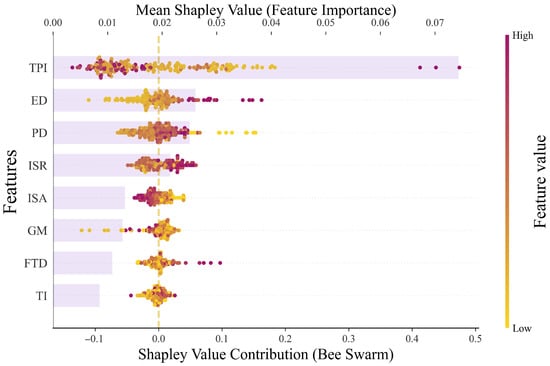
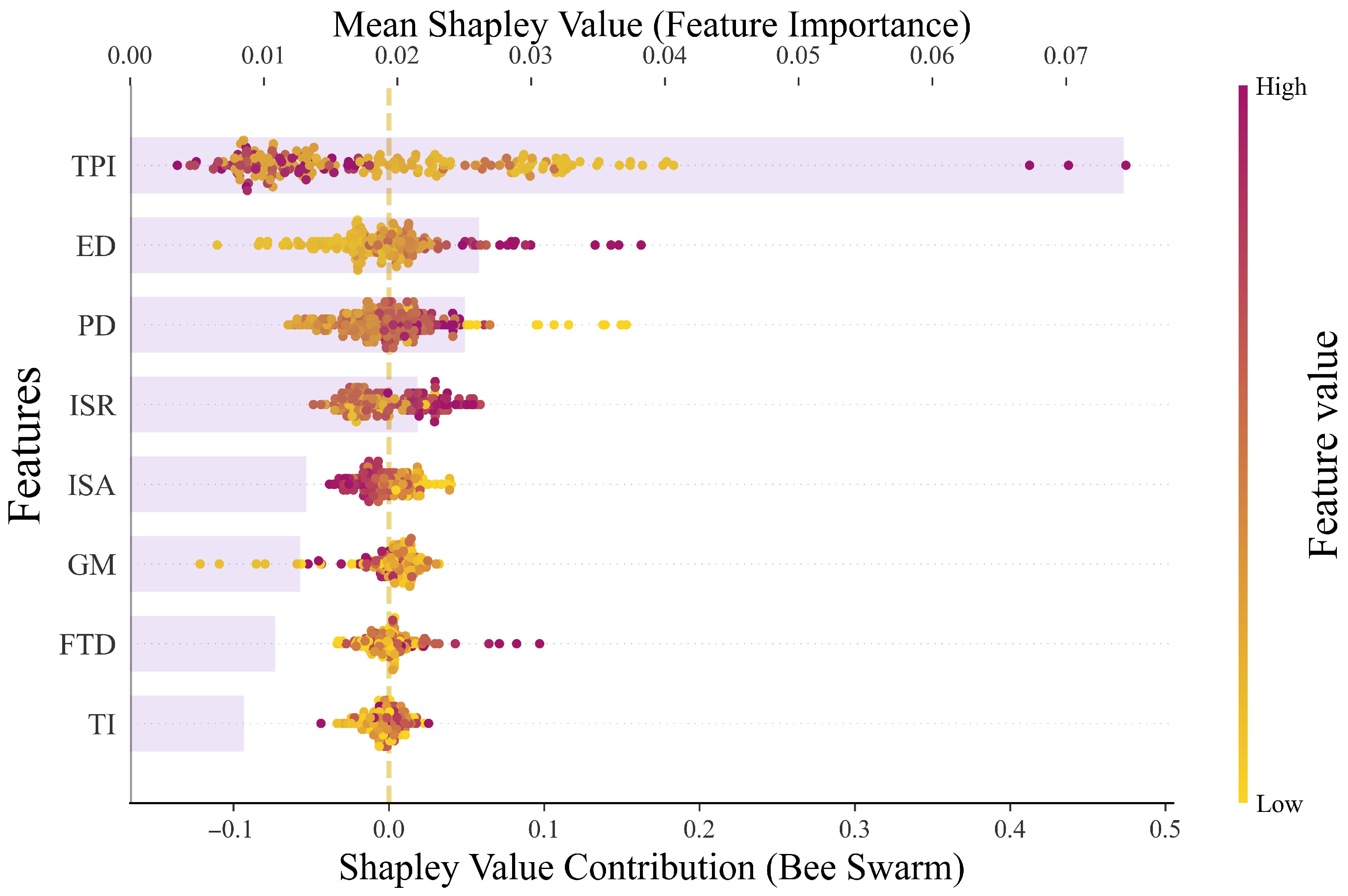
The influence intensity and direction of each factor on TSE are illustrated in Figure 7. According to the mean absolute SHAP values, the factors affecting TSE in the YRD rank in descending order of importance as follows: TPI, ED, PD, ISR, ISA, GM, FTD, and TI.
Figure 7.
Single-factor effects.
At the individual-factor level, the SHAP values of TPI are predominantly negative, with higher values corresponding to stronger negative effects, indicating that topographic relief and elevation impose significant constraints on spatial utilization efficiency. ED exhibits the widest SHAP distribution and is mainly positive, suggesting that higher economic density is the primary driver for improving spatial utilization efficiency. PD shows a bidirectional effect, with most observations yielding positive SHAP values, implying that population concentration contributes positively to the enhancement of TSE. ISR shows a consistently positive effect, suggesting that a more balanced industrial structure facilitates the integrated utilization of multifunctional territorial space. ISA also shows a generally positive relationship, suggesting that industrial upgrading facilitates efficiency improvement through structural transformation. The SHAP values of GM are largely positive, implying that stronger government governance capacity effectively supports higher spatial utilization efficiency. FTD has a relatively weak but positive influence, indicating that regions with higher openness are more likely to attract capital and technology, thereby facilitating factor mobility and industrial optimization. Finally, TI displays a concentrated and slightly positive SHAP distribution, demonstrating that technological investment has a potential promoting effect on multifunctional territorial spatial utilization efficiency.
- (2)
- Interaction Effects of Paired Factors
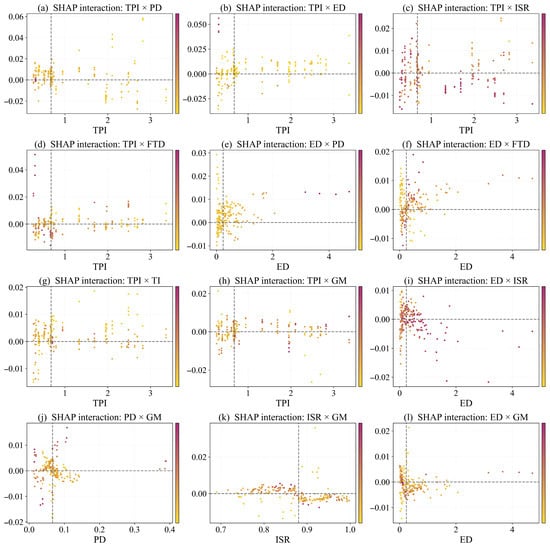
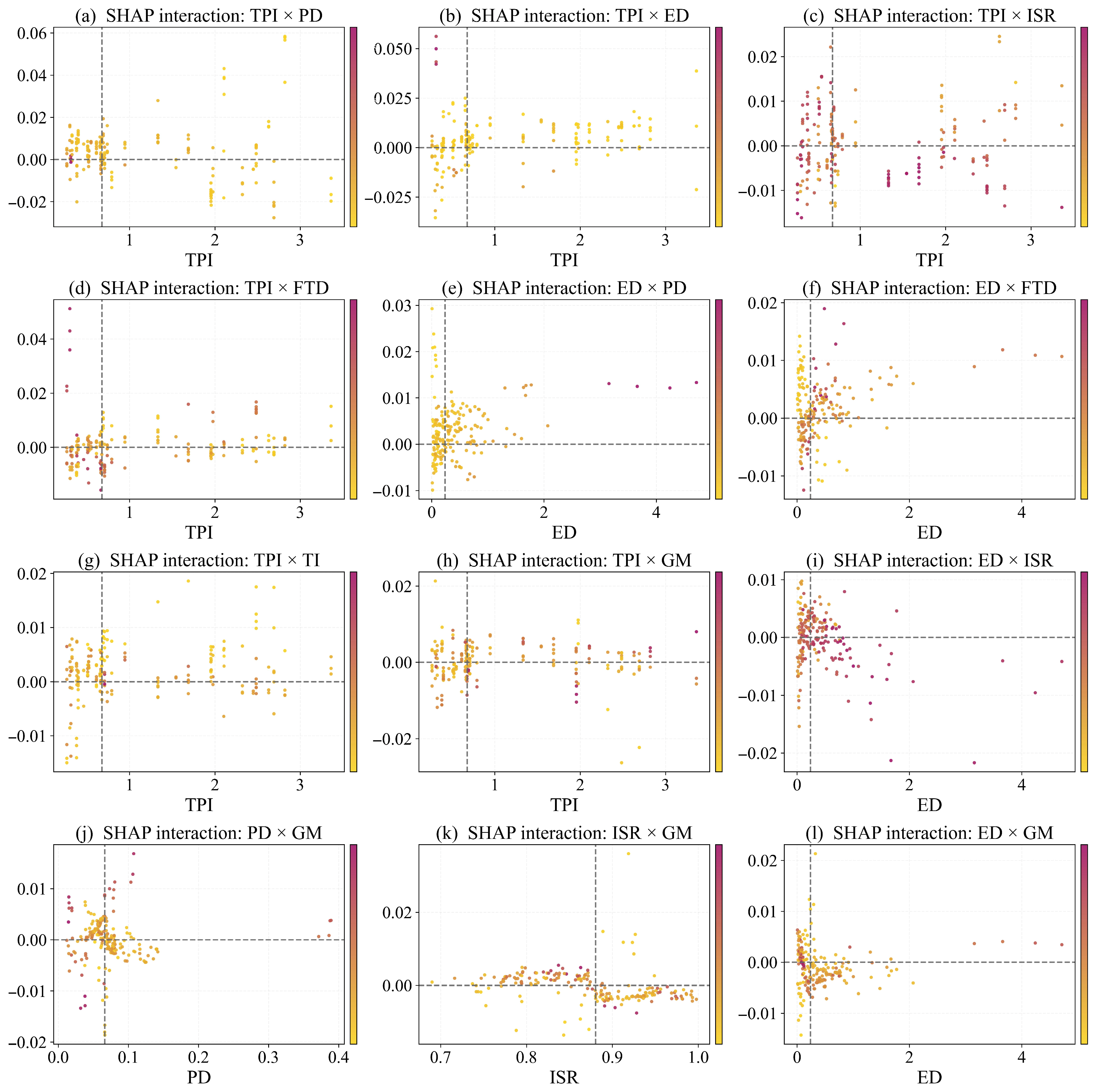
Figure 8 reports the two-factor interaction effects on TSE, further revealing the nonlinear influence of variable interactions on TSE. Overall, the interaction effects between TPI and other variables are the most pronounced, indicating that natural conditions remain a fundamental constraint on spatial utilization efficiency in the YRD.
Figure 8.
Interaction effects of paired factors.
At the interaction level, the interaction between TPI and PD is positive, indicating that in flatter areas an increase in population density significantly enhances TSE. However, this effect weakens in regions with greater topographic relief, suggesting a diminishing marginal return of population agglomeration under complex terrain conditions. The interaction between TPI and ED exhibits a turning-point feature: in areas with flat terrain, economic development effectively promotes TSE, while in more rugged areas, this positive influence diminishes, implying that topographic constraints limit socioeconomic activities. The interactions of TPI with ISR and FTD show weak but positive correlations, indicating that regions with gentler terrain can further enhance TSE through industrial optimization and external openness.
Among the socioeconomic factors, the interaction between ED and PD is the most prominent and displays a clear positive synergy, implying that simultaneous growth in economic development and population agglomeration fosters factor clustering effects, thereby improving TSE. The interactions between ED and ISR, as well as between ED and GM, are positive, suggesting that effective government governance and rational industrial specialization amplify the positive impact of economic development on TSE. In contrast, in areas with excessive population density but insufficient government regulation and spatial planning, TSE tends to decline. The interaction between ISR and GM is strongly positive, demonstrating that industrial structure optimization and improved governance capacity jointly contribute to higher spatial utilization efficiency. By comparison, the interaction between TPI and TI is relatively weak overall, though it shows a slight positive effect in flat areas. This finding suggests that technological innovation primarily enhances spatial utilization efficiency in regions where topographic constraints are minimal.
4.3.3. Marginal Effects of Dominant Factors on TSE
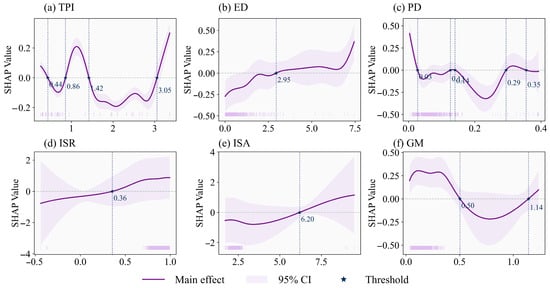
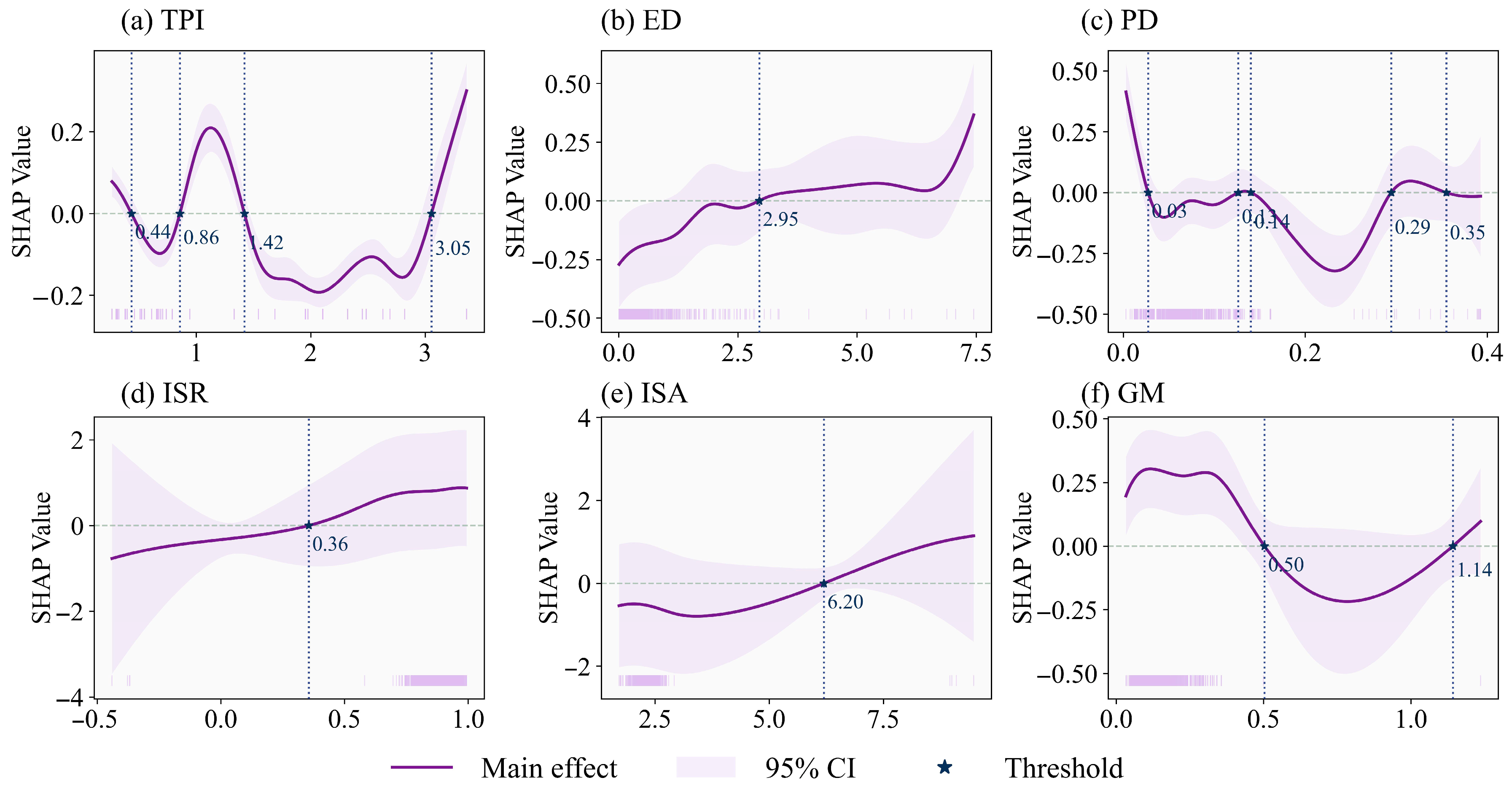
Figure 9 reveals that the dominant determinants of TSE respond in a markedly nonlinear manner at the margin.
Figure 9.
Marginal effects of dominant factors on TSE.
The influence of TPI on TSE demonstrates a multi-stage fluctuation pattern. When TPI < 0.46, the marginal effect declines gradually, indicating that steeper terrain constrains spatial efficiency. When 0.46 < TPI ≤ 0.86 and 1.42 < TPI ≤ 3.05, topography acts as a limiting factor for efficiency improvement, whereas 0.86 < TPI < 1.42 represents the optimal range for enhancing TSE. Notably, when TPI ≥ 3.05, terrain undulation may facilitate the improvement of specific functional spatial efficiencies.
The relationship between ED and TSE shows a turning point around 2.95, after which the positive impact of industrial rationalization becomes more evident. When ED > 2.95, i.e., beyond a certain economic threshold, intensified factor agglomeration and optimized resource allocation substantially enhance TSE.
The influence of PD on TSE exhibits a staged nonlinear response, indicating that extreme population densities—whether overly concentrated or overly dispersed—hinder efficiency gains. A moderate level of population aggregation, by contrast, is more conducive to balanced spatial development.
ISR exhibits an approximately linear positive relationship with TSE. When ISR > 0.36, its marginal effect increases significantly and the positive marginal effect of industrial rationalization on TSE strengthens, indicating that optimized industrial coordination enhances multifunctional spatial efficiency.
The relationship between ISA and TSE shows a turning point around 6.2, after which the positive impact of industrial upgrading becomes more evident. When ISA > 6.2, this indicates that optimized industrial upgrading enhances multifunctional spatial efficiency.
GM exhibits a multi-phase effect on TSE. When GM < 0.5, government intervention exerts a strong positive influence; however, in the range of 0.5 < GM < 1.14, government intervention may temporarily lead to resource mismatch and efficiency decline. Once GM > 1.14, government intervention driven by innovation and high-value-added sectors significantly promotes TSE improvement.
5. Discussion
Grounded in the conceptual framework of TSE, this study developed a multidimensional evaluation system embedded in the “urban–agricultural–ecological” spatial structure. Furthermore, KDE, the Dagum Gini coefficient, and the XGBoost–SHAP model were applied to reveal the spatiotemporal dynamics of TSE in the YRD and identify its key influencing factors. The subsequent sections elaborate on the empirical results and core conclusions.
5.1. Interpretation of Results
5.1.1. Spatiotemporal Evolution of TSE
TSE in the YRD exhibits a generally increasing trend punctuated by periodic fluctuations, with persistently higher efficiency in the eastern areas and lower levels in the western regions [42,43]. This pattern reflects the combined effects of regional development strategies, ecological constraints, technological innovation capacity, and differing abilities across cities to balance economic expansion with environmental regulation [44]. Core areas such as Shanghai, southern Jiangsu, southern Anhui, and northern Zhejiang maintain relatively high efficiency due to their advanced industrial structures, rapid urbanization, and stricter ecological governance. In contrast, northern Anhui and parts of southern Zhejiang remain constrained by weaker resource endowments and long-standing dependence on traditional industries, resulting in localized “efficiency depressions.” In addition, interactions among urban, agricultural, and ecological space utilization efficiencies also shape the spatial pattern. Increases in urban space efficiency often entail intensified construction activities, which may exert pressure on agricultural and ecological spaces through land conversion and higher resource consumption. Efforts to safeguard agricultural production can, in turn, restrict urban expansion, while improvements in ecological efficiency strengthen environmental constraints that may limit short-term gains in urban and agricultural areas yet support long-term sustainability.
5.1.2. Regional Differences and Sources of TSE
The TSE demonstrates a fluctuating yet overall declining trend in regional disparities [45]. This pattern can be largely explained by the heterogeneous coupling among factor mobility, spatial structure, and resource utilization intensity. The cross-regional flow of population, capital, and technology has fostered a networked spatial structure, in which agglomeration effects, corridor effects, and hierarchical differentiation among urban nodes drive resources to concentrate in dominant core cities. This process has reshaped land allocation mechanisms, enhancing multifunctional spatial utilization efficiency in core urban areas while simultaneously intensifying inefficient spatial expansion in peripheral regions. In the early stages, improvements in infrastructure connectivity promoted the sharing and diffusion of production factors across provincial boundaries. However, persistent institutional barriers and technological path dependence, together with the ongoing transition from land increment expansion to stock-based development, have altered the dynamics of efficiency distribution. In addition, widening technological disparities across provinces may reinforce spatial polarization, further influencing the regional efficiency. Beyond these dynamics, the YRD’s hierarchical urban system and its uneven ability to internalize the gains of regional integration have intensified these spatial dynamics, as core cities are more capable of transforming factor inflows and policy incentives into efficiency improvements. Cities with weaker industrial foundations or governance capacity often struggle to capture similar benefits, producing a pattern in which disparities narrow in general yet remain deeply rooted in the region’s structural development landscape.
5.1.3. Influencing Factors of TSE
The influence of economic, social, and natural factors on TSE in the YRD reflects the region’s differentiated development foundations and spatial constraints. Economic factors such as agglomeration intensity, industrial upgrading and technological innovation generally promote higher TSE, yet their effects vary according to local capacities to absorb factor inflows and sustain industrial transformation. Cities with mature industrial systems can translate agglomeration benefits into improved spatial efficiency, whereas those with weaker foundations may encounter congestion pressures or diminishing returns. Social factors, including population density and administrative capacity, show nonlinear impacts: moderate levels help to enhance service provision and land-use intensification, but excessive concentration or fragmented governance can increase environmental pressure and reduce functional coordination. Natural conditions continue to shape the limits of spatial expansion and the feasibility of balancing urban, agricultural, and ecological functions, particularly in areas where terrain imposes higher development costs. The role of openness also differs across the region; while integration into global production networks supports upgrading in more developed cities, less-developed areas may receive low-efficiency industrial transfers without commensurate spatial benefits. These patterns suggest that the drivers of TSE operate through multiple interacting channels conditioned by local development stages, institutional capacity, and spatial endowments, resulting in differentiated efficiency trajectories across the YRD.
5.2. Policy Recommendation
Building on the current patterns of multifunctional territorial space use in the YRD, this study proposes several differentiated policy recommendations to enhance overall territorial spatial utilization efficiency.
Firstly, for core cities and high-efficiency corridors such as Shanghai and the major cities in southern Jiangsu and northern Zhejiang, spatial policy should gradually shift from extensive expansion toward quality-oriented renewal—especially for cities that have already reached or exceeded the ED turning point. Priority should be given to strengthening the control of new construction land, promoting urban renewal and the intensive use of existing built-up areas, and enforcing ecological and agricultural protection at the urban fringe to prevent efficiency gains from being offset by rising undesirable outputs. At the same time, core cities should be encouraged to play a stronger coordinating role by diffusing advanced producer services, innovation resources, and high-quality public services to surrounding cities, so that they function as hubs of spillover rather than simple growth poles.
Secondly, for low-efficiency regions—especially the western and northern parts of Anhui and other peripheral counties—policy efforts should focus on improving basic conditions and clarifying functional positioning. In practice, regions operating below the key GAM turning points should prioritize enhancing regional accessibility and factor mobility through transport and digital infrastructure upgrades, while guiding the undertaking of suitable industries transferred from core areas to accelerate industrial upgrading and productivity improvement. In parallel, policies should support the consolidation and intensive use of existing construction land and combine farmland protection with ecological restoration to cultivate stable “production–ecology” support zones, rather than pursuing extensive, low-efficiency spatial expansion.
Finally, at the regional scale, cross-provincial coordination mechanisms should be continuously improved to support more efficient resource allocation and a clearer division of labor among Shanghai, Jiangsu, Zhejiang, and Anhui. Governance strategies should be adapted to local development conditions, combining moderate administrative intervention with market-based mechanisms. In particular, given the stage-wise GAM effects of GM, regions falling within the intermediate range (approximately 0.50–1.14) should emphasize improving the structure and efficiency of fiscal and regulatory interventions, rather than simply expanding their scale. Meanwhile, policy efforts should continue to promote technological innovation, optimize land-use intensity, and incorporate ecological constraints into spatial planning to support the long-term improvement of territorial spatial utilization efficiency.
5.3. Contribution, Limitations, and Prospects
This study conducts a comprehensive examination of the spatiotemporal dynamics and driving mechanisms of TSE within the YRD, providing valuable policy-oriented insights for enhancing the efficiency of territorial space utilization. Nevertheless, certain constraints remain and point to avenues for future research.
Owing to limitations in data accessibility, the analysis of TSE determinants in this study is performed from a relatively static viewpoint, which restricts the ability to reveal the dynamic interactions and evolutionary linkages among regions. Future studies could extend the analysis by adopting a dynamic perspective grounded in factor mobility, exploring indicators such as the intensity of data flow per unit of GDP or the activity level of the platform economy. Such an approach could help to identify how digital technologies substitute for physical land use and how the interactions between “virtual” and “physical” spaces—through knowledge diffusion, factor flows, or policy coordination—affect TSE on a broader scale. Moreover, further research is needed to explore spatial optimization strategies for improving TSE. Emphasis should be placed on enhancing factor allocation efficiency and identifying the optimal input intervals across different elements to achieve a Pareto-optimal state. Such efforts would contribute to a more refined understanding of how multifunctional territorial spaces can be effectively managed to balance efficiency, equity, and sustainability.
6. Conclusions
Using panel data from 41 cities in the YRD from 2000 to 2023, this study investigates the spatiotemporal dynamics of TSE and its underlying drivers. The main findings are summarized as follows:
- (1)
- TSE in the YRD shows a fluctuating yet overall upward trend, accompanied by a pronounced east–west spatial gradient in which eastern cities consistently outperform their western counterparts. At the sub-dimensional level, USE, ASE, and ESE all show modest temporal improvement. Their spatial configurations reveal distinct directional characteristics: USE is concentrated in the southeastern portion of the region, ASE is strongest within the central urban belt, and ESE predominates in the northern areas. Corresponding low-value clusters occur in the northwest, peripheral counties, and southern cities, respectively.
- (2)
- Spatial disparities in TSE demonstrate a fluctuating but generally declining pattern. At the provincial scale, Jiangsu exhibits the greatest internal differentiation, whereas the Shanghai–Anhui group displays the widest interprovincial gap. Furthermore, interprovincial disparities remain the dominant source of overall spatial variation in TSE across the region.
- (3)
- TSE in the YRD is still predominantly driven by single-factor contributions, each exhibiting clear nonlinear threshold effects. TPI, ED, PD, and ISR emerge as the principal drivers of efficiency enhancement. These factors also display strong synergistic interactions, jointly facilitating the coordinated improvement of TSE throughout the region.
Author Contributions
Conceptualization, K.Z. and J.C.; methodology, J.C.; software, K.Z.; validation, K.Z., J.C. and Y.G.; formal analysis, K.Z.; investigation, K.Z.; resources, J.C.; data curation, K.Z.; writing—original draft preparation, K.Z.; writing—review and editing, K.Z.; visualization, J.C.; supervision, Y.G.; project administration, X.L.; funding acquisition, X.L. All authors have read and agreed to the published version of the manuscript.
Funding
This work was supported by the National Natural Science Foundation of China (72474214), the Postgraduate Research Practice Innovation Program of Jiangsu Province (KYCX25_3018), the Graduate Innovation Program of China University of Mining and Technology (2025WLKXJ156), the Jiangsu Science and Technology Think Tank Program and Youth Project (JSKX0125099), the Special Project on the Study of Xi Jinping’s Thought on Ecological Civilization under the Jiangsu Social Science Applied Research Excellence Program, and the Natural Resources Think Tank Development Fund (2025STA-06 and ZK2508), the Major Incubation Project of the Fundamental Research Funds for the Central Universities (2025ZDPYSK03), and the Henan Provincial Natural Resources Scientific Research Project Funds.
Data Availability Statement
Data are contained within the article.
Conflicts of Interest
The authors declare no conflicts of interests.
References
- Qiu, Y.; Han, W.; Zeng, D. Impact of biased technological progress on the total factor productivity of China’s manufacturing industry: The driver of sustainable economic growth. J. Clean. Prod. 2023, 409, 137269. [Google Scholar] [CrossRef] [Scilit]
- Bosák, V.; Slach, O.; Ženková, K.; Ženka, J.; Paszová, L. Developing social-ecological justice through a context-sensitive reuse of urban vacant spaces. Environ. Sci. Policy 2024, 159, 103802. [Google Scholar] [CrossRef] [Scilit]
- Arsiso, B.K. Urban land cover transformations and thermal dynamics through integrated LULC, UHI, and ecological vulnerability assessment using remote sensing indices in the city of Addis Ababa, Ethiopia. Sust. Cities Soc. 2025, 135, 107017. [Google Scholar] [CrossRef] [Scilit]
- Jin, T.; Zhang, P.; Liu, S.; Zhou, N.; Guo, H.; Zhu, A. A novel integrated modelling framework to uncover spatial and temporal evolutionary patterns and influence mechanisms of land use conflicts. J. Environ. Manag. 2025, 391, 126574. [Google Scholar] [CrossRef] [Scilit]
- Cui, L.; Wang, J.; Sun, L.; Lv, C. Construction and optimization of green space ecological networks in urban fringe areas: A case study with the urban fringe area of tongzhou district in Beijing. J. Clean. Prod. 2020, 276, 124266. [Google Scholar] [CrossRef] [Scilit]
- Jaeger, J.A.G.; Bertiller, R.; Schwick, C.; Kienast, F. Suitability criteria for measures of urban sprawl. Ecol. Indic. 2010, 10, 397–406. [Google Scholar] [CrossRef] [Scilit]
- Vejchodská, E.; Shahab, S.; Hartmann, T. Revisiting the purpose of land policy: Efficiency and equity. J. Plan. Lit. 2022, 37, 575–588. [Google Scholar] [CrossRef] [Scilit]
- Ferchaud, F.; Marsac, S.; Mary, B. Conversion of arable land to perennial bioenergy crops increases soil organic carbon stocks on the long term. Agric. Ecosyst. Environ. 2025, 388, 109637. [Google Scholar] [CrossRef] [Scilit]
- Gebru, M.A.; Abebe, T.; Zewale, H.L.; Enyew, F.F.; Asnakew, M.B.; Nega, W. Drivers and socio-economic implications of vacant urban land: A case study of debre markos city, ethiopia. Cities 2026, 170, 106623. [Google Scholar] [CrossRef] [Scilit]
- Ronyastra, I.M.; Saw, L.H.; Low, F.S. Monte carlo simulation-based financial risk identification for industrial estate as post-mining land usage in Indonesia. Resour. Policy 2024, 89, 104639. [Google Scholar] [CrossRef] [Scilit]
- Zhang, Z.; Li, J. Spatial suitability and multi-scenarios for land use: Simulation and policy insights from the production-living-ecological perspective. Land Use Policy 2022, 119, 106219. [Google Scholar] [CrossRef] [Scilit]
- Xu, T.; Liu, F.; Wan, Z.; Zhang, C.; Zhao, Y. Spatiotemporal evolution characteristics and driving mechanisms of waterlogging in urban agglomeration from multi-scale perspective: A case study of the Guangdong-Hong Kong-macao greater bay area, China. J. Environ. Manag. 2024, 368, 122109. [Google Scholar] [CrossRef] [Scilit]
- Parul Tomar, A.K. A note on “a new method for intuitionistic fuzzy multi-objective linear fractional optimization problem and its application in agricultural land allocation problem”. Inf. Sci. 2024, 671, 120658. [Google Scholar] [CrossRef] [Scilit]
- Rodrigues, C.; Veloso, M.; Alves, A.; Bento, C.L. Socioeconomic and functional zoning characterization in a city: A clustering approach. Cities 2025, 163, 106023. [Google Scholar] [CrossRef] [Scilit]
- Gemeda, B.S.; Cirella, G.T.; Abebe, B.G.; Gemeda, F.T. Exploring land acquisition and restructuring policy in Addis Ababa. Cities 2024, 153, 105266. [Google Scholar] [CrossRef] [Scilit]
- Yadava, A.K.; Chakraborty, S.; Gupta, S. Benchmarking the performance of Indian electricity distribution companies: The applications of multi-stage robust DEA and SFA models. Energy Econ. 2025, 145, 108396. [Google Scholar] [CrossRef] [Scilit]
- Kalyan, S.; Bansal, P.; Kumar, S. A novel hybrid AHP-entropy weighted dynamic network DEA framework for comprehensive efficiency assessment. Expert Syst. Appl. 2026, 296, 129137. [Google Scholar] [CrossRef] [Scilit]
- Sufia; Singh, A.; Mishra, S. Operational efficiency and service quality of in electricity distribution utilities: A three-stage DEA and malmquist index analysis. Util. Policy 2025, 96, 102001. [Google Scholar] [CrossRef] [Scilit]
- Abate, S.; Centi, G.; Perathoner, S. Energy-related catalysis. Natl. Sci. Rev. 2015, 2, 143–145. [Google Scholar] [CrossRef] [Scilit]
- Tang, D.; Boamah, V.; Amara, D.B. Revisiting the environmental kuznets curve in west Africa: A spatial econometric analysis of growth, globalization, and emissions. J. Environ. Manag. 2025, 395, 127723. [Google Scholar] [CrossRef] [Scilit]
- Ghiwa Assaf, R.H.A. Modeling the impact of land use/land cover (LULC) factors on diurnal and nocturnal urban heat island (UHI) intensities using spatial regression models. Urban Clim. 2024, 55, 101971. [Google Scholar] [CrossRef] [Scilit]
- Liu, X.; Li, X.; Zhang, Y.; Wang, Y.; Chen, J.; Geng, Y. Spatiotemporal evolution and relationship between construction land expansion and territorial space conflicts at the county level in JiangSu province. Ecol. Indic. 2023, 154, 110662. [Google Scholar] [CrossRef] [Scilit]
- Hu, Q.; Shen, W.; Zhang, Z. How does urbanisation affect the evolution of territorial space composite function? Appl. Geogr. 2023, 155, 102976. [Google Scholar] [CrossRef] [Scilit]
- Qi, L.; Najam, H.; Oskenbayev, Y.; Alisher, S.; Hairis, K. Impact of rapid urban construction land expansion on spatial inequalities of ecosystem health in China: Evidence from national, economic regional, and urban agglomeration perspectives. Ecol. Indic. 2025, 172, 113196. [Google Scholar] [CrossRef] [Scilit]
- AbdelRahman, M.A.E. Reimagining soil stewardship in the anthropocene: Nature-positive pathways, pedological perspectives, and land use innovations for soil health and security. Soil Secur. 2025, 21, 100206. [Google Scholar] [CrossRef] [Scilit]
- Yang, L.; Ma, Z.; Xu, Y. How does the digital economy affect ecological well-being performance? Evidence from three major urban agglomerations in China. Ecol. Indic. 2023, 157, 111261. [Google Scholar] [CrossRef] [Scilit]
- Liu, Z.; Wei, Y.; Liao, R.; Yamaka, W.; Liu, J. Synergistic effects of dual low-carbon pilot policies on urban green land use efficiency: Mechanisms and spatial spillovers through difference-in-differences and spatial econometric analysis. Land 2025, 14, 882. [Google Scholar] [CrossRef] [Scilit]
- Punzo, G.; Castellano, R.; Bruno, E. Using geographically weighted regressions to explore spatial heterogeneity of land use influencing factors in campania (southern Italy). Land Use Policy 2022, 112, 105853. [Google Scholar] [CrossRef] [Scilit]
- Molla, A.; Ren, Y.; Mekonnen, Y.G.; Zuo, S.; Zhu, P. Spatial-temporal trends and driving mechanisms of land degradation sensitivity in the southern region of China. Ecol. Indic. 2025, 175, 113532. [Google Scholar] [CrossRef] [Scilit]
- Ouyang, X.; Xu, J.; Li, J.; Wei, X.; Li, Y. Land space optimization of urban-agriculture-ecological functions in the Changsha-Zhuzhou-Xiangtan urban agglomeration, China. Land Use Policy 2022, 117, 106112. [Google Scholar] [CrossRef] [Scilit]
- Tamburini, G.; Bommarco, R.; Wanger, T.C.; Kremen, C.; van der Heijden, M.G.A.; Liebman, M.; Hallin, S. Agricultural diversification promotes multiple ecosystem services without compromising yield. Sci. Adv. 2020, 6, eaba1715. [Google Scholar] [CrossRef] [Scilit]
- Wang, J.; Lai, X.; Zhang, Z.; Zhou, S.; Lv, L.; Fan, Y. Optimization of territorial ecological space under the constraint of ecosystem service externalities. Ecol. Indic. 2024, 168, 112752. [Google Scholar] [CrossRef] [Scilit]
- Yang, Q.; Wang, L.; Qin, X.; Fan, Y.; Wang, Y.; Ding, L. Urban land use efficiency and contributing factors in the yangtze river delta under increasing environmental restrictions in China. Chin. Geogr. Sci. 2022, 32, 883–895. [Google Scholar] [CrossRef] [Scilit]
- Fu, J.; Ding, R.; Zhu, Y.Q.; Du, L.Y.; Shen, S.W.; Peng, L.N.; Zou, J.; Hong, Y.X.; Liang, J.; Wang, K.X.; et al. Analysis of the spatial-temporal evolution of green and low carbon utilization efficiency of agricultural land in China and its influencing factors under the goal of carbon neutralization. Environ. Res. 2023, 237, 116881. [Google Scholar] [CrossRef] [Scilit]
- Ma, Z.; Duan, X.; Wang, L.; Wang, Y.; Kang, J.; Yun, R. A scenario simulation study on the impact of urban expansion on terrestrial carbon storage in the Yangtze river delta, China. Land 2023, 12, 297. [Google Scholar] [CrossRef] [Scilit]
- Zhai, D.; Zhang, X.; Zhuo, J.; Mao, Y. Driving the evolution of land use patterns: The impact of urban agglomeration construction land in the Yangtze river delta, China. Land 2024, 13, 1514. [Google Scholar] [CrossRef] [Scilit]
- Tone, K. A slacks-based measure of super-efficiency in data envelopment analysis. Eur. J. Oper. Res. 2002, 143, 32–41. [Google Scholar] [CrossRef] [Scilit]
- Tone, K. A slacks-based measure of eciency in data envelopment analysis. Eur. J. Oper. Res. 2001, 130, 498–509. [Google Scholar] [CrossRef] [Scilit]
- Dagum, C. A new approach to the decomposition of the gini income inequality ratio. Empir. Econ. 1997, 22, 515–531. [Google Scholar] [CrossRef] [Scilit]
- Chen, T.; Guestrin, C. XGBoost: A scalable tree boosting system. In Proceedings of the ACM SIGKDD Conference on Knowledge Discovery and Data Mining 2016, San Francisco, CA, USA, 13–17 August 2016. [Google Scholar]
- Lu, Q.; Liu, S.; Gu, J. Integrating LLMs and data-driven analytics to uncover nonlinear impacts of urban spatial patterns on noise complaints in complex terrain. Build. Environ. 2025, 285, 113546. [Google Scholar] [CrossRef] [Scilit]
- Zhou, J. Spatial–temporal evolution and spatial spillover of the green efficiency of urban construction land in the Yangtze river economic belt, China. Sci. Rep. 2023, 13, 14387. [Google Scholar] [CrossRef] [Scilit] [PubMed]
- Zhang, Z.; Du, J.; Shen, Z.; Asraoui, H.E.; Song, M. Effects of modern agricultural demonstration zones on cropland utilization efficiency: An empirical study based on county pilot. J. Environ. Manag. 2024, 349, 119530. [Google Scholar] [CrossRef] [Scilit]
- Zheng, L.; Zheng, Y.; Fu, Z. The impact of urban renewal on spatial–temporal changes in the human settlement environment in the Yangtze river delta, China. Land 2024, 13, 841. [Google Scholar] [CrossRef] [Scilit]
- Zhao, Y.; Jiang, X.; Lu, X.; Wang, H. Spatial convergence and its determinants of green urban land use efficiency: Empirical evidence from 284 cities in China. Environ. Dev. Sustain. 2024. [Google Scholar] [CrossRef] [Scilit]

Disclaimer/Publisher’s Note: The statements, opinions and data contained in all publications are solely those of the individual author(s) and contributor(s) and not of MDPI and/or the editor(s). MDPI and/or the editor(s) disclaim responsibility for any injury to people or property resulting from any ideas, methods, instructions or products referred to in the content. |
© 2025 by the authors. Licensee MDPI, Basel, Switzerland. This article is an open access article distributed under the terms and conditions of the Creative Commons Attribution (CC BY) license.