Article

Steps to Recreation: A Building-Level GIS-Based Ranking of Walkable Access to Public Recreational Urban Green Spaces in Warsaw

by
Joanna Jaroszewicz
1,* and
Anna Fijałkowska
2
1
Department of Spatial Management and Environmental Science, Faculty of Geodesy and Cartography, Warsaw University of Technology, 00-661 Warsaw, Poland
2
Department of Photogrammetry, Remote Sensing and Spatial Information Systems, Faculty of Geodesy and Cartography, Warsaw University of Technology, 00-661 Warsaw, Poland
*
Author to whom correspondence should be addressed.
Submission received: 16 October 2025 / Revised: 1 December 2025 / Accepted: 16 December 2025 / Published: 19 December 2025

Abstract

Green infrastructure and nature-based solutions (NBSs) are, especially in urban areas, one of the key elements in building a friendly living environment that contributes to healthy longevity. This paper presents a novel method for assessing the accessibility of recreational urban green space (RUGS) at the level of individual residential buildings. We designed and piloted a new total accessible recreational urban green space area (TARUGS) index, based on real pedestrian network distances, considering spatial accessibility weighted by the total area of green space available within an approximate 15-min walk. Calculations were carried out individually for each residential building and each individual RUGS, using GIS technologies, including network analysis. The developed methodology allows for the detection of local inequalities in access to all city RUGSs. It enables the inclusion of additional socioeconomic variables in an in-depth spatial equity analysis. The RUGS accessibility ranking of buildings provides a practical tool to support urban intervention planning, as well as the design of solutions that respond to the real needs of residents and environmental challenges. Availability analyses were performed for 108,618 buildings and 146 RUGS. Areas with the highest and clearly insufficient access to RUGS in Warsaw were identified. Over 40,400 buildings were classified as having no access to RUGS (class 0), which accounts for 37% of all residential buildings, while 21,700 buildings were classified as having the best access (class 4), which accounts for 20% of all residential buildings. The districts of Wilanów and Włochy have the worst accessibility, while Wawer and Mokotów have the best. The proposed building-level methodology quantitatively reveals spatial inequalities in access to RUGS, enabling data-driven, equitable planning decisions while highlighting the need to integrate broader accessibility modes, subjective user experiences, and data improvements for a comprehensive assessment of spatial justice. The framework demonstrates how advanced geospatial data analysis, integrating GIS technologies, open data, and network-based innovative solutions, could enhance urban policy-making, improve the design of equitable public spaces, and support resilient land management strategies.

1. Introduction

The current and increasingly complex needs of urban management require innovative measures and new technologies that operate across clearly defined spatial and institutional scales. These scales range from individual buildings and housing estates, through neighborhoods, to entire cities and regions. Such solutions strengthen decision-making processes at each planning level, and assisting public administration, development control, plan preparation, and strategic planning across urban sectors including transport, environmental management, and spatial planning. Rapid advancements in geospatial data analysis are transforming the ways cities can be studied and managed. These innovations facilitate the integration of spatial, environmental, and socioeconomic data, enabling more informed decisions regarding land use and environmental policy.

1.1. Urban Green Spaces Accessibility

Urban public green spaces (UGSs) play a multifaceted role in sustainable and resilient cities [1], shaping urban landscape identity [2,3,4] and contributing to the smart sustainable resilient city (SSRC) agenda [5,6]. Proximity to UGS supports social interaction and community cohesion [7,8,9], while recreational green spaces provide everyday opportunities for movement and social activity—an aspect well captured by Gibson’s affordance theory [10,11,12]. Beyond aesthetic and ecological benefits, recreational UGSs foster mental and physical health [8,9,13,14,15,16,17,18] and, in line with perspectives represented by Gehl and Jacobs, strengthen the quality of urban life and neighborhood vitality [19,20]. Importantly, user needs for such spaces tend to converge across cultural and regional contexts [21], and UGSs consistently promote residents’ overall health [22,23,24,25,26,27], well-being through visual contact with nature [9,28,29,30], and the encouragement of active lifestyles [16,17,31,32,33,34,35] as well as preventing numerous diseases [32,35,36,37,38,39,40,41,42,43].
Yet the mere presence of green infrastructure does not guarantee equitable access. Access to UGS is closely linked to the Right to the City [44,45] and is often discussed in the context of social and spatial justice [46,47]. Soja [48] emphasizes the fair spatial distribution of resources, while multiple studies show that unequal access to UGS can contribute to gentrification and displacement [20,46,49]. Even well-intended green investments may unintentionally deepen inequalities [50,51], which has led to approaches such as “just green enough” that aim to balance environmental improvements with social needs [52]. Ensuring equitable access to UGS, understood as a key common good [53,54], requires analytical tools capable of capturing accessibility patterns with sufficient spatial detail. This paper addresses that challenge.

1.2. Defining Accessibility: From Theory to Multidimensional Frameworks

Accessibility has been defined in multiple ways across decades of research, reflecting different perspectives on interaction, mobility, and land-use systems. According to Geurs and van Wee [55], accessibility can be understood as the potential for opportunities [56], the ease of reaching activities [57], the freedom to participate in them [58], and the benefits provided by transport–land-use configurations [59]. These conceptualizations highlight four core components: (1) land-use factors, including the distribution and quality of opportunities; (2) transport factors, such as travel time, effort, and infrastructure availability; (3) temporal variability in access; and (4) individual constraints related to needs, abilities, and resources.
Traditional accessibility assessments have frequently relied on straight-line (Euclidean) distance or simple proximity metrics. While computationally efficient, such measures do not adequately reflect real pedestrian movement, especially where natural or infrastructural barriers influence route choice [55,60,61,62,63,64]. For this reason, contemporary accessibility research increasingly adopts network-based methods that incorporate realistic pedestrian routes, delays, gradients, and terrain conditions [65,66,67,68,69,70]. These approaches enable the modeling of variations in walking speeds across age or physical condition [71,72,73,74] and can consider psychological and informational dimensions of access, including perceived safety, usability, and spatial legibility [75,76,77,78,79,80,81,82]. Recent reviews highlight that UGS accessibility is multidimensional, as personal, socio-cultural, physical, institutional, psychological, and transport factors all shape both access to and use of UGS [83]. Methodological syntheses by Ma [84] outline the main categories of accessibility metrics, including geometric and network-based approaches. More recent work, such as that by Chang et al. [85], demonstrates advanced integrated frameworks that combine accessibility with diversity in green spaces. In this study, accessibility is calculated along the network from individual buildings using a Gaussian 2SFCA method.
Thus, the network-based accessibility modelling plays a crucial role in diagnosing spatial and social inequalities in access to UGS, informing park placement, improving pedestrian infrastructure, and supporting planning concepts such as the “15-min city” [63,64,80].

1.3. The Building-Level Accessibility Gap: A Critical Research Gap

While accessibility to UGS has been extensively studied, much existing work still operates at coarse spatial units, such as census areas, districts, or grid cells, limiting the capacity to assess location-specific conditions at the scale of individual residential buildings. Two-step floating catchment area (2SFCA) methods integrating UGS supply and population demand through load or pressure ratios, offering more nuanced measures of park use potential [86,87,88]. However, even these approaches do not fully resolve the challenge of constructing building-level accessibility indicators. This gap represents a significant limitation for assessing spatial equity.

1.4. Research Question and Objectives

The primary research question guiding this study is: How can we quantify walkable access to recreational urban green spaces at the finest possible spatial scale—individual residential buildings—to reveal intra-urban inequalities and support equitable planning decisions?
To address this question, this study aims to: (1) develop a building-level framework for quantifying walkable access to public recreational urban green spaces (RUGS); (2) apply this framework to all residential buildings in Warsaw to identify spatial inequalities in access; and (3) demonstrate the added value of high-resolution accessibility indicators for spatial equity assessment and planning support.
We introduce the total accessible recreational urban green space (TARUGS) indicator, designed to capture accessibility with high spatial precision at the level of individual residential buildings based on real pedestrian network distances. The novelty of this study lies in three aspects: First, we shift the scale of analysis from urban blocks or census areas to individual residential buildings, enabling highly detailed evaluation of walkable RUGS access. Second, the TARUGS indicator allows accessibility scores to be flexibly aggregated into any spatial units for comparative purposes, ensuring scalability across multiple spatial resolutions. Third, the methodological framework can be integrated into more advanced accessibility approaches (such as 2SFCA methods) [86,87,88], providing a foundation for future multi-scale evaluations of urban green space accessibility.
Often, assessments and analyses of urban spaces are carried out on a generalized level. Usually, entire rankings or indicators are calculated as a single value for the whole of the city or its districts. Such an approach makes it possible to use a lot of thematic statistical data, which, due to the specificity of making the data available, is not available in greater spatial detail. Such a form of results can neither be adequately used in conducting a city assessment at the local level, nor does it serve as an aid for making changes, planning new UGS. Even a more detailed approach, dividing the city into other sub-areas (e.g., traffic regions or cadastral units), does not provide the opportunity for an appropriately detailed assessment of the chosen location address. The answer to the insufficient detail of the obtained results may be to conduct spatial analyses in a way that assigns the results to individual buildings.
The present study proposes a new methodological framework that combines detailed GIS-based network analysis with spatial equity assessment. The TARUGS index provides a fine-grained, building-level ranking of recreational green space access in Warsaw. By combining spatial analytics, open data integration, and accessibility modeling, this approach demonstrates how geospatial technologies can be used not only to describe, but also to evaluate, predict, and prevent future urban inequalities. This can indicate which areas do not meet the basic standards for a walkable city of longevity.

1.5. Methodological Context: Network Analysis and Data

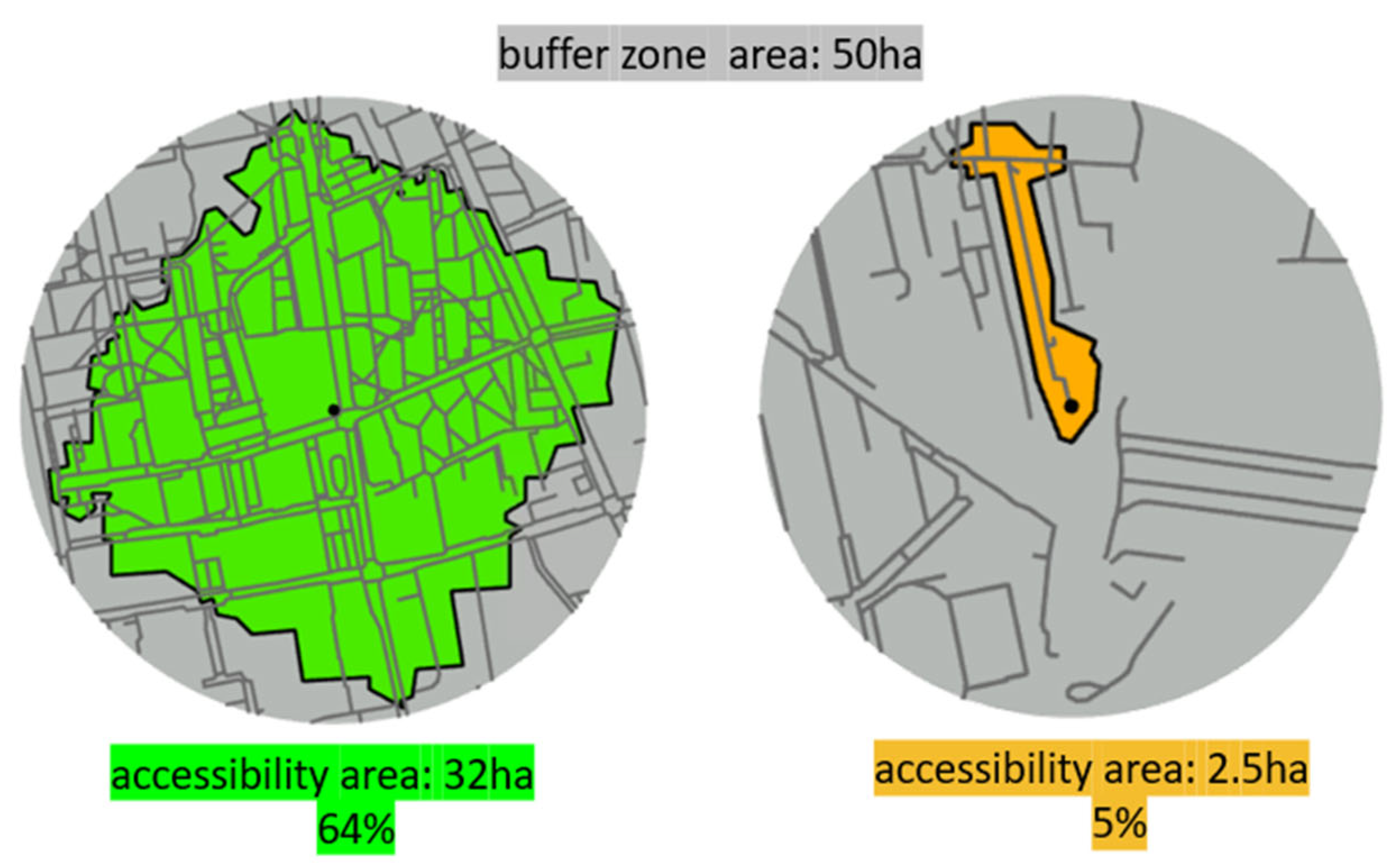
Although accessibility can be understood in different ways, unfortunately, it is still often understood as an assessment based on the distance in a straight line from the objects under study, rather than using data modeling of the actual pedestrian network connections. High-resolution geospatial data and pedestrian network models built from open sources, such as OpenStreetMap (OSM), support more detailed and realistic evaluations of accessibility patterns. Although network-based analyses require careful handling of potential data gaps, connectivity issues, and topological inconsistencies [62], they provide more accurate estimates of travel distance, time, and effort than Euclidean-based approaches. Such methods also enable the distinction between true walkable catchments and simplistic buffer zones, which can significantly misrepresent actual accessibility areas, depending on network density and connectivity (Figure 1).
We now have several tools at our disposal to carry out a wide range of network analyses, both commercial solutions (e.g., advanced modeling of the network itself and a range of network analyses in ArcGIS Pro 3.5.4) and those based on an open license (e.g., the QNEAT3 plug-in in QGIS 3.34.10). Many functionalities are also enabled by programming libraries like NetworkX, Shapely, or Access (PySAL). Some solutions allow analysis using embedded networks, which are provided together with the tools (which require, e.g., fees in the form of credits in ArcGIS Pro or an API key, as in the case of QGIS plugins like Hqgis (v. 1.2.3), Valhalla (v. 3.0.0), or TravelTime (v. 1.9.0)). Often, these are free solutions for testing only or for small datasets. Other solutions allow or require the user’s own network data (ArcGIS Pro, QNEAT3, or Networks). However, a key element of these analyses is always the infrastructure data—the network on which the movement is being analyzed, even in this seemingly simple model, there are still many challenges and limitations for pedestrian network modelling (e.g., selecting route elements, considering the terrain and its influence on pedestrian speed, crossing roadways according to their category, or moving through open areas such as squares). The most significant difficulty, however, is still the acquisition of data on pedestrian infrastructure sections to construct a complete network. Another challenge is ensuring the network sections’ connectivity, so that it represents a continuous set of connections, which is a critical requirement for obtaining proper network analysis results. In recent years, most analyses have been based on OSM data. Even though they are volunteer-generated data (VGI), they have certain limitations, including the risk of errors due to the limited skills of editors, as well as intentional vandalism. This entails inspecting the acquired data, updating, and editing it, including correcting topological errors. Despite the aforementioned limitations, it is still, as already pointed out, the best source of data for building pedestrian networks [89,90]. Therefore, the authors of this article used open OSM data to build a pedestrian traffic network. This methodology offers potential for broader applications in climate change adaptation planning, sustainable land management, and policy-oriented decision support systems.

2. Materials and Methods

2.1. Study Area

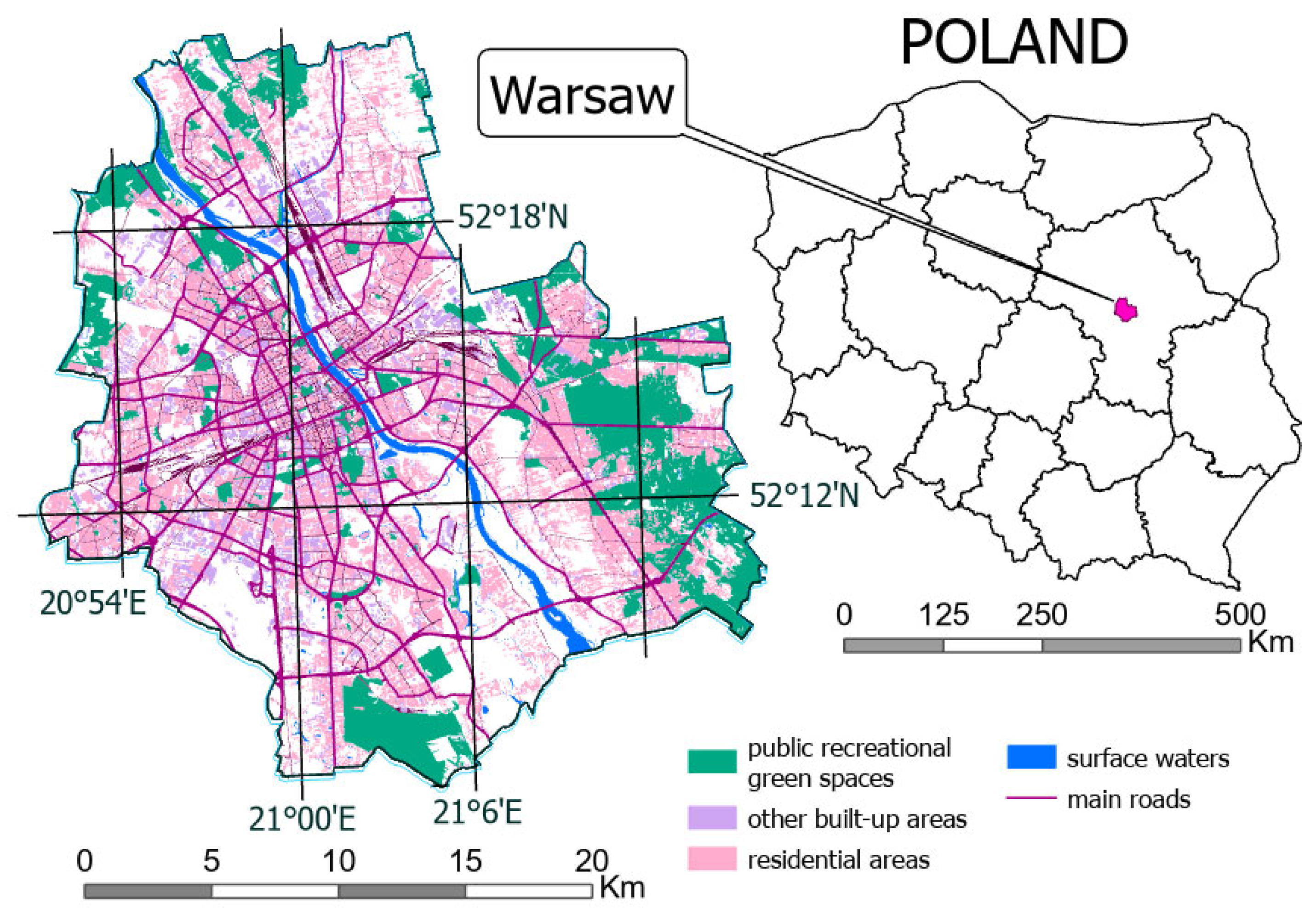
The study area includes Warsaw (Figure 2), the capital city of Poland. It is an area of 517 km2 with a population of over 1.8 million people. Approx. 60% of the people are of working age. A high rate of population growth and new housing developments characterize the capital. There is an increase in the number of seniors (65 and over)—about 22%, while the share of children and young people remains stable. Development pressure is causing the existing housing stock to become denser in the central districts and new housing estates to spring up, both multi-family buildings and intensive single-family housing in the peripheral districts.
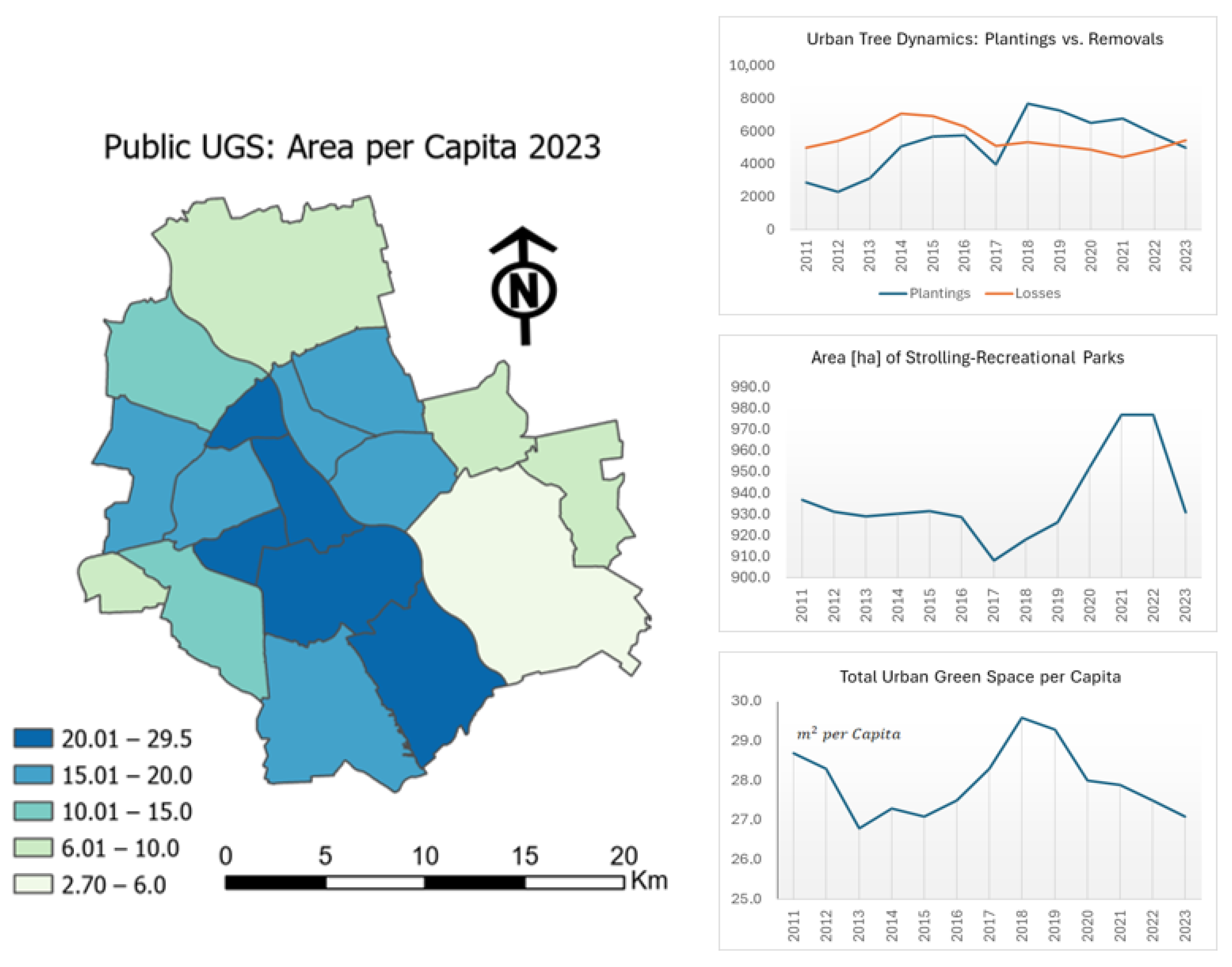
According to the ‘Diagnosis for the Environmental Protection Program for the Capital City of Warsaw for 2025–2030’ [91], in the area of the Capital City of Warsaw, areas fulfilling natural functions occupy a total of over 24,000 ha, which accounts for 47.1% of the total area of the city. These include forests, agricultural and post-agricultural areas, areas of arranged greenery, areas of natural and spontaneous greenery, areas of degraded greenery, areas of cemeteries, areas of allotment gardens, sports and recreation areas, and surface water areas. The categories listed have different functions, and public UGS with a recreational function are mainly city parks, squares, and forests. Managed green areas cover more than 1150 ha, accounting for approximately 2.2% of the city’s area. Primarily, urban parks are located in the central districts and forests in the peripheral districts. There are also areas where access to such areas is significantly limited. There is greenery accompanying buildings and streets, but no areas for outdoor recreation (Strolling-recreational green spaces). The most significant number of areas with natural functions are located in the districts of Wawer, Wesoła, and Wilanów, accounting for more than 60% of the area of these districts. Access to public green areas varies spatially across the city—the best in the central part, while insufficient on the outskirts, especially in new single- and multifamily housing areas. These problems particularly affect districts such as Białołęka, Wawer, Wilanów, Ursynów, Rembertów, parts of Włochy, Ursus, and Bemowo. In these areas, recreational functions are often taken over by forests and unmanaged natural and spontaneous green areas, if available [91]. Basic statistics on green spaces, including changes in recent years, and surface area per inhabitant, are shown in Figure 3.
It should be noted that strolling-recreational areas are not evenly distributed across the city. Based on data from 2020, the Municipal Office for Spatial Planning and Development Strategy has produced an analysis of the pedestrian accessibility of green spaces [92]. Green spaces were also included in the study. It shows that in 2020, 60% of Warsaw residents lived within 500 m of walking access to parks and green spaces, and 81% if a range of 1200 m of walking access to parks and green spaces was included. Warsaw adopted a development strategy in 2021, assuming that by 2030, there would be at least 6 m2 of green space with a recreational function per capita. Currently, in Warsaw, most districts meet this standard, but it is apparent that the outskirts achieve lower indicator values. At the same time, these are the most rapidly urbanizing areas with a rapid increase in population. Access to RUGS varies strongly within neighborhoods, and statistics calculated for such large areas do not highlight their variability. Furthermore, as can be seen from the figures quoted, the assessment of the RUGS areas already varies considerably depending on which sites are taken into account in the analysis, whether only landscaped areas are included, and whether forests are included in the RUGS. Therefore, selecting the source sites for the analysis and determining the realistic availability is essential. Another critical issue is the evaluation of the results obtained—a distance of 1200 m to the nearest RUGS can hardly be considered optimal and guarantees good enough access.
The study was conducted within the city limits of Warsaw. The main reasons for selecting Warsaw as the study area were: (1) its pronounced spatial variation in the distribution of recreational urban green spaces, (2) its dynamically evolving urban structure, producing diverse accessibility conditions, and (3) the availability of detailed geospatial data, which enables building-level analysis.
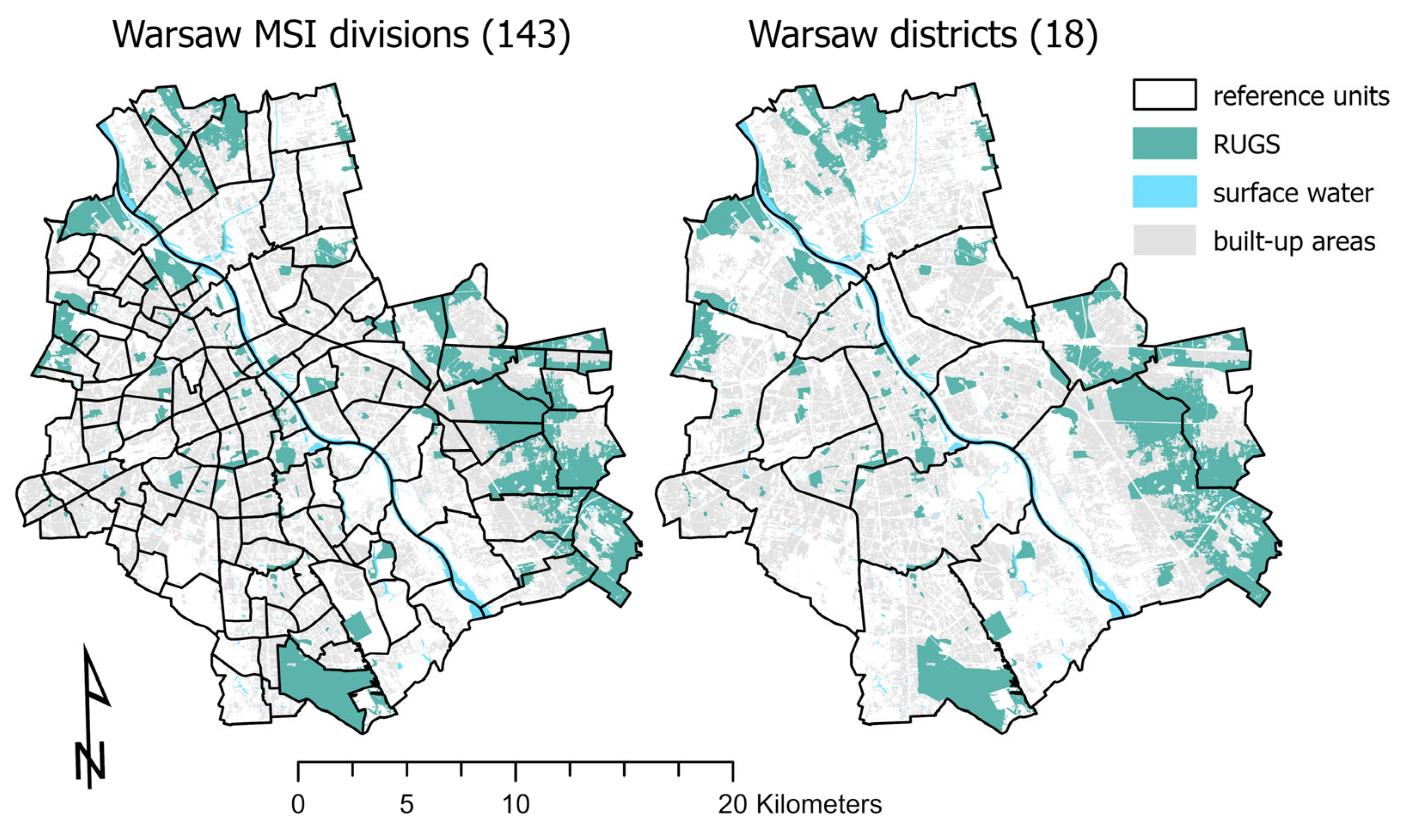
Accessibility of urban green spaces was determined for every residential building using the TARUGS indicator. In addition, accessibility was aggregated for 143 Municipal Information System (MSI) units and for all 18 city districts. The MSI units, established in 1996, serve as spatial management areas used to coordinate the layout of public service resources (Resolution No. 389/XXXVI/96 of the Warszawa-Centrum Municipal Council). This study uses this unit for accessibility aggregation analysis, which facilitates connection with urban management practices.

2.2. Data Sources and Methodology

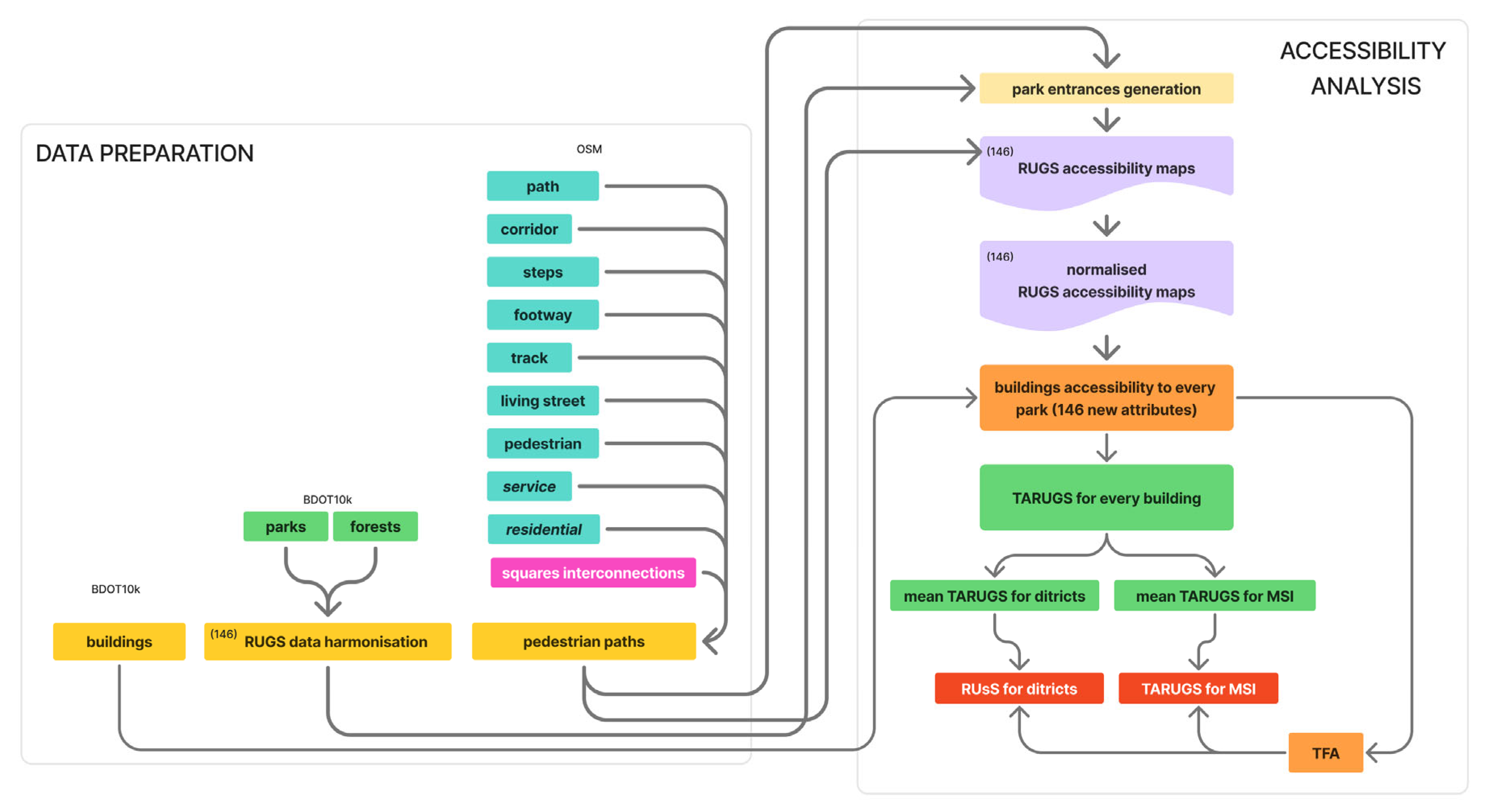
The methodology developed aimed to create a universal tool to generate a ranking of sites at the level of each building. Such a detailed analysis will enable a comprehensive assessment of the real accessibility to RUGS and, by testing different scenarios for new developments, to plan the optimal development of green infrastructure and equitable access to these areas. The diagram of the adopted methodology is presented in Figure 4.
The assumption in the presented project was to use publicly available data. To carry out the assessment using our proposed TARUGS indicator, the buildings for which the evaluation is conducted, pedestrian routes, and RUGS areas are required. Buildings and RUGS, including forests, were extracted from the BDOT10k database (Database of Topographic Objects at 1:10,000)—a vector database containing the spatial location of topographic features and a basic description of their properties. The content and detail level of the BDOT10k database generally corresponds to a traditional topographic map at the scale of 1:10,000. This is a nationwide, authoritative cartographic dataset maintained by the Polish Head Office of Geodesy and Cartography. BDOT10k provides detailed, systematically updated spatial information on land cover and land use, including public green areas, ensuring high positional accuracy and reliability for city-scale analyses. To improve completeness and confirm the validity of UGS delineation, BDOT10k features were cross-checked against the official list of parks, squares, and green areas published by the City of Warsaw (https://zzw.waw.pl/nasze-tereny/mapa-terenow-zzw/ URL accessed on 3 March 2025). This verification ensured that all formally designated urban green spaces were represented and correctly classified in the analytical dataset. Data was downloaded (open access) via the service www.geoportal.gov.pl (URL accessed on 15 February 2025), a central node of the Spatial Information Infrastructure in Poland that provides access to spatial data and related services. Analyses were carried out for 146 RUGS areas and 108,618 residential buildings. Data on pedestrian routes was extracted from the OSM database (selecting facilities where pedestrians can walk). These data were supplemented with routes generated within the squares by connecting all pairs of entrances to the square area with straight sections. The square’s entrance is the intersection point between the square’s boundary and the pedestrian routes reaching the square. To obtain suitably detailed results for assessing pedestrian accessibility to the RUGS, analyses were performed for RUGS entrances, assuming that the RUGS entrance is the point that provides access to the RUGS. RUGS entrances were generated similarly to those for squares, as points of intersection of RUGS boundaries and the pedestrian routes reaching them. Sections of the pedestrian network and RUGD entrances were randomly verified with the aerial orthophotomaps.
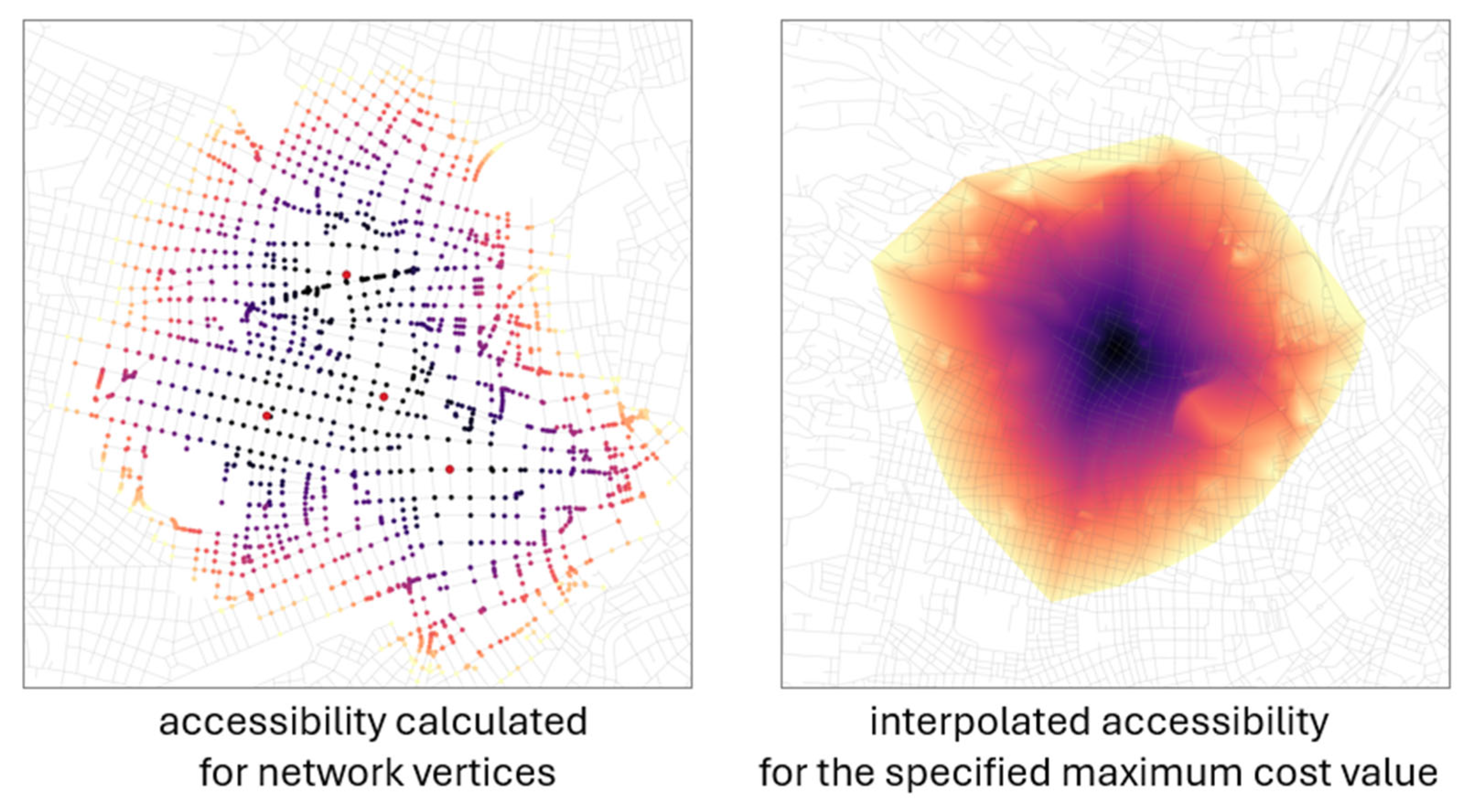
Accessibility analysis was performed in the QGIS environment using the QNEAT3 plugin and the Iso-Area as Interpolation algorithm. This algorithm interrogates the network’s vertices inside a user-defined cost range, starting from several points provided in the point vector layer (RUGS entrances). In this way, the algorithm assigns a minimum availability cost for each network vertex. The cost can be calculated in meters or seconds (based on an equal pedestrian speed assigned to each edge of the network or walking time calculated separately for each network element). The TIN interpolation method implemented in QGIS is then used to calculate an interpolated accessibility map of distance or time in raster format (Figure 5).
The resulting accessibility maps for all RUGS were then reclassified using fuzzy logic to produce normalized accessibility values for these sites. It was assumed that the highest value, equal to “1”, is closest to the entrances to the parks, in the range of up to 3 min of access, then decreasing linearly (values are recalculated using a linear function) to reach a value of “0” in the range of 15 min of access to the parks. Following an analysis of pedestrian speed studies, the average pedestrian speed was assumed to be 1.03 m/s (61.8 m/min) [93], resulting in a distance of 185 m for the 3-min range and 927 m for the 15-min range. It has therefore been assumed that the location of the RUGS, beyond 927 m from the building, has no impact on accessibility—this distance is too great to warrant the daily accessibility required to the RUGS. A relatively low walking speed was adopted due to the recreational nature of the areas studied (RUGS) and to accommodate people with limited mobility and children. In the implementation of the solution on a larger scale, this value can be an editable parameter of the algorithm and adjusted according to the assumptions of the analyses performed.
A limitation of using the QNEAT3 plugin is that it does not allow the incorporation of spatial impedances such as terrain slope or pedestrian crossing delays, which may introduce minor biases in estimated walking distances. In the case of Warsaw, where the urban terrain is predominantly flat and elevation differences are minimal, the resulting error is expected to remain within an acceptable range. Future developments of the method may include integrating terrain-related resistance coefficients or using more advanced network analysis tools to better account for such impedances. However, this approach requires the development of a new model of movement, based not on the distance travelled, but on the time taken to cover sections of the route. This model should also take into account the varying times taken to cover routes with significant gradients (in accordance with Tobler’s law), the inclusion of stairs and lifts, as well as delays associated with waiting at pedestrian crossings (with and without traffic lights).
Another limitation of the tool used is its inability to account for spatial barriers in interpolation based on the TIN model. Unfortunately, the tools currently available (implemented in various software platforms) do not offer this possibility. The solution proposed in the QNEAT3 plug-in addresses this issue sufficiently well; any problems that may arise are most often at the edge of the study area, which is why we methodically extended the study area beyond the borders of Warsaw to minimise the impact of this limitation. This conclusion also highlights the importance of accurately extending the area of analysis in relation to the target area of study. In the analyses presented in this article, the scope of the collected data has been extended to include a 1 km buffer zone around the city limits.
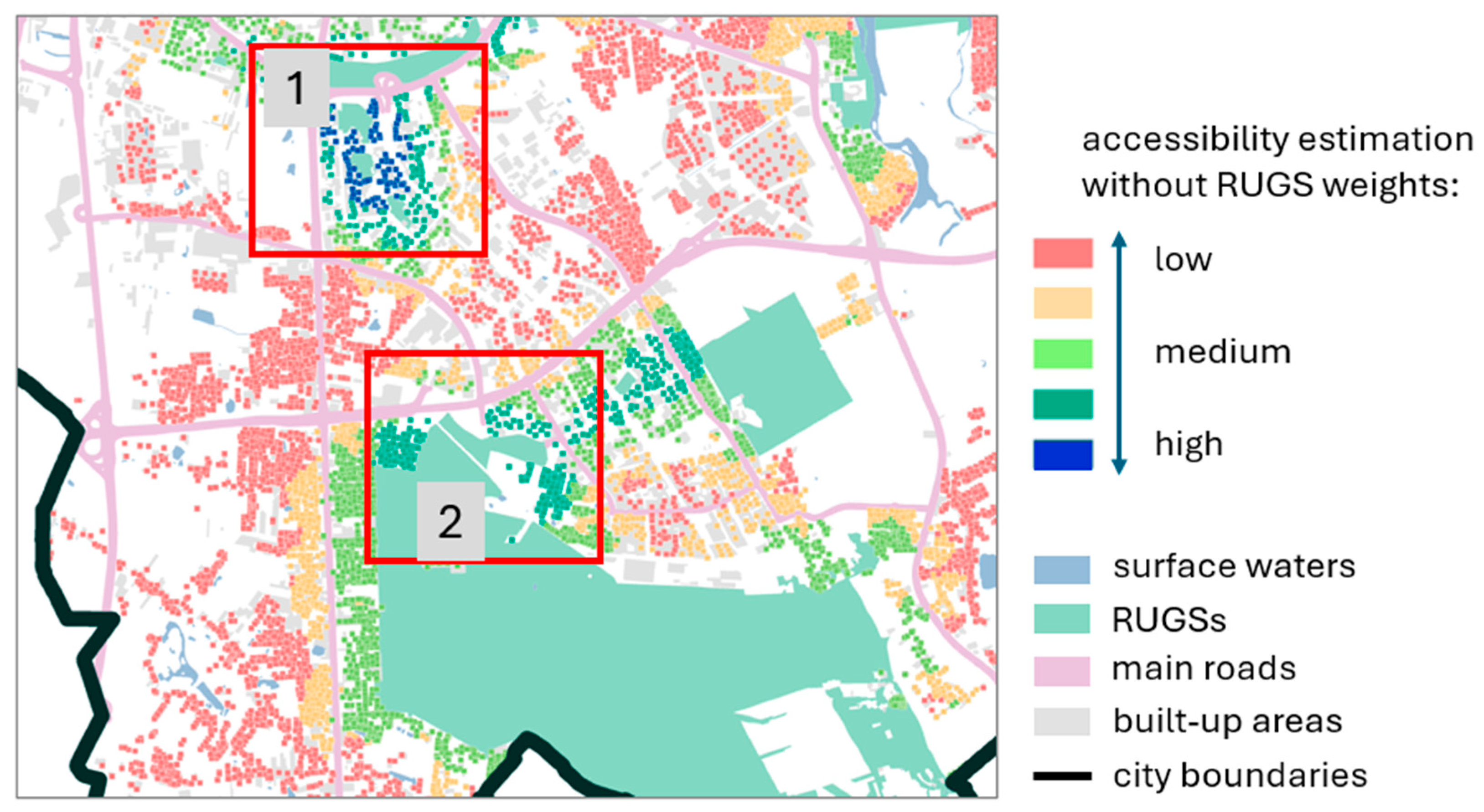
The next step was to extract data on the normalized accessibility to each of the 146 RUGS for each residential building. At this step, it was necessary to weigh the impact of the parks, considering their respective areas. Otherwise, buildings close to small RUGS received a significantly higher ranking than, for example, buildings in close proximity to forests (Figure 6).
In this way, the values of the TARUGS indicator were calculated for each residential building, allowing for the ranking of residential buildings and the calculation of aggregate indicators for 143 Municipal Information System (MSI) areas and 18 Warsaw districts.
MSI areas were introduced in 1996 to regulate public space and achieve spatial order (Resolution No. 389/XXXVI/96 of the Warszawa-Centrum Municipal Council), with subsequent amendments made in response to changes in the city’s boundaries (e.g., the incorporation of neighbouring communes) (Figure 7).
Analysis at the district level allows for a broad spatial context to be presented, enabling generalisation and assessment of large areas and highlighting differences in accessibility and conditions in individual districts, which are fairly autonomous in nature. On the other hand, aggregating into smaller MSI units provides a more precise assessment, which is crucial for detailed analyses of public space, without focusing solely on strict administrative divisions. This approach allows the internal diversity of each district to be revealed. The combination of both approaches provides a multidimensional perspective, taking into account different scales and planning aspects, while also highlighting the usefulness of the analysis results in relation to more homogeneous areas with smaller surface areas.
The following indicators were determined for each residential building:
Total Floor Area (TFA) is defined as the sum of the areas of all building floors, measured along the external surface of the external walls. This includes all utility, technical, and service areas on all levels, regardless of their intended function:
T F A i = F A × N F   f o r   i = 1,2 , , n
where
n is the number of buildings in the study area. FA is the floor area of the building, which refers to the area measured along the outer perimeter (outer edge) of the building at ground level; NF is the number of floors, which includes all above-ground floors (basements are not included). The result is expressed in square meters (m2).
Total accessible recreational urban green space (TARUGS) is defined as the sum of the surface areas of all RUGSs located within a specified maximum network-based walkable distance (927 m maximum) from each residential building, where each RUGS area is weighted by a decreasing function of the pedestrian network distance from the building to the nearest official entrance of that green space:
T A R U G S i = j = 1 m w i j × A j
where
Aj is the area of the j-th RUGS; wij is the weight (normalized value of accessibility to RUGS), determined as a decreasing function of the pedestrian network distance calculated from the given i-th building to the nearest entrance of the j-th RUGS:
w i j = f d i j
with the function taking the form:
w i j = f d i j =   1 i f   d i j < 185   m 927   m d i j 927   m 185   m i f   185   m d i j 927   m 0 i f   d i j > 927   m
where
dij—the distance between the i-th building and the nearest entrance to the j-th park calculated along the pedestrian network; as mentioned earlier, the distances of 185 m and 927 m result from the assumption of RUGS accessibility in 3 and 15 min.
In the analysis carried out, the values of 927 m and 185 m have been arbitrarily adopted—the analysis can be carried out with other values, adapting them to the needs of the social groups concerned, for example, for the elderly, a lower value for the maximum range than 927 m may be adopted.
The values of the TARUGS index are expressed in square meters (m2). These values formed the basis for ranking the city’s residential buildings in terms of accessibility to RUGS. The values obtained are presented in qualitative classes for more straightforward interpretation of the results obtained, showing the scale of accessibility to RUGS, ranging from no accessibility (buildings with no RUGS within a 927 m walking distance) to excellent accessibility. Details of the range of classes are described in the next section.
The processing resulted in a database of points representing buildings (centroids) that store the designated two indicators in the attributes: Total Floor Area (TFA) and TARUGS. This also allowed for the determination of aggregate indicators, which aid in assessing accessibility to RUGS calculated in each kth MSI unit and for each city district.
MEAN-TARUGS aggregate indicator was calculated as the average TARUGS value of the buildings located in a given k-th MSI unit:
M E A N k ( T A R U G S i ) = i = 1 n k T A R U G S i   ( f o r   i k ) n k
where
nk is the number of buildings in the k-th MSI unit.
RUGS Access Efficiency aggregate indicator (RAEk), which determines the RUGS access efficiency by showing the ratio of the summed values of TFAi and TARUGSi calculated in each k-th MSI unit:
R A E k = 999 999 999 f o r   i = 1 n k T A R U G S i   = 0   i = 1 n k T F A i i = 1 n k T A R U G S i   f o r   i = 1 n k T A R U G S i   > 0               f o r   i k
The closer the value of RAEk is to 0, the better the accessibility efficiency; the higher the RAEk, the more meters of residential development area fall within the distance-weighted square meters of RUGS area available for buildings within the 927 m walking access limit. An exceptional maximum value (equal to 999,999,999) has been introduced for situations where, in a given MSI unit, none of the buildings are located within the 927 m pedestrian access to buildings zone. This is when the effectiveness of accessibility to RUGS is at its worst.
A district sum in classes (DSC) was also calculated as the result of the total building area (TFA) multiplied by the class weight (from a weight of 4 for class 4 to a weight of 0 for class 0). This enabled the creation of a summary ranking of the districts.

3. Results

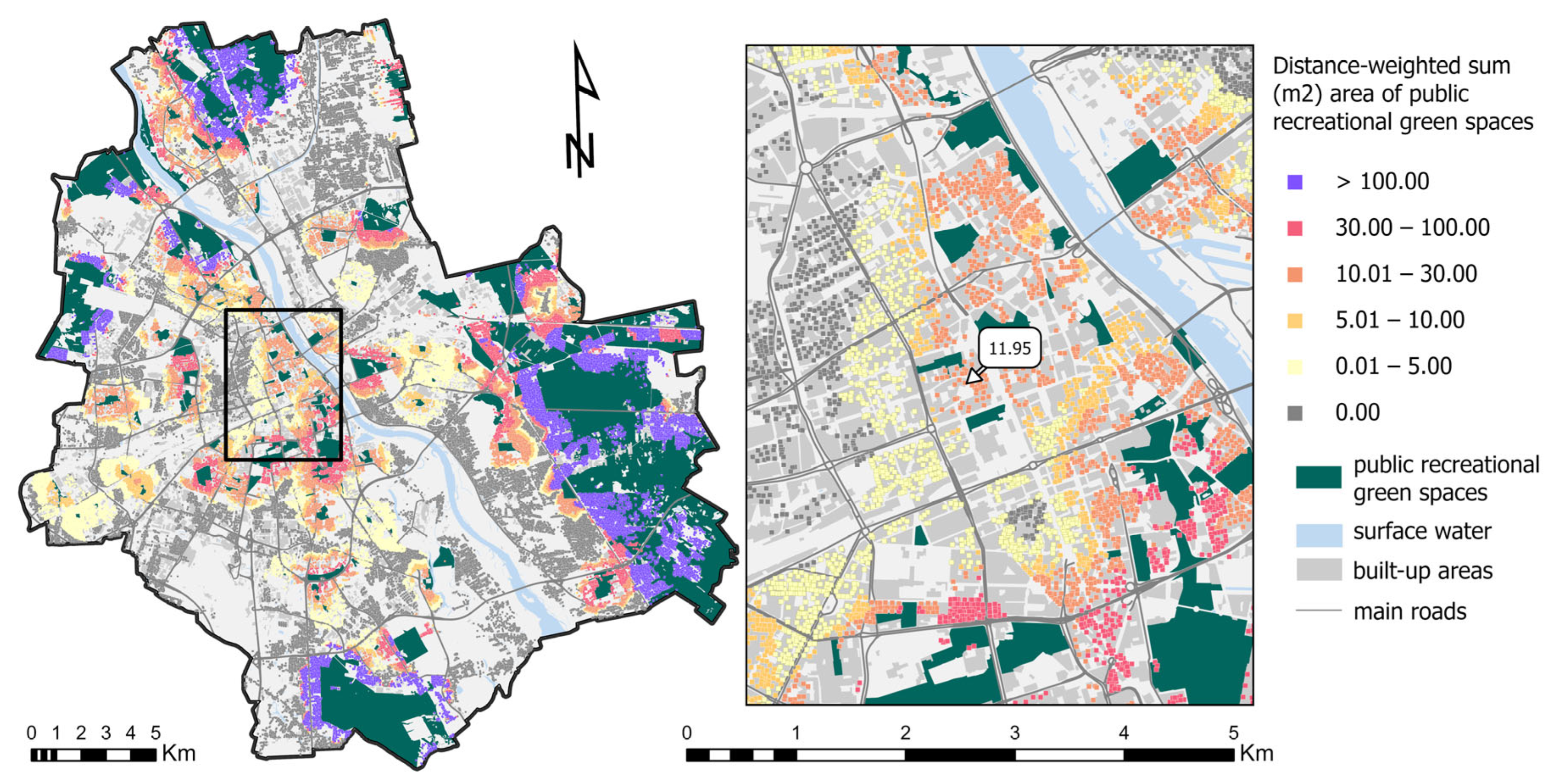
The key result obtained from the analyses is the ranking of residential buildings regarding accessibility to RUGS. What differentiates the results obtained from classic analyses on this topic is the execution of an accessibility assessment from each building to each of the 146 main RUGSs in the city. The ranking obtained does not indicate accessibility to the nearest RUGS, as is done in standard assessments of accessibility to green spaces. Still, it shows their total accessibility, considering the area of the RUGS. The highest ranking in such a ranking will be given to buildings with the largest possible RUGS areas in the closest possible access. Access, at all times, is understood to be the actual walking distance from the building to the nearest RUGS entrance. The map in Figure 8 shows the distribution of TARGUS index class values for Warsaw, indicating the total area of green space with a recreational function, weighted by walking distance, for each residential building. To simplify visualization, ranking classes of residential buildings have been introduced (Table 1).
Thanks to the proposed classification, the distribution of class values for the entire city can be presented systematically and transparently. The number of buildings for which an index value of 0 was obtained is striking. There are more than 40,400 of them, and they constitute a significant proportion of the city’s buildings (37% of the total). These buildings are located in all city districts, with the most significant number in Wawer (9180 buildings) and the smallest in Ochota (15 buildings). In class 4, with excellent accessibility to RUGS, there are 21.7 thousand buildings (20% of the buildings with a total area of 7.7% of the city’s total building area, from which it can be concluded that single-family buildings predominate in this class. The most significant number of them is in Wesoła, and many districts do not contain buildings in this class (Mokotów, Ochota, Praga-Północ, Praga Południe, Śródmieście, Ursus, Włochy, Wola, and Żoliborz). The percentage share in each city district related to the number of buildings and the total floor area (TFA) of buildings in a given district is presented in Table 2.
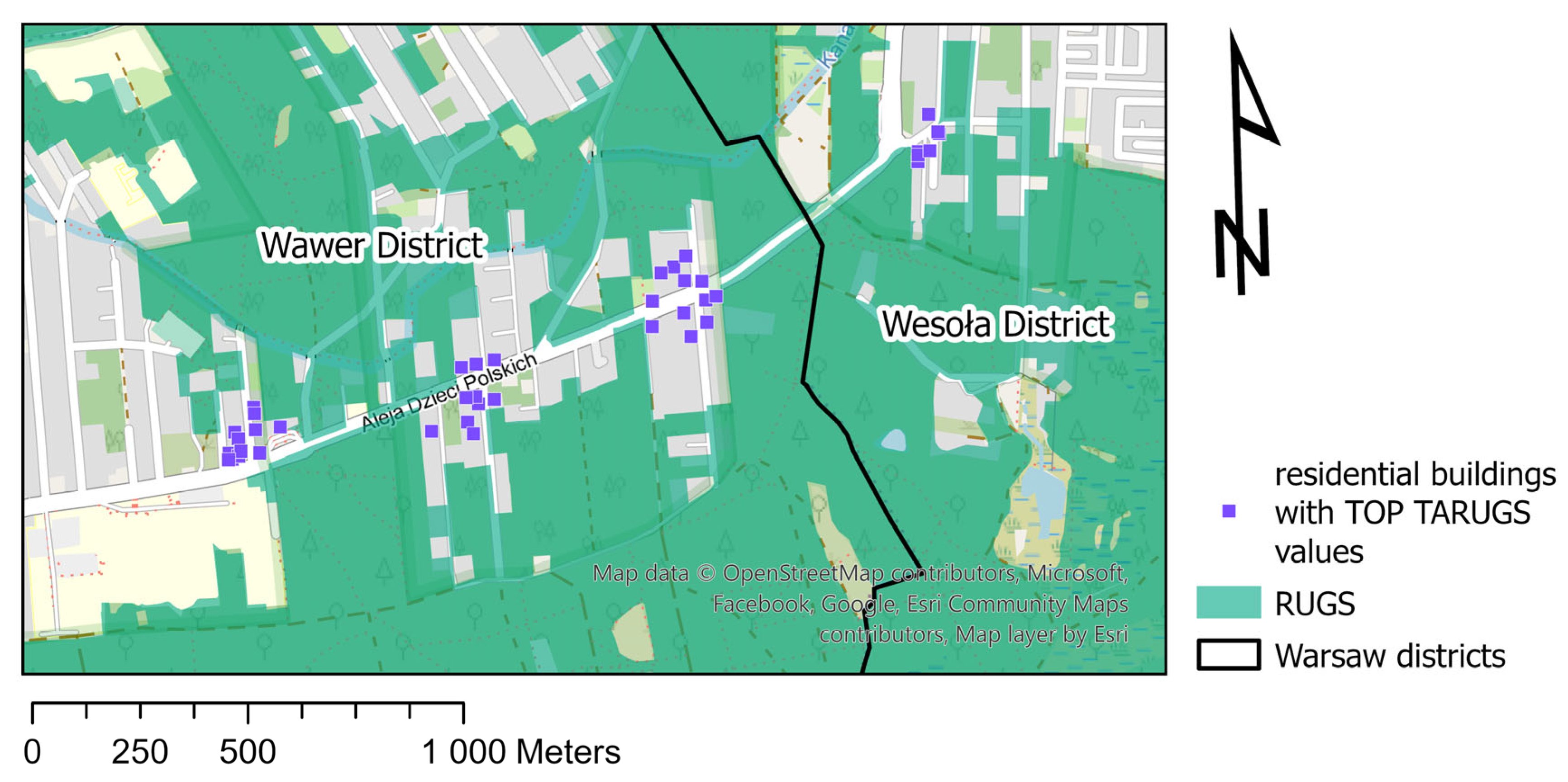
In the entire city, 42 buildings achieved the maximum value of the indicator; all of these buildings are located in close proximity, with some in the Wawer district and others in the Wesoła district, all situated along Al. Dzieci Polskich Street, and are literally surrounded by RUGS (Figure 9). This has resulted in these buildings’ indicator values being the highest in Warsaw.
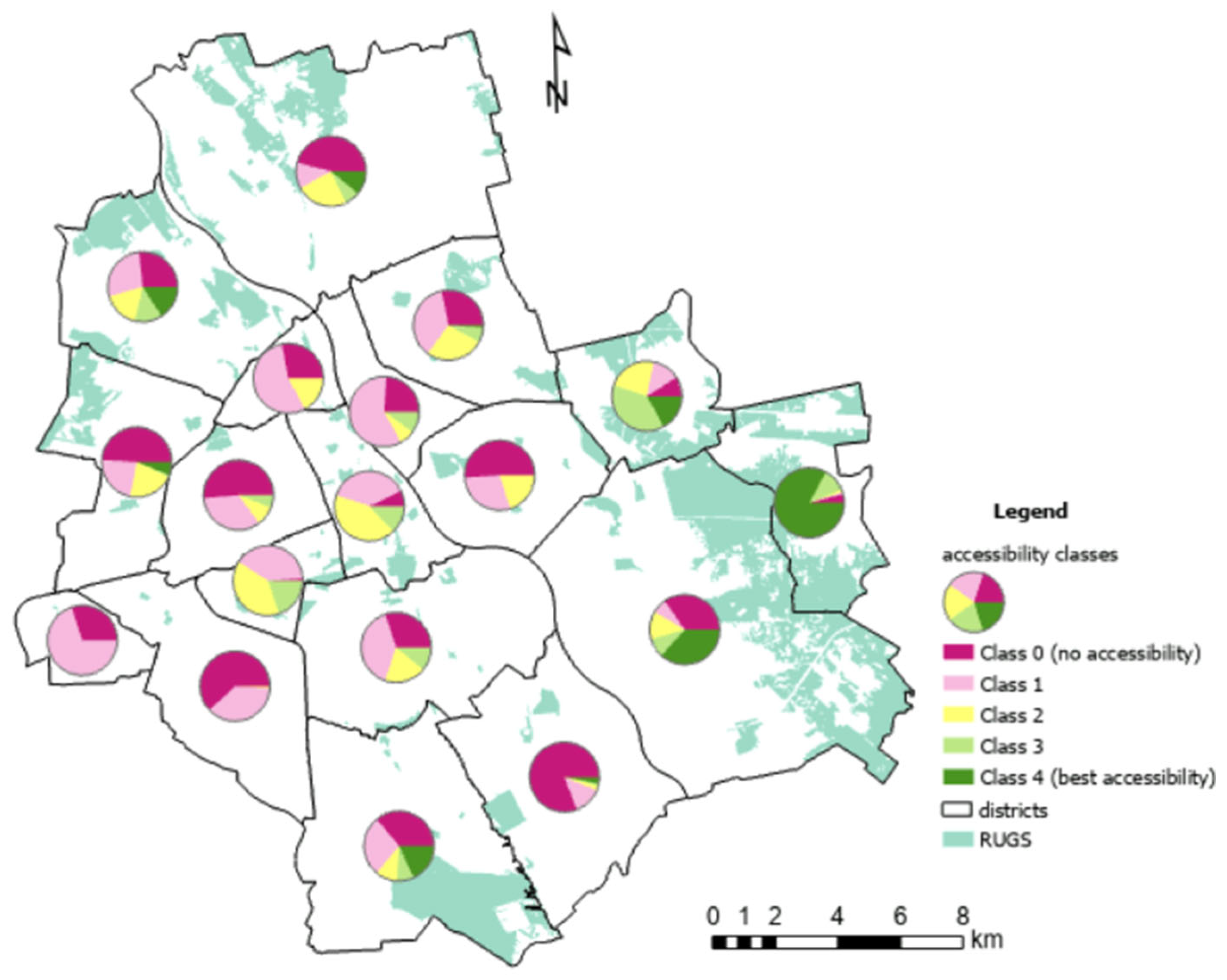
The summary prepared in this manner was used to visualize accessibility in classes in particular Warsaw districts (Figure 10).
The worst accessibility is characterized by those neighborhoods with the highest share of Class 0 (no accessibility—dark pink color) and the lowest share of Class 4 (best accessibility—dark green color). These neighborhoods are the most lacking in green spaces with a recreational function, located within a walking accessibility of up to 15 min leisurely walk (927 m). Wilanów and Włochy stand out among these neighborhoods with the worst accessibility. In contrast, Mokotów and Wawer have the best accessibility to significant RUGS areas. As mentioned above, the statistics for the neighborhoods show a significantly generalized picture of the city. Still, due to the considerable autonomy of the neighborhoods, they can be a good starting point for assessing accessibility in different areas of the city compared to other neighborhoods.
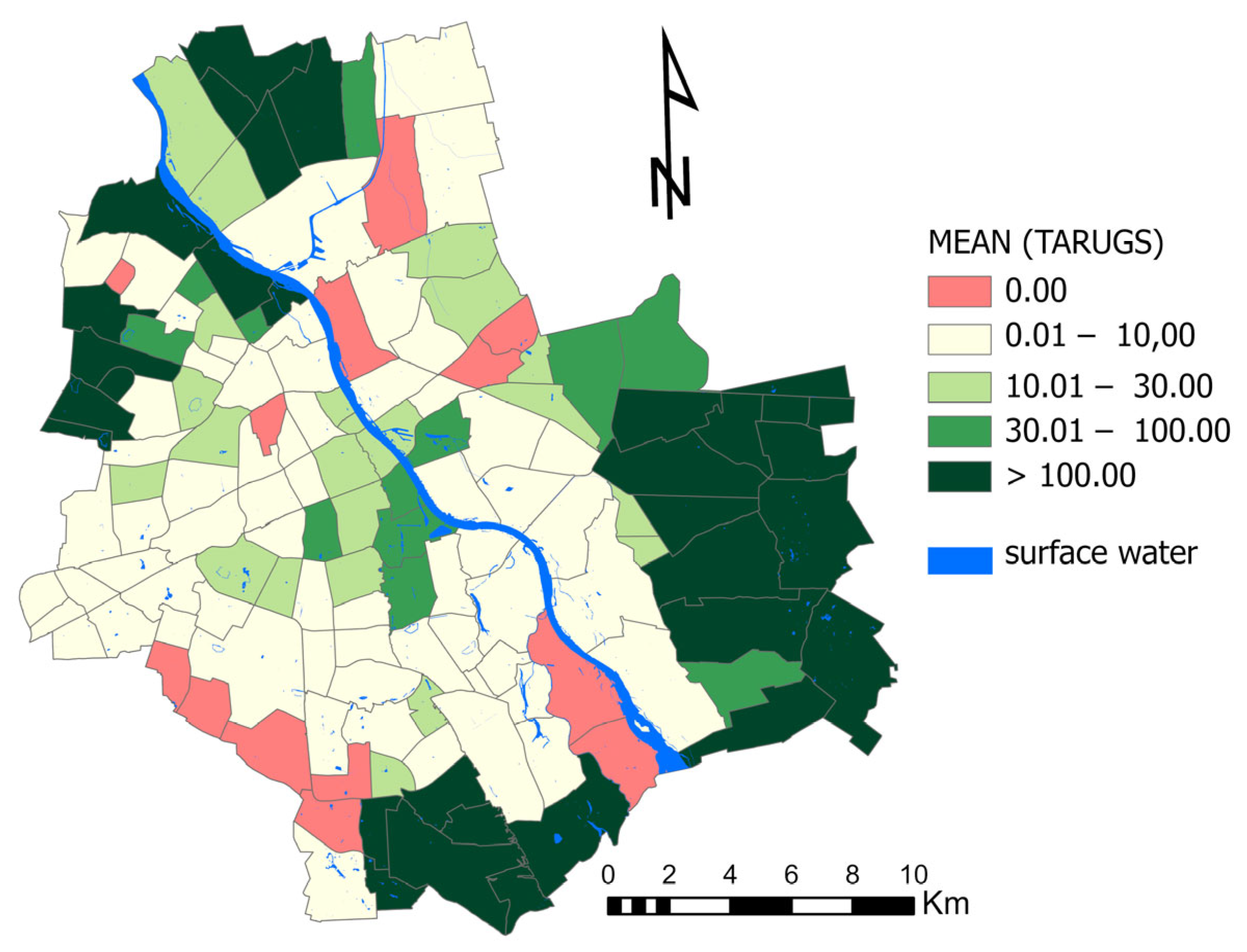
Measures aggregated to MSI areas present a slightly different picture of the city. Two further indicators have been calculated. One is MEAN-TARUGS, representing the average value of TARUGSi for buildings located in a given MSI unit (Figure 11).
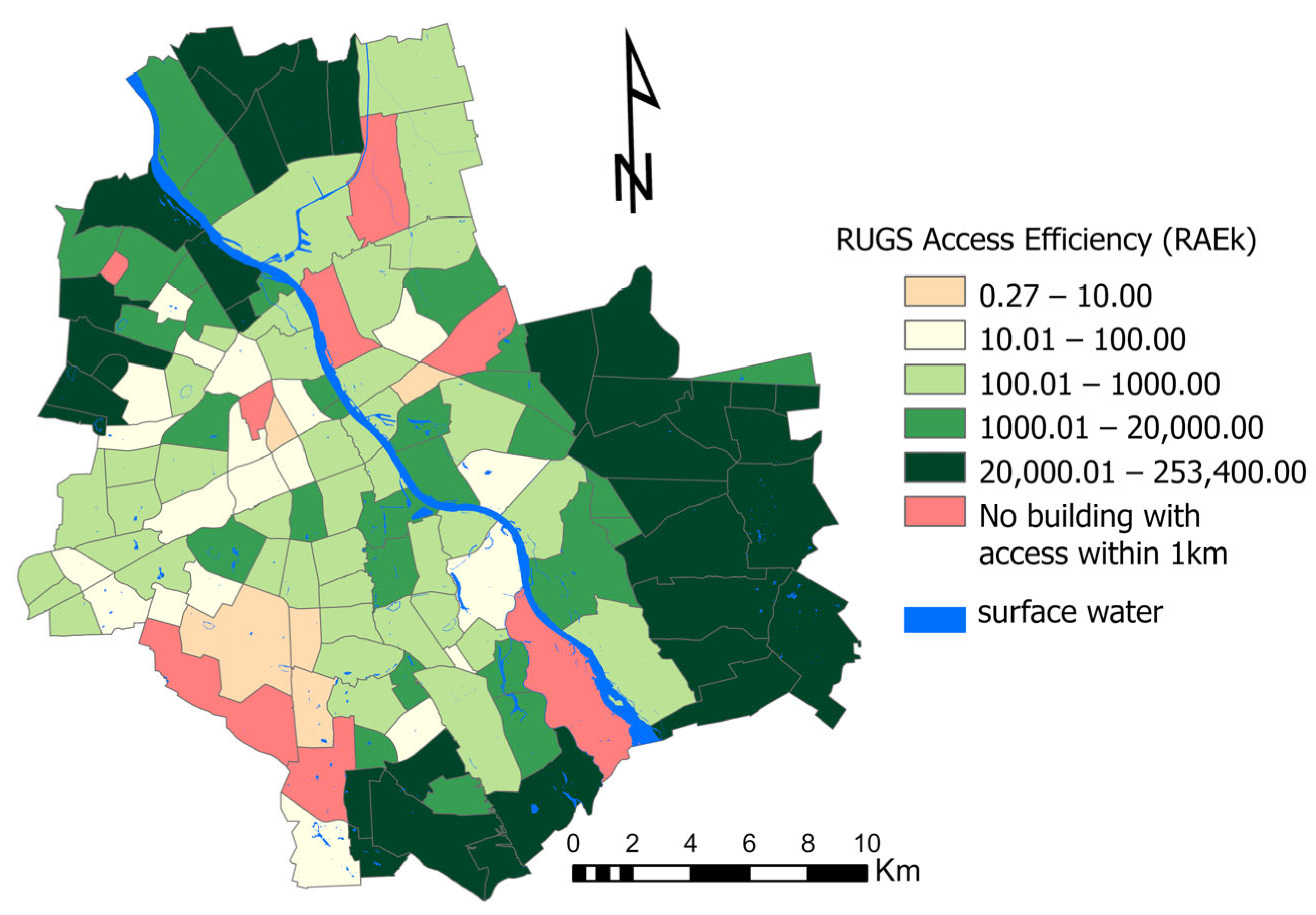
The second indicator is RUGS Access Efficiency (RAEk), which is shown on the map in Figure 12.
The red color in both Figure 11 and Figure 12 shows MSI units where residential buildings are not located within a walking distance of 927 m from any RUGS. They differ in terms of the total area of residential buildings summed up, i.e., the intensity of residential development. Still, unfortunately, the residents of these areas are not provided with access to RUGS, even at a minimum. Table 3 provides a summary of:
S U M k   T F A i = i = 1 n k T F A i
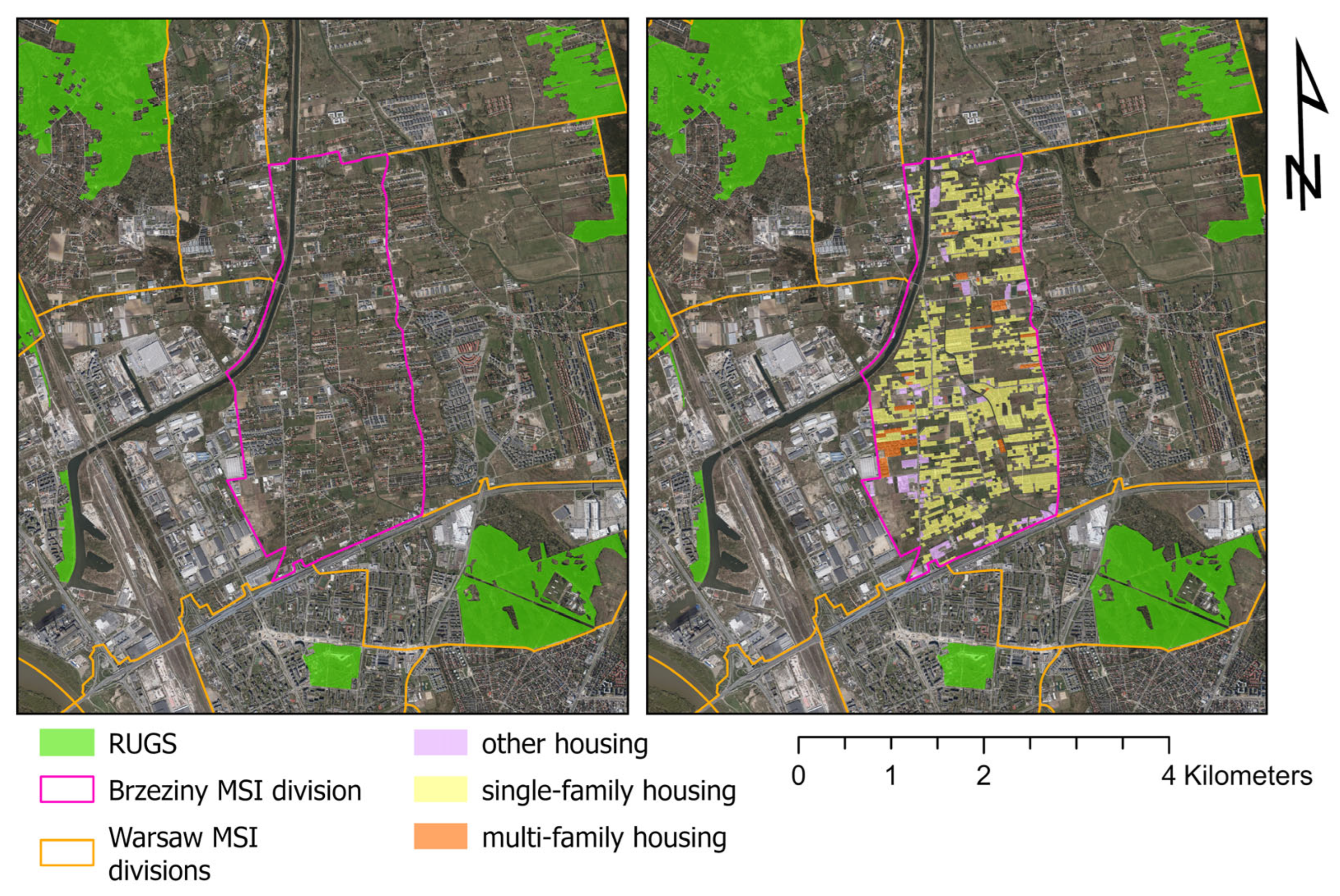
in these 6 MSI units. The lowest values were obtained for MSI Brzeziny, located in the Białołęka district. This MSI has no significant RUGS, and residential and other development is quite intensive (Figure 13). There is a RUGS in a straight line to the south-east of this MSI, but it is not accessible due to a spatial barrier—the S8 expressway.
Due to the lack of RUGS accessibility within the assumed 927 m radius of the actual access route, a RUGS Access Efficiency (RAE) value of 999,999,999 is obtained for all MSI units presented above.
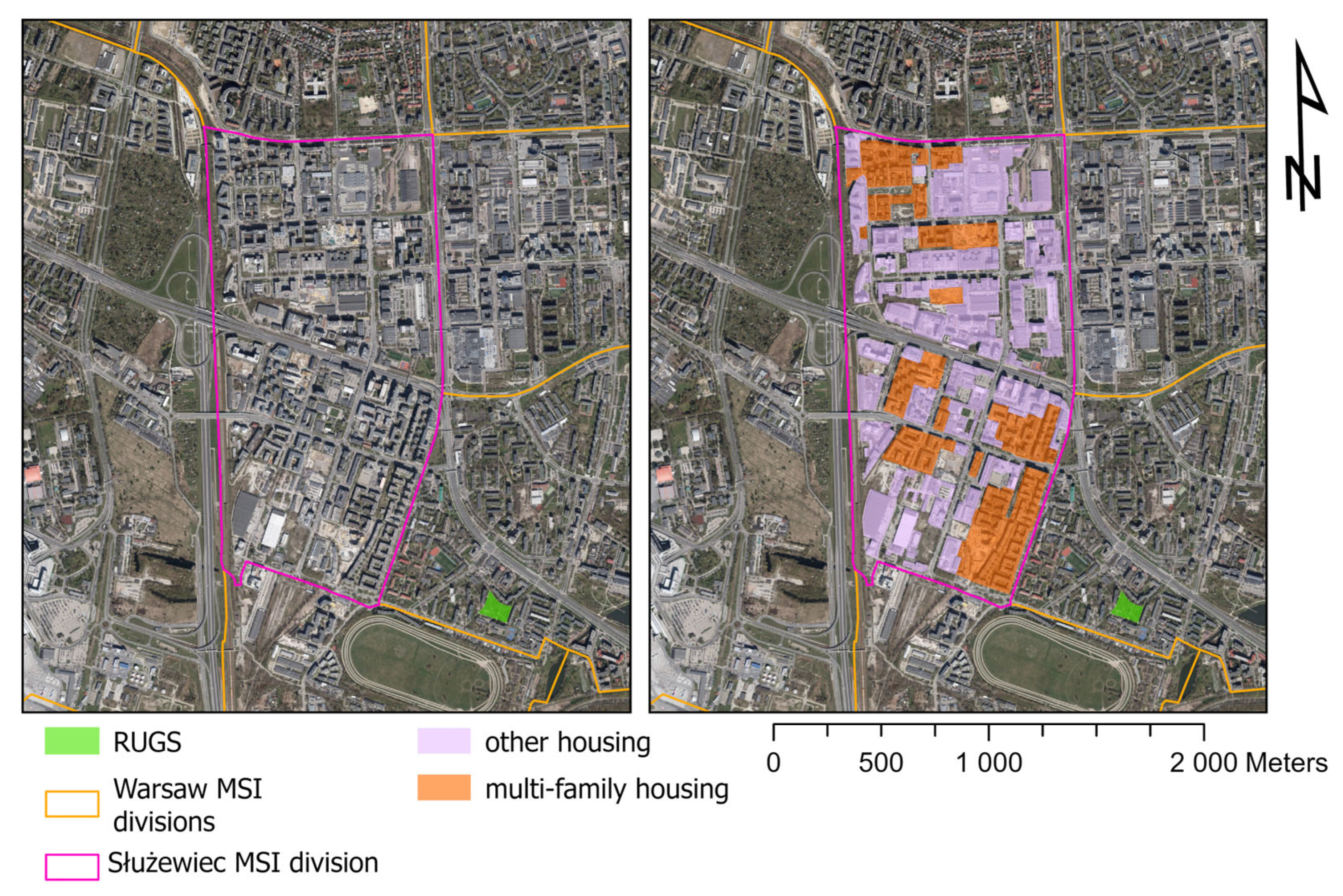
There is also an unfavorable situation in those units where buildings have little access to RUGS (small RUGS area and at the same time larger distances, but within the assumed limits), concerning the intensity of residential development (Table 4). In these units, RUGS Access Efficiency RAEk > 20,000 (marked in light yellow on the map in Figure 13). Among others, this is the Służewiec MSI area, located in the Mokotów district. It is an intensively urbanized MSI unit, with residential development dating back to the socialist period. Industrial areas are adjacent to modernist housing. The low index values are provided by one small RUGS located near the south-eastern boundary of the region. Similar to the Brzeziny MSI, there are no significant RUGSs located within Służewiec (Figure 14).
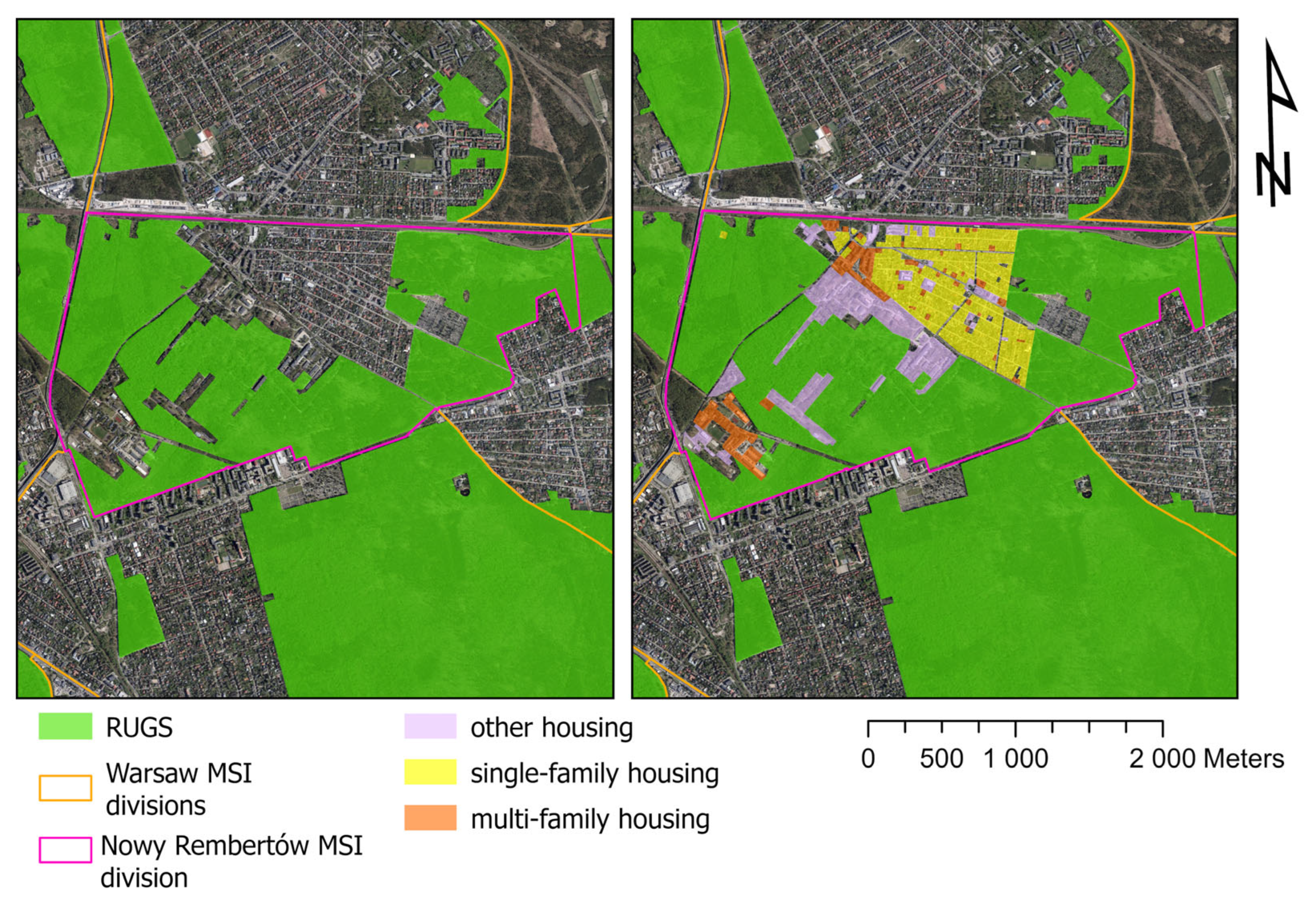
The situation is entirely different, for example, in the MSI Nowy Rembertów in the Rembertów district. This is a highly urbanized area, with buildings primarily consisting of single-family dwellings and villas. The map in Figure 15 clearly shows how the distribution of RUGSs within the MSI area itself, as well as in its vicinity, has influenced such high accessibility values for this area. Not only are they close by, but they are green areas with a vast area of both parks and forests.

4. Discussion and Conclusions

This article presents the spatial equity element of assessing accessibility to RUGS at the level of detail of residential buildings. This approach enables a quantitative assessment of spatial inequalities, providing hard, measurable data to reveal areas of exclusion from positive encouragement of movement and recreation due to insufficient access to RUGS with a recreational function.
Physical accessibility to UGS has also been examined in comparative studies across multiple European cities. Łaszkiewicz et al. [94] assessed access to urban green spaces for every urban block, demonstrating how different urban morphologies shape the reachability of UGS. Our approach moves to an even finer spatial resolution by analysing accessibility at the level of individual residential buildings, although we limit the scope to a single city. Łaszkiewicz et al. highlight that even in cities with high overall UGS coverage, the amount of truly accessible green space can be low and vary widely across the city. Their cross-city analysis shows that assessing UGS provision must account for physical accessibility, which determines whether residents can meaningfully benefit from walkable, recreation-oriented green spaces.
Our findings align with broader debates on the consequences of neoliberal urban development, in which rapid residential expansion frequently outpaces investments in public infrastructure. Under such conditions, spatial planning loses its corrective function and becomes secondary to market pressures, resulting in fragmented urban structures and uneven access to public amenities, including green spaces. The case of Wilanów illustrates this dynamic well: high-density development and a limited supply of new RUGS. The results suggest that even in relatively affluent areas, with high property prices [95], market-driven development does not inherently produce spatially just environments. Consequently, building-level accessibility assessments can serve as a practical governance tool, supporting the monitoring of planning decisions and ensuring the effective implementation of these decisions.
In the case of Warsaw, our results reveal a pattern that differs from findings reported for many other European cities [94], but this is primarily due to the fact that our analysis focused exclusively on access to public RUGS. The central districts demonstrate relatively good walkable access to RUGS, largely due to the presence of historical park complexes and green areas established during the socialist period. In contrast, spatial inequalities become more pronounced in peripheral districts, where conditions vary substantially. Some districts benefit from proximity to large forest complexes (e.g., Białołęka or Wawer), while others, such as Wilanów and Włochy, lack both forested areas and a sufficient supply of public RUGS. In these districts, residents often rely on not-yet-developed open areas for everyday recreation (not classified as RUGS in our study). These areas are predominantly privately owned and are being systematically converted into residential developments. The urban expansion has outpaced the provision of public green infrastructure, highlighting an uneven allocation of resources from the perspective of spatial justice. And that is precisely why analyses such as accessibility assessments and building rankings can support planning and decision-making, identifying places in need of thoughtful interventions. New RUGS, in any scenario, can be included in the next stage of such analysis to assess how the ranking of individual buildings changes. Such an approach allows informed, equitable decisions to be made about new developments (both UGS “just green enough” and new development). Such compilations can also serve as a check against planning decisions already made, particularly in cases where new greenfield developments are planned and the needs of residents are overlooked. It supports the assessment of whether the implemented processes weaken or strengthen the gentrification of the space. Disclosing the ranking to residents, for example, through a suitably designed dashboard, can strengthen public participation processes by arming residents with data-based arguments during ongoing public consultations, and taking into account the assessment of buildings when choosing where to live.
Only walking accessibility to RUGS was considered in the presented methodology. In the analyses conducted, emphasis was deliberately placed on pedestrian reaches, emphasizing the importance of walking—a basic physical activity and an essential part of a healthy lifestyle. For a complete picture of accessibility to RUGS, assuming that residents may use other modes of transportation to get around, accessibility for bicyclists and public transportation users should also be included. This would allow for a more diverse assessment of accessibility. This is also mentioned by Cheng [96]. A comprehensive assessment of spatial equity in the context of RUGS requires considering both measurable indicators of accessibility and the subjective experiences and needs of residents. A RUGS area may be physically close, but perceived as inaccessible (e.g., private, unsafe, or reaching it may be difficult for some reason—e.g., through steep slopes, unlit sections of trails or stairs) [46,52]. In this type of research, the groups of residents surveyed should be carefully selected to avoid excluding people (e.g., those who do not use green space due to social barriers) [47,49,97]. This study did not include indicators of green space quality. If a certain area of green space is accessible but lacks facilities, the actual utilization efficiency may be lower than the evaluation results. In the future, a multi-criteria assessment of park quality, along with the introduction of residents’ subjective perception data supplemented by questionnaire surveys, can help improve the accessibility evaluation system. The analyses conducted also do not take into account the issue of vertical access—there is a lack of analyses that consider both the location of the building entrance and the “vertical distance” (e.g., the floor of the apartment) in accessibility, among other factors, for RUGS. This limitation is due to the fact that there is currently no widespread access to such detailed data. The proposed methodology is universal and can also be used to determine the accessibility of other urban facilities.
A certain simplification of the methodology described is that only the area’s area is included in the weight (importance) of the RUGS. Its further development will also include an analysis of not only whether RUGS can be reached, but also whether it is worth it, taking into account the quality of RUGS, including the perception of quality by residents with different needs, safety, and adequate green space facilities.
Further research would also need to consider the burden on RUGS according to the principle of supply and demand. Too many residents using these areas can be a constraint and act as a disincentive for undertaking outdoor activities.
The need for local indicators of green space accessibility is also part of the assumptions underlying the new Law on Planning and Spatial Development in Poland, the provisions of which will take effect from 2026. It is planned to introduce new municipal standards of accessibility to social infrastructure, among other things, by providing access to public green areas, defined as the location of a parcel of land within a distance of no more than 1500 m (areas of less than 3 ha) and 3000 m (green areas of no less than 20 ha). This distance is designated as a public access route for pedestrians. The 927-m (15-min walk) threshold set in the paper is stricter than the policy standard of 1500 m, and only 63% of buildings in Warsaw meet the standard. It is necessary to prioritize adding small and scattered green spaces in areas with low compliance rates, such as Wilanów and Włochy, in subsequent planning to meet policy requirements.
When calculating statistics for neighbourhoods and MSI units, it is always necessary to identify possible outliers both globally and locally, as significant variation in TARUGS indicator values is apparent in each unit. The advantage of such aggregation is the potential possibility of juxtaposition with, for example, demographic and socioeconomic data.
Some limitations of the proposed methodology are also due to access to source data and the algorithms used. There is still a lack of reliable data on pedestrian routes, along with their characteristics. The TARUGS model relies on fundamental spatial data inputs: RUGS entrances locations, residential address points, and the pedestrian network, which, if available, allow the method to be successfully applied in other cities and under varying data conditions. Although the current computational workflow is demanding (depending on the size of the study area, the density of the pedestrian infrastructure, and the number of RUGS and their entrances), further optimization may enable its effective integration into urban planning platforms. However, the most sensitive data set is pedestrian network data, which is not yet available in national spatial databases, making the process of obtaining such data costly and time-consuming. Although OSM data is currently the best source for network analyses of pedestrian accessibility, these data must be subject to verification and updating due to the limitations described earlier. The time-consuming nature of data preparation also meant that, at this stage of the analysis, it was only possible to carry out the analysis for one city. Applying the proposed methodological framework to other comparable European cities may provide a broader empirical basis and enhance the generalizability of the findings. The current lack of comparative analyses with other European cities represents a limitation of our study.
The inconsistency in defining RUGS is also apparent in Polish conditions. This translates into different classifications and approaches, and thus different distinctions in other spatial databases. Limitations also arise from the tools used—the QNEAT3 algorithms used to determine pedestrian accessibility maps do not allow for the inclusion of spatial barriers in the interpolation algorithm, which uses accessibility values calculated for network node points located only at interpolation, with an irregular network, this can strongly affect the results. The authors of this article are participating in tests to develop a new tool that will enable even better estimation of actual pedestrian accessibility.
Contemporary research on spatial justice emphasizes that equal access to urban green spaces, considering both physical accessibility and social determinants, is crucial to achieving socio-spatial justice, but requires systemic change in planning, participation, and urban policies. Therefore, the question what steps can be taken to assess and achieve social justice properly is still very much relevant.

Author Contributions

Conceptualization, J.J. and A.F.; methodology, J.J. and A.F.; software, A.F.; validation, J.J.; formal analysis, J.J. and A.F.; resources, A.F. and J.J.; writing—original draft preparation, A.F.; writing—review and editing, J.J.; visualization, J.J. All authors have read and agreed to the published version of the manuscript.

Funding

This paper was co-financed under the research grant of the Warsaw University of Technology supporting the scientific activity in the discipline of Civil Engineering, Geodesy and Transport number 24/ILGiT/2024.

Data Availability Statement

All datasets used were taken from a publicly accessible repository. Topographic data from the BTOT10k database accessible via www.geoportal.gov.pl repository; pedestrian routes were taken from OSM datasets via the QuickOSM plugin in QGIS software.

Conflicts of Interest

The authors declare no conflicts of interest.

References

  1. Daniels, B.; Zaunbrecher, B.S.; Paas, B.; Ottermanns, R.; Ziefle, M.; Roß-Nickoll, M. Assessment of Urban Green Space Structures and Their Quality from a Multidimensional Perspective. Sci. Total Environ. 2018, 615, 1364–1378. [Google Scholar] [CrossRef] [PubMed]
  2. Jim, C.Y.; Chen, W.Y. Perception and Attitude of Residents Toward Urban Green Spaces in Guangzhou (China). Environ. Manag. 2006, 38, 338–349. [Google Scholar] [CrossRef] [PubMed]
  3. Hosey, L. The Shape of Green: Aesthetics, Ecology, and Design; Island Press: Washington, DC, USA, 2012. [Google Scholar]
  4. Veinberga, M.; Skujane, D.; Rivza, P. The Impact of Landscape Aesthetic and Ecological Qualities on Public Preference of Planting Types in Urban Green Spaces. LAA 2019, 14, 7–17. [Google Scholar] [CrossRef]
  5. Nitoslawski, S.A.; Galle, N.J.; Van Den Bosch, C.K.; Steenberg, J.W.N. Smarter Ecosystems for Smarter Cities? A Review of Trends, Technologies, and Turning Points for Smart Urban Forestry. Sustain. Cities Soc. 2019, 51, 101770. [Google Scholar] [CrossRef]
  6. Addas, A. The Importance of Urban Green Spaces in the Development of Smart Cities. Front. Environ. Sci. 2023, 11, 1206372. [Google Scholar] [CrossRef]
  7. WHO Regional Office for Europe. Urban Green Spaces and Health; Urban Green Spaces and Health; WHO Regional Office for Europe: Copenhagen, Denmark, 2016; p. 91. Available online: https://www.who.int/europe/publications/i/item/WHO-EURO-2016-3352-43111-60341 (accessed on 16 July 2025).
  8. Jennings, V.; Bamkole, O. The Relationship between Social Cohesion and Urban Green Space: An Avenue for Health Promotion. Int. J. Environ. Res. Public Health 2019, 16, 452. [Google Scholar] [CrossRef]
  9. Jabbar, M.; Yusoff, M.M.; Shafie, A. Assessing the Role of Urban Green Spaces for Human Well-Being: A Systematic Review. GeoJournal 2022, 87, 4405–4423. [Google Scholar] [CrossRef]
  10. Gibson, J.J.T. A Theory of Perception: The Ecological Approach to Visual Perception. Science 1980, 209, 799–800. [Google Scholar] [CrossRef]
  11. Widmer, H.; Rérat, P. Operationalizing Affordances for Public Space: Artefacts and Their Various Uses. Eur. Plan. Stud. 2025, 33, 421–442. [Google Scholar] [CrossRef]
  12. Scarantino, A. Affordances Explained. Philos. Sci. 2003, 70, 949–961. [Google Scholar] [CrossRef]
  13. Alshehri, R.M.; Alzenifeer, B.M.; Alqahtany, A.M.; Alrawaf, T.; Alsayed, A.H.; Afify, H.M.N.; Elmoghazy, Z.A.A.; Alshammari, M.S. Impact of Urban Green Spaces on Social Interaction and Sustainability: A Case Study in Jubail, Saudi Arabia. Sustainability 2025, 17, 4467. [Google Scholar] [CrossRef]
  14. de Jalón, S.G.; Chiabai, A.; Quiroga, S.; Suárez, C.; Ščasný, M.; Máca, V.; Zvěřinová, I.; Marques, S.; Craveiro, D.; Taylor, T. The Influence of Urban Greenspaces on People’s Physical Activity: A Population-Based Study in Spain. Landsc. Urban Plan. 2021, 215, 104229. [Google Scholar] [CrossRef]
  15. Olszewska-Guizzo, A.; Sia, A.; Fogel, A.; Ho, R. Features of Urban Green Spaces Associated with Positive Emotions, Mindfulness and Relaxation. Sci. Rep. 2022, 12, 20695. [Google Scholar] [CrossRef] [PubMed]
  16. Wajchman-Świtalska, S.; Grabowska-Chenczke, O.; Woźniak, M. Exploring the Patterns of Recreational Activity among Urban Green Spaces in Poland. Sustainability 2023, 15, 5425. [Google Scholar] [CrossRef]
  17. Lopez-Haro, J.; Gómez-Chávez, L.F.J.; Pelayo-Zavalza, A.R.; Gómez-Varela, J.F. Association between Active Use of Urban Green Spaces and Well-Being in Adults Aged 18–65 Years: A Systematic Review. J. Health Pollut. 2024, 12, 016002. [Google Scholar] [CrossRef]
  18. Castañeda, N.R.; Pineda-Pinto, M.; Gulsrud, N.M.; Cooper, C.; O’Donnell, M.; Collier, M. Exploring the Restorative Capacity of Urban Green Spaces and Their Biodiversity through an Adapted One Health Approach: A Scoping Review. Urban For. Urban Green. 2024, 100, 128489. [Google Scholar] [CrossRef]
  19. Gehl, J. Cities for People; Island Press: Washington, DC, USA, 2010. [Google Scholar]
  20. Connolly, J.J.T. From Jacobs to the Just City: A Foundation for Challenging the Green Planning Orthodoxy. Cities 2019, 91, 64–70. [Google Scholar] [CrossRef]
  21. Ingmann, K.; Katsavounidou, G.; Mehnen, N. Different, Different but Same? Recreational Opportunities and User Preferences of Inner-City Urban Green Spaces in Hanover and Thessaloniki. Front. Sustain. Cities 2025, 7, 1538171. [Google Scholar] [CrossRef]
  22. Santamouris, M.; Ban-Weiss, G.; Osmond, P.; Paolini, R.; Synnefa, A.; Cartalis, C.; Muscio, A.; Zinzi, M.; Morakinyo, T.E.; Ng, E.; et al. Progress in Urban Greenery Mitigation Science—Assessment Methodologies Advanced Technologies and Impact on Cities. J. Civ. Eng. Manag. 2018, 24, 638–671. [Google Scholar] [CrossRef]
  23. Qiu, K.; Jia, B. The Roles of Landscape Both inside the Park and the Surroundings in Park Cooling Effect. Sust. Cities Soc. 2020, 52, 101864. [Google Scholar] [CrossRef]
  24. Taleghani, M.; Kleerekoper, L.; Tenpierik, M.; van den Dobbelsteen, A. Outdoor Thermal Comfort within Five Different Urban Forms in the Netherlands. Build. Environ. 2015, 83, 65–78. [Google Scholar] [CrossRef]
  25. Jaganmohan, M.; Knapp, S.; Buchmann, C.M.; Schwarz, N. The Bigger, the Better? The Influence of Urban Green Space Design on Cooling Effects for Residential Areas. J. Environ. Qual. 2016, 45, 134–145. [Google Scholar] [CrossRef] [PubMed]
  26. Erlwein, S.; Zölch, T.; Pauleit, S. Regulating the Microclimate with Urban Green in Densifiying Cities: Joint Assessment on Two Scales. Build. Environ. 2021, 205, 108233. [Google Scholar] [CrossRef]
  27. Fricke, L.; Legg, R.; Kabisch, N. Impact of Blue Spaces on the Urban Microclimate in Different Climate Zones, Daytimes and Seasons—A Systematic Review. Urban For. Urban Green. 2024, 101, 128528. [Google Scholar] [CrossRef]
  28. Kothencz, G.; Kolcsár, R.; Cabrera-Barona, P.; Szilassi, P. Urban Green Space Perception and Its Contribution to Well-Being. Int. J. Environ. Res. Public Health 2017, 14, 766. [Google Scholar] [CrossRef]
  29. Wang, R.; Zhao, J.; Meitner, M.J.; Hu, Y.; Xu, X. Characteristics of Urban Green Spaces in Relation to Aesthetic Preference and Stress Recovery. Urban For. Urban Green. 2019, 41, 6–13. [Google Scholar] [CrossRef]
  30. Fikfak, A.; Zbasnik-Senegacnik, M.; Drobne, S. Greenery as an Element of Imageability in Window Views. Land 2022, 11, 2157. [Google Scholar] [CrossRef]
  31. Martensson, F.; Jansson, M.; Johansson, M.; Raustorp, A.; Kylin, M.; Boldemann, C. The Role of Greenery for Physical Activity Play at School Grounds. Urban For. Urban Green. 2014, 13, 103–113. [Google Scholar] [CrossRef]
  32. Neuvonen, M.; Sievänen, T.; Tönnes, S.; Koskela, T. Access to Green Areas and the Frequency of Visits—A Case Study in Helsinki. Urban For. Urban Green. 2007, 6, 235–247. [Google Scholar] [CrossRef]
  33. Maas, J.; Verheij, R.A.; Spreeuwenberg, P.; Groenewegen, P.P. Physical Activity as a Possible Mechanism behind the Relationship between Green Space and Health: A Multilevel Analysis. BMC Public Health 2008, 8, 206. [Google Scholar] [CrossRef]
  34. Raymond, C.M.; Frantzeskaki, N.; Kabisch, N.; Berry, P.; Breil, M.; Nita, M.R.; Geneletti, D.; Calfapietra, C. A Framework for Assessing and Implementing the Co-Benefits of Nature-Based Solutions in Urban Areas. Environ. Sci. Policy 2017, 77, 15–24. [Google Scholar] [CrossRef]
  35. Loureiro, A.; Veloso, S. Green Exercise, Health and Well-Being. In Handbook of Environmental Psychology and Quality of Life Research; Fleury-Bahi, G., Pol, E., Navarro, O., Eds.; Springer International Publishing: Cham, Switzerland, 2017; pp. 149–169. [Google Scholar] [CrossRef]
  36. Mytton, O.T.; Townsend, N.; Rutter, H.; Foster, C. Green Space and Physical Activity: An Observational Study Using Health Survey for England Data. Health Place 2012, 18, 1034–1041. [Google Scholar] [CrossRef] [PubMed]
  37. Jones, A.; Hillsdon, M.; Coombes, E. Greenspace Access, Use, and Physical Activity: Understanding the Effects of Area Deprivation. Prev. Med. 2009, 49, 500–505. [Google Scholar] [CrossRef] [PubMed]
  38. Kondo, M.C.; Fluehr, J.M.; McKeon, T.; Branas, C.C. Urban Green Space and Its Impact on Human Health. Int. J. Environ. Res. Public Health 2018, 15, 445. [Google Scholar] [CrossRef] [PubMed]
  39. Twohig-Bennett, C.; Jones, A. The Health Benefits of the Great Outdoors: A Systematic Review and Meta-Analysis of Greenspace Exposure and Health Outcomes. Environ. Res. 2018, 166, 628–637. [Google Scholar] [CrossRef]
  40. European Environment Agency. Healthy Environment, Healthy Lives: How the Environment Influences Health and Well Being in Europe; 21/2019; Publications Office of The European Union: Copenhagen, Denmark, 2020; p. 165. Available online: https://www.eea.europa.eu/en/analysis/publications/healthy-environment-healthy-lives (accessed on 17 July 2025).
  41. Zhang, L.; Tan, P.Y.; Richards, D. Relative Importance of Quantitative and Qualitative Aspects of Urban Green Spaces in Promoting Health. Landsc. Urban Plan. 2021, 213, 104131. [Google Scholar] [CrossRef]
  42. European Environment Agency. How Green are European Cities? Green Space Key to Well-Being—But Access Varies. Available online: https://www.eea.europa.eu/highlights/how-green-are-european-cities (accessed on 17 July 2025).
  43. Banwell, N.; Michel, S.; Senn, N. Greenspaces and Health: Scoping Review of Studies in Europe. Public Health Rev. 2024, 45, 1606863. [Google Scholar] [CrossRef]
  44. Lefebvre, H. Le Droit à La Ville; Anthropos: Brno, Czech Republic, 1967. [Google Scholar] [CrossRef]
  45. Rocco, R.; Royer, L.; Mariz Gonçalves, F. Characterization of Spatial Planning in Brazil: The Right to the City in Theory and Practice. Plan. Pract. Res. 2019, 34, 419–437. [Google Scholar] [CrossRef]
  46. Sharifi, F.; Levin, I.; M.Stone, W.; Nygaard, A. Green Space and Subjective Well-Being in the Just City: A Scoping Review. Environ. Sci. Policy 2021, 120, 118–126. [Google Scholar] [CrossRef]
  47. Biernacka, M.; Kronenberg, J. Urban Green Space Availability, Accessibility and Attractiveness, and the Delivery of Ecosystem Services. Cities Environ. (CATE) 2019, 12, 5. [Google Scholar]
  48. Soja, E.W. Seeking Spatial Justice; Globalization and Community; University of Minnesota Press: Minneapolis, UK, 2010. [Google Scholar]
  49. Rigolon, A.; Németh, J. Green Gentrification or ‘Just Green Enough’: Do Park Location, Size and Function Affect Whether a Place Gentrifies or Not? Urban Stud. 2020, 57, 402–420. [Google Scholar] [CrossRef]
  50. Koprowska, K. Environmental Justice in the Context of Urban Green Space Availability. Acta Univ. Lodziensis. Folia Oecon. 2019, 6, 141–161. [Google Scholar] [CrossRef]
  51. Haase, A.; Koprowska, K.; Borgström, S. Green Regeneration for More Justice? An Analysis of the Purpose, Implementation, and Impacts of Greening Policies from a Justice Perspective in Łódź Stare Polesie (Poland) and Leipzig’s Inner East (Germany). Environ. Sci. Policy 2022, 136, 726–737. [Google Scholar] [CrossRef]
  52. Wolch, J.R.; Byrne, J.; Newell, J.P. Urban Green Space, Public Health, and Environmental Justice: The Challenge of Making Cities “Just Green Enough”. Landsc. Urban Plan. 2014, 125, 234–244. [Google Scholar] [CrossRef]
  53. da Silva, R.G.P.; Lima, C.L.; Saito, C.H. Urban Green Spaces and Social Vulnerability in Brazilian Metropolitan Regions: Towards Environmental Justice. Land Use Policy 2023, 129, 106638. [Google Scholar] [CrossRef]
  54. Ghasemi, K.; Behzadfar, M.; Borhani, K.; Nouri, Z. Geographic Information System Based Combined Compromise Solution (CoCoSo) Method for Exploring the Spatial Justice of Accessing Urban Green Spaces, a Comparative Study of District 22 of Tehran. Ecol. Indic. 2022, 144, 109455. [Google Scholar] [CrossRef]
  55. Geurs, K.T.; Van Wee, B. Accessibility Evaluation of Land-Use and Transport Strategies: Review and Research Directions. J. Transp. Geogr. 2004, 12, 127–140. [Google Scholar] [CrossRef]
  56. Hansen, W.G. How Accessibility Shapes Land Use. J. Am. Inst. Plan. 1959, 25, 73–76. [Google Scholar] [CrossRef]
  57. Dalvi, M.Q.; Martin, K.M. The Measurement of Accessibility: Some Preliminary Results. Transportation 1976, 5, 17–42. [Google Scholar] [CrossRef]
  58. Burns, L.D. Transportation, Temporal, and Spatial Components of Accessibility; Gower Press: Lexington, MA, USA; Farnborough, UK, 1979; ISBN 0-669-02916-5. [Google Scholar]
  59. Ben-Akiva, M.; Lerman, S.R. Disaggregate Travel and Mobility-Choice Models and Measures of Accessibility. In Behavioural Travel Modelling; Routledge: London, UK, 1979. [Google Scholar]
  60. Geurs, K.; van Wee, B. Accessibility: Perspectives, Measures and Applications. In The Transport System and Transport Policy: An Introduction; Edward Elgar: Worcestershire, UK, 2013; pp. 207–226. [Google Scholar]
  61. Pereira, R.H.M.; Herszenhut, D. Introduction to Urban Accessibility: A Practical Guide with R; Ipea: Tübingen, Germany, 2023. [Google Scholar] [CrossRef]
  62. Mazzulla, G.; Pirrone, C.G. Accessibility Measures: From a Literature Review to a Classification Framework. ISPRS Int. J. Geo-Inf. 2024, 13, 450. [Google Scholar] [CrossRef]
  63. Ramezani Mehrian, M.; Manouchehri Miandoab, A.; Abedini, A.; Aram, F. The Impact of Inefficient Urban Growth on Spatial Inequality of Urban Green Resources (Case Study: Urmia City). Resources 2022, 11, 62. [Google Scholar] [CrossRef]
  64. Pastore, M.C.; Parenti, C.I.M.; Patetta, C. Measuring Accessibility of Green Spaces for the Health and Wellbeing of Inhabitants of the Milan Metropolitan Area. Land 2025, 14, 97. [Google Scholar] [CrossRef]
  65. Gan, Z.; Li, L.; Miao, H.; Zhao, R.; Yang, M. Can Public Transportation Improve Equity in High-Level Healthcare Time Accessibility? Transp. Res. Part D Transp. Environ. 2025, 145, 104804. [Google Scholar] [CrossRef]
  66. Neutens, T.; Delafontaine, M.; Scott, D.M.; De Maeyer, P. An Analysis of Day-to-Day Variations in Individual Space–Time Accessibility. J. Transp. Geogr. 2012, 23, 81–91. [Google Scholar] [CrossRef]
  67. Burdziej, J. Analiza Dostępności Przestrzennej Za Pomocą Technologii GIS Na Przykładzie Obiektów Użyteczności Publicznej w Toruni. Pr. Kom. Geogr. Komun. PTG 2016, 19, s43–s51. [Google Scholar] [CrossRef]
  68. Larsson, A.; Olsson, J. Potentials and Limitations for the Use of Accessibility Measures for National Transport Policy Goals in Freight Transport and Logistics: Evidence from Västra Götaland County, Sweden. Region 2017, 4, 71. [Google Scholar] [CrossRef][Green Version]
  69. Kelobonye, K.; Zhou, H.; McCarney, G.; Xia, J. Measuring the Accessibility and Spatial Equity of Urban Services under Competition Using the Cumulative Opportunities Measure. J. Transp. Geogr. 2020, 85, 102706. [Google Scholar] [CrossRef]
  70. Lin, Y.; Lippitt, C.; Beene, D.; Hoover, J. Impact of Travel Time Uncertainties on Modeling of Spatial Accessibility: A Comparison of Street Data Sources. Cartogr. Geogr. Inf. Sci. 2021, 48, 471–490. [Google Scholar] [CrossRef]
  71. Stępniak, M.; Pritchard, J.P.; Geurs, K.T.; Goliszek, S. The Impact of Temporal Resolution on Public Transport Accessibility Measurement: Review and Case Study in Poland. J. Transp. Geogr. 2019, 75, 8–24. [Google Scholar] [CrossRef]
  72. Willberg, E.; Fink, C.; Toivonen, T. The 15-Minute City for All?—Measuring Individual and Temporal Variations in Walking Accessibility. J. Transp. Geogr. 2023, 106, 103521. [Google Scholar] [CrossRef]
  73. Luo, W.; Chen, H.; Yang, Z.; Liu, J. Accessibility and Equity of Park Green Spaces: Considering Differences in Walking Speeds Across Age Groups. Land 2024, 13, 2240. [Google Scholar] [CrossRef]
  74. Merlo, L.; Johansson, C.; Nilson, F.; Chapman, D. State of the Art for Walking as a Transport Mode within 15-Minute Cities. Urban Plan. Transp. Res. 2025, 13, 2456186. [Google Scholar] [CrossRef]
  75. Błaszczyk, M.; Suchocka, M.; Wojnowska-Heciak, M.; Muszyńska, M. Quality of Urban Parks in the Perception of City Residents with Mobility Difficulties. PeerJ 2020, 8, e10570. [Google Scholar] [CrossRef] [PubMed]
  76. Talal, M.L.; Santelmann, M.V. Visitor Access, Use, and Desired Improvements in Urban Parks. Urban For. Urban Green. 2021, 63, 127216. [Google Scholar] [CrossRef]
  77. Biernacka, M. Podaż Terenów Zieleni w Mieście. Jakość Życia, Standardy Planowania, Wartość; Wydawnictwo Uniwersytetu Łódzkiego: Łódź, Polen, 2022. [Google Scholar] [CrossRef]
  78. Novak, M. Safety in Green Areas: It’s About People. Available online: https://citychangers.org/safety-in-green-areas/ (accessed on 18 July 2025).
  79. Veckalne, R.; Saidkhodjaev, A.; Tambovceva, T. Public Perceptions of Urban Green Spaces: Effects on Physical and Mental Health. Urban Sci. 2025, 9, 128. [Google Scholar] [CrossRef]
  80. Phillips, A.; Canters, F.; Khan, A.Z. Analyzing Spatial Inequalities in Use and Experience of Urban Green Spaces. Urban For. Urban Green. 2022, 74, 127674. [Google Scholar] [CrossRef]
  81. Pot, F.J.; van Wee, B.; Tillema, T. Perceived Accessibility: What It Is and Why It Differs from Calculated Accessibility Measures Based on Spatial Data. J. Transp. Geogr. 2021, 94, 103090. [Google Scholar] [CrossRef]
  82. Negm, H.; De Vos, J.; Pot, F.; El-Geneidy, A. Perceived Accessibility: A Literature Review. J. Transp. Geogr. 2025, 125, 104212. [Google Scholar] [CrossRef]
  83. Endalew Terefe, A.; Hou, Y. Determinants Influencing the Accessibility and Use of Urban Green Spaces: A Review of Empirical Evidence. City Environ. Interact. 2024, 24, 100159. [Google Scholar] [CrossRef]
  84. Ma, M. A Review of Urban Green Space Accessibility Research. Adv. Econ. Manag. Res. 2024, 12, 536. [Google Scholar] [CrossRef]
  85. Chang, F.; Huang, Z.; Liu, W.; Huang, J. A Novel Framework for Assessing Urban Green Space Equity Integrating Accessibility and Diversity: A Shenzhen Case Study. Remote Sens. 2025, 17, 2551. [Google Scholar] [CrossRef]
  86. Chen, X.; Jia, P. A Comparative Analysis of Accessibility Measures by the Two-Step Floating Catchment Area (2SFCA) Method. Null 2019, 33, 1739–1758. [Google Scholar] [CrossRef]
  87. Tao, Z.; Cheng, Y.; Liu, J. Hierarchical Two-Step Floating Catchment Area (2SFCA) Method: Measuring the Spatial Accessibility to Hierarchical Healthcare Facilities in Shenzhen, China. Int. J. Equity Health 2020, 19, 164. [Google Scholar] [CrossRef] [PubMed]
  88. Qin, J.; Liu, Y.; Yi, D.; Sun, S.; Zhang, J. Spatial Accessibility Analysis of Parks with Multiple Entrances Based on Real-Time Travel: The Case Study in Beijing. Sustainability 2020, 12, 7618. [Google Scholar] [CrossRef]
  89. Dunn, A.; Hanson, B.; Seeger, C.J. Evaluating Walkability in the Age of Open Data: OpenStreetMap and Community-Level Transportation Analysis; Wichmann Verlag: Berlin, Germany, 2018. [Google Scholar]
  90. Bartzokas-Tsiompras, A. Utilizing OpenStreetMap Data to Measure and Compare Pedestrian Street Lengths in 992 Cities around the World. Eur. J. Geogr. 2022, 13, 127–141. [Google Scholar] [CrossRef]
  91. Uchwała nr XXIII/879/2025 z 2025-07-10—Rada m.st. Warszawy—BIP. Rada m.st. Warszawy. Available online: https://bip.warszawa.pl/web/rada-warszawy/-/uchwala-nr-xxiii/879/2025-z-2025-07-10 (accessed on 30 July 2025).
  92. Municipal Office for Spatial Planning and Development Strategy. Warsaw Planning Reports II. The Environment We Live In; Warsaw Planning Reports; Municipal Office for Spatial Planning and Development Strategy: Hong Kong, China; Available online: https://architektura.um.warszawa.pl/documents/12025039/21022710/RAPORT_Z_PLANOWANIA_WARSZAWY_CZ2_ENG.pdf/b0d44675-6790-7258-c180-66860dd9cf0a?t=1690973611804 (accessed on 10 September 2025).
  93. Treter, W. Parametry ruchu pieszych—Przyczynek do rozpoznania problemu. Paragraf. Na Drodze 2018, 1, 63–81. Available online: https://arch.ies.gov.pl/images/PDF-Paragraf_na_Drodze/2018_PnD/01_2018/Treter_Parametry-ruchu-pieszych-przyczynek-do-rozpoznania-problemu_PnD_2018-1.pdf (accessed on 2 September 2025).
  94. Łaszkiewicz, E.; Wolff, M.; Andersson, E.; Kronenberg, J.; Barton, D.N.; Haase, D.; Langemeyer, J.; Baró, F.; McPhearson, T. Greenery in Urban Morphology: A Comparative Analysis of Differences in Urban Green Space Accessibility for Various Urban Structures across European Cities. Ecol. Soc. 2022, 27, 22. [Google Scholar] [CrossRef]
  95. Jaroszewicz, J.; Horynek, H. Aggregated Housing Price Predictions with No Information About Structural Attributes—Hedonic Models: Linear Regression and a Machine Learning Approach. Land 2024, 13, 1881. [Google Scholar] [CrossRef]
  96. Cheng, S.; Liao, Z.; Zhu, Y. Dynamic Changes in Community Deprivation of Access to Urban Green Spaces by Multiple Transport Modes. Front. Public Health 2021, 9, 615432. [Google Scholar] [CrossRef]
  97. Peters, K.; Elands, B.; Buijs, A. Social Interactions in Urban Parks: Stimulating Social Cohesion? Urban For. Urban Green. 2010, 9, 93–100. [Google Scholar] [CrossRef]
Figure 1. Differences between buffer zones and walkable accessibility areas. The green area shows the greatest accessibility range, while the orange area shows the smallest accessibility range for the test area (Piaseczno Municipality, Mazowieckie Province, Poland). The grey area is the buffer zone. All ranges—buffer zone and pedestrian accessibility—are set within a 400 m radius. The starting point of the analysis is marked with a black dot, and the dark grey areas indicate the elements of the network used by pedestrians. (source: own work).
Land 15 00001 g001
Figure 2. Research area: Warsaw—the capital City of Poland (source: own work based on BDOT10k database; data up to 2024).
Land 15 00001 g002
Figure 3. Strolling-Recreational Park in Warsaw selected characteristics (forest areas not included) (source: own work based on Statistics Poland database; data up to 31 December 2024).
Land 15 00001 g003
Figure 4. The methodology diagram of a building-level GIS-based ranking of walkable access to RUGS (colors in the diagram are used only to distinguish between the different stages of the process and have no special meaning; the value ‘(146)’ represents the number of RUGS taken into account for the analysis) (source: own work).
Land 15 00001 g004
Figure 5. Result of the Iso-Area as Interpolation algorithm: accessibility for network vertices (left) and interpolation map (right) (colors indicate increasing accessibility from the closest distances to the tested starting point (dark purple), through increasingly greater distances of accessibility (light purple and pink), to the furthest distances (orange and yellow) (source: https://root676.github.io/IsoAreaAlgs.html; accessed on 10 July 2025).
Land 15 00001 g005
Figure 6. Example of incorrect ranking results for residential buildings; obtained low ranking values close to a larger forest zone (area 2) and high ranking values close to small squares (area 1) (source: own work).
Land 15 00001 g006
Figure 7. Visualization of the areas used to aggregate the housing ranking results obtained: Municipal Information System (MSI) (left) and neighborhoods (right), together with the distribution of RUGS (source: own work based on open city datasets).
Land 15 00001 g007
Figure 8. Visualization of the distribution of TERGUS index class values for each residential building in Warsaw (weighted by walking distance, total area of public recreation green spaces for a maximum distance of 927 m) (source: own work).
Land 15 00001 g008
Figure 9. The location of the buildings with the highest TARUGS index values (source: own work).
Land 15 00001 g009
Figure 10. Percentage share of specific TARUGS index value classes in Warsaw districts (source: own work).
Land 15 00001 g010
Figure 11. Visualization of the distribution of mean TARUGSi index values for the Warsaw MSI areas (source: own work).
Land 15 00001 g011
Figure 12. Visualization of the distribution of RUGS access efficiency values (RAEk) for MSI areas for Warsaw (source: own work).
Land 15 00001 g012
Figure 13. Example of MSI with no access to RUGS (Brzeziny, Białołęka district)—lack of accessibility for maximum acceptable walking distance up to 927 m (source: own work).
Land 15 00001 g013
Figure 14. Example of MSI with very poor access to RUGS (Służewiec, Mokotów district) for maximum acceptable walking distance of 927 m (source: own work).
Land 15 00001 g014
Figure 15. Example of MSI with excellent access to RUGS (New Rembertów, Rembertów district) for a maximum acceptable walking distance of 927 m (source: own work).
Land 15 00001 g015
Table 1. Qualitative classification of TARGUS index values—accessibility classes (source: own work).
T A R U G S i (m2)Accessibility RankAccessibility Class
0.00no accessibility0
0.01–10.00poor accessibility1
10.01–30.00medium accessibility2
30.01–100.00good accessibility3
>100.00excellent accessibility4
Table 2. Summary of the total building floor area (TFA) share in accessibility classes according to TARGUS index values (source: own work).
DistrictBuilding Count in the DistrictClass 0Class 1Class 2Class 3Class 4District Sum Classes (DSC)
Building CountTFA % in DistrictBuilding CountTFA % in DistrictBuilding CountTFA % in DistrictBuilding CountTFA % in DistrictBuilding CountTFA % in District
Bemowo451920754981923429211411182661
Białołęka13,3736826469581214722412077291011107
Bielany476297627939287371786313124716100
Mokotów82162494303922401296195041100154
Ochota16651515514056339536200076
Praga-Południe5902617512762921020200022
Praga-Północ11051550242980597867586100099
Rembertów5149566970913748232239388871738
Śródmieście24121037800381134423751300121
Targówek570429522811323778927804727169
Ursus35549543026007000000025
Ursynów785039433693828411104658209318126
Wawer23,0929180351610726141318709781837134
Wesoła612426344615416241151378369
Wilanów56764038808761320321611398315
Włochy5397277962256837501000012
Wola23369925276934298927760060
Żoliborz1782782812075549717000088
Table 3. Summary of MSI with no accessibility to RUGS in the 927 m maximum reach, together with the total area of residential development (source: own work).
MSI 2. V a l u e   o f   i = 1 n k T F A i (m2)
Brzeziny Białołęka752,947
Elsnerów Targówek322,983
Powązki Wola223,508
Pelcowizna Praga Północ190,912
Targówek Fabryczny29,709
Placówka Bielany11,158
Table 4. Summary of MSI areas with poor access to RUGS—aggregated values of TARUGS and TFA indicators in MSIs with RAE values > 20,000 (marked in light yellow on the map in Figure 11; source: own work).
MSI Name S U M k   T A R U G S i (m2) S U M k   T F A i
Okęcie19.72816,013.33
Szmulowizna2.89712,008.33
Nowolipki15.70992,426.90
Służewiec4.691,189,226.55
Wyczółki7.38483,759.69
Disclaimer/Publisher’s Note: The statements, opinions and data contained in all publications are solely those of the individual author(s) and contributor(s) and not of MDPI and/or the editor(s). MDPI and/or the editor(s) disclaim responsibility for any injury to people or property resulting from any ideas, methods, instructions or products referred to in the content.