Abstract
The current investigation involved preliminary laboratory research regarding the accumulation capacity of three types of hyperaccumulator plants when specific soil factors are altered during their cultivation. Three different plants participated in this experiment, namely, milk thistle (Silybum marianum (L.) Gaerth), industrial hemp (Cannabis sativa L.), and tobacco (Nicotiana tabacum L.), which were cultivated in two soils with different pH values, yet containing similar levels of metal pollutants. ABC fire extinguisher powder (FP), which had been tested in the past and found to cause a significant change in nutrient availability, was added to the soils. The FP was added at 1% v/v and, in order to facilitate its fast incorporation into the soil, the soil moisture was maintained at 60–65%. The experiment was conducted in pots where the plants were grown in contaminated soils, with and without the FP addition. The pseudo-total (after extraction with Aqua Regia), available (after extraction with DTPA), and water-soluble concentrations (after extraction with CaCl2 solution) of Cd, Cr, and Cu were determined in the soils. The plants completed their growth cycle (in 112, 128, and 139 days, respectively), were harvested, and the metal concentrations were assessed after extraction with Aqua Regia, both in the underground and above-ground parts. FP addition caused a significant decrease in the availability of each of the three metals, yet mainly Cr, as it caused a maximum reduction of 19.6% and 16.0% in the rate of water-soluble and available (after extraction with DTPA) Cr, respectively, in relation to the total Cr concentration in acidic soil, revealing the decisive role played by soil reaction in metal availability. FP addition caused a significant Cd reduction in accumulation in the above-ground parts of cultivated plants in the order of hemp > thistle > tobacco. FP use appears to significantly alter the plant-to-soil metal transfer, affecting the plants’ ability to accumulate Cd, Cr, and Cu. Apparently, this material, disposed of in the environment, could be a useful and low-cost soil conditioner, in line with the principles of the circular economy.
1. Introduction
Environmental pollution is a scourge that threatens human health and it depletes existing natural resources [1]. Soil pollution arises when harmful substances (chemicals, metals, and waste) accumulate in the soil, altering its natural composition and rendering it unsuitable for cultivation or natural growth [2]. The accumulation of residues from daily activities related to farming practices, industrial operations, urban development, and a variety of accidents are the usual drivers of soil pollution [3].
Heavy metal soil pollution is an extremely dangerous type of soil degradation, as these substances are toxic and accumulate in the environment without decomposing [4]. Heavy metals come mainly from industrial waste, mining, fertilizers, and pesticides, but also from fuel combustion and uncontrolled landfills [5]. Once introduced into the soil, they alter its chemical composition and are easily absorbed by plants, subsequently entering the food chain. The consequences are serious for both nature and humans: soil fertility is reduced, ecosystems are burdened, and, in humans, long-term exposure can cause damage to the nervous and respiratory systems, kidney disease, and even cancer [6].
Phytoremediation is considered an environmentally friendly and cost-effective approach for remediating heavy metal-contaminated soils [7]. The plants suitable for this process must fulfill certain criteria, such as the ability to withstand toxic soil conditions, to have deep and robust root systems, and to have high biomass yields [8]. The approach relies on the use of specific plants—known as hyperaccumulators—that have the ability to absorb and accumulate toxic metals in their tissues [9]. In this way, the soil is gradually purified without the need for costly technical interventions such as excavation or chemical treatment [10]. However, certain plants serve a dual mission: they significantly purify the soil they grow in and produce products of high economic value. Vasilou et al. [11], in their study, found that the cultivation of Cannabis sativa in a toxic environment with high Cu levels induced CBD production, depending particularly on soil texture. Furthermore, the quantity of silymarin, a valuable metabolite, was enhanced when Silybum marianum, or milk thistle, was cultivated in soils moderately contaminated with both Zn and Cu, as Papadimou et al. [12] have investigated. Tobacco leaves seemed to accumulate toxic Cd, depending on the soil texture and tobacco species, according to Mei et al.’s [13] investigation.
Using soil amendments is a key way to improve soil health and provide high quality products, as they can improve the soil’s physical and chemical properties. Shyam et al. [14] found that using biochar in soils enhanced soil health, increasing their capacity to retain water and nutrients. Furthermore, Katebe et al. [15] found that using a series of soil improvers can reduce the toxicity of heavy metals by binding them in less available forms. However, in addition to the common soil conditioners, alternative materials, such as fire extinguisher powder (FP), have been used on a trial basis in some cases for lettuce cultivation, as presented in the research by Tsigka et al. [16]. The consideration of utilizing the powder used to fill fire extinguishers was prompted by the fact that, according to legislation, fire extinguishers must be refilled every six to twelve years, so the powder, which is now considered depleted, must be regarded as useless [16]. Therefore, in the context of the circular economy [17] and based on its chemical composition (40% NH4H2PO4 and 50% (NH4)2SO4), it was considered worthwhile to study an alternative use for it, giving it a second life at the end of the product’s life cycle [18]. The use of depleted fire extinguisher powder as a fertilizer was studied, as it has the potential to provide large amounts of nitrogen and phosphorus [19] which more than cover the needs of plants, saving the costs that would have to be incurred for the purchase and use of inorganic fertilizers. In addition, as the powder is surrounded by a plastic polymer, it allows for the gradual release of nutrients, acting as a slow-release fertilizer [20].
However, the effect that its presence may have on soils, in terms of the availability of potentially toxic elements if applied to contaminated soils, has not been studied. Furthermore, could its presence alter the phytoremediation capacity of hyperaccumulators? According to the extensive analysis above, this study aims to answer this question. Specifically, by using fire extinguisher powder on different types of soil contaminated with heavy metals and on different types of hyperaccumulators, it attempts to study the following: 1. the optimal amount of powder that can provide ideal conditions for plant growth, 2. the changes caused in the amounts of heavy metals available to plants, and 3. the effect of dust on the ability of plants to accumulate metals and their distributions in different plant parts.
2. Materials and Methods
The soil samples were collected from rural areas in Thessaly [21,22]. Two soils, an alkaline and an acidic one, have been chosen from areas known from previous studies [22] to have completely different pH values and yet the same texture, as well as similar heavy metal contamination profiles. Surface soils (0–30 cm) were selected as the highest heavy metal values are observed there, due to long-term contamination by anthropogenic activities [11,12]. Each soil sample consisted of six subsamples taken from an area with a radius of 1.5 m. Soil sampling was carried out using a small wooden shovel to avoid contamination with metal parts. After collection, they were placed in polyethylene plastic bags and transported to the Soil Science Laboratory of Aristotle University of Thessaloniki, where the necessary pre-treatment steps were carried out. Some of the samples were used to fill the pots in order to start the experiment.
2.1. Plant Growth Experiment
A randomized experiment was conducted involving two soils (S1 and S2), to which fire extinguisher powder was added at a level of 1% v/v, and then the three plants were cultivated. All experiments were performed in three replicates. The content of 1% v/v was based on preliminary experiments and tests, as well as on a previous relevant study [16]. The experimental design was as follows: (1 control soil + 1 soil with FP application) × 2 soils × 3 plants × 3 replicates = 36 pots. The pots were large so that the plants could comfortably develop their root system and grow properly. Each pot containing sample 1 had a volume of 5.4 L, while the pots containing sample 2 had a volume of 5.8 L. The powder (FP) was then added to the pots at a ratio of 1% v/v. For better incorporation of the powder, the soil samples were moistened and their moisture content was maintained at 60–65%. One month after the initial incorporation of the powder, the seedlings were transplanted and the duration of the cycle for each plant was as follows: 112, 128, and 139 days for Silybum marianum, Cannabis sativa, and Nicotiana tabacum, respectively.
2.2. Physicochemical Analyses of Soil and Plant Tissue
The soil samples were initially air-dried for 3 days and then lightly crushed using a mortar. They were then passed through a sieve with a hole diameter of 2 mm so that they were ready for soil–chemical analyses. The physicochemical analyses followed the processes described in JAOAC [23]. Classic soil analyses [24] were performed, such as the determination of acidity, electrical conductivity, the percentage of organic matter and calcium carbonate, and the texture of the soil after quantitative determination of the percentage of soil particles, i.e., clay, sand, and silt. Soil pH was determined after mixing with distilled water in a ratio of 1:2.5, while the electrical conductivity value was determined in the mixture created after mixing the soil with distilled water in a ratio of 1:1. For the quantitative determination of the organic matter content, the soil sample was first digested with concentrated sulfuric acid and potassium dichromate to carry out the redox reaction. This was followed by volumetric measurement with iron sulfate solution and diphenylamine indicator (Walkey–Black method). For the quantitative determination of the percentage of CaCO3, the volume of carbon dioxide released after the reaction of the existing CaCO3 with a concentrated hydrochloric acid solution was measured. For the quantitative determination of the percentage of soil particles, chemical separation of the clay with a sodium hexametaphosphate solution was performed according to the Vougioukos method [25].
To determine the water-soluble quantity of metal elements, a 0.01 M CaCl2 solution was used; for the available quantity, extraction with a DTPA solution was performed first; while for the total concentration of metals, digestion with a mixture of hydrochloric and nitric acid in a 3:1 ratio (Aqua Regia) was performed in a special autoclave system for 4.5 h [26]. For the quantitative determination of metals in plants, extraction with Aqua Regia mixture was also performed. Subsequently, both soil and plant extracts were quantitatively determined for metal elements using an Atomic Absorption Spectrophotometer with a flame or graphite furnace accessory (depending on the detection limits). Appropriate standard curves were created for the calibration of the instruments and the metal elements were determined by the appropriate dilution of the extracts. Finally, the metal elements were determined after the appropriate mathematical calculations.
2.3. Statistical Analysis
After completing the experimental part and performing all soil and chemical analyses, the data were entered into EXCEL (Excel|Microsoft 365). Using this software, all graphs were created and an attempt was made to compare the values in pairs (pairs of observations—each value of one sample corresponds to a value of the other sample) using the paired t-test, as the differences in values in the two pairs follow an approximately normal distribution and the pairs are independent of each other [27]. Moreover, the effect of powder addition on the metal uptake by each plant, soil, and metal was studied using the SPSS Statistics (v. 29), which is available through the PS IMAGE PRO 10 software suite. An ANOVA analysis (factorial, two-way ANOVA) was performed in various ways to obtain reliable results [28]. In the diagrams following the statistical processing of the results, the letters indicate the existence or absence of a statistically significant difference between the parameters studied.
3. Results and Discussion
3.1. Physicochemical Properties of Soils
In Table 1, the values of the soils’ physicochemical properties are presented. Moreover, in the same table, the new values of soil properties after the application of fire extinguisher powder are presented.
Table 1.
Changes in the physicochemical properties of soil samples S1 and S2 after using fire extinguisher powder (FP).
The addition of the powder, although in a small percentage (only 1% w/w) during its dissolution, caused a decrease in the pH value of both soil samples. As expected from the dissolution and hydrolysis reactions of the two salts contained in ABC fire extinguisher powders, i.e., NH4H2PO4 and (NH4)2SO4, we obtain acidic solutions with pH values between 4.5 and 6 [29]. As shown in Table 1, the percentage reduction in soil pH for the first soil sample was 6.8%, while for the second sample it reached 5.1%. In contrast, the addition of powder (FP) caused a significant increase in soil electrical conductivity of 87.5% and 80.8% for samples S1 and S2, respectively. Ismayilov et al. [30] studied the type of salinity caused by salts added in soils, using statistical tools to study the electrical conductivity values and the quantity of salts.
The addition of inorganic materials, as well as of organic fertilizer to soils, may affect the soils’ physicochemical properties, as found in Acar et al.’s [31] study. The addition of the powder did not apparently induce an increase in the percentage of organic matter, nor in the percentage of CaCO3, and of course it did not influence the percentage of soil particles, i.e., the percentage of sand, silt, and clay, disrupting the texture of the soil samples.
3.2. Water-Soluble, Available, and Total Metal Concentrations in Soil Samples
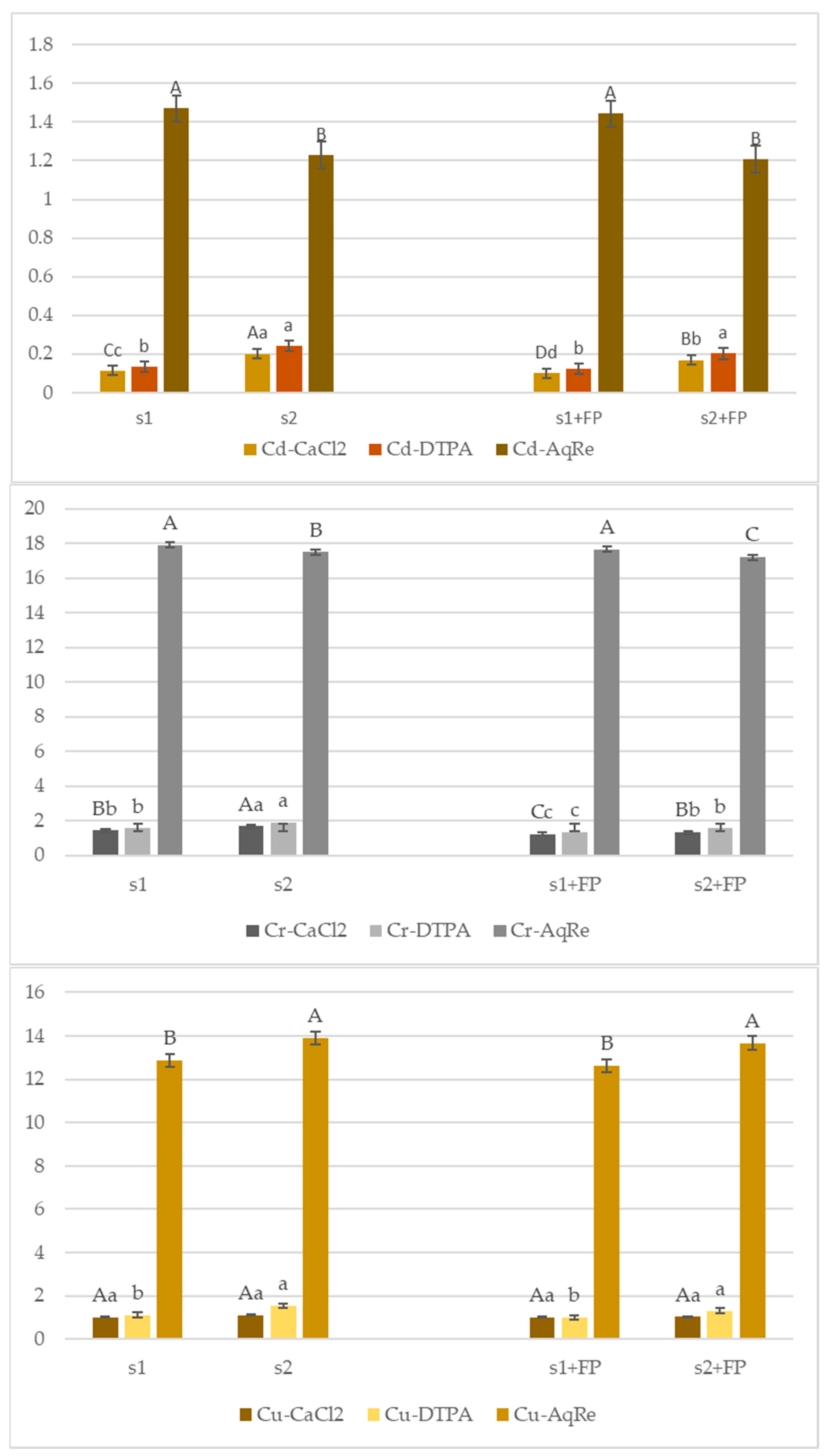
In Figure 1, the alterations in Cd, Cr, and Cu soil concentrations before and after fire extinguisher powder (FP) application are presented.
Figure 1.
Changes in metal concentrations (Cd, Cr, and Cu) in soils before and after fire extinguisher powder (FP) application. Lowercase and capital letters show the significant differences between metal concentrations in soil 1 (S1) and soil 2 (S2) before and after FP application. For each metal, error bars indicate the LSD5% value. Metal concentrations are expressed in mg/kg dry soil.
Soil metal concentration is expressed in various ways, as are attempts to determine the amount of metals that are directly available to plants [32]. The water-soluble concentration of metals is considered to be directly available to plants, as only metal ions dissolved in soil water can be absorbed by plants. Golui et al. [33], in their research, tried to establish the most appropriate method to investigate metal availability regarding human health. However, the DTPA extractive solution is commonly used in soil laboratories as it is perceived to simulate the concentration of trace element ions such as Cu, Zn, and Fe available to plants [34]. Among the soil samples studied, the proportion of water-soluble Cd, Cr, and Cu concentrations relative to total concentrations was 7.7%, 8.0%, and 7.9% for Cd, Cr, and Cu for soil sample S1, respectively, and 16.3%, 9.5%, and 8.1% for the same metals for sample S2. The percentages of the concentrations extracted with the DTPA solution (relative to the total concentration) were 9.1%, 8.7%, and 8.6% for Cd, Cr, and Cu, respectively, in the first soil sample and 19.6%, 10.8%, and 11.1% for the same metals in the second soil sample, respectively. The percentage of the available concentration of metal elements (DTPA-extracted) relative to the total (Aqua Regia-extracted) represents an important indicator of metal availability, as highlighted in the study by Papadimou et al. [12], which highlighted the ability of milk thistle to accumulate Cd in its tissues. The study showed a strong relationship between the availability index and the percentage of Cd in plant tissues. It is evident that metal availability is particularly increased in the second soil sample, which is acidic. The significant negative correlation between metal availability and soil pH is well known [35]. The FP was tested for heavy metal content and there were no detectable amounts of Cd, Cr, or Cu.
The addition of fire extinguisher powder induced a considerable decrease in the availability rate, i.e., the ratio of the water-soluble concentration to the total concentration and of the DTPA-extracted concentration to the total concentration. This reduction is evident and observed in all three metals and for both soils. Notably, the decrease in the percentage of water-soluble concentration relative to total concentration was 10.8%, 13.4%, and −0.8% for the first soil sample and 14.9%, 19.6%, and 5.6% for the second soil sample for the metals Cd, and Cr, and Cu, respectively. The reduction in the percentage of the DTPA-extracted solution relative to the total (ratio DTPA/Aqua Regia) is 7.3%, 12.9%, and 8.1% for S1, and 15.0%, 16.0%, and 13.5% for S2 for Cd, Cr, and Cu, respectively. We observe that the addition of powder directly affects the availability of Cr, both when determined on the basis of water solubility and on the basis of the amount extracted with DTPA. In acidic soils, adding high-nitrogen-content materials can lead to further acidification through the process of nitrification. Acidification can increase the solubility of several metals, resulting in their greater mobility. In addition, the presence of phosphorus usually leads to the precipitation of metals such as Fe and Al in the form of phosphate compounds (e.g., Fe3(PO4)2, FePO4, and AlPO4). Cu and Cd are predominantly adsorbed onto these, significantly reducing their availability, while Cr appears in acidic environments as Cr(OH)3. In alkaline soils, the addition of nitrogen-rich materials will not further acidify the soil, whereby most metals tend to precipitate as oxides, hydroxides, or carbonates, resulting in low solubility. In addition, P interacts with calcium, leading to the formation of insoluble calcium phosphates such as (Ca3(PO4)2 and Ca5(PO4)3OH), that can complex Cd and Cu into Cd3(PO4)2 and Cu3(PO4)2, strongly reducing their availability. Cr(VI) is more mobile at high soil pHs, can be adsorbed onto Ca–P minerals, or further be subject to reduction as Cr(III), leading to precipitation as CrPO4 or Cr(OH)3 [4]. In the present study, the decrease in the availability of all three metals (Cd, Cr, and Cu) is considerably higher in acidic soil.
Efforts at reducing metal availability through the use of soil amendments are common [36]. Nie et al. [37], in their research, present the most significant mechanisms that numerous soil amelioration agents use in order to remediate contaminated soils. In the present study, the use of FP is crucial for reducing the potential risks posed by metals in both acidic and alkaline soils, thereby reducing toxicity risks to plants, plant products, and possibly human health.
3.3. Plants Metal Concentrations
3.3.1. Cd Concentrations in Milk Thistle, Industrial Hemp, and Tobacco Plants
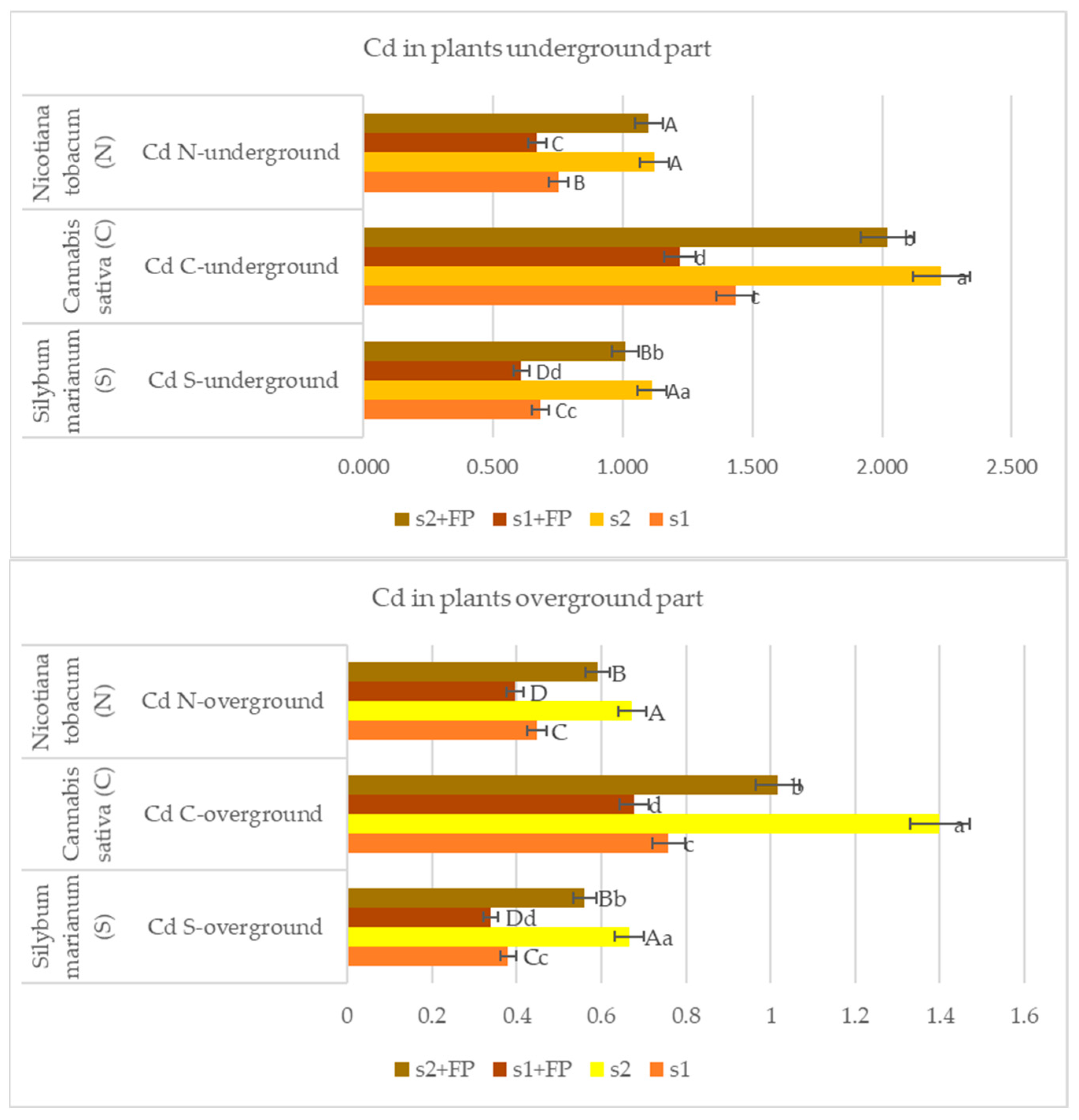
In Figure 2, the changes in Cd concentrations in the tissues of the three studied plants (Silybum marianum, Cannabis sativa, and Nicotiana tabacum) are presented.
Figure 2.
Changes in plants’ Cd concentrations before and after fire extinguisher powder (FP) application. Lowercase and capital letters show the significant differences between Cd concentrations in plants before and after FP application. For each plant, error bars indicate the LSD5% value. Metal concentrations are expressed in mg/kg dry tissue.
Quite obviously, to obtain a better grasp of the effects caused by the powder, it was decided to technically separate the concentration values for the underground and above-ground parts of the plants, i.e., for the roots on one hand, and the shoots, leaves, and flowers on the other. Considering the values in Figure 2, it is apparent that the addition of the powder caused a significant reduction in the concentration of Cd in the roots of the plants, specifically by 10.7, 14.9, and 10.7% in the plants Silybum marianum, Cannabis sativa, and Nicotiana tabacum, respectively, when these were cultivated in the 1st soil sample, and by 9.3, 9.3, and 1.9% for the roots of the same plantscultivated in the 2nd soil sample. It was therefore observed that in both soils and the three plants studied, smaller amounts of toxic Cd were absorbed when the powder (FP) was added. It is known that many plants accumulate toxic elements in their roots and contribute to a component of phytoremediation called phytostabilization, as described in the study by Papadimou et al. [12] in relation to Cd stabilization in the roots of Silybum marianum. Rasheed et al. [38] studied the accumulation of Cd in the roots and other parts of fiber-producing plants, such as flax, cotton, kenaf, jute, and hemp.
In the present study, higher reduction rates were observed in the above-ground parts of all three plants. In the above-ground parts of the plants, the decrease in Cd concentrations after the addition of powder (FP) to Silybum marianum, Cannabis sativa, and Nicotiana tabacum reached 10.7%, 10.7%, and 11.3%, respectively, when they were grown in the first soil sample, and 15.8%, 27.4%, and 12.1% when the experiment was conducted in the second soil sample. This is considered a very important finding of the study, as the above-ground part of Silybum marianum has high biomass, as its shoots can be used for energy production or biodiesel. Jan et al. [39], in their research, studied the synthesis of biodiesel produced from milk thistle (Silybum marianum (L.) Gaerth.). A greater reduction in toxic Cd concentrations was observed in the above-ground parts of all three plants in acidic soil. It is well known that metal availability increases in inverse proportion to soil acidity. Thus, the decrease in Cd in the plant tissues of the hyperaccumulators grown in acidic soils after powder (FP) addition is especially noteworthy. In their research, Zhang et al. [40] examined the use of oyster shell powder in soils and found that it resulted in reduced Cd uptake in rice grains.
Among the plants investigated in this study, the decrease caused following the application of the same amount of powder to the soil is greater in cannabis, followed by Silybum marianum, and Nicotiana tabacum. This further supports a conclusion that the use of powder (FP) significantly contributes to the reduction in Cd accumulation in the above-ground part of valuable industrial hemp, as it can be used for manufacturing ropes. Sward et al. [41] investigated biochar addition in soils where hemp was cultivated in order to reduce Cd, Pb, and Zn transfer from soil to plant tissues. Furthermore, a reduction in toxic Cd accumulation in the above-ground part of tobacco is particularly important as it is directly related to human health. It is well known that tobacco leaves are harvested, dried, and then participate in creating a blend from which cigarettes are produced. Heavy metals, especially toxic cadmium, poses real risks for various diseases, including cancer [42], when contained in cigarettes smoked by people smoking or even by people who do not smoke but breathe the toxic gases present in the environment of smokers [43]. Therefore, the contribution of FP is valuable in this case as well, as it reduces significant public health risks.
3.3.2. Cr Concentrations in Milk Thistle, Industrial Hemp, and Tobacco Plants
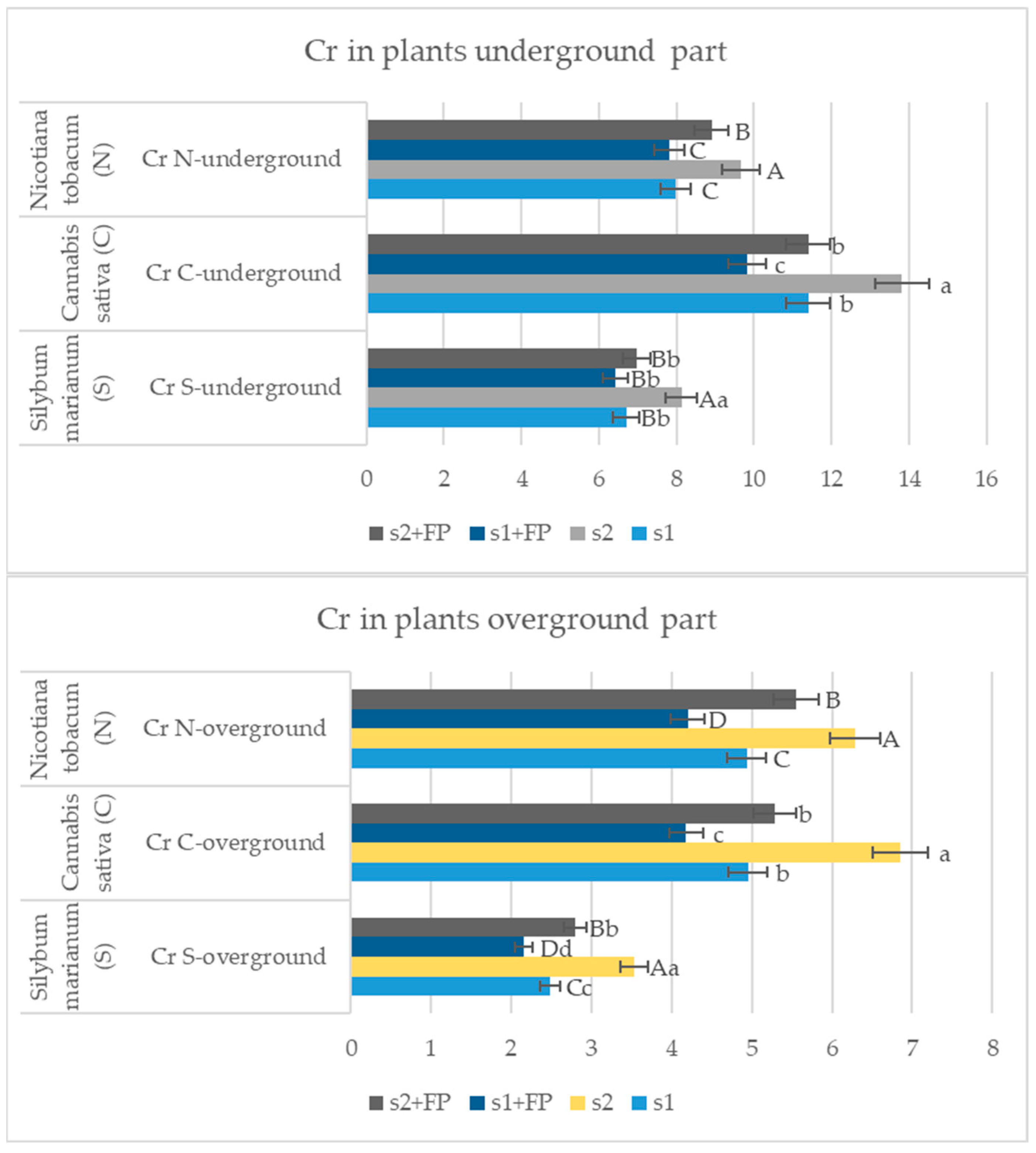
In Figure 3, Cr concentrations both in the under- and overground parts of Silybum marianum, Cannabis sativa, and Nicotiana tabacum plants are shown.
Figure 3.
Changes in plants’ Cr concentrations before and after fire extinguisher powder (FP) application. Lowercase and capital letters show the significant differences between Cr concentrations in plants before and after FP application. For each plant, error bars indicate the LSD5% value. Metal concentrations are expressed in mg/kg dry tissue.
The effect of adding powder (FP) on reducing Cr levels in the tissues of the plants studied is evident. Indeed, the reduction rates of Cr levels accumulated in the roots of Silybum marianum, Cannabis sativa, and Nicotiana tabacum plants amounted to 4.1%, 14.0, and 2.1% for the plants, respectively, which were grown in the first soil sample, and 14.2, 17.5, and 8.0% for the same plants that were grown in the second soil sample. In the above-ground part of the plants, a reduction in the concentration of Cr accumulated after the addition of the powder (FP) was again observed. The corresponding reduction rates for the alkaline soil were 13.0, 15.6, and 14.9%, while for the acidic soil, the reduction rates were 20.8, 23.0, and 11.7% for the plants Silybum marianum, Cannabis sativa, and Nicotiana tabacum, respectively.
It is clear that Cr concentrations were reduced in both the root and shoot parts of the plants grown in acidic soil. Although the effects of Cr on plants are not invariably harmful [44], the significance lies in the levels of its various forms, as Cr undergoes transformations within the soil. Different conditions (oxidative or reductive), different physicochemical properties of soils, and climatic parameters can affect the availability of Cr in soils and its uptake by plants [45]. Afif and Forján [46] investigated a large number of byproducts that can be used as soil improvements, changing metal availability. The use of FP seems to be a soil improvement that leads in significantly reducing metal availability, both in alkaline and acid soils.
3.3.3. Cu Concentrations in Milk Thistle, Industrial Hemp, and Tobacco Plants
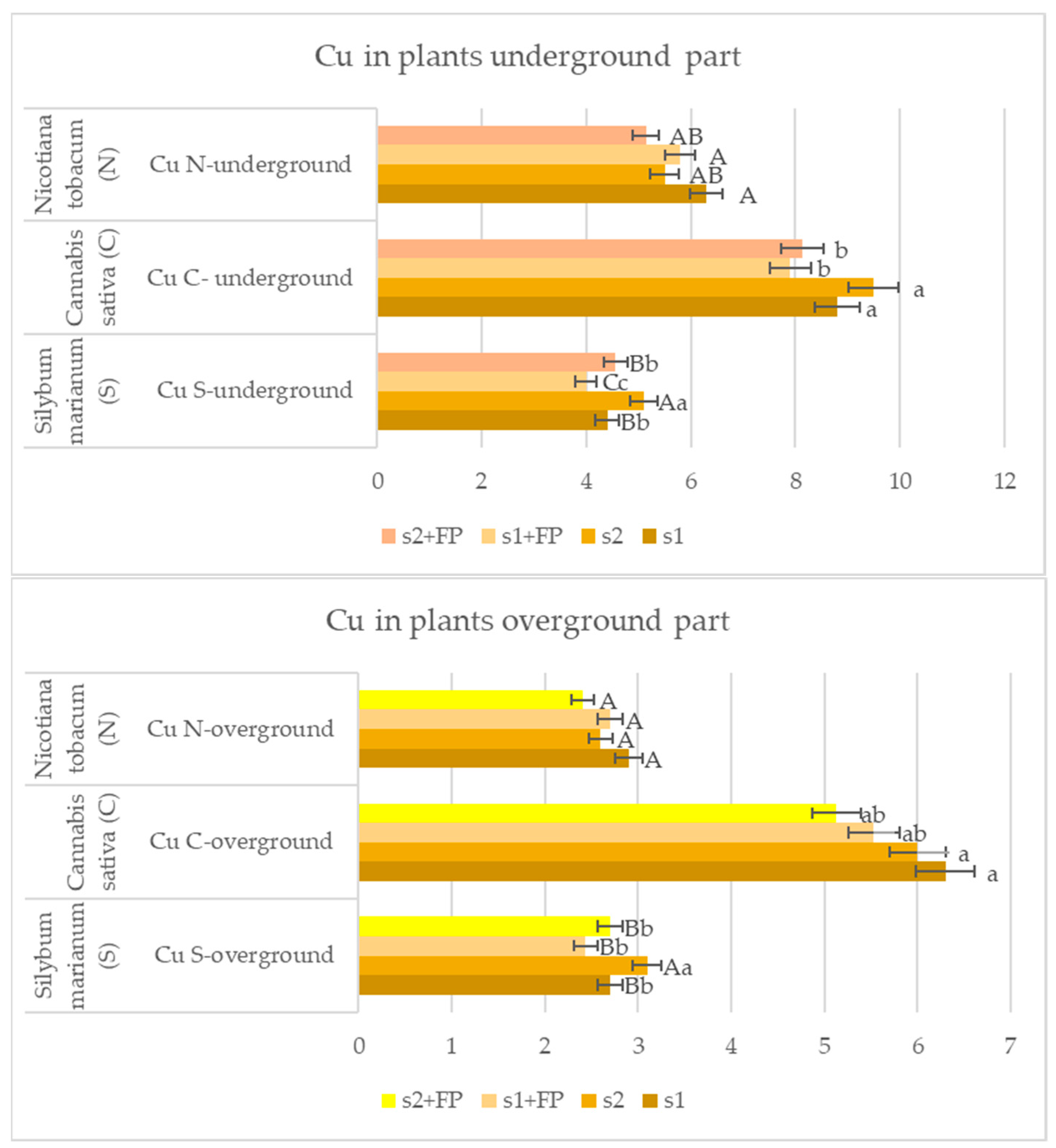
In Figure 4, Cu concentrations in the plant tissues, with and without powder addition, are presented.
Figure 4.
Changes in plants’ Cu concentrations before and after fire extinguisher powder (FP) application. Lowercase and capital letters show the significant differences between Cu concentrations in plants before and after FP application. For each plant, error bars indicate the LSD5% value. Metal concentrations are expressed in mg/kg dry tissue.
From the study of Figure 4, we observe that the addition of powder causes a reduction in the amount of Cu by 9.1, 10.2, and 8.1% for the underground (roots) part of the plants Silybum marianum, Cannabis sativa, and Nicotiana tabacum, respectively, when they are in alkaline soil. When these plants are grown in acidic soil, the reduction rate increases to 10.6, 14.4, and 6.5%, respectively. Vasilou et al. [11] observed a significantly higher uptake of Cu in the roots compared to the leaves and shoots.
In the above-ground part of the plants, the effect of adding the powder (FP) was even greater. Thus, the percentage reduction in Cu levels was 9.6, 12.2, and 6.9% for alkaline soil and 12.9, 14.5, and 7.3% for acidic soil for the Silybum marianum, Cannabis sativa, and Nicotiana tabacum plants, respectively. We observe that the changes in Cu levels are almost equally significant in both soil types and slightly greater in acidic soil. Thus, it is noticed that soil pH significantly determines the levels of Cd, Cr, and Cu uptake in the three studied plant species. It is conceivable, therefore, that in Mediterranean soils, the phytoremediation capacity of three hyperaccumulator plants is determined by soil acidity. Kumar et al. [47], in a twenty-year study, focus their investigation on indices in order to evaluate phytoremediation processes in heavy metal-contaminated soils. Metal accumulation inhibition, after powder (FP) addition in soils, follows the following scheme: Cannabis sativa > Silybum marianum > Nicotiana tabacum. Although there are not enough studies regarding the comparison of the phytoremediation capacity of the studied plants, Ahmad et al. [48] investigated the heavy metal accumulation of five crop species cultivated close to a traffic highway. Metal uptake was highly determined by the distance of the highway, indicating that metal uptake is also driven by anthropogenic factors, causing urban pollution.
The addition of a material such as FP, rich in both N and P, has different effects depending on soil acidity or alkalinity [49]. In acidic soils, FP can increase metal mobility and reduce P availability due to binding by Fe and Al. On the other hand, in alkaline soils, it can significantly reduce phosphorus availability due to precipitation with Ca and result in a limited effect upon metal mobility. Understanding these processes is critical for proper fertilizer management and avoiding environmental issues.
4. Conclusions
Three plants (Silybum marianum (L.) Gaerth, Cannabis sativa L., and Nicotiana tabacum L.), known as heavy metal accumulators, have been investigated in the present study. The main concept was to study the alterations caused in the metal concentrations accumulated in the plant tissues when an alternative amendment has been added in the soil where these plants were cultivated. For this purpose, a pot experiment has been conducted in two different soils, an acidic and an alkaline one. ABC fire extinguisher powder (FP) has been added in both soils at a 1% v/v proportion, as it is known to have large quantities of both N and P, so it can induce valuable nutrients enhancing soil fertility. The addition of FP caused significant reductions in the percentages of the DTPA-extracted solution relative to the total (ratio DTPA/Aqua Regia) of 7.3%, 12.9%, and 8.1% for alkaline soil, and 15.0%, 16.0%, and 13.5% in the acidic soil, for Cd, Cr, and Cu, respectively. Its application enhanched changes in Cd, Cr, and Cu uptake both in the roots and the overground parts of the plants studied. Hemp properly reduced toxic Cd accumulation in its underground part, leading to healthier and almost-metal-free stems, appropriate for industrial use in rope manufacturing. Cr and Cu accumulation in milk thistle was inhibited by FP addition, while tobacco plants seemed to be less affected by FP incorporation. The changes in plant metal concentrations were higher in the acid soil, confirming the strong influence of soil pH on metal availability and uptake by the three plants studied. FP seems to be a promising alternative for soil amendment, as it can provide soil nutrients and also control soil pollution and the remediation of heavy metal-polluted soils. A deeper investigation is needed in experimental field trials, on a large number of soil types, plant species, and metals as soil pollutants. Perhaps such valuable materials, discarded as useless after the end of the fire extinguishers’ life cycle, could be an affordable solution, combined with appropriate plants, for the remediation of heavy metal-contaminated soils.
Author Contributions
Conceptualization, E.E.G. and N.K.; methodology, N.K., E.E.G., D.A., R.V., E.T. and N.P.; software, N.K., E.E.G., D.A., R.V., S.G.P. and N.P.; validation, E.E.G. and N.K.; formal analysis, N.K., E.E.G., D.A., R.V. and S.G.P.; investigation, N.K., E.E.G., D.A., R.V., S.G.P. and N.P.; resources, E.E.G.; data curation, N.K., E.E.G., D.A., R.V. and S.G.P.; writing—original draft preparation, N.K., E.E.G., D.A., R.V., A.P.-G. and J.N.-P.; writing—review and editing, N.K., E.E.G. and J.N.-P.; supervision E.E.G.; funding acquisition, E.E.G. All authors have read and agreed to the published version of the manuscript.
Funding
This research received no external funding.
Institutional Review Board Statement
Not applicable.
Informed Consent Statement
Not applicable.
Data Availability Statement
The original contributions presented in this study are included in the article. Further inquiries can be directed to the corresponding authors.
Conflicts of Interest
The authors declare no conflicts of interest.
References
- Faizi, A.; AK, M.Z.; Shahzad, M.R.; Yüksel, S.; Toffanin, R. Environmental Impacts of Natural Resources, Renewable Energy, Technological Innovation, and Globalization: Evidence from the Organization of Turkic States. Sustainability 2024, 16, 9705. [Google Scholar] [CrossRef]
- Tokbergenova, A.; Skorintseva, I.; Ryskeldiyeva, A.; Kaliyeva, D.; Salmurzauly, R.; Mussagaliyeva, A. Assessment of Anthropogenic Disturbances of Landscapes: West Kazakhstan Region. Sustainability 2025, 17, 573. [Google Scholar] [CrossRef]
- Xin, X.; Shentu, J.; Zhang, T.; Yang, X.; Baligar, V.C.; He, Z. Sources, Indicators, and Assessment of Soil Contamination by Potentially Toxic Metals. Sustainability 2022, 14, 15878. [Google Scholar] [CrossRef]
- Mohammad, S.J.; Ling, Y.E.; Halim, K.A.; Sani, B.S.; Abdullahi, N.I. Heavy metal pollution and transformation in soil: A comprehensive review of natural bioremediation strategies. J. Umm Al-Qura Univ. Appl. Sci. 2025, 11, 528–544. [Google Scholar] [CrossRef]
- Siddiqua, A.; Hahladakis, J.N.; Al-Attiya, W.A.K.A. An overview of the environmental pollution and health effects associated with waste landfilling and open dumping. Environ. Sci. Pollut. Res. 2022, 29, 58514–58536. [Google Scholar] [CrossRef]
- Jomova, K.; Alomar, S.Y.; Nepovimova, E.; Kuca, K.; Valko, M. Heavy metals: Toxicity and human health effects. Arch. Toxicol. 2025, 99, 153–209. [Google Scholar] [CrossRef]
- Singh, H.; Pant, G. Phytoremediation: Low input-based ecological approach for sustainable environment. Appl. Water Sci. 2023, 13, 85. [Google Scholar] [CrossRef]
- Paladino, G.L.; Dupaul, G.; Jonsson, A.; Haller, H.; Eivazi, A.; Hedenström, E. Selecting effective plant species for the phytoremediation of persistent organic pollutants and multielement contaminated fibrous sediments. Environ. Sci. Eur. 2025, 37, 117. [Google Scholar] [CrossRef]
- Sur, I.M.; Hegyi, A.; Micle, V.; Molnar, H.; Gabor, T. Remediation of soils polluted with metals by phytoextraction using Hordeum vulgare L. Int. J. Environ. Sci. Technol. 2025, 22, 14309–14322. [Google Scholar] [CrossRef]
- Mohamed, H.I.; Ullah, I.; Toor, M.D.; Tanveer, N.A.; Din, M.M.U.; Basit, A.; Sultan, Y.; Muhammad, M.; Rehman, M.U. Heavy metals toxicity in plants: Understanding mechanisms and developing coping strategies for remediation: A review. Bioresour. Bioprocess. 2025, 12, 95. [Google Scholar] [CrossRef]
- Vasilou, C.; Tsiropoulos, N.G.; Golia, E.E. Phytoremediation & Valorization of Cu-contaminated Soils Through Cannabis sativa (L.) Cultivation: A Smart Way to Produce Cannabidiol (CBD) in Mediterranean Soils. Waste Biomass Valorization 2024, 15, 1711–1724. [Google Scholar] [CrossRef]
- Papadimou, S.G.; Barbayiannis, Ν.; Golia, Ε.Ε. Preliminary investigation of the use of Silybum marianum (L.) Gaertn. as a Cd accumulator in contaminated Mediterranean soils: The relationships among cadmium (Cd) soil fractions and plant Cd content. Euro-Mediterr. J. Environ. Integr. 2024, 9, 405–417. [Google Scholar] [CrossRef]
- Mei, S.; Lin, K.; Williams, D.V.; Liu, Y.; Dai, H.; Cao, F. Cadmium Accumulation in Cereal Crops and Tobacco: A Review. Agronomy 2022, 12, 1952. [Google Scholar] [CrossRef]
- Shyam, S.; Ahmed, S.; Joshi, S.J.; Sarma, H. Biochar as a Soil amendment: Implications for soil health, carbon sequestration, and climate resilience. Discov. Soil 2025, 2, 18. [Google Scholar] [CrossRef]
- Katebe, F.M.; Colinet, G.; Kyalamakasa, J.M.K.; Mubemba, M.M.; Jijakli, M.H. Application of soil amendments to reduce the transfer of trace metal elements from contaminated soils of Lubumbashi (Democratic Republic of the Congo) to vegetables. Environ. Monit. Assess. 2024, 196, 902. [Google Scholar] [CrossRef] [PubMed]
- Tsigka, I.; Kiatikidis, N.; Tsolakis, P.K.; Stergiou, N.; Golia, E.E. Investigating the Potential Use of End-of-Life Fire Extinguisher Powder as a Soil Amendment in Different Soil Types: A New Approach Following a Circular Economy Model. Sustainability 2024, 16, 8913. [Google Scholar] [CrossRef]
- Vovk, V.; Taşdöken, Ö.; Bölük, G.; Stratan, A.; Polcyn, J. Circular Economy in the European Union: A Prisma-Based Systematic Review and Meta-Synthesis. Sustainability 2025, 17, 1282. [Google Scholar] [CrossRef]
- Jerome, A.; Ljunggren, M. Product lifetime in life cycle assessments of circular economy strategies—A review and consolidation of methodology. Int. J. Life Cycle Assess. 2025, 30, 2162–2189. [Google Scholar] [CrossRef]
- Gelsomino, A.; Petrovičovà, Β.; Panuccio, Μ.R. Exhausted fire-extinguishing powders: A potential source of mineral nutrients for reuse and valorisation in compost enrichment for soilless cultivation. Sci. Total Environ. 2024, 906, 167633. [Google Scholar] [CrossRef] [PubMed]
- Han, C.; Zhang, Z.; Liu, R.; Tao, C.; Fan, X. The Effect of Slow-Release Fertilizer on the Growth of Garlic Sprouts and the Soil Environment. Appl. Sci. 2025, 15, 8216. [Google Scholar] [CrossRef]
- Golia, E.E.; Chartodiplomenou, M.A.; Papadimou, S.G.; Kantzou, O.D.; Tsiropoulos, N.G. Influence of soil inorganic amendments on heavy metal accumulation by leafy vegetables. Environ. Sci. Pollut. Res. 2021, 30, 8617–8632. [Google Scholar] [CrossRef]
- Golia, E.E.; Diakoloukas, V. Soil Parameters Affecting the Levels of Potentially Harmful Metals in Thessaly Area, Greece: A Robust Quadratic Regression Approach of Soil Pollution Prediction. Environ. Sci. Pollut. Res. 2022, 29, 29544–29561. [Google Scholar] [CrossRef]
- JAOAC. Official Method of Analysis, 14th ed.; Williams, E., Ed.; Association of Official Chemists, Inc.: Arlington, VA, USA, 1984. [Google Scholar]
- Page, A.L.; Miller, H.R.; Keeney, R.D. Methods of Soil Analysis, Part ΙΙ—Chemical and Microbiological Properties; Soil Science of America: Madison, WI, USA, 1982. [Google Scholar]
- Golia, E.E.; Dimirkou, A.; Floras, S.A. Spatial monitoring of arsenic and heavy metals in the Almyros area, Central Greece. Statistical approach for assessing the sources of contamination. Environ. Monit. Assess. 2015, 187, 399. [Google Scholar] [CrossRef]
- Papadimou, S.G.; Golia, E.E.; Barbayiannis, N.; Tsiropoulos, N.G. Dual role of the hyperaccumulator Silybum marianum (L.) Gaertn. in circular economy: Production of silymarin, a valuable secondary metabolite, and remediation of heavy metal contaminated soils. Sustain. Chem. Pharm. 2024, 38, 101454. [Google Scholar] [CrossRef]
- Roldán-Nofuentes, J.A.; Sheth, T.S.; Vera-Vera, J.F. Hypothesis Test to Compare Two Paired Binomial Proportions: Assessment of 24 Methods. Mathematics 2024, 12, 190. [Google Scholar] [CrossRef]
- Macharia, J.M.; Veronica, N.; Wangare, L.; Bence, R.L. Analysis of Selected Potentially Harmful Metal Elements in Soils and Vegetables in Gold Mining Region: Case Study Evaluated in Kenya, Africa. Environments 2025, 12, 317. [Google Scholar] [CrossRef]
- Mesmer, R.E.; Baes, C.F. Review of Hydrolysis Behavior of Ions in Aqueous Solutions. MRS Online Proc. Libr. 1990, 180, 85. [Google Scholar] [CrossRef]
- Ismayilov, A.I.; Mamedov, A.I.; Fujimaki, H.; Tsunekawa, A.; Levy, G.J. Soil Salinity Type Effects on the Relationship between the Electrical Conductivity and Salt Content for 1:5 Soil-to-Water Extract. Sustainability 2021, 13, 3395. [Google Scholar] [CrossRef]
- Acar, M.; Wahab, T.S.; Kaya Karaca, Ö.; Işık, M.; Sariyev, A.; Ortaş, İ. Exposing How Long-Term Organic and Inorganic Fertilizers Affect the Physical Characteristics of Soil. J. Soil Sci. Plant Nutr. 2025, 25, 5187–5201. [Google Scholar] [CrossRef]
- Chen, X.; Ren, Y.; Li, C.; Shang, Y.; Ji, R.; Yao, D.; He, Y. Study on Factors Influencing the Migration of Heavy Metals from Soil to Vegetables in a Heavy Industry City. Sustainability 2024, 16, 11084. [Google Scholar] [CrossRef]
- Golui, D.; Datta, S.P.; Dwivedi, B.S.; Meena, M.C.; Ray, P.; Trivedi, V.K. A new approach to establish safe levels of available metals in soil with respect to potential health hazard of human. Environ. Earth Sci. 2021, 80, 667. [Google Scholar] [CrossRef] [PubMed]
- Navarro-Pedreño, J.; Almendro-Candel, M.B.; Gómez Lucas, I.; Jordán Vidal, M.M.; Bech Borras, J.; Zorpas, A.A. Trace Metal Content and Availability of Essential Metals in Agricultural Soils of Alicante (Spain). Sustainability 2018, 10, 4534. [Google Scholar] [CrossRef]
- Barrow, N.J.; Hartemink, A.E. The effects of pH on nutrient availability depend on both soils and plants. Plant Soil 2023, 487, 21–37. [Google Scholar] [CrossRef]
- Umeobi, E.C.; Ducey, T.F.; Johnson, M.G.; Ippolito, J.A. Soil health alterations via compost additions to natural and remediated heavy metal-contaminated mineland soils. Environ. Sci. Pollut. Res. 2025, 32, 14968–14979. [Google Scholar] [CrossRef]
- Nie, X.; Huang, X.; Li, M.; Lu, Z.; Ling, X. Advances in Soil Amendments for Remediation of Heavy Metal-Contaminated Soils: Mechanisms, Impact, and Future Prospects. Toxics 2024, 12, 872. [Google Scholar] [CrossRef] [PubMed]
- Rasheed, A.; He, P.; Long, Z.; Gillani, S.F.A.; Wang, Z.; Morsy, K.; Hashem, M.; Jie, Y. Cadmium (Cd) Tolerance and Phytoremediation Potential in Fiber Crops: Research Updates and Future Breeding Efforts. Agronomy 2024, 14, 2713. [Google Scholar] [CrossRef]
- Jan, H.A.; Šurina, I.; Al-Fatesh, A.S.; Almutlaq, A.M.; Wali, S.; Lisý, A. Biodiesel Synthesis from Milk Thistle (Silybum marianum (L.) Gaertn.) Seed Oil using ZnO Nanoparticles as a Catalyst. Energies 2022, 15, 7818. [Google Scholar] [CrossRef]
- Zhang, M.-W.; Sun, M.-Z.; Wu, Y.; Wu, C.-H.; Song, H.-J.; Hu, D.-D.; Xia, J.; Sun, H.; Liu, K.-L. Application of oyster shell powder for five consecutive years effectively controlled soil acidification and reduced cadmium accumulation in rice grains. Sci. Rep. 2025, 15, 12008. [Google Scholar] [CrossRef]
- Sward, S.; Brye, K.R.; Miller, D.M.; Thurston, D.V. Use of Biochar and Industrial Hemp for Remediation of Heavy-Metal-Contaminated Soil: Root Uptake and Translocations for Cd, Pb, and Zn. Soil Syst. 2025, 9, 29. [Google Scholar] [CrossRef]
- Ebrahimi, M.; Khalili, N.; Razi, S.; Keshavarz-Fathi, M.; Khalili, N.; Rezaei, N. Effects of lead and cadmium on the immune system and cancer progression. J. Environ. Health Sci. Eng. 2020, 18, 335–343. [Google Scholar] [CrossRef] [PubMed] [PubMed Central]
- Wang, Y.; Gu, J. The Physical Processes and Chemical Transformations of Third-Hand Smoke in Indoor Environments and Its Health Effects: A Review. Atmosphere 2025, 16, 370. [Google Scholar] [CrossRef]
- Sharma, A.; Kapoor, D.; Wang, J.; Shahzad, B.; Kumar, V.; Bali, A.S.; Jasrotia, S.; Zheng, B.; Yuan, H.; Yan, D. Chromium Bioaccumulation and Its Impacts on Plants: An Overview. Plants 2020, 9, 100. [Google Scholar] [CrossRef]
- Zhang, W.; Yang, H.; You, S.; Zhong, X.; Jiang, P.; Lan, X.; Ma, R. A Study on the Oxidation Performance of Soil Chromium with Acid Birnessite and Cryptomelane. Toxics 2025, 13, 262. [Google Scholar] [CrossRef] [PubMed]
- Afif, E.; Forján, R. Soil Remediation and Improvement Through the Application of By-Product Amendments. Environments 2025, 12, 170. [Google Scholar] [CrossRef]
- Kumar, A.; Tripti; Raj, D.; Maiti, S.K.; Maleva, M.; Borisova, G. Soil Pollution and Plant Efficiency Indices for Phytoremediation of Heavy Metal(loid)s: Two-Decade Study (2002–2021). Metals 2022, 12, 1330. [Google Scholar] [CrossRef]
- Ahmad, S.; Hadi, F.; Jan, A.U.; Ullah, R.; Albalawi, B.F.A.; Ditta, A. Appraisal of Heavy Metals Accumulation, Physiological Response, and Human Health Risks of Five Crop Species Grown at Various Distances from Traffic Highway. Sustainability 2022, 14, 16263. [Google Scholar] [CrossRef]
- Scarpino, G.; Guerrero-Gallardo, L.; Gelsomino, A.; Sánchez-Rodríguez, A.R. Differential Effects of Organic Amendments on Soil P Availability, Plant P Uptake Efficiency and Root Traits of Durum Wheat at its Earliest Stage in Calcareous and Non-Calcareous Soils: A Microcosm Approach. J. Soil Sci. Plant Nutr. 2025. [Google Scholar] [CrossRef]
Disclaimer/Publisher’s Note: The statements, opinions and data contained in all publications are solely those of the individual author(s) and contributor(s) and not of MDPI and/or the editor(s). MDPI and/or the editor(s) disclaim responsibility for any injury to people or property resulting from any ideas, methods, instructions or products referred to in the content. |
© 2025 by the authors. Licensee MDPI, Basel, Switzerland. This article is an open access article distributed under the terms and conditions of the Creative Commons Attribution (CC BY) license (https://creativecommons.org/licenses/by/4.0/).