Spatiotemporal Evolution and Multi-Scenario Simulation of Rural Settlements in Liangzhou District: Evidence from an Oasis Region in the Arid Northwest


Abstract
1. Introduction
2. Research Area and Data Sources
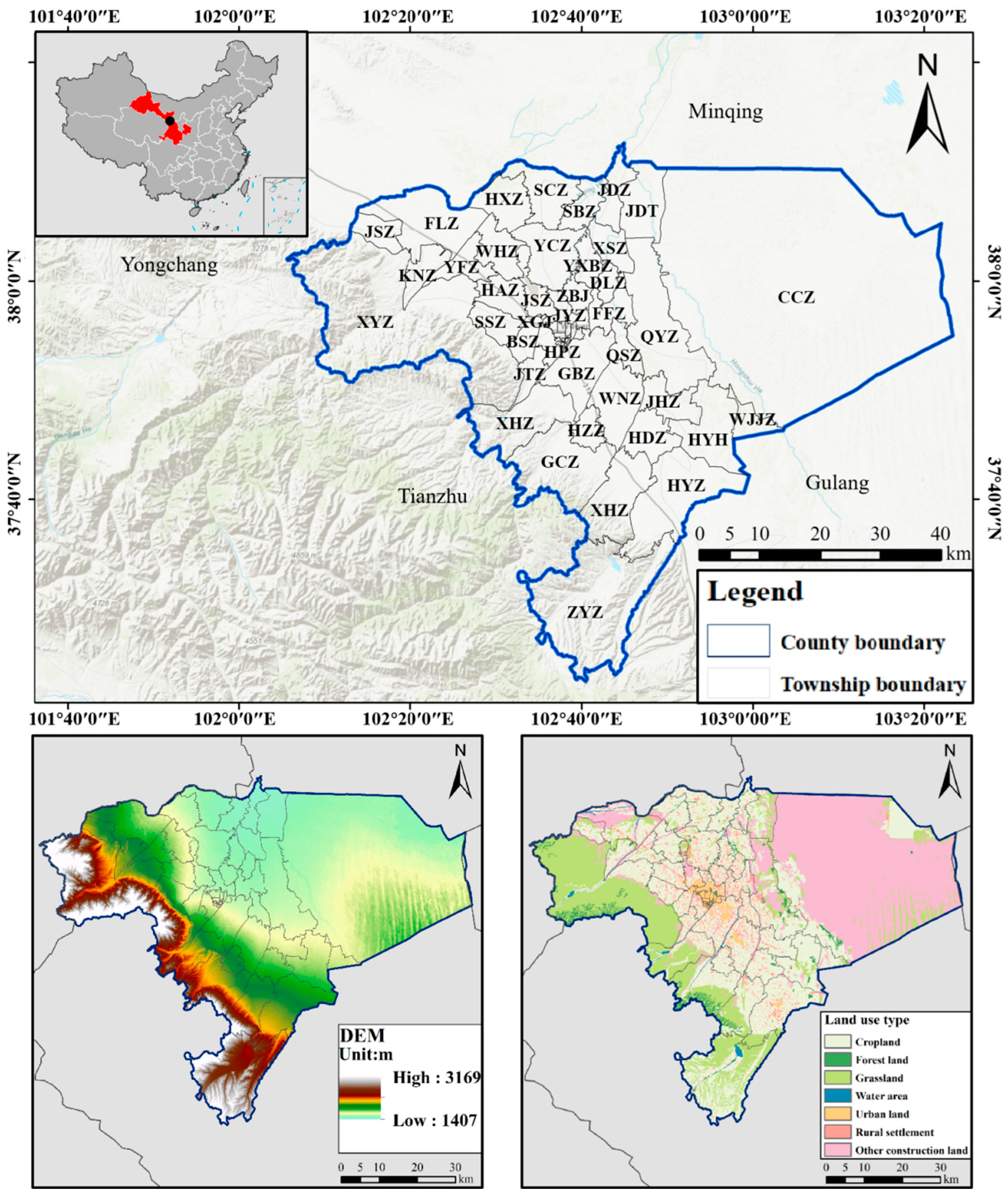
2.1. Overview of the Study Area
2.2. Data Sources
3. Research Methods
3.1. Land Use Transition Matrix
3.2. Landscape Pattern Metrics
3.3. Kernel Density Estimation
3.4. Average Nearest Neighbour Index
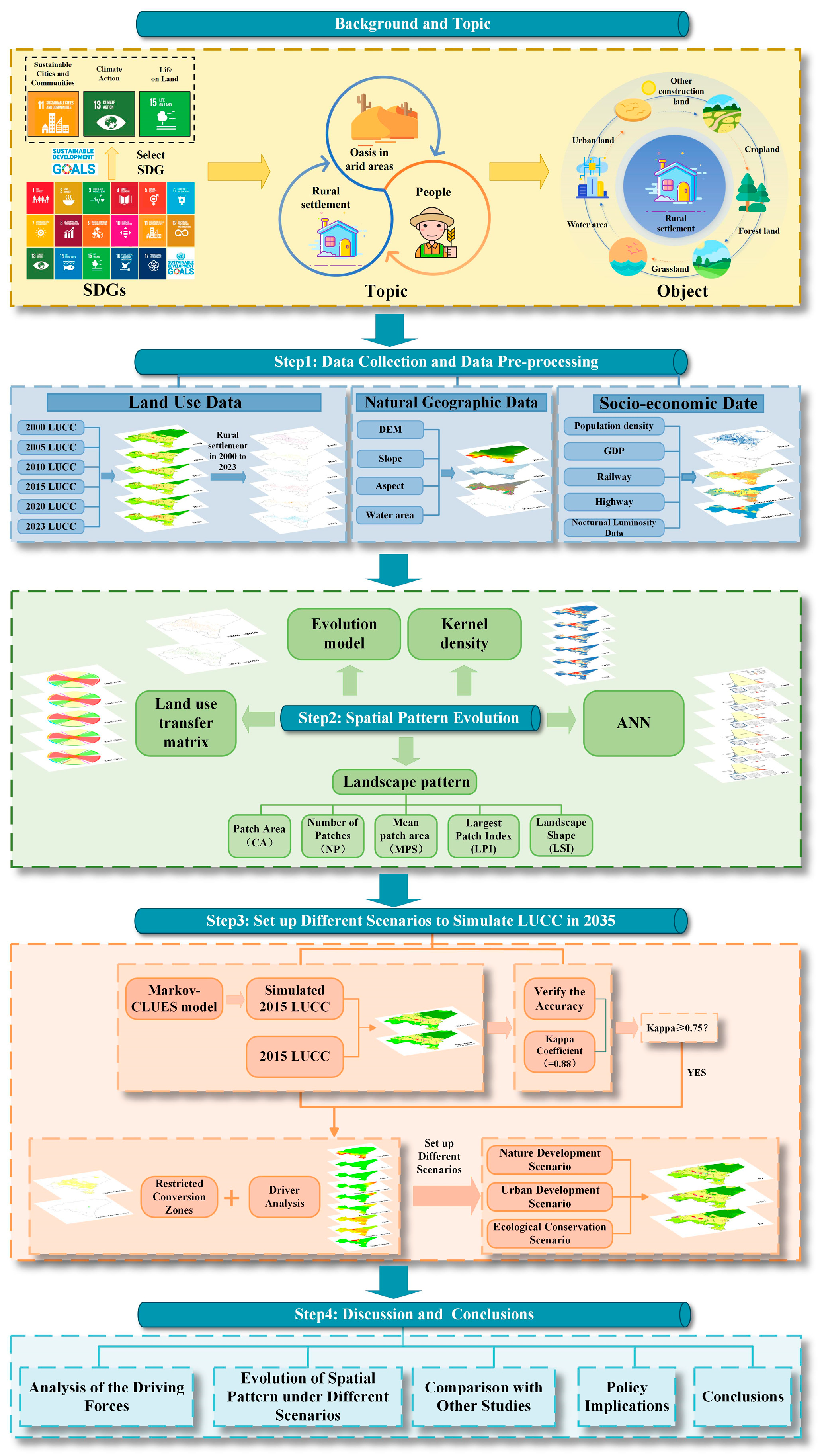
3.5. Markov-CLUES Model
3.5.1. Non-Spatial Demand Module
- (1)
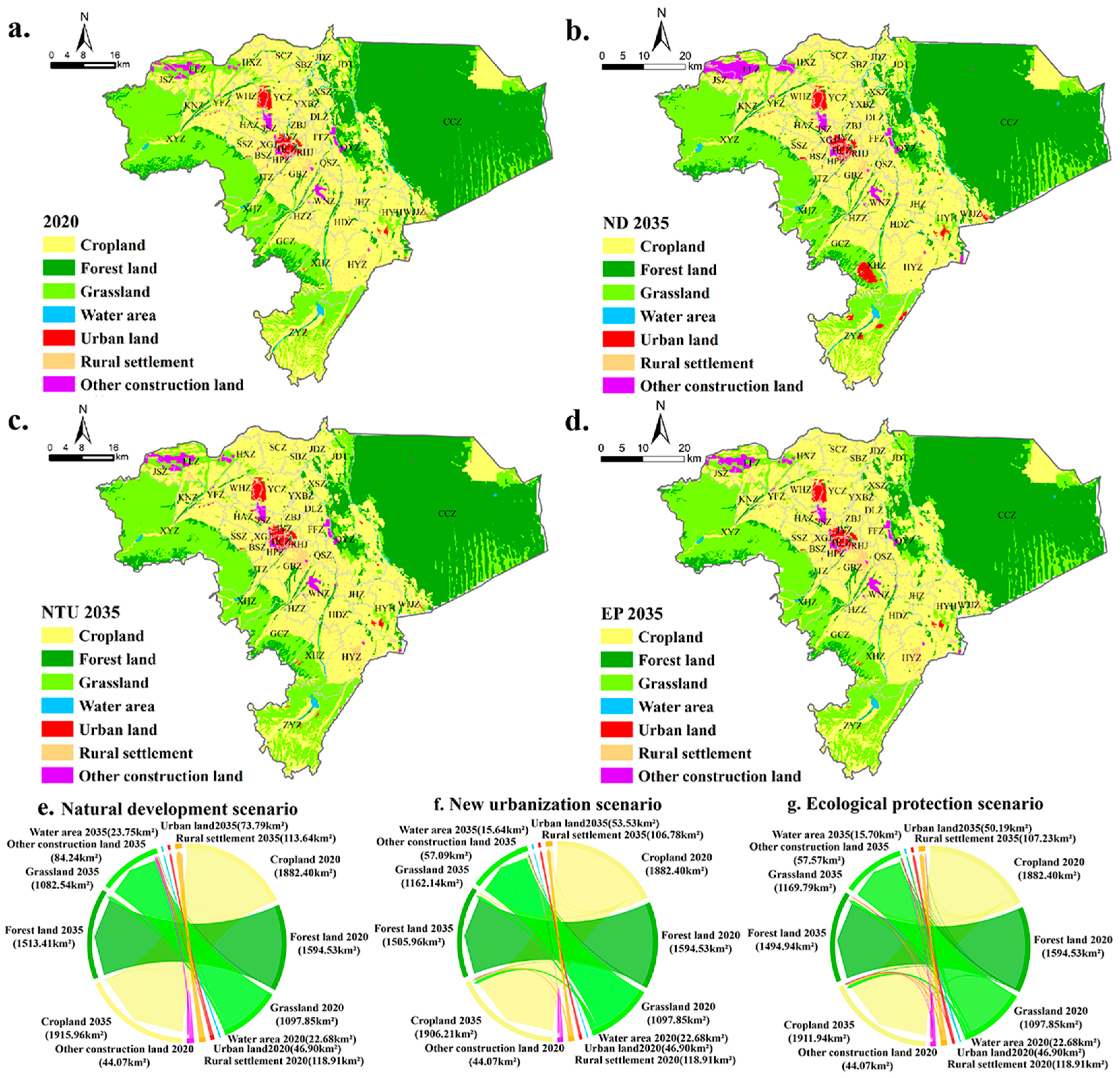
- Natural Development Scenario: This scenario aims to capture the natural evolution of land use and rural settlements in Liangzhou District. Using land-use data from 1990 to 2010, a Markov model was developed to calculate transition probability matrices among land-use categories, thereby projecting the future evolution of land-use structure. Model outputs enable the prediction of land-area changes and spatial distributions in 2035, reflecting the natural evolutionary trajectory under conditions absent of policy interventions.
- (2)
- New-Type Urbanization Scenario: This scenario simulates the evolution of rural settlements in Liangzhou District under Wuwei City’s new-type urbanization strategy. Guided by the overarching objectives of the Five-Year Action Plan for New-Type Urbanization in Wuwei and the New-Type Urbanization Plan (2014–2020), it emphasizes the integrated advancement of population concentration, industrial upgrading, and spatial optimization. Within this scenario, the locational advantages of Liangzhou’s central urban areas are expected to facilitate population movement and industrial restructuring, guiding rural settlements toward central villages and promoting rational expansion of construction land. The scenario further incorporates considerations of farmland protection, ecological conservation, and industrial development to coordinate urban–rural land-use layouts and prevent unregulated settlement sprawl.Taking the rural registered population as an example, the variable in the equation denotes the increase in the amount of land occupied by rural settlements within the study area during a given period; represents the growth in the rural population over the same period; while signifies the increase in land occupied by rural settlements resulting from the rise in per capita population.
- (3)
- Ecological Protection Scenario: Under this scenario, arbitrary conversion of natural ecological land is restricted, and excessive expansion of cropland and construction land is strictly controlled, with priority given to preserving critical ecological spaces such as forests, grasslands, and water bodies. Specific measures include reducing the transition probabilities of ecological land to cropland or construction land to maintain landscape stability and uphold ecological security thresholds, thereby determining the rational spatial allocation of land-use demand by 2035.
3.5.2. Spatial Allocation Module for Land Use Change
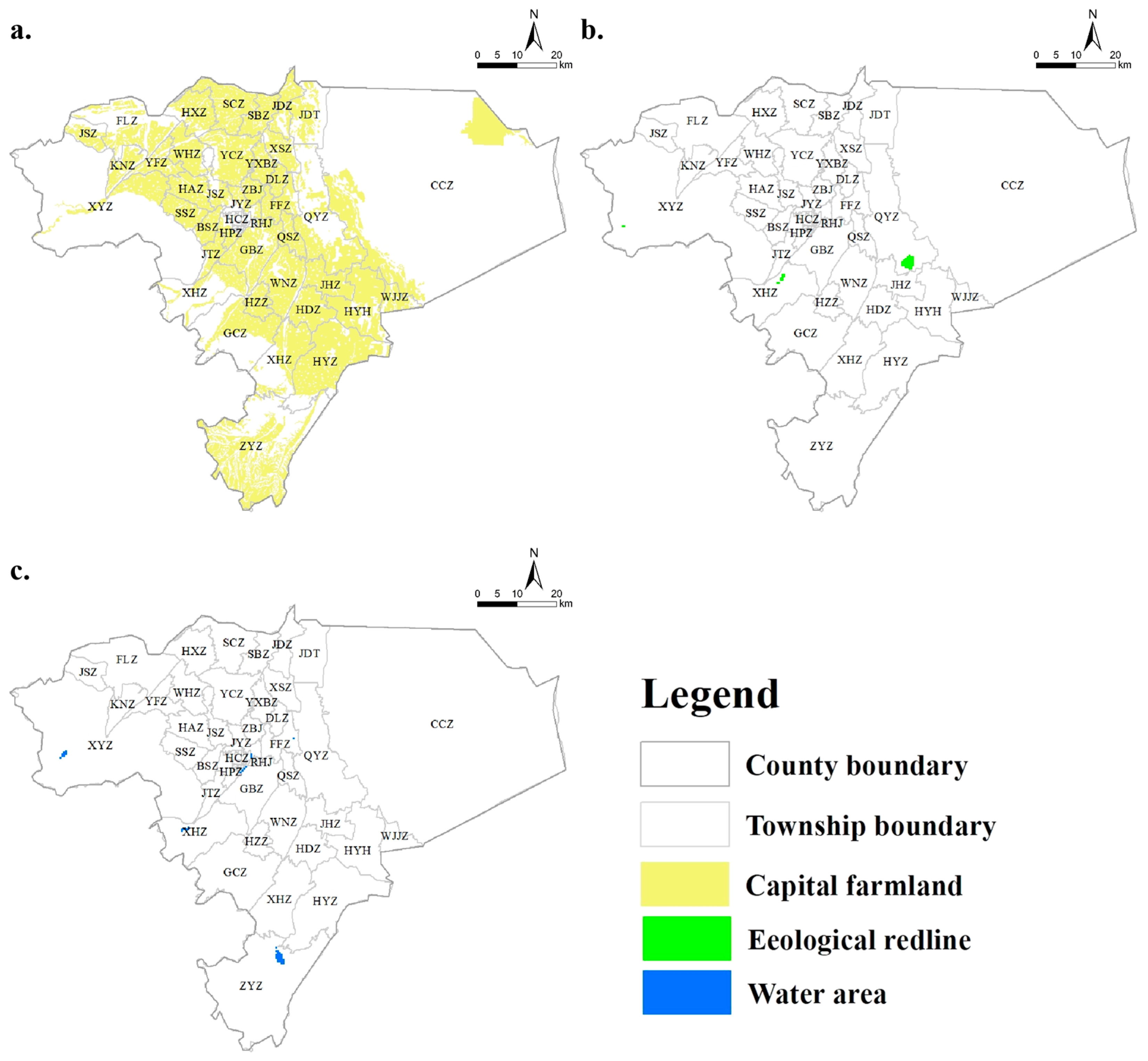
- (1)
- Spatial Allocation of Land-Use Change
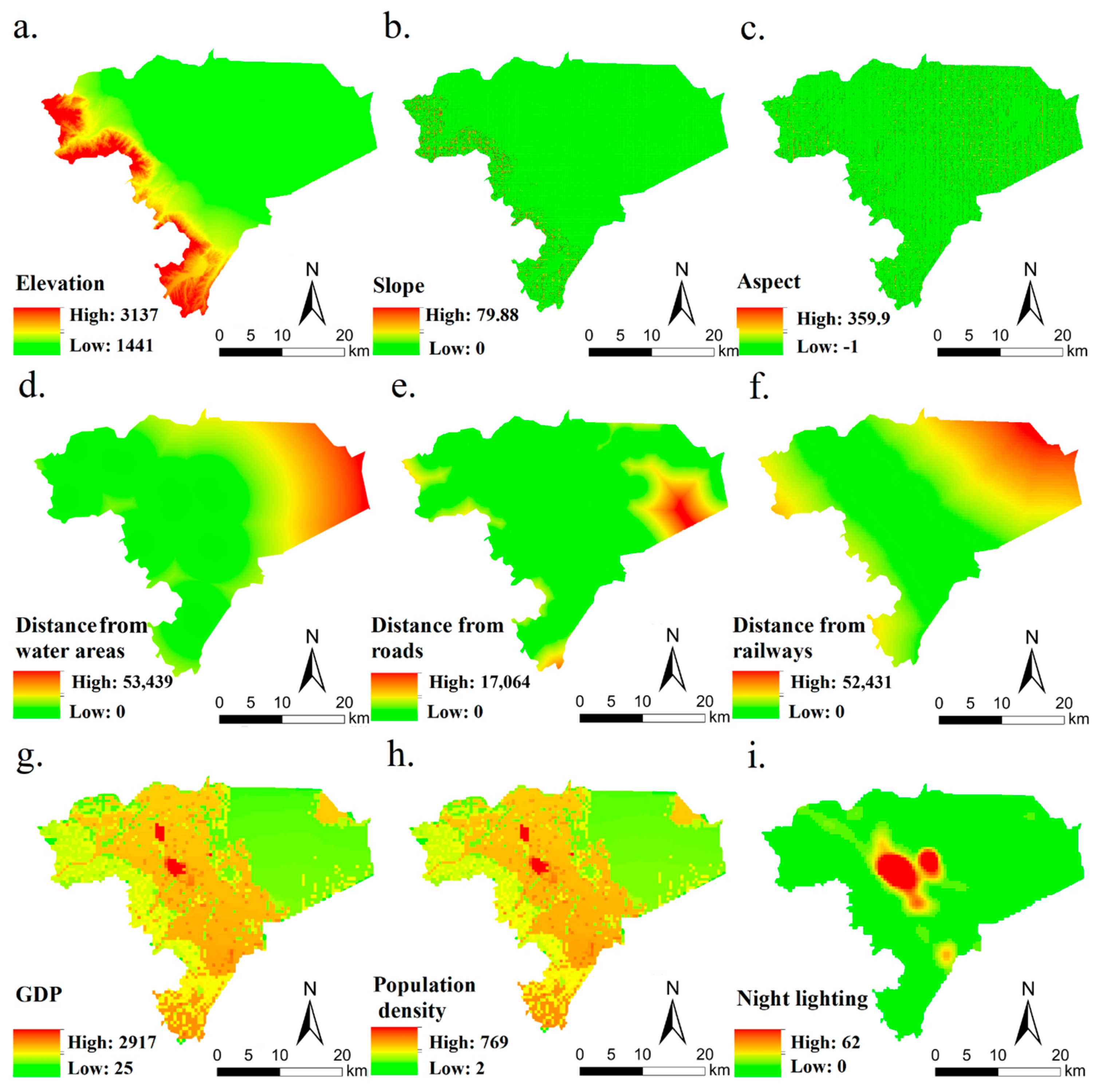
- (2)
- Analysis of Driving Factors
3.5.3. Simulation Accuracy Assessment
4. Results
4.1. Temporal Evolution of Rural Settlements
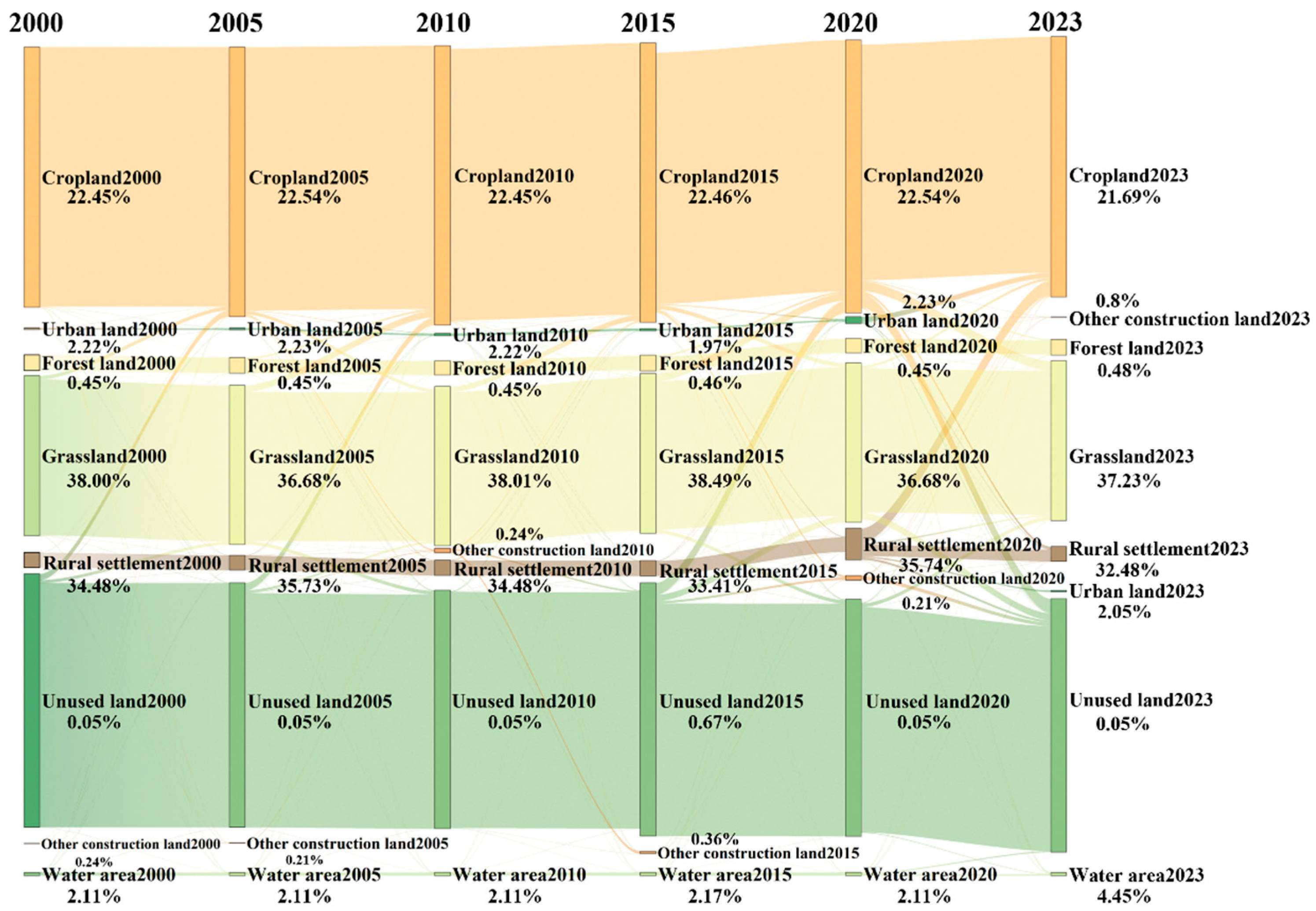
4.1.1. Land-Use Change Characteristics
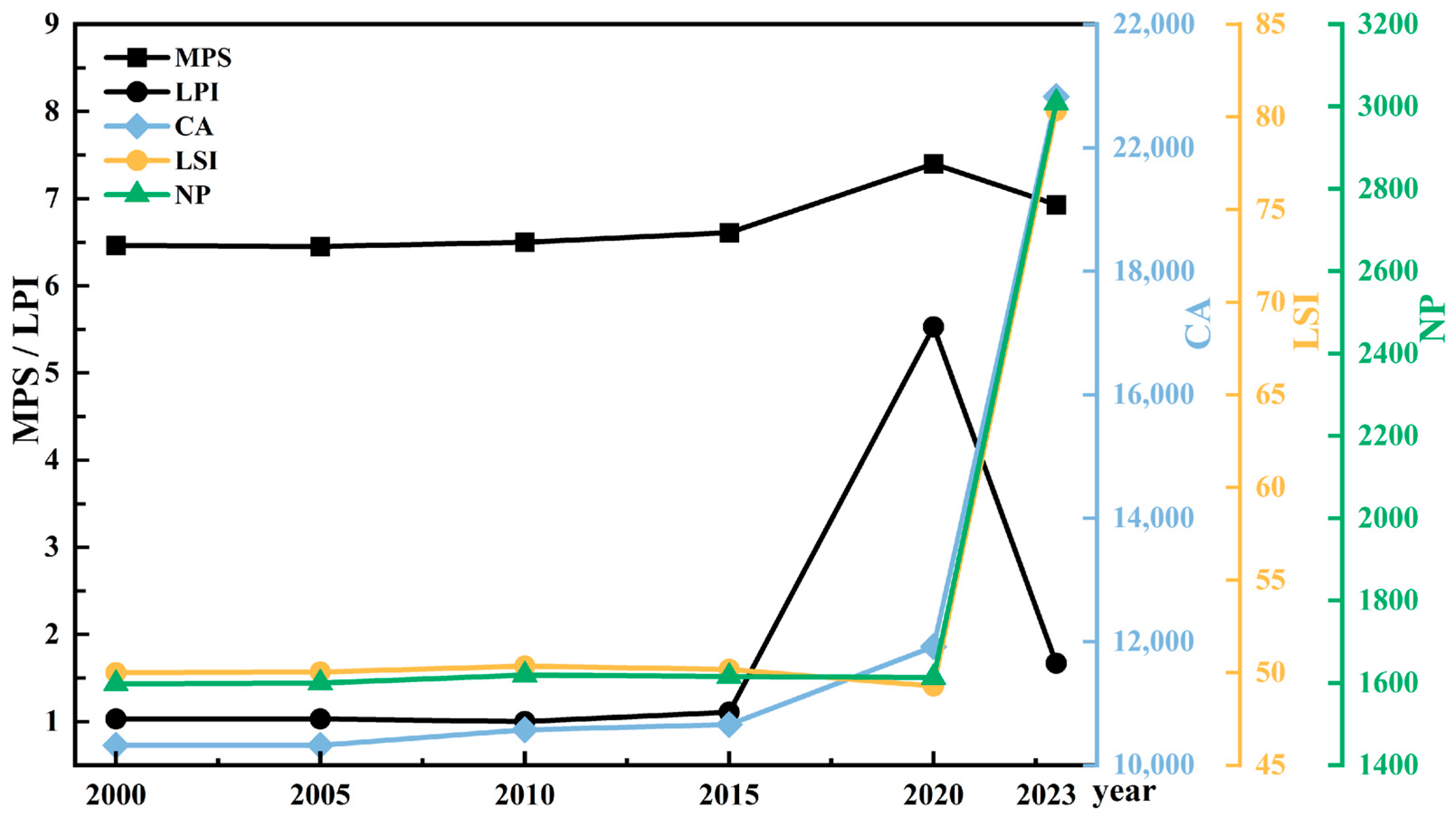
4.1.2. Evolution of Patch Size and Structure
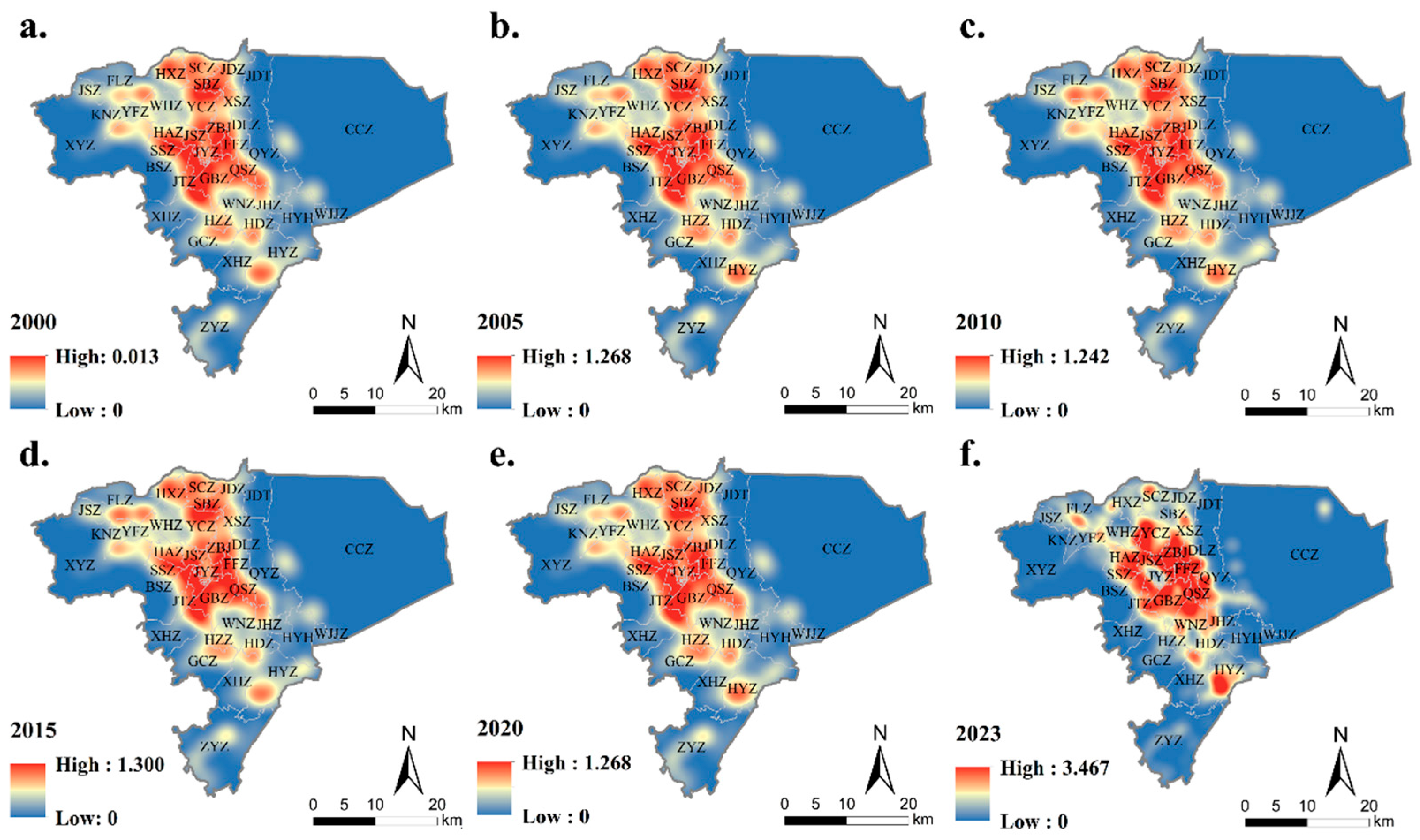
4.1.3. Spatiotemporal Distribution Patterns
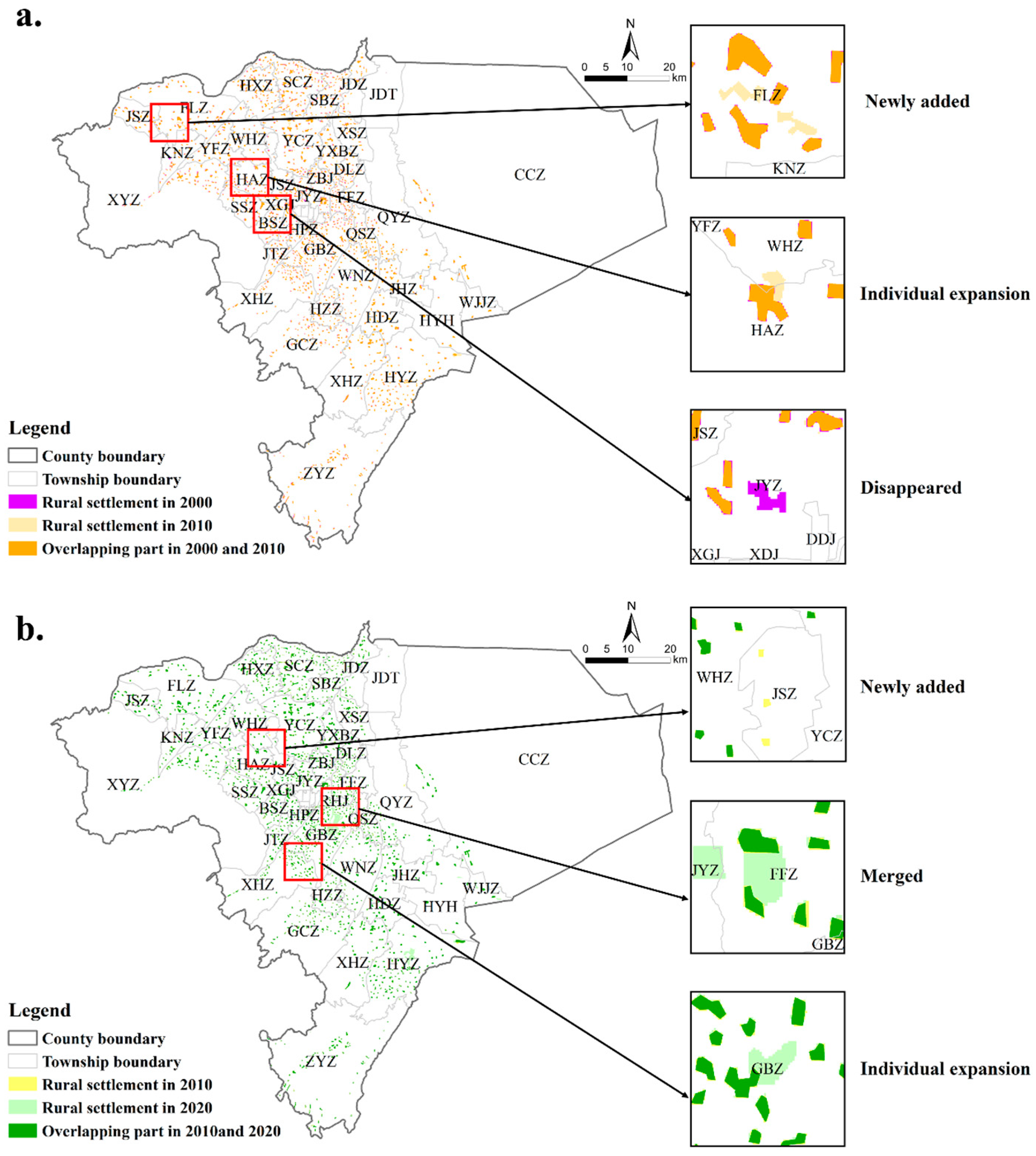
4.1.4. Spatial Evolution Types and Phase Characteristics
4.2. Simulation and Evolution of Rural Settlement Spatial Patterns
4.2.1. Validation of Simulation Accuracy and Model Applicability
4.2.2. Land-Use Change Characteristics of Rural Settlements Under Different Scenarios
4.2.3. Spatial Evolution Trends of Rural Settlements Under Different Scenarios
5. Discussion
5.1. Driving Forces of Spatiotemporal Evolution of Rural Settlements
5.1.1. Foundational Drivers: Physical Geography and Socio-Economic Factors
5.1.2. Institutional Mechanisms and Household Behaviors Shaping Settlement Evolution
5.1.3. The Rigid Boundary Effect of Water Resource Constraints
5.2. Comparison with Other Studies
5.3. Policy Recommendations
6. Conclusions
Author Contributions
Funding
Data Availability Statement
Conflicts of Interest
Appendix A

| Landscape Index | Formula | Formula Specification |
|---|---|---|
| Patch Area (CA) | CA denotes the area of rural settlement patches, reflecting the scale of rural settlements. | |
| Number of Patches (NP) | NP denotes the number of rural settlement patches, reflecting landscape heterogeneity. | |
| Mean patch area (MPS) | MPS denotes the average plot area of rural settlements, reflecting the degree of dispersion among rural settlements. | |
| Largest Patch Index (LPI) | LPI denotes the proportion of the largest patch area within a landscape relative to its total area, serving to reflect the dominance of a single patch within the landscape structure. | |
| Landscape Shape Index (LSI) | LSI denotes the complexity of patch shapes within a landscape, specifically the ratio of patch boundary length to the minimum possible boundary length. It serves to measure the complexity of patch shapes relative to simpler forms such as squares or circles. |
| Cropland | Forest Land | Grassland | Water Area | Urban Land | Rural Settlement | Other Construction Land | |
|---|---|---|---|---|---|---|---|
| Cropland | 0.91578 | 0.02506 | 0.04972 | 0.17592 | 0.56025 | 0.34009 | 5.43284 |
| Forest Land | 0.03514 | 0.93753 | 0.02461 | 0.12700 | 0.00939 | 0.00119 | 2.67164 |
| Grassland | 0.02940 | 0.01165 | 0.92622 | 0.04233 | 0.00000 | 0.00204 | 4.01493 |
| Water Area | 0.00054 | 0.00111 | 0.00059 | 0.81562 | 0.00000 | 0.00000 | 0.00000 |
| Urban Land | 0.00010 | 0.00056 | 0.00000 | 0.00000 | 0.90454 | 0.00000 | 0.00000 |
| Rural settlement | 0.33447 | 0.00036 | 0.00009 | 0.00659 | 0.02034 | 0.65497 | 0.02239 |
| Other construction land | 0.00000 | 0.00000 | 0.00000 | 0.00000 | 0.00000 | 0.00000 | 1.00000 |
| 2000 | 2005 | 2010 | 2015 | 2020 | 2023 | |
|---|---|---|---|---|---|---|
| NP | 1598 | 1600 | 1619 | 1616 | 1613 | 3009 |
| CA | 10,321.83 | 10,322.91 | 10,573.02 | 10,656.99 | 11,923.02 | 20,828.34 |
| MPS | 6.46 | 6.45 | 6.50 | 6.61 | 7.40 | 6.93 |
| LPI | 1.03 | 1.03 | 1.00 | 1.11 | 5.53 | 1.67 |
| LSI | 50.00 | 50.03 | 50.35 | 50.17 | 49.28 | 80.33 |
| Cropland | Forest Land | Grassland | Water Area | Urban Land | Rural Settlement | Other Construction Land | Area in 2020 | |
|---|---|---|---|---|---|---|---|---|
| Cropland | 1878.17 | 0.21 | 2.37 | 0.022 | 0.28 | 1.04 | 0.31 | 1882.40 |
| Forest Land | 17.55 | 1502.19 | 71.33 | 0.55 | 0.97 | 0.344 | 1.61 | 1594.53 |
| Grassland | 15.37 | 10.98 | 1005.74 | 2.90 | 25.00 | 1.06 | 36.81 | 1097.85 |
| Water Area | 0.59 | 0.04 | 1.73 | 20.28 | 0.02 | 0.02 | 0 | 22.68 |
| Urban Land | 0.09 | 0 | 0.14 | 0 | 44.85 | 0.56 | 1.27 | 46.90 |
| Rural settlement | 4.13 | 0 | 0.92 | 0 | 2.35 | 110.34 | 1.17 | 118.91 |
| Other construction land | 0.07 | 0 | 0.31 | 0 | 0.32 | 0.29 | 43.08 | 44.07 |
| Area under ND | 1915.97 | 1513.41 | 1082.54 | 23.75 | 73.79 | 113.65 | 84.24 | 4807.36 |
| Cropland | Forest Land | Grassland | Water Area | Urban Land | Rural Settlement | Other Construction Land | Area in 2020 | |
|---|---|---|---|---|---|---|---|---|
| Cropland | 1765.90 | 9.49 | 65.23 | 0.83 | 4.26 | 32.23 | 4.47 | 1882.40 |
| Forest Land | 53.33 | 1477.91 | 60.51 | 0.49 | 0.66 | 0.35 | 1.27 | 1594.53 |
| Grassland | 37.41 | 18.28 | 1032.59 | 0.38 | 0.44 | 0.08 | 8.66 | 1097.85 |
| Water Area | 6.04 | 0.24 | 2.44 | 13.94 | 0.01 | 0.02 | 0 | 22.68 |
| Urban Land | 0 | 0 | 0 | 0 | 46.90 | 0 | 0 | 46.90 |
| Rural settlement | 42.67 | 0.00 | 1.03 | 0 | 1.00 | 73.88 | 0.33 | 118.91 |
| Other construction land | 0.86 | 0.04 | 0.35 | 0 | 0.25 | 0.22 | 42.35 | 44.07 |
| Area under NTU | 1906.21 | 1505.96 | 1162.14 | 15.64 | 53.53 | 106.78 | 57.09 | 4807.35 |
| Cropland | Forest Land | Grassland | Water Area | Urban Land | Rural Settlement | Other Construction Land | Area in 2020 | |
|---|---|---|---|---|---|---|---|---|
| Cropland | 1767.38 | 8.78 | 64.51 | 0.89 | 4.26 | 32.10 | 4.48 | 1882.40 |
| Forest Land | 55.04 | 1470.77 | 65.67 | 0.53 | 0.75 | 0.51 | 1.27 | 1594.53 |
| Grassland | 38.01 | 15.11 | 1034.99 | 0.47 | 0.43 | 0.07 | 8.76 | 1097.85 |
| Water Area | 6.09 | 0.23 | 2.51 | 13.81 | 0.01 | 0.03 | 0 | 22.68 |
| Urban Land | 1.64 | 0.00 | 0.67 | 0 | 43.53 | 0.72 | 0.34 | 46.90 |
| Rural settlement | 42.95 | 0.00 | 1.06 | 0 | 0.98 | 73.58 | 0.34 | 118.91 |
| Other construction land | 0.84 | 0.038 | 0.37 | 0 | 0.23 | 0.22 | 42.38 | 44.07 |
| Area under EP | 1911.94 | 1494.94 | 1169.79 | 15.70 | 50.19 | 107.23 | 57.57 | 4807.36 |
References
- Sun, T.; Chen, J.; Guo, J. Multi-Source Data-Driven Identification and Spatial Optimization of Rural Settlements: Evidence from Sangxu, China. Sustainability 2025, 17, 7561. [Google Scholar] [CrossRef]
- Kanter, R.; Fort, M.P. Shared burdens, shared responsibilities: Advancing the 2030 Agenda for Sustainable Development. Lancet 2025, 406, 1703–1705. [Google Scholar] [CrossRef] [PubMed]
- Jackson, E.D.; Laaribi, A. Geospatial Information to Support the UN’s Sustainable Development Goals; CRC Press: Boca Raton, FL, USA, 2025. [Google Scholar]
- Ran, H.; Liu, R.; Xing, L.; Zhao, Y.; Zhang, K. Can urban-rural public services drive the realization of sustainable development goals? An empirical study of a typical rural-urban integration pilot area in China. J. Rural Stud. 2025, 120, 103818. [Google Scholar] [CrossRef]
- Lao, X.; Istrate, A.L.; Pilla, F. Navigating vulnerable community-based urban heat adaptation under SDG 11. Npj Urban Sustain. 2025, 5, 49. [Google Scholar] [CrossRef]
- Seddik, G.H.; Sovacool, B.K. Climate policy, Least Developed Countries, and the Sustainable Development Goals: A critical review of SDG13 and infrastructural, institutional, and informational resilience. Environ. Sci. Policy 2025, 170, 104129. [Google Scholar] [CrossRef]
- Chen, G.; Zhang, L.; Zhang, D.; Zhao, J. Temporal and Spatial Carbon Stock Changes and Driving Mechanisms Based on Land Use Multi—Scenario Modeling: An Assessment of SDGs15.3—A Case Study of the Central Yunnan Urban Agglomeration, China. Land Degrad. Dev. 2025, 36, 3017–3036. [Google Scholar] [CrossRef]
- Chen, Y.; Yan, X.; Zhang, J.; Chen, C.; Wang, Y.; Fan, J. Determinants and governance of unused rural residential bases in the context of Rural Revitalisation in China. Sci. Rep. 2025, 15, 33850. [Google Scholar] [CrossRef]
- Li, H.; Song, W. Evolution of rural settlements in the Tongzhou District of Beijing under the new-type urbanization policies. Habitat Int. 2020, 101, 102198. [Google Scholar] [CrossRef]
- Duan, Y.; Chen, S.; Zhang, L.; Wang, D.; Liu, D.; Hou, Q. Spatial Distribution Characteristic and Type Classification of Rural Settlements: A Case Study of Weibei Plain, China. Sustainability 2023, 15, 8736. [Google Scholar] [CrossRef]
- Zhang, R.; Zhang, X. Spatial Pattern Evolution and Driving Mechanism of Rural Settlements in Rapidly Urbanized Areas: A Case Study of Jiangning District in Nanjing City, China. Land 2023, 12, 749. [Google Scholar] [CrossRef]
- Zhu, B.; Li, H.; Hu, Z.; Wen, Y.; Che, J. An Evaluation and Optimization of the Spatial Pattern of County Rural Settlements: A Case Study of Changshu City in the Yangtze River Delta, China. Land 2022, 11, 1412. [Google Scholar] [CrossRef]
- Ren, P.; Hong, B.T.; Liu, Y.; Zhou, J.M. A study of spatial evolution characteristics of rural settlements and influences of landscape patterns on their distribution using GIS and RS. Acta Ecol. Sin. 2014, 34, 3331–3340. [Google Scholar] [CrossRef]
- Zhang, Y.; Duan, S.; Dong, L.; Ding, X. Spatial Sustainability of Agricultural Rural Settlements: An Analysis of Rural Spatial Patterns and Influencing Factors in Three Northeastern Provinces of China. Sustainability 2025, 17, 5597. [Google Scholar] [CrossRef]
- Zhang, J.; Li, L.; Li, Q.; Chen, W.; Huang, J.; Guo, Y.; Ji, G. Multiscenario Land Use Change Simulation and Its Impact on Ecosystem Service Function in Henan Province Based on FLUS-InVEST Model. Ecol. Evol. 2025, 15, e71111. [Google Scholar] [CrossRef]
- Zhang, Z.; Liu, Y.; Sheng, S.; Liu, X.; Xue, Q. Evolving Urban Expansion Patterns and Multi-Scenario Simulation Analysis from a Composite Perspective of “Social–Economic–Ecological”: A Case Study of the Hilly and Gully Regions of Northern Loess Plateau in Shaanxi Province. Sustainability 2024, 16, 2753. [Google Scholar] [CrossRef]
- Yirsaw, E.; Wu, W.; Temesgen, H.; Bekele, B. Socioeconomic Drivers of Spatio-Temporal Land Use/Land Cover Changes in a Rapidly Urbanizing Area of China, the Su-Xi-Chang Region. Appl. Ecol. Environ. Res. 2017, 15, 809–827. [Google Scholar] [CrossRef]
- Zhong, Z.; Peng, B.; Elahi, E. Spatial and temporal pattern evolution and influencing factors of energy–environmental efficiency:A case study of Yangtze River urban agglomeration in China. Energy Environ. 2021, 32, 242–261. [Google Scholar] [CrossRef]
- Yu, H.-X.; Wang, Y.-X. Spatio-temporal variations of ecosystem service value and its spatial heterogeneity mechanism in the Dongjiang River Basin, China. Ying Yong Sheng Tai Xue Bao = J. Appl. Ecol. 2023, 34, 2498–2506. [Google Scholar] [CrossRef]
- Ke, L.; Li, R.; Xu, Y. Study on Land Use Change and Its Impacts in the Nanming River Basin. Sustain. Dev. Res. 2025, 7, 109. [Google Scholar] [CrossRef]
- Han, M.Y.; Chen, G.Q.; Dunford, M. Land use balance for urban economy: A multi-scale and multi-type perspective. Land Use Policy 2019, 83, 323–333. [Google Scholar] [CrossRef]
- Sheng, S.; Song, W. Preferential encroachment of high-quality cropland by urban expansion across China: Past trends and future projections. Habitat Int. 2026, 167, 103655. [Google Scholar] [CrossRef]
- Sheng, S.; Lian, H. The Spatial Pattern Evolution of Rural Settlements and Multi-Scenario Simulations since the Initiation of the Reform and Opening up Policy in China. Land 2023, 12, 1763. [Google Scholar] [CrossRef]
- Kim, D.-S.; Chung, H.-W. Spatial Diffusion Modeling of New Residential Area for Land-Use Planning of Rural Villages. J. Urban Plan. Dev. 2005, 131, 181–194. [Google Scholar] [CrossRef]
- Kim, I.; Kwon, H. Assessing the Impacts of Urban Land Use Changes on Regional Ecosystem Services According to Urban Green Space Policies Via the Patch-Based Cellular Automata Model. Environ. Manag. 2020, 67, 192–204. [Google Scholar] [CrossRef] [PubMed]
- Wu, L.W.; Liu, G. Simulation and prediction of land-use change in Nanjing based on artificial bee colony cellular automata model. Bull. Surv. Mapp. 2022, 2, 95–99. [Google Scholar] [CrossRef]
- Kukuntod, N.; Wijitkosum, S. Escalating Drought Vulnerability Driven by Land Use Change: Insights from a GIS-Based CA-Markov and Multi-Criteria Assessment of Future Scenarios in the Lam Ta Kong Watershed. Earth Syst. Environ. 2025, 1–18. [Google Scholar] [CrossRef]
- Ho, V.H.; Morita, H.; Ho, T.H.; Bachofer, F. Spatiotemporal evolution of ecosystem carbon storage under land use/land cover dynamics in the coastal region of Central Vietnam. Adv. Space Res. 2025, 76, 4815–4837. [Google Scholar] [CrossRef]
- Dai, X.; Li, D.; Zheng, Y.; Liu, C.; Li, N.; Lu, H. Analysis of spatiotemporal changes and driving factors of green and blue carbon stocks in Zhangzhou City based on PLUS and InVEST models. J. Clean. Prod. 2025, 528, 146743. [Google Scholar] [CrossRef]
- Yu, Z.; Zhao, M.; Gao, Y.; Wang, T.; Zhao, Z.; Wang, S. Multiscenario Simulation and Prediction of Land Use in Huaibei City Based on CLUE-S and PLUS Models. Appl. Sci. 2023, 13, 7142. [Google Scholar] [CrossRef]
- Sun, C.; Bao, Y.; Vandansambuu, B.; Bao, Y. Simulation and Prediction of Land Use/Cover Changes Based on CLUE-S and CA-Markov Models: A Case Study of a Typical Pastoral Area in Mongolia. Sustainability 2022, 14, 15707. [Google Scholar] [CrossRef]
- Li, X. Progress in the study of oasis-desert interactions. Agric. For. Meteorol. 2016, 230–231, 1–7. [Google Scholar] [CrossRef]
- Zhang, M.; Zhou, Y.; Li, X.; Sun, Z.; Yang, G.; Xie, Z. Quantifying the Contributions of Regional Human Activities and Global Climate Change to the Regional Climate in a Typical Mountain-Oasis-Desert System of Arid Central Asia From 1979 to 2018. J. Geophys. Res. Atmos. 2023, 128, e2022JD037110. [Google Scholar] [CrossRef]
- Yongchun, Y. The Analysis of the Oasis Environmental Change and Its Reason of the Lower Reaches of the Arid Region—A Case Study of Minqin County in the Lower Reaches of Shiyang River in Hexi Corridor, Gansu Province. Hum. Geogr. 2003, 42–47. [Google Scholar] [CrossRef]
- Song, W.; Li, H. Spatial pattern evolution of rural settlements from 1961 to 2030 in Tongzhou District, China. Land Use Policy 2020, 99, 105044. [Google Scholar] [CrossRef]
- Party Committee of Liangzhou District. Liangzhou Yearbook; Gansu Ethnic Publishing House: Lanzhou, China, 2025. [Google Scholar]
- Xu, X.L.; Liu, J.Y.; Zhang, S.W.; Li, R.D.; Yan, C.Z.; Wu, S.X. China Multi-Temporal Land Use Remote Sensing Monitoring Data Set (CNLUCC); Resource and Environment Science Data Registration and Publication System: Beijing, China, 2018. [Google Scholar]
- Resource and Environment Science Data Center. Provincial Digital Elevation Model (DEM) 30 m Data (SRTM 30 m); Resource and Environment Science Data Center: Beijing, China, 2005. [Google Scholar]
- OpenStreetMap Contributors. Available online: https://www.openstreetmap.org/ (accessed on 10 May 2025).
- Wu, Y.; Shi, K.; Chen, Z.; Liu, S.; Chang, Z. Developing Improved Time-Series DMSP-OLS-Like Data (1992–2019) in China by Integrating DMSP-OLS and SNPP-VIIRS. IEEE Trans. Geosci. Remote Sens. 2022, 60, 1–14. [Google Scholar] [CrossRef]
- Administrative Measures for the Permanent Basic Farmland Protection Red Line. Available online: https://zrzy.gansu.gov.cn/zrzy/c110446/202509/174200162.shtml (accessed on 10 May 2025).
- China Nature Reserve Specimen Resource Sharing Platform. List and Vector Boundaries of Nature Reserves in China; Zenodo: Geneva, Switzerland, 2024. [Google Scholar] [CrossRef]
- Yang, Y.; Fang, M.; Li, J.; Jiao, Y.; Zhang, L.; Shi, L. A Study on the Spatial Evolution and Evolutionary Models of Rural Settlements in 25 Counties (Cities, Districts) along the Yellow River in Shandong Province. J. Life Sci. Agric. 2024, 1. [Google Scholar] [CrossRef]
- Tian, X.; Yu, Z.; Wang, J.; Ou, Z.; Hu, J.; Zhang, L. Tourism-driven spatial restructuring of urban and rural settlements in the Lijiang Intermontane Basin, China. Remote Sens. Appl. Soc. Environ. 2025, 40, 101748. [Google Scholar] [CrossRef]
- Chen, S.; Wang, X.; Lin, Q. Spatial pattern characteristics and influencing factors of mountainous rural settlements in metropolitan fringe area: A case study of Pingnan County, Fujian Province. Heliyon 2024, 10, e26606. [Google Scholar] [CrossRef]
- Xie, B.; Wei, W.; Liu, C.; Zhou, J.; Zhou, L. Optimal allocation for land in an arid inland basin in northwest China: Framework and application based on CLUE-S and MCR models. Environ. Sci. Pollut. Res. Int. 2023, 30, 95758–95772. [Google Scholar] [CrossRef]
- Bekele, B.; Wu, W.; Yirsaw, E. Drivers of Land Use-Land Cover Changes in the Central Rift Valley of Ethiopia. Sains Malays. 2019, 48, 1333–1345. [Google Scholar] [CrossRef]
- Guo, J.; Song, W.; Guo, L.; Zhang, Y. Simulation of the Effects of New Urbanization Policies on Rural Settlement Changes: A Case Study of Dingzhou City, China. J. Resour. Ecol. 2020, 13, 285–298. [Google Scholar]
- Wei, Y.; Zhiqiang, G.; Maosi, C. Dynamic modelling of future land-use change: A comparison between CLUE-S and Dinamica EGO models. In Proceedings of the Remote Sensing and Modeling of Ecosystems for Sustainability IX, San Diego, CA, USA, 12–16 August 2012; Volume 8513. [Google Scholar] [CrossRef]
- Chronicles of Liangzhou District. Available online: http://www.gsliangzhou.gov.cn/ (accessed on 10 May 2025).
- Jia, L.; Liu, Z.; Li, Y. Spatiotemporal dynamics of rural settlement evolution in Guangdong Province, China. Sci. Rep. 2025, 15, 18244. [Google Scholar] [CrossRef] [PubMed]
- Zhang, W.; Ma, L.; Li, H.; Wang, X. Trends in the future evolution of rural settlements in oasis-desert areas under water use simulation scenarios: Take the Hexi Corridor region of China as an example. Landsc. Urban Plan. 2024, 248, 105110. [Google Scholar] [CrossRef]
- Ma, L.; Li, J.; Wang, X.; Zhang, W.; Tao, T.; Zhong, Y. Evolution and simulation optimization of rural settlements in urban-rural integration areas from a multi-gradient perspective: A case study of the Lan-Bai urban agglomeration in China. Habitat Int. 2024, 153, 103203. [Google Scholar] [CrossRef]
- Implementation Plan for Wuwei City’s Five-Year Action Programme to Deepen the People-Wuwei City Territorial Spatial Master Plan (2021–2035). Available online: www.gswuwei.gov.cn (accessed on 28 October 2025).
- Interim Measures for the Management of Rural Homestead Construction in Liangzhou District. Available online: http://www.gsliangzhou.gov.cn/ (accessed on 28 October 2025).
- Interim Measures for the Paid Use of Rural Homestead Sites in Liangzhou District. Available online: http://www.gsliangzhou.gov.cn/ (accessed on 28 October 2025).
- Traffic Organisation Plan for Liangzhou Urban Area, Wuwei City. Available online: http://www.gswuwei.gov.cn/ (accessed on 10 May 2025).
- Measures for the Exercise of Collective Ownership Rights over Rural Homestead Sites in Liangzhou District (Trial). Available online: http://www.gsliangzhou.gov.cn/ (accessed on 28 October 2025).


| Data | Time | Resolution | Date Sources |
|---|---|---|---|
| land use data | 2000–2023 | 30 m | China Resources Environment Science and Data Center [37] |
| DEM | 2010 | 30 m | China Resources Environment Science and Data Center [38] |
| Water area | 2010 | — | OpenStreetMap(OSM) [39] |
| Population density | 2010 | 1000 m | Environment Science and Data Center [38] |
| GDP | 2010 | 1000 m | Environment Science and Data Center [38] |
| Railway | 2010 | — | OpenStreetMap(OSM) [39] |
| Highway | 2010 | — | OpenStreetMap(OSM) [39] |
| Nocturnal Luminosity Data | 2010 | 1000 m | Change Research Data Publishing &Repository [40] |
| Permanent Basic Farmland Protection Boundary | 2025 | — | Gansu Provincial Natural Resources Department [41] |
| Nature Reserve | 2024 | — | Environment Science and Data Center [42] |
| 2000 | 2005 | 2010 | 2015 | 2020 | 2023 | |
|---|---|---|---|---|---|---|
| ANN | 0.294 | 0.294 | 0.298 | 0.299 | 0.316 | 0.336 |
| Z | −457.098 | −457.112 | −460.314 | −461.387 | −476.086 | −611.252 |
| Policy Level | Time | Policy Title |
|---|---|---|
| State | 2018 | <Strategic Plan for Rural Revitalisation (2018–2022)> (https://www.gov.cn/) (accessed on 10 May 2025) |
| State | 2024 | <Five-Year Action Plan for Deepening the Implementation of the People-Centred New Urbanisation Strategy> (http://www.npc.gov.cn/) (accessed on 10 May 2025) |
| Gansu Provinc | 2024 | <Gansu Provincial Territorial Spatial Plan (2021–2035)> (https://www.gov.cn/) (accessed on 10 May 2025) |
| Gansu Province | 2023 | <Gansu Provincial Regulations on Promoting Rural Revitalisation> (http://www.gsrdw.gov.cn/) (accessed on 10 May 2025) |
| Wuwei City | 2024 | <Wuwei City Territorial Spatial Master Plan (2021–2035)> (http://www.gswuwei.gov.cn/) (accessed on 10 May 2025) |
| Liangzhou District | 2021 | <Liangzhou District Outline of the 14th Five-Year Plan for National Economic and Social Development and the Long-Term Objectives Through the Year 2035> (http://www.gsliangzhou.gov.cn/) (accessed on 10 May 2025) |
Disclaimer/Publisher’s Note: The statements, opinions and data contained in all publications are solely those of the individual author(s) and contributor(s) and not of MDPI and/or the editor(s). MDPI and/or the editor(s) disclaim responsibility for any injury to people or property resulting from any ideas, methods, instructions or products referred to in the content. |
© 2025 by the authors. Licensee MDPI, Basel, Switzerland. This article is an open access article distributed under the terms and conditions of the Creative Commons Attribution (CC BY) license (https://creativecommons.org/licenses/by/4.0/).
Share and Cite
Duan, Z.; Lu, C.; Wang, X.; Tang, X.; Sheng, S. Spatiotemporal Evolution and Multi-Scenario Simulation of Rural Settlements in Liangzhou District: Evidence from an Oasis Region in the Arid Northwest. Land 2025, 14, 2397. https://doi.org/10.3390/land14122397
Duan Z, Lu C, Wang X, Tang X, Sheng S. Spatiotemporal Evolution and Multi-Scenario Simulation of Rural Settlements in Liangzhou District: Evidence from an Oasis Region in the Arid Northwest. Land. 2025; 14(12):2397. https://doi.org/10.3390/land14122397
Chicago/Turabian StyleDuan, Zhuanghui, Chenyu Lu, Xiyun Wang, Xianglong Tang, and Shuangqing Sheng. 2025. "Spatiotemporal Evolution and Multi-Scenario Simulation of Rural Settlements in Liangzhou District: Evidence from an Oasis Region in the Arid Northwest" Land 14, no. 12: 2397. https://doi.org/10.3390/land14122397
APA StyleDuan, Z., Lu, C., Wang, X., Tang, X., & Sheng, S. (2025). Spatiotemporal Evolution and Multi-Scenario Simulation of Rural Settlements in Liangzhou District: Evidence from an Oasis Region in the Arid Northwest. Land, 14(12), 2397. https://doi.org/10.3390/land14122397