Techno-Economic Assessment and Process Design Considerations for Industrial-Scale Photocatalytic Wastewater Treatment

Abstract
1. Introduction
2. Photocatalytic Technology and Economic Bottlenecks
2.1. Application Domains: From Broad Potential to Context-Specific Challenges
2.1.1. Industrial Wastewater: The Core Battleground and the Efficacy Gap
2.1.2. Municipal and Agricultural Wastewater: Targeted Removal and the Need for System Integration
2.2. Technology Pathways: Balancing Material Performance and Process Economics
2.2.1. The Modified TiO2 Route: High Activity at the Expense of Cost and Complexity
2.2.2. The Non-Noble-Metal Catalyst Route: A Cost-Oriented, Sustainable Pathway
2.2.3. The Multi-Technology Integration Route: A System-Engineering Approach to Single-Route Constraints
2.3. Research Gap and This Study’s Focus
3. Cost–Benefit Analysis
3.1. NPV Analysis of the Modified TiO2 Technology
3.1.1. Model Framework and Key Parameter Assumptions

| Items | Calculation Basis/Formula | Amount (Million CNY) |
|---|---|---|
| Operating Revenue | 10,000 m3/d × 365 d × 3.0 CNY/m3 | 10.95 |
| Less: Operating Costs | ||
| Annual Electricity Cost | Based on time-of-use tariff calculation | 1.56 |
| Annual Labor Cost | Project-specific estimation | 0.48 |
| Annual Maintenance Cost | Project-specific estimation | 0.30 |
| Total Operating Costs | 2.34 | |
| Less: Annual Depreciation and Amortization (D&A) | Prorated from fixed assets over useful life (updated for lower Pt CAPEX) | 3.37 |
| Earnings Before Tax (EBT) | Operating Revenue—Operating Costs—D&A | 5.24 |
| Less: Corporate Income Tax (25%) | EBT × 25% | 1.31 |
| Net Profit After Tax | EBT—Income Tax | 3.93 |
| Plus: Annual Depreciation (D&A) | Add-back of non-cash expense | 3.37 |
| Net Operating Cash Flow (NCF) | Net Profit After Tax + D&A | 7.30 |
3.1.2. Life-Cycle Cash Flow Modeling and NPV Analysis Considering Equipment Replacement and Salvage Values
| Year | Category | Calculation Items | Amount (Million CNY) |
|---|---|---|---|
| 0 | Total Initial Investment | Reactor (8.0) + LED (8.0) + Carrier (6.0) + Catalyst (4.43) + Working Capital (4.0) | –30.43 |
| 1–3, 5–7, 9 | Normal Year NCF | Net Profit After Tax (3.93) + D&A (3.37) | 7.30 |
| 4 | Year 4 NCF | Normal Year NCF (7.30) − Catalyst Replacement (4.43) + Pt Recovery (1.56) | 4.43 |
| 8 | Year 8 NCF | Normal Year NCF (7.30) − Catalyst Replacement (4.43)—LED Replacement (8.0) + Pt Recovery (1.56) | –3.57 |
| 10 | Terminal Year NCF | Normal Year NCF (7.30) + Working Capital Recovery (4.0) + Salvage Value (1.40) + Pt Recovery (1.56) | 14.26 |
| Year (t) | Net Cash Flow (CFt) | Discount Factor (1/(1 + 0.1)t) | Present Value (Million CNY) |
|---|---|---|---|
| 0 | –30.43 | 1.000 | –30.43 |
| 1 | 7.30 | 0.909 | 6.64 |
| 2 | 7.30 | 0.826 | 6.03 |
| 3 | 7.30 | 0.751 | 5.48 |
| 4 | 4.43 | 0.683 | 3.03 |
| 5 | 7.30 | 0.621 | 4.54 |
| 6 | 7.30 | 0.564 | 4.12 |
| 7 | 7.30 | 0.513 | 3.74 |
| 8 | –3.57 | 0.467 | –1.67 |
| 9 | 7.30 | 0.424 | 3.10 |
| 10 | 14.26 | 0.386 | 5.50 |
| Total NPV | 9.08 |
3.2. Integrated Interpretation of Economic Drivers
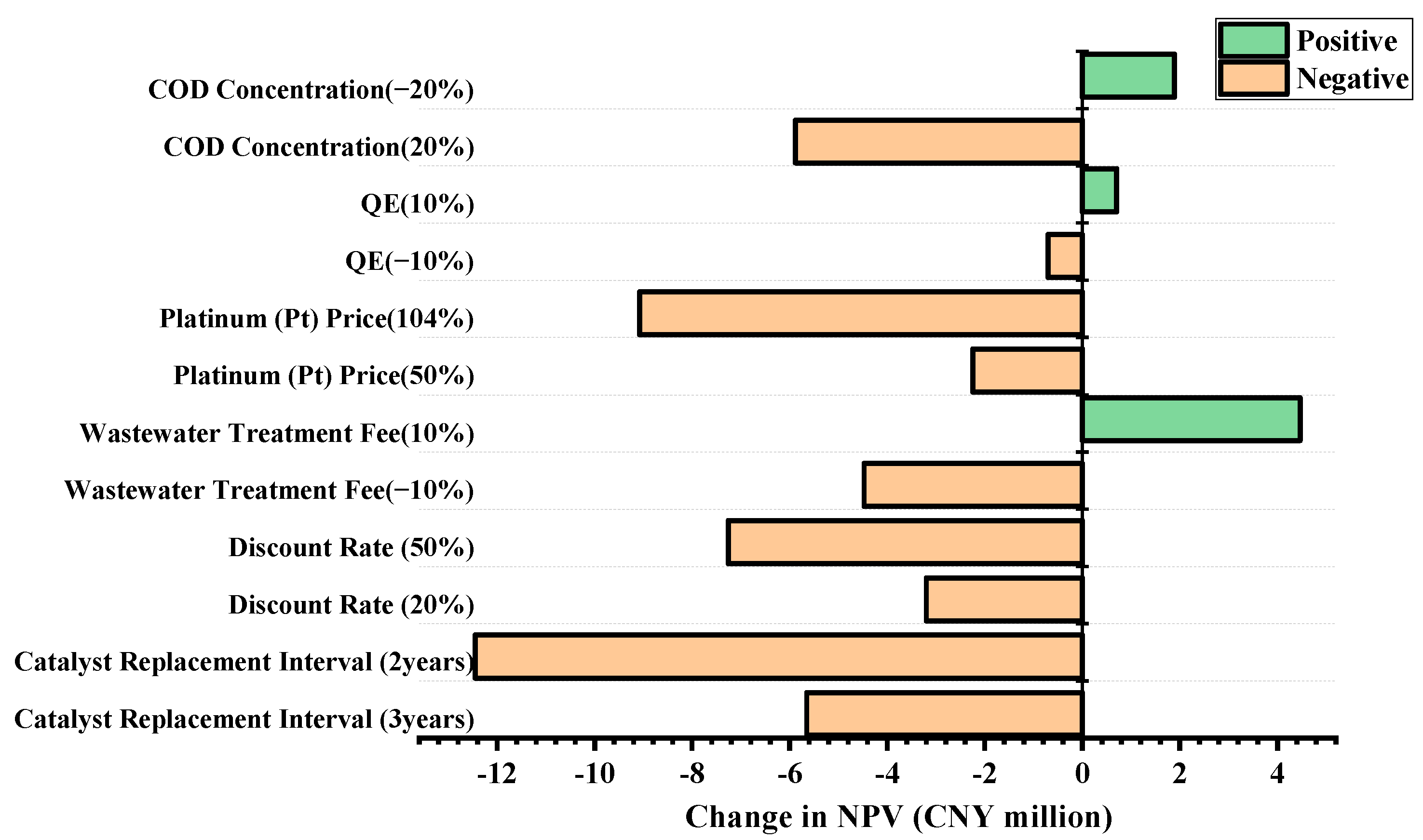
| Parameter | Scenario | Factor Value/Impact | NPV (Million CNY) | NPV Change (Million CNY) | NPV Change Rate (%) |
|---|---|---|---|---|---|
| Base NPV | – | i = 10% | 9.08 | 0 | 0 |
| Catalyst Replacement Interval | Pessimistic | 3 years (replace at yr 3, 6, 9), including Pt recovery revenue | 3.43 | –5.65 | –62.2% |
| Extremely Pessimistic | 2 years (replace at yr 2, 4, 6, 8, 10), including Pt recovery revenue * | –3.37 | –12.45 | –137.10% | |
| Discount Rate (i) | +20% | 12% | 5.88 | –3.20 | –35.20% |
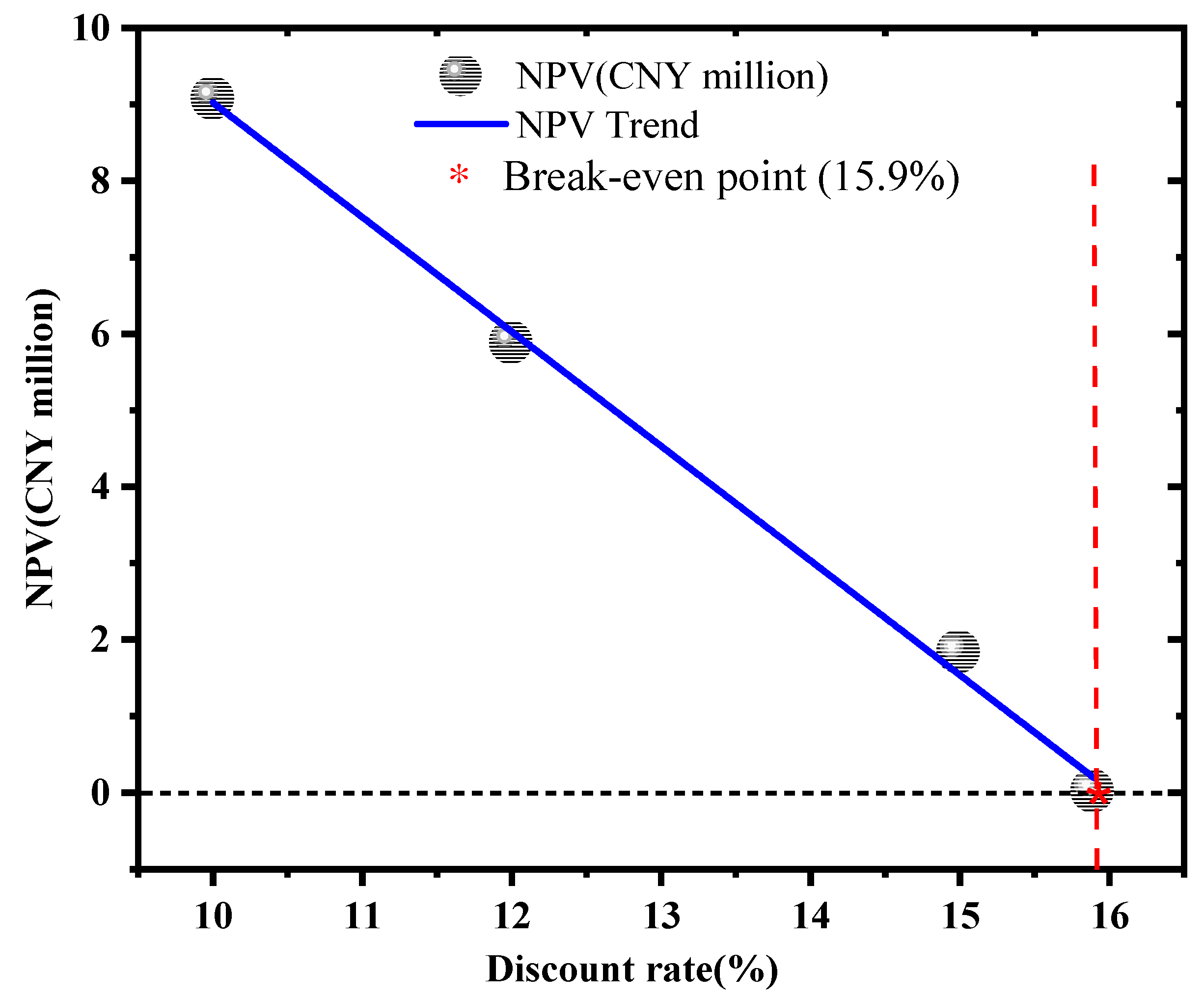
| +50% | 15% | 1.82 | –7.26 | –79.90% | |
| Wastewater Treatment Fee | −10% | 2.70 CNY/m3 | 4.61 | –4.47 | –49.20% |
| + 10% | 3.30 CNY/m3 | 13.55 | +4.47 | +49.20% | |
| Platinum (Pt) Price | +50% | 362.85 CNY/g | 6.84 | –2.24 | –24.70% |
| +104% | 495 CNY/g | 0 | –9.08 | –100% | |
| QE | −10% | 10% deviation from base QE | 8.38 | –0.70 | –7.70% |
| +10% | 10% deviation from base QE | 9.78 | 0.70 | 7.70% | |
| Influent COD Concentration | −20% | 240 mg/L | 10.97 | +1.89 | +20.8% |
| +20% | 360 mg/L | 3.20 | −5.88 | –64.8% | |
| LED Module Post-Replacement Efficiency | Pessimistic | 90% of initial photon output after each replacement | 9.04 | −0.04 | –0.44% |
| Extremely Pessimistic | 80% of initial photon output after each replacement | 8.99 | −0.09 | –0.99% |
| Factor | Base Value | Break-Even Value | Change from Base to Break-Even |
|---|---|---|---|
| Catalyst Replacement Interval | 4 years | 3.08 years | 23.0% shorter |
| Discount Rate (i) | 10% | 15.9% | 59.0% higher |
| Wastewater Treatment Fee | 3.00 CNY/m3 | 2.71 CNY/m3 | 9.7% lower |
| Platinum (Pt) Price | 241.92 CNY/g | 495 CNY/g | 104.5% higher |
3.3. Strategic Directions for Technological Optimization
4. Policy and Behavioral Interventions
4.1. Scope and Limitations
4.2. Policy-Driven Mechanisms
4.3. Behavioral Economics Interventions
5. Conclusions and Future Outlook
Author Contributions
Funding
Data Availability Statement
Conflicts of Interest
Abbreviations
| Abbreviation | Full Name |
| A2/O | Anaerobic–Anoxic–Oxic |
| CAPEX | Capital Expenditure |
| D&A | Depreciation and Amortization |
| EBT | Earnings Before Tax |
| MBBR | Moving Bed Biofilm Reactor |
| MBR | membrane bioreactor |
| NCF | Net Cash Flow |
| NPV | Net Present Value |
| OPEX | Operating Expenses |
| PBCM | Process-based cost model |
| QE | Quantum efficiency |
| TOU | Time of use |
Appendix A
Appendix A.1. Operating Revenue
Appendix A.2. Operating Costs
Appendix A.2.1. Annual Electricity Cost for the Project
| Parameter | Basis/Source | Value/Result |
|---|---|---|
| Voltage level | Project design assumption | 1–10 kV |
| Billing mechanism | Determined by project scale | Two-part tariff |
| Transmission and distribution price | Jiangsu Grid Transmission and Distribution Price Table, 1–10 kV two-part tariff | 0.1357 CNY/kWh |
| Grid-connected electricity price | Benchmark coal-fired power price in Jiangsu Province | 0.3910 CNY/kWh |
| Additional surcharge | Capacity cost allocation for natural gas power generation | 0.0230 CNY/kWh |
| Base price (Flat period) | Sum: Transmission + Grid-connected + Surcharge | 0.5497 CNY/kWh |
| Peak/Off-peak fluctuation ratio | Two-part tariff system | Peak: 80%; Off-peak: −65% |
| Critical peak/Deep off-peak ratio | Applicable to industrial loads >315 kVA | Critical peak: 20% above peak price |
| Time-of-Use Period | Calculation Formula | Final Price (CNY/kWh) |
|---|---|---|
| Flat period | 0.5497 (base) | 0.5497 |
| Off-peak period | 0.5497 × (1 − 65%) | 0.1924 |
| Peak period | 0.5497 × (1 + 80%) | 0.9895 |
| Critical peak period | 0.9895 × (1 + 20%) | 1.1874 |
| Season | Time Period | Daily Duration (h) | Days | Energy Charge Formula (CNY) | Total Energy Charge (Million CNY) |
|---|---|---|---|---|---|
| Summer/Winter | Critical peak | 3 | 181 | 3 h × 181 d × 280 kW × 1.1874 CNY/kWh | 0.18 |
| Peak | 5 | 181 | 5 h × 181 d × 280 kW × 0.9895 CNY/kWh | 0.25 | |
| Flat | 8 | 181 | 8 h × 181 d × 280 kW × 0.5497 CNY/kWh | 0.22 | |
| Off-peak | 8 | 181 | 8 h × 181 d × 280 kW × 0.1924 CNY/kWh | 0.08 | |
| Spring/Autumn | Peak | 7 | 184 | 7 h × 184 d × 280 kW × 0.9895 CNY/kWh | 0.36 |
| Flat | 8 | 184 | 8 h × 184 d × 280 kW × 0.5497 CNY/kWh | 0.23 | |
| Off-peak | 9 | 184 | 9 h × 184 d × 280 kW × 0.1924 CNY/kWh | 0.09 | |
| Total | 365 | Sum of all periods charges | 1.41 |
| Cost Category | Basis/Formula | Annual Cost (Million CNY) |
|---|---|---|
| Annual energy charge | From Table A3 | 1.41 |
| Annual capacity charge | 400 kVA × 32.0 CNY/month × 12 months | 0.15 |
| Total annual electricity cost | Energy + Capacity charge | 1.56 |
| Equivalent average electricity price | 1.56 million CNY/(280 × 24 × 365) kWh | 0.636 CNY/kWh |
Appendix A.2.2. Labor and Maintenance Costs
Appendix A.3. Investment
Appendix A.3.1. Supporting Carrier
Appendix A.3.2. UVA-LED Light Sources
Appendix A.3.3. Catalyst
Appendix A.3.4. Reactor System
Appendix A.3.5. Working Capital Reserve
Appendix A.3.6. Depreciation and Amortization (D&A)
Appendix A.4. Discount Rate
| Category | Parameter | Base Value | Unit | Basis/Source |
|---|---|---|---|---|
| Capacity | Design throughput | 10,000 | m3/d | Project design specification |
| Horizon | Project lifetime | 10 | years | Base case |
| Financial | Discount rate | 10% | — | (Appendix A.4) [108] |
| Electricity | TOU blended tariff | 0.636 | CNY/kWh | (Appendix A.2.1) Jiangsu Provincial Measures for the Collection and Use of Wastewater Treatment Fees |
| OPEX | Annual Electricity Cost | 1.56 | million CNY | |
| OPEX | Labor costs | 0.48 | million CNY | (Appendix A.2.2) |
| OPEX | Maintenance Cost | 0.30 | million CNY | |
| OPEX | Annual base OPEX | 2.34 | million CNY | |
| CAPEX | Reactor System Cost | 8.00 | million CNY | (Appendix A.3.4) [105] |
| CAPEX | UVA-LED Light Sources | 8.00 | million CNY | (Appendix A.3.2) [96] |
| CAPEX | Carrier Support | 6 | million CNY | (Appendix A.3.1) [95] |
| CAPEX | Catalyst system | 4.43 | million CNY | (Appendix A.3.3) [99] |
| CAPEX | Working Capital Reserve | 4 | million CNY | (Appendix A.3.3) [106] |
| CAPEX | Total initial CAPEX | 30.43 | million CNY | Project budget |
| Depreciation | Method | Straight-line | — | Accounting policy |
| Depreciation | Reactor System | 10 | years | (Appendix A.3.6) [99,107] |
| Depreciation | LED | 8 | years | |
| Depreciation | Catalyst | 4 | years | |
| Depreciation | Annual Depreciation And Amortization (D&A) | 3.37 | million CNY | |
| Salvage | Reactor + Carrier | 10% | of initial CAPEX | |
| Platinum | Initial Pt mass | 7.30 | kg | Based on 730 kg catalyst bed with 1% Pt loading (Appendix A.3.3) [82,83] |
| Platinum | Pt market price | 241.92 | CNY/g | The average of the end-of-month closing prices from the Shanghai Gold Exchange over the past three years (Appendix A.3.3) |
| Platinum | Physical recovery rate | 98% | — | Appendix B [109] |
| Platinum | Service fee rate | 10% | — | |
| Terminal | Net Pt recovery | 1.56 | million CNY |
Appendix B
| Description | Symbol | Value/Formula | Result (Million CNY) |
|---|---|---|---|
| Input Parameters | |||
| Initial Platinum Mass | MPt,initial | 7.30 kg | — |
| Platinum Market Price | PPt | 241.92 CNY/g | — |
| Physical Recovery Rate | ηphysical | 98% | — |
| Service Fee Rate | fservice | 10% | — |
| Calculation | |||
| Gross Market Value | Vgross | MPt,initial × ηphysical × PPt | 1.73 |
| Service Charge | Cservice | Vgross × fservice | 0.17 |
| Net Recovery Revenue | Rnet,recovery | Vgross-Cservice | 1.56 |
Appendix C
| Feature | Typical LCA/LCCA Studies | This Study’s Dynamic NPV Framework |
|---|---|---|
| Time resolution | Static or annual average | Annual cash flows with explicit replacement years (Y4, Y8) |
| Catalyst cost treatment | Fixed OPEX or lumped CAPEX | Dynamic replacement + Pt recovery credit |
| Technical constraints | Frequently simplified or assumed within nominal operating ranges | Explicitly bounded by COD, turbidity, poison limits (Section 2.1.1) |
| Revenue stream | Rarely included | Treatment fee + Pt salvage value |
| Decision output | Environmental impact/total cost | NPV, break-even thresholds, sensitivity rankings |
References
- Saravanan, A.; Senthil Kumar, P.; Jeevanantham, S.; Karishma, S.; Tajsabreen, B.; Yaashikaa, P.R.; Reshma, B. Effective Water/Wastewater Treatment Methodologies for Toxic Pollutants Removal: Processes and Applications towards Sustainable Development. Chemosphere 2021, 280, 130595. [Google Scholar] [CrossRef]
- Cui, Z.; Yuan, R.; Chen, H.; Zhou, B.; Zhu, B.; Zhang, C. Application of Polyaniline-Based Photocatalyst in Photocatalytic Degradation of Micropollutants in Water: A Review. J. Water Process Eng. 2024, 59, 104900. [Google Scholar] [CrossRef]
- Yeneneh, A.M.; Al Balushi, K.; Jafary, T.; Al Marshudi, A.S. Hydrodynamic Cavitation and Advanced Oxidation for Enhanced Degradation of Persistent Organic Pollutants: A Review. Sustainability 2024, 16, 4601. [Google Scholar] [CrossRef]
- Luo, B.; He, H.; Yan, Y.; Wang, Y.; Yang, X.; Liu, Y.; Xu, J.; Huang, W. Flocculants for the High-Concentration Activated Sludge Method and the Effectiveness of Urban Wastewater Treatment. Water 2024, 16, 2281. [Google Scholar] [CrossRef]
- Ferrentino, R.; Langone, M.; Fiori, L.; Andreottola, G. Full-Scale Sewage Sludge Reduction Technologies: A Review with a Focus on Energy Consumption. Water 2023, 15, 615. [Google Scholar] [CrossRef]
- Yu, P.; Tu, W.; Wu, M.; Zhang, Z.; Wang, H. Pilot-Scale Fermentation of Urban Food Waste for Volatile Fatty Acids Production: The Importance of pH. Bioresour. Technol. 2021, 332, 125116. [Google Scholar] [CrossRef] [PubMed]
- Zieliński, M.; Kazimierowicz, J.; Dębowski, M. Advantages and Limitations of Anaerobic Wastewater Treatment—Technological Basics, Development Directions, and Technological Innovations. Energies 2022, 16, 83. [Google Scholar] [CrossRef]
- Jiang, L.; Yang, J.; Zhou, S.; Yu, H.; Liang, J.; Chu, W.; Li, H.; Wang, H.; Wu, Z.; Yuan, X. Strategies to Extend Near-Infrared Light Harvest of Polymer Carbon Nitride Photocatalysts. Coord. Chem. Rev. 2021, 439, 213947. [Google Scholar] [CrossRef]
- Loeb, S.K.; Alvarez, P.J.J.; Brame, J.A.; Cates, E.L.; Choi, W.; Crittenden, J.; Dionysiou, D.D.; Li, Q.; Li-Puma, G.; Quan, X.; et al. The Technology Horizon for Photocatalytic Water Treatment: Sunrise or Sunset? Environ. Sci. Technol. 2019, 53, 2937–2947. [Google Scholar] [CrossRef]
- Zhao, S.-Z.; Lu, Y.; Lu, R.; Hu, Y.-D.; Rodriguez, R.D.; Chen, J.-J. Constructing BiOBr/TiO2 Heterostructure Nanotubes for Enhanced Adsorption/Photocatalytic Performance. J. Water Process Eng. 2023, 54, 103972. [Google Scholar] [CrossRef]
- Yang, J.; Wang, H.; Jiang, L.; Yu, H.; Zhao, Y.; Chen, H.; Yuan, X.; Liang, J.; Li, H.; Wu, Z. Defective Polymeric Carbon Nitride: Fabrications, Photocatalytic Applications and Perspectives. Chem. Eng. J. 2022, 427, 130991. [Google Scholar] [CrossRef]
- Wu, H.; Li, L.; Wang, S.; Zhu, N.; Li, Z.; Zhao, L.; Wang, Y. Recent Advances of Semiconductor Photocatalysis for Water Pollutant Treatment: Mechanisms, Materials and Applications. Phys. Chem. Chem. Phys. 2023, 25, 25899–25924. [Google Scholar] [CrossRef]
- Liu, W.; He, C.; Zhu, B.; Zhu, E.; Zhang, Y.; Chen, Y.; Li, J.; Zhu, Y. Progress in Wastewater Treatment via Organic Supramolecular Photocatalysts under Sunlight Irradiation. Chin. J. Catal. 2023, 53, 13–30. [Google Scholar] [CrossRef]
- Ahtasham Iqbal, M.; Akram, S.; Khalid, S.; Lal, B.; Hassan, S.U.; Ashraf, R.; Kezembayeva, G.; Mushtaq, M.; Chinibayeva, N.; Hosseini-Bandegharaei, A. Advanced Photocatalysis as a Viable and Sustainable Wastewater Treatment Process: A Comprehensive Review. Environ. Res. 2024, 253, 118947. [Google Scholar] [CrossRef]
- Mishra, S.; Sundaram, B. A Review of the Photocatalysis Process Used for Wastewater Treatment. Mater. Today Proc. 2024, 102, 393–409. [Google Scholar] [CrossRef]
- Hassaan, M.A.; El-Nemr, M.A.; Elkatory, M.R.; Ragab, S.; Niculescu, V.-C.; El Nemr, A. Principles of Photocatalysts and Their Different Applications: A Review. Top. Curr. Chem. 2023, 381, 31. [Google Scholar] [CrossRef]
- Rafieenia, R.; Sulonen, M.; Mahmoud, M.; El-Gohary, F.; Rossa, C.A. Integration of Microbial Electrochemical Systems and Photocatalysis for Sustainable Treatment of Organic Recalcitrant Wastewaters: Main Mechanisms, Recent Advances, and Present Prospects. Sci. Total Environ. 2022, 824, 153923. [Google Scholar] [CrossRef] [PubMed]
- Paiu, M.; Lutic, D.; Favier, L.; Gavrilescu, M. Heterogeneous Photocatalysis for Advanced Water Treatment: Materials, Mechanisms, Reactor Configurations, and Emerging Applications. Appl. Sci. 2025, 15, 5681. [Google Scholar] [CrossRef]
- Zheng, M.-W.; Tran, N.T.T.; Liu, S.-H. Enhanced Dual-Functional Performance on the Tetracycline Degradation and Chromium Detoxification via Z-Scheme COF/TiO2-NH2 Heterojunctions. J. Water Process Eng. 2025, 78, 108770. [Google Scholar] [CrossRef]
- Duraimurugan, J.; Kumar, G.S.; Shanavas, S.; Ramesh, R.; Acevedo, R.; Anbarasan, P.M.; Maadeswaran, P. Hydrothermal Assisted Phytofabrication of Zinc Oxide Nanoparticles with Different Nanoscale Characteristics for the Photocatlytic Degradation of Rhodamine B. Optik 2020, 202, 163607. [Google Scholar] [CrossRef]
- Gupta, B.; Saidulu, D.; Srivastava, A.; Rawat, A.; Singh, A.; Bhatnagar, A.; Gupta, A.K. Performance Assessment of Photo-Controlled Catalytic and Moving Biocarrier-Based Hybrid Systems for the Treatment of Pharmaceuticals from Municipal and Industrial Wastewater: Insights into Influencing Factors and Degradation Mechanisms. J. Environ. Chem. Eng. 2023, 11, 110128. [Google Scholar] [CrossRef]
- Han, C.; Wang, Z.; Cui, J.; Liu, S.; Yang, L.; Fu, Y.; Zhu, B.; Guo, C. Rapid Quantitative Detection of Dye Concentration in Pt/TiO2 Photocatalytic System Based on RGB Sensing. Sensors 2025, 25, 3195. [Google Scholar] [CrossRef]
- Meena, P.L.; Poswal, K.; Surela, A.K.; Saini, J.K. Synthesis of G-C3N4/ZnO Nanostructures via Mechano-Thermal Method for Photocatalytic Degradation of Methylene Blue Dye. Int. J. Environ. Sci. Technol. 2025, 22, 833–848. [Google Scholar] [CrossRef]
- Al Qaydi, M.; Rajput, N.S.; Lejeune, M.; Bouchalkha, A.; El Marssi, M.; Cordette, S.; Kasmi, C.; Jouiad, M. Intermixing of MoS2 and WS2 Photocatalysts toward Methylene Blue Photodegradation. Beilstein J. Nanotechnol. 2024, 15, 817–829. [Google Scholar] [CrossRef] [PubMed]
- Iervolino, G.; Zammit, I.; Vaiano, V.; Rizzo, L. Limitations and Prospects for Wastewater Treatment by UV and Visible-Light-Active Heterogeneous Photocatalysis: A Critical Review. In Heterogeneous Photocatalysis; Muñoz-Batista, M.J., Navarrete Muñoz, A., Luque, R., Eds.; Topics in Current Chemistry Collections; Springer International Publishing: Cham, Switzerland, 2020; pp. 225–264. ISBN 978-3-030-49491-9. [Google Scholar]
- Wang, L.; Zhang, Q.; Chen, B.; Bu, Y.; Chen, Y.; Ma, J.; Rosario-Ortiz, F.L.; Zhu, R. Some Issues Limiting Photo(Cata)Lysis Application in Water Pollutant Control: A Critical Review from Chemistry Perspectives. Water Res. 2020, 174, 115605. [Google Scholar] [CrossRef]
- Qudsieh, I.Y.; Ali, M.A.; Maafa, I.M. Effect of Water Matrix on Photocatalytic Degradation of Organic Pollutants in Water: A Literature Review. Rev. Chem. Eng. 2025, 41, 539–573. [Google Scholar] [CrossRef]
- Tawfik, A.; Alalm, M.G.; Awad, H.M.; Islam, M.; Qyyum, M.A.; Al-Muhtaseb, A.H.; Osman, A.I.; Lee, M. Solar Photo-Oxidation of Recalcitrant Industrial Wastewater: A Review. Environ. Chem. Lett. 2022, 20, 1839–1862. [Google Scholar] [CrossRef]
- Donga, C.; Ratshiedana, R.; Kuvarega, A.T.; Masunga, N.; Vallabhapurapu, V.S.; Mbule, P. Photocatalytic Degradation of Organic Pollutants in Wastewater Using Magnetic Functionalized Reduced Graphene Oxide Nanocomposites. A Review. Talanta 2025, 295, 128318. [Google Scholar] [CrossRef]
- Montenegro, R.; González, Z.; Rodríguez, A.; Canovi, C.; Pozzi, P.; Siligardi, C.; Cedillo-González, E.I. Processing of Bio-Based Photocatalytic Sponge-like Structures Containing C,N-TiO2 Colloidally Dispersed onto Cellulose Nanofibers for Microplastic Remediation. J. Environ. Manag. 2025, 389, 126015. [Google Scholar] [CrossRef]
- Díez, A.M.; Pazos, M.; Sanromán, M.Á.; Naranjo, H.V.; Mayer, J.; Kolen’ko, Y.V. Photocatalytic Solid-Phase Degradation of Polyethylene with Fluoride-Doped Titania under Low Consumption Ultraviolet Radiation. J. Environ. Manag. 2023, 329, 117044. [Google Scholar] [CrossRef]
- Li, D.; Calebe, V.C.; Li, Y.; Liu, H.; Lei, Y. Interstitial N-Doped TiO2 for Photocatalytic Methylene Blue Degradation under Visible Light Irradiation. Catalysts 2024, 14, 681. [Google Scholar] [CrossRef]
- Yang, X.; Liang, J.; Fu, H.; Ran, X.; An, X. Fabrication of Au-Ag@TiO2 Ternary Core-Shell Nanostructures with Enhanced Sunlight Photocatalytic Activity. Powder Technol. 2022, 404, 117463. [Google Scholar] [CrossRef]
- Mei, X.; Yuan, H.; Li, C. Study on the MOF Frame Pt-TiO2 Hybrid Photocatalyst and Its Photocatalytic Performance. Sustainability 2023, 15, 1403. [Google Scholar] [CrossRef]
- Liu, J.; Zheng, J.; Yue, G.; Li, H.; Liu, Z.; Zhao, Y.; Wang, N.; Sun, C.; Cui, Z. Continuous G-C3N4 Layer-Coated Porous TiO2 Fibers with Enhanced Photocatalytic Activity toward H2 Evolution and Dye Degradation. RSC Adv. 2022, 12, 10258–10266. [Google Scholar] [CrossRef] [PubMed]
- Chi, N.; Xu, W. Synthesis of TiO2/g-C3N4 Hybrid Photocatalyst and Its Application for Degradation of Chlorophenol as Organic Water Pollutant. Int. J. Electrochem. Sci. 2022, 17, 220929. [Google Scholar] [CrossRef]
- Lu, X.; Zhu, M.; Chen, D.; Wu, J.; Gao, S.; Zhao, Y.; Yang, J.; Li, S.; Meng, J. Preparation, Modification, and Application of Graphitic Carbon Nitride in Photocatalytic Degradation of Antibiotics. Processes 2025, 13, 3365. [Google Scholar] [CrossRef]
- Yang, Y.; Wang, D.Y.; Zhang, Y.C.; Chen, S.Y.; Sun, Y. Enhanced Photocatalytic Performance of Z-Scheme TiO2/g-C3N4 Heterojunction towards Degradation of Rhodamine B. DJNB 2022, 17, 1491–1500. [Google Scholar] [CrossRef]
- Liu, Q.; Hou, J.; Zeng, Y.; Xia, J.; Miao, L.; Wu, J. Integrated Photocatalysis and Moving Bed Biofilm Reactor (MBBR) for Treating Conventional and Emerging Organic Pollutants from Synthetic Wastewater: Performances and Microbial Community Responses. Bioresour. Technol. 2023, 370, 128530. [Google Scholar] [CrossRef]
- Chen, C.-Y.; Wang, G.-H.; Chang, Y.-J.; Chen, Y.-H.; Cheng, C.-Y.; Chung, Y.-C. Combination of a Highly Efficient Biological System and Visible-Light Photocatalysis Pretreatment System for the Removal of Phthalate Esters from Wastewater. Water 2022, 14, 3139. [Google Scholar] [CrossRef]
- Liu, K.; Chen, J.; Sun, F.; Liu, Y.; Tang, M.; Yang, Y. Historical Development and Prospect of Intimately Coupling Photocatalysis and Biological Technology for Pollutant Treatment in Sewage: A Review. Sci. Total Environ. 2022, 835, 155482. [Google Scholar] [CrossRef]
- Zhang, C.; Li, Y.; Shen, H.; Shuai, D. Simultaneous Coupling of Photocatalytic and Biological Processes: A Promising Synergistic Alternative for Enhancing Decontamination of Recalcitrant Compounds in Water. Chem. Eng. J. 2021, 403, 126365. [Google Scholar] [CrossRef]
- López, J.L.C.; Reina, A.C.; Gómez, E.O.; Martín, M.M.B.; Rodríguez, S.M.; Pérez, J.A.S. Integration of Solar Photocatalysis and Membrane Bioreactor for Pesticides Degradation. Sep. Sci. Technol. 2010, 45, 1571–1578. [Google Scholar] [CrossRef]
- Lu, Z.; Xu, Y.; Akbari, M.Z.; Liang, C.; Peng, L. Insight into Integration of Photocatalytic and Microbial Wastewater Treatment Technologies for Recalcitrant Organic Pollutants: From Sequential to Simultaneous Reactions. Chemosphere 2022, 295, 133952. [Google Scholar] [CrossRef]
- De Abreu, V.H.S.; Pereira, V.G.F.; Proença, L.F.C.; Toniolo, F.S.; Santos, A.S. A Systematic Study on Techno-Economic Evaluation of Hydrogen Production. Energies 2023, 16, 6542. [Google Scholar] [CrossRef]
- Esrafili, A.; Salimi, M.; Jonidi Jafari, A.; Reza Sobhi, H.; Gholami, M.; Rezaei Kalantary, R. Pt-Based TiO2 Photocatalytic Systems: A Systematic Review. J. Mol. Liq. 2022, 352, 118685. [Google Scholar] [CrossRef]
- Maurya, J.; Gemechu, E.; Kumar, A. The Development of Techno-Economic Assessment Models for Hydrogen Production via Photocatalytic Water Splitting. Energy Convers. Manag. 2023, 279, 116750. [Google Scholar] [CrossRef]
- GB 18918-2002; Discharge Standard of Pollutants for Municipal Wastewater Treatment Plant. State Environmental Protection Administration: Beijing, China, 2002.
- Antonietti, M.; Pelicano, C.M. Translating Laboratory Success into the Large-Scale Implementation of Photocatalytic Overall Water Splitting. Front. Sci. 2024, 2, 1507745. [Google Scholar] [CrossRef]
- Ong, W.-J.; Tan, L.-L.; Ng, Y.H.; Yong, S.-T.; Chai, S.-P. Graphitic Carbon Nitride (g-C3N4)-Based Photocatalysts for Artificial Photosynthesis and Environmental Remediation: Are We a Step Closer To Achieving Sustainability? Chem. Rev. 2016, 116, 7159–7329. [Google Scholar] [CrossRef]
- Singh, R.; Chauhan, M.; Garg, P.; Sharma, B.; Attri, P.; Sharma, R.K.; Sharma, D.; Chaudhary, G.R. A Critical Review on Visible Light Active Graphitic Carbon Nitride (g-CN) Based Photocatalyst for Environment Remediation Application: A Sustainable Approach. J. Clean. Prod. 2023, 427, 138855. [Google Scholar] [CrossRef]
- Wang, Y.-D.; Lee, T.-W.; Lo, Y.-C.; Hong, W.-J.; Chen, C. Insights into Photochemical Stability of Graphitic Carbon Nitride-Based Photocatalysts in Water Treatment. Carbon 2021, 175, 223–232. [Google Scholar] [CrossRef]
- Nidheesh, P.V.; Couras, C.; Karim, A.V.; Nadais, H. A Review of Integrated Advanced Oxidation Processes and Biological Processes for Organic Pollutant Removal. Chem. Eng. Commun. 2022, 209, 390–432. [Google Scholar] [CrossRef]
- Toe, C.Y.; Pan, J.; Scott, J.; Amal, R. Identifying Key Design Criteria for Large-Scale Photocatalytic Hydrogen Generation from Engineering and Economic Perspectives. ACS ES&T Eng. 2022, 2, 1130–1143. [Google Scholar] [CrossRef]
- Li, Y.; Zhang, D.; Ye, J.; Mai, Y.; Wang, C.; Yang, Y.; Li, Y.; Besenbacher, F.; Niemantsverdriet, H.; Rosei, F.; et al. A Modular Tubular Flow System with Replaceable Photocatalyst Membranes for Scalable Coupling and Hydrogenation. Angew. Chem. 2023, 135, e202302979. [Google Scholar] [CrossRef]
- Younis, S.; Kim, K.-H. Heterogeneous Photocatalysis Scalability for Environmental Remediation: Opportunities and Challenges. Catalysts 2020, 10, 1109. [Google Scholar] [CrossRef]
- Zhang, F.; Wang, X.; Liu, H.; Liu, C.; Wan, Y.; Long, Y.; Cai, Z. Recent Advances and Applications of Semiconductor Photocatalytic Technology. Appl. Sci. 2019, 9, 2489. [Google Scholar] [CrossRef]
- Ngulube, K.F.; Abdelhaleem, A.; Osman, A.I.; Peng, L.; Nasr, M. Advancing Sustainable Water Treatment Strategies: Harnessing Magnetite-Based Photocatalysts and Techno-Economic Analysis for Enhanced Wastewater Management in the Context of SDGs. Environ. Sci. Pollut. Res. 2024, 32, 28159–28195. [Google Scholar] [CrossRef]
- Huang, S.; Fan, Z.-P.; Wang, X. Optimal Financing and Operational Decisions of Capital-Constrained Manufacturer under Green Credit and Subsidy. J. Ind. Manag. Optim. 2021, 17, 261–277. [Google Scholar] [CrossRef]
- Tan, W.; Huang, Y.; Chen, X.H.; Gatto, A. Green Credit Policy and Energy Consumption Intensity in China: Firm-Level Evidence. J. Environ. Manag. 2024, 373, 123664. [Google Scholar] [CrossRef]
- Huang, S.; Fan, Z.-P.; Wang, N. Green Subsidy Modes and Pricing Strategy in a Capital-Constrained Supply Chain. Transp. Res. Part E Logist. Transp. Rev. 2020, 136, 101885. [Google Scholar] [CrossRef]
- Xi, B.; Jia, W. Research on the Impact of Carbon Trading on Enterprises’ Green Technology Innovation. Energy Policy 2025, 197, 114436. [Google Scholar] [CrossRef]
- Chen, Z.; Zhang, Y.; Wang, H.; Ouyang, X.; Xie, Y. Can Green Credit Policy Promote Low-Carbon Technology Innovation? J. Clean. Prod. 2022, 359, 132061. [Google Scholar] [CrossRef]
- Muthukumar, C.; Saginala, P.; Changmai, M.; Prakash Kumar, B.G. Natural Sunlight-Driven Enhanced Abatement of Real Resin Industry Wastewater Using Sludge-Derived Photocatalyst: Potential to Generate Carbon Credits. J. Environ. Chem. Eng. 2023, 11, 111014. [Google Scholar] [CrossRef]
- Shokri, A.; Shokri, A.; White, D.; Gelski, R.; Goldberg, Y.; Harrison, S.; Rashidi, T.H. EnviroCoin: A Holistic, Blockchain Empowered, Consensus-Based Carbon Saving Unit Ecosystem. Sustainability 2022, 14, 6979. [Google Scholar] [CrossRef]
- Yang, R.; Tang, W.; Zhang, J. Technology Improvement Strategy for Green Products under Competition: The Role of Government Subsidy. Eur. J. Oper. Res. 2021, 289, 553–568. [Google Scholar] [CrossRef]
- Sinfield, J.V.; Ajmani, A.; McShane, W. Strategic Roadmapping to Accelerate and Risk-Mitigate Enabling Innovations: A Generalizable Method and a Case Illustration for Marine Renewable Energy. Technol. Forecast. Soc. Change 2024, 209, 123761. [Google Scholar] [CrossRef]
- Li, Y.; Su, X.; Bai, M. A Stochastic Dynamic Programming Model for the Optimal Policy Mix of the Carbon Tax and Decarbonization Subsidy. J. Environ. Manag. 2024, 353, 120242. [Google Scholar] [CrossRef] [PubMed]
- Koval, V.; Laktionova, O.; Udovychenko, I.; Olczak, P.; Palii, S.; Prystupa, L. Environmental Taxation Assessment on Clean Technologies Reducing Carbon Emissions Cost-Effectively. Sustainability 2022, 14, 14044. [Google Scholar] [CrossRef]
- Tchorzewska, K.B.; Rio, P.D.; Garcia-Quevedo, J.; Martinez-Ros, E. Carrot First, Stick Second? Environmental Policy-Mix Sequencing and Green Technologies. Technol. Forecast. Soc. Change 2025, 210, 123835. [Google Scholar] [CrossRef]
- Theyel, G.; Tucci, C. Risk-Sharing and Its Role in Manufacturer’s Innovation. Prod. Manuf. Res. 2024, 12, 2296051. [Google Scholar] [CrossRef]
- Zhou, Y.; Pan, M.; Zhou, D.K.; Xue, L. Stakeholder Risk and Trust Perceptions in the Diffusion of Green Manufacturing Technologies: Evidence from China. J. Environ. Dev. 2018, 27, 46–73. [Google Scholar] [CrossRef]
- Tan, L.-L.; Wong, V.L.; Phang, S.J. Recent Advances on TiO2 Photocatalysis for Wastewater Degradation: Fundamentals, Commercial TiO2 Materials, and Photocatalytic Reactors. In Handbook of Nanotechnology Applications; Elsevier: Amsterdam, The Netherlands, 2021; pp. 25–65. ISBN 978-0-12-821506-7. [Google Scholar]
- Cherevko, S. Stabilization of Non-Noble Metal Electrocatalysts for Acidic Oxygen Evolution Reaction. Curr. Opin. Electrochem. 2023, 38, 101213. [Google Scholar] [CrossRef]
- Zhang, C.; Wang, L.; Wu, C.-D. Stabilization of Transition Metal Heterojunctions inside Porous Materials for High-Performance Catalysis. Dalton Trans. 2023, 52, 8834–8849. [Google Scholar] [CrossRef]
- Li, S.; Rao, H.; Tang, C.; Bao, T.; She, P.; Qin, J. Recent Advances of Non-Noble Metals Based Plasma Materials in Photocatalysis. Coord. Chem. Rev. 2024, 510, 215803. [Google Scholar] [CrossRef]
- Yao, Y.; Liu, C.; Xiao, C.; Wang, M.; Zhu, Z.; Yang, Y.; Zhou, Y.; Qi, J.; Richards, H.; Li, J. Metamorphoses of Industrial Waste Sludge via Metal Organic Frameworks into Efficient Fenton-like Catalysts. Chem. Eng. J. 2025, 519, 165620. [Google Scholar] [CrossRef]
- Kumar, A.; Sharma, P.; Sharma, G.; Dhiman, P.; Mola, G.T.; Farghali, M.; Rashwan, A.K.; Nasr, M.; Osman, A.I.; Wang, T. Simultaneous Hydrogen Production and Photocatalytic Pollutant Removal: A Review. Environ. Chem. Lett. 2024, 22, 2405–2424. [Google Scholar] [CrossRef]
- Zhou, Y.; Han, J.; Zhou, Y. Synergizing Carbon Trading and Water Management for Urban Sustainability: A City-Level Multi-Objective Planning Framework. Appl. Energy 2024, 359, 122637. [Google Scholar] [CrossRef]
- Hangai, B.; Ortega, P.; Simoes, A.Z.; Alves, F.; Longo, E.; Zirpoli Simões, A. Enhancing Photocatalytic Efficiency Through Silver Modification of Sodium and Hydrogen Titanate Nanostructures. Phys. B Condens. Matter 2024, 715, 417550. [Google Scholar] [CrossRef]
- Niu, Y.; Shi, Q.; Peng, T.; Cao, X.; Lv, Y. Research Progress on the Synthesis of Nanostructured Photocatalysts and Their Environmental Applications. Nanomaterials 2025, 15, 681. [Google Scholar] [CrossRef] [PubMed]
- Alagarsamy, V.; Venkatesh, N.; Roshan, S.A.; Pandurengan, S.; Gnanasekaran, L.; Viswanathan, K.; Murugadoss, G. NiS-ZnS Quantum Dots as Visible-Light Photocatalysts for Enhanced Dye Degradation in Sustainable Wastewater Treatment. Chem. Phys. Impact 2025, 11, 100912. [Google Scholar] [CrossRef]
- Ding, H.; Wang, H.; Huang, G.; Zhu, Y.; Zhang, L.; Zhang, X.; Zhou, M.; Wang, Q.; Li, X.; Xu, Q.; et al. Assessing the Wastewater Reclaim System Consisted of Wastewater Plant—Hybrid Constructed Wetland—Ultra Filtration and Reverse Osmosis in a Chemical Industrial Park, a Multi-Criteria Decision-Making Analysis. Sci. Total Environ. 2024, 926, 171942. [Google Scholar] [CrossRef]
- Zhang, Y.; Wu, Q.; Ren, H.; Li, Q.; Zhou, W. A Multi-Agent Distributed Electricity-Carbon Shared Trading Strategy Considering Regional Carbon Inclusion. Renew. Energy 2025, 239, 122075. [Google Scholar] [CrossRef]
- Li, X.; Yu, Y.; Pan, J.; Bhuiyan, M.A. Can Carbon Emission Trading Improve Regional Eco-Efficiency? Based on the Environmental Innovation Perspective. Environ. Sci. Pollut. Res. 2024, 31, 31081–31096. [Google Scholar] [CrossRef] [PubMed]
- Ganthavee, V.; Trzcinski, A.P. Artificial Intelligence and Machine Learning for the Optimization of Pharmaceutical Wastewater Treatment Systems: A Review. Environ. Chem. Lett. 2024, 22, 2293–2318. [Google Scholar] [CrossRef]
- Hussain, C.G.; Keçili, R.; Hussain, C.M. Future of Analytical Chemistry with Green Miniaturized Technologies. In Comprehensive Analytical Chemistry; Elsevier: Amsterdam, The Netherlands, 2025; Volume 109, pp. 507–537. ISBN 978-0-443-23980-9. [Google Scholar]
- Martini, S.; Roni, K.A. The Existing Technology and the Application of Digital Artificial Intelligent in the Wastewater Treatment Area: A Review Paper. J. Phys. Conf. Ser. 2021, 1858, 012013. [Google Scholar] [CrossRef]
- Pandey, A.K.; Reji Kumar, R.; Kalidasan, B.; Laghari, I.A.; Samykano, M.; Kothari, R.; Abusorrah, A.M.; Sharma, K.; Tyagi, V.V. Utilization of Solar Energy for Wastewater Treatment: Challenges and Progressive Research Trends. J. Environ. Manag. 2021, 297, 113300. [Google Scholar] [CrossRef]
- Chen, J.; Hu, L.; Chen, Q.; Yang, T.; Yi, C. Hotspots and Trends in Solar-Driven Interfacial Evaporation Technology Based on Bibliometric Management and Analysis. Surf. Interfaces 2024, 46, 104184. [Google Scholar] [CrossRef]
- Evro, S.; Oni, B.A.; Tomomewo, O.S. Global Strategies for a Low-Carbon Future: Lessons from the US, China, and EU’s Pursuit of Carbon Neutrality. J. Clean. Prod. 2024, 461, 142635. [Google Scholar] [CrossRef]
- Chen, J.; Xie, F.; Inna, S.; Liu, B.; Luo, H. Breaking Barriers, Boosting Green: Artificial Intelligence and Green Transformation in Cities. Sustain. Cities Soc. 2025, 130, 106626. [Google Scholar] [CrossRef]
- Zhang, X.; Fan, Y.; Hao, T.; Chen, R.; Zhang, T.; Hu, Y.; Li, D.; Pan, Y.; Li, Y.-Y.; Kong, Z. Insights into Current Bio-Processes and Future Perspectives of Carbon-Neutral Treatment of Industrial Organic Wastewater: A Critical Review. Environ. Res. 2024, 241, 117630. [Google Scholar] [CrossRef]
- Tapia-Tlatelpa, T.; Buscio, V.; Trull, J.; Sala, V. Performance Analysis and Methodology for Replacing Conventional Lamps by Optimized LED Arrays for Photocatalytic Processes. Chem. Eng. Res. Des. 2020, 156, 456–468. [Google Scholar] [CrossRef]
- Wang, D.; Mueses, M.A.; Márquez, J.A.C.; Machuca-Martínez, F.; Grčić, I.; Peralta Muniz Moreira, R.; Li Puma, G. Engineering and Modeling Perspectives on Photocatalytic Reactors for Water Treatment. Water Res. 2021, 202, 117421. [Google Scholar] [CrossRef]
- Jo, W.-K.; Tayade, R.J. New Generation Energy-Efficient Light Source for Photocatalysis: LEDs for Environmental Applications. Ind. Eng. Chem. Res. 2014, 53, 2073–2084. [Google Scholar] [CrossRef]
- Kane, A.; Assadi, A.A.; El Jery, A.; Badawi, A.K.; Kenfoud, H.; Baaloudj, O.; Assadi, A.A. Advanced Photocatalytic Treatment of Wastewater Using Immobilized Titanium Dioxide as a Photocatalyst in a Pilot-Scale Reactor: Process Intensification. Materials 2022, 15, 4547. [Google Scholar] [CrossRef]
- Kubiak, A. A Scalable IoT-Controlled Photocatalytic System for Pharmaceutical Removal in Real Wastewater Treatment Applications. Chem. Eng. J. 2025, 518, 164709. [Google Scholar] [CrossRef]
- Baaloudj, O.; Badawi, A.K.; Kenfoud, H.; Benrighi, Y.; Hassan, R.; Nasrallah, N.; Assadi, A.A. Techno-Economic Studies for a Pilot-Scale Bi12TiO20 Based Photocatalytic System for Pharmaceutical Wastewater Treatment: From Laboratory Studies to Commercial-Scale Applications. J. Water Process Eng. 2022, 48, 102847. [Google Scholar] [CrossRef]
- Malato, S.; Fernández-Ibáñez, P.; Maldonado, M.I.; Blanco, J.; Gernjak, W. Decontamination and Disinfection of Water by Solar Photocatalysis: Recent Overview and Trends. Catal. Today 2009, 147, 1–59. [Google Scholar] [CrossRef]
- Acevedo, A.; Carpio, E.A.; Rodríguez, J.; Manzano, M.A. Disinfection of Natural Water by Solar Photocatalysis Using Immobilized TiO2 Devices: Efficiency in Eliminating Indicator Bacteria and Operating Life of the System. J. Sol. Energy Eng. 2012, 134, 011008. [Google Scholar] [CrossRef]
- Pu, Y.; Jia, L.; Huang, Q.; Tang, X.; Rodriguez, P.; Huang, L. Investigation on the Surface Charge Separation in Pt-Supported Morphology-Related-TiO2 and Its Effect on Water Splitting. J. Colloid Interface Sci. 2023, 646, 815–823. [Google Scholar] [CrossRef] [PubMed]
- Huang, S.-Y.; Ganesan, P.; Park, S.; Popov, B.N. Development of a Titanium Dioxide-Supported Platinum Catalyst with Ultrahigh Stability for Polymer Electrolyte Membrane Fuel Cell Applications. J. Am. Chem. Soc. 2009, 131, 13898–13899. [Google Scholar] [CrossRef]
- Katz, A.; McDonagh, A.; Tijing, L.; Shon, H.K. Fouling and Inactivation of Titanium Dioxide-Based Photocatalytic Systems. Crit. Rev. Environ. Sci. Technol. 2015, 45, 1880–1915. [Google Scholar] [CrossRef]
- Loh, H.P.; Lyons, J.; White, C.W. Process Equipment Cost Estimation, Final Report; DOE/NETL--2002/1169; EG&G Technical Services, Inc.: Morgantown, WV, USA, 2002; p. 797810. [Google Scholar]
- Pelayo, D.; Rivero, M.J.; Santos, G.; Gómez, P.; Ortiz, I. Techno-Economic Evaluation of UV Light Technologies for the Simultaneous Disinfection and Water Remediation. SSRN J. 2022, 868, 161376. [Google Scholar] [CrossRef]
- Mei, J.; Gao, X.; Zou, J.; Pang, F. Research on Photocatalytic Wastewater Treatment Reactors: Design, Optimization, and Evaluation Criteria. Catalysts 2023, 13, 974. [Google Scholar] [CrossRef]
- Hirth, L.; Steckel, J.C. The Role of Capital Costs in Decarbonizing the Electricity Sector. Environ. Res. Lett. 2016, 11, 114010. [Google Scholar] [CrossRef]
- Ding, Y.; Zheng, H.; Li, J.; Zhang, S.; Liu, B.; Ekberg, C.; Jian, Z. Recovery of Platinum from Spent Petroleum Catalysts: Optimization Using Response Surface Methodology. Metals 2019, 9, 354. [Google Scholar] [CrossRef]




Disclaimer/Publisher’s Note: The statements, opinions and data contained in all publications are solely those of the individual author(s) and contributor(s) and not of MDPI and/or the editor(s). MDPI and/or the editor(s) disclaim responsibility for any injury to people or property resulting from any ideas, methods, instructions or products referred to in the content. |
© 2026 by the authors. Licensee MDPI, Basel, Switzerland. This article is an open access article distributed under the terms and conditions of the Creative Commons Attribution (CC BY) license.
Share and Cite
Liu, H.; Song, M. Techno-Economic Assessment and Process Design Considerations for Industrial-Scale Photocatalytic Wastewater Treatment. Water 2026, 18, 221. https://doi.org/10.3390/w18020221
Liu H, Song M. Techno-Economic Assessment and Process Design Considerations for Industrial-Scale Photocatalytic Wastewater Treatment. Water. 2026; 18(2):221. https://doi.org/10.3390/w18020221
Chicago/Turabian StyleLiu, Hongliang, and Mingxia Song. 2026. "Techno-Economic Assessment and Process Design Considerations for Industrial-Scale Photocatalytic Wastewater Treatment" Water 18, no. 2: 221. https://doi.org/10.3390/w18020221
APA StyleLiu, H., & Song, M. (2026). Techno-Economic Assessment and Process Design Considerations for Industrial-Scale Photocatalytic Wastewater Treatment. Water, 18(2), 221. https://doi.org/10.3390/w18020221