Article

Hydrodynamic Loadings on Debris Accumulations at Low Froude Numbers in Straight Channel

DESTEC—Department of Energy, Systems, Territory and Construction Engineering, University of Pisa, via Gabba 22, 56122 Pisa, Italy
*
Author to whom correspondence should be addressed.
Water 2026, 18(2), 220; https://doi.org/10.3390/w18020220
Submission received: 16 December 2025 / Revised: 7 January 2026 / Accepted: 12 January 2026 / Published: 14 January 2026
(This article belongs to the Section Hydraulics and Hydrodynamics)

Abstract

Debris accumulation critically impacts hydraulic structures by altering approach flow, amplifying hydrodynamic forces, and inducing backwater rise. While previous research has extensively examined drag forces due to debris, the effects of debris porosity, its proximity to the channel bed, and upstream–downstream water level difference on hydrodynamic loadings are still not fully understood. To address these gaps, 336 experiments were conducted under subcritical flow conditions, involving nine debris configurations, characterized by different geometries and porosities. Drag and lift forces were measured to quantify debris–flow–structure interactions. The results show that drag and lift coefficients increase with blockage ratio and water level difference, whereas they decrease with Froude number and proximity ratio. Moreover, debris porosity and geometry have a negligible effect on drag coefficient but significantly influence lift coefficient. In the tested range of Reynolds numbers, both coefficients are not affected by the flow regime, with all other parameters being constant. Based on experimental evidence and dimensional analysis, empirical equations were derived for estimating drag and lift coefficients. To the best of the authors’ knowledge, for the first time, the proposed predictive relationships account for all the above-mentioned hydraulic and geometric variables, providing useful tools for improving the design and resilience of bridge infrastructures.

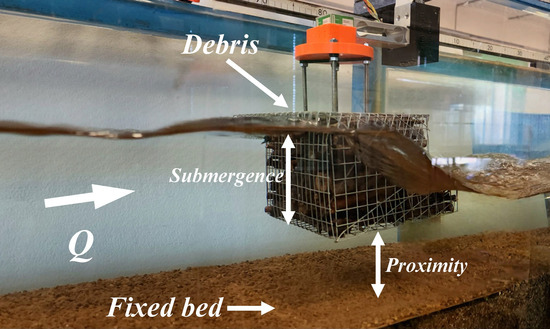
Graphical Abstract

1. Introduction

For many decades, engineers have sought to predict the hydrodynamic loads on piers and bridge decks, stimulated by the necessity of preventing failure and making the structure more resilient. To this end, one of the most challenging aspects is represented by the fluid–structure interaction, especially during flood events, when wood debris (formed by logs, branches, and man-made objects, or their combinations) may accumulate on river structures [1,2,3]. Under these conditions, there is an increase in drag and lift forces acting on debris, resulting in backwater rise, vortex shedding, and localized flow separation, which is largely influenced by debris geometry, porosity, submergence, and hydraulic conditions. The consequences of debris accumulation are particularly important for bridge infrastructures, representing critical components of transportation networks. Namely, during flood events, their vulnerability increases because of the partial or full obstruction of the water body due to debris accumulation.
Previous studies have primarily focused on specific aspects [1,2,3,4,5,6,7,8,9,10,11], showing that accumulated debris modifies momentum exchange and velocity gradients, while intensifying turbulence. Specifically, refs. [1,3] focused on debris transport and accumulation near bridge infrastructure. In so doing, they investigated how single logs or rafts are entrained, lodged at the structure, and gradually evolve into full-scale jams. Systematic experimental tests at bridge decks revealed that debris blocking probability decreases with freeboard and drift dimensions and with Froude number (Fr), when larger discharges facilitate flushing. The eventual jam formation generally depends on flow conditions, channel geometry, and wood characteristics [12,13,14]. Large-scale surveys further emphasize that debris accumulations influence channel morphology, sediment dynamics, and habitat formation [15,16,17].
Backwater rise induced by debris has been widely documented as a mechanism that diminishes conveyance capacity and increases upstream flood risk. Controlled experiments and field studies have shown that backwater effects are governed by flow regime (identified via the parameter Fr) and jam compactness [1,2,6,7]. Elevated water levels promote floodplain connectivity and alter sediment transport, sometimes fostering wetland formation and habitat heterogeneity. However, in these conditions, the risk to infrastructure such as bridges and culverts remains critical [3,18].
Scour at bridge pier is the primary cause of structural failures. Debris accumulations greatly intensify shear stresses acting on the movable bed, resulting in deeper scour holes [2,11,19,20,21,22]. Following experimental evidence, debris characteristics and properties strongly influence scour dynamics, with the scour depth reaching up to three times that observed without debris [20,21]. More recent studies highlight that debris porosity can reduce the maximum scour depth by up to 50%, suggesting that field-observed accumulations behave quite differently from the impermeable prismatic forms commonly assumed in design practice [22].
Research on hydrodynamic forces has focused on quantifying drag, lift, and pressure fields induced by debris accumulations and their implications for bridge stability [3,4,5,8,10,23]. Ref. [5] showed that large wood debris (LWD) of different shapes yields drag coefficients (CD) ranging from 0.05 to more than 6, and lift coefficients (CL) up to 30, highlighting the strong dependence on wood accumulation geometry and submergence. The coupling of debris with bridge structures (e.g., bridge deck, bridge pier) further intensifies streamwise and vertical loads, as reported by [9]. Hydrodynamic coefficients associated with such flow–obstruction systems are strongly influenced by several dimensionless variables, including Fr, inundation ratio (h*), proximity ratio (Pr), aspect ratio (Ar), blockage ratio (BR), Reynolds number (Re), and the upstream–downstream water level difference (ΔH). A broader theoretical background of these parameters can be found in [9,24,25,26,27], while definitions are provided in Section 2.
Recent advances in computational modeling have significantly deepened the understanding of debris–structure interactions, complementing traditional experimental approaches. Ref. [28] integrated flume experiments with 3D CFD simulations to evaluate the role of pier shape on wood accumulation, showing how cross-sectional geometry influences trapping probability. Extending the scope to debris flows, ref. [29] employed a coupled CFD–DEM approach to simulate impacts on piers of different shapes, deriving power-law relations for resistance coefficients that vary with both pier geometry and solid volume fraction. Collectively, these studies demonstrate the growing capability of CFD to resolve complex debris–flow–structure processes and highlight its role in bridging laboratory observations with predictive design applications.
Table 1 synthesizes the findings of selected relevant studies on debris–flow–structure interactions, highlighting the primary analyzed aspects and the key parameters employed in predictive formulations.
The existing literature has extensively examined debris transport, backwater rise, and scour processes, but comparatively less attention has been given to the hydrodynamic forces exerted by varying debris accumulations or shapes (Dbshp). While drag has been studied in detail, lift forces on submerged debris remain poorly understood. The influence of geometry, porosity, and orientation on these forces is further complicated by the irregularity and variability of real-world accumulations. In this regard, it is worth noticing that the existing predictive equations for hydrodynamic coefficients often neglect key governing parameters. In particular, the effects of debris proximity to the channel bed, upstream–downstream water level differences, porosity, and geometry are inadequately represented in current empirical or semi-empirical models.
This study contributes to narrowing these gaps through a comprehensive experimental investigation involving debris of various shapes and characteristics. In so doing, we provide insights into the effects of varying Fr, BR, ΔH, Pr, debris shape and porosities, on hydrodynamic loadings on debris accumulations. To this end, different debris configurations (including cuboidal, V, trapezoidal, caged, and solid geometries) were systematically tested under controlled low-Froude flows and different submergence levels. Both drag and lift forces were measured and the influence of hydraulic and geometrical parameters were quantified. The findings of this work have relevant practical implications. By elucidating the coupled effects of debris shape and submergence on vertical and horizontal force components, this study provides a robust foundation for improving bridge design codes under flood-prone conditions.

2. Materials and Methods

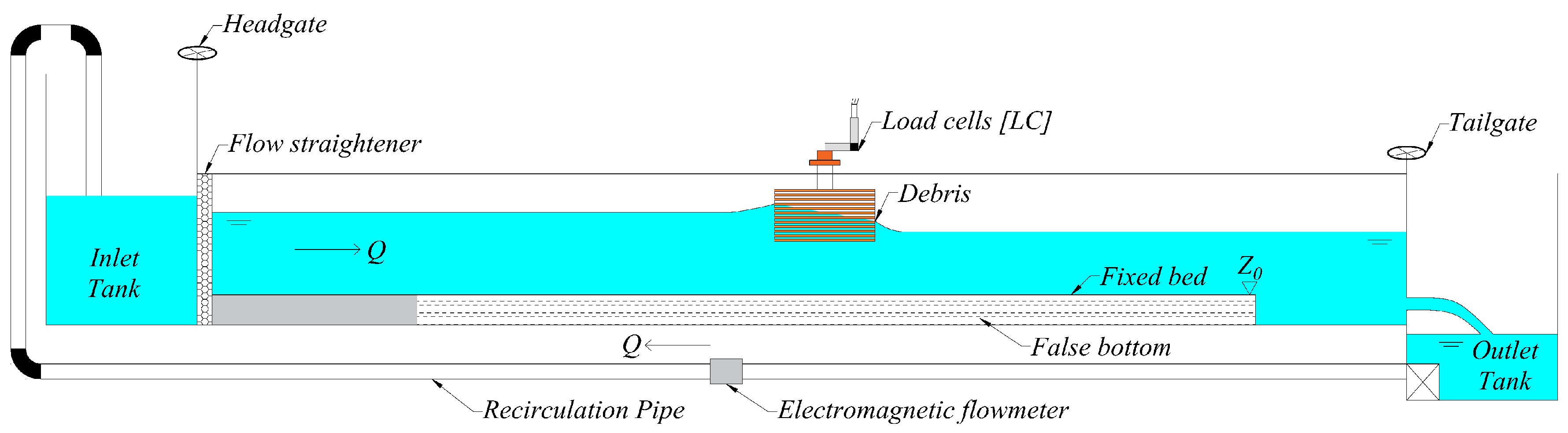
All experiments were conducted in a recirculating channel located at the Hydraulic Laboratory of the University of Pisa (Pisa, Italy). The channel measured 6 m in length (l), 0.345 m in width (w), and 0.4 m in depth (h), with transparent glass sidewalls to enable flow visualization. The system was equipped with two tanks, positioned at the upstream and downstream ends. Figure 1 shows the experimental apparatus used in the present study. Flow entered from the inlet tank through a headgate and was supplied by a variable speed centrifugal pump. The discharge rate (Q) was monitored using an inline KROHNE® Optiflux 2000 electromagnetic flowmeter (Duisburg, Germany) with an accuracy of ±1%. Water depth was regulated via an adjustable sluice gate located at the downstream end of the channel. The rigid, rough bed was simulated by gluing granular material (d50 = 3.87 mm) onto a 1 mm thick stainless-steel plate. Tests were conducted under various discharges Q, tailwater level, and debris submergences. A honeycomb mesh at the inlet ensured uniform approaching flow conditions.
To minimize sidewall effects, the debris configurations were positioned along the channel centerline, maintaining sufficient distance from the sidewalls. In addition, the blockage ratios remained within ranges commonly adopted in laboratory studies on debris–flow interaction. Therefore, the influence of sidewall reflections on the results is considered limited.
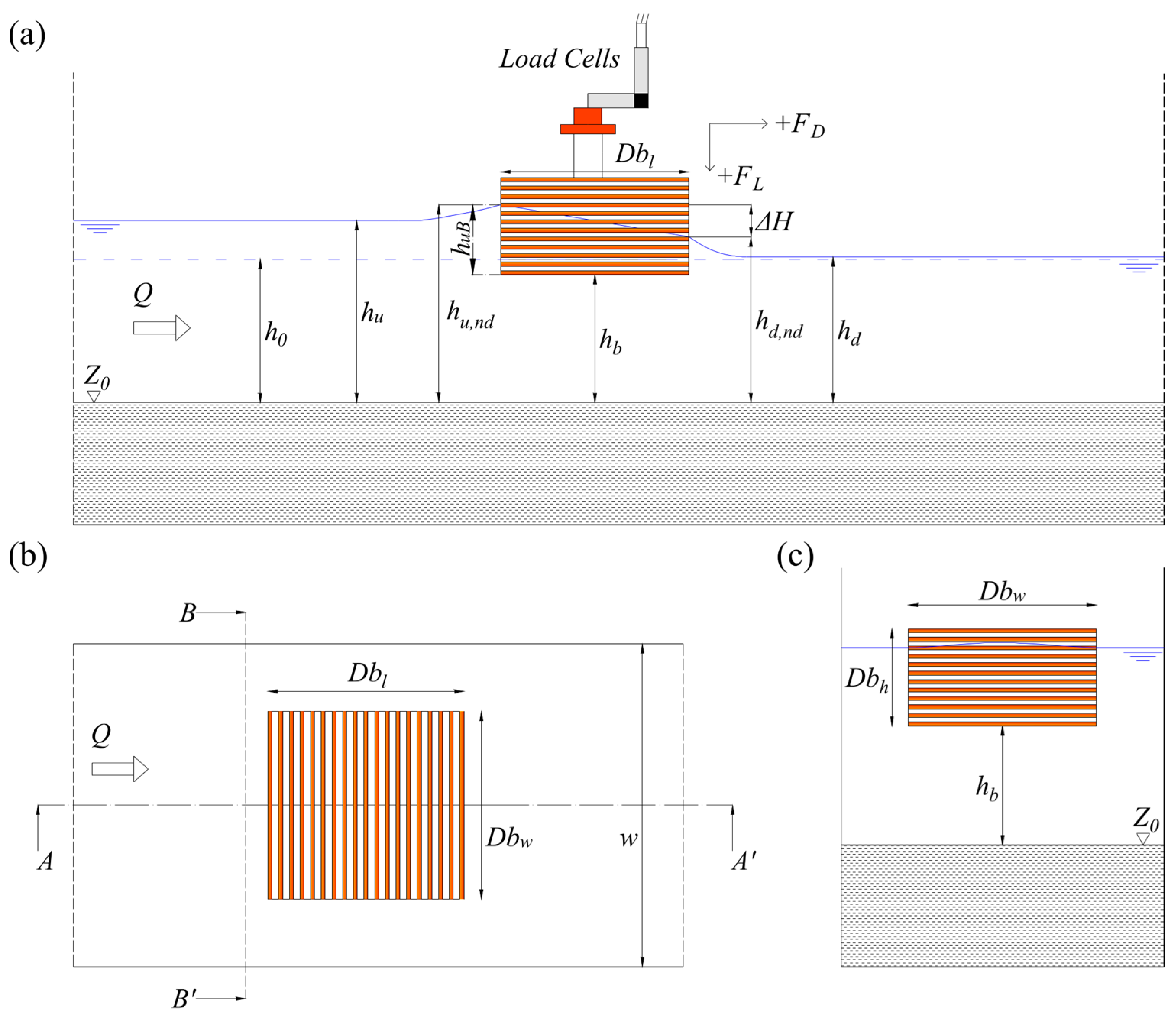
In Figure 2, we show three schematic views of the experimental setup, i.e., a side view (corresponding to section A-A′; Figure 2a), the plan view (Figure 2b), and an upstream view (from section B-B′; Figure 2c). Key parameters include discharge (Q), debris length (Dbl), debris width (Dbw), debris height (Dbh), and w. Different water levels were measured from the horizontal plane containing the rigid bed (whose elevation is Z0). They include the water surface elevations upstream and downstream of the debris (hu and hd, respectively); the flow depths immediately upstream and downstream of the debris (hu,nd and hd,nd, respectively), obtained by averaging the water elevations in correspondence with the sides and the center of the debris; the initial water level (h0); and the water depth at the upstream debris face, i.e., huB = hu,nd − hb, with hb denoting the vertical clearance between the debris bottom and the bed. The difference in water levels in correspondence with the upstream and downstream surfaces of the debris is equal to ΔH = (hu,nd − hd,nd). The total drag (FD) and lift (FL) forces were measured using load cells (LC) attached to a fixed frame positioned about 2.6 m downstream of the channel inlet. Further details about the above-mentioned water levels and load cell functioning are provided below when describing the testing procedure.
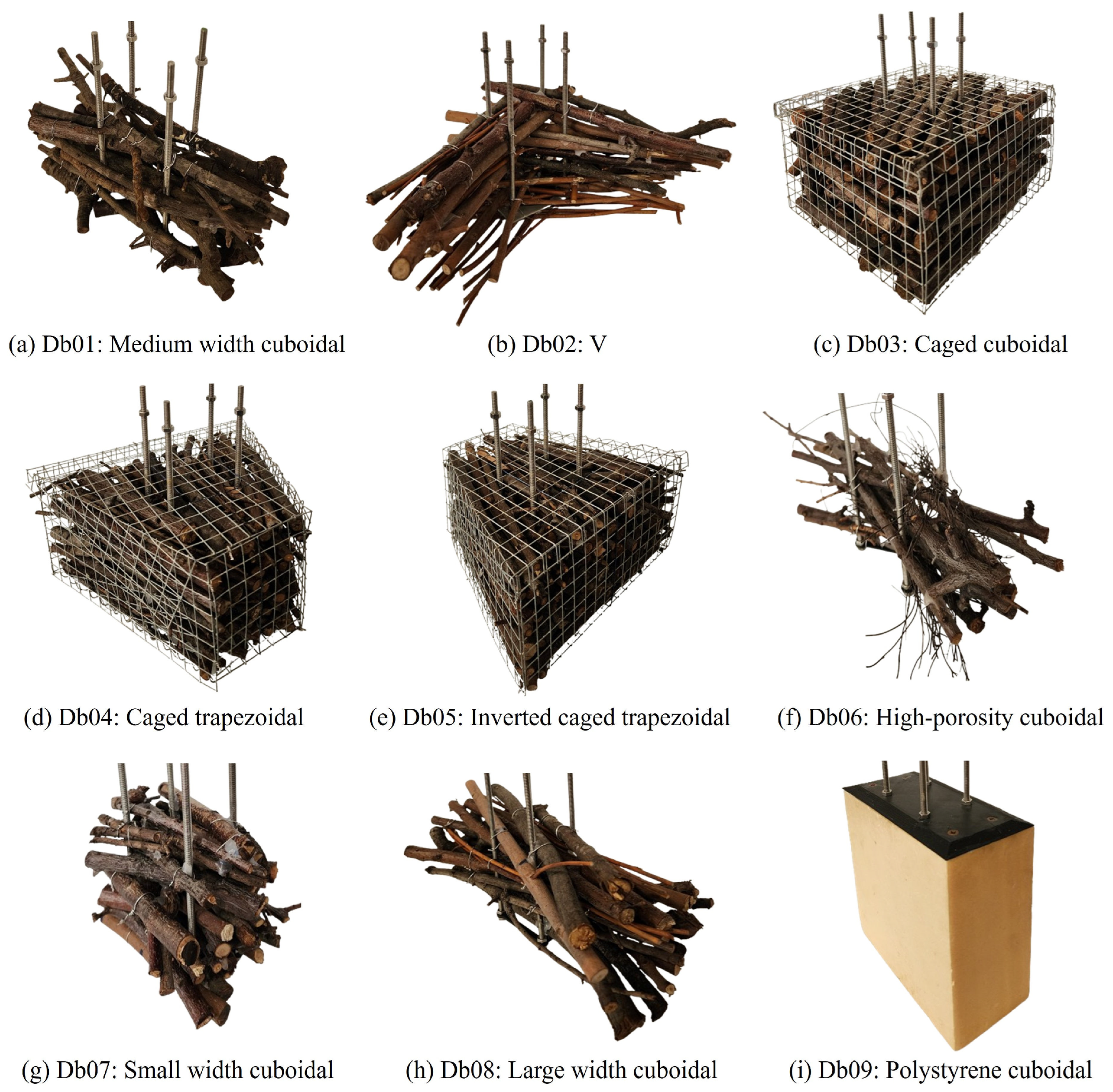
In Figure 3, different debris configurations used in the present study are presented. A total of nine distinct debris types were tested to simulate various flood-induced accumulations. The debris elements were constructed using natural woody branches, twigs, synthetic materials, and porous cages. They were selected to capture a broad spectrum of shapes, porosities, and buoyancy characteristics representative of actual field conditions.
The tested configurations are named as follows: (i) Db01—Medium width cuboidal debris formed from solid wood, (ii) Db02—V-shaped debris assembled by joining angled branches to mimic interlocked tree limbs, (iii) Db03—caged cuboidal debris fabricated by enclosing wood fragments within a rigid mesh frame, and (iv) Db04—caged trapezoidal debris and (v) Db05—inverted caged trapezoidal debris, both designed to explore the impact of sloped or reverse geometries on the hydrodynamic response. Additional types include: (vi) Db06—high-porosity cuboidal debris constructed from loosely packed lightweight twigs to simulate highly porous formations; (vii) Db07—small-width cuboidal debris and (viii) Db08—large-width cuboidal debris, representing low and high blockage ratios, respectively; and (ix) Db09—a low-density polystyrene block used to replicate impervious debris.
Table 2 summarizes the physical and geometric properties of the tested debris configurations, including debris dimensions [Dbl × Dbw × Dbh], relative debris width (Dbw/w), unsubmerged dry weight, solid wood volume (VLWD), full frontal and bottom projected areas (Afmax and Alift, respectively), and porosity (n) (the methodology adopted for estimating VLWD, Afmax, Alift, and n are clarified below). Specifically: debris porosity values range from n = 0 (corresponding to debris type Db09) to n = 0.86 (relative to debris type Db06); characteristic block dimensions vary between relatively small blocks (e.g., Db07: 8 × 13 × 11 cm) and large, elongated forms (Db02: 24 × 21 × 10.5 cm); Dbw/w ranges from 0.38 (Db07) to 0.81 (Db08), indicating substantial variability in relative channel blockage; weights span over an order of magnitude, from 220.94 g (Db09) to 1196.88 g (Db03); and VLWD ranges from 165 cm3 (Db06) to 2244 cm3 (Db09), while the maximum projected frontal and bottom areas Afmax and Alift vary between 134.25 cm2 (Db07) and 303.76 cm2 (Db08), and 91.10 cm2 (Db07) and 273.68 cm2 (Db02), respectively. Collectively, the dataset captures both light-buoyant and heavy–dense debris forms, as well as compact versus porous geometries, thus providing a representative spectrum for analyzing debris–flow–structure interactions.
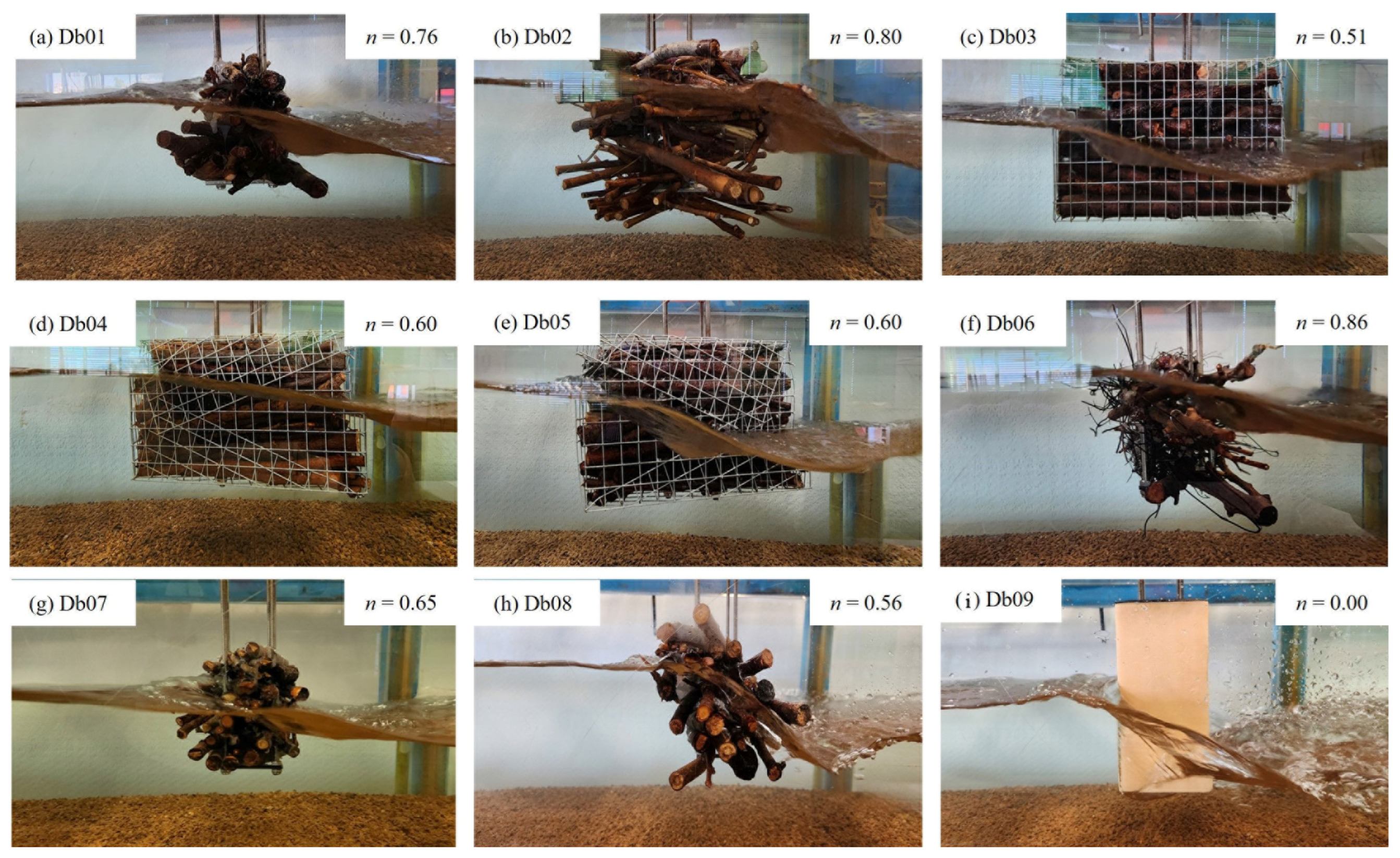
Figure 4 shows the nine debris types (Db01–Db09) assembled and tested under identical hydraulic conditions (Q = 25 L/s, h0 = 12.5 cm, and hb = 6.5 cm). Despite the same inflow and approach depth, the presence of different debris geometries and porosities resulted in markedly different water surface drops across the accumulation (ΔH). This demonstrates that the variable ΔH is influenced by debris porosity and thus should be explicitly accounted for in the analysis of backwater rise and hydrodynamic loadings.
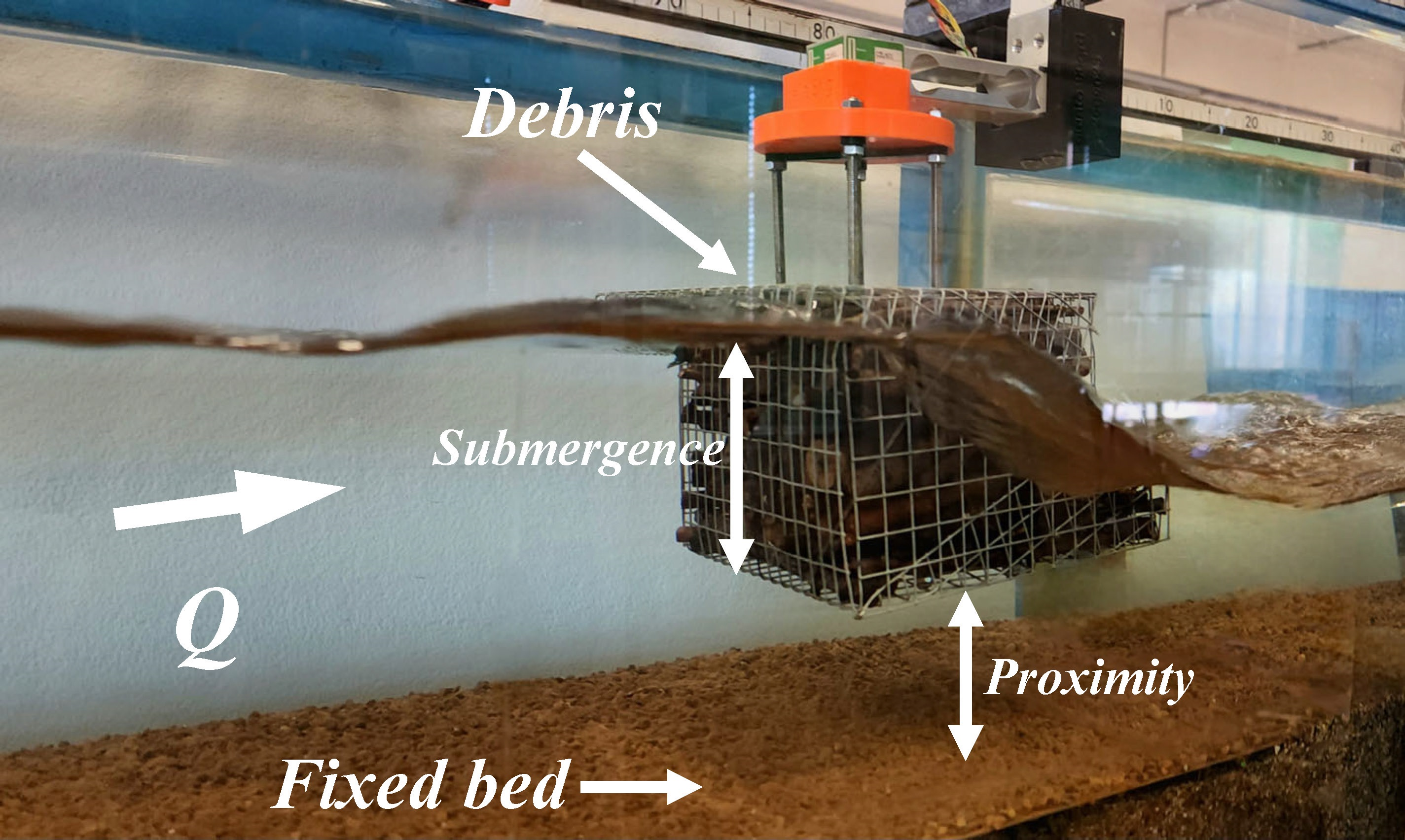
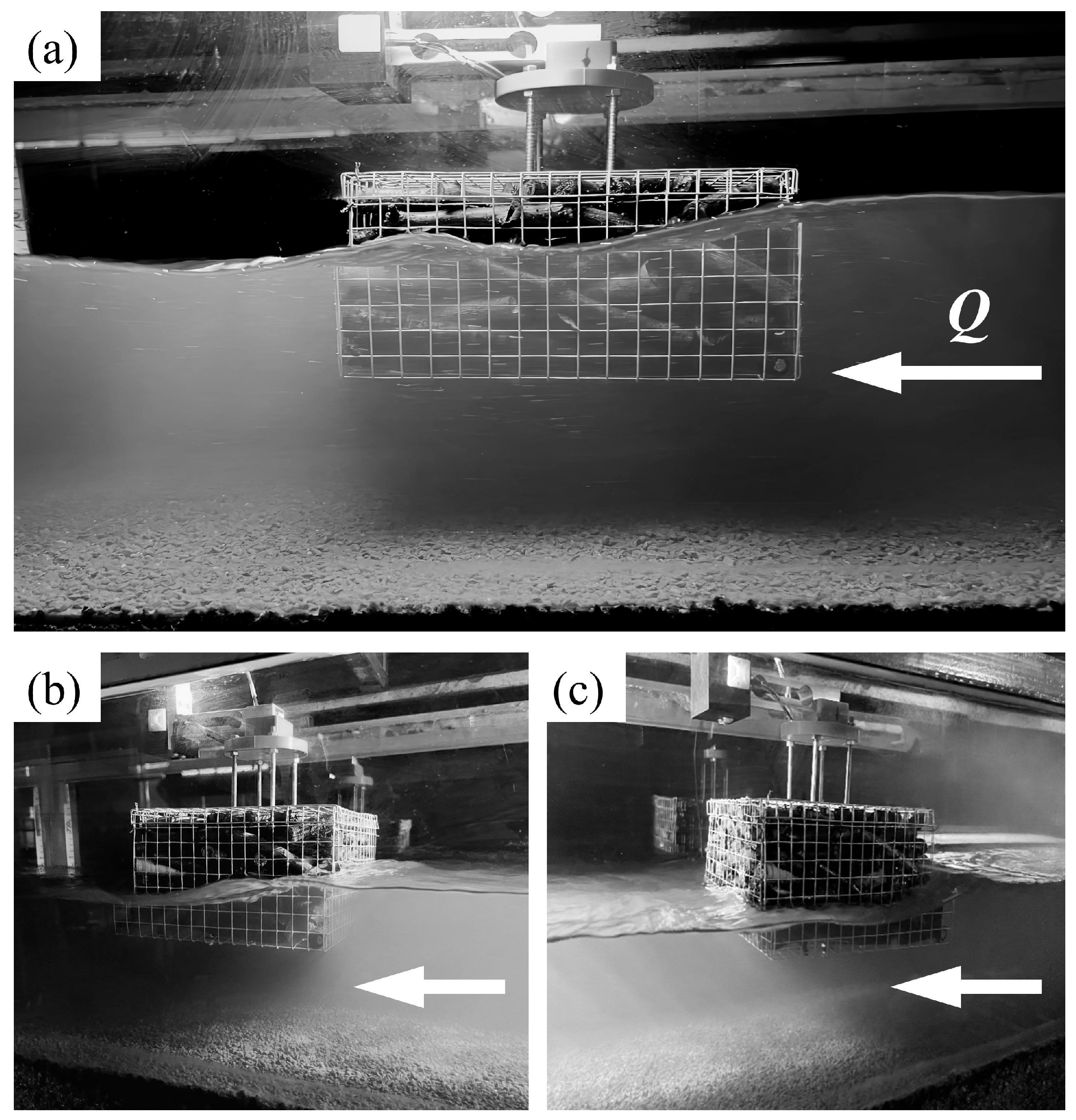
Figure 5 shows the experimental arrangement adopted for Db03 tested in the flume. The presented debris model was partially submerged and mounted on a rigid frame connected to load cells allowing direct measurement of hydrodynamic forces. Photographs from different perspectives illustrate the side, upstream, and downstream views (Figure 5a, b, and c, respectively).
Each debris type was tested individually. For every test, the desired h0 and Q were first set and allowed to stabilize. Subsequently, the debris gradually lowered into the flow until the target submergence depth huB was achieved. The introduction of the debris caused an increase in the upstream water level from h0 to hu. Once the debris had been submerged and all water levels had been stabilized, data acquisition was initiated.
Hydrodynamic forces acting on the debris were measured using a precision load cell system (CZL601) based on strain gauge-type sensors with ±1 g accuracy. The system was made of two load cells mounted orthogonally (one vertically to measure drag and the other horizontally for lift) and integrated into a fixed steel frame spanning the width of the flume. It included custom-fabricated 3D-printed fixtures and stainless-steel threaded rods to ensure proper alignment and stability during tests. Each load cell was connected to a high-precision signal conditioning system, with electrical signals routed through a switching box that allowed independent toggling between lift and drag channels. Output signals were monitored in real time using a Fluke 73III digital multimeter (Everett, WA, USA) and simultaneously recorded via a National Instruments USB data acquisition unit (NI-6000 series, version 6210). The analog voltage signals were sampled at a frequency of 10 Hz over a duration of 120 s per test using NI LabVIEW SignalExpress software, version 3.5.0. Prior to testing, the system was calibrated using known weights applied at the same location and orientation as the debris to develop a force–voltage relationship. The calibration curves were linear with a high degree of accuracy, providing confidence in the force measurements. To reduce electrical noise and ensure high signal fidelity, coaxial cables and shielded connectors were used throughout the system. Additionally, water surface elevations were recorded using a point gauge (of precision ±1 mm) at multiple locations along the flume. Longitudinal and transverse water levels were measured at the centerline and both sidewalls of the channel. Likewise, they were measured immediately upstream and downstream of the debris at three different sections, i.e., axially and close to the debris sides.
The drag coefficient CD was defined as
C D = F D 0.5 ρ V u 2 A d r a g
where FD is the drag force, ρ is the water density, Vu = Q/(w × hu) is the approach velocity, and Adrag is the projected area of the debris facing the flow. For the case of fully submerged debris, the reference Adrag was taken as the maximum frontal projected area Adrag = Afmax. The lift coefficient was defined as
C L = F L B 0.5 ρ V u 2 A l i f t
where FL represents the total vertical lift force, B is the buoyancy due to the submerged portion, and Alift corresponds to the projected bottom area beneath the debris.
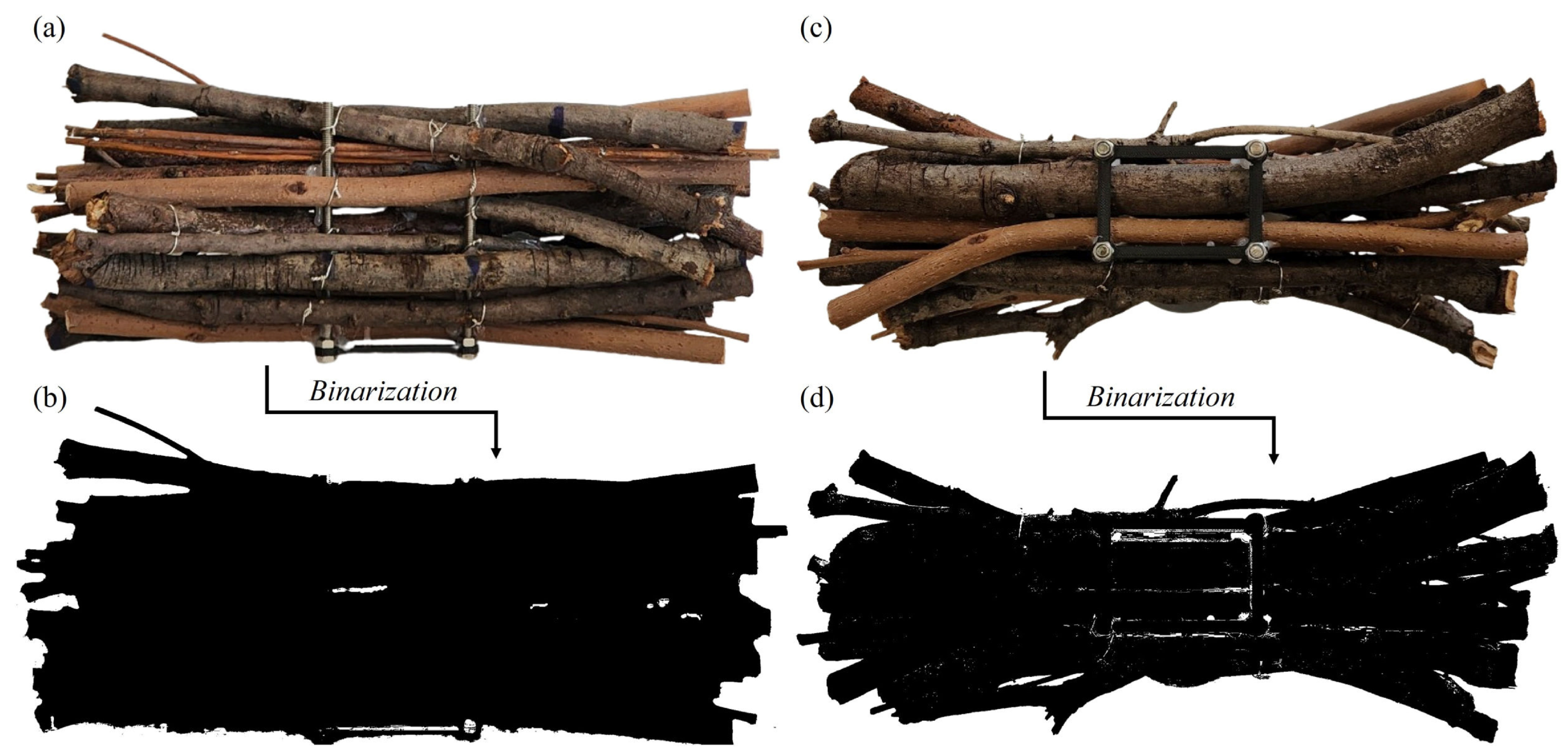
Following [10], projected areas Adrag and Alift were determined through image-based binarization techniques, as illustrated in Figure 6. For each debris configuration, high-resolution photographs were taken from the front (facing flow direction) and from below (for the bottom area) with the camera positioned along the channel centerline. In addition, multiple images were captured for each debris configuration outside the channel in a dark environment to minimize light interference and to support repeatability analysis. Specifically, the camera was positioned precisely to avoid lens distortion. These images were then converted into binary format using thresholdings, where the solid portions of the debris appeared as black pixels and the voids as white. The projected areas were obtained as averaged values from different images, which allowed us to estimate measurement variability associated with lighting and threshold selection. The uncertainty in the projected areas (Adrag and Alift) was estimated equal to ±3%. The black region in each binarized image represents the physical obstruction created by the debris. To estimate Adrag, only the portion of the debris that was submerged during each test was considered. For each specific submergence level, the corresponding projected black area (i.e., the portion of the debris delimited by the water surface) was extracted from the binarized front-view image. This ensured that the drag area accurately reflected the part of the debris subjected to fluid loading. On the other hand, since the bottom part of the debris was fully submerged in all test cases, Alift corresponds to the entire projected bottom area of the debris.
The Froude number Fr was evaluated as Fr = Vu/(g × hu)0.5, where g is the gravitational acceleration. The Reynolds number was calculated by Re = (Vu × hu)/ν, where ν is the kinematic viscosity of water. To characterize geometric flow obstruction, the blockage ratio BR = Adrag/(Ahu), where Ahu = w × hu indicates the upstream cross-sectional flow area. To evaluate the effect of the clearance between the debris and the bed, we consider the proximity ratio Pr. For huBDbh, the proximity ratio was defined as Pr = hb/huB; otherwise, it was taken as Pr = hb/Dbh. Ref. [26] demonstrated that ΔH is an important variable directly affecting the hydrodynamic coefficients of the bridge deck. To account for the effect of this parameter, the authors introduced the non-dimensional variable ΔH* (i.e., the ratio of ΔH to the deck’s height), showing that hydrodynamic coefficients increase with ΔH*, with all other parameters being constant. Since in this study, different debris geometries with varying heights were tested, we consider the non-dimensional parameter ΔHu = ΔH/hu to characterize the localized water surface drop induced by the debris. Another important governing parameter is the inundation ratio h* = (hu,ndhb)/Dbh, which represents the non-dimensional submergence of the debris [9,24,25,26]. The porosity, n, was estimated as the ratio of internal void volume to total volume. It is calculated as n = Vvoid/Vt = 1 − VLWD/Vt, where VLWD is the solid wood volume, Vvoid the void volume, and Vt is the total geometric volume of the debris configuration.
Table 3 summarizes the ranges of variation in the key non-dimensional parameters considered in this study. Re ranged from 2.9 × 10⁴–7.5 × 10⁴, confirming fully turbulent flow conditions across all experiments. Fr varied between 0.12 and 0.57, indicating tests were conducted under subcritical flow conditions, which are representative of real-world applications. The BR ranged from 0.03 to 0.63, capturing a wide spectrum of debris obstruction relative to the channel width. The normalized flow depth difference ΔHu spanned from 0.00 to 0.74, reflecting varying water level scenarios across the debris. Pr exhibited substantial variation from 0.03 to 9.94, accounting for different vertical clearances between debris and channel bed. h* ranged from 0.10 to 1.6, encompassing various submergence levels, including partially submerged (h* < 1) and fully submerged (h* ≥ 1) conditions. n ranged from 0.00 to 0.86, representing different degrees of porosity of debris.
The uncertainty associated with the experimental measurements was quantified based on instrument specifications and repeated measurements. We obtained the following estimates: (a) water depths and other measured heights: ±1 mm; (b) Q: ±1%; (c) FD, FL, and B (LC): ±1 g; and (d) n: ±0.04. Uncertainties in CD and CL were estimated using the standard error-propagation method. Error bars representing these uncertainties are included in figures in the section Results and Discussion.

3. Results and Discussion

3.1. Effect of Governing Parameters on CD and CL

The experimental results of this study showed that the observed CD and CL fall within ranges reported in laboratory experiments and field observations on LWD at bridges [3,4,5,10]. These studies indicate that at both model and prototype scales, CD and CL are primarily controlled by Fr, debris geometry, overall obstructions, clearance, and free-surface interaction [3,4,5,10]. Based on the experimental evidence of the present study and dimensional analysis, CD and CL can be expressed as follows:
C D , C L = f R e , F r , B R , H u , P r , n ,   D b s h p  
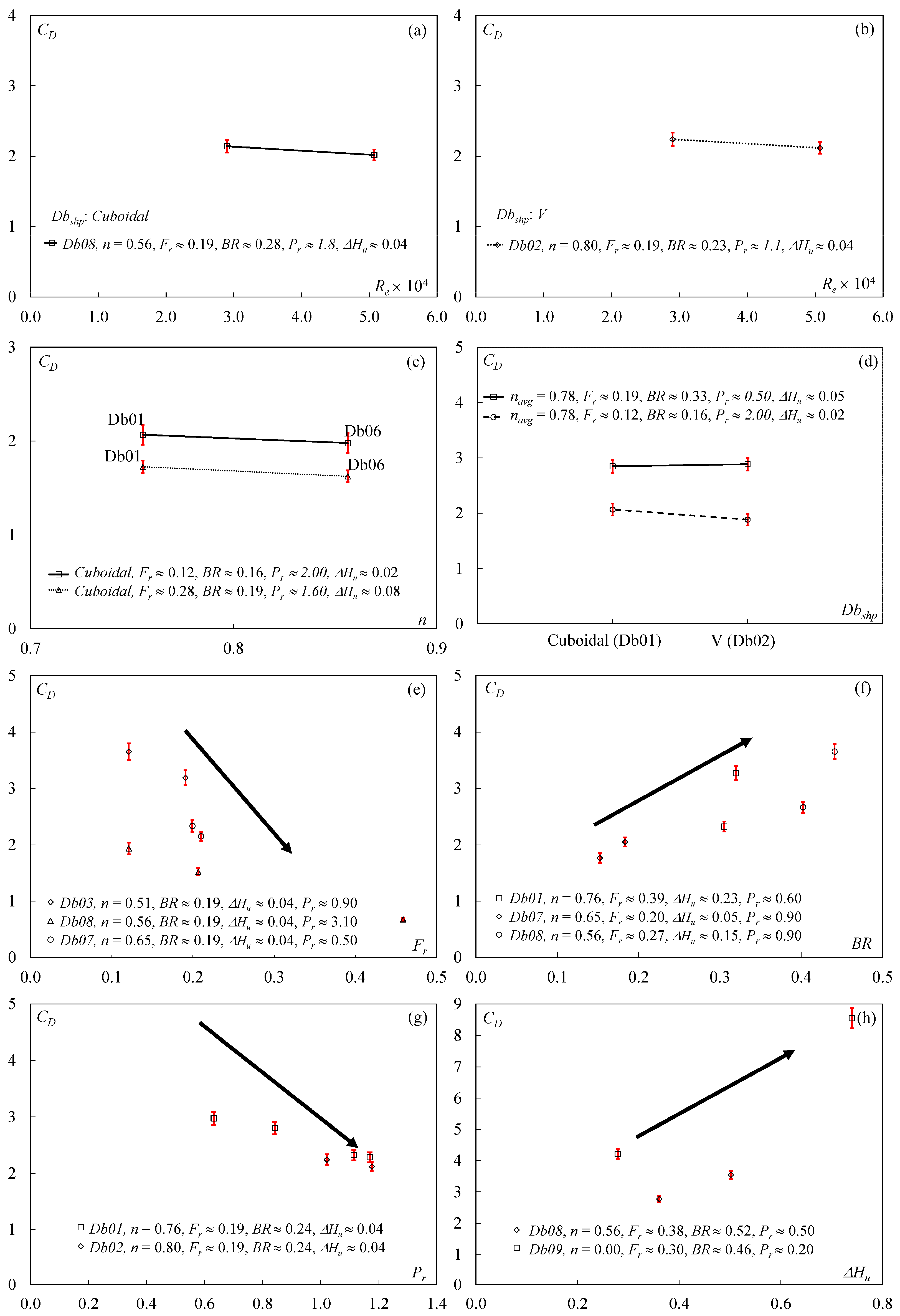
In order to assess the contribution of each independent parameter, a stepwise analysis was conducted. We first focus on CD, observing that, in the tested range, it is not influenced by Re, with all other parameters being constant (Figure 7a,b). This is consistent with classical findings on bluff bodies in turbulent flow, where CD is essentially independent of Re [30,31,32]. Previous studies [4,10,26] have likewise corroborated this behavior, with hydrodynamic coefficients reporting negligible dependence on Re within comparable ranges. Considering this, in free-surface hydraulic modeling, Froude similarity is prioritized as it ensures the correct scaling of gravity-controlled processes such as water-level rise, free-surface deformation, and flow contraction around obstacles [32,33]. Specifically, according to [32] (see Table 2 in that paper), as for forces on solid bodies, moderate scale effects occur for model scales up to 1:50. Consequently, considering the width of the tested channel, our results can be confidently extended to prototype applications characterized by a river width less than approximately 20 m. For larger widths, validation with field data is needed. Possible scale effects due to turbulence structure and surface tension may also occur. However, these effects are considered secondary in the present study because the focus is on time-averaged hydrodynamic forces [32].
Then, we examine the effects of other principle hydraulic and geometric parameters on CD (Figure 7). To this end, we consider selected tests for which only one parameter varies while the others are almost constant (note that these tests are representative of the general behavior).
As shown in Figure 7c, CD values do not vary significantly for n = 0.78 (Db01) and n = 0.84 (Db06), demonstrating that n exerts insignificant influence on CD. This outcome agrees with the findings of [10].
Figure 7d shows that, under similar hydraulic conditions and porosities, cuboidal and V-shaped debris exhibit comparable values of CD. For this comparison, we consider an average porosity navg = 0.78, since n = 0.76 for debris Db01 and n = 0.80 for debris Db02. This indicates that debris shape has an insignificant influence on CD for the tested geometries. Ref. [10] reached a similar conclusion, reporting that CD is essentially independent of the geometric characteristics of the accumulation. This behavior can be explained considering that the debris used in these tests have similar projected frontal areas, which is one of the main parameters affecting drag (Equation (1)). This result has a particular practical relevance, since it allows engineers to neglect debris geometry when designing structures.
Attention is then directed to the effect of Fr (Figure 7e). CD was found to decrease with Fr. This negative correlation has also been reported by previous studies, including [26], which attributed it to the reduction in ΔH* with Fr (see Figure 9c in [26]), thereby lowering the drag. Moreover, from Equation (1), it appears that CD decreases with Vu, which, in turn, increases with Fr. A similar trend was observed by [4], who also proposed a conservative envelope relation for CD. Other approaches considered a different Froude number. Namely, ref. [3] introduced a debris Froude number (FrL) defined using the characteristic debris length, and observed that higher FrL values amplified flow contraction and backwater rise around the jam, thereby increasing the drag. They argued that the geometric scaling through debris length provided a more direct link between flow velocity and obstruction effects, which explains the positive correlation between CD and FrL in their study. In turn, ref. [10] calculated Fr using downstream conditions (i.e., the downstream projected area), which can also explain their observed increase in CD. However, the use of downstream parameters becomes problematic at higher Fr and BR. For example, in our tests, large differences in ΔH between upstream and downstream were frequently observed, and in some cases, the downstream submergence was greatly reduced. This reduction decreases the downstream projected area, leading to higher CD values. In addition, when a jet-like flow occurs beneath the debris, the downstream submerged area tends to 0, therefore the standard drag equation cannot be applied. Furthermore, ref. [10] reported that CD approaches an asymptotic value of about 1.5 at very low values of Fr and BR (see their Figure 3a,b). While this provides a convenient empirical fit to their data, it raises some physical considerations. Specifically, as Fr → 0, the pressure distribution becomes almost hydrostatic. Consequently, these limiting cases suggest that the asymptotic formulation should be interpreted as a practical regression outcome rather than a rigorous physical condition.
Figure 7f highlights that CD increases with BR. This behavior is physically intuitive, as a larger BR produces greater upstream backwater rise, and consequently higher values of FD. The observed trend is consistent with the findings of [10], who also reported a strong dependence of CD on BR, although their analysis of BR was based on downstream reference conditions.
The influence of Pr is clearly visible in Figure 7g, where the CD decreases with Pr. Similar behavior has been reported for bridge decks by [24,25,26,34], which showed that smaller clearances exert a stronger influence on the surrounding flow, enhancing turbulence and promoting flow separation. In such cases, the contraction of streamlines beneath the structure accelerates local velocities, which in turn lowers the downstream wake pressure and amplifies drag. Our results extend these observations to debris accumulations, demonstrating that CD increases monotonically with decreasing Pr, when all other parameters are held constant.
Finally, it can be seen from Figure 7h that CD increases with ΔHu. The upstream–downstream water level difference emerges as one of the main factors governing CD. Physically, when the downstream water level is reduced, the resultant force acting on the debris accumulation increases due to a larger pressure gradient across the structure. As a consequence, the FD rises with ΔH, leading to higher values of CD. Similar trends were reported by [24,26], who highlighted the central role of water level difference in controlling hydrodynamic loads on bridge decks. Our findings extend this evidence to debris accumulations, corroborating that ΔHu represents a first-order parameter in predicting drag.
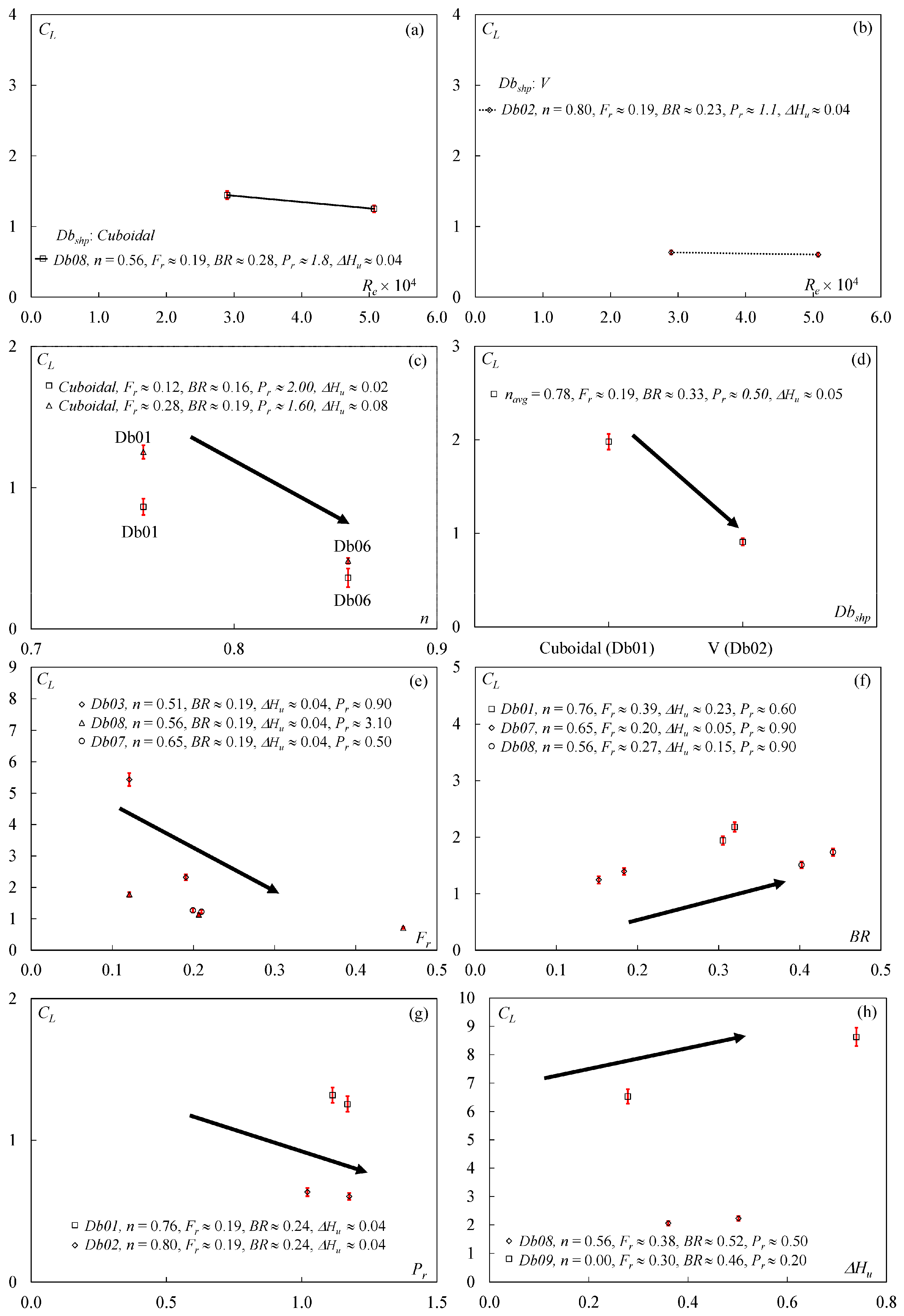
A similar analysis was conducted for the coefficient CL, for which the influence of Re is confirmed to be negligible within the tested range (Figure 8a,b).
Figure 8c illustrates that the effect of n on CL is more pronounced than on CD, with debris characterized by lower n consistently possessing higher CL values than their more permeable counterparts. This behavior can be explained considering that porosity reduces pressure imbalance between the underside and topside. In natural rivers, n influences how flow momentum and turbulence are redistributed around bridge decks and piers. Low-porosity (dense) accumulations tend to increase backwater rise and flow acceleration beneath the debris, which enhances local scour [22]. Meanwhile, higher-porosity accumulations allow partial flow penetration, reducing effective blockage but modifying wake structure and near-bed stresses. Although sediment transport was not modeled in the present study, especially during flood events, suspended sediment can fill the voids within the debris, thus reducing its porosity n [35,36]. Consequently, the hydrodynamic loads acting on debris accumulations may increase.
Figure 8d illustrates the equally significant effect of debris shape on CL. Cuboidal debris generated substantially greater lift than the more streamlined V-shaped form under identical hydraulic conditions. This outcome of different CL for different debris shapes under the same hydraulic conditions is consistent with experimental studies on bridge decks of different bottom shapes or geometry [24,37,38,39]. In fact, these studies show that the underside shape of the structure governs the flow-separation pattern, which in turn controls the suction (negative pressure) beneath the structure. Consequently, different underside shapes lead to different values of CL.
Consistently with what is observed for CD, CL decreases sharply with Fr (Figure 8e). This behavior is due to the decreasing trend of ΔH* with Fr (see Figure 9c of [26]), which reduces the submergence of the debris. In addition, since the approach velocity increases monotonically with Fr, the denominator in Equation (2) grows faster, further contributing to the reduction in CL.
Figure 8f shows a monotonic increase in CL with BR. This behavior mirrors the trend observed for CD. The narrowing of the flow passage increases ΔH, thereby intensifying vertical forces for the reason mentioned above.
The role of Pr is also pronounced, as shown in Figure 8g. When debris was positioned closer to the bed (i.e., at lower Pr), CL values were higher. This outcome is physically intuitive: reduced clearance accelerates the jet beneath the structure, lowers pressure in the downstream wake, and enhances suction on the underside, which amplifies the magnitude of the net lift. Similar trends have been reported for isolated decks and logs, where CL increased with reduced clearance due to wider boundary layer separation, and decreased as the gap widened [5,24,26,32]. Our results extend these observations to debris accumulations.
Finally, it was observed that CL increases with ΔHu (Figure 8h). As the upstream–downstream water level imbalance intensifies, the resultant vertical force on the debris grows. This parameter is therefore of importance for predicting lift, as it is for drag.
In summary, experimental evidence demonstrates that drag and lift on debris are governed by the combined effects of n, Dbshp, Fr, BR, Pr, and ΔHu. Compared to CD, CL is sensitive to debris shape and n, since these parameters directly modulate the pressure imbalance across the body.
To develop predictive relationships for estimating CD and CL, parameters were selected based on the above analyses. Re was omitted from further consideration due to its negligible influence in the tested range. Therefore, Equation (3) becomes:
C D ,   C L = f F r , B R , H u , P r , n ,   D b s h p  
As for CD, Dbshp and n were also excluded, as they showed minimal effect, yielding the simplified formulation in Equation (5).
C D   = f F r , B R , H u , P r
Conversely, both parameters were retained for CL, resulting in the following functional equation:
C L = f F r , B R , H u , P r , n ,   D b s h p  
A power-law framework was adopted to derive empirical equations. This procedure yielded Equation (7) following best-fit formulation (R2 = 0.91 for all tests, R2 = 0.91 for tests with h* < 1, and R2 = 0.85 for tests with h* ≥ 1):
C D ( p r e d i c t e d ) = 2.57 F r 0.70 B R 0.20 H u 0.30 P r 0.20  
This formulation is physically based, reflecting the key mechanisms highlighted in our experimental analysis. Namely, CD decreases with Fr and Pr, while the positive exponents for BR and ΔHu indicate enhanced CD under greater obstruction and water level difference.
A similar approach was adopted to derive the empirical Equation (8), accounting for both debris geometry (via a multiplicative coefficient Kshape) and porosity n.
C L ( p r e d i c t e d ) = K s h a p e C L , b a s e    
where CL,base represents the following base equation:
C L , b a s e = F r 0.58 B R 0.30 H u 0.20 P r 0.20 n 0.20
Once again, Equation (8) is physically based, fully reflecting the trends observed in Figure 8.
It is worth remarking that Equation (9) can be adopted to estimate CL when the shape of debris is unknown. In fact, by using Equation (9) for the entire database, we obtain reasonably good estimations (R2 = 0.75). Specifically, Equation (9) performs better for h* < 1 (R2 = 0.83), while R2 reduces to 0.63 for h* ≥ 1. However, by grouping tests according to the different debris shapes and submergence conditions (i.e., for h* < 1 and h* ≥ 1), and applying Kshape, estimates improve for both (i.e., R2 = 0.91 for h* < 1, and R2 = 0.71 for h* ≥ 1). Values of Kshape, corresponding to different types of debris, are listed in Table 4.
Distinct patterns emerge highlighting the combined influence of n and geometry. Under shallow submergence (h* < 1), the values of Kshape are always bigger, exhibiting marked differences across types. In turn, for impervious debris (Db09), h* does not influence Kshape values.
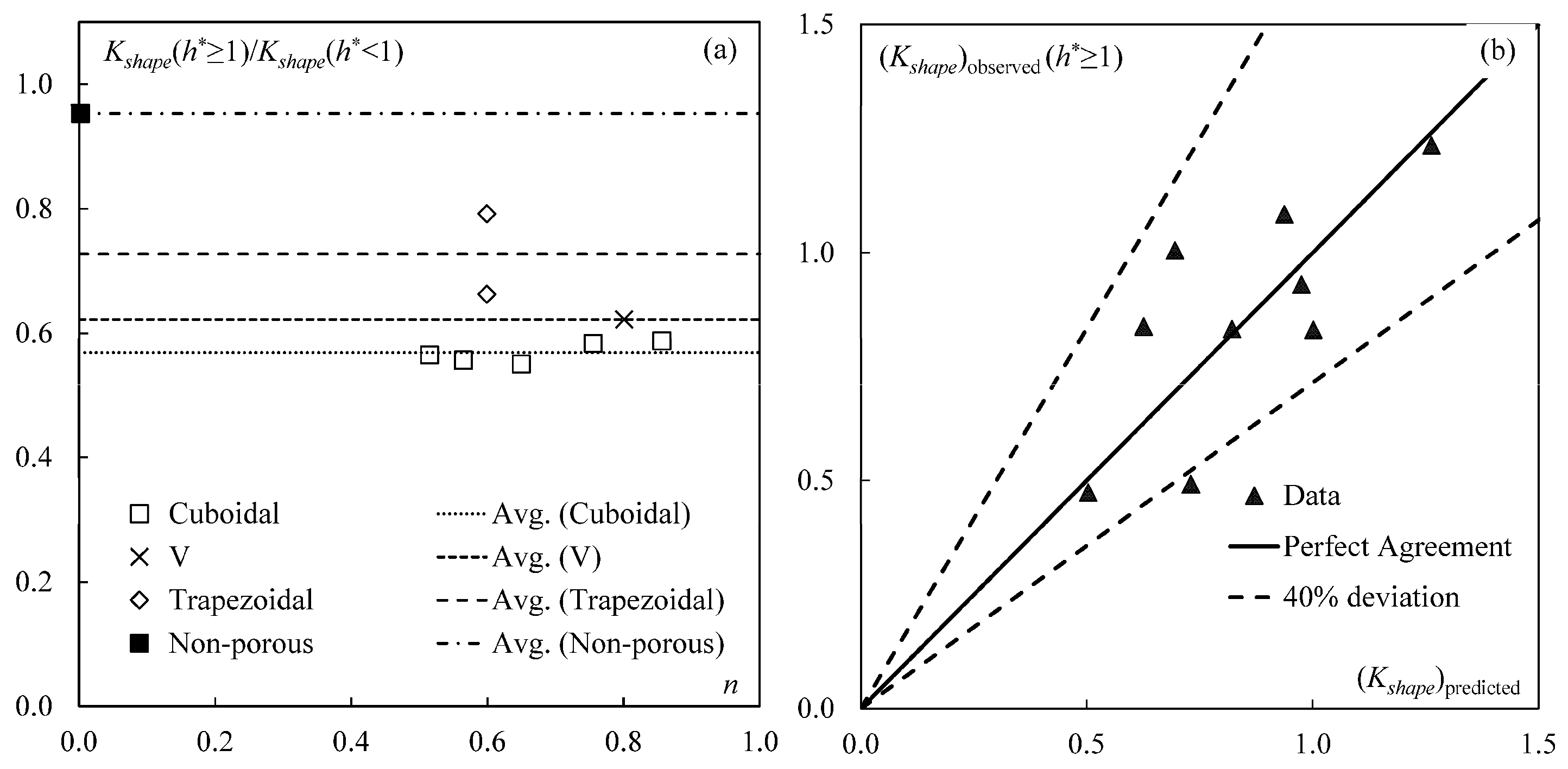
In Figure 9a, we contrast the ratio Kshape(h* ≥ 1)/Kshape(h* < 1) relative to various debris families against porosity n. Cuboidal debris (Db01, Db03, Db06, Db07, and Db08) consistently exhibit the lowest ratios (average ≈ 0.57), confirming their strong sensitivity to submergence. Trapezoidal debris (Db05 and Db06) retain higher ratios (average ≈ 0.73), while V-shaped (Db02) debris show intermediate behavior (average ≈ 0.62). Non-porous cuboidal debris (Db09) remain nearly unaffected, with ratios close to unity. Collectively, these results demonstrate that n governs the rate of decay with submergence, while geometry determines the asymptotic floor level. In summary, cuboidal debris amplify lift most strongly when partially submerged, but weaken substantially under full submergence. Conversely, non-porous debris are essentially unaffected.

3.2. Lift Index

To quantify the effective hydrodynamic influence of debris shape and n on the correction factor Kshape, a dimensionless lift index, denoted as LI, was formulated based on tests with h* ≥ 1 as given below:
L I = 1 n A f m a x A l i f t
This formulation captures the critical effects of (1) the solid volume fraction (via 1 − n) and (2) the ratio of frontal and bottom areas (via Afmax/Alift). As shown in Figure 9b, Kshape is positively correlated to  LI  for h* ≥ 1, i.e., it can be estimated as follows:
K shape = a L I b
where a and b are empirical coefficients equal to 1.38 and 0.47, respectively. It should be noted that Equation (11) is valid for the range of 0.6 ≤ Afmax/Alift ≤ 2.1.
This predictive framework provides engineers and practitioners with a practical tool. By estimating the expected n and the maximum frontal-to-bottom area ratio of incoming debris accumulations, the LI can be readily calculated. From this, Kshape under fully submerged conditions can be determined using Equation (11). Furthermore, values for partially submerged conditions (h* < 1) can be obtained by applying the debris-specific ratios reported in Table 4, thereby enabling consistent prediction of lift effects across submergence regimes. It is worth remarking that our analysis considered the effect of stable debris accumulations, without accounting for their time evolution. However, our model was also successfully validated using experimental data from [3] (see Section 3.3.), where debris accumulations evolved with time and are characterized by different shapes. This suggests that LI and Kshape should be interpreted as effective bulk parameters rather than exact descriptors of individual debris elements.

3.3. Validation

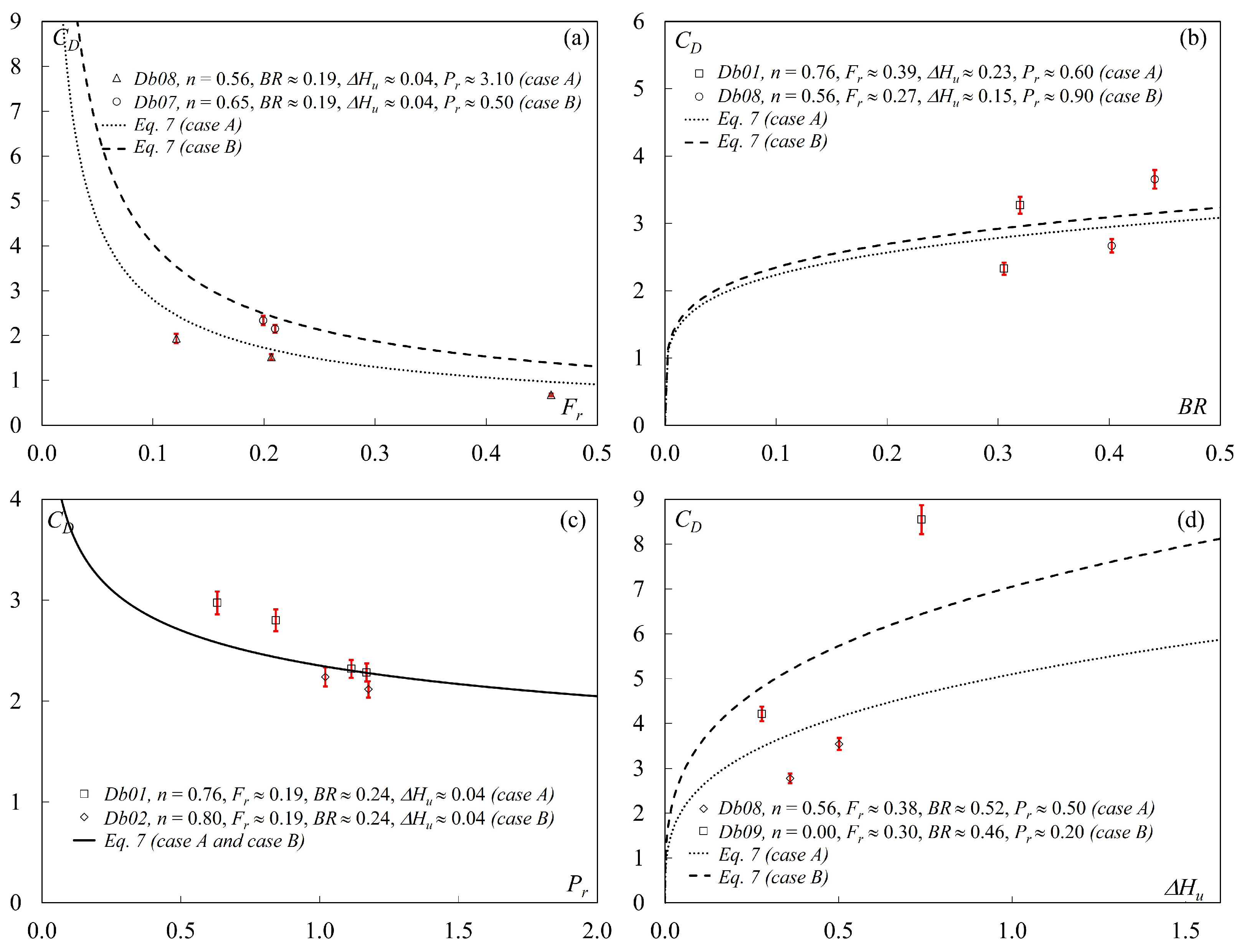
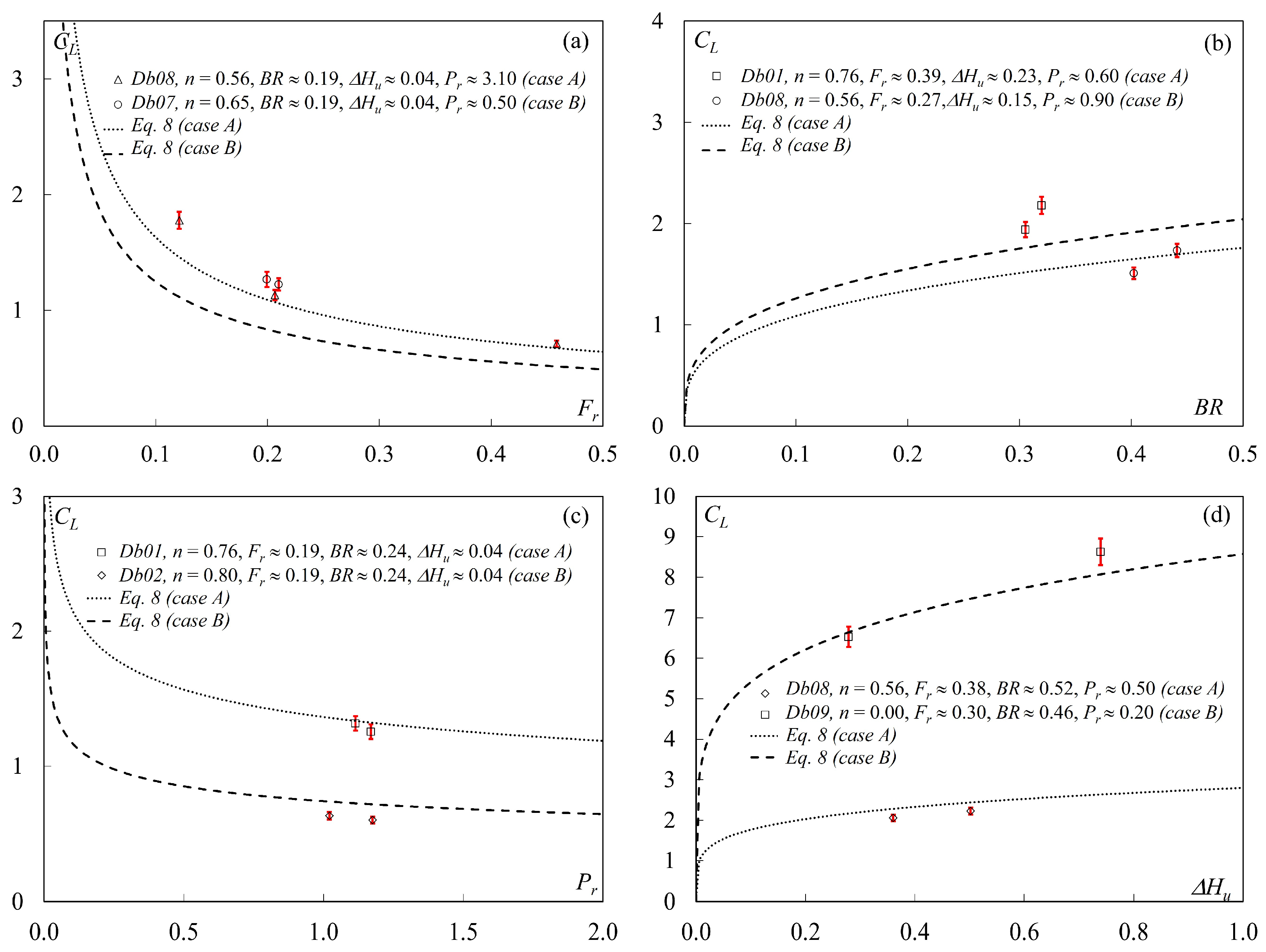
To corroborate the physical consistency of the proposed empirical relationships, we provide Figure 10, where we contrast CD against Fr (Figure 10a), BR (Figure 10b), Pr (Figure 10c), and ΔHu (Figure 10d), while keeping the other parameters (almost) constant. In these figures, we include the plots of Equation (7). Likewise, we do the same for CL (Figure 11). Overall, Equations (7) and (8) capture very well the physical behavior of the experimental data.
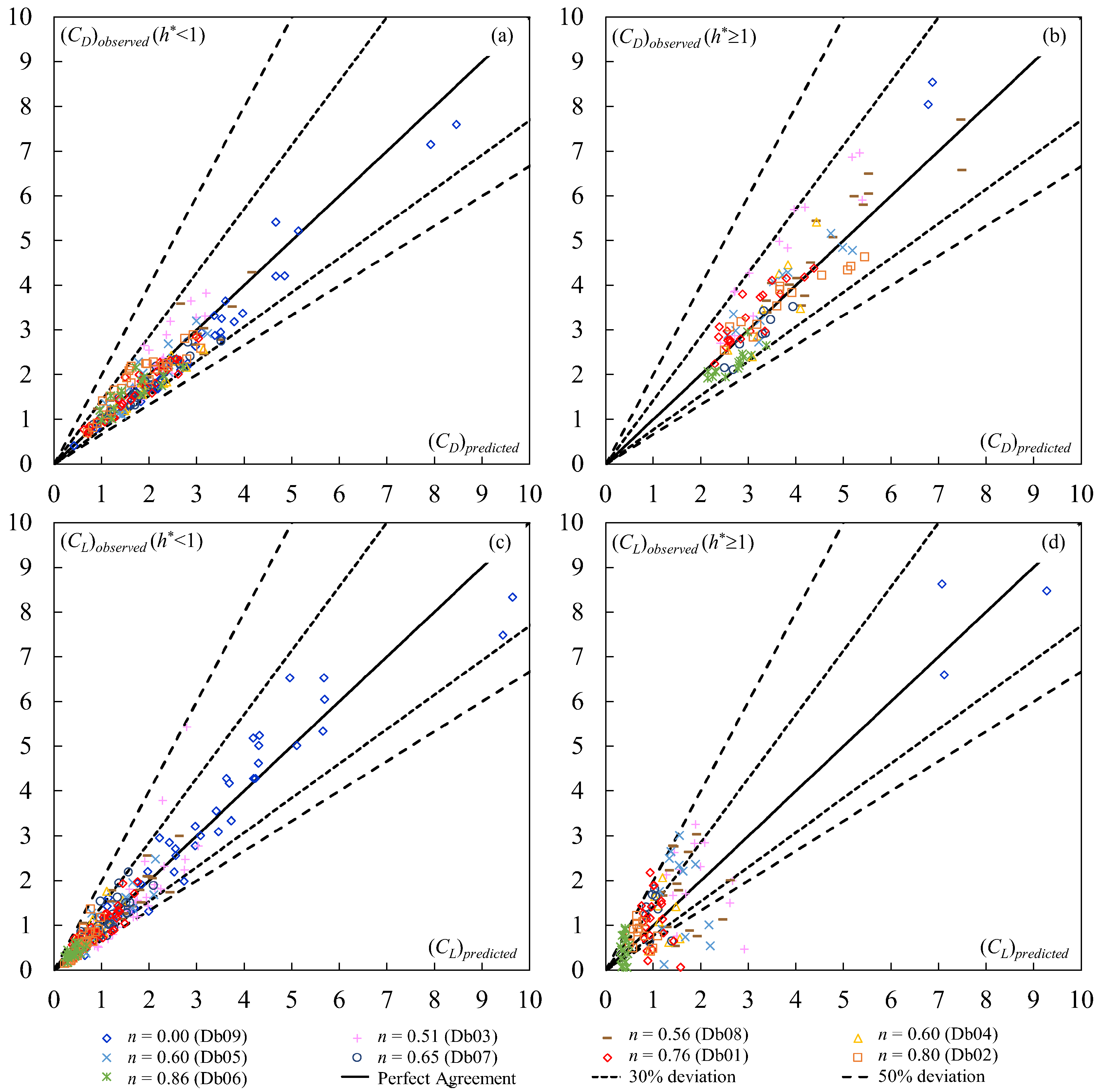
The proposed predictive framework was validated against the complete experimental dataset, considering both drag and lift responses for both h* < 1 and h* ≥ 1 (Figure 12). For CD (Figure 12a,b), the model shows strong predictive capability for h* < 1 (R2 = 0.91 and root mean square error, RMSE = 0.43) and slightly reduced accuracy for h* ≥ 1 (R2 = 0.85 and RMSE = 0.78). Most points cluster tightly around the perfect agreement line, with the majority falling within ±30% deviation. The scatter is somewhat larger for h* ≥ 1, which can be attributed to enhanced free-surface interactions and wake instabilities when debris elements become fully submerged.
For CL (Figure 12c,d), the agreement remains reasonably good, although the dispersion is inherently greater than for CD, reflecting the sensitivity of lift to subtle flow asymmetries, n, and bed proximity. Specifically, under partial submergence (h* < 1, Figure 12c), predictions remain tightly grouped around the line of perfect agreement with R2 = 0.91 and RMSE = 0.40. However, when debris becomes fully submerged (h* ≥ 1, Figure 12d), the scatter increases noticeably with R2 = 0.71 and RMSE = 0.75, consistent with the amplified influence of free-surface effects, vortex shedding, and unsteady wake dynamics. The stronger dispersion at higher submergence also reflects the greater role of n in modulating flow through pressure differentials.
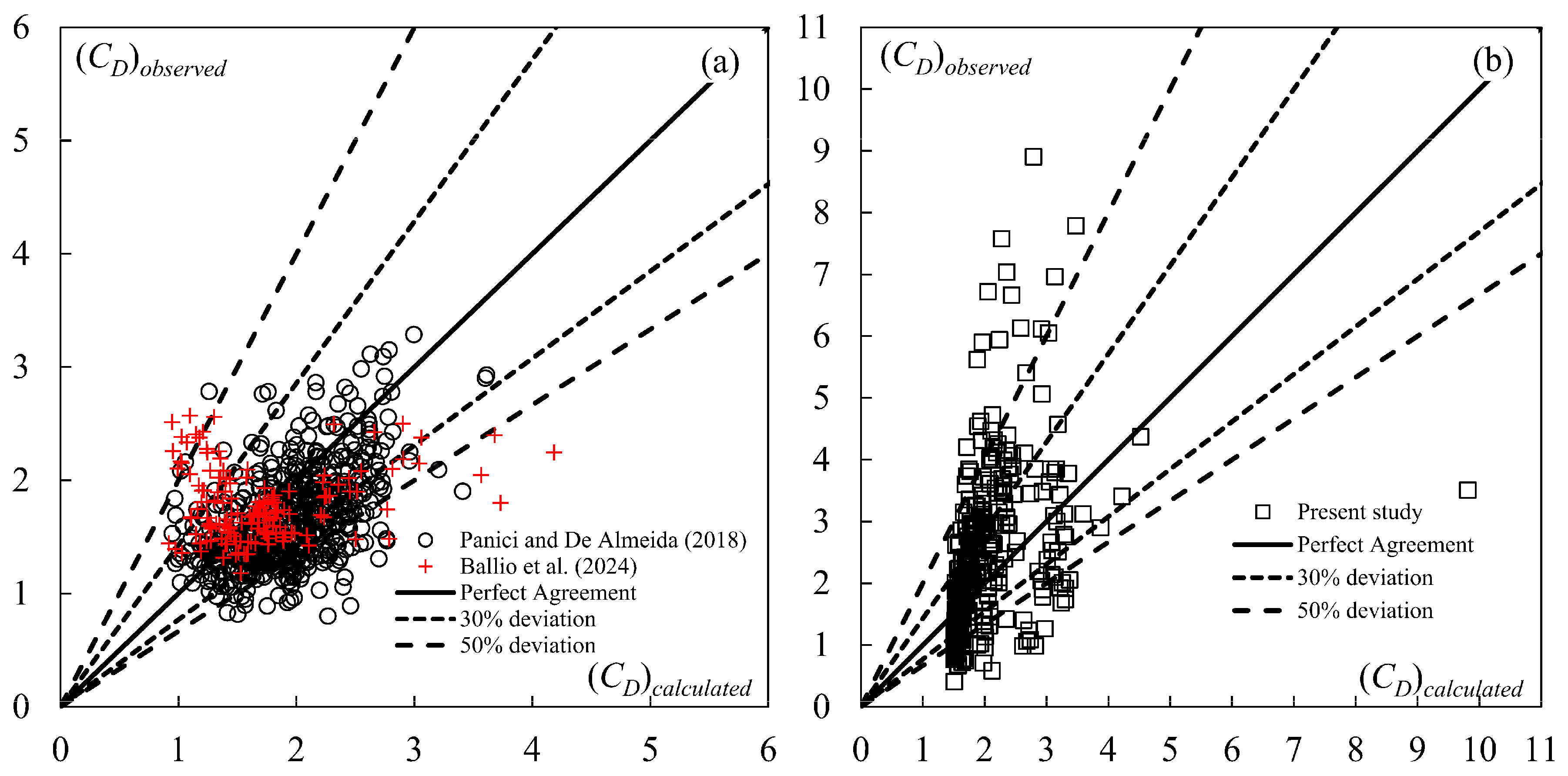
In Figure 13a, we validate Equation (7) using independent datasets from [3,10]. The comparison shows that most data points are within ±30% deviation and nearly all are within ±50%. The RMSE values are 0.59 for the dataset of [3] and 0.91 for that of [10]. It is also evident that these studies reported CD values below 4, whereas the present study obtained values up to 9. This difference arises because the present study’s experiments covered a much wider range of ΔHu (see Table 3). Conversely, refs. [3,10] conducted tests under more similar upstream and downstream water levels and therefore lower net drag forces.
It is important to note that [10] defined the CD, Fr, and BR using downstream hydraulic conditions, whereas in our formulation, all variables are referenced to upstream conditions. To ensure consistency, upstream-based CD, Fr, and BR were recalculated using the supplementary data provided in their study. Moreover, ref. [10] defined the ΔH as the water level immediately upstream of the debris minus the stabilized downstream depth. In contrast, our framework defines ΔH with respect to the level immediately downstream of the debris. Accordingly, ΔH was recalculated. Furthermore, because the bed elevation hb was not explicitly reported, it was estimated from debris geometry. Similarly, ref. [3] did not explicitly report values of ΔHu. To address this, the backwater rise was estimated using the empirical formulation of [40] (see Equations (5) and (6) in that paper), which expresses ΔH/h0 as a function of the approaching Fr and the BR of the rack. Since the experiments of [3] involved the gradual placement of debris elements at a single pier, the maximum BR never exceeded 20%. Under such circumstances, the h0 was assumed equal to the hu, which allowed us to normalize the backwater rise consistently within this study’s framework. This procedure harmonized their dataset with this study’s definitions, enabling us to validate Equation (7) against independent flume experiments.
It is important to note that these works did not provide CL, therefore we could not validate Equation (8). In fact, only [5] reported CL values. However, because their dataset does not include all the governing parameters required in the predictive equation for CL, quantitative validation was not possible. Nevertheless, their near-prototype experiments on cylindrical logs demonstrated that CL decreases systematically with clearance (Pr). In turn, it increases as logs approach overtopping conditions, which is consistent with the exponents derived herein and with the trends illustrated in Figure 8g,h. Although [5] focused on individual large wood pieces rather than debris accumulations on bridge decks, the agreement in dominant trends and coefficient ranges provides an important and independent validation of the predictive framework.
In Figure 13b, observed downstream CD from the present study are compared with values calculated using Equation (4) of [10]. To ensure consistency with the drag formulation in [10], all variables were recalculated using downstream flow data. The RMSE for the datasets was equal to 1.29. Most data points fall within the ±50% deviation bands. However, several calculated CD values are consistently lower than the corresponding observations. This underprediction is attributed to the exclusion of proximity effects and ΔH in Equation (4) of [10], which have been identified as very important parameters in the present experiments.

4. Conclusions

This study demonstrates that CD and CL increase with BR and ΔHu, but decreases with Fr and Pr. While CD proved largely insensitive to n and geometry within our tested range, CL showed strong dependence on these factors, emphasizing the role of pressure imbalance in vertical loading. Re effects were negligible within the tested range.
Building on these insights, empirical predictive equations were formulated for estimating CD and CL, and validated against independent datasets. Unlike previous formulations, the proposed framework explicitly incorporates the effects of ΔHu and Pr, which are often overlooked in debris hydrodynamics, thereby extending predictive capability to a wider range of configurations. The resulting equations offer practical value for bridge design, flood risk assessment, and the calibration of numerical models addressing debris–structure interaction.
The present work remains constrained to rigid-bed conditions, straight channel geometry, and subcritical flow regimes. The proposed predictive equations can be confidently applied to rivers/streams whose width is less than 20 m. For larger widths, additional validations are needed. However, the proposed model can also provide useful design indications for these cases.
Future studies should extend the analysis to movable beds, compound and circular channel geometries, and extreme hydraulic conditions such as supercritical flows, waves, and currents. Overall, this study advances the physics-based understanding of debris-induced hydrodynamic loads and provides a robust foundation for improving the resilience of bridges in debris-prone rivers.

Author Contributions

Conceptualization, S.P., A.K. and M.P.; methodology, S.P., A.K. and M.P.; validation, S.P., A.K. and M.P.; formal analysis, S.P., A.K. and M.P.; investigation, S.P., A.K. and M.P.; resources, S.P. and M.P.; data curation, S.P., A.K. and M.P.; writing—original draft preparation, S.P., A.K. and M.P.; writing—review and editing, S.P., A.K. and M.P.; supervision, S.P. and M.P. All authors have read and agreed to the published version of the manuscript.

Funding

This research received no external funding.

Data Availability Statement

The raw data supporting the conclusions of this article will be made available by the authors on request.

Acknowledgments

The authors would like to thank Claudio Rossi and the technicians of the hydraulics laboratory of the University of Pisa, Nicola Bruni, Antonio Cecchi, Alessandro Michelotti, and Vincenzo Pennabea, for their help in building the experimental apparatus.

Conflicts of Interest

The authors declare no conflicts of interest.

Abbreviations and Symbols

The following abbreviations and symbols are used in this manuscript:
AdragProjected area of the debris facing the flow (m2)
AfmaxMaximum frontal projected area of debris (m2)
AliftProjected bottom area beneath the debris (m2)
AprojProjected area (m2)
BBuoyancy due to submerged debris portion (N)
BR=Adrag/(Ahu) = Blockage ratio (–), here, Ahu = Upstream cross-sectional flow area = w × hu
CFDComputational fluid dynamics
CFD-DEMComputational fluid dynamics–discrete element method
CD=FD/(0.5ρ(Vu)2Adrag) = Drag coefficient (–)
CL=(FLB)/(0.5ρ(Vu)2Alift) = Lift coefficient (–)
d50Mean sediment grain diameter (mm)
DbhDebris height (m)
DblDebris length (m)
DbshpDebris shape
DbwDebris width (m)
Dbw/wRelative debris width to channel ratio (–)
FDDrag force on the debris readout by load cell (N)
FLLift force on the debris readout by load cell (N)
Fr=Vu/(ghu)0.5 = Froude number (–)
FrLDebris Froude number (–)
gAcceleration due to gravity (m/s2)
hChannel depth (m)
h*=(hu,ndhb)/Dbh = Inundation ratio
h0Initial water level (m)
hbClearance between debris bottom and channel bed (m)
hdDownstream water depth (m)
hd,ndDownstream water depth immediately near debris (m)
huUpstream water depth (m)
hu,ndUpstream water depth immediately near debris (m)
huB=(hu,ndhb) = Local upstream water depth at the debris face (m)
KshapeShape coefficient (−)
lChannel length (m)
LCLoad cells
LILift index (−)
LWDLarge wood debris
NINational Instruments
Pr=hb/huB (h* < 1) or Pr = hb/Dbh (h* ≥ 1) = Proximity ratio (–)
QFlow discharge (m3/s)
Re=Vu × hu/(ν) = Reynolds number (–)
VuUpstream flow velocity (m/s)
VLWDSolid wood volume (m3)
wChannel width (m)
Z0Fixed bed level
ΔH=hu,ndhd,nd = Difference between upstream and downstream water level (m)
ΔHuH/hu = Non-dimensional water level difference between upstream and downstream water level (–)
νKinematic viscosity of water (m2/s)
ρWater density (kg/m3)
Yes
No
Partially studied

References

  1. Schmocker, L.; Hager, W.H. Probability of Drift Blockage at Bridge Decks. J. Hydraul. Eng. 2011, 137, 470–479. [Google Scholar] [CrossRef]
  2. Pagliara, S.; Carnacina, I. Influence of Wood Debris Accumulation on Bridge Pier Scour. J. Hydraul. Eng. 2011, 137, 254–261. [Google Scholar] [CrossRef]
  3. Panici, D.; De Almeida, G.A.M. Formation, Growth, and Failure of Debris Jams at Bridge Piers. Water Resour. Res. 2018, 54, 6226–6241. [Google Scholar] [CrossRef]
  4. Parola, A.C.; Apelt, C.J.; Jempson, M.A. Debris Forces on Highway Bridges; National Cooperative Highway Research Program Report 445; Transportation Research Board: Washington, DC, USA, 2000. [Google Scholar]
  5. Shields, F.D., Jr.; Alonso, C.V. Assessment of Flow Forces on Large Wood in Rivers. Water Resour. Res. 2012, 48, W04516. [Google Scholar] [CrossRef]
  6. Schalko, I.; Schmocker, L.; Weitbrecht, V.; Boes, R.M. Backwater Rise Due to Large Wood Accumulations. J. Hydraul. Eng. 2018, 144, 04018056. [Google Scholar] [CrossRef]
  7. Schalko, I.; Lageder, C.; Schmocker, L.; Weitbrecht, V.; Boes, R.M. Laboratory Flume Experiments on the Formation of Spanwise Large Wood Accumulations: I. Effect on Backwater Rise. Water Resour. Res. 2019, 55, 4854–4870. [Google Scholar] [CrossRef]
  8. Mauti, G.; Stolle, J.; Takabatake, T.; Nistor, I.; Goseberg, N.; Mohammadian, A. Experimental Investigation of Loading Due to Debris Dams on Structures. J. Hydraul. Eng. 2020, 146, 04020029. [Google Scholar] [CrossRef]
  9. Kabir, S.M.I.; Ahmari, H.; Dean, M. Contribution of Debris and Substructures to Hydrodynamic Forces on Bridges. Eng. Struct. 2023, 283, 115878. [Google Scholar] [CrossRef]
  10. Ballio, F.; Viscardi, S.; Pallavicini, P.; Malavasi, S. Drag Coefficients of Debris Accumulations. J. Hydraul. Eng. 2024, 150, 06024003. [Google Scholar] [CrossRef]
  11. Diehl, T.H.; Bryan, B.A. Supply of Large Woody Debris in a Stream Channel. In Proceedings of the 1993 National Conference on Hydraulic Engineering. Part 1 (of 2), San Francisco, CA, USA, 25–30 July 1993; pp. 1055–1060. [Google Scholar]
  12. Braudrick, C.A.; Grant, G.E. When Do Logs Move in Rivers? Water Resour. Res. 2000, 36, 571–583. [Google Scholar] [CrossRef]
  13. Bocchiola, D.; Rulli, M.C.; Rosso, R. A Flume Experiment on the Formation of Wood Jams in Rivers. Water Resour. Res. 2008, 44, W02408. [Google Scholar] [CrossRef]
  14. Abbe, T.B.; Montgomery, D.R. Patterns and Processes of Wood Debris Accumulation in the Queets River Basin, Washington. Geomorphology 2003, 51, 81–107. [Google Scholar] [CrossRef]
  15. Gurnell, A.M.; Gregory, K.J.; Petts, G.E. The Role of Coarse Woody Debris in Forest Aquatic Habitats: Implications for Management. Aquat. Conserv. Mar. Freshw. Ecosyst. 1995, 5, 143–166. [Google Scholar] [CrossRef]
  16. Andreoli, A.; Comiti, F.; Lenzi, M.A. Characteristics, Distribution and Geomorphic Role of Large Woody Debris in a Mountain Stream of the Chilean Andes. Earth Surf. Process. Landf. 2007, 32, 1675–1692. [Google Scholar] [CrossRef]
  17. Wohl, E. Bridging the Gaps: An Overview of Wood across Time and Space in Diverse Rivers. Geomorphology 2017, 279, 3–26. [Google Scholar] [CrossRef]
  18. Lyn, D.; Cooper, T.; Yi, Y.-K. Debris Accumulation at Bridge Crossings: Laboratory and Field Studies; FHWA/IN/JTRP-2003/10; Joint Transportation Research Program; Purdue University: West Lafayette, IN, USA, 2003. [Google Scholar]
  19. Melville, B.W.; Dongol, D.M. Bridge Pier Scour with Debris Accumulation. J. Hydraul. Eng. 1992, 118, 1306–1310. [Google Scholar] [CrossRef]
  20. Pagliara, S.; Carnacina, I. Temporal Scour Evolution at Bridge Piers: Effect of Wood Debris Roughness and Porosity. J. Hydraul. Res. 2010, 48, 3–13. [Google Scholar] [CrossRef]
  21. Palermo, M.; Pagliara, S.; Roy, D. Effect of Debris Accumulation on Scour Evolution at Bridge Pier in Bank Proximity. J. Hydrol. Hydromech. 2021, 69, 108–118. [Google Scholar] [CrossRef]
  22. Panici, D.; Kripakaran, P. Characterizing the Importance of Porosity of Large Woody Debris Accumulations at Single Bridge Piers on Localized Scour. Water Resour. Res. 2023, 59, e2022WR033531. [Google Scholar] [CrossRef]
  23. Wellwood, N.; Fenwick, J. A Flood Loading Methodology for Bridges. In Proceedings of the 15th Australian Road Research Board Conference, Darwin, Australia, 26-31 August 1990; ARRB: Port Melbourne, Australia, 1990; pp. 315–341. [Google Scholar]
  24. Kabir, S.M.I.; Ahmari, H.; Dean, M. Experimental Study to Investigate the Effects of Bridge Geometry and Flow Condition on Hydrodynamic Forces. J. Fluids Struct. 2022, 113, 103688. [Google Scholar] [CrossRef]
  25. Malavasi, S.; Guadagnini, A. Interactions between a Rectangular Cylinder and a Free-Surface Flow. J. Fluids Struct. 2007, 23, 1137–1148. [Google Scholar] [CrossRef]
  26. Palermo, M.; Kumar, A.; Wei, H.; Pagliara, S. Hydrodynamic Loads on Rectangular Bridge Decks at Very Low Proximity in Fixed and Movable Beds. Water 2025, 17, 617. [Google Scholar] [CrossRef]
  27. Pagliara, S.; Kumar, A.; Wei, H.; Palermo, M. Hydrodynamic Impacts on Bridge Decks: A Comprehensive Literature Review. In Proceedings of the 41st IAHR World Congress, Singapore, 22–27 June 2025; IAHR: Singapore, 2025; pp. 190–198. [Google Scholar] [CrossRef]
  28. De Cicco, P.N.; Paris, E.; Solari, L.; Ruiz-Villanueva, V. Bridge Pier Shape Influence on Wood Accumulation: Outcomes from Flume Experiments and Numerical Modelling. J. Flood Risk Manag. 2020, 13, e12599. [Google Scholar] [CrossRef]
  29. Wang, Z.; Zhou, H.; Li, Y.; Wang, Z. Numerical Simulation of Debris Flow Impact on Pier with Different Cross-Sectional Shapes Based on Coupled CFD-DEM. Int. J. Numer. Anal. Methods Geomech. 2025, 49, 2025–2046. [Google Scholar] [CrossRef]
  30. Hoerner, S.F. Fluid Dynamic Drag: Theoretical, Experimental and Statistical Information; Hoerner Fluid Dynamics: Washington, DC, USA, 1992. [Google Scholar]
  31. White, F.M. Fluid Mechanics; McGraw-Hill: New York, NY, USA, 2011. [Google Scholar]
  32. Heller, V. Scale Effects in Physical Hydraulic Engineering Models. J. Hydraul. Res. 2011, 49, 293–306. [Google Scholar] [CrossRef]
  33. Schmocker, L.; Hager, W.H. Scale Modeling of Wooden Debris Accumulation at a Debris Rack. J. Hydraul. Eng. 2013, 139, 827–836. [Google Scholar] [CrossRef]
  34. Malavasi, S.; Guadagnini, A. Hydrodynamic Loading on River Bridges. J. Hydraul. Eng. 2003, 129, 854–861. [Google Scholar] [CrossRef]
  35. Palermo, M.; Wei, H.; Kumar, A.; Bombardelli, F.A.; Pagliara, S. 3D Scour due to Low-inclined Circular Jets in Cohesive Soils: A Preliminary Analysis. In Proceedings of the 41st IAHR World Congress, Singapore, 22–27 June 2025; IAHR: Singapore, 2025; pp. 315–322. [Google Scholar] [CrossRef]
  36. Palermo, M.; Di Nardi, J.; Bombardelli, F.A.; Pagliara, S. Scour due to Circular Jets in Cohesive Soils: Physical Evidence from Three-dimensional Laboratory Tests. Phys. Fluids 2024, 36, 095169. [Google Scholar] [CrossRef]
  37. Jempson, M. Flood and Debris Loads on Bridges. Ph.D. Thesis, The University of Queensland, Brisbane, Australia, 2000. [Google Scholar]
  38. Kerenyi, K.; Sofu, T.; Guo, J. Hydrodynamic Forces on Inundated Bridge Decks; U.S. Department of Transportation: Washington, DC, USA, 2009. [Google Scholar]
  39. Naderi, N. Numerical Simulation of Hydrodynamic Forces on Bridge Decks. Master’s Thesis, Delft University of Technology, Delft, The Netherlands, 2018. [Google Scholar]
  40. Zayed, M.; Saleh, M. Assessing the Backwater Rise of Floating Barriers with Racks for Various Blockages in Open Channels. J. Eng. Appl. Sci. 2025, 72, 20. [Google Scholar] [CrossRef]
Figure 1. Schematic representation of the experimental flume setup.
Water 18 00220 g001
Figure 2. Diagram sketch of experimental setup with fixed bed: (a) side view, (b) top view, and (c) front view.
Water 18 00220 g002
Figure 3. Types of debris used in the experiments: (a) Db01, (b) Db02, (c) Db03, (d) Db04, (e) Db05, (f) Db06, (g) Db07, (h) Db08, and (i) Db09.
Water 18 00220 g003
Figure 4. Side view of debris configurations tested in the flume channel: (a) Db01, (b) Db02, (c) Db03, (d) Db04, (e) Db05, (f) Db06, (g) Db07, (h) Db08, and (i) Db09 with corresponding porosity values n. All tests are performed for Q = 25 L/s, h0 = 12.5 cm, and hb = 6.5 cm. Flow is from left to right.
Water 18 00220 g004
Figure 5. Experimental setup showing: (a) side, (b) upstream, and (c) downstream views of the caged cuboidal debris (Db03) during a test.
Water 18 00220 g005
Figure 6. Image-based binarization process to quantify projected debris areas: (a) front view of Db08 and (b) corresponding binarized image used to compute projected drag area Adrag; and (c) bottom view of Db08 and (d) corresponding binarized image used to compute projected lift area Alift. The black regions represent the solid portions of the debris and white regions represents void spaces.
Water 18 00220 g006
Figure 7. Effect of Re on CD for (a) cuboidal and (b) V-shaped debris. Effect of (c) n, (d) Dbshp, (e) Fr, (f) BR, (g) Pr, and (h) ΔHu on CD. Error bars associated with CD are also indicated in red color.
Water 18 00220 g007
Figure 8. Effect of Re on CL for (a) cuboidal and (b) V-shaped debris. Effect of (c) n, (d) Dbshp, (e) Fr, (f) BR, (g) Pr, and (h) ΔHu on CL. Error bars associated with CL are also indicated in red color.
Water 18 00220 g008
Figure 9. (a) Variation in the ratio Kshape(h* ≥ 1)/Kshape(h* < 1) with n for different debris families. Symbols represent individual debris shape category, while dashed lines denote family averages. (b) Comparison between observed and calculated Kshape values using Equation (11) for tests with h* ≥ 1. The solid line represents perfect agreement, while dashed lines indicate ±40% deviation.
Water 18 00220 g009
Figure 10. Comparison between experimental data and predictions of Equation (7) for CD as a function of (a) Fr, (b) BR, (c) Pr, and (d) ΔHu. Symbols denote experimental data for different debris cases, while lines represent the plots of Equation (7) under corresponding hydraulic conditions. Error bars associated with CD are also indicated in red color.
Water 18 00220 g010
Figure 11. Comparison between experimental data and predictions of Equation (8) for CL as a function of (a) Fr, (b) BR, (c) Pr, and (d) ΔHu. Symbols denote experimental data for different debris cases, while lines represent the plots of Equation (8) under corresponding hydraulic conditions. Error bars associated with CL are also indicated in red color.
Water 18 00220 g011
Figure 12. Comparison between observed and predicted (with Equations (7) and (8)) values of (a) CD (h* < 1), (b) CD (h* ≥ 1), (c) CL (h* < 1), and (d) CL (h* ≥ 1). The solid line denotes perfect agreement, while dashed lines represent ±30% and ±50% deviation bands. Data points correspond to different types of debris and porosities as indicated in the legend.
Water 18 00220 g012
Figure 13. (a) Comparison between observed and calculated CD values using Equation (7) for tests from [3,10]. (b) Comparison between observed and calculated CD values using Equation (4) of [10] for present tests by considering downstream flow and geometrical parameters. The solid line represents perfect agreement, while the dashed and dotted lines indicate ±30% and ±50% deviation, respectively.
Water 18 00220 g013
Table 1. Summary of selected relevant studies.
ReferenceStudied AspectsParameters Investigated and/or Utilized in Predictive Formulations
DbshpnFD or CDFL or CLFrBRPrΔHu
or
Backwater
h*
or
Submergence
[1]Debris blockage probability
[3]Jam formation and loading
[4]Hydraulic loads by debris
[5]Drag–lift on single LWD
[7]Backwater rise from debris jams
[10]Drag of debris jams
[20]Scour evolution with debris
Present StudyDrag–lift of debris accumulations
Note: Symbols used: ✓ = Yes, ✗ = No, and ◐ = Partially investigated.
Table 2. Summary of physical and geometric properties of tested debris configurations.
Debris Typen (−)(Dbl × Dbw × Dbh)
(cm)
Dbw/w
(−)
Weight (g)VLWD
(cm3)
Afmax (cm2)Alift
(cm2)
Db01—Medium width cuboidal0.768.5 × 20 × 9.50.58396.98353.56168.08130.91
Db02—V0.8024 × 21 × 10.50.61465.37707.13206.79273.68
Db03—Caged cuboidal0.5118 × 18 × 10.50.521196.881649.97140.18241.16
Db04—Caged trapezoidal0.6017 × 19 × 100.55864.14942.84153.05195.50
Db05—Inverted caged trapezoidal0.6017 × 19 × 100.55864.14942.84176.00195.50
Db06—High-porosity cuboidal0.865 × 27 × 8.50.78224.63165.00163.41136.77
Db07—Small width cuboidal0.658 × 13 × 110.38377.86400.71134.2591.10
Db08—Large width cuboidal0.566.7 × 28 × 10.50.81682.20824.98303.76235.24
Db09—Polystyrene cuboidal0.008 × 17 × 16.50.49220.942244.00280.50136.00
Table 3. Ranges of variation in the main non-dimensional parameters.
ParametersRange
Re2.9 × 104–7.5 × 10⁴
Fr0.12–0.57
BR0.03–0.63
ΔHu0.00–0.74
Pr0.03–9.94
h*0.10–1.60
n0.00–0.86
Table 4. Shape correction factors (Kshape) pertaining to different debris types, grouped for h* < 1 and h* ≥ 1.
Debris TypeDebris Name K s h a p e  (h* < 1) K s h a p e  (h* ≥ 1) K s h a p e h * 1 K s h a p e h * < 1
Db01Medium width cuboidal1.440.840.58
Db02V0.790.490.62
Db03Caged cuboidal2.271.280.56
Db04Caged trapezoidal1.120.890.79
Db05Inverted caged trapezoidal1.641.080.66
Db06High-porosity cuboidal0.640.380.59
Db07Small width cuboidal1.500.820.55
Db08Large width cuboidal1.500.830.56
Db09Polystyrene cuboidal0.980.930.95
Disclaimer/Publisher’s Note: The statements, opinions and data contained in all publications are solely those of the individual author(s) and contributor(s) and not of MDPI and/or the editor(s). MDPI and/or the editor(s) disclaim responsibility for any injury to people or property resulting from any ideas, methods, instructions or products referred to in the content.