Skip to Content
WaterWater
  • Article
  • Open Access

6 January 2026

Quasi-2D Axisymmetric Modelling of Smooth–Turbulent Transient Flow: Comparison with 1D and 3D-CFD Models


and
1
Department of Civil Engineering, Polytechnic of Porto, 4200-465 Porto, Portugal
2
Civil Engineering Research and Innovation for Sustainability, Instituto Superior Técnico, Universidade de Lisboa, 1649-004 Lisboa, Portugal
*
Author to whom correspondence should be addressed.
This article belongs to the Special Issue Hydrodynamics in Pressurized Pipe Systems

Abstract

This study compares the numerical results obtained with an axisymmetric quasi two-dimensional (Q2D) model with those from two different types of dimensional models for smooth–turbulent transient flows generated by an instantaneous valve closure. The first is a high-accuracy three-dimensional computational fluid dynamics (3D-CFD) model. The second type is the one-dimensional (1D) model, analysing results from five unsteady friction formulations, namely four convolution integral-based (CIB) formulations and one instantaneous acceleration-based (IAB) formulation. The Q2D and 1D models are also compared with experimental data collected under laboratory conditions for a fast but non-instantaneous valve closure. The differences between the 1D, Q2D and 3D-CFD modelling approaches are quantified and discussed, focusing on the ability of each model to reproduce the different features of the transient flow phenomenon and the associated computation–accuracy trade-offs. The 3D-CFD model exhibits a more pronounced front-wave rounding, as it more accurately represents the valve conditions, where its closure induces highly turbulent flow with a strongly heterogeneous velocity profile. The Q2D model provides an accurate estimation of unsteady energy dissipation, when fully developed flow conditions are ensured with the advantage of requiring less computational effort than the 3D-CFD. These conclusions also apply to full convolution-based 1D models, whereas approximate 1D formulations can significantly reduce accuracy and limit their range of applicability. The comparison with experimental data corroborates the excellent results of the Q2D model. The Q2D model demonstrates to be an efficient alternative in terms of accuracy and computational time to 3D-CFD and 1D full convolution models.

1. Introduction

The development of accurate, simple and computationally efficient numerical models for transient flow simulations has been a major challenge over the past decades. Transient flow modelling is inherently complex. An ideal representation should account for secondary phenomena not captured by the classical Joukowsky formulation, including fluid structure interaction, cavitation, pipe-wall viscoelasticity and frequency-dependent energy dissipation [1,2,3,4,5].
The investigation effort to accurately calculate unsteady energy dissipation has followed different paths [6]. The instantaneous acceleration-based (IAB) one-dimensional (1D) formulations calculate friction losses based on the local and convective instantaneous accelerations, derived directly from mean velocity values without accounting for cross-sectional velocity distribution [7,8,9]. The convolution integral-based (CIB) 1D models incorporate past local accelerations through weighting functions to account for the velocity profile dynamics. These methods assume an axisymmetric velocity distribution and radially uniform pressure, resulting in higher accuracy compared with IAB formulations [10,11]. The quasi two-dimensional (Q2D) axisymmetric models adopt nearly the same assumptions as the CIB methods and, therefore, tend to have comparable results. However, Q2D models numerically discretise the pipe cross-section into concentric hollow cylinders and compute the axial and radial velocities within each cylinder independently, thereby enabling the incorporation of realistic turbulence models [12,13]. The three-dimensional computational fluid dynamics (3D-CFD) models solve all three velocity components without relying on axisymmetric or uniform-pressure assumptions and allow the use of advanced turbulence models [14,15,16].
No exact and completely satisfying solution exists for the calculation of unsteady friction in fast pressurised transient flows when using 1D models. The IAB formulations offer the simplest representation of the phenomenon with the fastest computational time, but they lack physical consistency [17,18,19]. The CIB models involve a high computation effort, and their simplified versions lack accuracy and generality [20,21]. The 3D-CFD models provide the highest level of accuracy in describing the 3D nature of the transient flow, which is particularly important near singularities, yet these models remain computationally prohibitive for the application in current engineering practice [20]. The Q2D models are a promising modelling alternative as they capture solely the most essential features of the fully developed flow during the transient event [22,23,24]. As a result, the Q2D models are a highly accurate and efficient numerical scheme, enabling the calculation of the wall shear stress according to the velocity profile, coupled with a turbulent model, which is not ensured by unsteady 1D models, while substantially reducing CPU time compared to 3D-CFD and CIB models. Nevertheless, the previous assumptions are not justified in all situations [20,25,26,27,28].
From an overly simplistic perspective, a better description of the transient phenomena presupposes more computational effort. Therefore, it is essential to identify the relevant features for a specific flow simulation and to understand the capabilities of each model to correctly select the most appropriate formulation. This paper aims to assess the accuracy and limitations of the Q2D model in comparison with traditional modelling approaches, from simplified 1D formulations to high-fidelity 3D-CFD simulations. First, a detailed comparison is carried out between Q2D and 3D-CFD results for an instantaneous valve closure event. This procedure provides the benchmark for analysing 1D models, enabling the identification of their accuracy and applicability. Additionally, experimental data from a real S-shaped valve closure manoeuvre is used to assess the accuracy of Q2D and 1D models under realistic valve closure conditions.
The current paper innovatively presents the following: (i) a comprehensive analysis of the main modelling approaches for an instantaneous valve closure event in a well-documented system configuration; (ii) an evaluation of the implications of assuming an axisymmetric velocity profile and radially uniform pressure; (iii) experimental data are used to examine the influence of realistic valve closure on the predictions of 1D and Q2D models; and (iv) the identification of future improvements required for the Q2D model to accurately simulate transient events in pressurised pipes while preserving its lower computational effort.

2. Experimental Facility

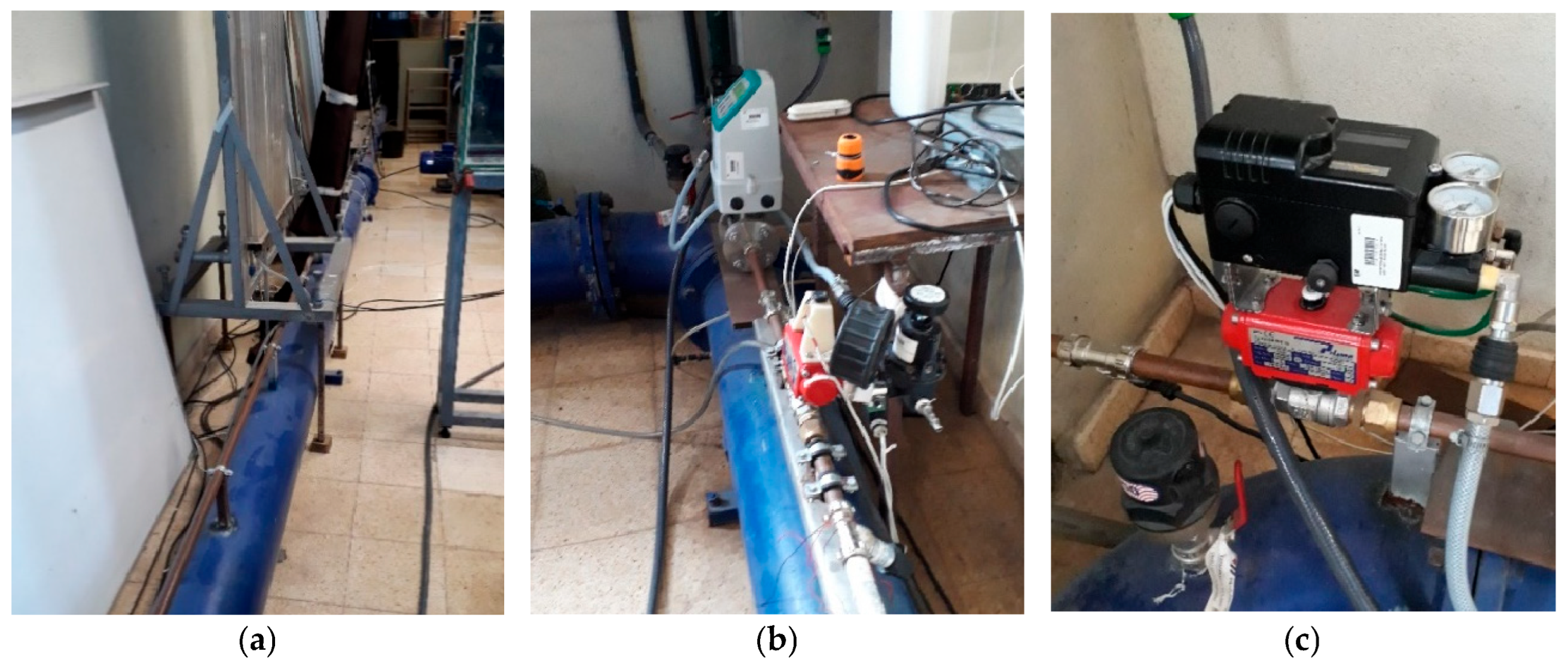
The experimental data were collected from an experimental pipe facility at the Laboratory of Hydraulics, Water Resources and Environment at the Instituto Superior Técnico (IST). The system has a reservoir–pipe–valve configuration, comprising a copper pipe with an inner diameter (D) of 0.02 m and a total length (L) of 15.2 m (Figure 1).
Figure 1. Experimental facility: (a) copper pipe; (b) downstream pipe section; and (c) pneumatically actuated valve.
A hydropneumatic vessel with a pump is installed at the upstream end of the pipeline to simulate a constant-level reservoir. At the downstream end, there are two ball valves: the first is manually operated and is used to control the initial flow rate; and the second is used to generate transient events. This second valve is pneumatically actuated allowing to have different closure times by changing the operating pressure of the valve actuator. The data acquisition system synchronises the valve closure and the acquisition interval of the measuring equipment.
The electromagnetic flowmeter has an internal diameter of 20 mm and an accuracy of 0.4% for a minimum flow rate of 15 L/h. The system is equipped with three pressure transducers with a full-range 0.25% accuracy and a nominal pressure of 25 bar. A detailed description of the experimental facility, hydraulic conditions, test results and valve closure law are detailed in Ferreira and Covas [29] and Ferreira [30].
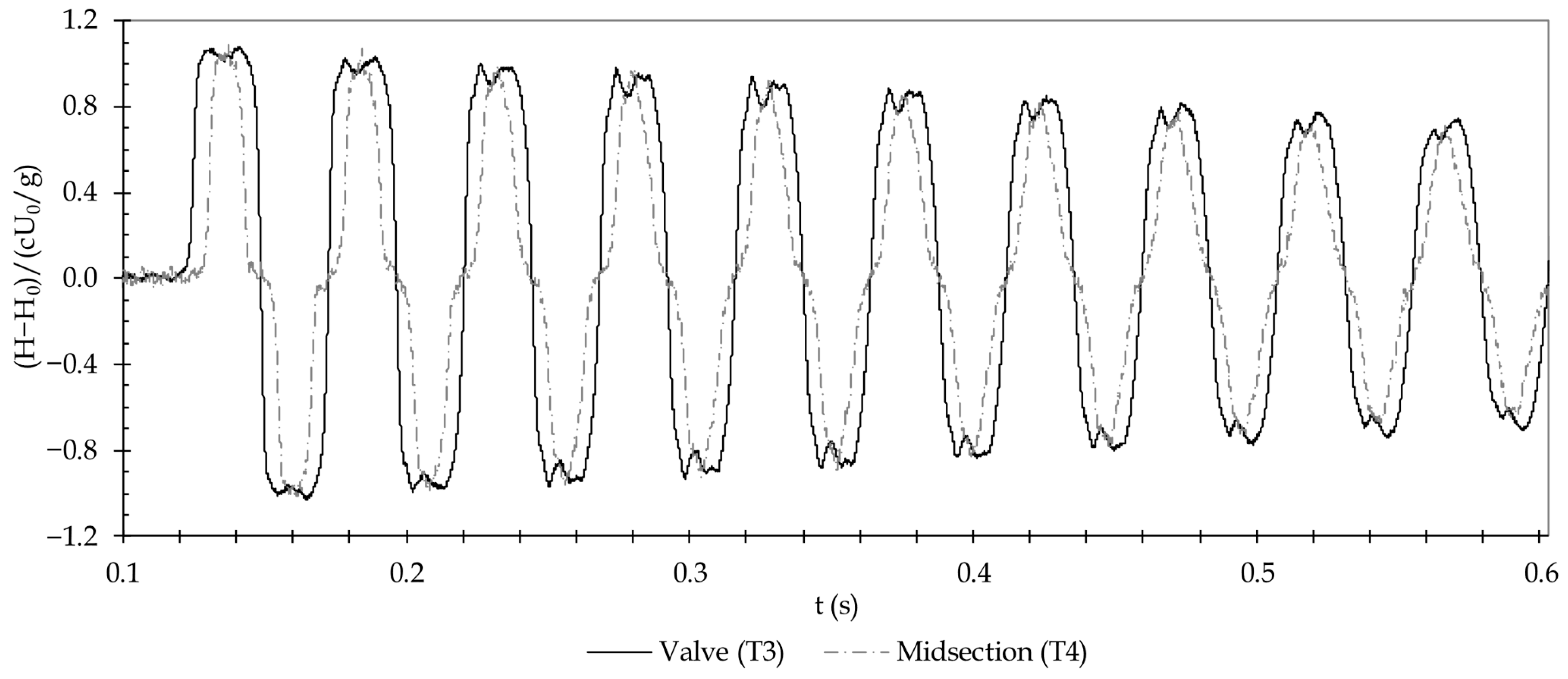
The pressure data for smooth–turbulent flow was originally collected for three steady-state flow rate values: Q0 = 71 × 10−3, 96 × 10−3 and 120 × 10−3 L/s. Only the measurements for the highest initial Reynolds number (Re0 = 7638) are presented and analysed herein because the results for the three tests overlapped in the dimensionless form, and no distinction is recognised regarding the wave damping and shape. The fastest valve closure, with an effective closing time of 0.01 s, is evaluated.
Piezometric time histories at the downstream and middle sections of the pipe for the initial flow rate Q0 = 120 L/s (Re0 = 7638) at the downstream end and mid-section transducers are presented in Figure 2.
Figure 2. Piezometric time histories at downstream near the valve (Valve—T3) and at the pipe middle section (Midsection—T4) for smooth turbulent flow (Re0 = 7638).

3. Numerical Models

The 1D and Q2D transient solvers and the respective numerical simulations were developed by the authors, whereas the 3D-CFD results were obtained from the previous research of Martins et al. [15], generated using a commercially available CFD software.

3.1. The Quasi-2D Axisymmetric Model

The Q2D model follows the standard 1D assumptions for the fluid and the pipe [12]. By assuming axisymmetric flow, radial velocity and non-axial viscous terms are neglected, which simplifies the axial momentum equation and eliminates the radial momentum equation. This results in a system of two partial differential equations with three unknown parameters (p, u , υ ) with the following form [13]:
𝜕 H 𝜕 t + c 2 g 𝜕 u 𝜕 x = c 2 g r 𝜕 r υ 𝜕 r
1 g 𝜕 u 𝜕 t + 𝜕 H 𝜕 x = 1 r ρ 𝜕 r τ 𝜕 r
τ = ρ ν 𝜕 u 𝜕 r ρ u ¯   υ ¯
where x is the distance along the pipe; r is the distance from the axis in the radial direction; t is time; H is the piezometric head; u (x, r, t) is the local axial velocity; υ (x, r, t) is the local radial velocity; g is the gravitational acceleration; c is the wave speed; ρ is the liquid density; τ is the shear stress; ν is the liquid kinematic viscosity; u and υ are turbulence fluctuations corresponding to longitudinal velocity u and υ , respectively. A five-region turbulence model is used herein to calculate the Reynolds stress term ρ u ¯   υ ¯ [31,32].
A geometric sequence (GS) radial mesh is adopted, defined by prescribing the thickness of the outermost cylinder adjacent to the pipe wall, Δ r j = N C 1 , together with a constant common ratio, C R . The thickness of each cylinder j is given by the following:
Δ r j = Δ r j = N C 1 . ( 1 + C R ) N C j
where NC denotes the total number of concentric hollow cylinders, indexed from the centreline ( j = 0 ) to the pipe wall ( j = N C 1 ). For each cylinder, the radial thickness is r j = r j r j 1 and the external radius is r j = 0 j r j .
A GS9%60 radial mesh is used herein, consisting of a total of 60 cylinders (NC = 60), with a 9% increase in cylinder thickness from the wall to the centre of the pipe (CR = 9%). This configuration was identified as the most suitable mesh for the flow characteristics under analysis. The methodology used to optimise the radial mesh, together with a comprehensive description of numerical implementation, radial and axial grid generation, recommended discretisation strategies and the influence of alternative numerical schemes for the Q2D model are detailed in Ferreira and Covas [33].

3.2. The 1D Unsteady Friction Models

Five 1D unsteady friction models were implemented, comprising four convolution integral-based (CIB) formulations and one instantaneous acceleration-based (IAB) model. For laminar flow, two CIB models were considered: the full Zielke model [10] and the approximate Trikha model [20]. For smooth–turbulent flow, two additional CIB formulations were used: the full Vardy and Brown model [11] and the approximate Vardy and Brown [19] model. Finally, the Vitkovsky et al. IAB model [9] was used.

3.2.1. Convolution Integral-Based (CIB) Models

Zielke’s analytical solution for laminar unsteady friction is used. In this formulation, the unsteady wall shear stress, τwu, is defined as the difference between the total wall shear stress, τw, and the corresponding steady-state shear stress for the same mean velocity, τws [10,34,35]. At a given time, τwu is expressed as the convolution of a weighting function and past fluid accelerations, depending on the entire velocity history from the start of the transient event until the time being evaluated:
τ w u ( t ) =   2 μ R 0 t 𝜕 U 𝜕 t t * W ψ d t *
in which μ is the fluid viscosity, R is the pipe radius, t is the current time, t * is the convolution integral time ( t * = t t S ) and is measured backwards from the current instant to the unsteady start, t S is the time at which the unsteady flow starts, W is the weighting function of the dimensionless time parameter ( ψ = 4 t * ν / D 2 ). The weighting function is defined as follows:
W ψ = 0.282095 ψ 1 2 1.25 + 1.057855 ψ 1 2 + 0.9375 ψ + 0.3966960 ψ 3 2 0.351563 ψ 2
W ψ = e 26.3744 ψ + e 70.8493 ψ + e 135.0198 ψ + e 218.9216 ψ + e 322.5544 ψ
for ψ < 0.02 and ψ > 0.02.
Building on this formulation, Vardy and Brown [1] extended the approach to capture smooth turbulent flow and the new weighting function is expressed as follows:
W a ( t ) = ν w / ν l e ψ / C * 2 π ψ
where ν l is the laminar kinematic viscosity, ν w is the kinematic viscosity at the wall and C * is the shear decay coefficient that is also a function of the Reynolds number. The parameter κ denotes the von Kármán constant.
C * = 12.86 / R e κ   and   κ = log 10 ( 15.29 / R e 0.0567 )
A computationally efficient alternative was introduced by Trikha [20] for laminar flow in which the cumulative effect of the full acceleration history is represented by three exponential terms updated at each time step. The unsteady wall shear stress at the instant t + t is obtained using the variables y1, y2 and y3 stored from the previous time step, as follows:
τ w u ( t ) = 2 μ R   ( Y 1 + Y 2 + Y 3 )
Y i t = Y i t Δ t e n i 4 ν D 2 Δ t + m i U t U ( t Δ t )
where m i and n i are coefficients that must be fitted such that the approximate weighting function resembles the true weighting function.
In the same direction, a general one-step integration method for smooth–turbulent flow was proposed by Vardy and Brown [9] and is given as follows:
τ w u ( t + Δ t ) = 2 ρ ν R i = 1 N Y a i t e n i ν / R 2 Δ t + m i U R 2 n i . ν ( 1 e n i ν / R 2 Δ t )
in which U ˙ is the average acceleration of the mean flow during the last time step, m i and n i are coefficients defined by the authors according to the selected approximation order and Y a represents the cumulative contribution of the previous terms.

3.2.2. Instantaneous Acceleration-Based (IAB) Models

The formulation proposed by Vítkovský et al. [9] is adopted and it distinguishes between positive or negative wave propagation, thereby providing broader applicability compared with earlier IAB models. In this approach, the unsteady wall shear stress is expressed as follows:
τ w u = ρ D 4 k 3 . 𝜕 U 𝜕 t c . s i g n ( U ) 𝜕 U 𝜕 x
where k3 is a decay coefficient that must be experimentally calibrated and sign( U ) takes the value +1 for U ≥ 1 and −1 for U ≤ 1.

3.3. The 3D-CFD Model

The 3D-CFD model was developed by Martins et al. [14,15,16] using the commercial software ANSYS Fluent to describe the pipe system and the transient phenomena in three dimensions. The model employs a finite-volume numerical discretisation together with a semi-implicit algorithm to solve the mass and all momentum conservation equations. Turbulence was represented using a realisable k-ε turbulence model. Convergence was assessed through residual monitoring, with solutions considered converged when the relative residuals of the governing equations fell below 1 × 10⁻⁶.

4. Q2D and 3D-CFD Model Results

4.1. Considerations on the Computational Effort

Before comparing the Q2D and 3D-CFD results, it is important to note that the 3D-CFD model demands substantially higher computational time for three main reasons.
Firstly, the 3D-CFD model used a mesh with 1.7 × 10⁶ cells. This mesh was studied by Martins et al. [15] to ensure the best compromise between accuracy and computation effort. It has a uniform circumferential spacing of 0.016 m, a radial discretisation defined by a geometric ratio of 1.24 with a minimum spacing of 10 7 m at the wall, and a conduit discretisation of 0.026 m. In contrast, the Q2D model uses a GS9%60 radial mesh (with a conduit interval of 0.05 m), has no circumferential discretisation and requires only 1.8 × 10³ cells. Overall, the Q2D grid contains approximately one thousandth of the nodes used in the 3D-CFD model.
Secondly, the 3D-CFD model calculates the three velocity components and assesses the pressure value at each radial node, requiring the solution of four conservation equations for each grid point (continuity, radial and circumferential momentum and energy). Conversely, the Q2D model solves only two conservation equations (mass and axial momentum), as it neglects radial pressure variation and circumferential mass transfer.
Thirdly, the Q2D model uses a frozen-viscosity five-region turbulence model [34], where the eddy viscosity is assumed to be constant over time and equal to its steady-state radial distribution. In the 3D-CFD model, however, the k-ε turbulence model implies an iterative calculation process until convergence is reached for every time step and node.
Consequently, the computational effort associated with the Q2D model is estimated to be approximately 16,000 times lower than that of the 3D-CFD model, assuming two turbulence model iterations per grid point in the latter.

4.2. Instantaneous Valve Manoeuvre

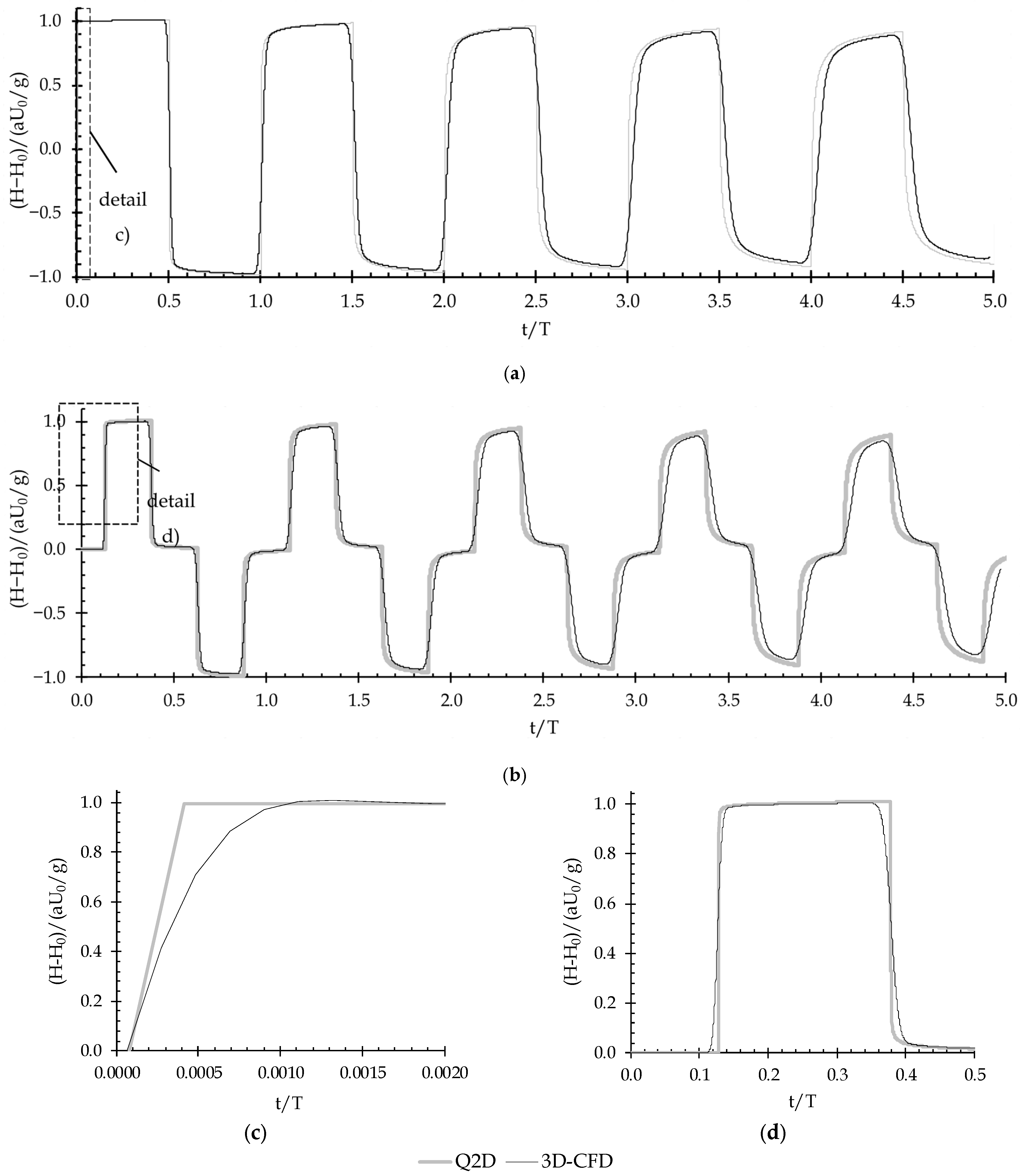
The piezometric head time history obtained for the 3D-CFD and the Q2D models for the first five periods are presented in Figure 3. The instantaneous valve closure occurs at t = 0 and both models exhibit a pressure wave front becoming smoother with time, which is significantly different from the classical Joukowsky square-shaped pressure wave.
Figure 3. 3D-CFD versus Q2D piezometric head time history: (a) at the pipe end section (0.0 ≤ t/T ≤ 5.0); (b) at the pipe midsection (0.0 ≤ t/T ≤ 5.0); (c) at the pipe end section (0.0 ≤ t/T ≤ 0.002); and (d) at the pipe midsection (0.0 ≤ t/T ≤ 0.5).
After the first pressure wave, the 3D-CFD results exhibit a more pronounced front wave rounding than those obtained with the Q2D model (Figure 3a,b). This can be the result of a higher unsteady energy dissipation or a more realistic representation of the valve closure manoeuvre. Additionally, the 3D-CFD model does not exhibit the square-shaped geometry observed in the Q2D immediately before the pressure wave arrival (see, for example, the 3D-CFD and Q2D results in Figure 3d and compare both models’ results at t/T = 0.375); instead, this model tends to display a more symmetric wave shape.
At t = 0, the Q2D model predicts an instantaneous piezometric head surge, with the pressure change occurring within a single time step, as expected for a numerical model that assumes a uniform radial pressure and neglects the circumferential velocity following an instantaneous valve closure. In contrast, the 3D-CFD model produces a very fast (but not instantaneous) S-shape variation (Figure 3c). When the pressure wave reaches the pipe midsection (t/T = 0.125; Figure 3d), the discrepancy between the two models becomes more evident, the 3D-CFD results show a more rounded pressure wave, progressively dissipating the rectangular wave geometry that remains visible in the Q2D model prior to the arrival of the pressure surge.
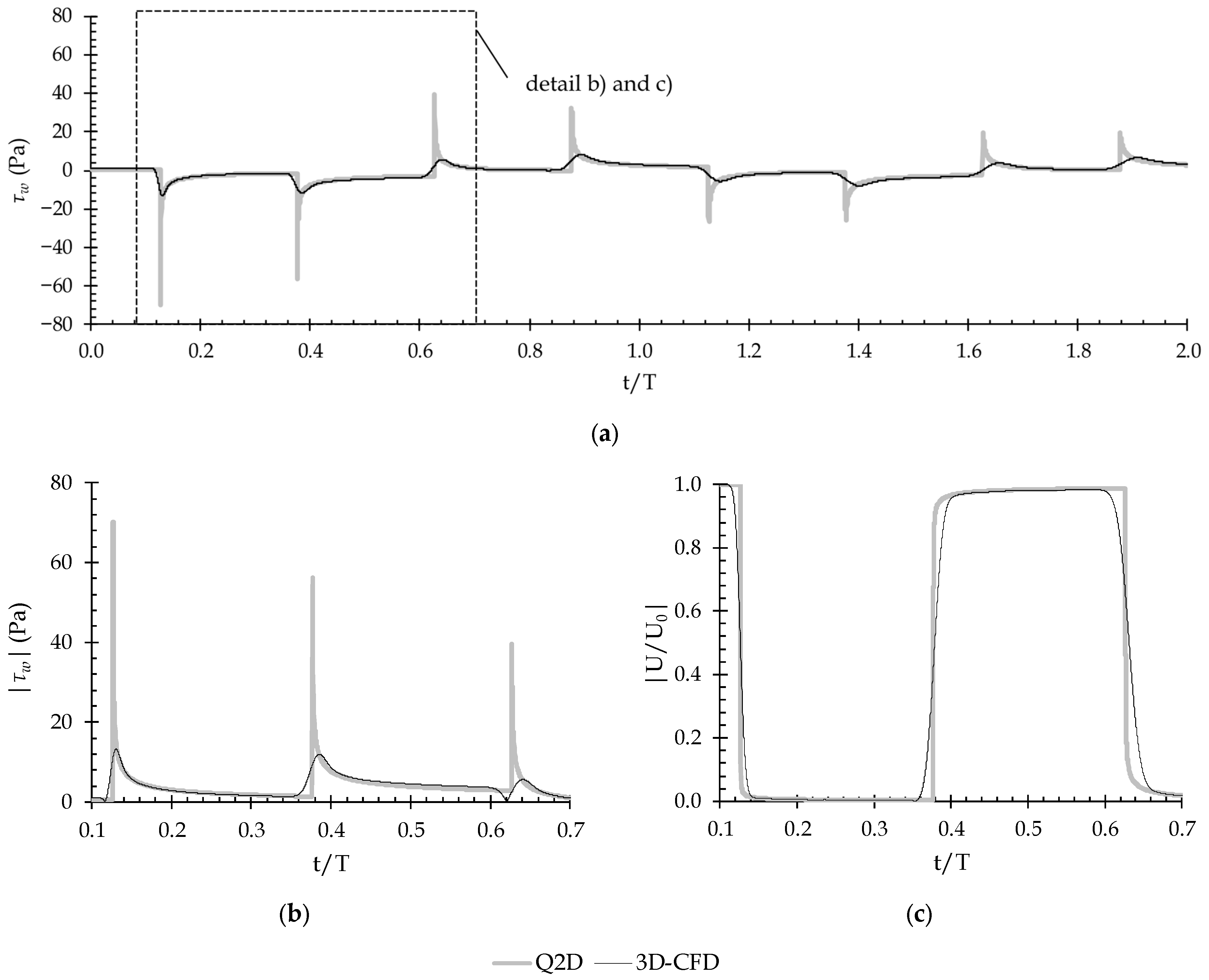
Figure 4a,b shows the wall shear stress, τw, time variation at the pipe midsection obtained by both models. The 3D-CFD model results have an immediate reduction of τw value and an S-shaped variation (see Figure 3b at t/T = 0.125). This behaviour reflects the rapid transformation of the nearly instantaneous velocity change imposed at the valve into a well-defined S-shaped velocity profile at the pipe midsection (Figure 3c). On the contrary, at the same instant (t/T = 0.125), the Q2D model highlights a relevant τw peak, consistent with the instantaneous pressure variation at the valve and the lower front-wave rounding computed by the Q2D model. The mean velocity variation predicted by each model is coherent with the corresponding wall shear stress response (Figure 3b,c).
Figure 4. 3D-CFD versus Q2D time history at the pipe midsection: (a) wall shear stress during the complete two wave periods; (b) wall shear stress between 0.1 ≤ t ≤ 0.7; and (c) absolute mean velocity variation between 0.1 ≤ T ≤ 0.7.
Please note that the 3D-CFD model wall shear stress simulation was only run until the second wave period, since it required a high computational time. After the passage of the wavefront, both models converge to nearly identical τ w variations. The rounder and more symmetric pressure wave predicted by the 3D-CFD model (Figure 3c,d) results primarily from the detailed modelling of the fluid behaviour at the valve during the instantaneous closure, which directly influences the unsteady energy dissipation calculation (especially the peak values), instead of being a consequence of it.

4.3. Valve Closure Calibration

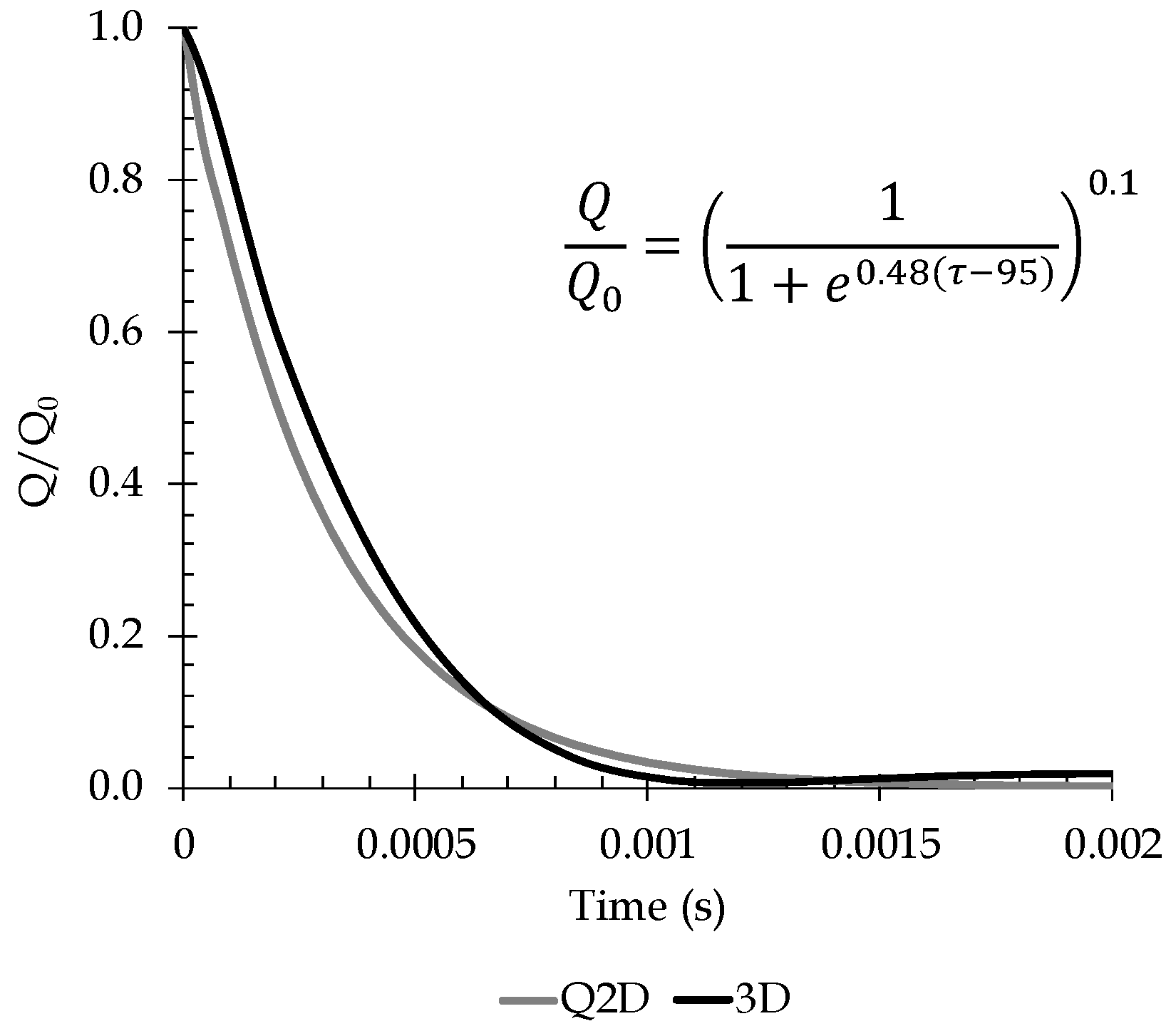
A sigmoidal law valve closure function was implemented in the Q2D model to more accurately reproduce the pressure variation obtained with the 3D-CFD model (Figure 3c). This procedure ensures that both models share identical initial boundary conditions at the valve section. Figure 5 shows the dimensionless flow variation predicted by the 3D-CFD model together with the calibrated sigmoidal law response adopted in the Q2D model for an effective closure time of 0.0014 s. In this formulation, τ denotes the valve closure percentage, varying between 0 (fully open) and 100 (fully closed).
Figure 5. Flow rate at pipe midsection with the 3D model and the calibrated valve manoeuvre with the Q2D model.
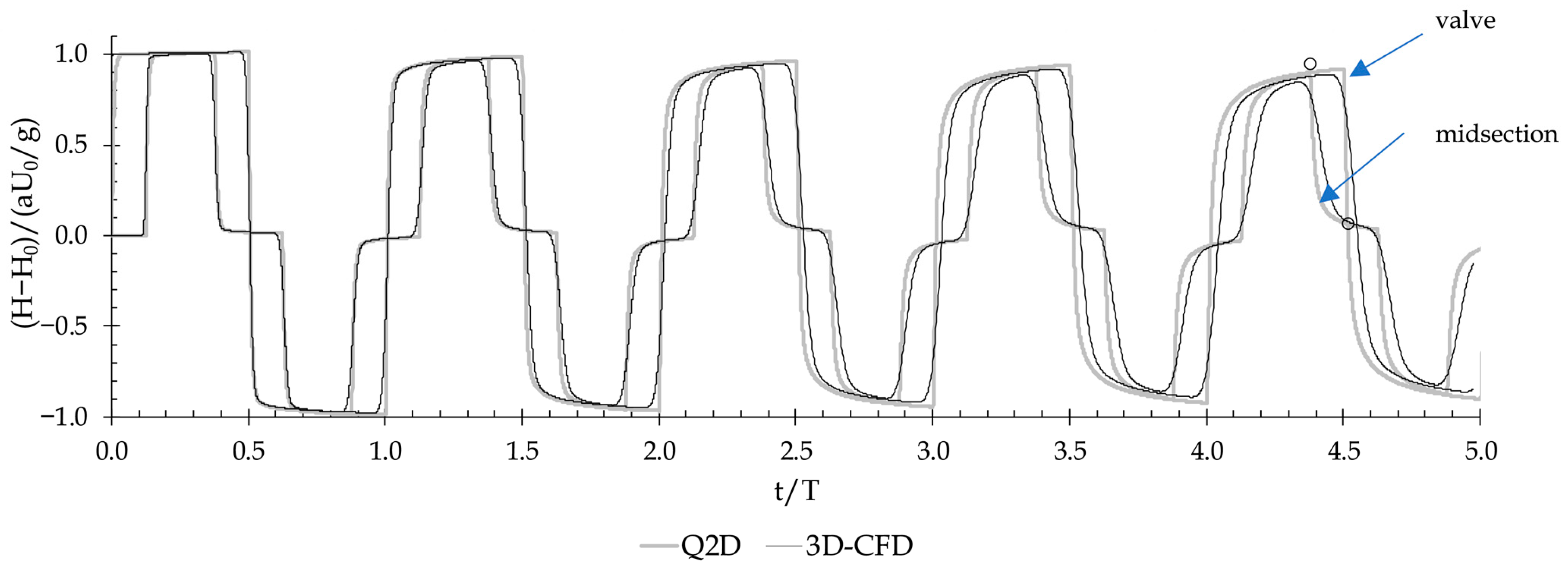
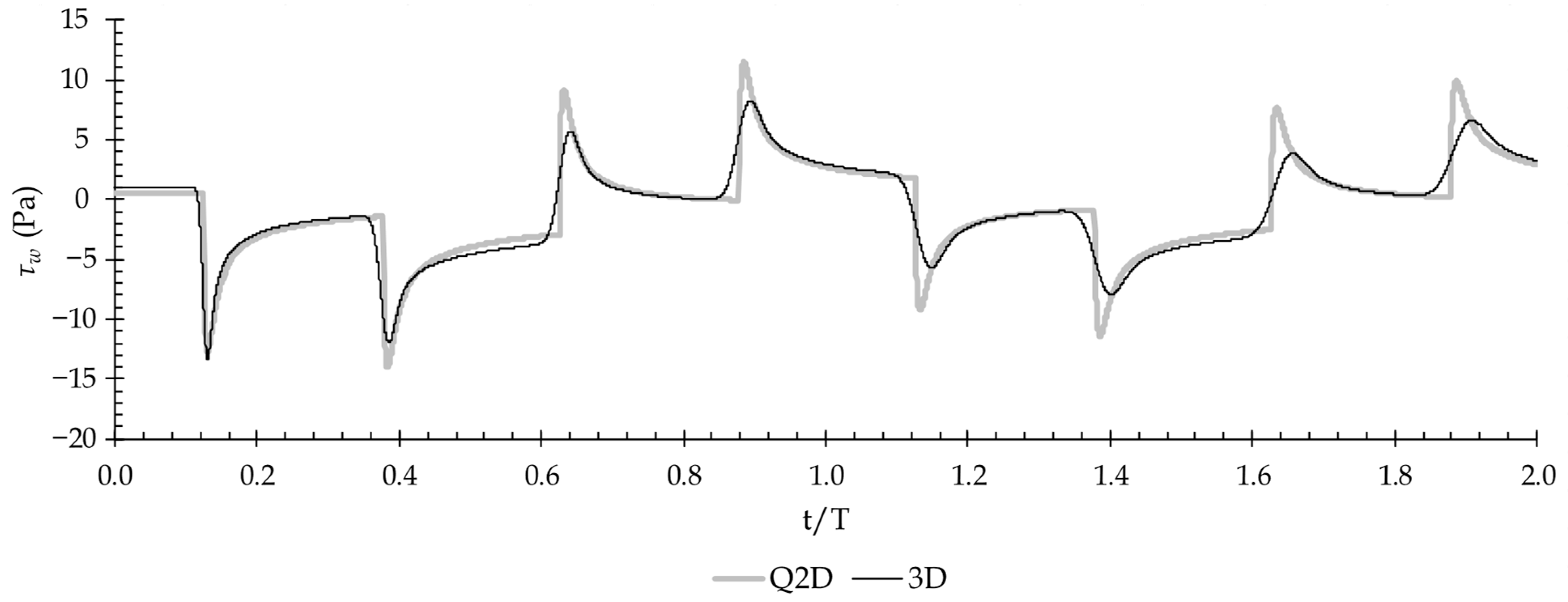
This valve calibration ensures a better agreement between the piezometric head time histories predicted by the two models, particularly during the first two wave periods (compare Figure 3b and Figure 6). An excellent match is also obtained for the wall shear stress during the first pressure wave (Figure 7). These results demonstrate that, when an appropriate valve closure law is applied (calibrated for the Q2D model and partially eliminating the raw representation of valve closure inherent to the Q2D formulation), both models exhibit comparable unsteady energy dissipation, as well as closely aligned mean-velocity and pressure variations. This confirms that the Q2D model can achieve the same unsteady dissipation accuracy as the 3D-CFD model, provided that a fully developed flow is established.
Figure 6. 3D-CFD versus Q2D (calibrated) piezometric time history at the pipe valve and midsection.
Figure 7. 3D-CFD versus Q2D (calibrated) wall shear stress time history at the pipe midsection.
After the first pressure surge, the 3D-CFD model progressively exhibits lower peak values than the Q2D model, reflecting the latter’s slower dissipation of the pressure wave shape and the gradual loss of the valve closure calibration effect. This behaviour suggests that the discrepancies between the Q2D and 3D-CFD models are not limited to the representation of the valve manoeuvre, but also arise from additional factors, such as the wave reflections at the closed valve and at the reservoir.

4.4. Discussion of Differences in Results from the Q2D and the 3D-CFD Models

Differences between the two models’ results can be explained by the following 3D-CFD model features not described by the Q2D model: (i) the use of a time-dependent turbulence model; (ii) the circumferential mesh discretisation and the calculation of the respective velocity component; and (iii) the non-uniform radial pressure distribution.
The applicability of frozen-viscosity models, such as the one used in the Q2D model, has been extensively studied [30]. He and Jackson [36] reported that the response of turbulence to the flowrate variations is characterised by three phases (turbulence production, turbulence energy redistribution and radial diffusion) and a time delay is observed. Similarly, Zhao and Ghiaoui [37] identified two important time scales, the radial diffusion time scale and wave time scale. Using these two scales, the authors introduced a dimensionless parameter, P = 2 D a / f U L , that quantifies the number of wave periods required for the wall shear stress vortex generated by the first wave to influence the pre-existing turbulent characteristics in the whole pipe cross-section. Applying this parameter to this system (i.e., experimental facility) results in P = 45, indicating that the frozen turbulence assumption can be used during the first five wave periods considered.
Zhao and Ghiaoui [11] compared the Q2D model with both the five-region model and k-ε turbulence model for several systems, concluding that the differences are negligible. In high-frequency transient simulations, the largest velocity gradients occur near the wall; however, in smooth–turbulent flows, the eddy viscosity in this region is nearly zero. This is why the quasi-laminar model, which assumes zero eddy viscosity throughout the entire cross-section, is adequate and the Zielke’s model presents good results in turbulent flow conditions. This also explains why existing unsteady-friction convolution formulations, which rely on simplified eddy viscosity representations in the core region, remain valid. Moreover, even though the turbulent radial distribution is significant in the pipe core, an accurate specification of the eddy viscosity in this region is not essential, because the velocity gradient in that region is comparatively small.
Additionally, the 3D-CFD model ensures a non-uniform radial pressure distribution and a circumferential velocity component. On the other hand, the Q2D model assumes a uniform cross-section pressure and neglects the circumferential velocities, since axial variations are considerably higher. Mitra e Rouleau [38] noted that this approximation is less accurate close to a rapidly closing valve and suggested that several pipe diameters are required downstream of the disturbance before an axisymmetric model can provide meaningful results. Consistent with their observations, the 3D-CFD velocity fields at different valve closure percentages reported by Ferreira et al. [22] for this particular system clearly shows a non-axisymmetric velocity profile close to the valve and a high radial velocity component.
The 3D-CFD model provides a more realistic representation of the transient event generated by the instantaneous valve closure, as the Q2D model neglects key flow features near the valve and boundary conditions. Nevertheless, once 3D boundary effects become negligible, the Q2D model correctly describes the unsteady energy dissipation.

5. Q2D and 1D Model Results

Five unsteady friction models were implemented in the 1D solver, namely four CIB models and one IAB model. The results are presented in the following sections. First, the 1D model results obtained for an instantaneous valve manoeuvre are compared with those obtained using the Q2D model (Figure 8 and Figure 9). Second, the 1D model results with the calibrated valve manoeuvre are compared with Q2D and 3D-CFD models (Figure 10). For clarity in the results analysis, the 3D-CFD results are only included in the second comparison.
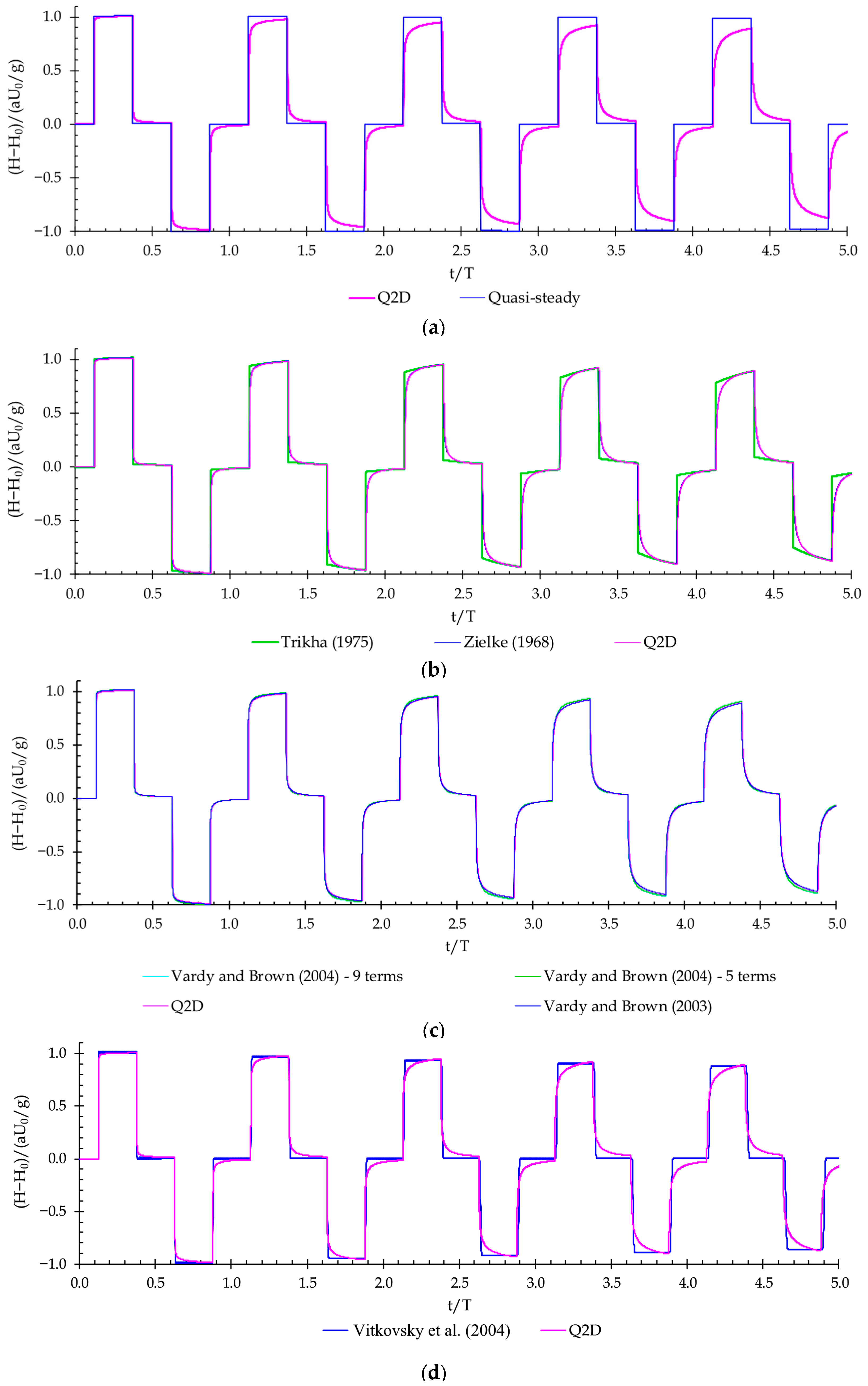
Figure 8. Q2D versus 1D model results in terms of adimensional piezometric head at the pipe mid-section: (a) Q2D; (b) Q2D versus laminar flow CIB model [10,20]; (c) Q2D versus smooth flow CIB model [1,11]; and (d) Q2D versus IAB model [9].
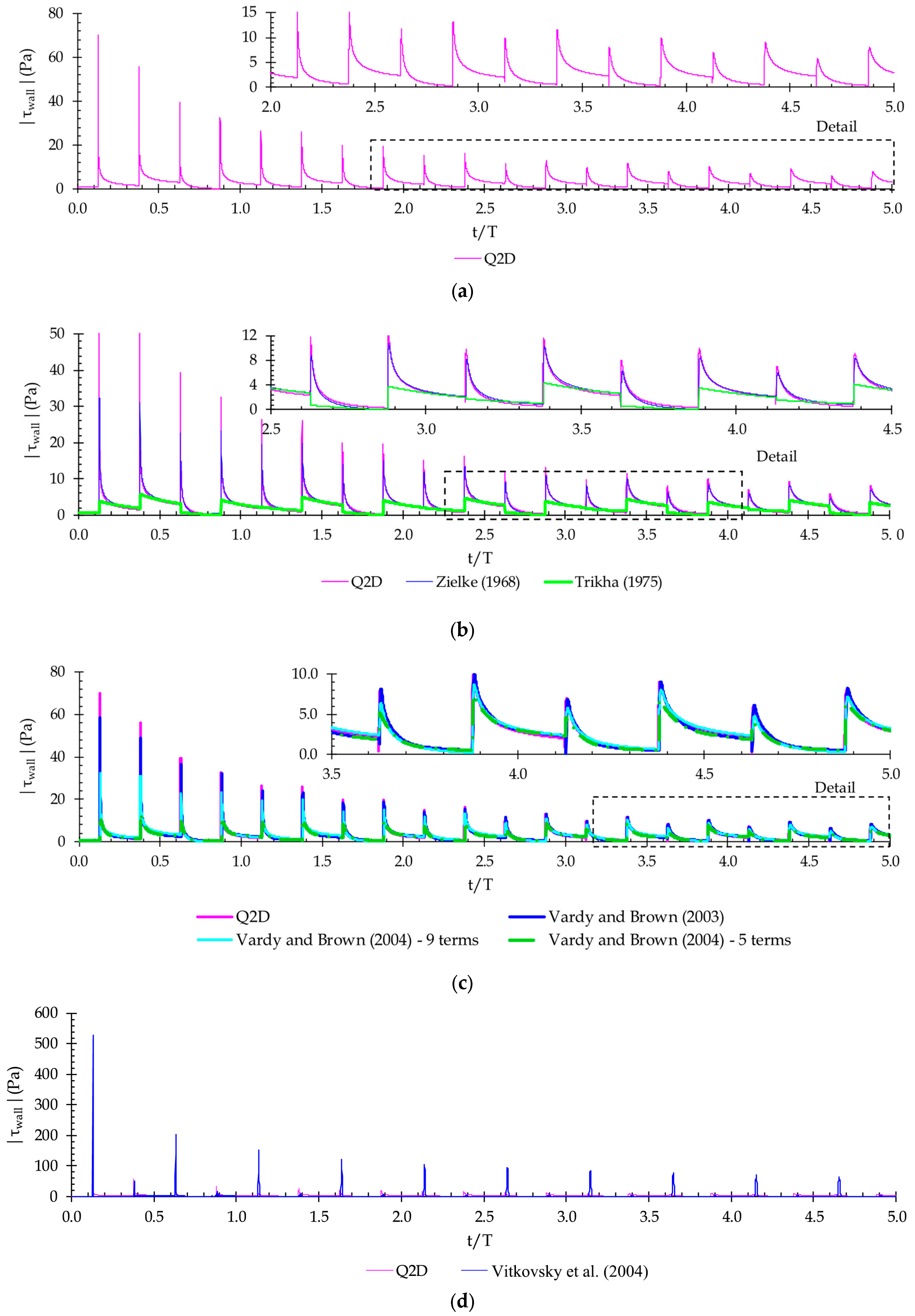
Figure 9. Q2D versus 1D model results wall shear stress at the pipe mid-section: (a) Q2D; (b) Q2D versus laminar flow CIB model [10,20]; (c) Q2D versus smooth–turbulent flow CIB model [1,11]; and (d) Q2D versus IAB model [9].
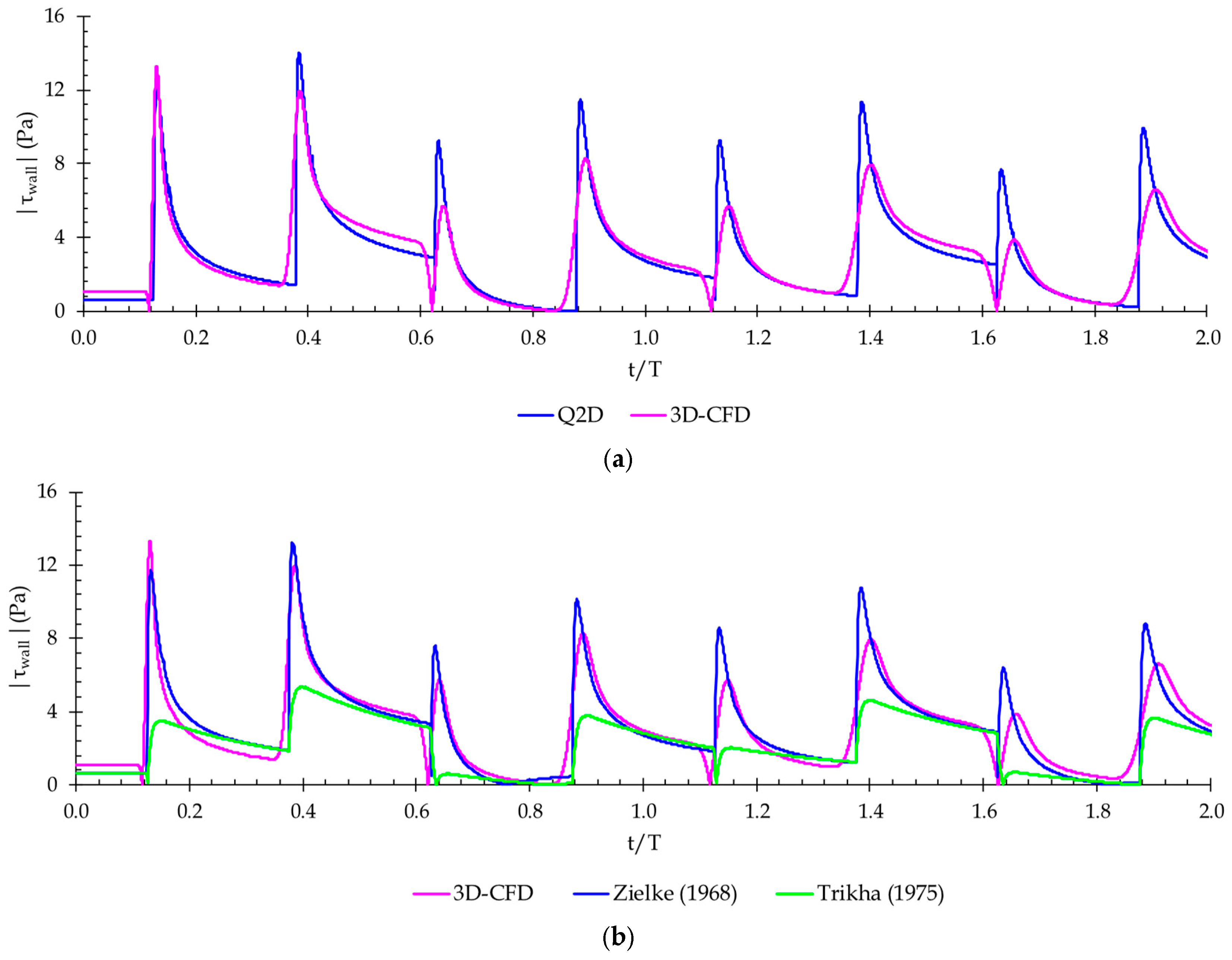
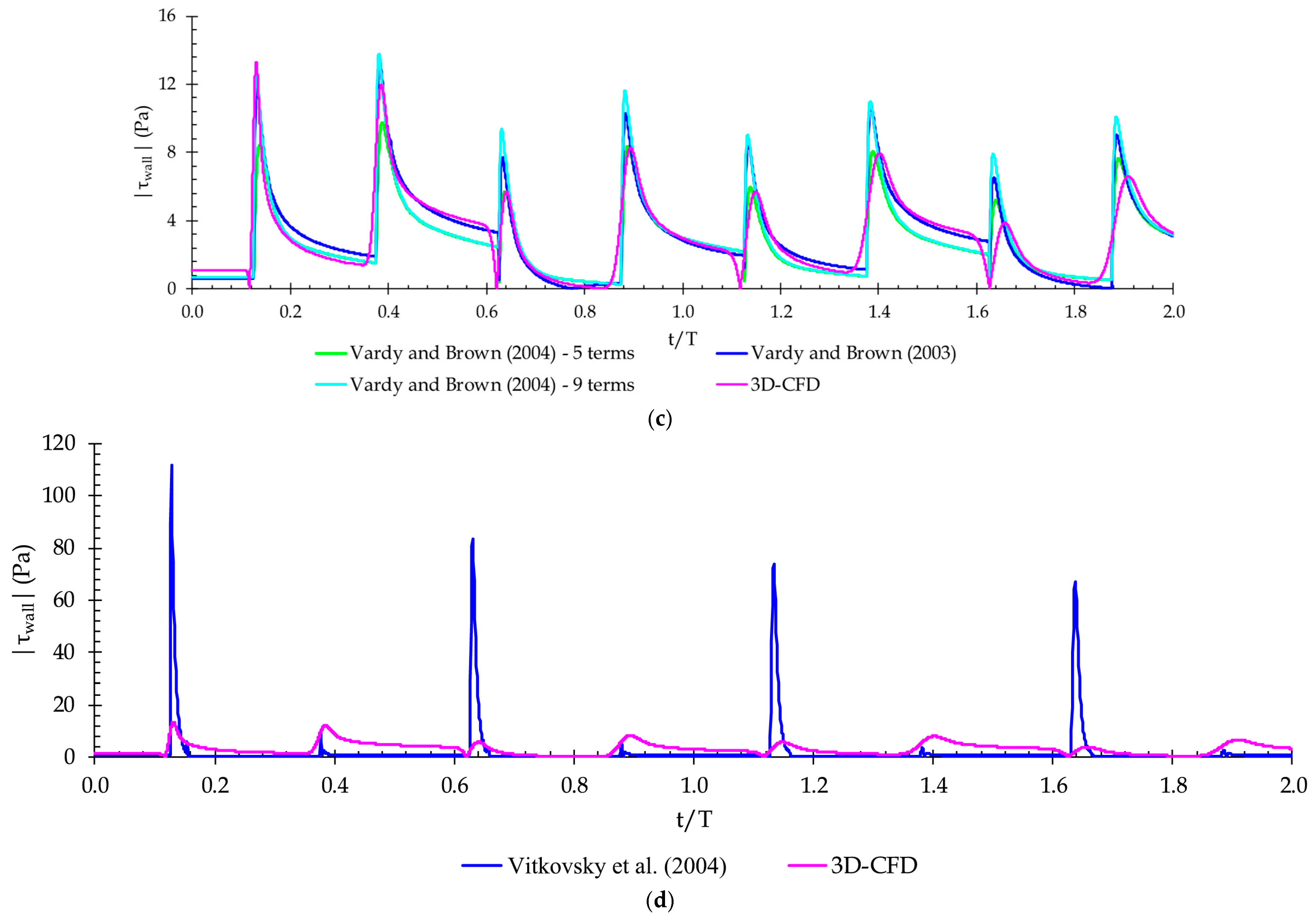
Figure 10. Wall shear stress time history at the pipe midsection for the calibrated valve manoeuvre: (a) Q2D versus 3D model; (b) Q2D versus laminar CIB models [10,20]; (c) Q2D versus turbulent CIB models [1,11]; and (d) Q2D versus IAB model [9].

5.1. Instantaneous Valve Manoeuvre

The Q2D and the 1D models’ piezometric head time history are presented in Figure 8: the quasi-steady (classical) approach (Figure 8a); the full Zielke [10] and the approximate Trikha [20] CIB models for laminar flow (Figure 8b); the full Vardy and Brown [1] and the approximate Vardy and Brown [11] CIB models for smooth–turbulent flow (Figure 8c); and the Vitkosky et al. [9] IAB model (Figure 8d).
The classic water hammer model with the quasi-steady friction formulation cannot describe the actual damping induced by the unsteady wall shear stress (Figure 8a). Consequently, its applicability is limited to the first transient wave cycle, or, in theory, to situations involving slow variations of the mean velocity, which is not the case. This limitation arises from the fact that this model does not account for the frequency-dependent radial velocity gradient, neglecting the high-velocity gradient after the pressure surge arrival. Thus, the damping observed over the five periods is almost non-existent, and the predicted pressure wave retains an unrealistically square-shaped profile, instead of the smooth and rounded S-shape behaviour exhibited by real systems and accurately captured by the Q2D and 3D-CFD models.
Zielke’s model can closely describe the transient pressure wave amplitude, phase and shape, matching the accuracy of the Q2D model (Figure 8b), despite the high computation effort required to compute all terms of the convolution integral. Both models rely on the same axisymmetric flow and frozen viscosity assumptions but differ on their steady-state viscosity profiles. Zielke’s model adopts a uniform molecular viscosity profile, whereas the Q2D model implements a five-layer turbulent viscosity profile, which is more realistic. Results are comparable over the five-wave pressure simulation periods because the viscous layer dominates during the wall shear stress computation.
Trikha’s approximate model, although requiring significantly less computational time, does not ensure the same simulation accuracy as Zielke’s model (Figure 8b). While it reproduces a comparable overall wave damping, it fails to capture energy dissipation immediately after the wavefront arrival, resulting in insufficient smoothing of the pressure wave. This behaviour reflects the well-documented limitations of the original Trikha implementation, as noted by Kagawa et al. [39], School [40], Vardy and Brown [21] and Vitkosvsky et al. [9]. Nevertheless, it provides a major reduction in the simulation time in comparison with the direct implementation of the full weighting functions.
For smooth–turbulent flows (Figure 8c), both the full CIB model and the nine-term approximate CIB model closely match the Q2D model results. The five-term approximate model exhibits a slight phase shift during the high dissipation periods after the third wave. The reduction in the number of exponential terms diminishes the frequency range over which the true weighting function is accurately represented, which leads to a loss of accuracy during intervals of high dissipation, where the wall shear stress peaks are most pronounced.
Vitkovsky’s model maintains the square shape of the pressure wave observed in the quasi-steady friction approach (Figure 8a,d). Nevertheless, by using a calibrated decay coefficient, k3, the model can reproduce the overall wave damping. Even so, all previous weighting models ensure a more realistic description.
The previous pressure histories are not a direct measurement of the frequency-dependent energy dissipation; rather, they reflect each model wall shear stress simulation, assuming the same steady-state conditions, as referred by Abreu and Almeida [24]. In this context, wall shear stress offers the most reliable basis for evaluating model performance, particularly when the piezometric head predictions are very similar, as is the case here. Figure 9 presents the absolute wall shear stress time histories for the unsteady friction models previously analysed. Figure 9a shows the Q2D reference solution, and the subsequent figures compare it with the predictions from the other UF formulations.
The piezometric time history results obtained by the Q2D and full CIB formulations for both laminar and smooth–turbulent flows are very similar. This is justified by identical wall shear stress simulations (Figure 9b,c). The differences are limited to the initial peak, and after four time periods, the results of all three models converge. The three models also predicted identical residual wall shear stress values (i.e., the values immediately prior to the arrival of the next pressure wave).
The incorrect pressure wave shape produced by Trikha’s model (Figure 9b) is a direct consequence of its inability to describe the wall shear stress peak and how it decays following each pressure surge (Figure 9b). Instead of exhibiting the exponential decay characteristic of more accurate unsteady-friction models, Trikha’s formulation produces an almost linear decline of the wall shear stress value.
The approximate CIB model for smooth turbulent flow correctly represents the wall shear stress decay (Figure 9c). However, it underestimates the peak value compared with the full CIB and the Q2D models. The number of exponential terms considered in the approximating of the weighting function strongly affects the correct description immediately after each wave arrival. For the nine- and five-term approximations, the wall shear stress first peak (t/T = 0.12) is one-half and one-fifth of the Q2D value, respectively. These differences diminish after the second wave cycle. Crucially, unlike Trikha’s model, these approximate CIB formulations still capture the correct exponential decay following each pressure surge.
Vitkovsky’s model (Figure 9d), after the calibration of the decay coefficient (k3 = 0.08), shows a sequence of high and non-continuous wall shear stress values associated with the instantaneous mean velocity changes, decreasing as the pressure wavefront becomes rounder. However, it does not represent the wall shear stress gradual decay observed in the Q2D and 1D CIB models. This result is the direct consequence of the model phenomenon simplification, particularly inadequate for an instantaneous valve closure. In this formulation, the correct overall pressure wave damping is ensured solely by the k3 calibration and not by the model correct description of the phenomenon.

5.2. Calibrated Valve Manoeuvre

The results obtained using the calibrated valve manoeuvre with the 1D and Q2D models are compared with those obtained from the 3D-CFD simulation (Figure 5). Figure 10 shows the absolute wall shear stress simulation for all models during the first two wave periods since the beginning of the transient, due to the high computational effort associated with the 3D-CFD model, as previously explained. Figure 10a shows the Q2D and the 3D-CFD models’ simulations for the calibrated valve manoeuvre, whilst Figure 10b shows the laminar CIB model predictions together with those from the 3D-CFD model. As previously observed for the instantaneous valve closure, the full laminar CIB model produces results indistinguishable from those of the Q2D model. The same behaviour is found for the full turbulent CIB formulation, which again closely matches the Q2D predictions and, consequently, the 3D-CFD results (Figure 10c).
Trikha’s model (the laminar approximate formulation) continues to produce a nearly linear decay of wall shear stress (Figure 10b). However, Trikha’s model results closely approach the Q2D and 3D-CFD solutions because the calibrated valve manoeuvre imposes a smoother pressure variation, reducing both the peak magnitude and the subsequent exponential decay. This feature also explains the improvement obtained with the approximate smooth–turbulent flow models. With five and nine exponential terms, these approximations yield almost identical results and follow the reference solutions closely.
Vitkovsky’s model (Figure 10d) considerably reduces the peak values compared with the instantaneous valve closure outcome (Figure 9d) due to the gradual pressure variation at the valve. Although fitting the decay coefficient, k 3 , allows the model to reproduce the decay of the pressure wave amplitude, it continues to fail to capture the pressure-wave shape, which is accurately described by the 1D CIB, Q2D and 3D-CFD models.

6. Q2D Model Results vs. Experimental Data

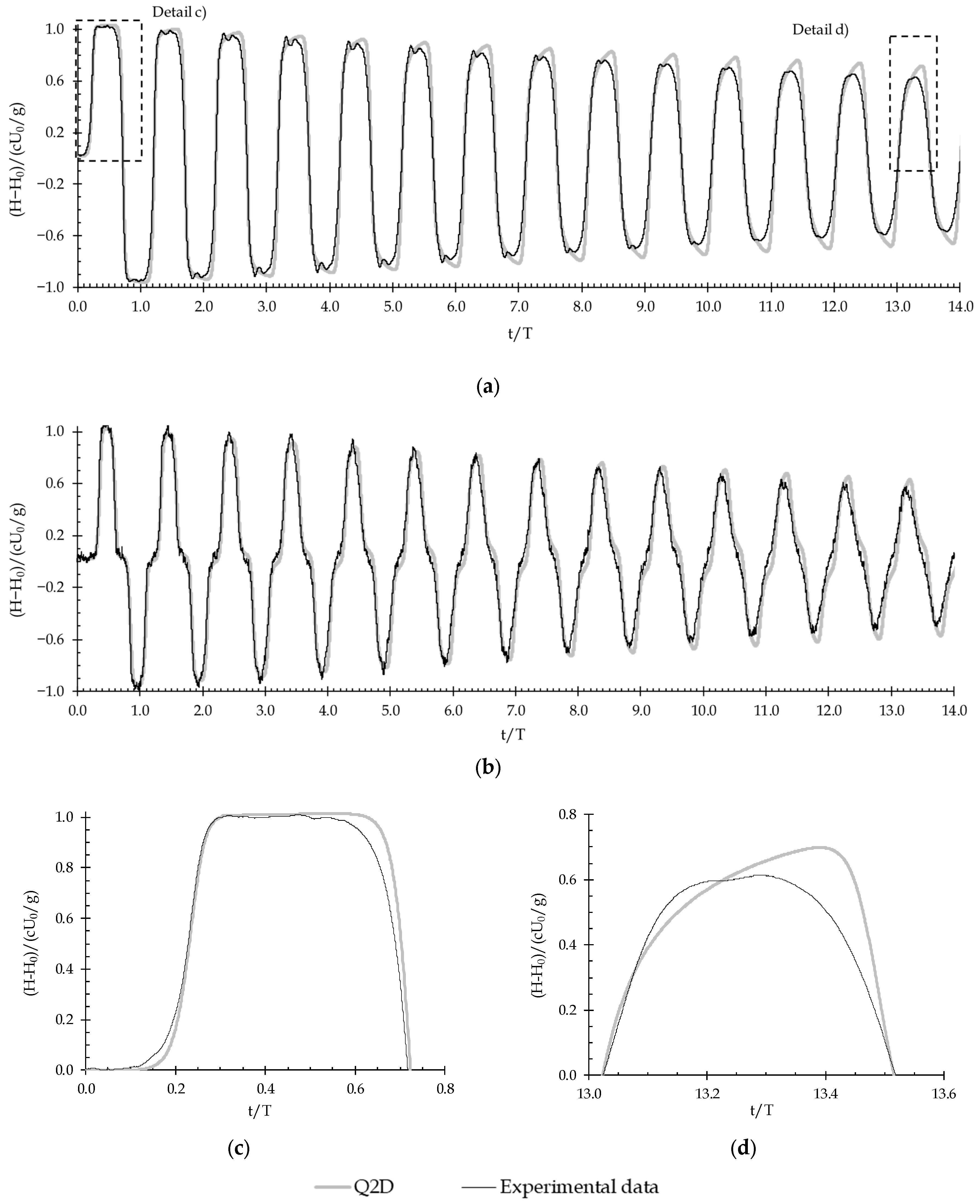
Experimental data for an effective valve closing time of 0.01 s is used herein for comparison with 1D and Q2D models’ results. The experimental valve closure manoeuvre is calibrated for all models and is ten times slower than the valve manoeuvre used in the previous comparison (Figure 5).
Figure 11 presents the collected piezometric-head data and the Q2D model simulation results. The CIB models’ piezometric head results are not represented, as all models closely match the Q2D results and no significant differences are observed. Increasing the valve closure time reduces wall shear stress peaks and improves the agreement between the full and approximate CIB models. Trikha’s model provides a poorer description during the high dissipation period, although the piezometric head results remain very close. The IAB model continues to reproduce wave damping but with a rectangular pressure-wave shape.
Figure 11. Piezometric head time history for the experimental data and Q2D results. (a) Valve section, 0 ≤ t/T ≤ 14; (b) pipe midsection section, 0 ≤ t/T ≤ 14; (c) valve section, 0 ≤ t/T ≤ 0.8; (d) valve section, 13.0 ≤ t/T ≤ 13.6.
The experimental data corroborates the almost symmetric pressure wave shape previously represented by the 3D-CFD model (Figure 11a,b). The extra wave rounding is immediately observed after the first wave reflection in the reservoir (Figure 11c at t/T = 0.65). This feature is not described by the Q2D model that closely maintains the valve closure S-shape. The difference between experimental data and Q2D model results increases with the simulation time (compare Figure 11c at t/T = 0.65 and Figure 11d at t/T = 13.4), as also observed in the comparison with the 3D-CFD results. The Q2D valve calibration improves the initial agreement with the experimental data, but deviations persist due to simplified boundary condition representation.
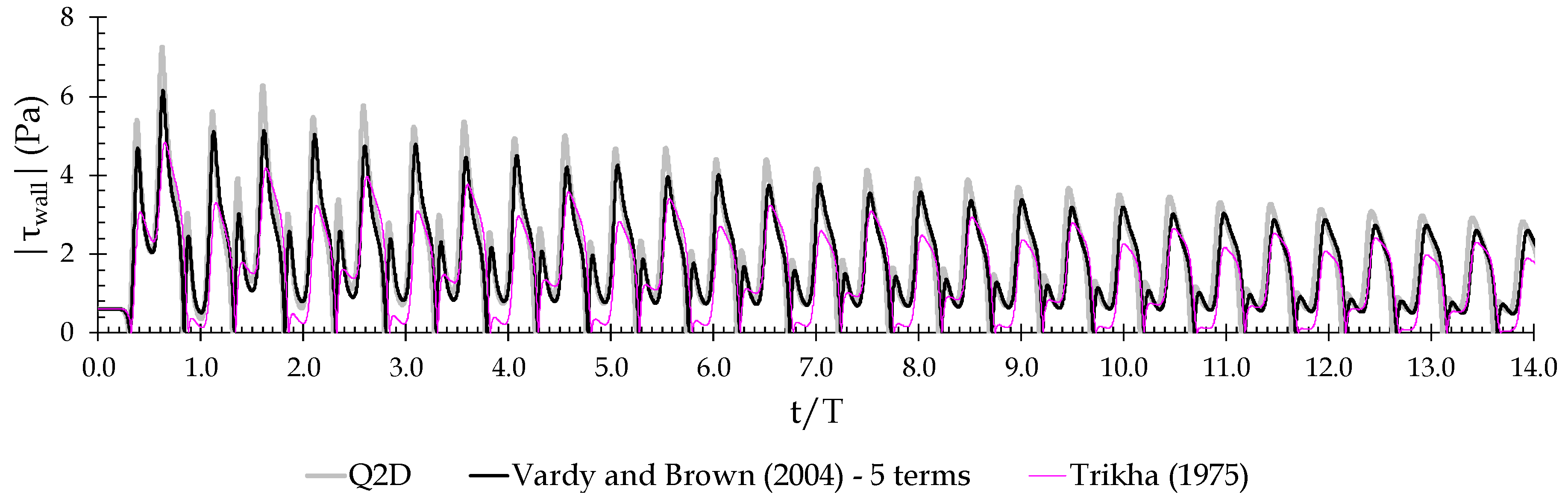
The wall shear stress for the approximate CIB models and the Q2D model are presented in Figure 12. The full CIB models’ results perfectly overlap with those from the Q2D model and, for simplification reasons, are not presented herein. The valve slower closure considerably reduces the τw peak values. The Q2D first pressure peak decreases from 72 Pa in the theoretical instantaneous manoeuvre calculations (Figure 9a), to 13.5 Pa in the 3D-CFD calibrated manoeuvre (Figure 10a) and to 5.2 Pa in the experimental data (Figure 12). This peak reduction substantially lowers the required numerical accuracy and brings the approximate CIB model results closer to those of the Q2D model, as evidenced by the good agreement among all models in Figure 12.
Figure 12. Wall shear stress time history at the pipe midsection for the experimental valve manoeuvre with the Q2D [11,20].

7. Conclusions

The Q2D model results are compared with those obtained from the 3D-CFD and 1D numerical models for an instantaneous valve closure, while the 1D and Q2D predictions are also evaluated with the valve manoeuvre observed in the laboratory tests.
The Q2D model accurately describes unsteady energy dissipation when fully developed flow is ensured. Its results are comparable to those of the 3D-CFD model, while requiring significantly less computational effort. However, it fails to correctly simulate instantaneous valve closure, as captured by the 3D-CFD model. This limitation directly results from the Q2D model assumptions of radially uniform pressure and negligible circumferential velocities, which are not valid near the valve or immediately after its closure. Consequently, the Q2D model does not predict a symmetric pressure wave and emphasises the high energy dissipation periods after each pressure surge arrival. This comparison shows the importance of developing specific boundary conditions to improve the Q2D model accuracy. Nevertheless, it emphasises that the 3D-CFD benefit is associated with the simulations near the boundary and during the valve closure, rather than with unsteady energy calculation.
The same assumptions are made in the convolutional 1D unsteady models, which explain why the results for wall shear stress and piezometric head obtained by the Q2D model and the full CIB 1D models are almost identical. The latter requires more computing power. Nevertheless, the approximate CIB 1D models cannot provide an accurate description of the transient event following the arrival of the pressure wave.
The laboratory valve closure represents a fast yet realistic closure of the valve, and no significant differences are observed between the Q2D and CIB models. Higher valve closure times reduce the wall shear stress peak value and approximate the results of the Q2D models (and full CIB models) with the approximate CIB models. The experimental data corroborates the almost symmetric pressure wave shape (previously represented by the 3D-CFD results) and the extra wave rounding observed in the first wave, not described by 1D and Q2D models.
Future efforts should focus on conducting further sensitivity analyses on the effect of key parameters on the Q2D model (e.g., pipe diameter, length, steady-state mean velocity) as well as on reducing the computational time of the Q2D model to make it more competitive with the 1D models. One possibility to explore for reducing computational effect is adapting the mesh geometry during the transient event according to the axial velocity gradient. A dynamic mesh that reconfigures as the axial velocity gradient decreases would reduce computational time. Secondly, the existing unsteady model accurately simulates unsteady friction for real valve closure manoeuvres, so efforts should focus on improving these models’ boundary description.

Author Contributions

Conceptualisation, P.F. and D.C.; methodology, P.F. and D.C.; software, P.F.; validation, P.F.; formal analysis, P.F.; investigation, P.F. and D.C.; resources, P.F. and D.C.; data curation, D.C.; writing—original draft preparation, P.F.; writing—review and editing, P.F. and D.C.; visualisation, P.F.; supervision, D.C.; project administration, D.C.; funding acquisition, D.C. All authors have read and agreed to the published version of the manuscript.

Funding

This research was partially funded by the Fundação para a Ciência e a Tecnologia, I.P. (FCT, https://ror.org/00snfqn58, accessed on 3 January 2026) under Grant UID/6438/2025 (https://doi.org/10.54499/UID/06438/2025) of the research unit CERIS. For the purpose of Open Access, the author has applied a CC-BY public copyright license to any Author’s Accepted Manuscript (AAM) version arising from this submission.

Data Availability Statement

The original contributions presented in this study are included in the article. Further inquiries can be directed to the corresponding author.

Acknowledgments

The authors would like to acknowledge João Paulo Ferreira and Nuno Martins for assisting the data collection in the experimental facility and for providing the 3D-CFD data.

Conflicts of Interest

The authors declare no conflicts of interest.

Abbreviations and Nomenclature

The following abbreviations and nomenclatures are used in this manuscript:
1DOne-dimensional
2DTwo-dimensional
3DThree-dimensional
CFDComputation fluid dynamics
CIBConvolution integral-based method
Q2DQuasi-2D axisymmetric model
GSGeometric sequence cylinder mesh
IABInstantaneous acceleration-based model
UFUnsteady friction
CRgeometric sequence common ratio (-)
cpressure wave speed (m/s)
Dpipe inner diameter (m)
Hpiezometric head (m)
gacceleration due to gravity (m/s2)
Lpipe length (m)
Qflow rate or discharge (m3/s)
NCtotal number of cylinders of the radial mesh (-)
ReReynolds number (-)
rdistance from the axis in the radial direction (m)
ttime (s)
Tpressure wave period (T = 4L/c) (s)
U mean velocity of the fluid in the pipe cross-section (m/s)
Wweighting function (-)
rj wall   thickness   of   the   jth   cylinder   ( r j = r j r j 1 )
uaxial velocity (m/s)
u turbulence velocity fluctuation on the axial direction (m/s)
υ radial velocity (m/s)
υ turbulence velocity fluctuation on the radial direction (m/s)
xdistance along the pipe (m)
νkinematic viscosity of liquid (m2/s)
ydistance from the pipe wall, measured in the radial direction (m)
t time interval (s)
κ Von Kármán constant (-)
λ bulk   viscosity   ( λ ≈ 2/3μ) (Pa.s)
νkinematic viscosity (m2/s)
εeddy viscosity (m2/s)
μ dynamic viscosity (Pa.s)
τwtotal wall shear stress (Pa)
τwuunsteady wall shear stress (Pa)
τwssteady wall shear stress (Pa)
ρ liquid density (kg/m3)

References

  1. Vardy, A.E.; Brown, J.M.B. Transient turbulent friction in smooth pipe flows. J. Sound Vib. 2003, 259, 1011–1036. [Google Scholar] [CrossRef]
  2. Covas, D.; Stoianov, I.; Ramos, H.; Graham, N.; Maksimovic, C. The dynamic effect of pipe-wall viscoelasticity in hydraulic transients. Part 1: Experimental analysis and creep characterization. J. Hydraul. Res. 2004, 42, 517–532. [Google Scholar] [CrossRef]
  3. Ferras, F.; Manso, A.; Schleiss, A.; Covas, I.C.D. Experimental distinction of damping mechanisms during hydraulic transients in pipe flow. J. Fluids Struct. 2016, 66, 424–446. [Google Scholar] [CrossRef]
  4. Urbanowicz, K.; Bergant, A.; Stosiak, M.; Karpenko, M.; Bogdevičius, M. Developments in analytical wall shear stress modelling for water hammer phenomena. J. Sound Vib. 2023, 562, 117848. [Google Scholar] [CrossRef]
  5. Urbanowicz, K.; Jing, H.; Bergant, A.; Stosiak, M.; Lubecki, M. Progress in analytical modeling of water hammer. J. Fluids Eng. 2023, 145, 081203. [Google Scholar] [CrossRef]
  6. Ghidaoui, M.S.; Zhao, M.; McInnis, D.A.; Axworthy, D.H. A review of water hammer theory and practice. Appl. Mech. Rev. 2005, 58, 49–76. [Google Scholar] [CrossRef]
  7. Brunone, B.; Golia, U.; Greco, M. Modelling of fast transients by numerical methods. In International Conference on Hydraulic Transients with Water Column Separation, Proceedings of the 9th Round Table of the IAHR Group, Valencia, Spain, 4–6 September 1991; IAHR: Madrid, Spain, 1991; pp. 273–280. [Google Scholar]
  8. Brunone, B.; Golia, U.; Greco, M. Some remarks on the momentum equation for fast transients. In International Conference on Hydraulic Transients with Water Column Separation, Proceedings of the 9th Round Table of the IAHR Group, Valencia, Spain, 4–6 September 1991; IAHR: Madrid, Spain, 1991; pp. 201–209. [Google Scholar]
  9. Vitkovsky, J.; Stephens, M.; Bergant, A.; Lambert, M.; Simpson, A. Efficient and accurate calculation of Vardy–Brown unsteady friction in pipe transients. In Proceedings of the 9th International Conference on Pressure Surges, Chester, UK, 24–26 March 2004. [Google Scholar]
  10. Zielke, W. Frequency-dependent friction in transient pipe flow. J. Basic Eng. 1968, 90, 109–115. [Google Scholar] [CrossRef]
  11. Vardy, A.E.; Brown, J.M.B. Transient turbulent friction in fully rough pipe flows. J. Sound Vib. 2004, 270, 233–257. [Google Scholar] [CrossRef]
  12. Vardy, A.E.; Hwang, K.-L. A characteristic model of transients in pipes. J. Hydraul. Res. 1991, 29, 669–684. [Google Scholar] [CrossRef]
  13. Zhao, M.; Ghidaoui, M. Investigation of turbulence behavior in pipe transients using a k–ε model. J. Hydraul. Res. 2006, 44, 682–692. [Google Scholar] [CrossRef]
  14. Martins, N.M.C.; Carriço, N.J.G.; Ramos, H.M.; Covas, I.C.C. Velocity distribution in pressurized pipe flow using CFD: Accuracy and mesh analysis. Comput. Fluids 2014, 105, 218–230. [Google Scholar] [CrossRef]
  15. Martins, N.; Brunone, B.; Meniconi, S.; Ramos, H.M.; Covas, D.I.C. CFD and 1D approaches for the unsteady friction analysis of low Reynolds number turbulent flows. J. Hydraul. Eng. 2017, 143, 04017050. [Google Scholar] [CrossRef]
  16. Martins, N.; Brunone, B.; Meniconi, S.; Ramos, H.M.; Covas, D.I.C. Efficient computational fluid dynamics model for transient laminar flow modelling: Pressure wave propagation and velocity profile changes. J. Fluids Eng. 2018, 140, 011002. [Google Scholar] [CrossRef]
  17. Vardy, A.E. Acceleration-dependent unsteady friction revisited. In Proceedings of the 13th International Conference on Pressure Surges, Bordeaux, France, 14–16 November 2018; BHR Group: Brittany, France, 2018; pp. 265–282. [Google Scholar]
  18. Adamkowski, A.; Lewandowski, M. Experimental examination of unsteady friction models for transient pipe flow simulation. J. Fluids Eng. 2006, 128, 1351–1363. [Google Scholar] [CrossRef]
  19. Ariyaratne, C.; He, S.; Vardy, A.E. Wall friction and turbulence dynamics in decelerating pipe flows. J. Hydraul. Res. 2010, 48, 810–821. [Google Scholar] [CrossRef]
  20. Trikha, A. An efficient method for simulating frequency-dependent friction in transient liquid flow. J. Fluids Eng. 1975, 97, 97–105. [Google Scholar] [CrossRef]
  21. Vardy, A.E.; Brown, J.M.B. Efficient approximation of unsteady friction weighting functions. J. Hydraul. Eng. 2004, 130, 1097–1107. [Google Scholar] [CrossRef]
  22. Ferreira, J.; Martins, N. Ball valve behaviour under steady and unsteady conditions. J. Hydraul. Eng. 2018, 144, 04018005. [Google Scholar] [CrossRef]
  23. Cebeci, T. Analysis of Turbulent Flows with Computer Programs, 3rd ed.; Elsevier: Oxford, UK, 2013. [Google Scholar]
  24. Abreu, J.; Betâmio de Almeida, A. Timescale behavior of the wall shear stress in unsteady laminar pipe flows. J. Hydraul. Eng. 2009, 135, 415–424. [Google Scholar] [CrossRef]
  25. Che, T.; Duan, H.; Lee, P.J.; Meniconi, S.; Pan, B.; Brunone, B. Radial pressure wave behavior in transient laminar pipe flows under different flow perturbations. J. Fluids Eng. 2018, 140, 101203. [Google Scholar] [CrossRef]
  26. Zidouh, H. Velocity profiles and wall shear stress in turbulent transient pipe flow. Int. J. Dyn. Fluids 2009, 5, 61–83. [Google Scholar]
  27. Martins, N.M.C.; Wahba, E.M. On the hierarchy of models for pipe transients: From quasi-two-dimensional water hammer models to full three-dimensional computational fluid dynamics models. ASME J. Press. Vessel Technol. 2022, 144, 021402. [Google Scholar] [CrossRef]
  28. Urbanowicz, K.; Andrade, D.M.; Kubrak, M.; Kodura, A. Accuracy and limitations of 1D and Q2D water hammer models for laminar and turbulent flows. J. Braz. Soc. Mech. Sci. Eng. 2025, 47, 666. [Google Scholar] [CrossRef]
  29. Ferreira, P.L.; Covas, D.I.C. New Optimized Equal-Area Mesh Used in Axisymmetric Models for Laminar Transient Flows. Water 2023, 15, 1402. [Google Scholar] [CrossRef]
  30. Ferreira, P.M.L. Axisymmetric Model for Pressurized Transient Flow: Efficient Meshes’ Analysis; Instituto Superior Técnico: Lisbon, Portugal, 2022. [Google Scholar]
  31. Kita, Y.; Adachi, Y.; Hirose, K. Periodically oscillating turbulent flow in a pipe. Bull. JSME 1980, 23, 656–664. [Google Scholar] [CrossRef]
  32. Bratland, O. Frequency-dependent friction and radial kinetic energy variation in transient pipe flow. In Proceedings of the 5th International Conference on Pressure Surges, Hanover, Germany, 22–24 September 1986; BHRA, The Fluid Engineering Centre: Bedford, UK, 1986. [Google Scholar]
  33. Ferreira, P.L.; Covas, D.I.C. Mesh Sensitivity Analysis of Axisymmetric Models for Smooth–Turbulent Transient Flows. Fluids 2024, 9, 268. [Google Scholar] [CrossRef]
  34. Vardy, A.E.; Brown, J.M.B. Transient, turbulent, smooth pipe friction. J. Hydraul. Res. 1995, 33, 435–456. [Google Scholar] [CrossRef]
  35. Vardy, A.; Brown, J.; He, S.; Ariyaratne, C.; Gorji, S. Applicability of frozen-viscosity models of unsteady wall shear stress. J. Hydraul. Eng. 2015, 141, 04014073. [Google Scholar] [CrossRef]
  36. He, S.; Jackson, J.D. A study of turbulence. A study of turbulence under conditions of transient flow in a pipe. J. Fluid Mech. 2000, 408, 1–38. [Google Scholar] [CrossRef]
  37. Zhao, M.; Ghidaoui, M. Efficient quasi-two-dimensional model for water hammer problems. J. Hydraul. Eng. 2003, 129, 1007–1013. [Google Scholar] [CrossRef]
  38. Mitra, A.; Rouleau, W. Radial and axial variations in transient pressure waves transmitted through liquid transmission lines. J. Fluids Eng. 1985, 107, 105–111. [Google Scholar] [CrossRef]
  39. Kagawa, T.; Lee, I.; Kitagawa, A.; Takenaka, T. High-speed and accurate computing method of frequency-dependent friction in laminar pipe flow for the method of characteristics. Trans. Jpn. Soc. Mech. Eng. 1983, 49, 2638–2644. [Google Scholar] [CrossRef]
  40. Schohl, G.A. Improved approximate method for simulating frequency-dependent friction in transient laminar flow. J. Fluids Eng. 1993, 115, 420–424. [Google Scholar] [CrossRef]
Disclaimer/Publisher’s Note: The statements, opinions and data contained in all publications are solely those of the individual author(s) and contributor(s) and not of MDPI and/or the editor(s). MDPI and/or the editor(s) disclaim responsibility for any injury to people or property resulting from any ideas, methods, instructions or products referred to in the content.

Article Metrics

Citations

Article Access Statistics

Multiple requests from the same IP address are counted as one view.