Article

Per- and Polyfluoroalkyl Substance (PFAS) Occurrence in Gunpowder River Watershed in Maryland United States

by
Chichedo I. Duru
1,
Theaux M. Le Gardeur
2,
Isabel N. Ryen
2,
Jennifer A. Galler
2 and
Samendra P. Sherchan
1,*
1
Center of Research Excellence in Wastewater Based Epidemiology, Morgan State University, Baltimore, MD 21251, USA
2
Gunpowder Riverkeeper, 16829 York RD, Monkton, MD 21111, USA
*
Author to whom correspondence should be addressed.
Water 2026, 18(2), 137; https://doi.org/10.3390/w18020137
Submission received: 8 November 2025 / Revised: 8 December 2025 / Accepted: 12 December 2025 / Published: 6 January 2026
(This article belongs to the Special Issue Contaminants of Emerging Concern in Soil and Water Environment)

Abstract

Per- and polyfluoroalkyl substances (PFASs) represent a group of persistent environmental contaminants with known adverse health effects. This study assessed the presence and concentrations of PFASs in surface water across various locations along the Gunpowder River Watershed in Maryland, United States. Gunpowder RIVERKEEPER® a 501(c)(3) nonprofit collected eleven surface water grab samples from the Gunpowder River Watershed for the study, including both drinking water sources and non-drinking tributaries. Of the 55 PFASs analyzed, multiple compounds, including PFOS, PFOA, PFBS, PFHxA, PFPeA, and PFHpA, were detected above reporting limits at all sampled locations. Total PFAS concentrations varied substantially across the watershed, ranging from 2.1 to 21.3 ng/L in drinking water source tributaries and 6.6–18.4 ng/L in non-drinking tributaries. Several sites exhibited PFOS and PFOA concentrations exceeding the 2022 U.S. EPA interim lifetime health advisory levels, indicating potential risk to downstream communities relying on these water sources. Short-chain PFASs (C ≤ 7) were more abundant than long-chain PFASs, reflecting their greater mobility and persistence in surface waters. These findings demonstrate watershed-wide PFAS contamination and highlight the potential for trophic transfer and bioaccumulation in fish species in these tributaries and subsequent human exposure. Continued monitoring, regulation, and remediation efforts are required to mitigate PFAS contamination and safeguard public health in vulnerable ecosystems and populations. Further research is needed to better understand the extent of PFAS exposure, associated health risks, and effective strategies for prevention and management.

1. Introduction

Per- and polyfluoroalkyl substances (PFASs) have emerged as a significant environmental concern, drawing attention due to their widespread presence and potential health risks. Maryland, with its diverse ecosystems and water bodies, has not remained untouched by this pervasive contamination. PFAS, a group of synthetic chemicals known for their resistance to heat, water, and oil, have found their way into the state’s surface water, posing a complex challenge that demands attention and comprehensive understanding.
These compounds consist of a group of over 4700 substances, which have been widely used since the mid-20th century in various industrial and consumer applications, such as firefighting foams, non-stick cookware, waterproof textiles, and more [1,2]. The unique properties that make PFASs so useful also contribute to their persistence in the environment, leading to bioaccumulation and potential adverse effects on human health and ecosystems. These substances comprise long- and short-chained carbon compounds attached to fluorine atoms, typically with a functional group attached to it [3]. This structure contributes to the unique properties of PFASs, such as their resistance to heat, water, and oil. PFAS exposure can occur through various pathways, spanning from contaminated fish tissues and soil/dust to food packaging, certain manufacturing facilities, and notably, our drinking water supply.
Maryland, with its intricate network of rivers, watersheds, estuaries, and Chesapeake Bay, serves as a microcosm of the larger environmental challenges associated with PFAS contamination. The introduction of these chemicals into surface water can be traced back to direct or accidental industrial discharges through industrial activities, especially those involving the production or use of PFAS-containing products. Also, stormwater runoff, especially in urban areas, with impervious surfaces and intense stormwater runoff, can transport PFASs from various sources into surface water [4,5]. The historical use of firefighting foams at military installations and commercial airports in different cities like Maryland also increased the introduction of these substances through leaching from these sites into surface water causing contamination [6]. PFASs (per- and polyfluoroalkyl substances) can also enter groundwater and, subsequently, drinking water, through various pathways. One common route is through industrial discharge and waste disposal practices where PFAS-containing materials are released into the environment [7,8]. Additionally, PFASs can leach into groundwater from landfills where products containing these substances are disposed of. Firefighting foam, which contains PFASs, can also significantly contribute to the contamination of groundwater and surface water during firefighting activities or training exercises [6]. Moreover, PFASs can migrate from soil into groundwater over time, especially in areas where these chemicals have been used extensively or where contaminated groundwater is present. PFASs in air can be transported by rainfall into the soil and subsequently into the groundwater. Once in the groundwater, PFASs can persist for long periods due to their chemical stability, potentially reaching drinking water sources through wells or water treatment systems [9].
PFAS contamination in Maryland’s surface water raises concerns about its impact on both the environment and public health. These chemicals have been linked to various health issues, including developmental delays, immune system suppression, reproductive health issues, changes in liver enzymes, cardiovascular effects (such as high blood pressure or pregnancy-induced hypertension), decreased antibody responses to vaccines, developmental effects (such as small decreases in birth weight), and an increased risk of certain cancers [9,10]. The bioaccumulation potential of PFASs in fish and other aquatic organisms poses a threat to the ecological balance of Maryland’s water ecosystems. With all these adverse effects of PFAS contamination, this group of compounds has been listed as one of the contaminants of emerging concern (CECs) by the EPA under the Clean Water Act [11].
As awareness of PFAS contamination grows, regulatory bodies at the federal and state levels are taking steps to address the issue. Maryland, in line with national efforts, has initiated monitoring programs, set maximum contaminant levels (MCLs), and established guidelines for the management and remediation of PFAS in contaminated sites according to the Environmental Council of the States [12]. The regulations for PFASs in the United States have undergone substantial evolution in recent years. In 2016, the EPA established a combined health advisory level of 70 ng/L for PFOA and PFOS; however, mounting scientific evidence has led many researchers to call for far more protective thresholds due to the documented adverse health effects associated with these compounds. Reflecting this growing body of research, the EPA revised its guidance in 2022, issuing dramatically lower interim health advisory levels of 0.004 ng/L for PFOA and 0.02 ng/L for PFOS, along with final advisory levels of 10 ng/L for GenX and 2000 ng/L for PFBS [13]. Additionally, many states have established health advisory levels for various PFAS compounds. Maryland only has a limit for PFHxS, at 140 ng/L. It is a PFAS compound commonly found in manufacturing industries, wastewater, and biosolids.
Finally, the contamination of PFASs in Maryland’s surface water is a complex and multifaceted issue that requires a comprehensive understanding of its sources, environmental impact, and potential health risks. In a sampling conducted by the MDE in 2020, involving 129 public water treatment systems for PFASs, the highest levels of PFOA and PFOS were detected in the water treatment systems serving the City of Westminster and the Town of Hampstead [14].
This study investigates the occurrence of PFAS compounds across tributaries of the Gunpowder River and Bush River watersheds in Maryland, providing baseline information for understanding PFAS occurrence in these systems. This work also provides information on several PFAS compounds that have been rarely studied or documented in surface waters.
The findings of this study will provide crucial insights into the presence of selected PFAS compounds within the Gunpowder River and Bush River Watersheds, regions where such data have been largely absent despite known pressures from wastewater effluent, industrial activity, and legacy pollutants like PCBs, and areas that serve as a nursery ground for 26 species of finfish, some of which are commercially harvested and used for subsistence [15]. Given the Gunpowder River’s role as a primary drinking water source for the Baltimore metro area (Baltimore County and Baltimore City) and its importance as a nationally recognized, self-sustaining, wild trout fishery, and a significant tributary to the Chesapeake Bay, understanding and mitigating PFAS contamination in this ecosystem is of paramount importance.

2. Materials and Methods

2.1. Description of Study Area

The Gunpowder River originates from the convergence of Big Gunpowder Falls and Little Gunpowder Falls. The river traverses Maryland’s largest state park, showcasing the region’s natural beauty and ecological diversity. It stretches across a length of 53 miles, winding through Carroll, Harford, and Baltimore Counties in Maryland as well as parts of York County, PA. Its expansive watershed covers more than 450 square miles and includes a network of over 217 miles of streams [16].
The sampling initiative, conducted in collaboration with the Waterkeeper Alliance and the Gunpowder RIVERKEEPER on a nationwide scale, covered the Gunpowder River watershed and a portion of the Bush River watershed. This effort targeted both primary reservoirs, the Prettyboy Reservoir and the Loch Raven Reservoir, and their associated tributaries that occur as surface water streams. These surface water streams, including Little Falls, Piney Run, Green Branch, and Beaverdam Run, hold significant importance and are identified as Class III-P streams under the Maryland Department of the Environment’s Water Quality Standards Integrated Report [17]. Designated for non-tidal cold-water use and supporting trout propagation, these streams also serve as crucial components of the public drinking water supply. Additionally, sampling extended to non-drinking water sources below the Loch Raven Reservoir, classified as Class I streams, essential as Chesapeake Bay tributaries for recreational activities like fishing and swimming. Notable sampling sites encompassed Gunpowder Falls at Pot Rocks in Perry Hall below the Richlyn Manor Wastewater Treatment Plant, and tidal water bodies like the Bird River in White Marsh and Winter’s Run located in the Bush River watershed in Joppa. The inclusion of samples from Little Gunpowder Falls, both upstream and downstream of the Joppa Wastewater Treatment Plant, aimed to elucidate any potential influence of the plant on PFAS abundance or concentration in the water system.

2.2. Sample Collection

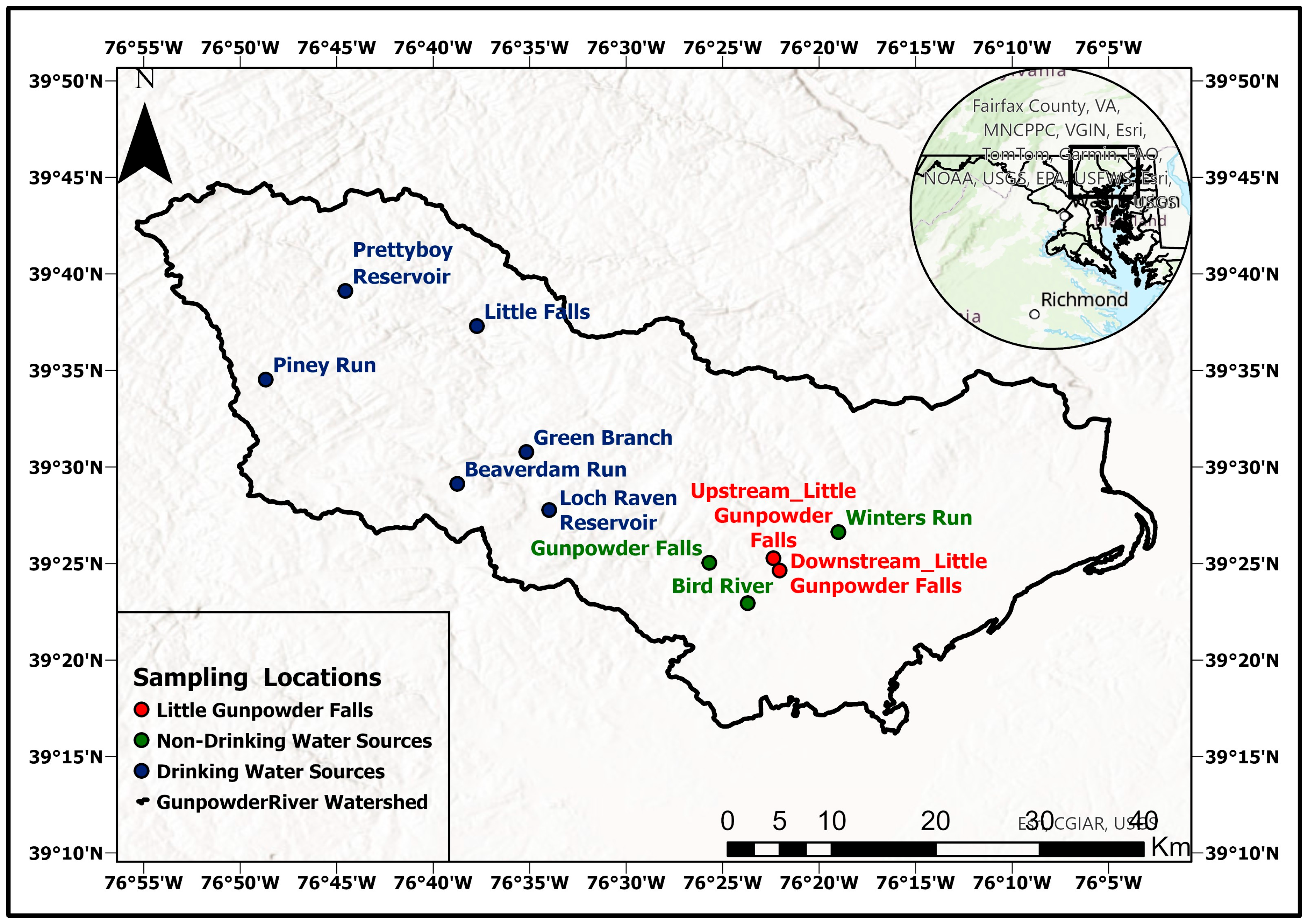
Surface water samples were obtained from all sampling locations along the Gunpowder River watershed (Table 1). The samples included six drinking water sources above the Loch Raven Reservoir and five non-drinking water sources (made up of three tributaries and two samples from the upstream and downstream of the Little Gunpowder River). This gave a total of eleven sampling locations from surface water tributaries across the Gunpowder River watershed, as depicted Figure 1. Sampling was conducted between 29 June and 7 July 2022. At each site, PFAS sampling was performed using the CycloPure Water Test Kits, which incorporate a field-deployable point-of-site solid-phase extraction (SPE) system. Approximately 250 mL of surface water was collected directly from the stream at mid-depth using clean high-density polyethylene (HDPE) and immediately passed through the Cyclopure DEXSORB® extraction disk following the manufacturer’s instructions to retain the dissolved PFASs. To prevent contamination, all sampling materials used were PFAS-free. The samplers wore nitrile gloves and used only PFAS-free HDPE containers during sampling. Field handling followed PFAS clean-sampling best practices, while minimizing exposure time prior to sealing the extraction disk. After extraction, the DEXSORB® disks were capped, sealed, and shipped to the Cyclopure analytical laboratory.

2.3. Extraction and Analysis of PFAS Compounds

At the Cyclopure laboratory, PFASs retained on the DEXSORB® extraction disks were eluted and processed using Cyclopure’s standard solid-phase extraction procedure, as described in USEPA method 537. Extracts were concentrated and analyzed for 55 target PFASs, including all PFASs listed in USEPA method 537 and other selected PFASs from EPA method 533 and method 1633 using High-Performance Liquid Chromatography coupled with Tandem Mass Spectrometry (HPLC-MS/MS). Quantification was performed using isotope dilution calibration, wherein a precise amount of isotopically labeled standard was weighed and utilized to prepare a stock solution, which was then added to the water sample. Following analysis, the PFAS compounds were quantified in nanograms per liter (ng/L). The limits of PFAS concentrations were reported in nanograms per liter (ng/L). The method’s limit of quantification (LOQ) and reporting limit (RL) was 1.0 ng/L for most PFAS compounds. Exceptions included HFPO-DA (GenX), 3:3 FTCA (LOQ = 2.0 ng/L), and 6:8 PFPi (LOQ = 10 ng/L), consistent with the analytical limits of the Cyclopure platform and HPLC-MS/MS detection. Any values below the LOQ were reported as non-detects (ND).

2.4. Quality Control

To ensure accuracy of PFAS measurements. Laboratory QA/QC procedures included laboratory reagent blanks and method blanks analyzed with each batch to verify that no PFAS contamination was introduced during extraction or analysis. Method accuracy and potential matrix effects were evaluated through laboratory control samples and matrix spikes/matrix-spike duplicates, with recoveries assessed against established acceptance limits. Isotopically labeled surrogate standards were added to all samples to monitor extraction efficiency, and samples outside of the recovery criteria were reanalyzed or qualified. Instrument calibration was maintained through nine-point calibration curves, with the lowest standard set at the reporting limit and verified using continuing calibration checks analyzed every ten samples and at the end of each analytical run. All calibration curves and verification checks were evaluated according to EPA method criteria for PFAS analysis. Routine monitoring of instrument performance, including retention time stability, ion ratio tolerances, and detection-limit verification, ensured consistent analytical integrity throughout the run. Reporting limits followed the laboratory’s established LOQ criteria for each PFAS compound.

3. Results and Discussion

3.1. PFAS Detection in Non-Drinking Water Source Tributaries

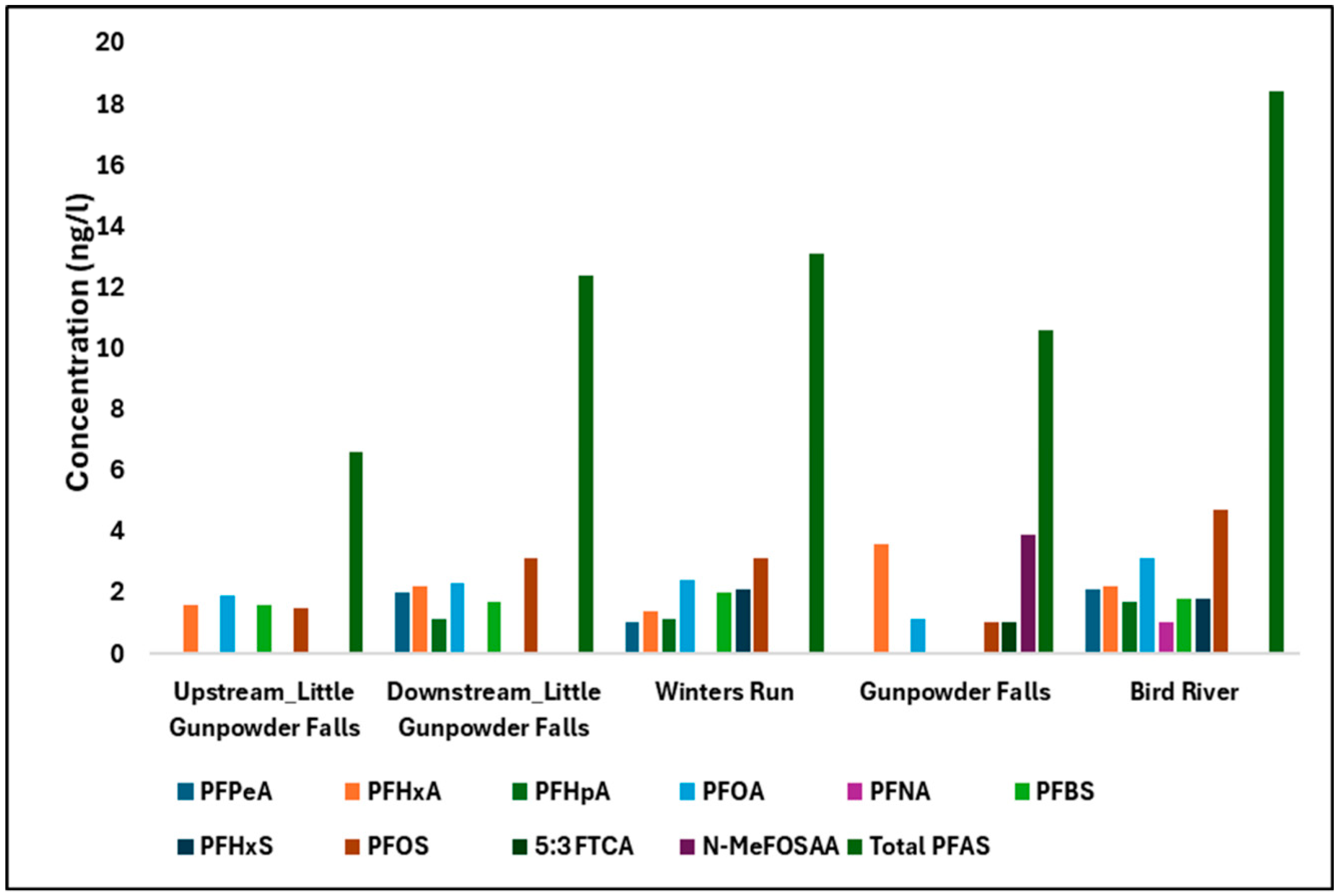
The study assessed 55 PFASs in the surface water samples collected, as listed in Table 2. Among the 55 PFAS compounds analyzed, 6 were detected in both the upstream and downstream sections of the Little Gunpowder Falls while the other PFAS compounds were below the RL (Table 3). The total concentration of PFASs in the upstream was measured at 6.6 ng/L, while the downstream region exhibited a concentration of 12.4 ng/L, as shown in Figure 2. In the upstream area, the predominant PFAS compounds detected were perfluorooctanoic acid (PFOA; 1.9 ng/L), perfluorohexanoic acid (PFHxA; 1.6 ng/L), perfluorobutane sulfonic acid (PFBS; 1.6 ng/L), and perfluorooctane sulfonic acid (PFOS; 1.5 ng/L). Conversely, in the downstream area, PFOS had the highest detection level (3.1 ng/L), followed by PFOA (2.3 ng/L), PFHxA (2.2 ng/L), perfluoropentanoic acid (PFPeA; 2 ng/L), PFBS (1.7 ng/L), and perfluoroheptanoic acid (PFHpA; 1.1 ng/L). The results highlight notably elevated PFAS levels in the downstream compared to the upstream of Little Gunpowder Falls.
Also, the other non-drinking water sources located at Winters Run, Gunpowder Falls, and Bird River detected some quantifiable concentrations of PFASs. The total concentration of PFASs detected in Winters Run, Gunpowder Falls, and Bird River, as shown in Table S2, were at 13.1 ng/L, 10.6 ng/L, and 18.4 ng/L, respectively. In Winters Run, the identified PFASs included perfluorooctane sulfonic acid (PFOS; 3.1 ng/L), perfluorooctanoic acid (PFOA; 2.4 ng/L), Perfluorohexane Sulfonic Acid (PFHxS; 2.1 ng/L), perfluorobutane sulfonic acid (PFBS; 2 ng/L), perfluorohexanoic acid (PFHxA; 1.4 ng/L), perfluoroheptanoic acid (PFHpA; 1.1 ng/L), and perfluoropentanoic acid (PFPeA; 1 ng/L). Gunpowder Falls measured N-Methyl Perfluorooctane Sulfonamido Acetic Acid (N-MeFOSAA; 3.9 ng/L), perfluorohexanoic acid (PFHxA; 3.6 ng/L), perfluorooctanoic acid (PFOA; 1.1 ng/L), and (5:3 FTCA; 1 ng/L), while Bird River contained perfluorooctane sulfonic acid (PFOS; 4.7 ng/L), perfluorooctanoic acid (PFOA; 3.1 ng/L), perfluorohexanoic acid (PFHxA; 2.2 ng/L), perfluoropentanoic acid (PFPeA; 2.1 ng/L), perfluorobutane sulfonic acid (PFBS; 1.8 ng/L), Perfluorohexane Sulfonic Acid (PFHxS; 1.8 ng/L), and perfluoroheptanoic acid (PFHpA; 1.7 ng/L).

3.2. PFAS Detection in Drinking Water Source Tributaries

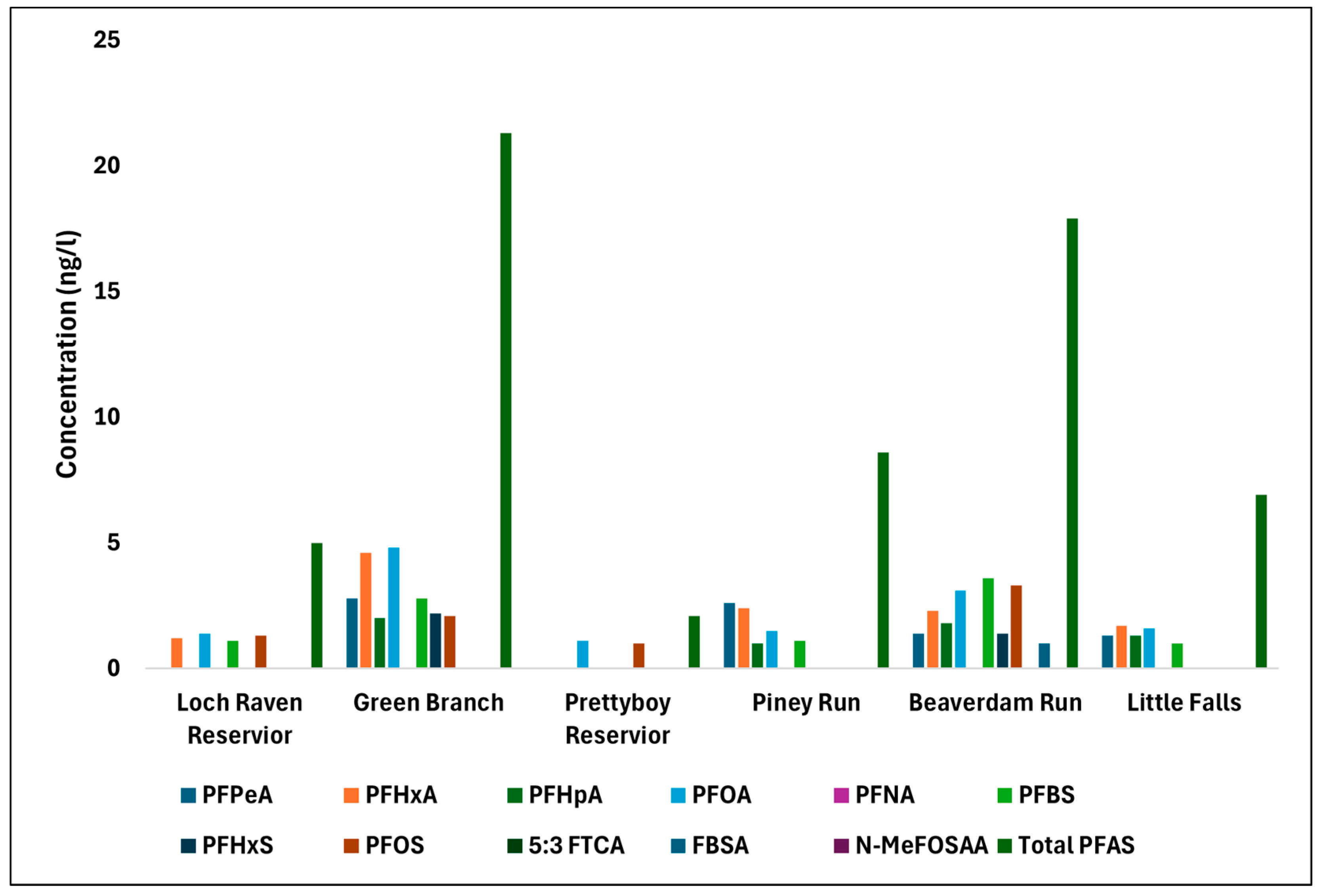
Similarly to the non-drinking water sources, the presence of 55 PFAS compounds were examined in the drinking water source tributaries above the Loch Raven Reservoir. These tributaries also detected quantifiable concentrations of PFASs (Table 4). The total concentrations of PFASs in the drinking water sources, as shown in Figure 3, are as follows: Loch Raven Reservoir (5 ng/L), Green Branch (21.3 ng/L), Prettyboy Reservoir (2.1 ng/L), Piney Run (8.6 ng/L), Beaverdam Run (17.9 ng/L), and Little Falls (6.9 ng/L).
In the Loch Raven Reservoir, the predominant PFAS compounds detected were PFOA (1.4 ng/L), PFOS (1.3 ng/L), PFHxA (1.2 ng/L), and PFBS (1.1 ng/L). Green Branch measured PFOA (4.8 ng/L), PFHxA (4.6 ng/L), PFPeA (2.8 ng/L), PFBS (2.8 ng/L), PFHxS (2.2 ng/L), PFOS (2.1 ng/L), and PFHpA (2 ng/L). Prettyboy Reservoir and Piney Run detected PFOA at 1.1 ng/L and 1.5 ng/L, respectively, and PFOS at 1 ng/L for both locations. Beaverdam Run detected PFBS (3.6 ng/L), (PFOS; 3.3 ng/L), PFOA (3.1 ng/L), PFHxA (2.3 ng/L), PFHpA (1.8 ng/L), PFPeA (1.4 ng/L), PFHxS (1.4 ng/L), and FBSA (1 ng/L). Finally, Little Falls identified PFHxA (1.7 ng/L), PFOA (1.6 ng/L), PFPeA (1.3 ng/L), PFHpA (1.3 ng/L), and PFBS (1 ng/L).

3.3. Discussion

The analysis revealed both short-chain PFASs (C ≤ 7) and long-chain PFASs (C > 7) in all surface water samples, including drinking and non-drinking water sources. Nevertheless, short-chain PFASs were more abundant, likely due to the increased hydrophilicity of shorter-chain PFASs. PFAS molecules consist of a hydrophobic tail and a hydrophilic functional head, with longer chains exhibiting greater hydrophobicity and shorter chains showing enhanced hydrophilicity [18,19]. Consequently, compounds with higher hydrophilicity tend to have higher solubility, with solubility generally increasing as the carbon chain length decreases. Bai and Son [20] also reported that short-chain PFAS, like PFHxA (6.2–74.7 ng/L) and PFPeA (1.8–46.9 ng/L), were among the dominant types of PFASs in surface water measured in two watersheds in Nevada USA. This dominance of short-chain PFASs is also consistent with findings from a Pennsylvania statewide assessment, where PFBS, PFPeA, and PFHxA were among the most frequently detected PFASs and were strongly associated with developed and urbanized land uses [21]. Similarly, studies across Europe, including research on the Oder River [22], Danube Basin [23], and River Mersey [24], also report the occurrence of long- and short-chain PFASs in rivers downstream of wastewater treatment plants and industrial zones. Comparable patterns were found in the Qiantang River [19], Zhangcun River [25], and Fuyang River [26] in China, where short-chain PFASs dominated PFAS profiles, attributed to both ongoing industrial sources and the global shift from long-chain to short-chain PFAS production. Together, these regional comparisons suggest a global trend in which short-chain PFASs increasingly prevail in aquatic environments due to regulatory phase-outs of long-chain PFASs and their greater mobility and persistence in water.
Subsequently, the findings of this study indicate that many surface water streams across the Gunpowder River watershed in Maryland continue to surpass recommended health advisory levels for various PFASs. Notably, the total PFAS levels detected in Little Gunpowder Falls (6.6 ng/L upstream and 12.4 ng/L downstream) and Gunpowder Falls (10.6 ng/L), located below the Richlyn Manor Wastewater Treatment Plant, may highlight influence from the plant. Although these levels are lower than some other sampled sites, they are still significant because wastewater treatment plants are known to be substantial point sources of PFAS contamination These plants receive PFAS-laden wastewater from various industries and households, and often lack effective treatment technologies to remove these harmful substances, which can then enter nearby waterways and pose environmental and health risks [27,28]. Furthermore, the proximity of these streams to industrial sites, including manufacturing facilities, chemical plants, and landfills, raises additional concerns about PFAS contamination. Of note is the area in the Bush River surrounding Aberdeen, identified by the EPA as a site historically used for testing and disposing of chemical agents [29]. This history suggests the potential release of PFASs into the environment through various pathways, including air emissions, wastewater discharges, leaching from waste disposal sites, and runoff from stormwater. Consequently, these factors contribute to the overall concentration of PFASs in the watershed, posing risks to both environmental health and human well-being. Urgent action is needed to address these sources of contamination and mitigate their adverse impacts on water quality and public health. In 2022, the USEPA proposed interim health advisory levels of 0.004 ng/L for PFOA and 0.02 ng/L for PFOS, and final advisory levels of 10 ng/L for GenX and 2000 ng/L for PFBS [13]. According to the American Cancer Society, these advisories rely on data from studies conducted on laboratory animals [30]. However, concentrations of these substances in many areas, especially PFOA and PFOS, consistently exceed these thresholds, raising ongoing concerns about PFAS contamination and potential health hazards in affected regions. Moreover, most states have established standard limits that surpass the EPA’s advisories. Maryland, for instance, has only set health advisory levels for PFHxS at 140 ng/L, further underscoring the urgency of addressing PFAS contamination [31].

3.4. Implications of PFAS Contamination in Surface Water

The environmental and public health concerns associated with PFAS exposure through drinking water and contact with surface waters are substantial, given the variable concentrations of these compounds and their documented adverse health effects. Surface water bodies such as the Prettyboy Reservoir and Loch Raven Reservoir serve as major drinking water sources, and without treatment processes specifically designed to remove PFASs, these contaminants may persist in finished drinking water. As a result, communities relying on these sources may face ongoing exposure risks. Many studies have reported PFAS-related diseases, including changes and damage to the kidneys, thyroid, and liver, reproductive health issues, pregnancy-induced hypertension, children’s developmental issues, and certain types of cancer [9,10,32,33,34,35,36,37]. Recognizing this, numerous government agencies across the United States have proposed drinking water guidelines or provisional health advisories for various PFASs. For instance, several states, including Alaska, Colorado, Connecticut, Delaware, New Mexico, Ohio, and Wisconsin, have adopted the 2016 US EPA established a health advisory of 70 ng/L for individual or combined PFOS and PFOA. Moreover, some states like Colorado and Ohio have set guidance levels for additional PFAS compounds, such as PFBS, with values reaching up to 400,000 ng/L and 140,000 ng/L, respectively. Each state varies in its approach, with California imposing lower limits for PFOS (6.5 ng/L), PFOA (5.1 ng/L), PFHxS (3 ng/L), and PFBS (500 ng/L), while New Jersey has set MCLs for PFOS, PFOA, and PFNA at 13 ng/L, 14 ng/L, and 13 ng/L, respectively. Other states, like Hawaii, Massachusetts, Maine, Michigan, Minnesota, Nevada, New Hampshire, New York, North Carolina, Oregon, Pennsylvania, Rhode Island, Vermont, Washington, and Maryland, have also implemented their own guidelines and limits for different PFAS compounds, reflecting the widespread recognition of the need to address PFAS contamination and mitigate associated health risks [38,39]. Furthermore, according to previous reports from the California Department of the Environment, PFOA and PFOS levels as low as 0.1 ng/L and 0.4 ng/L, respectively, have been associated with the potential to induce pancreatic and liver cancers. Additionally, an experiment conducted on male and female mice reported that PFOA levels of 2 ng/L and PFOS levels of 7 ng/L are considered to elicit non-cancer effects, yet they are still deemed toxic to the liver [40].
With reference to the US EPA lifetime advisory levels for PFOS, PFOA, GenX, and PFBS, we assessed the protective health implications of drinking water analyzed in our present study. An examination of Table 3 reveals that the highest concentrations of PFOS, PFOA, PFBS, and GenX across all drinking water samples were 3.3, 4.8, 3.6, and <2 ng/L, respectively. Notably, PFOS and PFOA levels exceeded the 2022 US EPA lifetime health advisory levels by a significant margin, ranging from 235 to 1200 times higher than the advised thresholds of 0.02 and 0.004 ng/L, respectively. These findings indicate a significant risk of adverse health effects from PFOS and PFOA exposure to the general human population in the sampled area, particularly children. However, it is noteworthy that levels of PFBS and GenX (3.6 ng/L and <2 ng/L, respectively) are much lower than the EPA health advisory levels of 2000 ng/L and 10 ng/L, respectively. This suggests that the levels of these two substances remain within safe limits for individuals in the area. Recent research by Pickard et al. [41] revealed detectable levels of PFAS in fish species despite undetectable levels in the surrounding water. Additionally, a study conducted by George et al. [42] highlighted an increase in PFAS levels across three fish species within an aquatic food chain, with species consuming prey exhibiting higher PFAS levels than the prey itself. This phenomenon underscores the bio-accumulative nature of PFAS as it progresses through the food chain [43,44,45,46].
The highest concentration levels of various PFASs detected in the upstream and downstream of Little Gunpowder Falls and other non-drinking water sources (Table 3), which are home to many species of fish (PFOS: 4.7 ng/L; PFOA: 3.1 ng/L; PFBS: 1.8 ng/L; PFHxA: 3.6 ng/L; PFPeA: 2.1 ng/L; PFHpA: 1.7 ng/L), indicate elevated levels of these substances in fish species inhabiting the river. Consequently, human consumption of fish from this river may lead to increased PFAS exposure in humans, since these streams are classified as Class I streams utilized for recreational activities like fishing and swimming. The Maryland Department of the Environment (MDE) has set health advisories as a precautionary measure to safeguard public health, following a comprehensive sampling effort that revealed concerning concentrations of PFASs in surface water and fish tissues across the state, including notable PFAS concentrations in fish tissues in the Gunpowder River and Gunpowder Falls, among others [47]. These findings further underscore the importance of addressing PFAS contamination in Maryland’s water sources to ensure public safety and protect the environment.

4. Conclusions

The comprehensive analysis of per- and polyfluoroalkyl substances (PFASs) in the Gunpowder River and Bush River watersheds in Maryland underscores the widespread contamination and potential health risks associated with these compounds. The findings reveal measurable PFAS concentrations across all sampled tributaries, with total PFASs ranging from 2.1 to 21.3 ng/L in drinking water sources and 6.6 to 18.4 ng/L in non-drinking sources. In many areas, these concentrations exceed the 2022 recommended health advisory levels, particularly for PFOS and PFOA, raising concerns about adverse health effects, especially in vulnerable populations like children. Despite efforts by government agencies to establish guidelines and advisories, PFAS contamination remains a significant issue, with many states implementing their own limits to address the risks. Moreover, the bioaccumulative nature of PFASs, as demonstrated by their potential presence in fish species despite low levels in surrounding water, highlights the potential for human exposure through dietary intake. This underscores the importance of ongoing monitoring and mitigation efforts to protect public health. The discrepancy between state and federal guidelines further emphasizes the need for consistent and robust regulatory frameworks to address PFAS contamination comprehensively. Collaborative efforts between government agencies, researchers, and stakeholders are essential to develop effective strategies for the monitoring, remediation, and regulation of PFASs to minimize health risks and ensure safe drinking water for all communities. Furthermore, the evolution of EPA advisory levels over time reflects a growing awareness of the potential health hazards posed by PFAS exposure and underscores the importance of continued research to inform policy decisions. It is imperative to prioritize research into the health effects of PFAS exposure, including long-term studies to better understand the cumulative impacts on human health. In summary, the findings of this study contribute to our understanding of PFAS contamination in water sources and highlight the urgent need for concerted action to address this pervasive environmental and public health challenge. Efforts to mitigate PFAS contamination must be multidisciplinary, collaborative, and evidence-based to effectively protect human health and the environment.

Supplementary Materials

The following supporting information can be downloaded at: https://www.mdpi.com/article/10.3390/w18020137/s1, Table S1: List of Streams Sampled During the Study; Table S2: PFAS in Non-drinking Water Sources; Table S3: PFAS in Drinking Water Sources; Table S4: All PFAS Analyzed; Table S5: PFAS Levels in States in the United States (Source [32]).

Author Contributions

Conceptualization: C.I.D., T.M.L.G., I.N.R., J.A.G. and S.P.S.; Methodology: C.I.D., T.M.L.G., I.N.R., J.A.G. and S.P.S.; Formal Analysis and Investigation: C.I.D. and T.M.L.G.; Writing—Original Draft Preparation: C.I.D.; Writing—Review and Editing: C.I.D.; Funding Acquisition: C.I.D., Supervision: T.M.L.G. and S.P.S. All authors have read and agreed to the published version of the manuscript.

Funding

This research received no external funding.

Data Availability Statement

The original contributions presented in this study are included in the article/Supplementary Material. Further inquiries can be directed to the corresponding author.

Conflicts of Interest

The authors declare no conflicts of interest.

References

  1. Aras, D.; Wasler, S.; Bieri, A.; Domenig, F.; Moor, J. PFAS—Forever Chemicals. Report EUT-P4-22FS-04/Institute for Biomass and Resource Efficiency. 2022. Available online: https://par.nsf.gov/biblio/10397728-pfas-forever-chemicals (accessed on 11 December 2025).
  2. Glüge, J.; Scheringer, M.; Cousins, I.T.; DeWitt, J.C.; Goldenman, G.; Herzke, D.; Lohmann, R.; Ng, C.A.; Trier, X.; Wang, Z. An overview of the uses of per- and polyfluoroalkyl substances (PFAS). Environ. Sci. Process. Impacts 2020, 22, 2345–2373. [Google Scholar] [CrossRef]
  3. Panieri, E.; Baralic, K.; Djukic-Cosic, D.; Buha Djordjevic, A.; Saso, L. PFAS Molecules: A Major Concern for the Human Health and the Environment. Toxics 2022, 10, 44. [Google Scholar] [CrossRef]
  4. Codling, G.; Yuan, H.; Jones, P.D.; Giesy, J.P.; Hecker, M. Metals and PFAS in stormwater and surface runoff in a semi-arid Canadian city subject to large variations in temperature among seasons. Environ. Sci. Pollut. Res. 2020, 27, 18232–18241. [Google Scholar] [CrossRef]
  5. Saifur, S.; Gardner, C.M. Loading, transport, and treatment of emerging chemical and biological contaminants of concern in stormwater. Water Sci. Technol. 2021, 83, 2863–2885. [Google Scholar] [CrossRef]
  6. Teymoorian, T.; Munoz, G.; Vo Duy, S.; Liu, J.; Sauvé, S. Tracking PFAS in Drinking Water: A Review of Analytical Methods and Worldwide Occurrence Trends in Tap Water and Bottled Water. ACS EST Water 2023, 3, 246–261. [Google Scholar] [CrossRef]
  7. Guelfo, J.L.; Korzeniowski, S.; Mills, M.A.; Anderson, J.; Anderson, R.H.; Arblaster, J.A.; Conder, J.M.; Cousins, I.T.; Dasu, K.; Henry, B.J.; et al. Environmental Sources, Chemistry, Fate, and Transport of Per- and Polyfluoroalkyl Substances: State of the Science, Key Knowledge Gaps, and Recommendations Presented at the August 2019 SETAC Focus Topic Meeting. Environ. Toxicol. Chem. 2021, 40, 3234–3260. [Google Scholar] [CrossRef]
  8. Saawarn, B.; Mahanty, B.; Hait, S.; Hussain, S. Sources, occurrence, and treatment techniques of per- and polyfluoroalkyl substances in aqueous matrices: A comprehensive review. Environ. Res. 2022, 214, 114004. [Google Scholar] [CrossRef]
  9. Boahen, E.; Owusu, L.; Adjei-Anim, S.O. A Review of Emerging Environmental Contaminants of Global Concern. OSF. 2023. Available online: https://www.researchgate.net/publication/374294986_A_Review_of_Emerging_Environmental_Contaminants_of_Global_Concern (accessed on 11 December 2025). [CrossRef]
  10. Adithya, S.; Jayaraman, R.S.; Krishnan, A.; Malolan, R.; Gopinath, K.P.; Arun, J.; Kim, W.; Govarthanan, M. A critical review on the formation, fate and degradation of the persistent organic pollutant hexachlorocyclohexane in water systems and waste streams. Chemosphere 2021, 271, 129866. [Google Scholar] [CrossRef] [PubMed]
  11. Gatz, L. Contaminants of Emerging Concern Under the Clean Water Act. 2021. Available online: https://www.everycrsreport.com/reports/R45998.html (accessed on 11 December 2025).
  12. Hughes, S.G. Processes & Considerations for Setting State PFAS Standards. ECOS. 2023. Available online: https://www.ecos.org/wp-content/uploads/2023/03/2023-ECOS-PFAS-Standards-Paper-Update.pdf (accessed on 11 December 2025).
  13. US EPA. Questions and Answers: Drinking Water Health Advisories for PFOA, PFOS, GenX Chemicals and PFBS [Overviews and Factsheets]. 2024. Available online: https://www.epa.gov/sdwa/questions-and-answers-drinking-water-health-advisories-pfoa-pfos-genx-chemicals-and-pfbs (accessed on 11 December 2025).
  14. Maryland Department of the Environment (MDE). Maryland and PFAS. Available online: https://mde.maryland.gov/PublicHealth/Pages/default.aspx (accessed on 11 December 2025).
  15. Park, A.; Hoover, C.; McGinty, M.; Uphoff, J.; Donovan, P.; Macon, M.; Walls, A. Estuarine Fish Community Sampling. In Marine and Estuarine Finfish Ecological and Habitat Investigations; Performance Report for Federal Aid Grant F-63-R, Segment 7; Maryland Department of Natural Resources: Annapolis, MD, USA, 2016; pp. 106–181. 2017. Available online: https://dnr.maryland.gov/fisheries/Documents/F-63-R7%20Report%202016_09202017.pdf (accessed on 11 December 2025).
  16. Gunpower River Keeper. Watershed Overview. Gunpowder RIVERKEEPER®. 2024. Available online: https://gunpowderriverkeeper.org/watershed-overview/ (accessed on 11 December 2025).
  17. Maryland Department of the Environment (MDE). Title 26 Department of the Environment Subtitle 08 Water Pollution Chapter 01–10. 2023. Available online: https://www.epa.gov/system/files/documents/2024-07/md_wqs_0022_051624.pdf (accessed on 11 December 2025).
  18. Li, F.; Duan, J.; Tian, S.; Ji, H.; Zhu, Y.; Wei, Z.; Zhao, D. Short-chain per- and polyfluoroalkyl substances in aquatic systems: Occurrence, impacts and treatment. Chem. Eng. J. 2020, 380, 122506. [Google Scholar] [CrossRef]
  19. Liu, Z.; Zhou, J.; Xu, Y.; Lu, J.; Chen, J.; Wang, J. Distributions and sources of traditional and emerging per- and polyfluoroalkyl substances among multiple environmental media in the Qiantang River watershed, China. RSC Adv. 2022, 12, 21247–21254. [Google Scholar] [CrossRef]
  20. Bai, X.; Son, Y. Perfluoroalkyl substances (PFAS) in surface water and sediments from two urban watersheds in Nevada, USA. Sci. Total Environ. 2021, 751, 141622. [Google Scholar] [CrossRef]
  21. Breitmeyer, S.E.; Williams, A.M.; Duris, J.W.; Eicholtz, L.W.; Shull, D.R.; Wertz, T.A.; Woodward, E.E. Per- and polyfluorinated alkyl substances (PFAS) in Pennsylvania surface waters: A statewide assessment, associated sources, and land-use relations. Sci. Total Environ. 2023, 888, 164161. [Google Scholar] [CrossRef] [PubMed]
  22. Zarębska, M.; Bajkacz, S.; Hordyjewicz-Baran, Z. Assessment of legacy and emerging PFAS in the Oder River: Occurrence, distribution, and sources. Environ. Res. 2024, 251, 118608. [Google Scholar] [CrossRef]
  23. Ng, K.; Alygizakis, N.; Androulakakis, A.; Galani, A.; Aalizadeh, R.; Thomaidis, N.S.; Slobodnik, J. Target and suspect screening of 4777 per- and polyfluoroalkyl substances (PFAS) in river water, wastewater, groundwater and biota samples in the Danube River Basin. J. Hazard. Mater. 2022, 436, 129276. [Google Scholar] [CrossRef] [PubMed]
  24. Byrne, P.; Mayes, W.M.; James, A.L.; Comber, S.; Biles, E.; Riley, A.L.; Runkel, R.L. PFAS River Export Analysis Highlights the Urgent Need for Catchment-Scale Mass Loading Data. Environ. Sci. Technol. Lett. 2024, 11, 266–272. [Google Scholar] [CrossRef]
  25. Lu, G.; Shao, P.; Zheng, Y.; Yang, Y.; Gai, N. Perfluoroalkyl Substances (PFASs) in Rivers and Drinking Waters from Qingdao, China. Int. J. Environ. Res. Public Health 2022, 19, 5722. [Google Scholar] [CrossRef]
  26. Pan, X.; Wu, L.; Wang, D. Per- and Polyfluoroalkyl Substances in Surface Water of Fuyang River (Handan Section): Occurrence, Source Apportionment, and Risk Assessment. Water 2025, 17, 1223. [Google Scholar] [CrossRef]
  27. Podder, A.; Sadmani, A.A.; Reinhart, D.; Chang, N.B.; Goel, R. Per and poly-fluoroalkyl substances (PFAS) as a contaminant of emerging concern in surface water: A transboundary review of their occurrences and toxicity effects. J. Hazard. Mater. 2021, 419, 126361. [Google Scholar] [CrossRef]
  28. Winchell, L.J.; Wells, M.J.; Ross, J.J.; Fonoll, X.; Norton, J.W., Jr.; Kuplicki, S.; Khan, M.; Bell, K.Y. Per-and polyfluoroalkyl substances presence, pathways, and cycling through drinking water and wastewater treatment. J. Environ. Eng. 2022, 148, 03121003. [Google Scholar] [CrossRef]
  29. USEPA. Aberdeen Proving Ground (Edgewood Area) Site Profile. 2024. Available online: https://cumulis.epa.gov/supercpad/SiteProfiles/index.cfm?fuseaction=second.cleanup&id=0300421 (accessed on 11 December 2025).
  30. American Cancer Society. Perfluorooctanoic Acid (PFOA), Perfluorooctane Sulfonate (PFOS), and Related Chemicals. Available online: https://www.cancer.org/cancer/risk-prevention/chemicals/teflon-and-perfluorooctanoic-acid-pfoa.html (accessed on 22 March 2024).
  31. Maryland Department of Health (MDH). Health Advisory on Perfluorohexane Sulfonic Acid (PFHxS) in Drinking Water. Maryland Department of Health. 2021. Available online: https://mde.maryland.gov/PublicHealth/Documents/MDH_PFHxS%20Advisory%20Fact%20Sheet.pdf (accessed on 11 December 2025).
  32. Blake, B.E.; Fenton, S.E. Early life exposure to per-and polyfluoroalkyl substances (PFAS) and latent health outcomes: A review including the placenta as a target tissue and possible driver of peri-and postnatal effects. Toxicology 2020, 443, 152565. [Google Scholar] [CrossRef]
  33. Bonato, M.; Corrà, F.; Bellio, M.; Guidolin, L.; Tallandini, L.; Irato, P.; Santovito, G. PFAS environmental pollution and antioxidant responses: An overview of the impact on human field. Int. J. Environ. Res. Public Health 2020, 17, 8020. [Google Scholar] [CrossRef] [PubMed]
  34. Cakmak, S.; Lukina, A.; Karthikeyan, S.; Atlas, E.; Dales, R. The association between blood PFAS concentrations and clinical biochemical measures of organ function and metabolism in participants of the Canadian Health Measures Survey (CHMS). Sci. Total Environ. 2022, 827, 153900. [Google Scholar] [CrossRef]
  35. Fenton, S.E.; Ducatman, A.; Boobis, A.; DeWitt, J.C.; Lau, C.; Ng, C.; Smith, J.S.; Roberts, S.M. Per- and polyfluoroalkyl substance toxicity and human health review: Current state of knowledge and strategies for informing future research. Environ. Toxicol. Chem. 2021, 40, 606–630. [Google Scholar] [CrossRef]
  36. Ferrari, F.; Manera, M.; Mongodi, S.; Esposito, P.; Ronco, C. The role of perfluorinated compound pollution in the development of acute and chronic kidney disease. Nephrol. Public Health Worldw. 2021, 199, 285–296. [Google Scholar]
  37. Liu, D.; Yan, S.; Wang, P.; Chen, Q.; Liu, Y.; Cui, J.; Liang, Y.; Ren, S.; Gao, Y. Perfluorooctanoic acid (PFOA) exposure in relation to the kidneys: A review of current available literature. Front. Physiol. 2023, 14, 1103141. [Google Scholar] [CrossRef]
  38. Kindschuh, J.; Lee, T.; Voyen, E. PFAS Update: State-by-State Regulation of PFAS Substances in Drinking Water. JD Supra. 2022. Available online: https://www.jdsupra.com/legalnews/pfas-update-state-by-state-regulation-4639985/ (accessed on 11 December 2025).
  39. Kindschuh, J.; Lee, T.; Voyen, E. PFAS Update: State-By-State PFAS Drinking Water Standards—February 2023. BCLP-Bryan Cave Leighton Paisner-PFAS Update: State-By-State PFAS Drinking Water Standards—February 2023. Available online: https://www.bclplaw.com/en-US/events-insights-news/pfas-update-state-by-state-pfas-drinking-water-standards-february-2023.html (accessed on 11 December 2025).
  40. Banks, C.; Flores-Avila, I.; Soshilov, A.; Steinmaus, C. Notification Level Recommendations for Perfluorooctanoic Acid (PFOA) and Perfluorooctane Sulfonate (PFOS) in Drinking Water. Office of Environmental Health Hazard Assessment California Environmental Protection Agency. 2019. Available online: https://oehha.ca.gov/media/downloads/water/chemicals/nl/final-pfoa-pfosnl082119.pdf (accessed on 11 December 2025).
  41. Pickard, H.M.; Ruyle, B.J.; Thackray, C.P.; Chovancova, A.; Dassuncao, C.; Becanova, J.; Vojta, S.; Lohmann, R.; Sunderland, E.M. PFAS and Precursor Bioaccumulation in Freshwater Recreational Fish: Implications for Fish Advisories. Environ. Sci. Technol. 2022, 56, 15573–15583. [Google Scholar] [CrossRef]
  42. George, S.E.; Baker, T.R.; Baker, B.B. Nonlethal detection of PFAS bioaccumulation and biomagnification within fishes in an urban- and wastewater-dominant Great Lakes watershed. Environ. Pollut. 2023, 321, 121123. [Google Scholar] [CrossRef]
  43. Beale, D.J.; Hillyer, K.; Nilsson, S.; Limpus, D.; Bose, U.; Broadbent, J.A.; Vardy, S. Bioaccumulation and metabolic response of PFAS mixtures in wild-caught freshwater turtles (Emydura macquariimacquarii) using omics-based ecosurveillance techniques. Sci. Total Environ. 2022, 806, 151264. [Google Scholar] [CrossRef] [PubMed]
  44. Beale, D.J.; Nilsson, S.; Bose, U.; Bourne, N.; Stockwell, S.; Broadbent, J.A.; Gonzalez-Astudillo, V.; Braun, C.; Baddiley, B.; Limpus, D.; et al. Bioaccumulation and impact of maternal PFAS offloading on egg biochemistry from wild-caught freshwater turtles (Emydura macquarii). Sci. Total Environ. 2022, 817, 153019. [Google Scholar] [CrossRef]
  45. Cara, B.; Lies, T.; Thimo, G.; Robin, L.; Lieven, B. Bioaccumulation and trophic transfer of perfluorinated alkyl substances (PFAS) in marine biota from the Belgian North Sea: Distribution and human health risk implications. Environ. Pollut. 2022, 311, 119907. [Google Scholar] [CrossRef]
  46. Munoz, G.; Mercier, L.; Duy, S.V.; Liu, J.; Sauvé, S.; Houde, M. Bioaccumulation and trophic magnification of emerging and legacy per- and polyfluoroalkyl substances (PFAS) in a St. Lawrence River food web. Environ. Pollut. 2022, 309, 119739. [Google Scholar] [CrossRef] [PubMed]
  47. MDE. Maryland and PFAS. Department of the Environment. 2024. Available online: https://mde.maryland.gov/PublicHealth/Pages/default.aspx (accessed on 11 December 2025).
Figure 1. Map of gunpowder river watershed showing sampling locations. Source: ArcGIS Pro 3.2.
Water 18 00137 g001
Figure 2. PFAS in non-drinking water source tributaries.
Water 18 00137 g002
Figure 3. PFASs in drinking water source tributaries.
Water 18 00137 g003
Table 1. List of streams sampled during the study.
Above Loch Raven
S/NRiver NameLocationLongitudeLatitude
1Loch Raven ReservoirLoch Raven −76.566639.46296
2Prettyboy ReservoirHampstead−76.7425239.65208
3Little FallsWhite Hall−76.6290839.62151
4Green BranchJacksonville−76.5862139.5129
5Beaverdam RunCockeysville−76.645939.48548
6Piney RunUpperco−76.8113339.57558
Below Loch Raven
7Winters RunJoppa−76.3168239.44389
8Gunpowder FallsPerry Hall−76.42802239.417515
9Bird RiverWhite Marsh−76.39491539.382405
10Upstream Little Gunpowder FallsJoppa−76.372939.4211
11Downstream Little Gunpowder FallsJoppa−76.3673539.41059
Table 2. List of 55 PFAS analytes.
CompoundsAbbreviationFormula
N-Methyl Perfluorooctane Sulfonamido Acetic AcidN-MeFOSAAC9H6F17NO4S
N-methyl perfluorooctanesulfonamidoethanolNMeFOSEC11H8F17NO3S
Perfluorobutanoic AcidPFBAC4HF7O2
Perfluorobutane Sulfonic AcidPFBSC4HF9O3S
Perfluorodecanoic AcidPFDAC10HF19O2
Perfluorododecanoic AcidPFDoAC12HF23O2
Perfluorododecane Sulfonic AcidPFDoSC12HF25O3S
Perfluorodecane Sulfonic AcidPFDSC10HF21O3S
Perfluoro-4-ethylcyclohexane Sulfonic AcidPFECHSC8HF15O3S
Perfluoro(2-ethoxyethane) Sulfonic acidPFEESAC4HF9O4S
Perfluoroheptanoic AcidPFHpAC7HF13O2
Perfluoroheptane Sulfonic AcidPFHpSC7HF15O3S
Perfluorohexanoic AcidPFHxAC6HF11O2
Perfluorohexane Sulfonic AcidPFHxSC6HF13O3S
Perfluoro-4-Methoxybutanoic AcidPFMOBAC5HF9O3
Perfluoro-3-Methoxypropanoic AcidPFMOPrAC4HF7O3
Perfluorononanoic AcidPFNAC9HF17O2
Perfluorononane Sulfonic AcidPFNSC9HF19O3S
Perfluorooctanoic AcidPFOAC8HF15O2
Perfluorooctane Sulfonic AcidPFOSC8HF17O3S
Perfluorooctane SulfonamidePFOSAC8H2F17NO2S
Perfluoropentanoic AcidPFPeAC5HF9O2
Perfluoropentane Sulfonic AcidPFPeSC5HF11O3S
Perfluoropropane Sulfonic AcidPFPrSC3F7SO3H
Perfluorotetradecanoic AcidPFTeAC14HF27O2
Perfluorotridecanoic AcidPFTrDAC13HF25O2
Perfluoroundecanoic AcidPFUnAC11HF21O2
10:2 Fluorotelomer Sulfonate10:2 FTSC12H4F21NaO3S
11-Chloroeicosafluoro-3-Oxanonane-1-Sulfonic Acid11CL-PF3OUdSC10HClF20O4S
3-Perfluoropropyl Propanoic Acid3:3 FTCAC6H5F7O2
4:2 Fluorotelomer Sulfonate4:2 FTSC6H5F9O3S
2h,2h,3h,3h-Perfluorooctanoic Acid5:3 FTCAC8H5F11O2
6:2 Fluorotelomer Sulfonate6:2 FTSC8H5F13O3S
Bis(perfluorohexyl)phosphinic acid6:6 PFPiC12HF26O2P
(Heptadecafluorooctyl)(tridecafluorohexyl) Phosphinic Acid6:8 PFPiC14HF30O2P
3-Perfluoroheptyl propanoic acid7:3 FTCAC10H5F15O2
8:2 Fluorotelomer Sulfonate8:2 FTSC10H5F17O3S
8-Chloroperfluoro-1-Octanesulfonic Acid8Cl-PFOSC8HClF16O3S
9-Chlorohexadecafluoro-3-Oxanone-1-Sulfonic Acid9Cl-PF3ONSC8HClF16O4S
4,8-Dioxa-3H-PerfluorononanoateADONAC10H11N4NaO5S
Perfluorobutane SulfonamideFBSAC6H5FOS
Perfluorodecane SulfonamideFDSAC10H2F21NO2S
2H-Perfluoro-2-dodecenoic acidFDUEAC12H2F20O2
Perfluorohexane SulfonamideFHxSAC6H2F13NO2S
Perfluorooctane Sulfonamido Acetic AcidFOSAAC10H4F17NO4S
2H-perfluoro-2-decenoic acidFOUEAC10H2F16O2
Hexafluoropropylene Oxide Dimer AcidHFPO-DA (GenX)C4HF7O3
N-MethylperfluorobutanesulfonamideMeFBSAC5H4F9NO2S
N-AP-FHxSAN-AP-FHxSAC11H13F13N2O2S
N-Ethylperfluorooctane-1-SulfonamideN-EtFOSAC10H6F17NO2S
N-Ethyl Perfluorooctane Sulfonamido Acetic AcidN-EtFOSAAC12H8F17NO4S
N-ethyl perfluorooctanesulfonamidoethanolNEtFOSEC12H6F21NO3S
Perfluoro-3,6-Dioxaheptanoic AcidNFDHAC5HF9O4
N-Methylperfluorooctane-1-SulfonamideN-MeFOSAC9H4F17NO2S
Table 3. PFASs in non-drinking water sources.
Sampling Locations
CompoundsLittle Gunpowder River UpstreamLittle Gunpowder River DownstreamBird River (White Marsh)Gunpowder Falls (Perry Hall)Winters Run (Joppa)
PFBS1.61.71.8<1 ng/L2
PFNA<1 ng/L<1 ng/L1<1 ng/L<1 ng/L
PFHpA<1 ng/L1.11.7<1 ng/L1.1
PFHxA1.62.22.23.61.4
PFHxS<1 ng/L<1 ng/L1.8<1 ng/L2.1
PFOA1.92.33.11.12.4
PFOS1.53.14.713.1
PFPeA<1 ng/L22.1<1 ng/L1
5:3 FTCA<1 ng/L<1 ng/L<1 ng/L1<1 ng/L
HFPO-DA (GenX)<2 ng/L<2 ng/L<2 ng/L<2 ng/L<2 ng/L
N-MeFOSA<1 ng/L<1 ng/L<1 ng/L3.9
Total PFAS (All Detected)6.6 ng/L12.4 ng/L18.4 ng/L10.6 ng/L13.1 ng/L
Table 4. PFAS in drinking water sources.
Sampling Locations
CompoundsLoch Raven reservoir (Loch Raven)Green branch (Jacksonville)Prettyboy Reservoir (Hampstead)Piney Run (Upperco)Beaverdam Run (Cockeysville)Little Falls (White Hall)
PFBA<RL<RL<RL<RL<RL<RL
PFPeA<RL2.8<RL2.61.41.3
PFHxA1.24.6<RL2.42.31.7
PFHpA<RL2<RL11.81.3
PFOA1.44.81.11.53.11.6
PFNA<RL<RL<RL<RL<RL<RL
PFDA<RL<RL<RL<RL<RL<RL
HFPO-DA (GenX)<RL<RL<RL<RL<RL<RL
PFBS1.12.8<RL1.13.61
PFHxS<RL2.2<RL<RL1.4<RL
PFOS1.32.11<RL3.3<RL
5:3 FTCA<RL<RL<RL<RL<RL<RL
FBSA<RL<RL<RL<RL1<RL
N-MeFOSAA<RL<RL<RL<RL<RL<RL
Total PFAS (All detected)521.32.18.617.96.9
Disclaimer/Publisher’s Note: The statements, opinions and data contained in all publications are solely those of the individual author(s) and contributor(s) and not of MDPI and/or the editor(s). MDPI and/or the editor(s) disclaim responsibility for any injury to people or property resulting from any ideas, methods, instructions or products referred to in the content.