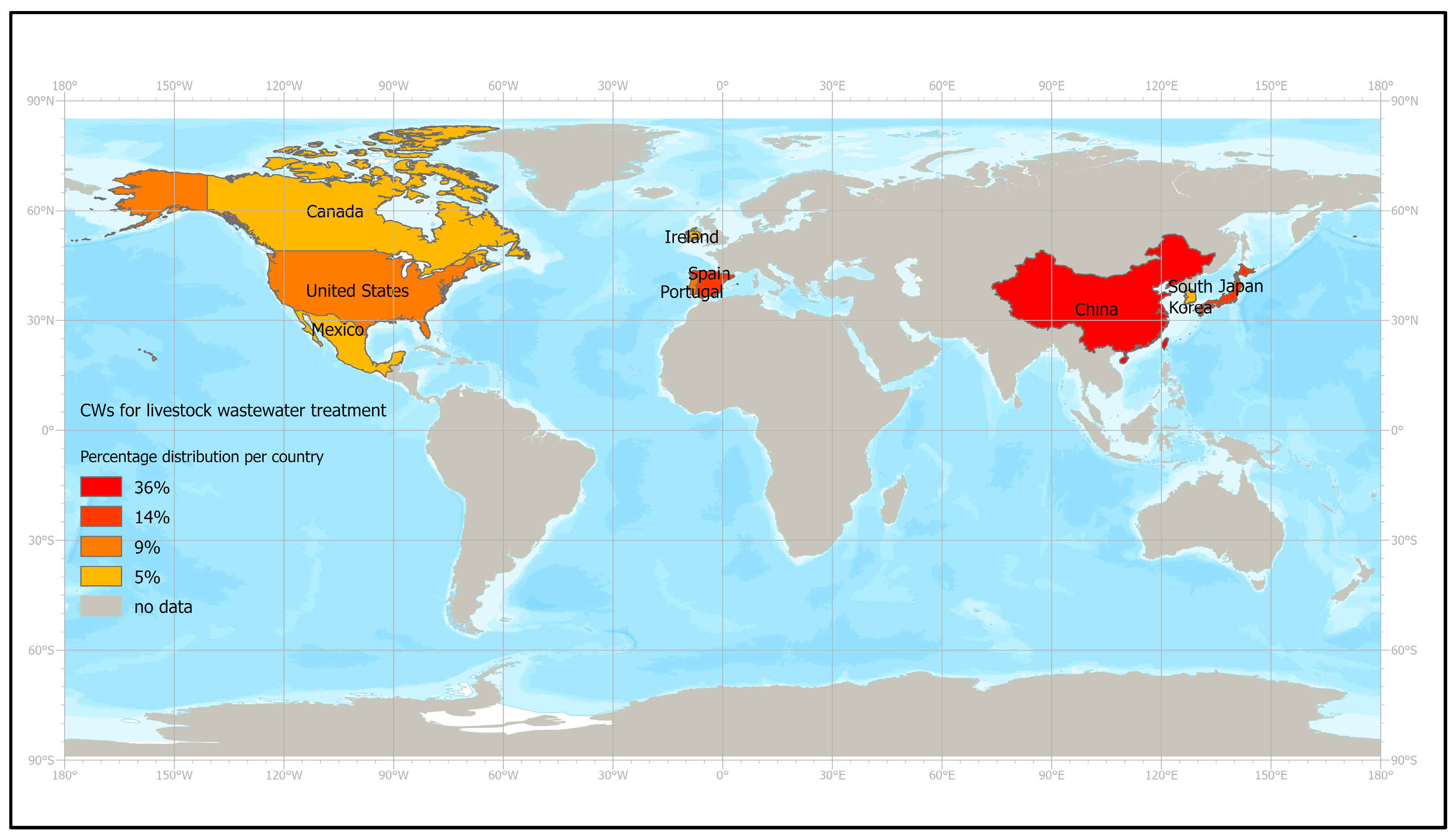
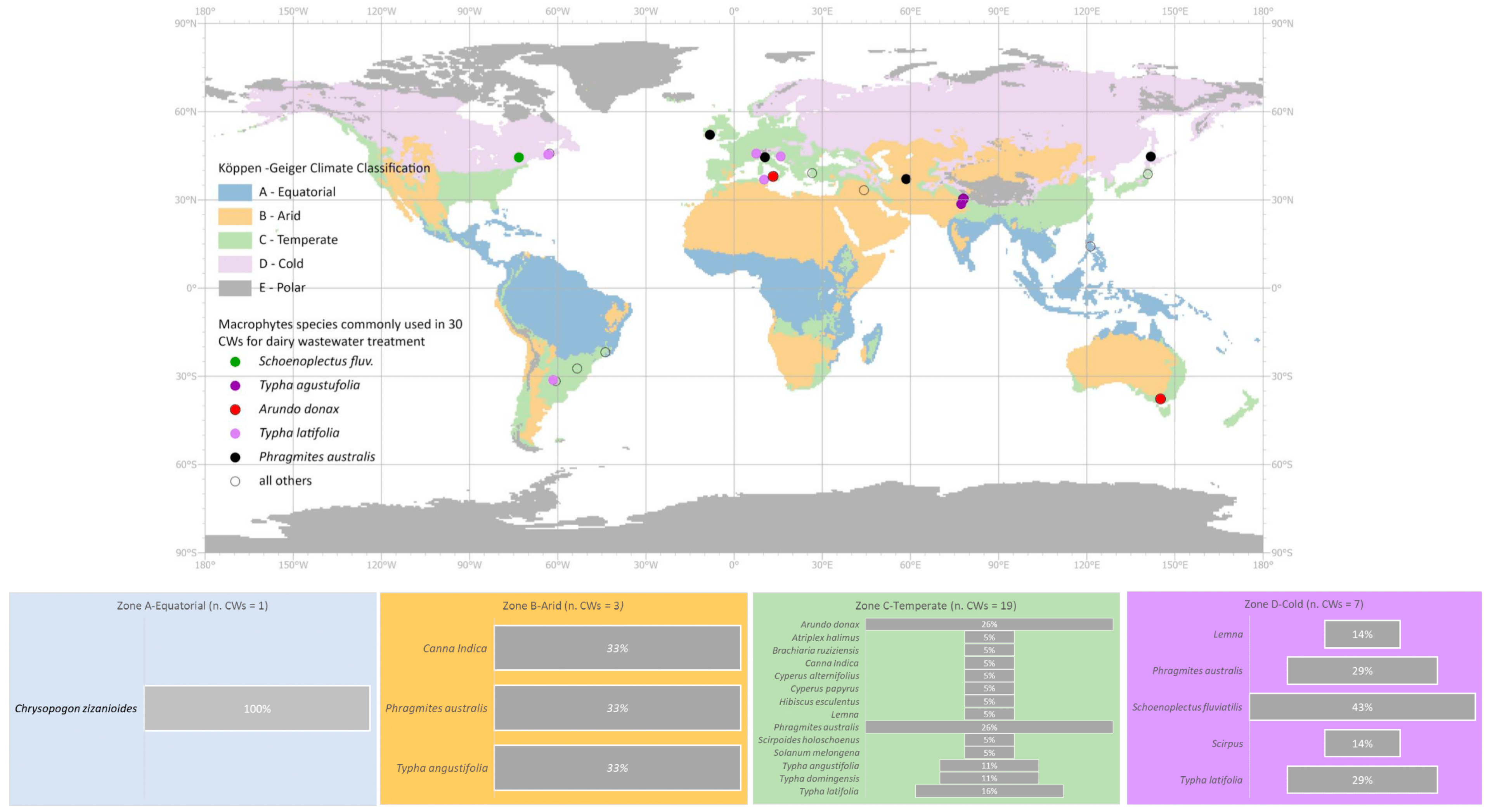
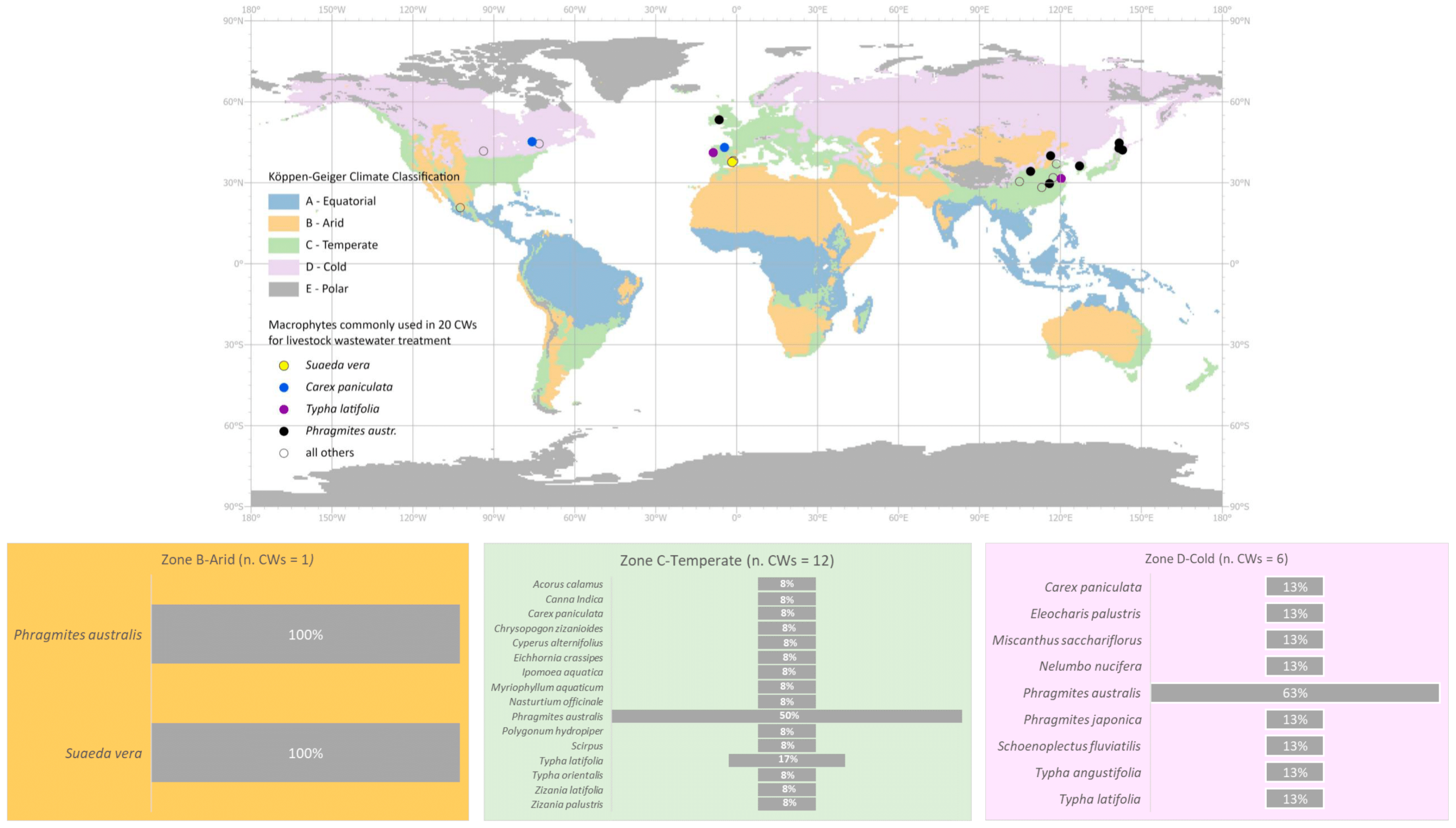
Constructed Wetlands for Dairy and Livestock Wastewater Treatment: A Review


Abstract
1. Introduction
2. Materials and Methods
2.1. Study Design
2.2. Search and Research Sources
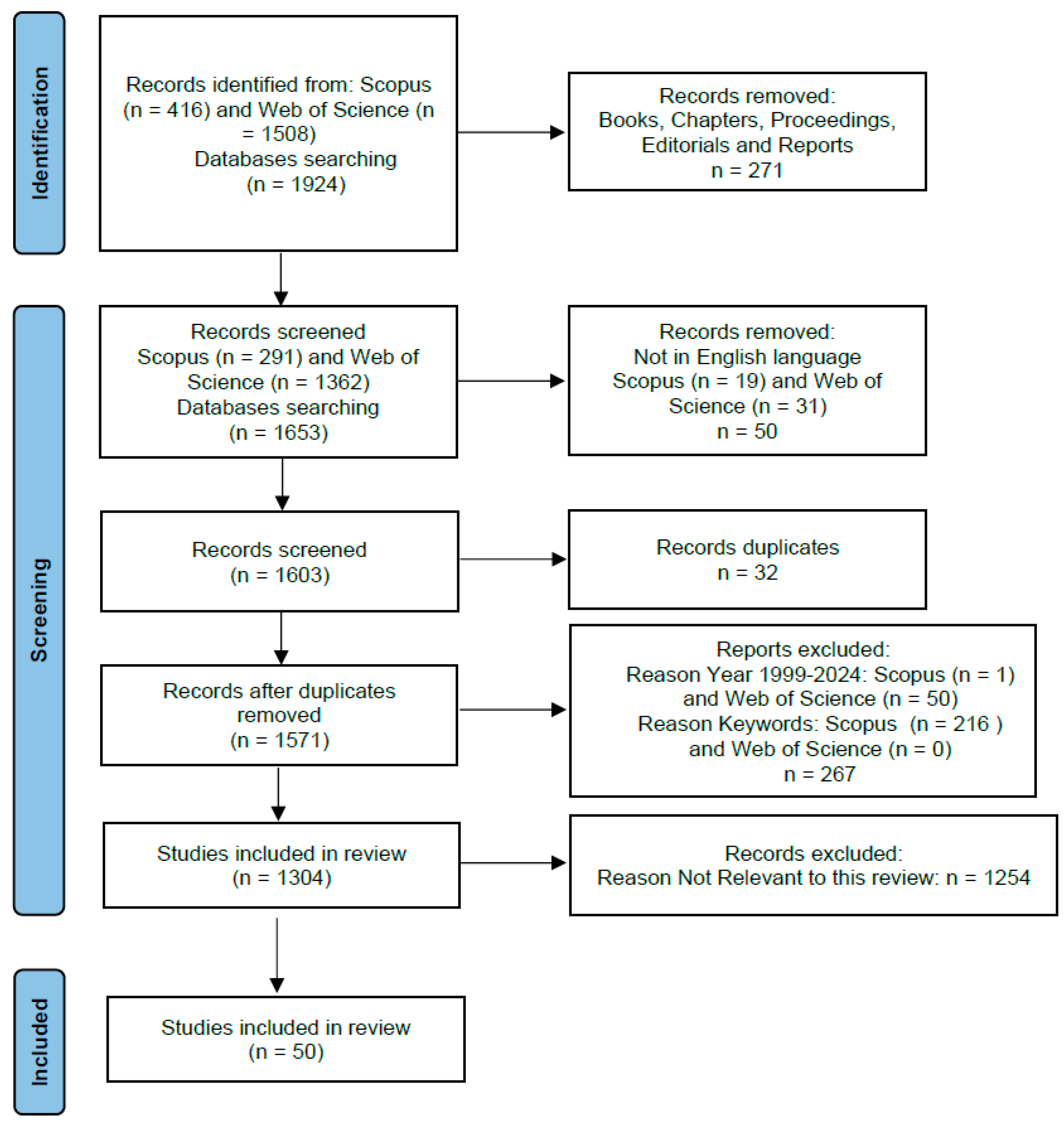
2.3. Screening and Eligibility Process
2.4. Bibliometric Analysis
3. Results and Discussions of the Literature Review
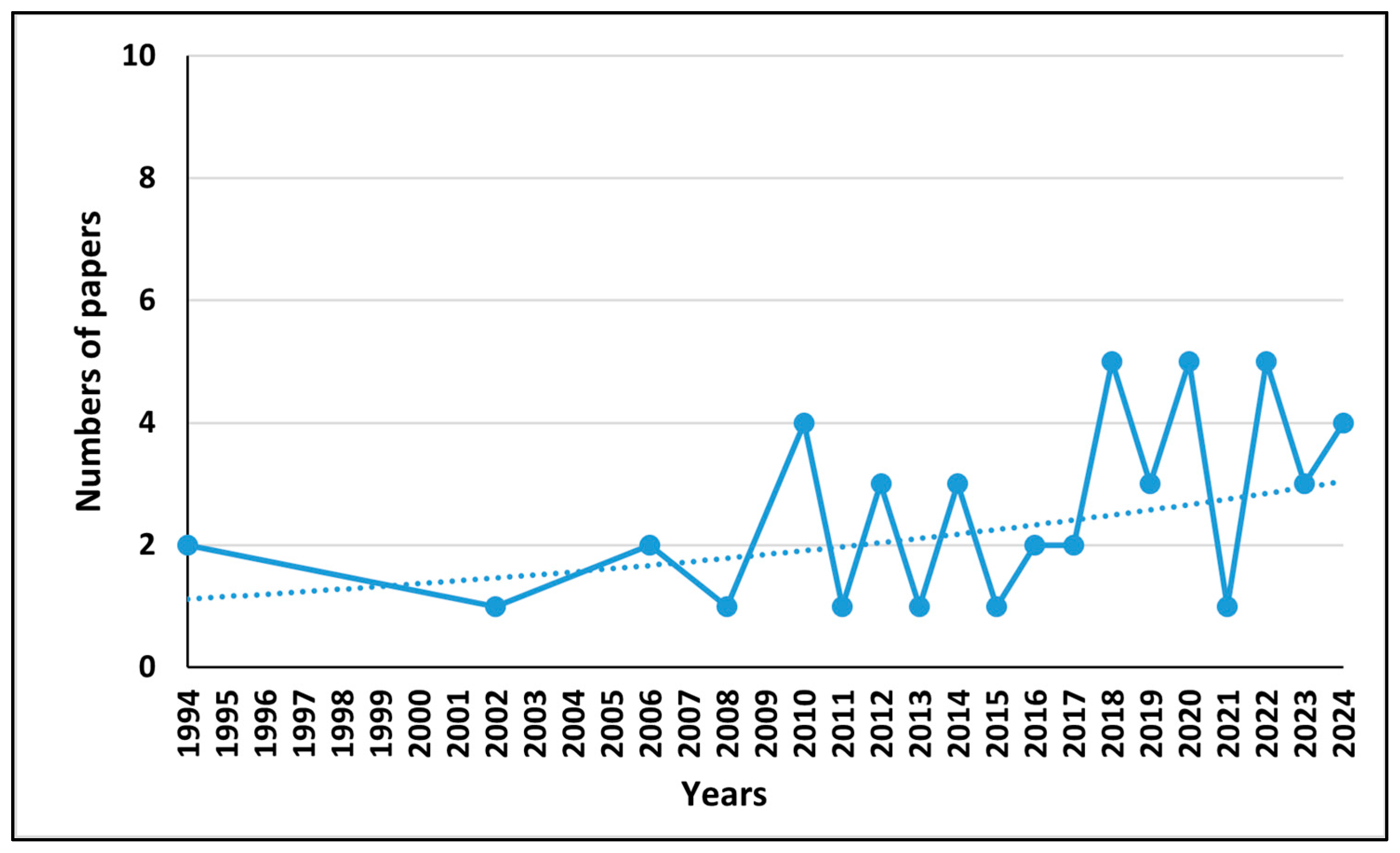
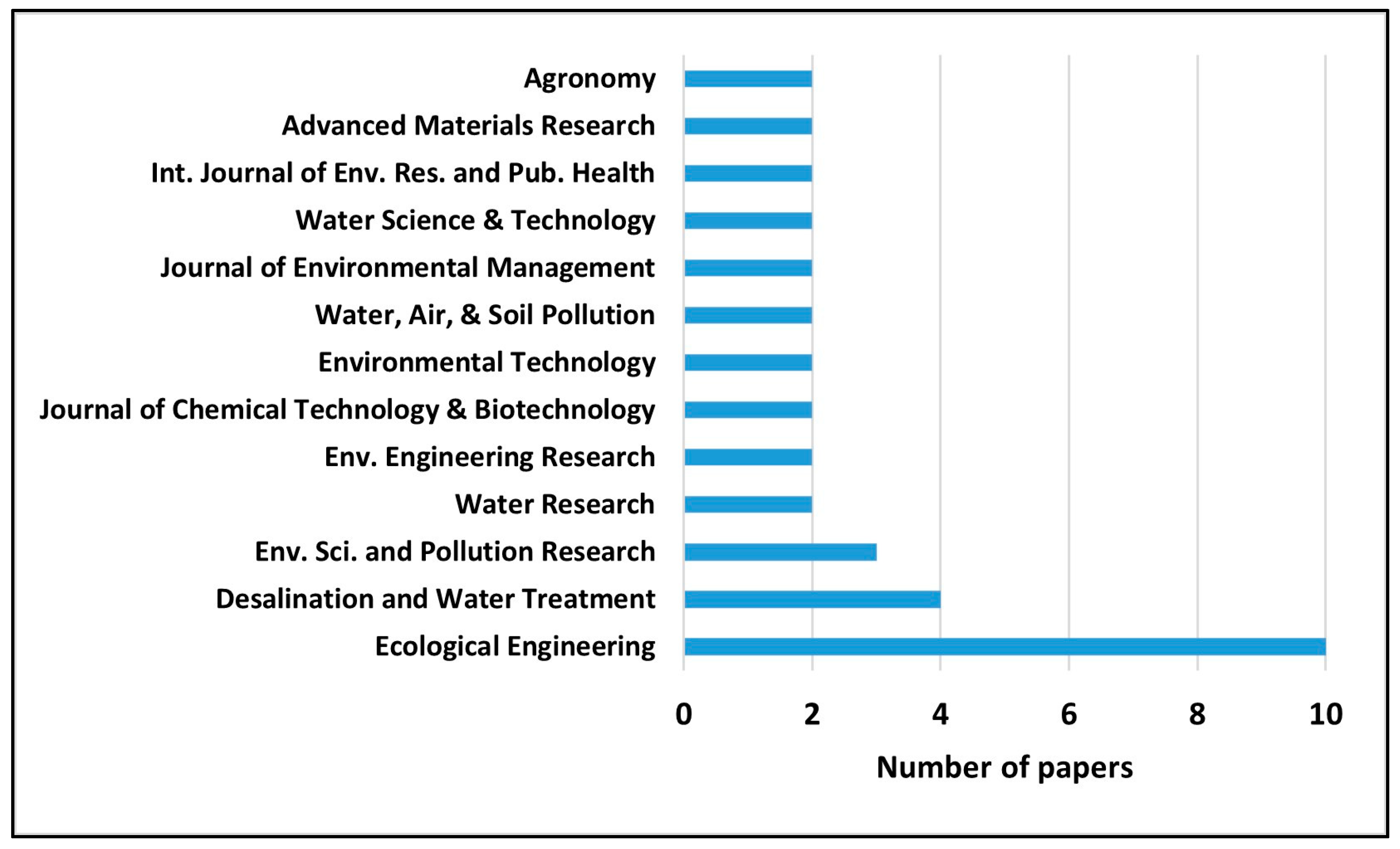
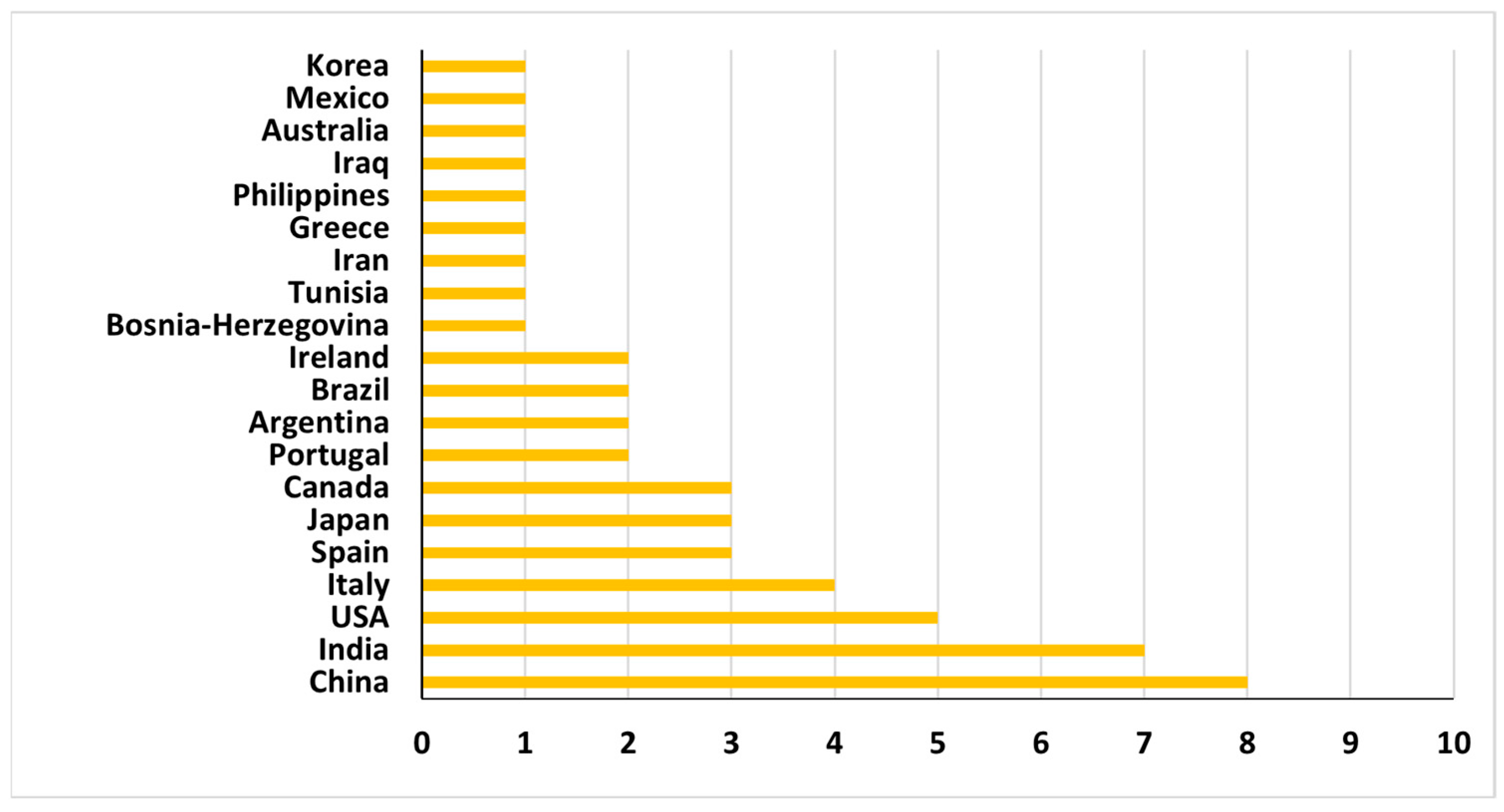
3.1. Preliminary Overview of Selected Articles
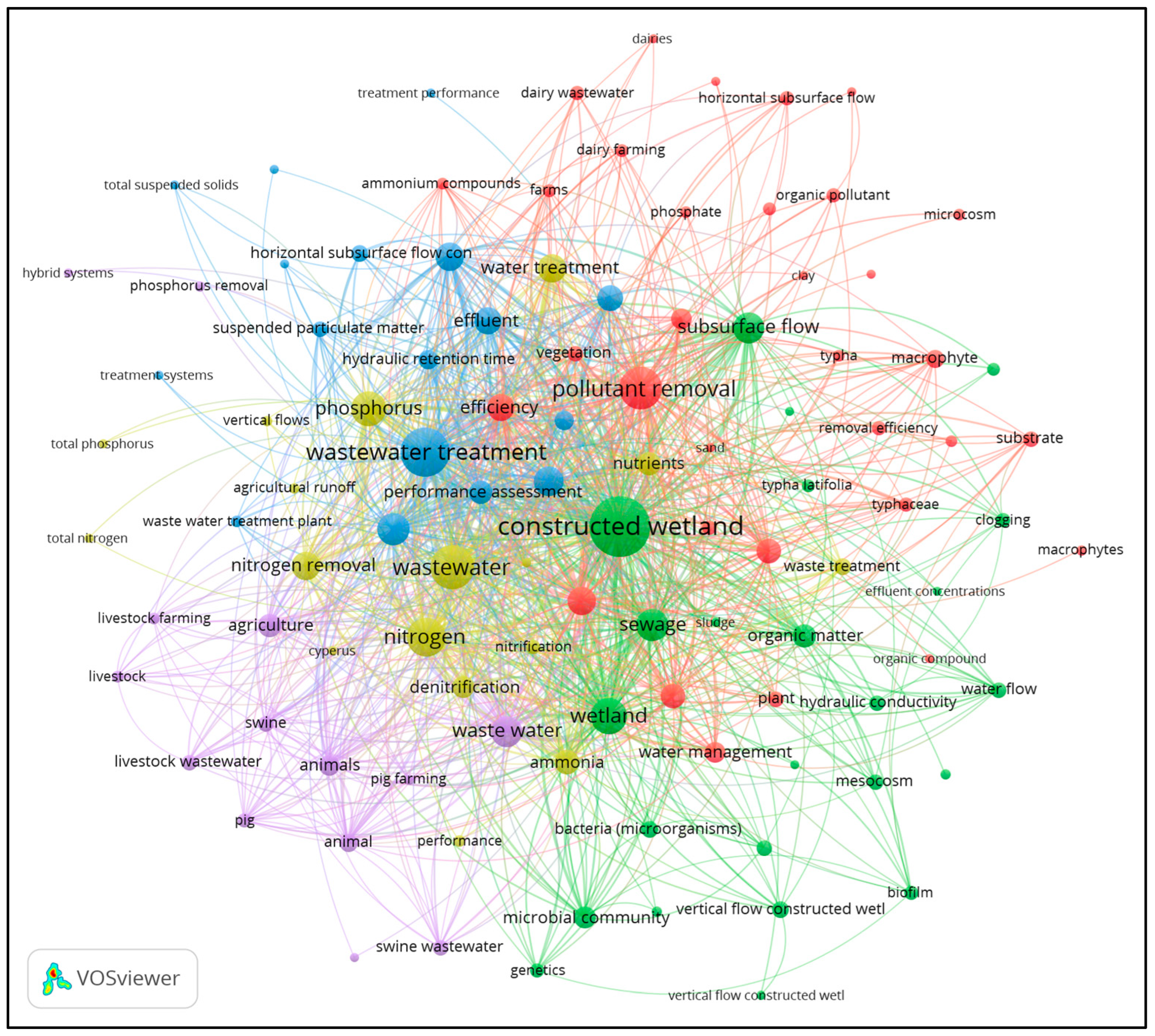
Bibliometric Analysis of the Themes
3.2. Wastewater Composition
3.2.1. Dairy Wastewater (DWW) Characteristics
3.2.2. Livestock Wastewater Characteristics
3.3. Plant System, Substrates and Vegetation
3.3.1. Pre-Treatment
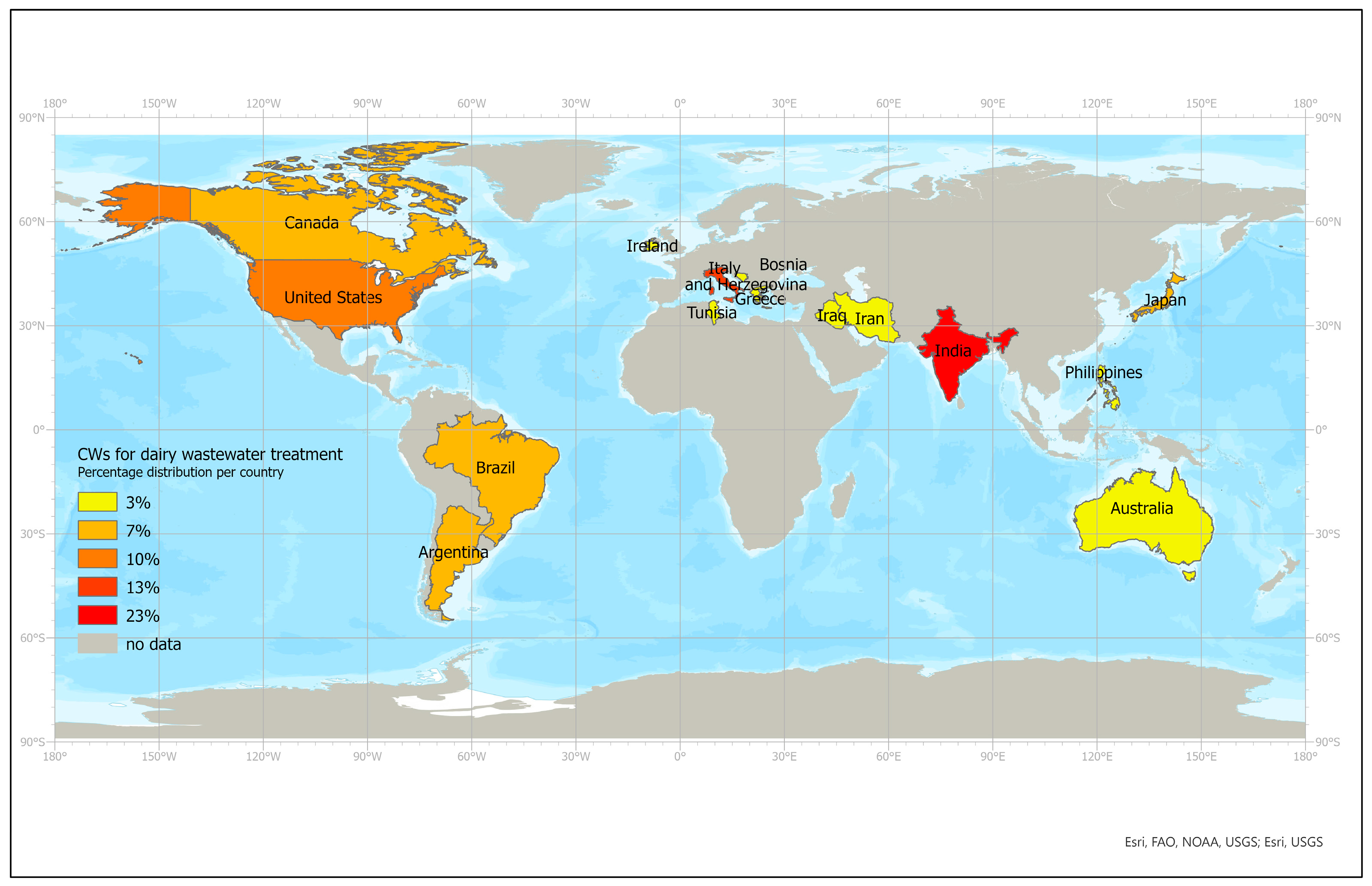
3.3.2. Type, Layout and Global Distribution of Dairy CW
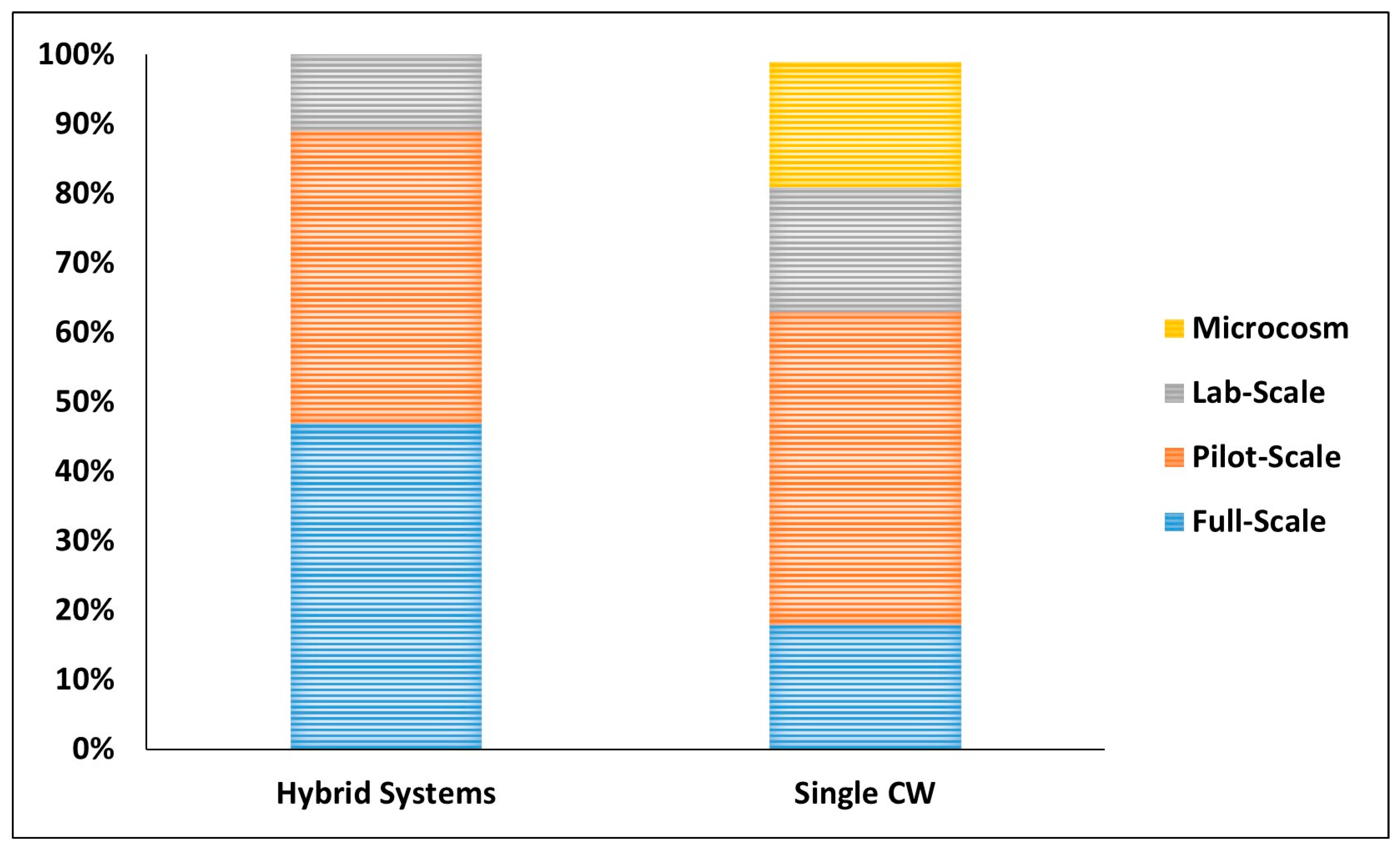
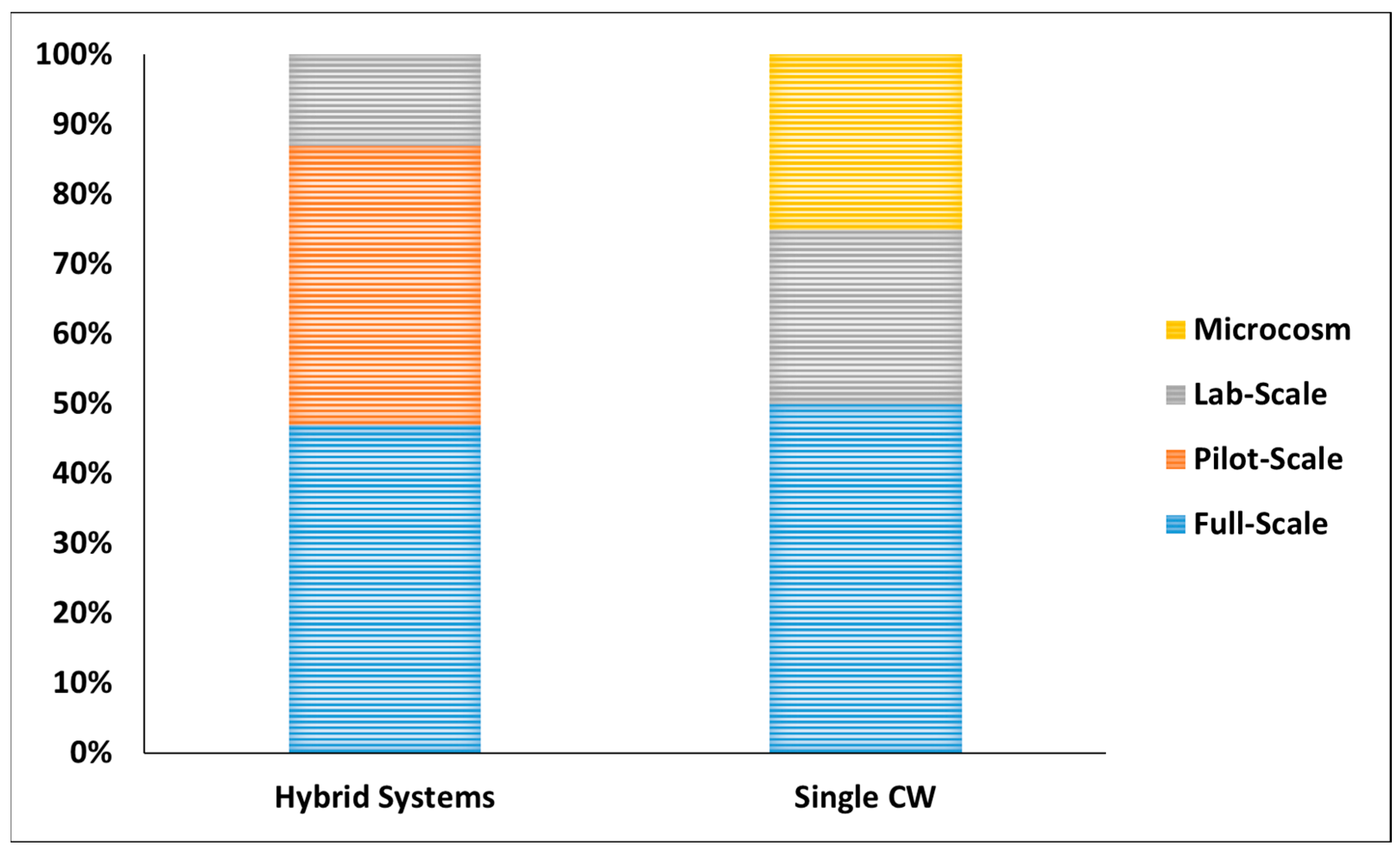
3.3.3. Type, Layout and Global Distribution of Livestock CW
3.3.4. Substrates of Dairy CW Systems
3.3.5. Substrates of Livestock CW Systems
3.3.6. Dairy CW Vegetation
3.3.7. Livestock CW Vegetation
4. Main Management Aspects
5. Conclusions
Author Contributions
Funding
Data Availability Statement
Conflicts of Interest
References
- Ahmad, T.; Aadil, R.M.; Ahmed, H.; ur Rahman, U.; Soares, B.C.V.; Souza, S.L.Q.; Pimentel, T.C.; Scudino, H.; Guimarães, J.T.; Esmerino, E.A.; et al. Treatment and utilization of dairy industrial waste: A review. Trends Food Sci. Technol. 2019, 88, 361–372. [Google Scholar] [CrossRef]
- López-Sánchez, A.; Silva-Gálvez, A.L.; Aguilar-Juárez, Ó.; Senés-Guerrero, C.; Orozco-Nunnelly, D.A.; Carrillo-Nieves, D.; Gradilla-Hernández, M.S. Microalgae-based livestock wastewater treatment (MbWT) as a circular bioeconomy approach: Enhancement of biomass productivity, pollutant removal and high-value compound production. J. Environ. Manag. 2022, 308, 114612. [Google Scholar] [CrossRef]
- Dias, S.; Mucha, A.P.; Duarte Crespo, R.; Rodrigues, P.; Almeida, C.M.R. Livestock Wastewater Treatment in Constructed Wetlands for Agriculture Reuse. Int. J. Environ. Res. Public Health 2020, 17, 8592. [Google Scholar] [CrossRef]
- Nocetti, E.; Hadad, H.R.; Maine, M.A.; Di Luca, G.A.; de las Mercedes Mufarrege, M. Effect of pollutant loading rate and macrophyte uptake on the performance of a pilot-scale hybrid wetland system for the final treatment of dairy wastewater. Ecol. Eng. 2024, 204, 107290. [Google Scholar] [CrossRef]
- Xia, T.; Liu, Z.; Pan, X.; Huang, E.; Chen, D.; Xiao, Z. Effects of dilution ratio on nutrient removal, sedimentation efficiency, and lipid production by Scenedesmus obliquus in diluted cattle wastewater. Energy Sources Part A Recovery Util. Environ. Eff. 2019, 42, 121–130. [Google Scholar] [CrossRef]
- Wood, J.; Fernandez, G.; Barker, A.; Gregory, J.; Cumby, T. Efficiency of reed beds in treating dairy wastewater. Biosyst. Eng. 2007, 98, 455–469. [Google Scholar] [CrossRef]
- Schierano, M.C.; Panigatti, M.C.; Maine, M.A.; Griffa, C.A.; Boglione, R. Horizontal subsurface flow constructed wetland for tertiary treatment of dairy wastewater: Removal efficiencies and plant uptake. J. Environ. Manag. 2020, 272, 111094. [Google Scholar] [CrossRef]
- Wu, Y.; Jin, W.; Xiong, J.; Wang, S.F.; Gu, P. Investigation of a full-scale anaerobic-aerobic and constructed wetlands integrated system treating livestock wastewater. Adv. Mater. Res. 2010, 113–116, 1189–1194. [Google Scholar] [CrossRef]
- Moreira, F.D.; Saraiva, C.B.; Bottrel, S.E.C.; Dias, E.H.O. Feasibility study of constructed wetlands for the treatment of dairy effluents. Rev. AIDIS Ing. Cienc. Ambientales Investig. Desarro. Pr’actica 2021, 14, 176. [Google Scholar] [CrossRef]
- Custodio, M.; Peñaloza, R.; Espinoza, C.; Espinoza, W.; Mezarina, J. Treatment of dairy industry wastewater using bacterial biomass isolated from eutrophic lake sediments for the production of agricultural water. Bioresour. Technol. Rep. 2022, 17, 100891. [Google Scholar] [CrossRef]
- Hu, H.; Li, X.; Wu, S.; Yang, C. Sustainable livestock wastewater treatment via phytoremediation: Current status and future perspectives. Bioresour. Technol. 2020, 315, 123809. [Google Scholar] [CrossRef]
- Xinjie, W.; Xin, N.; Qilu, C.; Ligen, X.; Yuhua, Z.; Qifa, Z. Vetiver Dictyosphaerium sp. co-culture for the removal of nutrients ecological inactivation of pathogens in swine wastewater. J. Adv. Res. 2019, 20, 71–78. [Google Scholar] [CrossRef] [PubMed]
- Kotsia, D.; Sympikou, T.; Topi, E.; Pappa, F.; Matsoukas, C.; Fountoulakis, M.S. Use of recycled construction and demolition waste as substrate in constructed wetlands for the wastewater treatment of cheese production. J. Environ. Manag. 2024, 362, 121324. [Google Scholar] [CrossRef] [PubMed]
- Zhu, D.; Sun, C.; Zhang, H.; Wu, Z.; Jia, B.; Zhang, Y. Roles of vegetation, flow type and filled depth on livestock wastewater treatment through multi-level mineralized refuse-based constructed wetlands. Ecol. Eng. 2012, 39, 7–15. [Google Scholar] [CrossRef]
- Crini, G.; Lichtfouse, E. Advantages and disadvantages of techniques used for wastewater treatment. Environ. Chem. Lett. 2019, 17, 145–155. [Google Scholar] [CrossRef]
- Stefanakis, A.; Akratos, C.S.; Tsihrintzis, V.A. Vertical Flow Constructed Wetlands: Eco-Engineering Systems for Wastewater and Sludge Treatment; Elsevier: Oxford, UK, 2016. [Google Scholar] [CrossRef]
- Parde, D.; Patwa, A.; Shukla, A.; Vijay, R.; Killedar, D.J.; Kumar, R. A review of constructed wetland on type, treatment and technology of wastewater. Environ. Technol. Innov. 2021, 21, 101261. [Google Scholar] [CrossRef]
- Melbourne Water. Constructed Shallow Lake System: Design Guideline for Developers, Version 2; Melbourne Water: Melbourne, Australia, 2005. [Google Scholar]
- Sudarsan, J.S.; Subramani, S.; Rajan, R.J.; Shah, I.; Nithiyanantham, S. Simulation of constructed wetland in treating wastewater using fuzzy logic technique. J. Phys. 2018, 1000, 012137. [Google Scholar] [CrossRef]
- Vymazal, J.; Kröpfelová, L. Wastewater Treatment in Constructed Wetlands with Horizontal Sub-Surface Flow; Springer Science & Business Media: Durham, NC, USA, 2008; Volume 14, pp. 566–578. [Google Scholar] [CrossRef]
- El-Sheikh, M.A.; Saleh, H.I.; El-Quosy, D.E.; Mahmoud, A.A. Improving water quality in polluted drains with free water surface constructed wetlands. Ecol. Eng. 2010, 36, 1478–1484. [Google Scholar] [CrossRef]
- Solano, M.L.; Soriano, P.; Ciria, M.P. Constructed wetlands as a sustainable solution for wastewater treatment in small villages. Biosyst. Eng. 2004, 87, 109–118. [Google Scholar] [CrossRef]
- Steer, D.; Fraser, L.; Boddy, J.; Seibert, B. Efficiency of small constructed wetlands for subsurface treatment of single-family domestic effluent. Ecol. Eng. 2002, 18, 429–440. [Google Scholar] [CrossRef]
- Tilley, E.; Ulrich, L.; Luthi, C. Compendium of Sanitation Systems and Technologies, 2nd ed.; Eawag: Dübendorf, Switzerland, 2014. [Google Scholar]
- Davis, L.; Edwards, R.; Garber, L.; Isaacs, B. A Handbook of Constructed Wetlands, General Considerations; US Environmental Protection Agency (EPA): Washington, DC, USA, 1995; Volume 1. [Google Scholar]
- Saeed, T.; Afrin, R.; Al Muyeed, A.; Sun, G. Treatment of tannery wastewater in a pilot-scale hybrid constructed wetland system in Bangladesh. Chemosphere 2012, 88, 1065–1073. [Google Scholar] [CrossRef]
- Yazdania, V.; Golestanib, H.A. Advanced treatment of dairy industrial wastewater using vertical flow constructed wetlands. Desalin. Water Treat. 2019, 162, 149–155. [Google Scholar] [CrossRef]
- Barbera, A.C.; Cirelli, G.L.; Cavallaro, V.; Di Silvestro, I.; Pacifici, P.; Castiglione, V.; Milani, M. Growth and biomass production of different plant species in two different constructed wetland systems in Sicily. Desalination 2009, 246, 129–136. [Google Scholar] [CrossRef]
- Stanković, D. Constructed wetlands for wastewater treatment. Građevinar 2017, 69, 639–652. [Google Scholar] [CrossRef][Green Version]
- Vymazal, J. Does clogging a ect long-term removal of organics and suspended solids in gravel-based horizontal subsurface flow constructed wetlands? Chem. Eng. J. 2018, 331, 663–674. [Google Scholar] [CrossRef]
- Sacco, A.; Sciuto, L.; Licciardello, F.; Cirelli, G.L.; Milani, M.; Barbera, A.C. Effects of solids accumulation on greenhouse gas emissions, substrate, plant growth and performance of a Mediterranean horizontal flow treatment wetland. Environments 2019, 10, 30. [Google Scholar] [CrossRef]
- Chintakovid, W.; Visoottiviseth, P.; Khokiattiwong, S.; Lauengsuchonkul, S. Potential of the hybrid marigolds for arsenic phytoremediation and income generation of remediators in Ron Phibun District, Thailand. Chemosphere 2008, 70, 1532–1537. [Google Scholar] [CrossRef] [PubMed]
- Trapp, S.; Karlson, U. Aspects of phytoremediation of organic pollutants. J. Soil. Sediment. 2001, 1, 37. [Google Scholar] [CrossRef]
- Moher, D.; Liberati, A.; Tetzlaff, J.; Altman, D.G.; The PRISMA Group. Preferred Reporting Items for Systematic Reviews and Meta-Analyses: The PRISMA Statement. PLoS Med. 2009, 6, e1000097. [Google Scholar] [CrossRef] [PubMed]
- Dardonville, M.; Bockstaller, C.; Therond, O. Review of quantitative evaluations of the resilience, vulnerability, robustness and adaptive capacity of temperate agricultural systems. J. Clean. Prod. 2021, 286, 125456. [Google Scholar] [CrossRef]
- Singh, A.K.; Singh, G.; Gautam, D.; Bedi, M.K. Optimization of dairy sludge for growth of Rhizobium cells. BioMed Res. Int. 2013, 2013, 845264. [Google Scholar] [CrossRef] [PubMed]
- Wildbrett, G. Bewertung von reinigungus-und desinfektionsmitteln imabwasser, Dtsch. Milchwirtschaft 1998, 39, 616–620. [Google Scholar]
- Sharma, P.K.; Rausa, K.; Rani, A.; Mukherjee, S.; Kumar, M. Biopurification of dairy farm wastewater through hybrid constructed wetland system: Groundwater quality and health implications. Environ. Res. 2021, 200, 111426. [Google Scholar] [CrossRef]
- Tanner, C.C. Plants for constructed wetland systems—A comparison of the growth and nutrient uptake of eight emergent species. Ecol. Eng. 1996, 7, 59–83. [Google Scholar] [CrossRef]
- Fang, X.F.; Pomeroy, J.W.; Ellis, C.R. Multivariable evaluation of hydrological model predictions for headwater basin in the Canadian Rocky Mountains. Hydrol. Earth Syst. Sci. 2013, 17, 1635–1659. [Google Scholar] [CrossRef]
- Maine, M.A.; Hadad, H.R.; S’anchez, G.C.; Di Luca, G.A.; Mufarrege, M.M.; Caffaratti, S.E.; Pedro, M.D. Long-term performance of two free-water surface wetlands for metallurgical effluent treatment. Ecol. Eng. 2017, 98, 372–377. [Google Scholar] [CrossRef]
- Carvalho, F.; Prazeres, A.R.; Rivas, J. Cheese whey wastewater: Characterization and treatment. Sci. Total Environ. 2013, 445–446, 385–396. [Google Scholar] [CrossRef]
- Mahmoudi, A.; Hannachi, C.; Mhiri, F.; Hamrouni, B. Performances of constructed wetland system to treat whey and dairy wastewater during a macrophytes life cycle. Desalination Water Treat. 2024, 318, 100364. [Google Scholar] [CrossRef]
- de Mendonça, H.V.; Otenio, M.H.; Lomeu, A.A.; Santa Rita, A.V. Post-treatment of an aerated facultative pond with constructed wetland: First two years of operation in a dairy industry. Ecol. Eng. 2022, 179, 106623. [Google Scholar] [CrossRef]
- Harada, J.; Inoue, T.; Kato, K.; Uraie, N.; Sakuragi, H. Performance evaluation of hybrid treatment wetland for six years of operation in cold climate. Environ. Sci. Pollut. Res. 2015, 22, 12861–12869. [Google Scholar] [CrossRef]
- Licata, M.T.T. The use of constructed wetlands for the treatment of agro-industrial wastewater—A case study in a dairy-cattle farm in Sicily (Italy). Desalination Water Treat. 2017, 76, 300–310. [Google Scholar] [CrossRef]
- Minakshi, D.; Sharma, P.K.; Rani, A.; Malaviya, P.; Srivastava, V.; Kumar, M. Performance evaluation of vertical constructed wetland units with hydraulic retention time as a variable operating factor. Groundw. Sustain. Dev. 2022, 19, 100834. [Google Scholar] [CrossRef]
- Licata, M.; Farruggia, D.; Tuttolomondo, T.; Iacuzzi, N.; Leto, C.; Di Miceli, G. Seasonal Response of Vegetation on Pollutants Removal in Constructed Wetland System Treating Dairy Wastewater. Ecol. Eng. 2022, 182, 106727. [Google Scholar] [CrossRef]
- Abdel-Mohsein, H.S.; Feng, M.; Fukuda, Y.; Tada, C. Remarkable Removal of Antibiotic-Resistant Bacteria During Dairy Wastewater Treatment Using Hybrid Full-scale Constructed Wetland. Water Air Soil Pollut 2020, 231, 397. [Google Scholar] [CrossRef]
- Toromanović, M.; Ibrahimpašić, J.; Dragičević, T.L. Horizontal Flow Pilot Constructed Wetland For Dairy Wastewater Purification. Spring 2023, 56, 507–526. [Google Scholar] [CrossRef]
- Pelissari, C.; Sezerino, P.H.; Decezaro, S.T.; Wolff, D.B.; Bento, A.P.; de Carvalho Junior, O.; Philippi, L.S. Nitrogen transformation in horizontal and vertical flow constructed wetlands applied for dairy cattle wastewater treatment in southern Brazil. Ecol. Eng. 2014, 73, 307–310. [Google Scholar] [CrossRef]
- Verma, R.; Suthar, S. Performance assessment of horizontal and vertical surface flow constructed wetland system in wastewater treatment using multivariate principal component analysis. Ecol. Eng. 2018, 116, 121–126. [Google Scholar] [CrossRef]
- Tunçsiper, B.; Drizo, A.; Twohig, E. Constructed wetlands as a potential management practice for cold climate dairy effluent treatment VT, USA. CATENA 2015, 135, 184–192. [Google Scholar] [CrossRef]
- Lee, M.S.; Drizo, A.; Rizzo, D.M.; Druschel, G.; Hayden, N.; Twohig, E. Evaluating the efficiency and temporal variation of pilot-scale constructed wetlands and steel slag phosphorus removing filters for treating dairy wastewater. Water Res. 2010, 44, 4077–4086. [Google Scholar] [CrossRef]
- Adera, S.; Drizo, A.; Twohig, E.; Jagannathan, K.; Benoit, G. Improving Performance of Treatment Wetlands: Evaluation of Supplemental Aeration, Varying Flow Direction, and Phosphorus Removing Filters. Water Air Soil Pollut. 2018, 229, 100. [Google Scholar] [CrossRef]
- Mohammed, N.A.; Ismail, Z.Z. Green sustainable technology for biotreatment of actual dairy wastewater in constructed wetland. J. Chem. Technol. Biotechnol. 2021, 96, 1197–1204. [Google Scholar] [CrossRef]
- Schierano, M.C.; Maine, M.A.; Panigatti, M.C. Dairy farm wastewater treatment using horizontal subsurface flow wetlands with Typha domingensis and different substrates. Environ. Technol. 2016, 38, 192–198. [Google Scholar] [CrossRef]
- Mantovi, P.; Marmiroli, M.; Maestri, E.; Tagliavini, S.; Piccinini, S.; Marmiroli, N. Application of a Horizontal Subsurface Flow Constructed Wetland on Treatment of Dairy Parlor Wastewater. Bioresour. Technol. 2003, 88, 85–94. [Google Scholar] [CrossRef]
- Velasco, P.P.; Dala, P.S.; Sundo, M.B.; De Padua, V.M.N.; Madlangbayan, M.S. Effect of Varying Retention Times and Feeding Schemes on the Performance of Vertical Constructed Wetlands Planted with Vetiver Grass in Treating Dairy Wastewater in the Philippines. Environ. Qual. Manag. 2024, 33, 173–181. [Google Scholar] [CrossRef]
- Sharma, P.; Rani, A.; Minakshi, D.; Malaviya, P. Effect of influent load fluctuation on the efficiency of vertical constructed wetlands treating dairy farm wastewater. Adv. Environ. Technol. 2023, 9, 227–241. [Google Scholar] [CrossRef]
- Ghosh, D.; Gopal, B. Effect of hydraulic retention time on the treatment of secondary effluent in a subsurface flow constructed wetland. Ecol. Eng. 2010, 36, 1044–1051. [Google Scholar] [CrossRef]
- Gorra, R.; Freppaz, M.; Zanini, E.; Scalenghe, R. Mountain Dairy Wastewater Treatment with the Use of a ‘Irregularly Shaped’ Constructed Wetland (Aosta Valley, Italy). Ecol. Eng. 2014, 73, 176–183. [Google Scholar] [CrossRef]
- Smith, S.G. Typha: Its taxonomy and the ecological significance of hybrids. Arch. Hydrobiol. Beih. 1987, 27, 129–138. [Google Scholar]
- Idris, S.M.; Jones, P.L.; Salzman, S.A.; Croatto, G.; Allinson, G. Evaluation of the giant reed (Arundo donax) in horizontal subsurface flow wetlands for the treatment of dairy processing factory wastewater. Environ. Sci. Pollut. Res. 2012, 19, 3525–3537. [Google Scholar] [CrossRef] [PubMed]
- Cicero Fernandez, D.; Expósito Camargo, J.A.; Peña Fernandez, M.; Antizar-Ladislao, B. Carex paniculata constructed wetland efficacy for stormwater, sewage and livestock wastewater treatment in rural settlements of mountain areas. Water Sci. Technol. 2019, 79, 1338–1347. [Google Scholar] [CrossRef] [PubMed]
- Zheng, Z.C.; Li, T.X.; Zeng, F.F.; Zhang, X.Z.; Yu, H.Y.; Wang, Y.D.; Liu, T. Accumulation characteristics of and removal of nitrogen and phosphorus from livestock wastewater by Polygonum hydropiper. Agric. Water Manag. 2013, 117, 19–25. [Google Scholar] [CrossRef]
- Gorme, J.B.; Maniquiz, M.C.; Lee, S.; Kim, L.H. Seasonal changes of plant biomass at a constructed wetland in a livestock watershed area. Desalination Water Treat. 2012, 45, 136–143. [Google Scholar] [CrossRef]
- Lian-sheng, H.; Hong-liang, L.; Bei-dou, X.; Ying-bo, Z. Effects of effluent recirculation in vertical-flow constructed wetland on treatment efficiency of livestock wastewater. Water Sci. Technol. 2006, 54, 137–146. [Google Scholar] [CrossRef]
- Santos, F.; Marisa, C.; Almeida, R.; Ribeiro, I.; Mucha, A.P. Potential of constructed wetland for the removal of antibiotics and antibiotic resistant bacteria from livestock wastewater. Ecol. Eng. 2019, 129, 45–53. [Google Scholar] [CrossRef]
- Hu, Y.S.; Kumar, J.L.G.; Akintunde, A.O.; Zhao, X.H.; Zhao, Y.Q. Effects of livestock wastewater variety and disinfectants on the performance of constructed wetlands in organic matters and nitrogen removal. Environ. Sci. Pollut. Res. 2011, 18, 1414–1421. [Google Scholar] [CrossRef]
- Li, C.Y.; Wu, S.B.; Sun, F.; Lv, T.; Dong, R.J.; Pang, C.L. Performance of Lab-Scale Tidal Flow Constructed Wetlands Treating Livestock Wastewater. Adv. Mater. Res. 2012, 518–523, 2631–2639. [Google Scholar] [CrossRef]
- Wang, M.; Zhang, D.; Dong, J.; Tan, S.K. Application of Constructed Wetlands for Treating Agricultural Runoff and Agro-Industrial Wastewater: A Review. Hydrobiologia 2018, 805, 1–31. [Google Scholar] [CrossRef]
- Zhang, X.; Inoue, T.; Kato, K.; Izumoto, H.; Harada, J.; Wu, D.; Sugawara, Y. Multi-stage hybrid subsurface flow constructed wetlands for treating piggery and dairy wastewater in cold climate. Environ. Technol. 2016, 38, 183–191. [Google Scholar] [CrossRef]
- Zhang, M.; Luo, P.; Liu, F.; Li, H.; Zhang, S.; Xiao, R.; Yin, L.; Zhou, J.; Wu, J. Nitrogen removal and distribution of ammonia-oxidizing and denitrifying genes in an integrated constructed wetland for swine wastewater treatment. Ecol. Eng. 2017, 104, 30–38. [Google Scholar] [CrossRef]
- García-Valero, A.; Acosta, J.A.; Faz, Á.; Gómez-López, M.D.; Carmona, D.M.; Terrero, M.A.; El Bied, O.; Martínez-Martínez, S. Swine Wastewater Treatment System Using Constructed Wetlands Connected in Series. Agronomy 2024, 14, 143. [Google Scholar] [CrossRef]
- De La Mora-Orozco, C.; González-Acuña, I.J.; Saucedo-Terán, R.A.; Flores-López, H.E.; Rubio-Arias, H.O.; Ochoa-Rivero, J.M. Removing Organic Matter and Nutrients from Pig Farm Wastewater with a Constructed Wetland System. Int. J. Environ. Res. Public Health 2018, 15, 1031. [Google Scholar] [CrossRef]
- Hayman, D.; Maaskant, K. Research Sub-Program, Environmental Monitoring of Agricultural Constructed Wetlands—A Provincial Study. COESA Report No.: LMAP-014/94. 1994. Agriculture Canada. Available online: http://hdl.handle.net/10214/15026 (accessed on 22 April 2025).
- Brenton, W. A Constructed Wetland in USE: 28 Years. In Constructed Wetlands for Animal Waste Management, Proceedings of the Workshop Sponsored by the Conservation Technology Information Center, the U.S. Department of Agriculture (USDA) Soil Conservation Service (SCS), U.S. Environmental Protection Agency (EPA) Region V, and Purdue University Agricultural Research Program, Lafayette, IN, USA, 4–6 April 1994; DuBowy, P., Reaves, R., Eds.; EPA: Washington, DC, USA, 1994. [Google Scholar]
- Terrero, M.A.; Muñoz, M.Á.; Faz, Á.; Gómez-López, M.D.; Acosta, J.A. Efficiency of an Integrated Purification System for Pig Slurry Treatment under Mediterranean Climate. Agronomy 2020, 10, 208. [Google Scholar] [CrossRef]
- Silva-Gálvez, A.L.; López-Sánchez, A.; Camargo-Valero, M.A.; Prosenc, F.; González-López, M.E.; Gradilla-Hernández, M.S. Strategies for livestock wastewater treatment and optimised nutrient recovery using microalgal-based technologies. J. Environ. Manag. 2024, 384, 120258. [Google Scholar] [CrossRef]
- Tang, X.; Huang, S.; Scholz, M. Nutrient removal in wetlands during intermittent artificial aeration. Environ. Eng. Sci. 2008, 25, 1279–1290. [Google Scholar] [CrossRef]
- Cheng, D.L.; Ngo, H.H.; Guo, W.S.; Liu, Y.W.; Zhou, J.L.; Chang, S.W.; Nguyen, D.D.; Bui, X.T.; Zhang, X.B. Bioprocessing for elimination antibiotics and hormones from swine wastewater. Sci. Total Environ. 2018, 621, 1664–1682. [Google Scholar] [CrossRef]
- Hejna, M.; Moscatelli, A.; Stroppa, N.; Onelli, E.; Pilu, S.; Baldi, A.; Rossi, L. Bioaccumulation of heavy metals from wastewater through a Typha latifolia and Thelypteris palustris phytoremediation system. Chemosphere 2020, 241, 125018. [Google Scholar] [CrossRef] [PubMed]
- Demirel, B.; Yenigun, O.; Turgut, T. Anaerobic Treatment of Dairy Wastewaters: A Review. Process Biochem. 2005, 40, 2583–2595. [Google Scholar] [CrossRef]
- Qamsari, R.; Karmanshahi, R.; Nosrati, M.; Amani, T. Enzymatic pre-hydrolysis of high fat content dairy wastewater as a pretreatment for anaerobic digestion. Int. J. Environ. Res. 2012, 6, 475–480. [Google Scholar] [CrossRef]
- Joshiba, G.J.; Senthil Kumar, P.K.; Femina, C.C.; Jayashree, E.; Racchana, R.; Sivanesan, S. Critical review on biological treatment strategies of dairy wastewater. Desalin. Water Treat. 2019, 160, 94–109. [Google Scholar] [CrossRef]
- Krishna, B.R.; Bhuvaneshwari, S.; Majeed, F.; Jose, E.; Mohan, A. Different treatment methodologies and reactors employed for dairy effluent treatment—A review. J. Water Process. Eng. 2022, 46, 102622. [Google Scholar] [CrossRef]
- Jung, F.; Cammarota, M.C.; Freire, D.M.G. Impact of enzymatic pre-hydrolysis on batch activated sludge systems dealing with oily wastewaters. Biotechnol. Lett. 2002, 24, 1797–1802. [Google Scholar] [CrossRef]
- Tabelini, D.B.; Lima, J.P.P.; Borges, A.C.; Aguiar, A. A review on the characteristics and methods of dairy industry wastewater treatment in the state of Minas Gerais, Brazil. J. Water Process Eng. 2023, 53, 103779. [Google Scholar] [CrossRef]
- Hu, H.; Zhou, Q.; Li, X.; Lou, W.; Du, C.; Teng, Q.; Zhang, D.M.; Liu, H.Y.; Zhong, Y.Y.; Yang, C.P. Phytoremediation of anaerobically digested swine wastewater contaminated by oxytetracycline via Lemna aequinoctialis: Nutrient removal, growth characteristics and degradation pathways. Bioresour. Technol. 2019, 291, 121853. [Google Scholar] [CrossRef]
- Metcalf & Eddy, Inc.; Tchobanoglous, G.; Stensel, H.D.; Tsuchihashi, R.; Burton, F.L. Wastewater Engineering: Treatment and Resource Recovery, 5th ed.; McGraw-Hill Education: Columbus, OH, USA, 2014. [Google Scholar]
- Ahn, C.; Mitsch, W.J. Scaling considerations of mesocosm wetlands in simulating large created freshwater marshes. Ecol. Eng. 2002, 18, 327–342. [Google Scholar] [CrossRef]
- Nally, R.M. Scaling artefacts in confinement experiments: A simulation model. Ecol. Model. 1997, 99, 229–245. [Google Scholar] [CrossRef]
- Pilson, M.; Nixon, S. Marine Microcosms in Ecological Research; Department of Energy Symposium Series; U.S. Environmental Protection Agency: Washington, DC, USA, 1980. [Google Scholar]
- Messer, T.L.; Burchell, M.R.; Birgand, F.; Broome, S.W.; Chescheir, G. Nitrate removal potential of restored wetlands loaded with agricultural drainage water: A mesocosm scale experimental approach. Ecol. Eng. 2017, 106, 541–554. [Google Scholar] [CrossRef]
- Priya; Sharma, G.; Brighu, U. Comparison of different types of media for nutrient removal efficiency in vertical upflow constructed wetlands. Int. J. Environ. Eng. Manag. 2013, 4, 377–388. [Google Scholar]
- Hu, Z.; Chu, Y.; Ma, Y. Design of a Combined Constructed Wetland System and Its Application on Swine Wastewater Treatment. J. Environ. Eng. 2020, 46, 04019093. [Google Scholar] [CrossRef]
- Vohla, C.; Kõiv, M.; Bavor, H.J.; Chazarenc, F.; Mander, Ü. Filter materials for phosphorus removal from wastewater in treatment wetlands—A review. Ecol. Eng. 2011, 37, 70–89. [Google Scholar] [CrossRef]
- Molle, P. French vertical flow constructed wetlands: A need of a better understanding of the role of the deposit layer. Water Sci. Technol. 2014, 69, 106–112. [Google Scholar] [CrossRef] [PubMed]
- Jesus, J.M.; Danko, A.S.; Fiúza, A.; Borges, M.T. Effect of plants in constructed wetlands for organic carbon and nutrient removal: A review. Environ. Sci. Pollut. Res. 2018, 25, 4149–4164. [Google Scholar] [CrossRef]
- Nguyen, X.C.; Nguyen, D.D.; Loan, N.T.; Chang, S.W. Potential of integrated vertical and horizontal flow constructed wetland with native plants for sewage treatment under different hydraulic loading rates. Water Sci. Technol. 2017, 76, 434–442. [Google Scholar] [CrossRef] [PubMed]
- Sandoval, L.; Zamora-Castro, S.A.; Vidal-’Alvarez, M.; Marín-Muñiz, J.L. Role of wetland plants and use of ornamental flowering plants in constructed wetlands for wastewater treatment: A review. Appl. Sci. 2019, 9, 685. [Google Scholar] [CrossRef]
- Hu, X.; Xie, H.; Zhuang, L.; Zhang, J.; Hu, Z.; Liang, S.; Feng, K. A review on the role of plant in pharmaceuticals and personal care products (PPCPs) removal in constructed wetlands. Sci. Total Environ. 2021, 780, 146637. [Google Scholar] [CrossRef]
- Vymazal, J. Plants used in constructed wetlands with horizontal subsurface flow: A review. Hydrobiologia 2011, 674, 133–156. [Google Scholar] [CrossRef]
- Moulisová, L.; Čížková, H.; Dušek, J.; Kazda, M. Root and rhizome traits of the common reed (Phragmites australis) in a constructed wetland for wastewater treatment. Ecol. Eng. 2023, 186, 106832. [Google Scholar] [CrossRef]
- Marchand, L.; Mench, M.; Jacob, D.L.; Otte, M.L. Metal and metalloid removal in constructed wetlands, with emphasis on the importance of plants and standardized measurements: A review. Environ. Pollut. 2010, 158, 3447–3461. [Google Scholar] [CrossRef]
- de Mendonça, H.V.; Ometto, J.P.H.B.; Otenio, M.H.; Marques, I.P.R.; dos Reis, A.J.D. Microalgae-mediated bioremediation and valorization of cattle wastewater previously digested in a hybrid anaerobic reactor using a photobioreactor: Comparison between batch and continuous operation. Sci. Total Environ. 2018, 633, 1–11. [Google Scholar] [CrossRef]
- Boonbangkeng, D.; Treesubsuntorn, C.; Dolphen, R. Remediation of algal cells, PO43-, and NO3- from eutrophic wastewater using Echinodorus cordifolius in zigzag-horizontal subsurface constructed wetlands. J. Environ. Manag. 2021, 300, 113720. [Google Scholar] [CrossRef]
- Dalton, P.A.; Smith, R.J.; Truong, P.N.V. Vetiver grass hedges for erosion 30 control on a cropped flood plain: Hedge hydraulics. Agric. Water Manag. 1996, 31, 91–104. [Google Scholar] [CrossRef]
- Balangcod, K.D.; Wong, F.M.; Balangcod, T.D. Chrysopogon zizanioides (vetiver grass) as a potential plant for landslide bioengineering at Atok, Benguet, Philippines. Austr. J. Bot. 2015, 63, 216–221. [Google Scholar] [CrossRef]
- POWO Plants of the World Online. Facilitated by the Royal Botanic Gardens, Kew. Published on the Internet. 2025. Available online: https://powo.science.kew.org/ (accessed on 22 April 2025).
- Luziatelli, G.; Alandia, G.; Rodríguez, J.P.; Manrique, I.; Jacobsen, S.; Sørensen, M. Chapter 7—Ethnobotany of Andean root crops: Tradition and innovation—Arracacha (Arracacia xanthorrhiza Bancr.), Yacón (Smallanthus sonchifolius (Poepp.) H. Rob.), Mauka (Mirabilis expansa (Ruíz & Pav.) Standl.), Ahipa (Pachyrhizus ahipa Parodi), Maca (Lepidium meyenii Walp.), Achira (Canna indica L.). In Varieties and Landraces: Cultural Practices and Traditional Uses; Cereda, M.P., Vilpoux, O.F., Eds.; Academic Press: Cambridge, MA, USA, 2023; Volume 2, pp. 101–134. ISBN 9780323900577. [Google Scholar] [CrossRef]
- Geller, G.; Höner, G. Anwenderhandbuch Pflanzenkläranlagen; Praktisches Qualitätsmanagement bei Planung, Bau und Betrieb; Springer: Berlin/Heidelberg, Germany, 2003. [Google Scholar]
- Liu, S.; Zhang, Y.; Feng, X.; Pyo, S.-H. Current problems and countermeasures of constructed wetland for wastewater treatment: A review. J. Water Process Eng. 2024, 57, 104569. [Google Scholar] [CrossRef]



| Parameters | Unit | Min. | Max. |
|---|---|---|---|
| Total Suspended Solid (TSS) | mg/L | 0.4 | 3040 |
| Chemical Oxygen Demand (COD) | mg/L | 1.6 | 5060 |
| Biochemical Oxygen Demand (BOD5) | mg/L | 25 | 3020 |
| Total Nitrogen (TN) | mg/L | 0.5 a | 198 |
| Ammonia (NH4-N) | mg/L | 9 | 128 b |
| Total Phosphorus (TP) | mg/L | 0.2 | 88 |
| Site | Type WW | Layout | Type CW | Dimension (m2) | Substrate | Vegetation | Raw Wastewater Characteristics, mg/L (Removal Efficiency, %) | Flow Rate (m3/day) | HLR (m/day) | HRT (days) | Ref. | |||||
|---|---|---|---|---|---|---|---|---|---|---|---|---|---|---|---|---|
| TSS | COD | BOD5 | TN | NH4-N | TP | |||||||||||
| India | Dairy WW | Sedimentation tank + VF–HF–VF | Pilot Scale | 40 | Gravel; Sand | Arundo donax.; Hibiscus esculentus.; Solanum melongena. | 321 (92) | - | 286 (95) | 73 (84) | 9.5 (68) | 30 (86) | 1.2 | 0.032 | 0.21 | [36] |
| Japan | Dairy WW | Siphon tank + VF–VF–VF–VF–HF | Full Scale | 111 | Sand; Gravel | - | 385 (99.6) | 1780 (98.5) | - | - | 24.5 (-) | - | 2 | - | 3–7 | [37] |
| Italy | Domestic + Dairy parlor WW | Sedimentation tank + Degreaser + 2Imhoff + HF–HF | Full Scale | 150 | Silica Quartz River Gravel; Coarse gravel | Phragmites Australis (Cav.) Trin. ex Steud. | 250 (69) | 384 (68) | 215 (68) | 46 b (45) | 17 (37) | 10 (41) | - | 0.1 | - | [38] |
| Argentina | Dairy WW | Primary treatment (dissolved air diffusion and aerobic pond) + VF–VF–VF–FWSF–HF | Pilot Scale | 12.6 | Coarse Sand; Natural Soil; River Stones | Typha domingensis | - | 1762 (91) | 250 (94) | 131.5 (76) | 17.4 (-) | 36 (65) | 0.170 | - | - | [4] |
| Bosnia and Herzegovina | Dairy WW | Pre-treatment (floating technology and precipitation device) + HF | Pilot Scale | 20 | Sand-Gravel | Typha latifolia; Phragmites australis | - | 842–3051 | 414–1240 | (54) | (61) | 39–88 (49) | 13.6 | - | 4–6 | [39] |
| Brazil | Dairy WW | Preliminary treatment (aluminum gratings, grit chamber, grease trap) + Facultative aerated pond + HF | Full Scale | 240 | Gravel | Brachiaria ruziziensis | 746 (99.6) | 2996 (92) | 1371 (93.5) | - | - | - | 15 | - | 2 | [40] |
| Brazil | Dairy Cattle WW | Primary treatment (storage pond) + Equalization tank + HF–VF | Full Scale | 41 | Sand | Typha domingensis | - | 1009 | - | 69 (23–59) | 55 (58–80) | - | 0.57–0.64 | - | - | [41] |
| India | Dairy WW | HF–VF | Lab Scale | 0.43 | Sand; Gravel; Boulders | Typha angustifolia | 456 (55–73) | 1676 (74–83) | 771 (73–83) | - | 62 (53–66) | - | 0.025–0.030 | - | - | [42] |
| USA | Dairy WW | Collection and settling tanks + HF–HF–HF–HF | Full Scale | 900 | Coarse Gravel; Smaller Gravel | Schoenoplectus fluviatilis | 397–829 (67–94) | - | 1102–2161 (78–86) | - | - | - | 0.5–10 | 0.10–0.14 | 3–60 | [43] |
| USA | Barnyard runoff + milk house wash water | VF + HF; HF + VF; HF + HF + EAF steel slag filter | Pilot Scale | 22 | Gravel; Compost | Schoenoplectus fluviatilis | 1740 (84–96) | - | 2500 (84–93) | - | 260 (54–65) | - | - | 0.019–0.039 | 2.5–5 d | [44] |
| USA | Dairy WW | Holding tank + VF HF–VF–HF-VF–VF–HF–HF–HF–RF–PRF–PRF | Mesocosm Scale | 22 | Gravel | Schoenoplectus fluviatilis; Scirpus validus | 320 (50–96) | - | 1700 (93–99) | - | 70 (8–91) | - | 0.075 | 0.04 | 5–10 | [45] |
| Japan | Dairy WW | Sedimentation tank + VF–VF–HF | Full Scale | 656 | River Gravel; Sand; Clinker ash | Phragmites australis | 662 a (97) | 3612 (94) | 1393 (93) | 146 b (85) | 69 (76) | 24 (76) | 4.4–5.5 | - | - | [46] |
| Tunisia | DWW with 20% whey | Sedimentation tank + HF–HF–FWSF | Pilot Scale | 6 | Gravel | Phragmites australis; Typha latifolia; Cyperus papyrus; Lemna minor | 3040 (99.6) | 5060 (80) | 3020 (97) | 79 (90) | - | 32 (99.6) | 0.1 | - | - | [47] |
| Italy | DWW + Domestic WW | Sedimentation tank + Degreaser + 2 Imhoff + HF–HF | Full Scale | 100 | Gravel | Arundo donax.; Cyperus alternifolius | 134–184 (82) | 188–253 (62) | 72–98 (78) | 83–112 (52) | 50–63 (44) | 13–16 (42) | 4 | 0.06 | 8.3 | [48] |
| India | DWW | VF | Lab Scale | 0.93 | Gravel; Sand | Canna indica | 628 (70) | 1230 (62) | 815 (55) | - | 48 (44) | - | - | - | - | [49] |
| Iran | DWW | (Already treated by anaerobic and aerobic treatment and sedimentation pond) VF–VF–VF | Pilot Scale | 2 | Stone; Gravel; Sand; Soil | Phragmites Australis; Juncaeae spp. | 1872 (79–86) | 2100 (68–92) | - | - | - | - | - | - | - | [27] |
| Ireland | Dairy WW | Storage container + Supernatant tank + FWSF | Pilot Scale | 5.3 | Sandy Loam; Silt; Clay | Phragmites australis | 1975 | 5385 | - | 241 | 118 | 43 | 0.7–4.7 | 25–170 | [50] | |
| Argentina | Dairy WW | (Already treated by anaerobic and facultative ponds) –HF | Microcosm Scale | 1.6 | River Gravel; Gravel; Zeo lit; LECA | Typha domingensis | 140–245 a (80–82) | 194–412 (67–80) | - | 55–68 b (92) | 43–54 (92–97) | 11–19 (86) | - | 0.01 | 7 d | [51] |
| Italy | Dairy Parlor WW | Imhoff tank + Plastic filter + HF–HF | Full Scale | 150 | Fine and Medium Gravel; Coarse Gravel | Phragmites australis | 690 (91) | 1219 (92) | 451 (94) | 65 b (49) | 22 (-) | 13 (61) | 6.5 | - | 10 | [52] |
| Greece | Diluted Dairy WW | VF–HF | Pilot Scale | 8 | Recycled Construction and Demolition Waste; Gravel-Recycled Rock Processing Residues | Atriplex halimus; Scirpoides holoschoens | 117–147 (85–97) | 1527–1763 (85–97) | 683–698 (82–96) | - | - | 15–8 (72–87) | - | 0.03–0.04 | 14 d | [13] |
| Philippines | Dairy WW | Settling tank + VF | Lab Scale | 0.5 | Sand; Gravel | Chrysopogon zizanioides | 12–127 (70) | 1.6–208 (94) | - | 0.5–5 b (75) | - | 0.2–0.7 (57) | - | - | 0.2–0.3 | [53] |
| Canada | Dairy WW | FFWSF | Full Scale | 100 | Local Topsoil; | Typha spp.; Lemna spp. | - | - | - | - | - | 48 | 12 | - | - | [6] |
| India | Dairy WW | VF | Pilot Scale | 12 | Gravel; Washed Sand | Arundo donax | 320 (83–98) | - | 197 (71–93) | - | 48 (35–69) | 32 (81–92) | 0.06–0.1 | 0.01–1 | [54] | |
| Iraq | Dairy WW | HF | Microcosm Scale | - | Gravel; Sand; Soil | Canna indica | 748 (93–99) | 3603 (90–98) | - | - | 41 (82–98) | - | - | - | 9–13 | [50] |
| India | Dairy WW | HF–VF | Lab Scale | 2.8 | Sand; Gravel; Boulders | Typha angustifolia | 456 (44–73) | 1676 (51–83) | 771 (49–83) | - | 62 (41–66) | - | 0.03 | 0.3–0.4 | - | [42] |
| India | Dairy WW | Sedimentation tank + VF–VF and VF–VF | Pilot Scale | 8 | Gravel | Arundo donax | 45–119 (53–81) | - | 128 (64–90) | - | 9–11 (58–83) | 14–22 (36–63) | 0.44 | - | 0.25–1 | [49] |
| India | Secondary effluent by milk processing WW | SSF | Pilot Scale | 6.5 | Gravel | Typha angustata | 0.43–4.4 (79–93) | 109–193 (16–89) | 52–161 (16–84) | 19–25 b (22–84) | 34–46 (78–99) | - | 0.08–0.3 | - | 1–4 | [55] |
| Italy | Dairy WW | Settling tank + HF–HF–HF–HF–HF | Full Scale | 200 | Gravel; Ground ceramic wastes by products from magnetite extraction; Zeolite; Siltic | Pragmites australis; Typha latifolia; Scirpus lacustris | - | - | 792 (85) | 198 (23) | 23 (28) | 10 (40) | 9–13 | 44 | 8 | [56] |
| Canada | Dairy WW | Storage tanks + FWSF–FWSF | Full Scale | 200 | Loamy Sand | Typha latifolia | 593 (95) | - | 1358 (99) | - | 128 c (96) | 40 (89) | 0.3 | - | - | [57] |
| Australia | Dairy processing factory WW | Storage tank + HF–HF–HF–HF–HF–HF–HF–HF | CW | 10 | Rocks; Gravel | Arundo donax; Pragmites australis | 64 a (95–98) | - | 25 (62–69) | 80 (26–33) | - | 75 (−3–0) | - | 0.04 | - | [58] |
| Site | Type WW | Layout | Type CW | Dimension (m2) | Substrate | Vegetation | Raw Wastewater Characteristics, mg/L (Removal Efficiency, %) | Flow Rate (m3/day) | HLR (m/day) | HRT (days) | Ref. | |||||
|---|---|---|---|---|---|---|---|---|---|---|---|---|---|---|---|---|
| TSS | COD | BOD5 | TN | NH4-N | TP | |||||||||||
| USA | Feedlot runoff + Milk parlor wash water | VF–HF and HF–HF | Pilot Scale | 22 | Gravel; Compost | Schoenoplectus fluviatilis | - (84–96) | - | - (84–93) | - | - (54–65) | - | - | 0.019–0.039 | 2.5–5 d | [44] |
| China | Washing water + Pig urine | HF–HF–HF–VF–VF–VF | Lab Scale | 0.8 | Mineralized Refuse | Cyperus alternifoliu; Phragmites spp.; Canna Indica; Acorus calamus | 140 a (87) | 655 (62) | - | 248 (18–32) | 168 c (>95) | 18 (>95) | 1.2 | 0.3 | 3 | [14] |
| Spain | Sewage + LWW | Pre-Treatment (decanter with bar screen) + Primary treatment (Septic tank) + WSFF–HF | Full Scale | 60 | - | Carex paniculata | - (83) | - (91) | - (96) | - (53) | - (43) | - (80) | - | - | 5 | [59] |
| China | LWW | - | - | - | - | Polygonum hydropiper | - | - | - | 67 (87) | 38 (-) | 17 (98) | - | - | - | [60] |
| Portugal | LWW | Decantation lagoon + VF–VF–VF–VF–VF–VF | Lab scale | 7 | Gravel; Expanded Clay; Lava Rock | Phragmites australis; Typha latifolia L. | - | - (44–89) | - | - | - (59–84) | - (32–92) | - | - | - | [3] |
| Korea | LWW | Settling basin + Aeration pond + FWSF–FWSF–FWSF + Settling basin | Full Scale | 4492 | - | Phragmites australis; Typha angustata; Miscanthus sacchariflorus; Phragmites japonica; Nelumbo nucifera | 60 (52) | 130 (26) | 64 (36) | 137 (12) | - | 5 (31) | - | - | 2 | [61] |
| China | Swine WW | Sand filter bed + Regulating tank + VF–VF Depositing tank + FWSF | Pilot Scale | 8 | Zeolite; Ash; Gravel | Phragmites communis; Phragmites typhia | 420–583 a (49–78) | - | 331–508 (50–81) | 124–185 b (50–67) | 86–129 (36–62) | - (42–49) | 0.4 | 0.06–0.2 | - | [62] |
| China | Piggery WW | IOC + SBBR reactors + CW–CW–CW | Full Scale | 1334 | - | Phragmites australis; Zizania palustris; Acorus calamus L. | - | 8873 (-) | 6194 (-) | 634 (60) | 591 (61) | - | 100 | - | - | [8] |
| China | Swine WW | Primary treatment(Two anaerobic tanks) + HF–HF–FWSF–FWSF–HF–HF | Full Scale | 36 | Gravel | Eichhornia crassipes; Typha orientalis; Chrysopogon zizanioides | - | 2500 (90–96) | 1100 (92–97) | 630 (58–75) | 351 (62–82) | 60 (84–88) | 1.5 | 0.04 | 4 | [11] |
| Portugal | Swine WW | Two anaerobic/aerobic lagoons + VF | Microcosm Scale | 0.5 | Gravel; Lava Rock | Phragmites australis (Cav.) Trin. ex Steud | - | 1431–3420 (70–93) | 207–516 (85–96) | - | 27–70 µMc (88–97) | - | - | - | - | [63] |
| Ireland | LWW | Tidal flow–Tidal flow–Tidal flow–Tidal flow | Pilot Scale | - | Alum Sludge | Phragmites australis | 115–365 a (-) | 463–1306 (26–94) | 45–716 (63–79) | 61–211 (27–90) | 41–165 (-) | 15–36 (-) | - | 0.29 | - | [64] |
| China | Piggery WW | Tidal flow | Lab Scale | 45 | Coarse sand; Aggregate | Phragmites australis | - | - | - | 731 (65) | 731 (36) | 7 (35–45) | - | 0.38–1.13 | - | [65] |
| China | Swine WW | Tidal flow–Tidal flow–Tidal flow–Tidal flow | Pilot Scale | 4 | Gravel; DAS Cakes | Phragmites australis | 188 a (64) | 446 (54) | 318 (68) | 136 (49) | - | - | - | - | - | [66] |
| Japan | Piggery WW + Dairy WW | Solid–Liquid separation tank + VF–VF–VF-HF–VF–VF-VF–VF–HF–VF–VF–VF–HF | Full Scale | 656–3048 | Pumice and River Gravel; Sand; Clinker Ash | Phragmites australis | 650–3073 (84–97) | 3751–9846 (91–96) | 1450–5609 (94–98) | 155–1395 (70–86) | 24–1130 (40–85) | 25–151 (71–90) | 4.7–42.7 | 0.007–0.01 | - | [67] |
| China | Swine WW | Bioreactor + FWSF–FWSF–FWSF | Full Scale | 497 | Rice Straw | Myriophyllum aquaticum, Ipomoea aquatica; Zizania latifolia; Nasturtium officinale | - | 651 (92) | - | 635 (96) | 489 (98) | - | 3–4 | 0.006–0.008 | 22–29 | [68] |
| Spain | Swine WW | Storage tank + Phase separator + Settlement tank + HF–HF–HF | Full Scale | 203 | Coarse Gravel; Washed Sand | Phragmites australis; Suaeda vera | 13,200 (20) | 4300 (81) | - | 1600 (63) | 900 (92) | - | 2 | - | 21 | [69] |
| Mexico | Piggery WW | Anaerobic digester and lagoon + HSF–Sedimentation tank + HF | Pilot Scale | 20 | Sand; Clay; Red Volcanic Rock | Thypa sp.; Scirpus sp. | - | 413–1247 (76–86) | - | 31–131 b (33–80) | 16–97 c (29–91) | 10–33 (30–91) | 0.96 | 5–10 | [70] | |
| Canada | Cattle farm | FWSF | Full Scale | 240 | Clay | Typha spp.; Eleocharis palustris; Carex | - | - | 35 (77) | 35 (77) | - | 9.2 (89) | - | - | - | [71] |
| USA | Cattle farm | FWSF | Full Scale | 47,000 | - | - | 110 (39) | - | 12 (–83) | 16 (–19) | 1 (0) | 0.08 (0) | - | - | - | [72] |
| Spain | Piggery WW | Slurry tank + Phase separator + Aeration and Settlement tanks + HF–HF | Pilot Scale | 135 | Washed Sand; Fine Gravel; Coarse Gravel | Phragmites australis; Suaeda vera | 56,300–60,200 (92–93) | 35,000–37,000 (77–82) | 1200–4400 (54–61) | 4300–5100 (10–52) | 2800–3600 (45–50) | 1662–1953 (95–97) | - | - | 7 | [73] |
| Parameters | Unit | Min. | Max. |
|---|---|---|---|
| Total Suspended Solid (TSS) | mg/L | 60 | 63,200 |
| Chemical Oxygen Demand (COD) | mg/L | 130 | 37,000 |
| Biochemical Oxygen Demand (BOD5) | mg/L | 12 | 5609 |
| Total Nitrogen (TN) | mg/L | 16 | 5100 |
| Ammonia (NH4-N) | mg/L | 1 | 3600 |
| Total Phosphorus (TP) | mg/L | 0.08 | 1953 |
| Full Scale | Pilot Scale | Lab Scale | Microcosm Scale | |||||||||||||||
|---|---|---|---|---|---|---|---|---|---|---|---|---|---|---|---|---|---|---|
| Hybrid | Single CW | Hybrid | Single CW | Hybrid | Single CW | Hybrid | Single CW | |||||||||||
| Vegetation | Total Count | % | Count | % | Count | % | Count | % | Count | % | Count | % | Count | % | Count | % | Count | % |
| Arundo donax | 5 | 29 | 1 | 20 | - | - | 3 | 60 | 1 | 20 | - | - | - | - | - | - | - | - |
| Atriplex halimus | 1 | 6 | - | - | - | - | 1 | 100 | - | - | - | - | - | - | - | - | - | - |
| Brachiaria ruziziensis | 1 | 6 | - | - | 1 | 100 | - | - | - | - | - | - | - | - | - | - | - | - |
| Canna indica | 2 | 12 | - | - | - | - | - | - | - | - | - | - | 1 | 50 | - | - | 1 | 50 |
| Chrysopogon zizanioides | 1 | 6 | - | - | - | - | - | - | - | - | - | - | 1 | 100 | - | - | - | - |
| Cyperus alternifolius | 1 | 6 | 1 | 100 | - | - | - | - | - | - | - | - | - | - | - | - | - | - |
| Cyperus papyrus | 1 | 6 | - | - | - | - | 1 | 100 | - | - | - | - | - | - | - | - | - | - |
| Hibiscus esculentus | 1 | 6 | - | - | - | - | 1 | 100 | - | - | - | - | - | - | - | - | - | - |
| Lemna | 2 | 12 | - | - | 1 | 50 | 1 | 50 | - | - | - | - | - | - | - | - | - | - |
| Phragmites australis | 8 | 47 | 4 | 50 | - | - | 3 | 38 | 1 | 12 | - | - | - | - | - | - | - | - |
| Schoenoplectus fluviatilis | 4 | 24 | 1 | 25 | - | - | 2 | 50 | - | - | - | - | - | - | 1 | 25 | - | - |
| Scirpoides holoschoenus | 1 | 6 | - | - | - | - | 1 | 100 | - | - | - | - | - | - | - | - | - | - |
| Scirpus | 1 | 6 | - | - | - | - | - | - | - | - | - | - | - | - | 1 | 100 | - | - |
| Solanum melongena | 1 | 6 | - | - | - | - | 1 | 100 | - | - | - | - | - | - | - | - | - | - |
| Typha angustifolia | 3 | 18 | - | - | - | - | - | - | 1 | 33 | 2 | 66 | - | - | - | - | - | - |
| Typha domingensis | 2 | 12 | 1 | 50 | - | - | 1 | 50 | - | - | - | - | - | - | - | - | - | - |
| Typha latifolia | 6 | 35 | 2 | 33 | 1 | 17 | 1 | 17 | 1 | 17 | - | - | - | - | - | - | 1 | 17 |
| Full Scale | Pilot Scale | Lab Scale | Microcosm Scale | |||||||||||||||
|---|---|---|---|---|---|---|---|---|---|---|---|---|---|---|---|---|---|---|
| Hybrid | Single CW | Hybrid | Single CW | Hybrid | Single CW | Hybrid | Single CW | |||||||||||
| Vegetation | Total Count | % | Count | % | Count | % | Count | % | Count | % | Count | % | Count | % | Count | % | Count | % |
| Acorus calamus | 1 | 5 | - | - | - | - | - | - | - | - | 1 | 100 | - | - | - | - | - | - |
| Canna indica | 1 | 5 | - | - | - | - | - | - | - | - | 1 | 100 | - | - | - | - | - | - |
| Carex paniculata | 1 | 5 | 1 | 100 | - | - | - | - | - | - | - | - | - | - | - | - | - | - |
| Chrysopogon zizanioides | 1 | 5 | 1 | 100 | - | - | - | - | - | - | - | - | - | - | - | - | - | - |
| Cyperus alternifolius | 1 | 5 | - | - | - | - | - | - | - | - | 1 | 100 | - | - | - | - | - | - |
| Eichhornia crassipes | 1 | 5 | 1 | 100 | - | - | - | - | - | - | - | - | - | - | - | - | - | - |
| Eleocharis palustris | 1 | 5 | - | - | 1 | 100 | - | - | - | - | - | - | - | - | - | - | - | - |
| Ipomoea aquatica | 1 | 5 | 1 | 100 | - | - | - | - | - | - | - | - | - | - | - | - | - | - |
| Miscanthus sacchariflorus | 1 | 5 | 1 | 100 | - | - | - | - | - | - | - | - | - | - | - | - | - | - |
| Myriophyllum aquaticum | 1 | 5 | 1 | 100 | - | - | - | - | - | - | - | - | - | - | - | - | - | - |
| Nasturtium officinale | 1 | 5 | 1 | 100 | - | - | - | - | - | - | - | - | - | - | - | - | - | - |
| Nelumbo nucifera | 1 | 5 | 1 | 100 | - | - | - | - | - | - | - | - | - | - | - | - | - | - |
| Phragmites australis | 13 | 62 | 6 | 46 | 4 | 30 | - | - | 1 | 8 | 1 | 8 | 1 | 8 | ||||
| Phragmites japonica | 1 | 5 | 1 | 100 | - | - | - | - | - | - | - | - | - | - | - | - | - | - |
| Polygonum hydropiper | 1 | 5 | - | - | - | - | - | - | - | - | - | - | - | - | - | - | - | - |
| Scirpus | 1 | 5 | - | - | - | 1 | 100 | - | - | - | - | - | - | - | - | - | - | |
| Suaeda vera | 2 | 10 | 1 | 50 | - | - | 1 | 50 | - | - | - | - | - | - | - | - | - | - |
| Typha angustifolia | 1 | 5 | 1 | 100 | - | - | - | - | - | - | - | - | - | - | - | - | - | - |
| Typha latifolia | 3 | 14 | - | - | 1 | 25 | 2 | 50 | - | - | 1 | 25 | - | - | - | - | - | - |
| Typha orientalis | 1 | 5 | 1 | 100 | - | - | - | - | - | - | - | - | - | - | - | - | - | - |
| Zizania latifolia | 1 | 5 | 1 | 100 | - | - | - | - | - | - | - | - | - | - | - | - | - | - |
| Zizania palustris | 1 | 5 | 1 | 100 | - | - | - | - | - | - | - | - | - | - | - | - | - | - |
Disclaimer/Publisher’s Note: The statements, opinions and data contained in all publications are solely those of the individual author(s) and contributor(s) and not of MDPI and/or the editor(s). MDPI and/or the editor(s) disclaim responsibility for any injury to people or property resulting from any ideas, methods, instructions or products referred to in the content. |
© 2025 by the authors. Licensee MDPI, Basel, Switzerland. This article is an open access article distributed under the terms and conditions of the Creative Commons Attribution (CC BY) license (https://creativecommons.org/licenses/by/4.0/).
Share and Cite
Barresi, S.; Marzo, A.C.; Milani, M. Constructed Wetlands for Dairy and Livestock Wastewater Treatment: A Review. Water 2025, 17, 3492. https://doi.org/10.3390/w17243492
Barresi S, Marzo AC, Milani M. Constructed Wetlands for Dairy and Livestock Wastewater Treatment: A Review. Water. 2025; 17(24):3492. https://doi.org/10.3390/w17243492
Chicago/Turabian StyleBarresi, Salvatore, Alessia Concetta Marzo, and Mirco Milani. 2025. "Constructed Wetlands for Dairy and Livestock Wastewater Treatment: A Review" Water 17, no. 24: 3492. https://doi.org/10.3390/w17243492
APA StyleBarresi, S., Marzo, A. C., & Milani, M. (2025). Constructed Wetlands for Dairy and Livestock Wastewater Treatment: A Review. Water, 17(24), 3492. https://doi.org/10.3390/w17243492