
Article

Different Alternate Bar Dynamics Under Different Channel Width and Flow Conditions

Graduate School of Advanced Science and Engineering, Hiroshima University, Higashi-Hiroshima 739-8527, Hiroshima, Japan
*
Author to whom correspondence should be addressed.
Water 2025, 17(24), 3494; https://doi.org/10.3390/w17243494
Submission received: 30 October 2025 / Revised: 1 December 2025 / Accepted: 4 December 2025 / Published: 10 December 2025
(This article belongs to the Section Water Erosion and Sediment Transport)

Abstract

Alternate bars are highly mobile features that play a critical role in river morphodynamics at the reach scale. Previous studies have highlighted discharge, slope, sediment size, and initial channel width as key factors in their development, but the sensitivity of initial channel width under varying unsteady flow conditions remains less understood. This study employs numerical simulations to investigate how channel width affects alternate bar formation under unsteady hydrographs, assuming a constant slope and uniform sediment. The hydrographs consist of four stages: rising limb, peak flow, falling limb, and low flow. Two groups of peak discharge are considered: (i) peak discharge sufficient to generate alternate bars and (ii) higher peak discharge that fails to generate alternate bars. The results reveal contrasting controls across these two groups. In the first group, the Shields number governs bar dynamics, as both wide and narrow channels with similar Shields numbers exhibit comparable trends in bar development despite differing half of width-to-depth ratios. In the second group, half of width-to-depth ratio becomes the dominant factor influencing bar formation. Moreover, when half of width-to-depth ratios are similar, the range of vorticity and the intensity of secondary flows further modulate bar dynamics.

1. Introduction

Alternate bars are single rows of highly mobile bars that form due to instability in the riverbed. Alternate bars are of importance for both river morphodynamic and ecological processes at the reach scale. In morphodynamic terms, they enhance bedload transport [1] under fully submerged conditions, as lateral bed movements affect local slopes and flow velocity. However, under low relative submergence, they increase flow resistance [2] because stronger vorticity generates more turbulence and friction. The Alternate bars also contribute to local flood risks [3], accelerate bank erosion [4,5,6], create challenges for river navigation [7,8], and pose threats to in-channel infrastructure [7,9]. Figure 1 illustrates the example of alternate bars in the Chubetsu River, Hokkaido, Japan.
The alternate bar can develop when the value half width-to-depth ratio (β = b/2havg), where b is the channel width and havg is the averaged water depth, exceeds a critical threshold. This threshold, typically around 10 [11,12,13], is controlled not only by sediment size, flow characteristics, and channel slope but also by the relative scale between water depth and grain size [14]. When the ratio significantly exceeds this threshold, multiple-row bars form instead. Kuroki and Kishi [15] proposed a classification system for determining the occurrence of single-row or multiple-row bars based on the relationship between the Shields number and the parameter bs0.20/havg, where s is the bed slope.
The previous research has shown that many factors influence the development of alternate bars, including the discharge pattern [16,17,18], slope of channel [19], non-uniform sediment [20,21,22], sediment supply pattern [16,21,23,24], channel width [18,25,26], bank strength [25], and Vegetation [9,27,28,29,30,31,32,33,34] can affect the development of alternate bars. Regarding discharge patterns, several studies have investigated the effects of unsteady discharge conditions on the development of alternate bars. Nelson and Morgan [16] found in their flume experiments that bar amplitude increased during the rising limb and decreased during the falling limb of the hydrograph, while bar wavelength remained constant. A limitation of their study is that it examined only a single hydrograph pattern. In numerical simulations, Huang et al. [17] used a simple repeated triangular hydrograph and found that the shape of the alternate bar depended on the hydrograph period. When the hydrograph was short, the change in discharge occurred faster than the bar growth rate, preventing the alternate bar from reaching an equilibrium state. In contrast, if the hydrograph duration was extended, the bar had sufficient time to develop into an equilibrium state, resulting in a longer bar wavelength. Additionally, when the hydrograph was sufficiently long, the behavior of the alternate bar development resembled that under a steady hydrograph, leading to a constant bar wavelength and consistent bar height along the channel, like those under steady discharge conditions. Wattanachareekul et al. [18] investigated a four-stage hydrograph: a rising limb with a constant rate of flow increase, a peak flow stage with constant discharge, a falling limb with a constant rate of flow decrease, and a low-flow stage with constant discharge. They examined various peak discharges, peak discharge durations, and transitional periods and found that the peak discharge duration was essential for bar development when the transitional period was short. Extending the peak discharge period led to different patterns of alternate bar development under lower and higher peak discharges. However, the importance of the peak discharge period diminished when the transitional period was extended. This indicated that the alternate bars could change their form and height in response to discharge variations.
In natural rivers, the channel width often varies along the longitudinal profile, which results in a different half width-to-depth ratio. Previous research showed that differences in channel width led to variations in alternate bar development. Jang and Shimizu [25] conducted numerical simulations of alternate bars with varying bank strengths and found that different bank strengths resulted in variations in bar wavelength in narrower channels (lower half width-to-depth ratio). However, in wider channels (higher half width-to-depth ratio), bank strength had little effect on wavelength. This trend aligns with the findings of previous studies from numerical simulation [25,26] that discharge variations significantly affected bar height and shape in narrower channels. In contrast, in wider channels with similar slope and bed material, discharge variations had minimal impact on bar morphology.
To better understand the combined effects of unsteady discharge and initial channel width on alternate bar morphodynamics, we conducted numerical simulations using a four-stage hydrograph. The simulations incorporated parameters such as slope, bed material size, discharge periods, low-flow discharge, and grid resolution, following Wattanachareekul et al. [18]. While their study considered only a channel width of 60 m, we extended the analysis by adding a narrower channel width of 40 m (lower half width-to-depth ratio) to examine how channel width influences alternate bar development.
This study compares the morphodynamics of alternate bars under unsteady hydrographs with varying peak discharges and transitional periods in both wide and narrow channels. Two peaks discharge groups were examined: (i) peak discharges capable of generating alternate bars, and (ii) higher peak discharges that do not generate alternate bars. Within each group, two scenarios were considered: (a) peak discharge producing a similar Shields number but different half width-to-depth ratios, and (b) peak discharge maintaining a similar half width-to-depth ratio but yielding different Shields numbers.

2. Methods

We investigated the development of an alternate bar by using a two-dimensional (2D) morphodynamic model, Nays2DH, within the iRIC platform. Nays2DH is a computational model for simulating unsteady horizontal two-dimensional (2D) flow, sediment transport, and morphological changes in river beds and banks [35,36]. Nays2DH is suitable for investigating the development of alternate bars [4,17]. Huang et al. [17] have validated that the Nays2DH solver accurately captures the development of the alternate bar under a repeated unsteady hydrograph.

2.1. Basic Equations

The Nays2DH is based on the two-dimensional depth-average mass and momentum continuity equations. We briefly introduce the main parts of the governing equations. Nays2DH uses a general coordinate system, but for simplicity, we present the governing equations in the Cartesian coordinate system here.
The flow model is based on the two-dimensional depth-average mass and momentum continuity equations.
h t + h u x + h v y = 0
u h t + h u 2 x + h u v y = g h h + z b x τ x ρ + D x
v h t + h u v x + h v 2 y = g h h + z b y τ y ρ + D y
where h is water depth, z b is riverbed elevation, t is time, u and v are depth average velocity in x and y directions, g is gravitational acceleration, τ x and τ y are the components of the shear stress of the riverbed in x and y directions, D x and D y are the diffusion terms of momentum in the fluid in x and y directions, ρ is water density.
The bed shear stresses in x and y directions are expressed as:
τ x ρ = C f u u 2 + v 2  
τ y ρ = C f v u 2 + v 2  
where C f is the riverbed friction coefficient, expressed as:
C f = g n m 2 h 1 3
where n m is the Manning’s roughness parameter, expressed as:
n m = k s 1 / 6 7.66 g
where k s represents the relative roughness height, which typically ranges between 1 and 3 times the sediment diameter [37].
The diffusion terms of momentum in the fluid in x and y directions are expressed as:
  D x = x ν t h u x + y ν t h u y
  D y = x ν t h v x + y ν t h v y
where the units of D x and D y are m 2 s 2 , and ν t is a coefficient of eddy viscosity given by:
    ν t = κ 6 u * h
where κ is the von Kármán constant and u * is the shear velocity ( u * 2 = τ x 2 + τ y 2 /   ρ ).
The bed elevation change is calculated as:
1 λ z b t + q b x x + q b y y = 0  
where λ is the porosity of riverbed material, q b x and q b y are the bedload transport rate per unit width in x and y directions, respectively.
q b x = u u 2 + v 2 q b s v u 2 + v 2 q b n
q b y = v u 2 + v 2 q b s + u u 2 + v 2 q b n
where q b s and q b n are the bedload transport rate per unit width in streamwise and transverse directions, respectively. Equations (12) and (13) distribute the streamwise and transverse bedload transport rates in the grid direction.
The streamwise bedload transport rate is calculated from Ashida and Michiue [38]:
q b s = 17 τ * e 1.5 1 τ * c τ * 1 τ * c τ * s g g d 3
τ * e = u 2 + v 2 6 + 2.5 l n h d 1 + 2 τ * 2 s g g d
where s g is the specific gravity of sediment, d is the sediment diameter, τ * is the Shields number, τ * e is the effective shields number, τ * c is the critical shields number (0.05 in this study). The transverse bedload transport rate is calculated as a proportion of the streamwise flux from the relation of Hasegawa [39].
q b n = q b s u n b u s b τ * c μ s μ k τ * z b n  
where u s b and u n b are near-bed flow velocities in s and n directions respectively, and μ s and μ k are the coefficients of static kinematic friction of sediment, respectively.
The ratio of u b s and u b n represents the effect of secondary flow.
u n b u s b = A n α 2 m 1 u 2 + v 2   2 45 m + 4 315
  m 1 = u 2 + v 2 u *
m = m 1 1 3
  α = k 6  
where A n is the secondary flow intensity, u * is the shear velocity, m and m 1 are dimensionless parameters related to the ratio of flow velocity to shear velocity, α is the ratio of the von Kármán constant, k is the von Kármán constant.
The depth-averaged vorticity in the streamwise direction [40], representing the spatial and temporal development of secondary flow as a function of local flow velocity, streamline curvature, and secondary flow intensity, is calculated as:
t V o r t + s u s s u n s u s b u n b + n u s s u n s u s b u n b + 1 r s ( u s s ) 2 ( u n s ) 2 = u 2 + v 2 A n m 1 3 h m 2 + 7 m 12 + 1 12
V o r t = A n α 2 m 1 2 1 12 m 2 + 11 360 m + 1 504
        1 r s = 1 ( u 2 + v 2 ) 3 2 [ u u v x v u x + v u v y v u y ]  
where V o r t is the depth-averaged vorticity, u s s and u n s are near-water-surface flow velocities in s and n directions, where r s is the local streamline curvature of the depth-average flow field (Inoue et al. [41]).

2.2. Channel Conditions

The numerical simulation was performed using simplified conditions based on the hydraulic and geomorphic characteristics near the Taisho Bridge [18,34] on the Chubetsu River in Hokkaido, Japan (Figure 1). Inoue et al. [5] reported that the bar height in this area is approximately 4.8 m, as measured using Airborne Laser Bathymetry (ALB). The initial channel configuration was represented as a straight, 5000 m long reach with a longitudinal bed slope of 0.005. To investigate a narrower-channel scenario, the initial channel width was reduced from 60 m, as used in Wattanachareekul et al. [18,34], to 40 m. This narrower width is also observed in other sections of the Chubetsu River. All other model parameters were kept consistent with those described in Wattanachareekul et al. [18,34]. The Manning roughness coefficient was set to 0.03 s/m1/3, based on a relative roughness height of 2.6 times the sediment size. This value is suitable for scenarios with a bedload layer [37], with a sediment diameter of 55 mm. The computational mesh grid was 5 m × 5 m. The calculation time step was set to 0.1 s. The initial bed was uniformly flat in the transverse direction, but added a small random perturbation on the grain size scale. This is because a small perturbation must be applied initially to form bars in a numerical calculation [42]. Periodic boundary conditions were applied, in which the flow discharge and sediment transport rate exiting the downstream end were reintroduced as inflow at the upstream end [18], assuming an infinite channel length. Regarding the channel banks, this study focused primarily on sediment-driven morphodynamics rather than bank-erosion processes. Therefore, the banks were treated as fixed (non-erodible), and the channel width remained constant throughout all simulations.

2.3. Discharge Conditions

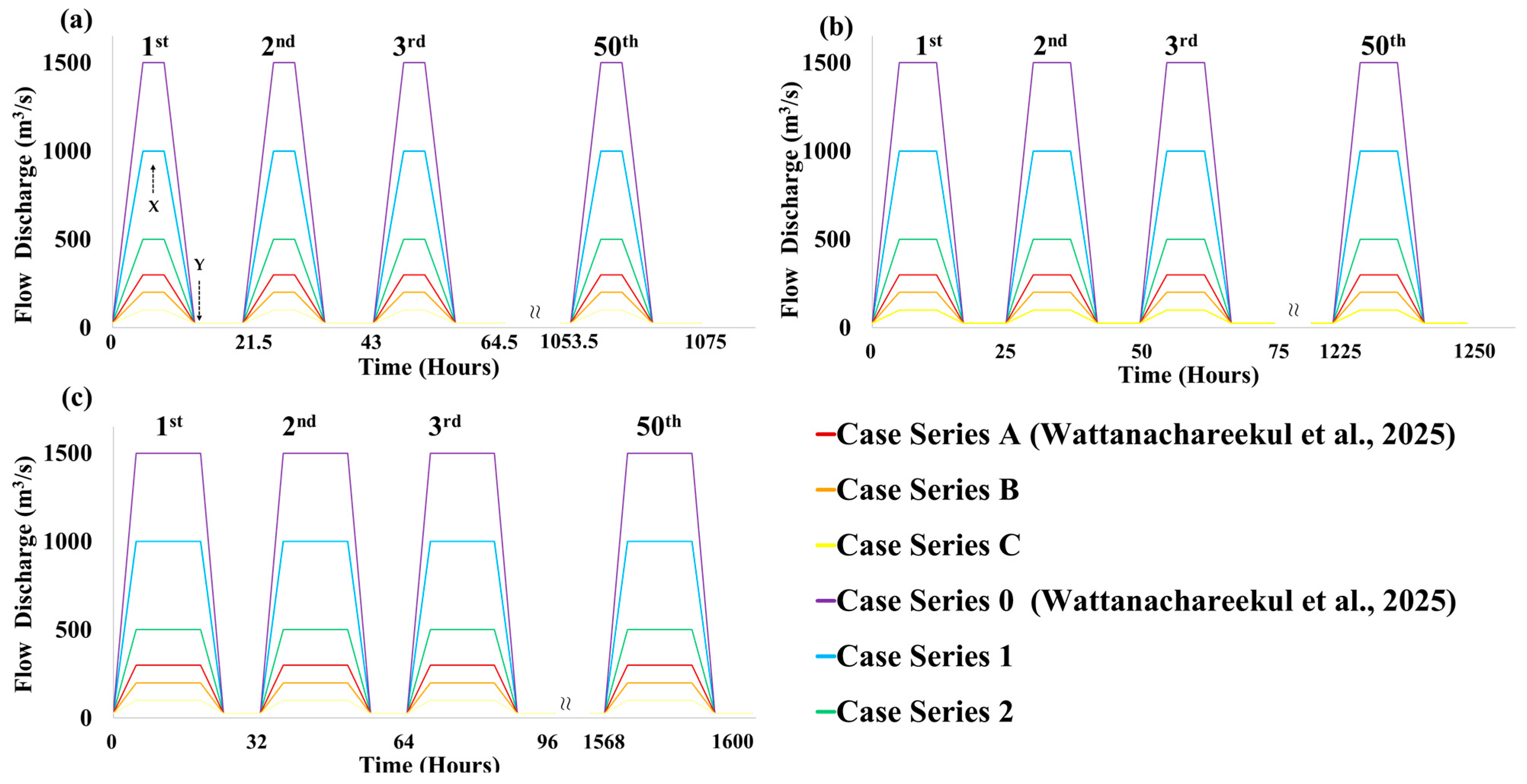
We used repeated hydrographs with four stages (Figure 2): a rising limb, a constant peak discharge, a falling limb, and a low-flow stage. The low-flow discharge was fixed at 25 m3/s for 8 h in all scenarios. This value represents typical low-flow conditions in the Chubetsu River (approximately 15–25 m3/s) and is insufficient to mobilize the uniform 55 mm sediment under our simplified conditions. Because this low discharge cannot generate enough shear stress to transport sediments (Appendix A.1), it does not influence bar dynamics.
For each peak discharge, 9 hydrograph patterns were examined by combining equal rising and falling limb durations of 5, 10, and 20 h with peak discharge durations of 3.5, 7, and 14 h (Table 1). For a 40 m channel width, four peak discharges (100, 200, 500, and 1000 m3/s) were simulated, resulting in 36 cases. These peak flow values were selected based on historical discharge records of the Chubetsu River, which reached a maximum of approximately 1058 m3/s in 1994. Each case was subjected to 50 repeated hydrographs, as this duration was sufficient for the alternate bars to develop and approach a quasi-equilibrium state. The 50th hydrograph shown in Figure 2 corresponds to the final cycle of the repeated hydrographs.
Comparisons were made with two additional peak discharge conditions under the 60 m channel width: 300 m3/s (Case A) and 1500 m3/s (Case 0) reported by Wattanachareekul [18]. This provided 18 additional simulation cases. Specifically, the peak discharges of 100 and 200 m3/s in the 40 m channel were compared with the 300 m3/s case under the 60 m width, while the 500 and 1000 m3/s cases were compared with the 1500 m3/s case under the 60 m width. These comparisons were designed to evaluate two contrasting flow conditions in both narrow and wide channels: (i) flow conditions with similar Shields numbers but different half width-to-depth ratios, and (ii) flow conditions with similar half width-to-depth ratios but different Shields numbers.
To clearly distinguish the simulation conditions, a simple naming system was adopted. Scenarios with lower peak discharges (100, 200, and 300 m3/s) are denoted using alphabetical identifiers, whereas scenarios with higher peak discharges (500, 1000, and 1500 m3/s) are denoted using numerical identifiers. The details of each case are presented in Table 1.
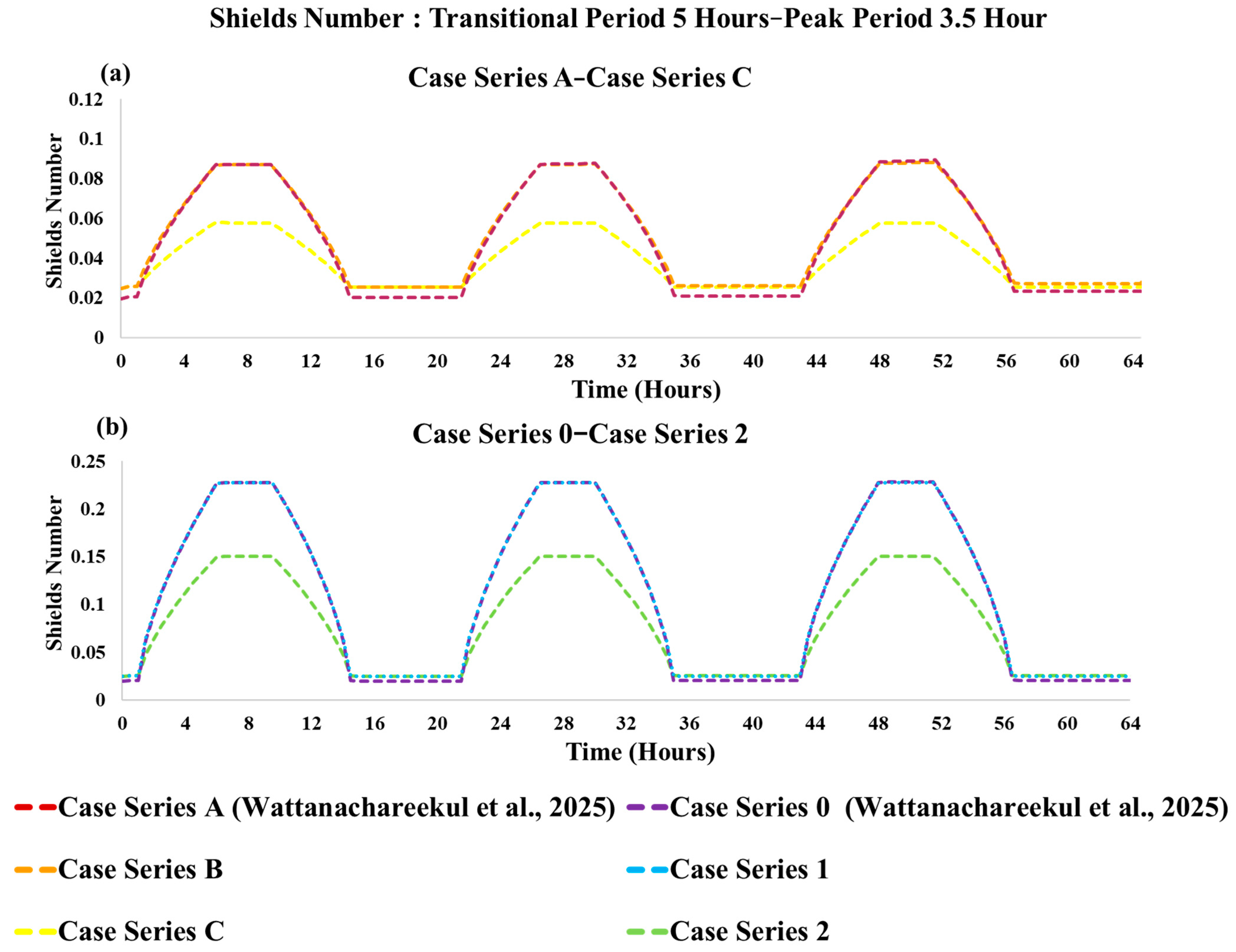
Figure 3 shows the average Shields number over the first three hydrograph cycles for a transitional discharge period of 5 h and a peak discharge period of 3.5 h. Results for Case Series A–C are shown in panel (a), and those for Case Series 0–2 are shown in panel (b). In Figure 3a, the red, orange, and yellow lines represent Case Series A [18], B, and C, respectively. In Figure 3b, the purple, blue, and green lines represent Case Series 0 [18], 1, and 2. The results reveal a cyclic pattern: the shields number increases during the rising limb, remains high and nearly constant during the peak discharge, decreases during the falling limb, and then stays low and steady during the low-flow period. This cycle repeats throughout the calculation. Case Series A [18] and B show similar values, as do Case Series 0 [18] and 1. Case Series C shows slightly lower Shields numbers than Case Series A [18]. While Case Series 2 shows marginally lower values than Case Series 0 [18], except during the low-flow phase (Figure 3b). The exception occurs during the low discharge period, when Case Series A [18] shows lower values than both B and C, and Case Series 0 [18] shows lower values than 1 and 2. However, all cases remain below 0.04, which is lower than the critical value of 0.044 for sediment transport in a gravel bed [43,44]. Therefore, the sediment in this study could not be transported during this period.
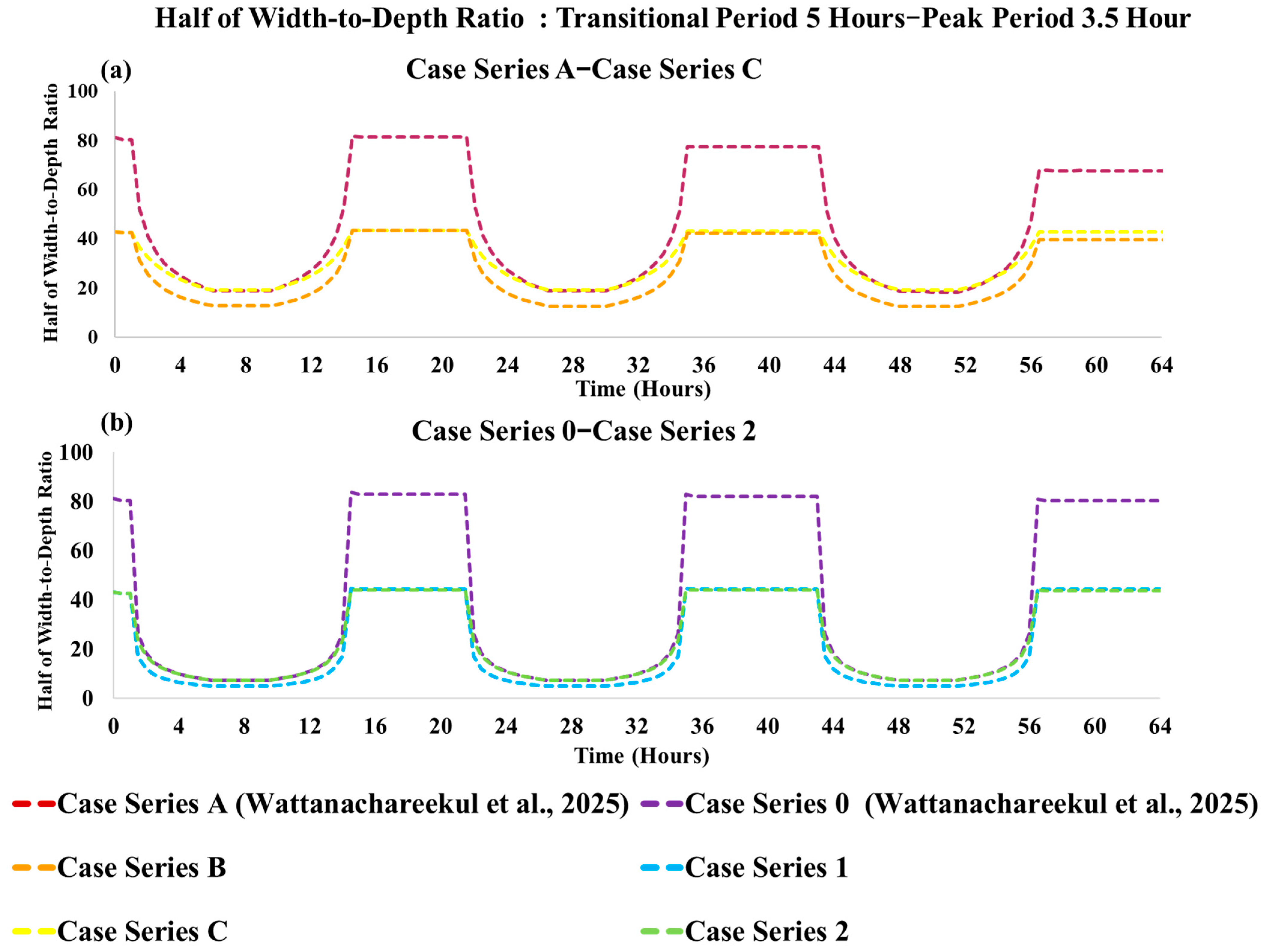
Figure 4 shows the average half-width-to-depth ratio over the first three hydrograph cycles for a transitional discharge period of 5 h and a peak discharge period of 3.5 h. Results for Case Series A–C are shown in panel (a), and those for Case Series 0–2 are shown in panel (b). In Figure 4a, the red, orange, and yellow lines represent Case Series A [18], B, and C, respectively. In Figure 4b, the purple, blue, and green lines represent Case Series 0 [18], 1, and 2, respectively. The results also reveal a cyclic pattern, but with a different trend compared to the Shields number (Figure 3). The ratio decreases during the rising limb, indicating an increase in channel depth. It then remains at a low constant value during the peak discharge period, reflecting a relatively deep channel. As the hydrograph enters the falling limb, the ratio increases, indicating a shallower channel, and then maintains a higher constant value during the low-flow period. This cycle repeats throughout the calculation. Comparisons show that Case Series A [18] has higher values than Case Series B, as do Case Series 0 [18] and 1. In contrast, Case Series A follows a trend like Case Series C (Figure 4a), while Case Series 2 behaves similarly to Case Series 0 [18] (Figure 4b).
During the constant peak discharge period, when the half width-to-depth ratio remains low, Case Series A [18] and C show ratios close to 20 (Figure 4a). This value is slightly higher than the threshold for alternate-bar formation (approximately 10–12 for gravel bed [11,12], indicating that alternate bars could form during the peak discharge period. In contrast, Case Series 0 [18] and 2 (Figure 4b) show half width-to-depth ratios around 7, which is lower than the threshold, suggesting that alternate bars are unlikely to develop during the steady peak-discharge period. An exception occurs during the constant low-discharge period, where Case Series A and 0 [18] exhibit much higher half width-to-depth ratios (Figure 4). These values are significantly above the threshold for alternate-bar formation, indicating that this flow condition may favor the development of multiple-row bars instead [15]. However, the Shields number (Figure 3) during this period was insufficient to transport sediment. Therefore, the half of width-to-depth ratio in this period does not influence alternate bar occurrence.
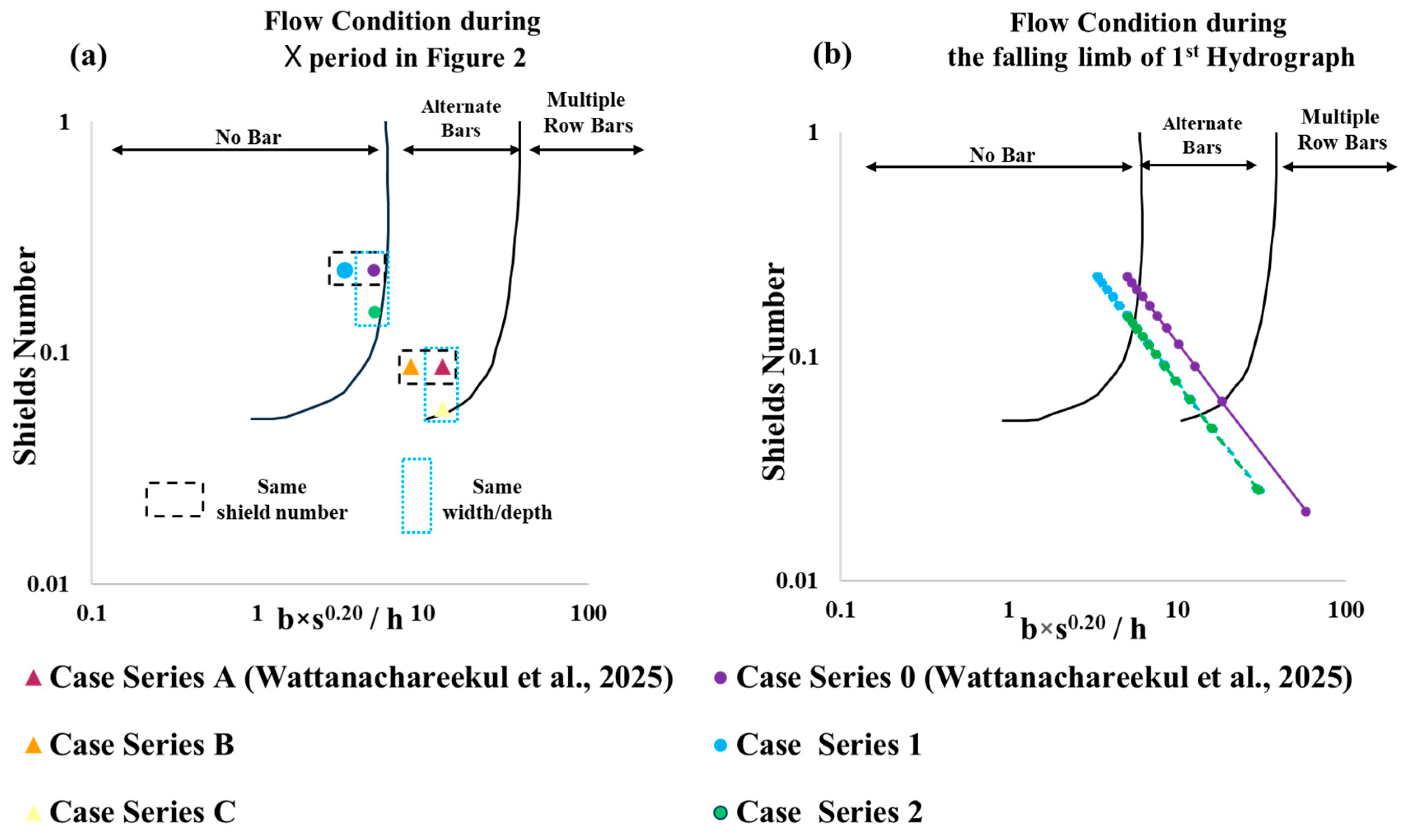
Table 1 presents the average values of the half width-to-depth ratio, shields number, and velocity calculated at the peak discharge period of the first hydrograph (X period in Figure 2). Case Series 0 [18] and Case Series 1 share the same Shields number but differ in their half width-to-depth ratios, as do Case Series A [18] and B. Similarly, Case Series 0 [18] and Case Series 2 share the same half width-to-depth ratio but differ in their Shields numbers, as do Case Series A [18] and C.
We investigated the flow conditions during the peak discharge period of the first hydrograph in the case of a 5-h transitional discharge and a 3.5-h peak discharge period (X period in Figure 2; Figure 5a), as well as during the falling limb of the first hydrograph (Figure 5b), using the mesoscale riverbed configuration diagram from Kuroki and Kishi [15]. During the X period, Case Series 0 [18],1, and 2 (purple, blue, and green circles) fall within the ‘No Bar’ region (Figure 5a), indicating that these flow conditions could not generate alternate bars. In contrast, Case Series A [18], B, and C (red, orange, and yellow triangles) fall within the “Alternate Bar” region (Figure 5a), indicating that these flow conditions could generate alternate bars. During the falling limb of the first hydrograph, some periods in Case Series 0, 1, 2 fall within the “Alternate Bar” region (Figure 5b), suggesting that alternate bars can form during this stage.

3. Results

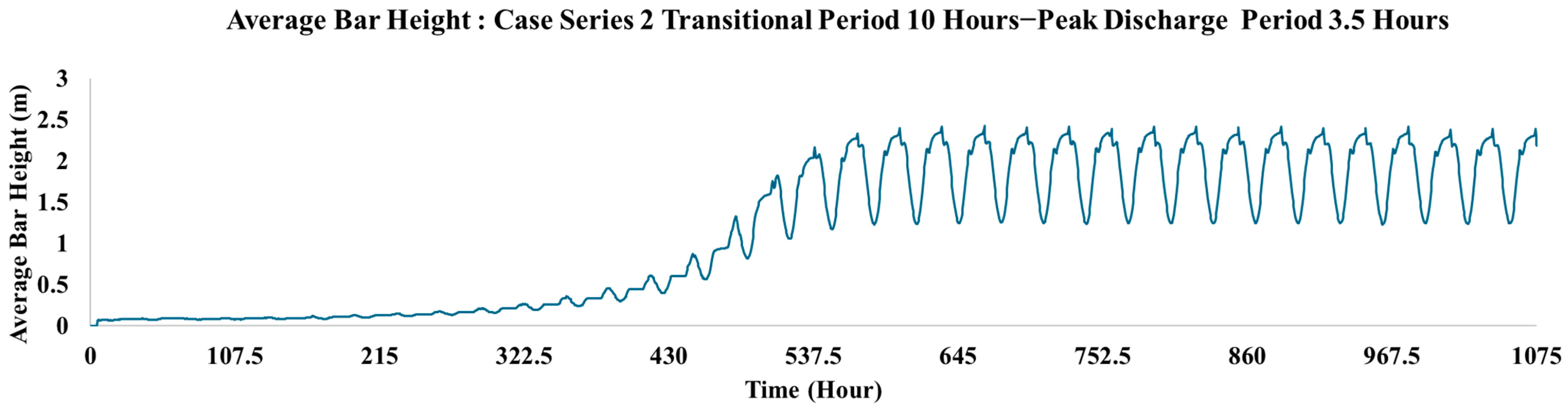
This study investigates dimensionless bar height, which represents the relative elevation difference within each bar unit. Specifically, the bar height is defined as the difference between the maximum and minimum bed elevations within a single bar unit, following the definition of Redolfi et al. [45]. The dimensionless bar height is obtained by normalizing the bar height to the initial channel width, providing a scale-independent measure of bar development that allows comparison across different channel width condition. Figure 6 presents the average bar height from the beginning to the end of the simulation for Case Series 2, with a transitional discharge period of 10 h and a peak discharge period of 3.5 h. The results show that the average dimensionless bar height develops a cyclic pattern after approximately 537.5 h, indicating that alternate bars have formed and reached an equilibrium state under the repeated unsteady hydrograph. The alternate bar morphology development for Case Series 2 is shown in Appendix B.
For the other cases, the Supplementary Materials provide additional explanations. Text S1 describes the details of the average bar height over the calculation time for transitional discharge periods of 5 h (Figure S1), 10 h (Figure S2), and 20 h (Figure S3).
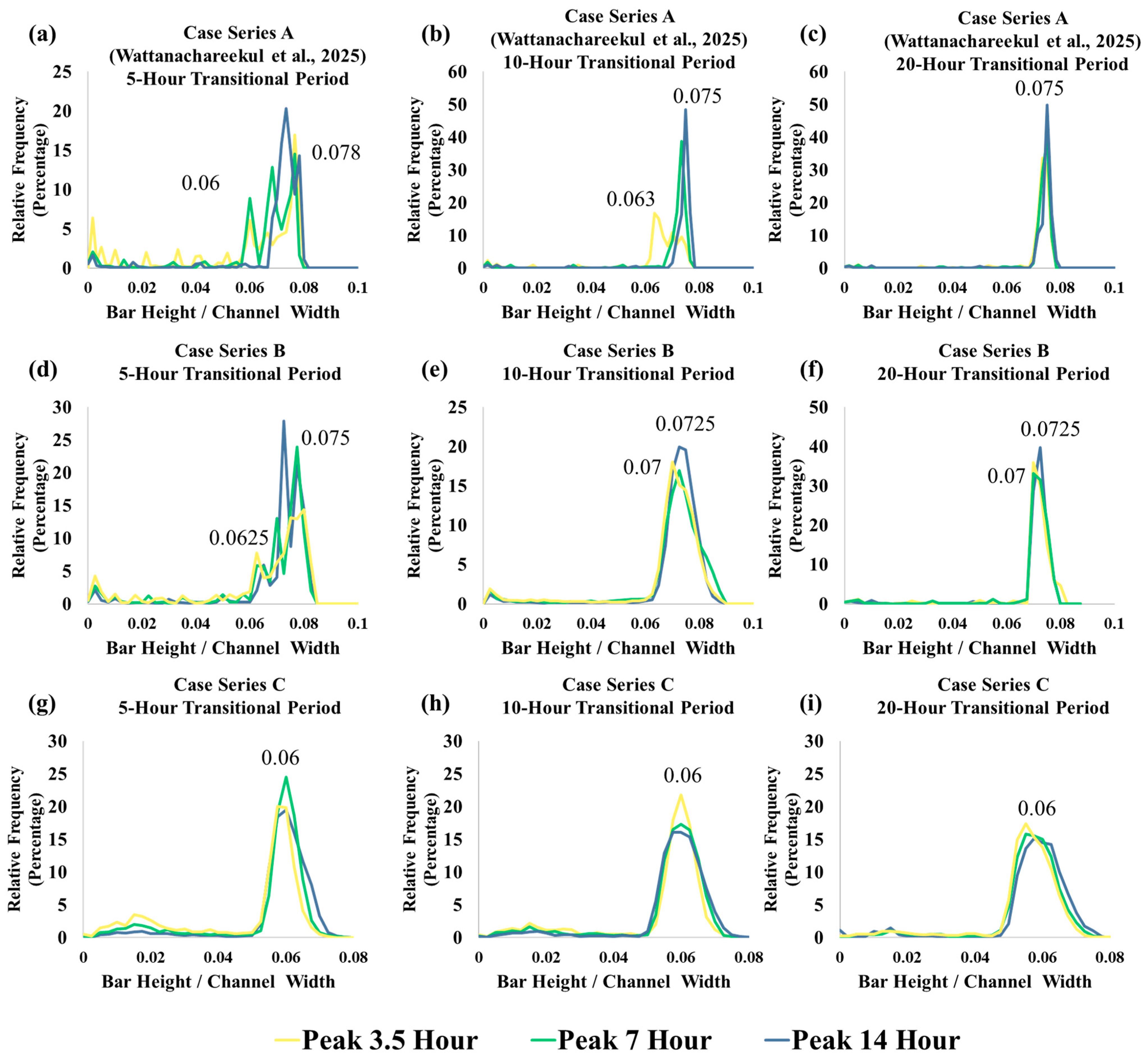
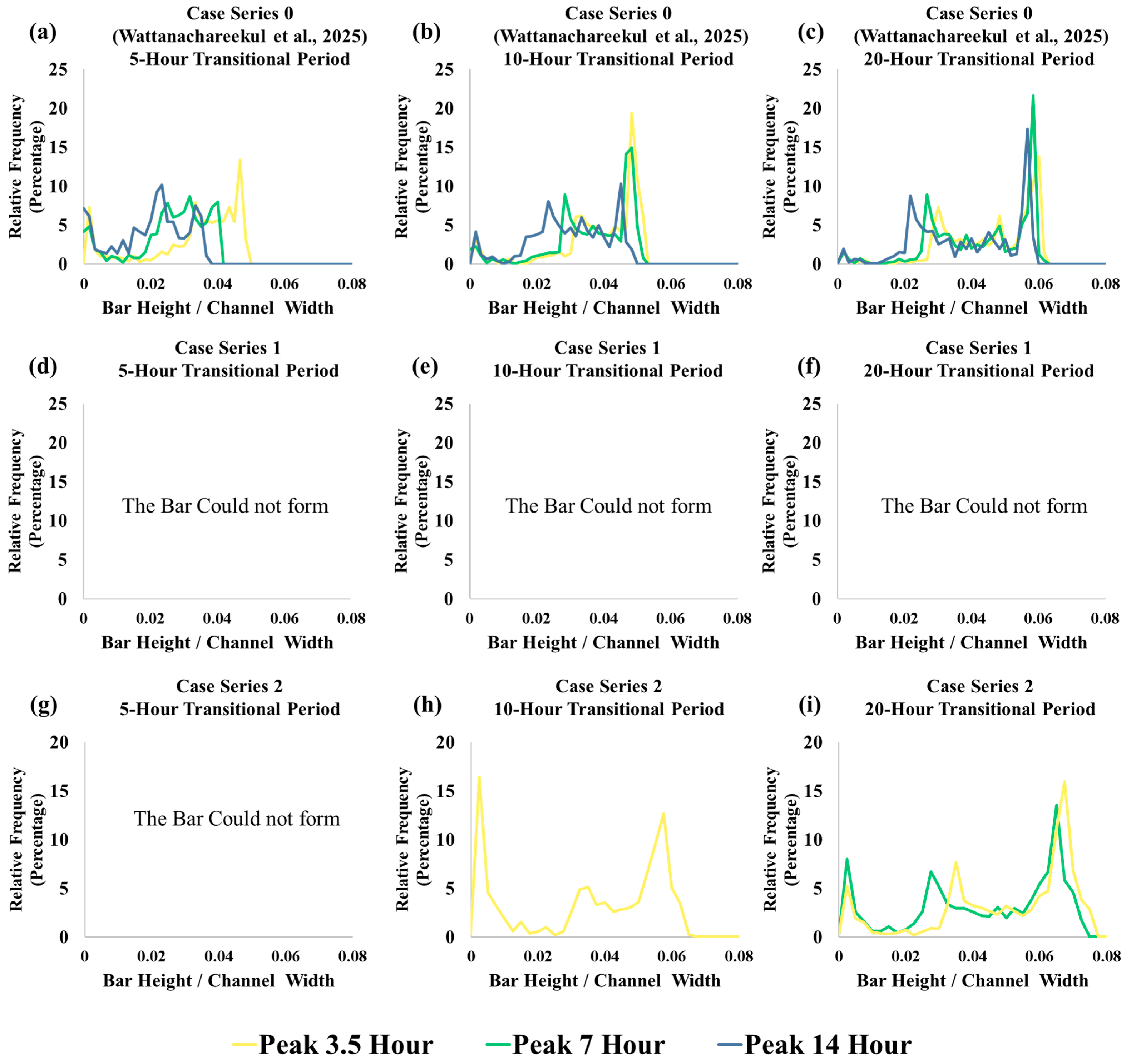
Figure 7 and Figure 8 illustrate the relative frequency distribution of dimensionless bar heights (normalized by the channel width) over the calculation period, sampled every 30 min and expressed as percentages. The horizontal axis in these figures uses 0.1 m intervals, meaning that bar heights are grouped into 0.1 m classes. This representation emphasizes the relative frequency distribution of dimensionless bar heights under different peak discharge durations (3.5, 7, and 14 h). Results for Case Series A–C are shown in Figure 7, while Case Series 0–2 are shown in Figure 8. The configurations used in Case Series A and 0 follow those originally introduced by Wattanachareekul et al. [18].

3.1. Case Series A [18]

Case Series A (Figure 7a–c), Wattanachareekul et al. [18] reported that with a channel width of 60 m and a peak discharge of 300 m3/s resulted in variations in the dimensionless bar-height distribution depending on the transitional discharge period. For the 5-h transitional period (Figure 7a), the 3.5- and 7-h peak discharges showed multiple dimensionless bar height peaks, while the 14-h peak discharge was reduced to two peaks. During the 10-h transitional period (Figure 7b), the 3.5-h peak discharge (yellow) produced approximately three peaks, with the highest frequency around 0.063. In contrast, the 7-h (green) and 14-h peak discharges (blue) each showed a single peak near 0.075. For the 20-h transitional period (Figure 7c), all peak discharge periods displayed a single peak at approximately 0.075, indicating a more uniform bar height distribution across different peak discharge durations.

3.2. Case Series B

Case Series B, with a channel width of 40 m and a peak discharge of 200 m3/s, multiple peaks were observed during the 5-h transitional period (Figure 7d). When the transitional discharge increased to 10 and 20 h, all peak discharge periods exhibited a single peak. However, differences were observed among the peak discharge durations: the 3.5-h and 7-h peak discharges had a peak dimensionless bar height of approximately 0.07 for both the 10-h (Figure 7e) and 20-h transitional periods (Figure 7f), while the 14-h peak discharge showed a slightly higher peak at around 0.0725 for both transitional periods. The alternate bar morphology observed during both the peak (Figure A2a–c) and low discharge periods (Figure A2d–f) of the last hydrograph indicates that increasing the peak discharge duration from 3.5 to 7 and 14 h resulted in larger alternate bars (Figure A2). Additionally, at the peak discharge of the 5-h transitional period (Figure A2a), extending the peak discharge duration induced more deposition (shown in red) and erosion (shown in blue), which in turn contributed to higher bar heights.

3.3. Case Series C

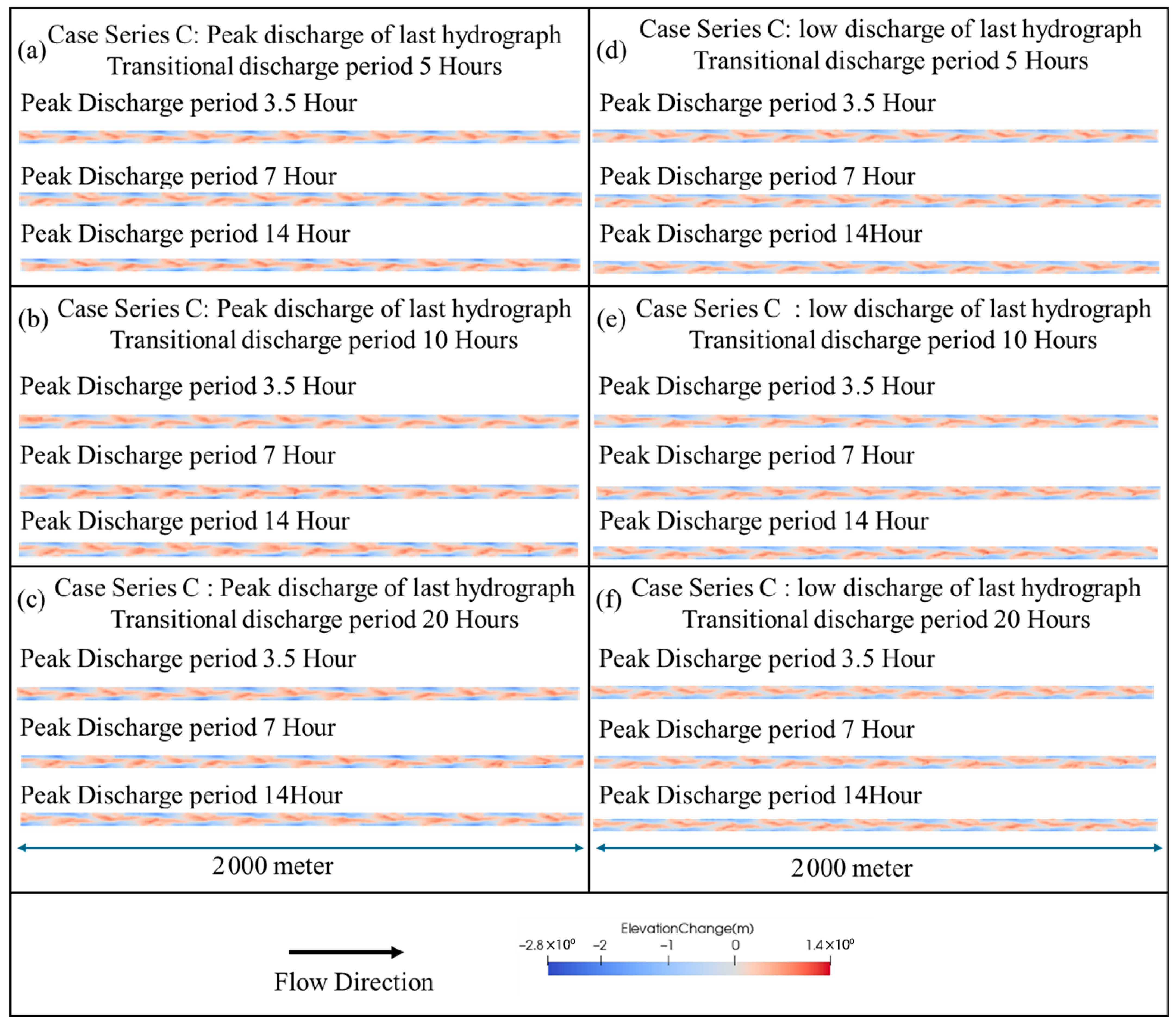
Case Series C, with a channel width of 40 m and a peak discharge of 100 m3/s, all scenarios showed a single peak at around 0.06. However, increasing the transitional discharge period from 5 (Figure 7g) to 10 (Figure 7h) and 20 h (Figure 7i) extended the maximum bar height from approximately 0.07 to 0.08. Moreover, extending the peak discharge period further increased the maximum dimensionless bar height within each transitional discharge period. From the peak discharge in the last hydrograph, as the peak discharge duration increased (Figure A3a–c), both depositional areas (shown in red) and erosion areas (shown in blue) expanded, resulting in higher bar heights. By contrast, during the low discharge period of the last hydrograph (25 m3/s; Figure A3d–f), no significant differences in bar morphology were observed compared to the peak discharge period (Figure A3a–c).

3.4. Case Series 0 [18]

Case Series 0 (Figure 8a–c), Wattanachareekul et al. [18] reported that with a channel width of 60 m and a peak discharge of 1500 m3/s, multiple peaks in dimensionless bar height were observed. As the peak discharge period increased, the maximum dimensionless bar height decreased across all transitional discharge periods, with the effect being most pronounced for shorter transitional periods (Figure 8a). Moreover, a longer transitional discharge period in Case Series 0 extends the overall range of dimensionless bar heights.

3.5. Case Series 1

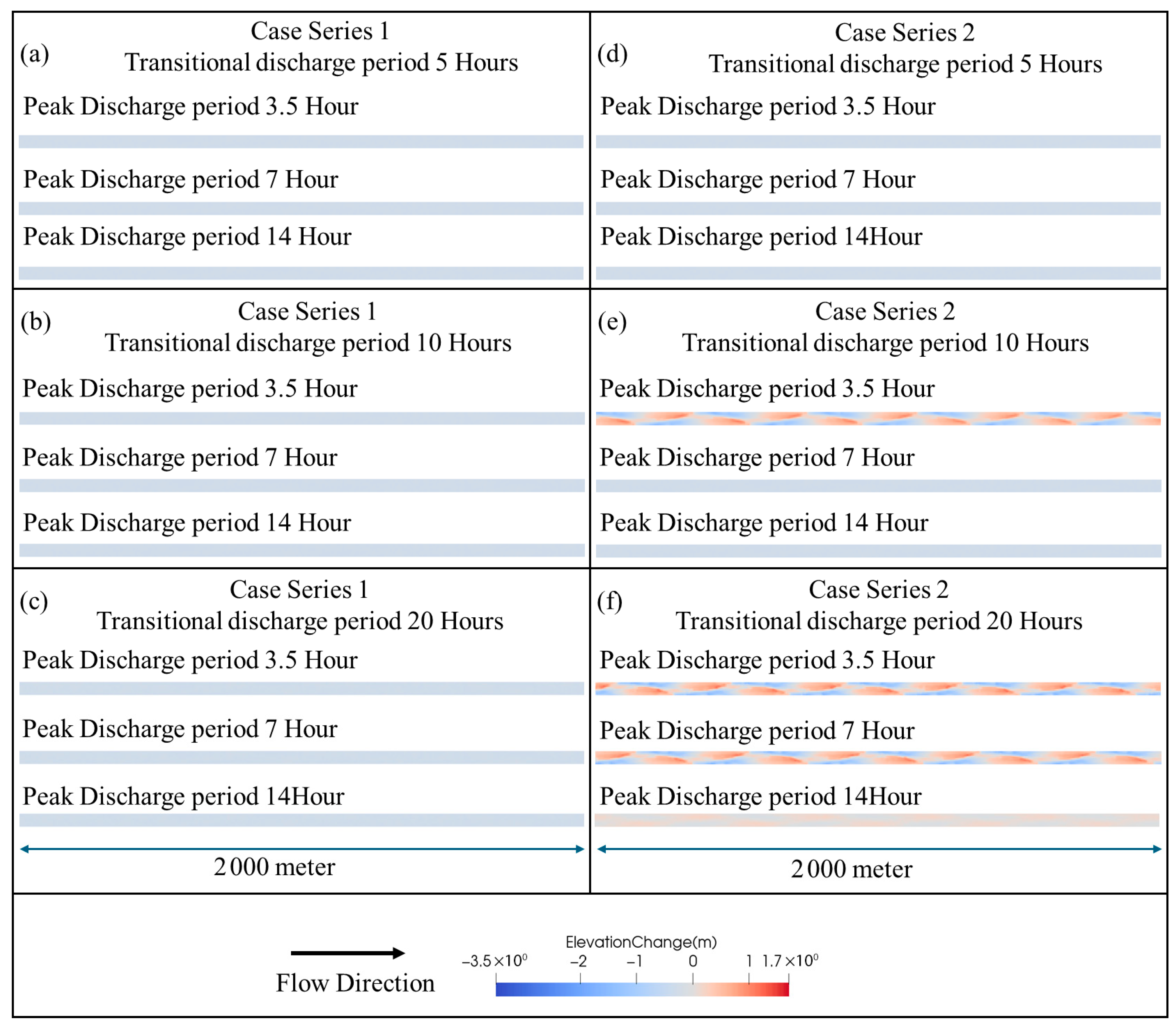
Case Series 1 (Figure 8d–f), with a channel width of 40 m and a peak discharge of 1000 m3/s, does not appear in the distribution of dimensionless bar heights because it was observed that bars did not form during any peak discharge or transitional discharge periods at the end of the calculation (Figure 9a–c). Although an unsteady, repeated hydrograph was applied, the flow conditions remained insufficient to generate alternate bars. Consequently, bar development behavior was observed under peak discharge periods, where bars could not form (Figure 5a). Additionally, The alternate bar morphology of Case Series 1 during the peak discharge period of the final hydrograph for each transitional discharge period is shown in Figure S4.

3.6. Case Series 2

Some cases in Case Series 2 (Figure 8g–i) do not appear in the distribution of dimensionless bar heights. Alternate bars did not form during any peak discharge period under the 5-h transitional discharge period (Figure 9d). They also did not form during the 7-h and 14-h peak discharge periods under the 10-h transitional discharge period (Figure 9e). For the 20-h transitional discharge period with 14-h peak discharge period, alternate bars could not develop to an equilibrium state, showing only small bed elevation changes (Figure 9f). The relative frequency of dimensionless bar heights shows that, when the transitional period increased from 10 (Figure 8h) to 20 h (Figure 8i), the maximum dimensionless bar height rose from about 0.06 to about 0.08. In both the 10-h (Figure 8h) and 20-h transitional periods (Figure 8i), a large proportion of dimensionless bar heights remained concentrated near zero. Additionally, The alternate bar morphology of Case Series 2 during the peak discharge period of the final hydrograph for each transitional discharge period is shown in Figure S4.

4. Discussion

4.1. Similar Shields Number Condition

Case Series A [18] and B show similar trends in Shields number, as do Case Series 0 [18] and 1. The exception occurs during the low-discharge period, when Case Series A [18] records slightly lower values than Case Series B, and Case Series 0 [18] is lower than Case Series 1. During this period, all series maintain shields number below 0.04, which is lower than the approximate threshold for sediment transport in gravel-bed rivers [43,44].
When the peak discharge provides flow conditions capable of generating alternate bars (Case Series A [18] and B in Figure 5a), the development of alternate bars follows a similar trend in both wide (Case Series A [18]) and narrow (Case Series B) channels: the peak in the distribution of dimensionless bar heights decreases from multiple peaks to a single peak as the transitional discharge period increases (Figure 7a–f). During the 20-h transitional discharge period, both cases show nearly identical maximum dimensionless bar height normalized by channel width, at around 0.075 for Case Series A [18] (Figure 7c) and 0.0725 for Case Series B (Figure 7f).
However, when higher peak discharge results in flow conditions that fail to generate alternate bars (Case Series 0 [18] and 1 in Figure 5a), wide and narrow channels behave differently. In Case Series 0 [18], alternate bars form under all hydrograph conditions, and increasing the transitional discharge period raises the maximum bar height. In contrast, Case Series 1 shows no formation of alternate bars at the end of the calculation (Figure 9d–f).

4.2. Similar Half of Width-to-Depth Ratio Condition

In Case Series A [18] (wide channel) and C (narrow channel), the half width-to-depth ratios are similar, while Case Series 0 [18] (wide channel) is comparable to Case Series 2 (narrow channel). The exception occurs during the low-discharge period, when Case Series A shows higher values than Case Series C, and Case Series 0 shows higher values than Case Series 2. During this period, all series exhibit half width-to-depth ratios above 10 (Figure 4), approximately the threshold for alternate bar occurrence in gravel-bed rivers [11,12]. At the same time, the Shields number remains below 0.04 (Figure 3), indicating insufficient flow to transport gravel-sized sediment. Shields number in Case Series C are lower than in Case Series A [18], while those in Case Series 2 are lower than in Case Series 0 [18].
When the peak discharge provides flow conditions capable of generating alternate bars (Case Series A [18] and C, Figure 5a), the development trends diverge between wide and narrow channels. Case Series A [18] shows variations in the distribution of dimensionless bar heights with the transitional discharge period, whereas Case Series C maintains only a single peak. Moreover, Case Series C shows that the maximum dimensionless bar height increases with more extended peak discharge periods across all transitional discharge durations, a trend not observed in Case Series A [18].
For the higher peak discharge that flow conditions that fail to generate alternate bars (Case Series 0 [18] and 2 in Figure 5a), Case Series 2 exhibits lower Shields numbers and peak velocities during peak discharge (Table 1). This suggests that Case Series 2 may still be favorable for alternate bar formation under unsteady discharge conditions. Because the higher Shields number, especially when it exceeds the critical threshold, is associated with increased sediment mobility [38,46] and transport capacity [47]. Consequently, higher Shields numbers tend to produce greater erosion of sediment deposits, particularly during peak discharge.
However, unsteady discharge simulations show that Case Series 2 does not form alternate bars under any 5-h transitional period (Figure 9d). When the transitional period is extended to 10 h, alternate bars appear only at the 3.5-h peak (Figure 9e). With a 20-h transitional period, alternate bars do not fully develop at the 14-h peak (Figure 9f), even after 50 hydrograph cycles. This may indicate that 50 cycles are insufficient for alternate bars to reach equilibrium under these conditions. In contrast, Case Series 0 [18] consistently develops alternate bars across transitional and peak periods, despite higher Shields numbers and velocities.
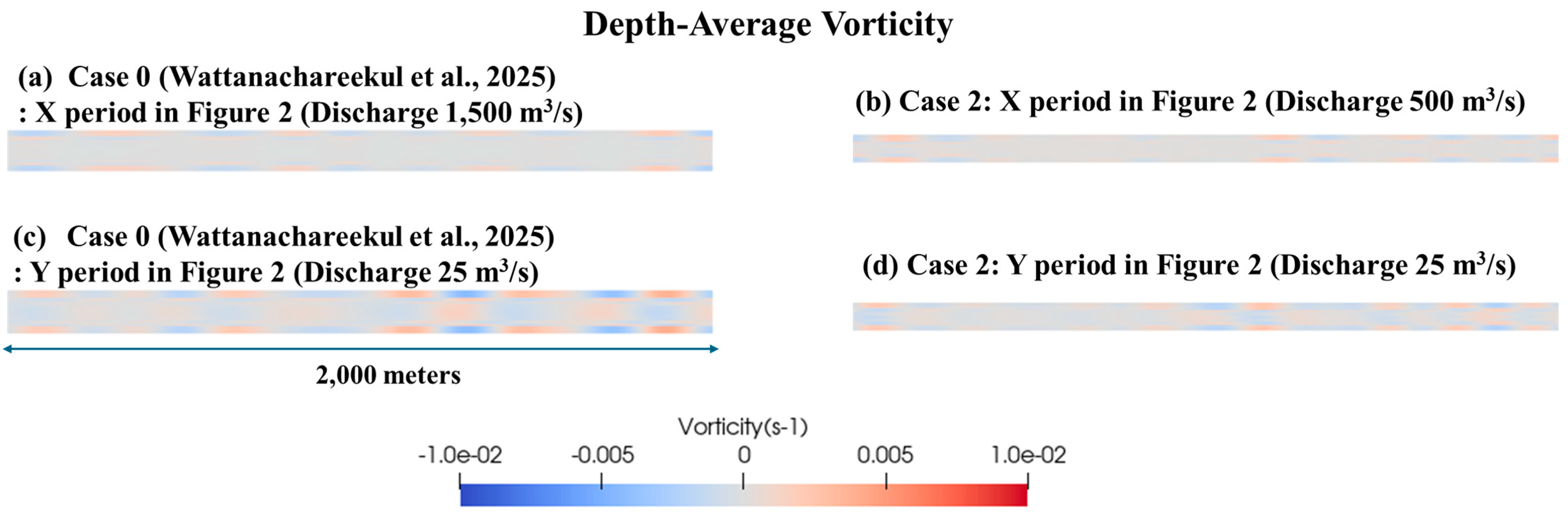
An analysis of depth-averaged vorticity at the peak discharge of the first hydrograph cycle (case 5-h transitional and 3.5-h peak period, X in Figure 2) shows that Case Series 0 [18] (Figure 10a) produces a similar vorticity range to Case Series 2 (Figure 10b), though Case Series 2 exhibits very small magnitudes. After the falling limb (Y in Figure 2), vorticity magnitude increases in both cases (Figure 9c,d), with Case Series 0 [18] (Figure 10c) exhibiting a wider range than Case Series 2 (Figure 10d). This indicates stronger secondary flow intensity in Case Series 0 [18] during the falling limb, when conditions can generate alternate bars (Figure 3). The higher secondary flow intensity and broader vorticity distribution in Case Series 0 [18] accelerate the development of alternate bars toward equilibrium, as reflected in the cyclic pattern of bar height (Figure 6). Evidence from Case Series 0 [18] also shows a smaller proportion of near-zero dimensionless bar heights compared with Case Series 2. Previous studies [3,40] likewise demonstrated that secondary flow intensity is important for alternate bar development and stability. Thus, the stronger secondary flow in Case Series 0 [18] creates more favorable conditions for alternate bar formation during transitional discharge, even though Case Series 2 has lower Shields numbers and velocities during peak discharge (Table 1).
These findings suggest that, under similar half width-to-depth ratio conditions, secondary flow intensity and vorticity range are critical factors influencing alternate bar formation and stability under unsteady discharge scenarios. This is particularly important during peak discharges that cannot independently generate alternate bars.

4.3. Implication from This Study

In the case of peak discharges that provide flow conditions capable of generating alternate bars (Series A [18]–C), the controlling factor for alternate bar morphodynamics appears to be the Shields number. Evidence from Case Series A [18] (wide channel) and B (narrow channel) shows a similar trend in the development of alternate bars. As the transitional discharge period increases, the number of peaks in the dimensionless bar height distribution reduces to a single peak (Figure 7). The range of dimensionless bar heights is also similar for cases with higher (Case Series A [18]) and lower (Case Series B) half width-to-depth ratio is close together. In contrast, when the Shields numbers differ (Case Series A [18] and Case Series C), the trends diverge (Figure 7). Series C shows only a single peak in the dimensionless bar height distribution, even though the channels have similar halfwidth-to-depth ratios conditions before the occurrence of alternate bars (Figure 4a). Overall, the case with a higher Shields number (Case Series A [18]) exhibits a wider range of dimensionless bar heights (Figure 7) than the case with a lower Shields number (Case Series C).
For cases where higher peak discharge fails to generate alternate bars, the half width-to-depth ratio plays a more critical role. When Shields numbers are similar (Figure 3b), alternate bar development differs between wide (Case Series 0 [18]) and narrow channels (Case Series 2): wide channels form alternate bars across all discharge phases, whereas narrow channels do not (Figure 8). When wide and narrow channels share similar half-width-to-depth ratios (Figure 4b), secondary flow intensity and vorticity range become essential. A broader vorticity range and stronger secondary flows during the falling limb provide more favorable conditions for alternate bar formation. These results suggest that, when peak discharge alone cannot generate alternate bars, bar dynamics are influenced not only by the Shields number and half width-to-depth ratio but also by secondary flow characteristics.
Additionally, this study suggests that climate change, which leads to longer flood durations, has a greater impact on alternate bar development in channels with lower half-width-to-depth ratios than in those with higher ratios under similar slopes and bed materials. When flood conditions produce comparable Shields numbers (e.g., Case Series 0 [18] and 2), the wider channels exhibit higher half width-to-depth ratios, making them more favorable for alternate bar formation during the falling limb. This tendency is consistent with Redolfi et al. [26], who reported that channels with higher half width-to-depth ratios are generally less sensitive to discharge variations in terms of bar dynamics. Furthermore, when wide and narrow channels share similar ratios (e.g., Case Series 0 [18] and 2), the wider channel develops a higher Shields number during the falling limb of the hydrograph, which generates stronger vorticity and more intense secondary flows. These conditions create a more favorable environment for the formation and stability of alternate bars.

4.4. Recommendation for Further Studies

This study investigates the effects of hydrograph patterns and channel width on alternate bar development, assuming negligible bank erosion and focusing on sediment-driven processes. However, previous studies have shown that several additional factors can also influence the evolution of alternate bars, including slope of channel [19], non-uniform sediment [20,21,22], sediment supply pattern [16,21,23,24], bank strength [25], and Vegetation [9,27,28,29,30,31,32,33,34]. Future research should incorporate sensitivity analyses of these parameters to understand their individual and combined effects better.

5. Conclusions

This study used 2D numerical simulations with repeated hydrographs to investigate the development and stability of alternate bars under unsteady discharge. Two groups of peak discharges were considered: (i) peak conditions sufficient to generate alternate bars (Series A–C), and (ii) higher peak discharges that failed to generate alternate bars (Series 0–2). Results indicate that the dominant controls on alternate bar development differ between these groups.
For cases where peak discharge generates alternate bars, and the half width-to-depth ratio is high (Series A–C), the Shields number primarily governs alternate bar dynamics. Under these conditions, wide and narrow channels show similar development when Shields numbers are alike, but diverge when Shields numbers differ, even if half width-to-depth ratios are similar.
For cases where higher peak discharge fails to generate alternate bars (Series 0–2), the half width-to-depth ratio plays a more critical role. When shields number are similar, alternate bar development differs between wide and narrow channels. In wide channels, alternate bars form across all discharge phases, whereas in narrow channels they do not. When wide and narrow channels have similar half-width-to-depth ratios, secondary flow intensity and vorticity range become decisive. A wider range of vorticity and stronger secondary flows during the falling limb provide more favorable conditions for alternate bar formation. This suggests that, when peak discharge alone cannot generate alternate bars, bar dynamics are not controlled solely by shields number or half width-to-depth ratio.
Finally, our findings indicate that narrow channels are more sensitive to discharge variations in alternate bar development than wide channels, particularly under high peak discharges that cannot generate alternate bars.

Supplementary Materials

The following supporting information can be downloaded at: https://www.mdpi.com/article/10.3390/w17243494/s1, Text S1. Average Bar Height Over the Calculation Time, Figure S1: Average bar height over the calculation period in Case 5–hour Transitional Period, Figure S2: Average bar height over the calculation period in Case 10–hour Transitional Period, Figure S3: Average bar height over the calculation period in Case 20–hour Transitional Period, Figure S4: Example of alternate bar morphology over a 2000 m channel reach during the peak discharge of last hydrograph for Case Series 1 and 2.

Author Contributions

Conceptualization, P.W.; methodology, P.W., T.I. and T.U.; software, P.W. and T.I.; validation, P.W. and T.I.; formal analysis, P.W.; investigation, P.W., T.I., T.U., Y.K. and K.E.; resources, P.W.; data curation, P.W.; writing—original draft preparation, P.W.; writing—review and editing, T.I. and T.U.; visualization, P.W.; supervision, T.I.; project administration, T.I.; funding acquisition, T.I. All authors have read and agreed to the published version of the manuscript.

Funding

This research was funded by JSPS KAKENHI (22KK0239, 23K22872) and Kasen Sabo Gijutsu Kenkyu Kaihatsu (Ministry of Land, Infrastructure, Transport and Tourism, Japan).

Data Availability Statement

The original data presented in this study are openly available in Figshare at https://figshare.com/s/77d3695782787401fe5c (accessed on 2 December 2025).

Acknowledgments

This project was supported by JSPS KAKENHI grant numbers 22KK0239, 23K22872, and Kasen Sabo Gijutsu Kenkyu Kaihatsu (Ministry of Land, Infrastructure, Transport and Tourism, Japan). Additionally, we sincerely thank the two anonymous reviewers and the editorial team for their time, effort, and constructive feedback, which have significantly improved the clarity and quality of our manuscript.

Conflicts of Interest

The authors declare no conflicts of interest.

Abbreviation

The following abbreviation are used in this manuscript:
iRICInternational River Interface Cooperative

Appendix A

Appendix A.1. The Shear Stress During Low Discharge (25 m3/s)

The critical bed shear stress ( τ c ) requires to initiate sediment transport in this study was calculated as follows:
Critical   bed   shear   stress   ( τ c ) :   τ c =   θ c ( ρ s     ρ ) gd = 0.044 × ( 2650     1000 ) × 9.81 × 0.055 = 39.17   N / m 2
where θ c is the critical dimensionless shear stress (typically around 0.044 for gravel beds [43,44], ρ s is sediment density in unit kg/m3 (This study 2650 kg/m3), ρ is fluid density in unit kg/m3 (for water is 1000 kg/m3), g is acceleration from to gravity (9.81 m/s2), d is sediment grain diameter in unit of meters (0.055 m in this study).
However, the low-flow discharge of 25 m3/s produces a shear stress of only 17 N/m2 (Figure A1), which is insufficient to mobilize the sediment. Therefore, sediment transport does not occur during the low-discharge period.
Figure A1. Shear stress during the low discharge stage (Discharge 25 m3/s).
Water 17 03494 g0a1

Appendix A.2. The Alternate Bar Morphology of Case Series B and C
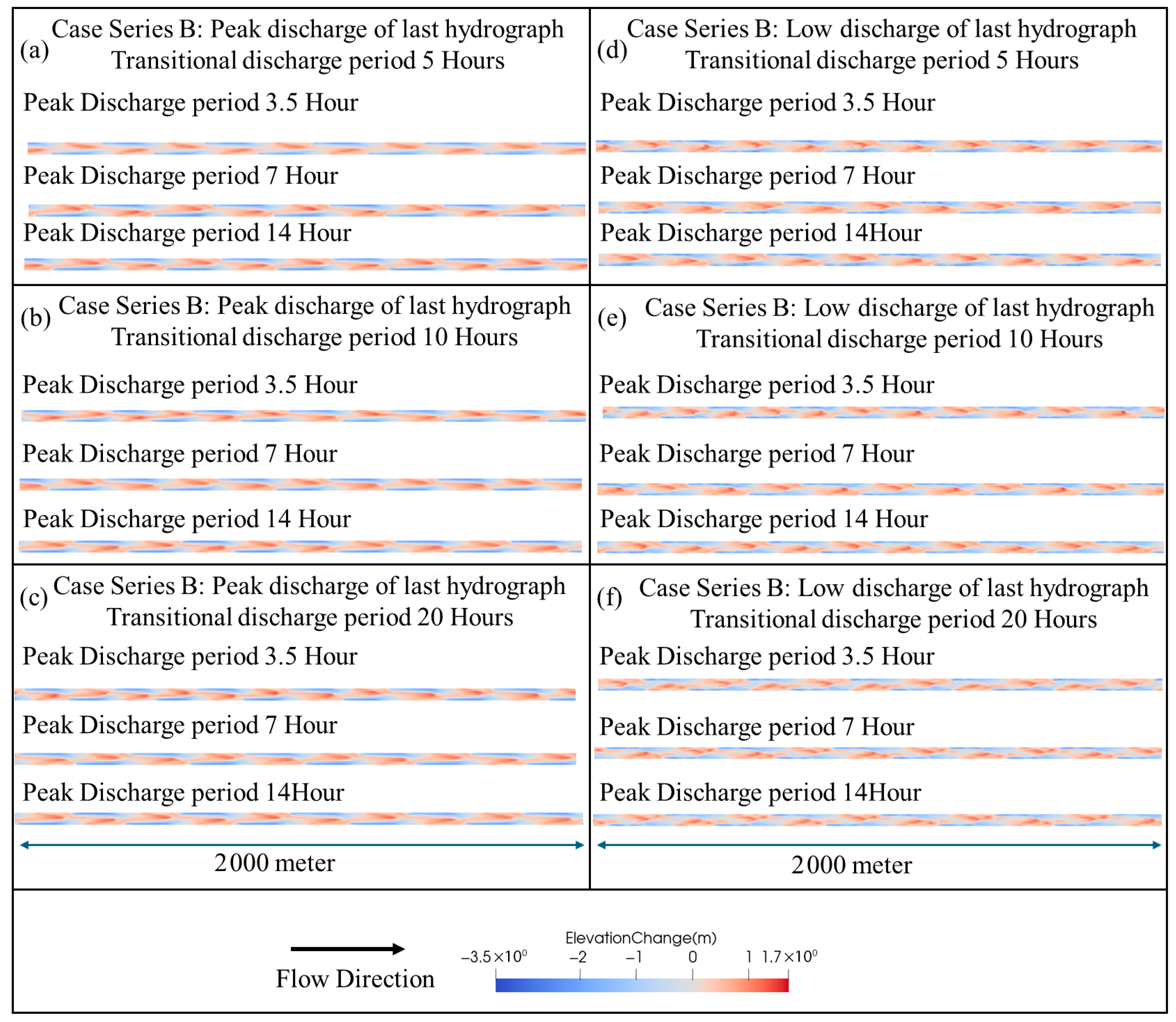
Figure A2. Example of alternate bar morphology over a 2000 m channel reach during the last hydrograph for case series B: (ac) peak discharge and (df) low discharge, for transitional discharge periods of 5, 10, and 20 h, respectively.
Water 17 03494 g0a2
Figure A3. Example of alternate bar morphology over a 2000 m channel reach during the last hydrograph for case series C: (ac) peak discharge and (df) low discharge, for transitional discharge periods of 5, 10, and 20 h, respectively.
Water 17 03494 g0a3

Appendix B

The Dynamic of Alternate Bar Morphology of Case Series 2 with Transitional Discharge Period 10 h–Peak 3.5 h
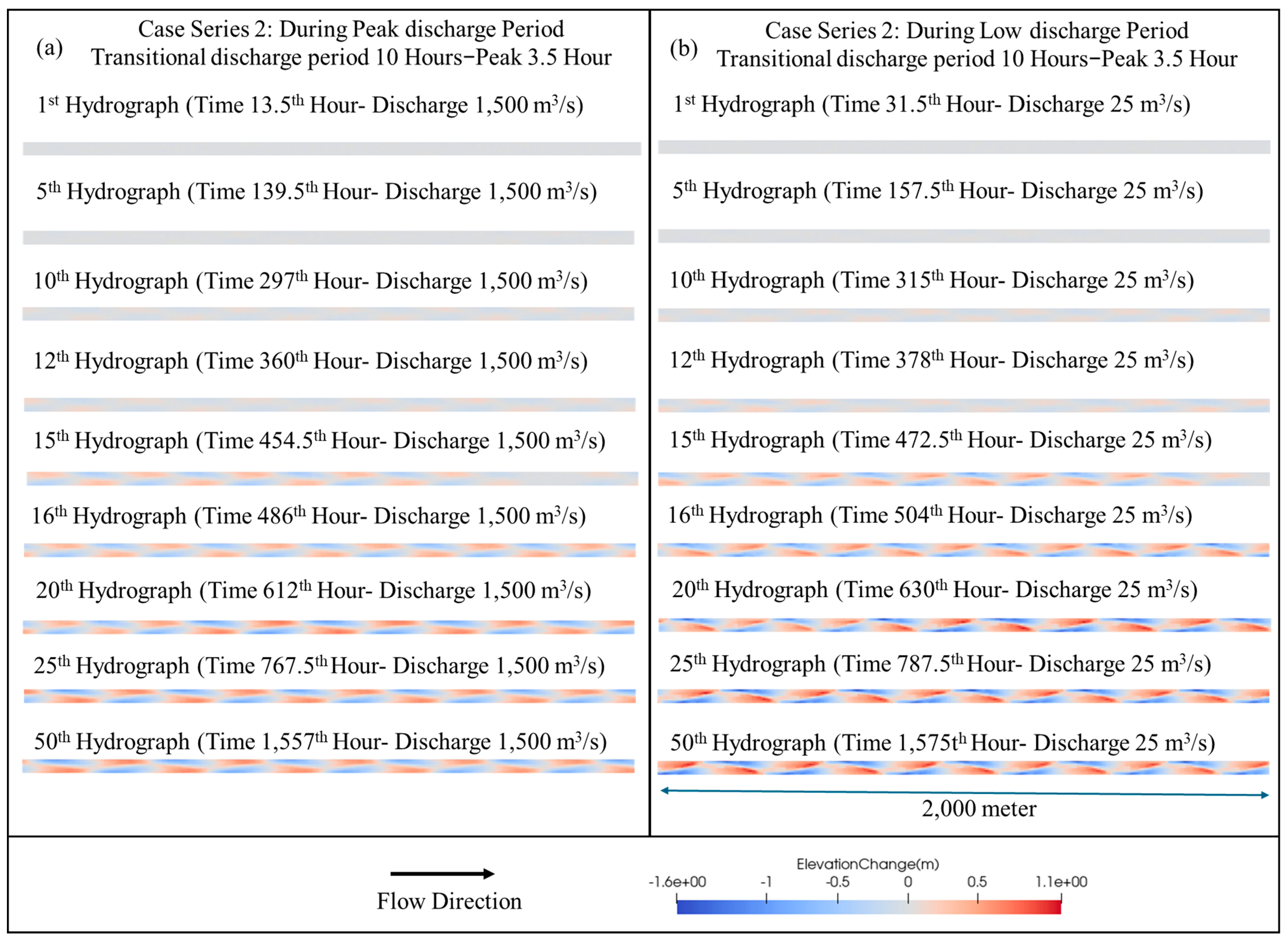
Figure A4 illustrates the development of alternate bars in Case Series 2 at the 10-h transitional discharge and the 3.5-h peak period, corresponding to (a) the peak-discharge stage and (b) the low-discharge stage. The elevation change represents the difference from the initial bed condition; red indicates sediment deposition, and blue indicates erosion. Alternate bars (shown as red areas) begin to appear around the 12th hydrograph. After their initial formation, bar growth continues, while the opposite side of each bar experiences continuous erosion.
Figure A4. Example of alternate bar development over a 2000 m channel in Case Series 2 at the 10-h transitional discharge and the 3.5-h peak period, showing (a) bar morphology during the peak-discharge stage and (b) bar morphology during the low-discharge stage.
Water 17 03494 g0a4
By the 20th hydrograph (approximately 630 h), the alternate bars exhibit a cyclic pattern, which corresponds to the cyclic variation in bar height shown in Figure 6. The bar morphology at the 20th hydrograph is also like that observed at the 25th and 50th hydrographs. Additionally, in this case, alternate bars are eroded during the peak-discharge stage (Figure A4a) and re-deposited during the falling limb and subsequent low-flow stage (Figure A4b). As a result, the alternate-bar morphology during the low-discharge period shows greater deposition (red) and lower erosion (blue) compared with the peak-discharge period (Figure A4a).

References

  1. Francalanci, S.; Solari, L.; Toffolon, M.; Parker, G. Do Alternate Bars Affect Sediment Transport and Flow Resistance in Gravel-Bed Rivers? Earth Surf. Process. Landf. 2012, 37, 866–875. [Google Scholar] [CrossRef]
  2. Ancey, C.; Recking, A. Scaling Behavior of Bedload Transport: What If Bagnold Was Right? Earth-Sci. Rev. 2023, 246, 104571. [Google Scholar] [CrossRef]
  3. Claude, N.; Rodrigues, S.; Bustillo, V.; Bréhéret, J.-G.; Tassi, P.; Jugé, P. Interactions between Flow Structure and Morphodynamic of Bars in a Channel Expansion/Contraction, Loire River, France. Water Resour. Res. 2014, 50, 2850–2873. [Google Scholar] [CrossRef]
  4. Inoue, T.; Mishra, J.; Kato, K.; Sumner, T.; Shimizu, Y. Supplied Sediment Tracking for Bridge Collapse with Large-Scale Channel Migration. Water 2020, 12, 1881. [Google Scholar] [CrossRef]
  5. Inoue, T.; Hiramatsu, Y.; Johnson, J.P.L.; Dempo, J.; Mishra, J. Ratio of River Channel Bar to Bank Height Sets Bank Erosion Rate. JGR Earth Surf. 2025, 130, e2024JF007965. [Google Scholar] [CrossRef]
  6. Inoue, T.; Hiramatsu, Y.; Johnson, J.P. Morphological and Sediment Supply Controls on Lateral Bedrock Channel Erosion. Geophys. Res. Lett. 2025, 52, e2024GL113436. [Google Scholar] [CrossRef]
  7. Duró, G.; Crosato, A.; Tassi, P. Numerical Study on River Bar Response to Spatial Variations of Channel Width. Adv. Water Resour. 2016, 93, 21–38. [Google Scholar] [CrossRef]
  8. Yang, X.; Sun, Z.; Li, Y.; Deng, J.; Xiong, H.; Li, D. Mechanisms of Bar Adjustments in the Jingjiang Reach of the Yangtze River in Response to the Operation of the Three Gorges Dam. J. Hydrol. 2023, 616, 128802. [Google Scholar] [CrossRef]
  9. Jaballah, M.; Camenen, B.; Pénard, L.; Paquier, A. Alternate Bar Development in an Alpine River Following Engineering Works. Adv. Water Resour. 2015, 81, 103–113. [Google Scholar] [CrossRef]
  10. Google LLC. Google Earth Pro, version 7.3.6; Google LLC: Mountain View, CA, USA, 2025.
  11. Colombini, M.; Seminara, G.; Tubino, M. Finite-Amplitude Alternate Bars. J. Fluid Mech. 1987, 181, 213–232. [Google Scholar] [CrossRef]
  12. Schielen, R.; Doelman, A.; de Swart, H.E. On the Nonlinear Dynamics of Free Bars in Straight Channels. J. Fluid Mech. 1993, 252, 325–356. [Google Scholar] [CrossRef]
  13. Crosato, A.; Mosselman, E. An Integrated Review of River Bars for Engineering, Management and Transdisciplinary Research. Water 2020, 12, 596. [Google Scholar] [CrossRef]
  14. Ahmari, H.; Da Silva, A.M.F. Regions of Bars, Meandering and Braiding in Da Silva and Yalin’s Plan. J. Hydraul. Res. 2011, 49, 718–727. [Google Scholar] [CrossRef]
  15. Kuroki, M.; Kishi, T. Regime Criteria on Bars and Braids in Alluvial Straight Channels. Proc. Jpn. Soc. Civ. Eng. 1984, 1984, 87–96. [Google Scholar] [CrossRef] [PubMed]
  16. Nelson, P.A.; Morgan, J.A. Flume Experiments on Flow and Sediment Supply Controls on Gravel Bedform Dynamics. Geomorphology 2018, 323, 98–105. [Google Scholar] [CrossRef]
  17. Huang, D.; Iwasaki, T.; Yamada, T.; Hiramatsu, Y.; Yamaguchi, S.; Shimizu, Y. Morphodynamic Equilibrium of Alternate Bar Dynamics under Repeated Hydrographs. Adv. Water Resour. 2023, 175, 104427. [Google Scholar] [CrossRef]
  18. Wattanachareekul, P.; Inoue, T.; Uchida, T.; Kido, R. The Effect of the Alteration in Flow Discharge on the Development of the Alternate Bar. Hydrol. Res. Lett. 2025, 19, 216–222. [Google Scholar] [CrossRef]
  19. Ishihara, M.; Yasuda, H. On the Migrating Speed of Free Alternate Bars. JGR Earth Surf. 2022, 127, e2021JF006485. [Google Scholar] [CrossRef]
  20. Qian, H.; Cao, Z.; Liu, H.; Pender, G. Numerical Modelling of Alternate Bar Formation, Development and Sediment Sorting in Straight Channels. Earth Surf. Process. Landf. 2017, 42, 555–574. [Google Scholar] [CrossRef]
  21. Bankert, A.R.; Nelson, P.A. Alternate Bar Dynamics in Response to Increases and Decreases of Sediment Supply. Sedimentology 2018, 65, 702–720. [Google Scholar] [CrossRef]
  22. Cordier, F.; Tassi, P.; Claude, N.; Crosato, A.; Rodrigues, S.; Pham Van Bang, D. Numerical Study of Alternate Bars in Alluvial Channels with Nonuniform Sediment. Water Resour. Res. 2019, 55, 2976–3003. [Google Scholar] [CrossRef]
  23. Cheng, Y.; Li, Z.; He, Y.; Yu, G.A.; Yao, W. Morphological Adjustments of Alternate Bars in a Channelized River of the Tibetan Plateau and Their Hydro-sedimentary Implications. Earth Surf. Process. Landf. 2025, 50, e70141. [Google Scholar] [CrossRef]
  24. Deng, J.; Brousse, G.; Jodeau, M. Gravel Replenishment Downstream of Dams: Insights from a Flume Experiment in a Straight Embanked Channel. Water Resour. Res. 2025, 61, e2024WR037928. [Google Scholar] [CrossRef]
  25. Jang, C.-L.; Shimizu, Y. Numerical Simulations of the Behavior of Alternate Bars with Different Bank Strengths. J. Hydraul. Res. 2005, 43, 596–612. [Google Scholar] [CrossRef]
  26. Redolfi, M.; Carlin, M.; Tubino, M. The Impact of Climate Change on River Alternate Bars. Geophys. Res. Lett. 2023, 50, e2022GL102072. [Google Scholar] [CrossRef]
  27. Bertoldi, W.; Siviglia, A.; Tettamanti, S.; Toffolon, M.; Vetsch, D.; Francalanci, S. Modeling Vegetation Controls on Fluvial Morphological Trajectories. Geophys. Res. Lett. 2014, 41, 7167–7175. [Google Scholar] [CrossRef]
  28. Bertagni, M.B.; Perona, P.; Camporeale, C. Parametric Transitions between Bare and Vegetated States in Water-Driven Patterns. Proc. Natl. Acad. Sci. USA 2018, 115, 8125–8130. [Google Scholar] [CrossRef]
  29. Serlet, A.J.; Gurnell, A.M.; Zolezzi, G.; Wharton, G.; Belleudy, P.; Jourdain, C. Biomorphodynamics of Alternate Bars in a Channelized, Regulated River: An Integrated Historical and Modelling Analysis. Earth Surf. Process. Landf. 2018, 43, 1739–1756. [Google Scholar] [CrossRef]
  30. Caponi, F.; Koch, A.; Bertoldi, W.; Vetsch, D.F.; Siviglia, A. When Does Vegetation Establish on Gravel Bars? Observations and Modeling in the Alpine Rhine River. Front. Environ. Sci. 2019, 7, 124. [Google Scholar] [CrossRef]
  31. Vargas-Luna, A.; Duró, G.; Crosato, A.; Uijttewaal, W. Morphological Adaptation of River Channels to Vegetation Establishment: A Laboratory Study. J. Geophys. Res. Earth Surf. 2019, 124, 1981–1995. [Google Scholar] [CrossRef]
  32. Jourdain, C.; Claude, N.; Tassi, P.; Cordier, F.; Antoine, G. Morphodynamics of Alternate Bars in the Presence of Riparian Vegetation. Earth Surf. Process. Landf. 2020, 45, 1100–1122. [Google Scholar] [CrossRef]
  33. Calvani, G.; Francalanci, S.; Solari, L. Insights Into the Dynamics of Vegetated Alternate Bars by Means of Flume Experiments. Water Resour. Res. 2023, 59, e2022WR032536. [Google Scholar] [CrossRef]
  34. Wattanachareekul, P.; Inoue, T.; Johnson, J.P.L. Modeling the Effects of Vegetation Growth Rate on the Dynamics of Alternate Bars. Prog. Earth Planet. Sci. 2025, 12, 103. [Google Scholar] [CrossRef]
  35. Nelson, J.M.; Shimizu, Y.; Abe, T.; Asahi, K.; Gamou, M.; Inoue, T.; Iwasaki, T.; Kakinuma, T.; Kawamura, S.; Kimura, I.; et al. The International River Interface Cooperative: Public Domain Flow and Morphodynamics Software for Education and Applications. Adv. Water Resour. 2016, 93, 62–74. [Google Scholar] [CrossRef]
  36. Shimizu, Y.; Nelson, J.; Arnez Ferrel, K.; Asahi, K.; Giri, S.; Inoue, T.; Iwasaki, T.; Jang, C.-L.; Kang, T.; Kimura, I.; et al. Advances in Computational Morphodynamics Using the International River Interface Cooperative (iRIC) Software. Earth Surf. Process. Landf. 2020, 45, 11–37. [Google Scholar] [CrossRef]
  37. Recking, A.; Frey, P.; Paquier, A.; Belleudy, P.; Champagne, J.-Y. Feedback between Bed Load Transport and Flow Resistance in Gravel and Cobble Bed Rivers. Water Resour. Res. 2008, 44, W05412, Erratum in Water Resour. Res. 2008, 44, W08701. [Google Scholar] [CrossRef]
  38. Ashida, K.; Michiue, M. Study on Hydraulic Resistance and Bed-Load Transport Rate in Alluvial Streams. Proc. Jpn. Soc. Civ. Eng. 1972, 1972, 59–69. [Google Scholar] [CrossRef] [PubMed]
  39. Hasegawa, K. Universal Bank Erosion Coefficient for Meandering Rivers. J. Hydraul. Eng. 1989, 115, 744–765. [Google Scholar] [CrossRef]
  40. Iwasaki, T.; Shimizu, Y.; Kimura, I. Sensitivity of Free Bar Morphology in Rivers to Secondary Flow Modeling: Linear Stability Analysis and Numerical Simulation. Adv. Water Resour. 2016, 92, 57–72. [Google Scholar] [CrossRef]
  41. Inoue, T.; Mishra, J.; Parker, G. Numerical Simulations of Meanders Migrating Laterally as They Incise Into Bedrock. JGR Earth Surf. 2021, 126, e2020JF005645. [Google Scholar] [CrossRef]
  42. Inoue, T.; Iwasaki, T.; Parker, G.; Shimizu, Y.; Izumi, N.; Stark, C.P.; Funaki, J. Numerical Simulation of Effects of Sediment Supply on Bedrock Channel Morphology. J. Hydraul. Eng. 2016, 142, 04016014. [Google Scholar] [CrossRef]
  43. Whitaker, A.C.; Potts, D.F. Analysis of Flow Competence in an Alluvial Gravel Bed Stream, Dupuyer Creek, Montana. Water Resour. Res. 2007, 43, W07433. [Google Scholar] [CrossRef]
  44. Meyer-Peter, E.; Müller, R. Formulas for Bed-Load Transport. 1948. [Google Scholar]
  45. Redolfi, M.; Welber, M.; Carlin, M.; Tubino, M.; Bertoldi, W. Morphometric Properties of Alternate Bars and Water Discharge: A Laboratory Investigation. Earth Surf. Dyn. 2020, 8, 789–808. [Google Scholar] [CrossRef]
  46. The Dynamics of Braided Rivers. In River Dynamics: Geomorphology to Support Management; Rhoads, B.L., Ed.; Cambridge University Press: Cambridge, UK, 2020; pp. 234–251. ISBN 978-1-107-19542-4. [Google Scholar]
  47. Zhang, G.-H.; Wang, L.-L.; Tang, K.-M.; Luo, R.-T.; Zhang, X.C. Effects of Sediment Size on Transport Capacity of Overland Flow on Steep Slopes. Hydrol. Sci. J. 2011, 56, 1289–1299. [Google Scholar] [CrossRef]
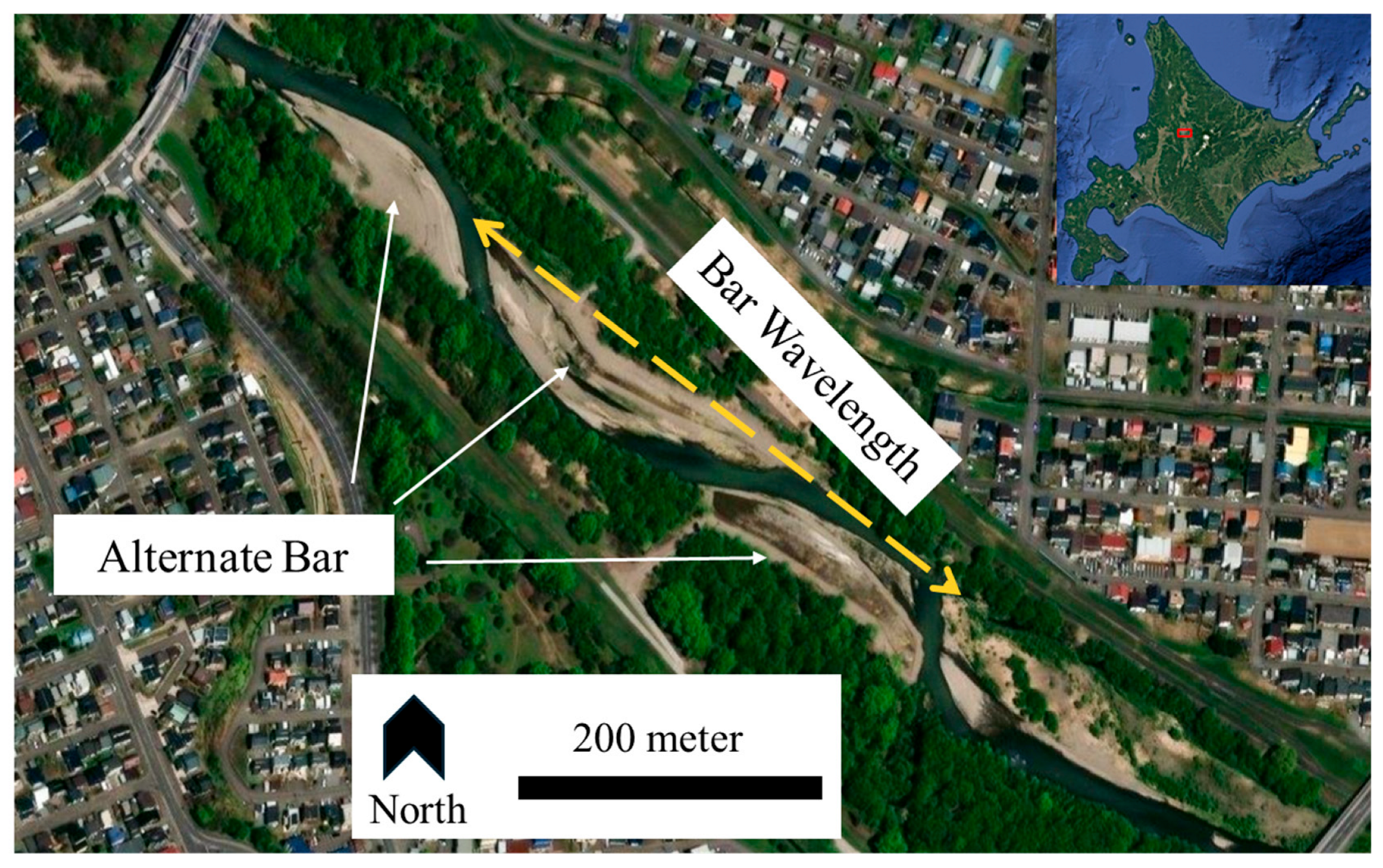
Figure 1. The example of alternate bars in Chubetsu River, Hokkaido, Japan [10].
Water 17 03494 g001
Figure 2. The examples of unsteady repeated hydrographs with 5-h rising and falling limbs are shown for (a) 3.5-h, (b) 7-h, and (c) 14-h peak discharge periods for Case Series A—Case Series C and Case Series 0—Case Series 2. The configurations for Case Series A and 0 were originally introduced by Wattanachareekul et al. [18].
Water 17 03494 g002
Figure 3. Example of the average shields number during the first three hydrograph cycles for a transitional period of 5 h and a peak period of 3.5 h: (a) Case Series A–Case Series C and (b) Case Series 0–Case Series 2. The configurations for Case Series A and 0 were originally introduced in Wattanachareekul et al. [18].
Water 17 03494 g003
Figure 4. Example of the average half of width-to-depth ratio during the first three hydrograph cycles for a transitional period of 5 h and a peak period of 3.5 h: (a) Case Series A–Case Series C and (b) Case Series 0–Case Series 2. The configurations for Case Series A and 0 were originally introduced in Wattanachareekul et al. [18].
Water 17 03494 g004
Figure 5. Mesoscale riverbed configuration diagram: (a) during the peak discharge period of the first hydrograph (X period in Figure 2) for Case Series A–Case Series C and Case Series 0–Case Series 2 and (b) during the falling limb of the first hydrograph for Case Series 0–Case Series 2. The configuration for Case Series A and 0 were originally introduced in Wattanachareekul et al. [18]. Adapted from Kuroki and Kishi [15].
Water 17 03494 g005
Figure 6. Numerical results of average dimensionless bar height over calculation time for case series 2, with a transitional discharge period of 10 h and a peak discharge period of 3.5 h.
Water 17 03494 g006
Figure 7. Relative frequency distribution of dimensionless bar heights normalized by channel width over time for Case Series A, B, and C with varying transitional periods. Panels (ac) show the distribution for Case Series A at transitional periods of 5, 10, and 20 h, respectively; panels (df) show those for Case Series B; and panels (gi) show those for Case Series C. The configuration for Case Series A was originally introduced by Wattanachareekul et al. [18].
Water 17 03494 g007
Figure 8. Relative frequency distribution of dimensionless bar heights normalized by channel width over time for Case Series 0, 1, and 2 with varying transitional periods. Panels (ac) show the distribution for Case Series 0 at transitional periods of 5, 10, and 20 h, respectively; panels (df) show those for Case Series 1; and panels (gi) show those for Case Series 2. The configuration for Case Series 0 was originally introduced by Wattanachareekul et al. [18].
Water 17 03494 g008
Figure 9. Example of alternate bar morphology over a 2000 m channel reach during the end of simulation for Case Series 1 (a channel width of 40 m with a peak discharge of 1000 m3/s) and Case Series 2 (a channel width of 40 m with a peak discharge of 500 m3/s). Panels (ac) show Case Series 1 with transitional discharge periods of 5, 10, and 20 h, respectively. Panels (df) show Case Series 2 for the corresponding transitional discharge periods.
Water 17 03494 g009
Figure 10. Depth-averaged vorticity range at the X and Y periods in Figure 2 for: (a) Case 0 at X period, (b) Case 1 at X period, (c) Case 0 at Y period, and (d) Case 2 at Y period. The configuration for Case Series 0 was originally introduced by Wattanachareekul et al. [18].
Water 17 03494 g010
Table 1. Numerical conditions.
Case Series A [18]Case Series BCase Series CCase Series 0 [18]Case Series 1Case Series 2
Channel width (m)604040604040
Peak flow discharge (m3/s)30020010015001000500
Low flow discharge (m3/s)25
Periods for the peak discharge (h)3.5, 7, 14
Periods for the rising and falling limbs (h)5, 10, 20
Averaged half of width-to-depth ratio *19.0712.6719.077.294.837.29
Averaged shields number *0.080.080.060.230.230.15
Averaged velocity (m/s) *3.193.192.426.066.064.58
Note(s): * Results from the X period in Figure 2.
Disclaimer/Publisher’s Note: The statements, opinions and data contained in all publications are solely those of the individual author(s) and contributor(s) and not of MDPI and/or the editor(s). MDPI and/or the editor(s) disclaim responsibility for any injury to people or property resulting from any ideas, methods, instructions or products referred to in the content.