You are currently viewing a new version of our website. To view the old version click .
Water
  • Article
  • Open Access

4 December 2025

Vulnerability Assessment of Karst Spring Failure and Water Quality Changes Induced by Earthquakes


,
and
Faculty of Civil Engineering, Architecture and Geodesy, University of Split, Matice Hrvatske 15, 21000 Split, Croatia
*
Author to whom correspondence should be addressed.
This article belongs to the Section Water Resources Management, Policy and Governance

Abstract

Earthquakes are among the most catastrophic natural disasters, primarily due to their immediate potential to cause loss of human life. However, their impact extends beyond the initial seismic event, particularly in karst systems, where groundwater resources are highly sensitive to geodynamic disturbances. The abundance of karst springs within these terrains makes them critical water sources for many communities, yet earthquakes can significantly disrupt their discharge patterns and degrade water quality. This study examines the vulnerability of karst springs to seismic activity, focusing on two case studies that illustrate distinct earthquake-induced hydrogeological effects. The first case investigates the temporary failure of the Opačac Spring near Imotski, Croatia, following the Mw 3.7 earthquake on 7 September 2018. This spring experienced a complete cessation of discharge for four days, as recorded by continuous hydrograph monitoring, before recovering due to the release of accumulated groundwater behind a temporarily blocked conduit. The second case explores the impact of seismic activity on water quality, focusing on the sensitive freshwater lens of the karstic Island of Vis in response to the Mw 6.1 earthquake on 22 April 2022, near Stolac, Bosnia and Herzegovina. Despite the epicenter being over 150 km away, water quality monitoring revealed notable changes, emphasizing the influence of seismic disturbances on fragile groundwater systems in carbonate island environments. Using a multidisciplinary approach, integrating seismic data analysis with hydrological and hydrogeological observations, this study investigates the mechanisms through which earthquakes alter karst water systems. A proposed vulnerability assessment framework is introduced, aiming to correlate earthquake intensity, proximity, and hydrogeological response to better predict karst spring failure and water quality degradation. This model provides valuable insights for disaster preparedness, water resource management, and risk mitigation strategies in karst terrains, highlighting the necessity of incorporating karst hydrogeology into regional earthquake response planning.

1. Introduction

Karst springs and groundwater from karst aquifers represent some of the most important and main sources for potable water worldwide [1,2]. The dynamic nature of karst hydrology poses challenges for water resource management. The rapid transmission of water through karst conduits can lead to variability in water quality and quantity, making these systems particularly sensitive to environmental changes and anthropogenic impacts [3]. Due to extreme stress on karst water resources, the negative changes (decreasing water levels and pollution) of physical and chemical characteristics of all water bodies (springs, rivers, lakes, wetlands, and aquifers) in the near future should be expected to exceed current trends [4]. Although not a new driver, seismic activity has been comparatively underexplored as a factor amplifying the vulnerability of karst water resources alongside climate change and anthropogenic pressures. This necessitates an understanding of how earthquake-induced disruptions of karst springs impact their hydrological dynamics. Earthquakes can strongly influence the triggering of both hydrological and chemical responses at groundwater springs, representing a significant concern worldwide, especially where groundwater is an important resource [5,6,7,8,9]. Being prone to seismic activities, karst springs need to be assessed for earthquake vulnerability. Earthquakes are typically classified into three categories based on their mode of generation [10]. The most common type is tectonic earthquake, which occurs when rocks suddenly break due to stress accumulated from tectonic forces and movements. Volcanic earthquakes happen in conjunction with volcanic activity, with their seismic wave generation mechanism likely similar to that of tectonic earthquakes. Collapse earthquakes are smaller and occur in regions with underground karst caverns and mines [11,12,13,14] caused by the collapse of the cavern or mine roof. A variation in this phenomenon that is often observed is mine bursting or quarry blasting [15]. Another type of local earthquake within karst mass can be caused by changes in fluid pressure in the rock mass [16,17,18,19,20]. Focusing on hydrological responses of karst springs in the aftermath of a seismic event, there are documented cases on the increase in hydraulic conductivity of the basal aquifer [21] resulting from the increase with springs’ flow rates. However, the worst-case scenario is the decrease in karst springs’ discharge or even an interruption of the flow [22]. Both cases of hydrological responses of karst springs can be observed as earthquake-related changes due to the change in complex underground water pathways [23]. The vulnerability of a karst spring to earthquake-related disruptions depends on various factors, including the intensity of the seismic event, the geological structure, and the spatial distribution of geological features such as thrusts and faults relative to the main underground channels of the spring. Particularly, karst springs that contain water intake infrastructure and serve as primary sources for water supply must be closely examined for their sensitivity to seismic events. Permanent or temporary disturbances, or even a complete cessation, can significantly impact the livelihoods of the people dependent on these springs. Therefore, it is important to conduct a mechanism analysis of the post-seismic behavior of karst springs to assess their vulnerability to earthquakes. Utilizing hydrograph analysis of stream baseflow, which reflects the groundwater movement, provides a reliable tool for detecting the mechanisms behind discharge variations caused by earthquakes. Specifically, Manga [24] analyzed five different streams affected by earthquakes resulting from coseismic increases in flow rates and the discharge of large volumes of excess water by extensive base flow and recession curve analysis. Wang et al. [25] examine post-seismic responses of groundwater levels (GWLs) resulting from the coseismic rise and drop triggered by the 1999 (Mw = 7.5) Chi-Chi earthquake in central Taiwan Island. Bonacci [26] observed how a strong earthquake (Mw = 5.5) in Southern Croatia caused rapid, but mostly short-lived, changes in the hydrogeological regime of the studied karst region. The water levels in all karst rivers in the region quickly decreased by 60–180 cm, and flow from some permanent karst springs dried up for 10 consequent hours. Scorzini et al. [27] utilize meteorological, hydrological, and seismic data to train and validate Long Short-Term Memory networks (LSTM) in one- and multiple-day ahead flow forecasting, contributing to quantitative modeling of the hydrological alterations in karst aquifers subject to seismic activity.
Reliable records of spring discharge or groundwater level, both before and after an earthquake, are essential for the effective use of this tool. Following a moderate to strong seismic event, comparing the previously established recession curve trend with any additional discharge measured at the aquifer outlet, unrelated to precipitation and recharge, enables the estimation of the extra water volume attributed to the earthquake [28]. Regarding the documentation of seismic events, it is essential to record both the magnitude of the earthquake and the distance from the epicenter to the spring location. By analyzing hydrological anomalies associated with earthquakes in southern Italy, Esposito et al. [29] reached significant conclusions. They found that a high concentration of phenomena (75%) occurred within a range of 25–80 km from the epicenter, whereas 19% were located within the epicentral area (0–25 km). Only 6% of these phenomena were observed at greater distances, around 100 km.
The study by Keegan-Treloar et al. [30] highlights how fault-controlled spring systems are particularly vulnerable to external disturbances, including seismic activity. These faults often act as either preferential groundwater pathways or barriers, depending on their structural properties. Seismic events can modify fault permeability, either enhancing or reducing flow connectivity, which can result in the disappearance or emergence of new springs. Similarly, Fandel et al. [31] demonstrate that conduit network modeling can be used to predict changes in spring discharge locations by reconstructing past hydrogeological conditions. Their study on alpine karst systems suggests that seismic activity could play a significant role in reshaping conduit pathways, leading to a long-term reconfiguration of karst drainage patterns.
This study aims to develop a conceptual model for understanding the temporary or permanent failure of karst springs, with a focus on implications for water resources management. This is particularly relevant for the utilization of karst springs in water supply infrastructure. The research investigates the behavior of selected karst springs in the Dinaric karst and karst water resources on the Adriatic islands before and after seismic events, addressing these primary concerns: permanent and temporary flow disruptions and water quality changes. By analyzing these factors, the study assesses the vulnerability of specific springs to earthquakes and their hydrological response to medium and large earthquakes. Another aim of the paper is to address the vulnerability of water quality in a highly sensitive freshwater lens exposed to seismic disturbances on a small-scale karst island. The two study sites were intentionally selected because they represent contrasting hydrogeological end-members under seismic stress: (i) a conduit-dominated Dinaric karst spring and (ii) a highly sensitive freshwater lens in an island environment, allowing us to examine seismic impacts across fundamentally different karst settings. By analyzing not only karst water availability but also water quality, the study offers a combined analysis of karst water sources and their vulnerability to seismic disturbances. The findings of this paper are intended to be of use to scientists and water resource management authorities involved in the planning, development, and maintenance of infrastructure in regions where karst springs are exposed to seismic hazards.

2. Materials and Methods

2.1. Materials

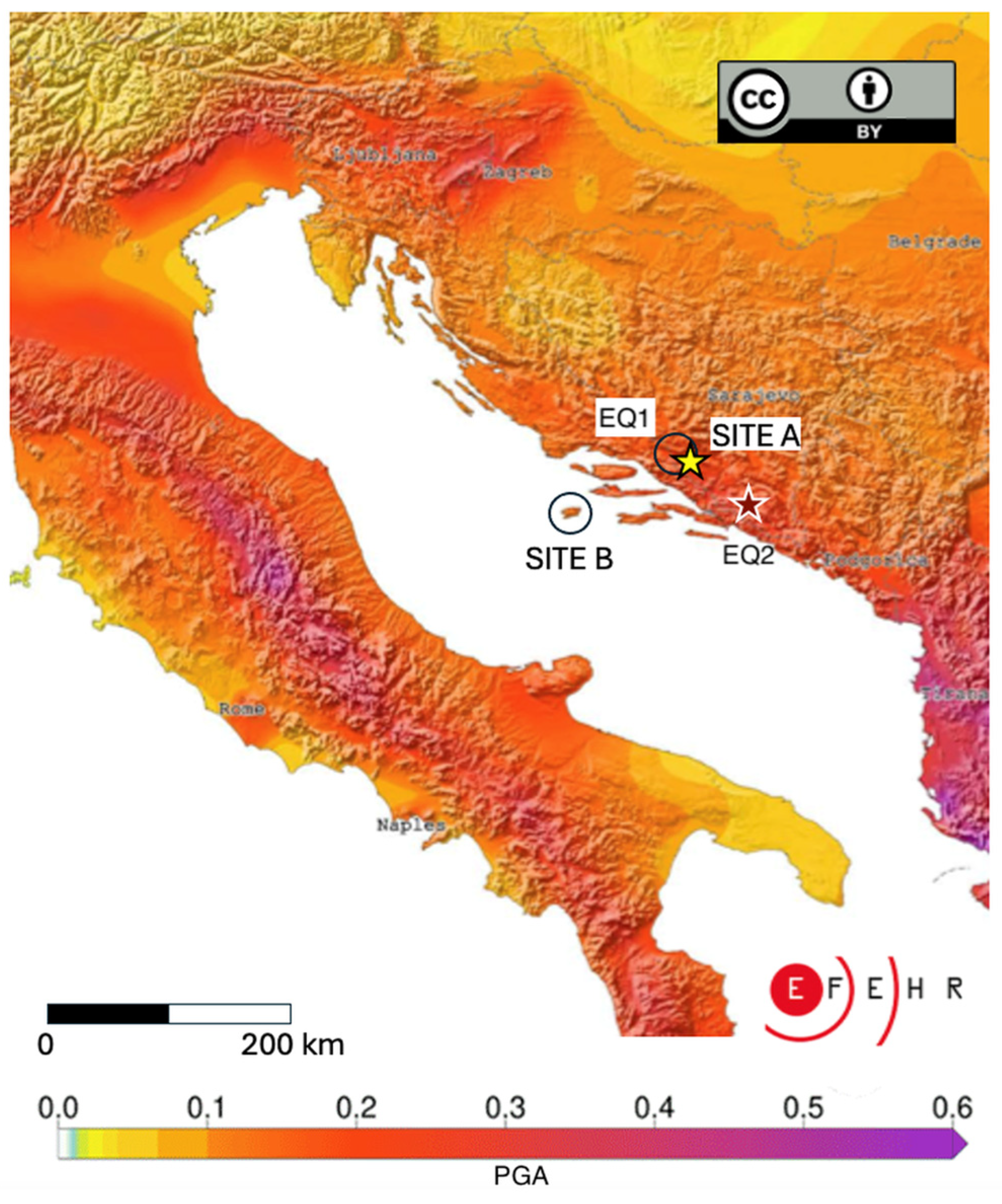
In this study, we utilized a comprehensive set of data to analyze the vulnerability of karst springs to seismic events. Specifically, we employed data from the European Seismic Hazard Maps (Figure 1), which provide the Peak Ground Acceleration (PGA) values, typically represented as a percentage of “g”, the earth’s gravitational acceleration, expected to be reached or exceeded with a 10% probability over a 50-year period [32]. Peak Ground Acceleration (PGA) data were obtained from the strong-motion database of the European-Mediterranean Seismological Centre (EMSC).
Figure 1. European earthquake hazard map (source: EFEHR), with the locations of two study sites in Imotski (SITE A) and on Island Vis (SITE B) highlighted and location of two earthquakes (EQ1, Mw3.7, 8 September 2018 and EQ2 Mw6.1, 22 April 2022) shown. PGA values are derived from the latest calculations of Europe’s updated earthquake hazard model (ESHM20) after [32].
Additionally, the available geographical and geological data for two study cases was provided to understand the geological and hydrological/hydrogeological settings of the study areas. The geological settings can explain why these locations are especially prone to earthquake-induced flow disruptions and water quality degradation. By understanding the specific geological and hydrological contexts of the study areas, it was possible to identify the underlying mechanisms that contribute to the vulnerability of the karst water recourses to seismic activities, thus providing a clearer rationale for their sensitivity to earthquakes. Complementing geological data, karst springs’ hydrographs and water quality records were analyzed, allowing for an assessment of changes in spring discharge and behavior (SITE A) and water quality deterioration (SITE B) induced by seismic events.

2.2. Case Study of Karst Springs, Opačac, Croatia (SITE A)

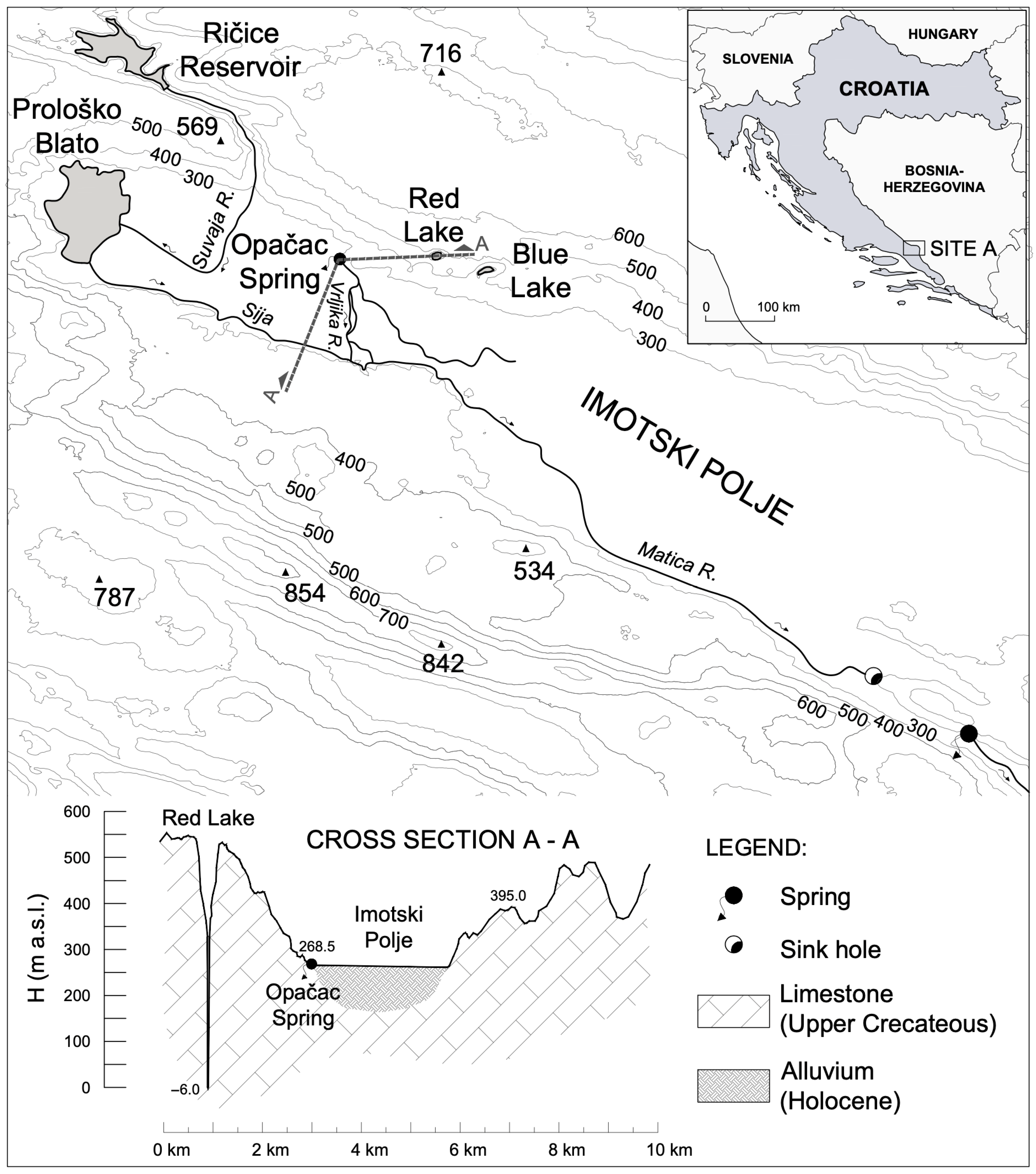
Opačac Spring (43°27′03.16″ N, 17°10′36.85″ E) is located near the town of Imotski (Croatia) in the central part of the Dinaric karst or, more precisely, in the northeastern, higher part of Imotsko Polje (Figure 2). Imotsko polje is a typical karst polje, which is defined as a depression in the karst that is generally elliptical, with relatively gently sloping bottoms from the spring zone to the swallow-hole zone [33]. The spring zone within the Imotski polje is mostly located in the northwest part of polje (Figure 2).
Figure 2. Topographic map of Imotski in Croatia with position of Opačac Spring, a main water supply source for the town of Imotski and surrounding settlements.
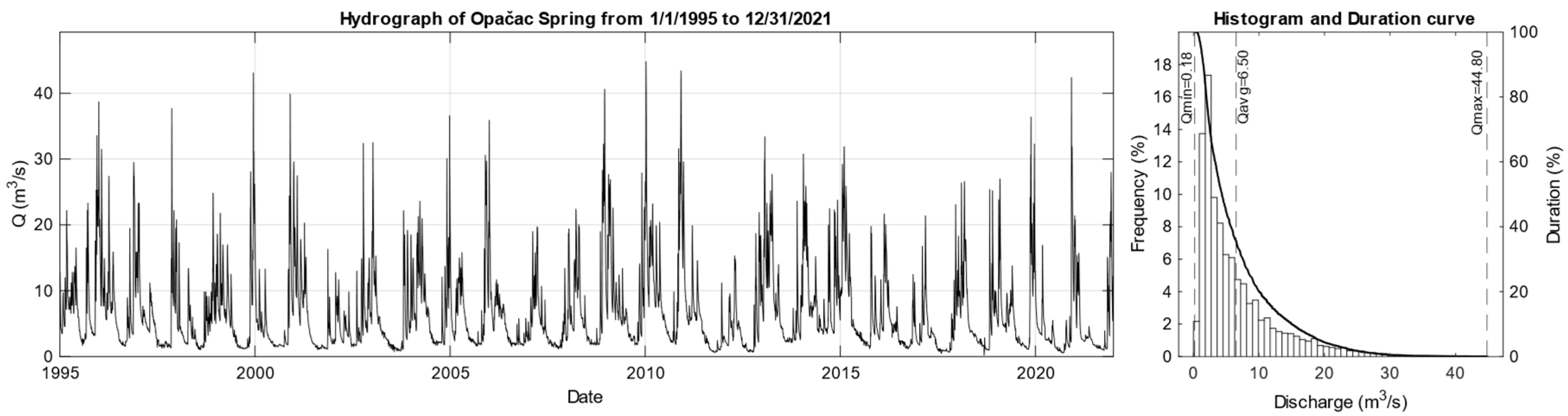
Some springs, such as the Opačac Spring, are highly abundant and are thus utilized for the water supply of the town of Imotski and the surrounding settlements. Analyzing the time series data on daily spring discharge from 1995 to 2021 (Figure 3), the mean annual discharge observed is 6.50 m3/s. The maximum discharge was recorded on 9 January 2010, at 44.90 m3/s, while the minimum discharge, coinciding with a seismic event, was recorded on 8 September 2018, at 0.18 m3/s.
Figure 3. Hydrograph of Opačac Spring between 1995 and 2022 with corresponding histogram and duration curve (data source: Croatian Hydrological and Meteorological Service—DHMZ).
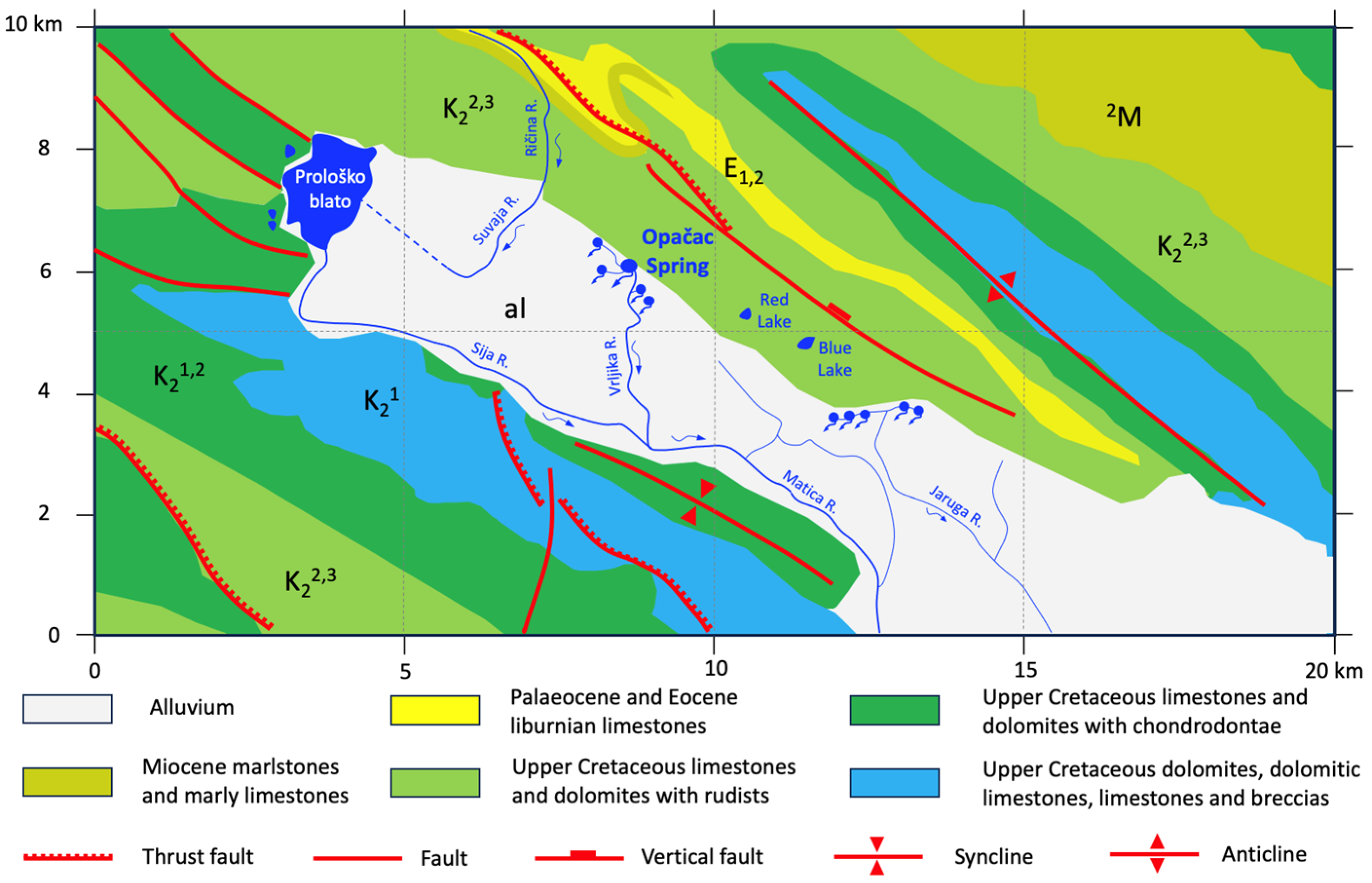
The water intake infrastructure at the Opačac Spring is installed at an elevation of 268.5 m a.s.l. According to the water license/permit issued by the Croatian national water authority (Croatian Waters), a withdrawal of 200 L/s or 5,000,000 m3/year is authorized. All the springs, including Opačac Spring, eventually feed the Vrljika River, which flows through the polje from the northwest to the southeast into swallow-hole zones. The study area is characterized by extremely complex surface and underground karst morphology [34]. The carbonate rocks of the area are predominantly limestones and only partly dolomites of Tertiary and Cretaceous formations (Figure 4). In general, dolomites are moderately permeable and do not considerably obstruct groundwater flow; however, where Lower Cretaceous dolomites alternate with thin-bedded limestones, they can form local underground barriers that influence groundwater pathways. It is important to detect a vertical fault and a thrust fault northbound from the Opačac Spring, crossing the main direction of regional groundwater flow.
Figure 4. Geological formations and structure of the area around Opačac Spring with adjacent karst lakes, Red Lake and Blue Lake, and surface water bodies and spring zones (partly based on basic geological map of SFRY 1:1,000,000, sheet: Imotski).
According to the European earthquake hazard map, the expected PGA around the Opačac Spring is 0.22 g [32]. There is strong evidence of a karst conduit connection between Red Lake and the spring of Opačac [35]. Furthermore, Vrsalović et al. [35] states that Opačac Spring responds to precipitation without a time lag, unlike Red Lake, which responds to precipitation after 7 days. This indicates that Red Lake is fed by groundwater and, to a lesser extent, by precipitation.

2.3. Case Study of Freshwater Lens, Island of Vis (SITE B)

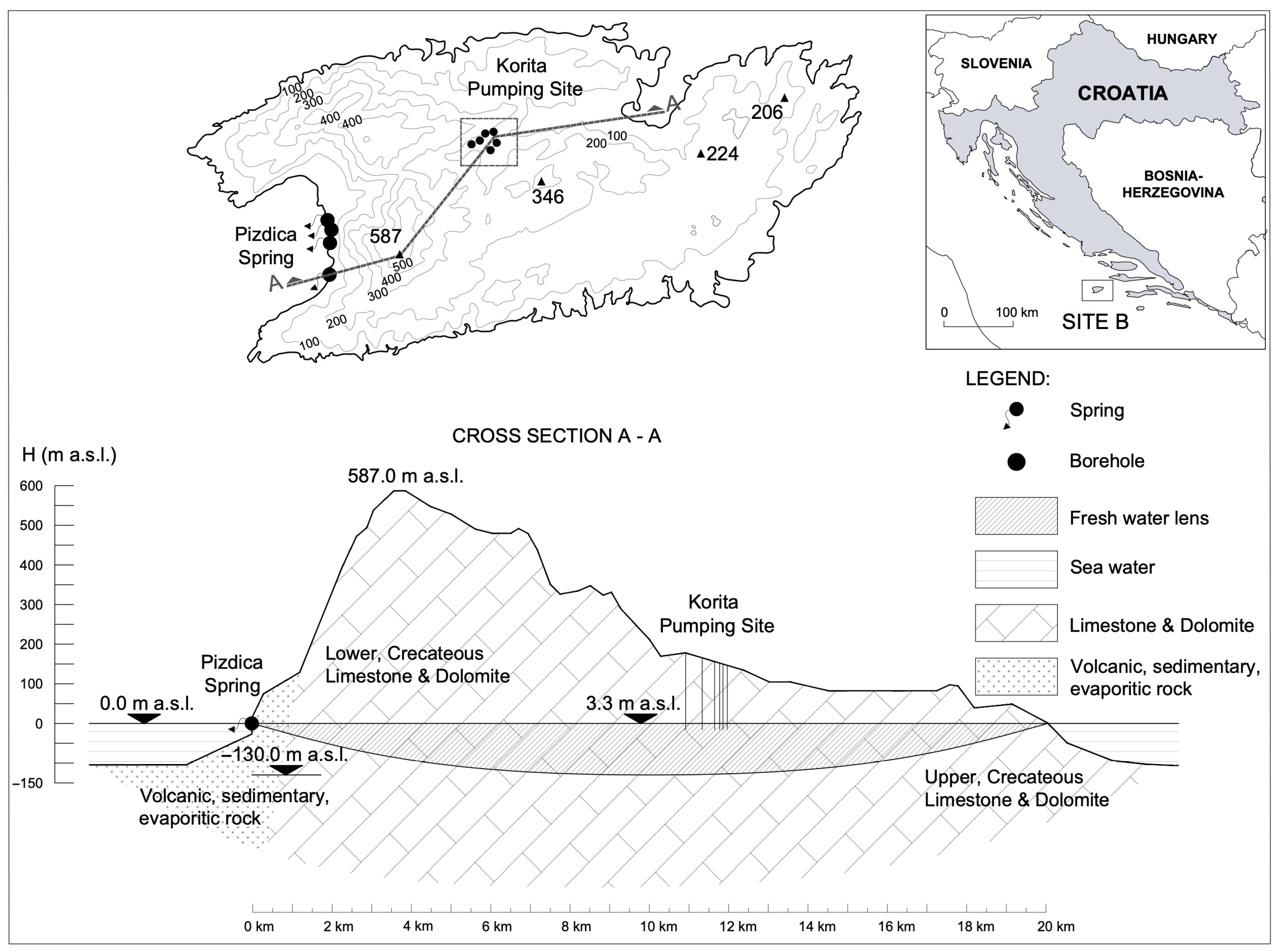
Vis Island, located in the Adriatic Sea, lies between 43°12′ and 43°48′6″ N latitude and 16°3′ and 15°48″ E longitude, covering an area of 89.72 km2. The island has a coastline of 84.9 km in length, with its highest point, Hum Peak, reaching an elevation of 587 m above sea level (Figure 4). Positioned 45 km from the mainland, the island’s economy is primarily driven by tourism and agriculture. Unlike many other Croatian islands, Vis is not connected to the mainland water supply network, so the entire domestic water consumption of both its permanent inhabitants and seasonal tourists is completely dependent on its own karst aquifer system and freshwater lens.
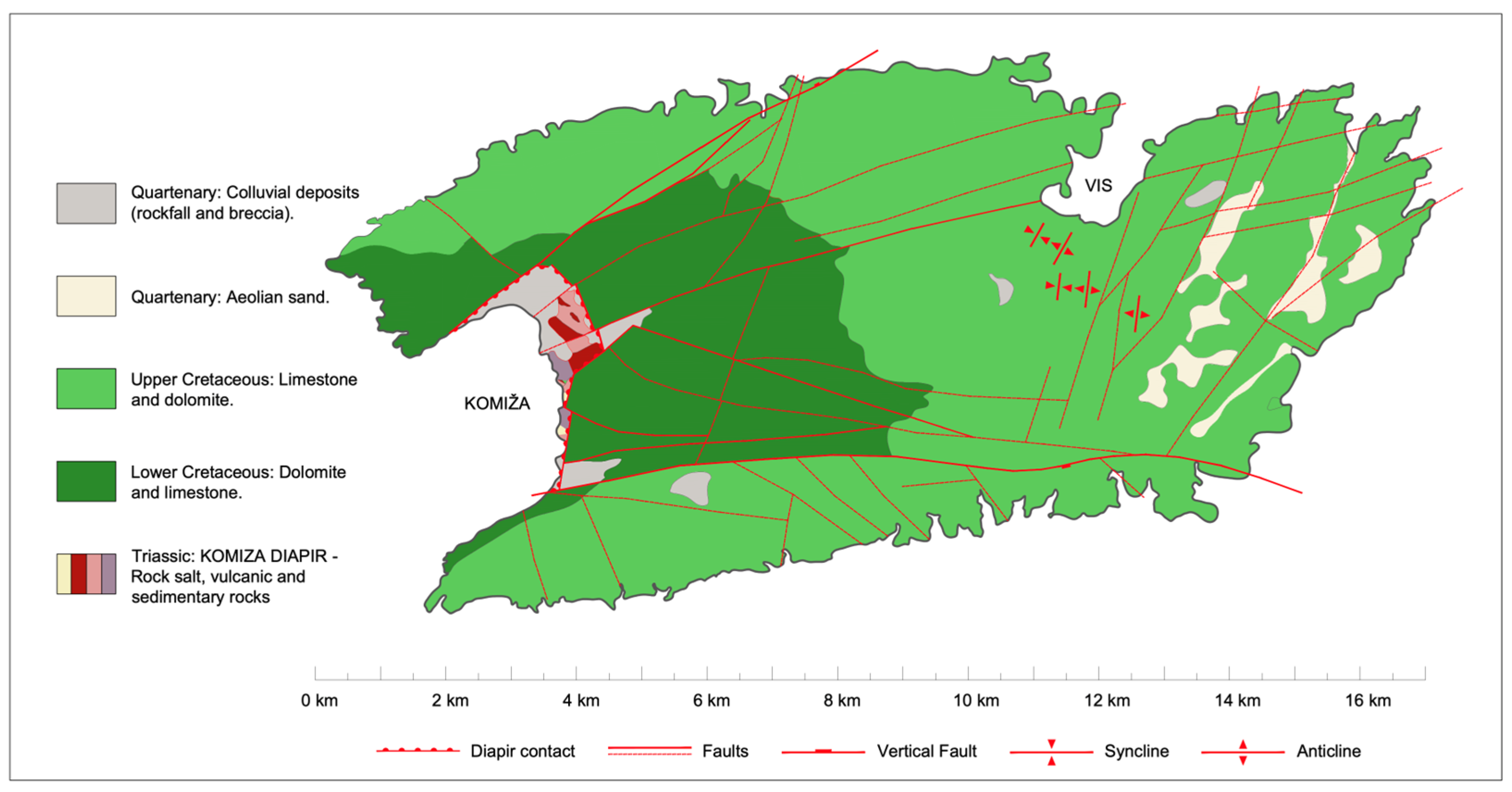
The geological setting of the Island of Vis is characterized by a complex combination of karstified carbonate rocks, fault zones, and hydrogeological barriers that play a crucial role in sustaining its groundwater reserves (Figure 5). The significant feature is the volcanic–sedimentary–evaporitic (VSE) complex located in the Komiža Bay, comprising andesites, marls, gypsum, and volcanic agglomerates (Figure 6). This unit is almost impervious and forms a natural hydrogeological barrier on the western side of the island, effectively limiting seawater intrusion into the central karst aquifer [36].
Figure 5. Topographic map of Vis Island with cross-section A-A illustrating the dimension of the freshwater lens, delineated according to the Ghyben–Herzberg principle (partially modified after [36,37]).
Figure 6. Geological formation and structure of the Island Vis, partly based on basic geological map of Republic of Croatia 1:50,000, sheet: Vis 3 i Biševo 1 (modified after Korbar et al. [38]).
The island lacks permanent surface watercourses, with substantial subterranean water flow discharging directly into the sea. The Ghyben–Herzberg principle [39,40], which describes the relationship between freshwater and underlying seawater in coastal aquifers, supports the idea that substantial freshwater reserves could exist beneath sea level (Figure 5). In the case of Vis, this is further validated by geological evidence that karstification processes extended well below the present sea level due to significant sea-level drops during the Last Glacial Maximum and Messinian Salinity Crisis. During these periods, the base of karstification was situated much deeper, creating a highly heterogeneous karst network below the island. This enables freshwater accumulation in deeper zones and helps maintain a freshwater–seawater balance in the aquifer, which is recharged by autumn and winter precipitation. The mean annual precipitation (data source: Croatian Hydrological and Meteorological Service—DHMZ) for the period of 1956–2022 is 773.0 mm, with a distinct seasonal distribution characterized by the highest values in winter (89.2 mm) and autumn (74.6 mm), followed by spring (57.7 mm), while summer represents the driest season, with an average of 36.2 mm. Groundwater levels typically reach their lowest in August and September, while peak levels occur in January or February. The island’s water infrastructure includes six deep piezometers at the Korita pumping site (Figure 5) and one coastal spring, serving as the principal sources of potable water [36,37]. Water quality is routinely monitored through mandatory operational programs conducted by the municipal water supply company, the Institute for Public Health, and the Croatian Geological Survey. These monitoring activities ensure the continuous assessment of key chemical and geochemical parameters relevant to water quality management. While the freshwater resources of the Island of Vis are already under significant climatic and anthropogenic pressures, the primary aim of this study is to highlight that the island’s sensitive freshwater lens is also at risk from seismic activity.

2.4. Methods

To assess the influence of earthquakes on karst springs, we utilized a multifaceted methodological approach combining time series analysis with geological and seismic data. Hydrological datasets used in this study were obtained from official national monitoring network, Croatian Hydrological and Meteorological Service (DHMZ), and include long-term discharge records from the Opačac Spring (Figure 4). It is crucial to use hourly discharge data during the seismic event for better resolution and isolation of rain events, so the changes in discharge due to precipitation are excluded. Anomaly detection techniques were applied to the time series data to pinpoint significant deviations from the norm that indicate the impact of earthquakes. Furthermore, geological settings of the karst spring were analyzed to understand the underlying structures and their potential influence on spring behavior.
The Z-score method (1) was used to measure the deviation of a data point from the mean of the dataset in terms of standard deviations. This method proved to be effective for detecting anomalies in time series data, such as sudden changes in discharge due to earthquakes. The Z-score for each data point Qi was calculated as follows:
Z i = Q i     μ σ ,
where Qi is the hourly discharge value, μ is the mean of the analyzed dataset, and σ is the standard deviation. The threshold for detecting anomalies is expressed as a fraction or coefficient of standard deviation. Since hourly discharge data is used to detect anomalies, and the available time-series length is 10 days, the threshold is set to be 0.5σ, since no sudden discharge increase is to be expected due to the absence of rain events during the studied period.
Because earthquakes and their hydrological disturbances occur over short timescales, the temporal resolution of discharge data is crucial: daily data can outline the disturbance window, whereas hourly data are required to accurately resolve its onset, magnitude, and recovery. The Cumulative Sum analysis (2) is used to detect shifts in the mean level of a process, such as changes in discharge time series that may reflect earthquake-induced hydrodynamic responses. Whether derived from daily or hourly records, the deviation from the mean discharge μ is first computed, and the cumulative effect of these deviations is then obtained as follows:
S i = i = 1 j ( Q i   μ )
where Qi is the hourly discharge of the Opačac Spring at time step i, and μ represents the mean of the analyzed dataset. Significant slope changes in the Cumulative Sum Si indicate potential anomalies, pointing to gradual or abrupt variations in discharge being possibly linked to seismic or hydrogeological events. By correlating geological and seismic records with the detected anomalies in the discharge time series, we aimed to describe the mechanisms through which earthquakes affect karst spring hydrodynamics. To ensure reproducibility and transparent data quality control, hydrological data preprocessing was explicitly defined, including outlier detection through visual screening and Z-score filtering, handling of missing values by linear interpolation for short gaps, and consistency verification via cross-checking with rainfall data and Cumulative Sum analysis.
The documented impact of a seismic event, in conjunction with discharge time-series and water quality records, establishes the Historical Record for the studied water source, thereby influencing the subsequent vulnerability assessment. Vulnerability assessment is based on the computation of a single Vulnerability Index that incorporates specific karst terrain classification and seismic hazard as a function of PGA and HR (Historical Record). As for intrinsic karst parameters, the EPIK method [41] is used (3). It evaluates four key attributes—Epikarst (E), Protective Cover (P), Infiltration Conditions (I), and Karst Network Development (K)—each capturing a distinct hydrogeological factor. By assigning weight factors α, β, γ, and δ to the four EPIK attributes and summing them in a point-count framework, the EPIK vulnerability score can be expressed as follows:
EPIK index   =   α · E   +   β · P   +   γ · I   +   δ · K
where α, β, γ, and δ represent the relative importance (weight) of each attribute. These weighting factors are empirically determined and fixed according to the EPIK method [41], based on the conceptual model of karst aquifers. However, minor adjustments may be considered in specific applications to reflect local hydrogeological conditions. Additional weighting on Karst Network Development (K) is warranted in conduit-dominated systems intersected by faults, because these morpho-structural features create highly interconnected flow paths that are especially sensitive to seismic perturbations. Under typical conditions, such conduits facilitate rapid water movement; however, when an earthquake occurs, fault reactivation or conduit wall destabilization can abruptly disrupt spring discharge. This heightened susceptibility, particularly in fault-crossed karst systems, underscores the need to prioritize K within the vulnerability assessment. A Vulnerability Index with Seismic (VIS) framework that builds upon the classic EPIK approach by explicitly integrating seismic factors is given below (4):
VIS   =   α · E   +   P · I   +   ω K · K   +   β · PGA   +   γ · HR
In the new proposed formulation, the coefficient ωk represents the additional weighting assigned to the K parameter to emphasize its increased influence on overall vulnerability in structurally disturbed zones. Parameter ωk is justified only in conduit-dominated and fault-intersected systems, supported by the structural hydrogeology literature [30,31]. The weighting coefficients used in the VIS framework are conceptual and site-specific rather than universally fixed, and the enhanced weighting of the K parameter is justified only in structurally disturbed conduit-controlled systems and should be calibrated separately for each karst setting. The appropriateness of the weighting depends on the following: (i) intrinsic aquifer characteristics, (ii) magnitude and distance of the seismic event, and (iii) local structural geology. The Historical Record (HR) is derived by quantifying each past seismic event according to its magnitude, distance from the water source, and the observed impact on spring discharge or water quality (5). For each event, a Seismic Load Factor (SLF) is first calculated by combining magnitude and epicentral distance (scaled to represent decreasing intensity with increasing distance).
HR = i SLF i · Impact
SLF is then multiplied by an impact rating that captures the severity of the recorded disturbance (0 = none, 1 = minor, 2 = moderate, and 3 = severe). Meng et al. [42] conducted detailed seismic modeling, and their magnitude–distance principles are adapted here to capture non-linear decay while remaining practical for evaluating spring responses to seismic events. We propose a simplified Seismic Load Factor (SLF) based on a logarithmic attenuation model that balances earthquake magnitude with distance (6), thus providing a straightforward yet robust framework for karst vulnerability assessments:
SLF   =   M w     d · log 10 ( D   +   D 0 )
The moment magnitude (Mw) represents the total seismic energy released, expressed on a logarithmic scale. The distance (D) refers to the horizontal separation (in kilometers) between the earthquake’s epicenter and the affected water source, such as a karst spring. To prevent mathematical divergence in cases where D is very small, a small offset distance (D0), typically set at 10 km, is introduced into the equation. Optionally, a calibration coefficient (d) is incorporated to represent local ground-motion attenuation, which is challenging due to the inherent heterogeneity of karst systems and requires site-specific geophysical investigations.
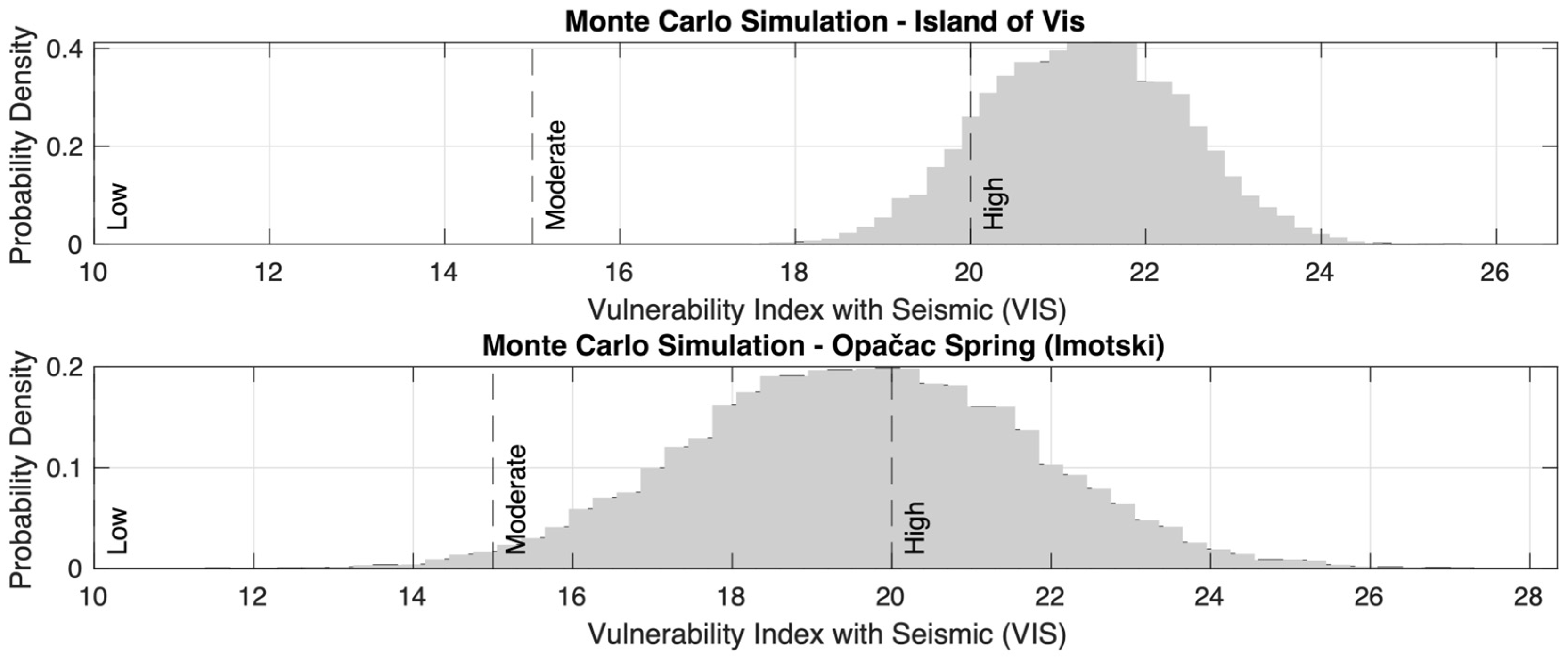
To assess the uncertainty associated with the Vulnerability Index with Seismic (VIS) framework calculation, a Monte Carlo simulation was conducted. The method involved 1000 iterations, during which the parameters representing Infiltration Conditions (I) and Karst Network Development (K) were randomly varied following a normal probability distribution with a standard deviation equal to 50% of their mean values. The seismic parameters (moment magnitude Mw, distance D, and Peak Ground Acceleration PGA) were kept constant to isolate the influence of hydrogeological variability. For each iteration n, VIS was computed as follows: In and Kn are randomly sampled values from their respective normal distributions (In∼N (μI, (0.5μI)2) and Kn∼N (μK, (0.5μK)2)).

3. Results

3.1. Impact of Earthquake on Water Quality

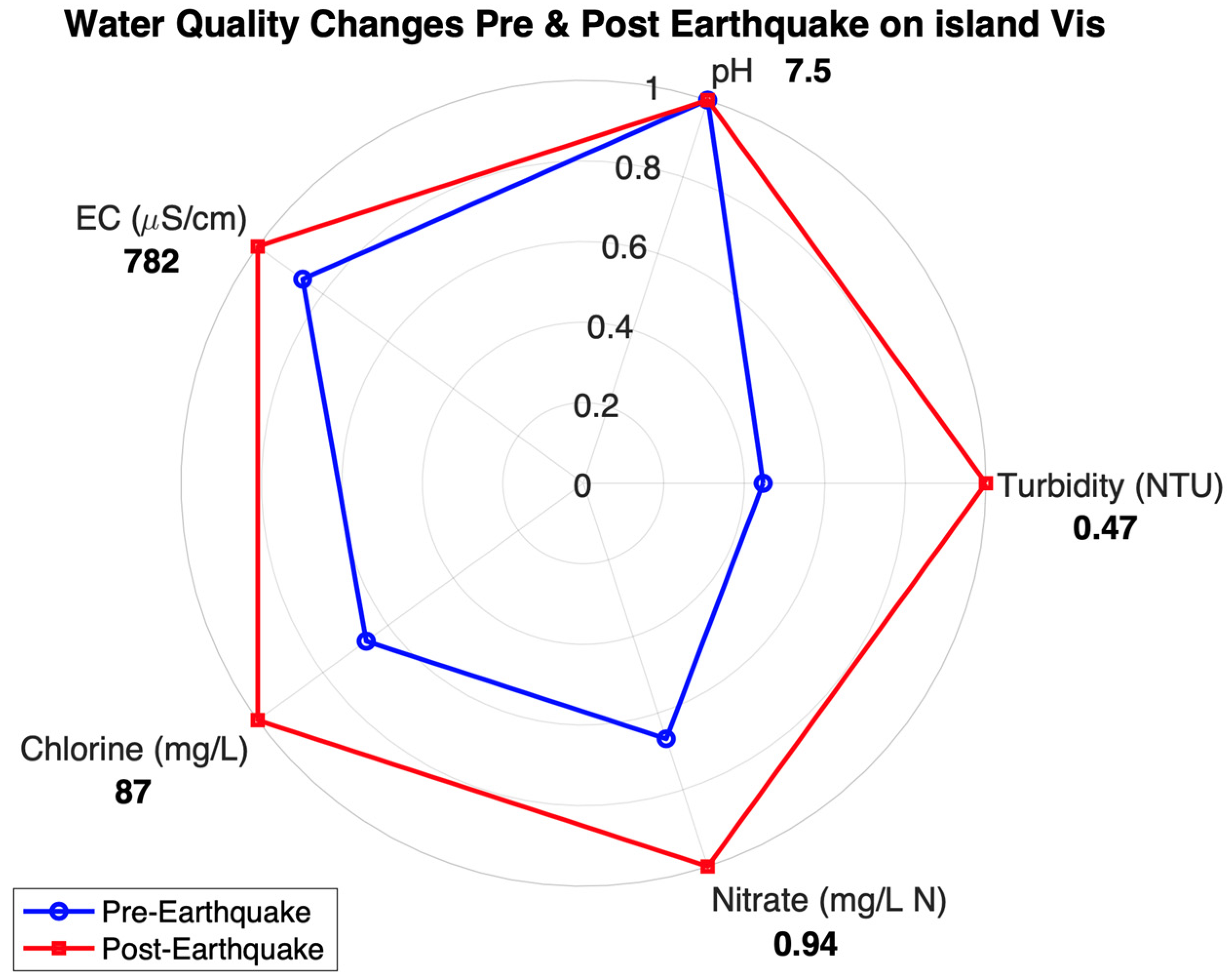
On 22 April 2022, at 23:07 local time, a seismic sequence originated in Stolac, Bosnia and Herzegovina, with the main shock occurring at a depth of 10 km. The earthquake’s epicenter was located approximately 150 km northeast of Vis Island, Croatia, with a local magnitude of ML = 5.7 and a moment magnitude of Mw = 6.1 [43]. Expected PGA around Stolac is 0.30 g [32]. Over the following 48 h period, approximately 100 aftershocks with moment magnitudes exceeding 2.0 were recorded. To assess the potential impact of seismic activity on water quality, samples collected at the Korita pumping site before and after the earthquake were analyzed. Water sampling was conducted on 12 April 2022, prior to the earthquake, and on 26 April 2022, following the event, as part of routine monitoring activities. The results of these analyses are presented below (Figure 7), highlighting any changes in key water quality parameters induced by the seismic disturbance. The reports issued by the Institute for Public Health indicate that the observed change occurred after the earthquake, whereas pre-earthquake conditions generally reflected stable baseline water quality.
Figure 7. Water quality changes within the freshwater lens following seismic activity, measured immediately after the earthquake.
Given the fragile equilibrium between freshwater and saltwater interfaces in island karst aquifers, seismic events can significantly disrupt hydraulic continuity, trigger saltwater intrusion, or alter recharge–discharge dynamics. In the specific case of the 2022 Stolac earthquake, a notable rise in chloride concentration and turbidity values was recorded (Figure 7), providing clear evidence of the freshwater lens’s sensitivity to seismic disturbances.

3.2. Impact of Earthquake on Karst Spring Failure

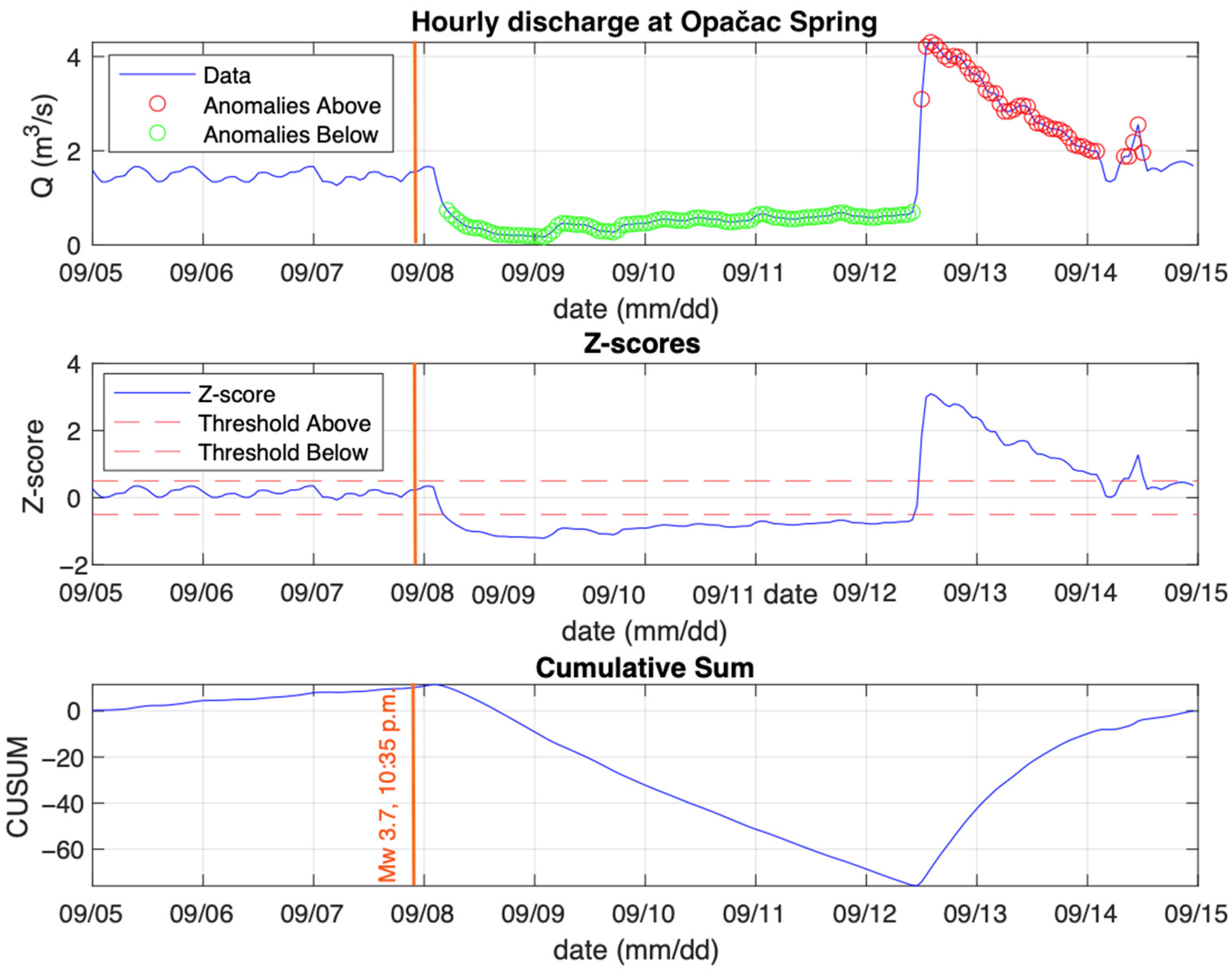
On 7 September 2018, at 10:35 p.m., seismographs of the Seismological Service of the Republic of Croatia recorded a strong earthquake with an epicenter in Bosnia and Herzegovina, 15 km eastbound from the Opačac Spring. The magnitude of the earthquake was Mw = 3.7, according to the Richter scale. Since discharge measurements at Opačac Spring are available at an hourly sampling rate, hydrological anomalies can be more thoroughly analyzed and interpreted due to the higher resolution of the resultant data (Figure 8).
Figure 8. Hourly hydrograph of ten consequent days capturing earthquake event recorded on 7 September 2018 at 22:35, with detection of the anomalies in discharge caused by earthquake using Z-score and Cumulative Sum analysis.
The seismic event led to a marked change in discharge, detectable on 8 September 2018, at 5:00 a.m., occurring 7 h after the recorded earthquake. The discharge subsequently reached a historical minimum of 0.18 m3/s, and this low discharge state persisted for 4 days and 5 h. Recovery to the pre-earthquake discharge state began on 12 September 2018, at 11:00 a.m., followed by a significant increase, reaching peak value of about 4 m3/s 2 h later and then slowly stabilizing to the pre-earthquake period over the next two days, indicating the release of temporarily stored water within the karst aquifer.

3.3. Vulnerability Assessment

The Vulnerability Index with Seismic (VIS) framework computation for the Vis Island and Opačac Spring near Imotski integrates EPIK parameters, seismic hazard factors (Mw, D, and PGA), and the Historical Records (HRs) given in Table 1 to assess the susceptibility of karst water resources to earthquake-induced disturbances.
Table 1. Parameters for calculating the Vulnerability Index with Seismic framework (VIS) for Opačac Spring near Imotski (SITE A) and Island of Vis (SITE B).
Karst vulnerability assessment inherently involves uncertainty, particularly in Karst Network Development (K) and Infiltration Conditions (I), as these parameters significantly influence the response of groundwater systems to seismic events. Studies by Gogu and Dassargues [44] highlight that EPIK parameters are subject to considerable variability, with K and I being the most sensitive to hydrogeological heterogeneity. To account for this uncertainty, a standard deviation of 50% of the mean value is applied to I and K, reflecting the natural variability in karst conduit connectivity and infiltration processes. For the Opačac Spring, where the karst system is conduit-dominated (K = 4) with concentrated infiltration (I = 3), groundwater response is highly sensitive to seismic-induced flow disruptions. This was evident in the Mw 3.7 earthquake at a 15 km distance, which caused a temporary spring failure lasting four days, reinforcing the need to incorporate uncertainty into VIS computations. On the other hand, Vis Island, with its freshwater lens system, has a lower Karst Network Development (K = 3) and more diffuse infiltration (I = 2), making it less prone to sudden spring failure but more vulnerable to hydrochemical disturbances. The Mw 6.1 earthquake in Stolac (150 km away) led to significant changes in water quality parameters, highlighting how seismic energy influences hydrogeochemical conditions. The uncertainty in the K and I values for Vis Island further reflects the variability in groundwater response to long-distance seismic impacts. To quantify uncertainty, Monte Carlo simulations (1000 iterations) are performed (Figure 9), varying I and K using a normal distribution with a standard deviation of 50% of the mean value while keeping seismic parameters (Mw, D, and PGA) constant.
Figure 9. Sensitivity analysis of Vulnerability Index with Seismic framework for freshwater lens of Island of Vis and Opačac Spring near Imotski.

4. Discussion

The EPIK method, originally developed for assessing the intrinsic vulnerability of karst aquifers, provides a useful framework for evaluating the susceptibility of groundwater resources to contamination. When expanded to include seismic hazards, such as earthquake magnitude, Peak Ground Acceleration (PGA), and distance to epicenter, it enables a more comprehensive vulnerability assessment under seismic stress. A clear distinction emerges between vulnerabilities to water quality degradation, primarily reflected by the slight seawater intrusion that increases electrical conductivity and chloride concentrations. However, the observed rise in nitrates and turbidity after the seismic event suggests that, in addition to limited saline intrusion, short-term mixing and mobilization of shallow groundwater containing surface contaminants likely contributed to the overall water quality deterioration on Vis Island. This case study shows how seismic distance can trigger significant water quality changes in a sensitive freshwater lens. In contrast, the Opačac Spring experienced a temporary failure due to a moderate earthquake occurring just 15 km away, which is consistent with its highly developed conduit system. This behavior is incorporated in the EPIK method by assigning a maximum value to the K parameter, acknowledging that conduit-dominated springs are inherently more sensitive to seismic perturbation due to their rapid, pressure-driven flow regimes. Crucially, the historical record (HR) plays a pivotal role in vulnerability assessment, as it provides empirical evidence of a spring or aquifer’s response to past seismic activity.
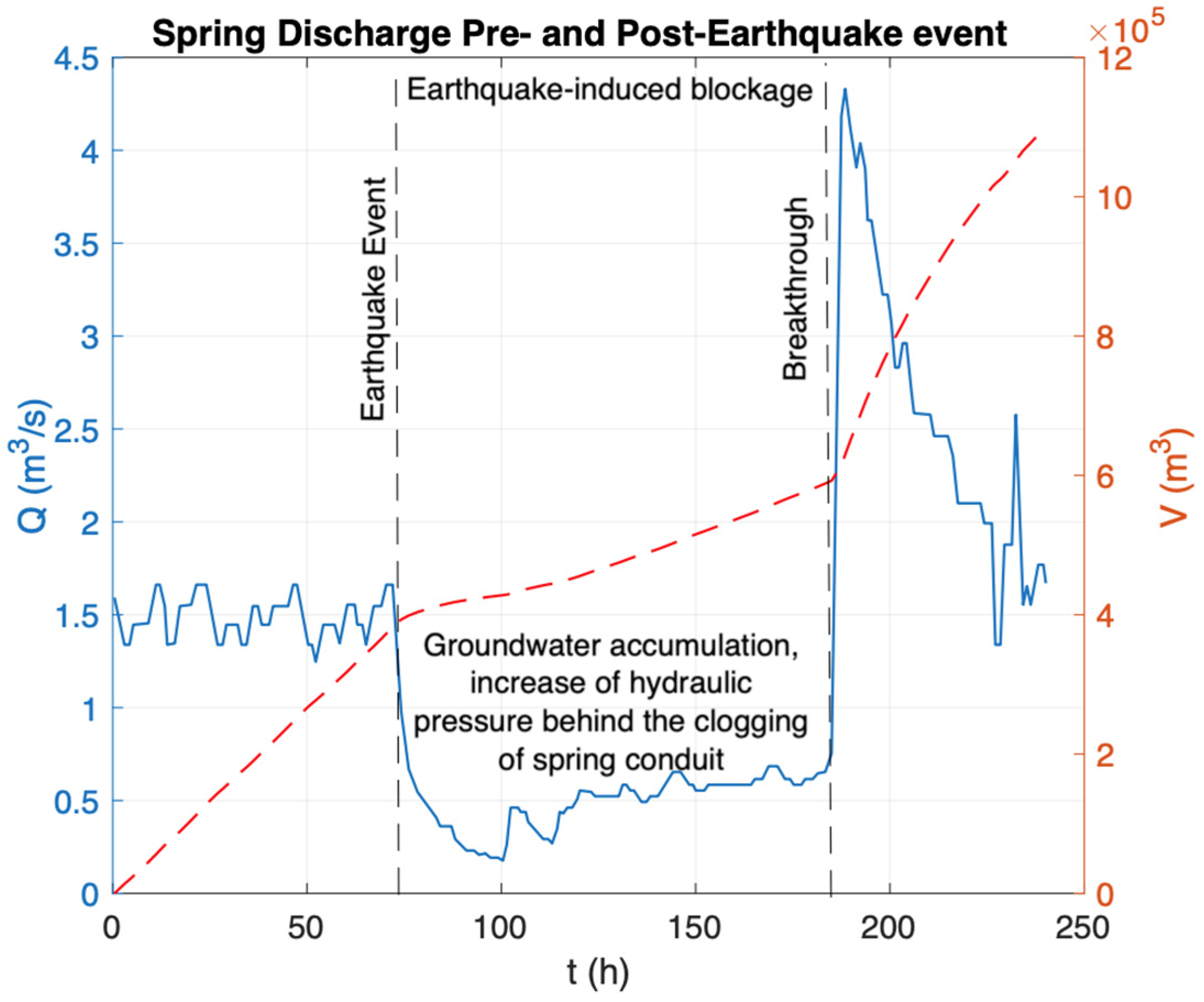
The analyzed hydrograph during the seismic event at Site A indicates that even a temporary failure of a karst spring can cause significant issues in water supply systems that rely on earthquake-affected sources. In the case of Opačac Spring, a four-day interruption in water supply due to insufficient discharge has substantial socio-economic impacts on the population dependent on the existing infrastructure. Temporary failure of a karst spring is closely linked to the temporary blockage of primary karst conduits converging at the spring zone or specific spring. Analyzing hydrographs that represent the spring’s discharge before and after an earthquake event (Figure 10) provides a clear distinction between the initial stable state of the karst conduit system, the period of earthquake-induced blockage, and the final breakthrough moment.
Figure 10. Hourly discharge hydrograph at Opačac Spring of ten consequent days capturing earthquake event recorded on 7 September 2018, at 22:35, with corresponding volume of water outflow (S-curve).
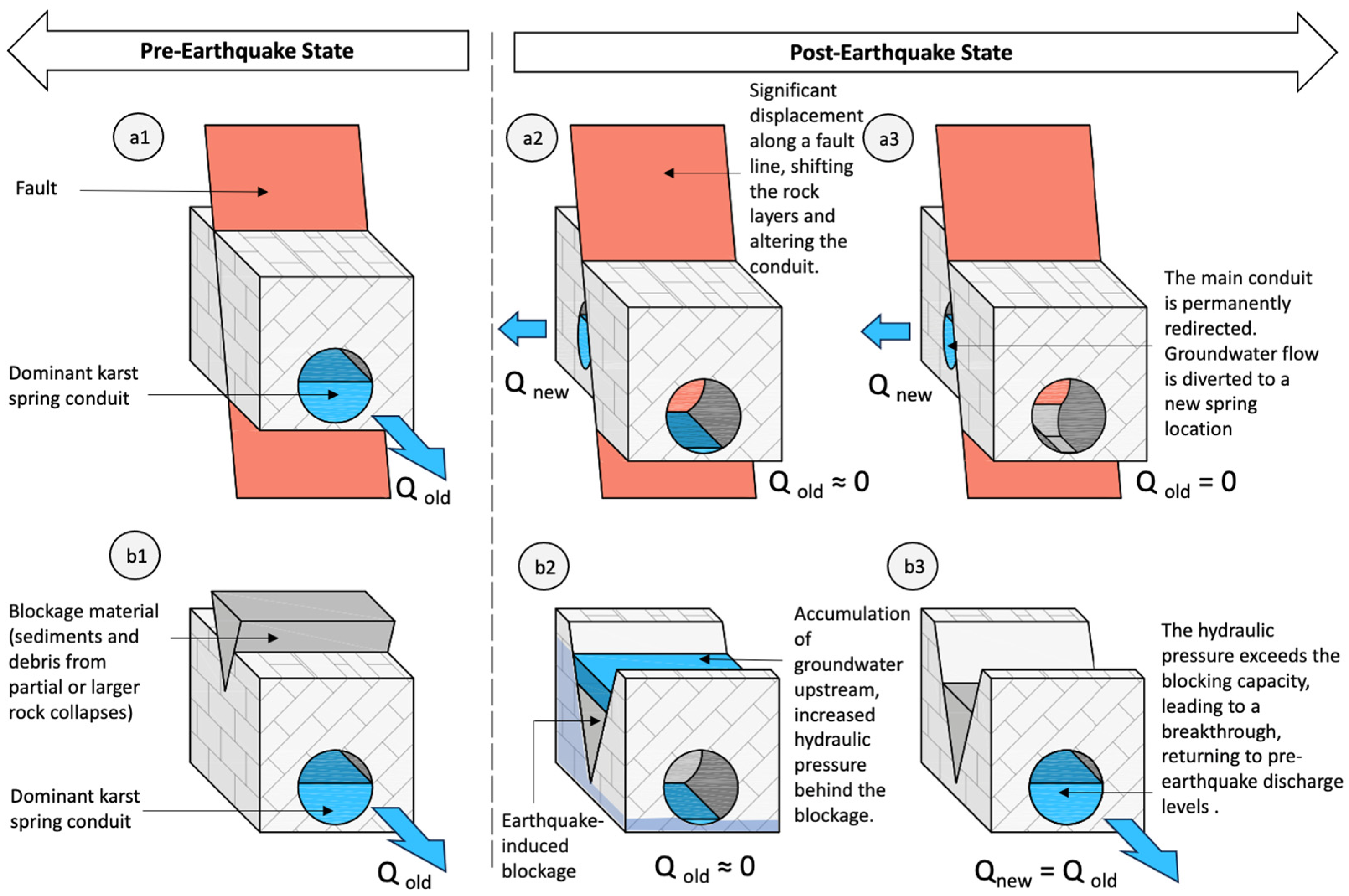
During this breakthrough, temporarily stored underground water, due to the built-up hydraulic pressure, clears the obstructing material, ultimately restoring the discharge at the spring. Figure 11 illustrates the proposed conceptual model of permanent and temporary karst spring failures induced by seismic events. Permanent failure by redirection of the main conduit is illustrated through a1–a3 (Figure 11). The initial state (a1) shows a stable karst conduit system where groundwater flows smoothly from recharge areas to the karst spring through well-established channels. An earthquake causes significant displacement along a fault line intersecting the karst system (a2). Seismic activity shifts the rock layers and alters the alignment of the conduit. As a result, the main conduit is permanently redirected due to the fault movement (a3). This redirection diverts the groundwater flow to a new spring location, effectively drying up the original karst spring (Qold ≈ 0, Qnew ≠ 0). Such permanent failure of karst springs due to seismic activity is considered a possible, though relatively rare, outcome typically associated with substantial structural reorganization of the karst conduit system.
Figure 11. Proposed two main conceptual models of permanent karst spring failure (a1a3) and temporary karst spring failure (b1b3).
Further on, the proposed conceptual model (Figure 11) depicts such an event by subfigures b1–b3. Initial state (b1) shows the underground stream flowing freely through the karst conduit, delivering water from the underground water storage to the spring exit. The shaking from the earthquake dislocates blockage material within the karst system, causing it to collapse partially or completely into the main conduit (b2), blocking the flow of water to the spring (Qold ≈ 0). Built-up hydraulic pressure behind the blockage, further seismic aftershocks, or the settling of the earth post-earthquake agitates the material that clogged the conduit (b3). This activity gradually breaks up the blockage or shifts it, allowing water to once again flow through the conduit and restoring discharge at the spring (Qnew = Qold). This model underscores the dynamic responses of karst systems to seismic activities, highlighting the distinction between temporary disruptions and permanent alterations in groundwater flow pathways.
The results of the Monte Carlo simulation (Figure 9) show a wider range and lower peak of the probability distribution for the Island of Vis, indicating higher uncertainty in the Vulnerability Index due to the heterogeneous structure of the freshwater lens and variability of infiltration (I) and karst network (K) parameters. In contrast, the Opačac Spring displays a narrower distribution with a more distinct peak around a higher VIS value, reflecting lower uncertainty and greater stability of the system. This is attributed to the fact that the discharge of Opačac Spring primarily depends on the blockage or recovery of a single main conduit, making its response to disturbance more direct and predictable. The contrasting behaviors underline how different hydrogeological settings can exhibit considerably different levels of uncertainty and sensitivity when subjected to seismic disturbances.
This work represents a proof-of-concept for integrating seismic impacts into karst vulnerability assessments, and the VIS framework requires further refinement, testing, and validation on a larger number of sites.

5. Conclusions

In evaluating the vulnerability of karst water resources, Historical Records (HR) represent an important parameter. These records provide empirical evidence of how seismic events have previously impacted water availability, offering critical insights for future risk assessments. Vis Island relies on a delicate freshwater lens system, which is highly vulnerable to external disturbances. A notable instance occurred when a seismic event with a moment magnitude (Mw) of 6.1 struck Stolac (Bosnia and Hercegovina), approximately 150 km away, leading to significant alterations in water quality parameters on the island. This incident underscores the sensitivity of freshwater lenses to seismic activity, even those originating at considerable distances. Situated in a seismically active region, the Island of Vis faces a tangible risk to the stability of its freshwater resources. This vulnerability is further amplified by climate variability and intensified groundwater extraction during the peak tourist season. These overlapping pressures highlight the need to consider natural hazards, such as earthquakes, alongside human-induced stressors in the planning and protection of isolated island aquifer systems. DiFilippo et al. [45] proposed an interdisciplinary protocol for the comprehensive management of freshwater lenses on karst islands. The case study of the Island of Vis demonstrates that, in addition to hydrogeological and socio-economic factors, geohazard risks, particularly seismic vulnerability, should also be integrated into such protocols. A modified EPIC method presents a promising approach for quantifying the vulnerability of island freshwater lenses to seismic events, thereby enhancing the robustness of water resource assessments and management strategies. The results presented here serve as an initial demonstration of the proposed VIS framework rather than a universally applicable classification, and broader validation will require future studies that include multiple sites across diverse karst terrains. The purpose of the present study is to open methodological space for incorporating geohazard components into karst water management rather than to propose a finalized, broadly generalizable model.
The Opačac Spring in Imotski has demonstrated a pronounced sensitivity to seismic events. Following an Mw 3.7 earthquake at a proximity of 15 km, the spring experienced a temporary cessation lasting four days. Such occurrences highlight the inherent vulnerability of karst systems with well-developed conduit networks, where seismic disturbances can disrupt groundwater flow paths. The prospect of a permanent spring failure or its relocation poses significant concerns. The literature indicates [45] that seismic activities can lead to substantial hydrogeological changes, including the emergence of new springs and the drying up of existing ones. On the other hand, the temporary failure of karst springs, such as that observed at Opačac Spring, is a more probable and well-documented response to seismic disturbances, typically resulting from transient clogging or pressure shifts within the conduit system.
The findings of this study are consistent with recent research [46,47,48,49], all of which demonstrate that earthquakes can induce measurable and often transient hydrodynamic responses in karst aquifers, manifested as abrupt variations in discharge, water levels, or hydrochemical parameters, highlighting the sensitivity of karst groundwater systems to seismic perturbations and supporting the interpretation of hydro-seismic signals observed in the Opačac and Vis Island case studies, which represent contrasting hydrogeological settings under seismic stress. Empirical evidence from historical records is indispensable for informing vulnerability assessments and guiding the management of karst water resources. For Vis Island, the combination of seismic risks, climatic variations, and human activities necessitates a comprehensive approach to safeguard its freshwater lens. Similarly, the Opačac Spring’s demonstrated sensitivity to seismic events calls for proactive measures to mitigate potential disruptions, considering the possibility of permanent alterations to the spring’s flow regime. Employing time-series analysis of both spring discharge and water quality datasets is essential for characterizing the historical relevance of seismic events in karst environments. By correlating fluctuations in discharge and key hydrochemical indicators with known earthquake occurrences, the extent and frequency of seismic-induced disturbances can be more accurately ascertained. Integrating seismic historical data into vulnerability assessments ensures that management strategies are grounded in real-world observations, thereby enhancing the resilience of these critical water resources. Climate variability modulates the hydraulic state of karst systems and therefore the stress conditions under which seismic disturbances propagate. Future studies should jointly consider seismic forcing, climatic drivers, and anthropogenic pressures, such as seasonal groundwater overexploitation and modified drainage (infiltration regimes), as these factors can amplify the vulnerability of karst water resources.

Author Contributions

Conceptualization, I.A. and O.B.; methodology, I.A., O.B., and T.K.; validation, I.A. and T.K.; formal analysis, I.A., O.B., and T.K.; investigation, I.A., O.B., and T.K.; writing—original draft preparation, I.A. and O.B.; writing—review and editing, I.A., O.B., and T.K.; visualization, I.A.; supervision, O.B.; project administration, I.A. and T.K. All authors have read and agreed to the published version of the manuscript.

Funding

This research was funded by Croatian Science Foundation, grant number IPCH-2024-04-1020.

Data Availability Statement

The original contributions presented in this study are included in the article. Further inquiries can be directed to the corresponding author.

Acknowledgments

The authors express their gratitude to Boris Ivanišević from Vodovod i odvodnja otoka Visa (the public utility company of the Island of Vis) for providing water quality data. Special thanks are extended to Staša Borović and Josip Terzić from the Croatian Geological Survey for their invaluable insights into the specific hydrogeological settings of the Island of Vis. The authors also thank Marin Milin for organizing and sharing data on the Imotski Lakes and Opačac Spring during the collaboration on the EU project VODIME—Waters of the Imotski Region (Grant No. KK.05.1.1.02.0024).

Conflicts of Interest

The authors declare no conflicts of interest. The funders had no role in the design of the study; in the collection, analyses, or interpretation of data; in the writing of the manuscript; or in the decision to publish the results.

References

  1. Bonacci, O.; Andrić, I. Karst spring catchment: An example from Dinaric karst. Environ. Earth Sci. 2015, 74, 6211–6223. [Google Scholar] [CrossRef]
  2. Stevanović, Z. Karst waters in potable water supply: A global scale overview. Environ. Earth Sci. 2019, 78, 662. [Google Scholar] [CrossRef]
  3. Vesper, D.J.; White, W.B. Metal transport to karst springs during storm flow: An example from Fort Campbell, Kentucky/Tennessee, USA. J. Hydrol. 2003, 276, 20–36. [Google Scholar] [CrossRef]
  4. Bonacci, O. Karst hydrogeology/hydrology of dinaric chain and isles. Environ. Earth Sci. 2015, 74, 37–55. [Google Scholar] [CrossRef]
  5. Barberio, M.D.; Barbieri, M.; Billi, A.; Doglioni, C.; Petitta, M. Hydrogeochemical changes before and during the 2016 Amatrice-Norcia seismic sequence (central Italy). Sci. Rep. 2017, 7, 11735. [Google Scholar] [CrossRef]
  6. Manga, M.; Brodsky, E.E.; Boone, M. Response of streamflow to multiple earthquakes. Geophys. Res. Lett. 2003, 30, 1214. [Google Scholar] [CrossRef]
  7. Pasvanoglu, S.; Canik, B.; Rosen, M.R. Hydrogeology and Possible Effects of the Mw 7.4 Marmara Earthquake (17 August 1999) on the Spring Waters in the Orhangazi-Bursa Area, Hirkey. Geol. Soc. India 2004, 63, 313–322. [Google Scholar] [CrossRef]
  8. Rosen, M.R.; Binda, G.; Archer, C.; Pozzi, A.; Michetti, A.M.; Noble, P.J. Mechanisms of earthquake--induced chemical and fluid transport to carbonate groundwater springs after earthquakes. Water Resour. Res. 2018, 54, 5225–5244. [Google Scholar] [CrossRef]
  9. Skelton, A.; Andrén, M.; Kristmannsdóttir, H.; Stockmann, G.; Mörth, C.M.; Sveinbjörnsdóttir, Á.; Jónsson, S.; Sturkell, E.; Guðrúnardóttir, H.R.; Hjartarson, H. Changes in groundwater chemistry before two consecutive earthquakes in Iceland. Nat. Geosci. 2014, 7, 752. [Google Scholar] [CrossRef]
  10. Gosar, A.; Brenčič, M. Possible relation between the sudden sinking of river Iška and the sequence of weak earthquakes in September-October 2010 near Iška vas (central Slovenia). Acta Carsologica 2012, 41. [Google Scholar] [CrossRef]
  11. Lei, M.; Jiang, X.; Yu, L. New advances in karst collapse research in China. Environ. Geol. 2002, 42, 462–468. [Google Scholar] [CrossRef]
  12. Liu, H.; Li, L.; Li, Z.; Yu, G. Numerical modelling of mining-induced inrushes from subjacent water conducting karst collapse columns in northern China. Mine Water Environ. 2018, 37, 652–662. [Google Scholar] [CrossRef]
  13. Parise, M.; Vennari, C. A chronological catalogue of sinkholes in Italy: The first step toward a real evaluation of the sinkhole hazard. In Proceedings of the Thirteenth Multidisciplinary Conference on Sinkholes and the Engineering and Environmental Impacts of Karst NCKRI Symposia 2, Carlsbad, NM, USA, 6–10 May 2013. [Google Scholar] [CrossRef]
  14. Wu, Q.H.; Zhang, W.; Liu, Y.; Cui, H.D. Quantifying the process of karst collapse by a physical model. J. Yangtze River Sci. Res. Inst. 2018, 35, 52. [Google Scholar]
  15. Ekmekci, M. Impact of Quarries on Karst Groundwater Systems; IAHS Publication: Oxfordshire, UK, 1990; p. 3. [Google Scholar]
  16. D’Agostino, N.; Silverii, F.; Amoroso, O.; Convertito, V.; Fiorillo, F.; Ventafridda, G.; Zollo, A. Crustal deformation and seismicity modulated by groundwater recharge of karst aquifers. Geophys. Res. Lett. 2018, 45, 12–253. [Google Scholar] [CrossRef]
  17. Galloway, E.; Hauck, T.; Corlett, H.; Pană, D.; Schultz, R. Faults and associated karst collapse suggest conduits for fluid flow that influence hydraulic fracturing-induced seismicity. Proc. Natl. Acad. Sci. USA 2018, 115, E10003–E10012. [Google Scholar] [CrossRef]
  18. Miller, S.A. Note on rain-triggered earthquakes and their dependence on karst geology. Geophys. J. Int. 2008, 173, 334–338. [Google Scholar] [CrossRef]
  19. Roje-Bonacci, T.; Bonacci, O. The possible negative consequences of underground dam and reservoir construction and operation in coastal karst areas: An example of the hydro-electric power plant (HEPP) Ombla near Dubrovnik (Croatia). Nat. Hazards Earth Syst. Sci. 2013, 13, 2041–2052. [Google Scholar] [CrossRef]
  20. Wang, C.Y.; Manga, M. Earthquakes influenced by water. In Earthquakes and Water; Springer: Cham, Switzerland, 2021; pp. 61–82. [Google Scholar] [CrossRef]
  21. Wang, C.Y.; Manga, M. Hydrologic responses to earthquakes and a general metric. Geofluids 2010, 10, 206–216. [Google Scholar] [CrossRef]
  22. Benderev, A.; Damyanova, E.; Ivanov, M.; Donkova, Y.; Gerginov, P. Probable reasons for interruption of the flow of the Iskrets karst spring. Rev. Bulg. Geol. Soc. 2022, 83, 243. [Google Scholar] [CrossRef]
  23. Nanni, T.; Vivalda, P.M.; Palpacelli, S.; Marcellini, M.; Tazioli, A. Groundwater circulation and earthquake-related changes in hydrogeological karst environments: A case study of the Sibillini Mountains (central Italy) involving artificial tracers. Hydrogeol. J. 2020, 28, 2409–2428. [Google Scholar] [CrossRef]
  24. Manga, M. Origin of postseismic streamflow changes inferred from baseflow recession and magnitude-distance relations. Geophys. Res. Lett. 2001, 28, 2133–2136. [Google Scholar] [CrossRef]
  25. Wang, C.Y.; Wang, C.H.; Kuo, C.H. Temporal change in groundwater level following the 1999 (Mw = 7.5) Chi-Chi earthquake, Taiwan. Geofluids 2004, 4, 210–220. [Google Scholar] [CrossRef]
  26. Bonacci, O. Hazards caused by natural and anthropogenic changes of catchment area in karst. Nat. Hazards Earth Syst. Sci. 2004, 4, 655–661. [Google Scholar] [CrossRef]
  27. Scorzini, A.R.; Di Bacco, M.; De Luca, G.; Tallini, M. Deep learning for earthquake hydrology? Insights from the karst Gran Sasso aquifer in central Italy. J. Hydrol. 2023, 617, 129002. [Google Scholar] [CrossRef]
  28. Celico, P. Prospezioni Idrogeologiche Vol. II; Liguori Editore: Naples, Italy, 1988. [Google Scholar]
  29. Esposito, E.; Pece, R.; Porfido, S.; Tranfaglia, G. Hydrological anomalies connected to earthquakes in southern Apennines (Italy). Nat. Hazards Earth Syst. Sci. 2001, 1, 137–144. [Google Scholar] [CrossRef]
  30. Keegan-Treloar, R.; Irvine, D.J.; Solórzano-Rivas, S.C.; Werner, A.D.; Banks, E.W.; Currell, M.J. Fault-controlled springs: A review. Earth-Sci. Rev. 2022, 230, 104058. [Google Scholar] [CrossRef]
  31. Fandel, C.; Miville, F.; Ferré, T.; Goldscheider, N.; Renard, P. The stochastic simulation of karst conduit network structure using anisotropic fast marching, and its application to a geologically complex alpine karst system. Hydrogeol. J. 2022, 30, 927–946. [Google Scholar] [CrossRef]
  32. Danciu, L.; Nandan, S.; Reyes, C.; Basili, R.; Weatherill, G.; Beauval, C.; Rovida, A.; Vilanova, S.; Şeşetyan, K.; Bard, P.Y.; et al. The 2020 update of the European Seismic Hazard Model: Model Overview. Nat. Hazards Earth Syst. Sci. 2021, 24, 3049–3073. [Google Scholar] [CrossRef]
  33. Bonacci, O. Karst Hydrology With Special Reference to the Dinaric Karst; Springer: Berlin/Heidelberg, Germany, 1987; pp. 13–15. [Google Scholar] [CrossRef]
  34. Andric, I.; Bonacci, O. Morphological study of Red lake in Dinaric karst based on terrestrial laser scanning and sonar systems. Acta Carsologica 2014, 43, 229. [Google Scholar] [CrossRef]
  35. Vrsalović, A.; Andrić, I.; Buzjak, N.; Bonacci, O. Karst Lake’s Dynamics Analysis as a Tool for Aquifer Characterisation at Field Scale, Example of Cryptodepression—Red Lake in Croatia. Water 2022, 14, 830. [Google Scholar] [CrossRef]
  36. Terzić, J.; Peh, Z.; Marković, T. Hydrochemical properties of transition zone between fresh groundwater and seawater in karst environment of the Adriatic islands, Croatia. Environ. Earth Sci. 2010, 59, 1629–1642. [Google Scholar] [CrossRef]
  37. Terzić, J.; Frangen, T.; Borović, S.; Reberski, J.L.; Patekar, M. Hydrogeological assessment and modified conceptual model of a dinaric Karst Island Aquifer. Water 2022, 14, 404. [Google Scholar] [CrossRef]
  38. Korbar, T.; Belak, M.; Fuček, L.; Husinec, A.; Oštrić, N.; Palenik, D.; Vlahović, I. Osnovna Geološka Karta Republike Hrvatske Mjerila 1:50 000—List: Vis 3 i Biševo 1; Hrvatski Geološki Institut (Zavod za geologiju): Zagreb, Croatia, 2012; ISBN 978-953-6907-27-4. [Google Scholar]
  39. Ghyben, B.W. Nota in Verband Met de Voorgenomen Putboring Nabij Amsterdam (Notes on the Probable Results of the Proposed Well Drilling Near Amsterdam); Tijdschrift van het Koninklijk Institunt van Ingeniers: The Hague, The Netherlands, 1888; pp. 8–22. [Google Scholar]
  40. Herzberg, A. Die Wasserversorgung einiger Nordseebader. Wasserversorgung 1901, 44, 815–819, 842–844. [Google Scholar]
  41. Doerfliger, N.; Jeannin, P.Y.; Zwahlen, F. Water vulnerability assessment in karst environments: A new method of defining protection areas using a multi-attribute approach and GIS tools (EPIK method). Environ. Geol. 1999, 39, 165–176. [Google Scholar] [CrossRef]
  42. Meng, F.; Wong, L.N.Y.; Zhou, H. Power law relations in earthquakes from microscopic to macroscopic scales. Sci. Rep. 2019, 9, 10705. [Google Scholar] [CrossRef]
  43. Ćatić, S. Temporal and spatial analysis of earthquake in Stolac on April 22nd, 2022. J. Fac. Min. Geol. Civ. Eng. 2022, 10, 101–110. [Google Scholar] [CrossRef]
  44. Gogu, R.C.; Dassargues, A. Sensitivity analysis for the EPIK method of vulnerability assessment in a small karstic aquifer, southern Belgium. Hydrogeol. J. 2000, 8, 337–345. [Google Scholar] [CrossRef]
  45. DiFilippo, R.; Bosher, L.; David, C.P. Freshwater lens assessment of karst island water resources: Towards an interdisciplinary protocol. Waterlines 2022, 41, 107–124. [Google Scholar] [CrossRef]
  46. Sanz Pérez, E. Groundwater Hydraulics in Increased Spring Discharge Caused by Earthquakes. Water 2024, 16, 520. [Google Scholar] [CrossRef]
  47. Lan, S.; Mao, Z.; Chen, D.; Gu, H. Exploring Similarities and Differences in Water Level Response to Earthquakes in Karst/Confined Aquifers. Water 2024, 16, 3484. [Google Scholar] [CrossRef]
  48. Mavroulis, S.; Sarantopoulou, A.; Lekkas, E. Co- and Post-Seismic Hydrogeological Anomalies in Greece. Geosciences 2025, 15, 367. [Google Scholar] [CrossRef]
  49. Isaya, D.; De Luca, G.; Di Carlo, G.; Guerriero, V.; Martorana, R.; Tallini, M. Hydroseismograms at Gran Sasso Aquifer, Central Italy, for Earthquake Monitoring and Seismic Activity Prediction. Sci. Rep. 2025, 15, 13162. [Google Scholar] [CrossRef] [PubMed]
Disclaimer/Publisher’s Note: The statements, opinions and data contained in all publications are solely those of the individual author(s) and contributor(s) and not of MDPI and/or the editor(s). MDPI and/or the editor(s) disclaim responsibility for any injury to people or property resulting from any ideas, methods, instructions or products referred to in the content.

Article Metrics

Citations

Article Access Statistics

Multiple requests from the same IP address are counted as one view.