



Atmospheric Loss of Energetic Electrons and Protons from the Radiation Belts After the Exceptional Injection of the 11 May 2024 Superstorm Leading to Four Electron Belts

Abstract
1. Introduction
2. Instruments and Data: PROBA-V/EPT Observations
3. Electron Flux Variations Observed by EPT
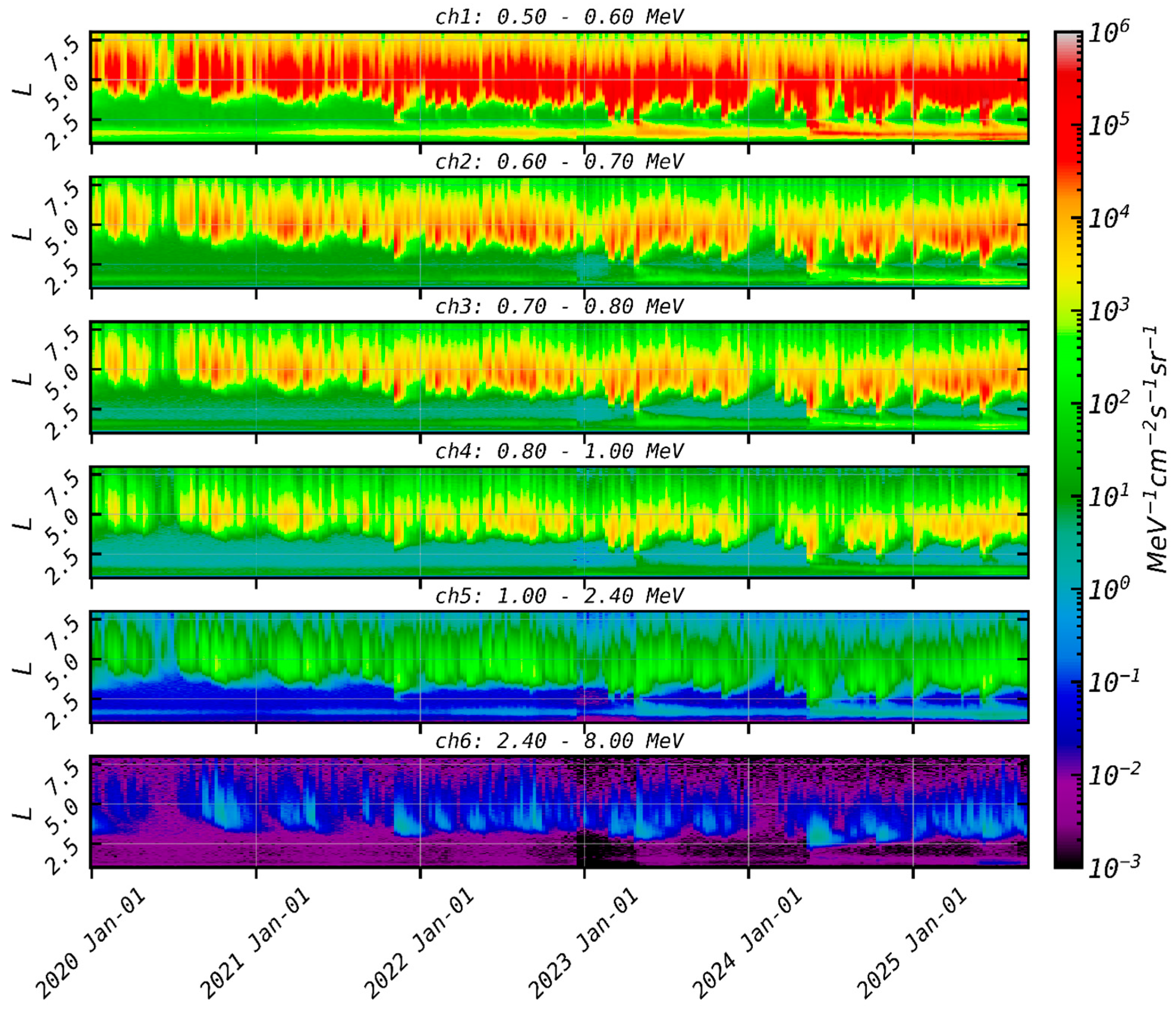
3.1. Long-Term Variations
3.2. Four Belts After the Event of 11 May 2024
- (1)
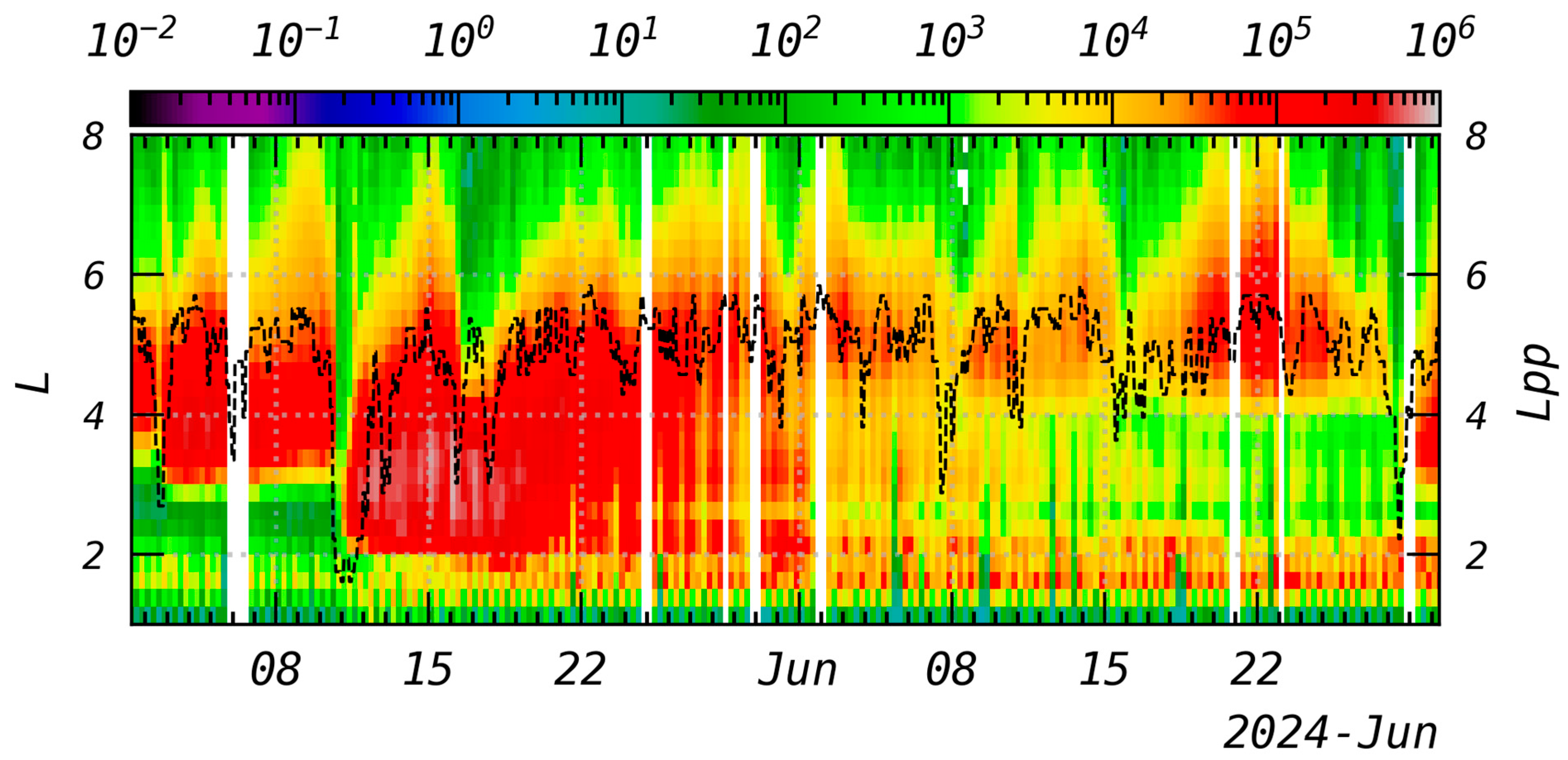
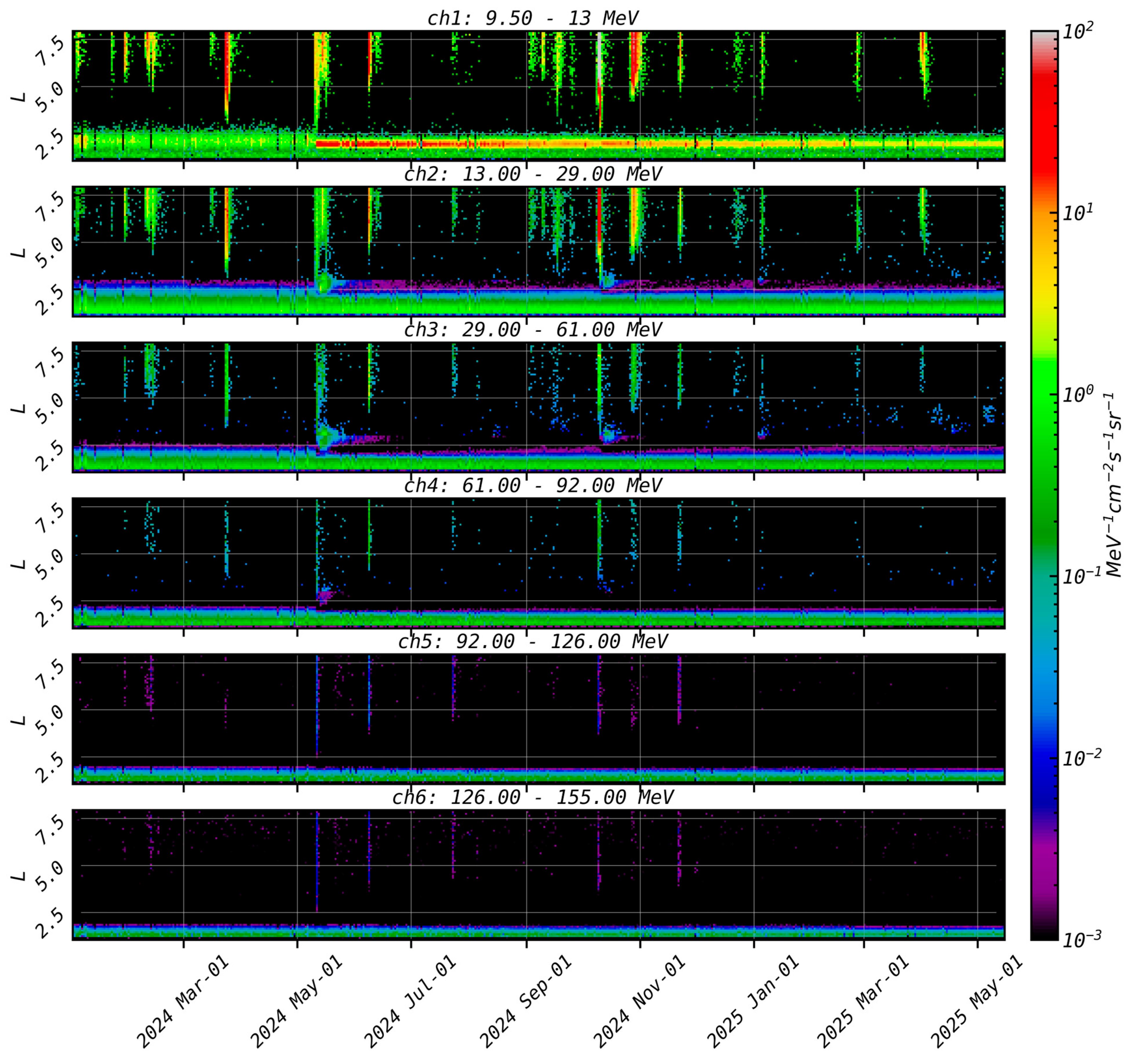
- First, on 10 May 2024, at the arrival of the coronal mass ejection, a fast and deep dropout is observed, i.e., the electrons of the outer belt completely disappeared during several hours. Such dropouts are observed at the arrival of most storms and substorms due to the magnetopause shadowing and precipitation of electrons in the atmosphere, but they are rarely so deep [21].
- (2)
- Simultaneously, a strong increase in electron flux is observed in the usual slot (from L = 2–3) and in the inner belt (L < 2). The flux becomes very high above L = 2, and later, after the geomagnetic storm, the flux further increases above L = 1.4. This is deeper than usual. The depth of the inner belt injection corresponds well to the estimation based on the Dst value established in [21]. Such flux increase is due to radial diffusion and ULF (ultra-low frequency) waves (1 mHz–1 Hz), as described for instance in [23].
- (3)
- The black dashed line corresponds to the plasmapause position Lpp, here obtained using the linear approximation relating the Bartels planetary geomagnetic index Kp and the plasmapause from the BSPM (Belgian Swiff Plasmasphere Model): Lpp = −0.47 Kp + 5.84 [24], which is close but slightly higher than the position obtained by the linear relation of Carpenter and Anderson [25]. During the 11 May 2024 event, the very rare occasion of a maximum Kp value (Kp = 9) was reached. One can see that the plasmapause was closer to the Earth during the storm, as indeed confirmed by SWARM with a plasmapause position observed to be around L = 1.8 in the midnight MLT (Magnetic Local Time) sector [3]. One can see links between the plasmapause and outer radiation belt boundaries, as demonstrated in [24] with previous observations. This link is due to wave–particle interactions, such as EMIC (Electro-Magnetic Ion Cyclotron) and chorus waves that are present mainly outside the plasmasphere and scatter high-energy electrons into the atmosphere.
- (4)
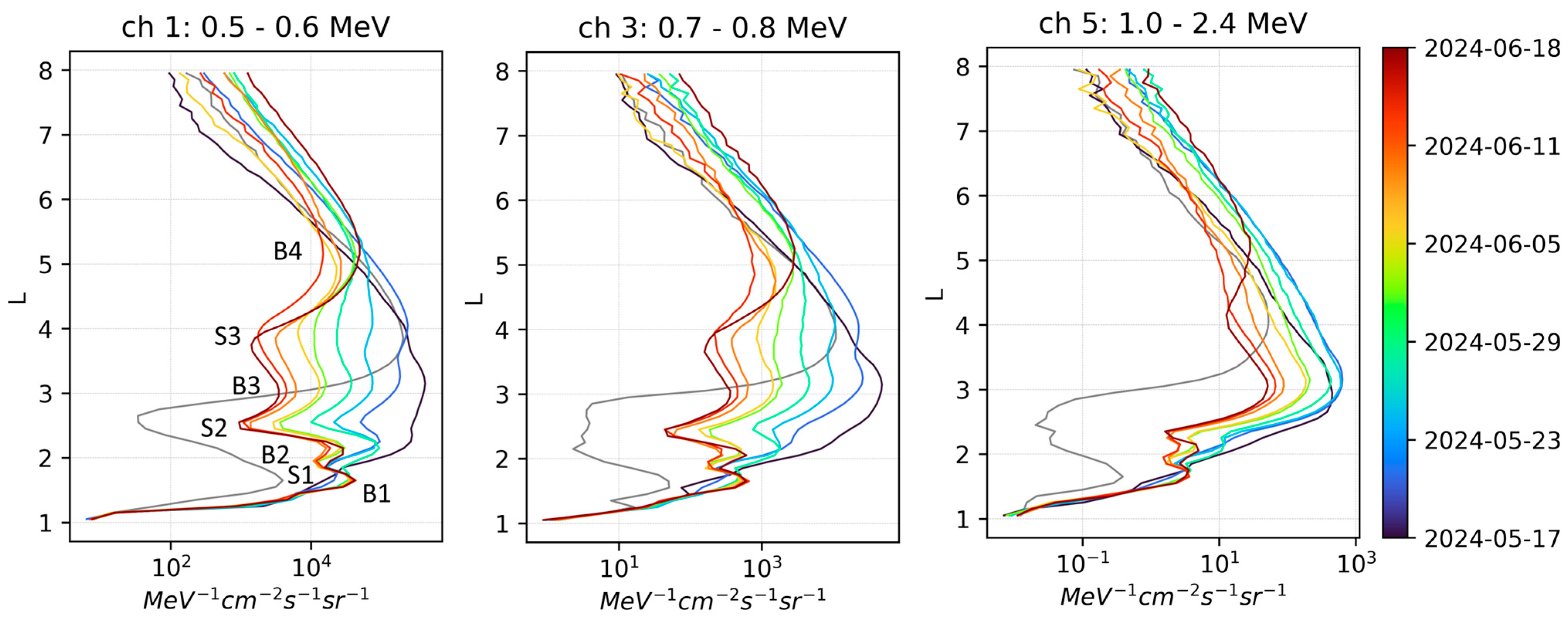
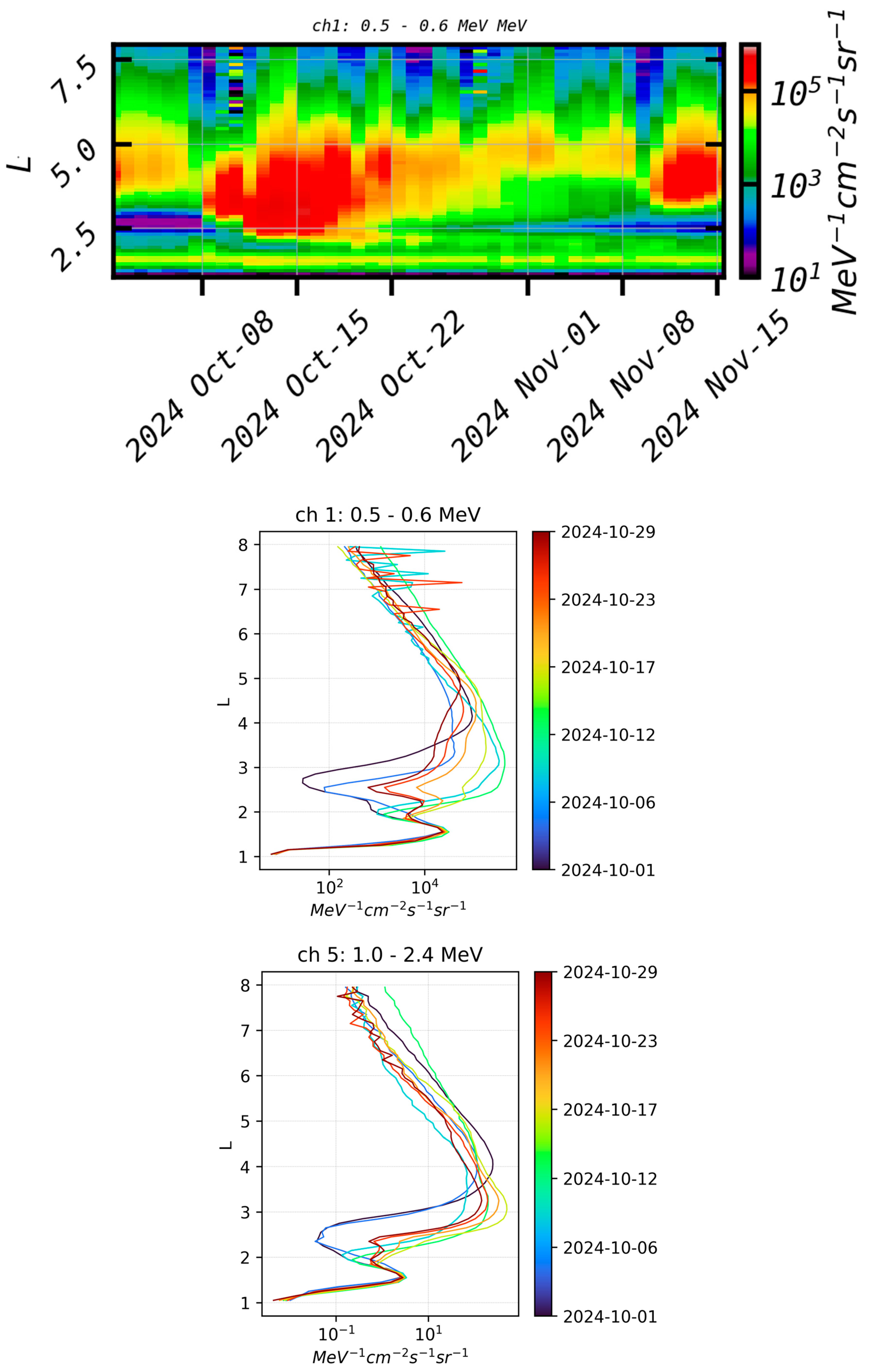
- The figure also well illustrates how the four belts are formed after the event due to the loss of electrons at specific L. The usual slot reforms again around L = 2.5 after around 10 days, which corresponds to what is observed after other storms. The four belts are due to two additional slots appearing around L = 1.9 (in the inner belt) and L = 3.8 (in the outer belt), which have never been observed in this energy range.
3.3. Electron Flux Profiles After the 11 May 2024 Event
3.4. Three Belts After the 10 October 2024 Event
3.5. Electron Lifetimes
3.6. Discussion About the Loss Mechanisms
4. Proton Flux Variations Observed by EPT
4.1. Long-Term Variations
4.2. Proton Flux Profiles
4.3. Proton Flux Lifetime of the New Belt at 9.5–13 MeV
4.4. Proton Refilling Times at the Outer Edge of the Belt
5. South Atlantic Anomaly (SAA)
6. Discussion and Conclusions
Author Contributions
Funding
Institutional Review Board Statement
Informed Consent Statement
Data Availability Statement
Conflicts of Interest
References
- Spogli, L.; Alberti, T.; Bagiacchi, P.; Cafarella, L.; Cesaroni, C.; Cianchini, G.; Coco, I.; DiMauro, D.; Ghidoni, R.; Giannattasio, F.; et al. The effects of the May 2024 Mother’s Day superstorm over the Mediterranean sector: From data to public communication. Ann. Geophys. 2024, 67, 218. [Google Scholar] [CrossRef]
- Paul, K.S.; Haralambous, H.; Moses, M.; Oikonomou, C.; Potirakis, S.M.; Bergeot, N.; Chevalier, J.-M. Investigation of the Ionospheric Response on Mother’s Day 2024 Geomagnetic Superstorm over the European Sector. Atmosphere 2025, 16, 180. [Google Scholar] [CrossRef]
- Pierrard, V.; Verhulst, T.G.W.; Chevalier, J.-M.; Bergeot, N.; Winant, A. Effects of the Geomagnetic Superstorms of 10–11 May 2024 and 7–11 October 2024 on the Ionosphere and Plasmasphere. Atmosphere 2025, 16, 299. [Google Scholar] [CrossRef]
- Pierrard, V.; Winant, A.; Botek, E.; Péters de Bonhome, M. The Mother’s Day solar storm of 11 May 2024 and its effect on Earth’s radiation belts. Universe 2024, 10, 391. [Google Scholar] [CrossRef]
- Evans, D.; Greer, M. Polar Orbiting Environmental Satellite Space Environment Monitor; NOAA National Geophysical Data Center: Boulder, CO, USA, 2000.
- Li, X.; Xiang, Z.; Mei, Y.; O’BRien, D.; Brennan, D.; Zhao, H.; Baker, D.N.; Temerin, M.A. A new electron and proton radiation belt identified by CIRBE/REPTile-2 measurements after the magnetic super storm of 10 May 2024. J. Geophys. Res. Space Phys. 2025, 130, e2024JA033504. [Google Scholar] [CrossRef]
- Zhang, Z.; Zhang, F.; Wang, L.; Li, X.; Zhima, Z.; Wang, Y.; Yang, Y.; Yang, D.; Li, S.; Chu, W.; et al. The Magnetosphere-Ionosphere-Ground Responses to the May 2024 Super Solar Storm. Space Weather 2025, 23, e2024SW004197. [Google Scholar] [CrossRef]
- Xu, X.; Ma, Y.; Zhang, L.; Yu, T.; Wang, J.; He, M.; Wang, C.; Li, H. Dynamics of Proton Flux in the South Atlantic Anomaly During the Super Geomagnetic Storm in May 2024. J. Geophys. Res. Space Phys. 2025, 130, e2024JA033536. [Google Scholar] [CrossRef]
- Pierrard, V. Effects of the Sun on the Space Environment of the Earth; Presses Universitaires de Louvain: Louvain-la-Neuve, Belgium, 2024; p. 208. ISBN 978-2-39061-442-5. Available online: https://i6doc.com/en/book/?gcoi=28001100628290 (accessed on 10 February 2026).
- Baker, D.N.; Kanekal, S.G.; Hoxie, V.C.; Henderson, M.G.; Li, X.; Spence, H.E.; Elkington, S.R.; Friedel, R.H.W.; Goldstein, J.; Hudson, M.K.; et al. A long-lived relativistic electron storage ring embedded in Earth’s outer Van Allen belt. Science 2013, 340, 186–190. [Google Scholar] [CrossRef] [PubMed]
- Pierrard, V.; Bolsée, D.; Winant, A.; Al-Qaaod, A.; Krasniqi, F.; de Bonhome, M.P.; Botek, E.; Van Laeken, L.; Sapundjiev, D.; Van Malderen, R.; et al. BIOSPHERE measurement campaign from January 2024 to March 2024 and in May 2024: Effects of the solar events on the radiation belts, UV radiation and ozone in the atmosphere. AIMS Geosci. 2025, 11, 117–154. [Google Scholar] [CrossRef]
- Winant, A.; Pierrard, V.; Botek, E. Ozone decrease observed in the upper atmosphere following the May 11th 2024 Mother’s day solar storm. Ann. Geophys. 2024. [Google Scholar] [CrossRef]
- Benck, S.; Mazzino, L.; Cyamukungu, M.; Cabrera, J.; Pierrard, V. Low altitude energetic electron lifetimes after enhanced magnetic activity as deduced from SAC-C and DEMETER data. Ann. Geophys. 2010, 28, 849–859. [Google Scholar] [CrossRef]
- Claudepierre, S.G.; Ma, Q.; Bortnik, J.; O’Brien, T.P.; Fennell, J.F.; Blake, J.B. Empirically estimated electron lifetimes in the Earth’s radiation belts: Van Allen Probe observations. Geophys. Res. Lett. 2020, 47, e2019GL086053. [Google Scholar] [CrossRef]
- Selesnick, R.S.; Albert, J.M. Variability of the proton radiation belt. J. Geophys. Res. Space Phys. 2019, 124, 5516–5527. [Google Scholar] [CrossRef]
- Selesnick, R.; Hudson, M.; Kress, B. Injection and loss of inner radiation belt protons during solar proton events and magnetic storms. J. Geophys. Res. Space Phys. 2010, 115, A08211. [Google Scholar] [CrossRef]
- Lopez Rosson, G.; Pierrard, V. Analysis of proton and electron spectra observed by EPT/PROBA-V in the South Atlantic Anomaly. Adv. Space Res. 2017, 60, 796–805. [Google Scholar] [CrossRef]
- Pierrard, V.; Benck, S.; Botek, E.; Borisov, S.; Winant, A. Proton flux variations during Solar Energetic Particle Events, minimum and maximum solar activity, and splitting of the proton belt in the South Atlantic Anomaly. J. Geophys. Res. Space Phys. 2023, 128, e2022JA031202. [Google Scholar] [CrossRef]
- Pierrard, V.; Rosson, G.L.; Borremans, K.; Lemaire, J.; Maes, J.; Bonnewijn, S.; Van Ransbeeck, E.; Neefs, E.; Cyamukungu, M.; Benck, S.; et al. The Energetic Particle Telescope: First results. Space Sci. Rev. 2014, 184, 87–106. [Google Scholar] [CrossRef]
- Cyamukungu, M.; Benck, S.; Borisov, S.; Grégoire, G.; Cabrera, J.; Bonnet, J.L. The Energetic Particle Telescope (EPT) on board PROBA-V: Description of a new science-class instrument for particle detection in space. IEEE Trans. Nucl. Sci. 2014, 61, 3667–3681. [Google Scholar] [CrossRef]
- Pierrard, V.; Botek, E.; Ripoll, J.F.; Cunningham, G. Electron dropout events and flux enhancements associated with geomagnetic storms observed by PROBA-V/EPT from 2013 to 2019. J. Geophys. Res. Space Phys. 2020, 125, e2020JA028487. [Google Scholar] [CrossRef]
- Pierrard, V.; Botek, E.; Darrouzet, F. Improving Predictions of the 3D Dynamic Model of the Plasmasphere. Front. Astron. Space Sci. 2021, 8, 681401. [Google Scholar] [CrossRef]
- Brautigam, D.H.; Albert, J.M. Radial diffusion analysis of outer radiation belt electrons during the October 9, 1990, magnetic storm. J. Geophys. Res. Space Phys. 2000, 105, 291–309. [Google Scholar] [CrossRef]
- Pierrard, V.; Botek, E.; Ripoll, J.-F.; Thaller, S.A.; Moldwin, M.B.; Ruohoniemi, M.; Reeves, G. Links of the plasmapause with other boundary layers of the magnetosphere: Ionospheric convection, radiation belts boundaries, auroral oval. Front. Astron. Space Sci. 2021, 8, 728531. [Google Scholar] [CrossRef]
- Carpenter, D.L.; Anderson, R.R. An ISEE/whistler Model of Equatorial Electron Density in the Magnetosphere. J. Geophys. Res. Space Phys. 1992, 97, 1097–1108. [Google Scholar] [CrossRef]
- Abel, B.; Thorne, R.M. Electron scattering loss in Earth’s inner magnetosphere: 2. Sensitivity to model parameters. J. Geophys. Res. Space Phys. 1998, 103, 2397–2407. [Google Scholar] [CrossRef]
- Dahmen, N.; Sicard, A.; Brunet, A.; Santolik, O.; Pierrard, V.; Botek, E.; Darrouzet, F.; Katsavrias, C. FARWEST: Efficient computation of wave-particle interactions for a dynamic description of the electron radiation belt diffusion. J. Geophys. Res. Space Phys. 2022, 127, e2022JA030518. [Google Scholar] [CrossRef]
- Thorne, R.M.; Church, S.R.; Gorney, D.J. On the origin of plasmaspheric hiss: The importance of wave propagation and the plasmapause. J. Geophys. Res. Space Phys. 1979, 84, 5241–5247. [Google Scholar] [CrossRef]
- Ni, B.; Thorne, R.M.; Shprits, Y.Y.; Bortnik, J. Resonant scattering of plasma sheet electrons by whistler-mode chorus: Contribution to diffuse auroral precipitation. Geophys. Res. Lett. 2008, 35, L11106. [Google Scholar] [CrossRef]
- Albert, J.M. Evaluation of quasi-linear diffusion coefficients for whistler mode waves in a plasma with arbitrary density ratio. J. Geophys. Res. Space Phys. 2005, 110, A03218. [Google Scholar] [CrossRef]
- Cunningham, G.S.; Botek, E.; Pierrard, V.; Cully, C.; Ripoll, J.-F. Observation of High-Energy Electrons Precipitated by NWC Transmitter from PROBA-V Low-Earth Orbit Satellite. Geoph. Res. Lett. 2020, 47, e2020GL089077. [Google Scholar] [CrossRef]
- Claudepierre, S.G.; Ma, Q.; Bortnik, J.; O’Brien, T.P.; Fennell, J.F.; Blake, J.B. Empirically estimated electron lifetimes in the Earth’s radiation belts: Comparison with theory. Geophys. Res. Lett. 2020, 47, e2019GL086056. [Google Scholar] [CrossRef]
- Feinland, M.; Blum, L.W.; Marshall, R.A.; Gan, L.; Shumko, M.; Looper, M. Lightning-induced relativistic electron precipitation from the inner radiation belt. Nat. Commun. 2024, 15, 8721. [Google Scholar] [CrossRef] [PubMed]
- Linzmayer, V.; Němec, F.; Santolík, O.; Kolmašová, I. Lightning-Induced Energetic Electron Precipitation Observed in Long-Term DEMETER Spacecraft Measurements. J. Geophys. Res. Space Phys. 2024, 129, e2024JA032713. [Google Scholar] [CrossRef]
- Feinland, M.A.; Blum, L.W. Lightning-induced precipitation as a proxy for inner belt MeV electron decay times. J. Geophys. Res. Space Phys. 2025, 130, e2025JA034258. [Google Scholar] [CrossRef]
- Young, S.L.; Denton, R.E.; Anderson, B.J.; Hudson, M.K. Empirical model for μ scattering caused by field line curvature in a realistic magnetosphere. J. Geophys. Res. Space Phys. 2002, 107, 1069. [Google Scholar] [CrossRef]
- Selesnick, R.S.; Baker, D.N.; Jaynes, A.N.; Li, X.; Kanekal, S.G.; Hudson, M.K.; Kress, B.T. Inward diffusion and loss of radiation belt protons. J. Geophys. Res. Space Phys. 2016, 121, 1969–1978. [Google Scholar] [CrossRef]
- Selesnick, R.S.; Looper, M.D. Field-line curvature scattering at the outer boundary of the proton radiation belt. J. Geophys. Res. Space Phys. 2023, 128, e2023JA031509. [Google Scholar] [CrossRef]
- Young, S.L.; Denton, R.E.; Anderson, B.J.; Hudson, M.K. Magnetic field line curvature induced pitch angle diffusion in the inner magnetosphere. J. Geophys. Res. Space Phys. 2008, 113, A03210. [Google Scholar] [CrossRef]
- Albert, J.M.; Ginet, G.P. CRRES observations of radiation belt protons 2. Time-dependent radial diffusion. J. Geophys. Res. Space Phys. 1998, 103, 14865–14878. [Google Scholar] [CrossRef]
- Albert, J.M.; Ginet, G.P.; Gussenhoven, M.S. CRRES observations of radiation belt protons 1. Data overview and steady state radial diffusion. J. Geophys. Res. Space Phys. 1998, 103, 9261–9274. [Google Scholar] [CrossRef]
- Selesnick, R.; Looper, M.; Mewaldt, R. A theoretical model of the inner proton radiation belt. Space Weather 2007, 5, S04003. [Google Scholar] [CrossRef]
- Li, Z.; Engel, M.; Hudson, M.; Kress, B.; Patel, M.; Qin, M.; Selesnick, R. Solar energetic proton access to the inner magnetosphere during the September 7–8, 2017 event. J. Geophys. Res. Space Phys. 2021, 126, e2021JA029107. [Google Scholar] [CrossRef]
- Pierrard, V.; Ripoll, J.-F.; Cunningham, G.; Botek, E.; Santolik, O.; Thaller, S.; Kurth, W.; Cosmides, M. Observations and simulations of dropout events and flux enhancements in October 2013: Comparing MEO equatorial with LEO polar orbit. J. Geophys. Res. Space Phys. 2021, 126, e2020JA028850. [Google Scholar] [CrossRef] [PubMed]
- Ripoll, J.-F.; Pierrard, V.; Cunningham, G.S.; Chu, X.; Sorathia, K.A.; Hartley, D.A.; Thaller, S.A. Modeling of the cold electron plasma density for radiation belt physics. Front. Astron. Space Sci. 2023, 10, 1096595. [Google Scholar] [CrossRef]
- Pierrard, V.; Lopez Rosson, G. The effects of the big storm events in the first half of 2015 on the radiation belts observed by EPT/PROBA-V. Ann. Geophys. 2016, 34, 75–84. [Google Scholar] [CrossRef]
- Baker, D.N.; Jaynes, A.N.; Hoxie, V.C.; Thorne, R.M.; Foster, J.C.; Li, X.; Fennell, J.F.; Wygant, J.R.; Kanekal, S.G.; Erickson, P.J.; et al. An impenetrable barrier to ultrarelativistic electrons in the Van Allen radiation belts. Nature 2014, 515, 531–534. [Google Scholar] [CrossRef]
- Botek, E.; Pierrard, V.; Winant, A. Prediction of radiation belts electron fluxes at a Low Earth Orbit using neural networks with PROBA-V/EPT data. Space Weather 2023, 21, e2023SW003466. [Google Scholar] [CrossRef]







| L | Mean Lifetime (Days) | Lifetime After 11 May (Days) | Belt or Slot After 11 May |
|---|---|---|---|
| 1.65 | 160 | 160 | B1 |
| 1.85 | 84 | 84 | S1 |
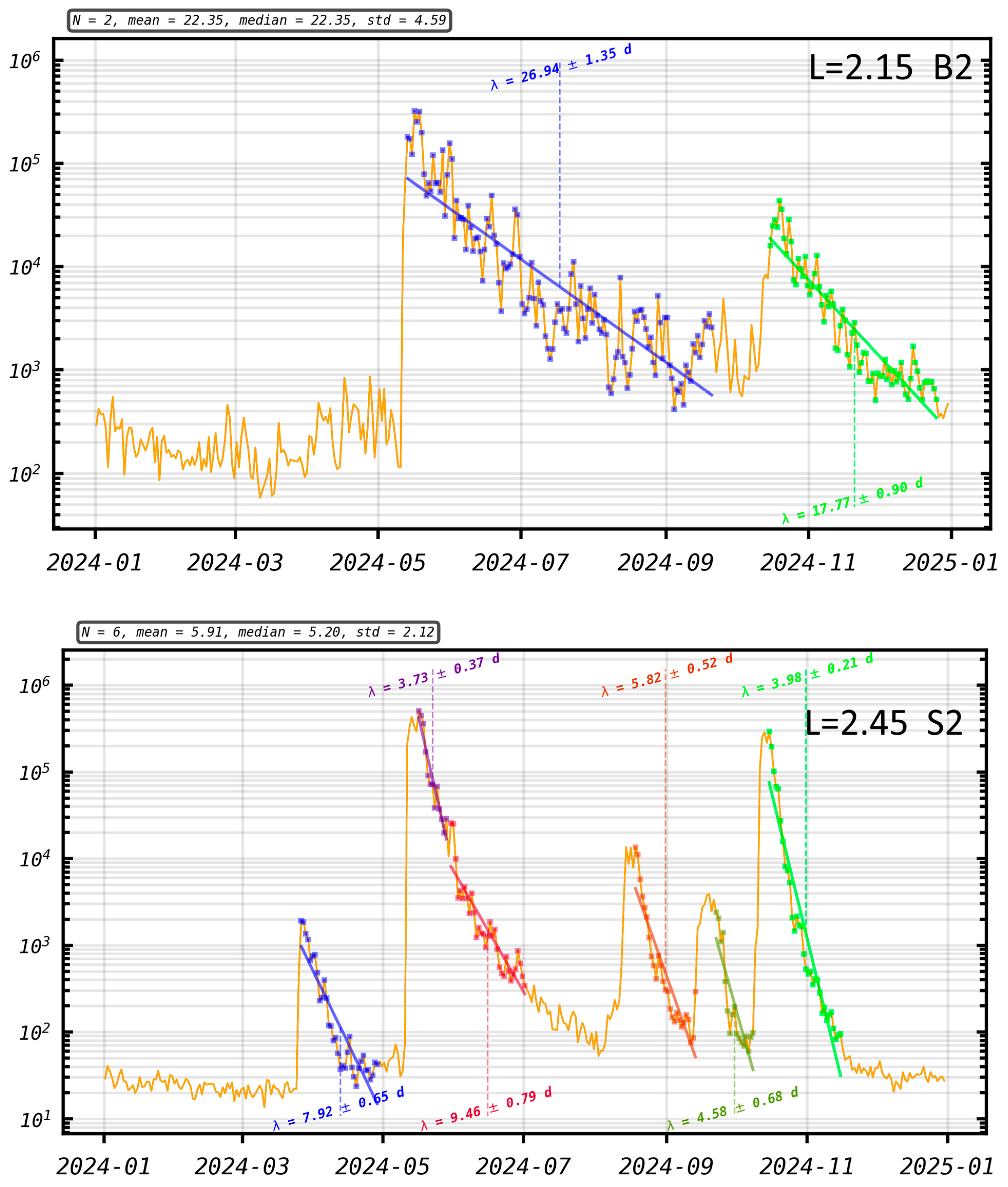
| 2.15 | 22 | 27 | B2 |
| 2.45 | 5.9 | 3.7 | S2 |
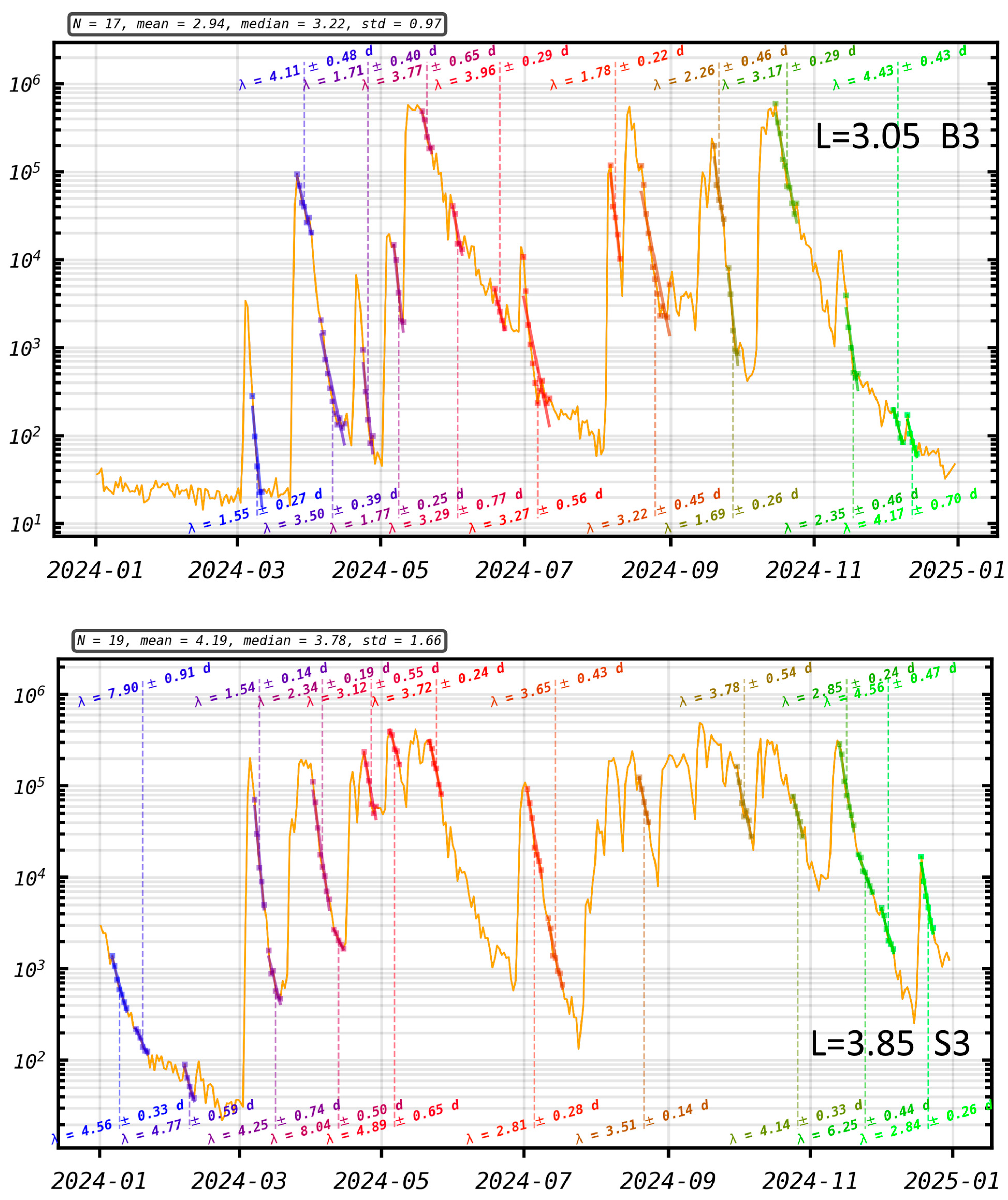
| 3.05 | 2.9 | 3.8 | B3 |
| 3.85 | 4.2 | 3.7 | S3 |
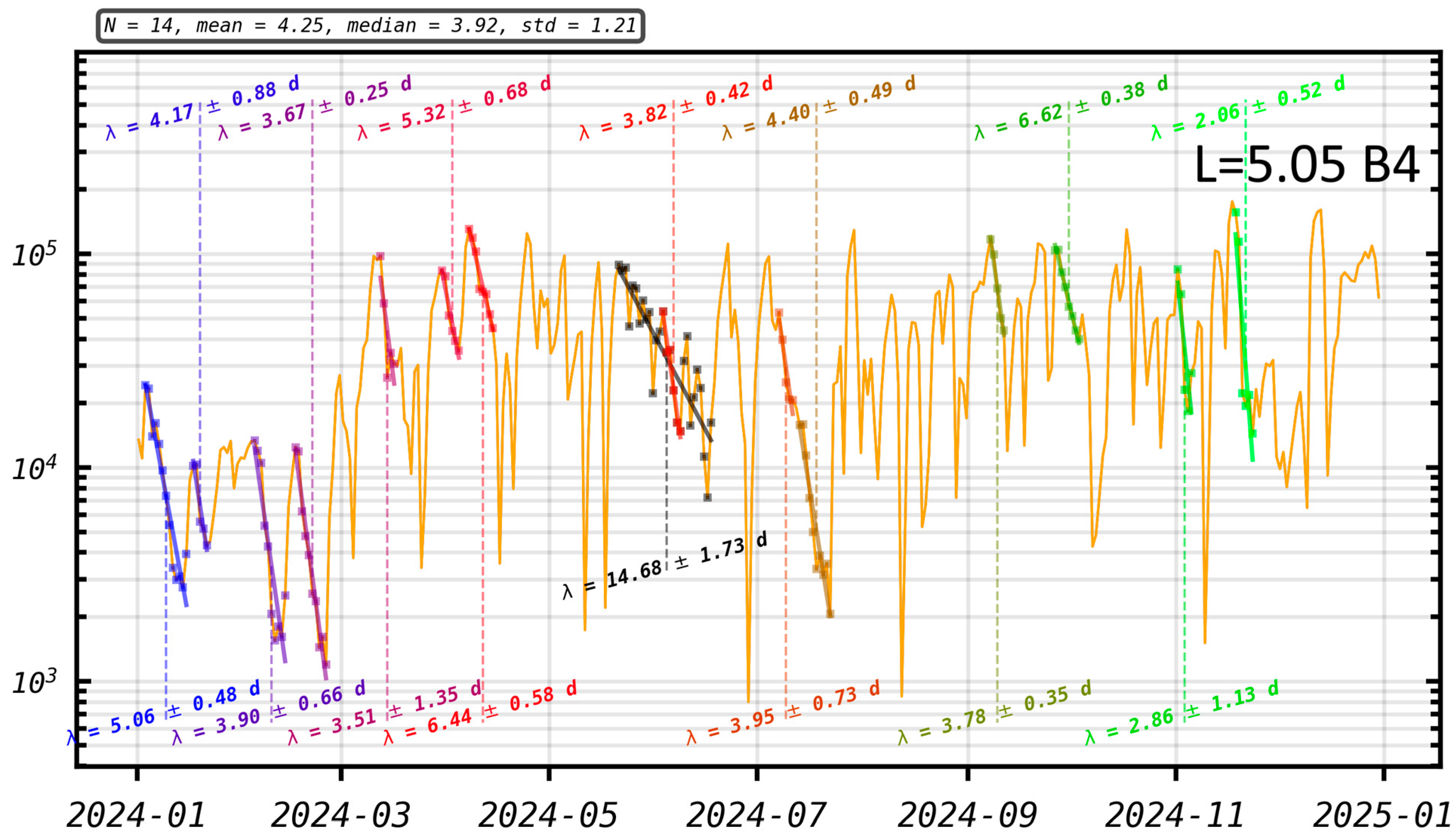
| 5.05 | 4.3 | 14.7 | B4 |
Disclaimer/Publisher’s Note: The statements, opinions and data contained in all publications are solely those of the individual author(s) and contributor(s) and not of MDPI and/or the editor(s). MDPI and/or the editor(s) disclaim responsibility for any injury to people or property resulting from any ideas, methods, instructions or products referred to in the content. |
© 2026 by the authors. Licensee MDPI, Basel, Switzerland. This article is an open access article distributed under the terms and conditions of the Creative Commons Attribution (CC BY) license.
Share and Cite
Pierrard, V.; Winant, A. Atmospheric Loss of Energetic Electrons and Protons from the Radiation Belts After the Exceptional Injection of the 11 May 2024 Superstorm Leading to Four Electron Belts. Atmosphere 2026, 17, 324. https://doi.org/10.3390/atmos17030324
Pierrard V, Winant A. Atmospheric Loss of Energetic Electrons and Protons from the Radiation Belts After the Exceptional Injection of the 11 May 2024 Superstorm Leading to Four Electron Belts. Atmosphere. 2026; 17(3):324. https://doi.org/10.3390/atmos17030324
Chicago/Turabian StylePierrard, Viviane, and Alexandre Winant. 2026. "Atmospheric Loss of Energetic Electrons and Protons from the Radiation Belts After the Exceptional Injection of the 11 May 2024 Superstorm Leading to Four Electron Belts" Atmosphere 17, no. 3: 324. https://doi.org/10.3390/atmos17030324
APA StylePierrard, V., & Winant, A. (2026). Atmospheric Loss of Energetic Electrons and Protons from the Radiation Belts After the Exceptional Injection of the 11 May 2024 Superstorm Leading to Four Electron Belts. Atmosphere, 17(3), 324. https://doi.org/10.3390/atmos17030324