


Abstract
Sunshine duration (SD) is an essential meteorological variable. It represents the sum of time for which direct solar radiation with an intensity above 120 W∙m−2 reaches the Earth’s surface. In the contemporary observational routine, automatic electronic devices are in use. The pyranometric method based on global solar radiation measurements (Kglob) is also proposed by the WMO to assess SD. The aim of the paper is to study the accuracy of the Slob–Monna method (SD-WMO), recommended by the WMO to calculate sunshine duration. Alternatively, the author’s method, which is based on the Ångström clearness index (SD-ACI), was used to approximate SD. For this purpose, a two-year series of SD and Kglob observations at four locations in Poland (well representing the Central European transitional climate zone) was analyzed. The result shows that, for SD-WMO, sunshine duration values are on average 16% higher than observed ones. For the SD-ACI method, they are only 5% higher. When verifying the accuracy of SD-WMO and SD-ACI approximations, we have found that, both for daily and monthly periods, the calculated SD sums are closer to the observed ones in the case of SD-ACI than for the SD-WMO method. The correlation coefficients are, respectively, 0.98 and 0.82 for daily sums and 0.99 and 0.88 for monthly sums.
1. Introduction
Sunshine duration (SD) is one of the essential meteorological variable. According to the World Meteorological Organization (WMO) guide [1], it represents the sum of time for direct solar radiation with an intensity above 120 W∙m−2 to reach the ground-level surface perpendicular to the sun beams. SD values are important in several research and practical applications, e.g., human and plant biometeorology, agrometeorology, or urban meteorology. The SD measurements at weather stations started in the 1880s [2]. For many decades, the Campbell–Stokes heliographs were used for this purpose. The end of the 20th century has brought new, electronic sensors to register sunshine duration. In the contemporary observational routine, automatic electronic devices of the CSD type are in use [3,4].
Sunshine duration, which is one of the crucial characteristics of solar conditions, depends on a number of factors:—astronomical (height of the solar disk above the horizon [5]),—geographical (latitude, altitude above sea level [6]),—environmental (degree of urbanization of the area, vegetation cover [2,7]),—atmospheric (optical mass, transparency of the atmosphere related to its purity and water vapor content [8]); two measures are in use, namely the Ångström clearness index and Linke turbidity factor ([1,9,10,11,12]),—weather (amount and type of cloud cover [13]).
The influence of individual factors on solar conditions, which, in addition to sunshine duration, are also characterized by the inflow of solar radiation, global (Kglob), direct (Kdir), and diffuse (Kdif), has been and continues to be studied in various research centers worldwide [14,15,16,17,18]. Contemporary changes in climate that also concern the sunshine duration are reported for the European–Polar region [19,20,21,22,23].
The WMO guide [1] lists several methods for sunshine duration assessment:
- (1)
- pyrheliometric method; i.e., detection of the transition of direct solar irradiance at the surface perpendicular to the sun,
- (2)
- pyranometric method; a—by measurement of global (Kglob) and diffuse (Kdif) solar irradiance at horizontal surface, and b—by measuring Kglob alone,
- (3)
- burn (heliographic) method; i.e., burning the trail at paper caused by focused direct solar radiation (heat effect of absorbed solar energy),
- (4)
- contrast method; i.e., discrimination of the insolation contrasts between several sensors in different positions to the sun and giving specific differences in the sensor output signals which correspond to an equivalent of the WMO threshold.
Several studies have referred to closed relationships between specific measurement methods of solar variables, e.g., [3,4,6]. For many reasons, the pyrheliometric, burn, and contrast devices are not in frequent use and the WMO recommends, for use in sunshine duration assessment, the pyranometric method based on the measurements of global solar radiation intensity [1].
Research conducted in the Netherlands Meteorological Institute (KNMI) led to the development of two detailed algorithms for determining the sunshine duration using the pyranometric method: Slob–Monna [24] and Bergman [25]. These algorithms were compared by Hinssen [26], who has found some similarities and differences between them. Finally, the WMO [1] recommends, for use in SD assessment, the Slob–Monna method (see Section 2.2.1) which applies the Linke turbidity factor (TL) as a measure of the atmosphere transparency. The method was tested and verified by Hinssen and Knap [4] and Fanjirindratovo et al. [27].
The most critical point in this method is the approximation of diffuse solar radiation, which is necessary to define Kdir intensity [28]. The accuracy of the Slob–Monna method for Kdif assessment was verified by Błażejczyk [29] with the use of different series of Kglob, Kdif, and cloud cover observations, within wide geographical extent (from temperate to tropical climate). His findings show that, at moderate sun elevations and at varying cloud cover, the Slob–Monna method provides unrealistic Kdir values and seems to be insufficient in sunshine duration research. Błażejczyk has proposed alternative method of Kdif assessment based on atmospheric extinction, namely the Ångström clearness index (ACI).
The aim of the paper is to discuss the results of research assessing the accuracy of the two methods to calculate the 10 min sunshine duration based on global solar radiation (Kglob) measurements. The sunshine duration values measured directly by CSD device (see Section 2) have been compared with SD calculated by the Slob–Monna method (recommended by the WMO—SD-WMO) and those obtained with applying the ACI approach, namely the Ångström clearness index (ACI) (see Section 2.2.2) (SD-ACI) as considered for 10 min, daily, and monthly time resolutions. For this purpose, we have analyzed two years’ parallel series of SD and Kglob observations at four special weather stations of the Institute of Geography and Spatial Organization of the Polish Academy of Sciences (IGSO PAS) located in southern and northern Poland. The stations well represent the Central European transitional climate.
2. Materials and Methods
According to the WMO [1], “sunshine duration during a given period is defined as the sum of the time for which the direct solar irradiance exceeds 120 W m−2 on a surface perpendicular to the sun direction”. In climatological applications, there are units used for “hours per day” or “daily sunshine hours”. Also in use is the measure “relative daily sunshine duration” where SD is related to the extraterrestrial possible, or to the maximum possible, sunshine duration (SDmax). The reference periods are typically day, decade, month, and year.
Synchronous measurements of sunshine duration (SD) and global solar radiation intensity (Kglob) at four ISGO PAS health resorts’ weather stations. Three stations are located in southern Poland: Świeradów-Zdrój (ϕ = 50°54′N. λ = 15°20′E. 600 m a.s.l.), Polanica-Zdrój (ϕ = 50°24′N. λ = 16°30′E. 350 m a.s.l.) and Jedlina-Zdrój (ϕ = 50°44′N. λ = 16°20′E. 450 m a.s.l.), and one station in northern Poland (Dąbki. ϕ = 54°35′N. λ = 16°52′E. 10 m a.s.l.). The observations covered the period of September 2016–July 2019. Namely, March 2017–July 2019 in Świeradów, May 2017–July 2019 in Polanica, September 2016–September 2018 in Jedlina, and July 2017–June 2018 in Dąbki.
The sunshine duration (SD) was measured by CSD-3 electronic Kipp & Zonen sensors. Every 10 s they detect presence of sunshine signal, i.e., the direct radiation exceeding 120 W∙m−2. Next, the 10 s signals were integrated as 10 min sums (in seconds). The SD sensor has built-in protection systems to prevent fogging, snow accumulation, and icing. The global solar radiation intensity (Kglob) was measured every 10 s using an SMP-3 Kipp & Zonen (Delft, The Netherlands) pyranometer and was recorded as 10 min averages (in W∙m−2).
In the following steps, the daily and monthly SD sums, expressed in hours, were analyzed. Based on the measured Kglob values, the 10 min sunshine duration sums were calculated by applying two comparing methods: SD-WMO and SD-ACI.
2.1. General Assumptions of the Pyranometric Method
The pyranometric method to derive sunshine duration is based on the fundamental relationship between the direct solar radiation (Dir) as well as the global (Glob) and diffuse (Dif) solar radiation at horizontal surface [1]:
where zs is the solar zenith angle and Dir·coszs represents the horizontal component of direct solar radiation.
Dir⋅coszs = Glob − Dif
In the absence of a sun-tracking pyrheliometer and CSD device, we can apply pyranometric measurements of Kglob and Kdif at the horizontal surface and the WMO sunshine criterion can be expressed according to equation:
(Kglob − Kdif)/coszs), >120 W m−2
In practice, only the global solar radiation is usually measured. In such cases, the amount of diffuse radiation must be approximated. The amount of diffuse radiation depends on the transparency of the atmosphere. This can be express by different measures such as the Ångström clearness index [1] or Linke turbidity factor [1,24].
In the present study, the observed SD is compared against those calculated by the Slob–Monna method which uses the Linke turbidity factor (TL), as presented in Annex 8.A. of chapter 8 of the WMO Guide to Instruments and Methods of Observation [1] with modifications proposed by Fanjirindratovo et al. [27] and with the method developed by authors who apply the Ångström clearness index (ACI).
2.2. Calculations of Sunshine Duration
2.2.1. Slob–Monna Method
The Slob–Monna method is based on two assumptions:
- (a)
- The potential global irradiance at the Earth’s surface (G) is based on the calculated value of the extraterrestrial irradiation (G0), by taking into account its extinction in the atmosphere. It depends on the solar elevation (hs) and the turbidity of the atmosphere (TL). The ratio between the measured global irradiance (Kglob) and its calculated value of the clear sky global irradiance is a good measure for the presence of clouds;
- (b)
- A difference between the minimum and maximum value of the global irradiance (Kglob), which is measured during a 10 min interval, presumes a temporary eclipse of the sun by clouds. However, in the case of no such difference (as is the case of our available data), there is assumed to be no sunshine or continuous sunshine during the 10 min interval (namely, SD = 0 or SD = 0.1667 h).
Within the Slob–Monna method, the amount of solar radiation depends on the optical mass of the atmosphere, i.e., the path of the sunlight traveling downward. Because this path is related to the elevation of the sun (hs), the algorithms discriminate between three hs zones: <5.7°, 5.7 < hs < 17.5°, and >17.5.
- (1)
- For sun elevation (hs) < 5.7°, there is no sunshine.
- (2)
- For sun elevation (hs) above 5.7°, the following equations are used to calculate sunshine duration:where Kdir is the 10 min value of direct solar radiation at horizontal surface (in W∙m−2), Kglob is the 10 min average of global solar radiation at horizontal surface (in W∙m−2), and Kdif is diffuse solar radiation (in W∙m−2).Kdir = Kglob − Kdif
Kdif is calculated as follows:
where
Kdif = I·D/G0
I = I0∙e[−T·L/(0.9 + 9.4 · sinhs)]
I0—the solar constant 1367 W∙m−2 [1]
TL—Linke turbidity factor (according to [27] TL= 6 for hs ≤ 17.5° and TL= 4 for hs > 17.5°)
D/G0 = (0.2 + sinhs/3) for hs ≤ 17.5° and = 0.3 for hs > 17.5°).
The TL values applied in the calculations well represent the extinction of the atmosphere observed in Poland [10].
Finally, the assessed values of direct solar radiation at a horizontal surface were recalculated according to the WMO criterion of the presence of sunshine duration by the following equation:
and when it is >120 W m−2, there is continuous sunshine during the 10 min interval (SD = 0.1667 h).
(Kdir/coszs)
2.2.2. The ACI-Based Method
The approximation of diffuse radiation based on the Ångström clearness index (ACI) applies the following relations [1,11,12]:
ACI = Kglob/(I0·sinhs)
Within the available data, the ACI was never below 0. About 1% of observations indicated an ACI slightly above 1, and they were excluded for the database.
According to the findings of Blazejczyk [29], the ACI approximates the fraction of diffuse radiation (fdif) in global radiation:
fdif = 0.9097 + 1.5289∙ACI − 5.8128∙ACI2 + 3.6708∙ACI3
The intensity of direct solar radiation (Kdir) is assessed as follows:
Kdir = Kglob − Kglob∙fdif
In the final step, the Kdir was recalculated using Equation (6) for its value at the surface perpendicular to the Sun beams according to the WMO criterion of the presence of sunshine duration, and when it is >120 W m−2 there is continuous sunshine during the 10 min interval (SD = 0.1667 h).
For the assessment of the accuracy of the calculated daily and monthly sums of sunshine duration (SD-WMO and SD-ACI), we have studied correlations between the observed SD and its calculated values. The statistical analysis was made with the use of STATGRAPHICS Centurion XVI, version 16.2.04 software package.
3. Results
The Slob–Monna method assumes that at sun altitudes below 5.7° there are insufficient conditions to meet the WMO criterion of direct irradiation exceeding 120 W∙m−2 which is necessary to record sunshine duration. However, the results of direct measurements of SD and Kglob indicate that short-duration pulses exceeding the WMO criterion are observed even at sun altitudes below 1.0°. Such situations lasted an average of 0.3–0.4 min. At hs above 1.5°, SD was recorded for an average of over half a minute during 10 min periods. Their frequency ranged from 7 to almost 12% in each of the 10 min observation intervals. Such situations were accompanied by increased Kglob intensity. At hs > 1.5°, its mean values ranged from 10 to 24 W∙m−2, reaching a maximum of about 170 W∙m−2 at hs > 4°. During measurements with sun height from 5.7 to 17.5°, the mean SD duration ranged from 1 to 3 min and covered from 14 to 40% of the consecutive 10 min periods. The Kglob intensity then ranged from an average of 29 to 122 W∙m−2 with maximum values of 430–440 W∙m−2 at hs > 16°. At hs > 17.5°, sunshine duration lasted from 3.6 to 5.7 min and covered from about 46 to 75% of the individual 10 min periods (Table 1).
Table 1.
Mean values of observed sunshine duration (SDobs), global solar radiation (Kglob), and percentage of sunshine duration > 0 min in 10 min periods (%SD > 0) in particular zones of sun altitude (hs).
Comparison of Observed and Calculated SD
Two methods were used to approximate sunshine duration: the Slob–Monna method, recommended by the WMO (SD-WMO), and the proposed-by-authors method based on the Ångström clarity index (SD-ACI). The sunshine duration calculated by these methods was compared with the measured values. The calculated values statistically differ from the measured values. In the case of SD-ACI, they are, on average, about 2.8% lower than the measured values while, in the case of SD-WMO, they are 11.5% higher. Within the individual stations, the differences between the measured and calculated sunshine duration values vary. In Świeradów-Zdrój and Polanica-Zdrój, the SD-WMO are higher than those observed by about 20 and 18%, respectively. In the case of SD-ACI, their values are 1.4 and 2.6% lower than the observed ones. In Dąbki, the calculated SD-WMO values are 3.1% higher, and the SD-ACI is 3.9% lower than observed. Only in Jedlina-Zdrój, both calculated sunshine duration values are about 4.8–4.5% lower than observed (Table 2).
Table 2.
Ratio of mean sunshine duration values calculated using the compared methods (SD-WMO, SD-ACI) to the mean measured SD values.
The data presented in Table 2 refer to 10 min values of sunshine duration. However, according to the WMO recommendations, the basic period for which sums of sunshine duration are reported is a day (24 h), a month, or a year. Such information is crucial in theoretical and applied sciences, and in the next part of the research, we concentrate on the accuracy of daily and monthly sums of sunshine duration. The daily values of sunshine duration are determined by summing 10 min measured or calculated SD values and monthly values, by summing daily values.
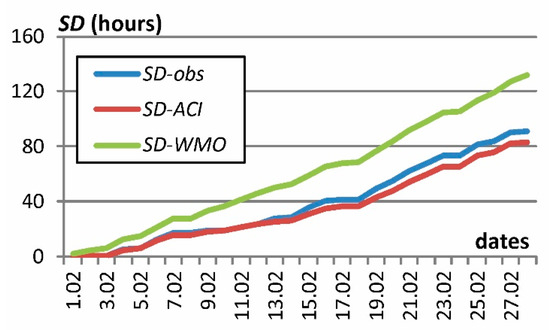
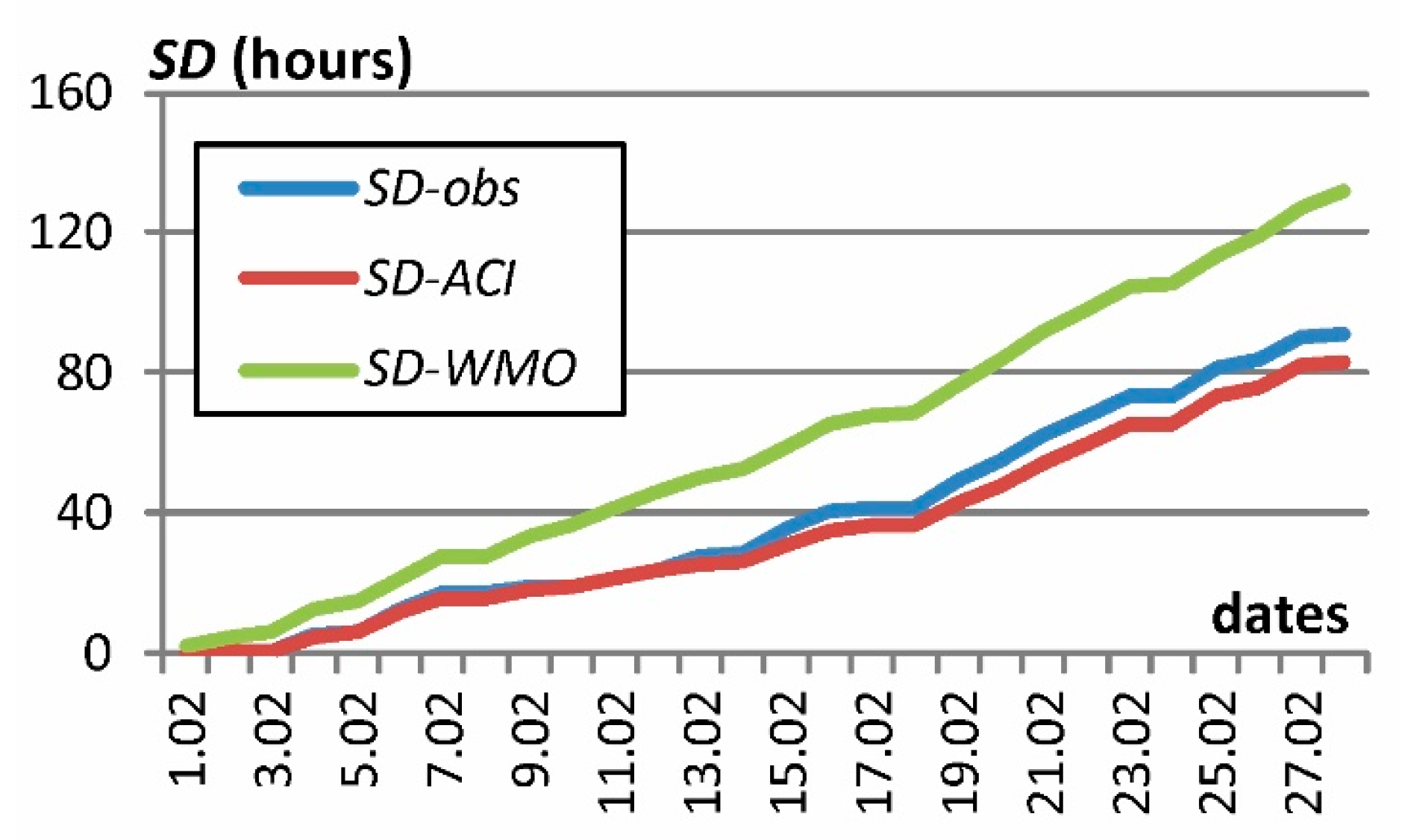
The better approximation of sunshine duration by the ACI method than by the WMO method is confirmed by the comparison of analyzing changes in sunshine during two selected months (February and June), differing in sun altitude. For this purpose, we have summarized daily SD sums (SD(d)). In February, monthly sums of sunshine duration (SD(m)) estimates made using the Slob–Monna method (SD-WMO) significantly exceed the measured sunshine values. On the last day of the month, this difference is over 40 h (SD(m)—91.4 h, SD-WMO(m)—131.7 h, i.e., 44% greater than the monthly measured value). For the method proposed by the authors, the difference between the measured and calculated sunshine duration is −7.9 h (91.4 and 83.5 h, respectively), meaning that the SD-ACI(m) values constitute 91% of the sunshine duration measured in this month (Figure 1).
Figure 1.
Monthly sunshine duration (cumulative values) in Świeradów-Zdrój in February 2018; SD-obs—measured values, SD-ACI—values assessed by ACI method, SD-WMO—values assessed by WMO method.
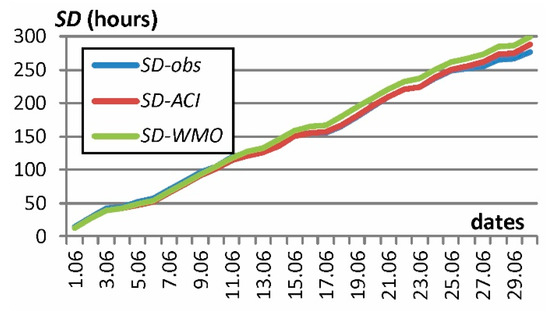
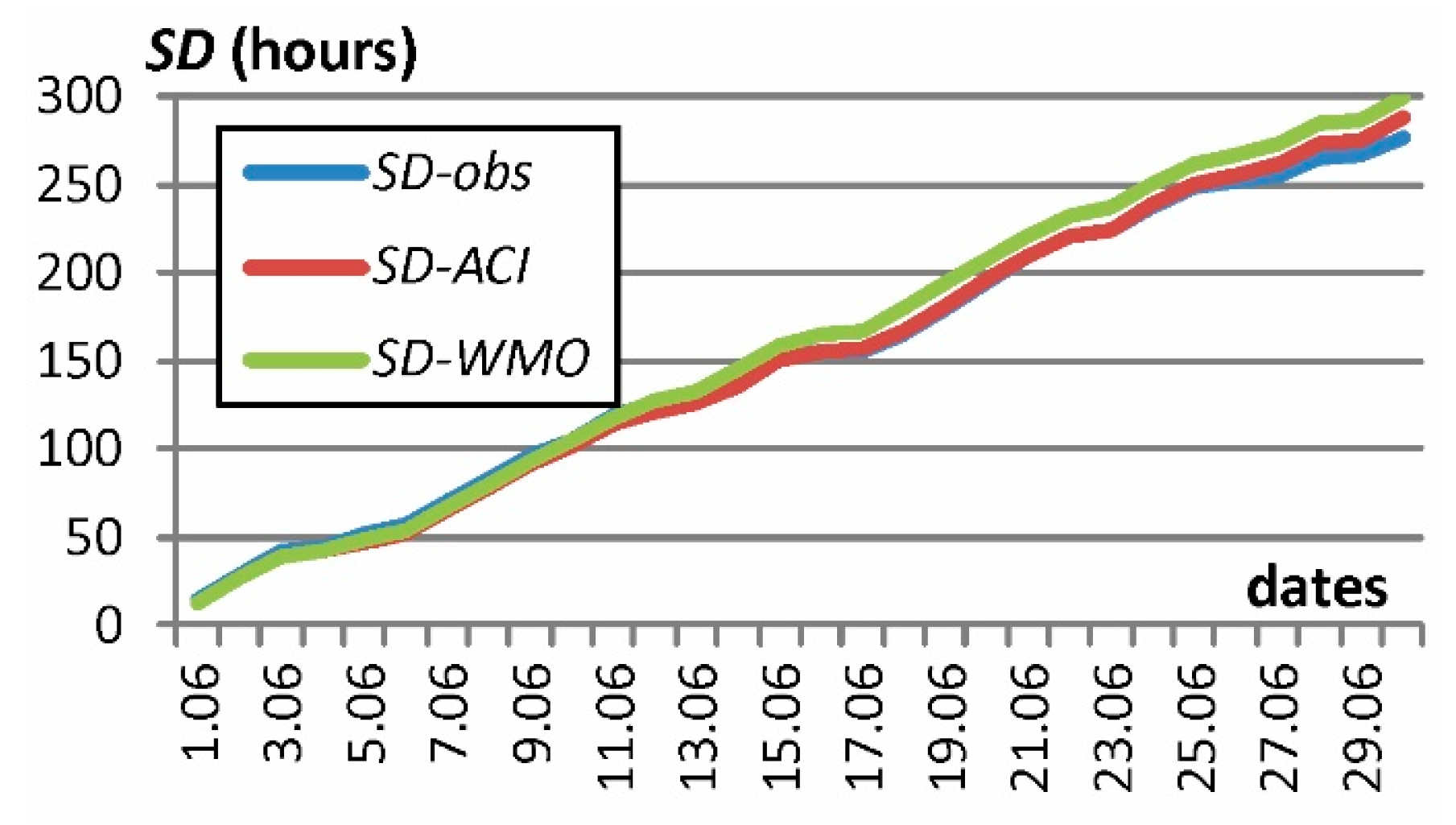
In June, the differences between measured and calculated sunshine duration monthly sums are small. Monthly sums were 277.2 h for monthly measured sunshine, 288.0 h for SD-ACI (10.8 h, i.e., 3.9% more than the measured values), and 295.5 h for SD-WMO (22.3 h, i.e., 6.6% more) (Figure 2).
Figure 2.
Monthly sums of sunshine duration (cumulative values) in Świeradów-Zdrój in June 2017; SD-obs—measured values, SD-ACI—values assessed by ACI method, SD-WMO—values assessed by WMO method.
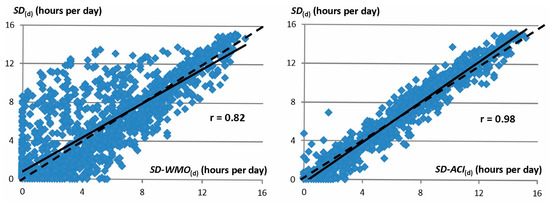
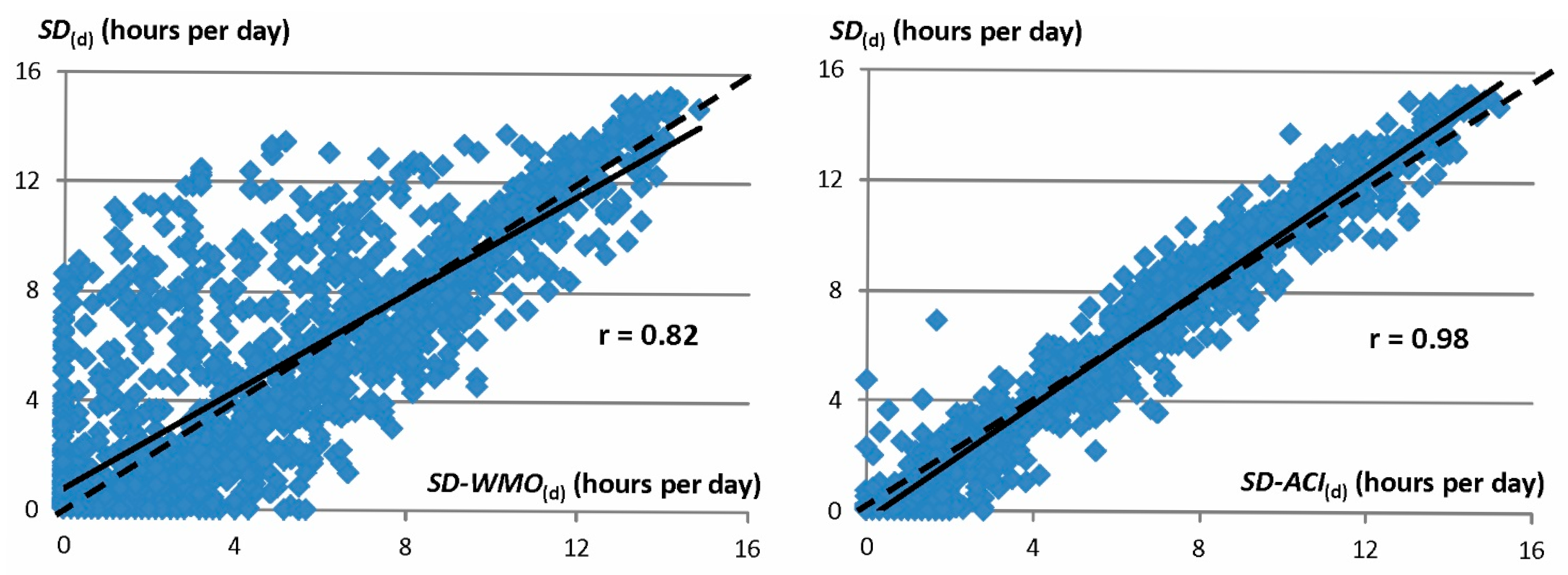
A comparison of mean sunshine duration values and mean differences between daily sunshine duration measured and calculated using the studied methods shows that those obtained using the ACI method are closer to the measured values than those obtained using the WMO method without any significant differentiation between stations (Table 3 and Table 4). This is confirmed by the analysis of the correlations between the measured and calculated values. Although the regression lines for both methods are similar, the dispersion of values is significantly greater for the WMO method than for the ACI one, as confirmed by the correlation coefficients, which are 0.82 for the WMO method and 0.98 for the ACI method (Figure 3).
Table 3.
Basic statistical characteristics of daily sunshine duration values (hours per day).
Table 4.
Basic statistical characteristics for differences (hours per day) of daily sunshine duration values.
Figure 3.
Relations between daily values of sunshine duration: observed (SD(d)) and calculated by WMO (SD-WMO(d)) and ACI (SD-ACI(d)) methods; regression line is solid and identity line is dotted.
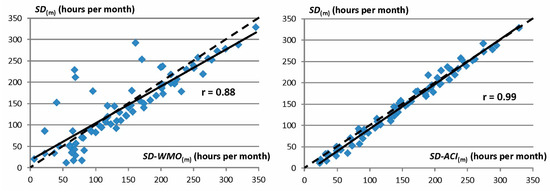
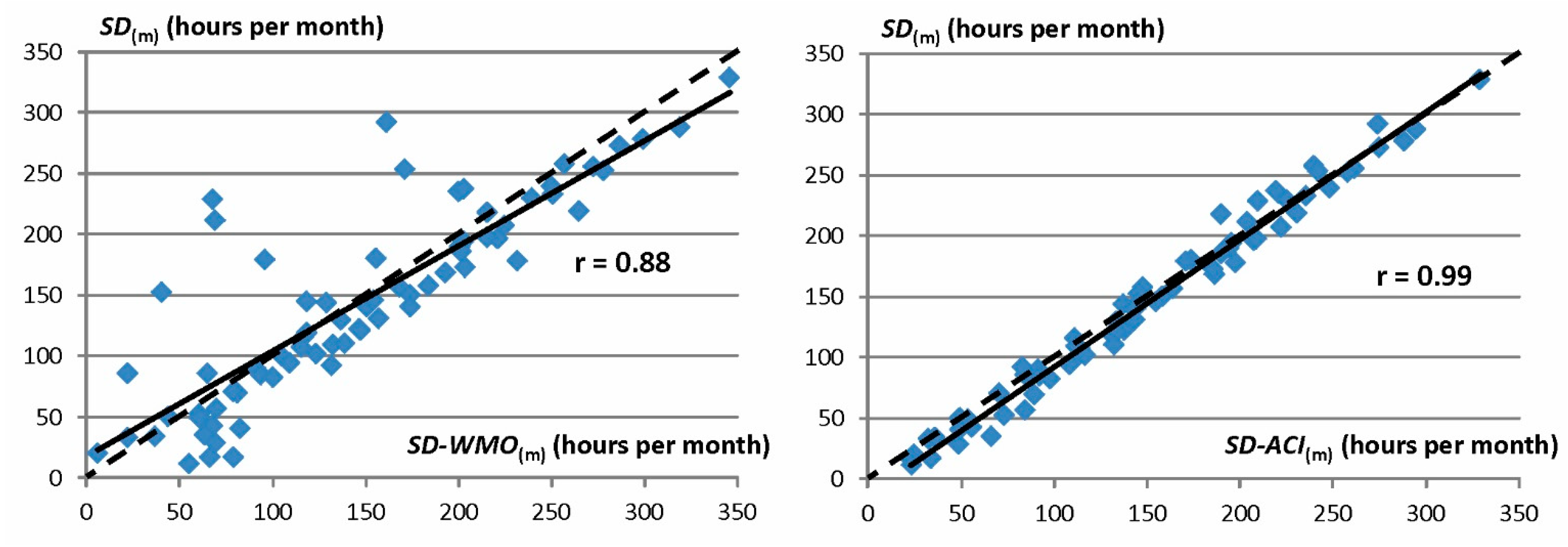
In some applications (human bioclimatology, agroclimatology, urban climate planning), monthly and seasonal sunshine duration sums are considered. Thus, the next step of the research was to determine the relations between measured and calculated monthly sums of sunshine duration. A comparison of mean sunshine duration values and mean differences between monthly sunshine duration were measured and calculated using the tested methods and shows that those obtained using the WMO method are slightly closer to the measured values than those obtained using the ACI method (Table 5 and Table 6). However, analysis of the correlations between measured and calculated values reveals that the dispersion of SD values is significantly greater for the WMO method than for the ACI method. For the WMO method, the correlation coefficient is 0.88, and for the ACI method it is 0.99 (Figure 4).
Table 5.
Basic statistical characteristics of monthly sums of sunshine duration (hours per month).
Table 6.
Basic statistical characteristics for differences (hours per month) of monthly sunshine duration values.
Figure 4.
Relations between daily values of sunshine duration: observed (SD(m)) and calculated by WMO (SD-WMO(m)) and ACI (SD-ACI(m)) methods; regression line is solid and identity line is dotted.
4. Discussion
The presented studies demonstrate that the sunshine duration can be estimated with satisfactory accuracy using the pyranometric method, which is one of the calculation methods recommended by the WMO [1]. When only 10 min time resolution measurements of global solar radiation are available, the WMO proposes the Slob–Monna method [1,24], which relies on the Linke turbidity factor (TL) for estimating diffuse radiation. As shown by Błażejczyk’s research [29], the use of the Slob–Monna method for Kdif estimation yields an error of 80–110%. His alternative method [29], based on the Ångström clearness index (ACI), yields an error of 15–20%. The ACI is frequently used in approximations of diffuse radiation in solar energy research [30,31,32]. Ridley et al. [28] reported similar relationships between ACI and the fraction of diffuse radiation as those founded by Blazejczyk [29] and used in the present study. The ACI-based method estimates the sunshine duration with significantly better accuracy than the Slob–Monna method for both 10 min values and daily and monthly SD.
The WMO assumption that there is no sunshine at sun altitude below 5.7 °C is not supported by two years of SD observations conducted in Poland, under climatic conditions typical of mid-latitude Europe. Sunshine duration was recorded even at hs around 1 °C. Similar conclusions were reached by Hinssen [26] and Fanjirindratovo et al. [27]. They propose using a sun altitude of 2 °C as the limit value for recording the sunshine duration. Current research confirms this suggestion. It appears that the authors’ method proposing the use of Ångström clearness index for assessing diffuse radiation significantly improves the accuracy of the pyranometric method for determining SD.
A comparison of observations made using Campbell–Stokes heliographs and electronic CSD sensors shows that SD values determined by CSD sensors, especially with respect to the daily and monthly periods, are higher than those obtained by the burn method [33,34]. Matuszko [3] explains this by the high sensitivity of electronic sensors to solar radiation at low sun positions. The SD-ACI method proposed in the present work well approximates this increased sensitivity of CSD censors.
5. Conclusions
- Our research aimed to validate the accuracy of two methods used to approximate sunshine duration, namely, the Slob–Monna method recommended by the WMO and the authors’ method based on the Ångström clearness index.
- For the stations located in the Central European climate region, the ACI-based pyranometric method, proposed in the current work, better approximates SD values than the Slob–Monna method recommended by the WMO. This is most clearly seen when considering daily and monthly sums of sunshine duration. The correlation coefficients for daily values are 0.82 for the WMO method and 0.98 for the ACI method. For monthly SD sums, the correlations are 0.88 and 0.99, respectively.
- Observed data show that sunshine can be recorded by CSD sensors even at a sun altitude below 1–2°. Thus, further research is needed to determine the threshold value of sun altitude at which SD cannot be recorded. This is especially important for research applying the Slob–Monna method. The ACI-based method is not sensitive for sun altitude.
- Further studies related to the influence of direct radiation on the approximation of sunshine duration by the Slob–Monna and ACI-based methods are necessary. They need collective efforts of researchers from different regions and climates.
- While the studies were carried out in Poland, representative of the temperate climate zone of Central Europe, further research is needed to verify the accuracy of the ACI-based method in other climate zones and at other sun altitude belts. Close co-operation of researchers from different science centers is expected.
Author Contributions
Conceptualization, K.B.; Methodology, K.B.; Validation, A.B. and J.B.; Investigation, K.B. and J.B.; Data Curation, J.B.; Writing—Original Draft Preparation, K.B.; Writing—Review and Editing, K.B. and A.B.; Visualization, A.B. All authors have read and agreed to the published version of the manuscript.
Funding
This research received no external funding.
Institutional Review Board Statement
Not applicable.
Informed Consent Statement
Not applicable.
Data Availability Statement
The data could be available after the contact with Authors.
Conflicts of Interest
The authors declare no conflict of interest.
References
- WMO. Guide to Instruments and Methods of Observation, Volume I–Measurement of Meteorological Variables; WMO-No-8; WMO: Geneva, Switzerland, 2023; pp. 336–351. [Google Scholar]
- Matuszko, D. Long-term variability in solar radiation in Krakow based on measurements of sunshine duration. Int. J. Climatol. 2014, 34, 228–234. [Google Scholar] [CrossRef] [Scilit]
- Matuszko, D. A comparison of sunshine duration records from the Campbell-Stokes sunshine recorder and CSD3 sunshine duration sensor. Theor. Appl. Climatol. 2015, 419, 401–406. [Google Scholar] [CrossRef] [Scilit]
- Hinssen, Y.B.L.; Knap, W.H. 2007: Comparison of pyranometric and pyrheliometric methods for the determination of sunshine duration. J. Atmosph Ocean. Technol. 2007, 24, 835–846. [Google Scholar] [CrossRef] [Scilit]
- Błażejczyk, K.; Kunert, A. Bioklimatyczne Uwarunkowania Rekreacji i Turystyki w Polsce, 2nd ed.; Monografie; IGiPZ PAN: Warszawa, Poland, 2011; Volume 13, pp. 24–50. [Google Scholar]
- Uscka-Kowalkowska, J. Bezpośrednie Promieniowanie Słoneczne w Polsce w Latach 1966-2010; Wydawnictwo Naukowe Uniwersytetu Mikołaja Kopernika: Toruń, Poland, 2019. [Google Scholar]
- Heim, D.; Narowski, P.; Szczepańska, E. Obliczeniowy współczynnik zmętnienia atmosfery dla obszaru Polski. Fiz. Budowli W Teor. I Prakt. 2007, 2, 91–96. [Google Scholar]
- Bartoszek, K.; Matuszko, D.; Soroka, J. Relationships between cloudiness, aerosol optical thickness, and sunshine duration in Poland. Atmos. Res. 2020, 245, 105097. [Google Scholar] [CrossRef] [Scilit]
- Kejna, M.; Uscka-Kowalkowska, J.; Kejna, P. The influence of cloudiness and atmospheric circulation on radiation balance and its components. Theor. Appl. Climatol. 2021, 144, 823–838. [Google Scholar] [CrossRef] [Scilit]
- Uscka-Kowalkowska, J.; Posyniak, M.; Markowicz, K.M.; Podgórski, J. Comparison of the Linke turbidity factor in Warsaw and in Belsk. Bull. Geogr. Phys. Geogr. Ser. 2017, 13, 71–81. [Google Scholar] [CrossRef] [Scilit]
- Paulescu, M.; Stefu, N.; Calinoiu, D.; Paulescu, E.; Pop, N.; Boata, R.; Mares, O. Ångström–Prescott equation: Physical basis, empirical models and sensitivity analysis. Renew. Sustain. Energy Rev. 2016, 62, 495–506. [Google Scholar] [CrossRef] [Scilit]
- Ronno, C.K. Estimation of Global Radiation using Ångström-Type Models at Selected Sites in Kenya. Afr. J. Educ. Sci. Technol. 2017, 4, 63–70. [Google Scholar]
- Matuszko, D. Influence of cloudiness on sunshine duration. Int. J. Climatol. 2012, 32, 1527–1536. [Google Scholar] [CrossRef] [Scilit]
- Matuszko, D. Wpływ Zachmurzenia na Usłonecznienie i Całkowite Promieniowanie Słoneczne na Przykładzie Krakowskiej Serii Pomiarów; Wydawnictwo Uniwersytetu Jagiellońskiego: Kraków, Poland, 2009. [Google Scholar]
- Black, J.N. The distribution of solar radiation over the Earth’s surface. Theor. Appl. Climatol. 1956, 7, 165–189. [Google Scholar] [CrossRef] [Scilit]
- El-Metwally, M. Sunshine and global solar radiation estimation at different sites in Egypt. J. Atmosph Sol. Terr. Phys. 2005, 67, 1331–1342. [Google Scholar] [CrossRef] [Scilit]
- Gopinathan, K.K. A general formula for computing the coefficients of the correlation connecting global solar radiation to sunshine duration. Sol. Energy 1988, 41, 499–502. [Google Scholar] [CrossRef] [Scilit]
- Hussain, M.; Rahman, L.; Rahman, M.M. Technical note: Techniques to obtain improved predictions of global radiation from sunshine duration. Renew. Energy 1999, 18, 263–275. [Google Scholar]
- Bartoszek, K.; Matuszko, D.; Węglarczyk, S. Trends in sunshine duration in Poland (1971–2018). Int. J. Climatol. 2021, 41, 73–91. [Google Scholar] [CrossRef] [Scilit]
- Matuszko, D.; Węglarczyk, S.; Bartoszek, K.; Soroka, J.; Bogdańska, B. Change of sunshine. In Climate Change in Poland; Falarz, M., Ed.; Springer Climate: Cham, Switzerland, 2021; pp. 189–215. [Google Scholar]
- Marsz, A.; Matuszko, D.; Styszyńska, A. The thermal state of the North Atlantic and macro-circulation conditions in the Atlantic-European sector, and changes in sunshine duration in Central Europe. Int. J. Climatol. 2022, 42, 748–761. [Google Scholar] [CrossRef] [Scilit]
- Marsz, A.; Styszyńska, A.; Matuszko, D. The Long-Term Course of the Annual Total Sunshine Duration in Europe and Changes in the Phases of the Thermohaline Circulation in the North Atlantic (1901–2018). Quaest. Geogr. 2023, 42, 49–65. [Google Scholar] [CrossRef] [Scilit]
- Matuszko, D.; Węglarczyk, S. Relationship between sunshine duration and air temperature and contemporary global warming. Int. J. Climatol. 2014, 35, 3640–3653. [Google Scholar] [CrossRef] [Scilit]
- Slob, W.H.; Monna, W.A.A. Bepaling van een Directe en Diffuse Straling en van Zonneschijnduur uit 10-Minuutwaarden van de Globale Straling; KNMI Technische Rapporten 136; KNMI: De Bilt, The Netherlands, 1991. [Google Scholar]
- Bergman, U. Het Programma voor Berekening van Zonneschijnduur uit Globale Straling; Technische Rapporten; TR–158; KNMI: De Bilt, The Netherlands, 1993. [Google Scholar]
- Hinssen, Y.B.L. Comparison of Different Methods for the Determination of Sunshine Duration; Scientific report; WR-2006-06; KNMI: De Bilt, The Netherlands, 2006. [Google Scholar]
- Fanjirindratovo, T.; Calogine, D.; Chau, O.; Ramiarinjanahary, O. Applying and Improving Pyranometric Methods to Estimate Sunshine Duration for Tropical Site. Solar 2024, 4, 455–470. [Google Scholar] [CrossRef] [Scilit]
- Ridley, B.; Boland, J.; Lauret, P. Modelling of diffuse solar fraction with multiple predictors. Renew. Energy 2010, 35, 478–483. [Google Scholar] [CrossRef] [Scilit]
- Błażejczyk, K. Statistical modelling of diffuse solar radiation for temperate climate of Central Europe. Geogr. Pol. 2025, in press. [Google Scholar]
- Boland, J.; Ridley, B.H.; Brown, B.M. Models of diffuse solar radiation. Renew. Energy 2008, 33, 575–584. [Google Scholar] [CrossRef] [Scilit]
- Erbs, D.G.; Klein, S.A.; Duffie, J.A. Estimation of the diffuse radiation fraction for hourly, daily and monthly average global radiation. Sol. Energy 1982, 28, 293–302. [Google Scholar] [CrossRef] [Scilit]
- Gonzales, J.A.; Calbó, J. Influence of the global radiation variability on the hourly diffuse fraction correlations. Sol. Energy 1999, 65, 119–131. [Google Scholar] [CrossRef] [Scilit]
- Kerr, A.; Tabony, R. Comparison of sunshine recorded by Campbell–Stokes and automatic sensors. Weather 2004, 59, 90–95. [Google Scholar] [CrossRef] [Scilit]
- Pashiardis, S.; Pelengaris, A.; Kalogirou, S.A. Comparison of Sunshine Duration Measurements between the Campbell–Stokes Sunshine Recorder and Three Automatic Sensors at Three Locations in Cyprus. Appl. Sci. 2023, 13, 12393. [Google Scholar] [CrossRef] [Scilit]

Disclaimer/Publisher’s Note: The statements, opinions and data contained in all publications are solely those of the individual author(s) and contributor(s) and not of MDPI and/or the editor(s). MDPI and/or the editor(s) disclaim responsibility for any injury to people or property resulting from any ideas, methods, instructions or products referred to in the content. |
© 2026 by the authors. Licensee MDPI, Basel, Switzerland. This article is an open access article distributed under the terms and conditions of the Creative Commons Attribution (CC BY) license.