


A New Framework for Comprehensive Flood Risk Assessment Under Non-Stationary Conditions Using GIS-Based MCDM Modeling


Abstract
1. Introduction
2. Materials
2.1. Study Area
2.2. Defining the Evaluation Criteria
2.3. Atmospheric Oscillations
3. Methodology
3.1. Analytical Hierarchy Process (AHP)
3.2. VIKOR
3.3. GAMLSS Model
3.4. Model Selection and Assessment
4. Results
4.1. Evaluation of AHP Findings
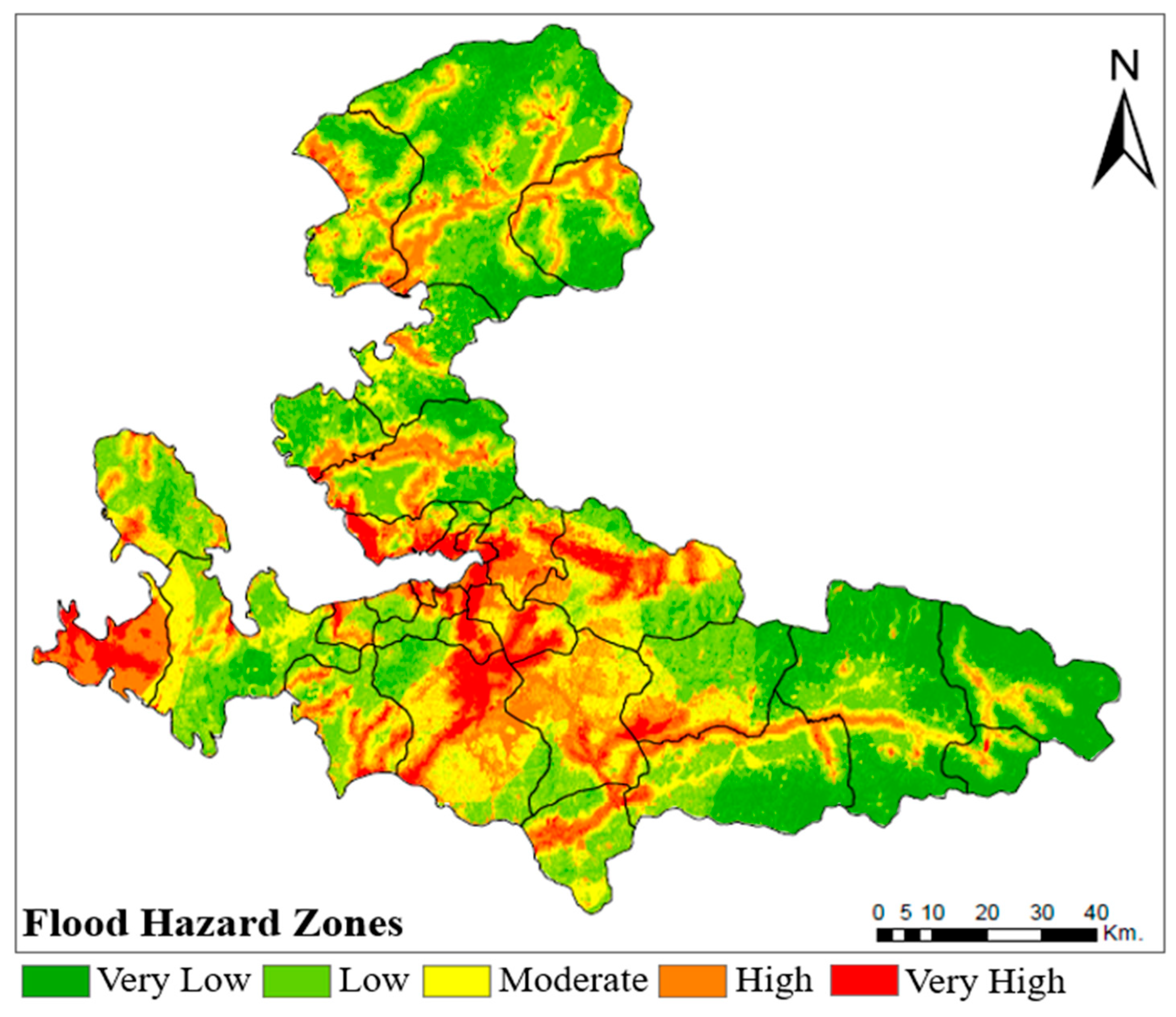
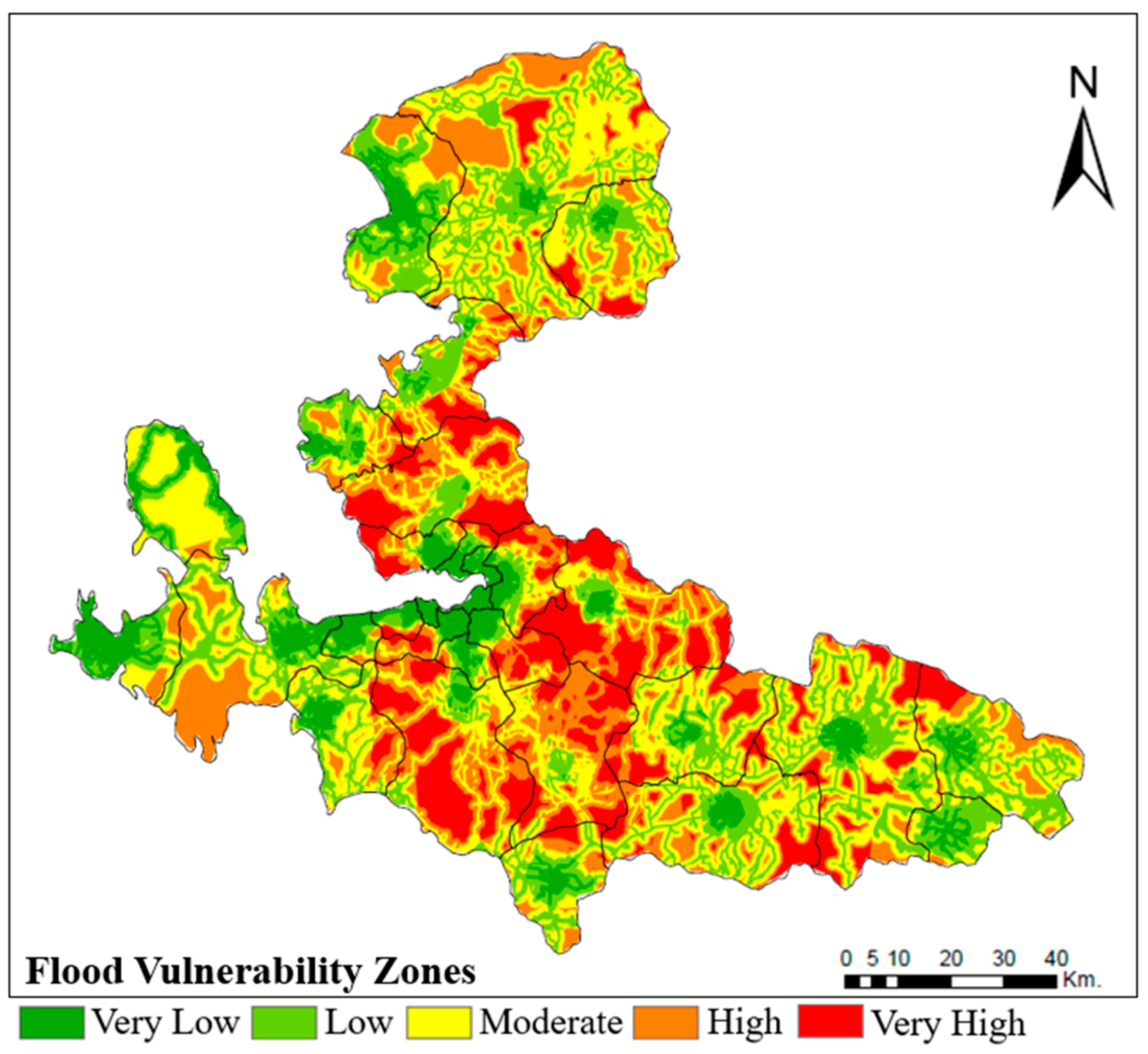
4.2. Evaluation of AHP-Based GIS
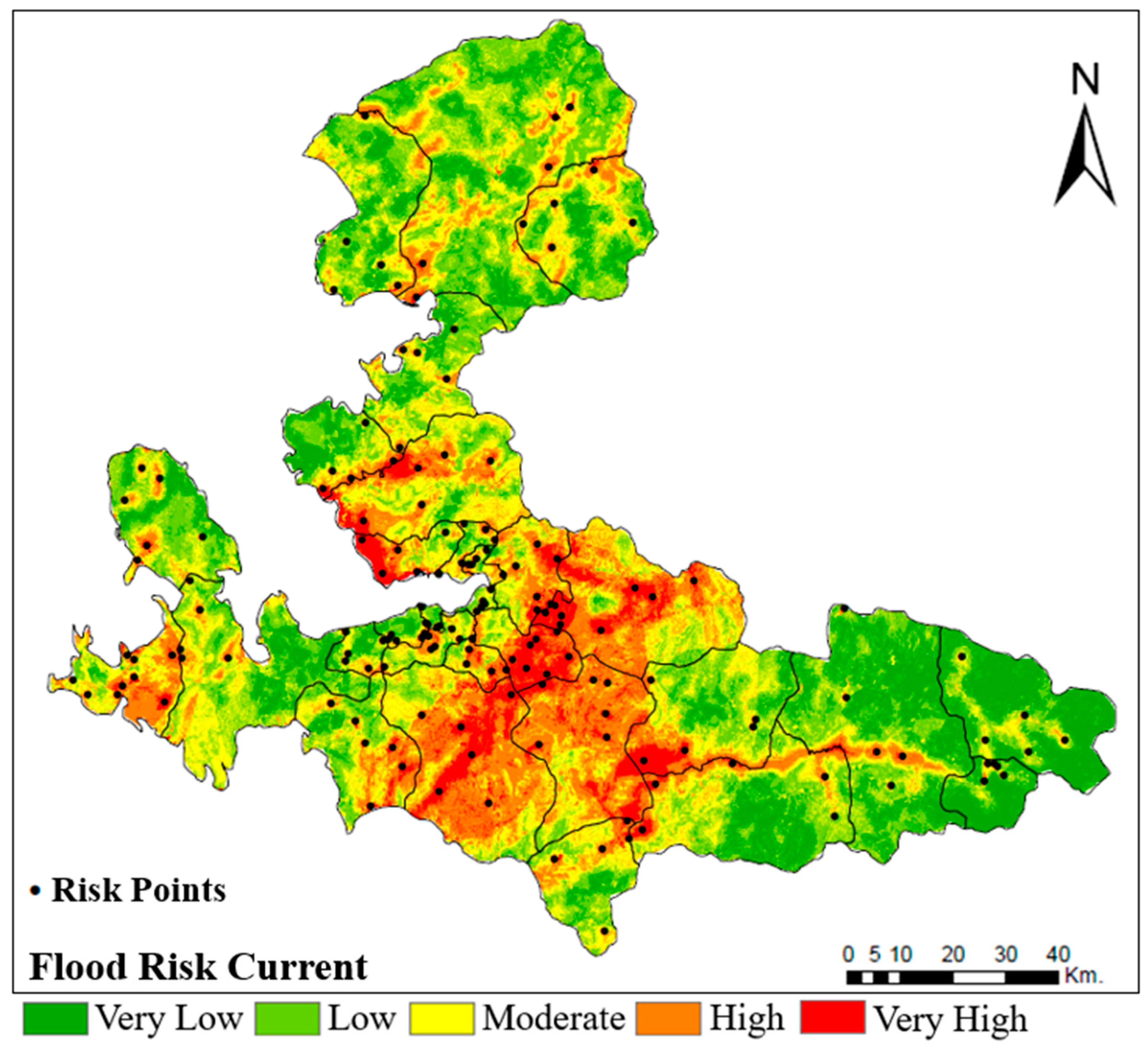
4.3. Risk Assessment with the VIKOR Method
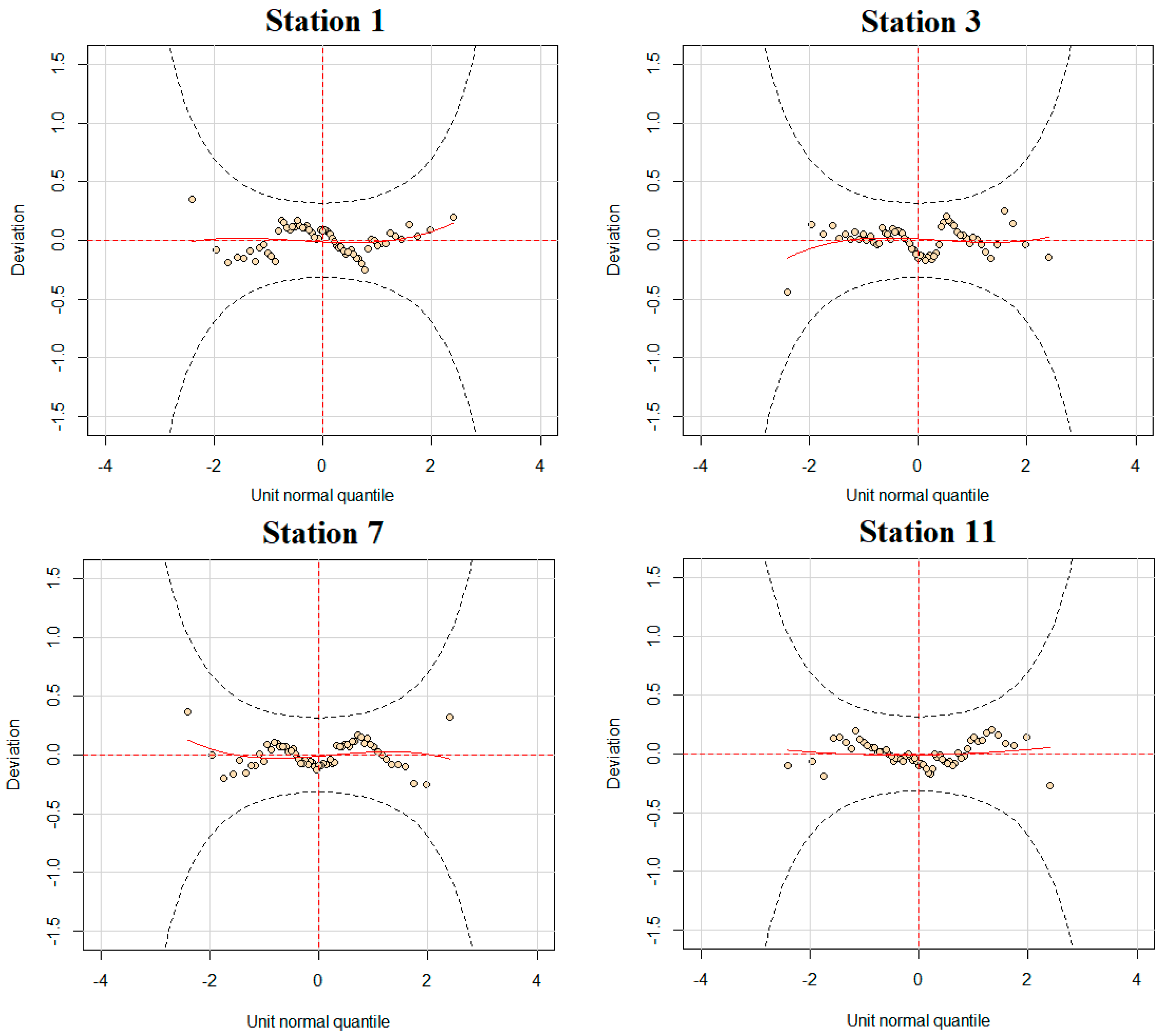
4.4. Modeling with GAMLSS and Comprehensive Risk Assessment Under Non-Stationary Conditions
5. Discussion
6. Conclusions
Supplementary Materials
Author Contributions
Funding
Institutional Review Board Statement
Informed Consent Statement
Data Availability Statement
Acknowledgments
Conflicts of Interest
References
- Sui, Y.; Lang, X.; Jiang, D. Projected Signals in Climate Extremes over China Associated with a 2 °C Global Warming under Two RCP Scenarios. Int. J. Climatol. 2018, 38, e678–e697. [Google Scholar] [CrossRef] [Scilit]
- Farooq, U.; Taha Bakheit Taha, A.; Tian, F.; Yuan, X.; Ajmal, M.; Ullah, I.; Ahmad, M. Flood Modelling and Risk Analysis of Cinan Feizuo Flood Protection Area, Huaihe River Basin. Atmosphere 2023, 14, 678. [Google Scholar] [CrossRef] [Scilit]
- Foudi, S.; Osés-Eraso, N.; Tamayo, I. Integrated Spatial Flood Risk Assessment: The Case of Zaragoza. Land Use Policy 2015, 42, 278–292. [Google Scholar] [CrossRef] [Scilit]
- Papaioannou, G.; Vasiliades, L.; Loukas, A. Multi-Criteria Analysis Framework for Potential Flood Prone Areas Mapping. Water Resour. Manag. 2015, 29, 399–418. [Google Scholar] [CrossRef] [Scilit]
- Tellman, B.; Sullivan, J.A.; Kuhn, C.; Kettner, A.J.; Doyle, C.S.; Brakenridge, G.R.; Erickson, T.A.; Slayback, D.A. Satellite Imaging Reveals Increased Proportion of Population Exposed to Floods. Nature 2021, 596, 80–86. [Google Scholar] [CrossRef] [Scilit]
- O’Donnell, E.C.; Thorne, C.R. Drivers of Future Urban Flood Risk. Philos. Trans. R. Soc. A Math. Phys. Eng. Sci. 2020, 378, 20190216. [Google Scholar] [CrossRef] [Scilit] [PubMed]
- Lima, F.N.; Freitas, A.C.V.; Silva, J. Climate Change Flood Risk Analysis: Application of Dynamical Downscaling and Hydrological Modeling. Atmosphere 2023, 14, 1069. [Google Scholar] [CrossRef] [Scilit]
- Lyu, H.M.; Yin, Z.Y. An Improved MCDM Combined with GIS for Risk Assessment of Multi-Hazards in Hong Kong. Sustain. Cities Soc. 2023, 91, 104427. [Google Scholar] [CrossRef] [Scilit]
- Melesse, A.M.; Shih, S.F. Spatially Distributed Storm Runoff Depth Estimation Using Landsat Images and GIS. Comput. Electron. Agric. 2003, 37, 173–183. [Google Scholar] [CrossRef] [Scilit]
- Kron, W. Flood Risk = Hazard • Values • Vulnerability. Water Int. 2005, 30, 58–68. [Google Scholar] [CrossRef] [Scilit]
- Müller, A.; Reiter, J.; Weiland, U. Assessment of Urban Vulnerability towards Floods Using an Indicator-Based Approach-a Case Study for Santiago de Chile. Nat. Hazards Earth Syst. Sci. 2011, 11, 2107–2123. [Google Scholar] [CrossRef] [Scilit]
- Wang, Y.; Sebastian, A. Community Flood Vulnerability and Risk Assessment: An Empirical Predictive Modeling Approach. J. Flood Risk Manag. 2021, 14, e12739. [Google Scholar] [CrossRef] [Scilit]
- Menoni, S.; Molinari, D.; Parker, D.; Ballio, F.; Tapsell, S. Assessing Multifaceted Vulnerability and Resilience in Order to Design Risk-Mitigation Strategies. Nat. Hazards 2012, 64, 2057–2082. [Google Scholar] [CrossRef] [Scilit]
- Lyu, H.M.; Shen, S.L.; Zhou, A.; Yang, J. Perspectives for Flood Risk Assessment and Management for Mega-City Metro System. Tunn. Undergr. Space Technol. 2019, 84, 31–44. [Google Scholar] [CrossRef] [Scilit]
- Nkwunonwo, U.C.; Whitworth, M.; Baily, B. A Review of the Current Status of Flood Modelling for Urban Flood Risk Management in the Developing Countries. Sci. Afr. 2020, 7, e00269. [Google Scholar] [CrossRef] [Scilit]
- Abdrabo, K.I.; Kantoush, S.A.; Saber, M.; Sumi, T.; Habiba, O.M.; Elleithy, D.; Elboshy, B. Integrated Methodology for Urban Flood Risk Mapping at the Microscale in Ungauged Regions: A Case Study of Hurghada, Egypt. Remote Sens. 2020, 12, 3548. [Google Scholar] [CrossRef] [Scilit]
- Bates, P.D.; Wilson, M.D.; Horritt, M.S.; Mason, D.C.; Holden, N.; Currie, A. Reach Scale Floodplain Inundation Dynamics Observed Using Airborne Synthetic Aperture Radar Imagery: Data Analysis and Modelling. J. Hydrol. 2006, 328, 306–318. [Google Scholar] [CrossRef] [Scilit]
- Mosavi, A.; Ozturk, P.; Chau, K.W. Flood Prediction Using Machine Learning Models: Literature Review. Water 2018, 10, 1536. [Google Scholar] [CrossRef] [Scilit]
- Zhang, J.; Chen, Y. Risk Assessment of Flood Disaster Induced by Typhoon Rainstorms in Guangdong Province, China. Sustainability 2019, 11, 2738. [Google Scholar] [CrossRef] [Scilit]
- Munpa, P.; Dubsok, A.; Phetrak, A.; Sirichokchatchawan, W.; Taneepanichskul, N.; Lohwacharin, J.; Kittipongvises, S.; Polprasert, C. Building a Resilient City through Sustainable Flood Risk Management: The Flood-Prone Area of Phra Nakhon Sri Ayutthaya, Thailand. Sustainability 2024, 16, 6450. [Google Scholar] [CrossRef] [Scilit]
- Liu, Y.B.; Gebremeskel, S.; De Smedt, F.; Hoffmann, L.; Pfister, L. A Diffusive Transport Approach for Flow Routing in GIS-Based Flood Modeling. J. Hydrol. 2003, 283, 91–106. [Google Scholar] [CrossRef] [Scilit]
- Zheng, Q.; Shen, S.L.; Zhou, A.; Lyu, H.M. Inundation Risk Assessment Based on G-DEMATEL-AHP and Its Application to Zhengzhou Flooding Disaster. Sustain. Cities Soc. 2022, 86, 104138. [Google Scholar] [CrossRef] [Scilit]
- Cai, S.; Fan, J.; Yang, W. Flooding Risk Assessment and Analysis Based on Gis and the Tfn-Ahp Method: A Case Study of Chongqing, China. Atmosphere 2021, 12, 623. [Google Scholar] [CrossRef] [Scilit]
- Shariati, M.; Kazemi, M.; Naderi Samani, R.; Kaviani Rad, A.; Kazemi Garajeh, M.; Kariminejad, N. An Integrated Geospatial and Statistical Approach for Flood Hazard Assessment. Environ. Earth Sci. 2023, 82, 384. [Google Scholar] [CrossRef] [Scilit]
- Pathan, A.I.; Girish Agnihotri, P.; Said, S.; Patel, D. AHP and TOPSIS Based Flood Risk Assessment—A Case Study of the Navsari City, Gujarat, India; Springer International Publishing: Berlin/Heidelberg, Germany, 2022; Volume 194, ISBN 1066102210111. [Google Scholar]
- Ahmadisharaf, E.; Tajrishy, M.; Alamdari, N. Integrating Flood Hazard into Site Selection of Detention Basins Using Spatial Multi-Criteria Decision-Making. J. Environ. Plan. Manag. 2016, 59, 1397–1417. [Google Scholar] [CrossRef] [Scilit]
- Dadrasajirlou, Y.; Karami, H.; Mirjalili, S. Using AHP-PROMOTHEE for Selection of Best Low-Impact Development Designs for Urban Flood Mitigation. Water Resour. Manag. 2023, 37, 375–402. [Google Scholar] [CrossRef] [Scilit]
- Zarei, A.R.; Moghimi, M.M.; Koohi, E. Sensitivity Assessment to the Occurrence of Different Types of Droughts Using GIS and AHP Techniques. Water Resour. Manag. 2021, 35, 3593–3615. [Google Scholar] [CrossRef] [Scilit]
- Agustina, R.D.; Putra, R.P.; Susanti, S. Mapping Greater Bandung Flood Susceptibility Based on Multi-Criteria Decision Analysis (MCDA) Using AHP Method. Environ. Earth Sci. 2023, 82, 370. [Google Scholar] [CrossRef] [Scilit]
- Al-Abadi, A.M.; Shahid, S.; Al-Ali, A.K. A GIS-Based Integration of Catastrophe Theory and Analytical Hierarchy Process for Mapping Flood Susceptibility: A Case Study of Teeb Area, Southern Iraq. Environ. Earth Sci. 2016, 75, 687. [Google Scholar] [CrossRef] [Scilit]
- Doorga, J.R.S.; Magerl, L.; Bunwaree, P.; Zhao, J.; Watkins, S.; Staub, C.G.; Rughooputh, S.D.D.V.; Cunden, T.S.M.; Lollchund, R.; Boojhawon, R. GIS-Based Multi-Criteria Modelling of Flood Risk Susceptibility in Port Louis, Mauritius: Towards Resilient Flood Management. Int. J. Disaster Risk Reduct. 2022, 67, 102683. [Google Scholar] [CrossRef] [Scilit]
- Ha-Mim, N.M.; Rahman, M.A.; Hossain, M.Z.; Fariha, J.N.; Rahaman, K.R. Employing Multi-Criteria Decision Analysis and Geospatial Techniques to Assess Flood Risks: A Study of Barguna District in Bangladesh. Int. J. Disaster Risk Reduct. 2022, 77, 103081. [Google Scholar] [CrossRef] [Scilit]
- Ramkar, P.; Yadav, S.M. Flood Risk Index in Data-Scarce River Basins Using the AHP and GIS Approach. Nat. Hazards 2021, 109, 1119–1140. [Google Scholar] [CrossRef] [Scilit]
- Dutta, P.; Deka, S. A Novel Approach to Flood Risk Assessment: Synergizing with Geospatial Based MCDM-AHP Model, Multicollinearity, and Sensitivity Analysis in the Lower Brahmaputra Floodplain, Assam. J. Clean. Prod. 2024, 467, 142985. [Google Scholar] [CrossRef] [Scilit]
- Chen, Y.; Liu, T.; Ge, Y.; Xia, S.; Yuan, Y.; Li, W.; Xu, H. Examining Social Vulnerability to Flood of Affordable Housing Communities in Nanjing, China: Building Long-Term Disaster Resilience of Low-Income Communities. Sustain. Cities Soc. 2021, 71, 102939. [Google Scholar] [CrossRef] [Scilit]
- Myhre, G.; Alterskjær, K.; Stjern, C.W.; Hodnebrog, Ø.; Marelle, L.; Samset, B.H.; Sillmann, J.; Schaller, N.; Fischer, E.; Schulz, M.; et al. Frequency of Extreme Precipitation Increases Extensively with Event Rareness under Global Warming. Sci. Rep. 2019, 9, 16063. [Google Scholar] [CrossRef] [Scilit]
- Jian, W.; Li, S.; Lai, C.; Wang, Z.; Cheng, X.; Lo, E.Y.M.; Pan, T.C. Evaluating Pluvial Flood Hazard for Highly Urbanised Cities: A Case Study of the Pearl River Delta Region in China. Nat. Hazards 2021, 105, 1691–1719. [Google Scholar] [CrossRef] [Scilit]
- Rangari, V.A.; Umamahesh, N.V.; Patel, A.K. Flood-Hazard Risk Classification and Mapping for Urban Catchment under Different Climate Change Scenarios: A Case Study of Hyderabad City. Urban Clim. 2021, 36, 100793. [Google Scholar] [CrossRef] [Scilit]
- Chen, J.; Gao, C.; Zhou, H.; Wang, Q.; She, L.; Qing, D.; Cao, C. Urban Flood Risk Assessment Based on a Combination of Subjective and Objective Multi-Weight Methods. Appl. Sci. 2024, 14, 3694. [Google Scholar] [CrossRef] [Scilit]
- Zzaman, R.U.; Nowreen, S.; Billah, M.; Islam, A.S. Flood Hazard Mapping of Sangu River Basin in Bangladesh Using Multi-Criteria Analysis of Hydro-Geomorphological Factors. J. Flood Risk Manag. 2021, 14, e12715. [Google Scholar] [CrossRef] [Scilit]
- Radwan, F.; Alazba, A.A.; Mossad, A. Flood Risk Assessment and Mapping Using AHP in Arid and Semiarid Regions. Acta Geophys. 2019, 67, 215–229. [Google Scholar] [CrossRef] [Scilit]
- Bajirao, T.S. Comparative Performance of Different Probability Distribution Functions for Maximum Rainfall Estimation at Different Time Scales. Arab. J. Geosci. 2021, 14, 2138. [Google Scholar] [CrossRef] [Scilit]
- Ye, L.; Hanson, L.S.; Ding, P.; Wang, D.; Vogel, R.M. The Probability Distribution of Daily Precipitation at the Point and Catchment Scales in the United States. Hydrol. Earth Syst. Sci. 2018, 22, 6519–6531. [Google Scholar] [CrossRef] [Scilit]
- Gu, X.; Zhang, Q.; Li, J.; Singh, V.P.; Sun, P. Impact of Urbanization on Nonstationarity of Annual and Seasonal Precipitation Extremes in China. J. Hydrol. 2019, 575, 638–655. [Google Scholar] [CrossRef] [Scilit]
- Scala, P.; Cipolla, G.; Treppiedi, D.; Noto, L.V. The Use of GAMLSS Framework for a Non-Stationary Frequency Analysis of Annual Runoff Data over a Mediterranean Area. Water 2022, 14, 2848. [Google Scholar] [CrossRef] [Scilit]
- Gu, X.; Zhang, Q.; Singh, V.P.; Xiao, M.; Cheng, J. Nonstationarity-Based Evaluation of Flood Risk in the Pearl River Basin: Changing Patterns, Causes and Implications. Hydrol. Sci. J. 2017, 62, 246–258. [Google Scholar] [CrossRef] [Scilit]
- Gu, X.; Zhang, Q.; Singh, V.P.; Shi, P. Non-Stationarities in the Occurrence Rate of Heavy Precipitation across China and Its Relationship to Climate Teleconnection Patterns. Int. J. Climatol. 2017, 37, 4186–4198. [Google Scholar] [CrossRef] [Scilit]
- Liu, H.; Zou, L.; Xia, J.; Chen, T.; Wang, F. Impact Assessment of Climate Change and Urbanization on the Nonstationarity of Extreme Precipitation: A Case Study in an Urban Agglomeration in the Middle Reaches of the Yangtze River. Sustain. Cities Soc. 2022, 85, 104038. [Google Scholar] [CrossRef] [Scilit]
- Xiong, L.; Yan, L.; Du, T.; Yan, P.; Li, L.; Xu, W. Impacts of Climate Change on Urban Extreme Rainfall and Drainage Infrastructure Performance: A Case Study in Wuhan City, China. Irrig. Drain. 2019, 68, 152–164. [Google Scholar] [CrossRef] [Scilit]
- Han, S.; Slater, L.; Wilby, R.L.; Faulkner, D. Contribution of Urbanisation to Non-Stationary River Flow in the UK. J. Hydrol. 2022, 613, 128417. [Google Scholar] [CrossRef] [Scilit]
- Tosunoglu, F.; Slater, L.J.; Kowal, K.M.; Gu, X.; Yin, J. Non-Stationary Modeling of Seasonal Precipitation Series in Turkey: Estimating the Plausible Range of Seasonal Extremes. Theor. Appl. Climatol. 2024, 155, 3071–3085. [Google Scholar] [CrossRef] [Scilit]
- MGM Statistics. Available online: https://www.mgm.gov.tr/ (accessed on 5 September 2025).
- Turkish Statistical Institute Geographic Statistics Portal. Available online: https://cip.tuik.gov.tr/ (accessed on 10 September 2025).
- Tang, Z.; Zhang, H.; Yi, S.; Xiao, Y. Assessment of Flood Susceptible Areas Using Spatially Explicit, Probabilistic Multi-Criteria Decision Analysis. J. Hydrol. 2018, 558, 144–158. [Google Scholar] [CrossRef] [Scilit]
- Lyu, H.M.; Sun, W.J.; Shen, S.L.; Arulrajah, A. Flood Risk Assessment in Metro Systems of Mega-Cities Using a GIS-Based Modeling Approach. Sci. Total Environ. 2018, 626, 1012–1025. [Google Scholar] [CrossRef] [Scilit]
- Lyu, H.M.; Shen, S.L.; Zhou, A.N.; Zhou, W.H. Flood Risk Assessment of Metro Systems in a Subsiding Environment Using the Interval FAHP-FCA Approach. Sustain. Cities Soc. 2019, 50, 101682. [Google Scholar] [CrossRef] [Scilit]
- Dash, P.; Sar, J. Identification and Validation of Potential Flood Hazard Area Using GIS-Based Multi-Criteria Analysis and Satellite Data-Derived Water Index. J. Flood Risk Manag. 2020, 13, e12620. [Google Scholar] [CrossRef] [Scilit]
- Elkhrachy, I. Flash Flood Hazard Mapping Using Satellite Images and GIS Tools: A Case Study of Najran City, Kingdom of Saudi Arabia (KSA). Egypt. J. Remote Sens. Sp. Sci. 2015, 18, 261–278. [Google Scholar] [CrossRef] [Scilit]
- Hamlat, A.; Kadri, C.B.; Guidoum, A.; Bekkaye, H. Flood Hazard Areas Assessment at a Regional Scale in M’zi Wadi Basin, Algeria. J. Afr. Earth Sci. 2021, 182, 104281. [Google Scholar] [CrossRef] [Scilit]
- Tehrany, M.S.; Pradhan, B.; Jebur, M.N. Flood Susceptibility Analysis and Its Verification Using a Novel Ensemble Support Vector Machine and Frequency Ratio Method. Stoch. Environ. Res. Risk Assess. 2015, 29, 1149–1165. [Google Scholar] [CrossRef] [Scilit]
- Hossain, M.N.; Mumu, U.H. Flood Susceptibility Modelling of the Teesta River Basin through the AHP-MCDA Process Using GIS and Remote Sensing. Nat. Hazards 2024, 120, 12137–12161. [Google Scholar] [CrossRef] [Scilit]
- Khouz, A.; Trindade, J.; Santos, P.P.; Oliveira, S.C.; El Bchari, F.; Bougadir, B.; Garcia, R.A.C.; Reis, E.; Jadoud, M.; Saouabe, T.; et al. Flood Susceptibility Assessment through Statistical Models and HEC-RAS Analysis for Sustainable Management in Essaouira Province, Morocco. Geosciences 2023, 13, 382. [Google Scholar] [CrossRef] [Scilit]
- Khosravi, K.; Nohani, E.; Maroufinia, E.; Pourghasemi, H.R. A GIS-Based Flood Susceptibility Assessment and Its Mapping in Iran: A Comparison between Frequency Ratio and Weights-of-Evidence Bivariate Statistical Models with Multi-Criteria Decision-Making Technique. Nat. Hazards 2016, 83, 947–987. [Google Scholar] [CrossRef] [Scilit]
- Lyu, H.M.; Zhou, W.H.; Shen, S.L.; Zhou, A.N. Inundation Risk Assessment of Metro System Using AHP and TFN-AHP in Shenzhen. Sustain. Cities Soc. 2020, 56, 102103. [Google Scholar] [CrossRef] [Scilit]
- Wang, G.; Liu, Y.; Hu, Z.; Zhang, G.; Liu, J.; Lyu, Y.; Gu, Y.; Huang, X.; Zhang, Q.; Liu, L. Flood Risk Assessment of Subway Systems in Metropolitan Areas under Land Subsidence Scenario: A Case Study of Beijing. Remote Sens. 2021, 13, 637. [Google Scholar] [CrossRef] [Scilit]
- Das, S.; Pardeshi, S.D. Morphometric Analysis of Vaitarna and Ulhas River Basins, Maharashtra, India: Using Geospatial Techniques. Appl. Water Sci. 2018, 8, 158. [Google Scholar] [CrossRef] [Scilit]
- Malik, S.; Pal, S.C.; Arabameri, A.; Chowdhuri, I.; Saha, A.; Chakrabortty, R.; Roy, P.; Das, B. GIS-Based Statistical Model for the Prediction of Flood Hazard Susceptibility; Springer: Dordrecht, The Netherlands, 2021; Volume 23, ISBN 0123456789. [Google Scholar]
- Chaulagain, D.; Ram Rimal, P.; Ngando, S.N.; Nsafon, B.E.K.; Suh, D.; Huh, J.S. Flood Susceptibility Mapping of Kathmandu Metropolitan City Using GIS-Based Multi-Criteria Decision Analysis. Ecol. Indic. 2023, 154, 110653. [Google Scholar] [CrossRef] [Scilit]
- Hidayah, E.; Halik, G.; Indarto, I.; Khaulan, D.W. Flood Hazard Mapping of the Welang River, Pasuruan, East Java, Indonesia. J. Appl. Water Eng. Res. 2023, 11, 333–344. [Google Scholar] [CrossRef] [Scilit]
- Samanta, S.; Pal, D.K.; Palsamanta, B. Flood Susceptibility Analysis through Remote Sensing, GIS and Frequency Ratio Model. Appl. Water Sci. 2018, 8, 66. [Google Scholar] [CrossRef] [Scilit]
- Shah, R.K.; Shah, R.K. GIS-Based Flood Susceptibility Analysis Using Multi-Parametric Approach of Analytical Hierarchy Process in Majuli Island, Assam, India. Sustain. Water Resour. Manag. 2023, 9, 139. [Google Scholar] [CrossRef] [Scilit]
- Aryal, D.; Wang, L.; Adhikari, T.R.; Zhou, J.; Li, X.; Shrestha, M.; Wang, Y.; Chen, D. A Model-Based Flood Hazard Mapping on the Southern Slope of Himalaya. Water 2020, 12, 540. [Google Scholar] [CrossRef] [Scilit]
- Lin, L.; Wu, Z.; Liang, Q. Urban Flood Susceptibility Analysis Using a GIS-Based Multi-Criteria Analysis Framework. Nat. Hazards 2019, 97, 455–475. [Google Scholar] [CrossRef] [Scilit]
- Gacu, J.G.; Monjardin, C.E.F.; Senoro, D.B.; Tan, F.J. Flood Risk Assessment Using GIS-Based Analytical Hierarchy Process in the Municipality of Odiongan, Romblon, Philippines. Appl. Sci. 2022, 12, 9456. [Google Scholar] [CrossRef] [Scilit]
- Kittipongvises, S.; Phetrak, A.; Rattanapun, P.; Brundiers, K.; Buizer, J.L.; Melnick, R. AHP-GIS Analysis for Flood Hazard Assessment of the Communities Nearby the World Heritage Site on Ayutthaya Island, Thailand. Int. J. Disaster Risk Reduct. 2020, 48, 101612. [Google Scholar] [CrossRef] [Scilit]
- Wang, G.; Liu, L.; Shi, P.; Zhang, G.; Liu, J. Flood Risk Assessment of Metro System Using Improved Trapezoidal Fuzzy Ahp: A Case Study of Guangzhou. Remote Sens. 2021, 13, 5154. [Google Scholar] [CrossRef] [Scilit]
- Izere, D.; Li, L.; Mind’je, R.; Kayiranga, A.; Umwali, E.D.; Nzabarinda, V.; Muhirwa, F.; Maniraho, A.P.; Niyomugabo, P.; Mupenzi, C.; et al. Suitability Analysis for Resettlement Potential Sites of Flood Vulnerable Community in Kigali City, Rwanda. Earth Syst. Environ. 2024, 8, 521–544. [Google Scholar] [CrossRef] [Scilit]
- Chen, Y.; Wang, D.; Zhang, L.; Guo, H.; Ma, J.; Gao, W. Flood Risk Assessment of Wuhan, China, Using a Multi-Criteria Analysis Model with the Improved AHP-Entropy Method. Environ. Sci. Pollut. Res. 2023, 30, 96001–96018. [Google Scholar] [CrossRef] [Scilit] [PubMed]
- Karabörk, M.Ç.; Kahya, E. The Teleconnections between the Extreme Phases of the Southern Oscillation and Precipitation Patterns over Turkey. Int. J. Climatol. 2003, 23, 1607–1625. [Google Scholar] [CrossRef] [Scilit]
- Tosunoglu, F.; Can, I.; Kahya, E. Evaluation of Spatial and Temporal Relationships between Large-Scale Atmospheric Oscillations and Meteorological Drought Indexes in Turkey. Int. J. Climatol. 2018, 38, 4579–4596. [Google Scholar] [CrossRef] [Scilit]
- Yılmaz, M.; Tosunoğlu, F. Non-Stationary Low Flow Frequency Analysis under Climate Change. Theor. Appl. Climatol. 2024, 155, 7479–7497. [Google Scholar] [CrossRef] [Scilit]
- Climatic Research Unit High-Resolution Gridded Datasets. Available online: https://crudata.uea.ac.uk (accessed on 10 August 2025).
- Wu, J.; Chen, X.; Lu, J. Assessment of Long and Short-Term Flood Risk Using the Multi-Criteria Analysis Model with the AHP-Entropy Method in Poyang Lake Basin. Int. J. Disaster Risk Reduct. 2022, 75, 102968. [Google Scholar] [CrossRef] [Scilit]
- Ekmekcioğlu, Ö.; Koc, K.; Özger, M. Stakeholder Perceptions in Flood Risk Assessment: A Hybrid Fuzzy AHP-TOPSIS Approach for Istanbul, Turkey. Int. J. Disaster Risk Reduct. 2021, 60, 102327. [Google Scholar] [CrossRef] [Scilit]
- Caner, H.I.; Aydin, C.C. Shipyard Site Selection by Raster Calculation Method and AHP in GIS Environment, İskenderun, Turkey. Mar. Policy 2021, 127, 104439. [Google Scholar] [CrossRef] [Scilit]
- Zhang, Q.; Yu, H.; Li, Z.; Zhang, G.; Ma, D.T. Assessing Potential Likelihood and Impacts of Landslides on Transportation Network Vulnerability. Transp. Res. Part D Transp. Environ. 2020, 82, 102304. [Google Scholar] [CrossRef] [Scilit]
- Saaty, T.L. Decision Making with the Analytic Hierarchy Process. Sci. Iran. 2008, 1, 215–229. [Google Scholar] [CrossRef] [Scilit]
- Stefanidis, S.; Stathis, D. Assessment of Flood Hazard Based on Natural and Anthropogenic Factors Using Analytic Hierarchy Process (AHP). Nat. Hazards 2013, 68, 569–585. [Google Scholar] [CrossRef] [Scilit]
- Liu, S.; Zhao, Q.; Wen, M.; Deng, L.; Dong, S.; Wang, C. Assessing the Impact of Hydroelectric Project Construction on the Ecological Integrity of the Nuozhadu Nature Reserve, Southwest China. Stoch. Environ. Res. Risk Assess. 2013, 27, 1709–1718. [Google Scholar] [CrossRef] [Scilit]
- Sennaroglu, B.; Varlik Celebi, G. A Military Airport Location Selection by AHP Integrated PROMETHEE and VIKOR Methods. Transp. Res. Part D Transp. Environ. 2018, 59, 160–173. [Google Scholar] [CrossRef] [Scilit]
- Opricovic, S.; Tzeng, G.H. Compromise Solution by MCDM Methods: A Comparative Analysis of VIKOR and TOPSIS. Eur. J. Oper. Res. 2004, 156, 445–455. [Google Scholar] [CrossRef] [Scilit]
- Sari, F. Forest Fire Susceptibility Mapping via Multi-Criteria Decision Analysis Techniques for Mugla, Turkey: A Comparative Analysis of VIKOR and TOPSIS. For. Ecol. Manag. 2021, 480, 118644. [Google Scholar] [CrossRef] [Scilit]
- Sayadi, M.K.; Heydari, M.; Shahanaghi, K. Extension of VIKOR Method for Decision Making Problem with Interval Numbers. Appl. Math. Model. 2009, 33, 2257–2262. [Google Scholar] [CrossRef] [Scilit]
- Biswas, B.; Ghosh, A.; Sailo, B.L. Spring Water Suitable and Vulnerable Watershed Demarcation Using AHP-TOPSIS and AHP-VIKOR Models: Study on Aizawl District of North-Eastern Hilly State of Mizoram, India. Environ. Earth Sci. 2023, 82, 80. [Google Scholar] [CrossRef] [Scilit]
- Rigby, R.A.; Stasinopoulos, D.M.; Lane, P.W. Generalized Additive Models for Location, Scale and Shape. J. R. Stat. Soc. Ser. C Appl. Stat. 2005, 54, 507–554. [Google Scholar] [CrossRef] [Scilit]
- Chen, M.; Papadikis, K.; Jun, C. An Investigation on the Non-Stationarity of Flood Frequency across the UK. J. Hydrol. 2021, 597, 126309. [Google Scholar] [CrossRef] [Scilit]
- Wang, M.; Jiang, S.; Ren, L.; Xu, C.Y.; Shi, P.; Yuan, S.; Liu, Y.; Fang, X. Nonstationary Flood and Low Flow Frequency Analysis in the Upper Reaches of Huaihe River Basin, China, Using Climatic Variables and Reservoir Index as Covariates. J. Hydrol. 2022, 612, 128266. [Google Scholar] [CrossRef] [Scilit]
- Zhang, D.D.; Yan, D.H.; Wang, Y.C.; Lu, F.; Liu, S.H. GAMLSS-Based Nonstationary Modeling of Extreme Precipitation in Beijing–Tianjin–Hebei Region of China. Nat. Hazards 2015, 77, 1037–1053. [Google Scholar] [CrossRef] [Scilit]
- Li, J.; Tan, S. Nonstationary Flood Frequency Analysis for Annual Flood Peak Series, Adopting Climate Indices and Check Dam Index as Covariates. Water Resour. Manag. 2015, 29, 5533–5550. [Google Scholar] [CrossRef] [Scilit]
- Akaike, H. A New Look at the Statistical Model Identification. IEEE Trans. Automat. Contr. 1974, 19, 716–723. [Google Scholar] [CrossRef] [Scilit]
- Filliben, J.J. The Probability Plot Correlation Coefficient Test for Normality. Technometrics 1975, 17, 111–117. [Google Scholar] [CrossRef]
- Van Buuren, S.; Fredriks, M. Worm Plot: A Simple Diagnostic Device for Modelling Growth Reference Curves. Stat. Med. 2001, 20, 1259–1277. [Google Scholar] [CrossRef] [Scilit]
- Hao, W.; Shao, Q.; Hao, Z.; Ju, Q.; Baima, W.; Zhang, D. Non-Stationary Modelling of Extreme Precipitation by Climate Indices during Rainy Season in Hanjiang River Basin, China. Int. J. Climatol. 2019, 39, 4154–4169. [Google Scholar] [CrossRef] [Scilit]
- Coles, S. An Introduction to Statistical Modeling of Extreme Values, 1st ed.; Springer: London, UK, 2001; ISBN 978-1-4471-3675-0. [Google Scholar]
- Akar, A.U.; Sisman, S.; Ulku, H.; Yel, E.; Yalpir, S. Evaluating Lake Water Quality with a GIS-Based MCDA Integrated Approach: A Case in Konya/Karapınar. Environ. Sci. Pollut. Res. 2024, 31, 19478–19499. [Google Scholar] [CrossRef] [Scilit] [PubMed]
- Xia, Z.; Li, H.; Chen, Y.; Yu, W. Detecting Urban Fire High-Risk Regions Using Colocation Pattern Measures. Sustain. Cities Soc. 2019, 49, 101607. [Google Scholar] [CrossRef] [Scilit]
- Jing, Y.; Liu, Y.; Cai, E.; Yi, L.; Zhang, Y. Quantifying the Spatiality of Urban Leisure Venues in Wuhan, Central China—GIS-Based Spatial Pattern Metrics. Sustain. Cities Soc. 2018, 40, 638–647. [Google Scholar] [CrossRef] [Scilit]
- Ouma, Y.O.; Tateishi, R. Urban Flood Vulnerability and Risk Mapping Using Integrated Multi-Parametric AHP and GIS: Methodological Overview and Case Study Assessment. Water 2014, 6, 1515–1545. [Google Scholar] [CrossRef] [Scilit]
- Belazreg, N.E.H.; Hasbaia, M.; Şen, Z.; Ferhati, A. Flood Risk Mapping Using Multi-Criteria Analysis (MCA) through AHP Method Case of El-Ham Wadi Watershed of Hodna Basin (Algeria). Nat. Hazards 2024, 120, 1023–1039. [Google Scholar] [CrossRef] [Scilit]
- Rafiei-Sardooi, E.; Azareh, A.; Choubin, B.; Mosavi, A.H.; Clague, J.J. Evaluating Urban Flood Risk Using Hybrid Method of TOPSIS and Machine Learning. Int. J. Disaster Risk Reduct. 2021, 66, 102614. [Google Scholar] [CrossRef] [Scilit]
- Partigöç, N.S.; Dinçer, C. The Multi–Disaster Risk Assessment: A-GIS Based Approach for Izmir City. Int. J. Eng. Geosci. 2024, 9, 61–76. [Google Scholar] [CrossRef] [Scilit]
- Ozkan, S.P.; Tarhan, C. Detection of Flood Hazard in Urban Areas Using GIS: Izmir Case. Procedia Technol. 2016, 22, 373–381. [Google Scholar] [CrossRef] [Scilit]
- Salata, S.; Velibeyoğlu, K.; Baba, A.; Saygın, N.; Couch, V.T.; Uzelli, T. Adapting Cities to Pluvial Flooding: The Case of Izmir (Türkiye). Sustainability 2022, 14, 16418. [Google Scholar] [CrossRef] [Scilit]
- Lyu, H.M.; Yin, Z.Y.; Zhou, A.; Shen, S.L. MCDM-Based Flood Risk Assessment of Metro Systems in Smart City Development: A Review. Environ. Impact Assess. Rev. 2023, 101, 107154. [Google Scholar] [CrossRef] [Scilit]
- Yang, W.; Xu, K.; Lian, J.; Ma, C.; Bin, L. Integrated Flood Vulnerability Assessment Approach Based on TOPSIS and Shannon Entropy Methods. Ecol. Indic. 2018, 89, 269–280. [Google Scholar] [CrossRef] [Scilit]
- Chen, Y. Flood Hazard Zone Mapping Incorporating Geographic Information System (GIS) and Multi-Criteria Analysis (MCA) Techniques. J. Hydrol. 2022, 612, 128268. [Google Scholar] [CrossRef] [Scilit]
- Moghadas, M.; Asadzadeh, A.; Vafeidis, A.; Fekete, A.; Kötter, T. A Multi-Criteria Approach for Assessing Urban Flood Resilience in Tehran, Iran. Int. J. Disaster Risk Reduct. 2019, 35, 101069. [Google Scholar] [CrossRef] [Scilit]
- Luu, C.; Von Meding, J.; Kanjanabootra, S. Assessing Flood Hazard Using Flood Marks and Analytic Hierarchy Process Approach: A Case Study for the 2013 Flood Event in Quang Nam, Vietnam. Nat. Hazards 2018, 90, 1031–1050. [Google Scholar] [CrossRef] [Scilit]
- Pourghasemi, H.R.; Honarmandnejad, F.; Rezaei, M.; Tarazkar, M.H.; Sadhasivam, N. Prioritization of Water Erosion–Prone Sub-Watersheds Using Three Ensemble Methods in Qareaghaj Catchment, Southern Iran. Environ. Sci. Pollut. Res. 2021, 28, 37894–37917. [Google Scholar] [CrossRef] [Scilit] [PubMed]
- Khosravi, K.; Shahabi, H.; Pham, B.T.; Adamowski, J.; Shirzadi, A.; Pradhan, B.; Dou, J.; Ly, H.B.; Gróf, G.; Ho, H.L.; et al. A Comparative Assessment of Flood Susceptibility Modeling Using Multi-Criteria Decision-Making Analysis and Machine Learning Methods. J. Hydrol. 2019, 573, 311–323. [Google Scholar] [CrossRef] [Scilit]
- Ghaleno, M.R.D.; Meshram, S.G.; Alvandi, E. Pragmatic Approach for Prioritization of Flood and Sedimentation Hazard Potential of Watersheds. Soft Comput. 2020, 24, 15701–15714. [Google Scholar] [CrossRef] [Scilit]
- Koliokosta, E. Return Periods in Assessing Climate Change Risks: Uses and Misuses. Environ. Sci. Proc. 2023, 26, 75. [Google Scholar] [CrossRef] [Scilit]
- Tosunoglu, F.; Can, I. Application of Copulas for Regional Bivariate Frequency Analysis of Meteorological Droughts in Turkey. Nat. Hazards 2016, 82, 1457–1477. [Google Scholar] [CrossRef] [Scilit]
- Shrestha, D.; Basnyat, D.B.; Gyawali, J.; Creed, M.J.; Sinclair, H.D.; Golding, B.; Muthusamy, M.; Shrestha, S.; Watson, C.S.; Subedi, D.L.; et al. Rainfall Extremes under Future Climate Change with Implications for Urban Flood Risk in Kathmandu, Nepal. Int. J. Disaster Risk Reduct. 2023, 97, 103997. [Google Scholar] [CrossRef] [Scilit]
- Chen, X.; Li, H.; Yu, H.; Hou, E.; Song, S.; Shi, H.; Chai, Y. Counterfactual Analysis of Extreme Events in Urban Flooding Scenarios. J. Hydrol. Reg. Stud. 2025, 57, 102166. [Google Scholar] [CrossRef] [Scilit]
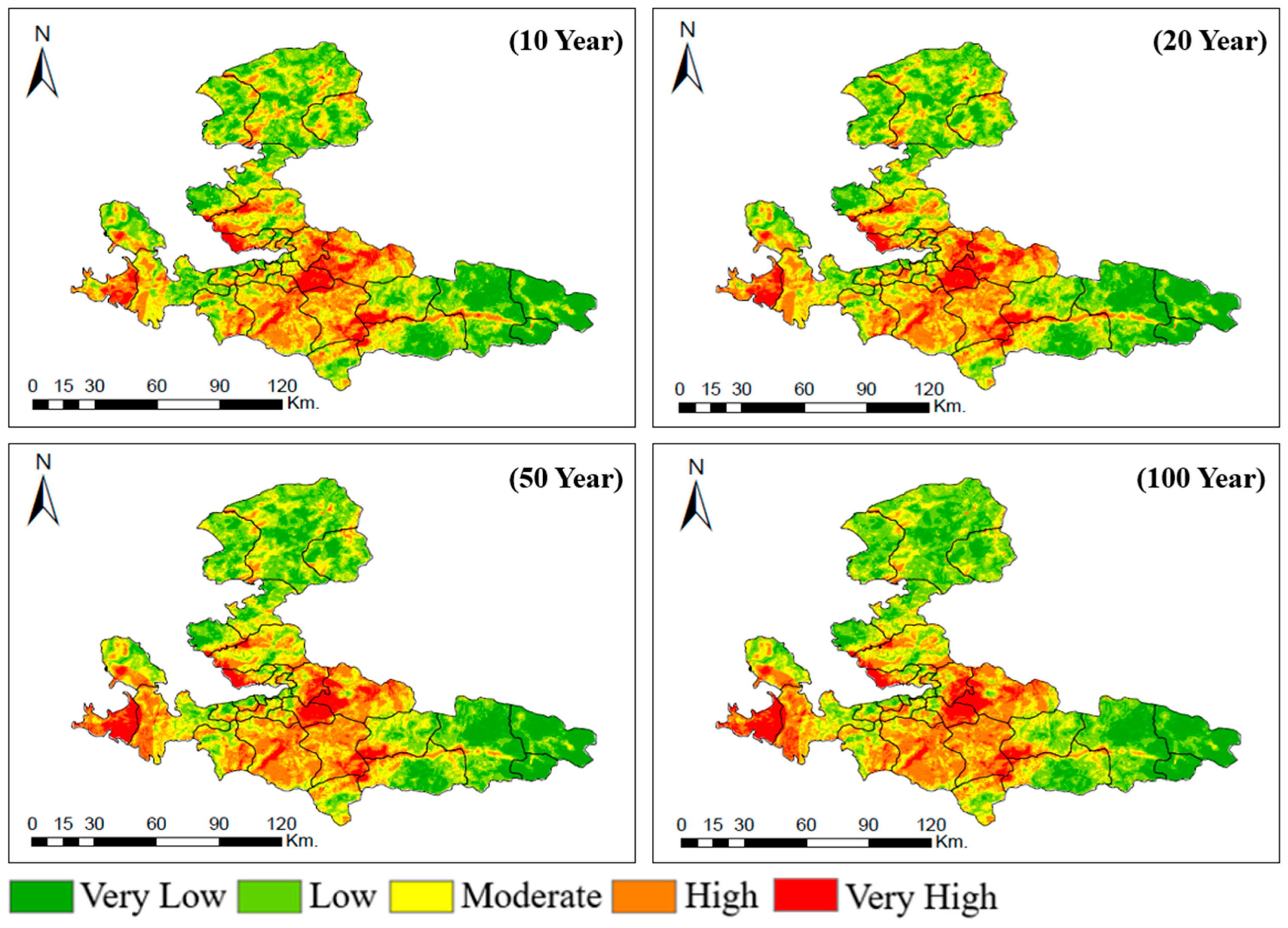
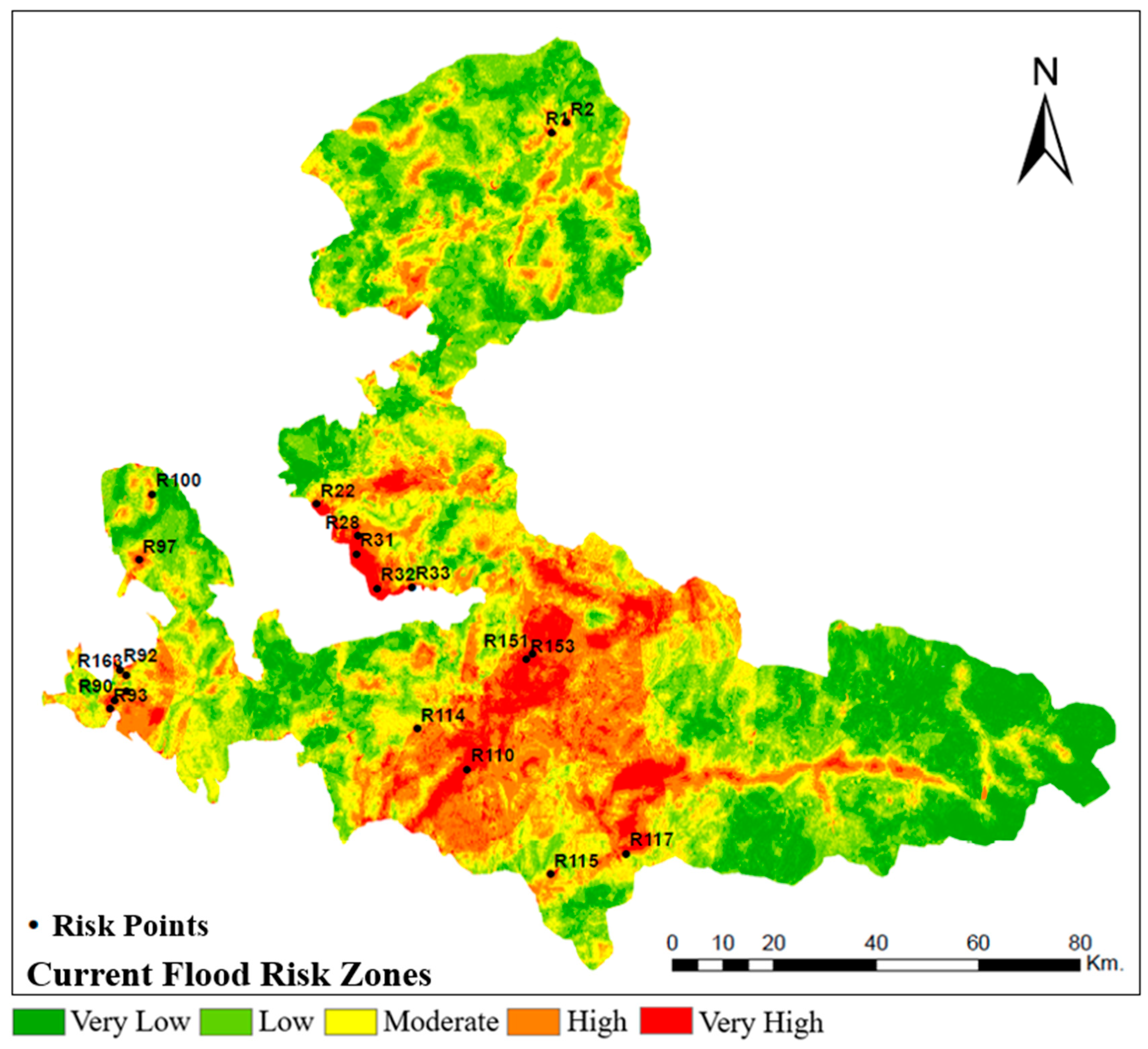
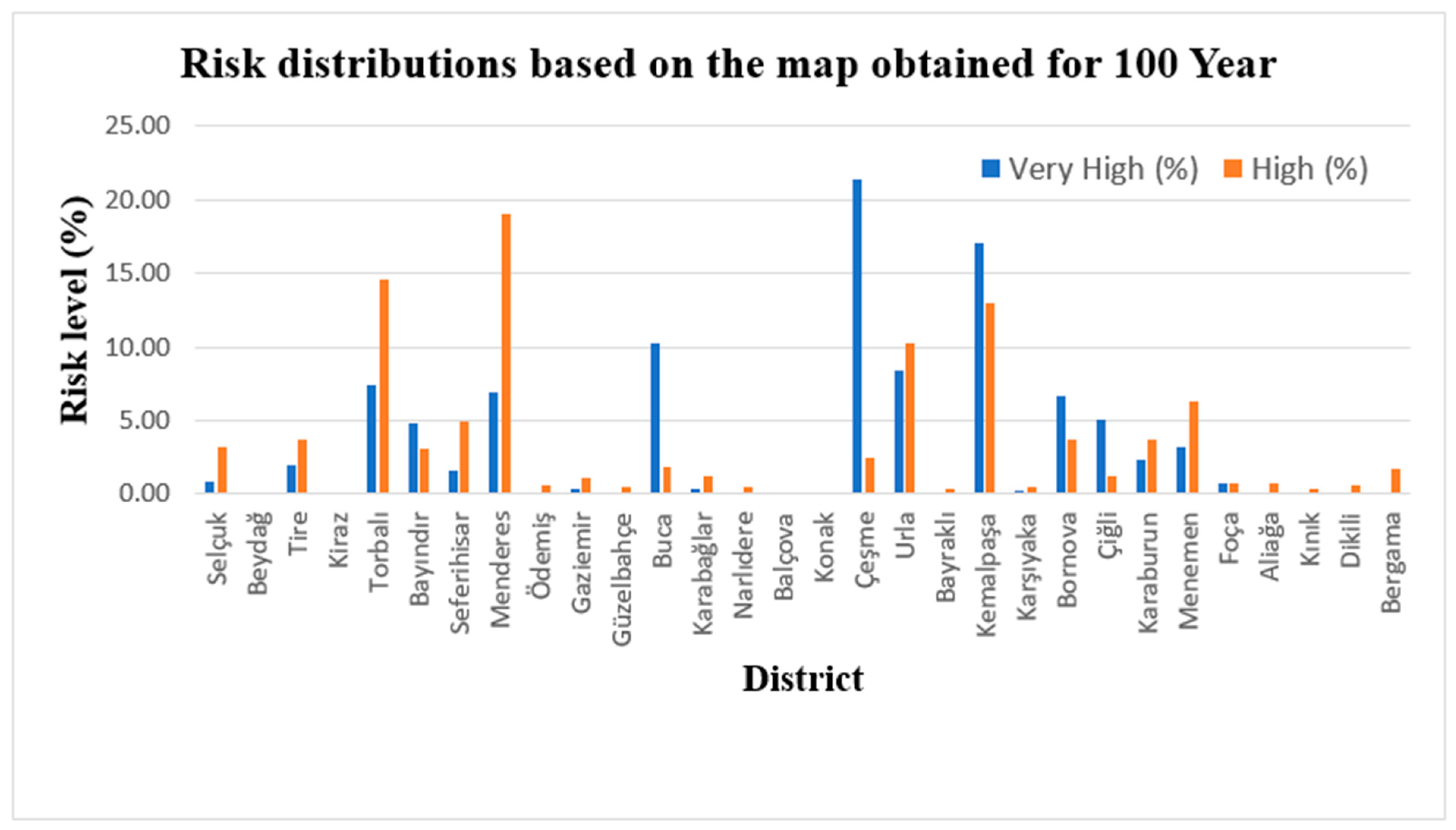
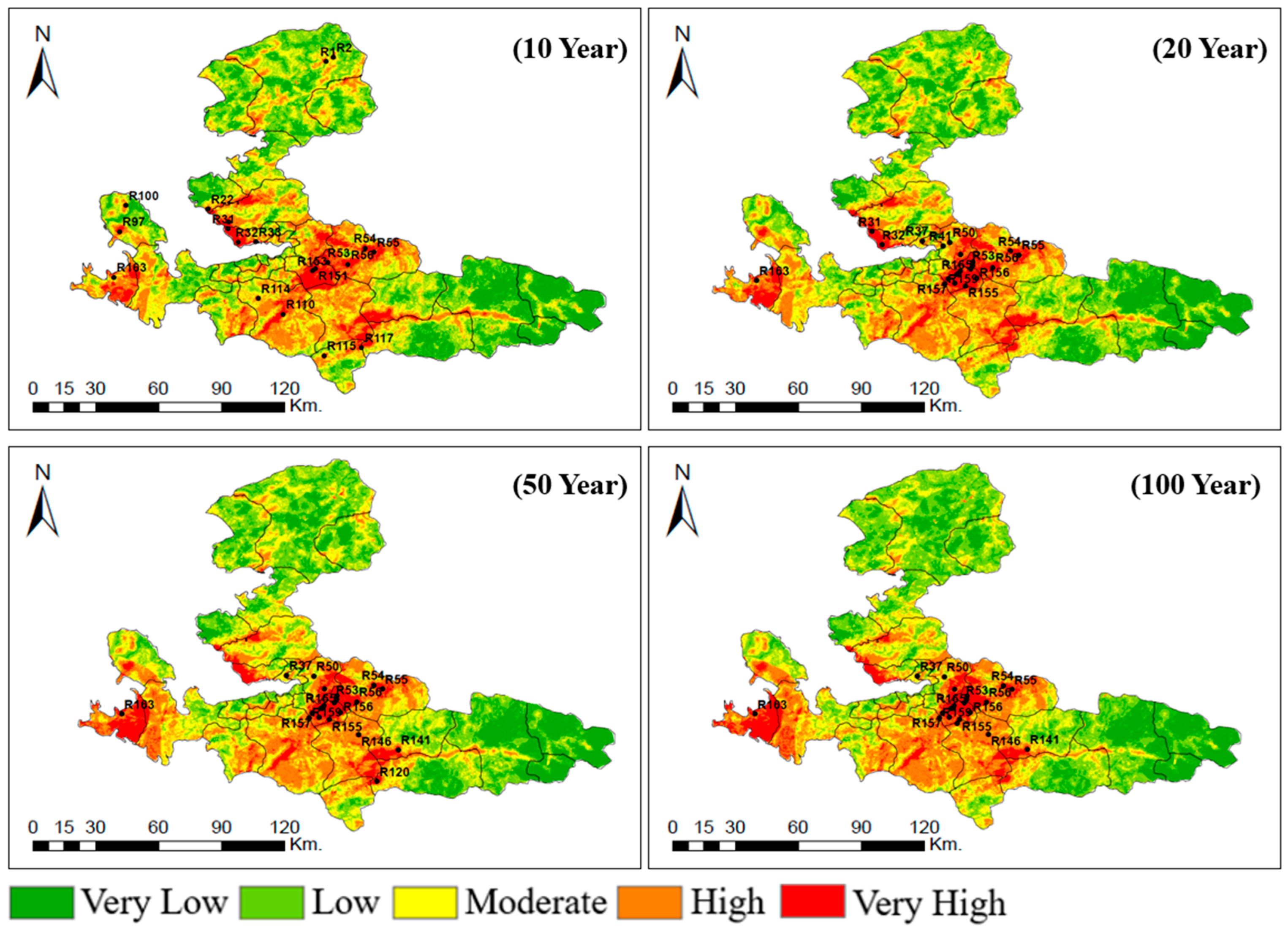

| Sub-Criteria | Brief Description | Data Source | Literature Source |
|---|---|---|---|
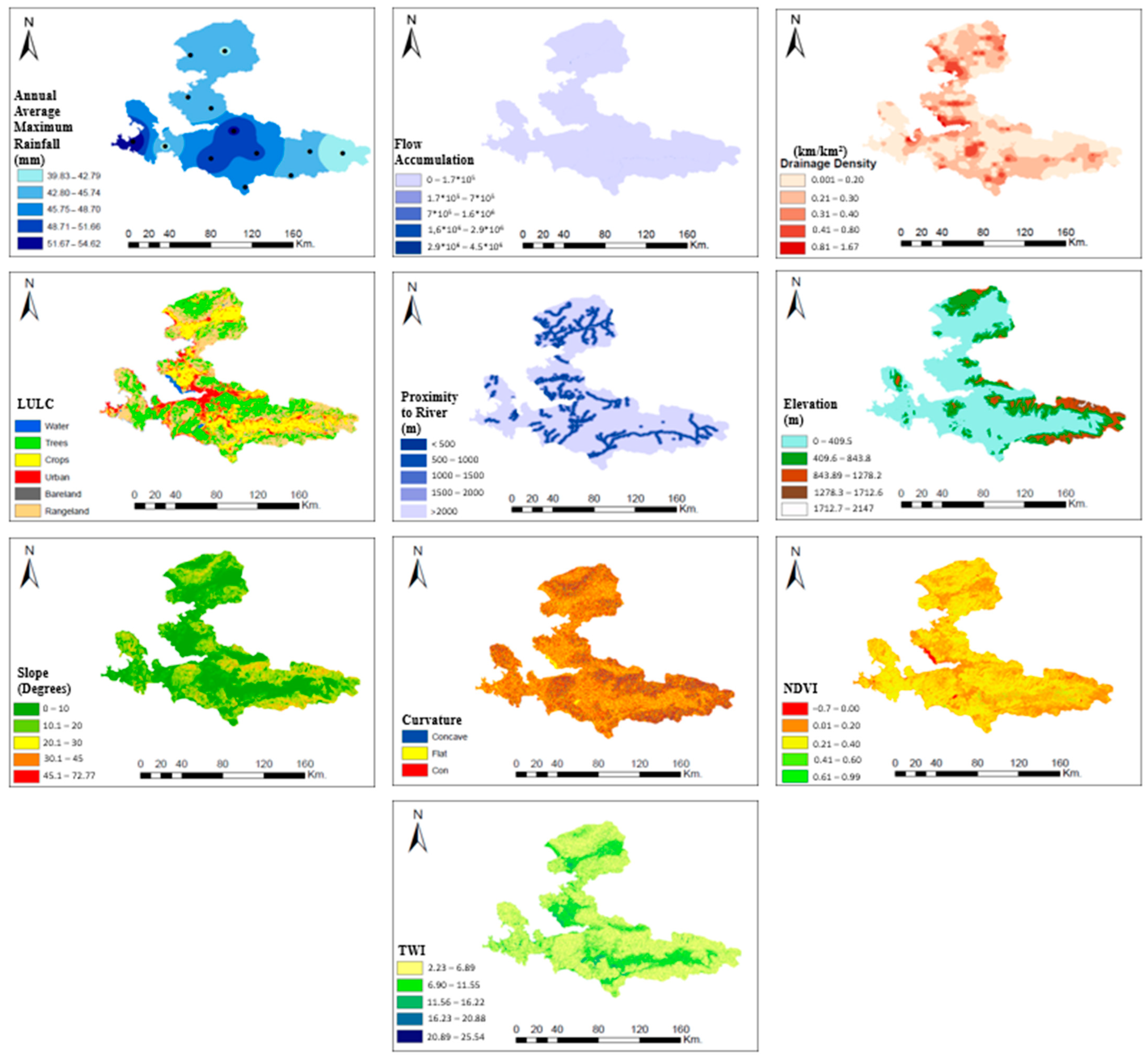
| H1.1. Annual Average Maximum Rainfall | Heavy rainfall in urban areas is likely to cause flooding. In the study, due to the insufficient number of observation stations, ERA5-Land rainfall data were taken from 13 points distributed homogeneously in the study area. The data were acquired daily between 1960 and 2021 and then the annual average maximum rainfall was calculated. | https://cds.climate.copernicus.eu/ (accessed on 5 August 2025) | [14,54,55,56] |
| H1.2. Flow Accumulation | Flow Accumulation is an important parameter that indicates important flood-prone regions. Higher values denote increased flood risk. | DEM | [25,57] |
| H1.3. Drainage Density | The drainage density represents the proportion of the total length of river channels to the area of the drainage basin. The risk of flooding is higher in areas with high drainage density. | DEM | [58] |
| H2.1. LULC | LULC offers comprehensive information on the land use and land cover uses of an area over time due to human impact or natural occurrences, especially in the non-homogeneous land cover of urban areas, infiltration capacity, and runoff vary. This causes the flood risk to vary from region to region. | livingatlas.arcgis.com (accessed on 10 August 2025) | [59,60] |
| H2.2. Proximity to River | Distance to a river is important in determining an area’s exposure to flooding. Areas farther from a river are less likely to be affected by flood hazards than those closer to it. | OpenStreet Map | [61,62] |
| H2.3. Elevation | The lowest elevation areas are the areas at high risk of flooding because water flows from higher to lower ground; thus, it is natural for areas at low elevations to become inundated due to flooding. | earthdata.com/DEM (accessed on 8 August 2025) | [55,63] |
| H2.4. Slope | Another important criterion affecting the risk of flooding is the slope of the land. Flat slopes are more easily inundated than higher slopes. | DEM | [22,55,64,65] |
| H2.5. Curvature | Curvature refers to the rate of change of a slope in a given direction. Negative values indicate concavity, zero values represent flat surface, and positive values indicate convex curvature. Concave terrains are a hazard for flood risk, while convex terrains are the least hazardous areas. | DEM | [8,66,67] |
| H2.6. NDVI | Vegetated lands play a protective role against flood events by reducing the acceleration of the flow and functioning as a natural barrier. This vegetation cover is depicted using the normalized difference vegetation index (NDVI), with values between −1 and +1. Negative NDVI values represent an area that is highly susceptible to flooding. | Satellite Image Landsat 8 | [68,69] |
| H2.7. TWI | Topographic Wetness Index (TWI) is an index used to determine the wetness potential of a land. TWI is important in determining flood risk zones. High positive values indicate humidity while low negative values indicate drought. | DEM | [70,71] |
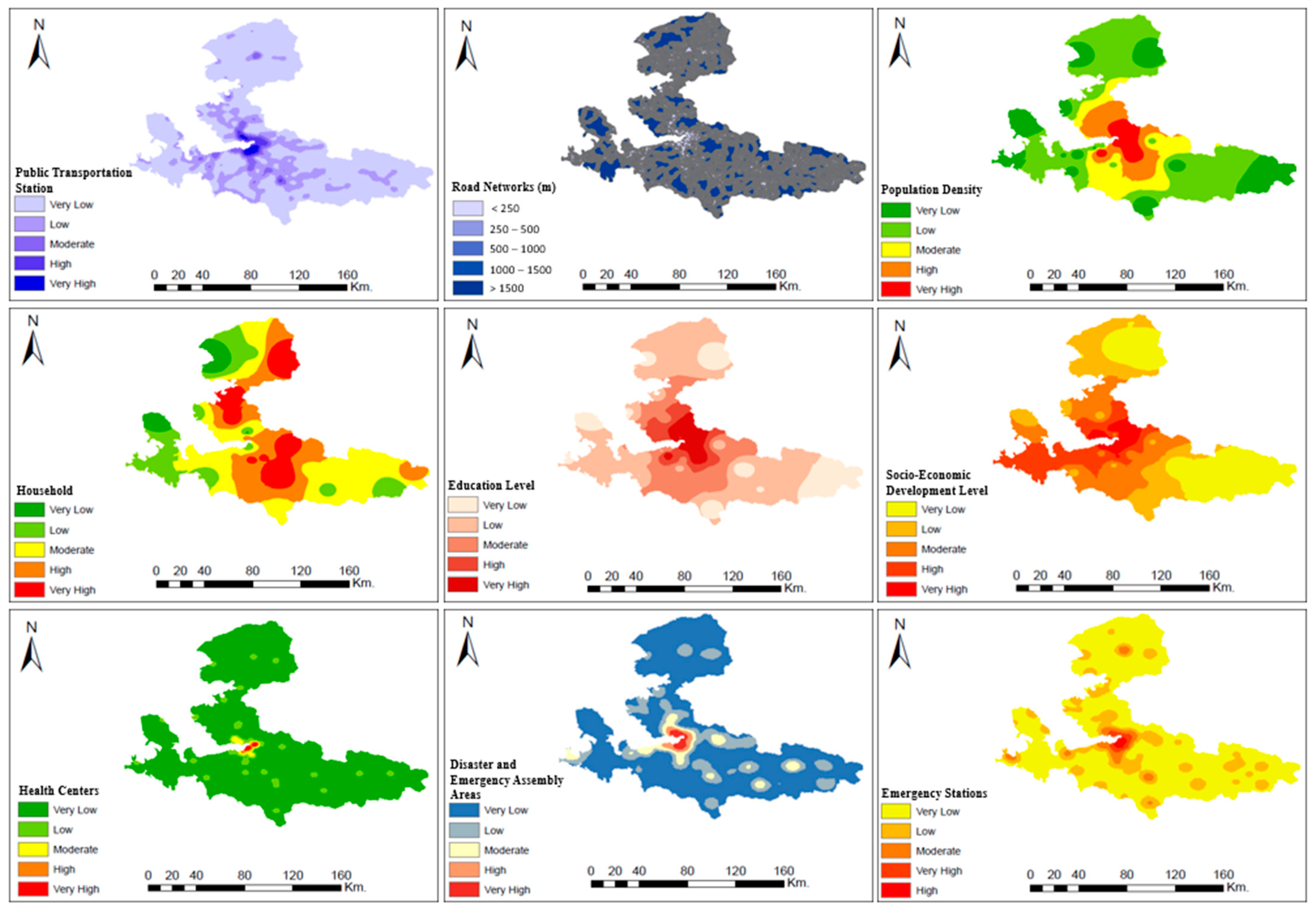
| V1.1. Public Transportation Station | Public transportation stations can significantly increase the risk of flood vulnerability because they areas where people gather. In this study, all bus, metro, and IZBAN stations of the Izmir province were considered. | https://acikveri.bizizmir.com/ (accessed on 8 July 2025) | [72] |
| V1.2. Road Networks | The distance of people to the road is an important factor in the flood response and evacuation process. The situation of roads at risk of flooding increases the severity of the flood. | OpenStreet Map | [22,55] |
| V2.1. Population Density | Population density directly increases the risk of exposure to floods. In densely populated areas, the risk of vulnerability to flooding events is high. | Turkish Statistical Institute | [25,73] |
| V2.2. Household | Household refers to the number of families at risk of flooding and can have a key role in amplifying the impact of flooding. | Turkish Statistical Institute | [74,75] |
| V2.3. Education Level | Education can increase people’s awareness of flooding and is considered a vulnerability assessment indicator. | Turkish Statistical Institute | [76] |
| V2.4. Socio-Economic Development Level | People with higher socio-economic development levels, such as education levels, may be more aware of the effects of flood risk. | sanayi.gov.tr (accessed on 20 July 2025) | Pilot Study |
| V3.1. Health Centers | Providing easy access to healthcare is essential to protecting the health and well-being of residents in the event of flooding. Therefore, damage caused by flooding may vary depending on the location of healthcare facilities. | https://acikveri.bizizmir.com/ (accessed on 8 July 2025) | [77] |
| V3.2. Disaster and Emergency Assembly Areas | The spread of assembly areas for use in the event of disasters and emergencies throughout the city can affect the extent of damage caused by events such as floods. The distribution of these areas can change the risk of residents’ exposure to hazards during emergencies. | https://acikveri.bizizmir.com/ (accessed on 8 July 2025) | Pilot Study |
| V3.3. Emergency Stations | Emergency facilities show the capacity of a city to respond to and cope with hazards. Rapid rescue and assistance are critical during the hazard; therefore, the density of emergency facilities increases resilience to flood events. | https://acikveri.bizizmir.com/ (accessed on 8 July 2025) | [78] |
| Covariates | Code | Covariates | Code |
|---|---|---|---|
| Annual NAO | x1 | Summer SO | x9 |
| Winter NAO | x2 | Autumn SO | x10 |
| Spring NAO | x3 | Annual WeMO | x11 |
| Summer NAO | x4 | Winter WeMO | x12 |
| Autumn NAO | x5 | Spring WeMO | x13 |
| Annual SO | x6 | Summer WeMO | x14 |
| Winter SO | x7 | Autumn WeMO | x15 |
| Spring SO | x8 |
| Code | Dist. Type | Probability Density Function (PDF) |
|---|---|---|
| WEI | Weibull | |
| LOGNO | LogNormal | |
| GA | Gamma | |
| LOGIS | Logistic | |
| Hazard | |||||
|---|---|---|---|---|---|
| Main Criteria and Sub-Criteria | Criteria Weights | Main Criteria and Sub-Criteria | Criteria Weights | ||
| Annual Average Maximum Rainfall (mm) | 0.246 | Topographic | Elevation (m) | 0.082 | |
| Meteorological and Hydrological | 39.83–42.79 | 0.064 | 0–409.5 | 0.358 | |
| 42.80–45.74 | 0.12 | 409.6–843.8 | 0.271 | ||
| 45.75–48.70 | 0.182 | 843.89–1278.2 | 0.206 | ||
| 48.71–51.66 | 0.264 | 1278.3–1712.6 | 0.107 | ||
| 51.67–54.62 | 0.37 | 1712.7–2147 | 0.058 | ||
| Flow Accumulation (pixels) | 0.133 | LULC | 0.194 | ||
| 0–1.7 × 10⁵ | 0.059 | Water | 0.32 | ||
| 1.7 × 10⁵–7 × 10⁵ | 0.099 | Urban | 0.237 | ||
| 7 × 10⁵–1.6 × 10⁶ | 0.144 | Bareland | 0.167 | ||
| 1.6 × 10⁶–2.9 × 10⁶ | 0.219 | Crops | 0.125 | ||
| 2.9 × 10⁶–4.5 × 10⁶ | 0.479 | Trees | 0.101 | ||
| Drainage Density (km/km2) | 0.02 | Rangeland | 0.05 | ||
| 0.001–0.20 | 0.073 | TWI | 0.027 | ||
| 0.21–0.30 | 0.132 | 2.23–6.89 | 0.084 | ||
| 0.31–0.40 | 0.159 | 6.90–11.55 | 0.148 | ||
| 0.41–0.80 | 0.24 | 11.56–16.22 | 0.194 | ||
| 0.81–1.67 | 0.396 | 16.23–20.88 | 0.256 | ||
| Topographic | Slope (degrees) | 0.06 | 20.89–25.54 | 0.318 | |
| 0–10 | 0.342 | Proximity to River (m) | 0.164 | ||
| 10.1–20 | 0.262 | <500 | 0.334 | ||
| 20.1–30 | 0.21 | 500–1000 | 0.265 | ||
| 30.1–45 | 0.121 | 1000–1500 | 0.189 | ||
| 45.1–72.77 | 0.065 | 1500–2000 | 0.143 | ||
| Curvature | 0.041 | >2000 | 0.069 | ||
| Concave | 0.558 | NDVI | 0.033 | ||
| Flat | 0.32 | <0 | 0.353 | ||
| Convex | 0.122 | 0.01–0.20 | 0.268 | ||
| 0.21–0.40 | 0.184 | ||||
| 0.41–0.60 | 0.123 | ||||
| 0.61–0.99 | 0.072 | ||||
| Vulnerability | |||||
|---|---|---|---|---|---|
| Main Criteria and Sub-Criteria | Criteria Weights | Main Criteria and Sub-Criteria | Criteria Weights | ||
| Transportation | Public Transportation Stations | 0.076 | Urban | Socio-Economic | 0.055 |
| <0.870 | 0.086 | 0.29–1.23 | 0.307 | ||
| 0.871–3.50 | 0.117 | 1.24–2.10 | 0.248 | ||
| 3.51–8.660 | 0.196 | 2.01–3.0 | 0.189 | ||
| 8.661–15.770 | 0.273 | 3.01–4.0 | 0.142 | ||
| 15.771–24.82 | 0.328 | 4.01–6.91 | 0.114 | ||
| Road Networks (m) | 0.171 | Proximity | Health Centers | 0.103 | |
| <250 | 0.099 | 0–0.020 | 0.313 | ||
| 250–500 | 0.156 | 0.021–0.130 | 0.24 | ||
| 500–1000 | 0.184 | 0.131–0.340 | 0.209 | ||
| 1000–1500 | 0.242 | 0.341–0.60 | 0.153 | ||
| >1500 | 0.319 | 0.61–0.92 | 0.085 | ||
| Urban | Population Density | 0.204 | Disaster and Emergency Assembly Areas | 0.141 | |
| 12,094–80,000 | 0.081 | 0–0170 | 0.313 | ||
| 80,000.01–140,000 | 0.136 | 0.171–0.50 | 0.295 | ||
| 140,000.01–200,000 | 0.226 | 0.51–1.15 | 0.183 | ||
| 200,000.01–300,000 | 0.256 | 1.151–2.12 | 0.116 | ||
| 300,000.01–522,738 | 0.301 | 2.121–3.38 | 0.093 | ||
| Household | 0.088 | Emergency Stations | 0.125 | ||
| 2.23–2.55 | 0.092 | 0–0.013 | 0.343 | ||
| 2.56–2.74 | 0.181 | 0.014–0.050 | 0.25 | ||
| 2.75–2.87 | 0.213 | 0.051–0.13 | 0.189 | ||
| 2.88–3.00 | 0.248 | 0.131–0.30 | 0.154 | ||
| 3.01–3.28 | 0.266 | 0.31–0.47 | 0.064 | ||
| Education Level | 0.037 | ||||
| 862–12,000 | 0.335 | ||||
| 12,000.01–24,000 | 0.253 | ||||
| 24,000.01–40,000 | 0.192 | ||||
| 40,000.01–60,000 | 0.146 | ||||
| 60,000.01–122,932 | 0.074 | ||||
| Rank | 1 | 2 | 3 | 4 | 5 | 6 | 7 | 8 | 9 | 10 |
| Point | R91 | R153 | R93 | R90 | R92 | R110 | R32 | R31 | R97 | R28 |
| 0.884 | 0.768 | 0.754 | 0.752 | 0.722 | 0.715 | 0.706 | 0.703 | 0.691 | 0.657 | |
| Rank | 11 | 12 | 13 | 14 | 15 | 16 | 17 | 18 | 19 | 20 |
| Point | R163 | R22 | R115 | R117 | R151 | R2 | R100 | R1 | R114 | R33 |
| 0.652 | 0.627 | 0.619 | 0.603 | 0.599 | 0.589 | 0.576 | 0.576 | 0.564 | 0.556 |
| Station No | Model | AIC Values | Filliben Coefficients | LR Test p Value |
|---|---|---|---|---|
| 1 | LOGNO(μ,σ) | 496.79 | 0.99 | |
| LOGNO(μ ∼x1,σ) | 491.8 | 0.99 | 0.008 | |
| LOGNO(μ∼x1 + x14,σ) | 487.99 | 0.99 | 0.015 | |
| 2 | LOGNO(μ,σ) | 512.9 | 0.99 | |
| LOGNO(μ∼x2,σ) | 511.86 | 0.99 | 0.01 | |
| LOGNO(μ∼x2 + x12,σ) | 507.88 | 0.99 | 0.014 | |
| 3 | GA(μ,σ) | 461.7 | 0.99 | |
| GA(μ∼x1,σ) | 455.09 | 0.99 | 0.003 | |
| 4 | LOGNO(μ,σ) | 474.87 | 0.98 | |
| LOGNO(μ∼x1,σ) | 468.71 | 0.99 | 0.004 | |
| 5 | LOGNO(μ,σ) | 484.35 | 0.99 | |
| LOGNO(μ∼x14,σ) | 483.56 | 0.98 | 0.094 | |
| 6 | LOGNO(μ,σ) | 459.25 | 0.97 | |
| LOGNO(μ∼x5,σ) | 456.23 | 0.97 | 0.024 | |
| 7 | GA(μ,σ) | 485.64 | 0.99 | |
| GA(μ∼x10,σ) | 482.53 | 0.99 | 0.023 | |
| 8 | LOGNO(μ,σ) | 476.27 | 0.99 | |
| LOGNO(μ∼x10,σ) | 471.4 | 0.99 | 0.008 | |
| 9 | LOGNO(μ,σ) | 484.24 | 0.99 | |
| LOGNO(μ∼x1,σ) | 481.3 | 0.99 | 0.02 | |
| LOGNO(μ∼x1 + x10,σ) | 478.8 | 0.99 | 0.03 | |
| 10 | LOGNO(μ,σ) | 470.74 | 0.97 | |
| LOGNO(μ∼x1,σ) | 466.7 | 0.98 | 0.014 | |
| 11 | GA(μ,σ) | 472.07 | 0.99 | |
| GA(μ∼x10,σ) | 469.3 | 0.99 | 0.03 | |
| 12 | LOGNO(μ,σ) | 472.51 | 0.99 | |
| LOGNO(μ∼x10,σ) | 470.6 | 0.98 | 0.04 | |
| LOGNO(μ∼x10,σ∼x10) | 468.34 | 0.99 | 0.03 | |
| 13 | LOGNO(μ,σ) | 445.37 | 0.98 | |
| LOGNO(μ∼x5,σ) | 442.78 | 0.98 | 0.03 |
| Return Periods | ||||
|---|---|---|---|---|
| Criteria | 10-Year | 20-Year | 50-Year | 100-Year |
| H1.1. | 0.295 | 0.334 | 0.398 | 0.427 |
| H1.2. | 0.124 | 0.117 | 0.105 | 0.088 |
| H1.3. | 0.018 | 0.018 | 0.017 | 0.016 |
| H2.1. | 0.185 | 0.172 | 0.153 | 0.186 |
| H2.2. | 0.152 | 0.143 | 0.128 | 0.107 |
| H2.3. | 0.075 | 0.073 | 0.066 | 0.057 |
| H2.4. | 0.057 | 0.052 | 0.049 | 0.042 |
| H2.5. | 0.038 | 0.037 | 0.034 | 0.031 |
| H2.6. | 0.031 | 0.03 | 0.027 | 0.025 |
| H2.7. | 0.025 | 0.024 | 0.023 | 0.021 |
| Flood Risk Scenarios | Very Low (%) | Low (%) | Moderate (%) | High (%) | Very High (%) |
|---|---|---|---|---|---|
| 10 Year | 15.12 | 28.26 | 28.60 | 21.29 | 6.73 |
| 20 Year | 14.91 | 28.48 | 27.85 | 21.69 | 7.07 |
| 50 Year | 14.52 | 28.70 | 27.80 | 21.70 | 7.28 |
| 100 Year | 13.92 | 31.59 | 24.64 | 22.32 | 7.53 |
| 10 Year | Rank | 1 | 2 | 3 | 4 | 5 | 6 | 7 | 8 | 9 | 10 |
| Point | R55 | R56 | R54 | R153 | R163 | R31 | R32 | R28 | R97 | R110 | |
| 0.957 | 0.770 | 0.740 | 0.714 | 0.678 | 0.670 | 0.666 | 0.626 | 0.618 | 0.617 | ||
| Rank | 11 | 12 | 13 | 14 | 15 | 16 | 17 | 18 | 19 | 20 | |
| Point | R22 | R53 | R115 | R117 | R33 | R151 | R100 | R1 | R2 | R114 | |
| 0.608 | 0.595 | 0.587 | 0.573 | 0.569 | 0.568 | 0.566 | 0.549 | 0.545 | 0.540 | ||
| 20 Year | Rank | 1 | 2 | 3 | 4 | 5 | 6 | 7 | 8 | 9 | 10 |
| Point | R55 | R56 | R54 | R153 | R163 | R53 | R151 | R164 | R165 | R152 | |
| 0.974 | 0.820 | 0.804 | 0.728 | 0.721 | 0.700 | 0.681 | 0.620 | 0.616 | 0.589 | ||
| Rank | 11 | 12 | 13 | 14 | 15 | 16 | 17 | 18 | 19 | 20 | |
| Point | R50 | R155 | R156 | R37 | R154 | R41 | R31 | R32 | R159 | R157 | |
| 0.585 | 0.552 | 0.544 | 0.533 | 0.530 | 0.510 | 0.503 | 0.500 | 0.500 | 0.500 | ||
| 50 Year | Rank | 1 | 2 | 3 | 4 | 5 | 6 | 7 | 8 | 9 | 10 |
| Point | R55 | R56 | R54 | R153 | R53 | R163 | R151 | R164 | R165 | R152 | |
| 0.979 | 0.849 | 0.828 | 0.753 | 0.748 | 0.747 | 0.709 | 0.669 | 0.654 | 0.642 | ||
| Rank | 11 | 12 | 13 | 14 | 15 | 16 | 17 | 18 | 19 | 20 | |
| Point | R50 | R156 | R155 | R154 | R157 | R159 | R141 | R37 | R120 | R146 | |
| 0.629 | 0.598 | 0.590 | 0.580 | 0.555 | 0.553 | 0.544 | 0.539 | 0.525 | 0.521 | ||
| 100 Year | Rank | 1 | 2 | 3 | 4 | 5 | 6 | 7 | 8 | 9 | 10 |
| Point | R55 | R56 | R54 | R163 | R53 | R153 | R151 | R164 | R165 | R152 | |
| 0.979 | 0.855 | 0.824 | 0.771 | 0.763 | 0.750 | 0.711 | 0.678 | 0.670 | 0.654 | ||
| Rank | 11 | 12 | 13 | 14 | 15 | 16 | 17 | 18 | 19 | 20 | |
| Point | R50 | R156 | R155 | R154 | R159 | R157 | R146 | R141 | R37 | R147 | |
| 0.638 | 0.599 | 0.589 | 0.580 | 0.553 | 0.552 | 0.532 | 0.528 | 0.522 | 0.511 |
Disclaimer/Publisher’s Note: The statements, opinions and data contained in all publications are solely those of the individual author(s) and contributor(s) and not of MDPI and/or the editor(s). MDPI and/or the editor(s) disclaim responsibility for any injury to people or property resulting from any ideas, methods, instructions or products referred to in the content. |
© 2026 by the authors. Licensee MDPI, Basel, Switzerland. This article is an open access article distributed under the terms and conditions of the Creative Commons Attribution (CC BY) license.
Share and Cite
Gün, R.; Yılmaz, M. A New Framework for Comprehensive Flood Risk Assessment Under Non-Stationary Conditions Using GIS-Based MCDM Modeling. Atmosphere 2026, 17, 62. https://doi.org/10.3390/atmos17010062
Gün R, Yılmaz M. A New Framework for Comprehensive Flood Risk Assessment Under Non-Stationary Conditions Using GIS-Based MCDM Modeling. Atmosphere. 2026; 17(1):62. https://doi.org/10.3390/atmos17010062
Chicago/Turabian StyleGün, Reşat, and Muhammet Yılmaz. 2026. "A New Framework for Comprehensive Flood Risk Assessment Under Non-Stationary Conditions Using GIS-Based MCDM Modeling" Atmosphere 17, no. 1: 62. https://doi.org/10.3390/atmos17010062
APA StyleGün, R., & Yılmaz, M. (2026). A New Framework for Comprehensive Flood Risk Assessment Under Non-Stationary Conditions Using GIS-Based MCDM Modeling. Atmosphere, 17(1), 62. https://doi.org/10.3390/atmos17010062

