
Article

Climate-Driven Cryospheric Changes and Their Impacts on Glacier Runoff Dynamics in the Northern Tien Shan

by
Aigul N. Akzharkynova
1,2,
Berik Iskakov
1,
Gulnara Iskaliyeva
1,3,*,
Nurmakhambet Sydyk
1,
Rustam Abdrakhimov
2,
Alima A. Amangeldi
1,
Aibek Merekeyev
1,2 and
Aleksandr Chigrinets
2
1
Institute of Ionosphere, Almaty 050000, Kazakhstan
2
Faculty of Geography and Environmental Sciences, Al-Farabi Kazakh National University, Almaty 050013, Kazakhstan
3
Faculty of Water Resources and IT Technologies, Kazakh National Agrarian Research University, Almaty 050010, Kazakhstan
*
Author to whom correspondence should be addressed.
Atmosphere 2026, 17(1), 63; https://doi.org/10.3390/atmos17010063
Submission received: 25 November 2025 / Revised: 23 December 2025 / Accepted: 30 December 2025 / Published: 3 January 2026
(This article belongs to the Special Issue Climate Change in the Cryosphere and Its Impacts)

Abstract

Glaciers in the Northern Tien Shan are a major source of Ile River runoff, supplying water to Kazakhstan’s largest city, Almaty. Under ongoing climate warming, their degradation alters the magnitude and seasonality of river discharge, increasing water-resource vulnerability. This study quantifies long-term changes in glacier area, firn-line elevation, and glacier runoff in the northern Tien Shan from 1955 to 2021. The analysis uses multi-decadal meteorological observations, hydrological records, multi-temporal Landsat-7/8 and Sentinel-2 imagery, and DEMs combined with empirical and semi-empirical runoff estimation methods. The glacier area has declined by more than 45–60% since 1955, accompanied by a rise in firn-line altitude from ~3400 to 3700 m. At the Mynzhylky station, mean summer air temperature increased by 0.88 °C, reflecting persistent warming in glacierized elevations. The contribution of glacier meltwater to annual discharge decreased from ~32% in 1955–1990 to ~25% in 1991–2021, while total and vegetation-period runoff increased due to modified seasonal hydrological conditions. These results demonstrate the impact of climate warming on glacier-fed runoff in the Northern Tien Shan and highlight the need to integrate glacier degradation into water-resource management and long-term water-security assessments.

1. Introduction

Glaciers are a crucial source of freshwater in high-mountain regions, regulating river discharge, sustaining ecosystems, and buffering seasonal and interannual climate variability [1]. Under ongoing climate change, their capacity to perform this regulatory function is increasingly reduced, making efficient water resource management a global priority—particularly in regions where runoff formation depends directly on snow and glacier melt. Central Asia represents one such region, as its hydrological systems are strongly controlled by the accumulation and ablation of seasonal snow and glaciers [2].
Rising air temperatures drive a cascade of interconnected processes—upward migration of the snowline, accelerated glacier retreat, and changes in meltwater production—which together alter the magnitude and seasonal distribution of river runoff [3,4,5,6,7]. As a result, understanding glacier response to climate warming is essential for assessing the long-term stability of regional water resources and hydrological resilience. This importance is reflected in the United Nations Sustainable Development Goals (SDG 2.3 and SDG 6.4), which emphasize sustainable water use under changing climatic conditions [8].
Glacier retreat has been widely documented across the world’s mountain systems [9]. In the European Alps, glacier area and volume have decreased by more than 50% since the mid-20th century, with exceptionally rapid shrinkage in the early 21st century [10,11,12]. In High Mountain Asia, most glaciers experience accelerated mass loss [13]. In the Andes, Arctic, and Alaska, rapid glacier shrinkage threatens water supply, hydropower generation, and contributes to global sea-level rise [14,15,16,17]. These examples demonstrate that while glacier degradation is global, its hydrological impacts are strongly modulated by regional climatic and topographic conditions.
The Tien Shan Mountains are commonly referred to as the “water tower of Central Asia” [18], providing essential freshwater resources and serving as a sensitive indicator of climate change [19]. Glacier degradation in the Tien Shan has intensified over recent decades, leading to persistent negative mass balances, reduced glacier area, altered runoff regimes, and the formation of hazardous moraine-dammed lakes [20,21,22,23,24]. These changes pose increasing risks to regional water security and ecosystem stability.
In the Northern Tien Shan, glacial meltwater contributes approximately 45–60% of summer river discharge [25], making hydrological regimes highly sensitive to climatic variability and glacier change [26]. The Ile River, one of the largest rivers in southeastern Kazakhstan, is primarily fed by snow and glacier melt [27]. Recent studies indicate that sustained warming and glacier retreat have significantly altered the hydrological regimes of its left-bank tributaries [28,29,30], leading to reduced river discharge as increased evaporation, more frequent winter thaws, and diminished soil freezing promote infiltration losses and limit effective runoff. Between 1962/63 and 2010/12, glacier area in the Koksu and Kunes river basins decreased by 191.3 ± 16.8 km2 (36.9 ± 6.5%) [31,32]. According to the Central Asian Regional Glaciological Center of UNESCO, glaciers in the region have exhibited persistently negative mass balances since the 1970s, with area losses of up to 29% in some mountain ranges [33,34,35].
Declining glacier extent directly affects both the volume and seasonality of glacial runoff, which recent studies suggest is now also decreasing [36]. These hydrological changes intensify risks associated with water resource management, including droughts, vegetation degradation, and biodiversity loss [37], with direct consequences for agriculture and other water-dependent sectors [38,39].
Despite extensive research on glacier change in the Tien Shan, long-term observations of glacial runoff in the Ile River’s left-bank tributaries remain limited. In particular, their seasonal and interannual variability and quantitative relationships with climatic drivers derived from modern satellite data are insufficiently documented. This knowledge gap is critical, as these tributaries supply water to the Almaty agglomeration and surrounding regions, and uncertainties in runoff projections hinder effective adaptation planning.
The assessment of glacier runoff is challenged by the scarcity of high-altitude meteorological observations, limitations of direct hydrometric measurements, and significant meltwater losses through moraine infiltration [40,41]. However, the use of vertical gradients of temperature, radiation, and precipitation, combined with satellite-based monitoring of glacier area and snowline dynamics, enables robust reconstruction of glacier-climate interactions [42,43].
In this study, a spatiotemporal analysis of glacier-exposed area in the Ile River’s left-bank tributaries was conducted using satellite data from 1999 onward, alongside an assessment of the climatic controls on glacier degradation. The specific focus on these tributaries is motivated by their strong dependence on glacier-fed runoff, their strategic importance for water supply to Kazakhstan’s largest urban agglomeration, and their relatively limited representation in previous studies. Accordingly, this study aims to (i) identify the spatial and temporal patterns of glacier area change in the Ile River’s left-bank tributaries since the late 1990s, (ii) quantify changes in glacier runoff contributions and their seasonal dynamics under recent climate warming, and (iii) examine the relationships between observed glacier degradation and key climatic variables in the study region.

2. Materials and Methods

2.1. Study Area

The study area comprises the high-mountain left-bank tributaries of the lower Ile River, originating in the Ile Alatau and Kungei Alatau ranges in southeastern Kazakhstan (Figure 1). These mountain systems converge in the Shilik–Kemin junction, which functions as a major runoff formation zone and catchment for numerous glacier-fed watercourses supplying agricultural, industrial, and urban areas, including the Almaty agglomeration.
The Ile Alatau is one of the largest northern ranges of the Tien Shan, extending for more than 300 km in a sublatitudinal direction and forming the boundary between foothill plains and high-mountain basins. Elevations range from 700 to 900 m in the foothills to nearly 5000 m, resulting in pronounced vertical zonality and favorable conditions for modern glaciation [44,45]. The hydrographic network has regional and transboundary significance, as the Ile River is formed outside Kazakhstan and receives tributaries from multiple Northern Tien Shan ridges [2,20,46].
This pronounced altitudinal range results in distinct climatic zones. At 600–1700 m, the mean annual air temperature is about +7.5 °C, with July and December averages of +19 °C and −7 °C, respectively, and annual precipitation up to 850 mm. The mid-mountain zone (1800–2700 m) has a typical mountain climate with a mean annual temperature of +3.6 °C. In the high-mountain zone (2700–3360 m), conditions are severe, with snow cover lasting up to eight months and mean annual temperatures near −2 °C; above 3300 m, mean annual temperature decreases to about −6.4 °C, with winter minima reaching −35 °C.
Overall, the climate is continental and relatively arid in the foothills but increasingly humid with elevation. Annual precipitation ranges from 269 to 872 mm and shows spring–summer and autumn–winter maxima, with a minimum in July–September [47].
The largest tributaries of the Ile River—Kishi and Ulken Almatinka, Talgar, Issyk, Chilik, and Turgen—originate on the northern slopes of the Ile Alatau, whereas runoff from the southern slopes is directed toward the Chui Valley, imparting a transboundary character to the basin [22,48]. The hydrological regime is characterized by spring snowmelt floods, stabilized summer runoff sustained by glacier melt, and low-flow conditions during winter [49].
Contemporary glaciation is confined to high-altitude valley heads and slopes. Large valley glaciers rarely descend below 3000 m a.s.l., even where extensive moraine cover is present, and commonly form complex firn basins composed of multiple accumulation bowls [50]. The glacier cover is dominated by cirque, hanging, and cirque-hanging glaciers, particularly in the Uzkarghaly, Shamalgan, and Kaskelen river basins [51]. Basin-type and semi-basin glaciers occur in multi-cirque settings with short tongues constrained by glacier troughs, while hanging icefalls and thin icefields occupy steep slopes, with termini generally above 3500 m [52,53,54,55,56].

2.2. Temperature and Precipitation

Meteorological conditions in the study area were assessed using air temperature and precipitation data from the Mynzhylky, Ulken Almaty Lake, Almaty city, and Kamenskoe Plateau stations, provided by the Republican State Enterprise “Kazhydromet” [57]. These stations supply the average monthly temperature and precipitation data required for estimating glacier runoff in the high-mountain zone.
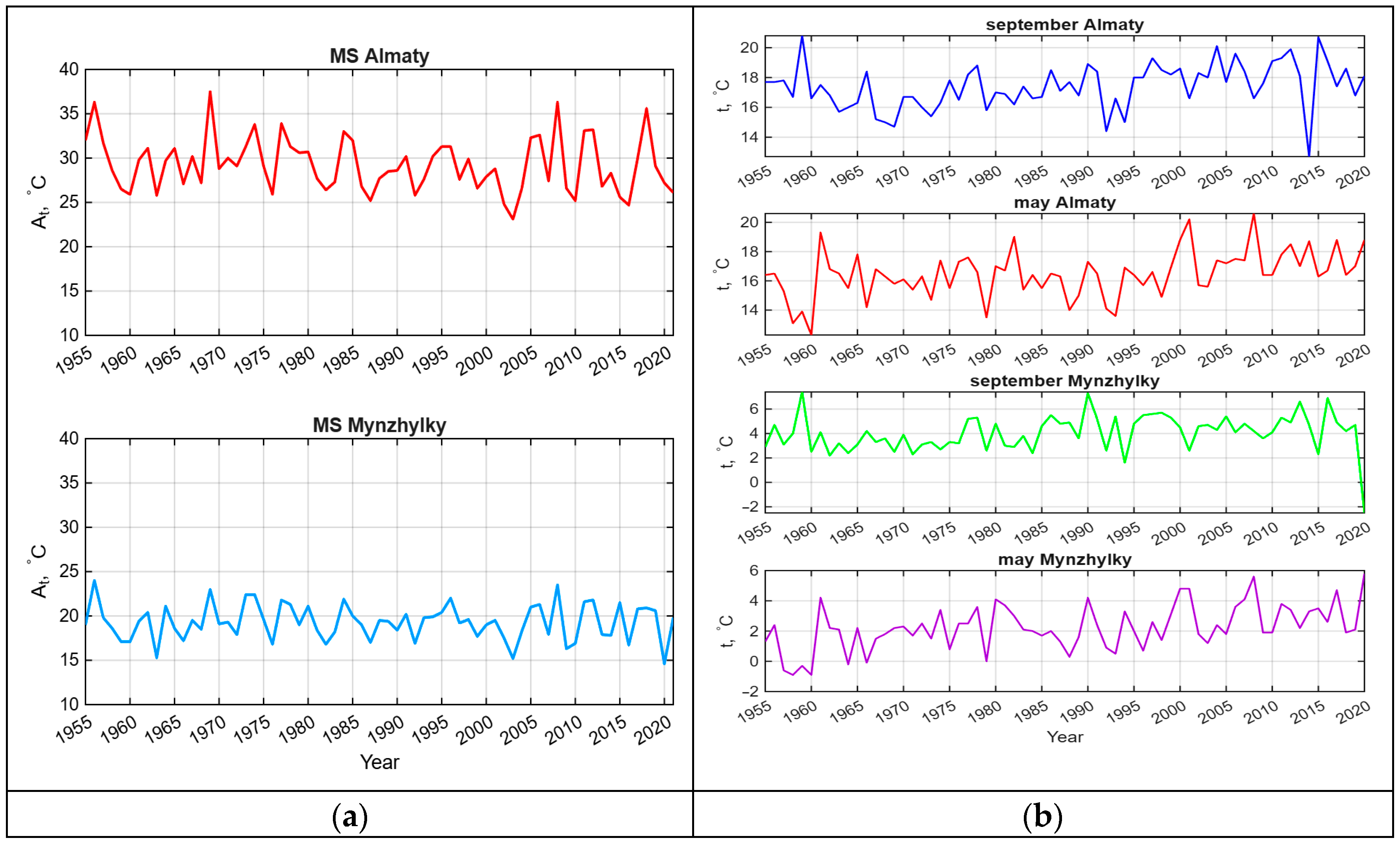
The data reflect clear altitudinal differences in temperature regimes. In the glacierized zone, January is the coldest month and July the warmest, while mean temperatures in September exceed those in May (Figure 2b). Climatic continentality decreases with elevation, as indicated by a substantially lower annual air temperature amplitude (At) at the high-altitude Mynzhylky station compared to the Almaty foothill station (Figure 2a).
The stability of altitudinal temperature gradients in the study region has been documented in previous glaciological studies, including observations from the International Geophysical Year, which provide a basis for applying elevation-dependent temperature corrections in this analysis. These empirical relationships form the basis for estimating meltwater runoff by extrapolating meteorological observations from reference stations to glacier elevations, providing a practical approach under conditions of limited direct measurements.
In this study, the calculation of mean daily air temperature at a given altitude was based on the following relationship:
t H = t 0 Δ t × Δ H 100
where t H is the mean daily air temperature at the target elevation H; t 0 is the mean daily air temperature at the reference meteorological station; Δt is the vertical temperature gradient (°C/100 m), which depends on the average cloudiness of the region; ΔH is the difference in elevation between the target level and the absolute height of the reference station. The dependence of the temperature gradient on cloudiness and seasonality was adopted from Cherkasov [58].
The adjustment of meteorological observations to higher elevations involves uncertainty due to the limited number of high-altitude stations and strong spatial climatic variability; however, this approach is essential in the absence of long-term observations in glacierized areas and has been validated by consistency with observed data reported by Severskiy et al. [59]. During the ablation period, precipitation on glacier surfaces occurs mainly as graupel and hail, while rainfall dominates in the subglacial zone; at the beginning and end of the warm season, precipitation often shifts to solid forms, including snow during short-term cooling events. Precipitation is typically short-lived and diurnal, with afternoon maxima, whereas cyclonic intrusions can produce multi-day events that substantially reduce melt rates.
Due to exposure to moist air masses from the north and northwest, the Ile Alatau receives relatively high precipitation. The vertical precipitation gradient was derived from observations at the Mynzhylky and Kamenskoe Plateau stations as the ratio of differences in annual precipitation totals to elevation differences and was used to extrapolate precipitation to glacier elevations.
One of the most important indicators of glacier state is the position of the firn line, which separates the accumulation and ablation zones. Its elevation varies from year to year under the influence of temperature and precipitation anomalies. In this study, the firn line elevation was determined using the empirical relationship [41]:
F = 3800 + 70 Δ t 0.56 Δ x
where F is the firn line elevation in a given year (m a.s.l.); Δt is the deviation in mean June–August air temperature from the climatic norm at the meteorological station in the given year (°C); Δx is the deviation in total precipitation (mm) from the norm for the period September of the previous year to August of the current year at the same station [41].
To determine Δx values for the glacierized basins of the left-bank tributaries of the Ile River, monthly and annual precipitation data from the Mynzhylky and Ulken Almaty Lake meteorological stations were used. These data enabled the identification of links between temperature–precipitation anomalies and the position of the firn line, which together provide a deeper understanding of the dynamics of modern glaciological processes in the region.
The sensitivity coefficient of 70 m °C−1 reflects the response of the firn line to combined mass-balance forcing rather than a free-atmosphere isotherm shift; therefore, it is expected to be lower than the ~150 m °C−1 implied by the standard atmospheric lapse rate [10,60,61].
The accuracy of firn line elevations derived from Equation (2) was evaluated using temporary snow line (TSL) mapping based on late-summer 2022 Landsat-8 (NASA/USGS, USA) imagery for four basins. Snow and ice surfaces were delineated using the NIR/SWIR1 reflectance ratio (≥1.4–2.0) and the Normalized Difference Snow Index (NDSI ≥ −0.05–0.1) following established approaches [62,63,64], with subsequent manual correction to remove misclassification caused by shadows, rock outcrops, and proglacial lakes. Snow-covered areas larger than 0.2 km2 were converted to linear TSL features, and median snow line elevations were derived for each basin using the ALOS PALSAR (Jaxa, Japan) digital elevation model. Comparison of satellite-derived TSL elevations with calculated firn line positions provided an independent assessment of estimation accuracy. Median TSL elevations (m a.s.l.) were: Ulken Almaty—3862.6, Kishi Almaty—3774.1, Turgen—3697.95, Shelek—3860.5. Using the satellite-derived TSL median elevations for the four basins and taking the firn line elevation from the empirical formula as 3800 m, the RMSE was calculated as follows:
R M S E = 1 n i = 1 n ( F i F r e f ) 2
where Fi are basin-specific TSL medians and Fref = 3800 m.
Comparison of satellite-derived temporary snowline elevations with firn line altitudes calculated using Equation (2) shows a negligible mean bias (−1.2 m), a mean absolute difference in ~63 m, and an RMSE of ~68 m across the analyzed basins, which is consistent with expected spatial variability of snowline position and supports the applicability of the empirical formulation at the basin scale.

2.3. Glacier Area Estimation

Glacier area changes in the Ile Alatau region were analyzed using satellite imagery from the Landsat (https://earthexplorer.usgs.gov/) (accessed on 25 November 2025) and Sentinel-2 (https://dataspace.copernicus.eu/) (accessed on 25 November 2025) missions for the period 1999–2021. Images were selected from the end of the ablation season (August–September), when seasonal snow cover is minimal and glacier outlines can be identified most reliably. Only scenes with cloud cover below 10% were used to minimize atmospheric and surface-related uncertainties.
The year 1999 was adopted as the reference period due to the availability of consistent Landsat 7 ETM+ data (NASA/USGS, USA. Additional images from 2014 and 2021 were analyzed to assess multi-decadal glacier dynamics. The dataset included Landsat 7 ETM+, Landsat 8 OLI, and Sentinel-2 MSI (European Space Agency, France) imagery obtained in Level 1T and Level 2A processing levels from the USGS and Copernicus platforms (Table 1). Panchromatic band (15 m) for Landsat was used to improve boundary delineation. Where image quality was insufficient, supplementary scenes from the same acquisition period were included.
Topographic information for watershed delineation and glacier morphometric analysis was derived from ALOS PALSAR (https://search.asf.alaska.edu/#/) (25 November 2025) digital elevation model (DEM) data with a spatial resolution of 12.5 m. To extend the temporal perspective, historical glacier area data from the second edition of Volume 13 of the Catalogue of Glaciers of the USSR were incorporated, providing glacier outlines for 1953, 1955, and 1964 based on aerial photography.
Glacier boundaries were delineated using a combined semi-automated approach integrating spectral band ratios with manual correction. Binary glacier masks were generated using band ratios (Landsat ETM+: Band 3/Band 5; Landsat OLI: Band 4/Band 6; Sentinel-2: Band 4/Band 11), with optimal threshold values in the range 1.5–2.7 determined through iterative testing. Noise was reduced using a 3 × 3 median filter, after which glacier outlines were converted to vector format for further spatial analysis and mapping [45,46,47,48,49].
In addition, thermal infrared bands [65] and high-resolution Google Earth imagery was used to improve the delineation of the glacier tongue, covered with debris. To evaluate the reliability of glacier mapping and quantify delineation accuracy, an independent validation was performed through repeated manual digitization of six representative glaciers using Google Earth imagery as reference data [66]. Digitization was carried out by three analysts over five consecutive days, and the resulting mean glacier areas were compared with those derived from automated processing. This comparison yielded standard deviations ranging from 3.3% to 6.0% and an average area difference of 4.2%.
The hydrological regime of the glacierized zone is controlled by hydrometeorological conditions and surface morphology, with firn line elevation serving as a key indicator of the balance between accumulation and ablation. To analyze the elevation-dependent distribution of glaciers, ALOS PALSAR DEM data were used to classify glacier areas into 200 m hypsometric intervals.
To assess the spatial distribution of solar radiation over the glacierized area, the Area Solar Radiation tool implemented in ArcGIS Pro (version 3.0.0) (CA, USA) was applied. Calculations were based on the SRTM 1 Arc-Second Global digital elevation model with a spatial resolution of 30 m, which provides a detailed representation of surface morphology required for reliable estimation of topographic controls on incoming solar radiation [67].

2.4. Runoff

Long-term changes in river runoff of the left-bank tributaries of the Ile River were analyzed using discharge observations from nine hydrological stations (Table 2), which provide the most continuous records in the region, extending back to the 1930s. The runoff database was compiled from official hydrological reference publications issued by Kazhydromet, including “Main Hydrological Characteristics”, “Long-Term Data on the Regime and Resources of Surface Waters of the Land”, and “Annual Data on the Regime and Resources of Surface Waters of the Land” [57,68,69,70,71]. These sources ensure the representativeness and reliability of the dataset for assessing long-term runoff variability.
Focused analysis was conducted for the Ulken Almaty River basin, formed by the confluence of the Prokhodnaya River (left branch) and the Ulken Almaty-Kumbel river system (right branch). As the discharge of the Prokhodnaya River is approximately half that of the right branch, annual runoff was assessed using data from a hydrological station located 2 km upstream of the Ulken Almaty Lake, complemented by stations at the mouths of the Prokhodnaya and Kumbel rivers, enabling estimation of both total runoff and individual tributary contributions.
Long-term variability in runoff-controlling hydrometeorological parameters was analyzed using statistical methods, with mean values over the full observation period adopted as reference. The homogeneity of runoff time series was evaluated using parametric and non-parametric tests, including Student’s t-test, Fisher’s F-test, and the Wilcoxon test. Statistical analyses were performed using the StokStat 1.2 software package.
The analysis included calculation of the number of observation years (nx), mean annual discharge (Qx, m3 s−1), standard deviation in annual runoff (σx), and coefficient of variation (Cvx, %). Student’s t and Fisher’s F statistics were computed following the formulations given in [72].
t = y ¯ x ¯ n 1 σ y 2 + n 2 σ x 2 n 1 n n 1 + n 2 2 n 1 + n 2
F = σ 1 2 σ 2 2
The representativeness of the hydrological time series was evaluated using the standard error of the mean, which quantifies the deviation in the estimated mean runoff from the climatological norm and provides a measure of how reliably the sample mean reflects long-term hydrological conditions [73].
Standard deviation (error):
σ Q ¯ = σ Q n
where the standard deviation in annual runoff:
σ Q = 1 n 1 i 1 n ( Q i Q ¯ ) 2
average annual runoff:
Q ¯ = 1 n i 1 n Q i
Temporal variability in runoff is characterized by alternating high-flow and low-flow periods. To identify cyclical patterns, difference integral curves were applied, representing cumulative deviations of annual runoff from the long-term mean. These curves are constructed by summing the deviations of modular coefficients from unity, with curve ordinates corresponding to the accumulated departures from the average runoff value for the analyzed period [74]:
1 i K 1
where K = Q i / Q ¯ The ordinates of the curve at the end of each i-th year represent the cumulative deviation in the annual modular coefficients K from the norm, i.e., from their long-term multi-year average value ( K ¯ = 1). To ensure comparability of long-term runoff fluctuations across different watercourses, the influence of temporal runoff variability is considered. This variability is characterized by the coefficient of variation (Cv), calculated based on the observation series:
K 1 C v
Based on these principles and analysis of the cumulative integral curves of hydrometeorological characteristics, calculation periods were identified. Since relatively homogeneous periods are selected, only the values of changes in the norm for these periods are studied.

2.5. Glacier Runoff

Glacier runoff estimation is a key task in mountain hydrology, and numerous methods have been developed, including hydrograph separation, water balance approaches, direct discharge measurements at glacier termini, and temperature-index and genetic methods, as well as empirical and semi-empirical formulas based on air temperature, precipitation, and glacier area [41]. However, the application of physically based and hydrometric approaches in high-mountain regions is often limited by data scarcity, the lack of gauging stations at glacier termini, and significant meltwater losses due to infiltration in moraine deposits.
Given these constraints, glacier runoff in the left-bank tributaries of the Ile River was estimated using empirical and semi-empirical relationships that require a limited set of input data, including mean summer air temperature, precipitation totals, and glacierized area. This approach is particularly suitable under conditions of limited high-altitude meteorological observations, sparse hydrometric measurements, and the absence of long-term discharge records at glacier termini. Such methods provide a practical means of reconstructing long-term glacier runoff variability in data-scarce mountain environments and have been widely applied in the mountain regions of Kazakhstan [52].
Although empirical approaches are subject to uncertainties related to regional calibration and do not explicitly account for factors such as surface albedo, precipitation phase, or glacier morphology, their applicability is supported by satisfactory agreement with published observational data for glaciers in the study region, including measurements from the Tuyuksu I station [59]. This justifies their use for long-term assessments of glacier runoff changes and trend analysis.
In this study, particular importance was given to the formula proposed by Vilesov [52], which was applied to estimate glacier runoff for individual basins in specific years. The glacier runoff for a given year in each basin was calculated using the following formula:
W l = 1.07   A b × F l
where Ab = (tl + 11.83)3—represents the ablation calculated for an elevation of 3800 m a.s.l.; tl is the mean summer air temperature at this elevation; the coefficient 1.07 accounts for the contribution of liquid precipitation during the summer period (approximately 7%); and the elevation of 3800 m corresponds to the long-term mean position of the snow line in the region.
For the calculation of total ablation, the formulas proposed by A.N. Krenke and V.G. Khodakov [53,54] were also applied:
A = ( t l + 9.5 ) 3
A = 1.33 × t l + 9.66 2.85
where tl is the mean air temperature for the three summer months—June to August.
Analogous relationships were proposed by E.N. Vilesov and V.N. Uvarova [55]:
A b = t l + 10 3
where tl—mean temperature of the three summer months—June to August.
A b = t l + 11.83 3
where tl—mean air temperature during the summer months (June–August or May–September) at an elevation of 3800 m a.s.l.
In addition, the formulas developed by L.P. Mazur [55] were also used in the calculations:
A l = 644 × 1.44 t V I V I I I
where t V I V I I I —mean temperature of the three summer months—June to August;
A l = 933 × 1.46   t V I X
where t V I X —mean temperature of the five summer months—May to September.
Systematic investigation of glacier runoff in the study region began during the International Geophysical Year (1957–1959) and was further developed through water balance studies conducted within the International Hydrological Decade (1965–1974), with the objective of isolating glacier runoff as a distinct component of basin-scale water balance calculations. The methodologies applied in this study were developed between the late 1980s and early 2000s and are based on empirical observations collected primarily during the 1960s and 1970s.
Direct validation of calculated glacier runoff using observational data was not feasible due to the high logistical complexity and resource demands of glacier runoff measurements, as well as substantial sub-channel losses in glacier-fed rivers, which can exceed 20–40% of total runoff in glacierized basins.
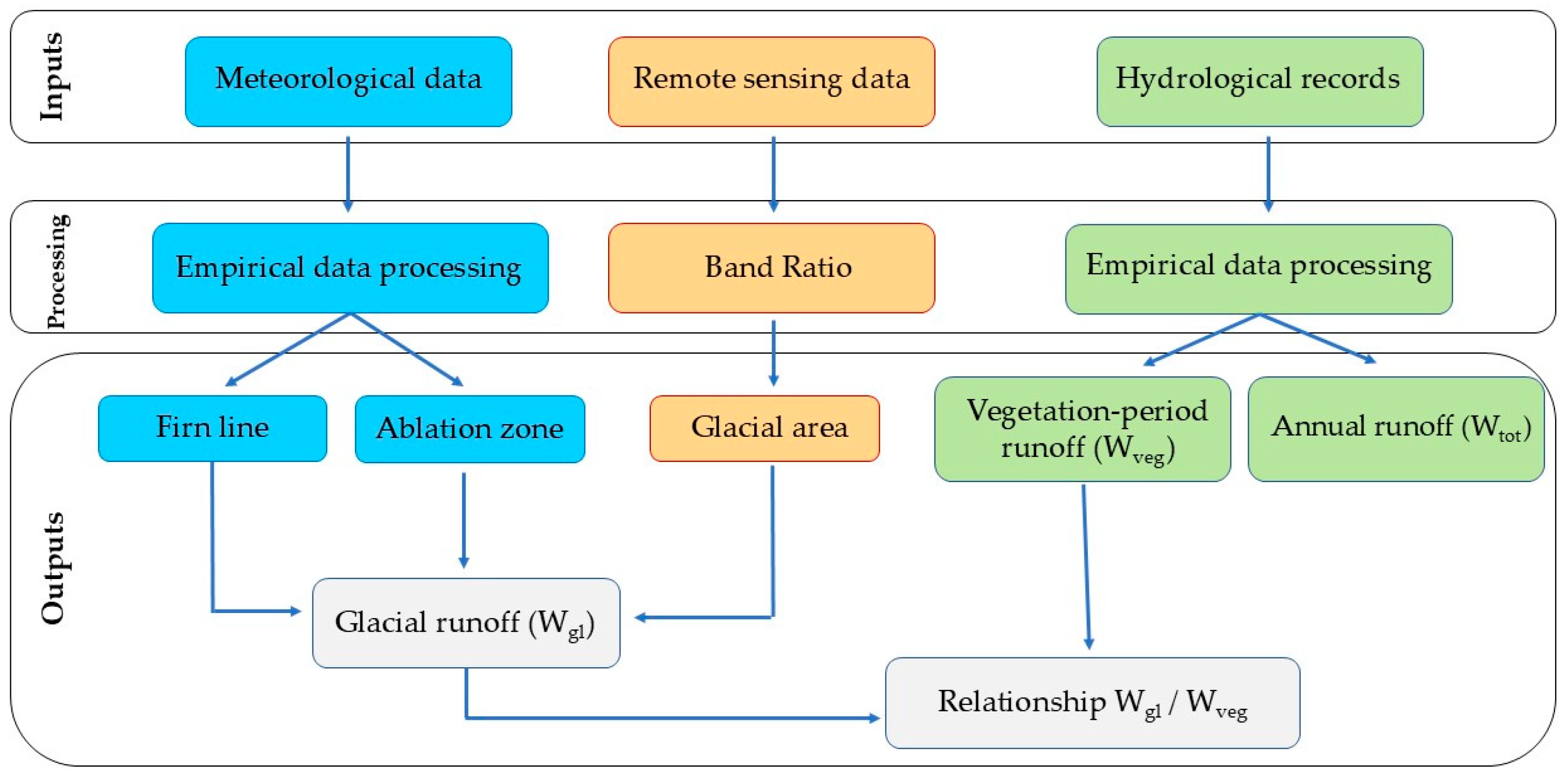
The complete workflow of the proposed method is summarized in the flowchart (Figure 3), which outlines the input datasets, the key processing steps, and the resulting outputs.
Nevertheless, analysis of glacier degradation under contemporary climate warming and associated changes in glacier runoff contributions provides a basis for evaluating long-term runoff characteristics of glaciers and glacier-fed rivers.

3. Results

3.1. Changes in Firn Line Altitude and Meteorological Conditions

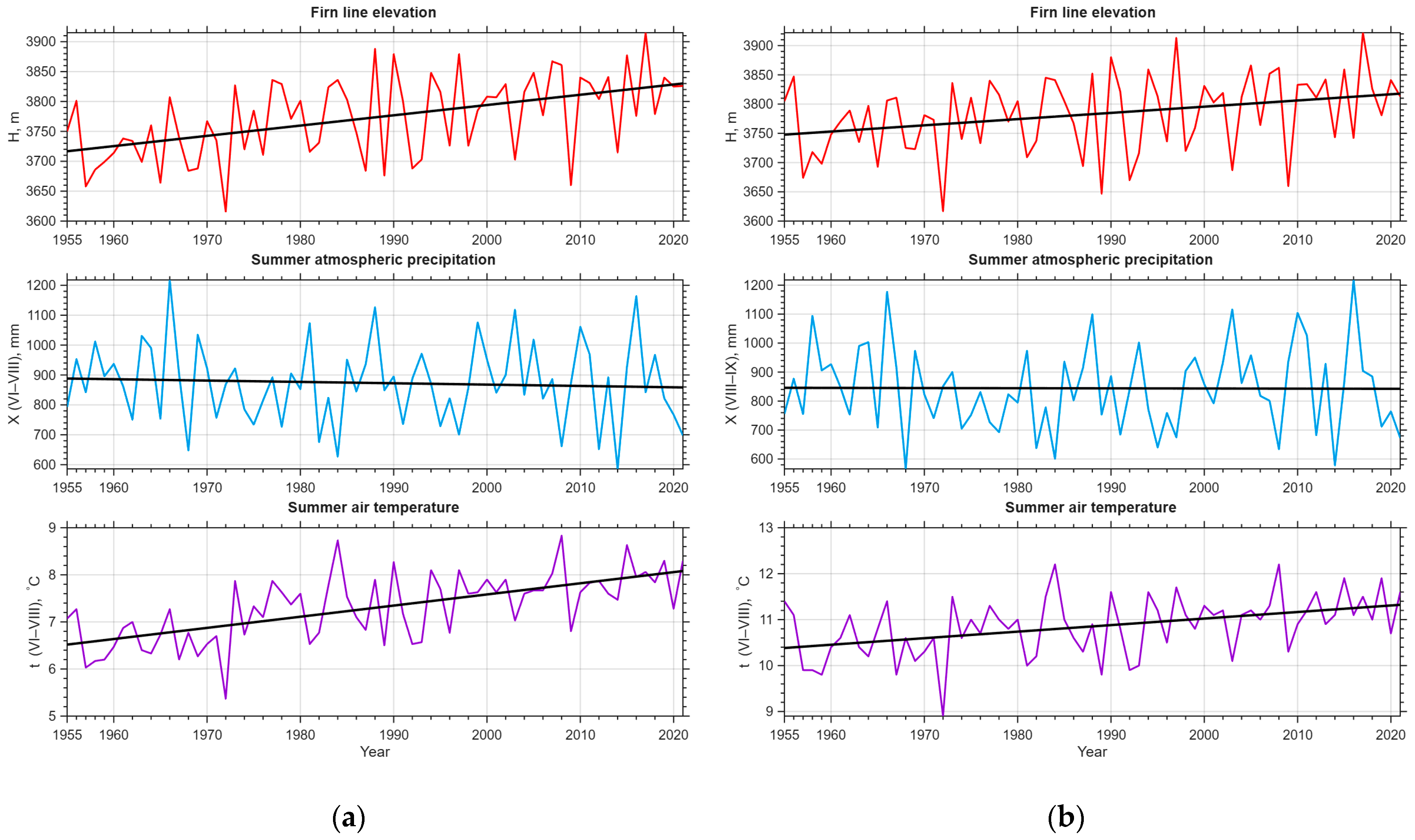
An upward shift in the glacier firn line, accompanied by a reduction in glacier area, is a consistent response to climate warming and reflects contraction of the accumulation zone. Figure 4 presents long-term variations in firn line elevation in the glacierized areas of the Kishi Almaty and Ulken Almaty river basins, together with annual (September–August) precipitation totals and mean summer (June–August) air temperatures derived from the Mynzhylky and Ulken Almaty Lake meteorological stations.
Firn line elevation is a key indicator of glacier conditions, as it defines the balance between accumulation and ablation zones. Firn line elevations calculated using Equation (2) are summarized in Table 3. The results show a clear dependence of firn line position on meteorological conditions, with higher air temperatures corresponding to elevated firn line altitudes.
Maximum firn line elevations were recorded in 1984 and 2008. At the Mynzhylky station, firn line altitudes reached 4008 m and 3995 m, respectively, with mean June–August air temperatures of 8.7 °C and 8.8 °C. At the Ulken Almaty Lake station, corresponding values were 4017 m in 1984 and 3998 m in 2008, with mean summer temperatures of 12.2 °C. Over the study period (1955–2021), firn line elevations generally ranged between 3700 and 3800 m and exhibited a long-term upward trend.
Since the 1990s, the study region has experienced a persistent increase in air temperature accompanied by an upward shift in the glacier firn line, indicating a strong linkage between meteorological conditions and seasonal snowline position. Previous studies have reported concurrent changes in temperature and precipitation under climate warming [68,75]. Building on this, mean air temperatures were calculated for the summer (June–August) and extended summer (May–September) periods at multiple elevations for 1955–2021 using established temperature gradients. Representative time intervals were identified using cumulative integral curves.
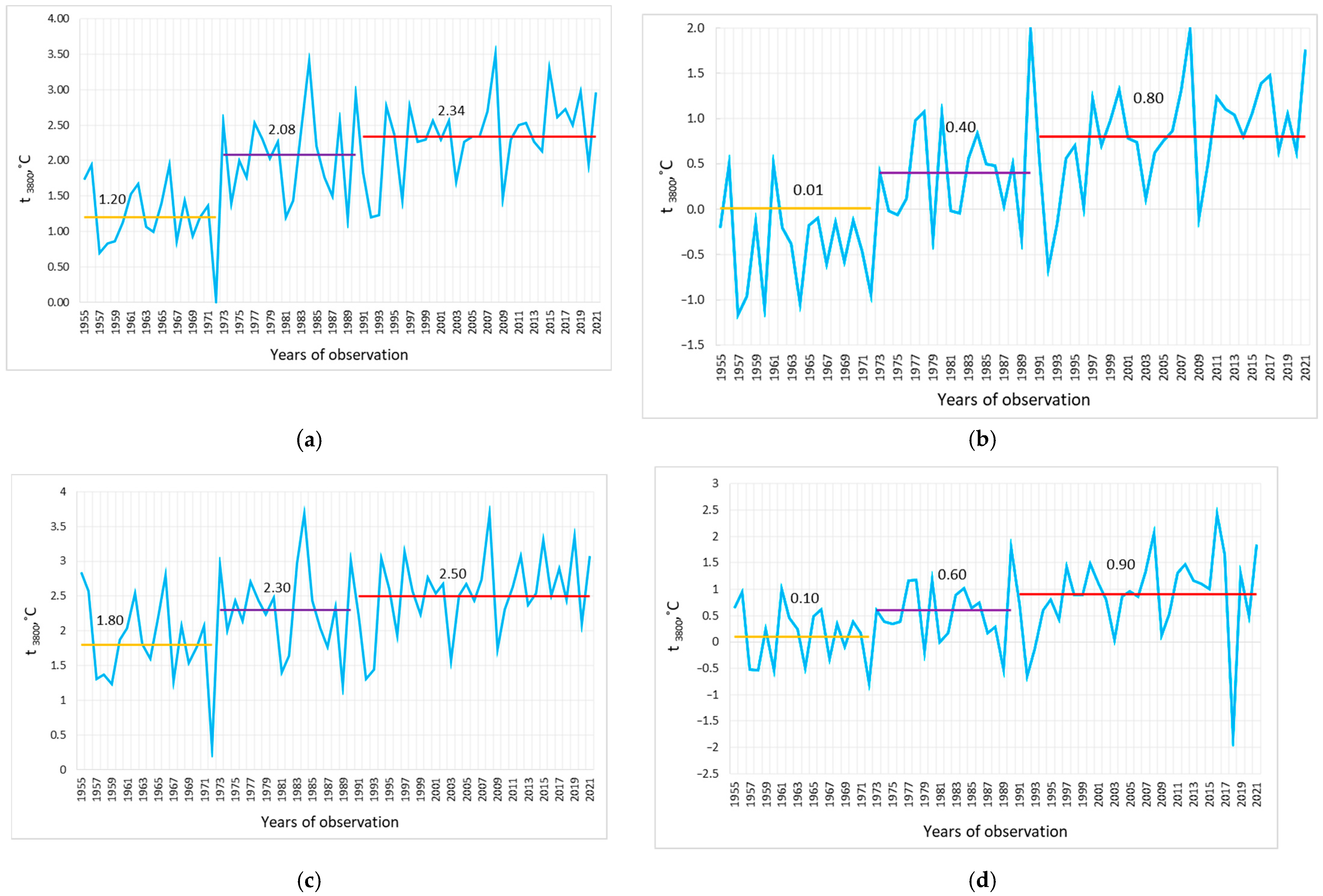
The cumulative curve analysis indicates that a sustained increase in air temperature began in the 1970s, with a marked intensification from the 1990s onward. Figure 5 illustrates mean air temperature variations in the glacierized zone for three periods (1955–1972, 1973–1990, and 1991–2021). The largest increase in mean temperatures occurred between the 1970s and 1990s, while warming continued after 1991 at a lower rate. Data summarized in Table 4 confirm temperature increases at all stations. The greatest absolute increase in summer temperature was observed at the Tuyuksu I station, whereas larger relative changes occurred at lower-elevation stations, including Mynzhylky and Ulken Almaty Lake. During the vegetation period, temperature increases were most pronounced at the Mynzhylky station, reaching approximately 98% for June–August and 50% for May–September.
As noted in [76], precipitation predominantly occurs during the spring–summer period along the polar front, which separates tropical and polar air masses. From April to August, the long-term average precipitation amounts to 619 mm, which is 71% of the annual total. Accordingly, during the autumn–winter period (September to March), the total precipitation is 255 mm, or 29% of the yearly amount.
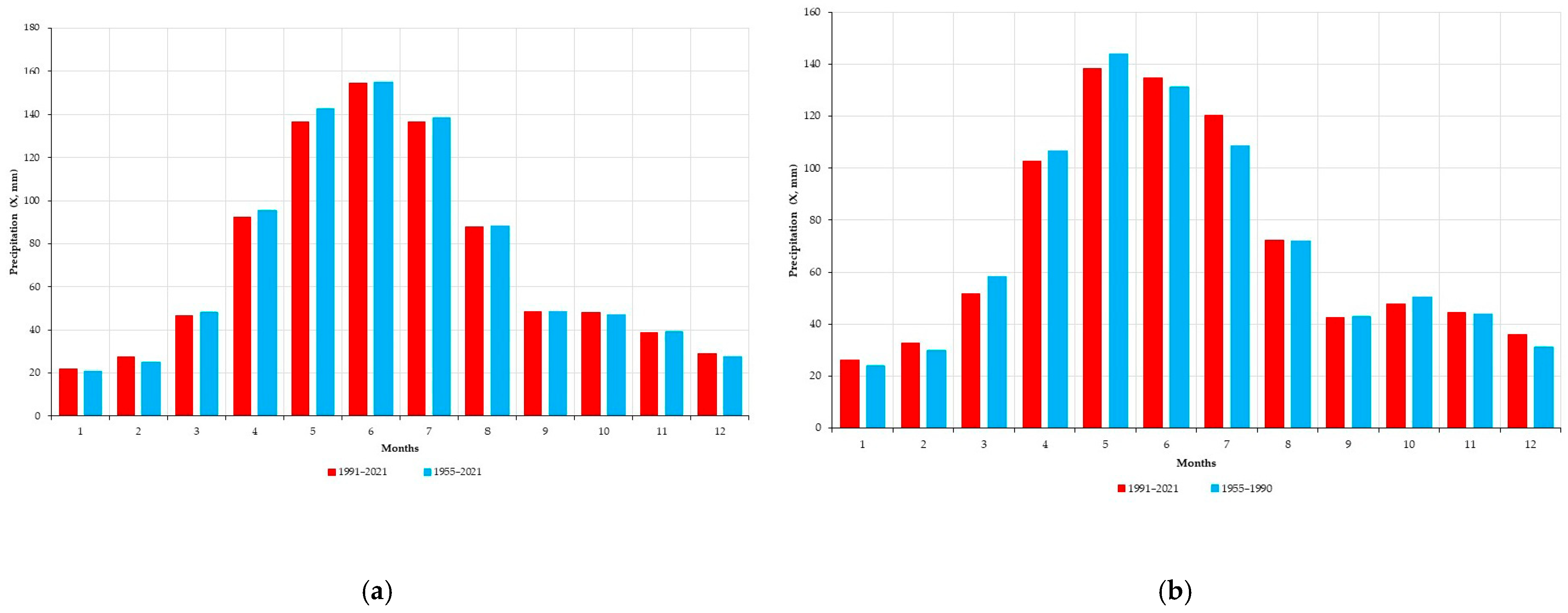
Analysis of monthly precipitation distribution indicates a pronounced summer maximum. At the Mynzhylky station, mean monthly precipitation peaks in June at 155 mm and reaches a minimum in January at approximately 21 mm. A similar pattern is observed at the Ulken Almaty Lake station, where June precipitation averages 141 mm and January values decrease to about 25 mm (Figure 6).
The vertical precipitation gradient was derived from long-term observations at the Mynzhylky, Ulken Almaty Lake, and Kamenskoye Plateau stations for 1955–2021. The accuracy of mean annual precipitation estimates obtained using this approach is expressed as relative error ranges summarized in Table 5.
The relative error of mean annual precipitation estimates was 2.34% for Mynzhylky, 4.31% for Ulken Almaty Lake, and 4.75% for the Kamenskoye Plateau, indicating acceptable accuracy of the applied methodology. Based on precipitation gradients calculated between the Mynzhylky–Kamenskoye Plateau and Ulken Almaty Lake–Kamenskoye Plateau station pairs, mean annual precipitation values were interpolated for elevations of 3430 and 3800 m; the results are summarized in Table 6.
Long-term series show consistent precipitation dynamics at 3800 m derived from stations at different elevations (Mynzhylky, Ulken Almaty Lake, and Tuyuksu I). During 1955–1972, precipitation totals were relatively high, followed by a decline in 1973–1990 of 43 mm (−4.6%) at Mynzhylky, 61 mm (−6.9%) at Ulken Almaty Lake, and 42 mm (−4.7%) at Tuyuksu I. Since 1991, precipitation has increased relative to the preceding period by 1.0%, 3.7%, and 1.4%, respectively. The largest variability was observed at the lower-elevation Ulken Almaty Lake station. Overall, current precipitation levels remain below those of the mid-20th century.
The comparison of results in Table 5 and Table 6 confirms the reliability of the vertical precipitation gradient estimation and indicates persistent long-term changes in precipitation distribution relevant to glacier and runoff dynamics in the region.

3.2. Glacier Area Change and Glacial Runoff Trend

Glaciers in the study region display pronounced spatial heterogeneity, with the largest glacierized areas concentrated in the Talgar, Yesik, Turgen, and Ulken Almaty river basins. Valley and cirque glaciers dominate and largely define the present glaciation pattern.
The first glacier inventory of the northern slope of the Ile Alatau was compiled in 1955 by Vilesov and Khonin [77]. An updated inventory based on glacier conditions in 2008 was later produced by Shesterova and Kokarev using satellite imagery, radar data, and topographic maps, substantially improving mapping accuracy [78].
Glacier area changes for 1999–2021 were assessed using multitemporal remote sensing data. The resulting glacier area estimates, excluding moraine- and firn-covered glaciers, are presented in Table 7 and characterize changes within the catchments of the northern Ile Alatau and Kungei Alatau ranges.
The glacier inventory shows that the number of glaciers on the northern slope of the Ile Alatau decreased from 489 in 1999 to 426 in 2014 and 402 in 2021, while total glacier area declined from 432.6 ± 18.17 km2 to 345 ± 14.49 km2 and 322.13 ± 3.53 km2, respectively. These changes indicate substantial glacier reduction over the study period.
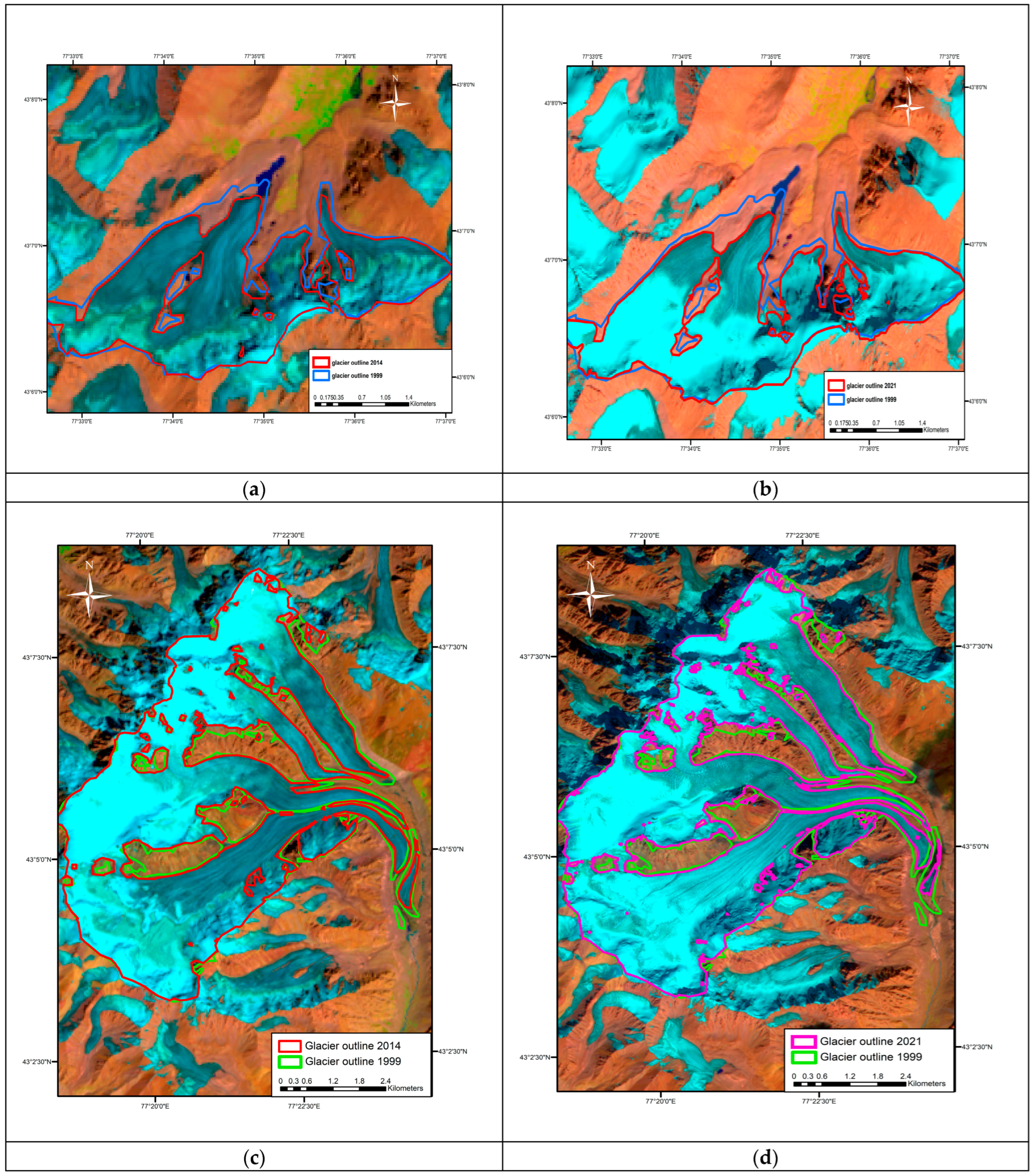
The highest rates of glacier area loss were observed in the Shamalgan (3.4% yr−1), Prokhodnaya (2.5% yr−1), and Kishi Almatinka (2.0% yr−1) river basins, whereas the lowest rates occurred in the Shilik (0.98% yr−1) and Yesik (1.01% yr−1) basins. The reduction in glacierized area was accompanied by structural changes in glacier cover, including glacier disappearance, fragmentation of larger glaciers, and separation of accumulation zones, as illustrated in Figure 7.
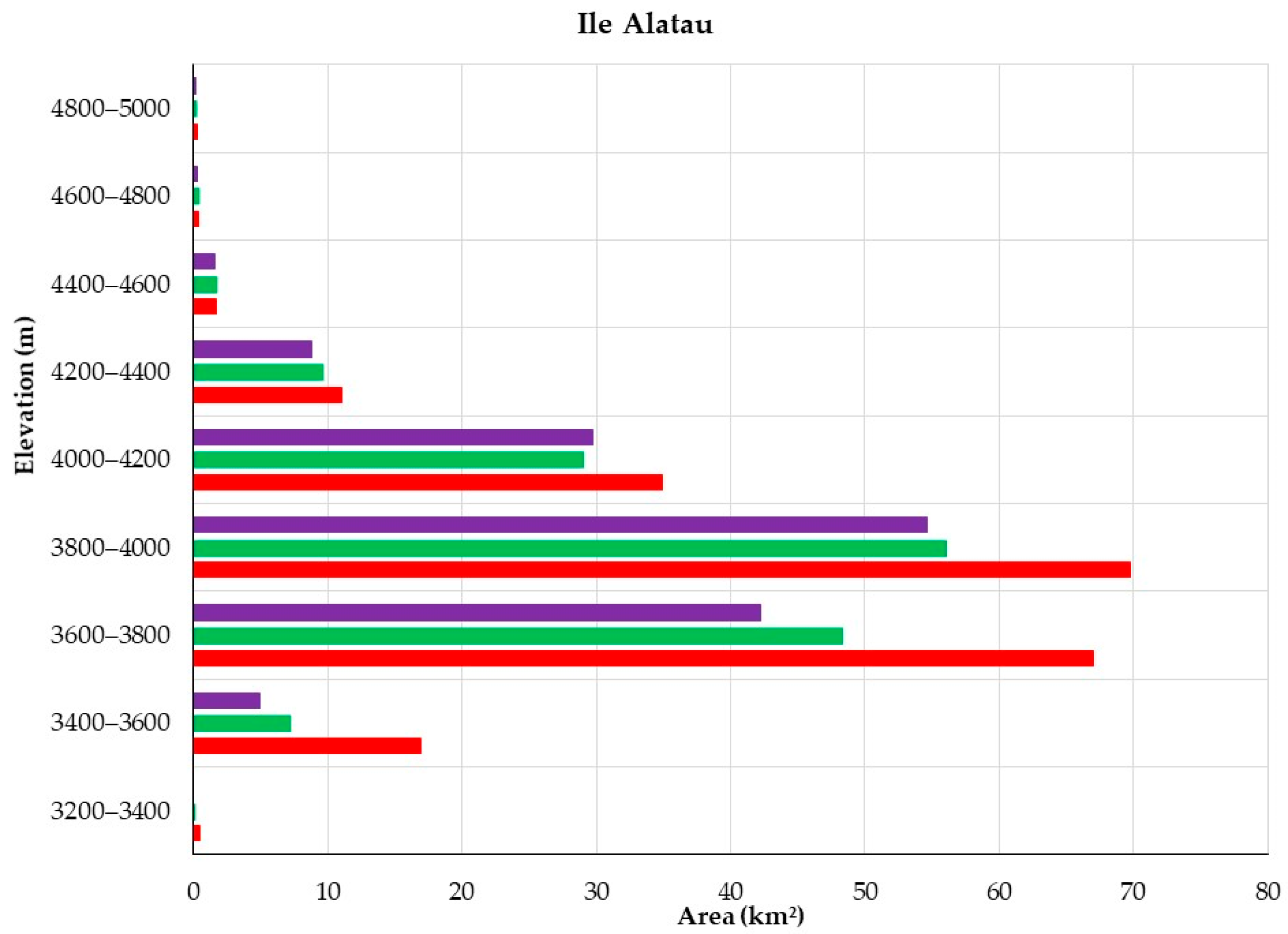
Between 1999 and 2021, glacierized area on the northern slope of the Ile Alatau declined across all elevation bands, accompanied by an upward shift in the main ice mass (Figure 8). The most pronounced reductions occurred in the 3200–3600 m and 3600–3800 m intervals, indicating decreasing glacier persistence at lower elevations. In the 3800–4000 m band, which retained the largest glacierized area, coverage decreased from 69.83 ± 2.93 km2 in 1999 to 54.6 ± 2.29 km2 in 2021 (−22%), while the 3600–3800 m interval declined from 67.03 ± 2.82 km2 to 42.24 km2 (−37%).
Glacier areas above 4400 m remained comparatively stable over the study period. Overall, the observed upward displacement of glacier area reflects changes in the thermal regime and reduced ice stability at lower elevations.
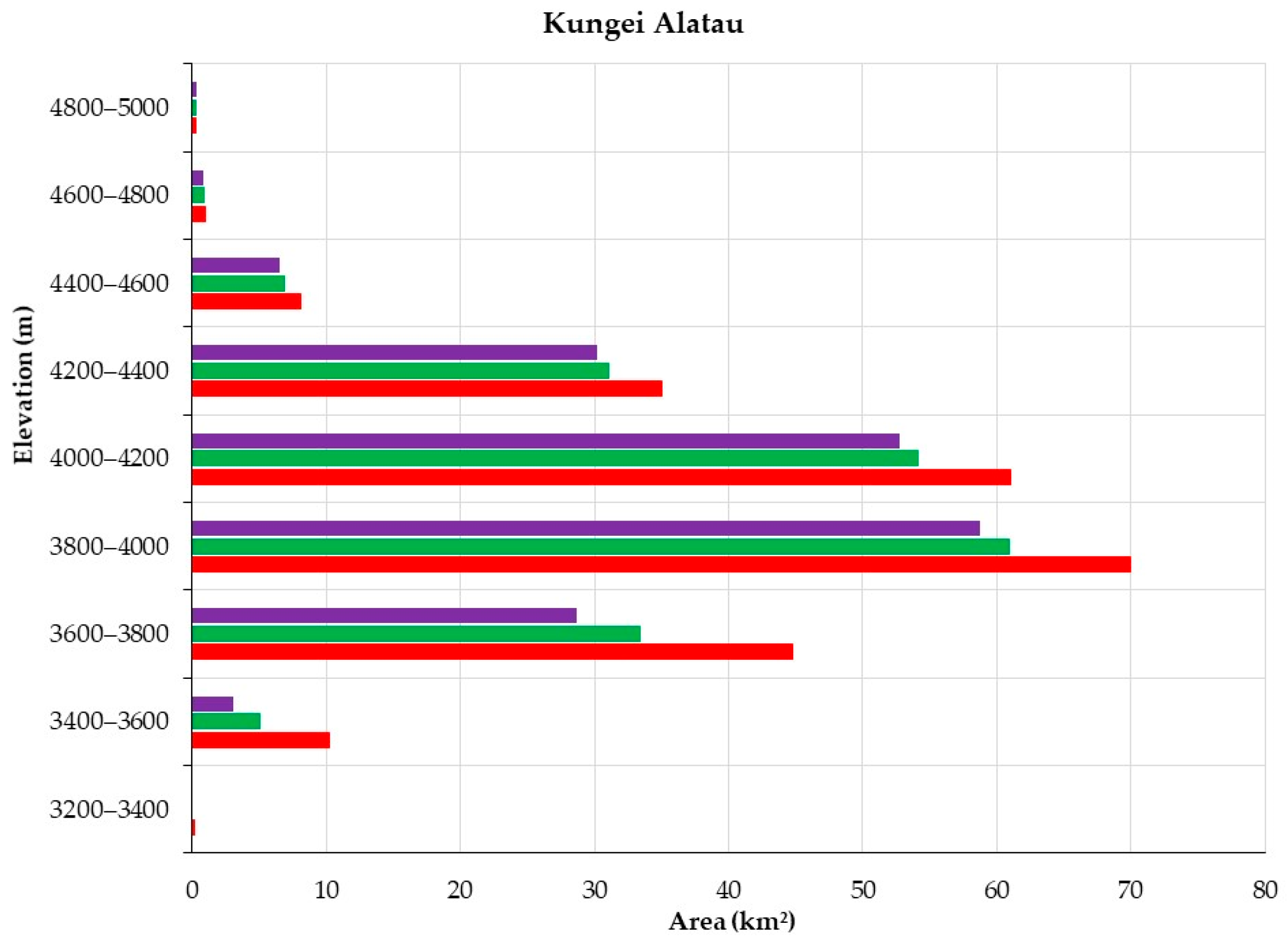
The elevation-dependent distribution of glacier area in the Kungei Alatau for 1999, 2014, and 2021 (Figure 9) shows a consistent reduction in glacier cover and a redistribution of ice mass toward higher elevations. The largest losses occurred in the 3600–4000 m interval, which previously contained the main accumulation areas.
In the 3800–4000 m band, glacier area decreased from 69.97 ± 2.94 km2 in 1999 to 58.77 ± 2.47 km2 in 2021 (−16%), while the 3600–3800 m zone experienced a larger decline from 44.76 ± 1.2 km2 to 28.67 km2 (−36%). The glacier area in the 3400–3600 m interval decreased from 10.17 ± 0.42 km2 to 3.05 km2, and the 3200–3400 m belt nearly lost glacier cover entirely. In contrast, glaciers above 4400 m remained relatively stable, with changes in less than 0.2 ± 0.008 km2 over the study period.
The observed upward shift in glacier area distribution in the Kungei Alatau closely mirrors patterns identified in the Ile Alatau, indicating consistent deglaciation trends across both mountain ranges.
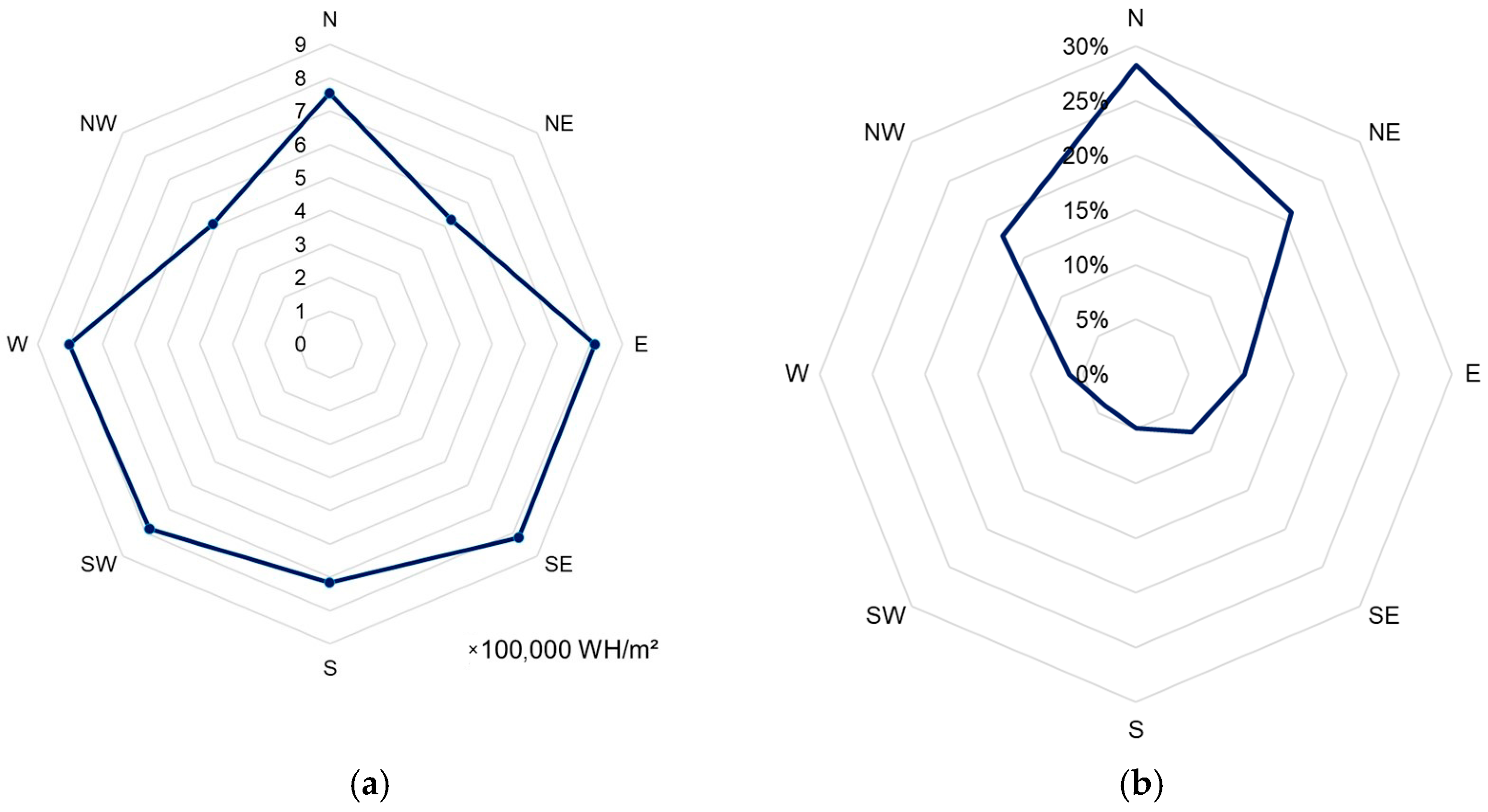
Solar radiation distribution calculated from the SRTM 30 m DEM shows a pronounced dependence on slope aspect (Figure 10a). The highest relative radiation values are observed on eastern (E) and southeastern (SE) slopes, reaching approximately 7.5–8.0 × 10⁵ Wh m−2. Slightly lower but still elevated values occur on western (W) and southwestern (SW) aspects, on the order of 6.5–7.2 × 10⁵ Wh m−2. Southern (S) slopes receive relatively high solar radiation of about 6.0–6.5 × 10⁵ Wh m−2, although these values remain below those of eastern exposures.
Minimum radiation values are characteristic of northeastern (NE) and northwestern (NW) aspects, where incoming solar radiation does not exceed 4.5–5.0 × 10⁵ Wh m−2. Northern (N) slopes exhibit intermediate values of approximately 5.5–6.0 × 10⁵ Wh m−2, consistently lower than those observed on southern and eastern orientations. The difference between minimum and maximum aspect-controlled solar radiation amounts to approximately 3.0–3.5 × 10⁵ Wh m−2, indicating pronounced anisotropy of insolation within the study area.
Analysis of glacier area distribution by slope aspect shows a pronounced asymmetry (Figure 10b). The largest proportion of glacier area is associated with northern (N) aspects, accounting for approximately 30% of the total glacierized area. Northeastern (NE) slopes also host a substantial share of glaciers, contributing about 20–25%.
In contrast, eastern (E) and southeastern (SE) aspects contain markedly smaller glacier areas, generally not exceeding 10–12%. The lowest proportions are observed on southern (S) and southwestern (SW) slopes, where glaciers account for less than 5% of the total area. Western (W) and northwestern (NW) aspects occupy an intermediate position, with glacier coverage lower than that on northern slopes but higher than on southern exposures.
The spatial distribution of glacier area by slope aspect demonstrates a clear preference for northern and northeastern orientations, while southern-sector slopes are characterized by minimal glacier occurrence.
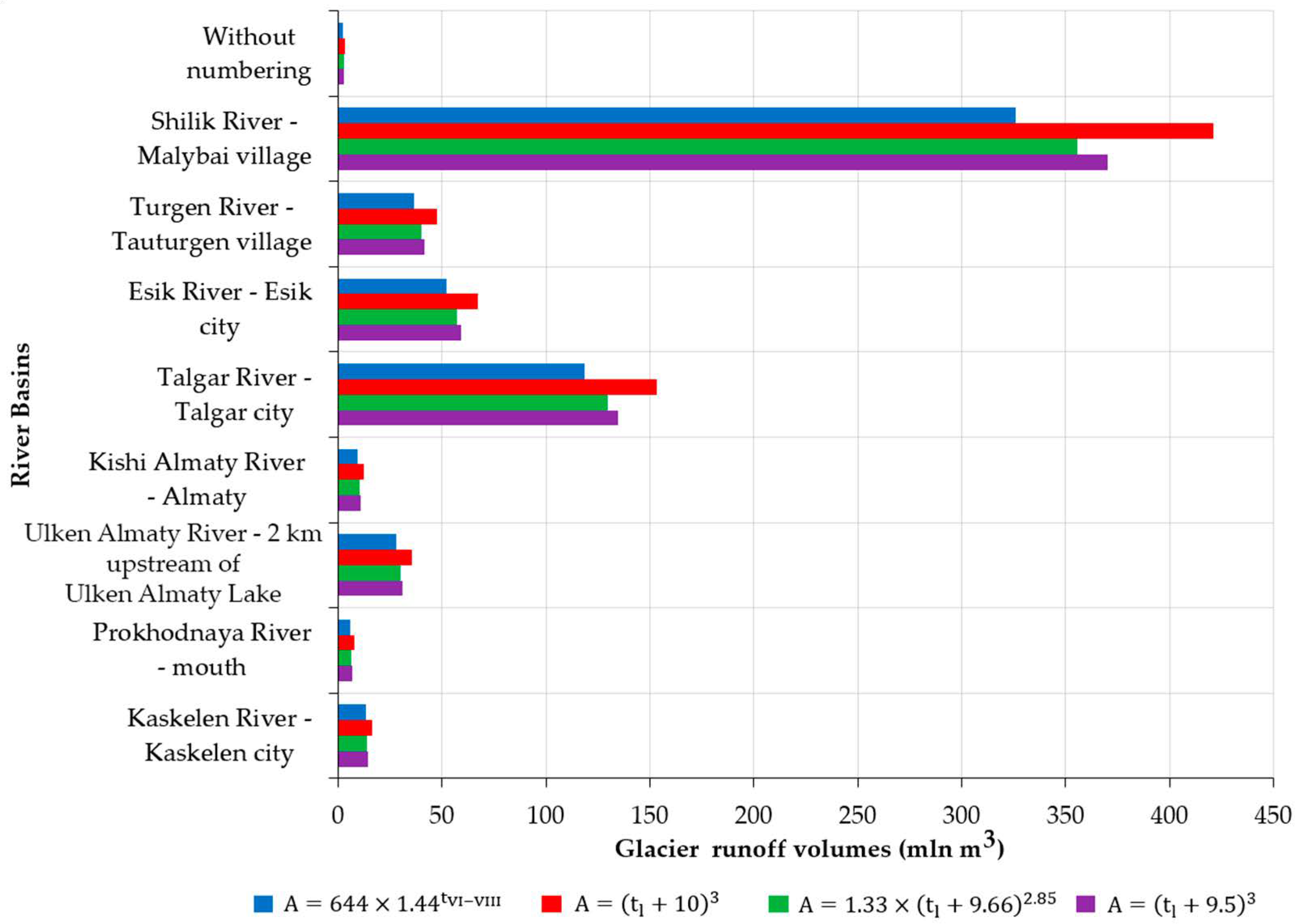
The results shown in Figure 11 were derived using the glacier runoff estimation approach for the Ile Alatau proposed by Vilesov [52], which calculates cumulative snow and ice ablation based on mean summer air temperature at a reference elevation of 3800 m corresponding to the long-term average snowline position. Glacier runoff volumes for the river basins of the northern slope of the Ile Alatau, calculated using empirical formulations proposed by different authors, are summarized in Figure 11 and illustrate methodological differences in runoff estimates.
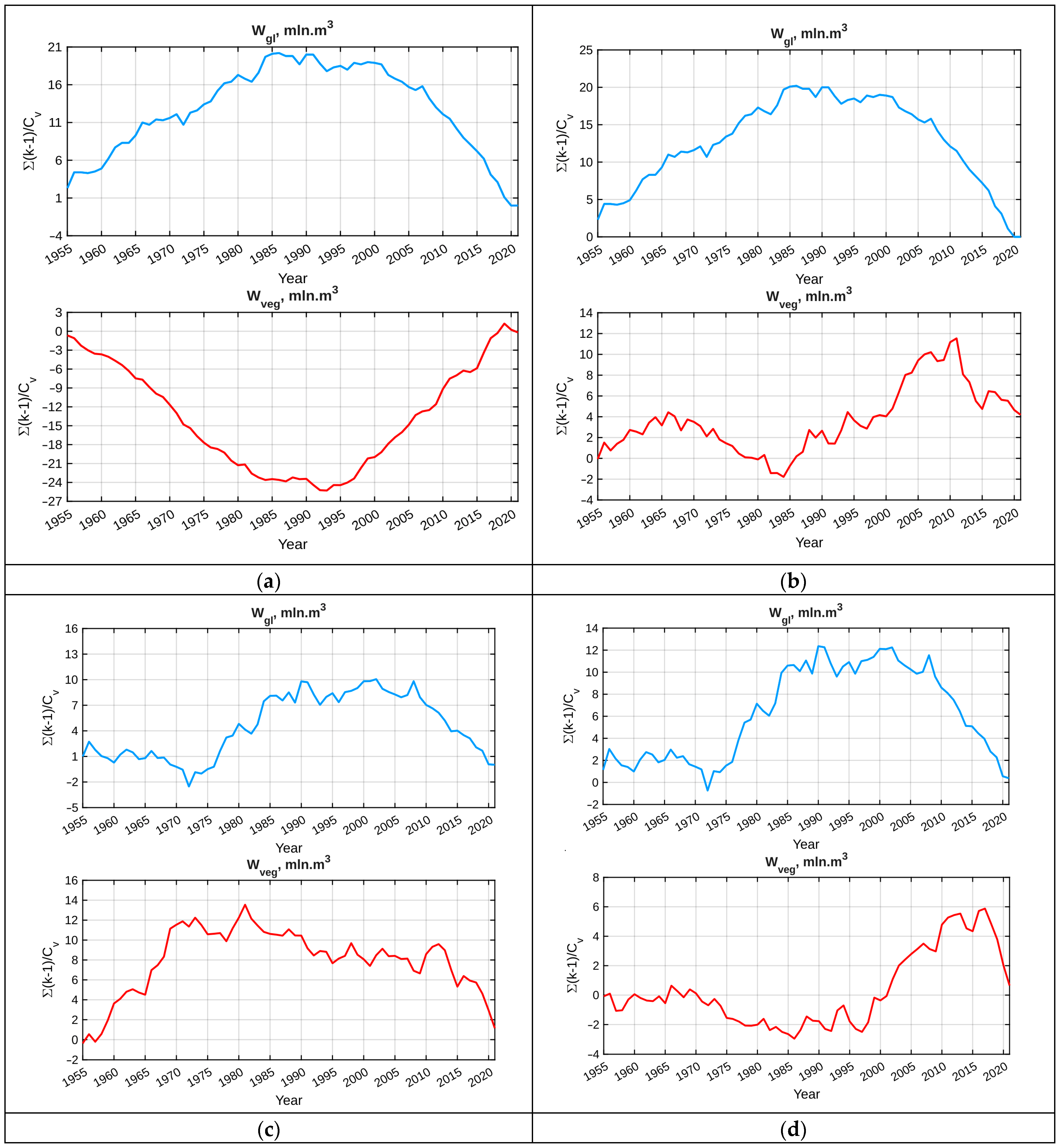
Long-term analysis of river runoff on the northern slope of the Ile Alatau indicates significant changes in water balance structure, characterized by a decreasing contribution of glacier meltwater. Integral curves and calculated values of total and glacier runoff for 1955–2021 (Figure 12) show that the decline in glacier runoff began in the late 1980s to early 1990s and has persisted thereafter.
The method of integral curves was used to assess deviations of runoff from long-term mean values and their cumulative behavior over time. Comparison of integral curves for total and glacier runoff allowed identification of key shifts in the hydrological regime and increasing variability associated with firn line retreat and expansion of ablation zones.
Changes in glacier runoff were analyzed on annual and vegetation-period (May–September) scales using mean monthly and annual discharge data from hydrological stations on the main left-bank tributaries of the Ile River for 1955–2021 (Table 8). Missing observations were reconstructed, and the relative error in estimated mean annual runoff ranged from 0.07% to 4.73%, indicating acceptable calculation accuracy.
The homogeneity of runoff time series was evaluated using Student’s t-test, Fisher’s F-test, binomial distribution curves (with Cs = 2Cv), and the nonparametric Wilcoxon test. The full record (1955–2021) was found to be heterogeneous, whereas the periods before and after 1991 were statistically homogeneous and were therefore analyzed separately. For the post-1991 interval, homogeneity was confirmed in 80% of cases for the mean, 100% for variance, and 90% using the Wilcoxon test, supporting the applicability of statistical analyses to this period.
Comparison of glacier runoff volumes with mean annual and vegetation-period (May–September) runoff for the main rivers of the northern slope of the Ile Alatau (Table 9) indicates that glacier melt remains a substantial component of the regional water balance. Estimates based on glacier areas derived from remote sensing data for 1999, 2014, and 2021 show that glacier runoff contributes approximately 25% of total annual discharge in the left-bank tributaries of the Ile River, increasing to about 40% in basins with extensive glacier cover.
These values exceed regional estimates reported for other parts of Central Asia, where glacier ice melt typically contributes less than 15% to runoff, rising to around 20% when firn and seasonal snowmelt are included [61]. It should be noted that evaporation losses were not considered, which may lead to a slight overestimation of the glacier contribution.
Long-term runoff records for 1955–2021 identify two hydrological phases: a relatively wet period up to the late 1980s–early 1990s, followed by a low-water period thereafter (Figure 12). This shift reflects changes in glacier extent and runoff regimes under climate warming.
The long-term norm of glacier runoff for 1955–2021 was derived primarily from calculated data (Figure 12). During 1955–1990, total glacier runoff amounted to 671 million m3 (32% of mean annual runoff), decreasing to 637 million m3 (25%) in 1991–2021. This corresponds to an overall reduction of approximately 7% in glacier runoff contribution over recent decades.
During 1955–1972, glacier runoff fluctuated around the long-term mean, while in 1973–1990 runoff increased and reached maxima in 1984 and 1990, coincident with rising air temperatures and enhanced ablation. After 1991, continued warming was accompanied by a decline in glacier runoff, as increased ablation no longer compensated for glacier area loss. Despite a 5% reduction in glacier runoff in the left-bank tributaries of the Ile River, mean annual discharge increased by 18% and vegetation-period runoff by 28% (Table 8).
Analysis of individual river basins indicates a widespread decline in the glacier runoff share. The largest reductions were observed in the Ulken Almaty basin, including decreases of 36% in the Prokhodnaya River, 23% in the Ulken Almaty River (including the Kumbel tributary), 15% in the Kishi Almaty River, and 11% in the Turgen River, while reductions of 4–9% were recorded in other basins. In contrast, glacier runoff in the Shilik River basin remained relatively stable. These results confirm a general decrease in glacier contributions to river discharge and highlight pronounced spatial variability among basins [39,79].
Under ongoing climate warming, glaciers of the Northern Tien Shan exhibit pronounced changes in both morphometric characteristics and runoff contribution. The firn line remains a key indicator of glacier state, reflecting the balance between accumulation and ablation. Its position is controlled not only by air temperature but also by precipitation, slope exposure, surface morphology, and physical properties of snow and ice, introducing uncertainty into firn line estimates derived solely from temperature data, particularly given the scarcity of high-altitude meteorological stations.

4. Discussion

4.1. Firn Line Change and Climatic Controls

The firn line is a key integrative indicator of glacier response to climate variability, reflecting the long-term balance between accumulation and ablation. In the Northern Tien Shan, firn line dynamics reveal a complex but internally consistent response to recent climate change, in which relatively small short-term variations coexist with a clear long-term upward trend and pronounced glacier degradation.
Observations from high-altitude meteorological stations indicate that firn line elevations remained near 3750–3800 m during 1955–2021, with only minor differences between the periods 1955–1990 and 1991–2021. This apparent stability contrasts with the well-documented warming trend in the region and suggests that increased precipitation in recent decades has partially compensated for enhanced ablation by supporting snow and firn accumulation. However, this compensation is incomplete and largely masks longer-term changes.
When examined over a longer temporal scale, firn line reconstruction reveals a systematic rise of approximately 80–100 m since the mid-20th century. This shift indicates a gradual contraction of the accumulation area, even though short-term firn line fluctuations appear modest. The observed behavior is consistent with findings from other parts of the Tien Shan, including the Eastern Tien Shan, where the seasonal snow line rose by 80–120 m between 1994 and 2016 [80]. These regional similarities suggest that the Northern Tien Shan response is not anomalous but part of a broader regional pattern.
Global comparisons further support this interpretation. Rapid firn line rise has been reported in the Western Himalayas in response to strong summer warming and reduced snow accumulation [81], while larger increases in the Qilian Mountains have been linked to combined warming and declining winter precipitation [82]. In the Pamir-Alai, upward migration of the firn zone has similarly been associated with rising air temperatures and decreasing accumulation [83]. Comparable magnitudes of firn line or equilibrium-line altitude rise have been documented in the Alps [84,85], tropical Andes [86], and Arctic regions [87], demonstrating the global coherence of this response.
Across these regions, similar mechanisms drive firn line change: increased summer energy input, reduced snow persistence, a shift from solid to liquid precipitation during transitional seasons, declining surface albedo due to impurities, and lengthening melt seasons in spring and autumn. In the Northern Tien Shan, these processes operate simultaneously, with temperature exerting the dominant control. While increased precipitation can locally and temporarily moderate firn line rise, global evidence indicates that such effects cannot offset sustained warming over longer periods.
Thus, the relatively stable firn line elevations observed in recent decades should not be interpreted as a sign of glacier stability. Instead, they reflect a transient state in which enhanced accumulation partially compensates for warming-induced melt. The continued thinning of firn and ice and the ongoing reduction in glacier area demonstrate that this balance is unstable and that the firn line response in the Northern Tien Shan represents an intermediate stage within a globally consistent trajectory of glacier adjustment to climate warming.

4.2. Glacier Area Change and Glacial Runoff Trends

The evolution of glacier area in the northern Ile Alatau and Kungei Alatau confirms substantial and accelerating glacier degradation. Glacier inventories and remote sensing analyses show a marked decline in glacier number and total area, with more than 25% of glacier area lost between 1999 and 2021 alone. These changes are consistent with earlier inventories [77,88] and indicate that recent decades correspond to a phase of intensified retreat.
Glacier area loss exhibits pronounced spatial heterogeneity among river basins. Basins dominated by small and mid-sized glaciers, such as Shamalgan, Prokhodnaya, and Kishi Almaty, show the highest relative loss rates (>2–3% yr−1), whereas basins containing larger and higher-elevation glacier systems, such as Shilik and Talgar, exhibit comparatively lower retreat rates. This size- and elevation-dependent response is widely documented in the Tien Shan and other mountain regions and reflects the greater sensitivity of small glaciers with limited hypsometric range and accumulation potential [89,90].
Elevation-dependent analysis further reveals that glacier retreat is concentrated at lower and mid-elevations (3200–3800 m), while glacier areas above ~4400 m remain relatively stable. This upward redistribution of glacier area reflects a rising thermal threshold for long-term ice preservation under warming conditions. Similar vertical shifts in glacier ice toward higher elevations have been reported throughout High Mountain Asia, the Pamirs, and the Alps [91,92,93], indicating a robust and widespread response to increasing air temperatures.
Slope aspect and solar radiation significantly modulate the spatial expression of glacier retreat. Strong anisotropy in potential incoming solar radiation—up to 3.0–3.5 × 10⁵ Wh m−2—creates pronounced contrasts in surface energy balance. Slopes with eastern, southeastern, western, and southwestern exposures receive higher solar radiation, enhancing melt rates and accelerating glacier area loss. In contrast, northern and northeastern aspects experience reduced insolation and more favorable thermal conditions, which explains the concentration of glacier area on shaded slopes and the minimal glacier presence on southern exposures.
Beyond direct melt enhancement, aspect-controlled insolation affects snow retention, firn development, and the timing of seasonal melt onset. High-radiation slopes lose seasonal snow earlier, reducing albedo and amplifying melt through positive feedbacks, whereas shaded slopes retain snow longer and delay ice exposure, partially buffering glacier retreat. Such aspect-dependent controls on glacier persistence are widely observed in the Tien Shan, Pamirs, Alps, and Karakoram [11,94,95].
The structural changes in glacier geometry and distribution directly influence glacial runoff. Between 1955 and 2021, the contribution of glacial meltwater to annual river discharge declined from approximately 32% to 25%, with reductions of 10–35% in most glacier-fed basins. This decline coincides with glacier area loss and firn line rise and reflects a weakening of glacier control on runoff formation. While increased ablation initially enhanced summer runoff in some basins, continued glacier shrinkage has led to a progressive transition toward precipitation-dominated hydrological regimes.
Comparable runoff transitions have been documented across Central Asia, the Tibetan Plateau, the Pamirs, the Alps, the tropical Andes, and North America [32,96,97,98,99,100,101,102]. Global modeling studies further demonstrate that most glacierized basins experience a “peak glacial runoff” phase, followed by an irreversible decline in meltwater contribution as glacier mass is depleted [7,103,104]. The trends observed in the Northern Tien Shan are consistent with this conceptual framework and indicate that many basins are approaching or have already passed peak glacial runoff.
In summary, glacier evolution in the Northern Tien Shan is primarily controlled by regional climate warming, with elevation and slope aspect modulating the spatial pattern of retreat. The combined evidence of firn line rise, glacier area reduction, and declining glacier runoff indicates an ongoing transition toward precipitation-dominated hydrological conditions, with implications for seasonal runoff regulation and long-term water resource sustainability in glacier-fed basins. Although deterministic hydrological forecasting was beyond the scope of this study, the identified long-term trends provide a basis for assessing future runoff behavior under continued warming. Uncertainty remains due to variability in future climate forcing, sparse high-altitude observations, and the empirical nature of runoff estimates. Nevertheless, the observed decline in glacier area and meltwater contribution indicates a continued shift toward precipitation-dominated runoff regimes in the coming decades.

5. Conclusions

This study analyzed changes in firn line elevation, climatic parameters, and glacier characteristics in the northern Ile Alatau and Kungei Alatau between 1955 and 2021. The findings confirm the persistent influence of climate warming on glacier degradation and associated transformations of runoff regimes. Data from high-mountain meteorological stations, satellite imagery (Landsat, Sentinel-2), digital elevation models, and empirical runoff estimates consistently indicate that rising summer air temperatures and shifts in precipitation patterns are the main drivers of glacier reduction.
During the study period, the firn line rose by ~300 m (from ~3400 m to ~3700 m), averaging ~4.6 m per year, which resulted in substantial loss of accumulation area. The most pronounced temperature increase occurred between 1955 and 1972 and 1973–1990, with summer temperatures (tVI–VIII) at Mynzhylky station rising by 0.88 °C (42%). Precipitation decreased across all stations during 1973–1990, followed by only partial recovery after 1991, without reaching mid-20th century levels. These conditions contributed to a steady reduction in glacier-fed runoff, which declined from ~32% of annual discharge in 1955–1990 to ~25% in 1991–2021. Hypsometric analysis further revealed that glacier degradation is concentrated below 3500 m, while accumulation zones above have largely lost their function.
The study acknowledges limitations, including uncertainties in empirical runoff formulas, the absence of direct mass-balance observations, and potential errors in satellite-derived data for complex terrain. Nevertheless, the results provide robust evidence that under projected warming of 1.5–2.0 °C by mid-century, glacier runoff is likely to peak within 1–2 decades, followed by rapid decline. This will exacerbate water supply instability and increase hydrological dependence on highly variable precipitation.
Future research should therefore focus on (i) long-term high-altitude monitoring, (ii) advanced glacier-climate-hydrological modeling, and (iii) integration of glaciological, hydrometeorological, and socio-economic assessments. For sustainability, adaptive water-resource management strategies must replace static models to ensure resilience of mountain and foothill communities in Central Asia under continuing climate change. Strengthening regional cooperation and sustainable governance of transboundary water resources will be essential to mitigate risks and support long-term socio-economic stability.

Author Contributions

Conceptualization, A.N.A., G.I. and N.S.; methodology, A.N.A., A.M. and R.A.; software, A.M.; validation, G.I. and A.C.; formal analysis, A.N.A. and N.S.; investigation, G.I.; resources, A.C.; data curation, B.I. and R.A.; writing—original draft preparation, A.N.A., A.C. and A.A.A.; writing—review and editing, N.S., R.A. and G.I.; visualization, A.A.A.; supervision, N.S.; project administration, B.I.; funding acquisition, B.I. All authors have read and agreed to the published version of the manuscript.

Funding

This research was funded by the Committee of Science of the Ministry of Science and Higher Education of the Republic of Kazakhstan (Grant No. BR21882365).

Institutional Review Board Statement

Not applicable.

Informed Consent Statement

Not applicable.

Data Availability Statement

Data are contained within this.

Acknowledgments

We are grateful to all the providers of free data, as well as to all the authors of the articles that were discussed in this work.

Conflicts of Interest

The authors declare no conflicts of interest.

References

  1. IPCC. Climate Change 2021—The Physical Science Basis Climate Change 2021—The Physical Science Basis: Working Group I Contribution to the Sixth Assessment Report of the Intergovernmental Panel on Climate Change, 1st ed.; Cambridge University Press: Cambridge, UK, 2023; ISBN 978-1-009-15789-6. [Google Scholar]
  2. Sorg, A.; Bolch, T.; Stoffel, M.; Solomina, O.; Beniston, M. Climate Change Impacts on Glaciers and Runoff in Tien Shan (Central Asia). Nat. Clim Change 2012, 2, 725–731. [Google Scholar] [CrossRef]
  3. Lutz, A.F.; Immerzeel, W.W.; Kraaijenbrink, P.D.A.; Shrestha, A.B.; Bierkens, M.F.P. Climate Change Impacts on the Upper Indus Hydrology: Sources, Shifts and Extremes. PLoS ONE 2016, 11, e0165630. [Google Scholar] [CrossRef]
  4. Sorg, A.; Huss, M.; Rohrer, M.; Stoffel, M. The Days of Plenty Might Soon Be over in Glacierized Central Asian Catchments. Environ. Res. Lett. 2014, 9, 104018. [Google Scholar] [CrossRef]
  5. Oliva, M.; Mercier, D.; Ruiz-Fernández, J.; McColl, S. Paraglacial Processes in Recently Deglaciated Environments. Land Degrad. Dev. 2020, 31, 1871–1876. [Google Scholar] [CrossRef]
  6. Huo, D.; Bishop, M.P.; Bush, A.B.G. Understanding Complex Debris-Covered Glaciers: Concepts, Issues, and Research Directions. Front. Earth Sci. 2021, 9, 652279. [Google Scholar] [CrossRef]
  7. Huss, M.; Hock, R. Global-Scale Hydrological Response to Future Glacier Mass Loss. Nat. Clim Change 2018, 8, 135–140. [Google Scholar] [CrossRef]
  8. Department of Economic and Social Affairs Sustainable Development. Available online: https://sdgs.un.org/goals (accessed on 14 September 2025).
  9. Marzeion, B.; Champollion, N.; Haeberli, W.; Langley, K.; Leclercq, P.; Paul, F. Observation-Based Estimates of Global Glacier Mass Change and Its Contribution to Sea-Level Change. Surv. Geophys. 2017, 38, 107–132. [Google Scholar] [CrossRef] [PubMed]
  10. Ohmura, A.; Boettcher, M. On the Shift of Glacier Equilibrium Line Altitude (ELA) under the Changing Climate. Water 2022, 14, 2821. [Google Scholar] [CrossRef]
  11. Paul, F.; Rastner, P.; Azzoni, R.S.; Diolaiuti, G.; Fugazza, D.; Le Bris, R.; Nemec, J.; Rabatel, A.; Ramusovic, M.; Schwaizer, G.; et al. Glacier Shrinkage in the Alps Continues Unabated as Revealed by a New Glacier Inventory from Sentinel-2. Earth Syst. Sci. Data 2020, 12, 1805–1821. [Google Scholar] [CrossRef]
  12. Zemp, M.; Frey, H.; Gärtner-Roer, I.; Nussbaumer, S.U.; Hoelzle, M.; Paul, F.; Haeberli, W.; Denzinger, F.; Ahlstrøm, A.P.; Anderson, B.; et al. Historically Unprecedented Global Glacier Decline in the Early 21st Century. J. Glaciol. 2015, 61, 745–762. [Google Scholar] [CrossRef]
  13. Bolch, T.; Kulkarni, A.; Kääb, A.; Huggel, C.; Paul, F.; Cogley, J.G.; Frey, H.; Kargel, J.S.; Fujita, K.; Scheel, M.; et al. The State and Fate of Himalayan Glaciers. Science 2012, 336, 310–314. [Google Scholar] [CrossRef]
  14. Buytaert, W.; Moulds, S.; Acosta, L.; De Bièvre, B.; Olmos, C.; Villacis, M.; Tovar, C.; Verbist, K.M.J. Glacial Melt Content of Water Use in the Tropical Andes. Environ. Res. Lett. 2017, 12, 114014. [Google Scholar] [CrossRef]
  15. Molina, L.T.; Gallardo, L.; Andrade, M.; Baumgardner, D.; Borbor-Córdova, M.; Bórquez, R.; Casassa, G.; Cereceda-Balic, F.; Dawidowski, L.; Garreaud, R.; et al. Pollution and Its Impacts on the South American Cryosphere. Earth’s Future 2015, 3, 345–369. [Google Scholar] [CrossRef]
  16. Larsen, C.F.; Burgess, E.; Arendt, A.A.; O’Neel, S.; Johnson, A.J.; Kienholz, C. Surface Melt Dominates Alaska Glacier Mass Balance. Geophys. Res. Lett. 2015, 42, 5902–5908. [Google Scholar] [CrossRef]
  17. Scambos, T.; Moon, T. How Is Land Ice Changing in the Arctic, and What Is the Influence on Sea Level? Arct. Antarct. Alp. Res. 2022, 54, 200–201. [Google Scholar] [CrossRef]
  18. Zhang, Q.; Chen, Y.; Li, Z.; Xiang, Y.; Li, Y.; Sun, C. Recent Changes in Glaciers in the Northern Tien Shan, Central Asia. Remote Sens. 2022, 14, 2878. [Google Scholar] [CrossRef]
  19. Saks, T.; Pohl, E.; Machguth, H.; Dehecq, A.; Barandun, M.; Kenzhebaev, R.; Kalashnikova, O.; Hoelzle, M. Glacier Runoff Variation Since 1981 in the Upper Naryn River Catchments, Central Tien Shan. Front. Environ. Sci. 2022, 9, 780466. [Google Scholar] [CrossRef]
  20. Yapiyev, V.; Wade, A.J.; Shahgedanova, M.; Saidaliyeva, Z.; Madibekov, A.; Severskiy, I. The Hydrochemistry and Water Quality of Glacierized Catchments in Central Asia: A Review of the Current Status and Anticipated Change. J. Hydrol. Reg. Stud. 2021, 38, 100960. [Google Scholar] [CrossRef]
  21. Foggin, J.M.; Lechner, A.M.; Emslie-Smith, M.; Hughes, A.C.; Sternberg, T.; Dossani, R. Belt and Road Initiative in Central Asia: Anticipating Socioecological Challenges from Large-Scale Infrastructure in a Global Biodiversity Hotspot. Conserv. Lett. 2021, 14, e12819. [Google Scholar] [CrossRef]
  22. Medeu, A.R.; Popov, N.V.; Blagovechshenskiy, V.P.; Askarova, M.A.; Medeu, A.A.; Ranova, S.U.; Kamalbekova, A.; Bolch, T. Moraine-Dammed Glacial Lakes and Threat of Glacial Debris Flows in South-East Kazakhstan. Earth-Sci. Rev. 2022, 229, 103999. [Google Scholar] [CrossRef]
  23. Yao, J.; Chen, Y.; Guan, X.; Zhao, Y.; Chen, J.; Mao, W. Recent Climate and Hydrological Changes in a Mountain–Basin System in Xinjiang, China. Earth-Sci. Rev. 2022, 226, 103957. [Google Scholar] [CrossRef]
  24. Azam, M.F. Need of Integrated Monitoring on Reference Glacier Catchments for Future Water Security in Himalaya. Water Secur. 2021, 14, 100098. [Google Scholar] [CrossRef]
  25. Aizen, V.B.; Aizen, E.M. Glacier Runoff Estimation and Simulation of Streamflow in the Peripheral Territory of Central Asia. Snow Glacier Hydrol. Proc. Int. Symp. Kathmandu 1993, 218, 167–180. [Google Scholar]
  26. Pritchard, H.D. Asia’s Shrinking Glaciers Protect Large Populations from Drought Stress. Nature 2019, 569, 649–654. [Google Scholar] [CrossRef] [PubMed]
  27. Nurakynov, S.; Kaldybayev, A.; Zulpykharov, K.; Sydyk, N.; Merekeyev, A.; Chepashev, D.; Nyssanbayeva, A.; Issanova, G.; Fang, G. Accelerated Glacier Area Loss in the Zhetysu (Dzhungar) Alatau Range (Tien Shan) for the Period of 1956–2016. Remote Sens. 2023, 15, 2133. [Google Scholar] [CrossRef]
  28. Liu, S.; Long, A.; Yan, D.; Luo, G.; Wang, H. Predicting Ili River Streamflow Change and Identifying the Major Drivers with a Novel Hybrid Model. J. Hydrol. Reg. Stud. 2024, 53, 101807. [Google Scholar] [CrossRef]
  29. Kyrgyzbay, K.; Kakimzhanov, Y.; Sagin, J. Climate Data Verification for Assessing Climate Change in Almaty Region of the Republic of Kazakhstan. Clim. Serv. 2023, 32, 100423. [Google Scholar] [CrossRef]
  30. Akhmetova, S.; Polyakova, S.; Duskayev, K.; Chigrinets, A. Water Resources and Regional Climate Change: Almaty Metropolis Case. Cent. Asian J. Sustain. Clim. Res. 2023, 2, 69–84. [Google Scholar] [CrossRef]
  31. Zhang, Q.; Zhang, Z.; Wang, X.; Xu, Z.; Wang, Y. Monitoring of Glacier Area Changes in the Ili River Basin during 1992–2020 Based on Google Earth Engine. Land 2024, 13, 1417. [Google Scholar] [CrossRef]
  32. Kogutenko, L.; Severskiy, I.; Shahgedanova, M.; Lin, B. Change in the Extent of Glaciers and Glacier Runoff in the Chinese Sector of the Ile River Basin between 1962 and 2012. Water 2019, 11, 1668. [Google Scholar] [CrossRef]
  33. Severskiy, I.; Vilesov, E.; Armstrong, R.; Kokarev, A.; Kogutenko, L.; Usmanova, Z.; Morozova, V.; Raup, B. Changes in Glaciation of the Balkhash-Alakol Basin, Central Asia, over Recent Decades. Ann. Glaciol. 2016, 57, 382–394. [Google Scholar] [CrossRef]
  34. Kokarev, A.L.; Kapitsa, V.P.; Bolch, T.; Severskiy, I.V.; Kasatkin, N.E.; Shahgedanova, M.; Usmanova, Z.S. The Results of Geodetic Measurements of the Mass Balance of Some Glaciers in the Zailiyskiy Alatau (Trans-Ili Alatau). Led I Sneg 2022, 62, 527–538. [Google Scholar] [CrossRef]
  35. Kapitsa, V.; Shahgedanova, M.; Severskiy, I.; Kasatkin, N.; White, K.; Usmanova, Z. Assessment of Changes in Mass Balance of the Tuyuksu Group of Glaciers, Northern Tien Shan, Between 1958 and 2016 Using Ground-Based Observations and Pléiades Satellite Imagery. Front. Earth Sci. 2020, 8, 259. [Google Scholar] [CrossRef]
  36. Gordon, B.L.; Brooks, P.D.; Krogh, S.A.; Boisrame, G.F.S.; Carroll, R.W.H.; McNamara, J.P.; Harpold, A.A. Why Does Snowmelt-Driven Streamflow Response to Warming Vary? A Data-Driven Review and Predictive Framework. Environ. Res. Lett. 2022, 17, 053004. [Google Scholar] [CrossRef]
  37. Schuster, L.; Maussion, F.; Rounce, D.R.; Ultee, L.; Schmitt, P.; Lacroix, F.; Frölicher, T.L.; Schleussner, C.F. Irreversible Glacier Change and Trough Water for Centuries after Overshooting 1.5 °C. Nat. Clim. Change 2025, 15, 1–8. [Google Scholar] [CrossRef]
  38. Mukherjee, K.; Bolch, T.; Goerlich, F.; Kutuzov, S.; Osmonov, A.; Pieczonka, T.; Shesterova, I. Surge-Type Glaciers in the Tien Shan (Central Asia). Arct. Antarct. Alp. Res. 2017, 49, 147–171. [Google Scholar] [CrossRef]
  39. Shahgedanova, M.; Afzal, M.; Hagg, W.; Kapitsa, V.; Kasatkin, N.; Mayr, E.; Rybak, O.; Saidaliyeva, Z.; Severskiy, I.; Usmanova, Z.; et al. Emptying Water Towers? Impacts of Future Climate and Glacier Change on River Discharge in the Northern Tien Shan, Central Asia. Water 2020, 12, 627. [Google Scholar] [CrossRef]
  40. Bhattacharya, A.; Bolch, T.; Mukherjee, K.; King, O.; Menounos, B.; Kapitsa, V.; Neckel, N.; Yang, W.; Yao, T. High Mountain Asian Glacier Response to Climate Revealed by Multi-Temporal Satellite Observations since the 1960s. Nat. Commun. 2021, 12, 4133. [Google Scholar] [CrossRef] [PubMed]
  41. Mazur, L.P.; Uvarov, D.V. Study of glacial runoff in the Kishi Almaty River (Malaya Almatinka). Hydrometeorol. Ecol. 2013, 2, 112–130. [Google Scholar]
  42. Florath, J.; Keller, S.; Abarca-Del-rio, R.; Hinz, S.; Staub, G.; Weinmann, M. Glacier Monitoring Based on Multi-Spectral and Multi-Temporal Satellite Data: A Case Study for Classification with Respect to Different Snow and Ice Types. Remote Sens. 2022, 14, 845. [Google Scholar] [CrossRef]
  43. Loibl, D.; Richter, N.; Grünberg, I. Remote Sensing-Derived Time Series of Transient Glacier Snowline Altitudes for High Mountain Asia, 1985–2021. Sci. Data 2025, 12, 103. [Google Scholar] [CrossRef] [PubMed]
  44. Narama, C.; Duishonakunov, M.; Kääb, A.; Daiyrov, M.; Abdrakhmatov, K. The 24 July 2008 Outburst Flood at the Western Zyndan Glacier Lake and Recent Regional Changes in Glacier Lakes of the Teskey Ala-Too Range, Tien Shan, Kyrgyzstan. Nat. Hazards Earth Syst. Sci. 2010, 10, 647–659. [Google Scholar] [CrossRef]
  45. Severskiy, I.V. Water-Related Problems of Central Asia: Some Results of the (GIWA) International Water Assessment Program. AMBIO A J. Hum. Environ. 2004, 33, 52–62. [Google Scholar] [CrossRef]
  46. Bolch, T. Climate Change and Glacier Retreat in Northern Tien Shan (Kazakhstan/Kyrgyzstan) Using Remote Sensing Data. Glob. Planet. Change 2007, 56, 1–12. [Google Scholar] [CrossRef]
  47. Dostay, Z.D.; Alimkulov, S.K.; Saparova, A.A. River Flow Resources of Kazakhstan. In Renewable Resources of Surface Water in the South and Southeast of Kazakhstan; Satbayev University: Almaty, Kazakhstan, 2012; Volume 2, p. 360. [Google Scholar]
  48. Pan, Y.; Du, W.; Ma, D.; Lyu, X.; Cheng, C. Comparison of Typical Alpine Lake Surface Elevation Variations and Different Driving Forces by Remote Sensing Altimetry Method. Int. J. Environ. Res. Public Health 2022, 19, 17090. [Google Scholar] [CrossRef]
  49. Sattar, A.; Haritashya, U.K.; Kargel, J.S.; Karki, A. Transition of a Small Himalayan Glacier Lake Outburst Flood to a Giant Transborder Flood and Debris Flow. Sci. Rep. 2022, 12, 12421. [Google Scholar] [CrossRef]
  50. Wang, X.; Chen, H.; Chen, Y. Large Differences between Glaciers 3d Surface Extents and 2d Planar Areas in Central Tianshan. Water 2017, 9, 282. [Google Scholar] [CrossRef]
  51. Tatkova, M.E.; Seversky, I.V.; Usmanova, Z.S.; Kapitsa, V.P. Testing the Capabilities of the Operational Monitoring Methodology for Mountain-Glacier Systems. Geogr. Water Resour. 2024, 3, 68–83. [Google Scholar] [CrossRef]
  52. Vilesov, E.N. Dynamics and Current State of Glaciation in the Mountains of Kazakhstan; Kazakh University: Almaty, Kazakhstan, 2016; ISBN 601-04-1641-8. [Google Scholar]
  53. Palkov, N.N. The firn line as an indicator of the hydrological regime of glaciers. In Thermal and Water Regime of Glaciers in Kazakhstan; Nauka KazSSR: Almaty, Kazakhstan, 1969; pp. 141–148. [Google Scholar]
  54. Mazur, L.P. On the calculation of glacier ablation on the northern slope of the Zailiysky Alatau. In Use and Protection of Natural Resources in Kazakhstan; Al-Farabi KazGU: Almaty, Kazakhstan, 1979; pp. 124–129. [Google Scholar]
  55. Krenke, A.N.; Khodakov, V.G. On the relationship between surface glacier melt and air temperature. In Materials on the Glaciology of Tien Shan; Siberian Altai: Moscow, Russia, 1966; Volume 12, pp. 153–164. [Google Scholar]
  56. Vilesov, E.N.; Cherkasov, P.A. Catalogue of Glaciers of the USSR. Central and Southern Kazakhstan, Lake Balkhash Basin, Part 2; Hydrometeoizdat: Leningrad, Russia, 1980; Volume 13. [Google Scholar]
  57. Annual Data on the Regime and Resources of Surface Waters of the Land. Available online: https://www.Kazhydromet.Kz (accessed on 25 December 2025).
  58. Cherkasov, P.A. Glacier ablation taking into account exposure and altitude (based on the example of the Dzungarian Alatau). In Collection of Glaciology and Climatology of Mountainous Countries; Search Russian Databases: Moscow, Russia, 1973; Volume 24, p. 60. [Google Scholar]
  59. Severskiy, I.; Mukanova, B.; Kapitsa, V.; Tatkova, M.; Kokarev, A.; Shesterova, I. Changes in the Glaciation of the Northern Slope of Ile Alatau over the Seventy-Year Period. J. Geogr. Environ. Manag. 2024, 73, 59–71. [Google Scholar] [CrossRef]
  60. Kuhn, M. Climate and Glaciers; IAHS: Bengaluru, India, 1979. [Google Scholar]
  61. Braithwaite, R.J. Temperature and Precipitation Climate at the Equilibrium-Line Altitude of Glaciers Expressed by the Degree-Day Factor for Melting Snow. J. Glaciol. 2008, 54, 437–444. [Google Scholar] [CrossRef]
  62. Mernild, S.H.; Pelto, M.; Malmros, J.K.; Yde, J.C.; Knudsen, N.T.; Hanna, E. Identification of Snow Ablation Rate, ELA, AAR and Net Mass Balance Using Transient Snowline Variations on Two Arctic Glaciers. J. Glaciol. 2013, 59, 649–659. [Google Scholar] [CrossRef]
  63. Kääb, A.; Bolch, T.; Casey, K.; Heid, T.; Kargel, J.S.; Leonard, G.J.; Paul, F.; Raup, B.H. Glacier Mapping and Monitoring Using Multispectral Data. In Global Land Ice Measurements from Space; Springer: Berlin/Heidelberg, Germany, 2014. [Google Scholar]
  64. Robson, B.; Hölbling, D.; Nuth, C.; Strozzi, T.; Dahl, S. Decadal Scale Changes in Glacier Area in the Hohe Tauern National Park (Austria) Determined by Object-Based Image Analysis. Remote Sens. 2016, 8, 67. [Google Scholar] [CrossRef]
  65. Shukla, A.; Gupta, R.P.; Arora, M.K. Delineation of Debris-Covered Glacier Boundaries Using Optical and Thermal Remote Sensing Data. Remote Sens. Lett. 2010, 1, 11–17. [Google Scholar] [CrossRef]
  66. Paul, F.; Barrand, N.E.; Baumann, S.; Berthier, E.; Bolch, T.; Casey, K.; Frey, H.; Joshi, S.P.; Konovalov, V.; Le Bris, R.; et al. On the Accuracy of Glacier Outlines Derived from Remote-Sensing Data. Ann. Glaciol. 2013, 54, 171–182. [Google Scholar] [CrossRef]
  67. Earth Resources Observation and Science (EROS) Center. USGS EROS Archive—Digital Elevation—Shuttle Radar Topography Mission (SRTM) 1 Arc-Second Global; Earth Resources Observation and Science (EROS) Center: Near Sioux Falls, SD, USA, 2018.
  68. Abdrakhimov, R.G.; Akzharkynova, A.N.; Dautaliyeva, M.E.; Rodrigo-Ilarri, J.; Rodrigo-Clavero, M.-E.; Nahiduzzaman, K.M. Assessment of Changes in Hydrometeorological Indicators and Intra-Annual River Runoff in the Ile River Basin. Water 2024, 16, 1921. [Google Scholar] [CrossRef]
  69. Kazhydromet River Basins of Lake Balkhash and Drainless Areas of Central Kazakhstan. In Long-Term Data on the Regime and Resources of Surface Waters of the Land; Climate Change Impact: Almaty, Kazakhstan, 2006; Volume 4, pp. 17–285.
  70. State Water Cadastre of the Republic of Kazakhstan Lake Balkhash Basin and Drainless Areas of Central Kazakhstan. Long-Term Data Regime Resour. Surf. Waters Land 2002, 2, 284.
  71. State Water Cadastre of the Republic of Kazakhstan Long-Term Data on the Regime and Resources of Surface Waters of the Land, 1990–1991. Lake Balkhash Basin Drainless Areas Cent. Kazakhstan 2004, 1, 171.
  72. Rozhdestvenskii, A.; Chebotarev, A. Statisticheskie Metody v Gidrologii [Statistical Methods in Hydrology]; Leningrad, Publ. Gidrometeoizdat: Leningrad, Russia, 1974; 424p. (In Russian) [Google Scholar]
  73. Rozhdestvenskaya, A.V.; Lobanov, A.G.; Plitkin, G.A.; Vladimirov, A.M.; Tumanovskaya, S.M. Gidrometeoizdat Guidelines for Determining Design Hydrological Characteristics; Gidrometeoizdat: Leningrad, Russia, 1984. [Google Scholar]
  74. Vladimirov, A.M. Hydrological Calculations; Gidrometeoizdat: Leningrad, Russia, 1980. [Google Scholar]
  75. Abdrakhimov, R.G.; Amirgalieva, A.S.; Dauletiarov, K.B.; Zyarov, A.M. Modern Trends in the Annual Runoff of the Ile River and Its Major Tributaries under Climate Warming; Series 5. Geography (No. 4); Bulletin of Moscow University: Moscow, Russia, 2021; pp. 83–90. [Google Scholar]
  76. Vilesov, E.N. Changes in the main climate parameters of the city of Almaty and their trends over 100 years (1915–2015). Issues Geogr. Geoecology 2015, 4, 14–21. [Google Scholar]
  77. Vilesov, E.N.; Khonin, R.V. Catalogue of Glaciers of the USSR. Central and Southern Kazakhstan, Lake Balkhash Basin. Basins of the Left Tributaries of the Ili River from the Mouth of the Kurty River to the Mouth of the Turgen River, Part 1; Hydrometeoizdat: Leningrad, Russia, 1967; Volume 13. [Google Scholar]
  78. Shultz, V.L. Rivers of Central Asia. In Rivers of Central Asia. Part I; Hydrometeorological Publishing House: Leningrad, Russia, 1965; pp. 33–58. [Google Scholar]
  79. Chigrinets, A.G.; Duskayev, K.K.; Mazur, L.P.; Chigrinets, L.Y.; Akhmetova, S.T.; Mussina, A.K. Evaluation and Dynamics of the Glacial Runoff of the Rivers of the Ile Alatau Northern Slope in the Context of Global Warming. Int. J. Eng. Res. Technol. 2020, 13, 419. [Google Scholar] [CrossRef]
  80. Yue, X.; Li, Z.; Li, H.; Wang, P.; Wang, L.; Zhao, J. Changes in the End-of-Summer Snow Line Altitude of Summer-Accumulation-Type Glaciers in the Eastern Tien Shan Mountains from 1994 to 2016. Remote Sens. 2021, 13, 1080. [Google Scholar] [CrossRef]
  81. Guo, Z.; Wang, N.; Kehrwald, N.M.; Mao, R.; Wu, H.; Wu, Y.; Jiang, X. Temporal and Spatial Changes in Western Himalayan Firn Line Altitudes from 1998 to 2009. Glob. Planet. Change 2014, 118, 97–105. [Google Scholar] [CrossRef]
  82. Guo, Z.; Wang, N.; Wu, H.; Wu, Y.; Wu, X.; Li, Q. Variations in Firn Line Altitude and Firn Zone Area on Qiyi Glacier, Qilian Mountains, Over the Period of 1990 to 2011. Arct. Antarct. Alp. Res. 2015, 47, 293–300. [Google Scholar] [CrossRef]
  83. Kronenberg, M.; van Pelt, W.; Machguth, H.; Fiddes, J.; Hoelzle, M.; Pertziger, F. Long-Term Firn and Mass Balance Modelling for Abramov Glacier in the Data-Scarce Pamir Alay. Cryosphere 2022, 16, 5001–5022. [Google Scholar] [CrossRef]
  84. Žebre, M.; Colucci, R.R.; Giorgi, F.; Glasser, N.F.; Racoviteanu, A.E.; Del Gobbo, C. 200 Years of Equilibrium-Line Altitude Variability across the European Alps (1901–2100). Clim. Dyn. 2021, 56, 1183–1201. [Google Scholar] [CrossRef]
  85. Rabatel, A.; Letréguilly, A.; Dedieu, J.-P.; Eckert, N. Changes in Glacier Equilibrium-Line Altitude in the Western Alps from 1984 to 2010: Evaluation by Remote Sensing and Modeling of the Morpho-Topographic and Climate Controls. Cryosphere 2013, 7, 1455–1471. [Google Scholar] [CrossRef]
  86. Rabatel, A.; Francou, B.; Soruco, A.; Gomez, J.; Cáceres, B.; Ceballos, J.L.; Basantes, R.; Vuille, M.; Sicart, J.-E.; Huggel, C.; et al. Current State of Glaciers in the Tropical Andes: A Multi-Century Perspective on Glacier Evolution and Climate Change. Cryosphere 2013, 7, 81–102. [Google Scholar] [CrossRef]
  87. Larocca, L.J.; Lea, J.M.; Erb, M.P.; McKay, N.P.; Phillips, M.; Lamantia, K.A.; Kaufman, D.S. Arctic Glacier Snowline Altitudes Rise 150 m over the Last 4 Decades. Cryosphere 2024, 18, 3591–3611. [Google Scholar] [CrossRef]
  88. Kokarev, A.; Shesterova, I. Izmenenie Lednikovih System Severnogo Sklona Zailiiskogo Alatau vo Vtoroi Polovine XX i Nachale XXI Vekov [Change of the Glacier Systems on the Northern Slope of Zailiyskiy Alatau for the Second Half of XX and the Beginning of XXI Centuries]. Led I Sneg Ice Snow 2011, 4, 39–46. [Google Scholar]
  89. Usmanova, Z.; Shahgedanova, M.; Severskiy, I.; Nosenko, G.; Kapitsa, V. Assessment of Glacier Area Change in the Tekes River Basin, Central Tien Shan, Kazakhstan Between 1976 and 2013 Using Landsat and KH-9 Imagery 2016. Cryosphere Discuss. 2016, 2016, 1–47. [Google Scholar]
  90. Narama, C.; Shimamura, Y.; Nakayama, D.; Abdrakhmatov, K. Recent Changes of Glacier Coverage in the Western Terskey-Alatoo Range, Kyrgyz Republic, Using Corona and Landsat. Proc. Ann. Glaciol. 2006, 43, 223–229. [Google Scholar] [CrossRef]
  91. Zhang, J.; Jia, L.; Menenti, M.; Zhou, J.; Ren, S. Glacier Area and Snow Cover Changes in the Range System Surrounding Tarim from 2000 to 2020 Using Google Earth Engine. Remote Sens. 2021, 13, 5117. [Google Scholar] [CrossRef]
  92. Li, Z.; Wang, N.; Chen, A.; Liang, Q.; Yang, D. Slight Change of Glaciers in the Pamir over the Period 2000–2017. Arct. Antarct. Alp. Res. 2022, 54, 13–24. [Google Scholar] [CrossRef]
  93. Reinthaler, J.; Paul, F. Reconstructed Glacier Area and Volume Changes in the European Alps since the Little Ice Age. Cryosphere 2025, 19, 753–767. [Google Scholar] [CrossRef]
  94. Chen, Y.; Li, W.; Deng, H.; Fang, G.; Li, Z. Changes in Central Asia’s Water Tower: Past, Present and Future. Sci. Rep. 2016, 6, 35458. [Google Scholar] [CrossRef]
  95. Xie, F.; Liu, S.; Gao, Y.; Zhu, Y.; Bolch, T.; Kääb, A.; Duan, S.; Miao, W.; Kang, J.; Zhang, Y.; et al. Interdecadal Glacier Inventories in the Karakoram since the 1990s. Earth Syst. Sci. Data 2023, 15, 847–867. [Google Scholar] [CrossRef]
  96. Baraer, M.; Mark, B.G.; McKenzie, J.M.; Condom, T.; Bury, J.; Huh, K.-I.; Portocarrero, C.; Gómez, J.; Rathay, S. Glacier Recession and Water Resources in Peru’s Cordillera Blanca. J. Glaciol. 2012, 58, 134–150. [Google Scholar] [CrossRef]
  97. Jouberton, A.; Shaw, T.E.; Miles, E.; Kneib, M.; Fugger, S.; Buri, P.; McCarthy, M.; Kayumov, A.; Navruzshoev, H.; Halimov, A.; et al. Snowfall Decrease in Recent Years Undermines Glacier Health and Meltwater Resources in the Northwestern Pamirs. Commun. Earth Environ. 2025, 6, 691. [Google Scholar] [CrossRef] [PubMed]
  98. Zhenqi, S.; Shijin, W.; Zhongqin, L. Characteristics of Runoff Changes and Their Climatic Factors in Two Different Glacier-Fed Basins. Arct. Antarct. Alp. Res. 2024, 56, 2356671. [Google Scholar] [CrossRef]
  99. Flores, J.A.; Gleason, C.J.; Brown, C.; Vergopolan, N.; Lummus, M.M.; Stearns, L.A.; Li, D.; Andrews, L.C.; Basnyat, D.; Brinkerhoff, C.B.; et al. Accelerating River Discharge in High Mountain Asia. AGU Adv. 2025, 6, C21A-04. [Google Scholar] [CrossRef]
  100. Shahgedanova, M.; Afzal, M.; Severskiy, I.; Usmanova, Z.; Saidaliyeva, Z.; Kapitsa, V.; Kasatkin, N.; Dolgikh, S. Changes in the Mountain River Discharge in the Northern Tien Shan since the Mid-20th Century: Results from the Analysis of a Homogeneous Daily Streamflow Data Set from Seven Catchments. J. Hydrol. 2018, 564, 1133–1152. [Google Scholar] [CrossRef]
  101. Comeau, L.E.L.; Pietroniro, A.; Demuth, M.N. Glacier Contribution to the North and South Saskatchewan Rivers. Hydrol. Process. 2009, 23, 2640–2653. [Google Scholar] [CrossRef]
  102. Collins, D.N. Climatic Warming, Glacier Recession and Runoff from Alpine Basins after the Little Ice Age Maximum. Ann. Glaciol. 2008, 48, 119–124. [Google Scholar] [CrossRef]
  103. Bliss, A.; Hock, R.; Radić, V. Global Response of Glacier Runoff to Twenty-first Century Climate Change. J. Geophys. Res. Earth Surf. 2014, 119, 717–730. [Google Scholar] [CrossRef]
  104. Radić, V.; Hock, R. Glaciers in the Earth’s Hydrological Cycle: Assessments of Glacier Mass and Runoff Changes on Global and Regional Scales. Surv. Geophys. 2014, 35, 813–837. [Google Scholar] [CrossRef]
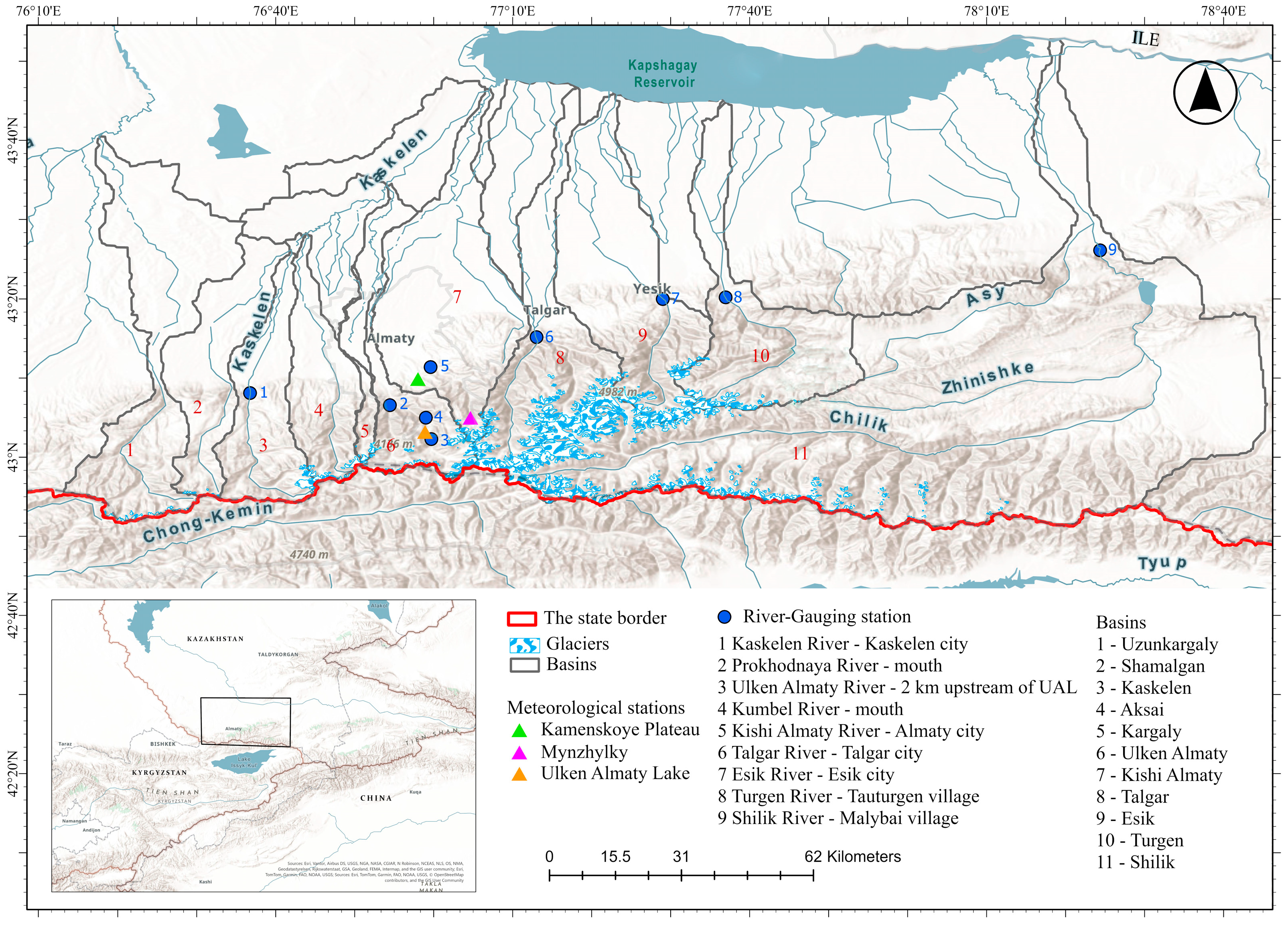
Figure 1. Map showing the left-bank tributaries of the Ile River within the Republic of Kazakhstan.
Atmosphere 17 00063 g001
Figure 2. Variations in mean annual air temperature. (a) Annual temperature amplitude based on data from the Mynzhylky and Almaty meteorological stations; (b) Mean annual temperatures for May and September derived from the Mynzhylky and Almaty stations.
Atmosphere 17 00063 g002
Figure 3. Schematic workflow of the proposed glacier-runoff estimation method.
Atmosphere 17 00063 g003
Figure 4. Combined graphs of long-term annual variations in firn line elevation (red line—H, m), summer atmospheric precipitation (blue line—XVI–VIII, mm), and summer air temperature (purple line—tVI–VIII, °C) for the period 1955–2021: (a) based on data from the Mynzhylky meteorological station; (b) based on data from the Ulken Almaty Lake meteorological station.
Atmosphere 17 00063 g004
Figure 5. Long-term fluctuations of mean annual air temperature in the high-mountain areas of the study region at an elevation of 3800 m (t3800) for the selected periods (1955–1972, 1973–1990, and 1991–2021): (a) Mynzhylky, for the June–August period (tVI–VIII); (b) Mynzhylky, for the May–September period (tV–IX); (c) Ulken Almaty Lake, for the June–August period (tVI–VIII); (d) Ulken Almaty Lake, for the May–September period (tV–IX).
Atmosphere 17 00063 g005
Figure 6. Seasonal distribution of mean monthly precipitation totals (X, mm): (a) Mynzhylky meteorological station; (b) Ulken Almaty Lake meteorological station.
Atmosphere 17 00063 g006
Figure 7. Changes in glacier area in the period 1999–2021 in the basins of the Ulken Almaty and Shilik rivers. (a) Glacier Mining Institute in the basin of the Turgen River in the period 1999–2014; (b) Glacier Mining Institute in the basin of the Turgen River in the period 1999–2021; (c) Korzhenevsky glacier in the Shilka River basin in the period 1999–2014; (d) Korzhenevsky glacier in the Shilik River basin in the period 1999–2021.
Atmosphere 17 00063 g007
Figure 8. Elevational distribution of glacier areas in the Ile Alatau for 1999 (red), 2014 (green), and 2021 (purple).
Atmosphere 17 00063 g008
Figure 9. Elevational distribution of glacier areas in the Kungei Alatau for 1999 (red), 2014 (green), and 2021 (purple).
Atmosphere 17 00063 g009
Figure 10. (a) Variations in potential income of solar radiation (PISR) by exposition (multiplied by 100,000 Wh m−2); (b) Glacier area (%) distribution by exposition.
Atmosphere 17 00063 g010
Figure 11. Comparison of glacier runoff volumes calculated using different empirical formulas: blue—L.P. Mazur; red—E.N. Vilesov and V.N. Uvarova; green—A.N. Krenke; purple—V.G. Khodakov.
Atmosphere 17 00063 g011
Figure 12. Integral curves of modular coefficients (∑(k–1)/Cv) with total runoff (Wveg, right axis) and glacier runoff (Wgl, left axis) for rivers of the northern slope of the Ile Alatau, 1955–2019: (a) Ulken Almaty River—upstream of Ulken Almaty Lake; (b) Prokhodnaya River—near the mouth; (c) Yesik River—at Yesik town; (d) Turgen River—at Tauturgen village.
Atmosphere 17 00063 g012
Table 1. Earth remote sensing data.
WRS2 Path-RowDateSatellite and SensorResolution (m)The Suitability of the Scenes
149–03008 August 1999Landsat ETM+15/30/60Main
150–03016 September 1999Landsat ETM+15/30/60Additional information
149–03009 August 2014Landsat OLI15/30/60Main
27 September 2021Sentinel-215/30/60Main
07 September 2021Sentinel-210/20/60Main
Table 2. Rivers and hydrological posts considered in the present research study.
River-PostElevation, m a.s.lCatchment Area, km2Where Does It Flow intoThe Year of the Opening of the Post
Kaskelen River-Kaskelen city1129.67290Kapchagai reservoir1928
Prokhodnaya River-mouth1422.1782Ulken Almaty River1951
Ulken Almaty River-2 km upstream of Ulken Almaty Lake2654.1971.8Kaskelen River1928
Kumbel river-mouth2150.4422.4Ulken Almaty River1952
Small (Kishi) Almaty River-Almaty city (mouth of Butakovka River, dam)1175.14118Kaskelen River1916
Talgar River-Talgar city1190.37444Kapchagai reservoir1928
Esik river Kapchagai reservoir
Turgen River-Tauturgen village1141.79614Kapchagai reservoir1932
Shelek River-Malybai village862.964300Kapchagai reservoir1928
Table 3. Changes in meteorological characteristics and firn line altitude during the vegetation period.
Meteorological StationPeriodH, mtVI–VIII, °CXVI–VIII, mm∆H, m∆tVI–VIII, °C∆XVI–VIII, mmH, %tVI–VIII, %XVI–VIII, %
Mynzhylky1955–197237196.54899620.87−412.2211.7−4.8
1973–199037817.41858200.27100.343.521.15
1991–202138017.68868
Ulken Almaty Lake1955–1972375010.4870350.5−581.614.590.06
1973–1990378510.9812150.2350.031.800.02
1991–2021380011.1847
Table 4. Changes in average monthly temperature values in the glacial zone during the growing season.
Meteorological StationAbsolute Elevation, mHeight Difference, mPeriodtH, °C∆t, °CtH, °C∆t, °C
tVI–VIII, °CVI–VIIItV–IX, °CV2013IX
Mynzhylky30178001955–19721.200.880.010.39
1973–19902.080.40
1991–20212.340.260.800.40
Ulken Almaty Lake251612841955–19721.800.500.100.50
1973–19902.300.60
1991–20212.500.200.900.30
Tuyuksu I34203801955–19723.780.882.200.80
1973–19904.663.00
1991–20214.920.263.400.40
Table 5. Relative error in determining the vertical precipitation gradient.
Meteorological StationX, mmH, m σ X ¯ , mmX (3800), mm σ X total , m m ɛ, %
Mynzhylky870301716.6862.6320.22.34
Ulken Almaty Lake839251618.9792.0034.14.31
Kamenskoye Plateau886131718.6862.6436.64.75
Table 6. Changes in annual precipitation amounts in the glacial belt during the growing season.
Meteorological StationAbsolute Elevation, mHeight Difference, mPeriodX3800, mm∆X3800, mmX3800, %
3017 1955–1972971
Mynzhylky8001973–1990928−43−4.6
1991–202193791.0
2516 1955–1972943−61−6.9
Ulken Almaty Lake12841973–1990882
1991–2021916343.7
3420 1955–1972934
Tuyuksu I3801973–1990892−42−4.7
1991–2021905131.4
Table 7. Changes in glacier area for the estimated period 1955–2021.
Left-Bank Tributaries of the Ile River BasinF, km2F, %
19551999201420211955–19991955–20211999–20141999–20212014–2021
Uzunkargaly river10.69.5
± 0.4
6.41
± 0.26
5.38
± 0.22
−10.3%−49.3%−32.5%−43.4%−16.1%
Shamalgan river1.61.2
± 0.05
0.38
± 0.02
0.29
± 0.01
−24.6%−81.9%−68.4%−75.9%−23.8%
Kaskelen river9.68.8
± 0.37
5.95
± 0.25
5.02
± 0.21
−8.2%−47.7%−32.5%−43.1%−15.7%
Aksai river12.710.2
± 0.43
7.06
± 0.3
6.39
± 0.26
−19.5%−49.6%−30.9%−37.4%−9.4%
Kargalinka river3.92.5
± 0.11
1.57
± 0.07
1.52
± 0.06
−35.0%−61.0%−38.2%−40.0%−3.0%
Prokhadnaya river6.03.80 ± 0.161.92 ± 0.081.72 ± 0.07−36.7%−71.3%−49.5%−54.7%−10.4%
Ulken Almaty river24.917.2 ± 0.7212.3 ± 0.5210.74 ± 0.45−31.7%−57.3%−28.7%−37.5%−12.3%
Kishi Almaty river9.16.8
± 0.28
4.64
± 0.19
3.78
± 0.16
−25.5%−58.4%−31.5%−44.1%−18.3%
Talgar river107.982.5
± 3.47
64.96
± 2.73
60.41
± 2.54
−23.5%−44.0%−21.3%−26.8%−7.0%
Esik river48.535.4
± 1.49
28.22
± 1.19
27.48
± 1.15
−27.1%−43.3%−20.2%−22.3%−2.6%
Turgen river34.824.7
± 1.04
19.49
± 0.82
18.9
± 0.79
−28.9%−45.7%−21.2%−23.6%−3.0%
Shilik river276.9230.0 ± 9.66192.1 ± 8.07180.5 ± 7.58−16.9%−34.8%−16.5%−21.5%−6.0%
without numbering2.601.52 ± 0.060.82 ± 0.030.71 ± 0.02−41.5%−72.5%−46.2%−53.0%−12.6%
Table 8. Characteristics of river runoff indicators for 1955–2021.
River BasinFgl, km2
2021
Fice/Fcatchment area, %Water DischargeFlow VolumeGlacial Runoff Volume (Average)
Q, m3/sQveg, m3/sWI–XII, million m3Wgl, Million m3in % from W
Kaskelen River—Kaskelen City5.021.74.257.001341411
Prokhodnaya River1.722.11.582.5050713
Ulken Almaty River10.815.02.824.60893034
Kishi Almaty River—Almaty City3.803.21.973.10621117
Talgar River—Talgar City60.413.610.317.332513241
Esik River—Esik City27.510.74.807.801515838
Turgen River—Turgen Village18.93.17.1312.12254118
Shilik River—Malybai Village180.54.239.672.2125036329
Table 9. Comparison of glacial runoff volumes (W, million m3) with annual runoff and runoff during the vegetative period for tributaries of the Ile River basin on average for the period 1955–2021.
River BasinPeriodsAnnual Runoff VolumeGlacial Runoff VolumeVolume of Glacial Runoff from Annual RunoffVolume of Vegetation RunoffGlacial Runoff Volume from Vegetation Runoff
WI–XII, Million m3∆W, %Wgl, Million m3∆Wgl, %Wgl from WI–XII, %∆, %Wveg, mln m3∆Wveg, %Wgl from Wveg, %∆, %
Kaskelen River—Kaskelen City1955–1990140.3−914.5−410.3696.0−810.815
1991–2021127.113.910.988.012.4
Prokhodnaya River1955–199049.327.9−3716.0−3834.0−347.1−36
1991–202150.15.010.033.030.2
Ulken Almaty River1955–199072.84834.0−2446.7−4949.85093.8−66
1991–2021108.126.024.174.832.2
Kishi Almaty River—Almaty City1955–199063.5−511.5−1618.1−1141.1−244.1−9
1991–202160.59.716.040.140.0
Talgar River—Talgar City1955–1990322.01136.7−842.5−8230.0−218.5−7
1991–2021325.0126.438.9226.017.2
Esik River—Esik City1955–1990157.0−660.5−938.5−3110.0−1335.011
1991–2021147.055.137.596.039.0
Turgen River—Turgen Village1955–1990222.0343.0−1119.4−13158.0412.3−16
1991–2021228.038.316.8164.010.2
Shilik River—Malybai Village1955–19901043.043362.5−0.00219.00776.0682.4−41
1991–20211492.0362.619.01306.01.5
Disclaimer/Publisher’s Note: The statements, opinions and data contained in all publications are solely those of the individual author(s) and contributor(s) and not of MDPI and/or the editor(s). MDPI and/or the editor(s) disclaim responsibility for any injury to people or property resulting from any ideas, methods, instructions or products referred to in the content.