Climate Reconstruction of the Beijing Area over 650 Years Ago Based on Textual Research


Abstract
1. Introduction
2. Materials and Methods
2.1. Research Subject
2.2. Research Methods
2.2.1. Taxonomic Study of Plants
2.2.2. Climate Reconstruction
Climate Analysis Using the Atlas of Woody Plants in China
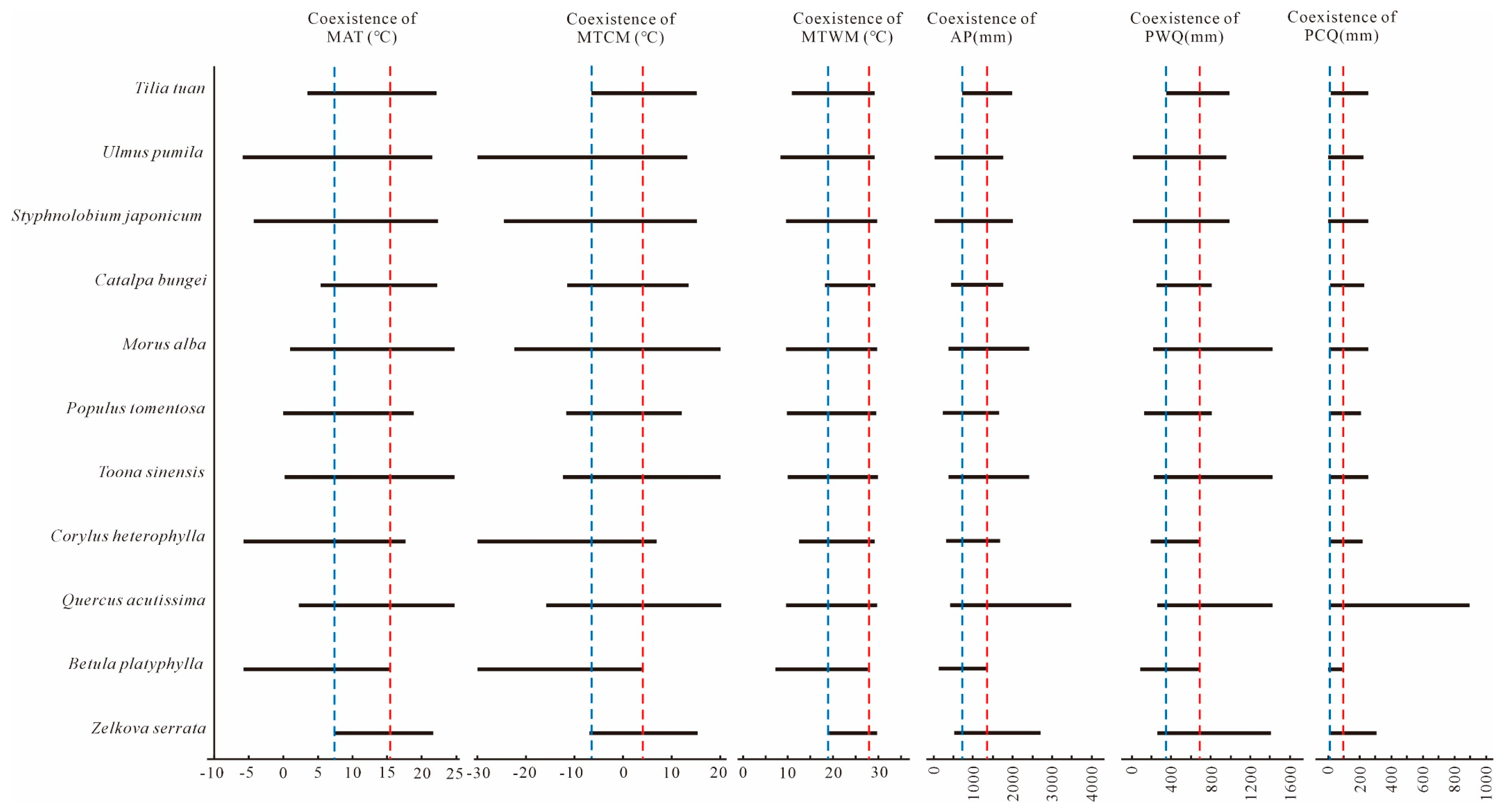
Coexistence Analysis
Selected Climatic Parameters
- Mean Annual Temperature (MAT);
- Mean Temperature of the Coldest Month (MTCM);
- Mean Temperature of the Warmest Month (MTWM);
- Annual Precipitation (AP);
- Precipitation of the Coldest Quarter (PCQ);
- Precipitation of the Warmest Quarter (PWQ).
Climate Analysis
3. Results
3.1. Identification of Plant Species Recorded in the Historical Text
3.2. Reconstruction of Beijing’s Climate from over 650 Years Ago Using the Coexistence Approach
4. Discussion
5. Conclusions
Author Contributions
Funding
Institutional Review Board Statement
Informed Consent Statement
Data Availability Statement
Conflicts of Interest
References
- Zhu, K.Z. A Preliminary Study on Climatic Variations in China Over the Past Five Thousand Years. Sci. Sin. 1973, 16, 475–498. [Google Scholar]
- Jones, P.D.; Mann, M.P. Climate Over Past Millennia. Rev. Geophys. 2004, 42, RG2002. [Google Scholar] [CrossRef]
- Mann, M.E. Climate Over Past Two Millennia. Annu. Rev. Earth Planet. Sc. 2007, 35, 111–136. [Google Scholar] [CrossRef]
- Ge, Q.S. Climate Change in Chinese Dynastic History; Beijing Science Press: Beijing, China, 2010; pp. 1–705. [Google Scholar]
- Ge, Q.S.; Fang, X.Q.; Zheng, J.Y. Learning from the Historical Impacts of Climate Change in China. Adv. Earth Sci. 2014, 29, 23–29. [Google Scholar]
- Luterbacher, J.; Dietrich, D.; Xoplaki, E.; Grosjean, M.; Wanner, H. European Seasonal and Annual Temperature Variability, Trends, and Extremes Since 1500. Science 2004, 303, 1499–1503. [Google Scholar] [CrossRef]
- He, F.Q. General History of Disasters in China (Vol: Yuan Dynasty); Zhengzhou University Press: Zhengzhou, China, 2009; pp. 1–689. [Google Scholar]
- Tao, Z.Y. Nancun Chuogeng Lu (Notes Made After Retiring from Farming in the Southern Village); Zhonghua Book Company: Beijing, China, 1959; pp. 1–385. [Google Scholar]
- Zheng, Z.M. The Decline of the Monetary System and the Fall of the Dynasty in the Yuan Dynasty. Ind. Sci. Trib. 2016, 15, 115–116. [Google Scholar]
- Liu, H.W. Some Thought on the Cultural Reasons for the Fall of the Yuan. Stud. Mong.-Yuan China Bordering Area 2017, 2, 121–126. [Google Scholar]
- Ma, G. Maritime Trade, Natural disasters, and Climate Change: A New Investigation into the Wokou and Their Causes Along the Coastal Areas of Yuan Dynasty China. J. Tsinghua Univ. (Philos. Soc. Sci.) 2018, 33, 61–73. [Google Scholar]
- Li, X.; Li, L.M. The Choice, Operation and Collapse of the Paper Currency System in the Yuan Dynasty: An Analysis of the Monetary Dimension of the Reasons for the Rapid Fall of the Yuan Dynasty. Inner Mongol. Soc. Sci. (Chin. Ed.) 2019, 40, 95–103. [Google Scholar]
- Ge, Q.S.; Zheng, J.Y.; Fang, X.Q.; Man, Z.M.; Zhang, X.Q.; Zhang, P.Y.; Wang, W.Q. Temperature Changes of Winter-Half-Year in Eastern China During the Past 2000 Years. Quat. Sci. 2002, 22, 166–173. [Google Scholar]
- Ge, Q.S.; Zheng, J.Y.; Man, Z.M.; Fang, X.Q.; Zhang, P.Y. Several Issues in the Study of Temperature Changes in China Over the Past 2000 Years. Prog. Nat. Sci. 2004, 14, 449–455. [Google Scholar] [CrossRef]
- Xiong, M.X. Collected Fragments of the Xijin Zhi; Beijing Ancient Books Publishing House: Beijing, China, 1983; pp. 1–262. [Google Scholar]
- Institute of Archaeology, Chinese Academy of Social Sciences; Beijing Municipal Cultural Heritage Bureau. Yuan Dadu: Archaeological Report From 1964 To 1974; Cultural Relics Press: Beijing, China, 2024; pp. 1–419. [Google Scholar]
- Jiang, D.C. Research on the Urban Morphology and Foundations of Building Complexes in Yuan Dynasty Capital City; Tsinghua University: Beijing, China, 2007; pp. 1–299. [Google Scholar]
- Liu, H.M.; Song, H.J.; Duan, F.; Shen, L. Botanical Studies Based on Textual Evidence in Eastern Asia and its Implications for the Ancient Climate. Atmosphere 2025, 16, 824. [Google Scholar] [CrossRef]
- Fang, J.Y.; Wang, Z.H.; Tang, Z.Y. Atlas of Woody Plants in China: Distribution and Climate. Vol I, II, III, Index; Higher Education Press: Beijing, China, 2009; pp. 1–2020. [Google Scholar]
- Anonymity (Ed.) Guan, X.H., Translator; Literary Expositor; Zhonghua Book Company: Beijing, China, 2014; pp. 1–773. [Google Scholar]
- Li, S.Z. The Great Pharmacopoeia; People’s Medical Publishing House: Beijing, China, 1999; pp. 1–2978. [Google Scholar]
- Tang, Y.; Gilnert, M.G.; Dorr, L.J. Flora of China; Science Press: Beijing, China, 2007; Volume 12, pp. 240–263. [Google Scholar]
- Su, S. Illustrated Treatise of Pharmaceutical Natural History: Edited Duplicate Copy; Fujian Science & Technology Publishing House: Fuzhou, China, 1988; pp. 1–622. [Google Scholar]
- Wu, Q.J. Illustrated Investigations of the Names and Natures of Plants; The Commercial Press: Beijing, China, 1957; pp. 1–892. [Google Scholar]
- Fu, L.G.; Xin, Y.Q.; Whittemore, A. Flora of China; Science Press: Beijing, China, 2003; Volume 5, pp. 1–19. [Google Scholar]
- Xu, L.R.; Chen, D.Z.; Zhu, X.Y.; Hang, P.H.; Wei, Z.; Sa, R.; Zhang, D.X.; Bao, B.J.; Wu, D.L.; Sun, H.; et al. Flora of China; Science Press: Beijing, China, 2010; Volume 10, pp. 1–577. [Google Scholar]
- Xu, K. Qing Bai Lei Chao; Zhonghua Book Company: Beijing, China, 1984; pp. 1–6587. [Google Scholar]
- Zhang, Z.Y.; Santisuk, T. Flora of China; Science Press: Beijing, China, 1998; Volume 18, pp. 213–225. [Google Scholar]
- Zhou, Z.K.; Gilbert, M.G. Flora of China; Science Press: Beijing, China, 2003; Volume 5, pp. 21–73. [Google Scholar]
- Fang, Z.F.; Zhao, S.D.; Skvortsov, A.K. Flora of China; Science Press: Beijing, China, 1999; Volume 4, pp. 139–274. [Google Scholar]
- Zhang, L.J.; Ding, K. Dilations Upon Pharmaceutical Natural History; Kou, Z.S., Ed.; China Medical Science Press: Beijing, China, 2012; pp. 1–102. [Google Scholar]
- Peng, H.; Mabberley, D.J.; Pannell, C.M.; Edmond, J.; Bartholomew, B. Flora of China; Science Press: Beijing, China, 2008; Volume 11, pp. 111–131. [Google Scholar]
- Li, P.Q.; Skvortsov, A.K. Flora of China; Science Press: Beijing, China, 1999; Volume 4, pp. 286–313. [Google Scholar]
- Gao, M.Q.; Lu, L.D. Ancient Chinese Names of Plants; Elephant Press: Zhengzhou, China, 2006; pp. 1–548. [Google Scholar]
- Wen, C. Illustrated Compendium of Metals, Stones, Insects, and Plants; Sichuan University Press: Chengdu, China, 2017; pp. 1–1432. [Google Scholar]
- Huang, C.J.; Zhang, Y.T.; Bartholomew, B. Flora of China; Science Press: Beijing, China, 1999; Volume 4, pp. 314–400. [Google Scholar]
- Hinsch, B. Climatic Change and History in China. J. Asia Hist. 1988, 22, 132–159. [Google Scholar]
- Chen, J.Q. Preliminary Research of Climatic Changes as Background of Heavy Meteorological Disaster in China During Last 2000 Years. J. Nat. Disast. 1996, 5, 18–27. [Google Scholar]
- Zhang, D.E. A Study on the Medieval Warm Period in China. Quat. Sci. 1993, 1, 7–15. [Google Scholar]
- Wang, H.C. The Relationship Between the Migrating South of the Nomadic Nationalities in North China and the Climatic Changes. Sci. Geogr. Sin. 1996, 16, 274–279. [Google Scholar]
- Hao, Z.X.; GE, Q.S.; Zheng, J.Y. Temperature Variations During the Song and Yuan Dynasties (196~1368 A.D.) in the Eastern Part of North West China. Quat. Sci. 2009, 29, 871–879. [Google Scholar]
- Zheng, J.Y.; Wang, S.W. Assessment on Climate Change in China for the last 2000 years. Acta Geogr. Sin. 2005, 60, 21–31. [Google Scholar]
- Grove, J.M. The Little Ice Age; Routledge: London UK; New York, NY, USA, 2004; pp. 1–718. [Google Scholar]
- Behringer, W. Climate and Society in Europe: The Last Thousand Years. Mediev. Hist. J. 2010, 13, 9–37. [Google Scholar]
- Büntgen, U.; Tegel, W.; Nicolussi, K.; McCormick, M.; Frank, D.; Trouet, V.; Kaplan, J.O.; Herzig, F.; Heussner, K.U.; Wanner, H.; et al. 2500 Years of European Climate Variability and Human Susceptibility. Science 2011, 331, 578–582. [Google Scholar] [CrossRef]
- Campbell, B.M.S. The Great Transition: Climate, Disease and Society in the Late-Medieval World; Cambridge University Press: Cambridge, UK, 2016; pp. 1–463. [Google Scholar]
- Shapland, C.Y.; Eunice, Y.T.; Leach, N.J.; Lavigne, É.; Tilling, K.; Mitchell, D.M. Forecast Attribution Reveals Enhanced Heat Mortality from Climate Change in British Columbia Heatwave. Sci. Adv. 2025, 11, eadw8268. [Google Scholar] [CrossRef]
- Alemayehu, S.; Olago, D.; Alfred, O.; Dejene, S.W. Climate Change Perceptions, Impacts, and Adaptation Strategies in Mixed Crop–Livestock Systems of Ethiopia’s Lowlands. Sustainability 2025, 17, 10428. [Google Scholar] [CrossRef]
- Muhammad, H.S.; Wilayat, S.; Sidra, S.; Irfan, U.; Wang, Y.Y.; Wang, Y.Y. Impacts of Climate Change on Rice Production in Pakistan: A Perspective from a Deep Learning Approach. Atmosphere 2025, 16, 1305. [Google Scholar] [CrossRef]


| Ancient Plant Names | Plant Description | Plant Scientific Names | Illustration | References |
|---|---|---|---|---|
| Duan | Trees. Bark gray, longitudinally exfoliate. Leaf blades narrowly ovate or ovate-oblong, base oblique, margin with a few minute teeth near apex, apex acuminate or acute. Cymes. Bracts band-shaped to oblanceolate, base cuneate to rounded, apex obtuse to acuminate. Sepals ovate to ovate-lanceolate. Petals shortly clawed. Fruit globose or obovoid-globose, brown or gray hairy. | Tilia tuan Szyszyl. | [20,21,22] | |
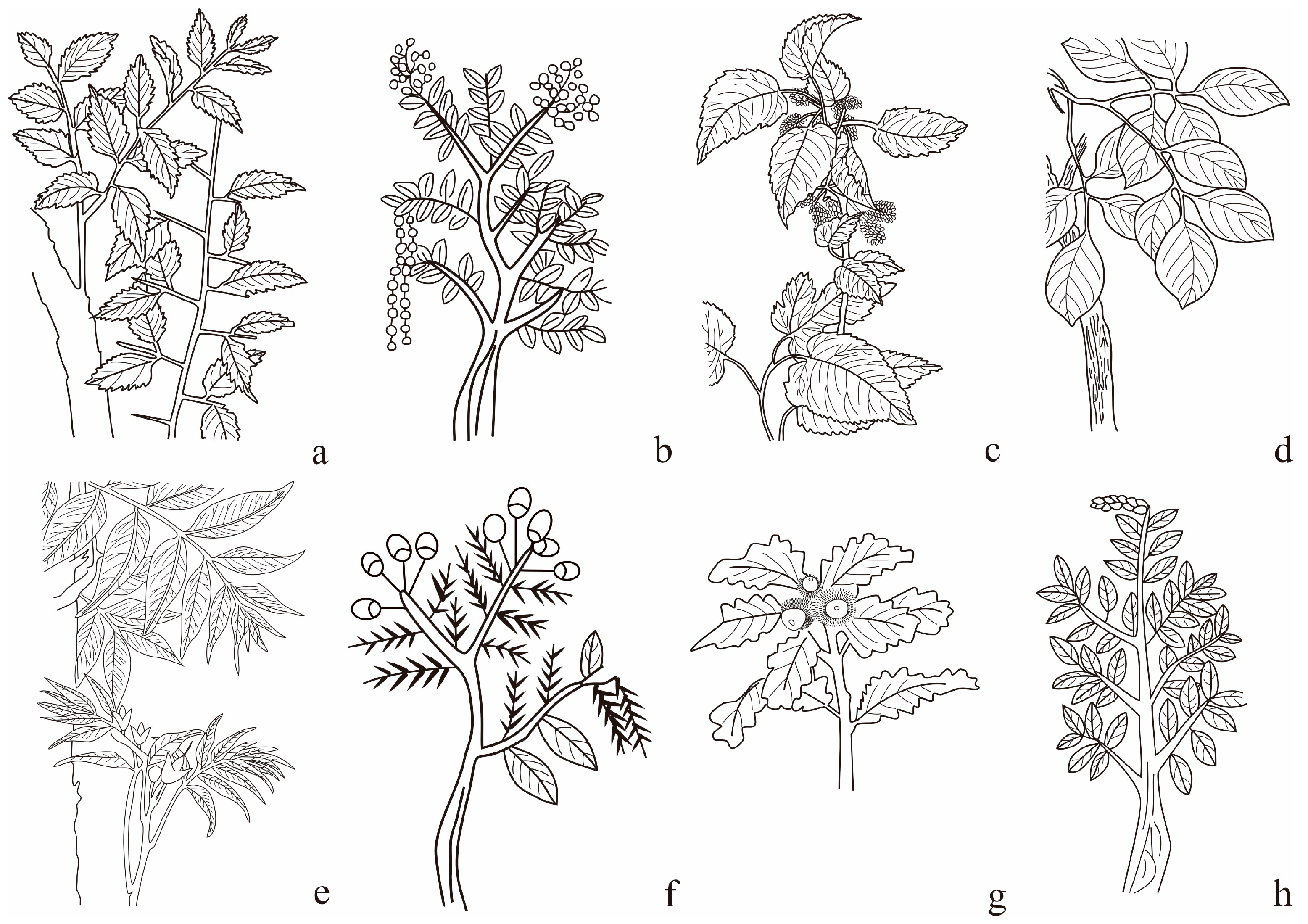
| Yu | Trees. Bark dark gray, fissured. Petiole pubescent; leaf blade elliptic-ovate to elliptic-lanceolate, base obliquely obtuse to rounded, margin doubly serrate, apex acute to acuminate; Inflorescences fascicled cymes, appearing before leaves. Perianth lobed, margin ciliate. Samaras whitish tan, orbicular to elliptical. Seed at center of samara or occasionally slightly toward apex. | Ulmus pumila L. | Figure 1a | [21,23,24,25] |
| Huai | Trees. Bark gray–brown, longitudinally striate. Leaves pinnate; petiole inflated at base; leaflets stipels subulate; blades ovate-lanceolate or ovate-oblong, papery. Panicles terminal; bracteole subulate. Calyx shortly campanulate. Corolla white or creamy yellow. Legumes green, obviously constricted between seeds, indehiscent, fleshy. | Styphnolobium japonicum (L.) Schott | Figure 1b | [21,26] |
| Qiu | Trees. Petiole slender; leaf blade triangular-ovate or ovate-oblong, dark green adaxially, base broadly cuneate or cordate, apex long acuminate. Inflorescences corymbose-racemose, terminal. Calyx bilabiate, apex acutely 2-dentate. Corolla pale red, yellow 2-striate and dark purple spotted at throat. Capsule linear. Seeds narrowly ellipsoid. | Catalpa bungei C. A. Mey. | [21,27,28] | |
| Sang | Shrubs or trees. Bark gray, shallowly furrowed. Branches finely hairy. Stipules lanceolate. Petiole slender; leaf blade ovate to broadly ovate, irregularly lobed, adaxially bright green, base rounded, margin coarsely serrate to crenate, apex acute. Male catkins pendulous. Female catkins, pubescent; peduncle slender. Syncarp blackish purple, purple, or greenish white, ovoid, ellipsoid, or cylindric. | Morus alba L. | Figure 1c | [21,24,29] |
| Bai Yang | Trees. Trunk usually erect; bark at first dull gray, later dark gray on basal part of trunk, furrowed, rough; crown conical to ovoid–globose. Lateral branches spreading. Petiole laterally flattened; leaf blade ovate or deltoid-ovate, adaxially dark green, shiny, base shallowly cordate to cordate or truncate, margin sinuate-dentate, apex acuminate. Capsule conical or long ovoid. | Populus tomentosa Carrière | Figure 1d | [21,23,24,30] |
| Chun | Trees. Bark gray to dark brown, fissured. Petiole slender; rachis often reddish; leaflet blades narrowly lanceolate to linear-lanceolate, base asymmetric, margin serrate, apex acuminate. Inflorescences pendent. Petals white or flushed pink. Capsule narrowly elliptic; columella convex; valves reddish to dark brown. Seeds, winged at one end. | Toona sinensis (Juss.) Roem. | Figure 1e | [21,31,32] |
| Zhen | Shrubs or small trees. Bark gray. Branchlets pubescent. Petiole slender; leaf blade elliptic-obovate, or broadly ovate, base cordate, margin irregularly and doubly serrate, apex mucronate to caudate. Male inflorescences pendulous, slender; bracts reddish brown, obovate. Female flowers bracts campanulate, striate, with triangular-ovate, entire or dentate lobes. Nut ovoid–globose. | Corylus heterophylla Fisch. ex Trautv. | Figure 1f | [21,24,33] |
| Xiang | Trees, furrowed. Branchlets yellowish gray, lenticellate. Petiole tomentose; leaf blade narrowly elliptic-lanceolate, concolorous, base rounded to broadly cuneate, margin with spiniform teeth, apex long acuminate; tertiary veins abaxially slender. Cupules cupular to discoid. Including bracts, enclosing half part of nut; bracts subulate to ligulate, reflexed, canescent. | Quercus acutissima Carruth. | Figure 1g | [21,34,35,36] |
| Hua | Trees. Bark grayish white, exfoliating in sheets. Branches, dark gray or dark brown; branchlets brown. Petiole slender; leaf blade ovate-triangular, base truncate, or cuneate, margin serrate, apex acute. Female inflorescence pendulous; peduncle slender. Nutlet narrowly oblong, with membranous wings slightly longer than and about as wide as nutlet. | Betula platyphylla Sukaczev | [21,24,33] | |
| Ju Liu | Trees. Bark grayish white to grayish brown, exfoliating. Branchlets brownish purple to brown. Stipules brownish purple, lanceolate. Leaf blade elliptic to ovate-lanceolate adaxially sparsely hispid, base slightly oblique, rounded, or shallowly cordate, margin serrate to crenate, apex caudate-acuminate. Male flowers: shortly pedicellate. Female flowers: subsessile. | Zelkova serrata (Thunb.) Makino | Figure 1h | [21,25,31] |
| Ancient Plant Names | Plant Scientific Names |
|---|---|
| Duan | Tilia tuan Szyszyl. |
| Yu | Ulmus pumila L. |
| Huai | Styphnolobium japonicum (L.) Schott |
| Qiu | Catalpa bungei C. A. Mey. |
| Sang | Morus alba L. |
| Bai Yang | Populus tomentosa Carrière |
| Chun | Toona sinensis (Juss.) Roem. |
| Zhen | Corylus heterophylla Fisch. ex Trautv. |
| Xiang | Quercus acutissima Carruth. |
| Hua | Betula platyphylla Sukaczev |
| Ju Liu | Zelkova serrata (Thunb.) Makino |
| Time | Yuan Dynasty (About 650 Years Ago) | Nowadays | ||||
|---|---|---|---|---|---|---|
| Climate Parameter | Minimum Value | Maximum Value | Mean Value | Minimum Value | Maximum Value | Mean Value |
| MAT | 7.40 | 15.50 | 13.16 | 8.03 | 14.03 | 13.12 |
| MTCM | −6.50 | 4.20 | 0.46 | −6.40 | 3.07 | −1.18 |
| MTWM | 18.70 | 28.00 | 24.58 | 23.40 | 29.60 | 26.38 |
| AP | 731 | 1358.00 | 970 | 279.80 | 733.20 | 514.64 |
| PWQ | 346 | 691 | 461.19 | 9.40 | 344.30 | 111.52 |
| PCQ | 15 | 97.00 | 69.27 | 00.0 | 37.70 | 4.90 |
Disclaimer/Publisher’s Note: The statements, opinions and data contained in all publications are solely those of the individual author(s) and contributor(s) and not of MDPI and/or the editor(s). MDPI and/or the editor(s) disclaim responsibility for any injury to people or property resulting from any ideas, methods, instructions or products referred to in the content. |
© 2025 by the authors. Licensee MDPI, Basel, Switzerland. This article is an open access article distributed under the terms and conditions of the Creative Commons Attribution (CC BY) license (https://creativecommons.org/licenses/by/4.0/).
Share and Cite
Liu, H.; Bi, H. Climate Reconstruction of the Beijing Area over 650 Years Ago Based on Textual Research. Atmosphere 2025, 16, 1394. https://doi.org/10.3390/atmos16121394
Liu H, Bi H. Climate Reconstruction of the Beijing Area over 650 Years Ago Based on Textual Research. Atmosphere. 2025; 16(12):1394. https://doi.org/10.3390/atmos16121394
Chicago/Turabian StyleLiu, Haiming, and Haiyan Bi. 2025. "Climate Reconstruction of the Beijing Area over 650 Years Ago Based on Textual Research" Atmosphere 16, no. 12: 1394. https://doi.org/10.3390/atmos16121394
APA StyleLiu, H., & Bi, H. (2025). Climate Reconstruction of the Beijing Area over 650 Years Ago Based on Textual Research. Atmosphere, 16(12), 1394. https://doi.org/10.3390/atmos16121394