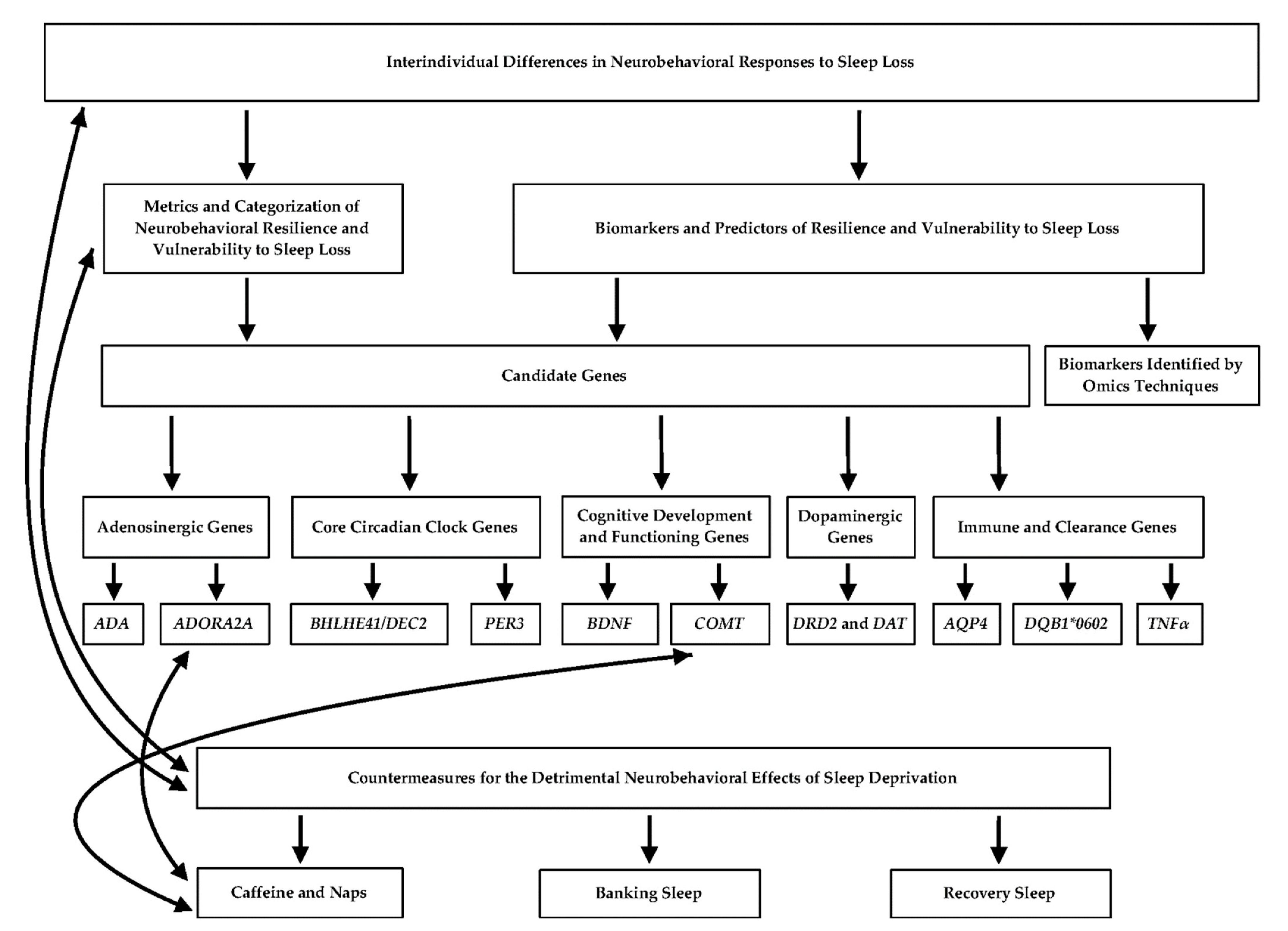


Genetic Markers of Differential Vulnerability to Sleep Loss in Adults

Abstract
1. Introduction
2. Interindividual Differences in Neurobehavioral Responses to Sleep Loss
2.1. Metrics and Categorization of Neurobehavioral Resilience and Vulnerability to Sleep Loss
2.2. Biomarkers and Predictors of Resilience and Vulnerability to Sleep Loss
3. Genetic Polymorphisms Related to Differential Neurobehavioral Vulnerability to Sleep Loss
3.1. Adenosinergic Genes
3.1.1. ADA
3.1.2. ADORA2A
3.2. Core Circadian Clock Genes
3.2.1. BHLHE41/DEC2
3.2.2. PER3
3.3. Cognitive Development and Functioning Genes
3.3.1. BDNF
3.3.2. COMT
3.4. Dopaminergic Genes
DRD2 and DAT
3.5. Immune and Clearance Genes
3.5.1. AQP4
3.5.2. DQB1*0602
3.5.3. TNFα
3.6. Strengths and Weaknesses of the Candidate Gene Approach
4. Countermeasures for the Detrimental Neurobehavioral Effects of Sleep Deprivation
4.1. Effects of Banking Sleep on Neurobehavioral Performance
4.2. Effects of Recovery Sleep on Neurobehavioral Performance
4.3. Effects of Caffeine and Napping on Neurobehavioral Performance
5. Conclusions and Perspectives
Author Contributions
Funding
Institutional Review Board Statement
Informed Consent Statement
Data Availability Statement
Conflicts of Interest
References
- Goel, N.; Basner, M.; Dinges, D.F. Phenotyping of neurobehavioral vulnerability to circadian phase during sleep loss. Methods Enzymol. 2015, 552, 285–308. [Google Scholar] [CrossRef]
- Achermann, P.; Dijk, D.J.; Brunner, D.P.; Borbély, A.A. A model of human sleep homeostasis based on EEG slow-wave activity; quantitative comparison of data and simulations. Brain Res. Bull. 1993, 31, 97–113. [Google Scholar] [CrossRef]
- Borbély, A.A. A two process model of sleep regulation. Hum. Neurobiol. 1982, 1, 195–204. [Google Scholar] [PubMed]
- Goel, N. Neurobehavioral effects and biomarkers of sleep loss in healthy adults. Curr. Neurol. Neurosci. Rep. 2017, 17, 89. [Google Scholar] [CrossRef] [PubMed]
- Goel, N.; Basner, M.; Rao, H.; Dinges, D.F. Circadian rhythms, sleep deprivation, and human performance. Prog. Mol. Biol. Transl. Sci. 2013, 119, 155–190. [Google Scholar] [CrossRef] [PubMed]
- Khalsa, S.B.S.; Jewett, M.E.; Duffy, J.F.; Czeisler, C.A. The timing of the human circadian clock is accurately represented by the core body temperature rhythm following phase shifts to a three-cycle light stimulus near the critical zone. J. Biol. Rhythms 2000, 15, 524–530. [Google Scholar] [CrossRef]
- Van Dongen, H.P.A.; Dinges, D.F. Investigating the interaction between the homeostatic and circadian processes of sleep-wake regulation for the prediction of waking neurobehavioral performance. J. Sleep Res. 2003, 12, 181–187. [Google Scholar] [CrossRef]
- Edgar, D.M.; Dement, W.C.; Fuller, C.A. Effect of SCN lesions on sleep in squirrel monkeys: Evidence for opponent processes in sleep-wake regulation. J. Neurosci. 1993, 13, 1065–1079. [Google Scholar] [CrossRef] [PubMed]
- Goel, N.; Rao, H.; Durmer, J.S.; Dinges, D.F. Neurocognitive consequences of sleep deprivation. Semin. Neurol. 2009, 29, 320–339. [Google Scholar] [CrossRef] [PubMed]
- Belenky, G.; Wesensten, N.J.; Thorne, D.R.; Thomas, M.L.; Sing, H.C.; Redmond, D.P.; Russo, M.B.; Balkin, T.J. Patterns of performance degradation and restoration during sleep restriction and subsequent recovery: A sleep dose-response study. J. Sleep Res. 2003, 12, 1–12. [Google Scholar] [CrossRef]
- Dijkman, M.; Sachs, N.; Levine, E.; Mallis, M.; Carlin, M.M.; Gillen, K.A.; Powell, J.W.; Samuel, S.; Mullington, J.; Rosekind, M.R.; et al. Effects of reduced stimulation on neurobehavioral alertness depend on circadian phase during human sleep deprivation. Sleep Res. 1997, 26, 265. [Google Scholar]
- Van Dongen, H.P.; Maislin, G.; Mullington, J.M.; Dinges, D.F. The cumulative cost of additional wakefulness: Dose-response effects on neurobehavioral functions and sleep physiology from chronic sleep restriction and total sleep deprivation. Sleep 2003, 26, 117–126. [Google Scholar] [CrossRef] [PubMed]
- Van Dongen, H.P.; Baynard, M.D.; Maislin, G.; Dinges, D.F. Systematic interindividual differences in neurobehavioral impairment from sleep loss: Evidence of trait-like differential vulnerability. Sleep 2004, 27, 423–433. [Google Scholar]
- Van Dongen, H.P.; Belenky, G. Individual differences in vulnerability to sleep loss in the work environment. Ind. Health 2009, 47, 518–526. [Google Scholar] [CrossRef] [PubMed]
- Chua, E.C.; Yeo, S.C.; Lee, I.T.; Tan, L.C.; Lau, P.; Cai, S.; Zhang, X.; Puvanendran, K.; Gooley, J.J. Sustained attention performance during sleep deprivation associates with instability in behavior and physiologic measures at baseline. Sleep 2014, 37, 27–39. [Google Scholar] [CrossRef]
- Rupp, T.L.; Wesensten, N.J.; Balkin, T.J. Trait-like vulnerability to total and partial sleep loss. Sleep 2012, 35, 1163–1172. [Google Scholar] [CrossRef] [PubMed]
- Dennis, L.E.; Wohl, R.J.; Selame, L.A.; Goel, N. Healthy adults display long-term trait-like neurobehavioral resilience and vulnerability to sleep loss. Sci. Rep. 2017, 7, 14889. [Google Scholar] [CrossRef] [PubMed]
- Yamazaki, E.M.; Goel, N. Robust stability of trait-like vulnerability or resilience to common types of sleep deprivation in a large sample of adults. Sleep 2021, 43, zsz292. [Google Scholar] [CrossRef]
- Dinges, D.F.; Powell, J.W. Microcomputer analyses of performance on a portable, simple visual RT task during sustained operations. Behav. Res. Methods Instrum. Comput. 1985, 17, 652–655. [Google Scholar] [CrossRef]
- Wechsler, D. The Measurement of Adult Intelligence; The Williams and Wilkins Company: Baltimore, MD, USA, 1939. [Google Scholar]
- Kirchner, W.K. Age differences in short-term retention of rapidly changing information. J. Exp. Psychol. 1958, 55, 352–358. [Google Scholar] [CrossRef] [PubMed]
- Wechsler, D. WAIS-R Manual: Wechsler Adult Intelligence Scale-Revised; The Psychological Corporation: San Antonio, TX, USA, 1981. [Google Scholar]
- Åkerstedt, T.; Gillberg, M. Subjective and objective sleepiness in the active individual. Int. J. Neurosci. 1990, 52, 29–37. [Google Scholar] [CrossRef] [PubMed]
- McNair, D.M.; Lorr, M.; Droppleman, L.F. Manual: Profile of Mood States; EdITS: San Diego, CA, USA, 1971. [Google Scholar]
- Leproult, R.; Colecchia, E.F.; Berardi, A.M.; Stickgold, R.; Kosslyn, S.M.; Van Cauter, E. Individual differences in subjective and objective alertness during sleep deprivation are stable and unrelated. Am. J. Physiol. Regul. Integr. Comp. Physiol. 2003, 284, R280–R290. [Google Scholar] [CrossRef] [PubMed]
- Tkachenko, O.; Dinges, D.F. Interindividual variability in neurobehavioral response to sleep loss: A comprehensive review. Neurosci. Biobehav. Rev. 2018, 89, 29–48. [Google Scholar] [CrossRef]
- Satterfield, B.C.; Stucky, B.; Landolt, H.P.; Van Dongen, H.P.A. Unraveling the genetic underpinnings of sleep deprivation-induced impairments in human cognition. Prog. Brain Res. 2019, 246, 127–158. [Google Scholar] [CrossRef] [PubMed]
- Caldwell, J.L.; Schroeder, V.M.; Kunkle, C.L.; Stephenson, H.G. Differential effects of modafinil on performance of low-performing and high-performing individuals during total sleep deprivation. Pharmacol. Biochem. Behav. 2020, 196, 172968. [Google Scholar] [CrossRef] [PubMed]
- Moreno-Villanueva, M.; von Scheven, G.; Feiveson, A.; Bürkle, A.; Wu, H.; Goel, N. The degree of radiation-induced DNA strand breaks is altered by acute sleep deprivation and psychological stress and is associated with cognitive performance in humans. Sleep 2018, 41, zsy067. [Google Scholar] [CrossRef] [PubMed]
- Patanaik, A.; Kwoh, C.K.; Chua, E.C.; Gooley, J.J.; Chee, M.W. Classifying vulnerability to sleep deprivation using baseline measures of psychomotor vigilance. Sleep 2015, 38, 723–734. [Google Scholar] [CrossRef]
- Chua, E.C.; Sullivan, J.P.; Duffy, J.F.; Klerman, E.B.; Lockley, S.W.; Kristal, B.S.; Czeisler, C.A.; Gooley, J.J. Classifying attentional vulnerability to total sleep deprivation using baseline features of Psychomotor Vigilance Test performance. Sci. Rep. 2019, 9, 12102. [Google Scholar] [CrossRef]
- Chee, M.W.; Tan, J.C. Lapsing when sleep deprived: Neural activation characteristics of resistant and vulnerable individuals. Neuroimage 2010, 51, 835–843. [Google Scholar] [CrossRef]
- Chee, M.W.; Chuah, L.Y.; Venkatraman, V.; Chan, W.Y.; Philip, P.; Dinges, D.F. Functional imaging of working memory following normal sleep and after 24 and 35 h of sleep deprivation: Correlations of fronto-parietal activation with performance. Neuroimage 2006, 31, 419–428. [Google Scholar] [CrossRef] [PubMed]
- Kong, D.; Asplund, C.L.; Ling, A.; Chee, M.W. Increased automaticity and altered temporal preparation following sleep deprivation. Sleep 2015, 38, 1219–1227. [Google Scholar] [CrossRef] [PubMed]
- Chuah, L.Y.; Chong, D.L.; Chen, A.K.; Rekshan, W.R., III; Tan, J.C.; Zheng, H.; Chee, M.W. Donepezil improves episodic memory in young individuals vulnerable to the effects of sleep deprivation. Sleep 2009, 32, 999–1010. [Google Scholar] [CrossRef] [PubMed][Green Version]
- Xu, J.; Zhu, Y.; Fu, C.; Sun, J.; Li, H.; Yang, X.; Li, W.; Qin, W.; Shi, D.; Tian, J. Frontal metabolic activity contributes to individual differences in vulnerability toward total sleep deprivation-induced changes in cognitive function. J. Sleep Res. 2016, 25, 169–180. [Google Scholar] [CrossRef]
- Riontino, L.; Cavallero, C. Individual differences in working memory efficiency modulate proactive interference after sleep deprivation. Psychol. Res. 2021, 85, 480–490. [Google Scholar] [CrossRef] [PubMed]
- Patanaik, A.; Zagorodnov, V.; Kwoh, C.K.; Chee, M.W.L. Predicting vulnerability to sleep deprivation using diffusion model parameters. J. Sleep. Res. 2014, 23, 576–584. [Google Scholar] [CrossRef] [PubMed]
- Banks, S.; Dinges, D.F. Behavioral and physiological consequences of sleep restriction. J. Clin. Sleep. Med. 2007, 3, 519–528. [Google Scholar] [CrossRef] [PubMed]
- Doran, S.M.; Van Dongen, H.P.; Dinges, D.F. Sustained attention performance during sleep deprivation: Evidence of state instability. Arch. Ital. Biol. 2001, 139, 253–267. [Google Scholar]
- Schmidt, C.; Collette, F.; Cajochen, C.; Peigneux, P. A time to think: Circadian rhythms in human cognition. Cogn. Neuropsychol. 2007, 24, 755–789. [Google Scholar] [CrossRef] [PubMed]
- Blatter, K.; Cajochen, C. Circadian rhythms in cognitive performance: Methodological constraints, protocols, theoretical underpinnings. Physiol. Behav. 2007, 90, 196–208. [Google Scholar] [CrossRef] [PubMed]
- Adam, M.; Rétey, J.V.; Khatami, R.; Landolt, H.P. Age-related changes in the time course of vigilant attention during 40 hours without sleep in men. Sleep 2006, 29, 55–57. [Google Scholar] [CrossRef] [PubMed]
- Rabbitt, P.; Osman, P.; Moore, B.; Stollery, B. There are stable individual differences in performance variability, both from moment to moment and from day to day. Q. J. Exp. Psychol. A 2001, 54, 981–1003. [Google Scholar] [CrossRef] [PubMed]
- Brieva, T.E.; Casale, C.E.; Yamazaki, E.M.; Antler, C.A.; Goel, N. Cognitive throughput and working memory raw scores consistently differentiate resilient and vulnerable groups to sleep loss. Sleep 2021, zsab197. [Google Scholar] [CrossRef]
- Michael, L.; Passmann, S.; Becker, R. Electrodermal lability as an indicator for subjective sleepiness during total sleep deprivation. J. Sleep Res. 2012, 21, 470–478. [Google Scholar] [CrossRef] [PubMed]
- Salfi, F.; Lauriola, M.; Tempesta, D.; Calanna, P.; Socci, V.; De Gennaro, L.; Ferrara, M. Effects of total and partial sleep deprivation on reflection impulsivity and risk-taking in deliberative decision-making. Nat. Sci. Sleep 2020, 12, 309–324. [Google Scholar] [CrossRef] [PubMed]
- Rocklage, M.; Williams, V.; Pacheco, J.; Schnyer, D.M. White matter differences predict cognitive vulnerability to sleep deprivation. Sleep 2009, 32, 1100–1103. [Google Scholar] [CrossRef] [PubMed]
- Yeo, B.T.T.; Tandi, J.; Chee, M.W.L. Functional connectivity during rested wakefulness predicts vulnerability to sleep deprivation. Neuroimage 2015, 111, 147–158. [Google Scholar] [CrossRef]
- Diekelmann, S.; Born, J.; Wagner, U. Sleep enhances false memories depending on general memory performance. Behav. Brain Res. 2010, 208, 425–429. [Google Scholar] [CrossRef] [PubMed]
- Galli, O. Predictors of Interindividual Differences in Vulnerability to Neurobehavioral Consequences of Chronic Partial Sleep Restriction. Ph.D. Thesis, University of Pennsylvania, Philadelphia, PA, USA, 2020. [Google Scholar]
- St Hilaire, M.A.; Kristal, B.S.; Rahman, S.A.; Sullivan, J.P.; Quackenbush, J.; Duffy, J.F.; Barger, L.K.; Gooley, J.J.; Czeisler, C.A.; Lockley, S.W. Using a single daytime performance test to identify most individuals at high-risk for performance impairment during extended wake. Sci. Rep. 2019, 9, 16681. [Google Scholar] [CrossRef] [PubMed]
- Frey, D.J.; Badia, P.; Wright, K.P., Jr. Inter- and intra-individual variability in performance near the circadian nadir during sleep deprivation. J. Sleep Res. 2004, 13, 305–315. [Google Scholar] [CrossRef]
- Goel, N. “Omics” approaches for sleep and circadian rhythm research: Biomarkers for identifying differential vulnerability to sleep loss. Curr. Sleep Med. Rep. 2015, 1, 38–46. [Google Scholar] [CrossRef][Green Version]
- Kuna, S.T.; Maislin, G.; Pack, F.M.; Staley, B.; Hachadoorian, R.; Coccaro, E.F.; Pack, A.I. Heritability of performance deficit accumulation during acute sleep deprivation in twins. Sleep 2012, 35, 1223–1233. [Google Scholar] [CrossRef]
- Goel, N.; Dinges, D.F. Sleep deprivation: Biomarkers for identifying and predicting individual differences in response to sleep loss. In Sleepiness: Causes, Consequences and Treatment; Thorpy, M.J., Billiard, M., Eds.; Cambridge University Press: Cambridge, UK, 2011; pp. 101–110. [Google Scholar]
- Van Dongen, H.P.; Maislin, G.; Dinges, D.F. Dealing with inter-individual differences in the temporal dynamics of fatigue and performance: Importance and techniques. Aviat. Space Environ. Med. 2004, 75, A147–A154. [Google Scholar]
- Goel, N. Genetic markers of sleep and sleepiness. Sleep Med. Clin. 2017, 12, 289–299. [Google Scholar] [CrossRef]
- Yamazaki, E.M.; Goel, N. Genetics of circadian and sleep measures in adults: Implications for sleep medicine. Curr. Sleep Med. Rep. 2020, 6, 32–45. [Google Scholar] [CrossRef]
- Dutta, R. Do genes matter in sleep?—A comprehensive update. J. Neurosci. Neurol. Disord. 2020, 4, 014–023. [Google Scholar] [CrossRef]
- Bolsius, Y.G.; Zurbriggen, M.D.; Kim, J.K.; Kas, M.J.; Meerlo, P.; Aton, S.J.; Havekes, R. The role of clock genes in sleep, stress and memory. Biochem. Pharmacol. 2021, 191, 114493. [Google Scholar] [CrossRef] [PubMed]
- Garfield, V. Sleep duration: A review of genome-wide association studies (GWAS) in adults from 2007 to 2020. Sleep Med. Rev. 2021, 56, 101413. [Google Scholar] [CrossRef] [PubMed]
- Mullington, J.M.; Abbott, S.M.; Carroll, J.E.; Davis, C.J.; Dijk, D.J.; Dinges, D.F.; Gehrman, P.R.; Ginsburg, G.S.; Gozal, D.; Haack, M.; et al. Developing biomarker arrays predicting sleep and circadian-coupled risks to health. Sleep 2016, 39, 727–736. [Google Scholar] [CrossRef]
- Uyhelji, H.A.; Kupfer, D.M.; White, V.L.; Jackson, M.L.; Van Dongen, H.P.A.; Burian, D.M. Exploring gene expression biomarker candidates for neurobehavioral impairment from total sleep deprivation. BMC Genom. 2018, 19, 341. [Google Scholar] [CrossRef]
- Bachmann, V.; Klaus, F.; Bodenmann, S.; Schäfer, N.; Brugger, P.; Huber, S.; Berger, W.; Landolt, H.P. Functional ADA polymorphism increases sleep depth and reduces vigilant attention in humans. Cereb. Cortex 2012, 22, 962–970. [Google Scholar] [CrossRef]
- Reichert, C.F.; Maire, M.; Gabel, V.; Viola, A.U.; Kolodyazhniy, V.; Strobel, W.; Götz, T.; Bachmann, V.; Landolt, H.P.; Cajochen, C.; et al. Insights into behavioral vulnerability to differential sleep pressure and circadian phase from a functional ADA polymorphism. J. Biol. Rhythms 2014, 29, 119–130. [Google Scholar] [CrossRef]
- Erblang, M.; Sauvet, F.; Drogou, C.; Quiquempoix, M.; Van Beers, P.; Guillard, M.; Rabat, A.; Trignol, A.; Bourrilhon, C.; Erkel, M.C.; et al. Genetic determinants of neurobehavioral responses to caffeine administration during sleep deprivation: A randomized, cross over study (NCT03859882). Genes 2021, 12, 555. [Google Scholar] [CrossRef]
- Rupp, T.L.; Wesensten, N.J.; Newman, R.; Balkin, T.J. PER3 and ADORA2A polymorphisms impact neurobehavioral performance during sleep restriction. J. Sleep Res. 2013, 22, 160–165. [Google Scholar] [CrossRef] [PubMed]
- Bodenmann, S.; Hohoff, C.; Freitag, C.; Deckert, J.; Rétey, J.V.; Bachmann, V.; Landolt, H.P. Polymorphisms of ADORA2A modulate psychomotor vigilance and the effects of caffeine on neurobehavioural performance and sleep EEG after sleep deprivation. Br. J. Pharmacol. 2012, 165, 1904–1913. [Google Scholar] [CrossRef] [PubMed]
- McLellan, T.M.; Caldwell, J.A.; Lieberman, H.R. A review of caffeine’s effects on cognitive, physical and occupational performance. Neurosci. Biobehav. Rev. 2016, 71, 294–312. [Google Scholar] [CrossRef] [PubMed]
- Baur, D.M.; Lange, D.; Elmenhorst, E.M.; Elmenhorst, D.; Bauer, A.; Aeschbach, D.; Landolt, H.P. Coffee effectively attenuates impaired attention in ADORA2A C/C-allele carriers during chronic sleep restriction. Prog. Neuropsychopharmacol. Biol. Psychiatry 2021, 109, 110232. [Google Scholar] [CrossRef]
- Elmenhorst, D.; Elmenhorst, E.M.; Hennecke, E.; Kroll, T.; Matusch, A.; Aeschbach, D.; Bauer, A. Recovery sleep after extended wakefulness restores elevated A1 adenosine receptor availability in the human brain. Proc. Natl. Acad. Sci. USA 2017, 114, 4243–4248. [Google Scholar] [CrossRef] [PubMed]
- Pellegrino, R.; Kavakli, I.H.; Goel, N.; Cardinale, C.J.; Dinges, D.F.; Kuna, S.T.; Maislin, G.; Van Dongen, H.P.; Tufik, S.; Hogenesch, J.B.; et al. A novel BHLHE41 variant is associated with short sleep and resistance to sleep deprivation in humans. Sleep 2014, 37, 1327–1336. [Google Scholar] [CrossRef] [PubMed]
- Webb, J.M.; Fu, Y.H. Recent advances in sleep genetics. Curr. Opin. Neurobiol. 2021, 69, 19–24. [Google Scholar] [CrossRef]
- Viola, A.U.; Archer, S.N.; James, L.M.; Groeger, J.A.; Lo, J.C.; Skene, D.J.; von Schantz, M.; Dijk, D.J. PER3 polymorphism predicts sleep structure and waking performance. Curr. Biol. 2007, 17, 613–618. [Google Scholar] [CrossRef] [PubMed]
- Groeger, J.A.; Viola, A.U.; Lo, J.C.; von Schantz, M.; Archer, S.N.; Dijk, D.J. Early morning executive functioning during sleep deprivation is compromised by a PERIOD3 polymorphism. Sleep 2008, 31, 1159–1167. [Google Scholar] [PubMed]
- Maire, M.; Reichert, C.F.; Gabel, V.; Viola, A.U.; Strobel, W.; Krebs, J.; Landolt, H.P.; Bachmann, V.; Cajochen, C.; Schmidt, C. Sleep ability mediates individual differences in the vulnerability to sleep loss: Evidence from a PER3 polymorphism. Cortex 2014, 52, 47–59. [Google Scholar] [CrossRef]
- Goel, N.; Banks, S.; Mignot, E.; Dinges, D.F. PER3 polymorphism predicts cumulative sleep homeostatic but not neurobehavioral changes to chronic partial sleep deprivation. PLoS ONE 2009, 4, e5874. [Google Scholar] [CrossRef] [PubMed]
- Lo, J.C.; Groeger, J.A.; Santhi, N.; Arbon, E.L.; Lazar, A.S.; Hasan, S.; von Schantz, M.; Archer, S.N.; Dijk, D.J. Effects of partial and acute total sleep deprivation on performance across cognitive domains, individuals and circadian phase. PLoS ONE 2012, 7, e45987. [Google Scholar] [CrossRef] [PubMed]
- Grant, L.K.; Cain, S.W.; Chang, A.M.; Saxena, R.; Czeisler, C.A.; Anderson, C. Impaired cognitive flexibility during sleep deprivation among carriers of the Brain Derived Neurotrophic Factor (BDNF) Val66Met allele. Behav. Brain Res. 2018, 338, 51–55. [Google Scholar] [CrossRef] [PubMed]
- Bachmann, V.; Klein, C.; Bodenmann, S.; Schäfer, N.; Berger, W.; Brugger, P.; Landolt, H.P. The BDNF Val66Met polymorphism modulates sleep intensity: EEG frequency- and state-specificity. Sleep 2012, 35, 335–344. [Google Scholar] [CrossRef] [PubMed]
- Satterfield, B.C.; Savenkova, M.I.; Karatsoreos, I.N.; Jackson, M.L.; Belenky, G.; Van Dongen, H.P.A. Interleukin-6 (IL-6) response to a simulated night-shift schedule is modulated by brain-derived neurotrophic factor (BDNF) genotype. Chronobiol. Int. 2020, 37, 1452–1456. [Google Scholar] [CrossRef] [PubMed]
- Britten, R.A.; Wellman, L.L.; Sanford, L.D. Progressive increase in the complexity and translatability of rodent testing to assess space-radiation induced cognitive impairment. Neurosci. Biobehav. Rev. 2021, 126, 159–174. [Google Scholar] [CrossRef] [PubMed]
- Valomon, A.; Holst, S.C.; Borrello, A.; Weigend, S.; Müller, T.; Berger, W.; Sommerauer, M.; Baumann, C.R.; Landolt, H.P. Effects of COMT genotype and tolcapone on lapses of sustained attention after sleep deprivation in healthy young men. Neuropsychopharmacology 2018, 43, 1599–1607. [Google Scholar] [CrossRef] [PubMed]
- Satterfield, B.C.; Hinson, J.M.; Whitney, P.; Schmidt, M.A.; Wisor, J.P.; Van Dongen, H.P.A. Catechol-O-methyltransferase (COMT) genotype affects cognitive control during total sleep deprivation. Cortex 2018, 99, 179–186. [Google Scholar] [CrossRef] [PubMed]
- Goel, N.; Banks, S.; Lin, L.; Mignot, E.; Dinges, D.F. Catechol-O-methyltransferase Val158Met polymorphism associates with individual differences in sleep physiologic responses to chronic sleep loss. PLoS ONE 2011, 6, e29283. [Google Scholar] [CrossRef] [PubMed]
- Bodenmann, S.; Xu, S.; Luhmann, U.F.; Arand, M.; Berger, W.; Jung, H.H.; Landolt, H.P. Pharmacogenetics of modafinil after sleep loss: Catechol-O-methyltransferase genotype modulates waking functions but not recovery sleep. Clin. Pharmacol. Ther. 2009, 85, 296–304. [Google Scholar] [CrossRef] [PubMed]
- Bodenmann, S.; Landolt, H.P. Effects of modafinil on the sleep EEG depend on Val158Met genotype of COMT. Sleep 2010, 33, 1027–1035. [Google Scholar] [CrossRef] [PubMed]
- Whitney, P.; Hinson, J.M.; Satterfield, B.C.; Grant, D.A.; Honn, K.A.; Van Dongen, H.P.A. Sleep deprivation diminishes attentional control effectiveness and impairs flexible adaptation to changing conditions. Sci. Rep. 2017, 7, 16020. [Google Scholar] [CrossRef] [PubMed]
- Muck, R.A.; Van Dongen, H.P.A.; Schmidt, M.A.; Wisor, J.P.; Layton, M.E.; DePriest, D.M.; Honn, K.A.; Satterfield, B.C. DRD2 C957T genotype modulates the time-on-task effect during total sleep deprivation. Chronobiol. Int. 2020, 37, 1457–1460. [Google Scholar] [CrossRef] [PubMed]
- Satterfield, B.C.; Wisor, J.P.; Schmidt, M.A.; Van Dongen, H.P.A. Time-on-task effect during sleep deprivation in healthy young adults is modulated by dopamine transporter genotype. Sleep 2017, 40, zsx167. [Google Scholar] [CrossRef]
- Holst, S.C.; Müller, T.; Valomon, A.; Seebauer, B.; Berger, W.; Landolt, H.P. Functional polymorphisms in dopaminergic genes modulate neurobehavioral and neurophysiological consequences of sleep deprivation. Sci. Rep. 2017, 7, 45982. [Google Scholar] [CrossRef]
- Ulv Larsen, S.M.; Landolt, H.P.; Berger, W.; Nedergaard, M.; Knudsen, G.M.; Holst, S.C. Haplotype of the astrocytic water channel AQP4 is associated with slow wave energy regulation in human NREM sleep. PLoS Biol. 2020, 18, e3000623. [Google Scholar] [CrossRef] [PubMed]
- Mignot, E.; Young, T.; Lin, L.; Finn, L. Nocturnal sleep and daytime sleepiness in normal subjects with HLA-DQB1*0602. Sleep 1999, 22, 347–352. [Google Scholar]
- Dauvilliers, Y.; Tafti, M. Molecular genetics and treatment of narcolepsy. Ann. Med. 2006, 38, 252–262. [Google Scholar] [CrossRef]
- Goel, N.; Banks, S.; Mignot, E.; Dinges, D.F. DQB1*0602 predicts interindividual differences in physiologic sleep, sleepiness, and fatigue. Neurology 2010, 75, 1509–1519. [Google Scholar] [CrossRef] [PubMed]
- Satterfield, B.C.; Wisor, J.P.; Field, S.A.; Schmidt, M.A.; Van Dongen, H.P.A. TNFα G308A polymorphism is associated with resilience to sleep deprivation-induced psychomotor vigilance performance impairment in healthy young adults. Brain Behav. Immun. 2015, 47, 66–74. [Google Scholar] [CrossRef] [PubMed]
- Skeiky, L.; Brager, A.J.; Satterfield, B.C.; Petrovick, M.; Balkin, T.J.; Capaldi, V.F.; Ratcliffe, R.H.; Van Dongen, H.P.A.; Hansen, D.A. TNFα G308A genotype, resilience to sleep deprivation, and the effect of caffeine on psychomotor vigilance performance in a randomized, double-blind, placebo-controlled, crossover study. Chronobiol. Int. 2020, 37, 1461–1464. [Google Scholar] [CrossRef] [PubMed]
- Watson, N.F.; Badr, M.S.; Belenky, G.; Bliwise, D.L.; Buxton, O.M.; Buysse, D.; Dinges, D.F.; Gangwisch, J.; Grandner, M.A.; Kushida, C.; et al. Recommended amount of sleep for a healthy adult: A joint consensus statement of the American Academy of Sleep Medicine and Sleep Research Society. Sleep 2015, 38, 843–844. [Google Scholar] [CrossRef]
- Dawson, D.; Reid, K. Fatigue, alcohol and performance impairment. Nature 1997, 388, 235. [Google Scholar] [CrossRef]
- Fairclough, S.H.; Graham, R. Impairment of driving performance caused by sleep deprivation or alcohol: A comparative study. Hum. Factors 1999, 41, 118–128. [Google Scholar] [CrossRef]
- Williamson, A.M.; Feyer, A.M. Moderate sleep deprivation produces impairments in cognitive and motor performance equivalent to legally prescribed levels of alcohol intoxication. Occup. Environ. Med. 2000, 57, 649–655. [Google Scholar] [CrossRef]
- Connor, J.; Whitlock, G.; Norton, R.; Jackson, R. The role of driver sleepiness in car crashes: A systematic review of epidemiological studies. Accid. Anal. Prev. 2001, 33, 31–41. [Google Scholar] [CrossRef]
- Horne, J.; Reyner, L. Vehicle accidents related to sleep: A review. Occup. Environ. Med. 1999, 56, 289–294. [Google Scholar] [CrossRef]
- McCartt, A.T.; Ribner, S.A.; Pack, A.I.; Hammer, M.C. The scope and nature of the drowsy driving problem in New York State. Accid. Anal. Prev. 1996, 28, 511–517. [Google Scholar] [CrossRef]
- Philip, P.; Taillard, J.; Micoulaud-Franchi, J.A. Sleep restriction, sleep hygiene, and driving safety: The importance of situational sleepiness. Sleep Med. Clin. 2019, 14, 407–412. [Google Scholar] [CrossRef] [PubMed]
- Arnal, P.J.; Sauvet, F.; Leger, D.; van Beers, P.; Bayon, V.; Bougard, C.; Rabat, A.; Millet, G.Y.; Chennaoui, M. Benefits of sleep extension on sustained attention and sleep pressure before and during total sleep deprivation and recovery. Sleep 2015, 38, 1935–1943. [Google Scholar] [CrossRef] [PubMed]
- Rupp, T.L.; Wesensten, N.J.; Bliese, P.D.; Balkin, T.J. Banking sleep: Realization of benefits during subsequent sleep restriction and recovery. Sleep 2009, 32, 311–321. [Google Scholar] [CrossRef] [PubMed]
- Alger, S.E.; Brager, A.J.; Balkin, T.J.; Capaldi, V.F.; Simonelli, G. Effect of cognitive load and emotional valence of distractors on performance during sleep extension and subsequent sleep deprivation. Sleep 2020, 43, zsaa013. [Google Scholar] [CrossRef]
- Mantua, J.; Skeiky, L.; Prindle, N.; Trach, S.; Doty, T.J.; Balkin, T.J.; Brager, A.J.; Capaldi, V.F.; Simonelli, G. Sleep extension reduces fatigue in healthy, normally-sleeping young adults. Sleep Sci. 2019, 12, 21–27. [Google Scholar] [CrossRef]
- Ebben, M.R. Nonpharmacologic management of excessive daytime sleepiness. Sleep Med. Clin. 2017, 12, 479–487. [Google Scholar] [CrossRef]
- Parker, R.S.; Parker, P. The impact of sleep deprivation in military surgical teams: A systematic review. J. R. Army Med. Corps 2017, 163, 158–163. [Google Scholar] [CrossRef]
- Patterson, P.D.; Ghen, J.D.; Antoon, S.F.; Martin-Gill, C.; Guyette, F.X.; Weiss, P.M.; Turner, R.L.; Buysse, D.J. Does evidence support “banking/extending sleep” by shift workers to mitigate fatigue, and/or to improve health, safety, or performance? A systematic review. Sleep Health 2019, 5, 359–369. [Google Scholar] [CrossRef]
- Drummond, S.P.; Paulus, M.P.; Tapert, S.F. Effects of two nights sleep deprivation and two nights recovery sleep on response inhibition. J. Sleep Res. 2006, 15, 261–265. [Google Scholar] [CrossRef] [PubMed]
- Kamdar, B.B.; Kaplan, K.A.; Kezirian, E.J.; Dement, W.C. The impact of extended sleep on daytime alertness, vigilance, and mood. Sleep Med. 2004, 5, 441–448. [Google Scholar] [CrossRef]
- Mantua, J.; Brager, A.J.; Alger, S.E.; Adewale, F.; Skeiky, L.; Balkin, T.J.; Capaldi, V.F.; Simonelli, G. Self-reported sleep need, subjective resilience, and cognitive performance following sleep loss and recovery sleep. Psychol. Rep. 2021, 124, 210–226. [Google Scholar] [CrossRef]
- Yamazaki, E.M.; Antler, C.A.; Lasek, C.R.; Goel, N. Residual, differential neurobehavioral deficits linger after multiple recovery nights following chronic sleep restriction or acute total sleep deprivation. Sleep 2021, 44, zsaa224. [Google Scholar] [CrossRef]
- Taub, J.M.; Globus, G.G.; Phoebus, E.; Drury, R. Extended sleep and performance. Nature 1971, 233, 142–143. [Google Scholar] [CrossRef]
- Stepan, M.E.; Altmann, E.M.; Fenn, K.M. Caffeine selectively mitigates cognitive deficits caused by sleep deprivation. J. Exp. Psychol. Learn. Mem. Cogn. 2021. [Google Scholar] [CrossRef]
- Killgore, W.D.S.; Kamimori, G.H. Multiple caffeine doses maintain vigilance, attention, complex motor sequence expression, and manual dexterity during 77 hours of total sleep deprivation. Neurobiol. Sleep Circadian Rhythms 2020, 9, 100051. [Google Scholar] [CrossRef] [PubMed]
- Hansen, D.A.; Ramakrishnan, S.; Satterfield, B.C.; Wesensten, N.J.; Layton, M.E.; Reifman, J.; Van Dongen, H.P.A. Randomized, double-blind, placebo-controlled, crossover study of the effects of repeated-dose caffeine on neurobehavioral performance during 48 h of total sleep deprivation. Psychopharmacology 2019, 236, 1313–1322. [Google Scholar] [CrossRef] [PubMed]
- Paech, G.M.; Vedova, C.D.; Pajcin, M.; Grant, C.; Kamimori, G.; Banks, S. Caffeine has minimal effects on daytime recovery sleep following severe sleep deprivation. Sleep Biol. Rhythms 2016, 14, 149–156. [Google Scholar] [CrossRef]
- Spaeth, A.M.; Goel, N.; Dinges, D.F. Cumulative neurobehavioral and physiological effects of chronic caffeine intake: Individual differences and implications for the use of caffeinated energy products. Nutr. Rev. 2014, 72, 34–47. [Google Scholar] [CrossRef]
- Wesensten, N.J.; Balkin, T.J.; Belenky, G. Countermeasures for mitigating fatigue in motor vehicle operators. Rev. Hum. Factors Ergon. 2015, 10, 115–137. [Google Scholar] [CrossRef]
- Irwin, C.; Khalesi, S.; Desbrow, B.; McCartney, D. Effects of acute caffeine consumption following sleep loss on cognitive, physical, occupational and driving performance: A systematic review and meta-analysis. Neurosci. Biobehav. Rev. 2020, 108, 877–888. [Google Scholar] [CrossRef]
- Faraut, B.; Andrillon, T.; Vecchierini, M.F.; Leger, D. Napping: A public health issue. From epidemiological to laboratory studies. Sleep Med. Rev. 2017, 35, 85–100. [Google Scholar] [CrossRef]
- Trotti, L.M. Waking up is the hardest thing I do all day: Sleep inertia and sleep drunkenness. Sleep Med. Rev. 2017, 35, 76–84. [Google Scholar] [CrossRef]
- Hilditch, C.J.; McHill, A.W. Sleep inertia: Current insights. Nat. Sci. Sleep 2019, 11, 155–165. [Google Scholar] [CrossRef]
- Kurniawan, I.T.; Cousins, J.N.; Chong, P.L.; Chee, M.W. Procedural performance following sleep deprivation remains impaired despite extended practice and an afternoon nap. Sci. Rep. 2016, 6, 36001. [Google Scholar] [CrossRef]
- Pomares, F.B.; Cross, N.; Jegou, A.; Nguyen, A.; Perrault, A.; Lee, K.; Smith, D.; Aydin, U.; Grova, C.; Dang-Vu, T. Cognitive performance and brain activation recovery after a nap following total sleep deprivation. Sleep Med. 2019, 64, S305. [Google Scholar] [CrossRef]
- Centofanti, S.; Banks, S.; Coussens, S.; Gray, D.; Munro, E.; Nielsen, J.; Dorrian, J. A pilot study investigating the impact of a caffeine-nap on alertness during a simulated night shift. Chronobiol. Int. 2020, 37, 1469–1473. [Google Scholar] [CrossRef]
- Johnson, D.A.; Jackson, C.L.; Williams, N.J.; Alcántara, C. Are sleep patterns influenced by race/ethnicity—A marker of relative advantage or disadvantage? Evidence to date. Nat. Sci. Sleep 2019, 11, 79–95. [Google Scholar] [CrossRef]
- Emmanuel, P.; von Schantz, M. Absence of morningness alleles in non-European populations. Chronobiol. Int. 2018, 35, 1758–1761. [Google Scholar] [CrossRef]
- Matthews, K.A.; Hall, M.H.; Lee, L.; Kravitz, H.M.; Chang, Y.; Appelhans, B.M.; Swanson, L.M.; Neal-Perry, G.S.; Joffe, H. Racial/ethnic disparities in women’s sleep duration, continuity, and quality, and their statistical mediators: Study of Women’s Health Across the Nation. Sleep 2019, 42, zsz042. [Google Scholar] [CrossRef]
- Prasad, B.; Saxena, R.; Goel, N.; Patel, S.R. Genetic ancestry for sleep research: Leveraging health inequalities to identify causal genetic variants. Chest 2018, 153, 1478–1496. [Google Scholar] [CrossRef]
- Hohoff, C.; Kroll, T.; Zhao, B.; Kerkenberg, N.; Lang, I.; Schwarte, K.; Elmenhorst, D.; Elmenhorst, E.M.; Aeschbach, D.; Zhang, W.; et al. ADORA2A variation and adenosine A1 receptor availability in the human brain with a focus on anxiety-related brain regions: Modulation by ADORA1 variation. Transl. Psychiatry 2020, 10, 406. [Google Scholar] [CrossRef] [PubMed]
- Magee, M.; Sletten, T.L.; Murray, J.M.; Gordon, C.J.; Lovato, N.; Bartlett, D.J.; Kennaway, D.J.; Lockley, S.W.; Lack, L.C.; Grunstein, R.R.; et al. Delayed Sleep on Melatonin (DelSoM) Study Group. A PERIOD3 variable number tandem repeat polymorphism modulates melatonin treatment response in delayed sleep-wake phase disorder. J. Pineal Res. 2020, 69, e12684. [Google Scholar] [CrossRef]
- Ozsoy, F.; Yigit, S.; Nursal, A.F.; Kulu, M.; Karakus, N. The impact of PER3 VNTR polymorphism on the development of schizophrenia in a Turkish population. Cytol. Genet. 2021, 55, 188–193. [Google Scholar] [CrossRef]
- Weiss, C.; Woods, K.; Filipowicz, A.; Ingram, K.K. Sleep quality, sleep structure, and PER3 genotype mediate chronotype effects on depressive symptoms in young adults. Front. Psychol. 2020, 11, 2028. [Google Scholar] [CrossRef] [PubMed]
- Tartar, J.L.; Hiffernan, F.S.; Freitas, K.E.; Fins, A.I.; Banks, J.B. A functional adenosine deaminase polymorphism associates with evening melatonin levels and sleep quality. J. Circadian Rhythms 2021, 19, 5. [Google Scholar] [CrossRef]
- Križan, Z.; Hisler, G. Personality and sleep: Neuroticism and conscientiousness predict behaviourally recorded sleep years later. Eur. J. Pers. 2019, 33, 133–153. [Google Scholar] [CrossRef]
- Križan, Z.; Hisler, G.; Krueger, R.F.; McGue, M. Why is personality tied to sleep quality? A biometric analysis of twins. J. Res. Pers. 2021, 90, 104048. [Google Scholar] [CrossRef]
- Killgore, W.D.; Richards, J.M.; Killgore, D.B.; Kamimori, G.H.; Balkin, T.J. The trait of introversion-extraversion predicts vulnerability to sleep deprivation. J. Sleep Res. 2007, 16, 354–363. [Google Scholar] [CrossRef]

Publisher’s Note: MDPI stays neutral with regard to jurisdictional claims in published maps and institutional affiliations. |
© 2021 by the authors. Licensee MDPI, Basel, Switzerland. This article is an open access article distributed under the terms and conditions of the Creative Commons Attribution (CC BY) license (https://creativecommons.org/licenses/by/4.0/).
Share and Cite
Casale, C.E.; Goel, N. Genetic Markers of Differential Vulnerability to Sleep Loss in Adults. Genes 2021, 12, 1317. https://doi.org/10.3390/genes12091317
Casale CE, Goel N. Genetic Markers of Differential Vulnerability to Sleep Loss in Adults. Genes. 2021; 12(9):1317. https://doi.org/10.3390/genes12091317
Chicago/Turabian StyleCasale, Courtney E., and Namni Goel. 2021. "Genetic Markers of Differential Vulnerability to Sleep Loss in Adults" Genes 12, no. 9: 1317. https://doi.org/10.3390/genes12091317
APA StyleCasale, C. E., & Goel, N. (2021). Genetic Markers of Differential Vulnerability to Sleep Loss in Adults. Genes, 12(9), 1317. https://doi.org/10.3390/genes12091317