

Integration of cAMP and TRPV4 Signaling to Optimize Collagen Remodeling for Management of Fibrosis


Highlights
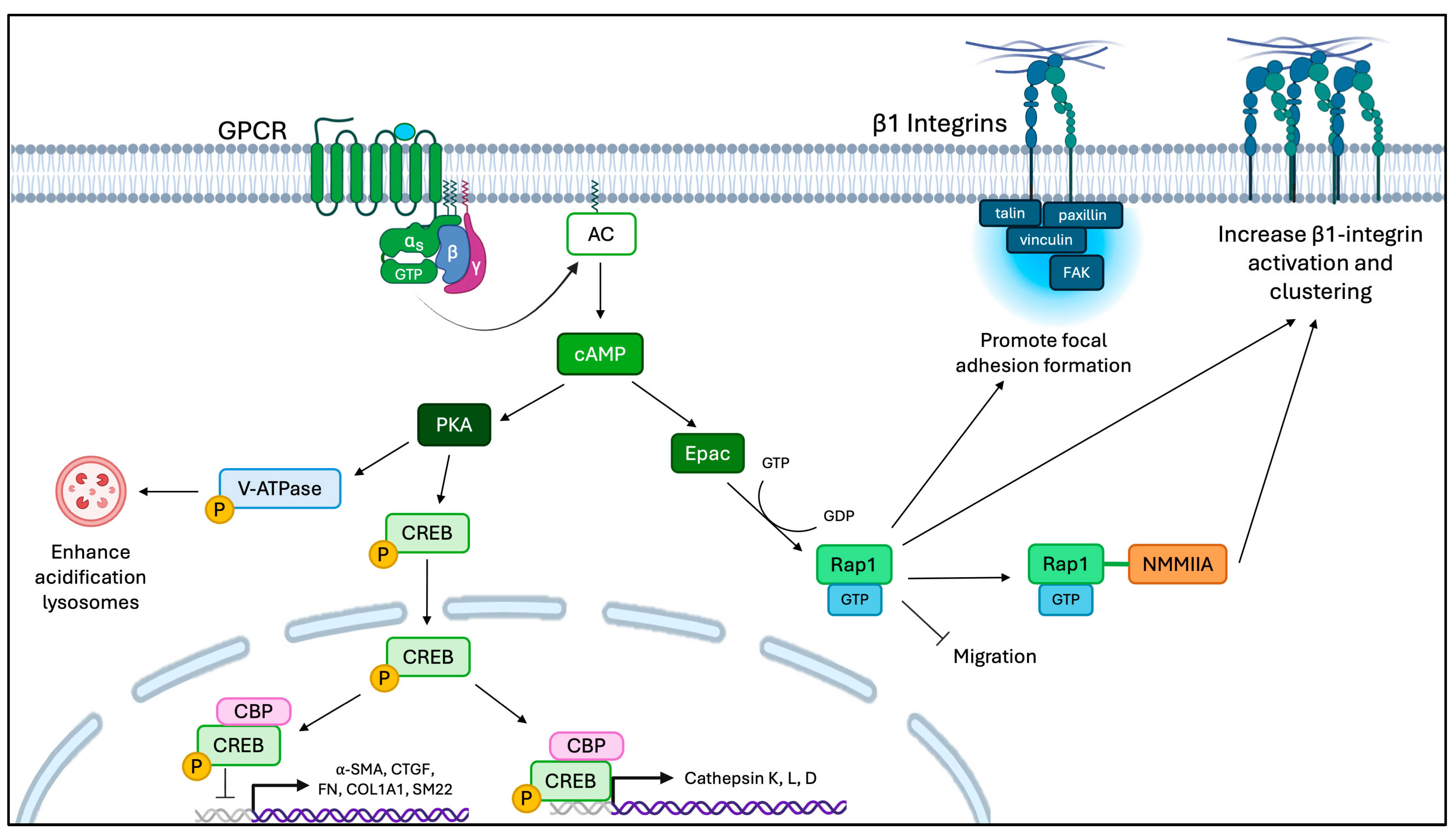
- Gαs GPCRs generates cAMP, which inhibits fibrotic processes by optimizing intracellular collagen degradation and remodeling.
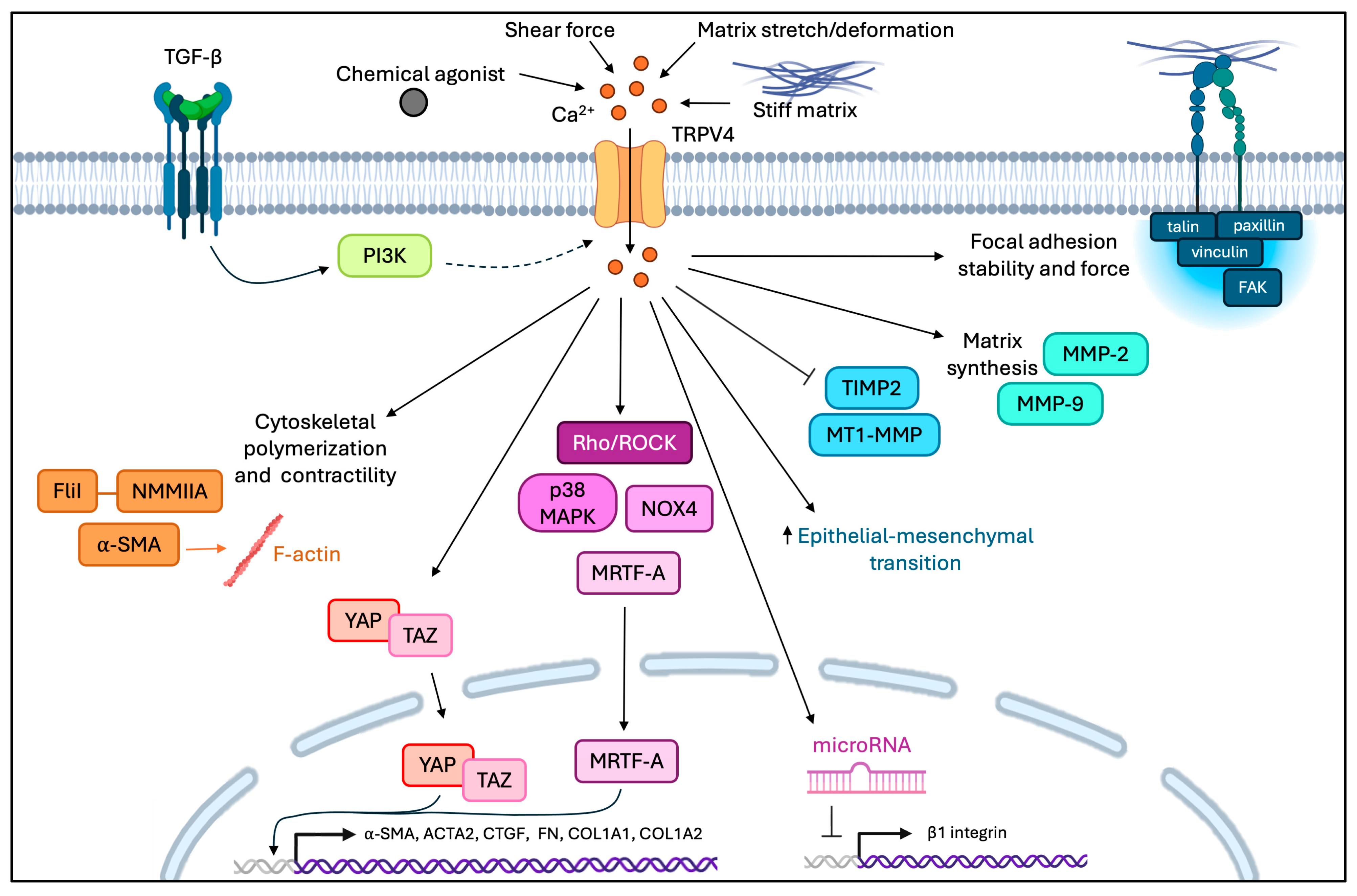
- TRPV4 activation regulates collagen remodeling under physiological conditions, but when dysregulated, TRPV4 promotes myofibroblast differentiation and reduces β1 integrin expression.
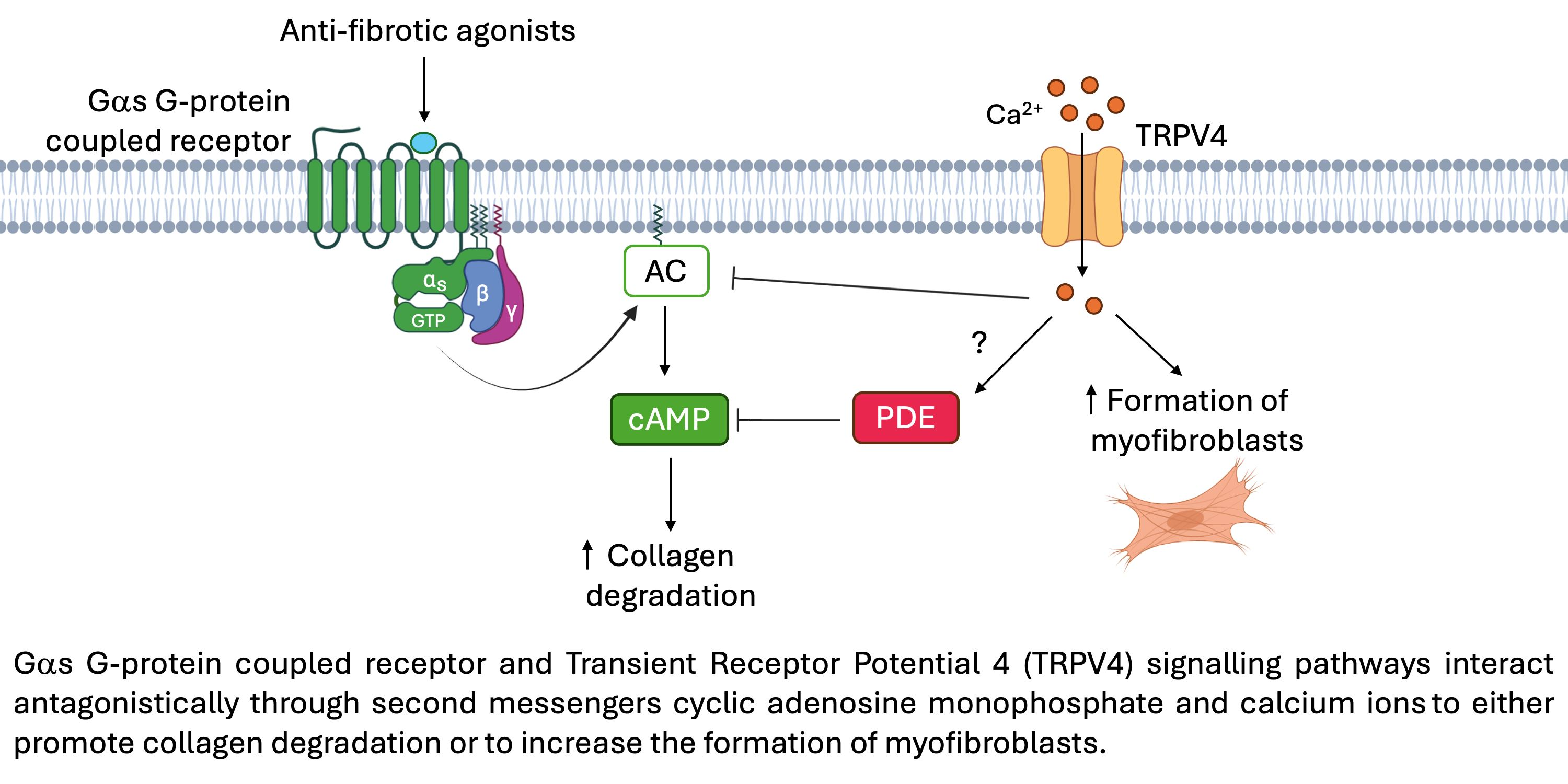
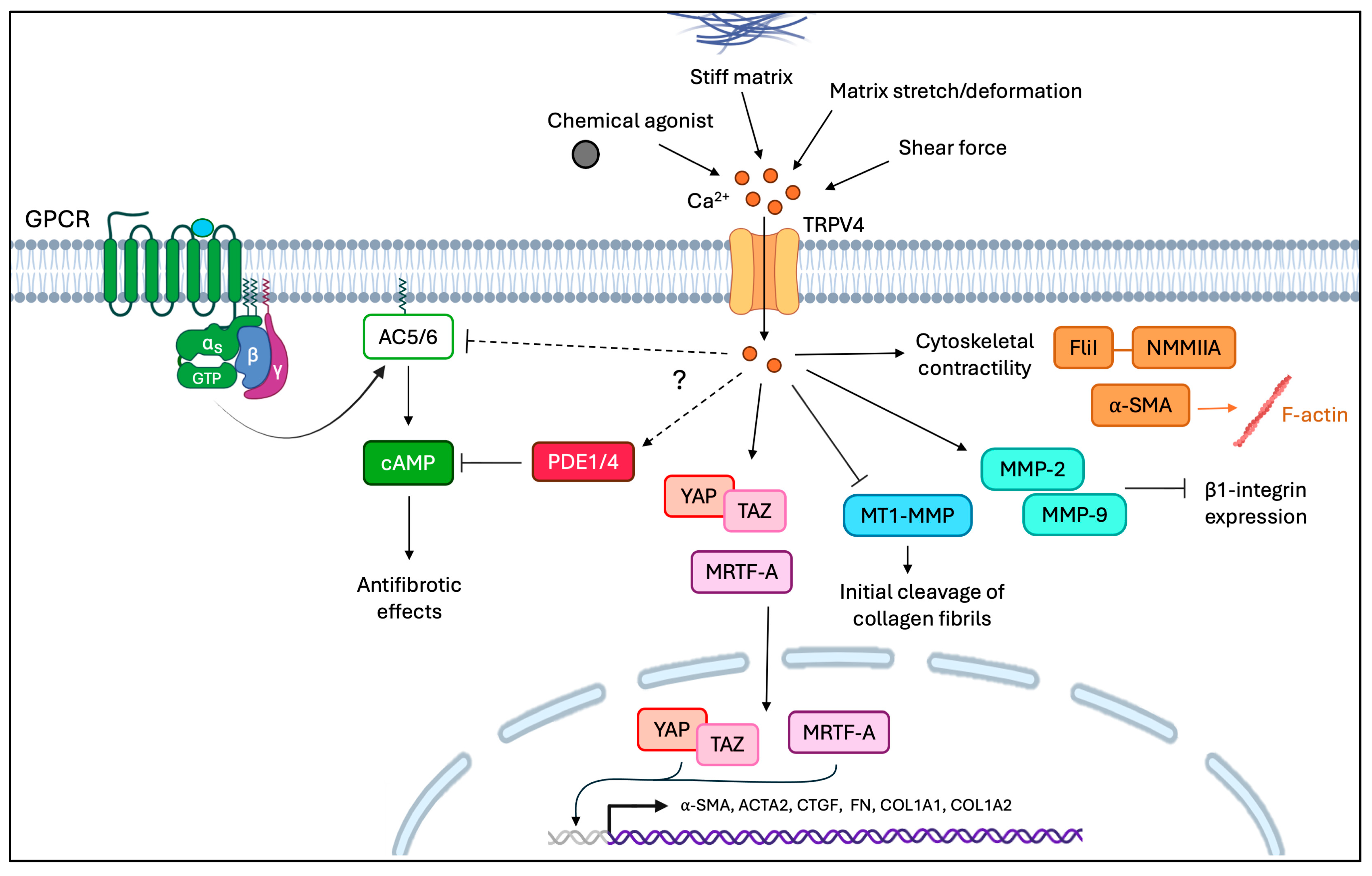
- Ca2+ influx through TRP channels modulates cAMP levels by regulating phosphodiesterases and adenylyl cyclases, underpinning the interplay between these signaling systems.
- Coordinated activation of the Gαs GPCRs pathway and inhibition of TRPV4 may provide a novel, bimodal approach to control tissue fibrosis.
Abstract
1. Introduction
2. Physiological Mechanisms of Collagen Remodeling
3. Pathways of Collagen Degradation
3.1. Extracellular Collagen Degradation
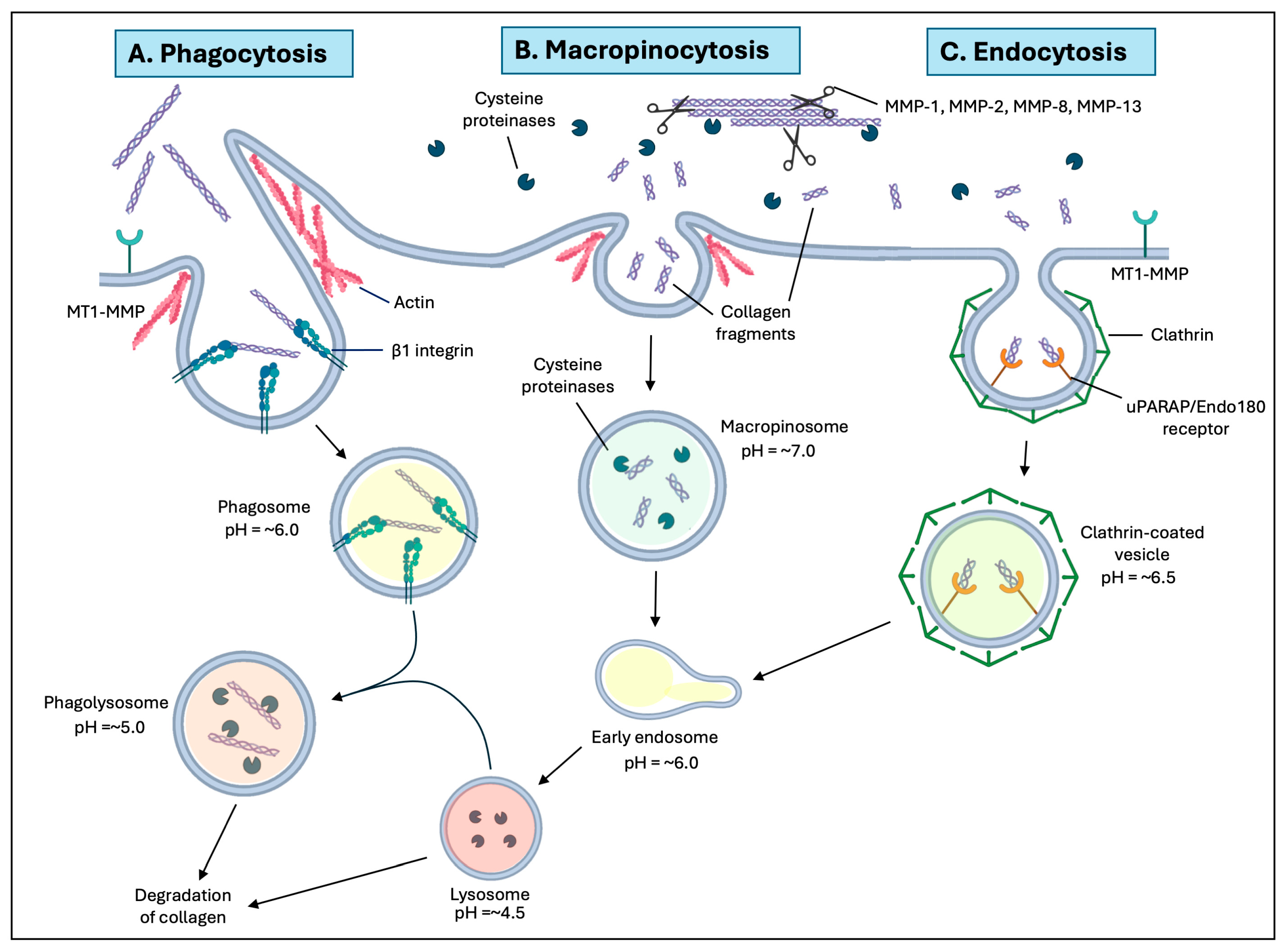
3.2. Intracellular Pathways of Collagen Degradation
4. Collagen Phagocytosis
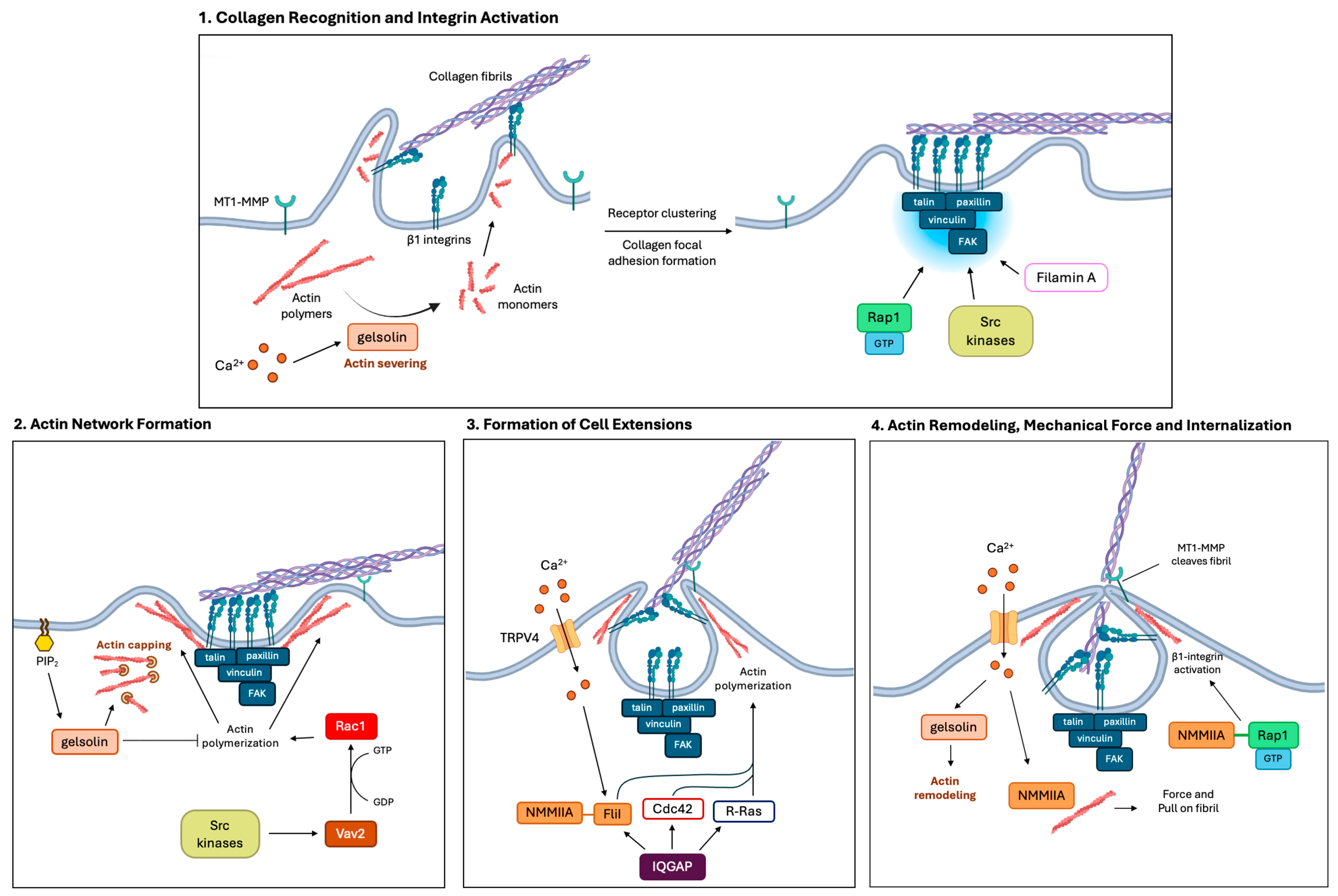
4.1. Collagen Recognition, Focal Adhesion Formation, and Actin Network Formation
4.2. Mechanism of Collagen Internalization
5. Dysregulation of ECM in Fibrotic Lesions
6. Drivers and Cellular Mediators of Fibrosis
7. Role of the Myofibroblast in Fibrotic Lesions
Signals That Activate Myofibroblast Formation
8. Why Study GPCR and TRPV4 Signaling in the Context of Fibrosis?
9. GPCRs Are Therapeutic Targets in Fibrosis
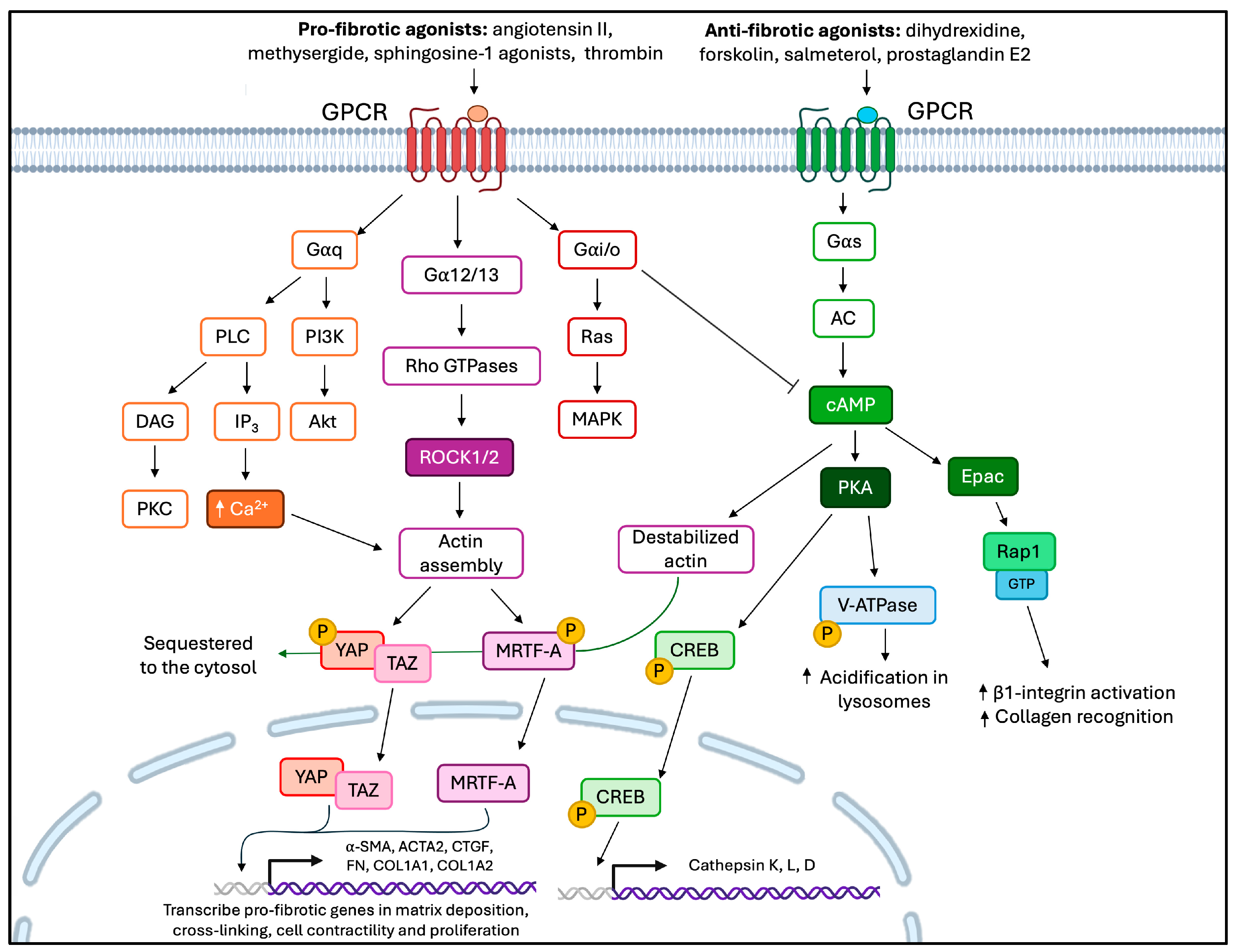
9.1. Gαi/o, Gαq/11, Gα12/13 Downstream Pathways Contribute to Fibrosis
9.2. Gαs GPCR/cAMP Pathway Is Anti-Fibrotic
10. TRPV4 Is a Ca2+ Permeable, Mechanosensing Channel That Promotes Fibrosis
11. Gαs GPCR and TRPV4 Signaling Are Interconnected Through the Second Messengers, cAMP and Ca2+
12. Conclusions and Future Perspectives
Author Contributions
Funding
Institutional Review Board Statement
Informed Consent Statement
Data Availability Statement
Acknowledgments
Conflicts of Interest
Abbreviations
| AC | Adenylyl cyclase |
| α-SMA | Alpha-smooth muscle actin |
| CaMK-I | Ca2+/calmodulin-dependent protein kinase-II |
| cAMP | Cyclic adenosine monophosphate |
| Ca2+ | Calcium ions |
| CBP | CREB-binding protein |
| CREB | cAMP-response element-binding protein |
| DAG | Diacylglycerol |
| DDR1 | Discoidin domain receptor 1 |
| DRD1 | Dopamine receptor D1 |
| ECM | Extracellular matrix |
| ERK | Extracellular signal-regulated kinase |
| Epac | Exchange protein activated by cAMP |
| FAK | Focal adhesion kinase |
| FliI | Flightless-I |
| Gαs | G protein alpha stimulatory subunit |
| GPCR | G protein-coupled receptor |
| IP3 | Inositol-1,4,5-triphosphate |
| LATS1/2 | Large tumor suppressor kinase ½ |
| MAPK | Mitogen-activated protein kinase |
| MMP | Matrix metalloproteinase |
| MRTF-A | Myocardin-related transcription factor A |
| MT1-MMP | Membrane-type 1-matrix metalloproteinase |
| NMMIIA | Non-muscle myosin IIA |
| PDE | Phosphodiesterase |
| PGE2 | Prostaglandin E2 |
| PI3K | Phosphoinositide 3-kinase |
| PIP2 | Phosphatidylinositol-4,5-biphosphate |
| ROCK | Rho-Rho-associated protein kinase |
| TEAD | TEA domain |
| TGF-β1 | Transforming growth factor beta1 |
| TIMP-2 | Tissue inhibitor of metalloproteinase 2 |
| TRP | Transient receptor potential |
| TRPV4 | Transient receptor potential vanilloid type 4 |
| uPARAP/Endo180 | Urokinase plasminogen activator receptor-associated protein |
| YAP/TAZ | Yes-associated protein 1/transcriptional coactivator with PDZ-binding motif |
References
- Rockey, D.C.; Bell, P.D.; Hill, J.A. Fibrosis—A Common Pathway to Organ Injury and Failure. N. Engl. J. Med. 2015, 372, 1138–1149. [Google Scholar] [CrossRef]
- Hinz, B.; McCulloch, C.A.; Coelho, N.M. Mechanical Regulation of Myofibroblast Phenoconversion and Collagen Contraction. Exp. Cell Res. 2019, 379, 119–128. [Google Scholar] [CrossRef]
- Andrabi, K.I.; Kaul, N.; Mudassar, S.; Dilawari, J.B.; Ganguly, N.K. Intracellular cAMP Determines the Extent of Degradation and Not the Synthesis of Collagen by Rat Hepatocytes. Mol. Cell Biochem. 1992, 109, 89–94. [Google Scholar] [CrossRef] [PubMed]
- Liu, X.; Sun, S.Q.; Hassid, A.; Ostrom, R.S. cAMP Inhibits Transforming Growth Factor-Beta-Stimulated Collagen Synthesis via Inhibition of Extracellular Signal-Regulated Kinase 1/2 and Smad Signaling in Cardiac Fibroblasts. Mol. Pharmacol. 2006, 70, 1992–2003. [Google Scholar] [CrossRef]
- Haak, A.J.; Kostallari, E.; Sicard, D.; Ligresti, G.; Choi, K.M.; Caporarello, N.; Jones, D.L.; Tan, Q.; Meridew, J.; Diaz Espinosa, A.M.; et al. Selective YAP/TAZ Inhibition in Fibroblasts via Dopamine Receptor D1 Agonism Reverses Fibrosis. Sci. Transl. Med. 2019, 11, eaau6296. [Google Scholar] [CrossRef] [PubMed]
- Gelse, K.; Pöschl, E.; Aigner, T. Collagens—Structure, Function, and Biosynthesis. Adv. Drug Deliv. Rev. 2003, 55, 1531–1546. [Google Scholar] [CrossRef]
- Sodek, J.; Brunette, D.M.; Feng, J.; Heersche, J.N.M.; Limeback, H.F.; Melcher, A.H.; Ng, B. Collagen Synthesis Is a Major Component of Protein Synthesis in the Periodontal Ligament in Various Species. Arch. Oral Biol. 1977, 22, 647–653. [Google Scholar] [CrossRef] [PubMed]
- Song, F.; Wisithphrom, K.; Zhou, J.; Windsor, L.J. Matrix Metalloproteinase Dependent and Independent Collagen Degradation. Front. Biosci. 2006, 11, 3100–3120. [Google Scholar] [CrossRef]
- Sprangers, S.; Everts, V. Molecular Pathways of Cell-Mediated Degradation of Fibrillar Collagen. Matrix Biol. 2019, 75–76, 190–200. [Google Scholar] [CrossRef]
- Arora, P.D.; Wang, Y.; Bresnick, A.; Dawson, J.; Janmey, P.A.; McCulloch, C.A. Collagen Remodeling by Phagocytosis Is Determined by Collagen Substrate Topology and Calcium-Dependent Interactions of Gelsolin with Nonmuscle Myosin IIA in Cell Adhesions. Mol. Biol. Cell 2013, 24, 734–747. [Google Scholar] [CrossRef]
- Arora, P.D.; Wang, Y.; Janmey, P.A.; Bresnick, A.; Yin, H.L.; McCulloch, C.A. Gelsolin and Non-Muscle Myosin IIA Interact to Mediate Calcium-Regulated Collagen Phagocytosis. J. Biol. Chem. 2011, 286, 34184–34198. [Google Scholar] [CrossRef]
- Livada, R.; Shiloah, J. Calcium Channel Blocker-Induced Gingival Enlargement. J. Hum. Hypertens. 2014, 28, 10–14. [Google Scholar] [CrossRef]
- Moccia, F.; Totaro, A.; Guerra, G.; Testa, G. Ca2+ Signaling in Cardiac Fibroblasts: An Emerging Signaling Pathway Driving Fibrotic Remodeling in Cardiac Disorders. Biomedicines 2025, 13, 734. [Google Scholar] [CrossRef] [PubMed]
- Li, X.; Cheng, Y.; Wang, Z.; Zhou, J.; Jia, Y.; He, X.; Zhao, L.; Dong, Y.; Fan, Y.; Yang, X.; et al. Calcium and TRPV4 Promote Metastasis by Regulating Cytoskeleton through the RhoA/ROCK1 Pathway in Endometrial Cancer. Cell Death Dis. 2020, 11, 1009. [Google Scholar] [CrossRef]
- Adapala, R.K.; Kanugula, A.K.; Paruchuri, S.; Chilian, W.M.; Thodeti, C.K. TRPV4 Deletion Protects Heart from Myocardial Infarction-Induced Adverse Remodeling via Modulation of Cardiac Fibroblast Differentiation. Basic. Res. Cardiol. 2020, 115, 14. [Google Scholar] [CrossRef]
- Bonnans, C.; Chou, J.; Werb, Z. Remodelling the Extracellular Matrix in Development and Disease. Nat. Rev. Mol. Cell Biol. 2014, 15, 786–801. [Google Scholar] [CrossRef] [PubMed]
- Hynes, R.O.; Naba, A. Overview of the Matrisome--an Inventory of Extracellular Matrix Constituents and Functions. Cold Spring Harb. Perspect. Biol. 2012, 4, a004903. [Google Scholar] [CrossRef] [PubMed]
- Selvaraj, V.; Sekaran, S.; Dhanasekaran, A.; Warrier, S. Type 1 Collagen: Synthesis, Structure and Key Functions in Bone Mineralization. Differentiation 2024, 136, 100757. [Google Scholar] [CrossRef]
- Gao, Y.; Li, J.; Cheng, W.; Diao, T.; Liu, H.; Bo, Y.; Liu, C.; Zhou, W.; Chen, M.; Zhang, Y.; et al. Cross-Tissue Human Fibroblast Atlas Reveals Myofibroblast Subtypes with Distinct Roles in Immune Modulation. Cancer Cell 2024, 42, 1764–1783.e10. [Google Scholar] [CrossRef]
- Valenzi, E.; Bulik, M.; Tabib, T.; Morse, C.; Sembrat, J.; Trejo Bittar, H.; Rojas, M.; Lafyatis, R. Single-Cell Analysis Reveals Fibroblast Heterogeneity and Myofibroblasts in Systemic Sclerosis-Associated Interstitial Lung Disease. Ann. Rheum. Dis. 2019, 78, 1379–1387. [Google Scholar] [CrossRef]
- Wang, Q.; Ji, C.; Smith, P.; McCulloch, C.A. Impact of TRP Channels on Extracellular Matrix Remodeling: Focus on TRPV4 and Collagen. Int. J. Mol. Sci. 2024, 25, 3566. [Google Scholar] [CrossRef]
- Bühling, F.; Röcken, C.; Brasch, F.; Hartig, R.; Yasuda, Y.; Saftig, P.; Brömme, D.; Welte, T. Pivotal Role of Cathepsin K in Lung Fibrosis. Am. J. Pathol. 2004, 164, 2203–2216. [Google Scholar] [CrossRef] [PubMed]
- Srivastava, M.; Steinwede, K.; Kiviranta, R.; Morko, J.; Hoymann, H.-G.; Länger, F.; Buhling, F.; Welte, T.; Maus, U.A. Overexpression of Cathepsin K in Mice Decreases Collagen Deposition and Lung Resistance in Response to Bleomycin-Induced Pulmonary Fibrosis. Respir. Res. 2008, 9, 54. [Google Scholar] [CrossRef]
- Aguda, A.H.; Panwar, P.; Du, X.; Nguyen, N.T.; Brayer, G.D.; Brömme, D. Structural Basis of Collagen Fiber Degradation by Cathepsin K. Proc. Natl. Acad. Sci. USA 2014, 111, 17474–17479. [Google Scholar] [CrossRef]
- Lauer-Fields, J.L.; Juska, D.; Fields, G.B. Matrix Metalloproteinases and Collagen Catabolism. Biopolymers 2002, 66, 19–32. [Google Scholar] [CrossRef]
- Birkedal-Hansen, H.; Moore, W.G.; Bodden, M.K.; Windsor, L.J.; Birkedal-Hansen, B.; DeCarlo, A.; Engler, J.A. Matrix Metalloproteinases: A Review. Crit. Rev. Oral Biol. Med. 1993, 4, 197–250. [Google Scholar] [CrossRef]
- Surazyński, A.; Pałka, J.; Wołczyński, S. Acetylsalicylic Acid-Dependent Inhibition of Collagen Biosynthesis and Beta1-Integrin Signaling in Cultured Fibroblasts. Med. Sci. Monit. 2004, 10, BR175–BR179. [Google Scholar] [PubMed]
- Eni-Aganga, I.; Lanaghan, Z.M.; Balasubramaniam, M.; Dash, C.; Pandhare, J. PROLIDASE: A Review from Discovery to Its Role in Health and Disease. Front. Mol. Biosci. 2021, 8, 723003. [Google Scholar] [CrossRef] [PubMed]
- Endo, F.; Tanoue, A.; Nakai, H.; Hata, A.; Indo, Y.; Titani, K.; Matsuda, I. Primary Structure and Gene Localization of Human Prolidase. J. Biol. Chem. 1989, 264, 4476–4481. [Google Scholar] [CrossRef]
- Yamazaki, S.; Su, Y.; Maruyama, A.; Makinoshima, H.; Suzuki, J.; Tsuboi, M.; Goto, K.; Ochiai, A.; Ishii, G. Uptake of Collagen Type I via Macropinocytosis Cause mTOR Activation and Anti-Cancer Drug Resistance. Biochem. Biophys. Res. Commun. 2020, 526, 191–198. [Google Scholar] [CrossRef]
- Bi, Y.; Mukhopadhyay, D.; Drinane, M.; Ji, B.; Li, X.; Cao, S.; Shah, V.H. Endocytosis of Collagen by Hepatic Stellate Cells Regulates Extracellular Matrix Dynamics. Am. J. Physiol. Cell Physiol. 2014, 307, C622–C633. [Google Scholar] [CrossRef]
- Zhang, Y.; Ling, L.; Murad, R.; Maganti, S.; Manceau, A.; Hetrick, H.A.; Neff, M.; Galapate, C.M.; Grenier, S.F.; Carrette, F.; et al. Macropinocytosis Maintains CAF Subtype Identity Under Metabolic Stress in Pancreatic Cancer. Cancer Cell 2025, 43, 1677–1696.e15. [Google Scholar] [CrossRef]
- Engelholm, L.H.; List, K.; Netzel-Arnett, S.; Cukierman, E.; Mitola, D.J.; Aaronson, H.; Kjøller, L.; Larsen, J.K.; Yamada, K.M.; Strickland, D.K.; et al. uPARAP/Endo180 Is Essential for Cellular Uptake of Collagen and Promotes Fibroblast Collagen Adhesion. J. Cell Biol. 2003, 160, 1009–1015. [Google Scholar] [CrossRef]
- Engelholm, L.H.; Ingvarsen, S.; Jürgensen, H.J.; Hillig, T.; Madsen, D.H.; Nielsen, B.S.; Behrendt, N. The Collagen Receptor uPARAP/Endo180. Front. Biosci.-Landmark 2009, 14, 2103–2114. [Google Scholar] [CrossRef]
- Behrendt, N.; Jensen, O.N.; Engelholm, L.H.; Mørtz, E.; Mann, M.; Danø, K. A Urokinase Receptor-Associated Protein with Specific Collagen Binding Properties. J. Biol. Chem. 2000, 275, 1993–2002. [Google Scholar] [CrossRef] [PubMed]
- Kjøller, L.; Engelholm, L.H.; Høyer-Hansen, M.; Danø, K.; Bugge, T.H.; Behrendt, N. uPARAP/Endo180 Directs Lysosomal Delivery and Degradation of Collagen IV. Exp. Cell Res. 2004, 293, 106–116. [Google Scholar] [CrossRef] [PubMed]
- Wienke, D.; MacFadyen, J.R.; Isacke, C.M. Identification and Characterization of the Endocytic Transmembrane Glycoprotein Endo180 as a Novel Collagen Receptor. Mol. Biol. Cell 2003, 14, 3592–3604. [Google Scholar] [CrossRef]
- Madsen, D.H.; Engelholm, L.H.; Ingvarsen, S.; Hillig, T.; Wagenaar-Miller, R.A.; Kjøller, L.; Gårdsvoll, H.; Høyer-Hansen, G.; Holmbeck, K.; Bugge, T.H.; et al. Extracellular Collagenases and the Endocytic Receptor, Urokinase Plasminogen Activator Receptor-Associated Protein/Endo180, Cooperate in Fibroblast-Mediated Collagen Degradation. J. Biol. Chem. 2007, 282, 27037–27045. [Google Scholar] [CrossRef]
- Madsen, D.H.; Ingvarsen, S.; Jürgensen, H.J.; Melander, M.C.; Kjøller, L.; Moyer, A.; Honoré, C.; Madsen, C.A.; Garred, P.; Burgdorf, S.; et al. The Non-Phagocytic Route of Collagen Uptake: A Distinct Degradation Pathway. J. Biol. Chem. 2011, 286, 26996–27010. [Google Scholar] [CrossRef] [PubMed]
- Sprangers, S.; Behrendt, N.; Engelholm, L.; Cao, Y.; Everts, V. Phagocytosis of Collagen Fibrils by Fibroblasts In Vivo Is Independent of the uPARAP/Endo180 Receptor. J. Cell Biochem. 2017, 118, 1590–1595. [Google Scholar] [CrossRef]
- Melcher, A.H.; Chan, J. Phagocytosis and Digestion of Collagen by Gingival Fibroblasts In Vivo: A Study of Serial Sections. J. Ultrastruct. Res. 1981, 77, 1–36. [Google Scholar] [CrossRef]
- Staudinger, L.A.; Spano, S.J.; Lee, W.; Coelho, N.; Rajshankar, D.; Bendeck, M.P.; Moriarty, T.; McCulloch, C.A. Interactions between the Discoidin Domain Receptor 1 and Β1 Integrin Regulate Attachment to Collagen. Biol. Open 2013, 2, 1148–1159. [Google Scholar] [CrossRef]
- Lee, H.; Sodek, K.L.; Hwang, Q.; Brown, T.J.; Ringuette, M.; Sodek, J. Phagocytosis of Collagen by Fibroblasts and Invasive Cancer Cells Is Mediated by MT1-MMP. Biochem. Soc. Trans. 2007, 35, 704–706. [Google Scholar] [CrossRef]
- Zeltz, C.; Gullberg, D. The Integrin–Collagen Connection—A Glue for Tissue Repair? J. Cell Sci. 2016, 129, 653–664. [Google Scholar] [CrossRef]
- Chou, D.H.; Lee, W.; McCulloch, C.A. TNF-Alpha Inactivation of Collagen Receptors: Implications for Fibroblast Function and Fibrosis. J. Immunol. 1996, 156, 4354–4362. [Google Scholar] [CrossRef] [PubMed]
- Segal, G.; Lee, W.; Arora, P.D.; McKee, M.; Downey, G.; McCulloch, C.A.G. Involvement of Actin Filaments and Integrins in the Binding Step in Collagen Phagocytosis by Human Fibroblasts. J. Cell Sci. 2001, 114, 119–129. [Google Scholar] [CrossRef] [PubMed]
- Knowles, G.C.; McKeown, M.; Sodek, J.; McCulloch, C.A.G. Mechanism of Collagen Phagocytosis by Human Gingival Fibroblasts: Importance of Collagen Structure in Cell Recognition and Internalization. J. Cell Sci. 1991, 98, 551–558. [Google Scholar] [CrossRef]
- Arora, P.D.; Conti, M.A.; Ravid, S.; Sacks, D.B.; Kapus, A.; Adelstein, R.S.; Bresnick, A.R.; McCulloch, C.A. Rap1 Activation in Collagen Phagocytosis Is Dependent on Nonmuscle Myosin II-A. Mol. Biol. Cell 2008, 19, 5032–5046. [Google Scholar] [CrossRef] [PubMed]
- Papagrigoriou, E.; Gingras, A.R.; Barsukov, I.L.; Bate, N.; Fillingham, I.J.; Patel, B.; Frank, R.; Ziegler, W.H.; Roberts, G.C.K.; Critchley, D.R.; et al. Activation of a Vinculin-Binding Site in the Talin Rod Involves Rearrangement of a Five-Helix Bundle. EMBO J. 2004, 23, 2942–2951. [Google Scholar] [CrossRef]
- Arora, P.D.; Chan, M.W.C.; Anderson, R.A.; Janmey, P.A.; McCulloch, C.A. Separate Functions of Gelsolin Mediate Sequential Steps of Collagen Phagocytosis. Mol. Biol. Cell 2005, 16, 5175–5190. [Google Scholar] [CrossRef]
- Humphrey, J.D.; Dufresne, E.R.; Schwartz, M.A. Mechanotransduction and Extracellular Matrix Homeostasis. Nat. Rev. Mol. Cell Biol. 2014, 15, 802–812. [Google Scholar] [CrossRef]
- Horton, E.R.; Byron, A.; Askari, J.A.; Ng, D.H.J.; Millon-Frémillon, A.; Robertson, J.; Koper, E.J.; Paul, N.R.; Warwood, S.; Knight, D.; et al. Definition of a Consensus Integrin Adhesome and Its Dynamics during Adhesion Complex Assembly and Disassembly. Nat. Cell Biol. 2015, 17, 1577–1587. [Google Scholar] [CrossRef]
- Kim, H.; Nakamura, F.; Lee, W.; Shifrin, Y.; Arora, P.; McCulloch, C.A. Filamin A Is Required for Vimentin-Mediated Cell Adhesion and Spreading. Am. J. Physiol. Cell Physiol. 2010, 298, C221–C236. [Google Scholar] [CrossRef]
- Nardone, G.; Oliver-De La Cruz, J.; Vrbsky, J.; Martini, C.; Pribyl, J.; Skládal, P.; Pešl, M.; Caluori, G.; Pagliari, S.; Martino, F.; et al. YAP Regulates Cell Mechanics by Controlling Focal Adhesion Assembly. Nat. Commun. 2017, 8, 15321. [Google Scholar] [CrossRef]
- Woltersdorf, C.; Bonk, M.; Leitinger, B.; Huhtala, M.; Käpylä, J.; Heino, J.; Gil Girol, C.; Niland, S.; Eble, J.A.; Bruckner, P.; et al. The Binding Capacity of A1β1-, A2β1- and A10β1-Integrins Depends on Non-Collagenous Surface Macromolecules Rather than the Collagens in Cartilage Fibrils. Matrix Biol. 2017, 63, 91–105. [Google Scholar] [CrossRef] [PubMed]
- Arora, P.D.; Marignani, P.A.; McCulloch, C.A. Collagen Phagocytosis Is Regulated by the Guanine Nucleotide Exchange Factor Vav2. Am. J. Physiol. Cell Physiol. 2008, 295, C130–C137. [Google Scholar] [CrossRef]
- Arora, P.D.; Glogauer, M.; Kapus, A.; Kwiatkowski, D.J.; McCulloch, C.A. Gelsolin Mediates Collagen Phagocytosis Through a Rac-Dependent Step. Mol. Biol. Cell 2004, 15, 588–599. [Google Scholar] [CrossRef] [PubMed]
- Szatmári, D.; Xue, B.; Kannan, B.; Burtnick, L.D.; Bugyi, B.; Nyitrai, M.; Robinson, R.C. ATP Competes with PIP2 for Binding to Gelsolin. PLoS ONE 2018, 13, e0201826. [Google Scholar] [CrossRef]
- Nakajima, K.; Arora, P.D.; Plaha, A.; McCulloch, C.A. Role of the Small GTPase Activating Protein IQGAP1 in Collagen Phagocytosis. J. Cell Physiol. 2021, 236, 1270–1280. [Google Scholar] [CrossRef]
- Arora, P.D.; Nakajima, K.; Nanda, A.; Plaha, A.; Wilde, A.; Sacks, D.B.; McCulloch, C.A. Flightless Anchors IQGAP1 and R-Ras to Mediate Cell Extension Formation and Matrix Remodeling. Mol. Biol. Cell 2020, 31, 1595–1610. [Google Scholar] [CrossRef] [PubMed]
- Arora, P.D.; Di Gregorio, M.; He, P.; McCulloch, C.A. TRPV4 Mediates the Ca2+ Influx Required for the Interaction Between Flightless-1 and Non-Muscle Myosin, and Collagen Remodeling. J. Cell Sci. 2017, 130, 2196–2208. [Google Scholar] [CrossRef]
- Deporter, D.A. Collagen Phagocytosis by Stimulated Mouse Peritoneal Macrophages In Vitro. J. Periodontal Res. 1979, 14, 323–331. [Google Scholar] [CrossRef]
- Arora, P.D.; Manolson, M.F.; Downey, G.P.; Sodek, J.; McCulloch, C.A.G. A Novel Model System for Characterization of Phagosomal Maturation, Acidification, and Intracellular Collagen Degradation in Fibroblasts. J. Biol. Chem. 2000, 275, 35432–35441. [Google Scholar] [CrossRef]
- Everts, V.; van der Zee, E.; Creemers, L.; Beertsen, W. Phagocytosis and Intracellular Digestion of Collagen, Its Role in Turnover and Remodelling. Histochem. J. 1996, 28, 229–245. [Google Scholar] [CrossRef] [PubMed]
- Hou, W.S.; Li, Z.; Gordon, R.E.; Chan, K.; Klein, M.J.; Levy, R.; Keysser, M.; Keyszer, G.; Brömme, D. Cathepsin k Is a Critical Protease in Synovial Fibroblast-Mediated Collagen Degradation. Am. J. Pathol. 2001, 159, 2167–2177. [Google Scholar] [CrossRef] [PubMed]
- Everts, V.; Beertsen, W. Phagocytosis of Collagen Fibrils by Periosteal Fibroblasts in Long Bone Explants. Effect of Concanavalin A. Tissue Cell 1992, 24, 935–941. [Google Scholar] [CrossRef]
- Etherington, D.J.; Evans, P.J. The Action of Cathepsin B and Collagenolytic Cathepsin in the Degradation of Collagen. Acta Biol. Med. Ger. 1977, 36, 1555–1563. [Google Scholar] [PubMed]
- Nishimura, F.; Naruishi, H.; Naruishi, K.; Yamada, T.; Sasaki, J.; Peters, C.; Uchiyama, Y.; Murayama, Y. Cathepsin-L, a Key Molecule in the Pathogenesis of Drug-Induced and I-Cell Disease-Mediated Gingival Overgrowth: A Study with Cathepsin-L-Deficient Mice. Am. J. Pathol. 2002, 161, 2047–2052. [Google Scholar] [CrossRef]
- Zhang, X.; Zhou, Y.; Yu, X.; Huang, Q.; Fang, W.; Li, J.; Bonventre, J.V.; Sukhova, G.K.; Libby, P.; Shi, G.-P. Differential Roles of Cysteinyl Cathepsins in TGF-β Signaling and Tissue Fibrosis. iScience 2019, 19, 607–622. [Google Scholar] [CrossRef]
- Manchanda, M.; Das, P.; Gahlot, G.P.S.; Singh, R.; Roeb, E.; Roderfeld, M.; Datta Gupta, S.; Saraya, A.; Pandey, R.M.; Chauhan, S.S. Cathepsin L and B as Potential Markers for Liver Fibrosis: Insights From Patients and Experimental Models. Clin. Transl. Gastroenterol. 2017, 8, e99. [Google Scholar] [CrossRef]
- Everts, V.; Beertsen, W.; Tigchelaar-Gutter, W. The Digestion of Phagocytosed Collagen Is Inhibited by the Proteinase Inhibitors Leupeptin and E-64. Top. Catal. 1985, 5, 315–336. [Google Scholar] [CrossRef]
- Panwar, P.; Du, X.; Sharma, V.; Lamour, G.; Castro, M.; Li, H.; Brömme, D. Effects of Cysteine Proteases on the Structural and Mechanical Properties of Collagen Fibers*. J. Biol. Chem. 2013, 288, 5940–5950. [Google Scholar] [CrossRef]
- Iozzo, R.V.; Gubbiotti, M.A. Extracellular Matrix: The Driving Force of Mammalian Diseases. Matrix Biol. 2018, 71–72, 1–9. [Google Scholar] [CrossRef]
- Onursal, C.; Dick, E.; Angelidis, I.; Schiller, H.B.; Staab-Weijnitz, C.A. Collagen Biosynthesis, Processing, and Maturation in Lung Ageing. Front. Med. 2021, 8, 593874. [Google Scholar] [CrossRef]
- Mutsaers, H.A.M.; Merrild, C.; Nørregaard, R.; Plana-Ripoll, O. The Impact of Fibrotic Diseases on Global Mortality from 1990 to 2019. J. Transl. Med. 2023, 21, 818. [Google Scholar] [CrossRef]
- Wynn, T. Cellular and Molecular Mechanisms of Fibrosis. J. Pathol. 2008, 214, 199–210. [Google Scholar] [CrossRef]
- Harrison, M.; Kavanagh, G.; Corte, T.J.; Troy, L.K. Drug-Induced Interstitial Lung Disease: A Narrative Review of a Clinical Conundrum. Expert. Rev. Respir. Med. 2024, 18, 23–39. [Google Scholar] [CrossRef] [PubMed]
- McCall, K.L.; Hennig, K.R.; Abe, Z.T.; Dattler, D.N.; Hurd, K.L.; Portnoy, S.L.; Zagoria, Z.J. Rising Cases of Drug-Induced Pulmonary Fibrosis: Analysis of the Food and Drug Administration Adverse Event Reporting System (FAERS) Database, 2000–2022. Pharmacoepidemiol. Drug Saf. 2024, 33, e5797. [Google Scholar] [CrossRef] [PubMed]
- Zhao, P.; Sun, T.; Lyu, C.; Liang, K.; Du, Y. Cell Mediated ECM-Degradation as an Emerging Tool for Anti-Fibrotic Strategy. Cell Regen. 2023, 12, 29. [Google Scholar] [CrossRef]
- Kinane, D.F.; Stathopoulou, P.G.; Papapanou, P.N. Periodontal Diseases. Nat. Rev. Dis. Primers 2017, 3, 17038. [Google Scholar] [CrossRef] [PubMed]
- Rani, J.; Dhull, S.B.; Rose, P.K.; Kidwai, M.K. Drug-Induced Liver Injury and Anti-Hepatotoxic Effect of Herbal Compounds: A Metabolic Mechanism Perspective. Phytomedicine 2024, 122, 155142. [Google Scholar] [CrossRef]
- Biswas, A.; Santra, S.; Bishnu, D.; Dhali, G.K.; Chowdhury, A.; Santra, A. Isoniazid and Rifampicin Produce Hepatic Fibrosis through an Oxidative Stress-Dependent Mechanism. Int. J. Hepatol. 2020, 2020, 6987295. [Google Scholar] [CrossRef]
- Kumar, N.; Kedarisetty, C.K.; Kumar, S.; Khillan, V.; Sarin, S.K. Antitubercular Therapy in Patients with Cirrhosis: Challenges and Options. World J. Gastroenterol. 2014, 20, 5760–5772. [Google Scholar] [CrossRef]
- Chen, C.; Zhang, X.; Zheng, C.; Gao, Z.; Jiang, X.; Bai, Y.; Meng, Y. Sulfasalazine Exacerbates Angiotensin II-Induced Cardiac Remodelling by Activating Akt Signal Pathway. Clin. Exp. Pharmacol. Physiol. 2022, 49, 776–783. [Google Scholar] [CrossRef]
- Chávez, E.; Castro-Sánchez, L.; Shibayama, M.; Tsutsumi, V.; Moreno, M.G.; Muriel, P. Sulfasalazine Prevents the Increase in TGF-β, COX-2, Nuclear NFκB Translocation and Fibrosis in CCl4-Induced Liver Cirrhosis in the Rat. Hum. Exp. Toxicol. 2012, 31, 913–920. [Google Scholar] [CrossRef] [PubMed]
- Kerget, B.; Araz, O.; Ucar, E.Y.; Aydin, O.; Akgun, M.; Saglam, L. Sulfasalazine-Induced Interstitial Fibrosis. Eurasian J. Med. 2018, 50, 207–209. [Google Scholar] [CrossRef] [PubMed]
- Barcellini, W.; Fattizzo, B.; Zaninoni, A. Current and Emerging Treatment Options for Autoimmune Hemolytic Anemia. Expert. Rev. Clin. Immunol. 2018, 14, 857–872. [Google Scholar] [CrossRef] [PubMed]
- Kwun, J.; Park, J.; Yi, J.S.; Farris, A.B.; Kirk, A.D.; Knechtle, S.J. IL-21 Biased Alemtuzumab Induced Chronic Antibody-Mediated Rejection Is Reversed by LFA-1 Costimulation Blockade. Front. Immunol. 2018, 9, 2323. [Google Scholar] [CrossRef]
- Huang, Y.; Feng, H.; Kan, T.; Huang, B.; Zhang, M.; Li, Y.; Shi, C.; Wu, M.; Luo, Y.; Yang, J.; et al. Bevacizumab Attenuates Hepatic Fibrosis in Rats by Inhibiting Activation of Hepatic Stellate Cells. PLoS ONE 2013, 8, e73492. [Google Scholar] [CrossRef]
- Chu, S.-J.; Zhang, Z.-H.; Wang, M.; Xu, H.-F. Effect of Bevacizumab on the Expression of Fibrosis-Related Inflammatory Mediators in ARPE-19 Cells. Int. J. Ophthalmol. 2017, 10, 366–371. [Google Scholar] [CrossRef]
- Van Geest, R.J.; Lesnik-Oberstein, S.Y.; Tan, H.S.; Mura, M.; Goldschmeding, R.; Van Noorden, C.J.F.; Klaassen, I.; Schlingemann, R.O. A Shift in the Balance of Vascular Endothelial Growth Factor and Connective Tissue Growth Factor by Bevacizumab Causes the Angiofibrotic Switch in Proliferative Diabetic Retinopathy. Br. J. Ophthalmol. 2012, 96, 587–590. [Google Scholar] [CrossRef]
- Zhang, M.; Chu, S.; Zeng, F.; Xu, H. Bevacizumab Modulates the Process of Fibrosis In Vitro. Clin. Exp. Ophthalmol. 2015, 43, 173–179. [Google Scholar] [CrossRef]
- Alimullah, M.; Shuvo, A.U.H.; Jahan, I.; Ismail, I.N.; Islam, S.M.M.; Sultana, M.; Saad, M.R.; Raihan, S.; Khan, F.; Alam, M.A.; et al. Evaluation of the Modulating Effect of Epidermal Growth Factor Receptor Inhibitor Cetuximab in Carbon-Tetrachloride Induce Hepatic Fibrosis in Rats. Biochem. Biophys. Rep. 2024, 38, 101689. [Google Scholar] [CrossRef]
- Tanriverdi, O.; Yilmaz, İ.; Adilay, H.U.; Gunaldi, O.; Erdogan, U.; Gungor, A.; Kilic, M.; Tanik, C. Effect of Cetuximab on the Development of Epidural Fibrosis Based on CD105 and Osteopontin Immunohistochemical Staining. Spine 2019, 44, E134–E143. [Google Scholar] [CrossRef]
- Chua, W.; Peters, M.; Loneragan, R.; Clarke, S. Cetuximab-Associated Pulmonary Toxicity. Clin. Color. Cancer 2009, 8, 118–120. [Google Scholar] [CrossRef]
- Hou, H.; Xu, Y.; Xie, M.; Chen, R. Exploring the Potential Molecular Mechanism of Trastuzumab-Induced Cardiotoxicity Based on RNA Sequencing and Bioinformatics Analysis. Biochem. Pharmacol. 2023, 208, 115388. [Google Scholar] [CrossRef]
- Thavarajah, K.; Wu, P.; Rhew, E.J.; Yeldandi, A.K.; Kamp, D.W. Pulmonary Complications of Tumor Necrosis Factor-Targeted Therapy. Respir. Med. 2009, 103, 661–669. [Google Scholar] [CrossRef]
- Perez-Alvarez, R.; Perez-de-Lis, M.; Diaz-Lagares, C.; Pego-Reigosa, J.M.; Retamozo, S.; Bove, A.; Brito-Zeron, P.; Bosch, X.; Ramos-Casals, M. Interstitial Lung Disease Induced or Exacerbated by TNF-Targeted Therapies: Analysis of 122 Cases. Semin. Arthritis Rheum. 2011, 41, 256–264. [Google Scholar] [CrossRef] [PubMed]
- Herrinton, L.J.; Harrold, L.R.; Liu, L.; Raebel, M.A.; Taharka, A.; Winthrop, K.L.; Solomon, D.H.; Curtis, J.R.; Lewis, J.D.; Saag, K.G. Association Between Anti-TNF-α Therapy and Interstitial Lung Disease. Pharmacoepidemiol. Drug Saf. 2013, 22, 394–402. [Google Scholar] [CrossRef] [PubMed]
- Parent, S.; Amant, J.S.; Remortel, S.V.; Kahn, S.; Vaka, R.; Courtman, D.; Stewart, D.J.; Davis, D.R. Atrial Fibrosis and Inflammation in Postoperative Atrial Fibrillation: Comparative Effects of Amiodarone, Colchicine, or Exosomes. JACC Clin. Electrophysiol. 2024, 10, 1037–1049. [Google Scholar] [CrossRef] [PubMed]
- Harb, I.; Ashour, H.; Rashed, L.A.; Mostafa, A.; Samir, M.; Aboulhoda, B.E.; El-Hanbuli, H.; Rashwan, E.; Mahmoud, H. Nicorandil Mitigates Amiodarone-Induced Pulmonary Toxicity and Fibrosis in Association with the Inhibition of Lung TGF-Β1/PI3K/Akt1-p/mTOR Axis in Rats. Clin. Exp. Pharmacol. Physiol. 2023, 50, 96–106. [Google Scholar] [CrossRef]
- Wandrer, F.; Frangež, Ž.; Liebig, S.; John, K.; Vondran, F.; Wedemeyer, H.; Veltmann, C.; Pfeffer, T.J.; Shibolet, O.; Schulze-Osthoff, K.; et al. Autophagy Alleviates Amiodarone-Induced Hepatotoxicity. Arch. Toxicol. 2020, 94, 3527–3539. [Google Scholar] [CrossRef]
- Alberti, C. Drug-Induced Retroperitoneal Fibrosis: Short Aetiopathogenetic Note, from the Past Times of Ergot-Derivatives Large Use to Currently Applied Bio-Pharmacology. G. Chir. 2015, 36, 187–191. [Google Scholar] [CrossRef]
- Nakaya, M.; Chikura, S.; Watari, K.; Mizuno, N.; Mochinaga, K.; Mangmool, S.; Koyanagi, S.; Ohdo, S.; Sato, Y.; Ide, T.; et al. Induction of Cardiac Fibrosis by β-Blocker in G Protein-Independent and G Protein-Coupled Receptor Kinase 5/β-Arrestin2-Dependent Signaling Pathways. J. Biol. Chem. 2012, 287, 35669–35677. [Google Scholar] [CrossRef] [PubMed]
- Schneegurt, N.R.; Wright, C.; Glenn, N.; Thethi, I. Flecainide-Induced Acute Respiratory Distress Syndrome: A Case Report. Cureus 2024, 16, e61637. [Google Scholar] [CrossRef] [PubMed]
- Moureau, G.; Zarrouk, E.; Hoton, D.; Saint-Marcoux, F.; Boland, L.; Haufroid, V.; Hantson, P. Flecainide-Induced Pneumonitis: A Case Report. J. Med. Case Rep. 2022, 16, 404. [Google Scholar] [CrossRef]
- Mondaca-Ruff, D.; Araos, P.; Yañez, C.E.; Novoa, U.F.; Mora, I.G.; Ocaranza, M.P.; Jalil, J.E. Hydrochlorothiazide Reduces Cardiac Hypertrophy, Fibrosis and Rho-Kinase Activation in DOCA-Salt Induced Hypertension. J. Cardiovasc. Pharmacol. Ther. 2021, 26, 724–735. [Google Scholar] [CrossRef] [PubMed]
- Waters, V.V. Hydralazine, Hydrochlorothiazide and Ampicillin Associated with Retroperitoneal Fibrosis: Case Report. J. Urol. 1989, 141, 936–937. [Google Scholar] [CrossRef]
- Thangam, M.; Nathan, S.; Petrovica, M.; Kar, B.; Patel, M.; Loyalka, P.; Buja, L.M.; Gregoric, I.D. Procainamide-Induced Pulmonary Fibrosis after Orthotopic Heart Transplantation: A Case Report and Literature Review. Cardiovasc. Pathol. 2015, 24, 250–253. [Google Scholar] [CrossRef]
- Daba, M.H.; El-Tahir, K.E.; Al-Arifi, M.N.; Gubara, O.A. Drug-Induced Pulmonary Fibrosis. Saudi Med. J. 2004, 25, 700–706. [Google Scholar]
- Feinberg, L.; Travis, W.D.; Ferrans, V.; Sato, N.; Bernton, H.F. Pulmonary Fibrosis Associated with Tocainide: Report of a Case with Literature Review. Am. Rev. Respir. Dis. 1990, 141, 505–508. [Google Scholar] [CrossRef] [PubMed]
- Oldham, J.M.; Lee, C.; Valenzi, E.; Witt, L.J.; Adegunsoye, A.; Hsu, S.; Chen, L.; Montner, S.; Chung, J.H.; Noth, I.; et al. Azathioprine Response in Patients with Fibrotic Connective Tissue Disease-Associated Interstitial Lung Disease. Respir. Med. 2016, 121, 117–122. [Google Scholar] [CrossRef] [PubMed]
- Chen, C.-M.; Wang, L.-F.; Chou, H.-C.; Lang, Y.-D.; Lai, Y.-P. Up-Regulation of Connective Tissue Growth Factor in Hyperoxia-Induced Lung Fibrosis. Pediatr. Res. 2007, 62, 128–133. [Google Scholar] [CrossRef] [PubMed]
- Shen, Y.-C.; Chiu, C.-F.; Chow, K.-C.; Chen, C.-L.; Liaw, Y.-C.; Yeh, S.-P. Fatal Pulmonary Fibrosis Associated with BCNU: The Relative Role of Platelet-Derived Growth Factor-B, Insulin-like Growth Factor I, Transforming Growth Factor-Beta1 and Cyclooxygenase-2. Bone Marrow Transpl. 2004, 34, 609–614. [Google Scholar] [CrossRef]
- Mohammed, S.M.; Al-Saedi, H.F.S.; Mohammed, A.Q.; Amir, A.A.; Radi, U.K.; Sattar, R.; Ahmad, I.; Ramadan, M.F.; Alshahrani, M.Y.; Balasim, H.M.; et al. Mechanisms of Bleomycin-Induced Lung Fibrosis: A Review of Therapeutic Targets and Approaches. Cell Biochem. Biophys. 2024, 82, 1845–1870. [Google Scholar] [CrossRef]
- Liu, W.; Han, X.; Li, Q.; Sun, L.; Wang, J. Iguratimod Ameliorates Bleomycin-Induced Pulmonary Fibrosis by Inhibiting the EMT Process and NLRP3 Inflammasome Activation. Biomed. Pharmacother. 2022, 153, 113460. [Google Scholar] [CrossRef]
- Lin, J.-H.; Liu, C.-C.; Liu, C.-Y.; Hsu, T.-W.; Yeh, Y.-C.; How, C.-K.; Hsu, H.-S.; Hung, S.-C. Selenite Selectively Kills Lung Fibroblasts to Treat Bleomycin-Induced Pulmonary Fibrosis. Redox Biol. 2024, 72, 103148. [Google Scholar] [CrossRef]
- Selvaggi, S.M. Busulfan Associated Pulmonary Toxicity: A Benign Mimic of Squamous Cell Carcinoma Diagnosed in a Bronchoalveolar Lavage Specimen. Diagn. Cytopathol. 2022, 50, E330–E332. [Google Scholar] [CrossRef]
- Elhadidy, M.G.; Elmasry, A.; Elsayed, H.R.H.; El-Nablaway, M.; Hamed, S.; Elalfy, M.M.; Rabei, M.R. Modulation of COX-2 and NADPH Oxidase-4 by Alpha-Lipoic Acid Ameliorates Busulfan-Induced Pulmonary Injury in Rats. Heliyon 2021, 7, e08171. [Google Scholar] [CrossRef]
- Qiao, J.; Huang, Y.; Xia, Y.; Chu, P.; Yao, H.; Xu, L.; Qi, K.; Liu, Y.; Xu, K.; Zeng, L. Busulfan and Cyclosphamide Induce Liver Inflammation Through NLRP3 Activation in Mice After Hematopoietic Stem Cell Transplantation. Sci. Rep. 2015, 5, 17828. [Google Scholar] [CrossRef]
- Allard, J.; Bucher, S.; Ferron, P.-J.; Launay, Y.; Fromenty, B. Busulfan Induces Steatosis in HepaRG Cells but Not in Primary Human Hepatocytes: Possible Explanations and Implication for the Prediction of Drug-Induced Liver Injury. Fundam. Clin. Pharmacol. 2024, 38, 152–167. [Google Scholar] [CrossRef]
- Lane, S.D.; Besa, E.C.; Justh, G.; Joseph, R.R. Fatal Interstitial Pneumonitis Following High-Dose Intermittent Chlorambucil Therapy for Chronic Lymphocyte Leukemia. Cancer 1981, 47, 32–36. [Google Scholar] [CrossRef]
- Giles, F.J.; Smith, M.P.; Goldstone, A.H. Chlorambucil Lung Toxicity. Acta Haematol. 1990, 83, 156–158. [Google Scholar] [CrossRef]
- Cole, S.R.; Myers, T.J.; Klatsky, A.U. Pulmonary Disease with Chlorambucil Therapy. Cancer 1978, 41, 455–459. [Google Scholar] [CrossRef]
- Segura, A.; Yuste, A.; Cercos, A.; López-Tendero, P.; Gironés, R.; Pérez-Fidalgo, J.A.; Herranz, C. Pulmonary Fibrosis Induced by Cyclophosphamide. Ann. Pharmacother. 2001, 35, 894–897. [Google Scholar] [CrossRef] [PubMed]
- Balaha, M.F.; Alamer, A.A.; Aldossari, R.M.; Aodah, A.H.; Helal, A.I.; Kabel, A.M. Amentoflavone Mitigates Cyclophosphamide-Induced Pulmonary Toxicity: Involvement of -SIRT-1/Nrf2/Keap1 Axis, JAK-2/STAT-3 Signaling, and Apoptosis. Medicina 2023, 59, 2119. [Google Scholar] [CrossRef]
- Iqubal, A.; Iqubal, M.K.; Sharma, S.; Ansari, M.A.; Najmi, A.K.; Ali, S.M.; Ali, J.; Haque, S.E. Molecular Mechanism Involved in Cyclophosphamide-Induced Cardiotoxicity: Old Drug with a New Vision. Life Sci. 2019, 218, 112–131. [Google Scholar] [CrossRef] [PubMed]
- Iqubal, A.; Sharma, S.; Ansari, M.A.; Najmi, A.K.; Syed, M.A.; Ali, J.; Alam, M.M.; Ahmad, S.; Haque, S.E. Nerolidol Attenuates Cyclophosphamide-Induced Cardiac Inflammation, Apoptosis and Fibrosis in Swiss Albino Mice. Eur. J. Pharmacol. 2019, 863, 172666. [Google Scholar] [CrossRef]
- Iqubal, A.; Syed, M.A.; Ali, J.; Najmi, A.K.; Haque, M.M.; Haque, S.E. Nerolidol Protects the Liver against Cyclophosphamide-Induced Hepatic Inflammation, Apoptosis, and Fibrosis via Modulation of Nrf2, NF-κB P65, and Caspase-3 Signaling Molecules in Swiss Albino Mice. Biofactors 2020, 46, 963–973. [Google Scholar] [CrossRef]
- Ma, Y.; Fang, L.; Zhang, R.; Zhao, P.; Li, Y.; Li, R. Cyclophosphamide Attenuates Fibrosis in Lupus Nephritis by Regulating Mesangial Cell Cycle Progression. Dis. Markers 2021, 2021, 3803601. [Google Scholar] [CrossRef] [PubMed]
- Forghieri, F.; Luppi, M.; Morselli, M.; Potenza, L. Cytarabine-Related Lung Infiltrates on High Resolution Computerized Tomography: A Possible Complication with Benign Outcome in Leukemic Patients. Haematologica 2007, 92, e85–e90. [Google Scholar] [CrossRef] [PubMed]
- Fortin, M.C.; LaCroix, A.S.; Grammatopoulos, T.N.; Tan, L.; Wang, Q.; Manca, D. Lower Cardiotoxicity of CPX-351 Relative to Daunorubicin Plus Cytarabine Free-Drug Combination in hiPSC-Derived Cardiomyocytes In Vitro. Sci. Rep. 2023, 13, 21054. [Google Scholar] [CrossRef]
- Wang, C.-J.; Chang, H.-T.; Chang, C.-Y. Docetaxel-Related Interstitial Pneumonitis. Ther. Clin. Risk Manag. 2015, 11, 1813–1816. [Google Scholar] [CrossRef] [PubMed]
- Hettiarachchi, S.M.; Thilakaratne, D.; Dharmasena, D.; Rathnapala, A.; Abeysinghe, P.; Perera, E. Docetaxel-Induced Interstitial Lung Disease among Patients with Breast Cancer: A Case Series and Review of Literature. Respirol. Case Rep. 2021, 9, e00802. [Google Scholar] [CrossRef]
- Del Castillo, Y.; Espinosa, P.; Bodí, F.; Alcega, R.; Muñoz, E.; Rabassó, C.; Castander, D. Interstitial Lung Disease Associated to Erlotinib Treatment: A Case Report. Cases J. 2010, 3, 59. [Google Scholar] [CrossRef]
- Mangla, A.; Agarwal, N.; Carmel, C.; Lad, T. Erlotinib Induced Fatal Interstitial Lung Disease in a Patient with Metastatic Non-Small Cell Lung Cancer: Case Report and Review of Literature. Rare Tumors 2016, 8, 6410. [Google Scholar] [CrossRef]
- Bach, J.-P.; Kiessling, A.M.; Kleinhans, A.; Faoro, C.; Gorg, C.; Riera-Knorrenschild, J.; Schwella, N.; Wagner, H.-J.; Neubauer, A. Pulmonary Fibrosis in a Patient Treated with Erlotinib. Onkologie 2006, 29, 342–343. [Google Scholar] [CrossRef]
- Bonomi, P.; Faber, L.P.; Recine, D.; Lincoln, S. Carboplatin/Etoposide/Radiation plus Escalating Doses of Paclitaxel in Stage III Non-Small Cell Lung Cancer: A Preliminary Report. Semin. Oncol. 1995, 22, 42–47. [Google Scholar]
- Dajczman, E.; Srolovitz, H.; Kreisman, H.; Frank, H. Fatal Pulmonary Toxicity Following Oral Etoposide Therapy. Lung Cancer 1995, 12, 81–86. [Google Scholar] [CrossRef]
- Palomera, L.; Azaceta, G.; Varo, M.J.; Soria, J.; Gutierrez, M. Fatal Myelofibrosis Following Fludarabine Administration in a Patient with Indolent Lymphoma. Haematologica 1998, 83, 1045–1046. [Google Scholar] [PubMed]
- Atanasova, E.; Milosevic, D.; Bornschlegl, S.; Krucker, K.P.; Jacob, E.K.; Carmona Porquera, E.M.; Anderson, D.K.; Egan, A.M.; Limper, A.H.; Dietz, A.B. Normal Ex Vivo Mesenchymal Stem Cell Function Combined with Abnormal Immune Profiles Sets the Stage for Informative Cell Therapy Trials in Idiopathic Pulmonary Fibrosis Patients. Stem Cell Res. Ther. 2022, 13, 45. [Google Scholar] [CrossRef]
- Kato, R.; Yamada, T.; Noda, T.; Tanaka, S.; Kohda, Y.; Ijiri, Y. Mechanism of Non-Steroidal Anti-Androgen-Induced Liver Injury: Reactive Metabolites of Flutamide and Bicalutamide Activate Inflammasomes. Toxicol. In Vitro 2023, 90, 105606. [Google Scholar] [CrossRef]
- Zhang, L.; Guo, J.; Zhang, Q.; Zhou, W.; Li, J.; Yin, J.; Cui, L.; Zhang, T.; Zhao, J.; Carmichael, P.L.; et al. Flutamide Induces Hepatic Cell Death and Mitochondrial Dysfunction via Inhibition of Nrf2-Mediated Heme Oxygenase-1. Oxid. Med. Cell Longev. 2018, 2018, 8017073. [Google Scholar] [CrossRef]
- Nomura, M.; Sato, H.; Fujimoto, N.; Matsumoto, T. Interstitial Pneumonitis Related to Flutamide Monotherapy for Prostate Cancer. Int. J. Urol. 2004, 11, 798–800. [Google Scholar] [CrossRef]
- Higenbottam, T.; Kuwano, K.; Nemery, B.; Fujita, Y. Understanding the Mechanisms of Drug-Associated Interstitial Lung Disease. Br. J. Cancer 2004, 91, S31–S37. [Google Scholar] [CrossRef]
- Taetle, R.; Dickman, P.S.; Feldman, P.S. Pulmonary Histopathologic Changes Associated with Melphalan Therapy. Cancer 1978, 42, 1239–1245. [Google Scholar] [CrossRef] [PubMed]
- Chang, S.H.; Jung, S.; Chae, J.J.; Kim, J.Y.; Kim, S.U.; Choi, J.Y.; Han, H.-J.; Kim, H.T.; Kim, H.-J.; Kim, H.J.; et al. Therapeutic Single-Cell Landscape: Methotrexate Exacerbates Interstitial Lung Disease by Compromising the Stemness of Alveolar Epithelial Cells under Systemic Inflammation. eBioMedicine 2024, 108, 105339. [Google Scholar] [CrossRef] [PubMed]
- Rajizadeh, M.A.; Hosseini, M.H.; Bahrami, M.; Bahri, F.; Rostamabadi, F.; Bagheri, F.; Khoramipour, K.; Najafipour, H.; Bejeshk, M.-A. High-Intensity Intermittent Training Ameliorates Methotrexate-Induced Acute Lung Injury. BMC Pulm. Med. 2024, 24, 45. [Google Scholar] [CrossRef] [PubMed]
- Kamel, M.Y.; Ahmed, S.M.; Abdelzaher, W.Y.; Welson, N.N.; Abdel-Aziz, A.M. Role of IL-6/STAT3 Pathway in Mediating the Protective Effect of Agomelatine against Methotrexate-Induced Lung/Intestinal Tissues Damage in Rats. Immunopharmacol. Immunotoxicol. 2022, 44, 35–46. [Google Scholar] [CrossRef]
- Bafna, P.; Sahoo, R.R.; Hazarika, K.; Manoj, M.; Rungta, S.; Wakhlu, A. Prevalence of Liver Fibrosis by Fibroscan in Patients on Long-Term Methotrexate Therapy for Rheumatoid Arthritis. Clin. Rheumatol. 2021, 40, 3605–3613. [Google Scholar] [CrossRef]
- Schmidt, S.; Messner, C.J.; Gaiser, C.; Hämmerli, C.; Suter-Dick, L. Methotrexate-Induced Liver Injury Is Associated with Oxidative Stress, Impaired Mitochondrial Respiration, and Endoplasmic Reticulum Stress In Vitro. Int. J. Mol. Sci. 2022, 23, 15116. [Google Scholar] [CrossRef]
- Ulusan, M.; Erdogan, M.A.; Simsek, O.; Dogan, Z.; Ciftci, B.B.; Atalan, G.; Erbas, O. Baricitinib Mitigates Methotrexate-Induced Liver Fibrosis Model via YAP Pathway. Medicina 2025, 61, 857. [Google Scholar] [CrossRef]
- Atallah, E.; Grove, J.I.; Crooks, C.; Burden-Teh, E.; Abhishek, A.; Moreea, S.; Jordan, K.M.; Ala, A.; Hutchinson, D.; Aspinall, R.J.; et al. Risk of Liver Fibrosis Associated with Long-Term Methotrexate Therapy May Be Overestimated. J. Hepatol. 2023, 78, 989–997. [Google Scholar] [CrossRef]
- Block, M.; Lachowiez, R.M.; Rios, C.; Hirschl, S. Pulmonary Fibrosis Associated with Low-Dose Adjuvant Methyl-CCNU. Med. Pediatr. Oncol. 1990, 18, 256–260. [Google Scholar] [CrossRef] [PubMed]
- Schacht, R.G.; Feiner, H.D.; Gallo, G.R.; Lieberman, A.; Baldwin, D.S. Nephrotoxicity of Nitrosoureas. Cancer 1981, 48, 1328–1334. [Google Scholar] [CrossRef]
- Harmon, W.E.; Cohen, H.J.; Schneeberger, E.E.; Grupe, W.E. Chronic Renal Failure in Children Treated with Methyl CCNU. N. Engl. J. Med. 1979, 300, 1200–1203. [Google Scholar] [CrossRef] [PubMed]
- Konits, P.H.; Aisner, J.; Sutherland, J.C.; Wiernik, P.H. Possible Pulmonary Toxicity Secondary to Vinblastine. Cancer 1982, 50, 2771–2774. [Google Scholar] [CrossRef]
- Ledwozyw, A. The Effect of Colchicine and Vinblastine on Bleomycin-Induced Lung Fibrosis in Rats. Acta Physiol. Hung. 1994, 82, 383–389. [Google Scholar] [PubMed]
- Glenn, L.D.; Armitage, J.O.; Goldsmith, J.C.; Sorensen, S.; Howe, D.; Weisenberger, D.D. Pulmonary Emboli in Patients Receiving Chemotherapy for Non-Hodgkin’s Lymphoma. Chest 1988, 94, 589–594. [Google Scholar] [CrossRef]
- Zhou, H.; Liu, L.; Ma, X.; Wang, J.; Yang, J.; Zhou, X.; Yang, Y.; Liu, H. RIP1/RIP3/MLKL-Mediated Necroptosis Contributes to Vinblastine-Induced Myocardial Damage. Mol. Cell Biochem. 2021, 476, 1233–1243. [Google Scholar] [CrossRef]
- Nanninga, L.; Guest, M. Blocking of the Fibrinolytic Antiactivator by Substituted Benzoates. Life Sci. 1974, 14, 2507–2511. [Google Scholar] [CrossRef]
- Landolt, A.M.; Osterwalder, V. Perivascular Fibrosis in Prolactinomas: Is It Increased by Bromocriptine? J. Clin. Endocrinol. Metab. 1984, 58, 1179–1183. [Google Scholar] [CrossRef]
- Esiri, M.M.; Bevan, J.S.; Burke, C.W.; Adams, C.B. Effect of Bromocriptine Treatment on the Fibrous Tissue Content of Prolactin-Secreting and Nonfunctioning Macroadenomas of the Pituitary Gland. J. Clin. Endocrinol. Metab. 1986, 63, 383–388. [Google Scholar] [CrossRef]
- Elenkova, A.; Shabani, R.; Kalinov, K.; Zacharieva, S. Increased Prevalence of Subclinical Cardiac Valve Fibrosis in Patients with Prolactinomas on Long-Term Bromocriptine and Cabergoline Treatment. Eur. J. Endocrinol. 2012, 167, 17–25. [Google Scholar] [CrossRef]
- Forbes, G.M.; Jeffrey, G.P.; Shilkin, K.B.; Reed, W.D. Carbamazepine Hepatotoxicity: Another Cause of the Vanishing Bile Duct Syndrome. Gastroenterology 1992, 102, 1385–1388. [Google Scholar] [CrossRef] [PubMed]
- Ramos, A.M.O.; Gayotto, L.C.C.; Clemente, C.M.; Mello, E.S.; Luz, K.G.; Freitas, M.L. Reversible Vanishing Bile Duct Syndrome Induced by Carbamazepine. Eur. J. Gastroenterol. Hepatol. 2002, 14, 1019–1022. [Google Scholar] [CrossRef] [PubMed]
- Song, E.; Nagarapu, A.; van Nispen, J.; Armstrong, A.; Manithody, C.; Murali, V.; Voigt, M.; Samaddar, A.; Hutchinson, C.; Jain, S.; et al. Carbamazepine Mitigates Parenteral Nutrition-Associated Liver Disease in a Novel Ambulatory Piglet Model. JPEN J. Parenter. Enter. Nutr. 2022, 46, 1384–1392. [Google Scholar] [CrossRef] [PubMed]
- Gonçalves, D.; Moura, R.; Ferraz, C.; Vitor, A.B.; Vaz, L. Carbamazepine-Induced Interstitial Pneumonitis Associated with Pan-Hypogammaglobulinemia. Respir. Med. Case Rep. 2012, 5, 6–8. [Google Scholar] [CrossRef]
- Archibald, N.; Yates, B.; Murphy, D.; Black, F.; Lordan, J.; Dark, J.; Corris, P.A. Carbamazepine-Induced Interstitial Pneumonitis in a Lung Transplant Patient. Respir. Med. 2006, 100, 1660–1662. [Google Scholar] [CrossRef]
- Mason, J.W.; Billingham, M.E.; Friedman, J.P. Methysergide-Induced Heart Disease: A Case of Multivalvular and Myocardial Fibrosis. Circulation 1977, 56, 889–890. [Google Scholar] [CrossRef]
- Graham, J.R. Cardiac and Pulmonary Fibrosis During Methysergide Therapy for Headache. Am. J. Med. Sci. 1967, 254, 1–12. [Google Scholar] [CrossRef] [PubMed]
- Snider, J.C.; Riley, L.A.; Mallory, N.T.; Bersi, M.R.; Umbarkar, P.; Gautam, R.; Zhang, Q.; Mahadevan-Jansen, A.; Hatzopoulos, A.K.; Maroteaux, L.; et al. Targeting 5-HT2B Receptor Signaling Prevents Border Zone Expansion and Improves Microstructural Remodeling After Myocardial Infarction. Circulation 2021, 143, 1317–1330. [Google Scholar] [CrossRef]
- Bucci, J.A.; Manoharan, A. Methysergide-Induced Retroperitoneal Fibrosis: Successful Outcome and Two New Laboratory Features. Mayo Clin. Proc. 1997, 72, 1148–1150. [Google Scholar] [CrossRef] [PubMed]
- Parnham, M.J.; Essed, C.E.; Montfoort, A.; Spierings, E.L. Inflammatory Pleuropulmonary Fibrosis in Essential Fatty Acid Deficient Rats and the Lack of Response to Methysergide. Agents Actions 1984, 14, 223–227. [Google Scholar] [CrossRef] [PubMed]
- Hindle, W.; Posner, E.; Sweetnam, M.T.; Tan, R.S. Pleural Effusion and Fibrosis During Treatment with Methysergide. Br. Med. J. 1970, 1, 605–606. [Google Scholar] [CrossRef]
- Corrêa, J.D.; Queiroz-Junior, C.M.; Costa, J.E.; Teixeira, A.L.; Silva, T.A. Phenytoin-Induced Gingival Overgrowth: A Review of the Molecular, Immune, and Inflammatory Features. ISRN Dent. 2011, 2011, 497850. [Google Scholar] [CrossRef]
- Dill, R.E.; Iacopino, A.M. Myofibroblasts in Phenytoin-Induced Hyperplastic Connective Tissue in the Rat and in Human Gingival Overgrowth. J. Periodontol. 1997, 68, 375–380. [Google Scholar] [CrossRef]
- Kanno, C.M.; Oliveira, J.A.d.; Ervolino, E.; Soubhia, A.M.P. Effects of Cyclosporin, Nifedipine and Phenytoin on Gingival Myofibroblast Transdifferentiation in Monkeys. J. Appl. Oral Sci. 2018, 27, e20180135. [Google Scholar] [CrossRef]
- Curry, B.; Mican, L.; Smith, T.L. Phenytoin-Induced Chronic Liver Enzyme Elevation and Hepatic Fibrosis: A Case Report. Ment. Health Clin. 2018, 8, 184–187. [Google Scholar] [CrossRef]
- Yusuf, D.; Christy, J.; Owen, D.; Ho, M.; Li, D.; Fishman, M.J. A Case Report of Nifedipine-Induced Hepatitis with Jaundice. BMC Res. Notes 2018, 11, 228. [Google Scholar] [CrossRef]
- Nakagami, H.; Shimamura, M.; Miyake, T.; Shimosato, T.; Minobe, N.; Moritani, T.; Kiomy Osako, M.; Nakagami, F.; Koriyama, H.; Kyutoku, M.; et al. Nifedipine Prevents Hepatic Fibrosis in a Non-Alcoholic Steatohepatitis Model Induced by an L-Methionine-and Choline-Deficient Diet. Mol. Med. Rep. 2012, 5, 37–40. [Google Scholar] [CrossRef]
- Mukherjee, S.; Ayaub, E.A.; Murphy, J.; Lu, C.; Kolb, M.; Ask, K.; Janssen, L.J. Disruption of Calcium Signaling in Fibroblasts and Attenuation of Bleomycin-Induced Fibrosis by Nifedipine. Am. J. Respir. Cell Mol. Biol. 2015, 53, 450–458. [Google Scholar] [CrossRef]
- Jia, Y.; Xu, J.; Yu, Y.; Guo, J.; Liu, P.; Chen, S.; Jiang, J. Nifedipine Inhibits Angiotensin II-Induced Cardiac Fibrosis via Downregulating Nox4-Derived ROS Generation and Suppressing ERK1/2, JNK Signaling Pathways. Pharmazie 2013, 68, 435–441. [Google Scholar]
- Bharti, V.; Bansal, C. Drug-Induced Gingival Overgrowth: The Nemesis of Gingiva Unravelled. J. Indian. Soc. Periodontol. 2013, 17, 182–187. [Google Scholar] [CrossRef]
- Kim, S.S.; Michelsons, S.; Creber, K.; Rieder, M.J.; Hamilton, D.W. Nifedipine and Phenytoin Induce Matrix Synthesis, but Not Proliferation, in Intact Human Gingival Connective Tissue Ex Vivo. J. Cell Commun. Signal 2015, 9, 361–375. [Google Scholar] [CrossRef] [PubMed]
- Omori, K.; Naruishi, K.; Yamaguchi, T.; Li, S.-A.; Yamaguchi-Morimoto, M.; Matsuura, K.; Arai, H.; Takei, K.; Takashiba, S. cAMP-Response Element Binding Protein (CREB) Regulates Cyclosporine-A-Mediated down-Regulation of Cathepsin B and L Synthesis. Cell Tissue Res. 2007, 330, 75–82. [Google Scholar] [CrossRef] [PubMed]
- Slattery, C.; Campbell, E.; McMorrow, T.; Ryan, M.P. Cyclosporine A-Induced Renal Fibrosis: A Role for Epithelial-Mesenchymal Transition. Am. J. Pathol. 2005, 167, 395–407. [Google Scholar] [CrossRef] [PubMed]
- Siemann, G.; Blume, R.; Grapentin, D.; Oetjen, E.; Schwaninger, M.; Knepel, W. Inhibition of Cyclic AMP Response Element-Binding Protein/Cyclic AMP Response Element-Mediated Transcription by the Immunosuppressive Drugs Cyclosporin A and FK506 Depends on the Promoter Context. Mol. Pharmacol. 1999, 55, 1094–1100. [Google Scholar] [CrossRef]
- Oetjen, E.; Thoms, K.-M.; Laufer, Y.; Pape, D.; Blume, R.; Li, P.; Knepel, W. The Immunosuppressive Drugs Cyclosporin A and Tacrolimus Inhibit Membrane Depolarization-Induced CREB Transcriptional Activity at the Coactivator Level. Br. J. Pharmacol. 2005, 144, 982–993. [Google Scholar] [CrossRef]
- Kaye, A.D.; Shah, S.S.; LaHaye, L.; Hennagin, J.A.; Ardoin, A.K.; Dubuisson, A.; Ahmadzadeh, S.; Shekoohi, S. Nitrofurantoin-Induced Pulmonary Toxicity: Mechanisms, Diagnosis, and Management. Toxics 2025, 13, 382. [Google Scholar] [CrossRef]
- Li, J.; Li, C.; Tao, L.; Wang, L.; Wang, G.; Kong, Y.; Zhou, L. Serum Vitamin E and Cardiovascular Diseases Risk: A J-Shaped Association in a Large Cross-Sectional Study. BMC Cardiovasc. Disord. 2025, 25, 489. [Google Scholar] [CrossRef]
- Goemaere, N.N.T.; Grijm, K.; van Hal, P.T.W.; den Bakker, M.A. Nitrofurantoin-Induced Pulmonary Fibrosis: A Case Report. J. Med. Case Rep. 2008, 2, 169. [Google Scholar] [CrossRef]
- Kim, K.-H.; Song, S.-Y.; Lim, K.-H.; Han, S.-S.; Kim, S.-H.; Cho, J.H.; Park, C.W.; Lee, S.; Lee, H.-Y. Interstitial Pneumonitis After Treatment with Pemetrexed for Non-Small Cell Lung Cancer. Cancer Res. Treat. 2013, 45, 74–77. [Google Scholar] [CrossRef] [PubMed]
- Adhikari, B.; Dongol, R.M.; Baral, D.; Hewett, Y.; Shah, B.K. Pemetrexed and Interstitial Lung Disease. Acta Oncol. 2016, 55, 521–522. [Google Scholar] [CrossRef] [PubMed]
- Loriot, Y.; Ferte, C.; Gomez-Roca, C.; Moldovan, C.; Bahleda, R.; Wislez, M.; Cadranel, J.; Soria, J.-C. Pemetrexed-Induced Pneumonitis: A Case Report. Clin. Lung Cancer 2009, 10, 364–366. [Google Scholar] [CrossRef] [PubMed]
- Nasrallah, H.; Bar-Sela, G.; Haim, N. Fatal Interstitial Lung Disease Associated with Gemcitabine and Erlotinib Therapy for Lung Cancer. Med. Oncol. 2012, 29, 212–214. [Google Scholar] [CrossRef]
- Umemura, S.; Yamane, H.; Suwaki, T.; Katoh, T.; Yano, T.; Shiote, Y.; Takigawa, N.; Kiura, K.; Kamei, H. Interstitial Lung Disease Associated with Gemcitabine Treatment in Patients with Non-Small-Cell Lung Cancer and Pancreatic Cancer. J. Cancer Res. Clin. Oncol. 2011, 137, 1469–1475. [Google Scholar] [CrossRef]
- Gupta, N.; Ahmed, I.; Steinberg, H.; Patel, D.; Nissel-Horowitz, S.; Mehrotra, B. Gemcitabine-Induced Pulmonary Toxicity: Case Report and Review of the Literature. Am. J. Clin. Oncol. 2002, 25, 96–100. [Google Scholar] [CrossRef]
- Aljobaily, N.; Viereckl, M.J.; Hydock, D.S.; Aljobaily, H.; Wu, T.-Y.; Busekrus, R.; Jones, B.; Alberson, J.; Han, Y. Creatine Alleviates Doxorubicin-Induced Liver Damage by Inhibiting Liver Fibrosis, Inflammation, Oxidative Stress, and Cellular Senescence. Nutrients 2020, 13, 41. [Google Scholar] [CrossRef]
- Pan, J.-A.; Zhang, H.; Lin, H.; Gao, L.; Zhang, H.-L.; Zhang, J.-F.; Wang, C.-Q.; Gu, J. Irisin Ameliorates Doxorubicin-Induced Cardiac Perivascular Fibrosis through Inhibiting Endothelial-to-Mesenchymal Transition by Regulating ROS Accumulation and Autophagy Disorder in Endothelial Cells. Redox Biol. 2021, 46, 102120. [Google Scholar] [CrossRef]
- Bayer, A.L.; Zambrano, M.A.; Smolgovsky, S.; Robbe, Z.L.; Ariza, A.; Kaur, K.; Sawden, M.; Avery, A.; London, C.; Asnani, A.; et al. Cytotoxic T Cells Drive Doxorubicin-Induced Cardiac Fibrosis and Systolic Dysfunction. Nat. Cardiovasc. Res. 2024, 3, 970–986. [Google Scholar] [CrossRef] [PubMed]
- Song, L.; Qiu, Q.; Ju, F.; Zheng, C. Mechanisms of Doxorubicin-Induced Cardiac Inflammation and Fibrosis; Therapeutic Targets and Approaches. Arch. Biochem. Biophys. 2024, 761, 110140. [Google Scholar] [CrossRef]
- Levick, S.P.; Soto-Pantoja, D.R.; Bi, J.; Hundley, W.G.; Widiapradja, A.; Manteufel, E.J.; Bradshaw, T.W.; Meléndez, G.C. Doxorubicin-Induced Myocardial Fibrosis Involves the Neurokinin-1 Receptor and Direct Effects on Cardiac Fibroblasts. Heart Lung Circ. 2019, 28, 1598–1605. [Google Scholar] [CrossRef]
- Border, W.A.; Noble, N.A. Transforming Growth Factor Beta in Tissue Fibrosis. N. Engl. J. Med. 1994, 331, 1286–1292. [Google Scholar] [CrossRef]
- al-Khateeb, T.; Stephens, P.; Shepherd, J.P.; Thomas, D.W. An Investigation of Preferential Fibroblast Wound Repopulation Using a Novel In Vitro Wound Model. J. Periodontol. 1997, 68, 1063–1069. [Google Scholar] [CrossRef] [PubMed]
- Blaauboer, M.E.; Smit, T.H.; Hanemaaijer, R.; Stoop, R.; Everts, V. Cyclic Mechanical Stretch Reduces Myofibroblast Differentiation of Primary Lung Fibroblasts. Biochem. Biophys. Res. Commun. 2011, 404, 23–27. [Google Scholar] [CrossRef] [PubMed]
- Lichtman, M.K.; Otero-Vinas, M.; Falanga, V. Transforming Growth Factor Beta (TGF-β) Isoforms in Wound Healing and Fibrosis. Wound Repair. Regen. 2016, 24, 215–222. [Google Scholar] [CrossRef]
- Adapala, R.K.; Katari, V.; Teegala, L.R.; Thodeti, S.; Paruchuri, S.; Thodeti, C.K. TRPV4 Mechanotransduction in Fibrosis. Cells 2021, 10, 3053. [Google Scholar] [CrossRef]
- Kulkarni, A.B.; Huh, C.G.; Becker, D.; Geiser, A.; Lyght, M.; Flanders, K.C.; Roberts, A.B.; Sporn, M.B.; Ward, J.M.; Karlsson, S. Transforming Growth Factor Beta 1 Null Mutation in Mice Causes Excessive Inflammatory Response and Early Death. Proc. Natl. Acad. Sci. USA 1993, 90, 770–774. [Google Scholar] [CrossRef]
- Kim, K.K.; Sheppard, D.; Chapman, H.A. TGF-Β1 Signaling and Tissue Fibrosis. Cold Spring Harb. Perspect. Biol. 2018, 10, a022293. [Google Scholar] [CrossRef]
- Rieder, F.; Nagy, L.E.; Maher, T.M.; Distler, J.H.W.; Kramann, R.; Hinz, B.; Prunotto, M. Fibrosis: Cross-Organ Biology and Pathways to Development of Innovative Drugs. Nat. Rev. Drug Discov. 2025, 24, 543–569. [Google Scholar] [CrossRef]
- Tschumperlin, D.J.; Lagares, D. Mechano-Therapeutics: Targeting Mechanical Signaling in Fibrosis and Tumor Stroma. Pharmacol. Ther. 2020, 212, 107575. [Google Scholar] [CrossRef]
- Adapala, R.K.; Thoppil, R.J.; Ghosh, K.; Cappelli, H.C.; Dudley, A.C.; Paruchuri, S.; Keshamouni, V.; Klagsbrun, M.; Meszaros, J.G.; Chilian, W.M.; et al. Activation of Mechanosensitive Ion Channel TRPV4 Normalizes Tumor Vasculature and Improves Cancer Therapy. Oncogene 2016, 35, 314–322. [Google Scholar] [CrossRef] [PubMed]
- Wang, A.Y.; Coelho, N.M.; Arora, P.D.; Wang, Y.; Eymael, D.; Ji, C.; Wang, Q.; Lee, W.; Xu, J.; Kapus, A.; et al. DDR1 Associates with TRPV4 in Cell-Matrix Adhesions to Enable Calcium-Regulated Myosin Activity and Collagen Compaction. J. Cell Physiol. 2022, 237, 2451–2468. [Google Scholar] [CrossRef]
- Hinz, B.; Phan, S.H.; Thannickal, V.J.; Galli, A.; Bochaton-Piallat, M.-L.; Gabbiani, G. The Myofibroblast: One Function, Multiple Origins. Am. J. Pathol. 2007, 170, 1807–1816. [Google Scholar] [CrossRef] [PubMed]
- Klingberg, F.; Hinz, B.; White, E.S. The Myofibroblast Matrix: Implications for Tissue Repair and Fibrosis. J. Pathol. 2013, 229, 298–309. [Google Scholar] [CrossRef]
- Tschumperlin, D.J.; Ligresti, G.; Hilscher, M.B.; Shah, V.H. Mechanosensing and Fibrosis. J. Clin. Investig. 2018, 128, 74–84. [Google Scholar] [CrossRef] [PubMed]
- Wynn, T.A.; Ramalingam, T.R. Mechanisms of Fibrosis: Therapeutic Translation for Fibrotic Disease. Nat. Med. 2012, 18, 1028–1040. [Google Scholar] [CrossRef]
- Arora, P.D.; McCulloch, C.A. Dependence of Collagen Remodelling on Alpha-Smooth Muscle Actin Expression by Fibroblasts. J. Cell Physiol. 1994, 159, 161–175. [Google Scholar] [CrossRef]
- He, X.; Tolosa, M.F.; Zhang, T.; Goru, S.K.; Severino, L.U.; Misra, P.S.; McEvoy, C.M.; Caldwell, L.; Szeto, S.G.; Gao, F.; et al. Myofibroblast YAP/TAZ Activation Is a Key Step in Organ Fibrogenesis. JCI Insight 2022, 7, e146243. [Google Scholar] [CrossRef]
- Kofler, M.; Speight, P.; Little, D.; Di Ciano-Oliveira, C.; Szászi, K.; Kapus, A. Mediated Nuclear Import and Export of TAZ and the Underlying Molecular Requirements. Nat. Commun. 2018, 9, 4966. [Google Scholar] [CrossRef]
- Francisco, J.; Zhang, Y.; Jeong, J.I.; Mizushima, W.; Ikeda, S.; Ivessa, A.; Oka, S.; Zhai, P.; Tallquist, M.D.; Del Re, D.P. Blockade of Fibroblast YAP Attenuates Cardiac Fibrosis and Dysfunction Through MRTF-A Inhibition. JACC Basic. Transl. Sci. 2020, 5, 931–945. [Google Scholar] [CrossRef] [PubMed]
- Haak, A.J.; Ducharme, M.T.; Espinosa, A.M.D.; Tschumperlin, D.J. Targeting GPCR Signaling for Idiopathic Pulmonary Fibrosis Therapies. Trends Pharmacol. Sci. 2020, 41, 172–182. [Google Scholar] [CrossRef]
- Galli, G.G.; Carrara, M.; Yuan, W.-C.; Valdes-Quezada, C.; Gurung, B.; Pepe-Mooney, B.; Zhang, T.; Geeven, G.; Gray, N.S.; de Laat, W.; et al. YAP Drives Growth by Controlling Transcriptional Pause Release from Dynamic Enhancers. Mol. Cell 2015, 60, 328–337. [Google Scholar] [CrossRef] [PubMed]
- Stein, C.; Bardet, A.F.; Roma, G.; Bergling, S.; Clay, I.; Ruchti, A.; Agarinis, C.; Schmelzle, T.; Bouwmeester, T.; Schübeler, D.; et al. YAP1 Exerts Its Transcriptional Control via TEAD-Mediated Activation of Enhancers. PLoS Genet. 2015, 11, e1005465. [Google Scholar] [CrossRef]
- Totaro, A.; Panciera, T.; Piccolo, S. YAP/TAZ Upstream Signals and Downstream Responses. Nat. Cell Biol. 2018, 20, 888–899. [Google Scholar] [CrossRef] [PubMed]
- Zhao, X.-H.; Laschinger, C.; Arora, P.; Szászi, K.; Kapus, A.; McCulloch, C.A. Force Activates Smooth Muscle α-Actin Promoter Activity through the Rho Signaling Pathway. J. Cell Sci. 2007, 120, 1801–1809. [Google Scholar] [CrossRef]
- Martin, K.; Pritchett, J.; Llewellyn, J.; Mullan, A.F.; Athwal, V.S.; Dobie, R.; Harvey, E.; Zeef, L.; Farrow, S.; Streuli, C.; et al. PAK Proteins and YAP-1 Signalling Downstream of Integrin Beta-1 in Myofibroblasts Promote Liver Fibrosis. Nat. Commun. 2016, 7, 12502. [Google Scholar] [CrossRef]
- Sabra, H.; Brunner, M.; Mandati, V.; Wehrle-Haller, B.; Lallemand, D.; Ribba, A.-S.; Chevalier, G.; Guardiola, P.; Block, M.R.; Bouvard, D. Β1 Integrin–Dependent Rac/Group I PAK Signaling Mediates YAP Activation of Yes-Associated Protein 1 (YAP1) via NF2/Merlin. J. Biol. Chem. 2017, 292, 19179–19197. [Google Scholar] [CrossRef]
- Zindel, D.; Mensat, P.; Vol, C.; Homayed, Z.; Charrier-Savournin, F.; Trinquet, E.; Banères, J.-L.; Pin, J.-P.; Pannequin, J.; Roux, T.; et al. G Protein-Coupled Receptors Can Control the Hippo/YAP Pathway through Gq Signaling. FASEB J. 2021, 35, e21668. [Google Scholar] [CrossRef]
- Yu, F.-X.; Zhao, B.; Panupinthu, N.; Jewell, J.L.; Lian, I.; Wang, L.H.; Zhao, J.; Yuan, H.; Tumaneng, K.; Li, H.; et al. Regulation of the Hippo-YAP Pathway by G-Protein-Coupled Receptor Signaling. Cell 2012, 150, 780–791. [Google Scholar] [CrossRef]
- Zhang, H.; Ren, L.; Shivnaraine, R.V. Targeting GPCRs to Treat Cardiac Fibrosis. Front. Cardiovasc. Med. 2022, 9, 1011176. [Google Scholar] [CrossRef]
- Boda, V.K.; Yasmen, N.; Jiang, J.; Li, W. Pathophysiological Significance and Modulation of the Transient Receptor Potential Canonical 3 Ion Channel. Med. Res. Rev. 2024, 44, 2510–2544. [Google Scholar] [CrossRef] [PubMed]
- Peng, S.; Grace, M.S.; Gondin, A.B.; Retamal, J.S.; Dill, L.; Darby, W.; Bunnett, N.W.; Abogadie, F.C.; Carbone, S.E.; Tigani, T.; et al. The Transient Receptor Potential Vanilloid 4 (TRPV4) Ion Channel Mediates Protease Activated Receptor 1 (PAR1)-Induced Vascular Hyperpermeability. Lab. Investig. 2020, 100, 1057–1067. [Google Scholar] [CrossRef] [PubMed]
- Darby, W.G.; Grace, M.S.; Simpson, K.J.; Woodman, O.L.; McIntyre, P. A Functional Kinase Short Interfering Ribonucleic Acid Screen Using Protease-Activated Receptor 2-Dependent Opening of Transient Receptor Potential Vanilloid-4. Assay. Drug Dev. Technol. 2018, 16, 15–26. [Google Scholar] [CrossRef]
- Zaccor, N.W.; Sumner, C.J.; Snyder, S.H. The Nonselective Cation Channel TRPV4 Inhibits Angiotensin II Receptors. J. Biol. Chem. 2020, 295, 9986–9997. [Google Scholar] [CrossRef] [PubMed]
- Sriram, K.; Insel, P.A. G Protein-Coupled Receptors as Targets for Approved Drugs: How Many Targets and How Many Drugs? Mol. Pharmacol. 2018, 93, 251–258. [Google Scholar] [CrossRef]
- Zou, J.; Zhou, X.; Ma, Y.; Yu, R. Losartan Ameliorates Renal Interstitial Fibrosis Through Metabolic Pathway and Smurfs-TGF-β/Smad. Biomed. Pharmacother. 2022, 149, 112931. [Google Scholar] [CrossRef]
- Wang, Q.; Oka, T.; Yamagami, K.; Lee, J.-K.; Akazawa, H.; Naito, A.T.; Yasui, T.; Ishizu, T.; Nakaoka, Y.; Sakata, Y.; et al. An EP4 Receptor Agonist Inhibits Cardiac Fibrosis Through Activation of PKA Signaling in Hypertrophied Heart. Int. Heart J. 2017, 58, 107–114. [Google Scholar] [CrossRef]
- Mou, Y.; Liu, J.; Pan, T.; Wang, Q.; Miao, K.; Xu, Y.; Xiong, W.; Yu, J. Dopamine Receptor Agonists Ameliorate Bleomycin-Induced Pulmonary Fibrosis by Repressing Fibroblast Differentiation and Proliferation. Biomed. Pharmacother. 2021, 139, 111500. [Google Scholar] [CrossRef]
- Insel, P.A.; Murray, F.; Yokoyama, U.; Romano, S.; Yun, H.; Brown, L.; Snead, A.; Lu, D.; Aroonsakool, N. cAMP and Epac in the Regulation of Tissue Fibrosis. Br. J. Pharmacol. 2012, 166, 447–456. [Google Scholar] [CrossRef]
- Diaz-Espinosa, A.M.; Link, P.A.; Sicard, D.; Jorba, I.; Tschumperlin, D.J.; Haak, A.J. Dopamine D1 Receptor Stimulates Cathepsin K-Dependent Degradation and Resorption of Collagen I in Lung Fibroblasts. J. Cell Sci. 2020, 133, jcs248278. [Google Scholar] [CrossRef]
- Clark, J.G.; Kostal, K.M.; Marino, B.A. Modulation of Collagen Production Following Bleomycin-Induced Pulmonary Fibrosis in Hamsters. Presence of a Factor in Lung That Increases Fibroblast Prostaglandin E2 and cAMP and Suppresses Fibroblast Proliferation and Collagen Production. J. Biol. Chem. 1982, 257, 8098–8105. [Google Scholar] [CrossRef]
- Ji, C.; McCulloch, C.A. TRPV4 Integrates Matrix Mechanosensing with Ca2+ Signaling to Regulate Extracellular Matrix Remodeling. FEBS J. 2021, 288, 5867–5887. [Google Scholar] [CrossRef]
- Goraya, T.A.; Cooper, D.M.F. Ca2+-Calmodulin-Dependent Phosphodiesterase (PDE1): Current Perspectives. Cell Signal 2005, 17, 789–797. [Google Scholar] [CrossRef]
- Feng, J.; Armillei, M.K.; Yu, A.S.; Liang, B.T.; Runnels, L.W.; Yue, L. Ca2+ Signaling in Cardiac Fibroblasts and Fibrosis-Associated Heart Diseases. J. Cardiovasc. Dev. Dis. 2019, 6, 34. [Google Scholar] [CrossRef]
- Milara, J.; Ribera, P.; Marín, S.; Montero, P.; Roger, I.; Tenor, H.; Cortijo, J. Phosphodiesterase 4 Is Overexpressed in Human Keloids and Its Inhibition Reduces Fibroblast Activation and Skin Fibrosis. Chem. Biol. Interact. 2024, 402, 111211. [Google Scholar] [CrossRef] [PubMed]
- Ren, L.; Yang, C.; Dou, Y.; Zhan, R.; Sun, Y.; Yu, Y. MiR-541-5p Regulates Lung Fibrosis by Targeting Cyclic Nucleotide Phosphodiesterase 1A. Exp. Lung Res. 2017, 43, 249–258. [Google Scholar] [CrossRef] [PubMed]
- Essam, R.M.; Ahmed, L.A.; Abdelsalam, R.M.; El-Khatib, A.S. Phosphodiestrase-1 and 4 Inhibitors Ameliorate Liver Fibrosis in Rats: Modulation of cAMP/CREB/TLR4 Inflammatory and Fibrogenic Pathways. Life Sci. 2019, 222, 245–254. [Google Scholar] [CrossRef]
- Dwivedi, N.V.; Datta, S.; El-Kersh, K.; Sadikot, R.T.; Ganti, A.K.; Batra, S.K.; Jain, M. GPCRs and Fibroblast Heterogeneity in Fibroblast-Associated Diseases. FASEB J. 2023, 37, e23101. [Google Scholar] [CrossRef] [PubMed]
- Insel, P.; Snead, A.; Murray, F.; Zhang, L.; Yokouchi, H.; Katakia, T.; Kwon, O.; Dimucci, D.; Wilderman, A. GPCR Expression in Tissues and Cells: Are the Optimal Receptors Being Used as Drug Targets? Br. J. Pharmacol. 2012, 165, 1613–1616. [Google Scholar] [CrossRef]
- Wootten, D.; Christopoulos, A.; Marti-Solano, M.; Babu, M.M.; Sexton, P.M. Mechanisms of Signalling and Biased Agonism in G Protein-Coupled Receptors. Nat. Rev. Mol. Cell Biol. 2018, 19, 638–653. [Google Scholar] [CrossRef]
- Vass, M.; Kooistra, A.J.; Yang, D.; Stevens, R.C.; Wang, M.-W.; de Graaf, C. Chemical Diversity in the G Protein-Coupled Receptor Superfamily. Trends Pharmacol. Sci. 2018, 39, 494–512. [Google Scholar] [CrossRef]
- Van Eps, N.; Altenbach, C.; Caro, L.N.; Latorraca, N.R.; Hollingsworth, S.A.; Dror, R.O.; Ernst, O.P.; Hubbell, W.L. Gi- and Gs-Coupled GPCRs Show Different Modes of G-Protein Binding. Proc. Natl. Acad. Sci. USA 2018, 115, 2383–2388. [Google Scholar] [CrossRef]
- Mizuno, N.; Itoh, H. Functions and Regulatory Mechanisms of Gq-Signaling Pathways. Neurosignals 2009, 17, 42–54. [Google Scholar] [CrossRef] [PubMed]
- Suzuki, N.; Hajicek, N.; Kozasa, T. Regulation and Physiological Functions of G12/13-Mediated Signaling Pathways. Neurosignals 2009, 17, 55–70. [Google Scholar] [CrossRef] [PubMed]
- Yang, L.; Gao, Z.-W.; Wang, X.; Wu, X.-N.; Li, S.-M.; Dong, K.; Zhu, X.-M. The Different Effects of Four Adenosine Receptors in Liver Fibrosis. Front. Pharmacol. 2024, 15, 1424624. [Google Scholar] [CrossRef] [PubMed]
- Vecchio, E.A.; White, P.J.; May, L.T. Targeting Adenosine Receptors for the Treatment of Cardiac Fibrosis. Front. Pharmacol. 2017, 8, 243. [Google Scholar] [CrossRef]
- Bock-Pereda, A.; Cruz-Soca, M.; Gallardo, F.S.; Córdova-Casanova, A.; Gutierréz-Rojas, C.; Faundez-Contreras, J.; Chun, J.; Casar, J.C.; Brandan, E. Involvement of Lysophosphatidic Acid-LPA1-YAP Signaling in Healthy and Pathological FAPs Migration. Matrix Biol. 2024, 133, 103–115. [Google Scholar] [CrossRef]
- Taleb, S.J.; Wei, J.; Mialki, R.K.; Dong, S.; Li, Y.; Zhao, J.; Zhao, Y. A Blocking Peptide Stabilizes Lysophosphatidic Acid Receptor 1 and Promotes Lysophosphatidic Acid-Induced Cellular Responses. J. Cell Biochem. 2021, 122, 827–834. [Google Scholar] [CrossRef]
- Sattikar, A.; Dowling, M.R.; Rosethorne, E.M. Endogenous Lysophosphatidic Acid (LPA1) Receptor Agonists Demonstrate Ligand Bias Between Calcium and ERK Signalling Pathways in Human Lung Fibroblasts. Br. J. Pharmacol. 2017, 174, 227–237. [Google Scholar] [CrossRef]
- Tager, A.M.; LaCamera, P.; Shea, B.S.; Campanella, G.S.; Selman, M.; Zhao, Z.; Polosukhin, V.; Wain, J.; Karimi-Shah, B.A.; Kim, N.D.; et al. The Lysophosphatidic Acid Receptor LPA1 Links Pulmonary Fibrosis to Lung Injury by Mediating Fibroblast Recruitment and Vascular Leak. Nat. Med. 2008, 14, 45–54. [Google Scholar] [CrossRef] [PubMed]
- Huang, L.S.; Natarajan, V. Sphingolipids in Pulmonary Fibrosis. Adv. Biol. Regul. 2015, 57, 55–63. [Google Scholar] [CrossRef] [PubMed]
- Lv, Q.; Wang, J.; Xu, C.; Huang, X.; Ruan, Z.; Dai, Y. Pirfenidone Alleviates Pulmonary Fibrosis In Vitro and In Vivo Through Regulating Wnt/GSK-3β/β-Catenin and TGF-Β1/Smad2/3 Signaling Pathways. Mol. Med. 2020, 26, 49. [Google Scholar] [CrossRef] [PubMed]
- Lin, C.; Borensztajn, K.; Spek, C.A. Targeting Coagulation Factor Receptors—Protease-Activated Receptors in Idiopathic Pulmonary Fibrosis. J. Thromb. Haemost. 2017, 15, 597–607. [Google Scholar] [CrossRef]
- Swaney, J.S.; Roth, D.M.; Olson, E.R.; Naugle, J.E.; Meszaros, J.G.; Insel, P.A. Inhibition of Cardiac Myofibroblast Formation and Collagen Synthesis by Activation and Overexpression of Adenylyl Cyclase. Proc. Natl. Acad. Sci. USA 2005, 102, 437–442. [Google Scholar] [CrossRef]
- Roberts, M.J.; Broome, R.E.; Kent, T.C.; Charlton, S.J.; Rosethorne, E.M. The Inhibition of Human Lung Fibroblast Proliferation and Differentiation by Gs-Coupled Receptors Is Not Predicted by the Magnitude of cAMP Response. Respir. Res. 2018, 19, 56. [Google Scholar] [CrossRef]
- Lin, C.; von der Thüsen, J.; Daalhuisen, J.; ten Brink, M.; Crestani, B.; van der Poll, T.; Borensztajn, K.; Spek, C.A. Protease-Activated Receptor (PAR)-2 Is Required for PAR-1 Signalling in Pulmonary Fibrosis. J. Cell Mol. Med. 2015, 19, 1346–1356. [Google Scholar] [CrossRef]
- Yokono, Y.; Hanada, K.; Narita, M.; Tatara, Y.; Kawamura, Y.; Miura, N.; Kitayama, K.; Nakata, M.; Nozaka, M.; Kato, T.; et al. Blockade of PAR-1 Signaling Attenuates Cardiac Hypertrophy and Fibrosis in Renin-Overexpressing Hypertensive Mice. J. Am. Heart Assoc. 2020, 9, e015616. [Google Scholar] [CrossRef]
- Coffey, E.E.; Beckel, J.M.; Laties, A.M.; Mitchell, C.H. Lysosomal Alkalization and Dysfunction in Human Fibroblasts with the Alzheimer’s Disease-Linked Presenilin 1 A246E Mutation Can Be Reversed with cAMP. Neuroscience 2014, 263, 111–124. [Google Scholar] [CrossRef]
- Liu, J.; Lu, W.; Reigada, D.; Nguyen, J.; Laties, A.M.; Mitchell, C.H. Restoration of Lysosomal pH in RPE Cells from Cultured Human and ABCA4(-/-) Mice: Pharmacologic Approaches and Functional Recovery. Investig. Ophthalmol. Vis. Sci. 2008, 49, 772–780. [Google Scholar] [CrossRef]
- Guha, S.; Baltazar, G.C.; Tu, L.-A.; Liu, J.; Lim, J.C.; Lu, W.; Argall, A.; Boesze-Battaglia, K.; Laties, A.M.; Mitchell, C.H. Stimulation of the D5 Dopamine Receptor Acidifies the Lysosomal pH of Retinal Pigmented Epithelial Cells and Decreases Accumulation of Autofluorescent Photoreceptor Debris. J. Neurochem. 2012, 122, 823–833. [Google Scholar] [CrossRef]
- Gao, A.Y.; Diaz Espinosa, A.M.; Nguyen, B.B.N.; Link, P.A.; Meridew, J.; Jones, D.L.; Gibbard, D.F.; Tschumperlin, D.J.; Haak, A.J. Dopamine Receptor D1 Is Exempt from Transforming Growth Factor β-Mediated Antifibrotic G Protein-Coupled Receptor Landscape Tampering in Lung Fibroblasts. J. Pharmacol. Exp. Ther. 2023, 386, 277–287. [Google Scholar] [CrossRef]
- Park, Y.-G.; Kim, Y.-H.; Kang, S.-K.; Kim, C.-H. cAMP-PKA Signaling Pathway Regulates Bone Resorption Mediated by Processing of Cathepsin K in Cultured Mouse Osteoclasts. Int. Immunopharmacol. 2006, 6, 947–956. [Google Scholar] [CrossRef]
- Brilla, C.G.; Zhou, G.; Rupp, H.; Maisch, B.; Weber, K.T. Role of Angiotensin II and Prostaglandin E2 in Regulating Cardiac Fibroblast Collagen Turnover. Am. J. Cardiol. 1995, 76, 8D–13D. [Google Scholar] [CrossRef]
- Zhou, Y.; Liang, P.; Bi, T.; Tang, B.; Zhu, X.; Liu, X.; Wang, H.; Shen, H.; Sun, Q.; Yang, S.; et al. Angiotensin II Depends on Hippo/YAP Signaling to Reprogram Angiogenesis and Promote Liver Fibrosis. Cell Signal 2024, 123, 111355. [Google Scholar] [CrossRef] [PubMed]
- Duangrat, R.; Parichatikanond, W.; Likitnukul, S.; Mangmool, S. Endothelin-1 Induces Cell Proliferation and Myofibroblast Differentiation through the ETAR/Gαq/ERK Signaling Pathway in Human Cardiac Fibroblasts. Int. J. Mol. Sci. 2023, 24, 4475. [Google Scholar] [CrossRef]
- Fabre, A.; Marchal-Sommé, J.; Marchand-Adam, S.; Quesnel, C.; Borie, R.; Dehoux, M.; Ruffié, C.; Callebert, J.; Launay, J.-M.; Hénin, D.; et al. Modulation of Bleomycin-Induced Lung Fibrosis by Serotonin Receptor Antagonists in Mice. Eur. Respir. J. 2008, 32, 426–436. [Google Scholar] [CrossRef] [PubMed]
- Flock, T.; Hauser, A.S.; Lund, N.; Gloriam, D.E.; Balaji, S.; Babu, M.M. Selectivity Determinants of GPCR-G-Protein Binding. Nature 2017, 545, 317–322. [Google Scholar] [CrossRef]
- Ren, Z.; Pan, X.; Li, J.; Dong, X.; Tu, X.; Pan, L.-L.; Sun, J. G Protein Coupled Receptor 41 Regulates Fibroblast Activation in Pulmonary Fibrosis via Gαi/o and Downstream Smad2/3 and ERK1/2 Phosphorylation. Pharmacol. Res. 2023, 191, 106754. [Google Scholar] [CrossRef] [PubMed]
- Shi, G.; Yang, X.; Pan, M.; Sun, J.; Ke, H.; Zhang, C.; Geng, H. Apixaban Attenuates Ischemia-Induced Myocardial Fibrosis by Inhibition of Gq/PKC Signaling. Biochem. Biophys. Res. Commun. 2018, 500, 550–556. [Google Scholar] [CrossRef] [PubMed]
- Mukherjee, S.; Kolb, M.R.J.; Duan, F.; Janssen, L.J. Transforming Growth Factor-β Evokes Ca2+ Waves and Enhances Gene Expression in Human Pulmonary Fibroblasts. Am. J. Respir. Cell Mol. Biol. 2012, 46, 757–764. [Google Scholar] [CrossRef] [PubMed]
- Ostrom, R.S.; Naugle, J.E.; Hase, M.; Gregorian, C.; Swaney, J.S.; Insel, P.A.; Brunton, L.L.; Meszaros, J.G. Angiotensin II Enhances Adenylyl Cyclase Signaling via Ca2+/Calmodulin. Gq-Gs Cross-Talk Regulates Collagen Production in Cardiac Fibroblasts. J. Biol. Chem. 2003, 278, 24461–24468. [Google Scholar] [CrossRef] [PubMed]
- Reed, E.B.; Sitikov, A.; Shin, K.W.D.; Hamanaka, R.B.; Cetin-Atalay, R.; Mutlu, G.M.; Mongin, A.A.; Dulin, N.O. Gα12 and Gα13 Proteins Are Required for Transforming Growth Factor-β-Induced Myofibroblast Differentiation. Biochem. J. 2024, 481, 1937–1948. [Google Scholar] [CrossRef]
- Liu, F.; Lagares, D.; Choi, K.M.; Stopfer, L.; Marinković, A.; Vrbanac, V.; Probst, C.K.; Hiemer, S.E.; Sisson, T.H.; Horowitz, J.C.; et al. Mechanosignaling through YAP and TAZ Drives Fibroblast Activation and Fibrosis. Am. J. Physiol. Lung Cell Mol. Physiol. 2015, 308, L344–L357. [Google Scholar] [CrossRef]
- Tsou, P.-S.; Haak, A.J.; Khanna, D.; Neubig, R.R. Cellular Mechanisms of Tissue Fibrosis. 8. Current and Future Drug Targets in Fibrosis: Focus on Rho GTPase-Regulated Gene Transcription. Am. J. Physiol. Cell Physiol. 2014, 307, C2–C13. [Google Scholar] [CrossRef]
- Zmajkovicova, K.; Bauer, Y.; Menyhart, K.; Schnoebelen, M.; Freti, D.; Boucher, M.; Renault, B.; Studer, R.; Birker-Robaczewska, M.; Klenk, A.; et al. GPCR-Induced YAP Activation Sensitizes Fibroblasts to Profibrotic Activity of TGFβ1. PLoS ONE 2020, 15, e0228195. [Google Scholar] [CrossRef]
- Lu, D.; Aroonsakool, N.; Yokoyama, U.; Patel, H.H.; Insel, P.A. Increase in Cellular Cyclic AMP Concentrations Reverses the Profibrogenic Phenotype of Cardiac Myofibroblasts: A Novel Therapeutic Approach for Cardiac Fibrosis. Mol. Pharmacol. 2013, 84, 787–793. [Google Scholar] [CrossRef]
- Choi, K.M.; Haak, A.J.; Espinosa, A.M.D.; Cummins, K.A.; Link, P.A.; Aravamudhan, A.; Wood, D.K.; Tschumperlin, D.J. GPCR-Mediated YAP/TAZ Inactivation in Fibroblasts via EPAC1/2, RAP2C, and MAP4K7. J. Cell Physiol. 2021, 236, 7759–7774. [Google Scholar] [CrossRef]
- Zhao, J.; Shu, B.; Chen, L.; Tang, J.; Zhang, L.; Xie, J.; Liu, X.; Xu, Y.; Qi, S. Prostaglandin E2 Inhibits Collagen Synthesis in Dermal Fibroblasts and Prevents Hypertrophic Scar Formation In Vivo. Exp. Dermatol. 2016, 25, 604–610. [Google Scholar] [CrossRef]
- Huang, S.K.; Wettlaufer, S.H.; Chung, J.; Peters-Golden, M. Prostaglandin E2 Inhibits Specific Lung Fibroblast Functions via Selective Actions of PKA and Epac-1. Am. J. Respir. Cell Mol. Biol. 2008, 39, 482–489. [Google Scholar] [CrossRef]
- Schiller, M.; Dennler, S.; Anderegg, U.; Kokot, A.; Simon, J.C.; Luger, T.A.; Mauviel, A.; Böhm, M. Increased cAMP Levels Modulate Transforming Growth Factor-Beta/Smad-Induced Expression of Extracellular Matrix Components and Other Key Fibroblast Effector Functions. J. Biol. Chem. 2010, 285, 409–421. [Google Scholar] [CrossRef]
- Haus-Seuffert, P.; Meisterernst, M. Mechanisms of Transcriptional Activation of cAMP-Responsive Element-Binding Protein CREB. Mol. Cell Biochem. 2000, 212, 5–9. [Google Scholar] [CrossRef]
- Chen, Y.; Yang, S.; Yao, W.; Zhu, H.; Xu, X.; Meng, G.; Zhang, W. Prostacyclin Analogue Beraprost Inhibits Cardiac Fibroblast Proliferation Depending on Prostacyclin Receptor Activation through a TGF β-Smad Signal Pathway. PLoS ONE 2014, 9, e98483. [Google Scholar] [CrossRef]
- Liu, Y.; Xu, H.; Geng, Y.; Xu, D.; Zhang, L.; Yang, Y.; Wei, Z.; Zhang, B.; Li, S.; Gao, X.; et al. Dibutyryl-cAMP Attenuates Pulmonary Fibrosis by Blocking Myofibroblast Differentiation via PKA/CREB/CBP Signaling in Rats with Silicosis. Respir. Res. 2017, 18, 38. [Google Scholar] [CrossRef]
- Zhi, Y.; Fan, K.; Liu, S.; Hu, K.; Zan, X.; Lin, L.; Yang, Y.; Gong, X.; Chen, K.; Tang, L.; et al. Deletion of GPR81 Activates CREB/Smad7 Pathway and Alleviates Liver Fibrosis in Mice. Mol. Med. 2024, 30, 99. [Google Scholar] [CrossRef] [PubMed]
- Fortier, S.M.; Penke, L.R.; King, D.; Pham, T.X.; Ligresti, G.; Peters-Golden, M. Myofibroblast Dedifferentiation Proceeds via Distinct Transcriptomic and Phenotypic Transitions. JCI Insight 2021, 6, e144799. [Google Scholar] [CrossRef]
- Gidon, A.; Al-Bataineh, M.M.; Jean-Alphonse, F.G.; Stevenson, H.; Watanabe, T.; Louet, C.; Khatri, A.; Calero, G.; Pastor-Soler, N.M.; Gardella, T.J.; et al. Endosomal GPCR Signaling Turned off by Negative Feedback Actions of PKA and V-ATPase. Nat. Chem. Biol. 2014, 10, 707–709. [Google Scholar] [CrossRef] [PubMed]
- Lee, H.; Koh, J.-Y. Roles for H+/K+-ATPase and Zinc Transporter 3 in cAMP-Mediated Lysosomal Acidification in Bafilomycin A1-Treated Astrocytes. Glia 2021, 69, 1110–1125. [Google Scholar] [CrossRef]
- Zhao, Y.; Shen, X.; Zhu, Y.; Wang, A.; Xiong, Y.; Wang, L.; Fei, Y.; Wang, Y.; Wang, W.; Lin, F.; et al. Cathepsin L-Mediated Resistance of Paclitaxel and Cisplatin Is Mediated by Distinct Regulatory Mechanisms. J. Exp. Clin. Cancer Res. 2019, 38, 333. [Google Scholar] [CrossRef] [PubMed]
- Ma, L.; Lu, B.; Si, Y.; Dai, L.; Tan, M.; Liu, W.; Sun, D.; Shu, J.; Chen, C.; Xiang, Q.; et al. Cathepsin K as a Key Regulator of Myocardial Fibrosis in Dilated Cardiomyopathy and a Promising Therapeutic Target. J. Biol. Chem. 2025, 301, 110421. [Google Scholar] [CrossRef]
- Chen, M.; Meng, X.; Zhu, Y.; Wang, D.; Wang, M.; Wang, Z.; Tian, X.; Zhang, J.; Yue, Z.; Yang, Z.; et al. Cathepsin K Aggravates Pulmonary Fibrosis Through Promoting Fibroblast Glutamine Metabolism and Collagen Synthesis. Adv. Sci. 2025, 12, e13017. [Google Scholar] [CrossRef] [PubMed]
- de Rooij, J.; Rehmann, H.; van Triest, M.; Cool, R.H.; Wittinghofer, A.; Bos, J.L. Mechanism of Regulation of the Epac Family of cAMP-Dependent RapGEFs. J. Biol. Chem. 2000, 275, 20829–20836. [Google Scholar] [CrossRef]
- de Rooij, J.; Zwartkruis, F.J.; Verheijen, M.H.; Cool, R.H.; Nijman, S.M.; Wittinghofer, A.; Bos, J.L. Epac Is a Rap1 Guanine-Nucleotide-Exchange Factor Directly Activated by Cyclic AMP. Nature 1998, 396, 474–477. [Google Scholar] [CrossRef]
- Ponsioen, B.; Gloerich, M.; Ritsma, L.; Rehmann, H.; Bos, J.L.; Jalink, K. Direct Spatial Control of Epac1 by Cyclic AMP. Mol. Cell Biol. 2009, 29, 2521–2531. [Google Scholar] [CrossRef]
- Grewal, S.S.; Fass, D.M.; Yao, H.; Ellig, C.L.; Goodman, R.H.; Stork, P.J. Calcium and cAMP Signals Differentially Regulate cAMP-Responsive Element-Binding Protein Function via a Rap1-Extracellular Signal-Regulated Kinase Pathway. J. Biol. Chem. 2000, 275, 34433–34441. [Google Scholar] [CrossRef]
- Zieba, B.J.; Artamonov, M.V.; Jin, L.; Momotani, K.; Ho, R.; Franke, A.S.; Neppl, R.L.; Stevenson, A.S.; Khromov, A.S.; Chrzanowska-Wodnicka, M.; et al. The cAMP-Responsive Rap1 Guanine Nucleotide Exchange Factor, Epac, Induces Smooth Muscle Relaxation by Down-Regulation of RhoA Activity. J. Biol. Chem. 2011, 286, 16681–16692. [Google Scholar] [CrossRef]
- Brands, J.; Bravo, S.; Jürgenliemke, L.; Grätz, L.; Schihada, H.; Frechen, F.; Alenfelder, J.; Pfeil, C.; Ohse, P.G.; Hiratsuka, S.; et al. A Molecular Mechanism to Diversify Ca2+ Signaling Downstream of Gs Protein-Coupled Receptors. Nat. Commun. 2024, 15, 7684. [Google Scholar] [CrossRef] [PubMed]
- Kosuru, R.; Chrzanowska, M. Integration of Rap1 and Calcium Signaling. Int. J. Mol. Sci. 2020, 21, 1616. [Google Scholar] [CrossRef] [PubMed]
- Yokoyama, U.; Patel, H.H.; Lai, N.C.; Aroonsakool, N.; Roth, D.M.; Insel, P.A. The Cyclic AMP Effector Epac Integrates Pro- and Anti-Fibrotic Signals. Proc. Natl. Acad. Sci. USA 2008, 105, 6386–6391. [Google Scholar] [CrossRef]
- Phosri, S.; Bunrukchai, K.; Parichatikanond, W.; Sato, V.H.; Mangmool, S. Epac Is Required for Exogenous and Endogenous Stimulation of Adenosine A2B Receptor for Inhibition of Angiotensin II-Induced Collagen Synthesis and Myofibroblast Differentiation. Purinergic Signal 2018, 14, 141–156. [Google Scholar] [CrossRef]
- Penke, L.R.K.; Huang, S.K.; White, E.S.; Peters-Golden, M. Prostaglandin E2 Inhibits α-Smooth Muscle Actin Transcription during Myofibroblast Differentiation via Distinct Mechanisms of Modulation of Serum Response Factor and Myocardin-Related Transcription Factor-A. J. Biol. Chem. 2014, 289, 17151–17162. [Google Scholar] [CrossRef]
- Cao, X.; Li, Y.; Shi, J.; Tang, H. The Potentially Therapeutic Role of EPAC in Curbing the Process of Idiopathic Pulmonary Fibrosis via Differential Cellular Pathways. J. Inflamm. Res. 2021, 14, 611–619. [Google Scholar] [CrossRef]
- Surinkaew, S.; Aflaki, M.; Takawale, A.; Chen, Y.; Qi, X.-Y.; Gillis, M.-A.; Shi, Y.-F.; Tardif, J.-C.; Chattipakorn, N.; Nattel, S. Exchange Protein Activated by Cyclic-Adenosine Monophosphate (Epac) Regulates Atrial Fibroblast Function and Controls Cardiac Remodelling. Cardiovasc. Res. 2019, 115, 94–106. [Google Scholar] [CrossRef]
- Halls, M.L.; Cooper, D.M.F. Regulation by Ca2+-Signaling Pathways of Adenylyl Cyclases. Cold Spring Harb. Perspect. Biol. 2011, 3, a004143. [Google Scholar] [CrossRef]
- Johnstone, T.B.; Agarwal, S.R.; Harvey, R.D.; Ostrom, R.S. cAMP Signaling Compartmentation: Adenylyl Cyclases as Anchors of Dynamic Signaling Complexes. Mol. Pharmacol. 2018, 93, 270–276. [Google Scholar] [CrossRef]
- Ostrom, K.F.; LaVigne, J.E.; Brust, T.F.; Seifert, R.; Dessauer, C.W.; Watts, V.J.; Ostrom, R.S. Physiological Roles of Mammalian Transmembrane Adenylyl Cyclase Isoforms. Physiol. Rev. 2022, 102, 815–857. [Google Scholar] [CrossRef]
- Liu, X.; Li, F.; Sun, S.Q.; Thangavel, M.; Kaminsky, J.; Balazs, L.; Ostrom, R.S. Fibroblast-Specific Expression of AC6 Enhances Beta-Adrenergic and Prostacyclin Signaling and Blunts Bleomycin-Induced Pulmonary Fibrosis. Am. J. Physiol. Lung Cell Mol. Physiol. 2010, 298, L819–L829. [Google Scholar] [CrossRef] [PubMed]
- Maghsoudi, S.; Shuaib, R.; Van Bastelaere, B.; Dakshinamurti, S. Adenylyl Cyclase Isoforms 5 and 6 in the Cardiovascular System: Complex Regulation and Divergent Roles. Front. Pharmacol. 2024, 15, 1370506. [Google Scholar] [CrossRef] [PubMed]
- Liu, X.; Ostrom, R.S.; Insel, P.A. cAMP-Elevating Agents and Adenylyl Cyclase Overexpression Promote an Antifibrotic Phenotype in Pulmonary Fibroblasts. Am. J. Physiol. Cell Physiol. 2004, 286, C1089–C1099. [Google Scholar] [CrossRef] [PubMed]
- Miller, C.L.; Cai, Y.; Oikawa, M.; Thomas, T.; Dostmann, W.R.; Zaccolo, M.; Fujiwara, K.; Yan, C. Cyclic Nucleotide Phosphodiesterase 1A: A Key Regulator of Cardiac Fibroblast Activation and Extracellular Matrix Remodeling in the Heart. Basic Res. Cardiol. 2011, 106, 1023–1039. [Google Scholar] [CrossRef]
- Catalano, S.; Panza, S.; Augimeri, G.; Giordano, C.; Malivindi, R.; Gelsomino, L.; Marsico, S.; Giordano, F.; Győrffy, B.; Bonofiglio, D.; et al. Phosphodiesterase 5 (PDE5) Is Highly Expressed in Cancer-Associated Fibroblasts and Enhances Breast Tumor Progression. Cancers 2019, 11, 1740. [Google Scholar] [CrossRef]
- Harding, S.L.; Ilg, M.M.; Bustin, S.A.; Ralph, D.J.; Cellek, S. Inhibition of Phosphodiesterases 1 and 4 Prevents Myofibroblast Transformation in Peyronie’s Disease. BJU Int. 2025, 135, 810–817. [Google Scholar] [CrossRef] [PubMed]
- DeBernardi, M.A.; Brooker, G. Single Cell Ca2+/cAMP Cross-Talk Monitored by Simultaneous Ca2+/cAMP Fluorescence Ratio Imaging. Proc. Natl. Acad. Sci. USA 1996, 93, 4577–4582. [Google Scholar] [CrossRef] [PubMed]
- Rogue, P.J.; Humbert, J.P.; Meyer, A.; Freyermuth, S.; Krady, M.M.; Malviya, A.N. cAMP-Dependent Protein Kinase Phosphorylates and Activates Nuclear Ca2+-ATPase. Proc. Natl. Acad. Sci. USA 1998, 95, 9178–9183. [Google Scholar] [CrossRef]
- Berridge, M.J.; Bootman, M.D.; Roderick, H.L. Calcium Signalling: Dynamics, Homeostasis and Remodelling. Nat. Rev. Mol. Cell Biol. 2003, 4, 517–529. [Google Scholar] [CrossRef] [PubMed]
- Samanta, A.; Hughes, T.E.T.; Moiseenkova-Bell, V.Y. Transient Receptor Potential (TRP) Channels. Subcell. Biochem. 2018, 87, 141–165. [Google Scholar] [CrossRef]
- Mickle, A.D.; Shepherd, A.J.; Mohapatra, D.P. Sensory TRP Channels: The Key Transducers of Nociception and Pain. Prog. Mol. Biol. Transl. Sci. 2015, 131, 73–118. [Google Scholar] [CrossRef]
- Sharma, S.; Goswami, R.; Merth, M.; Cohen, J.; Lei, K.Y.; Zhang, D.X.; Rahaman, S.O. TRPV4 Ion Channel Is a Novel Regulator of Dermal Myofibroblast Differentiation. Am. J. Physiol. Cell Physiol. 2017, 312, C562–C572. [Google Scholar] [CrossRef]
- Gao, X.; Wu, L.; O’Neil, R.G. Temperature-Modulated Diversity of TRPV4 Channel Gating: Activation by Physical Stresses and Phorbol Ester Derivatives Through Protein Kinase C-Dependent and -Independent Pathways. J. Biol. Chem. 2003, 278, 27129–27137. [Google Scholar] [CrossRef]
- Liedtke, W.; Friedman, J.M. Abnormal Osmotic Regulation in Trpv4-/- Mice. Proc. Natl. Acad. Sci. USA 2003, 100, 13698–13703. [Google Scholar] [CrossRef] [PubMed]
- Vergnolle, N. TRPV4: New Therapeutic Target for Inflammatory Bowel Diseases. Biochem. Pharmacol. 2014, 89, 157–161. [Google Scholar] [CrossRef]
- Watanabe, H.; Vriens, J.; Prenen, J.; Droogmans, G.; Voets, T.; Nilius, B. Anandamide and Arachidonic Acid Use Epoxyeicosatrienoic Acids to Activate TRPV4 Channels. Nature 2003, 424, 434–438. [Google Scholar] [CrossRef]
- Gombedza, F.; Kondeti, V.; Al-Azzam, N.; Koppes, S.; Duah, E.; Patil, P.; Hexter, M.; Phillips, D.; Thodeti, C.K.; Paruchuri, S. Mechanosensitive Transient Receptor Potential Vanilloid 4 Regulates Dermatophagoides Farinae-Induced Airway Remodeling via 2 Distinct Pathways Modulating Matrix Synthesis and Degradation. FASEB J. 2017, 31, 1556–1570. [Google Scholar] [CrossRef] [PubMed]
- Zhang, F.; Mehta, H.; Choudhary, H.H.; Islam, R.; Hanafy, K.A. TRPV4 Channel in Neurological Disease: From Molecular Mechanisms to Therapeutic Potential. Mol. Neurobiol. 2025, 62, 3877–3891. [Google Scholar] [CrossRef] [PubMed]
- Liu, Y.; Lyu, Y.; Wang, H. TRP Channels as Molecular Targets to Relieve Endocrine-Related Diseases. Front. Mol. Biosci. 2022, 9, 895814. [Google Scholar] [CrossRef]
- Rahaman, S.O.; Grove, L.M.; Paruchuri, S.; Southern, B.D.; Abraham, S.; Niese, K.A.; Scheraga, R.G.; Ghosh, S.; Thodeti, C.K.; Zhang, D.X.; et al. TRPV4 Mediates Myofibroblast Differentiation and Pulmonary Fibrosis in Mice. J. Clin. Investig. 2014, 124, 5225–5238. [Google Scholar] [CrossRef]
- Li, J.; Kanju, P.; Patterson, M.; Chew, W.-L.; Cho, S.-H.; Gilmour, I.; Oliver, T.; Yasuda, R.; Ghio, A.; Simon, S.A.; et al. TRPV4-Mediated Calcium Influx into Human Bronchial Epithelia upon Exposure to Diesel Exhaust Particles. Environ. Health Perspect. 2011, 119, 784–793. [Google Scholar] [CrossRef]
- Zhang, Y.; Catalán, M.A.; Melvin, J.E. TRPV4 Activation in Mouse Submandibular Gland Modulates Ca2+ Influx and Salivation. Am. J. Physiol. Gastrointest. Liver Physiol. 2012, 303, G1365–G1372. [Google Scholar] [CrossRef]
- Billert, M.; Skrzypski, M.; Sassek, M.; Szczepankiewicz, D.; Wojciechowicz, T.; Mergler, S.; Strowski, M.Z.; Nowak, K.W. TRPV4 Regulates Insulin mRNA Expression and INS-1E Cell Death via ERK1/2 and NO-Dependent Mechanisms. Cell Signal 2017, 35, 242–249. [Google Scholar] [CrossRef]
- D’Aldebert, E.; Cenac, N.; Rousset, P.; Martin, L.; Rolland, C.; Chapman, K.; Selves, J.; Alric, L.; Vinel, J.-P.; Vergnolle, N. Transient Receptor Potential Vanilloid 4 Activated Inflammatory Signals by Intestinal Epithelial Cells and Colitis in Mice. Gastroenterology 2011, 140, 275–285. [Google Scholar] [CrossRef] [PubMed]
- Zhan, L.; Yang, Y.; Ma, T.-T.; Huang, C.; Meng, X.-M.; Zhang, L.; Li, J. Transient Receptor Potential Vanilloid 4 Inhibits Rat HSC-T6 Apoptosis Through Induction of Autophagy. Mol. Cell Biochem. 2015, 402, 9–22. [Google Scholar] [CrossRef] [PubMed]
- Romac, J.M.-J.; Swain, S.M.; Mullappilly, N.; Bindhani, B.; Liddle, R.A. Loss of TRPV4 Reduces Pancreatic Cancer Growth and Metastasis. JCI Insight 2025, e196280. [Google Scholar] [CrossRef]
- Zhao, B.; Xu, Y.; Chen, Y.; Cai, Y.; Gong, Z.; Li, D.; Kuang, H.; Liu, X.; Zhou, H.; Liu, G.; et al. Activation of TRPV4 by Lactate as a Critical Mediator of Renal Fibrosis in Spontaneously Hypertensive Rats after Moderate- and High-Intensity Exercise. Front. Physiol. 2022, 13, 927078. [Google Scholar] [CrossRef] [PubMed]
- Mundt, N.; Spehr, M.; Lishko, P.V. TRPV4 Is the Temperature-Sensitive Ion Channel of Human Sperm. eLife 2018, 7, e35853. [Google Scholar] [CrossRef]
- Lin, L.; Li, X.; Wu, A.-J.; Xiu, J.-B.; Gan, Y.-Z.; Yang, X.-M.; Ai, Z.-H. TRPV4 Enhances the Synthesis of Fatty Acids to Drive the Progression of Ovarian Cancer Through the Calcium-mTORC1/SREBP1 Signaling Pathway. iScience 2023, 26, 108226. [Google Scholar] [CrossRef]
- Abdul Halim, M.S.; Dyson, J.M.; Gong, M.M.; O’Bryan, M.K.; Nosrati, R. Fallopian Tube Rheology Regulates Epithelial Cell Differentiation and Function to Enhance Cilia Formation and Coordination. Nat. Commun. 2024, 15, 7411. [Google Scholar] [CrossRef]
- Persoons, E.; Hennes, A.; De Clercq, K.; Van Bree, R.; Vriens, G.; O, D.F.; Peterse, D.; Vanhie, A.; Meuleman, C.; Voets, T.; et al. Functional Expression of TRP Ion Channels in Endometrial Stromal Cells of Endometriosis Patients. Int. J. Mol. Sci. 2018, 19, 2467. [Google Scholar] [CrossRef]
- Elena, Z.K.; Reimer, C.; Herrmann, D.; Klein, C. Substrate Stiffness Modifies Gene Expression and Transcriptional Response of Equine Endometrial Fibroblasts to TGF-Β1. Anim. Reprod. Sci. 2025, 278, 107873. [Google Scholar] [CrossRef]
- Villegas, D.; Giard, O.; Brochu-Gaudreau, K.; Rousseau, É. Activation of TRPV4 Channels Leads to a Consistent Tocolytic Effect on Human Myometrial Tissues. Eur. J. Obs. Gynecol. Reprod. Biol. X 2021, 10, 100124. [Google Scholar] [CrossRef]
- Ke, X.; Cheng, Z.; Qu, X.; Dai, H.; Zhang, W.; Chen, Z.-J. High Expression of Calcium Channel Subtypes in Uterine Fibroid of Patients. Int. J. Clin. Exp. Med. 2014, 7, 1324–1330. [Google Scholar]
- Ingles, J.A.; Rodriguez, Z.; Fornes, D.; Ying, L.; Han, X.; Cornfield, D.N.; Alvira, C.M. Loss of TRPV4 Decreases NFκB-Mediated Myometrial Inflammation and Prevents Preterm Labor. FASEB J. 2025, 39, e70418. [Google Scholar] [CrossRef] [PubMed]
- Lee, W.H.; Choong, L.Y.; Mon, N.N.; Lu, S.; Lin, Q.; Pang, B.; Yan, B.; Krishna, V.S.R.; Singh, H.; Tan, T.Z.; et al. TRPV4 Regulates Breast Cancer Cell Extravasation, Stiffness and Actin Cortex. Sci. Rep. 2016, 6, 27903. [Google Scholar] [CrossRef]
- Sharma, S.; Goswami, R.; Rahaman, S.O. The TRPV4-TAZ Mechanotransduction Signaling Axis in Matrix Stiffness- and TGFβ1-Induced Epithelial-Mesenchymal Transition. Cell Mol. Bioeng. 2018, 12, 139–152. [Google Scholar] [CrossRef]
- Zhu, Y.; Chu, Y.; Wang, S.; Tang, J.; Li, H.; Feng, L.; Yu, F.; Ma, X. Vascular Smooth Muscle TRPV4 (Transient Receptor Potential Vanilloid Family Member 4) Channels Regulate Vasoconstriction and Blood Pressure in Obesity. Hypertension 2023, 80, 757–770. [Google Scholar] [CrossRef] [PubMed]
- Krüger, J.; Kunert-Keil, C.; Bisping, F.; Brinkmeier, H. Transient Receptor Potential Cation Channels in Normal and Dystrophic Mdx Muscle. Neuromuscul. Disord. 2008, 18, 501–513. [Google Scholar] [CrossRef]
- Sharma, S.; Goswami, R.; Zhang, D.X.; Rahaman, S.O. TRPV4 Regulates Matrix Stiffness and TGFβ1-Induced Epithelial-Mesenchymal Transition. J. Cell Mol. Med. 2019, 23, 761–774. [Google Scholar] [CrossRef]
- Marcelin, G.; Gautier, E.L.; Clément, K. Adipose Tissue Fibrosis in Obesity: Etiology and Challenges. Annu. Rev. Physiol. 2022, 84, 135–155. [Google Scholar] [CrossRef]
- Schulz, M.E.; Akerstrom, V.L.; Song, K.; Broyhill, S.E.; Li, M.; Lambert, M.D.; Goldberg, T.B.; Kataru, R.P.; Shin, J.; Braun, S.E.; et al. Regulation of Collecting Lymphatic Vessel Contractile Function by TRPV4 Channels. Arter. Thromb. Vasc. Biol. 2025, 45, e412–e436. [Google Scholar] [CrossRef]
- Uhlén, M.; Fagerberg, L.; Hallström, B.M.; Lindskog, C.; Oksvold, P.; Mardinoglu, A.; Sivertsson, Å.; Kampf, C.; Sjöstedt, E.; Asplund, A.; et al. Tissue-Based Map of the Human Proteome. Science 2015, 347, 1260419. [Google Scholar] [CrossRef] [PubMed]
- Moayedi, Y.; Michlig, S.; Park, M.; Koch, A.; Lumpkin, E.A. Localization of TRP Channels in Healthy Oral Mucosa from Human Donors. eNeuro 2022, 9, ENEURO.0328-21.2022. [Google Scholar] [CrossRef] [PubMed]
- Grove, L.M.; Mohan, M.L.; Abraham, S.; Scheraga, R.G.; Southern, B.D.; Crish, J.F.; Naga Prasad, S.V.; Olman, M.A. Translocation of TRPV4-PI3Kγ Complexes to the Plasma Membrane Drives Myofibroblast Transdifferentiation. Sci. Signal 2019, 12, eaau1533. [Google Scholar] [CrossRef]
- Jia, X.; Xiao, C.; Sheng, D.; Yang, M.; Cheng, Q.; Wu, J.; Zhang, S. TRPV4 Mediates Cardiac Fibrosis via the TGF-Β1/Smad3 Signaling Pathway in Diabetic Rats. Cardiovasc. Toxicol. 2020, 20, 492–499. [Google Scholar] [CrossRef] [PubMed]
- Gilchrist, C.L.; Leddy, H.A.; Kaye, L.; Case, N.D.; Rothenberg, K.E.; Little, D.; Liedtke, W.; Hoffman, B.D.; Guilak, F. TRPV4-Mediated Calcium Signaling in Mesenchymal Stem Cells Regulates Aligned Collagen Matrix Formation and Vinculin Tension. Proc. Natl. Acad. Sci. USA 2019, 116, 1992–1997. [Google Scholar] [CrossRef]
- Goswami, R.; Cohen, J.; Sharma, S.; Zhang, D.X.; Lafyatis, R.; Bhawan, J.; Rahaman, S.O. TRPV4 ION Channel Is Associated with Scleroderma. J. Investig. Dermatol. 2017, 137, 962–965. [Google Scholar] [CrossRef] [PubMed]
- Matthews, B.D.; Thodeti, C.K.; Tytell, J.D.; Mammoto, A.; Overby, D.R.; Ingber, D.E. Ultra-Rapid Activation of TRPV4 Ion Channels by Mechanical Forces Applied to Cell Surface Β1 Integrins. Integr. Biol. 2010, 2, 435–442. [Google Scholar] [CrossRef]
- Ji, C.; Wang, Y.; Wang, Q.; Wang, A.; Ali, A.; McCulloch, C.A. TRPV4 Regulates Β1 Integrin-Mediated Cell-Matrix Adhesions and Collagen Remodeling. FASEB J. 2023, 37, e22946. [Google Scholar] [CrossRef]
- Jiang, D.; Guo, R.; Dai, R.; Knoedler, S.; Tao, J.; Machens, H.-G.; Rinkevich, Y. The Multifaceted Functions of TRPV4 and Calcium Oscillations in Tissue Repair. Int. J. Mol. Sci. 2024, 25, 1179. [Google Scholar] [CrossRef]
- Villalta, P.C.; Rocic, P.; Townsley, M.I. Role of MMP2 and MMP9 in TRPV4-Induced Lung Injury. Am. J. Physiol. Lung Cell Mol. Physiol. 2014, 307, L652–L659. [Google Scholar] [CrossRef]
- Kryczka, J.; Stasiak, M.; Dziki, L.; Mik, M.; Dziki, A.; Cierniewski, C.S. Matrix Metalloproteinase-2 Cleavage of the Β1 Integrin Ectodomain Facilitates Colon Cancer Cell Motility. J. Biol. Chem. 2012, 287, 36556–36566. [Google Scholar] [CrossRef]
- Pal-Ghosh, S.; Blanco, T.; Tadvalkar, G.; Pajoohesh-Ganji, A.; Parthasarathy, A.; Zieske, J.D.; Stepp, M.A. MMP9 Cleavage of the Β4 Integrin Ectodomain Leads to Recurrent Epithelial Erosions in Mice. J. Cell Sci. 2011, 124, 2666–2675. [Google Scholar] [CrossRef]
- Mukherjee, S.; Sheng, W.; Michkov, A.; Sriarm, K.; Sun, R.; Dvorkin-Gheva, A.; Insel, P.A.; Janssen, L.J. Prostaglandin E2 Inhibits Profibrotic Function of Human Pulmonary Fibroblasts by Disrupting Ca2+ Signaling. Am. J. Physiol. Lung Cell Mol. Physiol. 2019, 316, L810–L821. [Google Scholar] [CrossRef]
- Ahn, M.-S.; Eom, Y.W.; Oh, J.-E.; Cha, S.-K.; Park, K.S.; Son, J.-W.; Lee, J.-W.; Youn, Y.J.; Ahn, S.G.; Kim, J.-Y.; et al. Transient Receptor Potential Channel TRPV4 Mediates TGF-Β1-Induced Differentiation of Human Ventricular Fibroblasts. Cardiol. J. 2020, 27, 162–170. [Google Scholar] [CrossRef] [PubMed]
- Mukherjee, S.; Sheng, W.; Sun, R.; Janssen, L.J. Ca2+/Calmodulin-Dependent Protein Kinase IIβ and IIδ Mediate TGFβ-Induced Transduction of Fibronectin and Collagen in Human Pulmonary Fibroblasts. Am. J. Physiol. Lung Cell Mol. Physiol. 2017, 312, L510–L519. [Google Scholar] [CrossRef] [PubMed]
- Nassal, D.M.; Patel, N.J.; Unudurthi, S.D.; Shaheen, R.; Yu, J.; Mohler, P.J.; Hund, T.J. Ca2+/Calmodulin Kinase II–Dependent Regulation of βIV-Spectrin Modulates Cardiac Fibroblast Gene Expression, Proliferation, and Contractility. J. Biol. Chem. 2021, 297, 100893. [Google Scholar] [CrossRef] [PubMed]
- Moore, E.R.; Ryu, H.S.; Zhu, Y.X.; Jacobs, C.R. Adenylyl Cyclases and TRPV4 Mediate Ca2+/cAMP Dynamics to Enhance Fluid Flow-Induced Osteogenesis in Osteocytes. J. Mol. Biochem. 2018, 7, 48–59. [Google Scholar]
- Guillou, J.L.; Nakata, H.; Cooper, D.M. Inhibition by Calcium of Mammalian Adenylyl Cyclases. J. Biol. Chem. 1999, 274, 35539–35545. [Google Scholar] [CrossRef]
- Mou, T.-C.; Masada, N.; Cooper, D.M.F.; Sprang, S.R. Structural Basis for Inhibition of Mammalian Adenylyl Cyclase by Calcium. Biochemistry 2009, 48, 3387–3397. [Google Scholar] [CrossRef]
- Yu, H.J.; Ma, H.; Green, R.D. Calcium Entry via L-Type Calcium Channels Acts as a Negative Regulator of Adenylyl Cyclase Activity and Cyclic AMP Levels in Cardiac Myocytes. Mol. Pharmacol. 1993, 44, 689–693. [Google Scholar] [CrossRef]
- Baas, J.D.; Varga, J.; Feghali-Bostwick, C.; Peters-Golden, M.; Fortier, S.M. Distinct cAMP Regulation in Scleroderma Lung and Skin Myofibroblasts Governs Their Dedifferentiation via P38α Inhibition. FASEB J. 2025, 39, e70762. [Google Scholar] [CrossRef]
- Liu, H.; Xiong, Z.; Sperelakis, N. Cyclic Nucleotides Regulate the Activity of L-Type Calcium Channels in Smooth Muscle Cells from Rat Portal Vein. J. Mol. Cell Cardiol. 1997, 29, 1411–1421. [Google Scholar] [CrossRef] [PubMed]



| Drug of Interest | Main Therapeutic Function of Drug | Affected Tissues or Cells | Pro-Fibrotic Signaling Systems Involved | Fibrotic Mechanism | Ref. |
|---|---|---|---|---|---|
| Isoniazid, Rifampicin, Ethambutol | Antituberculosis, antimicrobial drug | Liver |
| Indirectly fibrotic | [81,82,83] |
| Sulfasalazine | Antibiotic used to treat ulcerative colitis and Crohn’s disease | Heart |
| Directly fibrotic | [84] |
| Liver |
| Anti-fibrotic | [85] | ||
| Lung |
| Indirectly fibrotic | [86] | ||
| Alemtuzumab | Anti-CD52 monoclonal antibody targets the destruction of CD52+ cells in blood cancers and multiple sclerosis | Lymphocytes |
| Indirectly fibrotic | [87,88] |
| Bevacizumab | Anti-vascular endothelial growth factor monoclonal antibody blocking angiogenesis in cancer | Liver |
| Anti-fibrotic | [89] |
| Retinal pigment epithelial cells |
| Directly fibrotic | [90,91] | ||
| Umbilical vein endothelial cells |
| Directly fibrotic | [92] | ||
| Cetuximab | Anti-epidermal growth factor Receptor monoclonal antibody to treat metastatic cancer | Liver |
| Mainly anti-fibrotic | [93] |
| Epidural space |
| Anti-fibrotic | [94] | ||
| Lung |
| Indirectly fibrotic | [95] | ||
| Trastuzumab | HER2-monoclonal antibody to treat cancer | Heart |
| Indirectly fibrotic | [96] |
| TNF-α blockers | TNF-α monoclonal antibody to treat rheumatoid arthritis, Crohn’s disease | Lung |
| Indirectly fibrotic | [97,98,99] |
| Amiodarone | Anti-arrhythmic | Lung |
| Directly fibrotic | [100,101] |
| Liver |
| Directly fibrotic | [102] | ||
| β-blockers | β-adrenergic receptor agonists that treat cardiovascular conditions like high blood pressure and heart arrhythmias | Heart |
| Directly fibrotic | [103,104] |
| Flecainide | Antiarrhythmic medication that blocks cardiac sodium channels | Lung |
| Indirectly fibrotic | [105,106] |
| Hydrochlorothiazide | Thiazide diuretic for the treatment of hypertension | Heart |
| Anti-fibrotic | [107] |
| Retroperitoneal space |
| Indirectly fibrotic | [108] | ||
| Procainamide | Antiarrhythmic medication that blocks voltage sodium channels | Lung |
| Directly fibrotic | [109,110] |
| Tocainide | An antiarrhythmic that is structurally related to lignocaine, which blocks voltage-gated sodium channels | Lung |
| Indirectly fibrotic | [111] |
| Azathioprine | An immunosuppressant used to treat inflammation | Lung |
| Indirectly fibrotic | [112] |
| BCNU (Carmustine) | Chemotherapy | Lung |
| Directly Fibrotic | [113,114] |
| Bleomycin | Antimitotic drug used to treat cancer | Lung |
| Directly and Indirectly fibrotic | [115,116,117] |
| Busulfan | DNA-alkylating antineoplastic for cancer | Lung |
| Directly fibrotic | [118,119] |
| Liver |
| Indirectly fibrotic | [120,121] | ||
| Chlorambucil | DNA-alkylating antineoplastic agent to treat cancers | Lung |
| Indirectly fibrotic | [122,123,124] |
| Cyclophosphamide | DNA-alkylating antineoplastic agent to treat cancers | Lung |
| Indirectly fibrotic | [125,126] |
| Heart |
| Indirectly fibrotic | [127,128] | ||
| Liver |
| Indirectly fibrotic | [129] | ||
| Kidney |
| Anti-fibrotic | [130] | ||
| Cytarabine | Antimetabolite chemotherapy that interferes with DNA synthesis and repair | Lung |
| Indirectly fibrotic | [131] |
| Heart |
| Indirectly fibrotic | [132] | ||
| Docetaxel | Antimitotic chemotherapy disrupting the microtubule dynamics | Lung |
| Indirectly fibrotic | [133,134] |
| Erlotinib | Epidermal growth factor receptor tyrosine kinase inhibitor to treat cancer | Lung |
| Indirectly fibrotic | [135,136,137] |
| Etoposide | Chemotherapeutic that inhibits topoisomerase II, leading to irreversible DNA damage in cancer cells | Lung |
| Indirectly fibrotic | [138,139] |
| Fludarabine | Chemotherapy agent that is a purine analog antimetabolite inducing cell death | Lung Bone Marrow |
| Indirectly fibrotic | [140,141] |
| Flutamide | Non-steroidal antiandrogen antagonist used to treat cancer | Liver |
| Indirectly fibrotic | [142,143] |
| Lung |
| Indirectly fibrotic | [144,145] | ||
| Melphalan | Alkylating chemotherapy drug that interferes with DNA and RNA synthesis used to treat cancer | Lung |
| Indirectly fibrotic | [146] |
| Methotrexate | Folic acid analog used to treat dermatological diseases | Lung |
| Directly fibrotic | [147,148,149] |
| Liver |
| Directly fibrotic | [150,151,152,153] | ||
| Nitrosoureas (i.e., Methyl-CCNU) | Alkylating nitrosourea chemotherapy | Kidney and Lung |
| Indirectly fibrotic | [154,155,156] |
| Vinblastine | Anticancer drug binds to tubulin and arrest cells in M-phase | Lung |
| Indirectly fibrotic | [157,158,159] |
| Heart |
| Indirectly fibrotic | [160] | ||
| Bromocriptine, Cabergoline | Dopamine-2 receptor agonists that inhibits prolactin secretion | Lung, Brain Heart |
| Directly fibrotic | [161,162,163,164] |
| Carbamazepine | Anticonvulsant medication that blocks voltage-gated sodium channels and is used to treat epilepsy | Liver |
| Both indirectly fibrotic and antifibrotic | [165,166,167] |
| Lung |
| Directly fibrotic | [168,169] | ||
| Methysergide | Ergot alkaloid pro-drug; serotonin antagonist for migraine treatment | Heart |
| Directly fibrotic | [170,171,172] |
| Lung, Retroperitoneal |
| Directly fibrotic | [173,174,175] | ||
| Phenytoin | Anticonvulsant drug to prevent seizures | Gingiva, Liver and Lung |
| Directly fibrotic | [176,177,178,179] |
| Nifedipine | Antihypertensive | Liver |
| Anti-fibrotic and indirectly fibrotic | [180,181] |
| Lung |
| Anti-fibrotic | [182] | ||
| Heart |
| Anti-fibrotic | [183] | ||
| Gingiva |
| Directly fibrotic | [184,185] | ||
| Cyclosporine A | Immunosuppressant that inhibits calcineurin and T cells | Kidney, Gingival Connective Tissues |
| Directly fibrotic | [186,187,188,189] |
| Nitrofurantoin | Antibiotic to treat urinary tract infections | Lung, Connective Tissues |
| Directly fibrotic | [190,191,192] |
| Pemetrexed | Chemotherapy drug that is a multitargeted antifolate Antimetabolite | Lung |
| Indirectly fibrotic | [193,194,195] |
| Gemcitabine | Chemotherapy drug that is a pyrimidine antimetabolite that disrupts DNA synthesis | Lung |
| Indirectly Fibrotic | [196,197,198] |
| Doxorubicin | Chemotherapeutic, anthracycline antibiotic | Heart, Liver, Lung |
| Directly fibrotic | [199,200,201,202,203] |
| G Protein Subclass | Receptor Examples | Signaling Systems | Physiological Roles | Implications in Fibrosis | Ref. |
|---|---|---|---|---|---|
| Gαi/o | Apelin, AT1R, AT2R, A1-AR, A3-AR, CB1, CB2, C5aR, CCR2/5, CXCR4, S1PR1, LPAR1, M2, Fz2, SMO, Y1-R | Inhibition of adenylyl cyclase. Promotes Smad2/3 and ERK1/2 phosphorylation. | Necessary for tissue repair. Promotes proliferation, myofibroblast differentiation, and ECM synthesis. | Suppresses cAMP production, which leads to excessive ECM production. | [250,257,258,259,260,261,262,263,264,265,266,267] |
| Gαq/11 | AT1R, ETAR, ETBR, LPARs, PAR1, PAR2, S1PR2, S1PR3, M1/3, 5-HT2A, 5-HT2B, ADRA1A, AVPR1A, GPR55 | Activation of PLC leads to the production of DAG and IP3. DAG -> PKC Increases Ca2+ release from the endoplasmic reticulum via IP3 receptors. | Maintains tissue homeostasis. Contributes to proliferation, myofibroblast differentiation, ECM synthesis, and migration to sites of injury | Ca2+ release enhances collagen secretion, myofibroblast differentiation, cytoskeletal polymerization, and contractility. | [259,260,261,262,263,265,268,269] |
| Gα12/13 | AT1R, ETBR, LPA1, S1PR2, S1PR3, PAR1, PAR2, TBXA2R | Stimulates RhoA and ROCK signaling. Cytoskeletal remodeling. | Directs cell migration and wound healing. Regulates expression of genes involved in cell growth and differentiation. Assembly of actin stress fibers and focal adhesions to maintain cell shape and tension. Establish cell polarity and facilitate the formation of stable microtubules. | Inhibit LATS1/2 kinase activity through Rho-dependent actin remodeling. Enhance ROCK signaling and enhances myofibroblast differentiation Promotes ECM synthesis. | [256,259,260,261,262,263,265,268,269] |
| Gαs | β2-AR, A2AR, A2BR, EP2, EP4, DRD1 | Activates AC which produces cAMP. cAMP activates PKA and Epac. PKA -> CREB Epac -> Rap1 | Destabilize F-actin assembly within cells and promotes matrix degradation. Tissue maintenance and repair processes Reduce pro-inflammatory cytokines | Inhibition of pro-fibrotic transcription factors Increase the expression of cathepsins and Smad7 PKA increases phosphorylation of v-ATPase Increase collagen degradation Inhibition of myofibroblast differentiation | [242,257,258,270,271,272,273,274] |
| Organ | Tissue | Relative TRPV4 RNA Expression (nTPM) * | TRPV4 Relative Protein Expression * | Implications for Fibrosis | Ref. | |
|---|---|---|---|---|---|---|
| Cell Type | Protein Expression (Score) | |||||
| Brain | Cerebral cortex | 0.1 | Endothelial cells | Not detected | TRPV4 activation triggers the release of pro-inflammatory cytokines. TRPV4 hyperactivation leads to neurotoxicity, contributing to neuronal damage associated with brain injury | [335] |
| Glial cells | Low | |||||
| Neuronal cells | High | |||||
| Neuropil | Medium | |||||
| Cerebellum | 0.1 | Cells in the granular layer | Low | |||
| Cells in the molecular layer | Not detected | |||||
| Purkinje cells | Medium | |||||
| Hippocampus | 0.2 | Glial cells | Low | |||
| Neuronal cells | High | |||||
| Basal Ganglia | 0.2 | Glial cells | Low | |||
| Endocrine tissues | Thyroid gland | 0.9 | Glandular cells | Medium | TRPV4 promotes the progression of pancreatic ductal adenocarcinoma by producing excessive ECM | [336] |
| Parathyroid gland | 0.3 | Glandular cells | Low | |||
| Adrenal gland | 0.8 | Glandular cells | High | |||
| Pituitary gland | 2.1 | N/A | N/A | |||
| Respiratory system | Nasopharynx | N/A | Respiratory epithelial cells | Low | TRPV4 mediates myofibroblast differentiation and pulmonary fibrosis. Upregulated in bleomycin-induced pulmonary fibrosis. | [337,338] |
| Bronchus | N/A | Respiratory epithelial cells | Medium | |||
| Lung | 2.2 | Alveolar cells | Low | |||
| Macrophages | Medium | |||||
| Proximal digestive tract | Oral mucosa | N/A | Squamous epithelial cells | Not detected | TRPV4 increases Ca2+ influx and salivation | [339] |
| N/A | Keratinocytes | Low ** | ||||
| Salivary gland | 18.6 | Glandular cells | Low | |||
| Esophagus | 10.0 | Squamous epithelial cells | Not detected | |||
| Tongue | 0.0 | N/A | Low ** | |||
| Gastrointestinal tract | Stomach | 0.7 | Glandular cells | Medium | TRPV4 activation participates in intestinal inflammation. TRPV4 antagonists show a positive protective effect. TRPV4 increases intestinal permeability | [332,340,341] |
| Small intestine | 0.4 | Glandular cells | Medium | |||
| Colon | 0.4 | Endothelial cells | Not detected | |||
| Glandular cells | Low | |||||
| Rectum | 0.3 | Glandular cells | Not detected | |||
| Duodenum | 0.7 | Glandular cells | High | |||
| Liver | Liver | 8.4 | Cholangiocytes | Not detected | TRPV4 inhibits hepatic stellate cell apoptosis by regulating the autophagy-mediated Akt pathway activation TRPV4 Ca2+ influx induces mitochondrial oxidative stress | [208,342] |
| Hepatocytes | Not detected | |||||
| Gallbladder | Gallbladder | 1.3 | Glandular cells | Not detected | TRPV4 promotes a pro-inflammatory environment | [208] |
| Pancreas | Pancreas | 4.3 | Exocrine glandular cells | Not detected | TRPV4 channel activation leads to sustained ECM deposition and differentiation into inflammatory cancer-associated fibroblasts | [343] |
| Pancreatic endocrine cells | High | |||||
| Kidney and Urinary bladder | Kidney | 14.3 | Cells in glomeruli | Low | High lactic acid aggravates renal fibrosis and promotes TRPV4-TGFβ1-SMAD2/3 fibrotic pathway | [344] |
| Cells in tubules | Low | |||||
| Urinary bladder | 1.8 | Urothelial cells | Low | |||
| Male tissues | Testis | 0.7 | Cells in seminiferous ducts | High | TRPV4 activation is involved in sperm motility and function. TRPV4 controls cell proliferation and ECM biosynthesis. | [345] |
| Leydig cells | Medium | |||||
| Epididymis | 0.4 | Glandular cells | Not detected | |||
| Prostate | 6.6 | Glandular cells | Low | |||
| Seminal vesicle | 0.8 | N/A | N/A | |||
| Female tissues | Vagina | 2.1 | Squamous epithelial cells | Not detected | N/A | N/A |
| Ovary | 0.4 | Ovarian stroma cells | Medium | Promotes proliferation and migration in ovarian cancer | [346] | |
| Fallopian tube | 4.5 | Glandular cells | Not detected | TRPV4 increases Ca2+ and decreases mitochondrial potential level | [347] | |
| Endometrium | 0.6 | Cells in the endometrial stroma | Medium | Substrate stiffness modifies gene expression in endometrial fibroblasts | [348,349] | |
| Glandular cells | Low | |||||
| Cervix | 1.9 | Glandular cells | Not detected | Mechanical sensing of TRPV4 helps increase uterine contraction. TRPV4 activates inflammatory signaling | [350,351,352] | |
| Placenta | 5.0 | Decidual cells | High | |||
| Trophoblastic cells | Low | |||||
| Breast | 1.8 | Adipocytes | Not detected | TRPV4 overexpression promoted breast cancer cell softness, blebbing, and actin reorganization | [353] | |
| Glandular cells | Medium | |||||
| Myoepithelial cells | Not detected | |||||
| Muscle tissues | Heart muscle | 0.8 | Cardiomyocytes | Medium | TRPV4 mediates cardiac fibrosis by increasing promoter activity and fibroblast differentiation by activation of ROCK and MRTF-A pathways | [15,354] |
| Smooth muscle | 0.7 | Smooth muscle cells | Low | Shear stress also activates TRPV4, resulting in Ca2+ influx that stimulates other Ca2+-dependent IP3 receptors in the endothelium and vasodilation | [208,355] | |
| Skeletal muscle | 0.1 | Myocytes | Low | Constant TRP channel expression levels promote imbalances with diminished Ca2+-handling in mdx muscle fibers. Enhances inflammatory response | [356] | |
| Connective and Soft tissues | Soft tissue | N/A | Fibroblasts | Medium | Fibroblasts continuously remodel the ECM to maintain tissue health using mechanosensory properties of TRPV4. TRPV4 promotes myofibroblast differentiation and ECM synthesis | [21,61,357] |
| Adipose tissue | 0.9 | Adipocytes | Not detected | White adipose tissue inflammation and accumulation | [358] | |
| Skin | Skin | 7.3 | Epidermal cells | Not detected | TRPV4 promotes dermal myofibroblast differentiation due to matrix stiffness induction | [329,357] |
| Fibroblasts | Medium | |||||
| Keratinocytes | Low | |||||
| Langerhans | Not detected | |||||
| Melanocytes | Not detected | |||||
| Bone marrow and Lymphoid tissues | Appendix | 0.9 | Glandular cells | Not detected | TRPV4 plays a role in lymphatic inflammation and secondary lymphedema | [359] |
| Lymphoid tissue | Medium | |||||
| Spleen | 2.8 | Cells in red pulp | Low | |||
| Cells in white pulp | Not detected | |||||
| Lymph node | 0.8 | Germinal center cells | Low | |||
| Non-germinal center cells | Low | |||||
| Tonsil | 0.9 | Germinal center cells | Low | |||
| Non-germinal center cells | Low | |||||
| Squamous epithelial cells | Low | |||||
| Bone marrow | 0.1 | Hematopoietic cells | Not detected | |||
Disclaimer/Publisher’s Note: The statements, opinions and data contained in all publications are solely those of the individual author(s) and contributor(s) and not of MDPI and/or the editor(s). MDPI and/or the editor(s) disclaim responsibility for any injury to people or property resulting from any ideas, methods, instructions or products referred to in the content. |
© 2025 by the authors. Licensee MDPI, Basel, Switzerland. This article is an open access article distributed under the terms and conditions of the Creative Commons Attribution (CC BY) license.
Share and Cite
Di Raimo, C.; McCulloch, C.A. Integration of cAMP and TRPV4 Signaling to Optimize Collagen Remodeling for Management of Fibrosis. Cells 2026, 15, 56. https://doi.org/10.3390/cells15010056
Di Raimo C, McCulloch CA. Integration of cAMP and TRPV4 Signaling to Optimize Collagen Remodeling for Management of Fibrosis. Cells. 2026; 15(1):56. https://doi.org/10.3390/cells15010056
Chicago/Turabian StyleDi Raimo, Connie, and Christopher A. McCulloch. 2026. "Integration of cAMP and TRPV4 Signaling to Optimize Collagen Remodeling for Management of Fibrosis" Cells 15, no. 1: 56. https://doi.org/10.3390/cells15010056
APA StyleDi Raimo, C., & McCulloch, C. A. (2026). Integration of cAMP and TRPV4 Signaling to Optimize Collagen Remodeling for Management of Fibrosis. Cells, 15(1), 56. https://doi.org/10.3390/cells15010056