Genome-Wide Mapping Reveals an Extensive AtfA Regulatory Influence on Development, Metabolism, and Stress Preparedness in Aspergillus nidulans

 , , ,
, , ,  ,
,  , ,
, ,  , and
, and 
Highlights
- AtfA as a central transcription factor connects developmental and metabolic gene networks in Aspergillus nidulans; AtfA binding occurs constitutively, even under stress-free conditions, which is biologically meaningful and underexplored.
- AtfA is involved in the orchestration of MAPK signaling, eisosome assembly, redox homeostasis, expression of light-responsive proteins including transcription factors, and storage carbohydrate biosynthesis.
- The findings presented here advance our understanding of fungal biology across species, especially in how fungi preconfigure stress responses during conidiogenesis.
- Identifying the roles of AtfA adds multi-layered mechanistic depth to the field of study, and the new findings are highly relevant to the ecology, evolution, and pathogenesis of fungi.
Abstract
1. Introduction
- First genome-wide ChIP-seq map of AtfA in any filamentous fungus.
- Discovery that AtfA constitutively binds promoters under both stressed and unstressed conditions.
- Identification of a conserved CRE-type motif identical to S. pombe Atf1, strengthening evolutionary links.
- Integration of ChIP-seq, RNA-seq, metabolite profiling, and genetic phenotypes.
- Direct transcriptional control of MAPK signaling, antioxidant defense, light-responsive factors, eisosome assembly, and carbohydrate storage metabolism.
- Demonstration that AtfA pre-configures conidia for oxidative stress before environmental exposure.
- Establishment of AtfA as a master integrator linking development, primary metabolism, and stress resilience.
2. Materials and Methods
2.1. ChIP-Seq Analysis
2.2. AtfA Binding Motif Analysis and Comparison of ChIPseq and RNAseq Data
2.3. Conidia Yields and Analytical Data
3. Results and Discussion
3.1. Sampling and Physiological Characterization of Conidia
3.2. ChIP-Seq Data Generation and Processing
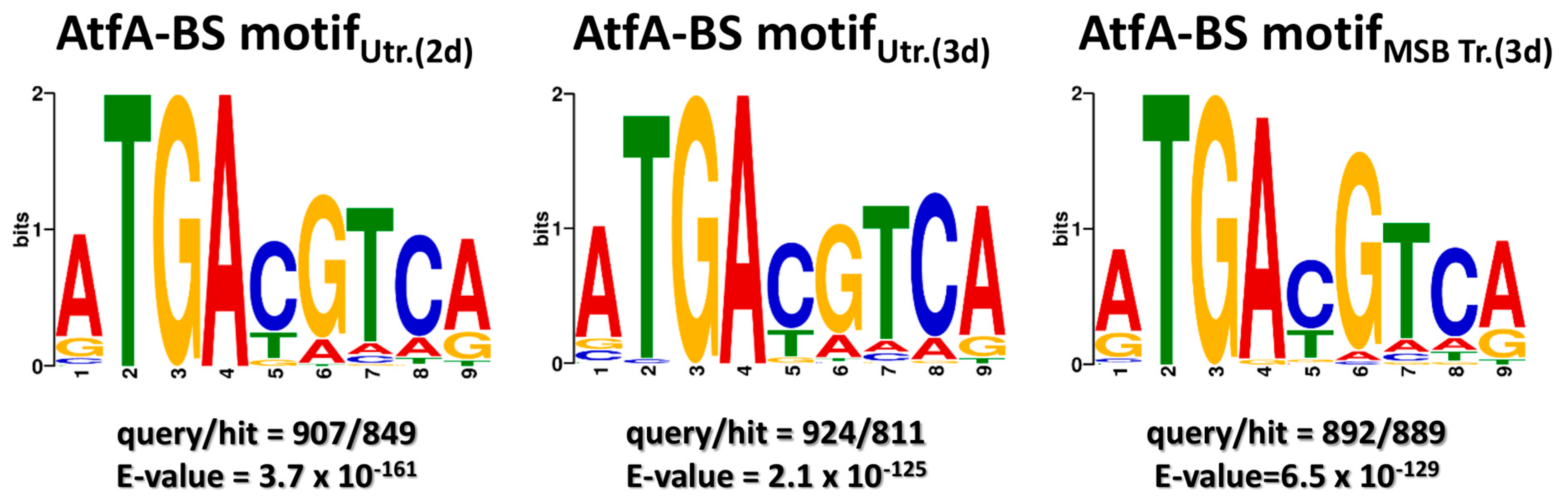
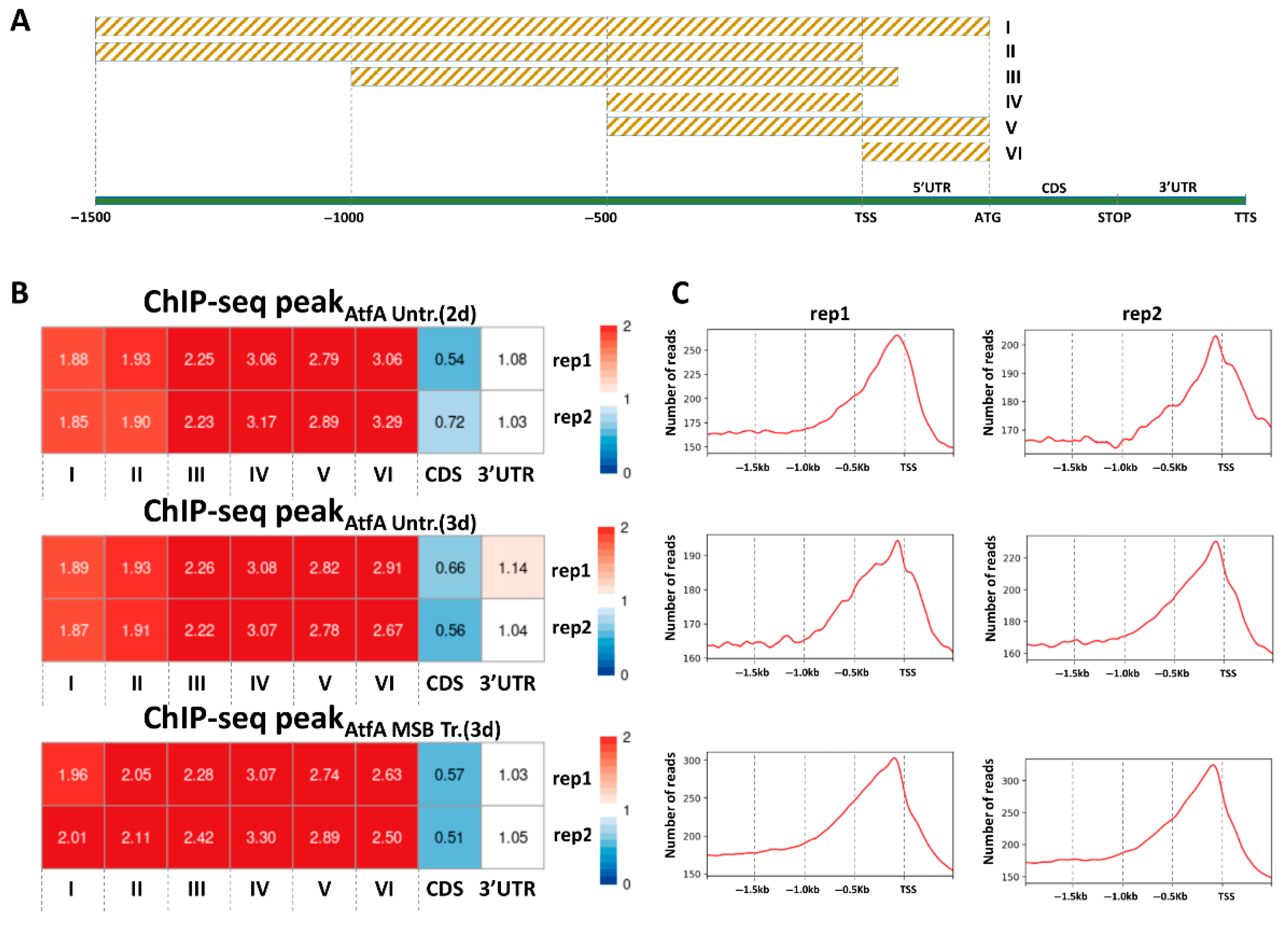
3.2.1. Motif and Localization of A. nidulans AtfA Binding Sites
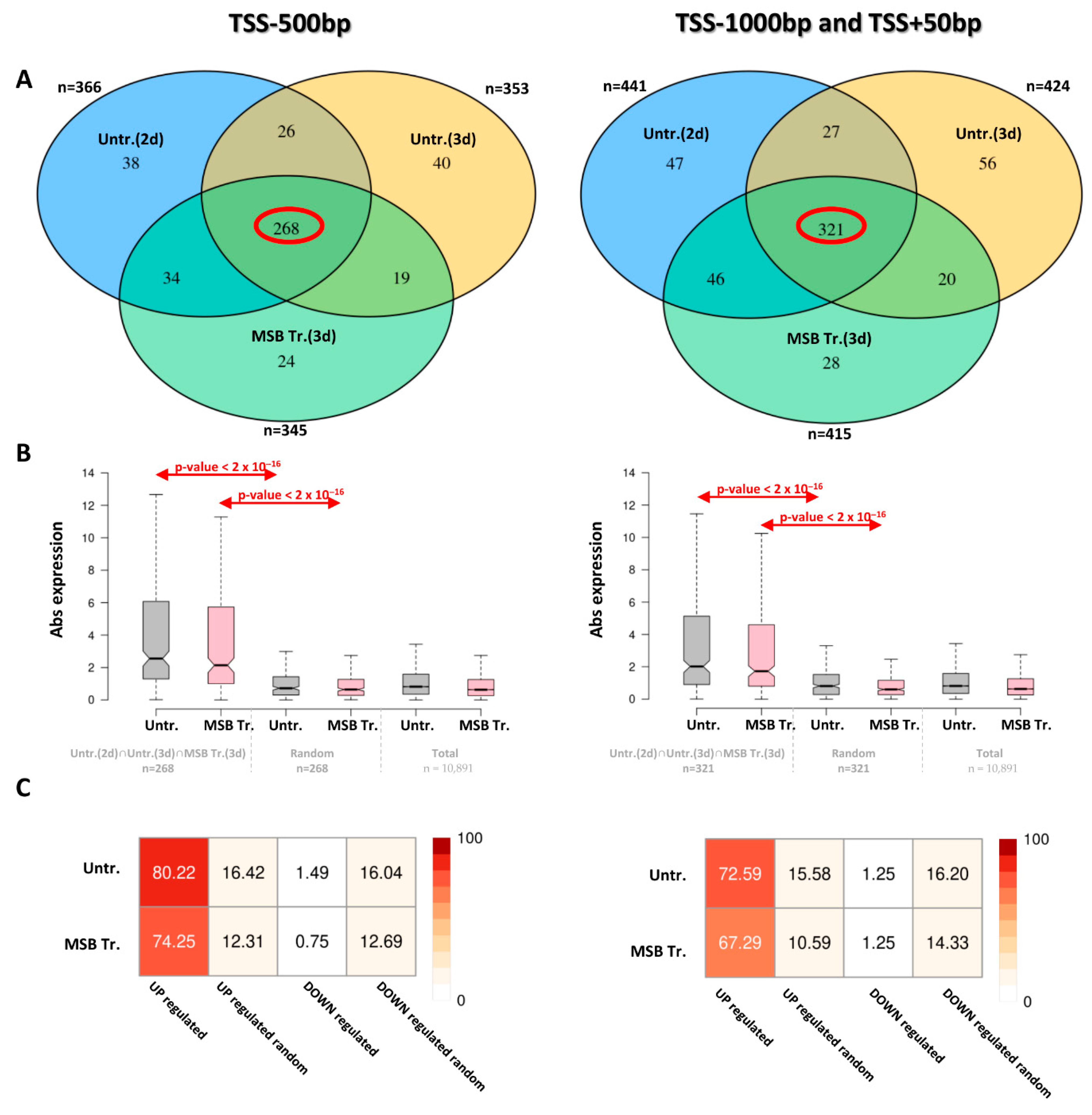
3.2.2. Expression Changes in Genes with AtfA Binding Sites
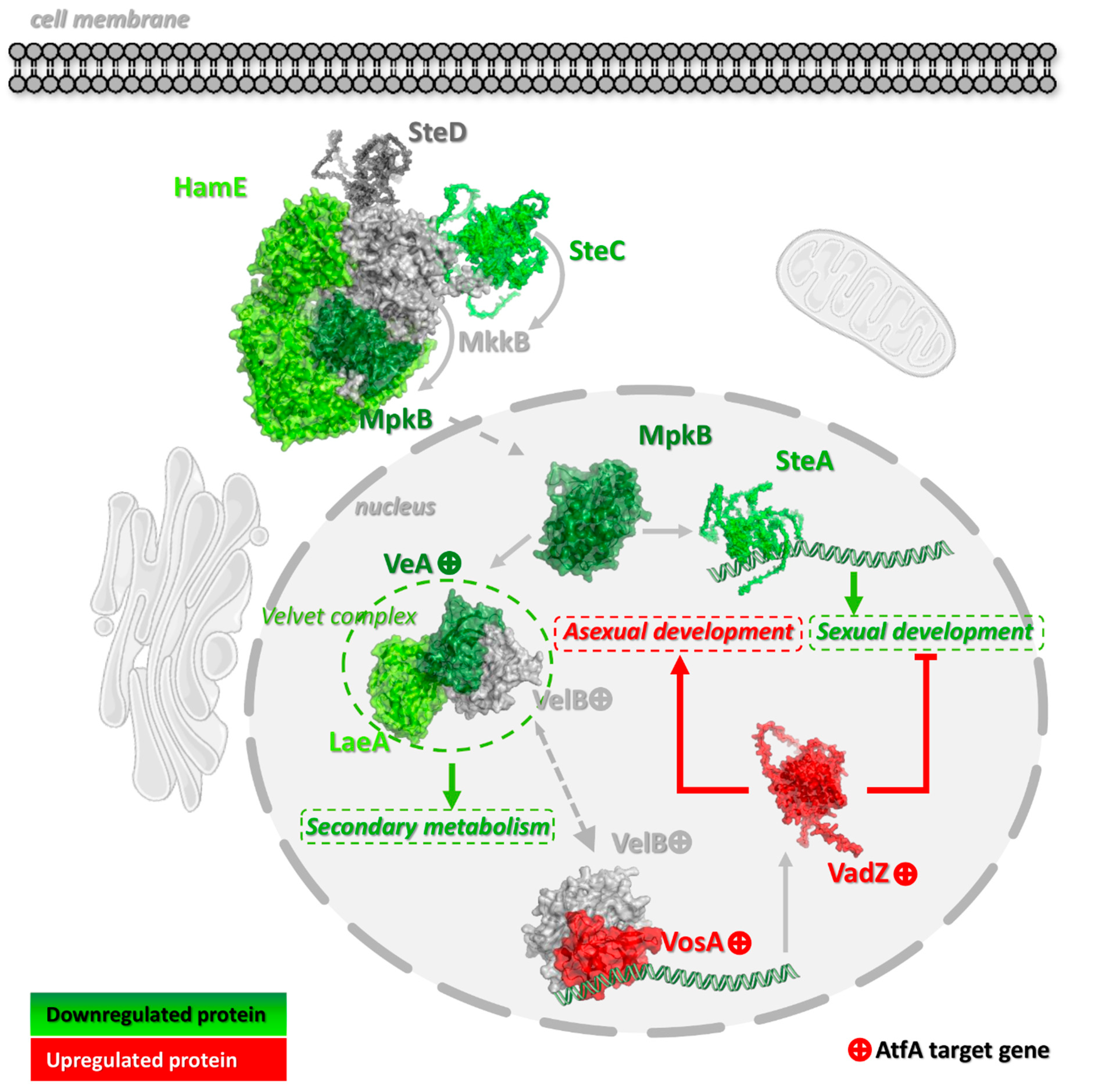
3.3. AtfA Is Involved in the Regulation of Conidiogenesis
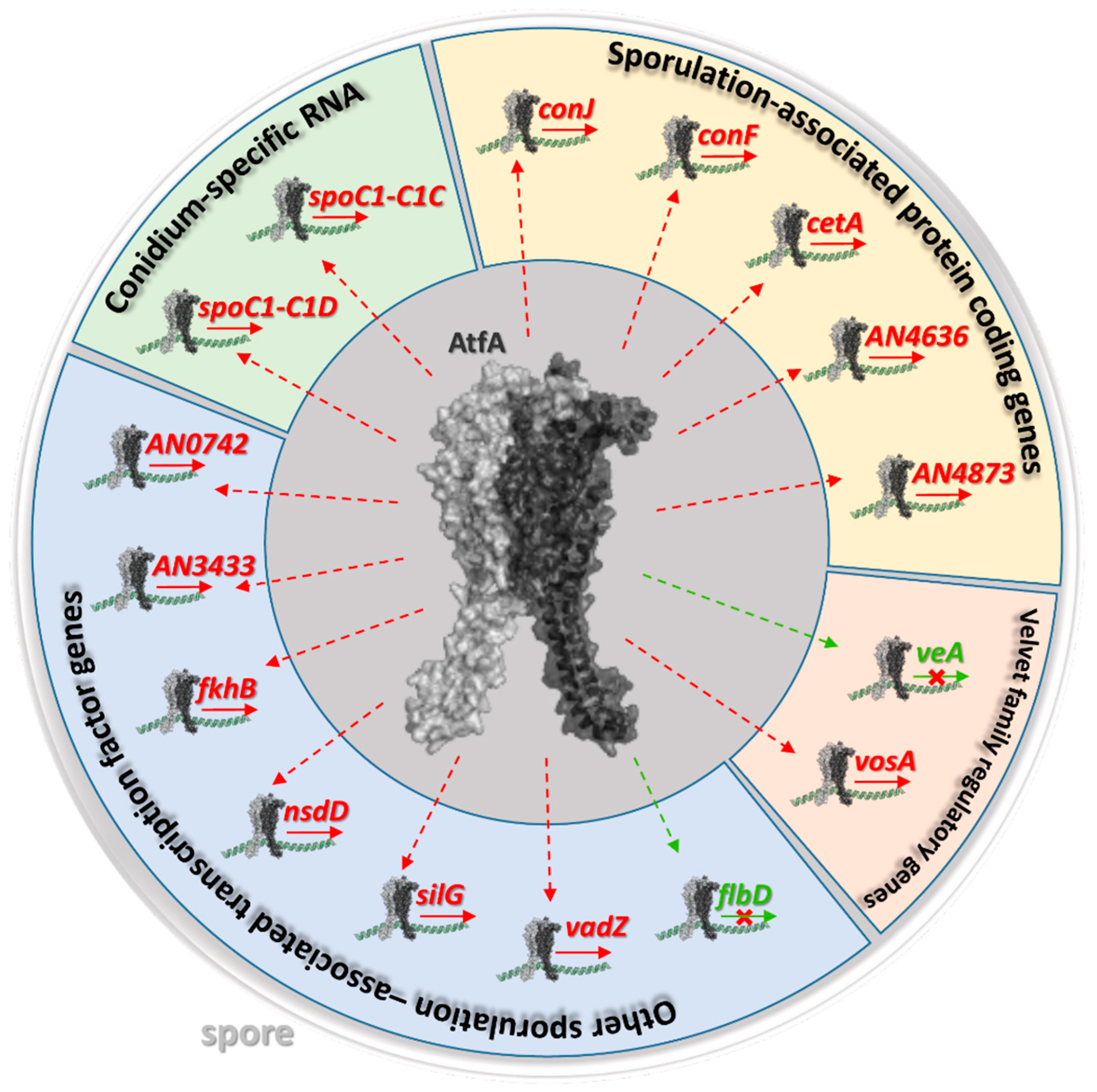
3.3.1. AtfA Is Involved in the Regulation of Conidiogenesis—A General Overview
3.3.2. AtfA Modulates the Expression of Other Transcription Factors
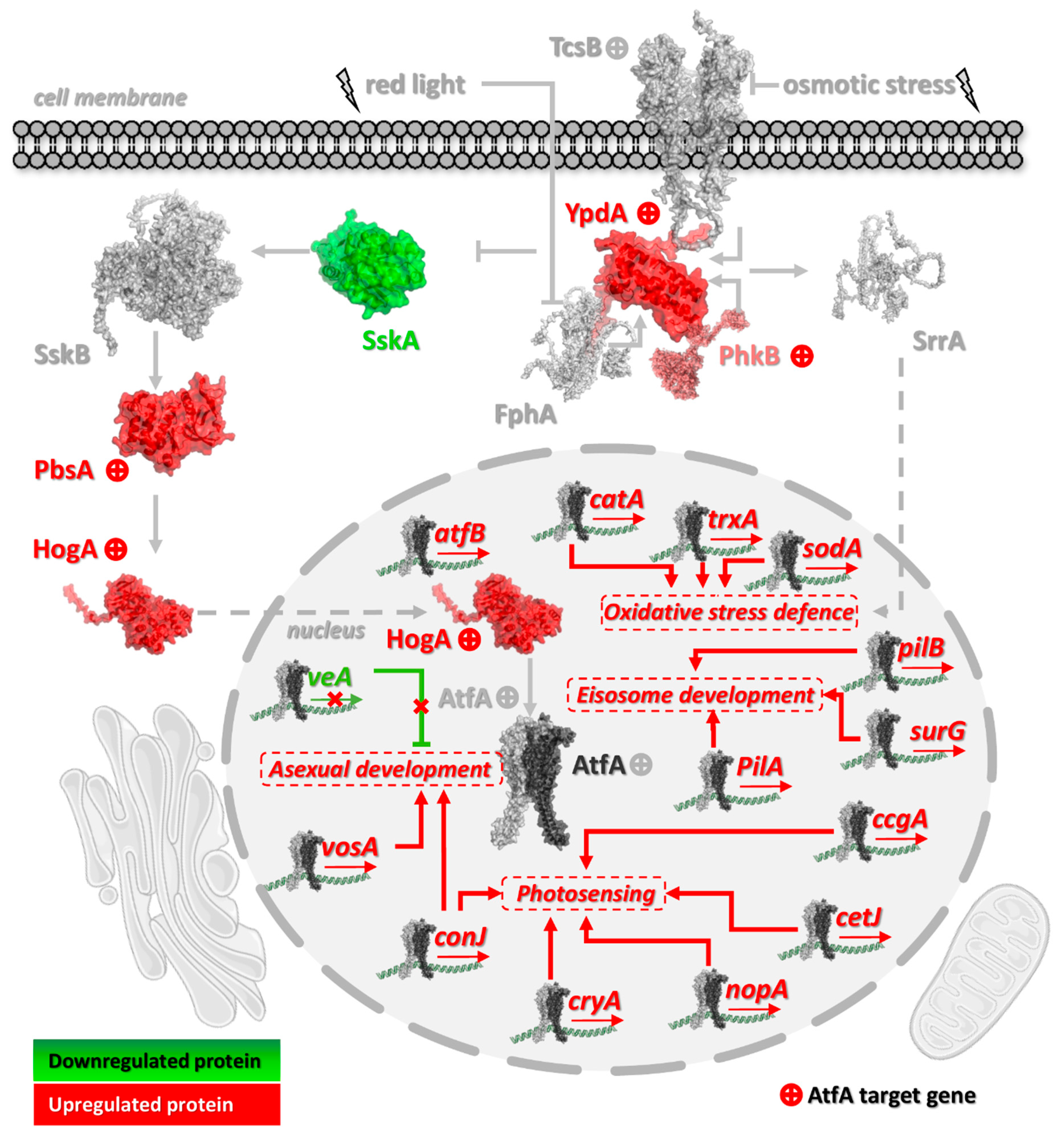
3.3.3. HogA/SakA MAPK Signaling and Other Protein Kinases

| Gene ID | Gene Name | Functional Description | References | AtfA and AtfB Dependent Regulations (Kocsis et al., 2023) [5] | |
|---|---|---|---|---|---|
| Unstressed Culture ‡ | MSB-Exposed Culture ‡ | ||||
| AN3101 | phkB | Putative histidine-containing phosphotransfer protein | Suzuki et al., 2008; Hagiwara et al., 2007 [82,94] | AA | AA |
| AN7945 | hk2 | Putative histidine-containing phosphotransfer protein | Suzuki et al., 2008; Hagiwara et al., 2007; Azuma et al., 2007; Bahn, 2008 [82,94,95,96] | AA | AA |
| AN4113 | hk-8-2 | Histidine kinase, histidine-containing phosphotransfer protein | Suzuki et al., 2008; Hagiwara et al., 2007; Azuma et al., 2007; Bahn, 2008 [82,94,95,96] | AA | AA |
| AN6820 | hk-8-3 | Putative histidine-containing phosphotransfer protein | Suzuki et al., 2008; Hagiwara et al., 2007; Azuma et al., 2007; Bahn, 2008 [82,94,95,96] | AA | AA |
| AN9048 | hk-8-7 | Orthologue of S. cerevisiae GCN20 | Suzuki et al., 2008; Hagiwara et al., 2007; Azuma et al., 2007; Bahn, 2008 [82,94,95,96] | ||
3.3.4. Light-Dependent Regulation of Conidiogenesis
3.3.5. Formation and Maintenance of Subcellular Conidial Organelles and Structures
3.3.6. Involvement of AtfA in the Control of Transcription and Translation Machineries
3.3.7. Preservation of Resting Conidia
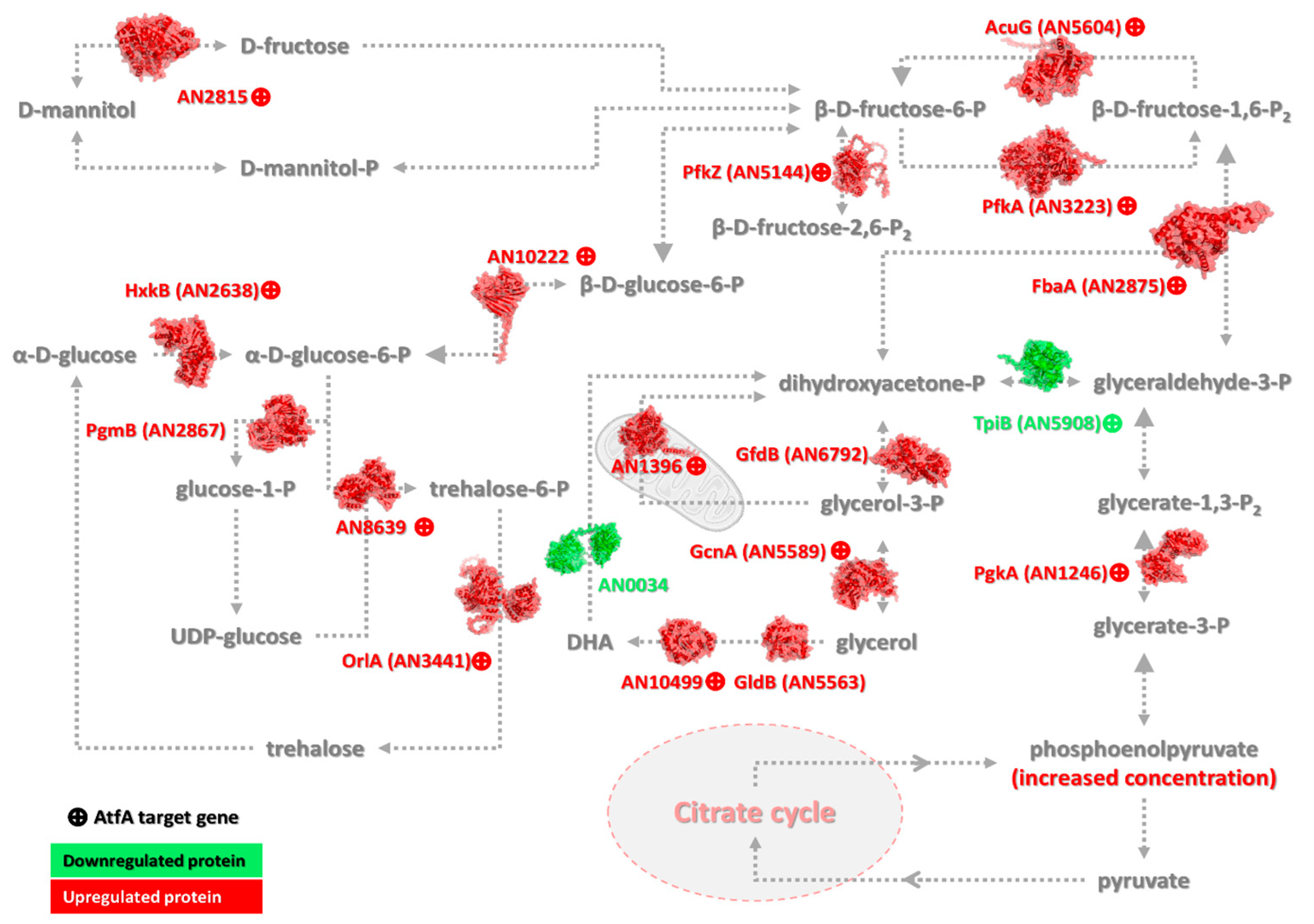
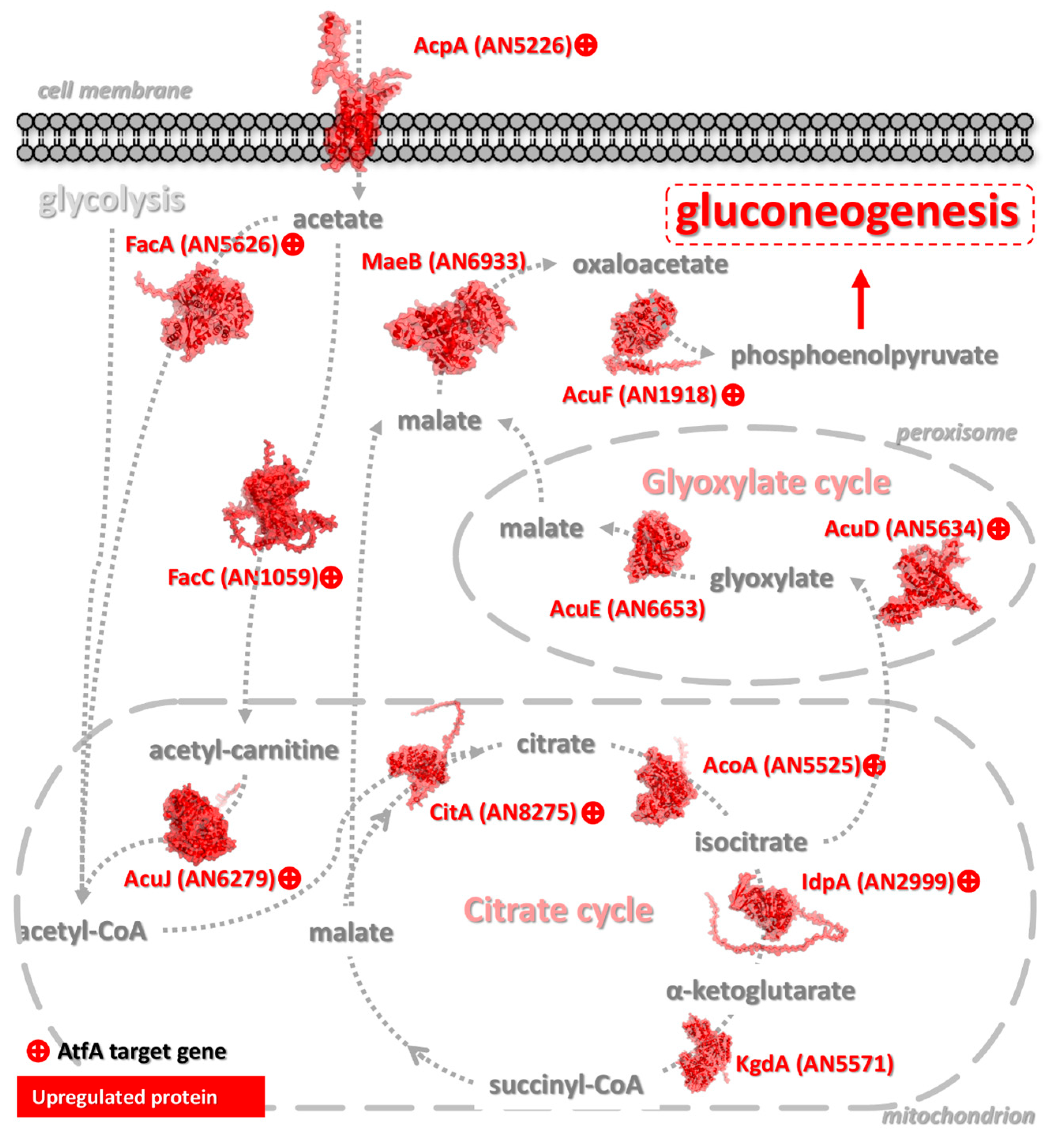
3.3.8. Fueling Biosynthetic Processes Progressing in Conidia
4. Conclusions
Supplementary Materials
Author Contributions
Funding
Institutional Review Board Statement
Informed Consent Statement
Data Availability Statement
Conflicts of Interest
References
- Adams, T.H.; Wieser, J.K.; Yu, J.-H. Asexual Sporulation in Aspergillus nidulans. Microbiol. Mol. Biol. Rev. 1998, 62, 35–54. [Google Scholar] [CrossRef]
- Park, H.-S.; Yu, J.-H. Genetic control of asexual sporulation in filamentous fungi. Curr. Opin. Microbiol. 2012, 15, 669–677. [Google Scholar] [CrossRef]
- Son, Y.-E.; Yu, J.-H.; Park, H.-S. Regulators of the Asexual Life Cycle of Aspergillus nidulans. Cells 2023, 12, 1544. [Google Scholar] [CrossRef] [PubMed]
- Emri, T.; Szarvas, V.; Orosz, E.; Antal, K.; Park, H.; Han, K.H.; Yu, J.-H.; Pócsi, I. Core oxidative stress response in Aspergillus nidulans. BMC Genom. 2015, 16, 478. [Google Scholar] [CrossRef]
- Kocsis, B.; Lee, M.K.; Antal, K.; Yu, J.H.; Pócsi, I.; Leiter, É.; Emri, T. Genome-Wide Gene Expression Analyses of the AtfA/AtfB-Mediated Menadione Stress Response in Aspergillus nidulans. Cells 2023, 12, 463. [Google Scholar] [CrossRef]
- Hallsworth, J.E.; Magan, N. Manipulation of intracellular glycerol and erythritol enhances germination of conidia at low water availability. Microbiology 1995, 141, 1109–1115. [Google Scholar] [CrossRef] [PubMed]
- Hagiwara, D.; Sakai, K.; Suzuki, S.; Umemura, M.; Nogawa, T.; Kato, N.; Osada, H.; Watanabe, A.; Kawamoto, S.; Gonoi, T.; et al. Temperature during conidiation affects stress tolerance, pigmentation, and trypacidin accumulation in the conidia of the airborne pathogen Aspergillus fumigatus. PLoS ONE 2017, 12, e0177050. [Google Scholar] [CrossRef] [PubMed]
- Earl Kang, S.; Celia, B.N.; Bensasson, D.; Momany, M. Sporulation environment drives phenotypic variation in the pathogen Aspergillus fumigatus. G3 2021, 11, jkab208. [Google Scholar] [CrossRef]
- Aguirre, J.; Ríos-Momberg, M.; Hewitt, D.; Hansberg, W. Reactive oxygen species and development in microbial eukaryotes. Trends Microbiol. 2005, 13, 111–118. [Google Scholar] [CrossRef]
- Hansberg, W.; Aguirre, J.; Rís-Momberg, M.; Rangel, P.; Peraza, L.; Montes de Oca, Y.; Cano-Domínguez, N. Cell differentiation as a response to oxidative stress. In British Mycological Society Symposia Series; Elsevier: Amsterdam, The Netherlands, 2008; Volume 27, Chapter 15, pp. 235–257. [Google Scholar]
- Etxebeste, O.; Garzia, A.; Espeso, E.A.; Ugalde, U. Aspergillus nidulans asexual development: Making the most of cellular modules. Trends Microbiol. 2010, 18, 569–576. [Google Scholar] [CrossRef]
- Ni, M.; Gao, N.; Kwon, N.-J.; Shin, K.-S.; Yu, J.-H. Regulation of Aspergillus Conidiation. In Cellular and Molecular Biology of Filamentous Fungi; Borkovich, K.A., Ebbole, D.J., Eds.; ASM Press: Washington, DC, USA, 2014; pp. 557–576. [Google Scholar] [CrossRef]
- Krijgsheld, P.; Bleichrodt, R.; van Veluw, G.J.; Wang, F.; Müller, W.H.; Dijksterhuis, J.; Wösten, H.A.B. Development in Aspergillus. Stud. Mycol. 2013, 74, 1–29. [Google Scholar] [CrossRef]
- Ojeda-López, M.; Chen, W.; Eagle, C.E.; Gutiérrez, G.; Jia, W.L.; Swilaiman, S.S.; Huang, Z.; Park, H.S.; Yu, J.-H.; Cánovas, D.; et al. Evolution of asexual and sexual reproduction in the aspergilli. Stud. Mycol. 2018, 91, 37–59. [Google Scholar] [CrossRef]
- Leiter, É.; Emri, T.; Pákozdi, K.; Hornok, L.; Pócsi, I. The impact of bZIP Atf1ortholog global regulators in fungi. Appl. Microbiol. Biotechnol. 2021, 105, 5769–5783. [Google Scholar] [CrossRef]
- Takeda, T.; Toda, T.; Kominami, K.; Kohnosu, A.; Yanagida, M.; Jones, N. Schizosaccharomyces pombe atf1+ encodes a transcription factor required for sexual development and entry into stationary phase. EMBO J. 1995, 14, 6193–6208. [Google Scholar] [CrossRef]
- Shiozaki, K.; Russell, P. Conjugation, meiosis, and the osmotic stress response are regulated by Spc1 kinase through Atf1 transcription factor in fission yeast. Genes. Dev. 1996, 10, 2276–2288. [Google Scholar] [CrossRef]
- Wilkinson, M.G.; Samuels, M.; Takeda, T.; Toone, W.M.; Shieh, J.C.; Toda, T.; Millar, J.B.; Jones, N. The Atf1 transcription factor is a target for the Sty1 stress-activated MAP kinase pathway in fission yeast. Genes. Dev. 1996, 10, 2289–2301. [Google Scholar] [CrossRef] [PubMed]
- Eshaghi, M.; Lee, J.H.; Zhu, L.; Poon, S.Y.; Li, J.; Cho, K.H.; Chu, Z.; Karuturi, R.K.; Liu, J. Genomic Binding Profiling of the Fission Yeast Stress-Activated MAPK Sty1 and the bZIP Transcriptional Activator Atf1 in Response to H2O2. PLoS ONE 2010, 5, e11620. [Google Scholar] [CrossRef] [PubMed]
- Carlezonjr, W.; Duman, R.; Nestler, E. The many faces of CREB. Trends Neurosci. 2005, 28, 436–445. [Google Scholar] [CrossRef]
- Hai, T.; Hartman, M.G. The molecular biology and nomenclature of the activating transcription factor/cAMP responsive element binding family of transcription factors: Activating transcription factor proteins and homeostasis. Gene 2001, 273, 1–11. [Google Scholar] [CrossRef]
- Skribbe, M.; Soneson, C.; Stadler, M.B.; Schwaiger, M.; Suma Sreechakram, V.N.; Iesmantavicius, V.; Hess, D.; Moreno, E.P.F.; Braun, S.; Seebacher, J.; et al. A comprehensive Schizosaccharomyces pombe atlas of physical transcription factor interactions with proteins and chromatin. Mol. Cell 2025, 85, 1426–1444.e8. [Google Scholar] [CrossRef]
- Hagiwara, D.; Asano, Y.; Yamashino, T.; Mizuno, T. Characterization of bZip-Type Transcription Factor AtfA with Reference to Stress Responses of Conidia of Aspergillus nidulans. Biosci. Biotechnol. Biochem. 2008, 72, 2756–2760. [Google Scholar] [CrossRef]
- Balázs, A.; Pócsi, I.; Hamari, Z.; Leiter, E.; Emri, T.; Miskei, M.; Oláh, J.; Tóth, V.; Hegedus, N.; Prade, R.A.; et al. AtfA bZIP-type transcription factor regulates oxidative and osmotic stress responses in Aspergillus nidulans. Mol. Genet. Genom. 2010, 283, 289–303. [Google Scholar] [CrossRef]
- Lara-Rojas, F.; Sánchez, O.; Kawasaki, L.; Aguirre, J. Aspergillus nidulans transcription factor AtfA interacts with the MAPK SakA to regulate general stress responses, development and spore functions. Mol. Microbiol. 2011, 80, 436–454. [Google Scholar] [CrossRef]
- Kocsis, B.; Lee, M.K.; Yu, J.H.; Nagy, T.; Daróczi, L.; Batta, G.; Pócsi, I.; Leiter, É. Functional analysis of the bZIP-type transcription factors AtfA and AtfB in Aspergillus nidulans. Front. Microbiol. 2022, 13, 1003709. [Google Scholar] [CrossRef]
- Sakamoto, K.; Iwashita, K.; Yamada, O.; Kobayashi, K.; Mizuno, A.; Akita, O.; Mikami, S.; Shimoi, H.; Gomi, K. Aspergillus oryzae atfA controls conidial germination and stress tolerance. Fungal Genet. Biol. 2009, 46, 887–897. [Google Scholar] [CrossRef] [PubMed]
- Orosz, E.; Antal, K.; Gazdag, Z.; Szabó, Z.; Han, K.H.; Yu, J.-H.; Pócsi, I.; Emri, T. Transcriptome-Based Modeling Reveals that Oxidative Stress Induces Modulation of the AtfA-Dependent Signaling Networks in Aspergillus nidulans. Int. J. Genom. 2017, 2017, 6923849. [Google Scholar] [CrossRef]
- Antal, K.; Gila, B.C.; Pócsi, I.; Emri, T. General stress response or adaptation to rapid growth in Aspergillus nidulans? Fungal Biol. 2020, 124, 376–386. [Google Scholar] [CrossRef]
- Peng, S.; Hu, L.; Ge, W.; Deng, J.; Yao, L.; Li, H.; Xu, D.; Mo, H. ChIP-Seq Analysis of AtfA Interactions in Aspergillus flavus Reveals Its Involvement in Aflatoxin Metabolism and Virulence Under Oxidative Stress. Int. J. Mol. Sci. 2024, 25, 12213. [Google Scholar] [CrossRef] [PubMed]
- Arnaud, M.B.; Cerqueira, G.C.; Inglis, D.O.; Skrzypek, M.S.; Binkley, J.; Chibucos, M.C.; Crabtree, J.; Howarth, C.; Orvis, J.; Shah, P.; et al. The Aspergillus Genome Database (AspGD): Recent developments in comprehensive multispecies curation, comparative genomics and community resources. Nucleic Acids Res. 2012, 40, D653–D659. [Google Scholar] [CrossRef]
- Galagan, J.E.; Calvo, S.E.; Cuomo, C.; Ma, L.J.; Wortman, J.R.; Batzoglou, S.; Lee, S.I.; Baştürkmen, M.; Spevak, C.C.; Clutterbuck, J.; et al. Sequencing of Aspergillus nidulans and comparative analysis with A. fumigatus and A. oryzae. Nature 2005, 438, 1105–1115. [Google Scholar] [CrossRef]
- Langmead, B.; Salzberg, S.L. Fast gapped-read alignment with Bowtie 2. Nat. Methods 2012, 9, 357–359. [Google Scholar] [CrossRef]
- Li, H.; Handsaker, B.; Wysoker, A.; Fennell, T.; Ruan, J.; Homer, N.; Marth, G.; Abecasis, G.; Durbin, R. 1000 Genome Project Data Processing Subgroup. The Sequence Alignment/Map format and SAMtools. Bioinformatics 2009, 25, 2078–2079. [Google Scholar] [CrossRef]
- Ramírez, F.; Ryan, D.P.; Grüning, B.; Bhardwaj, V.; Kilpert, F.; Richter, A.S.; Heyne, S.; Dündar, F.; Manke, T. deepTools2: A next generation web server for deep-sequencing data analysis. Nucleic Acids Res. 2016, 44, W160–W165. [Google Scholar] [CrossRef] [PubMed]
- Zhang, Y.; Liu, T.; Meyer, C.A.; Eeckhoute, J.; Johnson, D.S.; Bernstein, B.E.; Nusbaum, C.; Myers, R.M.; Brown, M.; Li, W.; et al. Model-based Analysis of ChIP-Seq (MACS). Genome Biol. 2008, 9, R137. [Google Scholar] [CrossRef]
- Quinlan, A.R.; Hall, I.M. BEDTools: A flexible suite of utilities for comparing genomic features. Bioinformatics 2010, 26, 841–842. [Google Scholar] [CrossRef]
- Bailey, T.L.; Johnson, J.; Grant, C.E.; Noble, W.S. The MEME Suite. Nucleic Acids Res. 2015, 43, W39–W49. [Google Scholar] [CrossRef] [PubMed]
- Grant, C.E.; Bailey, T.L.; Noble, W.S. FIMO: Scanning for occurrences of a given motif. Bioinformatics 2011, 27, 1017–1018. [Google Scholar] [CrossRef]
- Karanyi, Z.; Holb, I.; Hornok, L.; Pócsi, I.; Miskei, M. FSRD: Fungal stress response database. Database 2013, 2013, bat037. [Google Scholar] [CrossRef] [PubMed]
- De Vries, R.P.; Riley, R.; Wiebenga, A.; Aguilar-Osorio, G.; Amillis, S.; Uchima, C.A.; Anderluh, G.; Asadollahi, M.; Askin, M.; Barry, K.; et al. Comparative genomics reveals high biological diversity and specific adaptations in the industrially and medically important fungal genus Aspergillus. Genome Biol. 2017, 18, 28. [Google Scholar] [CrossRef]
- Emri, T.; Vékony, V.; Gila, B.; Nagy, F.; Forgács, K.; Pócsi, I. Autolytic hydrolases affect sexual and asexual development of Aspergillus nidulans. Folia Microbiol. 2018, 63, 619–626. [Google Scholar] [CrossRef]
- Leary, N.O.; Pembroke, A.; Duggan, P.F. Improving accuracy of glucose oxidase procedure for glucose determinations on discrete analyzers. Clin. Chem. 1992, 38, 298–302. [Google Scholar] [CrossRef] [PubMed]
- Suzuki, S.; Sarikaya Bayram, Ö.; Bayram, Ö.; Braus, G.H. conF and conJ contribute to conidia germination and stress response in the filamentous fungus Aspergillus nidulans. Fungal Genet. Biol. 2013, 56, 42–53. [Google Scholar] [CrossRef] [PubMed]
- D’Enfert, C.; Fontaine, T. Molecular characterization of the Aspergillus nidulans treA gene encoding an acid trehalase required for growth on trehalose. Mol. Microbiol. 1997, 24, 203–216. [Google Scholar] [CrossRef]
- Wolf, T.; Shelest, V.; Neetika, N.; Shelest, E. CASSIS and SMIPS: Promoter-based prediction of secondary metabolite gene clusters in eukaryotic genomes. Bioinformatics 2016, 32, 1138–1143. [Google Scholar] [CrossRef]
- Lis, M.; Walther, D. The orientation of transcription factor binding site motifs in gene promoter regions: Does it matter? BMC Genom. 2016, 17, 185. [Google Scholar] [CrossRef]
- Georgakopoulos-Soares, I.; Deng, C.; Agarwal, V.; Chan, C.S.Y.; Zhao, J.; Inoue, F.; Ahituv, N. Transcription factor binding site orientation and order are major drivers of gene regulatory activity. Nat. Commun. 2023, 14, 2333. [Google Scholar] [CrossRef]
- Agarwal, V.; Inoue, F.; Schubach, M.; Penzar, D.; Martin, B.K.; Dash, P.M.; Keukeleire, P.; Zhang, Z.; Sohota, A.; Zhao, J.; et al. Massively parallel characterization of transcriptional regulatory elements. Nature 2025, 639, 411–420. [Google Scholar] [CrossRef]
- Frawley, D.; Karahoda, B.; Sarikaya Bayram, Ö.; Bayram, Ö. The HamE scaffold positively regulates MpkB phosphorylation to promote development and secondary metabolism in Aspergillus nidulans. Sci. Rep. 2018, 8, 16588. [Google Scholar] [CrossRef]
- Frawley, D.; Stroe, M.C.; Oakley, B.R.; Heinekamp, T.; Straßburger, M.; Fleming, A.B.; Brakhage, A.A.; Bayramm, Ö. The Pheromone Module SteC-MkkB-MpkB-SteD-HamE Regulates Development, Stress Responses and Secondary Metabolism in Aspergillus fumigatus. Front. Microbiol. 2020, 11, 811. [Google Scholar] [CrossRef] [PubMed]
- Wieser, J.; Adam, T.H. flbD encodes a Myb-like DNA-binding protein that coordinates initiation of Aspergillus nidulans conidiophore development. Genes. Dev. 1995, 9, 491–502. [Google Scholar] [CrossRef]
- Garzia, A.; Etxebeste, O.; Herrero-García, E.; Ugalde, U.; Espeso, E.A. The concerted action of bZip and cMyb transcription factors FlbB and FlbD induces brlA expression and asexual development in Aspergillus nidulans. Mol. Microbiol. 2010, 75, 1314–1324. [Google Scholar] [CrossRef]
- Vallim, M.A.; Miller, K.Y.; Miller, B.L. Aspergillus SteA (Sterile12-like) is a homeodomain-C2/H2-Zn+2 finger transcription factor required for sexual reproduction. Mol. Microbiol. 2000, 36, 290–301. [Google Scholar] [CrossRef]
- Bayram, Ö.; Braus, G.H. Coordination of secondarymetabolism and development in fungi: The velvet family of regulatory proteins. FEMS Microbiol. Rev. 2012, 36, 1–24. [Google Scholar] [CrossRef]
- Moon, H.; Lee, M.K.; Bok, I.; Bok, J.W.; Keller, N.P.; Yu, J.H. Unraveling the Gene Regulatory Networks of the Global Regulators VeA and LaeA in Aspergillus nidulans. Microbiol. Spectr. 2023, 11, e00166-23. [Google Scholar] [CrossRef]
- Ni, M.; Yu, J.-H. A Novel Regulator Couples Sporogenesis and Trehalose Biogenesis in Aspergillus nidulans. PLoS ONE 2007, 2, e970. [Google Scholar] [CrossRef]
- Park, H.-S.; Ni, M.; Jeong, K.C.; Kim, Y.H.; Yu, J.-H. The Role, Interaction and Regulation of the Velvet Regulator VelB in Aspergillus nidulans. PLoS ONE 2012, 7, e45935. [Google Scholar] [CrossRef]
- Son, Y.-E.; Park, H.-S. Coordination of two regulators SscA and VosA in Aspergillus nidulans conidia. Fungal Genet. Biol. 2024, 171, 103877. [Google Scholar] [CrossRef]
- Zhao, Y.; Lee, M.K.; Lim, J.; Moon, H.; Park, H.S.; Zheng, W.; Yu, J.-H. The velvet-activated putative C6 transcription factor VadZ regulates development and sterigmatocystin production in Aspergillus nidulans. Fungal Biol. 2022, 126, 421–428. [Google Scholar] [CrossRef]
- Jang, S.-Y.; Son, Y.-E.; Oh, D.-S.; Han, K.-H.; Yu, J.-H.; Park, H.-S. The Forkhead Gene fkhB is Necessary for Proper Development in Aspergillus nidulans. J. Microbiol. Biotechnol. 2023, 33, 1420–1427. [Google Scholar] [CrossRef] [PubMed]
- Oh, D.S.; Kim, J.H.; Han, D.M.; Han, K.H. Forkhead Genes Are Key Regulators of Developmental Processes in Aspergillus nidulans. 2014. Available online: https://koreascience.kr/article/CFKO201424237730349.pdf (accessed on 22 May 2014).
- Lee, M.K.; Kwon, N.J.; Lee, I.S.; Jung, S.; Kim, S.C.; Yu, J.H. Negative regulation and developmental competence in Aspergillus. Sci. Rep. 2016, 6, 28874. [Google Scholar] [CrossRef] [PubMed]
- Han, D.-M. Genes Controlling Sexual Development of Aspergillus nidulans. 2005. Available online: https://www.koreascience.kr/article/CFKO200522941408094.pdf (accessed on 22 May 2005).
- Kim, H.-J.; Han, K.-H.; Han, D.-M. The Aspergillus nidulans silG Gene Functions in Repression of Sexual Development in Response to Light. 2005. Available online: https://koreascience.or.kr/article/CFKO200536036100897.page (accessed on 22 May 2005).
- Furukawa, K.; Hoshi, Y.; Maeda, T.; Nakajima, T.; Abe, K. Aspergillus nidulans HOG pathway is activated only by two-component signalling pathway in response to osmotic stress. Mol. Microbiol. 2005, 56, 1246–1261. [Google Scholar] [CrossRef]
- Garrido-Bazán, V.; Jaimes-Arroyo, R.; Sánchez, O.; Lara-Rojas, F.; Aguirre, J. SakA and MpkC Stress MAPKs Show Opposite and Common Functions During Stress Responses and Development in Aspergillus nidulans. Front. Microbiol. 2018, 9, 2518. [Google Scholar] [CrossRef]
- Han, K.; Prade, R.A. Osmotic stress-coupled maintenance of polar growth in Aspergillus nidulans. Mol. Microbiol. 2002, 43, 1065–1078. [Google Scholar] [CrossRef]
- Kawasaki, L.; Sánchez, O.; Shiozaki, K.; Aguirre, J. SakA MAP kinase is involved in stress signal transduction, sexual development and spore viability in Aspergillus nidulans. Mol. Microbiol. 2002, 45, 1153–1163. [Google Scholar] [CrossRef]
- Jaimes-Arroyo, R.; Lara-Rojas, F.; Bayram, Ö.; Valerius, O.; Braus, G.H.; Aguirre, J. The SrkA Kinase Is Part of the SakA Mitogen-Activated Protein Kinase Interactome and Regulates Stress Responses and Development in Aspergillus nidulans. Eukaryot. Cell 2015, 14, 495–510. [Google Scholar] [CrossRef]
- Mendoza-Martínez, A.E.; Lara-Rojas, F.; Sánchez, O.; Aguirre, J. NapA Mediates a Redox Regulation of the Antioxidant Response, Carbon Utilization and Development in Aspergillus nidulans. Front. Microbiol. 2017, 8, 516. [Google Scholar] [CrossRef]
- Vargas-Pérez, I.; Sánchez, O.; Kawasaki, L.; Georgellis, D.; Aguirre, J. Response Regulators SrrA and SskA Are Central Components of a Phosphorelay System Involved in Stress Signal Transduction and Asexual Sporulation in Aspergillus nidulans. Eukaryot. Cell 2007, 6, 1570–1583. [Google Scholar] [CrossRef] [PubMed]
- Levin, D.E. Regulation of Cell Wall Biogenesis in Saccharomyces cerevisiae: The Cell Wall Integrity Signaling Pathway. Genetics 2011, 189, 1145–1175. [Google Scholar] [CrossRef] [PubMed]
- Mulford, K.E.; Fassler, J.S. Association of the Skn7 and Yap1 Transcription Factors in the Saccharomyces cerevisiae Oxidative Stress Response. Eukaryot. Cell 2011, 10, 761–769. [Google Scholar] [CrossRef] [PubMed]
- Yaakoub, H.; Mina, S.; Calenda, A.; Bouchara, J.-P.; Papon, N. Oxidative stress response pathways in fungi. Cell. Mol. Life Sci. 2022, 79, 333. [Google Scholar] [CrossRef]
- Park, J.; Son, H. Antioxidant Systems of Plant Pathogenic Fungi: Functions in Oxidative Stress Response and Their Regulatory Mechanisms. Plant Pathol. J. 2024, 40, 235–250. [Google Scholar] [CrossRef]
- Hagiwara, D.; Asano, Y.; Marui, J.; Yoshimi, A.; Mizuno, T.; Abe, K. Transcriptional profiling for Aspergillus nidulans HogA MAPK signaling pathway in response to fludioxonil and osmotic stress. Fungal Genet. Biol. 2009, 46, 868–878. [Google Scholar] [CrossRef]
- Yoshimi, A.; Hagiwara, D.; Ono, M.; Fukuma, Y.; Midorikawa, Y.; Furukawa, K.; Fujioka, T.; Mizutani, O.; Sato, N.; Miyazawa, K.; et al. Downregulation of the ypdA Gene Encoding an Intermediate of His-Asp Phosphorelay Signaling in Aspergillus nidulans Induces the Same Cellular Effects as the Phenylpyrrole Fungicide Fludioxonil. Front. Fungal Biol. 2021, 2, 675459. [Google Scholar] [CrossRef] [PubMed]
- Dexter, J.P.; Xu, P.; Gunawardena, J.; McClean, M.N. Robust network structure of the Sln1-Ypd1-Ssk1 three-component phospho-relay prevents unintended activation of the HOG MAPK pathway in Saccharomyces cerevisiae. BMC Syst. Biol. 2015, 9, 17. [Google Scholar] [CrossRef] [PubMed][Green Version]
- Hagiwara, D.; Suzuki, S.; Kamei, K.; Gonoi, T.; Kawamoto, S. The role of AtfA and HOG MAPK pathway in stress tolerance in conidia of Aspergillus fumigatus. Fungal Genet. Biol. 2014, 73, 138–149. [Google Scholar] [CrossRef]
- Sansó, M.; Gogol, M.; Ayté, J.; Seidel, C.; Hidalgo, E. Transcription Factors Pcr1 and Atf1 Have Distinct Roles in Stress- and Sty1-Dependent Gene Regulation. Eukaryot. Cell 2008, 7, 826–835. [Google Scholar] [CrossRef] [PubMed]
- Suzuki, A.; Kanamaru, K.; Azuma, N.; Kato, M.; Kobayashi, T. GFP-Tagged Expression Analysis Revealed That Some Histidine Kinases of Aspergillus nidulans Show Temporally and Spatially Different Expression during the Life Cycle. Biosci. Biotechnol. Biochem. 2008, 72, 428–434. [Google Scholar] [CrossRef]
- Carrasco-Navarro, U.; Aguirre, J. H2O2 Induces Major Phosphorylation Changes in Critical Regulators of Signal Transduction, Gene Expression, Metabolism and Developmental Networks in Aspergillus nidulans. J. Fungi 2021, 7, 624. [Google Scholar] [CrossRef]
- Chapeland-Leclerc, F.; Dilmaghani, A.; Ez-Zaki, L.; Boisnard, S.; Da Silva, B.; Gaslonde, T.; Porée, F.H.; Ruprich-Robert, G. Systematic gene deletion and functional characterization of histidine kinase phosphorelay receptors (HKRs) in the human pathogenic fungus Aspergillus fumigatus. Fungal Genet. Biol. 2015, 84, 1–11. [Google Scholar] [CrossRef]
- Shimizu, K.; Keller, N.P. Genetic involvement of a cAMP-dependent protein kinase in a G protein signaling pathway regulating morphological and chemical transitions in Aspergillus nidulans. Genetics 2001, 157, 591–600. [Google Scholar] [CrossRef]
- Kwon, N.-J.; Park, H.-S.; Jung, S.; Kim, S.C.; Yu, J.-H. The Putative Guanine Nucleotide Exchange Factor RicA Mediates Upstream Signaling for Growth and Development in Aspergillus. Eukaryot. Cell 2012, 11, 1399–1412. [Google Scholar] [CrossRef]
- Mircus, G.; Hagag, S.; Levdansky, E.; Sharon, H.; Shadkchan, Y.; Shalit, I.; Osherov, N. Identification of novel cell wall destabilizing antifungal compounds using a conditional Aspergillus nidulans protein kinase C mutant. J. Antimicrob. Chemother. 2009, 64, 755–763. [Google Scholar] [CrossRef]
- Wu, M.Y.; Mead, M.E.; Lee, M.K.; Ostrem Loss, E.M.; Kim, S.C.; Rokas, A.; Yu, J.H. Systematic Dissection of the Evolutionarily Conserved WetA Developmental Regulator across a Genus of Filamentous Fungi. mBio 2018, 9, e01130-18. [Google Scholar] [CrossRef] [PubMed]
- Ni, M.; Rierson, S.; Seo, J.-A.; Yu, J.-H. The pkaB Gene Encoding the Secondary Protein Kinase A Catalytic Subunit Has a Synthetic Lethal Interaction with pkaA and Plays Overlapping and Opposite Roles in Aspergillus nidulans. Eukaryot. Cell 2005, 4, 1465–1476. [Google Scholar] [CrossRef]
- Mattos, E.C.; Palmisano, G.; Goldman, G.H. Phosphoproteomics of Aspergillus fumigatus Exposed to the Antifungal Drug Caspofungin. mSphere 2020, 5, e00365-20. [Google Scholar] [CrossRef]
- Son, S.; Osmani, S.A. Analysis of All Protein Phosphatase Genes in Aspergillus nidulans Identifies a New Mitotic Regulator, Fcp1. Eukaryot. Cell 2009, 8, 573–585. [Google Scholar] [CrossRef] [PubMed][Green Version]
- Winkelströter, L.K.; Dolan, S.K.; Fernanda Dos Reis, T.; Bom, V.L.; Alves de Castro, P.; Hagiwara, D.; Alowni, R.; Jones, G.W.; Doyle, S.; Brown, N.A.; et al. Systematic Global Analysis of Genes Encoding Protein Phosphatases in Aspergillus fumigatus. G3 2015, 5, 1525–1539. [Google Scholar] [CrossRef]
- De Assis, L.J.; Ries, L.N.; Savoldi, M.; Dinamarco, T.M.; Goldman, G.H.; Brown, N.A. Multiple Phosphatases Regulate Carbon Source-Dependent Germination and Primary Metabolism in Aspergillus nidulans. G3 2015, 5, 857–872. [Google Scholar] [CrossRef]
- Hagiwara, D.; Asano, Y.; Marui, J.; Furukawa, K.; Kanamaru, K.; Kato, M.; Abe, K.; Kobayashi, T.; Yamashino, T.; Mizuno, T. The SskA and SrrA Response Regulators Are Implicated in Oxidative Stress Responses of Hyphae and Asexual Spores in the Phosphorelay Signaling Network of Aspergillus nidulans. Biosci. Biotechnol. Biochem. 2007, 71, 1003–1014. [Google Scholar] [CrossRef] [PubMed]
- Azuma, N.; Kanamaru, K.; Matsushika, A.; Yamashino, T.; Mizuno, T.; Kato, M.; Kobayashi, T. In Vitro Analysis of His-Asp Phosphorelays in Aspergillus nidulans: The First Direct Biochemical Evidence for the Existence of His-Asp Phosphotransfer Systems in Filamentous Fungi. Biosci. Biotechnol. Biochem. 2007, 71, 2493–2502. [Google Scholar] [CrossRef][Green Version]
- Bahn, Y.-S. Master and Commander in Fungal Pathogens: The Two-Component System and the HOG Signaling Pathway. Eukaryot. Cell 2008, 7, 2017–2036. [Google Scholar] [CrossRef]
- Mooney, J.L.; Yager, L.N. Light is required for conidiation in Aspergillus nidulans. Genes. Dev. 1990, 4, 1473–1482. [Google Scholar] [CrossRef]
- Bayram, Ö.; Braus, G.H.; Fischer, R.; Rodriguez-Romero, J. Spotlight on Aspergillus nidulans photosensory systems. Fungal Genet. Biol. 2010, 47, 900–908. [Google Scholar] [CrossRef]
- Ruger-Herreros, C.; Armant, O.; Fischer, R. Regulation of Conidiation by Light in Aspergillus nidulans. Genetics 2011, 188, 809–822. [Google Scholar] [CrossRef]
- Yu, Z.; Armant, O.; Fischer, R. Fungi use the SakA (HogA) pathway for phytochrome-dependent light signalling. Nat. Microbiol. 2016, 1, 16019. [Google Scholar] [CrossRef]
- Yu, Z.; Streng, C.; Seibeld, R.F.; Igbalajobi, O.A.; Leister, K.; Ingelfinger, J.; Fischer, R. Genome-wide analyses of light-regulated genes in Aspergillus nidulans reveal a complex interplay between different photoreceptors and novel photoreceptor functions. PLoS Genet. 2021, 17, e1009845. [Google Scholar] [CrossRef] [PubMed]
- Yu, Z.; Hübner, J.; Herrero, S.; Gourain, V.; Fischer, R. On the role of the global regulator RlcA in red-light sensing in Aspergillus nidulans. Fungal Biol. 2020, 124, 447–457. [Google Scholar] [CrossRef]
- Yu, Z.; Gao, J.; Igbalajobi, O.; Skoneczny, M.; Sieńko, M.; Maciejewska, A.M.; Brzywczy, J.; Fischer, R. The sulfur metabolism regulator MetR is a global regulator controlling phytochrome-dependent light responses in Aspergillus nidulans. Sci. Bull. 2021, 66, 592–602. [Google Scholar] [CrossRef]
- Bayram, Ö.; Feussner, K.; Dumkow, M.; Herrfurth, C.; Feussner, I.; Braus, G.H. Changes of global gene expression and secondary metabolite accumulation during light-dependent Aspergillus nidulans development. Fungal Genet. Biol. 2016, 87, 30–53. [Google Scholar] [CrossRef]
- Kim, H.-S.; Han, K.; Kim, K.; Han, D.; Jahng, K.; Chae, K. The veA gene activates sexual development in Aspergillus nidulans. Fungal Genet. Biol. 2002, 37, 72–80. [Google Scholar] [CrossRef] [PubMed]
- Bayram, O.; Krappmann, S.; Ni, M.; Bok, J.W.; Helmstaedt, K.; Valerius, O.; Braus-Stromeyer, S.; Kwon, N.J.; Keller, N.P.; Yu, J.-H.; et al. VelB/VeA/LaeA complex coordinates light signal with fungal development and secondary metabolism. Science 2008, 320, 1504–1506. [Google Scholar] [CrossRef]
- Martins, I.; Hartmann, D.O.; Alves, P.C.; Martins, C.; Garcia, H.; Leclercq, C.C.; Ferreira, R.; He, J.; Renaut, J.; Becker, J.D.; et al. Elucidating how the saprophytic fungus Aspergillus nidulans uses the plant polyester suberin as carbon source. BMC Genom. 2014, 15, 613. [Google Scholar] [CrossRef]
- Reese, S.; Chelius, C.; Riekhof, W.; Marten, M.R.; Harris, S.D. Micafungin-Induced Cell Wall Damage Stimulates Morphological Changes Consistent with Microcycle Conidiation in Aspergillus nidulans. J. Fungi 2021, 7, 525. [Google Scholar] [CrossRef]
- Bayram, Ö.; Biesemann, C.; Krappmann, S.; Galland, P.; Braus, G.H. More Than a Repair Enzyme: Aspergillus nidulans Photolyase-like CryA Is a Regulator of Sexual Development. Mol. Biol. Cell 2008, 19, 3254–3262. [Google Scholar] [CrossRef]
- Fraser, J.L.A.; Neill, E.; Davey, S. Fission yeast Uve1 and Apn2 function in distinct oxidative damage repair pathways in vivo. DNA Repair 2003, 2, 1253–1267. [Google Scholar] [CrossRef]
- Breakspear, A.; Momany, M. Aspergillus nidulans Conidiation Genes dewA, fluG, and stuA Are Differentially Regulated in Early Vegetative Growth. Eukaryot. Cell 2007, 6, 1697–1700. [Google Scholar] [CrossRef] [PubMed]
- Scheckhuber, C.Q.; Mitterbauer, R.; Osiewacz, H.D. Molecular basis of and interference into degenerative processes in fungi: Potential relevance for improving biotechnological performance of microorganisms. Appl. Microbiol. Biotechnol. 2009, 85, 27–35. [Google Scholar] [CrossRef]
- Li, L.; Hu, X.; Xia, Y.; Xiao, G.; Zheng, P.; Wang, C. Linkage of Oxidative Stress and Mitochondrial Dysfunctions to Spontaneous Culture Degeneration in Aspergillus nidulans. Mol. Cell. Proteom. 2014, 13, 449–461. [Google Scholar] [CrossRef]
- Leiter, É.; Park, H.S.; Kwon, N.J.; Han, K.H.; Emri, T.; Oláh, V.; Mészáros, I.; Dienes, B.; Vincze, J.; Csernoch, L.; et al. Characterization of the aodA, dnmA, mnSOD and pimA genes in Aspergillus nidulans. Sci. Rep. 2016, 6, 20523. [Google Scholar] [CrossRef] [PubMed]
- Sharma, N.; Osman, C. Yme2, a putative RNA recognition motif and AAA+ domain containing protein, genetically interacts with the mitochondrial protein export machinery. Biol. Chem. 2022, 403, 807–817. [Google Scholar] [CrossRef] [PubMed]
- Raitt, D.C.; Bradshaw, R.E.; Pillar, T.M. Cloning and characterisation of the cytochrome c gene of Aspergillus nidulans. Mol. Gen. Genet. 1994, 242, 17–22. [Google Scholar] [CrossRef]
- Bradshaw, R.; Bird, D.; Brown, S.; Gardiner, R.; Hirst, P. Cytochrome c is not essential for viability of the fungus Aspergillus nidulans. Mol. Genet. Genom. 2001, 266, 48–55. [Google Scholar] [CrossRef] [PubMed]
- Pákozdi, K.; Emri, T.; Antal, K.; Pócsi, I. Global Transcriptomic Changes Elicited by sodB Deletion and Menadione Exposure in Aspergillus nidulans. J. Fungi 2023, 9, 1060. [Google Scholar] [CrossRef] [PubMed]
- Lalève, A.; Vallières, C.; Golinelli-Cohen, M.P.; Bouton, C.; Song, Z.; Pawlik, G.; Tindall, S.M.; Avery, S.V.; Clain, J.; Meunier, B. The antimalarial drug primaquine targets Fe–S cluster proteins and yeast respiratory growth. Redox Biol. 2016, 7, 21–29. [Google Scholar] [CrossRef]
- Ward, M.; Wilkinson, B.; Turner, G. Transformation of Aspergillus nidulans with a cloned, oligomycin-resistant ATP synthase subunit 9 gene. Mol. Gen. Genet. 1986, 202, 265–270. [Google Scholar] [CrossRef]
- Flipphi, M.; Oestreicher, N.; Nicolas, V.; Guitton, A.; Vélot, C. The Aspergillus nidulans acuL gene encodes a mitochondrial carrier required for the utilization of carbon sources that are metabolized via the TCA cycle. Fungal Genet. Biol. 2014, 68, 9–22. [Google Scholar] [CrossRef]
- Kundu, D.; Pasrija, R. The ERMES (Endoplasmic Reticulum and Mitochondria Encounter Structures) mediated functions in fungi. Mitochondrion 2020, 52, 89–99. [Google Scholar] [CrossRef] [PubMed]
- Savoldi, M.; Malavazi, I.; Soriani, F.M.; Capellaro, J.L.; Kitamoto, K.; da Silva Ferreira, M.E.; Goldman, M.H.; Goldman, G.H. Farnesol induces the transcriptional accumulation of the Aspergillus nidulans Apoptosis-Inducing Factor (AIF)-like mitochondrial oxidoreductase. Mol. Microbiol. 2008, 70, 44–59. [Google Scholar] [CrossRef]
- Smoyer, C.J.; Jaspersen, S.L. Breaking down the wall: The nuclear envelope during mitosis. Curr. Opin. Cell Biol. 2014, 26, 1–9. [Google Scholar] [CrossRef]
- Piña, F.J.; Fleming, T.; Pogliano, K.; Niwa, M. Reticulons Regulate the ER Inheritance Block during ER Stress. Dev. Cell 2016, 37, 279–288. [Google Scholar] [CrossRef]
- Park, D.S.; Yu, Y.M.; Kim, Y.J.; Maeng, P.J. Negative regulation of the vacuole-mediated resistance to K+ stress by a novel C2H2 zinc finger transcription factor encoded by aslA in Aspergillus nidulans. J. Microbiol. 2015, 53, 100–110. [Google Scholar] [CrossRef]
- Wang, S.; Liu, X.; Qian, H.; Zhang, S.; Lu, L. Calcineurin and Calcium Channel CchA Coordinate the Salt Stress Response by Regulating Cytoplasmic Ca2+ Homeostasis in Aspergillus nidulans. Appl. Environ. Microbiol. 2016, 82, 3420–3430. [Google Scholar] [CrossRef] [PubMed]
- Bartoszewska, M.; Kiel, J.A.K.W. The Role of Macroautophagy in Development of Filamentous Fungi. Antioxid. Redox Signal. 2011, 14, 2271–2287. [Google Scholar] [CrossRef]
- Ding, J.-L.; Feng, M.-G.; Ying, S.-H. Autophagy safeguards conidial environmental persistence in filamentous fungi. Autophagy Rep. 2023, 2, 2205343. [Google Scholar] [CrossRef]
- Ding, J.-L.; Lin, H.-Y.; Hou, J.; Feng, M.-G.; Ying, S.-H. The Entomopathogenic Fungus Beauveria bassiana Employs Autophagy as a Persistence and Recovery Mechanism during Conidial Dormancy. mBio 2023, 14, e03049-22. [Google Scholar] [CrossRef]
- Kikuma, T.; Arioka, M.; Kitamoto, K. Autophagy During Conidiation and Conidial Germination in Filamentous Fungi. Autophagy 2007, 3, 128–129. [Google Scholar] [CrossRef]
- Goldman, G.H.; Osmani, S.A. (Eds.) The Aspergilli: Genomics, Medical Aspects, Biotechnology, and Research Methods; CRC Press: Boca Raton, FL, USA, 2007. [Google Scholar] [CrossRef]
- Boase, N.A.; Kelly, J.M. A role for creD, a carbon catabolite repression gene from Aspergillus nidulans, in ubiquitination. Mol. Microbiol. 2004, 53, 929–940. [Google Scholar] [CrossRef] [PubMed]
- Malavazi, I.; Savoldi, M.; Ferreira, M.E.D.S.; Soriani, F.M.; Bonato, P.S.; Goldman, M.H.D.S.; Goldman, G.H. Transcriptome analysis of the Aspergillus nidulans AtmA (ATM, Ataxia-Telangiectasia mutated) null mutant. Mol. Microbiol. 2007, 66, 74–99. [Google Scholar] [CrossRef] [PubMed]
- Li, S.-J.; Hochstrasser, M. The Ulp1 SUMO isopeptidase. J. Cell Biol. 2003, 160, 1069–1082. [Google Scholar] [CrossRef]
- Sydorskyy, Y.; Srikumar, T.; Jeram, S.M.; Wheaton, S.; Vizeacoumar, F.J.; Makhnevych, T.; Chong, Y.T.; Gingras, A.-C.; Raught, B. A Novel Mechanism for SUMO System Control: Regulated Ulp1 Nucleolar Sequestration. Mol. Cell. Biol. 2010, 30, 4452–4462. [Google Scholar] [CrossRef]
- Vangelatos, I.; Roumelioti, K.; Gournas, C.; Suarez, T.; Scazzocchio, C.; Sophianopoulou, V. Eisosome Organization in the Filamentous Ascomycete Aspergillus nidulans. Eukaryot. Cell 2010, 9, 1441–1454. [Google Scholar] [CrossRef]
- Scazzocchio, C.; Vangelatos, I.; Sophianopoulou, V. Eisosomes and membrane compartments in the ascomycetes: A view from Aspergillus nidulans. Commun. Integr. Biol. 2011, 4, 64–68. [Google Scholar] [CrossRef][Green Version]
- Athanasopoulos, A.; Gournas, C.; Amillis, S.; Sophianopoulou, V. Characterization of AnNce102 and its role in eisosome stability and sphingolipid biosynthesis. Sci. Rep. 2015, 5, 15200. [Google Scholar] [CrossRef] [PubMed]
- Olivera-Couto, A.; Aguilar, P.S. Eisosomes and plasma membrane organization. Mol. Genet. Genom. 2012, 287, 607–620. [Google Scholar] [CrossRef]
- Douglas, L.M.; Konopka, J.B. Plasma membrane organization promotes virulence of the human fungal pathogen Candida albicans. J. Microbiol. 2016, 54, 178–191. [Google Scholar] [CrossRef] [PubMed]
- Foderaro, J.; Douglas, L.; Konopka, J. MCC/Eisosomes Regulate Cell Wall Synthesis and Stress Responses in Fungi. J. Fungi 2017, 3, 61. [Google Scholar] [CrossRef]
- Lanze, C.E.; Gandra, R.M.; Foderaro, J.E.; Swenson, K.A.; Douglas, L.M.; Konopka, J.B. Plasma Membrane MCC/Eisosome Domains Promote Stress Resistance in Fungi. Microbiol. Mol. Biol. Rev. 2020, 84, e00063-19. [Google Scholar] [CrossRef]
- Pinar, M.; Peñalva, M.A. Aspergillus nidulans BapH is a RAB11 effector that connects membranes in the Spitzenkörper with basal autophagy. Mol. Microbiol. 2017, 106, 452–468. [Google Scholar] [CrossRef]
- Audhya, A.; Loewith, R.; Parsons, A.B.; Gao, L.; Tabuchi, M.; Zhou, H.; Boone, C.; Hall, M.N.; Emr, S.D. Genome-wide lethality screen identifies new PI4,5P2 effectors that regulate the actin cytoskeleton. EMBO J. 2004, 23, 3747–3757. [Google Scholar] [CrossRef]
- Fadri, M.; Daquinag, A.; Wang, S.; Xue, T.; Kunz, J. The Pleckstrin Homology Domain Proteins Slm1 and Slm2 Are Required for Actin Cytoskeleton Organization in Yeast and Bind Phosphatidylinositol-4,5-Bisphosphate and TORC2. Mol. Biol. Cell 2005, 16, 1883–1900. [Google Scholar] [CrossRef]
- Zahumensky, J.; Malinsky, J. Role of MCC/Eisosome in Fungal Lipid Homeostasis. Biomolecules 2019, 9, 305. [Google Scholar] [CrossRef]
- Upadhyay, S.; Shaw, B.D. The role of actin, fimbrin and endocytosis in growth of hyphae in Aspergillus nidulans. Mol. Microbiol. 2008, 68, 690–705. [Google Scholar] [CrossRef]
- Rittenour, W.R.; Si, H.; Harris, S.D. Hyphal morphogenesis in Aspergillus nidulans. Fungal Biol. Rev. 2009, 23, 20–29. [Google Scholar] [CrossRef]
- Guo, Y.; Qiu, X.; Lai, B.; Ou, C.; Wang, H.; Guo, H.; Li, L.; Lin, L.; Yu, D.; Liu, W.; et al. TBCC Domain-Containing Protein Regulates Sporulation and Virulence of Phytophthora capsici via Nutrient-Responsive Signaling. Int. J. Mol. Sci. 2024, 25, 12301. [Google Scholar] [CrossRef]
- Zekert, N.; Fischer, R. The Aspergillus nidulans Kinesin-3 UncA Motor Moves Vesicles along a Subpopulation of Microtubules. Mol. Biol. Cell 2009, 20, 673–684. [Google Scholar] [CrossRef]
- Peñalva, M.A.; Galindo, A.; Abenza, J.F.; Pinar, M.; Calcagno-Pizarelli, A.M.; Arst, H.N.; Pantazopoulou, A. Searching for gold beyond mitosis: Mining intracellular membrane traffic in Aspergillus nidulans. Cell. Logist. 2012, 2, 2–14. [Google Scholar] [CrossRef]
- Masuo, S.; Terabayashi, Y.; Shimizu, M.; Fujii, T.; Kitazume, T.; Takaya, N. Global gene expression analysis of Aspergillus nidulans reveals metabolic shift and transcription suppression under hypoxia. Mol. Genet. Genom. 2010, 284, 415–424. [Google Scholar] [CrossRef] [PubMed]
- Noventa-Jordão, M.A.; Do Nascimento, A.M.; Goldman, M.H.S.; Terenzi, H.F.; Goldman, G.H. Molecular characterization of ubiquitin genes from Aspergillus nidulans: mRNA expression on different stress and growth conditions. Biochim. Biophys. Acta BBA—Gene Struct. Expr. 2000, 1490, 237–244. [Google Scholar] [CrossRef] [PubMed]
- Leach, M.D.; Brown, A.J.P. Posttranslational Modifications of Proteins in the Pathobiology of Medically Relevant Fungi. Eukaryot. Cell 2012, 11, 98–108. [Google Scholar] [CrossRef]
- Wu, J. Carboxyl methylation of the phosphoprotein phosphatase 2A catalytic subunit promotes its functional association with regulatory subunits in vivo. EMBO J. 2000, 19, 5672–5681. [Google Scholar] [CrossRef]
- Gan, X.; Kitakawa, M.; Yoshino, K.; Oshiro, N.; Yonezawa, K.; Isono, K. Tag-mediated isolation of yeast mitochondrial ribosome and mass spectrometric identification of its new components. Eur. J. Biochem. 2002, 269, 5203–5214. [Google Scholar] [CrossRef]
- Ribard, C.; Scazzocchio, C.; Oestreicher, N. The oxpA5 mutation of Aspergillus nidulans is an allele of adB, the gene encoding adenylosuccinate synthetase. Mol. Genet. Genom. 2001, 266, 701–710. [Google Scholar] [CrossRef] [PubMed]
- Heung, L.J.; Del Poeta, M. Unlocking the DEAD-box: A key to cryptococcal virulence? J. Clin. Investig. 2005, 115, 593–595. [Google Scholar] [CrossRef] [PubMed][Green Version]
- Szilágyi, M.; Miskei, M.; Karányi, Z.; Lenkey, B.; Pócsi, I.; Emri, T. Transcriptome changes initiated by carbon starvation in Aspergillus nidulans. Microbiology 2013, 159, 176–190. [Google Scholar] [CrossRef] [PubMed]
- Lim, J.-Y.; Kang, E.-H.; Jung, B.R.; Park, H.-M. Functional Analysis of Aspergillus nidulans Genes Selected by Proteomic Analysis under Conditions Inducing Asexual Development. Korean J. Mycol. 2017, 45, 196–211. [Google Scholar] [CrossRef][Green Version]
- Gila, B.C.; Antal, K.; Birkó, Z.; Keserű, J.S.; Pócsi, I.; Emri, T. Strategies Shaping the Transcription of Carbohydrate-Active Enzyme Genes in Aspergillus nidulans. J. Fungi 2022, 8, 79. [Google Scholar] [CrossRef]
- Van Dyke, N.; Baby, J.; Van Dyke, M.W. Stm1p, a Ribosome-associated Protein, is Important for Protein Synthesis in Saccharomyces cerevisiae under Nutritional Stress Conditions. J. Mol. Biol. 2006, 358, 1023–1031. [Google Scholar] [CrossRef]
- Van Dyke, N.; Chanchorn, E.; van Dyke, M.W. The Saccharomyces cerevisiae protein Stm1p facilitates ribosome preservation during quiescence. Biochem. Biophys. Res. Commun. 2013, 430, 745–750. [Google Scholar] [CrossRef]
- Schinke, J.; Kolog Gulko, M.; Christmann, M.; Valerius, O.; Stumpf, S.K.; Stirz, M.; Braus, G.H. The DenA/DEN1 Interacting Phosphatase DipA Controls Septa Positioning and Phosphorylation-Dependent Stability of Cytoplasmatic DenA/DEN1 during Fungal Development. PLoS Genet. 2016, 12, e1005949. [Google Scholar] [CrossRef]
- Suh, M.-J.; Fedorova, N.D.; Cagas, S.E.; Hastings, S.; Fleischmann, R.D.; Peterson, S.N.; Perlin, D.S.; Nierman, W.C.; Pieper, R.; Momany, M. Development stage-specific proteomic profiling uncovers small, lineage specific proteins most abundant in the Aspergillus fumigatus conidial proteome. Proteome Sci. 2012, 10, 30. [Google Scholar] [CrossRef]
- Wartenberg, D.; Vödisch, M.; Kniemeyer, O.; Albrecht-Eckardt, D.; Scherlach, K.; Winkler, R.; Weide, M.; Brakhage, A.A. Proteome analysis of the farnesol-induced stress response in Aspergillus nidulans—The role of a putative dehydrin. J. Proteom. 2012, 75, 4038–4049. [Google Scholar] [CrossRef]
- Bauer, I.; Gross, S.; Merschak, P.; Kremser, L.; Karahoda, B.; Bayram, Ö.S.; Abt, B.; Binder, U.; Gsaller, F.; Lindner, H.; et al. RcLS2F—A Novel Fungal Class 1 KDAC Co-repressor Complex in Aspergillus nidulans. Front. Microbiol. 2020, 11, 43. [Google Scholar] [CrossRef]
- Fillinger, S.; Chaveroche, M.K.; van Dijck, P.; de Vries, R.; Ruijter, G.; Thevelein, J.; d’Enfert, C. Trehalose is required for the acquisition of tolerance to a variety of stresses in the filamentous fungus Aspergillus nidulans. Microbiology 2001, 147, 1851–1862. [Google Scholar] [CrossRef]
- De Vries, R.P.; Flitter, S.J.; van de Vondervoort, P.J.; Chaveroche, M.K.; Fontaine, T.; Fillinger, S.; Ruijter, G.J.; d’Enfert, C.; Visser, J. Glycerol dehydrogenase, encoded by gldB is essential for osmotolerance in Aspergillus nidulans. Mol. Microbiol. 2003, 49, 131–141. [Google Scholar] [CrossRef]
- Hallsworth, J.E.; Prior, B.A.; Nomura, Y.; Iwahara, M.; Timmis, K.N. Compatible Solutes Protect against Chaotrope(Ethanol)-Induced, Nonosmotic Water Stress. Appl. Environ. Microbiol. 2003, 69, 7032–7034. [Google Scholar] [CrossRef]
- Park, H.-S.; Lee, M.-K.; Kim, S.C.; Yu, J.-H. The role of VosA/VelB-activated developmental gene vadA in Aspergillus nidulans. PLoS ONE 2017, 12, e0177099. [Google Scholar] [CrossRef] [PubMed]
- Son, Y.-E.; Park, H.-S. Conserved Roles of MonA in Fungal Growth and Development in Aspergillus Species. Mycobiology 2019, 47, 457–465. [Google Scholar] [CrossRef] [PubMed]
- Son, Y.-E.; Park, H.-S. Genome Wide Analysis Reveals the Role of VadA in Stress Response, Germination, and Sterigmatocystin Production in Aspergillus nidulans Conidia. Microorganisms 2020, 8, 1319. [Google Scholar] [CrossRef]
- Son, Y.-E.; Park, H.-S. Unveiling the Functions of the VosA-VelB Target Gene vidD in Aspergillus nidulans. Mycobiology 2021, 49, 258–266. [Google Scholar] [CrossRef]
- Borgia, P.T.; Miao, Y.; Dodge, C.L. The orlA gene from Aspergillus nidulans encodes a trehalose-6-phosphate phosphatase necessary for normal growth and chitin synthesis at elevated temperatures. Mol. Microbiol. 1996, 20, 1287–1296. [Google Scholar] [CrossRef]
- Puttikamonkul, S.; Willger, S.D.; Grahl, N.; Perfect, J.R.; Movahed, N.; Bothner, B.; Park, S.; Paderu, P.; Perlin, D.S.; Cramer, R.A., Jr. Trehalose 6-phosphate phosphatase is required for cell wall integrity and fungal virulence but not trehalose biosynthesis in the human fungal pathogen Aspergillus fumigatus. Mol. Microbiol. 2010, 77, 891–911. [Google Scholar] [CrossRef]
- Colabardini, A.C.; Ries, L.N.; Brown, N.A.; Dos Reis, T.F.; Savoldi, M.; Goldman, M.H.; Menino, J.F.; Rodrigues, F.; Goldman, G.H. Functional characterization of a xylose transporter in Aspergillus nidulans. Biotechnol. Biofuels 2014, 7, 46. [Google Scholar] [CrossRef] [PubMed]
- Lim, J.-Y.; Jang, S.-H.; Park, H.-M. Mannitol-1-phosphate dehydrogenase, MpdA, is required for mannitol production in vegetative cells and involved in hyphal branching, heat resistance of conidia and sexual development in Aspergillus nidulans. Curr. Genet. 2021, 67, 613–630. [Google Scholar] [CrossRef]
- Geysens, S.; Whyteside, G.; Archer, D.B. Genomics of protein folding in the endoplasmic reticulum, secretion stress and glycosylation in the aspergilli. Fungal Genet. Biol. 2009, 46, S121–S140. [Google Scholar] [CrossRef]
- Romsdahl, J.; Blachowicz, A.; Chiang, A.J.; Chiang, Y.M.; Masonjones, S.; Yaegashi, J.; Countryman, S.; Karouia, F.; Kalkum, M.; Stajich, J.E.; et al. International Space Station conditions alter genomics, proteomics, and metabolomics in Aspergillus nidulans. Appl. Microbiol. Biotechnol. 2019, 103, 1363–1377. [Google Scholar] [CrossRef] [PubMed]
- Masuo, S.; Komatsuzaki, A.; Takeshita, N.; Itoh, E.; Takaaki, O.; Zhou, S.; Takaya, N. Spatial heterogeneity of glycogen and its metabolizing enzymes in Aspergillus nidulans hyphal tip cells. Fungal Genet. Biol. 2018, 110, 48–55. [Google Scholar] [CrossRef]
- Teste, M.A.; Enjalbert, B.; Parrou, J.L.; François, J.M. The Saccharomyces cerevisiae YPR184w gene encodes the glycogen debranching enzyme. FEMS Microbiol. Lett. 2000, 193, 105–110. [Google Scholar] [CrossRef]
- Macheda, M.L.; Hynes, M.J.; Davis, M.A. The Aspergillus nidulans gltA gene encoding glutamate synthase is required for ammonium assimilation in the absence of NADP-glutamate dehydrogenase. Curr. Genet. 1999, 34, 467–471. [Google Scholar] [CrossRef]
- Sieńko, M.; Natorff, R.; Skoneczny, M.; Kruszewska, J.; Paszewski, A.; Brzywczy, J. Regulatory mutations affecting sulfur metabolism induce environmental stress response in Aspergillus nidulans. Fungal Genet. Biol. 2014, 65, 37–47. [Google Scholar] [CrossRef]
- Flipphi, M.; Sun, J.; Robellet, X.; Karaffa, L.; Fekete, E.; Zeng, A.P.; Kubicek, C.P. Biodiversity and evolution of primary carbon metabolism in Aspergillus nidulans and other Aspergillus spp. Fungal Genet. Biol. 2009, 46, S19–S44. [Google Scholar] [CrossRef] [PubMed]
- Coleman, S.T.; Fang, T.K.; Rovinsky, S.A.; Turano, F.J.; Moye-Rowley, W.S. Expression of a Glutamate Decarboxylase Homologue Is Required for Normal Oxidative Stress Tolerance in Saccharomyces cerevisiae. J. Biol. Chem. 2001, 276, 244–250. [Google Scholar] [CrossRef] [PubMed]
- Pusztahelyi, T.; Klement, E.; Szajli, E.; Klem, J.; Miskei, M.; Karányi, Z.; Emri, T.; Kovács, S.; Orosz, G.; Kovács, K.L.; et al. Comparison of transcriptional and translational changes caused by long-term menadione exposure in Aspergillus nidulans. Fungal Genet. Biol. 2011, 48, 92–103. [Google Scholar] [CrossRef][Green Version]
- Unkles, S.E.; Heck, I.S.; Appleyard, M.V.C.L.; Kinghorn, J.R. Eukaryotic Molybdopterin Synthase. Biochemical and molecular studies of Aspergillus nidulans cnxG and cnxH mutants. J. Biol. Chem. 1999, 274, 19286–19293. [Google Scholar] [CrossRef]
- Lee, J.-Y.; Kim, L.H.; Kim, H.E.; Park, J.S.; Han, K.H.; Han, D.M. A putative APSES transcription factor is necessary for normal growth and development of Aspergillus nidulans. J. Microbiol. 2013, 51, 800–806. [Google Scholar] [CrossRef]
- Martins, T.M.; Hartmann, D.O.; Planchon, S.; Martins, I.; Renaut, J.; Silva Pereira, C. The old 3-oxoadipate pathway revisited: New insights in the catabolism of aromatics in the saprophytic fungus Aspergillus nidulans. Fungal Genet. Biol. 2015, 74, 32–44. [Google Scholar] [CrossRef]
- Oh, Y.T.; Ahn, C.S.; Kim, J.G.; Ro, H.S.; Lee, C.W.; Kim, J.W. Proteomic analysis of early phase of conidia germination in Aspergillus nidulans. Fungal Genet. Biol. 2010, 47, 246–253. [Google Scholar] [CrossRef]
- Grant, C.M. Role of the glutathione/glutaredoxin and thioredoxin systems in yeast growth and response to stress conditions. Mol. Microbiol. 2001, 39, 533–541. [Google Scholar] [CrossRef] [PubMed]
- Toledano, M.B.; Delaunay-Moisan, A.; Outten, C.E.; Igbaria, A. Functions and Cellular Compartmentation of the Thioredoxin and Glutathione Pathways in Yeast. Antioxid. Redox Signal. 2013, 18, 1699–1711. [Google Scholar] [CrossRef]
- Couto, N.; Wood, J.; Barber, J. The role of glutathione reductase and related enzymes on cellular redox homoeostasis network. Free Radic. Biol. Med. 2016, 95, 27–42. [Google Scholar] [CrossRef]
- Jia, S.; Li, C.; An, Y.; Qi, D. Study on the metabolic changes and regulatory mechanism of Aspergillus flavus conidia germination. Microbiol. Spectr. 2024, 12, e00108-24. [Google Scholar] [CrossRef]
- Thön, M.; Al-Abdallah, Q.; Hortschansky, P.; Brakhage, A.A. The Thioredoxin System of the Filamentous Fungus Aspergillus nidulans. J. Biol. Chem. 2007, 282, 27259–27269. [Google Scholar] [CrossRef]
- De Castro, P.A.; Colabardini, A.C.; Moraes, M.; Horta, M.A.C.; Knowles, S.L.; Raja, H.A.; Oberlies, N.H.; Koyama, Y.; Ogawa, M.; Gomi, K.; et al. Regulation of gliotoxin biosynthesis and protection in Aspergillus species. PLoS Genet. 2022, 18, e1009965. [Google Scholar] [CrossRef] [PubMed]
- Cagas, S.E.; Jain, M.R.; Li, H.; Perlin, D.S. The Proteomic Signature of Aspergillus fumigatus During Early Development. Mol. Cell. Proteom. 2011, 10, M111.010108. [Google Scholar] [CrossRef] [PubMed]
- Navarro, R.E.; Stringer, M.A.; Hansberg, W.; Timberlake, W.E.; Aguirre, J. catA, a new Aspergillus nidulans gene encoding a developmentally regulated catalase. Curr. Genet. 1996, 29, 352–359. [Google Scholar] [CrossRef]
- Zhou, Y.; Lv, H.; Li, H.; Li, J.; Yan, Y.; Liu, F.; Hao, W.; Zhou, Z.; Wang, P.; Zhou, S. Nitroreductase Increases Menadione-Mediated Oxidative Stress in Aspergillus nidulans. Appl. Environ. Microbiol. 2021, 87, e01758-21. [Google Scholar] [CrossRef]
- Antsotegi-Uskola, M.; Markina-Iñarrairaegui, A.; Ugalde, U. Copper Resistance in Aspergillus nidulans Relies on the PI-Type ATPase CrpA, Regulated by the Transcription Factor AceA. Front. Microbiol. 2017, 8, 912. [Google Scholar] [CrossRef]
- Osmani, A.H.; May, G.S.; Osmani, S.A. The Extremely Conserved pyroA Gene of Aspergillus nidulans Is Required for Pyridoxine Synthesis and Is Required Indirectly for Resistance to Photosensitizers. J. Biol. Chem. 1999, 274, 23565–23569. [Google Scholar] [CrossRef]
- Mooney, S.; Leuendorf, J.-E.; Hendrickson, C.; Hellmann, H. Vitamin B6: A long known compound of surprising complexity. Molecules 2009, 14, 329–351. [Google Scholar] [CrossRef]
- Markina-Iñarrairaegui, A.; Spielvogel, A.; Etxebeste, O.; Ugalde, U.; Espeso, E.A. Tolerance to alkaline ambient pH in Aspergillus nidulans depends on the activity of ENA proteins. Sci. Rep. 2020, 10, 14325. [Google Scholar] [CrossRef]
- Pettersson, N.; Filipsson, C.; Becit, E.; Brive, L.; Hohmann, S. Aquaporins in yeasts and filamentous fungi. Biol. Cell 2005, 97, 487–500. [Google Scholar] [CrossRef] [PubMed]
- Dimou, S.; Georgiou, X.; Sarantidi, E.; Diallinas, G.; Anagnostopoulos, A.K. Profile of Membrane Cargo Trafficking Proteins and Transporters Expressed under N Source Derepressing Conditions in Aspergillus nidulans. J. Fungi 2021, 7, 560. [Google Scholar] [CrossRef] [PubMed]
- Dzikowska, A.; Grzelak, A.; Gawlik, J.; Szewczyk, E.; Mrozek, P.; Borsuk, P.; Koper, M.; Empel, J.; Szczęsny, P.; Piłsyk, S.; et al. KAEA (SUDPRO), a member of the ubiquitous KEOPS/EKC protein complex, regulates the arginine catabolic pathway and the expression of several other genes in Aspergillus nidulans. Gene 2015, 573, 310–320. [Google Scholar] [CrossRef]
- Han, K.; Chun, Y.H.; Figueiredo Bde, C.; Soriani, F.M.; Savoldi, M.; Almeida, A.; Rodrigues, F.; Cairns, C.T.; Bignell, E.; Tobal, J.M.; et al. The conserved and divergent roles of carbonic anhydrases in the filamentous fungi Aspergillus fumigatus and Aspergillus nidulans. Mol. Microbiol. 2010, 75, 1372–1388. [Google Scholar] [CrossRef]
- Belaish, R.; Sharon, H.; Levdansky, E.; Greenstein, S.; Shadkchan, Y.; Osherov, N. The Aspergillus nidulans cetA and calA genes are involved in conidial germination and cell wall morphogenesis. Fungal Genet. Biol. 2008, 45, 232–242. [Google Scholar] [CrossRef]
- Dutton, J.R.; Johns, S.; Miller, B.L. StuAp is a sequence-specific transcription factor that regulates developmental complexity in Aspergillus nidulans. EMBO J. 1997, 16, 5710–5721. [Google Scholar] [CrossRef]
- Miller, K.Y.; Wu, J.; Miller, B.L. StuA is required for cell pattern formation in Aspergillus. Genes Dev. 1992, 6, 1770–1782. [Google Scholar] [CrossRef]
- Jeon, M.H.; Chae, S.K. Characterization of a monosaccharide transporter mstB isolated as a downstream gene of MsnA in Aspergillus nidulans. Korean J. Microbiol. 2011, 47, 281–288. Available online: https://www.koreascience.kr/article/JAKO201120241361955.page (accessed on 31 December 2011).
- Bernardo, S.M.H.; Gray, K.-A.; Todd, R.B.; Cheetham, B.F.; Katz, M.E. Characterization of regulatory non-catalytic hexokinases in Aspergillus nidulans. Mol. Genet. Genom. 2007, 277, 519–532. [Google Scholar] [CrossRef]
- Khosravi, C.; Battaglia, E.; Kun, R.S.; Dalhuijsen, S.; Visser, J.; Aguilar-Pontes, M.V.; Zhou, M.; Heyman, H.M.; Kim, Y.M.; Baker, S.E.; et al. Blocking hexose entry into glycolysis activates alternative metabolic conversion of these sugars and upregulates pentose metabolism in Aspergillus nidulans. BMC Genom. 2018, 19, 214. [Google Scholar] [CrossRef] [PubMed]
- Kulcsár, L.; Flipphi, M.; Jónás, Á.; Sándor, E.; Fekete, E.; Karaffa, L. Identification of a mutarotase gene involved in D-galactose utilization in Aspergillus nidulans. FEMS Microbiol. Lett. 2017, 364, fnx202. [Google Scholar] [CrossRef] [PubMed]
- Németh, Z.; Kulcsár, L.; Flipphi, M.; Orosz, A.; Aguilar-Pontes, M.V.; de Vries, R.P.; Karaffa, L.; Fekete, E. l-Arabinose induces d-galactose catabolism via the Leloir pathway in Aspergillus nidulans. Fungal Genet. Biol. 2019, 123, 53–59. [Google Scholar] [CrossRef]
- Ries, L.N.A.; José de Assis, L.; Rodrigues, F.J.S.; Caldana, C.; Rocha, M.C.; Malavazi, I.; Bayram, Ö.; Goldman, G.H. The Aspergillus nidulans Pyruvate Dehydrogenase Kinases Are Essential To Integrate Carbon Source Metabolism. G3 2018, 8, 2445–2463. [Google Scholar] [CrossRef]
- Roumelioti, K.; Vangelatos, I.; Sophianopoulou, V. A cryptic role of a glycolytic–gluconeogenic enzyme (aldolase) in amino acid transporter turnover in Aspergillus nidulans. Fungal Genet. Biol. 2010, 47, 254–267. [Google Scholar] [CrossRef]
- Hoskins, I.C.; Roberts, C.F. Expression of the 3-phosphoglycerate kinase gene (pgkA) of Penicilllum chrysogenum. Mol. Gen. Genet. 1994, 243, 270–276. [Google Scholar] [CrossRef]
- Hynes, M.J.; Draht, O.W.; Davis, M.A. Regulation of the acuF Gene, Encoding Phosphoenolpyruvate Carboxykinase in the Filamentous Fungus Aspergillus nidulans. J. Bacteriol. 2002, 184, 183–190. [Google Scholar] [CrossRef]
- Suzuki, Y.; Murray, S.L.; Wong, K.H.; Davis, M.A.; Hynes, M.J. Reprogramming of carbon metabolism by the transcriptional activators AcuK and AcuM in Aspergillus nidulans. Mol. Microbiol. 2012, 84, 942–964. [Google Scholar] [CrossRef] [PubMed]
- Vincent, O.; Carlson, M. Sip4, a Snf1 kinase-dependent transcriptional activator, binds to the carbon source-responsive element of gluconeogenic genes. EMBO J. 1998, 17, 7002–7008. [Google Scholar] [CrossRef]
- Gila, B.C.; Moon, H.; Antal, K.; Hajdu, M.; Kovács, R.; Jónás, A.P.; Pusztahelyi, T.; Yu, J.-H.; Pócsi, I.; Emri, T. The DUG Pathway Governs Degradation of Intracellular Glutathione in Aspergillus nidulans. Appl. Environ. Microbiol. 2021, 87, e01321-e20. [Google Scholar] [CrossRef] [PubMed]
- Fekete, E.; de Vries, R.P.; Seiboth, B.; vanKuyk, P.A.; Sándor, E.; Fekete, E.; Metz, B.; Kubicek, C.P.; Karaffa, L. d-Galactose uptake is nonfunctional in the conidiospores of Aspergillus niger. FEMS Microbiol. Lett. 2012, 329, 198–203. [Google Scholar] [CrossRef]
- Alam, M.K.; Kaminskyj, S.G.W. Aspergillus galactose metabolism is more complex than that of Saccharomyces: The story of GalDGAL7 and GalEGAL1. Botany 2013, 91, 467–477. [Google Scholar] [CrossRef]
- Murray, S.L.; Hynes, M.J. Metabolic and Developmental Effects Resulting from Deletion of the citA Gene Encoding Citrate Synthase in Aspergillus nidulans. Eukaryot. Cell 2010, 9, 656–666. [Google Scholar] [CrossRef] [PubMed][Green Version]
- Min, I.S.; Bang, J.Y.; Seo, S.W.; Lee, C.H.; Maeng, P.J. Differential expression of citA gene encoding the mitochondrial citrate synthase of Aspergillus nidulans in response to developmental status and carbon sources. J. Microbiol. 2010, 48, 188–198. [Google Scholar] [CrossRef]
- Oberegger, H.; Schoeser, M.; Zadra, I.; Schrettl, M.; Parson, W.; Haas, H. Regulation of freA, acoA, lysF, and cycA Expression by Iron Availability in Aspergillus nidulans. Appl. Environ. Microbiol. 2002, 68, 5769–5772. [Google Scholar] [CrossRef]
- Novodvorska, M.; Hayer, K.; Pullan, S.T.; Wilson, R.; Blythe, M.J.; Stam, H.; Stratford, M.; Archer, D.B. Transcriptional landscape of Aspergillus niger at breaking of conidial dormancy revealed by RNA-sequencing. BMC Genom. 2013, 14, 246. [Google Scholar] [CrossRef]
- Hondmann, D.H.A.; Busink, R.; Witteveen, C.F.B.; Vlsser, J. Glycerol catabolism in Aspergillus nidulans. J. Gen. Microbiol. 1991, 137, 629–636. [Google Scholar] [CrossRef] [PubMed][Green Version]
- Zhang, C.; Gu, H.; Ren, Y.; Lu, L. GlcA-mediated glycerol-3-phosphate synthesis contributes to the oxidation resistance of Aspergillus fumigatus via decreasing the cellular ROS. Fungal Genet. Biol. 2021, 149, 103531. [Google Scholar] [CrossRef]
- Robellet, X.; Flipphi, M.; Pégot, S.; MacCabe, A.P.; Vélot, C. AcpA, a member of the GPR1/FUN34/YaaH membrane protein family, is essential for acetate permease activity in the hyphal fungus Aspergillus nidulans. Biochem. J. 2008, 412, 485–493. [Google Scholar] [CrossRef]
- Sá-Pessoa, J.; Amillis, S.; Casal, M.; Diallinas, G. Expression and specificity profile of the major acetate transporter AcpA in Aspergillus nidulans. Fungal Genet. Biol. 2015, 76, 93–103. [Google Scholar] [CrossRef]
- Ries, L.N.A.; Alves de Castro, P.; Pereira Silva, L.; Valero, C.; Dos Reis, T.F.; Saborano, R.; Duarte, I.F.; Persinoti, G.F.; Steenwyk, J.L.; Rokas, A.; et al. Aspergillus fumigatus Acetate Utilization Impacts Virulence Traits and Pathogenicity. mBio 2021, 12, e01682-e21. [Google Scholar] [CrossRef] [PubMed]
- Sandeman, R.A.; Hynes, M.J. Isolation of the facA (acetyl-Coenzyme A synthetase) and acuE (malate synthase) genes of Aspergillus nidulans. Mol. Gen. Genet. 1989, 218, 87–92. [Google Scholar] [CrossRef]
- Stemple, C.J.; Davis, M.A.; Hynes, M.J. The facC Gene of Aspergillus nidulans Encodes an Acetate-Inducible Carnitine Acetyltransferase. J. Bacteriol. 1998, 180, 6242–6251. [Google Scholar] [CrossRef] [PubMed]
- Hynes, M.J.; Murray, S.L.; Andrianopoulos, A.; Davis, M.A. Role of Carnitine Acetyltransferases in Acetyl Coenzyme A Metabolism in Aspergillus nidulans. Eukaryot. Cell 2011, 10, 547–555. [Google Scholar] [CrossRef]
- Fleck, C.B.; Brock, M. Characterization of an acyl-CoA: Carboxylate CoA-transferase from Aspergillus nidulans involved in propionyl-CoA detoxification. Mol. Microbiol. 2008, 68, 642–656. [Google Scholar] [CrossRef] [PubMed]
- Atkinson, P.W.; King, J.A.; Hynes, M.J. Identification of the aciA gene controlled by theamdA regulatory gene in Aspergillus nidulans. Curr. Genet. 1985, 10, 133–138. [Google Scholar] [CrossRef]
- Saleeba, J.A.; Cobbett, C.S.; Hynes, M.J. Characterization of the amdA-regulated aciA gene of Aspergillus nidulans. Mol. Gen. Genet. 1992, 235, 349–358. [Google Scholar] [CrossRef]
- Chow, C.M.; RajBhandary, U.L. Developmental regulation of the gene for formate dehydrogenase in Neurospora crassa. J. Bacteriol. 1993, 175, 3703–3709. [Google Scholar] [CrossRef][Green Version]
- Ahn, C.-S.; Oh, Y.; Kim, J.G.; Han, K.H.; Lee, C.W.; Kim, J.W. The observation of plcA mutation and localization in Aspergillus nidulans. J. Microbiol. 2014, 52, 590–596. [Google Scholar] [CrossRef] [PubMed]
- Vanzela, A.P.D.F.C.; Said, S.; Prade, R.A. Phosphatidylinositol phospholipase C mediates carbon sensing and vegetative nuclear duplication rates in Aspergillus nidulans. Can. J. Microbiol. 2011, 57, 611–616. [Google Scholar] [CrossRef]
- Kelly, D.E.; Kraševec, N.; Mullins, J.; Nelson, D.R. The CYPome (Cytochrome P450 complement) of Aspergillus nidulans. Fungal Genet. Biol. 2009, 46, S53–S61. [Google Scholar] [CrossRef]
- Diallinas, D.; Gorfinkiel, G.; Arst, H.N.; Cecchetto, C.; Scazzocchio, S. Genetic and Molecular Characterization of a Gene Encoding a Wide Specificity Purine Permease of Aspergillus nidulans Reveals a Novel Family of Transporters Conserved in Prokaryotes and Eukaryotes. J. Biol. Chem. 1995, 270, 8610–8622. [Google Scholar] [CrossRef]
- Valdez-Taubas, J.; Diallinas, G.; Scazzocchio, C.; Rosa, A.L. Protein Expression and Subcellular Localization of the General Purine Transporter UapC from Aspergillus nidulans. Fungal Genet. Biol. 2000, 30, 105–113. [Google Scholar] [CrossRef]
- Krypotou, E.; Diallinas, G. Transport assays in filamentous fungi: Kinetic characterization of the UapC purine transporter of Aspergillus nidulans. Fungal Genet. Biol. 2014, 63, 1–8. [Google Scholar] [CrossRef] [PubMed]
- Valdez-Taubas, J.; Harispe, L.; Scazzocchio, C.; Gorfinkiel, L.; Rosa, A.L. Ammonium-induced internalisation of UapC, the general purine permease from Aspergillus nidulans. Fungal Genet. Biol. 2004, 41, 42–51. [Google Scholar] [CrossRef] [PubMed]
- Karachaliou, M.; Amillis, S.; Evangelinos, M.; Kokotos, A.C.; Yalelis, V.; Diallinas, G. The arrestin-like protein ArtA is essential for ubiquitination and endocytosis of the UapA transporter in response to both broad-range and specific signals. Mol. Microbiol. 2013, 88, 301–317. [Google Scholar] [CrossRef]
- Molina-Arcas, M.; Casado, F.; Pastor-Anglada, M. Nucleoside Transporter Proteins. Curr. Vasc. Pharmacol. 2009, 7, 426–434. [Google Scholar] [CrossRef] [PubMed]
- Boswell-Casteel, R.C.; Hays, F.A. Equilibrative nucleoside transporters—A review. Nucleosides Nucleotides Nucleic Acids 2017, 36, 7–30. [Google Scholar] [CrossRef]
- Anjo, S.I.; Figueiredo, F.; Fernandes, R.; Manadas, B.; Oliveira, M. A proteomic and ultrastructural characterization of Aspergillus fumigatus’ conidia adaptation at different culture ages. J. Proteom. 2017, 161, 47–56. [Google Scholar] [CrossRef]
- Saykhedkar, S.; Ray, A.; Ayoubi-Canaan, P.; Hartson, S.D.; Prade, R.; Mort, A.J. A time course analysis of the extracellular proteome of Aspergillus nidulans growing on sorghum stover. Biotechnol. Biofuels 2012, 5, 52. [Google Scholar] [CrossRef]
- Mäkelä, M.R.; DiFalco, M.; McDonnell, E.; Nguyen, T.T.M.; Wiebenga, A.; Hildén, K.; Peng, M.; Grigoriev, I.V.; Tsang, A.; de Vries, R.P. Genomic and exoproteomic diversity in plant biomass degradation approaches among Aspergilli. Stud. Mycol. 2018, 91, 79–99. [Google Scholar] [CrossRef]
- Wortman, J.R.; Gilsenan, J.M.; Joardar, V.; Deegan, J.; Clutterbuck, J.; Andersen, M.R.; Archer, D.; Bencina, M.; Braus, G.; Coutinho, P.; et al. The 2008 update of the Aspergillus nidulans genome annotation: A community effort. Fungal Genet. Biol. 2009, 46, S2–S13. [Google Scholar] [CrossRef]
- Yuan, X.-L.; Roubos, J.A.; Van Den Hondel, C.A.M.J.J.; Ram, A.F.J. Identification of InuR, a new Zn(II)2Cys6 transcriptional activator involved in the regulation of inulinolytic genes in Aspergillus niger. Mol. Genet. Genom. 2008, 279, 11–26. [Google Scholar] [CrossRef] [PubMed]
- De Souza, W.R.; Morais, E.R.; Krohn, N.G.; Savoldi, M.; Goldman, M.H.; Rodrigues, F.; Caldana, C.; Semelka, C.T.; Tikunov, A.P.; Macdonald, J.M.; et al. Identification of Metabolic Pathways Influenced by the G-Protein Coupled Receptors GprB and GprD in Aspergillus nidulans. PLoS ONE 2013, 8, e62088. [Google Scholar] [CrossRef]
- Piłsyk, S.; Natorff, R.; Sieńko, M.; Skoneczny, M.; Paszewski, A.; Brzywczy, J. The Aspergillus nidulans metZ gene encodes a transcription factor involved in regulation of sulfur metabolism in this fungus and other Eurotiales. Curr. Genet. 2015, 61, 115–125. [Google Scholar] [CrossRef] [PubMed][Green Version]
- Albacar, M.; Zekhnini, A.; Pérez-Valle, J.; Martínez, J.L.; Casamayor, A.; Ariño, J. Transcriptomic profiling of the yeast Komagataella phaffii in response to environmental alkalinization. Microb. Cell Factories 2023, 22, 63. [Google Scholar] [CrossRef]
- Hong, S.; Horiuchi, H.; Ohta, A. Molecular cloning of a phospholipase D gene from Aspergillus nidulans and characterization of its deletion mutants. FEMS Microbiol. Lett. 2003, 224, 231–237. [Google Scholar] [CrossRef]
- Barman, A.; Gohain, D.; Bora, U.; Tamuli, R. Phospholipases play multiple cellular roles including growth, stress tolerance, sexual development, and virulence in fungi. Microbiol. Res. 2018, 209, 55–69. [Google Scholar] [CrossRef] [PubMed]


| Culture Condition | ||||
|---|---|---|---|---|
| Untr. (2 d) | MSB Tr. (2 d) | Untr. (3 d) | MSB Tr. (3 d) | |
| Spore yields (106/cm2) | 1.9 ± 0.3 | 0.8 ± 0.4 * | 2.0 ± 0.3 | 1.7 ± 0.3 |
| Remaining glucose concentration in culture medium (g/L) | 0 | 1.8 ± 0.7 | 0 | 0 |
| Trehalose (pg/spore) | 0.15 ± 0.05 | 0.17 ± 0.01 | 1.3 ± 0.2 ### | 1.1 ± 0.1 ### |
| Erythritol (pg/spore) | 0.03 ± 0.02 | 0.17 ± 0.02 ** | 0.003 ± 0.002 ### | 0.011 ± 0.004 ###, *** |
| Glycerol (pg/spore) | 0.04 ± 0.02 | 0.043 ± 0.002 * | 0 | 0.008 ± 0.007 ## |
| Mannitol (pg/spore) | 0.25 ± 0.04 | 1.4 ± 0.2 ** | 0.87 ± 0.05 ### | 1.35 ± 0.06 ** |
| Untr. (2 d) Rep1 | Untr. (2 d) Rep2 | Untr. (3 d) Rep1 | Untr. (3 d) Rep2 | MSB Tr. (3 d) Rep1 | MSB Tr. (3 d) Rep2 | |
|---|---|---|---|---|---|---|
| Untr. (2 d) rep1 | 100.00 | 68.29 | 72.52 | 75.48 | 79.28 | 79.92 |
| Untr. (2 d) rep2 | 73.04 | 100.00 | 76.04 | 76.96 | 80.18 | 73.27 |
| Untr. (3 d) rep1 | 72.09 | 69.34 | 100.00 | 76.11 | 74.63 | 70.19 |
| Untr. (3 d) rep2 | 79.38 | 74.06 | 80.49 | 100.00 | 84.48 | 79.38 |
| MSB Tr. (3 d) rep1 | 79.69 | 74.83 | 75.72 | 81.90 | 100.00 | 84.99 |
| MSB Tr. (3 d) rep2 | 84.05 | 71.07 | 74.26 | 80.18 | 88.61 | 100.00 |
| Gene ID | Gene Name | Functional Description | References | AtfA and AtfB Dependent Regulations (Kocsis et al., 2023) [5] | |
|---|---|---|---|---|---|
| Unstressed Culture ‡ | MSB-Exposed Culture ‡ | ||||
| AN1052 | veA+ | Involved in light-sensitive control of differentiation and secondary metabolism | Kim et al., 2002; Bayram et al., 2008a [105,106] | ||
| AN0709 | silG | Putative zinc finger protein | Martins et al., 2014 [107] | A-B | AA |
| AN0045 | Transcript induced by light in developmentally competent mycelia | Ruger-Herreros et al., 2011; Suzuki et al., 2013; Reese et al., 2021 [44,99,108] | AA | AA | |
| AN0693 | Transcript induced by light in developmentally competent mycelia | Ruger-Herreros et al., 2011; Suzuki et al., 2013; Reese et al., 2021 [44,99,108] | AA | AA | |
| AN9285 | ccgA | Induced by light; ortholog of glucose-repressible protein Grg1, putative | Ruger-Herreros et al., 2011; Suzuki et al., 2013 [44,99] | AA | A-B |
| AN5015 | conJ | Induced by light | Suzuki et al., 2013 [44] | A-B | A-B |
| AN8640 | conF | Induced by light | Suzuki et al., 2013 [44] | AA | AA |
| AN3361 | nopA | Encoding a fungal opsin, induced by light | Ruger-Herreros et al., 2011; Yu et al., 2021 [99,101] | AA | AA |
| AN0387 | cryA | coding for a deoxyribodipyrimidine photo-lyase; sensing UVA and blue light | Bayram et al., 2008b [109] | AA | AA |
| AN0604 | Homolog of S. pombe uve1 DNA repair endonuclease | Fraser et al., 2003 [110] | AA | AA | |
| AN8638 | cetJ | Conidia-enriched transcript J; hemerythrin domain-containing protein | Suzuki et al., 2013; Ruger-Herreros et al., 2011; Breakspear and Momany, 2007 [44,99,111] | AA | AA |
| AN5004 | Transcript induced by light in developmentally competent mycelia | Suzuki et al., 2013; Ruger-Herreros et al., 2011 [44,99] | A-B | AA | |
| AN5764 | Transcript induced by light in developmentally competent mycelia | Suzuki et al., 2013; Ruger-Herreros et al., 2011 [44,99] | AA | A-B | |
| AN8018 | Transcript induced by light in developmentally competent mycelia; auxin efflux transporter family protein | Suzuki et al., 2013; Ruger-Herreros et al., 2011; Martins et al., 2014 [44,99,107] | AA | A-B | |
| AN8339 | Transcript induced by light in developmentally competent mycelia | Suzuki et al., 2013; Ruger-Herreros et al., 2011 [44,99] | AA | AA | |
| AN8641 | Transcript induced by light in developmentally competent mycelia | Suzuki et al., 2013; Ruger-Herreros et al., 2011 [44,99] | A-B | AA | |
Disclaimer/Publisher’s Note: The statements, opinions and data contained in all publications are solely those of the individual author(s) and contributor(s) and not of MDPI and/or the editor(s). MDPI and/or the editor(s) disclaim responsibility for any injury to people or property resulting from any ideas, methods, instructions or products referred to in the content. |
© 2025 by the authors. Licensee MDPI, Basel, Switzerland. This article is an open access article distributed under the terms and conditions of the Creative Commons Attribution (CC BY) license (https://creativecommons.org/licenses/by/4.0/).
Share and Cite
Miskei, M.; Ibragimova, S.; Kocsis, B.; Nagy, T.; Park, H.-S.; Emri, T.; Yu, J.-H.; Leiter, É.; Pócsi, I. Genome-Wide Mapping Reveals an Extensive AtfA Regulatory Influence on Development, Metabolism, and Stress Preparedness in Aspergillus nidulans. Cells 2025, 14, 1965. https://doi.org/10.3390/cells14241965
Miskei M, Ibragimova S, Kocsis B, Nagy T, Park H-S, Emri T, Yu J-H, Leiter É, Pócsi I. Genome-Wide Mapping Reveals an Extensive AtfA Regulatory Influence on Development, Metabolism, and Stress Preparedness in Aspergillus nidulans. Cells. 2025; 14(24):1965. https://doi.org/10.3390/cells14241965
Chicago/Turabian StyleMiskei, Márton, Sandugash Ibragimova, Beatrix Kocsis, Tibor Nagy, Hee-Soo Park, Tamás Emri, Jae-Hyuk Yu, Éva Leiter, and István Pócsi. 2025. "Genome-Wide Mapping Reveals an Extensive AtfA Regulatory Influence on Development, Metabolism, and Stress Preparedness in Aspergillus nidulans" Cells 14, no. 24: 1965. https://doi.org/10.3390/cells14241965
APA StyleMiskei, M., Ibragimova, S., Kocsis, B., Nagy, T., Park, H.-S., Emri, T., Yu, J.-H., Leiter, É., & Pócsi, I. (2025). Genome-Wide Mapping Reveals an Extensive AtfA Regulatory Influence on Development, Metabolism, and Stress Preparedness in Aspergillus nidulans. Cells, 14(24), 1965. https://doi.org/10.3390/cells14241965