MTAP-Null Tumors: A Comprehensive Review on Synthetic Vulnerabilities and Therapeutic Strategies

 , , ,
, , ,
Abstract
1. Introduction
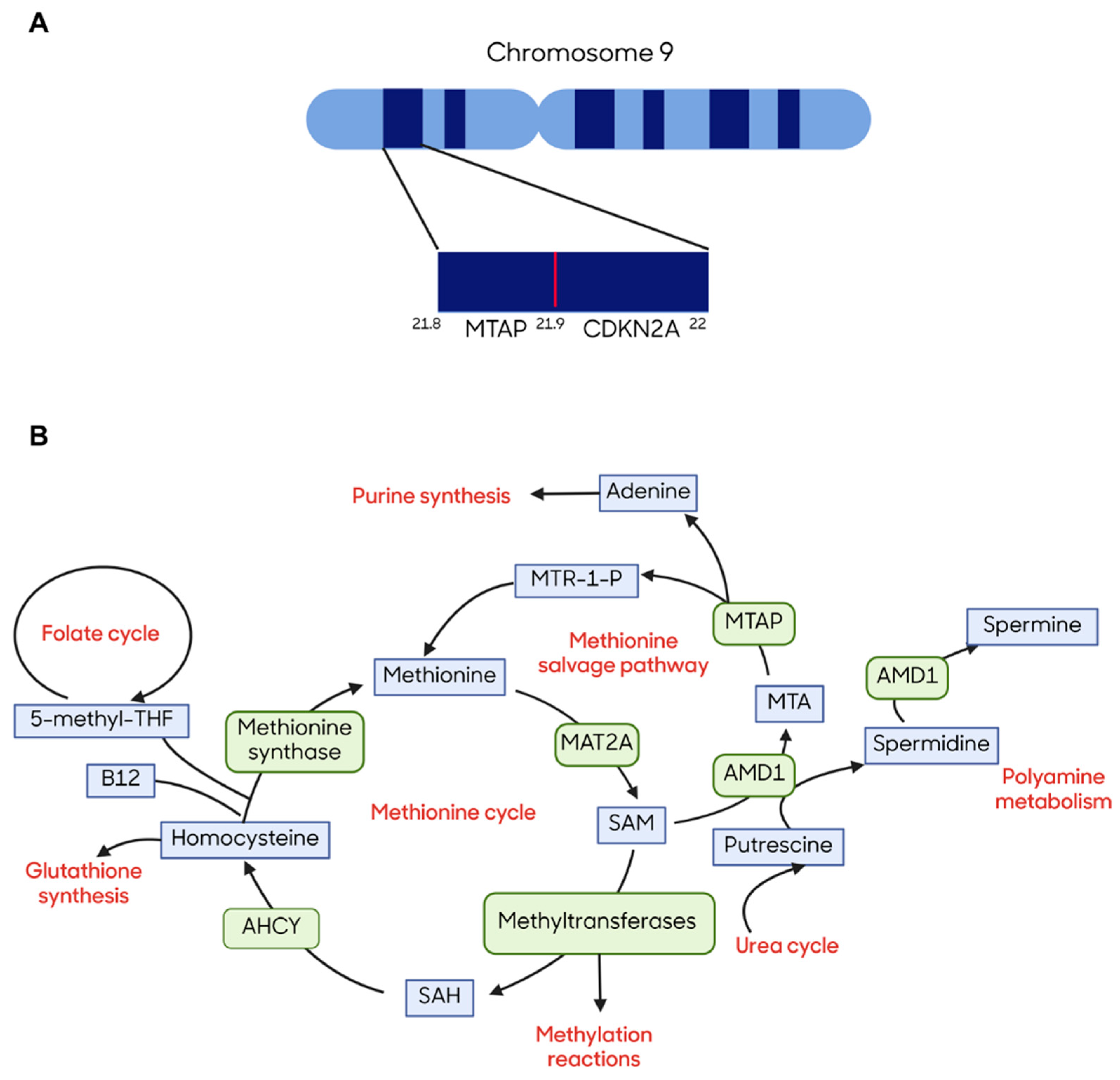
2. Loss of MTAP and Disease Overview
2.1. A Versatile Biomarker for Targeted Therapy
2.2. Methods for Detection of MTAP Loss

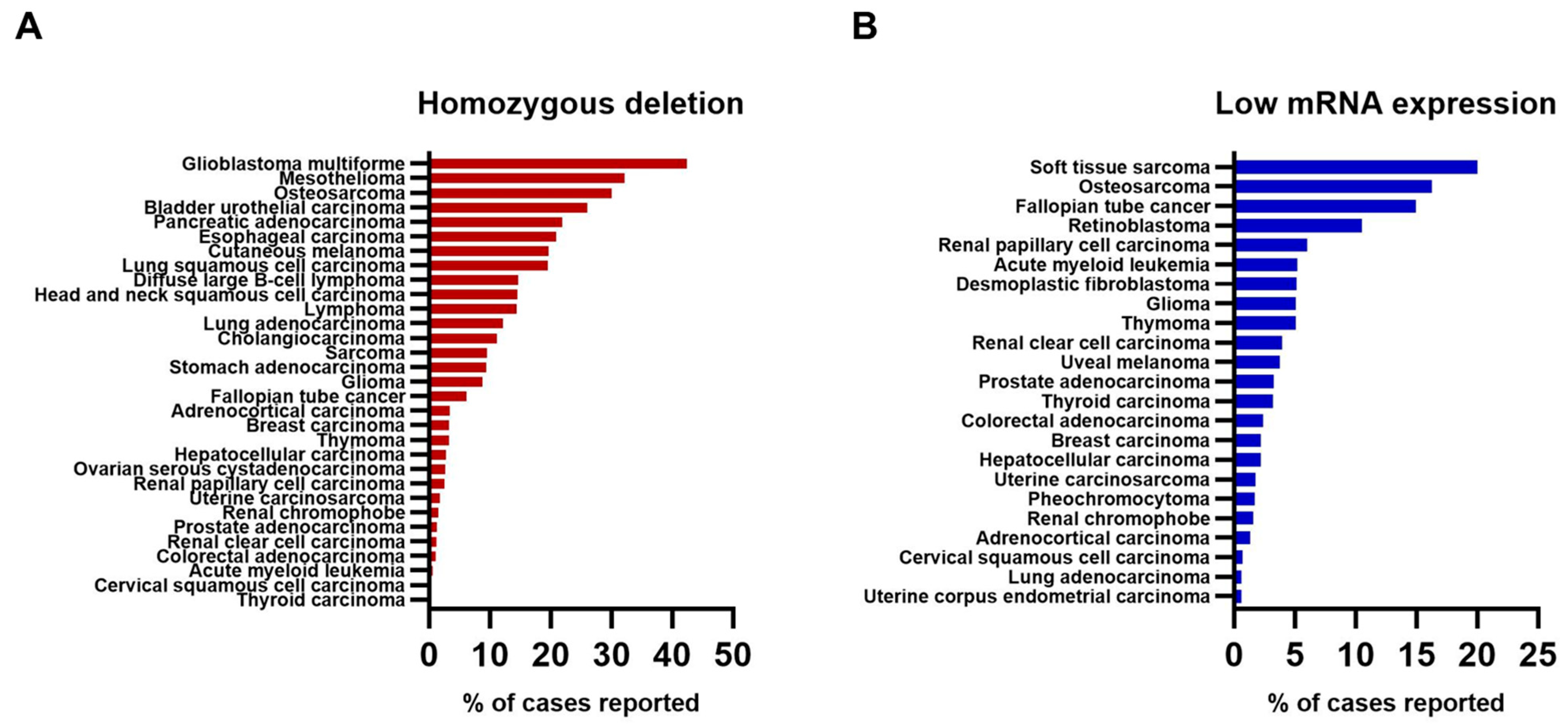
2.3. Incidence of MTAP Loss
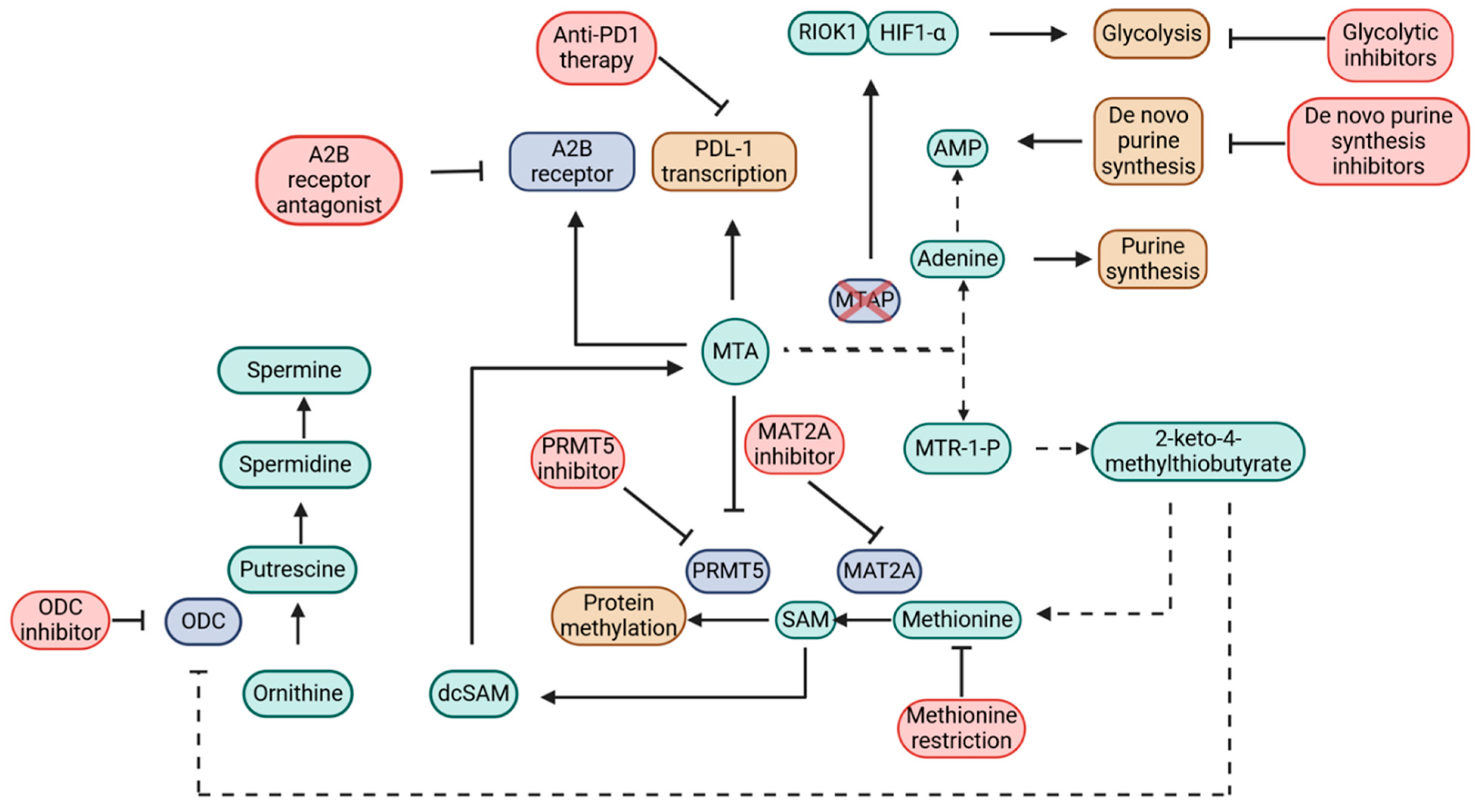
2.4. Effects of MTAP Loss in Cancer
3. Therapeutic Targets and Strategies
3.1. Targeting Protein Methyltransferase 5 (PRMT5)
3.1.1. First-Generation PRMT5 Inhibitors
3.1.2. Second-Generation Protein Methyltransferase 5 Inhibitors
3.2. Targeting MAT2A
3.3. Targeting De Novo Purine Synthesis Pathway
3.3.1. Antifolate Agents
3.3.2. Purine Analogs
3.4. Methionine Restriction
3.5. Glycolysis Inhibition
3.6. Ornithine Decarboxylase Inhibition
3.7. Immune Checkpoint Inhibition
3.8. Unmet Needs
4. Conclusions
Author Contributions
Funding
Acknowledgement
Conflicts of Interest
Abbreviations
| 2-DG | 2-Deoxy-D-glucose |
| 2-FA | 2-Fluoroadenine |
| ADSS | Adenylosuccinate synthetase |
| AKT | Serine/threonine kinase |
| ALA | L-alanosine |
| ALT | Adult T-cell leukemia |
| AMP | Adenosine monophosphate |
| ATP | Adenosine triphosphate |
| BAX | Bcl-2-associated X protein |
| CCLE | Cancer Cell Line Encyclopedia |
| CD133 | Cluster of differentiation 133 |
| CDK | Cyclin-dependent kinase |
| CDKN2A/B | Cyclin-dependent kinase inhibitor 2A/B |
| CDX | Cell-derived xenograft |
| CNA | Copy number alterations |
| CNS | Central nervous system |
| CNV | Copy-number variations |
| CRC | Colorectal carcinoma |
| CRISPR | Clustered regularly interspaced short palindromic repeats |
| CSF | Cerebrospinal fluid |
| ddPCR | Droplet digital polymerase chain reaction |
| DFMO | Difluoromethylornithine |
| DLBCL | Diffuse large B-cell lymphoma |
| dNCR | Delayed neurocognitive recovery |
| EBV | Epstein–Barr virus |
| eIF4E | Eukaryotic translation initiation factor 4E |
| EMT | Epithelial–mesenchymal transition |
| ERK | Extracellular signal-regulated kinase |
| FBS | Fetal bovine serum |
| FGFR3 | Fibroblast growth factor 3 |
| FISH | Fluorescence in situ hybridization |
| GBM | Glioblastoma |
| GI | Gastrointestinal |
| GSK3β | Glycogen synthase kinase 3 beta |
| HCC | Hepatocellular carcinoma |
| HIF1-α | Hypoxia-inducible factor 1α |
| ICI | Immune checkpoint inhibitor |
| IHC | Immunohistochemistry |
| IL | Interleukin |
| KD | Knockdown |
| KO | Knockout |
| LC-MS | Liquid chromatography–mass spectrometry |
| LV | Leucovorin |
| MAT2A | Methionine adenosyltransferase 2A |
| MDM2 | Mouse double minute 2 |
| MHC II | Major histocompatibility complex II |
| MLPA | Multiplex ligation-dependent probe amplification |
| MMP | Matrix metalloproteinase |
| MPM | Malignant pleural mesothelioma |
| MTA | Methylthioadenosine |
| MTAP | Methylthioadenosine phosphorylase |
| mTOR | Mammalian target of rapamycin |
| MTR-1-P | 5-methylthioribose-1-phosphate |
| NF-κB | Nuclear factor kappa-light-chain-enhancer of activated B cells |
| NGS | Next-generation sequencing |
| NIH | National Institutes of Health |
| NPC | Neural progenitor cell |
| NSCLC | Non-small cell lung cancer |
| ODC | Ornithine decarboxylase |
| PCAWG | Pan-Cancer Analysis of Whole Genomes |
| PD-1 | Programmed cell death protein 1 |
| PD-L1 | Programmed cell death ligand 1 |
| PDOX | Patient-derived orthotopic xenograft |
| PDX | Patient-derived xenograft |
| PFS | Progression-free survival |
| PI3K | Phosphatidylinositol-3 kinase |
| PIK3CA | Phosphatidylinositol-4,5-bisphosphate 3-kinase |
| PRMT | Protein methyltransferase |
| PRMT5 | Protein methyltransferase 5 |
| PROM1 | Prominin-1 |
| PRPP | 5-phosphoribosyl-1-pyrophosphate |
| RFC1 | Reduced folate carrier type 1 |
| RG | Arginine–glycine |
| RGG | Arginine–glycine–glycine |
| RIOK1 | RIO kinase 1 |
| rMETase | Recombinant methioninase |
| SAM | S-adenosylmethionine |
| SDMA | Symmetric dimethyl arginine |
| T-cell ALL | T-cell acute lymphoblastic leukemia |
| TCGA | The Cancer Genome Atlas |
| TIL | Tumor-infiltrating lymphocyte |
| TP53 | Tumor protein 53 |
| UC | Urothelial cancer |
References
- Toohey, J.I. Methylthio group cleavage from methylthioadenosine. Description of an enzyme and its relationship to the methylthio requirement of certain cells in culture. Biochem. Biophys. Res. Commun. 1977, 78, 1273–1280. [Google Scholar] [CrossRef]
- Toohey, J.I. Methylthioadenosine nucleoside phosphorylase deficiency in methylthio-dependent cancer cells. Biochem. Biophys. Res. Commun. 1978, 83, 27–35. [Google Scholar] [CrossRef] [PubMed]
- Kamatani, N.; Yu, A.L.; Carson, D.A. Deficiency of methylthioadenosine phosphorylase in human leukemic cells in vivo. Blood 1982, 60, 1387–1391. [Google Scholar] [CrossRef] [PubMed][Green Version]
- Fitchen, J.H.; Riscoe, M.K.; Dana, B.W.; Lawrence, H.J.; Ferro, A.J. Methylthioadenosine Phosphorylase Deficiency in Human Leukemias and Solid Tumors1. Cancer Res. 1986, 46, 5409–5412. [Google Scholar]
- Carrera, C.J.; Eddy, R.L.; Shows, T.B.; Carson, D.A. Assignment of the gene for methylthioadenosine phosphorylase to human chromosome 9 by mouse-human somatic cell hybridization. Proc. Natl. Acad. Sci. USA 1984, 81, 2665–2668. [Google Scholar] [CrossRef]
- Nobori, T.; Miura, K.; Wu, D.J.; Lois, A.; Takabayashi, K.; Carson, D.A. Deletions of the cyclin-dependent kinase-4 inhibitor gene in multiple human cancers. Nature 1994, 368, 753–756. [Google Scholar] [CrossRef]
- Marjon, K.; Kalev, P.; Marks, K. Cancer Dependencies: PRMT5 and MAT2A in MTAP/p16-Deleted Cancers. Annu. Rev. Cancer Biol. 2021, 5, 371–390. [Google Scholar] [CrossRef]
- Foulkes, W.D.; Flanders, T.Y.; Pollock, P.M.; Hayward, N.K. The CDKN2A (p16) Gene and Human Cancer. Mol. Med. 1997, 3, 5–20. [Google Scholar] [CrossRef]
- Trembath, D.G. Chapter 27–Molecular testing for gliomas. In Diagnostic Molecular Pathology, 2nd ed.; Coleman, W.B., Tsongalis, G.J., Eds.; Academic Press: New York, NY, USA, 2024; pp. 385–396. [Google Scholar]
- Hansen, L.J.; Sun, R.; Yang, R.; Singh, S.X.; Chen, L.H.; Pirozzi, C.J.; Moure, C.J.; Hemphill, C.; Carpenter, A.B.; Healy, P.; et al. MTAP Loss Promotes Stemness in Glioblastoma and Confers Unique Susceptibility to Purine Starvation. Cancer Res. 2019, 79, 3383–3394. [Google Scholar] [CrossRef]
- Menezes, W.P.; Silva, V.A.O.; Gomes, I.N.F.; Rosa, M.N.; Spina, M.L.C.; Carloni, A.C.; Alves, A.L.V.; Melendez, M.; Almeida, G.C.; Silva, L.S.D.; et al. Loss of 5′-Methylthioadenosine Phosphorylase (MTAP) is Frequent in High-Grade Gliomas; Nevertheless, it is Not Associated with Higher Tumor Aggressiveness. Cells 2020, 9, 492. [Google Scholar] [CrossRef]
- Alhalabi, O.; Chen, J.; Zhang, Y.; Lu, Y.; Wang, Q.; Ramachandran, S.; Tidwell, R.S.; Han, G.; Yan, X.; Meng, J.; et al. MTAP deficiency creates an exploitable target for antifolate therapy in 9p21-loss cancers. Nat. Commun. 2022, 13, 1797. [Google Scholar] [CrossRef]
- Bertino, J.R.; Waud, W.R.; Parker, W.B.; Lubin, M. Targeting tumors that lack methylthioadenosine phosphorylase (MTAP) activity: Current strategies. Cancer Biol. Ther. 2011, 11, 627–632. [Google Scholar] [CrossRef]
- Zhang, H.; Chen, Z.H.; Savarese, T.M. Codeletion of the genes for p16INK4, methylthioadenosine phosphorylase, interferon-alpha1, interferon-beta1, and other 9p21 markers in human malignant cell lines. Cancer Genet. Cytogenet. 1996, 86, 22–28. [Google Scholar] [CrossRef]
- Stadler, W.M.; Olopade, O.I. The 9p21 region in bladder cancer cell lines: Large homozygous deletion inactivate the CDKN2, CDKN2B and MTAP genes. Urol. Res. 1996, 24, 239–244. [Google Scholar] [CrossRef]
- Dreyling, M.H.; Roulston, D.; Bohlander, S.K.; Vardiman, J.; Olopade, O.I. Codeletion of CDKN2 and MTAP genes in a subset of non-Hodgkin’s lymphoma may be associated with histologic transformation from low-grade to diffuse large-cell lymphoma. Genes Chromosomes Cancer 1998, 22, 72–78. [Google Scholar] [CrossRef]
- Beroukhim, R.; Mermel, C.H.; Porter, D.; Wei, G.; Raychaudhuri, S.; Donovan, J.; Barretina, J.; Boehm, J.S.; Dobson, J.; Urashima, M.; et al. The landscape of somatic copy-number alteration across human cancers. Nature 2010, 463, 899–905. [Google Scholar] [CrossRef] [PubMed]
- Marjon, K.; Cameron, M.J.; Quang, P.; Clasquin, M.F.; Mandley, E.; Kunii, K.; McVay, M.; Choe, S.; Kernytsky, A.; Gross, S.; et al. MTAP Deletions in Cancer Create Vulnerability to Targeting of the MAT2A/PRMT5/RIOK1 Axis. Cell Rep. 2016, 15, 574–587. [Google Scholar] [CrossRef] [PubMed]
- Knudsen, E.S.; Witkiewicz, A.K. The Strange Case of CDK4/6 Inhibitors: Mechanisms, Resistance, and Combination Strategies. Trends Cancer 2017, 3, 39–55. [Google Scholar] [CrossRef]
- Gerstung, M.; Jolly, C.; Leshchiner, I.; Dentro, S.C.; Gonzalez, S.; Rosebrock, D.; Mitchell, T.J.; Rubanova, Y.; Anur, P.; Yu, K.; et al. The evolutionary history of 2,658 cancers. Nature 2020, 578, 122–128. [Google Scholar] [CrossRef]
- Moro, J.; Sobrero, S.; Cartia, C.F.; Ceraolo, S.; Rapanà, R.; Vaisitti, F.; Ganio, S.; Mellone, F.; Rudella, S.; Scopis, F.; et al. Diagnostic and Therapeutic Challenges of Malignant Pleural Mesothelioma. Diagnostics 2022, 12, 3009. [Google Scholar] [CrossRef]
- Sahu, R.K.; Ruhi, S.; Jeppu, A.K.; Al-Goshae, H.A.; Syed, A.; Nagdev, S.; Widyowati, R.; Ekasari, W.; Khan, J.; Bhattacharjee, B.; et al. Malignant mesothelioma tumours: Molecular pathogenesis, diagnosis, and therapies accompanying clinical studies. Front. Oncol. 2023, 13, 1204722. [Google Scholar] [CrossRef]
- Chapel, D.B.; Schulte, J.J.; Berg, K.; Churg, A.; Dacic, S.; Fitzpatrick, C.; Galateau-Salle, F.; Hiroshima, K.; Krausz, T.; Le Stang, N.; et al. MTAP immunohistochemistry is an accurate and reproducible surrogate for CDKN2A fluorescence in situ hybridization in diagnosis of malignant pleural mesothelioma. Mod. Pathol. 2020, 33, 245–254. [Google Scholar] [CrossRef]
- Febres-Aldana, C.A.; Chang, J.C.; Jungbluth, A.A.; Adusumilli, P.S.; Bodd, F.M.; Frosina, D.; Geronimo, J.A.; Hernandez, E.; Irawan, H.; Offin, M.D. Comparison of Immunohistochemistry, Next-generation Sequencing and Fluorescence In Situ Hybridization for Detection of MTAP Loss in Pleural Mesothelioma. Mod. Pathol. 2024, 37, 100420. [Google Scholar] [CrossRef]
- Brune, M.M.; Savic Prince, S.; Vlajnic, T.; Chijioke, O.; Roma, L.; König, D.; Bubendorf, L. MTAP as an emerging biomarker in thoracic malignancies. Lung Cancer 2024, 197, 107963. [Google Scholar] [CrossRef]
- A Phase 1/1b/2 Study Evaluating the Safety, Tolerability, Pharmacokinetics, Pharmacodynamics, and Efficacy of AMG 193 Alone and in Combination with Docetaxel in Subjects with Advanced MTAP-null Solid Tumors. 2021. Available online: https://clinicaltrials.gov/study/NCT05094336 (accessed on 13 November 2025).
- Calero, M.V.; Patnaik, A.; Maki, R.; O’Neil, B.; Abbruzzese, J.; Dagogo-Jack, I.; Devarakonda, S.; Wahlroos, S.; Lin, C.-C.; Fujiwara, Y. EP08. 02-116 Design of a Phase 1 Study of AMG 193, an MTA-Cooperative PRMT5 Inhibitor, in Patients with Advanced MTAP-Null Solid Tumors. J. Thorac. Oncol. 2022, 17, S457. [Google Scholar] [CrossRef]
- Numanagić, I.; Malikić, S.; Ford, M.; Qin, X.; Toji, L.; Radovich, M.; Skaar, T.C.; Pratt, V.M.; Berger, B.; Scherer, S. Allelic decomposition and exact genotyping of highly polymorphic and structurally variant genes. Nat. Commun. 2018, 9, 828. [Google Scholar] [CrossRef]
- Tremmel, R.; Klein, K.; Battke, F.; Fehr, S.; Winter, S.; Scheurenbrand, T.; Schaeffeler, E.; Biskup, S.; Schwab, M.; Zanger, U.M. Copy number variation profiling in pharmacogenes using panel-based exome resequencing and correlation to human liver expression. Hum. Genet. 2020, 139, 137–149. [Google Scholar] [CrossRef] [PubMed]
- Xie, K.; Liu, K.; Alvi, H.A.; Chen, Y.; Wang, S.; Yuan, X. Knncnv: A K-Nearest neighbor based method for detection of copy number variations using Ngs data. Front. Cell Dev. Biol. 2021, 9, 796249. [Google Scholar] [CrossRef] [PubMed]
- Illei, P.B.; Rusch, V.W.; Zakowski, M.F.; Ladanyi, M. Homozygous deletion of CDKN2A and codeletion of the methylthioadenosine phosphorylase gene in the majority of pleural mesotheliomas. Clin. Cancer Res. 2003, 9, 2108–2113. [Google Scholar] [PubMed]
- Oyama, Y.; Hamasaki, M.; Matsumoto, S.; Sato, A.; Tsujimura, T.; Nabeshima, K. Short 57 kb CDKN2A FISH probe effectively detects short homozygous deletion of the 9p21 locus in malignant pleural mesothelioma. Oncol. Lett. 2021, 22, 1–8. [Google Scholar] [CrossRef]
- Hellerbrand, C.; Mühlbauer, M.; Wallner, S.; Schuierer, M.; Behrmann, I.; Bataille, F.; Weiss, T.; Schölmerich, J.; Bosserhoff, A.K. Promoter-hypermethylation is causing functional relevant downregulation of methylthioadenosine phosphorylase (MTAP) expression in hepatocellular carcinoma. Carcinogenesis 2006, 27, 64–72. [Google Scholar] [CrossRef]
- Leal, M.; Lima, E.; Silva, P.; Assumpção, P.; Calcagno, D.; Payão, S.; Burbano, R.R.; Smith, M. Promoter hypermethylation of CDH1, FHIT, MTAP and PLAGL1 in gastric adenocarcinoma in individuals from Northern Brazil. World J. Gastroenterol. 2007, 13, 2568–2574. [Google Scholar] [CrossRef] [PubMed][Green Version]
- He, H.-L.; Lee, Y.-E.; Shiue, Y.-L.; Lee, S.-W.; Chen, T.-J.; Li, C.-F. Characterization and Prognostic Significance of Methylthioadenosine Phosphorylase Deficiency in Nasopharyngeal Carcinoma. Medicine 2015, 94, e2271. [Google Scholar] [CrossRef] [PubMed]
- Woollard, W.J.; Kalaivani, N.P.; Jones, C.L.; Roper, C.; Tung, L.; Lee, J.J.; Thomas, B.R.; Tosi, I.; Ferreira, S.; Beyers, C.Z.; et al. Independent Loss of Methylthioadenosine Phosphorylase (MTAP) in Primary Cutaneous T-Cell Lymphoma. J. Investig. Dermatol. 2016, 136, 1238–1246. [Google Scholar] [CrossRef]
- Urosevic, J.; Lynch, J.T.; Meyer, S.; Yusufova, N.; Wiseman, E.; Waring, P.; Hong, T.; Ozen, Z.; Wang, H.; Bradshaw, L.; et al. Epigenetic Silencing of MTAP in Hodgkin’s Lymphoma Renders It Sensitive to a 2 nd Generation PRMT5 Inhibitor. Blood 2023, 142, 4185. [Google Scholar] [CrossRef]
- Otsuji, R.; Hata, N.; Yamamoto, H.; Kuga, D.; Hatae, R.; Sangatsuda, Y.; Fujioka, Y.; Noguchi, N.; Sako, A.; Togao, O.; et al. Hemizygous deletion of cyclin-dependent kinase inhibitor 2A/B with p16 immuno-negative and methylthioadenosine phosphorylase retention predicts poor prognosis in IDH-mutant adult glioma. Neuro-Oncol. Adv. 2024, 6, vdae069. [Google Scholar] [CrossRef]
- Cheng, Y.Y.; Yuen, M.L.; Rath, E.M.; Johnson, B.; Zhuang, L.; Yu, T.K.; Aleksova, V.; Linton, A.; Kao, S.; Clarke, C.J.; et al. CDKN2A and MTAP Are Useful Biomarkers Detectable by Droplet Digital PCR in Malignant Pleural Mesothelioma: A Potential Alternative Method in Diagnosis Compared to Fluorescence In Situ Hybridisation. Front. Oncol. 2020, 10, 579327. [Google Scholar] [CrossRef]
- Parsons, D.W.; Jones, S.; Zhang, X.; Lin, J.C.; Leary, R.J.; Angenendt, P.; Mankoo, P.; Carter, H.; Siu, I.M.; Gallia, G.L.; et al. An integrated genomic analysis of human glioblastoma multiforme. Science 2008, 321, 1807–1812. [Google Scholar] [CrossRef] [PubMed]
- Nickerson, M.L.; Witte, N.; Im, K.M.; Turan, S.; Owens, C.; Misner, K.; Tsang, S.X.; Cai, Z.; Wu, S.; Dean, M.; et al. Molecular analysis of urothelial cancer cell lines for modeling tumor biology and drug response. Oncogene 2017, 36, 35–46. [Google Scholar] [CrossRef]
- Hustinx, S.R.; Hruban, R.H.; Leoni, L.M.; Iacobuzio-Donahue, C.; Cameron, J.L.; Yeo, C.J.; Brown, P.N.; Argani, P.; Ashfaq, R.; Fukushima, N.; et al. Homozygous deletion of the MTAP gene in invasive adenocarcinoma of the pancreas and in periampullary cancer: A potential new target for therapy. Cancer Biol. Ther. 2005, 4, 83–86. [Google Scholar] [CrossRef]
- Huang, H.-Y.; Li, S.-H.; Yu, S.-C.; Chou, F.-F.; Tzeng, C.-C.; Hu, T.-H.; Uen, Y.-H.; Tian, Y.-F.; Wang, Y.-H.; Fang, F.-M.; et al. Homozygous Deletion of MTAP Gene as a Poor Prognosticator in Gastrointestinal Stromal Tumors. Clin. Cancer Res. 2009, 15, 6963–6972. [Google Scholar] [CrossRef] [PubMed]
- Ashok Kumar, P.; Graziano, S.L.; Danziger, N.; Pavlick, D.; Severson, E.A.; Ramkissoon, S.H.; Huang, R.S.P.; Decker, B.; Ross, J.S. Genomic landscape of non-small-cell lung cancer with methylthioadenosine phosphorylase (MTAP) deficiency. Cancer Med. 2023, 12, 1157–1166. [Google Scholar] [CrossRef] [PubMed]
- Bou Zerdan, M.; Ashok Kumar, P.; Haroun, E.; Srivastava, N.; Ross, J.; Sivapiragasam, A. Genomic landscape of metastatic breast cancer (MBC) patients with methylthioadenosine phosphorylase (MTAP) loss. Oncotarget 2023, 14, 178–187. [Google Scholar] [CrossRef]
- Ngoi, N.Y.L.; Tang, T.Y.; Gaspar, C.F.; Pavlick, D.C.; Buchold, G.M.; Scholefield, E.L.; Parimi, V.; Huang, R.S.P.; Janovitz, T.; Danziger, N.; et al. Methylthioadenosine Phosphorylase Genomic Loss in Advanced Gastrointestinal Cancers. Oncologist 2024, 29, 493–503. [Google Scholar] [CrossRef] [PubMed]
- Cerami, E.; Gao, J.; Dogrusoz, U.; Gross, B.E.; Sumer, S.O.; Aksoy, B.A.; Jacobsen, A.; Byrne, C.J.; Heuer, M.L.; Larsson, E.; et al. The cBio cancer genomics portal: An open platform for exploring multidimensional cancer genomics data. Cancer Discov. 2012, 2, 401–404. [Google Scholar] [CrossRef]
- Gao, J.; Aksoy, B.A.; Dogrusoz, U.; Dresdner, G.; Gross, B.; Sumer, S.O.; Sun, Y.; Jacobsen, A.; Sinha, R.; Larsson, E.; et al. Integrative analysis of complex cancer genomics and clinical profiles using the cBioPortal. Sci. Signal. 2013, 6, pl1. [Google Scholar] [CrossRef]
- de Bruijn, I.; Kundra, R.; Mastrogiacomo, B.; Tran, T.N.; Sikina, L.; Mazor, T.; Li, X.; Ochoa, A.; Zhao, G.; Lai, B.; et al. Analysis and Visualization of Longitudinal Genomic and Clinical Data from the AACR Project GENIE Biopharma Collaborative in cBioPortal. Cancer Res. 2023, 83, 3861–3867. [Google Scholar] [CrossRef]
- A Phase II Trial to Evaluate Combination Therapy with Pemetrexed and Avelumab in Previously Treated Patients with MTAP-Deficient Advanced Urothelial Cancer. 2018. Available online: https://clinicaltrials.gov/study/NCT03744793 (accessed on 13 November 2025).
- A Phase 1 Study of AG-270 in the Treatment of Subjects with Advanced Solid Tumors or Lymphoma with Homozygous Deletion of MTAP. 2018. Available online: https://clinicaltrials.gov/study/NCT03435250 (accessed on 12 November 2025).
- A Phase I, Open-label, Dose Escalation Study to Investigate the Safety, Pharmacokinetics, Pharmacodynamics and Clinical Activity of GSK3326595 in Subjects with Solid Tumors and Non-Hodgkin’s Lymphoma. 2016. Available online: https://clinicaltrials.gov/study/NCT02783300 (accessed on 12 November 2025).
- A Phase 1, Open-Label, Multicenter, Dose Escalation and Expansion Study of PRT811 in Subjects with Advanced Solid Tumors, CNS Lymphoma, and Recurrent High-Grade Gliomas. 2019. Available online: https://clinicaltrials.gov/study/NCT04089449 (accessed on 11 November 2025).
- A Phase II Trial to Evaluate Pemetrexed Clinical Responses in Relation to Tumor MTAP Gene Status in Patients with Previously Treated Metastatic Urothelial Carcinoma. 2016. Available online: https://clinicaltrials.gov/study/NCT02693717?cond=pemetrexed%20mtap&rank=2 (accessed on 10 November 2025).
- A Phase I/II, Open-Label, Non-Randomized, Multicenter, Single Agent Study Of Intravenous SDX-102 For The Treatment of Patients with MTAP-Deficient High Grade Recurrent Malignant Gliomas. 2004. Available online: https://clinicaltrials.gov/study/NCT00075894 (accessed on 12 November 2025).
- Kirovski, G.; Stevens, A.P.; Czech, B.; Dettmer, K.; Weiss, T.S.; Wild, P.; Hartmann, A.; Bosserhoff, A.K.; Oefner, P.J.; Hellerbrand, C. Down-regulation of methylthioadenosine phosphorylase (MTAP) induces progression of hepatocellular carcinoma via accumulation of 5′-deoxy-5′-methylthioadenosine (MTA). Am. J. Pathol. 2011, 178, 1145–1152. [Google Scholar] [CrossRef]
- Kalev, P.; Hyer, M.L.; Gross, S.; Konteatis, Z.; Chen, C.C.; Fletcher, M.; Lein, M.; Aguado-Fraile, E.; Frank, V.; Barnett, A.; et al. MAT2A Inhibition Blocks the Growth of MTAP-Deleted Cancer Cells by Reducing PRMT5-Dependent mRNA Splicing and Inducing DNA Damage. Cancer Cell 2021, 39, 209–224.e211. [Google Scholar] [CrossRef]
- Hu, Q.; Qin, Y.; Ji, S.; Shi, X.; Dai, W.; Fan, G.; Li, S.; Xu, W.; Liu, W.; Liu, M. MTAP Deficiency–Induced Metabolic Reprogramming Creates a Vulnerability to Cotargeting De Novo Purine Synthesis and Glycolysis in Pancreatic Cancer. Cancer Res. 2021, 81, 4964–4980. [Google Scholar] [CrossRef]
- Subhi, A.L.; Diegelman, P.; Porter, C.W.; Tang, B.; Lu, Z.J.; Markham, G.D.; Kruger, W.D. Methylthioadenosine Phosphorylase Regulates Ornithine Decarboxylase by Production of Downstream Metabolites*. J. Biol. Chem. 2003, 278, 49868–49873. [Google Scholar] [CrossRef]
- Subhi, A.L.; Tang, B.; Balsara, B.R.; Altomare, D.A.; Testa, J.R.; Cooper, H.S.; Hoffman, J.P.; Meropol, N.J.; Kruger, W.D. Loss of methylthioadenosine phosphorylase and elevated ornithine decarboxylase is common in pancreatic cancer. Clin. Cancer Res. 2004, 10, 7290–7296. [Google Scholar] [CrossRef] [PubMed]
- Zhang, Y.; Zhang, T.T.; Gao, L.; Tan, Y.N.; Li, Y.T.; Tan, X.Y.; Huang, T.X.; Li, H.H.; Bai, F.; Zou, C.; et al. Downregulation of MTAP promotes Tumor Growth and Metastasis by regulating ODC Activity in Breast Cancer. Int. J. Biol. Sci. 2022, 18, 3034–3047. [Google Scholar] [CrossRef] [PubMed]
- Hansen, L.J.; Yang, R.; Roso, K.; Wang, W.; Chen, L.; Yang, Q.; Pirozzi, C.J.; He, Y. MTAP loss correlates with an immunosuppressive profile in GBM and its substrate MTA stimulates alternative macrophage polarization. Sci. Rep. 2022, 12, 4183. [Google Scholar] [CrossRef]
- Chang, W.H.; Hsu, S.W.; Zhang, J.; Li, J.M.; Yang, D.D.; Chu, C.W.; Yoo, E.E.; Zhang, W.; Yu, S.L.; Chen, C.H. MTAP deficiency contributes to immune landscape remodelling and tumour evasion. Immunology 2023, 168, 331–345. [Google Scholar] [CrossRef] [PubMed]
- Lorenz, S.; Baroy, T.; Sun, J.; Nome, T.; Vodak, D.; Bryne, J.C.; Hakelien, A.M.; Fernandez-Cuesta, L.; Mohlendick, B.; Rieder, H.; et al. Unscrambling the genomic chaos of osteosarcoma reveals extensive transcript fusion, recurrent rearrangements and frequent novel TP53 aberrations. Oncotarget 2016, 7, 5273–5288. [Google Scholar] [CrossRef]
- Yuan, D.; Tian, J.; Fang, X.; Xiong, Y.; Banskota, N.; Kuang, F.; Zhang, W.; Duan, H. Epidemiological Evidence for Associations Between Genetic Variants and Osteosarcoma Susceptibility: A Meta-Analysis. Front. Oncol. 2022, 12, 912208. [Google Scholar] [CrossRef]
- Zhi, L.; Liu, D.; Wu, S.G.; Li, T.; Zhao, G.; Zhao, B.; Li, M. Association of common variants in MTAP with susceptibility and overall survival of osteosarcoma: A two-stage population-based study in Han Chinese. J. Cancer 2016, 7, 2179–2186. [Google Scholar] [CrossRef] [PubMed][Green Version]
- Chang, W.H.; Chen, Y.J.; Hsiao, Y.J.; Chiang, C.C.; Wang, C.Y.; Chang, Y.L.; Hong, Q.S.; Lin, C.Y.; Lin, S.U.; Chang, G.C.; et al. Reduced symmetric dimethylation stabilizes vimentin and promotes metastasis in MTAP-deficient lung cancer. EMBO Rep. 2022, 23, e54265. [Google Scholar] [CrossRef]
- Cheng, X.Y.; Liu, Z.; Shang, L.; Cai, H.Q.; Zhang, Y.; Cai, Y.; Xu, X.; Hao, J.J.; Wang, M.R. Deletion and downregulation of MTAP contribute to the motility of esophageal squamous carcinoma cells. OncoTargets Ther. 2017, 10, 5855–5862. [Google Scholar] [CrossRef]
- Limm, K.; Ott, C.; Wallner, S.; Mueller, D.W.; Oefner, P.; Hellerbrand, C.; Bosserhoff, A.-K. Deregulation of protein methylation in melanoma. Eur. J. Cancer 2013, 49, 1305–1313. [Google Scholar] [CrossRef] [PubMed]
- Zhong, Y.; Lu, K.; Zhu, S.; Li, W.; Sun, S. Characterization of methylthioadenosin phosphorylase (MTAP) expression in colorectal cancer. Artif. Cells Nanomed. Biotechnol. 2018, 46, 2082–2087. [Google Scholar] [CrossRef]
- Kryukov, G.V.; Wilson, F.H.; Ruth, J.R.; Paulk, J.; Tsherniak, A.; Marlow, S.E.; Vazquez, F.; Weir, B.A.; Fitzgerald, M.E.; Tanaka, M.; et al. MTAP deletion confers enhanced dependency on the PRMT5 arginine methyltransferase in cancer cells. Science 2016, 351, 1214–1218. [Google Scholar] [CrossRef]
- Palanichamy, K.; Thirumoorthy, K.; Kanji, S.; Gordon, N.; Singh, R.; Jacob, J.R.; Sebastian, N.; Litzenberg, K.T.; Patel, D.; Bassett, E.; et al. Methionine and Kynurenine Activate Oncogenic Kinases in Glioblastoma, and Methionine Deprivation Compromises Proliferation. Clin. Cancer Res. 2016, 22, 3513–3523. [Google Scholar] [CrossRef]
- Mavrakis, K.J.; McDonald, E.R.; Schlabach, M.R.; Billy, E.; Hoffman, G.R.; deWeck, A.; Ruddy, D.A.; Venkatesan, K.; Yu, J.; McAllister, G.; et al. Disordered methionine metabolism in MTAP/CDKN2A-deleted cancers leads to dependence on PRMT5. Science 2016, 351, 1208–1213. [Google Scholar] [CrossRef]
- Radzisheuskaya, A.; Shliaha, P.V.; Grinev, V.; Lorenzini, E.; Kovalchuk, S.; Shlyueva, D.; Gorshkov, V.; Hendrickson, R.C.; Jensen, O.N.; Helin, K. PRMT5 methylome profiling uncovers a direct link to splicing regulation in acute myeloid leukemia. Nat. Struct. Mol. Biol. 2019, 26, 999–1012. [Google Scholar] [CrossRef]
- Thandapani, P.; O’Connor, T.R.; Bailey, T.L.; Richard, S. Defining the RGG/RG motif. Mol. Cell 2013, 50, 613–623. [Google Scholar] [CrossRef]
- Chen, C.; Nott, T.J.; Jin, J.; Pawson, T. Deciphering arginine methylation: Tudor tells the tale. Nat. Rev. Mol. Cell Biol. 2011, 12, 629–642. [Google Scholar] [CrossRef]
- Li, X.; Wang, C.; Jiang, H.; Luo, C. A patent review of arginine methyltransferase inhibitors (2010–2018). Expert. Opin. Ther. Pat. 2019, 29, 97–114. [Google Scholar] [CrossRef] [PubMed]
- Brehmer, D.; Beke, L.; Wu, T.; Millar, H.J.; Moy, C.; Sun, W.; Mannens, G.; Pande, V.; Boeckx, A.; van Heerde, E.; et al. Discovery and Pharmacological Characterization of JNJ-64619178, a Novel Small-Molecule Inhibitor of PRMT5 with Potent Antitumor Activity. Mol. Cancer Ther. 2021, 20, 2317–2328. [Google Scholar] [CrossRef] [PubMed]
- Vieito, M.; Moreno, V.; Spreafico, A.; Brana, I.; Wang, J.S.; Preis, M.; Hernández, T.; Genta, S.; Hansen, A.R.; Doger, B.; et al. Phase 1 Study of JNJ-64619178, a Protein Arginine Methyltransferase 5 Inhibitor, in Advanced Solid Tumors. Clin. Cancer Res. 2023, 29, 3592–3602. [Google Scholar] [CrossRef]
- Jensen-Pergakes, K.; Tatlock, J.; Maegley, K.A.; McAlpine, I.J.; McTigue, M.; Xie, T.; Dillon, C.P.; Wang, Y.; Yamazaki, S.; Spiegel, N.; et al. SAM-Competitive PRMT5 Inhibitor PF-06939999 Demonstrates Antitumor Activity in Splicing Dysregulated NSCLC with Decreased Liability of Drug Resistance. Mol. Cancer Ther. 2022, 21, 3–15. [Google Scholar] [CrossRef]
- Rodon, J.; Rodriguez, E.; Maitland, M.L.; Tsai, F.Y.; Socinski, M.A.; Berlin, J.D.; Thomas, J.S.; Al Baghdadi, T.; Wang, I.M.; Guo, C.; et al. A phase I study to evaluate the safety, pharmacokinetics, and pharmacodynamics of PF-06939999 (PRMT5 inhibitor) in patients with selected advanced or metastatic tumors with high incidence of splicing factor gene mutations. ESMO Open 2024, 9, 102961. [Google Scholar] [CrossRef]
- Wang, Q.; Xu, J.; Li, Y.; Huang, J.; Jiang, Z.; Wang, Y.; Liu, L.; Leung, E.L.H.; Yao, X. Identification of a Novel Protein Arginine Methyltransferase 5 Inhibitor in Non-small Cell Lung Cancer by Structure-Based Virtual Screening. Front. Pharmacol. 2018, 9, 173. [Google Scholar] [CrossRef]
- Ferrarotto, R.; Swiecicki, P.L.; Zandberg, D.P.; Baiocchi, R.A.; Wesolowski, R.; Rodriguez, C.P.; McKean, M.; Kang, H.; Monga, V.; Nath, R.; et al. PRT543, a protein arginine methyltransferase 5 inhibitor, in patients with advanced adenoid cystic carcinoma: An open-label, phase I dose-expansion study. Oral Oncol. 2024, 149, 106634. [Google Scholar] [CrossRef] [PubMed]
- Monga, V.; Johanns, T.M.; Stupp, R.; Chandra, S.; Falchook, G.S.; Giglio, P.; Philipovskiy, A.; Alnahhas, I.; Babbar, N.; Sun, W.; et al. A phase 1 study of the protein arginine methyltransferase 5 (PRMT5) brain-penetrant inhibitor PRT811 in patients (pts) with recurrent high-grade glioma or uveal melanoma (UM). J. Clin. Oncol. 2023, 41, 3008. [Google Scholar] [CrossRef]
- Siu, L.L.; Rasco, D.W.; Vinay, S.P.; Romano, P.M.; Menis, J.; Opdam, F.L.; Heinhuis, K.M.; Egger, J.L.; Gorman, S.A.; Parasrampuria, R.; et al. METEOR-1: A phase I study of GSK3326595, a first-in-class protein arginine methyltransferase 5 (PRMT5) inhibitor, in advanced solid tumours. Ann. Oncol. 2019, 30, v159. [Google Scholar] [CrossRef]
- Bonday, Z.Q.; Cortez, G.S.; Grogan, M.J.; Antonysamy, S.; Weichert, K.; Bocchinfuso, W.P.; Li, F.; Kennedy, S.; Li, B.; Mader, M.M.; et al. LLY-283, a Potent and Selective Inhibitor of Arginine Methyltransferase 5, PRMT5, with Antitumor Activity. ACS Med. Chem. Lett. 2018, 9, 612–617. [Google Scholar] [CrossRef] [PubMed]
- Kumar, D.; Jain, S.; Coulter, D.W.; Joshi, S.S.; Chaturvedi, N.K. PRMT5 as a Potential Therapeutic Target in MYC-Amplified Medulloblastoma. Cancers 2023, 15, 5855. [Google Scholar] [CrossRef]
- A Phase 1, First-in-Human, Open-Label Study of the Safety, Pharmacokinetics, and Pharmacodynamics of JNJ-64619178, an Inhibitor of Protein Arginine Methyltransferase 5 (PRMT5) in Subjects with Advanced Cancers. 2018. Available online: https://www.clinicaltrials.gov/study/NCT03573310 (accessed on 12 November 2025).
- A Phase 1 Study To Evaluate The Safety, Pharmacokinetics, and Pharmacodynamics Of Escalating Doses Of Pf-06939999 (Prmt5 Inhibitor) in Participants with Advanced Or Metastatic Non-Small Cell Lung Cancer, Head and Neck Squamous Cell Carcinoma, Esophageal Cancer, Endometrial Cancer, Cervical Cancer and Bladder Cancer. 2019. Available online: https://clinicaltrials.gov/study/NCT03854227 (accessed on 12 November 2025).
- Falchook, G.S.; Glass, J.; Monga, V.; Giglio, P.; Mauro, D.; Viscusi, J.; Scherle, P.; Bhagwat, N.; Sun, W.; Chiaverelli, R. Abstract P044: A phase 1 dose escalation study of protein arginine methyltransferase 5 (PRMT5) brain penetrant inhibitor PRT811 in patients with advanced solid tumors, including recurrent high-grade gliomas. Mol. Cancer Ther. 2021, 20, P044. [Google Scholar] [CrossRef]
- Zheng, Y.; Dai, M.; Dong, Y.; Yu, H.; Liu, T.; Feng, X.; Yu, B.; Zhang, H.; Wu, J.; Kong, W.; et al. ZEB2/TWIST1/PRMT5/NuRD Multicomplex Contributes to the Epigenetic Regulation of EMT and Metastasis in Colorectal Carcinoma. Cancers 2022, 14, 3426. [Google Scholar] [CrossRef]
- Carter, J.; Ito, K.; Thodima, V.; Sivakumar, M.; Hulse, M.; Rager, J.; Vykuntam, K.; Bhagwat, N.; Vaddi, K.; Ruggeri, B.; et al. Abstract 2159: PRMT5 inhibitor PRT543 displays potent antitumor activity in U2AF1S34F and RBM10LOF spliceosome-mutant non-small cell lung cancer in vitro and in vivo. Cancer Res. 2022, 82, 2159. [Google Scholar] [CrossRef]
- A Phase 1, Open-Label, Multicenter, Dose Escalation, Dose Expansion Study of PRT543 in Patients with Advanced Solid Tumors and Hematologic Malignancies. 2019. Available online: https://clinicaltrials.gov/study/NCT03886831 (accessed on 12 November 2025).
- Liu, X.; He, J.; Mao, L.; Zhang, Y.; Cui, W.; Duan, S.; Jiang, A.; Gao, Y.; Sang, Y.; Huang, G. EPZ015666, a selective protein arginine methyltransferase 5 (PRMT5) inhibitor with an antitumour effect in retinoblastoma. Exp. Eye Res. 2021, 202, 108286. [Google Scholar] [CrossRef] [PubMed]
- Engstrom, L.D.; Aranda, R.; Waters, L.; Moya, K.; Bowcut, V.; Vegar, L.; Trinh, D.; Hebbert, A.; Smith, C.R.; Kulyk, S.; et al. MRTX1719 Is an MTA-Cooperative PRMT5 Inhibitor That Exhibits Synthetic Lethality in Preclinical Models and Patients with MTAP-Deleted Cancer. Cancer Discov. 2023, 13, 2412–2431. [Google Scholar] [CrossRef] [PubMed]
- Smith, C.R.; Kulyk, S.; Lawson, J.D.; Engstrom, L.D.; Aranda, R.; Briere, D.M.; Gunn, R.; Moya, K.; Rahbaek, L.; Waters, L.; et al. Abstract LB003: Fragment based discovery of MRTX9768, a synthetic lethal-based inhibitor designed to bind the PRMT5-MTA complex and selectively target MTAP/CDKN2A-deleted tumors. Cancer Res. 2021, 81, LB003. [Google Scholar] [CrossRef]
- Briggs, K.J.; Cottrell, K.M.; Tonini, M.R.; Wilker, E.W.; Gu, L.; Davis, C.B.; Zhang, M.; Whittington, D.; Gotur, D.; Goldstein, M.J. TNG908 is an MTAPnull-selective PRMT5 inhibitor that drives tumor regressions in MTAP-deleted xenograft models across multiple histologies. Cancer Res. 2022, 82, 3941. [Google Scholar] [CrossRef]
- Briggs, K.J.; Tsai, A.; Zhang, M.; Tonini, M.R.; Haines, B.; Huang, A.; Cottrell, K.M. TNG462 is a potential best-in-class MTA-cooperative PRMT5 inhibitor for the treatment of MTAP-deleted solid tumors. Cancer Res. 2023, 83, 4970. [Google Scholar] [CrossRef]
- Villalona-Calero, M.A.; Patnaik, A.; Maki, R.G.; O’Neil, B.; Abbruzzese, J.L.; Dagogo-Jack, I.; Devarakonda, S.; Wahlroos, S.; Lin, C.-C.; Fujiwara, Y.; et al. Design and rationale of a phase 1 dose-escalation study of AMG 193, a methylthioadenosine (MTA)-cooperative PRMT5 inhibitor, in patients with advanced methylthioadenosine phosphorylase (MTAP)-null solid tumors. J. Clin. Oncol. 2022, 40, TPS3167. [Google Scholar] [CrossRef]
- Rose, S. AMG 193 Effective in Multiple Tumor Types. Cancer Discov. 2023, 13, 2492. [Google Scholar] [CrossRef]
- Rodon, J.; Yamamoto, N.; Doi, T.; Ghiringhelli, F.; Goebeler, M.-E.; Fujuwara, Y.; Villalona-Calero, M.; Penel, N.; Patnaik, A.; Machiels, J.-P.; et al. Abstract PR006: Initial results from first-in-human study of AMG 193, an MTA-cooperative PRMT5 inhibitor, in biomarker-selected solid tumors. Mol. Cancer Ther. 2023, 22, PR006. [Google Scholar] [CrossRef]
- Konteatis, Z.; Travins, J.; Gross, S.; Marjon, K.; Barnett, A.; Mandley, E.; Nicolay, B.; Nagaraja, R.; Chen, Y.; Sun, Y.; et al. Discovery of AG-270, a First-in-Class Oral MAT2A Inhibitor for the Treatment of Tumors with Homozygous MTAP Deletion. J. Med. Chem. 2021, 64, 4430–4449. [Google Scholar] [CrossRef]
- Fischer, M.M.; Bhola, N.; Faulhaber, J.; Freyman, Y.; Yao, B.; Mounir, Z.; Lackner, M.R.; Neilan, C. Abstract 1278: MAT2A inhibitor, IDE397, displays broad anti-tumor activity across a panel of MTAP-deleted patient-derived xenografts. Cancer Res. 2021, 81, 1278. [Google Scholar] [CrossRef]
- Atkinson, S.J.; Bagal, S.K.; Argyrou, A.; Askin, S.; Cheung, T.; Chiarparin, E.; Coen, M.; Collie, I.T.; Dale, I.L.; De Fusco, C.; et al. Development of a Series of Pyrrolopyridone MAT2A Inhibitors. J. Med. Chem. 2024, 67, 4541–4559. [Google Scholar] [CrossRef]
- Zhou, F.; Tang, F.; Yu, Z.; Li, Z.; Yang, W.; Xue, L.; Chen, P.; Tang, R. Abstract 5434: Discovery of SCR-7952, a novel, potent and high selective MAT2A inhibitor shows robust anti-tumor activities and better safety profile. Cancer Res. 2022, 82, 5434. [Google Scholar] [CrossRef]
- Chan, Y.-Y.; Tsang, C.-M.; Chung, G.T.Y.; To, K.-F.; Zhang, Y.; Zhang, X.; Tang, J.; Lo, K.W. Abstract 6226: Therapeutic vulnerability of MTAP-deleted nasopharyngeal carcinoma by MAT2A inhibitors. Cancer Res. 2023, 83, 6226. [Google Scholar] [CrossRef]
- Wang, Y.; Muylaert, C.; Wyns, A.; Vlummens, P.; De Veirman, K.; Vanderkerken, K.; Zaal, E.; Berkers, C.; Moreaux, J.; De Bruyne, E.; et al. S-adenosylmethionine biosynthesis is a targetable metabolic vulnerability in multiple myeloma. Haematologica 2024, 109, 256–271. [Google Scholar] [CrossRef]
- Hans-Georg, B. Drug Synergy–Mechanisms and Methods of Analysis. In Toxicity and Drug Testing; William, A., Ed.; IntechOpen: Rijeka, Croatia, 2012; pp. 143–166. [Google Scholar]
- A Phase 1 Multiple Expansion Cohort Trial of MRTX1719 in Patients with Advanced Solid Tumors with Homozygous MTAP Deletion. 2022. Available online: https://www.clinicaltrials.gov/study/NCT05245500 (accessed on 11 November 2025).
- A Phase 1/2, Multi-Center, Open-Label Study to Evaluate the Safety, Tolerability, and Preliminary Anti-tumor Activity of TNG908 in Patients with MTAP-deleted Advanced or Metastatic Solid Tumors. 2022. Available online: https://clinicaltrials.gov/study/NCT05275478 (accessed on 11 November 2025).
- A Phase 1/2, Multi-Center, Open-Label Study to Evaluate the Safety, Tolerability, and Preliminary Anti-tumor Activity of TNG462 as a Single Agent and in Combination in Patients with MTAP-deleted Advanced or Metastatic Solid Tumors. 2023. Available online: https://www.clinicaltrials.gov/study/NCT05732831 (accessed on 12 November 2025).
- PRIMROSE: A Modular Phase I/IIa, Multi-centre, Dose Escalation, and Expansion Study of AZD3470, a MTA Cooperative PRMT5 Inhibitor, as Monotherapy and in Combination with Anticancer Agents in Patients with Advanced/Metastatic Solid Tumors That Are MTAP Deficient. 2023. Available online: https://clinicaltrials.gov/study/NCT06130553 (accessed on 12 November 2025).
- Spira, A.I.; Lau, J.; Hattersley, M.M.; Aronson, B.E.; Peters, J.; Soo-Hoo, Y.; Sawant, A.; Loizou, J.; Smith, C.; Dean, E.; et al. PRIMROSE: A modular phase 1/2a study of AZD3470, an MTA-cooperative PRMT5 inhibitor, in patients with MTAP deficient advanced solid tumors. J. Clin. Oncol. 2024, 42, TPS3179. [Google Scholar] [CrossRef]
- A Phase 1b Study Evaluating the Safety, Tolerability, Pharmacokinetics, and Efficacy of AMG 193 Alone or in Combination with Other Therapies in Subjects with Advanced Thoracic Tumors with Homozygous MTAP-deletion (Master Protocol). 2024. Available online: https://www.clinicaltrials.gov/study/NCT06333951 (accessed on 10 November 2025).
- A Phase 2 Study Evaluating the Efficacy, Safety, Tolerability, and Pharmacokinetics of AMG 193 in Subjects with Methylthioadenosine Phosphorylase (MTAP)-Deleted Previously Treated Advanced Non-Small Cell Lung Cancer (NSCLC). 2024. Available online: https://clinicaltrials.gov/study/NCT06593522 (accessed on 12 November 2025).
- Tango Therapeutics Reports Positive TNG462 Clinical Data and Provides Update on PRMT5 Development Program. 2024. Available online: https://tangotx.gcs-web.com/news-releases/news-release-details/tango-therapeutics-reports-positive-tng462-clinical-data-and/ (accessed on 11 November 2025).
- Barekatain, Y.; Ackroyd, J.J.; Yan, V.C.; Khadka, S.; Wang, L.; Chen, K.C.; Poral, A.H.; Tran, T.; Georgiou, D.K.; Arthur, K.; et al. Homozygous MTAP deletion in primary human glioblastoma is not associated with elevation of methylthioadenosine. Nat. Commun. 2021, 12, 4228. [Google Scholar] [CrossRef]
- Smith, C.R.; Aranda, R.; Bobinski, T.P.; Briere, D.M.; Burns, A.C.; Christensen, J.G.; Clarine, J.; Engstrom, L.D.; Gunn, R.J.; Ivetac, A.; et al. Fragment-Based Discovery of MRTX1719, a Synthetic Lethal Inhibitor of the PRMT5•MTA Complex for the Treatment of MTAP-Deleted Cancers. J. Med. Chem. 2022, 65, 1749–1766. [Google Scholar] [CrossRef]
- Sachamitr, P.; Ho, J.C.; Ciamponi, F.E.; Ba-Alawi, W.; Coutinho, F.J.; Guilhamon, P.; Kushida, M.M.; Cavalli, F.M.G.; Lee, L.; Rastegar, N.; et al. PRMT5 inhibition disrupts splicing and stemness in glioblastoma. Nat. Commun. 2021, 12, 979. [Google Scholar] [CrossRef]
- Sanderson, S.M.; Mikhael, P.G.; Ramesh, V.; Dai, Z.; Locasale, J.W. Nutrient availability shapes methionine metabolism in p16/MTAP-deleted cells. Sci. Adv. 2019, 5, eaav7769. [Google Scholar] [CrossRef] [PubMed]
- Bray, C.; Balcells, C.; McNeish, I.A.; Keun, H.C. The potential and challenges of targeting MTAP-negative cancers beyond synthetic lethality. Front. Oncol. 2023, 13, 1264785. [Google Scholar] [CrossRef] [PubMed]
- Kalliokoski, T.; Kettunen, H.; Kumpulainen, E.; Kettunen, E.; Thieulin-Pardo, G.; Neumann, L.; Thomsen, M.; Paul, R.; Malyutina, A.; Georgiadou, M. Discovery of novel methionine adenosyltransferase 2A (MAT2A) allosteric inhibitors by structure-based virtual screening. Bioorganic Med. Chem. Lett. 2023, 94, 129450. [Google Scholar] [CrossRef]
- Lombardini, J.B.; Coulter, A.W.; Talalay, P. Analogues of methionine as substrates and inhibitors of the methionine adenosyltransferase reaction. Deductions concerning the conformation of methionine. Mol. Pharmacol. 1970, 6, 481–499. [Google Scholar] [CrossRef] [PubMed]
- Lombardini, J.B.; Sufrin, J.R. Chemotherapeutic potential of methionine analogue inhibitors of tumor-derived methionine adenosyltransferases. Biochem. Pharmacol. 1983, 32, 489–495. [Google Scholar] [CrossRef]
- Sviripa, V.M.; Zhang, W.; Balia, A.G.; Tsodikov, O.V.; Nickell, J.R.; Gizard, F.; Yu, T.; Lee, E.Y.; Dwoskin, L.P.; Liu, C.; et al. 2′,6′-Dihalostyrylanilines, pyridines, and pyrimidines for the inhibition of the catalytic subunit of methionine S-adenosyltransferase-2. J. Med. Chem. 2014, 57, 6083–6091. [Google Scholar] [CrossRef]
- Zhang, W.; Sviripa, V.; Chen, X.; Shi, J.; Yu, T.; Hamza, A.; Ward, N.D.; Kril, L.M.; Vander Kooi, C.W.; Zhan, C.G.; et al. Fluorinated N,N-dialkylaminostilbenes repress colon cancer by targeting methionine S-adenosyltransferase 2A. ACS Chem. Biol. 2013, 8, 796–803. [Google Scholar] [CrossRef]
- Quinlan, C.L.; Kaiser, S.E.; Bolaños, B.; Nowlin, D.; Grantner, R.; Karlicek-Bryant, S.; Feng, J.L.; Jenkinson, S.; Freeman-Cook, K.; Dann, S.G.; et al. Targeting S-adenosylmethionine biosynthesis with a novel allosteric inhibitor of Mat2A. Nat. Chem. Biol. 2017, 13, 785–792. [Google Scholar] [CrossRef]
- Heist, R.S.; Gounder, M.M.; Postel-Vinay, S.; Wilson, F.; Garralda, E.; Do, K.; Shapiro, G.I.; Martin-Romano, P.; Wulf, G.; Cooper, M.; et al. Abstract PR03: A phase 1 trial of AG-270 in patients with advanced solid tumors or lymphoma with homozygous MTAP deletion. Mol. Cancer Ther. 2019, 18, PR03. [Google Scholar] [CrossRef]
- Gounder, M.; Johnson, M.; Heist, R.S.; Shapiro, G.I.; Postel-Vinay, S.; Wilson, F.H.; Garralda, E.; Wulf, G.; Almon, C.; Nabhan, S.; et al. MAT2A inhibitor AG-270/S095033 in patients with advanced malignancies: A phase I trial. Nat. Commun. 2025, 16, 423. [Google Scholar] [CrossRef]
- A Phase 1/2, Open-label, Multicenter Clinical Trial Investigating the Safety, Tolerability, Pharmacokinetics, and Antineoplastic Activity of S095035 (MAT2A Inhibitor) as a Single Agent and in Combination in Adult Participants with Advanced or Metastatic Solid Tumors with Homozygous Deletion of MTAP. 2023. Available online: https://clinicaltrials.gov/study/NCT06188702 (accessed on 11 November 2025).
- An Open Label, Phase 1, Treatment Study to Evaluate the Safety, Pharmacokinetics and Pharmacodynamics of IDE397 (MAT2A Inhibitor) in Adult Participants with Advanced Solid Tumors. 2021. Available online: https://www.clinicaltrials.gov/study/NCT04794699 (accessed on 10 November 2025).
- Johnson, M.L.; Rodon, J.; Aljumaily, R.; Villalona-Calero, M.; Borazanci, E.; Pishvaian, M.; Turk, A.; Carvajal, R.D.; Mantia, C.; Giaccone, G.; et al. 492TiP A phase I study of synthetic lethal, IDE397 (MAT2A inhibitor) as a monotherapy and in combination with chemotherapy in advanced solid tumors harboring MTAP deletion. Ann. Oncol. 2022, 33, S766–S767. [Google Scholar] [CrossRef]
- A Phase 1, Open-Label, Multicenter, First-in-Human Study to Evaluate the Safety, Tolerability, Pharmacokinetics/Pharmacodynamics, and Preliminary Efficacy of ISM3412 in Participants with Locally Advanced/Metastatic Solid Tumors. 2024. Available online: https://www.clinicaltrials.gov/study/NCT06414460 (accessed on 11 November 2025).
- A Phase 1/2 Study Evaluating the Safety, Tolerability, Pharmacokinetics, Pharmacodynamics, and Efficacy of AMG 193 in Combination with IDE397 in Subjects with Advanced MTAP-null Solid Tumors. 2023. Available online: https://clinicaltrials.gov/study/NCT05975073 (accessed on 11 November 2025).
- Singh, S.X.; Yang, R.; Roso, K.; Hansen, L.J.; Du, C.; Chen, L.H.; Greer, P.K.; Pirozzi, C.J.; He, Y. Purine Synthesis Inhibitor L-Alanosine Impairs Mitochondrial Function and Stemness of Brain Tumor Initiating Cells. Biomedicines 2022, 10, 751. [Google Scholar] [CrossRef]
- Harasawa, H.; Yamada, Y.; Kudoh, M.; Sugahara, K.; Soda, H.; Hirakata, Y.; Sasaki, H.; Ikeda, S.; Matsuo, T.; Tomonaga, M.; et al. Chemotherapy targeting methylthioadenosine phosphorylase (MTAP) deficiency in adult T cell leukemia (ATL). Leukemia 2002, 16, 1799–1807. [Google Scholar] [CrossRef][Green Version]
- Tang, B.; Lee, H.O.; An, S.S.; Cai, K.Q.; Kruger, W.D. Specific Targeting of MTAP-Deleted Tumors with a Combination of 2′-Fluoroadenine and 5′-Methylthioadenosine. Cancer Res. 2018, 78, 4386–4395. [Google Scholar] [CrossRef] [PubMed]
- Tedeschi, P.M.; Kathari, Y.K.; Farooqi, I.N.; Bertino, J.R. Leucovorin rescue allows effective high-dose pralatrexate treatment and an increase in therapeutic index in mesothelioma xenografts. Cancer Chemother. Pharmacol. 2014, 74, 1029–1032. [Google Scholar] [CrossRef] [PubMed]
- Batova, A.; Diccianni, M.B.; Nobori, T.; Vu, T.; Yu, J.; Bridgeman, L.; Yu, A.L. Frequent Deletion in the Methylthioadenosine Phosphorylase Gene in T-Cell Acute Lymphoblastic Leukemia: Strategies for Enzyme-Targeted Therapy. Blood 1996, 88, 3083–3090. [Google Scholar] [CrossRef]
- Alhalabi, O.; Zhu, Y.; Hamza, A.; Qiao, W.; Lin, Y.; Wang, R.M.; Shah, A.Y.; Campbell, M.T.; Holla, V.; Kamat, A.; et al. Integrative Clinical and Genomic Characterization of MTAP-deficient Metastatic Urothelial Cancer. Eur. Urol. Oncol. 2023, 6, 228–232. [Google Scholar] [CrossRef]
- Jing, W.; Zhu, H.; Liu, W.; Zhai, X.; Tian, H.; Yu, J. MTAP-deficiency could predict better treatment response in advanced lung adenocarcinoma patients initially treated with pemetrexed-platinum chemotherapy and bevacizumab. Sci. Rep. 2020, 10, 843. [Google Scholar] [CrossRef]
- Tedeschi, P.M.; Kathari, Y.K.; Johnson-Farley, N.; Bertino, J.R. Methylthioadenosine phosphorylase (MTAP)-deficient T-cell ALL xenografts are sensitive to pralatrexate and 6-thioguanine alone and in combination. Cancer Chemother. Pharmacol. 2015, 75, 1247–1252. [Google Scholar] [CrossRef] [PubMed]
- Aoki, Y.; Tome, Y.; Han, Q.; Yamamoto, J.; Hamada, K.; Masaki, N.; Kubota, Y.; Bouvet, M.; Nishida, K.; Hoffman, R.M. Deletion of MTAP Highly Sensitizes Osteosarcoma Cells to Methionine Restriction with Recombinant Methioninase. Cancer Genom. Proteom. 2022, 19, 299–304. [Google Scholar] [CrossRef]
- Gjuka, D.; Adib, E.; Garrison, K.; Chen, J.; Zhang, Y.; Li, W.; Boutz, D.; Lamb, C.; Tanno, Y.; Nassar, A.; et al. Enzyme-mediated depletion of methylthioadenosine restores T cell function in MTAP-deficient tumors and reverses immunotherapy resistance. Cancer Cell 2023, 41, 1774–1787.e1779. [Google Scholar] [CrossRef]
- Shih, C.; Chen, V.J.; Gossett, L.S.; Gates, S.B.; MacKellar, W.C.; Habeck, L.L.; Shackelford, K.A.; Mendelsohn, L.G.; Soose, D.J.; Patel, V.F.; et al. LY231514, a Pyrrolo[2,3-d]pyrimidine-based Antifolate That Inhibits Multiple Folate-requiring Enzymes. Cancer Res. 1997, 57, 1116–1123. [Google Scholar]
- Shah, A.Y.; Campbell, M.T.; Tidwell, R.; Siefker-Radtke, A.O.; Goswami, S.; Alhalabi, O.; Adriazola, A.C.; Shaw, L.; Ye, Y.; Chen, J. A phase II trial evaluating combination pemetrexed and avelumab in patients with MTAP-deficient advanced urothelial cancer. J. Clin. Oncol. 2022, 40, TPS4612. [Google Scholar] [CrossRef]
- A Phase 2 Study to Evaluate the Triplet Combination of Pemetrexed Plus AB928 (Etrumadenant) + AB122 (Zimberelimab) in Patients with Previously Treated Advanced or Metastatic MTAP Deficient Urothelial Carcinoma. 2022. Available online: https://clinicaltrials.gov/study/NCT05335941 (accessed on 11 November 2025).
- Alhalabi, O.; Sheth, R.; Shah, A.; Bathala, T.; Klimkowsky, S.P.; Qiao, W.; Chen, J.; Yan, X.; Goswami, S.; Adriazola, A.; et al. 660 Phase 2 Study to evaluate the triplet combination of pemetrexed plus etrumadenant and zimberelimab in patients with previously treated advanced or MTAP-deficient metastatic urothelial carcinoma (mUC). J. Immunother. Cancer 2023, 11. [Google Scholar] [CrossRef]
- Sirotnak, F.M.; DeGraw, J.I.; Colwell, W.T.; Piper, J.R. A new analogue of 10-deazaaminopterin with markedly enhanced curative effects against human tumor xenografts in mice. Cancer Chemother. Pharmacol. 1998, 42, 313–318. [Google Scholar] [CrossRef] [PubMed]
- Visentin, M.; Unal, E.S.; Zhao, R.; Goldman, I.D. The membrane transport and polyglutamation of pralatrexate: A new-generation dihydrofolate reductase inhibitor. Cancer Chemother. Pharmacol. 2013, 72, 597–606. [Google Scholar] [CrossRef] [PubMed]
- Tyagi, A.K.; Cooney, D.A. Identification of the antimetabolite of L-alanosine, L-alanosyl-5-amino-4-imidazolecarboxylic acid ribonucleotide, in tumors and assessment of its inhibition of adenylosuccinate synthetase. Cancer Res. 1980, 40, 4390–4397. [Google Scholar]
- Kindler, H.L.; Burris, H.A., III; Sandler, A.B.; Oliff, I.A. A phase II multicenter study of L-alanosine, a potent inhibitor of adenine biosynthesis, in patients with MTAP-deficient cancer. Investig. New Drugs 2009, 27, 75–81. [Google Scholar] [CrossRef]
- A Phase II, Open-Label, Non-Randomized, Multicenter, Single Agent Study of Intravenous SDX-102 for the Treatment of Patients with MTAP-Deficient Cancer. 2003. Available online: https://clinicaltrials.gov/study/NCT00062283 (accessed on 10 November 2025).
- Lubin, M.; Lubin, A. Selective killing of tumors deficient in methylthioadenosine phosphorylase: A novel strategy. PLoS ONE 2009, 4, e5735. [Google Scholar] [CrossRef]
- Munshi, P.N.; Lubin, M.; Bertino, J.R. 6-thioguanine: A drug with unrealized potential for cancer therapy. Oncologist 2014, 19, 760–765. [Google Scholar] [CrossRef]
- Tang, B.; Testa, J.R.; Kruger, W.D. Increasing the therapeutic index of 5-fluorouracil and 6-thioguanine by targeting loss of MTAP in tumor cells. Cancer Biol. Ther. 2012, 13, 1082–1090. [Google Scholar] [CrossRef]
- Coulthard, S.; Hogarth, L. The thiopurines: An update. Investig. New Drugs 2005, 23, 523–532. [Google Scholar] [CrossRef] [PubMed]
- Collins, C.C.; Volik, S.V.; Lapuk, A.V.; Wang, Y.; Gout, P.W.; Wu, C.; Xue, H.; Cheng, H.; Haegert, A.; Bell, R.H.; et al. Next generation sequencing of prostate cancer from a patient identifies a deficiency of methylthioadenosine phosphorylase, an exploitable tumor target. Mol. Cancer Ther. 2012, 11, 775–783. [Google Scholar] [CrossRef] [PubMed]
- Komninou, D.; Leutzinger, Y.; Reddy, B.S.; Richie, J.P., Jr. Methionine restriction inhibits colon carcinogenesis. Nutr. Cancer 2006, 54, 202–208. [Google Scholar] [CrossRef]
- Sinha, R.; Cooper, T.K.; Rogers, C.J.; Sinha, I.; Turbitt, W.J.; Calcagnotto, A.; Perrone, C.E.; Richie, J.P., Jr. Dietary methionine restriction inhibits prostatic intraepithelial neoplasia in TRAMP mice. Prostate 2014, 74, 1663–1673. [Google Scholar] [CrossRef]
- Murakami, T.; Li, S.; Han, Q.; Tan, Y.; Kiyuna, T.; Igarashi, K.; Kawaguchi, K.; Hwang, H.K.; Miyake, K.; Singh, A.S. Recombinant methioninase effectively targets a Ewing’s sarcoma in a patient-derived orthotopic xenograft (PDOX) nude-mouse model. Oncotarget 2017, 8, 35630. [Google Scholar] [CrossRef]
- Kawaguchi, K.; Igarashi, K.; Li, S.; Han, Q.; Tan, Y.; Kiyuna, T.; Miyake, K.; Murakami, T.; Chmielowski, B.; Nelson, S.D.; et al. Combination treatment with recombinant methioninase enables temozolomide to arrest a BRAF V600E melanoma in a patient-derived orthotopic xenograft (PDOX) mouse model. Oncotarget 2017, 8, 85516–85525. [Google Scholar] [CrossRef]
- Chaturvedi, S.; Hoffman, R.M.; Bertino, J.R. Exploiting methionine restriction for cancer treatment. Biochem. Pharmacol. 2018, 154, 170–173. [Google Scholar] [CrossRef]
- Tan, Y.; Zavala, J., Sr.; Xu, M.; Zavala, J., Jr.; Hoffman, R. Serum methionine depletion without side effects by methioninase in metastatic breast cancer patients. Anticancer Res. 1996, 16, 3937–3942. [Google Scholar]
- Taguchi, T.; Kosaki, G.; Onodera, T.; Endo, M.; Nakagawara, G.; Sano, K.; Kaibara, N.; Kakegawa, T.; Nakano, S.; Kurihara, M. A controlled study of AO-90, a methionine-free intravenous amino acid solution, in combination with 5-fluorouracil and mitomycin C in advanced gastric cancer patients (surgery group evaluation). Gan Kagaku Ryoho. Cancer Chemother. 1995, 22, 753–764. [Google Scholar]
- Durando, X.; Farges, M.-C.; Buc, E.; Abrial, C.; Petorin-Lesens, C.; Gillet, B.; Vasson, M.-P.; Pezet, D.; Chollet, P.; Thivat, E. Dietary methionine restriction with FOLFOX regimen as first line therapy of metastatic colorectal cancer: A feasibility study. Oncology 2010, 78, 205–209. [Google Scholar] [CrossRef]
- Chello, P.L.; Bertino, J.R. Effect of methionine deprivation on L5178Y murine leukemia cells in culture interference with the antineoplastic effect of methotrexate. Biochem. Pharmacol. 1976, 25, 889–892. [Google Scholar] [CrossRef]
- Halpern, B.C.; Clark, B.R.; Hardy, D.N.; Halpern, R.M.; Smith, R.A. The effect of replacement of methionine by homocystine on survival of malignant and normal adult mammalian cells in culture. Proc. Natl. Acad. Sci. USA 1974, 71, 1133–1136. [Google Scholar] [CrossRef]
- Li, J.; Meng, Y.; Wu, X.; Sun, Y. Polyamines and related signaling pathways in cancer. Cancer Cell Int. 2020, 20, 539. [Google Scholar] [CrossRef] [PubMed]
- Gerner, E.W.; Meyskens, F.L., Jr. Polyamines and cancer: Old molecules, new understanding. Nat. Rev. Cancer 2004, 4, 781–792. [Google Scholar] [CrossRef]
- Chen, S.; Hou, J.; Jaffery, R.; Guerrero, A.; Fu, R.; Shi, L.; Zheng, N.; Bohat, R.; Egan, N.A.; Yu, C.; et al. MTA-cooperative PRMT5 inhibitors enhance T cell-mediated antitumor activity in MTAP-loss tumors. J. Immunother. Cancer 2024, 12, e009600. [Google Scholar] [CrossRef] [PubMed]
- Luo, Y.; Gao, Y.; Liu, W.; Yang, Y.; Jiang, J.; Wang, Y.; Tang, W.; Yang, S.; Sun, L.; Cai, J.; et al. Myelocytomatosis-Protein Arginine N-Methyltransferase 5 Axis Defines the Tumorigenesis and Immune Response in Hepatocellular Carcinoma. Hepatology 2021, 74, 1932–1951. [Google Scholar] [CrossRef]
- Kadariya, Y.; Yin, B.; Tang, B.; Shinton, S.A.; Quinlivan, E.P.; Hua, X.; Klein-Szanto, A.; Al-Saleem, T.I.; Bassing, C.H.; Hardy, R.R.; et al. Mice heterozygous for germ-line mutations in methylthioadenosine phosphorylase (MTAP) die prematurely of T-cell lymphoma. Cancer Res. 2009, 69, 5961–5969. [Google Scholar] [CrossRef] [PubMed]
- Zhang, L.; Mao, H.; Zhou, R.; Zhu, J.; Wang, H.; Miao, Z.; Chen, X.; Yan, J.; Jiang, H. Low blood S-methyl-5-thioadenosine is associated with postoperative delayed neurocognitive recovery. Commun. Biol. 2024, 7, 1356. [Google Scholar] [CrossRef]
- Ikushima, H.; Watanabe, K.; Shinozaki-Ushiku, A.; Oda, K.; Kage, H. Pan-cancer clinical and molecular landscape of MTAP deletion in nationwide and international comprehensive genomic data. ESMO Open 2025, 10, 104535. [Google Scholar] [CrossRef]
- Hsu, E.J.; Thomas, J.; Maher, E.A.; Youssef, M.; Timmerman, R.D.; Wardak, Z.; Dan, T.D.; Patel, T.R.; Vo, D.T. Impact of CDKN2A/B, MTAP, and TERT Genetic Alterations on Survival in IDH Wild Type Glioblastomas. Discov. Oncol. 2022, 13, 126. [Google Scholar] [CrossRef] [PubMed]
- Xia, Y.; Liu, Y.; Yang, C.; Simeone, D.M.; Sun, T.-T.; DeGraff, D.J.; Tang, M.-s.; Zhang, Y.; Wu, X.-R. Dominant role of CDKN2B/p15INK4B of 9p21.3 tumor suppressor hub in inhibition of cell-cycle and glycolysis. Nat. Commun. 2021, 12, 2047. [Google Scholar] [CrossRef] [PubMed]



| Effects of MTAP Loss | Cancer Type | Mechanism | References |
|---|---|---|---|
| Metabolism | Multiple | MTA accumulation in vitro | [7,18,56,57] |
| Pancreas | Enhanced expression of HIF1-α and activation of RIOK1, metabolic adaptation towards glycolysis and de novo purine synthesis | [58] | |
| Pancreas, neuroendocrine, breast | Activation of ODC, elevation of polyamine levels | [59,60,61] | |
| Immune microenvironment | GBM | Enhanced infiltration of M2 macrophages mediated by adenosine A2B receptor | [62] |
| Lung | Upregulation of PD-L1, inhibition of T-cell activity, upregulation of immunosuppressive cells | [63] | |
| Cell lineage and morphology | GBM | Enhanced cancer cell stemness, increased PROM1/CD133 expression | [10] |
| Gastrointestinal cancer | Epithelioid histology, high mitotic rate | [43] | |
| Tumor growth and proliferation | Hepatocellular carcinoma | MTA-induced MMP and IL-8 transcription, enhanced proliferation, activation of NF-κB | [56] |
| Gastrointestinal cancer | Large tumor size, high proliferative index, increased risk | [43] | |
| Bladder cancer | Mutation of genes involved in hyperplasia, e.g., FGFR3, PIK3CA | [12] | |
| T-cell leukemia | Increased tumor aggressiveness, malignant tumor transformation | [16] | |
| Osteosarcoma | Amplified MDM2 expression, inactivation of TP53, poor overall survival | [64,65,66] | |
| GBM | Decreased PFS | [10] | |
| Tumor migration and invasion | Lung | Reduced degradation of vimentin, increased metastasis | [67] |
| Esophageal cancer | Activation of the GSK3β/Slug/E-cadherin axis | [68] | |
| Melanoma | ERK-mediated tumor metastasis | [69] | |
| Breast | Increased putrescine, enhanced metastasis | [61] | |
| Better prognosis | Colorectal cancer | Lower microsatellite instability and tumor mutation burden, reduced tumor proliferation, migration, invasion through EMT | [46,70] |
| GBM | Reduced tumor proliferation, migration, invasion | [11] |
| Inhibitors | Drugs | Manufacturer | Tumors | Response | References |
|---|---|---|---|---|---|
| SAM-competitive PRMT5 inhibitors | JNJ-64619178 | Johnson & Johnson | Pancreatic, hematological, breast, colon, lung, and ovarian cancer | Reduced cell proliferation, increased alternative splicing burden | [78] |
| PF-06939999 | Pfizer | NSCLC | Reduced proliferation of NSCLC cells, dose-dependent decrease in SDMA levels, changes in alternative splicing of numerous pre-mRNAs | [80] | |
| PRT811 | Prelude therapeutics | Brain tumors | Anti-tumor activity in mice models | [90] | |
| GSK3326595 | GlaxoSmithKline | Colorectal carcinoma | Inhibited distant metastasis of CRC cells | [91] | |
| PRT543 | Prelude therapeutics | NSCLC | Anti-tumor activity of NSCLC in vitro and in vivo models | [92] | |
| LLY-283 | Eli Lilly | Melanoma | Anti-tumor activity on mouse xenografts | [86] | |
| Non-SAM-competitive PRMT5 inhibitors | T1551 | NSCLC | Reduced proliferation of cells, downregulated oncogene (FGFR3 and eIF4E), interrupted PI3K/AKT/mTOR and ERK signaling | [82] | |
| EPZ015666 (GSK3235025) | Epizyme Inc./GlaxoSmithKline | Retinoblastoma | Inhibited retinoblastoma cell proliferation and led to cell cycle arrest at the G1 phase | [94] | |
| MTA-cooperative PRMT5 inhibitors | MRTX1719 | Mirati Therapeutics | Solid tumors | Antitumor activity across a panel of xenograft models (lung carcinoma, colorectal, mesothelioma) at well-tolerated doses | [95] |
| MRTX9768 | Mirati Therapeutics | Colon cancer | Inhibited SDMA and cell proliferation of HCT116 MTAP-deleted cells | [96] | |
| TNG908 | Tango Therapeutics | Solid tumors including GBM | Tumor regression in MTAP-null cholangiocarcinoma, NSCLC, bladder cancer, DLBCL, and GBMs | [97] | |
| TNG462 | Tango Therapeutics | Solid tumors | Significant potency and selectivity towards MTAP-deleted cells, durable pharmacodynamics modulation, tumor regression in vivo | [98] | |
| AMG193 | Amgen | Solid tumors | Selective antitumor activity in MTAP-null models | [99,100] | |
| MAT2A | AG-270 | Agios Pharmaceutical | Colorectal cancer and pancreatic cancer | Reduced SAM levels in cancer cells and selectively blocked proliferation of MTAP-null cells both in tissue culture and xenograft tumors | [101] |
| IDE397 | IDEAYA Biosciences | Solid tumors | Anti-tumor activity in MTAP-deleted CDX and PDX of NSCLC, pancreatic, bladder, head and neck, esophageal, and gastric cancer | [102] | |
| AZD9567 | AstraZeneca | Lymphoma, lung, and pancreatic cancer | Antiproliferative effects on MTAP-KO cells in vitro and in vivo, excellent preclinical pharmacokinetic properties | [103] | |
| SCR-7952 | Jiangsu Simcere Pharmaceutical | Colorectal cancer | Significant in vitro potency and selectivity compared to AG270, robust in vivo anti-tumor activity with no elevation in bilirubin | [104] | |
| BT115386 | ScinnoHub Pharmaceutical | Nasopharyngeal carcinoma | Activation of p53 pathway, induction of BAX apoptotic protein, promoted differentiation, suppressed stemness, inhibited lipogenesis, disrupted EBV latency in the MTAP-deleted NPCs, in vivo anti-tumor efficacy | [105] | |
| FIDAS-5 | Multiple myeloma | Reduced cell proliferation and survival by inhibiting mTOR-mediated protein synthesis, improved bortezomib-based treatment, reduced in vivo tumor growth | [106] |
| Mechanism | Drugs | Tumors | Response | References |
|---|---|---|---|---|
| De novo purine synthesis (purine analogs) | ALA | GBM | Diminished stemness and compromised mitochondrial function in vitro, tumor regression in vivo, sensitized tumors to temozolomide | [135] |
| Adult T-cell leukemia | Improved sensitivity towards MTAP-negative cell lines compared to MTAP-positive cell lines | [136] | ||
| Pancreatic cancer | Synergistic effects with 2-DG on MTAP-null cells | [58] | ||
| 2-FA | GBM, lung | Combination of 2-FA and MTA showed robust tumor growth inhibition in vivo | [137] | |
| 6-thioguanine | T-cell ALL | Anti-proliferative effects in vitro and in vivo | [138] | |
| Blocking nucleotide transporters or purine starvation | GBM | Low-toxicity purine synthesis inhibitor leads to extended survival and preferably depletes the CD133-positive subset of GBM cells | [10] | |
| ALA and MTA | T-cell ALL | Only growth of MTAP− cells was inhibited, not MTAP+ cells | [139] | |
| De novo purine synthesis (antifolate) | Pemetrexed | Urothelial carcinoma | Induced DNA double-strand breaks, distorted nucleotide pools, triggered apoptosis, anti-tumor effects on MTAP-deficient xenografts | [140] |
| Lung | Clinically effective against CDKN2A/MTAP-null lung adenocarcinoma | [141] | ||
| Pralatrexate and 6-thioguanine | T-cell ALL | Significant tumor regression in CEM xenografts [142] | [142] | |
| Methionine restriction | rMETase | Osteosarcoma | MTAP-KO U2OS cells were more sensitive to rMETase than the parental MTAP-positive U2OS cells | [143] |
| Removal of methionine from media | T-cell ALL | Reduced cell viability upon 48 h administration | [139] | |
| Glycolysis | 2-DG | Pancreatic cancer | Synergistic effects with ALA on MTAP-null cells | [58] |
| Ornithine decarboxylase | DFMO | Breast cancer | Inhibited ODC, reduced tumor migration, invasion, and angiogenesis | [61] |
| DFMO | Pancreatic cancer | Tumor growth inhibition, apoptosis | [60] | |
| Immune checkpoint | MTA-degrading enzyme | Melanoma | Increased TILs, impaired tumor growth, synergized with anti-PD1 therapy | [144] |
| Treatment | Target | Trial ID | Phase | Status | Date of Verification/Update | Patients | Actual/Estimated Enrollment | Primary Outcomes/Report | References |
|---|---|---|---|---|---|---|---|---|---|
| MRTX1719 | PRMT5 | NCT05245500 | 1 | Active, recruiting | 10 November 2025 | Solid tumors with MTAP deletion | 336 estimated | DLT, AE, ORR, DOR, PFS, OS, CSLA | [108] |
| TNG462 | PRMT5 | NCT05732831 | 1/2 | Active, recruiting | 6 May 2025 | Solid tumors with MTAP deletion | 225 estimated | Phase 1: MTD, DS Phase 2: Anti-neoplastic activity using RECIST v1.1 or mRECIST v1.1 | [110] |
| TNG908 | PRMT5 | NCT05275478 | 1/2 | Active, not recruiting | 23 July 2025 | Solid tumors with MTAP deletion | 192 estimated | Phase 1: MTD Phase 2: Anti-neoplastic activity using RECIST v1.1 or mRECIST v1.1 or modified RANO criteria | [109] |
| AZD3470 | PRMT5 | NCT06130553 | 1/2 | Active, recruiting | 15 October 2025 | MTAP deficient advanced/metastatic solid tumors | 234 estimated | Phase 1: AE, SAEs, DLT | [111,113] |
| AMG193 | PRMT5 | NCT06333951 | 1 | Active, recruiting | 2 October 2025 | Advanced thoracic tumors with homozygous MTAP deletion | 500 estimated | Phase 1: DLT, TEAE, SAE | [114] |
| AMG193 | PRMT5 | NCT06593522 | 2 | Active, recruiting | 5 November 2025 | Advanced non-small cell lung cancer | 200 estimated | OR, TEAEs, EOIs, Cmax, Tmax, AUC | [115] |
| S095035 | MAT2A | NCT06188702 | 1/2 | Active, recruiting | 16 October 2025 | Advanced or metastatic solid tumors with deletion of MTAP | 308 estimated | Phase 1: DLT, AE, SAE Phase 2: ORR | [130] |
| IDE397 | MAT2A | NCT04794699 | 1 | Active, recruiting | 18 November 2025 | Solid tumors harboring MTAP deletion | 180 estimated | Phase 1: DLT, MTD, RP2D of IDE397 alone or in combination, ORR and DoR in combination expansion arms | [131,132] |
| ISM3412 | MAT2A | NCT06414460 | 1 | Active, recruiting | 5 November 2025 | Locally advanced/metastatic solid tumors with MTAP deletion | 80 estimated | DLT, AE, RP2D | [133] |
| AMG193 and IDE397 | PRMT5 and MAT2A | NCT05975073 | 1/2 | Active, not recruiting | 31 July 2025 | Advanced MTAP-null solid tumors | 53 | Part 1: DLT, TEAE, SAE Part 2: OR, RECIST | [134] |
| AMG193 alone or in combination with docetaxel | PRMT5 and chemotherapy | NCT05094336 | 1/2 | Active, recruiting | 11 September 2025 | Advanced MTAP-null solid tumors | 649 estimated | Part 1 and 2: DLT, TEAE, AE, SAE Part 3: ORR | [26,27] |
| Pemetrexed and avelumab | Antifolate and immune checkpoint inhibitor | NCT03744793 | 2 | Active, not recruiting | 30 July 2025 | MTAP-deficient metastatic urothelial cancer | 18 | ORR | [50,146] |
| Pemetrexed, zimberelimab, etrumadenant | Antifolate, immune checkpoint inhibitor, A2A and A2B receptor antagonists | NCT05335941 | 2 | Active, recruiting | 7 October 2025 | Advanced or metastatic MTAP-deficient urothelial carcinoma | 20 estimated | AE, CR, PR, BOR per RECIST v1.1 | [147,148] |
| AG-270 | MAT2A | NCT03435250 | 1 | Terminated | 25 July 2024 | Advanced solid tumors or lymphoma with MTAP loss | 123 | Discontinued due to liver toxicity | [51,128,129] |
| ALA | De novo purine synthesis | NCT00075894 | 1/2 | Completed | 13 January 2009 | MTAP-deficient high-grade recurrent malignant gliomas | 18 | N/A | [55] |
| ALA | De novo purine synthesis | NCT00062283 | 2 | Completed | 26 June 2013 | MTAP-deficient cancers | 65 | No objective responses, grade 3/4 toxicities | [152,153] |
Disclaimer/Publisher’s Note: The statements, opinions and data contained in all publications are solely those of the individual author(s) and contributor(s) and not of MDPI and/or the editor(s). MDPI and/or the editor(s) disclaim responsibility for any injury to people or property resulting from any ideas, methods, instructions or products referred to in the content. |
© 2025 by the authors. Licensee MDPI, Basel, Switzerland. This article is an open access article distributed under the terms and conditions of the Creative Commons Attribution (CC BY) license (https://creativecommons.org/licenses/by/4.0/).
Share and Cite
Subramaniam, B.; Chong, W.C.; Babaei, A.; Bornhorst, M.; Zhang, C.; Packer, R.; Nazarian, J. MTAP-Null Tumors: A Comprehensive Review on Synthetic Vulnerabilities and Therapeutic Strategies. Cells 2025, 14, 1964. https://doi.org/10.3390/cells14241964
Subramaniam B, Chong WC, Babaei A, Bornhorst M, Zhang C, Packer R, Nazarian J. MTAP-Null Tumors: A Comprehensive Review on Synthetic Vulnerabilities and Therapeutic Strategies. Cells. 2025; 14(24):1964. https://doi.org/10.3390/cells14241964
Chicago/Turabian StyleSubramaniam, Bavani, Wai Chin Chong, Aylar Babaei, Miriam Bornhorst, Chunchao Zhang, Roger Packer, and Javad Nazarian. 2025. "MTAP-Null Tumors: A Comprehensive Review on Synthetic Vulnerabilities and Therapeutic Strategies" Cells 14, no. 24: 1964. https://doi.org/10.3390/cells14241964
APA StyleSubramaniam, B., Chong, W. C., Babaei, A., Bornhorst, M., Zhang, C., Packer, R., & Nazarian, J. (2025). MTAP-Null Tumors: A Comprehensive Review on Synthetic Vulnerabilities and Therapeutic Strategies. Cells, 14(24), 1964. https://doi.org/10.3390/cells14241964