1. Introduction
Cattle farming plays a fundamental role in food security, providing proteins and micronutrients that are essential in the human diet [
1,
2]. In Peru, there are more than 881,000 cattle producers, over 40% of whom live in poverty and operate farms smaller than 5 ha [
3,
4]. In the Amazonas region, around 16% of the land area has been affected by anthropogenic activities, and more than 70% of this area is degraded, with low-quality native grasslands, deteriorated improved pastures, and reduced availability of fallow land due to the conversion of grasslands and scrublands into cropland [
5,
6,
7].
Currently, climate change is one of the main challenges for cattle production, as it reduces food supply through prolonged droughts, strong seasonality, temperature fluctuations, and an increased presence of pests and diseases, thereby increasing the vulnerability of small-scale cattle producers [
8,
9]. In addition, extensive pastoralism practices, which require high labor demand and large areas of pasture, have driven the transition to stall systems [
10,
11]. As a result, livestock farmers have become increasingly dependent on imported feed supplements, which has raised production costs and undermined their financial sustainability [
12,
13].
Faced with this problem, many producers resort to using
Pennisetum clandestinum, a species considered invasive and used mainly as a secondary forage resource [
14]. This situation implies the need for forages with greater agronomic and nutritional potential, in order to help reduce risk factors in production. However, the indiscriminate introduction of exotic or highly improved fodder genotypes can reduce local biodiversity and accelerate the degradation of ecosystems [
15]. The genus
Lolium, although not native to the Tropical Andes of Peru, stands out for its resistance and tolerance to different altitudinal zones; its acclimatization to cold reveals a valuable genetic reservoir against frost and drought [
16], demonstrating an adaptive capacity between 1800 and 3600 m above sea level, with low levels of damage and incidence of pests and diseases [
17].
It should be noted that yields and nutritional composition vary among
Lolium species [
18].
Lolium multiflorum Lam. stands out for its usefulness in the phytoremediation of contaminated soils, accelerating the degradation of polycyclic aromatic hydrocarbons (PAHs), such as phenanthrene, and reducing their half-life [
19]. It also increases nitrogen (N) adsorption in the soil and significantly reduces nitrate leaching compared to
Lolium perenne [
20], and has superior ensilability, with greater stability and quality than other species of the genus [
21]. However, the growth cycle of ryegrass depends on both the genotype and the environment in which it develops, revealing differences between varieties in days to flowering, days to anthesis, persistence, longevity, yield, and nutritional composition [
22,
23,
24,
25]. These differences may be associated with responses to photoperiod and vernalization requirements [
26,
27], as well as functional traits such as root architecture and regrowth capacity, which determine tolerance to water and heat stress and production stability between harvests [
28,
29,
30].
In this context, one alternative is to evaluate locally sourced ryegrass (
Lolium multiflorum Lam.) varieties from other regions of the country, selected for their origin in environments with altitudinal zones and agroecological conditions similar to those of the study area. In the Peruvian Tropical Andes, there is still limited scientific evidence on the agronomic and nutritional performance of local ryegrass accessions, justifying the need to establish a scientific basis that can guide the future sustainability of livestock systems [
31,
32].
The lack of appropriate technologies for forage conservation during critical periods of scarcity restricts producers’ options for dealing with climate variability. In response, producers often increase animal stocking rates to compensate for yield losses, which reduces the forage available per head and makes system performance more dependent on herd size than on individual performance, thus reducing meat and milk yields [
33,
34]. In addition, as forage matures, its digestibility decreases and it becomes less viable for consumption as fresh forage, being better utilized in silage [
35]. Therefore, the initial evaluation of the harvested material is key to determining its suitability during the silage process and future losses of dry matter and nutritional value at each stage, allowing for improved planning to cope with critical periods and reduce forage losses, thus contributing to the stability of the system [
36,
37].
There is wide range of unexplored genetic diversity regarding how its agronomic and nutritional characteristics vary when used as raw material for silage under the conditions of the tropical Andes of Peru. In this context, the objective of this study was to identify local accessions of Lolium multiflorum Lam. with greater forage potential through evaluations in consecutive cuts made at the anthesis phenological stage. The hypothesis was that, even when evaluated at anthesis and under similar agroecological conditions, the accessions differ consistently in yield and nutritional composition, and that the changes resulting from consecutive cuts do not occur to the same extent in all of them. In particular, it is expected that at least one accession will combine higher yield and nutritional value with greater stability between cuts, expressed as less variation of these attributes throughout the cuts, positioning itself as a promising candidate as raw material for forage conservation strategies. This study generated an experimental database describing the behavior of little-explored local accessions. It is important to note that this study only evaluated the harvested forage as silage raw material (agronomic and nutritional characteristics) and did not assess the ensiling process or fermentation quality. Therefore, our study was limited to the silage potential inferred from the raw material attributes and highlights the need for future research on silage quality and the management of these accessions under different conditions in the Peruvian tropical Andes. Our results can guide producers’ decision-making to reduce the impact of climate change without compromising ecosystems in the Tropical Andes, thus contributing to the sustainability of livestock systems.
4. Discussion
Our study revealed high variability in basal coverage area among accessions within each cut [
53]. This could explain why accessions LM4 and LM13 exhibited the highest performance at the end of the fourth cut, exceeding the basal coverage area recorded in the first cut by more than eight times. This increase may also be linked to a high adaptive capacity to the thermal regime [
24]. Among the advantages that accessions LM4 and LM13 could offer by presenting greater basal coverage area is weed suppression, helping to mitigate competition for resources [
54,
55]. They could also contribute to reducing soil erosion [
56,
57].
With regard to days to anthesis, accessions LM4 and LM13 exceeded 120 days in the first cut, exhibiting a decreasing trend until stabilizing in the third cut. In contrast, accessions LM1, LM3, LM6, and LM8 showed phenological stability throughout the cuts with shorter days. The record of longer and shorter days until anthesis in our study can be attributed to genetic variation in the reproductive phenology of each accession, influenced by sensitivity to photoperiod [
58]. This variation in days to anthesis is relevant because it allows early and late accessions to be differentiated, which is useful for selection and improvement aimed at synchronizing flowering with cutting windows and improving production stability between harvests under tropical Andean conditions [
59,
60,
61].
In turn, the origin of the accessions conditions the type of inductive requirement [
62]. For example, Cooper [
63] revealed that 50% of the population of
Lolium multiflorum Lam. requires induction by cold and short days, while the remaining 50% shows a quantitative response with no induction. In this context, the behavior recorded in LM4 and LM13 could be associated with obligate or partial vernalization requirements. This could be supported by the initial delay and subsequent stabilization, indicating that the requirements were progressively met after cumulative exposure to winter conditions during successive cuts, allowing for a faster reproductive transition in subsequent cycles. This could be corroborated by the study by Adhikari et al. [
25] with the selection of plants and the crossing of early and late groups in
Lolium species, where they observed variations that differed by up to 28 days between populations. Our results allowed us to identify the phenological cycle of each accession under the conditions of the Tropical Andes, facilitating the planning of cuts and conservation. In this regard, LM4 and LM13 represent a late group with a subsequent sharp reduction in time to anthesis, while LM1, LM3, LM6, and LM8 maintain early and consistent behavior, information that can be used in selection schemes and management decisions.
Regarding fresh forage yields, our study showed that, in accessions that were later to anthesis, yields were significantly higher, with a fourth cut yield 13.2 and 10.1 times higher than the value recorded in the first cut in accessions LM4 and LM13. These results are consistent with the study by Choi [
64], which indicates that the longer the days until anthesis, the longer the active growth period, leading to greater light interception and biomass accumulation. He also points out that the most optimal cuts for greater productivity of late-cycle
Lolium multiflorum Lam. are during the heading and flowering stage, with no significant differences, at which point there is a balance between quantity and quality. Previous research has also shown that greater plant height is associated with higher fresh forage yields [
65,
66]. This is consistent with our results, where the greatest plant height recorded between cuts was observed in LM4 and LM13. In addition, LM4 and LM13 obtained the highest daily dry matter accumulation rates in a stable manner between cuts. This is supported by the study by Gaytán Valencia et al. [
46], who obtained higher fresh forage and dry matter yields in
Medicago sativa L. when cutting at four weeks, showing a higher daily accumulation of dry matter compared to cutting at three weeks. On the other hand, yield according to the planting method may vary [
67]. Based on our study, it has the limitation that only the vegetative propagation method was used, which implies future studies in the same local accessions using different propagation methods. Among the qualitative traits shared by LM4 and LM13 was the dark green color of their leaves. This characteristic could be associated with genetic or environmental factors, which play an important role in leaf senescence by interfering with yellowing through alteration of the chlorophyll decomposition pathway, allowing stay-green genotypes to remain green longer and part of the photosynthetic apparatus (thylakoid membrane proteins) to remain intact for longer [
68].
In general terms, dry matter yield (t ha
−1) was less than 0.200 t ha
−1 for most accessions and cuts, with the exception of the results presented in LM4 and LM13. According to studies in local accessions of
Lolium multiflorum Lam. under chemical fertilization (160-130-66 kg of N-P
2O
5-K
2O ha
−1 year
−1) dry matter yields were obtained that ranged between 3.64 and 4.49 t ha
−1 with cuts made every 60 days [
31]. Based on our results, yields of 3.7 and 2.8 t ha
−1 were obtained at 57.2 and 70 days to anthesis in the fourth cutting, competitive ranges close to those obtained with synthetic fertilization, with stability from the third cutting onward under organic fertilization. These findings are promising, considering that chemical fertilization with nitrogen (N) could double biomass yields, as reported by Vásquez et al. [
43] in the INIA 910—Kumymarca variety at a N dose of 180 kg ha
−1. Consequently, LM4 and LM13 are emerging as the accessions with the greatest biomass yield potential in the Tropical Andes. Our results suggest future research evaluating the response of LM4 and LM13 to different nitrogen gradients, in order to enhance key physiological components for performance such as tiller density and leaf area index [
69].
The percentage of dry matter varied between accessions and cuts. The LM4 accession presented the most stable values between cuts, with values ranging from 26.7 to 28.5%, higher than LM13. In terms of ensilability, dry matter contents below 25% (equivalent to 75% moisture) are associated with a higher risk of poor fermentation, high pH, and effluent losses during ensiling; while values between 25% and 30% dry matter (≥70% moisture) still reflect a wet raw material and correlate with greater damage due to bacterial proliferation and deterioration of nutritional quality under certain conditions [
70,
71]. In our study, most accessions harvested at anthesis showed dry matter values below the recommended levels, except for LM2 in the first cut and LM8 in the second, confirming a high moisture content in the raw material. Therefore, strategies such as pre-wilting and the use of inoculants (e.g.,
Lactobacillus plantarum) may be necessary to increase dry matter and improve silage quality, as reported by Lio et al. [
72]. From a practical standpoint, accession LM4, which has higher dry matter content and lower moisture content than the other accessions, may require a shorter pre-wilting period to achieve suitable silage conditions, potentially shorter than for more moist accessions. This management can be complemented with inoculants to promote more stable fermentation and obtain better quality silage.
Nutritional analysis revealed the highest acid detergent fiber (ADF) contents in LM7 (33.3 ± 0.13% and 34.4 ± 0.33%). These results were similar to those reported by Yavuz et al. [
73] in the evaluation of ryegrass lines, where they obtained values ranging from 31.41 to 34.75% ADF using the half-sib family selection breeding method. Likewise, among accessions, it was observed that certain accessions increased the percentage of ADF in the fourth cut, while others remained stable. This could be related to the genetic expression of each accession in response to seasonal changes or environmental variability [
74]. It should be noted that our study was limited to nutritional composition evaluations during anthesis only. The literature mentions that during this stage, plant senescence is greater, evidencing greater lignification, which could have an impact on the increase in neutral detergent fiber (NDF) [
75]. Based on our findings, NDF values exceeded 50% in all our accessions. In contrast, Alende et al. [
76] reported values below 46.05% in intermediate tetraploids and short-cycle diploids of
Lolium multiflorum Lam. On the other hand, there are studies that indicate that rumination time is quadratically related to the NDF concentration in the diet of cattle and to digestibility, indicating that NDF regulation affects ruminal function [
77]. The results obtained in our study serve as a starting point for future evaluations, with the aim of reducing the NDF content above 50% in all accessions, to fill the knowledge gap on the performance of these accessions in evaluations with earlier cuts before anthesis.
Based on protein content, accession LM4 presented the highest stable values among cuts, with figures ranging between 24.2 and 24% protein. However, these values may vary depending on topography [
78] and under different silvopastoral systems in interaction with the season [
79]. In addition, it has been reported that some lines of
Lolium multiflorum Lam. may show different responses (high or low) to nitrogen uptake, although these differences are not always consistent and may be reversed in subsequent cycles [
80,
81]. This behavior could have contributed to the variability observed in our experiment, as nitrogen is directly related to increased protein content in
Lolium multiflorum Lam. Plants [
82]. In this sense, N use efficiency can translate into differential responses in yield and nutritional quality depending on the availability of nitrogen in the soil, and would be conditioned by traits such as plant architecture and root biomass development [
83,
84].
The results shown in our study on LM4 are more remarkable than studies with phosphate fertilization applications, which showed protein values of 17.87% in
Panicum maximum [
85]. Similarly, it was higher than the results presented in the evaluation of six forage grasses, where the highest value reached 14.23% [
86]. However, the high protein content observed in LM4 could make it susceptible to greater protein degradation during the silage process, but the higher percentage of dry matter (%) compared to the other accessions could contribute to moderating proteolysis and, consequently, reducing the formation of soluble nitrogen during silage [
87]. Studies indicate that intrinsic plant proteases can initiate the early stages of forage proteolysis after cutting, even in the absence of ruminal microorganisms, contributing to the initial formation of peptides and soluble nitrogen [
88]. This suggests that the outstanding protein and dry matter values in LM4 need to be further studied in evaluations at each stage of silage, and how this affects its performance in terms of its contribution to quality.
On the other hand, digestibility in LM4 and LM8 remained stable in the second and fourth cut, with statistically high values. These results are promising, suggesting a possible trend toward increased meat and milk production if these values remain stable during ensiling [
89]. It should be noted that a high lignin content can affect digestibility, acting as a physical barrier to microbial degradation [
90]. Furthermore, the results obtained in our study were superior to those of other local grasses [
78]. This reveals the broad potential of local
Lolium multiflorum Lam. accessions in the Tropical Andes, based on LM4.
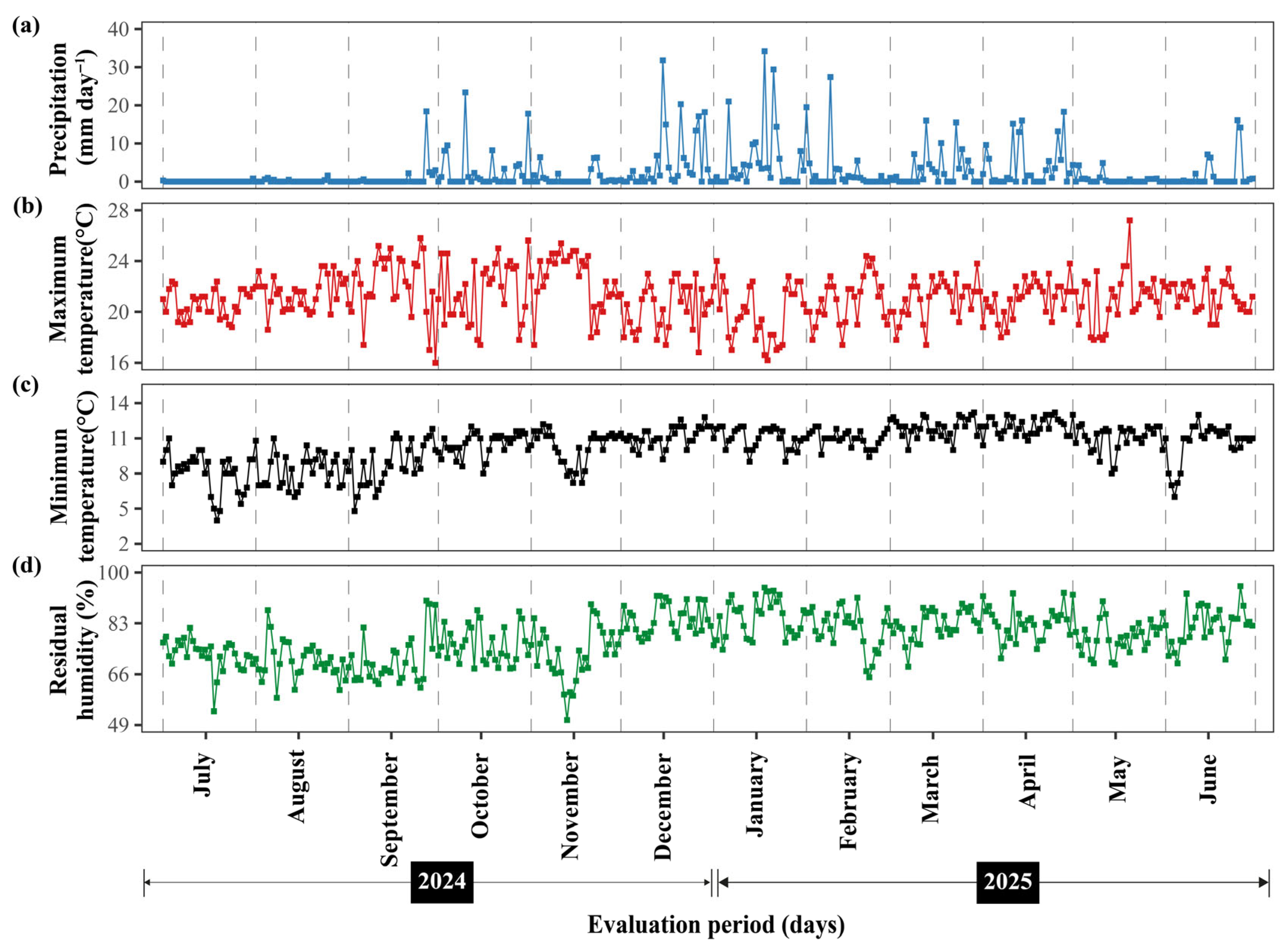
One of the main limitations of this study is that it was conducted during a single annual cycle (July 2024 to June 2025) and at a single location, so the consistency of the trends observed could vary in years with different precipitation patterns or at sites with different Andean elevations. In addition, the evaluation was restricted to four cuts, so longer trials are required to corroborate the stability of each accession over time. Furthermore, the forage was evaluated only as raw material, without considering its behavior during the silage process, which highlights the need for additional studies that include the preparation and evaluation of silage to more accurately quantify its contribution to quality. Taken together, these results constitute a preliminary reference for the performance of local accessions under the agroecological conditions evaluated in the Tropical Andes and lay the foundation for future research.




 ,
,