Addressing Black Soil Compaction: An Integrated Analysis of the Mechanisms, Efficacy, and Future Directions of Conservation Tillage
 ,
,
Abstract
1. Introduction
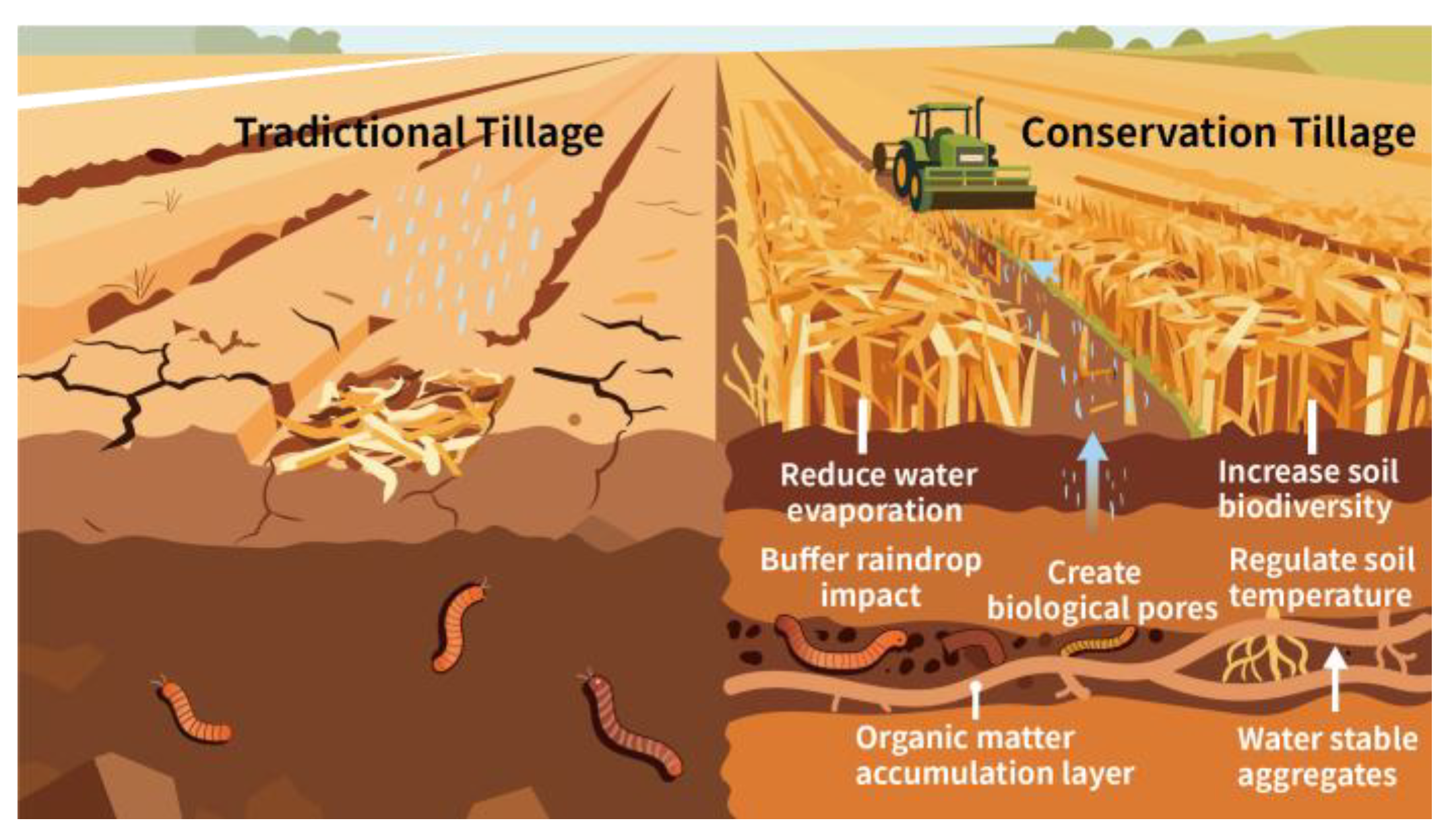
2. Conservation Tillage
2.1. Definition and Principles
2.2. Key Technical Measure
2.3. Global Status of Conservation Tillage Adoption
3. Effects of Conservation Tillage on Soil Properties
3.1. Effects of Conservation Tillage on Soil Physical Properties
3.2. Effects of Conservation Tillage on Soil Chemical Properties and Microbial Communities
3.3. The Risks Associated with Discontinuing Conservation Tillage
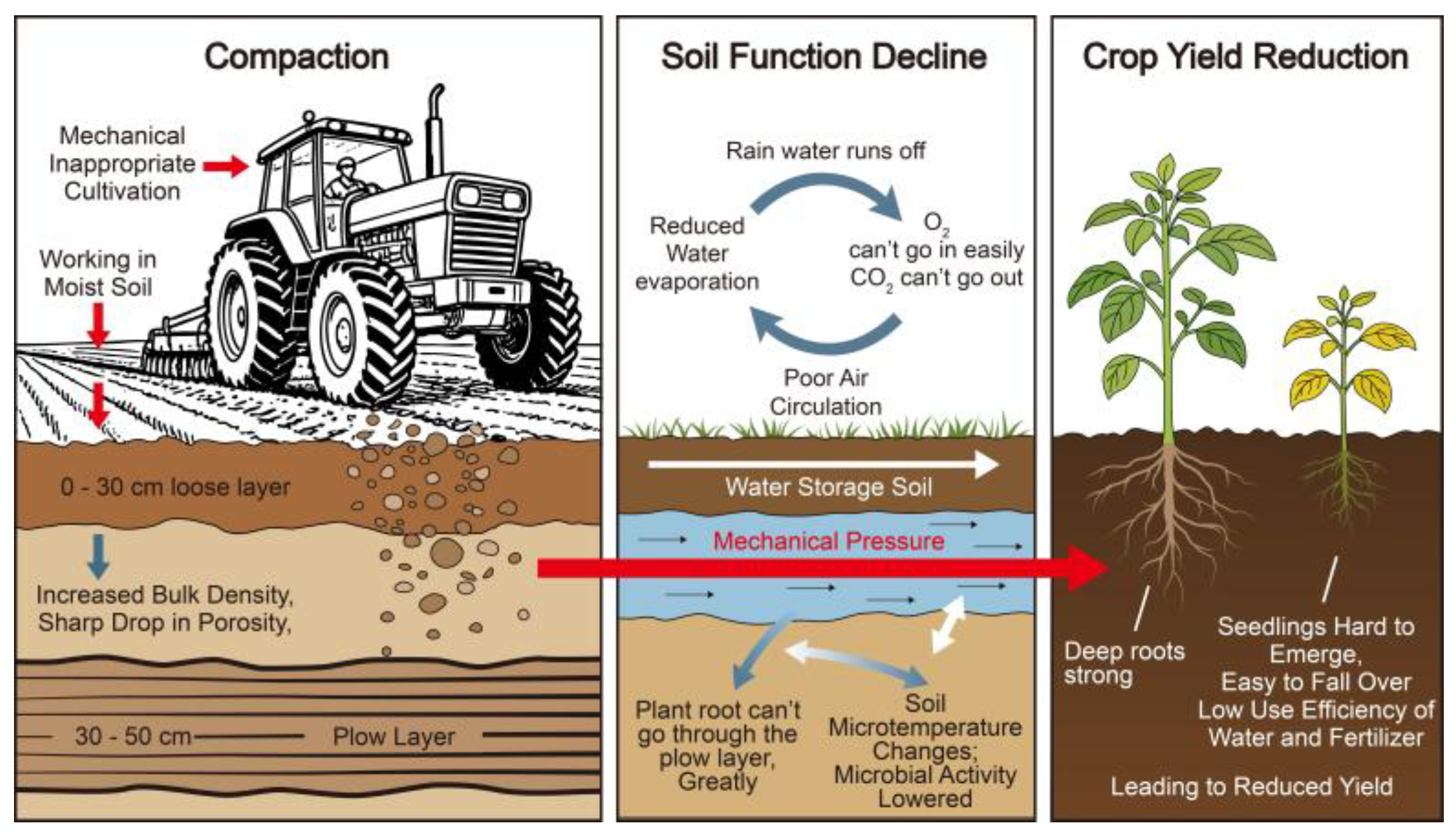
4. Concept and Causes of Soil Compaction
4.1. Definition of Soil Compaction
4.2. Origins of Soil Compaction
4.2.1. Primary Causes
4.2.2. Contributing Factors
4.2.3. Management Factors
4.2.4. Evaluation and Management of Soil Compaction
4.3. Impacts of Soil Compaction
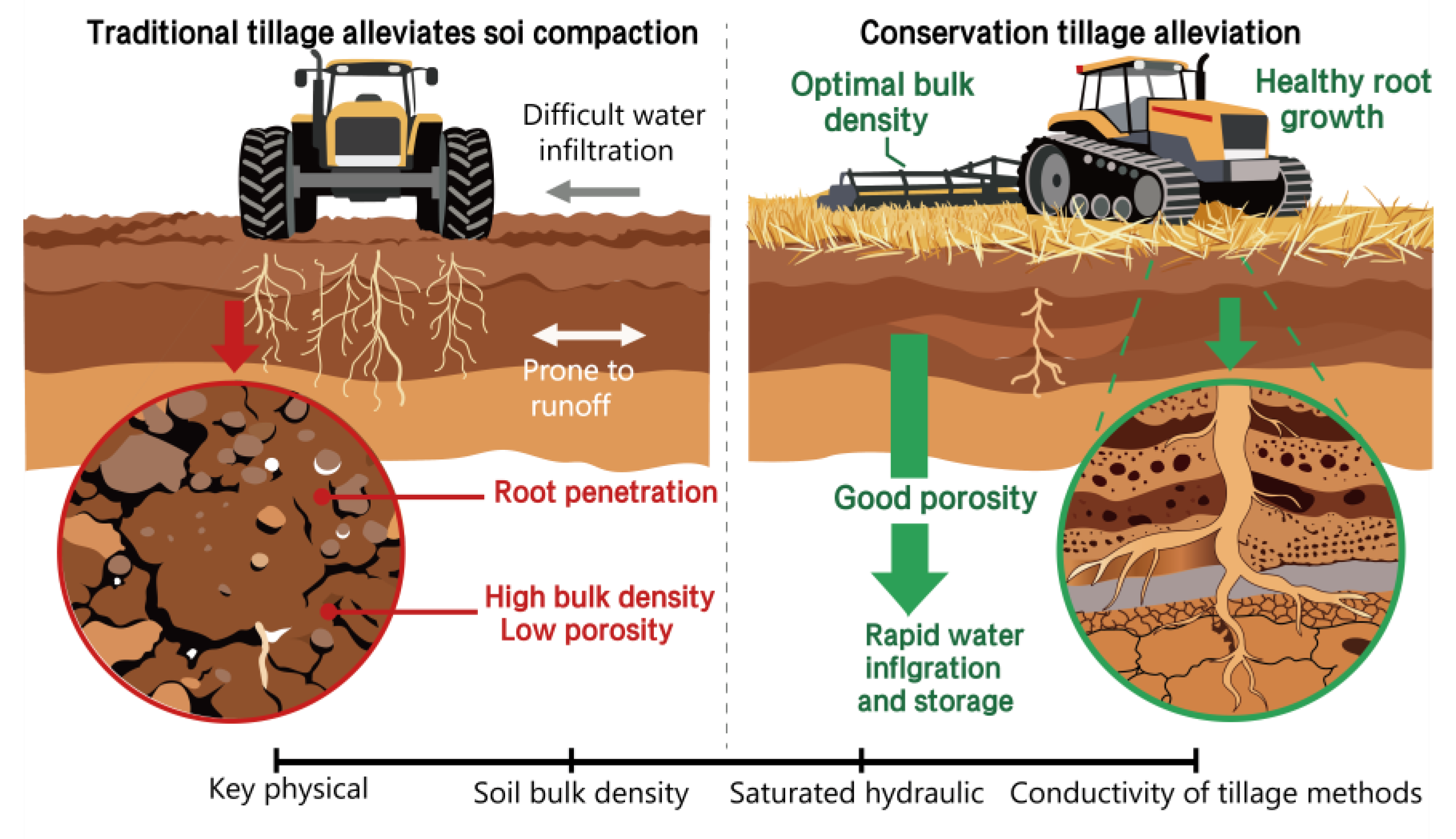
5. Conservation Tillage Mitigates Soil Compaction
6. Roles of Conservation Tillage in Climate Change Mitigation
7. Economic Benefits of Conservation Tillage
7.1. Improving Crop Yield and Quality
7.2. Production Cost Reduction
7.3. Boosting Net Farm Profit
7.4. Improving Soil Health and Securing Long-Term Benefits
7.5. Reducing Environmental Impact and Policy Support
7.6. Adaptation to Climate Change and Risk Mitigation
8. Future Trends in Conservation Tillage
8.1. Technology Perception and Farmer Behavior Change
8.2. Collaborative Mechanisms and Policy Support
8.3. Technological Innovation and Soil Health Improvement
8.4. Crop Diversity and System Optimization
8.5. Water Resource Management and Carbon Footprint Reduction
8.6. Technology Extension and Farmer Support
9. Challenges and Strategies in Promoting Conservation Tillage
9.1. Challenges in Promoting Conservation Tillage [226]
9.2. Response Strategies
10. Conclusion and Future Prospects
Author Contributions
Funding
Data Availability Statement
Acknowledgments
Conflicts of Interest
Abbreviations
| CT | Conservation tillage |
| NS | No-till with subsoiling |
| NTS | No-till combined with straw mulching |
| TT | Conventional tillage |
| WUE | Water use efficiency |
| NT | No tillage |
| MT | Minimum tillage |
| RT | Reduced tillage |
| CAP | Common Agricultural Policy |
| SOC | Soil organic carbon |
| LAI | Leaf area index |
| SS | Subsoiling |
| K | Potassium |
| Ca | Calcium |
| Mg | Magnesium |
| P | Phosphorus |
| Zn | Zinc |
| TN | Total nitrogen |
| TP | Total phosphorus |
| TK | Total potassium |
| AP | Available phosphorus |
| AMF | Arbuscular mycorrhizal fungi |
| Cu | Copper |
| Fe | Iron |
| Mn | Manganese |
| CUE | Carbon use efficiency |
| GHGI | Greenhouse gas intensity |
| σ_pc | Pre-consolidation Pressure |
| σ_Z | Vertical Stress Propagation |
| NPT | Non-Pneumatic Tires |
| SST | Strip Soil Tillage |
| CTF | Controlled Traffic Farming |
| EWMA | Exponential Weighted Moving Average |
References
- Xu, X.Z.; Xu, Y.; Chen, S.C.; Xu, S.G.; Zhang, H.W. Soil loss and conservation in the black soil region of Northeast China: A retrospective study. Environ. Sci. Policy 2010, 13, 793–800. [Google Scholar] [CrossRef] [Scilit]
- Li, R.; Hu, W.; Jia, Z.; Liu, H.; Zhang, C.; Huang, B.; Yang, S.; Zhao, Y.; Zhao, Y.; Shukla, M.K.; et al. Soil degradation: A global threat to sustainable use of black soils. Pedosphere 2025, 35, 264–279. [Google Scholar] [CrossRef] [Scilit]
- Lei, G.; Dai, L.; Song, G. Evaluation of soil ecological environment quality of typical black soils in Heilongjiang Province. Trans. Chin. Soc. Agric. Eng. 2009, 25, 243–248. [Google Scholar]
- Zhao, G.; Deng, Z.; Liu, C. Assessment of the Coupling Degree between Agricultural Modernization and the Coordinated Development of Black Soil Protection and Utilization: A Case Study of Heilongjiang Province. Land 2024, 13, 288. [Google Scholar] [CrossRef] [Scilit]
- Osman, K.T. Physical Properties of Soil. In Soils: Principles, Properties and Management; Osman, K.T., Ed.; Springer: Dordrecht, The Netherlands, 2013; pp. 49–65. [Google Scholar]
- Li, H.; Zhu, H.; Qiu, L.; Wei, X.; Liu, B.; Shao, M. Response of soil OC, N and P to land-use change and erosion in the black soil region of the Northeast China. Agric. Ecosyst. Environ. 2020, 302, 107081. [Google Scholar] [CrossRef] [Scilit]
- Gu, Z.; Xie, Y.; Gao, Y.; Ren, X.; Cheng, C.; Wang, S. Quantitative assessment of soil productivity and predicted impacts of water erosion in the black soil region of northeastern China. Sci. Total Environ. 2018, 637–638, 706–716. [Google Scholar] [CrossRef] [Scilit]
- Wen, D.; Liang, W. Soil Fertility Quality and Agricultural Sustainable Development in the Black Soil Region of Northeast China. Environ. Dev. Sustain. 2001, 3, 31–43. [Google Scholar] [CrossRef] [Scilit]
- Yan, Y.; Kuang, W.; Zhang, C.; Chen, C. Impacts of impervious surface expansion on soil organic carbon—A spatially explicit study. Sci. Rep. 2015, 5, 17905. [Google Scholar] [CrossRef] [Scilit]
- Correa, J.; Postma, J.A.; Watt, M.; Wojciechowski, T. Soil compaction and the architectural plasticity of root systems. J. Exp. Bot. 2019, 70, 6019–6034. [Google Scholar] [CrossRef] [Scilit]
- Stoessel, F.; Sonderegger, T.; Bayer, P.; Hellweg, S. Assessing the environmental impacts of soil compaction in Life Cycle Assessment. Sci. Total Environ. 2018, 630, 913–921. [Google Scholar] [CrossRef] [Scilit]
- Taylor, H.M.; Roberson, G.M.; Parker, J.J.J. Soil Strength-Root Penetration Relations for Medium- to Coarse-Textured Soil Materials. Soil Sci. 1966, 102, 18–22. [Google Scholar] [CrossRef] [Scilit]
- McKyes, E. Soil Cutting and Tillage; Elsevier: Amsterdam, The Netherlands, 1985; Volume 7. [Google Scholar]
- Heisler, C.; Kaiser, E.-A. Influence of agricultural traffic and crop management on collembola and microbial biomass in arable soil. Biol. Fertil. Soils 1995, 19, 159–165. [Google Scholar] [CrossRef] [Scilit]
- Xu, S. Temporal and Spatial Characteristics of the Change of Cultivated Land Resources in the Black Soil Region of Heilongjiang Province (China). Sustainability 2019, 11, 38. [Google Scholar] [CrossRef] [Scilit]
- Filimonenko, E.; Liu, Z.; Wang, Z.; Shen, Y.; Sushko, S.; Belyanovskaya, A.; Gorbov, S.; Liu, S.; Alotaibi, K.D.; Yang, Q.; et al. Long-term conservation tillage and straw return affect thermal stability of soil organic matter. Sci. Total Environ. 2025, 991, 179934. [Google Scholar] [CrossRef] [Scilit]
- Franzluebbers, A.J. Soil organic matter stratification ratio as an indicator of soil quality. Soil Tillage Res. 2002, 66, 95–106. [Google Scholar] [CrossRef] [Scilit]
- Pittelkow, C.M.; Liang, X.; Linquist, B.A.; van Groenigen, K.J.; Lee, J.; Lundy, M.E.; van Gestel, N.; Six, J.; Venterea, R.T.; van Kessel, C. Productivity limits and potentials of the principles of conservation agriculture. Nature 2015, 517, 365–368. [Google Scholar] [CrossRef] [Scilit]
- Naveed, M.; Moldrup, P.; Vogel, H.-J.; Lamandé, M.; Wildenschild, D.; Tuller, M.; de Jonge, L.W. Impact of long-term fertilization practice on soil structure evolution. Geoderma 2014, 217–218, 181–189. [Google Scholar] [CrossRef] [Scilit]
- Tang, Z.; Song, W.; Zou, J. Farmland protection and fertilization intensity: Empirical evidence from preservation policy of Heilongjiang’s black soil. J. Environ. Manag. 2024, 356, 120629. [Google Scholar] [CrossRef] [Scilit]
- Liang, X.; Rehman, S.U.; Zhiqi, W.; Raza, M.A.; Haider, I.; Khalid, M.H.B.; Saeed, A.; Iqbal, Z.; Fatima, S.; Siddiqa, A.; et al. Impacts of Conservation Tillage on Agricultural Land Development: A Review. J. Soil Sci. Plant Nutr. 2025, 25, 428–449. [Google Scholar] [CrossRef] [Scilit]
- Sarkar, S.; Skalicky, M.; Hossain, A.; Brestic, M.; Saha, S.; Garai, S.; Ray, K.; Brahmachari, K. Management of Crop Residues for Improving Input Use Efficiency and Agricultural Sustainability. Sustainability 2020, 12, 9808. [Google Scholar] [CrossRef] [Scilit]
- USDA Natural Resources Conservation Service. The PLANTS Database; USDA Natural Resources Conservation Service: Washington, DC, USA, 2020; Volume 3. [Google Scholar]
- Mekouar, M.A. Food and Agriculture Organization of the United Nations (FAO). Yearb. Int. Environ. Law 2023, 34, yvae031. [Google Scholar] [CrossRef] [Scilit]
- Bossange, A.V.; Knudson, K.M.; Shrestha, A.; Harben, R.; Mitchell, J.P. The Potential for Conservation Tillage Adoption in the San Joaquin Valley, California: A Qualitative Study of Farmer Perspectives and Opportunities for Extension. PLoS ONE 2016, 11, e0167612. [Google Scholar] [CrossRef] [Scilit]
- Alhassan, A.-R.M.; Yang, C.; Ma, W.; Li, G. Influence of conservation tillage on Greenhouse gas fluxes and crop productivity in spring-wheat agroecosystems on the Loess Plateau of China. PeerJ 2021, 9, e11064. [Google Scholar] [CrossRef] [Scilit] [PubMed]
- Xiao, L.; Kuhn, N.J.; Zhao, R.; Cao, L. Net effects of conservation agriculture principles on sustainable land use: A synthesis. Glob. Change Biol. 2021, 27, 6321–6330. [Google Scholar] [CrossRef] [Scilit]
- Tim Chamen, W.C.; Moxey, A.P.; Towers, W.; Balana, B.; Hallett, P.D. Mitigating arable soil compaction: A review and analysis of available cost and benefit data. Soil Tillage Res. 2015, 146, 10–25. [Google Scholar] [CrossRef] [Scilit]
- Busari, M.A.; Kukal, S.S.; Kaur, A.; Bhatt, R.; Dulazi, A.A. Conservation tillage impacts on soil, crop and the environment. Int. Soil Water Conserv. Res. 2015, 3, 119–129. [Google Scholar] [CrossRef] [Scilit]
- Tiessen, K.; Elliott, J.A.; Yarotski, J.; Lobb, D.; Flaten, D.; Glozier, N. Conventional and conservation tillage: Influence on seasonal runoff, sediment, and nutrient losses in the Canadian prairies. J. Environ. Qual. 2010, 39, 964–980. [Google Scholar] [CrossRef] [Scilit]
- Yuan, L.; Li, J.; Lei, N.; Lu, C.; Chen, X.; Xie, H.; Zhang, J.; Müller, C.; He, H.; Zhang, X. High leaching potential combined with a low leaching amount of fertilizer-derived nitrate in conservation tillage cropland of Northeast China. Sci. Total Environ. 2024, 915, 170020. [Google Scholar] [CrossRef] [Scilit]
- Potter, T.L.; Gerstl, Z.; White, P.W.; Cutts, G.S.; Webster, T.M.; Truman, C.C.; Strickland, T.C.; Bosch, D.D. Fate and Efficacy of Metolachlor Granular and Emulsifiable Concentrate Formulations in a Conservation Tillage System. J. Agric. Food Chem. 2010, 58, 10590–10596. [Google Scholar] [CrossRef] [Scilit]
- Adil, M.; Zhang, S.; Wang, J.; Shah, A.N.; Tanveer, M.; Fiaz, S. Effects of Fallow Management Practices on Soil Water, Crop Yield and Water Use Efficiency in Winter Wheat Monoculture System: A Meta-Analysis. Front. Plant Sci. 2022, 13, 825309. [Google Scholar] [CrossRef] [Scilit]
- Ugrenović, V.; Filipović, V.; Miladinović, V.; Simić, D.; Janković, S.; Stanković, S.; Saljnikov, E. How Do Mixed Cover Crops (White Mustard + Oats) Contribute to Labile Carbon Pools in an Organic Cropping System in Serbia? Plants 2024, 13, 1020. [Google Scholar] [CrossRef] [Scilit]
- Wang, P.; Kuzyakov, Y.; Wang, Y.; Liu, Y.; Liu, J.; Qi, Z.; He, Y.; Jiang, Q. Quantifying microbial necromass contributions to soil carbon sequestration under diverse cropland management practices: A meta-analysis. J. Environ. Manag. 2025, 388, 126008. [Google Scholar] [CrossRef] [Scilit] [PubMed]
- Chandra, M.S.; Naresh, R.K.; Bhatt, R.; Kadam, P.V.; Siddiqui, M.H.; Gaafar, A.-R.Z.; Atikur Rahman, M. Conservation tillage and fertiliser management strategies impact on basmati rice (Oryza sativa L): Crop performance, crop water productivity, nutrient uptake and fertility status of the soil under rice-wheat cropping system. PeerJ 2023, 11, e16271. [Google Scholar] [CrossRef] [Scilit] [PubMed]
- Bai, H.; Xiao, D.; Liu, D.L.; Tao, F.; Liu, F.; Tang, J. Impacts of future climate change and management practices to yield, eco-efficiency and global warming potential for rice–wheat rotation system. J. Sci. Food Agric. 2025, 105, 6138–6150. [Google Scholar] [CrossRef] [Scilit] [PubMed]
- Luo, B.; Zhou, J.; Yao, W.; Wang, Y.; Guillaume, T.; Yuan, M.; Han, D.; Bilyera, N.; Wang, L.; Zhao, L.; et al. Maize and soybean rotation benefits soil quality and organic carbon stock. J. Environ. Manag. 2024, 372, 123352. [Google Scholar] [CrossRef] [Scilit]
- Allmaras, R.R.; Dowdy, R.H. Conservation tillage systems and their adoption in the United States. Soil Tillage Res. 1985, 5, 197–222. [Google Scholar] [CrossRef] [Scilit]
- Awada, L.; Lindwall, C.W.; Sonntag, B. The development and adoption of conservation tillage systems on the Canadian Prairies. Int. Soil Water Conserv. Res. 2014, 2, 47–65. [Google Scholar] [CrossRef] [Scilit]
- Fuentes-Llanillo, R.; Telles, T.S.; Soares Junior, D.; de Melo, T.R.; Friedrich, T.; Kassam, A. Expansion of no-tillage practice in conservation agriculture in Brazil. Soil Tillage Res. 2021, 208, 104877. [Google Scholar] [CrossRef] [Scilit]
- Díaz-Zorita, M.; Duarte, G.A.; Grove, J.H. A review of no-till systems and soil management for sustainable crop production in the subhumid and semiarid Pampas of Argentina. Soil Tillage Res. 2002, 65, 1–18. [Google Scholar] [CrossRef] [Scilit]
- Derpsch, R. No-tillage and conservation agriculture: A progress report. No-Till Farming Syst. Spec. Publ. 2008, 3, 7–39. [Google Scholar]
- Peigné, J.; Casagrande, M.; Payet, V.; David, C.; Sans, F.X.; Blanco-Moreno, J.M.; Cooper, J.; Gascoyne, K.; Antichi, D.; Bàrberi, P.; et al. How organic farmers practice conservation agriculture in Europe. Renew. Agric. Food Syst. 2016, 31, 72–85. [Google Scholar] [CrossRef] [Scilit]
- Somasundaram, J.; Sinha, N.K.; Dalal, R.C.; Lal, R.; Mohanty, M.; Naorem, A.K.; Hati, K.M.; Chaudhary, R.S.; Biswas, A.K.; Patra, A.K.; et al. No-Till Farming and Conservation Agriculture in South Asia—Issues, Challenges, Prospects and Benefits. Crit. Rev. Plant Sci. 2020, 39, 236–279. [Google Scholar] [CrossRef] [Scilit]
- Liu, X.; Zhang, S.; Zhang, X.; Ding, G.; Cruse, R.M. Soil erosion control practices in Northeast China: A mini-review. Soil Tillage Res. 2011, 117, 44–48. [Google Scholar] [CrossRef] [Scilit]
- Ito, M.; Matsumoto, T.; Quinones, M.A. Conservation tillage practice in sub-Saharan Africa: The experience of Sasakawa Global 2000. Crop Prot. 2007, 26, 417–423. [Google Scholar] [CrossRef] [Scilit]
- Diop, M.; Chirinda, N.; Beniaich, A.; El Gharous, M.; El Mejahed, K. Soil and Water Conservation in Africa: State of Play and Potential Role in Tackling Soil Degradation and Building Soil Health in Agricultural Lands. Sustainability 2022, 14, 13425. [Google Scholar] [CrossRef] [Scilit]
- Nachimuthu, G.; Webb, A.A. On-farm soil conservation measures in cotton farming systems of Australia: A sustainability analysis. J. Soil Water Conserv. 2016, 71, 75A–80A. [Google Scholar] [CrossRef] [Scilit]
- D’Emden, F.H.; Llewellyn, R.S.; Burton, M.P. Adoption of conservation tillage in Australian cropping regions: An application of duration analysis. Technol. Forecast. Soc. Change 2006, 73, 630–647. [Google Scholar] [CrossRef] [Scilit]
- Hussain, S.; Hussain, S.; Guo, R.; Sarwar, M.; Ren, X.; Krstic, D.; Aslam, Z.; Zulifqar, U.; Rauf, A.; Hano, C.; et al. Carbon Sequestration to Avoid Soil Degradation: A Review on the Role of Conservation Tillage. Plants 2021, 10, 2001. [Google Scholar] [CrossRef] [Scilit]
- de Oliveira Ferreira, A.; de Moraes Sá, J.C.; Lal, R.; Tivet, F.; Briedis, C.; Inagaki, T.M.; Gonçalves, D.R.P.; Romaniw, J. Macroaggregation and soil organic carbon restoration in a highly weathered Brazilian Oxisol after two decades under no-till. Sci. Total Environ. 2018, 621, 1559–1567. [Google Scholar] [CrossRef] [Scilit]
- Carmeis Filho, A.C.A.; Crusciol, C.A.C.; Guimarães, T.M.; Calonego, J.C.; Mooney, S.J. Impact of Amendments on the Physical Properties of Soil under Tropical Long-Term No Till Conditions. PLoS ONE 2016, 11, e0167564. [Google Scholar] [CrossRef] [Scilit]
- Li, J.; Wang, Y.-K.; Guo, Z.; Li, J.-B.; Tian, C.; Hua, D.-W.; Shi, C.-D.; Wang, H.-Y.; Han, J.-C.; Xu, Y. Effects of Conservation Tillage on Soil Physicochemical Properties and Crop Yield in an Arid Loess Plateau, China. Sci. Rep. 2020, 10, 4716. [Google Scholar] [CrossRef] [Scilit] [PubMed]
- Lin, J.S.; Sarto, M.V.M.; Carter, T.L.; Peterson, D.E.; Gura, C.; Mino, L.; Rohrs, M.; Lucas, H.; Clark, J.; Rice, C.W. Soil organic carbon, aggregation and fungi community after 44 years of no-till and cropping systems in the Central Great Plains, USA. Arch. Microbiol. 2023, 205, 84. [Google Scholar] [CrossRef] [Scilit] [PubMed]
- Zhao, X.; He, C.; Liu, W.S.; Liu, W.X.; Liu, Q.Y.; Bai, W.; Li, L.J.; Lal, R.; Zhang, H.L. Responses of soil pH to no-till and the factors affecting it: A global meta-analysis. Glob. Change Biol. 2022, 28, 154–166. [Google Scholar] [CrossRef] [Scilit] [PubMed]
- Xu, J.M.; Tang, C.; Chen, Z.L. The role of plant residues in pH change of acid soils differing in initial pH. Soil Biol. Biochem. 2006, 38, 709–719. [Google Scholar] [CrossRef] [Scilit]
- Schroder, J.L.; Zhang, H.; Girma, K.; Raun, W.R.; Penn, C.J.; Payton, M.E. Soil Acidification from Long-Term Use of Nitrogen Fertilizers on Winter Wheat. Soil Sci. Soc. Am. J. 2011, 75, 957–964. [Google Scholar] [CrossRef] [Scilit]
- Engell, I.; Linsler, D.; Sandor, M.; Joergensen, R.G.; Meinen, C.; Potthoff, M. The Effects of Conservation Tillage on Chemical and Microbial Soil Parameters at Four Sites across Europe. Plants 2022, 11, 1747. [Google Scholar] [CrossRef] [Scilit]
- Wu, Y.-H.; Tian, X.-H.; Chi, W.-B.; Nan, X.-X.; Yan, X.-L.; Zhu, R.-X.; Tong, Y.-A. Numerical evaluation of soil quality under different conservation tillage patterns. Chin. J. Appl. Ecol. Yingyong Shengtai Xuebao 2010, 21, 1468–1476. [Google Scholar]
- Pramanick, B.; Kumar, M.; Naik, B.M.; Singh, S.K.; Kumar, M.; Singh, S.V. Soil carbon-nutrient cycling, energetics, and carbon footprint in calcareous soils with adoption of long-term conservation tillage practices and cropping systems diversification. Sci. Total Environ. 2024, 912, 169421. [Google Scholar] [CrossRef] [Scilit]
- Hu, X.; Liu, J.; Liang, A.; Li, L.; Yao, Q.; Yu, Z.; Li, Y.; Jin, J.; Liu, X.; Wang, G. Conventional and conservation tillage practices affect soil microbial co-occurrence patterns and are associated with crop yields. Agric. Ecosyst. Environ. 2021, 319, 107534. [Google Scholar] [CrossRef] [Scilit]
- Nandan, R.; Singh, V.; Singh, S.S.; Kumar, V.; Hazra, K.K.; Nath, C.P.; Poonia, S.; Malik, R.K.; Bhattacharyya, R.; McDonald, A. Impact of conservation tillage in rice–based cropping systems on soil aggregation, carbon pools and nutrients. Geoderma 2019, 340, 104–114. [Google Scholar] [CrossRef] [Scilit]
- Li, J.; Niu, Z.; Guo, Z.; Li, J.; Ye, S.; Hua, D. Improving soil water dynamics and crop productivity through conservation tillage in arid regions. Sci. Rep. 2025, 15, 25242. [Google Scholar] [CrossRef] [Scilit]
- Kan, Z.R.; Liu, W.X.; Liu, W.S.; Lal, R.; Dang, Y.P.; Zhao, X.; Zhang, H.L. Mechanisms of soil organic carbon stability and its response to no-till: A global synthesis and perspective. Glob. Change Biol. 2022, 28, 693–710. [Google Scholar] [CrossRef] [Scilit]
- Ding, J.L.; Wei, H.Y.; Yang, Y.H.; Zhang, J.M.; Wu, J.C. Effects of conservation tillage on soil water condition and winter wheat yield in farmland. Yingyong Shengtai Xuebao 2018, 29, 2501–2508. [Google Scholar] [PubMed]
- Schomberg, H.H.; White, K.E.; Thompson, A.I.; Mirsky, S.B. Data quantifying interseeded cover crops effects on soil water and corn productivity in corn-soybean-wheat no-till cropping systems. Data Brief 2023, 50, 109465. [Google Scholar] [CrossRef] [Scilit] [PubMed]
- Kaur, H.; Nelson, K.A.; Singh, G.; Kaur, G.; Davis, M.P. Spring applied phosphorus loss with cover crops in no-till terraced field. J. Environ. Manag. 2024, 355, 120431. [Google Scholar] [CrossRef] [Scilit] [PubMed]
- Shakoor, A.; Shahbaz, M.; Farooq, T.H.; Sahar, N.E.; Shahzad, S.M.; Altaf, M.M.; Ashraf, M. A global meta-analysis of greenhouse gases emission and crop yield under no-tillage as compared to conventional tillage. Sci. Total Environ. 2021, 750, 142299. [Google Scholar] [CrossRef] [Scilit]
- Li, Z.; Zhang, Q.; Li, Z.; Qiao, Y.; Du, K.; Tian, C.; Zhu, N.; Leng, P.; Yue, Z.; Cheng, H.; et al. Effects of no-tillage on greenhouse gas emissions in maize fields in a semi-humid temperate climate region. Environ. Pollut. 2022, 309, 119747. [Google Scholar] [CrossRef] [Scilit]
- van Kessel, C.; Venterea, R.; Six, J.; Adviento-Borbe, M.A.; Linquist, B.; van Groenigen, K.J. Climate, duration, and N placement determine N2O emissions in reduced tillage systems: A meta-analysis. Glob. Change Biol. 2013, 19, 33–44. [Google Scholar] [CrossRef] [Scilit]
- Nayak, A.K.; Rahman, M.M.; Naidu, R.; Dhal, B.; Swain, C.K.; Nayak, A.D.; Tripathi, R.; Shahid, M.; Islam, M.R.; Pathak, H. Current and emerging methodologies for estimating carbon sequestration in agricultural soils: A review. Sci. Total Environ. 2019, 665, 890–912. [Google Scholar] [CrossRef] [Scilit]
- Zhao, J.; Hu, Y.; Wang, J.; Gao, W.; Liu, D.; Yang, M.; Chen, X.; Xie, H.; He, H.; Zhang, X.; et al. Greenhouse gas emissions from the growing season are regulated by precipitation events in conservation tillage farmland ecosystems of Northeast China. Sci. Total Environ. 2024, 948, 174716. [Google Scholar] [CrossRef] [Scilit]
- Shakoor, A.; Xu, Y.; Wang, Q.; Chen, N.; He, F.; Zuo, H.; Yin, H.; Yan, X.; Ma, Y.; Yang, S. Effects of fertilizer application schemes and soil environmental factors on nitrous oxide emission fluxes in a rice-wheat cropping system, east China. PLoS ONE 2018, 13, e0202016. [Google Scholar] [CrossRef] [Scilit]
- Almaraz, J.J.; Zhou, X.; Mabood, F.; Madramootoo, C.; Rochette, P.; Ma, B.-L.; Smith, D.L. Greenhouse gas fluxes associated with soybean production under two tillage systems in southwestern Quebec. Soil Tillage Res. 2009, 104, 134–139. [Google Scholar] [CrossRef] [Scilit]
- Canadell, J.G.; Schulze, E.D. Global potential of biospheric carbon management for climate mitigation. Nat. Commun. 2014, 5, 5282. [Google Scholar] [CrossRef] [Scilit] [PubMed]
- Bayer, C.; Gomes, J.; Vieira, F.C.B.; Zanatta, J.A.; de Cássia Piccolo, M.; Dieckow, J. Methane emission from soil under long-term no-till cropping systems. Soil Tillage Res. 2012, 124, 1–7. [Google Scholar] [CrossRef] [Scilit]
- Plaza-Bonilla, D.; Cantero-Martínez, C.; Viñas, P.; Álvaro-Fuentes, J. Soil aggregation and organic carbon protection in a no-tillage chronosequence under Mediterranean conditions. Geoderma 2013, 193–194, 76–82. [Google Scholar] [CrossRef] [Scilit]
- Peng, Z.K.; Li, L.L.; Xie, J.H.; Kang, C.R.; Wang, J.B.; Xie, J.H.; Shen, J.C. Effects of conservational tillage on water characteristics in dryland farm of central Gansu, Northwest China. Yingyong Shengtai Xuebao 2018, 29, 4022–4028. [Google Scholar]
- Fatumah, N.; Tilahun, S.A.; Mohammed, S. Water use efficiency, grain yield, and economic benefits of common beans (Phaseolus vulgaris L.) under four soil tillage systems in Mukono District, Uganda. Heliyon 2021, 7, e06308. [Google Scholar] [CrossRef] [Scilit]
- Pulighe, G.; Belocchi, A.; Tani, A.C.; Lupia, F. Impacts of agricultural management practices on water cycle, soil erosion and crop yields in a Mediterranean agroecosystem. Sci. Total Environ. 2025, 995, 180111. [Google Scholar] [CrossRef] [Scilit]
- Ren, J.; Feng, P.; Batchelor, W.D.; Hu, K.; Liu, H.; Lv, S. Ground Cover Rice Production System Affects Soil Water, Nitrogen Dynamics and Crop Growth Differentially with or without Climate Stress. Plants 2023, 12, 3866. [Google Scholar] [CrossRef] [Scilit]
- Zhang, R.; Li, P.Z.; Wang, L. Relationship between soil moisture dynamics, crop growth and precipitation in rain-fed area of the Loess Tableland, China. Ying Yong Sheng Tai Xue Bao 2019, 30, 359–369. [Google Scholar] [CrossRef]
- Tripathi, I.M.; Mahto, S.S.; Kushwaha, A.P.; Kumar, R.; Tiwari, A.D.; Sahu, B.K.; Jain, V.; Mohapatra, P.K. Dominance of soil moisture over aridity in explaining vegetation greenness across global drylands. Sci. Total Environ. 2024, 917, 170482. [Google Scholar] [CrossRef] [Scilit] [PubMed]
- Ibrahim, G.R.F.; Rasul, A.; Abdullah, H. Assessing how irrigation practices and soil moisture affect crop growth through monitoring Sentinel-1 and Sentinel-2 data. Environ. Monit. Assess. 2023, 195, 1262. [Google Scholar] [CrossRef] [Scilit] [PubMed]
- Adla, S.; Bruckmaier, F.; Arias-Rodriguez, L.F.; Tripathi, S.; Pande, S.; Disse, M. Impact of calibrating a low-cost capacitance-based soil moisture sensor on AquaCrop model performance. J. Environ. Manag. 2024, 353, 120248. [Google Scholar] [CrossRef] [Scilit] [PubMed]
- Li, Y.; Zhang, Q.; Cai, Y.; Yang, Q.; Chang, S.X. Minimum tillage and residue retention increase soil microbial population size and diversity: Implications for conservation tillage. Sci. Total Environ. 2020, 716, 137164. [Google Scholar] [CrossRef] [Scilit]
- Hu, N.; Lou, Y.-L.; Zhang, X.-K.; Liang, W.-J.; Liang, L. Effects of conservation tillage on the composition of soil exchangeable base. Ying Yong Sheng Tai Xue Bao 2010, 21, 1492–1496. [Google Scholar]
- Neugschwandtner, R.W.; Száková, J.; Pachtrog, V.; Tlustoš, P.; Kulhánek, M.; Černý, J.; Kaul, H.-P.; Wagentristl, H.; Moitzi, G.; Euteneuer, P. Exchangeable and Plant-Available Macronutrients in a Long-Term Tillage and Crop Rotation Experiment after 15 Years. Plants 2022, 11, 565. [Google Scholar] [CrossRef] [Scilit]
- Cai, L.; Guo, Z.; Zhang, J.; Gai, Z.; Liu, J.; Meng, Q.; Liu, X. No tillage and residue mulching method on bacterial community diversity regulation in a black soil region of Northeastern China. PLoS ONE 2021, 16, e0256970. [Google Scholar] [CrossRef] [Scilit]
- Zhang, P.; Li, H.; Jia, Z.K.; Wang, W.; Lu, W.T.; Zhang, H.; Yang, B.P. Effects of straw returning to field on soil organic carbon and carbon mineralization in semi-arid areas of southern Ningxia of China. J. Agro-Environ. Sci. 2011, 30, 2518–2525. [Google Scholar]
- Moraru, P.I.; Rusu, T. Soil tillage conservation and its effect on soil organic matter, water management and carbon sequestration. J. Food Agric. Environ. 2010, 8, 309–312. [Google Scholar]
- Sun, F.-X.; Zhang, W.-H.; Xu, M.-G.; Zhang, W.-J.; Li, Z.-Q.; Zhang, J.-Y. Effects of longterm fertilization on microbial biomass carbon and nitrogen and on carbon source utilization of microbes in a red soil. Chin. J. Appl. Ecol. Yingyong Shengtai Xuebao 2010, 21, 2792–2798. [Google Scholar]
- Liu, Y.H.; Wang, S.L.; Li, J.P.; Qin, D.L.; Zhang, M.L.; Nie, J.J.; Mao, L.L.; Song, X.L.; Sun, X.Z. Effects of cotton straw returning on soil available nutrients and microbial characteristics. Acta Agron. Sin. 2016, 42, 1037–1046. [Google Scholar] [CrossRef] [Scilit]
- He, J.; Li, X.; Wei, Y. Effects of long-term deep tillage and straw return with biochar addition to lime concretion black soil on the aggregates and wheat-maize yield. Trans. Chin. Soc. Agric. Eng. 2024, 40, 161–171. [Google Scholar]
- Hao, X.; Yang, C.; Yuan, Y.; Han, X.; Li, L.; Jiang, H. Effects of Continuous Straw Returning on Organic Carbon Content in Aggregates and Fertility of Black Soil. Chin. Agric. Sci. Bull. 2013, 29, 263–269. [Google Scholar]
- Qi, J.-Y.; Jing, Z.-H.; He, C.; Liu, Q.-Y.; Wang, X.; Kan, Z.-R.; Zhao, X.; Xiao, X.-P.; Zhang, H.-L. Effects of tillage management on soil carbon decomposition and its relationship with soil chemistry properties in rice paddy fields. J. Environ. Manag. 2021, 279, 111595. [Google Scholar] [CrossRef] [Scilit] [PubMed]
- Wang, H.; Yang, Q.; Wang, S. Metagenomic insights into the impact of tillage practices on soil nutrient cycling and wheat yield. Sci. Total Environ. 2025, 978, 179427. [Google Scholar] [CrossRef] [Scilit]
- Farhangi-Abriz, S.; Ghassemi-Golezani, K.; Torabian, S. A short-term study of soil microbial activities and soybean productivity under tillage systems with low soil organic matter. Appl. Soil Ecol. 2021, 168, 104122. [Google Scholar] [CrossRef] [Scilit]
- Tang, H.; Li, C.; Cheng, K.; Shi, L.; Wen, L.; Li, W.; Xiao, X. Effects of different tillage management on rhizosphere soil nitrogen mineralization and its extracellular enzyme activity in a double-cropping rice paddy field of southern China. Land Degrad. Dev. 2021, 32, 4933–4943. [Google Scholar] [CrossRef] [Scilit]
- Micenková, L.; Sedláček, I.; Hrbáček, F.; Švec, P.; Nývlt, D.; Pantůček, R.; Mašlaňová, I. Effect of soil depth on the structure of bacterial composition in the active layer at five geologically distinct sites on James Ross and Vega Islands in Antarctica. Polar Biol. 2024, 47, 295–303. [Google Scholar] [CrossRef] [Scilit]
- Man, M.; Tosi, M.; Dunfield, K.E.; Hooker, D.C.; Simpson, M.J. Tillage management exerts stronger controls on soil microbial community structure and organic matter molecular composition than N fertilization. Agric. Ecosyst. Environ. 2022, 336, 108028. [Google Scholar] [CrossRef] [Scilit]
- Oliveira, E.M.; Wittwer, R.; Hartmann, M.; Keller, T.; Buchmann, N.; van der Heijden, M.G.A. Effects of conventional, organic and conservation agriculture on soil physical properties, root growth and microbial habitats in a long-term field experiment. Geoderma 2024, 447, 116927. [Google Scholar] [CrossRef] [Scilit]
- Köhl, L.; Oehl, F.; van der Heijden, M.G. Agricultural practices indirectly influence plant productivity and ecosystem services through effects on soil biota. Ecol. Appl. 2014, 24, 1842–1853. [Google Scholar] [CrossRef] [Scilit]
- Smith, C.; Blair, P.; Boyd, C.; Cody, B.; Hazel, A.; Hedrick, A.; Kathuria, H.; Khurana, P.; Kramer, B.; Muterspaw, K. Microbial community responses to soil tillage and crop rotation in a corn/soybean agroecosystem. Ecol. Evol. 2016, 6, 8075–8084. [Google Scholar] [CrossRef] [Scilit] [PubMed]
- Li, H.; Zou, Y.; Song, W.; Xin, J.; Gao, J. Effects of frequency and amount of stover mulching on the microbial community composition and structure in the endosphere and rhizosphere. Front. Microbiol. 2024, 15, 1372471. [Google Scholar] [CrossRef] [Scilit] [PubMed]
- Li, Y.-J.; Wang, H.; Zhao, J.-N.; Huangfu, C.-H.; Yang, D.-L. Effects of tillage methods on soil physicochemical properties and biological characteristics in farmland: A review. Chin. J. Appl. Ecol. Yingyong Shengtai Xuebao 2015, 26, 939–948. [Google Scholar]
- Yang, Y.-L.; Ma, X.-S.; Xie, H.-T.; Bao, X.-L.; Liang, C.; Zhu, X.-F.; He, H.-B.; Zhang, X.-D. Effects of conservation tillage on soil microbial community and the function of soil carbon cycling. Ying Yong Sheng Tai Xue Bao 2021, 32, 2675–2684. [Google Scholar] [CrossRef] [Scilit]
- Shi, Y.; Lalande, R.; Hamel, C.; Ziadi, N. Winter effect on soil microorganisms under different tillage and phosphorus management practices in eastern Canada. Can. J. Microbiol. 2015, 61, 315–326. [Google Scholar] [CrossRef] [Scilit]
- Li, J.; Jia, L.; Struik, P.C.; An, Z.; Wang, Z.; Xu, Z.; Ji, L.; Yao, Y.; Lv, J.; Zhou, T. Plant and soil responses to tillage practices change arbuscular mycorrhizal fungi populations during crop growth. Front. Microbiol. 2024, 15, 1394104. [Google Scholar] [CrossRef] [Scilit]
- Orrù, L.; Canfora, L.; Trinchera, A.; Migliore, M.; Pennelli, B.; Marcucci, A.; Farina, R.; Pinzari, F. How tillage and crop rotation change the distribution pattern of fungi. Front. Microbiol. 2021, 12, 634325. [Google Scholar] [CrossRef] [Scilit]
- Calderoli, P.A.; Collavino, M.M.; Behrends Kraemer, F.; Morrás, H.J.; Aguilar, O.M. Analysis of nifH-RNA reveals phylotypes related to Geobacter and Cyanobacteria as important functional components of the N2-fixing community depending on depth and agricultural use of soil. MicrobiologyOpen 2017, 6, e00502. [Google Scholar] [CrossRef] [Scilit]
- West, T.O.; Post, W.M. Soil organic carbon sequestration rates by tillage and crop rotation: A global data analysis. Soil Sci. Soc. Am. J. 2002, 66, 1930–1946. [Google Scholar] [CrossRef] [Scilit]
- Strickland, M.S.; Rousk, J. Considering fungal:bacterial dominance in soils—Methods, controls, and ecosystem implications. Soil Biol. Biochem. 2010, 42, 1385–1395. [Google Scholar] [CrossRef] [Scilit]
- McVay, K.; Budde, J.; Fabrizzi, K.; Mikha, M.; Rice, C.; Schlegel, A.J.; Peterson, D.; Sweeney, D.; Thompson, C. Management effects on soil physical properties in long-term tillage studies in Kansas. Soil Sci. Soc. Am. J. 2006, 70, 434–438. [Google Scholar]
- Blanco-Canqui, H.; Lal, R. No-Tillage and Soil-Profile Carbon Sequestration: An On-Farm Assessment. Soil Sci. Soc. Am. J. 2008, 72, 693–701. [Google Scholar] [CrossRef] [Scilit]
- Hamza, M.A.; Anderson, W.K. Soil compaction in cropping systems: A review of the nature, causes and possible solutions. Soil Tillage Res. 2005, 82, 121–145. [Google Scholar] [CrossRef] [Scilit]
- Keller, T.; Défossez, P.; Weisskopf, P.; Arvidsson, J.; Richard, G. SoilFlex: A model for prediction of soil stresses and soil compaction due to agricultural field traffic including a synthesis of analytical approaches. Soil Tillage Res. 2007, 93, 391–411. [Google Scholar] [CrossRef] [Scilit]
- Lavelle, P.; Decaëns, T.; Aubert, M.; Barot, S.; Blouin, M.; Bureau, F.; Margerie, P.; Mora, P.; Rossi, J.P. Soil invertebrates and ecosystem services. Eur. J. Soil Biol. 2006, 42, S3–S15. [Google Scholar] [CrossRef] [Scilit]
- Oztas, T.; Fayetorbay, F. Effect of freezing and thawing processes on soil aggregate stability. Catena 2003, 52, 1–8. [Google Scholar] [CrossRef] [Scilit]
- Jefferies, R.A.; Mackerron, D.K.L. Responses of potato genotypes to drought. II. Leaf area index, growth and yield. Ann. Appl. Biol. 1993, 122, 105–112. [Google Scholar] [CrossRef] [Scilit]
- Henry, H.A.L. Soil freeze–thaw cycle experiments: Trends, methodological weaknesses and suggested improvements. Soil Biol. Biochem. 2007, 39, 977–986. [Google Scholar] [CrossRef] [Scilit]
- Ma, Q.; Zhang, K.; Jabro, J.D.; Ren, L.; Liu, H. Freeze–thaw cycles effects on soil physical properties under different degraded conditions in Northeast China. Environ. Earth Sci. 2019, 78, 321. [Google Scholar] [CrossRef] [Scilit]
- Pikul, J.L., Jr.; Zuzel, J.F. Soil Crusting and Water Infiltration Affected by Long-Term Tillage and Residue Management. Soil Sci. Soc. Am. J. 1994, 58, 1524–1530. [Google Scholar] [CrossRef] [Scilit]
- Jabro, J.D.; Iversen, W.M.; Evans, R.G.; Allen, B.L.; Stevens, W.B. Repeated Freeze-Thaw Cycle Effects on Soil Compaction in a Clay Loam in Northeastern Montana. Soil Sci. Soc. Am. J. 2014, 78, 737–744. [Google Scholar] [CrossRef] [Scilit]
- Lebert, M.; Böken, H.; Glante, F. Soil compaction—Indicators for the assessment of harmful changes to the soil in the context of the German Federal Soil Protection Act. J. Environ. Manag. 2007, 82, 388–397. [Google Scholar] [CrossRef] [Scilit] [PubMed]
- Guimarães Júnnyor, W.d.S.; Diserens, E.; De Maria, I.C.; Araujo-Junior, C.F.; Farhate, C.V.V.; de Souza, Z.M. Prediction of soil stresses and compaction due to agricultural machines in sugarcane cultivation systems with and without crop rotation. Sci. Total Environ. 2019, 681, 424–434. [Google Scholar] [CrossRef] [Scilit] [PubMed]
- Arvidsson, J.; Keller, T. Soil stress as affected by wheel load and tyre inflation pressure. Soil Tillage Res. 2007, 96, 284–291. [Google Scholar] [CrossRef] [Scilit]
- Soane, B.D.; van Ouwerkerk, C. Soil Compaction in Crop Production; Elsevier: Amsterdam, The Netherlands, 2013; Volume 11. [Google Scholar]
- Cyganow, A.; Kłoczkow, A. Problems of soil compaction and soil erosion in Belarus. In Proceedings of the VIII International Symposium on Ecological Aspects of Plant Production Mechanization, Warszawa, Poland, 6–7 September 2001. [Google Scholar]
- Balbuena, R.H.; Terminiello, A.M.; Claverie, J.A.; Casado, J.P.; Marlats, R. Soil compaction by forestry harvester operation: Evolution of physical properties. Rev. Bras. Eng. Agric. Ambient. 2000, 4, 453–459. [Google Scholar] [CrossRef] [Scilit]
- Botta, G.G.; Jorajuría, C.D.; Draghi, T.L. Soil compaction during secondary tillage traffic. Agro-Cienc. 1999, 15, 139–144. [Google Scholar]
- Gysi, M.; Klubertanz, G.; Vulliet, L. Compaction of an Eutric Cambisol under heavy wheel traffic in Switzerland—Field data and modelling. Soil Tillage Res. 2000, 56, 117–129. [Google Scholar] [CrossRef] [Scilit]
- Hetz, E. Soil compaction potential of tractors and other heavy agricultural machines used in Chile. Agric. Mech. Asia 2001, 32, 38–42. [Google Scholar]
- Aliev, K. Current problems with regard to mechanization and greening of farming in Azerbaijan. Mezhdunarodnyĭ Sel’skokhozyaĭstvennyĭ Zhurnal 2001, 5, 57–61. [Google Scholar]
- Radford, B.J.; Bridge, B.J.; Davis, R.J.; McGarry, D.; Pillai, U.P.; Rickman, J.F.; Walsh, P.A.; Yule, D.F. Changes in the properties of a Vertisol and responses of wheat after compaction with harvester traffic. Soil Tillage Res. 2000, 54, 155–170. [Google Scholar] [CrossRef] [Scilit]
- Szabó, B.; Korányi, D.; Gallé, R.; Lövei, G.L.; Bakonyi, G.; Batáry, P. Urbanization decreases species richness, and increases abundance in dry climates whereas decreases in wet climates: A global meta-analysis. Sci. Total Environ. 2023, 859, 160145. [Google Scholar] [CrossRef] [Scilit] [PubMed]
- de Moraes, M.T.; Debiasi, H.; Franchini, J.C.; Bonetti, J.d.A.; Levien, R.; Schnepf, A.; Leitner, D. Mechanical and Hydric Stress Effects on Maize Root System Development at Different Soil Compaction Levels. Front. Plant Sci. 2019, 10, 1358. [Google Scholar] [CrossRef] [Scilit]
- Govaerts, B.; Sayre, K.D.; Deckers, J. A minimum data set for soil quality assessment of wheat and maize cropping in the highlands of Mexico. Soil Tillage Res. 2006, 87, 163–174. [Google Scholar] [CrossRef] [Scilit]
- Peixoto, D.S.; Silva, L.d.C.M.d.; Melo, L.B.B.d.; Azevedo, R.P.; Araújo, B.C.L.; Carvalho, T.S.d.; Moreira, S.G.; Curi, N.; Silva, B.M. Occasional tillage in no-tillage systems: A global meta-analysis. Sci. Total Environ. 2020, 745, 140887. [Google Scholar] [CrossRef] [Scilit]
- Tullberg, J.N.; Yule, D.F.; McGarry, D. Controlled traffic farming—From research to adoption in Australia. Soil Tillage Res. 2007, 97, 272–281. [Google Scholar] [CrossRef] [Scilit]
- Kroulík, M.; Kumhála, F.; Hůla, J.; Honzík, I. The evaluation of agricultural machines field trafficking intensity for different soil tillage technologies. Soil Tillage Res. 2009, 105, 171–175. [Google Scholar] [CrossRef] [Scilit]
- Botta, G.F.; Jorajuria, D.; Balbuena, R.; Ressia, M.; Ferrero, C.; Rosatto, H.; Tourn, M. Deep tillage and traffic effects on subsoil compaction and sunflower (Helianthus annus L.) yields. Soil Tillage Res. 2006, 91, 164–172. [Google Scholar] [CrossRef] [Scilit]
- Horn, R.; Fleige, H. A method for assessing the impact of load on mechanical stability and on physical properties of soils. Soil Tillage Res. 2003, 73, 89–99. [Google Scholar] [CrossRef] [Scilit]
- Berisso, F.E.; Schjønning, P.; Keller, T.; Lamandé, M.; Etana, A.; de Jonge, L.W.; Iversen, B.V.; Arvidsson, J.; Forkman, J. Persistent effects of subsoil compaction on pore size distribution and gas transport in a loamy soil. Soil Tillage Res. 2012, 122, 42–51. [Google Scholar] [CrossRef] [Scilit]
- Dexter, A.R. Soil physical quality: Part I. Theory, effects of soil texture, density, and organic matter, and effects on root growth. Geoderma 2004, 120, 201–214. [Google Scholar] [CrossRef] [Scilit]
- Lipiec, J.; Hatano, R. Quantification of compaction effects on soil physical properties and crop growth. Geoderma 2003, 116, 107–136. [Google Scholar] [CrossRef] [Scilit]
- Alakukku, L.; Weisskopf, P.; Chamen, W.C.T.; Tijink, F.G.J.; van der Linden, J.P.; Pires, S.; Sommer, C.; Spoor, G. Prevention strategies for field traffic-induced subsoil compaction: A review: Part 1. Machine/soil interactions. Soil Tillage Res. 2003, 73, 145–160. [Google Scholar] [CrossRef] [Scilit]
- McHugh, A.D.; Tullberg, J.N.; Freebairn, D.M. Controlled traffic farming restores soil structure. Soil Tillage Res. 2009, 104, 164–172. [Google Scholar] [CrossRef] [Scilit]
- Casagrande, A. The determination of the pre-consolidation load and its practical significance. In Proceedings of the 1st International Conference on Soil Mechanics, Cambridge, MA, USA, 22–26 June 1936; pp. 3–60. [Google Scholar]
- Soehne, W. Druckverteilung im boden und bodenverformung unter schlepperreifen. Grund. Landtech.-Konstr. 1953, 5, 49–63. [Google Scholar]
- ASABE D497.8; Agricultural Machinery Management Data. American Society of Agricultural and Biological Engineers: St. Joseph, MI, USA, 2021.
- Shin, S.; Jin, A.-h.; Yoo, S.; Lee, S.; Kim, C.; Heo, S.; Kang, N. Wheel impact test by deep learning: Prediction of location and magnitude of maximum stress. Struct. Multidiscip. Optim. 2023, 66, 24. [Google Scholar] [CrossRef] [Scilit]
- Koolen, A.J.; Kuipers, H. Agricultural Soil Mechanics; Springer Science & Business Media: Berlin/Heidelberg, Germany, 2012; Volume 13. [Google Scholar]
- Bengough, A.G.; McKenzie, B.M.; Hallett, P.D.; Valentine, T.A. Root elongation, water stress, and mechanical impedance: A review of limiting stresses and beneficial root tip traits. J. Exp. Bot. 2011, 62, 59–68. [Google Scholar] [CrossRef] [Scilit]
- O’Sullivan, M.F.; Henshall, J.K.; Dickson, J.W. A simplified method for estimating soil compaction. Soil Tillage Res. 1999, 49, 325–335. [Google Scholar] [CrossRef] [Scilit]
- Saljnikov, E.; Eulenstein, F.; Lavrishchev, A.; Mirschel, W.; Blum, W.E.H.; McKenzie, B.M.; Lilburne, L.; Römbke, J.; Wilke, B.-M.; Schindler, U.; et al. Understanding Soils: Their Functions, Use and Degradation. In Advances in Understanding Soil Degradation; Saljnikov, E., Mueller, L., Lavrishchev, A., Eulenstein, F., Eds.; Springer International Publishing: Cham, Switzerland, 2022; pp. 1–42. [Google Scholar]
- Keller, T.; Lamandé, M.; Naderi-Boldaji, M.; de Lima, R.P. Soil Compaction Due to Agricultural Field Traffic: An Overview of Current Knowledge and Techniques for Compaction Quantification and Mapping. In Advances in Understanding Soil Degradation; Saljnikov, E., Mueller, L., Lavrishchev, A., Eulenstein, F., Eds.; Springer International Publishing: Cham, Switzerland, 2022; pp. 287–312. [Google Scholar]
- da Luz, F.B.; Gonzaga, L.C.; Castioni, G.A.F.; de Lima, R.P.; Carvalho, J.L.N.; Cherubin, M.R. Controlled traffic farming maintains soil physical functionality in sugarcane fields. Geoderma 2023, 432, 116427. [Google Scholar] [CrossRef] [Scilit]
- Mendes, I.C.; Cherubin, M.R. Soil Health and Sustainable Agriculture in Brazil; John Wiley & Sons: Hoboken, NJ, USA, 2024. [Google Scholar]
- Hussein, M.A.; Antille, D.L.; Kodur, S.; Chen, G.; Tullberg, J.N. Controlled traffic farming effects on productivity of grain sorghum, rainfall and fertiliser nitrogen use efficiency. J. Agric. Food Res. 2021, 3, 100111. [Google Scholar] [CrossRef] [Scilit]
- Neto, A.F.D.; Albiero, D.; Rossetto, R.; Biagi, J.D.; da Silva, J.G. Strip Soil Tillage and Traffic Over the Soil on Sugar Cane Compared to Conventional Tillage Systems. Sugar Tech 2023, 25, 1025–1035. [Google Scholar] [CrossRef] [Scilit]
- Lynch, J.; Marschner, P.; Rengel, Z. Chapter 13—Effect of Internal and External Factors on Root Growth and Development. In Marschner’s Mineral Nutrition of Higher Plants, 3rd ed.; Marschner, P., Ed.; Academic Press: San Diego, CA, USA, 2012; pp. 331–346. [Google Scholar]
- Skilleter, P.; Nelson, D.; Dodd, I.C. Cultivar-dependent differences in tuber growth cause increased soil resistance in potato fields. Front. Plant Sci. 2023, 14, 1095790. [Google Scholar] [CrossRef] [Scilit] [PubMed]
- Bieluczyk, W.; Merloti, L.F.; Cherubin, M.R.; Mendes, L.W.; Bendassolli, J.A.; Rodrigues, R.R.; Camargo, P.B.d.; van der Putten, W.H.; Tsai, S.M. Forest restoration rehabilitates soil multifunctionality in riparian zones of sugarcane production landscapes. Sci. Total Environ. 2023, 888, 164175. [Google Scholar] [CrossRef] [Scilit] [PubMed]
- Wang, M.; He, D.; Shen, F.; Huang, J.; Zhang, R.; Liu, W.; Zhu, M.; Zhou, L.; Wang, L.; Zhou, Q. Effects of soil compaction on plant growth, nutrient absorption, and root respiration in soybean seedlings. Environ. Sci. Pollut. Res. 2019, 26, 22835–22845. [Google Scholar] [CrossRef] [Scilit]
- Araújo, F.H.V.; da Conceição, C.A.; Batista, A.C.; de Andrade, G.F.P.; de Abreu, C.M.; Grazziotti, P.H.; da Silva, R.S. Potential of Bacterial Inoculants to Mitigate Soil Compaction Effects on Gossypium hirsutum Growth. Plants 2025, 14, 1844. [Google Scholar] [CrossRef] [Scilit]
- Zhu, X.; Peng, W.; Xie, Q.; Ran, E. Effects of Soil Compaction Stress Combined with Drought on Soil Pore Structure, Root System Development, and Maize Growth in Early Stage. Plants 2024, 13, 3185. [Google Scholar] [CrossRef] [Scilit]
- Ma, J.; Kirkpatrick, T.L.; Rothrock, C.S.; Brye, K. Effects of Soil Compaction and Meloidogyne incognita on Cotton Root Architecture and Plant Growth. J. Nematol. 2013, 45, 112–121. [Google Scholar]
- Hasan, M.M.; Liu, X.-D.; Rahman, M.A.; Hazzazi, Y.; Wassem, M.; Ghimire, S.; Alabdallah, N.M.; Alharbi, B.M.; Kabir, A.H.; Yao, G.; et al. Plants breathing under pressure: Mechanistic insights into soil compaction-induced physiological, molecular and biochemical responses in plants. Planta 2025, 261, 52. [Google Scholar] [CrossRef] [Scilit]
- Woldeyohannis, Y.S.; Hiremath, S.S.; Tola, S.; Wako, A. Influence of soil physical and chemical characteristics on soil compaction in farm field. Heliyon 2024, 10, e25140. [Google Scholar] [CrossRef] [Scilit]
- Öttl, L.K.; Wilken, F.; Hupfer, A.; Sommer, M.; Fiener, P. Non-inversion conservation tillage as an underestimated driver of tillage erosion. Sci. Rep. 2022, 12, 20704. [Google Scholar] [CrossRef] [Scilit]
- Romano, I.; Bodenhausen, N.; Basch, G.; Soares, M.; Faist, H.; Trognitz, F.; Sessitsch, A.; Doubell, M.; Declerck, S.; Symanczik, S. Impact of conservation tillage on wheat performance and its microbiome. Front. Plant Sci. 2023, 14, 1211758. [Google Scholar] [CrossRef] [Scilit] [PubMed]
- Khan, M.H.; Liu, H.; Zhu, A.; Khan, M.H.; Hussain, S.; Cao, H. Conservation tillage practices affect soil microbial diversity and composition in experimental fields. Front. Microbiol. 2023, 14, 1227297. [Google Scholar] [CrossRef] [Scilit] [PubMed]
- Trimarco, T.; Harmel, R.D.; Wardle, E.; Buchanan, C.; Brown, A.; Deleon, E.; Bauder, T.; Ippolito, J.A. Connecting the soil health–water quality nexus under surface-irrigated conservation tillage. J. Environ. Qual. 2025, 54, 1090–1102. [Google Scholar] [CrossRef] [Scilit] [PubMed]
- Li, H.W.; Gao, H.W.; Chen, J.D.; Li, W.Y.; Li, R.X. Study on controlled traffic with conservative tillage. Trans. Chin. Soc. Agric. Eng. 2000, 16, 73–77. [Google Scholar]
- Carter, L.; Meek, B.; Rechel, E. Zone production system for cotton: Soil response. Trans. ASAE 1991, 34, 0354–0360. [Google Scholar] [CrossRef] [Scilit]
- Van den Putte, A.; Govers, G.; Diels, J.; Gillijns, K.; Demuzere, M. Assessing the effect of soil tillage on crop growth: A meta-regression analysis on European crop yields under conservation agriculture. Eur. J. Agron. 2010, 33, 231–241. [Google Scholar] [CrossRef] [Scilit]
- Rusinamhodzi, L.; Corbeels, M.; van Wijk, M.T.; Rufino, M.C.; Nyamangara, J.; Giller, K.E. A meta-analysis of long-term effects of conservation agriculture on maize grain yield under rain-fed conditions. Agron. Sustain. Dev. 2011, 31, 657–673. [Google Scholar] [CrossRef] [Scilit]
- Blanco-Canqui, H.; Shaver, T.M.; Lindquist, J.L.; Shapiro, C.A.; Elmore, R.W.; Francis, C.A.; Hergert, G.W. Cover crops and ecosystem services: Insights from studies in temperate soils. Agron. J. 2015, 107, 2449–2474. [Google Scholar] [CrossRef] [Scilit]
- Sadiq, M.; Rahim, N.; Tahir, M.M.; Alasmari, A.; Alqahtani, M.M.; Albogami, A.; Ghanem, K.Z.; Abdein, M.A.; Ali, M.; Mehmood, N. Conservation tillage: A way to improve yield and soil properties and decrease global warming potential in spring wheat agroecosystems. Front. Microbiol. 2024, 15, 1356426. [Google Scholar] [CrossRef] [Scilit]
- Meng, X.; Meng, F.; Chen, P.; Hou, D.; Zheng, E.; Xu, T. A meta-analysis of conservation tillage management effects on soil organic carbon sequestration and soil greenhouse gas flux. Sci. Total Environ. 2024, 954, 176315. [Google Scholar] [CrossRef] [Scilit]
- Liu, W.-S.; Wei, Y.-X.; Deng, P.-P.; Oladele, O.P.; N’Dri Bohoussou, Y.; Dang, Y.P.; Zhao, X.; Zhang, H.-L. Conservation tillage increases surface soil organic carbon stock by altering fungal communities and enzyme activity. Environ. Sci. Pollut. Res. 2023, 30, 80901–80915. [Google Scholar] [CrossRef] [Scilit] [PubMed]
- Gao, Q.; Ma, L.; Fang, Y.; Zhang, A.; Li, G.; Wang, J.; Wu, D.; Wu, W.; Du, Z. Conservation tillage for 17 years alters the molecular composition of organic matter in soil profile. Sci. Total Environ. 2021, 762, 143116. [Google Scholar] [CrossRef] [Scilit] [PubMed]
- Adil, M.; Yao, Z.; Zhang, C.; Lu, S.; Fu, S.; Mosa, W.F.; Hasan, M.E.; Lu, H. Climate change stress alleviation through nature based solutions: A global perspective. Front. Plant Sci. 2022, 13, 1007222. [Google Scholar] [CrossRef] [Scilit] [PubMed]
- Wang, H.; Wang, S.; Yu, Q.; Zhang, Y.; Wang, R.; Li, J.; Wang, X. No tillage increases soil organic carbon storage and decreases carbon dioxide emission in the crop residue-returned farming system. J. Environ. Manag. 2020, 261, 110261. [Google Scholar] [CrossRef] [Scilit] [PubMed]
- Eggleston, H.; Buendia, L.; Miwa, K.; Ngara, T.; Tanabe, K. 2006 IPCC Guidelines for National Greenhouse Gas Inventories; Institute for Global Environmental Strategies (IGES): Hayama, Japan, 2006. [Google Scholar]
- West, T.O.; Marland, G. A synthesis of carbon sequestration, carbon emissions, and net carbon flux in agriculture: Comparing tillage practices in the United States. Agric. Ecosyst. Environ. 2002, 91, 217–232. [Google Scholar] [CrossRef] [Scilit]
- Liu, X.; Song, X.; Li, S.; Liang, G.; Wu, X. Understanding how conservation tillage promotes soil carbon accumulation: Insights into extracellular enzyme activities and carbon flows between aggregate fractions. Sci. Total Environ. 2023, 897, 165408. [Google Scholar] [CrossRef] [Scilit]
- Mazaron, B.H.S.; Coelho, A.P.; Fernandes, C. Is localized soil tillage in the planting row a sustainable alternative for sugarcane cultivation? Bragantia 2022, 81, e4222. [Google Scholar] [CrossRef] [Scilit]
- Neto, A.F.D. Análise Econômica e Operacional de Preparo de Solo e Colheita Mecanizada = Economic and Operational Analysis of Soil Tillage and Mechanized Harvesting. Ph.D. Thesis, Universidade Estadual de Campinas, São Paulo, Brazil, 2021. [Google Scholar]
- Yuan, J.; Yan, L.; Li, G.; Sadiq, M.; Rahim, N.; Wu, J.; Ma, W.; Xu, G.; Du, M. Effects of conservation tillage strategies on soil physicochemical indicators and N2O emission under spring wheat monocropping system conditions. Sci. Rep. 2022, 12, 7066. [Google Scholar] [CrossRef] [Scilit]
- Du, J.; Gao, Q.; Sun, F.; Liu, B.; Jiao, Y.; Liu, Q. Agricultural soil microbiomes at the climate frontier: Nutrient-mediated adaptation strategies for sustainable farming. Ecotoxicol. Environ. Saf. 2025, 295, 118161. [Google Scholar] [CrossRef] [Scilit]
- Das, A.; Babu, S.; Datta, M.; Kumar, S.; Singh, R.; Avasthe, R.; Rathore, S.S.; Yadav, S.K.; Singh, V.K. Restoring soil carbon in marginal land of Indian Himalayas: Impact of crop intensification and conservation tillage. J. Environ. Manag. 2022, 318, 115603. [Google Scholar] [CrossRef] [Scilit]
- Kumar, N.; Tripathi, S.C.; Yadav, D.B.; Samota, S.R.; Venkatesh, K.; Sareen, S.; Singh, G. Boosting wheat yield, profitability and NUE with prilled and nano urea in conservation tillage. Sci. Rep. 2023, 13, 18073. [Google Scholar] [CrossRef] [Scilit] [PubMed]
- Nasseri, A. Energy use and economic analysis for wheat production by conservation tillage along with sprinkler irrigation. Sci. Total Environ. 2019, 648, 450–459. [Google Scholar] [CrossRef] [Scilit] [PubMed]
- Shahzad, M.; Hussain, M.; Farooq, M.; Farooq, S.; Jabran, K.; Nawaz, A. Economic assessment of conventional and conservation tillage practices in different wheat-based cropping systems of Punjab, Pakistan. Environ. Sci. Pollut. Res. 2017, 24, 24634–24643. [Google Scholar] [CrossRef] [Scilit] [PubMed]
- McPhee, J.E.; Braunack, M.V.; Garside, A.L.; Reid, D.J.; Hilton, D.J. Controlled Traffic for Irrigated Double Cropping in a Semi-arid Tropical Environment: Part 1, Machinery Requirements and Modifications. J. Agric. Eng. Res. 1995, 60, 175–182. [Google Scholar] [CrossRef] [Scilit]
- Kingwell, R.; Fuchsbichler, A. The whole-farm benefits of controlled traffic farming: An Australian appraisal. Agric. Syst. 2011, 104, 513–521. [Google Scholar] [CrossRef] [Scilit]
- Singh, R.J.; Kumar, G.; Sharma, N.K.; Deshwal, J.S.; Mishra, M.; Roy, P.; Bhattacharyya, R.; Madhu, M. Conservation tillage-based Arundo donax agro-geotextiles enhance productivity and profitability of sloping croplands in the Indian Himalayas by reducing soil erosion and improving soil organic carbon. J. Environ. Manag. 2025, 377, 124728. [Google Scholar] [CrossRef] [Scilit]
- Abdalla, M.; Osborne, B.; Lanigan, G.; Forristal, D.; Williams, M.; Smith, P.; Jones, M.B. Conservation tillage systems: A review of its consequences for greenhouse gas emissions. Soil Use Manag. 2013, 29, 199–209. [Google Scholar] [CrossRef] [Scilit]
- Bergtold, J.S.; Ramsey, S.; Maddy, L.; Williams, J.R. A review of economic considerations for cover crops as a conservation practice. Renew. Agric. Food Syst. 2019, 34, 62–76. [Google Scholar] [CrossRef] [Scilit]
- Soule, M.J.; Tegene, A.; Wiebe, K.D. Land tenure and the adoption of conservation practices. Am. J. Agric. Econ. 2000, 82, 993–1005. [Google Scholar] [CrossRef] [Scilit]
- Smith, P.; Soussana, J.-F.; Angers, D.; Schipper, L.; Chenu, C.; Rasse, D.P.; Batjes, N.H.; van Egmond, F.; McNeill, S.; Kuhnert, M.; et al. How to measure, report and verify soil carbon change to realize the potential of soil carbon sequestration for atmospheric greenhouse gas removal. Glob. Change Biol. 2020, 26, 219–241. [Google Scholar] [CrossRef] [Scilit]
- Prokopy, L.S.; Floress, K.; Arbuckle, J.G.; Church, S.P.; Eanes, F.R.; Gao, Y.; Gramig, B.M.; Ranjan, P.; Singh, A.S. Adoption of agricultural conservation practices in the United States: Evidence from 35 years of quantitative literature. J. Soil Water Conserv. 2019, 74, 520–534. [Google Scholar] [CrossRef] [Scilit]
- Zhichkin, K.A.; Nosov, V.V.; Zhichkina, L.N. Agricultural Insurance, Risk Management and Sustainable Development. Agriculture 2023, 13, 1317. [Google Scholar] [CrossRef] [Scilit]
- Varble, S.; Secchi, S.; Druschke, C.G. An Examination of Growing Trends in Land Tenure and Conservation Practice Adoption: Results from a Farmer Survey in Iowa. Environ. Manag. 2016, 57, 318–330. [Google Scholar] [CrossRef] [Scilit] [PubMed]
- Stubbs, M. Conservation Compliance and US Farm Policy; Congressional Research Service: Washington, WA, USA, 2018. [Google Scholar]
- Miao, S.; Chen, B.; Jiang, N. Collaboration among governments, agribusinesses, and rural households for improving the effectiveness of conservation tillage technology adoption. Sci. Rep. 2025, 15, 45. [Google Scholar] [CrossRef] [Scilit] [PubMed]
- Chhokar, R.S.; Sharma, R.K.; Kumar, N.; Singh, R.K.; Singh, G.P. Advancing Sowing Time and Conservation Tillage—The Climate-Resilient Approach to Enhance the Productivity and Profitability of Wheat. Int. J. Plant Prod. 2023, 17, 121–131. [Google Scholar] [CrossRef] [Scilit]
- Li, L.; Dingyi, S.; Fengluan, S.; Xiujun, T.; Noor, H. Effects of social capital and technology cognition on farmers’ adoption of soil and water conservation tillage technology in the Loess Plateau of China. Heliyon 2024, 10, e27137. [Google Scholar] [CrossRef] [Scilit]
- Nazu, S.B.; Saha, S.M.; Hossain, M.E.; Haque, S.; Khan, M.A. Willingness to pay for adopting conservation tillage technologies in wheat cultivation: Policy options for small-scale farmers. Environ. Sci. Pollut. Res. 2022, 29, 63458–63471. [Google Scholar] [CrossRef] [Scilit]
- Guo, H.; Zhao, W.; Pan, C.; Qiu, G.; Xu, S.; Liu, S. Study on the Influencing Factors of Farmers’ Adoption of Conservation Tillage Technology in Black Soil Region in China: A Logistic-ISM Model Approach. Int. J. Environ. Res. Public Health 2022, 19, 7762. [Google Scholar] [CrossRef] [Scilit]
- Su, X.; Zhang, L.; Meng, H.; Wang, H.; Zhao, J.; Sun, X.; Song, X.; Zhang, X.; Mao, L. Long-term conservation tillage increase cotton rhizosphere sequestration of soil organic carbon by changing specific microbial CO2 fixation pathways in coastal saline soil. J. Environ. Manag. 2024, 358, 120743. [Google Scholar] [CrossRef] [Scilit]
- Miao, H.; Yuan, L.; Yang, M.; Hu, Y.; Chen, X.; He, H.; Zhang, X.; Xie, H.; Lu, C. Mechanisms of conservation tillage on nitrogen-fertilizer reduction and maize grain improvement in Molli-sols of Northeast China: Insights from a 15 N tracing study. Chin. J. Appl. Ecol. Yingyong Shengtai Xuebao 2023, 34, 876. [Google Scholar]
- Ferraz Dias Neto, A.; Rossetto, R.; Albiero, D. Mitigating Soil Compaction in Sugarcane Production: A Systems Approach Integrating Controlled Traffic Farming and Strip Soil Tillage. AgriEngineering 2025, 7, 400. [Google Scholar] [CrossRef] [Scilit]
- Delmond, J.G.; Guimarães Junnyor, W.d.S.; Brito, M.F.d.; Rossoni, D.F.; Araujo-Junior, C.F.; Severiano, E.d.C.; Severiano, E.C. Which operation in mechanized sugarcane harvesting is most responsible for soil compaction? Geoderma 2024, 448, 116979. [Google Scholar] [CrossRef] [Scilit]
- Montgomery, D.C. Introduction to Statistical Quality Control; John Wiley & Sons: Hoboken, NJ, USA, 2020. [Google Scholar]
- Ahmad, S.; Hussain, I.; Ghaffar, A.; Rahman, M.H.U.; Saleem, M.Z.; Yonas, M.W.; Hussnain, H.; Ikram, R.M.; Arslan, M. Organic amendments and conservation tillage improve cotton productivity and soil health indices under arid climate. Sci. Rep. 2022, 12, 14072. [Google Scholar] [CrossRef] [Scilit] [PubMed]
- Rahman, M.M.; Sultana, N.; Hoque, M.A.; Azam, M.G.; Islam, M.R.; Hossain, M.A. Conservation tillage (CT) for climate-smart sustainable intensification: Benchmarking CT to improve soil properties, water footprint and bulb yield productivity in onion cultivation. Heliyon 2024, 10, e39749. [Google Scholar] [CrossRef] [Scilit] [PubMed]
- Li, Y.; Xue, C.; Chai, C.; Li, W.; Li, N.; Yao, S. Influencing factors and spatiotemporal heterogeneity of net carbon sink of conservation tillage: Evidence from China. Environ. Sci. Pollut. Res. 2023, 30, 110913–110930. [Google Scholar] [CrossRef] [Scilit] [PubMed]
- Peltre, C.; Nyord, T.; Bruun, S.; Jensen, L.S.; Magid, J. Repeated soil application of organic waste amendments reduces draught force and fuel consumption for soil tillage. Agric. Ecosyst. Environ. 2015, 211, 94–101. [Google Scholar] [CrossRef] [Scilit]
- Luo, Z.; Wang, E.; Sun, O.J. Can no-tillage stimulate carbon sequestration in agricultural soils? A meta-analysis of paired experiments. Agric. Ecosyst. Environ. 2010, 139, 224–231. [Google Scholar] [CrossRef] [Scilit]
- Lampurlanés, J.; Cantero-Martínez, C. Soil Bulk Density and Penetration Resistance under Different Tillage and Crop Management Systems and Their Relationship with Barley Root Growth. Agron. J. 2003, 95, 526–536. [Google Scholar] [CrossRef] [Scilit]
- Shen, Y.; Kong, W.; Shi, R.; Du, R.; Zhao, M. Farmers’ adoption behavior of conservation tillage technology: A multidimensional heterogeneity perspective. Environ. Sci. Pollut. Res. 2023, 30, 37744–37761. [Google Scholar] [CrossRef] [Scilit]
- Giller, K.E.; Andersson, J.A.; Corbeels, M.; Kirkegaard, J.; Mortensen, D.; Erenstein, O.; Vanlauwe, B. Beyond conservation agriculture. Front. Plant Sci. 2015, 6, 870. [Google Scholar] [CrossRef] [Scilit]
- Keil, A.; Mitra, A.; Srivastava, A.K.; McDonald, A. Social inclusion increases with time for zero-tillage wheat in the Eastern Indo-Gangetic Plains. World Dev. 2019, 123, 104582. [Google Scholar] [CrossRef] [Scilit]
- Khedwal, R.S.; Chaudhary, A.; Sindhu, V.K.; Yadav, D.B.; Kumar, N.; Chhokar, R.S.; Poonia, T.M.; Kumar, Y.; Dahiya, S. Challenges and technological interventions in rice–wheat system for resilient food–water–energy-environment nexus in North-western Indo-Gangetic Plains: A review. Cereal Res. Commun. 2023, 51, 785–807. [Google Scholar] [CrossRef] [Scilit] [PubMed]
- Delandmeter, M.; de Faccio Carvalho, P.C.; Bremm, C.; dos Santos Cargnelutti, C.; Bindelle, J.; Dumont, B. Integrated crop and livestock systems increase both climate change adaptation and mitigation capacities. Sci. Total Environ. 2024, 912, 169061. [Google Scholar] [CrossRef] [Scilit]
- Brummitt, C.D.; Mathers, C.A.; Keating, R.A.; O’Leary, K.; Easter, M.; Friedl, M.A.; DuBuisson, M.; Campbell, E.E.; Pape, R.; Peters, S.J.W.; et al. Solutions and insights for agricultural monitoring, reporting, and verification (MRV) from three consecutive issuances of soil carbon credits. J. Environ. Manag. 2024, 369, 122284. [Google Scholar] [CrossRef] [Scilit] [PubMed]
- Ma, L.; Zhou, G.; Zhang, J.; Jia, Z.; Zou, H.; Chen, L.; Zhang, C.; Ma, D.; Han, C.; Duan, Y. Long-term conservation tillage enhances microbial carbon use efficiency by altering multitrophic interactions in soil. Sci. Total Environ. 2024, 915, 170018. [Google Scholar] [CrossRef] [Scilit] [PubMed]
- Zhang, X.; Zhang, L.; Hu, X.; Wang, H.; Shi, X. Calibrating contact parameters of typical rotary tillage components cutting soil based on different simulation methods. Sci. Rep. 2023, 13, 5757. [Google Scholar] [CrossRef] [Scilit]
- Rauf, O.; Ning, Y.; Ming, C.; Haoxiang, M. Evaluation of Ground Pressure, Bearing Capacity, and Sinkage in Rigid-Flexible Tracked Vehicles on Characterized Terrain in Laboratory Conditions. Sensors 2024, 24, 1779. [Google Scholar] [CrossRef] [Scilit]
- Li, Z.; Zhang, L.; Zhuang, H.; Wu, Q. Experimental Static and Dynamic Characteristics of Recycled Waste Tire Rubber Particle–Cement–Sand Composite Soil. Materials 2022, 15, 8938. [Google Scholar] [CrossRef] [Scilit]
- Kennedy, C. The Effect of Dynamic Response Characteristics in Different Confining Pressures of Damping Ratio and Shear Modulus of Sandy Soil. Res. Sq. 2024. [Google Scholar] [CrossRef] [Scilit]
- Madhusudan, B.S.; Kushwaha, H.L.; Kumar, A.; Parray, R.A.; Swain, S.S.; Chowdhury, M.; Nag, R.H.; Asha, K.R.; Rathod, S.K.; Kumar, P.; et al. Critical assessment of furrow openers and operational parameters for optimum performance under conservation tillage. Sci. Rep. 2024, 14, 20928. [Google Scholar] [CrossRef] [Scilit]


Disclaimer/Publisher’s Note: The statements, opinions and data contained in all publications are solely those of the individual author(s) and contributor(s) and not of MDPI and/or the editor(s). MDPI and/or the editor(s) disclaim responsibility for any injury to people or property resulting from any ideas, methods, instructions or products referred to in the content. |
© 2026 by the authors. Licensee MDPI, Basel, Switzerland. This article is an open access article distributed under the terms and conditions of the Creative Commons Attribution (CC BY) license.
Share and Cite
Ma, Y.; Zhu, Y.; Li, J.; Li, Z.; Zhao, D.; Qu, Z.; Zhou, X.; Zhao, W.; Wei, X.; Sun, J.; et al. Addressing Black Soil Compaction: An Integrated Analysis of the Mechanisms, Efficacy, and Future Directions of Conservation Tillage. Agronomy 2026, 16, 274. https://doi.org/10.3390/agronomy16020274
Ma Y, Zhu Y, Li J, Li Z, Zhao D, Qu Z, Zhou X, Zhao W, Wei X, Sun J, et al. Addressing Black Soil Compaction: An Integrated Analysis of the Mechanisms, Efficacy, and Future Directions of Conservation Tillage. Agronomy. 2026; 16(2):274. https://doi.org/10.3390/agronomy16020274
Chicago/Turabian StyleMa, Yuanqi, Yumeng Zhu, Jiaqi Li, Zhao Li, Duo Zhao, Zhipeng Qu, Xinyu Zhou, Wei Zhao, Xinhe Wei, Jixuan Sun, and et al. 2026. "Addressing Black Soil Compaction: An Integrated Analysis of the Mechanisms, Efficacy, and Future Directions of Conservation Tillage" Agronomy 16, no. 2: 274. https://doi.org/10.3390/agronomy16020274
APA StyleMa, Y., Zhu, Y., Li, J., Li, Z., Zhao, D., Qu, Z., Zhou, X., Zhao, W., Wei, X., Sun, J., Yang, L., & Dong, S. (2026). Addressing Black Soil Compaction: An Integrated Analysis of the Mechanisms, Efficacy, and Future Directions of Conservation Tillage. Agronomy, 16(2), 274. https://doi.org/10.3390/agronomy16020274