Nanomaterial-Mediated Alleviation of Abiotic Stress in Plants: Mechanisms and Applications

Abstract
1. Introduction
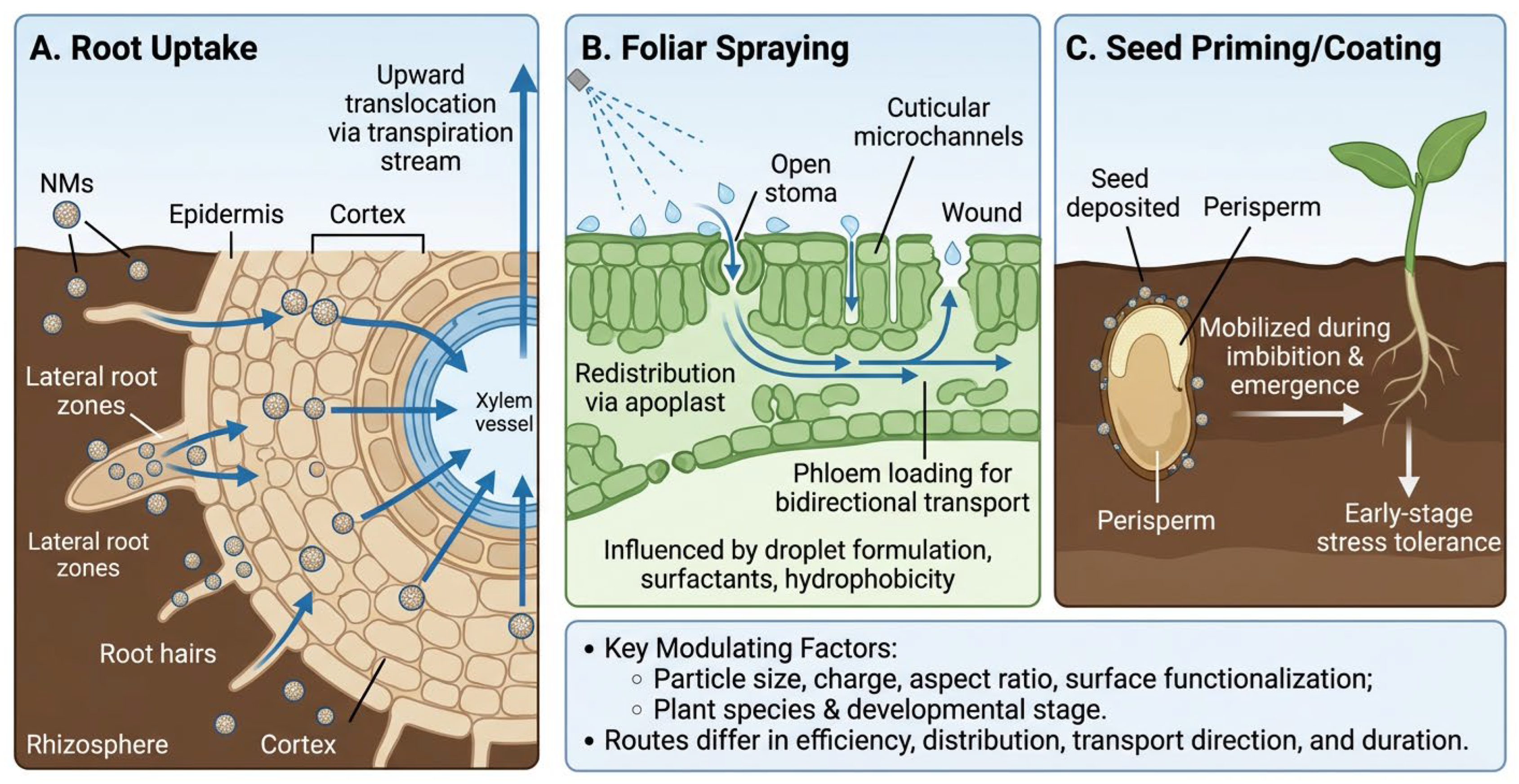
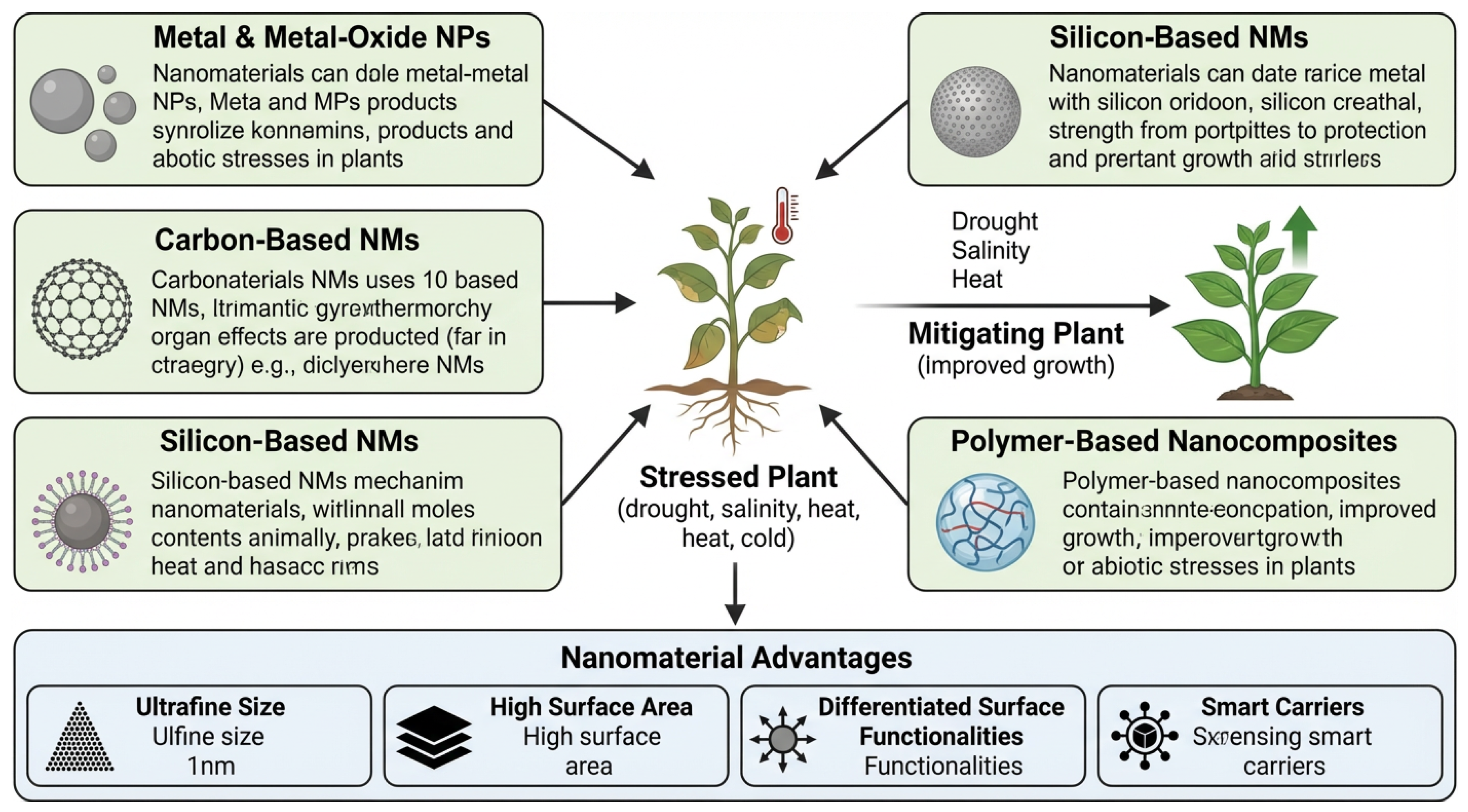
2. Properties and Routes of Nanomaterials for Alleviating Abiotic Stress in Plants
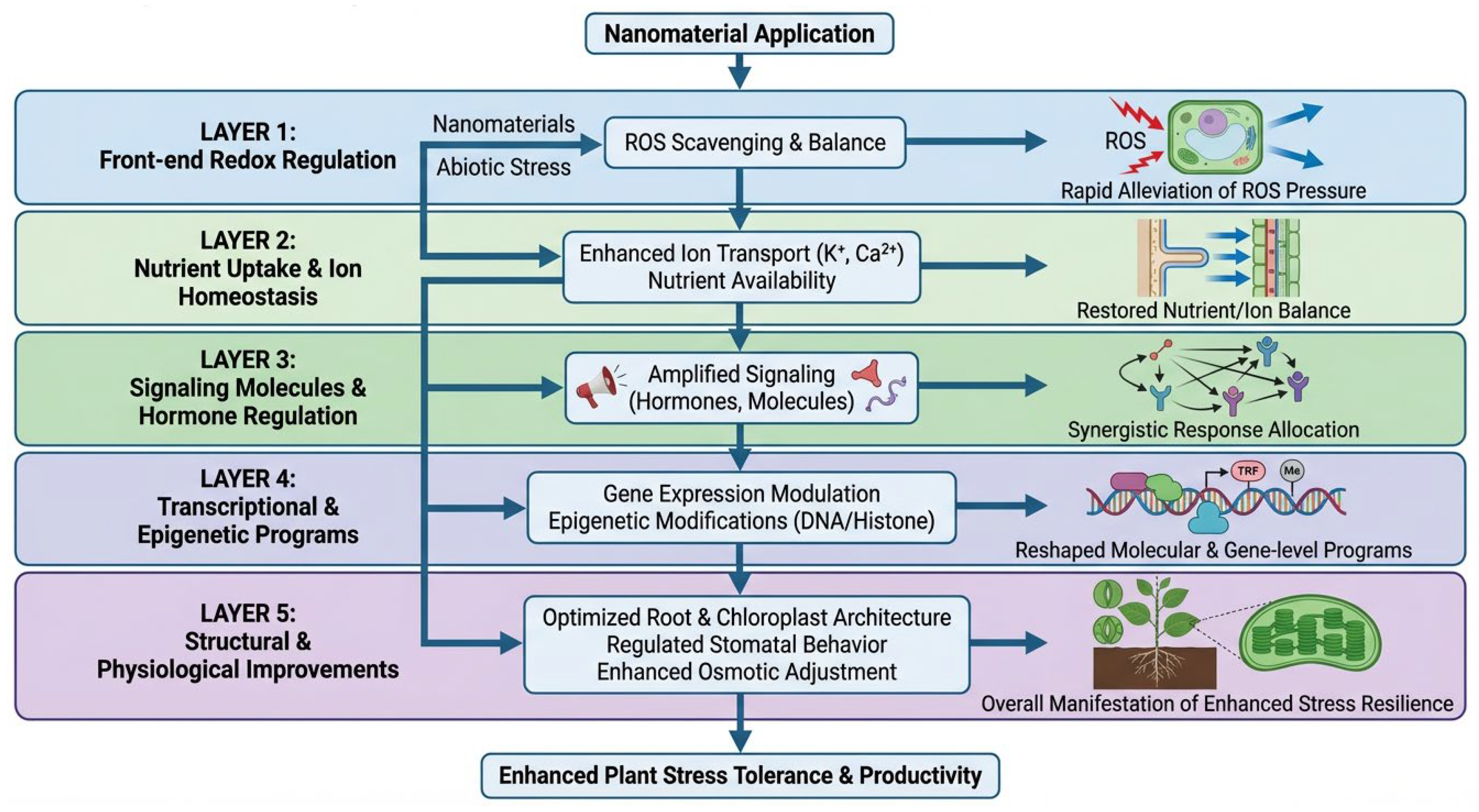
3. Nanomaterial-Mediated Mechanisms of Stress Tolerance
3.1. Redox Regulation
3.2. Nutrient Uptake and Ion Homeostasis
3.3. Signaling Molecules and Hormone Regulation
3.4. Gene- and Molecular-Level Regulation
3.5. Structural and Physiological Improvements
4. Application Cases and Practical Exploration

| Nanomaterial | Target Plant | Application Purpose | Treatment Method | Key Advantages | Potential Drawbacks | Reference |
|---|---|---|---|---|---|---|
| Chitosan–selenium nanomaterials (Cs–Se NMs) | Rice (Oryza sativa L.), Pakchoi (Brassica chinensis L.) | Alleviate salt stress (100 mM NaCl)-induced oxidative damage and enhance plant growth | Root application, 100–500 mg/L (optimal: 300 mg/L) | Effectively scavenges ROS and enhances antioxidant enzyme activity, improving plant growth and salt tolerance. | High Se content may cause phytotoxicity; long-term soil impacts need further study. | [31] |
| Graphene Oxide (GO) | Persian clover (Trifolium resupinatum L.) | Mitigate salt stress’s impact on seed germination | Seed exposure to GO (0–500 mg/L) with/without NaCl (−0.1 MPa) | Effectively improves germination rate and seedling growth under saline conditions. | Limited understanding of long-term phytotoxicity and environmental fate. | [38] |
| Silicon dioxide nanoparticles (SiO2-NPs) | Potato (Solanum tuberosum L.) cv. Sante & Proventa | Alleviate salt stress (50 & 100 mM NaCl) and improve in vitro and greenhouse growth | Foliar spray at 50 & 100 mg L−1 (optimal: 50 mg L−1) | Enhances growth and antioxidant enzyme activity (GPX, SOD), and induces stress-related protein expression. | High concentration (100 mg L−1) may become phytotoxic and reduce beneficial effects. | [41] |
| PAA-coated Mn3O4 nanoparticles (PMO) | Cotton (Gossypium hirsutum L.) | Enhance drought tolerance by ROS scavenging and stomatal regulation | Foliar spray (200 mg/L) | Improves biomass, photosynthesis, and ROS homeostasis under drought | Limited data on long-term environmental impact | [39] |
| nCeO2 and N-CDs | Tobacco BY-2 suspension cells | Enhance salt tolerance via Na+ extrusion or sequestration | Exposure in culture medium (0.1 mg/L nCeO2; 0.5 mg/L N-CDs) | nCeO2 promotes Na+ efflux via SOS pathway; N-CDs enhance vacuolar Na+ sequestration | Mechanism specificity unclear; effects may vary by plant species | [40] |
5. Future Directions and Outlook
6. Conclusions
Author Contributions
Funding
Data Availability Statement
Conflicts of Interest
References
- Seleiman, M.F.; Ahmad, A.; Battaglia, M.L.; Bilal, H.M.; Alhammad, B.A.; Khan, N. Zinc oxide nanoparticles: A unique saline stress mitigator with the potential to increase future crop production. S. Afr. J. Bot. 2023, 159, 208–218. [Google Scholar] [CrossRef]
- Mariyam, S.; Upadhyay, S.K.; Chakraborty, K.; Verma, K.K.; Duhan, J.S.; Muneer, S.; Meena, M.; Sharma, R.K.; Ghodake, G.; Seth, C.S. Nanotechnology, a frontier in agricultural science, a novel approach in abiotic stress management and convergence with new age medicine-a review. Sci. Total Environ. 2024, 912, 169097. [Google Scholar] [CrossRef] [PubMed]
- Zaman, W.; Ayaz, A.; Park, S. Nanomaterials in agriculture: A pathway to enhanced plant growth and abiotic stress resistance. Plants 2025, 14, 716. [Google Scholar] [CrossRef] [PubMed]
- Zhu, S.; Chen, M.; Dai, H.; Tian, T.; Pan, W.; Xu, J.; Lin, D. Safe production of rice in cd-polluted paddy fields by rhizosphere application of zero-valent iron nanoplates at specific growth stages. Nano Today 2024, 56, 102289. [Google Scholar] [CrossRef]
- Zhou, Y.; Lv, L.; Yu, Z.; Zhang, J.; Wang, B.; Yang, R.D.; Chen, M.; Wu, P.; Wang, S.S. Synergistic effect between biochar and sulfidized nano-sized zero-valent iron enhanced cadmium immobilization in a contaminated paddy soil. Biochar 2024, 6, 55. [Google Scholar] [CrossRef]
- Haque, M.A.; Rafii, M.Y.; Yusoff, M.M.; Ali, N.S.; Yusuff, O.; Datta, D.R.; Anisuzzaman, M.; Ikbal, M.F. Recent advances in rice varietal development for durable resistance to biotic and abiotic stresses through marker-assisted gene pyramiding. Sustainability 2021, 13, 10806. [Google Scholar] [CrossRef]
- Dixit, S.; Singh, U.M.; Singh, A.K.; Alam, S.; Venkateshwarlu, C.; Nachimuthu, V.V.; Yadav, S.; Abbai, R.; Selvaraj, R.; Devi, M.N.; et al. Marker assisted forward breeding to combine multiple biotic-abiotic stress resistance/tolerance in rice. Rice 2020, 13, 29. [Google Scholar] [CrossRef]
- Brito, I.; Goss, M.J.; Alho, L.; Brígido, C.; van Tuinen, D.; Félix, M.R.; Carvalho, M. Agronomic management of amf functional diversity to overcome biotic and abiotic stresses—The role of plant sequence and intact extraradical mycelium. Fungal Ecol. 2019, 40, 72–81. [Google Scholar] [CrossRef]
- Khan, M.N.; Li, Y.; Mu, Y.; Sultan, H.; Baloch, A.; Din, I.; Fu, C.; Li, J.; Khan, Z.; Kumar, S.; et al. Recent advances in nano-enabled plant salt tolerance: Methods of application, risk assessment, opportunities and future prospects. J. Integr. Agric. 2025, 24, 1611–1630. [Google Scholar] [CrossRef]
- Feng, Y.C.; Zhang, Z.Y.; Ding, Z.X.; Chen, K.; Zhou, Z.H.; Ren, X.Q.; Liang, J.G.; Huang, Y.N.; Shah, A.A.; Li, Y.; et al. Enhanced photosynthesis in zea maize with the biofortification of zif-8 electron bridge to mediate growth improvement under drought. Chem. Eng. J. 2025, 513, 163022. [Google Scholar] [CrossRef]
- Halaji, B.; Haghighi, M.; Amiri, A.; Kappel, N. Effects of potassium and nanocapsule of potassium on pepper growth and physiological changes in high-temperature stress. J. Soil. Sci. Plant Nutr. 2023, 23, 6317–6330. [Google Scholar] [CrossRef]
- Silva, J.Y.R.; Proenza, Y.G.; da Luz, L.L.; de Sousa Araújo, S.; Filho, M.A.G.; Junior, S.A.; Soares, T.A.; Longo, R.L. A thermo-responsive adsorbent-heater-thermometer nanomaterial for controlled drug release: (zif-8,euxtby)@aunp core-shell. Mater. Sci. Eng. C 2019, 102, 578–588. [Google Scholar] [CrossRef] [PubMed]
- Wu, Y.N.; Wang, Y.J.; Liu, X.; Zhang, C.D. Unveiling key mechanisms: Transcriptomic meta-analysis of diverse nanomaterial applications addressing biotic and abiotic stresses in arabidopsis thaliana. Sci. Total Environ. 2024, 928, 172476. [Google Scholar] [CrossRef] [PubMed]
- Soni, S.; Jha, A.B.; Dubey, R.S.; Sharma, P. Mitigating cadmium accumulation and toxicity in plants: The promising role of nanoparticles. Sci. Total Environ. 2024, 912, 168826. [Google Scholar] [CrossRef] [PubMed]
- Cui, J.H.; Liu, T.X.; Li, F.B.; Yi, J.C.; Liu, C.P.; Yu, H.Y. Silica nanoparticles alleviate cadmium toxicity in rice cells: Mechanisms and size effects. Environ. Pollut. 2017, 228, 363–369. [Google Scholar] [CrossRef]
- Marmiroli, M.; Pagano, L.; Rossi, R.; De La Torre-Roche, R.; Lepore, G.O.; Ruotolo, R.; Gariani, G.; Bonanni, V.; Pollastri, S.; Puri, A.; et al. Copper oxide nanomaterial fate in plant tissue: Nanoscale impacts on reproductive tissues. Environ. Sci. Technol. 2021, 55, 10769–10783. [Google Scholar] [CrossRef]
- Zhang, P.; Jiang, Y.Q.; Schwab, F.; Monikh, F.A.; Grillo, R.; White, J.C.; Guo, Z.L.; Lynch, I. Strategies for enhancing plant immunity and resilience using nanomaterials for sustainable agriculture. Environ. Sci. Technol. 2024, 58, 9051–9060. [Google Scholar] [CrossRef]
- Liu, Y.K.; Persson, D.P.; Li, J.X.; Liang, Y.C.; Li, T.Q. Exposure of cerium oxide nanoparticles to the hyperaccumulator sedum alfredii decreases the uptake of cadmium via the apoplastic pathway. J. Hazard. Mater. 2021, 417, 125955. [Google Scholar] [CrossRef]
- Mazarji, M.; Bayero, M.T.; Minkina, T.; Sushkova, S.; Mandzhieva, S.; Bauer, T.V.; Soldatov, A.; Sillanpää, M.; Wong, M.H. Nanomaterials in biochar: Review of their effectiveness in remediating heavy metal-contaminated soils. Sci. Total Environ. 2023, 880, 163330. [Google Scholar] [CrossRef]
- Zhao, X.; Dai, J.N.; Teng, Z.D.; Yuan, J.J.; Wang, G.T.; Luo, W.Q.; Ji, X.N.; Hu, W.; Li, M. Immobilization of cadmium in river sediment using phosphate solubilizing bacteria coupled with biochar-supported nano-hydroxyapatite. J. Clean. Prod. 2022, 348, 131221. [Google Scholar] [CrossRef]
- Dev, A.; Srivastava, A.K.; Karmakar, S. Nanomaterial toxicity for plants. Environ. Chem. Lett. 2018, 16, 85–100. [Google Scholar] [CrossRef]
- Rai, P.K.; Kumar, V.; Lee, S.; Raza, N.; Kim, K.-H.; Ok, Y.S.; Tsang, D.C.W. Nanoparticle-plant interaction: Implications in energy, environment, and agriculture. Environ. Int. 2018, 119, 1–19. [Google Scholar] [CrossRef] [PubMed]
- Abbasi Khalaki, M.; Moameri, M.; Asgari Lajayer, B.; Astatkie, T. Influence of nano-priming on seed germination and plant growth of forage and medicinal plants. Plant Growth Regul. 2021, 93, 13–28. [Google Scholar] [CrossRef]
- Tripathi, G.; Dutta, S.; Mishra, A.; Basu, S.; Gupta, V.; Kamaraj, C. Nanomaterials impact in phytohormone signaling networks of plants—A critical review. Plant Sci. 2025, 352, 112373. [Google Scholar] [CrossRef]
- Riyazuddin, R.; Nisha, N.; Gupta, R. Phytonanotechnology in the mitigation of biotic and abiotic stresses in plants. Plant Nano Biol. 2025, 13, 100173. [Google Scholar] [CrossRef]
- Choudhary, A.; Sharma, S.; Kaur, H.; Sharma, N.; Gadewar, M.M.; Mehta, S.; Husen, A. Plant system, abiotic stress resilience, reactive oxygen species, and coordination of engineered nanomaterials: A review. S. Afr. J. Bot. 2024, 171, 45–59. [Google Scholar] [CrossRef]
- Sánchez-Reyna, A.; González-García, Y.; Gabriel Alpuche-Solís, Á.; Cadenas-Pliego, G.; Benavides-Mendoza, A.; Juárez-Maldonado, A. Synergistic effect of zinc oxide, magnesium oxide and graphene nanomaterials on fusarium oxysporum-inoculated tomato plants. Phyton-Int. J. Exp. Bot. 2025, 94, 2097–2116. [Google Scholar] [CrossRef]
- Hu, W.; Yang, Y.; Ali, S.; Zhao, W.; Wang, S.; Zhou, Z. Optimizing cotton growth and phytoremediation under cadmium stress through the integration of nanomaterials and plant growth-promoting bacteria. J. Hazard. Mater. 2025, 495, 139090. [Google Scholar] [CrossRef]
- Gao, J.; Zhu, Y.; Zeng, L.; Liu, X.; Yang, Y.; Zhou, Y. Recent advances on environmental behavior of cu-based nanomaterials in soil-plant system: A review. J. Environ. Manag. 2024, 361, 121289. [Google Scholar] [CrossRef]
- Ahmed, T.; Noman, M.; Qi, Y.; Xu, S.; Yao, Y.; Masood, H.A.; Manzoor, N.; Rizwan, M.; Li, B.; Qi, X. Dynamic crosstalk between silicon nanomaterials and potentially toxic trace elements in plant-soil systems. Ecotoxicol. Environ. Saf. 2023, 264, 115422. [Google Scholar] [CrossRef]
- Fang, J.; Peng, Y.X.; Zheng, L.J.; He, C.; Peng, S.; Huang, Y.W.; Wang, L.X.; Liu, H.P.; Feng, G.F. Chitosan–se engineered nanomaterial mitigates salt stress in plants by scavenging reactive oxygen species. J. Agric. Food Chem. 2024, 72, 176–188. [Google Scholar] [CrossRef]
- Hao, Y.; Ma, C.; Zhang, Z.; Song, Y.; Cao, W.; Guo, J.; Zhou, G.; Rui, Y.; Liu, L.; Xing, B. Carbon nanomaterials alter plant physiology and soil bacterial community composition in a rice-soil-bacterial ecosystem. Environ. Pollut. 2018, 232, 123–136. [Google Scholar] [CrossRef] [PubMed]
- Ijaz, M.; Ijaz, R.; Bi, J.; Ahmed, T.; Noman, M.; Rani, H.; Malook, M.B.; Shahid, M.S.; Ondrasek, G.; Lin, B.; et al. Silicon-functionalized nanotherapeutics modulate physio-biochemical functions and soil enzyme profile for curtailing cadmium toxicity in rice (Oryza sativa l.) at vegetative phase. Clean. Eng. Technol. 2025, 28, 101070. [Google Scholar] [CrossRef]
- Mohammadi, N.; Shariatmadari, H.; Khademi, H.; Bazarganipour, M. Coating of sepiolite-chitosan nanocomposites onto urea increases nitrogen availability and its use efficiency in maize. Arch. Agron. Soil. Sci. 2020, 66, 884–896. [Google Scholar] [CrossRef]
- Kolbert, Z.; Ördög, A. Involvement of nitric oxide (no) in plant responses to metalloids. J. Hazard. Mater. 2021, 420, 126606. [Google Scholar] [CrossRef]
- Vishwakarma, K.; Singh, V.P.; Prasad, S.M.; Chauhan, D.K.; Tripathi, D.K.; Sharma, S. Silicon and plant growth promoting rhizobacteria differentially regulate agnp-induced toxicity in brassica juncea: Implication of nitric oxide. J. Hazard. Mater. 2020, 390, 121806. [Google Scholar] [CrossRef]
- Zhou, P.; Zhang, P.; He, M.; Cao, Y.; Adeel, M.; Shakoor, N.; Jiang, Y.; Zhao, W.; Li, Y.; Li, M.; et al. Iron-based nanomaterials reduce cadmium toxicity in rice (Oryza sativa L.) by modulating phytohormones, phytochelatin, cadmium transport genes and iron plaque formation. Environ. Pollut. 2023, 320, 121063. [Google Scholar] [CrossRef]
- Stefanello, R.; da Silva Garcia, W.J.; Rossato Viana, A.; da Rosa Salles, T.; Bohn Rhoden, C.R. Graphene oxide decreases the effects of salt stress on persian clover seed germination. J. Toxicol. Environ. Health 2024, 87, 47–56. [Google Scholar] [CrossRef]
- Li, Y.; Tao, Y.; Xu, W.; Wu, H.; Li, G.; Yue, L.; Gu, J.; Li, F.; Wu, H.; Giraldo, J.P.; et al. Mn3o4 nanoparticles maintain ros homeostasis to modulate stomatal aperture to improve cotton drought tolerance. Environ. Sci. Nano 2025, 12, 1126–1137. [Google Scholar] [CrossRef]
- Chen, F.; Zhu, L.; Tang, J.; Wang, C.; Yue, L.; Schröder, P.; Wang, Z. Nanomaterial-modulated cellular sodium extrusion and vacuolar sequestration for salt tolerance. Environ. Sci. Nano 2022, 9, 4018–4026. [Google Scholar] [CrossRef]
- Salah, M.H.G.; Al-Zahrani, H.S.M.; Metwali, E.M.R. Improving the salinity tolerance in potato (Solanum tuberosum) by exogenous application of silicon dioxide nanoparticles. Int. J. F Agric. Biol. 2017, 19, 183–192. [Google Scholar] [CrossRef]
- Deng, J.B.; Wang, P.; Xu, Z.X.; Hu, T.; Li, D.Y.; Wei, X.J.; Chen, C.Y.; Li, Y.T.; Zhang, Y.L. Contaminated soil remediation with nano-fes loaded lignin hydrogel: A novel strategy to produce safe rice grains while reducing cadmium in paddy field. J. Hazard. Mater. 2024, 469, 133965. [Google Scholar] [CrossRef]


Disclaimer/Publisher’s Note: The statements, opinions and data contained in all publications are solely those of the individual author(s) and contributor(s) and not of MDPI and/or the editor(s). MDPI and/or the editor(s) disclaim responsibility for any injury to people or property resulting from any ideas, methods, instructions or products referred to in the content. |
© 2025 by the authors. Licensee MDPI, Basel, Switzerland. This article is an open access article distributed under the terms and conditions of the Creative Commons Attribution (CC BY) license (https://creativecommons.org/licenses/by/4.0/).
Share and Cite
Yang, J.; Lian, L.; Yan, Y. Nanomaterial-Mediated Alleviation of Abiotic Stress in Plants: Mechanisms and Applications. Agronomy 2025, 15, 2866. https://doi.org/10.3390/agronomy15122866
Yang J, Lian L, Yan Y. Nanomaterial-Mediated Alleviation of Abiotic Stress in Plants: Mechanisms and Applications. Agronomy. 2025; 15(12):2866. https://doi.org/10.3390/agronomy15122866
Chicago/Turabian StyleYang, Jiao, Lijun Lian, and Yuxi Yan. 2025. "Nanomaterial-Mediated Alleviation of Abiotic Stress in Plants: Mechanisms and Applications" Agronomy 15, no. 12: 2866. https://doi.org/10.3390/agronomy15122866
APA StyleYang, J., Lian, L., & Yan, Y. (2025). Nanomaterial-Mediated Alleviation of Abiotic Stress in Plants: Mechanisms and Applications. Agronomy, 15(12), 2866. https://doi.org/10.3390/agronomy15122866