Abstract
Research on microplastics (MPs) in agricultural soils has received increasing attention due to their potential ecological risks and adverse effects on the food chain. Recently, geostatistical approaches have been increasingly used to assess the spatial distribution of MPs in soils. Therefore, this study aims to predict the abundance of MPs in the soil of an agricultural micro-watershed using geostatistical methods and to produce a continuous map of the interpolated MPs. Soil samples were collected, and MP abundance was determined using the density separation method. Subsequently, exploratory data analysis was conducted, followed by the construction of the experimental semivariogram, theoretical variogram model fitting, ordinary kriging interpolation, cross-validation and, inverse distance weighting (IDW) interpolation. MPs were detected in all samples, with average abundances of 3826, 2553, and 3407 pieces kg−1 in forest, pasture, and agricultural land use systems, respectively. The experimental semivariogram showed that the spatial distribution of MPs has a weak spatial dependence structure. The Kriging and IDW maps showed a distribution of MPs in the range of 600 to 7400 pieces kg−1, with higher concentrations of MPs for forest and agricultural areas. Additionally, the map reveals a high abundance of MPs, with greater concentrations in depressions and areas near roads and urban centers, allowing for identifying critical points within the micro-watershed. This study offers important insights into the presence of MPs across various land uses, emphasizing the need for proactive measures to prevent and mitigate their accumulation in soil.
1. Introduction
Microplastics (MPs) are pervasive pollutants in aquatic and terrestrial ecosystems [1]. They originate from plastic waste that degrades over time through ultraviolet radiation, mechanical wear, thermo-oxidative processes, and biological activity [2,3]. With particle sizes ranging from <5 mm to 1 µm [4,5,6], MPs are highly persistent in the environment [7] and can alter key properties of agricultural soils [8,9]. Additionally, they pose potential risks to soil fauna, microorganisms, and crop growth [10].
The identification and quantification of MPs are, therefore, essential for understanding their environmental impacts. However, standardized methodologies for assessing their abundance and spatial distribution are still lacking [11]. The most widely used method in the literature for isolating MPs from soil involves density separation using high-density salt solutions [12,13,14] followed by filtration and recovery of MPs on filter paper [15].
Continuing with the identification and quantification process, stereoscopic microscopy is used to count and characterize MPs based on their color, size, and shape, often assisted by professional imaging software [16,17]. This is followed by identifying the polymer composition of the MPs using non-destructive techniques such as Fourier-transform infrared spectroscopy (FTIR) and Raman spectroscopy [15,18,19].
The techniques for the extraction, characterization, and identification of MPs are well documented; however, the georeferencing of these particles remains an incipient approach. It is typically applied to map the spatial distribution of MPs isolated from soil through point-based data analysis [20,21], which represents only the exact locations of MP concentrations or masses. For example, Leitão et al. [22] mapped the spatial distribution of microplastic concentrations in Coimbra, a municipality in central Portugal. Moreover, geostatistical data analysis, including approaches such as kriging interpolation, has been applied to model and visualize microplastic patterns, as demonstrated by Liu et al. [23] in their study of microplastics isolated from water and sediment samples from Chaohu Lake, China. Similarly, the inverse distance weighting (IDW) method has been used to map the distribution of microplastics in surface agricultural soils of the Huangshui River basin, located on the northeastern Qinghai–Tibet Plateau, where Zhou et al. [24] reported higher concentrations in agricultural and densely populated areas.
In this study, the methodological approach was designed to construct a spatial distribution map of soil MPs using two interpolation techniques: ordinary kriging and IDW. Each method provides distinct advantages for visualizing and analyzing the spatial variability of MP abundance. The ordinary kriging interpolation, based on the semivariogram model, allows the incorporation of spatial correlation analysis and the estimation of prediction reliability [25,26]. This geostatistical approach also considers anisotropy, which reflects the directions of greater and lesser spatial continuity of the studied phenomenon. In contrast, the conventional IDW method, although valid and widely applied, does not account for data anisotropy and assigns weights solely according to Euclidean distance to perform the interpolation [27].
Recent studies highlight the urgent need to prioritize research on MPs in agroecosystems [28]. However, the spatial distribution of MPs in Brazilian agricultural soils remains largely unexplored [29,30,31]. The lack of studies on the spatial distribution of MPs limits the understanding of their distribution patterns in tropical agricultural soils according to land use and potential environmental risks. It also hinders the development of effective mitigation strategies and the identification of critical hotspots where MPs accumulate in tropical soils. Therefore, this study aims to analyze the abundance of MPs in soil and to predict their spatial distribution within a micro-watershed. The performance of ordinary kriging and inverse distance weighting interpolation methods was compared across three land use types—forest, grassland, and agricultural—within the 0–20 cm soil layer.
2. Materials and Methods
The data analyzed in this study were derived from soil samples previously collected and examined in our earlier work [32]. That publication provides a comprehensive description of the study area, including its geographic location, climatic conditions, soil types, vegetation cover, and topographic characteristics. It also details the sampling design implemented for soil collection, along with the procedures for sample preparation, microplastic extraction, and the analytical methods employed for their identification and quantification.
To determine whether the abundance of MPs in soil behaves as a regionalized variable characterized by spatial continuity and correlation [33], a geostatistical framework was adopted. This approach allows for the identification and modeling of spatial dependence structures, providing a robust basis for understanding and predicting the spatial distribution of MPs in soils—the geostatistical workflow comprised variogram calculation, model fitting, anisotropy assessment, kriging interpolation, and cross-validation. Particular emphasis was placed on the semivariogram, which quantifies how data similarity decreases with distance. Its key parameters—the nugget effect, sill, and range—describe micro-scale variability, total variance, and the spatial correlation distance, respectively [26,34]. This framework was applied to model the spatial variability and generate distribution maps of MP abundance across three land use types—forest, grassland, and cropland—within the study area, thereby providing a detailed characterization of their spatial patterns.
2.1. Description of Study Area
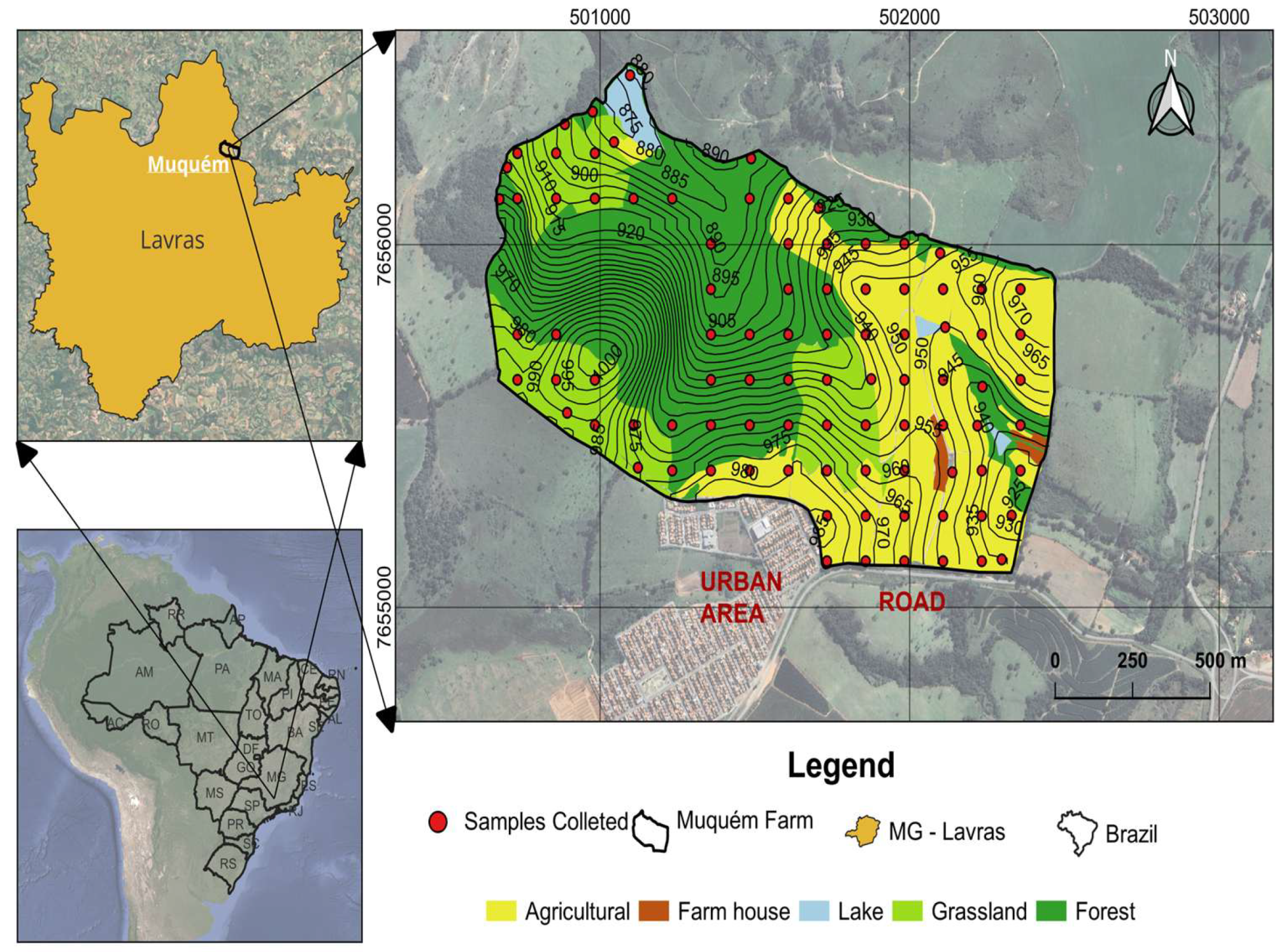
The study was conducted in a micro-watershed within the Rio Grande basin, encompassing the Muquém experimental farm of the Federal University of Lavras (−21°12′037′′ S, −44°59′3.77′′ W), with a total area of 1.61 km2 and features a diversified land use system comprising forest, grassland, and agricultural (Figure 1), with elevations ranging from 877 m to 1040 m.
Figure 1.
Map of the study area, land use, contour line, and geographic position of the sampled points at the micro-watershed from Muquém experimental farm, municipality of Lavras, Brazil.
Soil classification in the study area indicates that the major soil orders in the micro-watershed, according to WRB-FAO [35], correspond to Cambisols, which occupy 18.84 ha (11.41% of the area); Gleysols, 1.92 ha (1.16% of the area); Ferrasols, 63.60 ha (38.50%); Nitisols, 8.30 ha (5.02%); Acrisols, 58.07 ha (35.15% of the area), and Leptsols, 14.48 ha, representing 8.76% of the total area.
Land use in the micro-watershed was classified into three main categories: agricultural, grasslands, and forests (Figure 1). Agricultural land accounts for 30.1% of the total area, with annual crops covering 29.2%, including corn (Zea mays), soybean (Glycine max (L.) Merrill), wheat (Triticum aestivum L.), common bean (Phaseolus vulgaris), sorghum (Sorghum bicolor (L.) Moench), and rice (Oryza sativa L.). Perennial crops, primarily coffee (Coffea arabica), occupy 0.9% of the area. Grasslands represent the most extensive land use, covering 44% of the micro-watershed. This includes 39.3% planted pastures (Brachiaria sp.) eucalyptus (Eucalyptus sp.) and native forests. The remaining 1.5% of the area is allocated to water reservoirs and built-up areas.
2.2. Soil Collection and Sampling
Soil sampling was conducted between August 2022 and April 2023, covering the winter (June–September), spring (September–December), and summer (December–March) seasons. A predefined grid of 91 georeferenced points was used, covering a total area of 161 ha. Unfortunately, an area of the property designated as forest land was not sampled due to difficult access caused by steep slopes and dense vegetation, as shown in Figure 1 (absence of red dots in that area). Therefore, the sampling density was 1.77 ha per sample, with an ideal spacing between samples of 125 m. Each sampling point was georeferenced with a Garmin Oregon 750 GPS device (±3 m accuracy), managed through Garmin Express software (version 7.26.1). At each location, a composite sample was obtained by collecting three subsamples spaced approximately 70 cm apart from the 0–20 cm soil layer. From each subsample, 100 g of soil was collected and stored in glass jars labeled with the corresponding grid code to ensure traceability.
In terms of land use distribution, the grid design provided 19 samples from forest, 27 from grassland, and 45 from agricultural land. Certain areas of the micro-watershed were not sampled (Figure 1) due to steep slopes and dense forest vegetation, which hindered access and sample collection. All samples were transported to the laboratory for subsequent analyses.
2.3. Separation, Extraction, and Abundance of Microplastics
Soil samples were pretreated by air-drying and sieving through a 2.00 mm mesh. Microplastic (MP) extraction followed the procedure of Zhou et al. [36], consisting of three steps: (a) digestion of soil organic matter, (b) density separation, and (c) quantification by optical microscopy.
For each sampling point, 10 g of soil was collected for the extraction of MPs. The first stage involved digesting the soil organic matter using an alkaline KOH: NaClO solution at a 1:2 ratio (soil: solution), followed by ultrasonic dispersion and controlled heating. In the second stage, sequential density separation was performed using distilled water (ρ = 1.00 g cm−3), a saturated NaCl solution (5.33 mol L−1, ρ = 1.19 g cm−3), and a ZnCl2 solution (5.06 mol L−1, ρ = 1.50 g cm−3), also at a 1:2 ratio (soil: solution). This separation process was combined with sonication and centrifugation at 3000 rpm for 5 min each [37]. All procedures were conducted at room temperature.
The resulting supernatants were filtered using a cellulose ester membrane (CEM) filter with a diameter of 47 mm and a pore size of 0.22 μm, repeating the filtration until all particles were removed. The filters were then air-dried and stored for analysis.
Plastic particles were identified and counted using a Nikon Eclipse Ni optical microscope (10× magnification) equipped with a Nikon DS-Fi3 digital camera and supported by NIS Elements software version 4.6 for data processing. The filter was examined for microplastic particle counting by scanning its entire surface, shifting the microscope’s field of view from right to left every 2 mm, until the 47mm diameter filter was fully covered. This approach enabled the isolation and characterization of particles ranging in size from 40 µm to 2000 µm in most samples.
The abundance of plastic particles was expressed as the number of pieces per kilogram of dry soil, based on counts of pieces retained on the membrane. The calculation (Equation (1)) was performed using the number of particles identified in 10 g of dry soil (Nᵢ), adjusted with the conversion factor to kilograms (f1 = 1000 g kg−1).
To ensure the quality and control of the described procedure, soil samples collected in the field were stored in glass jars. All materials used in the analysis were made of glass and rinsed with a disinfectant solution (filtered distilled water and 30% ethanol) to prevent contamination. Additionally, researchers wore nitrile gloves and cotton clothing, and access to the laboratory was restricted to minimize external contamination.
As part of the data quality control and to detect potential contamination, the MP extraction procedure was also applied to five soil-free control samples stored in Petri dishes [38,39]. A fiber-like MP particle was detected in all five control samples analyzed.
To assess methodological accuracy, recovery tests were conducted using four clean soil samples from the study area, along with low-density polyethylene (LDPE) and polyvinyl chloride (PVC). The results showed LDPE recovery rates ranging from 81.0% to 98.8%, while PVC recovery rates varied between 59.7% and 75.2% [37].
2.4. Geostatistical Analysis of Microplastics
The geostatistical analysis of the data was conducted based on an adaptation proposed by Scalon [40], comprising five stages. The first stage involved exploration analysis using descriptive statistics to identify outliers, trends, anisotropy, and data distribution shapes, and to assess normality through statistical tests and visual inspection of the plots. In the second stage, the spatial dependence of the data was analyzed as a function of distance. To achieve this, the robust empirical semivariogram by Cressie [41] was applied due to the presence of outliers.
This semivariogram can be estimated using Equation (2), where γ(h) represents the experimental semivariogram estimator, h is the distance vector (magnitude and direction) between pairs of observations, |N(h)| denotes the number of paired observations corresponding to the distances analyzed, and Z(Si) and Z(Sj) are the data values at the spatial locations Si and Sj, respectively. Empirical semivariograms were computed under the assumption of intrinsic stationarity in four different directions to assess the presence of anisotropy.
Simulation envelopes was used to both assess the variability of the experimental variogram and to test the hypothesis of pure nugget effect about the spatial structure of data [41]. For the application of the geostatistical model, it is necessary to assume that it meets the intrinsic stationarity condition and does not exhibit anisotropy, as the theoretical semivariograms used to construct the Kriging maps are based on isotropic models.
The third stage involved fitting the theoretical semivariogram to the empirical semivariogram using a continuous function. The Gaussian, Exponential, and Spherical models were fitted to estimate the parameters, including nugget effect (C0), contribution (C1), sill (C0 + C1), and range (a), as described by Ferraz et al. [34] and Scalon [40]. To select the best model, the spatial dependence index (IDS) and cross validation were used [42,43].
In the fourth stage, data interpolation was performed using the ordinary kriging predictor to estimate MP values at unsampled locations. The result of this stage is a map depicting the spatial distribution of MP abundance across the study area. The ordinary kriging predictor is given by Equation (3)
where is the predicted value at S0, m(S0) are the expected values for the prediction locations S0, and λi are the kriging weights assigned to each observed value Z(Si) [40]. The interpolated maps can be converted into raster-type images and plotted in QGIS software for editing and analysis.
If a satisfactory fit of the variogram model to the data cannot be achieved due to anisotropy or weak spatial dependence, it becomes crucial to apply an alternative interpolation method, such as inverse distance weighting (IDW) [24].
In IDW, values at unsampled locations are estimated as a weighted average of values at nearby sampled locations, with weights inversely proportional to the distance between the sampled and unsampled points. The IDW predictor is given by Equation (4).
where is the predicted value at S0, n is the number of sample locations, Z(Si) is the observed value at location Si,di is the distance between location Si and location S0, and β is the distance power that determines the degree to which nearer locations are preferred over more distant locations. In this work, we are using β = 2 (Inverse Distance Squared) [43]. The results obtained with the IDW predictor can also be shown in the form of a map representing the spatial distribution of MP abundance across the study area.
The statistical and geostatistical analyses were performed using the R computational system version 4.4.0 [44] and the gstat [41] and geoR [45] libraries. The maps were obtained using QGIS software version 3.28.2-Firenze [46], using flat coordinates based on the Universal Transverse Mercator (UTM) projection, zone 23S, which covers the Lavras region in Minas Gerais, Brazil. Figures were plotted with OriginPro Lab version 2024b [47].
Note on the use of AI Tools: During the preparation of this manuscript, the authors used ChatGPT (OpenAI, version 5.1) solely for spelling review and to improve the fluency of the written text. The authors have reviewed and edited all generated output and take full responsibility for the content of this publication.
3. Results and Discussion
3.1. Abundance of Microplastics in the Soil

In most research on microplastics (MPs) in soil, average abundance is reported as the number of pieces per unit mass of soil (e.g., pieces kg−1 soil). Their spatial distribution is typically represented on a point-by-point basis for each sampled site, as illustrated in the maps by Rafique et al. [48], Akca et al. [49], and X. Wang et al. [21]. Other studies, such as So et al. [50] applied geospatial analysis using the Inverse Distance Weighting (IDW) interpolation method to predict soil PM contamination risk in Macau. On the other hand, Zhou et al. [28] and Hossain et al. [2] developed maps to locate sampling sites and depict the spatial distribution of MPs within the study area, without specifying the interpolation method used.
In this study, MPs smaller than 2 mm were extracted by density separation and detected in all 91 georeferenced soil samples collected from the 0–20 cm layer. Ordinary Kriging and Inverse Distance Squared methods were then applied to generate an interpolated map for predicting the spatial distribution of MPs in a typical agricultural landscape in southeastern Brazil.
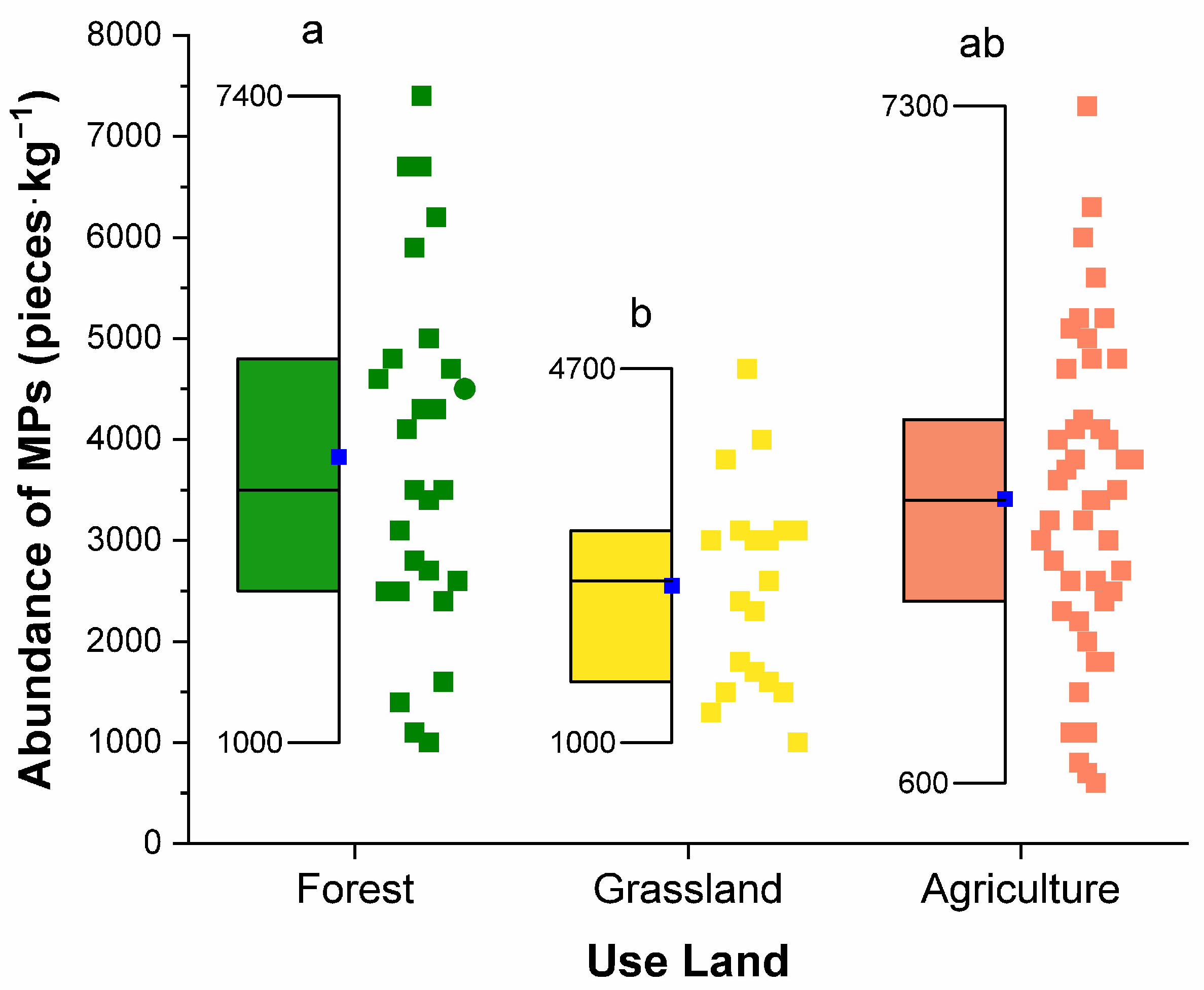
The results showed an abundance of MPs (mean sd) of 3826 1759 and ranging from (1000 to 7400), 2553 1007 (1000 to 4700), and 3340 1520 (600 to 7300) pieces kg−1 for forest, grassland, and agricultural land uses, respectively (Figure 2).
Figure 2.
Analysis of the variation in the abundance of MPs isolated by land use, from the 0–20 cm layer. Shown as violin graphs (pieces. kg−1), values at the extremes of each box are the minimum and maximum MP abundance for each land use. The diagrams display data distribution, with the whiskers indicating the extreme values, while the lower and upper edges of the boxes represent the first and third quartiles, respectively. The line inside the boxes corresponds to the median, and the mean is highlighted by a blue box. Different letters indicate statistically significant differences between land uses according to Tukey’s test (p < 0.05).
Figure 2 shows that the mean abundance of MPs was higher in forest and agricultural soils compared to grassland soils. Also, the distribution of MP abundance is more homogeneous in grassland soils than in the other two soil types. One-way analysis of variance (ANOVA) was performed to compare the effect of using land on MPs. A statistically significant difference was found among the means of land use (F = 3.978, p = 0.022). Tukey’s Honestly Significant Difference (HSD) test was conducted to determine which groups of use land differed. It showed that only the means of grassland and forest presented a statistically significant difference (Forest–Grassland = 1273 pieces kg−1, p = 0.016).
These results do not fully corroborate findings from other studies. For example, Zhang et al. [51] reported a higher concentration of MPs in agricultural soils than in grassland soils. In contrast, Wang et al. [21] found that MP abundance in agricultural soils was twice as high as in grassland soils and three times higher than in forest soils, attributing this difference to intensive agricultural activities such as the application of sewage sludge and compost.
These findings suggest that agricultural areas tend to exhibit the highest MP concentrations compared to forests and grasslands, indicating greater soil contamination by MPs due to the use of plastic products in agricultural practices, and contradict our results. During this analysis, significant heterogeneity in the reports was observed, a challenge previously highlighted by Wrigley et al. [31], who emphasized the need to standardize sampling protocols and MP separation methods in soils to enhance data comparability and accuracy.
This finding underscores the importance of establishing a classification system to compare MP concentrations in soil, categorizing them into low, medium, and high concentration levels. Wrigley et al. [31] proposed a preliminary approach to this classification, analyzed 89 studies on MPs in soils covering 553 sampling sites, and reported a minimum concentration of 0.0 pieces kg−1 and a maximum of 72,200 pieces kg−1. Additionally, the study mentions that the global average is 2900 ± 7600 pieces kg−1, a value that falls within the range of our results (Table 1).
A recent review by Cai et al. [52] proposed a preliminary classification of MP contamination in agricultural soils into four categories: micro contamination (<400 items kg−1), light contamination (400–4000 items kg−1), moderate contamination (4000–40,000 items kg−1), and heavy contamination (≥40,000 items kg−1). According to this classification, our results fall within the light contamination level, providing a valuable reference point for comparison in future studies.
In addition, Table 1 provides a summary of several studies in which maps were developed to illustrate the spatial distribution of soil MP abundance. In these studies, samples were collected from the topsoil layer at depths of 0–5 cm, 0–10 cm, and 0–20 cm. The sampling procedure involved removing surface vegetation and excavating the soil to the specified depths.
Table 1.
Locations, land uses, ranges, averages, and spatial representation method of the values of the abundance of microplastics in the soil as reported by different authors.
Table 1.
Locations, land uses, ranges, averages, and spatial representation method of the values of the abundance of microplastics in the soil as reported by different authors.
| Country, City, and Region | Land Use * | Abundance | Spatial Representation Method of MPs | Source | |
|---|---|---|---|---|---|
| Range | Average ** | ||||
| (Pieces kg−1) | |||||
| Qinghai–Tibet Plateau Province, China | Agricultural soils | 6 to 444 | 86 | Geostatistical analysis data, based on the IDW interpolation using ArcGIS 10.2 | [24] |
| Coimbra city, Central region, Portugal | Agricultural soil | 400 to 2100 | 1087.5 ± 454 | Spatial point data, map prepared using ArcMap 10.5.1 | [22] |
| Lahore, Pakistan | Agricultural Public Parks house lawns industrial areas drains, roadsides | 1750 to 12,200 | 4483 ± 2315 | Spatial distribution maps prepared using ArcGIS 10.3 | [48] |
| Macao, China | Urban soils | 1.3 × 10³ to 2.6 × 10⁴ | 1.1 × 10⁴ | Geostatistical analysis data based on the IDW interpolation using ArcGIS Pro 3.4 | [50] |
| Jincheng, Kunming, southwest China | Agricultural land/watershed | 400 to 2100 | 1087 ± 454 | Spatial distribution map prepared using ArcGIS 10.2 | [21] |
| Suburbs of Wuhan China | Vegetable farmlands | 320 to 12,560 | 2020 | Spatial point data, using OriginPro10 | [53] |
| Hainan Island, China | Agro-ecosystem/Agricultural soils. | 2300 to 32,500 | 15,461.52 ± 16,390.78 | Spatial distribution map prepared using ArcGIS 10.8 | [20] |
| Yuanmou County, Yunnan Province, China | Facility farmland, Traditional farmland, Orchard land, Grassland, Woodland | 50 to 3450 | 1236.36 ± 843.18, 695.45 ± 429, 640.91 ± 927.32, 200.00 ± 228.52, 85.0 ± 22.910 | Spatial point data, map prepared using ArcGIS | [51] |
| Lavras MG Brazil | Forest Grassland Farmland | 600 to 7400 | 3826 2553 3407 | Geostatistical analysis data, based on Ordinary kriging and IDW interpolation, using R and QGIS software | Authors (2025) |
Note: * Microplastics extracted using the density separation method. IDW: Inverse Distance Weighting. ** Microplastics collected from soil samples collected at depths ranging from 0 to 30 cm.
Analyzing the results in Table 1, the presence of MPs is evident in all study areas, influenced by human activities in both rural and urban environments. The heterogeneity of MP abundance among studies suggests that agricultural practices may represent a major source of soil contamination [48]. The table also compiles studies from different cities and regions that used Geographic Information System (GIS) software and geospatial interpolation techniques to map and analyze MP distribution.
Different interpolation methods have been applied to predict MP abundance in unsampled soil areas. Examples include Inverse Distance Weighting (IDW) interpolation [28,50] and Kriging interpolation, both used for geospatial analysis and prediction of MP distribution. Other researchers have graphically represented spatial point data on the abundance of MPs. For instance, Leitão et al. [22] presented a point map of MP concentrations in soils, using four classes ranging from 5000 to 571 × 103 pieces kg−1 in urban spaces of Coimbra City (Portugal). Similarly, Cai et al. [52] illustrated a point distribution map of MP abundance in farmland soils, with four classes ranging from 400 to 40,000 pieces kg−1. Their data collection was based on the collation of peer-reviewed papers published before May 2022 in the ISI Web of Science data base. In another example, Amjad et al. [20] produced a spatial distribution map of MPs in agricultural soils on Hainan Island (China), using ten classes at 10,000-piece intervals, covering a range from 2001 to 80,000 pieces kg−1 to delineate zones of varying impact.
As in the previous studies, other examples in the literature have generated spatial distribution maps to identify hotspots of MP abundance [20,21,48]. As can be observed, there is substantial heterogeneity in soil MP concentrations, largely influenced by anthropogenic factors such as plastic use in greenhouses and mulching, land use change [28], and by environmental sinks or sources, including polymer-based fertilizers and atmospheric deposition of MPs [54].
The interpretation of soil MP abundance maps is essential for identifying spatial patterns and understanding their environmental impact. These maps not only reveal considerable variation in MP distribution between sites, and even among samples within the same region [20], but also highlight broader gradients, such as the north–south trend identified in urban soils [50]. By illustrating dispersion and accumulation across diverse environments—including urban areas, agricultural fields, and natural ecosystems—they help pinpoint major anthropogenic sources and potential transport pathways such as wind, water, and vehicular movement [21,22,50]. Ultimately, mapping MP distribution provides critical insights for developing strategies to optimize land use, reduce contamination, and implement effective management solutions, while fostering more sustainable and responsible practices in both rural and urban landscapes, as in agricultural, urban, and forested areas [22,32].
The heterogeneity in the concentration of MPs in agricultural soils is due to different agricultural activities, including sewage sludge application, fertilizer use, mulch film use, atmospheric deposition, and irrigation with water from wastewater treatment plants [55]. These practices can introduce MPs of different sizes and compositions into the soil, resulting in varying concentrations [56], with significant implications for soil health and food security [57], altering nutrient availability and soil structure, and affecting soil fertility [58].
Other explanations for the heterogeneity of MP concentrations in soils include environmental factors, terrain characteristics, and soil properties. For example, soil texture, structure, and porosity can affect MP retention and migration [59]. Topography, vegetation bulk density, and biological activity (such as bioturbation by soil organisms) play important roles in the distribution of MPs [38,56]. Finally, the variability in the spatial distribution of MPs can be influenced by factors such as the topographic conditions of the site or specific locations characterized by practices with higher plastic use. These “hot spots” can significantly increase the concentrations of MPs in soil, as will be analyzed below.
3.2. Spatial Distribution of Microplastics in the Soil
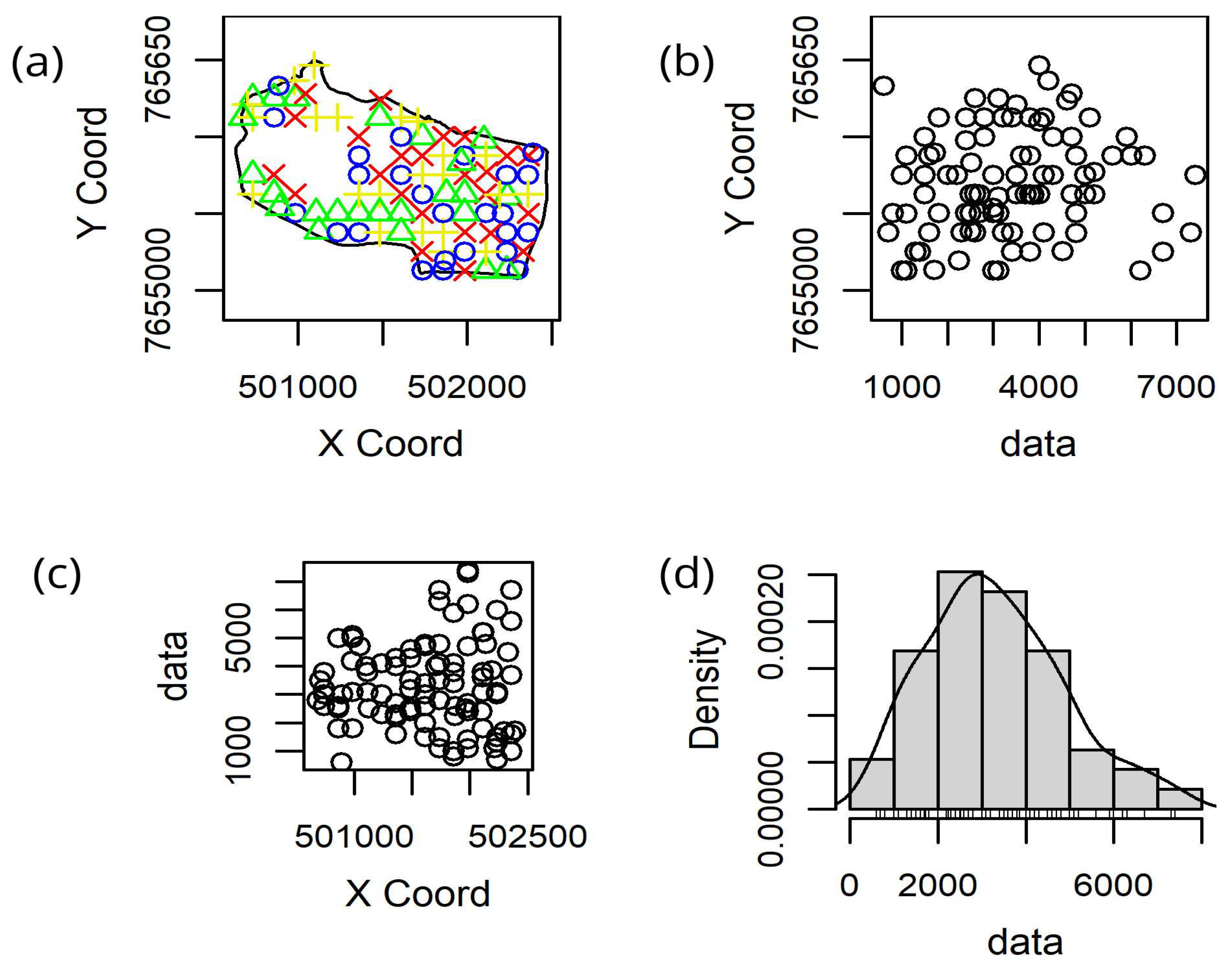
The spatial distribution of the 91 sampling points is illustrated in Figure 3a, where different shapes and colors represent four ranges of MP abundance. Blue circles correspond to the first quartile (600 to 2300 pieces kg−1), indicating the lowest MP concentrations. Green triangles represent the second quartile (2300 to 3100 pieces kg−1). Crosses denote the third quartile, with values ranging from (3100 to 4250 pieces kg−1). Finally, ‘×’ marks indicate the highest MP abundance values, corresponding to the fourth quartile (4250 to 7400 pieces kg−1). Figure 3b,c show the spatial trend of the data in a north–south and east–west direction, respectively, where it can be seen that neither figure has a linear trend, indicating that the stochastic process may be stationary [40]. Finally, the histogram in Figure 3d shows that the abundance of MPs in the region approximately follows a normal distribution.
Figure 3.
Distribution of quartiles (a), y-coordinate trend (b), x-coordinate trend (c), and histogram (d) of microplastic abundance data in the micro-watershed.
The R code developed for the statistical analysis of MP data, as well as for the spatial interpolation using kriging and inverse distance weighting (IDW), is provided in Supplementary Document S1.
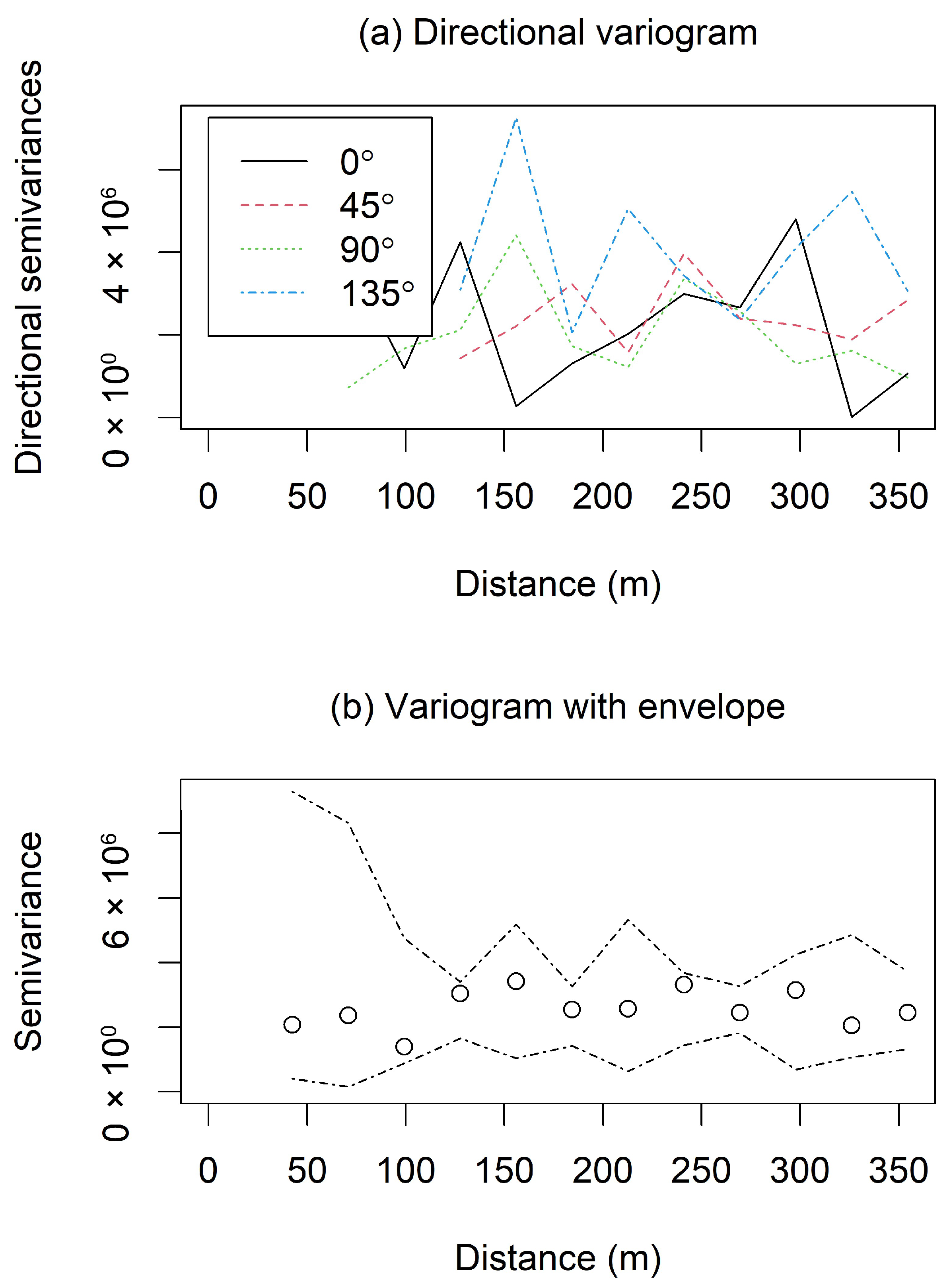
We initiate our geostatistical analysis by looking for isotropy. Thus, we compared the directional robust experimental variograms, which were calculated with four different angular tolerances (0, 45, 90, and 135 degrees), to see how the variogram parameters (sill, range, nugget) change with direction. Figure 4a shows that the directional variograms presented a random behavior in all directions, suggesting a pure nugget effect or a weak spatial dependence of MPs in the study region. Figure 4b shows the omnidirectional empirical robust variogram with the point-wise envelope simulation generated by 99 simulated variograms under the null hypothesis of complete spatial randomness (pure nugget effect). We observe that the empirical variogram points fall within the simulation envelope bounds for all lag distances, indicating that the observed spatial variability is consistent with the null hypothesis.
Figure 4.
Directional robust experimental variograms for angular tolerances 0, 45, 90 and 135 degrees (a), omnidirectional empirical robust variogram with the point-wise envelope simulation generated by 99 simulated variograms under the null hypothesis of pure nugget effect (b).
Results presented in Figure 4 suggest that interpolation maps using ordinary kriging may not be reliable [40,43]. In any case, we will continue with the kriging process, starting with the fitting of theoretical models to the robust empirical variogram.
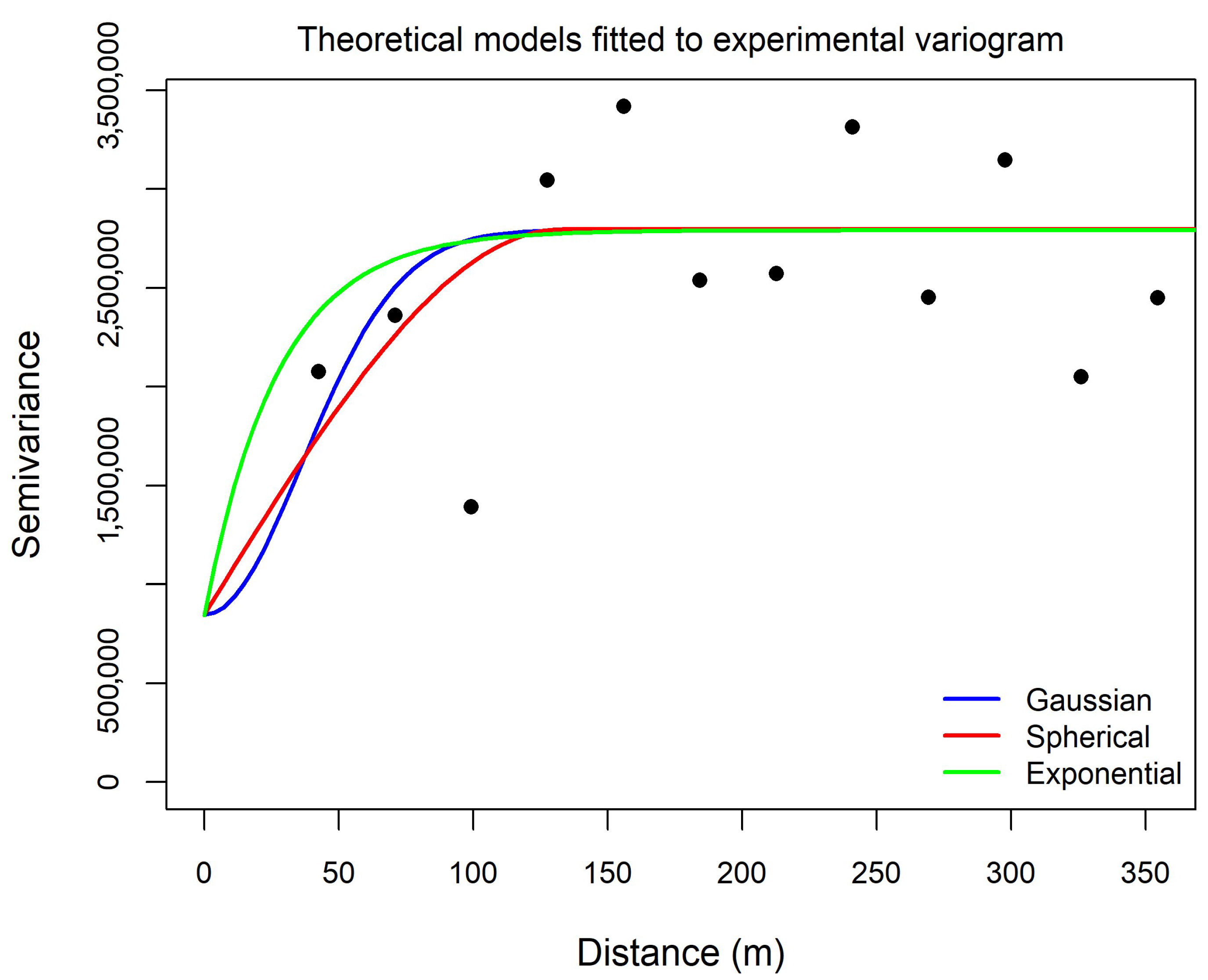
Figure 5 shows the empirical omnidirectional robust semivariogram, represented by dots, along with the fitted models (Spherical, Gaussian, and Exponential), shown as solid lines.
Figure 5.
Empirical semivariograms (dots) and fitted models Spherical, Gaussian, and Exponential (solid lines) of microplastics abundance data (pieces kg−1) at soil depth 0–20 cm in the micro-watershed.
The fitting was performed using the weighted least squares estimator (WLS2) proposed by Cressie [60]. The estimated parameters for each fitted model, along with the selection criteria for the best model, are presented in Table 2.
Table 2.
Models, parameter estimates and quality indicators (SDI, SME) of the fitted semivariograms for microplastics abundance in the 0–20 cm layer.
Spatial dependence index (SDI) presented in Table 2 shows that all models indicate a moderate spatial dependence of MPs in the study region. Standardized mean error from cross-validation using ordinary kriging is nearly zero. This could be a good indicator of the quality of the model fit. Unfortunately, visual inspection of the graphs of the cross-validation (available in the R code provided in the Supplementary Material) reveals that all models lead ordinary kriging to exhibit low predictive capacity, likely due to the use of the omnidirectional empirical semivariogram in an anisotropic phenomenon. Thus, the parameters of any model could be used to obtain the kriging maps. We will use the s in the ordinary kriging because it is the only one that presents a sill that is not asymptotic [40].
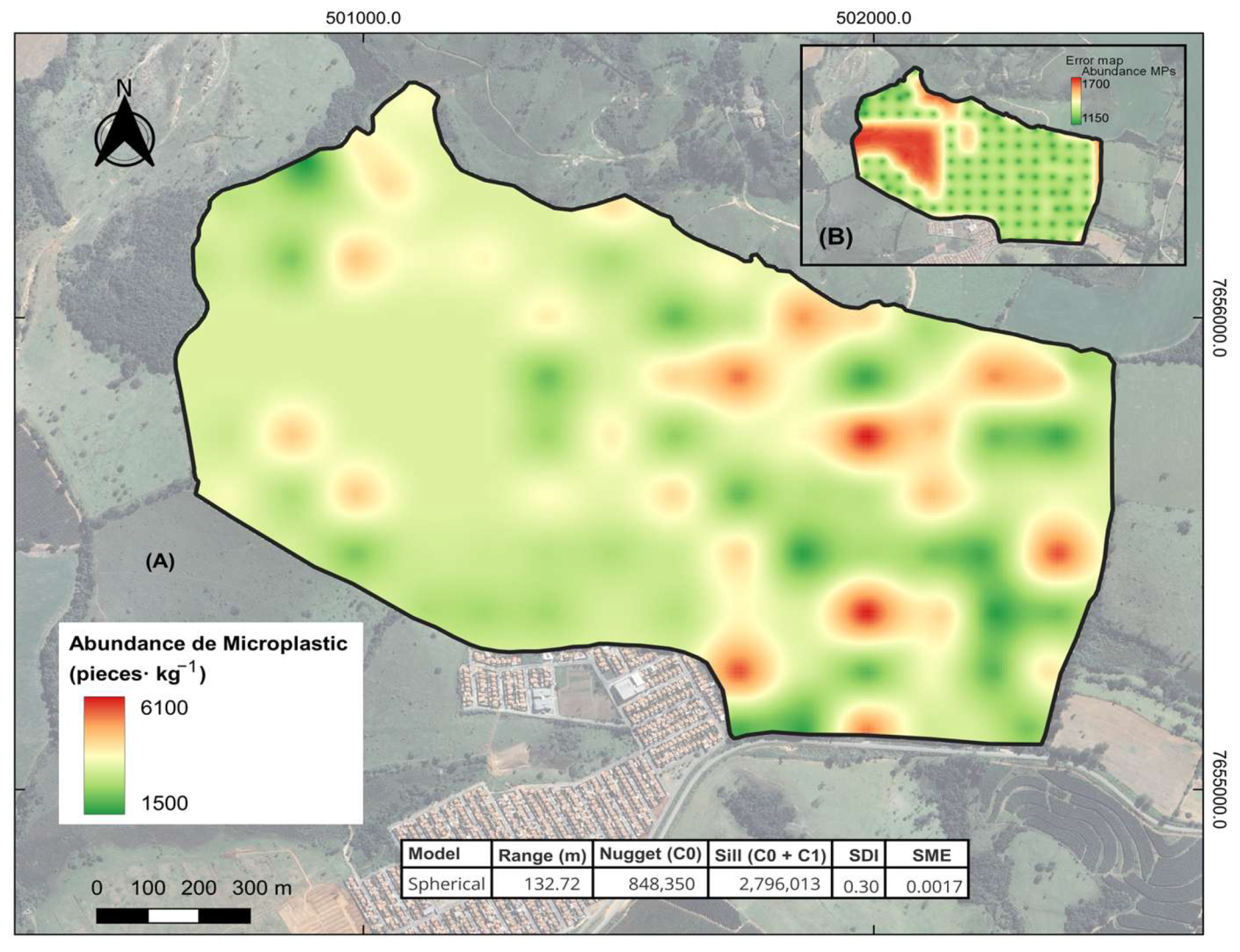
Continuing with the geostatistical procedure, Figure 6 shows the Ordinary Kriging map of the spatial distribution of MPs in the 0 to 20 cm layer. The predicted minimum and maximum values of MPs are 1561 to 6023 pieces kg−1, respectively, and show great variability in the abundance of MPs in the study region.
Figure 6.
(A) Prediction map of the spatial distribution of microplastics (pieces kg−1), and (B) corresponding standard deviation map, obtained from the spherical model and interpolation by ordinary Kriging at micro-watershed from Muquém experimental farm, municipality of Lavras, Brazil.
The kriging standard deviation map (Figure 6B) shows that prediction errors are greatest in regions where sampling points are absent. This pattern is expected in geostatistical interpolation, as uncertainty increases with distance from the sampled locations. The uncertainty associated with the predictions at each interpolated point ranges between 1150 and 1700 pieces kg−1. Lower errors were observed in the vicinity of two sampling points, indicating greater reliability of the interpolated values in those areas.
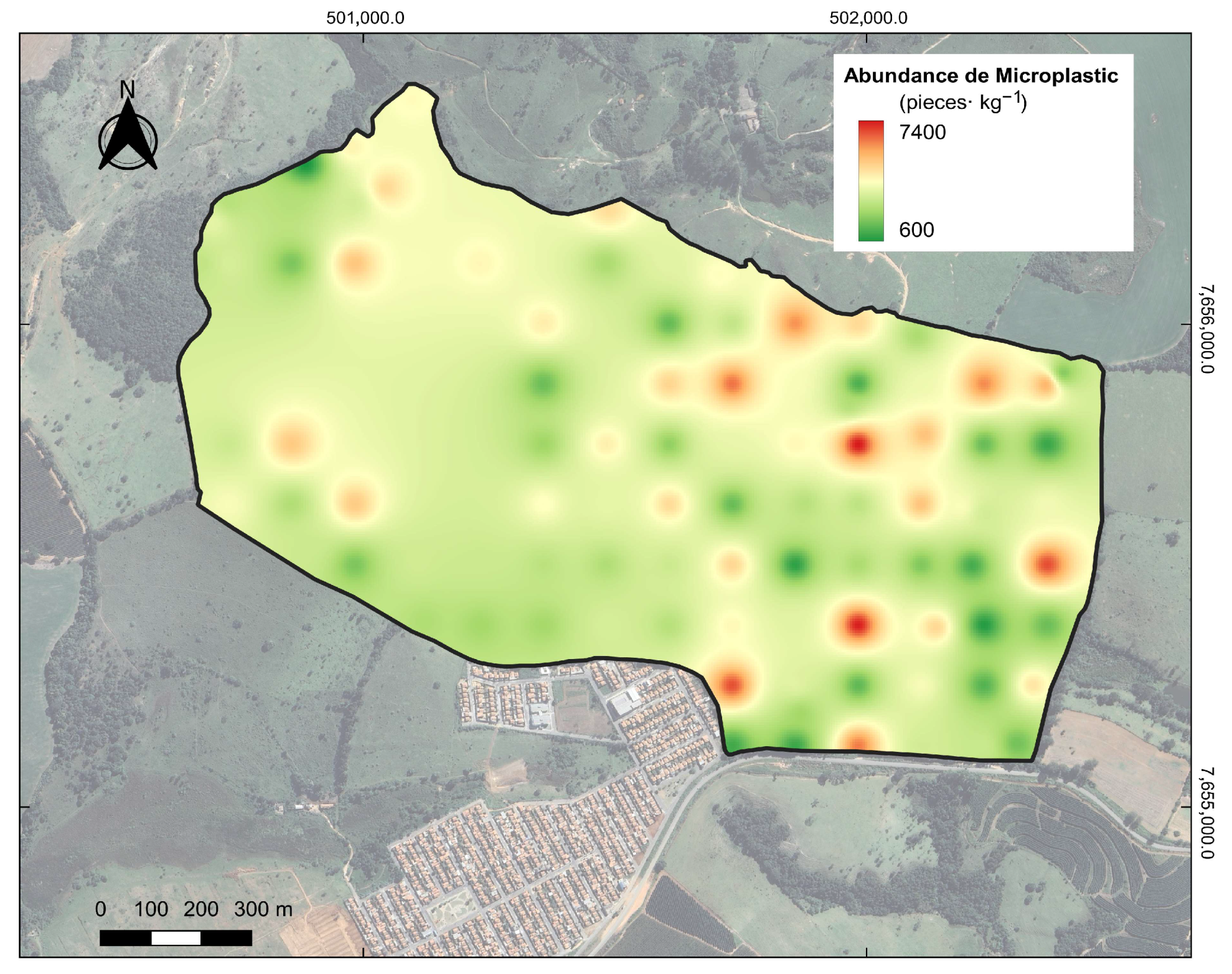
Since MPs exhibit anisotropy and low to moderate spatial dependence (almost a pure nugget effect), we also used the inverse distance squared interpolation method to obtain the prediction map for the study region. Figure 7 shows this map of the spatial distribution of MPs in the 0 to 20 cm layer. The predicted minimum and maximum values of MPs are 609 to 7394 pieces kg−1, respectively, and also show great variability in the abundance of MPs in the study region.
Figure 7.
Prediction Map of the spatial distribution of microplastics (pieces kg−1), obtained from the inverse distance squared interpolation method at micro-watershed from Muquém experimental farm, municipality of Lavras, Brazil.
The similarity between the maps generated using inverse distance weighting (IDW) and ordinary kriging with a spherical model, despite the moderate spatial dependence and low cross-validation performance, suggests that the overall spatial pattern of MP distribution is primarily controlled by the sampling data themselves. This indicates the presence of a consistent spatial trend in MP abundance, although the moderate spatial structure limits the potential advantage of kriging over deterministic methods. Consequently, while both interpolation methods provide a coherent representation of the general distribution of MPs, the low predictive performance highlights the need to interpret these results with caution and to consider them as indicative of relative spatial trends rather than exact estimates.
It is important to emphasize that this study presents a methodology for predicting the spatial distribution of plastic particles in soil, producing results that go beyond conventional point-based assessments of their occurrence. Figure 6 and Figure 7, generated using kriging and IDW interpolation, respectively, suggest that the observed pattern may be influenced by variables not explicitly included in the model, such as land use, topography (slope and depositional zones), surface runoff, and vegetation cover. In this context, higher abundances of plastic particles were observed in forested and agricultural areas, particularly in zones located near urban areas and roads.
This behavior can be attributed to anthropogenic activities in agricultural areas, where the application of organic and chemical fertilizers may introduce plastic particles [61]. In addition, the use and handling of plastic mulch, along with the improper disposal of plastic materials, contribute to the accumulation of MP in agricultural soils [20]. Over time, these materials gradually degrade through biotic and abiotic processes, releasing substantial quantities of MP into the environment [21,58,62].
In this regard, the study by Prajapati et al. [63] demonstrates that MP abundance in agricultural soils is significantly higher in areas near residential zones compared to commercial or industrial areas, as nearby population density directly influences contamination levels. In addition, Ling et al. [64] studied the occurrence and migration of MPs during high-intensity rainfall in an agricultural watershed in Shaanxi Province, China. 3710 pieces kg−1 were detected in the sediments, and the number of MPs trapped by the check dam was estimated to be 6.140 × 10¹⁰ pieces. Their findings indicated that heavy rainfall can significantly affect MP migration, transporting them to lower areas of the watershed where they tend to accumulate with sediments.
In this study, MP particles were found throughout the farm regardless of land use (forest, grassland, and agricultural). It should be noted that due to the lack of standardized methods, the abundance of MPs can be influenced by various factors, as shown in Table 1, such as sampling methods, locations, the way MPs are isolated from the soil, agricultural activities [65], and other natural or anthropogenic factors as described by Zhou et al. [66].
For example, studies by Brandes et al. [67] found high levels of MPs in the northwestern region of Germany due to the high use of sewage sludge, compost, and plasticulture waste. Some authors suggest that MPs in agricultural soil originate from packaging bags, plastic bottles, and mulch film, and that atmospheric deposition of MPs is more relevant for agricultural soils such as grasslands and forests. Therefore, it is suggested that future research should investigate the origin of sources that generate MPs in agricultural soils, and the effect of terrain and rainfall on the migration of MPs, especially in regions with high soil erosion.
The results obtained should be interpreted with caution for absolute quantitative purposes, but they do lead to the search for other alternatives to improve predictions. Therefore, for future research, we suggest using other models to fit the theoretical semivariogram, such as maternal, cubic, power, etc., as well as implementing other interpolation methods, such as universal kriging or co-kriging [40].
These approaches can improve modeling by incorporating information on the location coordinates of the data (universal kriging) or information on an external variable correlated with MP abundance [40], such as terrain morphology (slope, deposition zones), vegetation cover, pH, soil organic matter, or physical properties such as bulk density [19,68].
3.3. Limitations and Future Research of Microplastics in the Soil
Our study covered an area of 1.61 km2, identifying three land use types of representatives of tropical regions in southeastern Brazil: agricultural land, grasslands, and forests.
Expanding research to other representative ecosystems is essential, as well as assessing the influence of adjacent urban, industrial, and transportation areas on MP concentration and spatial distribution in the soil. The methodology employed in this study was limited to detecting MPs within the 0–20 cm soil layer. However, deeper soil horizons may also contain MPs. Therefore, to enhance understanding of the spatial distribution of MPs, future research should include the extraction and analysis of microplastics from deeper soil profiles [20]. Furthermore, there is a need to advance toward a standardized method for the extraction and classification of MPs across the full-size spectrum, enabling more reliable comparisons of data among different regions.
Another important consideration is that this study did not account for seasonal or temporal variations, which limited our ability to evaluate the dynamics of microplastic pollution over time. Such variations can influence the physical and chemical degradation of MPs through changes in temperature, humidity, and UV radiation exposure [48,69], as well as their transport via rain-driven infiltration and runoff, which accelerate vertical migration, and through wind and water erosion, which enhance the lateral movement of MPs [70].
Finally, the interpolation methods applied in this study, which utilized kriging and inverse distance weighted (squared) predictors to generate spatial distribution maps and predict MP abundance in the soil, represent important approaches for characterizing and visualizing the spatial dependency structure of MPs and were described in detail to facilitate replication by other researchers. However, However, this analysis may not be so simple due to the spatial complexity of the phenomenon under study. Implementing additional interpolation models, such as co-kriging, is recommended to enhance the validation of the geostatistical analysis.
4. Conclusions
Microplastic particles (MPs) were detected in all soil samples across the three land uses (forest, grassland, and agricultural). Although overall differences among land uses were limited, the post hoc analysis indicated that MP abundance in grassland soils was significantly lower than in forest soils. In contrast, no statistically significant differences were observed between forest and agricultural areas, nor between grassland and agricultural areas. Overall, grassland sites tended to present lower MP concentrations compared to the other land uses.
The spatial variability of MP abundance in the 0–20 cm soil depth was also characterized. The spatial distribution of MPs exhibited moderate spatial dependence and anisotropy, allowing the construction of an experimental semivariogram that was fitted with the spherical model. This enabled the mapping of MP abundance using (with caution) ordinary kriging. Other interpolation methods, such as the inverse distance weighted, may also be applied to enable the application of MP.
Thus, the application of geostatistics facilitated the creation of a map depicting the MP abundance across the study area. High MP concentrations were found near highways, in urban areas, and in low-lying regions where rainwater accumulates. Future research should explore the relationship between land use, landscape patterns, soil properties, and microplastic characteristics.
Supplementary Materials
The following supporting information can be downloaded at: https://www.mdpi.com/article/10.3390/agronomy15122862/s1. The R code for spatial analysis (Spatial_Analysis_MPs_Rcode), the Excel file containing the microplastic abundance data (dados_geoMPs), and the study area boundary file (borde_muquem).
Author Contributions
Conceptualization, J.J.A.-H. and M.L.N.S.; Methodology, J.J.A.-H., A.D.B.d.B. and M.L.N.S.; Formal analysis, J.J.A.-H. and A.D.B.d.B.; Investigation, J.J.A.-H., A.D.B.d.B., J.D.S. and M.L.N.S.; Writing—original draft, J.J.A.-H.; Writing—review and editing, A.D.B.d.B., J.D.S. and M.L.N.S.; Visualization, J.D.S.; Supervision, M.L.N.S.; project administration, M.L.N.S.; Funding acquisition, A.D.B.d.B. and M.L.N.S. All authors have read and agreed to the published version of the manuscript.
Funding
This research was funded by the Coordination for the Improvement of Higher Education Personnel (CAPES) (code 001), the National Council for Scientific and Technological Development (CNPq) (processes: 307950/2021-2 and 307059/2022-7), and the Foundation for Research Support of the State of Minas Gerais (FAPEMIG) (processes: APQ 00802-18).
Data Availability Statement
The datasets presented in this article are not readily available because the research team has decided to retain temporary access to support ongoing analyses and future publications. Requests to access the datasets should be directed to the corresponding author (john.arevalo@usco.edu.co or marx@ufla.br).
Acknowledgments
This work was supported by the Surcolombiana University (USCO), the Federal University of Lavras (UFLA). The authors would like to thank the Laboratory of Electron Microscopy and Analysis of the Ultrastructural Federal University of Lavras. During the preparation of this manuscript, the authors used ChatGPT (OpenAI, version 5.1) solely for spelling review and to improve the fluency of the written text. The authors have reviewed and edited all generated output and take full responsibility for the content of this publication.
Conflicts of Interest
The authors state that they have no financial interests or personal affiliations that could have inappropriately influenced the research presented in this manuscript.
Abbreviations
The following abbreviations are used in this manuscript:
| MPs | Microplastics |
| FTIR | Fourier-transform infrared spectroscopy |
| GPS | Global Positioning System |
| NaCl | Sodium Chloride |
| ZnCl2 | Zinc Chloride |
| LDPE | Low-density polyethylene |
| PVC | Polyvinyl chloride |
| AIC | Akaike Information Criterion |
| RMSR | Root Mean Square Residual |
| UTM | Universal Transverse Mercator |
| IDW | Inverse Distance Weighting |
| SDI | Spatial dependence index |
| UFLA | Federal University of Lavras |
| USCO | Universidad Surcolombiana |
References
- Li, J.; Zhu, B.; Huang, B.; Ma, J.; Lu, C.; Chi, G.; Guo, W.; Chen, X. Vertical Distribution and Characteristics of Soil Microplastics under Different Land Use Patterns: A Case Study of Shouguang City, China. Sci. Total Environ. 2023, 903, 166154. [Google Scholar] [CrossRef] [PubMed]
- Hossain, A.; Adham, I.; Hasan, M.; Mohammad, M.; Siddique, B.; Senapathi, V.; Reza, A.; Islam, T. Regional Studies in Marine Science Analysis and Risk Evaluation of Soil Microplastics in the Rohingya Refugee Camp Area, Bangladesh: A Comprehensive Study. Reg. Stud. Mar. Sci. 2024, 76, 103578. [Google Scholar] [CrossRef]
- Zhou, Y.; Wang, J.; Zou, M.; Jia, Z.; Zhou, S.; Li, Y. Microplastics in Soils: A Review of Methods, Occurrence, Fate, Transport, Ecological and Environmental Risks. Sci. Total Environ. 2020, 748, 141368. [Google Scholar] [CrossRef] [PubMed]
- Kumar, P.; Lee, J.; Brown, R.J.C.; Kim, K. Micro- and Nano-Plastic Pollution: Behavior, Microbial Ecology, and Remediation Technologies. J. Clean. Prod. 2021, 291, 1–22. [Google Scholar] [CrossRef]
- Shi, X.; Chen, Z.; Wei, W.; Chen, J.; Ni, B.-J. Toxicity of Micro/Nanoplastics in the Environment: Roles of Plastisphere and Eco-Corona. Soil Environ. Health 2023, 1, 100002. [Google Scholar] [CrossRef]
- Weber, C.J.; Santowski, A.; Chifflard, P. Investigating the Dispersal of Macro- and Microplastics on Agricultural Fields 30 Years after Sewage Sludge Application. Sci. Rep. 2022, 12, 1–13. [Google Scholar] [CrossRef]
- Chamas, A.; Moon, H.; Zheng, J.; Qiu, Y.; Tabassum, T.; Jang, J.H.; Abu-omar, M.; Scott, S.L.; Suh, S. Degradation Rates of Plastics in the Environment. ACS Sustain. Chem. Eng. 2020, 8, 3494–3511. [Google Scholar] [CrossRef]
- Machado, A.A.S.; Lau, C.W.; Till, J.; Kloas, W.; Lehmann, A.; Becker, R.; Rillig, M.C. Impacts of Microplastics on the Soil Biophysical Environment. Environ. Sci. Technol. 2018, 52, 9656–9665. [Google Scholar] [CrossRef]
- Yan, P.; Zhang, S.; Wang, J.; Wang, W.; Xu, B.; Hao, X.; Aurangzeib, M. Field Management Changes the Distribution of Mesoplastic and Macroplastic in Mollisols of Northeast China. Chemosphere 2022, 308, 136282. [Google Scholar] [CrossRef]
- Ding, F.; Jones, D.L.; Chadwick, D.R.; Kim, P.J.; Jiang, R.; Flury, M. Environmental Impacts of Agricultural Plastic Film Mulch: Fate, Consequences, and Solutions. Sci. Total Environ. 2022, 836, 1–4. [Google Scholar] [CrossRef]
- Radford, F.; Zapata-Restrepo, L.M.; Horton, A.A.; Hudson, M.D.; Shaw, P.J.; Williams, I.D. Developing a Systematic Method for Extraction of Microplastics in Soils. Anal. Methods 2021, 13, 1695–1705. [Google Scholar] [CrossRef]
- Grause, G.; Kuniyasu, Y.; Chien, M.; Inoue, C. Separation of Microplastic from Soil by Centrifugation and Its Application to Agricultural Soil. Chemosphere 2022, 288, 132654. [Google Scholar] [CrossRef] [PubMed]
- Li, W.; Wufuer, R.; Duo, J.; Wang, S.; Luo, Y.; Zhang, D.; Pan, X. Microplastics in Agricultural Soils: Extraction and Characterization after Different Periods of Polythene Film Mulching in an Arid Region. Sci. Total Environ. 2020, 749, 141420. [Google Scholar] [CrossRef] [PubMed]
- Quinn, B.; Murphy, F.; Ewins, C. Validation of Density Separation for the Rapid Recovery of Microplastics from Sediment. Anal. Methods 2017, 9, 1491–1498. [Google Scholar] [CrossRef]
- Thomas, D.; Schutze, B.; Heinze, W.M.; Steinmetz, Z. Sample Preparation Techniques for the Analysis of Microplastics in Soil—A Review. Sustainability 2020, 12, 9074. [Google Scholar] [CrossRef]
- Samanta, P.; Dey, S.; Kundu, D.; Dutta, D.; Jambulkar, R.; Mishra, R.; Ghosh, A.R.; Kumar, S. An Insight on Sampling, Identification, Quantification and Characteristics of Microplastics in Solid Wastes. Trends Environ. Anal. Chem. 2022, 36, e00181. [Google Scholar] [CrossRef]
- Zhang, G.S.; Liu, Y.F. The Distribution of Microplastics in Soil Aggregate Fractions in Southwestern China. Sci. Total Environ. 2018, 642, 12–20. [Google Scholar] [CrossRef]
- Munno, K.; De Frond, H.; O’Donnell, B.; Rochman, C.M. Increasing the Accessibility for Characterizing Microplastics: Introducing New Application-Based and Spectral Libraries of Plastic Particles (SLoPP and SLoPP-E). Anal. Chem. 2020, 92, 2443–2451. [Google Scholar] [CrossRef]
- Machado, A.A.S.; Lau, C.W.; Kloas, W.; Bergmann, J. Microplastics Can Change Soil Properties and Affect Plant Performance. Environ. Sci. Technol. 2019, 53, 6044–6052. [Google Scholar] [CrossRef]
- Khan, M.A.; Huang, Q.; Khan, S.; Wang, Q.; Huang, J.; Fahad, S.; Sajjad, M.; Liu, Y.; Mašek, O.; Li, X.; et al. Abundance, Spatial Distribution, and Characteristics of Microplastics in Agricultural Soils and Their Relationship with Contributing Factors. J. Environ. Manag. 2023, 328, 117006. [Google Scholar] [CrossRef]
- Wang, X.; Feng, Q.; Yang, L.; Li, M.; Zhao, F.; Tang, J.; Bu, Q.; Zhang, Y.; Chen, L. Effect of Land Use on Occurrence and Spatial Variability of Soil Microplastics in Agricultural Watershed. Ecol. Front. 2025, 45, 497–506. [Google Scholar] [CrossRef]
- Leitão, I.A.; van Schaik, L.; Ferreira, A.J.D.; Alexandre, N.; Geissen, V. The Spatial Distribution of Microplastics in Topsoils of an Urban Environment-Coimbra City Case-Study. Environ. Res. 2023, 218, 114961. [Google Scholar] [CrossRef] [PubMed]
- Liu, H.; Sun, K.; Liu, X.; Yao, R.; Cao, W.; Zhang, L.; Wang, X. Spatial and Temporal Distributions of Microplastics and Their Macroscopic Relationship with Algal Blooms in Chaohu Lake, China. J. Contam. Hydrol. 2022, 248, 104028. [Google Scholar] [CrossRef] [PubMed]
- Zhou, Y.; Jing, J.; Yu, R.; Zhao, Y.; Gou, Y.; Zhang, Z.; Tang, H.; Zhang, H.; Huang, Y. Microplastics in Plateau Agricultural Areas: Spatial Changes Reveal Their Source and Distribution Characteristics. Environ. Pollut. 2023, 319, 121006. [Google Scholar] [CrossRef] [PubMed]
- Villada-Arias, I.C.; Londoño-Ciro, L.A. Aplicación De Métodos Geoestadísticos Para La Caracterización De La Calidad Química De Un Depósito De Material Calcáreo. Boletín Cienc. La Tierra 2014, 15–23. [Google Scholar] [CrossRef]
- Araújo, D.C.d.S.; Montenegro, S.M.G.L.; Montenegro, A.A.d.A.; Silva, V.d.P., Jr.; dos Santos, S.M. Spatial Variability of Soil Attributes in an Experimental Basin in the Semi-Arid Region of Pernambuco, Brazil. Rev. Bras. Eng. Agric. Ambient. 2018, 22, 38–44. [Google Scholar] [CrossRef]
- Landim, P.M.B. Sobre Geoestatística e Mapas. Terra Didat. 2006, 2, 19–33. [Google Scholar] [CrossRef]
- Zhou, Y.; Jia, Z.; Zheng, G.; Chen, L.; Zhang, Q.; Su, B.; Zhou, S. Microplastics in Agricultural Soils on the Coastal Plain: Spatial Characteristics, Influencing Factors and Sources. Sci. Total Environ. 2023, 901, 1–12. [Google Scholar] [CrossRef]
- Sarti, F.M.E.; De Souza, G.A.; da Silva, B.R.; dos Santos, R.D. Municipal Park Grounds and Microplastics Contamination. J. Polym. Environ. 2022, 30, 5202–5210. [Google Scholar] [CrossRef]
- Silva, P.E.; Vincent, T.; da Conceição, H.; Santos, T.; de Almeida, M.; Vinhas Costa, O.; Rebouças, M.; Gonzaca, J. Widespread Microplastic Pollution in Mangrove Soils of Todos Os Santos. Environ. Res. 2022, 210, 112952. [Google Scholar] [CrossRef]
- Wrigley, O.; Braun, M.; Amelung, W. Global Soil Microplastic Assessment in Different Land-Use Systems Is Largely Determined by the Method of Analysis: A Meta-Analysis. Sci. Total Environ. 2024, 957, 177226. [Google Scholar] [CrossRef] [PubMed]
- Arévalo-Hernández, J.J.; Severo, E.M.; Brito, B.D.D.A.; Tassinari, D.; Silva, N.L.M. Assessment of Soil Microplastics and Their Relation to Soil and Terrain Attributes Under Different Land Uses. AgriEngineering 2025, 7, 281. [Google Scholar] [CrossRef]
- Mendes, A.; Dos Santos, G.; Emiliano, P.; Kaleita, A.L.; Ferreira, M.D.E.P. Estimação Do Tamanho Amostral Na Geoestatística Usando Um Modelo de Variograma Gaussiano Na Presença de Outliers. Energ. Agric. Botucatu. 2019, 34, 429–440. [Google Scholar] [CrossRef]
- Ferraz, A.G.; Moreira, F.; Augusto, P.; Silva, A.C.; Carvalho, F.D.M. Precision Agriculture to Study Soil Chemical Properties and the Yield of a Coffee Field. Coffee Sci. 2012, 7, 59–67. [Google Scholar]
- IUSS Working Group. WRB World Reference Base for Soil Resources. In International Soil Classification System for Naming Soils and Creating Legends for Soil Maps, 4th ed.; International Union of Soil Sciences (IUSS): Vienna, Austria, 2022; ISBN 9798986245119. [Google Scholar]
- Zhou, Y.; Liu, X.; Wang, J. Characterization of Microplastics and the Association of Heavy Metals with Microplastics in Suburban Soil of Central China. Sci. Total Environ. 2019, 694, 133798. [Google Scholar] [CrossRef]
- Arevalo-Hernandez, J.J.; Barrera, D.B.D.A.; Curi, N.; Avanzi, J.C.; Silva, N.L.M. A Method for the Extraction and Analysis of Microplastics from Tropical Agricultural Soils in Southeastern Brazil. Soil. Syst. 2025, 9, 34. [Google Scholar] [CrossRef]
- Corradini, F.; Meza, P.; Eguiluz, R.; Casado, F.; Huerta-Lwanga, E.; Geissen, V. Evidence of Microplastic Accumulation in Agricultural Soils from Sewage Sludge Disposal. Sci. Total Environ. 2019, 671, 411–420. [Google Scholar] [CrossRef]
- Weber, C.J.; Opp, C.; Prume, J.A.; Koch, M.; Andersen, T.J.; Chifflard, P. Deposition and In-Situ Translocation of Microplastics in Floodplain Soils. Sci. Total Environ. 2021, 819, 152039. [Google Scholar] [CrossRef]
- Scalon, J. Análise de Dados Espaciais Com Aplicações Em R; UFLA: Lavras, Brazil, 2024. [Google Scholar]
- Pebesma, E.J. Multivariable Geostatistics in S: The Gstat Package. Comput. Geosci. 2004, 30, 683–691. [Google Scholar] [CrossRef]
- Ferraz, G.A.S.; Ferraz, P.F.P.; Martins, F.B.; Silva, F.M.; Damasceno, F.A. Principal Components in the Study of Soil and Plant Properties in Precision Coffee Farming. Agron. Res. 2019, 17, 418–429. [Google Scholar] [CrossRef]
- Zanzarini, F.V.; Pissarra, T.C.T.; Brandão, F.J.C.; Teixeira, D.D.B. Spatial Correlation of the Vegetation Index (NDVI) of a Landsat/ETM+ Images with Soil Attributes. Rev. Bras. Eng. Agrícola Ambient. 2013, 17, 608–614. [Google Scholar] [CrossRef]
- R Core Team. A Language and Environment for Statistical Computing, R Version 4.4.0; R Foundation for Statistical Computing: Vienna, Austria, 2024.
- Ribeiro, J.P.; Diggle, P.; Christensen, O.; Schlather, M.; Bivand, R. geoR: Analysis of Geostatistical Data, 2025; version 1.9-6. Available online: https://CRAN.R-project.org/package=geoR (accessed on 27 November 2025).
- QGIS Development Team. QGIS Geographic Information System, Version 3.28.2; QGIS Development Team: Florence, Italy, 2024.
- OriginPro Lab Corporation. OriginPro, Version 2024b; OriginPro Lab Corporation: Northampton, MA, USA, 2024.
- Rafique, A.; Irfan, M.; Mumtaz, M.; Qadir, A. Spatial Distribution of Microplastics in Soil with Context to Human Activities: A Case Study from the Urban Center. Environ. Monit. Assess. 2020, 192, 671. [Google Scholar] [CrossRef]
- Akca, H.; Albayrak, R.; Onur, M.; Gündo, S. An Evaluation on Microplastic Accumulations in Turkish Soils under Different Land Uses. Sci. Total Environ. 2024, 911, 168609. [Google Scholar] [CrossRef] [PubMed]
- Du, A.; Li, Y.; Jian, Q.; Zhang, K.; Luo, Y.; Yan, J.; Du, P.; Power, D.M.; Li, Y.; Ma, Y. Multidimensional Characterization of Microplastic Pollution in Subtropical Urban Soils: Combining Geospatial Analysis and Polymer Risk Indexing. J. Hazard. Mater. 2025, 498, 139898. [Google Scholar] [CrossRef] [PubMed]
- Zhang, Y.; Wang, K.; Chen, W.; Ba, Y.; Khan, K.; Chen, W.; Tu, C. Effects of Land Use and Landscape on the Occurrence and Distribution of Microplastics in Soil, China. Sci. Total Environ. 2022, 847, 157598. [Google Scholar] [CrossRef]
- Cai, L.; Zhang, L.; Liu, Z.; Zhao, X.; Han, J. The Factors Affecting Microplastic Pollution in Farmland Soil for Different Agricultural Uses: A Case Study of China. Catena 2024, 239, 107972. [Google Scholar] [CrossRef]
- Chen, Y.; Leng, Y.; Liu, X.; Wang, J. Microplastic Pollution in Vegetable Farmlands of Suburb Wuhan, Central China. Environ. Pollut. 2020, 257, 113449. [Google Scholar] [CrossRef]
- Hao, Y.; Sun, H.; Zeng, X.; Dong, G.; Kronzucker, H.J.; Min, J.; Xia, C.; Shiung, S.; Shi, W. Smallholder Vegetable Farming Produces More Soil Microplastics Pollution than Large-Scale Farming. Environ. Pollut. 2023, 317, 120805. [Google Scholar] [CrossRef]
- Wang, J.; Li, J.; Liu, S.; Li, H.; Chen, X.; Peng, C.; Zhang, P.; Liu, X. Distinct Microplastic Distributions in Soils of Different Land-Use Types: A Case Study of Chinese Farmlands. Environ. Pollut. 2021, 269, 116199. [Google Scholar] [CrossRef]
- Li, H.; Lu, X.; Wang, S.; Zheng, B.; Xu, Y. Vertical Migration of Microplastics along Soil Profile under Different Crop Root Systems. Environ. Pollut. 2021, 278, 116833. [Google Scholar] [CrossRef]
- De Bhowmick, G.; Sarmah, A.K.; Dubey, B. Microplastics in the NZ Environment: Current Status and Future Directions. Case Stud. Chem. Environ. Eng. 2021, 3, 100076. [Google Scholar] [CrossRef]
- La, Y.; Zhang, L.; Zhao, N.; Ye, H.; Zeng, Q.; Zhao, L.; Wang, Z.; Lin, D.; Wang, R. The Microplastics Distribution Characteristics and Their Impact on Soil Physicochemical Properties and Bacterial Communities in Food Legumes Farmland in Northern China. J. Hazard. Mater. 2024, 471, 134282. [Google Scholar] [CrossRef] [PubMed]
- Yang, M.; Tian, X.; Guo, Z.; Li, J.; Guo, Z.; Li, H.; Liu, R.; Wang, R.; Li, Q. Effect of Dry Soil Aggregate Size on Microplastic Distribution and Its Implications for Microplastic Emissions Induced by Wind Erosion. Environ. Sci. Technol. Lett. 2022, 9, 618–624. [Google Scholar] [CrossRef]
- Cressie, N. Fitting Variogram Models by Weighted Least Squares. J. Int. Assoc. Math. Geol. 1985, 17, 563–586. [Google Scholar] [CrossRef]
- Klaus, J.; Seeger, M.; Bigalke, M.; Weber, C.J. Microplastics in Vineyard Soils: First Insights from Plastic-Intensive Viticulture Systems. Sci. Total Environ. 2024, 947, 174699. [Google Scholar] [CrossRef]
- Arevalo-Hernandez, J.J.; Barrera, D.B.A.; Avanzi, J.C.; Cirillo, M.A.; Silva, M.L.N. Plastic Debris in Agroecosystems: Distribution and Abundance Patterns, and Relationship with Terrain Characteristics in Southeastern Brazil. ACS OMEGA 2025, 10, 18457–18469. [Google Scholar] [CrossRef]
- Prajapati, A.; Jadhao, P.S.; Khare, A.; Vaidya, A.N.; Kumar, A.R.; Das, S. Characterization of Microplastics and Associated Heavy Metals in Urban Soils Affected by Anthropogenic Littering: Distribution, Spatial Variation, and Influence of Soil Properties. Soil Sediment. Contam. 2023, 33, 1018–1046. [Google Scholar] [CrossRef]
- Ling, Q.; Yang, B.; Jiao, J.; Ma, X.; Zhao, W.; Zhang, X. Response of Microplastic Occurrence and Migration to Heavy Rainstorm in Agricultural Catchment on the Loess Plateau. J. Hazard. Mater. 2023, 460, 132416. [Google Scholar] [CrossRef]
- Berenstein, G.; Córdoba, P.; Díaz, Y.B.; González, N.; Ponce, M.B.; Montserrat, J.M. Macro, Meso, Micro and Nanoplastics in Horticultural Soils in Argentina: Abundance, Size Distribution and Fragmentation Mechanism. Sci. Total Environ. 2024, 906, 167672. [Google Scholar] [CrossRef]
- Zhou, Y.; Wang, T.; Zou, M.; Yin, Q.; Jia, Z.; Su, B.; Zhang, Q.; Chen, L.; Zhou, S. Trends in the Occurrence and Accumulation of Microplastics in Urban Soil of Nanjing and Their Policy Implications. Sci. Total Environ. 2023, 903, 166144. [Google Scholar] [CrossRef]
- Brandes, E.; Henseler, M.; Kreins, P. Identifying Hot-Spots for Microplastic Contamination in Agricultural Soils-A Spatial Modelling Approach for Germany. Environ. Res. Lett. 2021, 16, 104041. [Google Scholar] [CrossRef]
- Zhang, H.; Huang, Y.; An, S.; Zhao, J.; Xiao, L.; Li, H.; Huang, Q. Microplastics Trapped in Soil Aggregates of Different Land-Use Types: A Case Study of Loess Plateau Terraces, China. Environ. Pollut. 2022, 310, 119880. [Google Scholar] [CrossRef]
- Chen, Z.; Carter, L.J.; Banwart, S.A.; Kay, P. Microplastics in Soil–Plant Systems: Current Knowledge, Research Gaps, and Future Directions for Agricultural Sustainability. Agronomy 2025, 15, 1519. [Google Scholar] [CrossRef]
- Chandrakanthan, K.; Fraser, M.P.; Herckes, P. Microplastics Are Ubiquitous and Increasing in Soil of a Sprawling Urban Area, Phoenix (Arizona). Sci. Total Environ. 2024, 906, 167617. [Google Scholar] [CrossRef]
Disclaimer/Publisher’s Note: The statements, opinions and data contained in all publications are solely those of the individual author(s) and contributor(s) and not of MDPI and/or the editor(s). MDPI and/or the editor(s) disclaim responsibility for any injury to people or property resulting from any ideas, methods, instructions or products referred to in the content. |
© 2025 by the authors. Licensee MDPI, Basel, Switzerland. This article is an open access article distributed under the terms and conditions of the Creative Commons Attribution (CC BY) license (https://creativecommons.org/licenses/by/4.0/).